UP IN A BALLOON. By A. Soden.
Reading edition
It was a delightful September afternoon some six years back—the close of a week during which there had been much discussion in the newspapers concerning a great balloon race versus cyclists, to be fought out on this identical Saturday. The late Rev. G. M. Bacon, of Newbury, the “ballooning parson,” and Mr. Percival Spencer, the well-known aeronaut, were to compete against Volunteer cyclists in an endeavour to settle the much-debated question as to whether, in time of war, a hostile balloon could escape from the speedy military wheelman. I am not a Volunteer, and certainly was at that time far from being a balloonist; I am less so now.
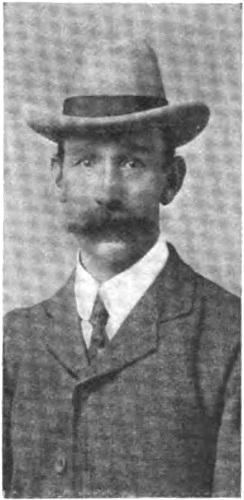
MR. A. SODEN, WHO HERE DESCRIBES HIS EXPERIENCES IN A RUNAWAY BALLOON. From a Photo. by Sternberg & Co., Kingston-on-Thames.
At four-forty-five in the afternoon of this particular Saturday, while I was still debating what to do with myself, what should I see to the north-east but the war balloon, released from its anchorage at Stamford Bridge grounds, being carried by a gentle September breeze in the direction of Epsom. At all times the sight of a balloon excites peculiar interest, and I had soon made up my mind—I would try my hand at catching the aeronauts, and try to beat the military cyclists! I rushed for my machine, and was presently in full chase, pedalling fast through the lovely lanes of Malden. On and on I went, riding hard, alternately glancing at the road to see that all was clear and then at the balloon, calculating how high it was, how far away, and where it was likely to descend.
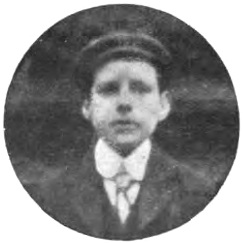
THE BOY WHO WAS WITH MR. SODEN IN THE BALLOON. From a Photograph.
Mile after mile I chased the drifting balloon, until at last, much to my joy, I saw that it was undoubtedly nearing the earth, and it eventually descended in a harvested field at Bookham. On approaching the balloon I soon discovered I was not alone, for cyclists representing various Volunteer regiments and civilian riders were there by the score; and a number of farm labourers who had been busy harvesting in the neighbouring fields also appeared on the scene, eager to inspect closely so formidable a beast as a war balloon.
The formal “capturing” of the balloonists by the soldiers was soon over, and then, at the urgent request of the onlookers, and to the intense delight of the local element, Mr. Spencer was good enough to grant permission for those who wished to go for short trips in the balloon, now held captive by the anchor-rope. There were many willing hands to relieve the balloon of ballast, grappling-irons, and sundries, and in a remarkably short time the great gas-bag was free of its accoutrements. A trail-rope was attached for those on the ground to hang on, to prevent the balloon from sailing away, and Mr. Spencer, with his usual foresight, arranged for parties of six to go up at a time. The passengers were given strict instructions that when the balloon touched ground each was to get out singly, so that there should be no sudden alteration of weight that would cause the balloon to shoot up again.
All went merrily, and several car-loads went up, we on the ground hanging tight to the rope and hauling the great bag down on the word of command from Mr. Spencer. At length came the call, “The last time!” and in I jumped. There were five of us in the car, four men and a boy—a Volunteer, a farm labourer, and two others. Surely, I thought, as the great sphere began to rise, I am well repaid for my long ride by this novel experience. It was grand to be sailing up in the air with the ground gradually sinking away beneath us and our late companions becoming mere specks dotted about on the ground. At last we arrived at the end of our upward journey, and the men below began hauling at the trail-rope. Down we went, and presently touched ground. Then, contrary to all instructions, out jumped the Volunteer and a civilian named Tickner. As they leapt they collided with the men who held the controlling ropes, knocking them over and causing much confusion.
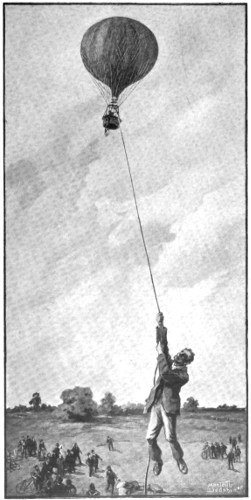
“HIGHER AND HIGHER WE WENT, WITH THE HAPLESS MAN DANGLING.”
The balloon, relieved of the heavy load, at once shot up again. There were wild cries of “Seize the rope!” “Hang on to her!” “Hold her down!” But all the shouts were of no avail; the balloon continued to rush upwards, while we peered helplessly over the edge of the car. Several men, realizing the dangerous position we were in, soaring up aloft at great speed, rushed into the middle of the crowd of excited onlookers and seized the trailing rope, but all to no purpose; it was now impossible to check the balloon’s rapid ascent. “Let go!” roared somebody, and by the sudden bound our car gave we knew the men had obeyed. All, that is, save one. He, Tickner, a hard-working, much-respected farm labourer, clung to the rope like a monkey, only to be drawn up into the air as the balloon rose. Higher and higher we went, with the hapless man dangling two hundred feet below us and the crowd watching with horror in their eyes. Presently, when he was about eighty feet from the earth, the poor fellow’s strength gave out and he was compelled to let go, falling with an awful thud to the ground.
Then, for the first time since the accident, I found my tongue. “Good heavens! this is awful!” I cried. “Where shall we drop?” I could say no more, for my knees shook under me and my very blood seemed frozen with horror. Still, steadily and inexorably, the balloon continued to rise. I dared not look over the side, but I knew we must have reached a considerable altitude. What would happen to us, and should we ever see our homes again?
All this time the boy beside me, shivering with fright, yet not realising his desperate position, kept dinning into my ears in a whining monotone, “They’ve let us go! They’ve let us go!”
There was nothing to be seen around us now but mountains of clouds—clouds white, black, and grey. I saw them, and yet, somehow or other, I could not bring myself to realize what they meant. I could not think, but simply stood there, bewildered and dazed, leaning against the side of the car. On my right hand the boy still continued his maddening wail; on the left my second companion, a man, kept asking what his father and mother would think. Our peril seemed to have temporarily turned his brain.
2 SEPTEMBER 1902. BALLON DISASTER. A LEATHERHEAD LABORER KILLED. THRILLING ADVENTURES OF AMATEUR AERONAUTS.
The ballon versus cyclists, which was arranged by the Rev. G. M. Bacon, of Newbury, the ballooning enthusiast, with the sanction of the War Office, and which took place from Stamford-bridge athletic grounds on Saturday, was, it was transpire, attended with an accident of a very serious character, resulting in the death of one man, injuries to several others, and an experience which three of those involved are never likely to forget as long as they live. The
A CUTTING FROM THE “MORNING LEADER” REFERRING TO THE BALLOON DISASTER. Click here for image.
I glanced at the altitude-registering instrument; we were up two thousand feet! Then, suddenly, without the slightest warning, my brain cleared, and I remembered the valve, the opening of which would cause the great gas-bag to descend. But where was it? Which was the valve-rope? The car seemed all ropes as I turned anxiously this way and that. I tried one after another, and at last, to my joy, I felt one give. Then I smelt the escaping gas, and knew that I had struck the right cord. Very soon I realized that our upward way was checked, and that instead we were descending. I do not know how long we took over the downward trip. I only remember that I pulled the rope, then slacked it, and so on alternately until we could faintly hear the shouts of those below. Presently the boy plucked up courage to look over the side of the car, and, wild with joy, called out that we were saved. Fortunately for us, there was practically no wind; we went up straight and came down straight, landing safely in a field only some two hundred yards from the spot where we ascended. I collapsed as they helped me out of the car, and the other man, directly he alighted, rushed headlong away—the ordeal had turned his brain.
Giving evidence before the coroner the following Monday at the inquest on poor Tickner, I still felt decidedly shaky, and to my dying day I shall never forget my trip in the runaway balloon.
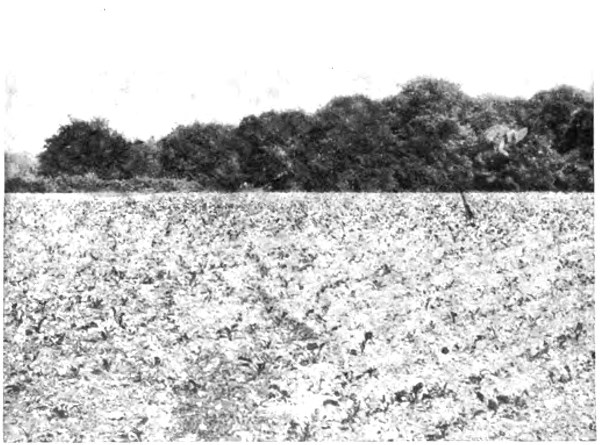
THE FIELD IN WHICH THE BALLOON DESCENDED. From a Photograph.