I.—MY ADVENTURES IN ‘FRISCO. By Ralph Stock.
Reading edition

It was on the first anniversary of the great earthquake that I found myself in San Francisco. The city was a forest of scaffolding and steam-cranes; huge blocks of stone and concrete hung suspended above the streets on their way to clothe the towering “quake-proof” steel frameworks that rose from the débris of former buildings like gigantic skeletons. Hills of bricks, mortar, and plaster confronted the pedestrian at every turn, and the dust from these and the streets generally made the city a blinding, choking wilderness.
The demand for labour in rebuilding had drawn to San Francisco the very dregs of humanity throughout the Americas, and strikes, street riots, and robberies with violence were of daily occurrence. The authority of the police was a sinecure; fat, good-natured giants in white, uniforms and helmets, with truncheons swinging from their wrists, leant against hoardings at street corners and smoked cigarettes, or earnestly requested a striker who became more than usually vociferous to “Cut it out” or “Go way back and sit down.”
It appears that in “’Frisco” the cheapest way of living is by drinking, for by buying five cents’ worth of inferior beer one is entitled to eat at a “free lunch counter” adjacent to the bar and have a cut from the joint and cheese and biscuits ad lib. To a world-wanderer like myself, whose income was, to say the least, precarious, this was a great institution; and it was at one of these counters that I met a would-be guide, philosopher, and friend in the form of a gaunt youth who, after a brief exchange of civilities, professed the desire to show me a little of ‘Frisco under-life—at my expense. He promised me Chinese opium and gambling dens and orgies in subterranean dancing-halls, with attendant excitements undreamed of by my prosaic mind.
Such an appeal to the adventure-loving spirit that lies hidden in most of us was irresistible. I closed with the offer, and after investing in a cheap revolver, that was quite as likely to hurt the man behind it as the one in front, we set out for the less frequented parts of the city. Down by the docks the streets were dark and deserted, and my guide improved the occasion by relating the various “sand-baggings” and assaults that had distinguished the quarter during the past week.
The only lighted shop we passed was a small tobacco booth, where I stopped to buy cigarettes. This could hardly have taken me more than two minutes, yet when I stepped out into the street I found my unfortunate guide lying face downwards on the pavement, with a thin stream of red creeping from his forehead towards the gutter. For a brief moment I thought he had fainted; then I saw his clothes had been rifled, and, glancing up the street, discerned the dim outline of three dark figures trotting silently and apparently without haste into the gloom.
A wave of anger took possession of me; the cowardly assailants evidently thought they would get off scot-free after an easy and profitable night’s work. I longed to give them at least a scare for their money.
Leaving my companion, still insensible, to the care of the tobacconist, I dashed up the street in pursuit. My footfalls echoed along the deserted thoroughfare like rifle-shots, so I hastily discarded my boots and continued the chase in socks.
Rather to my surprise I soon came in sight of the three figures in front, who had now dropped into a leisurely walk. This confidence in their security for some reason angered me the more, and in the deep shadows of a wall I crept nearer and drew the revolver from my pocket.
I had never shot a man in my life, and for the first time I experienced the dread of doing this in cold blood. Then I remembered my companion’s gaunt figure prone on the pavement, and the fact that but for a packet of cigarettes I should have certainly shared the same fate. I fired—low down.
The men scattered like startled rabbits; two darted down by-streets on opposite sides of the road, while the third took an abrupt seat on the pavement and examined his leg, evidently more concerned about his wound than the chances of escape.
As I rushed down the turning to the left I sighted my second quarry scrambling over a mound of bricks; he turned and saw me at the same instant, and then began a chase and obstacle race combined under conditions that are probably unique. Over mounds of sand, lime, and broken brick; through mazes of scaffolding, barrels, planks, and wheelbarrows, pools of muddy water, and quagmires of soft mortar we went. My bootless feet were soon battered and bruised, but the fever of the chase was in my veins, and as long as my quarry was in sight I felt incapable of abandoning the pursuit.
The fugitive was now hardly thirty feet ahead, and I dashed after him round a corner of scaffolding, confident that I had run him to earth; and I did, but not in the way expected. He had crouched low just round the corner, and, unable to stop myself, I fell headlong over his body. It was an old trick, and I scrambled to my feet anathematizing myself for a fool, but my man had vanished. With slightly cooler blood and a bruised head I had just decided to leave matters where they stood, when I heard a gentle rasping, and looked up to find him clinging to a scaffold-pole above my head. I could see his white face looking down at me.
“What are you going to do about it?” he demanded, breathlessly.
“Come down and you’ll see,” said I, sternly.
When at last we stood facing each other, however, I found myself at a loss. He was a mere boy, with a wizened, old-young face and cunning eyes that took me in from hatless head to socked feet with a callous insolence that rather appealed to me. What was I going to do about it? The police of San Francisco were either asleep or smoking cigarettes in more salubrious quarters of the city; and it was next to impossible to give him in charge, so I took the law into my own hands.
“Hand over what you took,” said I, “and you shall go.”
“The others went through him,” he replied, sullenly; “I don’t know how much they got.”
“Shall we call it twenty-five dollars as a minimum?” I suggested.
His face expressed neither approval nor dissent, but he drew from a ragged pocket a large gold watch.
“Guess that’ll cover it,” he said, coolly, and on examination I found that it did, by fully another twenty-five dollars.
When, after considerable difficulty, I found my way back to the tobacconist, my companion had recovered consciousness and, with a bandaged head, sat up to hear my report.
“How much did you lose?” was my first question.
“Nothing,” he said; “I haven’t a cent in the world.”
“Then here’s something to be going on with,” said I, and handed him the watch.
After the foregoing, it is with some reluctance that I relate what happened two days later, but the experience is so typical of San Franciscan under-life that I can hardly allow it to pass unrecorded. My own part in the affair was entirely reprehensible, and I need say no more, for everyone knows that, while confession may be good for the soul, it is rarely compatible with personal dignity.
I wished to go to a certain theatre, and asked the way of the first pedestrian I met. He smilingly informed me that I was going in precisely the opposite direction, and that, as he happened to be passing the doors himself, he would show me the way. During the next five minutes I learnt that my guide was also a stranger to San Francisco, and that he had come from Canada. As I had lived there myself for four years this supplied a connecting link in our reminiscences, and we entered the first bar to improve the occasion. He certainly knew the Canadian prairie like a book, and his anecdotes of ranch and bush life were so interesting that the theatre was soon forgotten and we settled down for a chat.
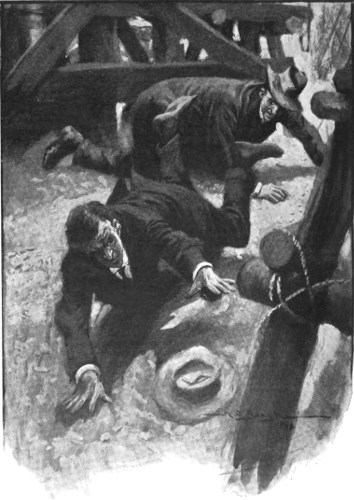
“UNABLE TO STOP MYSELF, I FELL HEADLONG OVER HIS BODY.”
It appeared that he had tired of the rough life of the plains, and after a course of study had become a telegraph operator in Denver.
While there he had been approached by a gang of wire-tappers2 with a view to his becoming a confederate, but he had refused. A few weeks later he heard of their capture, and went to see the trial and conviction of the entire gang.
Now, however, they were again at large, for he had recognised their leader that very day in the streets of San Francisco, and without a doubt he was engaged in his old nefarious business.
My companion’s idea was to make a round of the city pool-rooms, where they received news of the races by wire, and, if he encountered the “wire-tapper,” force him by threats of exposure to divulge what horses he was going to back. “There might be some brisk fun,” he said. “Would you care to come and see it?”
This appealed to me rather more than the theatre, and we accordingly started a careful tour of every pool-room in the city. They were dark, dusty places, swarming with a heterogeneous collection of humanity that ceaselessly shuffled and elbowed round boards bearing notices of the odds and winners, while a sleek gentleman in faultless attire stood on a rostrum at the end of the room and acted as “bookie.”
The fruitlessness of my companion’s search was growing a trifle monotonous, when, on entering the fourth of these rooms, he seized my arm and nodded in the direction of a tall, stout man who had emerged from the crowd and stood counting over a large roll of bills. At last he seemed satisfied, slipped an elastic band round the roll, and strode out into the street.
“Come on,” whispered my companion, excitedly; “that’s my man.”
Not far from the door he tapped the stranger on the shoulder. The tall man faced about with surprising swiftness.
“What do you want?” he snapped.
“I know all about you,” said my companion, evenly.
The collapse was sudden; the tall man’s jaw dropped perceptibly.
“Come farther away and I’ll listen to you,” he said, with a furtive glance at the pool-room doors.
Round a quiet corner my companion stated his business, and the wire-tapper brought out his roll of bills and fingered them feverishly.
“This is blackmail,” he whined; “but how much do you want?”
“It’s not blackmail, and I want none of your money,” protested my companion, indignantly. “All you have to do is to take my money and place it on the right horse. Here are ten dollars for a start. I shall watch you go in and come out of the pool-room from this corner.”
The wire-tapper had hardly left us when a little boy of thirteen or fourteen ran up to him with a note; then he disappeared through the swinging doors.
Presently the wire-tapper came out and, without a word, counted thirty dollar bills into the other’s hand.
“The price was only two to one,” he explained, apologetically.
“Never mind,” said my companion; “better luck next time. Just place this thirty dollars for me, and that will do—for the present.”
The process was repeated, and this time ninety dollars changed hands; but the wire-tapper was evidently nervous and anxious to be gone, and when my companion tentatively suggested a third attempt he refused point-blank, on the ground that if he won any more that day it would arouse suspicion. This objection, however, was overruled by the other offering to place the money himself.
“And we’ll make the amount worth while; shall we?” he added, turning to me. “Do you feel inclined to join me in a hundred-dollar bet?”
Fifty dollars meant a good deal to me then, but the two or three hundred it would bring in meant a great deal more, so I took the plunge. After another note had changed hands between the wire-tapper and the boy, he told us to back Rough Diamond for the next race, and threw in fifty dollars as his own stake; then we took up our position on the opposite pavement and waited expectantly.
To my surprise my companion soon appeared and exultantly informed us that he had succeeded in placing our stake on Rough Diamond to win at three to one.
“To win?” roared the wire-tapper.
“Yes, to win,” retorted the other, feebly.
The wire-tapper literally danced on the pavement.
“You fool!” he spluttered; “I told you to back the horse for a place this time—it has come in third.” He turned to me. “Didn’t I say for a place?” he snapped, vehemently.
But I took no further interest in the proceedings. In Western parlance, I had been “done brown.” The men were confederates, and all that was left for me to do was to swallow my medicine without grimacing. So I smiled blandly, congratulated them on their acting, and left them to marvel at man’s credulity.
It all sounds very foolish and easy, set down in black and white, but the San Franciscan “confidence man,” by long and unhampered practice, has reduced his methods to a fine art; and although it is hardly likely that any respectable, level-headed reader of The Wide World would fall a victim to his wiles, such a thing has been known to occur to others, and if the foregoing personal experience helps to put these on their guard, the purpose of its recounting will be served.