Mountain Tragedies of the Lake District.
Reading edition
A contribution appealing to climbers and non-climbers alike. Although the writer prefers to remain anonymous, he is a well-known mountaineer. In this article he gives an authoritative and most interesting account of the various climbing fatalities which have occurred in the English Lake District, pointing out exactly how each disaster occurred. Photographs by G. P. Abraham, Keswick.

In these days of hurry-scurry mountaineering, when the words of the wise are on every climber’s tongue and the intention to obey them in few men’s minds, a great deal is written concerning the perils of the mountains. The object of the greater part of these writings has been to elaborate in detail the various phases of mountaineering dangers and how to obviate them: in other words, how best to avoid accidents.
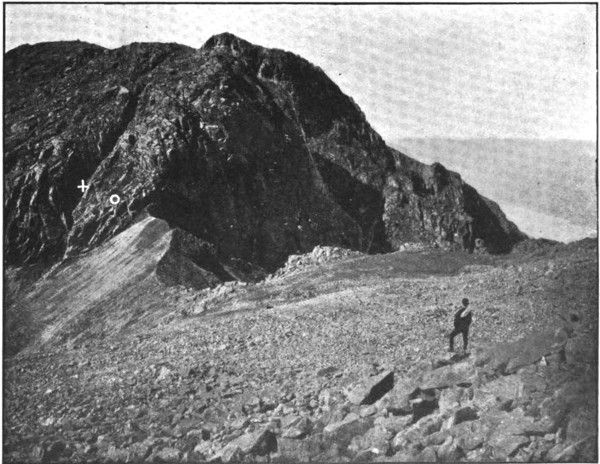
MICKLEDORE RIDGE AND THE BROAD STAND—THE CIRCLE MARKS THE SPOT FROM WHICH MR. HAARBLEICHER FELL AND THE CROSS THE POINT WHERE MR. PETTY LOST HIS BALANCE. From a Photograph.
It is a somewhat singular fact that, beyond a few generalities and platitudes evolved by non-climbing reporters, no record has been written of the accidents themselves. And yet, in the case of the accidents that have occurred in the Lake District, much is to be learnt. Every disaster on the mountains, if properly understood, should teach a lesson, for the majority of them are only accidents in part, and have been directly due to the disregard or violation of some cardinal law governing the sport of mountaineering.
If a man who has never been on a mountain in his life before endeavours to scale a steep precipice and loses his life in the attempt, can such be truly called an accident? Surely it would be more of an accident if he succeeded in winning through without mishap; a fatal fall may under such circumstances be called a tragedy—a disaster, but surely not an accident.
And yet the circumstances of the so-called accident to Mr. Haarbleicher, a Manchester merchant, in 1892, were almost in accordance with the above instance.
He arrived at Wastdale Head Hotel with his sister, and, being “anxious to climb his first mountain,” ascended Scawfell.
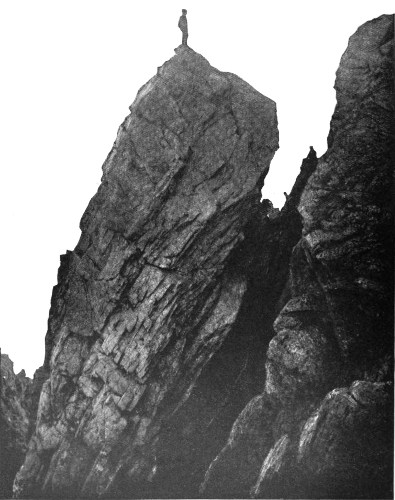
SCAWFELL PINNACLE—PROFESSOR MARSHALL HAD JUST RETURNED FROM THIS CLIMB WHEN HE MET WITH HIS FATAL ACCIDENT. From a Photograph.
In attempting to descend to Mickledore by way of the Broad Stand, at the bottom of which is a steep cliff, he jumped downward on to a scree-covered slab, his feet shot from under him, and he fell a distance of more than a hundred feet. As a result of his injuries he succumbed shortly after.
This lower cliff of the Broad Stand was responsible for another fall, which, however, did not prove fatal. A Mr. Petty was climbing Mickledore Chimney with a large party, amongst whom was his fiancée. The late J. W. Robinson was the leader. At the place where the Chimney is left and a step across to the Broad Stand effected, Mr. Petty took off the rope in order to let the leader throw the end of it down to the others of the party.
An agonized shout from Petty caused Mr. Robinson to turn sharply, and he saw his companion shooting head downwards with terrific velocity to the screes below. The distance, carefully measured afterwards, was a hundred and seven feet. Some of the party, still at the foot of the Chimney, were horrified to see Mr. Petty hurtling through the air towards them, and narrowly escaped being struck.
He fell face downward. The angle of his body conformed exactly to the slope of the screes, and his entire length struck the slope at once. It seems incredible that he could survive such a fall, and his friends never hoped to find him alive. His injuries was terrible, but nevertheless he still lived, and, by careful nursing, regained his full strength.
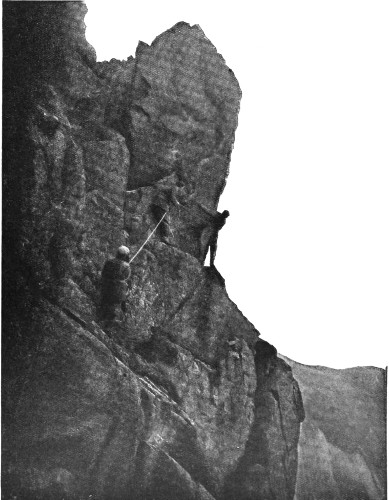
THE PILLAR ROCK—THIS IS THE CLIMB THE NOVICES WERE ATTEMPTING WHEN MR. WALKER WENT TO THEIR ASSISTANCE. From a Photograph.
This is surely the most wonderful bit of luck that ever befell a climber. It transpired afterwards that he had grown impatient of waiting for the others to come up and had begun to fill in the time by a little desultory climbing on a steep slab directly above him. Off this he had just slipped when he shouted and drew the attention of Mr. Robinson and the others.
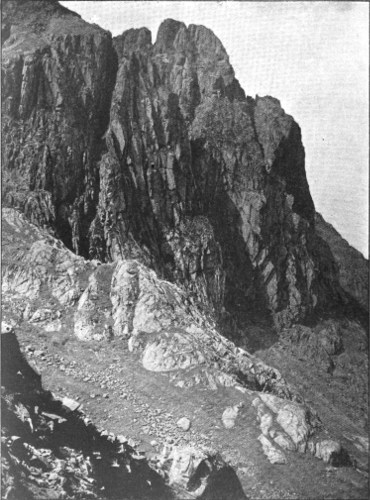
THE PILLAR ROCK AND SHAMROCK (NORTH SIDE)—THE CROSS SHOWS THE CLIFF MR. WALKER SLID OVER, NOW KNOWN AS “WALKER’S GULLY.” From a Photograph.
Would that Professor Milnes Marshall, who was killed the following year on the opposite side of Scawfell, could have had such a providential escape! His fall could not have been one of more than twelve feet, and yet it proved too great.
In company with the late Owen Glynne Jones and Joseph Collier, Professor Marshall had just previously climbed Scawfell Pinnacle by way of Steep Ghyll, returning down Deep Ghyll to the foot of the crags, where they had lunch together. Being anxious to obtain a photograph of the Ghyll, Professor Marshall scrambled up the fell side opposite to its entrance.
The nature of the ground was so easy and well broken up, although rocky and steep, that his companions never for a moment dreamt of disaster. Hearing a noise of falling stones they looked round and saw a cube of rock, about two feet in diameter, rolling down the mountain side. This was followed by the body of Professor Marshall. Both came to rest on the scree slope below the Lord’s Rake, where, to their great astonishment and horror, Messrs. Jones and Collier found the life of their companion quite extinct. Exactly how the accident happened will never be known, but it was surmised at the time that Mr. Marshall had stepped on the cube of rock and that it had given way with him. It has become proverbial that “it is on the easy places that accidents happen,” and no doubt it was the easy nature of the ground that caused a temporary carelessness on the part of a man who, in all mountaineering circles, was recognised as a most careful and cautious climber.
We may pass over briefly the death of the Rev. James Jackson, who fell on the Pillar and was killed in May, 1878. He was alone at the time, but his body was found at the foot of a steep cliff, near the summit of the mountain. In walking along the top of the cliff he had evidently slipped over, but what caused him to do so will never be known. The fact that the reverend gentleman had attained to the ripe age of eighty-two years may suggest a broad reason.
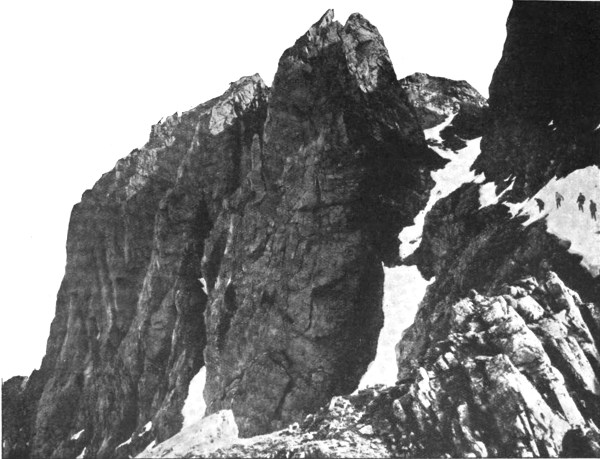
SCAWFELL PINNACLE AND DEEP GHYLL, SHOWING THE GHYLL AS IT APPEARED WHEN MR. GOODALL GLISSADED DOWN IT TO HIS DEATH. From a Photograph.
At Easter, nearly five years later, a party of novices were trying to climb the Pillar Rock from the east side. For some time they were unsuccessful. Just then another party reached the top of the Pillar Mountain; one of them, a Whitehaven youth of the name of Walker, had climbed the rock some time before. Seeing the predicament of the novices, he set off down a snow-slope towards them, intending to direct their ascent. He had only gone a few feet when he slipped on to his back and shot off down the snow. Gathering terrific and uncontrollable impetus as he slid, he reached the Rock, which juts out of the side of the mountain, in a few moments and dashed into it. His body bounded off it and then fell into a gully on the right. This was filled with hard snow, which carried him swiftly downward until the crest of a sheer cliff was reached. Over this, for five hundred feet, he plunged, and far into the Ennerdale valley below, death, of course, being inevitable.
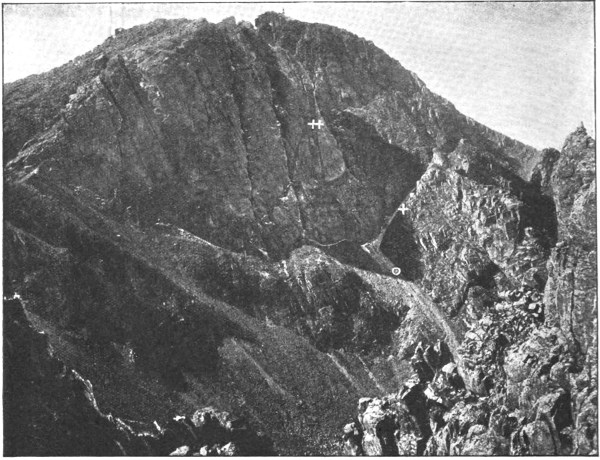
SCAWFELL AND MICKLEDORE—THE DOUBLE CROSSES INDICATE THE LEDGE FROM WHICH THE PARTY OF FOUR FELL; THE SINGLE CROSS DENOTES WHERE PROFESSOR MARSHALL SLIPPED; AND THE CIRCLE SHOWS WHERE ALL THE BODIES, INCLUDING THAT OF MR. GOODALL, WERE FOUND. From a Photograph.
Of the witnesses of this accident two subsequently lost their reason, and the death of another shortly afterwards was attributed to the shock. And all for the want of a little caution and forethought on a snow-slope! Still, “out of evil comes good,” and no doubt the remembrance of this terrible tragedy and its contributory cause has ultimately saved many valuable lives. Only once since then has it been forgotten in the Lake District, and this led to the last tragedy that has happened. This was to poor Alexander Goodall, a Keswick youth, who deliberately set off glissading down the snow at the top of Deep Ghyll on Scawfell.
To those of us who know the frightful velocity that is attained in a few feet on steep snow, and the long years of practice necessary to control this speed, such an act would appear quite inexplicable. But to him, whose first day on snow it was, and in entire ignorance of its insidious dangers, that downward slide would present no terrors, until, with balance gone and ice-axe snatched out of his grasp by the snow in which he wildly dug it, his mistake flashed across his mind with terrible meaning. Alas! he learnt his lesson too late; he did not live to profit by it, for his body dashed downward, crashing into the rocks as it sped, until it came to rest on the scree-slope five hundred feet below, within a few feet of the place on which Professor Marshall fell.
A short three months before this same spot witnessed the most terrible of all the Lakeland tragedies, when a party of skilful climbers fell from the north face of Scawfell Pinnacle. Even the historical accident on the first ascent of the Matterhorn, when all of a large party were killed but Mr. Whymper and two guides, palls before this home disaster, for here four Englishmen in the prime of their youth were suddenly called away.
On September 21st, 1903, Messrs. Broadrick, Garrett, Jupp, and Ridsdale started from Wastdale Head for Scawfell, intent upon climbing the Pinnacle by the difficult route from Deep Ghyll. This they successfully accomplished, and afterwards redescended to the foot of the Pinnacle, where they had lunch with another climbing party, which was under Mr. W. E. Webb’s leadership.
After lunch Mr. Webb’s party bade them au revoir and went off to climb one of the cracks on the far end of the crags. After their climb they foregathered on Mickledore Ridge, and thence set off along the base of the cliff to regain their knapsacks, which had been left at the lunching-place.
As they neared the foot of the Pinnacle they heard a shout, but thought it came from the valley below. Leisurely they rounded a corner, and there, about fifty yards away, in the vicinity of the screes where they had lunched, saw four figures stretched out and lying quite still.
In a disconnected way they thought at first that these four figures were asleep, though it was a peculiar place to fall asleep in; then something unusual about their attitudes became apparent, and not till then did the awful reality flash upon them.
They tore across the rough intervening ground and made a dreadful discovery. Only Mr. Ridsdale was alive, and even he was obviously too terribly injured to recover. As they approached he raised his head. “I’ve been shouting for hours,” he murmured. “I’m afraid the others are all gone, but look after them and don’t mind me.” As he feared, they were past human aid, and death had evidently visited them with merciful swiftness, for their bodies were already cold.
It was now nearly six o’clock, and little could be done for poor Ridsdale, but Mr. Webb and another of his party stayed with him whilst the other ran down to Wastdale for help.
From that time until nearly ten o’clock they did all in their power to alleviate the sufferings of the survivor, who was in great pain. Darkness set in before seven o’clock, and their lonely vigil, with the wind sighing weirdly through the crags above their heads, their three erstwhile friends lying dead around them, and poor Ridsdale moaning and but half conscious most of the time, must have been an awful experience. The remembrance of Ridsdale’s heroic appeal to them to tend the others before him, and afterwards the manly efforts of Mr. Webb and his friend to help and sustain their dying comrade in such awful circumstances through those long, dark hours of waiting, must ever linger with pride in the hearts of all true Englishmen. We may be a degenerate race; but, if this Scawfell tragedy has done nothing else, it has proved that there are still men amongst us.
Little more remains to be told. The rescue party arrived through the darkness with a stretcher, and by the light of the lanterns, after strenuous labour and weary suspense, succeeded in conveying the survivor downward over the rough stones and shale, only to find, alas! that their effort was in vain, for their burden expired about an hour before they gained the shelter of the inn.
From what Mr. Ridsdale let fall in his delirium, and by an investigation of the face of the Pinnacle from which the party fell, it was not difficult to reconstruct their doings before the accident. After Mr. Webb’s party had left them they started up the north face of the Pinnacle, a climb that had not hitherto been accomplished, with Mr. Broadrick leading. He must subsequently have relinquished it, however, for their position on the rope when found showed that Mr. Garrett had taken over the lead. From a narrow ledge about two hundred feet up the sheer rock-face Mr. Garrett slipped, and the others, not being well placed to sustain a shock, were plucked one after another from their holds and dashed to the screes below.
Apart from Mr. Garrett’s slip, there were two prime contributory causes of the accident. The first was the perseverance of the party beyond where good anchorage (a place where the leader could be checked by the rope in case of a slip) was obtainable; and the second was in not turning back and abandoning the climb when Mr. Broadrick, by far the most experienced and careful man in the party, gave up the leadership.
It is easy to be wise after the event, but similar circumstances may arise some day on another climb. If the Scawfell Pinnacle disaster and its lesson are then recalled, it may be the means of working the salvation of future climbers, and the loss of four valuable men, plucked off in their prime, may not have been in vain.