“TAPU.” By D. W. O. Fagan, of Mangapai, Whangarei, Auckland, New Zealand.
Reading edition
The author writes: “I can vouch for this story in every particular. I hope it may prove interesting to ’Wide World’ readers, as illustrating the endless ramifications of the old Maori law of ‘tapu,’ and the absurd predicaments in which Europeans coming under its influence occasionally found themselves.”

In the old days of thirty-five years ago, especially in the out-districts, the Maoris still retained many of their ancient customs.
Among other inconvenient practices they had an insane habit of depositing the bones of the dead in any kind of handy spot that took their fancy—on the top of an island, in a hollow tree, in the crevices of rocks—anywhere that was most convenient.
Afterwards the place became “tapu” (sacred, forbidden, prohibited). Consequently any unwary and unsuspecting stranger who, happening along, chanced to lean against the tree or tread on the rocks became himself “tapu” (meaning, in this connection, accursed, unclean), and was hunted from the tribe as a social leper and outcast. Like Cain, every man’s hand was against him, though it was forbidden to kill him; and unless he was a man of mark and could get the “tohunga” (priest) to “lift the ‘tapu’ off him” he speedily succumbed to a general sense of misery and superstitious bedevilment.
It is not my intention to attempt an explanation of the working of the “tapu” law. That has already been done by far abler pens than mine. My own opinion is that no one ever did properly understand it—not even the Maoris themselves.
In the beginning, probably, the thing was a decent and workable law enough, as laws go, but in the course of ages, what with amendments and addenda, it got beyond everything and was entirely indigestible by human intellect; finally becoming an incubus—a kind of religio-legal nightmare from which they couldn’t wake up.
I only know that any place, person, or thing could become “tapu.” Food, fire, air, and water were not free from it. Man, woman, and child were subject to it. For any trivial cause and without his knowledge a man might be made “tapu.”
Sometimes it was partial, affecting only the feet or hands, and on these occasions a man could put a “tapu” on himself by walking about or scratching his own head!
Anyhow, if you got a bad dose of it, things became pretty uncomfortable.
White men could generally escape by affecting to ignore the thing and taking ship for another country.
Unfortunately, as the reader will perceive, circumstances prevented my adoption of this course.
At the time I am telling of I was superintending their northern trading station at Te Mata for Messrs. Franks, Backhouse, and Co., a big Auckland firm. Puketawa—whom I have mentioned in previous Wide World contributions—a native of the South Island, educated at a mission school, was by way of being my servant and store-help. Having lived much with Europeans, and being ridiculously proud of the little the mission school had taught him, he affected to despise the Maoris of the neighbourhood. “Ignorant savages,” he called them, and stood aloof in the light of superior wisdom. At times he even permitted himself a mild remonstrance at what he considered my undue intimacy with the heathen. Education had made Puketawa a bit of a snob; but, for all that, he was a very good fellow.
The store, residence, and outbuildings stood on the shore of the tidal estuary of the Mangapai River. Over a low range of hills running parallel with the coast, at a distance of about half a mile, was the Maori “kainga” (village), having a population of about nine hundred souls.
It was with the object of bringing the blessings of civilization to these benighted inhabitants and—of course, quite incidentally—securing a profit to themselves that my principals had established the trading post.
Being the only station within a radius of fifty miles, trade was good, and neither merchants nor agent had reason for complaint on the score of value or bulk of the cargoes of native produce picked up by the firm’s trading steamer on its quarterly round.
By largess of sweets to the piccaninnies and gauds of cheap jewellery to their mothers, I had gained a certain popularity. With Te Horo, the chief, I was on terms of close friendship. I had quite won the old fellow’s heart by a timely gift of an imitation pearl necklace to his youngest and favourite wife. By careful tutelage I was fast inducing in these children of Nature a craving for the things of the white man’s higher life as represented by cotton goods, sugar, tea, tobacco, etc. For obvious reasons, therefore, I was anxious to retain their good will, and careful lest by any infringement of custom or superstition I should unwittingly offend. In the light of what follows this should be remembered.
The snipe were thick that autumn on the tidal flats at the river’s mouth, and as a break to the monotony and with a view to change of diet I would often close the store on Saturday afternoons and, with Puketawa, drop down stream on a gunning expedition.
It was on one of these weekly excursions that misfortune fell upon us. The birds were shy that day, and we followed them far over the sand-flats. Intent on our sport, neither of us noticed the signs of an ominous change in the weather, till, chancing to look seaward, I became suddenly aware of it. The blue water had changed in colour to a leaden grey and the horizon was hidden in a dense shroud of mist, which, with the wind behind it, was rapidly rolling up towards us. There was no time to lose. Our boat was at anchor a mile away on the inner edge of the sand-flat. It would be a race between us and the fog. If overtaken on those interminable banks we might wander, hopeless, till the returning tide drowned us like rats in a trap.
Fortune favoured us. We reached the boat, and, breathless, had just tumbled into it and hoisted sail, when the sea-fog shut down like a curtain. Sky, cliffs, and river channel were blotted out in an instant. No pretence at keeping a course was possible. The river ran due west, and, the wind coming from the east, it only remained to sit tight and let the boat scud before it, trusting to luck that we did not ram any one of the hundred rocky islets studding the river’s mouth.
Our vision, beyond a small circle of heaving grey water immediately around us, was shut in by the wall of thick white vapour. With Puketawa at the sheet, I at the steer-oar, we drove along in a little world of our own.
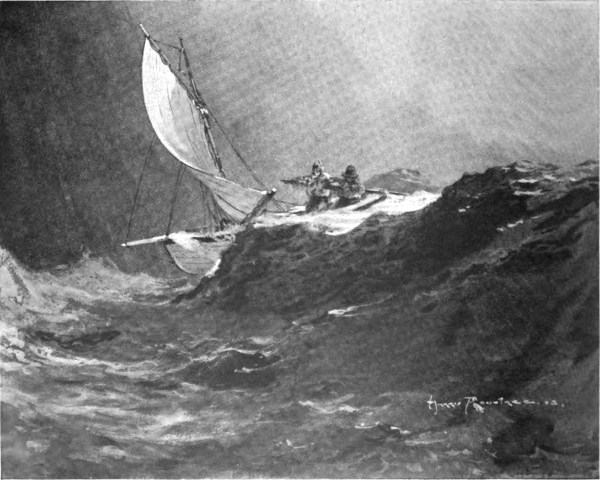
“IT ONLY REMAINED TO SIT TIGHT AND LET THE BOAT SCUD.”
Suddenly, at a yell from Puketawa, I looked up. A wall of rock loomed dark through the mist, before and above us! “Luff!” he screamed, but there was no time. Ere I could sweep her round with the oar a grey roller lifted under our stern, caught us broadside on its crest, rushed us through a providential cleft in the rocks, and, rolling over and over, we, with our belongings, were strewn broadcast on a little, sandy beach. The boat, though shaken, was still sound, and we quickly hauled it beyond the reach of the waves.
A short examination showed us we had been cast up on one of the very islands we had hoped to escape. Still, unpleasant though our predicament was, it could easily have been worse. In that thick haze we might well have been driven on the bluff cliffs of the headland and pounded to a jelly in the surf. At all events, we were on terra firma and could make the best of it till the fog lifted. In our drenched condition the wind was decidedly unpleasant, so, after securing the boat, we made haste to seek shelter on the lee side of the island.
As we groped our way up the rocks and over the top we came across a low-spreading puriri tree. Beneath it we found plenty of dry sticks, and, breaking off some dead branches also, we carried with us a good stock of firewood. I had matches in a waterproof case, and soon, in a snug rock-niche, we were warm and comfortable beside a roaring fire. We had managed to save some six brace of birds from the shipwreck, and these, skinned and toasted on the embers, with the contents of my flask to wash them down, made an excellent supper, with sufficient to spare for breakfast.
Dawn broke clear and calm, with just enough wind to take us on our homeward way. I had sent Puketawa for a further supply of wood, when a shout from above brought me scrambling up the rocks. There he stood, a living embodiment of terror. With wide eyes and dropping jaw he was staring at the hollow tree-trunk. Then I saw what it was. From the orifice, ghastly in the dim light, grinned two fleshless skeletons. Around the hole was heaped a pile of human bones and skulls, while other death’s-heads peered at us from crevices of the rocks. We were in a Maori “wahi-tapu” (cemetery).
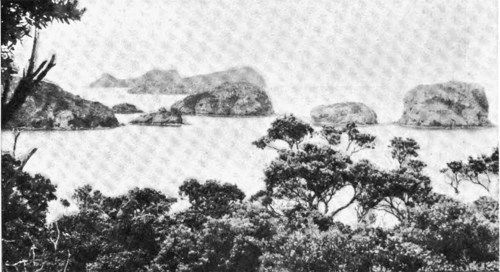
THE ESTUARY OF THE MANGAPAI RIVER. From a Photograph.
It was yet another instance of the sheer “cussedness” of things in general. There were half a hundred islands to choose from; yet malignant Fate, aided by that confounded fog, must needs fix upon Taupiri on which to cast us up—Taupiri, the sacred island, where for centuries the bones of the chiefs had been deposited. It was consecrated to the “mana” (holiness) of their spirits, and frightfully “tapu.” No man might put foot on it and live. And we had not only passed the night there, but—horror of horrors!—had eaten food cooked with wood from the sacred tree! The loose stones, among which we had stumbled in the foggy night and had kicked from our path, were the skulls of the great dead. There was no doubt about it—we were “tapued” up to our necks. That it was purely accidental and through no fault of our own didn’t in the least matter. From the Maori point of view, indeed, it made the case infinitely worse. For Puketawa, whose civilization was, after all, only skin-deep, it was likely to prove a most serious affair. Brought thus face to face with the terrors of ancient superstition, his white man’s education fell to pieces. His mind swung back to the faith of his forbears and the fears of the old beliefs gripped his heart. He was for fleeing the accursed place at once, but, “tapu” or no “tapu,” I wasn’t going without breakfast. Puketawa refused food. Already I fancied he was getting “pourri” (depressed)—no light thing with a Maori, for I had known them before then to die of sheer melancholy. I realized that the accident was bad for me also if the thing should get known. I did not fancy being ostracized by the tribe, my goods confiscated and destroyed, and my house and store burnt by way of purification and to avert the anger of the gods.
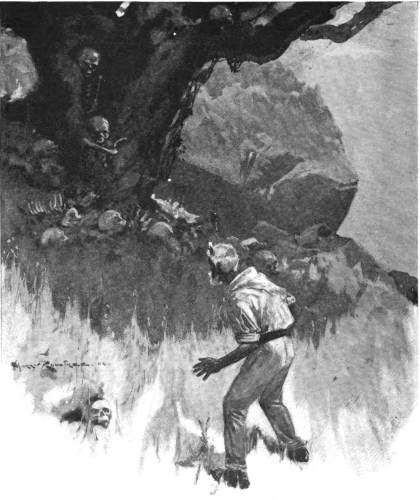
“THERE HE STOOD, A LIVING EMBODIMENT OF TERROR.”
Though, on the way home, I was angry and contemptuous by turns, Puketawa refused to be comforted. To my ridicule or reproaches he answered only with a sickly smile. “No good,” he said. He was “tapu” right enough—could feel the spell “working inside him.” In vain I pointed out that the island was six miles distant from the “kainga,” hidden by a bend of the river, and that we had landed at night in a dense fog and had left again before sunrise.
“Ah!” he answered. “Te tohunga very wise. He know wi’out seein’.”
On arrival, contrary to custom, we found the beach below the store deserted. Not a soul was in sight. No Sunday crowd of mothers chatted as they squatted around the buildings; no piccaninnies dabbled in the water, and waited anxiously for sweets on my return. I knew these latter would not forego the weekly dole unless for serious cause. Could Puketawa be right after all? Had our infringement of “tapu” become known in some incomprehensible manner? It began to look very like it. That night at supper also Puketawa declined food. He even refused rum-punch, and when Puketawa refused rum things must be looking black indeed. He lay in his bunk with his face to the wall, silent save for long, shuddering sighs. So it went on through the night. Protests, reproaches, even vigorous shakings were of no avail; he lay like a log, with closed eyes, making no sign.
This was beyond a joke. No possibility of pretence was here. The man was dying, visibly, of sheer funk. Unless I could rouse him he would not live another day. I could not let him die, and, base surrender to heathen jugglery though it was, made up my mind to seek out the “tohunga” next day and entreat him to remove the spell.
In the long, dark watches I began to feel pretty queer myself. The silence seemed tangible, heavy, impermeable. I was not exactly frightened; the feeling was indescribable—a sort of nameless terror at nothing, a horror of some unknown impending fate against which it was useless to struggle and from which there was no escape. Mutuality, sympathy, hypnotism—call it what you will—a weight of fear lay on my senses, a veritable obsession of dread.
Was there any truth in heathen devilry after all, I wondered? Had the confounded “tapu” got me too? With an effort I shook off the growing lethargy and paced the floor through the night. In the morning I could eat nothing; food was repulsive. Shortly after sunrise I took my way to the “kainga.”
Within fifty yards of the gate I was warned by the young warriors to keep my distance. Presently Te Horo himself appeared in full war-paint of “korowai” (kilt) and feather mat, a spear in his hand.
“Thy sin is known,” he cried, sternly. “Come not near to bring contamination upon us. Thou and thy servant are accursed. It may be ye shall both die; I know not. Begone! At noon the ‘tohunga’ comes to confer with thee.”
As I sat beside the bewitched man and awaited the coming of the priest the night fears that had assailed me passed, giving place to a feeling of rising anger at the whole thing. Here was I—a fairly decent Englishman, reared in the Anglican faith and living in the nineteenth century—hindered from going about my business, outcast, excommunicated, shunned as a leper, my servant dying; all on account of some fiendish diablerie of heathen fetish. The affair was preposterous, incredible, ludicrous. Then I looked at poor Puketawa, moaning, prone in his bunk, and was answered. That at least was real.
Punctually at twelve o’clock the old “tohunga” came over the hill. He was a tall man, grey-headed and handsome, and in his full robes of office he looked imposing enough. Halting at a short distance he called us to come forth. I started forward to expostulate, but he waved me sternly back.
“Approach not,” he commanded. “You are unclean, you have incurred the anger of the great spirits. Yet will I intercede, and it may be purge you of the offence. Now, therefore, bring out your ‘taonga’ (goods) and everything that you have touched, in order that I may destroy it and the purging be complete.”
This was beyond a joke. Give up my household goods and knick-knacks to be burnt? Never! I’d see him hanged first.
“Be off, you old scallywag!” I shouted. “Give you my things, indeed!” And I began to tell him what I thought about it. He stood impassive, inexorable.
“Young man,” he answered, “be not mad. Fool! Can you fight the spirits? Look to your servant. Delay not, lest he die.”
This was unanswerable. I surrendered, and we carried the things out, Puketawa moving as though in a mesmeric dream. All my bachelor treasures, bedding, rugs, chairs, cooking-pots, and crockery—everything went. The pots and crockery he smashed with his tomahawk, the house and all else he burnt to ashes. Luckily, I had not been near the store, or that and its contents would have gone too.
What next, I wondered? Had the old heathen done with us? Evidently not.
“Remove your clothing,” he commanded. Here was a pretty state of things! Being naturally of a modest disposition, I demurred, at which he lost his temper.
“Hinder me not,” he cried. “Your life or death is naught to me. Beware, lest I depart and leave you to your fate.”
There was nothing for it but to comply. So, whilst our clothes were burning, Puketawa and I stood before him naked and unashamed.
Down to the creek, to the pool beneath the waterfall, the old priest drove us. The stream was full of snow-water from the mountains, and bitterly cold.
“Enter,” he ordered.
“Needs must when the devil drives,” and with a gulp we plunged in and stood shivering up to our necks, while for ten interminable minutes the old fellow chanted prayers and wove his “karakia” (spells) on the bank.
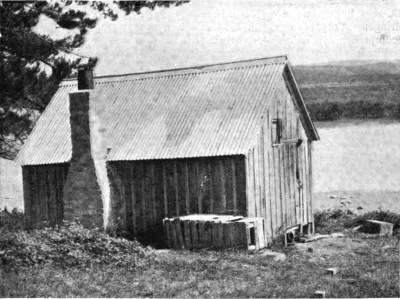
THE AUTHOR’S STORE ON THE BANKS OF THE MANGAPAI RIVER. From a Photograph.
At last it was over. We climbed out, and the “tohunga” sprinkled each of us, separately and solemnly, with a fern frond dipped in the water of the pool.
“It is enough,” he said. “The ‘tapu’ is lifted,” and walked away.
The humour of the situation appealed to me, and, cold and dripping though I was, I shouted with laughter. And you will admit the thing was fairly humorous. Imagine us, if you can, standing there, stripped of our worldly goods, naked and shivering—Puketawa, a prize convert from a mission station, and I, a Christian—brought to such a pass by miserable heathen wizardry that we had been glad to submit ourselves to the sorceries of the arch-wizard himself to escape the consequences of the spells that had been cast over us!
All the same, the effect of the hanky-panky on Puketawa was truly wonderful. Moribund before the arrival of the “tohunga,” he was a new man after the performance. He laughed with me, his dull eyes again became clear and bright, and he got quite chirpy; while, laugh as you will, even I, who had submitted to go through it only on Puketawa’s account and for the sake of trade, must confess to a sense of spiritual well-being to which I had been a stranger for some days.
With trade clothing from the store we clad our nakedness. The baptism business had given us an appetite, and we soon rummaged out a cold collation. Maoris are always fair trenchermen, but I never saw one put away such a feed as Puketawa did then. Eat? Long after I had finished I sat and watched the stuff disappearing—tinned salmon, potted beef, spiced ox-tongue, dried fish, ham and chicken, pine-apple, Worcester sauce. King Solomon in all his glory never had such an appetite.
Next day, as though to make amends for the inconvenience we had suffered, and show that the popular feeling was not directed against us but against the “tapu” alone, the Maoris flocked to the store with cash and barter, and I did the best day’s trade of my life. In two days they had built me a better house than that destroyed. It was as if the ceremony of purification had conferred a sort of brotherhood upon me, and I found myself on a better footing with them than ever before. I never discovered, however, how they learnt of our transgression.
To this day the question of how the “tohunga” became aware of our accidental presence on the sacred island remains a mystery. That we were alone there I am certain. Under the circumstances of the storm and the thick mist, it is equally certain our presence was not observed from the shore. The “kainga” was six miles distant, a range of hills intervening. It was a black night; Maoris are chary of being out after dark. Altogether the possibility of our having been seen may be dismissed. Puketawa, of course, leaned to the supernatural. Old stories of occultism practised by the priests, of spiritualism and uncanny mental telepathy with the spirit world, he told for my benefit. I do not like mystery, and have no leaning towards the occult, but, dismissing all this as unworthy of credence, there yet remains the query of how the “tohunga” knew of our “breaking of the ’wahi-tapu’” (breach of the sanctity of a burial-place).
In the fullness of his heart at my successful whitewashing, old Te Horo offered to give me his youngest and prettiest daughter in marriage, with a thousand acres of tribal land as a dowry. Between you and me, there have since been times when I have regretted that I didn’t clinch the bargain.