THE FIGHT AT THE A-T RANCH. By Frank Bransted.
Reading edition
The story of one of the most sanguinary “cattle wars” the West has ever known. The long-standing feud between the big cattlemen and the homesteaders, whose advent means the doom of the open range, led in this instance to a most extraordinary state of affairs, in which one side raised a regiment of ruffians to wipe out their enemies, while the other retorted by laying siege to their opponents’ head-quarters with rifle-pits and dynamite bombs! “The narrative is absolutely true,” writes the author, “only the names of the cattlemen concerned being changed.”

With a rattle of wheels over stones and frozen ground the buckboard swung round the bend and down across the muddy creek flats. The driver, Ranger Jones, one of the pioneers of Northern Wyoming, drew off his leather glove and rubbed his chilled hands on the buffalo robe to restore circulation. The sun was low in the west, and, after placing his hand on the heavy Colt that lay reassuringly beside him on the seat, he drew on his glove and spoke sharply to his team. A moment later they struck the bridge, and after clattering across the shaky wooden structure began the ascent of the south bank.
Scarcely had the buckboard left the bridge than from underneath it was thrust the barrel of a rifle. A sharp report rang out, followed by two others in rapid succession, and with his fingers groping vainly for his pistol Ranger Jones, the best rider and one of the bravest men of the Big Horn country, fell forward off the seat. Shot three times through the back, he was dead before his head struck the dashboard.
Jones’s death was but one of the brutal murders that about 1890 horrified the settlers east of the Big Horns and north of the Powder River. This country, which had formerly belonged exclusively to the cattle kings, had of late years been invaded by homesteaders and other settlers, who had begun to stretch their hated wire fences along the creeks and around the water-holes on the alkali flats to the east. Early in the winter all the settlers in this district had received warnings that they had been tried by “a jury of their betters” and found guilty of cattle rustling, and warning them that if they did not leave the country within thirty days their lives would be forfeited. These warnings were signed by the “White Cap Protective League.” The letters, which were known to be the work of the Cattle Association, or of some of its members, were for the most part disregarded.
The death of Ranger Jones fanned to a white heat the flames of rage that had been aroused by the previous murders, and a meeting was called at which Frank Benton, an ex-sheriff of Johnson County, was by common assent adjudged the person guilty of Ranger Jones’s death, and he was sentenced to die by the hand of the first of the settlers who had a chance to pot him. It was further agreed to discover, if possible, the ringleaders of the “White Caps,” and either to lynch them or drive them from the country. But the searchers were unable to find Benton, who, having heard of the plans laid for his taking-off, held a hasty consultation with Dr. Hays and Ben Williams, two of the leading cattlemen, and then boarded a train at Cheyenne and fled to Texas. Once there, he began scouring the country for “bad men.” Any man who had some other man’s blood on his hands found favour with Benton, and at the little town of Utica, where he made his head-quarters, he soon gathered together as choice a collection of “toughs” and murderers as could be found in any one hundred square miles on earth. These men he hired to go with him to Wyoming and kill “Rustlers.” They signed a contract to stay with him for six months and were to receive fifty dollars apiece per month, and one hundred dollars were to be divided amongst the bunch for every man that they killed.
Late in April the band, consisting of sixty men, with Benton and a negro cook, boarded a train on the M. K. T. for the north. At Omaha, where they outfitted, they bought up practically all the ammunition in the town, as well as large quantities of provisions, bedding, tents, and other articles. They were joined here by Dr. Hays, who, after expressing himself as being well pleased with the appearance of the men selected, informed Benton that horses and supply wagons awaited him at Douglas, Wyoming. Before parting from Benton he gave him a revised list of some forty men of whom the cattle kings were desirous of ridding the country.
On Thursday, the 27th of April, the little town of Douglas was surprised and terrified by the appearance of sixty armed men who alighted from the Elkhorn train. The strangers paid but little attention to the townspeople, but hastened out to the E——Y ranch near the town, where their horses awaited them. Here they pitched camp for the night, and at daylight the next morning set off for the north-west, camping that night on the banks of Wild Horse Creek, some forty miles from Douglas. By Saturday night they were within sight of the Powder River, but were halted by Benton in the hills south of the river until it became dark, when they advanced, and, after fording the river, camped in a large cottonwood grove for the night. At two o’clock in the morning they were awakened, and followed their leader on foot for a couple of miles, when, just as day was breaking, they came to a little log-house near the banks of the Powder River. The building was on the claim of a small rancher named Ben Champion, and stopping with him at the time was another rancher named Billy Ray. Both men had received White Cap notices, and were living together for greater security.
Swiftly the men under Benton—who were known thereafter as White Caps—surrounded the ranch and lay concealed, awaiting the appearance of the hapless ranchers, who were to be their first victims. About five o’clock the door opened and Billy Ray stepped out.
“Get breakfast, Ben, and I will look after the horses,” he called out, cheerily, as he started for the log stable near the river bank.
Half-way there he paused and partly turned as if to retrace his steps. Thinking that they had been discovered in their hiding-place, Benton gave the order to fire, and poor Ray fell riddled with bullets.
“Now for the house, boys! Get the other one!” yelled Benton, and he headed a rush at the log building. The rush, however, ended in a wild stampede for shelter, for, regardless of the bullets smashing into the logs around him, Ben Champion appeared in the doorway with a six-shooter in either hand streaming fire and lead. One White Cap lay dead close beside the body of Billy Ray, and another one was painfully trying to drag himself into shelter with a broken leg trailing behind him.
From all sides a perfect hail of bullets was now poured into the log cabin, and but for the seasoned logs stopping a large proportion of the bullets no man could have lived inside for five minutes. As it was, bullets were constantly getting in through the chinks and crevices between the timbers. After the first charge failed, Champion, knowing that it was only a question of time before the White Caps killed him, sat down at his table and wrote a letter of farewell to his mother and sisters in far-away Vermont. He also, from time to time, wrote down short comments on the battle in progress. This blood-stained diary, which is now the property of the State Historical Society at Cheyenne, reads as follows:—
“Six o’clock.—It is just about an hour since they killed Billy, and, while bullets have been buzzing around in here pretty lively ever since, I am still untouched. I just wrote a letter to my mother.
“Seven o’clock.—As I was writing in this book before a bullet smashed up my left arm pretty badly, but I have it tied up and the bleeding stopped. Now I have got my revenge, too, for as I shifted from one end of the shack to the other I caught one fellow trying to run up here with a bunch of burning brush in his hands. He’ll not need brush to keep warm where he is now.
“Nine o’clock.—Still on deck, but getting kind of wobbly on the pins from loss of blood. Have been hit four times.
“Nine-forty a.m.—Well, good-bye everyone. They set a load of hay on fire and let it run down the hill against the side of the shack and the roof is all ablaze. I am waiting till the smoke settles over the main bunch a little thicker and then I will try to get in amongst them with my six-shooter, if I can, before they down me. Good-bye.—Ben.”
A whiff of wind from the north blew a heavy cloud of smoke low down over a bunch of White Caps lying in the shelter of a small creek some fifty yards from the cabin, and when it lifted Ben Champion stood amongst them with a smoking revolver in his hand. A moment later he lay dead on the sand with over forty bullets through his body, but in that short space of time his deadly Colt had sent two more of the White Caps to their last reckoning.
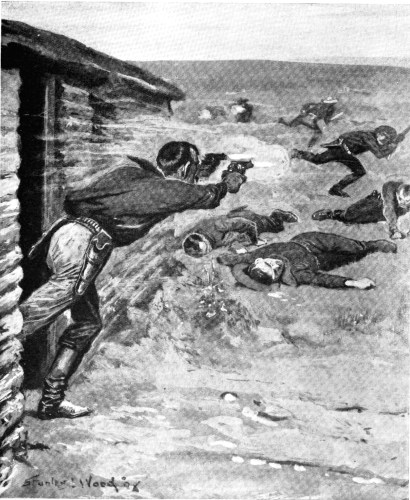
“BEN CHAMPION APPEARED IN THE DOORWAY WITH A SIX-SHOOTER IN EITHER HAND STREAMING FIRE AND LEAD.”
While the White Caps were burying their dead, the horses and wagons were brought up and the outfit cooked their breakfast on the embers of the burning logs. Then, placing their wounded comrade in a supply wagon, they moved up the river in search of more victims. Surrounding two ranches, they crept up to them, only to find them vacant; they were too late, for their firing had attracted the attention of a rancher named Whitmore as he stopped to water his horse at the ford a mile below Champion’s ranch, and he had ridden up close enough to see the finish of the unequal fight, and had then spurred his horse up the river, warning the settlers that the much-talked-of White Cap invasion had begun. The news spread over the country like wildfire, and, instead of fleeing from the danger-zone, the ranchers and cow-punchers buckled on their guns and headed for the scene of the fight. They started in ones and twos, but as they got closer in they began to gather in bunches of ten or twelve, all spoiling for a fight, if there was a prospect of avenging the death of their comrades.
In vain did Benton and his regiment try to close with any of these bunches; their horses were fresh, and they would run as long as chased by the White Caps; but once let the chase cease and they were back again, waiting for a chance to sneak up under cover of a hill or ravine to pour in a volley of bullets and again take to their heels if pursued. By three o’clock there were fully fifty men harassing the White Caps, and Benton decided to make for the shelter of the A—T ranch on Crazy Woman Creek, some fifty miles to the north-west. The first few miles was an orderly march, but the “Rustlers,” as the other side called them, were constantly increasing in numbers and pressing in closer behind. At five o’clock Benton gave his men the order to strap their ammunition on to the backs of the wagon horses and to abandon the wagons and supplies. From an orderly march their ride had now degenerated into a wild dash over the barren sage brush flats for refuge in the far-off ranch. Darkness alone saved them from extermination, and as it was, only forty-five powder-stained, worn-out White Caps rode up to Dr. Hays’s A—T ranch just as the sun rose on Monday morning.
After a hasty breakfast they set to work barricading the windows and doors of the stout log-house, as well as building a fort of stones around the well and cutting a trench from there to the house and the barn, a large two-storey frame structure which was rendered almost bullet-proof by lining it with bales of hay. Noon found them well prepared for a siege—found, too, close on three hundred Rustlers watching them from the surrounding hill-tops.
A long-range fusillade was kept up all day on Monday without effect on either side, and Monday night also passed uneventfully. Tuesday found the Rustlers entrenched in rifle-pits and stone forts within easy range on all sides of the ranch buildings. They had received large quantities of ammunition from Buffalo, which was only fifteen miles north of them, and had also brought up the tents and provisions abandoned by the White Caps near the Powder River. All day long the numbers of the Rustlers kept constantly increasing, till by nightfall fully five hundred men were pouring lead into the buildings and forts on the A—T. The firing kept up all Tuesday night, and under cover of the darkness the Rustlers advanced their rifle-pits to within two hundred yards of the ranch buildings. Seated on the top of a pile of earth and thinking himself safe in the darkness, young Tommy Arnold, of the Rustlers, fired a shot at the dark mass of buildings in the valley. Quick as lightning came an answering shot, fired at the flash of his gun, and young Arnold pitched forward, shot through the breast. Angered at the death of Arnold, several Rustlers digging a pit near him seized their rifles and poured in a volley of bullets at the spot where they had seen the gun-flash in the valley. With five further shots, however, the hidden marksman wounded two of them and threw dirt into the faces of a couple more, so that they were soon glad to quit the unequal duel. The man who did this shooting was afterwards discovered to be an ex-United States marshal from Oklahoma, named Smith. He was wounded on the last day of the fight, and afterwards died from his wounds.
On Tuesday afternoon Bob Snelling and John Pettybone, two of the richest ranchers among the Rustlers, rode over to Fort McKinney and offered the commander there two thousand dollars for the use of his cannon for one day. Of course, the commandant had to refuse, and he further took warning, so that that night, when a party of Rustlers, led by Tom Ray, arrived with the intention of stealing the gun they found it had been wheeled into the guard-house and a sentry stationed over it. Not to be daunted by these failures to secure a big gun, old Jack Flagett, a veteran of the Civil War, essayed to make one. He secured a team and drove to Buffalo, returning with a number of lengths of iron piping. He first placed a three-inch pipe around a two-inch and pounded the intervening space full of wet sand, repeating the performance with a four and six inch pipe. The whole affair was then chained securely to the stump of a tree on the top of a hill about five hundred yards from the A—T buildings. Next the amateur artillerist rammed in a couple of pounds of powder, and, for a projectile, put in five pounds of dynamite. Then he called out to some near-by Rustlers: “Come over, boys, and watch me blow that White Cap outfit to Hades!”
He was about to set a match to the touch-hole when one Fred Johnston interfered.
“Better set it off with a fuse, Jack,” he said.
“Well, to satisfy you, I will,” replied Flagett; “but there is no danger, as this gun can stand anything.”
A six-inch fuse was then placed in the gun and lighted, and everyone retired into an adjacent pit, dragging old Jack with them. For a moment all was silence; then came an awful ear-splitting report, and a cloud of dust settled over the rifle pit. When it cleared away all trace of Flagett’s cannon and the stump as well had disappeared. Not a piece of either was ever found, though Hall Smith, who was in charge of the cook-camp half a mile farther back, swore that he heard a piece of pipe whistle over his head a few seconds after the explosion.
Wednesday night passed very quietly, the White Caps being short of ammunition, and the Rustlers busy in the construction of a movable fort on wheels. They placed three mountain wagons in the shape of the letter V, and built a framework of poles between them. This frame they covered with bales of hay and suspended other bales from it clear to the ground. There was room within this curious fort for twenty men, and loopholes were left in the front sides for firing through as they slowly propelled it forward. It was the intention to roll this up within throwing distance of the ranch buildings, and then to demolish them with dynamite bombs.
On Thursday morning, just at sunrise, the ponderous engine began to crawl forward on its half-mile journey. Slowly but surely it crept along, till at ten o’clock it was less than three hundred yards from the ranch. In vain did the White Caps concentrate their fire on the moving fortress; their bullets were absorbed by the hay as water by a sponge. Inside the beleaguered ranch all was excitement and terror. Only too well did they know the fate that awaited them unless the grim monster advancing on them was checked. Benton called his boys together. “Boys, we must stop that fort or die like rats in a trap,” he said. “I want twenty men to follow me. Each will take a torch in one hand and his six-shooter in the other, and I promise one thousand dollars to the first man to fire the hay walls of the fort.”
The moving fort was now less than a hundred yards from the house, and the furious fire from the hills and pits that had covered its advance died down as the Rustlers lay, with their loaded rifles silent, waiting for some move on the part of the White Caps.
Within the ranch-house all was quiet. The twenty men selected for the dash stood with their right hands clenched around the butts of their heavy Colts and their lefts grasping kerosene-soaked torches. All eyes were fixed on their leader, who stood next to big Ben Williams, who was noiselessly removing the bars from the door. “Ready, boys!” came in clear, low tones from Benton as the last bar was lifted from its socket. Every man braced himself for the leap—ready, in fact, anxious, to have the dreadful suspense at an end, though each well knew that the opening of the door would be a signal for five hundred rifles to sweep the space between the house and the fort with a perfect hail of lead. Quickly the door swung open, and Benton leaped out. His eyes swept the surrounding hills; then he turned and tried to leap back into the protection of the log walls again. But all in vain! Quicker than thought came a flash of fire from a loophole in the fort, and Benton fell in the doorway with a bullet from Tom Champion’s rifle through his lungs.
“Keep back, boys!” he gasped. “Stay inside. You’re saved—the troops are coming.” They dragged him in, but these were his last words; the heavy hand of the avenging angel had fallen on him, and he had gone for a final reckoning.
“To the loopholes, boys!” shouted Williams, who had now taken command. “Shoot as you never shot before. If we can hold them in check for five minutes we are saved.”
From loopholes and cracks thirty-five rifles concentrated their fire on the hay fort, and the furious storm of lead caused Champion and the twenty men behind the bales to lie low and hug the ground. They knew that the fire could not long be sustained at that rate, and that when it slackened they could advance with fewer casualties. Glancing from a loophole to the north, Tom Champion saw two lines of brown-coated men, riding furiously in the midst of a cloud of dust, sweep over the hills less than a mile away. “Boys, the troops are coming!” he shouted. “Quick! light a fuse and try a throw from here.”
Hastily the bomb was prepared and thrown. The five-pound parcel of dynamite circled through the air and fell only ten feet short of the wall. For an instant there was silence; then came the explosion, and for a few minutes all was hid in a blinding cloud of dust. When it settled it revealed a gaping hole in the side of the house and the dim forms of men inside striving desperately to replace the dislocated logs.
“To the loopholes, boys! Pick them off!” cried Champion, but before a shot could be fired, between them and the house swept a line of cavalry, and the fight at the A—-T had passed into history.
Clothed in the uniform and authority of the United States army, fifty men from the Thirteenth Cavalry robbed five hundred raging Rustlers of their prey. No true American can fire on the army uniform, and cursing and furious, but powerless to interfere, the Rustlers could only stand by and watch thirty-five men—all that were left of the invaders—come forth and surrender themselves to Captain Watterson and his men, to be transported to Cheyenne for trial for the murder of Ray, Champion, and others. They were ultimately released without the formality of a trial after some of the moneyed cattle kings had conferred with the State officials.
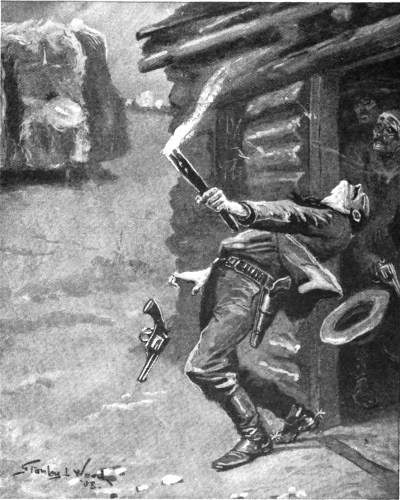
“BENTON FELL IN THE DOORWAY WITH A BULLET FROM TOM CHAMPION’S RIFLE THROUGH HIS LUNGS.”
Dr. Hays, Ben Williams, and other of the leading cattlemen fled from the country, never to return. Their buildings were burned, their horses and cattle shot on sight by the Rustlers, while their calves bore the brand of the first man to see them. Many a wealthy rancher in that district to-day owes his start to the calves he gathered up when the big outfits went to pieces.
So ended one of the most sanguinary cattle wars that the West has ever witnessed. All that remains to-day to recall it is a group of bullet-scarred buildings, surrounded by weed-grown rifle-pits, some two hours’ ride south-east of Buffalo, near the junction of Muddy Creek with the north fork of the Crazy Woman.