III.—“SEEING IT OUT.” By Albert E. MacGrotty.
Reading edition
The simple-minded and innocent Britisher may, on his first trip to the States, now and then walk into a very pretty little trap, neatly and carefully planned, like the web of the wily spider in wait for the inoffensive, curiosity-prompted, blundering fly.
I suppose I must have a somewhat unsophisticated aspect, which disguises all my dark and deep wisdom, and this appearance caused me to be selected as the victim of the little adventure I am going to recount.
It was at the close of my first visit to the States, and the day previous to my embarking for old England—all my business finished, and nothing to do but to say “Good-bye” to my friends and take a last look round.
I left the Astor House, valise in hand, and walked to the steamer Teutonic lying alongside the wharf, ready to sail for Liverpool on the following day. Having put my bag in my state-room, I strolled into Houston Street with the intention of getting on a cable car for the Broadway, where I was to lunch with a cousin. No cable car being in sight, I leisurely lit a cigar and turned round to inspect the goods in a store window. I had not been gazing therein more than a moment when I heard a buggy drive up and stop behind me, and someone shout, “Hey!” I paid no attention, being almost a stranger in New York, and not supposing that the call was addressed to me, especially as Houston Street is one of the most crowded thoroughfares in the city.
The call was repeated, but still I took no notice. When I had finished my inspection of the window I turned round, and to my astonishment saw that a respectable-looking man in the buggy was endeavouring to attract my attention. I went up to him and asked what his business was with me; he replied that he wished to know if I could tell him when the steamer left for England. “Do you mean the Teutonic?” I said, and he answered, “Yes.”
“To-morrow morning at seven,” I replied. He thanked me, and was just whipping up his horse to drive on, when he suddenly pulled up again sharply, and said:—
“Excuse me, sir, but the reason I asked you about the steamer is that my guv’nor told me to try to find a respectable old gent who was sailing in the boat for England, and ask him if he would mind looking after his nephew, who is a boy of ten.”
“I hope you’ve found one,” I told him, smiling.
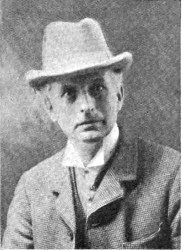
MR. ALBERT E. MACGROTTY. From a Photograph.
“I’ve come across no one, except yourself,” replied the man.
“Well,” said I, “as the boy is going over alone, if your master will bring him on to the steamer I will look out for him, and endeavour to keep an eye upon him during the voyage and make the trip pleasant to him.”
He thanked me most effusively, and said he was sure that I would be the right person to look after the boy, adding that his master would not think of giving me this trouble unless I would consent to receive payment, say a hundred dollars. I was taken aback by this latter suggestion, and rapidly came to the conclusion that the man’s so-called “guv’nor” must be one of the sharpers of New York. Up to this time, I must acknowledge, I had fully believed the fellow’s statements to be genuine.
I replied that I could not accept any such payment for the little I could do for the boy on the ship, whereupon the man again thanked me warmly, and asked me if I would come to his master’s house in order that he might introduce me. I declined; but, seeing no cable car coming along, it flashed across my mind that I would make use of him a little, so I asked which way he was driving, as I wanted to get to the upper end of Broadway.
“Jump in, sir!” he cried, whereupon I thanked him, and accepted the invitation.
I should not, of course, have done this had I not been fairly well acquainted with New York and able to tell that he was taking me in the right direction. We drove rapidly, and his conversation was clever and amusing. He asked me if I knew California?
“Yes, I have just come from there,” I told him. He seemed greatly pleased at this. Did I know Governor Stanford? I had not that pleasure, though I knew him well by name. My driver said that he was sorry for that, as the Governor was a relative of his master’s.
By this time we were in the Broadway, close to my cousin’s office, and seeing this I asked the man to pull up, but he begged me to go on and see his guv’nor, as it was only one block farther.
I still had half an hour to spare before lunch, and, though my suspicions were now thoroughly aroused, some impish spirit prompted me to “see the thing out,” so I said, “Very well, drive on.”
The man pulled up at the end of the block, and fixed his horse to the halter found in all New York streets for that purpose. I jumped out and we entered a stable, I taking care to keep close to the large open door. Needless to say, I scrutinized the floor closely and rapidly for trap-doors, but none appeared. My companion asked an ostler, who was rubbing down one of several horses, if the “guv’nor” was in. The man said “no,” but he would be back in a few minutes. I then informed the driver that I could not wait, and had better see him in the morning on the steamer.
“One minute,” replied the fellow; “if you will be good enough, I have only to go to No. 4, and will bring my guv’nor back with me.” With that he disappeared.
While we waited the ostler made one or two friendly remarks concerning the weather, and a moment later a gentleman, attired in a very handsome fur-lined coat, silk hat, and kid gloves of a light and delicate tint, walked into the stable from the street outside. My late companion followed, and, addressing me, said: “This is Dr. Coombs, sir,” observing to the doctor that I had offered to look after his nephew on the steamer without any payment. Dr. Coombs thanked me in a gentlemanlike manner, and appeared in all respects a well-bred man.
The doctor then turned to his coachman and told him to fetch the boy, explaining to me that his nephew was a ward in Chancery, and that he would become possessed of a fortune of over ten million dollars on attaining his majority. Being the boy’s guardian, he was anxious that some responsible person should keep an eye upon him during his voyage to England, where another uncle would meet him. We were only talking for a short time, but I noticed that the doctor was somewhat restless, moving frequently towards the stalls containing the horses, all of which, he remarked, belonged to his nephew. Still I could not shake off a certain suspicion of my surroundings, and would not move from the door.
We had been waiting about five minutes when a big, horsy-looking fellow lounged in from the street, shouting at the top of a loud voice: “Is the boss in?”
My friend in the fur coat came forward, politely raised his hat, said he was the master, and asked the stranger’s business.
The new-comer, pointing to a grey mare in one of the stalls, replied, “I had that mare out yesterday, and I want to know, boss, what you’ll take for her,” at the same time handing the doctor his card. Both men were at a little distance from me, and a few words passed between them which I did not hear. Then the fur-coated gentleman came up to me, saying, “Excuse me a minute; I can’t understand why the boy is so long; I will go and fetch him myself!” With that he left me with stranger number three.
This fellow continued to examine the horses, making remarks upon them to the ostler, and then, to my surprise, suddenly said to me, pointing to the grey mare, that he wanted to buy it; but “the boss” could not sell it to him, as he was an agent in Boston for buying and selling horses, the same line as “the boss” himself was in, and there was a State law prohibiting dealings between agents in the same business. He next asked me if I would help him in the transaction. I replied that I was sorry I could not see my way to do so.
“I wish you could,” said the stranger. “I would give eight hundred and fifty dollars for the mare; she is a valuable beast.” As he spoke the doctor returned. The Bostonian promptly told him he could see a way to a deal, as that gentleman (pointing to me) would buy the mare with his money, and then he in turn would purchase her from me, adding, “Now, boss, what’s your price?”
“Eight hundred dollars,” replied the doctor.
“There,” said the Boston dealer to me; “I told you I would give eight hundred and fifty dollars. Complete the purchase, and I will pay you the fifty dollars for commission.”
The doctor chimed in that he also would give me five per cent.—forty dollars.
“Gentlemen,” I said, laughing, “that is ninety dollars—a good morning’s work. But do you expect me to be carrying eight hundred dollars in my pocket through the streets of New York?”
They looked depressed at this; then the Bostonian, becoming suddenly cheerful, suggested that if “the gentleman” would pay ten per cent, of the value of the mare, he would pay the balance. The doctor agreed immediately, and the Bostonian pulled out a roll of green-backs from his pocket. Asking me to take the money, he placed a twenty-dollar note in my hand, and while he was taking another from the roll I raised it slightly as if I was weighing it; I saw at once that the note was a forged one—some of the letters upon it were smudged. It was not even a good imitation.
Both men read in my face that I had detected their fraud, and the expression of their countenances became diabolical. However, the Boston man went on pushing notes in my hand until he reached one hundred and fifty dollars, when the doctor pulled him up, saying that he must have the ten per cent. from me first. I saw the time had come for action, and so, allowing the notes to drop to the floor, I told them sternly that if I had been remaining in New York I should have had them arrested. I then left the premises immediately. Looking back, I saw the “doctor” rushing down some steps in front of the building, hurriedly throwing off his fur coat as he went, and the other man walking rapidly down the street in the opposite direction.
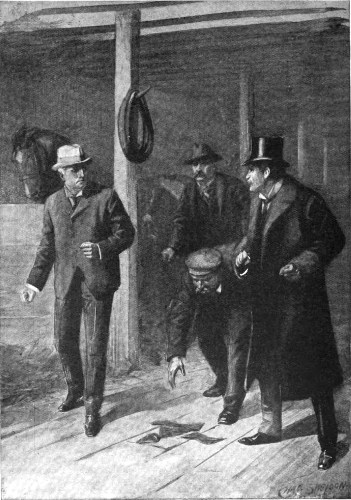
“ALLOWING THE NOTES TO DROP TO THE FLOOR, I TOLD THEM STERNLY THAT IF I HAD BEEN REMAINING IN NEW YORK I SHOULD HAVE HAD THEM ARRESTED.”
In conclusion, I may say that I was very glad to arrive at the Sinclair House and drink a stiff glass of brandy, as I was a trifle shaky, swearing to myself that I would never again risk pocket and life with mysterious strangers in the city of New York, even for the sake of “seeing it out.”