Some “Freak” Memorials. By T. W. Wilkinson.
Reading edition
When a man, especially a wealthy man, sets out to erect a memorial to something or somebody, there is no knowing what eccentricity he will not commit. Scattered up and down this country, as the writer shows, are a number of most remarkable memorials—“freaks” of the first water, from whatever standpoint one judges them.

Who shall impose limits on the intent and form of memorials? He would be a brave man indeed who attempted the task; yet, though it is very difficult to say precisely where the line should be drawn, there are a number of such things in existence which, judged by the commonly-accepted standards, are distinctly “freakish.” They range from public statues plain to all men to small stones in arcadian aloofness, and, as a whole, go far to justify the oft-repeated taunt of the “intelligent foreigner”—a taunt amounting to an implication—that memorials afford an outlet for much of the Englishman’s eccentricity and sheer “pig-headedness.”
There are some very curious monuments to animals scattered over the countryside. The one with the most remarkable story crowns Farley Mount, near Winchester. Underneath it lies buried, as an inscription on the exterior records, “a horse, the property of Paulet St. John, Esq., that in the month of September, 1733, leaped into a chalk-pit twenty-five feet deep a-fox-hunting, with his master on his back, and in October, 1734, won the Hunters’ Plate on Worthing Downs, and was rode by his owner, and entered in the name of Beware Chalk Pit.” This inscription, which is a copy of the original, was restored by the Right Hon. Sir William Heathcote, Bart., in 1870. A duplicate is in the interior, which is provided with three seats intended for the accommodation of wayfarers.
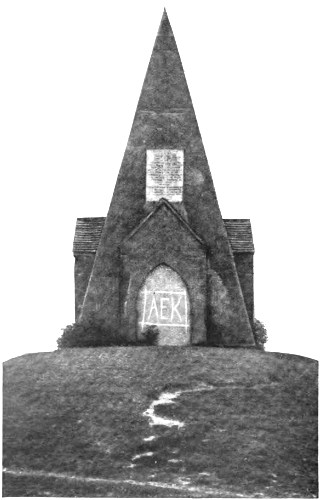
A MONUMENT TO A HORSE THAT LEAPED INTO A CHALK-PIT AND AFTERWARDS WON A RACE. From a Photograph.
Of the memorials to dogs the most imposing of modern date is “Tell’s Tower,” a structure on the seashore near West Kirby, Cheshire. It is in honour of the Great St. Bernard dog, Tell, “ancestor of most of the rough-coated champions of England, and himself winner of every prize in the kingdom. He was majestic in appearance, noble in character, and of undaunted courage.” Built by the late Mr. J. Cumming Macdona, the tower is a sort of summer-house, in the base of which is a vault containing Tell’s remains, guarded by an effigy of that remarkable animal.
To a whole series of such freaks of commemoration there hangs a singular tale. In Oatlands Park, Weybridge, there are two or three scores of memorials to dogs. These animals, some of which have handsome epitaphs inscribed to their many virtues, are popularly supposed to have been pets of Frederica Duchess of York; but, as a fact, Her Royal Highness had not sufficient warm affection to bestow a goodly portion on so many dumb creatures. What human being, indeed, ever had? She was presented with many dogs, which she could neither refuse without giving pain, nor keep unless the whole house was turned into kennels. So they were given a dose of opium, buried, and then commemorated in verse. But, while the Duchess was not so foolish as is generally believed by those who visit Oatlands, she was certainly responsible for the monuments.
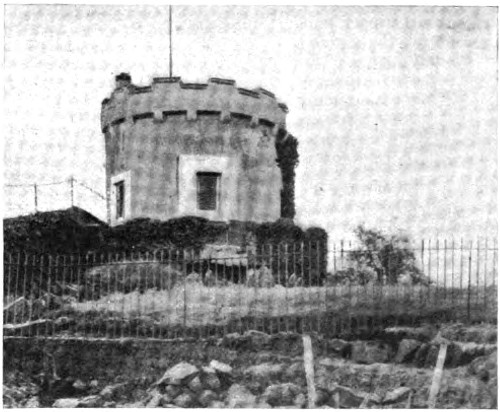
“TELL’S TOWER,” ERECTED TO THE MEMORY OF A ST. BERNARD DOG—IN THE FOUNDATIONS IS A VAULT CONTAINING THE ANIMAL’S REMAINS. From a Photograph.
Strange, then, that her own memorial is the prime curiosity of Weybridge! Its history is this: After her death the inhabitants of the town were desirous of commemorating her thirty years’ residence among them, and it suddenly struck them that a way was ready to hand. Till about fifty years earlier there had stood in Seven Dials a pillar supporting a sundial which presented a face to each of the streets. It was from this adornment, indeed, that the classic district got its name. Believing that treasure was buried beneath the pillar, some night-birds threw it down and excavated beneath it, to find nothing. Rumour, they discovered, was a lying jade. The stones, instead of being set up again on their old site, were conveyed to Sayes Court, Addlestone, with a view to their re-erection there, but this was not done, the column remaining dismembered till the occupier of Oatlands died. Now this bit of London out of town the inhabitants resolved should be converted into a memorial of the Duchess. So the stones were purchased and set up on the green, with the substitution of a ducal crown for the block on which were the dials. This was used for some time afterwards as a mounting stone at an inn hard by. It then constituted a puzzle, because, though in Seven Dials—according to the testimony of everybody who described it—there were seven faces, the number on close examination proved to be only six.
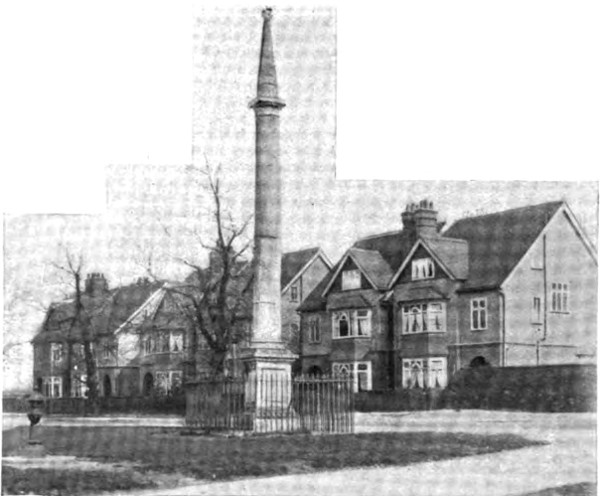
THE “SEVEN DIALS” PILLAR, AT WEYBRIDGE, SURREY. From a Photograph.
Another class of “freak” memorials have a twofold peculiarity: they are singular in themselves and are also remarkable by reason of the tardiness with which they were erected. Maud Heath’s Column, on Bremhillwick Hill, near Chippenham, is as good an instance as any. The title of the good lady to grateful remembrance is that she left a bequest by which a causeway was constructed in 1474 from Chippenham to the shoulder of Bremhillwick Hill. Her claim was from the outset acknowledged, inscriptions along the route of the causeway expressing gratitude to her for having made it. But this was not enough for a former vicar of Bremhillwick. After pedestrians had for more than three centuries been called upon to bless the public-spirited lady, and had been told, moreover, precisely where her causeway began and where it ended, the vicar came to the conclusion that she ought to have a statue, and moved himself to that end. A preliminary difficulty was that no portrait of Maud Heath was known to exist; but ultimately, with the co-operation of the Marquess of Lansdowne, the clergyman triumphed, and the column on Bremhillwick Hill—which was set up in 1836—is the result. The sculptor of the statue on the top of it had to fall back on his imagination, and he represented a woman in fifteenth century costume, with a staff in her hand and a basket by her side.
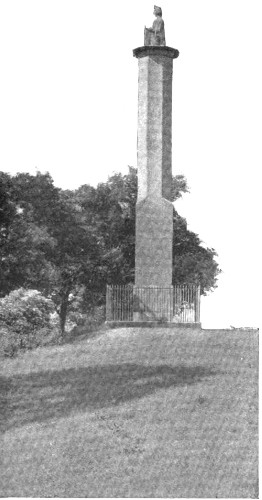
A BELATED MONUMENT—IT WAS ERECTED IN 1836 TO THE MEMORY OF A LADY WHO LIVED IN 1474, AND THE ARCHITECT HAD TO FALL BACK UPON HIS IMAGINATION FOR THE PORTRAIT! From a Photograph.
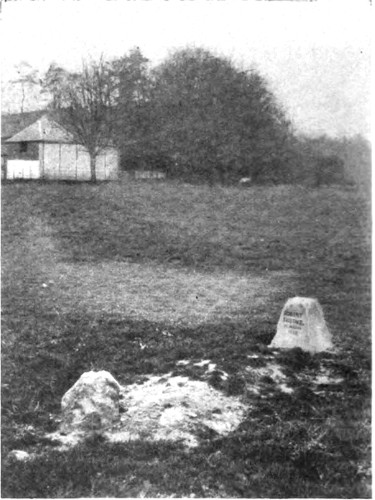
A HIGHWAYMAN’S GRAVE AT BOXMOOR COMMON. From a Photograph.
A belated memorial of a different class is at the head of a highwayman’s grave on Boxmoor Common. The knight of the road buried here, Snooks by name, was long a terror to travellers on the London road, which runs by his resting-place. At last, emboldened by many successes, he had the audacity to rob the Royal mail, whereupon he was hunted down, and eventually hanged near the scene of many of his crimes. He was, it is said, the last highwayman to suffer the extreme penalty in the district. Buried in unconsecrated ground, he was intended to be forgotten; but till about four years ago his grave was re-turfed periodically, and then a small stone, simply inscribed, “Robert Snooks, 1803,” was placed at its head. That tribute is one proof out of many that there is still a certain admiration for the race of which Dick Turpin is the popular hero.
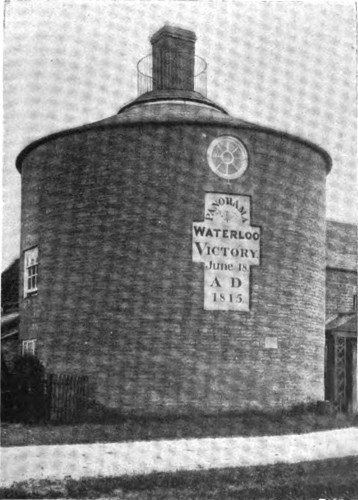
THE “ROUND HOUSE,” NEAR FINEDON, NORTHAMPTONSHIRE, WHICH IS SUPPOSED TO OVERLOOK A TRACT OF COUNTRY EXACTLY RESEMBLING THE FIELD OF WATERLOO. From a Photograph.
Among our battle memorials are several of the “freak” order. The Round House, near Finedon, Northamptonshire, must certainly be so classified. Formerly an inn, it is now a dwelling, from the roof of which, it is said, there can be obtained a “panorama of Waterloo.” It was built on this spot, as a memorial of Wellington’s great victory, because the surrounding country is believed to be very much like the theatre of the momentous battle. There is a parallel duplicate in Kent. Crown Point, between Sevenoaks and Maidstone, takes its name from a place in Canada where Sir Jeffrey Amherst gained a great victory over the North American Indians. It is said to bear a remarkably close resemblance to its namesake.
Waterloo is also commemorated by an Alnwick memorial. Locally dubbed a “folly,” it stands on Camphill, where it is surrounded by tall fir trees, which prevent it from being seen except at close quarters. Its creator was the late Mr. H. S. Selby, whose object was to place on record the policy of Pitt, the victories of Wellington and Nelson, and the restoration of peace in 1814. He appears to have been doubtful afterwards whether the column would be sufficient to prevent all these events from being forgotten by posterity, because in celebration of the Battle of Waterloo he set up a beautiful statue of Peace in front of his mansion.
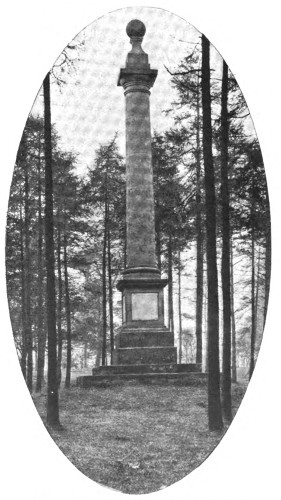
A HILL-TOP FREAK—THE COLUMN COMMEMORATES QUITE A LOT OF THINGS, BUT IS SO SURROUNDED BY TREES AS TO BE INVISIBLE SAVE AT CLOSE QUARTERS. From a Photograph.
Still more singular a memorial of our fighting prowess is the Red Lion of Martlesham. The Red Lion, originally a ship’s figure-head, is now the sign of an inn at Martlesham, on the high road between Ipswich and Woodbridge, and is painted a most brilliant and aggressive red. Indeed, “As red as the Red Lion of Martlesham” is a proverbial expression throughout East Suffolk. The grotesque object is a relic of a British victory over the Dutch in Sole Bay. It was brought inland as a trophy of our success, and was ultimately converted to its present use—that of an inn sign.
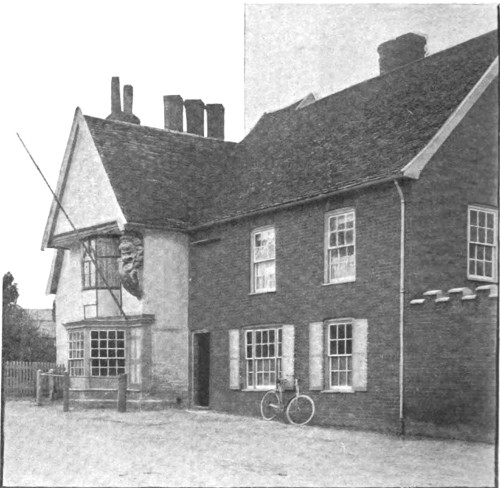
THE RED LION, OF MARTLESHAM, WHICH HAS GIVEN RISE TO A SUFFOLK PROVERB. From a Photograph.
One of the best-known memorials of battles fought on English soil—the obelisk at Naseby—is a “freak,” and a strange one, too. Its distinction lies in the fact that it has misled thousands, including Carlyle and Dr. Arnold. “To commemorate,” so runs the inscription, “that great and decisive battle fought in this field on the XIV day of June, MDCXLV, between the Royalist Army, commanded by King Charles the First, and the Parliament Forces, headed by the Generals Fairfax and Cromwell ... this pillar was erected by John and Mary Frances Fitzgerald, Lord and Lady of the Manor of Naseby.” But nothing is more certain than that the battle was not fought in “this field.” It actually took place on Broadmoor, about a mile away. Appropriately, therefore, did Liston call the obelisk the “obstacle.” Edward Fitzgerald was conscious of this strange blunder, to which he refers in one of his letters (the monument, he says, “planted by my papa on the wrong site”), and which he proposed to remedy by removing the obelisk to the real battlefield. The scheme, however, was not carried out, presumably on the score of expense.
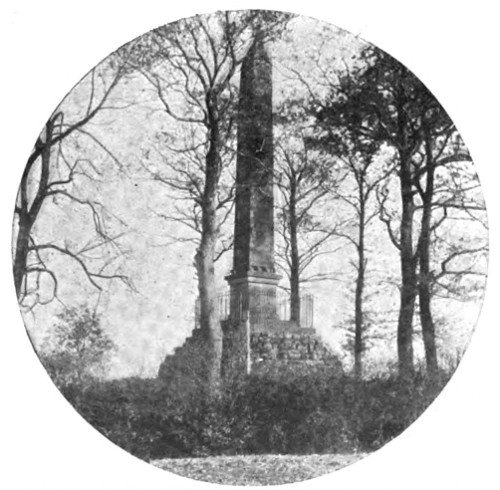
A MONUMENT IN THE WRONG PLACE—THE NASEBY MEMORIAL, WHICH DOES NOT STAND UPON THE BATTLEFIELD AT ALL. From a Photograph.
Besides the Round House, Finedon possesses a representative of a large class of “freak” memorials—those which bear no inscription, and the object of which is consequently doubtful. These differ from the many strange things which serve as memorials without being plainly stamped as such. In Lancaster, for instance, a large horse-shoe is embedded in the middle of the roadway, and there is nothing to inform the stranger of its intent. It is actually there owing to a tradition that a horse ridden by John o’ Gaunt, the town’s patron saint, cast a shoe near the spot. The silent reminder of the incident—which, of course, has been renewed many times—was some years ago polished every morning. An eccentric man turned up with the utmost regularity, went down on his knees, and made it as bright as the proverbial new pin. Unfortunately his zeal was not admired by the authorities, who ultimately prosecuted him for obstructing the traffic.
A unique milestone, again, serves as a memorial. It stands in the hamlet of Newbold, Gloucestershire, and is surmounted by a cross. On the south side are the directions:—
6 miles To Shakespeare’s town, whose name Is known throughout the earth; To Shipston 4, whose lesser fame Boasts no such poet’s birth.
And on the north face appears a “sermon in stone”:—
Crux mea lux. After darkness, light. From light hope flows, And peace in death, In Christ a sure repose. Spes, 1871.
Nothing on the milestone denotes that it is intended to be a memorial, but a local gentleman, it is understood, erected it as such after the death of a member of his family.
There are, however, many memorials of conventional form which are much more puzzling than such “freaks.” Above the white horse at Cherhill, Wilts, is one on which not a single letter or figure appears. Several stories are told locally of its origin and purpose. Of the same cryptic character is the Finedon memorial—a pillar standing in a garden at the cross-roads. It is generally supposed to commemorate a mailcoach robbery which took place near the spot in or about the year 1810; but, as it was in existence before this event took place, the popular belief must be erroneous. The most probable theory is that it was set up during the rejoicings at the recovery of George III. from his illness. There was an ebullition of patriotism at that time, and before the fever subsided several memorials sprang up in different parts of the country.
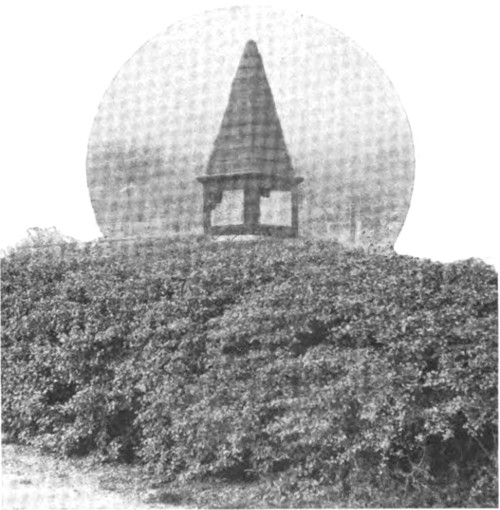
WHAT IS IT? AN OBELISK WITHOUT AN INSCRIPTION. From a Photograph.
Burial-grounds contain numerous “freak” memorials, notwithstanding that clergymen, as a rule, discountenance that form of eccentricity which strives after novelty in post-mortem advertisement. The most curious churchyard memorial in England, perhaps, is at Pinner. It resembles a church tower, and half-way up it a coffin projects on each side. Beneath, and supporting the structure, are arches filled in with ironwork, bearing the words, “Byde-my-Tyme.” The “my” appears to stand for one William London, who was interred (or interned) here in 1809.
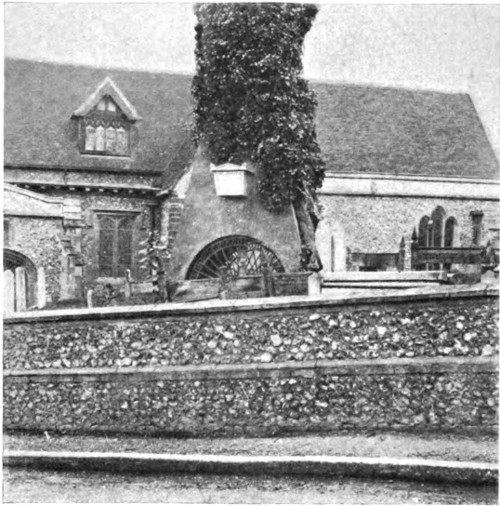
“’TWIXT EARTH AND SKY”—AN EXTRAORDINARY GRAVE IN PINNER CHURCHYARD. From a Photograph.
Legends cluster round this strange object. The stone coffin, according to the most circumstantial, contains the remains of a Scotch merchant, whose descendants retain his property as long as he “remains above ground.” Nothing definite, however, is known about the tomb. If its constructor wished to furnish posterity with an insoluble puzzle, he has succeeded to perfection.
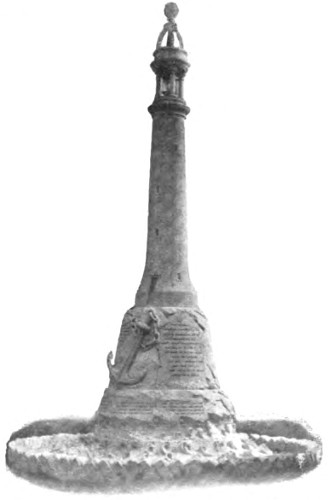
ANOTHER REMARKABLE MEMORIAL—A LIGHT BURNS IN THE TOWER NIGHT AND DAY. From a Photograph.
Of the “freak” memorials in public cemeteries, a lighthouse is easily first. This is at Ulverston, and is not merely a stonemason’s model, for it actually contains a plate-glass lantern, in which a gas-jet is burning continuously day and night. The most remarkable thing about this elaborate token of affection, perhaps, is that it is not a glorified tombstone. It was erected by a daughter in memory of her father, who is buried elsewhere, and was placed on its present site because the two had paid several visits to Ulverston Priory. Neither had any real connection with the town. A feature which differentiates this handsome tribute from all, or nearly all, others is obvious, and that is the cost of maintenance consequent on the gas consumed in the lantern.
Public memorials include numbers of “freaks,” the singularity of some of which is greatly heightened by their surroundings. This is notably so in the case of a drinking fountain which stands in the middle of the East Anglian town of Swaffham. Unromantic as its environment is, this structure is a modern heart shrine, containing as it does the cardiac organ of a local magnate, Sir William Bagge, who died in 1880. It was at his own request that his heart was deposited within the memorial, that he might remain after death, in a sense, in a place which he had loved so well in life.
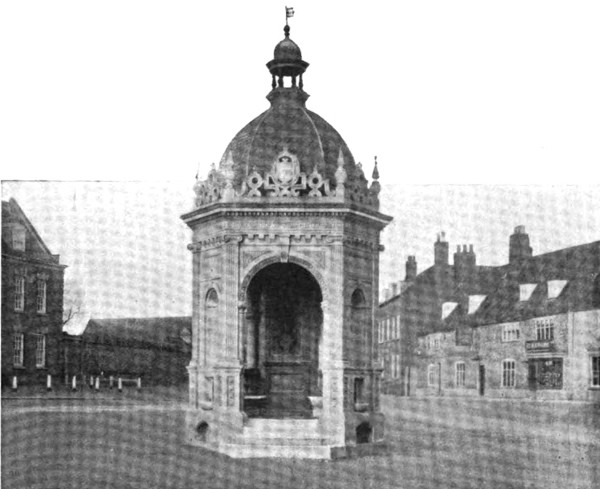
A MODERN “HEART SHRINE,” AT SWAFFHAM, NORFOLK. From a Photograph.
The last class of people to whom one would expect to see “freak” memorials are preachers, and yet there are two or three to such men. Decidedly the most picturesque, though not the most outré, is a massive chimney-stack at Coleman Green, Herts. It is preserved, as a tablet on it records, because in the cottage which was attached to it Bunyan occasionally preached.
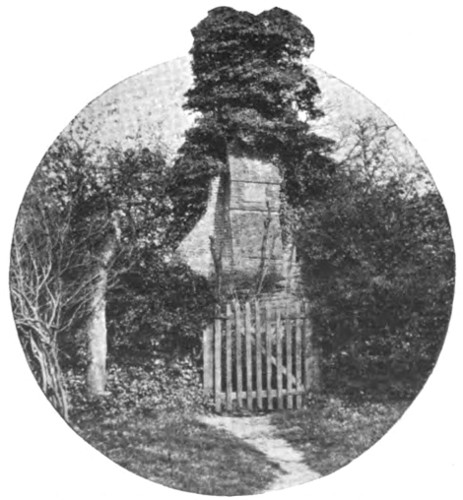
“JOHN BUNYAN’S CHIMNEY” AT COLEMAN GREEN, HERTFORDSHIRE. From a Photograph.
Strange as some of the foregoing memorials are, they are surpassed by certain monstrosities in private parks, which unquestionably contain the most remarkable “freaks” of the kind in England. In several cases the public are forbidden to enter such domains, not because it is feared that they commit damage, but in order that they shall not see some colossal absurdity of which the descendants of its creator are ashamed. Nearly the first thing one gentleman did, on entering into possession of the estate which he now holds, was to ascertain whether he had power to sweep off it a memorial which was ridiculed by the whole countryside and pointed out to every stranger to the district. Finding that he could not remove the eyesore, he at once gave orders that the park wall should be raised four feet all the way round!