IN THE LAND OF THE REINDEER. By H. Chusseau-Flaviens.
Reading edition
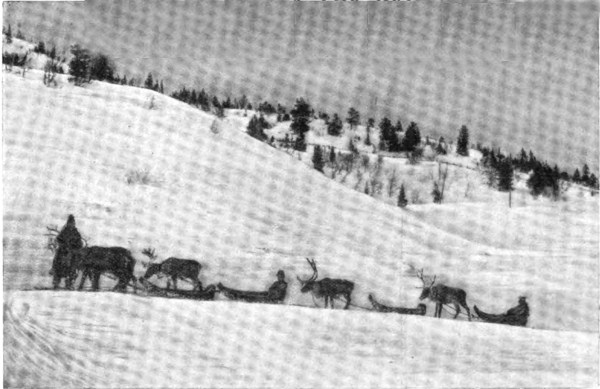
A WINTER SCENE IN “THE LAND OF THE REINDEER”—A LAPP MAGNATE MAKING THE ROUND OF HIS ESTATE. From a Photograph.
An article dealing with a strange and little-known people—the Lapps. Living in a country where practically nothing grows, their whole lives are occupied with the reindeer, the one product of Lapland. A man’s wealth is reckoned in reindeer; he eats its flesh and drinks its blood for food, and his clothes are made of its skin. Small wonder, therefore, that the moss on which the animals live is more important to him than cereal crops, and that the highest form of Lapp art finds expression in the carving of reindeer bones. Photographs by the Author.

Some little time ago I was in Sweden, and was strongly advised by my friends to take the opportunity of visiting Lapland, that strange country of reindeer and semi-savages. I was given a letter of introduction to a certain Lapp magnate, who, I was assured, was the most educated and advanced person in the country, and who would see that I saw everything worth seeing. “Go and interview him,” said my informant, “though I cannot promise that you will be able to get him to talk. The Lapps are very reticent; they will never tell you, for instance, how many reindeer they possess. Mickel Nilsson Nia, to whom I am giving you this letter of recommendation, is wealthy and educated, yet he covers himself with reindeer skins like the humblest of his herdsmen, drinks the warm blood of the animal he kills, and thinks no dish more succulent than a sort of cake made of reindeer blood mixed with flour! He is a splendid specimen of a people who have at once assimilated and resisted civilization.”
I began to think it might be worth my while to visit these curious folk, and in pursuit of information sought out another acquaintance, a colonel in the Swedish army.
He told me that the Lapps are very fond of stimulating drinks; they think nothing of drinking fifteen or twenty cups of coffee a day, while their consumption of punch is on a vast scale. It is no uncommon thing to see numbers of helplessly drunk natives in the streets of Tromsö, especially when the sale of reindeer flesh has been profitable. Yet robbery and, indeed, crime in general are practically unknown among them; the innate honesty of the people is quite extraordinary. The colonel gave me an example. “As, perhaps, you may have heard,” he said, “I am very keen on hunting both the wolf and the bear. On one occasion, accompanied by a Laplander, I was out after an enormous she-wolf, but the animal succeeded in completely baffling us. Finally, despairing of success, I abandoned the pursuit. A few days subsequently I was much surprised to receive a visit from my Lapp. With him he brought the wolf’s skin, which he insisted on my accepting; he had come up with the creature and killed it after a long, weary chase of many hours. I told him that the skin belonged to him, but he would listen to no argument. ‘You must be paid back for the trouble you have had,’ he kept repeating, with a smile. ‘It would not be fair for me to keep all the advantage for myself.’
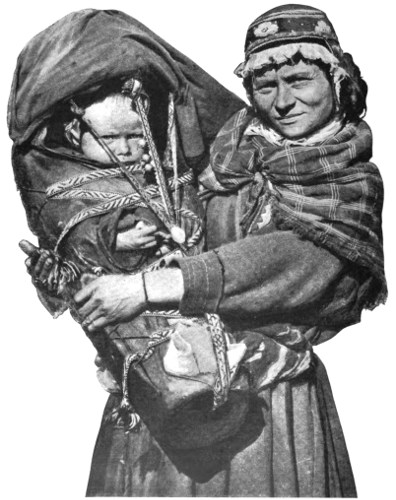
A LAPP MOTHER AND CHILD IN HOLIDAY ATTIRE—SO TIGHTLY SWATHED IS THE INFANT IN ITS CURIOUS “CASE” THAT IT SEEMS IMPOSSIBLE FOR THE POOR LITTLE MITE TO GROW. From a Photograph.
“But go to the country and see things for yourself,” concluded my friend. “Try and speak with Mickel Nilsson Nia; but, above all things, make up your mind to practise patience. Nobody in Lapland appreciates the value of time in the slightest degree; a Lapp thinks nothing of turning up at an appointment six hours too soon or six hours too late. You must also be careful to be invariably most scrupulously polite to them. Their pride is boundless; they are persuaded they are almost divine. Their account of their origin is that, God having decided to submerge the world in the Deluge, everything living was drowned by the heavy rain, with the exception of two Laplanders, a man and a woman. These two God took under his charge and led to Vasso-Varra, where the couple separated, the man proceeding in one direction, the woman in another. For three years they pursued their respective paths, and at the end of that time found themselves again at Vasso Varra. On their travels neither had encountered a living soul. Three separate times did they repeat the experience. When nine years had elapsed they came to the conclusion that in the whole world they were the only inhabitants, and consequently they decided to marry one another. They had a very large family, and to-day the whole earth is peopled with their children; those who do not live in Lapland are degenerates!”
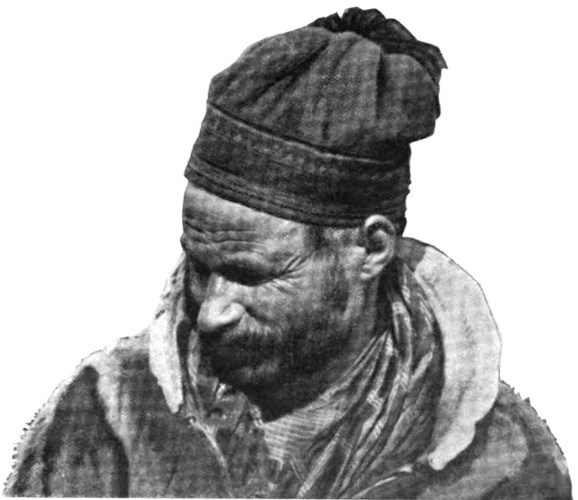
A TYPICAL LAPP PEASANT. From a Photograph.
Well, I went to Lapland, eager to see the semi-savages of whom I had heard so much. It is unnecessary to describe the earlier stages of my journey. Tromsö, Hammerfest, and Lyngseedt, though much frequented, are but large villages in the neighbourhood of which the nomad Lapps pasture their reindeer. The animals feed on a sort of lichen, termed reindeer moss, which, during the autumn, covers the mountains with what looks like a mantle of snow.
The natives live in primitive wattle and mud huts, and I found entire families living in paternal promiscuity with their animals in what—judged by the usual standards—was a most pestilential atmosphere, the predominating feature of which was a nauseous mingled odour of leather and boiled coffee.
As to the people themselves, the typical Laplander, with whom I grew familiar, was, by no means a disagreeable type. Many of the older men bear a strange resemblance to French peasants, having the same dark skin, black hair, large mouth, thin face, prominent cheek-bones, and long, pointed chin. Even in the most wretched hovels I was offered a cup of coffee, accompanied by polite gestures that would have been appropriate for the bestowal of Royal hospitality. In exchange for this courtesy I usually presented my hosts with chocolate sweetmeats, which were received with transports of gratitude. My general impression, however, was that I was among a very primitive peasant race, but I am bound to admit that the Laplanders fell in with all my requirements as a photographer with the utmost good grace; they invariably took the pose I required better than my own people, and never displayed any unseemly curiosity.
I had not forgotten the famous Mickel Nilsson Nia, and when I reached Nawick a Lapp schoolmistress there was kind enough to serve me as guide to the abode of her celebrated countryman. We walked for an hour through a most desolate stretch of country, which gave one the impression that it had been abandoned after some mighty natural cataclysm. In this landscape of death the only persons we met were a stray herdsman or two, miserably attired, driving before them a few attenuated reindeer. Suddenly my guide stopped, exclaiming, “Here is Mickel’s house.”
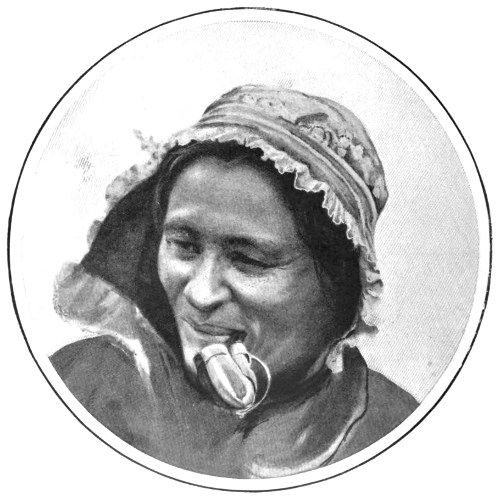
A LAPP WOMAN OF THE BETTER CLASS—MOST OF THE FEMALES HAVE A MARKED PREDILECTION FOR TOBACCO. From a Photograph.
On the threshold two women were engaged in tanning reindeer hides. One of the women was elderly, the other quite young, yet they were attired in an almost identical manner. Each wore a short, coarse brown woollen skirt, beneath which were visible garments that resembled trousers made of bands of tightly-wound cloth. On their shoulders were grey shawls, on their feet enormous shoes of reindeer leather, on their heads bonnets of some blue material covered with lace. The colours usually employed in Lapp costumes, by the way, are white, black, grey, blue, and green; brighter hues are seldom seen.
At sight of us the two women ceased working to stare, and then broke out into a hearty laugh—not of derision, but of welcome. The Laplander is of an extremely jovial disposition, and invariably prides himself on the possession of some nickname—not always complimentary—bestowed upon him in jest. My guide addressed herself to the younger of the two women, who, in addition to the garments I have enumerated, wore some splendid reindeer furs. Then a young peasant came out of the hut, and there ensued a tremendous discussion, the result of which was to convince us that we had made a mistake—Mickel Nilsson’s hut was farther on. The young man volunteered to accompany us there.
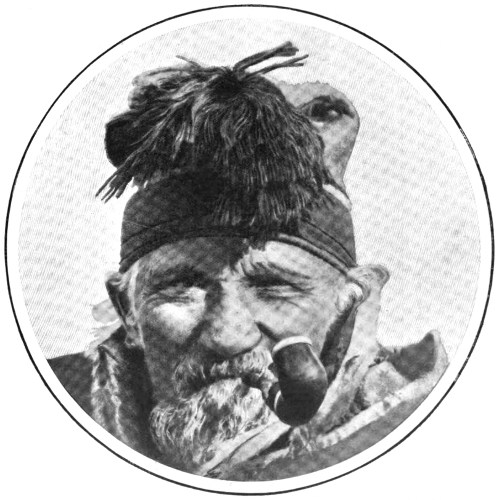
MICKEL NILSSON NIA, THE “LAPP ROTHSCHILD,” WHO POSSESSES NINE THOUSAND HEAD OF REINDEER. From a Photograph.
Finally, we came up to a group of men and women, in the centre of which, busily talking, a veritable Triton among minnows, was the person I sought. On the road I had, through my interpreter, been questioning our new companion, and had thus learned that Mickel Nilsson Nia was a sort of Lapp Rothschild, and possessed nine thousand head of reindeer. As each animal may be put down as worth roughly about a sovereign, the fortune of the little Lapp before me—who, hearing the object of my mission, had now put his finger to his cap and was wringing my hand with great affability—might be estimated at nine thousand pounds.
We had come upon him on a holiday, it appeared, and Mickel Nilsson Nia was arrayed in his very best clothes. On his head he wore a tall sugarloaf, peaked cap, topped by a bright red “pompon,” which gave it a most extraordinary aspect. His body was covered by a superb white reindeer skin—the gala costume—and on his vest glittered the medal bestowed upon him by King Oscar as a reward for his success in breeding reindeer. The man’s whole appearance, with his moustache, short beard, cunning eyes, and perpetual smile, reminded me strongly of Li Hung Chang, the Chinese statesman of illustrious memory, and also the richest man in his country.
Mickel Nilsson Nia courteously invited me to enter his hut. I hesitated for a moment, and then, with head bent low, bravely dashed into the malodorous atmosphere of leather and boiled coffee which I had already learned to dread. In the semi-gloom of the interior a mass of animals were wallowing about, though I could not see them very distinctly. I sank into a wicker arm-chair.
“A cup of coffee?”
“Many thanks.”
Into my hands was thrust a grotesquely-coloured cup, bearing the fateful legend, “Made in Germany.” Like a hero I gulped down the mixture it contained; to tell the truth, it was not unsavoury. Then I commenced to ask him a few questions.
“Are things prospering in the reindeer breeding?” I inquired.
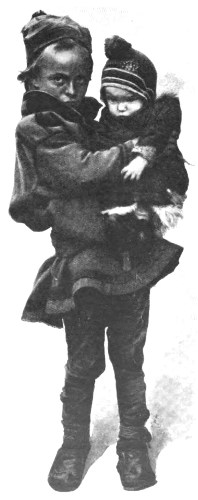
FRATERNAL AFFECTION—FAMILY TIES ARE STRONG IN LAPLAND, AND EVEN THE BOYS LOOK AFTER THEIR BABY BROTHERS WITH THE UTMOST SOLICITUDE. From a Photograph.
Mickel’s answer was strictly non-committal—neither a decided “yes” nor a “no.”
“How many animals do you possess?”
Again he evaded the direct answer with an unsatisfactory “Not so many as I once had.” Then he called my attention to a herd of some three hundred animals or so on the neighbouring hillside, but added immediately, as though fearing he had hinted too much, “They do not all belong to me, however; some are the property of my neighbours. The herdsman we share between us.”
After this I thought it as well to abandon commercial matters for literature. Mickel Nilsson Nia is a man of letters, devoting to books all the leisure his nomadic pursuits leave him. Of the literature of Lapland he spoke with pride.
“With us,” added Mickel, “literature is essentially popular. Our poets sing only of what they have actually under their eyes; they celebrate our daily life, our labours.” Here is a specimen of our poetry:—
The reindeer are in full flight. Look at their wild flowing manes! Look at the capricious animals! Look how the noble creatures bound fleet-footed over the plain through the world! At his topmost speed the man pursues them, sweat standing out in great beads. “Ah, how fatigued I am!” he cries. “And yet what would I not do to catch them!” Oh, the precious animal! What flesh, what a skin, what horns, what veins, what bones! How excellent is all about him! How excellent he is himself! Ah, ah, ah! Look! Look! Two hundred, three hundred, thousands together! Ever do they flee. Into the lakes, into the snow do they cast themselves, seeking to get refreshed. Only when the sun has set will they come forth. Now the night has come; forth they dart. Now it is day and they hide themselves; only the plaintive bleats of the young fall on the ear.
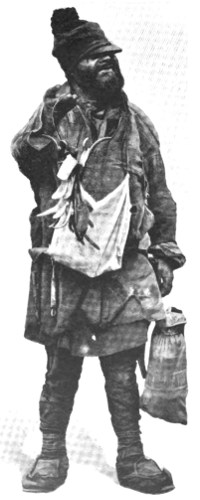
A VENDER OF SOUVENIRS—HE HAS DONE WELL AT HIS TRADE, AND HAS ACCORDINGLY TREATED HIMSELF TO A SPECIALLY-SMART CAP AND LUXURIOUS LAPP BOOTS. From a Photograph.
As I was begging my interpreter to convey to Mickel Nilsson Nia my admiration of this stirring epic of hunting, my host picked up a bundle of Swedish illustrated papers from the corner and proceeded to make comments upon them. Just then, however, a herdsman entered with news of importance, so I rose and took my leave.
Accompanied by my two companions, I retraced my steps through the wild, desolate country, in which none but the most intrepid of sportsmen could find any pleasure. It is a land in which there are neither hotels nor houses; a land which seems to take one back to some remote age of innocence, when simple, honest human beings drove their flocks and herds before them, chanting the while a hymn to the delights of a pastoral life.
What souvenirs, you ask, can one carry away from this strange country, where the reindeer rules supreme, and which, without the presence of that useful animal, would sink into a condition of abject poverty and utter desolation? Appropriately enough, there is nothing but carved reindeer bones. Some are carved in so extraordinarily realistic and expert a fashion that more than one eminent sculptor to whom I have shown them has lifted his hands in admiration.
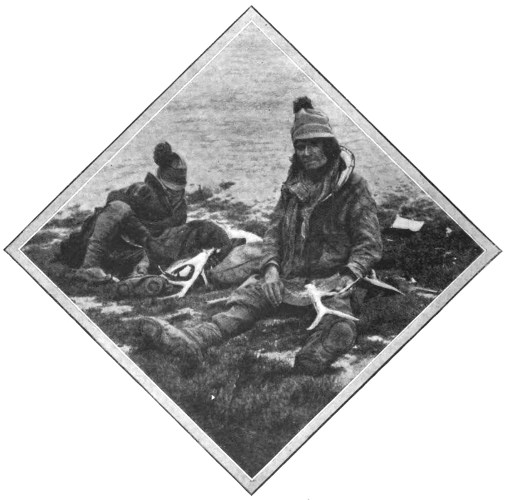
LAPP ARTISTS AT WORK CARVING REINDEER BONES. From a Photograph.
Like all true artists worthy the name—like the Japanese, for instance—the Laplander will only reproduce what he sees. Consequently, in nine cases out of ten his carved reindeer bones show only reindeer—reindeer at rest, reindeer jumping, reindeer harnessed to sledges, and reindeer browsing. The thing becomes an absolute obsession. And what realism is displayed by these unconscious artists! What long hours of patient observation are implied by the life-like attitudes they depict, and which might almost have been photographed, so true are they to Nature! One gets the impression, watching the Lapp carver at work, that one is in the presence of an artisan of a bygone age, before rules had been laid down and become stereotyped—an age when each individual worker was guided by his personal inspiration alone.
After all, then, in this strange country, where there is supposed to be “nothing but reindeer,” one may still find among these half-savage people financiers—like Mickel Nilsson Nia—poets, and artists—types which certainly go to show that the Lapps possess some of the attributes of a civilized nation. Music alone is unknown in Lapland, and this may be because the Lapp, with his boundless pride of race, considers he has no need of its chastening and refining influence.
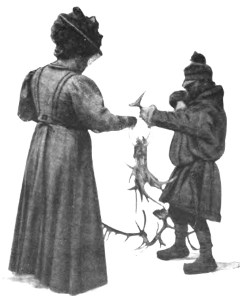
BUYING SOUVENIRS—STRIKING A BARGAIN WITH THE CURIO PEDLARS IS A LONG AND COMPLICATED BUSINESS. From a Photograph.