II.—A SHARP LESSON. By R. L. C. Morrison.
Reading edition
In November of the year 1885, when I had reached the mature age of seventeen, I found myself in Glasgow, my native city, in the service of an uncle of mine named Mr. James Thomson, who was a merchant tailor and Colonial outfitter in Hope Street.
One afternoon towards the end of the month my uncle gave me instructions to call at the offices of a well-known firm in the neighbourhood of Jamaica Street.
I was to collect an account, whose total represented a substantial sum, and give a receipt for the money. There would, I was told, be no difficulty about drawing what was due, as the firm in question had duly intimated to my uncle that if he would present the account on a certain date payment would be made then and there.
It was close upon three o’clock when I put in an appearance at the counting-house of the firm, taking up my position in a somewhat extended queue of clerks and others who had arrived on the same errand as myself.
The queue was arranged in single file along a passage of considerable length on the second storey, to reach which a flight of something like a score of steps had to be ascended.
Right away at the far end of this passage was what had all the appearance of a railway station booking office, where, behind a square aperture of limited dimensions, stood the sharp-witted cashier.
I took my turn with the rest, and in due course found myself in front of the pigeon-hole, where I presented my uncle’s account.
“All right; receipt it,” exclaimed the cashier, as he returned it.
I did so, receiving the amount of the account in Bank of Scotland pound notes, a couple of score of them, or more, which I quickly folded into a kind of roll and thrust deep into my trousers pocket, keeping my hand over them for safety’s sake.
Pleased with the thought that I had got the money, I briskly threaded my way among the nondescript crowd in the passage, and even more briskly negotiated the stairs.
I had scarcely walked the length of the side thoroughfare which led into Jamaica Street, however, when I heard hurrying footsteps behind me, and, looking round, was surprised to see a very stylishly-dressed man, whose appearance was enhanced by his faultlessly-groomed hair and moustache. As soon as I looked in his direction he held up his hand and beckoned me to stop.
Wondering what he could want with me I obeyed without further ado, waiting for him to come up with me.
“Excuse me, sir,” he said, with much politeness, at the same time slightly raising his hat, “but I believe this is your handkerchief.” As he spoke he swept round his hand, which he had held behind his back, and displayed to view a blue silk specimen in the handkerchief line. It was mine; there was no doubt about that, and as I advanced my hand he extended it towards me.
“I saw you drop it as you came down the stairs of Messrs. ——’s office” (mentioning the name of the firm), he explained.
I thanked him and was about to resume my way when he asked if I could direct him to Hope Street.
As everyone who knows anything about Glasgow is aware, it does not take long to reach Hope Street from Jamaica Street, and I was beginning to explain this to him when he cut me short with the remark that before we went any farther I must have a drink with him. As I was a teetotaller, however, I promptly declined his proffered hospitality, and once more resumed my walk.
The next moment he laid a daintily-gloved hand on my shoulder, and, with an engaging smile, said, with the utmost good humour, “But surely a glass of lemonade or ginger-beer cannot do you any harm?”
There was a strange magnetism about the man which carried me away, and I meekly surrendered myself to his will.
“Let us turn up this street,” he said, suddenly. “I know a nice little quiet place where we can have a drink in comfort.”
I followed him. Strange as it may seem, I was for the time being incapable of resistance. Perhaps my new-found friend was a hypnotist, or something of the kind; if he did not actually possess occult powers, he certainly had the gift in a very marked degree of ingratiating himself with strangers.
As we walked along side by side he kept up a lively and interesting conversation, touching lightly upon a variety of subjects. He evidently possessed a well-stored mind, for his fund of knowledge and anecdote seemed almost inexhaustible.
I became so interested in what he was telling me—wonderful adventures he said he had had in South America, and a graphic description of how diamonds are found—that I did not notice where I was being led. All I know is that we traversed street after street, until at length the man whom I had offered to guide to Hope Street had taken me to a part of the city in which I never remember having previously been.
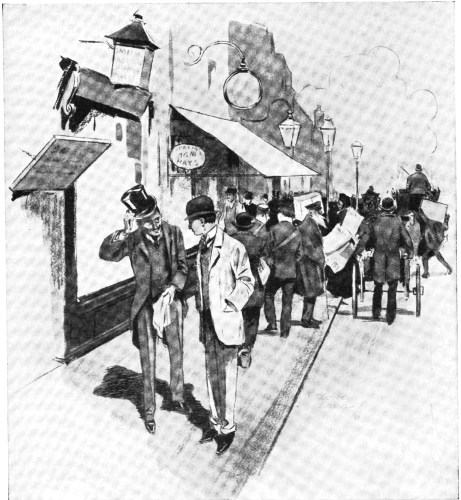
“’EXCUSE ME, SIR,’ HE SAID, WITH MUCH POLITENESS, AT THE SAME TIME SLIGHTLY RAISING HIS HAT, ‘BUT I BELIEVE THIS IS YOUR HANDKERCHIEF.’”
Then suddenly he halted in front of a most respectable-looking whisky shop—in England we call them public-houses—situated in a broad thoroughfare, busy with plenty of pedestrian and vehicular traffic. It did not strike me as being a particularly “quiet” place; in fact, whilst it may have been comfortable enough inside, its exterior surroundings were not likely to recommend it to those in search of solitude.
“Here we are, my young friend,” he said, with that smile which had now become almost irresistible to me.
The inside fittings of the place were what may be termed “flashy,” immense gilded mirrors and crimson-covered seats being the outstanding features in the general scheme of furnishing and decoration. A mahogany, tumbler-laden bar, with shelves of massed bottles in the background, ran the whole length of the apartment, whilst on the other side were a range of what I can best describe as cubicles, though in public-house parlance I suppose they would be called “snugs.” There was a door to each of these box-like apartments, though the ceiling of the saloon was common to them all.
“Come in here,” urged my friend, tugging at my coat-sleeve. “It will be quieter, and no one will disturb us.”
We entered the “snug,” which contained a long narrow table, with horsehair-padded seats on either side, an oblong window, half screened, serving to let in a rather subdued light.
Scarcely had I got both my feet inside when I observed with surprise that the place had already an occupant, a benevolent-looking old gentleman, who at that moment was studiously engaged in perusing the columns of a newspaper.
My companion, noticing my hesitation, exclaimed in a cheery voice, “It’s all right, my boy; I’m sure our friend won’t object.”
Looking up from his paper “our friend” adjusted his spectacles and regarded us both with a quizzical expression.
“Come in; don’t mind me,” he said at length, as if satisfied with our appearance, and we sat down at the table, my companion on one side, I on the other, the first occupant taking no further notice of us.
“I’m going to have a toothful of whisky,” said my fashionably-dressed vis-à-vis. “Will you have the same?”
I diffidently demurred at the proposal, as all alcoholic beverages were then to me as a sealed book, and in the end a bottle of lemonade was ordered for me.
And there I sat, sipping the lemonade and nervously fingering the bundle of notes in my trousers pocket.
I had found my friend very agreeable, very pleasant, and very entertaining, and would not have objected to remaining a little longer with him, but that I felt my employer would be expecting my return with the money he had sent me out to collect. Accordingly, drinking up my beverage, I presently rose and said I was afraid I must be going.
“Oh, there is no hurry, my boy,” he said, with such cordiality that I sat down again—but it should be only for a couple of minutes, I told myself.
“That’s right; make yourself comfortable, and we’ll have another drink in.”
I protested that I had had quite sufficient and that I must not linger, as I was expected back.
“A few minutes more or less will hardly make any difference,” he remarked, “and, besides, if you will only wait I shall be coming your way, for you know you promised to show me the way to Hope Street.”
I am afraid my resolutions about going were somewhat feeble, for he again persuaded me to sit down.
Meanwhile the old gentleman at the other end of the narrow table went on reading his paper. He might have had the place to himself for all the notice he took of us.
Suddenly my companion ceased speaking to me (the conversation had by some means or other turned on the subject of trains), and diving his hand into a side pocket produced a new railway-carriage key, very bright and very shiny.
I wondered what he intended to do with it, and even got so far as speculating upon whether he was a manufacturer of this class of goods, or travelled for the people who made them.
Then he tapped the key lightly on the edge of the table, and, addressing the old gentleman, said, politely: “Is this article of any service to you, sir? Excuse the apparent liberty, but I can offer you these keys at the small sum of sixpence each.”
I looked in the direction of the old gentleman and saw that he had put his paper on one side and was regarding my companion with a pleasant smile.
“I am much obliged to you, sir,” he replied, softly; “but as I very rarely travel I have no use for such a key.”
“Never mind,” remarked the other; “I’ll tell you what we’ll do—we’ll just ‘cut’ for it,” and without any further explanation at the moment he drew from his breast pocket what I took to be three ordinary playing-cards. The same pattern embellished the back of each, but when they were turned face upwards I observed that two of them were blanks, whilst on the other was a highly-coloured representation of a lady’s head and shoulders. I recollect that the hues in which the charms of this female were depicted were very varied, so that in combination they presented a dazzling picture.
Although the word “cut” had been made use of as applicable to the cards, it was rather a misnomer. “Double shuffle,” with a peculiar movement, would more fittingly describe what subsequently happened.
“Now, whichever of you two can first tell me where the lady is I will present with this key as a prize,” said the young man. As he spoke he made a pretence of shuffling the cards up in his hands, and then proceeded to lay them face downwards on the table, but before he finally allowed them to remain he exhibited the face of each card, so that I thought nothing could possibly be easier than to indicate where the lady’s head lay.
“You try first, sir,” said my friend to the old gentleman, and he singled out the card which I was absolutely certain was the wrong one, and so it was, as it turned out.
“Your turn, my boy,” cried the stranger, having rearranged the cards, and without the slightest hesitation I displayed the female’s head to view.
“Very good; here’s your prize,” and he pushed the key across the table to me.
“Just by way of a change, I will bet each of you sixpence that neither of you can pick out the lady’s head this time,” he said; but hardly had the words been spoken than the door of the “snug” was quietly opened and an elderly man stood framed in the open space.
“I beg your pardon, gentlemen,” he apologized; “I didn’t mean to intrude.”
“Won’t you come in and join us, sir?” cried my companion, insinuatingly. “Just a quiet little game together; only sixpenny stakes.”
“Oh, well, I don’t mind if I do,” replied the new-comer, and without further ceremony he seated himself on the other side of me and fixed his eyes intently on the cards, which the other was manipulating with both hands.
By this time the old gentleman gave every sign of being deeply interested in the proceedings, and had taken a number of sixpences from his pocket, which he placed in a little heap at his side.
The new-comer and I also produced the necessary coin and staked it on the “lady.”
The old gentleman was the first to try his luck, but he failed to locate the whereabouts of the fair one.
Then the cards were taken up and rearranged, when the new arrival had a flutter, but he likewise parted with his sixpence.
“How stupid these men must be!” I thought, as the cards were being prepared for a third set out, when, of course, I immediately spotted the “lady” and was paid over the sixpence.
“Double stakes now,” cried the manipulator.
Nothing loath, I put my shilling down, and again I was the only victor.
Well, to cut a long story short, my companion went on doubling the stakes until they stood at sixteen shillings. Up to now I had been the only winner. I had not lost a single penny; as a matter of fact, I was fifteen and sixpence to the good, but when I tried to find the “lady” when the stakes stood at sixteen shillings I signally failed, and had to pay over all my winnings, with an additional sixpence.
By this time I was fairly infected with the game, and had thrown all discretion to the winds with regard to my return to the office. I felt confident that I could win a lot of money, and up to this point had not the faintest suspicion that I was in the midst of a gang of card-sharpers of whose modus operandi of working the business I was now being given a practical demonstration. Therefore, when the leader of the coterie, the man, who had “hooked” me outside, suggested that the stakes should be thirty-two shillings I made no demur, but blindly accepted, fondly imagining that by exercising a little care in watching where the cards were placed I should be able to spot the “lady.”
“Now, gentlemen,” cried the card manipulator, deliberately holding up the picture card to our view every two or three shuffles, so that I was able to follow its fortunes with the greatest ease, “there is the lady! Just watch carefully where I place her.”
As I had been the last loser it was my turn to pick out the picture, and as he placed the winning card in the centre (I could have sworn he did) I did not hesitate to indicate my choice by at once turning it face upwards, when, lo and behold! all that met my gaze was a plain white surface. Instead of being in the middle, the “lady” was at the right of me, though how this sleight-of-hand trick had been accomplished under my very eyes without my detecting it was past my comprehension.
“Thank you,” said the swindler, suavely; “thirty-two shillings, please”; and after some fumbling in my trousers pocket I succeeded in detaching two pound notes from the roll.
“Eight shillings change,” he remarked, genially, and handed me over the silver.
Inconceivable as it may appear, it is nevertheless the fact that even this “fleecing” did not arouse my suspicion as to the bona fides of the proceedings in which I was being made the victim. Possibly I was too excited at the moment to give this aspect of the matter a thought. My chief concern just then was to recover the money I had lost—not my own money, it should be remembered, but my employer’s.
At the suggestion of the old gentleman, who had not up to the present won a penny, and yet struck me as taking his “bad luck” very philosophically, the stakes were increased to three pounds—“so as to” (I use his own ingenuous phrase) “give the young gentleman and myself a chance.”
I sprang at the bait. Indeed, I was desperately in earnest, and mentally vowed that I must win this time at all costs.
Need it be recorded that I lost?
The card on the left—my choice—was not the “lady,” and three more notes were separated from the roll in my pocket.
Then, and not till then, did the real situation dawn upon me—I was in the hands of a gang of “three-card” tricksters. I had over forty pounds, which was not mine, on me, and the fashionably-attired stranger who had ingratiated himself into my good graces by some mysterious means was fully aware of that fact. The whole thing, in short, was a cleverly-laid plot to despoil me of my employer’s money.
As the full truth burst upon me I rose from my seat without a word and made my way to the door, intending to seek the landlord’s assistance.
But it was locked from outside! Bending down and applying my eye to the lock I saw the key inserted on the saloon side. This discovery I accepted as furnishing positive proof of the existence of a conspiracy to rob me. As I stood at the locked door, making up my mind that the next step should be on my part, the man who had lured me into the place plucked me by the coat-sleeve and begged me with gentle words to resume my seat and “talk matters over.”
“Give me my money back!” I cried, impetuously, pointing to the five notes which lay on the table. “It does not belong to me,” I went on, entreatingly. “It is my employer’s, and I cannot return to him without it.”
The two other confederates looked at me with sympathetic glances; then I fancied I saw an exchange of eye telegraphy between them and the leader.
“Of course, none of us want to get you into trouble,” he said, soothingly, at the same time pushing me gently back into my seat and taking his place opposite me, “but you must admit that you were willing enough to play the game. No one forced you to it, and what you have lost has been lost in square play.”
“But why is the door locked if it is all fair and above-board?” I shouted, excitedly.
“What! the door locked?” they cried in chorus, with well-simulated amazement.
“Yes, locked from outside,” I continued.
“Ah, from the outside,” replied the leader, smilingly. “That proves we have nothing to do with it. It is an accident, a mistake on the part of someone in the saloon.”
Although I did not believe a word of this, for I was now fully convinced that the landlord was also in league with these scoundrels, I made no further allusion to it, having made up my mind to a certain plan by which I hoped to regain possession of the money and make my escape from this den.
I instinctively knew that a proposal for further play was going to be made me on the plea of giving me a chance of recouping my losses, and for the purposes of the desperate plan I had decided upon this was exactly what I wanted.
“Now, my boy,” began the leader, in his friendly way, “I’ll tell you what I’ll do to give you a chance. I’ll lay you ten pounds to two pounds on the next round, and only you and I will play. You shall watch me as closely as you like, and no doubt you will win.”
“I will agree,” I assented, “on condition that the door is unlocked and the key brought inside and placed on the table.”
It was a bold move on my part, and I trembled for the answer, because upon this one point depended to a very great extent the success of the desperate plan I had thought of to escape, and at the same time regain my employer’s money.
Evidently sure of their quarry, and all unsuspicious as to my intentions, the trio at once agreed to the proposal.
The landlord was called—and bullied—the door unlocked, and the key placed on the table by my side.
Then the cards were laid out afresh, and I made another effort to “spot” the “lady,” although I was morally certain that I should fail.
I did, and handed over two more pound notes, which the dealer placed with the five others, lying loosely by his side.
In my jacket pocket I had a large sailors’ clasp knife, with a murderous-looking blade nearly five inches long, and while my vis-à-vis was picking up the cards preparatory to another deal, I having consented to play for the same stakes again, I surreptitiously got this weapon out and opened it under cover of the table.
The seven Bank of Scotland pound notes lay carelessly bunched together opposite me on the side of the table and within easy reach, whilst the door of the “snug” was but a couple of feet away from where I sat, I being nearest to it.
The next moment I saw my opportunity and seized it.
As the dealer manipulated the cards, he, as he had done all through, spread out his hand over a card for a couple of seconds. I clutched the open knife firmly in my right hand, and before any one of those present could have the slightest idea of my intentions I bounded to my feet, raised my arm in the air, and the next instant had pinned the sharper’s hand to the table with the long, keen blade!
With his scream of agony ringing in my ears, and the sight of the knife quivering in his hand photographed, as it were, upon my vision, I grabbed at the loose notes which lay in front of me, bunched them up into the palm of my hand, and, leaving the knife where I had driven it, flung open the door of the “snug” and bounded through the saloon and out into the busy street.
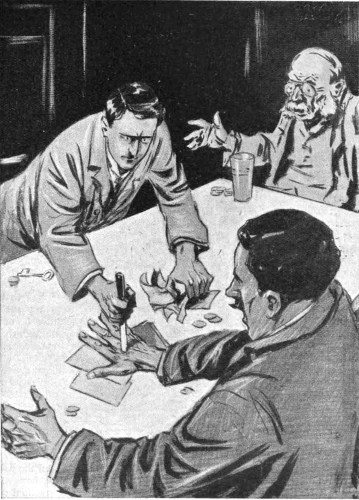
“THE NEXT INSTANT I HAD PINNED THE SHARPER’S HAND TO THE TABLE WITH THE LONG, KEEN BLADE!”
Though the recital of this incident occupies some little time in the telling, it was all accomplished in the space of a few seconds, and as soon as I found myself mixed up with the traffic outside I considered I was safe from pursuit—if, indeed, it had ever been likely any attempt would be made by the sharpers to run me to earth.
I reached my uncle’s place of business an hour or two later than I should have done in the ordinary course, but gave some plausible excuse for my delay.
He was inclined to be angry at first, but as I produced the money all right he did not pursue the matter further, although it was not until a considerable time afterwards that I ventured to give any of my relations an account of my exciting adventure with the card-sharpers.