THE WIDE WORLD: In Other Magazines
Reading edition
A HETEROGENEOUS COLLECTION.
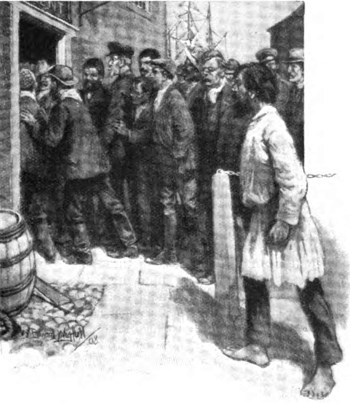
For one wishing to study the ways of the lowest dregs of this earth, I would advise him to give the slums of London a rest, and watch the throngs who besiege the offices of the agents who undertake to supply the cattlemen with help at Montreal. German and Russian Jews, Dukhobhors, Italians, negroes, Dr. Barnardo boys, homesick for their beloved slums; broken-down “sharks” and “confidence men” from the large cities of the States; one-time moneyed youths from the larger English towns, who have run through the capital given them to start in business, and are returning on the chance of getting more. All bustling and hustling each other after the same prize—a free passage to London, the home, and often the grave, of the desperate.—“THE CAPTAIN.”
TRAVELLING IN ICELAND.
By the average individual (unless he happens to be a salmon-fisher) Iceland is imagined to be a place somewhere within the region of the Arctic Circle and to be a land of eternal winter. The fishing enthusiast knows it only as a paradise of his craft and values it accordingly. Some tourists visit the island for a week or so in summer, and get as far as Thingvellir, or if they are not too saddle-sore they may see Geysir. But only a very select few have travelled for weeks on the hardy little ponies and known to the full the exceeding delight of day after day spent in the wonderful Icelandic air and of riding through the green valleys and fording the numberless rivers and streams of Iceland. To those who can ride and are keen on an open-air life and who are lovers of scenery the island should appeal, and this should apply even more so to those tired of the ways of cities, for there are no railways in Iceland, no motors, and there were until very recently no telegraphs.—“WOMAN’S LIFE.”
A LUCKY FALL OF SNOW.
On the Trans-Siberian Railway not long ago some train-wreckers, anticipating the Continental express, had been busily engaged for some hours tearing up the permanent way. But, in the meantime, so heavy a fall of snow had occurred that the mail had been completely blocked some few miles before reaching the work of destruction. In this way the robbers were defeated of their prey, and the gangs of workmen who afterwards went out to clear the line discovered the damage on digging away the snow.—“TIT-BITS.”
WOMEN’S SPORT IN SWEDEN.
In no other European country do sports occupy so large a place in women’s lives as they do in Sweden. This is especially the case in winter, when traffic and social intercourse are hindered by the snow and, but for outdoor games and exercises, life in the great castles and country estates would be monotonous and dull for the women of the upper classes. This is the time, however, when the Swedish ladies most enjoy themselves, for they pass their days in skating, skiing, tobogganing, coasting, and in training for the races which take place at Stockholm and in most of the more populated parts of the country.—“THE LADIES’ FIELD.”
AN UNCONVENTIONAL AMUSEMENT.
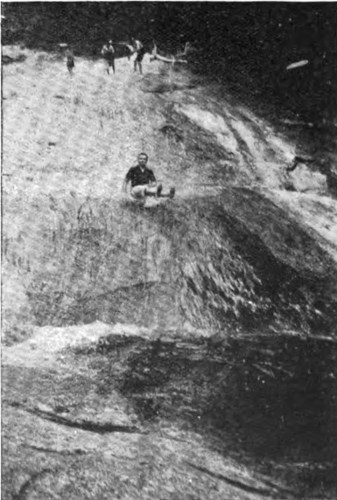
The “Mengeleusha,” or “slippery place,” near Kuala Kangsar, Perak, Federated Malay States, is a solid piece of granite, about seventy or eighty feet long, standing in a stream of water and forming a sort of waterfall. The water flowing down this rock makes it as slippery as glass, and the amusement is to slide down the rock and splash into the pool beneath. This snapshot shows an Englishman half-way down the slide.—“THE STRAND MAGAZINE.”