THE NATIVE INHABITANTS OF THE PACIFIC SLOPE
Reading edition
The explorers and early settlers found a native race occupying nearly every portion of our continent. These people had many characteristics in common and were all called Indians. It is believed that they came originally from Asia, but their migration and scattering occurred so long ago that they have become divided into many groups, each having its own language and customs.
In the western portion of the country, where the surface is broken by numerous barriers, such as mountains and deserts, almost every valley was found to be occupied by a distinct group of Indians called a "tribe." The language of each tribe differed so much from the languages of adjoining tribes that they could with difficulty understand one another. These tribes were almost continually at war.
The Indians upon the Pacific slope were generally found to be inferior in most respects to those living in the central and eastern portions of the continent. One might suppose that the tribes possessing the fair and fertile valleys of California would be the most advanced in civilization, but such was not the case. Many of them were among the most degraded upon the continent. They seemed unable to adapt themselves to the white man and his ways, and in the older settled districts they have now nearly disappeared. In the newer portions of the Northwest and along the coast toward Alaska the Indians have not yet come into so direct contact with the white men, and remain more nearly in their primitive condition.
When the Indians of central California were first seen, they wore but little clothing, and knew how to construct only the simplest dwellings for protection from the weather. They did not cultivate the soil, nor did they hunt a great deal, although the country abounded with game. Along the larger streams fish was an important article of food, but in other places, acorns, pine nuts, and roots constituted the main supplies. The acorns were ground in stone mortars and made into soup or into a kind of bread. These Indians have often been called Diggers because they depended so largely for their living upon the roots which they dug.
It would seem natural that about San Francisco Bay the natives should have used canoes, but, according to early travellers, they had none. When they wished to go out upon the water they built rafts of bundles of rushes or tules tied together.
At favorable points along the shore the Indians collected for their feasts, and these spots are now indicated by heaps of shells, in some places forming mounds of considerable size. Many interesting implements have been dug from these mounds, or kitchen middens as they are sometimes called. In the mountains the sites of the villages are marked by chips of obsidian (a volcanic glass used in making arrow-tips) and by holes in the flat surfaces of granitic rocks near some spring or stream. These holes were made for the purpose of grinding acorns or nuts.
Many of the Indian tribes developed great skill in the weaving of baskets, which they used for many different purposes. The baskets are still made in some places, and are much sought after because of their beauty.
The Indians of northern California in building their homes dug round, shallow holes, over which poles were bent in the form of a half-circle, and then tied together at the top. Bark was laid upon the outside, and earth was thrown over the whole structure.
FIG. 61.—HOLES IN ROCK, MADE FOR GRINDING FOOD
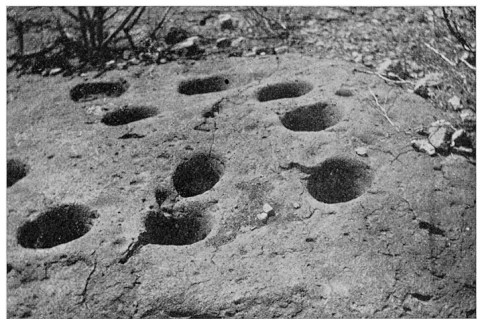
"Sweat houses" were built in much the same manner, and were used chiefly during the winter. When an Indian wished to take a sweat, hot stones were placed in one of these houses, and after he had entered and all openings were closed, he poured water upon the stones until the room was filled with steam. After enduring this process as long as he desired, the Indian came out and plunged into the cold water of a near-by stream. As may be imagined, such a bath often resulted disastrously to the weak or sick.
The fact that the California Indians could support themselves without any great exertion undoubtedly had the effect of making them indolent, while in the desert regions of the Great Basin the struggle for something to eat was so severe that it kept the natives in a degraded condition.
FIG. 62.—CALIFORNIA INDIAN BASKET
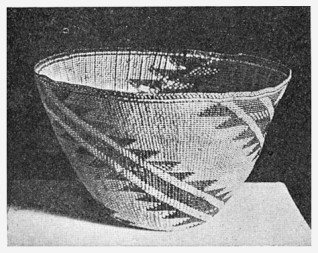
The Indians of the Columbia basin built better houses than those farther south. Where wood was abundant their homes were similar in some respects to those of the coast Indians north of the mouth of the Columbia. Fish was their main article of diet. At certain seasons of the year, when salmon were plentiful, each tribe or group of Indians established its camp near one of the many rapids and waterfalls along the Columbia River. Large numbers of the salmon were caught by the use of traps. After being partly dried they were packed in bales for winter use. The fish thus prepared were considered very valuable and formed an article of trade with the tribes living farther from the river.
The Indians inhabiting the coast northward from the mouth of the Columbia were different in many respects from those farther south or inland. They built better homes, took more pains with their clothing, were skilled in the making of canoes, and showed marked ability in navigating the stormy waters of the channels and sounds.
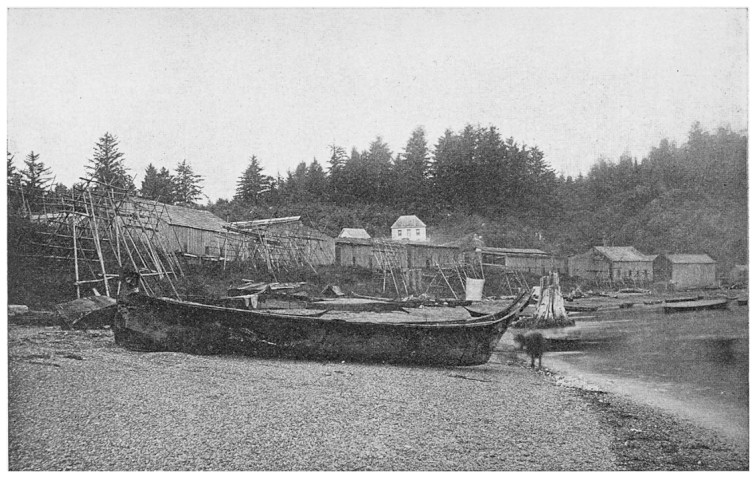
FIG. 63.—HESQUIAT INDIAN VILLAGE
Nootka Sound, Vancouver Island
The Vancouver Island Indians are called Nootkas, from the name of an important tribe upon the west coast. Those of Queen Charlotte Islands, still farther north, are known as Haidas. These two groups are very similar. They live upon the shores of densely wooded, mountainous lands and travel little except by water. Some of the canoes which these tribes construct are over fifty feet long and will easily carry from fifty to one hundred persons. Such a canoe is hewn out of a single cedar log, and presents a very graceful appearance with its upward-curving bow. In these boats the Indians take trips of hundreds of miles.
FIG. 64.—FLATHEAD INDIAN WOMAN, VANCOUVER ISLAND
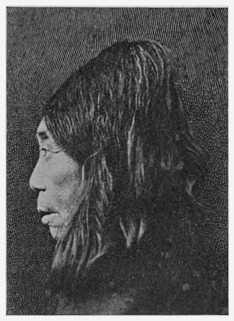
A ride in one of the large canoes is an interesting experience. When a party starts out to visit the neighboring villages, carrying invitations to a festival, the men are gayly dressed, and shout and sing in unison as they ply their paddles. The great canoe jumps up and onward like a living thing at every stroke of the paddles, which are dipped into the water all at once as the rowers keep time to their songs. But this enthusiasm quickly disappears if a head wind comes up, and the party goes ashore to wait for the breeze to turn in a more favorable direction.
These Indians, as might be supposed, live largely upon fish. Berries are abundant during the summer and are also much used for food. The clothing of the Indians was originally a sort of blanket made of the woven fibres of cedar bark, or more rarely, of the skins of animals, although among the northern tribes skins were used almost exclusively. Matting made of the cedar bark is still in common use in their houses.
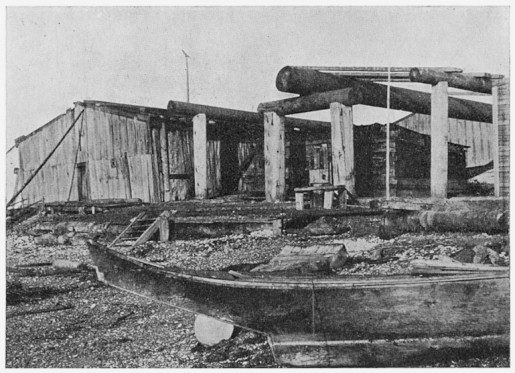
FIG. 65.—INDIAN HOUSES, FORT RUPERT, VANCOUVER ISLAND
Among the Vancouver Island Indians, a few have peculiarly flattened foreheads (Fig. 64). This deformity is produced by binding a piece of board upon the forehead in babyhood and leaving it there while the head is growing.
The villages are located in some protected spot where the canoes can lie in safety. The buildings are strung along the shore close under the edge of the thick forest and just above the reach of the waves at high tide. They are very solidly constructed, for these Indians do not move about as much as those farther south where the forests are less dense. Figure 65 shows the framework of a partially built house, while another stands at one side completed. Large posts are set in the ground at the corners and ends of the building; cross logs are then placed upon the middle posts, and upon these a huge log is placed for a ridge-pole. This is sometimes two feet in diameter and from sixty to eighty feet long. It must require the united strength of many men to roll such a log into position. Upon the framework thus constructed split cedar boards are fastened, and the building is practically finished. Such a house is usually occupied by a number of families. Upon Queen Charlotte Islands there is a dwelling of this kind large enough to hold seven hundred Indians.
The fronts of the houses are ornamented with figures hewn out of wood. These represent men, birds and animals and have a religious significance. Sometimes these figures are mounted upon the tops of tall poles.
The "totem pole" is a most interesting affair. Figure 66 represents the pole at Alert Bay, east of Vancouver Island. It is one of the finest upon the north coast. The figures of animals and birds carved upon it represent the mythological ancestors of the family or clan in front of whose abode the pole stands. The Indians often hunt similar animals to-day, but believe that their ancestors had supernatural power which raised them above the ordinary creatures.
The Chinook Indians live upon the lower Columbia. The name "chinook" has been given to a warm, dry wind which blows down the eastern slope of the Rocky Mountains and out upon the Great Plains. This wind is so named because it blows from the direction of the Chinook Indians' country. The "Chinook" jargon is a strange sort of mixed language with which nearly all the tribes of the Northwest are familiar. It is formed of words from the Chinook language, together with others from different Indian languages, French-Canadian, and English. Through the influence of the trappers and traders the "Chinook" has come into wide use, so that by means of it conversation can be carried on with tribes speaking different languages.
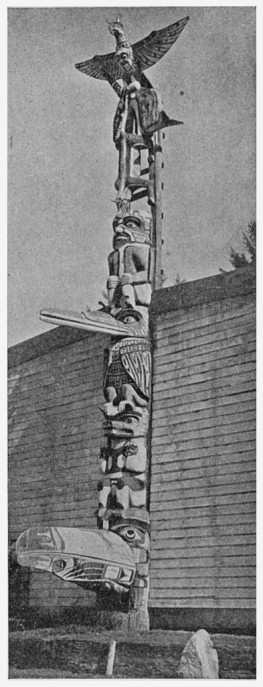
FIG. 66.—TOTEM POLE
Alert Bay, British Columbia
Although there are so many different tribes, with great diversities of language, throughout the West, they were probably all derived from the same source. As we go north the similarity between the coast Indians and the inhabitants of eastern Asia becomes more noticeable. It seems almost certain that these American Indians originally came across the narrow strip of water separating Asia from America.
We do not know how long the Indians have occupied our country, but it has probably been several thousand years. Some of the main groups have undoubtedly been here longer than others.
Unless we protect the Indians and permit them so far as possible to lead their own natural lives, most of them will soon disappear.