THE LAST VOLCANIC ERUPTIONS IN THE UNITED STATES
Reading edition
There are more volcanoes in our country than is generally supposed. Some are very small and some rank among the greatest of mountain peaks, but all together there are many hundreds, perhaps thousands, of them. At present they are all silent and apparently dead. We are accustomed to speak of them as extinct volcanoes, but of this we must not be too sure.
They stand dark and cold, giving no clue to the nature of the forces which made them, except perhaps by the presence of an occasional hot spring and the appearance of the rocks of which they are composed. The slag-like character of these rocks we have learned to associate with intense heat. Some of these volcanoes are very old and have been nearly worn away; others are new and almost as perfect as when they were first made.
Where shall we go to find these volcanoes? Are there any upon the Atlantic coast or neighboring highlands? Though you may travel over all that portion of our country, you will find none, although you will discover in places, as for instance in the palisades of the Hudson, lavas which came from very ancient volcanoes, worn down so long ago that their very sites are lost to view.
If we search the Mississippi basin we find there even fewer traces of volcanic action than upon the eastern highlands. The greater portion of the vast area embraced by the Mississippi River and its tributaries has had a very uneventful history, although at times earthquakes may have occurred and the sky may have been darkened by ashes from eruptions in distant parts of the earth.
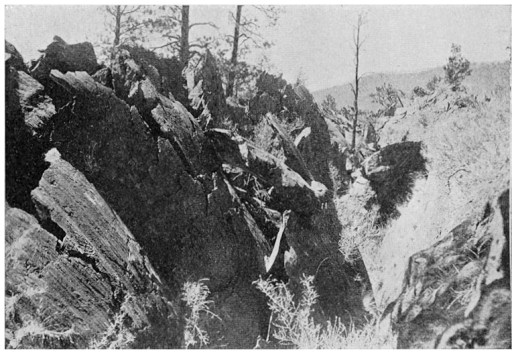
FIG. 25.—FISSURE IN THE LAVA, SHADOW MOUNTAIN
The groovings in the lava show that it was squeezed out in a half-solid condition
It is in the country west of the Rockies, the region last to be explored and settled, that the objects of our search come to light. Here are volcanoes and lava fields so extensive as almost to bury from sight the older surface of the earth. Some of them appear as if but yesterday they had been glowing with heat.
In the Cordilleran region Nature has carried on her work with a master hand. She has lifted the earth's crust to form a great plateau. Portions of the plateau she has broken, projecting the fragments upward to form lofty mountains, while along the fissures thus created she has squeezed out fiery molten matter from the interior of the earth. This molten material has spread out in fields of lava or has piled itself about small openings, forming volcanic cones, which in some cases have overtopped the loftiest mountain ranges of the continent. It is believed that a number of these volcanic eruptions have occurred in the Cordilleran region of the United States since the discovery of America, and that one took place within the lifetime of many persons now living.
San Francisco Mountain, in northern Arizona, is the loftiest volcanic peak of a region dotted with volcanoes and lava flows. This great volcano, like most of its neighbors, has long been extinct, although a few miles to the eastward there appears a group of small but very new cones.
A ride of fifteen miles from the town of Flagstaff, across the forest-covered plateau, brings us to Shadow Mountain and the fields of lava and volcanic sand lying at its base. The mountain, throughout its height of over one thousand feet, is a conical aggregate of loose lapilli which give way under the feet and make climbing the peak very tiresome.
The lapilli and scoriæ are slag-like fragments of lava which have been blown out of the throat of the volcano while in a hot or semi-molten condition. These fragments, as they fall back to the earth, collect about the opening and in time build up the volcano, or cinder cone, as such a mountain is frequently called. The finer particles, which have the appearance of dark sand, fall farther away and form a layer over the surface for some miles upon every side. These products of an explosive volcano are sometimes called cinders and ashes, because of their resemblance to the slag and refuse of furnaces.
In the case of the volcano which we are studying, the lapilli are so black that they give the cone the appearance of being darkened by the shadow of a cloud, and on this account the peak is named Shadow Mountain. As the days are usually bright here, the shadow effect is very striking.
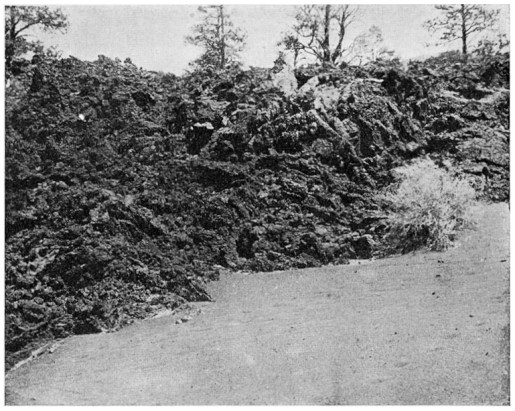
FIG. 26.—EDGE OF LAVA FIELD, WITH PUMICE IN THE FOREGROUND
Near Shadow Mountain
There are several smaller craters, east of the main one, which also threw out volcanic sand and lapilli. The surrounding hills are of volcanic origin, although very much older than Shadow Mountain. These hills are covered with pine forests; but trees or plants have gained only slight hold upon the newer surfaces of the cinder cones, which present a picture of almost complete desolation.
There have been two other eruptions since the making of the cinder cones, and these were marked by flows of molten lava. Although the rough and rugged surface of the older flow has not yet begun to crumble and form soil, as it must do in time, yet a few trees are found here and there, reaching their roots down for the scanty nourishment to be drawn from the crevices of the rocks.
The last flow of lava, which was very small, ran into a depression in the other flow just described. This lava appears so fresh that we almost expect to find the rocks still warm. What a contrast between the wooded hillside adjoining, with its carpet of soft volcanic sand, and the jagged surface of the lava! Care must be taken in climbing over the lava, for the sharp points and angles are ever ready to tear one's shoes and hands. It cannot be many years since these hard, cold rocks formed a glowing mass of molten matter creeping quietly out of some hidden fissure which reached far down into the earth. The lava hardened as it became cold, just as does molten iron when led from the furnace to make a casting.
At one spot in the lava field stand the remains of rude stone houses built into caverns in the lava. About them are scattered pieces of broken pottery. These rude dwellings were probably occupied by some of the prehistoric people whose homes are also found along many of the streams, and in the caves of the plateau region. We can see no reason for their coming to this desolate place, so far from a water supply, unless it was that the rugged lava offered some protection from their enemies.
Now let us imagine ourselves transported to northern California. Near Lassen Peak, the southernmost of the great volcanoes of the Cascade Range, there lies another field of recent volcanic activity of even greater interest than the first. The centre of attraction is Cinder Cone, similar to Shadow Mountain in its manner of formation as well as in materials, but more symmetrical in form. Upon one side is a field of black lava several miles in extent, while volcanic sand has been spread over all the adjacent country.
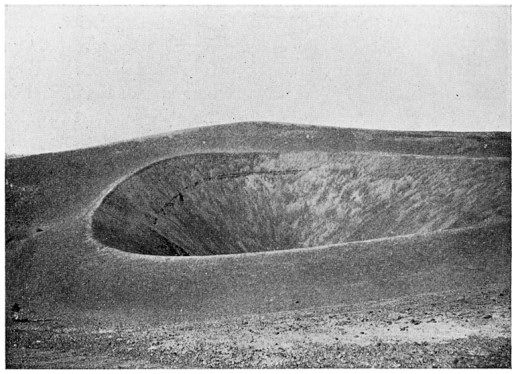
FIG. 27.—THE CRATER OF CINDER CONE
As nearly as can be determined, only a little more than two hundred years ago the valley now occupied by Cinder Cone and the lava fields gave no indication of ever becoming a new centre of volcanic action. It has been thousands of years since the ancient volcanic peaks and cinder cones of this mountainous region became extinct. The glaciers had come, and torn and ground away the surface of the lava, and afterward dense forests had hidden all the rocky slopes, while lakes had occupied many of the valleys. Far below, however, the fires had not gone out. In many places there were boiling springs from which the steam, upon cold mornings, rose in dense white clouds.
Then, for some reason which we do not understand, the forces beneath the surface increased their activity. The force of the steam and other gases was too great to be restrained, and at a weak spot in the overlying rocks they broke through. Molten lava accompanied them, and a new volcano came into life in the valley where Cinder Cone now raises its dark, symmetrical slopes.
The eruptions were violent. With explosive force the molten lava was torn into fragments, and sand, lapilli, and bombs were hurled out into the air. The finer particles were carried by the air currents far over the surrounding country. The lapilli, scoriæ, and bombs fell around the throat of the volcano, finally building up the cone to its present proportions. The great bombs, some of them five feet in diameter, are among the most remarkable products of this eruption. They lie scattered about upon the surface of the ground at the foot of the cone, and, although they are often irregular in shape, they might almost be mistaken for huge cannon-balls. The eruption killed and burned the trees in the near-by forests, burying them under six or seven feet of fine sand or ashes. After the cone had been built and the explosive eruptions had nearly stopped, a stream of molten lava burst from the base of the cone and filled a portion of the valley.
Now followed a long period of quiet. Trees began to grow upon the sand and gradually to encroach upon the barren wastes about Cinder Cone. It appeared as if there were to be no more eruptions. But the volcano was only resting. At about the time, perhaps, when the gold seekers began to pour across the continent to California, there was another eruption; but this time it took the form of a lava flow and was so quiet as to create no disturbance in the surrounding country.
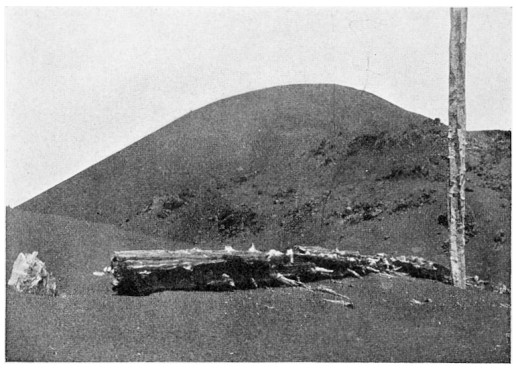
FIG. 28.—CINDER CONE
The trees were killed by the last eruption of volcanic ashes
A stream of thick, viscous lava flowed slowly out of an opening at the southern base of Cinder Cone. As the lava crept down the gentle slopes of the valley, it crusted over, forming a black, slag-like surface. The surface was from time to time broken up and mixed with the softer portions beneath, so that the movement of the flow was still further retarded. At the lower end of the valley the lava occupied a portion of a body of water now known as Lake Bidwell; its rugged front made a dam across the valley above, forming Snag Lake. The stumps of the trees which were killed by the water when the lake was first formed are still standing.
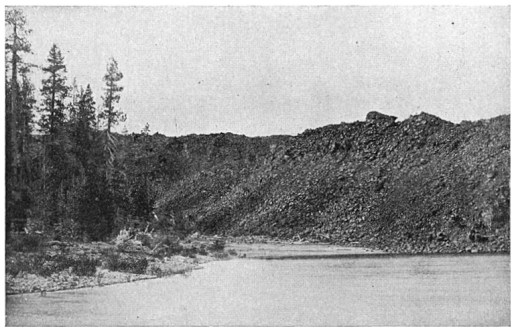
FIG. 29.—THE LAST LAVA FLOW IN THE UNITED STATES
At Cinder Cone, California. It formed a dam across a valley, thus creating Snag Lake
One's feet sink deep into volcanic sands, and walking is tiresome. The lava field resulting from the last eruption is free from sand, but its rough surface, formed of broken blocks, is difficult to cross.
A few charred stumps rise out of the sand, pathetic remnants of the forest trees that were growing at the time of the first eruption. Most of the trees have completely disappeared, leaving shallow pits where they once stood.
It is exceedingly difficult to climb the cone, which rises over six hundred feet, for the slopes, composed of loose lapilli, are so steep that one slips back at every step nearly as far as he advances. From the summit a remarkable sight meets the eye. Within the rim of the main crater is a second crater with a rim nearly as high as the first, while the cavity within has a depth of about two hundred and fifty feet.
Because of the loose character of the material of which it is built, no streamlets have yet worn channels down the slopes of Cinder Cone, and except for the presence of two small bushes which cling to its side, it is just as bare and perfect in form as when first completed.
Little by little the forests are encroaching upon the sand-covered slopes about the cone, and in time these slopes, the black fields of lava, and the cone itself, will be covered with forests like the older lava fields and cinder cones which appear upon every hand.