THE LIFE OF THE PROSPECTOR
Reading edition
Perhaps some of us who have comfortable homes, sleep upon soft beds, wear neat clothes, and can obtain every variety of food that we wish, think with pity of the men who lead a rough and lonely life among the mountains far from all comforts. Let us learn something more about the life and work of the prospectors, for we may find much that is desirable in their experiences.
Not many thousands of years ago our ancestors led what we would now call a wild and savage life. They had no permanent homes, but wandered here and there in search of food, and lived in caves or constructed the rudest kind of shelter from the storms. Perhaps we are right in feeling thankful that we were not born in those primitive times, but are there not really many things to regret about the way in which we have to live at the present day?
The utterly free outdoor life is not open to many. We have little or no opportunity to become acquainted with Nature, the guardian of our ancestors. The woods, the rocks, the mountains, and the dashing streams are almost complete strangers to many of us.
Many men are now obliged to go every day to their work in office or shop, and spend the hours shut in from the fresh air and bright sunshine. At night they sleep in rooms into which they admit little fresh air for fear of taking cold. To-day each man has to learn to do one thing well to the exclusion of nearly everything else, in order to make a living. For this very reason we are in danger of becoming human machines and of losing the use of some of the powers with which Nature has endowed us. Many things about our present mode of life are not natural to us, but through successive generations we have become somewhat adapted to them. The Indians, if taken from a life in the open air and made to live as we do, often sicken and die.
The farmer enjoys much more freedom and more of the sweet fresh air than do the artisans and office workers; but of all the men in civilized countries the trappers and prospectors live most out of doors. To be sure, they have to endure many hardships and dangers, and their beds are not always the softest nor their food the best, but you will seldom find one who is willing to exchange his free life for work in the town or city.
The trappers have nearly disappeared. Their occupation will be gone with the passing of the wild animals which were once so abundant. The prospectors are, however, becoming more numerous year by year throughout the mountains of western America. To them we owe a great debt, for had not their searching eyes brought to light the hidden mineral deposits this portion of our country would be far more thinly populated than it is to-day.
The discovery of gold in California was accidental. A man named Marshall was building a mill for Sutter in the foot-hills of the Sierra Nevada mountains at the time (1848) when California had just come into the possession of the United States. While at work he noticed some shining grains in the sand of the mill-race. A little testing of the grains led him to the conclusion that they were gold.
The news spread rapidly over the world, and since that time a constantly increasing tide of gold-seekers has been pushing out into the unexplored portions of the earth. Comparatively few of these men have become wealthy, but their discoveries have led to the settlement of new regions and to the growth of important industries. In truth, if it were not for the deposits of valuable metals, large areas of the desert and mountainous West would be of small value.
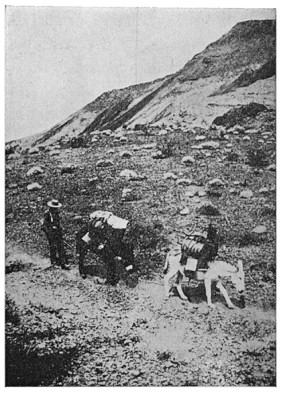
FIG. 96.—A PROSPECTOR IN THE DESERT
The prospector needs little capital except health and strength, but he must be willing to lead a rough life. He will be more likely to succeed if he knows something about the different kinds of minerals and rocks, and is able to distinguish the valuable ones from those which are of little or no worth.
The prospector may have a pack-horse and a second horse to ride, or he may go afoot with merely two burros to carry blankets, provisions, and tools. A burro costs little and will live upon almost anything. The variety of food that can be carried is not large; such things as bacon, flour, sugar, beans, and coffee are the most important. With the rifle one may frequently add to the supply. This, you may think, is pretty hard fare, but life in the open air will make one hungry enough to relish almost any sort of food.
The prospector does not need a road or even a trail. He seeks the least-known portion of some mountain district where he has an idea that gold may be found. Through the cañons he goes, and over the mountains, either on horseback or driving the burros before him. Water and grass are usually abundant, and the little cavalcade stops where night overtakes it. In the desert prospecting is more difficult and often dangerous, because of the scarcity of water. It is necessary to know the location of the few scattered springs, and to make one of the burros useful in carrying water kegs. A spring must be the starting-point in the morning, and a sufficient amount of water must be taken to last until the traveller can get back to the same spring or until he can reach another.
A pick, a shovel, and a hammer are among the most important parts of the prospector's outfit. Gold is a heavy substance, and as it washes down the mountain sides and into the gulches from some quartz vein, its weight finally takes it to the bed-rock beneath the sand and gravel. With his pick and shovel the prospector can reach the bed-rock. He takes some of the gravel from its hiding-place close to the rock, places it in a pan filled with water, and then, with a peculiar rotary movement, washes away the lighter materials, leaving the heavier substances and the gold, if there is any, at the bottom of the pan. If there is no trace of gold, the prospector goes on to another creek; but if some of the yellow metal is washed out, he tests the place thoroughly for more.
In searching for ledges the prospector spends his time in the smaller gulches and upon the mountain sides. Every piece of detached quartz that meets his eye is examined, and if any specks of gold appear, the search is directed toward the vein or ledge from which the specimen came. With the hammer, pieces of quartz are broken from the veins which here and there rise above the surface of loose and crumbling rock. When the worker finds a piece that is stained with iron and has the appearance of carrying gold, he places it in his bag and keeps it for further examination. At camp, the pieces of quartz are pounded to a powder in a mortar and then washed in a horn spoon. A string of fine grains of gold tells of the discovery of a rich vein.
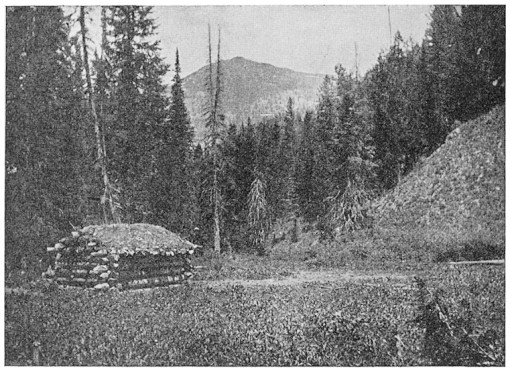
FIG. 97.—A PROSPECTOR'S CABIN IN THE ROCKY MOUNTAINS
It is not usually an easy matter to find home of a piece of stray quartz upon the mountain side. Days and weeks may pass while search is made up the slope, for the fragment must have come from some point above. But the ledge, once discovered, is traced along the surface for the purpose of determining its direction and extent.
When a promising bed of gravel or a vein of gold-bearing quartz is found, the prospector posts the proper notices of his right to the claim and has them recorded at the nearest land office. Then he makes a permanent camp by cutting down trees and building a cabin. The interior of the cabin is very simple. Its table and chairs are made of split lumber. One end of the single room is occupied by the bunk, and the other by a large fireplace. There may be no windows, and the roof may be made of earth piled upon logs, or of long split shingles commonly known as shakes.
Sometimes, after discovering a very rich quartz ledge, the prospector goes back to a settlement to attempt to interest some one in buying or developing it. Sometimes it happens that he loses the location of the vein and cannot go back to the place where it was discovered. In this way his discovery becomes a "lost mine," and grows in importance in people's minds as the story of its riches spreads from one to another. Although men may spend years looking for such mines, they are not often found again.
Frequently two men go prospecting together so that their work will be less dangerous and lonely. If they are not at once successful, they manage in some way to get supplies for a trip each year into the mountains. Often they are "grub-staked," that is, some man who has money furnishes their supplies in return for a share in their findings.
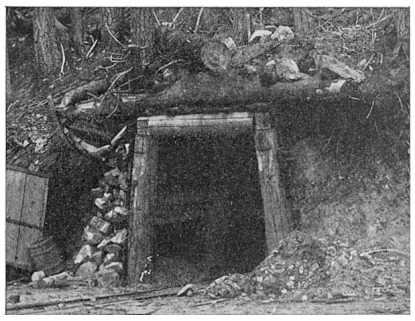
If they have enough to eat, the prospectors, in their snug cabin, are comfortable and happy. The cabin is built as near as possible to the mine, so that the men need not be cut off from their work during the stormy weather. The temperature underground is about the same in both winter and summer, so that winter storms and summer heat form no hindrance to the work.
FIG. 98.—MOUTH OF A TUNNEL
Years spent in life of this kind lead men to love the mountains. They feel a sympathy with Nature and a companionship in her presence. When they have to visit the town for supplies, they long to get back to their little cabins. They feel lost in the whirl and confusion of the city.
Summer is a delightful time at the many little miners' cabins scattered through the mountains. The air is invigorating, the water pure and cold. There is everything in the surroundings to make one happy. In the winter the miner sits by his great fireplace, with the flames roaring up the chimney. He has no stove to make the air close and oppressive. About the fireplace his dishes are arranged—the kettle for beans, the coffee-pot, and the Dutch oven in which the bread is baked. If there are some old paper-covered story-books at hand, it does not matter how fiercely the storms rage without. Ask any old prospector who has spent years in this manner if he would exchange his cabin for a house in the city, and he will most decidedly answer "no."
This lonely life in the mountains seems to engender hospitality. The old-time prospector will make you welcome to his cabin and will share his last crust with you. When he asks you in to have some coffee and beans, he does not do it merely for the sake of being polite, and he will feel hurt if you do not accept his hospitality. His dishes may not be as white as those to which you are accustomed, but I will venture to say that you have never tasted better beans than those with which he will fill your plate from his soot-begrimed kettle.
We ought all to see more of this wildlife. Even if we do not care to, make our permanent homes among the mountains, it would do us good to go there every summer at least, and so not only become stronger, but cultivate that familiarity with and love for outdoor life which our ancestors enjoyed.