A TRIP INTO THE GRAND CAÑON OF THE COLORADO
Reading edition
We may read of the Colorado plateau, and of the Grand Cañon with its precipitous walls of variously colored rock, but unless we actually visit this wonderland, it is hard to realize the height and extent of the plateau and the depth of the gashes made in its surface by running water, gashes so deep that they seem to expose the very heart of the earth.
Nature has chosen a remote and half-desert region for the location of this, the most picturesque cañon in the world, as if she wished to keep it as long as possible from the eyes of men. Once a traveller could not view the cañon without making a long and weary journey across hundreds of miles of desert; now it is quite different, for one can almost look into its depths from the windows of a palace car. But to appreciate and understand fully the stupendous work that nature has done throughout this region we must leave the cars at a somewhat distant point, and before reaching the cañon become acquainted with the country in which it lies through the old-fashioned ways of travelling on horseback or wagon.
Flagstaff was formerly the starting-point for travellers to the cañon, and we will choose it now, for the old stage road offers an interesting ride. The road first winds around that lofty snow-clad peak, the San Francisco Mountain, which can be seen from all northern Arizona. Leaving the mountain behind, we strike out directly across the high plateau. The country is nearly level, and the open park-like forest extends in every direction as far as one can see.
It is difficult for us to believe that we are seven thousand feet above the sea, a height greater than that of the highest mountains in the United States east of the Mississippi Valley. It is this elevation, however, which brings the summer showers and makes the air cool and pleasant, for the lowlands of this portion of the United States are barren deserts, upon which the sun beats with almost savage heat.
After the rainy season green grass and an abundance of flowers appear in the open meadows scattered through the forest. But, as a rule, the entire absence of water strikes one as being very strange. Where are the springs and running streams which usually abound in mountainous regions? Throughout the whole distance of seventy miles from Flagstaff to the cañon, there are but one or two spots where water is to be found. These places are known as "water-holes"; they are simply hollows in the surface of the ground where the water collects after the showers.
There is another strange feature about the plateau over which the road leads; instead of sloping down toward the Colorado River and the Grand Cañon, the surface slowly rises, so that the little streams which are formed after the heavy rains flow away from the river.
Our journey draws to an end, but there is nothing to indicate the presence of the cañon until we get glimpses through the trees of an apparently bottomless gulf. The gulf widens upon a closer view, we reach the edge, and all its wonderful proportions burst upon us. Does the Grand Cañon look as you thought it would? Probably not, for it is unlike any other in the world. The cañon is very deep. The river has worn its way for more than a mile down into the plateau, which once stretched unbroken from the cliffs upon which we stand, across to those upon the opposite side, nearly ten miles away.
The clear air makes objects upon the opposite side and in the bottom of the cañon seem much nearer than they really are. You may think that it is an easy task to go to the bottom of the cañon and climb back again in a day, but in reality it is so difficult an undertaking that only those who are accustomed to mountain climbing can accomplish it.
It is not merely the great width and depth of the cañon that impress us, but also the bright, variegated colors which the different rock layers display as they stretch in horizontal bands along the faces of the cliffs, or sweep around the towers and pinnacles until their detailed outlines are lost in the distant blue haze.
Our eyes wander far down, toward the bottom of the cañon, following the alternate lines of precipitous cliffs and slopes covered with rock fragments. The cliffs and slopes succeed each other like the steps in a giant stairway, until at the very bottom the opposite walls meet in a gorge so narrow that in only a few places does the river come into view, glistening like a silver thread.
A hotel stands among the trees a short distance from the brink of the cañon. Living here is expensive, for every article of food has to be brought upon the cars and wagons for a distance of hundreds of miles. Even the water has to be brought in wagons from a distant spring.
FIG. 4.—A SCENE ON THE TRAIL
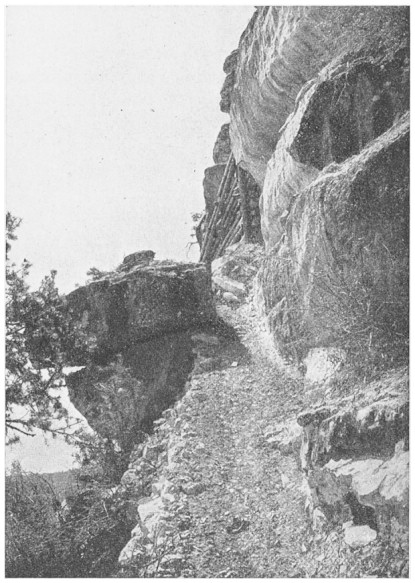
In visiting the cañon we have the choice of going on horseback or on foot. While the latter method is much harder, yet one feels safer upon his own feet while moving along the steep and narrow trail. Our start is made in the cool air of the early morning. Leaving the top of the plateau, where among the pines the summer air is seldom sultry, and the winters are cold and snowy, we descend, until, by luncheon time, we are far below the heights and in the midst of an almost tropical climate. This difference in climatic features between the top and bottom of the cañon is equal to the change which the traveller experiences in a trip from the pine forests of the northern United States to the cactus-covered plains of Arizona.
As we look down from the top of the trail it does not seem possible to pass the great cliffs below, and yet there must be a way, since others have gone before us. All that we have to do is simply to follow the beaten path. Nature has conveniently left narrow shelves, crevices, and less precipitous slopes here and there, which need only the application of the pick and shovel to be made passable even for pack animals. Where the trail winds into shady recesses, we find stunted fir and pine trees clinging to the crevices and stretching their roots down into the waste rock collected upon projecting ledges.
Down, down we go. The belt of the yellow pine and fir is left behind, and we come to the habitat of the piñon pine and juniper. These two will flourish where there is less moisture than is needed by the trees which grow nearer the top. Soon the trees have all disappeared and such plants as the greasewood, cactus, and agave take their place. Here, if it were not for the walls of rock rising on every hand, we might imagine ourselves upon one of the desert plains of Arizona.
FIG. 5.—CLIFFS ON THE TRAIL INTO THE GRAND CAÑON
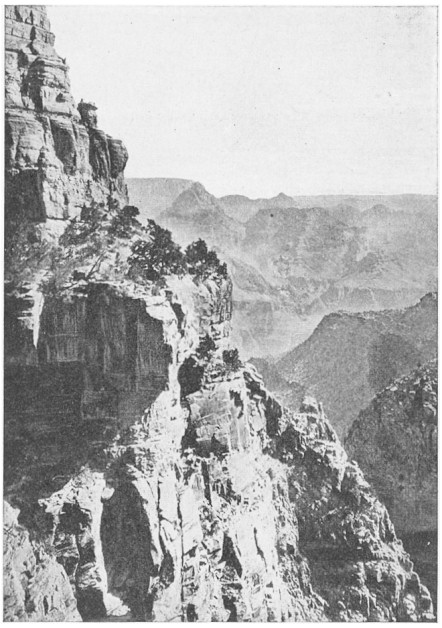
New views open at every turn in the trail, as it winds along the narrow shelves of rock with precipitous walls above and below. Now it zigzags back and forth down a gentle slope, but is soon stopped by another precipice. In one place, to escape a rocky point, the trail has been carried around the face of a cliff on a sort of shelf made of logs. It then passes through a crevice formed by the splitting away of a huge piece of the wall. In many places the grade is so steep that the trail is made practically a stairway, for the steps are necessary to keep animals from slipping.
Step by step we descend until the slope becomes more gentle and a sort of terrace is reached, where men are at work developing a copper mine. Everything needed for the mine is carried down packed upon the backs of sure-footed burros. Even the water has to be brought in kegs from a little spring still deeper in the cañon.
The trail leaves the mine and winds down past another cliff, until, when more than three thousand feet from the top of the plateau, we find water for the first time. The little springs issue from the sandstone, and their limited supply of water is soon drunk up by the thirsty sands.
As far as the water flows it forms a little oasis upon the barren slope. Along the course of the streams are little patches of green grass, flowers, and bushes. Birds flit about, and there are tracks of small animals in the mud. Evidently the water is as great an attraction to them as it is to us. If a well were dug in the plateau above, we can understand now how deep it would have to be in order to reach water. A well three-fourths of a mile deep would be a difficult one to pump.
We are now in the bottom of the main cañon, but deeper still is the last and inner gorge, through which the Colorado is flowing. For thousands of centuries the river has been sawing its way down into the earth. The precipitous cliffs which we have passed are formed of hard sandstone or limestone. The more gentle slopes consist of softer shales. Now the river has cut through them all and has reached the very heart of the earth, the solid granite.
FIG. 6.—THE INNER GORGE OF THE GRAND CAÑON OF THE COLORADO
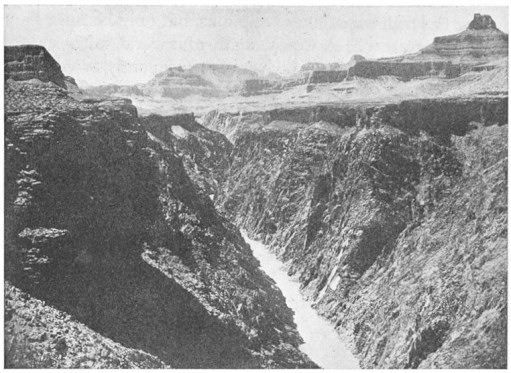
This inner gorge has almost vertical walls twelve hundred to fifteen hundred feet high. We can sit upon the brink under a ledge of rock which protects us from the hot sun, and watch the river as we eat our luncheon. Far below, almost directly under us, it rushes along. The roar of the current rises but faintly to our ears. The water is very muddy and not at all like the clear mountain streams, far away upon the continental divide, which unite to form the river. It seems as if the water, ashamed of its soiled appearance, wanted to hide from the sight of men. If so, it has succeeded well, for it can be seen only at rare intervals from the top of the cañon walls, and even at the bottom of the main cañon the river itself is not visible unless one stands upon the very brink of the granite gorge.
The work of the river is not yet done. It will go on until the great cliffs have crumbled and have been replaced by gentle slopes. It will not stop until, at some far distant time, a broad valley has been worn out of the rocky strata.
The cañon appears much wider when viewed from the bottom than from the top, and the great cliffs far back along the trail seem less precipitous, but only because they are so far away. A weary climb of several miles awaits us. We must rest and take breath frequently or we shall not reach the top.
As night approaches and the shadows begin to fall, every turret and pinnacle stands out in bold relief. The bands of yellow and red shade into purple, and everything, save the long winding trail, begins to have a weird and mystical look.