Volume 1 / Part 1 — Introductory Essay on Caste
Reading edition
List of Paragraphs
1. The Central Provinces.
2. Constitution of the population.
3. The word ‘Caste.’
4. The meaning of the term ‘Caste.’
5. The subcaste.
6. Confusion of nomenclature.
7. Tests of what a caste is.
8. The four traditional castes.
9. Occupational theory of caste.
10. Racial Theory.
11. Entry of the Aryans into India. The Aryas and Dasyus.
12. The Sūdra.
13. The Vaishya.
14. Mistaken modern idea of the Vaishyas.
15. Mixed unions of the four classes.
16. Hypergamy.
17. The mixed castes. The village menials.
18. Social gradation of castes.
19. Castes ranking above the cultivators.
20. Castes from whom a Brāhman can take water. Higher agriculturists.
21. Status of the cultivator.
22. The clan and the village.
23. The ownership of land.
24. The cultivating status that of the Vaishya.
25. Higher professional and artisan castes.
26. Castes from whom a Brāhman cannot take water; the village menials.
27. The village watchmen.
28. The village priests. The gardening castes.
29. Other village traders and menials.
30. Household servants.
31. Status of the village menials.
32. Origin of their status
33. Other castes who rank with the village menials.
34. The non-Aryan tribes.
35. The Kolarians and Dravidians.
36. Kolarian tribes.
37. Dravidian tribes.
38. Origin of the Kolarian tribes
39. Of the Dravidian tribes.
40. Origin of the impure castes.
41. Derivation of the impure castes from the indigenous tribes.
42. Occupation the basis of the caste system.
43. Other agents in the formation of castes.
44. Caste occupations divinely ordained.
45. Subcastes. local type.
46. Occupational subcastes.
47. Subcastes formed from social or religious differences, or from mixed descent.
48. Exogamous groups.
49. Totemistic clans.
50. Terms of relationship.
51. Clan kinship and totemism.
52. Animate Creation.
53. The distribution of life over the body.
54. Qualities associated with animals.
55. Primitive language.
56. Concrete nature of primitive ideas.
57. Words and names concrete.
58. The soul or spirit.
59. The tranmission of qualities.
60. The faculty of counting. Confusion of the individual and the species.
61. Similarity and identity.
62. The recurrence of events.
63. Controlling the future.
64. The common life.
65. The common life of the clan.
66. Living and eating together.
67. The origin of exogamy.
68. Promiscuity and female descent.
69. Exogamy with female descent.
70. Marriage.
71. Marriage by capture.
72. Transfer of the bride to her husband’s clan.
73. The exogamous clan with male descent and the village.
74. The large exogamous clans of the Brāhmans and Rājpūts. The Sapindas, the gens and the γένος.
75. Comparison of Hindu society with that of Greece and Rome. The gens.
76. The clients.
77. The plebeians.
78. The binding social tie in the city-states.
79. The Suovetaurilia.
80. The sacrifice of the domestic animal.
81. Sacrifices of the gens and phratry.
82. The Hindu caste-feasts.
83. Taking food at initiation.
84. Penalty feasts.
85. Sanctity of grain-food.
86. The corn-sprit.
87. The king.
88. Other instances of the common meal as a sacrificial rite.
89. Funeral feasts.
90. The Hindu deities and the sacrificial meal.
91. Development of the occupational caste from the tribe.
92. Veneration of the caste implements.
93. The caste panchāyat and its code of offences.
94. The status of impurity.
95. Caste and Hinduism.
96. The Hindu reformers.
97. Decline of the caste system.
1. The Central Provinces.
The territory controlled by the Chief Commissioner of the Central Provinces and Berār has an area of 131,000 square miles and a population of 16,000,000 persons. Situated in the centre of the Indian Peninsula, between latitudes 17°47′ and 24°27′ north, and longitudes 76° and 84° east, it occupies about 7.3 per cent of the total area of British India. It adjoins the Central India States and the United Provinces to the north, Bombay to the west, Hyderābād State and the Madras Presidency to the south, and the Province of Bihār and Orissa to the east. The Province was constituted as a separate administrative unit in 1861 from territories taken from the Peshwa in 1818 and the Marātha State of Nāgpur, which had lapsed from failure of heirs in 1853. Berār, which for a considerable previous period had been held on a lease or assignment from the Nizām of Hyderābād, was incorporated for administrative purposes with the Central Provinces in 1903. In 1905 the bulk of the District of Sambalpur, with five Feudatory States inhabited by an Uriya-speaking population, were transferred to Bengal and afterwards to the new Province of Bihār and Orissa, while five Feudatory States of Chota Nāgpur were received from Bengal. The former territory had been for some years included in the scope of the Ethnographic Survey, and is shown coloured in the annexed map of linguistic and racial divisions.
The main portion of the Province may be divided, from north-west to south-east, into three tracts of upland, alternating with two of plain country. In the north-west the Districts of Sangor and Damoh lie on the Vindhyan or Mālwa plateau, the southern face of which rises almost sheer from the valley of the Nerbudda. The general elevation of this plateau varies from 1500 to 2000 feet. The highest part is that immediately overhanging the Nerbudda, and the general slope is to the north, the rivers of this area being tributaries of the Jumna and Ganges. The surface of the country is undulating and broken by frequent low hills covered with a growth of poor and stunted forest. The second division consists of the long and narrow valley of the Nerbudda, walled in by the Vindhyan and Satpūra hills to the north and south, and extending for a length of about 200 miles from Jubbulpore to Handia, with an average width of twenty miles. The valley is situated to the south of the river, and is formed of deep alluvial deposits of extreme richness, excellently suited to the growth of wheat. South of the valley the Satpūra range or third division stretches across the Province, from Amarkantak in the east (the sacred source of the Nerbudda) to Asīrgarh in the Nimār District in the west, where its two parallel ridges bound the narrow valley of the Tapti river. The greater part consists of an elevated plateau, in some parts merely a rugged mass of hills hurled together by volcanic action, in others a succession of bare stony ridges and narrow fertile valleys, in which the soil has been deposited by drainage. The general elevation of the plateau is 2000 feet, but several of the peaks rise to 3500, and a few to more than 4000 feet. The Satpūras form the most important watershed of the Province, and in addition to the Nerbudda and Tapti, the Wardha and Wainganga rivers rise in these hills. To the east a belt of hill country continues from the Satpūras to the wild and rugged highlands of the Chota Nāgpur plateau, on which are situated the five States recently annexed to the Province. Extending along the southern and eastern faces of the Satpūra range lies the fourth geographical division, to the west the plain of Berār and Nāgpur, watered by the Purna, Wardha and Wainganga rivers, and further east the Chhattīsgarh plain, which forms the upper basin of the Mahānadi. The Berār and Nāgpur plain contains towards the west the shallow black soil in which autumn crops, like cotton and the large millet juāri, which do not require excessive moisture, can be successfully cultivated. This area is the great cotton-growing tract of the Province, and at present the most wealthy. The valleys of the Wainganga and Mahānadi further east receive a heavier rainfall and are mainly cropped with rice. Many small irrigation tanks for rice have been built by the people themselves, and large tank and canal works are now being undertaken by Government to protect the tract from the uncertainty of the rainfall. South of the plain lies another expanse of hill and plateau comprised in the zarmīndāri estates of Chānda and the Chhattīsgarh Division and the Bastar and Kanker Feudatory States. This vast area, covering about 24,000 square miles, the greater part of which consists of dense forests traversed by precipitous mountains and ravines, which formerly rendered it impervious to Hindu invasion or immigration, producing only on isolated stretches of culturable land the poorer raincrops, and sparsely peopled by primitive Gonds and other forest tribes, was probably, until a comparatively short time ago, the wildest and least-known part of the whole Indian peninsula. It is now being rapidly opened up by railways and good roads.
2. Constitution of the population.
Up to a few centuries ago the Central Provinces remained outside the sphere of Hindu and Muhammadan conquest. To the people of northern India it was known as Gondwāna, an unexplored country of inaccessible mountains and impenetrable forests, inhabited by the savage tribes of Gonds from whom it took its name. Hindu kingdoms were, it is true, established over a large part of its territory in the first centuries of our era, but these were not accompanied by the settlement and opening out of the country, and were subsequently subverted by the Dravidian Gonds, who perhaps invaded the country in large numbers from the south between the ninth and twelfth centuries. Hindu immigration and colonisation from the surrounding provinces occurred at a later period, largely under the encouragement and auspices of Gond kings. The consequence is that the existing population is very diverse, and is made up of elements belonging to many parts of India. The people of the northern Districts came from Bundelkhand and the Gangetic plain, and here are found the principal castes of the United Provinces and the Punjab. The western end of the Nerbudda valley and Betūl were colonised from Mālwa and Central India. Berār and the Nāgpur plain fell to the Marāthas, and one of the most important Marātha States, the Bhonsla kingdom, had its capital at Nāgpur. Cultivators from western India came and settled on the land, and the existing population are of the same castes as the Marātha country or Bombay. But prior to the Marātha conquest Berār and the Nimar District of the Central Provinces had been included in the Mughal empire, and traces of Mughal rule remain in a substantial Muhammadan element in the population. To the south the Chānda District runs down to the Godāvari river, and the southern tracts of Chānda and Bastar State are largely occupied by Telugu immigrants from Madras. To the east of the Nāgpur plain the large landlocked area of Chhattīsgarh in the upper basin of the Mahānadi was colonised at an early period by Hindus from the east of the United Provinces and Oudh, probably coming through Jubbulpore. A dynasty of the Haihaivansi Rājpūt clan established itself at Ratanpur, and owing to the inaccessible nature of the country, protected as it is on all sides by a natural rampart of hill and forest, was able to pursue a tranquil existence untroubled by the wars and political vicissitudes of northern India. The population of Chhattīsgarh thus constitutes to some extent a distinct social organism, which retained until quite recently many remnants of primitive custom. The middle basin of the Mahānadi to the east of Chhattīsgarh, comprising the Sambalpur District and adjoining States, was peopled by Uriyas from Orissa, and though this area has now been restored to its parent province, notices of its principal castes have been included in these volumes. Finally, the population contains a large element of the primitive or non-Aryan tribes, rich in variety, who have retired before the pressure of Hindu cultivators to its extensive hills and forests. The people of the Central Provinces may therefore not unjustly be considered as a microcosm of a great part of India, and conclusions drawn from a consideration of their caste rules and status may claim with considerable probability of success to be applicable to those of the Hindus generally. For the same reason the standard ethnological works of other Provinces necessarily rank as the best authorities on the castes of the Central Provinces, and this fact may explain and excuse the copious resort which has been made to them in these volumes.
3. The word ‘Caste.’
4. The meaning of the term ‘Caste.’
The two main ideas denoted by a caste are a community or persons following a common occupation, and a community whose members marry only among themselves. A third distinctive feature is that the members of a caste do not as a rule eat with outsiders with the exception of other Hindu castes of a much higher social position than their own. None of these will, however, serve as a definition of a caste. In a number of castes the majority of members have abandoned their traditional occupation and taken to others. Less than a fifth of the Brāhmans of the Central Provinces are performing any priestly or religious functions, and the remaining four-fifths are landholders or engaged in Government service as magistrates, clerks of public offices, constables and orderlies, or in railway service in different grades, or in the professions as barristers and pleaders, doctors, engineers and so on. The Rājpūts and Marāthas were originally soldiers, but only an infinitely small proportion belong to the Indian Army, and the remainder are ruling chiefs, landholders, cultivators, labourers or in the various grades of Government service and the police. Of the Telis or oil-pressers only 9 per cent are engaged in their traditional occupation, and the remainder are landholders, cultivators and shopkeepers. Of the Ahīrs or graziers only 20 per cent tend and breed cattle. Only 12 per cent of the Chamārs are supported by the tanning industry, and so on. The Bahnas or cotton-cleaners have entirely lost their occupation, as cotton is now cleaned in factories; they are cartmen or cultivators, but retain their caste name and organisation. Since the introduction of machine-made cloth has reduced the profits of hand-loom weaving, large numbers of the weaving castes have been reduced to manual labour as a means of subsistence. The abandonment of the traditional occupation has become a most marked feature of Hindu society as a result of the equal opportunity and freedom in the choice of occupations afforded by the British Government, coupled with the rapid progress of industry and the spread of education. So far it has had no very markedly disintegrating effect on the caste system, and the status of a caste is still mainly fixed by its traditional occupation; but signs are not wanting of a coming change. Again, several castes have the same traditional occupation; about forty of the castes of the Central Provinces are classified as agriculturists, eleven as weavers, seven as fishermen, and so on. Distinctions of occupation therefore are not a sufficient basis for a classification of castes. Nor can a caste be simply defined as a body of persons who marry only among themselves, or, as it is termed, an endogamous group; for almost every important caste is divided into a number of subcastes which do not marry and frequently do not eat with each other. But it is a distinctive and peculiar feature of caste as a social institution that it splits up the people into a multitude of these divisions and bars their intermarriage; and the real unit of the system and the basis of the fabric of Indian society is this endogamous group or subcaste.
5. The subcaste.
The subcastes, however, connote no real difference of status or occupation. They are little known except within the caste itself, and they consist of groups within the caste which marry among themselves, and attend the communal feasts held on the occasions of marriages, funerals and meetings of the caste panchāyat or committee for the judgment of offences against the caste rules and their expiation by a penalty feast; to these feasts all male adults of the community, within a certain area, are invited. In the Central Provinces the 250 groups which have been classified as castes contain perhaps 2000 subcastes. Except in some cases other Hindus do not know a man’s subcaste, though they always know his caste; among the ignorant lower castes men may often be found who do not know whether their caste contains any subcastes or whether they themselves belong to one. That is, they will eat and marry with all the members of their caste within a circle of villages, but know nothing about the caste outside those villages, or even whether it exists elsewhere. One subdivision of a caste may look down upon another on the ground of some difference of occupation, of origin, or of abstaining from or partaking of some article of food, but these distinctions are usually confined to their internal relations and seldom recognised by outsiders. For social purposes the caste consisting of a number of these endogamous groups generally occupies the same position, determined roughly according to the respectability of its traditional occupation or extraction.
6. Confusion of nomenclature.
No adequate definition of caste can thus be obtained from community of occupation or intermarriage; nor would it be accurate to say that every one must know his own caste and that all the different names returned at the census may be taken as distinct. In the Central Provinces about 900 caste-names were returned at the census of 1901, and these were reduced in classification to about 250 proper castes.
In some cases synonyms are commonly used. The caste of pān or betel-vine growers and sellers is known indifferently as Barai, Pansāri or Tamboli. The great caste of Ahīrs or herdsmen has several synonyms—as Gaoli in the Northern Districts, Rawat or Gahra in Chhattīsgarh, Gaur among the Uriyas, and Golkar among Telugus. Lohārs are also called Khāti and Kammāri; Masons are called Larhia, Rāj and Beldār. The more distinctly occupational castes usually have different names in different parts of the country, as Dhobi, Wārthi, Baretha, Chakla and Parit for washermen; Basor, Burud, Kandra and Dhulia for bamboo-workers, and so on. Such names may show that the subdivisions to which they are applied have immigrated from different parts of India, but the distinction is generally not now maintained, and many persons will return one or other of them indifferently. No object is gained, therefore, by distinguishing them in classification, as they correspond to no differences of status or occupation, and at most denote groups which do not intermarry, and which may therefore more properly be considered as subcastes.
Titles or names of offices are also not infrequently given as caste names. Members of the lowest or impure castes employed in the office of Kotwār or village watchmen prefer to call themselves by this name, as they thus obtain a certain rise in status, or at least they think so. In some localities the Kotwārs or village watchmen have begun to marry among themselves and try to form a separate caste. Chamārs (tanners) or Mahars (weavers) employed as grooms will call themselves Sais and consider themselves superior to the rest of their caste. The Thethwār Rāwats or Ahīrs will not clean household cooking-vessels, and therefore look down on the rest of the caste and prefer to call themselves by this designation, as ‘Theth’ means ‘exact’ or ‘pure,’ and Thethwār is one who has not degenerated from the ancestral calling. Sālewārs are a subcaste of Koshtis (weavers), who work only in silk and hence consider themselves as superior to the other Koshtis and a separate caste. The Rāthor subcaste of Telis in Mandla have abandoned the hereditary occupation of oil-pressing and become landed proprietors. They now wish to drop their own caste and to be known only as Rāthor, the name of one of the leading Rājpūt clans, in the hope that in time it will be forgotten that they ever were Telis, and they will be admitted into the community of Rājpūts. It occurred to them that the census would be a good opportunity of advancing a step towards the desired end, and accordingly they telegraphed to the Commissioner of Jubbulpore before the enumeration, and petitioned the Chief Commissioner after it had been taken, to the effect that they might be recorded and classified only as Rāthor and not as Teli; this method of obtaining recognition of their claims being, as remarked by Sir Bampfylde Fuller, a great deal cheaper than being weighed against gold. On the other hand, a common occupation may sometimes amalgamate castes originally distinct into one. The sweeper’s calling is well-defined and under the generific term of Mehtar are included members of two or three distinct castes, as Dom, Bhangi and Chuhra; the word Mehtar means a prince or headman, and it is believed that its application to the sweeper by the other servants is ironical. It has now, however, been generally adopted as a caste name. Similarly, Darzi, a tailor, was held by Sir D. Ibbetson to be simply the name of a profession and not that of a caste; but it is certainly a true caste in the Central Provinces, though probably of comparatively late origin. A change of occupation may transfer a whole body of persons from one caste to another. A large section of the Banjāra caste of carriers, who have taken to cultivation, have become included in the Kunbi caste in Berār and are known as Wanjāri Kunbi. Another subcaste of the Kunbis called Mānwa is derived from the Māna tribe. Telis or oilmen, who have taken to vending liquor, now form a subcaste of the Kalār caste called Teli-Kalār; those who have become shopkeepers are called Teli-Bania and may in time become an inferior section of the Bania caste. Other similar subcastes are the Ahīr-Sunars or herdsmen-goldsmiths, the Kāyasth-Darzis or tailors, the Kori-Chamārs or weaver-tanners, the Gondi Lohārs and Barhais, being Gonds who have become carpenters and blacksmiths and been admitted to these castes; the Mahār Mhālis or barbers, and so on.
7. Tests of what a caste is.
It would appear, then, that no precise definition of a caste can well be formulated to meet all difficulties. In classification, each doubtful case must be taken by itself, and it must be determined, on the information available, whether any body of persons, consisting of one or more endogamous groups, and distinguished by one or more separate names, can be recognised as holding, either on account of its traditional occupation or descent, such a distinctive position in the social system, that it should be classified as a caste. But not even the condition of endogamy can be accepted as of universal application; for Vidūrs, who are considered to be descended from Brāhman fathers and women of other castes, will, though marrying among themselves, still receive the offspring of such mixed alliances into the community; in the case of Gosains and Bairāgis, who, from being religious orders, have become castes, admission is obtained by initiation as well as by birth, and the same is the case with several other orders; some of the lower castes will freely admit outsiders; and in parts of Chhattīsgarh social ties are of the laxest description, and the intermarriage of Gonds, Chamārs and other low castes are by no means infrequent. But notwithstanding these instances, the principle of the restriction of marriage to members of the caste is so nearly universal as to be capable of being adopted as a definition.
8. The four traditional castes.
The well-known traditional theory of caste is that the Aryans were divided from the beginning of time into four castes: Brāhmans or priests, Kshatriyas or warriors, Vaishyas or merchants and cultivators, and Sūdras or menials and labourers, all of whom had a divine origin, being born from the body of Brahma—the Brāhmans from his mouth, the Kshatriyas from his arms, the Vaishyas from his thighs, and the Sudras from his feet. Intermarriage between the four castes was not at first entirely prohibited, and a man of any of the three higher ones, provided that for his first wife he took a woman of his own caste, could subsequently marry others of the divisions beneath his own. In this manner the other castes originated. Thus the Kaivarttas or Kewats were the offspring of a Kshatriya father and Vaishya mother, and so on. Mixed marriages in the opposite direction, of a woman of a higher caste with a man of a lower one, were reprobated as strongly as possible, and the offspring of these were relegated to the lowest position in society; thus the Chandāls, or descendants of a Sūdra father and Brāhman mother, were of all men the most base. It has been recognised that this genealogy, though in substance the formation of a number of new castes through mixed descent may have been correct, is, as regards the details, an attempt made by a priestly law-giver to account, on the lines of orthodox tradition, for a state of society which had ceased to correspond to them.
9. Occupational theory of caste.
In the ethnographic description of the people of the Punjab, which forms the Caste chapter of Sir Denzil Ibbetson’s Census Report of 1881, it was pointed out that occupation was the chief basis of the division of castes, and there is no doubt that this is true. Every separate occupation has produced a distinct caste, and the status of the caste depends now mainly or almost entirely on its occupation. The fact that there may be several castes practising such important callings as agriculture or weaving does not invalidate this in any way, and instances of the manner in which such castes have been developed will be given subsequently. If a caste changes its occupation it may, in the course of time, alter its status in a corresponding degree. The important Kāyasth and Gurao castes furnish instances of this. Castes, in fact, tend to rise or fall in social position with the acquisition of land or other forms of wealth or dignity much in the same manner as individuals do nowadays in European countries. Hitherto in India it has not been the individual who has undergone the process; he inherits the social position of the caste in which he is born, and, as a rule, retains it through life without the power of altering it. It is the caste, as a whole, or at least one of its important sections or subcastes, which gradually rises or falls in social position, and the process may extend over generations or even centuries.
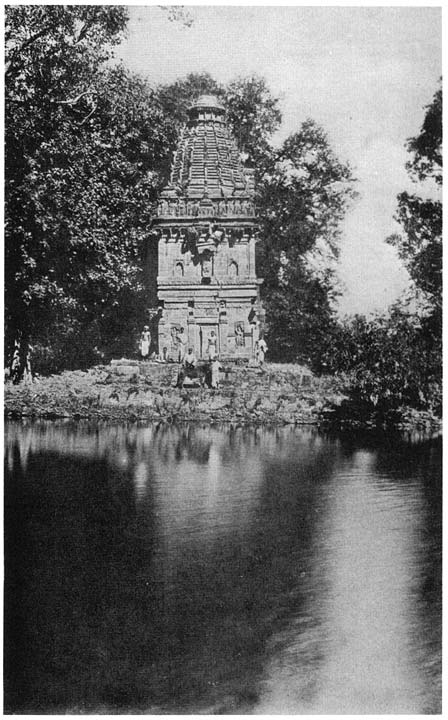
Hindu temple of the god Siva.
In the Brief Sketch of the Caste System of the North-Western Provinces and Oudh, Mr. J.C. Nesfield puts forward the view that the whole basis of the caste system is the division of occupations, and that the social gradation of castes corresponds precisely to the different periods of civilisation during which their traditional occupations originated. Thus the lowest castes are those allied to the primitive occupation of hunting, Pāsi, Bhar, Bahelia, because the pursuit of wild animals was the earliest stage in the development of human industry. Next above these come the fishing castes, fishing being considered somewhat superior to hunting, because water is a more sacred element among Hindus than land, and there is less apparent cruelty in the capturing of fish than the slaughtering of animals; these are the Kahārs, Kewats, Dhīmars and others. Above these come the pastoral castes—Ghosi, Gadaria, Gūjar and Ahīr; and above them the agricultural castes, following the order in which these occupations were adopted during the progress of civilisation. At the top of the system stands the Rājpūt or Chhatri, the warrior, whose duty is to protect all the lower castes, and the Brāhman, who is their priest and spiritual guide. Similarly, the artisan castes are divided into two main groups; the lower one consists of those whose occupations preceded the age of metallurgy, as the Chamārs and Mochis or tanners, Koris or weavers, the Telis or oil-pressers, Kalārs or liquor-distillers, Kumhārs or potters, and Lunias or salt-makers. The higher group includes those castes whose occupations were coeval with the age of metallurgy, that is, those who work in stone, wood and metals, and who make clothing and ornaments, as the Barhai or worker in wood, the Lohār or worker in iron, the Kasera and Thathera, brass-workers, and the Sunār or worker in the precious metals, ranking precisely in this order of precedence, the Sunār being the highest. The theory is still further developed among the trading castes, who are arranged in a similar manner, beginning from the Banjāra or forest trader, the Kunjra or greengrocer, and the Bharbhūnja or grain-parcher, up to the classes of Banias and Khatris or shopkeepers and bankers.
It can hardly be supposed that the Hindus either consciously or unconsciously arranged their gradation of society in a scientific order of precedence in the manner described. The main divisions of social precedence are correctly stated by Mr. Nesfield, but it will be suggested in this essay that they arose naturally from the divisions of the principal social organism of India, the village community. Nevertheless Mr. Nesfield’s book will always rank as a most interesting and original contribution to the literature of the subject, and his work did much to stimulate inquiry into the origin of the caste system.
10. Racial Theory.
In his Introduction to the Tribes and Castes of Bengal Sir Herbert Risley laid stress on the racial basis of caste, showing that difference of race and difference of colour were the foundation of the Indian caste system or division of the people into endogamous units. There seems reason to suppose that the contact of the Aryans with the indigenous people of India was, to a large extent, responsible for the growth of the caste system, and the main racial divisions may perhaps even now be recognised, though their racial basis has, to a great extent, vanished. But when we come to individual castes and subcastes, the scrutiny of their origin, which has been made in the individual articles, appears to indicate that caste distinctions cannot, as a rule, be based on supposed difference of race. Nevertheless Sir H. Risley’s Castes and Tribes of Bengal and Peoples of India will, no doubt, always be considered as standard authorities, while as Census Commissioner for India and Director of Ethnography he probably did more to foster this branch of research in India generally than any other man has ever done.
11. Entry of the Aryans into India. The Aryas and Dasyus.
The early sacrifice was in the nature of a communal sacred meal at which the worshippers partook of the animal or liquor offered to the god. The Dasyus or indigenous Indian races could not worship the Aryan gods nor join in the sacrifices offered to them, which constituted the act of worship. They were a hostile race, but the hostility was felt and expressed on religious rather than racial grounds, as the latter term is understood at present.
12. The Sūdra.
13. The Vaishya.
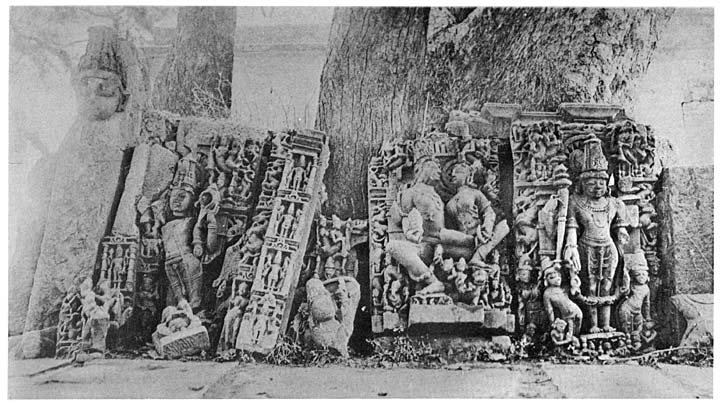
Hindu sculptures
14. Mistaken modern idea of the Vaishyas.
The demonstration of the real position of the Vaishyas is important, because the Hindus themselves no longer recognise this. The name Vaishya is now frequently restricted to the Bania caste of bankers, shopkeepers and moneylenders, and hence the Banias are often supposed to be the descendants and only modern representatives of the original Vaishyas. Evidence has been given in the article on Bania to show that the existing Bania caste is mainly derived from the Rājpūts. The name Bāni, a merchant or trader, is found at an early period, but whether it denoted a regular Bania caste may be considered as uncertain. In any case it seems clear that this comparatively small caste, chiefly coming from Rājputāna, cannot represent the Vaishyas, who were the main body or people of the invading Aryans. At that time the Vaishyas cannot possibly have been traders, because they alone provided the means of subsistence of the community, and if they produced nothing, there could be no material for trade. The Vaishyas must, therefore, as already seen, have been shepherds and cultivators, since in early times wealth consisted almost solely of corn and cattle. At a later period, with the increased religious veneration for all kinds of life, agriculture apparently fell into some kind of disrepute as involving the sacrifice of insect life, and there was a tendency to emphasise trade as the Vaishya’s occupation in view of its greater respectability. It is considered very derogatory for a Brāhman or Rājpūt to touch the plough with his own hands, and the act has hitherto involved a loss of status: these castes, however, did not object to hold land, but, on the contrary, ardently desired to do so like all other Hindus. Ploughing was probably despised as a form of manual labour, and hence an undignified action for a member of the aristocracy, just as a squire or gentleman farmer in England might consider it beneath his dignity to drive the plough himself. No doubt also, as the fusion of races proceeded, and bodies of the indigenous tribes who were cultivators adopted Hinduism, the status of a cultivator sank to some extent, and his Vaishyan ancestry was forgotten. But though the Vaishya himself has practically disappeared, his status as a cultivator and member of the village community appears to remain in that of the modern cultivating castes, as will be shown subsequently.
15. Mixed unions of the four classes.
16. Hypergamy.
17. The mixed castes. The village menials.
But though among the four classical castes it was possible for the descendants of mixed unions between fathers of higher and mothers of lower caste to be admitted into their father’s caste, this would not have been the general rule. Such connections were very frequent and the Hindu classics account through them for the multiplication of castes. Long lists are given of new castes formed by the children of mixed marriages. The details of these genealogies seem to be destitute of any probability, and perhaps, therefore, instances of them are unnecessary. Matches between a man of higher and a woman of lower caste were called anuloma, or ‘with the hair’ or ‘grain,’ and were regarded as suitable and becoming. Those between a man of lower and a woman of higher caste were, on the other hand, known as pratiloma or ‘against the hair,’ and were considered as disgraceful and almost incestuous. The offspring of such unions are held to have constituted the lowest and most impure castes of scavengers, dog-eaters and so on. This doctrine is to be accounted for by the necessity of safeguarding the morality of women in a state of society where kinship is reckoned solely by male descent. The blood of the tribe and clan, and hence the right to membership and participation in the communal sacrifices, is then communicated to the child through the father; hence if the women are unchaste, children may be born into the family who have no such rights, and the whole basis of society is destroyed. For the same reason, since the tribal blood and life is communicated through males, the birth and standing of the mother are of little importance, and children are, as has been seen, easily admitted to their father’s rank. But already in Manu’s time the later and present view that both the father and mother must be of full status in the clan, tribe or caste in order to produce a legitimate child, has begun to prevail, and the children of all mixed marriages are relegated to a lower group. The offspring of these mixed unions did probably give rise to a class of different status in the village community. The lower-caste mother would usually have been taken into the father’s house and her children would be brought up in it. Thus they would eat the food of the household, even if they did not participate in the sacrificial feasts; and a class of this kind would be very useful for the performance of menial duties in and about the household, such as personal service, bringing water, and so on, for which the Sūdras, owing to their impurity, would be unsuitable. In the above manner a new grade of village menial might have arisen and have gradually been extended to the other village industries, so that a third group would be formed in the village community ranking between the cultivators and labourers. This gradation of the village community may perhaps still be discerned in the main social distinctions of the different Hindu castes at present. And an attempt will now be made to demonstrate this hypothesis in connection with a brief survey of the castes of the Province.
18. Social gradation of castes.
An examination of the social status of the castes of the Central Provinces, which, as already seen, are representative of a great part of India, shows that they fall into five principal groups. The highest consists of those castes who now claim to be directly descended from the Brāhmans, Kshatriyas or Vaishyas, the three higher of the four classical castes. The second comprises what are generally known as pure or good castes. The principal mark of their caste status is that a Brāhman will take water to drink from them, and perform ceremonies in their houses. They may be classified in three divisions: the higher agricultural castes, higher artisan castes, and serving castes from whom a Brāhman will take water. The third group contains those castes from whose hands a Brāhman will not take water; but their touch does not convey impurity and they are permitted to enter Hindu temples. They consist mainly of certain cultivating castes of low status, some of them recently derived from the indigenous tribes, other functional castes formed from the forest tribes, and a number of professional and menial castes, whose occupations are mainly pursued in villages, so that they formerly obtained their subsistence from grain-payments or annual allowances of grain from the cultivators at seedtime and harvest. The group includes also some castes of village priests and mendicant religious orders, who beg from the cultivators. In the fourth group are placed the non-Aryan or indigenous tribes. Most of these cannot properly be said to form part of the Hindu social system at all, but for practical purposes they are admitted and are considered to rank below all castes except those who cannot be touched. The lowest group consists of the impure castes whose touch is considered to defile the higher castes. Within each group there are minor differences of status some of which will be noticed, but the broad divisions may be considered as representing approximately the facts. The rule about Brāhmans taking water from the good agricultural and artisan castes obtains, for instance, only in northern India. Marātha Brāhmans will not take water from any but other Brāhmans, and in Chhattīsgarh Brāhmans and other high castes will take water only from the hands of a Rāwat (grazier), and from no other caste. But nevertheless the Kunbis, the great cultivating caste of the Marātha country, though Brāhmans do not take water from them, are on the same level as the Kurmis, the cultivating caste of Hindustān, and in tracts where they meet Kunbis and Kurmis are often considered to be the same caste. The evidence of the statements made as to the origin of different castes in the following account will be found in the articles on them in the body of the work.
19. Castes ranking above the cultivators.
The castes of the first group are noted below:
Bania. Bhāt. Brāhman. Gurao. Karan. Kāyasth and Prabhu. Khātri. Rajpūt.
Thus all the castes of the first group are derived from the representatives of the Brāhmans and Kshatriyas, the two highest of the four classical castes, except the Guraos, who have risen in status owing to special circumstances. The origin of the Kāyasths is discussed in the article on that caste. Members of the above castes usually wear the sacred thread which is the mark of the Dwija or twice-born, the old Brāhmans, Kshatriyas and Vaishyas. The thread is not worn generally by the castes of the second group, but the more wealthy and prominent sections of them frequently assume it.
20. Castes from whom a Brāhman can take water. Higher agriculturists.
The second group of good castes from whom a Brāhman can take water falls into three sections as already explained: the higher agricultural castes, the higher artisans, and the serving or menial castes from whom a Brāhman takes water from motives of convenience. These last do not properly belong to the second group but to the next lower one of village menials. The higher agricultural castes or those of the first section are noted below:
Agharia. Ahīr. Bhilāla. Bishnoi. Chasa. Daharia. Dāngi. Dumāl. Gūjar. Jādum. Jāt. Khandait. Kirār. Kolta. Kunbi. Kurmi. Lodhi. Māli. Marātha. Mīna or Deswāli. Panwār Rājpūt. Rāghuvansi. Velama.
Similarly the Vellālas are the great cultivating caste of the Tamil country, to whom by general consent the first place in social esteem among the Tamil Sūdra castes is awarded. In the Madras Census Report of 1901 Mr. Francis gives an interesting description of the structure of the caste and its numerous territorial, occupational and other subdivisions. He shows also how groups from lower castes continually succeed in obtaining admission into the Vellāla community in the following passage: “Instances of members of other castes who have assumed the name and position of Vellālas are the Vettuva Vellālas, who are only Puluvāns; the Illam Vellālas, who are Panikkāns; the Karaiturai (lord of the shore) Vellālas, who are Karaiyāns; the Karukamattai (palmyra leaf-stem) Vellālas, who are Balijas; the Guha (Rama’s boatmen) Vellālas, who are Sembadavāns; and the Irkuli Vellālas, who are Vannāns. The children of dancing-girls also often call themselves Mudali, and claim in time to be Vellālas, and even Paraiyāns assume the title of Pillai and trust to its eventually enabling them to pass themselves off as members of the caste.”
This is an excellent instance of the good status attaching to the chief cultivating caste of the locality and of the manner in which other groups, when they obtain possession of the land, strive to get themselves enrolled in it.
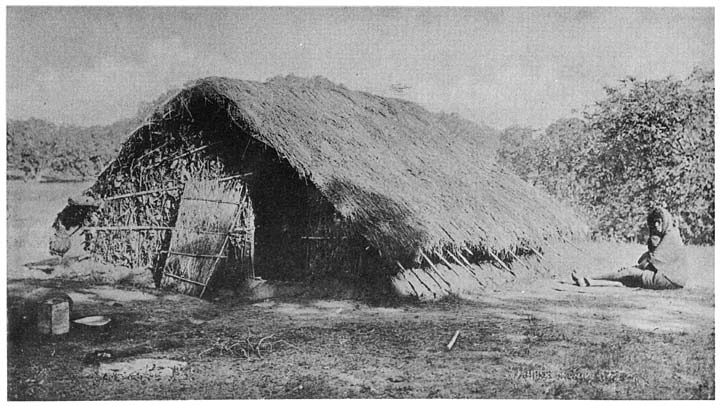
Peasant’s hut
21. Status of the cultivator.
22. The clan and the village.
It has been seen also that Visha in the plural signified clans. The clan was the small body which lived together, and in the patriarchal stage was connected by a tie of kinship held to be derived from a common ancestor. Thus it is likely that the clans settled down in villages, the cultivators of one village being of the same exogamous clan. The existing system of exogamy affords evidence in favour of this view, as will be seen. All the families of the clan had cultivating rights in the land, and were members of the village community; and there were no other members, unless possibly a Kshatriya headman or leader. The Sūdras were their labourers and serfs, with no right to hold land, and a third intermediate class of village menials gradually grew up.
23. The ownership of land.
24. The cultivating status that of the Vaishya.
The suggested conclusion from the above argument is that the main body of the Aryan immigrants, that is the Vaishyas, settled down in villages by exogamous clans or septs. The cultivators of each village believed themselves to be kinsmen descended from a common ancestor, and also to be akin to the god of the village lands from which they drew their sustenance. Hence their order had an equal right to cultivate the village land and their children to inherit it, though they did not conceive of the idea of ownership of land in the sense in which we understand this phrase.
The original status of the Vaishya, or a full member of the Aryan community who could join in sacrifices and employ Brāhmans to perform them, was gradually transferred to the cultivating member of the village communities. In process of time, as land was the chief source of wealth, and was also regarded as sacred, the old status became attached to castes or groups of persons who obtained or held land irrespective of their origin, and these are what are now called the good cultivating castes. They have now practically the same status, though, as has been seen, they were originally of most diverse origin, including bands of robbers and freebooters, cattle-lifters, non-Aryan tribes, and sections of any castes which managed to get possession of an appreciable quantity of land.
25. Higher professional and artisan castes.
The second division of the group of pure or good castes, or those from whom a Brāhman can take water, comprises the higher artisan castes:
Barhai. Bharbhūnja. Halwai. Kasār. Komti. Sānsia. Sunār. Tamera. Vidūr.
26. Castes from whom a Brāhman cannot take water; the village menials.
The third main division consists of those castes from whom a Brāhman cannot take water, though they are not regarded as impure and are permitted to enter Hindu temples. The typical castes of this group appear to be the village artisans and menials and the village priests. The annexed list shows the principal of these.
Village menials.
Lohār—Blacksmith.
Barhai—Carpenter.
Kumhār—Potter.
Nai—Barber.
Dhimar—Waterman.
Kahār—Palanquin-bearer.
Bāri—Leaf-plate maker.
Bargāh—Household servant.
Dhobi—Washerman.
Darzi—Tailor.
Basor or Dhulia—Village musician.
Bhāt and Mirāsi—Bard and genealogist.
Halba—House-servant and farm-servant.
Castes of village watchmen.
Khangār.
Chadār.
Chauhān.
Dahāit.
Panka.
Village priests and mendicants.
Joshi—Astrologer.
Gārpagāri—Hail-averter.
Gondhali—Musician.
Mānbhao Jangam Basdewa Sātani Waghya Wandering priests and mendicants.
Others.
Māli—Gardener and maker of garlands.
Barai—Betel-vine grower and seller.
Other village traders and artisans.
Kalār—Liquor-vendor.
Teli—Oil-presser.
Hatwa Manihār Pedlar.
Banjāra—Carrier.
Bahelia Pārdhi Fowlers and hunters.
Bahna—Cotton-cleaner.
Chhīpa—Calico-printer and dyer.
Chitrakathi—Painter and picture-maker.
Kachera—Glass bangle-maker.
Kadera—Fireworks-maker.
Nat—Acrobat.
Gadaria Dhangar Kuramwār Shepherds.
Beldār Murha Nunia Diggers, navvies, and salt-refiners.
The essential fact which formerly governed the status of this group of castes appears to be that they performed various services for the cultivators according to their different vocations, and were supported by contributions of grain made to them by the cultivators, and by presents given to them at seed-time and harvest. They were the clients of the cultivators and the latter were their patrons and supporters, and hence ranked above them. This condition of things survives only in the case of a few castes, but prior to the introduction of a metal currency must apparently have been the method of remuneration of all the village industries. The Lohār or blacksmith makes and mends the iron implements of agriculture, such as the ploughshare, axe, sickle and goad. For this he is paid in Saugor a yearly contribution of 20 lbs. of grain per plough of land held by each cultivator, together with a handful of grain at sowing-time and a sheaf at harvest from both the autumn and spring crops. In Wardha he gets 50 lbs. of grain per plough of four bullocks or 40 acres. For new implements he must either be paid separately or at least supplied with the iron and charcoal. In Districts where the Barhai or carpenter is a village servant he is paid the same as the Lohār and has practically an equal status. The village barber receives in Saugor 20 lbs. of grain annually from each adult male in the family, or 22½ lbs. per plough of land besides the seasonal presents. In return for this he shaves each cultivator over the head and face about once a fortnight. The Dhobi or washerman gets half the annual contribution of the blacksmith and carpenter, with the same presents, and in return for this he washes the clothes of the family two or three times a month. When he brings the clothes home he also receives a meal or a wheaten cake, and well-to-do families give him their old clothes as a present. The Dhīmar or waterman brings water to the house morning and evening, and fills the earthen water-pots placed on a wooden stand or earthen platform outside it. When the cultivators have marriages he performs the same duties for the whole wedding party, and receives a present of money and clothes according to the means of the family, and his food every day while the wedding is in progress. He supplies water for drinking to the reapers, receiving three sheaves a day as payment, and takes sweet potatoes and boiled plums to the field and sells them. The Kumhār or potter is not now paid regularly by dues from the cultivators like other village menials, as the ordinary system of sale has been found to be more convenient in his case. But he sometimes takes for use the soiled grass from the stalls of the cattle and gives pots free to the cultivator in exchange. On Akti day, at the beginning of the agricultural year, the village Kumhār in Saugor presents five pots with covers on them to each cultivator and is given 2½ lbs. of grain. He presents the bride with seven new pots at a wedding, and these are filled with water and used in the ceremony, being considered to represent the seven seas. At a funeral he must supply thirteen vessels which are known as ghāts, and must replace the household earthen vessels, which are rendered impure on the occurrence of a death in the house, and are all broken and thrown away. In the Punjab and Marātha country the Kumhār was formerly an ordinary village menial.
27. The village watchmen.
The office of village watchman is an important one, and is usually held by a member of the indigenous tribes. These formerly were the chief criminals, and the village watchman, in return for his pay, was expected to detect the crimes of his tribesmen and to make good any losses of property caused by them. The sections of the tribes who held this office have developed into special castes, as the Khangārs, Chadārs and Chauhāns of Chhattīsgarh. These last are probably of mixed descent from Rājpūts and the higher castes of cultivators with the indigenous tribes. The Dahāits were a caste of gatekeepers and orderlies of native rulers who have now become village watchmen. The Pankas are a section of the impure Gānda caste who have embraced the doctrines of the Kabīrpanthi sect and formed a separate caste. They are now usually employed as village watchmen and are not regarded as impure. Similarly those members of the Mahār servile caste who are village watchmen tend to marry among themselves and form a superior group to the others. The village watchman now receives a remuneration fixed by Government and is practically a rural policeman, but in former times he was a village menial and was maintained by the cultivators in the same manner as the others.
28. The village priests. The gardening castes.
The village priests are another class of this group. The regular village priest and astrologer, the Joshi or Parsai, is a Brāhman, but the occupation has developed a separate caste. The Joshi officiates at weddings in the village, selects auspicious names for children according to the constellations under which they were born, and points out the auspicious moment or mahūrat for weddings, name-giving and other ceremonies, and for the commencement of such agricultural operations as sowing, reaping, and threshing. He is also sometimes in charge of the village temple. He is supported by contributions of grain from the villagers and often has a plot of land rent-free from the proprietor. The social position of the Joshis is not very good, and, though Brāhmans, they are considered to rank somewhat below the cultivating castes. The Gurao is another village priest, whose fortune has been quite different. The caste acted as priests of the temples of Siva and were also musicians and supplied leaf-plates. They were village menials of the Marātha villages. But owing to the sanctity of their calling, and the fact that they have become literate and taken service under Government, the Guraos now rank above the cultivators and are called Shaiva Brāhmans. The Gondhalis are the village priests of Devi, the earth-goddess, who is also frequently the tutelary goddess of the village. They play the kettle-drum and perform dances in her honour, and were formerly classed as one of the village menials of Marātha villages, though they now work for hire. The Gārpagāri, or hail-averter, is a regular village menial, his duty being to avert hail-storms from the crops, like the χαλαζοφύλαξ in ancient Greece. The Gārpagāris will accept cooked food from Kunbis and celebrate their weddings with those of the Kunbis. The Jogis, Mānbhaos, Sātanis, and others, are wandering religious mendicants, who act as priests and spiritual preceptors to the lower classes of Hindus.
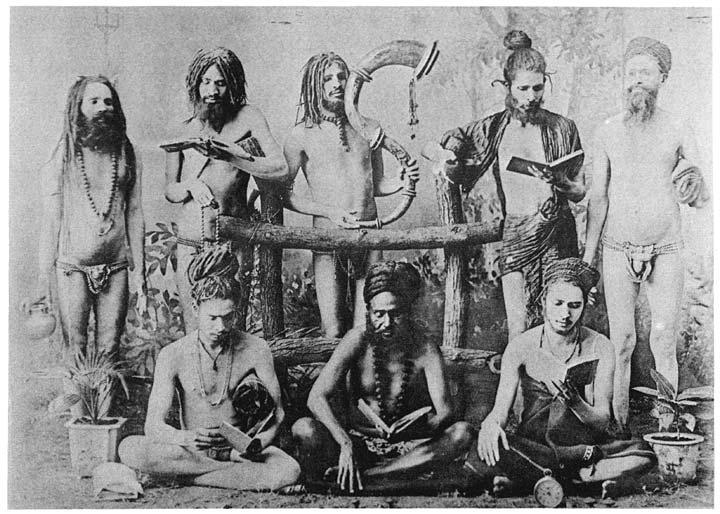
Group of religious mendicants
29. Other village traders and menials.
30. Household servants.
Some of the castes already mentioned, and one or two others having the same status, work as household servants as well as village menials. The Dhīmar is most commonly employed as an indoor servant in Hindu households, and is permitted to knead flour in water and make it into a cake, which the Brāhman then takes and puts on the girdle with his own hands. He can boil water and pour pulse into the cooking-pot from above, so long as he does not touch the vessel after the food has been placed in it. He will take any remains of food left in the cooking-pot, as this is not considered to be polluted, food only becoming polluted when the hand touches it on the dish after having touched the mouth. When this happens, all the food on the dish becomes jūtha or leavings of food, and as a general rule no caste except the sweepers will eat these leavings of food of another caste or of another person of their own. Only a wife, whose meal follows her husband’s, will eat his leavings. As a servant, the Dhīmar is very familiar with his master; he may enter any part of the house, including the cooking-place and the women’s rooms, and he addresses his mistress as ‘Mother.’ When he lights his master’s pipe he takes the first pull himself, to show that it has not been tampered with, and then presents it to him with his left hand placed under his right elbow in token of respect. Maid-servants frequently belong also to the Dhīmar caste, and it often happens that the master of the household has illicit intercourse with them. Hence there is a proverb: ‘The king’s son draws water and the water-bearer’s son sits on the throne,’—similar intrigues on the part of high-born women with their servants being not unknown. The Kahār or palanquin-bearer was probably the same caste as the Dhīmar. Landowners would maintain a gang of Kahārs to carry them on journeys, allotting to such men plots of land rent-free. Our use of the word ‘bearer’ in the sense of a body-servant has developed from the palanquin-bearer who became a personal attendant on his master. Well-to-do families often have a Nai or barber as a hereditary family servant, the office descending in the barber’s family. Such a man arranges the marriages of the children and takes a considerable part in conducting them, and acts as escort to the women of the family when they go on a journey. Among his daily duties are to rub his master’s body with oil, massage his limbs, prepare his bed, tell him stories to send him to sleep, and so on. The barber’s wife attends on women in childbirth after the days of pollution are over, and rubs oil on the bodies of her clients, pares their nails and paints their feet with red dye at marriages and on other festival occasions. The Bāri or maker of leaf-plates is another household servant. Plates made of large leaves fastened together with little wooden pins and strips of fibre are commonly used by the Hindus for eating food, as are little leaf-cups for drinking; glazed earthenware has hitherto not been commonly manufactured, and that with a rougher surface becomes ceremonially impure by contact with any strange person or thing. Metal vessels and plates are the only alternative to those made of leaves, and there are frequently not enough of them to go round for a party. The Bāris also work as personal servants, hand round water, and light and carry torches at entertainments and on journeys. Their women are maids to high-caste Hindu ladies, and as they are always about the zenana are liable to lose their virtue.
31. Status of the village menials.
32. Origin of their status
The status of the village menial castes appears to be fixed by their dependent position on the cultivators. The latter are their patrons and superiors, to whom they look for a livelihood. Before the introduction of a currency in the rural tracts (an event of the last fifty to a hundred years) the village artisans and menials were supported by contributions of grain from the cultivators. They still all receive presents, consisting of a sowing-basketful of grain at seed-time and one or two sheaves at harvest. The former is known as Bīj phūtni, or ‘The breaking of the seed,’ and the latter as Khanvār, or ‘That which is left’ Sometimes, after threshing, the menials are each given as much grain as will fill a winnowing-fan. When the peasant has harvested his grain, all come and beg from him. The Dhīmar brings some water-nut, the Kāchhi or market-gardener some chillies, the Barai betel-leaf, the Teli oil and tobacco, the Kalār liquor (if he drinks it), the Bania some sugar, and all receive grain in excess of the value of their gifts. The Joshi or village priest, the Nat or acrobat, the Gosain or religious mendicant and the Fakīr or Muhammadan beggar solicit alms. On that day the cultivator is said to be like a little king in his fields, and the village menials constitute his court. In purely agricultural communities grain is the principal source of wealth, and though the average Hindu villager may appear to us to be typical of poverty rather than wealth, such standards are purely relative. The cultivator was thus the patron and supporter of the village artisans and menials, and his social position was naturally superior to theirs. Among the Hindus it is considered derogatory to accept a gift from another person, the recipient being thereby placed in a position of inferiority to the donor. Some exception to this rule is made in the case of Brāhmans, though even with them it partly applies. Generally the acceptance of a gift of any value among Hindus is looked upon in the same manner as the taking of money in England, being held to indicate that the recipient is in an inferior social position to the giver. And the existence of this feeling seems to afford strong support to the reason suggested here for the relative status of the cultivating and village menial castes.
33. Other castes who rank with the village menials.
Many other castes belong to the group of those from whom a Brāhman cannot take water, but who are not impure. Among these are several of the lower cultivating castes, some of them growers of special products, as the Kāchhis and Mowārs or market-gardeners, the Dāngris or melon-growers, and the Kohlis and Bhoyars who plant sugarcane. These subsidiary kinds of agriculture were looked down upon by the cultivators proper; they were probably carried out on the beds and banks of streams and other areas not included in the regular holdings of the village, and were taken up by labourers and other landless persons. The callings of these are allied to, or developed from, that of the Māli or gardener, and they rank on a level with him, or perhaps a little below, as no element of sanctity attaches to their products. Certain castes which were formerly labourers, but have now sometimes obtained possession of the land, are also in this group, such as the Rajbhars, Kīrs, Mānas, and various Madras castes of cultivators. Probably these were once not allowed to hold land, but were afterwards admitted to do so. The distinction between their position and that of the hereditary cultivators of the village community was perhaps the original basis of the different kinds of tenant-right recognised by our revenue law, though these now, of course, depend solely on length of tenure and other incidents, and make no distinction of castes. The shepherd castes who tend sheep and goats (the Gadarias, Dhangars and Kuramwārs) also fall into this group. Little sanctity attached to these animals as compared with the cow, and the business of rearing them would be left to the labouring castes and non-Aryan tribes. The names of all three castes denote their functional origin, Gadaria being from gādar, a sheep, Dhangar from dhan or small-stock, the word signifying a flock of sheep or goats and also wealth; and Kuramwār from kurri, the Telugu word for sheep. Others belonging to this group are the digging and earth-working castes, the Beldārs, Murhas, Nunias and so on, practically all derived from the indigenous tribes, who wander about seeking employment from the cultivators in the construction and repair of field embankments and excavation of wells and tanks; and various fishing and boating castes, as the Injhwārs, Naodas, Murhas and Kewats, who rank as equal to the Dhīmars, though they may not be employed in household or village service. Such castes, almost entirely derived from the non-Aryan tribes, may have come gradually into existence as the wants of society developed and new functions were specialised; they would naturally be given the social status already attaching to the village menial castes.
34. The non-Aryan tribes.
The fourth group in the scheme of precedence comprises the non-Aryan or indigenous tribes, who are really outside the caste system when this is considered as the social organisation of the Hindus, so long at least as they continue to worship their own tribal deities, and show no respect for Brāhmans nor for the cow. These tribes have, however, entered the Hindu polity in various positions. The leaders of some of them who were dominant in the early period were admitted to the Kshatriya or Rājpūt caste, and the origin of a few of the Rājput clans can be traced to the old Bhar and other tribes. Again, the aristocratic or landholding sections of several existing tribes are at present, as has been seen, permitted to rank with the good Hindu cultivating castes. In a few cases, as the Andhs, Halbas and Mānas, the tribe as a whole has become a Hindu caste, when it retained possession of the land in the centre of a Hindu population. These have now the same or a slightly higher position than the village menial castes. On the other hand, those tribes which were subjugated and permitted to live with a servile status in the Hindu villages have developed into the existing impure castes of labourers, weavers, tanners and others, who form the lowest social group. The tribes which still retain their distinctive existence were not enslaved in this manner, but lived apart in their own villages in the forest tracts and kept possession of the land. This seems to be the reason why they rank somewhat higher than the impure castes, even though they may utterly defile themselves according to Hindu ideas by eating cow’s flesh. Some tribes, such as the Gonds, Binjhwārs and Kawars, counted amongst them the owners of large estates or even kingdoms, and consequently had many Hindu cultivators for their subjects. And, as the Hindus themselves say, they could not regard the Gonds as impure when they had a Gond king. Nevertheless, the Gond labourers in Hindu villages in the plains are more despised than the Gonds who live in their own villages in the hill country. And the conversion of the tribes as a whole to Hinduism goes steadily forward. At each census the question arises which of them should be classed as Hindus, and which as Animists or worshippers of their own tribal gods, and though the classification is necessarily very arbitrary, the process can be clearly observed. Thus the Andhs, Kolis, Rautias and Halbas are now all Hindus, and the same remark applies to the Kols, Bhīls and Korkus in several Districts. By strict abstention from beef, the adoption of Hindu rites, and to some extent of child-marriage, they get admission to the third group of castes from whom a Brāhman cannot take water. It will be desirable here to digress from the main argument by noticing briefly the origin and affinities of the principal forest tribes of the Central Provinces.
35. The Kolarians and Dravidians.
36. Kolarian tribes.
The principal tribes of the Munda or Kolarian family in the Central Provinces are shown below:
Kol, Munda, Ho. Bhumij. Santāl. Kharia. Korwa. Korku. Nāhal Savar or Saonr. Māl, Māle. Gadba. Khairwār. Baiga. Bhuiya. Bhaina. Bhunjia. Binjhwār. Probable: Bhar, Koli, Bhīl, Chero.
One large group includes the Kol, Munda or Ho tribe itself and the Bhumij and Santāls, who appear to be local branches of the Kols called by separate names by the Hindus. The Kharias seem to be the earliest Kol settlers in Chota Nāgpur, who were subjugated by the later comers. The name Kol, as already seen, is probably a form of the Santali hār, a man. Similarly the name of the Korku tribe is simply a corruption of Koraku, young men, and that of the Korwa tribe is from the same root. The dialects of the Korku and Korwa tribes closely approximate to Mundāri. Hence it would seem that they were originally one tribe with the Kols, but have been separated for so long a period that their direct connection can no longer be proved. The disintegrating causes which have split up what was originally one into a number of distinct tribes, are probably no more than distance and settlement in different parts of the country, leading to cessation of intermarriage and social intercourse. The tribes have then obtained some variation in the original names or been given separate territorial or occupational designations by the Hindus, and their former identity has gradually been forgotten. Both the Korwas of the Chota Nāgpur plateau and the Korkus of the Satpūra hills were known as Muāsi, a term having the meaning of robber or raider. The Korwas have also a subtribe called Korāku, and Mr. Crooke thinks that they were originally the same tribe. Sir G. Grierson states that the Korwa dialect is closely allied to Kharia. Similarly the resemblance of the name raises a presumption that the great Koli tribe of Gujarāt and western India may be a branch of the Kols who penetrated to the western coast along the Satpūlra and Central India hill ranges. The Kolis and Bhīls are tribes of the same country and are commonly spoken of together. Both have entirely lost their own language and cannot therefore be classified definitely either as Kolarian or Dravidian, but there is a probability that they are of the Kolarian family. The Nāhals, another tribe of the western Satpūra range, are an offshoot of the Korkus. They are coupled with the Bhīls and Kolis in old Hindu accounts.
Another great branch of the Kolarian family is that represented by the Bhuiya and Baiga tribes and their offshoots, the Bhunjias, Bhainas and Binjhwārs. The Kolarian origin of the Bhuiyas has been discussed in the article on that tribe, and it has also been suggested that the Baiga tribe of the Central Provinces are an offshoot of the Bhuiyas. These tribes have all abandoned their own languages and adopted the local Aryan vernaculars. The name Bhuiya is a Sanskrit derivative from bhu, earth, and signifies ‘belonging to the soil.’ Bhumij, applied to a branch of the Kol tribe, has the same origin. Baiga is used in the sense of a village priest or a sorcerer in Chota Nāgpur, and the office is commonly held by members of the Bhuiya tribe in that locality, as being the oldest residents. Thus the section of the tribe in the Central Provinces appears to have adopted, or been given, the name of the office. The Bharias or Bharia-Bhumias of Jubbulpore seem to belong to the great Bhar tribe, once dominant over large areas of the United Provinces. They also hold the office of village priest, which is there known as Bhumia, and in some tracts are scarcely distinguished from the Baigas. Again, in Sambalpur the Bhuiyas are known as Bhumia Kol, and are commonly regarded as a branch of the Kol tribe. Thus it would seem that two separate settlements of the Kolarian races may have occurred; the earlier one would be represented by the Bhars, Bhuiyas, Baigas and kindred tribes who have entirely lost their own languages and identity, and have names given to them by the Hindus; and a later one of the Kols or Mundas and their related tribes, whose languages and tribal religion and organisation, though in a decaying state, can be fully recognised and recorded. And the Dravidian immigration would be subsequent to both of them. To judge from the cases in which the fissure or subdivision of single tribes into two or more distinct ones can still be observed, it seems quite a plausible hypothesis that the original immigrants may have consisted only of a single tribe on each occasion, and that the formation of new ones may have occurred after settlement. But the evidence does not warrant any definite assertion.
37. Dravidian tribes.
The principal Dravidian tribes are the Gonds, Khonds and Oraons. The Gonds were once dominant over the greater part of the Central Provinces, which was called Gondwana after them. The above three names have in each case been given to the tribes by the Hindus. The following tribes are found in the Province:
Gond, Oraon or Kurukh, Khond, Kolām, Parja, Kamār. Tribal Castes: Bhatra, Halba, Dhoba. Doubtful: Kawar, Dhanwār.
The Gonds and Khonds call themselves Koi or Koitur, a word which seems to mean man or hillman. The Oraon tribe call themselves Kurukh, which has also been supposed to be connected with the Kolarian horo, man. The name Oraon, given to them by the Hindus, may mean farmservant, while Dhangar, an alternative name for the tribe, has certainly this signification.
38. Origin of the Kolarian tribes
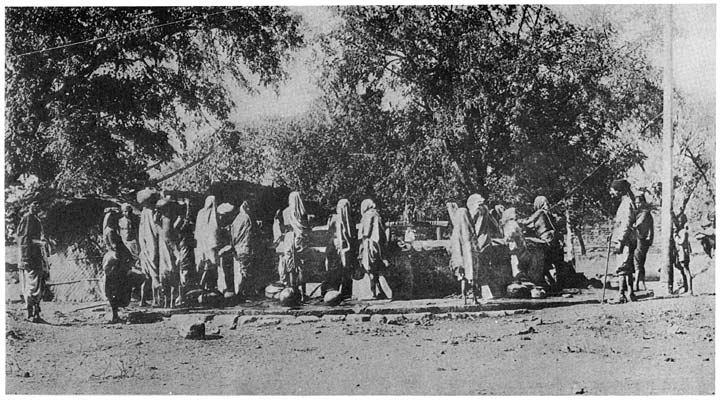
Drawing water from the village well
Though the physical characteristics of the two sets of tribes display no marked points of difference, the opinion has been generally held by ethnologists who know them that they represent two distinct waves of immigration, and the absence of connection between their languages bears out this view. It has always been supposed that the Mundas were in the country of Chota Nāgpur and the Central Provinces first, and that the Dravidians, the Gonds, Khonds and Oraons came afterwards. The grounds for this view are the more advanced culture of the Dravidians; the fact that where the two sets of tribes are in contact those of the Munda group have been ousted from the more open and fertile country, of which, according to tradition, they were formerly in possession; and the practice of the Gonds and other Dravidian tribes of employing the Baigas, Bhuiyas and other Munda tribes for their village priests, which is an acknowledgment that the latter as the earlier residents have a more familiar acquaintance with the local deities, and can solicit their favour and protection with more prospect of success. Such a belief is the more easily understood when it is remembered that these deities are not infrequently either the human ancestors of the earliest residents or the local animals and plants from which they supposed themselves to be descended.
39. Of the Dravidian tribes.
As stated by Sir Edward Gait there is at present no evidence to show that the Dravidians came to southern India from any other part of the world, and for anything that is known to the contrary the languages may have originated there. The existence of the small Brahui tribe in Baluchistān who speak a Dravidian language but have no physical resemblance to other Dravidian races cannot be satisfactorily explained, but, as he points out, this is no reason for holding that the whole body of speakers of Dravidian languages entered India from the north-west, and, with the exception of this small group of Brahuis, penetrated to the south and settled there without leaving any traces of their passage.
Any further evidence or argument as to the date of the Dravidian immigration would be of considerable interest.
40. Origin of the impure castes.
If the whole of India had been thoroughly subjugated and settled like the Punjab and Hindustān, it may be supposed that the same status of impurity would have been imposed upon all the indigenous races; but this was very far from being the case. In central and southern India the Aryans or subsequent immigrants from Central Asia came at first at any rate only in small parties, and though they may have established territorial states, did not regularly occupy the land nor reduce the indigenous population to a condition of servitude. Thus large bodies of these must have retained a free position, and on their acceptance of the new religion and the development of the caste system, became enrolled in it with a caste status on the basis of their occupation. Their leaders were sometimes admitted to rank as Kshatriyas or Rājpūts, as has been stated.
The Dhobi (washerman) and Kumhār (potter) are sometimes included among the impure castes, but, as already noted, their status is higher than that of the castes in this list.
Audhelia: Labouring caste of mixed descent who keep pigs.
Balāhi: Weavers and village messengers and watchmen.
Basor: Bamboo basket-makers and village musicians.
Chamār: Tanners and labourers.
Gānda: Weavers and village musicians.
Ghasia: Grass-cutters, labourers and sweepers.
Kaikāri: Vagrant basket-makers.
Kanjar, Beria, Sānsia: Gipsies and thieves.
Katia: Cotton-spinners.
Kori: Weavers and labourers.
Mādgi: Telugu tanners and hide-curriers.
Mahār: Weavers and labourers.
Māla: Telugu weavers and labourers.
Māng: Broom- and mat-makers and village musicians. They also castrate cattle.
Mehtar: Sweepers and scavengers.
41. Derivation of the impure castes from the indigenous tribes.
42. Occupation the basis of the caste system.
It has been seen that the old Aryan polity comprised four classes: the Brāhmans and Kshatriyas or priestly and military aristocracy; the Vaishyas or body of the Aryans, who were ceremonially pure and could join in sacrifices; and the Sūdras or servile and impure class of labourers. The Vaishyas became cultivators and herdsmen, and their status of ceremonial purity was gradually transferred to the cultivating members of the village community, because land was the main source of wealth. Between the last two there arose another class of village menials and craftsmen, originating principally from the offspring of fathers of the Aryan classes and Sūdra women, to whom was left the practice of the village industries, despised by the cultivators. In spite of the almost complete fusion of races which the intercourse of centuries has effected, and the multiplication and rearrangement of castes produced by the diversity of occupation and other social factors, the divisions of the village community can still be recognised in the existing social gradation.
Several castes have been formed from military service, as the Marāthas, Khandaits, Rautias, Taonlas and Pāiks. All of these, except the Marāthas, are mainly derived from the non-Aryan tribes; since they have abandoned military service and taken as a rule to agriculture, their rank depends roughly on their position as regards the land. Thus the Marāthas and Khandaits became landowners, receiving grants of property as a reward for, or on condition of, military service like the old feudal tenures; they rank with, but somewhat above, the cultivating castes. The same is the case, though to a less degree, with the Rautias of Chota Nāgpur, a military caste mainly formed from the Kol tribe. On the other hand, the Pāiks or foot-soldiers and Taonlas have not become landholders and rank below the cultivating castes. The Hatkars are a caste formed from Dhangars or shepherds who entered the Marātha armies. They are now called Bangi Dhangars or shepherds with the spears, and rank a little above other Dhangars.
43. Other agents in the formation of castes.
The great majority of castes have been formed from occupation, but other sources of origin can be traced. Several castes are of mixed descent, as the Vidūrs, the descendants of Brāhman fathers and mothers of other castes; the Bhilālas, by Rajpūt fathers and Bhīl mothers; the Chauhāns, Audhelias, Khangārs and Dhākars of Bastar, probably by Hindu fathers and women of various indigenous tribes; the Kirārs of mixed Rajpūt descent, and others. These also now generally take rank according to their occupation and position in the world. The Vidūrs served as village accountants and ranked below the cultivators, but since they are well educated and have done well in Government service their status is rapidly improving. The Bhilālas are landholders and rank as a good cultivating caste. The Chauhāns and Khangārs are village watchmen and rank as menials below the cultivators, the Dhākars are farmservants and labourers with a similar position, while the Audhelias are labourers who keep pigs and are hence regarded as impure. The Halbas or ‘ploughmen’ are another mixed caste, probably the descendants of house-servants of the Uriya Rājas, who, like the Khandaits, formed a sort of militia for the maintenance of the chiefs authority. They are now mainly farmservants, as the name denotes, but where they hold land, as in Bastar, they rank higher, almost as a good cultivating caste.
Again, very occasionally a caste may be formed from a religious sect or order. The Bishnois were originally a Vaishnava sect, worshipping Vishnu as an unseen god, and refusing to employ Brāhmans. They have now become cultivators, and though they retain their sectarian beliefs, and have no Brāhman priests, are generally regarded as a Hindu cultivating caste. The Pankas are members of the impure Gānda caste who adhered to the Kabīrpanthi sect. They are now a separate caste and are usually employed as village watchmen, ranking with menials above the Gāndas and other similar castes. The Lingāyats are a large sect of southern India, devoted to the worship of Siva and called after the lingam or phallic emblem which they wear. They have their own priests, denying the authority of Brāhmans, but the tendency now is for members of those castes which have become Lingāyats to marry among themselves and retain their relative social status, thus forming a sort of inner microcosm of Hinduism.
44. Caste occupations divinely ordained.
Occupation is the real determining factor of social status in India as in all other societies of at all advanced organisation. But though in reality the status of occupations and of castes depends roughly on the degree to which they are lucrative and respectable, this is not ostensibly the case, but their precedence, as already seen, is held to be regulated by the degree of ceremonial purity or impurity attaching to them. The Hindus have retained, in form at any rate, the religious constitution which is common or universal in primitive societies. The majority of castes are provided with a legend devised by the Brāhmans to show that their first ancestor was especially created by a god to follow their caste calling, or at least that this was assigned to him by a god. The ancestors of the bearer-caste of Kahārs were created by Siva or Mahādeo from the dust to carry his consort Parvati in a litter when she was tired; the first Māng was made by Mahādeo from his own sweat to castrate the divine bull Nandi when he was fractious, and his descendants have ever since followed the same calling, the impiety of mutilating the sacred bull in such a manner being thus excused by the divine sanction accorded to it. The first Māli or gardener gave a garland to Krishna. The first Chamār or tanner made sandals for Siva from a piece of his own skin; the ancestor of the Kāyasth or writer caste, Chitragupta, keeps the record of men’s actions by which they are judged in the infernal regions after death; and so on.
45. Subcastes. local type.
46. Occupational subcastes.
47. Subcastes formed from social or religious differences, or from mixed descent.
Subcastes are also occasionally formed from differences of social practice which produce some slight gain or loss of status. Thus the Biyāhut or ‘Married’ Kalārs prohibit the remarriage of widows, saying that a woman is married once for all, and hence rank a little higher than the others. The Dosar Banias, on the other hand, are said to take their name from dūsra, second, because they allow a widow to marry a second time and are hence looked upon by the others as a second-class lot. The Khedāwāl Brāhmans are divided into the ‘outer’ and ‘inner’: the inner subdivision being said to exist of those who accepted presents from the Rāja of Kaira and remained in his town, while the outer refused the presents, quitted the town and dwelt outside. The latter rank a little higher than the former. The Suvarha Dhīmars keep pigs and the Gadhewāle donkeys, and are considered to partake of the impure nature of these animals. The Gobardhua Chamārs wash out and eat the undigested grain from the droppings of cattle on the threshing-floors. The Chungia group of the Satnāmi Chamārs are those who smoke the chongi or leaf-pipe, though smoking is prohibited to the Satnāmis. The Nāgle or ‘naked’ Khonds have only a negligible amount of clothing and are looked down upon by the others. The Makaria Kamārs eat monkeys and are similarly despised.
Subcastes are also formed from mixed descent. The Dauwa Ahīrs are held to be the offspring of Ahīr women who were employed as wet-nurses in the houses of Bundela Rājpūts and bore children to their masters. The Halbas and Rautias are divided into subcastes known as Puraīt or ‘pure,’ and Surāit or of ‘mixed’ descent. Many castes have a subcaste to which the progeny of illicit unions is relegated, such as the Dogle Kāyasths, and the Lahuri Sen subcaste of Barais, Banias and other castes. Illegitimate children in the Kasār (brass-worker) caste form a subcaste known as Tākle or ‘thrown out,’ Vidur or ‘illegitimate,’ or Laondi Bachcha, the issue of a kept wife. In Berār the Mahādeo Kolis, called after the Mahādeo or Pachmarhi hills, are divided into the Khas, or ‘pure,’ and the Akarāmāse or ‘mixed’; this latter word means gold or silver composed of eleven parts pure metal and one part alloy. Many subcastes of Bania have subcastes known as Bīsa or Dasa, that is ‘Twenty’ or ‘Ten’ groups, the former being of pure descent or twenty-carat, as it were, and the latter the offspring of remarried widows or other illicit unions. In the course of some generations such mixed groups frequently regain full status in the caste.
Subcastes are also formed from members of other castes who have taken to the occupation of the caste in question and become amalgamated with it; thus the Korchamārs are Koris (weavers) adopted into the Chamār (tanner) caste; Khatri Chhīpas are Khatris who have become dyers and printers; the small Dāngri caste has subcastes called Teli, Kalār and Kunbi, apparently consisting of members of those castes who have become Dāngris; the Bāman Darzis or tailors will not take food from any one except Brāhmans and may perhaps be derived from them, and the Kaith Darzis may be Kāyasths; and so on.
Occasionally subcastes may be formed from differences of religious belief or sectarian practice. In northern India even such leading Hindu castes as Rājpūts and Jāts have large Muhammadan branches, who as a rule do not intermarry with Hindus. The ordinary Hindu sects seldom, however, operate as a bar to marriage, Hinduism being tolerant of all forms of religious belief. Those Chamārs of Chhattīsgarh who have embraced the doctrines of the Satnāmi reforming sect form a separate endogamous subcaste, and sometimes the members of the Kabīrpanthi sect within a caste marry among themselves.
Statistics of the subcastes are not available, but their numbers are very extensive in proportion to the population, and even in the same subcaste the members living within a comparatively small local area often marry among themselves and attend exclusively at their own caste feasts, though in the case of educated and well-to-do Hindus the construction of railways has modified this rule and connections are kept up between distant groups of relatives. Clearly therefore differences of occupation or social status are not primarily responsible for the subcastes, because in the majority of cases no such differences really exist. I think the real reason for their multiplication was the necessity that the members of a subcaste should attend at the caste feasts on the occasion of marriages, deaths and readmission of offenders, these feasts being of the nature of a sacrificial or religious meal. The grounds for this view will be given subsequently.
48. Exogamous groups.
The caste or subcaste forms the outer circle within which a man must marry. Inside it are a set of further subdivisions which prohibit the marriage of persons related through males. These are called exogamous groups or clans, and their name among the higher castes is gotra. The theory is that all persons belonging to the same gotra are descended from the same male ancestor, and so related. The relationship in the gotra now only goes by the father’s side; when a woman marries she is taken into the clan of her husband and her children belong to it. Marriage is not allowed within the clan and in the course of a few generations the marriage of persons related through males or agnates is prohibited within a very wide circle. But on the mother’s side the gotra does not serve as a bar to marriage and the union of first cousins would be possible, other than the children of two brothers. According to Hindu law, intermarriage is prohibited within four degrees between persons related through females. But generally the children of first cousins are allowed to marry, when related partly through females. And several castes allow the intermarriage of first cousins, that of a brother’s daughter to a sister’s son and in a less degree of a brother’s son to a sister’s daughter being specially favoured. One or two Madras castes allow a man to marry his niece, and the small Dhoba caste of Mandla permit the union of children of the same mother but different fathers.
Sir Herbert Risley classed the names of exogamous divisions as eponymous, territorial or local, titular and totemistic. In the body of this work the word clan is usually applied only to the large exogamous groups of the Rājpūts and one or two other military castes. The small local or titular groups of ordinary Hindu castes are called ‘section,’ and the totemic groups of the primitive tribes ‘sept.’ But perhaps it is simpler to use the word ‘clan’ throughout according to the practice of Sir J.G. Frazer. The vernacular designations of the clans or sections are gotra, which originally meant a stall or cow-pen; khero, a village; dih, a village site; baink, a title; mul or mur, literally a root, hence an origin; and kul or kuri, a family. The sections called eponymous are named after Rishis or saints mentioned in the Vedas and other scriptures and are found among the Brāhmans and a few of the higher castes, such as Vasishta, Garga, Bhāradwāj, Vishvamitra, Kashyap and so on. A few Rājpūt clans are named after kings or heroes, as the Rāghuvansis from king Rāghu of Ajodhia and the Tilokchandi Bais from a famous king of that name. The titular class of names comprise names of offices supposed to have been held by the founder of the clan, or titles and names referring to a personal defect or quality, and nicknames. Instances of the former are Kotwār (village watchman), Chaudhri, Meher or Māhto (caste headman), Bhagat (saint), Thākuria and Rawat (lord or prince), Vaidya (physician); and of titular names and nicknames: Kuldip (lamp of the family), Mohjaria (one with a burnt mouth), Jāchak (beggar), Garkata (cut-throat), Bhātpagar (one serving on a pittance of boiled rice), Kangāli (poor), Chīkat (dirty), Petdukh (stomach-ache), Ghunnere (worm-eater) and so on. A special class of names are those of offices held at the caste feasts; thus the clans of the Chitrakathi caste are the Atak or Mānkari, who furnish the headman of the caste panchāyat or committee; the Bhojin who serve the food at marriages and other ceremonies; the Kākra who arrange for the lighting; the Gothārya who keep the provisions, and the Ghorerao (ghora, a horse) who have the duty of looking after the horses and bullock-carts of the caste-men who assemble. Similarly the five principal clans of the small Turi caste are named after the five sons of Singhbonga or the sun: the eldest son was called Mailuar and his descendants are the leaders or headmen of the caste; the descendants of the second son, Chardhagia, purify and readmit offenders to caste intercourse; those of the third son, Suremār, conduct the ceremonial shaving of such offenders, and those of the fourth son bring water for the ceremony and are called Tirkuār. The youngest brother, Hasdagia, is said to have committed some caste offence, and the four other brothers took the parts which are still played by their descendants in his ceremony of purification. In many cases exogamous clans are named after other castes or subcastes. Many low castes have adopted the names of the Rājpūt clans, either from simple vanity as people may take an aristocratic surname, or because they were in the service of Rājpūts, and have adopted the names of their masters or are partly descended from them. Other names of castes found among exogamous groups probably indicate that an ancestor belonging to that caste was taken into the one in which the group is found. The Bhaina tribe have clans named after the Dhobi, Ahīr, Gond, Māli and Panka castes. The members of such clans pay respect to any man belonging to the caste after which they are named and avoid picking a quarrel with him; they also worship the family gods of the caste.
49. Totemistic clans.
50. Terms of relationship.
51. Clan kinship and totemism.
52. Animate Creation.
Thus primitive man had no conception of inanimate matter, and it seems probable that he did not either realise the idea of death. Though it may be doubtful whether any race exists at present which does not understand that death is the cessation of life in the body, indications remain that this view was not primary and may not have been acquired for some time. The Gonds apparently once thought that people would not die unless they were killed by magic, and similar beliefs are held by the Australian and African savages. Several customs also point to the belief in the survival of some degree of life in the body after death, apart from the idea of the soul.
53. The distribution of life over the body.
Primitive man further thought that life, instead of being concentrated in certain organs, was distributed equally over the whole of the body. This mistake appears also to have been natural and inevitable when it is remembered that he had no name for the body, the different limbs and the internal organs, and no conception of their existence and distribution, nor of the functions which they severally performed. He perceived that sensation extended over all parts of the body, and that when any part was hurt or wounded the blood flowed and life gradually declined in vigour and ebbed away. For this reason the blood was subsequently often identified with the life. During the progress of culture many divergent views have been held about the source and location of life and mental and physical qualities, and the correct one that life is centred in the heart and brain, and that the brain is the seat of intelligence and mental qualities has only recently been arrived at. We still talk about people being hard-hearted, kind-hearted and heartless, and about a man’s heart being in the right place, as if we supposed that the qualities of kindness and courage were located in the heart, and determined by the physical constitution and location of the heart. The reason for this is perhaps that the soul was held to be the source of mental qualities, and to be somewhere in the centre of the body, and hence the heart came to be identified with it. As shown by Sir J.G. Frazer in The Golden Bough many peoples or races have thought that the life and qualities were centred in the whole head, not merely in the brain. And this is the reason why Hindus will not appear abroad with the head bare, why it is a deadly insult to knock off a man’s turban, and why turbans or other head-gear were often exchanged as a solemn pledge of friendship. The superstition against walking under a ladder may have originally been based on some idea of its being derogatory or dangerous to the head, though not, of course, from the fear of being struck by a falling brick. Similarly, as shown in the article on Nai, the belief that the bodily strength and vigour were located in the hair, and to a less extent in the nails and teeth, has had a world-wide prevalence. But this cannot have been primary, because the hair had first to be conceived of apart from the rest of the body, and a separate name devised for it, before the belief that the hair was the source of strength could gradually come into existence. The evolution of these ideas may have extended over thousands of years. The expression ‘white-livered,’ again, seems to indicate that the quality of courage was once held to be located in the liver, and the belief that the liver was the seat of life was perhaps held by the Gonds. But the primary idea seems necessarily to have been that the life was equally distributed all over the body. And since, as will be seen subsequently, the savage was incapable of conceiving the abstract idea of life, he thought of it in a concrete form as part of the substance of the flesh and blood.
And since primitive man had no conception of inanimate matter it followed that when any part of the body was severed from the whole, he did not think of the separate fraction as merely lifeless matter, but as still a part of the body to which it had originally belonged and retaining a share of its life. For according to his view of the world and of animate nature, which has been explained above, he could not think of it as anything else. Thus the clippings of hair, nails, teeth, the spittle and any other similar products all in his view remained part of the body from which they had been severed and retained part of its life. In the case of the elements, earth, fire and water, which he considered as living beings and subsequently worshipped as gods, this view was correct. Fractional portions of earth, fire and water, when severed from the remainder, retained their original nature and constitution, and afforded some support to his generally erroneous belief. And since he had observed that an injury done to any part of the body was an injury to the whole, it followed that if one got possession of any part of the body, such as the severed hair, teeth or nails, one could through them injure that body of which they still formed a part. It is for this reason that savages think that if an enemy can obtain possession of any waste product of the body, such as the severed hair or nails, that he can injure the owner through them. Similarly the Hindus thought that the clippings of the hair or nails, if buried in fertile ground, would grow into a plant, through the life which they retained, and as this plant waxed in size it would absorb more and more of the original owner’s life, which would consequently wane and decline. The worship of relics, such as the bones or hair of saints, is based on the same belief that they retain a part of the divine life and virtue of him to whom they once belonged.