Volume 1 / Part 1 — Muhammadan Religion
Reading edition
[Bibliography: Rev. T.P. Hughes, Notes on Muhammadanism, and Dictionary of Islām, London, W.H. Allen, 1895; Bombay Gazetteer, vol. ix. Part II. Muhammadans of Gujarāt, by Khān Bahādur Fazalullah Lutfullah Farīdi; Qāun-i-Islām, G.A. Herklots, Madras, Higginbotham, reprint 1895; Muhammadanism and Early Developments of Muhammadanism, by Professor D.S. Margoliouth; Life of Mahomet, by Sir. W. Muir; Mr. J.T. Marten’s Central Provinces Census Report, 1911. This article is mainly compiled from the excellent accounts in the Bombay Gazetteer and the Dictionary of Islām.]
List of Paragraphs
1. Statistics and distribution.
2. Occupations.
3. Muhammadan castes.
4. The four tribal divisions.
5. Marriage.
6. Polygamy, divorce and widow-remarriage.
7. Devices for procuring children, and beliefs about them.
8. Pregnancy rites.
9. Childbirth and naming children.
10. The Ukīka sacrifice.
11. Shaving the hair and ear-piercing.
12. Birthdays.
13. Circumcision, and maturity of girls.
14. Funeral rites.
15. Muhammadan sects. Shiah and Sunni.
16. Leading religious observances. Prayer.
17. The fast of Ramazān.
18. The pilgrimage to Mecca.
19. Festivals. The Muharram.
20. Id-ul-Fitr.
21. Id-ul-Zoha
22. Mosques.
23. The Friday service.
24. Priests, Mulla and Maulvi.
25. The Kāzi.
26. General features of Islām.
27. The Korān.
28. The Traditions.
29. The schools of law.
30. Food.
31. Dress.
32. Social rules. Salutations.
33. Customs.
34. Position of women.
35. Interest on money.
36. Muhammadan education.
1. Statistics and distribution.
Muhammadan Religion.—The Muhammadans numbered nearly 600,000 persons in the Central Provinces in 1911, or about 3 per cent of the population. Of these about two-fifths belong to Berār, the Amraoti and Akola Districts containing more than 70,000 each; while of the 350,000 returned from the Central Provinces proper, about 40,000 reside in each of the Jubbulpore, Nāgpur and Nimār Districts. Berār was for a long period governed by the Muhammadan Bahmani dynasty, and afterwards formed part of the Mughal empire, passing to the Mughal Viceroy, the Nizām of Hyderābād, when he became an independent ruler. Though under British administration, it is still legally a part of Hyderābād territory, and a large proportion of the official classes as well as many descendants of retired soldiers are Muhammadans. Similarly Nimār was held by the Muhammadan Farūki dynasty of Khāndesh for 200 years, and was then included in the Mughal empire, Burhānpur being the seat of a viceroy. At this period a good deal of forcible conversion probably took place, and a considerable section of the Bhīls nominally became Muhammadans.
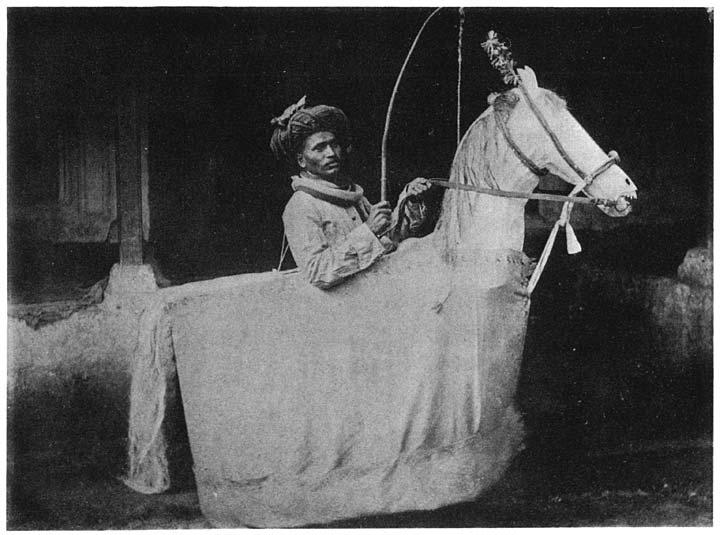
Beggar on artificial horse at the Muharram festival
When the Gond Rāja of Deogarh embraced Islām after his visit to Delhi, members of this religion entered his service, and he also brought back with him various artificers and craftsmen. The cavalry of the Bhonsla Rāja of Nāgpur was largely composed of Muhammadans, and in many cases their descendants have settled on the land. In the Chhattīsgarh Division and the Feudatory States the number of Muhammadans is extremely small, constituting less than one per cent of the population.
2. Occupations.
3. Muhammadan castes.
About 14 per cent of the Muhammadans returned caste names. The principal castes are the Bohra and Khoja merchants, who are of the Shiah sect, and the Cutchis or Memans from Gujarāt, who are also traders; these classes are foreigners in the Province, and many of them do not bring their wives, though they have now begun to settle here. The resident castes of Muhammadans are the Bahnas or cotton-cleaners; Julāhas, weavers; Kacheras, glass bangle-makers; Kunjras, greengrocers; Kasais, butchers; and the Rangrez caste of dyers who dye with safflower. As already stated, a section of the Bhīls are at least nominally Muhammadans, and the Fakīrs or Muhammadan beggars are also considered a separate caste. But no caste of good standing such as the Rājpūt and Jāt includes any considerable number of Muhammadans in the Central Provinces, though in northern India large numbers of them belong to this religion, while retaining substantially their caste usages. The Muhammadan castes in the Central Provinces probably consist to a large extent of the descendants of Hindu converts. Their religious observances present a curious mixture of Hindu and Muhammadan rites, as shown in the separate articles on these castes. Proper Muhammadans look down on them and decline to take food or intermarry with them.
4. The four tribal divisions.
5. Marriage.
The census returns of 1911 show that three-fourths of Muhammadan boys now remain unmarried till the age of 20; while of girls 31 per cent are unmarried between 15 and 20, but only 13 per cent above that age. The age of marriage of boys may therefore be taken at 18 to 25 or later, and that of girls at 10 to 20. The age of marriage both of girls and boys is probably getting later, especially among the better classes.
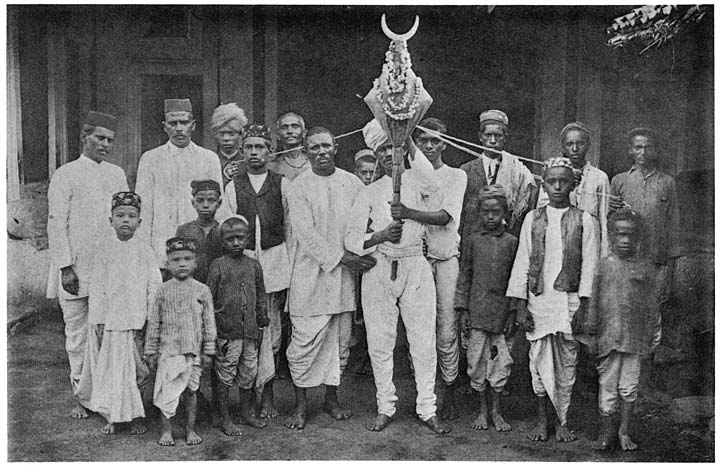
Carrying the horse-shoe at the Muharram festival
6. Polygamy, divorce and widow-remarriage.
A husband can divorce his wife at pleasure by merely repeating the prescribed sentences. A wife can obtain divorce from her husband for impotence, madness, leprosy or non-payment of the dowry. A woman who is divorced can claim her dowry if it has not been paid. Polygamy is permitted among Muhammadans to the number of four wives, but it is very rare in the Central Provinces. Owing to the fact that members of the immigrant trading castes leave their wives at home in Gujarāt, the number of married women returned at the census was substantially less than that of married men. A feeling in favour of the legal prohibition of polygamy is growing up among educated Muhammadans, and many of them sign a contract at marriage not to take a second wife during the lifetime of the first. There is no prohibition on the remarriage of widows in Muhammadan law, but the Hindu rule on the subject has had considerable influence, and some Muhammadans of good position object to the marriage of widows in their family. The custom of the seclusion of women also, as Mr. Marten points out, operates as a bar to a widow finding a husband for herself.
7. Devices for procuring children, and beliefs about them.
8. Pregnancy rites.
9. Childbirth and naming children.
10. The Ukīka sacrifice.
11. Shaving the hair and ear-piercing.
When a girl is one or two years old the lobes of her ears are bored. By degrees other holes are bored along the edge of the ear and even in the centre, till by the time she has attained the age of two or three years she has thirteen holes in the right ear and twelve in the left. Little silver rings and various kinds of earrings are inserted and worn in the holes. But the practice of boring so many holes has now been abandoned by the better-class Muhammadans.
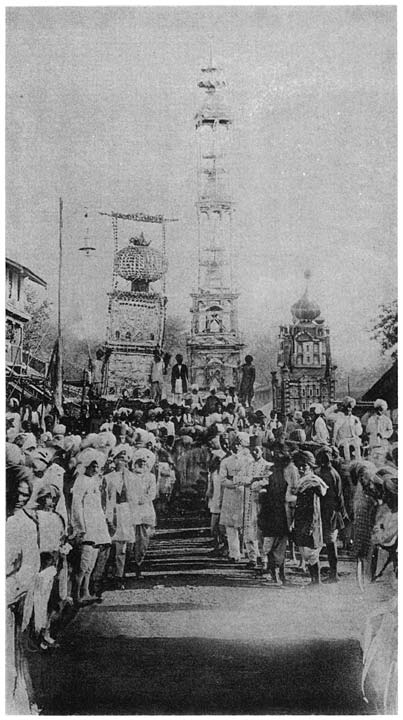
Tāzia or tombs of Hussain at the Muharram festival
12. Birthdays.
13. Circumcision, and maturity of girls.
14. Funeral rites.
15. Muhammadan sects. Shiah and Sunni.
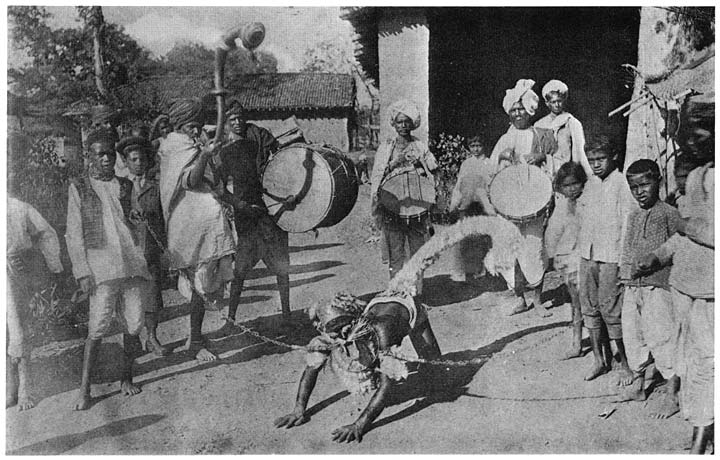
Of the two main sects of Islam, ninety-four per cent of the Muhammadans in the Central Province were returned as being Sunnis in 1911 and three per cent as Shiahs, while the remainder gave no sect. Only the Cutchi, Bohra and Khoja immigrants from Gujarāt are Shiahs and practically all other Muhammadans are Sunnis. With the exception of Persia, Oudh and part of Gujarāt, the inhabitants of which are Shiahs, the Sunni sect is generally prevalent in the Muhammadan world. The main difference between the Sunnis and Shiahs is that the latter think that according to the Korān the Caliphate or spiritual headship of the Muhammadans had to descend in the Prophet’s family and therefore necessarily devolved on the Lady Fātimah, the only one of his children who survived him, and on her husband Ali the fourth Caliph. They therefore reject the first three Caliphs after Muhammad, that is Abu Bakr, Omar and Othman. After Ali they also hold that the Caliphate descended in his family to his two sons Hasan and Hussain, and the descendants of Hussain. Consequently they reject all the subsequent Caliphs of the Muhammadan world, as Hussain and his children did not occupy this position. They say that there are only twelve Caliphs, or Imāms, as they now prefer to call them, and that the twelfth has never really died and will return again as the Messiah of whom Muhammad spoke, at the end of the world. He is known as the Mahdi, and the well-known pretender of the Soudan, as well as others elsewhere, have claimed to be this twelfth or unrevealed Imām. Other sects of the Shiahs, as the Zaidiyah and Ismailia, make a difference in the succession of the Imāmate among Hussain’s descendants. The central incident of the Shiah faith is the slaughter of Hussain, the son of Ali, with his family, on the plain of Karbala in Persia by the sons of Yazīd, the second Caliph of the Umaiyad dynasty of Damascus, on the 10th day of the month Muharram, in the 61st year of the Hijra or A.D. 680. The martyrdom of Hussain and his family at Karbala is celebrated annually for the first ten days of the month of Muharram by the Shiahs. Properly the Sunnis should take no part in this, and should observe only the tenth day of Muharram as that on which Adam and Eve and heaven and hell were created. But in the Central Provinces the Sunnis participate in all the Muharram celebrations, which now have rather the character of a festival than of a season of mourning. The Shiahs also reject the four great schools of tradition of the Sunnis, and have separate traditional authorities of their own. They count the month to begin from the full moon instead of the new moon, pray three instead of five times a day, and in praying hold their hands open by their sides instead of folding them below the breast. The word Shiah means a follower, and Sunni one proceeding on the sunnah, the path or way, a term applied to the traditions of the Prophet. The two words have thus almost the same signification. Except when otherwise stated, the information in this article relates to the Sunnis.
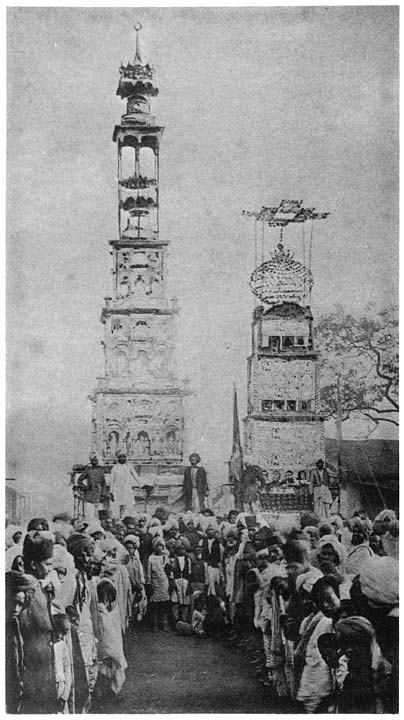
Famous Tāzia at Khandwa
16. Leading religious observances. Prayer.
17. The fast of Ramazān.
The third necessary observance is the fast in the month of Ramazān, the ninth month of the Muhammadan year. The fast begins when the new moon is seen, or if the sky is clouded, after thirty days from the beginning of the previous month. During its continuance no food or water must be taken between sunrise and sunset, and betel-leaf, tobacco and conjugal intercourse must be abjured for the whole period. The abstention from water is a very severe penance during the long days of the hot weather when Ramazān falls at this season. Mr. Hughes thinks that the Prophet took the thirty days’ fast from the Christian Lent, which was observed very strictly in the Eastern Church during the nights as well as days. In ordaining the fast he said that God ‘would make it an ease and not a difficulty,’ but he may not have reflected that his own action in discarding the intercalary month adopted by the Arabs and reverting to the simple lunar months would cause the fast to revolve round the whole year. During the fast people eat before sunrise and after sunset, and dinner-parties are held lasting far into the night.
It is a divine command to give alms annually of money, cattle, grain, fruit and merchandise. If a man has as much as eighty rupees, or forty sheep and goats, or five camels, he should give alms at specified rates amounting roughly to two and a half per cent of his property. In the case of fruit and grain the rate is one-tenth of the harvest for unirrigated, and a twentieth for irrigated crops. These alms should be given to pilgrims who desire to go to Mecca but have not the means; and to religious and other beggars if they are very poor, debtors who have not the means to discharge their debts, champions of the cause of God, travellers without food and proselytes to Islām. Religious mendicants consider it unlawful to accept the zakāt or legal alms unless they are very poor, and they may not be given to Saiyads or descendants of the Prophet.
18. The pilgrimage to Mecca.
19. Festivals. The Muharram.
20. Id-ul-Fitr.
The Id-ul-Fitr, or the breaking of the fast, is held on the first day of the tenth month, Shawwal, on the day after the end of the fast of Ramazān. On this day the people assemble dressed in their best clothes and proceed to the Id-Gāh, a building erected outside the town and consisting of a platform with a wall at the western end in the direction of Mecca. Here prayers are offered, concluding with one for the King-Emperor, and a sermon is given, and the people then return escorting the Kāzi or other leading member of the community and sometimes paying their respects in a body to European officers. They return to their homes and spend the rest of the day in feasting and merriment, a kind of vermicelli being a special dish eaten on this day.
21. Id-ul-Zoha
22. Mosques.
23. The Friday service.
24. Priests, Mulla and Maulvi.
25. The Kāzi.
26. General features of Islām.
In proclaiming one unseen God as the sole supernatural being, Muhammad adopted the religion of the Jews of Arabia, with whose sacred books he was clearly familiar. He looked on the Jewish prophets as his predecessors, he himself being the last and greatest. The Koran says, “We believe in God, and that which hath been sent down to us, and that which was sent down unto Abraham, and Ishmael and Isaac, and Jacob, and the tribes, and that which was delivered unto Moses, and Jesus and the prophets from the Lord, and we make no distinction between any of them.” Thus Muhammad accepted the bulk of the Old but not of the New Testament, which the Jews also do not receive. His deity was the Jewish Jehovah of the Old Testament, though called Allah after the name of a god worshipped at Mecca. The six prophets who brought new laws were Adam, the chosen of God; Noah, the preacher of God; Abraham, the friend of God; Moses, one who conversed with God; Jesus, the Spirit of God; and Muhammad, the Messenger of God. His seven heavens and his prophecy of a Messiah and Day of Judgment were Jewish beliefs, though it is supposed that he took the idea of the Sirat or narrow bridge over the midst of hell, sharper than the edge of a sword, over which all must pass, while the wicked fall from it into hell, from Zoroastrianism. Muhammad recognised a devil, known as Iblis, while the Jinns or Genii of pagan Arabia became bad angels. The great difference between Islām and Judaism arose from Muhammad’s position in being obliged continually to fight for his own existence and the preservation of his sect This circumstance coloured the later parts of the Korān and gave Islām the character of a religious and political crusade, a kind of faith eminently fitted to the Arab nature and training. And to this character may be assigned its extraordinary success, but, at the same time, probably the religion itself might have been of a somewhat purer and higher tenor if its birth and infancy had not had place in a constant state of war. Muhammad accomplished most beneficent reforms in abolishing polytheism and such abuses as female infanticide, and at least regulating polygamy. In forbidding both gambling and the use of alcohol he set a very high standard to his disciples, which if adhered to would remove two of the main sources of vice. His religion retained fewer relics of the pre-existing animism and spirit-worship than almost any other, though in practice uneducated Indian Muhammadans, at least, preserve them in a large measure. And owing to the fact that the Muhammadan months revolve round the year, its festivals have been dissociated from the old pagan observances of the changes of the sun and seasons and the growth of vegetation. At the same time the religious sanction given to polygamy and slavery, and the sensual nature of the heaven promised to true believers after death, must be condemned as debasing features; and the divine authority and completeness ascribed to the Korān and the utterances of the Prophet, which were beyond criticism or question, as well as the hostility towards all other forms of religion and philosophy, have necessarily had a very narrowing influence on Muhammadan thought. While the formal and lifeless precision of the religious services and prayers, as well as the belief in divine interference in the concerns of everyday life, have produced a strong spirit of fatalism and resignation to events.
27. The Korān.
28. The Traditions.
29. The schools of law.
30. Food.
31. Dress.
Representing a tiger at the Muharram festival
32. Social rules. Salutations.
Next day dhoolies or litters are sent for the guests, or if the hostess is poor she sends women to escort them to the house before daybreak. The guests are expected to bring presents. If any ceremony connected with a child is to be performed they give it clothes or sweets, and similar articles of higher value to the bride and bridegroom in the case of a wedding.
33. Customs.
34. Position of women.
The inferior status of women in Islām is inherited from Arabian society before the time of Muhammad. Among the pagan Arabs a woman was a mere chattel, and descended by inheritance. Hence the union of men with their step-mothers and mothers-in-law was common. Muhammad forbade these incestuous marriages, and also the prevalent practice of female infanticide. He legalised polygamy, but limited it to four wives, and taught that women as well as men could enter paradise. It would have been quite impossible to abolish polygamy in Arabia at the time when he lived, nor could he strike at the practice of secluding women even if he had wished to do so. This last custom has shown an unfortunate persistence, and is in full force among Indian Muhammadans, from whom the higher castes of Hindus in northern India have perhaps imitated it. Nor can it be said to show much sign of weakening at present. It is not universal over the Islamic world, as in Afghanistan women are not usually secluded. As a matter of fact both polygamy and divorce are very rare among Indian Muhammadans. Mr. Hughes quotes an interesting passage against polygamy from a Persian book on marriage customs: “That man is to be praised who confines himself to one wife, for if he takes two it is wrong and he will certainly repent of his folly. Thus say the seven wise women:
Be that man’s life immersed in gloom Who weds more wives than one, With one his cheeks retain their bloom, His voice a cheerful tone; These speak his honest heart at rest, And he and she are always blest; But when with two he seeks his joy, Together they his soul annoy; With two no sunbeam of delight Can make his day of misery bright.”
Adultery was punished by stoning to death in accordance with the Jewish custom.
35. Interest on money.
36. Muhammadan education.
The Indian Muhammadans have generally been considered to be at a disadvantage in modern India as compared with the Hindus, owing to their unwillingness to accept regular English education for their sons, and their adherence to the simply religious teaching of their own Maulvis. However this may have been in the past, it is doubtful whether it is at all true of the present generation. While there is no doubt that Muhammadans consider it of the first importance that their sons should learn Urdu and be able to read the Korān, there are no signs of Muhammadan boys being kept away from the Government schools, at least in the Central Provinces. The rationalising spirit of Sir Saiyad Ahmad, the founder of the Aligarh College, and the general educational conference for Indian Muhammadans has, through the excellent training given by the College, borne continually increasing fruit. A new class of educated and liberal-minded Muhammadan gentlemen has grown up whose influence on the aims and prejudices of the whole Muhammadan community is gradually becoming manifest. The statistics of occupation given at the commencement of this article show that the Muhammadans have a much larger share of all classes of administrative posts under Government than they would obtain if these were awarded on a basis of population. Presumably when it is asserted that Muhammadans are less successful than Hindus under the British Government, what is meant is that they have partly lost their former position of the sole governing class over large areas of the country. The community are now fully awake to the advantages of education, and their Anjumāns or associations have started high schools which educate students up to the entrance of the university on the same lines as the Government schools. Where these special schools do not exist, Muhammadan boys freely enter the ordinary schools, and their standard of intelligence and application is in no way inferior to that of Hindu boys.