Volume 1 / Part 1 — Glossary
Reading edition
Abhimanchkul.—A section of Komti in Chānda. They abstain from using a preparation of lead which is generally ground to powder and applied to wounds.
Abhīra.—An immigrant nomad tribe from which the modern Ahīr caste is believed to have originated. A division of Marātha and Gujarāti Brāhmans, so called because they are priests of the Abhīras or the modern Ahīrs.
Abdhūt.—Name for a religious mendicant. Applied to Gosains, q.v.
Achārya, Achāraj.—(Superintendent of ceremonies.) Title of the heads of the Swāmi-Nārāyan sect. A surname of Adi Gaur Brāhmans in Saugor.
Adhia.—(Half.) A subcaste of Telis considered to be illegitimate in Betūl.
Adhaighar, Arhaighar.—(2½ houses.) A subdivision of Sāraswat Brāhmans.
Adhāli.—A name given to Malyārs by outsiders.
Adigaur.—A subdivision of Brāhman, probably a branch of the Gaur Brāhmans, though in Saugor they are considered to be Kanaujias.
Adkandh, Adikandh.—(Superior Khonds.) A subcaste of Khonds, being the most Hinduised section of this tribe. A title of Khond.
Adnath, Adinath.—A subdivision of Jogi. Adināth was the father of Matsyendranāth and grandfather of Gorakhnāth, the first great Jogi.
Agamudayan.—A large Tamil cultivating caste, of which a few members reside in the Central Provinces in Jubbulpore and Raipur. They are the families of Madras sepoys who have retired from regiments stationed in these places. The Agamudayans sometimes call themselves by the title of Pillai, which means ‘Son of a god’ and was formerly reserved to Brāhmans.
Agarwāla, Agarwāl.—A subcaste of Bania. See Bania-Agarwāla.
Agastya.—An eponymous section of Brāhmans.
Aghorpanthi.—Synonym for Aghori.
Agnihotri.—A surname of Kanaujia and Jijhotia Brāhmans in Saugor. (One who performs the sacrifice to Agni or the god of fire.)
Agnikula.—A name given to four clans of Rājpūts said to have been born from the fire-pit on Mount Abu. See article Panwār Rājpūt.
Agrahari.—A subcaste of Bania found chiefly in Jubbulpore District and Raigarh State. Their name has been connected with the cities of Agra and Agroha.
Agrajanma.—(First-born.) A synonym for Brāhmans.
Ahāria.—Clan of Rājpūt. Synonym for Sesodia.
Ahīr.—The professional caste of herdsmen. A clan of Marātha. A subcaste of Rāwat and Sālewār Koshti in Nimār. A subcaste of Bishnoi, Gurao, and Sunār.
Ahīrwār.—A resident of the old town of Ahar in the Bulandshahr district. Subcaste of Kori.
Ahivāsi, Ahiwāsi.—(From Ahiwās, ‘The abode of the dragon,’ the hermitage of Sanbhari Rishi in Mathura.) A Brāhmanical or pseudo-Brāhmanical tribe. They are said to be sprung from a Brāhman father and a Kshatriya mother, and were formerly pack-carriers. Found in Jubbulpore and the Nerbudda Valley.
Ahke.—(Seduced.) A sept of the Uika clan of Gonds in Betūl. They are said to be so named because their priests once seduced a Dhurwa girl, and her son was given this name.
Aithāna.—A subcaste of Kāyasth.
Ajodhia.—Subcaste of Jādam.
Ajudhiabāsi.—See Audhia.
Akāli.—Order of Sikh devotees. See article Sikh.
Akhādewāle.—A class of Bairāgis who do not marry. Also known as Nihang.
Akhroti.—A subdivision of Pathāns. (From akhrot, walnut.)
Akre.—A bastard Khatīk. Title of a child a Khatīk gets by a woman of another caste.
Alia.—A grower of the āl plant. A subcaste of Bania and Kāchhi, a synonym of Chasa.
Alkari.—Synonym for Alia.
Alua.—A subcaste of Uriya Brāhmans, so named because their forefathers grew the ālu or potato.
Amal.—A section of Komti. The members of this section do not eat the plantain.
Ambadār.—(Mango-branch.) A section of Rāwat (Ahīr).
Ambashta.—A subcaste of Kāyasth.
Amethia.—(From Amethi, a pargana in Lucknow District.) A sept of Rājpūts, who are Chauhāns according to Sir H.M. Elliott, but others say they are a branch of the Chamār Gaur.
Amisht.—A subcaste of Kāyasth.
Amnāit.—Subcaste of Bhatra.
Amrite.—(From Amrit nectar.) A section of Kirār.
Anapa.—(Leather-dealers.) Subcaste of Mādgi.
Anavala.—A subdivision of Gujarāti or Khedāwāl Brāhmans. They derive their name from the village Anaval in Baroda. They are otherwise known as Bhatela, Desai or Mastān.
Andhra, Tailanga.—One of the five orders of the Pānch Dravid Brāhmans inhabiting the Telugu country.
Antarvedi.—A resident of Antarved or the Doāb, the tract of land between the Ganges and the Jumna rivers. Subcaste of Chamār.
Apastambha.—A Sutra of the Vedas. A subdivision of Brāhmans following that Sutra and forming a caste subdivision. But they marry with Rig-Vedis, though the Sutra belongs to the Black Yajur-Vedi.
Athārvarvedi, Anthārwarvedi.—A subcaste of Brāhmans who follow the Athārvar-Veda and are very rarely met with.
“There are perhaps no troops in the world that will make a stouter or more determined stand at their posts than the Arabs. They are entirely unacquainted with military evolutions, and undisciplined; but every Arab has a pride and heart of his own that never forsakes him as long as he has legs to stand on. They are naturally brave and possess the greatest coolness and quickness of sight: hardy and fierce through habit, and bred to the use of the matchlock from their boyhood: and they attain a precision and skill in the use of it that would almost exceed belief, bringing down or wounding the smallest object at a considerable distance, and not unfrequently birds with a single bullet. They are generally armed with a matchlock, a couple of swords, with three or four small daggers stuck in front of their belts, and a shield. On common occasions of attack and defence they fire but one bullet, but when hard pressed at the breach they drop in two, three, and four at a time, from their mouths, always carrying in them from eight to ten bullets, which are of a small size. We may calculate the whole number of Arabs in the service of the Peshwa and the Berār Rāja at 6000 men, a loose and undisciplined body, but every man of them a tough and hardy soldier. It was to the Arabs alone those Provinces looked, and placed their dependence on. Their own troops fled and abandoned them, seldom or never daring to meet our smallest detachment. Nothing can exceed the horror and atarm with which some of our native troops view the Arab. At Nāgpur in November 1817 the Arabs alone attacked us on the defence and reduced us to the last extremity, when we were saved by Captain Fitzgerald’s charge. The Arabs attacked us at Koregaon and would have certainly destroyed us had not the Peshwa withdrawn his troops on General Smith’s approach. The Arabs kept General Doveton at bay with his whole army at Nāgpur for several days, repulsing our attack at the breach, and they gained their fullest terms. The Arabs worsted us for a month at Mālegaon and saved their credit. They terrified the Surat authorities by their fame alone. They gained their terms of money from Sir John Malcolm at Asīrgarh. They maintained to the last for their prince their post at Alamner and nobly refused to be bought over there. They attacked us bravely, but unfortunately at Tālner. They attacked Captain Spark’s detachment on the defence and destroyed it. They attacked a battalion of the 14th Madras Infantry with 26-pounders and compelled them to seek shelter in a village; and they gave us a furious wind-up at Asīrgarh. Yet the whole of these Arabs were not 6000.”
There is no doubt that the Arabs are one of the finest fighting races of the world. Their ancestors were the Saracens who gained a great empire in Europe and Asia. Their hardihood and powers of endurance are brought to the highest pitch by the rigours of desert life, while owing to their lack of nervous sensibility the shock and pain of wounds affect them less than civilised troops. And in addition their religion teaches that all who die in battle against the infidel are transported straight to a paradise teeming with material and sensual delights. Arab troops are still employed in Hyderābād State. Mr. Stevens notices them as follows in his book In India: “A gang of half-a-dozen, brilliantly dishevelled, a faggot of daggers with an antique pistol or two in each belt, and a six-foot matchlock on each shoulder. They serve as irregular troops there, and it must be owned that if irregularity is what you want, no man on earth can supply it better. The Arab irregulars are brought over to serve their time and then sent back to Arabia; there is one at this moment, who is a subaltern in Hyderābād, but as soon as he crosses the British border gets a salute of nine guns; he is a Sheikh in his own country near Aden.”
Arakh.—A caste. A subcaste of Dahāit, Gond and Pāsi.
Aranya.—Name of one of the ten orders of Gosains.
Arka.—A sept of Gonds in Chānda who worship the sāras crane.
Armachi.—(The dhaura tree.) A totemistic sept of Gonds.
Asāthi.—A subcaste of Bania. They are both Jains and Hindus.
Ashrām.—Name of one of the ten orders of Gosains.
Ashthāna.—A subcaste of Kāyasth.
Athāradesia.—(A man of eighteen districts.) Subcaste of Banjāra.
Athbhaiya.—(Eight brothers.) A subdivision of Sāraswat Brāhman in Hoshangābād. An Athbhaiya cannot take a wife from the Chaubhaiya subdivision, to whom the former give their daughters in marriage.
Athia.—A subcaste of Chadār, so named because they worship their goddess Devi on the 8th day (Athain) of Kunwār (September), and correspond to the Brāhmanical Sākta sect, as opposed to the other Chadār subcaste Parmasuria, who correspond to the Vaishnavas.
Audhalia.—Synonym for Audhelia.
Audhia, Ajudhiabāsi.—A resident of Oudh. Subcaste of Bania and of Kasār and Sunār.
Audichya.—A subcaste of Brāhmans coming from Oudh.
Aughad.—A subdivision of Jogi. They resemble the Aghoris with the difference that they may not eat human flesh.
Aughar.—A subdivision of Jogi.
Aukule.—A subcaste of Koshtis. They are also called Vidurs, being of mixed descent from Koshtas and other castes.
Aulia.—(A favourite of God.) Title of Muhammadan saints.
Bāba.—Synonym of Gosain.
Bābhan.—Synonym for Bhuinhār, being the name of a landholding caste in Bengal. Used as a title by Bhuiyas.
Bābuān.—Title for the descendants of the former ruling families of the Chero tribe.
Bachhalya, Bachhap, Bachhilia.—(From bachha, a calf.) A section of Bania, Chadār and Khangār. A section of Patwa in Raipur. They do not castrate bullocks.
Bad.—(High or great.) Subcaste of Agharia and Sudh.
Bād or Bhānd.—A caste. Title of Khatīk.
Bad.—(Banyan tree.) A section of Joshi.
Badaria.—(From badar, cloud.) A section of Kandera.
Badgainya.—(From Badgaon (bara gaon), a large village.) A surname of Sarwaria Brāhmans. A section of Basdewa, Gadaria and Kurmi.
Badgūjar.—(From bada, great.) One of the thirty-six royal races of Rājpūts. A subcaste of Gūjar, also of Gaur Brāhman. A section of Mehtar.
Badhaiya.—(Barhai, carpenter.) A subcaste of Lohār and Kol. A sept of Savar.
Badhāria.—A resident of Badhās in Mirzapur. Subcaste of Bahna and Dhuri.
Bādi.—(A rope-walker.) Synonym of Nat.
Badkur.—Title used in the Dhobi caste.
Badwāik.—(The great ones.) A subcaste of Māna. A title of Dhobi and Pān or Gānda.
Bagaria.—(A young buffalo.) A sept of Dhanwār and Sonkar.
Bāgh, Bāghwa.—(Tiger.) A totemistic sept of Ahīr, Bhatra, Kawar, Munda, Oraon, Sonkar, Teli and Turi.
Baghel, Baghela.—(A tiger or tiger-cub.) A clan of Rājpūts which has given its name to Baghelkhand. A subcaste of Audhia Sunār and Chamār. A section of Bhilāla, Dhanwār, Gond, Lodhi, Māli, and Panwār Rājpūt.
Bāghmār, Bāghmārya, Bāgmār.—(A tiger-slayer.) A section of Oswāl Bania, Basor, Chamār, Dhīmar, Koilabhuti Gond, and Teli. A subsept of Nika Gonds in Betūl, who abstain from killing tigers.
Bāgri.—A clan of Rājpūts. A subcaste of Jāt. One of the 72½ sections of Maheshri Banias. People belonging to the Badhak or Bawaria, and Pārdhi castes are sometimes known by this name.
Bāhargainyān.—(From Bāhar gaon, outside the village.) A subcaste of Kurmi.
Baharketu.—(Bush-cutter.) A subcaste of Korwa.
Bahelia.—The caste of fowlers and hunters in northern India. In the Central Provinces the Bahelias are not to be distinguished from the Pārdhis, as they have the same set of exogamous groups named after the Rājpūt clans, and resemble them in all other respects. The word Bahelia is derived from the Sanskrit Vyādha, ‘one who pierces or wounds,’ hence a hunter. Pārdhi is derived from the Marāthī pāradh, hunting. The latter term is more commonly used in the Central Provinces, and has therefore been chosen as the title of the article on the caste.
Bāhre.—(Outside the walls.) A subdivision of Khedāwāl Brāhmans.
Bahrūp.—Subcaste of Banjāra.
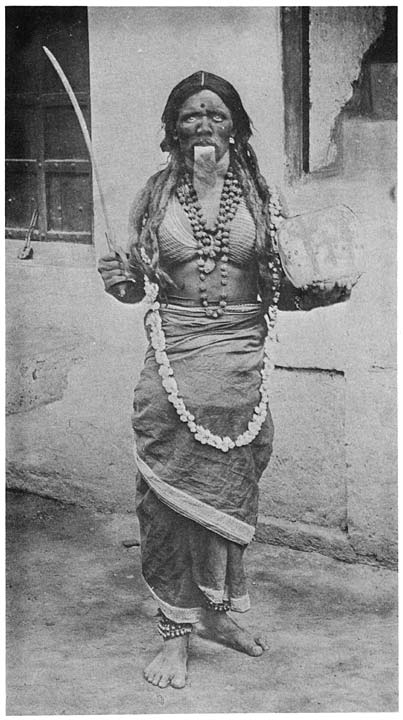
Bahrūpia impersonating the goddess Kāli
Baid.—(Physician.) A surname of Sanadhia and Marātha Brāhmans in Saugor. A section of Oswāl Bania, and Darzi.
Bairāgi.—A caste or religious order. Subcaste of Bhāt.
Bais.—A clan of Rājpūts.
Bajania.—(One who plays on musical instruments.) Subcaste of Panka.
Bajanya.—(Drummer.) A subcaste of Panka in Bālāghāt.
Bajārha.—(Bazār.) A section of Daraiha in Bilāspur.
Bajna, Bajgari.—(Musicians at feasts and marriages.) Subcaste of Gānda.
Bājpai.—(A priest officiating at the horse sacrifice.) A surname of Kanaujia Brāhmans. A section of Brāhmans. Title of some old families whose ancestors were sacrificial priests.
Bakar Kasai.—(Goat-butcher.) A subcaste of Khatīk.
Bakra.—(Goat.) A totemistic sept of Bhatra and Halba.
Baksaria.—From Buxar in Bengal. A clan of Rājpūts. A section of Daraiha and Lodhi.
Balla.—One of the 36 Rājkuls or royal clans of Rājpūts noted in Tod’s Rājasthān.
Balnīk.—Subcaste of Kāyasth.
Bālūsudia.—(Shaven.) Title of Khond.
Bālutedār.—Name for a village menial in Berār. Title of Dhobi.
Balwanda.—(Quarrelsome.) A section of Teli.
Bām-Mārgi.—Synonym for the Vām-Mārgi sect.
Bāman or Brāhman. Subcaste of Bishnoi, Darzi and Gondhali.
Bāmania.—(From Brāhman.) A section of Ahīr. They do not touch the pīpal tree. A section of Mahār and of Rājjhar in Hoshangābād.
Bāmhan Gour or Brāhman Gour.—A clan of Rājpūts in Saugor and Narsinghpur.
Bāmhania.—A subcaste of Kasar, from Bāmhan or Brāhman. A section of Katia.
Bāmnaiha.—(Belonging to a Brāhman.) A section of Basor.
Banāphar, Banāfar.—A clan of Rājpūts. A section of Daharia.
Banbhainsa.—(Wild buffalo.) A section of Rāwat (Ahīr).
Bānda.—(Tailless.) A section of Kirar.
Bānda Bāgh.—(Tailless tiger.) A section of Teli.
Bāndar.—(A rocket-thrower.) Synonym of Kadera.
Bandarwāle.—(One who catches monkeys.)—Subcaste of Pārdhi.
Bandesia.—(A man of 52 districts.) Subcaste of Banjāra.
Bandhaiya.—A subcaste of Nunia who confine themselves to the excavation of tanks and wells. Also a subcaste of Dhīmar.
Bandhaiya.—(From Bāndhogarh.) Subcaste of Nai.
Bandhia—(From bāndh, an embankment.) A subcaste of Darzi and Dhīmar. A section of Chamār.
Bandrele.—(Monkey.) A section of Basor, and Barai.
Banghore.—(Wild horses.) A section of Dom (Mehtar).
Bania.—A caste. Subcaste of Bishnoi. A synonym of Sunār in Sambalpur. A subcaste of Banjāra. A section of Nāndvansi Gauli.
Bānka.—A small caste found principally in the Kālāhandī State which now forms part of Bengal. The caste was formed from military service like the Khandaits, Pāiks and Marāthas, and some families bear the names of different castes, as Brāhman Bānka, Kumhār Bānka, and so on. They were formerly notorious freebooters, but have now settled down to cultivation. Each man, however, still carries a sword or knife on his person, and in Kālāhandī they are permitted to do this without taking out a licence.
Banku.—(One who frequents sequestered parts of forests.) A sept of Korku.
Bānsberia.—(One who performs acrobatic feats on a stick or bamboo.) Synonym of Kolhāti.
Bansia.—(Angler.) From bansi, a fishing-hook. Subcaste of Dhīmar.
Bānsphor.—(A breaker of bamboos.) Synonym of Basor. Subcaste of Mehtar and Mahli.
Bānstalai.—(A tank with bamboo trees on its bank.) A section of Teli.
Bant.—Subcaste of Dhīmar.
Bantia.—(From banāt, a red woollen blanket.) A section of Oswāl Bania.
Baone or Baonia.—From the phrase Bāwan Berār, a term applied to the Province by the Mughals, because it paid fifty-two lakhs of revenue, as against only eight lakhs realised from the adjoining Jhādi or hilly country in the Central Provinces. Subcaste of Kunbi, Mahār and Māli.
Baoria.—Synonym of Badhak.
Bāra-hazār.—(Twelve thousand.) Subcaste of Chero.
Barāde, Berāri.—A resident of Berār. Subcaste of Bahna, Barhai, Chamār, Dhangar, Dhobi, Khatīk, Māng and Nai.
Baram or Birm.—Subcaste of Bhāt.
Barapatre.—(A large leaf-plate.) A section of Koshti.
Baraua.—(A fisherman.) Synonym of Dhīmar; title of Dhīmar.
Bardhia.—(From bārdh, a term for the edge of a weapon.) Synonym of Sikligār.
Bardia.—One who uses bullocks for transport. Subcaste of Kumhār.
Baretha.—(A washerman.) Synonym for Dhobi.
Barga.—Subcaste of Oraon.
Bargandi,—Synonym for Kaikāri.
Barghāt.—Synonym of Bargāh.
Barki.—High. Subcaste of Rautia.
Bārkia.—(A spinner of fine thread.) Subcaste of Mahār.
Barmaiyan, Barmian, Malaiya.—Subcaste of Basor, Dhīmar and Gadaria.
Baroni.—Title of a female Dhīmar.
Barora or Warkara.—(Wild cat.) A subsept of the Uika clan of Gonds in Betūl.
Barpaihi.—(Bar, banyan tree.) A sept of the Uika clan of Gonds in Betūl, so named because their priest offered food to their gods on the leaves of a banyan tree.
Barwa.—Synonym for Gārpagāri. One who wards off hailstones from the standing crops. Subcaste of Jogi.
Bashishta.—See Vasishta. A section of Vidūr.
Bastarha.—A resident of Bastar State. Subcaste of Halba.
Bathri.—(From batkur, a vegetable.) A subcaste of Dhobi and Teli.
Bāthudia.—Subcaste of Bhuiya.
Batri.—A grower of batar, a kind of pea. Subcaste of Teli.
Batti.—(A ball.) A subsept of the Uika clan of Gonds in Betūl, so named because their priest stole balls of cooked mahua. They do not kill or eat goats or sheep, and throw away anything smelt by them.
Bāwan, Bāwanjaye.—(Bāwan-52.) A subcaste of Sāraswat Brāhmans.
Bāwaria.—A dweller of Bhānwargarh tract in Betūl district. Subcaste of Korku.
Bāwisa.—(Twenty-two.) A subcaste of Gujarāti Brāhmans in Hoshangābād and Makrai State.
Bayar, Biyar, Biar.—A small caste of labourers belonging to the eastern Districts of the United Provinces, of whom about 200 persons were returned from Bilāspur in 1891. They are found in the Korba zamīndāri, and are professional diggers or navvies, like the Murhas. They are apparently a mixed caste derived from the primitive tribes with some Hindu blood. They eat fowls and pork, but will not take food from any other caste. They work by contract on the dangri system of measurement, a dangri being a piece of bamboo five cubits long. For one rupee they dig a patch 8 dangris long by one broad and a cubit in depth, or 675 cubic feet. But this rate does not allow for lift or lead.
Bāzigar.—(An acrobat.) Synonym of Nat.
Behār.—(Cat.) A totemistic sept of Kawar.
Behera.—A subcaste of Taonla. A section of Tiyar. A title of Khadāl.
Belwār, Bilwār.—A small caste of carriers and cattle-dealers belonging to Oudh, whose members occasionally visit the northern Districts of the Central Provinces. They say that their ancestors were Sanādhya Brāhmans, who employed bullocks as pack-animals, and hence, being looked down on by the rest of the caste, became a separate body, marrying among themselves.
Benaika, Binaika.—A subcaste of Parwār Bania, consisting of the offspring of remarried widows or illegitimate unions. Probably also found among other subcastes of Bania.
Benatia.—A subcaste of Sānsia in Sambalpur.
Bendiwāla.—Name of a minor Vishnuite order. See Bairāgi.
Benetiya, Benātia.—Subcaste of Chasa and Sānsia.
Bengali.—Bengali immigrants are usually Brāhmans or Kāyasths.
Bengani.—(Brinjal.) One of the 1444 sections of Oswāl Bania.
Benglāh.—An immigrant from Bengal. Subcaste of Bharbhūnja.
Beora Basia.—(Hawk.) A totemistic sept of Bhatra.
Berāria, Berādia.—(Belonging to Berār.) A subcaste of Bahna, Barai, Barhai, Chamār, Dhangar, Dhīmar, Kasār and Kunbi.
Beria.—A caste of gipsies and vagrants, whose women are prostitutes. Hence sometimes used generally to signify a prostitute. A subcaste of Nat.
Besra.—(Hawk.) A totemistic sept of Bhatra and Rāwat (Ahīr).
Betala.—(Goblin.) One of the 1444 sections of Oswāl Bania.
Bhadauria.—(From Bhadāwar in Gwalior State.) A clan of Rājpūts. A clan of Dāngi in Saugor from whom Rājpūts take daughters in marriage, but do not give daughters to them. A surname of Sanādhia Brāhman.
Bhadonia.—Subcaste of Dāngi.
Bhadoria.—(A drum-beater.) Subcaste of Chamār.
Bhadri, Bhaddari.—A synonym for Joshi, having a derogatory sense, as of one who begs with deceit or fraud.
Bhadune.—(From the month Bhādon.) A section of Kalār.
Bhagat.—(Devotee.) A section of Ahīr or Gaoli, Barai and Panwār Rājpūt.
Bhains-Māra.—(Killer of the buffalo.) A section of Kanjar.
Bhainsa.—(Buffalo.) A section of Chamār, Dhanwār, Gānda, Kawar, Kanjar, Māli, Panka and Rāwat (Ahīr).
Bhairon.—(The god Bhairon.) A section of Pānwar Rājpūt.
Bhaiya.—(Brother.) One of the 72½ sections of Maheshri Bania.
Bhala.—(Spear.) One of the 72½ sections of Maheshri Bania.
Bhaldār.—(A spear-man.) A class of Dahāits, who have commonly been employed as village watchmen.
Bhale Sultān.—(Lords of the spear.) A clan of Rājpūts.
Bhāmti, Bhāmtia.—Synonyms of Bhāmta.
Bhanāre.—Named after the town of Bhandāra in the Central Provinces. Subcaste of Dhīmar.
Bhandāri.—(A barber, also a cook in the Uriya country.) A synonym for Nai. A subcaste of Gondhali. A section of Oswāl Bania and Halba. Title of the deputies of the chief guru of the Satnāmi sect.
Bhangi.—(Hemp-smoker.) Synonym of Mehtar.
Bhānr.—Synonym of Bhānd, a story-teller.
Bhānwar.—(A bee, also honey.) A section of Gadaria and Kawar.
Bhaosar.—Synonym of Chhīpa.
Bhāradwāj.—(A skylark. Name of a great Brāhman Rishi or saint.) One of the common eponymous sections of Brāhmans. Also a section of Joshi, Lohār, Prabhu, Sunār, and of several clans of Rājpūts.
Bharewa.—(From bharat, a mixture of copper and lead.) A group of brass or bell-metal workers classed with the Kasār caste, but of lower social standing than the Kasārs. A subcaste of Sunār in Raipur.
Bhārgava.—(Born of Bhrigu Rishi.) A subcaste of Kanaujia Brāhmans. A section of Marātha Brāhmans. Bhārgava Dhusar is a subcaste of Bania. See Bania-Dhusar.
Bharia.—(From the Bhar tribe.) A tribe. A subcaste of Baiga in Mandla, and of Kol.
Bharia-Bhumia.—Synonym of Bharia.
Bharotia or Mudia.—(Shaven.) Subcaste of Baiga, also of Ahīr.
Bhārthi.—Name of one of the ten orders of Gosains.
Bhatnāgar.—A subcaste of Kāyasth.
Bhātpagār.—(Wage of rice.) A section of Katia.
Bhīkshakunti.—(Bhīksha, begging; kunti, lame.) A subcaste of Kāpewār who are the Bhāts or bards of the caste.
Bhīl.—A tribe. A subcaste of Pārdhi.
Bhilaophod.—(Those who extract oil from the bhilawa nut, Semecarpus anacardium.) Subcaste of Kol.
Bhīlsaiyan, Bhīlsia, Bhīlasia.—(From Bhīlsa, a town in Gwalior State.) A section and surname of Jijhotia Brāhmans. A section of Purānia Sunār and of Rāthor Teli and Teli.
Bhima.—A small caste belonging to the Mandla and Seoni Districts. They are musicians of the Gond tribe and dance and beg at their weddings. The caste are an offshoot of the Gonds, their exogamous septs having Gond names, as Marābi, Markām, Dhurwa, Parteti, Tekām and so on; but they now marry among themselves. They worship the Gond god, Bura Deo, their own elders serving as priests. At their performances the men play and dance, wearing hollow anklets of metal with little balls of iron inside to make them tinkle. The women are dressed like Hindu women and dance without ornaments. Their instrument is called Tūma or gourd. It consists of a hollow piece of bamboo fixed horizontally over a gourd. Over the bamboo a string is stretched secured to a peg at one end and passing over a bridge at the other. Little knobs of wax are made on the bamboo so that the string touches them during its vibrations. The gourd acts as a sounding-board.
Bhogta.—Subcaste of Khairwār.
Bhoi.—(One who carries litters or palanquins.) Synonym of Dhīmar and Kahār. A title or honorific name for Gonds and one by which they are often known. See article Kahār. A section of Binjhāl.
Bhoir.—Synonym for Bhoyar.
Bhojni.—Subcaste of Chitrakathi. They serve the food at marriage and other ceremonies.
Bholia.—(From bhūlna, to forget.) Synonym of Bhulia.
Bhona.—A small caste of labourers in the Mandla District. They are practically all employed by the local Pansāris (Barai) or pān-growers in tending their barejas or betel-vine gardens. There is some ground for supposing that the Bhonas are an offshoot of the Bharia or Bharia-Bhumia tribe of Jubbulpore, which is itself derived from the Bhars. One of the sections of the Bhonas is named after the vulture, and at their weddings a man of this section catches a young chicken and bites off the head in imitation of a vulture.
Bhondih.—(From bhond, dung-beetle.) A section of Ahīr.
Bhonsla.—A clan of Marāthas to which the Rājas of Nāgpur belong.
Bhope or Bhoall.—Subcaste of Mānbhao.
Bhoriya.—Synonym of Bhulia.
Bhoyar.—A caste. A subcaste of Koshti and Marār.
Bhudes.—(The gods on earth.) Title of Brāhmans.
Bhuinhār.—Name of a landholding caste in Benāres and Bengal who claim to be Brāhmans or Rājpūts. They are also known as Bābhan. A title of the Bhuiya tribe. See article Bhuiya. A title of the Bhaina tribe.
Bhumia.—(Born from the land, or aboriginal.) A title of the Bharia tribe in Jubbulpore, also a title of Baiga and Korku. A synonym of Bhuiya. A subdivision of Gond. A section of Kurmi.
Bhūra.—(Grey.) One of the sections of Oswāl Bania. A proper name.
Bhusar.—(Lord of the earth.) A title of Brāhman.
Bhusārjīn.—(From bhūsa, the chaff of wheat.) Subcaste of Banjāra.
Bhuskate.—(From bhūsa, fodder, one who supplies fodder.) A family name.
Bhūta.—A subtribe of Gond in Betūl, the same as Koilabhūta. They are said to be of immoral character.
Biar.—Synonym of Bayar.
Bichhuwa, Bichhi.—(From bichhu, scorpion.) A section of Dhobi and Kawar.
Bidur.—Synonym of the Vidūr caste.
Biloria.—(From bilori, marble stone.) A section of Chhipa.
Bilwār.—Synonym of Belwār, a carrier and cattle-dealer.
Binjhāl.—Synonym of Binjhwār.
Binjhwār.—A caste derived from the Baiga tribe. A subtribe of Baiga and Gond. A subcaste of Gowāri.
Birchheya.—(A dweller in the forest.) Subcaste of Ghosi.
Birchkia.—(From birchka, a tree.) A subcaste of Ghosi.
Birjhia, Birjia. (One who practises bewar or shifting cultivation in a forest.) Subcaste of Binjhwār, Baiga and Korwa.
Bīrkhandia.—From Bīrkhand (Sand of heroes), a name for Rājputāna. A section of Teli.
Birtiya. Title of Nai or barber.
Bisen, Bisān.—A clan of Rājpūt. A section of Daharia and of Panwār Rājpūt. A section of Marār.
Bobaiaya.—(From Bobbili, a town in Madras.) A section of Teli in Chānda.
Bogam.—A name for Madrāsi prostitutes, perhaps a separate caste. Their honorific title is Sani.
Bohra.—A Muhammadan caste. A section of Oswāl Bania.
Bombay.—A subdivision of Vālmiki Kāyasth.
Bondoya—A resident of Jītgarh and the Pachmarhi tract of the Central Provinces. Subcaste of Korku.
Bopchi.—A section of Pānwar Rājpūt.
Bopchi—A small caste in the Wardha District numbering a few hundred persons. They are in reality Korkus, the name being a corruption of that of the Bendoya subtribe, but they have discarded their proper tribal name and formed a separate caste. They retain some of the Korku sept names, while others are derived from the Marāthi words or from the names of other castes, and these facts indicate that the Bopchis are of mixed descent from Korkus and other low Marātha castes with which unions have taken place. As might be expected, they are very tolerant of sexual and social offences, and do not expel a woman who has a liaison with a man of another caste or takes food from him. She is readmitted to caste intercourse, but has to undergo the penalty of washing her body with cowdung and having a lock of her hair cut off. A man committing a similar offence has his upper lip shaved. They employ Gosains for their gurus and their social position is very low.
Borākar.(A mat-maker.) Synonym of Gopāl.
Borjharia.—(Bor-plum.) A sept of Halba.
Brahmachare.—(A celibate.) Subcaste of Manbhao.
Brāhman Gaur, or Bāmhan Gaur.—A branch of the Gaur clan of Rājpūts. A subcaste of Bhāt.
Brid-dhari.—Begging Bhāts. Subcaste of Bhāt.
Brihaspati, Brahaspati.—An eponymous section of Brāhmans.
Buchar.—A corruption of the English word ‘butcher.’ Subcaste of Khatīk in Agra.
Budālgir.—(From budla, a leathern bag made for the transport and storage of oil and ghī (butter).) Subcaste of Chamār.
Bukekari.—(A seller of scented powder (bukka).) Synonym of Atāri.
Bundela.—A clan of Rājpūts of mixed descent. Name probably from the Vindhya hills. A subcaste of Basor. A sept of Manihār and Rāwat.
Bundelkhandi.—A resident of Bundelkhand. Subcaste of Basdewa, Barai, Basor, Chamār, Darzi, Dhobi, Kumhār, Lohār, Nai and Sunār.
Bundhrajia.—Subcaste of Kamār.
Bunkar.—(A weaver.) Title of Balāhi.
Burad.—A synonym for the Basor caste of bamboo-workers. A section of Koshti and Oswāl Bania.
Burthia.—Subcaste of Chāran Banjāra.
Burud.—(A bamboo-worker.) Synonym for Basor in the Marātha country.
Butka.—(One who brings leaves.) Subcaste of Chasa.
Byahūt.—(Married.) Subcaste of Kalār.
Chadār.—A caste. A subcaste of Kori.
Chakere.—(One who uses the potter’s wheel in localities where other Kumhārs do not use it.) Subcaste of Kumhār.
Chakla.—(A professional washerman.) Synonym for Dhobi.
Chalukya.—A synonym for Solanki Rājpūts. (Perhaps from chhullu or challu, hollow of the hand.) A subcaste of Panwār Rājpūt.
Chamār, Chamara.—(From chamra, a hide.) The well-known caste of tanners. A subcaste of Banjāra, Barhai and Darzi.
Chamār Gaur.—(Chamār and Gaur.) A well-known clan of Rājpūts. See Rājpūt-Gaur.
Chambhār.—Name of the Chamār caste in Berār.
Chamra.—A contemptuous diminutive for the Chamār caste in Chhattīsgarh.
Chandan, Chandania.—(Sandalwood.) A section of Chamār, Kawar, Khangār and Kurmi.
Chandel.—A famous clan of Rājpūts. See Rājpūt-Chandel.
Chāndewār.—(Belonging to Chānda.) Subcaste of Injhwār.
Chandi.—(One who hides behind a fishing-net.) A sept of Korku.
Chandra, Chandrāha. (From chanda, the moon.) A section of Gūjar and Teli.
Chandravansi or Somvansi.—(Descended from the moon.) A clan of Rājpūts.
Chandravedi.—Synonym of Sanaurhia, meaning ‘One who observes the moon.’
Chankhatia.—A subcaste of Bhuiya and Chamār.
Channāgri.—A small Jain sect. A subcaste of Bania.
Chanti.—Name derived from chiti, an ant. Subcaste of Kawar. A section of Kumhār.
Chānwar.—(Whisk.) A totemistic sept of Kawar and Pābia.
Charak.—A subdivision of Marātha Brāhman; a section of Brāhman.
Chāran.—Subcaste of Banjāra and Bhāt. Title of Bhāt in Rājputāna.
Chārdeve.—A clan of Gonds worshiping four gods and paying special reverence to the tortoise.
Chārghar.—(Four houses.) A subdivision of Sāraswat Brāhmans.
Chārnāgri.—A Jain sect or subcaste of Bania.
Chatrapati.—(Lord of the umbrella.) Title of the ancient Indian kings.
Chatri, Chhatri.—A common synonym for a Rājpūt. A subcaste of Bhāmta.
Chatūrbhuji.—(Four-armed.) An epithet of Vishnu. A title of the Chauhān clan of Rājpūts. A class of Bairāgis or religious mendicants.
Chaube, Chaturvedi.—(From Chaturvedi, or one learned in the four Vedas.) A surname for Kanaujia, Jijhotia and other Hindustāni Brāhmans. Subcaste of Banjara.
Chaubhaiya.—(Four brothers.) A subdivision of Sāraswat Brāhmans. They take wives from the Athbhaiya subdivision, but do not give girls to them in marriage.
Chaudhri, Chaudhari, Choudhri.—(A headman, the first person.) Title of Kalār Panwār, Rājpūt and other castes; title of Dhobi, vice-president of the caste committee. A section of Ahīr, Maheshri Bania, Gadaria, Gūjar, Halba and Marār (Māli). A subdivision of Kāpewār.
Chauhān.—A famous clan of Rājpūts. Name of a low caste of village watchmen in Chhattīsgarh, perhaps the illegitimate descendants of Panwār Rājpūts.
Chauka.—Title of the Kabīrpanthi religious service. The chauk is a sanctified place on the floor of the house or yard, plastered with cowdung and marked out with lines of wheat-flour or quartz-dust within which ceremonies are performed.
Chaukhūtia.—A term which signifies a bastard in Chhattīsgarh. Subcaste of Bhunjia.
Chauske.—Subcaste of Kalār. They are so called because they prohibit the marriage of persons having a common ancestor up to four generations.
Chaurāsia.—Resident of a Chaurāsi or estate of eighty-four villages. Subcaste of Barai and Bhoyar. A section of Dhīmar and Kumhār. Many estates are called by this name, grants of eighty-four villages having been commonly made under native rule.
Chawara, Chaura.—One of the thirty-six royal races of Rājpūts.
Chenr.—(Little.) Subcaste of Bhānd.
Cheorākuta.—(One who prepares cheora or pounded rice.) Subcaste of Dhuri.
“The overthrow of the Cheros in Mithila and Magadha seems to have been complete. Once lords of the Gangetic provinces, they are now found in Shāhābād and other Bihār Districts only holding the meanest offices or concealing themselves in the woods skirting the hills occupied by their cousins, the Kharwārs; but in Palāmau they retained till a recent period the position they had lost elsewhere. A Chero family maintained almost an independent rule in that pargana till the accession of the British Government; they even attempted to hold their castles and strong places against that power, but were speedily subjugated, forced to pay revenue and submit to the laws. They were, however, allowed to retain their estates; and though the rights of the last Rāja of the race were purchased by Government in 1813, in consequence of his falling into arrears, the collateral branches of the family have extensive estates there still. According to their own traditions (they have no trustworthy annals) they have not been many generations in Palāmau. They invaded that country from Rohtās, and with the aid of Rājpūt chiefs, the ancestors of the Thakurais of Ranka and Chainpur drove out and supplanted a Rājpūt Rāja of the Raksel family, who retreated into Sargūja and established himself there.
“All the Cheros of note who assisted in the expedition obtained military service grants of land, which they still retain. The Kharwārs were then the people of most consideration in Palāmau, and they allowed the Cheros to remain in peaceful possession of the hill tracts bordering on Sargūja. It is popularly asserted that at the commencement of the Chero rule in Palāmau they numbered twelve thousand families, and the Kharwārs eighteen thousand; and if an individual of one or the other is asked to what tribe he belongs, he will say, not that he is a Chero or a Kharwār, but that he belongs to the twelve thousand or to the eighteen thousand, as the case may be. The Palāmau Cheros now live strictly as Rājpūts and wear the paita or caste thread.”
It has been suggested in the article on Khairwār that the close connection between the two tribes may arise from the Kharwārs or Khairwārs having been an occupational offshoot of the Cheros and Santāls.
“The distinctive physical traits of the Cheros,” Colonel Dalton states, “have been considerably softened by the alliances with pure Hindu families, which their ancient power and large possessions enabled them to secure; but they appear to me still to exhibit an unmistakable Mongolian physiognomy. They vary in colour, but are usually of a light brown. They have, as a rule, high cheek-bones, small eyes obliquely set, and eyebrows to correspond, low broad noses, and large mouths with protuberant lips.”
Cherwa.—Subcaste of Kawar.
Chetti.—Subcaste of Gandli.
Chhachān.—(A hawk.) A section of Rāwat (Ahīr).
Chhadesia.—(A man of six districts.) Subcaste of Banjāra.
Chhadīdār or Darwān.—Title of the Dahaits, who were door-keepers of the Rājas of Mahoba in former times.
Chhanava Kule.—(The ninety-six houses.) A subcaste of Marātha.
Chhatakia.—An illegitimate group of the Kumhār caste.
Chhattīsgarhi, Chhattīsgarhia.—Resident of Chhattīsgarh or the region of the thirty-six forts, a name given to the eastern tract of the Central Provinces. Subcaste of Bahna, Darzi and Halba.
Chhehghar (Chhenghar).—(Members of the six houses.) A hypergamous division of Kanaujia Brāhmans. They take daughters from the other two divisions, but do not give their daughters to them.
Chhīpa.—(A dyer.) Synonym of Darzi.
Chhoha or Saroria.—A subcaste of Agharia of mixed descent.
Chholia.—(Rubbish.) A section of Rājjhar.
Chhote.—(Inferior.) Subcaste of Agharia and Teli.
Chhoti Pangat.—A subcaste of Halba, Synonym Surāit. Chhoti Pangat signifies the inferior caste feast, and the implication is that these members cannot join in the proper feast.
Chhotki Bhir or Gorhi.—(Low.) Subcaste of Rautia.
Chhura,—(Razor.) A section of Panka. It was their business to shave other members of the caste after a death;
Chicham.—(Hawk.)—A sept of Gonds.
Chicheria.—(From church, forelock, which the children of this sept wear.) A sept of Dhīmar.
Chika.—Subcaste of Majhwār.
Chikwa.—Synonym of Khatīk.
Chinchkul.—A section of Komti. They abstain from the use of ginger and from the juice of the bhilawa or marking-nut tree.
Chīta Pūrdhi, Chīlewāla.—(Leopard-hunter.) A subcaste of Pārdhi.
Chiturkar, Chitrakar.—(A painter.) Synonym for Chitāri.
Chiter.—(A painter.) See Chitāri.
Chitevari.—(One who makes clay idols.) Synonym for Mochi.
Chitpāwan.—(The pure in heart.) A synonym for Konkanasth Brāhman.
Chitragupta Vansi.—(Descendants of Chitragupta.) A name for Kāyasths.
Chobdār.—(A mace-bearer.) Title of Dahāit.
Chorbans.—(Family of thieves.) A section of Chamār.
Chourdhar.—(A whisk-carrier.) A section of Sunār.
Chuhra.—Subcaste of Mehtar. Name for the sweeper caste in the Punjab.
Chungia.—(One who smokes a leaf-pipe.) Subcaste of Chamār and Satnāmi.
Chunwiha.—(From chunri, a coloured sheet worn by women.) A section of Tamera.
Churha.—(Thief.) A subcaste of Sunār. A section of Chhīpa.
Cutchwāha.—Clan of Rājpūt. Synonym for Kachhwaha.
Daharia.—(From Dāhar, the old name of the Jubbulpore country.) A clan of Rājpūts which has developed into a caste. A subcaste of Bhoyar, Kalār, Mahār, Marātha and Teli. A section of Chadār, Chamār and Katia.
Dahāt.—A variant for Dahāit. A subcaste of Khangār.
Dahia.—One of the thirty-six royal races of Rājpūts.
Daijanya.—Subcaste of Chamār. They are so called because their women act as dai or midwives.
Dakhne, Dakshne, Dakshni, Dakshini.—(Belonging to the Deccan.) Subcaste of Bahna, Chamār, Gondhali, Gurao, Kunbi, Mahār, Māng and Nai.
Dakochia.—A synonym for Bhadri, an astrologer.
Dal.—(From dal, an army.) Subcaste of Khond.
Dalboha, Dalbuha.—(One who carries dhoolies or palanquins.) Subcaste of Ghasia and Katia.
Dālia.—(From dāl or the pulse of Burhānpur which had a great reputation). Subcaste of Kunbi.
Dal Khālsa.—(Army of God.) Title of the Sikh army.
Dandewāla.—(One who performs acrobatic feats on a stick or bamboo.) Synonym for Kolhāti.
Dandi.—(One who carries a stick.) Name of a class of religious mendicants. See article Gosain.
Dandsena.—(One who carries a stick.) Subcaste of Kalār.
Dang-charha.—(A rope-climber.) Synonym of Nut.
Dāngiwāra.—Name of part of the Saugor District, which is called after the Dāngi caste. Subcaste of Kadera.
Dāngua.—(A hill-dweller.) Subcaste of Taonla.
Dangūr.—A small caste of hemp weavers numbering about 100 persons, and residing almost entirely in the village of Māsod in Betūl District. They are of the same standing as the caste of Kumrāwat or Patbina which pursues this occupation in other Districts, but acknowledge no connection with them and are probably an occupational offshoot of the Kunbi caste, from whose members they readily accept any kind of cooked food. Like many other small occupational castes with no definite traditions, they profess to have a Kshatriya origin, calling themselves Bhagore Rājpūts, while their families are known by such high-sounding titles as Rāthor, Chauhān, Gaur, Solanki and other well-known Rājpūt names. These pretensions have no foundation in fact, and the Dangūrs formerly did not abjure pork, while they still eat fowls and drink liquor. They neither bathe nor clean their kitchens daily. They may eat food taken from one place to another, but not if they are wearing shoes, this being only permissible in the case when the bridegroom takes his food wearing his marriage shoes.
Dantele.—(With teeth.) A section of Purānia Sunārs in Saugor.
Like other Rājpūts the Daraihāns have an elaborate system of septs and subsepts, the former having the names of Rājpūt clans, while the latter are taken from the eponymous gotras of the Brāhmans. There are fourteen septs, named as a rule after the principal Rājpūt clans, of whom four, the Chandel, Kachhwāha, Dhāndhul and Sakrawāra, rank higher than the other ten, and will take daughters from these in marriage, but not give their daughters in return. Besides the septs they have the standard Brāhmanical gotras, as Kausilya, Bhāradwāj, Vasishtha and so on to the number of seven, and the members of each sept are divided into these gotras. Theoretically a man should not take a wife whose sept or gotra is the same as his own. The marriage of first cousins is forbidden, and while the grandchildren of two sisters may intermarry, for the descendants of a brother and a sister the affinity is a bar till the third generation. But the small numbers of the caste must make the arrangement of matches very difficult, and it is doubtful whether these rules are strictly observed. They permit the practice of Gunrāvat or giving a bride for a bride. In other respects the social customs of the caste resemble those of their neighbours, the Daharias, and their rules as to the conduct of women are strict. The men are well built and have regular features and fair complexions, from which their Rājpūt ancestry may still be recognised. They wear the sacred thread. The Daraihāns are good and intelligent cultivators, many of them being proprietors or large tenants, and unlike the Daharias they do not object to driving the plough with their own hands. In the poorer families even the women work in the fields. They have a strong clannish feeling and will readily combine for the support or protection of any member of the caste who may be in need of it.
Darbānia.—(Door-keeper.) Title of Khangūr.
Darshani.—Title of the most holy members of the Kānphata Jogis.
Darshni.—(From darshan, seeing, beholding, as of a god.) A sub-division of Jogi.
Darwān.—(A door-keeper.) Title of Dahāit.
Darwe or Dalwe.—A subcaste of Gonds in Chānda; the Darwes are also called Nāik.
Darwesh.—Persian name for a Muhammadan Fakīr or religious mendicant.
Darzi.—A caste of tailors. Subcaste of Ghasia.
Dās.—(Servant.) Used as the termination of their names by Bairāgis or religious mendicants. A term applied by Pankas and other Kabīrpanthis to themselves.
Dasa.—(Ten.) A subdivision of Agarwāla and other subcastes of Bania, meaning those of pure blood.
Dasghar.—(Ten houses.) One of the three subdivisions of Kanaujia Brāhmans. They give their daughters to members of the Chheghar or six houses and receive them from the Pānchghar or five houses.
Dasnāmi.—A member of the ten orders. Synonym for Gosain.
Datta or Dutt.—Surname of Bengali Kāyasths.
Daune.—A subdivision of Prabhu or Parbhu in Nāgpur, so called on account of their living in the island of Diu, a Portuguese possession.
Deccani.—See Dakhne.
Dehalwi.—(From Delhi.) A subdivision of Gaur Kāyasths.
Dehri.—(A worshipper.) Subcaste of Sudh.
Dekkala.—(A genealogist.) Subcaste of Mādgi.
Delki.—Subcaste of Kharia.
Deo.—(God.) A hereditary title borne by certain Feudatory Chiefs. A surname of Karhāra Brāhmans in Saugor. A subcaste of Gandli in Chānda.
Deobansi.—(A descendant of a god.) Subcaste of Patwa.
Deogarhia or Rājkunwar.—(From Deogarh.) A subcaste of Pardhān. A subcaste of Audhelia made up of prostitutes. A sept of Dhīmar.
Deokia.—Title used in the Bedar caste.
Deoputra.—(Son of god.) Synonym of Chāran.
Desa or Kota.—Subcaste of Balija.
Desai.—A variant for Deshmukh or a Marātha revenue officer. Title of the Pardhān caste.
Desāwal.—A subdivision of Brāhman in Jubbulpore. They take their name from Disa, a town in Pālanpur State in Bombay Presidency.
Desha, Desaha.—(Belonging to the home country.) The name is usually applied to immigrants from Mālwa or Hindustān. A subcaste of Ahīr, Bargāh, Bāri, Chamār, Dhuri, Gadaria, Kalār, Kol, Kurmi, Lakhera, Lohār, Mahār, Sunār and Teli.
Deshastha.—A subcaste of Marātha Brāhmans inhabiting the country (Desh) above the Western Ghāts. A subcaste of Gurao.
Deshkar.—(One belonging to the country.) A subcaste of Gondhali, Gurao, Kasār, Koshti, Kunbi, Mahār, Māli, Marātha, Nāi, Sunār and Teli.
Deshmukh.—Under Marātha rule the Deshmukh was a Pargana officer who collected the revenue of the Pargana or small subdivision, and other taxes, receiving a certain share. The office of Deshmukh was generally held by a leading Kunbi of the neighbourhood. He also held revenue-free land in virtue of his position. The Deshmukh families now tend to form a separate subcaste of Kunbis and marry among themselves.
Deshpānde.—The Deshpānde was the Pargana accountant. He was generally a Brāhman and the right-hand man of the Deshmukh, and having the advantage of education he became powerful like the Deshmukh. Now used as a surname by Marātha Brāhmans.
Deswāli.—Synonym for Mīna.
Devadāsi.—(Handmaidens of the gods.) Synonym for Kasbi.
Devarukhe.—A subdivision of Marātha Brāhmans. The word is derived from Devarishi, a Shakha (branch) of the Atharva Veda, or from Devarukh, a town in Ratnāgiri District of Bombay Presidency. Among Brāhmans they hold rather a low position.
Dewangan.—(From the old town of this name on the Wardha river.) Subcaste of Koshti.
Dhaighar.—(2½ houses.) A subcaste of Khatri.
Dhākan.—(A witch.) Subcaste of Bhāt.
Dhākar.—Name of a caste in Bastar. A clan of Rājpūts. A subcase of Barai, Bania and Kirār. A sept of Halba.
Dhāmonia.—(From Dhāmoni, a town in Saugor.) A subcaste of Sonkar. A territorial sept of Darzi and Dhobi.
Dhanak Sammāni.—(One who reverences the bow.) A section of Barai.
Dhandere.—(Probably from Dhundhar, an old name of Jaipur or Amber State.) A sept of Rājpūts.
Dhangar.—(A farmservant.) Synonym of Oraon.
Dhanka.—Perhaps a variant for Dhangar. Subcaste of Oraon.
Dhanoj, Dhanoje.—(From dhangar, a shepherd.) Subcaste of Are and Kunbi.
Dhānpagar.—(One serving for a pittance of paddy.) A section of Teli.
Dhanuhār.—(A corrupt form of Dhanusdhar or a holder of a bow.) Synonym of Dhanwār.
Dhānuk.—(A bowman.) A caste. A subcaste of Mehtār.
Dhanushban.—(Bow and arrow.) A sept of Kawar.
Dharampuria.—(Resident of Dharampur.) Subcaste of Dhobi.
Dhare.—Title of Gowāri.
Dhāri.—A subcaste of Banjāra. They are the bards of the caste.
Dharkār.—Subcaste of Basor.
Dharmīk.—(Religious or virtuous.) A subcaste of Mahār and Marātha.
Dhed.—Synonym for Mahār.
Dhengar.—A subcaste of Bharewa (Kasār) and Gadaria.
Dherha.—(Brother-in-law or paternal aunt’s husband.) Title of Kharia.
Dhīmar.—A caste. Subcaste of Kori.
Dhimra.—Synonym for Dhīmar.
Dhobi.—The caste of washermen. A sept of Bharia and Bhaina.
Dhokhede.—One of doubtful parentage. A sept of Teli.
Dholewār.—(From dhola, a drum.) A subcaste of Bhoyar and Gaoli. A section of Basor.
Dholi.—(A minstrel.) Subcaste of Bhāt.
Dhubela.—Origin perhaps from the Dhobi caste. Subcaste of Basor.
Dhulbajia.—(From dhol, a drum.) A subcaste of Chamār, also known as Daijania.
Dhulia, Dholin, Dholi.—(A player on a dhol or drum.) Synonym for the Basor caste. A subcaste of Gond in Chānda and Betul. A subcaste of Mahār.
Dhunak Pathān.—Synonym for Bahna.
Dhunia.—(From dhunna, to card cotton.) Synonym for Bahna.
Dhunka.—(A cotton-cleaner.) Subcaste of Kadera.
Dhur Gond.—(From dhur, dust.) A subcaste of Gonds. They are also known as Rāwanvansi or descendants of Rāwan.
Dhuri.—A caste of grain-parchers. A subcaste of Dhīmar.
Dhuria.—Subcaste of Nagasia and Dhīmar. They are so called because they mark the forehead of the bride with dust (dhur) taken from the sole of the bridegroom’s foot.
Dhurwa.—The word may be derived from dhur, dust. Dhur is a name given to the body of Gonds as opposed to the Raj-Gonds. One of the commonest septs of Gonds. A sept of Baiga, Kolta, Kalār and Nat. A title of Parja.
Dhūsar.—Subcaste of Bania.
Dhusia.—Subcaste of Murha.
Digāmbari.—A sect of Jain Banias who do not clothe their idols and apply saffron to their feet. Also a class of Bairāgis or religious mendicants.
Diharia or Kisān.—(One who lives in a village or a cultivator.). Subcaste of Korwa.
Dikhit, Dikshit, Dixit.—(The Initiator.) A subcaste of Brāhman. A clan of Rājpūts of the solar race formerly dominant in the United Provinces.
Dila.—(A pointed stick tied to a calf’s mouth to prevent him from sucking.) A totemistic sept of Kawar. They do not use a stick in this manner. A section of Ahīr.
Dillawāl.—A subcaste of Kasār. Those belonging to or coming from Delhi.
Dingkuchia.—(One who castrates cattle and ponies.) Subcaste of Ghasia.
Dipawālia.—(One who supplies oil for the lamps at Diwāli.) A sept of Teli.
Dīpbans.—(Son of the lamp.) Title of Teli.
Diwān.—Title of the members of the Dahāit caste committee.
Dixit.—See Dikhit.
Dobaile.—(One who yokes two bullocks to the oil-press.) Subcaste of Telis in the Nāgpur country.
Dobīsya.—(Two score.) Subcaste of Halwai.
Doda or Dor.—One of the thirty-six royal races of Rājpūts.
Dogle.—Name applied to Kāyasths of illegitimate descent.
Dolia.—(Palanquin-bearer.) A section of Dhīmar.
Dom.—An important caste in Bengal. See article Kanjar. Used as a synonym for Gānda in the Uriya country.
Domra.—Subcaste of Turi.
Dongaria, Dongarwār.—(From dongar, a hill.) A sept of Bhīl, Dhobi, Māli, Māng and Sonkar. A surname of Marātha Brāhmans.
Dora.—(Sāhib or Lord.) Title of the Mutrāsi caste.
Dosar.—Subcaste of Bania.
Dravida.—(Southern.) See Pānch-Dravida.
Dūbe.—(A teacher and a man learned in two Vedās.) A common surname of Hindustāni Brāhmans. A subcaste of Banjāra.
Dūdh.—(Milk.) Dūdh-Barai, a subcaste of Barai; Dudh-Gowāri, a subcaste of Ahīr or Gowāri; Dūdh-Kawar, a subcaste of Kawar.
Dūdh Bhai.—(Milk-brothers.) A fraternity of Gonds in Betūl, who are apparently foster-brothers. They do not marry, though they have different septs.
Dukar.—A subcaste of Kolhāti. From dukar, hog, because they are accustomed to hunt the wild pig with dogs and spears when these animals become too numerous and damage the crops of the villagers.
Dukaria.—Title of the officer of the Andh caste who constitutes the caste committee.
Dūlha.—(Bridegroom.) A section of Chadār.
Dumār or Dom.—A low caste of sweepers in Bengal. See Kanjar. Subcaste of Basor, Gānda, Panka and Turi. Synonym and subcaste of Mehtar. A section of Kawar.
Durgbansi.—A clan of Rājpūts in Rāgnandgaon.
Dūsre.—(Second.) A subdivision of Shrivāstab, Gaur and Saksena Kāyasths, meaning those of inferior or mixed origin as opposed to Khare or those of pure origin.
Dwārka.—One of the most holy places in India, situated on or near the sea in Gujarāt. It is supposed to have been founded by Krishna. Site of one of the monasteries (Ashrām) of Sankarachārya, the founder of the non-dualistic or Vedanta philosophy.
Dwija.—(Twice-born.) A title applied to the three higher classical castes, Brāhman, Kshatriya and Vaishya, and now especially to Brāhmans.
Ekbāhia.—(One-armed.) Subcaste of Teli, so called because their women wear glass bangles only on one arm.
Ekbaile.—One who yokes one bullock only to the oil-press. Subcaste of Teli.
Elama, Elma.—Synonym for Velāma. A subcaste of Kāpewār or Kāpu.
Erenga.—Subcaste of Kharia in Bengal.
Erna.—(From Eran, in Saugor district.) A section of Teli.
Fakīr.—A Muhammadan mendicant. Synonym Sain. See article.
Farīd.—Sheikh Farīd was a well-known Muhammadan saint. A section of Panwār Rājpūt.
Fārsi.—Persian. From the Province of Fārs. The term Fārsi is also used by the Hindus to signify foreign or non-Aryan languages like Gondi.
Fidawi.—(A disciple.) An order of devotees of the Khojah sect known to the Crusaders as Assassins. Title of Khojah.
Gadaba.—Synonym of Gadba.
Gadaria.—A caste. Subcaste of Ahīr.
Gadha.—(An ass.) A sept of the Uika clan of Gonds in Betūl, so named because their priest rode on an ass in crossing a river.
Gadhao.—(From gadha, an ass.) Subcaste of Kunbi.
Gadhewāl, Gadhere, Gadhwe, Gadhilla.—(One who keeps donkeys. From gadha, an ass.) A subcaste of Dhīmar, Katia, Koshti, Kumhār and Sonkar. A sept of Gond and Pardhān.
Gadhwana.—(From Garha, near Jubbulpore.) Subcaste of Nai.
Gādiwān.—(A cart-driver.) Subcaste of Dāngri.
Gādri.—(From gādar, a sheep.) A synonym of Gadaria. A subcaste of Dhangar.
Gaharwār, Gaharvāl, Gherwāl.—One of the thirty-six royal races of Rājpūts chiefly found in Bilāspur and Khairagarh. A section of Patwas.
Gahbainya or Gahboniya.—(Those who hid in a village when called by a king to his presence.) A subcaste of Kurmi. A section of Kurmi.
Gahlot or Sesodia.—A famous clan of Rājpūts. A section of Daraiha and Joshi.
Gahoi.—Subcaste of Bania. See article Bania-Gahoi.
Gahra.—Synonym for Ahīr or herdsman in the Uriya country.
Gai-Gowāri.—Subcaste of Gowāri.
Gaiki.—A cowherd. (A subcaste of Gond in Betūl.) A section of Chamār.
Gaikwār or Gaika.—(A cowherd.) A clan of Marātha. A section of Ahīr, Bhīl, Kunbi and Mahār.
Gaita.—Subcaste of Gond.
Gaiwāle.—(Cow-keeper.) A subcaste of Moghia.
Gajarha.—(Gājar, a carrot.) A section of Teli in Mandla.
Gajjām.—A sept of the Dhurwa clan of Gonds in Betūl named after Gajjāmi. (Bow and arrows in Gondi.)
Gānda.—(A messenger.) A low caste of village watchmen. In the Uriya country the Gāndas are known as Dom. A subcaste of Pardhān. Title of Kharia.
Gandhi.—A scent-seller. (From gandh, a Sanskrit word for scent.) Synonym of Atāri. A section of Maheshir Bania.
Gāndli.—The Telugu caste of oil-pressers, numbering about 3000 persons in the Central Provinces, in the Chānda, Nāgpur and Bhandāra Districts. They are immigrants from the Godāvari District of Madras and have been settled in the Central Provinces for some generations. Here many of them have prospered so that they have abandoned the hereditary calling and become landowners, traders and moneylenders. Like the well-to-do Telis they are keenly desirous of bettering their social position and now repudiate any connection with what may be known as ‘the shop,’ or the profession of oil-pressing. As this ranks very low, among the more despised village handicrafts, the progress of the Gāndlis and Telis to the social standing of Banias, to which they generally aspire, is beset with difficulties; but the Gāndlis, in virtue of having migrated to what is practically a foreign country so far as they are concerned, have achieved a considerable measure of success, and may be said to enjoy a better position than any Telis. A few of them wear the sacred thread, and though they eat flesh, they have abjured liquor except in Chānda, where they are most numerous and the proportion of wealthy members is smallest. Here also they are said to eat pork. Others eat flesh and fowls.
Gangabālu.—(Sand of the Ganges.) A family name of Gānda.
Gangābasia.—(Living on the banks of the Ganges.) A section of Ahīr.
Gangāpāri.—(One coming from the further side of the Ganges.) Subcaste of Barai, Barhai, Chamār, Dhobi, Gondhali, Kumhār and Umre Bania.
Gangasāgar.—(Sea of the Ganges.) A section of Chitāri and Kawar.
Gangāvansi.—(Descended from the Ganges.) A clan of Rājpūts. The chief of Bāmra State is a Gangāvansi.
Gangthade.—Dwellers on the banks of the Godāvari and Wainganga. These rivers are sometimes called Ganga or Ganges, which is used as a general term for a great river. A subcaste of Marātha.
Gannore.—Name of a minor Rājpūt clan. Subcaste of Balāhi.
Gānth-chor.—(A bundle-thief.) Title of Bhāmta.
Gaolān.—A synonym of Ahīr or Gaoli, applied to an inferior section of the caste.
Gaoli, Gauli.—(A milkman.) Synonym for Ahīr. Subcaste of Hatkar.
Gaontia.—(A village headman.) Title of the head of the Kol caste committee. Title of Kol.
Garde.—(Dusty.) A surname of Karhāra Brāhmans in Saugor.
Garg or Gargya.—The name of a famous Rishi or saint. An eponymous section of Brāhmans. A section of Agarwāla Banias. Gargabansi is a clan of Rājpūts.
Garhāwāla, Garhewāla, Garhewār.—A resident of Garha, an old town near Jubbulpore which gave its name to the Garha-Mandla dynasty, and is a centre of weaving. A subcaste of Katia, Koshti and Mahār, all weaving castes. A subcaste of Binjhāl.
Garkata.—(Cut-throat.) A section of Koshti.
Garpagāri.—A body of Jogis or Nāths who avert hailstorms and are considered a separate caste. See article. From gār, hail. A subcaste of Koshta and Kumhār. A section of Ghasia.
Gāte.—(A bastard.) Subcaste of Naoda.
Gaur.—The ancient name of part of Bengal and perhaps applied also to the tract in the United Provinces round about the modern Gonda District. A subcaste of Brāhman and Kāyasth. A clan of Rājpūts. See articles.
Gauria, Gauriya.—A caste. A subcaste of Dhīmar, Khond, Kumhār and Uriya Sānsia.
Gauriputra.—A son of Gauri, the wife of Mahādeo. Title of Balija.
Gautam.—A name of a famous Rishi or saint. A common eponymous section of Brāhmans. A clan of Rājpūts. A section of Agharia, Ahīr, Marātha, Panwār Rājpūt, Rangāri and Jangam.
Gāyake.—Subcaste of Pardhi, meaning a man who stalks deer behind a bullock.
Gayāwāl.—(From the town of Gaya on the Ganges, a favourite place for performing the obsequies of the dead.) A subcaste of Brāhmans who act as emissaries for the owners of the shrines at Gaya and wander about the country inducing villagers to undertake the pilgrimage and personally conducting their constituents.
Gāzulu.—(A bangle-seller.) Subcaste of Balija.
Gedam.—A sept of Gonds. A sept of Baigās.
Ghadyachi Tong.—(The rim of the pitcher.) A section of Kirār.
Ghanta.—(Bell.) A section of Kumhār.
Ghantra.—Name of a caste of Lohārs or blacksmiths in the Uriya country.
Gharbāri.—One who while leading a mendicant life is permitted to marry with the permission of his guru. A householder, synonym Grihastha. The married groups of the Gosain, Bairāgi and Mānbhao orders as distinguished from the Nihang or celibate section.
Ghāsi Mali.—Subcaste of Māli.
Ghātole, Ghātode.—Those who dwell on the ghāts or passes of the Sainhyadri Hills to the south of the Berār plain. Subcaste of Bahna, Gondhali and Kunbi.
Ghātmathe.—(Residents of the Mahādeo plateau in Berār.) Subcaste of Marātha.
Gherwāl.—A clan of Rājpūts. Synonym for Gaharwār.
Ghīdoda.—(Giver of ghī.) A section of Telis so named because their first ancestors presented ghī to the king Bhoramdeo.
Ghisādi, Ghisāri.—A group of wandering Lohārs or blacksmiths. Synonym for Lohār.
Ghoderāo.—(Ghoda, a horse.) Subcaste of Chitrakathi. They have the duty of looking after the horses and bullock-carts of the castemen who assemble for marriage or other ceremonies.
Ghodke.—Those who tend horses. Subcaste of Māng.
Ghodmāria.—(Horse-killer.) A sept of Binjhwār.
Ghopi.—(Wild jāmun tree.) A sept of Gonds.
Ghosi.—A caste. A subcaste of Ahīr. A section of Chamār.
Ghudchoda.—A subcaste of Pāsi, who have become grooms. (From ghora, a horse.)
Ghughu, Ghughwa.—(Owl.) A section of Gānda, Kawar, Kewat and Panka. Pankas of the Ghughu sept are said to have eaten the leavings of their caste-fellows.
Ghunnere.—(Worm-eater.) A section of Teli in Betūl and Rāthor Teli.
Ghūra or Gūra.—(Dunghill.) A section of Chadār and Sunār.
Ghuttin.—A sept of Bhīls. They reverence the gūlar, or fig tree.
Gingra.—A subcaste of Tiyar.
Girgira.—A small caste found in Sonpur State and Sambalpur district. They are fishermen, and also parch rice. They are perhaps an offshoot of the Kewat caste.
Giri or Gir.—(Gir, mountain.) An order of Gosains.
Girnāra.—A subcaste of Brāhmans in Jubbulpore. They are said to take their name from Girnār in Kāthiāwār, where they were settled by Krishna after he rose from the Dāmodar reservoir in the bed of the Sonrekha river at Junagarh. They have the monopoly of the office of priests to pilgrims visiting Girnār. (Bombay Gazetteer, ix.)
Goāl or Gowāla, Guāla.—(Sanskrit Gopāl, a cowherd.) Synonym of Ahīr, also subcaste of Ahīr.
Gaoli.—(A cowherd.) Synonym for Ahīr. Subcaste of Marātha.
Gobardhua.—(From gobar, cowdung.) Subcaste of Chamār.
Gohia, Gohi.—(From goh or gohi, a large lizard.) A section of Jain Bania or Khatīk. A sept of Bhatra and Parja.
Gohil.—A well-known clan of Rājpūts in the United Provinces.
Goia.—(From gohi, a mango-stone.) A section of Chadār. They draw a picture of the mango-stone at the Maihar or distribution of sacrificial cakes.
Gola.—Synonym of Golar.
Golak.—Synonym Govardhan or Gaomukh. An illegitimate group of Marātha Brāhmans.
Golalāre.—A subcaste of Bania.
Golandāz.—(An artilleryman.) Synonym of Kadera.
Golapūrab.—A subcaste of Bania, Darzi and Kalār.
Golkar.—Synonym of Golar and Ahīr.
Golia.—One who dyes cloth with goli kā rang, the fugitive aniline dyes. Subcaste of Chhīpa.
Golla.—Synonym of Golar.
Gollam.—Synonym of Golar.
Gondādya.—(Gond.) Subcaste of Otāri.
Gondi.—(From the Gonds.) A subcaste of Ahīr, Binjhwār and Lohār.
Gondia.—Subcaste of Dhīmar.
Gondi-Lohār.—A Gond who works as a blacksmith. Subcaste of Lohār.
Gondvansi.—(Descendants of Gonds.) A section of Ghasia.
Gondwaina.—Subcaste of Baiga.
Gopāl.—A caste. Synonym of Ahīr in Rājputāna.
Goranda.—Synonym of Goyanda.
Gorakhnāth.—A sect of Jogis. From Guru Gorakhnāth, a great Jogi.
Gorasia.—(From goras, milk.) A section of Lonāre Māli.
Gorigawār, Gaigowāl.—(A cowherd.) A section of Otāri and Panka.
Gosain, Goswāmi.—A caste. A surname of Sanādhya Brāhmans in Saugor.
Gotte.—A subcaste of Gond. They are also called Made in Chānda.
Goundia.—A class of Bairāgi. Synonym Mādhavachāri. A section of Bharia-Bhumia.
Gowālvansi.—Subcaste of Ahīr.
Grihastha, Gharbāri.—(A householder.) A name given to those divisions of the religious mendicant orders who marry and have families.
Guār.—(From guāra or gwāla, a milkman.) Subcaste of Banjāra.
Gudarh or Gudar.—(From gudra, a rag.) A sect of the Bairāgi, Gosain and Jogi orders of mendicants.
Gudha or Gurha.—(From gudh, a pigsty.) Subcaste of Basor.
Gugaria.—One who trades in gugar, a kind of gum. Subcaste of Banjāra.
Gūjar.—A caste. A subcaste of Ahīr, Darzi, Koshti and Pāsi. A clan of Marātha. A section of Khatīk.
Gujarāti.—(From Gujarāt.) A territorial subcaste of Bahelia, Bania, Barhai, Chhīpa, Darzi, Gopāl, Nai, Sunār and Teli.
Gurasthulu.—A synonym for the Balija caste.
Gurbhelia.—(A ball of molasses.) A section of Gohira Ahīrs in Chānda.
Guria.—(A preparer of gur or unrefined sugar.) Synonym of Halwai in the Uriya country.
Gurujwāle.—A class of Fakīrs or Muhammadan beggars.
Guru-Māta.—Title of the great council of the Sikhs and their religious meal.
Guru.—(A preacher or teacher or spiritual guide.) Brāhmans and members of the religious orders, Bairāgis and Gosains, are the Gurus of ordinary Hindus. Most Hindu men and also women of the higher and middle castes have a Guru, whose functions are, however, generally confined to whispering a sacred verse into the ear of the disciple on initiation, and paying him a visit about once a year; it is not clear what happens on these occasions, but the Guru is entertained by this disciple, and a little moral exhortation may be given.
Gurusthulu.—Synonym of Balija.
Guthau.—Title of Gadba.
Gwālbansi, Gokulbansi, Goālbansi.—(Descended from a cowherd.) A subcaste of Ahīr or Gaoli, A subcaste of Khairwār.
Gwālhare.—(Cowherd.) A subcaste of Lodhi.
Habshi.—Synonym of Siddi. An Abyssinian.
Hadi.—(Sweeper or scavenger.) One of the 72½ gotras of Meheshri Bania. A synonym for Mangan.
Hadia.—(From hadi, bone.) A section of Rāghuvansi.
Haihaya, Haihaivansi.—(Race of the horse.) A clan of Rājpūts of the lunar race.
Hajjām.—Muhammadan name for Nai or barber.
Hakkya.—Title of Hatkar.
Halai.—Subcaste of Cutchi.
Halbi.—Synonym of Halba. Subcaste of Koshti.
Haldia, Hardiya, Hardiha, Halde.—(A grower of haldi, or turmeric.) Subcaste of Kāchhi, Lodhi, Mali, Rājjhar and Teli. A section of Rājjhar.
Halia.—(Ploughman.) A subcaste of Teli in Nandgaon State.
Halua.—A subcaste of Uriya Brāhmans, so called because they use the plough (hal).
Hāns, Hānsi, Hānsa,—(The swan.) A section of Agharia, Ahīr, Māli and Savar.
Hansele.—(Hansna, to laugh.) A section of Ahīr.
Hanumān, Hanumanta.—(The monkey-god Hanumān.) A section of Bhatra, Mahār and Mowār.
Hāra.—A clan of Rājpūts, a branch of the Chauhāns.
Harbola.—Derived from Hari, a name of Vishnu or Krishna, and bolna to speak. Synonym of Basdewa and also subcaste of Basdewa.
Hardās.—A religious mendicant who travels about and tells stories about heroes and gods accompanied with music. Synonym of Chitrakathi.
Hāri.—(A bone-gatherer.) Synonym of Mehtar and subcaste of Mehtar.
Haria.—(Hal, plough.) A subcaste of Mahār.
Harial.—(Green pigeon.) A section of Ahīr.
Harshe.—(Glad.) Surname of Karhāra Brāhmans in Saugor.
Hatgar.—Synonym of Hatkar.
Hatghar.—Subcaste of Koshti.
Hāthgarhia.—Subcaste of Kumhār, meaning one who moulds vessels with his hands only, without using the wheel as an implement.
Hāthia, Hasti.—(From hāthi, elephant.) A section of Ahīr, Chasa, Mehra and Mowār.
Hatkar, Hatgar.—A caste. A subcaste of Koshta and Maratha.
Hatwa.—A small caste of pedlars and hawkers in the Uriya country, who perambulate the village bazārs or hāts, from which word their name is derived. They sell tobacco, turmeric, salt, and other commodities. The caste are in reality a branch of the Kewats, and are also called Semli Kewat, because their ancestors travelled on the Mahānadi and other rivers in canoes made from the bark of the semal tree (Bombax Malabaricum). They were thus Kewats or boatmen who adopted the practice of carrying small articles up and down the river for sale in their canoes, and then beginning to travel on land as well as on water, became regular pedlars, and were differentiated into a separate caste. The caste originated in Orissa where river travelling has until lately been much in vogue, and in Sambalpur they are also known as Uriyas, because of their recent immigration into this part of the country. The Hatwas consider themselves to be descended from the Nāg or cobra, and say that they all belong to the Nāg gotra. They will not kill a cobra, and will save it from death at the hands of others if they have the opportunity, and they sometimes pay the snake-charmers to set free captive snakes. The oath on the snake is their most solemn form of affirmation. For the purposes of marriage they have a number of exogamous sections or vargas, the names of which in some cases indicate a military calling, as Dalai, from Dalpati, commander of an army, and Senāpati, commander-in-chief; while others are occupational, as Mahārana (painter), Dwāri (gatekeeper) and Manguāl (steersman of a boat). The latter names show, as might be expected, that the caste is partly of functional origin, while as regards the military names, the Hatwas say that they formerly fought against the Bhonslas, under one of the Uriya chiefs. They say that they have the perpetual privilege of contributing sixteen poles, called Naikas, for the car of Jagannāth, and that in lieu of this they hold seven villages in Orissa revenue-free. Those of them who use pack-bullocks for carrying their wares worship Banjāri Devi, a deity who is held to reside in the sacks used for loading the bullocks; to her they offer sweetmeats and grain boiled with sugar.
Havelia.—(Resident of a Haveli or fertile wheat tract.) Subcaste of Ghosi and Kurmi.
Hawāidār.—(A maker of fireworks.) Synonym of Kadera.
Hela.—(From hela, a cry.) Subcaste of Mehtar.
Hichami.—(A comb.) A sept of Māria Gonds.
Hijra.—(A eunuch.) See article. A subcaste of Gondhali.
Hindustāni.—Subcaste of Kunbi.
Hira, Hirāni.—(Diamond.) A section of Bhulia and of Uriya Sānsia.
Hirangotri.—(Hiran, deer.) A section of Agarwāl Bania.
Ho.—Synonym of Kol.
Holer.—(A hide-curer.) Subcaste of Māng.
Holia, Holer.—A caste. A subcaste of Golar. Holer, perhaps from Holia, a subcaste of Māng.
Hudila.—(Wolf.) A totemistic sept of Kawar.
Hulhulia Sāhu.—A section of Chasa so named, because as a mark of respect they make the noise ‘Hulhuli,’ when a king passes through the village.
Hūna, Hoon or Hun.—One of the thirty-six royal races of Rājpūts. Probably descendants of the Hun invaders of the fifth century. See articles Rājpūt and Panwār Rājpūt.
Husaini.—Subcaste of Brāhman.
Ikbainha.—A subcaste of Kurmi, so called because their women put bangles on one arm only.
Iksha Kul or Ikshawap Kul.—A section of Komti. They abstain from using the sugarcane and the sendia flower.
Ilākeband.—(From ilāqa or alāqa, meaning connection, and bāndhna, to bind.) Synonym of Patwa.
Inga.—Subcaste of Gowari.
Irpachi.—(Mahua flowers.) A sept of Dhurwa Gonds in Betūl.
Ivna Inde.—(Inde, chicken.) A sept of Dhurwa Gonds in Betūl. They offer chickens to their gods.
Ivna Jagleya.—(Jagna, to be awake.) A sept of the Dhurwa clan of Gonds in Betūl. They are so named because they kept awake to worship their gods at night.
Jādam, Jāduvansi, Yādava.—An important clan of Rājpūts now become a caste. Name derived from Yādu or Yādava. A subcaste of Gūjar. A subcaste and section of Ahīr; a section of Rāthor Rājpūts in Betūl.
Jadia, Jaria.—(An enameller.) A subcaste of Sunār. They practise hypergamy by taking wives from the Pitariye and Sudihe subdivisions, and giving daughters to the Sri Nagariye and Banjar Māhuwe subdivisions. Also an occupational term meaning one who sets precious stones in rings.
Jādubansi, Yādubansi.—See Jadum. A subcaste of Ahīr.
Jaga.—(Awakener.) Synonym of Basdewa.
Jagat.—(An awakener or sorcerer.) A sept of Gond in many localities. A section of Nat and Kasār.
Jaharia.—(From jahar, an essence.) Subcaste of Satnāmi.
Jain.—Name of a religion. See article. A subcaste of Kalār, Kumbār and Simpi (Darzi).
Jaina.—(One who follows the Jain faith.) Subcaste of Komti, Gurao.
Jain Koshti.—Subcaste of Koshti.
Jaipuria.—(A resident of Jaipur.) Subcaste of Māli.
Jaiswār.—(From the old town of Jais in Rai Bareli District.) A subcaste of Chamārs, who usually call themselves Jaiswāra in preference to their caste name. A subcaste of Barai, Kunbi and Kalār.
Jalālia.—A class of Fakīrs or Muhammadan beggars.
Jaitwa or Kamari.—A clan of Rājpūts; one of the thirty-six royal races mentioned by Colonel Tod.
Jallād.—(An executioner.) Subcaste of Kanjar.
Jamādagni.—An eponymous section of Karhāre Brāhman and Agharia.
Jambu.—(From the jāman tree.) A subcaste of Brāhman and Marār. A sept of Korku.
Jambu Dālia.—(Born in a shed made of jāman branches.) A section of Ghasia.
Jamnabāsi.—(Residing on the banks of the Jumna.) A subcaste of Dhobi.
Jangam.—A caste of Saiva mendicants, who call themselves Vīr Shaiva, and are priests of the Lingāyat sect; a subcaste of Jogi.
Jāngra.—(Perhaps the same as Jharia or jungly.) A subcaste of Lodhi. A section of Dhīmar, Māli and Sunār.
Jāni.—A wise man; an exorciser.
Janta.—(Flour grinding-mill.) A section of Panka, a sept of Kawar.
Janughanta.—Mendicants who tie bells to their thighs; a kind of Jogis.
Jaria.—A totemistic section of Basor, who worship the ber or wild plum tree.
Jasondhi, Dasaundhi.—A caste. A subcaste of Bhāt.
Jasondhi, Karohla.—A small caste of the Narsinghpur District, who were employed at the Gond and Marātha courts to sing the jas or hymns in praise of the chiefs. They may be considered as a branch of the Bhāt caste, and some of them are said to be addicted to petty theft. Some Jasondhis, who are also known as Karohla, now wander about as religious mendicants, singing the praises of Devi. They carry an image of the goddess suspended by a chain round the neck and ask for gifts of tilli (sesamum) or other vegetable oil, which they pour over their heads and over the image. Their clothes and bodies are consequently always saturated with this oil. They also have a little cup of vermilion which they smear on the goddess and on their own bodies after receiving an offering. They call on Devi, saying, ‘Maiji, Maiji Mata meri, kahe ko janam diya’ or ‘Mother, mother, why did you bring me into the world?’ Women who have no children sometimes vow to dedicate their first-born son as a Karohla, and it is said that such children were bound to sacrifice themselves to the goddess on attaining manhood in one of three ways. Either they went to Benāres and were cut in two by a sword, or else to Badrinārāyan, a shrine on the summit of the Himalayas, where they were frozen to death, or to Dhaolagiri, where they threw themselves down from a rock, and one might occasionally escape death. Their melancholy refrain may thus be explained by the fate in store for them. The headquaters of the order is the shrine of the Bindhyachal Devi in the Vindhyan Hills.
Jāt.—A caste. One of the thirty-six royal races of Rājpūts. A subcaste of Barhai, Bishnoi and Kumhār.
Jatadhari.—(With matted hair.) A sect of celibate Manbhaos.
Jati.—Name of Jain mendicant ascetics.
Jaunpuri.—(From Jaunpur.) A subcaste of Halwai and Lohār.
Jemādār.—Honorific title of Khangār and Mehtar.
Jemādārin.—Title of the female leaders of the Yerukala communities of thieves.
Jera.—(A forked stick for collecting thorny wood.) A section of Dāngi.
Jhādī, Jhāde, Jharia, Jharkua. (Jungly.)—A name often applied to the oldest residents of a caste in any locality of the Central Provinces. In Berār it is used to designate the Wainganga Valley and adjacent hill ranges. A subcaste of Ahīr, Barai, Barhai, Chamār, Dhangār, Dhanwār, Dhobi, Gadaria, Gurao, Kāpewār, Kasār, Katia, Kewat, Khatīk, Khond, Kirār, Kumhār, Kunbi, Kurmi, Mahār, Māli, Nai, Sunār, Teli and Turi.
Jhadukar.—(From jhādu, a broom.) A synonym of Mehtar.
Jhal or Jhala.—One of the thirty-six royal races of Rājpūts. A subcaste of Rāj-Gond.
Jhānkar.—Name of a village priest in the Uriya country. The Jhānkar is usually a Binjhwār or member of another primitive tribe.
Jhara, Jhira, Jhora.—Synonym of Sonjhara.
Jharha.—subcaste of Lodhi. Jharia.—(Jungly.) See Jhadi. Jharola.—(Perhaps from the town of Jhalor in Mārwār.) A subcaste of Brāhmans in Jubbulpore.
Jhīnga.—(A prawn-catcher.) Subcaste of Dhīmar.
Jijhotia or Jujhotia.—(From Jajhoti, the old name of the country of Lalitpur and Saugor.) A subcaste of Brāhmans of the Kanaujia division. A subcaste of Ahīr; a section of Joshi and Kumhār.
Jīldgar.—(A bookbinder.) A class of Mochi.
Jīngar.—(A saddlemaker.) A class of Mochi. A subcaste of Chamār and of Simpi (Darzi).
Jirāyat.—Synonym for Mochis in Berār who have taken up the finer kinds of ironwork, such as mending guns, etc.
Jire-Māli.—Formerly was the only subcaste of Māli who would grow cumin or jira.
Jiria.—(From jira, or cumin.) Subcaste of Kachhi.
Jogi, Jugi. A caste. A subcaste of Dewar. A section of Chamār, Chhīpa and Lohar.
Joharia.—(From johar, a form of salutation.) Subcaste of Dahāits in Bilāspur.
Johri.—A subcaste of Rājpūt.
Jondhara.—(Indian millet.) A totemistic sept of Korku and Halba.
Joshi.—(An astrologer.) A caste. A surname of Karhāra Brāhmans.
Juthia.—(One who eats the leavings of others.) Subcaste of Basor.
Jyotishi.—A synonym for Joshi; an astrologer.
Kabirāya.—(Followers of Kabīr.) A subcaste of Kori. A section of Koshti.
Kabīrpanthi.—A member of the Kabīrpanthi sect. A subcaste of Panka and Agharia. A class of Bairāgis or religious mendicants.
Kabra.—(Spotted.) One of the 72½ sections of Maheshri Bania.
Kabūtari.—(Pigeon.) A synonym for Kolhāti. A name given to female dancers of the Nat caste.
Kabutkunia.—(Those who find place at the corner of the door.) A subcaste of Sudh in Sambalpur, being the illegitimate issues of the Baro Sudh subcaste.
Kachāra.—Synonym of Kachera.
Kachchhi.—(From Cutch in Gujarāt.) A subdivision of Bālmiki Kāyasths and Mathur Kāyasths.
Kachhap.—(Tortoise.) A totemistic sept of Agharia, Sudh, Bhulia, Chasa, Kamār and Khandait.
Kachhotia.—Subcaste of Jādam.
Kachhutva.—(The tortoise.) A totemistic sept of several groups of Gonds, also of Darzi, Halba, Kol, Rāwat, Munda, Jāt, Kāchhi and Lohār.
Kachhwāha.—(The tortoise.) One of the thirty-six royal races of Rājpūts, the princes of Jaipur or Amber being of this clan. They derive the name from Cutch, or from Kush, an eponymous ancestor. A section of Nāndbansi Ahīr, Gadaria, Kāchhi and Nat. The Kachhwāha section of Gadarias worship the tortoise.
Kada-kalle-bhallavi.—One who uses donkeys for pack-carriage (bhallavi), but stole a horse (kalle-kada). A sept of the Dhurwa clan of Satdeve Gonds in Betūl.
Kagar.—Synonym of Dhīmar.
Kagwaria.—From kagwār, an offering made to the ancestors in the month of Kunwār. Subcaste of Kol.
Kaibartta.—Synonym of Kewat.
Kaikādi.—Synonym of Kaikāri.
Kainthwāns.—A subcaste of Pāsi in Saugor and Betūl, said to have originated in a cross between a Badhak or Baori, and a Kāyasth woman.
Kaith.—Synonym for Kāyasth.
Kaitha, Kaithia.—Subcaste of Bharbhūnja and Darzi.
Kakra.—One who arranges for the lighting at the marriage and other ceremonies. Subcaste of Chitrakathi.
Kāla.—(Black.) A subcaste of Golkar (Ahīr.
Kālachuri.—Synonym for the Haihaya clan of Rājpūts.
Kalanga.—A caste. A subcaste of Gond.
Kalanki.—A subdivision of Mahārāshtra Brāhmans found in Nāgpur. They are considered degraded, as their name indicates. They are said to have cut up a cow made of flour to please a Muhammadan governor, and to follow some other Muhammadan practices.
Kālapīthia,—(Having black backs.) A subcaste of Savars in Pūri of Orissa. They have the right of dragging the car of Jagannāth.
Kālawant.—Title of Mirāsi.
Kālbelia.—(Catcher of snakes.) A subcaste of Nat.
Kālibelia.—(Bel, an ox.) A section of Chadār. They draw a picture of an ox at their weddings.
Kalihari.—(Bridle.) A section of Teli in Nāndgaon, so named because they presented a bridle to their king.
Kalkhor.—(Castor-oil plant.) A totemistic sept of the Audhalia caste.
Kalutia, Kalota.—A subtribe of Gonds in Chānda and Betūl.
Kalwar.—Synonym of Kalār.
Kamalbansī.—(Stock of the lotus.) Subcaste of Kawar.
Kamal Kul.—(Lotus.) A section of Komti. They do not use lotus roots nor yams.
Kamari, Kailwa.—One of the thirty-six royal races of Rājpūts.
Kamaria.—(From kambal, blanket.) A subcaste of Ahīr. A section of Dhīmar and Sonkar.
Kammari.—Telugu Lohārs or blacksmiths.
Kamsala.—(A goldsmith.) Subcaste of Kammala.
Kanalsia.—(Kanelu, a tile.) A section of Ahīr in Nimār who do not live in tiled huts.
Kānare.—(A resident of Canara.) A subcaste of Dhangar.
Kanaujia, Kānkubja.—A very common subcaste name, indicating persons whose ancestors are supposed to have come from the town of Kanauj in northern India, into the Central Provinces. A subcaste of Ahīr, Bahna, Bharbhūnja, Bhāt, Brāhman, Dahāit, Darzi, Dhobi, Halwai, Lohār, Māli, Nai, Patwa, Sunār and Teli.
Kanbajia or Ahirwār.—Same as Kanaujia. Subcaste of Chamār.
Kanchara.—(A brassworker.) Subcaste of Kammala.
Kand.—(Roots or tubers of wild plants.) A section of Rāghuvansi Rājpūts in Hoshangābād.
Kanda Potel.—(One who grows roots.) A section of Mali.
Kande.—Subcaste of Bedar.
Kandera.—Synonym for Kadera. Subcaste of Bahna.
Kandh.—Synonym of Khond. A subcaste of Taonla in Sambalpur.
Kandhana.—Subcaste of Khond.
Kandhia.—(A big-beaked vulture.) A sept of Dhanwar.
Kandia.—(Kandi, a shell, also a snake.) A section of Teli in Betūl.
Kandol.—A subcaste of Brāhmans, who take their name from the village Kandol, in Kāthiāwār.
Kandra.—A small caste of bamboo-workers in the Uriya country, akin to the Basors elsewhere. Members of the caste are found in small numbers in the Raipur and Bālāghāt Districts. The word Kandra may be derived from kānd, an arrow, just as Dhānuk, often a synonym for Basor, has the meaning of an archer. It is not improbable that among the first articles made of bamboo were the bow and arrow of the forest tribes, and that the bow-maker was the parent of the modern Basor or basket-maker, bows being a requisite of an earlier stage of civilisation than baskets. In Bhandāra the Kandras are an offshoot of Gonds. Their women do not wear their cloths over the head, and knot their hair behind without plaiting it. They talk a Gondi dialect and are considered an impure caste.
Kandu.—(A grain-parcher.) A synonym and subcaste of Bharbhūnja. A subcaste of Halwai.
Kandua.—(From kānd, onion, as they eat onions.) A subcaste of Bharbhūnja.
Kanera.—(From the kaner tree.) A totemistic section of Gānda and Khangār.
Kangāli.—(Poor.) A common sept of Gonds.
Kanhejin.—Subcaste of Banjāra.
Kānhpuria.—(From Cawnpore, which was founded by their eponymous hero Kānh.) A clan of Rājpūts.
Kanjar.—A caste of gipsies. A subcaste of Banjāra.
Kānkubja.—See Kanaujia.
Kānnow.—A sectarian division of Brāhmans.
Kanphata.—(One who has his ears bored or pierced.) A class of Jogi mendicants.
Kansāri.—Synonym of Kasār.
Kanwar.—Synonym of Kawar.
Kanwarbansi.—A subtribe of Khairwār.
Kaonra or Kora.—A caste. A subcaste of Ahīr.
Kaore.—A sept of Gonds. A surname of Marātha Brāhmans.
Kapalia.—(Covered with skulls.) A section of Telis in Betūl.
Kaparia.—(From kapra cloth, owing to their wearing several dresses, which they change rapidly like the Bahrūpia.) Synonym of Basdewa.
Kapasia.—(From kapās, cotton.) A section of Mahār.
Kapdi.—Synonym of Basdewa.
Kapur.—(Camphor.) A section of Khatri.
Kapuria.—A subdivision of Arhaighar Sāraswat Brāhmans in Hoshangābād, probably deriving their title from being the priests of the Kapur section of Khatris.
Karai Nor.—A section of Basor. They perform the Meher ceremony of eating the marriage cakes near a well and not in the house.
Karāit.—(A poisonous snake.) A section of Ahīr, Halba and Panka.
Karan (Mahanti).—A caste. A subcaste of Kāyasth. An eponymous section of Binjhwār and Tānti.
Karaola.—(One who pours sesamum oil on his clothes and begs.) Synonym for Jasondhi and Bhāt.
Karbal.—Subcaste of Khangār.
Karchuli.—A clan of Rājpūts, formerly a ruling race in the Jubbulpore country. See Rājpūt-Haihāya. A section of Joshi and Mochi.
Kare, Karia.—(Black.) A subcaste of Marār. A section of Binjhwār, Ahīr, Chhīpa and Lodhi.
Karela.—(Bitter gourd.) A section of Sonkar.
Karhāda.—A subcaste of Mahārāshtra Brāhmans deriving their name from Karhād, near the junction of the Krishna and Koyana rivers, about fifteen miles from Satāra.
Karhaiya.—(Frying-pan.) A section of Rāghuvansi.
Karīgar.—(A workman.) An honorific title of Barhai and Lohār. A subcaste and synonym of Beldār.
Karijāt.—Subcaste of Pārdhi. The members of this subcaste only kill birds of a black colour.
Karkarkadhe.—(Stone-diggers.) Subcaste of Māng.
Karnam.—Synonym of Karan, a palm-leaf writer.
Karnata, Karnataka.—One of the five orders of Pānch Dravida or southern Brāhmans, inhabiting the Canarese country.
Karnati.—(From the Carnatic.) Synonym for a class of Nats or acrobats.
Karohla.—A religious mendicant who wanders about singing praises of Devi. See Jasondhi.
Karpachor.—(Stealer of straw.) A sept of the Uika clan of Gonds in Betūl.
Karsayāl.—(A deer.) A sept of the Kawar tribe. Also a sept of Ahīr, Bhaina, Dhobi in Chhattīsgarh, Kewat, Lohar and Turi.
Karsi.—(From kalas, a pitcher.) A totemistic sept of Kawar. They do not drink water from a red jar on the Akti festival.
Karwa.—Subcaste of Kunbi.
Karwar.—(An oar.) A section of Dāngi in Damoh. A section of Kawar.
Kasai.—A caste of butchers. Name applied to Banjāras.
Kasar.—A caste. A subdivision of Audhia Sunār. A section of Kewat.
Kasarwāni.—A subcaste of Bania.
Kasaundhan.—A subcaste of Bania.
Kasda.—(One who hides himself in the bed of the river.) A sept of Korku; a man of this sept has the privilege of directing the ceremony for the readmission of an outcaste.
Kasdhonia.—A subcaste of Dhīmar. They wash the sand in the sacred rivers for coins thrown there by pilgrims, and dive into water to find lost ornaments or gold.
Kasera.—Synonym of Kasār.
Kāshi.—(Benares.) A section of Agharia, Ahīr, Dhuri, Kewat, Kurmi and Māli.
Kashyap.—Name of a famous Rishi or saint. The name may perhaps be really derived from kachhap, a tortoise. One of the common eponymous sections of Brāhmans. Also a section of Barai, Bāri, Beldār, Bharbhūnja, Bhulia, Binjhwār, Chandnāhu Kurmi, Gond, Jangam, Joshi, Kalār, Kasār, Kasarwāni Bania, Khangār, Nai, Rājpūt, Sunār. Some castes say that they are all of the Kashyap gotra or section, the tortoise being considered a common ancestor of mankind, because it supports the world.
Kasia.—(Kānsa, or bell-metal.) A section of Chamār. They draw a picture of a bell-metal dish at their weddings.
Kasondhi.—A subcaste of Bania.
Kassāb, Kassia.—(A butcher.) Synonym of Kasai.
Katāre.—(Katār, dagger.) A surname of Sanādhya Brāhmans in Saugor. A section of Agarwāl and Oswāl Bania, Chhattīsgarhi Ahīr or Rāwat, Chadār and Basor. The Katāre sept of Basors worship a dagger.
Katharia.—(From Kathibar, the old name of eastern Rohilkhand.) A section of Gadaria and Kasār.
Kathbhaina;—Subcaste of Baiga in Bilāspur.
Kāthi.—A Rājpūt clan included in the thirty-six royal races of Rājpūts. Originally an indigenous tribe of Gujarāt, who gave their name to Kāthiāwār.
Kathia.—Name of an Akhāra or school of Bairāgi religious mendicants. See Bairāgi.
Kathotia.—(Kathotia, a wooden bowl.) A section of Darzi.
Kati or Khatti.—Subcaste of Bhuiya.
Katia.—A cast of spinners. A subcaste of Balāhi and Mahār.
Kattri.—Subcaste of Are.
Katwa.—(From Kātna, to cut.) Synonym of Katia and Chamār.
Kaur.—Synonym of Kawar.
Kaushalya.—(From Koshal, the name of a famous Rishi or saint.) A section of Agarwāl Bania, Darzi, Lodhi and Khatri Sunār.
Kaushik.—The name of a Rishi or saint. An eponymous section of Brāhmans. A section of Ahīr, Dhobi, Rājpūt, Sunār and other castes.
Kavirāj.—Title of a Bhāt who has the qualification of literacy, and can therefore read the old Sanskrit medical works. A physician.
Kāyasth Patwa.—A subcaste of Patwa in Hoshangābād and Saugor.
Kekre.—Subcaste of Gūjar.
Kesaria.—(From kesar, saffron.) A section of Ahīr and Gadaria.
Kewat.—A caste. A subcaste of Dhīmar and Mallāh.
Khad.—Subcaste of Māna.
Khadāl.—A caste of palanquin-carriers.
Khadia.—(A kind of snake.) A section of Ahīr and Rāghuvansi. A sept of Nahal.
Khadura.—Synonym of Khadra.
Khaijrāha.—(A resident of Khaira, a town in Central India.) Subcaste of Chamār.
Khair, Khaira.—(From khair, catechu or the catechu tree. A maker of catechu.) Synonym for Khairwār.
Khairchura.—(Carechu preparer.) A subcaste of Khairwār.
Khaire.—A subcaste of Are (Gondhali), Kanbi and Oraon.
Khairwār.—A catechu-making caste. A section of Chamār.
Khaiyawāre.—(Khai, ditch; owing to their houses having been originally built on the ditch of Hatta fort.) A section of Beldār Sonkars in Damoh.
Khāki.—(From khāk, ashes.) A class of Bairagi, or religious mendicants.
Khalīfa.—(Lord.) An honorific title for Darzis or tailors, and Muhammadan barbers.
Khaltaha.—Subcaste of Ghasia.
Khaltāti.—(Illegitimate.) Subcaste of Andh.
Khaltia.—Subcaste of Basdewa.
Khamari.—(Farmservant.) A section of Kolta.
Khambi.—(One who hides behind the graveyard.) A sept of Korku.
Khanda.—(A sword.) A section of Panka and Mahār.
Khandait.—(A swordsman.) An Uriya caste. A subcaste of Sānsia, Taonla and Chasa. Also a name of Koltas in Cuttack.
Khandapatra.—(One who cleans swords.) A section of Khandwāl.
Khandapi.—(Khanda, a sword.) A sept of the Dhurwa clan of Sahdeve or six-god Gonds in Betūl, named after the sword of Rāja Durga Shāh by which a victory was gained over the Muhammadans.
Khandele.—(From khanda, sword.) A section of Rāghuvansi Rājpūts in Hoshangābād.
Khandelwāl.—A subcaste of Bania.
Khāndeshi.—(A resident of Khāndesh.) A territorial subcaste of Darzi, Joshi, Mahār and Māng.
Khanne, Khanna.—A subdivision of Chārgarh Sāraswat Brāhmans in Hoshangābād, probably deriving their name from being priests of the Khanna section of Khatris. A section of Khatri.
Khanonkha.—(A kind of basket to catch birds with.) A totemistic sept of Rautia Kawars in Bilāspur.
Kharādi.—(A turner, one who turns woodwork on a lathe.) A synonym of Kundera and Barhai.
Kharchi.—Bastard Marāthas forming a separate division as distinguished from the Khasi or pure Marāthas.
Khare.—A subdivision of Srivāstab, Gaur and Saksena Kāyasths, meaning those of pure descent.
Khari Bind Kewat.—Title of the Murha caste.
Kharodia.—(A resident of Kharod in Bilāspur.) A subcaste of Nunia.
Kharsisjha.—(Maker of cowdung cakes.) A section of Māli.
Kharwade.—(Refuse.) A subcaste of Simpi or Marātha Darzi (tailor) originally formed of excommunicated members of the caste, but now occupying a position equal to other subcastes in Nāgpur.
Kharwār.—Synonym of the Khairwār tribe. Subcaste of Chero and Kol.
Khasi.—A subdivision of Marāthas, meaning those born in wedlock.
Khasua.—(A eunuch.) Synonym of Hijra.
Khāti.—(From the Sanskrit kskatri, one who cuts.) A subcaste of Barhai and Lohār.
Khatīk.—A caste. Synonym of Chikwa. A subcaste of Pāsi in Saugor, said to have originated in a cross between a Bauri and a Khatīk woman.
Khatkudia.—(Illegitimate.) A section of Teli in Betūl.
Khatri.—A caste. A subcaste of Chhīpa and of Sunār in Narsinghpur.
Khatua.—(Having a cot.) A section of the Hatwa caste.
Khatulha or Khatola.—A subtribe of Gond.
Khatulwār.—A subtribe of Gonds in Chānda, the same as the Khatulha of the northern Districts.
Khawās.—A title of Nai or barber. A subcaste of Dhuri. A section of Halba.
Khedāwāl.—A subcaste of Gujarāti Brāhmans. They take their name from Kheda or Kaira, a town in Gujarāt.
Khedule.—From kheda, a village. Subcaste of Kunbi.
Khendro.—Subcaste of Oraon.
Kheralawāla.—An immigrant from Kherāla in Mālwa. Subcaste of Rangrez.
Kherāwāl.—See Khedāwāl.
Kheti.—(Cultivation.) A section of Dumāl.
Khewat.—Synonym of Kewat.
Khīchi.—A clan of Rājpūts, a branch of the Sesodia clan.
Khoba.—(Sticks for fencing the grain-store.) A sept of Kawar; they abstain from using these sticks.
Khoksa.—(A kind of fish.) A totemistic sept of Rautia Kawar in Bilāspur.
Khuntia.—A subcaste of Agaria. One who uses a khunti or peg to fix the bellows in the ground for smelting iron. A sept of Savars. (Those who bury their dead on a high place.)
Khursām.—A sept of Pardhān and Dhur Gond.
Khutha.—(Impure.) A section of Tamera in Mandla.
Khyaurokar.—(One who shaves, from kshaur, to shave.) A synonym of Nai or Bhandāri.
Kilanāya.—(Kilna, a dog-house.) A nickname section of Ahīr.
Kilkila.—(The kingfisher.) A sept of Khairwār.
Killibusum.—(One who eats dead animals.) A sept of Korku.
Kindra.—(One who hides behind a tree.) A sept of Korku.
Kirachi or Karachi.—A sept of Gonds of Raipur and Betūl.
Kirād.—Synonym of Kirār.
Kirāhiboijir.—(A kind of fruit.) A section of Teli in Nāndgaon.
Kirār.—A caste. Synonym Dhākar. A subcaste of Kāchhi. A section of Khatīk.
Kirnakha.—A sept of Gonds in Chānda.
Kirvant or Kilvant.—A subdivision of Maharāshtra Brāhmans in Khairagarh. The name is said to be derived from kīra, an insect, because they kill insects in working their betel-vine gardens. Another explanation is that the name is really Kriyavant, and that they are so called because they conducted kriya or funeral services, an occupation which degraded them. A third form of the name is Kramwant or reciters of the Veda.
Kisān.—(A cultivator.) Oraons are commonly known by this name in Chota Nāgpur and Gonds in Mandla and other Districts. A section of Marār, Rāwat or Ahīr, and Savar.
Koathia.—A section of Bais Rājpūts.
Kochia.—Perhaps a name for Bahnas or cotton cleaners.
Kodjet.—(A conqueror of crores of people.) A section of Bhulia.
Kohistāni.—(A dweller on mountains.) A section of Pathān.
Kohkatta.—A sept of Gonds in Khairagarh.
Kohri.—A synonym for the Kohli caste.
Koi.—A class of Gonds.
Koikopāl.—A subcaste of Gond.
Koilabhūt or Koilabhūti.—A subtribe of Gonds. Their women are prostitutes.
Koiri.—A synonym of the Murao caste.
Koitur.—A synonym for Gond. The name by which the Gonds call themselves in many Districts.
Kokonasth or Chitpāvan.—A subcaste of Mahārāshtra Brāhmans inhabiting the Konkan country. Chitpāvan means the pure in heart.
Koksinghia.—(Koka, the Brāhmani duck.) A subsection of the Pardhān section of Koltas.
Kol.—A tribe. Subcaste of Dahāit.
Kolabhūt.—A name for Gonds.
Kolām.—A tribe. A subtribe of Gonds in Chanda.
Kolchar.—A clan of Marātha.
Kolia.—(From kolu, oil-press.) A section of Teli in Betūl.
Koliha.—(Jackal.) A section of Panwār Rājpūt, Chamār and Kawar.
Kolita, Kulta.—Synonyms of Kolta.
Kolta.—A caste. A subcaste of Chasa.
Kolya.—(One who hides behind a jackal-hole.) A sept of Korku.
Komalwār.—(Komal, soft.) A section of Kurumwār.
Komati.—Synonym of Komti.
Kommu.—(A story-teller.) Subcaste of Mādgi.
Kondawār.—(Konda, a mountain.) A section of Pālewār Dhīmar and Koshti in Chānda.
Kondwān or Kundi.—A name of a tract south of the Mahānadi which is called after the Khond tribe, and was formerly owned by them. Subcaste of Baiga.
Korai.—A subcaste of Ahīr or Rāwat in Bilāspur.
Korāku.—(Young men.) Subcaste of Korwa.
Koratkul.—A section of Komti; they do not eat the kumhra or pumpkin.
Korava.—Synonym of Yerūkala.
Korchamār.—A descendant of alliances between Chamārs and Koris or weavers. Subcaste of Chamār.
Kori.—A caste. A subcaste of Balāhi, Jaiswāra Chamār and Katia.
Korku.—A tribe. A subtribe of Nahal.
Korre.—(Residents of the Korai hill-tract in Seoni.) Subcaste of Injhwār.
Kosaria.—A subcaste of Rāwat or Ahīr, Barai, Dhobi, Kalār, Māli, Panka and Teli; a section of Chamār and Gond.
Koshti, Koshta.—A caste of weavers. See article. A subcaste of Katia and Bhulia.
Koskāti.—A subcaste of Koshti.
Kothari—(A store-keeper, from kotha, a store-room.) A section of Oswāl and Maheshri Banias.
Kotharya.—(A store-keeper.) Subcaste of Chitrakathi.
Kotwāl.—(Keeper of a castle, or a village watchman.) Honorific title of the Khangār caste. A surname of Yajurvedi Brāhmans in Saugor. A section of Halba.
The kotwār was also the guardian of the village boundaries, and his opinion was often taken as authoritative in all cases of disputes about land. This position he perhaps occupied as a representative of the pre-Aryan tribes, the oldest residents of the country, and his appointment may have also been partly based on the idea that it was proper to employ one of them as the guardian of the village lands, just as the priest of the village gods of the earth and fields was usually taken from these tribes.
In some localities those members of an impure caste such as the Mahārs, who hold the office of village watchman, obtain a certain rise in status on account of the office, and show a tendency to marry among themselves. Similarly persons of the impure Gānda caste, who joined the Kabīrpanthi sect and now form a separate and somewhat higher caste under the name of Panka, usually work as village watchmen in preference to the Gāndas. Under British rule the kotwār has been retained as a village policeman, and his pay increased and generally fixed in cash. Besides patrolling the village, he has to report all cognisable crime at the nearest police post as well as births and deaths occurring in the village, and must give general assistance to the regular police in the detection of crime. Kotwār is used in Saugor as a synonym for the Chadār caste. It is also a subcaste of the Kori caste.
Kowa.—(A crow.) A section of Tamera and of Gond in Chānda.
Koya A subtribe of Gond in Bastar.
Koyudu.—A synonym of Gond in Chānda used by Telugus.
Kramikul.—A section of Komti. They do not use the black radish.
Kshatriya.—Name of the second Hindu classical caste or the warrior caste. Synonym for Rājpūt.
Kshirsāgar.—(Ocean of Milk.) A section of Panwār Rājpūt, and a proper name of Marātha Brāhmans.
Kuch.—(A weaver’s brush.) A section of Rāghuvansi Rājpūts in Hoshangābād.
Kuchbandhia, Kunchbandhia.—(A maker of weavers’ brushes.) Synonym and subcaste of Beldār in Chhattīsgarh.
Kudaiya.—(Kodon, a small millet.) A section of Ahīr.
Kudappa.—A sept of Gonds in Raipur and Khairagarh.
Kudarbohna.—A Hindu Bhana.
Kudaria.—(Kudāli, a pickaxe.) A section of the Bharia tribe.
Kukra.—(A dog.) A totemistic sept of Bhatra Gonds. A section of Kumhār.
Kukuta.—(Cock.) A sept of Gonds in Raipur.
Kulatia.—A section of Basor. From kulara, a somersault, because they perform somersaults at the time of the maihir ceremony, or eating the marriage cakes.
Kuldip.—(The lamp of the family.) A section of Panka in Raipur.
Kuldiya.—(Those who stop eating if the lamp goes out at supper.) A section of Ghasia.
Kulin.—(Of high caste.) A well-known class of Bengali Brāhmans. A subdivision of Uriya Mahantis. A section of Panka.
Kulshreshta.—(Of good family.) A subcaste of Kāyasth.
Kūmān.—Subcaste of Barai.
Kumarrha or Kumarra.—(A bird.) A sept of Sahdeve or six-god Gonds. In Betūl the members of this sept do not eat or kill a goat or sheep, and throw away any article smelt by one.
Kumarshishta.—A section of Komti. They do not use mehndi or henna leaves.
Kumbhār.—(Potter.) Marāthi synonym for Kumhār. A section of Gānda and Bhulia.
Kumbhoj.—(Born of a pitcher, a Rishi or saint.) An eponymous section of Agharia.
Kumbhira.—(Crocodile.) A totemistic sept of Bhulia.
Kumbhwār.—(Kumbh, a pot.) A surname of Gandli in Chānda.
Kumhārbans.—(Descended from a potter.) A section of Ghasia.
Kumrayete.—(Yete, a goat.) A sept of the Uika clan of Sahdeve or six-god Gonds in Betūl. They do not eat goats, and are said to have offered human sacrifices in ancient times.
Kunbi.—A caste. Subcaste of Dāngri, Gondhali and Marātha.
The number of girls in the caste is usually insufficient, and hence they are married at a very early age. The boy’s father, accompanied by a few friends, goes to the girl’s father and addresses a proposal for marriage to him in the following terms: “You have planted a tamarind tree which has borne fruit. I don’t know whether you will catch the fruit before it falls to the ground if I strike it with my stick.” The girl’s father, if he approves of the match, says in reply, ‘Why should I not catch it?’ and the proposal for the marriage is then made. The ceremony follows the customary ritual in the northern Districts. When the family gods are worshipped, the women sit round a grinding-stone and invite the ancestors of the family by name to attend the wedding, at the same time placing a little cowdung in one of the interstices of the stone. When they have invited all the names they can remember they plaster up the remaining holes, saying, ‘We can’t recollect any more names.’ This appears to be a precaution intended to imprison any spirits which may have been forgotten, and to prevent them from exercising an evil influence on the marriage in revenge for not having been invited. Among the Dāngurs the bride and bridegroom go to worship at Hanumān’s shrine after the ceremony, and all along the way the bride beats the bridegroom with a tamarind twig. The dead are both buried and burnt, and mourning is observed during a period of ten days for adults and of three days for children. But if another child has been born to the mother after the one who has died, the full period of mourning must be observed for the latter; because it is said that in this case the mother does not tear off her sāri or body-cloth to make a winding-sheet for the child as she does when her latest baby dies. The Kumrāwats both grow and weave hemp, though they have no longer anything like a monopoly of its cultivation. They make the gons or double bags used for carrying grain on bullocks. In Chhattīsgarh the status of the Patbinas is low, and no castes except the most debased will take food or water from them. The Kumrāwats of Jubbulpore occupy a somewhat more respectable position and take rank with Kāchhis, though below the good cultivating castes. The Dāngurs of Betūl will take food from the hands of the Kunbis.
Kumrayete.—(Yete, a goat.) A sept of the Uika clan of Sahdeve or six-god Gonds in Betūl. They do not eat goats, and are said to have offered human sacrifices in ancient times.
Kunbi.—A caste. Subcaste of Dāngri, Gondhali and Marātha.
Kundera.—A caste. A subcaste of the Larhia Beldārs.
Kundgolakar.—A subdivision of degraded Marātha Brāhmans, the offspring of adulterous connections.
Kunjām.—A sept of Solāha in Raipur. A section of Basor and Bhunjia. A sept of Gond and Pardhān.
Kunnatya—(Rope-dancer.) A name applied to Nats.
Kunti or Kunte.—(Kunti, lame.) A subcaste of Kāpewar, synonym Bhiksha Kunti or lame beggars.
Kunwar.—(Prince.) A title of Rājpūt ruling families. A section of Rājpūt and Kawar.
Kura Sasura.—Husband’s elder brother. Title of Kharia.
Kurathiya, Kuratia.—(From kur, a fowl, which they have given up eating.) A subtribe of Gonds in Khairagarh.
Kurha or Sethia.—Title of the Sonkar caste headman.
Kurkere.—One who moulds his vessels on a stone slab revolving on a stick and not on a wheel. Subcaste of Kumhār.
Kurmeta.—A sept of Gonds in Chanda.
Kurmgutia.—(From kurm, tortoise.) A section of Mahār.
Kurmi.—A caste. A subcaste of Agharia in the Uriya country. A subcaste of Barai. A sept of Pardhān. A section of Mahār.
Kurochi.—(Kur, hen.) A sept of the Uika clan of Sahdeve or six-god Gonds in Betūl, so named because their priest once stole a hen.
Kurpachi.—(Kur, hen.) A sept of the Uika clan of Gonds in Betūl, so named because their priest offered the contents of a hen’s intestines to the gods.
Kurru or Kura.—Title of Yerukala.
Kusangia.—(Of bad company.) A section of Lohār.
Kushbansi.—A subcaste of Ahīr. (Descendants of Kush, one of the two sons of Rāma.)
Kush Ranjan.—A section of Brāhman, Barai, Chamār, Chandnāhu Kurmi, Rāwat (Ahīr), Marār and Rājbhar.
Kushta, Koshta.—Subcaste of Kori.
Kuslia.—(Kusli, boat.) A subcaste of Māli.
Kusrām.—(Kusri, pulse.) A sept of the Uika Gonds in Betūl and Chānda.
Labhāna.—Synonym and subcaste of Banjāra.
Lād.—The old name for the territory of Gujarāt. A subcaste of Bania, Kalār, Koshti and Sunār.
Ladaimār.—One who hunts jackals and sells and eats their flesh. Subcaste of Jogi.
Ladele.—(Quarrelsome.) A section of Shribathri Teli.
Lādjin.—Subcaste of Banjāra.
Lādse or Lādvi.—Subcaste of Chamār and Dhangar.
Ladwan, Ladvan.—A subcaste of Mahār. Perhaps from Lād, the old name of Gujarāt.
Laheri.—Synonym of Lakhera.
Laherīa.—Subcaste of Brāhman.
Lahgera or Lahugera.—(Lahanga, weaver.) A subcaste of Kori.
Lahuri Sen.—A subcaste of Barai in the northern Districts who are formed of excommunicated members of the caste.
Lahuria.—(From Lahore.) A section of Rāthor and Chauhān Banjāras.
Lajjhar.—Synonym of Rājjhar.