Volume 1 / Part 1 — Swāmi-Nārāyan Sect
Reading edition
1. The founder.
2. Tenets of the sect.
3. Meeting with Bishop Heber.
In order to protect the Swāmi, his followers constituted from themselves an armed guard, as shown by Bishop Heber’s account of their meeting: “About eleven o’clock I had the expected visit from Swāmi-Nārāyan. He came in a somewhat different guise from all which I expected, having with him near 200 horsemen, mostly well-armed with matchlocks and swords, and several of them with coats of mail and spears. Besides them he had a large rabble on foot with bows and arrows, and when I considered that I had myself an escort of more than fifty horses and fifty muskets and bayonets, I could not help smiling, though my sensations were in some degree painful and humiliating, at the idea of two religious teachers meeting at the head of little armies, and filling the city which was the scene of their interview with the rattling of gunners, the clash of shields and the tramp of the war-horse. Had our troops been opposed to each other, mine, though less numerous, would have been doubtless far more effective from the superiority of arms and discipline. But in moral grandeur what a difference was there between his troop and mine. Mine neither knew me nor cared for me; they escorted me faithfully and would have defended me bravely, because they were ordered by their superiors to do so. The guards of Swāmi-Nārāyan were his own disciples and enthusiastic admirers, men who had voluntarily repaired to hear his lessons, who now took a pride in doing him honour, and would cheerfully fight to the last drop of blood rather than suffer a fringe of his garment to be handled roughly.... The holy man himself was a middle-aged, thin and plain-looking person, about my own age, with a mild expression of countenance, but nothing about him indicative of any extraordinary talent. I seated him on a chair at my right hand and offered two more to the Thākur and his son, of which, however, they did not avail themselves without first placing their hands under the feet of their spiritual guide and then pressing them reverently to their foreheads.”
4. Meeting with Governor of Bombay.
5. Conclusion.
The author of the above account is not given, and it apparently emanates from a follower of the saint, but there seems little reason to doubt its substantial accuracy, and it certainly demonstrates the high estimation in which he was held. After his death his disciples erected Chauras or resthouses and monuments to his memory in all the villages and beneath all the trees where he had at any time made any stay in Gujarāt; and here he is worshipped by the sect. In 1901 the sect had about 300,000 adherents in Gujarāt. In the Central Provinces a number of persons belong to it in Nimār, principally of the Teli caste. The Telis of Nimār are anxious to improve their social position, which is very low, and have probably joined the sect on account of its liberal principles on the question of caste.
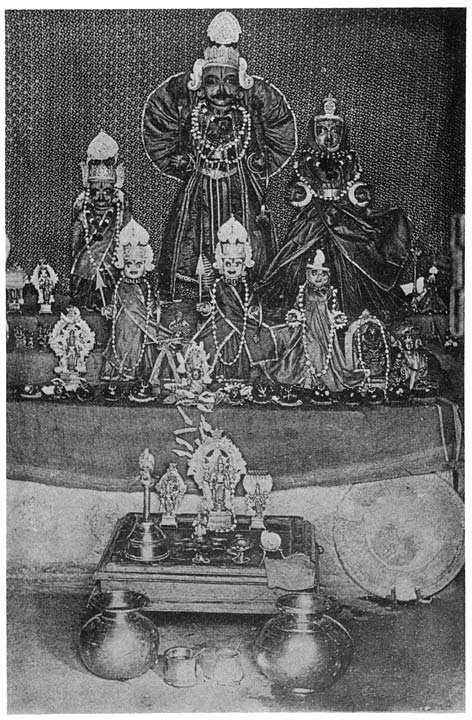
Images of Rāma, Lachman and Sīta, with attendants