Volume 1 / Part 1 — Vaishnava, Vishnuite Sect
Reading edition
1. Vishnu as representing the sun.
As the sun is seen to sink every night into the earth, so it was thought that he could come down to earth, and Vishnu has done this in many forms for the preservation of mankind.
2. His incarnations.
He is generally considered to have had ten incarnations, of which nine are past and one is still to come. The incarnations were as follows:
1. As a great fish he guided the ark in which Manu the primeval man escaped from the deluge.
2. As a tortoise he supported the earth and poised it in its present position; or according to another version he lay at the bottom of the sea while the mountain Meru was set on its peak on his back, and with the serpent Vāsuki as a rope round the mountain the ocean was churned by the gods for making the divine Amrit or nectar which gives immortality.
3. As a boar he dived under the sea and raised the earth on his tusks after it had been submerged by a demon.
4. As Narsingh, the man-lion, he delivered the world from the tyranny of another demon.
5. As Wāman or a dwarf he tricked the King Bali, who had gained possession over the earth and nether world and was threatening the heavens, by asking for as much ground as he could cover in three steps. When his request was derisively granted he covered heaven and earth in two steps, but on Bali’s intercession left him the nether regions and refrained from making the third step which would have covered them.
7. As Rāma, the divine king of Ajodhia or Oudh, he led an expedition to Ceylon for the recovery of his wife Sīta, who had been abducted by Rawan, the demon king of Ceylon. This story probably refers to an early expedition of the Aryans to southern India, in which they may have obtained the assistance of the Munda tribes, represented by Hanumān and his army of apes.
9. As Buddha he was the great founder of the religion known by his name; the Brāhmans, by making Buddha an incarnation of Vishnu, have thus provided a connecting link between Buddhism and Hinduism.
In his tenth incarnation he will come again as Nishka-lanki or the stainless one for the final regeneration of the world, and his advent is expected by some Hindus, who worship him in this form.
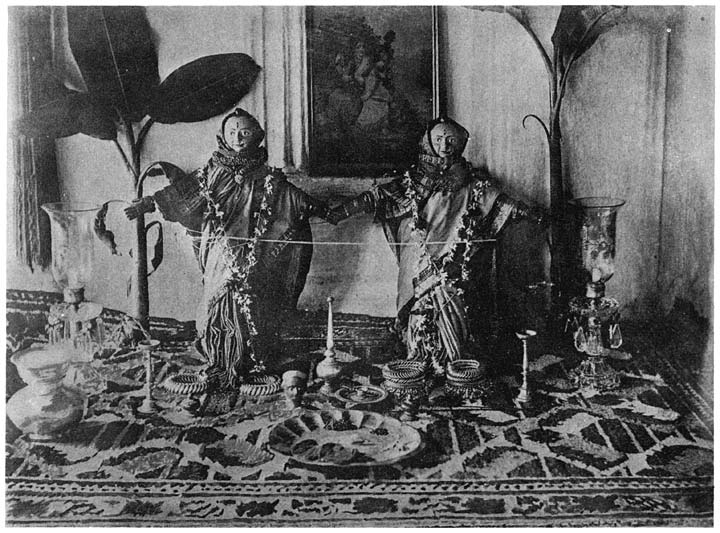
Image of Lakshmi, the Goddess of Wealth, the consort of Vishnu, with attendant
3. Worship of Vishnu and Vaishnava doctrines.
In the Central Provinces Vishnu is worshipped as Nārāyan Deo, who is identified with the sun, or as Parmeshwar, the supreme beneficent god. He is also much worshipped in his incarnations as Rāma and Krishna, and their images, with those of their consorts, Sīta and Rādha, are often to be found in his temples as well as in their own. These images are supposed to be subject to all the conditions and necessities incident to living humanity. Hence in the daily ritual they are washed, dressed, adorned and even fed like human beings, food being daily placed before them, and its aroma, according to popular belief, nourishing the god present in the image.
Faithful worshippers of Vishnu will after his death be transported to his heaven, Vaikuntha, or to Golaka, the heaven of Krishna. The sect-mark of the Vaishnavas usually consists of three lines down the forehead, meeting at the root of the nose or below it. All three lines may be white, or the centre one black or red, and the outside ones white. They are made with a kind of clay called Gopichandan, and are sometimes held to be the impress of Vishnu’s foot. To put on the sect-mark in the morning is to secure the god’s favour and protection during the day.