Volume 1 / Part 1 — Arya Samāj
Reading edition
[Bibliography: Sir E.D. Maclagan’s Punjab Census Report of 1891; Mr. R. Burn’s United Provinces Census Report of 1901; Professor J. C. Oman’s Cults, Customs and Superstitions of India.]
List of Paragraphs
1. The founder of the sect, Dayānand Sāraswati.
2. His methods and the scientific interpretation of the Vedas.
3. Tenets of the Samāj.
4. Modernising tendencies.
5. Aims and educational institutions.
6. Prospects of the sect.
1. The founder of the sect, Dayānand Sāraswati.
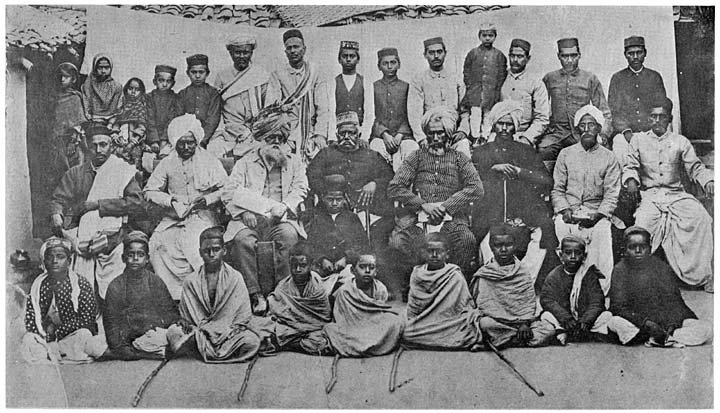
A meeting of the Arya Samāj for investing boys with the sacred thread
2. His methods and the scientific interpretation of the Vedas.
Professor Max Müller.—“May Mitra, Varūna, Aryaman, Ayu, Indra, the Lord of the Ribhus, and the Marūts not rebuke us because we shall proclaim at the sacrifice the virtues of the swift horse sprung from the Gods.”
Pandit Guru Datt.—“We shall describe the power-generating virtues of the energetic horses endowed with brilliant properties (or the virtues of the vigorous force of heat) which learned or scientific men can evoke to work for purposes of appliances. Let not philanthropists, noble men, judges, learned men, rulers, wise men and practical mechanics ever disregard these properties.” In fact, the learned Pandit has interpreted horse as horse-power.
3. Tenets of the Samāj.
4. Modernising tendencies.
The Samāj does not believe in any literal heaven and hell, but considers these as figurative expressions of the state of the soul, whether in this life or the life to come. The Aryas therefore do not perform the shrādhh ceremony nor offer oblations to the dead, and in abolishing these they reduce enormously the power and influence of the priesthood.
5. Aims and educational institutions.
Ah! long have ye slept, Sons of India, too long! Your country degenerate, your morals all wrong.
Its principal educational institutions are the Dayānand Anglo-Vedic College at Lahore and the Anglo-Vedic School at Meerut, a large orphanage at Bareilly, smaller ones at Allahabad and Cawnpore, and a number of primary schools. It employs a body of travelling teachers or Upadeshaks to make converts, and in the famine of 1900 took charge of as many famine orphans as the Local Governments would entrust to it, in order to prevent them from being handed over to Christian missionaries. All members of the Samāj are expected to contribute one per cent of their incomes to the society, and a large number of them do this. The Arya Samāj has been accused of cherishing political aims and of anti-British propaganda, but the writers quoted in this article unite in acquitting it of such a charge as an institution, though some of its members have been more or less identified with the Extremist party. From the beginning, however, and apparently up to the present time, its religious teaching has been directed to social and not to political reform, and so long as it adheres to this course its work must be considered to be useful and praiseworthy. Nevertheless some danger may perhaps exist lest the boys educated in its institutions may with youthful intemperance read into the instruction of their teachers more than it is meant to convey, and divert exhortations for social improvement and progress to political ends.