Volume 1 / Part 1 — Kabīrpanthi
Reading edition
[Bibliography: Right Reverend G. H. Westcott, Kabīr and the Kabīrpanth, Cawnpore, 1907; Asiatic Researches, vol. xvi. pp. 53–75 (Wilson’s Hindu Sects); Mr. Crooke’s Tribes and Castes, article Kabīrpanthi; Central Provinces Census Report (1891), Sir B. Robertson.]
List of Paragraphs
1. Life of Kabīr.
2. Kabīr’s teachings.
3. His sayings
4. The Kabīrpanthi Sect in the Central Provinces.
5. The religious service.
6. Initiation.
7. Funeral rites.
8. Idol worship.
9. Statistics of the sect.
1. Life of Kabīr.
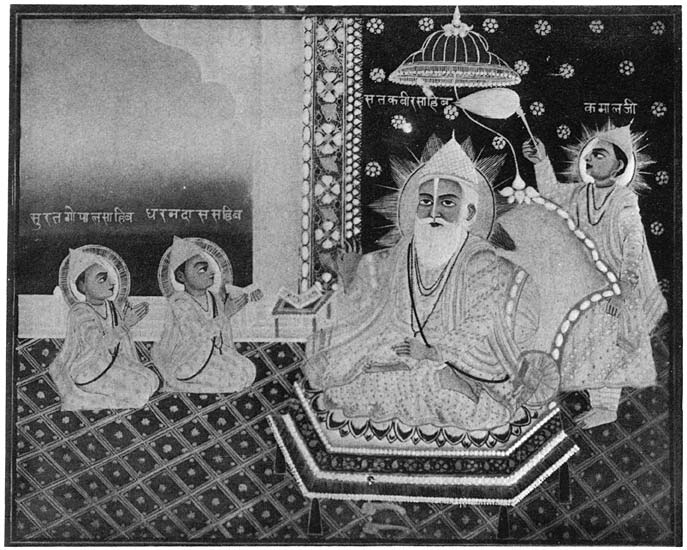
Kabīr
The plain speaking of Kabīr and his general disregard for religious conventions excited the enmity of both Hindus and Muhammadans, and he was accused before the Emperor Sikandar Lodi, by whose orders various attempts were made to kill him; but he was miraculously preserved in each case, until at last the Emperor acknowledged his divine character, asked his forgiveness, and expressed his willingness to undergo any punishment that he might name. To this Kabīr replied that a man should sow flowers for those who had sown him thorns. Bishop Westcott continues:—“All accounts agree that the earthly life of Kabīr came to a close at Maghar, in the District of Gorakhpur. Tradition relates that Kabīr died in extreme old age, when his body had become infirm and his hands were no longer able to produce the music with which he had in younger days celebrated the praises of Rāma.
“A difficulty arose with regard to the disposal of his body after death. The Muhammadans desired to bury it and the Hindus to cremate it. As the rival parties discussed the question with growing warmth Kabīr himself appeared and bade them raise the cloth in which the body lay enshrouded. They did as he commanded, and lo! beneath the cloth there lay but a heap of flowers. Of these flowers the Hindus removed half and burnt them at Benāres, while what remained were buried at Maghar by the Muhammadans.”
2. Kabīr’s teachings.
The religion preached by Kabīr was of a lofty character. He rejected the divine inspiration of the Vedas and the whole Hindu mythology. He taught that there was no virtue in outward observances such as shaving the head, ceremonial purity and impurity, and circumcision among Muhammadans. He condemned the worship of idols and the use of sect-marks and religious amulets, but in all ordinary matters allowed his followers to conform to usage in order to avoid giving offence. He abolished distinctions of caste. He enjoined a virtuous life, just conduct and kindly behaviour and much meditation on the virtues of God. He also condemned the love of money and gain. In fact, in many respects his creed resembles Christianity, just as the life of Kabīr contains one or two episodes parallel to that of Christ. He prescribed obedience to the Guru or spiritual preceptor in all matters of faith and morals. His religion appears to have been somewhat of a pantheistic character and his idea of the deity rather vague. But he considered that the divine essence was present in all human beings, and apparently that those who freed themselves from sin and the trammels of worldly desires would ultimately be absorbed into the godhead. It does not seem that Kabīr made any exact pronouncement on the doctrine of the transmigration of souls and re-birth, but as he laid great stress on avoiding the destruction of any animal life, a precept which is to some extent the outcome of the belief in transmigration, he may have concurred in this tenet. Some Kabīrpanthis, however, have discarded transmigration. Bishop Westcott states that they do believe in the re-birth of the soul after an intervening period of reward or punishment, but always apparently in a human body.
3. His sayings
He would seem never to have promulgated any definite account of his own religion, nor did he write anything himself. He uttered a large number of Sākhis or apothegms which were recorded by his disciples in the Bījak, Sukhanidhān and other works, and are very well known and often quoted by Kabīrpanthis and others. The influence of Kabīr extended beyond his own sect. Nānak, the founder of the Nānakpanthis and Sikhs, was indebted to Kabīr for most of his doctrine, and the Adi-Granth or first sacred book of the Sikhs is largely compiled from his sayings. Other sects such as the Dādupanthis also owe much to him. A small selection of his sayings from those recorded by Bishop Westcott may be given in illustration of their character:
1. Adding cowrie to cowrie he brings together lakhs and crores.
At the time of his departure he gets nothing at all, even his loin-cloth is plucked away.
2. Fire does not burn it, the wind does not carry it away, no thief comes near it; collect the wealth of the name of Rāma, that wealth is never lost.
3. By force and love circumcision is made, I shall not agree to it, O brother. If God will make me a Turk by Him will I be circumcised; if a man becomes a Turk by being circumcised what shall be done with a woman? She must remain a Hindu.
4. The rosaries are of wood, the gods are of stone, the Ganges and Jumna are water. Rāma and Krishna are dead. The four Vedas are fictitious stories.
5. If by worshipping stones one can find God, I shall worship a mountain; better than these stones (idols) are the stones of the flour-mill with which men grind their corn.
6. If by immersion in the water salvation be obtained, the frogs bathe continually. As the frogs so are these men, again and again they fall into the womb.
7. As long as the sun does not rise the stars sparkle; so long as perfect knowledge of God is not obtained, men practise rites and ceremonies.
8. Brahma is dead with Siva who lived in Kāshi; the immortals are dead. In Mathura, Krishna, the cowherd, died. The ten incarnations (of Vishnu) are dead. Machhandranāth, Gorakhnāth, Dattātreya and Vyās are no longer living. Kabīr cries with a loud voice, All these have fallen into the slip-knot of death.
9. While dwelling in the womb there is no clan nor caste; from the seed of Brahm the whole of creation is made.
Whose art thou the Brāhman? Whose am I the Sūdra? Whose blood am I? Whose milk art thou?
Kabīr says, ‘Who reflects on Brahm, he by me is made a Brāhman.’
10. To be truthful is best of all if the heart be truthful. A man may speak as much as he likes; but there is no pleasure apart from truthfulness.
11. If by wandering about naked union with Hari be obtained; then every deer of the forest will attain to God. If by shaving the head perfection is achieved, the sheep is saved, no one is lost.
If salvation is got by celibacy, a eunuch should be the first saved. Kabīr says, ‘Hear, O Man and Brother; without the name of Rāma no one has obtained salvation.’
The resemblance of some of the above ideas to the teaching of the Gospels is striking, and, as has been seen, the story of Kabīr’s birth might have been borrowed from the Bible, while the Kabīrpanthi Chauka or religious service has one or two features in common with Christianity. These facts raise a probability, at any rate, that Kabīr or his disciples had some acquaintance with the Bible or with the teaching of Christian missionaries. If such a supposition were correct, it would follow that Christianity had influenced the religious thought of India to a greater extent than is generally supposed. Because, as has been seen, the Nānakpanthi and Sikh sects are mainly based on the teaching of Kabīr. Another interesting though accidental resemblance is that the religion of Kabīr was handed down in the form of isolated texts and sayings like the Logia of Jesus, and was first reduced to writing in a connected form by his disciples. The fact that Kabīr called the deity by the name of Rāma apparently does not imply that he ascribed a unique and sole divinity to the hero king of Ajodhia. He had to have some name which might convey a definite image or conception to his uneducated followers, and may have simply adopted that which was best known and most revered by them.
4. The Kabīrpanthi Sect in the Central Provinces.
The two principal headquarters of the Kabīrpanthi sect are at Benaires and at Kawardha, the capital of the State of that name, or Dāmākheda in the Raipur District. These appear to be practically independent of each other, the head Mahants exercising separate jurisdiction over members of the sect who acknowledge their authority. The Benāres branch of the sect is known as Bāp (father) and the Kawardha branch as Mai (mother). In 1901 out of 850,000 Kabīrpanthis in India 500,000 belonged to the Central Provinces. The following account of the practices of the sect in the Province is partly compiled from local information, and it differs in some minor, though not in essential, points from that given by Bishop Westcott. The Benāres church is called the Kabīrchaura Math and the Kawardha one the Dharam Dās Math.
5. The religious service.
6. Initiation.
7. Funeral rites.
The Kabīrpanthis are usually buried. Formerly, the bodies of married people both male and female were buried inside the compound of the house, but this is now prohibited on sanitary grounds. A cloth is placed in the grave and the corpse laid on it and another cloth placed over it covering the face. Over the grave a little platform is made on which the Mahant and two or three other persons can sit. On the twenty-first day after the death, if possible, the Mahant should hold a service for the dead. The form of the service is that already described, the Mahant sitting on the grave and the chauka being made in front of it. He lays a cocoanut and flowers on the grave and lights the lamp, afterwards distributing the cocoanut. The Kabīrpanthis think that the soul of the dead person remains in the grave up to this time, but when the lamp is burnt the soul mingles with the flame, which is the soul of Kabīr, and is absorbed into the deity. When breaking a cocoanut over the grave of the dead the Kabīrpanthis say, ‘I am breaking the skull of Yama,’ because they think that the soul of a Kabīrpanthi is absorbed into the deity and therefore is not liable to be taken down to hell and judged by Chitragupta and punished by Yama. From this it would appear that some of them do not believe in the transmigration of souls.
8. Idol worship.
Ordinarily the Kabīrpanthis have no regular worship except on the occasion of a visit of the guru. But sometimes in the morning they fold their hands and say ‘Sat Sāhib,’ or the ‘True God,’ two or three times. They also clean a space with cowdung and place a lighted lamp on it and say ‘Jai Kabīr Ki,’ or ‘Victory to Kabīr.’ They conceive of the deity as consisting of light, and therefore it seems probable that, like the other Vaishnava sects, they really take him to be the Sun. Kabīr prohibited the worship of all idols and visible symbols, but as might be expected the illiterate Kabīrpanthis cannot adhere strictly to this. Some of them worship the Bījak, the principal sacred book of their sect. At Rudri near Dhamtari on the Mahānadi one of the Gurus is buried, and a religious fair is held there. Recently a platform has been made with a footprint of Kabīr marked on it, and this is venerated by the pilgrims. Similarly, Kudarmāl is held to contain the grave of Churāman, the first guru after Dharam Dās, and a religious fair is held here at which the Kabīrpanthis attend and venerate the grave. Dharam Dās himself is said to be buried at Puri, the site of Jagannāth’s temple, but it seems doubtful whether this story may not have been devised in order to give the Kabīrpanthis a valid reason for going on pilgrimage to Puri. Similarly, an arch and platform in the court of the temple of Rāma at Rāmtek is considered to belong to the Kabīrpanthis, though the Brāhmans of the temple say that the arch was really made by the daughter of a Sūrajvansi king of the locality in order to fasten her swing to it. Once in three years the Mahār Kabīrpanthis of Mandla make a sacrificial offering of a goat to Dulha Deo, the bridegroom god, and eat the flesh, burying the remains beneath the floor. On this occasion they also drink liquor. Other Kabīrpanthis venerate Brahma, Vishnu and Siva, and light a lamp and burn camphor in their names, but do not make idols of them. They will accept the cooked food offered to Vishnu as Satnārāyan and a piece of the cocoanut kernel offered to Devi, but not the offerings to any other deities. And a number even of illiterate Kabīrpanthis appear to abstain from any kind of idol-worship.
9. Statistics of the sect.
About 600,000 Kabīrpanthis were returned in the Central Provinces in 1911, this being equivalent to an increase of 19 per cent since the previous census. As this was less than the increase in the total population the sect appears to be stationary or declining in numbers. The weaving castes are usually Kabīrpanthis, because Kabīr was a weaver. The Brāhmans call it ‘The weaver’s religion.’ Of the Panka caste 84 per cent were returned as members of the sect, and this caste appears to be of sectarian formation, consisting of Pāns or Gāndas who have become Kabīrpanthis. Other weaving castes such as Balāhis, Koris, Koshtis and Mahārs belong to the sect in considerable numbers, and it is also largely professed by other low castes as the Telis or oilmen, of whom 16 per cent adhere to it, and by Dhobis and Chamārs; and by some castes from whom a Brāhman will take water, as the Ahīrs, Kurmis, Lodhis and Kāchhis. Though there seems little doubt that one of the principal aims of Kabīr’s preaching was the abolition of the social tyranny of the caste system, which is the most real and to the lower classes the most hateful and burdensome feature of Hinduism, yet as in the case of so many other reformers his crusade has failed, and a man who becomes a Kabīrpanthi does not cease to be a member of his caste or to conform to its observances. And a few Brāhmans who have been converted, though renounced by their own caste, have, it is said, been compensated by receiving high posts in the hierarchy of the sect. Formerly all members of the sect took food together at the conclusion of each Chauka or service conducted by a Mahant. But this is no longer the case, and presumably different Chaukas are now held for communities of different castes. Only on the 13th day of Bhādon (August), which was the birthday of Kabīr, as many Kabīrpanthis as can meet at the headquarters of the Guru take food together without distinction of caste in memory of their Founder’s doctrine. Otherwise the Kabīrpanthis of each caste make a separate group within it, but among the lower castes they take food and marry with members of the caste who are not Kabīrpanthis. These latter are commonly known as Saktāha, a term which in Chhattīsgarh signifies an eater of meat as opposed to a Kabīrpanthi who refrains from it. The Mahārs and Pankas permit intermarriage between Kabīrpanthi and Saktāha families, the wife in each case adopting the customs and beliefs of her husband. Kabīrpanthis also wear the choti or scalp-lock and shave the head for the death of a relative, in spite of Kabīr’s contempt of the custom. Still, the sect has in the past afforded to the uneducated classes a somewhat higher ideal of spiritual life than the chaotic medley of primitive superstitions and beliefs in witchcraft and devil worship, from which the Brāhmans, caring only for the recognition of their social supremacy, made no attempt to raise them.