Volume 1 / Part 1 — Jain Religion
Reading edition
[Bibliography: The Jainas, by Dr. J.G. Bühler and J. Burgess, London, 1903; The Religions of India, Professor E.W. Hopkins; The Religions of India, Professor A. Barth; Punjab Census Report (1891), Sir E.D. Maclagan; article on Jainism in Dr. Hastings’ Encyclopaedia of Religion and Ethics.]
List of Paragraphs
1. Numbers and distribution.
2. The Jain religion. Its connection with Buddhism.
3. The Jain tenets. The Tirthakars.
4. The transmigration of souls.
5. Strict rules against taking life.
6. Jain sects.
7. Jain ascetics.
8. Jain subcastes of Banias.
9. Rules and customs of the laity.
10. Connection with Hinduism.
11. Temple and car festival.
12. Images of the Tirthakārs.
13. Religious observances.
14. Tenderness for animal life.
15. Social condition of the Jains.
1. Numbers and distribution.
Jain.—The total number of Jains in the Central Provinces in 1911 was 71,000 persons. They nearly all belong to the Bania caste, and are engaged in moneylending and trade like other Banias. They reside principally in the Vindhyan Districts, Saugor, Damoh and Jubbulpore, and in the principal towns of the Nāgpur country and Berār.
2. The Jain religion. Its connection with Buddhism.
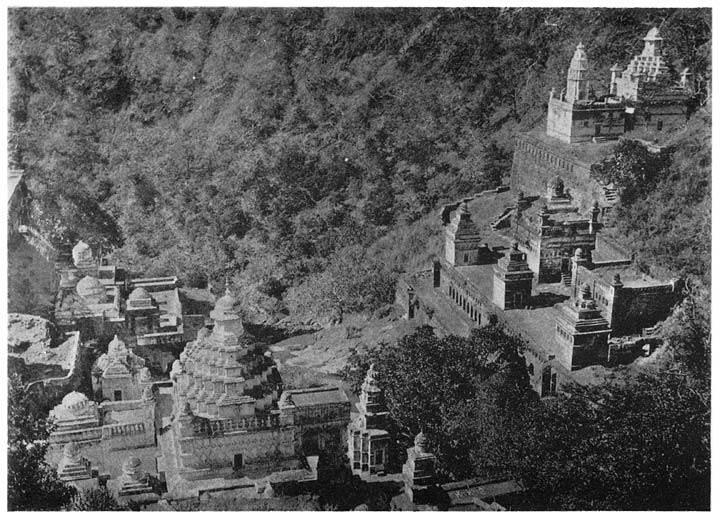
Jain temples at Muktagiri, Betul
3. The Jain tenets. The Tirthakars.
4. The transmigration of souls.
5. Strict rules against taking life.
6. Jain sects.
The Jains are divided into the above two principal sects, the Digambara and the Swetambara. The Digambara are the more numerous and the stricter sect. According to their tenets death by voluntary starvation is necessary for ascetics who would attain heaven, though of course the rule is not now observed. The name Digambara signifies sky-clad, and Swetambara white-clad. Formerly the Digambara ascetics went naked, and were the gymnosophists of the Greek writers, but now they take off their clothes, if at all, only at meals. The theory of the origin of the two sects is that Pārasnāth, the twenty-third Tirthakār, wore clothes, while Mahāvīra the twenty-fourth did not, and the two sects follow their respective examples. The Digambaras now wear ochre-coloured cloth, and the Swetambaras white. The principal difference at present is that the images in Digambara temples are naked and bare, while those of the Swetambaras are clothed, presumably in white, and also decorated with jewellery and ornaments. The Digambara ascetics may not use vessels for cooking or holding their food, but must take it in their hands from their disciples and eat it thus; while the Swetambara ascetics may use vessels. The Digambara, however, do not consider the straining-cloth, brush, and gauze before the mouth essential to the character of an ascetic, while the Swetambara insist on them. There is in the Central Provinces another small sect called Channāgri or Samaiya, and known elsewhere as Dhundia. These do not put images in their temples at all, but only copies of the Jain sacred books, and pay reverence to them. They will, however, worship in regular Jain temples at places where there are none of their own.
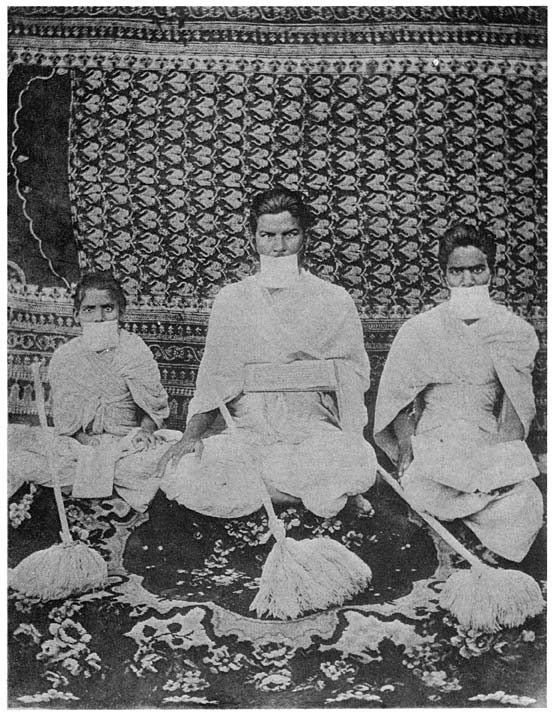
Jain ascetics with cloth before mouth and sweeping-brush
7. Jain ascetics.
8. Jain subcastes of Banias.
9. Rules and customs of the laity.
The Jain laity are known as Shrāwak or Saraogi, learners. There is comparatively little to distinguish them from their Hindu brethren. Their principal tenet is to avoid the destruction of all animal, including insect life, but the Hindu Banias are practically all Vaishnavas, and observe almost the same tenderness for animal life as the Jains. The Jains are distinguished by their separate temples and method of worship, and they do not recognise the authority of the Vedas nor revere the lingam of Siva. Consequently they do not use the Hindu sacred texts at their weddings, but repeat some verses from their own scriptures. These weddings are said to be more in the nature of a civil contract than of a religious ceremony. The bride and bridegroom walk seven times round the sacred post and are then seated on a platform and promise to observe certain rules of conduct towards each other and avoid offences. It is said that formerly a Jain bride was locked up in a temple for the first night and considered to be the bride of the god. But as scandals arose from this custom, she is now only locked up for a minute or two and then let out again. Jain boys are invested with the sacred thread on the occasion of their weddings or at twenty-one or twenty-two if they are still unmarried at that age. The thread is renewed annually on the day before the full moon of Bhādon (August), after a ten days’ fast in honour of Anānt Nāth Tirthakār. The thread is made by the Jain priests of tree cotton and has three knots. At their funerals the Jains do not shave the moustaches off as a rule, and they never shave the choti or scalp-lock, which they wear like Hindus. They give a feast to the caste-fellows and distribute money in charity, but do not perform the Hindu shrāddh or offering of sacrificial cakes to the dead. The Agarwāl and Khandelwāl Jains, however, invoke the spirits of their ancestors at weddings. Traces of an old hostility between Jains and Hindus survive in the Hindu saying that one should not take refuge in a Jain temple, even to escape from a mad elephant; and in the rule that a Jain beggar will not take alms from a Hindu unless he can perform some service in return, though it may not equal the value of the alms.
10. Connection with Hinduism.
11. Temple and car festival.
The Jains display great zeal in the construction of temples in which the images of the Tirthakārs are enshrined. The temples are commonly of the same fashion as those of the Hindus, with a short, roughly conical spire tapering to a point at the apex, but they are frequently adorned with rich carved stone and woodwork. There are fine collections of temples at Muktagiri in Betūl, Kundalpur in Damoh, and at Mount Abu, Girnar, the hill of Parasnāth in Chota Nāgpur, and other places in India. The best Jain temples are often found in very remote spots, and it is suggested that they were built at times when the Jains had to hide in such places to avoid Hindu persecution. And wherever a community of Jain merchants of any size has been settled for a generation or more several fine temples will probably be found. A Jain Bania who has grown rich considers the building of one or more temples to be the best method of expending his money and acquiring religious merit, and some of them spend all their fortune in this manner before their death. At the opening of a new temple the rath or chariot festival should be held. Wooden cars are made, sometimes as much as five stories high, and furnished with chambers for the images of the Tirthakārs. In these the idols of the hosts and all the guests are placed. Each car should be drawn by two elephants, and the procession of cars moves seven times round the temple or pavilion erected for the ceremony. For building a temple and performing this ceremony honorary and hereditary titles are conferred. Those who do it once receive the designation of Singhai; for carrying it out twice they become Sawai Singhai; and on a third occasion Seth. In such a ceremony performed at Khurai in Saugor one of the participators was already a Seth, and in recognition of his great liberality a new title was devised and he became Srimant Seth. It is said, however, that if the car breaks and the elephants refuse to move, the title becomes derisive and is either ‘Lule Singhai,’ the lame one, or ‘Arku Singhai,’ the stumbler. If no elephants are available and the car has to be dragged by men, the title given is Kadhore Singhai.
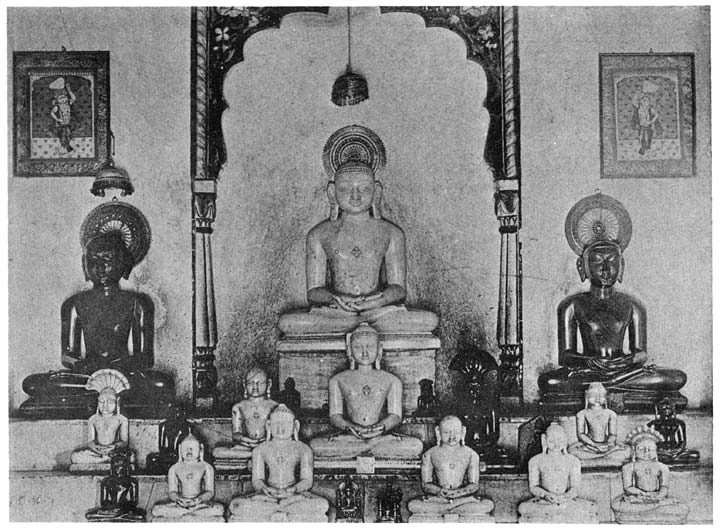
Jain gods in attitude of contemplation
12. Images of the Tirthakārs.
13. Religious observances.
The priest of a Jain temple is not usually a Yati or ascetic, but an ordinary member of the community. He receives no remuneration and carries on his business at the same time. He must know the Jain scriptures, and makes recitations from them when the worshippers are assembled. The Jain will ordinarily visit a temple and see the god every morning before taking his food, and his wife often goes with him. If there is no temple in their own town or village they will go to another, provided that it is within a practicable distance. The offerings made at the temple consist of rice, almonds, cocoanuts, betel-leaves, areca, dates, cardamoms, cloves and similar articles. These are appropriated by the Hindu Māli or gardener, who is the menial servant employed to keep the temple and enclosures clean. The Jain will not take back or consume himself anything which has been offered to the god. Offerings of money are also made, and these go into the bhandār or fund for maintenance of the temple. The Jains observe fasts for the last week before the new moon in the months of Phāgun (February), Asārh (June) and Kārtik (October). They also fast on the second, fifth, eighth, eleventh and fourteenth days in each fortnight of the four months of the rains from Asārh to Kārtik, this being in lieu of the more rigorous fast of the ascetics during the rains. On these days they eat only once, and do not eat any green vegetables. After the week’s fast at the end of Kārtik, at the commencement of the month of Aghan, the Jains begin to eat all green vegetables.
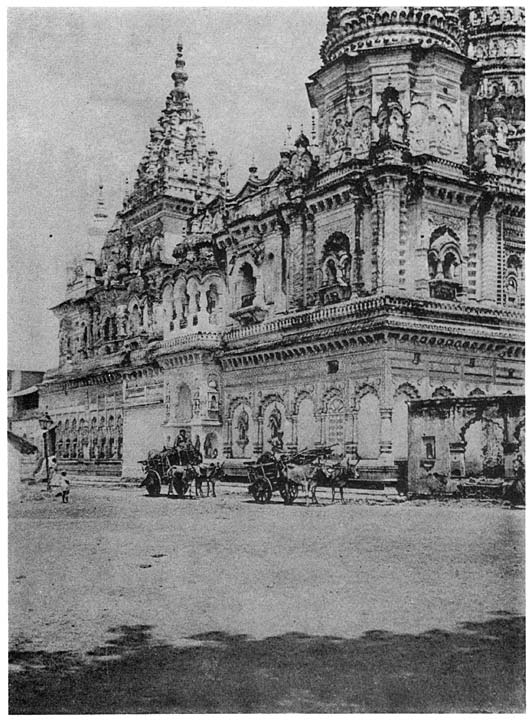
Jain temple in Seoni