Volume 1 / Part 1 — Glossary (continued 2)
Reading edition
Lakariha.—A subdivision of Pardhān in Kawardha. While begging they play a musical instrument, hence the name from lakri, a stick.
Lāla.—(A term of endearment.) Synonym for Kāyasth. A subcaste of Chamār.
Lālbegi.—A follower of Lālbeg, patron saint of the sweepers. Synonym of Mehtar.
Lāl Pādri.—Red priests, because they rub geru or red ochre on their bodies. Title of Jogi.
Lamechu.—A subcaste of Bania.
Langoti.—Subcaste of Pārdhi. They wear only a narrow strip of cloth called langoti round the loins.
Lānjia.—A subcaste of Lohār and Nai, from Lānji in Bālāghāt. A subtribe of Gonds in Khairagarh.
Lānjiwār.—(One living round Lānji in Bālāghāt.) Subcaste of Injhwār.
Laphangia.—(Upstart.) A section of Kolta.
Laria, Larhia.—(Belonging to Chhattīsgarh.) A synonym of Beldār. A subcaste of Bhaina, Binjhwār, Chamār, Gānda, Ghasia, Gond, Gosain, Kalār, Kewat, Koshti, Mahār, Marār, Mowār, Panka, Savar, Sunār and Teli.
Lasgaria.—A class of Bairāgi mendicants.
Lasukar.—A subcaste of Gondhalis who sell books and calendars.
Lāt.—Subcaste of Chamār.
Lave.—Subcaste of Kunbi.
Laya.—(Bird.) A section of Binjhwār, Mahār, and Panka.
Lekha.—Subcaste of Gūjar.
Lemuan, Limuan.—(Tortoise.) A totemistic sept of Audhelia, Munda and Oraon.
Lidha.—(Excrement of swine.) Subcaste of Khatīk in Jubbulpore.
Lilia.—(From līl or nīl, the indigo plant.) Subcaste of Kāchhi.
Lilorhia.—Subcaste of Gūjar.
Limba.—(Nīm tree.) A totemistic section of Dumāls.
Lingāyat.—A religious order which has become a caste. See article and subordinate article to Bania. A subcaste of Bania and Kumhār.
Lodha.—Synonym of Lodhi. Subcaste of Lodhi.
Lohār.—A caste of blacksmiths, synonym Luhura. A section of Binjhwār and Gānda.
Lohār Barhai.—A subcaste of Barhai in Bundelkhand.
Lohāria.—A subcaste of Ahīr.
Lonāria.—A salt-maker. Subcaste of Mahār.
Lonchatia.—(Salt-licker.) A sept of the Uika clan of Gonds. The members of this sept lick salt on the death of their relatives. Another account from Betūl says that they spread salt on a platform raised in honour of the dead and make cattle lick it up.
Londhāri.—A small caste of cultivators found in the Bhandāra District. They appear to be immigrants from northern India, as their women wear the Hindustāni dress and they speak Hindi at home. At their weddings the bridal couple walk round the sacred post according to the northern custom. When a widow marries again the couple worship a sword before the ceremony. If a man is convicted of an intrigue with a low-caste woman, he has to submit to a symbolical purification by fire. A heap of juāri-stalks is piled all round him and set alight, but as soon as the fire begins to burn he is permitted to escape from it. This rite is known as Agnikasht. The Londhāris appear to be distinct from the Lonhāre Kunbis of Betūl, with whom I was formerly inclined to connect them. These latter derive their name from the Lonār Mehkar salt lake in the Buldāna District, and are probably so called because they once collected the salt evaporated from the lake. They thus belong to the Marātha country, whereas the Londhāris probably came from northern India. The name Lonhāre is also found as a subdivision of one or two other castes living in the neighbourhood of the Lonār Mehkar lake.
Londhe, Londe.—(One who hides himself behind cloth.) A section of Kohli. A sept of Korku.
Londibacha.—A subcaste of Kasār, including persons of illegitimate descent.
Lonhāre, Lonāre.—(From Lonār-Mehkar, the well-known salt lake of the Buldāna District.) A subcaste of Kunbi. A section of Arakh and Ahīr.
Ludhela.—A section of Basor who worship the ludhia, a round stone for pounding food, at the Maihar ceremony.
Luhura.—(One who works in iron.) Synonym of Lohār. Subcaste of Sidhira.
Lunia.—Synonym of Murha, Nunia.
Machhandar.—(One who catches fish.) Synonym of Dhīmar.
Machhandra Nāth.—A subdivision of Jogi.
Machhia.—(From machhi, fish.) A section of Dhīmar and Lodhi.
Machhri.—(Fish.) A sept of Oraon.
Mada Kukuria.—(Dead dog.) A subsection of the Viswāl section of Koltas.
Madankul.—A section of Komti. They do not use red clothes, nor the wood of the swallow-wort tree.
Madari.—A class of Fakīrs or Muhammadan beggars.
Māde.—A resident of the Mād country in Chānda and Bastar. Subcaste of Pardhān.
Madhavachārya.—A Vishnuite sect and order of religious mendicants. See Baīrāgi.
Madhyanjan, Madhyandina.—A class of Brāhmans, the same as the Yajur-Vedis, or a section of them.
Mādia.—A class of Gonds in Bastar.
Madpotwa.—(One who distils liquor.) Subcaste of Teli.
Madrāsi.—Subcaste of Dhobi.
Magadha.—A subcaste of Ahīr or Rāwat in Chhattīsgarh, who ask for food from others and do not cook for themselves.
Magar, Magra.—A sept of Khangār, Ahīr or Rāwat, Gond and Chadār.
Māgida.—Synonym of Mādgi.
Mahābrāhman.—A degraded class of Brāhmans who accept gifts for the dead.
Mahādeva Thākur.—(Lord Mahādeo.) A section of Māli.
Mahajalia.—(Deceitful.) A section of Lohār.
Mahājan.—A banker. Title of the Bania caste.
Mahākul.—Synonym for Ahīr.
Mahālodhi.—(Great Lodhi.) Subcaste of Lodhi.
Mahānadiya.—(Those who came from the Mahānadi river.) A subcaste of Lodhi. A section of Gānda, Ghasia and Panka.
Mahant.—Chief of a math or monastery. A superior class of priest. A section of Ahīr, Panka, Chamār and Koshta.
Mahanti.—A synonym for the Karan or writer caste of Orissa. A section of Chasa.
Mahāpātra.—A subdivision of degraded Brāhmans who take funeral gifts. An honorific title of Thānapati and of Uriya Brāhmans. A subcaste of Bhāt.
Mahār.—A caste. A subcaste of Balāhi and Gondhali. A section of Rawat in Raigarh.
Mahārāj.—(Great king.) A title of Brāhmans.
Mahūrāna.—Synonym of Chitāri.
Mahārāshtra or Marāthe.—One of the five orders of Pānch Dravida Brāhmans inhabiting the Marātha country. They are also called Dakshini Brāhmans. A subcaste of Kumhār, Kāsar and Lohār.
Mahedia.—A section of Basors who worship pounded rice mixed with curds.
Mahenga.—(An elephant.) A totemistic sept of Rautia and Kawar in Bilāspur.
Maheshri.—Subcaste of Baina.
Mahili.—Synonym for Māhli.
Mahipia.—(A drinker of curds.) A subsection of the Viswāl section of Koltas.
Mahisur.—(Lord of the earth.) A synonym of Brāhmans.
Mahli-Munda.—Subcaste of Mahli.
Mahobia.—(From the town of Mahoba in Central India.) A subcaste of Barai, Chamār, Dāngi, Ghasia, Khangār and Mahār. A section of Dāngi, Kumhār and Kori.
Mahoda.—A subdivision of Brāhmans in Jubbulpore.
Mahore, Mahure.—A subcaste of Bania, Kori, Kumhār and Kalār.
Mahrātta.—Synonym of Marātha.
Māhto, Māhton.—A chief or village headman. Subcaste and title of Teli and Khairwār; title of the leader of the Bhuiya caste. A section of Gānda and Rāwat (Ahīr).
Mahur.—(Poison.) A subcaste of Sunārs in Chhindwāra.
Mahure, Mahuria.—(From Mahur, a town in Hyderābād.) Subcaste of Barhai and Dhangar.
Mai.—(Mother.) A division of the Kabīrpanthi sect.
Maichhor.—A small clan of Rājpūts. Perhaps from Maichuri in Jaipur.
Mailwār.—(Dirty.) A group of Sunārs in Raipur.
Maina.—Synonym of Mina.
Mair.—A subcaste of Sunār named after Mair, their original ancestor, who melted down a golden demon.
Maithil.—One of the five divisions of Pānch Gaur Brāhmans inhabiting the province of Maithil or Bihār and Tirhūt.
Majarewār.—A territorial section of Binjhwār (from Majare in Bālāghāt).
Mājhi.—(A village headman.) Title of Bhatra.
Mājhia.—Synonym of Majhwār.
Majhli.—(Middle.) Subcaste of Rautia.
Makaria.—(From makad, monkey.) A subcaste of Kamār, so called because they eat monkeys.
Makhia.—Subcaste of Mehtar.
Malaiya.—An immigrant from Mālwa. Subcaste of Chhīpa.
Māle, Māler.—Synonyms of Māl.
Malha.—A boatman. Synonym of Mallah.
Malhar.—Subcaste of Koli.
Māli.—(A caste.) A section of Kalār.
Māl-Pahāria.—Synonym of Māl.
Mālvi, Mālwi.—(From Mālwa.) A subdivision of Brāhmans in Hoshangābād and Betūl. A subcaste of Ahīr, Barhai, Darzi, Dhobi, Gadaria, Kalār, Koshti, Kumhār, Nai and Sunār.
Māna Ojha.—Subcaste of Ojha.
Mandal.—(A name for a prosperous cultivator in Chhattīsgarh.) A section of Chamār and Panka. See article Kurmi.
Mandilwār.—Name derived from Mandla. Subcaste of Katia.
Mandkul.—A section of Komti who do not eat mangoes.
Mandlāha.—(From Mandla town.) Subtribe of Gond.
Māne Kunbi.—Subcaste of Gondhali.
Māng or Māngia.—A caste. Subcaste of Gānda, Gondhali, Bahrūpia.
Mangan.—(From Manghunia, beggar.) A caste.
Māngta.—(A beggar.) A subcaste of Pāsi in Sangor, who beg from their caste-fellows.
Maniāra.—(A Pedlar.) Subcaste of Jogi.
Manihār.—A caste. The Manihārs are also known as Bisāti. An occupational name of Jogis.
Mānikpuria.—(A resident Mānikpur.) Subcaste of Panka.
Mānjhi.—(Headman.) A synonym of Santāl and Kewat. A section of Chasa, Dhanuhār and Kolta. A title of Chasa.
Manjur.—(Peacock.) A totemistic sept of Munda.
Manjmār.—Term for a boatman. Included in Kewat.
Mānkar.—Name of a superior class of village watchmen in Nimār District. See article Bhīl. A subcaste of Māna and Halba.
Mannepuwār.—A subcaste of Māla. Synonym, Teluga Bhoi.
Mānwa.—Subcaste of Kunbi.
Marābi.—A common sept of Gond. A section of Nat.
Marai.—(A name for the goddess of cholera, who is called Marai Māta.) A common sept of Gond. Also a sept of Baiga, Pasor and Bhunjia. A subcaste of Majhwār.
Marāl.—Synonym of Māli.
Marapa.—A sept of Gonds in Betūl, who abstain from killing or eating a goat or sheep and throw away any article smelt by them.
Marār.—Synonym for Māli, a gardener. Also a subcaste of Kāchhi.
Marātha, Marāthe.—A caste. A subcaste of Barhai, Bedar, Chamār, Dhīmar, Gadaria, Kumhār, Mahār, Māli, Māng, Nai and Teli.
Marāthi, Marātha, Mārthe, Marāthe.—(A resident of the Marātha country.) Subcaste of Bahrūpia, Chamār, Dhargar, Gundhali, Gopāl, Injhwār, Kaikāri, Kasār, Koshti, Nāhal, Otāri.
Marathia.—Resident of Bhandāra or another Marātha District. Subcaste of Halba.
Māria.—A well-known tribe of Gonds in Bastar and Chānda. See article Gond. A subcaste of Gowāri. A section of Ahīr, Chamār and Kumhār.
Markām.—(Marka, mango.) One of the principal septs of Gonds. Also a sept of Baiga, Basor, Bhumjia, Pardhān and Solāha.
Marskola.—(From markets, an axe.) A common sept of Gonds and Pardhāns.
Māru.—Subcaste of Chāran Bhāts.
Mārwāri.—A resident of Mārwār or the desert tract of Rājputāna; Mārwār is also used as a name for Jodhpur State. See subordinate article Rājpūt-Rāthor. The name Mārwāri is commonly applied to Banias coming from Mārwār. See article Bania. A subcaste of Bahna, Gurao, Kumhār, Nai, Sunār and Teli.
Masania.—(From masin, straw or grass mats, or masina, thatched roof.) A section of Lohār. A synonym for San Bhatras in Bastar.
Mashki.—(A water-bearer.) Synonym of Bhishti.
Masrām.—A common sept of Gonds.
Masti.—(Dancer.) Subcaste of Mādgi.
Mastram.—(Mastra, brass bangles.) A sept of Gonds in Betūl. The women of this sept wear brass bangles.
Masūria.—A subcaste of Kurmi. From masūr, lentil. A section of Rājpūt.
Mathadhari.—(Living in a monastery.) A celibate clan of Mānbhao mendicants.
Mathpati.—(Lord of the hermitage.) A subcaste of Jangam.
Mathur, Mathuria.—(From Mathura or Muttra.) A subcaste of Kāyasth. A subdivision of Brāhman. A subcaste of Banjāra, Darzi and Nai.
Matkūda, Matkora.—(Earth-digger.) A subcaste and synonym of Beldār. A name for Gonds and Pardhāns who take to earthwork.
Mattha.—Corruption of Marātha. A subcaste of Koshti, Mahār and Teli, and a title of Teli.
Matti.—A subdivision of low-class Brāhmans returned from Khairagarh. Also a class of Kashmīri Brāhmans.
Matwāla.—(A drinker of country liquor.) Subcaste of Kadera.
Mawāsi, Mirdhān.—Subcaste of Dahāit. Title of the headman of the Dahāit caste committee.
Mayaluar.—(Chief man of the caste.) A subcaste of Turi.
Mayur.—(Peacock.) A totemistic section of the Ahīr, Hatwa, Gond, Sonjhara and Sundi castes.
Mayurmāra.—(Killer of peacock.) A section of Bahelia.
Meda Gantia.—(Counter of posts.) Title of Bhatra. Official who fixes date and hour for wedding.
Medari.—Synonym of Medara.
Mehar.—Synonym of Bhulia.
Meher.—A section of Mālwi Ahīr, a synonym for Bhulia. A title of Chamār.
Mehra.—Synonym for Mahār. A subcaste of Katia and Kori.
Mehta.—A group of Brāhmans. A section of Oswāl Bania.
Mehtar.—(A prince or leader.) Common name for the sweeper caste. Title of the president of the Dhobi caste committee.
Meman.—Synonym of Cutchi.
Meshbansi.—(Descendant of a sheep.) A clan of Rājpūts.
Mewāda, Mewāri.—(From Mewār.) A division of Gujarāti or Khedāwāl Brāhmans. A subcaste of Chhīpa, Dārzi, Māli and Sunār.
Mewāti.—Synonym of Meo. See article. A class of Fakīrs or Muhammadan beggars.
Mhāli.—Synonym of Nai.
Mhasia, Mhashi.—(Mhas, buffalo.) A sept of Halba. A section of Kohli.
Mihir.—Synonym of Bhulia.
Mīna.—A caste. A section of Rāghuvansis.
Mīrdaha.—A subcaste of Dahāit, Khangār, and Nat. A section of Rāghuvansi. Name used for the mate of a gang of coolies.
Mīr-Dahāit.—Title of the Mīrdha caste.
Mīrshikār.—Synonym of Pārdhi.
Misra or Misar.—A surname of Kanaujia, Jijhotia, Sarwaria and Uriya Brāhmans.
Mistri.—(Corruption of the English Mister.) A master carpenter or mate of a gang. Title of Barhai, Beldār and Lohār.
Mithia.—(A preparer of sweets.) Synonym of Halwai.
Mochi.—(A shoemaker.) A caste. Subcaste of Chamār.
Modh.—A subdivision of Khedāwāl or Gujarāti Brāhmans who take their name from Modhera, an ancient place in Gujarāt. A subcaste of Gujarāti Bania.
Modh-Ghaneli.—Subcaste of Teli in Gujarāt.
Moghia.—Synonym of Pardhi.
Mohania.—(Captivator.) A section of Rajjhar and Kirār.
Mohtaria.—Title of the headman of the Andh caste committee.
Mohtera.—One who fixes the auspicious moment, hence the headman of the caste. A titular section of Basor.
Monas.—A subdivision of Brāhmans.
Mongre, Mongri, Mongrekair.—(A club or mallet.) A section of Ahīr or Rāwat in Chhattīsgarh, and of Chamār, Ganda, and Panka.
Mori.—A branch of the Panwār Rājpūts.
Mor Kāchhi.—One who prepares the maur or marriage-crown for weddings. Subcaste of Kāchhi.
Morkul.—A section of Komti. They do not use asafoetida (hing) nor the fruit of the umar fig-tree.
Motate.—(From mot, water-bag.) A subcaste of Kāpewār.
Moujikul.—A section of Komti. They do not use pepper.
Mowār.—Subcaste of Rajwār.
Mowāsi.—A resident of the forests of Kalibhīt and Melghāt known as the Mowās. Subcaste of Korku.
Muamin.—Synonym of Cutchi.
Muāsi.—Title of Korku; subcaste of Korwa.
Muchi.—Synonym of Mochi.
Mudara.—Subcaste of Parja.
Mudgalia.—(From mudgal, Indian club—an athlete.) A surname of Adi Gaur Brāhmans in Saugor.
Mudha.—Synonym for Munda.
Mudotia.—(From mudha, a cheat.) A surname of Sanādhia Brāhmans in Saugor.
Mughal.—A tribal division of Muhammadans. See article Muhammadan Religion.
Muhammadan.—Subcaste of Koli.
Muhjaria.—(Burnt mouth.) A section of Lodhi.
Mullāji.—Title of the priests of the Bohra caste.
Multani.—Subcaste and synonym of Banjāra.
Munda.—(A village headman, from munda, the head.) Title and synonym of Kol. A subcaste of Kharia and Oraon.
Mundela.—(Bald-headed.) A surname of Jijhotia Brāhmans in Saugor.
Mundle.—(Shaven ones.) Subcaste of Gūjar.
Munikul.—A section of Komti. They do not use munga beans.
Munjia.—Name of an Akhāra or school of Bairāgi religious mendicants. See Bairāgi.
Munurwār.—Synonym of Kāpewār.
Murai, Murao.—(From muli, or radish.) Subcaste of Kāchhi.
Murchulia.—(One who puts rings on the fingers of the caste.) A section of Gānda and Panka in Raipur.
Muria.—A well-known subtribe of Gonds in Bastar and Chānda.
Murli.—Synonym of Wāghya.
Musābir.—Synonym of Mochi.
Musahar.—(A rat-eater.) Subcaste and title of Bhuiya.
Mūsare.—(Mūsar, a pestle.) A section of Māli.
Mussali.—Title of Mehtar.
Mutrācha.—Synonym of Mutrāsi.
Mutrāsa.—Synonym of Mutrāsi.
Nabadia.—(Boatman or sailor.) A synonym for Kewat.
Naddāf.—A synonym for Bahna or Pinjāra.
Nadha.—(Those who live on the banks of streams.) Subcaste of Dhīmar.
Nadia.—A clan of Dāngi.
Nāg, Nagesh.—(Cobra.) A sept of the Ahīr or Rāwat, Binjhāl, Bhātia, Chasa, Hatwa, Halba, Khadāl, Kawar, Khangār, Karan, Katia, Kolta, Lohār, Mahār, Māli, Mowār, Parja, Redka, Sulia, Sundi and Taonla castes. Most of these castes belong to Chhattīsgarh and the Uriya country.
Nāga.—A clan of Gosains or mendicants. See Gosain.
Nāgar.—A subcaste of Brāhmans belonging to Gujarāt; a subcaste of Bania; a section of Teli.
Nagārchi.—(A drum-beater.) A class of Gonds. A subcaste of Gānda and Ghasia.
Nāgaria.—(A drum-player.) A section of Jasondhi Bhāt and Teli.
Nāgbans.—(Descended from the cobra.) A totemistic sept of Gadba, Ghasia, and Gond.
Nāgla.—(Naked.) Subcaste of Khond.
Nāgpure.—(From Nāgpur.) A section of Lodhi and Kohli.
Nāgvansi.—A clan of Rājpūts. See article Rājpūt-Nāgvānsi. A subcaste and section of Sunār. A section of Daharia or Daraiha and Gond.
Nāhar.—(Tiger.) A subtribe of Baiga. A section of Rājpūts in Saugor.
Nahonia.—A clan of Dāngi in Damoh and Saugor. They were formerly Kachhwāha Rājpūts from Narwar, but being cut off from their own domicile they married with Dāngis. Rājpūts accept daughters from them but do not give their daughters to Nahonias.
Naidu.—Title of the Balija, Mutrāsi and Velama castes. Often used by Balijas as their caste name.
Nāik.—(Leader.) A subdivision of Gond, also known as Darwe. A title of Banjāra headmen. A title of Teli and Kolta. A section of Ahīr, Chamār, Chasa, Gadaria, Halba, Kewat, Khond, Māli, Sudh.
Nakīb.—Mace-bearer or flag-bearer in a procession. Subcaste of Jasondhi Bhāt and Khangār.
Nakshbandia.—A class of Fakīrs or Muhammadan beggars.
Naksia.—Synonym of Nagasia.
Nāmdeo.—A religious sect confined to members of the Chhīpa and Darzi castes, which has become a subcaste.
Nānakshāhi.—Synonym of Nānakpanthi.
Nandia.—(One who leads about with him a performing bullock). From Nandi, the bull on which Mahādeo rides. Subcaste of Jogi.
Nāndvansi.—Subcaste of Ahīr.
Nanghana.—A name given to the Kol tribe in Hoshangābād.
Napita.—Sanskrit name for Nai or barber.
Naqqāl.—Title of Bhānd.
Naraina.—Subcaste of Patwa.
Naramdeo.—A subcaste of Brāhmans belonging to the Gaur branch. They take their name from the river Nerbudda.
Narbadi, Narmada.—(From the river Nerbudda.) A subdivision of Mahārāshtra Brāhmans. A section of Yajur-Vedi Brāhmans. A synonym for Naramdeo Brāhmans. A section of Agharia, Binjhāl and Chamār.
Narnolia.—(From a place called Narnol in the Punjab.) Subcaste of Mehtar.
Narwaria.—A clan of Dāngi. A subcaste of Ahīr.
Nāta.—(A young bullock.) A section of Ahīr and Oswāl Bania.
Nathunia.—(Nose-ring.) A subcaste of Pāsi.
Navadesia.—(A man of nine districts.) Subcaste of Banjāra.
Nawaria.—A subcaste of Barhai, Lohar, Kachera or Sīsgar, Nai and Tamera.
Nāzir.—(A cashier or usher.) Subcaste of Jasondhi Bhāt.
Negi.—A vice-president of the caste committee in the Kharia caste.
Nema or Nīma.—A subcaste of Bania. See article Bania, Nema.
Netām.—(The dog in Gondi.) One of the common septs of Gond. Also a sept of Basor, Bhatra, Bhuiya, Dewar, Kawar and Parja.
Nawāri.—(From newār, thick tape used for webbing of beds.) Subcaste of Bahna.
Niaria.—An occupational term applied to persons who take the refuse and sweepings from a Sunār’s shop and wash out the particles of gold and silver. See article Sunār.
Nigam, Nigum.—A subcaste of Kāyasth.
Nihāl.—Synonym of Nahal.
Nihang.—A class of Bairagis or religious mendicants, who remain celibate.
Nikhar.—A subcaste of Ahīr, Bharewa (Kasār), Gadaria. A clan of Rājpūt. A section of Koshti.
Nikumbh.—A clan of Rājpūts included in the thirty-six royal races. A section of Joshi.
Nīlgar.—Synonym of Chhīpa.
Nīlkar.—(From nīl, indigo.) A subcaste of Darzi or Simpi (tailors) in Nāagpur, so named because they took up the work of dyeing in addition to their own and formed a new subcaste.
Nīmānandi.—A Vishnuite sect and order of religious mendicants. See Bairāgi.
Nimāri, Nimādi, Nimāria.—(A resident of Nimār.) A subcaste of Balāhi, Bania, Dhobi, Mahār and Nai.
Nimāwal.—A class of Bairāgi.
Nirāli.—Synonym of Chhīpa.
Niranjani.—Name of an Akhāra or school of Bairāgis. See Bairāgi.
Nirbani.—(Nir, without; bani, speech.) A class of Bairāgis who refrain from speech as far as possible.
Nirmohi.—A class of Bairāgis.
Nona or Lona.—Name derived from Nona or Lona Chamārin, a well-known witch. Subcaste of Chamār.
Nulkāchandriah.—Caste priests. Subcaste of Mādgi.
Nun.—(Salt.) A sept of Oraon.
Nunia, Nonia, Lunia.—(Saltmaker.) A synonym of Beldār. A section of Binjhwār and Koli.
Od.—Synonym of Beldār.
Odde, Ud.—(From Odra the old name of Orissa.) Term for a digger or navvy. A group of Beldārs.
Odhia.—Synonym for Audhia Bania.
Odia or Uriya.—Subcaste of Beldār in Chhattīsgarh.
Oiku.—Subtribe of Majhwār.
Ojha.—(From Ojh, entrails.) A caste of Gond augurs, see article. A title of Maithil Brāhmans. A subcaste of Lohār, Nat and Savar.
Okkilyan.—Synonym of Wakkāliga.
Omre, Umre.—A subcaste of Bania. See Bania Umre.—A subcaste of Teli.
Onkar Nāth.—A subdivision of Jogis.
Onkule.—Subcaste of Koshti.
Orha.—Subcaste of Chasa.
Oswāl.—A subcaste of Bania. See subordinate article to Bania.
Ota.—(One who recites the Vedas aloud in sacrifices.) An honorific title of Uriya Brāhmans.
Otāri, Watkari.—A low caste of workers in brass in the Marātha country. The name is derived from the Marāthi verb otne, to pour or smelt. They number about 2600 persons in the Bhandāra and Chānda Districts, and in Berār. The caste have two subcastes, Gondādya and Marātha, or the Gond and Marātha Otāris. The latter are no doubt members of other castes who have taken to brass-working. Members of the two subcastes do not eat with each other. Their family names are of different kinds, and some of them are totemistic. They employ Brāhmans for their ceremonies, and otherwise their customs are like those of the lower artisan castes. But it is reported that they have a survival of marriage by capture, and if a man refuses to give his daughter in marriage after being asked twice or thrice, they abduct the girl and afterwards pay some compensation to the father. They make and sell ornaments of brass and bell-metal, such as are worn by the lower castes, and travel from village to village, hawking their toe-rings and anklets. There is also an Otāri subcaste of Kasārs.
Pabaiya.—(From Pabai in Bundelkhand.) A clan of Rājpūts in Hoshangābād.
Pābia.—A small caste in the zamīndāris of the Bilāspur District, and some of the Feudatory States, who numbered about 9000 persons in 1911. They appear to be Pāns or Gāndas, who also bear the name of Pāb, and this has been corrupted into Pābia, perhaps with a view to hiding their origin. They are wretchedly poor and ignorant. They say that they have never been to a Government dispensary, and would be afraid that medicine obtained from it would kill them. Their only remedies for diseases are branding the part affected or calling in a magician. They never send their children to school, as they hold that educated children are of no value to their parents, and that the object of Government in opening schools is only to obtain literate persons to carry on its business. One curious custom may be noticed. When any one dies in a family, all the members, as soon as the breath leaves his body, go into another room of the house; and across the door they lay a net opened into the room where the corpse lies. They think that the spirit of the dead man will follow them, and will be caught in the net. Then the net is carried away and burnt or buried with the corpse, and thus they think that the spirit is removed and prevented from remaining about the house and troubling the survivors.
Pabeha.—Synonym for Dhīmar.
Pābudia or Mādhai.—A subcaste of Bhuiya.
Pachādhe.—(Western.)—A subdivision of Sāraswat Brāhman.
Pachbhaiya.—(Five Brothers.) A section of Ahīr and Audhelia.
Pada.—(A pig-eater.) A section of Muria Gonds and Pardhāns.
Padhān.—(An Uriya name for a chief or headman of a village.) A section of Bhuiya, Chasa, Dumāl, Hatwa, Kolta, Tiyar and other Uriya castes. A title of Chasa and Kolta.
Padmasāle.—Subcaste of Koshti.
Padyāl.—A subtribe of Gond in Chānda. A section of Marori.
Pāhar.—Subcaste of Mahli.
Pahāria or Benwaria.—Subcaste of Korwa.
Pāik.—(A foot-soldier.) See Rājput-Pāik.
Paikaha.—(One who follows the calling of curing hides.) Synonym for Chamār.
Paikara.—(From Pāik, a foot-soldier.) Subcaste of Kawar.
Pailagia.—(Pailagi or ‘I fall at your feet,’ is a common term of greeting from an inferior to a superior.) Subcaste of Dahāit.
Paiyām.—(From paiya, a calf.) A sept of Gonds in Betūl.
Pajania.—(Paijana, tinkling anklets.) A section of Kurmi.
Pakhāli.—(From pakhāli, a leathern water-bag.) Synonym of Bhishti.
Pakhawaji.—(One who plays on the pakhawaj or timbrel.) Title of Mirāsi.
Pakhia.—(They are so called because they eat the flesh of the por or buffalo.) Subcaste of Khond.
Palas.—(From the palās tree, Butea frondosa.) A totemistic sept of Gonds.
Pālewār.—A gotra of Binjhwār; a subcaste of Dhīmar found in the Telugu country. They are also called Bhoi in Chānda. A name for Telugu Dhīmars or watermen. A section of Binjhwār.
Palgaria.—(Sleeping on a palang or cot.) A sept of Bhunjia.
Palliwāl.—A subcaste of Brāhmans belonging to the Kanaujia division. They take their name from Pāli, a trading town of Mārwār. A subcaste of Bania, whose name is derived from the same place.
Palsa-gacha.—(Palās tree, Butea frondosa.) A totemistic sept of Pāns.
Palshe.—A subcaste of Marātha Brāhmans. They derive their name from Palsaoli village in Kalyān (Bombay Presidency).
Pampatra.—(Those who use their hands as pots.) A section of Khandwāl.
Pān.—(Name of a forest tribe.) Synonym for Gānda.
Panch, Panchāyat.—(A caste committee, so called because it is supposed to consist of five (pānch) persons.) A section of Marār.
Pancham.—A subcaste of Bania. A subcaste of Barai, the same as Berāria.
Pānchbhai.—(Five brothers.) A surname of Bhanāra Dhīmars, a section of Ghasia.
Pānchdeve.—A subdivision of Gonds, worshipping five gods and paying special reverence to the sāras crane.
Pānch Dravid.—One of the two primary divisions of Brāhmans, inhabiting the country south of the Vindhya hills and Nerbudda river, and including the following five orders: viz., Karnata (Carnatic), Dravid (Madras), Tailanga (Telugu country), Mahārāshtra (Bombay) and Gurjara (Gujarāt).
Panch Gaur.—One of the two primary divisions of Brāhmans inhabiting the country north of the Vindhya hills and Nerbudda river; it includes the following five orders: Sāraswat (Punjab), Kanaujia (Hindustān), Gaur (Bengal), Utkal (Orissa) and Maithil (Bihār or Tirhūt).
Panchghar.—One of the three subdivisions of Kanaujia Brāhmans in Hoshangābād.
Panda.—(A priest of Devi, a wise man.) A subcaste or title of Māli. A subcaste and surname of Uriya Brāhmans. A subcaste of Jasondhi Bhāts.
Pandarām.—A class of Brāhman priests.
Pānde.—(A wise man.) A surname of Kanaujia and Gaur Brāhmans. A section of Agharia, Barhai, Kewat and Marār. A title of Joshi and Kumhār.
Pāndhare.—(White.) Subcaste of Sunār.
Pandit.—(A learned man.) A title of Brāhmans.
Pandki.—(Dove.) A totemistic sept of Bhatra, Kawar and Parja.
Pandra.—A small caste of cultivators in the Uriya country. It is said that one of the Rājas of Patna had an illegitimate son to whom he gave the village of Pandri. His descendants were the Pandras.
Pandwar or Padwar.—A section of Panka in Raipur. They are said to be so named because they washed the feet of others.
Pāngal.—Subcaste of Gopāl. They make mats, but in addition to this they are mendicants begging from trees.
Panhāra.—An occupational term meaning a seller of pān or betel-leaf.
Pānibhar.—(A waterman.) Subcaste of Dāngri.
Pānigrahi.—(Husband.) An honorific title of Uriya Brāhmans.
Panjha.—(Paw of an animal.) A sept of Gond.
Panka.—A weaver caste derived from the Gāndas, being Gāndas who follow the Kabīrpanthi sect. See article. In Chhattīsgarh Pankas sometimes call themselves Dās, as servants of Kabīr. Panka is also a subcaste of Gānda.
Pansāri.—(A druggist.) Synonym for Barai.
Panwār.—A clan of Rājpūt. See article Panwār Rājpūt. A subcaste of Banjāra and Bhoyar. A section of Ahīr, Bhilāla, Koshti, Marātha and Marori.
Parasār, Parashār.—(Name of a Brāhmanical saint.) An eponymous section of Brāhmans. A surname of Sanādhya and Gaur Brāhmans. A section of Basdeva, Rangāri, Sunār and Vidur.
Parauha.—(From para, a male buffalo calf.) A subcaste of Basdewa who deal in buffaloes.
Parbat.—Name of one of the ten orders of Gosain.
Parbhu.—Synonym of Prabhu.
Pardeshi.—(A foreigner.) The name is sometimes applied to immigrants from Mālwa, and also to those coming from northern India. A subcaste of the Bahna, Barai, Barhai, Chamār, Dhīmar, Dhobi, Garpagāri, Kīmbi, Kasār, Kumhār, Lohār, Nai, Rangāri, Sunār and Teli castes.
Pardhān.—(A chief.) A caste who are priests of the Gonds. See article. A section of Chhattīsgarhi Ahīr or Rāwat, Halba and Pābia. Title of caste headman of the Kharia tribe.
Pārdhi.—(A hunter.) A caste. See article. A subcaste of Khatīk. A section of Kunbi and Panwār Rājpūt.
Parewa.—(A pigeon.) A section of Chhattīsgarhi Ahīr or Rāwat, and Panka.
Parganiha.—A synonym of Pardhān (Gond priests) in Kawardha.
Parihār.—An important clan of Rājpūts. See Rājpūt Parihār. A section of Daharia and Daraiha, of Panwār Rājpūt and Pārdhi.
Parit.—Synonym for Dhobi in the Marātha districts.
Parnāmi.—(A follower of Prānnāth of Panna.) Subcaste of Dāngi.
Parsai.—(Village priest.) Synonym for Joshi.
Parsoli.—(parsa, an axe.) A section of Ahīr or Rāwat in Chhattīsgarh.
Parwār.—A subcaste of Bania. See article Bania-Parwār. A subcaste of Kumhār.
Pāssi.—Synonym of Pāsi.
Pātadhari.—(One occupying the seat of instruction.) A section of celibate Mānbhaos.
Pātane.—A subcaste of Prabhu, so called on account of their living near Pātan in Gujarāt.
Patbina.—(From patti, sacking, and binna, to weave.) Synonym of Kumrāwat. Subcaste of Jogi.
Patel.—(Headman of a village.) A subcaste and title of Māli. A surname of Gaur Brāhmans in Saugor and of Pārsis. A surname or section of Agharia, Mahār and Kāchhi. A title of the Ahīr and Bhoyar castes.
Pāthak.—(Teacher.) A surname of Kanaujia and other classes of Brāhmans.
Pathān.—One of the four tribes of Muhammadans. See article Muhammadan Religion.
Pathāri.—(A hillman.) Synonym of Pardhān. Subcaste of Katia.
Patharia.—A subcaste of Katia, Kurmi and Mahār. A section of Halba. A subcaste of Agaria, who place a stone on the mouth of the bellows to fix them in the ground for smelting iron.
Pathmukh.—A subsept of the Dhurwa Gonds in Betūl. They offer a young goat to their gods and do not kill bears.
Pathrot, Pathrāwat.—(One who makes and sharpens millstones and grindstones.) Synonym of Beldār.
Pati.—(Lord.) An honorific title of Uriya Brāhmans.
Patkar.—(From pat, widow-marriage.) A subcaste of Sunār in Wardha. A section of Rangāri.
Patlia.—(From patel.) Title of Panwār Rājpūt.
Patnāik.—A surname of Karan or Mahanti, the Uriya writer caste.
Patra.—(An Uriya word meaning councillor.) A subcaste of Kolta and Chasa, and title of several Uriya castes. Also a synonym for the Patwa caste.
Patti.—(A thread-seller.) Subcaste of Kaikāri.
Patwa.—A caste. See article. In Seoni tahsīl of Hoshangābād District Patwa and Lakhera appear to be synonymous terms. A section of Oswāl Bania.
Patwāri.—(Name of the village accountant and surveyor, who is now a salaried Government official.) The Kāyasth caste were formerly patwāris by profession. See article.
Patwi.—(A dyer who colours the silk thread which weavers use to border their cotton cloth.) Synonym of Patwa. Subcaste of Koshti. From pata, a woven cloth.
Pāwanbans.—(The children of the wind.) Synonym for Bhuiya.
Pendhāri.—Synonym of Pindāri.
Peng.—Subcaste of Parja.
Penthi.—(Sheep.) A totemistic sept of Bhulia.
Periki, Perki, Perka.—The Perikis are really a subcaste of the great Balija or Balji caste, but they have a lower position and are considered as a distinct group. About 4000 Perikis were returned in the Central Provinces in 1911 from the Nāgpur, Wardha and Chānda Districts. They derive their names from the perike or panniers in which they carried salt and grain on bullocks and donkeys. They were thus formerly a nomadic group, and like the Banjāras and Bhāmtas they also made gunny-bags and sacking. Most of them have now taken to cultivation, and in Madrās some Perikis have become large landholders and claim Rājpūt rank. In the Central Provinces the Balijas and Naidus deny that the Perikis have any connection with the Balija caste.
Peta.—(A trading Balija.) Subcaste of Balija.
Phal Barhai.—(A carpenter who only works on one side of the wood.) Synonym for Chitāri in the Uriya country.
Phānse.—(A Pārdhi who hunts with traps and snares.) Subcaste of Pārdhi.
Phānsigar.—(A strangler.) Synonym of Thug.
Pharsi.—(Axe.) A section of Uriya, Ahīr or Gahara.
Phopatia.—Title of the officer of the Andh caste who summons the caste committee.
Phūlia, Phūlmāli.—(A flower-gardener.) Subcaste of Kāchhi and Māli.
Phuljharia.—(From Phuljhar zamīndāri in Raipur.) A territorial subcaste of Ahīr or Rāwat, Ghasia and Panka.
Phul Kunwar.—A section of Kawar. They use the akre or swallow-wort flower for their marriage-crown.
Phulsunga.—A totemistic section of Gadaria. They abstain from smelling or touching a flower called gadha.
Phurasti.—(A wanderer.) Subcaste of Kaikāri.
Pindāra.—Synonym of Pindāri.
Pindāri.—A caste. Subcaste of Mang.
Pinjāra.—(One who cards cotton.) Synonym of Bahna.
Pipar.—(A tree.) A section of Khatīk and Kalār.
Pipariya.—(From the pīpal tree, or from Piparia, a common place-name derived from the tree.) A clan of Rājpūts in Saugor. A section of Sunārs in Saugor.
Piria.—Subcaste of Kāchhi. From piria, the basket in which they carry earth.
Pīt.—Subcaste of Bhatra.
Pītariya.—(From pītal, brass.) A subdivision of Pardeshi Sunārs in Nāgpur. They practise hypergamy, taking wives from the Sadihe subcaste, and giving daughters to the Srinagariye, Bangar, Mahuwe and Jadiye subcastes.
Pohni.—Subcaste of Jhādi Telenga.
Poiya,—Subcaste of Majhwār.
Polya.—(One who did not take off his turban at the feast.) Title of Hatkar.
Pondro.—(A tree.) One of the six subsepts of the Marai clan of Pathāri Gonds in Khairagarh.
Ponwār.—Synonym of Panwār Rājpūt.
Portai.—(Basket.) A subsept of the Uika clan of Gonds in Betūl. They do not kill the tiger or crocodile. A sept of Dhur Gonds.
Potdār.—(A money-tester.) Synonym and title of Sunār. A surname of Karhāra Brāhmans in Saugor.
Potdukh.—(Stomach-ache.) A section of Teli in Chānda.
Potharia.—(One to whom a certain dirty habit is imputed.) Subcaste of Korku.
Potwa.—(A worker in tasar silk.) Synonym for Darzi; a subcaste of Darzi.
Poyām.—(Worshipper of eight gods.) A sept of Pardhān and of Māria Gonds.
Prajapati.—Title of Kumhār.
Prāmara.—Synonym for Panwār Rājpūt.
Prānnāthi.—A follower of Prānnāth of Panna. Synonym for Dhāmi.
Pravar.—A term for the ancestors sharing in a sacrificial invocation, particularly that of the Horn or fire-sacrifice.
Prayāgwāl.—(From Prayāg-Allahābād.) A subcaste of Brāhmans who preside at the ceremonial bathing in the Ganges at Allahābād.
Puār.—Synonym of Panwār Rājpūt.
Pujāri.—(A worshipper.) Name for the priest in charge of a temple. A title of Bhatra.
Purād.—A small mixed caste in Nāgpur. They say that their ancestor was a Brāhman, who was crossing a river and lost his sacred thread, on being carried down in a flood (pūr). Therefore he was put out of caste because the sacred thread must be changed before swallowing the spittle, and he had no other thread ready. At the census the Purāds were amalgamated with Vidūrs. They are shopkeepers by profession.
Purāit.—(One who is of pure blood.) A subdivision of Jharia Rāwat (Ahīr) in Chhattīsgarh. A subcaste of Dhākar, Halba and Marār.
Purānia.—(Old.) A subcaste of Kachera or Sīsgar in Saugor. The Purānias are the Muhammadan bangle-makers who originally practised this calling. A subcaste of Barai, Basor, Nai and Sunār. A section of Chamār and Darzi.
Purbia.—This term, which means eastern or coming from the east, is used in Hoshangābād and other Districts to designate Rājpūts from Oudh and the adjoining tracts, especially retired sepoys from the Bengal army. They appear to belong to different clans, but many of them are Bais Rājpūts. Some of the Purbias say that their king, somewhere in northern India, heard that cows were being killed in the Central Provinces, so he sent them to stop the practice and they came and stopped it and settled there. In Gujarāt this name appears to be applied to Brāhmans. A subcaste of Barhai and Gadaria. A section of Nat and Sunār.
Purkām.—(Purka-pumpkin.) A sept of the Uika clan of Gonds in Betūl.
Purohit.—(Family priest.) A common title of Brāhmans.
Purouti or Pudoti.—(Bowels.) A sept of Gonds in Khairagarh.
Pusām.—(Worshipper of five gods.) A sept of Rāj-Gond and Dhur Gond, and of Baiga and Pardhān.
Putka.—A subcaste of Sudh, being the illegitimate issue of the Dehri Sudhs.
Qawwal.—(One who speaks fluently.) Title of Mirāsi.
Rachhbandia.—(Comb-makers.) A subcaste of Kuchhbandia (Kanjar).
Rāghunāthia.—A small group of Brāhmans, so called because their ancestors are said to have received a grant of five villages from Rāghunāth Deo of Hindoli.
Rāghuvansi.—A caste formed from a Rājpūt clan. See article. A subcaste of Ahīr; a section of Māli and Gond.
Rāghvi.—Synonym of Rāghuvansi.
Rahmat.—(Compassion.) A section of Panwār Rājpūt. A Muhammadan proper name.
Rai or Rāj.—Subcaste of Darzi, Kalār, Khangār.
Rai-bhaina.—Subcaste of Baiga in Bālāghāt.
Raipuria.—(From Raipur.) A subcaste of Dhīmars who do not wear gold ornaments. A subcaste of Dewār in Bilāspur.
Rāj or Rai.—From Rāja, a king. This term designates the landholding division of certain tribes, as the Rāj-Gonds, the Rāj-Korkus, the Rāj-Khonds and the Rājbhars. The Rāj-Bhats, Rāj-Dhuris and Rai-Darzis are similarly subcastes of good position in their respective castes. Rāj is also used as a synonym for Beldār, meaning a mason.
Rāja.—(A king.) Title of a ruling chief, and occasionally conferred on prominent Indian gentlemen.
Rajak.—(A washerman.) Synonym for Dhobi.
Rājbhar.—(A landowning Bhar.) Synonym for Rājjhar.
Rāj-Bhāt.—Subcaste of Bhāt.
Rāj-Dhuri.—A subcaste of Dhuri, said to be descendants of personal servants in Rājpūt families.
Rāj-Gond.—The landholding subdivision of the Gond tribe; a section of Chamār and Kāchhi.
Rāj-Khond.—Subcaste of Khond.
Rāj-Kunwar, Rāj-Pardhān.—A subcaste of Pardhān in Bālāghāt.
Rājoria.—(Kingly.) A section of Barhai, Dāngi, Khatīk and Sanādhya Brāhman.
Rāj-Pardhān.—A subcaste of Pardhān. They are said to be also known as Kunwar Pardhān or Gond Bhāt and to be beggars and bards of the Gonds.
Rāj-Pāsi.—Subcaste of Pāsi.
Rājpūt.—(Son of a king.) A caste, representing the ancient Kshatriya caste. See article. A subcaste of Banjāra, Kadera, Kumhār and Patwa.
Rajwaria.—From the Rajwār caste. Subcaste of Dahāit. Subdivision of Kol in Mirzāpur.
Rakaseya.—(From Rakas, a devil.) A section of Katia.
Rakhotia.—An illegitimate section of Kumhār.
Rakhwāldār.—(Village watchman.) Title of Rāmosi.
Raksa.—(Demoniac.) A section of Kumhār and Kawar.
Rāmānandi.—A class of Bairāgis or religious mendicants. See article Bairāgi.
Rāmānuja.—A class of Bairāgis or religious mendicants. See article Bairāgi.
Rāmgarhia.—(A resident of Rāmgarh in Mandla.) Subcaste of Ghasia.
Ramoshi.—Synonym of Rāmosi.
Rāna.—A title of Sesodia Rājpūts. A section of Halba and Panwār.
Randgolak.—A subdivision of degraded Mahārāshtra Brāhmans, the offspring of illicit unions or remarried widows.
Rangāri.—(One who works in indigo (nīl).) Synonym for Chhīpa.
Rao.—Synonym for Bhāt. A section of Chamār and Lohār. A title of the Bhilāla caste.
Ratanpuria.—(A resident of Ratanpur in Bilāspur.) Subcaste of Nunia and Dewār.
Ratha.—(A car for carrying a god.) Honorific title of Uriya Brāhmans.
Rāthia.—Subcaste of Kawar.
Rāthor, Rāthaur.—A famous Rājpūt clan. See article Rājpūt-Rāthor. A subcaste of Banjāra, Bāri and of Teli in Mandla, Betūl, Nimār and other Districts. A section of Ahīr, Bhilāla, Mochi, Nāhal and Pārdhi.
Ratna Bānik.—(Dealer in jewels.) A synonym of Sunār in Sambalpur.
Rautadi.—Subcaste of Bhuiya.
Rautele.—A subcaste of Kol. A section of Barai, Bhāt, Gadaria and of Sunār in Saugor.
Rautia.—A subcaste of Kol in several Districts. A subcaste of Dahāit. A subcaste of Kawar. A section of Chamār and Rāwat (Ahīr).
Rawal.—Title borne by some Rājpūt chieftains in Western India. Probably a diminutive of Rao, the Marāthi form of Rāj or Rāja. A section of Chasa, Māli and Garpagāri.
Rāwanbansi.—Descendants of Rāwan, the demon king of Ceylon. A name applied to the Gonds generally, and now used as a subtribal designation to distinguish them from Rāj-Gonds.
Rāwanvansi.—Name of a clan of Gosain mendicants.
Rawat.—A title borne by some minor Rājpūt chiefs. Probably a diminutive of Rājpūtra, the original form of the term Rājpūt. An honorific title of Gonds and Savars in Saugor and Damoh. The name by which the Ahīr caste is generally known in Chhattīsgarh. A subcaste and title of Khairwār. A title sometimes used by Sunārs and Brāhmans in Bundelkhand and by Lodhis. A subcaste of Mehtar and Māli. A section of Arakh, Banjāra, Binjhwār, Dhanwār, Kawar, Khairwār, Kunbi, Nat, Patwa, Panwār Rājpūt, and Sudh.
Reddi.—A synonym for the Kāpewār or Kāpu caste; a subcaste of Kāpewār and Gandli.
Redka.—A small labouring caste of Sambalpur. They are apparently the result of intermarriages between some members of the Reddi or Kāpu cultivating caste of Telingāna, who came to Sambalpur during the Orissa famine of 1866, with low-class Uriya women. They still speak Telugu among themselves, using Uriya to outsiders. Only one curious feature of the marriage ceremony of the Redkas need be noticed here. This is that the officiating Brāhman actually places a red-hot copper seal on the arms of the bride and bridegroom as a symbol of sealing the marriage bond. In other respects their customs resemble those of low-caste Uriyas.
Rekwār.—Subcaste of Dhīmar.
Rig-Vedi.—Sectarian division of Brāhmans.
Rikhiāsan Mahatwār.—Subcaste of Bhuiya.
Ritha Bīknath.—One who prepares and sells soap-nuts for washing clothes. Subcaste of Jogi.
Rohidāsi.—Honorific term for a Chamār. It signifies a follower of the sect of Rohidās in Northern India. The Chamārs often describe themselves by this name instead of their caste name.
Romya or Haralya.—Subcaste of Chamār.
Ror.—Subcaste of Khatri.
Rora.—Synonym of Arora.
Rūma.—A resident of Bāsim and Gāngra in Amraoti District. Subcaste of Korku.
Ruthia.—A name formed from the noise rut, rut made by the oil-mill in turning. Subcaste of Teli.
Sabara.—Synonym for the Savar tribe. A section of Kawar and Teli.
Sabat.—(From saot, co-wife.) An honorific title of Uriya Brāhmans.
Sadāphal.—(A fruit.) A section of Chandnāhu Kurmi and Sonkar.
Sada-Sohāgal.—A class of Fakīrs or Muhammadan beggars.
Sādhu.—(A religious mendicant.) Synonym for Bairāgis or Gosains.
Sāgar.—Name of one of the ten orders of Gosains.
Sāgunsāle.—A group of illegitimate descent. Subcaste of Koshti.
Sāhadeve.—A clan of Gonds worshipping six gods and paying special reverence to the tiger.
Sahāni.—(From siāhi, ink.) An honorific title of Karan or Mahanti. A subcaste of Pāik.
Sahara.—Synonym for the Savar tribe.
Sahasra Audichya.—(A thousand men of the north.) A subdivision of Gujarāti Brāhmans who are said to have accepted presents from Rāja Mulrāj of Anhalwāra Pātan at a sacrifice, and hence to have suffered some degradation in rank. Audichya probably signifies coming from Oudh.
Sahra.—Synonym of Savar.
Sāhu.—(A trader.) An honorific title of Bania. A synonym for Sunār in Sambalpur. A subdivision of Uriya Brāhmans. A section of Khadra, Kolta, Sundi and Teli.
Sahukār.—Title of Bania. See Sāhu.
Sain.—Synonym for Fakīr.
Saiqalgār.—From Arabic saiqal, a polisher. Synonym for Siklīgar.
Saitwāl.—A subcaste of Jain Banias.
Saiyad.—One of the four Muhammadan tribes, which is supposed to comprise the descendants of the Prophet.
Sakadwīpi.—A tribe of Brāhmans taking their name from Sakadwīpa, the country of the Sakas. The Sakas were a Central Asian tribe who invaded India before the commencement of the Christian era, and Sakadwīpa is said to be the valley of the Kābul river.
Sakarwāl, Sikarwār.—A clan of Rājpūts whose name is said to be derived from Fatehpur Sīkri.
Saksena.—A subcaste of Kāyasth, also called Sukhsena. A subcaste of Bharbhūnja and Kāchhi.
Saktāha.—A synonym for Shākta, a worshipper of Devi in Chhattīsgarh. Saktāha practically means a person who eats flesh, as opposed to a Kabīrpanthi who abstains from it. A subcaste of Panka, who are not Kabīrpanthis.
Sakum.—A sept of Korku. (One who hides behind a teak tree.)
Salam.—(Worshipper of six gods.) A clan of Gond. A section of Dewār.
Sālewār.—A name for Telugu Koshtis. A subcaste of Koshti.
Samaiya.—A sect of Jains.
San.—A subcaste of Bhatra.
Sanādhya.—A subcaste of Brāhmans belonging to the Gaur division.
Sanak-kul.—A section of Komti. They do not use jaiphal or nutmeg.
Sanaurhia.—Subcaste of Brāhman. Synonym for Sanādhya.
Sanbāgh.—(A little tiger.) A section of Bhulia.
Sānd.—(The bull.) A totemistic sept of Kawar. They do not use bullocks for ploughing, or are supposed not to. A section of Khangār. They do not give a present of a bull at weddings. A section of Māli.
Sania.—(A grower of san-hemp.) Subcaste of Kāchhi.
Saniāsi.—Name for a religious mendicant. Synonym for Gosain.
Sanjogi.—A class of Bairāgis or mendicants who marry, also called Grihastha.
Sankrita.—An eponymous section of Kanaujia Brāhmans.
Sānp.—(Snake.) A sept of Gond and Kawar.
The Saontas of Sargūja and Bilāspur appear to have been separated from the parent tribe for some generations and to have assimilated some of the customs of the Gonds. They have some Gond sept-names, as Markām and Dhurwa. Those of Pendra zamīndāri have no traditions of their origin beyond saying that the adjoining Kenda zamīndāri was their original home. They profess to revere only the sun, fire and water. In order to worship the Jal-deota or water-god they pour water round the fire and then throw a little butter on the fire in his name. Mr. C.U. Wills, Settlement Officer, records of them the following curious custom: When a man is at the point of death or actually dead, they sometimes set fire to the hut in which his body is lying and run away, no doubt to save themselves from being haunted and troubled by his spirit, to the attainment of which end so large a part of funeral ritual is everywhere directed.
“The name Saont or Saonta directs us to the Santāl branch of the Kols, and, as I have already noticed, there is in Sargūja a small tribe so called. They are the sole inhabitants of the magnificent tableland forming the southern barrier of Sargūja, called the Mainpāt or more correctly perhaps the Manipāt. They are a small tribe living scattered over the vast area of the plateau in about a dozen hamlets, and they are strong in the belief that they were especially created to dwell there, or that they and the plateau somehow sprang into existence together, and cannot be separated. I saw a number of them when I was last in Sargūja, and from their features I should be inclined to class them as Kols, but they have some customs and notions which they must have derived from the Dravidian Gonds. They acknowledge Dūlha Deo as a household god, and follow the customs of the Gonds and other southerners in their marriage ceremonies.
“They worship the sun as Bhāgwan, and like the Kharias offer sacrifices to that luminary in an open place with an ant-hill for an altar. The Mainpāt is their Mārang Buru, and as it is 16 miles long, 12 miles broad, and rises 3850 feet above the sea-level, it is not unworthy of the name, but they do not use that or any other Kol term. The great Mainpāt is their fatherland and their god. They have it all to themselves except during the summer months, when it becomes a vast grazing field for the cattle of Mīrzapur and Bihār.
“The Saonts are armed like the Korwas with bows and arrows, and the peculiar battle-axe of the country, but it is against the beasts of the forest that these weapons are used. Formerly the Mainpāt was a magnificent hunting field, especially noted for its herds of antelope and gaur. The late Mahārāja of Sargūja strictly preserved it, but on his death it fell into the hands of his widow, a very money-loving old lady, who allowed it to become one of the great grazing tracts, and the pasturage alone gives her an income of £250 a year; but the wild animals have in consequence withdrawn from it.
“The position of the Saonts is altogether very curious, and though they now speak no language but a rude Hindi, the evidence is, on the whole, favourable to their being a remnant of the ancient Kol aborigines of Sargūja, cut off from connection with those people by successive inroads of other races or tribes. Their substitution of a Hindi dialect for their own language seems to indicate that they were first subjugated by Aryans. The Gond chiefs only count about twenty-four generations in Sargūja, and they have all adopted the Hindi language.”
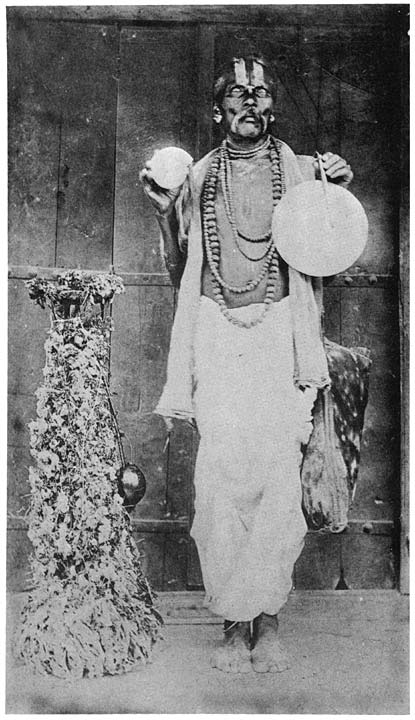
Dāsari religious mendicant with discus and conch-shell of Vishnu
Sanyāsi.—(A religious recluse.) Synonym for Gosain.
Sao.—(For sāhu, a banker, a rich man.) A subcaste of Kalār and Teli. An honorific title of Chhīpa or Rangāri. A sept of Gond.
Saojin.—(From sao, a banker.) Subcaste of Banjāra.
Saonr.—Synonym of Savar.
Saonta.—Name by which the Santāl tribe is known in Bilāspur. A subcaste of Dhanwār.
Sapera.—(A snake-charmer.) Name of a clan of Nats, who exhibit snakes. A section of Basor and Khatik.
Sarāf.—(A money-changer and tester.) A synonym of Sunār.
Saraia (Angler.) From sarai, a bamboo fishing-rod. Subcaste of Dhimār.
Sarangarhia.—(From Sārangarh.) A subtribe of Gonds in Khairagarh. A subcaste of Dewār.
Saraogi.—A name by which Jain laymen are known. Subcaste of Bania.
Sāras.—(A large crane.) A section of Chamār.
Sāraswat.—One of the five orders of Pānch Gaur Brāhmans inhabiting the country of the river Sāraswati. One of the ten orders of Gosains.
Sarati.—A sept of Gond and Pardhān.
Sariyām.—A subsept of the Dhurwa clan of Gonds in Betūl, said to be so called because the road to the place of the gods was swept by their priests.
Sarolia or Sarwaria.—(Inferior or mixed.) Subcaste of Agharia.
Saroti.—A sept of Pardhāns said to be named after sarra, a whip, because their priest once struck a man with a whip.
Sarsatia.—(From the Sāraswati river.) Subcaste of Bahna.
Satbhuiyān or Utār.—Subcaste of Khond.
Satdeve.—A clan of Gonds worshipping seven gods and paying special reverence to the porcupine.
Satghare.—(Seven houses.) A division of the Marātha caste, consisting of seven of the highest clans who marry among themselves and sometimes take daughters from the other ninety-six clans.
Satnāmi.—A religious sect, which now practically forms a subcaste of Chamār.
Satputia.—(Having seven sons.) A section of Lonare Māli.
Satyanāth. A subcaste of Jogi or Nāth.
Savar, Savara.—A tribe.
Sawalākh.—(1¼ lakhs.) A section of Dhobi.
Sawara.—Synonym for Savar. Subcaste of Kol.
Senapati.—(General.) Honorific title of Sundi.
Sendia.—Title of caste headman of Panwār Rājpūt.
Sendur.—A section of Ahīr or Rāwat.
Senduria.—Subcaste of Nagasia. They mark the forehead of the bride with vermilion (sendur).
Sengar.—A clan of Rājpūts belonging to Saugor and Jubbulpore.
Sesodia.—A famous clan of Rājpūts.
Seth.—(Banker or moneylender.) A title of Bania.
Setti.—A corruption of the Sanskrit Shreshta, good. Title of Komti caste.
Sewak.—(Servant.) The name given to an inferior class of Brāhmans who serve in Vaishnava temples.
Shaikh, Sheikh.—One of the four tribes of Muhammadans. A subcaste of Mehtar.
Shaiva, Saiva.—(A worshipper of Siva.) The term Shaiva Brāhman is applied to Guraos.
Shandilya, Sandilya.—An eponymous gotra or section of Brāhmans. A section of Darzi, Rāj-Gond, Rāwat (Ahīr) and Sunār.
Shegudi.—See Segidi.
Shendia.—A section of Teli and Otāri (Kasār).
Shenvi.—A subcaste of Marātha Brāhmans in Hoshangābād.
Sheohāre or Sivahāre.—Subcaste of Kalār.
Shiah.—One of the two great sects of Muhammadans.
Shikāri.—(A hunter.) A synonym for Pārdhi or Bahelia.
Shimpi.—(A tailor.) Synonym for Darzi in the Marātha country.
Shīshi ke Telwāle.—Subcaste of Pārdhi. They sell oil obtained from the bodies of crocodiles.
Sidhira, Sithira.—A small occupational caste of Sambalpur and the Uriya States. The caste is not found elsewhere in India. They are braziers by trade, and in spite of their small numbers say they have three subcastes, one of which, the Luhura, works in iron. They are an impure caste, whose touch conveys pollution in Sambalpur. They accept alms from a Munda or Oraon on the occasion of a death in the latter’s family, and have totemistic septs. They eat fowls and rats and consume much liquor. They also admit outsiders into the caste. It may be concluded, therefore, that they are an occupational caste formed from the tribes above mentioned or others, through adopting the calling of brass-workers. The adultery of a Sidhira woman with a man of any higher caste is looked upon as an absolutely trifling offence, and this is a common feature of low castes of mixed origin. As among many primitive tribes, one particular sept performs the ceremony of readmitting offenders to caste intercourse by sprinkling a little Ganges water over them. The man fulfilling this office is known as the Baikar, and after a wedding the bridal pair go to the Baikar’s house and he pours two jars full of water over their heads and bodies. They go inside the house, and the bridegroom then comes out and gives the wet clothes to the Baikar with a small present. This appears to be a sort of purificatory ceremony at marriage.
Sidi.—Synonym of Siddi.
Silpi.—(A stone-mason.) Subcaste of Kammala.
Sindhi.—(Performers of dramas.) Subcaste of Mādgi.
Sindhupushkar.—A subcaste of Brāhmans in Khairagarh State, perhaps the same as the Mārwāri Pushkama Brāhmans. It is said that Sindhu has the meaning of a lake.
Singāde.—(From singh, horn, and gādna, to bury.) Subcaste of Koli. The members of this group, when their buffaloes die, bury the horns in their compound.
Singar.—(A fish.) A totemistic sept of Kawar. A section of Agharia.
Singāria.—Those who cultivate the Singāra nut. Subcaste of Dhīmar.
Singh.—(A lion.) The usual suffix to the names of Rājpūts, Sikhs and castes which claim Rājpūt rank, such as Lodhis.
Singh, Singhi.—(Horn.) A totemistic sept of Dhanwār. A section of Kurmi, and of Oswāl and Maheshri Bania.
Singhāl.—(Ceylon.) A section of Brāhmans in Damoh.
Singrore.—Subcaste of Kunbi and Lodhi.
Sirdār.—Title of the Kawar caste.
Siriswār.—(From siris, a tree.) A section of Gadaria.
Sirnet.—A clan of Rājpūts.
Sirwa.—(A resident of the ancient city of Sravāsti in Gonda district.) Subcaste of Teli.
Sita Pādri.—Title of Vaishnava mendicants.
Sithira.—Synonym of Sidhira.
Solanki, Solankhi.—A well-known clan of Rājpūts, also called Chalukya. The name is perhaps derived from Sulakshana, one bearing an auspicious mark. A section of Pārdhi and Gūjar.
Sompura.—A subdivision of Gujarāti Brāhmans in Jubbulpore. They take their name from Somnāth in Kāthiāwār.
Somvansi.—(Children of the Moon.) Subcaste of Mahār. A clan of Rājpūts.
Sonār.—Synonym for Sunār in the Marātha country.
Sonbarha.—(Gold pig.) A section of Teli in Khairagarh, so named as they presented a golden pig to their king Bharam Deo.
Sonboyir.—(Gold plum.) A section of Teli in Nāndgaon, so called because their ancestor presented a gold plum to their Rāja.
Sonbukra.—(Yellow goat.) A totemistic sept of Kawar.
Sondi.—(Sondi, tiger.) A sept of Gonds in Raipur. It is said to be of mixed descent from all the septs, and can intermarry with any other.
Sondhi.—Synonym for Sundi.
Songainda.—(Gold unicorn.) A section of Teli in Khairagarh, so named because they presented a golden unicorn to their king Bharam Deo.
Sonha; Sonkutta.—(Wild dog.) A sept of Dhanwār, Kawar, Saonta or Santāl, and Chero.
Soni.—Synonym for Sunār.
Sonjhara, Sonjharia.—(One who washes for gold in the beds of streams.) A caste. Subcaste of Binjhwār, Injhwār and Dhīmar.
Sonkar.—A small caste found in the Chhattīsgarh country, and also in Saugor and Damoh. The name Sonkar is said to be a corruption of Chūnkar or lime-dealer, and the Sonkars of Saugor make their living by carrying clay and lime on donkeys for building and whitewashing walls. In Saugor they are also known as Beldār (navvy) and Gadhera (donkey-driver), and occupy a despised position. Possibly on this account a few of them in the northern Districts and the whole community in Chhattīsgarh have abandoned their traditional calling, and have taken to growing vegetables like the Mālis and Marārs. Here their status is better, and they rank as a gardening caste. Their customs resemble those of the lower castes of Chhattīsgarh. They obtain auspicious dates for their marriages and different ceremonies from Brāhmans, but otherwise these are not employed, and the caste headman, known as Kurha or Sethia, officiates as priest. At their weddings the sacred post round which the couple walk must consist of a forked bough of the mahua tree divided in a V shape, and they take much trouble to find and cut a suitable bough. They will not take cooked food from the hands of any other caste, even from Brāhmans.
Sonkarasaria.—(Impure gold.) A section of Bhona or Bhulia.
Sonkutri.—(Bitch of the wild dog.) A totemistic sept of Kawar.
Sonpākar.—(A tree.) A totemistic sept of Kawar and Chero.
Sonratan.—(Gold jewel.) A section of Chandnāhu Kurmi.
Sonthaga.—(Gold-cheat.) A subdivision of Pardhāns in Kawardha. They cheated people by passing false gold, and hence were so named.
Sonthāl.—Synonym for Santāl.
Sonwāni.—(Sona-pāni, gold-water.) This is a common sept among the primitive tribes and castes derived from them. The members of this sept occupy a quasi-priestly position, and readmit offenders into caste by giving them water to drink in which gold has been dipped. They also purify those who have got vermin in a wound by sprinkling this water over them. A section of Ahīr and of Rāwat or Chhattīsgarhi Ahīr; a sept of Dhoba, Dhanwār, Gond and Kawar; a section of Kalanga, Kumhār, Panka and Teli.
Sori.—A sept of Gond and Pardhān. Sori and Khusro are the two subsepts of the Markām sept.
Soyām.—(Worshipper of seven gods.) A division of Gond in Chānda.
Srāvaka.—A Jain layman.
Sri Gaur Māla.—(A resident of Mālwa.) Subcaste of Barhai.
Srimāli.—(From the old city of Srimāl in Rājputāna.) A subcaste of Gujarāti Brāhman and Bania.
Srivāstab, Sriwāstab.—(From the old city of Srāvasti in the north of Oudh.) A well-known subcaste of Kāyasth. A subcaste of Bharbhūnja, Darzi and Teli.
Sua.—(Parrot.) A section of Chadār, Khangār and Kasār. A sept of Bhatra and Kawar.
Suda.—Synonym of Sudh.
Sudh.—A caste. A subcaste of Kolta and Lohār.
Sudha.—Synonym of Sudh.
Sudho.—Synonym of Sudh.
Sūdra.—The lowest of the four traditional castes. See Introduction. There is no Sūdra caste at present in the Central Provinces. A subcaste of Barai.
Suibadiwa.—(Sui, porcupine.) A totemistic sept of the Dhurwa Gonds in Betūl.
Sūji.—(From sui, a needle.) Synonym for Darzi.
Sukul, Shukul.—(White.) A surname of Kanaujia Brāhmans.
Sulankhi.—Subcaste of Mahli.
Sunār.—A caste of goldsmiths. Subcaste of Bishnoi.
Sundhi.—Synonym of Sundi.
Sungaria.—(One who keeps pigs.) Subcaste of Kumhār.
Sunni.—One of the two principal sects of Muhammadans who follow the orthodox traditions, Sunni meaning traditionist.
Sunri.—Synonym of Sundi.
Surāit.—A name signifying persons of impure or mixed descent. A subcaste of Dhākar and Halba. A subcaste of Jharia Rāwat (Ahīr) in Bastar, being the offspring of Jharia Rāwat fathers by women of other Rāwat subcastes. A subcaste of Sonkar in Kanker, consisting of the offspring of illegitimate unions. A subcaste of Jhādi Telenga, Kumhār and Marār (Māli).
Sūraj, Sūrya.—(The sun.) A section of Binjhwār, Gond, Khangār, Marār, Mowār, Rāwat (Ahīr) and Sānsia (in Sambalpur).
Sūrajdhwaja.—A subcaste of Kāyasth.
Sūrajvansi.—(Descendants of the Sun.) Name of one of the two great divisions of Rājpūts. A clan of Rājpūts. A subcaste of Barai, Khairwār and Kalār. A section of Chamār, Dhanwār, Gond and Koli.
Suratha.—A subdivision of Valmīki Kāyasth.
Sureyām.—A Gond sept named after the sui or porcupine, because, it is said, a porcupine passed by when they were worshipping their god.
Surkhi.—(Red.) A clan of Sūrajvansi Rājpūts.
Sutār.—The name of a carpenter in the Marātha Districts. Synonym of Barhai.
Suthra Shāhi.—Synonym for Nānakpanthi.
Sutsāle.—(A thread-weaver.) Subcaste of Koshti.
Suvarha.—Named after the suar or pig. Subcaste of Dhīmar.
Swāmi or Aiya (Iyer).—(Master.) A title given to leaders of the religious orders. A title of Sanādhya Brāhmans in Saugor. A subcaste of Jangam.
Swetāmbari.—A sect of Jains who put clothes on their images.
Tadvi.—A name for Muhammadan Bhīls.
Tāk, Takshac.—A clan of Rājpūts, now extinct.
Tākankar, Tākari.—(From tākna, to tap, to roughen the face of a mill-stone.) A synonym or subcaste of Pārdbi. A synonym for the Pathrot or Pathrāwat stone-workers in Berār, who are classed with Beldārs.
Takle.—(Fallen.) A subcaste of Kasār, said to consist of the descendants of persons excommunicated for sexual offences.
Tamāshawāla.—(Showman.) A name given to Nats.
Tambatkar.—(A coppersmith.) Synonym for Tamera.
Tamboli, Tamoli.—(A seller of the prepared betel-leaves.) Synonym for Barai.
Tandan.—A subdivision of Sāraswat Brāhmans in Hoshangābād, perhaps so called from their being priests of the Tandan Khatris.
Tānkiwāla.—(A sharpener of grindstones.) Subcaste of Dhimar.
Tānti.—(Tanta, weaver’s loom.) A caste. A subcaste of Bhulia and Mahli.
Tanwar.—A subcaste of Kawar, to which zamīndārs belong.
Tanwat, Tanwatkari.—A synonym for Panchāl Sunār.
Tarane.—Synonym of Dobaile Teli.
Tasa.—Synonym of Chasa.
Tātwa.—Synonym for Tanti. (From Sanskrit tantu, a fibre.)
Tawāif.—(A prostitute.) Synonym for Kasbi.
Tekām.—(The teak tree.) One of the commonest clans of Gonds. A sept of Baiga, Bharewa, Binjhwār and Pardhān. A subdivision of Majhwār.
Telenga Dora.—(Telugu Lord.) A designation used by the Velama caste.
Telenge.—A Telugu name used by Balijas and other Telugu castes. Subcaste of Nai.
Telha.—Subcaste of Nagasia. The members of this subcaste mark the forehead of the bride with tel or oil at the marriage ceremony.
Teli.—A caste of oil-pressers. Subcaste of Barhai, Dāngri and Gondhali.
Teli-Bania.—A group of the Teli caste who have taken to shopkeeping. Subcaste of Teli.
Teli-Kalār.—A mixed group of the Kalār and Teli castes. Subcaste of Teli.
Teli-Marār.—A subcaste of Marār.
Telkala.—Subcaste of Gandli.
Terah-hazār or Birbandhi.—(Thirteen thousand.) Subcaste of Chero.
Thākur.—(Lord.) The common title of Rājpūts. This title is also used by Lodhis, Rāj-Gonds and other landowning castes. A surname of Karhāra Brāhmans in Saugor. A section of Ahīr, Marār (Māli), Panwār Rājpūt and Sudh.
Thakuria.—(Lordling.) A subcaste of Murao. A subcaste of Kol and Parja. A section of Darzi and Katia.
Thānāpati.—(Master of the sacred place.) Synonym for Gandhmāli.
Thāpak.—A surname of Sanādhia Brāhmans in Saugor. (From Sthāpak, the consecrator of idols.)
Thapatkari.—Synonym of Beldār.
Thathāri.—A caste of coppersmiths in Sambalpur.
Thatia.—A subtribe of Gonds, also called Gaiki or Mahato in Betūl.
Thethwār.—(One who follows the straight path.) A subcaste of Rāwat (Ahīr) in Chhattīsgarh.
Thotia, Thothia.—(Maimed.) A subdivision of Gonds and Pardhāns, who live by begging from the Gonds.
Thuria.—Subcaste of Banjāra in Sambalpur.
Tilokchandi.—(Bais.) A subdivision of the Bais clan of Rājpūts.
Tirelle.—(Tirole.) Subcaste of Are.
Tirgām.—A subsept of the Uika clan of Gonds in Betūl. A sept of Pardhān.
Tirmalle.—Synonym of Tirmale.
Tīrtha.—Name of one of the ten orders of Gosains.
Titha.—(From titahri, a sandpiper.) A section of Basor.
Tiwāri.—(Learned in three Vedas.) A family name of Kanaujia and Gaur Brāhmans.
Todasai.—(Worshipper of six gods.) A section of Rāj-Gond.
Tomara, Tuar, Tawar.—(Tomar, a club.) A well-known clan of Rājpūts. A sept of Gond.
Toriya.—A name given to Gonds who worship twelve gods in Chānda.
Tumram.—(Tumria, a pumpkin.) A clan of Gond, said to be those who worship six gods.
Turi.—A caste. A synonym for Basors or bamboo-workers. A section of Kalanga.
Turk.—(Muhammadan.) A section of Panwā Rājpūt in Bālāghāt.
Turkān.—A subcaste of Bahna, so called because their forefathers are said to have been soldiers in the army of the king of Delhi.
Turkia, Kurkanya.—A Muhammadan group. Subcaste of Banjāra, Chamār.
Uchla.—(A lifter.) Title for Bhārota.
Uchle.—(Pickpocket.) Subcaste of Māng.
Uchodia.—A subcaste of Bhānd.
Ud.—Subcaste of Chasa. See Odde.
Udaināth.—A subdivision of Jogi.
Udaiputria.—(One belonging to Udaipur.) Subcaste of Dhobi.
Udāsi.—A class of religious mendicants. See Nānakpanthi.
Uika, Oika.—A very common clan of Gonds, who are said to be worshippers of six gods.
Ukās.—A subcaste of Barhai.
Ulluka.—(An owl.) A totemistic sept of Sudh and Dumāl.
Umre.—A subcaste of Bania. See subordinate article to Bania. A subcaste of Kalār, Nai and Teli.
Unayo, Unnaya.—(From Unan in Oudh.) A subdivision of Nigam Kāyasth. It is also sometimes considered as a half subcaste, in addition to the twelve proper subcastes.
Unewāl.—A subdivision of Rhedāwāl Brāhmans found in Jubbulpore. They take their name from Una, a village in Kāthiāwār.
Upādhya.—(A teacher.) A surname of Kananjia and Sanādhya Brāhmans. A title of Mānbhao.
Upmanyu.—An eponymous section of Brāhmans.
Uraon.—Synonym of Oraon.
Uriya,—(A native of Orissa.) A synonym for the Sānsia caste of masons in Sambalpur. A subcaste of Gānda, Ghasia, Gond, Karan, Kewat, Koshti, Savar, Sundi and Sunār.
Urkara, Urkare.—(From Warkora, a wild cat in Gondi.) A section of Sunār and Gond.
Usrete.—A subcaste of Kurmi and Nai.
Uthaigira.—(A picker-up of that which has fallen.) Synonym of Sanaurhia.
Utkala.—(A resident of Orissa.) One of the five orders of Pānch Gaur Brāhmans inhabiting Orissa.
Vadar or Wadewār.—(A stone-cutter.) Synonym of Beldār.
Vade, Wade.—(A carpenter.) A sept of Māria Gonds.
Vadra.—(A carpenter.) Subcaste of Kammala.
Vāghe.—(From vāgh, a tiger.) See Wāghya.
Vaidika.—(Reciter of the Vedas.) A title of Brāhmans.
Vaishnava.—(A worshipper of Vishnu.) A name for the mendicant orders of Vishnuite devotees and Bairāgis.
Vaishnava Sunār.—A group of Sunārs who claim to be Brāhmans. See Panchāl.
Vaishya.—Name of the third of the four classical castes. See Introduction. There is no Vaishya caste at present, but the Bania caste are considered, perhaps incorrectly, to be descended from the Vaishyas.
Vajantri, Wajantri.—(Musician.) A subcaste of Gurao. A synonym and section of Māng.
Vallabkachārya.—A Vishnuite sect and order of religious mendicants. See article Bairāgi.
Valmīka, Valmīki.—A subdivision of Khedāwāl Brāhmans who take their name from the sage Valmīka. A subcaste of Kāyasths.
Vamachari Sect.—Synonym for Vām-Mārgi.
Vāni.—Synonym for Bania.
Varāde, Warāde.—(A resident of Berār, a variant of Berāri, q.v.) A subcaste of Simpi or Marātha Darzi. A subcaste of Dhangar and Nai.
Varendra or Barendra.—A subcaste of Bengali Brāhmans.
Vartāti.—(Pure.) Subcaste of Andh.
Vasishta or Vashishta.—Name of a famous saint in classical literature. An eponymous section of Brāhmans.
Vellāla.—The great cultivating caste of the Tamil country, to whom by general consent the first place in social esteem among the Tamil Sūdra castes is awarded. They have a strength of more than 2½ millions in India; in the Central Provinces there were in 1911 about 700 in Chānda, Nāgpur and other Districts. In the Madras Census Report of 1901, Mr. Francis gives an interesting description of the structure of the caste and its numerous territorial, occupational and other subdivisions. He shows also how groups from lower castes continually succeed in obtaining admission into the Vellāla community in the following passage: “Instances of members of other castes who have assumed the name and position of Vellālas are the Vettuva Vellālas, who are really Vettuvāns; the Puluva Vellālas, who are only Puluvāns; the Illam Vellālas, who are Panikkāns; the Karaiturai (lord of the shore) Vellālas, who are Karaiyāns; the Karukamattai (palmyra leaf stem) Vellālas, who are Balijas; the Guha (Rāma’s boatman) Vellālas, who are Sembadavāns; and the Irkuli Vellālas, who are Vannans. The children of dancing girls also often call themselves Mudali, and claim in time to be Vellālas, and even Paraiyāns assume the title of Pillai, and trust to its eventually enabling them to pass themselves off as members of the caste.” The Vellālas will not touch the plough with their own hands. Some of them abstain from flesh and liquor, and prohibit the remarriage of widows with a view to raising their social status.
Vidur.—A caste. A subcaste of Gondhali, Kasār, Komti, Kunbi, and Lohār, comprising persons of illegitimate descent.
Vīr.—Subcaste of Gopāl.
Vīrmushti.—A class of Bairāgis or religious mendicants.
Vishnu Swāmi.—A class of Bairāgis or religious mendicants.
Vishwāmitra.—Name of a famous saint in classical literature. An eponymous section of Brāhmans.
Vyās.—A section of Brāhmans and of Agharia.
Waddār.—A name for Telugu Oddes or navvies in Chānda. A subcaste of Beldār.
Wadewār.—Synonym of Odde or Beldār in Chānda.
Wāghe.—(Wāgh or bāgh, a tiger.) A section of Koshti and Māna, a clan of Marātha.
Wāghmāre.—(Tiger-killer.) A clan of Arakh, Gopāl and Mahār.
Wakmar.—(One who left the pangat or caste feast while his fellows were eating.) Title of Hatkar.
Wāndhekar.—Subcaste of Kunbi.
Wanjāri.—Synonym for Banjāra. Subcaste of Kunbi.
Warāde.—(A resident of Berār.) Subcaste of Gurao.
Wārtki.—(A washerman.) Synonym for Dhobi in the Marātha country.
Wāsudeo, Wāsdeo.—The name of the father of Krishna, the Hindu god. Synonym of Basdewa. A subcaste of Joshi.
Watkari. See Otāri.
Wika.—Synonym for Uika, a well-known clan of Gonds.
Yādu, Yādava.—A well-known clan of Rājpūts.
Yādubansi.—(Of the Yadu race.) A subcaste of Ahīr.
Yādu-Bhatti.—Clan of Rājpūts. Synonym for Yādu.
Yajur-Vedi.—A subcaste of Brāhmans who follow the Yajur-Veda. They are also known as Madhyandan and Apastambha.
Yarande.—(One who presses the erandi or castor-oil seed.) Subcaste of Teli.
Yati.—(For Jati). A Jain ascetic.
Yelama.—Synonym of Velama.
Yogi.—Synonym of Jogi.
Yojna.—Subcaste of Komti.