Volume 1 / Part 1 — Introductory Essay on Caste (continued 2)
Reading edition
54. Qualities associated with animals.
55. Primitive language.
56. Concrete nature of primitive ideas.
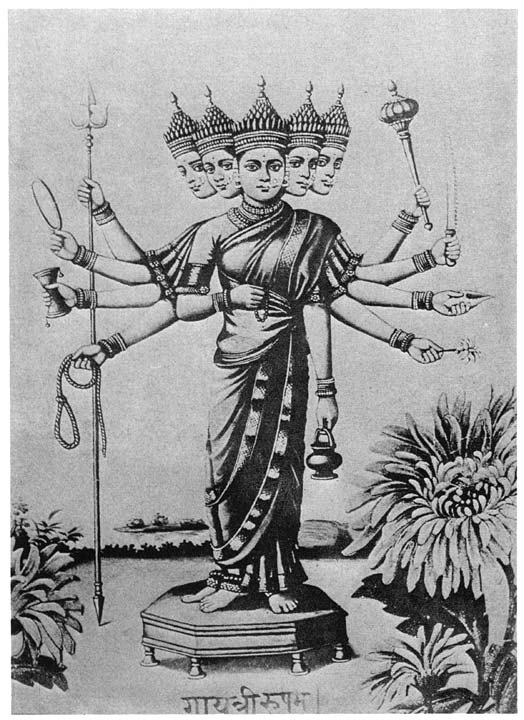
Gāyatri or sacred verse personified as a goddess
The whole category of superstitions about the evil eye arises from the belief that the glance of the eye is a concrete thing which strikes the person or object towards which it is directed like a dart. The theory that the injury is caused through the malice or envy of the person casting the evil eye seems to be derivative and explanatory. If a stranger’s glance falls on the food of a Rāmānuji Brāhman while it is being cooked, the food becomes polluted and must be buried in the ground. Here it is clear that the glance of the eye is equivalent to real contact of some part of the stranger’s body, which would pollute the food. In asking for leave in order to nurse his brother who was seriously ill but could obtain no advantage from medical treatment, a Hindu clerk explained that the sick man had been pierced by the evil glance of some woman.
57. Words and names concrete.
It is not I who am burying him, It is Gabriel who is burying him,
and thinks that the repetition of these words produces the state of facts which they denote so that the guilt of the murder is removed from his own shoulders to those of the archangel Gabriel. Similarly when he has killed a deer and wishes to be free from the guilt of his action, or as he calls it to cast out the mischief from the deer, he says:
It is not I who cast out these mischiefs, It is Michael who casts them out. It is not I who cast out these mischiefs, It is Israfel who casts them out,
58. The soul or spirit.
There seems every reason to suppose, as the same author suggests, that man first thought he had a spirit himself and as a consequence held that animals, plants and inanimate objects also contained spirits. Because the belief that the human body had a spirit can easily be accounted for, but there seems to be no valid reason why man should have thought that all other visible objects also contained spirits, except that at the period when he conceived of the existence of a soul or spirit he still held them to be possessed of life and self-conscious volition like himself. But certain beliefs, such as the universal existence of life, and of its distribution all over the body and transmission by contact and eating, the common life of the species, and possibly totemism itself, appear to have been pre-animistic or prior to any conception of or belief in a soul or spirit either in man himself or in nature.
59. The tranmission of qualities.
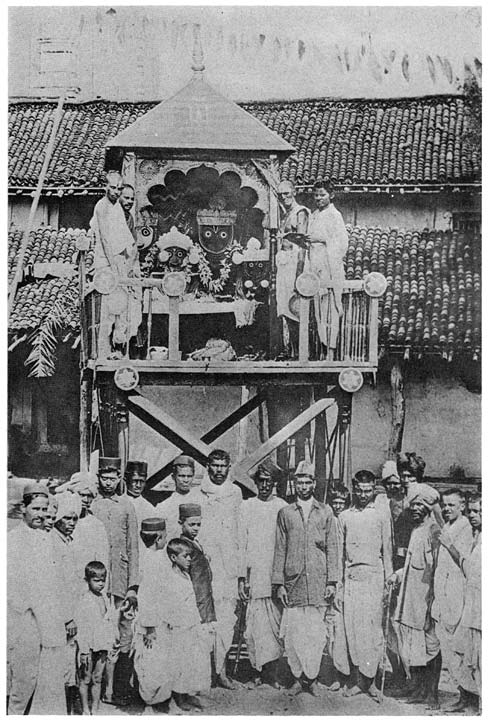
Image of the god Jagannāth, a form of Vishnu
60. The faculty of counting. Confusion of the individual and the species.
61. Similarity and identity.
62. The recurrence of events.
A brief digression may be made here in order to suggest an explanation of another important class of primitive ideas. These arise from the belief that when something has happened, that same event, or some other resembling it, will again occur, or, more briefly, the belief in the recurrence of events. This view is the origin of a large class of omens, and appears to have been originally evolved simply from the recurring phenomena of day and night and of the months and climatic seasons. For suppose that one was in the position of primitive man, knowing absolutely nothing of the nature and constitution of the earth and the heavenly bodies, or of the most elementary facts of astronomy; then, if the question were asked why one expected the sun to rise to-morrow, the only possible answer, and the answer which one would give, would be because it had risen to-day and every day as long as one could remember. The reason so stated might have no scientific value, but would at any rate establish a strong general probability. But primitive man could not have given it in this form, because he had no memory and could not count. Even now comparatively advanced tribes like the Gonds have a hopelessly inaccurate memory for ordinary incidents; and, as suggested subsequently, the faculty of memory was probably acquired very slowly with the development of language. And since he could not count, the continuous recurrence of natural phenomena had no cumulative force with him, so that he might distinguish them from other events. His argument was thus simply “the sun will rise again because it rose before; the moon will wax and wane again because she waxed and waned before”; grass and leaves and fruit would grow again because they did so before; the animals which gave him food would come again as before; and so on. But these were the only events which his brain retained at all, and that only because his existence depended upon them and they continually recurred. The ordinary incidents of life which presented some variation passed without record in his mind, as they still do very largely in those of primitive savages. And since he made no distinction between the different classes of events, holding them all to be the acts of volitional beings, he applied this law of the recurrence of events to every incident of life, and thought that whenever anything happened, reason existed for supposing that the same thing or something like it would happen again. It was sufficient that the second event should be like the first, since, as already seen, he did not distinguish between similarity and identity. Thus, to give instances, the Hindus think that if a man lies full length inside a bed, he is lying as if on a bier and will consequently soon be dead on a real bier; hence beds should be made so that one’s feet project uncomfortably over the end. By a similar reasoning he must not lie with his feet to the south because corpses are laid in this direction. A Hindu married woman always wears glass bangles as a sign of her state, and a widow may not wear them. A married woman must therefore never let her arms be without bangles or it is an omen that she will become a widow. She must not wear wholly white clothes, because a widow wears these. If a man places one of his shoes over the other in the house, it is an omen that he will go on a journey when the shoes will be in a similar position as he walks along. A Kolta woman who desires to ascertain whether she will have a son, puts a fish into a pot full of water and spreads her cloth by it. If the fish jumps into her lap, it is thought that her lap will shortly hold another living being, that is a son. At a wedding, in many Hindu castes, the bride and bridegroom perform the business of their caste or an imitation of it. Among the Kuramwār shepherds the bride and bridegroom are seated with the shuttle which is used for weaving blankets between them. A miniature swing is put up and a doll is placed in it in imitation of a child and swung to and fro. The bride then takes the doll out and gives it to the bridegroom, saying:—“Here, take care of it, I am now going to cook food”; while, after a time, the boy returns the doll to the girl saying, “I must now weave the blanket and go to tend the flock.” Thus, having performed their life’s business at their wedding, it is thought that they will continue to do so happily as long as they live. Many castes, before sowing the real crop, make a pretence of sowing seed before the shrine of the god, and hope thus to ensure that the subsequent sowing will be auspicious. The common stories of the appearance of a ghost, or other variety of apparition, before the deaths of members of a particular family, are based partly on the belief in the recurrence of associated events. The well-known superstition about sitting down thirteen to dinner, on the ground that one of the party may die shortly afterwards, is an instance of the same belief, being of course based on the Last Supper. But the number thirteen is generally unlucky, being held to be so by the Hindus, Muhammadans and Persians, as well as Europeans, and the superstition perhaps arose from its being the number of the intercalary month in the soli-lunar calendar, which is present one year and absent the next year. Thirteen is one more than twelve, the auspicious number of the months of the year. Similarly seven was perhaps lucky or sacred as being the number of the planets which gave their names to the days of the week, and three because it represented the sun, moon and earth. When a gambler stakes his money on a number such as the date of his birth or marriage, he acts on the supposition that a number which has been propitious to him once will be so again, and this appears to be a survival of the belief in the recurrence of events.
63. Controlling the future.
64. The common life.
Generally in the relations between the totem-clan and its totem-animal, and in all the fables about animals, one animal is taken as representing the species, and it is tacitly assumed that all the animals of the species have the same knowledge and qualities and would behave in the same manner as the typical one. Thus when the Majhwār says that the tiger would run away if he met a member of the tiger-clan who was free from sin, but would devour any member who had been put out of caste for an offence, he assumes that every tiger would know a member of the clan on meeting him, and also whether that member was in or out of caste. He therefore apparently supposes a common knowledge and intelligence to exist in all tigers as regards the clan, as if they were parts of one mind or intelligence. And since the tigers know instinctively when a member of the clan is out of caste, the mind and intelligence of the tigers must be the same as that of the clan. The Kols of the tiger clan think that if they were to sit up for a tiger over a kill the tiger would not come and would be deprived of his food, and that they themselves would fall ill. Here the evil effects of the want of food on one tiger are apparently held to extend to all tigers and also to all members of the tiger clan.
65. The common life of the clan.
66. Living and eating together.
67. The origin of exogamy.
68. Promiscuity and female descent.
The instinct of exogamy first developed in the totem-clan when it was migratory and lived by hunting, at least among the Australians and probably the American Indians.
69. Exogamy with female descent.
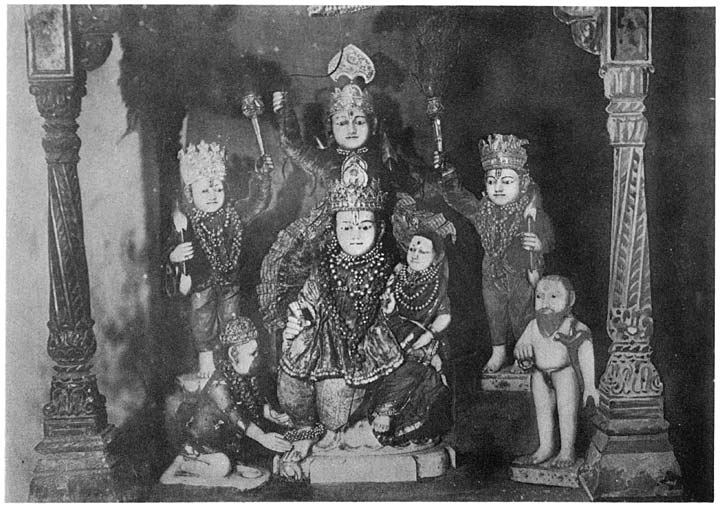
The god Rāma, an incarnation of Vishnu, with attendant deities
70. Marriage.
The transfer of the reckoning of kinship and descent from the mother’s to the father’s side may perhaps be associated with the full recognition of the physical fact of paternity. Though they may not have been contemporaneous in all or even the majority of societies, it would seem that the former was in most cases the logical outcome of the latter, regard being had also to the man’s natural function as protector of the family and provider of its sustenance. But this transition from female to male kinship was a social revolution of the first importance. Under the system of female descent there had been generally no transfer of clanship; both the woman and her partner or husband retained their own clans, and the children belonged to their mother’s clan. In the totemic stage of society the totem-clan was the vital organism, and the individual scarcely realised his own separate existence, but regarded himself as a member of his totem-clan, being a piece or fraction of a common life which extended through all the members of the clan and all the totem animals of the species. They may have thought also that each species of animals and plants had a different kind of life, and consequently also each clan whose life was derived from, and linked to, that of its totem-species. For the name, and life, and qualities, and flesh and blood were not separate conceptions, but only one conception; and since the name and qualities were part of the life, the life of one species could not be the same as that of another, and every species which had a separate name must have been thought to have a different kind of life. Nor would man have been regarded as a distinct species in the early totem-stage, and there would be no word for man; but each totem-clan would regard itself as having the same life as its totem-species. With the introduction of the system of male kinship came also the practice of transferring a woman from her own clan to that of her husband. It may be suggested that this was the origin of the social institution of marriage. Primitive society had no provision for such a procedure, which was opposed to its one fundamental idea of its own constitution, and involved a change of the life and personality of the woman transferred.
71. Marriage by capture.
The view seems to have been long held that this transfer could only be effected by violence or capture, the manner in which presumably it was first practised. Marriage by capture is very widely prevalent among savage races, as shown by Mr. M’Lennan in Primitive Marriage, and by Dr. Westermarck in The History of Human Marriage. Where the custom has given place to more peaceable methods of procuring a wife, survivals commonly occur. In Bastar the regular capture of the girl is still sometimes carried out, though the business is usually arranged by the couple beforehand, and the same is the case among the Kolāms of Wardha. A regular part of the marriage procedure among the Gonds and other tribes is that the bride should weep formally for some hours, or a day before the wedding, and she is sometimes taught to cry in the proper note. At the wedding the bride hides somewhere and has to be found or carried off by the bridegroom or his brother. This ritualistic display of grief and coyness appears to be of considerable interest. It cannot be explained by the girl’s reluctance to marriage as involving the loss of her virginity, inasmuch as she is still frequently not a virgin at her wedding, and to judge from the analogy of other tribes, could seldom or never have been one a few generations back. Nor is affection for her family or grief at the approaching separation from them a satisfactory motive. This would not account for the hiding at all, and not properly for the weeping, since she will after all only live a few miles away and will often return home; and sometimes she does not only weep at her own house but at all the houses of the village. The suggestion may be made that the procedure really indicates the girl’s reluctance to be severed from her own clan and transferred to another; and that the sentiment is a survival of the resistance to marriage by capture which was at first imposed on the women by the men from loyalty to the clan totem and its common life, and had nothing to do with the conjugal relationship of marriage. But out of this feeling the sexual modesty of women, which had been non-existent in the matriarchal condition of society, was perhaps gradually developed. The Chamārs of Bilāspur have sham fights on the approach of the wedding party, and in most Hindu castes the bridegroom on his arrival performs some militant action, such as striking the marriage-shed or breaking one of its festoons. After the marriage the bride is nearly always sent home with the bridegroom’s party for a few days, even though she may be a child and the consummation of the marriage impossible. This may be in memory of her having formerly been carried off, and some analogous significance may attach to our honeymoon. When the custom of capture had died down it was succeeded by the milder form of elopement, or the bride was sold or exchanged against a girl from the bridegroom’s family or clan, but there is usually a relic of a formal transfer, such as the Hindu Kanyadān or gift of the virgin, the Roman Traditio in manum or her transfer from her father’s to her husband’s power, and the giving away of the bride.
72. Transfer of the bride to her husband’s clan.
73. The exogamous clan with male descent and the village.
Thus among the cultivating castes apparently each exogamous clan consisted originally of the residents of one village, though they afterwards spread to a number of villages. The servile labouring castes may also have arranged their clans by villages as the primitive forest-tribes did. How the menial castes formed exogamous clans is not altogether clear, as the numbers in one village would be only small. But it may be supposed that as they gradually increased, clans came into existence either in one large village or a number of adjacent ones, and sometimes traced their descent from a single family or from an ancestor with a nickname. As a rule, the artisan castes do not appear to have formed villages of their own in India, as they did in Russia, though this may occasionally have happened. When among the cultivating castes the lands were divided, separate joint families would be constituted; the head only of each family would be its representative in the clan, as he would hold the share of the village land assigned to the family, which was their joint means of subsistence, and the family would live in one household. Thus perhaps the Hindu joint family came into existence as a subdivision of the exogamous clan with male descent, on which its constitution was modelled. In Chhattīsgarh families still live together in large enclosures with separate huts for the married couples. A human ancestor gradually took the place of the totem as the giver of life to the clan. The members thought themselves bound together by the tie of his blood which flowed through all their veins, and frequently, as in Athens, Rome and Scotland, every member of the clan bore his name. In this capacity, as the source of the clan’s life, the original ancestor was perhaps venerated, and on the development of the family system within the clan, the ancestors of the family were held in a similar regard, and the feeling extended to the living ancestor or father, who is treated with the greatest deference in the early patriarchal family. Even now Hindu boys, though they may be better educated and more intelligent than their father, will not as a rule address him at meals unless he speaks to them first, on account of their traditional respect for him. The regard for the father may be strengthened by his position as the stay and support of the family, but could scarcely have arisen solely from this cause.
74. The large exogamous clans of the Brāhmans and Rājpūts. The Sapindas, the gens and the γένος.
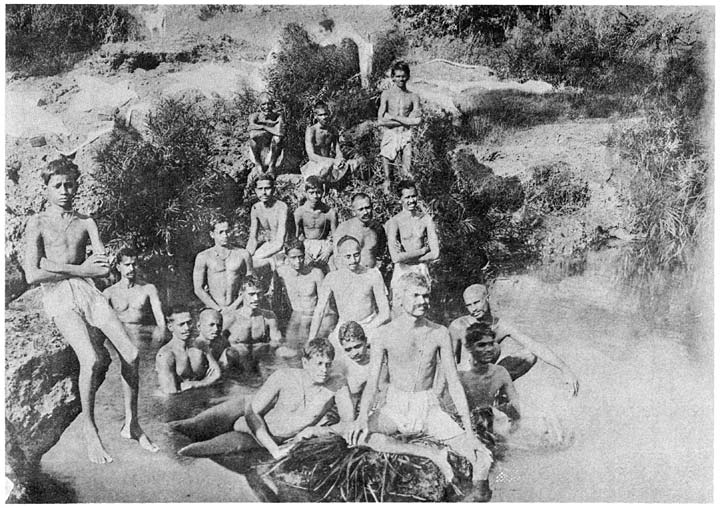
Hindu bathing party
75. Comparison of Hindu society with that of Greece and Rome. The gens.
76. The clients.
77. The plebeians.
This position corresponds exactly with that of the Sūdras and the existing impure castes, who have to live outside the village and cannot enter or even approach Hindu temples.
M. de Coulanges considers that the plebeians were to a large extent made up of conquered and subjected peoples. An asylum was also established at Rome for broken men and outlaws from other cities, with a view to increasing the population and strength of the state. Subsequently the class of clients became absorbed among the plebeians.
78. The binding social tie in the city-states.
79. The Suovetaurilia.
The Roman city sacrifice of the Suovetaurilia, as described by M. de Coulanges, is of the greatest interest. The magistrate whose duty it was to accomplish it, that is in the first place the king, after him the consul, and after him the censor, had first to take the auspices and ascertain that the gods were favourable. Then he summoned the people through a herald by a consecrated form of words. On the appointed day all the citizens assembled outside the walls; and while they stood silent the magistrate proceeded three times round the assembly, driving before him three victims—a pig, a ram and a bull. The combination of these three victims constituted with the Greeks as well as the Romans an expiatory sacrifice. Priests and attendants followed the procession: when the third round had been accomplished, the magistrate pronounced a prayer and slaughtered the victims. From this moment all sins were expiated, and neglect of religious duties effaced, and the city was at peace with its gods.
80. The sacrifice of the domestic animal.
81. Sacrifices of the gens and phratry.
82. The Hindu caste-feasts.
83. Taking food at initiation.
When an outsider is admitted to the caste the rite is usually connected with food. A man who is to be admitted to the Dahāit caste must clean his house, break his earthen cooking-vessels and buy new ones, and give a feast to the caste-fellows in his house. He sits and takes food with them, and when the meal is over he takes a grain of rice from the leaf-plate of each guest and eats it, and drinks a drop of water from his leaf-cup. After this he cannot be readmitted to his own caste. A new Mehtar or sweeper gives water to and takes bread from each casteman. In Mandla a new convert to the Panka caste vacates his house and the caste panchāyat or committee go and live in it, in order to purify it. He gives them a feast inside the house, while he himself stays outside. Finally he is permitted to eat with the panchāyat in his own house in order to mark his admission into the caste. A candidate for admission in the Mahli caste has to eat a little of the leavings of the food of each of the castemen at a feast. The community of robbers known as Badhak or Baoria formerly dwelt in the Oudh forests. They were accustomed to take omens from the cry of the jackal, and they may probably have venerated it as representing the spirit of the forest and as a fellow-hunter. They were called jackal-eaters, and it was said that when an outsider was admitted to one of their bands he was given jackal’s flesh to eat.
Again, the rite of initiation or investiture with the sacred thread appears to be the occasion of the admission of a boy to the caste community. Before this he is not really a member of the caste and may eat any kind of food. The initiation is called by the Brāhmans the second birth, and appears to be the birth of the soul or spirit. After it the boy will eat the sacrificial food at the caste feasts and be united with the members of the caste and their god. The bodies of children who have not been initiated are buried and not burnt. The reason seems to be that their spirits will not go to the god nor be united with the ancestors, but will be born again. Formerly such children were often buried in the house or courtyard so that their spirits might be born again in the same family. The lower castes sometimes consider the rite of ear-piercing as the initiation and sometimes marriage. Among the Panwār Rājpūts a child is initiated when about two years old by being given cooked rice and milk to eat. The initiation cannot for some reason be performed by the natural father, but must be done by a guru or spiritual father, who should thereafter be regarded with a reverence equal to or even exceeding that paid to the natural father.
84. Penalty feasts.
85. Sanctity of grain-food.
86. The corn-sprit.
87. The king.
88. Other instances of the common meal as a sacrificial rite.
Similarly, Guru Govind Singh instituted a prasād or communion among the Sikhs, in which cakes of flour, butter and sugar are made and consecrated with certain ceremonies while the communicants sit round in prayer, and are then distributed equally to all the faithful present, to whatever caste they may belong. At a Guru-Māta or great council of the Sikhs, which was held at any great crisis in the affairs of the state, these cakes were laid before the Sikh scriptures and then eaten by all present, who swore on the scriptures to forget their internal dissensions and be united. Among the Rājpūts the test of legitimacy of a member of the chief’s family was held to depend on whether he had eaten of the chief’s food. The rice cooked at the temple of Jagannāth in Orissa may be eaten there by all castes together, and, when partaken of by two men together, is held to establish a bond of indissoluble friendship between them.
89. Funeral feasts.
90. The Hindu deities and the sacrificial meal.
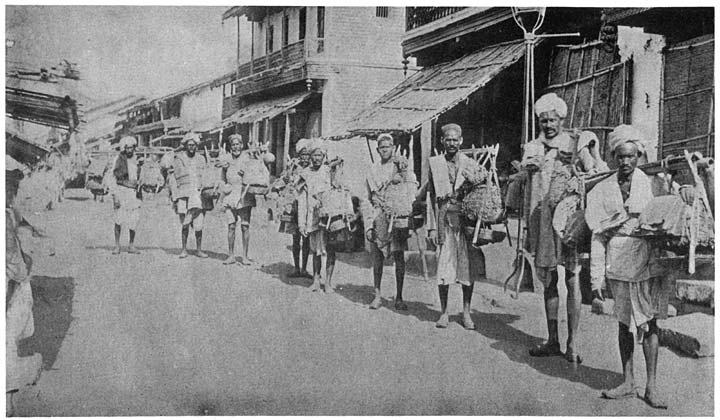
Pilgrims carrying Ganges water
91. Development of the occupational caste from the tribe.
92. Veneration of the caste implements.
93. The caste panchāyat and its code of offences.
94. The status of impurity.
95. Caste and Hinduism.
In The Religions of India M. Barth defined a Hindu as a man who has a caste: ‘The man who is a member of a caste is a Hindu; he who is not, is not a Hindu.’ His definition remains perhaps the best. There is practically no dogma which is essential to Hinduism, nor is the veneration of any deity or sacred object either necessary or heretical. As has often been pointed out, there is no assembly more catholic or less exclusive than the Hindu pantheon. Another writer has said that the three essentials of a Hindu are to be a member of a caste, to venerate Brāhmans, and to hold the cow sacred. Of the latter two, the veneration of Brāhmans cannot be considered indispensable; for there are several sects, as the Lingāyats, the Bishnois, the Mānbhaos, the Kabīrpanthis and others, who expressly disclaim any veneration for Brāhmans, and, in theory at least, make no use of their services; and yet the members of these sects are by common consent acknowledged as Hindus. The sanctity of the bull and cow is a more nearly universal dogma, and extends practically to all Hindus, except the impure castes. These latter should not correctly be classed as Hindus; the very origin of their status is, as has been seen, the belief that they are the worshippers of gods hostile to Hinduism. But still they must now practically be accounted as Hindus. They worship the Hindu gods, standing at a distance when they are not allowed to enter the temples, perform their ceremonies by Hindu rites, and employ Brāhmans for fixing auspicious days, writing the marriage invitation and other business, which the Brāhman is willing to do for a consideration, so long as he does not have to enter their houses. Some of the impure castes eat beef, while others have abandoned it in order to improve their social position. At the other end of the scale are many well-educated Hindu gentlemen who have no objection to eat beef and may often have done so in England, though in India they may abstain out of deference to the prejudices of their relatives, especially the women. And Hindus of all castes are beginning to sell worn-out cattle to the butchers for slaughter without scruple—an offence which fifty years ago would have entailed permanent expulsion from caste. The reverence for the cow is thus not an absolutely essential dogma of Hinduism, though it is the nearest approach to one. As a definition or test of Hinduism it is, however, obviously inadequate. Caste, on the other hand, regulates the whole of a Hindu’s life, his social position and, usually, his occupation. It is the only tribunal which punishes religious and social offences, and when a man is out of caste he has, for so long as this condition continues, no place in Hinduism. Theoretically he cannot eat with any other Hindu nor marry his child to any Hindu. If he dies out of caste the caste-men will not bury or burn his body, which is regarded as impure. The binding tie of caste is, according to the argument given above, the communal meal or feast of grain cooked with water, and this, it would therefore seem, may correctly be termed the chief religious function of Hinduism. Caste also obtains among the Jains and Sikhs, but Sikhism is really little more than a Hindu sect, while the Jains, who are nearly all Banias, scarcely differ from Vaishnava Hindu Banias, and have accepted caste, though it is not in accordance with the real tenets of their religion. The lower industrial classes of Muhammadans have also formed castes in imitation of the Hindus. Many of these are however the descendants of converted Hindus, and nearly all of them have a number of Hindu practices.
96. The Hindu reformers.
There have not been wanting reformers in Hinduism, and the ultimate object of their preaching seems to have been the abolition of the caste system. The totem-clans, perhaps, supposed that each species of animals and plants which they distinguished had a different kind of life, the qualities of each species being considered as part of its life. This belief may have been the original basis of the idea of difference of blood arising from nobility of lineage or descent, and it may also have been that from which the theory of caste distinctions was derived. Though the sacrificial food of each caste is the same, yet its members may have held themselves to be partaking of a different sacrificial feast and absorbing a different life; just as the sacrificial feasts and the gods of the different Greek and Latin city-states were held to be distinct and hostile, and a citizen of one state could not join in the sacrificial feast of another, though the gods and sacrificial animals might be as a matter of fact the same. And the earth-goddess of each village was a separate form or part of the goddess, so that her land should only be tilled by the descendants of the cultivators who were in communion with her. The severe caste penalties attached to getting vermin in a wound, involving a long period of complete ostracism and the most elaborate ceremonies of purification, may perhaps be explained by the idea that the man so afflicted has in his body an alien and hostile life which is incompatible with his forming part of the common life of the caste or subcaste. The leading feature of the doctrines of the Hindu reformers has been that there is only one kind of life, which extends through the whole of creation and is all equally precious. Everything that lives has a spark of the divine life and hence should not be destroyed. The belief did not extend to vegetable life, perhaps because the true nature of the latter was by then partly realised, while if the consumption of vegetable life had been prohibited the sect could not have existed. The above doctrine will be recognised as a comparatively simple and natural expansion of the beliefs that animals have self-conscious volitional life and that each species of animals consists of one common life distributed through its members. If the true nature of individual animals and plants had been recognised from the beginning, it is difficult to see how the idea of one universal life running through them all could have been conceived and have obtained so large a degree of acceptance. As the effect of such a doctrine was that all men were of the same blood and life, its necessary consequence was the negation of caste distinctions. The transmigration of souls followed as a moral rule apportioning reward and punishment for the actions of men. The soul passed through a cycle of lives, and the location or body of its next life, whether an animal of varying importance or meanness, or a human being in different classes of society, was determined by its good or evil actions in previous lives. Finally, those souls which had been purified of all the gross qualities appertaining to the body were released from the cycle of existence and reabsorbed into the divine centre or focus of life. In the case of the Buddhists and Jains the divine centre of life seems to have been conceived of impersonally. The leading authorities on Buddhism state that its founder’s doctrine was pure atheism, but one may suggest that the view seems somewhat improbable in the case of a religion promulgated at so early a period. And on such a hypothesis it is difficult to understand either the stress laid on the escape from life as the highest aim or the sanctity held to attach to all kinds of animal life. But these doctrines follow naturally on the belief in a divine centre or focus of life from which all life emanates for a time, to be ultimately reabsorbed. The Vaishnava reformers, who arose subsequently, took the sun or the spirit of the sun as the divine source of all life. They also preached the sanctity of animal life, the transmigration of souls, and the final absorption of the purified soul into the divine centre of life. The abolition of caste was generally a leading feature of their doctrine and may have been its principal social aim. The survival of the individual soul was not a tenet of the earlier reformers, though the later ones adopted it, perhaps in response to the growing perception of individuality. But even now it is doubtful how far the separate existence of the individual soul after it has finally left the world is a religious dogma of the Hindus. The basis of Hindu asceticism is the necessity of completely freeing the soul or spirit from all the appetites and passions of the body before it can be reabsorbed into the god. Those who have so mortified the body that the life merely subsists in it, almost unwillingly as it were, and absolutely unaffected by human desires or affections or worldly events, have rendered their individual spark of life capable of being at once absorbed into the divine life and equal in merit to it, while still on earth. Thus Hindu ascetics in the last or perfect stage say, ‘I am God,’ or ‘I am Siva,’ and are revered by their disciples and the people as divine. Both the Buddhists and Jains lay the same stress on the value of asceticism as enabling the soul to attain perfection through complete detachment from the appetites and passions of the body and the cares of the world; and the deduction therefore seems warranted that the end of the perfect soul would be a similar reabsorption in the divine soul.
97. Decline of the caste system.
The caste system has maintained its vigour unimpaired either by the political vicissitudes and foreign invasions of India or by Muhammadan persecution. Except where it has been affected by European education and inventions, Hindu society preserved until recently a remarkably close resemblance to that of ancient Greece and Rome in the classical period. But several signs point to the conclusion that the decay of caste as the governing factor of Indian society is in sight. The freedom in selection of occupation which now obtains appears to strike at the root of the caste system, because the relative social status and gradation of castes is based on their traditional occupations. When in a large number of the principal castes the majority of the members have abandoned their traditional occupation and taken freely to others, the relative status of castes becomes a fiction, which, though it has hitherto subsisted, cannot apparently be indefinitely maintained. The great extension of education undertaken by Government and warmly advocated by the best Indian opinion exercises an analogous influence. Education is free to all, and, similarly, in the careers which it opens to the most successful boys there is no account of caste. Thus members of quite low castes obtain a good social position and, as regards them personally, the prejudices and contempt for their caste necessarily fall into abeyance. The process must, probably, in time extend to general social toleration. The educated classes are also coming to regard the restrictions on food and drink, and on eating and drinking with others, as an irksome and unnecessary bar to social intercourse, and are gradually abandoning them. This tendency is greatly strengthened by the example and social contact of Europeans. Finally, the facilities for travelling and the democratic nature of modern travel have a very powerful effect. The great majority of Hindus of all castes are obliged by their comparative poverty to avail themselves of the cheap third-class fares, and have to rub shoulders together in packed railway carriages. Soon they begin to realise that this does them no harm, and get accustomed to it, with the result that the prejudices about bodily contact tend to disappear. The opinion has been given that the decline of social exclusiveness in England was largely due to the introduction of railway travelling. Taking account of all these influences, and assuming their continuance, the inference may safely be drawn that the life of the Indian caste system is limited, though no attempt can be made to estimate the degree of its vitality, nor to predict the form and constitution of the society which will arise on its decay.