Volume 1 — CONTENTS VOLUME 1
Reading edition
PAGE
ANTECEDENTS1
CHILDHOOD43
BOYHOOD170
LYNCOMBE247
SOUTHGATE297
OXFORD LIFE 402
LIST OF ILLUSTRATIONS VOL. I
The illustrations may be viewed enlarged by clicking on them. In order to ease the flow of reading, some of the illustrations have been moved to before or after the paragraph in which they appeared in the book. (note of etext transcriber)
GEORGIANA, MRS. HARE NAYLOR. (Photogravure)Frontispiece
PAGE
HURSTMONCEAUX CASTLE. (Full-page woodcut)To face 4
GLAMIS CASTLE22
AUGUSTUS J. C. HARE WITH LUCIA CECINELLI. (Photogravure)To face 50
HURSTMONCEAUX RECTORY55
LIME58
FRANCIS G. HARE. (Photogravure) To face 84
HURSTMONCEAUX CASTLE93
THE DRAWING-ROOM AT LIME101
RUIN IN THE PALACE GARDEN, NORWICH117
THE CHAPEL DOOR, NORWICH119
STOKE RECTORY—THE APPROACH126
REV. O. LEYCESTER. (Photogravure)To face 128
PETSEY132
STOKE CHURCH136
STOKE RECTORY—THE GARDEN SIDE141
HURSTMONCEAUX165
THE VESTRY, HURSTMONCEAUX188
LEWES195
AUGUSTUS J. C. HARE. From S. Lawrence. (Photogravure) To face 202
REV. O. LEYCESTER'S GRAVE, STOKE CHURCHYARD208
EDWARD STANLEY, BISHOP OF NORWICH. (Photogravure)To face 232
THE TOWER AT ROCKEND, TORQUAY252
WILMINGTON PRIORY257
FLOWERS GREEN, HURSTMONCEAUX259
THE RYE GATE, WINCHELSEA290
IN ST. HELEN'S, BISHOPSGATE336
LE TOMBEAU NAPOLEON349
CANON STANLEY'S HOUSE, CANTERBURY358
SITE OF BECKET'S SHRINE, CANTERBURY361
STEPS AT LIME367
LIME, THE APPROACH410
ARCHDEACON HARE'S STUDY, HURSTMONCEAUX RECTORY466
JULIUS C. HARE. From Richmond. (Photogravure)To face 468
HURSTMONCEAUX CHURCH483
LIME, FROM THE GARDEN491
ALFRISTON506
I ANTECEDENTS
"Time doth consecrate; And what is grey with age becomes religion."—SCHILLER.
"I hope I may be able to tell the truth always, and to see it aright, according to the eyes which God Almighty gives me."—THACKERAY.
IN 1727, the year of George the First's death, Miss Grace Naylor of Hurstmonceaux, though she was beloved, charming, and beautiful, died very mysteriously in her twenty-first year, in the immense and weird old castle of which she had been the heiress. She was affirmed to have been starved by her former governess, who lived alone with her, but the fact was never proved. Her property passed to her first cousin Francis Hare (son of her aunt Bethaia), who forthwith assumed the name of Naylor.
The new owner of Hurstmonceaux was the only child of the first marriage of that Francis Hare, who, through the influence first of the Duke of Marlborough (by whose side, then a chaplain, he had ridden on the battle-fields of Blenheim and Ramilies), and afterwards of his family connections the Pelhams and Walpoles, rose to become one of the richest and most popular pluralists of his age. Yet he had to be contented at last with the bishoprics of St. Asaph and Chichester, with each of which he held the Deanery of St. Paul's, the Archbishopric of Canterbury having twice just escaped him.
The Bishop's eldest son Francis was "un facheux détail de notre famille," as the grandfather of Madame de Maintenon said of his son. He died after a life of the wildest dissipation, without leaving any children by his wife Carlotta Alston, who was his stepmother's sister. So the property of Hurstmonceaux went to his half-brother Robert, son of the Bishop's second marriage with Mary-Margaret Alston, heiress of the Vatche in Buckinghamshire, and of several other places besides. Sir Robert Walpole had been the godfather of Robert Hare-Naylor, and presented him with a valuable sinecure office as a christening present, and he further made the Bishop urge the Church as the profession in which father and godfather could best aid the boy's advancement. Accordingly Robert took orders, obtained a living, and was made a Canon of Winchester. While he was still very young, his father had further secured his fortunes by marrying him to the heiress who lived nearest to his mother's property of the Vatche, and, by the beautiful Sarah Selman (daughter of the owner of Chalfont St. Peter's, and sister of Mrs. Lefevre), he had two sons—Francis and Robert, and an only daughter Anna Maria, afterwards Mrs. Bulkeley. In the zenith of her youth and loveliness, however, Sarah Hare died very suddenly from eating ices when overheated at a ball, and soon afterwards Robert married a second wife—the rich Henrietta Henckel, who pulled down Hurstmonceaux Castle. She did this because she was jealous of the sons of her predecessor, and wished to build a large new house, which she persuaded her husband to settle upon her own children, who were numerous, though only two daughters lived to any great age. But she was justly punished, for when Robert Hare died, it was discovered that the great house which Wyatt had built for Mrs. Hare, and which is now known as Hurstmonceaux Place, was erected upon entailed land, so that the house stripped of furniture, and the property shorn of its most valuable farms, passed to Francis Hare-Naylor, son of Miss Selman. Mrs. Henckel Hare lived on to a great age, and when "the burden of her years came on her" she repented of her avarice and injustice, and coming back to Hurstmonceaux in childish senility, would wander round and round the castle ruins in the early morning and late evening, wringing her hands and saying—"Who could have done such a wicked thing: oh! who could have done such a wicked thing, as to pull down this beautiful old place?" Then her daughters, Caroline and Marianne, walking beside her, would say—"Oh dear mamma, it was you who did it, it was you yourself who did it, you know"—and she would despairingly resume—"Oh no, that is impossible: it could not have been me. I could not have done such a wicked thing: it could not have been me that did it." My cousin Marcus Hare had at Abbots Kerswell a picture of Mrs. Henckel Hare, which was always surrounded with crape bows.
HURSTMONCEAUX CASTLE.
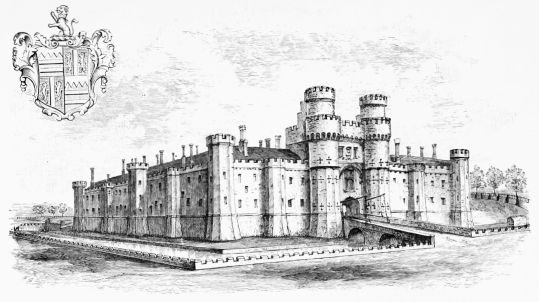
The second Francis Hare-Naylor and his brother Robert had a most unhappy home in their boyhood. Their stepmother ruled their weak-minded father with a rod of iron. She ostentatiously burnt the portrait of their beautiful mother. Every year she sold a farm from his paternal inheritance and spent the money in extravagance. In 1784 she parted with the ancient property of Hos Tendis, at Sculthorpe in Norfolk, though its sale was a deathblow to the Bishop's aged widow, Mary-Margaret Alston. Yet, while accumulating riches for herself, she prevented her husband from allowing his unfortunate elder sons more than £100 a year apiece. With this income, Robert, the younger of the two, was sent to Oriel College at Oxford, and when he unavoidably incurred debts there, the money for their repayment was stopped even from his humble pittance.
Goaded to fury by his stepmother, the eldest son, Francis, became reckless and recklessly extravagant. He raised money at an enormous rate of interest upon his prospects from the Hurstmonceaux estates, and he would have been utterly ruined, morally as well as outwardly, if he had not fallen in with Georgiana, Duchess of Devonshire, who was captivated by his good looks, charmed by his boldness and wit, and who made him the hero of a living romance. By the Duchess he was introduced to her cousin, another even more beautiful Georgiana, daughter of Jonathan Shipley, Bishop of St. Asaph, and his wife Anna Maria Mordaunt, niece of the famous Earl of Peterborough; and though Bishop Shipley did everything he could to separate them, meetings were perpetually connived at by the Duchess, till eventually the pair eloped in 1785. The families on both sides renounced them with fury. The Canon of Winchester never saw his son again, and I believe that Bishop Shipley never saw his daughter. Our grandparents went to Carlsruhe, and then to Italy, where in those days it was quite possible to live upon the £200 a year which was allowed them by the Duchess of Devonshire, and where their four sons—Francis, Augustus, Julius, and Marcus—were born.
The story of Mrs. Hare-Naylor's struggling life in Italy is told in "Memorials of a Quiet Life," and how, when the Canon of Winchester died, and she hurried home with her husband to take possession of Hurstmonceaux Place, she brought only her little Augustus with her, placing him under the care of her eldest sister Anna Maria, widow of the celebrated Sir William Jones, whom he ever afterwards regarded as a second mother.
The choice of guardians which Mrs. Hare-Naylor made for the children whom she left at Bologna would be deemed a very strange one by many: but gifted, beautiful, and accomplished, our grandmother was never accustomed either to seek or to take advice: she always acted upon her own impulses, guided by her own observation. An aged Spanish Jesuit was living in Bologna, who, when his order was suppressed in Spain, had come to reside in Italy upon his little pension, and, being skilled in languages, particularly in Greek, had taken great pains to revive the love of it in Bologna. Amongst his pupils were two brothers named Tambroni, one of whom, discouraged by the difficulties he met with, complained to his sister Clotilda, who, by way of assisting him, volunteered to learn the same lessons. The old Jesuit was delighted with the girl, and spared no pains to make her a proficient. Female professors were not unknown in Bologna, and in process of time Clotilda Tambroni succeeded to the chair of the Professor of Greek, once occupied by the famous Laura Bassi, whom she was rendered worthy to succeed by her beauty as well as by her acquirements. The compositions of Clotilda Tambroni both in Greek and Italian were published, and universally admired; her poems surprised every one by their fire and genius, and her public orations were considered unrivalled in her age. Adored by all, her reputation was always unblemished. When the French became masters of Bologna, the University was suppressed, and to avoid insult and danger, Clotilda Tambroni retired into private life and lived in great seclusion. Some time after, she received an appointment in Spain, but, just as she arrived there, accompanied by her monk-preceptor Dom Emmanuele Aponte, the French had overturned everything. The pair returned to Bologna, where Aponte would have been in the greatest distress, if his grateful pupil had not insisted upon receiving him into her own house, and not only maintained him, but devoted herself as a daughter to his wants. After the Austrians had re-established the University on the old system, Clotilda Tambroni was invited to resume her chair, but as her health and spirits were then quite broken, she declined accepting it, upon which the Government very handsomely settled a small pension upon her, sufficient to ensure her the comforts of life.
With Clotilda Tambroni and her aged friend, our grandmother Mrs. Hare-Naylor, who wrote and spoke Greek as perfectly as her native language, and who taught her children to converse in it at the family repasts, naturally found more congenial companionship than with any other members of the Bolognese society; and, when she was recalled with her husband to England, she had no hesitation in intrusting three of her sons to their care. Julius and Marcus were then only very beautiful and engaging little children, but Francis, my father, was already eleven years old, and a boy of extraordinary acquirements, in whom an almost unnatural amount of learning had been implanted and fostered by his gifted mother. The strange life which he then led at Bologna with the old monk and the beautiful sibyl (for such she is represented in her portrait) who attended him, only served to ripen the seed which had been sown already, and the great Mezzofanti, who was charmed at seeing a repetition of his own marvellous powers in one so young, voluntarily took him as a pupil and devoted much of his time to him. To the year which Francis Hare passed with Clotilda Tambroni at Bologna, in her humble rooms with their tiled floors and scanty furniture, he always felt that he owed that intense love of learning for learning's sake which was the leading characteristic of his after life, and he always looked back upon the Tambroni as the person to whom, next to his mother, he was most deeply indebted. When he rejoined his parents at Hurstmonceaux, he continued, under his new tutor, Dr. Lehmann, to make such amazing progress as astonished all who knew him and was an intense delight to his mother.
Hurstmonceaux Place was then, and is still, a large but ugly house. It forms a massy square, with projecting circular bows at the corners, the appearance of which (due to Wyatt) produces a frightful effect outside, but is exceedingly comfortable within. The staircase, the floors, and the handsome doors, were brought from the castle. The west side of the house, decorated with some Ionic columns, is part of an older manor-house, which existed before the castle was dismantled. In this part of the building is a small old panelled hall, hung round with stags' horns from the ancient deer-park. The house is surrounded by spacious pleasure-grounds. Facing the east front were, till a few years ago, three very fine trees, a cedar, a tulip-tree, and a huge silver fir. In my childhood it often used to be a question which of these trees should be removed, as they were crowding and spoiling each other, and it ended in their all being left, as no one could decide which was the least valuable of the three. The wind has since that time carried away the cedar. The tulip-tree was planted by our great-aunt Marianne, daughter of Mrs. Henckel Hare, and I remember that my uncle Julius used to say that its gay flowers were typical of her and her dress.
For several years our grandparents carried on a most laborious contest of dignity with poverty on their ruined estate of Hurstmonceaux, where their only daughter Anna Maria Clementina was born in 1799. Finding no congenial associates in the neighbourhood, Mrs. Hare-Naylor consoled herself by keeping up an animated correspondence with all the learned men of Europe, while her husband wrote dull plays and duller histories, which have all been published, but which few people read then and nobody reads now. The long-confirmed habits of Italian life, with its peculiar hours and utter disregard of appearances, were continued in Sussex; and it is still remembered at Hurstmonceaux how our grandmother rode on an ass to drink at the mineral springs which abound in the park, how she always wore white, and how a beautiful white doe always accompanied her in her walks, and even to church, standing, during the service, at her pew door.
Upon the return of Lehmann to Germany in 1802, Francis Hare was sent to the tutorship of Dr. Brown, an eminent professor in Marischal College at Aberdeen, where he remained for two years, working with the utmost enthusiasm. He seems to have shrunk at this time from any friendships with boys of his own age, except with Harry Temple (afterwards celebrated as Lord Palmerston), who had been his earliest acquaintance in England, and with whom he long continued to be intimate. Meanwhile his mother formed the design of leaving to her children a perfect series of large finished water-colour drawings, representing all the different parts of Hurstmonceaux Castle, interior as well as exterior, before its destruction. She never relaxed her labour and care till the whole were finished, but the minute application, for so long a period, seriously affected her health and produced disease of the optic nerve, which ended in total blindness. She removed to Weimar, where the friendship of the Grand Duchess and the society of Goethe, Schiller, and the other learned men who formed the brilliantly intellectual circle of the little court did all that was possible to mitigate her affliction. But her health continued to fail, and her favourite son Francis was summoned to her side, arriving in time to accompany her to Lausanne, where she expired, full of faith, hope, and resignation, on Easter Sunday, 1806.
After his wife's death, Mr. Hare-Naylor could never bear to return to Hurstmonceaux, and sold the remnant of his ancestral estate for £60,000, to the great sorrow of his children. They were almost more distressed, however, by his second marriage to a Mrs. Mealey, a left-handed connection of the Shipley family—the Mrs. Hare-Naylor of my own childhood, who was less and less liked by her stepsons as years went on. She became the mother of three children, Georgiana, Gustavus, and Reginald—my half aunt and uncles. In 1815, Mr. Hare-Naylor died at Tours, and was buried at Hurstmonceaux.
The breaking up of their home, the loss of their beloved mother, and still more their father's second marriage, made the four Hare brothers turn henceforward for all that they sought of sympathy or affection to their Shipley relations. The house of their mother's eldest sister, Lady Jones, was henceforward the only home they knew. Little Anna Hare was adopted by Lady Jones, and lived entirely with her till her early death in 1813: Augustus was educated at her expense and passed his holidays at her house of Worting, her care and anxiety for his welfare proving that she considered him scarcely less her child than Anna; and Francis and Julius looked up to her in everything, and consulted her on all points, finding in her "a second mother, a monitress wise and loving, both in encouragement and reproof."[3] While Augustus was pursuing his education at Winchester and New College, and Marcus was acting as midshipman and lieutenant in various ships on foreign service; and while Julius (who already, during his residence with his mother at Weimar, had imbibed that passion for Germany and German literature which characterised his after life) was carrying off prizes at Tunbridge, the Charter House, and Trinity College, Cambridge; Francis, after his mother's death, was singularly left to his own devices. Mr. Hare-Naylor was too apathetic, and his stepmother did not dare to interfere with him: Lady Jones was bewildered by him. After leaving Aberdeen he studied vigorously, even furiously, with a Mr. Michell at Buckland. From time to time he went abroad, travelling where he pleased and seeing whom he pleased. At the Universities of Leipsic and Göttingen the report which Lehmann gave of his extraordinary abilities procured him an enthusiastic reception, and he soon formed intimacies with the most distinguished professors of both seats of learning. At the little court of Weimar he was adored. Yet the vagaries of his character led him with equal ardour to seek the friendship and share the follies of Count Calotkin, of whom he wrote as "the Lord Chesterfield of the time, who had had more princesses in love with him and perhaps more children on the throne than there are weeks in the year." At twenty, he had not only all the knowledge, but more than all the experiences, of most men of forty. Such training was not a good preparation for his late entrance at an English University. The pupil of Mezzofanti and Lehmann also went to Christ Church at Oxford knowing far too much. He was so far ahead of his companions, and felt such a profound contempt for the learning of Oxford compared with that to which he had been accustomed at the Italian and German universities, that he neglected the Oxford course of study altogether, and did little except hunt whilst he was at college. In spite of this, he was so naturally talented, that he could not help adding, in spite of himself, to his vast store of information. Jackson, Dean of Christ Church in his time, used to say that "Francis Hare was the only rolling stone he knew that ever gathered any moss." That which he did gather was always made the most of for his favourite brother Julius, for whose instruction he was never weary of writing essays, and in whose progress he took the greatest interest and delight. But through all the changes of life the tie between each of the four brothers continued undiminished—"the most brotherly of brothers," their common friend Landor always used to call them.
After leaving Oxford, my father lived principally at his rooms in the Albany. Old Dr. Wellesley[4] used often to tell me stories of these pleasant chambers (the end house in the court), and of the parties which used to meet in them, including all that was most refined and intellectual in the young life of London. For, in his conversational powers, Francis Hare had the reputation of being perfectly unrivalled, and it was thus, not in writing, that his vast amount of information on all possible subjects became known to his contemporaries. In 1811, Lady Jones writes of him "at Stowe" as "keeping all the talk to himself, which does not please the old Marquis much."
Francis Hare sold his father's fine library at Christie's soon after his death, yet almost immediately began to form a new collection of books, which soon surrounded all the walls of his Albany chambers. But his half-sister Mrs. Maurice remembered going to visit him at the Albany, and her surprise at not seeing his books. "Oh, Francis, what have you done with your library?" she exclaimed. "Look under the sofa and you will see it," he replied. She looked, and saw a pile of Sir William Jones's works: he had again sold all the rest. And through life it was always the same. He never could resist collecting valuable books, and then either sold them, or had them packed up, left them behind, and forgot all about them. Three of his collections of books have been sold within my remembrance, one at Newbury in July 1858; one at Florence in the spring of 1859; and one at Sotheby & Wilkinson's rooms in the following November.
Careful as to his personal appearance, Francis Hare was always dressed in the height of the fashion. It is remembered how he would retire and change his dress three times in the course of a single ball! In everything he followed the foibles of the day. "Francis leads a rambling life of pleasure and idleness," wrote his cousin Anna Maria Dashwood; "he must have read, but who can tell at what time?—for wherever there is dissipation, there is Francis in its wake and its most ardent pursuer. Yet, in spite of this, let any subject be named in society, and Francis will know more of it than nineteen out of twenty."
In 1816-17, Francis Hare kept horses and resided much at Melton Mowbray, losing an immense amount of money there. After this time he lived almost entirely upon the Continent. Lord Desart, Lord Bristol and Count d'Orsay were his constant companions and friends, so that it is not to be wondered at that attractions of a less reputable kind enchained him to Florence and Rome. He had, however, a really good friend in John Nicholas Fazakerley, with whom his intimacy was never broken, and in 1814, whilst watching his dying father at Tours, he began a friendship with Walter Savage Landor, with whom he ever afterwards kept up an affectionate correspondence. Other friends of whom he saw much in the next few years were Lady Oxford (then separated from her husband, and living entirely abroad) and her four daughters. In the romantic interference of Lady Oxford in behalf of Caroline Murat, queen of Naples, and in the extraordinary adventures of her daughters, my father took the deepest interest, and he was always ready to help or advise them. On one occasion, when they arrived suddenly in Florence, he gave a ball in their honour, the brilliancy of which I have heard described by the older Florentine residents of my own time. Twice every week, even in his bachelor days, he was accustomed to give large dinner-parties, and he then first acquired that character for hospitality for which he was afterwards famous at Rome and Pisa. Spa was one of the places which attracted him most at this period of his life, and he frequently passed part of the summer there. It was on one of these occasions (1816) that he proceeded to Holland and visited Amsterdam. "I am delighted and disgusted with this mercantile capital," he wrote to his brother Augustus. "Magnificent establishments and penurious economy—ostentatious generosity and niggardly suspicion—constitute the centrifugal and centripetal focus of Holland's mechanism. The rage for roots still continues. The gardener at the Hortus Medicus showed me an Amaryllis (alas! it does not flower till October), for which King Lewis paid one thousand guelders (a guelder is about 2 francs and 2 sous). Here, in the sanctuary of Calvinism, organs are everywhere introduced—though the more orthodox, or puerile, discipline of Scotland has rejected their intrusion. But, in return, the sternness of republican demeanour refuses the outward token of submission—even to Almighty power: a Dutchman always remains in church with his hat unmoved from his head."
The year 1818 was chiefly passed by Francis Hare in Bavaria, where he became very intimate with the King and Prince Eugene. The latter gave him the miniature of himself which I still have at Holmhurst. For the next seven years he was almost entirely in Italy—chiefly at Florence or Pisa. Sometimes Lord Dudley was with him, often he lived for months in the constant society of Count d'Orsay and Lady Blessington. He was fêted and invited everywhere. "On disait de M. Hare," said one who knew him intimately, "non seulement qu'il était original, mais qu'il était original sans copie." "In these years at Florence," said the same person, "there were many ladies who were aspirants for his hand, he was si aimable, pas dans le sens vulgaire, mais il avait tant d'empressement pour tout le sexe feminin." His aunts Lady Jones and her sister Louisa Shipley constantly implored him to return to England and settle there, but in vain: he was too much accustomed to a roving life. Occasionally he wrote for Reviews, but I have never been able to trace the articles. He had an immense correspondence, and his letters were very amusing, when their recipients could read his almost impossible hand. We find Count d'Orsay writing, apropos of a debt which he was paying—"Employez cette somme à prendre un maître d'écriture: si vous saviez quel service vous renderiez à vos amis!"
The English family of which Francis Hare saw most at Florence was that of Lady Paul, who had brought her four daughters to spend several years in Italy, partly for the sake of completing their education, partly to escape with dignity from the discords of a most uncongenial home. To the close of her life Frances Eleanor, first wife of Sir John Dean Paul of Rodborough, was one of those rare individuals who are never seen without being loved, and who never fail to have a good influence over those with whom they are thrown in contact. That she was as attractive as she was good is still shown in a lovely portrait by Sir Thomas Lawrence. Landor adored her, and rejoiced to bring his friend Francis Hare into her society. The daughters were clever, lively and animated; but the mother was the great attraction to the house.
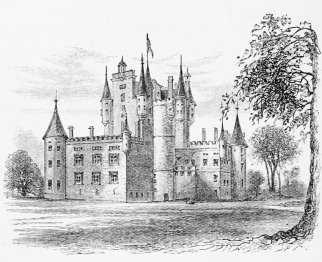
Defoe says that "people who boast of their ancestors are like potatoes, in that their best part is in underground." Still I will explain that Lady Paul was the daughter of John Simpson of Bradley in the county of Durham, and his wife Lady Anne Lyon, second daughter of the 8th Earl of Strathmore, who quartered the royal arms and claimed royal descent from Robert II. king of Scotland, grandson of the famous Robert Bruce: the king's youngest daughter Lady Jane Stuart having married Sir John Lyon, first Baron Kinghorn, and the king's grand-daughter Elizabeth Graham (through Euphemia Stuart, Countess of Strathern) having married his son Sir John Lyon of Glamis. Eight barons and eight earls of Kinghorn and Strathmore (which title was added 1677) lived in Glamis Castle before Lady Anne was born. The family history had been of the most eventful kind. The widow of John, 6th Lord Glamis, was burnt as a witch on the Castle Hill at Edinburgh, for attempting to poison King James V., and her second husband, Archibald Campbell, was dashed to pieces while trying to escape down the rocks which form the foundation of the castle. Her son, the 7th Lord Glamis, was spared, and restored to his honours upon the confession of the accusers of the family that the whole story was a forgery, after it had already cost the lives of two innocent persons. John, 8th Lord Glamis, was killed in a Border fray with the followers of the Earl of Crawford: John, 5th Earl, fell in rebellion at the battle of Sheriffmuir: Charles, 6th Earl, was killed in a quarrel. The haunted castle of Glamis itself, the most picturesque building in Scotland, girdled with quaint pepper-box turrets, is full of the most romantic interest. A winding stair in the thickness of the wall leads to the principal apartments. The weird chamber is still shown in which, as Shakspeare narrates, Duncan, king of Scotland, was murdered by Macbeth, the "thane of Glamis." In the depth of the walls is another chamber more ghastly still, with a secret, transmitted from the fourteenth century, which is always known to three persons. When one of the triumvirate dies, the survivors are compelled by a terrible oath to elect a successor. Every succeeding Lady Strathmore, Fatima-like, has spent her time in tapping at the walls, taking up the boards, and otherwise attempting to discover the secret chamber, but all have failed. One tradition of the place says that "Old Beardie"[5] sits for ever in that chamber playing with dice and drinking punch at a stone table, and that at midnight a second and terrible person joins him.
GLAMIS CASTLE.
More fearful than these traditions were the scenes through which Lady Anne had lived and in which she herself bore a share. Nothing is more extraordinary than the history of her eldest brother's widow, Mary-Eleanor Bowes, 9th Countess of Strathmore, who, in her second marriage with Mr. Stoney, underwent sufferings which have scarcely ever been surpassed, and whose marvellous escapes and adventures are still the subject of a hundred story-books.
The vicissitudes of her eventful life, and her own charm and cleverness, combined to make Lady Anne Simpson one of the most interesting women of her age, and her society was eagerly sought and appreciated. Both her daughters had married young, and in her solitude, she took the eldest daughter of Lady Paul to live with her and brought her up as her own child. In her house, Anne Paul saw all the most remarkable Englishmen of the time. She was provided with the best masters, and in her home life she had generally the companionship of the daughters of her mother's sister Lady Liddell, afterwards Lady Ravensworth, infinitely preferring their companionship to that of her own brothers and sisters. Lady Anne Simpson resided chiefly at a house belonging to Colonel Jolliffe at Merstham in Surrey, where the persons she wished to see could frequently come down to her from London. The royal dukes, sons of George III., constantly visited her in this way, and delighted in the society of the pretty old lady, who had so much to tell, and who always told it in the most interesting way.
It was a severe trial for Anne Paul, when, in her twentieth year (1821), she lost her grandmother, and had to return to her father's house. Not only did the blank left by the affection she had received cause her constant suffering, but the change from being mistress of a considerable house and establishment to becoming an insignificant unit in a large party of brothers and sisters was most disagreeable, and she felt it bitterly.
Very welcome therefore was the change when Lady Paul determined to go abroad with her daughters, and the society of Florence, in which Anne Paul's great musical talents made her a general favourite, was the more delightful from being contrasted with the confinement of Sir John Paul's house over his bank in the Strand. During her Italian travels also, Anne Paul made three friends whose intimacy influenced all her after life. These were our cousin, the clever widowed Anna Maria Dashwood, daughter of Dean Shipley; Walter Savage Landor; and Francis Hare; and the two first united in desiring the same thing—her marriage with the last.
Meantime, two other marriages occupied the attention of the Paul family. One of Lady Paul's objects in coming abroad had been the hope of breaking through an attachment which her third daughter Maria had formed for Charles Bankhead, an exceedingly handsome and fascinating, but penniless young attaché, with whom she had fallen in love at first sight, declaring that nothing should ever induce her to marry any one else. Unfortunately, the first place to which Lady Paul took her daughters was Geneva, and Mr. Bankhead, finding out where they were, came thither (from Frankfort, where he was attaché) dressed in a long cloak and with false hair and beard. In this disguise, he climbed up and looked into a room where Maria Paul was writing, with her face towards the window. She recognised him at once, but thought it was his double, and fainted away. On her recovery, finding her family still inexorable, she one day, when her mother and sisters were out, tried to make away with herself. Her room faced the stairs, and as Prince Lardoria, an old friend of the family, was coming up, she threw open the door and exclaimed—"Je meurs, Prince, je meurs, je me suis empoisonné."—"Oh Miladi, Miladi," screamed the Prince, but Miladi was not there, so he rushed into the kitchen, and seizing a large bottle of oil, dashed upstairs with it, and, throwing Maria Paul upon the ground, poured the contents of it down her throat. After this, Lady Paul looked upon the marriage as inevitable, and sent Maria to England to her aunt Lady Ravensworth, from whose house she was married to Charles Bankhead, neither her mother or sisters being present. Shortly afterwards Mr. Bankhead was appointed minister in Mexico, and his wife, accompanying him thither, remained there for many years, and had many extraordinary adventures, especially during a great earthquake, in which she was saved by her presence of mind in swinging upon a door, while "the cathedral rocked like a wave on the sea" and the town was laid in ruins.
While Maria Paul's marriage was pending, her youngest sister Jane had also become engaged, without the will of her parents, to Edward, only son of the attainted Lord Edward Fitz Gerald, son of the 1st Duke of Leinster. His mother was the famous Pamela,[6] once the beautiful and fascinating little fairy produced at eight years old by the Chevalier de Grave as the companion of Mademoiselle d'Orleans; over whose birth a mystery has always prevailed; whose name Madame de Genlis declared to be Sims, but whom her royal companions called Seymour. To her daughter Jane's engagement Lady Paul rather withheld than refused her consent, and it was hoped that during their travels abroad the intimacy might be broken off. It had begun by Jane Paul, in a ball-room, hearing a peculiarly hearty and ringing laugh from a man she could not see, and in her high spirits imprudently saying—"I will marry the man who can laugh in that way and no one else,"—a remark which was repeated to Edward Fitz Gerald, who insisted upon being immediately introduced. Jane Paul was covered with confusion, but as she was exceedingly pretty, this only added to her attractions, and the adventure led to a proposal, and eventually, through the friendship and intercession of Francis Hare, to a marriage.[7]
Already, in 1826, we find Count d'Orsay writing to Francis Hare in August—"Quel diable vous possede de rester à Florence, sans Pauls, sans rien enfin, excepté un rhume imaginaire pour excuse?" But it was not till the following year that Miss Paul began to believe he was seriously paying court to her. They had long corresponded, and his clever letters are most indescribably eccentric. They became more eccentric still in 1828, when, before making a formal proposal, he expended two sheets in proving to her how hateful the word must always had been and always would be to his nature. She evidently accepted this exordium very amiably, for on receiving her answer, he sent his banker's book to Sir John Paul, begging him to examine and see if, after all his extravagancies, he still possessed at least "fifteen hundred a year, clear of every possible deduction and charge, to spend withal, that is, four pounds a day," and to consider, if the examination proved satisfactory, that he begged to propose for the hand of his eldest daughter! Equally strange was his announcement of his engagement to his brother Augustus at Rome, casually observing, in the midst of antiquarian queries about the temples—"Apropos of columns, I am going to rest my old age on a column. Anne Paul and I are to be married on the 28th of April,"—and proceeding at once, as if he had said nothing unusual—"Have you made acquaintance yet with my excellent friend Luigi Vescovali," &c. At the same time Mrs. Dashwood wrote to Miss Paul that Francis had "too much feeling and principle to marry without feeling that he could make the woman who was sincerely attached to him happy," and that "though he has a great many faults, still, when one considers the sort of wild education he had, that he has been a sort of pet pupil of the famous or infamous Lord Bristol, one feels very certain that he must have a more than commonly large amount of original goodness (not sin, though it is the fashion to say so much on that head) to save him from having many more."
It was just before the marriage that "Victoire" (often afterwards mentioned in these volumes) came to live with Miss Paul. She had lost her parents in childhood, and had been brought up by her grandmother, who, while she was still very young, "pour assurer son avenir," sent her to England to be with Madame Girardôt, who kept a famous shop for ladies' dress in Albemarle Street. Three days after her arrival, Lady Paul came there to ask Madame Girardôt to recommend a maid for her daughter, who was going to be married, and Victoire was suggested, but she begged to remain where she was for some weeks, as she felt so lonely in a strange country, and did not like to leave the young Frenchwomen with whom she was at work. During this time Miss Paul often came to see her, and they became great friends. At last a day was fixed on which Victoire was summoned to the house "seulement pour voir," and then she first saw Lady Paul. Miss Paul insisted that when her mother asked Victoire her age, she should say twenty-two at least, as Lady Paul objected to her having any maid under twenty-eight. "Therefore," said Victoire, "when Miladi asked 'Quelle age avez vous?' j'ai répondu 'Vingt-deux ans, mais je suis devenu toute rouge, oh comme je suis devenu rouge'—et Miladi a répondu avec son doux sourire—'Ah vous n'avez pas l'habitude des mensonges?'—Oh comme cà m'a tellement frappé."[8]
My father was married to Anne Frances Paul at the church in the Strand on the 28th of April 1828. "Oh comme il y avait du monde!" said Victoire, when she described the ceremony to me. A few days afterwards a breakfast was given at the Star and Garter at Richmond, at which all the relations on both sides were present, Maria Leycester, the future bride of Augustus Hare, being also amongst the guests.
Soon after, the newly-married pair left for Holland, where they began the fine collection of old glass for which Mrs. Hare was afterwards almost famous, and then to Dresden and Carlsbad. In the autumn they returned to England, and took a London house—5 Gloucester Place, where my sister Caroline was born in 1829. The house was chiefly furnished by the contents of my father's old rooms at the Albany.
"Victoire" has given many notes of my father's character at this time. "M. Hare était sevère, mais il était juste. Il ne pouvait souffrir la moindre injustice. Il pardonnait une fois—deux fois, et puis il ne pardonnait plus, il faudrait s'en aller; il ne voudrait plus de celui qui l'avait offensé. C'était ainsi avec François, son valet à Gloucester Place, qui l'accompagnait partout et qui avait tout sous la main. Un jour M. Hare me priait, avec cette intonation de courtoisie qu'il avail, que je mettrais son linge dans les tiroirs. 'Mais, très volontiers, monsieur,' j'ai dit. Il avait beaucoup des choses—des chemises, des foulards, de tout. Eh bien! quelques jours après il me dit—'Il me manque quelques foulards—deux foulards de cette espèce'—en tirant une de sa poche, parcequ'il faisait attention à tout. 'Ah, monsieur,' j'ai dit, 'c'est très probable, en sortant peut-être dans la ville.' 'Non,' il me dit, 'ce n'est pas ça—je suis volé, et c'est François qui les a pris, et ça n'est pas la première fois,' ainsi enfin il faut que je le renvoie." It was not till long after that Victoire found out that my father had known for years that François had been robbing him, and yet had retained him in his service. He said that it was always his plan to weigh the good qualities of any of his dependants against their defects. If the defects outweighed the virtues, "il faudrait les renvoyer de suite—si non, il faudrait les laisser aller." When he was in his "colère" he never allowed his wife to come near him—"il avait peur de lui faire aucun mal."
The christening of Caroline was celebrated with great festivities, but it was like a fairy story, in that the old aunt Louisa Shipley, who was expected to make her nephew Francis her heir, then took an offence—something about being godmother, which was never quite got over. The poor little babe itself was very pretty and terribly precocious, and before she was a year old she died of water on the brain. Victoire, who doated upon her, held her in her arms for the last four-and-twenty hours, and there she died. Mrs. Hare was very much blamed for having neglected her child for society, yet, when she was dead, says Victoire, "Madame Hare avait tellement chagrin, que Lady Paul qui venait tous les jours, priait M. Hare de l'ammener tout de suite. Nous sommes allés à Bruxelles, parceque là M. FitzGerald avait une maison,—mais de là, nous sommes retournés bien vite en Angleterre à cause de la grossesse de Madame Hare, parceque M. Hare ne voulut pas que son fils soil né à l'étranger, parcequ'il disait, que, étant le troisième, il perdrait ses droits de l'héritage.[9] C'est selon la loi anglaise—et c'était vraiment temps, car, de suite en arrivant à Londres, François naquit."
The family finally left Gloucester Place and went abroad in consequence of Lady Jones's death. After that they never had a settled home again. When the household in London was broken up, Victoire was to have left. She had long been engaged to be married to Félix Ackermann, who had been a soldier, and was in receipt of a pension for his services in the Moscow campaign. But, when it came to the parting, "Monsieur et Madame" would not let her go, saying that they could not let her travel, until they could find a family to send her with. "It was an excuse," said Victoire, "for I waited two years, and the family was never found. Then I had to consigner all the things, then I could not leave Madame—and so it went on for two years more, till, when the family were at Pisa, Félix insisted that I should come to a decision. Then M. Hare sent for Félix, who had been acting as a courier for some time, and begged him to come to Florence to go with us as a courier to Baden. Félix arrived on the Jeudi Saint. M. Hare came in soon after (it was in my little room) and talked to him as if they were old friends. He brought a bottle of champagne, and poured out glasses for us all, and faisait clinquer les verres. On the Monday we all left for Milan, and there I was married to Félix, and, after the season at Baden, Félix and I were to return to Paris, but when the time came M. Hare would not let us."
"Wherever," said Victoire, "M. Hare était en passage—soit à Florence, soit à Rome, n'importe où, il faudrait toujours des diners, et des fêtes, pour recevoir M. Hare, surtout dans les ambassades, pas seulement dans l'ambassade d'Angleterre, mais dans celles de France, d'Allemagne, etc. Et quand M. Hare ne voyageait plus, et qu'il était établi dans quelque ville, il donnait à son tour des diners à lui."
"Il s'occupait toujours à lire,—pas des romans, mais des anciens livres, dans lesquelles il fouillait toujours. Quand nous voyageons, c'était toujours pour visiter les bibliothèques, ça c'était la première chose, et il emporta énormément des livres dans la voiture avec lui.... Quand il y'avait une personne qui lui avait été recommandée, il fallait toujours lui faire voir tout ce qu'il avait, soit à Rome, soit à Bologne,—et comme il savait un peu de tout, son avis était demandé pour la valeur des tableaux, et n'importe de quoi."
On first going abroad, my father had taken his wife to make acquaintance with his old friends Lady Blessington and Count d'Orsay, with whom they afterwards had frequent meetings. Lady Blessington thus describes to Landor her first impressions of Mrs. Hare:—
"Paris, Feb. 1829.—Among the partial gleams of sunshine which have illumined our winter, a fortnight's sojourn which Francis Hare and his excellent wife made here, is remembered with most pleasure. She is indeed a treasure—well-informed, clever, sensible, well-mannered, kind, lady-like, and, above all, truly feminine; the having chosen such a woman reflects credit and distinction on our friend, and the community with her has had a visible effect on him, as, without losing any of his gaiety, it has become softened down to a more mellow tone, and he appears not only a more happy man, but more deserving of happiness than before."
My second brother, William Robert, was born September 20, 1831, at the Bagni di Lucca, where the family was spending the summer. Mrs. Louisa Shipley meanwhile never ceased to urge their return to England.
"Jan. 25, 1831.—I am glad to hear so good an account of my two little great-nephews, but I should be still more glad to see them. I do hope the next may be a girl. If Francis liked England for the sake of being with old friends, he might live here very comfortably, but if he will live as those who can afford to make a show, for one year of parade in England he must be a banished man for many years. I wish he would be as 'domestic' at home as he is abroad!"
In the summer of 1832 all the family went to Baden-Baden, to meet Lady Paul and her daughter Eleanor, Sir John, the FitzGeralds, and the Bankheads. All the branches of Mrs. Hare's family lived in different houses, but they met daily for dinner, and were very merry. Before the autumn, my father returned to Italy, to the Villa Cittadella near Lucca, which was taken for two months for Mrs. Hare's confinement, and there, on the 9th of October, my sister was born. She received the names of "Anne Frances Maria Louisa." "Do you mean your πολνὡνμος daughter to rival Venus in all her other qualities as well as in the multitude of her names? or has your motive been rather to recommend her to a greater number of patron saints?" wrote my uncle Julius on hearing of her birth. Just before this, Mrs. Shelley (widow of the poet and one of her most intimate friends) had written to Mrs. Hare:—
"Your accounts of your child (Francis) give me very great pleasure. Dear little fellow, what an amusement and delight he must be to you. You do indeed understand a Paradisaical life. Well do I remember the dear Lucca baths, where we spent morning and evening in riding about the country—the most prolific place in the world for all manner of reptiles. Take care of yourself, dearest friend.... Choose Naples for your winter residence. Naples, with its climate, its scenery, its opera, its galleries, its natural and ancient wonders, surpasses every other place in the world. Go thither, and live on the Chiaja. Happy one, how I envy you. Percy is in brilliant health and promises better and better.
"Have you plenty of storms at dear beautiful Lucca? Almost every day when I was there, vast white clouds peeped out from above the hills—rising higher and higher till they overshadowed us, and spent themselves in rain and tempest: the thunder, re-echoed again and again by the hills, is indescribably terrific.... Love me, and return to us—Ah! return to us! for it is all very stupid and unamiable without you. For are not you—
'That cordial drop Heaven in our cup had thrown, To make the nauseous draught of life go down.'"
After a pleasant winter at Naples, my father and his family went to pass the summer of 1833 at Castellamare. "C'était à Castellamare" (says a note by Madame Victoire) "que Madame Hare apprit la mort de Lady Paul. Elle était sur le balcon, quand elle la lut dans le journal. J'étais dans une partie de la maison très éloignée, mais j'ai entendu un cri si fort, si aigu, que je suis arrivée de suite, et je trouvais Madame Hare toute étendue sur le parquet. J'appellais—'Au secours, au secours,' et Félix, qui était très fort, prenait Madame Hare dans ses bras, et l'apportait à mettre sur son lit, et nous l'avons donné tant des choses, mais elle n'est pas revenue, et elle restait pendant deux heures en cet état. Quand M. Hare est entré, il pensait que c'était à cause de sa grossesse. Il s'est agenouillé tout en pleurs à coté de son lit. Il demandait si je lui avais donné des lettres. 'Mais, non, monsieur; je ne l'ai pas donné qu'un journal.' On cherchait longtemps ce journal, parcequ'elle l'avait laissé tomber du balcon, mais quand il était trouvé, monsieur s'est aperçu tout de suite de ce qu'elle avait." The death of Lady Paul was very sudden; her sister Lady Ravensworth first heard of it when calling to inquire at the door in the Strand in her carriage. After expressing her sympathy in the loss of such a mother, Mrs. Louisa Shipley at this time wrote to Mrs. Hare:—
"I will now venture to call your attention to the blessings you possess in your husband and children, and more particularly to the occupation of your thoughts in the education of the latter. They are now at an age when it depends on a mother to lay the foundation of principles which they will carry with them through life. The responsibility is great, and if you feel it such, there cannot be a better means of withdrawing your mind from unavailing sorrow, than the hope of seeing them beloved and respected, and feeling that your own watchfulness of their early years, has, by the blessing of God, caused them to be so. Truth is the cornerstone of all virtues: never let a child think it can deceive you; they are cunning little creatures, and reason before they can speak; secure this, and the chief part of your work is done, and so ends my sermon."
It was in the summer of 1833, following upon her mother's death, that a plan was first arranged by which my aunt Eleanor Paul became an inmate of my father's household—the kind and excellent aunt whose devotion in all times of trouble was afterwards such a blessing to her sister and her children. Neither at first or ever afterwards was the residence of Eleanor Paul any expense in her sister's household: quite the contrary, as she had a handsome allowance from her father, and afterwards inherited a considerable fortune from an aunt.
In the autumn of 1833 my father rented the beautiful Villa Strozzi at Rome, then standing in large gardens of its own facing the grounds of the noble old Villa Negroni, which occupied the slope of the Viminal Hill looking towards the Esquiline. Here on the 13th of March 1834 I was born—the youngest child of the family, and a most unwelcome addition to the population of this troublesome world, as both my father and Mrs. Hare were greatly annoyed at the birth of another child, and beyond measure disgusted that it was another son.
II CHILDHOOD 1834-1843
"Sweete home, where meane estate In safe assurance, without strife or hate, Findes all things needfull for contentment meeke."—SPENSER.
"Is there not in the bosoms of the wisest and best some of the child's heart left to respond to its earliest enchantments?"—C. LAMB.
"I cannot paint to Memory's eye The scene, the glance, I dearest love; Unchanged themselves, in me they die, Or faint, or false, their shadows prove."—KEBLE. "Ce sont là les séjours, les sites, les rivages, Dont mon âme attendrie évoque les images, Et dont, pendant les nuits, mes songes les plus beaux Pour enchanter mes yeux composent leurs tableaux."—LAMARTINE.
MARIA LEYCESTER had been married to my uncle Augustus Hare in June 1829. In their every thought and feeling they were united, and all early associations had combined to fit them more entirely for each other's companionship. A descendant of one of the oldest families in Cheshire, Miss Leycester's childhood and youth had been spent almost entirely in country rectories, but in such rectories as are rarely to be found, and which prove that the utmost intellectual refinement and an interest in all that is remarkable and beautiful in this world are not incompatible with the highest aspirations after a Christian and a heavenly life. Her father, Oswald Leycester, Rector of Stoke-upon-Terne in Shropshire, was a finished scholar, had travelled much, and was the most agreeable of companions. Her only sister, seven years older than herself, was married when very young to Edward Stanley, Rector of Alderley, and afterwards Bishop of Norwich, well known for the picturesqueness of his imaginative powers, for his researches in Natural History, and for that sympathy with all things bright and pleasant which preserved in him the spirit of youth quite to the close of life. Her most intimate friend, and the voluntary preceptor of her girlhood, had been the gifted Reginald Heber, who, before his acceptance of the Bishopric of Calcutta, had lived as Rector of Hodnet—the poet-rector—within two miles of her home.
One of the happy circle which constantly met at Hodnet Rectory, she had known Augustus Hare (first-cousin of Mrs. Heber, who was a daughter of Dean Shipley) since she was eighteen. Later interests and their common sorrow in Heber's death had thrown them closely together, and it would scarcely have been possible for two persons to have proved each other's characters more thoroughly than they had done, before the time of their marriage, which was not till Maria Leycester was in her thirty-first year.
Four years of perfect happiness were permitted them—years spent almost entirely in the quiet of their little rectory in the singularly small parish of Alton Barnes amid the Wiltshire downs, where the inhabitants, less than two hundred in number, living close at each other's doors, around two or three small pastures, grew to regard Augustus Hare and his wife with the affection of children for their parents. So close was the tie which united them, that, when the rich family living of Hurstmonceaux fell vacant on the death of our great-uncle Robert, Augustus Hare could not bear to leave his little Alton, and implored my father to persuade his brother Julius to give up his fellowship at Trinity and to take it instead.
"Having lived but little in the country, and his attention having been engrossed by other subjects, Augustus Hare was, from education and habits of life, unacquainted with the character and wants of the poor. The poverty of their minds, their inability to follow a train of reasoning, their prejudices and superstitions, were quite unknown to him. All the usual hindrances to dealing with them, that are commonly ascribed to a college life, were his in full force. But his want of experience and knowledge touching the minds and habits of the poor were overcome by the love he felt towards all his fellow-creatures, and his sympathy in all their concerns. In earlier days this Christ-like mind had manifested itself towards his friends, towards servants, towards all with whom he was brought in contact. It now taught him to talk to his poor parishioners and enter into their interests with the feeling of a father and a friend.... He had the power of throwing himself out of himself into the interests and feelings of others; nor did he less draw out their sympathies into his own, and make them sharers in his pleasures and his concerns. It was not only the condescension of a superior to those over whom he was placed, it was far more the mutual interchange of feeling of one who loved to forget the difference of station to which each was called, and to bring forward the brotherly union as members of one family in Christ, children of the same Heavenly Father, in which blessed equality all distinctions are done away. Often would he ask their counsel in matters of which he was ignorant, and call upon their sympathy in his thankful rejoicing. His garden, his hayfield, his house, were as it were thrown open to them, as he made them partakers of his enjoyment, or sought for their assistance in his need.... The one pattern ever before his eyes was his Lord and Master Jesus Christ; the first question he asked himself, 'What would Jesus Christ have me to do? What would He have done in my place?'
"Perfect contentedness with what was appointed for him, and deep thankfulness for all the good things given him, marked his whole being. In deciding what should be done, or where he should go, or how he should act, the question of how far it might suit his own convenience, or be agreeable to his own feelings, was kept entirely in the background till all other claims were satisfied. It was not apparently at the dictate of duty and reason that these thoughts were suppressed and made secondary: it seemed to be the first, the natural feeling in him, to seek first the things of others and to do the will of God, and to look at his own interest in the matter as having comparatively nothing to do with it. And so great a dread had he of being led to any selfish or interested views, that he would find consolation in having no family to include in the consideration—'Had I had children I might have fancied it an excuse for worldly-mindedness and covetousness.' His children truly were his fellow-men, those who were partakers of the same flesh and blood, redeemed by the same Saviour, heirs of the same heavenly inheritance. For them he was willing to spend and be spent, for them he was covetous of all the good that might be obtained.... He was never weary in well-doing, never thought he had done enough, never feared doing too much. Those small things, which by so many are esteemed as unnecessary, as not worth while, these were the very things he took care not to leave undone. It was not rendering a service when it came in his way, when it occurred in the natural course of things that he should do it; it was going out of the way to help others, taking every degree of trouble and incurring personal inconvenience for the sake of doing good, of giving pleasure even in slight things, that distinguished his benevolent activity from the common form of it. The love that dwelt in him was ready to be poured forth on whomsoever needed it, and being a free-will offering, it looked for no return, and felt no obligation conferred."
I have copied these fragments from the portrait which Augustus Hare's widow drew of his ministerial life,[10] because they afford the best clue to the way in which that life influenced hers, drawing her away from earth and setting her affections in heavenly places. And yet, though in one sense the life of Augustus Hare and his wife at Alton was one of complete seclusion, in another sense there were few who lived more for, or who had more real communion with, the scattered members of their family. Mrs. Stanley and her children, with her brother Mr. Penrhyn[11] and his wife, were sharers by letter in every trifling incident which affected their sister's life; and with his favourite brother Julius, Augustus Hare never slackened his intellectual intercourse and companionship. But even more than these was Lucy Anne Stanley,[12] the life-long friend of Maria Hare, till, in the summer of 1833, the tie of sisterhood, which had always existed in feeling, became a reality, through her marriage with Marcus Hare, the youngest of the four brothers.
A chill which Augustus Hare caught when he was in Cheshire for his brother's marriage, was the first cause of his fatal illness. It was soon after considered necessary that he should spend the winter abroad with his wife, and it was decided that they should accompany Marcus and Lucy Hare to Rome. At Genoa the illness of Augustus became alarming, but he reached Rome, and there he expired on the 14th of February 1834, full of faith and hope, and comforting those who surrounded him to the last.
My father felt his brother's loss deeply. They had little in common on many points, yet the close tie of brotherhood, which had existed between them from early days at Bologna, was such as no difference of opinion could alter, no time or absence weaken. When Augustus was laid to rest at the foot of the pyramid of Caius Cestius, my father's most earnest wish was to comfort his widowed sister-in-law, and in the hope of arousing an interest which might still give some semblance of an earthly tie to one who seemed then upon the very borderland of heaven, he entreated, when I was born in the following month, that she would become my godmother, promising that she should be permitted to influence my future in any way she pleased, and wishing that I should be called Augustus after him she had lost.
I was baptized on the 1st of April in the Villa Strozzi, by Mr. Burgess. The widow of Augustus held me in her arms, and I received the names of "Augustus John Cuthbert," the two last from my godfathers (the old Sir John Paul and Mr. Cuthbert Ellison), who never did anything for me, the first from my godmother, to whom I owe everything in the world.
Augustus J. C. Hare. And his nurse Lucia Cecinelli.
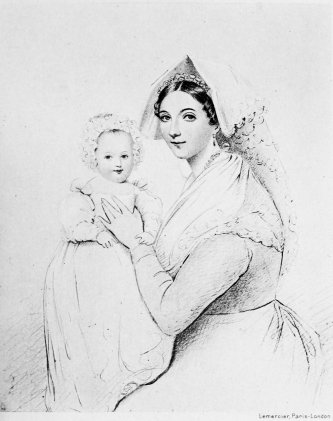
Soon afterwards, my godmother returned to England, with her faithful maid Mary Lea, accompanied by the Marcus Hares. She had already decided to fix her future home in the parish of Julius, who, more than any other, was a fellow-mourner with her. As regarded me, nothing more than the tie of a godmother had to that time been thought of; but in the quiet hours of her long return journey to England, while sadly looking forward to the solitary future before her, it occurred to Augustus Hare's widow as just possible that my parents might be induced to give me up to her altogether, to live with her as her own child. In July she wrote her petition, and was almost surprised at the glad acceptance it met with. Mrs. Hare's answer was very brief—"My dear Maria, how very kind of you! Yes, certainly, the baby shall be sent as soon as it is weaned; and, if any one else would like one, would you kindly recollect that we have others."
Yet my adopting mother had stipulated that I was to be altogether hers; that my own relations were henceforward to have no claim over me whatever; that her parents were to be regarded as my grandparents, her brother and sister as my uncle and aunt.
Meantime my father took his family for the hot summer months to one of the lovely villas on the high spurs of volcanic hill, which surround picturesque romantic Siena. They had none of the English society to which they had been accustomed at Lucca Baths and at Castellamare, but the Siennese are celebrated for their hospitality, and my father's talents, famous then throughout Italy, ensured him a cordial welcome amongst the really cultivated circle which met every evening in the old mediæval palaces of the native nobility. Of English, they had the society of Mr. and Mrs. Bulwer, who were introduced by Landor, while constant intercourse with Landor himself was one of the chief pleasures which the family enjoyed during this and many succeeding years. With Francis Hare he laid the plan of many of his writings, and in his judgment and criticism he had the greatest confidence. To this he alludes in his little poem of "Sermonis Propriora:"—
"Little do they who glibly talk of vrese Know what they talk about, and what is worse, Think they are judges if they dare to pass Sentence on higher heads. The mule and ass Know who have made them what they are, and heed Far from the neighing of the generous steed. Gell, Drummond, Hare, and wise and witty Ward Knew at first sight and sound the genuine bard, But the street hackneys, fed on nosebag bran, Assail the poet, and defame the man."
After another winter at Rome, the family went to Lausanne, and thence my father, with my beautiful Albanese nurse, Lucia Cecinelli, took me to meet Mrs. Gayford, the English nurse sent out to fetch me by my adopted mother from Mannheim on the Rhine. There the formal exchange took place which gave me a happy and loving home. I saw my father afterwards, but he seldom noticed me. Many years afterwards I knew Mrs. Hare well and had much to do with her; but I have never at any time spoken to her or of her as a "mother," and I have never in any way regarded her as such. She gave me up wholly and entirely. She renounced every claim upon me, either of affection or interest. I was sent over to England with a little green carpet-bag containing two little white night-shirts and a red coral necklace—my whole trousseau and patrimony. At the same time it was indicated that if the Marcus Hares should also wish to adopt a child, my parents had another to dispose of: my second brother William had never at any time any share in their affections.
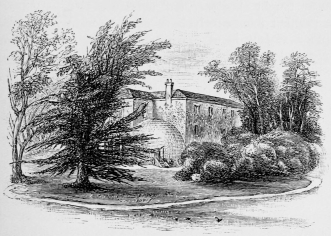
On reaching England I was sent first to my cousin the Dowager Countess of Strathmore, and from her house was taken (in the coach) by Mrs. Gayford to my mother—my real only mother from henceforth—at Hurstmonceaux Rectory, which at that time was as much a palace of art, from its fine collection of pictures and books, as a country rectory could be.
My adopted mother always used to say that the story of Hannah reminded her of the way in which I was given to her. She believed it was in answer to a prayer of my uncle Augustus in the cathedral at Chalons, when he dropped some money into a box "pour les femmes enceintes," because he knew how much she wished to have a child. His eldest brother's wife was then enceinte, and I was born soon afterwards.
HURSTMONCEAUX RECTORY.
From MY MOTHER'S JOURNAL.
"On Tuesday, August 26, 1835, my little Augustus came to me. It was about four o'clock when I heard a cry from upstairs and ran up. There was the dear child seated on Mary's (Mary Lea's) knee, without a frock. He smiled most sweetly and with a peculiar archness of expression as I went up to him, and there was no shyness. When dressed, I brought him down into the drawing-room: he looked with great delight at the pictures, the busts, and especially the bronze wolf—pointed at them, then looked round at Jule and me. When set down, he strutted along the passage, went into every room, surveyed all things in it with an air of admiration and importance, and nothing seemed to escape observation. The novelty of all around and the amusement he found at first seemed to make him forget our being strangers. The next day he was a little less at home. His features are much formed and an uncommon intelligence of countenance gives him an older look than his age: his dark eyes and eyelashes, well-formed nose and expressive mouth make his face a very pretty one; but he has at present but little hair and that very straight and light. His limbs are small and he is very thin and light, but holds himself very erect. He can run about very readily, and within a week after coming could get upstairs by himself. In talking, he seems to be backward, and except a few words and noises of animals, nothing is intelligible. Number seems to be a great charm to him—a great many apples, and acorns to be put in and out of a basket. He has great delight in flowers, but is good in only smelling at those in the garden, gathers all he can pick up in the fields, and generally has his hands full of sticks or weeds when he is out. He wants to be taught obedience, and if his way is thwarted or he cannot immediately have what he wants, he goes into a violent fit of passion. Sometimes it is soon over and he laughs again directly, but if it goes on he will roll and scream on the floor for half-an-hour together. In these cases we leave him without speaking, as everything adds to the irritation, and he must find out it is useless. But if by prevention such a fit may be avoided it is better, and Mary Lea is very ingenious in her preventing."
"Oct. 3.—Augustus improves in obedience already. His great delight is in throwing his playthings into a jug or tub of water. Having been told not to do so in my room, he will walk round the tub when full, look at Mary, then at me, and then at the tub with a most comical expression, but if called away before too long will resist the temptation. He is very impatient, but sooner quiet than at first: and a tear in one eye and a smile in the other is usually to be seen. His great delight lately has been picking up mushrooms in the fields and filling his basket."
It was in October that my mother moved from the Rectory to Lime—our own dear home for the next five-and-twenty years. Those who visit Hurstmonceaux now can hardly imagine Lime as it then was, all is so changed. The old white gabled house, with clustered chimneys and roofs rich in colour, rose in a brilliant flower-garden sheltered on every side by trees, and separated in each direction by several fields from the highroad or the lanes. On the side towards the Rectory, a drive between close walls of laurel led to the old-fashioned porch which opened into a small low double hall. The double drawing-room and the dining-room, admirably proportioned, though small, looked across the lawn, and one of the great glistening pools which belonged to an old monastery (once on the site of the house), and which lay at the foot of a very steep bank carpeted with primroses in spring. Beyond the pool was our high field, over which the stumpy spire of the church could be seen, at about a mile and a half distant, cutting the silver line of the sea. The castle was in a hollow farther still and not visible. On the right of the lawn a grass walk behind a shrubbery looked out upon the wide expanse of Pevensey Level with its ever-varying lights and shadows, and was sheltered by the immensely tall abele trees, known as "the Five Sisters of Lime," which tossed their weird arms, gleaming silver-white, far into the sky, and were a feature in all distant views of Hurstmonceaux. On the left were the offices, and a sort of enclosed court, where the dogs and cats used to play and some silver pheasants were kept, and where my dear nurse Mary Lea used to receive the endless poor applicants for charity and help, bringing in their many complaints to my mother with inimitable patience, though they were too exclusively self-contained to be ever the least grateful to her, always regarding and speaking of her and John Gidman, the butler, as "furriners, folk from the shires."
LIME.
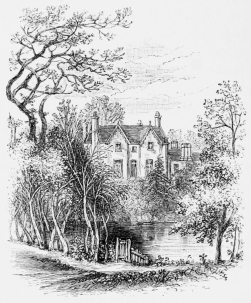
No description can give an idea of the complete seclusion of the life at Lime, of the silence which was only broken by the cackling of the poultry or the distant threshing in the barn, for the flail, as well as the sickle and scythe, were then in constant use at Hurstmonceaux, where oxen—for all agricultural purposes—occupied the position which horses hold now. No sound from the "world," in its usually accepted sense, would ever have penetrated, if it had not been for the variety of literary guests who frequented the Rectory, and one or other of whom constantly accompanied my uncle Julius when he came down, as he did every day of his life, to his sister-in-law's quiet six-o'clock dinner, returning at about eight. Of guests in our house itself there were very few, and always the same—the Norwich Stanleys; Miss Clinton, a dear friend of my mother; after a time the Maurices, and Mr. and Mrs. Pile—an Alton farmer of the better class, and his excellent wife: but there was never any variety. Yet in my boyhood I never thought it dull, and loved Lime with passionate devotion. Even in earliest childhood my dearest mother treated me completely as her companion, creating interests and amusements for me in all the natural things around, and making me so far a sharer in her own spiritual thoughts, that I have always felt a peculiar truthfulness in Wordsworth's line—
"Heaven lies about us in our infancy."
If my mother was occupied, there was always my dear "Lea" at hand, with plenty of farmhouse interests to supply, and endless homely stories of country life.
From MY MOTHER'S JOURNAL.
"Lime, Oct. 23, 1835.—My little Augustus was much astonished by the change of house, and clung to me at first as if afraid of moving away. The first evening he kissed me over and over again, as if to comfort and assure me of his affection."
"Nov. 21.—Augustus has grown much more obedient, and is ready to give his food or playthings to others. Some time ago he was much delighted with the sight of the moon, and called out 'moon, moon,' quite as if he could not help it. Next day he ran to the window to look for it, and has ever since talked of it repeatedly. At Brighton he called the lamps in the streets 'moon,' and the reflection of the candles or fire on the window he does the same. He is always merriest and most amiable when without playthings: his mind is then free to act for itself and finds its own amusement; and in proportion as his playthings are artificial and leave him nothing to do, he quarrels or gets tired of them. He takes great notice of anything of art—the flowers on the china and plates, and all kinds of pictures."
"Stoke Rectory, Jan. 7, 1836.—During our stay with the Penrhyns at Sheen, Baby was so much amused by the variety of persons and things to attract attention, that he grew very impatient and fretful if contradicted. Since we have been at Stoke he has been much more gentle and obedient, scarcely ever cries and amuses himself on the floor. He is greatly amused by his Grandpapa's playful motions and comical faces, and tries to imitate them. When the school children are singing below, he puts up his forefinger when listening and begins singing with his little voice, which is very sweet. He will sit on the bed and talk in his own way for a long time, telling about what he has seen if he has been out: his little mind seems to be working without any visible thing before it, on what is absent."
"Alderley, March 13.—My dear boy's birthday, two years old. He has soon become acquainted with his Alderley relations,[13] and learnt to call them by name. He has grown very fond of 'Aunt Titty,' and the instant she goes to her room follows her and asks for the brush to brush the rocking-horse and corn to feed it. His fits of passion are as violent, but not so long in duration, as ever. When he was roaring and kicking with all his might and I could scarcely hold him, I said—'It makes Mama very sorry to see Baby so naughty.' He instantly stopped, threw his arms round my neck, and sobbed out—'Baby lub Mama—good.' When I have once had a struggle with him to do a thing, he always recollects, and does it next time."
"Lime, June 13.—On the journey from Stoke to London, Baby was very much delighted with the primroses in the hedgerows, and his delight in the fields when we got home was excessive. He knows the name of every flower both in garden and field, and never forgets any he has once seen.... When he sees me hold my hand to my head, he says, 'Mama tired—head bad—Baby play self.'"
"July 9.—Baby can now find his way all over the house, goes up and down stairs alone and about the lawn and garden quite independently, and enjoys the liberty of going in and out of the windows: runs after butterflies or to catch his own shadow: picks up flowers or leaves, and is the picture of enjoyment and happiness. Tumbling out of the window yesterday, when the fright was over, he looked up—'Down comes Baby and cradle and all.' He tells the kitten 'not touch this or that,' and me 'not make noise, Pussy's head bad.'"
"Sept. 28.—The sea-bathing at Eastbourne always frightened Baby before he went in. He would cling to Mary and be very nervous till the women had dipped him, and then, in the midst of his sobs from the shock, would sing 'Little Bo Peep,' to their great amusement. He was very happy throwing stones in the water and picking up shells; but above all he enjoyed himself on Beachy Head, the fresh air and turf seemed to exhilarate him as much as any one, and the picking purple thistles and other down flowers was a great delight.... His pleasure in returning home and seeing the flowers he had left was very great. He talks of them as if they were his playmates, realising Keble's—'In childhood's sports, companions gay.'"
"Oct. 17.—After dinner to-day, on being told to thank God for his good dinner, he would not do it, though usually he does it the first thing on having finished. I would not let him get out of his chair, which enraged him, and he burst into a violent passion. Twice, when this abated, I went to him and tried, partly by encouragement, partly by positively insisting on it, to bring him to obedience. Each time I took him up from the floor, he writhed on the floor again with passion, screaming as loud as he could. After a while, when I had left him and gone into the drawing-room, he came along the walk and went back again two or three times as if not having courage to come in, then at last came and hid his face in my lap. I carried him back to the dining-room and put him in his chair and talked to him about his dinner, did not he love God for giving him so many good things, and I knelt by him and prayed God to forgive him for being so naughty and to take away the naughty spirit. All the time he was struggling within himself, half-sobbing, half-smiling with effort—'I can't say it'—and then, after a time, 'Mama thanks God for Baby's good dinner.' 'No,' I said, 'Baby must do it for himself.' Still he resisted. At length on getting down from the chair he said, 'Kneel down under table'—and there at last he said, 'Thank God for Baby's good dinner,' and in a minute all the clouds were gone and sunshine returned to his face. The whole struggle lasted I suppose half-an-hour. In a few minutes after he was calling me 'Mama dear' and as merry as ever."
"Stoke Rectory, Nov. 26.—Baby asks 'Who made the dirt? Jesus Christ?' It is evident that he has not the slightest notion of any difference between the nature of God and any man, or between Heaven and London or any name of a place. Perhaps in this simplicity and literality of belief he comes nearer the truth than we in the sophistications and subtilties of our reasonings on such things: but the great difficulty is to impress awe and reverence for a holy and powerful Being, and to give the dread and serious sense of being under His eye, without a slavish fear and distance.
"He always asks when he sees my Bible—'Mama reading about Adam and Eve and Jesus Christ?'—a union of the two grand subjects, very unconsciously coming to the truth."
"Jan. 16, 1837.—Time is as yet a very indistinct impression on Baby's mind. Going round the field, he gathered some buttercups. I said, 'Leave the rest till to-morrow.' When we returned the same way, he asked, 'Is it to-morrow now?' ... After a violent passion the other day he looked up—'Will Jesus Christ be shocked?' He comes often and says—'Will 'ou pray God to make little Augustus good?' and asks to 'pray with Mama.'
"The other day he said—'My eyes are pretty.' 'Oh yes,' I said, 'they are, and so are Mama's and Na's.'—'And Grandpapa's and Grannie's too?'—'Yes, they are all pretty, nothing so pretty as eyes.' And I have heard no more of it.
"'Look, Mama,' he says, 'there is a bird flying up to God.'—'Where have you been to, Baby?'—'To a great many wheres.' He visits all the flowers in Grannie's garden, quite as anxiously as if they were living beings, and that quite without any hope of possessing them, as he is never allowed to gather any. He puts the different flowers together—and invents names for them—Hep—poly—primrose, &c. He also talks to animals and flowers as if they were conscious, and in this way creates constant amusement for himself: but the illusion is so strong he hardly seems to separate it from fact, and it becomes increasingly necessary to guard against the confusion of truth and error."
Children are said seldom to remember things which happen when they are three years old; but I have a distinct recollection of being at my mother's early home of Toft in Cheshire during this spring of 1837, and of the charm, of which children are so conscious, of the Mrs. Leycester ("Toft Grannie"—my mother's first cousin) who lived there. I also recollect the great dog at Alderley, and being whipped by "Uncle Ned" (Edward Stanley) at the gate of the Dutch garden for breaking off a branch of mezereon when I was told not to touch it. Indeed I am not sure whether these recollections are not of a year before, in which I distinctly remember a terrible storm at Lime, when Kate Stanley was with us, seeing a great acacia-tree torn up by the roots and hurled against the drawing-room window, smashing all before it, and the general panic and flight that ensued. Otherwise my earliest impressions of Hurstmonceaux are all of the primroses on the Lime bank—the sheets of golden stars everywhere, and the tufts of pure white primroses which grew in one particular spot, where the bank was broken away under an old apple-tree. Then of my intense delight in being taken in a punt to the three islets on the pond—Mimulus Island, Tiny and Wee; and of the excessive severity of Uncle Julius, who had the very sharpest possible way of speaking to children, even when he meant to be kind to them. Every evening, like clockwork, he appeared at six to dine with my mother, and walked home after coffee at eight. How many of their conversations, which I was supposed neither to hear or understand, have come back to me since like echoes: strange things for a child to remember—about the Fathers, and Tract XC., and a great deal about hymns and hymn-tunes—"Martyrdom," "Irish," "Abridge," &c.; for an organ was now put into the church, in place of the band, in which the violin never could keep time with the other instruments. Sir George Dasent has told me how he was at Hurstmonceaux then, staying with the Simpkinsons. Arthur Stanley was at the Rectory as a pupil, and he asked Arthur how he liked this new organ. "Well," he said, "it is not so bad as most organs, for it does not make so much sound." Uncle Julius preached about it, altering a text into "What went ye out for to hear."
A child who lives much with its elders is almost certain to find out what it is most intended to conceal from it. If possible it had better be confided in. I knew exactly what whispers referred to a certain dark passage in the history of the Rectory before Uncle Julius's time—"il y avait un crime"—and I never rested till I found it out. It was about this time that I remember Uncle Julius going into one of his violently demonstrative furies over what he considered the folly of "Montgomery's Poems," and his flinging the book to the other end of the room in his rage with it, and my wondering what would be done to me if I ever dared to be "as naughty as Uncle Jule."
From MY MOTHER'S JOURNAL.
"Lime, June 20, 1837.—Augustus was very ill in coming through London.... Seeing Punch one day from the window, he was greatly amused by it, and laughed heartily. Next day I told him I had seen Punch and Judy again. 'No, Mama, you can't have seen Judy, for she was killed yesterday.' On getting home he was much pleased, and remembered every place perfectly. Great is his delight over every new flower as it comes out, and his face was crimsoned over as he called to me to see 'little Cistus come out.' At night, in his prayers he said—'Bless daisies, bluebells,' &c.... I have found speaking of the power exercised by Jesus Christ in calming the wind a means of leading him to view Christ as God, which I felt the want of in telling him of Christ's childhood and human kindness,—showing how miraculous demonstration is adapted to childhood."
I have a vivid recollection of my long illness in Park Street, and of the miserable confinement in London. It was just at that time that my Uncle Edward Stanley was offered the Bishopric of Norwich. His family were all "in a terrible taking," as they used to call that sort of emotion, as to whether it should be accepted or not, and when the matter was settled they were almost worse—not my aunt, nothing ever agitated her, but the rest of them. Mary and Kate came, with floods of tears, to tell my mother they were to leave Alderley. My Uncle Penrhyn met Mary Stanley coming down our staircase, quite convulsed with weeping, and thought that I was dead.
When I was better, in the spring, we went to my Uncle Penrhyn's at East Sheen. One day I went into Mortlake with my nurse Mary Lea. In returning, a somewhat shabby carriage passed us, with one or two outriders, and an old gentleman inside. When we reached the house, Lea asked old Mills, the butler, who it was. "Only 'Silly Billy,'" he said. It was King William IV., who died in the following June. He had succeeded to the sobriquet which had been applied to his cousin and brother-in-law, William Henry, Duke of Gloucester, who died in 1834.
John Sterling had been living at Hurstmonceaux for several years as my uncle's curate, and was constantly at Lime or the Rectory. I vividly recollect how pleasant (and handsome) he was. My mother used to talk to him for hours together and he was very fond of her. With Mrs. Sterling lived her sister Annie Barton, whom I remember as a very sweet and winning person. During this summer, Frederick Maurice, a Cambridge pupil of my uncle's, came to visit him, and confessed his attachment to her. There were many obstacles to their marriage, of which I am ignorant; but my mother was always in favour of it, and did much to bring it about. I recollect Annie Barton as often sitting on a stool at my mother's feet.
On our way to Stoke in the preceding autumn, we had diverged to visit Frederick Maurice at his tiny curacy of Bubnell near Leamington. With him lived his sister Priscilla, for whom my mother formed a great friendship, which, beginning chiefly on religious grounds, was often a great trial to her, as Priscilla Maurice, with many fine qualities and great cleverness, was one of the most exacting persons I have ever known. I am conscious of course now of what fretted me unconsciously then, the entire difference of class, and consequent difference in the measurement of people and things, between the Maurices and those my mother had been accustomed to associate with, and of their injurious effect upon my mother herself, in inducing her to adopt their peculiar phraseology, especially with regard to religious things. They persuaded her to join in their tireless search after the motes in their brother's eyes, and urged a more intensified life of contemplative rather than active piety, which abstracted her more than ever from earthly interests, and really marred for a time her influence and usefulness. The Maurice sisters were the first of the many so-called "religious" people I have known, who did not seem to realise that Christianity is rather action than thought; not a system, but a life.
It must have been soon after this that Frederick Maurice moved to London, and our visits to London were henceforth for several years generally paid to his stuffy chaplain's house at Guy's, where, as I could not then appreciate my host, I was always intensely miserable, and, though a truly good man, Frederick Maurice was not, as I thought, an attractive one. What books have since called "the noble and pathetic monotone"[14] of his life, which was "like the burden of a Gregorian chaunt," describes him exactly, but was extremely depressing. He maundered over his own humility in a way which—even to a child—did not seem humble, and he was constantly lost mentally in the labyrinth of religious mysticisms which he was ever creating for himself. In all he said, as in all he wrote, there was a nebulous vagueness. "I sometimes fancy," "I almost incline to believe," "I seem to think," were the phrases most frequently on his lips. When he preached before the University of Cambridge to a church crowded with dons and undergraduates, they asked one another as they came out, "What was it all about?" He may have sown ideas, but, if they bore any fruits, other people reaped them.[15] Still his innate goodness brought him great devotion from his friends. Amongst those whom I recollect constantly seeing at Guy's, a man in whose society my mother found much pleasure, was John Alexander Scott, whom Mrs. Kemble describes as being mentally one of the most influential persons she had ever known.
Priscilla Maurice henceforward generally came to Lime soon after our annual return from Shropshire, and usually spent several months there, arriving armed with plans for the "reformation of the parish," and a number of blank books, some ruled in columns for parochial visitation, and others in which the names of all communicants were entered and preserved, so as to make the reprobation of absentees more easy at Hurstmonceaux.
As she established her footing, she frequently brought one of her many sisters with her: amongst them Esther Maurice, who at that time kept a ladies' school at Reading. Priscilla, I believe, afterwards regretted the introduction of Esther, who was much more attractive than herself, and in course of time entirely displaced her in my mother's affections. "Priscilla is like silver, but Esther is like gold," I remember my mother saying to Uncle Julius. Of the two, I personally preferred Priscilla, but both were a fearful scourge to my childhood, and so completely poisoned my life at Hurstmonceaux, that I looked to the winters spent at Stoke for everything that was not aggressively unpleasant.
Little child as I was, my feeling about the Maurices was a great bond between me and my aunt Lucy Hare, who, I am now certain, most cordially shared my opinion at this time, though it was unexpressed by either. Otherwise my Aunt Lucy was also already a frequent trial to my child-life, as she was jealous for her little Marcus (born in 1836) of any attention shown to me or any kindness I received. I felt in those early days, and on looking back from middle life I know that I felt justly, that my mother would often pretend to care for me less than she did, and punish me far more frequently for very slight offences, in order not to offend Aunt Lucy, and this caused me many bitter moments, and outbursts of passionate weeping, little understood at the time. In very early childhood, however, one pleasurable idea was connected with my Aunt Lucy. In her letters she would desire that "Baby" might be allowed to gather three flowers in the garden, any three he liked: the extreme felicity of which permission that Baby recollects still—and the anxious questionings with himself as to which the flowers should be.
From MY MOTHER'S JOURNAL.
"Lime, July 24, 1837.—Augustus continually asks 'Why,' 'What is the reason.' If it be in reference to something he has been told to do, I never at the time give him any other reason than simply that it is my will that he should do it. If it refers to something unconnected with practical obedience, it is right to satisfy his desire of knowledge as far as he can understand. Implicit faith and consequent obedience is the first duty to instil, and it behoves a parent to take care that a child may find full satisfaction for its instinctive moral sense of justice, in the consistency of conduct observed towards him; in the sure performance of every promise; in the firm but mild adherence to every command.
"He asks, 'Is God blue?'—having heard that He lived above the sky."
"Stoke Rectory, Jan. 1, 1838.—On Christmas Day Augustus went to church for the first time with me. He was perfectly good and kept a chrysanthemum in his hand the whole time, keeping his eyes fixed on it when sitting down. Afterwards he said, 'Grandpapa looked just like Uncle Jule: he had his shirt (surplice) on.'