Volume 3 — CONTENTS VOLUME 3 (continued 6)
Reading edition
"I asked the Polish ladies if the language they spoke was Russian. It was like throwing a bomb into the camp. They detest the Russians, and would not speak to a pleasant Countess Boranoff, née Wasilikoff, who has been staying here.... But of all my Pisan acquaintance there is none like Robert Peabody! He has been at an atelier in Paris for two years studying as an architect, and had a charming life there with his fellow-students, making walking tours in France, &c. When he first went to Paris, he did not know a word of French, and made out his washing bills by drawing little pictures, socks, shirts, drawers, &c., and the washerwoman put the prices opposite them."
On December 10 occurred the terrible floods of the Arno.
To MISS LEYCESTER.
"Pisa, Dec. 11, 1869.—How little you will be able to imagine all we have been going through in the last twenty-four hours! We have had a number of adventures in our different travels, but this is by far the worst that has ever befallen us. Now I must tell you our story consecutively.
"For the last three days the Mother has been very ill. On Thursday she had an attack of fainting, and seemed likely to fall into one of her long many days' sleep.... The rain continued day and night in torrents. Yesterday made it three weeks since we arrived, and in that time there had been only two days in which the rain had not been ceaseless. The Arno was much swollen: I saw it on Thursday, very curious, up to the top of the arches of the bridges.
"Yesterday, Friday, Madame Victoire came to dine with Lea. Afterwards she came up to see us as usual, and then Flora's children came to be shown pictures. I think it must have been half-past three when they took leave of us. Lea went with them down the passage. Soon she came back saying that little Anna said there was 'such an odd water coming down the street, would I come and see,' and from the passage window I saw a volume of muddy water slowly pouring down the street, not from the Arno, but from towards the railway station, the part of the street towards Lung' Arno (our street ends at the Spina Chapel) remaining quite dry. The children were delighted and clapped their hands. I meant to go and see the water nearer, but before I could reach the main entrance, in half a minute the great heavy waves of the yellow flood were pouring into the courtyard and stealing into the entrance hall.[408]
"It was as suddenly as that it came upon us.
THE HÔTEL DE LONDRES DURING THE FLOOD.
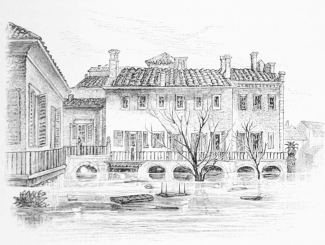
"The scene for the next half-hour baffles all description. Flora and her mother stood on the principal staircase crying and wringing their hands: the servants rushed about in distraction: Lea, pale as ashes, thought and cried that our last moment was come; and all the time the heavy yellow waters rose and rose, covering first the wheels of the omnibus, the vases, the statues in the garden, then up high into the trees. Inside, the carpets were rising and swaying on the water, and in five minutes the large pieces of furniture were beginning to crash against each other. I had rushed at the first alarm to the garde meuble, and (how I did it I cannot imagine) dragged our great box to the stairs: it was the only piece of luggage saved from the ground-floor. Then I rushed to the salle-à-manger, and shouting to Flora to save the money in her bureau, swept all the silver laid out for dinner into a tablecloth, and got it safe off. From that moment it was a sauve qui peut. I handed down rows of teapots, jugs, sugar-basins, &c., to the maids, who carried them away in lapfuls: in this way also we saved all the glass, but before we could begin upon the china, the water was up to our waists and we were obliged to retreat, carrying off the tea-urns as a last spoil. The whole family, with Amabile and all the old servants, were now down in the water, but a great deal of time was wasted in the belief that a poor half-witted Russian lady was locked into her room and drowning, and in breaking open the door; but when at last a panel of the door was dashed in, the room was found full of water and all its contents swimming about, but the lady was ... gone out for a walk!
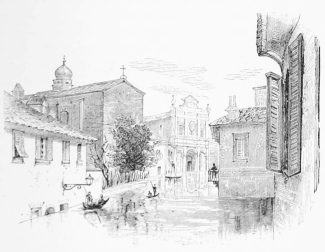
"As I was coming in from the lower rooms to the staircase with a load of looking-glasses, a boat crashed in at the principal entrance, bringing home the poor lady and two other English, who had been caught by the flood at the end of the street, and had been for some time in the greatest peril: the boatmen having declined to bring them the few necessary steps until they had been paid twenty francs, and then having refused altogether to bring a poor Italian who had no money to give them. At this moment Madame Victoire insisted on taking the opportunity of the boat to return to her own house. It was a dreadful scene, all the women in the house crying and imploring her to stay, but she insisted on embarking. She did not arrive without hairbreadth escapes. When she reached her own house, the current was so strong, and the boat was dashed so violently against the walls, that it was impossible for her to be landed; but the flood was less violent beneath her larger house which is let to the Marchese Guadagna, from which sheets were let down from the upper windows, and she was fastened to them and raised: but when she reached the grille of the first-floor windows, and was hanging half-way, the current carried away the boat, and at the same moment the great wall opposite S. Antonio fell with an awful crash. However, the Guadagna family held tight to the sheets, and Madame Victoire was landed at last, though she fell insensible on the floor when she entered the window.
"The walls were now falling in every direction with a dull roar into the yellow waters. The noise was dreadful—the cries of the drowning animals, the shrieks of the women, especially of a mother whose children were in the country, wringing her hands at the window of an opposite house. The water in our house was rising so rapidly that it was impossible to remain longer on the side towards the principal staircase, and we fled to the other end, where Pilotte, a poor boy in the service, lay dangerously ill, but was obliged to get up from his bed, and, though quite blind from ophthalmia, was far more useful than any one else. Since her mother left, Flora had been far too distracted to think of anything; still we saved an immense number of things, and I was able to cut down pictures, &c., floating on a sofa as if it were a boat. The great difficulty in reaching the things was always from the carpet rising, and making it almost impossible to get out of the room again. The last thing I carried off was the 'Travellers' Book!' It was about half-past 5 P.M. when we were obliged to come out of the water, which was then terribly cold and above the waist.
"Meantime the scene in the street was terrible. The missing children of the woman opposite were brought back in a boat and drawn up in sheets; and the street, now a deep river, was crowded with boats, torches flashing on the water, and lights gleaming in every window. All the thirty poor hens in the hen-house at the end of the balcony were making a terrible noise as they were slowly drowned, the ducks and pigeons were drowned too, I suppose, being too frightened to escape, and many floated dead past the window. The garden was covered with cushions, chairs, tables, and ladies' dresses, which had been washed out of the lower windows. There was great fear that the omnibus horse and driver were drowned, and the Limosins were crying dreadfully about it; but the man was drawn up late at night from a boat, whose crew had discovered him on the top of a wall, and at present the horse exists also, having taken refuge on the terrace you will remember at the end of the garden, where it is partially above water. The street was covered with furniture, great carved wardrobes being whirled down to the Arno like straws. The cries of the drowning animals were quite human.
"All this time my poor sweet Mother had been lying perfectly still and patient, but about 6 P.M., as the water had reached the highest step of the lower staircase and was still mounting, we had our luggage carried up to the attics, secured a few valuables in case of sudden flight (as no boat would have taken luggage), and began to get Mother dressed. There was no immediate danger, but if another embankment broke, there might be at any moment, and it was well to be prepared. Night closed in terribly—pouring rain again, a perfectly black sky, and waters swelling round the house: every now and then the dull thud of some falling building, and, from beneath, the perpetual crash of the furniture and floors breaking up in the lower rooms. Mother lay down dressed, most of the visitors and I walked the passages and watched the danger-marks made above water on the staircase, and tried to comfort the unhappy family, in what, I fear, is their total ruin. It seemed as if daylight would never come, but at 6 A.M. the water was certainly an inch lower.
"It was strange to return to daylight in our besieged fortress. There had been no time to save food, but there was one loaf and a little cheese, which were dealt out in equal rations, and we captured the drowned hens as the aviary broke up, and are going to boil one of them down in a tiny saucepan, the only cooking utensil saved. Every one has to economise the water in their jugs (no chance of any other), and most of all their candles.... How we are ever to be delivered I cannot imagine. The railways to Leghorn, Spezia, and Florence must all be under water."
"Dec. 14.—It seems so long now since the inundation began and we were cut off from every one: it is impossible to think of it as only three days.
"Nothing can be more dreadful than the utter neglect of the new Government and of the municipality here. They were fully warned as to what would result if Pisa was not protected from the Arno, but they took no heed, and ever since the dikes broke they have given no help, never even consenting to have the main drains opened, which keeps us still flooded, refusing to publish lists of the drowned, and giving the large sums sent for distribution in charity into the hands of the students, who follow one another, giving indiscriminately to the same persons, whilst others are starving. On Saturday night there ceased to be any immediate alarm: the fear was that the Arno might break through at the Spina, which still stands, and which, being so much nearer, would be far more serious to us. The old bridge is destroyed. All through that night the Vicomte de Vauriol and the men of the house were obliged to watch on the balconies with loaded pistols, to defend their property floating in the garden from the large bands of robbers who came in boats to plunder, looking sufficiently alarming by the light of their great torches. The whole trousseau of the Vicomtesse is lost, and her maid has 4000 francs in her box, which can still be seen floating open.... But the waters are slowly going down. Many bodies have been found, but there are still many more beneath the mud. In the lower rooms of this house the mud is a yard deep, and most horrid in quality, and the smell of course dreadful. I spend much of my time at the window in hooking up various objects with a long iron bed-rod—bits of silver, teacups, even books—in a state of pulp."
S. ANTONIO, PISA, DURING THE FLOOD.
"Dec. 19.—My bulletin is rather a melancholy one, for my poor Mother has been constantly in bed since the inundation, and cannot now turn or move her left side at all.... I have also been very ill myself, with no sleep for many days, and agonies of neuralgia from long exposure in the water.... However, I get on tolerably, and have plenty to take off my thoughts from my own pain in attending to Mother and doing what I can for the poor Limosins.... In the quarter near this seventy bodies have been found in the mud, and as the Government suppresses the number and buries them all immediately, there are probably many more. Our friends at Rome have been greatly alarmed about us."
"Dec. 27.—Mother has been up in a chair for a few hours daily, but cannot yet be dressed. The weather is horrible, torrents of rain night and day—quite ceaseless, and mingled with snow, thunder, and lightning. It is so dark even at midday, that Mother can see to do nothing, and I very little. The mud and smell would prevent our going out if it were otherwise possible. It has indeed been a dismal three months, which we have all three passed entirely in the sick-room, except the four days I was away.... Still the dear Mother says 'we shall have time to recount our miseries in heaven when they are over; let us only recount our mercies now.'"
To MISS WRIGHT.
"33 Via Gregoriana, Rome, Jan. 19, 1870.—You will have heard from others of our misfortunes at Pisa, of Mother's terrible illness, and my wearing pains, and in the midst of all this our awful floods, the Arno bursting its banks and overwhelming the unhappy town with its mud-laden waves. I cannot describe to you the utter horror of those three days and nights—the rushing water (waves like the sea) lifting the carpets and dashing the large pieces of furniture into bits like so many chips,—the anxious night-watchings of the water stealthily advancing up step after step of the staircase,—the view from the upper corridor windows of the street with its rushing tourbillon of waters, carrying drowning animals, beds, cabinets, gates, &c., along in a hideous confusion;—from our windows of the garden one maze of waters afloat with chairs, tables, open boxes, china, and drowned creatures;—the sound of the falling walls heavily gliding into the water, and the cries of the drowning and their relations. And then, in the hotel, the life was so strange, the limited rations of food and of water from the washing jugs, and the necessity for rousing oneself to constant action, and far more than mere cheerfulness, in order to prevent the poor people of the hotel from sinking into absolute despair.
"When the real danger to life once subsided and the poor drowned people had been carried away to their graves, and the water had changed into mud, it was a strange existence, and we had still six weeks in the chilled house with its wet walls, and an impossibility of going out or having change. However, there is a bright side to everything, and the utter isolation was not unpleasant to me. I got through no end of writing work, having plenty also to do in attending on my poor Mother; and you know how I can never sufficiently drink in the blessedness of her sweet companionship, and how entirely the very fact of her existence makes sunshine in my life, wherever it is.
"All the time of our incarceration I have employed in writing from the notes of our many Roman winters, which were saved in our luggage, and which have been our only material of employment. It seems as if 'Walks in Rome' would some day grow into a book. Mother thinks it presumptuous, but I assure her that though of course it will be full of faults, no book would ever be printed if perfection were waited for. And I really do know much more about the subject than most people, though of course not half as much as I ought to know.
"One day I was away at Florence, where I saw Lady Anne S. Giorgio and many other friends in a very short time. How bright and busy it looked after Pisa.
"Last week Pisa devoted itself, or rather its priests, to intense Madonna-worship, because, owing to her image, carved by St. Luke, the flood was no worse. Her seven petticoats, unremoved for years, were taken off one by one and exchanged for new, and this delicious event was celebrated by firing of cannon, processions, and illuminations all over the town. In the midst, the Arno displayed its disapproval by rising again violently and suddenly; the utmost consternation ensued; the population sat up, doors were walled up, the doll-worshippers were driven out of the cathedral (which lies very low) at the point of the bayonet by the Bersaglieri under General Bixio. To us, the great result of the fresh fright was, that the Mother suddenly rose from her bed, and declaring that she could not stay to endure another inundation, dressed, and we all set off last Wednesday morning, and arrived at midnight after a prosperous journey, though the floods were certainly frightful up to the very walls of Rome.
"Oh, how glad we were to get here—to feel that after all the troubles of the last few months we were safe in the beloved, the home-like city. It is now only that I realise what a time of tension our stay at Pisa has been. We breathe quietly. Even the calm placid Mother feels the relief of not having to start up at every sound and wonder whether 'L'Arno é sbordato.'
"I always feel as if a special Providence watched over us in respect of lodgings. It has certainly been so this time, as we could never have hoped, arriving so late, to obtain this charming apartment, with full sun, glorious view, and all else we can wish. You can fancy us, with all our own pictures and books, the mother in her chair, the son at his drawing-table, and Lea coming in and out.
"But on Friday we had a terrible catastrophe. In the evening at the hotel the poor Mother fell violently upon her head on the hard stone floor and was dreadfully hurt. You will imagine my terror, having gone out at 8 P.M., to find every one in confusion on my return, that Dr. Winslow had been sent for, and that I had been searched for everywhere. For some hours the Mother was quite unconscious, and she can still see nothing, and I am afraid it will be some days before any sight is restored; but all is going on well, and I am most thankful to have been able to move her to her own house.
"Do you know, I am going to renounce the pomps and vanities of the world this winter and not 'go out' at all. I have often found that it has rather fatigued Mother even to hear of my going out, and it is far easier to give a thing up altogether than partially. In the daytime I can see people. My American friend Robert Peabody is here, and the most delightful companion, and there are endless young men artists, quite a colony, and of the pleasantest description.
"The weather is very fine, but very cold. I went to-day to St. Peter's (Il Giorno della Scatola), and the procession was certainly magnificent. The Bishop who attracts most attention is Monsignor Dupanloup of Orleans, who at first displayed great courage in opposing the Infallibility doctrine, but is allowing his opposition to be swamped. Many of the Bishops are most extraordinary—such a variety of forms and colours in costume, blue and violet veils, green robes and hats, and black caps with gold knobs like the little Shems and Hams in Noah's Ark. But the central figure of Pius IX. looks more than ever solemn and impressive, the man so lost in his intense feeling of the office, that it is impossible to associate him, mentally, with the Council and its blasphemies. Of the Council itself we hear nothing, and there is little general interest about it. Lord Houghton asked Manning what had been going on: he answered, 'Well, we meet, and we look at one another, and then we talk a little, but when we want to know what we have been doing, we read the Times.'"
To MISS LEYCESTER.
"Jan. 31.—We have had another anxious week, though once more all is going on well. On Monday the Mother was well enough to see visitors, but that night was in terrible suffering, and the next day had a slight paralytic seizure ... followed by long unconsciousness; but it was all accounted for the next morning when we found the roof white with snow. She continued in great suffering till Friday, when the weather suddenly changed to scirocco, and she at once rallied. That day I was able to have my lecture on the Quirinal and Viminal—all new ground. There was a large gathering in spite of weather, so many people had asked to come. I have yielded to the general wish of the party in arranging weekly meetings at 10 A.M., but it makes me feel terribly ignorant, and—in the intervals of tending Mother—I am at work all the week instructing myself upon the subject of my lecture."
VIEW FROM THE VIA GREGORIANA.
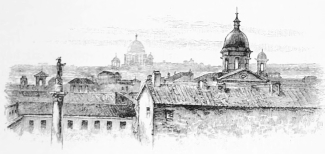
"Feb. 19.—The Mother is still sadly weak, and always in an invalid state, yet she has not the serious symptoms of the winter you were here. She is seldom able to be dressed before twelve, and can do very, very little—to read a few verses or do a row of her crotchet is the outside. I scarcely ever leave her, except for my lectures. I had one on the Island yesterday. The weather is splendid and our view an indescribable enjoyment, the town so picturesque in its blue morning indistinctness, and St. Peter's so grand against the golden sunsets. As usual, the Roman society is like the great net which was let down into the deep and brought up fish of every kind.... The Mother is quite happy and bright in spite of all her misfortunes, but we have had to feed her like a bird in her blindness. I wonder if you know the lines of Thomas Dekker (1601)—
'Patience! why, 'tis the soul of peace; Of all the virtues, 'tis nearest kin to heaven; It makes men look like gods. The best of men That e'er wore earth about Him was a sufferer, A soft, meek, patient, humble, tranquil spirit; The first true gentleman that ever breathed."
To MISS WRIGHT.
"Rome, Feb. 27.—My life this winter has been one of constant watching and nursing; the Mother has been so very powerless and requires such constant care: but she is, oh! so sweet and patient always. You need not pity me for not going out; after the day's anxiety I find the luxury of the evening's rest so very great.
"My Friday lectures now take place regularly, and I hope they give pleasure, as they are certainly crowded. I am amused to see many ultra-Catholics come time after time, in spite of my Protestant anecdotes. How I wish the kind Aunt Sophy were here to share these excursions."
On the 12th of March I spent a delightful afternoon with a young artist friend, Henry Florence, in the garden of SS. Giovanni e Paolo, drawing the gloriously rich vegetation and the old cypresses there. My Mother was tolerably well, and the air, the sunshine, and the beauty around were unspeakably enchanting. "I never saw any one enjoy things as you do," said Florence, and I spoke of my thankfulness for having the power of putting away anxieties when they were not pressing, and of making the utmost of any present enjoyment, even though it be to "borrow joy at usury of pain."[409] "Perhaps it may be the last day," I said. It was. There is an old proverb which says, "The holidays of joy are the vigils of sorrow." That night my dearest Mother had the terrible paralytic seizure which deprived her of the use of her left arm and side, and from which she never recovered.
To MISS LEYCESTER.
"Rome, March. 16, 1870.—My darling Mother is to-day in a happy peaceful state, no longer one of suffering, which is—oh! such rest to us. She is now able to articulate, so that I always, and others often, understand her.... I sleep close by upon the floor and never leave her. On Monday night we were pleasantly surprised by the arrival of Amabile, the maid from Pisa, who is quite a tower of strength to us—so kind, gentle, and strong. Mrs. Woodward comes and goes all day. Every one is kind and sympathising."
"March 23.—Mother talks constantly of Albano and her great wish to be there amongst the flowers, but for many weeks, perhaps months, this must be impossible."
"March 28.—It has been the same kind of week, alternately saddened by the strange phases of illness, or cheered by slight amendments; but Mother has had many sad nights, always worse than her days, without rest even for a minute. Her mind is only too clear. She will translate hymns, 'Abide with me,' &c., into Italian; the great difficulty is to keep it all in check. From 4 to 10 P.M. the nervous spasms in the paralysed arm are uncontrollable, and she can only endure them by holding tight to my arm or Lea's. All yesterday, however, I was away from her, tending poor young Sutherland, who has been dreadfully ill at the Hôtel de Londres of typhoid fever, and who is quite alone and helpless."
"April 3.—The Mother goes on very slowly, but I hope has not had an unpleasant week. She never seems to find the time long, and always looks equally placid and happy. Physically she is certainly more comfortable now she is entirely in bed. Her chief trouble is from the returning vitality of the poor arm; the muscles knot all round it, and move on slowly by a quarter of an inch at a time, as the life advances: passing the shoulder was agony, and I dread the passing the elbow. Meantime, the rest of the arm is an independent being, acting by its independent muscular action, and is obliged to be constantly watched, as it will sometimes lay its heavy weight upon her chest, once clutched her by the throat and nearly strangled her, at others annoys her by stealing her pocket-handkerchiefs! She has been able to hear a psalm and some prayers read aloud every evening, and occupies herself with her own inexhaustible stores of mental hymns and verses incessantly. Mrs. Woodward's daily visit is one of her little pleasures, and she has also seen Mrs. Hall several times.
"My young cousin Edward Liddell[410] returned lately from Naples, and on Monday became very ill of fever, pronounced typhoid, and likely to become typhus and very infectious, so, as he had no one else to look after him, I have been nursing him ever since. It was so fortunate for me that Mother was really better at this time, or I do not know what we could have done, as though he had one good nurse, she was quite worn out, and there was no other to be procured. So now we take it in turns, four hours at a time, and I chiefly at night, when she goes home to her children. I am writing in the darkened room, where Edward lies powerless, with all his hair cut off and his head soaked in wet towels, almost unable to move, and unable to feed himself. I am sorry not to be able to go out while Marcus Hare is here, and he is much disappointed. He arrived suddenly from Naples and embraced me as if we were still children."
"April 10.—My dear Mother is much the same. It has been a peaceful week with her, though there is no improvement.... The paralysed arm is quite useless, and has a separate and ungovernable individuality. This is why she can never be left alone. Its weight is like a log of lead, and sometimes it will throw itself upon her, when no efforts of her own can release her. Odd as it sounds, her only safe moments are when the obstreperous member is tied up by a long scarf to the post of Lea's bed opposite and cannot injure her. Mentally, she is always quiet and happy, and I believe that she never feels her altered life a burden. She repeats constantly her hymns and verses, for which her memory is wonderful, but she has no longer any power of attention to reading and no consecutive ideas. All names of places and people she remembers perfectly. As Dr. Winslow says, some of the organs of the brain are clearer than ever, others are quite lost.
"As the fear of infection caused him to be left alone, I have been constantly nursing Edward Liddell. All last week his fever constantly increased, and he was so weak that he could only swallow drops of strong soup or milk, perpetually dropped into his mouth from a spoon. Had this been ever relinquished, the feeble flame of life must have become extinct. Last Monday morning I had gone home to rest, when the doctor hastily summoned me back, and I found new symptoms which indicated the most immediate danger; so then, on my own responsibility, I telegraphed for Colonel and Mrs. Augustus Liddell (his father and mother), and soon had the comfort of hearing that they were en route. That evening the alarming symptoms returned with such frightful vehemence that both nurse and doctor thought it impossible that he could survive the night. Then and for three nights after I never left Edward for a moment, bathing his head, feeding him, holding him, and expecting him every instant to die in my arms, and in the day only I returned to pay Mother visits. Anything like his sweetness, gentleness, thankfulness, I never saw in any one, and his perfect readiness for heaven made us feel that it was the less likely that his life would be given back to us; and you may imagine, though I had scarcely known him before, how very close a cousinly tie has been drawn in these hours of anguish. He received the Sacrament on Thursday. On Friday there was a very slight improvement, but more delirium. For four days and nights he lay under a vast poultice of snow, which had to be replenished as often as it melted, and making snow with a machine has been perhaps the most laborious part of my duties. Each night I have watched for the faint streak of dawn, wondering if he could live till morning, and feeling as if I were wrestling for his life. Yesterday morning, when I knew his parents were coming, it was quite an agony of suspense; but they arrived safe, and I was able to give him up living to his mother's care. I have had every day to write to Mrs. Fraser Tytler, to whose daughter Christina he had not been engaged a month, and of whom he has thought touchingly and incessantly.
"I am not much knocked up, but thankful even for myself that Mrs. Augustus Liddell is come, as my cough is so much increased by having to be so often out on the balcony at night, up to my elbows in the snow manufacturing. I do not think I could have held out much longer, and then I do not know what would have become of Edward."
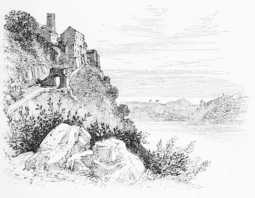
NEMI.[411]
"April 17.—Last Sunday I had so much more cough, and was so much knocked up with my week's nursing, that kind Lady Marian Alford insisted on taking me early on Monday in her own carriage to Albano for change. It was like travelling with the Queen, everything so luxurious, charming rooms, and perfect devotion everywhere to 'la gran donna da bene,' her personal charm affecting all classes equally.
"Lady Marian had a very pleasant party at Albano, Lord and Lady Bagot and their daughter, Mr. Story,[412] Miss Boyle,[413] Miss Hattie Hosmer,[414] and Mr.[415] and Lady Emily Russell. The first afternoon we drove along the lake to Lariccia, where we went all over the wonderful old Chigi palace, and then on to the Cesarini garden at Genzano, overhanging the lake of Nemi. The next morning we went to the Parco di Colonna and Marino, and then in a tremendous thunderstorm to Frascati, where we dined in the old Campana Palace, returning to Rome in the evening. I like Mr. Odo Russell and his simple massive goodness extremely. I hear that Pius IX. says of him, 'Non é un buono cattolico, ma é un cattivissimo protestante.' Miss Hosmer had said to him, 'You're growing too fat: you ought to come out riding; it will do you no end of good;' to which he replied in his slow way, 'No, I cannot come out riding.'—'And why not?' said Miss Hosmer. 'Don't you know,' he said, 'that I am very anxious to be made an ambassador as soon as possible, and, since that is the case, I must stay working at home.'
"'I like midges, for they love Venice, and they love humanity,' said Miss Mary Boyle.
"On Wednesday, finding both my patients better, I acceded to Marcus's entreaties and went with him and some friends of his to Tivoli for the day. Most gloriously lovely was it looking! My companions scrambled round the waterfalls, whilst I sat and what Robert Peabody calls 'water-coloured' opposite the Cascatelle. In the evening we went to the Villa d'Este and saw the sun set upon the grand old palace through its dark frame of cypresses.
"This morning I went for the first time to see the bishops of the Council; rather a disappointing sight, though they are a fine set of old men. Some of the American costumes are magnificent.
"Monday is the end of Edward's twenty-one days' fever, and I am still very anxious for the result. As he says, I feel rather, since the arrival of his parents, like a hen who has nursed a duckling which has escaped: but I go every day to look at him."
"April 30.—It is no use worrying oneself about the journey yet. It must always be painful and anxious. On returning to America, Dr. Winslow's last words to me were, 'Remember, if she has any fright, any accident, any anxiety, there will be another seizure,' and in so long a journey this can scarcely be evaded. She must have more strength before we can think of it. Her own earnest wish is to go to Albano first, but I dread those twelve miles extra. We always had this house till May 15, and hitherto there has been no heat.
TIVOLI.[416]
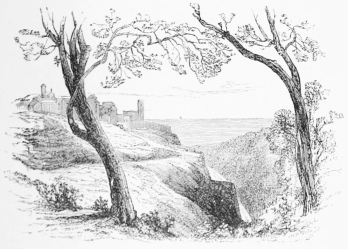
"On Monday, Tuesday, and Wednesday, Mother was carried down by two women in her dressing-gown, wrapped round with shawls, to a little carriage at the door. They were perfectly still sunny days, no bronchitis to be caught. The first day we only went round the Pincio, the second to the Parco di San Gregorio, the third to the Lateran and Santa Croce: she chose her own two favourite drives.
JOURNAL.
"May 3, 1870.—Walked with Miss J. Pole Carew and her governess from the Villa Albani to Sant' Agnese to look for the blood-red lily, seven feet high, which smells so terribly that no one is able to pick it. The governess (Miss Nicholson) said how the twisted palms carried in the Roman Catholic ceremonies seemed to her like a type of their faith. So much would be beautiful and impressive in the lives of the martyrs and the memories of the early Church, if, like the palms, so beautiful when they are first brought to Rome, they were not twisted and overladen, to the hiding and destruction of their original character."
To MISS LEYCESTER.
"May 8.—Last Sunday we drove to the Villa Borghese, which is now in its fullest most luxuriant summer green. When we came back, the Tombola was taking place in the Piazza del Popolo, so that gate was closed, and we had to go round by Porta Salara. The slight additional distance was too much for Mother, so that she has been unable to be up even in her chair for several days. This will show you how weak she is: how terrible the return journey is to look forward to.
"She certainly never seems to realise her helplessness, or to find out that she can no longer knit or do the many things she is accustomed to.... She likes hearing Job read, because of the analogy of sufferings, but she does not at all admire Job as a model of patience! Hymns are her delight, and indeed her chief occupation. She has great pleasure in the lovely flowers with which our poorer friends constantly supply us, especially in the beautiful roses and carnations of the faithful Maria de Bonis (the old photograph woman), who is as devoted as ever."
"May 15.—The weather has been perfect. In all our foreign or home experience I do not recollect such weeks of hot sunshine, yet never oppressive; such a delicious bracing air always. The flowers are quite glorious, and our poor people—grateful as only Italians are—keep the sick-room constantly supplied with them.
"But, alas! it has been a very sad week nevertheless, and if I once allowed myself to think of it, my heart would sink within me. My dearest Mother has been so very, very suffering; in fact, there have been very few hours free from acute pain, and, in spite of her sweet patience and her natural leaning towards only thanksgiving, her groans and wails have been most sad and the flesh indeed a burden.... You will easily imagine what it is to me to see this state of intense discomfort, and to be able to do nothing to relieve it; for I am quite convinced that nothing can be done, that medicine must be avoided as much as possible in her worn-out system, and that we must trust entirely to the effect of climate and to a returning power of taking nourishment. Dr. Grigor told her that it was a case of most suffering paralysis, usually producing such dreadful impatience that he wondered at her powers of self-control. But from my sweetest Mother, we never hear one word which is not of perfect patience and faith and thanksgiving, though her prayers aloud for patience are sometimes too touching for us to bear. She has not been out for ten days, as she has really had no strength to bear the lifting up and down stairs, and she has seen nobody except our dear Mrs. Woodward and Mary Stanley."
To MISS WRIGHT.
"Rome, May 22, 1870.—The Mother can recover no power in her lost limbs, in which she has, nevertheless, acute pain. Yet, deprived of every employment and never free from suffering, life is to her one prolonged thanksgiving, and in the sunshine of her blessed state of outpouring gratitude for the silver linings of her clouds, it is not for her nurses to repine. In her case daily more true become the lines of Waller—
'The soul's dark cottage, battered and decayed, Lets in new light through chinks that time has made.'
But when even her short excursions to the Pincio or Villa Borghese produce the most intense exhaustion, no stranger can imagine how we can dream of attempting the immense homeward journey. Still, knowing her wonderful power of will and what it has accomplished, I never think anything impossible, and all minor details of difficulty become easier when one has a fixed point of what must be. We shall at any rate try to reach Florence, and then, if she suffers seriously and further progress is quite impossible, we shall be on the way to Lucca or Siena. If we ever do reach Holmhurst, of course it will be for life, which makes the leaving this more than second home very sad to me.
BRACCIANO.[417]
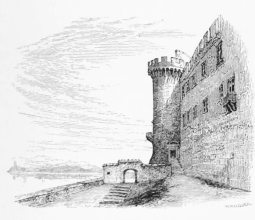
"I have had many pleasant friends here this winter, especially the Pole Carews, who are a most charming family. Latterly also I have seen much of Mrs. Terry, who is a very interesting and delightful person. Since the world has drifted northwards, I have seen more of the few friends who remain, and with the Terrys have even accomplished a very old desire of going to Bracciano. It is a beautiful drive across the Campagna, and then comes the ascent into the steep old town, and under the many gates and fortalices of the castle, to a courtyard with painted loggias. Armed with an order from Princess Odescalchi, we went all over the rooms with their curious ugly old pictures and carving, and sat in the balconies looking down upon the beautiful transparent Bracciano lake, twenty miles in circumference, all the mountains reflected as in a mirror. Mrs. Terry is charming: after we had talked of sad subjects she said—'But we have spoken enough of these things; now let us talk of butterflies and flowers.' In spite of all other work, I have sold £75 worth of sketches this winter, chiefly old ones, so am nearly able to pay our rent."
To MISS LEYCESTER.
"Rome, May 26, 1870.—The Mother is better for the great heat, thermometer standing at 85°, but Rome always has such a fresh air that heat is never overpowering, and in our delightful apartments we never suffer, as we can have so much variety, and if Mother does not go out, she is moved to the balcony overhanging the little garden at the back, where she sits and has her tea under a vine-covered pergola. If we are permitted to reach Holmhurst, I fear all will not be benefit. I much dread the difficulty there will be in keeping Lea from being wholly engrossed again by household affairs, and I cannot see how Mother could do without her almost constant attendance, which she has now. Also, we shall greatly miss the large bedroom opening into a sitting-room, where I can pursue my avocations, able to be with her at the faintest call, and yet not quite close to the groans.... But all this is long, long looking forward: there seems such a gulf between us and England.... Yet we think of attempting the move next week, and on Friday sent off six large boxes with the accumulations of many years, retaining also a list of what must be sent back if we never reach England.
"The Signorina and Samuccia, Clementina and Louisa, Rosina and Madame da Monaca, have all been to say good-bye, and all kiss Mother with tears on taking leave, overcome by her helpless state and sweet look of patience."
GRAVE OF AUGUSTUS W. HARE, ROME.
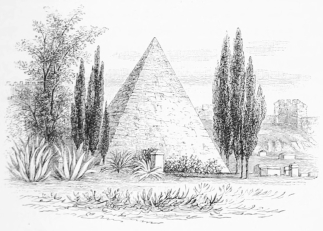
"May 29.—Emmie Penrhyn's letter was an especial pleasure to the Mother, and what she said of the centurion's servant, grievously 'tormented.' Certainly she is grievously tormented. The pain really never ceases, and the individual motion of the helpless arm is terrible.... I think with misery of the disappointment the return to Holmhurst will be to her. She cannot realise that it will not be, as it has always been, the home of her well months, talks of how she shall 'frolic out into the garden,' &c. I feel if we ever reach it, it is going, not to England, but to Holmhurst for life.... We have been to the cemetery under Caius Cestius, and the sentinel allowed her little carriage to pass across the turf, so that she was able to look once more upon the well-known grave, embosomed in its roses and aloes. Yesterday we went to take leave of the old Miss Haigs at their beautiful villa. The three old ladies embraced Mother, and presented her, like three good fairies, one with roses, another with geraniums, and the third with two ripe strawberries."
"Florence, June 1.—Monday was a terribly fatiguing day, but Mother remained in bed, and was very composed, only anxious that nothing should occur to prevent our departure, and to prove to us that she was well enough. At five Mrs. Woodward came and sat by her whilst Lea and I were occupied with last preparations. At 7 P.M. Mother was carried down and went off in a little low carriage with Mrs. Woodward and Lea, and I followed in a large carriage with Miss Finucane and the luggage. There was quite a collection of our poorer friends to see Mother off and kiss hands. At the railway the faithful Maria de Bonis was waiting, and she and Mrs. Woodward stayed with Mother and saw her carried straight through to the railway coupé which was secured for us. We felt deeply taking leave of the kindest of friends, who has been such a comfort and blessing to us, certainly, next to you, the chief support of Mother's later years. 'Oh, how beautiful it will be when the gates which are now ajar are quite open!' were her last words to Mother.
FROM THE LOGGIA DEI LANZI.[418]
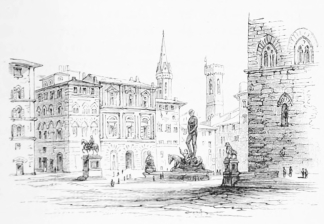
"The carriage was most comfortable.... Mother slept a little, and though she wailed occasionally, was certainly no worse than on ordinary nights. The dawn was lovely over the rich Tuscan valleys, so bright with corn and vines, tall cypresses, and high villa roofs. She was carried straight through to a carriage, and soon reached the succursale of the Alleanza, where the people know us and are most kind. In the afternoon she slept, and I drove up to Fiesole, where I had not been for twelve years, with Mr. and Mrs. Cummings, American friends."
"Bologna, June 5.—I fear, after my last, you will be grievously disappointed to hear of us as no farther on our way. We can, however, only tell from hour to hour how soon we may be able to get on, and I find it entirely useless to make plans of any kind, as we are sure not to be able to keep them. On Tuesday a great thunderstorm prevented our leaving Florence, and on Wednesday and Thursday Mother was in such terrible suffering that it was impossible to think of it. On Friday evening there was a rally, and we came on at once, Mrs. Dallas helping us through the difficulties of the Florence Station, and Mr. and Mrs. Cummings following us here. I think I mentioned that Dr. Grigor said travelling at night, when there was no sun, was the only chance of her reaching England alive. Mother begs I will tell Charlotte that 'No words can describe her sufferings or my anxieties, but that she has been brought through wonderfully hitherto, and that she still hopes to reach England—in time.'"
JOURNAL.
"Bologna, June 5.—Mr. Cummings says the great Church of S. Petronio here reminds him of the great Church universal—so vast the space, and so many chapels branching off, all so widely divided that in each a separate sermon and doctrine might be preached without distressing its neighbour, while yet all meet in the centre in one common whole, the common Church of Christ.
PIAZZA S. DOMENICO, BOLOGNA.[419]
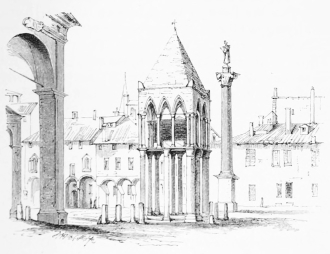
"An old American lady in the train had passed a summer at Vallombrosa. She said it was a place where to live was life and where one could be happy when one was unhappy."
To MISS LEYCESTER.
"Susa, June 8, 1870.—The Mother continued in a most terribly suffering state all the time we were at Bologna—agonies of pain which gave no rest. Yesterday afternoon it was so intense that she implored me to try the railway as a counter-irritant, and we set off at half-past ten at night. But the train shook fearfully, and the journey was absolute torture to her. We have never had such a painful time. Lea and I were obliged to sit on the floor by turns, holding the poor hand, and trying to animate her courage to bear up, but her cries were terrible. We reached Turin at 5 A.M., where, in spite of all promises to the contrary, she had to be carried all round the station; but fortunately for the next hour the train was easier and she suffered less. She was carried by two men out of the station, and down the wet muddy road here, where she has a good room, and soon fell asleep from exhaustion. We arrived at 6.30 A.M., and shall stay till to-morrow morning. Her state is certainly one of incomparably more suffering than at Rome, and she feels the change of climate dreadfully."
"Aix-les-Bains, June 9.—Last night, to my great relief, Colonel and Mrs. Cracroft and Miss Wilson arrived at Susa, and were the greatest possible help to us. We had obtained a permesso for the Mother to be taken straight through to the Fell railway carriage, and her little procession started at 7 A.M., and she was carried from her bed to her seat in the railway. The Cracrofts sat all round us in the carriage, which was much better than strangers, and Miss Wilson was most kind in keeping her hands bathed with eau de Cologne, &c. She suffered much for the first two hours, but the train was wonderfully smooth and easy, so that really the dreaded Mont Cenis was the least distressing part of the journey. About the middle of the pass she revived a little, and noticed the flowers, which were lovely—such gentianellas, auriculas, large golden lilies, &c. At S. Michel she bore the being carried about tolerably, so we were able to come on here, and arrived about four. Mother desires I will say to Charlotte, 'Hitherto the Lord hath helped me.'"
"Macon, June 12.—No farther on our way than this. Mother was rather less suffering on Friday, and she bore the move from Aix and the dreaded change at Culoz better than we expected, but in the latter part of our four hours' journey she was fearfully exhausted, and arrived here (at the hotel looking out on the Saone and the wide-stretching poplar plains) in a sad state.... It is impossible to move on yet.
"Yesterday, while she was sleeping, I drove to Cluny, the queen of French abbeys. A great deal is left, and it is a most interesting and beautiful place. I also saw Lamartine's little château of Monceaux, described in his 'Confidences.' All his things and his library were being sold under the chestnut-trees in front of the house. I just came up in time to buy the old apple-green silk quilt[420] from the bed of his saint-like mother, described in 'Le Manuscrit de ma Mère.'"
CLUNY.[421]
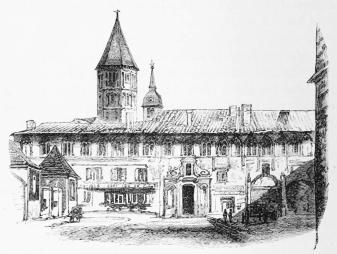
"Montbard, June 13.—Mother was so anxious to attempt coming on, that we left Macon at half-past eleven to-day, arriving here at four. To our dismay, when she had been taken out of the carriage and laid flat upon the platform, and the train had gone off, we found the station hotel closed. However, she was well carried on a chair down a lane to the so-called Hôtel de la Poste—an old-fashioned farm-house in a garden of roses; everything clean, pretty, and quaint; no sound but cocks and hens crowing and cackling; delicious farm-house bread, butter, and milk. Montbard is the place where Buffon lived in a very picturesque old château and gardens. Mother seems revived by the intense quiet and fresh country air. The old landlord and his wife are quite pictures—such clever, kind old faces, reminding one of La Sarte in 'Citoyenne Jacqueline.'"
CLOISTER OF FONTENAY.[422]
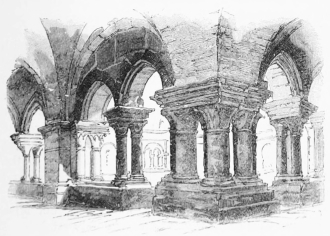
"Paris, June 14.—This morning was like a respite! Mother lay so quiet that I was actually able to draw as in the old days, which now seem in the far distance; and I took a little carriage to the lovely cloistered château of Fontenay, which I had long wished to see, and where I had luncheon with the charming owner, Madame de Montgolfier, and her two sons, people who own immense factories in the valley and devote their whole lives to the good of their workpeople. On my return I found Mother so far better that we could prepare her for the one o'clock express. She had a bath-chair to the station, and bore it well; but she was terribly tried by the five hours' journey, and being very ill carried at Paris, arrived at the hotel utterly prostrated. We hope to go on to-morrow, but all is most uncertain."
"Dover Station, June 16.—We are here, with intense thankfulness. Mother looked so ill and aged this morning we did not hope to move her, but she had a sudden rally in the middle of the day, so at 6 P.M. we were able to prepare her, and had her carried through the station to a carriage before the mob of people came.... We dreaded arriving at Calais, but she was carried in an arm-chair to the steamer, which was fortunately at the near quay and no steps. Of course our little procession was the last to arrive, and every place was taken; but Miss Charlotte Cushman,[423] who had comfortably established herself in the cabin, with a calm dignity which is irresistible at once directed the men to put Mother down in her place, and went up on deck.
"The sea was like glass—lovely moonlight and sunrise, and we seemed to be at Dover before we left Calais. A sailor carried Mother in his arms to the railway carriage, in which we were allowed to go as far as the station platform, and here we are. A porter has fetched cups of tea, and we have four hours to wait.
"We shall be glad of a visit from you as early as you like to come next week. I should not like you to defer coming long, as, though I have no special cause for apprehension, still in Mother's critical state every day is precious. You will find her terribly altered in all respects, though the mind and memory are quite clear at the moment. None of her doctors give any hope whatever of amendment; but you will understand the position much better when you see it, only I am anxious that you should help me to face what is inevitable, instead of striving after what cannot be. Let us seek to alleviate suffering, not struggle after an impossible cure which may hasten the end."
To MISS WRIGHT.
"Holmhurst, June 17.—I know you will truly rejoice with and for us that we have arrived in safety, and that my poor suffering Mother has her great wish of seeing her little home once more. You will imagine what the journey has been, as she is now utterly helpless, nearly blind, and never free from acute suffering in the spine and arm, which is often agony. At Rome it was generally thought quite impossible that she could survive the journey, and nothing but her faith and patience, and her self-control, have enabled us to get through it. We never could make a plan, but just seized the happy moment when she was a shade better, and at once pushed on a step. She was, of course, carried everywhere, and people were wonderfully kind; we had always somebody to go with us and smooth the difficulties of the railway stations—either old friends or people who were at my lectures at Rome and met us accidentally.
"When we arrived, all the old servants were terribly overcome to see their beloved mistress carried in so changed and helpless. She is still very ill, but unspeakably thankful to be here, and to feel that the journey is done. My life is, and must continue to be, one of constant watching."
"July 21.—Our letters are now our only intercourse with the world beyond the gates of Holmhurst, which I never leave; but indeed I can seldom leave the house before 8 P.M., when I walk round the fields while Mother is prepared for the night. Though it is now the only thing I ever think of, it is very difficult to occupy and cheer her days, for she cannot bear any consecutive reading. Sometimes I read, and tell her what I have read as a kind of story. She is seldom up before 3 P.M., and then is carried down to the lawn in her dressing-gown, and up again at four, when she is sometimes able to look at a book for a few minutes. That which is oftenest in her hand is the little 'Invalid's Friend' which you gave her, and she desires me to tell you how often she finds comfort in it.... For the last fortnight we have been entirely alone, which has been really best for her, as, though she has enjoyed seeing those she loved, each departure has made her worse.
"I write much at my 'Walks in Rome' in her room, and my ancient history is so imperfect I have plenty to study, which acts as a sort of mental tonic."
From my JOURNAL (The Green Book).
"June 26.—My darling often talks to me in her hymns. To-night, when I left her, she said with her lovely sweetness, 'Good-night, darling.
"Go, sleep like closing flowers at night, And Heaven your morn will bless."'
"'I never wish to leave you,' she said the other day. 'I never wish for death; always remember that. I should like to stay with you as long as I can.' And another day, 'I must call you "my daughter-son," as Mrs. Colquhoun did hers: as long as I have you, I suppose I can bear anything; but if you were taken away, or if I had never had you, my life would be indeed desolate: I could not have lived on.... I try so not to groan when you are here, you must not grudge me a few groans when you are out of the room.'"
"July 18.—'I had such a sweet dream of your Aunt Lucy last night. I thought we were together again, and I said, "How I do miss you!" and she said she was near me. I suppose I had been thinking of—
"Saints in glory perfect made Wait thine escort through the shade."
I think perhaps I had been thinking of that. Dear Aunt Lucy, how she would have grieved to see me now!'"
"July 19.—'Yes, I know the psalms; many in your Uncle Julius's version too. Many a time it keeps me quiet for hours to know and repeat them. I should never have got through my journey if I had not had so many to repeat and to still the impatience.'"
To MISS WRIGHT.
"Holmhurst, July 31, 1870.—I continue to work on steadily at my book in the sick-room. I have just got Murray's Roman Handbook, and am amazed to see how much better it is than I expected; but I am glad I have not seen it before, as, though I have already given even all his newest information, I have told it so oddly differently.
"The sweet Mother continues much the same. She is carried out each fine afternoon to sit for an hour near the weeping ash-tree on the lawn, and enjoys the sunshine and flowers.... In this quiet garden, and never going beyond the gates, everything seems very far off, and I am beginning to have quite a sympathy with the hermits, and to wonder the race does not continue: it is certainly more reasonable than that of the monks. A great peace seems to have fallen upon us. As I see my helpless Mother's quiet happiness, and share it, I think of Richard Crashaw's lines—
'How many unknown worlds there are
Of comforts, which Thou hast in keeping!
How many thousand mercies there
In Pity's soft lap lie a-sleeping!
Happy she who has the art
To awake them
And to take them
Home, and lodge them in her heart.'"
From my JOURNAL (The Green Book).
"August 8.—It is inexpressibly touching to me how Mother now seems to have an insight into my past feelings which she never had before, and to understand and sympathise with childish sufferings which she never perceived at the time, or from which she would have turned aside if she had perceived them. To-day, after her dinner, she said most touchingly, watching till every one went away and calling me close to her pillow—'I want to make my confession to you, darling. I often feel I have never been half tender enough to you. I feel it now, and I should like you to know it. You are such a comfort and blessing to me, dearest, and I thought perhaps I might die suddenly, and never have told you so. I cannot bear your being tied here, and yet I do not know how I could do without you, you are so great a blessing to me.'
"And oh! in the desolate future what a comfort these few words will contain! But I said—'No, darling, I am not tied: you know it is just what I like. I know you could not do without me, but then I could not do without you, so it is just the same for both of us.'"
"August 26.—To-day is the anniversary of my adoption, what Mother used to call my Hurstmonceaux birthday. She remembered it when I went to her, and said touchingly—'God be thanked for having given me my child, for having preserved him, for having strengthened him. May he live to His glory, and may I die to His praise.... Pray that He may forgive the past, watch over the present, and guide the future.' Later she said—'It is very seldom that a woman's future is settled at thirty-five, as mine was. I was not only a widow, but my adopting a child showed to all the world that I should never marry again.... I can only make a meditation,' she said; 'I have no strength to make a prayer.... I have long been obliged to pray in snatches—in moments.... I am so glad that I know so many psalms, hymns, and collects; they are such a comfort to me now. I could think of nothing more, but these I dwell upon.... Sometimes when I can think of nothing else I take the Lord's Prayer, and lie still to make a meditation upon each separate clause.' When I left her at night she said fervently—'Good-night, my own dear love, my blessing: may I be your blessing, as you are mine.'"
In our quiet life, the news of the war in France, the siege of Paris, &c., reached us like far-off echoes. My mother cared little to hear of it, but shared with me in anxiety as to the fate of the excellent people we had so lately left at Montbard and Fontenay, which were overrun by the Prussians. On September 8 the Empress Eugenie took refuge at Hastings, and two days after walked up the hill past our gate. She was joined at Hastings by the Prince Imperial. I little thought then that I should afterwards know him so well.
JOURNAL.
"Sept. 10, 1870.—Lea has just been saying, 'You may go and count the trees to-day, for I've nothing for you for dinner. The butcher's never been, good-for-nothing fellow! he's gone gawking after that Empress, I'll be bound.'"
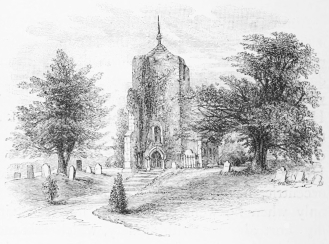
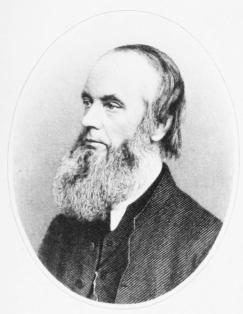
Almost all my Mother's nieces and many old friends came to see her in the summer, generally staying only two or three days, but her dear cousin, Charlotte Leycester, came for the whole of September. While she was here at Holmhurst I was persuaded to go away for two days, and went to see Dean Alford at his cottage of Vine's Gate in the Kentish Hills. He was more charming than ever, and more eccentric, never wearing stockings, and shoes only when he went out. I was miserable, in my short absence, with anxiety, which cost me far more than the refreshment of change could replace; but I was led to go to see the Dean by one of those strange presentiments for which I have never been able to account. It was my last sight of this dear friend, with whom I have been more really intimate than with perhaps any one else, in spite of the great difference of age and position. Dean Alford died in the following winter, but it was at a time when, in my own intense desolation, all minor sorrows fell dumb and dead. But his grave, in St. Martin's Churchyard at Canterbury, is always a very sacred spot to me.
ST. MARTIN'S, CANTERBURY.
Henry Alford Dean of Canterbury.
I must record a visit which we received soon after my return home, as it led to a friendship which was one of the great pleasures of many following years. One morning, as I was sitting in my Mother's room as usual, a card with "Mrs. Grove, Oakhurst," was brought up to me, and, as I opened the drawing-room door, I saw an old lady with the very sweetest and dearest face I ever set eyes upon, in a primitive-looking hat and apron, and with a basket on her arm, and I fell in love with her at once. She came often afterwards to see my Mother, who greatly appreciated her; and after my Mother's sweet life passed away, it is difficult to say how much of my home interest was associated with Oakhurst, with the ready sympathy and old-fashioned knowledge of this dear Mrs. Grove, and with her daughter, Mrs. Baillie Hamilton, and her two grand-daughters, now Mrs. Spencer Smith and Mrs. Hamilton Seymour. Alas! as I write this,[424] the dear Mrs. Grove, in her great age, is herself rapidly fading heavenwards—but so gently, so surrounded by the love which her own loving-kindness has called forth, that death is indeed coming as a friend, gently and tenderly leading her into the visible presence of the Saviour, in whose invisible presence she has so long lived and served.
JOURNAL (The Green Book).
"Holmhurst, Oct. 20, 1870.—Mother said to-day, 'I always think that walking through the Roman picture-galleries is like walking through the Old and New Testament with the blessed company of apostles and martyrs beside one.... I am so fond of that prayer "for all sorts and conditions of men," not only for my invalid state, but it is all so appropriate to the present time—the petition for peace and unity, &c.'"
"Oct. 23, Sunday.—'Alas! another Sunday in bed,' said Mother this morning.
"'But, darling, you need not regret it; all the days are Sundays to you.'
"'Yes; but to-day I woke early, and have said all my little Sunday hymns and psalms.'
"Truly with her, 'Les prières de la nuit font la sérénité du jour.'"[425]
"Oct. 26.—'My dear child is never cross to me, never; and always appears just at the very moment I want anything.'"
To MISS WRIGHT.
"Holmhurst, Oct. 28, 1870.—I am so glad you have been here, and can fancy our perfectly quiet, eventless life, the coming and going in the Mother's sick-room, and her gentle happiness in all the little pleasures which are spared to her. Since you were here she has been not so well, from the wet and cold, I suppose, the sight dimmer and the other powers weaker; but the symptoms are ever varying, and, when it is thus, I almost never leave her—watch her sleeping and try to amuse her waking.
"To-day my absent hour was sadly engaged in attending the funeral of my dear old friend, Mrs. Dixon,[426] who died quite peacefully last Saturday, a long illness ending in two days of merciful unconsciousness. She was buried at Ore, in Emma Simpkinson's grave. Many deeply mourn her, for few were more sincere and cordial, more affectionate and sympathising."
JOURNAL (The Green Book).
"Nov. 1, 1870.—My darling has had two months of comparative freedom from pain, with many hours of real pleasure, in which she was often carried down and sat out in her bath-chair amongst the flower-beds in the sunshine. Sitting under the ash-tree shade, she has been able to see many friends—Mrs. Wagner, Mrs. Grove, old Mrs. Vansittart Neale at ninety, and Lady Waldegrave. Charlotte Leycester was here for six weeks, and the Mother was then so far better that it was a great source of enjoyment to both the cousins. Since then she has ailed more frequently, and has had occasional recurrence of the old pain in her arm. I have sat constantly writing in her room, laying aside 'Walks in Rome' for a time, and devoting myself to writing the Family Memorials. For the dear Mother has wished me to continue the work she began long ago of writing the life of Augustus and Julius Hare. I represented that, as one of these died before I was born, and I had never appreciated the other as she had done, it would be impossible for me to do this, unless she would permit me to make her, who had been the sunshine of my own life, the central figure of the picture. At first she laughed at the idea, but, after a day or two, she said that, as, with the sole exception of Charlotte Leycester, all who had shared her earlier life had passed away, she could not oppose my wish that the simple experience of her own life, and God's guidance in her case, might, if I thought it could be so, be made useful for others. And, as she has accustomed herself to this thought, she has lately taken real pleasure in it. She laughs at what she calls my 'building her mausoleum in her lifetime,' but has almost grown, I think, to look upon her own life and her own experience as if it were that of another in whom she was interested, and to read it and hear it in the same way. She has given me many journals and letters of various kinds which I might use, and has directed the arrangement of others. I have already written the two earliest chapters of her married life, and read most of them to her, but she stopped me at last, saying that they interested her too deeply. She frequently asks now—'Are you writing the Memorials, or only "Walks in Rome"?' and it is a proof how clear her understanding still is, that some weeks ago she wisely directed me, if the work was ever carried out, to evade all wearying discussion by consulting no one, and that I should on no account show it to any one of the family, especially the Stanleys, till it was finished, when they might judge of it as a whole.
"Sometimes the dear Mother has herself been able to write some of her 'Ricordi,' as she calls them, and, with her trembling hand, has filled a whole little volume with the recollections of her youth, but this has often been too much for her.... After her tea at four o'clock, I have generally read some story to her till she has gone to bed, and after that a chapter and some hymns. There is a passage in one of George Eliot's autobiographical sonnets, in which, referring to her mother, she speaks of 'the benediction of her gaze'; how often have I experienced this!"
"Nov. 4.—Last night I read to the Mother Luke xvii. and a hymn on 'Rest' which she asked for. When I was going to wish her good-night she said—'I do hope, darling, I am not like the ungrateful lepers. I try to be always praising God, but I know that I can never praise Him enough for His many, many mercies to me.' I could not but feel, in the alarm afterwards, if my dearest Mother never spoke to me again, what beautiful last words those would have been, and how characteristic of her. Oh, goodness in life brings us near to God: not death! not death!
"At 2 P.M. I was awakened by the dreadful sound which has haunted me ever since the night of March 12 in the Via Gregoriana—of Lea rushing along the passage and flinging open the door—'Come directly'—no time for more words—and of running through the dark gallery and finding the terrible change—another paralytic seizure—calling up John and sending him off to Battle for the doctor, and kneeling by the bedside, consoling her if possibly conscious, and watching for the faint dawn of visible life, that the first words might be tender ones, the first look one of love, ... and it was so—that my darling's first words were something tender, indefinite, but spoken to me. The entire unconsciousness was not long. When the doctor arrived the face was almost natural, but he saw that it had been a regular seizure. By 8 A.M. she was nearly herself again, and anxious to know what could have happened. She had been frightened by seeing the doctor. She appeared to have no pain, and there is no additional injury to the powers. To-day has been a constant watching, rather a warding off from her of any possible excitement than anything else.... In all the anguish of anxiety, I cannot be thankful enough for what we have, especially the freedom from pain."
"Nov. 9.—No great change—a happy painless state, the mind very feeble, its power gone, but peaceful, loving, full of patience, faith, and thankfulness."
"Nov. 16.—And since I wrote last, the great, the most unutterable desolation, so long looked for, so often warded off, has come upon me. Oh! while they can still be attained, let me gather up the precious fragments that remain.
"On Thursday the 10th my darling was much better, though her mind was a little feeble. I felt then, as I feel a thousand times now, how extraordinary people were who spoke of the trial my darling's mental feebleness would be to me. It only endeared her to me a thousandfold—her gentle confidence, her sweet clinging to me to supply the words and ideas which no longer came unsought, made her only more unspeakably lovable. On that day I remember that my darling mentioned several times that she heard beautiful music. This made no impression on me then.
"Friday the 11th, I sat, as usual, all morning in her room correcting my book. I forget whether it was that morning or the next that my darling on waking from sleep said that she had had such a pleasant dream of her childhood and Adderley and 'old Lady Corbet,' who first taught her to 'love what was beautiful.'[427] At 2 P.M. Mother was up, and sat in her arm-chair by the fire. She was partly dressed, and wore her pretty old-fashioned cap with the strings tied in a bow on the top of the head, and a little red cloak which Miss Wright had given her: I remember thinking she looked so pretty, and telling her so. I was out at first, while she wrote a little letter to Fanny Tatton,[428] and talked to Lea about the texts she had been reading. At four, she had her tea, and then I sat at her feet, and my darling talked most sweetly about all the places she had admired most in her life—of Llangollen in her childhood, and of Capel Curig, of her visit to Rhianva, and of many places abroad, Narni with its woods and river, and more especially Villar in the Vaudois, of which I had been making a drawing, which she had desired to have set up that she might look at it. Then she asked to have one of her old journals read, and I read one of Rome, and she spoke of how much happiness, how many blessings, she had connected with Rome also, though much of suffering. She was especially bright and sunny. I remember saying to her playfully, 'Take a little notice of me, darling; you do not take enough notice of me,' and her stroking my head and saying, 'You dear child,' and laughing.
"At six o'clock my sweetest one was put to bed.
"Afterwards I read to her a chapter in St. Luke—'Let this cup pass from me,' &c., and sat in her room till half-past nine. When I went downstairs I kissed her and said, 'Have a good good night, darling.' I cannot recollect that she spoke, but I remember looking back as I opened the door, and seeing my sweet Mother lying on her side as she always did, and her dear eyes following me with a more than usually tender expression as I left the room.
"I have often thought since of a sentence in Carlyle's 'Life of Sterling'—'Softly, as a common evening, the last of our evenings passed away, and no other would come to me for evermore.'
"When I went upstairs again at half-past ten, I went, as I always did, to listen at her door, and, hearing a noise, went in. Terrible illness had come on and continued for hours.... The next thirty-six hours I never left her for an instant, and they all seem to me like one long terrible night. I remember very little distinctly, but at eight on Saturday morning she was certainly much better. The doctor came at ten, and she was able to speak to him. He looked very grave over the lowness of her pulse, but she continued better for some hours, and slept a great deal in the afternoon. Towards evening I thought her not so well, though the doctor, who came at half-past nine, considered her state much less anxious. I was then possessed with the feeling that our parting was very near. Lea also called me downstairs to hear the extraordinary sound that was going on. It was indeed strange. It was as if hundreds of thousands of crickets were all chirping together. They appeared everywhere in swarms on the hearths downstairs. The noise was so great that I felt if it continued we should be driven out of the place: it was quite deafening; but they only came that night, they never were heard before, and the next day they had totally disappeared.[429] I persuaded Lea to lie down on her bed, where she soon fell asleep. All through the night I sat by my darling on the pillow. I think the last thing she said was that the other arm, the well arm, pained her very much, and we feared paralysis, but more pressing symptoms diverted attention. At half-past one I called Lea again. I shall never know in this world whether my Mother was really conscious, if she even knew anything either of her own great physical suffering, or of what passed that night. I believe God helped me to say and do all she would have wished. Each hour I was more sure of what was coming. Towards dawn, kneeling on the bed, I said some of the short prayers in the Visitation of the Sick, but she was then fading rapidly, and at last I repeated the hymn 'How bright those glorious spirits shine,' which we had always agreed was never to be used except as the solemn sign that our parting was surely come. I am not sure if my darling knew that she was dying before: I am sure, if she could still hear, that she knew it then. I am sure that she was conscious at the end and that she speechlessly took leave of us. Her expression was calm and serene, but very grave, as if she realised for the first time that I might not travel with her into the solitude she was entering. It was about a quarter of an hour before the end that all suffering ceased, her paralysed side seemed to become quite well; the lame hand, which had been so tightly clenched since the 13th of March, unfolded then upon the 13th of November, and gently met the other in prayer. The eyes were closing, but opened once more—as a look—a look of youth and radiance, stole over the beloved features at the last, when there was no struggle, only just a gentle sigh or two. Lea, who was leaning over the bed on the other side, held her spectacles to the mouth. There was no breath. I could scarcely believe that she was gone. I still held her in my arms. But oh! in my unutterable desolation I could give God thanks that the end was like this. The first stroke of the church-bell sounded as she passed into the real life.
"When the sweet eyes closed and the dear face lost its last shadow of colour, I kissed my own Mother for the last time and came away. The first snowflakes of winter were falling then. They do not signify now: no snow or cold can ever signify any more.
"But oh! the agony, the anguish!
"And since then her precious earthly form has been lying, with her hands folded on her breast as if she were praying—the dear lame hand quite well now. The room is draped with white and filled with flowers. Two large white camellias stand at the head of the bed and overshadow her pillow, and on the table, draped with white, are her own particular objects, her bronze wolf, her little gold tray with her spectacles, smelling-bottle, &c., and all her special hymn-books. At first when I went in, in my great agony, I did not draw down the sheet. But now I draw it down and look at my dearest one. There is a look of unearthly serene repose upon the worn features, which is almost too beautiful.
"'Days without night, joys without sorrow, sanctity without sin, charity without stain, possession without fear, satiety without envyings, communication of joys without lessening, and they shall dwell in a blessed country, where an enemy never entered, and from whence a friend never went away.'[430]
"But yet—oh my darling! my darling!"
To MISS LEYCESTER.
"Sunday morning, Nov. 13.—My darling Mother has entered into the real life.
"She grew gradually weaker hour by hour, and I think she suffered less. She knew me always, and liked to keep her eyes constantly fixed upon me, but she could not speak. At half-past nine, she seemed sinking, and I repeated over to her, as she desired me to do when she was dying, the hymn 'How bright those glorious spirits shine.' I think she heard it.... Soon after she opened her eyes and gave me a long, long look of her own perfect lovingness, then turned to Lea, to me again, and we heard a few gentle sighs. I had just time to ring the bell close to my hand as I sat on the pillow, and as John and Harriet[431] (who had been waiting in the passage) passed sobbing into the room and stood at the foot of the bed, my sweet darling gently breathed her last in my arms, once more—quite at the last—opening her eyes, with a look of perfect bliss, as if gazing at something beyond us. It was so gentle a breathing out of her spirit, we scarcely knew when it was over. She died in my arms, with my kiss upon her forehead, at half-past ten. I know how tenderly my Mother's dearest, most tenderly loved friend feels for me, and that I need not ask her to pray for my Mother's poor child Augustus."
"Nov. 14.—It seems so strange to look out of the window and see the same sheep feeding in the same green meadows, the same flowers blooming, and yet such a change over all. I feel as if it were I who had died yesterday.
"What a long, long day it was! A thousand times I was on the point of running into the room to say some little loving word to her who has been the recipient of every thought, every pleasure for so many, many years, and then the crushing blank, the annihilation came all afresh. Indeed, I feel it afresh every quarter of an hour, and when I am calmed after one thing in which my great desolation is especially presented to me, something else calls it all forth again. Oh, my darling! my darling! can it be? oh! how can it be?
"The dear earthly form lies with its hands sweetly folded as if she were praying. I go in often. I am always going in; but it does not remind me of her, though it is most peaceful, and the servants and others have the greatest comfort from looking at it.
"It is as a dream that yesterday morning, quite after it was over, I could say 'The day before yesterday my darling did this, my darling said that.' On Friday she was so bright, so happy, only her memory a little astray, but I was already forming a thousand little schemes for supplying this lost power, so that it should not be apparent to others, and to me nothing, I felt, could ever matter if the sunshine of my dear Mother's sweet presence was with me under any change."
"Tuesday, Nov. 15.—Your most dear letter has come.... How much, even in the first anguish of my desolation, I have felt what it would be to you also. You will always be most tenderly entwined with her sacred memory; indeed, I can scarcely think of you apart. For the last few years especially your companionship has been her greatest joy, and in your absence she has never passed many hours without speaking of you, never any, I think, without thinking of you. The grief she most dreaded was that she might have to mourn for you, for I think she rightly felt that—great as the sorrow would be—your physical powers would enable you to bear the separation better than she could have done.
"This morning I feel a little better, and can dwell more upon my darling's being perfected, upon the restoration of all her powers, upon her reunion to those she loved in former times of her life; and I have a perfect treasure-store in my journals for years of her sacred words of blessing, and advice, and thought for me, many of them, I know, intended to be my comfort now.
"I will send you many of the letters about her. I wonder why people should dread letters of sympathy. To me the letters are nothing, but what I long for is not to hear that people sympathise with me, but to know how they loved her.
"To-day it is thick snow. Oh! she would have been so ill; now she is not ill."
"Tuesday evening, Nov. 15.—To-day a change came over the dear face—a look of unspeakable repose and beauty such as I never saw on any face before. The servants told me of it, and so it was; it is the most wonderful expression—serene, solemn, holy beauty.
"All the letters are a great—not comfort—nothing can ever be that, but I like to see how she was loved, and I look forward to them. There were thirty to-day, and yet I thought no one could know. What comes home to one is simple sympathy. One cannot help envying the people who can be comforted in real sorrow by what one may call Evangelical topics. It seems so perfectly irrelative to hear that 'man is born to trouble,' that 'it is God that chasteneth,' &c.
"I recollect now that on Saturday morning I was obliged to send off some proof-sheets.[432] She asked what I was doing, and then said, 'I shall so enjoy reading it when it is all finished, but I must have my little desk out then, because I shall not be able to hold the book.' We have only just remembered this, which proves that there must have been a slight rally then. It was all so short, so bewildering at last, that things will only come back gradually.
"I shall be glad when the incessant noise of workmen[433] downstairs ceases. It is so incongruous in the house now, but could not be helped. My darling did not mind it; indeed it seems to me, on looking back, as if she never found fault with anything; often she did not hear it, and when she did, 'I like that pleasant sound,' she said."
"Nov. 16.—There were forty letters to-day, many wanting answers, so I can only write a little, but it is a comfort to me to send you any memories of those precious last days as they occur to me, and as the first mist of anguish clears up, so many things recur.
"You asked about Romo. Indeed it overwhelms me to think of it. The dear little beast is so touching in his attempts to comfort me. He comes and licks my hand and rubs himself against me, as he never was in the habit of doing. In the first sad moments after the dear eyes closed, Lea, by an old Northern custom, would send down to 'tell the dog and the bees' (the bees would have died, she thinks, if they had not been told), and Romo understood it all, and did not howl, but cried plaintively all morning.
"I forget whether I spoke of the music. For the last four days my darling had said at intervals that she heard beautiful music. Thursday and Friday I thought nothing of it; on Saturday it began to have a solemn meaning.
THE CHURCH LANE, HURSTMONCEAUX.
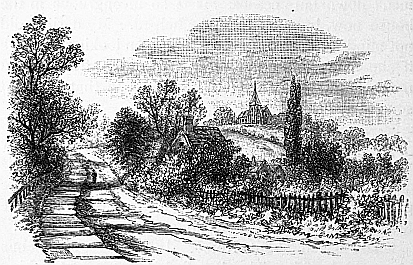
"I have been to-day to Hurstmonceaux. It was necessary. There was deep snow the first part of the way, but beyond Battle no snow at all, leaves still on the trees, and quite a summer look. It was more overpowering to me than I expected to pass Lime, and I almost expected to see her come across the field and open the wicket-gate to her beloved walk to the school. The Haringtons[434] were most kind in placing Hurstmonceaux Place at our disposal for the funeral, and removed all scruples about it by saying how really thankful they were to be able to show their affection for the Mother in that way. I went up twice to the church. The road thither and the churchyard looked most beautiful, and the spot chosen, on the edge towards the level, with the view she always thought so like the Campagna. I am allowed to enclose a little space, which will contain my grave also.
"I called on Mrs. W. Isted,[435] and found her quite overpowered, sitting with my darling's photograph. 'It is not only her own loss, dearly as I loved her, but the deaths of all my others come back to me, which she helped me to bear.'"
"Nov. 17.—Do you know that through a mist of tears I have been forced to go on sending off proof-sheets of 'Walks in Rome'? One of the last things she spoke of was her hope that I would not let her illness hinder the book. The dedication to her, already printed, will seem touching to those who read it. She herself read that when the first volume was finished. But her great pleasure of the last few weeks was in the chapters of the 'Memorials' which I was writing of her Alton life. To continue them with the copious materials she has left will now be my one great interest. She has left me perfectly free to make what use I like of all, and one day made me write down from her dictation an expression to that effect. The Alton life is certainly the most perfect ideal of a country clergyman's life that can well be conceived."
"Nov. 19.—I cannot leave home yet.... Leycester, Mamie, and many others have written, as she always said they would, that their hearts and houses are open to receive me, but this must be later. Indeed, I shall cling to all she loved, and in the ever-living remembrance of her shall be able to love all. I had even a kind note from Mrs. Maurice[436] to-day: she said I should.
"Henry Papillon came yesterday, touchingly wishful to look upon the dear face once more, and he was even more struck than I expected with its immortal beauty.... To-day was a great wrench. This morning the precious earthly form was sealed away from us."
"Nov. 22.—I went through yesterday in a dream. I did not realise it at all. Lea left Holmhurst in an agony of sobs and tears, but I did not; I had so often thought of it, I seemed to have gone through it all before, and then I had already lost sight of my darling.
"Lea, John, Johnnie Cornford, and I went in the little carriage first; Harriet, Anne, Rogers, Joe, and Margaret Cornford[437] followed her. We reached Hurstmonceaux Place about half-past twelve. In half-an-hour they all began to arrive: each and all of my dear cousins were most kind to me."
JOURNAL (The Green Book).
"Dec. 4, 1870.—I have been unable to write in my journal, the hundred and ninety-two letters which I have had to answer have taken all the time.... And I live still. I used to think I could not live, but I am not even ill; and yet how my life is changed, all the interest, all the happiness, all the sunshine gone, only the systematic routine of existence left.
"My poor Lea is already beginning to be interested in her chickens and her farm-life, and to think it all 'such a long time ago.' But to me it seems as if it had only just happened, and the hour in which her sweet eyes closed upon me has swallowed up all the hours which have come since, and is always the last hour to me.
"I think it was about the third day afterwards that Lea came into my room and told me that the look of wonderful beauty and repose which appeared at the last had come back again to the dear features. And so it was. It was the sweetest look of calm, serene repose. The colour had all faded out of my darling's cheeks, which had lost every sign of age, and were smooth and white as if they were chiselled in marble. Her closed eyelids, her gently curving mouth expressed the sweetest restfulness. The dear lame hand, quite supple at last, had closed softly upon the other. And this lovely image of her perfected state was lent to me till the last, when the beloved features were closed away from me for ever.
"It was on the Saturday that Lea and I went in together for the last time. Lea cried violently. I was beyond tears. We covered away together all that was dearest to us on earth. I placed a lock of my hair in her hands, and laid her favourite flowers by her. Monday a day of rain and storm-cloud. I shall always associate the road to Hurstmonceaux with the drive on that winter's morning with swirling rain-clouds, and the waters out on the distant Levels gleaming white through the mist. Coming down the hill near Boreham how many memories of my dearest one came back to me,—of her anxiety to put me out to walk at Standard Hill,—of her admiration of the three pines on the hill-top; and then, near Lime, of walks with her on dewy summer mornings, when I went with her in my childhood to pick ground-ivy and violets in the fields behind Lime Cross.