Volume 3 — CONTENTS VOLUME 3 (continued 2)
Reading edition
"Then Madame de Trafford asked them if there were no more poor people there, and they went and fetched other poor women and children, till there was quite a crowd. To them also she ordered me to give piastres—'toujours sans compter'—till at last, through much giving, my pockets were empty. Then Madame de Trafford was really angry—'Je vous ai dit, Madame Victoire, de porter autant que vous pouviez, et vous ne l'avez pas fait.'—'Mais, Madame, vous ne m'avez pas dit de mettre quatre poches, vous m'avez dit de mettre deux poches: ces deux poches étaient remplis, à present les voilà vides.'
"When we were turning to go away, all the people, who had not till that moment believed in their good fortune, fell on their knees, and cried, 'Oh, Signore, noi ti ringraziamo d'avere mandato questa anima benedetta, e preghiamo per ella.'—'Mais retournez bien vite à la voiture, mais montez donc bien vite, Madame Victoire,' said Madame de Trafford, and we hurried back to the carriage; and the coachman, concerning whom she had taken care that he should not see what had happened, was amazed to see us coming with all this crowd of poor women and children following us. When we were driving away, Madame de Trafford said, 'Quel jour heureux pour nous, Madame Victoire, d'avoir soulagé tant de misère; quel bonheur de pouvoir faire tant de félicité avec un peu d'argent.'"
After remaining many weeks at Pisa with Victoire, Madame de Trafford had accompanied her to Rome, whither she went in December 1859 to arrange the affairs of Italima at the Palazzo Parisani, and thence, having fulfilled her mission, and seen Victoire comfortably established in her Pisan home, Madame de Trafford had returned to Paris.
In 1865 the journey from Pisa to Rome was still tiresome and difficult. We went by rail to Nunziatella, and there a cavalcade was formed (for mutual protection from the brigands), of six diligences with five horses apiece, with patrols on each carriage, and mounted guards riding by the side. The cholera had been raging, so at Montalto, one of the highest points of the dreary Maremma, we were stopped, and those who were "unclean"—i.e., had omitted to provide themselves with clean bills of health at Leghorn—were detained for eight days' quarantine. We had obtained "clean" bills, from the Spanish Consul, grounded upon the hotel bills of the different places we had slept at since crossing the Alps, and, with others of our kind, were taken into a small white-washed room filled with fumes of lime and camphor, where we were shut up for ten minutes, without other hurt than that any purple articles of dress worn by the ladies came out yellow. Most dreary was the long after-journey through a deserted region, without a house or tree or sign of habitation, till at 10 p.m. we came in sight of the revolving light of Civita Vecchia, beautifully reflected in the sea. Then I had to watch all the luggage being fumigated for three midnight hours. However, November 18 found us established in Rome, in the high apartment of the Tempietto (Claude Lorraine's house), at the junction of the Via Sistina and Via Gregoriana, with the most glorious view from its windows over all the Eternal City, and a pleasant Englishwoman, Madame de Monaca, as our landlady. Hurried travellers to Rome now can hardly imagine the intense comfort and repose which we felt in old days in unpacking and establishing ourselves in our Roman apartment, which it was worth while to make really pretty and comfortable, as we were sure to be settled there for at least four or five months, with usually far more freedom from interruptions, and power of following our own occupations, than would have attended us in our own home, even had health not been in question. Most delightful was it, after the fatigues and (on my mother's account) the intense anxieties of the journey, to wake upon the splendid view, with its succession of aërial distances, and to know how many glorious sunsets we had to enjoy behind the mighty dome which rose on the other side of the brown-grey city. And then came the slow walk to church along the sunny Pincio terrace, with the deepest of unimaginable blue skies seen through branches of ilex and bay, and garden beds, beneath the terraced wall, always showing some flowers, but in spring quite ablaze with pansies and marigolds.
The first time we went out to draw was to the gardens of S. Onofrio, where, when we were last here, we used to be very much troubled by a furious dog. We rang the bell, and the woman answered; she recognised us, and, without any preliminary greetings, by an association of ideas, exclaimed at once, "Il cane e morto." It was very Italian.
So many people beset me during this winter with notes or verbal petitions that I would go out drawing with them, that at last I wrote on a sheet of paper a list of the days (three times a week) on which I should go out sketching, and a list of the places I should go to, and desiring that any one who wished to go with me would find themselves on the steps of the Trinità de' Monti at 10 A.M., and sent it round to my artistic acquaintance. To my astonishment, on the first day mentioned, when I expected to meet one or two persons at most, I found the steps covered by forty ladies, in many cases attended by footmen, carrying their luncheon-baskets, camp-stools, &c. I introduced four ladies to each other that they might drive out together to the Campagna, and I generally tried to persuade those who had carriages of their own to offer seats to their poorer companions. For a time all went radiantly, but, in a few weeks, two-thirds of the ladies were "en delicatesse" and, at the end of two months, they were all "en froid," so that the parties had to be given up. Of the male sex there was scarcely ever any one on these sketching excursions, except myself and my cousin Frederick Fisher,[308] who was staying at Rome as tutor to the young Russian Prince, Nicole Dolgorouki. He was constantly with us during the winter, and was a great pleasure from his real affection for my mother, who was very fond of him.
In the spring Esmeralda came to Rome, and I used often to go to see her in the rooms at Palazzo Parisani. She was very fragile then, and used to lie almost all day upon an old velvet sofa, looking, except for the heavy masses of raven hair which were still uncovered, almost like an uncloistered nun, with her pale face and long black dress, unrelieved at the throat, and with a heavy rosary of large black beads and cross at her waist.
From my JOURNAL.
"Rome, Dec. 21, 1865.—Cardinal Cecchi died last week, and lay in state all yesterday in his palace, on a high bier, with his face painted and rouged, wearing his robes, and with his scarlet hat on his head. Cardinals always lie in state on a high catafalque, contrary to the general rule, which prescribes that the higher the rank the lower the person should lie. Princess Piombino lay in state upon the floor itself, so very high was her rank.
"The Cardinal was carried to church last night with a grand torchlight procession, which is always considered necessary for persons of his rank; but it is expensive, as everything in Rome costs double after the Ave Maria. The fee for a frate to walk at a funeral is four baiocchi in the daytime, but after the Ave it is eight baiocchi. When the Marchesa Ponziani was taken to church the other day, all the confraternities in Rome attended with torches.[309]
"To-day at 10 A.M. the Cardinal was buried in the church at the back of the Catinari. According to old custom, when he was put into the grave, his head-cook walked up to it and said, 'At what time will your Eminence dine?' For a minute there was no response, and then the major-domo replied, 'His Eminence will not want dinner any more (non vuol altro).' Then the head-footman came in and asked, 'At what time will your Eminence want the carriage?' and the major-domo replied, 'His Eminence will not want the carriage any more.' Upon which the footman went out to the door of the church, where the fat coachman sat on the box of the Cardinal's state carriage, who said, 'At what time will his Eminence be ready for the carriage?' and when the footman replied, 'La sua Eminenza non vuol altro,' he broke his whip, and throwing down the two pieces on either side the carriage, flung up his hands with a gesture of despair, and drove off.
"The other day Mrs. Goldsmid was in a church waiting for her confessor, who was not ready to come out of the sacristy. While she was waiting, two men came in carrying something between them, which she soon saw was a dead frate. His robe was too short, and his little white legs protruded below. They put him on a raised couch with a steep incline and left him, and her agony was that he would slip down and fall off, and then that the priests would think she had done it. She became so nervous, that, as she kept her eyes fixed on the body, it seemed to her to slip, slip, slip, till at last she made sure the little man was coming down altogether, and going to the sacristy door, she rang the bell violently, and entreated to be let out of the church.
"Mrs. Goldsmid says that the Pope, Pius IX., cannot stop spitting even when he is in the act of celebrating mass.... Being very jocose himself, he likes others to be familiar enough to amuse him. The other day a friend asked Monsignor de Merode why the Pope was so fond of him: he said it was because, when he saw the Pope in a fit of melancholy, he always cut a joke and made him laugh, instead of condoling with him.
"The Pope is always thoroughly entertained at the stories which are circulated as to his 'evil eye' and its effects, as well as those about the 'evil eye' of the excellent and strikingly handsome Monsignor Prosperi. When the fire occurred in the Bocca di Leone, and the Pope was told of it, he said, 'How very extraordinary, for Monsignor Prosperi was out of Rome, and I was not there.'
"When the Pope, who does not speak good French, was talking of Pusey, he said, 'Je le compare à une cloche, qui sonne, sonne, pour appeler les fidèles à l'église, mais qui n'entre jamais.'
"I think there can scarcely be any set of men whose individuality is more marked than the present Cardinals.... Antonelli's manner in carrying the chalice in St Peter's is reverent in the extreme. Cardinal Ugolini, who is almost always with the Pope, never fails to ruffle up his hair in walking down St. Peter's or the Sistine."
"Christmas Day.—The Pope heard of the death of his sister, an abbess, this morning, just as he was going to be carried into St. Peter's, but the procession and the chair were waiting, and he was obliged to go. The poor old man looked deadly white as he was carried down the nave, and no wonder."
"January 15, 1866.—Went, by appointment, with Mrs. Goldsmid to the Church of SS. Marcellino e Pietro—the church with a roof like that of a Chinese pagoda, in the little valley beneath St. John Lateran. Inside it is a large Greek cross, and very handsome, with marbles, &c. The party collected slowly, Mrs. De Selby and her daughter, Mrs. Alfred Montgomery, Madame Sainte Aldegonde, the Bedingfields, a French Abbé, Mrs. Dawkins, and ourselves. Soon a small window shutter was opened to the left of the altar, and disclosed a double grille of iron, beyond which was a small room in the interior of the monastery. In the room, but close to the grille, and standing sideways, with lighted candles in front of it, was a very beautiful picture of the Crucifixion. It was much smaller than life, and seemed to be a copy of Guido's picture in the Lucina. The figure hung alone on the cross in the midst of a dark wind-stricken plain, and behind it the black storm clouds were driving through the sky, and beating the trees towards the ground. As you looked fixedly at the face, the feeling of its intense suffering and its touching patience seemed to take possession of you and fill you. We all knelt in front of it, and I never took my eyes from it. Very soon Mrs. Goldsmid said, 'I begin to see something; do you not see the pupils of its eyes dilate?' Mrs. Montgomery, in an ecstasy, soon after said, 'Oh, I see it: how wonderful! what a blessing vouchsafed to us! See, it moves! it moves!' Mrs. De Selby, who is always sternly matter-of-fact, and who had been looking fixedly at it hitherto, on this turned contemptuously away and said, 'What nonsense! it is a complete delusion: you delude yourselves into anything; the picture is perfectly still.' Mrs. Dawkins now declared that she distinctly saw the eyes move. Lady Bedingfield would not commit herself to any opinion. The French Abbé saw nothing.
"Meanwhile Madame Ste. Aldegonde had fallen into a rapture, and with clasped hands was returning thanks for the privilege vouchsafed to her. 'Oh mon Dieu! mon Dieu! quelle grâce! quelle grâce!' Shortly after this the French Abbé saw it also. 'Il n'y a pas le moindre doute,' he said; 'il bouge les yeux, mais le voilà, le voilà.' They all now began to distress themselves about Mrs. De Selby. 'Surely you must see something,' they said; 'it is impossible that you should see nothing.' But Mrs. De Selby continued stubbornly to declare that she saw nothing. While Madame Ste. Aldegonde was exclaiming, and when the scene was at its height, I could fancy that I saw something like a scintillation, a speculation, in one of the eyes of the Crucified One, but I could not be certain. As we left the church, the other ladies said, apropos of Mrs. De Selby, 'Well, you know, after all, it is not a thing we are obliged to believe,' and one of them, turning to her, added consolingly, 'And you know you did see a miracle at Vicovaro.'
"Mrs. Goldsmid declared that she was so shocked at my want of faith, that she should take me immediately to the Sepolti Vivi, to request the prayers of the abbess there. So we drove thither at once. The convent is most carefully concealed. Opposite the Church of S. Maria del Monte, a little recess in the street, which looks like a cul de sac, runs up to one of those large street shrines with a picture, so common in Naples, but of which there are very few at Rome. When you get up to the picture, you find the cul de sac is an illusion. In the left of the shrine a staircase in the wall leads you up round the walls of the adjoining house to a platform on the roof. Here you are surrounded by heavy doors, all strongly barred and bolted. In the wall there projects what looks like a small green barrel. Mrs. Goldsmid stooped down and rapped loudly on the barrel. This she continued to do for some time. At last a faint muffled voice was heard issuing from behind the barrel, and demanding what was wanted. 'I am Margaret Goldsmid,' said our companion, 'and I want to speak to the abbess.'—'Speak again,' said the strange voice, and again Mrs. G. declared that she was Margaret Goldsmid. Then the invisible nun recognised the voice, and very slowly, to my great surprise, the green barrel began to move. Round and round it went, till at last in its innermost recesses was disclosed a key. Mrs. Goldsmid knew the meaning of this, and taking the key, led us round to a small postern door, which she unlocked, and we entered a small courtyard. Beyond this, other doors opened in a similar manner, till we reached a small white-washed room. Over the door was an inscription bidding those who entered that chamber to leave all worldly thoughts behind them. Round the walls of the room were inscribed: 'Qui non diligit, manet in morte'—'Militia est vita hominis super terram'—'Alter alterius onera portate,' and on the side opposite the door—
'Vi esorto a rimirar La vita del mondo Nella guisa che il mira Un moribondo.'
Immediately beneath this inscription was a double grille, and beyond it what looked at first like pitch darkness, but what was afterwards shown to be a thick plate of iron, pierced, like the rose of a watering-pot, with small round holes, through which the voice might penetrate. Behind this plate of iron the abbess of the Sepolti Vivi receives her visitors. She is even then veiled from head to foot, and folds of thick serge fell over her face. Pope Gregory XVI., who of course could penetrate within the convent, once wishing to try her faith, said to her, 'Sorella mia, levate il velo.'—'No, mio Padre,' replied the abbess, 'é vietato dalle regole del nostro ordine.'
"Mrs. Goldsmid said to the abbess that she had brought with her two heretics, one in a state of partial grace, the other in a state of blind and outer darkness, that she might request her prayers and those of her sisterhood. The heretic in partial grace was Mrs. Dawkins, the heretic in blind darkness was myself. Then came back the muffled voice of the abbess, as if from another world, 'Bisogna essere convertiti, perchè ci si sta poco in questo mondo: bisogna avere le lampane accese, perchè non si sa l'ora quando il Signore chiamerà, ma bisogna che le lampane siano accese coll' olio della vera fede, e se ve ne manca un solo articolo, se ne manca il tutto.' There was much more that she said, but it was all in the same strain. When she said, 'Se ve ne manca un solo articolo, se ne manca il tutto,' Mrs. Goldsmid was very much displeased, because she had constantly tried to persuade Mrs. Dawkins that it was not necessary to receive all, and the abbess had unconsciously interfered with the whole line of her argument. Afterwards we asked the abbess about her convent. They were 'Farnesiani,' she said; 'Sepolti Vivi' was only 'un nome popolare;' but she did not know why they were called Farnesiani, or who founded their order. She said the nuns did not dig their graves every day, that also was only a popular story. When they died, she said, 'they only enjoyed their graves a short time, like the Cappuccini (a year, I think), and then, if their bodies were whole when they were dug up, they were preserved; but if their limbs had separated, they were thrown away. She said the nuns could speak to their 'parenti stretti' four times a year, but when I asked if they ever saw them, she laughed in fits at the very idea, 'ma perchè bisogna vederli?' Mrs. Goldsmid was once inside the convent, but could not get an order this year, because, when it had been countersigned by all the other authorities, old Cardinal Patrizi remembered that she had been in before, and withdrew it.
"I heard afterwards that generally when the crucifixion at S. Marcellino is shown, a nun of S. Teresa, with her face covered, and robed from head to foot in a long blue veil, stands by it immovable, like a pillar, the whole time."
"January 27.—Gibson the sculptor died this morning. He was first taken ill while calling on Mrs. Caldwell. She saw that he could not speak, and, making him lie down, brought water and restoratives. He grew better and insisted on walking home. She wished to send for a carriage, but he would not hear of it, and he was able to walk home perfectly. That evening a paralytic seizure came. Ever since, for nineteen days and nights, Miss Dowdeswell had nursed him. He will be a great loss to Miss Hosmer (the sculptress), whom he regarded as a daughter. They used to dine together with old Mr. Hay every Saturday. It was an institution. Mr. Gibson was writing his memoirs then, and he used to take what he had written and read it aloud to Mr. Hay on the Saturday evenings. Mr. Hay also dictated memoirs of his own life to Miss Hosmer, and she wrote them down."
"January 29.—I had a paper last night begging me to be present at a meeting about Gibson's funeral, but I could not go. The greater part of his friends wished for a regular funeral procession on foot through the streets, but this was overruled by Colonel Caldwell and others. A guard of honour, offered by the French general, was however accepted. The body lay for some hours in the little chapel at the cemetery, the cross of the Legion of Honour fixed upon the coffin. It was brought to the grave with muffled drums, all the artists following. Many ladies who had known and loved him were crying bitterly, and there was an immense attendance of men. The day before he died there was a temporary rally, and those with him hoped for his life. It was during this time that the telegraph of inquiry from the Queen came, and Gibson was able to receive pleasure from it, and held it in his hand for an hour.
"Gibson—'Don Giovanni,' as his friends called him—had a quaint dry humour which was all his own. He used to tell how a famous art-critic, whose name must not be mentioned, came to his studio to visit his newly-born statue of Bacchus. 'Now pray criticise it as much as you like,' said the great sculptor. 'Well, since you ask me to find fault,' said the critic, 'I think perhaps there is something not quite right about the left leg.'—'About the leg! that is rather a wide expression,' said Gibson; 'but about what part of the leg?'—'Well, just here, about the bone of the leg.'—'Well,' said Gibson, 'I am relieved that that is the fault you have to find, for the bone of the leg is on the other side!'
"Gibson used to relate with great gusto something which happened to him when he was travelling by diligence before the time of railways. He had got as far as the Mont Cenis, and, while crossing it, entered into conversation with his fellow-traveller—an Englishman, not an American. Gibson asked where he had been, and he mentioned several places, and then said, 'There was one town I saw which I thought curious, the name of which I cannot for the life of me remember, but I know it began with an R.'—'Was it Ronciglione,' said Gibson, 'or perhaps Radicofani?' thinking of all the unimportant places beginning with R. 'No, no; it was a much shorter name—a one-syllable name. I remember we entered it by a gate near a very big church with lots of pillars in front of it, and there was a sort of square with two fountains.'—'You cannot possibly mean Rome?'—'Oh yes, Rome—that was the name of the place.'"
"February 4.—I spent yesterday evening with the Henry Feildens.[310] Mrs. Feilden told me that in her girlhood her family went to the Isle of Wight and rented St. Boniface House, between Bonchurch and Ventnor. She slept in a room on the first floor with her sister Ghita: the French governess and her sister Cha slept in the next room, the English governess above. If they talked in bed they were always punished by the English governess, who could not bear them; so they never spoke except in a whisper. One night, when they were in bed, with the curtains closely drawn, the door was suddenly burst open with a bang, and something rushed into the room and began to whisk about in it, making great draught and disturbance. They were not frightened, but very angry, thinking some one was playing them a trick. But immediately the curtains were drawn aside and whisked up over their heads, and one by one all the bed-clothes were dragged away from them, though when they stretched out their hands they could feel nothing. First the counterpane went, then the blankets, then the sheet, then the pillows, and lastly the lower sheet was drawn away from under them. When it came to this she (Ellinor Hornby) exclaimed, 'I can bear this no longer,' and she and her sister both jumped out of bed at the foot, which was the side nearest the door. As they jumped out, they felt the mattress graze against their legs, as it also was dragged off the bed. Ghita Hornby rushed into the next room to call the French governess, while Ellinor screamed for assistance, holding the door of their room tightly on the outside, fully believing that somebody would be found in the room. The English governess and the servants, roused by the noise, now rushed downstairs, and the door was opened. The room was perfectly still and there was no one there. It was all tidied. The curtains were carefully rolled, and tied up above the head of the bed: the sheets and counterpane were neatly folded up in squares and laid in the three corners of the room: the mattress was reared against the wall under the window: the blanket was in the fireplace. Both the governesses protested that the girls must have done it themselves in their sleep, but nothing would induce them to return to the room, and they were surprised the next morning, when they expected a scolding from their mother, to find that she quietly assented to the room being shut up. Many years after Mrs. Hornby met the lady to whom the property belonged, and after questioning her about what had happened to her family, the lady told her that the same thing had often happened to others, and that the house was now shut up and could never be let, because it was haunted. A murder by a lady of her child was committed in that room, and she occasionally appeared; but more frequently only the noise and movement of the furniture occurred, and sometimes that took place in the adjoining room also. St. Boniface House is mentioned as haunted in the guide-books of the Isle of Wight."
"Feb. 12.—Went in the morning with the Feildens to S. Maria in Monticelli—a small church near the Ghetto. The church is not generally open, and we had to ring at the door of the priest's lodgings to get in: he let us into the church by a private passage. In the right aisle is the famous picture over an altar. It is a Christ with the eyes almost closed, weighed down by pain and sorrow. The Feildens knelt before it, and in a very few minutes they both declared that they saw its eyes open and close again. From the front of the picture and on the right side of it, though I looked fixedly at it, I could see nothing, but after I had looked for a long time from the left side, I seemed to see the eyes languidly close altogether, as if the figure were sinking unconsciously into a fast sleep.
"In the case of this picture, Pope Pius IX. has turned Protestant, and, disapproving of the notice it attracted, after it was first observed to move its eyes in 1859, he had it privately removed from the church, and it was kept shut up for some years. Two years ago it was supposed that people had forgotten all about it, and it was quietly brought back to the church in the night. It has frequently been seen to move the eyes since, but it has not been generally shown. The sacristan said it was a 'regalo' made to the church at its foundation, and none knew who the artist was.
"In the afternoon I was in St. Peter's with Miss Buchanan when the famous Brother Ignatius[311] came in. He led 'the Infant Samuel' by the hand, and a lay brother followed. He has come to Rome for his health, and has brought with him a sister (Sister Ambrogia) and the lay brother to wash and look after the Infant Samuel. He found the 'Infant' as a baby on the altar at Norwich, and vowed him at once to the service of the Temple, dressed him in a little habit, and determined that he should never speak to a woman as long as he lived. The last is extremely hard upon Sister Ambrogia, who does not go sight-seeing with her companions, and having a very dull time of it, would be exceedingly glad to play with the little rosy-cheeked creature. The Infant is now four years old, and is dressed in a white frock and cowl like a little Carthusian, and went pattering along the church in the funniest way by the side of the stately Brother Ignatius. He held the Infant up in his arms to kiss St. Peter's toe, and then rubbed its forehead against his foot, and did the same for himself, and then they both prostrated themselves before the principal shrine, with the lay brother behind them, and afterwards at the side altars, the Infant of course exciting great attention and amusement amongst the canons and priests of the church. A lady acquaintance of ours went to see Brother Ignatius and begged to talk to the Infant. This was declared to be impossible, the Infant was never to be allowed to speak to a woman, but she might be in the same room with the Infant if she pleased, and Brother Ignatius would then himself put any questions she wished. She asked who its father and mother were, and the Infant replied, 'I am the child of Jesus Christ and of the Blessed Virgin and of the holy St. Benedict.' She then asked if it liked being at Rome, 'Yes,' it said, 'I like being at Rome, for it is the city of the holy saints and martyrs and of the blessed Apostles Peter and Paul.' When we saw the party, they were just come from the Pope, who told Brother Ignatius to remember that a habit could not make a monk.
"Miss Dowdeswell has been to see us, and given us a terrible account of the misapplication of the Roman charities. She says the people would rather beg, or even really die of want, than go into most of the institutions—that the so-called soup is little more than water, and that the inmates are really starved, besides which the dirt and vermin are quite disgusting. The best hospital is that of the 'Buon Fratelli,' where the people who obtain entrance are kindly treated, but it is exceedingly difficult to get admittance, and the hospital authorities will always say it is full, scarcely ever taking in more than nine patients, though there is accommodation for thirty, and each person admitted has to pay ten scudi. At S. Michele, which is enormously endowed, and which professes to be free, the patient is not only compelled to have a complete outfit of bedding and everything else she requires, but must pay three scudi a month for her maintenance as long as she remains, yet for this will not have what she could procure for the same sum elsewhere."
"Feb. 15.—Went with the Eyres to Benzoni's studio. Amongst many other statues was a fine group of a venerable old man raising a little half-naked boy out of a gutter. 'Ecco il mio benefattore,' said Benzoni. It was the likeness of Conte Luigi Taddini of Crema, who first recognised the genius of Benzoni when making clay images in the puddles by the wayside, and sent him to Rome at his own expense for education. Count Taddini died six years after, but, in the height of his fame, Benzoni has made this group as a voluntary thank-offering and presented it to the family of his benefactor in Crema. He was only twelve years old when adopted by Taddini.
"A curious instance of presentiment happened yesterday. Some charitable ladies, especially Mrs. McClintock,[312] had been getting up a raffle for a picture of the poor artist Coleman, whom they believed to be starving. The tickets cost five scudi apiece, and were drawn yesterday. Just at the last moment Mrs. Keppel, at the Pension Anglaise, had a presentiment that 77 would be the lucky number, and she sent to tell Mrs. McClintock that if she could have 77 she would take it, but if not, she would not take any number at all. Seventy-seven happened to be Mrs. McClintock's own number. However, she said that rather than Mrs. Keppel should take none, she would give it up to her and take another. Mrs. Keppel took 77 and she got the picture."
"Feb. 24, 1866.—The other day little Nicole Dolgorouki came in to dinner with a pencil in his hand. The Princess said, 'Little boys should not sit at dinner with pencils in their hands;' upon which the child of eight years old coolly replied, 'L'artiste ne quitte jamais son crayon!'
"When the Mother and Lea were both ill last week, our Italian servants Clementina and (her daughter) Louisa groaned incessantly; and when Clementina was taken ill on the following night, Louisa gave up all hope at once, and sent for her other children to take leave of her. This depression of spirits has gone on ever since Christmas, and it turns out now that they think a terrible omen has come to the house. No omen is worse than an upset of oil, but, if this occurs on Christmas Eve, it is absolutely fatal, and on Christmas Eve my mother upset her little table with the great moderator lamp upon it. The oil was spilt all over her gown and the lamp broken to pieces on the floor, with great cries of 'O santissimo diavolo' from the servants. 'Only one thing can save us now,' says Louisa; 'if Providence would mercifully permit that some one should break a bottle of wine here by accident, that would bring back luck to the house, but nothing else can.'
"The Borgheses have had a magnificent fancy ball. Young Bolognetti Cenci borrowed the armour of Julius II. from the Pope for the occasion, and young Corsini that of Cardinal de Bourbon. The Duchess Fiano went in the costume of the first Empire, terribly improper in these days, and another lady went as a nymph just emerged from a fountain, and naturally clothed as little as possible. The Princess Borghese[313] was dreadfully shocked, but she only said, 'I fear, Madame, that you must be feeling horribly cold.'
"When the French ambassador sent to the Pope to desire that he would send away the Court of Naples, the Pope said he must decline to give up the parental prerogative which had always belonged to the Popes, of giving shelter to unfortunate princes of other nations, of whatever degree or nation they might be, and 'of this,' he added pointedly, 'the Bonapartes are a striking example.' The French ambassador had the bad taste to go on to the Palazzo Farnese, and, after condoling with the King of Naples[314] upon what he had heard of his great poverty, said, 'If your Majesty would engage at once to leave Rome, I on my part would promise to do my best endeavours with my Government to obtain the restoration of at least a part of your Majesty's fortune.' The King coldly replied, 'Sir, I have heard that in all ages great and good men have ended their days in obscurity and poverty, and it can be no source of dread to me that I may be numbered amongst them.'
"The Queen-mother of Naples[315] is still very rich, but is now a mere nurse to her large family, with some of whom she is to be seen—'gran' bel' pezzo di donna'—driving every day. When the King returned from Caieta, she was still at the Quirinal, and went down to the Piazza Monte Cavallo to receive him; but with him and the Queen came her own eldest son, and, before noticing her sovereign, she rushed to embrace her child, saying, 'Adesso, son pagato a tutto.'
"One sees the Queen of Naples[316] daily walking with her sister Countess Trani[317] near the Porta Angelica, or threading the carriages in the Piazza di Spagna, where the coachmen never take off their hats, and even crack their whips as she passes. She wears a straw hat, a plain violet linsey-woolsey dress, and generally leads a large deerhound by a string. She is perfectly lovely.
"The great Mother, Maria de Matthias,[318] has lately come down from her mountains of Acuto to visit my sister, who has arrived in Rome, and the confessor of the Venerable Anna Maria Taigi has also visited her. I have read the life of this saint, and have never found out any possible excuse for her being canonised, unless that she married her husband because he was a good man, though he was 'ruvido di maniere e grossolano.'
"At dinner at Mr. Brooke's, I met the quaint and clever Mrs. Payne, Madame d'Arblay's niece. She said that England had an honest bad climate and Rome a dishonest good one.
"Count Bolognetti Cenci is marvellously handsome, face and figure alike perfect. Some people maintain that Don Onorato Caiëtani is equally handsome. He has the extraordinary plume of white hair which is hereditary in the Caiëtani family. His father, the Duke of Sermoneta, said the other day, with some pardonable pride, 'Our ancestors were reigning sovereigns (in Tuscany) long before the Pope had any temporal power.'
"We have been to the Villa Doria to pick 'Widowed Iris,' which the Italians call 'I tre Chiodi del Nostro Signore,'—the three nails of our Saviour's cross.
"My sister declares that when Madame Barrère, late superior of the Order of the Sacré Cœur, was in her great old age, a Catholic lady who was married to a Protestant came to her and implored her to promise that, as soon as she entered heaven, her first petition should be for her husband that he might be a Catholic. Soon after this the Protestant husband was taken alarmingly ill, but gave his wife no hope that he would change his religion; yet, to her great surprise, when he was dying he bade her send for a priest. She considered this at first as a result of delirium, but he insisted upon the priest coming, and, rallying soon after, was received into the Roman Catholic Church. In a few days came the news of the death of Madame Barrère, and on inquiry it was found that the moment of her death and that of the Protestant sending for the priest exactly coincided."
"March 13.—The Roman princes are generally enormously rich. Tortonia is said to have an income which gives him 7000 scudi (£1200) a day. He is very charitable, and gives a great many pensions of a scudo a day to poor individuals of the mezzoceto class. The Chigis used to be immensely rich, but were ruined by old Princess Chigi, who gambled away everything she could get hold of. When one of her sons was to be made a Monsignore, a collection was arranged amongst the friends of the family to pay the expenses, but they imprudently left the rouleaux of money on the chimney-piece, where the old Princess spied them, and snapping them up, gioccolare-d them all away. The Massimi are rich, but the old Prince[319] is very miserly. The other day he told his cook that he was going to give a supper, but that it must not cost more than fifteen baiocchi a head, and that he must give minestra. The cook said it was utterly impossible, but the Prince declared he did not care in the least about 'possible,' only it must be done. The supper came off, and the guests had minestra. The next day the Prince said to his cook, 'Well, now, you see you could do it perfectly well; what was the use of making such a fuss about it?' The cook said 'Yes, I did it, but would you like to know where I got the bones from that made the soup?' The Prince shrugged his shoulders and said, 'Oh no, I don't want in the least to know about that; so long as you do your suppers for my price, you may get your bones wherever you like.' The cook told his friends afterwards that he got them at the Immondezzajo!"
"March 25.—Last January my sister wanted to engage a new maid. The mistress of a famous flower shop at Paris recommended her present maid, 'Madame Victorine,' who came to the hotel to see Esmeralda, who was delighted with her, only thinking her too good for the place. The new maid only made two stipulations: one was that she should always be called Madame Victorine; the other, that she should not be expected to have her meals with the other servants. My sister said that as to the first stipulation, there would be no difficulty at all; that she had always called her mother's maid 'Madame Victoire,' and that she could have no objection to calling her Madame Victorine; but that as to the second stipulation, though she insisted upon nothing, and though Madame Victorine would be perfectly free to take her food away and eat it wherever she pleased, yet she did not advise her to make any difficulty of this kind, as they were going to Italy, where the servants have jealous natures, and would be peculiarly liable to resent anything of the sort. Upon this Madame Victorine waived her second stipulation.
"Esmeralda was surprised, when Madame Victorine came to her, to find how well she had been educated and little traces of her having belonged to a higher position several times appeared by accident, upon which occasions Madame Victorine would colour deeply and try to hide what she had said. Thus, once she was betrayed into saying, 'I managed in that way with my servants;' and once in the railway, 'I did so when I was travelling with my son.' My sister observed not only that all her dresses were of the best silk though perfectly plain, but that all her cuffs, collars, and handkerchiefs were of the very best and finest material. But the oddest circumstance was, that once when Esmeralda was going to seal a letter, having no seal about her, she asked Madame Victorine if she had one. Madame Victorine lent her one, and then, colouring violently, as if she remembered something, tried to snatch it away, but Esmeralda had already pressed it down, and saw on the impression a coronet and a cipher. When my sister first told Madame Victorine that she was too good for the place, she seemed greatly agitated and exclaimed, 'Oh don't, don't change your mind, do take me: I will consent to do anything, only do take me.'
"One day since they have been at Palazzo Parisani, Esmeralda was looking for something amongst her music. 'You will find it in such an opera,' said Madame Victorine. 'Why, do you play also?' said Esmeralda, much surprised. 'Yes,' said Madame Victorine, colouring deeply. 'Then will you play to me?' said my sister. 'Oh no, no,' said Madame Victorine, trembling all over. 'Then I hope you will play sometimes when I am out,' said Esmeralda, and this Madame Victorine said she would do, and it seemed to please her very much."[320]
"March 26.—The Santa Croce are perhaps really the oldest family in Rome. They claim descent from Valerius Publicola, and the spirit of his life, that which characterised 'the good house that loved the people well,' still remains in the family. The other day Donna Vincenza Santa Croce was speaking of the Trinità de' Monti,[321] and the system of education there, and she said, 'I do so dislike those nuns: they are so worldly: they do so give in to rank, for when a girl of one of the great noble houses is there, they will make all the other girls stand up when she comes into a room! But this, you know, is not right, for it is only goodness and talent, not rank, that ought to make people esteemed in the world.' And was not this the spirit of Valerius Publicola speaking through his descendant?"
"March 27.—Last Sunday (Palm Sunday) was the last day of the 'mission' which the Pope had appointed in the hope of warding off both the cholera and the destruction of his own power. All the week processions had paraded the streets and monks had preached in the piazzas, rousing the feelings of the people in behalf of the Holy Father, and last Sunday it all came to a close. Giacinta, 'the Saint of St. Peter's,' came to tell my sister about the scene at Santo Spirito, where she was. A Passionist Father took a real crown of thorns and pressed it upon his head three times, till the thorns sank deep into the flesh, and the blood ran in streams down his face and over his dress. The people cried and sobbed convulsively, and were excited to frenzy when he afterwards took a 'disciplina' and began violently to scourge himself before all the congregation. One man sobbed and screamed so violently that he was dragged out by the carabinieri. Whilst the feelings of the people were thus wrought up, the father besought and commanded them to deliver up all books they possessed which were mentioned in the Index, tambourines and things used in dancing the saltarella, and all weapons,—and all through that afternoon they kept pouring in by hundreds, men bringing their books, and women their tambourines, and many their knives and pistols, which were piled up into a great heap in the courtyard of the Santo Spirito and set on fire. It was a huge bonfire, which burnt quite late into the evening, and whilst it burnt, more people were perpetually arriving and throwing on their books and other things, just as in the old days of Florence under the influence of Savonarola.
"Last Thursday at the Caravità, the doors of the church were 'closed at one hour of the day' (i.e., after Ave Maria), only men being admitted, and when they were fast, scourges were distributed, the lights all put out, and every one began to scourge both themselves and their neighbours, any one who had ventured to remain in the church without using a 'disciplina' being the more vigorously scourged by the others. At such times all is soon a scene of the wildest confusion, and shrieks and groans are heard on all sides. Some poor creatures try to escape by clinging to the pillars of the galleries, others fly screaming through the church with their scourgers pursuing them like demons.
"They say that the reason why St. Joseph's day was so much kept this year is that the Pope is preparing the public mind to receive a dogma of the Immaculate Conception of St. Joseph—perhaps to be promulgated next year: St. Anne is to be reserved to another time."
"April 1, Easter Sunday.—Passion Week has been very odd and interesting, but not reverent. It was very curious to see how—as Mrs. Goldsmid says, 'the Church always anticipates,' so that the Saviour, personified by the Sacrament, is laid in the tomb long before the hour of His death, and Thursday, not Saturday, is the day upon which all the faithful go about to visit the sepulchres.[322] My sister decorated that of S. Claudio with flowers and her great worked carpet. The Mother recalls John Bunyan's confession of faith—
'Blest cross, blest sepulchre,—blest rather He, The Man that there was put to shame for me.'
"We went to the Benediction in the Piazza S. Pietro—a glorious blue sky and burning sunshine, and the vast crowd making the whole scene very grand, especially at the moment when the Pope stretched out his arms, and, hovering over the crimson balcony like a great white albatross, gave his blessing to all the world. Surely nothing is finer than that wonderful voice of Pius IX., which, without ever losing its tone of indescribable solemnity, yet vibrates to the farthest corners of the immense piazza.
"Afterwards we went to S. Andrea della Valle to see the 'sepolcro;' but far more worth seeing was a single ray of light streaming in through a narrow slit in one of the dark blinds, and making a glistening pool of gold upon the black pavement.
"On Good Friday, after the English service, we went to Santo Spirito in Borgo, where, after waiting an hour and a half, seeing nothing but the curiously ragged congregation, we found that the 'Tre Ore' was to be preached in broad Trasteverino, of which we could not understand a word. We went into St. Peter's, which was in a state of widowhood, no bells, no clock, no holy water, no ornaments on any of the altars, no lamps burning at the shrine, and all because the Sacrament was no longer present. We went again in the afternoon, when the whole building was thickly crowded from end to end. I stood upon the ledge of one of the pillars and watched two graceful ladies and a gentlemanly-looking man in black buffetted in the crowd below me: they were the King and Queen of Naples and the Countess Trani. Some zealous Bourbonists kissed their hands at risk of being trampled on.
"To-day St. Peter's and all the other churches have come to life again: the Sacrament has been restored: the bells have rung: and fire and water have been re-blessed for the year to come. All private Catholic houses too have had their blessings. A priest and a boy surprised Lea by coming in here and blessing everything, and she found them asperging the Mother's bed with holy water, all at the desire of our fellow-lodger, Mr. Monteith of Carstairs, whom Louisa described as dropping gold pieces into their water-vessel. At Palazzo Parisani, as well as below us, a 'colazione' was set out, with a great cake, eggs, &c., and after being blessed was given away.
"Antonelli has just been made a priest, in the vague idea, I suppose, that it might some day be convenient to raise him to the papacy.
"Mr. Perry Williams, the artist, thought the old woman who cleans out his studio looked dreadfully ill the other day, and said, 'You look very bad, what on earth is the matter with you?'—'Cosa vuole, Signore, ho avuto una digestione tutta la notte.'"
"April 3.—This morning poor little Miss Joyce lay in a chapelle ardente at S. Andrea delle Fratte, and all the English Catholics, with the Borgheses and Dorias, who were her cousins, attended the requiem mass. She was only alarmingly ill for thirty-six hours, of brain fever, caused by a dose of twenty-five grains of quinine after typhus, which she had brought back from Naples. She had been the gayest of the gay all the season, and a week ago was acting in tableaux and singing at Mrs. Cholmondeley's party. It is said that at least one young lady is killed every year by being taken to Naples when she is overdone by the balls and excitement here.
"My sister gave a small party yesterday evening. The Duke and Duchess Sora were there. The Duchess has a wonderfully charming expression. K., a young Tractarian, was introduced to her. She said afterwards, 'J'ai pensé longtemps qu'il était catholique, et puis j'ai tourné, j'ai tourné, j'ai tourné, et voilà qu'il était protestant!'"
"April 8.—On Thursday, at the Monteiths', I met Lady Herries, Mrs. Montgomery, my sister, and many other Catholics. They were all assembled before dinner to receive Cardinal de Reisach, a very striking-looking old man, whose white hair and brilliant scarlet robes made a splendid effect of colour.
"On Friday, at 2 P.M., I joined the Feildens to go to the Palazzo Farnese. Mrs. F. wore a high grey dress without a bonnet: little Helen was in black velvet, with all her pretty hair flowing over her shoulders; Mr. Robartes, Mr. Feilden, and I wore evening dress. The whole way in the carriage my companions declared they felt more terrified than if they were going to a dentist, as bad as if they were going to have their legs taken off. We drove into the courtyard of the Farnese and to the foot of the staircase. Several other people were just coming down. We were shown through one long gallery after another to a small salon furnished with green, where the Duca della Regina and an old lady received us. Soon the door was opened at the side, and in very distinct tones the Duke mentioned our names. Just within the door stood Francis II. He looked grave and sad, and his forehead seemed to work convulsively at moments; still I thought him handsome. The Queen sat on a sofa at the other side of the room. She was in a plain black mourning dress with some black lace in her hair (for Queen Marie Amelie, her husband's aunt). The room was a boudoir, hung round with family portraits. There was a beautiful miniature of the Queen on the table near which I sat.
"I went up at once to the King and made as if I would kiss his hand, but he shook mine warmly and made me sit in an arm-chair between him and the Queen. Mrs. Feilden in the meantime had gone direct to the Queen, who seated her by her side upon the sofa, and taking little Helen on her lap, kissed her tenderly, and said she remembered her, having often seen her before. I said, 'Ce petit enfant a tant de dévouement pour sa Majesté la Reine, qu'elle va tous les jours à la Place d'Espagne seulement pour avoir le bonheur de voir sa Majesté quand elle passe.' The Queen's eyes filled with tears, and she hid her face in Helen's hair, which she kissed and stroked, saying, 'Oh mon cher enfant, mon cher petit enfant!'
"The King then said something about the great rains we had suffered. I mentioned the prophecy if it rained on the 4th April—
'Quattro di brillante, Quaranta di durante,'
and the King said that in Naples there was a superstition of the same kind as that of our St. Swithin in England.
"As another set of people came in, we rose to go, kissing the Queen's hand, except Helen, who kissed her face. The King[323] shook hands and walked with us to the door, expressing a wish that we should return to Rome; and replying, when I said how much my mother benefited by the climate here, that Madame my mother ought always to make the most of whatever climate suited her health and remain in it. In the anteroom the Duca della Regina and the old lady were waiting to see Helen again.
"To-day Mrs. Ramsay asked me the difference between the Italian words mezzo-caldo and semi-freddo. One would think they were the same, but mezzo-caldo is hot punch and semi-freddo is cold cream!"
I have put in these extracts from my journal, as they describe a state of things at Rome which seemed then as if it would last for ever, but which is utterly swept away now and rapidly passing into oblivion. The English society was as frivolous then as it is now, but much more primitive. It was the custom in those days, when any one gave a larger party than usual, to ask Mrs. Miller, a respectable old Anglo-German baker who lived in the Via della Croce, to make tea and manage the refreshments, and one knew whether the party that one was invited to was going to be a large or small one by looking to see if there was "To meet Mrs. Miller" in the corner.
CONTADINA, VALLEY OF THE SACCO.[324]
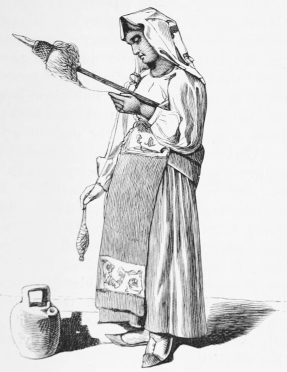
Our days were for the most part spent in drawing, and many were the delightful hours we passed in the Villa Negroni, which has now entirely disappeared, in spite of its endless historic associations, or in the desolate and beautiful vigne of the Esquiline, which have also been destroyed since the Sardinian occupation of Rome. Indeed, those who visit Rome now that it is a very squalid modern city, can have no idea of the wealth and glory of picturesqueness which adorned its every corner before 1870, or of how romantic were the passing figures—the crimson Cardinals; the venerable generals of religious orders with their flowing white beards; the endless monks and nuns; the pifferari with their pipes; the peasant women from Cori and Arpino and Subiaco, with their great gold earrings, coral necklaces, and snowy head-dresses; the contadini in their sheep-skins and goat-skins; the handsome stalwart Guardia Nobile in splendid tight-fitting uniforms; and above all, the grand figure and beneficent face of Pius IX. so frequently passing, seated in his glass coach, in his snow-white robes, with the stoic self-estimation of the Popes, but with his own kindly smile and his fingers constantly raised in benediction.
THE BRIDGE OF AUGUSTUS, NARNI.[325]
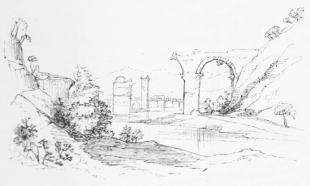
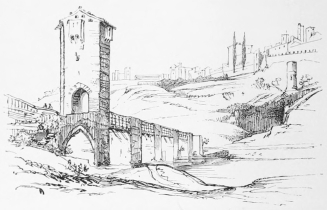
The heat was very great before we left Rome in April. We went first to Narni, where we stayed several days in a very primitive lodging, with the smallest possible amount of furniture, and nothing to eat except cold goat and rosemary, but in a glorious situation on the terrace which overlooks the deep rift of the Nar, clothed everywhere with ilex, box, and arbutus; and we spent long hours drawing the two grand old bridges—Roman and Mediæval—which stride across the river, even Lea being stimulated by the intense beauty to a trial of her artistic powers, and making a very creditable performance of the two grand cypresses on the slope of the hill, which have disappeared under the Sardinian rule.
THE MEDIÆVAL BRIDGE, NARNI.[327]
We spent a happy day at Spoleto, with its splendid ilex woods. Here my friends Kilcoursie[326] and Pearson joined us, and I went with them to spend the morning at the Temple of the Clitumnus, and returned just too late for the train we had intended to leave by. It is very characteristic of the slowness of those early days of Italian railways, that though we did not order our carriage till some time after the train was gone, we reached Perugia by road, in spite of the steep hill to be climbed, before the train which we were to have taken arrived on the railway. This evening's drive (April 23) is one of the Italian journeys I look back upon with greatest pleasure, the going onwards through the rich plain of vines and almonds and olives, and all the blaze of spring tulips and gladioli, and the stopping to buy the splendid oranges from the piles which lay in the little market under the old cathedral of Foligno; then seeing the sky turn opal behind the hills, and deepen in colour through a conflagration of amber, and orange, and crimson, of which the luminousness was never lost, though everything else disappeared into one dense shadow, and the great cypresses on the mountain edges were only dark spires engraven upon the sky. How many such evenings have we spent, ever moving onwards at that stately smooth vetturino pace—and silent, Mother absorbed in her heavenly, I in my earthly contemplations; dear Lea, tired by her long day, often sleeping opposite to us against the hand-bags.
We spent several days in Florence in 1866, when the streets were already placarded with such advertisements as 'I Menzogne di Genese, o l'Impostatura di Mosé'—typical of the change of Government. I paid several visits to the Comtesse d'Usedom (the Olympia Malcolm of my childhood), who was more extraordinary than ever. When I went to luncheon with her in the Villa Capponi, she talked incessantly for three hours, chiefly of spirits.
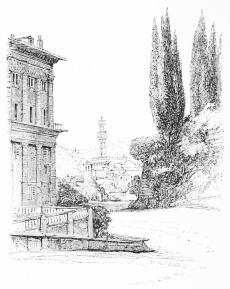
VIEW FROM THE BOBOLI GARDENS, FLORENCE.[328]
"I believe in them," she said, "of course I do. Why, haven't I heard them?" (with a perfect yell). "Why, I've seen a child whom we knew most intimately who was perfectly possessed by spirits—evil spirits, I mean. There is nothing efficacious against that kind but prayer and the crucifix. Why, the poor little thing used to struggle for hours. It used to describe the devils it saw. They were of different kinds. Sometimes it would say, 'Oh, it's only one of the innocent blackies,' and then it would shriek when it thought it saw a red devil come. It was the red devils that did all the mischief. All the best physicians were called in, but they all said the case was quite beyond them. The possession sometimes came on twice in a day. It would end by the child gasping a great sigh, as if at that moment the evil spirit went out of it, and then quite calmly it would open its eyes, wonder where it was, and remember nothing of what had happened. The doctors urged that the child should not be kept quiet, but taken abroad and amused, and mama writes me word now that it is quite well.
"I never saw the ghosts at Rugen," said Madame von Usedom, "but there is one of Usedom's houses there which I have refused ever to go to again, for I have heard them there often. The lady in the room with me saw them too—she saw three white sisters pulling her husband out of his grave.
"We have an old lady in our family, a relation of Usedom's, who has that wonderful power of second-sight.... When we left you at Bamberg (in 1853), we went to Berlin, and there we saw Usedom's relation, who told me that I was going to have a son. She 'saw it,' she said. Saw it! why, she saw it as plain as daylight: I was going to have a son: Usedom's first wife had brought him none, and I was going to give him one.
"When I left Berlin, we went to Rugen, but I was to return to Berlin, where my son was to be born. Well, about three weeks before my confinement was expected, the old lady sent for a relation of Usedom's, who was in Berlin, and said, 'Have you heard anything of Olympia?'—'Yes,' he said, 'I heard from Usedom yesterday, and she is going on as well as possible, and will be here in a few days.'—'No,' said the old lady, 'she will not, for the child is dead. Yesterday, as I was sitting here, three angels passed through my room with a little child in their arms, and the face of the child was so exactly like Usedom's, that I know that the child is born and that it is in heaven.' And so it was. I had a bad fall in Rugen, which we thought nothing of at the time. I had so much strength and courage that it did not seem to affect me; but a week after my boy was born—dead—killed by that fall, and the image, oh! the very image of Usedom."
From Florence we went to Bellagio on the Lago di Como, and spent a week of glorious weather amid beautiful flowers with nightingales singing in the trees all day and night. Many of our Roman friends joined us, and we passed pleasant days together in the garden walks and in short excursions to the neighbouring villas. When we left Bellagio, the two Misses Hawker, often our companions in Rome, accompanied us. We ascended the Splugen from Chiavenna in pitch darkness, till, about 4 A.M., the diligence entered upon the snow cuttings, and we proceeded for some time between walls of snow, often fifteen feet high. At last we stopped altogether, and in a spot where there was no refuge whatever from the ferocious ice-laden wind. Meantime sledges were prepared, being small open carts without wheels, which just held two persons each: my mother and I were in the second, Lea and an Italian in the third, and the Hawkers in the fourth: we had no man with our sledge. The sledges started in procession, the horses stumbling over the ledges in the snow, from which we bounded up and down. At last the path began to wind along the edge of a terrific precipice, where nothing but a slight edging of fresh snow separated one from the abyss. Where this narrow path turned it was truly horrible. Then came a tunnel festooned with long icicles; then a fearful descent down a snow-drift almost perpendicularly over the side of the mountain, the horses sliding on all fours, and the sledges crashing and bounding from one hard piece of snow to another; all this while the wind blew furiously, and the other sledges behind seemed constantly coming upon us. Certainly I never remember anything more appalling.
At the bottom of the drift was another diligence, but the Hawkers and I walked on to Splugen.
HOLMHURST, FROM THE GARDEN.
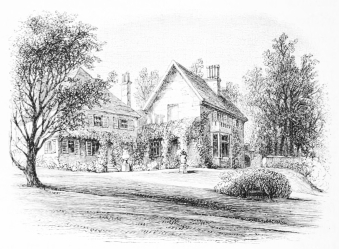
We spent an interesting afternoon at Brugg, and drew at Königsfelden, where the Emperor Albert's tomb is left deserted and neglected in a stable, and Queen Agnes's room remains highly picturesque, with many relics of her. In the evening we had a lovely walk through the forest to Hapsburg, where we saw a splendid sunset from the hill of the old castle. With a glimpse at Freiburg-im-Breisgau, we reached Carlsruhe, with which we were very agreeably surprised. The Schloss Garten is really pretty, with fine trees and fountains: the town is bright and clean; and all around is the forest with its endless pleasant paths. We found dear Madame de Bunsen established with her daughters Frances and Emilia in a nice old-fashioned house, 18 Waldhornstrasse, with all their pictures and treasures around them, the fine bust of Mrs. Waddington in itself giving the room a character. Circling round the aunts were Theodora von Ungern Sternberg's five motherless children, a perpetual life-giving influence to the home. We went with them into the forest and to the faisanerie, and picked masses of wild lilies of the valley. In the palace gardens we saw the Grand Duke and Grand Duchess, a very handsome couple: she the only daughter of the King of Prussia. At the station also I saw again, and for the last time, the very pleasing Queen Emma of the Sandwich Islands, and presented the Bunsens to her.[329] On the eve of Trinity Sunday we reached home.
From my JOURNAL.
"July 30, 1866.—Holmhurst.—Another happy summer! How different my grown-up-hood has been to my boyhood: now all sunshine, then all reproach and misery. How strange it is that my dearest mother remembers nothing of those days, nothing of those years of bitter heartache which my uncles' wives cost me. But her present love, her beautiful full heart devotion, are all free-will offering, not sacrifice of atonement. Our little Holmhurst is most lovely and peaceful."
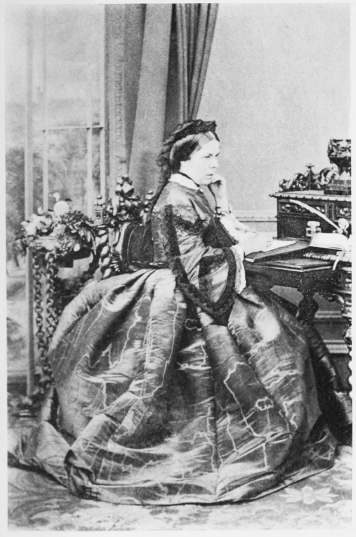
Lady Augusta Stanley
ALTON BARNES CHURCH.
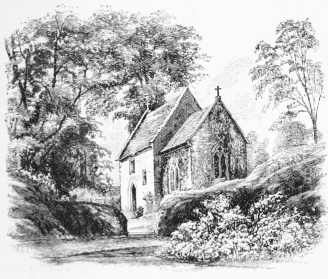
In August we spent a fortnight at the Deanery at Westminster with Arthur and Augusta Stanley, the latter fit les delices of all who came under her influence, and both were most kind in asking every one to meet us that they thought we could be interested to see. To me, however, no one was ever half so interesting as Arthur himself, and his conversation at these small Deanery dinner-parties was most delightful, though, as I have heard another say, and perhaps justly, "it was always versatile rather than accurate, brilliant rather than profound." From London we went to look after our humble friends at Alton, where all the villagers welcomed my mother with a most touching wealth of evergreen love, and where forty old people came to supper by her invitation in the barn. The owls hissed overhead in the oak rafters; the feast was lighted by candles stuck into empty ginger-beer bottles, and in quavering voices they all drank the mother's health. She made them a sweet little speech, praying that all those who were there might meet with her at the great supper of the Lamb. I had much interest at Alton in finding out those particulars which form the account of the place in "Memorials of a Quiet Life." The interest of the people, utterly unspoilt by "civilisation," can hardly be described, or the simplicity of their faith. Speaking of her long troubles and illness, "Betty Smith" said, "I ha' been sorely tried, but it be a' to help I on to thick there place." William Pontyn said, "It just be a comfort to I to know that God Almighty's always at whom: He never goes out on a visit." Their use of fine words is very comical. Old Pontyn said, "My son-in-law need na treat I ill, for I niver gied un no publication for it." He thanked mother for her "respectable gift," and said, "I do thank God ivery morning and ivery night, that I do; and thank un as I may, I niver can thank un enough, He be so awful good to I." He said the noise the threshing-machine made when out of order was "fierly ridic'lous," and that he was "fierly gallered (frightened) at it"—that he was "obliged to flagellate the ducks to get them out of the pond."
I drove with Mr. Pile to see the remains of Wolf Hall, on the edge of Savernake Forest, where Henry VIII. married Jane Seymour. The house, once of immense size, is nearly destroyed. The roof of the banqueting-hall is now the roof of a barn. The beautiful fragment of building remaining was once the laundry. Hard by, at Burbage, is "Jane Seymour's Pool."
After leaving Alton, as if making the round of my mother's old homes, we went to Buntingsdale, Hodnet, and Stoke. While at the former, I remember the Tayleurs being full of the promptitude of old Mrs. Massie (whose son Edward married our cousin Sophy Mytton). When above ninety she had been taken to see the church of Northwich, where some one pointed out to her a gravestone with the epitaph—
"Some have children, and some have none; Here lies the mother of twenty-one."
Old Mrs. Massie drew herself up to her full height and at once made this impromptu—
"Some have many, and some have few; Here stands the mother of twenty-two."
And what she said was true.
My mother turned south from Shropshire, and I went to Lyme, near Disley, the fine old house of the Leghs, whose then head, W. T. Legh, had married Emily Wodehouse, one of the earliest friends of my childhood. It is a most stately old house, standing high in a very wild park, one of the only three places where wild cattle are not extinct. The story of the place is curious.
"Old Colonel Legh of Lyme left his property first to his son Tom, but though Tom Legh was twice married, he had no sons, so it came to the father of the present possessor. Tom's first wife had been the celebrated Miss Turner. Her father was a Manchester manufacturer, who had bought the property of Shrigley, near Lyme, of which his only daughter was the heiress. She was carried off from school by a conspiracy between three brothers named Gibbon Wakefield and a Miss Davis, daughter of a very respectable master of the Grammar School at Macclesfield. While at school, Miss Turner received a letter from home which mentioned casually that her family had changed their butler. Two days after, a person purporting to be the new butler came to the school, and sent in a letter to say that Mr. Turner was dangerously ill, and that he was sent to fetch his daughter, who was to return home at once. In the greatest hurry, Miss Turner was got ready and sent off. When they had gone some way, the carriage stopped, and a young man got in, who said that he had been sent to break to her the news that her father's illness was a fiction; that they did not wish to spread the truth by letting the governess know, but that the fact was that Mr. Turner had got into some terrible money difficulties and was completely ruined, and he begged that his daughter would proceed at once to meet him in Scotland, whither he was obliged to go to evade his creditors. During the journey the young man who was sent to chaperon Miss Turner made himself most agreeable. At last they reached Berwick, and then at the inn, going out of the room, he returned with a letter and said that he was almost afraid to tell her its contents, but that it was sent by her father's command, and that he only implored her to forgive him for obeying her father's orders. It was a most urgent letter from her father, saying that it rested with her to extricate him from his difficulties, which she could do by consenting to marry the bearer. The man was handsome and pleasant, and the marriage seemed no great trial to the girl, who was under fifteen. Immediately after marriage she was taken to Paris.
"Meantime all the gentlemen in the county rallied round Mr. Turner, and he contrived somehow to get his daughter away whilst she was in Paris. Suspicion had been first excited in the mind of the governess because letters for Miss Turner continued to arrive at the school from Shrigley, and she gave the alarm. There was a great trial, at which all the gentlemen in Cheshire accompanied Mr. Turner when he appeared leading his daughter. The marriage was pronounced null and void, and one of the Gibbon Wakefields was imprisoned at Lancaster for five years, the others for two. It was the utmost punishment that could be given for misdemeanour, and nothing more could be proved. The Gibbon Wakefields had thought that, rather than expose his daughter to three days in a witness box, Mr. Turner would consent to a regular marriage, and they had relied upon that. Miss Turner was afterwards married to Mr. Legh, in the hope of uniting two fine properties, but as she had no son, her daughter, Mrs. Lowther, is now the mistress of Shrigley."
To MY MOTHER.
"Lyme Hall, August 29, 1866.—I have been with Mrs. Legh to Bramhall, the fine old house of the Davenports, near Stockport, with the haunted room of Lady Dorothy Davenport and no end of relics. Out of the billiard-room opens the parish church, in the same style as the house, with prayer-books chained to the seats. We returned by Marple, the wonderfully curious old house of Bradshaw the regicide."
"Sept. 1.—To-day we had a charming drive over the hills, the green glens of pasture-land, the steeps, and the tossing burns recalling those of Westmoreland. I went with Mrs. Legh into one of the cottages and admired the blue wash of the room, 'Oh, you like it, do ye?' said the mistress of the house; 'I don't—so that's difference of opinions.' The whole ceiling was hung with different kinds of herbs, 'for we're our own doctors, ye see, and it saves the physic bills.'
"The four children—Sybil and Mob (Mabel), Tom and Gilbert Legh, are delightful, and Sybil quite lovely. It is a pleasure to hear the little feet come scampering down the oak staircase, as the four rush down to the library to ask for a story at seven o'clock—'A nice horrible story, all about robbers and murders: now do tell us a really horrible one.'"
"Thornycroft Hall, Cheshire, Sept. 3.—The family here are much depressed by the reappearance of the cattle plague. In the last attack sixty-eight cows died, and so rapidly that men had to be up all night burying them by lantern-light in one great grave in the park.... How curious the remains of French expressions are as used by the cottagers here. They speak of carafes of water, and say they should not oss (oser) to do a thing. The other day one of the Birtles tenants was being examined as a witness at the Manchester assizes. 'You told me so and so, didn't you?' said the lawyer. And the man replied, 'I tell't ye nowt o' the kind, ye powther-headed monkey; ask the coompany now if I did.'"
From Thornycroft I went to stay (only three miles off) at Birtles, the charming, comfortable home of the Hibberts—very old friends of all our family. Mrs. Hibbert, née Caroline Cholmondeley, was very intimate with my aunt Mrs. Stanley, and a most interesting and agreeable person; and I always found a visit to Birtles a most admirable discipline, as my great ignorance was so much discovered and commented upon, that it was always a stimulus to further exertion. It was on this occasion that Mrs. Hibbert told me a very remarkable story. It had been told her by Mrs. Gaskell the authoress, who said that she felt so greatly the uncertainty of life, that she wished a story which might possibly be of consequence, and which had been intrusted to her, to remain with some one who was certain to record it accurately. Three weeks afterwards, sitting by the fire with her daughter, Mrs. Gaskell died suddenly in her arm-chair. Mrs. Hibbert, in her turn, wished to share her trust with some one, and she selected me.
In my childhood I remember well the Misses T., who were great friends of my aunt Mrs. Stanley, and very clever agreeable old ladies. "Many years before," as Mrs. Gaskell described to Mrs. Hibbert, "they had had the care of a young cousin, a girl whose beauty and cleverness were a great delight to them. But when she was very young, indeed in the first year of her 'coming out,' she engaged herself to marry a Major Alcock. In a worldly point of view the marriage was all that could be desired. Major Alcock was a man of fortune with a fine place in Leicestershire: he was a good man, of high character, and likely to make an excellent husband. Still it was a disappointment—an almost unspoken disappointment—to her friends that the young lady should marry so soon—'she was so young,' they thought; she had had so few opportunities of judging persons; they had looked forward to having her so much longer with them,' &c.
"When Mrs. Alcock went to her new home in Leicestershire, it was a great comfort to the Misses T. and others who cared for her that some old friends of the family would be her nearest neighbours, and could keep them cognisant of how she was going on. For some time the letters of these friends described Mrs. Alcock as radiantly, perfectly happy. Mrs. Alcock's own letters also gave glowing descriptions of her home, of the kindness of her husband, of her own perfect felicity. But after a time a change came over the letters on both sides. The neighbours described Mrs. Alcock as sad and pale, and constantly silent and preoccupied, and in the letters of Mrs. Alcock herself there was a reserve and want of all her former cheerfulness, which aroused great uneasiness.
"The Misses T. went to see Mrs. Alcock, and found her terribly, awfully changed—haggard, worn, preoccupied, with an expression of fixed melancholy in her eyes. Both to them and to the doctors who were called in to her she said that the cause of her suffering was that, waking or sleeping, she seemed to see before her a face, the face of a man whom she exactly described, and that she was sure that some dreadful misfortune was about to befall her from the owner of that face. Waking, she seemed to see it, or, if she fell asleep, she dreamt of it. The doctors said that it was a case of what is known as phantasmagoria; that the fact was that in her unmarried state Mrs. Alcock had not only had every indulgence and consideration, but that even the ordinary rubs of practical life had been warded off from her; and that having been suddenly transplanted into being the head of a large establishment in Leicestershire, with quantities of visitors coming and going throughout the hunting season, had been too much for a very peculiar and nervous temperament, and that over-fatigue and unwonted excitement had settled into this peculiar form of delusion. She must have perfect rest, they said, and her mind would soon recover its usual tone.
"This was acted upon. The house in Leicestershire was shut up, and Major and Mrs. Alcock went abroad for the summer. The remedy completely answered. Mrs. Alcock forgot all about the face, slept well, enjoyed herself extremely and became perfectly healthy in body and mind. So well was she, that it was thought a pity to run the risk of bringing her back to Leicestershire just before the hunting season, the busiest time there, and it was decided to establish her cure by taking her to pass the winter at Rome.
"One of the oldest established hotels in Rome is the Hôtel d'Angleterre in the Bocca di Leone. It was to it that travellers generally went first when they arrived at Rome in the old vetturino days; and there, by the fountain near the hotel door which plays into a sarcophagus under the shadow of two old pepper-trees, idle contadini used to collect in old days to see the foreigners arrive. So I remember it in the happy old days, and so it was on the evening on which the heavily laden carriage of the Alcock family rolled into the Bocca di Leone and stopped at the door of the Hôtel d'Angleterre. Major Alcock got out, and Mrs. Alcock got out, but, as she was descending the steps of the carriage, she happened to glance round at the group under the pepper-trees, and she uttered a piercing shriek, fell down upon the ground, and was carried unconscious into the hotel.
"When Mrs. Alcock came to herself, she affirmed that amongst the group near the door of the hotel she had recognised the owner of the face which had so long tormented her, and she was certain that some dreadful misfortune was about to overwhelm her. Doctors, summoned in haste, when informed of her previous condition, declared that the same results were owing to the same causes. Major Alcock, who disliked bad hotels, had insisted on posting straight through to Rome from Perugia; there had been difficulties about horses, altercations with the post-boys—in fact, 'the delusion of Mrs. Alcock was owing, as before, to over-fatigue and excitement: she must have perfect rest, and she would soon recover.'
"So it proved. Quiet and rest soon restored Mrs. Alcock, and she was soon able to enjoy going about quietly and entering into the interests of Rome. It was decided that she should be saved all possible fatigue, even the slight one of Roman housekeeping: so the family remained at the Hôtel d'Angleterre. Towards January, however, Mrs. Alcock was so well that they sent out some of the numerous letters of introduction which they had brought with them, and, in answer to these, many of the Romans came to call. One day a Roman Marchese was shown upstairs to the Alcocks' room, and another gentleman went up with him. The Marchese thought, 'Another visitor come to call at the same time as myself,' the waiter, having only one name given him, thought, 'The Marchese and his brother, or the Marchese and a friend,' and they were shown in together. As they entered the room, Mrs. Alcock was sitting on the other side of the fire; she jumped up, looked suddenly behind the Marchese at his companion, again uttered a fearful scream, and again fell down insensible. Both gentlemen backed out of the room, and the Marchese said in a well-bred way that as the Signora was suddenly taken ill, he should hope for another opportunity of seeing her. The other gentleman went out at the same time.
"Again medical assistance was summoned, and again the same cause was ascribed to Mrs. Alcock's illness: this time she was said to be over-fatigued by sight-seeing. Again quiet and rest seemed to restore her.
"It was the spring of 1848—the year of the Louis Philippe revolution. Major Alcock had a younger sister to whom he was sole guardian, and who was at school in Paris, and he told his wife that, in the troubled state of political affairs, he could not reconcile it to his conscience to leave her there unprotected; he must go and take her away. Mrs. Alcock begged that, if he went, she might go with him, but naturally he said that was impossible—there might be bloodshed going on—there might be barricades to get over—there might be endless difficulties in getting out of Paris; at any rate, there would be a hurried and exciting journey, which would be sure to bring back her malady: no, she had friends at Rome,—she must stay quietly there at the hotel till he came back. Mrs. Alcock, with the greatest excitement, entreated, implored her husband upon her knees that she might go with him; but Major Alcock thought this very excitement was the more reason for leaving her behind, and he went without her.
"As all know, the Louis Philippe revolution was a very slight affair. The English had no difficulty in getting out of Paris, and in a fortnight Major Alcock was back in Rome, bringing his sister with him. When he arrived, Mrs. Alcock was gone. She was never, never heard of again. There was no trace of her whatever. All that ever was known of Mrs. Alcock was that, on the day of her disappearance, some people who knew her were walking in front of S. John Lateran, and saw a carriage driving very rapidly towards the Porta S. Giovanni Laterano, and in it sat Mrs. Alcock crying and wringing her hands as if her heart would break, and by her side there sat a strange man, with the face she had so often described."
I have my own theories as to the explanation of this strange story of Mrs. Alcock, but as they are evolved entirely from my own imagination, I will not mention them here.
BODRYDDAN.
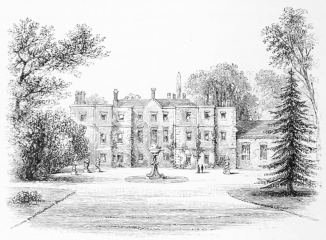
From Cheshire I went to North Wales to pay a visit to our cousinhood at Bodryddan, which had been the home of my grandmother's only brother, the Dean of St. Asaph. The place has been spoilt since, but was very charming in those days. Under an old clock-tower one entered upon a handsome drive with an avenue of fine elms, on the right of which a lawn, with magnificent firs, oaks, and cedars, swept away to the hills. At the end rose the stately old red brick house, half covered with magnolias, myrtles, and buddlea, with blazing beds of scarlet and yellow flowers lighting up its base. Through an oak hall hung with armour a fine staircase led to the library—an immense room with two deep recesses, entirely furnished with black oak from Copenhagen, and adorned with valuable enamels collected at Lisbon. The place had belonged to the Conwys, and that family ended in three sisters, Lady Stapleton, Mrs. Cotton, and Mrs. Yonge: they had equal shares. Mrs. Cotton bought up Lady Stapleton's share, and left it with her own to the two daughters of her sister Mrs. Yonge, of whom the elder married my great-uncle, Dean Shipley, and was the mother of William and Charles Shipley and of the three female first cousins (Penelope, Mrs. Pelham Warren; Emily, Mrs. Heber; and Anna Maria, Mrs. Dashwood) who played so large a part in the early history of my father and his brothers, and who are frequently mentioned in the first volume of these memoirs.
When Dean Shipley married, he removed to his wife's house of Bodryddan. Miss Yonge lived with them, and after her sister's death the Dean was most anxious to marry her, trying to obtain an Act of Parliament for the purpose. For some years their aunt, Lady Stapleton, also continued to hold a life-interest in the property. Of this lady there is a curious portrait at Bodryddan. She is represented with her two children and a little Moor, for whom her own little boy had conceived the most passionate attachment, and from whom he could never bear to be separated. One night, after this little Moor was grown up, Lady Stapleton, returning very late from a ball, went to bed, leaving all her diamonds lying upon the table. Being awakened by a noise in the room, she saw the Moor come in with a large knife in his hand, and begin gathering up her jewels. Never losing her presence of mind, she raised herself up in bed, and, fixing her eyes upon him, exclaimed in a thrilling tone of reproach, "Pompey, is that you?" This she did three times, and the third time the Moor, covering his face with his hands, rushed out of the room. Nothing was heard of him till many years afterwards, when the chaplain of a Devonshire gaol wrote to Lady Stapleton that one of his prisoners, under sentence of death for murder, was most anxious to see her. She was unable to go, but heard afterwards that it was Pompey, who said that on the night he entered her room he had intended to kill her, but that when she spoke, such a sense of his ingratitude overwhelmed him, that he was unable to do it.
As an ecclesiastical dignitary, Dean Shipley would certainly be called to account in our days. He was devoted to hunting and shooting, and used to go up for weeks together to a little public-house in the hills above Bodryddan, where he gave himself up entirely to the society of his horses and dogs. He had led a very fast life before he took orders, and he had a natural daughter by a Mrs. Hamilton, who became the second wife of our grandfather; but after his ordination there was no further stain upon his character. As a father he was exceedingly severe. He never permitted his daughters to sit down in his presence, and he never allowed two of them to be in the room with him at once, because he could not endure the additional talking caused by their speaking to one another. His daughter Anna Maria had become engaged to Captain Dashwood, a very handsome young officer, but before the time came at which he was to claim her hand, he was completely paralysed, crippled, and almost imbecile. Then she flung herself upon her knees, imploring her father with tears not to insist upon her marriage with him; but the Dean sternly refused to relent, saying she had given her word, and must keep to it.
She nursed Captain Dashwood indefatigably till he died, and then she came back to Bodryddan, and lived there with her aunt Mrs. Yonge, finding it dreadfully dull, for she was a brilliant talker and adored society. At last she went abroad with her aunt Louisa Shipley, and at Corfu she met Sir Thomas Maitland, who gave her magnificent diamonds, and asked her to marry him. But she insisted on coming home to ask her father's consent, at which the Dean was quite furious. "Why could you not marry him at once?"—and indeed, before she could get back to her lover, he died!
After the death of Mrs. Yonge, Mrs. Dashwood lived at Cheltenham, a rich and clever widow, and had many proposals. To the disgust of her family, she insisted upon accepting Colonel Jones, who had been a neighbour at Bodryddan, and was celebrated for his fearfully violent temper. The day before the wedding it was nearly all off, because, when he came to look at her luggage, he insisted on her having only one box, and stamped all her things down into it, spoiling all her new dresses. He made her go with him for a wedding tour all over Scotland in a pony-carriage, without a maid, and she hated it; but in a year he died.
Then she insisted on marrying the Rev. G. Chetwode, who had had one wife before and had two afterwards—an old beau, who used to comb his hair with a leaden comb to efface the grey. On her death he inherited all she had—diamonds, £2000 a year, all the fine pictures left her by Mr. Jones, and all those Landor had collected for her in Italy.
But to return to Dean Shipley. To Mrs. Rowley, who was the mistress of Bodryddan when I was there, the Dean had been the kindest of grandfathers, and she had no recollection of him which was not associated with the most unlimited indulgence. The Dean was much interested in the management of his estate, but he insisted that every detail should pass through his own hands. For instance, while he was absent in London, a number of curious images and carvings in alabaster were discovered under the pavement at Bodryddan: news was immediately sent to him, but he desired that everything should be covered up, and remain till he came home. On his return, he put off the examination from time to time, till, on his death, the place was forgotten, and now no one is able to discover it.
Mrs. Rowley was the beautiful Charlotte, only daughter of Colonel William Shipley, and had led an adventurous life, distinguishing herself by her bravery and heroism during the plague while she was in the East, and on various other occasions. By her marriage with Colonel Rowley, second son of the first Lord Langford, she had three children,—Shipley Conwy, the present owner of Bodryddan; Gwynydd, who has married twice; and Efah, who, after her mother's death, made a happy marriage with Captain Somerset.
In her early married life, Mrs. Rowley had lived much in Berkeley Square with her mother-in-law, old Lady Langford, who was the original of Lady Kew in "The Newcomes," and many pitched battles they had, in which the daughter-in-law generally came off victorious. Lady Langford had been very beautiful, clever, and had had une vie très orageuse. She had much excuse, however. She had only once seen her cousin, Lord Langford, when he came to visit her grandmother, and the next day the old lady told her she was to marry him. "Very well, grandmama, but when?"—"I never in my life heard such an impertinent question," said the grandmother; "what business is it of yours when you are to marry him? You will marry him when I tell you. However, whenever you hear me order six horses to the carriage, you may know that you are going to be married." And so it was.
At the time I was at Bodryddan, the most devoted and affectionate deference was shown by Mrs. Rowley to every word, movement, or wish of her only brother, Colonel Shipley Conwy. He looked still young, but was quite helpless from paralysis. Mrs. Rowley sat by him and fed him like a child. It was one mouthful for her brother, the next for herself. When dinner was over, a servant came in and wrung his arms and legs, as you would pull bell-ropes, to prevent the joints from stiffening (a process repeated several times in the evening), and then carried him out. But with all this, Colonel Shipley Conwy—always patient—was very bright and pleasant, and Mrs. Rowley, who said that she owed everything to my father and his interest in her education, was most cordial in welcoming me. I never saw either of these cousins again. They spent the next two winters at the Cape, and both died a few years afterwards.