Volume 1 — CONTENTS VOLUME 1 (continued 3)
Reading edition
When my uncle was driving himself, these accidents were so frequent that we scarcely thought anything of them, as he drove so carelessly and talked vehemently or composed his sermons or charges all the way. But if the family had an accident on their way to church, they always returned thanks for their preservation, which made quite a little excitement in the service. I remember one occasion on which my mother and aunt did not appear as usual, when a note was handed to Uncle Julius as he came out of the vestry, upon which thanks were returned for the "merciful preservation of Lucy and Maria Hare and Staunton Collins" (the coachman)—and all the Rectory servants and all the Lime servants immediately walked out of church to look after the wounded or—because they were too excited to stay! The horse had taken fright at a gipsy encampment in the marsh lane and the family had been precipitated into the ditch.
At this time Uncle Julius had been made one of the Poor Law Guardians and had to visit at the workhouse, and there was the most ceaseless ferment and outcry against him. All sorts of stories were got up. One was that he was going to put all the children into a boat and take them out to sink them in Pevensey Bay! One day old Betty Lusted went up to the Rectory and asked to see the Archdeacon. He went out to her: "Well, Betty, and what do you want?"—"I want to know, zur, if you do know the Scripture."—"Well, Betty, I hope I do, but why do you ask?"—"Because if you do know the Scripture, how coomes it that you doona zee—'them whom God hath joined together let na man put asunder'?" (apropos of the separation of husbands and wives in the workhouse); and though she was a poor half-witted body, she brought the tears into his eyes. I remember his asking her daughter Polly once what she prayed for every night and morning. "Well, zur, I do pray for a new pair of shoes," replied Polly, without the slightest hesitation.
Uncle Julius would have given the world to have been able to talk easily and sympathetically to his people, but he could not get the words out. Sick people in the parish used to say, "The Archdeacon he do come to us, and he do sit by the bed and hold our hands, and he do growl a little, but he do zay nowt."
One day he heard that a family named Woodhams were in great affliction. It was just after poor Haydon had committed suicide, and he took down Wordsworth's sonnet on Haydon, and read it to them by way of comfort. Of course they had never heard of Haydon, and had not an idea what it was all about.[27]
It was on our way from Norwich to Stoke in the autumn of 1841 that I made my first sketch from nature. We slept at Bedford, to meet Charles Stanley there, and I drew Bedford Bridge out of the window—a view made by candlelight of a bridge seen by moonlight—but it was thought promising and I was encouraged to proceed. My mother, who drew admirably herself, gave me capital simple lessons, and in every way fostered my love of the picturesque. Indeed Hurstmonceaux itself did this, with its weird views across the levels to the faint blue downs, and its noble ruined castle. Of the stories connected with this castle I could never hear enough, and Uncle Julius told them delightfully. But the one I cared for most was of our remote ancestress Sybil Filiol, who lived at Old Court Manor in the reign of Edward II., I think. Uncle Julius used to describe how, after her marriage in Wartling Church, she went to take leave of her dead father's garden (before riding away upon a pillion behind her husband), and, whilst there, was carried off by gipsies. Her husband and other members of her family pursued them, but in those days locomotion was difficult, escape in the Cheviot Hills easy, and she was never heard of again.[28] How well I remember the pictorial description of a strange funeral seen approaching over the hills—"the gipsies of the north" bringing back the body of Sybil Filiol to be buried with her ancestors at Wartling, and the story of how her husband devoted her dowry to making "Sybil Filiol's Way," a sort of stone causeway to Hurstmonceaux Church, of which I delighted to trace the old grey stones near Boreham Street and in the Church Lane.
Our cousin Anna Maria Shipley, who had been cruelly married by her father against her will to the savage paralytic Mr. Dashwood, and who had been very many years a widow, had, in 1838, made a second marriage with an old neighbour, Mr. Jones, who, however, lived only a year. In 1840, she married as her third husband the Rev. George Chetwode, and died herself in the year following. Up to the time of her death, it was believed and generally understood that the heirs of her large fortune were the children of her cousin Francis,[29] but it was then discovered that two days before she expired, she had made a will in pencil in favour of Mr. Chetwode, leaving all she possessed in his power. This news was an additional shock to my father, who had never recovered the will of Mrs. Louisa Shipley, and he passed the winter of 1841 at Palermo in the utmost melancholy. When he first arrived, he gave a few dinners, but after that, says Victoire, he seemed to have a presentiment of his end, though the doctors declared that he was not dangerously ill. For several nights in February Félix sate up with him. Mr. Hare wished to send him to bed, "mais Félix repondit, 'Rappelez-vous, monsieur, que je suis ancien militaire, et que quand j'ai une consigne, je ne la quitte jamais;'" and then he opposed Félix no longer. "One morning at five o'clock A.M.," said Madame Victoire, "he asked Félix what o'clock it was. Félix told him. Then he said, 'Dans une demi-heure j'aurais mon lait d'ânesse,' parceque l'ânesse venait à six heures.... Puis il commence à faire jour, et Félix se met à arranger un peu la chambre. Se trouvant à la fenêtre, il entend M. Hare faire un mouvement dans le lit: Félix regarde de près, il écoute, il touche: M. Hare venait de finir."
My father was buried in the English Cemetery at Palermo, where there is a plain sarcophagus over his grave. The English Consul sent the following certificate to Mrs. Hare:—
"On Saturday, the 15th January, 1842, the remains of the late Francis George Hare, Esquire, were interred in the Protestant Burial Ground at the Lazzaret of Palermo, in the presence of a large concourse of Sicilian noblemen, and of the British, French, and American residents. The service of the church was read by the Rev. W. F. Holt, and the pall was supported by the Principino of Lardoria, the Prince of Radali, the American Consul, and Mr. J. F. Turner. As a token of respect to the memory of the deceased, the flags of the British, French, and American vessels were hoisted half-mast high during the forenoon."
The summer was spent by the Marcus Hares at the Rectory—one of those intensely hot summers which I never remember since my childhood, when we gasped through the day, and lay at night under bowers of ash-boughs to keep off the torment of gnats, which used then to be as bad at Hurstmonceaux as I have since known mosquitoes in Italy. Of my cousins I preferred Theodore, who was a very engaging little child. I remember Uncle Julius coming out with tears streaming down his cheeks, and an open letter in his hand, one day when all the family were sitting under the trees. It was the news of the death of Dr. Arnold of Rugby.
In the autumn Mrs. Hare came with her children to spend some time at Hurstmonceaux Rectory. It was then arranged that I should call her "Italima" (being a corruption of "Italian Mama"), and by that name I will henceforth speak of her in these memoirs, but this must not be taken to imply any greater intimacy, as she never treated me familiarly or with affection. I remember the party arriving in their black dress—Italima, Francis, William, Esmeralda, Mr. Gaebler—the admirable tutor, Félix, Victoire, and Clémence—my sister's maid. My sister, as a little child, was always called "the Tigress," but as she grew older, her cousin Lord Normanby remonstrated at this. "Then give her another name," said Italima. "Esmeralda,"—and Esmeralda she was now always called.
Italima must have found it intensely dull at the Rectory. She used to walk daily to Gardner Street, where the sight of "somebody" and the village shops was a consolation to her. She used to make my sister practise on the pianoforte for hours, and if she did not play well she shut her up for the rest of the day in a dressing-room, and I used to go and push fairy-stories to her under the door. Though she was so severe to my sister, she resented exceedingly any scoldings which Uncle Julius gave to Francis, who richly deserved them, and was terribly spoilt. He was, however, as beautiful as a boy as my sister was as a girl, and a wonderfully graceful pair they made when they danced the tarantella together in the evenings. Altogether my own brothers and sister being as children infinitely more attractive than the Marcus Hares', I was much happier with them, which was terribly resented in the family, and any sign I gave of real enjoyment was always followed by some privation, for fear I should be over-excited by it. Mr. Gaebler was a most pleasant and skilful tutor, and I found it delightful to do lessons with him, and made immense progress in a few weeks: but because his teaching was pleasant, it was supposed that the "discipline" of lessons was wanting, and I was not long allowed to go on learning from him. In the afternoons we were all made to go to the school and practise ridiculous Hullah singing, which we loathed.
The Bunsens were now living at Hurstmonceaux Place. Bunsen had been Minister for Prussia at Rome at the time of my birth and the death of my uncle Augustus Hare, and had then become very intimate with my mother, as he had previously been with my uncle. Therefore, when he became Minister in London and wanted a country-house, Hurstmonceaux Place, which was then to let, seemed wonderfully suited to his requirements. The great distance from London, however (the railway then coming no nearer than Brighton, twenty-four miles off) prevented the Bunsens from remaining more than two years at Hurstmonceaux; but during this time they added much to our happiness, and, child as I was, I was conscious of the vivifying influence which their refinement, their liberal views, and hightoned conversation brought into the narrow circle at Hurstmonceaux, which being so much and so often cut off from outer influences, was becoming more and more of a Mutual Admiration Society. In the many loving daughters of the house, my mother found willing helpers in all her work amongst the poor, while the cheerful wisdom and unfailing spirit of Madame Bunsen made her the most delightful of companions. For several months I went every morning to Hurstmonceaux Place, and did all my lessons with Theodore Bunsen, who was almost my own age, under the care of his German tutor, Herr Deimling.
It must have been in 1841, I think, that Bunsen inoculated my uncle and mother with the most enthusiastic interest in the foundation of the Bishopric of Jerusalem, being himself perfectly convinced that it would be the Church thus founded which would meet the Saviour at his second coming. Esther Maurice, by a subscription amongst the ladies of Reading, provided the robes of the new Bishop.
In the spring of 1843 I was dreadfully ill with the whooping-cough, which I caught (as I had done the chicken-pox before) from my mother's numerous parochial godchildren, when they came to Lime for their lessons. When I was better we went for three days in our own carriage to the Mount Ephraim Hotel at Tunbridge Wells. It was my first "tour," and it was with rapture that I saw Mayfield Palace, Bayham Abbey, and the High Rocks, on our way to which Lea and I were run away with by our donkeys.
When the Marcus Hares were not at the Rectory, Uncle Julius in these years had a wonderfully varied society there, of whom we always saw more or less—German philosophers, American philologists, English astronomers, politicians, poets. Amongst those I particularly disliked were Whewell and Thirlwall—so icily cold were their manners. Bunsen, Star, Archdeacon Moore, Prentiss the American, Darley, Hull, I liked; but Professor Sedgwick I was quite devoted to.[30] He "threw a mantle of love over every one;"[31] and nothing could be more charming than his stories, more attractive and interesting than his conversation, especially with children, with whom he took pains to "be agreeable." I saw so many people of this kind, that I used to think that what I heard called "society" was all like these specimens: I was very much mistaken. A visit from the gentle and amiable Copley Fielding early encouraged my love of art. He greatly admired the peculiar scenery of Hurstmonceaux—the views from the churchyard, so like the descent upon the marshes of Ostia; the burnt uplands of the old deer-park; the long flat reaches of blue-green level; and the hazy distant downs, which were especially after his own heart. There was one view of the castle towers seen from behind, and embossed against the delicate hues of the level, which he used to make a frequent study of, and which my mother and uncle ever after called "Copley Fielding's view."
HURSTMONCEAUX.
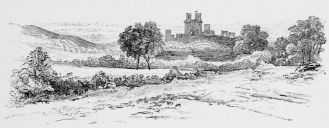
Amongst other visitors of this year, I must mention our cousin Penelope, Mrs. Warren (eldest daughter of Dean Shipley and sister of Mrs. Dashwood and Mrs. Heber), who spent some days at the Rectory with her daughters, because under her protection I had my only sight of the upper part of Hurstmonceaux Castle. One of the staircases remained then, and the timbers of many of the upper rooms were left, though the floors were gone. One day we were with my mother and uncle in the ruins, and they were saying how no one would ever see the upper floor again, when, to their horror, Mrs. Warren seized me in her arms and darted up the staircase. "Look, child, look!" she said, "for no one will ever see this again," and she leapt with me from beam to beam. I recollect the old chimney-pieces, the falling look of everything. It was wonderful that we came down safe; the staircase was removed immediately after, that no one might follow in our footsteps.
I remember Carlyle coming to stay at the Rectory, where they did not like him much. He came in a high hat—every one wore high hats then. The day he arrived, the wind blew his hat off into a ditch as he was getting over a stile: and he went off at once into one of his unbounded furies against "the most absurd outrageous head-covering in the world, which the vanity of the Prince Regent had caused people to adopt."
Aunt Lucy and the Maurices had long urged my mother to send me to school, and perhaps in many ways my terrible fits of naughtiness made it desirable, though they chiefly arose from nervousness, caused by the incessant "nagging" I received at home from every one except my mother and Lea. But the choice of the school to which I was sent at nine years old was very unfortunate. When illness had obliged my Uncle Augustus Hare to leave his beloved little parish of Alton Barnes for Italy, a Rev. Robert Kilvert came thither as his temporary curate—a very religious man, deeply learned in ultra "evangelical" divinity, but strangely unpractical and with no knowledge whatever of the world—still less of the boyish part of it. As Dr. John Brown once said—"The grace of God can do muckle, but it canna gie a man common-sense." Mr. Kilvert was a good scholar, but in the dryest, hardest sense; of literature he knew nothing, and he was entirely without originality or cleverness, so that his knowledge was of the most untempting description. Still his letters to my mother in her early widowhood had been a great comfort to her, and there was no doubt of his having been a thoroughly good parish-priest. He had lately married a Miss Coleman, who derived the strange name of Thermuthis from the daughter of Pharaoh who saved Moses out of the bulrushes, and he had opened a small school at his tiny Rectory of Hardenhuish, or, as it was generally called, Harnish, the estate of the Clutterbucks, near Chippenham in Wiltshire; so my mother, thinking it of far more importance to select "a good man" than "a good master," determined to send me there. How often since have I seen the terrible mistake of parents in "packing off" children to a distant school, to be entirely in the hands of masters of whose practical influence and social competence for their duties they know nothing whatever!
My own experience of Harnish is one of the many instances I have known of how little the character of the head of an establishment affects the members of it, unless his spirituality is backed up by a thorough knowledge of the world. The greater portion of Mr. Kilvert's scholars—his "little flock of lambs in Christ's fold"—were a set of little monsters. All infantine immoralities were highly popular, and—in such close quarters—it would have been difficult for the most pure and high-minded boy to escape from them. The first evening I was there, at nine years old, I was compelled to eat Eve's apple quite up—indeed, the Tree of the Knowledge of Good and Evil was stripped absolutely bare: there was no fruit left to gather.
I wonder if children often go through the intense agony of anguish which I went through when I was separated from my mother. Perhaps not, as few children are brought up so entirely by and with their parents in such close companionship. It was leaving my mother that I minded, not the going to school, to which my misery was put down: though, as I had never had any companions, the idea of being left suddenly amongst a horde of young savages was anything but comforting. But my nervous temperament was tortured with the idea that my mother would die before I saw her again (I had read a story of this kind), that our life was over, that my aunts would persuade her to cease to care for me,—indeed, the anguish was so great and so little understood, that though it is more than fifty years ago, as I write this, I can scarcely bear to think of it.
III BOYHOOD 1843-1848
"The more we live, more brief appear
Our life's returning stages:
A day to childhood seems an year,
And years like passing ages."
—Thomas Campbell.
"Oh if, in time of sacred youth,
We learned at home to love and pray,
Pray Heaven that early Love and Truth
May never wholly pass away."
—Thackeray.
MY mother took me to Harnish Rectory on July 28, 1843. The aspect of Mr. Kilvert, his tall figure, and red hair encircling a high bald forehead, was not reassuring, nor were any temptations offered by my companions (who were almost entirely of a rich middle class), or by the playground, which was a little gravelled courtyard—the stable-yard, in fact—at the back of the house. The Rectory itself was a small house, pleasantly situated on a hill, near an odd little Wrenian church which stood in a well-kept churchyard. We were met at Harnish by Mrs. Pile, who, as daughter of an Alton farmer, was connected with the happiest period of my mother's life, and while I was a prey to the utmost anguish, talking to her prevented my mother from thinking much about parting with me.
One miserable morning Mr. Kilvert, Mrs. Pile, and I went with my mother and Lea to the station at Chippenham. Terrible indeed was the moment when the train came up and I flung myself first into Lea's arms and then into my mother's. Mrs. Pile did her best to comfort me—but ... there was no comfort.
Several boys slept in a room together at Harnish. In mine there was at first only one other, who was one of the greatest boy-blackguards I ever came across—wicked, malicious, and hypocritical. He made my life indescribably miserable. One day, however, whilst we were wearily plodding through our morning lessons, I saw a pleasant gentleman-like boy come through the gate, who was introduced to us as Alick MacSween. He was thirteen, so much older than any of the others, and he was very good-looking, at least we thought so then, and we used to apply to him the line in our Syntax—
"Ingenui vultus puer ingenuique pudoris."
It was a great joy to find myself transferred to his room, and he soon became a hero in my eyes. Imagination endowed him with every grace, and I am sure, on looking back, that he really was a very nice boy. Gradually I had the delight of feeling assured that Alick liked me as much as I liked him. We became everything to each other, and shared our "lockers" in school, and our little gardens in play-hours. Our affection made sunshine in the dreariness. My one dread was that Alick would some day like another boy better than he liked me. It happened. Then, at ten years old, life was a blank. Soon afterwards Alick left the school, and a little later, before he was fifteen, I heard that he was dead. It was a dumb sorrow, which I could speak to no one, for no one would have understood it, not even my mother. It is all in the dim distance of the long ago. I could not realise what Alick would be if he was alive, but my mind's eye sees him now as he was then, as if it were yesterday: I mourn him still.
Mr. Kilvert, as I have said, was deeply "religious," but he was very hot-tempered, and slashed our hands with a ruler and our bodies with a cane most unmercifully for exceedingly slight offences. So intense, so abject was our terror of him, that we used to look forward as to an oasis to the one afternoon when he went to his parish duties, and Mrs. Kilvert or her sister Miss Sarah Coleman attended to the school, for, as the eldest boy was not thirteen, we were well within their capacities. The greater part of each day was spent in lessons, and oh! what trash we were wearisomely taught; but from twelve to one we were taken out for a walk, when we employed the time in collecting all kinds of rubbish—bits of old tobacco-pipe, &c.—to make "museums."
To MY MOTHER.
"DARLING MAMA,—I like it rather better than I expected. They have killed a large snake by stoning it, and Gumbleton has skinned it, such nasty work, and peged it on a board covered with butter and pepper, and layed it out in the sun to dry. It is going to be stuffed. Do you know I have been in the vault under the church. It is so dark. There are great big coffins there. The boy's chief game is robbers. Give love and 8 thousand kisses to Lea and love to the Grannies. Good-bye darling Mama."
"Frederick Leuis has been very ill of crop. Do you know what that is? I have been to the school-feast at Mr. Clutterbuck's. It was so beautifull. All the girls were seated round little round tables amongst beds of geraniums, heltrope, verbenas, and balm of Gilead. We carried the tea and were called in to grapes and gooseberries, and we played at thread-the-needle and went in a swing and in a flying boat. Good-bye Mamma."
"MY DEAR MAMMA,—The boys have got two dear little rabbits. They had two wood-pigeons, but they died a shocking death, being eaten of worms, and there was a large vault made in which was interred their bodies, and that of a dear little mouse who died too. All went into mourning for it."
"MY DEAR MAMMA,—We have been a picknick at a beautiful place called Castlecomb. When we got there we went to see the dungeon. Then we saw a high tower half covered with ivy. You must know that Castlecomb is on the top of an emense hill, so that you have to climb hands and knees. When we sate down to tea, our things rolled down the hill. We rambled about and gathered nuts, for the trees were loaded. In the town there is a most beautiful old carved cross and a church. Good-bye darling Mamma."
"Nov. 11.—I will tell you a day at Mr. Kilvert's. I get up at half-past six and do lessons for the morning. Then at eight breakfast. Then go out till half-past nine. Then lessons till eleven. Then go out till a quarter-past eleven. Then lessons till 12, go a walk till 2 dinner. Lessons from half-past three, writing, sums, or dictation. From 5 till 6 play. Tea. Lessons from 7 to 8. Bed. I have collected two thousand stamps since I was here. Do you ever take your pudding to the poor women on Fridays now? Goodbye darling Mamma."
As the holidays approached, I became ill with excitement and joy, but all through the half years at Harnish I always kept a sort of map on which every day was represented as a square to be filled up when lived through. Oh, the dreary sight of these spaces on the first days: the ecstasy when only one or two squares remained white!
From MY MOTHER'S JOURNAL.
"When I arrived at Harnish, Augustus was looking sadly ill. As the Rectory door was opened, the dear boy stood there, and when he saw us, he could not speak, but the tears flowed down his cheeks. After a while he began to show his joy at seeing us."
The Marcus Hares were at Hurstmonceaux all the winter, and a terrible trial it was to me, as my Aunt Lucy was more jealous than ever of any kind word being spoken to me. But I had some little pleasures when I was at Hurstmonceaux Place with the large merry family of the Bunsens, who had a beautiful Christmas-tree.
There is nothing to tell of my school-life during the next year, though my mind dwells drearily on the long days of uninstructive lessons in the close hot schoolroom when so hopelessly "nous suyons à grosses gouttes," as Mme. de Sévigné says; or on the monotonous confinement in the narrow court which was our usual playground; and my recollection shrinks from the reign of terror under which we lived. In the summer I was delivered from Hurstmonceaux, going first with my mother to our dear Stoke home, which I had never seen before in all its wealth of summer flowers, and proceeding thence to the English lakes, where the delight of the flowers and the sketching was intense. But our pleasure was not unalloyed, for, though Uncle Julius accompanied us, my mother took Esther Maurice with her, wishing to give her a holiday after her hard work in school-teaching at Reading, and never foreseeing, what every one else foresaw, that Uncle Julius, who had always a passion for governesses, would certainly propose to her. Bitter were the tears which my mother shed when this result—to her alone unexpected—actually took place. It was the most dismal of betrothals: Esther sobbed and cried, my mother sobbed and cried, Uncle Julius sobbed and cried daily. I used to see them sitting holding each other's hands and crying on the banks of the Rotha.
These scenes for the most part took place at Foxhow, where we paid a long visit to Mrs. Arnold, whose children were delightful companions to me. Afterwards we rented a small damp house near Ambleside—Rotha Cottage—for some weeks, but I was very ill from its unhealthiness, and terribly ill afterwards at Patterdale from the damp of the place. Matthew Arnold, then a very handsome young man, was always excessively kind to me, and I often had great fun with him and his brothers, but he was not considered then to give any promise of the intellectual powers he showed afterwards. From Foxhow and Rotha Cottage we constantly visited Wordsworth and his dear old wife at Rydal Mount, and we walked with him to the Rydal Falls. He always talked a good deal about himself and his own poems, and I have a sense of his being not vain, but conceited. I have been told since, in confirmation of this, that when Milton's watch—preserved somewhere—was shown to him, he instantly and involuntarily drew out his own watch, and compared, not the watches, but the poets. The "severe creator of immortal things," as Landor called him, read us some of his verses admirably,[32] but I was too young at this time to be interested in much of his conversation, unless it was about the wild-flowers, to which he was devoted, as I was. I think that at Keswick we also saw Southey, but I do not remember him, though I remember his (very ugly) house very well. In returning south we saw Chester, and paid a visit to an old cousin of my mother's—"Dosey (Theodosia) Leigh," who had many quaint sayings. In allusion to her own maiden state, she would often complacently quote the old Cheshire proverb—"Bout's bare but it's yezzy."[33] While at Chester, though I forget how, I first became conscious how difficult the having Esther Maurice for an aunt would make everything in life to me. I was, however, at her wedding in November at Reading.
The winter of 1844-45 was the first of many which were made unutterably wretched by "Aunt Esther." Aunt Lucy had chastised me with rods, Aunt Esther did indeed chastise me with scorpions. Aunt Lucy was a very refined person, and a very charming and delightful companion to those she loved, and, had she loved me, I should have been devoted to her. Aunt Esther was, from her own personal characteristics, a person I never could have loved. Yet my uncle was now entirely ruled by her, and my gentle mother considered her interference in everything as a cross which was "sent to her" to be meekly endured. The society at the Rectory was now entirely changed: all the relations of the Hare family, except the Marcus Hares, were given to understand that their visits were unwelcome, and the house was entirely filled with the relations of Aunt Esther—old Mr. and Mrs. Maurice; their married daughter Lucilla Powell, with her husband and children; their unmarried daughters—Mary, Priscilla, and Harriet[34]—Priscilla, who now never left her bed, and who was violently sick after everything she ate (yet with the most enormous appetite), often for many months together.
With the inmates of the house, the whole "tone" of the Rectory society was changed. It was impossible entirely to silence Uncle Julius, yet at times even he was subdued by his new surroundings, the circle around him being incessantly occupied with the trivialities of domestic or parochial detail, varied by the gossip of such a tenth-rate provincial town as Reading, or reminiscences of the boarding-school which had been their occupation and pride for so many years. Frequently also the spare rooms were filled by former pupils—"young ladies" of a kind who would announce their engagement by "The infinite grace of God has put it into the heart of his servant Edmund to propose to me," or "I have been led by the mysterious workings of God's providence to accept the hand of Edgar,"[35]—expressions which Aunt Esther, who wrote good and simple English herself, would describe as touching evidences of a Christian spirit in her younger friends.
But what was far more trying to me was, that in order to prove that her marriage had made no difference in the sisterly and brotherly relations which existed between my mother and Uncle Julius, Aunt Esther insisted that my mother should dine at the Rectory every night, and as, in winter, the late return in an open carriage was impossible, this involved our sleeping at the Rectory and returning home every morning in the bitter cold before breakfast. The hours after five o'clock in every day of the much-longed-for, eagerly counted holidays, were now absolute purgatory. Once landed at the Rectory, I was generally left in a dark room till dinner at seven o'clock, for candles were never allowed in winter in the room where I was left alone. After dinner I was never permitted to amuse myself, or to do anything, except occasionally to net. If I spoke, Aunt Esther would say with a satirical smile, "As if you ever could say anything worth hearing, as if it was ever possible that any one could want to hear what you have to say." If I took up a book, I was told instantly to put it down again, it was "disrespect to my Uncle." If I murmured, Aunt Esther, whose temper was absolutely unexcitable, quelled it by her icy rigidity. Thus gradually I got into the habit of absolute silence at the Rectory—a habit which it took me years to break through: and I often still suffer from the want of self-confidence engendered by reproaches and taunts which never ceased: for a day—for a week—for a year they would have been nothing: but for always, with no escape but my own death or that of my tormentor! Water dripping for ever on a stone wears through the stone at last.
The cruelty which I received from my new aunt was repeated in various forms by her sisters, one or other of whom was always at the Rectory. Only Priscilla, touched by the recollection of many long visits during my childhood at Lime, occasionally sent a kindly message or spoke a kindly word to me from her sick-bed, which I repaid by constant offerings of flowers. Most of all, however, did I feel the conduct of Mary Maurice, who, by pretended sympathy and affection, wormed from me all my little secrets—how miserable my uncle's marriage had made my home-life, how I never was alone with my mother now, &c.—and repeated the whole to Aunt Esther.
From this time Aunt Esther resolutely set herself to subdue me thoroughly—to make me feel that any remission of misery at home, any comparative comfort, was as a gift from her. But to make me feel this thoroughly, it was necessary that all pleasure and comfort in my home should first be annihilated. I was a very delicate child, and suffered absolute agonies from chilblains, which were often large open wounds on my feet. Therefore I was put to sleep in "the Barracks"—two dismal unfurnished, uncarpeted north rooms, without fireplaces, looking into a damp courtyard, with a well and a howling dog. My only bed was a rough deal trestle, my only bedding a straw palliasse, with a single coarse blanket. The only other furniture in the room was a deal chair, and a washing-basin on a tripod. No one was allowed to bring me any hot water; and as the water in my room always froze with the intense cold, I had to break the ice with a brass candlestick, or, if that were taken away, with my wounded hands. If, when I came down in the morning, as was often the case, I was almost speechless from sickness and misery, it was always declared to be "temper." I was given "saur-kraut" to eat because the very smell of it made me sick.
When Aunt Esther discovered the comfort that I found in getting away to my dear old Lea, she persuaded my mother that Lea's influence over me was a very bad one, and obliged her to keep me away from her.
A favourite torment was reviling all my own relations before me—my sister, &c.—and there was no end to the insulting things Aunt Esther said of them.
People may wonder, and oh! how often have I wondered that my mother did not put an end to it all. But, inexplicable as it may seem, it was her extraordinary religious opinions which prevented her doing so. She literally believed and taught that when a person struck you on the right cheek you were to invite them to strike you on the left also, and therefore if Aunt Esther injured or insulted me in one way, it was right that I should give her the opportunity of injuring or insulting me in another! I do not think that my misery cost her nothing, she felt it acutely; but because she felt it thus, she welcomed it, as a fiery trial to be endured. Lea, however, was less patient, and openly expressed her abhorrence of her own trial in having to come up to the Rectory daily to dress my mother for dinner, and walk back to Lime through the dark night, coming again, shine or shower, in the early morning, before my mother was up.
I would not have any one suppose that, on looking back through the elucidation of years, I can see no merits in my Aunt Esther Hare. The austerities which she enforced upon my mother with regard to me she fully carried out as regarded herself. "Elle vivait avec elle-même comme sa victime," as Mme. de Staël would describe it. She was the Inquisition in person. She probed and analysed herself and the motive of her every action quite as bitterly and mercilessly as she probed and analysed others. If any pleasure, any even which resulted from affection for others, had drawn her for an instant from what she believed to be the path—and it was always the thorniest path—of self-sacrifice, she would remorselessly denounce that pleasure, and even tear out that affection from her heart. She fasted and denied herself in everything; indeed, I remember that when she was once very ill, and it was necessary for her to see a doctor, she never could be persuaded to consent to it, till the happy idea occurred of inducing her to do so on a Friday, by way of a penance! To such of the poor as accepted her absolute authority, Aunt Esther was unboundedly kind, generous, and considerate. To the wife of the curate, who leant confidingly upon her, she was an unselfish and heroic nurse, equally judicious and tender, in every crisis of a perplexing and dangerous illness. To her own sisters and other members of her family her heart and home were ever open, with unvarying affection. To her husband, to whom her severe creed taught her to show the same inflexible obedience she exacted from others, she was utterly devoted. His requirement that she should receive his old friend, Mrs. Alexander, as a permanent inmate, almost on an equality with herself in the family home, and surround her with loving attentions, she bowed to without a murmur. But to a little boy who was, to a certain degree, independent of her, and who had from the first somewhat resented her interference, she knew how to be—oh! she was—most cruel.
Open war was declared at length between Aunt Esther and myself. I had a favourite cat called Selma, which I adored, and which followed me about at Lime wherever I went. Aunt Esther saw this, and at once insisted that the cat must be given up to her. I wept over it in agonies of grief: but Aunt Esther insisted. My mother was relentless in saying that I must be taught to give up my own way and pleasure to others; and forced to give it up if I would not do so willingly, and with many tears, I took Selma in a basket to the Rectory. For some days it almost comforted me for going to the Rectory, because then I possibly saw my idolised Selma. But soon there came a day when Selma was missing: Aunt Esther had ordered her to be ... hung!
From this time I never attempted to conceal that I loathed Aunt Esther. I constantly gave her the presents which my mother made me save up all my money to buy for her—for her birthday, Christmas, New Year, &c.—but I never spoke to her unnecessarily. On these occasions I always received a present from her in return—"The Rudiments of Architecture," price ninepence, in a red cover. It was always the same, which not only saved expense, but also the trouble of thinking. I have a number of copies of "The Rudiments of Architecture" now, of which I thus became the possessor.
Only from Saturday till Monday we had a reprieve. The nearness of Lime to the school which my mother undertook to teach on Sundays was the excuse, but, as I see from her journal, only the excuse, which she made to give me one happy day in the week. How well I remember still the ecstasy of these Saturday evenings, when I was once more alone with the mother of my childhood, who was all the world to me, and she was almost as happy as I was in playing with my kittens or my little black spaniel "Lewes," and when she would sing to me all her old songs—"Hohenlinden," "Lord Ullin's Daughter," &c. &c.—and dear Lea was able to come in and out undisturbed, in the old familiar way.
THE VESTRY, HURSTMONCEAUX.
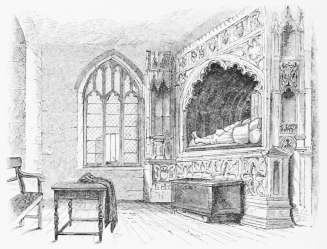
Even the pleasures of this home-Sunday, however, were marred in the summer, when my mother gave in to a suggestion of Aunt Esther that I should be locked into the vestry of the church between the services. Miserable indeed were the three hours which—provided with a sandwich for dinner—I had weekly to spend there; and though I did not expect to see ghosts, the utter isolation of Hurstmonceaux Church, far away from all haunts of men, gave my imprisonment an unusual eeriness. Sometimes I used to clamber over the tomb of the Lords Dacre, which rises like a screen against one side of the vestry, and be stricken with vague terrors by the two grim white figures lying upon it in the silent desolation, in which the scamper of a rat across the floor seemed to make a noise like a whirlwind. At that time two grinning skulls (of the founder and foundress of the church, it was believed) lay on the ledge of the tomb; but soon after this Uncle Julius and Aunt Esther made a weird excursion to the churchyard with a spade, and buried them in the dusk with their own hands. In the winter holidays, the intense cold of the unwarmed church made me so ill, that it led to my miserable penance being remitted. James II. used to say that "Our Saviour flogged people to make them go out of the temple, but that he never punished them to make them go in."[36] But in my childhood no similar abstinence was observed.
It was a sort of comfort to me, in the real church-time, to repeat vigorously all the worst curses in the Psalms, those in which David showed his most appalling degree of malice (Psalm xxxv. 7-16, Psalm lix., Psalm lxix. 22-29, Psalm cxl. 9, 10, for instance), and apply them to Aunt Esther & Co. As all the Psalms were extolled as beatific, and the Church of England used them constantly for edification, their sentiments were all right, I supposed.
A great delight to me at this time was a cabinet with many drawers which my mother gave me to keep my minerals and shells in, and above which was a little bookcase filled with all my own books. The aunts in vain tried to persuade her to take away "some of the drawers," so that I might "never have the feeling that the cabinet was wholly mine." When I returned to school, it was some amusement in my walks to collect for this cabinet the small fossils which abound in the Wiltshire limestone about Harnish, especially at Kellaway's quarry, a point which it was always our especial ambition to reach on holidays. At eleven years old I was quite learned about Pentacrinites, Bellemnites, Ammonites, &c.
It was often a sort of vague comfort to me at home that there was always one person at Hurstmonceaux Rectory whom Aunt Esther was thoroughly afraid of. It was the faithful old servant Collins, who had kept his master in order for many years. I remember that my Uncle Marcus, when he came to the Rectory, complained dreadfully of the tea, that the water with which it was made was never "on the boil," &c.—"they really must speak to Collins about it." But neither Uncle Julius nor Aunt Esther would venture to do it; they really couldn't: he must do it himself. And he did it, and very ill it was received.
The summer holidays were less miserable than those in the winter, because then, at least for a time, we got away from Hurstmonceaux. In the summer of 1845, I went with my mother to her old home of Alton for the first time. How well I remember her burst of tears as we came in sight of the White Horse, and the church-bells ringing, and the many simple cordial poor people coming out to meet her, and blessing her. She visited every cottage and every person in them, and gave feasts in a barn to all the people. One day the school-children all sang a sort of ode which a farmer's daughter had composed to her. Never was my sweet mother more charming than in her intercourse with her humble friends at Alton, and I delighted in threading with her the narrow muddy foot-lanes of the village to the different cottages, of old and young Mary Doust, of Lizzie Hams, Avis Wootton, Betty Perry, &c.
Alton was, and is, quite the most primitive place I have ever seen, isolated—an oasis of verdure—in the midst of the great Wiltshire corn-plain, which is bare ploughed land for so many months of the year; its two tiny churches within a stone-throw of each other, and its thatched mud cottages peeping out of the elms which surround its few grass pastures. A muddy chalky lane leads from the village up to "Old Adam," the nearest point on the chain of downs, and close by is a White Horse, not the famous beast of Danish celebrity, but something much more like the real animal. I was never tired during this visit of hearing from his loving people what "Uncle Augustus" had said to them, and truly his words and his image seemed indelibly impressed upon their hearts. Mrs. Pile, with whose father or sister we stayed when at Alton, and who always came to meet us there, was one of those rare characters in middle life who are really ennobled by the ceaseless action of a true, practical, humble Christianity. I have known many of those persons whom the world calls "great ladies" in later times, but I have never known any one who was more truly "a lady" in every best and highest sense, than Mrs. Pile.
On leaving Alton, we went to join the Marcus Hares in the express train at Swindon. Uncle Marcus, Aunt Lucy, her maid Griffiths, and my mother were in one compartment of the carriage; my little cousin Lucebella, Lea, an elderly peer (Lord Saye and Sele, I think), and I were in the other, for carriages on the Great Western were then divided by a door. As we neared Windsor, my little cousin begged to be held up that she might see if the flag were flying on the castle. At that moment there was a frightful crash, and the carriage dashed violently from side to side. In an instant the dust was so intense that all became pitch darkness. "For God's sake put up your feet and press backwards; I've been in this before," cried Lord S., and we did so. In the other compartment all the inmates were thrown violently on the floor, and jerked upwards with every lurch of the train. If the darkness cleared for an instant, I saw Lea's set teeth and livid face opposite. I learned then for the first time that to put hand-bags in the net along the top of the carriage is most alarming in case of accident. They are dashed hither and thither like so many cannon-balls. A dressing-case must be fatal.
After what seemed an endless time, the train suddenly stopped with a crash. We had really, I believe, been three minutes off the line. Instantly a number of men surrounded the carriage. "There is not an instant to lose, another train is upon you, they may not be able to stop it,"—and we were all dragged out and up the steep bank of the railway cutting. Most strange, I remember, was the appearance of our ruined train beneath, lying quite across the line. The wheels of the luggage van at the end had come off, and the rest of the train had been dragged off the line gradually, the last carriages first. Soon two trains were waiting (stopped) on the blocked line behind. We had to wait on the top of the bank till a new train came to fetch us from Slough, and when we arrived there, we found the platform full of anxious inquirers, and much sympathy we excited, quite black and blue with bruises, though none of us seriously hurt.
LEWES.
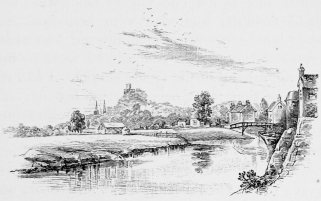
Soon after we reached Hurstmonceaux, my Uncle Marcus became seriously ill at the Rectory. I went with my mother, Aunt Esther, and Uncle Julius to his "charge" at Lewes, and, as we came back in the hot evening, we were met by a messenger desiring us not to drive up to the house, as Uncle Marcus must not be disturbed by the sound of wheels. Then his children were sent to Lime, and my mother was almost constantly at the Rectory. I used to go secretly to see her there, creeping in through the garden so as not to be observed by the aunts, for Aunt Lucy could scarcely bear her to be out of sight. At last one morning I was summoned to go up to the Rectory with all the three children. Marcus went in first alone to his father's room and was spoken to: then I went in with the younger ones. Lucebella was lifted on to the pillow, I stood at the side of the bed with Theodore; my mother, Uncle Julius, and Aunt Esther were at the foot. I remember the scene as a picture, and Aunt Lucy sitting stonily at the bed's-head in a violet silk dress. My dying uncle had a most terrible look and manner, which haunted me long afterwards, but he spoke to us, and I think gave us his blessing. I was told that after we left the room he became more tranquil. In the night my mother and Uncle Julius said the "Te Deum" aloud, and, as they reached the last verse, he died.
Aunt Lucy never saw him again. She insisted upon being brought away immediately to Lime, and shut herself up there. She was very peculiar at this time and for a year afterwards, one of her odd fancies being that her maid Griffiths was always to breakfast and have luncheon with the family and be waited on as a lady. We children all went to the funeral, driving in the family chariot. I had no real affection for Uncle Marcus, but felt unusually solemnised by the tears around me. When, however, a peacock butterfly, for which I had always longed, actually perched upon my prayer-book as I was standing by the open grave in the most solemn moment, I could not resist closing the book upon it, and my prayer-book still has the marks of the butterfly's death. I returned to school in August under the care of Mr. Hull, a very old friend of the family, who had come to the funeral.
To MY MOTHER.
"Harnish, August 8.—When we got to London we got a cab and went, passing the Guildhall where Gog and Magog live, the great Post-Office, the New Royal Exchange and the Lord Mayor's, to Tavistock Square, where three young men rushed down-stairs, who Mr. Hull told me were his three sons—John, Henry, and Frank. I had my tea when they had their dinner. After tea I looked at Miss Hull's drawings. Mr. Hull gave me a book called 'The Shadowless Man.' I stayed up to see a balloon, for which we had to go upon the top of the house. The balloon looked like a ball of fire. It scattered all kinds of lights, but it did not stay up very long. We also saw a house on fire, the flames burst out and the sky was all red. Do give the kitten and the kitten's kitten some nice bits from your tea for my sake."
"August 30.—We have been a picknick to Slaughterford. We all went in a van till the woods of Slaughterford came in sight. Then we walked up a hill, carrying baskets and cloaks between us till we came to the place where we encamped. The dinner was unpacked, and the cloth laid, and all sate round. When the dishes were uncovered, there appeared cold beef, bread, cheese, and jam, which were quickly conveyed to the mouths of the longing multitude. We then plunged into the woods and caught the nuts by handfuls. Then I got flowers and did a sketch, and when the van was ready we all went home. Goodbye darling Mamma. I have written a poem, which I send you—
"O Chippenham station thy music is sweet When the up and down trains thy neighbourhood greet. The up train to London directeth our path And the down train will land us quite safely at Bath."
"October the I don't know what.—O dearest Mamma, what do you think! Mr. Dalby asked me to go to Compton Bassett with Mr. and Mrs. Kilvert and Freddie Sheppard.... When we got to the gate of a lovely rectory near Calne, Mrs. Sheppard flew to the door to receive her son, as you would me, with two beautiful little girls his sisters. After dinner I went with Freddie into the garden, and to the church, and saw the peacocks and silver pheasants, and made a sketch of the rectory. On Sunday we had prayers with singing and went to church twice, and saw a beautiful avenue where the ground was covered with beech-nuts. On Monday the Dalbys' carriage brought us to Chippenham to the Angel, where we got out and walked to Harnish. Mr. Dalby told me to tell you that having known Uncle Augustus so well, he had taken the liberty to invite me to Compton."
"Oct. 6.—It is now only ten weeks and six days to the holidays. Last night I had a pan of hot water for my feet and a warm bed, and, what was worse, two horrible pills! and this morning when I came down I was presented with a large breakfast-cup of senna-tea, and was very sick indeed and had a very bad stomach-ache. But to comfort me I got your dear letter with a sermon, but who is to preach it?"
"Nov. 6.—Dearest Mamma, as soon as we came down yesterday all our dresses for the fifth of November were laid out. After breakfast the procession was dressed, and as soon as the sentinel proclaimed that the clock struck ten, the grand procession set out: first Gumbleton and Sheppard dressed up with straps, cocked hats, and rosettes, carrying between them, on a chair, Samuel dressed as Guy Fawkes in a large cocked hat and short cloak and with a lanthorn in his hand. Then came Proby carrying a Union Jack, and Walter (Arnold) with him, with rosettes and bands. Then King Alick with a crown turned up with ermine, and round his leg a blue garter. Behind him walked the Queen (Deacon Coles) with a purple crown and long yellow robe and train, and Princess Elizabeth (me) in a robe and train of pink and green. After the procession had moved round the garden, singing—
'Remember, remember, The fifth of November, &c.,'
the sentinel of the guard announced that the cart of faggots was coming up the hill ... and in the evening was a beautiful bonfire and fireworks.
"What a pity it is that the new railway does not turn aside to save Lewes Priory. I shall like very much to see the skeletons, but I had much rather that Gundrada and her husband lay still in their coffins, and that the Priory had not been disturbed.... It is only five weeks now to the holidays."
"Nov. 28.—Counting to the 19th, and not counting the day of breaking up, it is now only three weeks to the holidays. I will give you a history of getting home. From Lewes I shall look out for the castle and the Visitation church. Then I shall pass Ringmer, the Green Man Inn, Laughton, the Bat and Ball; then the Dicker, Horsebridge, the Workhouse, the turnpike, the turn to Carter's Corner, the turn to Magham Down, Woodham's Farm, the Deaf and Dumb House, the Rectory on the hill, the Mile Post—'15 miles to Lewes,' Lime Wood, the gate (oh! when shall I be there!)—then turn in, the Flower Field, the Beaney Field, the gate—oh! the garden—two figures—John and Lea, perhaps you—perhaps even the kittens will come to welcome their master. Oh my Lime! in little more than three weeks I shall be there!"
"Hurrah for Dec. 1.—On Wednesday it will be, not counting breaking-up day, two weeks, and oh! the Wednesday after we shall say 'one week.' This month we break up! I dream of nothing, think of nothing, but coming home. To-day we went with Mr. Walker (the usher) to Chippenham, and saw where Lea and I used to go to sit on the wooden bridge.... Not many more letters! not many more sums!"
How vividly, how acutely, I recollect that—in my passionate devotion to my mother—I used, as the holidays approached, to conjure up the most vivid mental pictures of my return to her, and appease my longing with the thought of how she would rush out to meet me, of her ecstatic delight, &c.; and then how terrible was the bathos of the reality, when I drove up to the silent door of Lime, and nobody but Lea took any notice of my coming; and of the awful chill of going into the drawing-room and seeing my longed-for and pined-for mother sit still in her chair by the fire till I went up and kissed her. To her, who had been taught always to curtsey not only to her father, but even to her father's chair, it was only natural; but I often sobbed myself to sleep in a little-understood agony of anguish—an anguish that she could not really care for me.
"Oh, the little more, and how much it is! And the little less, and what worlds away!"[37]
In the winter of 1845-46, "Aunt Lucy" let Rockend to Lord Beverley, and came to live at Lime for six months with her three children, a governess, and two, sometimes three, servants. As she fancied herself poor, and this plan was economical, it was frequently repeated afterwards. On the whole, the arrangement was satisfactory to me, as though Aunt Lucy was excessively unkind to me, and often did not speak a single word to me for many weeks together, and though the children were most tormenting, Aunt Esther—a far greater enemy—was at least kept at bay, for Aunt Lucy detested her influence and going to the Rectory quite as cordially as I did.
How often I remember my ever-impatient rebellion against the doctrine I was always taught as fundamental—that my uncles and aunts must be always right, and that to question the absolute wisdom and justice of their every act—to me so utterly selfish—was typical of the meanest and vilest nature. How odd it is that parents, and still more uncles and aunts, never will understand, that whilst they are criticising and scrutinising their children or nephews, the latter are also scrutinising and criticising them. Yet so it is: investigation and judgment of character is usually mutual. During this winter, however, I imagine that the aunts were especially amiable, as in the child's play which I wrote, and which we all acted—"The Hope of the Katzekoffs"—they, with my mother, represented the three fairies—"Brigida, Rigida, and Frigida"—Aunt Lucy, I need hardly say, being Frigida, and Aunt Esther Rigida.
Augustus J. C. Hare From a portrait by S. Lawrence.
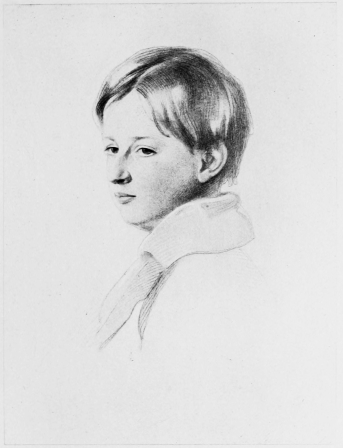
Being very ill with the measles kept me at home till the middle of February. Aunt Lucy's three children also had the measles, and were very ill; and it is well remembered as characteristic of Aunt Esther, that she said when they were at the worst—"I am very glad they are so ill: it is a well-deserved punishment because their mother would not let them go to church for fear they should catch it there." Church and a love of church was the standard by which Aunt Esther measured everything. In all things she had the inflexible cruelty of a Dominican. She would willingly and proudly undergo martyrdom herself for her own principles, but she would torture without remorse those who differed from her.
When we were recovering, Aunt Lucy read "Guy Mannering" aloud to us. It was enchanting. I had always longed beyond words to read Scott's novels, but had never been allowed to do so—"they were too exciting for a boy!" But usually, as Aunt Lucy and my mother sat together, their conversation was almost entirely about the spiritual things in which their hearts, their mental powers, their whole being were absorbed. The doctrine of Pascal was always before their minds—"La vie humaine n'est qu'une illusion perpetuelle," and their treasure was truly set in heavenly places. They would talk of heaven in detail just as worldly people would talk of the place where they were going for change of air. At this time, I remember, they both wished—no, I suppose they only thought they wished—to die: they talked of longing, pining for "the coming of the kingdom," but when they grew really old, when the time which they had wished for before was in all probability really near, and when they were, I believe, far more really prepared for it, they ceased to wish for it. "By-and-by" would do. I imagine it is always thus.
Aunt Lucy loved her second boy Theodore much the best of her three children, and made the greatest possible difference between him and the others. I remember this being very harshly criticised at the time; but now it seems to me only natural that in any family there must be favourites. It is with earthly parents as Dr. Foxe said in a sermon about God, that "though he may love all his children, he must have an especial feeling for his saints."
To MY MOTHER.
"March 13.—My dearest, dearest Mamma, to-day is my 12th birthday. How well I remember many happy birthdays at Stoke, when before breakfast I had a wreath of snowdrops, and at dinner a little pudding with my name in plums.... I will try this new year to throw away self and think less how to please it. Good-bye dear Mamma."
In March the news that my dear (Mary) Lea was going to marry our man-servant John Gidman was an awful shock to me. My mother might easily have prevented this (most unequal) marriage, which, as far as Mrs. Leycester was concerned, was an elopement. It was productive of great trouble to us afterwards, and obliged me to endure John Gidman, to wear him like a hair-shirt, for forty years. Certainly no ascetic torments can be so severe as those which Providence occasionally ordains for us. As for our dear Lea herself, her marriage brought her misery enough, but her troubles always stayed in her heart and never filtered through. As I once read in an American novel, "There ain't so much difference in the troubles on this earth, as there is in the folks that have to bear them."
To MY MOTHER.
"March 20.—O my very dearest Mamma. What news! what news! I cannot believe it! and yet sometimes I have thought it might happen, for one night a long time ago when I was sitting on Lea's lap—O what shall I call her now? may I still call her Lea? Well, one night a long time ago, I said that Lea would never marry, and she asked why she shouldn't, and said something about—'Suppose I marry John.' ... I was sure she could never leave us. I put your letter away for some time till Mrs. Kilvert sent me upstairs for my gloves. Then I opened it, and the first words I saw were 'Lea—married.' I was so surprised I could not speak or move.... How very odd it will be for Lea to be a bride. Why, John is not half so old as Lea, is he?... Tell me all about the wedding—every smallest weeest thing—What news! what news!"
MARY (LEA) GIDMAN to A. J. C. H.
"Stoke, March 29, 1846.—My darling child, a thousand thanks for your dear little letter. I hope the step I have taken will not displease you. If there is anything in it you don't like, I must humbly beg your pardon. I will give you what account I can of the wedding. Your dear Mamma has told you that she took me to Goldstone. Then on Saturday morning a little after nine my mother's carriage and a saddle-horse were brought to the gate to take us to Cheswardine. My sister Hannah and her husband and George Bentley went with me to church. I wished you had been with me so very much, but I think it was better that your dear Mamma was not there, for very likely it would have given her a bad headache and have made me more nervous than I was, but I got through all of it better than I expected I should. As soon as it was over the bells began to ring. We came back to Goldstone, stayed about ten minutes, then went to Drayton, took the coach for Whitmore, went by rail to Chelford, and then we got a one-horse fly which took us to Thornycroft to John's grandfather's, where we were received with much joy. We stayed there till Wednesday, then went for one night to Macclesfield, and came back to Goldstone on Thursday and stayed there till Friday evening. Then we came back to Stoke. The servants received us very joyfully, and your dear Mamma showed me such tender feelings and kindness, it is more than I can tell you now. My dear child, I hope you will always call me Lea. I cannot bear the thought of your changing my name, for the love I have for you nothing can ever change. My mother and Hannah wish you had been in the garden with me gathering their flowers, there is such a quantity of them.... We leave Stoke to-morrow, and on Friday reach your and our dear Lime. I shall write to you as soon as we get back, and now goodbye, my darling child, from your old affectionate nurse Lea."
REV. O. LEYCESTER'S GRAVE, STOKE CHURCHYARD.
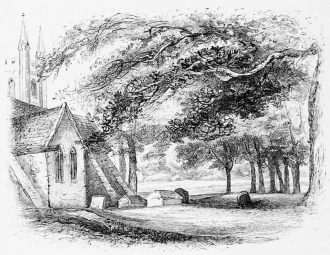
The great age of my dear Grandfather Leycester, ninety-five, had always made his life seem to us to hang upon a thread, and very soon after I returned home for my summer holidays, we were summoned to Stoke by the news of his death. This was a great grief to me, not only because I was truly attached to the kind old man, but because it involved the parting with the happiest scenes of my childhood, the only home in which I had ever been really happy. The dear Grandfather's funeral was very different from that which I had attended last year, and I shed many tears by his grave in the churchyard looking out upon the willows and the shining Terne. Afterwards came many sad partings, last visits to Hawkestone, Buntingsdale, Goldstone; last rambles to Helshore, Jackson's Pool, and the Islands; and then we all came away—my Uncle Penrhyn first, then Aunt Kitty, then my mother and Lea and I, and lastly Grannie, who drove in her own carriage all the way to her house in New Street, Spring Gardens, the posting journey, so often talked of, actually taking place at last. Henceforward Stoke seemed to be transferred to New Street, which was filled with relics of the old Shropshire Rectory, and where Mrs. Cowbourne, Margaret Beeston, Anne Tudor, and Richard the footman, with Rose the little red and white spaniel, were household inmates as before.
I thought the house in New Street charming—the cool, old-fashioned, bow-windowed rooms, which we should now think very scantily furnished, and like those of many a country inn; the dining-room opening upon wide leads, which Grannie soon turned into a garden; the drawing-room, which had a view through the trees of the Admiralty Garden to the Tilting Yard, with the Horse Guards and the towers of Westminster Abbey.
The grief of leaving Stoke made me miserably unwell, and a doctor was sent for as soon as I arrived at the Stanleys' house, 38 Lower Brook Street, who came to me straight from a patient ill with the scarlatina, and gave me the disorder. For three weeks I was very seriously ill in hot summer weather, in stifling rooms, looking on the little black garden and chimney-pots at the back of the house. Mary and Kate Stanley were sent away from the infection, and no one came near me except my faithful friend Miss Clinton, who brought me eau-de-Cologne and flowers. It was long foolishly concealed from me that I had the scarlatina, and therefore, as I felt day after day of the precious holidays ebbing away, while I was pining for coolness and fresh country air, my mental fever added much to my bodily ailments, whereas, when once told that I was seriously ill, I was quite contented to lie still. Before I quite recovered, my dear nurse Lea became worn-out with attending to me, and we had scarcely reached Lime before she became most dangerously ill with a brain-fever. For many days and nights she lay on the brink of the grave, and great was my agony while this precious life was in danger. Aunt Esther, who on great occasions generally behaved kindly, was very good at this time, ceased to persecute me, and took a very active part in the nursing.
At length our dear Lea was better, and as I was still very fragile, I went with my mother and Anne Brooke, our cook, to Eastbourne—then a single row of little old-fashioned houses by the sea—where we inhabited, I should think, the very smallest and humblest lodging that ever was seen. I have often been reminded of it since in reading the account of Peggotty's cottage in "David Copperfield." It was a tiny house built of flints, amongst the boats, at the then primitive end of Eastbourne, towards the marshes, and its miniature rooms were filled with Indian curiosities, brought to the poor widow to whom it belonged by a sailor son. The Misses Thomas of Wratton came to see us here, and could hardly suppress their astonishment at finding us in such a place—and when the three tall smart ladies had once got into our room, no one was able to move, and all had to go out in the order in which they were nearest the door. But my mother always enjoyed exceedingly these primitive places, and would sit for hours on the beach with her Taylor's "Holy Living" or her "Christian Year," and had soon made many friends amongst the neighbouring cottagers, whose houses were quite as fine as her own, and who were certainly more cordial to the lady who had not minded settling down as one of themselves, than they would have been to a smart visitor in a carriage. The most remarkable of these people was an excellent old woman called Deborah Pattenden, who lived in the half of a boat turned upside down, and had had the most extraordinary adventures. My first literary work was her biography, which told how she had suffered the pains of drowning, burning (having been enveloped in flames while struck by lightning), and how she had lain for twenty-one days in a rigid trance (from "the plague," she described it) without food or sign of life, and was near being buried alive. We found a transition from our cottage life in frequent visits to Compton Place, where Mrs. Cavendish, mother of the 7th Duke of Devonshire, lived then, with her son Mr. Cavendish, afterwards Lord Richard. She was a charming old lady, who always wore white, and had very simple and very timid manners. But she was fond of my mother, who was quite adored by Lord Richard, by whom we were kept supplied with the most beautiful fruits and flowers of the Compton Gardens. He was very kind to me also, and would sometimes take me to his bookcases and tell me to choose any book I liked for my own. We seldom afterwards passed a summer without going for a few days to Compton Place as long as Mrs. Cavendish lived there. It was there that I made my first acquaintance with the existence of many simple luxuries to which, in our primitive life, we were quite unaccustomed, but which in great houses are considered almost as necessaries. The Cavendishes treated us as distant relations, in consequence of the marriage of my Grandmother's cousin, Georgiana Spencer, with the 5th Duke of Devonshire.
When I returned to Harnish I was still wretchedly ill, and the constant sickness under which I suffered, with the extreme and often unjust severity of Mr. Kilvert, made the next half year a very miserable one. In the three years and a half which I had spent at Harnish, I had been taught next to nothing—all our time having been frittered in learning Psalms by heart, and the Articles of the Church of England (I could say the whole thirty-nine straight off when eleven years old), &c. Our history was what Arrowsmith's Atlas used to describe Central Africa to be—"a barren country only productive of dates." I could scarcely construe even the easiest passages of Cæsar. Still less had I learned to play at any ordinary boys' games; for, as we had no playground, we had naturally never had a chance of any. I was glad of any change. It was delightful to leave Harnish for good at Christmas, 1846, and the prospect of Harrow was that of a voyage of adventure.
In January 1847 my mother took me to Harrow. Dr. Vaughan was then headmaster, and Mr. Simpkinson, who had been long a curate of Hurstmonceaux, and who had been consequently one of the most familiar figures of my childhood, was a master under him, and, with his handsome, good-humoured sister Louisa, kept the large house for boys beyond the church, which is still called "The Grove." It was a wonderfully new life upon which I entered; but though a public school was a very much rougher thing then than it is now, and though the fagging for little boys was almost ceaseless, it would not have been an unpleasant life if I had not been so dreadfully weak and sickly, which sometimes unfitted me for enduring the roughness to which I was subjected. As a general rule, however, I looked upon what was intended for bullying as an additional "adventure," which several of the big boys thought so comic, that they were usually friendly to me and ready to help me: one who especially stood my friend was a young giant—Twisleton, son of Lord Saye and Sele. One who went to Harrow at the same time with me was my connection Harry Adeane,[38] whose mother was Aunt Lucy's sister, Maude Stanley of Alderley. I liked Harry very much, but though he was in the same house, his room was so distant that we saw little of each other; besides, my intense ignorance gave me a very low place in the school, in the Lower Fourth Form. It was a great amusement to write to my mother all that occurred. In reading it, people might imagine my narration was intended for complaint, but it was nothing of the kind: indeed, had I wished to complain, I should have known my mother far too well to complain to her.
To MY MOTHER.
"Harrow, Jan. 29, 1847.—When I left you, I went to school and came back to pupil room, and in the afternoon had a solitary walk to the skating pond covered with boys.... In the evening two big boys rushed up, and seizing Buller (another new boy) and me, dragged us into a room where a number of boys were assembled. I was led into the midst. Bob Smith[39] whispered to me to do as I was bid and I should not be hurt. On the other side of the room were cold chickens, cake, fruit, &c., and in a corner were a number of boys holding open little Dirom's mouth, and pouring something horrible stirred up with a tallow-candle down his throat. A great boy came up to me and told me to sing or to drink some of this dreadful mixture. I did sing—at least I made a noise—and the boys were pleased because I made no fuss, and loaded me with oranges and cakes.
"This morning being what is called a whole holiday, I have had to stay in three hours more than many of the others because of my slowness in making Latin verses. This evening Abel Smith sent for me to his room, and asked me if I was comfortable, and all sorts of things."
"Jan. 21.—What do you think happened last night? Before prayers I was desired to go into the fifth form room, as they were having some game there. A boy met me at the door, ushered me in, and told me to make my salaam to the Emperor of Morocco, who was seated cross-legged in the middle of a large counterpane, surrounded by twenty or more boys as his serving-men. I was directed to sit down by the Emperor, and in the same way. He made me sing, and then jumped off the counterpane, as he said, to get me some cake. Instantly all the boys seized the counterpane and tossed away. Up to the ceiling I went and down again, but they had no mercy, and it was up and down, head over heels, topsy-turvy, till some one called out 'Satus'—and I was let out, very sick and giddy at first, but soon all right again.... I am not much bullied except by Davenport, who sleeps in my room."
"Jan. 22.—To-day it has snowed so hard that there has been nothing but snow-balling, and as I was coming out of school, hit by a shower of snowballs, I tumbled the whole way down the two flights of stairs headlong from the top to the bottom."
"Jan. 23.—Yesterday I was in my room, delighted to be alone for once, and very much interested in the book I was reading, when D. came in and found the fire out, so I got a good licking. He makes me his fag to go errands, and do all he bids me, and if I don't do it, he beats me, but I don't mind much. However, I have got some friends, for when I refused to do my week-day lessons on a Sunday, and was being very much laughed at for it, some one came in and said, 'No, Hare, you're quite right; never mind being laughed at.' However I am rather lonely still with no one to speak to or care about me. Sometimes I take refuge in Burroughs' study, but I cannot do that often, or he would soon get tired of me. I think I shall like Waldegrave,[40] a new boy who has come, but all the others hate him. Blomfield[41] is a nice boy, but his room is very far away. Indeed, our room is so secluded, that it would be a very delightful place if D. did not live in it. In playtime I go here, there, and everywhere, but with no one and doing nothing. Yet I like Harrow very much, though I am much teased even in my form by one big boy, who takes me for a drum, and hammers on my two sides all lesson-time with doubled fists. However, Miss Simmy says, if you could see my roses you would be satisfied."
"Jan. 30.—There are certain fellows here who read my last letter to you, and gave me a great lecture for mentioning boys' names; but you must never repeat what I say: it could only get me into trouble. The other night I did a desperate thing. I appealed to the other boys in the house against D. Stapleton was moved by my story, and Hankey and other boys listened. Then a boy called Sturt was very much enraged at D., and threatened him greatly, and finally D., after heaping all the abuse he could think of upon me, got so frightened that he begged me to be friends with him. I cannot tell you how I have suffered and do suffer from my chilblains, which have become so dreadfully bad from going out so early and in all weathers."
"Feb. 2.—To-day, after half-past one Bill, I went down the town with Buller and met two boys called Bocket and Lory. Lory and I, having made acquaintance, went for a walk. This is only the second walk I have had since I came to Harrow. I am perpetually 'Boy in the House.'"
"Feb. 10.—To-day at 5 minutes to 11, we were all told to go into the Speech-room (do you remember it?), a large room with raised benches all round and a platform in the middle and places for the monitors. I sat nearly at the top of one of these long ranges. Then Dr. Vaughan made a speech about snow-balling at the Railway Station (a forbidden place), where the engine-drivers and conductors had been snow-balled, and he said that the next time, if he could not find out the names of the guilty individuals, the whole school should be punished. To-day the snow-balling, or rather ice-balling (for the balls are so hard you can hardly cut them with a knife), has been terrific: some fellows almost have their arms broken with them."
"Feb. 12.—I am in the hospital with dreadful pains in my stomach. The hospital is a large room, very quiet, with a window looking out into the garden, and two beds in it. Burroughs is in the other bed, laid up with a bad leg.... Yesterday, contrary to rule, Dr. Vaughan called Bill, and then told all the school to stay in their places, and said that he had found the keyhole of the cupboard in which the rods were kept stopped up, and that if he did not find out before one o'clock who did it, he would daily give the whole school, from the sixth form downwards, a new pun, of the severest kind.... There never was anything like the waste of bread here, whole bushels are thrown about every day, but the bits are given to the poor people.... I like Valletort[42] very much, and I like Twisleton,[43] who is one of the biggest boys in this house."
"Feb. 20.—To-day I went to the Harrisites' steeplechase. Nearly all the school were there, pouring over hedges and ditches in a general rush. The Harrisites were distinguished by their white or striped pink and white jackets and Scotch caps, and all bore flags."
"Feb. 21.—I have been out jumping and hare-and-hounds, have hard work now to escape from the slave-drivers for racket-fagging. Sometimes we do, by one fellow sacrificing himself and shutting up the others head downwards in the turn-up bedsteads, where they are quite hidden; and sometimes I get the old woman at the church to hide me in the little room over the porch till the slave-drivers have passed."
"March 1.—I have just come back from Sheen, where I have had a very happy Exeat. Uncle Norwich gave me five shillings, and Uncle Penrhyn ten."
Mrs. Stanley to
her Sister Mrs. A. Hare.
"Sheen, March 1.—I never saw Augustus look anything like so well—and it is the look of health, ruddy and firm, and his face rounder. The only thing is that he stoops, as if there were weakness in the back, but perhaps it is partly shyness, for I observed he did it more at first. He did look very shy the first day—hung his head like a snowdrop, crouched out of sight, and was with difficulty drawn out; but I do not think it is at all because he is cowed, and he talked more yesterday. The Bishop was very much pleased with him, and thought him much improved.... He came without either greatcoat or handkerchief, but did not appear to want the one, and had lost the other. He said most decidedly that he was happy, far happier than at Mr. Kilvert's, happier than he expected to be; and, though I felt all the time what an uncongenial element it must be, he could not be in it under better circumstances."
To MY MOTHER.
"March 4.—As you are ill, I will tell you my adventure of yesterday to amuse you. I went out with a party of friends to play at hare-and-hounds. I was hare, and ran away over hedges and ditches. At last, just as I jumped over a hedge, Macphail caught me, and we sat down to take breath. Just then Hoare ran up breathless and panting, and threw himself into the hedge crying out, 'We are pursued by navvies.' The next minute, before I could climb back over the hedge, I found myself clutched by the arm, and turning round, saw that a great fellow had seized me, and that another had got Macphail and another Hodgson Junior. They dragged us a good way, and then stopped and demanded our money, or they would have us down and one should suffer for all. Macphail and Hoare were so frightened that they gave up all their money at once, but I would not give up mine. At last they grew perfectly furious and declared they would have our money to buy beer. I then gave them a shilling, but hid the half-sovereign I had in my pocket, and after we had declared we would not give them any more, they went away.
"To cut the story short, I got Hodgson Junior (for the others were afraid) to go with me to the farmer on whose land the men were working, and told what had happened. He went straight to the field where the navvies were and made them give up all our money, turned one out of his service, and threatened the other two, and we came back to Harrow quite safe, very glad to have got off so well.
"What do you think! the fever has broken out in Vaughan's, and if any other house catches it, we are to go—home!"
"March 9.—All the school is in an uproar, for all Vaughan's house went down yesterday. Two boys have the fever, and if any one else catches it, we shall all go home. What fun it will be. The fever came straight from Eton with some velocipedes. Everybody now thinks everybody else has the fever. I am shunned by all because I have a sore throat, and half-a-yard is left on each side of me in form. Boys suck camphor in school. Endless are the reports. 'Pember's got the fever.'—'No, he hasn't.'—'Yes, he has, for it's broke out in Harris's.'—'Then we shall all go home. Hurrah!'—'No, it's all a gull!'"
"My adventure with the navvies has been a very good thing for me, as some fellows say 'that little Hare has really got some pluck.'"
"March 10.—Hurrah! Vaughan has caught the fever. The Vaughanites are all gone. Valletort is gone. Waldegrave is gone. But the great news is we all go home the day after to-morrow. Now if you don't write the instant you get this you will delay my return home. So pray, Mamma, do—do—do—do. I cannot write much, for the school is so hurry-scurry. There will be no Trial—oh hip! hip! Oh pray do write directly! I shall see you soon. Hurrah!"
(After Easter holidays), "April 14.—When I got here, I found Davenport was gone and Dirom come into our room. The bells rang all night for the return of the school. We are busy at our Trial, which we do with our masters in form. We did Ovid this morning, and I knew much more about it than many other fellows."
"Saturday.—To-day has been a whole holiday, as it always is at the end of Trial. I have got off very well, and learnt eighty lines more than I need have done, for we need only have learnt fifty lines, and I knew more of other things than many others.
"To-day was 'Election Day'—commonly called Squash Day (oh, how glad I am it is over), the day most dreaded of all others by the little boys, when they get squashed black and blue, and almost turned inside out. But you won't understand this, so I will tell you. Platt, horrid Platt, stands at one side of Vaughan's desk in school, and Hewlett at the other, and read the names. As they are read, you go up and say who you vote for as cricket-keeper, and as you come out, the party you vote against squash you, while your party try to rescue you. Sometimes this lasts a whole hour (without exaggeration it's no fun), but to-day at breakfast the joyful news came that the fourth form was let off squash. It was such a delight. The fifth form were determined that we should have something though, for as we came out of Bill, they tried to knock our hats to pieces, and ourselves to pieces too."
"April 24.—The boys have all begun to wear strawhats and to buy insect-nets, for many are very fond of collecting insects, and to my delight I found, when I came up, that they did not at all despise picking primroses and violets."
"April 28.—The other day, as Sturt was staying out, I had to fag in his place. I had to go to that horrid Platt at Ben's. At the door of Ben's was P——. I asked him which was Platt's room, and he took me upstairs and pushed me into a little dark closet, and when I got out of that, into a room where a number of fellows were at tea, and then to another. At last I came to some stairs where two boys were sitting cross-legged before a door. They were the tea-fags. I went in, and there were Platt and his brother, very angry at my being late, but at last they let me go, or rather I was kicked out of the house.
"To-day we went to hear a man read the 'Merchant of Venice' in Speech-room. Such fun: I liked it so much."
"May 1.—Yesterday I was in a predicament. Hewlett, the head of our house, sent me with a note to Sporling, the head of the school, in Vaughan's new house. I asked a boy which was Sporling's. He told me that I should find him upstairs, so I went up stairs after stairs, and at the top were two monitors, and as I looked bewildered by the long passages, they told me which was Sporling's room. When I came out with an answer to the note, they called after me, and ordered me to give Hewlett their compliments, and tell him not to be in too great a hurry to get into Sporling's shoes. You must obey a monitor's orders, and if you don't you get a wapping; but I was pretty sure to get a wapping anyway—from the monitors if I did not deliver the message, and from Hewlett for its impertinence. I asked a great many boys, and they all said I must tell Hewlett directly. At last I did: he was in a great rage, but said I might go.
"I have 7s. 6d. owed me, for as soon as the boys have any money they are almost obliged to lend it; at least you never have any peace till it is all gone. Some of the boys keep rabbits in the wells of their studies, but to-night Simmy has forbidden this."
"June.—On Sunday in the middle of the Commandments it was so hot in chapel that Kindersley fell down in a fit. He was seized head and foot and carried out, struggling terribly, by Smith and Vernon and others: and the boys say that in his fit he seized hold of Mr. Middlemist's (the Mathematical Master's) nose and gave it a very hard tweak; but how far this is true I cannot tell. However, the whole chapel rose up in great consternation, some thinking one thing and some another, and some not knowing what to think, while others perhaps thought as I did, that the roof was coming down. Dr. Vaughan went on reading the prayers, and Kindersley shrieking, but at last all was quiet. Soon, however, there was another row, for Miles fainted, and he was carried out, and then several others followed his example. That night was so hot that many of the boys slept on the bare floor, and had no bedclothes on, but the next day it rained and got quite cold, and last night we were glad of counterpanes and blankets again."
"The Bishop's Holiday.—The cricket-fagging, the dreadful, horrible cricket-fagging comes upon me to-day. I am Boy in the House on the extra whole holiday, and shall have cricket-fagging in the evening at the end of a hard day's other fagging."
"Saturday.—I must write about the awful storm of last night. I had been very ill all day, and was made to take a powder in marmalade—Ah-h—bah!—and went to sleep about twelve with the window wide open because of the heat. At half-past two I awoke sick, when to my astonishment, it being quite dark, flash after flash of lightning illuminated the room and showed how the rain was pouring in floods through the open window. The wind raged so that we thought it would blow the house down. We heard the boys downstairs screaming out and running about, and Simmy and Hewlett trying to keep order. I never saw such a storm. All of a sudden, a long loud clap of thunder shook the house, and hail like great stones mingled with the rain came crashing in at the skylights. Another flash of lightning illuminated the room, and continued there (I suppose it must have struck something) in one broad flame of light, bursting out like flames behind the window: I called out 'Fire, fire, the window's on fire.' This woke Buller, who had been sleeping soundly all this time, and he rushed to the window and forced it down with the lightning full in his eyes. Again all was darkness, and then another flash showed what a state the room was in—the books literally washed off the table, and Forster and Dirom armed with foot-pans of water. Then I threw myself on my bed in agonies of sickness: not a drop of water was to be had to drink: at last Buller found a little dirty rain-water, and in an instant I was dreadfully sick.... You cannot think what the heat was, or what agonies of sickness I was in."[44]