Volume 1 — CONTENTS VOLUME 1 (continued 4)
Reading edition
"June 13.—I have cricket-fagged. Maude, my secret helper in everything, came and told me what to do. But one ball came and I missed it, then another, and I heard every one say, 'Now did you see that fool; he let a ball pass. Look. Won't he get wapped!' I had more than thirty balls and missed all but one—yet the catapulta was not used. I had not to throw up to any monitors; Platt did not come down for some time, and I had the easiest place on the cricket-field, so it will be much worse next time. Oh, how glad I was when half-past eight came! and when I went to take my jacket up, though I found it wringing wet with dew.
"The next day was Speech-day, but, with my usual misfortune, I was Boy in the House. However I got off after one o'clock. All the boys were obliged to wear straw-coloured or lavender kid-gloves and to be dressed very smart.... When the people came out of Speeches, I looked in vain for Aunt Kitty, but Aunt Kitty never came; so, when we had cheered everybody of consequence, I went back with the others to eat up the remains of Simmy's fine luncheon, and you may guess how we revelled in jellies and fruit.
"The boys in our house now play at cricket in the corridor."
"June.—I have been cricket-fagging all evening, and it was dreadful; Platt was down, the catapulta was used, and there were very few fags, so I had very hard fagging.... Platt bellowed at me for my stupidity, and Platt's word is an oracle, and Platt's nod strikes terror into all around."
"June 16.—I have been for my Exeat to Brook Street.... At breakfast the Archbishop of Dublin came in. He is a very funny old man[45] and says such funny things. He gave us proverbs, and everybody a piece of good advice."
"July.—I have found a beautiful old house called Essingham standing in a moat full of clear water. It is said to have been inhabited once by Cardinal Wolsey.
"Last night I cricket-fagged, very hard work, and I made Platt very angry; but when I told him my name, he quite changed, and said I must practise and learn to throw up better, and when the other monitors said I ought to be wapped, Platt (!!) said, 'I will take compassion upon him, because when I first came to Harrow I could do no better.'"
If it had not been for constant sickness, the summer holidays of 1847 would have been very happy ones. I found my dear old Grandmother Mrs. Oswald Leycester at Lime, which prevented our going to the Rectory, and it was the greatest happiness to read to her, to lead her about, and in every way to show my gratitude for past kindnesses at Stoke. When she left us, we went for the rest of the holidays to the Palace at Norwich, which was always enchanting to me—from the grand old library with its secret room behind the bookcase, to the little room down a staircase of its own, where the old nurse Mrs. Burgess lived—one of the thinnest and dearest old women ever seen—surrounded by relics of her former charges. Aunt Kitty was pleased with my improvement in drawing, and she and Kate Stanley encouraged me very much in the endless sketches I made of the old buildings in Norwich. "Honour the beginner, even if the follower does better," is a good old Arabic proverb which they thoroughly understood and practised. We spent the day with the Gurneys at Earlham, where I saw the heavenly-minded Mrs. Catherine Gurney ("Aunt Catherine") and also Mrs. Fry, in her long dark dress and close white cap, and we went to visit the Palgraves at Yarmouth in a wonderful old house which once belonged to Ireton the regicide. But a greater delight was a visit of several days which we paid to the Barings at Cromer Hall, driving the whole way with the Stanleys through Blickling and Aylsham, a journey which Arthur Stanley made most charming by the books which he read to us about the places we passed through. We lingered on the way with Miss Anna Gurney, a little old lady, who was paralysed at a very early age, yet had devoted her whole life to the good of those around her, and who, while never free from suffering herself, seemed utterly unconscious of her own trials in thinking of those of others. She lived in a beautiful little cottage at Northrepps, full of fossils and other treasures, close to the sea-coast.
Lord and Lady Shrewsbury[46] (the father and mother of the Princesses Doria and Borghese) came to meet my mother at Cromer Hall, perfectly full of the miraculous powers of "L'Estatica" and "L'Addolorata," which they had witnessed in Italy, and of which they gave most extraordinary accounts.
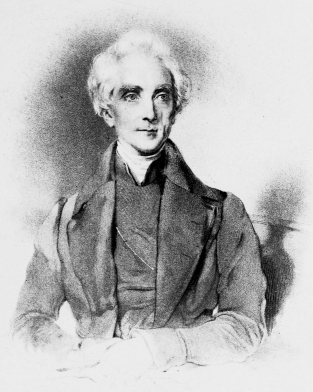
The kindness of "Uncle Norwich" caused me to love him as much as I dreaded Uncle Julius. In his dealings with his diocese I have heard that he was apt as a bishop to be tremendously impetuous; but my aunt knew how to calm him, and managed him admirably. He wonderfully wakened up clerical life in Norfolk. Well remembered is the sharpness with which he said to Dean Pellew, who objected to a cross being erected on the outside of the cathedral, "Never be ashamed of the cross, Mr. Dean, never be ashamed of the cross." It was his custom to pay surprise visits to all Norwich churches on Sunday afternoons. On one of these occasions, an old clergyman—fellow of his college for forty years—who had lately taken a small living in the town, was the preacher. High and dry was the discourse. Going into the vestry afterwards, "A very old-fashioned sermon, Mr. H.," said the Bishop. "A very good-fashioned sermon I think, my lord," answered the vicar.
Edward Stanley Bishop of Norwich.
In those days a very primitive state of things prevailed in the Norwich churches. A clergyman, newly ordained, provided for by a title at St. George's, Colegate, was exercised by finding the large well-thumbed folio Prayer-book in the church marked with certain hieroglyphics. Amongst these O and OP frequently recurred. On the curate making inquiry of the clerk if there were any instructions he ought to follow during the service, he was informed that his active predecessor had established a choir and had reopened an organ closed from time immemorial. He had done this without any reference to the incumbent, who was so deaf that he could hear neither organ nor choir. Thus it happened that when they came to the "Venite," the incumbent read, as usual, the first verse. From long usage and habit he knew, to a second, the moment when the clerk would cease reading verse two, and then commenced reading the third verse, the clerk below him making frantic signs with his hand, which were quite incomprehensible: and it was not until the reading of the fifth verse that he understood he had better be silent altogether, and leave the field to the organ and choir, of whose performances he had not heard one single sound. He was determined not to be taken aback again, so, consulting with the clerk, he elicited when the performances of the organ would take place, and marked these for his guidance with a large O or OP—organ plays.
When the curate of whom I have spoken was first ordained, the incumbent gave him instructions as to what he was to do. Afterwards he found him visiting and over-zealous for the age, and said, "Now don't do too much in the parish, and never give anything away." The curate expressed surprise, when he added, "If you want to give, always come to me"—a suggestion the curate never failed to carry out. The rector had a very poor opinion of clergymen who wrote fresh sermons every week. "I've only got two sermons for every Sunday in the year, and I preach them all every year. I don't see why I should trouble myself to write any more, for when I preach them, I find I don't recollect them myself, so it's quite impossible the congregation should." As reminiscences of a type of clergyman very common at this time, but nearly extinct now, these notes seem worth recording.
Most of the Norfolk clergy were then old-fashionedtives of the first water. One day at a clerical dinner-party at the Palace, the Bishop, probably with the view of improving the taste of his guests, said, "When I first came into this diocese, I found the clergy would drink nothing but port. I used every means I could think of to alter a taste I could not myself enter into. All failed. At last I hit upon something which I thought was sure to be successful. I told my wine-merchant to send me the best of all other wines and the nastiest of port. But the clergy still insisted upon drinking the nasty port. So, when I felt my plan had failed, I wrote to my wine-merchant again, and told him to let them have it good."
The Bishop used to be greatly amused by an epitaph in Bergh Apton Church, which said that the man commemorated was "very free of his port," meaning that he was very hospitable (from portcullis), but the common people always thought it meant that he drank a great deal of port.
My dear old uncle was a capital bishop, and his clergy gradually learnt to think him so. But it was a sailor he had wished to be. He had been better fitted for that profession originally. Indeed, when he was a very little child he had such a passion for the sea, that once when he was missed from his cot, he was found asleep on the high shelf of a wardrobe, having climbed up there because he thought it was like a berth. Through life he was one of those men who never want presence of mind, and this often stood him in good stead. One Advent Sunday it was the Bishop's turn to preach in the cathedral, where the soldiers in the barracks usually attend the service: but it was terrible weather, and, with due regard to their pipe-clay, they were all absent that morning. The Bishop had prepared his sermon especially for the soldiers he expected to hear it, and he had no other. But he was quite equal to the occasion, for, after he had given out the text, he began—"Now this is the sermon I should have preached if the soldiers had been here," and went on, without concerning himself further about their absence.
On another occasion he fell fast asleep in the cathedral during the sermon. At the end, when the choir broke out into the "Amen," he suddenly awoke. In that moment he could not collect himself to remember the words of the blessing, but, "Peace be with you" he exclaimed very solemnly, and it did quite well.
"Uncle Norwich," with his snow-white hair and black eyebrows, and his eager impetuous manner, was a somewhat startling figure to come upon suddenly. There was a private door in the wall in a remote corner of the palace-garden. A rather nervous clergyman who lived close by had passed it for years, and had never seen it open. His curiosity was greatly excited about it. One day when he was passing, he could not resist the impulse, and looking up and down the road, and seeing neither the Bishop nor any of the Stanley family about, though very shy, he stooped down to peep in at the keyhole. At that moment the Bishop's key entered the lock on the other side, the door flew open, and he found himself confronted by the Bishop in person!
It was soon after we left Norwich that Jenny Lind, then at the height of her fame, went to stay at the Palace, and great was the family enthusiasm about her. My aunt conceived an affection for her which was almost maternal. Arthur Stanley admired her exceedingly, in spite of his hatred of music, but amused her when he said, "I think you would be most delightful if you had no voice."
At the end of August I returned to Harrow.
To MY MOTHER.
"Harrow, Sept. 10.—Alas! our form is under Mr. Oxenham. He has the power of flogging, and does flog very often for the least fault, for he really enjoys it. He is such an old man, very old, very sharp, very indolent, very preachy. Sometimes he falls asleep when we are in form, and the boys stick curl-papers through his hair, and he never finds it out. He always calls his boys 'stupid little fools,' without meaning anything particular by it. This morning he said to me, 'Stuff and nonsense, stupid little fool; don't make yourself a stupider little fool than you are.' He is always called 'Billy.'"
"Sept.—I have been racket-fagging all afternoon. It is such dismal work. You have to stand in one corner of the square court and throw all the balls that come that way to the 'feeders,' who throw them to the players when they are wanted. The great amusement of P., one of those I fag for, is to hit the racket-balls with all his might at the fags, and he tried to cut me off a great many times, but missed. At last P. said, 'I'll go and get another fag instead of that young beast Hare,' and he went, but he never came back, or the fag either.
"One day our room bought a pipkin, saucepan, and frying-pan to cook things in, but Mrs. Collins (the matron) took away the frying-pan, and the others were bagged. But we got another pipkin, and one night as we were cooking some potatoes, in little slices as we have them at home, they made such a smell that Mrs. Collins came up, and told Simmy, and he was very angry, and would not let us have fires for a week, and said we should all have extra pupil-room; but fortunately he forgot about that."
A. P. Stanley to A. J. C. H.
"University College, Oxford, Oct. 16.—The Goblin presents his compliments to the Ghost, and will give him a leaf of a bay-tree from Delphi, a piece of marble from Athens, and a bit of tin from the Cassiterides, on condition that the Ghost can tell him where those places are, and where the Goblin shall send these treasures."
A. J. C. H. to A. P. Stanley.
"Delphi is the capital of Phocis and the seat of the oracle in Greece. Athens is capital of Attica in Greece, and the Cassiterides are islands in the Western Ocean. The Ghost presents his compliments to the Goblin, thanks him very much, tells him where the places are, and begs him to send the things from those places to the usual haunt of the Ghost. The Ghost has communicated the Goblin's stories of the beautiful Hesketh and Mrs. Fox to the boys at night. The Ghost flitted up Harrow church-steeple yesterday, and was locked up inside. Farewell, Goblin, from your most grateful cousin—the Ghost."
This letter reminds me how I used to tell stories to the boys in our room after we had gone to bed: it was by them that I was first asked to "tell stories."
The winter of 1847-48 was one of those which were rendered quite miserable to me by the way in which I was driven to the Rectory, where Aunt Esther made me more wretched than ever, and by being scarcely ever permitted to remain in my own dear home. I fear that in later days I should have acted a part, and pretended to like going to the Rectory, when it would instantly have been considered unnecessary, the one thought in the mind of all the family being that it was a duty to force me to do what I disliked; but at that time I was too ingenuous to indulge in even the most innocent kinds of deception. My own brothers, Francis and William, who were now at Eton, came to the Rectory for part of their holidays, but their upbringing and their characters had so little in common with my own, that we were never very intimate, though I rather liked them than otherwise. They hated the Rectory, and got away from it whenever they could.
Of all the miserable days in the year, Christmas was the worst. I regarded it with loathing unutterable. The presents of the quintessence of rubbish which I had to receive from my aunts with outward grace and gratitude. The finding all my usual avocations and interests cleared away. The having to sit for hours and hours pretending to be deeply interested in the six huge volumes of Foxe's "Book of Martyrs," one of which was always doled out for my mental sustenance. The being compelled—usually with agonising chilblains—to walk twice to church, eight miles through the snow or piercing marsh winds, and sit for hours in mute anguish of congelation, with one of Uncle Julius's interminable sermons in the afternoon, about which at that time I heartily agreed with a poor woman, Philadelphia Isted, who declared that they were "the biggest of nonsense." Then, far the worst of all, the Rectory and its sneerings and snubbings in the evening.
My mother took little or no notice of all this—her thoughts, her heart, were far away. To her Christmas was simply "the festival of the birth of Christ." Her whole spiritual being was absorbed in it: earth did not signify: she did not and could not understand why it was not always the same with her little boy.
I was not allowed to have any holidays this year, and was obliged to do lessons all morning with Mr. Venables, the curate.[47] At this I wonder now, as every day my health was growing worse. I was constantly sick, and grew so thin that I was almost a skeleton, which I really believe now to have been entirely caused by the way in which the miseries of my home life preyed upon my excessively sensitive nervous disposition. And, instead of my mind being braced, I was continually talked to about death and hell, and urged to meditate upon them. Towards the close of the holidays I was so ill that at last my mother was alarmed, and took me to a Mr. Bigg, who declared that I had distinct curvature of the spine, and put my poor little back into a terrible iron frame, into which my shoulders were fastened as into a vice. Of course, with this, I ought never to have been sent back to Harrow, but this was not understood. Then, as hundreds of times afterwards, when I saw that my mother was really unhappy about me, I bore any amount of suffering without a word rather than add to her distress, and I see now that my letters are full of allusions to the ease with which I was bearing "my armour" at school, while my own recollection is one of intolerable anguish, stooping being almost impossible.
That I got on tolerably well at Harrow, even with my "armour" on, is a proof that I never was ill-treated there. I have often, however, with Lord Eustace Cecil (who was at Harrow with me), recalled since how terrible the bullying was in our time—of the constant cruelty at "Harris's," where the little boys were always made to come down and box in the evening for the delectation of the fifth form:—of how little boys were constantly sent in the evening to Famish's—half-way to the cricket-ground, to bring back porter under their greatcoats, certain to be flogged by the head-master if they were caught, and to be "wapped" by the sixth form boys if they did not go, and infinitely preferring the former:—of how, if the boys did not "keep up" at football, they were made to cut large thorn sticks out of the hedges, and flogged with them till the blood poured down outside their jerseys. Indeed, what with fagging and bullying, servility was as much inculcated at Harrow in those days as if it was likely to be a desirable acquirement in after life.
I may truly say that I never learnt anything useful at Harrow, and had little chance of learning anything. Hours and hours were wasted daily on useless Latin verses with sickening monotony. A boy's school education at this time, except in the highest forms, was hopelessly inane.
In some ways, however, this "quarter" at Harrow was much pleasanter than the preceding ones. I had a more established place in the school, and was on more friendly terms with all the boys in my own house; also, with my "armour," the hated racket-fagging was an impossibility. I had many scrambles about the country with Buller[48] in search of eggs and flowers, which we painted afterwards most carefully and perseveringly; and, assisted by Buller, I got up a sort of private theatricals on a very primitive scale, turning Grimm's fairy stories into little plays, which were exceedingly popular with the house, but strictly forbidden by the tutor, Mr. Simpkinson or "Simmy." Thus I was constantly in hot water about them. One day when we had got up a magnificent scene, in which I, as "Snowdrop," lay locked in a magic sleep in an imaginary cave, watched by dwarfs and fairies, Simmy came in and stood quietly amongst the spectators, and I was suddenly awakened from my trance by the sauve qui peut which followed the discovery. Great punishments were the result. Yet, not long after, we could not resist a play on a grander scale—something about the "Fairy Tilburina" out of the "Man in the Moon," for which we learnt our parts and had regular dresses made. It was to take place in the fifth form room on the ground-floor between the two divisions of the house, and just as Tilburina (Buller) was descending one staircase in full bridal attire, followed by her bridesmaids, of whom I was one, Simmy himself suddenly appeared on the opposite staircase and caught us.
These enormities now made my monthly "reports," when they were sent home, anything but favourable; but I believe my mother was intensely diverted by them: I am sure that the Stanleys were. A worse crime, however, was our passion for cooking, in which we became exceedingly expert. Very soon after a tremendous punishment for having been caught for the second time frying potato chips, we formed the audacious project of cooking a hare! The hare was bought, and the dreadful inside was disposed of with much the same difficulty and secrecy, and in much the same manner, in which the Richmond murderess disposed of her victims; but we had never calculated how long the creature would take to roast even with a good fire, much more by our wretched embers: and long before it was accomplished, Mrs. Collins, the matron, was down upon us, and we and the hare were taken into ignominious custody.
Another great amusement was making sulphur casts and electrotypes, and we really made some very good ones.
My great love for anything of historic romance, however, rendered the Louis Philippe revolution the overwhelming interest of this quarter, and put everything else into the shade. In the preceding autumn the murder of the Duchesse de Praslin had occupied every one, and we boys used to lie on the floor for hours poring over the horrible map of the murder-room which appeared in the "Illustrated," in which all the pools of blood were indicated. But that was nothing to the enthusiastic interest over the sack of the Tuileries and the escape of the Royal Family: I have never known anything like it in after life.
I have often heard since much of the immoralities of a public-school life, but I can truly say that when I was there, I saw nothing of them. A very few boys, however, can change the whole character of a school, especially in a wrong direction. "A little worm-wood can pollute a hive of honey," was one of the wise sayings of Pius II. I do not think that my morals were a bit the worse for Harrow, but from what I have heard since of all that went on there even in my time, I can only conclude it was because—at that time certainly—"je n'avais pas le goût du peché," as I once read in a French novel.
At Easter, 1848, I left Harrow for the holidays, little imagining that I should never return there. I should have been very sorry had I known it. On the whole, the pleasurable "adventures" of a public-school life had always outweighed its disagreeables; though I was never in strong enough health for any real benefit or enjoyment.
IV LYNCOMBE
"Les longues maladies usent la douleur, et les longues espérances usent la joie."—Mme. de Sévigné.
"One adequate support For the calamities of mortal life Exists, one only—an assured belief That the procession of our fate, however Sad or disturbed, is ordered by a Being Of infinite benevolence and power, Whose everlasting purposes embrace All accidents, converting them to good." —WORDSWORTH.
"Condemned to Hope's delusive mire, As we toil on from day to day By sudden stroke or slow decline Our means of comfort drop away." —JOHNSON.
"It is well we cannot see into the future. There are few boys of fourteen who would not be ashamed of themselves at forty." —Jerome K. Jerome.
OF all the unhappy summers of my boyhood, that of 1848 was the most miserable. When I left Harrow at Easter, I was very really ill. The iron frame which had been made for my back had seriously injured the spine which it was intended to cure, and a bad fall down the school steps at Harrow had increased the malady. When Sir Benjamin Brodie saw me, he said that I must lie down for at least the greater part of many months, and that a return to Harrow was quite out of the question. This, however, was concealed from me at first, and when I knew it, I was too ill to have any regrets. We went first to Torquay, stopping on the way to visit Mrs. Alexander, a person who afterwards, for some years, bore a large share in our life. In her youth, as Miss Mary Manning, she had been a governess in the family of Sir John Malcolm, and, while living with the Malcolms at Hyde Hall near Cambridge, had been the most intimate early friend of my Uncle Julius. People generally thought that he had been engaged to her, but this, I believe, was never the case. She had married a Mr. Alexander, a physician at Edinburgh, who soon left her a widow, and since that time she had possessed no settled home. She was very tall, serene, and had a beautiful countenance, and her old-fashioned dress was always wonderfully refined and in keeping with her appearance. She seemed to have the power of imposing her own personality upon her surroundings, and subduing the life and movement around her into an intellectual as well as a physical calm. She had a melodious low voice, a delicate Scotch accent, a perfectly self-possessed manner, and a sweet and gentle dignity. In conversation she was witty and genial, but never rude. With wonderful power of narration, she had the art of throwing unspeakable interest and charm over the most commonplace things: yet she never exaggerated. All the clever men who came in contact with her were bound under her spell. Whewell, Worsley, Landor, Bunsen, Sedgwick adored her, and did not wonder at my uncle's adoration. Saint-Amand's description of Mme. de Maintenon might have been written for her—"Elle garda, dans sa vieillesse, cette supériorité de style et de langage, cette distinction de manières, ce tact exquis, cette finesse, cette douceur et cette fermeté de caractère, ce charme et cette élévation d'esprit qui, à toutes les époques de son existence, lui valurent tant d'éloges et lui attirèrent tant d'amitié."
This is one view of Mrs. Alexander, and, as far as it goes, it is perfectly true. But scarcely any characters are all of one piece. She was also boundlessly subtle, and when she had an object in view she spared no means to attain it. For her own ends, with her sweetness unruffled, she would remorselessly sacrifice her best friends. The most egotistical woman in the world, she expected every one to fall under her spell, and calmly and gently but consistently hated any one who escaped. Whilst she almost imperceptibly flattered her superiors in rank and position, she ruthlessly and often heartlessly trampled upon those whom she (sometimes wrongly) considered her inferiors. She demanded sovereignty in every house she entered, and she could always find a way to punish rebellion. She made herself friends that "men might receive her into their houses," and when she had once entered them she never relaxed her foothold.
There is a description in the Life of George Sand which might be well applied to this view of Mrs. Alexander—"Elle était une personne glacée autant que glaciale.... Ce n'était pas qu'elle ne fut aimable, elle était gracieuse à la surface, un grand savoir-vivre lui tenant lieu de grace véritable. Mais elle n'aimait réellement personne et ne s'intéressait à rien qu'à elle-même."
When we first saw Mrs. Alexander, she was living in a small lodging at Heavitree near Exeter. In the following year she came to Hurstmonceaux Rectory for three days and stayed three weeks. The year after she came for three weeks and stayed five years. From the first she was supreme at the Rectory, ruling even Aunt Esther with unswerving and ever-increasing power; but on the whole her presence was an advantage. Her education and strong understanding enabled her to enter into all my uncle's pursuits and interests as his wife could never have done, and to outsiders she was usually suave, courteous, and full of agreeable conversation.
THE TOWER AT ROCKEND, TORQUAY.
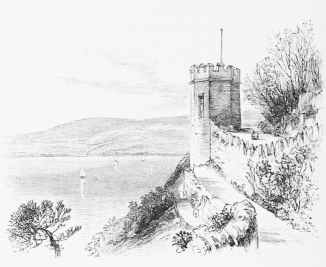
Uncle Julius and Aunt Esther visited Rockend when we were there, and as my aunts when together generally acted as foils to each other, I should have been at liberty to enjoy the really beautiful place—its delightful gardens, storm-beaten rocks, and the tower where Aunt Lucy "made her meditations"—if I had been well enough; but I had generally to spend the greater part of the day lying upon the floor on a hard backboard and in a state of great suffering. It was often an interest at this time to listen to Uncle Julius as he read aloud in the family circle passages connected with the French Revolution, Kingsley's "Saint's Tragedy," which had then recently appeared, or the papers which my uncle and his friends were then contributing to the Magazine for the People which Kingsley was getting up. No one read so well as Uncle Julius—a whole whirlwind of tragedy, an unutterable depth of anguish and pathos could be expressed in the mere tone of his voice; and it was not merely tone; he really thus felt what he read, and so carried away his listeners, that all their actual surroundings were invisible or forgotten. Those who never heard Julius Hare read the Communion Service can have no idea of the depths of humility and passion in those sublime prayers.
In everything Uncle Julius was as unsuited to the nineteenth century as he well could be. He used to declare that he never would read a book which he knew would interest him, till the exact mood of his mind was fitted for it, till the sun happened to be shining where it ought, and till weather and time and situation all combined to suit the subject and give its full effect, and he usually had numbers of books by him waiting for this happy conjunction, but, when it arrived, he did the books full justice.
I never saw any one so violent, so unmitigated in his likes and dislikes as Uncle Julius, so furious in his approval or condemnation. "Il avait une grande hardiesse, pour ne pas dire effronterie," as Bassompierre wrote of the Duke of Buckingham. In his despotic imperiousness he had no sympathy with the feelings and weaknesses of others, though inexpressible pity for all their greater misfortunes or sorrows.
Another person of whom we saw much at this time was the really saint-like Harry Grey, my mother's first cousin, who was living at Babbicombe. He was heir to the Earldom of Stamford (to which his son afterwards succeeded), but a clergyman, and very poor.
I was so ill when we returned home, almost everything I ate producing violent sickness, that it is astonishing my health should not have been considered a primary object. A few weeks of healthy life on moors or by the sea-side, with freedom from the gnawing mental misery and depression under which I suffered, would probably have restored me; a visit to German baths might have cured me, and saved years of ill-health. Had the family only had any practical common-sense! But, on religious grounds, it was thought wrong to contend against "the wonderful leadings of God's Providence"—pain was "sent" to be endured, sickness as a tractor to draw its victims to heaven; and all simple and rational means of restoration to a healthy and healthful life were disregarded. Sago with brandy in it was provided instead of meat for my physical, and an inexhaustible supply of tracts, hymns, and little sermons for my mental digestion. Patient endurance of suffering, the following of the most unpleasant path which duty could be thought to point out, and that without hope of either reward or release, were the virtues which even my mother most inculcated at this time.
Then a private tutor was sought for—not by knowledge, not by inquiry at the Universities, not by careful investigation of attainments for teaching, but by an advertisement. The inquiry as to all the letters which answered it was whether they appeared to be "those of truly pious men"—i.e., whether they were written in the peculiar phraseology then supposed to denote such a character. At last one was accepted, and a tutor arrived, who was—well, I will not describe him further than as certainly the most unprepossessing of human beings: Nature had been so terribly hard upon him.
With this truly unfortunate man I was shut up every morning in the hope that he would teach me something, a task he was wholly unequal to; and then I had to walk out with him. Naturally there were scenes and recriminations on both sides, in which I was by no means blameless. But daily my health grew worse, and scarcely a morning passed without my having an agonising fit of suffocation, from contraction of the muscles of the throat, gasping for breath in misery unutterable. The aunts said it was all nervous. I have no doubt it was: I have had plenty of experience of hysteria since, and it is the most dreadful disorder that exists.
At last my sufferings were such, from the relaxing air of Hurstmonceaux, that I was taken to Eastbourne, but an attempt was still made to chain me down for six or eight hours a day in a stuffy lodging at lessons with my tutor, who had not an idea of teaching and knew nothing to teach. Poor man! he was at least quite as wretched as I was, and I know that he thirsted quite as much for the fresh air of the downs. Aunt Esther came over, and used cruelly to talk, in my presence, of the fatigue and trouble which my ill-health caused my mother, and of the burden which she had thus brought upon herself by adopting me. It is only by God's mercy that I did not commit suicide. I was often on the point of throwing myself over the cliffs, when all would have been over in an instant, and was only restrained by my intense love for my mother, and the feeling that her apparently dormant affection would be awakened by such a catastrophe, and that she would always be miserable in such an event. Twenty-two years afterwards, when we were as closely united as it was possible for any mother and son to be, my darling mother reverted of her own accord to this terrible time: she could never die happy, she said, unless she knew that her after love had quite effaced the recollection of it.
WILMINGTON PRIORY.
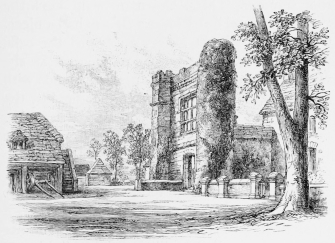
Yet, even in these wretched months at Eastbourne there were oases of comfort—days when my "Aunt Kitty and Lou Clinton" came down, and, with "le cœur haut placé" and sound common-sense, seemed to set everything right; and other days when I made excursions alone with my mother to Jevington in the Downs, or to Wilmington with its old ruin and yew-tree, where we used to be kindly entertained by the primitive old Rector, Mr. Cooper, and his wife.
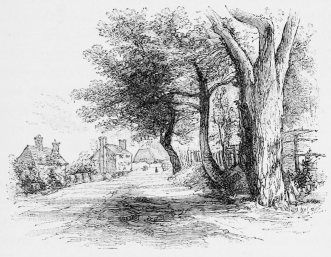
When I went, in 1877, to visit Alfred Tennyson the poet, he asked me to give him a subject for "A Domestic Village Tragedy." The story which I told him occurred at Hurstmonceaux this summer. Mrs. Coleman, who kept the "dame's school" at Flowers Green, had a niece, Caroline Crowhurst, a very pretty girl, the belle of the parish, and as amiable and good as she was pretty, so that every one was friends with her. She became engaged, rather against the will of her family, to a commercial traveller from a distance. He wrote to her, and she wrote to him, maidenly letters, but full of deep affection. One day they had a little quarrel, and the man, the fiend, took the most intimate, the most caressing of these letters and nailed it up against the Brewery in the centre of Gardner Street, where all the village might read it and scoff at it. As the people knew Caroline, no one scoffed, and all pitied her. But Caroline herself came to the village shop that afternoon; she saw her letter hanging there, and it broke her heart. She said nothing about it to any one, and she did not shed a tear, but she went home and kissed her aunt and her mother more tenderly than usual; she gathered the prettiest flowers in her little garden and put them in her bosom, and then she opened the lid of the draw-well close to her home and let herself in. The lid closed upon her.
FLOWERS GREEN, HURSTMONCEAUX.
I remember the news coming to Lime one evening that Caroline Crowhurst was missing, and the dreadful shock the next morning when we heard that the poor girl had been found in the well. My mother, who had known her from her birth, felt it very deeply, for at Hurstmonceaux we were on the most intimate terms with the poor people, and Philadelphia Isted, Mercy Butler, dear old Mrs. Piper the schoolmistress, Ansley Vine of the shop, grumbling old Mrs. Holloway (who always said she should be so glad when she was dead because then people would believe she had been ill), the crippled Louisa Wood, the saint-like bedridden Mrs. Wisham, and gentle Mrs. Medhurst, who lived amongst the primroses of "the lower road"—all these, and many more, were as familiar to me as my own nearest relations. To many of them, when well enough, I went regularly, and to Mrs. Piper, who had lived in the time of the castle, and known my father and his brothers from babyhood, almost every day. Her death was a real affliction. My mother walked behind her coffin at her funeral. In her will she left me a box which had belonged to my unhappy little ancestress, Grace Naylor.
At the end of July my real mother, "Italima," with my sister, came to stay at the Rectory. The visit was arranged to last a month, but unhappily on the second day of her stay, Italima went out with Aunt Esther. They came home walking on different sides of the road, and as soon as she entered the house Italima sent for post-horses to her carriage and drove away. I have never heard what happened, but Italima never came to the Rectory again. Soon afterwards she fixed her residence at Rome, in the Palazzo Parisani, which then occupied two sides of the Piazza S. Claudio.
In August it was decided to send me away to a private tutor's, and my mother and Uncle Julius went with me to Lyncombe, near Bath. My tutor was the Rev. H. S. R., son of a well-known evangelical writer, but by no means of the same spiritual grace: indeed I never could discover that he had any grace whatever; neither had he any mental acquirements, or the slightest power of teaching. He was "un homme absolument nul," and though paid a very large salary, he grossly and systematically neglected all his duties as a tutor. Uncle Julius must have been perfectly aware how inefficient the education at Lyncombe would be, but he was probably not to blame for sending me there. Because I did not "get on" (really because I was never taught), he regarded me as the slave of indolence—"putrescent indolence" he would have called it, like Mr. Carlyle. He considered me, however, to be harmless, though fit for nothing, and therefore one to be sent where I should probably get no harm, though certainly no good either. It was the system he went upon with my brothers also, and in their case he had all the responsibility, being their guardian. But, indeed, Uncle Julius's view was always much that of Rogers—"God sends sons, but the devil sends nephews," and he shunted them accordingly.
"Les grands esprits, d'ailleurs très estimables, Ont très peu de talent pour former leurs semblables."
I went to Lyncombe with the utmost curiosity. The house was a large villa, oddly built upon arches in the hollow of a wooded valley about a mile from Bath, behind the well-known Beechen Cliff. At the back of it was a lawn with very steep wooded banks at the sides, and a fountain and pool, showing that the place had once been of some importance, and behind the lawn, meadows with steep banks led towards the heights of Combe Down. We all had rooms to ourselves at Lyncombe, scantily furnished, and with barely a strip of carpet, but we could decorate them with pictures, &c., if we liked. We did our lessons, when we were supposed to do them, at regular hours, in the dining-room, where we had our meals, and after work was finished in the evening, and eight o'clock tea, we were expected to sit with Mrs. R. in the drawing-room.
But we had an immense deal of time to ourselves—the whole afternoon we were free to go where we liked; we were not expected to give any account of what we did, and might get into as much mischief as we chose. Also, we too frequently had whole holidays, which Mr. R.'s idle habits made him only too glad to bestow, but which I often did not in the least know what to do with.
Eagerly did I survey my new companions, who were much older than myself, and with whom I was likely to live exclusively, with none of the chances of making other friendships which a public school affords. Three of them were quiet youths of no especial character: the fourth was Temple Harris,[49] at once the friend, enlivener, and torment of the following year.
On the whole, at first I was not unhappy at Lyncombe. I liked the almost unlimited time for roaming over the country, and the fresh air did much to strengthen me. But gradually, when I had seen all the places within reach, this freedom palled, and I felt with disgust that, terribly ignorant as I was, I was learning nothing, and that I had no chance of learning anything except what I could teach myself. Whilst Temple Harris stayed at Lyncombe, we spent a great deal of time in writing stories, ballads, &c., for a MS. magazine which we used to produce once a week; and this was not wholly useless, from the facility of composition which it gave me. But after Temple Harris left, the utter waste of life at Lyncombe palled upon me terribly, and I made, in desperation, great efforts to instruct myself, which, with no books and with every possible hindrance from without, was difficult enough. After a fashion, however, I succeeded in teaching myself French, stumbling through an interesting story-book with Grammar and Dictionary, till I had learnt to read with ease; of the pronunciation I naturally knew nothing. Two miserable years and a half of life were utterly wasted at Lyncombe, before Arthur Stanley came to visit me there, and rescued me by his representation of the utter neglect and stagnation in which I was living. It had been so hammered into my mind by my aunts that I was a burden to my mother, and that she was worn out with the trouble I had given her in finding my first private tutor, that I should never of myself have ventured to try to persuade her to look out for a second.
My earlier letters to my mother from Lyncombe are filled with nothing but descriptions of the scenery round Bath, of which I formed a most exaggerated estimate, as I had seen so little with which I could compare it. Once a week at least I used to go into Bath itself, to dine with my father's old friend Walter Savage Landor, who had been driven away from his Florentine home by his wife's violent temper. Mr. Landor's rooms (in Catherine Place, and afterwards at 2 Rivers Street) were entirely covered with pictures, the frames fitting close to one another, leaving not the smallest space of wall visible. One or two of these pictures were real works of art, but as a rule he had bought them at Bath, quite willing to imagine that the little shops of the Bath dealers could be storehouses of Titians, Giorgiones, and Vandycks. The Bath picture-dealers never had such a time; for some years almost all their wares made their way to Mr. Landor's walls. Mr. Landor lived alone with his beautiful white Spitz dog Pomero, which he allowed to do whatever it liked, and frequently to sit in the oddest way on the bald top of his head. He would talk to Pomero by the hour together, poetry, philosophy, whatever he was thinking of, all of it imbued with his own powerful personality, and would often roar with laughter till the whole house seemed to shake. I have never heard a laugh like that of Mr. Landor—"deep-mouthed Beotian Savage Landor," as Byron called him—such a regular cannonade.[50] He was "the sanest madman and the maddest reasonable man in the world," as Cervantes says of Don Quixote. In the evenings he would sit for hours in impassioned contemplation: in the mornings he wrote incessantly, to fling off sheet after sheet for the Examiner, seldom looking them over afterwards. He scarcely ever read, for he only possessed one shelf of books. If any one gave him a volume, he mastered it and gave it away, and this he did because he believed that if he knew he was to keep the book and be able to refer to it, he should not be able to absorb its contents so as to retain them. When he left Florence, he had made over all he possessed to his wife, retaining only £200 a year—afterwards increased to £400—for himself, and this sufficed for his simple needs. He never bought any new clothes, and a chimney-sweep would have been ashamed to wear his coat, which was always the same as long as I knew him, though it in no way detracted from his majestic and lion-like appearance. But he was very particular about his little dinners, and it was about these that his violent explosions of passion usually took place. I have seen him take a pheasant up by the legs when it was brought to table and throw it into the back of the fire over the head of the servant in attendance. This was always a failing, and, in later days, I have heard Mr. Browning describe how in his fury at being kept waiting for dinner at Siena, he shouted: "I will not eat it now, I will not eat it if it comes," and, when it came, threw it all out of the window.
At the same time nothing could be more nobly courteous than his manner to his guests, and this was as marked towards an ignorant schoolboy as towards his most distinguished visitor; and his conversation, whilst calculated to put all his visitors at their ease and draw out their best points, was always wise, chivalrous, pure, and witty.
At one time Mr. Landor's son Walter came to stay with him, but he was an ignorant rough youth, and never got on well with his father. I believe Mr. Landor preferred me at this time to any of his own children, and liked better to have me with him; yet he must often have been grievously disappointed that I could so little reciprocate about the Latin verses of which he so constantly talked to me, and that indeed I could seldom understand them, though he was so generous and high-bred that he never would allow me to feel mortified. Mrs. Lynn Linton, then Miss Lynn, was by her almost filial attentions a great comfort to Landor during the earlier years of his exile at Bath. Another person, whom he liked, was a pretty young Bath lady, Miss Fray, who often came to dine with him when I was there. After dinner Mr. Landor generally had a nap, and would say, "Now, Augustus, I'm going to sleep, so make love to Miss Fray"—which was rather awkward.[51]
These were the best friends of Lander's solitude; most of his other visitors were sycophants and flatterers, and though he despised the persons, he did not always dislike the flattery. Swift says truly—
"'Tis an old maxim in the schools, That flattery's the food of fools; Yet now and then your men of wit Will condescend to take a bit."
Another resident of whom I saw much at Bath was my mother's cousin, Miss Harriet Dumbleton (her mother was a Leycester)—an old maiden lady, who lived in the most primitive manner, really scarcely allowing herself enough to eat, because, like St. Elizabeth, though she had a very good fortune, she had given everything she had to the poor. She would even sell her furniture, books, and pictures, to give away the money they realised. But she was a most agreeable, witty, lively person, and it was always a great pleasure to go to her.
To MY MOTHER.
"Lyncombe, Sept. 12.—I have been here four days, but only to-day did Mr. R. begin to attempt any lessons with me. He was very impatient, and I got so puzzled and confused, I could scarcely do anything at all; all my sums and everything else were wrong. Warriner and Hebden were very kind, and did all they could to help me. I like Warriner very much. To-day I have done much better, and I really do try to do well, dearest Mamma."
"Sept. 14.—Yesterday morning, as there was again no work whatever to be done, I went off by myself to Charterhouse Hinton to see the Abbey. I was told it was not shown, but insisted upon going up to the house, where I rang the bell, and was allowed to look at the ruin in the garden. There I found an old gentleman, to whom I told who I was, where I was, and all about myself, and he told me in return that he had been at school with Uncle Jule and knew the Bath aunts, and not only showed me the best place to sketch the Abbey from, but gave me a lesson in perspective. Then he took me into the house and told me all the stories of the pictures there.
"Mr. Landor has been here, and, thinking to do me honour, called upon the R.'s. Whilst Pomero danced about, he told numbers of stories, beginning at once about the Dukes of Brandenburg and Orleans, and in defence of the Danes. 'Hare may say what he likes, but that King of Prussia is a regular old scoundrel.'
"Whenever we are supposed to do any work, Mr. R. sits at the small table in the dining-room while we are at the large one; but no one takes any notice of him, and all talk slang and laugh as if he was out of the room; and if Harris gets bored with his supposed work, he rings for a plate and glass of water and paints."
"Sept. 22.—You need not grudge my long walks and being away from the others, for I should not be with them if at home, as Hebden goes to play on the Abbey organ, and the rest have their own occupations. To-day I went over hill and dale to Wellow, where there is a noble old church, and a Holy Well of St. Julian, at which a white lady used to appear on St. Julian's Eve, whenever any misfortune was about to happen to the family of Hungerford, the former possessors of the soil. As I was drawing the village, a farmer came riding by, and, after looking at my sketch, went back with me to show me his house, once a manor of the Hungerfords, with a splendid old carved chimney-piece.
"These are very long dreary half-years. At Harrow I used to rejoice that I should never more have to endure those horrible long private-school half-years, yet here they are again. Oh! what would I not give to be back with you, and able to take care of you when you are poorly!"
"Oct. 9.—Yesterday, as there were no lessons whatever again, I made a great expedition to Farley Castle, but was very miserable all the way in thinking that I had not been better to you all the summer, dearest, dearest Mamma. I used to think, when I knew that I should be at home such a long time, what a comfort I should be to you, and that you would see how good I was grown; but instead of that, how bad I was all the time! Oh! if I had only a little of it over again! Well, it is a long walk, but at last I arrived at Farley, a pretty ruin on a height, with four towers at the angles and a chapel in the centre. I persuaded the woman to lock me in here, and was in ecstasies. The walls are covered with armour of the Hungerfords for centuries, and in a corner are Cromwell's boots and saddle. At the other end is the ancient high altar with a Bible of ages mouldering away beneath a carved crucifix and stained window, and the surrounding walls are emblazoned with Hungerford arms. Old banners wave from the ceiling, old furniture lines the aisle, and in St. Anne's Chantry are two splendid altar-tombs, of Lady Joanna Hungerford and her husband, and Sir Edward and his wife.
"How am I to get any money to pay for having my hair cut, and for some gloves, for mine are quite worn out?"
"Oct. 20.—No work at all, so I have had a grand expedition to the beautiful old deserted house of the Longs at South Wraxhall, and have been writing ballads and stories about it ever since."
"Oct. 26.—No lessons. Mr. R. will not have them. So we have all been together to Farley, and went into the vault where the Hungerfords lie in leaden coffins, melted to fit their bodies and faces, their real features in deep relief. They look most extraordinary, especially two babies, whom, at first sight, you would take for a pair of shoes.... When I am alone with Harris, I like him very much. He writes poetry and draws beautifully, and can read French and Italian for his own amusement. I wish I could. Oh, I am so tired of having nothing to do!"
My dear Grandmother, Mrs. Leycester, had been failing all the autumn, and my mother was much with her at her house in New Street. Towards the end of October she seemed better, and my mother returned to Lime, but on the 3rd of November she was suddenly recalled. As so often happens in serious cases, for the only time in her life she missed the train, and when she arrived, after many hours' delay, she found that dear Grannie had died an hour before, wishing and longing for her to the last. To my intense thankfulness, I was allowed to go to my mother in New Street, once more to behold the beloved aged features in the deep repose of death, and to see the familiar inanimate objects connected with my childhood, and the dear old servants. Grannie was buried in the vaults of St. Martin's Church, Trafalgar Square, her coffin being laid upon that of Uncle Hugh (Judge Leycester). The vaults were a very awful place—coffins piled upon one another up to the ceiling, and often in a very bad state of preservation,[52]—and the funeral was a very ghastly one, all the ladies being enveloped in huge black hooded mantles, which covered them from head to foot like pillars of crape. Grannie is one of the few persons whose memory is always evergreen to me, and for whom I have a most lasting affection. Everything connected with her has an interest. Many pieces of furniture and other memorials of my grandmother's house in New Street and, before that, of Stoke Rectory, have been cherished by us at Hurstmonceaux and Holmhurst, and others it has always been a pleasure to see again when I have visited my Penrhyn cousins at Sheen—objects of still life which long survive those to whom they were once important.
In the winter of 1848-49 I saw at St. Leonards the venerable Queen Marie Amélie, and am always glad to have seen that noble and long-suffering lady, the niece of Marie Antoinette.
During the autumn at Lyncombe I was almost constantly ill, and very often ill in the winter at home, which the Marcus Hares all spent at Lime. It was a miserable trial to me that, in her anxiety lest I should miss an hour of a school where I was taught nothing, my mother sent me back a week too early—and I was for that time alone in the prison of my abomination, in unutterable dreariness, with nothing in the world to do. This term, a most disagreeable vulgar boy called W—— was added to the establishment at Lyncombe, who was my detested companion for the next two years; and from this time in every way life at Lyncombe became indescribably wretched—chiefly from the utter waste of time—and, as I constantly wrote to my mother, I was always wishing that I were dead. My only consolation, and that a most dismal and solitary one, was in the long excursions which I made; but I look back upon these as times of acute suffering from poverty and hunger, as I never had any allowance, and was always sent back to my tutor's with only five shillings in my pocket. Thus, though I walked sometimes twenty-four miles in a day, and was out for eight or ten hours, I never had a penny with which to buy even a bit of bread, and many a time sank down by the wayside from the faintness of sheer starvation, often most gratefully accepting some of their food from the common working people I met. If I went out with my companions, the utmost mortification was added to the actual suffering of hunger, because, when they went into the village inns to have a good well-earned luncheon, I was always left starving outside, as I never had the means of paying for any food. I believe my companions were very sorry for me, but they never allowed their pity to be any expense to them, and then "E meglio essere odiato che compatito" is an Italian proverb which means a great deal, especially to a boy. After a time, too, the food at Lyncombe itself became extremely stinted and of the very worst quality—a suet dumpling filled with coarse odds and ends of meat being our dinner on at least five days out of the seven, which of course was very bad for an extremely delicate rapidly-growing youth—and, if I was ill from want of food, which was frequently the case, I was given nothing but rice.
What indescribably miserable years those were! I still feel, in passing Bath by railway, sick at heart from the recollection, and I long in this volume to hurry over a portion of life so filled with wretched recollections, and which had scarcely a redeeming feature, except Mr. Landor's constant kindness and friendship. It was also a terrible disappointment that my mother never would consent to my going for a few days to see "Italima" and my brothers, who were then living at Torquay, and who vainly begged for it. My endless letters to my mother (for I wrote several sheets daily) are so crushed and disconsolate that I find little to select.
To MY MOTHER.
"Easter Sunday, 1849.—Yesterday Mr. Landor asked me to dine with him. First we went out to order the dinner, accompanied by Pomero in high spirits. As we went through the streets, he held forth upon their beauties, especially those of the Circus, to which he declares that nothing in Rome or in the world was ever equal. We stopped first at the fishmonger's, where, after much bargaining, some turbot was procured; then, at the vegetable shop, we bought broccoli, potatoes, and oranges; then some veal to roast; and finally a currant-tart and biscuits. Mr. Landor generally orders his own little dinners, but almost all this was for me, as he will dine himself on a little fish. He has actually got a new hat, he says because all the ladies declared they would never walk with him again unless he had one, and he has a hideous pair of new brown trousers. Pomero was put out of the room for jumping on them, but when he was heard crying outside the door, Mr. Landor declared he could not let his dear child be unhappy, and was obliged to let it in; upon which the creature was so delighted, that it instantly jumped on the top of its master's head, where it sate demurely, looking out of the window.
"Harris has just written an account of my home life which he says he believes to be exact, i.e., that I live with two maiden aunts, 'Gidman and Lear'—that they have a dog called 'Paul against the Gentiles,' who runs after them, carrying muffins and apples to the poor and destitute inhabitants of the parish of Chalk-cum-Chilblains—that his kennel is inscribed with texts of Scripture, and when a heretic is near he can smell him five miles off—that his food consists of tracts, and that he drinks a dilution of hymn-books and camphor-ice."
In my summer holidays of 1849 my mother took me for the second time to Alton. It was very hot weather, and we lived entirely amongst the affectionate primitive cottagers, going afterwards to stay with Lady Gore at Wilcot House—an old haunted house, with a tower where a tailor (I forget how he got there) committed suicide. With Mrs. Pile we drove through the open Wiltshire country to her farmhouse home of Tufton, where we spent several days very pleasantly, in a quiet place on the glistening little river Teste, close to Hurstborne Park. On the day of our leaving Tufton we visited Winchester, and as we were going thence to Portsmouth by rail, we had an adventure which might have ended seriously.
The train was already in motion, and my mother and I were alone in the carriage, when three men came running along the platform and attempted to enter it. Only one succeeded, for before the others could follow him, the train had left the platform. In a minute we saw that the man who was alone in the carriage with us was a maniac, and that those left behind were his keepers. He uttered a shrill hoot and glared at us. Fortunately, as the door banged to, the tassel of the window was thrown up, and this attracted him, and he yelled with laughter. We sat motionless at the other side of the carriage opposite each other. He seized the tassel and kept throwing it up and down, hooting and roaring with laughter. Once or twice we fancied he was about to pounce upon us, but then the tassel attracted him again. After about eight minutes the train stopped. His keepers had succeeded in getting upon the guard's box as the train left the station, and hearing his shouts, stopped the train, and he was removed by force.
We went to stay at Haslar with Sir Edward Parry, the Arctic voyager, whose first wife had been my mother's early friend Bella Stanley. He was now married again, and had three more children, and his wife had two daughters by her first husband, Mr. Hoare. The three families lived together, and in the most wonderful harmony. The eldest son, Edward, afterwards Bishop of Dover, was several years older than I, yet not too old for companionship. But I never could feel the slightest interest in the dockyards or the ships at Spithead. My only pleasure was a happy tourette round the Isle of Wight—the mother, Lea, and I, in a little carriage. During the latter part of our stay at Haslar, cholera broke out in the hospital, and our departure was like a flight.
While I was at Lyncombe in the autumn, my step-grandmother Mrs. Hare Naylor died, very soon after the marriage of her daughter Georgiana to Mr. Frederick D. Maurice, whose first wife had been her intimate friend. She was married during what was supposed to be her last illness, but was so pleased with her nuptials that she recovered after the ceremony and lived for nearly half a century afterwards.
My dear old uncle Edward Stanley had always said, while making his summer tour in Scotland, that he should return to Norwich when the first case of cholera appeared. He died at Brahan Castle, and his body was brought back to Norwich just as the cholera appeared there. Tens of thousands of people went to his funeral—for, in the wild Chartist times of his episcopate, he had been a true "chevalier sans peur et sans reproche," and had become beloved by people of every phase of creed and character. My mother met Aunt Kitty in London as she came from Scotland, and went with her to Norwich. It was perfect anguish to me not to see once more the place which I had most delighted in, but that was not permitted. Only two days after leaving her home in the old palace, my aunt heard of the death of her youngest son, Captain Charles Edward Stanley, at Hobart Town in Van Diemen's Land. He left a young widow, who, in her desolation, derived her chief comfort from the thought of joining her husband's eldest brother, Captain Owen Stanley, at Sydney, and returning to England in his ship, the Rattlesnake. When she reached the ship, she learned that he had been found dead in his cabin only a few days after receiving the tidings of his father's death. The news of this third loss reached Lime just after Aunt Kitty and Kate Stanley had left it to take possession of their new London home—6 Grosvenor Crescent. I remember my mother's piercing shriek when she opened the letter: it was the only time I ever heard her scream. It was only a few months after this that Kate was married to Dr. Vaughan, her brother's friend and my late head-master.
In 1850 I detested my life at Lyncombe more than ever. Mr. R. was increasingly neglectful in teaching, and the food and everything else was increasingly bad. Temple Harris and my other elder companions went away, and their places were taken by a boy "with flaxen hair and spectacles, like a young curate," but inoffensive, and "an atrociously vulgar little snob;" while the ill-tempered rathunter, who had been at Lyncombe with the old set, was the only one of them that remained. I was now, however, more anxious than ever to learn something, and I made much progress by myself. Most of the external consolations of this year came from the residence in Bath of my maternal cousin Mrs. Russell Barrington, a rather gay young widow, and an eccentric person, but very kind to me at this time, incessant in her invitations, and really very useful in her constant lectures upon "good manners." She might truly have written to my mother in the words of Mme. de Sévigné—"Je me mêle d'apprendre à votre fils les manèges des conversations ordinaires, qu'il est important de savoir; il y a des choses qu'il ne faut pas ignorer. Il seroit ridicule de paraître étonné de certaines nouvelles de quoi on raisonne; je suis assez instruite de ces bagatelles."
Up to this time, as ever afterwards, no preparation for social life had ever been thought of as far as I was concerned. I was never encouraged to talk at home; indeed, if I ever spoke, I was instantly suppressed. I knew nothing of any game; I was never taught to ride or swim, and dancing was absolutely prohibited as an invention of the evil one. Other boys must have thought me a terrible ass, but it was really not quite my own fault. Oh! how heartily I agree with Archbishop Whately, who said that "the God of the Calvinists is the devil with 'God' written on his forehead."
There was another of my real relations with whom I made acquaintance this year, and with whom I was afterwards very intimate—namely, Henry Liddell, Rector of Easington, and one of the trustees of Bamborough Castle, who was the brother of my great-uncle Lord Ravensworth, and had married Charlotte Lyon of Hetton, daughter of the youngest brother of my great-grandmother Lady Anne Simpson. Mr. Liddell was one of the kindest of men, with all the genial courtesy of a race of country gentlemen now almost extinct, and his wife was a beautiful old lady, with much that was interesting to tell of past times and people. Their eldest son, who was afterwards Dean of Christ Church at Oxford, was at this time head-master of Westminster, and was a clever and cultivated person, though inferior to his parents in natural charm of character. In the summer my maternal grandfather, Sir John Paul, came to stay at a hotel at Bath and I saw him frequently, but never found anything in common with him, though he was an exceedingly clever artist. In my daily letters to my mother, I see that I described his first reception of me with "How do you do, sir"—just like any distant acquaintance. He was at this time married to his third wife, who was a daughter of Bishop Halifax, and presented a very youthful appearance. Her step-children, who never liked her, declared that on the day after her marriage one of her eyebrows fell off into her soup. But to me she was always very kind, and I was fond of her, in spite of her many ancient frivolities. With Lady Paul lived her sister Caroline Halifax, a very pretty pleasant old lady, who adored her, and thought "my sister Bessy" the most beautiful, illustrious, and cultivated woman in the world.
It was in April 1850 that a happy missing of his train at Bath produced a visit at Lyncombe from Arthur Stanley, who was horrified at my ignorance, and at the absence, which he discovered, of all pains in teaching me. His representations to my mother at last induced her to promise to remove me, for which I shall be eternally grateful to him in recollection. Nevertheless I was unaccountably left at Lyncombe till Christmas, nine wretched and utterly useless months; for when he knew I was going to leave, after my return in the summer, Mr. R. dropped even the pretence of attempting to teach me, so that I often remained in total neglect, without any work whatever, for several weeks. In their anger at the distant prospect of my escaping them, the R.'s now never spoke to me, and my life was passed in total and miserable silence, even at meal-times. If it had not been for the neighbourhood of Bath, I should often have been many weeks together without speaking a single word. My mother in vain remonstrated over my sickeningly doleful letters, and told me to "catch all the sunbeams within reach;" I could only reply there were no sunbeams to catch—that "you would think at meals that you were in the Inquisition from the cold, morose, joyless, motionless faces around the table." Then Aunt Esther would make my mother urge me to accept all these small trials, these "guidings," in a more Christian spirit, which made me furious: I could not express religious sentiments when such sentiments were quite unborn. Besides, I might have answered that "when St. Paul said we were to put off the old man, he did not mean we were to put on the old woman."[53] I also wrote to my mother—
"We are in the last extremities as regards food. I will give you a perfectly correct account of the last few days. Saturday, dinner, boiled beef. Sunday, breakfast, ditto cold with bread and butter. Luncheon, a very small portion of ditto with dry bread and part of the rind of a decayed cheese. Dinner, a little of ditto with a doughy plum-tart. Monday, breakfast, ditto with two very small square pieces of bread. Luncheon, ditto with bread and ... butter! Dinner, ditto and a rice-pudding. Tuesday, breakfast, ditto; luncheon, a very small fragment of ditto and one potato apiece doled round. Dinner, ditto. Wednesday, breakfast, scraps of ditto; luncheon, fat and parings of ditto. We all have to sit and do our work now by the light of a single bed-candle. Oh! I am more thankful every day that you will at last let me leave this place. Any change must be for the better, and I should not mind if it was to the centre of the desert, if I could only feel I should learn something, for I am learning nothing here, and never have learnt anything.... Would you very much mind giving me an umbrella, for I have got wet through almost every day: on Sundays it is especially inconvenient. Mr. R. asked me the other day how I liked the thoughts of going away!—but I was very good, and only said 'I should not mind it very much!'"
My only reprieve from the misery of Lyncombe in 1850 was in a three days' visit to my half-uncle Gustavus Hare at Exmouth. I describe to my mother the extraordinary sermon which I heard there from the Dean of Exeter, on the theory that the object of St. Paul's visit to Jerusalem, as described in the Acts of the Apostles, was to attend the deathbed of the "most blessed Virgin." I was greatly delighted with sketching the then ruined sanctuary of St. John in the Wilderness—an old grey tower covered with moss and lichen and a huge yew-tree, in a solitary opening amid woods. Another day we saw Bradley Manor, near Newton, "with its chapel used as a hen-roost and a peacock perched upon the altar," and the second Mrs. Hare Naylor's grave at Highweek, "overlooking the beautiful wooded hills and the still blue waters of Teignmouth harbour."
Whilst at my tutor's, I had saved up every penny I could—actually by pennies—to go to Berkeley Castle, and at last, by going without food the whole day (as I had no money for that), I accomplished the excursion. To me, it was well worth all the suffering it cost, and I wrote seven sheets to my mother about the great hall with its stained windows, the terraces with peacocks sunning themselves on the carved balustrades, the dark picture-hung staircase, the tapestried bedrooms, and above all, the unspeakably ghastly chamber of Edward the Second's murder, approached through the leads of the roof by a wooden bridge between the towers—"dim and dark, with a floor of unplaned oak, and the light falling from two stained windows upon a white head of Edward in a niche, and an old bed with a sword lying upon it in the position in which it was found after the murder." Then in the park were "the descendants of the stags which were harnessed to the king's bier, and which, for want of horses, drew him to his grave at Gloucester."
In the dreary solitude of my life at Lyncombe (as how often since!) drawing was a great resource, and much practice gave me facility in sketching. At this time I was very conceited about it, thought my drawings beautiful, and, as an inevitable consequence, fell violently into "the black stage," in which they were—abominable! In the holidays, however, my pride was well taken down by my mother, who herself drew with great taste and delicacy. She would look at my drawing carefully, and then say, "And what does this line mean?"—"Oh, I thought ... it looked well."—"Then, if you do not know exactly what it means, take it out at once." This was the best of all possible lessons.
The chief variety of our summer was spending two days in the little inn at Penshurst—seeing and drawing the fine old house there and Hever Castle, and a day at Winchelsea, where we slept at the primitive little public-house, and sketched from breakfast to sunset.
THE RYE GATE, WINCHELSEA.
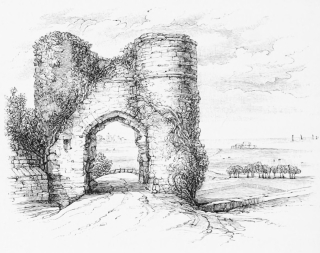
In the autumn, at Mr. Landor's house, I first met Miss Carolina Courtenay Boyle,[54] Queen Adelaide's ex-maid of honour, with whom, partly through my love of drawing, I made a great friendship. Accustomed as I was to the inferior twaddle which formed the conversation of the Maurice sisters, or the harsh judgments of those who considered everything pleasant to be sinful, Miss Boyle was a revelation to me. I was as one mesmerised by her. Hitherto my acquaintance with women had been chiefly with the kind who thought ample compensation for having treated me with inordinate unkindness and selfishness to be contained in the information that they would not fail to remember me in their prayers. It was a new experience, not only that a beautiful and clever lady should try to make herself agreeable, but that she should think it worth while to make herself agreeable to me. No wonder I adored her. She was then living with her mother Lady Boyle in the same house of Millard's Hill, near Frome, in which my great-aunts Caroline and Marianne Hare had lived before; and, to my great surprise and delight, I was allowed to go by the coach to spend two days with her there. It was on this occasion that I first wore a morning-coat instead of a jacket, and very proud I was of it. Apropos of dress, at this time and for many years afterwards, all young gentlemen wore straps to their trousers, not only when riding, but always: it was considered the ne plus ultra of snobbism to appear without them. The said trousers also always had stripes at the sides, which, beginning like those of soldiers, grew broader and broader, till they recalled the parti-coloured hose of Pinturicchio: then they disappeared altogether.
The house of Millard's Hill, when the Boyles inhabited it, was quite enchanting, so filled with pictures, carvings, and china; and Miss Boyle herself was a more beautiful picture than any of those upon her walls—still wonderfully striking in appearance, with delicately chiselled features and an unrivalled complexion, while her golden-grey hair, brushed back and cut short like a boy's (owing to a coup de soleil long before), added a marvellous picturesqueness. A greater contrast to the pinched and precise evangelical women whom alone I was usually permitted to visit could at this time scarcely be imagined. Wonderful were the stories which she had to tell me, and delighted to tell me, of her past life and sufferings, "through which only God and religion" had helped her, with the moral attached that since the few whom she had idolised were taken away, she must now live for all. She talked much also of her great anxiety about dear old Landor, "that God would change and rebuild his soul." Lady Boyle, a sweet and beautiful old lady,[55] was now quite paralysed, and her daughter would sit for hours at her feet, soothing her and holding her hands. I remember as especially touching, that when Miss Boyle sang hymns to her mother, she would purposely make a mistake, in order that her sick mother might have "the pleasure of correcting her."
When we went out, Miss Boyle's dress—a large Marie Antoinette hat and feathers and a scarlet cloak—at that time considered most extraordinary—excited great sensation. With her I went to Longleat; to Vallis, of which I have often been reminded in seeing Poussin's pictures; and to Marston, where old Lord Cork was still living, with his daughter-in-law Lady Dungarvan and her children. An immense number of the Boyles—"the illustrious family" by whom, our Dr. Johnson said, "almost every art had been encouraged or improved"—were at this time residing at or around Marston, and none of them on terms with one another, though they were all, individually, very kind to me. I now first made acquaintance with Miss Boyle's younger sister Mary, whom I knew better many years after, when I learned to value her wonderful sympathy with all the pathos of life, as much as to admire her quick wit and inimitable acting.[56] Landor used to say of her, "Mary Boyle is more than clever, she is profound;" but it is her quickness that remains by one. Of her lively answers it is difficult to give specimens, but I remember how one day when she neglected something, Lady Marion Alford said to her, "What a baby you are, Mary," and she answered, "Well, I can't help it; I was born so."
Another day Sir Frederic Leighton had promised to go to her, and, after keeping her waiting a long time, had disappointed her. She met him at the Academy party that evening, and he made a feint of kneeling down to beg her pardon—"Oh, pray rise up," she exclaimed; "people might think I was forgiving you."
But to return to Millard's Hill. In the evenings Miss Boyle took a guitar and played and sang—strange wild Spanish songs, which seemed perfectly in accordance with her floating hair and inspired mien. King William IV. desired her to play to him, which she dreaded so much, that when she was sent to fetch her guitar, she cut every string and then frizzled them up, and came back into the royal presence saying that her guitar was quite broken and she could not play. To her terror, the King sent for the guitar to see if it was true, but he was deceived. Queen Adelaide's death had made a great change in Miss Boyle's life, but she received the greatest kindness from the Queen's sister, Duchess Ida of Saxe-Weimar. When I was with her, she was looking forward to a homeless life after her mother's death, which could not be far distant, but was trusting in the family motto—"God's providence is my inheritance."
Soon after my return from Millard's Hill, I went to my grandfather Sir John Paul at the Hill House near Stroud—a much-dreaded visit, as I had never before seen most of the near relations amongst whom I so suddenly found myself.
From the Hill House I wrote to my mother—
"Dec. 19, 1850.—Lyncombe is done with! my own Mother, and oh! I cannot say how delightful it was, in parting with so many persons terribly familiar through two years and a half of misery, to know that I should never see them again.
"At Stroud Lady Paul's pony-carriage was waiting, and we drove swiftly through some deep valleys, the old coachman, twenty-five years in the family, telling me how he had seen and nursed me when a baby, and how glad he was that I was come to see my grandfather. We turned up by a house which he said was my 'Aunt Jane's,'[57] through a steep lane overhung by magnificent beech-trees, and then round a drive to this hill-set mansion, which has a fine view over wood and valley on one side, and on the other a garden with conservatories and fountains.
"As the bell rang, a good-natured, foreign-looking man came out to welcome me, and told me he was my Uncle Wentworth,[58] introduced me to his boy Johnnie, and took me into a large cheerful room (like the chintz room at Eridge), where the bright-eyed old Sir John was sitting with Lady Paul and my aunt Minnie Bankhead. Lady Paul kissed me, and it was not half so formidable as I expected.... Aunt Minnie is very handsome, and amuses everybody with her stories. She has just brought back His Excellency her husband from Mexico, where she has had the most wonderful adventures."
V SOUTHGATE
"Stern lawgiver, yet thou dost wear
The Godhead's most benignant grace;
Nor know we anything so fair
As is the smile upon thy face."
—WORDSWORTH, Ode to Duty.
"Duties bring blessings with them."
—SOUTHEY, Roderick.
"In the acquisition of more or less useless knowledge, soon happily to be forgotten, boyhood passes away. The schoolhouse fades from view, and we turn into the world's high-road."—J. K. Jerome.
MY new tutor, the Rev. Charles Bradley, was selected by Arthur Stanley, who had been acquainted with his brother, afterwards Master of University College at Oxford. I went over from Lime to see him at Hastings, and at once felt certain that, though he was very eccentric, his energy and vivacity were just what would be most helpful to me. His house was an ugly brick villa standing a little way back from the road in the pretty village of Southgate, about ten miles from London, and he had so many pupils that going there was like returning to school. The life at Southgate for the next two years was certainly the reverse of luxurious, and I did not get on well with my tutor owing to his extraordinary peculiarities, and probably to my many faults also; but I feel that mentally I owe everything to Mr. Bradley. "Vita sine proposito languida et vaga est"[59] was the first principle he inculcated. He was the only person who ever taught me anything, and that he did not teach me more than he did was entirely my own fault. He had a natural enthusiasm for knowledge himself, and imparted it to his pupils; and the energy and interest of the lessons at Southgate were perfectly delightful—every hour filled, not a moment wasted, and a constant excitement about examinations going on. I am sure that the manly vigour of my surroundings soon began to tell on my character as much as my mind, and at Southgate I soon learned to acquire more openness in matters of feeling, and a complete indifference to foolish sneers. Mr. R. for two years and a half had totally, systematically, and most cruelly neglected me: Mr. Bradley fully did his duty by me—to a degree of which I have only in after years learned the full value.
When we had a holiday at Southgate, it was the well-earned reward of hard work on the part of the pupils, not the result of idleness on the part of the tutor, and our holidays were intensely enjoyable. As he found he could trust me, Mr. Bradley let me make long excursions on these holidays—to Hatfield, St. Albans, Epping Forest, and often to London, where my happy hunts after old buildings and historic recollections laid the foundation of a work which I at that time little looked forward to.[60] Sometimes also I went to the Stanleys', ever becoming increasingly attracted by the charm, intelligence, and wisdom of my "Aunt Kitty." She was very alarming with her
"Strong sovereign will, and some desire to chide."[61]
But the acuteness of her observation, the crispness of her conversation, and the minute and inflexible justice of her daily conduct, ever showed the most rare union of masculine vigour with feminine delicacy.
My aunt was very intimate with the Miss Berrys, who both died in 1852, Agnes in January, Mary in November. Their celebrity began with their great intimacy at Devonshire House and Lansdowne House: the old Duchess of Devonshire was their great friend. I believe they were not clever in themselves, but they had a peculiar power of drawing clever people around them. They had both been engaged, Mary to the O'Hara, Agnes to the Mr. Ferguson who married Lady Elgin. They were very kind-hearted, and were, as it were, privileged to say rude things, which nobody minded, at their parties. Often, when a fresh person arrived towards the end of the evening, Miss Berry would say before all the other guests, "You see I've been able to get no one to meet you—no one at all." She would go out of the room whilst she was pouring out the tea, and call out over the stairs, "Murrell, no more women, no more women;" and Murrell, the butler, understood perfectly, and put out the lamp over the door. A few very intimate friends would still come in, but, when they saw the lamp was out, ladies generally drove away. Latterly, the Miss Berrys tried to draw in a good deal. A sort of jeu d'esprit went round to their friends, thanking them for past favours, and asking for a continuance on a smaller scale. It was never quite understood, but was supposed to mean that they did not wish to see quite so many. The death of Miss Agnes was like that of the wife. She had always been touching in that she could never understand how any one could like her better than her sister. She was the housekeeper, and she did what other housekeepers seldom do—she had the soup brought up to her every day whilst she was dressing, and tasted it, and would say, "There must be a little more sugar," or "There is too much salt," so that it was always perfect and always the same.
I think it must have been at this time also that I was taken to see the venerable Lady Louisa Stuart, who died soon afterwards.[62] I am glad that I can thus always retain a vivid recollection of the daughter of the famous Lord Bute and grand-daughter of Lady Mary Wortley Montagu as a very old lady of ninety-four, in a large cap, sitting in an old-fashioned high-backed chair covered with white stuff, in a room of extreme bareness.
Great was my excitement, on first going to Southgate. I stayed on the way with the Stanleys, to see the Exhibition (of 1851) which was then in full preparation, and the procession at the opening of Parliament.
To MY MOTHER.
"6 Grosvenor Crescent, Feb. 3, 1851.—The exterior of the Crystal Palace is disappointing, I had imagined it so much higher, but the interior is and looks gigantic. The most striking feature is the great tree: it is wonderful to see its huge branches enclosed quite to the topmost twigs, and the details of the building are beautiful."
"Feb. 4.—I went to the Bunsens' house to see the procession. There was a crowd of people on the terrace when the great gun announced that the Queen had left the palace, and already from distant parts of the avenue cries of 'God save the Queen' and 'Hurrah!' The procession of Lifeguards in their panoply of glittering helmets and breastplates was beautiful. Then came the six gorgeous carriages with the household, and lastly the eight cream-coloured horses drawing the great glass coach. Prince Albert in his great boots sat on the side nearest to us, opposite the Duchess of Sutherland in a diamond tiara; and on the other, the Queen, in a crown and glistening dress of embroidered silver, kept bowing to the shouts of her subjects—so much indeed that I heard a poor Irish-woman exclaim—'Och indeed, and mustn't the poor thing get tired of nodding her head about so.' ... There were forty people at luncheon with the Bunsens afterwards."
"Southgate, Feb. 8, 1851.—My own dearest mother, at last I am writing from my own room at Southgate. I joined the omnibus at a public-house at the bottom of Snow Hill,[63] and drove here through the moonlight, arriving at 10 P.M. We stopped at a large gate in a wall, which was opened by a stable-boy, who led the way across a grass-plat with trees. Mr. Bradley met me in the hall, and took me to see Mrs. Bradley, and then to my room, which at first seemed most dreary, cold, and comfortless."
"Feb. 9.—I have already seen enough of the life here to know a good deal about it. Mr. Bradley is an excellent tutor, though I could never like him as a man. He is much too familiar with his pupils, pulls their hair or hits them on the toes with the poker when they make mistakes: he will peer into their rooms, and if he finds a coat, &c., lying about, will fine them a penny, and there is a similar fine if you do not put the chair you have sat upon at dinner close up against the wall when you have done with it. The tradespeople are allowed to put in their bills, 'Pane of glass broken by Portman or Brooke,' &c. When I asked him to lend me a pen, he said, 'Oh, I don't provide my pupils with pens.' When he wanted to send a parcel to Miss Jason, he told her brother he should come upon him for the postage. The first thing he said to me after I entered the house was—pointing to the sideboard—'Mind you never take either of those two candles; those are Mrs. Bradley's and mine' (we have sickly-smelling farthing dips in dirty japanned candlesticks). These are instances to give you an idea of the man.
"If you have three indifferent marks from the mathematical master, you have either to stay in all the next half-holiday, or to receive three severe boxes on the ear!—a thing which I imagine would not be borne at any other private tutor's, but Bradley seems to have magic power. His inquisitiveness about trifles is boundless. If I bring down a book—'What is that book? Was it a present? Who from? Where was it bought? How much did it cost?'