Volume 1 — CONTENTS VOLUME 1 (continued 5)
Reading edition
"When I came down to prayers this morning (at eight, being Sunday), I found all the pupils assembled. I am the smallest but one, and look up at the gigantic Portman, who is only thirteen. Then we had breakfast. Cold beef and ham were on the table, a huge loaf, and two little glasses of butter. Mrs. Bradley poured out the tea, while Bradley threw to each pupil an immense hunch off the loaf, saying with mine, that I 'must not leave any, or any fat at dinner, that was never allowed; and that I must always say first what I wanted, much or little, fat or not.' After breakfast the pupils all gathered round the fire and talked. Soon Bradley made us sit down to work, myself at Greek Testament, till it was time to go to church, whither we went, not quite in a schoolboy procession, but very nearly. The church was 'Weld Chapel,' a barn-like building, with round windows and high galleries. At dinner there was cold roast and boiled beef, and plum and custard pudding, good and plain, but with severe regulations. We did not have any time to ourselves except three-quarters of an hour after afternoon church, after which we went down to a sort of Scripture examination, with such questions as, 'How do we know that Salome was the mother of Zebedee's children?' I wrote what I thought an excellent set of answers, but they proved sadly deficient, and I am afraid I am a dunce.... I am writing now after prayers, in forbidden time, and in danger of having my fire put out for a month! Do not think from my letter that I dislike being here. Oh, no! work, work, is the one thing I need, and which I must and will have, and, if I have it, all petty troubles will be forgotten. Good-night, my own dear blessed mother."
"Feb. 10.—Half my first work-day is over, and I have just washed my hands, sooty with lighting my own fire, to write before dinner. At half-past nine we all sat down to work at the long table in the dining-room. I was directed to do Euripides while the 'schemes' (tables of work) of the others were prepared, and we went on till half-past twelve, when Bradley said, 'You've done enough.' Then Campbell asked me to walk with him and Walker to the station.... All my companions seem very old."
"Feb. 12.—On Wednesday afternoon I went a long walk with Campbell. The country looks most dreary now, and mostly hidden by London fog, still I think there are bits which I could draw.... When we came home I ached with cold and my fire was out. Mrs. Bradley is certainly most good-natured; for happening to pass and see my plight, she insisted on going down herself to get sticks, laying it, and lighting it again. When I was going to bed, too, the servant came up with a little bason of arrowroot, steaming hot, and some biscuits, which 'Missis thought would do my cold good.'
"Bradley improves greatly on acquaintance, and is very kind to me, though I am sorry to say he finds me far more backward and stupid than he expected, especially in grammar. He has a wonderfully pleasant way of teaching, and instead of only telling us we are dunces and blockheads, like Mr. R., he helps us not to remain so.
"He was exceedingly indignant yesterday at receiving a letter from Lord Portman to say that his son had complained of the dreadful damp of the house, that his shirts put out at night were always wet before morning. After expatiating for a long time upon the unkindness and impropriety of Portman's conduct in writing to complain instead of asking for a fire, he ended good-humouredly by insisting on his going out into a laurel bush in the garden with Forbes, to receive advice as to improved conduct for the future! All this every pupil in the house was called down to witness: indeed, if any one does wrong, it is Bradley's great delight to make him a looking-glass to the others. Sometimes he holds up their actual persons to be looked at. If they are awkward, he makes them help the others at meals, &c., and all his little penances are made as public as possible."
"Feb. 14.—The days go quickly by in a succession of lessons, one after the other. I am much happier already at Southgate than I ever was anywhere else, for Bradley's whole aim, the whole thought of his soul, is to teach us, and he makes his lessons as interesting as Arthur (Stanley) himself would. I like all my companions very much, but Walker best; and, though I am the smallest, thinnest, weakest fellow here, I do not think they like me the worse for it."
"Feb. 16.—Yesterday, after work, I went by train to Hatfield House, provided with a large piece of cake for luncheon by Mrs. Bradley.... You may imagine my delight, as I expected something like Penshurst at best, to see tower after tower, and pile after pile of the most glorious old building, equally splendid in colour and outline—far the most beautiful house I ever saw. It was a perfect day, the sun lighting up the glorious building, and making deep shadows upon it, and glinting through the old oaks in the park upon the herds of deer.... The train was forty minutes late, and it was quite dark when I got back, but Mrs. Bradley's good-nature gave me a welcome and a hot meat tea, whereas with Mrs. R. there would indeed have been cold behaviour and cold tea—if any.
"The only way of getting on with Bradley is the most entire openness, and answering all his questions as shortly and simply as possible.... After Cicero he always gives us a composition to translate into Latin out of his own head, most extraordinary sometimes, though in the style of what we have been reading. I am already beginning to find Cicero quite easy, and am beginning at last even to make some little sense of Euripides."
"Feb. 21.—At half-past six I hear knocking without intermission at my door, which it is generally a long time before I am sufficiently awake to think other than a dream. Presently I jump up, brush my own clothes, seize my Cicero, and look it over while I dress, and at half-past seven rush downstairs to the dining-room. For some minutes the stairs are in a continual clatter. Meantime I retire into a window in agonies of agitation about my Cicero, till Bradley comes in rubbing his hands, and sits down in an arm-chair by the fire: I sit down by him, and Hill on the other side of me, like a great long giant. I generally do this lesson very ill, partly from want of presence of mind, partly from inattention, and partly because I am scarcely awake: however, Bradley makes it not only instructive but interesting, always giving us funny sentences out of his own head to construe into the sort of Latin we are doing. I quite enjoy my lessons with him, only he must think me such a dunce. After the lesson is construed, I sometimes have to do it all through by myself, or the others do it and I correct them (if I can). Sometimes the poker is held over their toes, when, without exception, they do it worse than before, and down it comes. Then we parse.
"Then a little bell tinkles. Portman cuts the bread, Bradley the ham, and I help to set chairs in two rows from the fire, while the others hang over it, very grim and cold. Two maidens and a stable-boy come in, we sit in two rows confronting each other, and Bradley in the oddest possible tone reads a chapter in 'Proverbs' and a prayer. Then the chairs are put to the table: I sit next but Hill to Mrs. Bradley, which means I am fourth eldest, Walker on the other side of me, Forbes and Campbell opposite. At breakfast every one talks of plans for the day, Forbes and Portman of hounds, races, and steeplechases, Campbell of church windows; it is very different from the silent meals at Lyncombe.
"We do not begin regular work again till half-past nine, though I generally prepare mine, but sometimes Forbes persuades me to come out and give them a chase, that is, to run away as hard as I can, with all the others yelping like hounds at my heels; but the scene of these chases is only a square walled garden and orchard, and there are no places for concealment. We come in very dirty, and Buchan is sometimes made to wear his dirty shoes round his neck, or to have them under his nose all worktime.
"I work in my room till ten, when I come in with Walker for the second Cicero lesson, which is even pleasanter than the other. Afterwards we write Latin compositions out of our own heads! Then I sometimes say Greek grammar, or else work in my own room again till twelve, when I go down to the young Cambridge wrangler, who is teaching some one all worktime, but with whom I do nothing except for this half-hour. He looks very young and delicate and is childish in manner, and generally gets into a fix over a fraction, and so do I, but we fumble and whisper together over arithmetic till half-past twelve. Meanwhile my letters have generally come, books are clapped together, and I run upstairs to write to you.
"A dinner-bell rings at half-past one, and the others come in from the drawing-room, whither they adjourn before dinner, with the penalty of a penny if they lean against the mantelpiece, as they might injure the ornaments. We have the same places at dinner, an excellent dinner always—variety of food and abundance of it. Afterwards I generally read, while the others play at quoits, and at half-past two I go out walking with Campbell, coming in to begin work at five. At half-past five Walker and I come in with Euripides, which is the last repetition: then I work in my own room till six, when we have tea, with bread and butter and cake. After tea the drawing-room is open to the public till half-past seven, when we all begin to prepare work for the next day, and write Latin exercises till nine, when prayers are read. Afterwards the younger ones generally go to bed, but some of us sit up talking or playing chess, &c., till nearly eleven.
"I like the sort of life excessively—the hardly having a moment to one's self, as the general working 'subject' takes up all leisure time—the hardly having time even to make acquaintance with one's companions from the succession of all that has to be done. No one thinks it odd if you do any amount of work in your own room; of course they laugh at you as 'a bookworm,' but what does that signify?
"I have forgotten to tell you that between breakfast and the chase, Hill and I are examined in three chapters of the Bible which we prepare beforehand. Bradley asks the most capital questions, which one would never think of, and we have to know the geography perfectly. I am astonished to find how indescribably ignorant I am."
"Feb. 23.—I daily feel how much happier I am with the Bradleys than I have ever been before. Compared to Lyncombe, Southgate is absolute paradise, the meals are so merry and the little congregations round the fire afterwards, and work is carried on with such zest and made so interesting.
"Yesterday, after work, I went to Waltham Abbey—a long walk to Edmonton, and then by rail to Waltham. I was very anxious to see what a place so long thought of would be like—a tall white tower rising above trees, a long rambling village street, and then the moss-grown walls of the church. The inside is glorious, with twisted Norman pillars, &c., but choked with pews and galleries. The old man who showed it said he was 'quite tired of hearing of church reform and restoration, though the pillars certainly did want whitewashing again sadly.' ... There is an old gothic gateway on the brink of the river Lea."
"March 9, Harrow.—Having got through 'the subject'—Cicero and Greek grammar—yesterday morning, with much trembling but favourable results, I set off to come here. With a bundle like a tramp, I passed through Colney Hatch, Finchley, and Hendon, keeping Harrow steeple and hill well in view, and two miles from Harrow met Kate in her carriage. This morning we have been to church, and I have since been to Mrs. Brush, the Pauls' old servant, whom I knew so well when at school here, and who came out exclaiming, 'O my dear good little soul, how glad I be to see ye!'"
"Southgate, March 14.—I must tell my mother of my birthday yesterday. Mr. and Mrs. Bradley made me order the meals, and do very much what I liked. The tutor, who can be as savage as a lion during work, relapses into a sucking-lamb when it is over. My health was drunk all round at dinner, and 'a truce' given afterwards, which I employed in going with little Fitzherbert Brooke to the old church at Chingford, close to Epping Forest—a picturesque, deserted, ivy-covered building, looking down over the flat country which I think so infinitely interesting, with the churches and towers of London in the distance.
"To-day there has been a great fuss, and it will probably have some dreadful ending. In the middle of work we were all suddenly called down, and Bradley, with his gravest face, headed a procession into the garden, where all across one of the flower-beds were seen footmarks, evidently left by some one in the chases yesterday. The gardener was called, and said he saw one of the party run across yesterday, but he was not allowed to say a word more. Then Bradley said he should allow a day in which the culprit might come forward and confess, in which case he would be forgiven and no one told his name, otherwise the shoes of yesterday, which have been locked up, would be measured with the footprints, and the offender sent away."
"March 15.—The plan has quite answered. In the evening, Bradley told me the offender had given himself up. No one knows who it is, and all goes on as before. Some of the others are given a tremendous punishment for running through some forbidden laurel bushes—the whole of 'Southey's Life of Nelson' to get up with the geography, and not to leave the house till it is done, no second course, no beer, and ... to take a pill every night."
"April 2.—The other day I was very careless in my work, and was asked where my mind was, and as I could not tell, Campbell was sent upstairs to fetch—my mind! and came down bearing two little pots of wild anemones, which were moved about with me as my 'mind,' to the great amusement of the others.... If I should ever seem to complain of anything here in my letters, mind you never allude to it to the Bradleys, as there is only one thing which Bradley never forgives a pupil, and that is having caused him to write a letter."
"April 7.—Yesterday I went with Campbell and Edgecombe to Hatfield, whence we ran all the way to St. Albans, an effort, but quite worth while, though we had only an hour there."
"(After the Easter vacation), April 27.—When I opened my eyes this morning on the wintry wilderness here, what a change it was from Lime—withered sooty evergreens, leafless trees, trampled grass, and thick London fog—I think the angels driven out of Paradise must have felt as I do, only I have a bad headache besides.... All here is the same as when we left, to the drawling sermon of Mr. Staunton about faith, grace, and redemption, sighing and groaning and hugging the pulpit-cushion the while. It is bitterly cold, but the law of the house allows no more fires.... Even Fausty's white hair, which still clings to my coat, has its value now."
"April 29.—Bradley has now taken a notion that I am dreadfully self-conceited, so I am made to sit on a high chair before him at lessons like a little school-boy, and yesterday, for mistakes in my Latin exercise, I was made to wear my coat and waistcoat inside out till dinner-time."
"May 11.—Yesterday, I went by train to Broxbourne, and walked thence by Hoddesdon across the bleak district called the Rye, till I saw an oasis of poplars and willows by the river Lea, and a red brick tower with terra-cotta ornaments, twisted chimney, flag-staff, and a grey arched door below. I had not expected it, so you may imagine how enchanted I was to find that it was the tower of the Rye-House. In that road Charles and James were to have been murdered on their return from Newmarket, and for the plot conceived in that tower Algernon Sidney and William Lord Russell died!
"Bradley is now alternately very good-natured and very provoking. He continually asks me if I do not think him the most annoying, tiresome man I ever met, and I always say, 'Yes, I do think so.' In return, he says that I am sapping his vitals and wearing him out by my ingratitude and exaggerations, but he does not think so at all."
"May 18.—I have been to Harrow. Mr. Bradley lent me a horse, to be sent back by the stable-boy after the first six miles, so I easily got through the rest.... I had many hours with Kate, and came away immediately after dinner, arriving at exactly ten minutes to ten—the fatal limit; so Bradley was pleased, and welcomed me, and I did not go supperless to bed."
"June 8, 1851.—Yesterday I walked to Dyrham Park near Barnet, to pay a visit to the Trotters. It is a handsome place.... I wrote upon my card, 'Will you see an unknown cousin?' and sending it in, was admitted at once. I found Mrs. Trotter[64] in the garden. She welcomed me very kindly, and seven of her nine children came trooping up to see 'the unknown cousin.' Captain Trotter is peculiar and peculiarly religious. I had not been there a minute before he gathered some leaves to dilate to me upon 'the beauty of the creation and the wonderful glory of the Creator,' with his magnifying-glass. He builds churches, gives the fourth of his income to the poor, and spends all his time in good works. I stayed to tea with all the children. The gardens are lovely, and the children have three houses in the shrubberies—one with a fireplace, cooking apparatus, and oven, where they can bake; another, a pretty thatched cottage with Robinson Crusoe's tree near it, with steps cut in it to the top."
"June 11.—The first day of our great examination is over, and I have written seventy-three answers, some of them occupying a whole sheet."
"June 12.—To-day has been ten hours and a half of hard writing. I was not plucked yesterday!"
"June 15.—I reached Harrow by one, through the hot lanes peopled with haymakers. I was delayed in returning, yet by tearing along the lanes arrived at ten exactly by my watch, but by the hall-clock it was half-past ten. Bradley was frigidly cold in consequence, and has been ever since. To-day at breakfast he said, 'Forbes may always be depended upon, but that is not the case with every one.'"
"June 20.—I have had an interesting day!—examinations all morning—the finale of Virgil, and then, as a reward, and because neither of my preceptors could attend to me, Bradley said I might go where I liked; so I fixed on Hertford, and, having walked to Ponder's End, took the train thither.... From Hertford, I walked to Panshanger, Lord Cowper's, which is shown, and in the most delightful way, as you are taken to the picture-gallery, supplied with a catalogue, and left to your own devices. The pictures are glorious and the gardens are quaint, in the old style. At Ware I saw the great bed, but the owners would not let me draw it on any account, because they were sure I was going to do it for the Pantomime. The bed is twelve feet square and is said to have belonged to Queen Elizabeth.
"In the Bible examination I am second, in spite of having said that Ishmael married an Egyptian, and having left out 'They drank of that rock which followed them' in answer to the question 'What were the miracles ordained to supply the temporal wants of the Israelites in the wilderness?'"
"June 25.—I am enchanted—quite enchanted that we are really going to Normandy.... I feel satisfied, now the end of the quarter is come, that I never was happier anywhere in my life than I have been here, and that I have done more, learned more, and thought more in the few months at Southgate than in all the rest of my life put together."
While I was away, my mother's life at Hurstmonceaux had flowed on in a quiet routine between Lime and the Rectory. She had, however, been much affected by the sudden death of Ralph Leycester, the young head of her family,[65] and cheerful, genial owner of Toft, her old family home. Chiefly, however, did she feel this from her share in the terrible sorrow of Ralph's eldest sister, her sister-like cousin Charlotte Leycester; and the hope of persuading her to have the change and of benefiting her by it, proved an incentive to make a short tour in Normandy—a plan with which I was intensely delighted. To go abroad was positively enchanting. But anything would have been better than staying at Hurstmonceaux, so overrun was it with Maurices. I suppose they sometimes meant well, but what appalling bores they were! "La bonne intention n'est de rien en fait d'esprit."[66]
We crossed to Boulogne on a sea which was perfectly calm at starting, but on the way there came on one of the most frightful thunderstorms I ever remember, and the sea rose immediately as under a hurricane. A lady who sate by us was dreadfully terrified, and I have no doubt remembers now the way in which (as the waves swept the deck) my mother repeated to her the hymn—"Oh, Jesus once rocked on the breast of the billow." I have often seen in dreams since, our first entrance into a French harbour, brilliant sunshine after the storm, perfectly still water after the raging waves, and the fishwomen, in high white caps like towers (universal then) and huge glittering golden earrings, lining the railing of the pier.
We saw Amiens and had a rapid glimpse of Paris, where we were all chiefly impressed by the Chapelle St. Ferdinand and the tomb of the Duke of Orleans, about whom there was still much enthusiasm. During this visit I also saw three phases of old Paris which I am especially glad to remember, and which I should have had no other opportunity of seeing. I saw houses still standing in the Place du Carrousel between the Tuileries and the then unfinished Louvre: I saw the Fontaine des Innocents in the middle of the market, uncovered as it then was: and I saw the Tour de S. Jacques rising in the midst of a crowd of old houses, which pressed close against it, and made it look much more picturesque than it has done since it has been freed from its surroundings. On leaving Paris, we spent delightful days at Rouen, and visited, at Darnetal, the parents of M. Waddington, who became well known as Minister of Foreign Affairs at Paris, and ambassador in England. From Havre we went by sea to Caen, arriving full of the study of Norman history and determined to find out, in her native place, all we could about Gunnora, Duchess of Normandy (grandmother of William the Conqueror), from whose second marriage both my mother and Charlotte Leycester were directly descended.
Very delightful were the excursions we made from Caen—to Bayeux with its grand cathedral and the strange strip of royal needlework known as "the Bayeux Tapestry:" and to the quaint little church of Thaon and Château Fontaine Henri, a wonderfully preserved great house of other days. Ever since I have had a strong sense of the charm of the wide upland Normandy plains of golden corn, alive with ever-changing cloud shadows, and of the sudden dips into wooded valleys, fresh with streams, where some little village of thatched cottages has a noble church with a great spire, and an area wide enough to contain all the people in the village and all their houses too. The most beautiful of all the breaks in the cornland occurs at Falaise, where the great castle of Robert the Devil rises on a precipice above a wooded rift with river and watermills and tanners' huts, in one of which Arlette, the mother of the Conqueror, and daughter of the tanner Verpray, was born.
From Falaise we went to Lisieux, which was then one of the most beautiful old towns in France, almost entirely of black and white timber houses. It was only a few miles thence to Val Richer, where we spent the afternoon with M. Guizot—"grave and austere, but brilliantly intellectual," as Princess Lieven has described him. His château was full of relics of Louis Philippe and his court, and the garden set with stately orange-trees in large tubs like those at the Tuileries. My mother and cousin returned to England from hence, but I was left for some weeks at Caen to study French at the house of M. Melun, a Protestant pasteur, in a quiet side-street close to the great Abbaye aux Dames, where Matilda of Flanders is buried.
To MY MOTHER.
"Caen, July 26, 1851.—It was very desolate, my own mother, being left alone in that square of Lisieux, and the old houses seemed to lose their beauty, the trees and cathedral to grow colourless, after you were all gone, so that I was glad when the diligence came to take me away. It was a long drive, passing through 'Coupe Gorge,' a ravine where Napoleon, hearing diligences were often robbed there, made one man settle, saying that others would soon follow, and now there is quite a village.
"I have a pleasant room here, with a clean wooden floor, and a view of S. Pierre from the window. Its only drawback is opening into the sitting-room where Mr. T., my fellow-pensionnaire, smokes his pipes. He is a heavy young man, very anxious to impress me with the honour and glory of his proficiency as a shot and cricketer, and of the Frenchmen he has knocked down and 'rather surprised.' We had prayers in Madame Melun's bedroom, she being dressed, but 'le petit' snoring in bed. The whole family, including les petits, have a great meat breakfast with wine, followed by bowls of sour milk.... Such a touching funeral procession has just passed up the Rue des Chanoines, a young girl carried on a bier by six of her companions in white dresses and wreaths."
"Sunday, July 27.—Yesterday I went a walk with M. Melun to the Prairie, where the races are going on. This morning he preached about them and the evils of the world with the most violent action I ever saw—stamping, kicking, spreading out his arms like the wings of a bird, and jumping as if about to descend upon the altar, which, in the Temple, is just under the pulpit. This afternoon I have been again to the service, but there was no congregation; all the world was gone to the races, and, M. Melun says, to perdition also."
"July 28.—It is such a burning day that I can hardly hold my head up. Everything seems lifeless with heat, and not a breath of air. I never missed a green tree so much: if you go out, except to the Prairie, there is not one to be seen, and even the streets are cool and refreshing compared with the barren country. Tens of thousands of people collected in the Prairie this morning, half to see the races, half the eclipse of the sun, for they both began at the same moment, and the many coloured dresses and high Norman caps were most picturesque."
"July 30.—It is like the deadly motionless heat of 'The Ancient Mariner;' I suppose the eclipse brings it ... the baking is absolute pain.... It is tiresome that the whole Melun family think it necessary to say 'bon jour' and to shake hands every time one goes in and out of the house, a ceremony which it makes one hotter to think of."
"July 31.—The heat is still terrific, but thinking anything better than the streets, I have been to Thaon—a scorching walk across the shadeless cornfields. The church and valley were the same, but seemed to have lost their charm since I last saw them with my mother. I have my French lesson now in the little carnation-garden on the other side of the street."
"August 1.—I have been by the diligence to Notre Dame de la Deliverande, a strange place, full of legends. In the little square an image of the Virgin is said to have fallen down from heaven: it was hidden for many years in the earth, and was at length discovered by the scratching of a lamb. Placed in the church, the Virgin every night returned to the place where she was disinterred, and at last the people were obliged to build her a shrine upon the spot. It is an old Norman chapel surrounded by booths of relics, and shouts of 'Achetez donc une Sainte Vierge' resound on all sides. Latterly, to please the fishermen, the worship of the Virgin has been combined with that of St. Nicholas, and they appear on the same medal, &c. When a crew is saved from shipwreck on this coast, it instantly starts in procession, barefoot, to 'La Deliverande,' and all the lame who visit the chapel are declared to go away healed.... In a blaze of gold and silver tinsel, surrounded by the bouquets of the faithful and the crutches of the healed, is the image which 'fell down from heaven,'—its mouldering form is arrayed in a silver robe, and, though very old, it looks unlikely to last long. I went on with M. Melun to Bernières, where there is a grand old church, to visit a poor Protestant family, the only one in this ultra-Catholic neighbourhood. They had begged the minister to come because one of the sisters was dead, and the whole party collected while he prayed with them, and they wept bitterly. Afterwards we asked where we could get some food. 'Chez nous, chez nous,' they exclaimed, and lighting a fire in their little mud room with some dried hemp, they boiled us some milk, and one of the sisters, who was a baker, brought in a long hot roll of sour bread, for which they persistently refused any payment.... I have had an English invitation from Madame de Lignerole in these words—'Will you be so very kind as to allow me to take the liberty of entreating you to have the kindness to confer the favour upon me of giving me the happiness of your company on Friday.'"
"August 2.—We went to-day to see M. Laire, an old antiquary who has lived all his life upon vegetables. His house is very attractive; the court, full of flowers mixed with carvings and Celtic remnants, borders on the willows which fringe the Odon, and the rooms are crammed with curiosities and pictures relating to Caen history. The old man himself is charming, and spends his life in collecting and giving away. He gave me a medallion of Malesherbes, and many other things."
"August 2.—I have been to dine with the Consul, Mr. Barrow. Under his garden is the quarry whence the stone was taken which built Westminster Abbey. It undermines all the grounds, and once, when a part fell in, the hot air which came out made it quite hot in winter. Mr. Barrow has built a conservatory over the spot, which needs no other heat, and plants flourish amazingly, though only camellias and smooth-leaved plants will do, as others are too much affected by the damp."
Want of money was still always the great trouble of my boyhood, as my dear mother never could be persuaded to see the necessity of my having any, and after she had made a minute calculation of the necessary pennies that came into her head, always gave me just that sum and no more, never allowing anything for the ever-recurring incidents and exigencies of daily life. When I was sixteen she was persuaded to allow me £10 a year, but out of this I was expected to buy all the smaller articles of dress, boots, hats, gloves, &c., so, as may be imagined, my annual allowance was almost nil; and my excursions at Southgate had been only possible by starvation, and because the third-class ticket to London cost only fourpence. When I was left at Caen, just the absolutely needful sum for my return journey was given me, and no allowance made for any personal expenses of my stay—for washer-woman servants, or payments for the many purchases which my mother wrote to desire me to make for her. Thus, when the time came for setting out homewards, with the nine packages which were to be taken to my mother, I was in the greatest embarrassment, and many were my adventures; yet my dread of a sea-voyage still made me refuse altogether to go by Havre and Southampton, and my longing to see a historical spot which I had long read and heard of made me determine if possible—if I half died for it on the way—to visit St. Denis, a place I had always had a special longing after. The journey entailed a singular chapter of accidents.
During the whole of the first long day—twelve hours' diligence journey—I had nothing whatever to eat but a brioche and some plums; but at seventeen starvation is not one of the worst things in life, and when I arrived at Evreux, the fair of St. Taurinus, the patron saint of the place, was going on, and I was in ecstasies the next morning over the costumes which it brought into the town, as well as over the old Bishop's Palace and the beautiful cathedral with its lace-work architecture.
From Evreux the diligence had to be taken again to Bonnières, where I joined the railway to Paris, and in the evening reached St. Denis. I had no money to go to a hotel, but spent the night in a wretched café which was open for carters under the walls of the cathedral, where I got some sour bread and eggs, having had no food all day. At five in the morning the doors of the Abbey were opened, and in my raptures over the monuments of Dagobert, Francis I., &c., I forgot all my miseries—especially in the crypt, full then of royal tombs and statues. At half-past twelve, when I was ready to leave, I found that no more trains for Boulogne would stop at St. Denis that day, and that I must return to Paris. I went in the omnibus, but owing to my ignorance of French, was carried far beyond my point, and had to be dropped, with all my packages, in a strange street, whence with some difficulty I got a porter to drag my things to the station, but arrived when the train was just gone, and no other till half-past seven, and it was then two. Hungry and forlorn, I made my way, losing it often, on foot, to the Tuileries gardens, where I felt that the beauty of the flowers repaid me for the immense walk, though I was disconcerted when I found that sitting down on a chair cost the two sous I had saved to buy bread with. In my return walk, ignorance and mistakes brought me to the railway for Rouen (Gare S. Lazare), instead of that for Boulogne (Gare du Nord). However, in time I reached the right place.
As we were half-way to the coast in the express, a strong smell of burning was borne on the wind, and the carriage soon filled with smoke. Looking out, we saw a line of screaming faces, and the roof of one of the front carriages in flames. Pieces of burning stuff rushed flaming past. A young lady in our carriage—"Gabrielle"—fell on her knees and said her prayers to the Virgin. Suddenly we stopped, and heard the rush of water above us. The engine-driver, to save the train, had, with terrible risk to the passengers, pushed on at a frightful speed to the pompe d'incendie of Pontoise.
At half-past one in the morning we reached Boulogne. I was told that the steamer for Folkestone would not start for an hour. An official in blue with silver lace said that he would call for me then. At the time, but rather late, he came. A cab was ready, and we were only just in time to catch the steamer. The official, as I was going on board, desired that I would pay my fare. I supposed it was all right, and gave up almost all my few remaining shillings. I was assured the packet was the one for Folkestone, and, though surprised at having no ticket, supposed it was because most of the passengers had through tickets from Paris to London, and because my going on was an afterthought.
The steamer started, but, before leaving the harbour, concussed with another vessel, which broke one of the paddle-boxes and delayed us an hour. Meantime it began to pour in torrents, the deck swam with water, and before we got out to sea the wind had risen and the sea was very rough. The vessel was fearfully crowded with three hundred and fifty people going to the Hyde Park Exhibition, and more than half of them were sea-sick.
At last day broke, and with it the English coast came in sight. But it was very odd; it was not a coast I knew, and Dover Castle seemed to be on the wrong side. Then a man came for the tickets, and said I must have had one if I had paid: as I had not one, I could not have paid. It was in vain that I protested I had paid already. "When I get to Folkestone," I said, "I should see some one who could prove my identity," &c. The man grinned. "It will be a long time before you get to Folkestone," he said, and he went away. Then I saw Dover Castle fade away, and we still coasted on, and I saw a little town which looked strangely like the pictures of Deal. At last a man next to me, recovering from a paroxysm of sea-sickness, said, "You think you're in the boat for Folkestone, but you are in the boat for London!" I had been swindled at Boulogne by a notorious rogue. Some weeks afterwards I saw in the papers that he had been arrested, after a similar case.
I was in despair, not so much because of the long voyage, as because to pay for it was impossible. We were not to reach London till four in the afternoon. I implored the captain to set me down, we were so near the coast. "No," he said, "go to London you must."
At last, as we passed Margate, he said I might perhaps get out, but it was rather too much to sacrifice the comfort of three hundred and fifty passengers to one. However, the three hundred and fifty seemed very glad of a break in the monotony of their voyage, and as there was another passenger anxious to land, a boat was hailed and reached the vessel. All my packages were thrown overboard and I after them, with injunctions to sit perfectly still and hold fast, as it was so frightfully rough. The injunctions were unnecessary, since, exhausted as I was, I very soon became unconscious, as I have so often done since in a rough sea.
It was too rough to land at the pier, so we were landed on a ridge of rocks at some distance from the shore. Seeing all my packages, the coastguardsmen naturally took us for smugglers, and were soon on the spot to seize our goods and carry them to the custom-house. Here I had to pay away all that remained to me except sixpence.
With that sixpence I reached Ramsgate.
There were four hours to wait for a train, and I spent it in observing the directions on the luggage of all arriving passengers, to see if there was any one I could beg of. But no help came; so eventually I told my story to the station-master, who kindly gave me a railway pass. At Ashford I had four hours more to wait, and I lay almost unconscious (from want of food) upon the floor of the waiting-room. Lying thus, I looked up, and saw the astonished face of my cousin Mary Stanley gazing in through the window at me. She was leaving in two minutes for France, but had time to give me a sovereign; with that sovereign, late in the night, I reached home in a gig from Hastings.
To MY MOTHER (after returning to Southgate).
"August 27, 1851.—I have just got your dear letter to refresh me after the first morning's work. It is strange to have to give oneself to Latin again after having thought of nothing but French for so long."
"August 28.—When I hear of all you are doing, I cannot but long to be with you, and yet I am very happy here in finding it so much less disagreeable than I expected, the Bradleys perfection, Walker very nice, and Portman delightful."
"Sept. 12, 1851.—I have just been to the old chapel in Ely Place and to the Savoy.... One may study architecture just as well in London as abroad: I had no idea before what beautiful bits are there."
"Oct. 18.—I have had an unfortunate trouble with Bradley lately. I am sure I have done right, but it is very unfortunate indeed. I will tell you all about it. In my Latin exercise I put 'quo velis' for 'go your way,' meaning 'go where you like,' which I thought was the meaning of that English sentence. Bradley scratched it out, and I said, 'But "go your way" does mean go where you like.' He thought I contradicted him and was very angry, and appealed to the opinion of every one at the table. They said it meant 'go away.' He said I was very obstinate, and wrote down, '"I have a bad headache, go your way"—what does that mean?' I wrote, 'Go wherever you like.' I thought no more was going to happen, but, to my astonishment, heard him send for Mrs. Bradley, who wisely refused to come. Then, in a voice in which he never spoke to me before, he ordered me to go into the drawing-room. I did, and asked Mrs. Bradley her opinion (not able to believe he could really mind being differed from). He followed in a moment, very angry, and said, 'Walk up to your room, if you please, Mr. Hare, this instant.' I prepared to obey, but he posted himself in the doorway and pushed me back into a chair. He then asked me again to explain the sentence. I said of course he was the only judge about the Latin passage, but that in English 'go your way' might certainly be taken to mean 'go where you like.' He said, 'If you are going to differ from me in this way, I shall not attempt to teach you any more.' All that day, morning, afternoon, and evening, I laboured or twaddled at arithmetic with Mr. Howse. Late in the evening Bradley took me for a whole hour by myself and tried to persuade me to say 'go your way' never meant 'go where you like.' I said if I did, it would not be true, but that I was very sorry to have differed from him, and had never meant in the least to contradict him. But it is no use; he quotes from the Bible—'"The house divided against itself falleth," therefore I cannot teach you any more.' I went to him again and said 'if I had seemed the least ill-tempered I begged his pardon.' He said I had not seemed at all ill-tempered, I had only differed from him. You need not be alarmed, however, for he will never send away for such a trifle the pupil who loves him best in spite of all his eccentricities: I have only told you all this in case anything more should happen. As I called on the B.'s to-day, I asked, without explanation, what they thought 'go your way' meant. They said at once, 'Go where you like.'"
"Oct. 21.—Dearest mother, the dispute with Bradley has now assumed so much more serious an aspect that I am afraid it cannot end well. For two days he said nothing more about it, so I did not volunteer anything: he was only very unpleasant in his manner to and about me.
"This morning he called me into his dressing-room and talked. He said that now he must write to you. But now he harps upon my setting up my opinion, and having said in the first moment, 'I always have thought so, and always shall think so.' In vain have I acknowledged that this was a very improper speech, that I only said such a thing hastily in a moment of annoyance, and in vain have I begged his pardon repeatedly, and offered to do so, if he wished it, before all his pupils. He says mine has been a successful instance of open rebellion. I have in vain tried to convince him how foolish a thing it will sound if I am sent away or go away merely because my opinion has differed from his: he now says it will be because I have 'rebelled against him'—though it would be strange indeed if I had wished to 'rebel' against the only tutor I have ever liked, from whom I have received so much kindness and learnt so much. I did not think it would come to this, and even now I cannot think I have done wrong, except in one hasty speech, which I am very sorry for.
"I am so sorry you should be troubled by this, dear mother, and even now I think Bradley will not be so infatuated—so really infatuated as to send away the only one of his pupils who likes him much, or would be really sorry to go."
"Oct. 22.—Only a few words, my own dear mother, to say we are all going now very much as if nothing had happened. I thought yesterday morning I should certainly have to go away, as Bradley repeatedly declared he would never hear me another word again, because I had differed from him before all his pupils. But at Cicero time he called me down and asked, 'Why did you not come down to your Cicero?' I said, 'Because I was packing up, as you said you would never hear me another word again.' He said, 'Oh, you may put whatever qualification on my words you like: whatever you like.' So I came down, and he took no notice, and I have come down ever since, and he treats me as if nothing had happened. He must have thought better of it.
"Mrs. Bradley sent me a beautiful myrtle branch from the nursery-garden, as a sign that all was right, I suppose: and I have expressed all penitence that can possibly be expressed."
"Nov. 13.—Yesterday I even let Bradley use his stick over the Virgil to put him into a good humour, and then asked for leave to go to the Temple Church ... and afterwards, brimful of the descriptions in Knight's 'London,' I went to Crosby Hall and to St. Helen's, Bishopsgate, full of delightful tombs. My coats are in holes and my shoes have no soles, so will you please give me some money to mend them?"
"Nov. 23.—To-day I have seen Smithfield, and St. Bartholomew's, and the Clerk's Well of Clerkenwell. I wonder if my 'kind good Mama,' as Mrs. Barrington calls her in writing, will let me go to see my cousins the Brymers at Wells before Christmas: old Mr. Liddell has given me some money to take me there."
IN ST. HELEN'S, BISHOPSGATE.
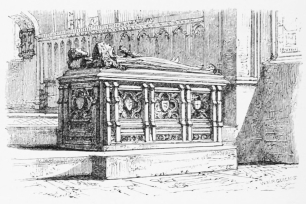
"Harrow, Nov. 25, Sunday.—Yesterday I walked here with my bundle, meeting Kate at the foot of the hill.... To-day we have been to the Chapel Royal at St. James's, where Dr. Vaughan had to preach a funeral sermon for the King of Hanover.[67] The old Duke of Cambridge was there, and startled people by the cordiality of his loud assent—'By all means!' to the invitation 'Let us pray.' I must leave early to-morrow morning, as I have promised to be at Southgate at 9 A.M."
"Nov. 28.—We are in the depth of examinations. Some of the fellows are so excited about them, that they do not go to bed at all, only lie down on the rug at 5 A.M. for a short rest before dawn. To-morrow is the 'great Napoleon stakes, when all the horses are to run.' I think we shall have a pretty jumble, as we are to go to sleep on Napoleon and wake on Charles V.—such a confusion of campaigns (fifteen of Napoleon's) and places, and the passage and flow of all the rivers the two heroes ever crossed."
"Dec. 15.—On Thursday evening all the other fellows rushed up to my room shouting 'Ichabod! Hare is plucked in Charles V.' They were enchanted, because they thought it so conceited of me to take up the additional subject; but their triumph was a short one, for it was soon discovered that only half the marks had been added up.
"Friday was a very long examination in the Bible. Amongst the questions were—'Give the size, population, and government of Nineveh; the route of Jonah to Nineveh from Joppa; the religions of the sailors; where you suppose Tarshish to be, and the reason of your supposition; who were Tirshakeh, Adoram, &c.' It was a most interesting examination to get up. Yesterday was Euclid. It was much easier than I expected, and finished by twelve, so Bradley sent me to London on a commission. I had also time to go to the Bunsens, who were at luncheon, but when I sent in my card, they sent for me into the dining-room. Several gentlemen were there: I believe one of them was the Duke of Nassau. Madame Bunsen is always most kind in her welcome."
My visit to Wells took place, and was most delightful. Mrs. Brymer was the eldest granddaughter of John Lyon of Hetton, youngest brother of my great-grandmother Lady Anne Simpson, and she and her husband Archdeacon Brymer were most kind, genial, benevolent people, who had no children, but lived very luxuriously in a charming house in "the Liberty" at Wells. I had made their acquaintance at Bath when I was with Mrs. Barrington. Though it was bitterly cold weather, I made many drawings of Wells, which I have always thought the most perfectly beautiful cathedral town in England, with its clear rushing water, old palace and gateways, grand cathedral, and luxuriant surrounding orchards. It was a visit I looked forward to repeating very often, but the kind Archdeacon and his wife died—almost at the same time—very soon afterwards.
All through the year 1851 the Père La Vigne had been preaching constantly at Rome at the Church of S. Luigi dei Francesi. "Italima" had gone to hear him, with many other Protestant ladies. One evening she said to her faithful Victoire that she wished to be dressed very early the next morning—in black, with a veil, as if for the Sistine. Victoire did her bidding, and she went out early, and returned in the course of the morning, when she called Victoire to her, and said, embracing her, "A présent nous sommes vraiment sœurs; nous avons été toujours sœurs; à présent nous le sommes doublement."—"Qu'est que cela veut dire?" said Victoire to herself.—"Je suis devenue catholique," continued Italima; "je l'ai été toujours au fond du cœur, à présent je le suis en réalité." She then called Félix and took him by the hand—"Victoire vous expliquera tout," she said. Lady Lothian had been the "marraine," and, added to the influence of the Père La Vigne, had been that of Manning, himself a recent convert to the Catholic Church. That evening Italima said to Victoire, "Nous allons avoir la guerre dans la maison," and so it was. My sister discovered (at a ball, I believe) the next day what had happened, and she was quite furious—"en vraie tigresse." "Il n'y avait pas de reproches qu'elle ne faisait à sa mère" (records Victoire); "elle disait à sa mère qu'elle ne voulait plus de elle. Elle se renferma avec sa tante. Cela dura plus que deux ans." To Victoire herself she never spoke at all for several months.
For two whole years my sister deserted the drawing-room of Palazzo Parisani, and lived shut up with her aunt in her boudoir. Their chief occupation was drawing in charcoal, in which singular art they both attained a great proficiency. Esmeralda never spoke to her mother unless it was necessary. Italima must have led rather a dreary life at this time, as other events had already weakened her connection with the members of her own family and most of her old friends, and her change of religion widened the breach for ever.
Lord and Lady Feilding[68] had been most active in urging and assisting Italima's change of religion, and they now turned to my sister, leaving no means untried by which they might make her dissatisfied with the Protestant faith. As they left Rome, Lord Feilding put into her hand a long controversial letter, imploring her to study it. That very spring his own faith had been strengthened by a supposed miracle in his family. Lady Feilding had long been ill, and had partly lost the use of her limbs from sciatica. She had to be carried everywhere. All kinds of baths and doctors had been tried in vain. The case was almost given up, when Pope Pius IX. advised him to apply to a family of peasants living in the mountains above Foligno, who possessed a miraculous gift of healing. St. Peter, it was said, had passed by that way and had lodged with them, and, on taking leave, had said that of silver and gold he had none to give them, but that he left with them his miraculous gift of healing, to be perpetuated amongst their descendants. A messenger was despatched to this favoured family, and returned with a venerable old peasant, respectably dressed, who went up to Lady Feilding, and, after reciting the Lord's Prayer, Hail Mary, and Apostles' Creed, said, "Per l'intercessione dei Sti. Apostoli S. Pietro e S. Paolo siete guarita da tutti i mali come speriamo." He passed his hand rapidly over her limbs, and making the sign of the cross, said, "In nomine Patris et Filii et Spiritus Sancti"—and added, "E finito." Then Lady Feilding felt her limbs suddenly strengthened, and rising, walked upstairs like other people, which she had not done for many months, and the same afternoon went to St. Peter's to return thanks, walking all over that enormous basilica without pain.[69][70] Her illness returned slightly, however, in the following winter, and in the summer of 1853 she died of consumption at Naples. Her death was a great grief to Italima.
It was in the Carnival of 1852, immediately after her mother's change of religion, that my sister, after the then fashion of Roman ladies, was seated in one of the carriages which in a long line were proceeding slowly up the Corso, and whose inmates were employed in pelting those of the carriages which met them with bouquets and bonbons. As she was eagerly watching for her friends amongst those who passed, my sister observed in one of the carriages, dressed in deep mourning among the gay maskers, a lady who clasped her hands and looked at her fixedly. The expression of the lady was so peculiar, that when her carriage reached the end of the Corso and turned round at the Ripresa dei Barberi, my sister watched carefully for her reappearance in the opposite line of carriages which she was now again to meet. Again she saw the lady, who again looked at her with an expression of anguish and then burst into tears. The third time they met, the lady laid upon my sister's lap a splendid nosegay of azaleas and camellias, &c., quite different from the common bouquets which are usually thrown about in the Carnival.
When my sister went home, she told her little adventure to her aunt and mother while they were at dinner, but it did not make any great impression, as at Rome such little adventures are not uncommon, and do not create the surprise they would in England.
The next morning at breakfast the family were again speaking of what had happened, when the door opened, and Félix came in. He said that there was a lady in the passage, a lady in deep mourning, who gave her name as the Comtesse de Bolvilliers, who wished to speak to Italima at once on important business. At that time there were a great many lady quêteuses going about for the different charities, and most of them especially anxious to take advantage of the new convert to their Church. Therefore Italima answered that she was unable to receive Madame de Bolvilliers, and that she knew no such person. In a minute Félix returned saying that Madame de Bolvilliers could not leave the house without seeing Mrs. Hare, for that her errand involved a question of life and death. She was then admitted.
The lady who came into the room at Palazzo Parisani was not the lady my sister had seen in the Corso. She said she was come to tell a very sad story, and besought Italima to have patience with her while she told it, as she was the one person who had the power of assisting her. She said that she had a sister-in-law, another Countess de Bolvilliers, who was then living at the Palazzo Lovati in the Piazza del Popolo: that at the beginning of the winter her sister-in-law had come to Rome accompanied by her only daughter, in whom her whole life and love were bound up: that her daughter was of the exact age and appearance of my sister, and that she (the aunt) felt this so strongly, that it seemed to her, in looking upon my sister, as if her own niece was present before her: that soon after they came to Rome her niece had taken the Roman fever, and died after a very short illness: that her sister-in-law had been almost paralysed by grief, and had fallen into a state of mental apathy, from which nothing seemed able to rouse her. At last fears were entertained that, if her body recovered, her mind would never be roused again, and, two days before, the doctors had advised resorting to the expedient of a violent mental transition, and had urged that as Madame de Bolvilliers had remained for several months in her room, in silence and darkness, seeing no one, she should suddenly be taken out into the full blaze of the Carnival, when the shock of the change might have the effect of re-awakening her perceptions. At first the experiment had seemed to succeed; she had taken notice and recovered a certain degree of animation; but then, in the Carnival, she had seen what she believed to be her daughter returned from the grave; upon her return home, she had fallen into the most fearful state of anguish, and they had passed the most terrible night, the unhappy mother declaring that her lost daughter had returned to life, but was in the hands of others. The sister-in-law implored that Italima would allow her daughter to return home with her to the Palazzo Lovati, in order to prove that she was a living reality, and not what she was believed to be.
My sister at once put on her bonnet and walked back with the second Countess de Bolvilliers to the Palazzo Lovati, where the family rented the small apartment at the back of the courtyard. When they entered her room, the unhappy mother jumped up, and throwing her arms round my sister, declared that she was her daughter, her lost daughter, come back to her from the dead. Gradually, but very gradually, she was induced to believe in my sister's separate identity. When she became convinced of this, she declared her conviction that a person who so entirely resembled her daughter in appearance and manners must resemble her in character also; that she was herself very rich (her husband had been a Russian), and that if my sister would only come to live with her and be a daughter to her in the place of the one she had lost, she would devote her whole life to making her happy, and leave all her fortune to her when she died. My sister declared that this was impossible; that she had a mother of her own, whom she could not leave; that it was impossible for her to live with Madame de Bolvilliers. The Countess flung herself upon her knees, and implored and besought that my sister would reconsider her determination, but Esmeralda was inexorable. The Countess then said that she was of a very jealous disposition; that it was quite impossible that she could go on living in the world, and feeling that her daughter's living representative was the child of another,—that she should leave the world and go into a convent. My sister, whose antagonism to Roman Catholicism was just then at its height, besought her to reconsider this, urged the many opportunities which were still left to her of being useful in the world, and the folly of throwing away a life which might be devoted to the highest aims and purposes. But Madame de Bolvilliers, on her part, was now firm in her determination. Esmeralda then begged that she might sometimes be allowed to hear from her, and said that she should be glad to write to her; that, though she could not live with her and be her daughter, she could never lose the interest she already felt about her. But Madame de Bolvilliers said, "No! she could not have half love; she must either have my sister altogether, or she must never hear from her; that would try her and tantalise her too much." My sister then begged that she might at any rate be allowed to hear of her once—of her well-being and happiness, and, after much entreaty, Madame de Bolvilliers said, "Yes, after a year has expired, if you inquire at a certain house in the Rue S. Dominique at Paris, you shall hear of me, but not till then." She then went into the next room, and she came back with a number of jewels in her hands. "These," she said, "were the jewels my daughter wore when she was with me. I must have one last pleasure—one last consolation in this world, in fastening them upon the person of my daughter's living representative upon earth." And so saying, she fastened the necklace, bracelets, &c., upon my sister, who possessed these, the Bolvilliers jewels, till the day of her death. More than a year elapsed and nothing whatever was heard of the Countess.
LE TOMBEAU NAPOLEON.
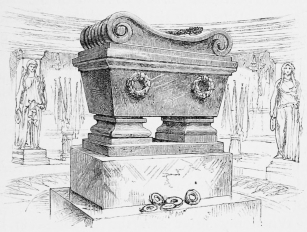
In 1854, Italima and my sister were passing through Paris. They drove to see the Tombeau Napoleon, which was then newly erected at the Invalides. As they returned, and as they were turning a corner, the name "Rue S. Dominique" caught my sister's eyes. "Oh," she said, "the year has expired, and this is the place where we were to inquire after the Countess de Bolvilliers;" and in spite of her mother's assurance that it was useless to look for her, she insisted upon driving to the number the Countess had indicated; but the portress declared that she knew of no such person as Madame de Bolvilliers. Upon this Italima said, "Well, now you see how it is; I always told you she gave you a false direction, because she did not wish you to find her out, and you will never discover her." "But to find her I am perfectly determined," said my sister, and she insisted on getting out of the carriage and knocking at every door down the long extent of the Rue S. Dominique to make inquiries, but without any result. Her mother followed in the carriage, very angry, but quite vainly urging her to get in. Having done one side of the street, Esmeralda insisted upon going up the other, and inquiring at every door in the same way. Her mother stormed to no purpose. She then insisted upon going back to the first house and inquiring who did live there. "Oh," said the portress, "it is a convent of the Sacré Cœur." When my sister heard this, she asked for the Superior, and said, "Is there any one here whose real name it may generally be thought better to conceal, but who was once known in the world as the Countess de Bolvilliers?" And the Superior said, "You then are the lady who was to come from Rome in a year's time: you are exactly the person who has been described to me. Yes, Sister Marie Adelaïde was once known in the world as Madame de Bolvilliers."
When my sister saw the Countess in her nun's dress, she found her perfectly calm and satisfied. She no longer reproached my sister for not having consented to live with her. She did not regret the step she had taken; she was perfectly happy in her convent life with its regular duties and occupations. She was also pleased that my sister should frequently go again to see her. My sister went very often, and, while visiting her, was introduced to the famous controversialist nun Madame Davidoff, by whose teaching and arguments she was converted to the Roman Catholic Church.
The last thing Italima wished was that her daughter should become a Roman Catholic, for my sister was at that time a considerable heiress, the whole of her aunt's fortune being settled upon her, as well as that which Italima had derived from Lady Anne Simpson. And Italima knew that if my sister changed her religion, her aunt, a vehement Protestant, would at once disinherit her.
My sister said nothing to her mother of what was going on. It was supposed that Madame de Bolvilliers was the only cause of her visits to the Sacré Cœur. She also said nothing to her aunt, but her aunt suspected that all was not right. My sister had abstained from going to church on one pretext or another, for several Sundays. Easter was now approaching. "You will go to church with me on Good Friday, won't you, Esmeralda?" Aunt Eleanor kept saying.
At last Good Friday came. Aunt Eleanor, according to her habit, went in early to see my sister before she was up. My sister was more affectionate than usual. As soon as her aunt was gone, she got up and dressed very quickly and went off with her maid to the Sacré Cœur. In her room she left three letters—one to her mother, bidding her come to the church of the convent on a particular day, if she wished to see her received: one to her aunt, telling her that her determination was irrevocable, but breaking it to her as gently as she could: and one to her greatest friend, Marguerite Pole, begging her to go at once to her aunt to comfort her and be like a daughter in her place. "When Miss Paul read her letter," said Victoire, "her lips quivered and her face became pale as ashes. But she said no word to any one: it was quite awful, she was so terribly calm. She took up her bonnet from the place where it lay, and she walked straight downstairs and out of the house. We were so alarmed as to what she might do, that I followed her, but she walked quite firmly through the streets of Paris, till she reached Sir Peter Pole's house, and there she went in." Aunt Eleanor went straight up to Sir Peter Pole, and told him what had happened. Sir Peter was a very excitable man, and he immediately rang the bell and sent for his daughter Marguerite. When she came he said, "Esmeralda Hare is about to become a Roman Catholic; now remember that if you ever follow her example, I will turn you out of doors then and there with the clothes you have on, and will never either see you or hear of you again as long as you live." The result of this was that within a week Marguerite Pole had become a Roman Catholic. Of what happened at this time my sister has left some notes:—
"It was Madame Davidoff who led Marguerite Pole across the courtyard of the Sacré Cœur to the little room at the other side of it, where the Père de Ravignan was waiting for her. As she opened the door he looked up in an ecstasy. 'Voilà trois ans,' he said, 'que je prie pour votre arrivée, et vous voilà enfin.' She was quite overcome, and told him that for three years she had seen a figure constantly beckoning her forward, she knew not whither. The Père de Ravignan answered, 'I believe that you will see that figure for the last time on the day of your première communion;' and so it was: the figure stood by her then, and afterwards it disappeared for ever.
"At the first Sir Peter had said that he would turn Marguerite out of doors, and his fury knew no bounds. One evening Marguerite sent her maid privately to me with a note saying, 'To-morrow morning I shall declare myself: to-morrow my father will turn me out of doors, and what am I to do?' 'Oh,' I said, 'only have faith and watch what will happen, for it will all come right.' And sure enough, so it seemed at the time, for the next morning Sir Peter sent for his housekeeper and said to her, 'I've changed my mind; Miss Marguerite shall not go away; and I've changed my mind even so much that I shall send to Mrs. Hare and ask her to take me with her when she goes to see her daughter make her première communion.'
"It was quite a great function in the church of the Sacré Cœur. I was terrified out of my wits when I saw the crowd in the church, and in the chancel were the Bishop, the Papal Nuncio, and all the principal clergy of Paris, for it was quite an event. Marguerite and I were dressed in white, with white veils and wreaths of white roses. As the Papal Nuncio came forward to place his hands on our heads, in the very act of confirmation, there was a fearful crash, and Sir Peter fell forward over the bench just behind us, and was carried insensible out of the church. Mamma went with him, for she thought he was dying. When he came to himself his first words were—'Louisa, Louisa! I have seen Louisa.' He had seen Lady Louisa Pole.
"When Lady Louisa was dying she said to Marguerite, 'My child, there is one thing I regret; it is that I have had doubts about the Roman Catholic Church, and that I have never examined.'"
Of this time are the following notes by Victoire:—
"When your sister first insisted upon going to the Sacré Cœur, she said it was 'pour voir.' 'O comme c'est drôle,' I said to Madame Hare. But your sister was always obstinate in her own intentions. 'Je veux examiner la religion catholique au fond,' she said, 'ainsi que la religion protestante.' She got all the books. She read those on both sides. Then she went to the Sacré Cœur again. Her maid went to her three times a day. One day she took her a great many things. 'What is it you take to Mademoiselle?' I said. 'I take what she ordered me,' answered the maid, and I said no more: but it was really the white dress, the veil, and all that was required for the reception. The next day I had a note from Mademoiselle asking me to come to her at eight o'clock. I showed it to Madame. 'Eh bien, nous irons ensemble,' she said, and we went together in the carriage. When we reached the Sacré Cœur, we were shown at once to the chapel, and then I began to suspect. All the nuns were assembled. At last a door opened and your sister came in, all in white, with a long white veil on her head. She walked in firm and erect, and knelt down at a prie Dieu in the aisle. The Père de Ravignan made a most touching discourse. He bade her, if she still felt any doubts, to remember that there was still time; he urged her not to come forward without true faith. At the end of his discourse she walked firmly up to the altar and knelt on the steps. She remained there while mass was said. After it was over she was taken into the garden. There she embraced her mother and me. A collation was then served.... Nothing was said about her going away. 'Voulez vous amener votre fille?' said one of the nuns at last to Madame Hare. 'Je la laisse parfaitement libre maintenant et toujours,' she replied. 'Oh comme Mademoiselle était belle ce jour-là; elle était fraîche, elle allait si bien avec ce grand voile blanc, et ses beaux cheveux noirs, et ses grands yeux: elle avait du couleur, elle était vraiment ravissante! elle était radieuse!... Dans ce temps-là elle était la reine de tous les bals—à l'ambassade, à la cour, partout: mais elle n'était jamais plus ravissante de sa beauté que ce jour-là dans le couvent.'"
The Dowager Lady Lothian[71] once told me that in the letter of condolence which Madame Davidoff wrote to my sister after her mother's death she said, "The cross which you saw on the day of your first communion has been very heavy, but it has never crushed you." On the day of her first communion she saw a huge black cross between her and the altar. She lay on the ground, and it advanced to crush her, only it seemed as if an invisible power upheld it, and then she saw that the top was wreathed with flowers. Oh, how prophetic was this vision of the cross!
A few days after her reception, Sir Peter Pole fulfilled his word with regard to his daughter Marguerite. He turned her out of his house, and he never would allow her name to be mentioned again. Not only to her father, but to my sister, and to her own sister, Alice Pole, every trace of her was lost. How my sister met Marguerite Pole again, and of her extraordinary history in after years, will be told later in these volumes.
I have been anticipating greatly, but it seems impossible to break up a connected story into the different years in which their events occurred. Meantime, without any romantic excitement and far removed from religious controversy, our quiet existence flowed on; though I was always fond of my sister and deeply interested in the faint echoes which from time to time reached me from her life.
Mrs. Alexander was now settled at the Rectory at Hurstmonceaux, and she ruled as its queen. Uncle Julius consulted her even on the smallest details; she ordered everything in the house, she took the leading part with all the guests, everything gave way to her. And the odd thing was that Mrs. Julius Hare (Aunt Esther), instead of being jealous, worshipped with greater enthusiasm than any one else at the shrine of the domestic idol. I have met many perfectly holy and egotistical women, but Mrs. Alexander was the most characteristic specimen.
CANON STANLEY'S HOUSE, CANTERBURY.
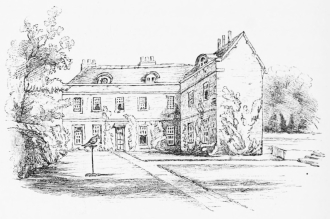
In the summer of 1851, Arthur Stanley had been appointed to a canonry at Canterbury, which was a great delight to me as well as to him. "One of my greatest pleasures in going to Canterbury is the thought of Augustus's raptures over the place and the cathedral," he wrote to my mother. And truly I did enjoy it, and so did he. The eight years he spent at Canterbury were certainly the happiest of his life. We spent part of my winter holidays there with him and his family. Mrs. Grote used to describe Arthur truly as "like a sausage, packed so full of information;" and, with many peculiarities, he was the most charming of hosts, while his enthusiastic interest peopled every chapel, every cloister, every garden, with historic memories. Arthur Stanley's was now the most stimulating companionship possible. He had lost all the excessive shyness which had characterised his youth, and talked on all subjects that interested him (ignoring those which did not) with an eloquence which "se moque de l'éloquence," as Pascal says. His canonry was situated in its own garden, reached by the narrow paved passage called "the Brick Walk," which then intersected the buildings on the north-east of the cathedral. Just behind was the Deanery, where the venerable Dean Lyall used to be seen walking up and down daily in the sun in the garden which contained the marvellous old mulberry tree, to preserve the life of which a bullock was actually killed that the tree might derive renewed youth from its blood. The fact that a huge bough rent asunder[72] from this old tree had taken root, and become even more flourishing than the parent stem, was adapted as an illustration by Arthur Stanley in a lecture in which he likened the two trees to the Churches of Rome and England.
Enchanting indeed were the many ancient surroundings of the mighty cathedral—the Baptistery with its open arches and conical roof half buried in ivy; the dark passage haunted by "Nell Cook;" the Norman staircase, so beautiful in colour; the Pilgrim's Inn, down a narrow entry from the street; the many tombs of the archbishops; and most of all the different points through which one could follow Thomas à Becket so vividly through his last hours from his palace to his martyrdom. I made many drawings, chiefly in pencil and sepia, for my mother and aunt deprecated colour. "Until you can draw perfectly you have no right to it. Do one thing well, and not two badly," they said. Of course they were right; and though often abashed and distressed by Aunt Kitty's dictum—"Crude, coarse, harsh, and vulgar," after looking at my sketches, I always felt the slight meed of praise just possible from her lips a prize well worth striving for. I owe much to her (as to my mother's) constant inquiry, after I had done a drawing I was conceitedly proud of, as to what each line meant, and unless I could give a good account of its intention, desiring me to rub it out; thus inculcating the pursuit of truth, which she urged in drawing as in all else, instead of striving after unattainable excellence.
SITE OF BECKET'S SHRINE, CANTERBURY.
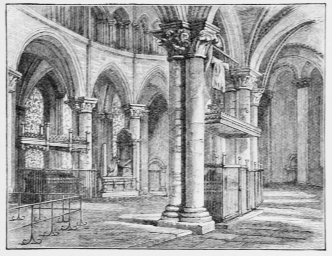
One great interest of this winter was going with Arthur Stanley excursions to Bozledeane Wood and tracing out on the spot the curious history of the so-called Sir William Courtenay, which is so strangely at variance with the usually matter-of-fact character of the present century. Briefly, the story is that of John Nichols Tom, son of a maltster at Truro, who ran away from his wife, and, going to Canterbury, announced himself as Sir William Courtenay, and laid claim to the title and rights of the Earls of Devon. His dress was most extraordinary—a scarlet robe with a crimson hanger. He was taken up, tried for perjury, and confined in a lunatic asylum, but, while there, contrived to interest Sir Edward Knatchbull in his behalf, and obtained his release by Sir Edward's influence with Lord John Russell. On his return to Canterbury in 1838, he gave out that he was not only Sir William Courtenay, but Jesus Christ himself. It was not so much his dress, as his long flowing hair, his beard, his perfect proportions, his beauty and height, which lent themselves to his story, and his wonderful resemblance to the well-known pictures of the Saviour. The rustics and tradesmen welcomed him, and really believed in him. With forty of his most devoted disciples he took up his abode in a village near Canterbury. He was always preaching, and the chief part of his doctrine was faith—faith in himself. He formed a plan of storming Canterbury and seizing the cathedral on Whitsunday, when all the people were at the service there. But this plan was frustrated and he lived in comparative quietude till Michaelmas. Then a constable was sent to arrest him. The constable found Courtenay with his forty disciples at breakfast at a farmhouse near Bozledeane Wood, and when Courtenay saw him approach, he went out, shot him, and leaving him writhing in agony upon the ground, returned, perfectly unruffled, to finish his repast. After breakfast "Sir William Courtenay" led his disciples down the path, which still remains, into a hollow by a little stream in the heart of the wood. Here his followers, under Colonel Armstrong, a fanatical leader from Canterbury, threw up an earthwork, behind which they entrenched themselves, and here they were surrounded by a body of troops sent out in three bands to encompass them. Lieutenant Bennet, who was in command, was sent forward to parley with the impostor. Courtenay, who stood under a tree, waited till he came close up, and then shot him through the heart! The troops then rushed forwards, but the fanatics, though greatly astonished at the death of Courtenay, who, in spite of his professed invulnerability, fell in the first onset, fought with fury, and defended themselves with their bludgeons against the muskets of the soldiers. At last seven of them were killed and the rest taken prisoners.
Mr. Curteis, the Principal of St. Augustine's College, who went with us to Bozledeane Wood, described the scene after the battle, the pools of blood, the trees riddled with shot, the bodies lying in the public-house, and the beautiful hair of Courtenay being cut off and distributed amongst the people. It was fourteen years afterwards that we visited the spot. We went to the farmhouse where the last breakfast was held and the gate where the constable was shot. The view was beautiful over the Forest of Blean to the sea, with the line of the Isle of Sheppey breaking the blue waters. A boy guided us down the tangled path to the hollow where the battle took place by the little stream, said to be now frequented by the white squirrel and badger. The "stool" of the tree under which Courtenay stood had lately been grubbed up. The boy described Courtenay and his forty men lying on a green mossy bank talking, the evening before they were attacked, and his giving "bull's-eyes" to all the children on the morning of the battle. Courtenay had great powers of attracting all who came in contact with him. A girl belonging to the farmhouse (who on a previous occasion had knocked his arm aside when he would have shot a magistrate) rushed about during the engagement to give water and help to the dying, perfectly regardless of the bullets which were flying around her. And after his death his wife turned up, "Mrs. Tom" from Truro, most deeply afflicted, for "he was the best of husbands!"
I liked better being with the Stanleys at Canterbury than in London, where they talked—as people in London do talk, and where my dearest mother, who had lived only in the narrowest groove latterly, and especially as to religious things, often felt it necessary to "testify to her religious profession" in a way which was even more a mortification than a pain to me. After we began to go abroad, and she was removed from the "mutual admiration society" at Hurstmonceaux, she took a wider view of everything,[73] and had a far better and more general influence in consequence. But there was a time when my mother, so infinitely tender and gentle in her own nature, almost seemed to have lost her hold upon the liberality and gentleness of the Christian gospel in her eager espousal of the doctrine of fire and worms beyond the grave. I think it is St. Jerome who says, "Desire rather to act Scripture than to write about it, to do rather than to say holy things."
To MY MOTHER.
"Southgate, Feb. 10, 1852.—My own dearest mother, I am settled here again after my most happy holidays, with the old faces round me, and the old tiresome conversation about nothing but the comparative virtues of ruff pigeons and carriers.... The last part of the holidays at Canterbury was indeed perfectly delightful, and I enjoyed it—oh! so much. I shall work very hard, and tell Arthur I shall be quite ready for an examination on Pericles, Marathon, and Arbela when I see him again. I am afraid Aunt Kitty thought me awfully ignorant of Greek history, but I really never have had anything to do with it.[74] I think of you and your walk through the beautiful cloister when I plod through the muddy village to our hideous chapel. It is very smoky and dirty and misty, but—I will not be discontented."
"Feb. 14.—And now I think of my dearest mother at home again, sitting in the evening in her own arm-chair in Peace Corner, with her little table and her Testament, and John and my Fausty[75]—all white and clean—bringing in the supper, and, oh! how nice it must be!"
STEPS AT LIME.
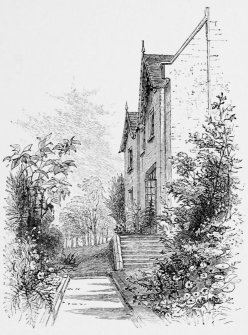
It was very soon after her return from Canterbury that my mother, going to visit a sick woman in the village, slipped down a turfy frostbound bank near some steps in the garden at Lime. Unable to make any one hear her cries for help, she contrived to crawl to the back part of the house, whence she was carried to a sofa, and a doctor was sent for, who found that her leg was broken. After very many weeks upon a sofa, all lameness was cured, but the confinement, to one used to an active life, told seriously upon her health, and my dearest mother was always liable to serious illness from this time, though her precious life was preserved to me for nineteen years to come. Henceforward I never left her without misery, and when with her was perhaps over-anxious about her. Mr. Bradley wisely sent me at once to her for a day that I might be reassured, and I feel still an echo of the pang with which I first saw her helpless—as I so often saw her afterwards. How I remember all the sheltered spots in which Lea and I found primroses for her in the one day I was at home in this bitterly early spring!
To MY MOTHER (after returning to Southgate).
"March 13, 1852.—Yesterday we had 'a truce,' so I hurried to see Gerard's Hall in Bow Lane before its demolition. It has latterly been an inn, with a statue of Gerard the Giant over the door. A wooden staircase leads into the wine-cellar, once Gerard's Crypt, possessing slender arches and pillars, most beautiful in colour, and forming wonderful subjects for pictures, with pewter pots and stone pitchers thrown about in confusion."
"April 29.—I have been to see Mrs. Gayford, the nurse who brought me over to England. She is very poor, and lives in an attic in the New Wharf Road, but was enchanted to see me. I sate upon the old seachest which has been often with her to India, and heard the history of her going to Mannheim and meeting my father with his 'weak baby—very passionate, you know, but then it's in the nature of such young gentlemen to be so.' And then she described the journey and voyage, and my ingratitude to a lady who had been very kind to me by slapping her in the face when she was sea-sick."
"June 15.—We are in the midst of an examination in Thierry's 'Norman Conquest.' At nine we all assemble in the dining-room, and the greatest anxiety is exhibited: the 'prophets' proclaim their views on the issue of the day, and the 'hunters' speculate upon the horses who are to 'run in the Thierry stakes.' Bradley comes in with the papers and gives one to each, and from that time we are in custody: no one can exchange a word, and two fellows may never go up to the table together. When we have done that set of questions, generally between one and three o'clock, we are at liberty till five, and then we are in custody again till we have done the next, at nine, ten, or eleven. Bradley is on guard all day, or, if he is obliged to go out, Mrs. B. mounts guard for him. They cannot employ themselves, as they have always to wander up and down the rows of writers with their eyes.... I like the life during these examinations, there is so much more excitement than over ordinary work, and one never has time to get stupid, but the others do nothing but bemoan themselves."
I think it must have been on leaving Southgate for the summer that I paid a visit of one day to "Italima" and my sister in a house which had been lent them in Grosvenor Square. It was then that my sister said, "Mamma, Augustus is only with us for one day. We ought to take the opportunity of telling him what may be of great importance to him: we ought to tell him the story of the 'Family Spy.'" What I then heard was as follows:—
For many years my sister had observed that she and her mother were followed and watched by a particular person. Wherever they went, or whatever they did, she was aware of the same tall thin man dressed in grey, who seemed to take a silent interest in all that happened to them. At last this surveillance became quite disagreeable and they tried to escape it. One spring they pretended that they were going to leave Rome on a particular day, announced it to their friends, and made secret preparations for quitting Rome a week earlier. They arrived in safety within a few miles of Florence, when, looking up at a tall tower by the side of the road, my sister saw the face of the Family Spy watching them from its battlements. Another time they heard that the Spy was ill and confined to his bed, and they took the opportunity of moving at once. As their vetturino carriage turned out of the piazza into the Via S. Claudio, in order to attain the Corso, which must be passed before reaching the gate of the city, the narrow street was almost blocked up by another carriage, in which my sister saw the emaciated form of the Family Spy propped on pillows and lying on a mattress, and which immediately followed them. Constant inquiries had long since elicited the fact that the Spy was a Sicilian Marquis who had been living at Palermo when my parents were there, and whose four children were exactly the same age as their four children. Soon afterwards his wife and all his children were swept away at one stroke by the cholera, and he was left utterly desolate. With characteristic Sicilian romance, he determined to create for himself a new family and a new interest in life by adopting the other family, which was exactly parallel to his own, and of which only the father had been removed—but adopting it by a mysterious bond, in which the difficulty of a constant surveillance should give entire occupation to his time and thought. When Italima heard this, after making inquiries about him which proved satisfactory, she sent to the Spy to say that she thought it much better this secret surveillance should end, but that she should be happy to admit him as a real friend, and allow him to see as much as he liked of the family in which he took so deep an interest. But, though expressing great gratitude for this proposal, the Spy utterly declined it. He said that he had so long accustomed himself to the constant excitement of his strange life, that it would be quite impossible for him to live without it; that if ever an opportunity occurred of rendering any great service to the family whose fortunes he followed, he would speak to them, but not till then.
When I had been told this story, my sister and Italima took me out in the afternoon to drive in the Park. As we were passing along the road by the Serpentine, my sister suddenly exclaimed, "There, look! there is the Family Spy," and, among those who walked by the water, I saw the tall thin grey figure she had described. We passed him several times, and he made such an impression upon me that I always knew him afterwards. My sister said, "If you look out at ten o'clock to-night, you will see him leaning against the railing of Grosvenor Square watching our windows,"—and so it was; there was the tall thin figure with his face uplifted in the moonlight.
In 1852 the extravagance of my two brothers Francis and William was already causing great anxiety to their mother. Francis, who had lately obtained his commission in the Life-Guards through old Lord Combermere, had begun to borrow money upon the Gresford estate. William, who was in the Blues, with scarcely any fortune at all, had plunged desperately into the London season. When winter approached, their letters caused even more anxiety on account of their health than their fortunes: both complaining of cough and other ailments. One day, in the late autumn of 1852, my sister, coming into the diningroom of the Palazzo Parisani, found her mother stretched insensible upon the hearth-rug, with a letter open in her hand. The letter was from the new Sir John Paul, who had not in the least got over his first anger at his sister's change of religion, and who wrote in the cruellest and harshest terms. He said, "Your eldest son is dying. It is quite impossible that you can arrive in time to see him alive. Your second son is also in a rapid decline, though if you set off at once and travel to England without stopping, you may still be in time to receive his last words."