Volume 2 — CONTENTS VOLUME 2
Reading edition
PAGE
OXFORD LIFE1
FOREIGN LIFE32
WORK IN SOUTHERN COUNTIES130
WORK IN NORTHERN COUNTIES259
HOME LIFE WITH THE MOTHER367
LIST OF ILLUSTRATIONS VOL. II
The illustrations may be viewed enlarged by clicking on them. In order to ease the flow of reading, some of the illustrations have been moved to before or after the paragraph in which they appeared in the book. (note of etext transcriber)
MARIA HARE. From G. Canevari. (Photogravure)Frontispiece
PAGE
DRAWING-ROOM, LIME15
FROM THE DEAN'S GARDEN, CANTERBURY24
LA MADONNA DEI. SASSO, LOCARNO45
IN S. APOLLINARE NUOVO, RAVENNA48
LORETO51
MACERATA53
CIVITA CASTELLANA55
VALMONTONE77
ROCCA JANULA, ABOVE SAN GERMANO79
CAPRI82
PÆSTUM83
VALLOMBROSA85
AUGUSTUS J. C. HARE. From G. Canevari. (Photogravure)To face 96
PONTE ALLA MADDALENA, LUCCA96
PIETRA SANTA102
IL VALENTINO, TURIN107
VILLAR, IN THE VAUDOIS110
NOTRE DAME, PARIS117
THE PONT NEUF, PARIS124
PORT ROYAL126
CATHERINE STANLEY. From E. U. Eddis. (Photogravure)To face 132
CANON STANLEY'S HOUSE, OXFORD136
HODNET CHURCH159
GIBSIDE181
OLD BEECHES, HURSTMONCEAUX PARK227
THE ABELES, LIME245
MENTONE248
GRIMALDI251
DOLCEACQUA254
PEGLIONE255
VENTIMIGLIA257
AT DURHAM262
ON ALLEN WATER, RIDLEY HALL273
FORD CASTLE, THE TERRACE281
VIEW FROM HOLMHURST. (Full-page woodcut)To face 286
ENTRANCE TO HOLMHURST: "HUZ AND BUZ"287
ALDERLEY CHURCH AND RECTORY293
WARKWORTH, FROM THE COQUET352
WINTON CASTLE355
THE CHEVIOTS, FROM FORD361
CARROZZA371
ROMAN THEATRE, ARLES378
HÔTEL DU MAUROY, TROYES379
THE KING OF BOHEMIA'S CROSS, CRECY380
S. FLAVIANO, MONTEFIASCONE386
OSTIA391
THEATRE OF TUSCULUM392
AMALFI397
COURMAYEUR410
ANNE F. M. L. HARE. From G. Canevari. (Photogravure)To face 416
ARS421
TOURS465
AT ANGOULÊME467
PAU471
BÉTHARRAM481
BIARRITZ489
THE PAS DE ROLAND491
S. EMILION CATHEDRAL DOOR494
AMBOISE496
VII OXFORD LIFE
"A few souls brought together as it were by chance, for a short friendship and mutual dependence in this little ship of earth, so soon to land her passengers and break up the company for ever."—C. Kinsgley.
"To thine own self be true,
And it must follow, as the night the day,
Thou canst not then be false to any man."
—Shakspeare, Polonius to Laertes.
"IF you would escape vexation, reprove yourself liberally and others sparingly."—CONFUCIUS.
It was the third year of our Oxford life, and Milligan and I were now the "senior men" resident in college; we sat at one of the higher tables in hall, and occupied stalls in chapel. We generally attended lectures together, and many are the amusing tricks I recall which Milligan used to play—one especially, on a freshman named Dry—a pious youth in green spectacles, and with the general aspect of "Verdant Green." An undergraduate's gown is always adorned with two long strings behind; these strings of Dry, Milligan adroitly fastened to mine, and, inventing one excuse after another, for slipping round the room to open the door, shut a window, &c., he eventually had connected the whole lecture in one continuous chain; finally, he fastened himself to Dry on the other side; and then, with loud outcries of "Don't, Dry,—don't, Dry," pulled himself away, the result being that Dry and his chair were overturned, and that the whole lecture, one after another, came crashing on the top of him! Milligan would have got into a serious scrape on this occasion, but that he was equally popular with the tutors and his companions, so that every possible excuse was made for him, while I laughed in such convulsions at the absurdity of the scene, that I was eventually expelled from the lecture, and served as a scapegoat.
I think we were liked in college—Milligan much better than I. Though we never had the same sort of popularity as boating-men and cricketers often acquire, we afforded plenty of amusement. When the college gates were closed at night, I often used to rush down into Quad and act "Hare" all over the queer passages and dark corners of the college, pursued by a pack of hounds who were more in unison with the general idea of Harrow than of Oxford. One night I had been keeping ahead of my pursuers so long, that, as one was apt to be rather roughly handled when caught after a very long chase, I thought it was as well to make good my escape to my own rooms in the New Buildings, and to "sport my oak." Yet, after some time, beginning to feel my solitude rather flat after so much excitement, I longed to regain the quadrangle, but knew that the staircase was well guarded by a troop of my pursuers. By a vigorous coup d'état, however, I threw open my "oak," and seizing the handrail of the bannisters, slipped on it through the midst of them, and reached the foot of the staircase in safety. Between me and the quadrangle a long cloistered passage still remained to be traversed, and here I saw the way blocked up by a figure approaching in the moonlight. Of course it must be an enemy! There was nothing for it but desperation. I rushed at him like a bolt from a catapult, and by taking him unawares, butting him in the stomach, and then flinging myself on his neck, overturned him into the coal-hole, and escaped into Quad. My pursuers, seeing some one struggling in the coal-hole, thought it was I, and flung all their sharp-edged college caps at him, under which he was speedily buried, but emerged in time to exhibit himself as—John Conington, Professor of Latin!
Meantime, I had discovered the depth of my iniquity, and fled to the rooms of Duckworth, a scholar, to whom I recounted my adventure, and with whom I stayed. Late in the evening a note was brought in for Duckworth, who said, "It is a note from John Conington," and read—"Dear Duckworth, having been the victim of a cruel outrage on the part of some undergraduates of the college, I trust to your friendship for me to assist me in finding out the perpetrators," &c. Duckworth urged that I should give myself up—that John Conington was very good-natured—in fact, that I had better confess the whole truth, &c. So I immediately sat down and wrote the whole story to Professor Conington, and not till I had sent it, and it was safe in his hands, did Duckworth confess that the note he had received was a forgery, that he had contrived to slip out of the room and write it to himself—and that I had made my confession unnecessarily. However, he went off with the story and its latest additions to the Professor, and no more was said.
If Milligan was my constant companion in college, George Sheffield and I were inseparable out of doors, though I often wondered at his caring so much to be with me, as he was a capital rider, shot, oarsman—in fact, everything which I was not. I believe we exactly at this time, and for some years after, supplied each other's vacancies. It was the most wholesome, best kind of devotion, and, if we needed any ennobling influence, we always had it at hand in Mrs. Eliot Warburton, who sympathised in all we did, and who, except his mother, was the only woman whom I ever knew George Sheffield have any regard for. It was about this time that the Bill was before Parliament for destroying the privileges of Founder's kin. While it was in progress, we discovered that George was distinctly "Founder's kin" to Thomas Teesdale, the founder of Pembroke, and half because our ideas were conservative, half because we delighted in an adventure of any kind, we determined to take advantage of the privilege. Dr. Jeune, afterwards Bishop of Peterborough, was Master of Pembroke then, and was perfectly furious at our audacity, which was generally laughed at at the time, and treated as the mere whim of two foolish schoolboys; but we would not be daunted, and went on our own way. Day after day I studied with George the subjects of his examination, goading him on. Day after day I walked down with him to the place of examination, doing my best to screw up his courage to meet the inquisitors. We went against the Heads of Houses with the enthusiasm of martyrs in a much greater cause, and we were victorious. George Sheffield was forcibly elected to a Founder's-kin Scholarship at Pembroke, and was the last so elected. Dr. Jeune was grievously annoyed, but, with the generosity which was always characteristic of him, he at once accorded us his friendship, and remained my most warm and honoured friend till his death about ten years afterwards. He was remarkable at Oxford for dogmatically repealing the law which obliged undergraduates to receive the Sacrament on certain days in the year. "In future," he announced in chapel, "no member of this college will be compelled to eat and drink his own damnation."
In urging George Sheffield to become a scholar of Pembroke, I was certainly disinterested; without him University lost half its charms, and Oxford was never the same to me without "Giorgione"—the George of Georges. But our last summer together was uncloudedly happy. We used to engage a little pony-carriage at the Maidenhead, with a pony called Tommy, which was certainly the most wonderful beast for bearing fatigue, and as soon as ever the college gates were opened, we were "over the hills and far away." Sometimes we would arrive in time for breakfast at Thame, a quaint old town quite on the Oxfordshire boundary, where John Hampden was at school. Then we would mount the Chiltern Hills with our pony, and when we reached the top, look down upon the great Buckinghamshire plains, with their rich woods; and when we saw the different gentlemen's places scattered about in the distance, we used to say, "There we will go to luncheon"—"There we will go to dinner," and the little programmes we made we always carried out; for having each a good many relations and friends, we seldom found we had no link with any of the places we came to. Sometimes Albert Rutson would ride by the side of our carriage, but I do not think that either then or afterwards we quite liked having anybody with us, we were so perfectly contented with each other, and had always so much to say to each other. Our most delightful day of all was that on which we had luncheon at Great Hampden with Mr. and Lady Vere Cameron and their daughters, who were slightly known to my mother; and dined at the wonderful old house of Chequers, filled with relics of the Cromwells, the owner, Lady Frankland Russell, being a cousin of Lady Sheffield's. Most enchanting was the late return from these long excursions through the lanes hung with honeysuckle and clematis, satiated as we were, but not wearied with happiness, and full of interest and enthusiasm in each other and in our mutual lives, both past and present. One of the results of our frequent visits to the scenes of John Hampden's life was a lecture which I was induced to deliver in the town-hall at Oxford, during the last year of my Oxford life, upon John Hampden—a lecture which was sadly too short, because at that time I had no experience to guide me as to how long such things would take.
It was during this spring that my mother was greatly distressed by the long-deferred declaration of Mary Stanley that she had become a Roman Catholic.[109] A burst of family indignation followed, during which I constituted myself Mary's defender, utterly refused to make any difference with her, as well as preventing my mother from doing so; and many were the battles I fought for her.
A little episode in my life at this time was the publication of my first book—a very small one, "Epitaphs for Country Churchyards." It was published by John Henry Parker, who was exceedingly good-natured in undertaking it, for it is needless to say it was not remunerative to either of us. The ever-kind Landor praised the preface very much, and delighted my mother by his grandiloquent announcement that it was "quite worthy of Addison!"
At this time also my distant cousin Henry Liddell was appointed to the Deanery of Christ Church. He had previously been Headmaster of Westminster, and during his residence there had become celebrated by his Lexicon. One day he told the boys in his class that they must write an English epigram. Some of them said it was impossible. He said it was not impossible at all; they might each choose their own subject, but an epigram they must write. One boy wrote—
"Two men wrote a Lexicon, Liddell and Scott; One half was clever, And one half was not. Give me the answer, boys, Quick to this riddle, Which was by Scott And which was by Liddell?"
Dr. Liddell, when it was shown up, only said, "I think you are rather severe."
As to education, I did not receive much more at Oxford this year than I had done before. The college lectures were the merest rubbish; and of what was learnt to pass the University examinations, nothing has since been of use to me, except the History for the final Schools. About fourteen years of life and above £4000 I consider to have been wasted on my education of nothingness. At Oxford, however, I was not idle, and the History, French, and Italian, which I taught myself, have always been useful.
To MY MOTHER.
"Oxford, Feb. 19, 1856.—Your news about dear Mary (Stanley) is very sad. She will find out too late the mistake she has made: that, because she cannot agree with everything in the Church of England, she should think it necessary to join another, where, if she receives anything, she will be obliged to receive everything. I am sorry that the person chosen to argue with her was not one whose views were more consistent with her own than Dr. Vaughan's. It is seldom acknowledged, but I believe that, by their tolerance, Mr. Liddell and Mr. Bennett[110] keep as many people from Rome as other people drive there. I am very sorry for Aunt Kitty, and hope that no one who loves her will add to her sorrow by estranging themselves from Mary—above all, that you will not consider her religion a barrier. When people see how nobly all her life is given to good, and how she has even made this great step, at sacrifice to herself, because she believes that good may better be carried out in another Church, they may pity her delusion, but no person of right feeling can possibly be angry with her. And, after all, she has not changed her religion. It is, as your own beloved John Wesley said, on hearing that his nephew had become a Papist—'He has changed his opinions and mode of worship, but has not changed his religion: that is quite another thing.'"
JOURNAL.
"Lime, March 30, 1856.—My mother and I have had a very happy Easter together—more than blessed when I look back at the anxiety of last Easter. Once when her bell rang in the night, I started up and rushed out into the passage in an agony of alarm, for every unusual sound at home has terrified me since her illness; but it was nothing. I have been full of my work, chiefly Aristotle's Politics, for 'Greats'—too full, I fear, to enter as I ought into all her little thoughts and plans as usual: but she is ever loving and gentle, and had interest and sympathy even when I was preoccupied. She thinks that knowledge may teach humility even in a spiritual sense. She says, 'In knowledge the feeling is the same which one has in ascending mountains—that, the higher one gets, the farther one is from heaven.' To-day, as we were walking amongst the flowers, she said, 'I suppose every one's impressions of heaven are according to the feeling they have for earthly things: I always feel that a garden is my impression—the garden of Paradise.' 'People generally love themselves first, their friends next, and God last,' she said one day. 'Well, I do not think that is the case with me,' I replied; 'I really believe I do put you first and self next.' 'Yes, I really think you do,' she said."
When I returned to Oxford after Easter, 1856, my pleasant time in college rooms was over, and I moved to lodgings over Wheeler's bookshop and facing Dr. Cradock's house, so that I was able to see more than ever of Mrs. Eliot Warburton. I was almost immediately in the "Schools," for the classical and divinity part of my final examination, which I got through very comfortably. While in the Schools at this time, I remember a man being asked what John the Baptist was beheaded for—and the answer, "Dancing with Herodias's daughter!" Once through these Schools, I was free for some time, and charades were our chief amusement, Mrs. Warburton, the Misses Elliot,[111] Sheffield, and I being the principal actors. The proclamation of peace after the Crimean War was celebrated—Oxford fashion—by tremendous riots in the town, and smashing of windows in all directions.
At Whitsuntide, I had a little tour in Warwickshire with Albert Rutson as my companion. We enjoyed a stay at Edgehill, at the charming little inn called "The Sun Rising," which overlooks the battlefield, having the great sycamore by its side under which Charles I. breakfasted before the battle, and a number of Cavalier arms inside, with the hangings of the bed in which Lord Lindsey died. From Edgehill I saw the wonderful old house of the Comptons at Compton-Whinyates, with its endless secret staircases and trap-doors, and its rooms of unplaned oak, evidently arranged with no other purpose than defence or escape. We went on to Stratford-on-Avon, with Shakspeare's tomb, his house in Henley Street, and the pretty old thatched cottage where he wooed his wife—Anne Hathaway. Also we went to visit Mrs. Lucy (sister of Mrs. William Stanley) at Charlecote, a most entertaining person, with the family characteristic of fun and goodhumour; and to Combe Abbey, full of relics of Elizabeth of Bohemia and her daughters, who lived there with Lord Craven. Many of the portraits were painted by her daughter Louisa. A few weeks later I went up to the Stanleys in London for the Peace illuminations—"very neat, but all alike," as I heard a voice in the crowd say. I saw them from the house of Lady Mildred Hope, who had a party for them like the one in Scripture, not the rich and great, but the "poor, maimed, halt, and blind;" as, except Aldersons and Stanleys, she arranged that there should not be a single person "in society" there.
JOURNAL.
"Lime, June 8, 1856.—I had found the dear mother in a sadly fragile state, so infirm and tottering that it is not safe to leave her alone for a minute, and she is so well aware of it, that she does not wish to be left. She cannot now even cross the room alone, and never thinks of moving anywhere without a stick. Every breath, even of the summer wind, she feels most intensely. '"The Lord establish, strengthen you," that must be my verse,' she says."
"June 15.—I am afraid I cannot help being tired of the mental solitude at home, as the dear mother, without being ill enough to create any anxiety, has not been well enough to take any interest, or have any share in my doings. Sometimes I am almost sick with the silence, and, as I can never go far enough from her to allow of my leaving the garden, I know not only every cabbage, but every leaf upon every cabbage."
DRAWING-ROOM, LIME.
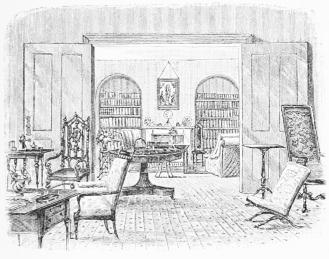
"June 29.—We have been for a week with the Stanleys at Canterbury, and it was very pleasant to be with Arthur, who was his most charming self."
Early in July, I preceded my mother northwards, made a little sketching tour in Lincolnshire, where arriving with little luggage, and drawing hard all day, I excited great commiseration amongst the people as a poor travelling artist. "Eh, I shouldn't like to have such hard work as that on. Measter, I zay, I should'na like to be you."
At Lincoln I joined my mother, and we went on together to Yorkshire, where my friend Rutson lent us a charming old manor-house, Nunnington Hall near Helmsley, the centre of an interesting country, in which we visited the principal ruined abbeys of Yorkshire. My mother entirely recovered here, and was full of enjoyment. On our way to Harrogate, a Quakeress with whom we travelled persecuted me with "The Enquiring Parishioner on the Way to Salvation," and then, after looking at my sketches, hoped that "one so gifted was not being led away by Dr. Pusey!" At Bolton we stayed several days at the Farfield Farm, and thence drove through Swale Dale to Richmond. On our way farther north, I paid my first visit to my cousins at Ravensworth, and very alarming I thought it; rejoining my mother at Warkworth, a place I have always delighted in, and where Mrs. Clutterbuck[112] and her daughters were very kind to us. More charming still were the next few days spent with my kind old cousin Henry Liddell (brother-in-law of my Aunt Ravensworth) in Bamborough Castle.
We visited Dryburgh and Jedburgh, and the vulgar commonplace villa, with small ill-proportioned rooms looking out upon nothing at all, out of which Sir Walter Scott created the Abbotsford of his imagination. Charlotte Leycester having joined us, I left my mother at the Bridge of Allan for a little tour, in the first hour of which I, Italian-fashion, made a friendship with one with whom till her death I continued to be most intimate.
To MY MOTHER.
"Tillycoultry House, August 12, 1856.—My mother will be surprised that, instead of writing from an inn, I should date from one of the most beautiful places in the Ochils, and that I should be staying with people whom, though we met for the first time a few hours ago, I already seem to know intimately.
"When I left my mother and entered the train at Stirling, two ladies got in after me; one old, yellow, and withered; the other, though elderly, still handsome, and with a very sweet interesting expression. She immediately began to talk. 'Was I a sportsman?'—'No, only a tourist.'—'Then did I know that on the old bridge we were passing, the Bishop of Glasgow long ago was hung in full canonicals?' And with such histories the younger of the two sisters, in a very sweet Scottish accent, animated the whole way to Alloa. Having arrived there, she said, 'If we part now, we shall probably never meet again: there is no time for discussion, but be assured that my husband, Mr. Dalzell, will be glad to see you. Change your ticket at once, and come home with me to Tillycoultry.' And ... I obeyed; and here I am in a great, old, half-desolate house, by the side of a torrent and a ruined churchyard, under a rocky part of the Ochils.
"Mr. Dalzell met us in the avenue. He is a rigid maintainer of the Free Kirk, upon which Mrs. Huggan (the old sister) says he spends all his money—about £18,000 a year—and he is very odd, and passes three-fourths of the day quite alone, in meditation and prayer. He has much sweetness of manner in speaking, but seems quite hazy about things of earth, and entirely rapt in prophecies and thoughts either of the second coming of Christ or of the trials of the Kirk part of his Church on earth.
"Mrs. Dalzell is quite different, truly, beautifully, practically holy. She 'feels,' as I heard her say to her sister to-night, 'all things are wrapt up in Christ.' The evening was very long, as we dined at four, but was varied by music and Scotch songs.
"The old Catholic priest who once lived here cursed the place, in consequence of which it is believed that there are—no little birds!"
"Dunfermline, August 13.—This morning I walked with Mr. Dalzell to Castle Campbell—an old ruined tower, on a precipitous rock in a lovely situation surrounded by mountains, the lower parts of which are clothed with birch woods. Inside the castle is a ruined court, where John Knox administered his first Sacrament. On the way we passed the little burial-ground of the Taits, surrounded by a high wall, only open on one side, towards the river Devon."
"Falkland, August 14.—After drawing in beautiful ruined Dunfermline, I drove to Kinross, and embarked in the 'Abbot' for the castle of Loch Leven, which rises on its dark island against a most delicate distance of low mountains.... There is a charming oldfashioned inn here, and a beautiful old castle, in one of the rooms of which the young Duke of Rothesay was starved to death by his uncle."
"St. Andrews, August 15.—This is a glorious place, a rocky promontory washed by the sea on both sides, crowned by Cardinal Beaton's castle, and backed by a perfect crowd of ecclesiastical ruins. The cathedral was the finest in Scotland, but destroyed in one day by a mob instigated by John Knox, who ought to have been flayed for it. Close by its ruins is a grand old tower, built by St. Regulus, who 'came with two ships' from Patras, and died in one of the natural caves in the cliff under the castle. In the castle itself is Cardinal Beaton's dungeon, where a Lord Airlie was imprisoned, and whence he was rescued by his sister, who dressed him up in her clothes."
"Brechin, August 17.—The ruin of Arbroath (Aberbrothock) is most interesting. William the Lion is buried before the high altar, and in the chapter-house is the lid of his coffin in Scottish marble, with his headless figure, the only existing effigy of a Scottish king. In the chapter-house a man puts into your hand what looks like a lump of decayed ebony, and you are told it is the 'blood, gums, and intestines' of the king. You also see the skull of the Queen, the thigh-bone of her brother, and other such relics of royalty. Most beautiful are the cliffs of Arbroath, a scene of Scott's 'Antiquary.' From a natural terrace you look down into deep tiny gulfs of blue water in the rich red sandstone rock, with every variety of tiny islet, dark cave, and perpendicular pillar; and, far in the distance, is the Inchcape Rock, where the Danish pirate stole the warning bell, and was afterwards lost himself; which gave rise to the ballad of 'Sir Patrick Spens.' The Pictish tower here is most curious, but its character injured by the cathedral being built too near."
I have an ever-vivid recollection of a most piteous Sunday spent in the wretched town of Brechin, with nothing whatever to do, as in those days it would have made my mother too miserable if I had travelled at all on a Sunday—the wretched folly of Sabbatarianism (against which our Saviour so especially preached when on earth) being then rife in our family, to such a degree, that I regard with loathing the recollection of every seventh day of my life until I was about eight-and-twenty.[113] After leaving Brechin, I saw the noble castle of Dunottar, and joined my mother at Braemar, where we stayed at the inn, and Charlotte Leycester at a tiny lodging in a cottage thatched with peat. I disliked Braemar extremely, and never could see the beauty of that much-admired valley, with its featureless hills, half-dry river, and the ugly castellated house of Balmoral. Dean Alford and his family were at Braemar, and their being run away with in a carriage, our coming up to them, our servant John stopping their horses, the wife and daughters being taken into our carriage, and my walking back with the Dean, first led to my becoming intimate with him. I remember, during this walk, the description he gave me of the "Apostles' Club" at Cambridge, of which Henry Hallam was the nucleus and centre, and of which Tennyson was a member, but from which he was turned out because he was too lazy to write the necessary essay. Hallam, who died at twenty-two, had "grasped the whole of literature before he was nineteen." The Alfords were travelling without any luggage, and could consequently walk their journeys anywhere—that is, each lady had only a very small hand-bag, and the Dean had a walking-stick, which unscrewed and displayed the materials of a dressing-case, a pocket inkstand, and a candlestick.
On our way southwards I first saw Glamis. I did not care about the places on the inland Scottish lakes, except Killin, where our cousin Fanny Tatton and her friend Miss Heygarth joined us, and where we spent some pleasant week-days and a most abominable Sunday. We afterwards lingered at Arrochar on Loch Long, whither Aunt Kitty and Arthur Stanley came to us from Inverary. We returned to Glasgow by the Gareloch, which allowed me to visit at Paisley the tomb of my royal ancestress, Marjory Bruce. At Glasgow, though we were most uncomfortable in a noisy and very expensive hotel, my mother insisted upon spending a wretched day, because of—Sunday! We afterwards paid pleasant visits at Foxhow and Toft, whence I went on alone to Peatswood in Shropshire (Mr. Twemlow's), and paid from thence a most affecting visit to our old home at Stoke, and to Goldstone Farm, the home of my dear Nurse Lea. Hence I returned with Archdeacon and Mrs. Moore to Lichfield, and being there when the grave of St. Chad was opened, was presented with a fragment of his body—a treasure inestimable to Roman Catholics, which I possess still.
During the remaining weeks of autumn, before I returned to Oxford, we had many visitors at Lime, including my new friend Mrs. Dalzell, whose goodness and simplicity perfectly charmed my mother.
FROM THE DEAN'S GARDEN, CANTERBURY.
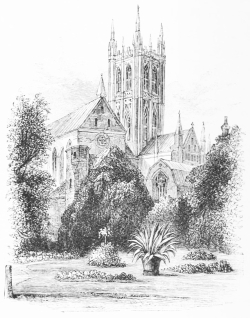
We passed the latter part of the winter between the Penrhyns' house at Sheen, Aunt Kitty's house of 6 Grosvenor Crescent, and Arthur Stanley's Canonry at Canterbury. With Arthur I dined at the house of Mr. Woodhall, a Canterbury clergyman, now a Roman Catholic priest, having been specially invited to meet (at a huge horseshoe table) "the middle classes"—a very large party of chemists, nurserymen, &c., and their wives, and very pleasant people they were. I used to think Canterbury perfectly enchanting, and Arthur was most kind and charming to me. While there, I remember his examining a school at St. Stephen's, and asking the meaning of bearing false witness against one's neighbour—"When nobody does nothing to nobody," answered a child, "and somebody goes and tells."
In returning to Oxford in 1857, I terribly missed my constant companions hitherto—Milligan and Sheffield, who had both left, and, except perhaps Forsyth Grant, I had no real friends left, though many pleasant acquaintances, amongst whom I had an especial regard for Tom Brassey, the simple, honest, hardworking son of the great contractor and millionaire—afterwards my near neighbour in Sussex, whom I have watched grow rapidly up from nothing to a peerage, with only boundless money and common-sense as his aides-de-camp. The men I now saw most of were those who called themselves the δωδεκα—generally reputed "the fast men" of the college, but a manly high-minded set of fellows. Most of my time was spent in learning Italian with Count Saffi, who, a member of the well-known Roman triumvirate, was at that time residing at Oxford with his wife, née Nina Crauford of Portincross.[114] I was great friends with this remarkable man, of a much-tried and ever-patient countenance, and afterwards went to visit him at Forli. I may mention Godfrey Lushington (then of All Souls) as an acquaintance of whom I saw much at this time, and whom I have always liked and respected exceedingly, though our paths in life have not brought us often together since. It was very difficult to distinguish him from his twinbrother Vernon; indeed, it would have been impossible to know them apart, if Vernon had not, fortunately for their friends, shot off some of his fingers.
In March (1857) I was proud to receive my aunt, Mrs. Stanley, with all her children, Mrs. Grote, and several others, at a luncheon in my rooms in honour of Arthur Stanley's inaugural lecture as Professor of Ecclesiastical History, in which capacity his lectures, as indeed all else concerning him, were subjects of the greatest interest to me, my affection for him being that of a devoted younger brother.
I was enchanted with Mrs. Grote, whom De Tocqueville pronounced "the cleverest woman of his acquaintance," though her exterior—with a short waist, brown mantle of stamped velvet, and huge bonnet, full of fullblown red roses—was certainly not captivating. Sydney Smith always called her "Grota," and said she was the origin of the word grotesque. Mrs. Grote was celebrated for having never felt shy. She had a passion for discordant colours, and had her petticoats always arranged to display her feet and ankles, of which she was excessively proud. At her own home of Burnham she would drive out with a man's hat and a coachman's cloak of many capes. She had an invalid friend in that neighbourhood, who had been very seriously ill, and was still intensely weak. When Mrs. Grote proposed coming to take her for a drive, she was pleased, but was horrified when she saw Mrs. Grote arrive in a very high dogcart, herself driving it. With great pain and labour she climbed up beside Mrs. Grote, and they set off. For some time she was too exhausted to speak, then she said something almost in a whisper. "Good God! don't speak so loud," said Mrs. Grote, "or you'll frighten the horse: if he runs away, God only knows when he'll stop."
On the occasion of this visit at Oxford, Mrs. Grote sat with one leg over the other, both high in the air, and talked for two hours, turning with equal facility to Saffi on Italian Literature, Max Müller on Epic Poetry, and Arthur on Ecclesiastical History, and then plunged into a discourse on the best manure for turnips and the best way of forcing Cotswold mutton, with an interlude first upon the "harmony of shadow" in watercolour drawing, and then upon rat-hunts at Jemmy Shawe's—a low public-house in Westminster. Upon all these subjects she was equally vigorous, and gave all her decisions with the manner and tone of one laying down the laws of Athens. She admired Arthur excessively, but was a capital friend for him, because she was not afraid of laughing—as all his own family were—at his morbid passion for impossible analogies. In his second lecture Arthur made a capital allusion to Mr. Grote, while his eyes were fixed upon the spouse of the historian, and when she heard it, she thumped with both fists upon her knees, and exclaimed loudly, "Good God! how good!" I did not often meet Mrs. Grote in after life, but when I did, was always on very cordial terms with her. She was, to the last, one of the most original women in England, shrewd, generous, and excessively vain. I remember hearing that when she published her Life of her husband, Mr. Murray was obliged to insist upon her suppressing one sentence, indescribably comic to those who were familiar with her uncouth aspect. It was—"When George Grote and I were young, we were equally distinguished by the beauty of our persons and the vivacity of our conversation!" Her own true vocation she always declared was that of an opera-dancer.
Arthur Stanley made his home with me during this visit to Oxford, but one day I dined with him at Oriel, where we had "Herodotus pudding"—a dish peculiar to that college.
JOURNAL.
"Lime, Easter Sunday, April 12, 1857.—I have been spending a happy fortnight at home. The burst of spring has been beautiful—such a golden carpet of primroses on the bank, interspersed with tufts of still more golden daffodils, hazels putting forth their fresh green, and birds singing. My sweet mother is more than usually patient under the trial of failure of sight—glad to be read to for hours, but contented to be left alone, only saying sometimes—'Now, darling, come and talk to me a little.' On going to church this morning, we found that poor Margaret Coleman, the carpenter's wife, had, as always on this day, covered Uncle Julius's grave with flowers. He is wonderfully missed by the people, though they seldom saw him except in church; for, as Mrs. Jasper Harmer said to me the other day, 'We didn't often see him, but then we knew he was always studying us—now wasn't he?'"
A subject of intense interest after my return to Oxford was hearing Thackeray deliver his lectures on the Georges. That which spoke of the blindness of George III., with his glorious intonation, was indescribably pathetic. It was a great delight to have George Sheffield back and to resume our excursions, one of which was to see the May Cross of Charlton-on-Ottmoor, on which I published a very feeble story in a magazine; and another to Abingdon, where we had luncheon with the Head-master of the Grammar School, who, as soon as it was over, apologised for leaving us because he had got "to wallop so many boys." All our visits to Abingdon ended in visits to the extraordinary old brothers Smith, cobblers, who always sat cross-legged on a counter, and always lived upon raw meat. We had heard of their possession of an extraordinary old house which no one had entered, and we used to try to persuade them to take us there; but when we asked one he said, "I would, but my brother Tom is so eccentric, it would be as much as my life is worth—I really couldn't;" and when we asked the other he said, "I would, but you've no idea what an extraordinary man my brother John is; he would never consent." However, one day we captured both the old men together and over-persuaded them (no one ever could resist George), and we went to the old house, a dismal tumble-down building, with shuttered windows, outside the town. Inside it was a place of past ages—old chairs and cupboards of the sixteenth century, old tapestries, and old china, but all deep, deep in dust and dirt, which was never cleaned away. It was like the palace of the Sleeping Beauty after the hundred years' sleep. I have several pieces of china out of that old house now—"Gris de Flandres ware."
In June I made a little tour, partly of visits, and from Mrs. Vaughan's house at Leicester had an enchanting expedition to Bradgate, the ruined home of Lady Jane Grey, in a glen full of oaks and beeches of immense age.
In my final (History and Law) Schools I had passed with great ease, and had for some time been residing at Oxford as a Bachelor, having taken my degree. But as one friend after another departed, the interest of Oxford had faded. I left it on the 13th of June 1857, and without regret.
VIII FOREIGN LIFE
"Under the arch of Life, where love and death, Terror and mystery, guard her shrine, I saw Beauty enthroned; and though her gaze struck awe, I drew it in as simply as my breath."—ROSSETTI.
"A good mental condition includes just as much culture as is necessary to the development of the faculties, but not any burden of erudition heavy enough to diminish (as erudition so often does) the promptitude or elasticity of the mind."—HAMERTON, French and English.
"WHO thinks the story is all told at twenty? Let them live on and try."—Hitherto.
In June 1857 we left Lime for a long residence abroad. My mother's doctors had declared that being thoroughly imbued with heat in a warm climate was the only way in which her health could be permanently benefited. It was a journey so long prepared for by historical studies, that I imagine few people have gone to Italy with a more thorough knowledge of what they would find there than we possessed.
We took our two old servants, Lea and John (Gidman), abroad with us, and Charlotte Leycester accompanied us to Lucerne, where the family was established for the hot summer months at the Pension Faller, which stands at the end of a long green terrace behind the cathedral cloisters, with a glorious view of Mont Pilate and all the range of mountains on the other side of the lake. George Sheffield came out to Lucerne to accompany me thence to Austria; but as he was very young at the time, and his college examinations were not over, we had to gain his parents' consent to this project by consenting to his having a tutor, and chose for this purpose our common acquaintance Robinson Duckworth, afterwards tutor to Prince Leopold. The arrangement did not answer, though it must be confessed that we treated Duckworth very ill, and were always playing him tricks. One night at Linz, for instance, we were greatly annoyed by finding he would have to sleep in our room, which was a very large one. He went out to listen to the band in the evening, and we spent the time of his absence in drawing the third bed into the middle of the room, and arranging it like a kind of catafalque, with lighted candles at the four corners. We then went to bed ourselves and pretended to be deep in slumber. When Duckworth came in, though two people could just manage to move the heavy bed to its pedestal, it was quite impossible for him alone to move it back again, and he was obliged to go to bed upon it—and most absurd he looked in the morning. I do not think he ever quite forgave us for this trick.
To MY MOTHER.
"Constance, July 24.—The Falls of Schaffhausen, with the dashing and roaring emerald water, were quite glorious. We came here from thence by steamer—the entrance to Constance very lovely, and the distant Alps lighted with the most delicate pink hues of sunset. The inn is close to the lake-pier and to the old Council-house. We have walked to the field at Bruhl where Huss was burnt, and since then Duckworth has been serenading the nuns of a Franciscan convent under their windows with airs out of 'Don Giovanni.'"
"July 26.—We were called at four, and my companions went out fishing, and returned dragging an immense pike which they had caught. Meanwhile I had seen the Minster and drawn the Kauf-haus, and was ready to leave with them at nine. We had a delicious journey across the still lake, Sheffield and I sitting quite down in the bow of the boat, where we had nothing before us but the soft blue lake and distant snows, and where we cut through air and water at the same time."
"July 29.—Yesterday we embarked at Donauwörth on the Danube steamer—crowded, filthy, and ceaselessly vibrating—the river the colour of pea-soup, with sandbanks on which we stuck every five minutes. There was no relief to the hideous monotony of the nine hours' voyage, the blackened swamps only changing into barren sandhills, on which a few ragged hops were vainly struggling for existence. But to-day in grand old Ratisbon has made up for yesterday's sufferings. Sheffield and I had great fun in making an expedition to the palace of the Prince of Thurm and Taxis. Numbers of people were out, and we discovered it was to greet the two young princes, who were to return that day from their travels: so we represented them, bowed to the right and left all through the street, and finally being set down at the palace, escaped into the garden and out the other way: what became of the real princes we have not heard. After all our audacity and impertinence in pushing through the Prince's courtyard and intruding upon his garden, we were rather touched by coming upon a placard inscribed—'The possessor of this garden, who has nothing nearer his heart than the promotion of universal pleasure, bids you—welcome!'"
"August 1.—In early morning we were on board the Danube steamer. Immediately after, three very common-looking men came on board by a boat, and descended at once to the cabin. Soon a neighbour whispered that one of them was the Archduke Albrecht, Governor of Hungary,—and behold, in a few minutes the three strangers emerged, dressed in gorgeous uniforms and glittering with orders.... All along the shore were crowds of bowing and curtseying people. At the hotel at Linz the Archduchess and her two daughters were waiting for the Archduke on the balcony of the inn; and their presence brought a splendid band under the window in the evening. This morning the whole family came on board, amid guns firing and crowds of people, to whom we thought the Archduchess would have bowed her head off. The presence of royalties gave us a better steamer, and before reaching Vienna the scenery of the Danube improved, especially at the rocks and castle of Dürnstein, where Richard Cœur-de-Lion was imprisoned."
"August 4.—Vienna would be delightful if it were not for the heat, but the grass is all burnt brown, and the trees almost black. Sheffield and I have driven to the old convent called Klosterneuburg, and in returning saw at Nussdorf the arrival of the Archduke Maximilian and his lovely wife,[115] radiant, unaffected, captivating all who saw her."
"August 6.—We have been to the country-palace of Laxenburg—a terrible drive in a sirocco, which made both Sheffield and me as ill as a sea-voyage. Laxenburg was the palace of Maria Theresa, and has an English park, only the grounds are full of gothic temples, &c., and an imitation dungeon fortress, with an imitation prisoner in it, who lifts his hands beseechingly and rattles his chains as you approach. Princess Charlotte was to have her first meeting with all the imperial family in the afternoon, and we waited for the public appearance of the royalties after dinner. We saw them emerge from the palace, and then ran down to the lake to see them embark. The imperial party arrived in carriages at the water's edge, and were set down under some old plane-trees, where their barges were ready, with rowers in sailors' dresses. First came the Empress, looking very lovely and charming, bowing her way to her own boat, which was distinguished by its blue cloth linings. Then came the Emperor, running as hard as he could, to be in time to hand her in: then sweet-looking Princess Charlotte, with a radiantly happy and not at all a shy expression; the mother of the Empress; Princess Marguerite; the Queen of Saxony; and the Archduchess Albrecht. All these entered the imperial boat, which was followed by another with three old countesses, and then all the court ladies in other boats. The Emperor and the Archdukes Leopold and Heinrich rowed themselves. There could hardly be a prettier scene—no crowd, no staring, and sunset on the water as the little fleet glided in among the cypress-covered islets. The last I saw of them was one of the princesses seizing hold of the old countesses' boat, and rocking it violently to give them a good fright.
"Throughout our travels we have perpetually fallen in with two solitary ladies. Yesterday one of them said to Duckworth, 'I beg your pardon, perhaps I ought not to ask, but the melancholy gentleman (meaning me) must have had a very severe disappointment; was it recent?—he seems to take on very much. Well, my idea is one must always be crossed three times before love runs smooth.' Duckworth asked where they were going. 'Oh, where is it?' said the younger lady; 'I quite forget the name of the place; something very long, I know.'—'Oh, Constantinople, my dear, that's the name, and then we go to a place they call Smyrna, and then to Algeria; for you see we've been to Rome and Naples, and if you don't mind travelling, it's just the same thing whether you go to one place or another.'"
"Aussee in Styria, August 8.—The last thing Sheffield and I did together was to go to the Capuchin vault, where all the sovereigns of the House of Hapsburg lie in gorgeous sarcophagi and coffins: amongst them Maria Theresa, and the husband by whose grave she came to pray every Friday in this dark vault. In one corner was the little Archduchess Sophia, only dead two months, her coffin heaped still with the white garlands deposited by her father and mother, who—are out of mourning for her.
"After parting with my companions, I went by train to Modling, and drove through the Wienerwald to Heiligenkreutz,[116] a gigantic monastery on the edge of a perfectly desolate moor, but in itself magnificent, with a quadrangle larger than 'Tom Quad' at Oxford. Daylight was waning, and I hastened to get the Sacristan to show me the 'Heilige Partikel,' which is kept in a venerable old leather case, and set in a huge golden cross covered with jewels. There are beautiful cloisters, and several chapels of the fourteenth century, and in one of them a fountain, so large that its sound is that of a waterfall. From Baden I crossed the Simmering pass to Bruck-an-der-Mur. Here all the travellers who descended from the train drew diligence tickets by turns, and as mine was only No. 11, I came in for the rickety board by the driver! What a road it was, in which the heavy wheels alternately sank into quagmires of deep mud, or jolted over the piles of stones which were thrown down to fill them up. The dank marshy plain was covered with driving white fog, from which one could only take refuge in the fumes of bad tobacco around one.
"When at length it was my turn to change, it was into an old car with leathern curtains, and horses so feeble that the passengers were obliged to get out and plod through the thick mud at every incline. I had a German companion, who smoked all night in my face.
"All through the night a succession of these cars was kept up, the company being turned out every two hours in some filthy village street, while another wretched old carriage was searched for and brought out. The taverns at which we stopped were most miserable. In the only one I entered the old landlady came out in her nightgown, and seizing my straw hat from my head, placed it on the top of her own top-knot, exclaiming, 'Schöne Strohhut.' Not till midday did we arrive here, and then found the inn full and the hills shrouded in mist—the 'Mountains of the Dead,' as the surroundings of this lonely lake are called, appalling in their white winding-sheets."
"Salzburg, August 14.—During my first days in the Salzkammergut, I might have been inside a kitchen boiler, so thick and white was the steam. But the landlord at Ischl said it was not likely to clear, and, wearied of waiting and longing to see something, I went off to the Traunsee, where, to my surprise, the mist suddenly gave way, the sun appeared, and in a few minutes the heavy veil rolled back, and the beautiful blue lake and high forest-clad mountains were disclosed as if by magic. In a few minutes after shivering, we were all complaining of heat again, and then luxuriating in the cool breeze as we steamed slowly under the great purple Traunstein. At Gmünden[117] we dined at the little inn, served by ladies in gold helmets, with great silver chains round their necks. I drove on to the fall in an Einspanner. It is a miniature Schaffhausen, and the colour of the water most beautiful. On the following day an old Colonel Woodruffe and his wife took me with them to Hallstadt, where we were rowed by women in crimson petticoats down the lovely lake to the village. The scenery is magnificent—jagged mountains melting into beautiful chestnut woods which reach to the water's edge, and at the end of the lake the little town, with its picturesque wooden houses and beautiful gothic chapel. The population consists of nine hundred Roman Catholics and nine hundred Protestants, who live together most amicably. No vehicle can enter the town, for the streets are narrow gullies, with staircases from one house to another.
"My new friends left me at Hallstadt, and early next morning I was up, and in the forest, to see the Wildbach waterfall, an exquisite walk, through green glades carpeted with cyclamen and columbines, with great masses of moss-grown rock tossed about amongst the trees, and high mountains rising all around. The goats were just getting up and coming out of their sheds, ringing their little bells as they skipped about amongst the rocks, and the flowers were all glistening with dew—no human being moving, except the goatherds directing their flocks up the mountain paths. I reached the waterfall, in its wild amphitheatre of rock, before the sun, and saw the first rolling away of the morning mist, and the clear mountain torrent foaming forth in its place; while far beyond was the great snowy Dachstein.
"At nine, a little boat took me to the Gosauswang at the other end of the lake, and while I was waiting there for an Einspanner, four travellers came up, one of whom—a pleasant-looking clergyman—introduced himself as Mr. Clements, the Rector of Upton St. Leonards, and informed me that his companions were his brother, just returned from Australia, and the two young Akers of Prinknash.
"As soon as they were gone off in their boat, my little carriage came, and I had a glorious drive, up the banks of the torrent Gosau, to open mountain pastures, backed by a magnificent range of bare rocky peaks. There is only a footpath from the 'Schmidt' to the Vorder See, set in the loveliest of forests, and backed by noble rugged peaks and snowy glaciers. The colour of the lake was indescribable, but oftenest like a rainbow seen through a prism—the purple, green, and clear blue melting into each other, and the whole transparent as crystal, showing all the bright stones and pebbles in the immense depths and reflecting all the snow-peaks beyond. When I returned to the inn, the Clements' party had arrived, and finding they were going the same way, I engaged to travel with them to Innsbruck.
"On Friday we all went again to the Vorder See, and then, taking a woodcutter as guide, scrambled on for two hours through woods and rocks to the Hinter See,[118] which is like a turquoise set in the mountains.
"We returned together to Ischl, and left in a carriage next day. At the end of St. Wolfgang Lake we engaged a boat and crossed to the curious old gothic church which contains the shrine of St. Wolfgang, and his rocky bed projecting through the pavement of a chapel, upon which the peasants throw kreutzers through a grating. We did not arrive at Salzburg till dark. What a fine old town it is!—but what most interested me was seeing here an old lady in black walking to church with a lady behind her. It was the Kaiserin Caroline, widow of the Emperor Francis I., grand-daughter-in-law of Maria Theresa, niece of Marie Antoinette, sister-in-law of Marie Louise!"
"Reichenhall, August 26.—From Salzburg we visited the mines of Hallein, into which we descended in full miner's costume—thick white trousers, smock-frock, cap, and a leathern apron behind. The guide gave us each a light, and marshalled us in single file through the narrow dark passages. On the summit of the first descent, we were all made to sit down upon our leathern aprons, to put our legs round each others' heads, hold a rope, and then slide off like a train into the dark abyss—alarming at first, and then very amusing. After three slides, we reached a black lake like the Styx, with lamps glittering like stars on faraway rocks. Here a boat moved by invisible hands came soundlessly gliding towards us: we stepped in, and in death-like silence, without oars or rowers, floated across the ghastly waters. On the opposite bank a wooden horse was waiting, on which we were made to sit, each behind the other, and, when we were mounted, rushed away with the speed of a whirlwind through the dark unearthly passages. At last, what looked like a twinkling star appeared in the distance, and it gradually increased till we emerged in open daylight. It is a most extraordinary expedition, but as the salt is all black, there is no beauty. We went on to Berchtesgaden and the Königsee and Obersee, but the wet weather only cleared enough to show us the beauties of the myrtle-green water."
It was a most wearisome journey then—two days of twelve hours in a carriage—to Innsbruck, where I parted with my companions. Hence a terrible long diligence journey of seventeen hours brought me to Botzen. The driver beguiled the way by telling me the history of his life—how when quite young he had given up smoking, and constantly put by all the money he should have spent on tobacco, in the hope of using it in revisiting Naples and the Island of Ischia, where he had been in boyhood as a soldier; but that two years before these designs had been cut short, because one day, when he returned with his diligence from Verona, he found his house burnt to the ground, and nothing saved except six silver spoons which his wife had carried off in her apron.
From Botzen I went to Meran and Trafoi, whence I walked across the Stelvio to the Baths of Bormio; but this part of the tour was not enjoyable, as my sufferings were always so great from bad weather, and hunger owing to want of money. Still less pleasant were the immense journeys afterwards by Finstermuntz and the Great Arlberg, along horrible roads and in wretched diligences, which, in these days of luxurious railway travelling, we should think perfectly unendurable. At Wesen, on the Lake of Wallenstadt, I had the happiest of meetings with my dear mother and her old servants, and vividly does the impression come back to me of the luxurious sense of rest in the first evening, and of freedom from discomfort, privation, and want.
LA MADONNA DEL SASSO, LOCARNO.[119]
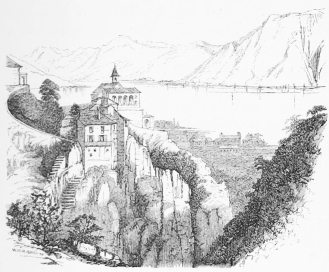
We crossed the Bernardino to Locarno, where we were joined by mother's widowed niece, Mrs. Charles Stanley, and by her friend Miss Cole. There were many circumstances which made me see the whole of North Italy through jaundiced eyes at this time, so that Milan, Venice, and even beautiful Verona, became more associated in my mind with mental and bodily fatigue than with any pleasure. One of the happiest recollections which comes back to me is an excursion alone with my sweet mother to the old deserted convent of Chiaravalle near Milan, and the grave of the enthusiast Wilhelmina. At Venice we had much pleasure in sight-seeing with Miss Louisa Cole, and her cousins Mr. and Miss Warre, the latter of whom afterwards married Froude the historian.
At Padua we engaged two vetturino carriages, in one of which our companions travelled, and in the other my mother and I with our two old servants. The first day's journey, through the rich plain of the vintage in October, was very pleasant, meeting the immense wains and waggons laden with grapes, and the merry peasants, who delighted to give us large ripe bunches as we passed. But we had a perilous passage of the swollen Po, on which our carriage was embarked in a large boat, towed with ropes by numbers of men in smaller boats. In our long journey in our roomy excellent carriage—our home for about three weeks—we were provided with a perfect library of books, for my mother was quite of the opinion of Montaigne when he said, "Je ne voyage sans livres, n'y en paix, n'y en guerre. C'est la meilleure munition j'aye trouvé à cet humain voyage." So we studied the whole of Arnold, Gibbon, Ranke, and Milman at this time. The slower the mode of travel, the greater its variety. In the middle of the day the vetturini rested often in some picturesque town, where there were churches, convents, and pictures to sketch or visit; sometimes in quiet country inns, near which we wandered in country lanes, and collected the wild-flowers of the district. How vividly the recollections of these quiet weeks come back to me—of the charm of our studies and the weekly examination upon them: of the novel which my mother and I used afterwards to tell each other alternately, in which the good characters lived at a place called "Holmhurst," but somehow contrived to have always some link with the scenes through which we were travelling: of our early luncheon of bread and preserved apricots: of our arrival in the evenings at rooms which had always a wholesome barn-like smell, from the fresh straw under the carpets: of the children, who scampered along by the sides of the carriage calling out "Tà-tà"—as short for Carità: of my mother screaming at Ferrara as she ran away from a white spectral figure, with eyes gleaming out of holes in a peaked hood and rattling a money-box—a figure to which we became well accustomed afterwards as a Frate della Misericordia: of the great castle of Ferrara, whose picturesque outlines seemed so strangely familiar till I recollected where I had seen them—at the bottom of willow-patterned washing-basins.
IN S. APOLLINARE NUOVO, RAVENNA.[120]
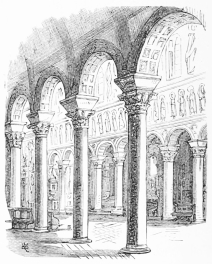
Ravenna was at this time reached by a wearisome journey through marshy flats overgrown by a dark-berried plant much used in the making of dye: we afterwards imported it to Hurstmonceaux. The Stanleys, whom we seldom contradicted, had greatly opposed our going thither, so that our journey to Ravenna had the charm of eating forbidden fruit; but I was able to silence their angry reproaches afterwards for having "taken my mother into so unhealthy a climate" by finding in Gibbon the remark that Ravenna, though situated in the midst of fœtid marshes, possesses one of the most salubrious climates in Italy! My mother was even more enchanted with the wonderful old city than myself, especially with the peerage of martyrs in the long palm-bearing procession in the mosaics of S. Apollinare Nuovo, and with the exquisite and ever-varied loveliness of the Pineta.
Deeply interesting was the historical journey afterwards along the shores of the Adriatic—the sunset on the Metaurus—the proud ruins of Roman Rimini, where also we went to see the soft lustrous picture known as "the winking Virgin," and accidentally met the father of the painter in the church—the Rubicon and Pesaro; Sinigaglia and Fano; and the exquisitely beautiful approach to Ancona, with the town climbing up the steep headland crowned by the cathedral, and the blue sea covered with shipping. In many ways Ancona has always seemed to me more beautiful than Naples. I have seen much of all these towns since, but there is nothing now like the halcyon days of vetturino travelling, with the abundant time for seeing and digesting everything, and the quiet regular progression, without fuss or fatigue, or anything to mar mental impressions.
From Ancona we went to Loreto, a lovely drive then, through ranges of hills, sweeping one behind another like files of an advancing army, and crested sometimes by the picturesque roofs, domes, and towers of an old town; sometimes clothed to their summits with olives and pines, vineyards and mulberry-gardens. Here and there a decayed villa stood by the roadside in its overgrown garden, huge aloes and tall cypresses rising from its tangled grass and periwinkles. Very lovely was the ascent to Osimo, thronged with the students of the old university town in their black cloaks, amongst whom was the Cardinal-bishop, going for a walk in crimson stockings, sash, and gloves, with two footmen in cocked hats strutting behind him.
LORETO.[121]
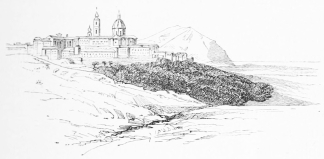
Nothing can be grander than the situation of Loreto, and the views from it over the surrounding country—the walls overlooking a wide sea-view as well. A building like a huge castle, with massive semicircular towers, dominates the town, and is the fortress which guards the holy of holies—the Santa Casa. We were called at five to go to the church. It was still pitch dark, but many pilgrims had already arrived, and waited with us in a corridor till the doors were opened. The scene inside was most singular—the huge expanse quite dark, except where a blaze of light under the dome illuminated the marble casing of the Santa Casa, or where a solitary lamp permitted a picture or an image to loom out of the chaos. The great mass of pilgrims knelt together before the shrine, but here and there a desolate figure, with arms outstretched in agonising prayer, threw a long weird shadow down the pavement of the nave, while others were crawling on hands and knees round the side walls of the house, occasionally licking up the sacred dust with their tongues, which left a bloody trail upon the floor. At either door of the House, the lamplight flashed upon the drawn sword of a soldier, keeping guard to prevent too many people pressing in together, as they ceaselessly passed in single file upon their knees, to gaze for a few seconds upon the rugged walls of unplastered brick, blackened with soot, which they believed to be the veritable walls of the cottage at Nazareth. Here, in strange contrast, the negress statue, attributed to St. Luke, gleams in a mass of diamonds. At the west end of the House was the window by which the angel entered! The collection of jewels and robes in the sacristy was enormous, though the priests lamented bitterly to us over the ravages of the Revolution, and that now the Virgin had only wardrobe sufficient to allow of her changing her dress once instead of three times every day of the year.
MACERATA.[122]
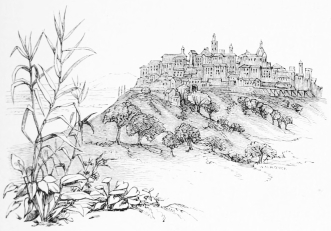
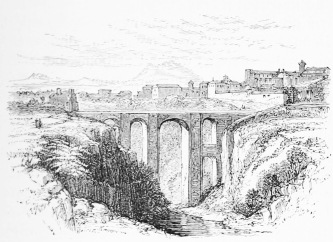
We travelled afterwards through a country seldom visited now—by hill-set Macerata and Recanati, and picturesque Tolentino with its relics of S. Nicolas, into the central Apennines, where Sabbatarianism doomed us to spend a most miserable Sunday at the unspeakably wretched inn of La Muccia. From Foligno we made an excursion to Assisi, then filled with troops of stately Franciscan monks—all "possidenti;" and by the Clitumnus temple, Spoleto, and Narni to Terni. At Civita Castellana the famous robber chief Gesparoni was imprisoned at this time, this year being the thirty-third of his imprisonment. Miss Cole and I obtained an order to visit him and his band, tall gaunt forms in a large room in the castle. The chieftain had a long white beard: we bought a little knitted cap of his workmanship. There was a ghastly sensation in being alone for a few minutes with this gang of men, who had all been murderers, and mostly murderers of many.
Breathlessly interesting was the first approach to Rome—the characteristic scenery of the Campagna, with its tufa quarries, and its crumbling towers and tombs rising amidst the withered thistles and asphodels; its strange herds of buffaloes; then the faint grey dome rising over the low hills, and the unspoken knowledge about it, which was almost too much for words; lastly, the miserable suburb and the great Piazza del Popolo.
I never shall forget the ecstasy of awaking the next morning in the Hôtel d'Angleterre, and feeling that the longed-for desire of many years was realised. We engaged apartments in the upper floor of the Palazzo Lovati in the Piazza del Popolo—cold dreary rooms enough, but from my mother's bedroom there was a lovely view to St. Peter's across the meadows of S. Angelo.
CIVITA CASTELLANA.[123]
Naturally one of my first visits was to Mrs. Hare and my sister, whom I found established in the first floor of the Palazzo Parisani, which occupies two sides of the little Piazza S. Claudio, a dismal little square, but which my sister regarded with idolatry, asserting that there was no house half so delightful as the Palazzo Parisani, no view which could be compared in interest to that of the Piazza S. Claudio. Making acquaintance with my sister at this time was to me like the perpetual reading of an engrossing romance, for nobody ever was more amusing, no one ever had more power of throwing an interest into the commonest things of life. She did not colour her descriptions, but she saw life through a prism, and imparted its rays to others. Her manner, her dress, all her surroundings were poetical. If one went to dine with her, the dinner was much the same as we had at home, but some picturesquely hung grapes, or a stalk of finocchio, or some half-opened pomegranates, gave the table an air which made it all seem quite different.
"Italima" liked my coming and going, and was very angry if I did not come, though she never professed any maternal affection for me. I often found myself in difficulties between my two mothers. My adopted mother would sometimes take an alarm that I was going too often to Italima, and would demand my presence just on the particular occasion when "Italima" had counted upon it; in which case I always gave way to her. And indeed, as a rule, I always spent all my time with my mother, except about two evenings in the week, when I went to Italima and the Palazzo Parisani. On rare occasions, also, I went out "into the world" with Italima and my sister, to balls at the Palazzo Borghese, and at the Palazzo di Spagna, where old Queen Christina of Spain was then living, an interesting historic figure to me as the sister of the Duchesse de Berri and great-niece of Marie Antoinette. She was very hospitable, and her parties, approached through an avenue of silver candelabra representing palm-trees—spoils from the Spanish convents—were exceedingly magnificent. At her suppers on Fridays, one side of the room was laid for "maigre," the other for "gras," and when the doors were opened, there was a general scrimmage to reach the delicious viands on the "maigre" table. After each of her receptions, it was the rule that five cards should be left by each guest—for herself, for her husband the Duc de Rianzares (who had been a common soldier), for her master of the household, for her equerry, and for her lady-in-waiting. The principal balls were those given by Princess Borghese, at which many cardinals were present, but would sit down to whist in a room apart from the dancers. A great feature of the Borghese parties at this time was the Princess-mother, who always sat in a conspicuous place in the anteroom, and to whom all the guests were expected to pay their court. By birth she was Adèle de la Rochefoucauld, and she was the mother of three princes—Marc-Antonio Borghese, Aldobrandini, and Salviati. She was "sage, souple, et avide des biens," as Voltaire says of Mazarin, and it was she who—probably most unjustly—had then the reputation of having poisoned the beautiful Princess Guendolina, first wife of Marc-Antonio, with all her sons, in order that her own son might marry her niece, Thérèse[124] de la Rochefoucauld, which he afterwards did. A conspicuous figure was the beautiful young Princess del Drago, one of the daughters of Queen Christina's second marriage, whose husband had a most fiendish face. I often saw the blind Duke of Sermoneta, celebrated for his knowledge of Dante, and his witty canonical brother, Don Filippo Caiëtani, generally known as "Don Pippo." The then Duchess of Sermoneta was "Margherita," née Miss Knight, a most ghastly and solemn woman to outsiders, but much beloved by those who knew her intimately.
The Prince of Piombino, who lived in exile or seclusion after the change of government in Rome, was then flourishing in his immense palace in the Corso, and his children, then young married people, were the life of all the parties. Of these, Rudolfo, Duke of Sora, had married the saint-like Agnese, only surviving child of Donna Guendolina Borghese, who was supposed only by absence to have escaped the fate of her mother and brothers. Of his sisters, Donna Carolina was the clever, brilliant Princess Pallavicini, and Donna Giulia had married the Duke of Fiano, who lived in the neighbouring palace, and by marrying her had broken the heart of Mademoiselle Judith Falconnet.[125]
One of the Romans whom I saw most frequently was the Princess Santa Croce, living in the old historical palace which has the reputation of being the only haunted house in Rome, where two statues of cardinals come down from their pedestals and rattle their marble trains up and down the long galleries. The Princess was one of the daughters of Mr. Scully in Ireland. He had three, of whom two were beautiful, clever, and brilliant, but the third was uninteresting. The two elder Miss Scullys went out into the world, and were greatly admired and much made of; but the youngest stayed at home like Cinderella, and was never known at all except as "the Miss Scullys' younger sister." Many people wished to marry the elder Miss Scullys; but they said "No, for we have a presentiment that we are to marry dukes, and therefore we will wait." But no dukes came forward, and at length old Mr. Scully died, leaving his daughters three great fortunes; and being Roman Catholics, without any particular call or claim, they determined to visit Rome before they settled in life. They took many introductions with them, and on their arrival the good looks, cleverness, and wealth of the elder sisters created quite a sensation; but people asked them, Roman-fashion, "what was their vocation," for in Rome all Catholic ladies are expected to have decided this. Then they said they had never thought of it, and they went to spend a week in the convent of the Trinità de' Monti to consider it. When the day came on which the three Miss Scullys were to declare their vocation, all Rome was interested, and the "great world" thronged the parlours of the Trinità de' Monti to hear it; but the expectants were petrified when the two elder Miss Scullys came out, for they had found their vocation, and it was a convent! No doubt whatever was felt about the youngest—"of course she would follow her sisters." But no; she had found her vocation, and it was marriage! and the youngest Miss Scully, additionally enriched by half the fortunes of her two elder sisters, went out into the world, and in three weeks she had accepted the great Roman Prince of Santa Croce, who claims descent from Valerius Publicola. I often used to watch with interest the Princess Santa Croce, who went to confess and pray at the convent of the Villa Lante (which Roman princesses are wont to frequent), for the two portresses who opened the doors were her two elder sisters, the proud Miss Scullys: it was the story of Cinderella in real life. I was at Rome years afterwards (1864) when the Princess Santa Croce died. All the princesses lie in state after death, but by old custom, the higher their rank, the lower they must lie, and the Princess Santa Croce was of such excessively high rank, that she lay upon the bare boards.
I think that it was towards the middle of our stay in Rome that I received a summons to a private audience of Pius IX. Italima and my sister went with me. We went in evening dress to the Vatican in the middle of the day, and were shown into a gallery where a number of Monsignori were standing. Amongst them was Monsignore Talbot, who asked me if I did not feel very much agitated. I said "No," and he answered, "But every one must be agitated when they are about to stand in the presence of the Vicar of Christ"—and at that moment he drew aside a portière, and we found ourselves at one end of a long hall, at the other end of which a sturdy figure with a beneficent face, in what looked like a white dressing-gown, was standing leaning his hand upon a table: it was Pius IX. We had been told beforehand that, as we had asked for a private audience, we must perform all the genuflections, three at the doorway, three in the middle of the room, and three at the feet of the Pope, and the same in returning; and Italima had declared that the thought of this made her so nervous that we must do all the talking. But Italima had often been to the Pope before, and she was so active and agile, that by the time my sister and I got up from the third genuflection in the doorway, she was already curvetting in the centre of the hall, and we heard the beautiful voice of the Pope, like a silver bell, say, "E come sta la figlia mia—e come sta la cara figlia mia," and by the time we were in the middle of the apartment she was already at the feet of the Pope. Eventually my sister and I arrived, and flung ourselves down, one on each side of Italima, at the feet of the Pope, who gave us his ring to kiss, and his foot, or rather a great raised gold cross upon his white slipper. "E questa la figlia?" he said, pointing to my sister. "Si, Sua Santità," said Italima. "Ed e questo il figlio?" he said, turning to me. "Si, Sua Santità," said Italima. Then my sister, who thought it was a golden opportunity which she would never have again, and which was not to be lost, broke through all the rules of etiquette, and called out from the other side of the daïs, clasping her hands, "Ma, Sua Santità, il mio fratello e stato Protestant."
Then the Pope turned to me and spoke of the great privilege and blessing of being a Catholic, but said that from what he had heard of me he felt that I did not deserve that privilege, and that therefore he could not wish that I should enjoy its blessings. He said much more, and then that, before I left, I should make him a "piccolo piccolino promessino" (the least little bit of a promise in the world), and that I should remember all my life that I had made it at the feet of Pius IX. I said that I should wish to do whatever Sua Santità desired, but that before I engaged to make a promise I should like to know what the promise was to be about. "Oh," said the Pope, smiling, "it is nothing so very difficult; it is only something which a priest in your own Church might ask: it is that you will say the Lord's Prayer every morning and evening." "Yes," I replied, "I shall be delighted to make Sua Santità the promise; but perhaps Sua Santità is not aware that the practice is not unusual in the Church of England." Then, almost severely for one so gentle, the Pope said, "You seem to think the promise a light one; I think it a very serious one; in fact, I think it so serious, that I will only ask you to promise to use one petition—'Fiat voluntas tua, O Deus, in terris ut in cœlo,' and remember that you have promised that at the feet of Pius IX." Then he blended his farewell very touchingly into a beautiful prayer and blessing; he blessed the things—rosaries, &c.—which my sister had brought with her; he again gave us his ring and the cross on his foot to kiss, and while he rang the little bell at his side, we found our way out backwards—quite a geometrical problem with nine genuflections to be made on the way.
I was often in the convent of the Trinità when I was at Rome in 1857, for visitors are allowed there at certain hours, and a great friend of my sister's, Adèle, Madame Davidoff, was then in the convent, having been sent to Rome on an especial mission to the Pope on matters connected with the French convents of the Sacré Cœur. Madame Davidoff ("Madame" only "in religion," as "a spouse of Christ") was daughter of the Maréchale Sebastiani, the stepmother of the murdered Duchesse de Praslin, and was grand-daughter of the Duchesse de Grammont, who founded the Sacré Cœur. Her own life had been very romantic. One winter there was a very handsome young Count Schouvaloff in Rome, whom my sister knew very well. She had been one day in the convent, and Madame Davidoff had accompanied her to the outer door, and was standing engrossed with last words, leaning against the green baize door leading into the church. Suddenly a man appeared, coming through the inner door of the convent, evidently from visiting the Abbess. "Mais c'est le Comte Schouvaloff!" said Madame Davidoff to my sister, and pushing the baize door behind her, suddenly disappeared into the church, while Schouvaloff, seeing her suddenly vanish, rushed forward to my sister exclaiming, "Oh, c'est elle—c'est elle! Oh, mon Adèle, mon Adèle!" He had been on the eve of marriage with her, when she had thought herself suddenly seized by a conventual vocation, had taken the veil, and he had never seen her since. The next day Count Schouvaloff left Rome. He went into retreat for some time at the Certosa of Pavia, where total silence is the rule of daily life. He took orders, and in a few years, having a wonderful gift for preaching, was sent on a mission to Paris; but the shock of returning to the scenes of his old life was too much for him, and in a few days after reaching Paris he died.
When I knew Madame Davidoff, she still possessed an extraordinary charm of conversation and manner, and the most exuberant eloquence of any person I have ever seen. Her one object was conversion to the Roman Catholic faith, and into that she threw all her energies, all her charm and wit, and even her affections. Her memory was as prodigious as that of Macaulay, and she knew all the controversial portions of the great Catholic writers by heart. What was more extraordinary still was, that having many "cases" going on at the same time (for people used to go to visit her and sit round her anteroom like patients at a fashionable dentist's), she never confounded one with another in her mind, never lost time, and always went on exactly where she left off. But her love of ruling made Madame Davidoff less popular within the walls of her convent than with the outside world; and after her return to Paris, the means which she often took to attain the ends to which she devoted her life brought such trouble to the convent of the Sacré Cœur, that the nuns refused to keep her amongst them, and she afterwards lived in the world, giving frequent anxiety to her sister, the Marquise de Gabriac, and to Lord Tankerville and Lady Malmesbury, her cousins. During my first visit at Rome, I saw Madame Davidoff often, and, after a courteous expression of regret that I was sure to be eternally damned, she would do her best to convert me. I believe my dear mother underwent great qualms on my visits to her. But her religious unscrupulousness soon alienated me, and I had a final rupture with her upon her urging me to become a Roman Catholic secretly, and to conceal it from my adopted mother as long as she lived. Other Roman Catholics who made a vehement effort for my perversion were Monsignor Talbot and Monsignor Howard, the latter of whom I had known as a very handsome dashing young guardsman a few years before, but who afterwards became a Cardinal. There was a most ridiculous scene when they came to the Palazzo Lovati, where Monsignor Howard made so violent a harangue against Protestantism that Monsignor Talbot was obliged to apologise for him. Roman Catholics with whom we were intimate from circumstances were the ex-Jew Mr. Goldsmid and his wife. Mr. Goldsmid had been converted by the Père Ratisbon, whose own conversion was attributed partially to the image of the Virgin in the Church of Andrea delle Fratte, and partly to the prayers of M. de la Ferronays, which are believed to have endowed the image with speech.
A really excellent Roman Catholic priest of whom I saw much was Monsignor Pellerin, Bishop in Cochin-China. His conversation was liberal and beautiful, and he had the simplicity of a mediæval saint. He was at that time about to return to China, with a great probability of martyrdom. On his last day in Rome he celebrated mass in the Catacombs in the Chapel of Santa Cecilia, a most touching sight even to those who were not of his faith. On taking leave, he gave me a small silver crucifix, which I treasured for a long time, then it disappeared: I always thought that Lea made away with it, in the fear that it might make me a Roman Catholic. I heard of the close of Monsignor Pellerin's self-sacrificing life in China several years later.
Amongst the English we had many pleasant friends, especially the George Cavendishes and the Greene Wilkinsons, who had a great fortune left to them for opening a pew-door to an old gentleman: it used to be said that they ought to take "Pro Pudor" as their motto.
But no notice of our familiar society at Rome can be complete which does not speak of "Auntie"—Miss Paul—the sister of "Italima," who lived her own life apart in two rooms in a corner of the Parisani Palace, where she saw and observed everything, and was very ready to make her quaint original remarks upon what she had observed when she joined the rest of the family, which was only in the evenings. I never saw "Auntie" otherwise than desperately busy, sometimes with immense rolls of embroidery, sometimes with charcoal-drawing, often with extraordinary and most incomprehensible schemes for recovering the very large fortune she had once possessed, and which she had lost in "the Paul Bankruptcy." Italima was not at all kind to her, but this did not affect her in the least: she went her own way, and when she was most soundly abused, it only seemed to amuse her. My sister she absolutely adored, and then and afterwards used to think it perfect happiness to sit and watch her for hours, not being able to hear a word she said on account of her deafness. I was exceedingly fond of "Auntie," and used to delight to escape from the ungenial atmosphere of Italima's great drawing-room to the busy little den in the corner of the palace, where I was always a welcome visitor, and always found something amusing going on.
When we arrived in Rome, my sister Esmeralda was supposed to be partially engaged to Don Emilio Rignano, eldest son of the Duke Massimo, whom she had known well from childhood. Emilio at one time passed every evening at the Palazzo Parisani; but during this winter Donna Teresa Doria appeared in the world, and the old Duchess Massimo, who hated Anglo-Roman alliances, by a clever scheme soon compelled her son to consent to an engagement with her. Having learnt this, Esmeralda refused ever to receive Emilio again. On the day before his marriage, however, he found her in the Church of S. Claudio, and tried to make her marry him at once by the easy Roman form, "Ecco il mio marito—Ecco la mia moglie," but she would not listen to him. Then, when she drove to the Villa Borghese, he pursued the carriage, regardless of the people in the street. His hat fell off, but he would not stop: he seemed to have lost his senses.
At a marriage in high life in Rome, the guests are often asked, not to the actual ceremony, but to St. Peter's afterwards, to see the bridal pair kiss the foot of the famous statue. When the Duke and Duchess Rignano entered St. Peter's, they were piteous to see: they would not look at each other. Old Lady Rolle was there, standing by the statue, and when they came near she said audibly, "What a wicked scene! what a sinful marriage!" And Emilio heard her, gave her one look of agony, and flung himself down on the pavement in front of the statue.
As Duchess Rignano, Teresa Doria was wretched. We saw her afterwards at Genoa, in the old Doria Palace, with her mother, whose death was hastened by the sight of her daughter's woe and her own disappointed ambition. Before long the Duchess Teresa was separated from her husband. Her tragical fate was a good thing for her sisters: the second sister, Guendolina, made a happy marriage with the Conte di Somaglia in the Marchi, and the youngest, Olimpia, was allowed to remain long unmarried. This last daughter of the house of Doria was described by her mother as so very small when she was born, that they swathed her in flannel and laid her in the sun, in the hope that it would make her grow like a plant. I was one day at the house of Mrs. de Selby, cousin of Princess Doria, when her servant threw open the door and announced in a stentorian voice, allo Romano—"La sua Eccellenza l'illustrissima Principessina la Donna Olimpia di Doria,"—and there marched in a stately little maiden of eight years old!
Cardinal Antonelli obtained an order for my sister and me to visit the Madre Makrina, the sole survivor of the Polish nuns who were martyred for their faith in the terrible persecution at Minsk. The nuns were starved, flogged to death, buried alive, subjected to the most horrible cruelties. Three escaped and reached Vienna, where two of them disappeared and never were heard of again. After a series of unparalleled adventures and escapes, the Abbess, the Madre Makrina, arrived in Rome. Pope Gregory XVI. received her kindly, but made her tell her whole story once for all in the presence of sixty witnesses, who all wrote it down at once to ensure accuracy, and then he shut her up, for fear she should be turned into a saint and object of pilgrimage. It was not generally known what had become of the Madre Makrina—it was a mystery in Rome—but we were able to trace her to the tiny convent of the Monacche Polacche, which has since been destroyed by the Sardinian Government, but which then stood near the Arch of Gallienus, nearly opposite the Church of S. Eusebio. Italima wished to go with us, but we could only obtain an order for two. When we rang the convent bell and had shown our permit through the grille, a portress from within drew a bolt which admitted us to a little room—den rather—barred with iron, and with an iron cage at one side, behind which the portress, a very fat old woman, reappearing, asked us many questions about ourselves, the Pope, the state of Rome generally. At last we got tired and said, "But shall we not soon see the Madre Makrina?"—"Io sono la Madre Makrina," said the old woman, laughing. Then we said, "Oh, do tell us the story of Minsk."—"No," she replied, "I promised at the feet of Pope Gregory XVI. that I would never tell that story again: the story is written down, you can read it, but I cannot break my promise."—"How dreadfully you must have suffered at Minsk," we said. "Yes," she answered, and, going backwards, she pulled up her petticoats and showed us her legs, which were enormously fat, yet, a short distance above the ankles, were quite eaten away, so that you could see the bones. "This," she said, "was caused by the chains I wore at Minsk." The Madre Makrina, when we took leave, said, "I am filled with wonder as to how you got admittance. I have never seen any one before since I came here, and I do not suppose I shall ever see any one again, so I will give you a little memorial of your visit!" and she gave me a tiny crucifix and medal off her chain. I have it still.
When the Emperor Nicholas came to Rome, he went to pay his respects to the Pope, who received him very coldly. "You are a great king," said Pius IX. "You are one of the mightiest monarchs in the world, and I am a feeble old man, the servant of servants; but I cite you to meet me again, to meet me before the throne of the Judge of the world, and to answer there for your treatment of the nuns at Minsk."
But of the gathering up of reminiscences of Roman life there is no end, and, after all, my normal life was a quiet one with my mother, driving with her, sketching with her, sitting with her in the studio of the venerable Canevari,[126] who was doing her portrait, spending afternoons with her in the Medici gardens, in the beautiful Villa Wolkonski, or in the quiet valley near the grove and grotto of Egeria.
In the mornings we generally walked on the Pincio, and there often noticed a family of father, mother, and daughter working on the terrace, as the custom then was, at rope-making. One day a carriage passed and re-passed with a solitary gentleman in it, who at last, as if he could no longer restrain himself, jumped out and rushed towards the group exclaiming, "C'est elle! c'est elle!" Then he became embarrassed, retired, and eventually sent his servant to beg that the mother would bring some of her cord to his house the next morning. She obeyed, and on entering his apartment was struck at once by a portrait on the wall. "That is the picture of my daughter," she said. "No," he replied, "that is the portrait of my dead wife." He then proceeded to say that he must from that time consider himself affianced to her daughter, for that in her he seemed to see again his lost wife, and he insisted on establishing the old woman and her daughter in comfortable lodgings, and hiring all kinds of masters for the latter, saying that he would go away and leave her to her studies, and that in a year he should come back to marry her, which he did. In England this would be a very extraordinary story, but it was not thought much of at Rome.
VALMONTONE.[127]
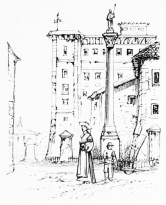
I have always found that the interests of Rome have a more adhesive power than those of any other place, and that it is more difficult to detach oneself from them; and even in this first winter, which was the least pleasant I have spent there—the conflicting requirements of my two mothers causing no small difficulty—I was greatly distressed when my mother, in her terror of Madame Davidoff and Co., decided that we must leave for Naples on the twenty-third of February. What an unpleasant companion I was as we drove out of the Porta S. Giovanni in the large carriage of the vetturino Constantino, with—after the custom of that time—a black Spitz sitting on the luggage behind to guard it, which he did most efficaciously. I remember with a mental shiver how piteously the wind howled over the parched Campagna, and how the ruins looked almost frightful in the drab light of a sunless winter morning. But though the cold was most intense, for the season really was too early for such a journey, our spirits were revived by the extreme picturesqueness of the old towns we passed through. In Valmontone, where the huge Doria palace is, we met a ghastly funeral, an old woman carried by the Frati della Misericordia on an open bier, her withered head nodding to and fro with the motion, and priests—as Lea said—"gibbering before her." Here, from the broad deserted terrace in front of the palace, we looked over the mountains, with mists drifting across them in the wind; all was the essence of picturesqueness, raggedness, ignorance, and filth. By Frosinone and Ceprano—then the dreary scene of the Neapolitan custom-house—we reached San Germano, where the inn was in those days most wretched. In our rooms we were not only exposed to every wind that blew, but to the invasions of little Marianina, Joannina, and Nicolina, who darted in every minute to look at us, and to the hens, who walked about and laid their eggs under the bed and table. Most intensely, however, did we delight in the beauties of the glorious ascent to Monte Cassino and in all that we saw there.