Volume 3 — CONTENTS VOLUME 3 (continued 5)
Reading edition
The coffin was already closed, and stood in the middle of the room covered with a white pall, and surrounded by burning candles and vases of flowers. Upon the coffin lay the crucifix which both Italima and Esmeralda held in their hands when they were dying. Near it was the bed, with the mark where the head had lain still unremoved from the pillow.
On Monday afternoon there was a long wearying family discussion as to whether the remains were to be taken to Kensal Green in the evening, to remain throughout the night in the cemetery chapel. Francis insisted that it should be so. Our Aunt Fitz-Gerald declared that if it was done she would not go to the funeral, as she would not follow nothing. I agreed with Mrs. Fitz-Gerald, and the nuns of the Precious Blood were most vehement that the body should not be removed. Eventually, however, Francis carried his point. At 9 P.M. we all went up for the last time to the room, still draped like a chapel, where the coffin lay, covered with fresh flowers, with the great crucifix still standing at the foot between the lighted candles. Then what remained of Esmeralda was taken away.
The next day (June 2) was the funeral. At the cemetery the relations who came from the house were joined by Mr. Monteith, Lady Lothian, Lady Londonderry, Lady Georgiana Fullerton, the Abbess Pierina, and all the nuns of the Precious Blood, with several nuns of the Misericorde.
ESMERALDA'S GRAVE.
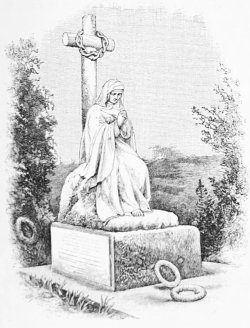
The chapel was full of people, but it is very small, and a very small part of it is used for seats. The larger part was spread with a rich crimson carpet, in the midst of which rose a kind of catafalque, upon which lay the coffin, covered with a long purple velvet pall, embroidered in golden letters—"May all the holy saints and angels receive her soul." Round this were six candles burning in very tall brass candlesticks. After the priest had gone round with the holy water and incense, a door at the east end of the church was thrown open and the pall removed, when the light poured in upon the coffin and its silver ornaments and the large silver cross lying upon it. Then we all passed out round the shrubberies to the grave, where the vault was opened just behind the beautiful seated statue of "Our Lady of Sorrows" under the cross, which Esmeralda had herself erected. Upon the coffin was engraved—
Anne Frances Maria Louisa Hare, E. de M. (Enfant de Marie), Oblate of the Order of the Precious Blood. Born October 9, 1832. Died May 26, 1868.
As the priest said all the leading sentences, the nuns, with clear voice, sang the responses. The whole service occupied nearly an hour and a half. We drove home in total silence: Aunt Fitz-Gerald led Auntie into the desolate house.
Thus was my sweet sister Esmeralda taken from us—being removed from the evil to come.
"Souls of the Holy Dead! Though fancy whispers thus to musing hearts, We would not call ye back, whence ye are fled, To take your parts In the old battle-strife; or break With our heartache— The rest which ye have won and in Christ's presence take."
XIV THE ROMAN CATHOLIC CONSPIRACY
"Glory to Thee in Thine Omnipotence, Who dost dispense, As seemeth best to Thine unerring will The lot of victory still; Edging sometimes with might the sword unjust, And bowing to the dust The rightful cause, that so much seeming ill May Thine appointed purposes fulfil." —SOUTHEY.
"Sprechen ist silbern, Schweigen ist golden." —Swiss Inscription.
"If you your lips would keep from slips, Of five things have a care: To whom you speak, of whom you speak, And how, and when, and where." —Old Distich.
AT eleven o'clock on the morning of my sister's death, our aunt, Mrs. Fitz-Gerald, arrived in Grosvenor Street. She wrote to me afterwards:—
"When Eleanor sent for me, after I recovered the shock, I went immediately to Grosvenor Street, and the first thing I asked before going up to Eleanor was, 'Is Mr. Hare (Francis) upstairs?' The maid made answer, 'Oh, no; Miss Hare would not hear of seeing him, and forbade us to let him enter the house, declaring that he had her death to answer for.' I could not believe this statement, and I called another servant into the dining-room, who repeated exactly the same thing, saying also that things had taken place in that house which were fearful, and that they were afraid of their lives. I was the innocent cause of Francis coming to sleep in the house, as I did not think it was right that Eleanor should be left alone with the dead body of your sister. I did not know till the following morning, when the servants told me, that people had been walking about the house the whole night, and that the Rev. Mother (Pierina) had forbid them to leave the kitchen, hear what they would."[380]
Upon this, and all succeeding nights until the funeral, the three maids persistently refused at night to go upstairs, saying that they had seen a spirit there, and they remained all through the night huddled up together in a corner of the kitchen. By day even they manifested the greatest terror, especially Mary Laffam, the lady's-maid, who started and trembled whenever she was spoken to, and who entreated to be allowed to go out when she heard the lawyer was coming, "for fear he should ask her any questions." If they had the opportunity, they always made mysterious hints of poison, and of Esmeralda's death having been caused by unnatural means. To the Rev. Mother Pierina, Mary Laffam said at one time that Miss Hare had told her she knew that she should die of poison.[381] All the servants constantly repeated to the Rev. Mother their conviction that Miss Hare was poisoned. They talked a great deal, especially Mary Laffam, who horrified the Abbess by saying that Miss Hare had herself said in her last moments, "I am poisoned and I die of poison."[382] In consequence of all that the servants had said to Mrs. Fitz-Gerald of their certain conviction that my sister had been poisoned, she was most anxious, before my return to England, for a post-mortem examination, but Francis violently opposed this, and he carried his point.
The opinion that my sister's death was caused by poison was shared by many of those who came to see her after death. They could not but recollect that though Dr. Squires then said he believed her to have died of ulceration of the intestines, up to the day before the death he had said that she might be removed, that the house might be let, and had suggested no such impression. For two days after death, black blood continued to stream from the mouth, as is the case from slow corrosive poison, and three eminent physicians, on hearing of the previous symptoms and the after appearances (Dr. Hale, Sir Alexander Taylor, and Dr. Winslow), gave it as their opinion that those were the usual symptoms and appearances induced by corrosive poison. Mrs. Baker (Marguerite Pole) wrote to me on June 24:—"The idea of poison is the one I formed the first moment I saw the body, as for some years I was practically versed in medicine, and I was at a loss how to account for various appearances in a natural way—i.e., from illness."
When I arrived at the house on May 31 (the death having taken place on the 26th), I found all its inmates agitated by the various reports which were going about. Mrs. Fitz-Gerald was full of a dreadful message which she believed to have been given by my dying sister to the Abbess Pierina. "When I am dead, go to my brother Francis, and tell him that he was the cause of my death, and that he will have to answer for it." This message was also repeated to me by Mrs. Baker and by Mrs. William Hare, and was always spoken of as having been given to the Rev. Mother herself. On each occasion on which I heard it spoken of, I said that the message had much better not be given to Francis, as he was in such a weak state of health that it might do him serious injury; and that probably when my sister gave it, she was in a state of semi-delirium, brought on by her extreme weakness. I entirely declined to question the servants, consequently I heard nothing directly from them, only their words as repeated by Mrs. Fitz-Gerald, and the many persons to whom the Mother Pierina had related them.
I never had any interview with or heard anything directly from Pierina herself. The reason of this was that, three days after the death, she had a violent scene with Mrs. Fitz-Gerald, who had intercepted her in the act of carrying off two large heavy silver candelabra from the oratory, and some valuable point-lace, which she had ripped off the altar-cloth and concealed in her pocket. She also took away a quantity of small articles (rosaries, crucifixes, &c.), which were afterwards returned with the more valuable articles by order of Monsignor Paterson, who wrote to express his extreme grief and annoyance at her conduct. My own impression still is that Pierina was a simple and devout character, who would not willingly do anything she believed to be wrong, but that she was really convinced (as she said) that it was a duty to take away these things, which had been dedicated to the service of a Roman Catholic altar, in order to prevent their being applied to secular uses in a Protestant household. After this, however, which occurred before my arrival, the Abbess Pierina was never allowed to return to the house, so that I never saw her.
Immediately after the death, all the small articles in my sister's room had been hastily removed, in order that the room might be draped with white, and to give it as much as possible the appearance of a chapel. On the day before the funeral, I saw Mrs. Fitz-Gerald, who was in the inner drawing-room, after opening a davenport and looking into a blotting-book, suddenly burst into tears. "Oh," she said, "the whole mystery is revealed now; it is all quite plain; you may see what it was that killed your sister," and she held up a letter from Francis, written on the Friday evening before her death—a cruel letter, telling her in the harshest terms that she was totally ruined, that she might sell her house and her plate, and all else that she possessed, for she had nothing whatever left to live upon; but that, as he did not wish her to starve, she and her aunt might come to live with his wife. This letter Esmeralda must have received on Saturday morning, soon after writing the affectionate note to Francis, which was read afterwards at Guildford in proof of the happy terms on which she was living with him. But it was her peculiar habit, when she was ill or suffering, to put letters aside, whoever they might be from, and not to read them till she felt better; it is therefore quite possible that she did not open this letter till Monday, when it gave the fatal blow. This was my impression at the time, and then and always afterwards, when others spoke of poison, I said, "There were strange signs of poison, and many people think she was poisoned, but it is my firm conviction that she did not die of poison, but of a broken heart—a heart broken by her brother Francis."
On the 6th of June I spent the whole morning in the office of my sister's solicitor examining accounts and papers, and the afternoon at Coutts' Bank to find out what was left. The result of the investigation was to show that in October my sister possessed £12,000 clear, besides a great quantity of plate, diamonds, and other valuables, and the house in Grosvenor Street paid for and clear from debt, as well as the property in the Palazzo Parisani at Rome. At the time of her death she possessed, interest and principal combined, £216, and debts to a considerable amount, while the diamonds and plate seemed to have disappeared without leaving a trace behind them.
Several days afterwards, while I was taking an envelope out of the envelope-box on the table, I saw a bit of bluish paper sticking up between the partitions of the box. I absently poked it up with a paper-knife, and then found that it was a pawn-ticket from Attenborough for £120 upon diamonds. Turning out a quantity of old Times from a cupboard, I afterwards found there a pawn-ticket for £100 upon plate; later I found a third ticket for £82 upon some diamond earrings. Attenborough told me that Francis had brought his sister there at different times and placed the plate and diamonds in pawn.
Whilst I was still in Grosvenor Street, many of my sister's Catholic friends came to see me. Mrs. Montgomery came three times. I had never liked her, and had greatly deprecated my sister's intimacy with her, but in the presence of what I believed to be a common grief I could not refuse to receive her, and she was apparently most sympathising and even affectionate. The second time she came she sat by me on the sofa and spoke of Esmeralda's death as making a blank in her whole future life. She said what a comfort and happiness it would be to her if she were ever able to be of use to me in any way,—in any way to supply the place of her I had lost.... Yet ten days after![383]
Mrs. Dunlop came several times. On June 8 she would not get out of her carriage, but begged me to come down to her and speak to her in it. She then said, "Now I know you would not speak of these things to any one else, but you know you may trust me: now do tell me, was it not most extraordinary that Francis should, in spite of her forbidding him, force his way into his sister's house just upon the one day on which he knew his aunt was away? Now of course you would not speak of this to every one, but Esmeralda loved me as a sister. You know you may trust me." She went on very long in the same strain. At last I was so shocked that I got up and said, "Mrs. Dunlop, I see what you wish me to say. You wish me to say that I think my brother poisoned my sister. Recollect that I do not think so. I distinctly think that he was the cause of her death, but I think that she died of a broken heart," and so saying I left her.
In the face of this Mrs. Dunlop afterwards asserted that I had told her that Francis poisoned my sister. In fact, I shall always believe that the whole of the poisoning story, as it appeared at the trial which ensued, originated, sprung up, and fructified with Mrs. Dunlop, the most unscrupulous of the conspirators concerned. "Where the devil cannot go, he sends an old woman," is an old German proverb.
Mary Stanley
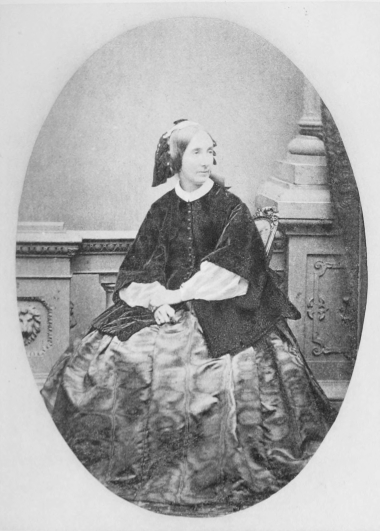
On June 9 I received a letter from my adopted mother's niece, Mary Stanley, saying that some friends had come up to her at a party, and spoken of the cruel way in which Mr. (Francis) Hare had been treated by his Protestant relations. When she asked an explanation, they said that Mrs. Montgomery had asserted (it was at Lord Denbigh's) that the doors of the house in Grosvenor Street were forcibly closed upon Mr. and Mrs. Francis Hare during Miss Hare's illness, and that she was influenced in her last moments to cancel a will in which she had left all her money to her brother Francis; also that neither Francis nor his wife were then allowed to enter the house or to see their aunt, and that they had nothing to live upon, owing to their having been disinherited by Miss Hare, who supported them during her life. Mary Stanley, a Roman Catholic, shocked at such falsehoods promulgated by a member of her own creed, and seeing the discredit it was likely to bring upon her party, strongly urged my writing to Mrs. Montgomery, who had professed such intimate friendship for me, stating that I had heard such a report was circulated, though not by whom, and after putting her in possession of the facts, as my sister's dearest friend, urging her to contradict it.
Having an inward distrust of Mrs. Montgomery, and a shrinking from any communication with her, I did not then write as Mary Stanley wished.
On June 11 Mary Stanley came down to Holmhurst, and again vehemently urged my writing to Mrs. Montgomery in defence of Miss Paul. On June 12 I yielded to her repeated solicitations, and wrote—Mary Stanley and my adopted mother looking over the letter and approving it sentence by sentence. When it was finished, Mary Stanley said, "That letter is perfect: you must not alter a word: it could not be better." The letter was as follows:—
"Holmhurst, June 13, 1868.—Dear Mrs. Montgomery, I have heard on good authority that a report has been circulated in London to the effect that the doors were perfectly closed upon Mr. and Mrs. Francis Hare during Miss Hare's illness, and that she was influenced in her last moments to cancel a will in which she had left all her money to her brother Francis; also that neither Francis nor his wife are now allowed to enter the house or to see their aunt, and that they have nothing to live upon, owing to their being disinherited by Miss Hare, who supported them during her life.
"As it is a pity that this impression should be allowed to gain ground, and as you were latterly the most intimate friend my dearest sister possessed, I venture to put you in possession of the facts.
1. "In her previous will my sister had not even mentioned Francis' name. She had left £4000 to me, a very large legacy to Lady G. Fullerton, legacies to other friends, and the remainder to her aunt. Francis was not even alluded to.
2. "Francis was not allowed to see my sister during the last days of her life at her own especial request: the very mention of his name made her scream with horror. In her last moments she left a solemn message with the Superior of the Precious Blood, to be given him after her death. This message was of so terrible a kind that, owing to Francis' critical state of health and the uncertainty of his life, he has hitherto been spared the pain of hearing it.
3. "Francis and his wife are not allowed, by the lawyer's direction, to see my aunt until the whole terrible story of my sister's sudden death is cleared up. In the month of November, besides Grosvenor Street, bought and paid for, she possessed £12,000 in money; when she died she was absolutely penniless, except £216, interest and principal combined, and she was overwhelmed with debts. There is no trace of any part of her fortune except of £2000 which was lost on the Stock Exchange through brokers to whom Francis introduced her.
4. "My dear sister's accounts at Coutts' show only too clearly that Francis had the greater part of her income. He will henceforward receive nothing from his aunt, who is totally ruined, and will scarcely have enough left to buy daily bread, as £2400 of her own little fortune is gone owing to signatures which Francis persuaded her to give.
"I am sure you will forgive my troubling you thus far with our family affairs, but I am certain that many, knowing your intimacy with my sister, may ask you for information, and I wish you to be in a position to give it. Believe me yours very truly,
"Augustus J. C. Hare."
In writing this letter, I had no idea of the significance which it might be made possible to attribute to the sentence No. 3—"Until the whole story of my sister's sudden death is cleared up." My own mind dwelt entirely and fixedly upon the impression that my sister's terribly sudden death was caused by the cruel shock of Francis' ungrateful letter coming to her in her weak state. To have it cleared up would be in my mind to have it clearly ascertained that she was poisoned, as most people believed, because in that case it would be certain that Francis might be held guiltless of her death, since—putting other reasons aside—he had never once been allowed to enter the house during the last days of the illness, and therefore could have nothing to do with it.
The statements about the money were perfectly correct; my sister's solicitor vouched for them. I believed all the other statements to be correct also, for I wrote them, not upon what I had heard from one person, but from what I had heard repeatedly and from many. I did not know till long afterwards that "the message" was not given by my sister herself to the Superior of the Precious Blood, but that the Superior had received it through the servants. It will be borne in mind that I had never myself seen the Superior, except in the group of mourners round the grave.
It was not till after I had written the letter to Mrs. Montgomery that I was able to read all the details of my sister's former will, annulled upon her death-bed. All that I had said and more than that was true. The will was of great length and detail, but Francis was not even alluded to. It began by leaving £4000, the family diamonds, miniatures, and plate, with various other valuables, to me, but it also left me residuary legatee. There was a legacy of £4000 to Lady Georgiana Fullerton, or, if she were dead, to her husband, Alexander Fullerton; £200 to Lady Lothian; £200 to Mr. and Mrs. Theodore Galton; £200 to Father Galway—in all about £5000 to Roman Catholics. Besides these, there were considerable legacies to Victoire, to Flora Limosin and her daughter, to Clémence Boissy,[384] and £200 annuity to her aunt. There were small legacies to various nuns—Serafina della Croce, Pierina of the Precious Blood, the "Saint of St. Peter's," &c.
From the virulence and avarice afterwards displayed by the Roman Catholics, and by the fact of their bringing an action to get the exact sum, £5000, we could only conclude that they had discovered that my sister had originally left them that sum and that they determined to extort it from the Protestant part of the family, in spite of the fact that she had really left nothing, so that even the last will was valueless, and that, if it had not been so, I should have been the chief sufferer, having been residuary legatee under the old will.[385]
In less than a week from the time of my sending the letter to Mrs. Montgomery, I received one from a lawyer, who had long been mixed up with Francis' affairs, stating that unless I at once withdrew and apologised for every part of that letter, an action for libel would be brought against me. Knowing that Francis was utterly insolvent, my family and I treated this as an idle threat, and declining any correspondence with the person in question, referred him to my solicitor. Mrs. Montgomery and Mrs. Dunlop had persuaded Francis to these proceedings, and Mrs. Montgomery had at once begun to stir up strife by taking the letter to him.
On hearing what had happened, Mary Stanley wrote:—
"July 16, 9 A.M.—You may imagine that my indignation is boundless. I can scarcely believe it. There must be some mistake, because there is no sense in it. You were not in England when the will was made: it is Miss Paul, if any one, from whom they ought to extort money, if they wish it.
"2 P.M.—All morning I have been out in your service. I went first to Farm Street, to see if I could see any of the priests who knew anything of the matter, but only two were in, who knew nothing. Then I went to Lady G. Fullerton, she was out; to Lady Lothian, she was out; then to find out Monsignor Paterson's direction, and happily I found it and him. I wish you could have heard all he said. The moment I mentioned the name principally concerned he stopped me—'You need say no more; I can believe anything of that person.' Nothing could be stronger than his words about her.... He was just as indignant at the whole transaction as you and I are. He said Francis, finding all else fail, was now trading on his faith. The Abbess Pierina had told him all that your sister said on her deathbed, and Monsignor Paterson desired me to say that you had only to command his services, and he would keep her to her words."
Meanwhile the action for libel was declared, an action which openly avowed its object, to extort £5000. Meanwhile, also, it was found that Mr. and Mrs. Monteith of Carstairs had joined the conspirators, and were hand in hand with Mrs. Dunlop and Mrs. Montgomery. Soon after I reached home, Mrs. Monteith had written to me, expressing her great devotion to my sister's memory, and begging me to send all the sad details connected with her death. I answered to the effect that those who were present could better tell the story of my sister's death. Had I written to Mrs. Monteith, doubtless my letter to her would have been used in the action, instead of that which I wrote, when I fell into the more skilful trap laid by Mrs. Montgomery. The Monteiths before this were intimate friends of mine. I had spent a week at Carstairs in the preceding October. With Francis they were previously unacquainted. Therefore it could have been only the interests of their Church which incited them to the course they pursued.
On the 18th of July Mary Stanley wrote:—
"At last I have got into the enemy's camp. I found Mrs. Dunlop this morning, and for an hour heard her version, and was aghast at the violence with which she spoke. I am very glad I have seen her, because it gives me a fresh insight into the state of things. She said Francis himself was absolutely passive, and allowed his friends to act for him; that he was now living on charity, and of course his friends must defray the cost of prosecution.
"She also said that Mrs. Montgomery's letter was used for the prosecution only because it happened to be more convenient than Mrs. Dunlop's evidence. They were resolved to prosecute you.
"I was so afraid of doing mischief, I scarcely knew what to say, but the general point I urged was that I had heard from a Catholic priest to whom I had spoken on the subject that the accusation of poison originated with the Abbess, who had told my informant that Miss Hare had said so to her!—and that my informant was ready to hold her to these words."
I do not think that any words could describe my misery at this time—"battered and fretted into great sorrow of heart," as Carlyle would say. It was naturally of far more consequence to me than to any one else to screen the miserable Francis, whom I alone had cared for and helped during the long years of his prison life, and who was now—as a last resource—consenting to extort what was equivalent to hush-money from me—either hush-money to save the family from the exposure of his own past life, or a provision for life from the Roman Catholic conspirators, if they were successful in the scheme to which he lent himself. Yet I possessed nothing, and even if I could have brought myself to let the Roman Catholics so far triumph, I could not have allowed my adopted mother to impoverish herself by the purchase of their silence. And all the time there was the unutterable weariness of contradicting all the false reports, of making over and over again the statement that if my sister were poisoned, then Francis, who had never seen her during her illness, was innocent of her death, but that if she were not poisoned, then the moral cause of it must be attributed to him; and mingled through the whole were silent bursts of indignant misery over the cruel sufferings which Esmeralda had undergone, and the calumnious falsehood of her friends, with anguish over her so recent death.
When it became quite evident that the only real object of the conspiracy was to extort money from me, because I was supposed to be, as Mrs. Dunlop expressed it, "the richest of the family," I did all I could to save family scandal by offering to withdraw the letter to Mrs. Montgomery altogether. My solicitor made every possible offer on my part, but was always answered that they must have "pecuniary compensation,"—in fact, it was always made a question of buying back the letter to Mrs. Montgomery. The conspirators, as Mrs. Dunlop said, were "resolved to prosecute," and wished to use the letter to Mrs. Montgomery because "it was more convenient to use than anything else." They would listen to nothing, consider nothing. Is it not Whyte-Melville who says, "I never knew but one woman who could understand reason, and she wouldn't listen to it?"
When we knew that the trial was inevitable, we did what we could to prepare for it. I was strongly advised to put the case entirely into the hands of my sister's solicitor, who was already acquainted with all the dark page of Francis' past life, rather than to give it to my adopted mother's respectable, old-fashioned solicitor, who was totally unacquainted with it. I afterwards regretted this course, as the one remark made by the latter, "that the Abbess should now be allowed to deliver her message," showed greater perspicuity than anything which was done by the former. He, on the contrary, insisted that there should be no communication at all with Pierina till just before the trial, and begged that I would not see her at all; he also allowed himself entirely to lose sight of the servants, in spite of my repeated entreaties. His plan seems to have consisted in ferreting out all the proofs of what Francis' conduct had been for many years past, and of the way in which he preyed upon his sister during the last year of his life, as shown by his own letters and my sister's accounts, which were in our hands.
In the "declaration of the action for libel" it was set forth as the necessary "injury" that it had caused Francis to be avoided by all his friends and acquaintances. Upon this we sued for particulars. Francis returned a list of the persons whom he declared to have been led to avoid him—"Mrs. Montgomery, Mrs. Dunlop, Mr. Monteith, Mrs. Monteith, Marchioness of Lothian, and Miss Bowles," a list which included the very persons (several of whom he had not known before) who were at that time in constant communication with him, and were bringing on and subscribing for the action, which was nominally on his behalf. On Tuesday, July 28, the Roman Catholic lawyer asked permission to fix the day for the trial. This courtesy was not refused. He fixed the day instantly and summoned his witnesses, but he did not let us know till Saturday, August 1, that the trial was to be on Monday, August 3, when, owing to the want of a London post on Sunday, it was most difficult, almost impossible, to summon the witnesses on our side.
On Friday, July 31, my acting solicitor went to Monsignor Paterson and took down his deposition as to Pierina's account to him of the death-bed. Monsignor Paterson then deposed that "the message" had been given by my sister in the form already described, and that my sister had also said she was "poisoned, and knew that she died of poison." Upon receiving this evidence, my solicitor naturally felt sure of his cause. He then went to see the Abbess Pierina in Mecklenburgh Square, when, to his utter amazement, she totally denied ever having received the message; but (being terrified by threats as to the "legal consequences" which might accrue to her) she did not then say that the message had been given to the servants and by them delivered to her to give to Francis.
On Saturday afternoon, August 1, Monsignor Paterson again saw Pierina, and, to his amazement, was informed that the message which he had so positively declared to have been given to the Abbess was not what Miss Hare said to her, but what Miss Hare had said to the maids, who had told her. Monsignor Paterson wrote this immediately to my solicitor, who (owing to the want of London post on Sunday) only received it in court.
On Saturday, August 1, the announcement came that the trial would take place at Guildford on Monday the 3rd. On Monday morning Mary Stanley and I drove early to the Waterloo station to go down to Guildford. There were so many passengers for the trial that a special train was put on. At the station I was close to Mr. Monteith, who had come from Scotland to represent his wife, and young Gerard, who was to open the prosecution, but there was no speech between us. Sir Alexander Taylor went down with us, and at Guildford we were joined by many other friends.
The heat of that day was awful, a broiling sun and not a breath of air. We had a little room to meet in at the hotel. Almost immediately I was hurried by my solicitor to the room where our senior counsel, the great Hawkins, was breakfasting at the end of a long table. He complained of the immense mass of evidence he had had to go through. He said—what I knew—that such a trial must expose terrible family scandals—that it would be a disgrace not to snatch at any chance of bringing it to a close—that probably the judge would give it for private investigation to some other Queen's counsellor—that, in fact, it was never likely to be a trial.
When I came down from Mr. Hawkins, Mary Stanley and I were taken to court. There were so many cases to be tried, that ours could not come on for some time. As Leycester Penrhyn was there, who was chairman of the Quarter Sessions at Guildford, we were given places on the raised daïs behind the judge, and there we all sat waiting through many hours. In that intensely hot weather, the court-house, with its high timber roof and many open windows, was far cooler than the outer air, and we did not suffer from the heat. But the judge, Baron Martin, whom I have heard described as far more at home on a racecourse than on the judgment-seat, was suffering violently from diarrhœa, was most impatient of the cases he had to try, and at last snatched his wig from his head and flung it down upon the ground beside him.
About three o'clock in the afternoon we were assured that it was quite impossible our case could be brought on that day, as there were still so many others to be tried, and we were advised to go out and rest. So Mary Stanley and I went back to the hotel and remained there in a cool room. Presently, to our horror, a messenger came running down from the court and said, "Your case is on, and has been on twenty minutes already." We rushed to the court and found the whole scene changed. All the approaches to the court were crowded, literally choked up with witnesses and Roman Catholic spectators. The court itself was packed to overflowing. As I was hurried through the crowd, I recognised the individuals forming the large group of figures immediately behind the judge. There were Pierina of the Precious Blood and her attendant nuns in their long black veils and scarlet girdles; there, in her quaint peaked head-dress, was the nun of the Misericorde who had watched through the illness; there was the burly figure of Mr. Monteith; the sallow face of Mrs. Dunlop; her husband the Admiral; Mrs. Montgomery, beautiful still; Lady Lothian in her deep mourning and looking very sad at being subpœnaed, which was a terrible pain to her; Dr. Squires, Mr. Seyer, and Miss Bowles.
When I was brought in, all seemed to be confusion, every one speaking at once; Mr. Hawkins was in vain trying to put in a word, the judge was declaiming that he would have an end of the trial, whilst Serjeant Parry for the prosecution was in a loud voice reading the letter to Mrs. Montgomery and giving his comments upon it.
The proceedings had commenced by the judge saying that he considered the case one which it would be most undesirable to discuss in a public court; and suggesting, indeed trying to enforce, that it should be left to the arbitration of some friend of the family. Repeatedly Baron Martin urged the expediency of a private investigation, saying that he "felt it his duty to make the suggestion, and that he thought the learned counsel (Parry) might act upon it." But the lawyers for the opposition refused any compromise whatever, for they knew what the evidence of Pierina and the servants was to be.
Serjeant Parry then opened his speech by describing between whom the action was taking place. He drew a picture of the nominal prosecutor's life in which he dwelt on "the brilliant examination at Sandhurst," but touched lightly upon the time which he had passed in the gaieties both of the Continent and of this country, after which he became "not embarrassed, but reduced in circumstances." He then said that Esmeralda had recently had a tolerable fortune, and was doubtless "supposed at her death to be in possession of it, but she was not, for she entered into speculations which had proved unsuccessful, so that she died a comparatively poor woman." He then described the death-bed will. He asserted that the only cause of the death was inflammation of the bowels. He then said that he should proceed to read the letter, "supplementing it with evidence to prove that the defendant was actuated by the wickedest malice."
It was at this point that we arrived in court. When a little silence was obtained, Parry began to read the letter, and having concluded the first sentence, said, "When the defendant states that a report has been circulated in London, &c., he states a deliberate falsehood. No such report ever was heard by him, and I will not say it is the effect of his imagination, it is simply an invention for the purpose of damaging the character of his brother."[386]
Serjeant Parry then read the paragraph saying that in the first will Francis was not even alluded to. "I have reason to believe that this also is totally false," he said, and that with the will itself lying open upon the table before him.
Parry passed over the third paragraph of the letter, without any criticism except an absolute denial, but he read a note written by my sister before she received Francis' fatal letter, in proof of the affectionate terms on which they were living. That the "mention of his name made her scream with horror," he declared to be utterly false, and he asserted (for the first time stating facts) that the Abbess Pierina would deny that any message was given by my sister to her. Finally, Parry denied that there was any truth in the statement that Francis had received money from his sister, beyond the sum of £300.
As Serjeant Parry concluded his speech, Mrs. Montgomery was called into the witness-box. While the preliminary questions were being put to her, the confusion in court increased; a letter was brought in to Mr. Harrison and handed on by him to Mr. Hawkins. It was the letter from Monsignor Paterson, written on Saturday evening, which announced that Pierina would deny and belie the deposition he had made. Immediately Mr. Hawkins turned round to me and said, "Our cause has received a fatal blow; the Abbess Pierina is about to deny all the evidence she has given before—deny all that she has said to Monsignor Paterson, and will swear that your sister's death-bed passed in total silence, save for the single word 'Auntie,' and under these circumstances it is perfectly useless to go on; our antagonists will get the money they long for; for money is all they really care for."—"But," I said, "we can bring endless persons and Monsignor Paterson's own deposition to prove what the Abbess's former statements have been."—"No," said Mr. Hawkins, "you cannot bring a witness to prove a witness."—"But," I said, "we can prove every other part of the letter."—"That will do no good," said Mr. Hawkins; "if you fail in proving a single point, you fail in proving the whole, and the Roman Catholics will get the money; besides, you cannot prove every other part of the letter, for where is the maid, Mary Laffam?—she is not here." And in truth, Mary Laffam (whose evidence was all-important, who was to swear to the screaming at the very mention of Francis' name, who was constantly present during the illness) was mysteriously missing, and no trace of her could then be found. Two days afterwards she was traced, and it was discovered that she had been sent abroad by the Roman Catholic confederates to be out of the way—sent by them to the Augustinian Abbey of Charentan in France.
During the discussion which was now taking place, the utmost excitement prevailed in court. Almost every one stood up. Mr. Hawkins urged—"Are your adopted family prepared to pay what the Roman Catholics claim?"—"Certainly not."—"Then you must submit to a verdict."—"I leave it in your hands." So I wrote on a bit of paper, "Say no more than this. I withdraw anything that may be legally taken as libellous in the letter to Mrs. Montgomery." Then the group opened, and Mr. Hawkins again stood up and said that he was in a position to withdraw the letter—if it contained any libellous statements to apologise for them. At the same time "his client could not submit to be told that he had either acted maliciously or invented anything: he was absent from England at the time of his sister's death, and had throughout acted entirely upon information he had received from those upon the spot."
"I will have an end of this, gentlemen," exclaimed the judge—"I give a verdict for forty shillings."
"Make it ten guineas, my Lord," shouted the Roman Catholic lawyer, who had previously interrupted Serjeant Parry by saying "We will have money, we will have money." "There shall be an end of this, gentlemen," said the judge; "I give a verdict for forty shillings," and he walked out of court. And so this painful ordeal came to an end. It was not till afterwards that I was aware that the verdict of forty shillings obliged me to pay the costs of both sides—£199 to my lawyer, and £293 to the Roman Catholic lawyer, which was afterwards reduced by a taxing-master to £207, 9s. 1d.
As soon as we left the court and returned to the hotel, our solicitor came in, and, before all those of our family who were present, declared how, by my desire, he had repeatedly offered to withdraw the letter to Mrs. Montgomery, but how money was always demanded as its price, and how money was proved throughout to be the only real object of those who brought the action. In looking back, therefore, upon the whole of this terrible affair, I only see three ways in which the trial could have been avoided:—
1. If Miss Stanley had had the courage to go openly to Mrs. Monteith and Lady Lothian, and say boldly that she, a Roman Catholic, was the cause of my writing the letter to Mrs. Montgomery; that as to the "report," I acted entirely and exclusively on information which she gave; that at first I had hesitated to do as she wished, but that she had continued to urge it; and that she, a Catholic, had looked over the letter before it was sent, and begged me not to alter a word of it.
2. If my solicitor had acted upon the one piece of advice given by Mr. Phelps, and weeks before the trial had requested Pierina to deliver her "message," we should then have known that the message was not given to her except through the medium of the servants, and therefore that by English law the wording of the letter was indefensible.
3. If my solicitor had been less supine in summoning witnesses—if he had at once subpœnaed Mary Laffam and the other maids on our side, and had also summoned my Aunt Fitz-Gerald, who would have been willing and glad to give her evidence, and whose very appearance would have made Francis shrink from allowing the Roman Catholic confederacy to continue the trial.
Mary Stanley and I went early to the Guildford station to wait for the train which was to take us back to London. We had not been long on the platform before all the Roman Catholic party emerged upon it. I went at once to meet and pass them, thinking it better at once to establish the terms on which we were to remain through life. The Mother Pierina alone lingered behind the rest, and, with streaming eyes and outstretched hands, came towards me. "Oh, I thought it would have been for peace," she said. I could not refuse to take her hand, when Mr. Monteith, turning round, roughly seized her by the shoulder and led her away, saying, "Reverend Mother, I must insist that you do not speak to that ... person." Afterwards, when she was entering the railway carriage after the others, Mrs. Dunlop seized Pierina and pushed her out of the carriage, almost throwing her down upon the platform, and slammed the carriage-door in her face. Admiral Dunlop immediately forced his wife to get out of the carriage and apologise to the Reverend Mother. I did not know till long afterwards the reason of Mrs. Dunlop's violence, which was the persistence with which Pierina throughout that day had dwelt upon the wicked unfairness of having the trial in the absence of Mary Laffam, who was the witness really responsible for all that had been said. On August 19 Mary Stanley wrote to me:—
"Yesterday I saw Sister Pierina. She said how extremely grieved she had been for you. She said the lawyer on the Catholic side read the evidence to all the party at Guildford, and that she then expressed her dissent, saying that it was not in accordance with what Mary Laffam had said to her and others, and that in justice to you, she, Laffam, ought to be present. All through that day (which she said was most dreadful to her) she asserted and reasserted this, and that you were not fairly dealt with, and to me she complained sadly of the un-christian spirit in which the affair had been carried on: Mrs. Dunlop, she said, was far the worst.
"Pierina denies nothing. She could only say, when asked about the message, that none was given directly to her, and that to her your sister had only said, 'Tell Francis that he has been the cause of my death.' She was forbidden to say to whom the message was given. So far from going over to the other side, she was at war with them the whole day, and told me she did not believe any of that party would ever come near her again; and I met Monsignor Paterson on Sunday, who told me that Mrs. Dunlop had been to him to complain bitterly of her."
Afterwards the feeling of the conspirators, especially of Mrs. Dunlop and Mrs. Montgomery, became so violent against the Mother Pierina (on account of her persisting in the injustice of the trial), that they not only stopped their own subscriptions to her charities, but induced others to do so, and eventually, by the interest of Mr. Monteith with Monsignor Talbot and other Roman authorities, they brought about her recall and persecuted her out of England altogether.
On August 7, Monsignor Paterson wrote a long letter to Mary Stanley, explanatory of his conduct in the affair. It contained the following remarkable passage:—
"A day or two after Miss Hare's death, which took me quite by surprise, I went to her house, and there saw Sister Pierina, who told me she had been summoned, and found Miss Hare actually dying; that she seemed very suffering, and had some difficulty in resigning herself to the will of God. I remember also hearing that she expressed distress at some conduct on the part of Mr. Francis Hare, and I thought that other expressions used implied a suspicion on her part of some kind of foul play. Of course, had I taken this au sérieux, it would have made a great impression, but I set it down, after a moment's reflection, as a random (perhaps almost delirious) expression, such as people who are very ill sometimes use with very little meaning at all."
Strange certainly that an eminent Roman Catholic priest should call at his friend's house, hear that she had died suddenly, and that she had said on her death-bed that she died from "foul play," and yet be able so easily to dismiss the subject from his mind!
Soon after the trial I wrote a long account of the whole proceedings to Archbishop Manning. His answer was very kind but very evasive—"Miss Hare's death was most sad ... the trial must have been most painful," he "sympathised deeply," &c., but without giving a direct opinion of any kind.
It was not till some months later that I became acquainted with a secret which convinced me that, though my sister's end was probably hastened by the conduct of her brother Francis, yet poison was the original cause of her death. When we next visited Pisa, Madame Victoire told me how, when my sister was a little girl of six years old at Paris, she and her own little girl, Victoria Ackermann, were sitting on two little stools doing their needlework side by side. Suddenly there was a terrible outcry. Little Anna Hare had swallowed her thimble. The whole house was in consternation, doctors were summoned in haste, the child was given emetics, was held upside down, everything was done that could be done to bring the thimble back, but it was too late. Then the doctors inquired what the thimble was like, and on seeing the thimble of the little Victoria, who had received one at the same time, were satisfied that it was not dangerous, as the thimble being of walnut-wood, would naturally dissolve with time, and they gave medicines to hasten its dissolution. But, in the midst of the confusion, came Mrs. Large, the nurse, who confessed with bitter tears that, owing to her folly, the thimble was not what it was imagined to be. She had not liked to see the child of the mistress with the same thimble as the child of the maid, and had given little Anna one with a broad band which looked like gold but was really copper. When the doctors heard this, the accident naturally assumed a serious aspect, and they redoubled their efforts to bring back the thimble. But everything failed; the wooden thimble dissolved with time, but the copper band remained. Gradually, as Esmeralda grew stronger, the accident was forgotten by all but her mother, Mrs. Large, and Madame Victoire, who observed from time to time, in childish illnesses of unusual violence, symptoms which they alone could recognise, but which were such as would arise through slight injury from poison of verdigris. As my sister grew, the copper ring grew also, attenuated to the minutest thread, but encircling her body. From time to time she was seriously affected by it, but her mother could not bear it to be spoken of, and her repulsion for the subject communicated itself to Esmeralda herself. She was warned to evade a damp climate or the use of vegetables. When she was seized with her violent illness at Dijon, the symptoms were all such as would be caused by poison of verdigris. She then went to Pisa, where Madame Victoire was alarmed by what she heard, and insisted upon the best advice being procured, and a medical examination. The doctors who saw her, even then spoke to Madame Victoire of her state as very serious, and requiring the most careful watching. When Esmeralda went to Rome to the canonisation in the summer of 1867, she returned by Pisa. The faithful Madame Victoire then sent for a famous medical professor of the University of Bologna to meet her, and insisted upon her being examined by him. He afterwards told Madame Victoire privately that though, by intense care, Miss Hare might live for many years, her life, in case of accident, hung on a thread, and that it was highly improbable that she would live long, for that the copper ring was beginning to tell very seriously upon her constitution, and that when she died it would probably be suddenly of black sickness, with every appearance of poison—poison of verdigris. And so it was.
One of the principal actors in the scene at Guildford was soon after called to account before a higher tribunal than any that earth can afford. On the 18th of November (1868) I received (at Rome), to my great surprise, a letter from Madame Flora Limosin, of the Hôtel de Londres at Pisa (Victoire's youngest daughter), saying that Francis was about to arrive there from Hyères. He had been sent away from England some time before, having then £80 in his possession. Whether this sum was obtained by a Roman Catholic subscription, I have never been able to learn, but from this time the Roman Catholic conspirators ceased to help him: he had failed as the instrument for which they required him, and they now flung him aside as useless. His folly at Guildford, in lending himself to their designs, had also alienated the whole of his own family, even to the most distant degrees of relationship. Not knowing where to turn, he could only think of two persons who would receive him in his destitution. His mother's faithful maid Madame Victoire and her daughter Flora were still living at Pisa, and to them, when he had only £20 left, he determined to make his way. On landing at Spezia, though even then in a dying state, he would not enter a hotel, because he felt that if he entered it he would never have strength to leave it again, and he sat for hours upon his luggage on the platform of the station till the train started. For the sake of their old companionship in childhood, and of the kindness she had received from my father, Flora Limosin not only received Francis, but also the person to whom he was married, and gave them some quiet rooms opening upon the garden of the Hôtel de Londres, where he was nursed by the faithful friends of his infancy.[387] He was attended by Padre Pastacaldi, who administered to him the last offices of the Church, and says that he died penitent, and sent me a message hoping that I forgave him for all that had passed at Guildford. He died on the 27th of November, utterly destitute, and dependent upon the charity of his humble friends. He was buried by them in a corner of the Campo Santo at Pisa, near their own family burial-place, where the letters F. H. in the pavement alone mark the resting-place of Francis George Hare, the idolised son of his mother.[388]
XV LAST YEARS WITH THE MOTHER
"Nothing but the infinite pity is sufficient for the infinite pathos of human life."—John Inglesant.
"Never here, for ever there, Where all parting, pain, and care, And death, and time shall disappear— For ever there, but never here! The horologe of Eternity Sayeth this incessantly,— Forever—never! Never—forever!" —LONGFELLOW.
"Dic nobis ... Quid vidisti in via? ... Gloriam vidi Resurgentis." —From the Paschal Mass.
"C'est une âme qui se racconte dans ces volumes: 'Autrefois, aujourd'hui.' Un abîme les sépare, le tombeau."—Victor Hugo.
THE autumn of 1868 was indeed filled for me with utter misery and "weariness of spirit." If it were not that my dear Mother had gone hand and hand with me through the terrible time of the trial and the weeks which followed, I could scarcely have survived them. To please her, I went away for a time, at the end of August, to our old friend Mrs. Francis Dawkins near Havant, and to Ripley Castle and Flaxton in Yorkshire; but I had no spirits to enjoy, scarcely to endure these visits.
It added to the complication of troubles that the poor Aunt Eleanor, for whose sake alone I had brought all the trouble upon myself, now began to take some perverted view,—what I have never ascertained. She went to live with her brother George Paul, who had lately returned from America, and for ten years I never saw her to speak to.
JOIGNY.[389]
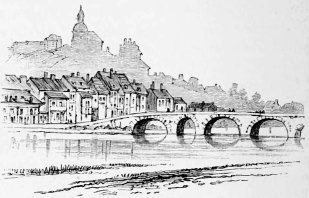
I was most thankful when we left England for Italy on the 12th of October, and seemed to breathe freely when we were once more in our old travelling life, sleeping in the primitive inns at Joigny and Nuits, and making excursions to Citeaux and Annecy. Carlyle says, "My father had one virtue which I should try to imitate: he never spoke of what was disagreeable and past," and my Mother was the same; she turned her back at once upon the last months, which she put away for ever like a sealed volume. We spent several weeks at Florence in the Via della Scala, whence, the Mother being well, I went constantly to draw in the gallery of sketches by Old Masters at the Uffizi. But, in the middle of November, I felt already so ill, that I began to dread a possibility of dying where my Mother would not have any one to look after her, and on the 16th we hurried to Rome, where I had just time to look out lodgings for my Mother, and establish her and Lea in the Piazza Mignanelli, when I succumbed to a violent nervous fever. Most terrible are the sufferings which I recollect at this time, the agonising pains by day, and the nights of delirium, which were truly full of Coleridge's "pains of sleep," in which I was frequently haunted by the sardonic smile of the horrible Mrs. Dunlop, and otherwise by dreams which were, as Carlyle would say, "a constant plunging and careering through chaos and cosmos." In the second week of December I rallied slightly, and could sit with Mother in the sun on the terrace of Villa Negroni. By the 14th I was able to walk a little, and went, supported on each side, to the quiet sunny path by the Tiber which then existed opposite Claude's villa. Just in front of us a carter was walking by the side of his cart, heavily laden with stones. Suddenly the wheel of the cart went too near the steeply sloping bank of the Tiber and tipped over; the horse tried in vain to recover itself, but the weight of the stones was so great that it was dragged down, and slowly, slowly, screaming as only animals do scream, disappeared with the cart under the swollen yellow waters; while the driver stood helplessly upon the bank shrieking and wringing his hands.
Weak as I was, this terrible scene naturally brought back all my fever, which now turned to typhoid, and I soon became delirious. By the following Sunday my life was despaired of. But in the small hotel where we had stayed at Florence, we had met an American, Dr. Winslow, with his wife and daughters, to whom my Mother had shown kindness, and who had been struck with our entire union and devotion to each other. Dr. Winslow arrived in Rome when I was at the worst, and the first news he heard was that I was dying. He at once gave up his Roman sight-seeing and everything else, and devoted himself to me, coming many times a day and nursing me with such wonderful care, that I eventually recovered, though it was February before I was at all myself again. It was an unspeakable blessing that my Mother continued well during my long illness, and was so kindly looked after by Mrs. Woodward and Miss Wright that I had no anxiety about her; though in the spring, when we had moved to the Via Babuino, she had one of her strange illnesses, ending in a tranquil unbroken sleep which lasted two days and nights. It was about this time that she was called to bear a loss which in earlier years would have been utterly crushing, that of her sister-friend Lucy, who expired peacefully in her quiet home at Abbots-Kerswell, with only her faithful maid watching over her. In her hermit-life, my Aunt Lucy had become farther removed from us each year, but two years before my Mother had found great happiness in visiting her, and her beautiful letters were a constant enjoyment. Still it is a merciful dispensation that to those who are themselves on the border-land of heaven, bereavements fall less bitterly, separations seem so short; and, to my Mother, the loss of the dearest friend of her early life was only a quiet grief: she had "only gone from one room into the next." My Aunt Lucy Hare had never liked me, but I had none of the bitter feeling towards her which I had towards my Aunt Esther: she truly loved my Mother, and I could admire, though I could not enter into, the various graces of her character, which were none the less real because they were those of a Carmelite nun in Protestant form.
To Roman antiquaries this spring was rendered important from the discovery of the site of the Porta Capena,—the site of which was long a vexed question,—by Mr. J. H. Parker, the Oxford publisher, who devoted much of his fortune to archæological pursuits. Pius IX. granted him permission to excavate without in the least believing anything would come of it. But when he came to inspect the discoveries he exclaimed, "Why, the heretic's right," and complained bitterly that his own archæologists, whom he paid highly, should have failed to find what had been discovered by a foreigner. Mr. Parker carefully marked all the pieces then found of the Servian Wall, and numbered them in red; but the guardia, seeing the red marks, thought they meant something revolutionary, and destroyed them. When he found them gone, Parker was furious. "Is it," he said, "due to the absurdities of an effete religion, or is it perhaps the insolence of some rival archæologist?" (meaning Rosa).
As we returned through France in the spring of 1869, we diverged to Autun and Nevers, the last of the pleasant expeditions the dear Mother and I made together in summer weather. The greater part of our summer was spent quietly at home, and was chiefly marked for me by the marriage of my dear friend Charlie Wood to Lady Agnes Courtenay.
To MISS WRIGHT.
"Holmhurst, July 10, 1869.—Your description made me see a pleasant mental picture of the cousinhood assembled at your party. For myself, I cannot but feel that all social pleasures will henceforward become more and more difficult for me, as the Mother, though not ill, becomes daily more dependent upon me for all her little interests and amusements, so that I scarcely ever leave her even for an hour. It is an odd hermit-like life in the small circuit of our little Holmhurst, with one or two guests constantly changing in its chambers, but no other intercourse with the outside world. At last summer has burst upon us, and looks all the brighter for the long waiting, and our oak-studded pastures are filled with gay groups of haymakers, gathering in the immense crop. The garden is lovely, and my own home-sunflower is expanding in the warmth and stronger and better than she has been for months past."
PORTE D'ARROUX, AUTUN.[390]
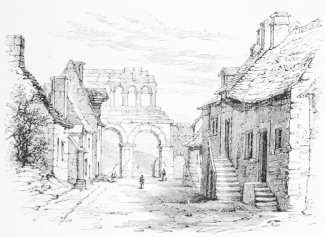
"Holmhurst, August 1.—I cannot be away from home at all this summer, partly because I cannot leave Mother, who (though very anxious to promote my going away) is really becoming more dependent upon my constant care and companionship; and partly because I cannot afford the inevitable small expenses of going anywhere, our finances having been completely prostrated by the Roman Catholic robberies last year. Indeed, I have never been poorer than this year, as I have had nothing, and when I put two threepenny bits into the Communion plate to-day, felt exceedingly like the widow with the two mites, for it was literally all that I possessed! However, this is not so very dreadful after all, and I daresay another year matters will come round."
In September, however, when Charlotte Leycester came to take care of my Mother, I did go to the North.
To MY MOTHER.
"Ridley Hall, Sept. 1, 1869.—Though I have got into a great scrape with Cousin Susan by calling blackberry jelly, 'jam,' and though I was terribly scolded the other day for saying 'thanks,'—'such new-fangled vulgarity,'—this visit at Ridley has been very pleasant. First, there never was more perfect ideal weather, so fresh and bright, so bracing, and the colouring of the woods and moorlands, and the glorious tumbling amber-coloured rivers so beautiful. Then I feel much stronger and better than I have done for two years past, and Cousin Susan, who thought me most ghastly when I arrived, is quite satisfied with the results of her grouse, pheasants, and sherry. On Wednesday Lady Blackett came to spend the day, and, after she was gone, Cousin Susan and I made a long exploring expedition far beyond the Allen Water, up into the depths of Staward valley—most romantic little paths through woods and miniature rocky gorges to a ruined bridge and 'Plankey Mill,' and then up a steep wood path to the moor of Briarside. Cousin Susan had never been so far since she lived here, and we were walking, or rather climbing, for three hours, attended by the white dogs. These have chairs with cushions on each side the fireplace in her new sitting-room. One is in bad health, has medical attendance from Hexham at half-a-guinea a visit, and uninitiated visitors must be rather amazed when they see 'my poor little sick girl' whom Cousin Susan is constantly talking of.... On Sundays there is only service here in the morning: the clergyman giving as his curious reason for not having it in the afternoon, that 'perhaps it might annoy the Dissenters.' ... This evening it has thundered. Cousin Susan, as usual on such occasions, hid herself with her maid under the staircase (the safest place in case of thunderbolts), and held a handkerchief over her eyes till it was over; but her nerves have been quite upset ever since, and we are not to have the carriage to-morrow for fear the storm should return."
"Ford Castle, Sept. 8.—It was almost dark as I drove up the beautiful new road over the high bridge to the renovated castle, which is now all grand and in keeping. I found the beautiful mistress of the house in her new library, which is a most delightful room, with carved chimney-piece and bookcases, and vases of ferns and flowers in all the corners and in the deep embrasures of the windows. She is full of the frescoes in her school. 'I want to paint "Josiah was eight years old when he began to reign." I think he must be a little boy on a step with other children round him—a very little boy, and he must have some little regal robes on, and I think I must put a little crown upon his head.'"
FORD CASTLE, THE LIBRARY.[391]
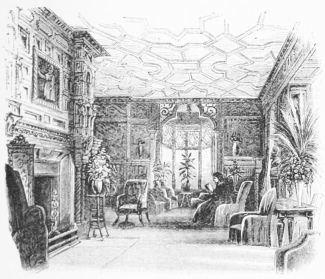
"Sept. 10.—Every day of a visit at Ford always seems to contain more of charm and instruction than hundreds of visits elsewhere. The great interest this time has been Lady Canning's drawings—many hundreds of them, and all so beautiful that you long to look at each for hours. All yesterday evening Lady Waterford read aloud to us—old family letters, from old Lady Hardwicke and from Lady Anne Barnard. 'My great-aunt, Lady Anne Barnard,' she says, 'wrote a book very like your Family Memoirs, only hers was too imaginative. She called all her characters by imaginary names, and made them all quite too charming: still her book is most interesting. She was very intimate with Mrs. Fitzherbert, and describes all her first meetings with George IV. and the marriage, and then she went with her on her famous expedition to Paris. She got possession of all the real letters of the family and put them into her book, but she embellished them. She got hold of a letter Uncle Caledon wrote to my aunt when he proposed to her, but when Uncle Caledon read the book and found a most beautiful letter, he said, "My dear, I never wrote all this."—"No, my dear," she answered, "I know you did not, but then I thought your real letter was not warm enough." Lady Anne Barnard wrote "Auld Robin Gray," and she used to describe how some one translated it into French, and how, when she went to Paris, she saw every one looking at her, she could not imagine why, till she heard some one say, "Voilà l'auteur du fameux roman de Robin Gray.'"[392]
"Sept. 10.—We have all been to luncheon at Carham, sixteen miles off, and the latter part of the drive very pretty—close to the wide reaches of the Tweed, with seagulls flitting over it, and Cuyp-like groups of cattle on the shore, waiting for the ferryboats to take them across to Coldstream Fair. Carham is one of the well-known haunted houses: the 'Carham light' is celebrated and is constantly seen. We asked old Mrs. Compton of eighty-three, who lives there now, about the supernatural sights of Carham. 'Och,' she said, 'and have ye niver heard the story of the phantom carriage? We have just heard it this very morning: when we were waiting for you, we heard it drive up. We are quite used to it now. A carriage drives quickly up to the door with great rattling and noise, and when it stops, the horses seem to paw and tear up the gravel. Strange servants are terribly frightened by it. One day when I was at luncheon I heard a carriage drive up quickly to the door: there was no doubt of it. I told the servant who was in waiting to go out and see who it was. When he came back I asked who had come. He was pale as ashes. "Oh," he said, "it's only just the phantom coach."
"'And then there is the Carham light. That is just beautiful! It is a large globe of fire in the shape of a full moon: I have seen it hundreds of times. It moves about in the woods, and sometimes settles in one place. The first time I saw it I was driving from Kelso and I saw a great ball of fire. I said to the driver, "What is that?"—"Oh, it's just the Carham Light," he said. When Dick[393] came in, he said he did not believe it—he had never seen it; but that night it came—bright as ever. All the gentlemen went out into the woods to examine it; but it moved before them. They all saw it, and they were quite convinced: it has never been explained.'
"We had tea with the charming old lady. 'I've just had these cakes made, Lady Waterford,' she said, 'because they were once very weel likit by some very dear to you; so I thought you would like them.'
"Lady Waterford sends you a riddle:—
'Mon premier est un tyran, mon second une horreur, Mon tout est le diable lui-même. Mais si mon premier est bon, mon second ne fait rien, Et mon tout est le bonheur suprême.'"[394]
"Foxhow, Ambleside, Sept. 12, 1869.—How lovely the drive into Foxhow from Windermere; but, after the grand ideas of my childhood, how small everything seems, even the lake and the mountains! We drove in at the well-remembered gate by Rotha Cottage, and along those lovely Swiss pasture-meadows. It was like a dream of the past as one turned into the garden, all so exactly the same and so well remembered, not only from our last brief visit, but from that of twenty-six years ago. Dear Mrs. Arnold is little altered, and is so tenderly affectionate and charming, that it is delightful to be with her. She likes to ask all about you and Holmhurst, and says that her power of producing mind-pictures and dwelling upon them often brings you before her, so that she sees you as before, only older, in your home life. It is quite beautiful to see the intense devotion of her children to their mother and her happiness in them, in Fan especially. All the absent ones write to her at least three times a week.
"We have just been in a covered car to Rydal Church: how beautiful the situation! How well I remembered being sick as a child from the puggy smell of its hideous interior. It was just as puggy to-day, but I was not sick. There was a most extraordinary preacher, who declared that the Woman on the seven mountains was Rome on her seven hills—'allowed to be so by all authorities, Jewish, and even Romanist,'—that the dragon was only the serpent in its worshipped form, and that both were identical with the Beast and represented the pagan religion; that the Woman flying into the wilderness before the Beast was Early Christianity flying from pagan persecution, and that when she came back, to St. John's astonishment she was seated on the Beast, i.e., she had adopted all the pagan attributes, the cross, the mother and child—well-known objects of worship at Babylon, and Purgatory—a tenet of pagan Rome!"
"Foxhow, Sept. 14.—My Mother will have thought of this pouring weather as most unpropitious for the Lake Country, but in reality it has not signified very much, as each day it has cleared for a few hours, and the lights and shadows have been splendid. On Sunday afternoon Edward (Arnold) and I went up Loughrigg. All the little torrents were swollen by the storms, and the colours of the dying fern and the great purple shadows on Helm Crag and Bow Fell were most beautiful. It is a most picturesque bit of mountain, and it all strikes me, as I remember it did in 1859, as more really beautiful than anything in Switzerland, though so contracted.
"Yesterday afternoon we walked to Grasmere, and I stayed looking at the interesting group of Wordsworth tombs, whilst Edward paid a visit. Afterwards the lake looked so tempting, that Edward rowed me down it, sending the boat back by a boy. We landed at the outlet of the Rotha on the other side, and had a beautiful walk home by a high terrace under Loughrigg. If one remained in this country, one could not help becoming fond of Wordsworth, his descriptions are so exact. Edward has repeated many of his poems on the sites to which they apply, and they are quite beautifully pictorial. Mrs. Arnold is very happy in the general revival of interest in his poetry.... Nothing can be more enjoyable and united than the family life here, the children and grandchildren coming and going, and so many interesting visitors. Truly dear Mrs. Arnold's is an ideal old age, so hedged in by the great love and devotion of her descendants."[395]
"Dalton Hall, Lancashire, Sept. 17.—I always enjoy being here with the Hornbys. Yesterday we drove in the morning to Yealand, a pretty village so called from the Quakers who colonised it. In the afternoon we went to Levens. It is a lovely country, just upon the outskirts of the Lake District, with the same rich green meadows, clear streams, and lanes fringed with fern and holly. We passed through Milnthorpe, and how well I remembered your shutting me up and making me learn a Psalm in the inn there, instead of letting me go out to draw! The country is very primitive still. An old clergyman who officiated till lately in the neighbouring church of Burton Moss had only three sermons, one of which was laid in turn on the pulpit desk by his housekeeper every Sunday morning. When he had finished, he used to chuck it down to her out of the pulpit. One of these sermons was on 'Contentment,' and contained—apropos of discontent—the story of the Italian nobleman whose tombstone bore the words, 'I was well, I wished to be better, and now I am here.'"
It was a great pleasure this autumn to see again in London the New Zealand Sir George Grey. I remember his saying how he wished some one would write a poem on Pharaoh pursuing the Israelites to the Red Sea, from the point of view that in pursuing them he was pursuing Christianity; that if the Israelites had perished, and not Pharaoh, there would have been no Redemption.
JOURNAL (The Green Book).
"Holmhurst, Oct. 13, 1869.—After the storms of last year, this summer has been peaceful and quiet. My sweet Mother, though often ailing, has been very gently and quietly happy. She seems older, but age has with her only its softening effects—casting a brighter halo around her sweet life, and rendering more lovable still every precious word and action.... We are more than ever to each other now in everything."
We left home in 1869 on the 14th of October, intending to cross the Channel at once, but on arriving at Folkestone, found such a raging sea, that we retreated to Canterbury to wait for better weather. This enabled us to pay a charming visit to Archdeacon and Mrs. Harrison, who had been very familiar to us many years before, when the Stanleys lived at Canterbury. It was the last visit my Mother ever paid, and she greatly enjoyed it, as it seemed almost like a going back into her Hurstmonceaux life, a revival of the ecclesiastical interests which had filled her former existence. Whenever any subject was alluded to, Archdeacon Harrison, like Uncle Julius, went to his bookcase, and brought down some volume to illustrate it. Thus I remember his reading to us in the powerful sermons of Bishop Horsley. One of the most remarkable was upon the Syro-Phœnician woman. Another is on the French Nuns, in defence of their institution in England, saying, with little foresight, how unlikely they were to increase in number, and how very superior they were to those women "who strip themselves naked to go out into the world, who daub their cheeks with paint, and plaster their necks with litharge."
Apropos of the proverb about Tenterden Steeple and Goodwin Sands, Archdeacon Harrison described how it was in allusion to two things totally disconnected. Tenterden Steeple and Goodwin Sands are very far apart, and of course have no connection whatever: yet perverse persons used to say that Tenterden Steeple was the cause of Goodwin Sands, as money which ought to have been used to prevent the accumulation of Goodwin Sands was diverted to the building of Tenterden Steeple. The place where you may hear most about it is "Latimer's Sermons." Latimer is inveighing against the persons who denounced the study of the Bible as the cause of the misfortunes of the time, and says that they had as much connection as Tenterden Steeple and Goodwin Sands, and so forth.
To MISS WRIGHT.
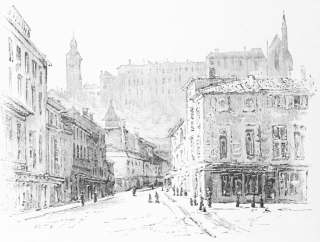
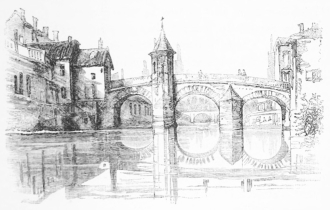
"Munich, Nov. 1, 1869.—We made it four days' journey from Paris to Strasbourg. First we went to Bar-le-duc. I had longed to see it, from a novel I read once, and it is well worth while—the old town rising above the new like the old town of Edinburgh—tall grey houses pierced with eight or ten rows of windows, a river with a most picturesque bridge, and in the church 'Le Squelette de Bar,' a wonderful work of Richier, the famous sculptor of S. Mihiel, commemorating the Princes of Bar (Henri I., II., III., &c.), sovereigns of whom I wonder if you ever heard before: I never did.
"We slept next at Toul, where there is a fine huge dull cathedral, a beautiful creche by Ignace Robert, and a lovely convent cloister of flamboyant arches. Living at Toul is wonderfully cheap; our rooms for three were only four francs, and dinner for three four francs.[396] We wonder people do not emigrate to Lorraine instead of to Australia; it would be far cheaper, and infinitely more amusing. If it had been warmer, we should have gone to Domremy and S. Mihiel, but we feared the cold. We were a day at Nancy: how stately it is! At Strasbourg we found that the storks had left, and we thought it the least interesting place on the road, yet most people stay only there.
BAR-LE-DUC.[397]
BRIDGE OF BAR-LE-DUC.[398]
"We had three days at Carlsruhe, and found dear Madame de Bunsen most bright and well and charming, with much to tell that was worth hearing, and the fullest sympathy and interest in others. Generally one feels that conversation weakens the mind; with the Bunsens it never fails to strengthen it. Madame de Bunsen talked much of the difficulties which had crowded round her when she herself was to begin the Memoir of her husband. Bunsen had said to her, 'You must tell the story of our common life; you are able to do it, only do not be afraid.' Thus to her the work was a sacred legacy. First, as material, her son George brought her Bunsen's letters to his sister Christiana, which she had given to him, and which he had fortunately never given to his father for fear he should destroy them. Then she had written to Reck, the early Göttingen friend and confidant of all Bunsen's early life, and had been refused all help without any explanation! Then Stockmar, Brandeis, &c., sent all their letters; thus the work grew. But there were no journals, she had made no notes, there was only her recollection to fall back upon. Madame de Bunsen regretted bitterly the destruction of Uncle Julius's letters by his widow, especially those written in his early life to his brother Augustus, which would have been 'the history of the awakening of a new phase of opinions.' I made quantities of notes from the intensely interesting reminiscences Madame de Bunsen poured forth of her own life.[399]
"We were one day at Stuttgart, which I had never seen, and was delighted with—so handsome, really a beautiful little capital, and we reached Munich in time to have one day for the International Exhibition of Paintings, which was well worth seeing—finer, I thought, than ours. The German artists have surely far more originality than the artists of other nations. Three pictures especially remain in my mind—'The Chase after Luck,' a wild horseman with Death riding behind him in pursuit of Luck, a beautiful figure scattering gold and pearls whilst floating on a bladder, full speed across a bridge which ends in a rotten plank over a fathomless abyss: 'The Cholera in Rome,' the Angel of Death leading the Cholera—a hideous old woman—down the street under the Capitol by moonlight, and showing her the door she is to knock at: 'L'Enfant qui dort à l'ombre du lit maternel, et les Anges qui savent d'avance le sort des humains, et baissent avec larmes ses petites mains.' It is interesting to see how familiar the German common people are with their artists: the great names of Kaulbach, Henneberg, &c., are in every mouth; how few of our common people would know anything of Landseer or Millais!"
"Vicenza, Nov. 14.—The descent into Italy by the Brenner was enchanting—the exchange of the snow and bitter cold of Germany for vineyards and fruit-gardens, still glorious in their orange and scarlet autumnal tints. We were greatly delighted with Botzen, where the delicately wrought cathedral spire against the faint pink mountains tipped with snow is a lovely subject.
MANTUA.[400]
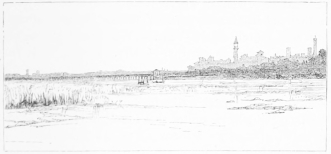
"At Verona we spent several days, thinking it more captivating than ever. Mother was able to enjoy the Giusti gardens, and I went one day to Mantua. It is wonderful. The station is two miles off, and the drive into the town across an immense bridge over the lake is most striking[401]—the towers all reflected in the still waters, and the fishing-boats sailing in close under the houses. Then, in the town, the intense desolation of one part—courts and corridors and squares all grass-grown and utterly tenantless—is a striking contrast to the other part, teeming with life and bustle. The Palazzo del Té is marvellous—only one story high, gigantic rooms covered with grand frescoes opening on sunny lawns with picturesque decaying avenues. I wandered over the vast ducal palace with three American ladies, who 'guessed' that 'when Mantua was in its prime, it must have been rather an elegant city.'"
"Hôtel de Londres, Pisa, Dec. 7.—From Verona we went to Vicenza, where we stayed nearly a week in the old-fashioned palazzo which is now turned into the Hôtel de la Ville. We found some old Roman acquaintances there—Mrs. Kuper and her daughter, great Italian travellers, famous linguists, and excessively amusing companions. With them I went many delightful walks in the lovely country near Vicenza, which is quite the ideal Italy one reads so much of and so seldom sees—splendid mountain background with snowy peaks; nearer hills golden with decaying chestnuts and crimson with falling vine-leaves; old shrines and churches half hidden in clematis and vine, and a most interesting town with a fine picture-gallery—Montagna (not Mantegna) being the great master. I took to the plan of trying to make ever so slight sketches from pictures, and find them, bad as they are, far more interesting than photographs. We had permission to walk in the lovely gardens of the old Marchese Salvi, close to the hotel, a great pleasure to the Mother.
VICENZA.[402]
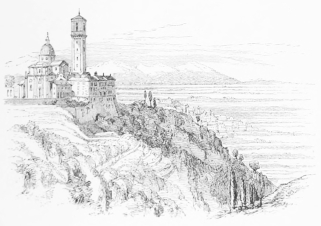
VICENZA FROM MONTE BERICO.[403]
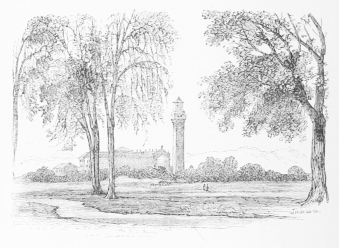
THE PRATO DELLA VALLE, PADUA.[404]
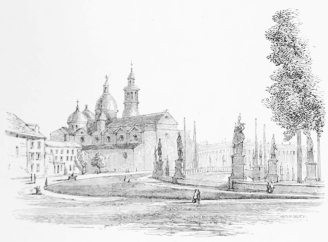
SIENA.[405]
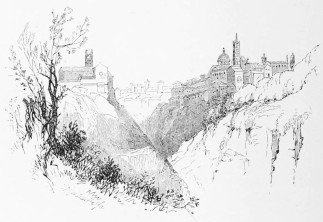
S. GEMIGNANO.[406]
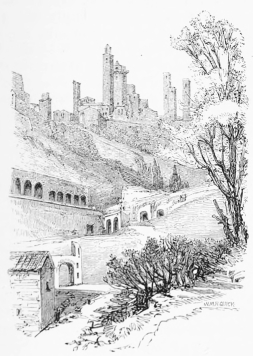
"The Kupers preceded us to Padua and engaged comfortable rooms for us there, to which we followed. Here was another kind of interest in the quaint churches; the Prato della Valle with its stone population; the University, where we went to hear a lecture and saw the 3000 students assembled; and the society of some pleasant young Paduans—M. Fava and Count Battistino Medine, introduced by the Kupers. But alas! Mother became very unwell indeed during the latter part of our stay at Padua, and I was made very unhappy by her constant cough and inability to take food. So I was thankful when we were able to come on to this comfortable hotel, where Flora and the faithful Victoire are incessant in their attentions. I am still anxious about my sweet Mother, who is very ailing and unable to go out; otherwise I always like staying at Pisa, with its clean quiet streets and the interest of the Campo Santo, so full of beautiful relics and memories. Many delightful hours have I spent there, and what a school of art and history it is! And then the Spina is always so graceful and striking against the crimson sunset which turns the muddy Arno into a river of fire.[407] Then, only think, I have made a new friend, and, strange to say, an American, with the uninteresting name of Robert Peabody. I do not know when, if ever, I have seen any one I like so much—so clever, so natural, so unworldly, so large-minded, so good-looking. The Mother thinks my sudden friendships most fantastic, but I have no doubt about this one; and as Mother was much better last week, I went away with him for four days to Siena and S. Gemignano, and we were entirely happy together, though it poured cats and dogs the whole time, and thundered and lightened as if the skies were coming down. I do not think you have ever been half excited enough about Siena: it seems to me such a sublime place—the way it rises out of that desolate earthquake-riven country, the cathedral so grandly solemn, and such a world of interest circling around all the scenes in S. Catherine's life. I tried to draw the famous Sodoma, and longed to stay months, but we only did stay two days, and then away we went in a baroccino over the hills to S. Gemignano. You must never come to Italy again without going there: I am beginning now to fancy that no one has seen Italy who has missed S. Gemignano. It is a perfect sanctuary of art, the smallest town ever seen, but with thirteen tall mediæval towers in fullest preservation, crowning the top of the little hill like a huge group of ninepins, and with churches covered with frescoes by Filippo and Simone Memmi, Beccafumi, Ghirlandajo, and all that wonderful school. The great saint of the place is Santa Fina—a poor girl, who had a spine complaint, lay for years on a backboard, bore her intense sufferings with great patience, and finally died a most peaceful and holy death—perhaps the one Roman Catholic saint whose story is unspoilt by miracles. I first heard about her from Lady Waterford, and had always longed to see her native place. The Ghirlandajo fresco of her death is most touching and real, portraying the bare cottage room, the hard-featured Tuscan nurse, the sick girl on her backboard—all like a scene in a Tuscan cottage now; and, above, the angels floating away with their newly-gained sister. But the people of S. Gemignano forgot the picture when they quaintly told us that 'all the little flowers and shrubs were so enchanted with her exemplary patience, that they began to sprout around her bed, and by her twenty-eighth year (when she died) she was lying in quite a garden of beautiful flowers.'"
In recollection I feel grateful for this short absence from my Mother with Robert Peabody, as it procured for me my last tiny letter from her—cheerful and tender as all her letters were now. But after the beginning of December I seldom left her, and the next six weeks were spent entirely in her room, in watching and cheering her through a time of great suffering, whilst the rain never ceased to fall in torrents. I was often able to amuse her with stories of my companions at the table-d'hôte.
JOURNAL.
"Pisa, Nov. 27.—The chief interest here has been from travellers in the hotel—a Mr. and Mrs. D., kind, vulgar people, who have seldom been out of London, except to Paris, and who do not speak a word of any foreign language; at least Mr. D. does speak certain words, and uses them all together to all the foreigners he meets, without any regard to their meaning—'Lait pain thé bongjour toodyswee;'—a haughty pretty Polish girl and her governess, and a clever pretty Polish Comtesse de M. with her young husband. The last lady keeps the whole table alive with her stories, told with the utmost naïveté, and in the prettiest manner.
"'I will tell you about my going to Ferrara. When I arrived I was gasping with hunger. We drove up to the hotel. "Could we have any dinner?"—"J'en suis désolé, Madame, but the cook is out." We drove to another. "Could we have any dinner?"—"J'en suis au désespoir, Madame, mais il n'y a pas de feu." We drove on. Another hotel. We ordered our dinner, and when it was put on the table, it was so dreadful, I gave one look and ran out of the room. And then the sights of Ferrara! We went to the castle. It was horrible—a ghastly dungeon with bare walls and chains and one glimmering ray of light. "This," said the guide, "was the dungeon of Ugo and Parisina; here they suffered and here they died." Oh, mon Dieu, quel horreur! I wished to go somewhere else. They took me to a convent—again a ghastly room, a fearful prison. "This, Madame, was the prison of Tasso"—encore des horreurs! Oh, then I would have a carriage. I asked the driver where he would take me. "Ma, Signora, allo Campo Santo." Ah! quelle triste ville la ville de Ferrare! But when we got to Bologna, and I asked where we should go, c'était toujours la même chose—toujours au Campo Santo, and at Pisa here, it is encore au Campo Santo!
"'At Ferrara, in the prison of Tasso, they show on the wall an ode written by Lord Byron. The rest of the wall is white, but the place where the ode is written is brown. "Why," I asked, "is that part of the wall brown?"—"Ah!" said the custode, "that is the sweat of the English. All the English will touch the writing of their compatriot, and then they perspire from their hot fingers, and thus it is brown." In the same room is a great hole; the wall has crumbled away: it is gone: the room will fall. "And what is that?" I asked. "Ah! that is made by the English, who all insist upon taking away a morsel of the prison of Tasso." And thus it was at Verona; when I saw Juliet's tomb, they told me it was only an imitation; for as for the real one, the English ladies had chopped it all up and were wearing it in bracelets. Oh, comme c'est ennuyant de voyager, il faut tourner la tête pour regarder les tableaux, et on casse le cou par ici: il faut regarder par la fênetre pour voir la vue, et on casse le cou par là: il faut regarder au plafond pour voir les fresques, et on casse le cou de tous les côtés à la fois. And then the journey to Switzerland! Mais aller en Suisse, jamais! What do you want to see mountains for? to admire their height? Ah! then how stupid to go up! Why, of course they become shorter every step you go. No, you should go into the depths to see the mountains. Les plaines pour moi!... Jusqu'à mon mariage je ne suis jamais sortie à pied, mais depuis mon mariage je suis devenue ... raisonable.'