Volume 3 — CONTENTS VOLUME 3 (continued 3)
Reading edition
A little later, I went to stay at Dalton Hall in Lancashire, to visit Mrs. Hornby, a cousin of my Aunt Penrhyn, and a very sweet and charming old lady, who never failed to be loved by all who came within her influence. She told me many old family stories, amongst others how—
"The late Lord Derby (the 13th Earl) was very fond of natural history even as a boy. One night he dreamt most vividly of a rare nest in the ivy on the wall, and that he was most anxious to get it, but it was impossible. In the morning, the nest was on his dressing-table, and it could only have got there by his opening the window in his sleep and climbing the wall to it in that state.
"Another instance of his sleep-walking relates that he had a passion, as a little boy, for sliding down the banisters, but it was strictly forbidden. One night his tutor had been sitting up late reading in the hall, when he saw one of the bedroom doors open, and a little boy come out in his night-shirt and slide down the banisters. This he did two or three times, and when the tutor made some little noise, he ran upstairs and disappeared into his bedroom. The tutor followed, but the little boy was fast asleep in bed."
Apropos of sleep-walking, Mr. Bagot (husband of Mrs. Hornby's daughter Lucy) told me a story he had just seen in the Times:—
"A large pat of butter was lately on the breakfast table of a family. When it was divided, a gold watch and chain were found in the midst of it. The maid who was waiting gave a shriek, and first rushed off to her room, then, coming back, declared it was hers. The family were much surprised, but what she said turned out to be true. She had dreamt that she was going to be robbed of her watch and chain, and that the only way of hiding them would be to wrap them up in a pat of butter, and she had done it in her sleep."
A sister-in-law of Mrs. Hornby—a Mrs. Bayley—was staying at Dalton when I was there. She told me—first hand—a story of which I have heard many distorted versions. I give it in her words:—
"My sister, Mrs. Hamilton (née Armstrong), was one night going to bed, when she saw a man's foot project from under the bed. She knelt down then and there by the bedside and prayed for the wicked people who were going about—for the known wicked person especially—that they might be converted. When she concluded, the man came from under the bed and said, 'I have heard your prayer, ma'am, and with all my heart I say Amen to it;' and he did her no harm and went away. She heard from him years afterwards, and he was a changed man from that day."
Apropos of the growth of a story by exaggeration, Mrs. Bayley said:—
"The first person said, 'Poor Mrs. Richards was so ill that what she threw up was almost like a black crow.' The second said, 'Poor Mrs. Richards was so ill: it was the most dreadful thing, she actually threw up a black crow.' The third said, 'Poor Mrs. Richards has the most dreadful malady: it is almost too terrible to speak of, but she has already thrown up ... three black crows.'"
Mrs. Bayley was a very "religious" person, but she never went to church; she thought it wrong. She called herself an "unattached Christian," and said that people only ought to go to church for praise, but to do their confessions at home. When I left Dalton, she presented me with a little book, which she begged me not to read till I was quite away. It was called "Do you belong to the Hellfire Club?" It was not an allegorical little book, but really and seriously asked the question, saying that, though not generally known, such a club really existed, where the most frightful mysteries were enacted, and that it was just within the bounds of possibility that I might secretly belong to it, and if so, &c., &c. A similar little book was once thrust into my hand by a lady at the top of St. James's Street.
On the 29th of October 1866 we left England for Cannes, stopping on the way at Villefranche, that we might visit Ars, for the sake of its venerable Curé.
To my Sister.
"Nov. 1866.—It was a pretty and peculiar drive to Ars: first wooded lanes, then high open country, from whence you descend abruptly upon the village, which, with its picturesque old church, and the handsome wooden one behind it, quite fills the little hollow in the hills. The village itself is almost made up of hotels for the pilgrims, but is picturesque at this season, with masses of golden vine falling over all the high walls. We left the carriage at the foot of the church steps, and ascended through a little square crowded with beggars, as in the time of the Curé.[330] The old church is exceedingly interesting. In the middle of the floor is the grave of the Curé, once surrounded by a balustrade hung with immortelles, which are now in the room where he died. At the sides are all the little chapels he built at the different crises of his life, that of S. Philomene being quite filled with crutches, left by lame persons who have gone away cured. Beyond the old church opens out the handsome but less interesting modern building erected by the Empress and the bishops, with a grand baldacchino on red granite pillars, and on the altar a beautiful bas-relief of the Curé carried to heaven by angels. In the old church a missionary was giving the pilgrims (who kept flocking in the whole time) a very beautiful and simple exposition on the life of Christ as a loving Saviour, quite carrying on the teaching of the Curé.
"At half-past twelve a Sister of Charity came to show the Curé's room. It is railed off, because the pilgrims would have carried everything away, as they have almost undermined the thick walls in their eagerness to possess themselves of the bits of stone and plaster; but you see the narrow bed, the poor broken floor, his chair, his table, his pewter spoon and earthenware pot,—the picture which was defiled by the Demon,—the door at which 'the Grappin' knocked,—the narrow staircase from which he shouted 'Mangeur de truffes,'—the still poorer room downstairs where the beloved Curé lay when all his people passed by to see him in his last sleep,—the little court shaded by ancient elder-trees in which he gave his incessant charities,—and close by the little house of his servant Catherine. She herself is the sweetest old woman, seeming to live, in her primitive life, upon the gleanings and the teaching of the past. She sate on a low stool at Mother's feet, and talked in the most touching way of her dear Curé. When Mother said something about the crowds that came to him, she said, 'I have always heard that when the dear Saviour was on earth, He was so sweet and loving, that people liked to be near Him, and I suppose that now when men are sweet and loving, and so a little like the dear Saviour, people like to be near them too.' In a small chapel of the school he founded they showed some blood of the Curé in a bottle—'encore coulant.' Many other people we saw who talked of him—'Comme il était gai, toujours gai,' &c. The whole place seemed cut out of the world, in an atmosphere of peace and prayer, like a little heaven: no wonder Roman Catholics like to go into 'Retreat' there."
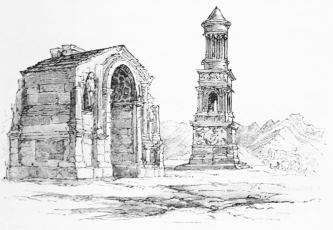
We stayed afterwards at Arles, and made the excursion to S. Remy, one of the most exquisitely beautiful places I have ever seen, where Roman remains, grand in form and of the most splendid orange colouring, rise close to the delicate Alpines.
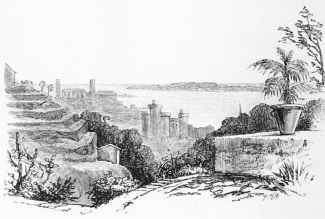
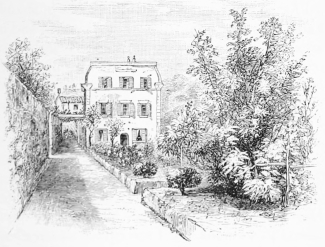
At Cannes we were most fortunate in finding a house exactly suited to our needs—a primitive bastide, approached by a long pergola of vines, on the way to the Croix des Gardes, quite high up in woods of myrtle and pine upon the mountain-side.[331] It was far out of the town and dreadfully desolate at night, but in the daytime there were exquisite views through the woods of the sea and mountains, and a charming terraced garden of oranges and cassia—the vegetation quite tropical. Close to the turn into our pergola was a little shrine of S. François, which gave a name to our cottage, and which the peasants, passing to their work in the forests, daily presented with fresh flowers. Delightful walks led beyond us into the hilly pine woods with a soil of glistening mica, and, if one penetrated far enough, one came out upon the grand but well-concealed precipices of rock known as the Rochers de Bilheres. Just below us lived Lord Mount-Edgecumbe, the "Valletort" of my Harrow days, with his sweet invalid wife, and their three little girls, with the little Valletort of this time, were a perpetual pleasure to my mother in her morning walk to the Croix des Gardes. Old Madame Bœuf, our landlady, used to come up every morning in her large flapping Provençal hat to work with her women amongst the cassia: the sunshine seemed almost ceaseless, and all winter we used to sit with open windows and hear our maid Marguerite carolling her strange patois ballads at her work.
S. REMY.[332]
FROM MAISON S. FRANÇOIS, CANNES.[333]
On the other side of Cannes, at the Hôtel de Provence, we had a large group of friends, Lady Verulam and her sons; Lord and Lady Suffolk and their two daughters; and the Dowager Lady Morley with her son and daughter. With the latter I became very intimate, and joined them in many long and delightful excursions to remote villages and to the unspeakably grand scenery above the Var. Lady Suffolk too became a dear and much honoured friend.
A still greater pleasure was the neighbourhood, in a small house by the torrent at the foot of our hill, of the dear old Lady Grey of our Nice days, and her niece Miss G. Des Vœux. I generally dined with them once or twice a week, and constantly accompanied them on delightful drawing excursions, taking our luncheon with us. In the spring I went away with them for several days together to the wild mountains of S. Vallier and S. Cesaire. Lady Grey painted beautifully, though she only began to be an artist when she was quite an old woman. She always went out sketching with thirty-nine articles, which one servant called over at the door, another answering "Here" for each, to secure that nothing should be left behind.
Beneath us, at the Hôtel Bellevue, were Lady Jocelyn and her children, with Lord and Lady Vernon and Mr. and Lady Louisa Wells, whom we saw frequently; also three admirable Scotch sisters, Mrs. Douglas, Miss Kennedy, and Mrs. Tootal. Hither also came for two months our dear friend Miss Wright ("Aunt Sophy"), and she was a constant pleasure, dropping in daily at tea-time, and always the most sympathising of human beings both in joy and sorrow.
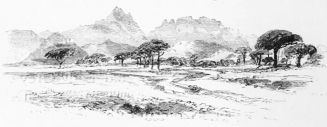
BOCCA WOOD, CANNES.
Altogether, none of our winters was so rich in pleasant society as this one at Cannes, and we had nothing to trouble us till the spring, when Lea was taken very seriously ill from the bite either of scorpion or tarantula, and, while she was at the worst and unable to move, my mother became alarmingly ill too with a fever. I was up with them through every night at this time; and it was an odd life in the little desolate bastide, as it was long impossible to procure help. At length we got a Sœur de Charité—a pretty creature in a most picturesque nun's dress, but efficient for very little except the manufacture and consumption of convent soup, made with milk, tapioca, and pepper.
MAISON S. FRANÇOIS, CANNES.
Still, for the most part, my mother had not been so well or so perfectly happy for years as in our little hermitage amid the juniper and rosemary. It was just what she most enjoyed, the walks all within her compass—perfect country, invariably dry and healthy, perpetual warmth in which to sit out, and endless subjects for her sketch-book. Lea, rejoiced to be rid for some months of her tiresome husband, found plenty of occupation in her kitchen and in attending to the poultry which she bought and reared; while I was engrossed with my drawings, of which I sold enough to pay our rent very satisfactorily, and with my "Lives of the Popes," a work on which I spent an immense amount of time, but which is still unfinished in MS., and likely to remain so. My mother greatly appreciated the church at Cannes, and we liked the clergyman, Mr. Rolfe, and his wife. His sermons were capital. I do not often attend to sermons, but I remember an excellent one on Zacharias praying for vengeance, and Stephen for mercy on his murderers, as respectively illustrating the principles of the Old and New Testament—Justice and Mercy.
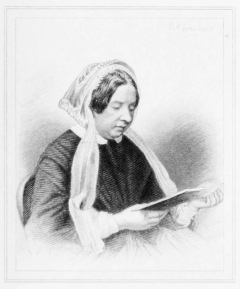
Maria Hare. 1862.
I dined once or twice, to meet Mr. Panizzi[334] of the British Museum, at the house of a quaint old Mr. Kerr, who died soon afterwards. It was him of whom it used to be said that he had been "trying to make himself disagreeable for sixty years and had not quite succeeded." When he was eighty he told me that there were three things he had never had: he had never had a watch, he had never had a key, and he had never had an account.
I frequently saw the famous old Lord Brougham, who bore no trace then of his "flashes of oratory," of his "thunder and lightning speeches," but was the most disagreeable, selfish, cantankerous, violent old man who ever lived. He used to swear by the hour together at his sister-in-law, Mrs. William Brougham,[335] who lived with him, and bore his ill-treatment with consummate patience. He would curse her in the most horrible language before all her guests, and this not for anything she had done, but merely to vent his spite and ill-humour. Though a proper carriage was always provided for him, he would insist upon driving about Cannes daily in the most disreputable old fly he could procure, with the hope that people would say he was neglected by his family. Yet he preferred the William Broughams to his other relations, and entirely concealing that he had other brothers, procured the reversion of his title to his youngest brother, William, much to the annoyance of the Queen when she found it out. Lord Brougham was repulsive in appearance and excessively dirty in his habits. He had always been so. Mr. Kerr remembered seeing him at the Beefsteak Club, when the Prince Regent was President, and there was the utmost license of manners. One day when he came in, the Prince Regent roared out, "How dare you come in here, Brougham, with those dirty hands?"—and he insisted on the waiters bringing soap and water and having his hands washed before all the company. In early life, if anything aggravated him at dinner, he would throw his napkin in the face of his guests, and he did things quite as insulting to the close of his life at Cannes, where he had a peculiar prestige, as having, through his "Villa Louise Eleanore,"[336] first brought the place into fashion, which led to the extension of a humble fishing village into miles upon miles of villas and hotels.
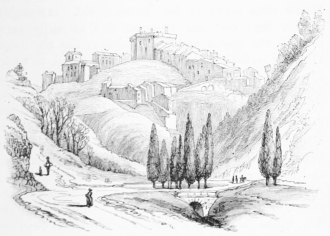
CAGNES.[337]
To MISS WRIGHT (after she had gone on to Rome).
"Maison S. François, Cannes, Feb. 2, 1867.—On Tuesday we made an immense excursion of thirteen hours to the 'Seven villages of the Var.' The party consisted of Lord Morley and Lady Katherine, Lord Suffolk and Lady Victoria, Lord Henry Percy, Lord Mount-Edgecumbe, and myself. We left by the 7.40 train and had carriages to meet us at Cagnes. These took us as far as the grand Sinai-like granite peaks of S. Janet, and thence we walked. The whole terrace is most grand for seven miles above the tremendous purple gorge of the Var, overhung here and there by splendid Aleppo pines or old gnarled oaks; and as we reached just the finest point of all, where the huge castle of Carrozza stands out on a great granite crag, the mist curtain drew up and displayed range on range of snow mountains, many of them close by—really a finer scene than any single view I remembered in Switzerland. The whole of our party, hitherto inclined to grumble, were almost petrified by the intensity of the splendour.
"M. Victor Cousin's sudden death at dinner has been a great shock to the Cannes world. It was just at that time that our attention was so sadly occupied by the illness and death of dear old Sir Adam Hay. The Hays gave a picnic at Vallauris, to which I was invited, and Sir Adam caught a cold there, which excited no attention at the time, as he had never been ill in his life before. Four days afterwards Addie Hay took Miss Hawker and me in their carriage to Napoule, where we spent a pleasant day in drawing. When we came back, his father was most alarmingly ill, and absent children had been already telegraphed for. All that week I went constantly to Villa Escarras, and shared with the family their alternations of hope and fear, but at the end of a week dear Sir Adam died, and all the family went away immediately, as he was to be buried at Peebles."
ANTIBES.[338]
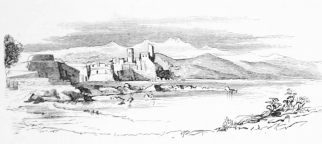
During the latter part of our stay at Cannes, the society of Madame Goldschmidt (Jenny Lind) was a great pleasure to my mother, and in her great kindness she came often to sing to her. We went with the Goldschmidts to Antibes one most glorious February day, when Madame G. was quite glowing with delight in all the beauties around and gratitude to their Giver. "Oh, how good we ought to be—how good with all this before our eyes! it is a country to die in." She spoke much of the sweetness of the Southern character, which she believed to be partly due to the climate and scenery. She talked of an old man, bowed with rheumatism, who worked in her garden. That morning she had asked him, "Comment ça va t'il? Comment va votre santé?"—"Oh, la volonté de Dieu!" he had replied—"la volonté de Dieu!" In his pretty Provençal his very murmur was a thanksgiving for what God sent. She spoke of the dislike English had to foreigners, but that the only point in which she envied the English was their noble women. In Sweden she said they might become as noble, but that hitherto the character of Swedish women had been oppressed by the bondage in which they were kept by the laws—that they had always been kept under guardians, and could have neither will nor property of their own, unless they married, even when they were eighty. She said that she was the first Swedish woman who had gained her liberty, and that she had obtained it by applying direct to the king, who emancipated her because of all she had done for Sweden. Now the law was changed, and women were emancipated when they were five-and-twenty.
Then Madame Goldschmidt talked of the faithfulness of the Southern vegetation. In England she said to the leaves, "Oh, you poor leaves! you are so thin and miserable. However, it does not signify, for you have only to last three or four months; but these beautiful thick foreign leaves, with them it is quite different, for they have got to be beautiful always."
We drove up the road leading to the lighthouse, and then walked up the steep rocky path carrying two baskets of luncheon, which we ate under the shadow of a wall looking down upon the glorious view. Madame Goldschmidt had been very anxious all the way about preserving a cream-tart which she had brought. "Voilà le grand moment," she exclaimed as it was uncovered. When some one spoke of her enthusiasm, she said, "Oh, it is delightful to soar, but one is soon brought back again to the cheese and bread and butter of life." When Lady Suffolk asked how she first knew she had a voice, she said, "Oh, it did fly into me!"
At first sight Madame Goldschmidt might be called "plain," though her smile is most beautiful and quite illuminates her features; but how true of her is an observation I met with in a book by the Abbé Monnin, "Le sourire ne se raconte pas." "She has no face; it is all countenance," might be said of her, as Miss Edgeworth said of Lady Wellington.
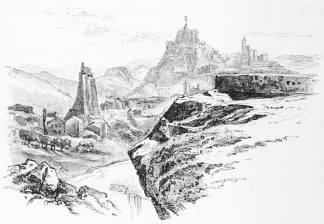
LE PUY.[339]
ROYAT.[340]
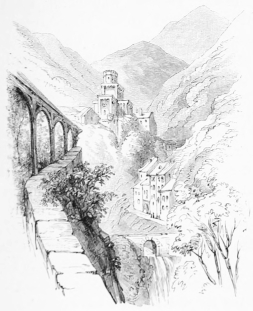
It was already excessively hot before we left Cannes on the 29th of April. After another day at the grand ruins of Montmajour near Arles, we diverged from Lyons to Le Puy, a place too little known and most extraordinary, with its grand and fantastic rocks of basalt crowned by the most picturesque of buildings. Five days were happily spent in drawing at Le Puy and Espailly, and in an excursion to the charming neighbouring campagne of the old landlord and landlady of the hotel where we were staying. Then my mother assented to my wish of taking a carriage through the forests of Velay and Auvergne to the grand desolate monastery of the Chaise Dieu, where many of the Popes lived during their exile in France, and where Clement VI. lies aloft on a grand tomb in the centre of the superb choir, which is so picturesquely hung with old tapestries. Our rooms at the hotel here cost half a franc apiece. Joining the railway again at Brioude, we went to the Baths of Royat, then a very primitive and always a very lovely place, with its torrent tumbling through the walnut woods, its gorge closed by a grand old Templars' church, and its view over rich upland vineyards to the town and cathedral of Clermont. On the way home we visited the great deserted abbey of Souvigny near Moulins, and bought the beautiful broken statuette which is one of the principal ornaments of Holmhurst.
In June I went to Oxford to stay with my friend Henry Hood, and was charmed to make acquaintance with a young Oxford so different from the young Oxford of my days, that it seemed altogether another race—so much more cordial and amusing, though certainly very Bohemian. During this visit I cemented an acquaintance with Claude Delaval Cobham, then reading for the orders for which he soon felt himself unsuited. In some respects, he is one of the cleverest men I have met, especially from his unusual linguistic acquirements, combined with extreme correctness. I have frequently received kindness from him since and valuable advice and help in literary work, and though I have sometimes conceitedly rebelled against his opinion at the time, I have never failed to find that he was in the right.
To MY MOTHER.
"Oxford, June 1, 1867.—We went this morning in two pony-carriages to Cuddesden, where Claude Cobham now is, and spent the afternoon in walking and sitting in the Bishop's shady and weedy garden.
"The other day, coming out of this garden, the Bishop heard two navvies on the other side of the road talking. 'I zay, Bill, ain't yon a Beeshop?' said one. 'Yees,' said Bill. 'Then oi'll have some fun oot o' him.' So he crossed the road and said, 'I zay, zur, be you a Beeshop?'—'Yes, at your service,' said the Bishop. 'Then can you tell us which is the way to heaven?'—'Certainly,' said the Bishop, not the least discomposed; 'turn to the right and go straight on.'"
"June 3.—I enjoy being at Oxford most intensely, and Hood is kindness itself. A wet day cleared into a lovely evening for the boat-race, which was a beautiful sight, the green of the water-meadows in such rich fulness, and the crowd upon the barges and walks so bright and gay."
"6 Bury Street, June 12.—The first persons I met in London were Arthur and Augusta Stanley, who took me into their carriage, and with them to the Park, whence we walked through Kensington Gardens, and very pretty they looked. Arthur described his first sight of the Queen on that spot, and Augusta was full of Princess Mary's cleverness in being confined in the same house on the same day on which the Queen was born.
"Then I went to Lady Wenlock, a most charming visit to that sweet old lady, now much feebler, but so animated and lively, and her life one long thanksgiving that her paralysis has left all her powers unimpaired. She told me many old stories. I also called on Lady Lothian, who is greatly disturbed at Madame de Trafford's power over my sister. She says she quite considers her 'possessed,' and that she ought to be exorcised. To-day I dined with Lady Grey. She told me that as Charlie Grey was crossing to America, his fellow-passengers were frightfully sea-sick, especially a man opposite. At last an American sitting by him said, 'I guess, stranger, if that man goes on much longer, he'll bring up his boots.'"
"June 15.—I have been sitting long with Lady Eastlake. She spoke of how the great grief of her widowhood had taught her to sift the dross from letters of condolence. She says that she lives upon hope; prayer is given her in the meanwhile as a sustenance, not a cure, for if it were a cure, one might be tempted to leave off praying: still 'one could not live without it; it is like port wine to a sick man.'
"She says she finds a great support in the letters of Sir Charles to his mother—his most precious gift to her. She said touchingly how she knew that even to her he had a slight reserve, but that to his mother he poured out his whole soul. In those letters she had learnt how, when he was absent, his mother hungered after him, and perhaps, in all those blessed years when she had him, his mother was hungering after him. In giving him up, she felt she gave him up to her: he was with her now, and from those letters she knew what their communion must be. 'I know he is with her now, for "I have seen my mother, I have seen my mother," he twice rapturously exclaimed when he was dying.' How touching and how consoling are those visions on this side of the portal. Old Mr. Harford, when he was dying, continually asked his wife if she did not hear the music. 'Oh, it is so wonderful,' he said, 'bands upon bands.' She did not understand it then but she knows now.
"'It was beautifully ordered,' said Lady Eastlake, 'that my "History of Our Lord" was finished first: I could not have done it now. And through it I learnt to know his library. My darling was like a boy jumping up and down to find the references I wanted, and, if possible, through the book I learnt to know him better.'
"She spoke of his wonderful diligence. When he was a boy he wrote to his mother, 'London will be illuminated to-morrow, I shall draw all night.'"
IN THE DEAN'S GARDEN, CANTERBURY.[341]
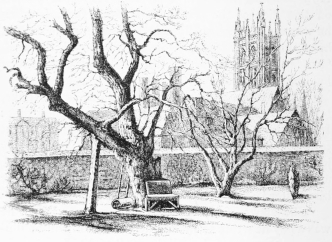
In July I spent a few days with the Alfords at the Deanery of Canterbury, which was always most enjoyable, the Dean so brimming with liveliness and information of every kind. In the delightful garden grows the old historic mulberry-tree,[342] about which it used to be said that the Deans of Canterbury sit under the mulberry till they turn purple, because those Deans were so frequently elevated to the episcopal bench, and bishops formerly, though it is rare now, always wore purple coats. I dined out with the Dean several times. I remember at one of the parties a son of Canon Blakesley saying to me—what I have often thought of since—"I find much the best way of getting on in society is never to be able to understand why anybody is to be disapproved of." Both the Dean's daughters were married now, and he cordially welcomed my companionship, always treating me as an intimate friend or relation. No one could be more sympathetic, for he had always the rare power of condemning the fault, but not the action of it.[343] I insert a few snatches from his table-talk, though they give but a faint idea of the man.
"We have been studying Butler's Analogy ever since we came back from Rome, for we've had eight different butlers in the time. The last butler said to me, 'It's not you who govern the Deanery, and it's not Mrs. Alford, but it is the upper housemaid.'"
"Archbishop Harcourt was very fond of hunting, so fond that he was very near refusing the archbishopric because he thought if he accepted he should have to give it up. He consulted a friend, who said that he must take counsel with others. 'Of course I should never join the meet,' said the Archbishop, 'but you know I might fall in with the hounds by accident.' After some time the friend came back and said that on the whole the party considered that the Archbishop might hunt, provided he did not shout."
"Archbishop Manners Sutton had a wonderfully ready wit. One day a blustering vulgar man came up to him and said, 'I believe, Archbishop, that I am a relation of yours: my name is Sutton.' The Archbishop quietly replied, 'Yes, but you want the Manners.'"
"When some one was abusing our font the other day, I could not help saying that, for a font, I thought renaissance peculiarly appropriate."
"I met Lady Mounteagle the other day: you know she was the sister—
'Of the woman tawny and tough[344] Who married the Master rude and rough Who lived in the house that Hope built.'
You know Hope gothicised the Master's Lodge at Trinity. At the Whewells' 'perpendiculars,' as their large parties were called, no one was allowed to sit down: if any one ventured to do so, a servant came and requested him to move on."
"When Alice was a little girl, I was explaining the Apostles' Creed to her. When we came to the point of our Saviour descending into hell she said, 'Oh, that is where the devil is, isn't it?'—'Yes.'—'Then why didn't the devil run at him and tear him all to pieces?'"
Arthur Penrhyn Stanley
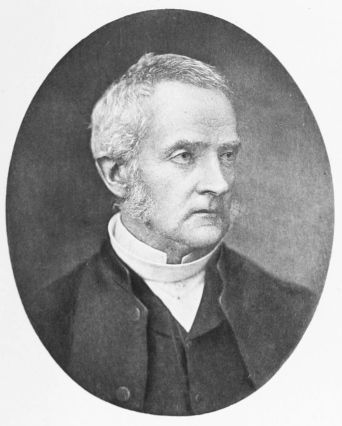
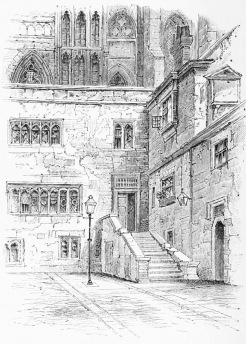
In August we spent some time at the Deanery of Westminster, where Arthur and Augusta Stanley were always hospitality itself, and, with more than the usual kindness of hosts, always urged, and almost insisted, on our inviting our own friends to dinner and luncheon, making us, in fact, use their house and fortune as our own.
From my JOURNAL.
"July 28, 1867.—In the evening, from the gallery of the Deanery which overhangs the abbey, Mother, Mrs. Hall, and I looked down upon the last service. Luther's hymn was sung and the Hallelujah chorus, and trumpets played: it was very grand indeed. The Bishop of Chester and the Wordsworths dined. Yesterday Arthur showed thirty working-men over the Abbey. He pointed out where Peel was buried. One of them received it very gravely in silence, and then, after several minutes, said, 'Well, it is very extraordinary. I've lived all my life in the next county, and I never knew that before: I always thought he was buried at Drayton. Now that's what I call information.'"
"August 3.—It has a weird effect at night to look down upon the Abbey, and see the solitary watchman walking along the desolate aisles and the long trail of light from the lantern he carries flickering on each monument and death's-head in turn. Hugo Percy, who was here the other evening, asked him about his nights in the Abbey. 'The ghosts have been very cross lately,' he said. 'Palmerston was the last who came, but Mr. Cobden has not come yet.'
COURTYARD, DEANERY, WESTMINSTER.
"We have been to Buckingham Palace to see the rooms which were arranged for the Sultan, which are dull and handsome. The chief fact I derived from the housekeeper was that the Sultan never 'goes to bed' and never lies down—in fact, he cannot, for a third of the imperial bed at either end is taken up by a huge bolster, in the middle of which he sits all night, and reclines either way in turn. There was a picture of the late Sultan in the room, and of Frederick, Prince of Wales, sent from Windsor for the occasion. One room was entirely hung with portraits of French kings and their families."
From London I went to visit Bishop Jeune,[345] who was most wonderfully kind to me, really giving up his whole time to me whilst I was with him, and pouring forth such stores of information as I had not received since the days of Dr. Hawtrey; and it was a great pleasure to feel, to be quite sure—which one so seldom is—that he liked my visit as much as I liked being with him.
From my JOURNAL.
"August 10, 1867.—On the 8th I went to Peterborough, where I have had a most agreeable visit at the Palace. When I arrived at half-past seven, the family were all gone to dine with Dr. James, an old Canon in the Close, whither I followed them. He was a charming old-fashioned gentleman, most delightful to see.
"In the morning the Bishop, wearing his surplice and hood, read prayers at a desk in the crypted hall of the Palace. Afterwards we walked in the garden. I spoke of there being no monument in the Cathedral to Catherine of Arragon. 'It is owing to that very circumstance,' said the Bishop, 'that you are here to-day. If Catherine of Arragon had had a tomb, I should never have been Bishop of Peterborough. When people reproached Henry VIII. with having erected no monument to his first wife, he said, "The Abbey of Peterborough shall be a cathedral to her monument," and he instituted the bishopric; the last abbot was the first bishop.' As we passed the lavatory of the old convent, the Bishop said that a touching description was still extant of its dedication and of the number of cardinals, bishops, and priests who were present. 'How few of them,' he said, 'would have believed that not only their buildings, which they believed would last for ever, could become an indefinite ruin, but that their Church, whose foundations they believed to be even more eternally rooted in the soil, should be cast out to make way for another Church, which is already tottering on its base and divided against itself.' He said he 'firmly believed that the ends both of the Church and monarchy were close at hand, that the power of government was even now in the hands of a few individuals, who were in their turn in the hands of a few Irish priests.'
"While passing through the garden in returning to the Palace, the Bishop showed me a white fig-tree growing out of the old wall of the refectory and abundantly bearing fruit. 'This,' he said, 'I believe to be the white fig-tree which is nearest to the Pole.' Passing a fine mulberry-tree he said, 'We owe that to James I., as he was so excessively anxious to promote the manufacture of silk, that he recommended to every one the cultivation of the mulberry-tree, but especially to the clergy, and those of the clergy planted it who wished to stand well with him. Therefore it is to be found in the neighbourhood of many of our cathedrals.'
PALACE GARDEN, PETERBOROUGH.
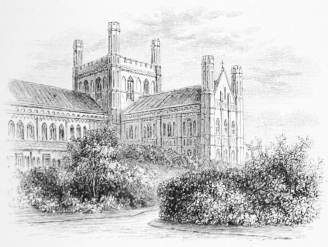
"Afterwards the Bishop showed the old chronicle of the Abbey, which he had had splendidly restored at Oxford. He read me some Latin verses which had evidently been inserted by one of the monks descriptive of his amours. 'Yet,' said the Bishop, 'these sins of the monk were probably only sins of the imagination, quite as vivid as real ones. You know,' he added, 'there are far more acted than enacted sins, and the former are really far the more corrupting of the two.'
"In the afternoon we drove to Croyland. The Bishop talked the whole way. I spoke of his patronage, and envied the power it gave him; he bitterly lamented it. He said, 'I have in my gift three canonries, two archdeaconries, and sixty livings, and if any of these fell vacant to-morrow, I should be at my wit's end whom to appoint. On the average, two livings fall vacant every year, and then comes my time of trouble. A bishop who would appoint the best man would be most unpopular in his diocese, for every one of his clergy would be offended at not being considered the best.' With regard to the canonries, I suggested that he could find no difficulty, as he might always choose men who were employed in some great literary work. The Bishop allowed that this was exactly what he desired, but that no such men were to be found in his diocese. There were many very respectable clergy, but none more especially distinguished than the rest. He said that when he was appointed bishop, Dr. Vaughan advised him never to become what he called 'a carpet-bag bishop,' but that this, in fact, was just what he had become: that when he was going to preach in a village and sleep in a clergyman's house, he did not like to trouble them by taking a man-servant, and that he often arrived carrying his own carpet-bag. That consequently he often never had his clothes brushed, or even his boots blacked, but that he brushed his boots with his clothes-brush as well as he could, as he was afraid of ringing his bell for fear of mortifying his hosts by showing that he had not already got all that he wanted. He said, however, that the work of a bishop was vastly overrated, that there was nothing which did not come within the easy powers of one man, yet that a proposition had already been made to exclude the bishops from the House of Lords, to reduce their incomes to £1500, and to double their number. He said that he believed all Conservatives had better at once emigrate to New Zealand, and that he wondered the Queen did not invest in foreign funds; that it was utterly impossible the monarchy could last much longer; that the end would be hastened by the debts of the two Princes.
"When we reached Croyland we went into the Abbey Church, where the Bishop pointed out the baptistery used for immersion, and several curious epitaphs, one as late as 1729 asking prayers for the dead. The drive was most curious over the fens, which are now drained, but of which the soil is so light that they are obliged to marl it all over to prevent its being blown away. The abbey itself is most picturesque. It was built by St. Guthlac, a courtier, who retired hither in a boat, but who came from no desire of seclusion and prayer, but merely because he longed for the celebrity which must accrue to him as a hermit. His sister, Pega, became the foundress of Peakirk. The Bishop spoke much of the sublimity of the conception under which these great abbeys were founded—'One God, one Pope as God's interpreter, one Church, the servant of that Pope, unity in everything.' He spoke of the Jesuit influence as used to combat that of the Gallican Church, and he said that there were now only three Gallican bishops.
"Coming home, the Bishop talked about Wales, and asked if I had ever compared the military tactics of the Romans with regard to Wales with those of Edward I. 'The Romans,' he said, 'built the castle of Lincoln for the repression of the savage people of the fens, and with the same idea built a line of fortresses between England and Wales for the repression of the Welsh; but the consummate skill of Edward I. saw a better plan than this, and he built a line of fortresses along the coast, which could be provisioned from the sea, so that if the Welsh made a raid into England, he could bring them back by falling upon their wives and children.
"In the evening the Bishop read aloud French poetry, a ballad of the early part of the seventeenth century, on which Goldsmith had evidently founded his 'Madame Blaise,' the powerful 'Malbrook,' and many old hymns; also a beautiful hymn of Adolph Monod on the Passion of Christ, which he said showed too much philosophy. He described how he had preached in Westminster Abbey in French during the great Exhibition, and the immense power of declamation that French gave; that he had apostrophised those lying in the tombs, the dead kings round about him, as he never should have ventured to do in English. He spoke of the transitions of his life, that his childhood had been passed amongst the rocks of Guernsey, and that he had loved rocks and wild rolling seas ever since. That as a child he was never allowed to speak French, as only the lower orders spoke it, but that he went to the French college of S. Servan, and there he learnt it. Then came his Oxford life, after which, thinking that he was never likely to have any opening for making his way in England, he went off to Canada in despair, intending to become a settler in the backwoods. The rough life, however, soon disgusted him, and in a year he returned to England, where he became fellow and tutor of his college. Thence he was appointed Dean of Jersey, and ruled there over the petty community. Then he was made Master of Pembroke (where he remained twenty years), Vice-Chancellor, Dean of Lincoln, and Bishop of Peterborough. He spoke of the honour of Oxford men and the consistency of the Hebdomadal Board, compared with others he had to deal with. In Jersey, as a matter of course, all his subordinates voted with their Dean. When he came to Oxford he expected the same subserviency, and looked on all his colleagues with suspicion, but he was soon convinced of their uprightness. He said touchingly that, when near the grave, on looking back, it all seemed much the same—the same pettiness of feeling, the same party strife, only he did not worry himself about it; they were all in the hands of One who died for all alike; that now there were changes in everything—only One was unchanged.
"Speaking of the morality of Italy, he said that his friend Mr. Hamilton, head of a clan, had met 'Sandy,' one of his men, travelling between Rome and Naples. After expressing his surprise at seeing him there, he asked what he thought of Rome and Naples. 'Wal,' said Sandy, 'I jist think that if naething happens to Rome and Naples, Sodom and Gomorrah were very unjustly dealt with.'
"'I met Gioberti in Italy,' said the Bishop, 'and asked him about the Pope. "C'est une femme vertueuse," he replied, "mais c'est toujours une femme."'
"The Bishop said that, when younger, he wished to have written a series of Bampton Lectures (and began them) on the History of the Sacrament of the Lord's Supper. He intended to begin with a description of three scenes—first, the supper in the upper chamber at Jerusalem; then the Pope officiating at the altar of the Lateran; then a simple Scotch meeting in the Highlands—and he would proceed to describe what had led to the differences between these; how the Agape was arranged as a point at which all divisions and dissensions should be laid aside; how it was set aside after sixty years by the Roman Emperor; then of the gradual growth of the Eucharist, till oaths were taken on the wafer, and deeds were sealed with it to give them a solemnity; and till, finally, it came to be regarded as the actual body of Christ; then of the gradual rise of all the different theories, the impanation, the invination of the Saviour.
"This morning the Bishop asked if I knew what was the difference between the entrance of a field in France and England. 'In England,' he said, 'it is a gate to let people in; in France a barrière to keep people out: from this you might proceed to theorise that England was a country where sheep might stray, but France not: England a country for milk and flesh, France for corn and wine.'
"The Bishop said he knew our Roman acquaintance Mr. Goldsmid well. 'I met Nat Goldsmid in Paris about the time of the Immaculate Conception affair, and I said to him, "Goldsmid, now why has your Church done this? for you know you all worshipped the Virgin as much as you could before, and what more can you do for her now?"—"Yes," he said, "that is quite true; we all worshipped the Virgin before, but we have done this as a stepping-stone to declaring the infallibility of the Pope. A Pope who could take upon himself to declare such a dogma as this must be infallible!"'
From Peterborough I went to stay at Lincoln with Mrs. Nicholas Bacon, mother of the premier baronet, a very pretty old lady, who reminded me of the old lady in "David Copperfield," finding her chief occupation in rapping at her window and keeping the Minster green opposite free from intruding children, and unable to leave home for any time because then they would get beyond her—"so sacrilegious," she told them, it was to play there. Going with her to dine with that Mrs. Ellison of Sugbrooke who has bequeathed a fine collection of pictures to the nation, I met the very oldest party of people I ever saw in my life, and as one octogenarian tottered in after another, felt more amazed, till Mrs. Ellison laughingly explained that, as Mrs. Bacon had written that she was going to bring "a very old friend" of hers, she had supposed it would be agreeable to him to meet as many as possible of his contemporaries! Afterwards, when staying with Mr. Clements at Gainsborough, I saw Stowe, which, as an old cathedral, was the predecessor of Lincoln—very curious and interesting. Thence I went to Doncaster, arriving in time to help Kate[346] with a great tea-party to her old women. She asked one old woman how she was. "Well," she said, "I be middling upwards, but I be very bad downwards. I be troubled with such bad legs; downright dangerous legs they be." After visits at Durham, Cullercoats, and Ridley Hall, I went to stay with the Dixon-Brownes at Unthank in Northumberland.
To MY MOTHER.
"Unthank, August 27, 1867.—I spent yesterday morning in my Northern home (at Ridley), which is in perfect beauty now—the Allen water, full and clear, rushing in tiny waterfalls among the mossy rocks, all the ferns in full luxuriance, and the rich heather in bloom, hanging over the crags and edging the walks. At six o'clock the flag was raised which stops all trains at the bottom of the garden, and I came the wee journey of seven miles down the lovely Tyne valley to Haltwhistle. Unthank is the old home of Bishop Ridley, the house to which he wrote his last letter before the stake, addressed to 'my deare sister of Unthanke,'—and it is a beautiful spot in a green hollow, close under the purple slopes of the grand moor called Plenmellor. The house is modern, but has an old tower, and a garden splendid in gorgeous colouring sweeps up the hill behind it. To-day we went up through a romantic gill called 'The Heavenly Hole' to Plenmellor Tarn, a lovely blue lake in the midst of the heather-clad hills. We spoke of it to an old man there, 'Aye,' he said, 'it's jist a drap of water left by the Fluid, and niver dried up.'"
"Bonnyrigg, August 30.—This shooting lodge of Sir Edward Blackett is quite in the uninhabited moorlands, but has lovely views of a lake backed by craggy blue hills—just what my sweet mother would delight to sketch. Lady Blackett is very clever and agreeable.[347] We have been a fatiguing walk through the heather to 'the Queen's Crag,' supposed to be Guinevere turned into stone."
"Bamborough Castle, Sept. 7.—I always long especially for my dearest mother in this grand old castle, to me perhaps the most delightful place in the world, its wild scenery more congenial than even beautiful Italy itself. Nothing too can be kinder than the dear old cousins.[348] ... It was almost dark when we drove up the links and under all the old gateways and through the rock entrance: the light burning in Mrs. Liddell's recess in the court-room. And it was pleasant to emerge from the damp into the brightly lighted tapestried chamber with the dinner set out. All yesterday the minute-gun was booming through the fog to warn ships off the rocks—such a strangely solemn sound.
"Mr. Liddell was speaking to an old Northumbrian here about the organ yesterday, and he said, 'I canna bear the loike o' that kist o' whistles a buzzin' in my ears.'"
"The Lodge, North Berwick, Sept. 9.—I find my sweet hostess, Mrs. Dalzel,[349] little altered, except perhaps more entirely heavenly than before in all her thoughts and words. 'I am very near the last station now,' she says, 'and then I shall be at home. I am the last of fifteen, and I can think of them all there—my mother, my sisters, one after another, resting upon their Saviour alone, and now with Him for ever!' 'When one is old, the wonderful discoveries, the great works of man only bewilder one and tire one; but the flowers and the unfolding of Nature, all the wonderful works of God, refresh and interest as much as ever: and may not it be because these interests and pleasures are to be immortal, amid the flowers that never fade?'
"Mr. Dalzel does not look a day older, but he sat at dinner with a green baize cloth before him to save his eyes. We dined at five, and another Mrs. Dalzel came, who sang Scottish songs most beautifully in the evening. Mr. Dalzel prayed aloud long extempore prayers, and we dispersed at ten. Before dinner I went to the sands with Mrs. Allen Dalzel,[350] who was very amusing:—
"'The old Dalzel house is at Binns near Linlithgow. The first Dalzel was an attendant of one of the early Kenneths. The king's favourite was taken by his enemies and hanged on a tree. "Who will dare to cut him down?" said the king. "Dalzel," or "I dare," said the attendant, who cut him down with his dagger. Hence came the name, and hence the Dalzels bear a dagger as their crest, with the motto "I dare," and on their arms a man hanging.
"'At Binns there are trees cut in the shape of men hanging. There is also a picture of the "tyrannous Dalzel," who persecuted the Covenanters, and who made a vow at the death of Charles I. that he would never shave again or change his costume. He lived for fifty years after that, but he never cut his beard, and he is represented in his odd suit of chamois leather, with a high-peaked hat and his hair down to his waist.
"'His comrade was Grierson of Lag, whose eye was the most terrible ever seen. Long after the persecution was over, he was told that a servant in the house had a great curiosity to see him. "Let him bring me a glass of wine," said Grierson. The servant brought it in upon a salver. Grierson waited till he came close up, and then, fixing his eye on him, exclaimed, "Are there ony Whigs in Galloway noo?" and the effect was so terrible, that the servant dropped the salver, glass and all, and rushed out of the room.
"'I used to go and teach Betty O'Brien to read when we lived at Seacliffe. Her mother was a clean tidy body, and, though she had not a penny in the world, she was very proud, for she came from the North of Ireland, and looked down upon all who came from the South. I asked her why she did not make friends with her neighbours, and she said, "D'ye think I'd consort wi' the loike o' them, just Connaught folk?" So on this I changed the subject as quick as I could, for I just came from Connaught myself.
"'Her daughter, however, married one of those very Connaught Irish—what she called "the boy O'Flinn," and she would have nothing to do with her afterwards; and she lay in wait for "the boy O'Flinn," and threw a stone at him, which hit him in the chest so badly that he was in bed for a week afterwards. When I heard of this, I went to see her and said, "Well, Betty, you're Irish, and I'm Irish, and I think we just ought to set a good example and show how well Irishwomen can behave." But she soon cut short my little sermon by saying, "They've been telling tales o' me, have they? and it's not off you they keep their tongues neither: they say you're a Roman!" I did not want to hear any more, and was going out of the cottage, when she called after me in a fury, "I know what you've been staying so long in Edinburgh for; you just stay here to fast and to pray, and then you go there to faast and drink tay."'"
"Sept. 10.—I wish for my dearest mother every hour in this sanctuary of peace and loving-kindness, with the sweet presence of Mrs. Dalzel. What she is and says it is quite impossible to give an idea of; but she is truly what Milton describes—
"Insphered In regions mild of calm and air serene, Above the smoke and stir of this dim spot Which men call earth."
"Her constant communion with heaven makes all the world to her only a gallery of heavenly pictures, creating a succession of heavenly thoughts, and she has so sweet and gentle a manner of giving these thoughts to others, that all, even those least in unison with her, are equally impressed by them. Most striking of all is her large-heartedness and admiration of all the good people who disagree with her. Her daughter-in-law has quite given up everything else in her devotion to her: it is really Ruth and Naomi over again.
"This afternoon we drove to Tantallon and on to Seacliffe, a most beautiful place on the coast, where Mrs. Dalzel lived formerly. A delightful little walk under a ruined manor-house and through a wood of old buckthorn trees led down to the sea, and a most grand view of Tantallon rising on its red rocks. We walked afterwards to 'Canty Bay,' so called because the Covenanters sang Psalms there when they were being embarked for the Bass.
"'How curious it would be,' Mrs. Dalzel has been saying, 'if all the lines on people's faces had writing on them to say what brought them there. What strange tales they would tell!'
"'Oh, what it is to be at peace! at perfect peace with God! in perfect reliance on one's Saviour! I often think it is like a person who has packed up for a journey. When all his work is finished and all his boxes are packed, he can sit down in the last hour before his departure and rest in peace, for all his preparations are made. So in the last hours of life one may rest in peace, if the work of preparation is already done.'
"'I used to count the future by years: now I only do it by months; perhaps I can only do it by weeks.'
"'My eldest brother lived in a great world. He was very handsome and much admired. As aide-de-camp to Sir Ralph Abercromby, George IV. made him his friend, and many people paid court to him. At last one day he came to my dear mother, who was still living in her great age, and who had found her Saviour some years before, and said to her, "Mother, I feel that my health is failing and that this world is rapidly slipping away from me, and I have no certain hope for the next: what would you advise me to do?" And my mother said to him, "My dear son, I can only advise you to do what I have done myself, take your Bible and read it with prayer upon your knees, and God will send you light." And my brother did so, and God granted him the perfect peace that passeth understanding. He lived many years after that, but his health had failed, and his Bible was his constant companion. When I went to see him, he used to lay his hand on the Book and say, "This is my comforter." A few years before he died, a malady affected one of his legs which obliged him to have the limb amputated. When the operation was about to commence, the doctor who was standing by felt his pulse, and did not find it varied in the least. "General Macmurdo," he said, "you are a hero."—"No," said my brother solemnly, "but I hope I am a Christian." And the doctor said he felt the power of Christianity from that day.'
"'From the shore of another world all my past life seems like a dream.'[351]
"I think if one stayed here long, one would quite feel the necessity of sinning occasionally to avoid the danger of becoming intolerant of petty faults and unsuitablenesses, from living with those so entirely without them."
"Carstairs, Sept. 18.—This is a large and comfortable house, and Mr. Monteith is busied with various improvements in the grounds. One improvement I should certainly make would be the destruction of a horrible tomb of a former possessor of the place, an atheist relation, with an inscription 'to the Infernal Deities.' No wonder that the avenue leading to the tomb is said to be haunted."
It was during this summer that old Lady Webster died.[352] She had long been a conspicuous figure in our home neighbourhood, and had seemed to possess the secret of eternal youth. In my childhood she reigned like a queen at Battle, but the Websters had several years before been obliged to sell Battle to Lord Harry Vane (afterwards Duke of Cleveland), chiefly because there were five dowager Lady Websters at once, all drawing jointures from the already impoverished property. Of these ladies, three, usually known as "the good Lady Webster," "Grace, Lady Webster," and "the great Lady Webster," lived much at Hastings. When the great Lady Webster died, she left several sons, and it was a subject of much comment at the time that, when her will was opened, she was found to have left nothing to any of them. Her will was very short. She left everything she possessed in the world to her dear and faithful companion Madame Bergeret. It excited many unkind remarks, but those who learnt the real facts always admitted that, in the crowning act of her life, Lady Webster had only acted with that sense of justice and duty which had ever been her characteristic. The story is this:[353]—
Towards the latter part of the last century there lived at an old manorial farm in Brittany a female farmer named Bergeret. Her ancestors had owned the farm, and had cultivated their own land for hundreds of years, and Madame Bergeret herself was well known and highly respected through all the neighbouring country, charitable to her poorer neighbours, frank, kind, and unfailingly hospitable to those in her own rank of life. She lived bounteously, kept an open house, and spent in beneficence and hospitality the ample income which her lands brought her.
One day she was surprised by a visit from her next neighbour, a man named Girard, in her own class of life, whose family had always been known to her own, and who had possessed the neighbouring farm. He told her that he felt she would be shocked to hear that he had long been acting a part in making himself appear much better off than he was; that he had lost a great deal of money in speculation; that all was on the eve of being divulged; that if he could manage to keeps things going till after the next harvest, he might tide over his misfortunes, but that otherwise he must be totally ruined, lose everything he had, and bring his wife and children to destitution; and by the recollection of their old neighbourhood and long intimacy he adjured Madame Bergeret to help him. Madame Bergeret was very sorry—very sorry indeed, but she told him that it was impossible; and it really was. She lived amply up to her income, she had laid nothing by: she was well off, but all she had came from her lands; her income depended upon her harvest; she really had nothing to give to her poor neighbour, and she told him so—told him so with a very heavy heart, and he went away terribly crestfallen and miserable.
When Girard was gone, Madame Bergeret looked round her room, and she saw there a collection of fine old gold plate, such as often forms the source of pride to a Breton yeoman of old family, and descends like a patent of nobility from one generation to another, greatly reverenced and guarded. Madame Bergeret looked at her plate, and she said to herself, "If this was sold, it would produce a very large sum; and ought I, for the sake of mere family pride, to allow an old and honourable family to go to destitution?" And she called her neighbour back, and she gave Girard all her gold plate. The sum for which he was able to sell it helped him through till after the harvest; soon afterwards he found an opportunity of disposing of his Breton lands to very great advantage, and removed to another part of the country. He thanked Madame Bergeret, but he did not seem to realise that she had made any great sacrifice in his behalf; and she, resting satisfied in having done what she believed to be right, expected no more.
Some years afterwards, Madame Bergeret, being an old woman, placed her Breton lands in the hands of an agent, and removed with her two children to Paris. The great French Revolution occurred while she was there, and the Reign of Terror came on, and Madame Bergeret, who belonged to a Royalist family of loyal Brittany, was arrested: she was thrown into the prison of La Force, and she was condemned to death.
The Madame Bergeret I knew in another generation recollected being with her little brother in a room on the Rue St Honoré on the day on which a hundred and twenty persons were to suffer in the Place Louis XV. She saw them pass down the street to execution in twenty-two tumbrils; but when the last tumbril came beneath the window, the friends who were with her in the room drew down the blinds; not, however, before she had recognised her own mother in that tumbril, with all her hair cut off, that the head might come off more easily.
All the way to the place of execution, Madame Bergeret consoled and encouraged her companions, and she assented to their petition that she should suffer last, that she would see them through the dread portal before her. Therefore, when her turn at length came, the ground around the scaffold was one sea of blood, for a hundred and nineteen persons had perished that day. Thus, on descending the steps of the cart, Madame Bergeret slipped and stumbled. This arrested the attention of the deputy who was set to watch the executions. He started, and then rushed forward saying, "This woman has no business here. I know her very well; she is a most honest citoyenne, or, if she is not, I know quite well how to make her so: this woman is not one to be guillotined." It was Girard.
Now Madame Bergeret was quite prepared for death, but the sudden revulsion of her deliverance overcame her and she fainted. Girard carried her away in his arms, and when she came to herself she was in bed in a house in a quiet back-street of Paris, and he was watching over her. He had removed to Lyons, and, with the sudden changes of the time, had risen to be deputy, and being set to watch the executions, had recognised the woman who had saved him. By the help of Girard, and after many hairbreadth escapes, Madame Bergeret reached the coast, and eventually arrived in England. She then made her way to the only person she knew, a lady who had once spent some time in her Breton village, a Mrs. Adamson. Her daughter played with and was brought up with the little Miss Adamson. When Miss Adamson married Sir Godfrey Webster of Battle Abbey, Mademoiselle Bergeret (her mother being dead) went with her and lived at Battle as a sort of companion to Lady Webster and nursery-governess to her boys. For fifty years she never received any salary, and having, through the changes of things in France, inherited something of her mother's Breton property, she twice sacrificed her little all to pay the debts of the Webster family. Therefore it was that, in the close of life, Lady Webster felt that her sons might provide for themselves, but that, having very little to bequeath, the one person she could not leave destitute was "her dear and faithful companion and friend, Madame Bergeret."
Five months before her death, Lady Webster was very full of the terrible deaths which had lately occurred from railway accidents, and, on leaving home, she said to Madame Bergeret, "Here is this paper, and if I should be killed by an accident or not live to come home, you may read it; but at any rate keep it for me, and perhaps, if I come back, some day I may want it again." Lady Webster came back well and did not ask for the paper, and when she died, it was so sudden, a few minutes after talking quite cheerfully to Madame Bergeret, that in the shock she remembered nothing about it, and it was only long afterwards, when they were making a great fuss about there being no will, that she suddenly thought of the paper entrusted to her, and, when it was read, found Lady Webster had left her all she possessed.
Madame Bergeret dying herself about a year afterwards, left everything back to the Webster family. She was a quiet primitive old woman, who used to sit in the background at work in Lady Webster's sitting-room.
After my return home in the autumn of 1867, my mother was terribly ill, so that our journey abroad was a very anxious one to look forward to. I tried, however, to face it quite cheerily. I have read in an American novel somewhere, "It is no use to pack up any worries to take with you; you can always pick up plenty on the way;" and I have always found it true.
To MISS WRIGHT and JOURNAL.
"Nice, Nov. 17, 1867.—My dear Aunt Sophy will be delighted to see this date. So far all our troubles and anxieties are past, and the sweet Mother certainly not the worse, perhaps rather better for all her fatigues. It is an extraordinary case, to be one day lying in a sort of vision on the portals of another world, the next up and travelling.
FONTAINES.[354]
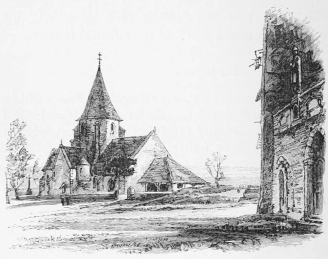
"When we reached Paris she was terribly exhausted, then slept for thirty-six hours like a child, almost without waking. At the Embassy we were urged to go on to Rome, all quiet and likely to subside into a dead calm; but so much snow had fallen on Mont Cenis, that in Mother's weak state we could not risk that passage, and were obliged to decide upon coming round by the coast. On Monday we reached Dijon, where twenty-four hours' sleep again revived the Mother. It was fiercely cold, but Tuesday brightened into a glorious winter's day, and I had a most enchanting walk through sunshine and bracing air to Fontaines. It is picturesque French country, a winding road with golden vines and old stone crosses, and a distance of oddly-shaped purple hills. Fontaines itself is a large village, full of mouldering mediæval fragments, stretching up a hillside, which becomes steeper towards the top, and is crowned by a fine old church, a lawn with groups of old walnut-trees, and the remains of the château where St. Bernard was born. Over the entrance is a statue of him, and within, the room of his birth is preserved as a chapel. The view from the churchyard is lovely, and the graves are marked by ancient stone crosses and bordered with flowers. Within are old tombs and inscriptions—'Ce git la très haute et très puissante dame,' &c.
"We came on to Arles by the quick night-train, and stayed there as usual two days and a half—days of glaring white sirocco and no colour, and at Arles we found ourselves at once in Southern heat, panting, without fires and with windows wide open."
ARC DE S. CESAIRE, ALISCAMPS, ARLES.[355]
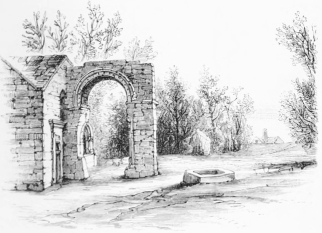
"Pisa, Dec. 1.—We left Nice on the 21st, and slept at Mentone, quite spoilt by building and by cutting down trees. I saw many friends, especially the Comtesse d'Adhemar, who flung her arms round me and kissed me on both cheeks. We spent the middle of the next day at S. Remo and slept at Oneglia. The precipices are truly appalling. I have visions still of the early morning drive from Oneglia along dewy hillsides and amongst hoary olives, and through the narrow gaily painted streets of the little fishing-towns, where the arches meet overhead and the wares set out before the shop-doors brush the carriage as it passes by.
AT SAVONA.[356]
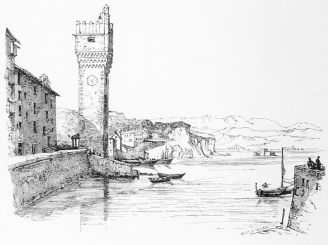
"The second day, at Loiano, I was left behind. I went just outside the hotel to draw, begging my mother and Lea to pick me up as they went by. The carriage passed close by me and they did not see me. At first I did not hurry myself, thinking, when they did not find me, that they would stop for me a little farther on; but seeing the carriage go on and on, I ran after it as hard as I could, shouting at the pitch of my voice; but it never stopped, and I quite lost sight of it in the narrow streets of one of the fishing-villages before reaching Finale. At Finale I was in absolute despair at their not stopping, which seemed inexplicable, and I pursued mile after mile, footsore and weary, through the grand mountain coves in that part of the Riviera and along the desolate shore to Noli, where, just as night closed in, I was taken up by some people driving in a little carriage, on the box of which, in a bitter cold wind, I was carried to Savona, where I arrived just as our heavy carriage with its inmates was driving into the hotel. It was one of the odd instances of my dear mother's insouciance, of her 'happy-go-lucky' nature: 'they had not seen me, they had not looked back; no, they supposed I should get on somehow; they knew I always fell on my legs.' And I was perfectly conscious that if I had not appeared for days, my mother would have said just the same. We spent a pleasant Sunday at Savona, the views most beautiful of the wonderfully picturesque tower, calm bay of sapphire water, and delicate mountain distance.
"The landlord of the Croce di Malta at Genoa engaged a vetturino to take us to La Spezia. The first day, it was late when we left Sta. Margherita, where we stayed for luncheon. The driver lighted his lamps at Chiavari. Soon both my companions fell asleep. I sat up watching the foam of the sea at the bottom of the deep black precipices without parapets as long as I could see it through the gloom: then it became quite dark. Suddenly there was a frightful bolt of the horses, scream after scream from the driver, an awful crash, and we were hurled violently over and over into the black darkness. A succession of shrieks from Lea showed me that she was alive, but I thought at first my mother must be killed, for there was no sound from her. Soon the great troop of navvies came up, whose sudden appearance from the mouth of a tunnel, each with a long iron torch in his hand, had made the horses bolt. One of them let down his torch into the mired and broken carriage as it lay bottom upwards. 'Povera, poveretta,' he exclaimed, as he saw Lea sitting pouring with blood amongst the broken glass of the five great windows of the carriage. Then Mother's voice from the depth of the hood assured us that she was not hurt, only buried under the cushions and bags, and she had courage to remain perfectly motionless, while sheet after sheet of broken glass was taken from off her (she would have been cut to pieces if she had moved) and thrown out at the top of the carriage. Then there was a great consultation as to how we were to be got out, which ended in the carriage being bodily lifted and part of the top taken off, making an opening through which first Lea was dragged and afterwards the Mother. Then my mother, who had not walked at all for many weeks, was compelled to walk more than a mile to Sestri, in pitch darkness and pouring rain, dragged by a navvy on one side and me on the other. Another navvy supported Lea, who was in a fainting state, and others carried torches. We excited much pity when we arrived at the little inn at Sestri, and the people were most hospitable and kind. I had always especially wished to draw a particular view of a gaily painted church tower and some grand aloes on the road near Sestri, and it was curious to be enabled to do so the next day by our forcible detention there for want of a carriage.
SESTRI.[357]
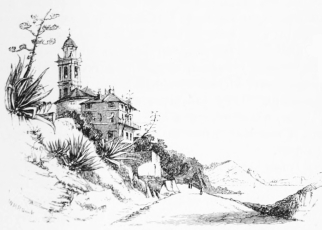
"On the 29th we crossed once more the grand pass of Bracco, with its glorious scenery of billowy mountains ending in the delicate peaks of Carrara; and we baited at a wretched village where Mother was able to walk in the sunny road. Yesterday we came here by the exquisite railway under Massa Ducale, and were rapturously welcomed by Victoire[358] and her daughter."
"Palazzo Parisani, Rome, Dec. 10.—We had a wearisome journey here on the 3rd, the train not attempting to keep any particular time, and stopping more than an hour at Orbetello for the 'discorso' of the guard and engine-driver,[359] and at other stations in proportion. However, Mother quite revived when the great masses of the aqueducts began to show in the moonlight. They had given up expecting us in the Palazzo, where my sister has lent us her apartments, and it was long before we could get any one to open the door.
"It has been bitterly cold ever since we arrived and the air filled with snow. The first acquaintance I saw was the Pope! He was at the Trinità de' Monte, and I waited to see him come down the steps and receive his blessing on our first Roman morning. He looked dreadfully weak, and Monsignor Talbot seemed to be holding him tight up lest he should fall. The Neapolitan royal family I have already seen, always in their deep mourning.[360]
"The Pincio is still surrounded with earthworks, and the barricades remain outside the gates: a great open moat yawns in front of the door of the English Church. The barrack near St. Peter's is a hideous ruin. The accounts of the battle of Mentana are awful: when the Pontificals had expended all their ammunition, they rushed upon the Garibaldians and tore them with their teeth.
"Terrible misery has been left by the cholera, and the streets are far more full of beggars than ever. The number of deaths has been frightful—Princess Colonna and her daughters; old Marchese Serlupi; Müller the painter and his child; Mrs. Foljambe's old maid of thirty years; Mrs. Ramsay's donna and the man who made tea at her parties, are amongst those we have known. The first day we were out, Lea and I saw a woman in deep mourning, who was evidently begging, look wistfully at us, and had some difficulty in recognising Angela, our donna of 1863. Her husband, handsome Antonio the fisherman, turned black of the cholera in the Pescheria, and died in a few hours, and her three children have been ill ever since.
"Mrs. Shakspeare Wood has been to see us, and described the summer which she has spent here—six thousand deaths in Rome between May and November, sixty in the Forum of Trajan, thirty in the Purificazione alone. The Government wisely forbade any funeral processions, and did not allow the bells to be tolled, and the dead were taken away at night. Then came the war. The gates were closed, and an edict published bidding all the citizens, when they heard 'cinque colpi di cannóne, d'andare subito a casa.' The Woods laid in quantities of flour, and spent £5 in cheese, only remembering afterwards that, having forgotten to lay in any fuel, they could not have baked their bread."
"Dec. 13.—Yesterday I went to Mrs. Robert De Selby.[361] She described the excitement of the battles. In the thick of it all she got a safe-conduct and drove out to Mentana to be near her husband in case he was wounded. She also drove several times to the army with provisions and cordials. If they tried to stop her, she said she was an officer's wife taking him his dinner, and they let her pass. One of the officers said afterwards to her mother, 'La sua figlia vale un altro dragone.'
"She told me Lady Anne S. Giorgio (her mother),[362] was living in the Mercede, and I went there at once. She was overjoyed to see me, and embraced me with the utmost affection. She is also enchanted to be near the Mother, her 'saint in a Protestant niche.' She is come here because 'all the old sinners in Florence' disapproved of her revolutionary tendencies. Lady Anne remembered my father's great intimacy with Mezzofanti. She said my father had once a servant who came from an obscure part of Hungary where they spoke a very peculiar dialect. One day, going to Mezzofanti, he took his servant with him. The Cardinal asked the man where he came from, and, on his telling him, addressed him in the dialect of his native place. The man screamed violently, and, making for the door, tried to escape: he took Mezzofanti for a wizard.
"Lady Anne recollected my father's extreme enjoyment of a scene of this kind. There was a Dr. Taylor who used to worship the heathen gods—Mars and Mercury, and the rest. One day at Oxford, in the presence of my father and of one of the professors, he took his little silver images of the gods out of his pocket and began to pray to them and burn incense. The professor, intensely shocked, tried to interfere, but my father started up—'How can you be so foolish? do be quiet: don't you see you're interrupting the comedy?' The same Dr. Taylor was afterwards arrested for sacrificing a bullock to Neptune in a back-parlour in London!"
"44 Piazza di Spagna, Dec. 29.—We moved here on the 20th to a delightfully comfortable apartment, which is a perfect sun-trap. Most truly luxurious indeed does Rome seem after Cannes—food, house, carriages, all so good and reasonable. I actually gave a party before we left my sister's apartment, lighting up those fine rooms, and issuing the invitations in my own name, in order that Mother might not feel obliged to appear unless quite equal to it at the moment. Three days after I had another party for children—tea and high romps afterwards in the long drawing-room.
"On the 21st I went with the Erskines, Mrs. Ramsay, and Miss Garden, by rail to Monte Rotondo. The quantity of soldiers at the station and all along the road quite allayed any fears of brigands which had been entertained regarding the mile and a half between the village and the railway. The situation proved quite beautiful—the old houses crowned by the Piombino castle, rising from vineyards and gardens, backed by the purple peak of Monte Gennaro. Beyond, in the hollow, is the convent where Garibaldi was encamped, and farther still the battlefield of Mentana.
"On the 23rd there was a magnificent reception at the Spanish Embassy. Every one went to salute the new ambassador, Don Alessandro del Castro, and the whole immense suite of rooms thrown open had a glorious effect. There was an abundance of cardinals, and the Roman princesses all arrived in their diamonds. The Borgheses came in as a family procession, headed by Princess Borghese in blue velvet and diamonds. The young English Princess Teano looked lovely in blue velvet and gold brocade. On Christmas Day I went to St Peter's for the coming in of the Pope, and stayed long enough to see Francis II. arrive with his suite. In the afternoon I took Lea to the Ara Cœli and Sta. Maria Maggiore. At the Ara Cœli great confusion prevails and much enthusiasm on account of a new miracle. When people were ill, upon their paying a scudo for the carriage, the Santo Bambino was brought by two of the monks, and left upon the sick-bed, to be fetched away some hours after in the same way. A sacrilegious lady determined to take advantage of this to steal the Bambino; so she pretended her child was ill and paid her scudo; but as soon as ever the monks were gone, she had a false Bambino, which she had caused to be prepared, dressed up in the clothes of the real one, and when the monks came back they took away the false Bambino without discovering the fraud, and carried it to the place of honour in the Church of Ara Cœli.
"That night the convent awoke to fearful alarm, every bell rang at the same moment, awful sounds were heard at the doors; the trembling brotherhood hastened to the church, but loud and fast the knocks continued on the very door of the sanctuary ('bussava, bussava, bussava'). At last they summoned courage to approach the entrance with lights, and behold, a little tiny pink child's foot, which was poked in under the door; and they opened the door wide, and there without, on the platform at the head of the steps, stood, in the wind and the rain, quite naked, the real Bambino of Ara Cœli. So then the real child was restored to its place, and the lady, confounded and disgraced, was bidden to take the false child home again.
"Our donna, Louisa, was in ecstasies when she told us this story—'Oh com' è graziosa, oh com' è graziosa questa storia,'—and she never can understand why we do not send for the Bambino to cure Mother of all her ailments, though, in consequence of the theft, it is now never left alone in a house, but is taken away by the same monks who bring it. Lea was imprudent enough to say she did not believe the Bambino would ever do her any good; but when Louisa, looking at her with wondering eyes, asked why, said weakly, 'Because I have such a bad heart,' in which Louisa quite acquiesced as a reason.
"It had been a sad shadow hitherto over all this winter that my sweetest Mother had been so ill. At Parisani I had many sad days and nights too. She suffered almost constantly from pain in the back, and moaned in a way which went to my very heart.... Twice only in the fortnight was Mother able to get out to the Forum and walk in the sun from the Coliseum to the Capitol, and she felt the cold most terribly, and certainly the Palazzo was very cold.
"At first, when we came to this house, Mother was better, and she was delighted with these rooms, which fulfilled a presentiment she had told me of before we left home, that this winter she should have the pleasantest apartment she had ever had yet. But on the 21st she was chilled when driving with Mrs. Hall to Torre Quinto, and that evening quite lost her power of articulation. It only lasted about an hour.... She was conscious of it afterwards, and said, 'It was so odd, I was not able to speak.' Some days after, though able to articulate, she was unable to find the words she needed, calling the commonest things by their wrong names, and this was the more alarming as more likely to be continuous. On Thursday she was well enough to drive with me to the Aqua Acetosa, and walk there in the sun on the muddy Tiber bank, but that evening she became worse, and since then has scarcely been out of bed."
"Dec. 30.—On Saturday I was constantly restless, with a sense of fire near me, but could discover nothing burning in the apartment. I had such a strong presentiment of fire that I refused to go out all day. When Lea came in with my tea at 8 P.M., I told her what an extraordinary noise I continually heard—a sort of rushing over the ceiling, which was of strained canvas—but she thought nothing of it. Soon after she was gone, a shower of sparks burst into the room and large pieces of burning wood forced their way through a hole in the ceiling. Shouting to Lea, I rushed up to the next floor, and rang violently and continuously at the bell, shouting 'Fuoco, fuoco;' but the owners of the apartment were gone to bed and would not get up; so, without losing time, I flew downstairs, roused the porter, sent him off to fetch Ferdinando Manetti, who was responsible for our apartment, and then for the pompieri. Meantime the servants of Miss Robertson, who lived below us, had come to our help, and assisted in keeping the fire under with sponges of water, while Lea and I rushed about securing money, valuables, drawings, &c., and then, dragging out our great boxes, began rapidly to fill them. Mother was greatly astonished at seeing us moving in and out with great piles of things in our arms, but did not realise at once what had happened. I had just arranged for her being wrapped up in blankets and carried through the streets to Palazzo Parisani, when the pompieri arrived. From that time there was no real danger. They tore up the bricks of the floor above us, and poured water through upon the charred and burning beams, and a cascade of black water and hot bricks tumbled through together into our drawing-room."
To MISS WRIGHT.
"Jan. 1.—Alas! I can give but a poor account of her who occupies all my real thoughts and interests. My sweetest Mother is still very, very feeble, and quite touchingly helpless. She varies like a thermometer with the weather, and if it is fine, is well enough to see Mrs. Hall and one or two friends, but she is seldom able to be dressed before twelve o'clock, and often has to lie down again before four. I seldom like to be away from her long, and never by day or night feel really free from anxiety."
JOURNAL.
"Jan. 2, 1868.—I have been out twice in the evening—to Mrs. Ramsay to meet M. de Soveral, the ex-minister of Portugal, and his wife and daughter, and to Mrs. Hall to meet the Erskines. Mrs. Hall described a sermon she had lately heard at the Coliseum, the whole object of which was the glorification of Mary Queen of Scots. It was most painful, she said, describing how Elizabeth, who turned only to her Bible, died a prey to indescribable torments of mind, while Mary, clinging to her crucifix, died religiously and devoutly.
"The Marchesa Serlupi has given a fearful account of the Albano tragedy. The old Marchese had come to them greatly worn out with his labours in attendance on the Pope during the canonisation,[363] and he was seized with cholera almost at once. When the doctor came, his hair was standing on end with horror. He said he had not sat down for eighteen hours, hurrying from one to another. He said the old Marchese had the cholera, and it was no use doing anything for him, he would be dead in a few hours. The Marchesa thought he had gone mad with fright, which in fact he had. When he was gone, she gave remedies of her own to the old man, which subdued the cholera at the time, but he sank afterwards from exhaustion. During that time the dead all around them were being carried out: the Appian Way was quite choked up by those who were in flight, and people were dying among the tombs all along the wayside.
"As soon as the old Marchese was dead, the Serlupi family determined to fly. As the Marchesa had been constantly nursing the old man, she would not take her child with her, and sent him on first in another carriage. When they got half way, a man came up to them saying that the person who was with the child in the other carriage was in the agonies of death, and they had to take the child into their own carriage. At the half-way house they stopped to inquire for a party of friends who had preceded them: five had fled in the carriage, three were already dead! There was only one remedy which was never known to fail: it was discovered by a Capuchin monk, and is given in wine. It is not known what the medicine is, and its effect entirely depends upon the exact proportions being given. The Marchesa used to send dozens of wine to the Capuchin, and then give it away impregnated with the medicine to the poor people in Rome.
"To-day my darling has been rather better, and was able to drive for an hour on the Pincio. Yesterday evening she prayed aloud for herself most touchingly before both me and Lea, that God would look upon her infirmities, that He would forgive her weakness, and supply the insufficiency of her prayers. Her sweet pleading voice, tremulous with weakness, went to our hearts, and her trembling upturned look was inexpressibly affecting."
"Feb. 4.—When we first came here, we were much attracted by Francesca Bengivenga, a pleasant cordial woman who lets the apartment above us, and who lived in a corner of it with her nice respectable old mother. Lea went up to see them, and gave quite a pretty description of the old woman sitting quietly in her room at needlework, while the daughter bustled about.
"On January 9 we were startled by seeing a procession carrying the Last Sacraments up our staircase, and on inquiry heard that it was to a very old woman who was dying at the top of the house. Late in the evening it occurred to Lea that the sick person at the top of the house might perhaps be in want, and she went up to Francesca to inquire if she could be of any use. Then, for the first time, we heard that it had been Francesca's mother who had been ill, and that she had died an hour after the priests had been. Francesca herself was in most terrible anguish of grief, but obliged to control herself, because only a few days before she had let her apartment, and did not venture to tell her lodgers what had occurred in the house. So whenever the bell rang, she had to dry her tears by an effort, and appear as if nothing had happened. We urged her to reveal the truth, which at length she did with a great burst of sobs, and the tenants took it well. The next day at four o'clock the old woman was carried away, and on the following morning I pleased Francesca by attending at the messa cantata in S. Andrea delle Fratte.
"On January 10 Charlotte and Gina Leycester arrived. By way of showing civilities to acquaintance, I have had several excursions to the different hills, explaining the churches and vineyards with the sights they contain. On the Aventine I had a very large—too large a party. With the Erskines I went to San Salvatore in Lauro, where the old convent is partially turned into a barrack, and was filled with Papal Zouaves, who spoke a most unintelligible jargon which turned out to be High Dutch. A very civil little officer, however, took us into a grand old chapel opening out of the cloisters, but now occupied as a soldiers' dormitory, and filled with rows of beds, while groups of soldiers were sitting on the altar-steps and on the altar itself, and had even piled their arms and hung up their knapsacks on the splendid tomb of Pope Eugenius IV., which was the principal object of our visit.[364] We went on hence to the Vallicella, where we saw the home and relics of S. Filippo Neri—his fine statue in the sacristy, his little cell with its original furniture, his stick, his shoes, the crucifix he held when he was dying, the coffin in which he lay in state, the pictures which belonged to him, and the little inner chapel with the altar at which he prayed, adorned with the original picture, candlesticks, and ornaments.
"Another excursion has been to the Emporium, reached by an unpleasant approach, the Via della Serpe behind the Marmorata, an Immondezzajo half a mile long; but it is a fine mass of ruin, with an old gothic loggia, in a beautiful vineyard full of rare and curious marbles. Close by, on the bank of the Tiber, the ancient port of the Marmorata is now being cleaned out.
"My dearest Mother continues very ailing and terribly weak, but I am hopeful now (as the cold months are so far advanced), that we may steer through the remainder of the winter, and that I may once more have the blessing of taking her back to England restored to health and power. Every Friday she has been seriously ill, but has rallied afterwards. On Friday 17th, she was very ill, and I was too anxious about her to rest at all during the night, but perpetually flitted ghost-like in and out of her room. Last Friday again she was, if anything, worse still, such a terrible cloud coming over all her powers, with the most complete exhaustion. I scarcely left her all day. When these sad days are over, life becomes quite different, so heavy is the burden lifted off, and it is difficult to realise all that they have been, the wearing anxiety as to what is best to be done, the terribly desolate future seeming so near at hand, all the after scenes presenting themselves so vividly, like fever phantoms, to the imagination, and then sometimes the seeming carried with my dearest one to the very gates of the unseen world.... She is always patient, always self-forgetful, and her obedience to her 'doctor,' as she calls me, is too touching, too entirely confiding and childlike. Oh, if our unity is broken by death, no one, no one will ever realise what it has been. Come what will, I can bless God for this winter, in which that union has been without one tarnished moment, one passing difference, in which my sweetest one has entirely leant upon me, and I have entirely lived for her.