Volume 2 — CONTENTS VOLUME 2 (continued 7)
Reading edition
"I remember well the battle of Trafalgar. It was the Euryalus, Captain Blackwood, that brought the news, and, oh dear! the sensation. I was seven years old then, but I knew the names of all the ships and captains. My sister was then the mistress of my father's house, and I was sent for down to her. She was not up, and the newspaper was lying on the bed. 'Oh, my dear,' she said, 'my father has sent me up the newspaper, and we have taken twenty ships of the line, but—Nelson is dead!' Child as I was, I burst into tears; one had been taught to think that nothing could go on without him.
"I cannot quite forgive Dean Trench his book.[248] Nelson was the one hero of his time, and it was a pity to bring up the bad vulgar side again and not to let it sleep.... The Lady Carysfort the book mentions was my aunt. My cousins were quite devoted to Mrs. Trench, and have often told me how enchanted they felt when she came back to England."
————
"King George III. used to be very fond of driving about in Berkshire with the Queen and visiting the families in the neighbourhood of Windsor—those whom they used to honour with their notice. He often came to my grandfather,[249] who was gouty with the gout of that day, which prevented people from rising, so that he was not able to get up when the King came in. The King and Queen always came quite simply in a carriage and four with the prickers riding before in crimson liveries. There was a particular point in the avenue at which the prickers were visible from the windows, and when they were seen, my grandfather used to ring the bell and ask if there was a round of beef in the house. He was generally answered in the affirmative, and then it was all right, for none of the royal party took luncheon, only the Queen used to have a particular kind of chocolate brought to her: my father generally offered it on a tray, after they had been about half-an-hour in the house. They used to take an interest in everything, and if any one ventured to rehang their pictures, they would say, 'Mr. So-and-so, why have you rehung your pictures?' I remember the King one day asking my grandfather if he had read the memoirs which every one was talking about at that time. They were those of the Duc de St. Simon, La Grande Mademoiselle, &c., and my father said no, he had not seen them. The King came again within the fortnight, and my grandfather did not see him coming down the avenue, nor did he know the King was in the house, till there was a kind of fumbling outside the door, and the King, who would not let any one come to help him, opened the door, with a great pile of volumes reaching from his waist to his chin, saying, 'Here, Mr. Grenville, I have brought you the books we were talking about.' But as the King came through the door, the books slipped and fell all about on the floor: my grandfather could not move, and the King began to pick them up, till some one came to help him and put them on the table for him.
"The scene on the terrace at Windsor on Sundays was the prettiest thing. It was considered proper that every one in the neighbourhood who could should go; those who were in a position of life to be presented at court stood in the foremost rank. The presence of the King was announced by the coming of 'Lavender,' a kind of policeman-guard, who used to clear the way and always preceded the royal family; he was the only kind of guard they had. The Queen wore evening dress, a sort of cap with a string of diamonds, and a loose flowing kind of gown; there was no such thing then as demi-toilette. After her came the princesses, or any of the princes who happened to have come down from London, or, on fine days, some of the Cabinet Ministers. The royal family stopped perpetually and talked to every one. I remember the King coming up to me when I was a very little girl, and dreadfully frightened I was. 'Well, now,' said the King, 'and here is this little girl. Come, my dear, take off your bonnet,' he said (for I wore a poke), and then he added, 'I wanted to see if you were like your mother, my dear.'
"It was Miss Burney who gave the impression of Queen Charlotte as being so formidable. Nothing could be more false; she was the kindest person that ever lived, and so simple and unostentatious. The fact was that Miss Burney had been spoilt by having been made a sort of queen in Dr. Johnson's court. The day 'Evelina' came out Dr. Johnson said to her, 'Miss Burney, die to-night,' meaning that she had reached the highest point of fame which it was possible to attain. Queen Charlotte made her one of her readers, for she was passionately fond of being read to while she worked. But Miss Burney was one of those people afflicted with mauvaise honte. She could not read a bit, and the Queen could not hear a word she said. 'Mama the Queen,' said the Duchess of Gloucester to me, 'never could bear Miss Burney, poor thing!' So the Queen invented some other place in her extreme kindness to Miss Burney, to prevent having to send her away, and in that place Miss Burney was obliged to stand.
"An instance of Queen Charlotte's extreme kindness was shown when she made Lady Elizabeth Montagu one of her ladies-in-waiting, out of her great love to Lady Cornwallis. When Lady Elizabeth arrived at court, the Queen sent for her and said, 'My dear, you have no mother here, so I must beg that you will consider me as your mother, and if you have any trouble or difficulty, that you will come to me at once.' When Lady Elizabeth went to her room, she found the bed covered with new things—new dresses, a quantity of black velvet to make the trains which were worn then, and a great many ornaments. 'My dear,' said the Queen, 'you will want these things, and it will be a year before your salary is due; I thought it might not be convenient to you to buy them just now, so you must accept them from me.'
"Another day, when Lady Elizabeth had been ill in the evening and unable to go with the Queen to a concert, early in the morning she heard a knock at her door while she was in bed, and the Queen came in in her dressing-gown, with what we called a combing-cloth (which they used because of the powder) over her shoulders, and all her hair down. 'May I come in, Lady Elizabeth?' she said. 'I heard you were ill, and there is nothing stirring to-day, so I came to beg that you will not think of getting up, and that you will send for everything you can wish for. Pray think of everything that it is right for you to have.'"
"Mrs. Fry came to Escrick once, and was pleased to see our gardens and the few little things we had to show her. 'Friend Caroline, I like thy pig-styes,' she said."
During this and the following summer I was often with my sister in London, and saw much of her friends, persons who have been entirely lost to me, never seen again, since the link which I had to them in her has been broken. Thus at Esmeralda's house I often saw the gentle sisters of the Precious Blood and their sweet-looking Mother, Pierina Roleston. She was utterly ignorant of worldly matters, and entirely governed by her priests, but her own character was of a simplicity much like that of the Curé d'Ars. She once described to me Maria de Matthias, and the story of the foundation of her Order.
"Oh, I wish you could see the Mother-General: she is so simple, such a primitive person. When she wants anything, she just goes away and talks to our Blessed Lord, and He gives it to her. Sometimes the nuns come and say to her, 'What can we do, Mother? we have no flour, we cannot bake;' and she answers, 'Why should you be troubled? Are not the granaries of our Master always full? We will knock at them, and He will give us something.'
"One day there was nothing at all left at Acuto: there was no bread, and there was no money to buy any. But Mother-General had just that simple faith that she was not at all troubled by it, and she even brought in five additional persons, five workmen who were to make some repairs which were necessary for the convent. When they came, she made the nuns come into the chapel, and she said, 'Now, my children, you know that we have nothing left, and we must pray to our Master that He will send us something;' and she herself, going up to the altar, began to talk to Our Blessed Lord and to tell Him all her needs. 'Dear Lord,' she said, 'we have nothing to eat, and I am just come to tell you all about it, and to ask you to send us something; and I am in debt too, dear Lord. I owe twenty-five scudi for your work; will you send it to me?' and so she continued to talk to Our Blessed Lord, just telling Him all she wanted.
"At that moment there was a knock at the door, and a young man put a paper into the portress's hand, only saying these words—'Pray for the benefactor.' The portress brought the paper to the Mother-General in the chapel, and she opened it and said,'My children, give thanks; the Master has sent us what we asked for.' It was the twenty-five scudi. Mother-General was not surprised. She knew that our Blessed Lord heard her, and she felt sure He would answer her. Soon after the convent bell rang for the dinner-hour. The nuns were coming downstairs, but there was nothing for them to eat. The Mother-General said, however, that the Master would send them something, and indeed, as they reached the foot of the stairs, the door-bell rang, and a large basket of food was left at the door, sent by some ladies in the neighbourhood. 'See how our Lord has sent dinner to us,' said the Mother-General.
"The Mother-General is an educated person, really indeed quite learned, considering that in the time of her youth it was not thought well to teach girls much, for fear they should learn anything that is evil.
"When the Mother-General was a young person, as Maria de Matthias in Vallecorso, she was very worldly and gay. But she heard 'the Venerable' (Gaspare del Bufalo) preach in Vallecorso, and, as he preached, his eye fixed upon her, he seemed to pierce her to the very soul. When she went home, she cut off all her hair except the curls in front, and turned her gown inside out, and wore her oldest bonnet. She thought to please our Lord in this way, and she remained for seven years shut up in her father's house, but all that time she was not satisfied, and at last she went to 'the Venerable' and asked him what she was to do, for she wished to do something for our Blessed Lord. And the Venerable said to her, 'You must go to Acuto, and there you will be told what you must do.' She had never heard of Acuto, but she went to a friend of hers, also named Maria, and inquired where Acuto was, for she was ordered to go there. The friend said she would go with her, and ordered out her horse, but the horse was a wild horse,[250] and she did not know how to ride it. Maria de Matthias, however, went up to the horse and patted it, saying, 'You must not be wild, you must become calm, because it is necessary that we should go to Acuto: you and I have to go in obedience, and I cannot walk, for it is twelve hours' journey.' When the Mother had thus spoken to the horse, it became quite mild, and, hanging down its head, went quite gently, step by step, and the Mother rode upon it. When they had gone half-way, she wished that the other Maria should ride, and the Mother got off, and Maria climbed upon a wall to mount the horse, but with her the horse would not move an inch, and then Maria felt it was not our Lord's will that she should mount the horse, and the Mother continued to ride to Acuto. When they arrived, and the Mother got off the horse, it became again immediately quite wild, and when Maria attempted to touch it, it was in such a fury that it kicked and stamped till the fire came out of the ground.
"The priest of Acuto was waiting to receive the Mother, and she remained there teaching a school. She believed at first that this only was her mission, but in a short time the children began to call her 'Mother,' and to ask her to give them a habit. The first nun who received the habit was a little child of eight years old, who is now Mother Caroline, Superior of the Convent at Civita Vecchia.
"The Mother-General often preaches, and she preaches so powerfully that even the priests crowd to hear her. When the people see her come forward to the edge of the altar-steps and begin to speak, they say 'Hark! the great Mother is going to talk to us,' and there is fixed silence and attention. She generally begins by addressing them as 'Brothers and Sisters,' and then she teaches them.
"The Mother-General cannot write. When she is obliged to write a letter, she kneels down and kisses the feet of the Crucifix and asks Our Lord to help her, and letters of hers which she has written in this way, in the most beautiful hand, are preserved. When there are no flowers for the altar she says, 'Our Master's flowers are always blooming; He will send us some;' and that day flowers come.
"After her death Sister Caterina appeared three times to Sister Filomena, and begged her to tell the Mother not to be troubled, for that the Sisters would suffer yet for four months longer, and then that they would have all that they needed. That day four months Lady Londonderry gave us a house.
"'The Venerable' left a prophecy that an English subject should come to join his Order in Italy, and then go back to found the female Order in England. When I took the veil, it was remembered that the Venerable had said this.
"Don Giovanni Merlini used to accompany 'the Venerable' on his missions. 'The Venerable' used to say, 'Take care of Don Giovanni, for he is a saint.' Don Giovanni is still living at the little church of the Crociferi near the Fountain of Trevi."
At this time my sister went frequently to see and consult Dr. Grant, the Bishop of Southwark. She believed him to be quite a saint, and fancied that he had the gift of healing, and she delighted to work for others under his direction. But Esmeralda was always willing to believe in or to find out saints of the nineteenth century. It was by Dr. Grant's advice, I believe, that she went to visit a nun of saintly attributes who lived near him, the Sœur Marie Anne. Of this visit she wrote: "Sœur Marie Anne was quite full of canonizations and of all that was going on about the Venerable Labre, because she said that, when she was a child, she had once seen him as a venerable pilgrim, going through a village, when the boys stoned him. She had been so struck, so saisie by his appearance, that she went up to him and said, 'Forgive me, but I hope that you will not refuse to tell your name.'—'Labre,' he said, and the name Labre had stuck by her to that day. She implored me to get up a special veneration for the Venerable Labre, but I said that I really could not, for he was too dirty."
In 1863, under the direction of her priests, and with the assistance of many Catholic friends, Esmeralda had published a "Manual of the Dolours of Our Lady," which she caused to be translated into almost every language of Europe and to be disseminated among all its nations; this she did through the medium of foreign converts. In her "retreats" and in her religious life Esmeralda had for some years been brought nearer to many of her former friends with the same interests, but especially to Lady Lothian, Lady Georgiana Fullerton, and to a Miss Bradley, a recent pervert to the Church of Rome. By them she had been induced to join the society of "Les Enfants de Marie;" a society of persons united together by special acts of devotion to the Virgin, and works of charity conducted in her honour. In sorrow, faithfully borne, the beauty and power of holiness had become hourly more apparent to Esmeralda. But she could never join in the exaggeration which led many of these ladies to invest the Virgin with all the attributes of our Lord Himself, as well as with the perfection of human sympathies. I remember as rather touching that when the Dowager Lady Lothian was writing to Esmeralda about her son as being so "fearfully Protestant," she said, "It is very trying to know that one cannot share one's thoughts with any one. I try to make our dear Mother more my companion, but I am tempted sometimes to remember how Our Lady, in all her sorrows, never can have had that of anxiety about her son's soul. I know that she has it in and for us, her adopted children, but she never can have felt it about Our Lord."
From the devotion which Esmeralda felt to the Blessed Virgin followed her especial interest in the Order of the Servites, who had lately been established in London, and who always wore black in sympathy with the sorrows of Mary. The very name had an interest for Esmeralda, derived as it was from the special love shown to the Madonna by seven noble Florentines, the founders of the Order, which induced the children to point at them in the streets, saying, "Guardati i servi di Maria." For the Servites Esmeralda never ceased to obtain contributions.
Another confraternity in which my sister had entered herself as an associate, together with Lady Lothian and most of her friends, was that of "The Holy Hour"—first instituted by the beatified nun, Margaret Mary Alacoque of Paray le Monial, a convent near Monceaux les Mines,[251] for which her admirers, and my sister amongst them, had worked a splendid carpet, to cover the space in front of her altar. The rules of this society set forth that it "is established as a special manner of sharing the agony of our Divine Lord, and of uniting in associated prayer for reparation of insults offered Him by sin. The associates of this devotion thus form a band of faithful disciples, who in spirit accompany our Saviour every Thursday night to the scene of His agony, and share more particularly that watch which Our Blessed Lady and the Apostles kept on the eve of the Passion. With this end in view, the associates spend one hour of Thursday evening in mental or vocal prayer upon the Agony in the Garden, or other mysteries of the Passion." Thus every Thursday night my sister repeated:—
"O Lord Jesus Christ, kneeling before Thee I unite myself to Thy Sacred Heart and offer myself again to Thy service. In this hour when Thou wert about to be betrayed into the hands of sinners, I, a poor sinner, dare to come before Thee and say, 'Yes, Lord, I too many times have betrayed and denied Thee, but Thou, who knowest all things, knowest that I desire to love Thee, that I desire to comfort Thee insulted by sin, that I desire to watch with Thee one hour, and to cry before Thy throne, 'O Lord, remember me when Thou comest into thy kingdom!' And therefore, with my whole heart, I now promise before thee—
"When the mysteries of Thy life and Passion are denied: the more firmly will I believe in them and defend them with my life.
"When the spirit of unbelief, coming in like a flood, seeks to quench our hope: I will hope in Thee and take refuge in Thy Sacred Heart.
"When blinded men obstinately shut their hearts to Thy love: I will love Thee who hast shown me an everlasting love.
"When the Majesty and power of Thy Divinity are denied: I will say to Thee—day by day—'My Lord and my God!'
"When Thy law is broken and Thy sacraments profaned: I will keep Thy words in my heart and draw near to thy holy altar with joy.
"When all men forsake Thee and flee from Thy ways: I will follow Thee, my Jesus, up the way of sorrow, striving to bear Thy cross.
"When the evil one, like a roaring lion, shall seek everywhere the souls of men: I will raise Thy standard against them and draw them to Thy Sacred Heart.
"When the Cross shall be despised for the love of pleasure and the praise of men: I will renew my baptismal vows, and again renounce the devil, the world, and the flesh.
"When men speak lightly of Thy Blessed Mother and mock at the power of Thy Church: I will renew my love to the Mother of God, hailing her as 'Our life, our sweetness, and our hope,' and will again give thanks for the Church that is founded upon the rock."
At my sister's house, I now, at least on one occasion, met each of my brothers, but we never made the slightest degree of real acquaintance; indeed, I doubt if I should have recognised either of them if I had met him in the street. When my eldest brother, Francis, came of age, he had inherited the old Shipley property of Gresford in Flintshire, quantities of old family plate, &c., and a clear £3000 a year. He was handsome and clever, a good linguist and a tolerable artist. But he had a love of gambling, which was his ruin, and before he was seven-and-twenty (October 1857) he was in the Queen's Bench, without a penny in the world, with Gresford sold—Hurstmonceaux sold—his library, pictures, and plate sold, and £53,000 of debts. After Francis was released in 1860, he went to join Garibaldi in his Italian campaign, and being a brave soldier, and, with all his faults, devoted to military adventure and impervious to hardships, he was soon appointed by the Dictator as his aide-de-camp. He fought bravely in the siege of Capua. His especial duty, however, was to watch and follow the extraordinary Contessa della Torre, who rode with the troops, and by her example incited the Italians to prodigies of valour. Of this lady Francis said—
"The Contessa della Torre was exceedingly handsome. She wore a hat and plume, trousers, boots, and a long jacket. She was foolhardy brave. When a shell exploded by her, instead of falling on the ground like the soldiers, she would stand looking at it, and making a cigarette all the time. The hospital was a building surrounding a large courtyard, and in the centre of the court was a table where the amputations took place. By the side of the surgeon who operated stood the Contessa della Torre, who held the arms and legs while they were being cut off, and when they were severed, chucked them away to join others on a heap close by. There were so many, that she had a heap of arms on one side of her and a heap of legs on the other. The soldiers, animated by her example, often sang the Garibaldian hymn while their limbs were being taken off, though they fainted away afterwards.
"When the war was over, the Contessa della Torre retired to Milan. Her first husband, the Count della Torre, she soon abandoned; her second husband, Signor Martino, a rich banker, soon abandoned her. Lately she has founded a Society for the Conversion of the Negroes of Central Africa, of which she appointed herself patroness, secretary, and treasurer; and, obtaining an English Clergy List, wrote in all directions for subscriptions. Of course many clergy took no notice of the appeal, but a certain proportion responded and sent donations, which it is needless to say were not applied to Central Africa."
After the siege of Capua, Francis was very ill with a violent fever at Naples, and then remained there for a long time because he was too poor to go away. It was during his stay at Naples that he formed his friendship with the K.'s, about which my sister has left some curious notes.
"When Francis first went to Naples, he had his pay, was well to do, and stayed at the Hotel Victoria. Amongst the people who were staying in the house and whom he regularly met at the table-d'hôte, were an old Mr. K. and his daughter. Old Mr. K. was a very handsome old gentleman and exceedingly pleasant and agreeable; Miss K. was also handsome, and of very pleasing manners: both were apparently exceedingly well off. After some time, the K.'s went to Rome, where they passed some time very pleasantly. When they returned, the siege of Capua was taking place, and it was a source of great surprise to the Garibaldian officers to see the father and daughter constantly walking about arm in arm with the most perfect sang-froid in the very teeth of the firing, shells bursting all around them. The Garibaldians remonstrated in vain: the K.'s remained unhurt in the heat of every battlefield, and appeared to bear charmed lives.
"Some time after, it transpired that the K.'s had no money to pay their bills at the Victoria. They were much respected there, having been there often before, but they could not be allowed to remain without payment, so the landlord told them they must leave. They went to another hotel, where the same thing happened. Then they went to a lodging.
"One day Francis met them coming down under the arch in the Chiaja. He turned round and went with them to the Villa Reale. As they went, Miss K. spoke of the great distress which was then prevalent in Naples, and said that a gentleman had just begged of them in the street, and that they had nothing to give him. 'Before I would be reduced to that,' she said, 'I would drown myself.'—'Yes, and I too would drown myself,' said Mr. K.; but what they said did not strike Francis till afterwards. When they reached the Villa Reale, they walked up and down together under the avenue. Miss K. was more than usually lively and agreeable, and they did not separate till nightfall, when the gates of the Villa were going to be shut.
"At two o'clock the next morning, Francis was awakened by the most dreadful and vivid dream. He dreamt that he stood on the little promontory in the Villa Reale, and that he saw two corpses bobbing up and down a short distance off. The dream so took possession of him, that he jumped up, dressed himself, and rushed down to the Villa, but the gates were shut when he got there, and he had to wait till they were opened at four o'clock in the morning. He then ran down the avenue to the promontory, and thence, exactly as he had seen in his dream, he saw two corpses bobbing up and down on the waves a short distance off. He called to some fishermen, who waded in and brought them to land, and he then at once recognised Mr. and Miss K. They must have concealed themselves in the Villa till the gates were closed, and must then have deliberately climbed over the railing of the promontory, and then tied each other's ankles and wrists, and, after filling their pockets with heavy stones, leapt off into the sea.
"Capua they had vainly hoped would destroy them.
"Some time after Francis found that Mr. K. had once been exceedingly rich, but had been ruined: that his wife, who had a large settlement, had then left him, making him a handsome allowance. A few days before the catastrophe this allowance had been suddenly withdrawn, and Mr. K. with the daughter, who devoted herself to him, preferred death to beggary."
It may seem odd that I have never mentioned my second brother, William, in these memoirs, but the fact is, that after he grew up, I never saw him for more than a few minutes. It is one of the things I regret most in life that I never made acquaintance with William. I believe now that he was misrepresented to us and that he had many good qualities; and I often feel, had he lived till I had the means of doing so, how glad I should have been to have helped him, and how fond I might have become of him. At Eton he was an excessively good-looking boy, very clever, very mischievous, and intensely popular with his companions. He never had any fortune, so that it was most foolish of his guardian (Uncle Julius) to spend £2000 which had been bequeathed to him by "the Bath aunts," in buying him a commission in the Blues. I only once saw him whilst he was in the army, and only remember him as a great dandy, but I must say that he had the excuse that everything he wore became him. After he left the army he was buffeted about from pillar to post, and lived no one knows where or how. Our cousin Lord Ravensworth was very kind to him, and so was old Lady Paul; but to Hurstmonceaux or Holmhurst he was never invited, and he would never have been allowed to come. I have often thought since how very odd it was that when he died, neither my mother nor I wore the slightest mourning for him; but he was so entirely outside our life and thoughts, that somehow it would never have occurred to us. He had, however, none of the cold self-contained manner which characterised Francis, but was warm-hearted, cordial, affectionate, and could be most entertaining. After his mother's great misfortunes he went to Spain on some temporary appointment, and at Barcelona nearly died of a fever, through which he was nursed by a lady, who had taken an extraordinary fancy to him; but on his return, when it was feared he would marry her, he took every one by surprise in espousing the very pretty portionless daughter of a physician at Clifton.
During the year 1864 I constantly saw my Lefevre cousins and found an increasing friendship for them. Sir John always showed me the greatest kindness, being full of interest in all my concerns. I consulted him on many subjects, feeling that he was the only person I had ever known, except my mother, willing to take the trouble of thinking how to give the best advice and perfectly disinterested in giving it: consequently I always took his advice and his only. His knowledge was extraordinary, and was only equalled by his humility and self-forgetfulness. Many were the interesting reminiscences of other days which he delighted to call up—many the remarkable parallels he drew between present events and those he remembered—many the charming stories he told me. One of these, which has always struck me as very grand and dramatic, I have so often repeated that I will make a note of it here:—
"Within the memory of those still living there resided in Madrid a family called Benalta. It consisted of Colonel Benalta, a man of choleric and sharp disposition; of his wife, Madame Benalta; of his young daughter; of his little son Carlos, a boy ten years old; and of the mother of Madame Benalta, who was a woman of large property and of considerable importance in the society at Madrid. On the whole, they were quoted as an example of a happy and harmonious family. It is true that there were, however, certain drawbacks to their being completely happy, entirely harmonious, and the chief of these was that Colonel Benalta, when his temper was not at its best, would frequently, much more often than was agreeable, say to his wife, 'My dear, you know nothing: my dear, you know nothing at all: you know nothing whatever.' This was very disagreeable to Madame Benalta, but it was far more unpleasant to the mother of Madame Benalta, who considered her daughter to be a very distinguished and gifted woman, and who did not at all like to have it said, especially in public, that she knew—nothing!
"However, as I have said, on the whole, as Madrid society went, the Benaltas were quoted as an example of a happy and harmonious family.
"One day Colonel Benalta was absent on military duty, but the rest of the family were assembled in the drawing-room at Madrid. In the centre of the room, at a round table, sat Madame Benalta and her daughter working. At a bureau on one side of the room sat the mother of Madame Benalta, counting out the money which she had just received for the rents of her estates in Andalusia, arranging the louis-d'ors in piles of tens before her, and eventually putting them away in a strong box at her side. At another table on the other side of the room sat little Carlos Benalta writing a copy.
"Now I do not know the exact words of the Spanish proverb which formed the copy that Carlos Benalta wrote, but it was something to the effect of 'Work while it is to-day, for thou knowest not what may happen to-morrow.' And the child wrote it again and again till the page was full, and then he signed it, 'Carlos Benalta, Sept. 22nd,' and he took the copy to his mother.
"Now the boy had signed his copy 'Carlos Benalta, Sept. 22nd,' but it really was Sept. 21. And Madame Benalta was a very superstitious woman; and when she saw that in his copy Carlos had anticipated the morrow—the to-morrow on which 'thou knowest not what may happen'—it struck her as an evil omen, and she was very much annoyed with Carlos, and spoke sharply, saying that he had been very careless, and that he must take the copy back and write it all over again. And Carlos, greatly crestfallen, took the copy and went back to his seat. But the mother of Madame Benalta, who always indulged and petted Carlos, looked up from her counting and said, 'Bring the copy to me.' And when she saw it she said to her daughter, 'I think you are rather hard upon Carlos, my dear; he has evidently taken pains with his copy and written it very well; and as for the little mistake at the end, it really does not signify; so I hope you will forgive him, and not expect him to write it again.' Upon which Madame Benalta, but with a very bad grace, said, 'Oh, of course, if his grandmother says he is not to write it again, I do not expect him to do it; but I consider, all the same, that he ought to have been obliged to do it for his carelessness.' Then the grandmother took ten louis-d'ors from the piles before her, and she tore the copy out of the book and rolled them up in it, and sealed the parcel, and she wrote upon the outside, 'For my dear grandson, Carlos Benalta; to be given to him when I am dead!' And she showed it to her daughter and her grand-daughter, and said, 'Some day when I am passed away, this will be a little memorial to Carlos of his old grandmother, who loved him and liked to save him from a punishment.' And she put the packet away in the strong box with the rest of the money.
"The next morning the news of a most dreadful tragedy startled the people of Madrid. The mother of Madame Benalta, who inhabited an apartment in the same house above that of her daughter and son-in-law, was found murdered in her room under the most dreadful circumstances. She had evidently fought hard for her life. The whole floor was in pools of blood. She had been dragged from one piece of furniture to another, and eventually she had been butchered lying across the bed. There were the marks of a bloody hand all down the staircase, and the strong box was missing. Everything was done that could be done to discover the murderer, but unfortunately he had chosen the one day in the year when such a crime was difficult to trace. As Mademoiselle Benalta was not yet 'out,' and as the family liked a quiet domestic life, they never went out in the evening, and the street door was known to be regularly fastened. Therefore, on this one day in the year, when the servants went on their annual picnic to the Escurial, it was supposed to be quite safe to leave the street door on the latch, that they might let themselves in when they returned very late. The murderer must have known this and taken advantage of it; therefore, though Colonel Benalta offered a very large reward, and though the Spanish Government—so great was the public horror—offered, for them, a very large reward, no clue whatever was ever obtained to the murderer.
"A terrible shadow naturally hung over the house in Madrid, and the Benalta family could not bear to remain in a scene which to them was filled with such associations of horror. By the death of the poor lady, Madame Benalta's mother, they had inherited her estates in Andalusia, and they removed to Cordova. There they lived very quietly. From so great a shock Madame Benalta could not entirely rally, and she shrank more than ever from strangers. Besides, her home life was less pleasant than it had been, for Colonel Benalta's temper was sharper and sourer than ever, and even more frequently than before he said to her, 'My dear, you know nothing: you really know nothing at all.'
"Eleven years passed away, melancholy years enough to the mother, but her children grew up strong and happy, and naturally on them the terrible event of their childhood seemed now quite in the far-away past. One day Colonel Benalta was again absent on military duty. Madame Benalta was sitting in her usual chair in her drawing-room at Cordova, and Carlos, then a young man of one-and-twenty, was standing by her, when the door opened and Mademoiselle Benalta came in. 'Oh, mother,' she said, 'I've been taking advantage of our father's absence to arrange his room, and in one of his drawers I have found a little relic of our childhood, which I think perhaps may be interesting to you: it seems to be a copy which Carlos must have written when he was a little boy.' Madame Benalta took the paper out of her daughter's hand and saw, 'Work while it is to-day, for thou knowest not what may happen to-morrow,' and at the bottom the signature 'Carlos Benalta, September 22nd,' and she turned it round, and there, at the back, in the well-known trembling hand, was written, 'For my dear grandson Carlos Benalta, to be given to him when I am dead.' Madame Benalta had just presence of mind to crumple up the paper and throw it into the back of the fire, and then she fell down upon the floor in a fit.
"From that time Madame Benalta never had any health. She was unable to take any part in the affairs of the house, and scarcely seemed able to show any interest in anything. Her husband had less patience than ever with her, and more frequently abused her and said, 'My dear, you know nothing;' but it hardly seemed to affect her now; her life seemed ebbing away together with its animation and power, and she failed daily. That day-year Madame Benalta lay on her death-bed, and all her family were collected in her room to witness her last moments. She had received the last sacraments, and the supreme moment of life had arrived, when she beckoned her husband to her. As he leant over her, in a calm solemn voice, distinctly audible to all present, she said, 'My dear, you have always said that I knew nothing: now I have known two things: I have known how to be silent in life, and how to pardon in death,' and so saying, she died.
"It is unnecessary to explain what Madame Benalta knew."
In later years, in Spain, I have read a little book by Fernan Caballero, "El Silencio en la Vita, e el Perdono en la Muerte," but even in the hands of the great writer the story wants the simple power which it had when told by Sir John.
The winter of 1864-65 was a terribly anxious one at Holmhurst. My mother failed daily as the cold weather came on, and was in a state of constant and helpless suffering. I never could bear to be away from her for a moment, and passed the whole day by the side of her bed or chair, feeding her, supporting her, chafing her inanimate limbs, trying by an energy of love to animate her through the weary hours of sickness, giddiness, and pain. We were seldom able to leave one room, the central one in the house, and had to keep it as warm as was possible. My recollection lingers on the months of entire absence from all external life spent in that close room, sitting in an armchair, pretending to read while I was ceaselessly watching. My mother was so much worse than she had ever been before, that I was never very hopeful, but strove never to look beyond the present into the desolate future, and, while devoting my whole thoughts and energies to activity for her, was always able to be cheerful. Still I remember how, in that damp and misty Christmas, I happened to light upon the lines in "In Memoriam"—
"With trembling fingers did we weave The holly round our Christmas hearth; A rainy cloud possess'd the earth, And sadly fell our Christmas Eve."
And how wonderfully applicable they seemed to our case.
To my Sister.
"Holmhurst, Dec. 17, 1864.—How we envy you the warmth of Italy! Had we known how severe a winter this was likely to be, we also should have started for Italy at all risks, and I feel that I have been very wrong ever to have consented to the mother's staying in England, though she seemed so weary of travelling and so much better in health, that I could not believe the effect would be so bad. The cold is most intense. After a month of wet, we have had two days of snow with black east wind, and now it is pouring again, but the rain freezes as it falls.
"The dear mother is perfectly prostrated by the cold, and looks at least twenty years older than in the summer. She has great and constant pain, and trembles so greatly as to be quite unable to feed herself, and she can do nothing whatever all day, so that she is very miserable. Of course I am dreadfully and constantly anxious about her, and the dread of paralysis haunts me night and day. I need not say how sweet, and gentle, and uncomplaining my poor darling is, but one can see she suffers greatly, and 'the pleasures of an English winter,' which some of the family have always been urging her to enjoy, consist in an almost total non-existence on her part, and constant watching on mine."
Gradually the consciousness came to all around her that the only chance of my mother's recovery would be from taking her abroad. How I longed to follow the advice given in "Kotzebue's Travels" when he urges us to take pattern by our ancestors, who were content to sit still and read the injunction in their Bibles, "Let not your flight be in the winter." Yet this year even poor Lea, generally so averse to leaving home, urged us to set off. Then came the difficulty of how to go, and where. We decided to turn towards Pau and Biarritz, because easier of access than Cannes, and because the journeys were shorter: and then there was the constant driving down to look at the sea, and the discovery that, when it was calm enough, my mother was too ill to move, and when she was better, the sea was too rough. At last, on the 20th of January, we left home in the evening.
To my Sister.
"Bordeaux, Jan. 28, 1865.—I cannot say what a comfort it is, amid much else that is sad and trying, to think of you safe at Palazzo Parisani, in the home of many years, with the devoted auntie and the two old domestic friends to share your interests and sorrows and joys—so much left of the good of life, so much to gild the memory of the past. I know how you would feel the return to Rome at first—the desolate room, the empty chair, the unused writing-table; and then how you would turn to 'gather up the fragments that remain,' and to see that even the darkest cloud has its silver lining.... No, you cannot wish your mother back. In thinking of her, you will remember that if she were with you now, it would not be in the enjoyment of Rome, of Victoire, and Parisani, but in cheerless London rooms, with their many trials of spirits and temper. Now all those are forgotten by her, for
'Who will count the billows past, If the shore be won at last'?
"And for yourself, you are conscious that you are in the place where she would have you be, and that if she can still be with you invisibly, her life and your life may still be running on side by side, and yours now giving to her unclouded eyes the pleasure it never could have given when earthly mists obscured them.
"I often think of Christian Andersen's story of the mother who was breaking her heart with grief for the loss of her only child, when Death bade her look into his mirror, and on one side she saw the life of her child as it would have been had it remained on earth, in all the misery of sorrow and sickness and sin; and on the other, the glorified life to which it was taken; and then the mother humbly gave thanks to the All-Wise, who chose for her, and could only beg forgiveness because she had wished to choose for herself.
"Do you know, my Esmeralda, that great sorrow has been very near me too? My sweetest mother has been very, very ill, and even now she is so little really better, that I am full of anxiety about her. From the New Year she was so ill at Holmhurst from the cold and snow, that it was decided that we must take the first available moment for going abroad. But we were packed up and waiting for more than a fortnight before her health and the tempests allowed us to start.
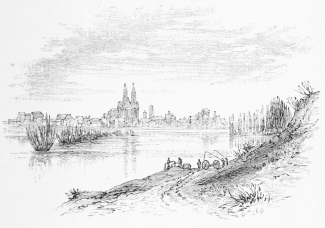
"Her passage on the 21st was most unfortunate, for a thick fog came on, which long prevented the steamer from finding the narrow entrance of Calais harbour, and the boat remained for two hours swaying about outside and firing guns of distress every ten minutes. These were answered by steamers in port, and the great alarm-bell of Calais tolled incessantly. At last another steamer was sent out burning red lights, and guided the wanderer in. My poor mother was quite unable to stand from the cold and fatigue when she was landed, and the journey to Paris, across the plains deep in snow, was a most anxious one. During the three days we spent at Paris, she was so ill that I had almost given up all hope of moving her, when a warm change in the weather allowed of our reaching Tours, where we stayed two more days.
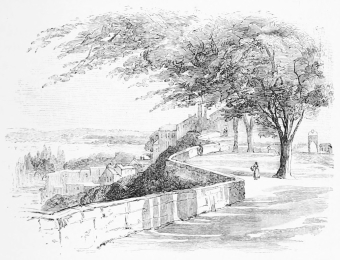
"Tours is a fine old town, and is the place where our grandfather died. I saw his house, quite a palace, now the museum. We slept again at Angoulême, a very striking place, the old town rising out of the new, a rocky citadel surrounded with the most beautiful public walks I ever saw out of Rome, and a curious cathedral. This Bordeaux is a second Paris, only with a river like an arm of the sea, and immense quays, full of bustle and hubbub, like the Carminella at Naples."
TOURS.[252]
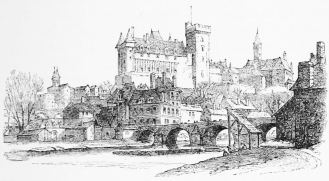
"Hotel Victoria, Pau, Feb. 2.—On Monday we made the easiest move possible from Bordeaux to Arcachon, a most quaint little watering-place. The hotel was a one-storied wooden house, with an immensely broad West-Indian-like balcony, in which three or four people could walk abreast, descending on one side to the strip of silver sand which alone separated it from the wave-less bay of the sea called the Bassin d'Arcachon;[253] the other opening into the forest—sixty or seventy miles of low sandhills covered with arbutus, holly, and pine. Near the village, quantities of lodging-houses, built like Swiss châlets, are rising up everywhere in the wood, without walls, hedges, or gardens, just like a fairy story, and in the forest itself it is always warm, no winds or frosts penetrating the vast living walls of green. If the mother had been better, I should have liked to linger at Arcachon a few days, but we could not venture to remain so far from a doctor. Here at Pau we live in a deluge: it pours like a ceaseless waterspout; yet, so dry is the soil, that the rain never seems to make any impression. Pau is dreadfully full and enormously expensive. I see no beauty in the place, the town is modern with a modernised castle, the surrounding country flat, with long white roads between stagnant ditches, the 'coteaux' low hills in the middle distance covered with brushwood, the distant view scarcely ever visible. We are surrounded by cousins. Mrs. Taylor[254] is most kind—really as good-natured as she is ugly, and, having lived here twenty years, she knows everything about the place. Dr. Taylor is a very skilful physician. Edwin and Bertha Dashwood are also here with their five children, and Amelia Story with her father and step-mother.[255]
"Alas! my sweetest mother is terribly weak, and has hitherto only seemed to lose strength from day to day. She cannot now even walk across the room, nor can she move from one chair to another without great help. We are a little cheered, however, to-day by Dr. Taylor."
AT ANGOULÊME.[256]
To MISS LEYCESTER.
"Pau, Feb. 12.—For the last two days my dearest mother's suffering has been most sad, without intermission.... This evening Dr. Taylor has told me how very grave he thinks her state, and that, except for the knowledge of her having so often rallied before, there is no hope of her precious life being restored to us. God has given her back before from the brink of the grave, and it might be His will to do so again; this is all we have to cling to. Her weakness increases daily. She cannot now help herself at all.... Her sweetness, her patience, the lovely expression of her countenance, her angelic smile, her thankfulness for God's blessings even when her suffering is greatest, who can describe? These are the comfort and support which are given us.
"I do not gather that the danger is quite immediate; the dread is a stupor, which may creep on gradually.... I am always able to be cheerful in watching over her, though I feel as if the sunshine was hourly fading out of my life."
To my Sister.
"Pau, Feb. 14.—My last account will have prepared you for the news I have to give. My sweetest mother is fast fading away.... Lea and I have been up with her all the last two nights, and every minute of the day has been filled with an intensity of anxious watching. The frail earthly tabernacle is perishing, but a mere look at my dearest one assures us that her spirit, glorious and sanctified, has almost already entered upon its perfected life. Her lovely smile, the heavenly light in her eyes, are quite undescribable.
"All through last night, as I sat in the red firelight, watching every movement, it seemed to me as if the end was close at hand. Her hymn rang in my ears—so awfully solemn and real:—
'It may be when the midnight Is heavy upon the land, And the black waves lying dumbly Along the sand; When the moonless night draws close, And the lights are out in the house; When the fires burn low and red, And the watch is ticking loudly Beside the bed: Though you sleep, tired out, on your couch, Still your heart must wake and watch In the dark room, For it may be that at midnight I will come.'
When the Master does come, she will be always found waiting. Has not my darling kept her lamp burning all her life long? Surely when the Bridegroom cometh, she will enter into the kingdom.
"I cannot tell how soon it will be. I have no hope now of her being given back to me. It is a solemn waiting. Oh! my Esmeralda, when you hear that the hour has come, pity, pray for her unutterably desolate son."
To MISS LEYCESTER.
"Feb. 17.—There has been an unexpected rally. Two days ago, when I was quite hopeless and she lay motionless, unconscious of earth, Dr. Taylor said, 'Wait, you can do nothing: if this trance is to end fatally, you can do nothing to arrest it; but it may still prove to be an extraordinary effort of Nature to recruit itself.' And truly, at eight o'clock yesterday morning, after sixty hours of trance, she suddenly opened her eyes, smiled and spoke naturally. I had just left the room, when Lea called me back—'She is talking to me.' I could scarcely believe it; yet, when I went in, there my darling sat in her bed, with a sweet look of restored consciousness and returning power.
"It was like a miracle.
"She remembers nothing now of her illness. She does not think she has suffered. During the last night she says she was constantly saying the seventy-first Psalm. Almost the first thing she said after rallying was, 'I have not been alone: your Uncle Penrhyn and your Aunt Kitty[257] have been here, supporting me all through the night.'
"Our nice simple little landlady had just been to the church to pray for her, and, coming back to find her restored, believes it is in answer to her prayers.
"I did not know what the agony of the last three days was till they were over. While they lasted, I thought of nothing but to be bright for her, that she might only see smiles, to prevent Lea from giving way, and to glean up every glance and word and movement; but to-day I feel much exhausted."
To my Sister.
"Pau, Feb. 21.—My darling has been mercifully restored to me for a little while—a few days' breathing space; and yet I could not count upon this even while it lasted; I could not dwell upon hope, I could not look forward—the frail frame is so very frail. I cannot think she is given to me for long: I only attempt to store up the blessings of each day now against the long desolate future.
PAU.[258]
"Last Sunday week she fell into her trance. It lasted between sixty and seventy hours. During this time she was almost unconscious. She knew me, she even said 'Dear' to me once or twice, and smiled most sweetly as she did so, but otherwise she was totally unconscious of all around her, of day and night, of the sorrow or anxiety of the watchers, of pain or trouble. A serene peace overshadowed her, a heavenly sweetness filled her expression, and never varied except to dimple into smiles of angelic beauty, as if she were already in the company of angels.
"But for the last sixteen hours the trance was like death. Then the doctor said, 'If the pulse does not sink and if she wakes naturally, she may rally.' This happened. At eight the next morning, my darling gently awoke and was given back into life. This was Thursday, and there were three days' respite. But yesterday she was evidently failing again, and this morning, while Dr. Taylor was in the room, the trance came on again. For ten minutes her pulse ceased to beat altogether.... Since then she has lain as before—scarcely here, yet not gone—quite happy—between heaven and earth.
"I believe now that if my darling is taken I can give thanks for the exceeding blessedness of this end.
"Meantime it is again a silent watching, and, as I watch, the solemn music of the hymns that my darling loves comes back to me, and I repeat them to myself. Now these verses are in my mind:—
'Have we not caught the smiling On some beloved face, As if a heavenly sound were wiling The soul from our earthly place?— The distant sound and sweet Of the Master's coming feet. We may clasp the loved one faster, And plead for a little while, But who can resist the Master? And we read by that brightening smile That the tread we may not fear Is drawing surely near.'
And then, in the long watches of the night, all the golden past comes back to me—how as a little child I played round my darling in Lime Wood—how the flowers were our friends and companions—how we lived in and for one another in the bright Lime garden: of her patient endurance of much injustice—of her sweet forgiveness of all injuries—of her loving gratitude for all blessings—of her ever sure upward-seeking of the will and glory of God: and my eye wanders to the beloved face, lined and worn but glowing with the glory of another world, and while giving thanks for thirty years of past blessing, shall I not also give thanks that thus—not through the dark valley, but through the sunshine of God—my mother is entering upon her rest?
"God will give me strength: I feel quite calm. I can think only how to soothe, how to cheer, how to do everything for her."
"Feb. 26.—It is still the same; we are still watching. In the hundred and twelfth hour of her second trance, during which she had taken no nourishment whatever, my mother spoke again, but it was only for a time. You will imagine what the long watchings of this death-like slumber have been, what the strange visions of the past which have risen to my mind in the long, silent nights, as, with locked doors (for the French would insist that all was over), I have hovered over the pillow on which she lies as if bound by enchantment. Now comes before me the death-bed scene of S. Vincent de Paul, when, to the watchers lamenting together over his perpetual stupor, his voice suddenly said, 'It is but the brother that goes before the sister.' Then, as the shadows lighten into dawn, Norman Macleod's story of how he was watching by the death-bed of his beloved one in an old German city, and grief was sinking into despair, when, loud and solemn, at three in the morning, echoed forth the voice of the old German watchman giving the hours in the patriarchal way—'Put your trust in the Divine Three, for after the darkest night cometh the break of day.'
"Last night the trance seemed over. All was changed. My sweetest one was haunted by strange visions; to her excited mind and renewed speech, every fold of the curtains was a spirit, every sound an alarm. For hours I sat with her trembling hands in mine, soothing her with the old hymns that she loves. To a certain extent, however, there is more hope, more of returning power. Is it a superstition to think that she began to revive when in the churches at Holmhurst, Hastings, Hurstmonceaux, Alton, and Pau prayers (and in many cases how earnest) were being offered up for her restoration?
"Two P.M.—My darling has been sitting up in bed listening to sweet voices, which have been singing to her; but they were no earthly voices which she heard.
"Ten P.M.—She has just declared that she sees Ruth Harmer (a good, sweet girl she used to visit, who died at Hurstmonceaux) standing by her bedside. 'It is Ruth Harmer—look at Ruth Harmer,' she said. But it was not a voice of terror; it was rather like the apostolic question, 'Who are these who are arrayed in white robes, and whence come they?' There has also been a time when she has spoken of 'dear Holmhurst, dear beautiful Holmhurst,' in the most touching way."
"Feb. 27.—She has fallen into a third stupor, deeper than the others; there is no sign of breath, the heart does not beat, the pulse does not beat, the features have sunk. I alone now declare with certain conviction that she lives. The shadows are closing around us, yet I feel that we are in the immediate presence of the Unseen, and that the good Ruth Harmer is only one of the many angels watching over my sweetest one. Years ago she told me that when dying she wished her favourite hymn—
'How bright those glorious spirits shine,—'
to be sung by her bedside; was it these words which she heard the angels sing to her? Oh! my Esmeralda, are you praying that I may endure while it is necessary to do everything for her, only so long? How strange that the scene which I have so often imagined should be in a country hitherto unknown, the only relations near having been strangers before; yet the simple French people here are very sad for us, and there is much sympathy."
"March 10.—It has been many days since I have ventured to write: it has been so difficult to say anything definite, with the constant dread of another relapse, which we have thought must come every day: yet I think I may now venture to write in thanksgiving that my mother is restored to me from the brink of the grave. It seemed quite impossible that she could come back, as if she must enter the world on the portals of which she had been so long resting. Doctor and nurse gave up all hope; and at last the nurse went out, saying all must be over when she returned in three hours' time. In those three hours the remedies began to take effect, the dead limbs to revive, the locked mouth to open, the closed eyes to see, the hands to feel. It had been a death-like trance of a hundred and ninety-six hours altogether—ten days and nine nights. She remembers nothing of it now, and nothing of the illness which came before, but a gradual revival and awakening of all her powers is going on. It has been less painful to her throughout than to any one, and it is so still.
"Dr. Taylor is made Sir Alexander. He and Lady Taylor have been most kind to us—could not have been more so. It has been interesting to see so much of her, the last survivor of our father's generation in the family, and one who, living constantly at Hurstmonceaux, was present through all the old family crises and conflicts, which she narrates with much of sound sense and observation. I shall hope to write down much of her recollections, and shall begin in good earnest to collect the memorials of that earlier family period, quite as curious in its way as many later ones."[259]
"Pau, March 27.—My sweet mother continues slightly better certainly, but in a most fragile and harassing state of health. I never feel happy in leaving her, even for half-an-hour. On some days she is better and almost able to enjoy reading a few words, or being read to a little: on others, as to-day, the trembling increases to such a degree as to prevent her occupying herself in any way. I need not say how beautiful are her faith and love, how increasing the beatitude of her inner, her heavenly life. 'Oh, how long it is since I have been at church,' she said last night. 'But you are always at church in your soul, darling,' I said. 'Yes,' she answered, 'that is the greater part of my day—meditation and prayer, and in the night I say my hymns and texts.' On my birthday she gave me a solemn blessing. Each day I watch her every look and movement. Truly I feel as if the pulse of her life beat into mine. She does not see many people, but our sweet little cousin Lady Dashwood, Lady Taylor, and Lady Charles Clinton come occasionally.
"Pau is the most unattractive place I ever was in, and it pours or snows almost incessantly. The 'society' is small, good, and uninteresting, and snubs the immense remainder of the Anglo-Pau world with hearty goodwill.
"For some days we have been very sad about dear Emma Leycester, who has been terribly ill: at least I have been, for I think the mother has scarcely taken in the great cause for alarm."
I think the name of this most dear cousin, Emma Leycester (Charlotte's much younger sister) has scarcely been mentioned in these memoirs, and yet there was scarcely any one who had a tenderer place in our home life and thoughts, or to whom we were more devoted. Perhaps the very fact of omitting her shows how entirely she must have kept aloof from all family squabbles and disorders, whilst rejoicing in all our pleasures and sorrowing in all our griefs. She was never strong, and I always recollect her as a semi-invalid, yet more animated and cheerful than most people in strong health, and able, from the very fact of weakness removing her from the general turmoil of all that was going on around her, to give her full attention and sympathy to the things she could participate in. Small in person, she was of a most sweet countenance, with grey hair, a most delicate complexion, and bright eyes, full of expression and humour—
"Her angel's face As the great eye of heaven, shyned bright, And made a sunshine in the shady place."[260]
As a child, in her visits to Stoke and Lime, I was quite devoted to her, and in the persecutions of my boyhood was comforted by her unfailing sympathy. When at Southgate, the greatest pleasure of my London excursions was that they sometimes ended at "Charlotte and Emma's house" in Wilton Crescent, and that I often went to have tea with the dear Emma, who was already gone to rest upon the sofa in her own little sitting-room. When I was at Oxford she came to visit me there; and latterly the loss of her own brother and sister had drawn this sister-like cousin nearer to my mother as well as to myself.
To MISS LEYCESTER.
"Pau, April 6, 1865, 8 P.M.—I must write one little line of love this evening: the sad news reached us two hours ago, and you will know how we are mourning with you. I had just a hope, and can hardly feel yet that dearest Emma's sweet presence, her loving tender sympathy and interest, are taken from us in this world: but may we not feel that she is perhaps still near us in her perfected state, and to you and to my darling mother even the visible separation may be a very short one, it can only be a few years—long here, but like a moment to her, till the meeting again.
"I am glad to think of you at Toft, and of her resting there, where we can visit the grave. I feel so deeply not being able to be with you, or to do anything for you, as dearest Emma so often said I should do for her, if you were taken from her.
"The news came at tea-time. It was impossible to conceal it. The mother had had a suffering day, and was utterly crushed. We put her to bed at once, and very soon she literally 'fell asleep for sorrow,' and I, watching beside her, heard her lips murmur, 'O blessed are they who die in Thee, O Lord, for they rest from their labours.'"
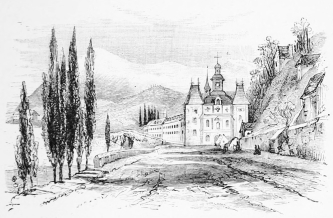
"L'Estelle, April 8.—My mother continued so seriously ill up to yesterday morning, that I was certain if she were not moved at once, I must not hope she ever would be. Dr. Taylor declined to take the responsibility, but I felt some one must act; so I sent for a large carriage, and had her carried down into it like a baby, and brought off here, only two hours' easy drive from Pau. Before we had gone six miles she began to revive, was carried to her room without exhaustion, and to-day opens her eyes on a lovely view of the snow mountains above the chestnut woods, with a rushing river and the old convent of Bétharram in the gorge, which is a wonderful refreshment after having lived in a narrow street, and seen nothing but a white-washed wall opposite for eleven weeks. Already she is better."
To my Sister.
"L'Estelle, April 9.—You will have heard of our great sorrow.... A week ago dearest Emma's fever passed and took the form of prayer, which, as Charlotte says, 'flowed like a river.' Once she said, 'I have been fed with angels' food; I did not ask for it, I could not, but I have had it.' Her last resting-place is at Toft. Charlotte was able to be present.... I feel that, though we have many still to love, no one can ever fill the same place in our hearts."
BÉTHARRAM.[261]
During my mother's long illness at Pau, I naturally thought of nothing, and saw scarcely any one, but her. In the last three weeks, however, after her rally, and before the last alarm, I saw a few people, amongst them very frequently Lady Vere Cameron, whose husband, Cameron of Lochiel, had been known to my mother from girlhood. Through Lady Vere, I was introduced to a remarkable circle then at Pau, which formed a society entirely occupied with spiritualism. Most extraordinary were the experiences they had to narrate. I have kept some notes of my acquaintance with them:—
"Pau, March 1865.—When I was at Lady Vere Cameron's, the subject of table-turning was brought forward, and I then said that I had been told that I was a medium, meaning merely with reference to tables. We sat down to a table and it turned. Soon it began to rap violently, and a scratching noise was heard underneath. This I believe to have been owing to some ventriloquism on the part of Ferdinand Russell, who was present, but it excited Lady Vere very much.
"Some days after I had a note from Lady Vere to desire that I would come to be introduced to her 'particular friend,' Mrs. Gregory, at a party in her own house. As I knew that Mrs. Gregory was a great spiritualist and much occupied with the subject, I naturally supposed that this desire to make my acquaintance was due to the table-turning at Lady Vere's, and I went expecting to find a séance.
"But it was a large party, a great number of people whom I had never seen before. Mrs. Gregory had the odd expression of always looking for something behind her. She spoke at once of my being a medium, and then said in an excited manner, 'But are you far advanced? are you like me? when a friend is going to die, do you see it written before you in letters of light there?'—pointing into vacancy. 'No,' I said, 'certainly not: that never happens to me.' Speaking of this afterwards to a Mr. Hamilton, he bade me beware, for very unpleasant things often happened at Mrs. Gregory's séances, or, if they did not happen, every one present believed that they did—that hands appeared, &c.: that his cousin, Mrs. H. of S., had received messages from her child who was dead: that others also had received messages from their dead relations. The meetings were always solemnly opened with prayer.
"At Mrs. White Hedges' I saw Mrs. H. She said that she also was certain that I was a medium, and asked whether I did not frequently have messages from the other world. I said 'No,' and that I did not wish to have any. 'What,' she said, with a look of great surprise, 'you do not wish, then, for the regeneration of the world; for if you did you would feel that it can only be brought about through the instrumentality of spirits.'"
"April 4.—At Lady Robinson's[262] I again met Mrs. Gregory, who asked me to come on the 6th to help her to turn a table, and see if I should receive any messages. I agreed to do so, understanding that nothing more was intended than she said. Afterwards I sat by Miss N. L., who said, 'I see that terrible woman has been getting hold of you. Pray don't go. You don't know what you will see. Every one who goes is beguiled by small pretexts till they see the most appalling things. It can only be through the devil.'
"Persuaded by Miss N. L., I went to Mrs. Gregory and said, 'Mrs. Gregory, do tell me exactly what you expect to happen on Thursday, because I do not wish to see anything.'
"'Oh, you are a coward, are you?' said both Mrs. Gregory and Mrs. Alexander, who was sitting near her.
"'Yes, certainly I am a coward about trifling with the supernatural. It is not because I do not believe that spirits can return from the dead, but because I do believe it that I would rather not come, if you expect to see anything.'
"'Well, I can only say that both seeing and receiving messages are the greatest possible comfort to me: it is only that which keeps me in my right mind,' said Mrs. Gregory.
"I answered that I should dislike being upset for the ordinary and practical duties of life by being led to dwell constantly upon the supernatural.
"'That is precisely what strikes me as the greatest advantage,' said Mrs. Gregory; 'surely one cannot think too much of the other world. To feel that spirits are constantly watching you, and grieving or rejoicing over you, must surely tend to keep you from a great deal of evil. I have known many infidels entirely converted to a new and Christian life by what they have seen with me—Mr. Ruskin, for instance. I asked Mr. Ruskin one day what he believed, and he answered "Simply nothing." He afterwards came to my house several times when I had séances, and then he took my hands, and with tears in his eyes said, "Mrs. Gregory, I cannot thank you enough for what you have shown me: it will change my whole life, for because I have seen I believe." Mr. Pickersgill the artist was another instance. Certainly hands often appear to me, but I like to see them. If you had lost any one who was a part of your life, would you not like to know that you were receiving a message from those you loved? You need not be afraid of the messages I receive. Just before I came here I received this message—"Keep close to God in prayer." There was nothing dreadful in that, was there? Was not that a beautiful message to receive. But sometimes the spirits are conflicting. There are good and bad spirits. If the messages are not such as we should wish, then we know the bad spirits are there. All this is in the Bible, "Ye shall try the spirits, whether they be good or evil." This is one of the means of grace which God gives us: surely we ought not to turn aside from it.'
"Afterwards I asked Lady Robinson her experience. She said that she had been at one of the séances, but nothing appeared and 'the Indicator' gave nothing decided. She said it was conducted most seriously, with all religious feeling. She described Mrs. Gregory as not only praying at the time, but living in a state of prayer, and she believed that the messages were granted in answer to real faith. She said quantities of people had seen the hands appear. Mrs. Gregory had a very large séance at Sir William Gomm's in London, and Lady Gomm asked for an outward sign before she would believe. A bodiless hand then appeared, and, taking up a vase with a plant in it from a china dish upon the table, set it on the floor, and then breaking a flower from the plant, came and laid it in Lady Gomm's lap: all the company saw it.
"I told the Taylors what I had heard. Sir Alexander said that he thought the chief good of such a clever physician as Mrs. Gregory's husband (Dr. Gregory of the powders) appearing would be to write a prescription for the living."
While we were at Pau, my sister wrote much to me upon the death of Cardinal Wiseman, to whom she was greatly devoted, and whom I have always believed to be a most sagacious and large-hearted man. His burly figure upon the sands at Eastbourne used to be very familiar to me in my boyhood. I heard Monsignor Capel, who afterwards attained some celebrity, preach his funeral sermon at Pau.
"Thirty years ago," he said, "there were only six Catholic churches in London; now there are forty-six. Then there were six Catholic schools in London; now there are at least three in each of these parishes—one for boys, one for girls, and one for infants. Then there were only 30,000 Catholics in all England; now there are two millions, one-ninth of the whole population of the country. Then there were no religious Orders except the Jesuit Fathers, who had lingered on from the Reformation, flying from one Catholic house to another, and administering the sacraments in fear and trembling; now there are in London the followers of St. Francis and St. Dominic, the Passionist Fathers, the Redemptorists, and at least twelve nunneries of English ladies. All this change is in a great measure due to Cardinal Wiseman, the founder of the English hierarchy. He entered on his labours in troublous times: with the enthusiasm and love of splendid ritual which he imbibed as a Spanish boy, with the ecclesiastical learning of Italy, with the dogmatic perseverance and liberality which he drank in with his English education. He chose as the title of his bishopric the see of the last martyred English bishop, and he also thirsted for martyrdom."
These notes are curious as showing how the rapid growth of Catholicism in England, which we Protestants are so unwilling to recognise, had advanced under Cardinal Wiseman's leadership.
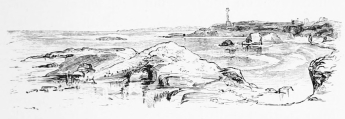
At L'Estelle my mother daily revived, and was soon able to sit out on the sunny balcony, for the valleys of the Pyrenees were already quite hot, though the trees were leafless and the mountains covered with snow. It was long, however, before I ventured to leave her to go beyond the old convent of Bétharram, with its booths of relics and its calvary on a hill. When she was stronger, we moved to Argelès, a beautiful upland valley, whence excursions are very easy to Cauterets and Luz. Afterwards we visited Eaux Chaudes and Eaux Bonnes; but though the snow was too deep to allow of mountain rambles, the heat was already too intense for enjoyment of the valleys. We had left Pau without a sign of vegetation, and when we came back three weeks later, it was in all the deadest, heaviest green of summer. So it was a great refreshment to move at once to Biarritz, with its breezy uplands, covered with pink daphne, and its rolling, sparkling, ever-changing sea, so splendid in colour. To my mother, Biarritz was a complete restorative, and she was able there to take up her drawing again, to enjoy seeing friends, and to enter into the interests and peculiarities of the curious Basque country.
BIARRITZ.[263]
We visited many of the Basque churches, which are always encircled within by three galleries, except over the altar. These galleries are of black oak. The men sit in the galleries, and the women below, and they enter at different doors. In the churchyards the graves have all little crosses or Basque head-stones with round tops, and they are all planted with flowers. The houses all have wide overhanging roofs and external wooden galleries. Bidart and Cambo are good specimens of Basque villages. Bidart is a beautiful place on the road to S. Jean de Luz, and has a church with the characteristic overhanging belfry and high simple buttresses. A wide entry under the organ-loft is the only entrance to the church. In the hollow below is a broken bridge reflected in a pool, which is golden at sunset, and which, with the distant sea and sands, and the old houses with their wooden balconies scattered over the hillside, forms a lovely picture. Here I stayed one evening to draw with Miss Elizabeth Blommart, an acquaintance we made at Biarritz (afterwards our friend for many years), while my mother and Lea walked on, and descended from the opposite hill upon the sands. We had often been told of the treacherous waves of Bidart, but could not have believed in danger—so distant, beyond the long reaches of sand, seemed the calm Atlantic, glistening in the last rays of sunlight. To our horror, when we had nearly finished our drawing, we looked up, and saw my mother and Lea coming towards us pouring with salt water from cloaks, bonnets, everything. They had been walking unsuspiciously on the sands three-quarters of a mile from the sea, when suddenly, without any warning, a great wave surrounded them. My mother was at once swept off her feet, but Lea, with her usual presence of mind, caught her cloak and rolled it round her arm, and plunging herself deep into the sand, resisted the water and held her mistress till the wave receded, when they made their escape. A few days afterwards an Englishman with his little dog was walking in the Bay of Bidart; the man escaped, but the dog was swept out to sea.
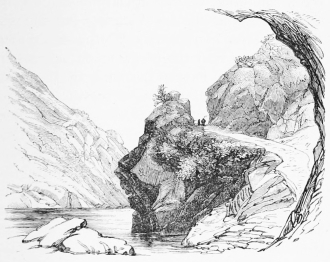
Cambo is two hours' drive from Biarritz—a most pleasant watering-place on a high terrace above the Nive, with pergolas of vines and planes, a churchyard which is a perfect blaze of lilies and roses, and an inn-garden which is full of lovely flowers. Close by is the opening to the Pas de Roland, a grand little gorge where the Nive rushes through the mountains—a finer Dovedale. A rocky path ascends by the side of the stream and climbs a succession of steeps to la roche percée, through which it passes to a little hamlet and old bridge. Eighteen miles farther is S. Jean de Port, whence one can ride to Roncesvalles.
THE PAS DE ROLAND.[264]
The whole of this Basque country is full of memorials of the Peninsular War, the events of which in this district are wonderfully well described in the novel of "The Subaltern." There are deep woods and glens which ran down with blood; green lanes (as at Irogne) which were scenes of desperate combats; tombs of English officers, as in the churchyard at Bidart and in the picturesque mayor's garden between Bidart and Biarritz, where a flat stone commemorating three English officers is to be seen under the old apple-trees, overlooking a wide expanse of country. The most dreadful slaughter was near the Negressa Station, where the two armies, having occupied the ridges on either side the lake, suffered frightful carnage. It might have been spared, but in both armies it was then unknown that Napoleon had abdicated, and that peace was proclaimed. Between S. Jean de Luz and the Behobia is a picturesque old château, which was taken by the English after an easy siege, the inhabitants having been forced to fly with such precipitation that everything was abandoned, even the mail-bags which they had just seized being left behind and the contents scattered about on the floor. The first letter the English officer in command picked up was directed to himself and from his own father! He took nothing from the house but a Spanish dictionary from the library, but returning that way three weeks afterwards, found it completely pillaged by the Spanish camp-followers.
The peasantry of the Basque country are most interesting to talk to, and it is strange that more should not have been said and written about them, as their conversation is more full of ancient proverbs and folk-lore than that of the inhabitants of any other part of France. I remember an old Basque woman saying that her language was not only the best, but far the oldest in the world—in fact, it was that which Adam and Eve spoke in Paradise!
Twice, while we were at Biarritz, I made excursions into Spain, crossing the Bidassoa close to the Isle of Pheasants with intense interest. In all the Spain I have seen since, there is nothing more utterly Spanish than the tiny walled town of Fontarabia, with its wooden balconies piled one above another, and its lookout over a blue estuary. Most striking also is Passages—a land-locked bay of the sea with a very narrow opening, which is passed on the way to S. Sebastian.
S. EMILION CATHEDRAL DOOR.[265]
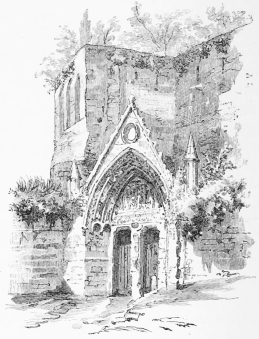
Our return journey to England in the late spring was very delightful. My mother, in entire enjoyment of her marvellously restored health, and delighting to drink in the full beauties of nature and antiquity, was in no hurry to return to the turmoil of English life. We lingered everywhere, making short half-day journeys, and spending quiet afternoons sketching in the grass-grown streets of half-deserted cities, or driving out in little carriages to grand old châteaux. Thus we first saw S. Emilion, that marvellous place, where the buildings are so mingled with the living rock, that you scarcely can tell where the work of man begins, and where each sculptured cornice glows in late spring with a glory of crimson valerian. In one of the quietest streets of Poitiers, before a cottage door, we bought an old inlaid table, which is one of the pleasantest memorials of our journey. At Amboise we stayed several days in a most primitive but charming hotel, the vision of my dear mother in which often comes back to me, sitting with her psalm-book in a low room with white-washed walls and brick floor, and with a latticed window looking out over the great river glistening in the sunset. My mother liked and admired Amboise[266] more than almost any of our thousand resting-places, and she delighted in the excursions to moated Chenonceaux and to Chambord, where we and Lea had tea and bilberry jam at a delightful little inn which then existed on the outskirts of the forest.
AMBOISE.[265a]
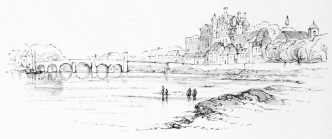
On the 27th of May we reached Holmhurst. One of those curious incidents which are inexplicable had occurred during our absence, and was narrated to us, on our return, by our servants, neighbours, and by Mrs. Hale, the wife of our Hastings doctor. During my mother's illness at Pau, two of our maids, Alice and Jane Lathom, slept, according to their custom, in one of the spare rooms to the front of the house. In the middle of the night they were both aroused by three piercing terrible screams in the room close to the bed. Petrified with horror, they hid under the bed-clothes, and lay thus more dead than alive till morning. With the first streak of dawn they crept down the passage to John Gidman's room, roused him, and told him what had happened. He felt it was certainly an omen that the death they expected had occurred; took the carriage and drove down at once to St. Leonards toMrs. Hale. Dr. and Mrs. Hale were at breakfast when John Gidman arrived and sent in word that his mistress was dead. When they went out, they found he had received no letter, but had only an inward conviction of the event from what had happened.
It was the same hour at which my mother, waking from her second trance in her room at Pau, had uttered three long piercing screams in her wandering, and said, "Oh, I shall never, never see my dear Holmhurst again!"
There is no explanation to offer.
We had much enjoyment of our little Holmhurst this summer and a constant succession of guests. Amongst those who now came annually were Arthur Stanley and his wife Lady Augusta. To my mother, Augusta Stanley was always a very tender and dutiful niece, and to me a most kind cousin. She rejoiced to aid my mother in acting as a drag to Arthur's ever-increasing impression that the creed of progress and the creed of Christianity were identical. Many people thought that such an intense, almost universal warmth of manner as hers must be insincere, but with her it was perfectly natural. She took the sunshine of court favour, in which they both lived, quite simply, accepting it quietly, very glad that the Royal Family valued her, but never bringing it forward. She was indeed well worthy of the confidence which her royal mistress reposed in her, for though the Queen wrote to her daily, and though she generally came in to breakfast with several sheets in the large well-known handwriting, not one word from them ever transpired to her nearest relation or dearest friend.
What Lord Beaconsfield called "Arthur Stanley's picturesque sensibility" made him care more than Augusta about having royal (i.e. historic) friendships, though he had less personal feeling than she had for the illustrious persons who made them. He was, however, quite devoted to the Queen, to her own personality, and would certainly have been so had she been in any other position of life. The interests of Westminster made him very happy, and he rejoiced in the duty which fell upon him of preserving the Abbey as he received it, furious when it was suggested that some of the inferior and ugly monuments might be removed, or that the peculiar character of the choir (like a Spanish coro) might be altered. Always more a lover of moral than of doctrinal, or even spiritual Christianity, at this time he was beginning to be the victim of a passion for heretics which went on increasing afterwards. The Scotch were delighted with him: they thought he had an enthusiastic admiration for their Church. But he almost equally admired all schismatics from the Church to which he officially belonged, and was almost equally interested in them, and if he could get any one with ever so slight a taint of heresy to preach in the Abbey, it was a great delight to him: he thought it was setting an example of Christian liberality.
My sister left Rome with her aunt at the end of May (1865). At Pisa she took leave of her beloved Victoire, who remained at her own house. When she reached France, weakness prevented her intended visit to Paray le Monial, whence the nuns sent her the following rules for the employment of "The Holy Hour" in acts of reparation for insults offered to our Lord by the sins of men:—
1.Unbelief { Short acts.—"Lord, I believe, help thou mine unbelief." Faith.—"Lord, increase our faith," &c.
2.Ridicule, mockery. Secret prayers for the scoffers.
3.Irreverence.—Special reverence towards the Blessed Sacrament.
4.Rash judgments.—Acts of reparation to the Sacred Heart.
5.Unlawful opinion.—Silence upon things settled by authority.
6.Careless life.—Act of offering morning and night against frivolous and immoderate words and actions.
7.Love of ease and pleasure.—Simple acts of mortification and self-denial in the course of the day.
Esmeralda was detained for some time by serious illness at Dijon, with the strange symptoms which, three years later, attended her final illness, and which were then inexplicable to all around her. On her recovery, Madame de Trafford met her at Paris, and insisted that she should follow her to her château in Touraine. Hence Esmeralda wrote:—
"Château de Beaujour, June 1865.—You will have heard from Auntie of our arrival in this fairy château.... I have heard much that is wonderful, but what is most striking is to watch the perfect simplicity of a life so gifted as Madame de Trafford's—the three virtues, Faith, Hope, and Charity, that faith which can move mountains, and with it great humility. Madame de Trafford is deeply interested in any details I give her of the last six years: she was really attached to Mama. Here, in her château, she saw that Mama was dying. She turned suddenly round to Mr. Trafford, who was here, and said, 'Ah! elle va mourir—sortons.' She could not bear it, and felt that she must go out into the open air.
"We shall be in London some time next week, with endless affairs to settle. I quite dread the lawyers' deeds, days and weeks of worry, never ending and still beginning.
"I think of you once more in your study, as if a new life were given you, and dear Aunt Augustus in her arm-chair, and everything bright and beautiful around you."
Of this, her first visit to Beaujour, Esmeralda has left a few remarkable notes.
"July 1865.—Madame de Trafford came off to receive us at Paris as soon as she heard we were on our way. Then, when she heard I was so ill at Dijon, she often telegraphed there four times a day to Auntie, to the master of the hotel, to every one, so that they thought at Dijon that I was quite 'une grande personage.' At last, when I was better, we went to Beaujour. Madame de Trafford sent to meet us at Blois, but not her own horses, because they were trop vifs. It was a long drive, though we went at a great pace, for Madame de Trafford had told the coachman he was to drive as fast as possible. At last, in the avenue of poplars, the ruts were so deep that I thought we should have been overturned. Beaujour is a large square house with wings to it. Madame de Trafford herself opened the door, with a handkerchief over her head. 'Ah! vous voilà,' she said, 'c'est bien; il y'a longtemps que je vous attends.'