Volume 1 — CONTENTS VOLUME 1 (continued 6)
Reading edition
Palazzo Parisani was at once thrown into the utmost confusion, and all its inmates occupied themselves in preparing for immediate departure. Owing to the great number of things to be stowed away, it was, however, utterly impossible that they should leave before the next morning. Italima's state of anguish baffles description, for Francis was her idol. In the afternoon my sister, hoping to give her quiet, persuaded her to go out for an hour and walk in the gardens of the Villa Medici, where she would not be likely to meet any one she knew. In the long arcaded bay-walks of the villa she saw a familiar figure approaching. It was the "Family Spy." He came up to her, and, to her amazement, he began to address her—he, the silent follower of so many years! He said, "The time has now come at which I can serve you, therefore I speak. This morning you received a letter." Italima started. "You are surprised that I know you have the letter, and yet I am going to tell you all that was in that letter," and he repeated it word for word. He continued—"I not only know all that was in your letter and the distress in which it has placed you, but I know all the circumstances under which that letter was written, and I know all that has happened to your sons since: I know all about your sons. Your son Francis was taken ill on such a day: he saw such and such doctors: he is already much better: there is no danger: you may be quite easy about him. Your son William is not in danger, but he is really much the more ill of the two. Dr. Fergusson has seen him, and a foreign winter is prescribed. It will not do for you to go to England yourself, but yet he is not well enough to travel alone. You have an old servant, Félix, who came to you in such a year, and who has been with you ever since. You must send him to fetch William, and here is a paper on which I have written down all the trains and steamers they are to travel by, both in going and returning." So saying, and having given the paper to Italima and bowing very low, the Family Spy retired. Italima went home. She acted entirely on the advice she had received. She unpacked her things and remained in her palazzo at Rome. She sent Félix, as the Spy had directed: he travelled according to the written programme, and in a fortnight he returned to Rome bringing William back with him. The Spy never spoke to any member of the family again.
It is anticipating, but I may mention here that when we went to Rome in 1857, I wondered if we should see the Family Spy. I spoke of it to my mother. As we passed through the Porta del Popolo, he was the first person who met us. I saw him very often that winter, and again when I was at Paris with my sister in October 1858. That winter my sister often saw him at Rome. The next year was marked by our great family misfortunes. My sister always expected that somehow or other he would come to the rescue of the lost fortunes, but he never did. Some time after she heard that he had died very suddenly about that time.
When I returned to my mother in the summer of 1852, she was at Eastbourne with Charlotte Leycester and very ill. It was the earliest phase of the strange hysteria with which I was afterwards so familiar—sudden flushings with a deathly chill over her face, and giddiness, sometimes followed by unconsciousness, occasionally by a complete apparent suspension of life, a death-like trance without breath or pulsation, lasting for hours, or even for many days together. It is a very rare illness, but it is known to doctors, and I believe it is called "Waking coma." In this summer I first began the anxious watchings of first symptoms—the swelling of my mother's fingers around her rings, and then by a kiss searched if the alarming chill had already taken possession of her face. Happily, the heavenly state of mind in which she always lived took away from her the terror of these illnesses; the visions which beset her waking and sleeping were of all things good and beautiful: the actual trances themselves were to her a translation into heavenly places and to the companionship of the blessed, and, for those who looked upon her, a transfiguration.
When my mother was able to move, it was decided that she must try foreign air, which then and often afterwards completely restored her to health for the time. It was settled that we should go to Heidelberg, and as her cousin Charlotte Leycester was to travel with her, I was able to precede her for a few days in the old Belgian towns, which, as I was then in the first enthusiasm about foreign travel, I looked upon as absolutely entrancing.
To MY MOTHER.
"St. Omer, July 15, 1852.—I shall never feel the day is properly over till it has been shared with my own dear mother. I have only left you a few hours, and yet, at an expense of one pound, how great is the change!... We embarked at Dover at one, with a cloudless sky and rippling waves, and an Irish lady near me was most amusing, telling anecdotes first in French to her neighbour on the other side and then in English to me. But half-way across the Channel the thickest of fogs came on, we made no way, and cries and whistles were kept up without cessation. Then it grew rough, the Irish lady's jokes became less vivacious, and at last she followed almost all the other passengers to the side of the vessel. At five o'clock sea and fog subsided and we went on, but then the tide had gone from the harbour, and when we were a mile and a half from Calais, all the passengers were transferred to open boats. As we were rowed in under the long pier, the beautiful fishing-nets were being drawn up out of the calm waters, and the old French faces with the high white caps and large gold earrings were looking down as last year.... The railway journey was delicious through the rich flat country, and the churches here, of the two missionary saints, Bertin and Omer, are most interesting."
"Bruges, July 17.—The heat is so intense that I am more inclined to watch the perfectly motionless branches of the acacia under the window than to do my duty by the sights. The old town and its people all seem lulled to sleep by the oppression. Yet the Dyver Canal is delightful, with its strange old towers and its poplar trees, and the market on its bank filled with Dutch fishwives in bright costumes.... My straw hat attracts much attention. 'Voilà le costume anglais,' I hear the people say.... The table d'hôte was very amusing, musicians playing the while on harp, guitar, and flute. To-night there is to be a procession which has had no equal for a hundred years.
"This morning I went to the Béguinage, a little village with walls of its own in the middle of the town. The sweet-faced Béguine nuns in long white veils were chanting the service in the church, ranged in the stalls of the choir. They wore long trains, which they took up when they came out of church. A priest was there, but the abbess seemed to take his part in officiating.[76] ... The streets are beautifully decorated for the procession, planted with living fir-trees, half the height of the houses, which, as they are very narrow, gives the effect of an avenue; but, behind, the houses are hung with flags and tapestry. In some streets altars are raised, surrounded with orange-trees and flowers.
"10 P.M.—The ceremonial was to celebrate 'the jubilee of the Carmelite tonsure.' ... The streets were all hung with flowers and tapestry, and garlands made a flower canopy across them, beneath which streamed crowds of peasants from every town in Belgium. Each pine-tree was a huge Christmas-tree with thousands of wax-lights blazing in the motionless air. Many hundreds of clergy formed the procession, and Capuchins and Carmelites and Franciscans, many with bare feet and flowing beards. There were also hundreds of torch-bearers and children swaying censers. Then came troops of young girls, 'brides of Christ,' in white, with garlands: then a beautiful little boy as St. John leading his lamb by a string; then Jesus, Mary, and Joseph—Mary crowned with a veil covered with golden stars, and endless winged cherubs in attendance; then abbots and canons; and lastly, under a crimson canopy, in a violet robe, the Bishop bearing the Host.
"The scene in the Grande Place was magnificent. Along the base of the halles burning torches rolled up their smoke around the belfry and the brilliant banners, and the sea of faces was motionless in expectation. It was a tremendous moment when the immense mass of clergy had sung a hymn around the altar in the square, and the Bishop took off his mitre and knelt upon the rushes before the Sacrament. Then, as he lifted the Host in his hands, the music ceased, and the whole multitude of people fell almost prostrate in silent prayer."
After visiting Ghent, Malines, Antwerp, and Louvain, I joined my mother and her companions at Brussels, and we proceeded by the Rhine and Frankfort to Heidelberg, where we found a charming apartment almost at the castle gate, at the back of a baker's shop, with a little oleander-fringed garden high on the hill-top, overlooking the town and river. Two sisters and their cousin waited upon us. The castle gardens were like our own, and delicious in their shade and freshness and the scent of their roses and lilacs; and the courtyards and towers were full of inexhaustible interest. We were never weary here of studying the history of the English Elizabeth, Queen of Bohemia, and finding out her connection with the different parts of the castle, and her little garden with its triumphal arch was our favourite resort. We seldom went down into the town except on Sundays, when the famous Dr. Schenkel preached in St. Peter's Church at the foot of our hill. In the evenings we used to walk along the edge of the hills, through flower-fringed lanes, to the clear springs of Wolfsbrunnen, where there was a sort of nursery of trout (florellen). The students shared the gardens with us, with their ridiculous dress and faces scarred for life in the silly duels at the Hirsch Gasse, which they looked upon as a distinction, and which generally arose from quarrels about giving way to each other in the street. They often, consequently, spent six hours a day in practising the sword-exercise, to the ruin of their studies. When we were at Heidelberg, all the clothes in the place used to be sent to be washed in the village of Spiegelhausen, because there the water was softer, and when its hills were covered with the linen of the whole town they produced the oddest effect. A large Heidelberg family considered it a great point of honour to have linen enough to last them six months, so as only to send it to be washed twice in the year, when it went in a great waggon to Spiegelhausen. A young lady always endeavoured to have this quantity at her marriage.
Lodging in the castle itself was M. Meyer,[77] afterwards a kind of secretary to the Empress Augusta of Germany, a most singular man, who was then employed upon an enormous poem, which he believed would throw Dante into the shade, though it has passed quite unnoticed. He delighted to read us some of its endless cantos in the castle gardens, and we tried to look as if we understood and appreciated. But he was really very kind to us, and was a most amusing companion in the long walks which he took us—to the Angel's Meadow, a small green space in the forests high on the mountains beyond the river, and elsewhere. I shared his admiration for Mrs. Hamilton (née Margaret Dillon, the maid of honour), who was at that time in the zenith of her beauty and attractiveness, and was living at Heidelberg with her husband and children.
We spent a day at Schwetzingen, where at that time was living the Grand Duchess Stephanie, the daughter of the Comte de Beauharnais and great-niece of the Empress Josephine, who had been adopted by Napoleon, and married against her will (1806) to the Prince of Baden. My aunt, Mrs. Stanley, was very intimate with her, and had much that was interesting to tell of her many trials.
It was during the latter part of our sojourn at Heidelberg that the Stanleys (Aunt Kitty, Arthur, and Mary), with Emmie Penrhyn, came to stay with us on their way to spend the winter at Rome, a journey which at that time was looked upon as a great family event. With them I went to Spires and its beautiful cathedral, and on the anniversary of my adoption we all went over to Mannheim, and dined at the hotel where, seventeen years before, I, being fourteen months old, was given away to my aunt, who was also my godmother, to live with her for ever as if I were her own child, and never to see my own parents, as such, any more. I dwell upon this because one of the strangest coincidences of my life—almost too strange for credence—happened that day at Mannheim.
When we returned to the station in the evening, we had a long time to wait for the train. On the platform was a poor woman, crying very bitterly, with a little child in her arms. Emmie Penrhyn, who was tender-hearted, went up to her, and said she was afraid she was in some great trouble. "Yes," she said, "it is about my little child. My little child, who is only fourteen months old, is going away from me for ever in the train which is coming. It is going away to be adopted by its aunt, who is also its godmother, and I shall never, never have anything to do with it any more."
It was of an adoption under exactly the same circumstances that we had been to Mannheim to keep the seventeenth anniversary!
After parting with the Stanleys, we left Heidelberg on the 26th of August and made a little tour.
To Mrs. Alexander.
"Coblentz, Sept. 1.—Here we are again at Coblentz, in a room looking on the friendly Rhine, with Ehrenbreitstein all new and yellow on the other side the water, and the older houses of the town below us.
"Our little tour has been most successful. We went first to Baden, and spent the afternoon in driving up through the forest to the Alte Schloss, coming down in a splendid sunset—the golden Rhine gleaming in a red valley through the dark pines. The next morning, as I was being shown over the Neue Schloss, I asked about the Grand Duchess Stephanie and the Princess Wasa, when the guide rushed to a window and said, 'Come quick, for the princesses are riding out of the courtyard upon their asses, as they do every morning before breakfast;' but I saw little more than their shadows flit across the court as their donkeys clattered through the gate. I was shown the circular opening through which prisoners bound in a chain used to be let down into the oubliettes and their subterranean judgment-hall, and the place where they had to give the baiser de la Vierge, when they fell through a trap-door upon wheels set round with knives which cut them to pieces.
"Next day we went to Strasbourg—so hot it was!—and then to Metz, where the cathedral is poor outside, but most glorious within—a vista of solid round pillars terminating in a blaze of stained glass. In one of the towers is 'Groggy,' a real dragon, dried.
"A diligence took us to Sierck on the Moselle, where we had a long time to wait, and mother sate and drew whilst I rambled about. It was evening before the churches of Treves appeared above the river-bank. We stayed at the charming Rothes Haus, with the little cross opposite commemorating the fiery vision of Constantine, which is supposed to have taken place there. Treves has a wonderful round of sights—the Roman baths, a beautiful ruin with tall brick arches, brilliant still in colour: thence up the vine-clad hill to where a gap between two ruined walls forms the entrance of the amphitheatre: back by the Porta Nigra, noblest of Roman gateways, with the hermitage whither S. Simeon was brought from Syracuse by Archbishop Poppo, and where he spent the rest of his life: finally to the cathedral, and the Liebfrauenkirche with lovely cloisters filled with flowers.
"We made great friends with the old sacristan at the cathedral, who gave us an extraordinary account of the last exhibition of its great relic, the 'Heilige Rock,' or seamless coat of the Saviour, when 30,000 persons passed through the church every day, weeping and sobbing, singing and praying as they went. The coat is only exhibited every twenty-five years, and awaits its next resurrection entombed in a treble coffin before the high altar. It has certainly done great things for Treves, as the cathedral has been restored, a capital hospital built, and all the fortunes of the citizens made by its exhibition. The sacristan was delighted to find that I also was a 'Romische Burgher,' but hoped that in a few years I should 'want some more cloth putting into my coat.'"
To MY MOTHER.
"Namur, Sept. 2.—Here I am, alone and dreary in the world once more.... It always seems as if I could have done a great deal more for you, and been more gentle and loving when I am gone, but I am sure my own darling mother will never really have thought me wanting in gratitude to her."
"Braine le Comte, Sept. 3.—I believe no one has such misfortunes as I have. I was at the Namur station at six this morning, and here by eight. Then the guard suggested my going into the waiting-room, as there was half-an-hour to wait before the train came up for Calais, for which I had a through ticket. I had no summons to the train: it came up on the opposite side of the station (concealed by another train) in five minutes, and I was left behind, and there is no train again till past seven o'clock this evening, and then only to Lille!—eleven hours to wait!"
"Southgate, Sept. 4.—As the dreary hours at Braine le Comte waned, two English families arrived from Namur, and with two ladies, 'Alice and Sybil,' and the boys of Sybil, I sallied out to see Braine le Comte, and then into the forest to pick bilberries for the luncheon which I had no money to buy. Then I arrived in the night at Lille, and being unable to find a hotel in the dark, and indeed having no money to pay for going to one, wandered about till at length I collapsed altogether on the doorstep of one of the houses. Here I was found by some of the old market-women when they arrived for the opening of the market at dawn, and they took me into the halles, and made me share their early breakfast. This was a kind of black broth in a huge wooden bowl, into which we all dipped a great spoon in turns, but it was most welcome, and the old women were very kind to me."
It was a great pleasure this autumn to pay a little visit to my mother's old friend Miss Clinton, whose frequent visits to Lime had counted as some of the happiest days of my childhood. She was essentially what the French call "bonne à vivre," so good-humoured and cheerful, and so indulgent to the faults of others. The crystal stream of her common-sense had always seemed to stir up the stagnant quagmire of religious inanities which the Maurice sisters had surrounded us with at Hurstmonceaux.
"Cokenach, Oct. 3.—I was so glad to come here for two days. The dear old Stoke carriage with Lou Clinton[78] in it met me at Royston. She took me first to see the antiquities—Lady Rohesia's chapel and Roysie's Cave, which gave the place its name, and a house where James I. stayed when he came hunting, in which his bedroom is preserved with its old furniture: in the garden is the first mulberry-tree planted in England. We reached Cokenach by the field roads.
"I was taken up at once to Lady Louisa,[79] who sate, as years ago, in her large chair by the blazing firelogs, with all her baskets of papers round her, and her table covered with things."
As it was considered a settled point that I was to take Orders when I was grown up (a point on which no single member of the family allowed any discussion or difference of opinion), and that I was then to have the rich family living of Hurstmonceaux, in the gift of my brother Francis, my whole education up to this time had been with that intention. My mother, therefore, was quite enchanted when my admiration of the Béguinages which I had seen in Belgium led me, in the autumn of 1852, to devote every spare moment to a sort of missionary work in the low wretched districts of Southgate. I had read in St. Vincent de Paul: "L'action bonne et parfaite est le véritable caractère de l'amour de Dieu ... c'est l'amour effectif qu'il faut à Dieu," and I determined to try to act upon it.
To MY MOTHER.
"Sept. 29, 1852.—I have now regularly entered on my parochial duties. There is a long strip of cottages in the village, yet out of Southgate parish, and which the clergyman of their own parish will have nothing to do with, as those of the inhabitants who go to church go to Southgate, so that he gets no marriage fees. The people would have been dreadfully neglected if Mrs. Bradley had not taken care of them, and as it is, they are in a very bad state, most of the men drunkards, and their wives and children starving. As the houses look out upon an open drain, they teem with illness for which there is no remedy. The children spend their days in making mud-pies upon the road.... I have now got all these cottages as my peculiar province.
"Most of the people cannot, or fancy they cannot, go to church, so I offered to have a sort of 'cottage reading' every Tuesday in the house of one of the better people—a Mrs. Perry. I was rather alarmed, though glad, to see how many came.... I tried to make the reading as interesting and easy as I could, and afterwards ventured upon a little 'discourse.'
"It was strange to find this really heathen colony—for they know nothing—close by, and I am glad to have a foretaste of what my life's work will be like."
"Southgate, October 12.—Mr. Bradley is in nothing so extraordinary as in the education of his children. All the moral lessons to his little daughter Jesse are taken from reminiscences of his 'poor dear first wife,' who never existed. I am used to it now, but was amazed when I first heard little Jesse ask something about 'your poor dear first wife, papa,' and he took out a handkerchief and covered over both their heads that no one might see them cry, which the little girl did abundantly over the touching story told her. Little Charlie's education was carried on in a similar way, only the model held up to him was a son of Mrs. Bradley's by an imaginary first husband, who 'died and is buried in Oxfordshire.' Little Moses's mamma, 'Mrs. Jochebed Amram,' is also held up as an effective example of Christian piety and patience, but Moses himself never touches their feelings at all. I must send you one of the allegories which I have heard Bradley tell his children; it is such a characteristic specimen:—
"'Now I will tell you a story about Hare. When Hare was a little child he lived at Rome: you know what we call it?—("Oh yes, papa, Babylon.")—Well, he lived at Babylon, and he was a very good little boy then, but he used to walk about dressed in scarlet, for they all wore scarlet there. One day a man was seen in the streets, very beautiful, a stranger with silver wings. And he said, "Are you little Hare, and would you like to go with me and learn how to be good?" for he was an angel. And little Hare said, "Oh yes, that is what I always like to be and try to be, and I shall like very much to go."
"'So the angel took little Hare up and carried him away on his back: and his poor mother went up and down the streets of Babylon crying and wringing her hands, for she did not know where her dear boy was gone.
"'But the angel carried Hare to the Happy Island, where all manner of little children were living—Ada and Angelina, and numbers of others. All these little children came to Hare and asked why he came there in his scarlet dress without getting it washed, because they all wore white robes, and they told him he must get his robes washed too. But he said he liked his scarlet clothes, and did not wish to have white robes like theirs, and he was very sullen and angry.
"'So then the angel and the children left him alone and took no notice of him. But after a time he observed that all the other children had little wings while he had none, and he felt sorry when the great angel passed by every day and took no notice of him, and at last he said, "How sorry I am to have spoken as I did, and how much I should like to have my robes washed and made white like those of the Happy Island children."
"'And the instant he said these words, his scarlet dress fell off, and he had beautiful white robes given him, and he felt a strange sensation in his shoulders, for little wings were growing there. And all the little children came up and kissed him, and cried, "Hosanna! hosanna! he is good; and he has got little wings like us."
"'So Hare lived on in the island, till, one day, the angel said, "Have you ever thought what your poor mother is doing now, and would you not like to go back to her?" And Hare said, "But can I always be good and have white robes and wings if I go back to Babylon?" And the angel said, "No, but you can try," and he took Hare on his back and flew off and off till he came to Babylon, where he set Hare down in the streets: and all the people looked at him, and when they saw his white robes and his wings, they said, "Why, there is a little angel come!"
"'And Hare went to his mother when she was asleep, and when she awoke she thought it was a dream, but he said, "No, mother, it is no dream. I have been in the Happy Island all this time, and I have come back good." Then his mother, when she saw his wings, said, "Oh, go on being good, and then your wings will grow larger and larger, till at last you will not only be able to go back yourself to the Happy Isle, but to take me with you." And Hare wished to do this, but nevertheless Babylon is a bad place, and as he went out in the streets his dress became soiled with their mud, and he mingled and played with its children till his wings grew smaller and smaller, and at last they fell off altogether.
"'Still, if you were to examine Hare on the bare shoulders when he is undressed, you would see the stumps where the wings were.'"
On the 17th of November I went up to London for the funeral of the Duke of Wellington on the following day. Very late at night Arthur Stanley arrived, having travelled day and night from Rome on purpose. We had to set off at four o'clock next morning to reach our reserved seats in St. Paul's, though I do not think the service began till twelve. We were four hours in the long chain of carriages wending at a foot's pace towards St. Paul's. A number of curious cases of robbery occurred then. I remember one, of an old gentleman in a carriage before us, who was leaning out of the carriage window with a pair of gold spectacles on his nose. A well-dressed man approached him between the two lines of carriages and said, "Sir, don't you know that you're very imprudent in leaning out of the carriage window on this occasion with such a very valuable pair of gold spectacles upon your nose? An ill-disposed person might come up and whip off your spectacles like this"—and, suiting the action to the word, he whipped them off, and escaped between the opposite line of carriages, leaving the old gentleman without any chance of redress.
The ceremony in St. Paul's was sublime beyond any power of words to describe. I recollect as one of the most striking features the figure of Dean Milman—bent almost double, with silver hair—who had been present at the funeral of Nelson in 1806, when he "heard, or seemed to hear, the low wail of the sailors who encircled their Admiral." My mother saw the procession from the Bunsens' house at Carlton Terrace.
In the winter of 1852-53 I passed through one of those phases of religious conviction which ultra-Evangelicals would call a "conversion"—an awakening at a distinct time which I can remember (January 11) of the strongest feeling of repentance for past sin and desire for improvement. "O amare! O ire! O sibi perire! O ad Deum pervenire," are words of St. Augustine which expressed my whole feeling at the time. I have no doubt that this feeling—exaggerated and violent as it was—was perfectly sincere at the time, and possibly in some way may have had a wholesome influence on my life. But I am quite sure that in other ways it had a very unwholesome influence, and that the habit of self-introspection and self-examination which I then felt a duty, and which many clergymen inculcate, is most injurious, as destroying simplicity of character, by leading an individual to dwell upon himself and his own doings, and thus causing him to invest that self and those doings with a most undue importance. I have always in later years, where I have had any influence, done all I could to discourage and repress these sudden religious "awakenings," producing unnatural mental sufferings at the time, and usually lapsing into an undesirable rebound. With an imaginary reality of conviction, young people are often led into hypocrisy, from a sense of the meritoriousness of that very hypocrisy itself in the eyes of many. I am quite sure that a simple Christian life of active benevolence and exertion for others, of bearing and forbearing, is the wholesome state—a life which is freed from all thoughts of self-introspection, and from all frantic efforts (really leading aside from simple faith in a Saviour) after self-salvation. I dwell upon this here for a moment, though I dislike to do so, because no narrative of my life could be true without it.
The last nine months of my stay at Southgate were less pleasant than the preceding ones, as Mr. Bradley had ceased to like me, and, though he fully did his duty by me in work-time, plainly showed, out of working hours, that he would be very glad when the time came for our final separation. This change arose entirely from my resistance, backed up by Dr. Vaughan at Harrow, to many of his absurd punishments. I was now nearly nineteen, and I offered to bear any amount of rational punishment he chose, but utterly refused to wear my coat inside out, and to run with a tin kettle tied to my coattail through the village, &c., which were the punishments he liked to impose.
But our final dispute came about in this way:—
My Latin prose was always the greatest stumbling-block in my work, and I was most trying, and inveterately careless over it, making the same mistake over and over again. At last Bradley decreed publicly, that for each of my commonest blunders, one of my companions should—kiss me! They thought it great fun, but I declared I would not submit. The decree had a good effect so far, that, for a very long time—a most unusually long time, the mistakes were evaded. At last, after about three weeks, a morning came when one of the mistakes occurred again. The fellow appointed to kiss me for this mistake was a big Scotchman named Buchan. Immediately the whole room was in motion, and Buchan in hot pursuit. I barricaded the way with chairs, jumped on the table, splashing right and left from all the inkstands, but eventually I was caught and—kissed.
In a blind fury, scarcely knowing what I did, I knocked Buchan's head against the sharp edge of the bookcase, and, seizing a great Liddell and Scott Lexicon, rushed upon Bradley, who was seated unsuspecting in a low chair by the fire, and, taking him unawares, banged him on the bald scalp with the lexicon till I could bang no longer. Bradley, after this, naturally said I must leave. I instantly fled over hedge and ditch fourteen miles to Harrow, and took refuge with the Vaughans, and after a day or two, Dr. Vaughan, by representing the fatal injury it would do me to be left tutorless just when I was going up to Oxford, persuaded Bradley to take me back and teach me as before. But this he consented to do only on condition that he was never expected to speak to me out of work-time, and he never did. My Southgate life henceforth was full of (in many ways well-deserved) petty hardships, though they were made endurable, because the time in which they had to be endured became every day more limited.
To MY MOTHER.
"Southgate, Feb. 6, 1853.—Bradley of course keeps aloof, but is not unkind to me, and it seems nothing to come back here, with Oxford as a bright guiding-star.... I now work all day as if it were the last day of preparation, and Walker and I question each other in the evening."
"Feb. 12.—I have been in my Southgate district all afternoon. The wretchedness and degradation of the people is such as only sight can give an idea of. In the last house in the upper alley live the Gudgeons, where two children were born a few days ago, and died a few hours after. I found Mrs. Gudgeon downstairs, for she had brought the thing she called a bed there, because, she said, if she was upstairs the children banging the doors maddened her. Two dirty shaggy children, never washed or combed since their mother was taken ill, were tugging at her; the eldest daughter, in tattered clothes and with dishevelled hair, was washing some rags, the fumes of which filled the room, while the floor was deep in dirt. Since the mother has been ill she has had the only blanket the family possess, so that she says the children howl with cold all night."
"Feb. 13.—To-day I found six of the Gudgeon children sitting on three-legged stools, huddled round a miserable fire, the door locked to prevent their running out into the snow. The mother said 'the Almighty knew what was good when He took the two babies; He knew I couldn't tell what in the world I was to do with them—though they were pretty babies, they were, every bit like little waxwork dolls. I sent for the doctor, but it was a cold night, and I was a poor woman, so he wouldn't come; if he had come, I should have known they wouldn't live, and should have had them baptized, and then I should have been happier about them.' I asked where the family all contrived to sleep. 'Why, sir,' she said, 'you know we have but two beds, and I sleep in the middle of one with Martha on one side and Polly on the other, and Lisa has her head out at the bottom, and sleeps at our feet; and father sleeps in the little bed, with Emma on one side and Tom on the other, and Georgie he lies at their feet, and Lu she lies with her grandmother.'"
"In another cottage I found that a good woman, Mrs. Caius, had just taken in a dwarf child who had been much ill-treated by the woman that took care of it. It had been dashed to and fro with convulsions for three hours, and now its limbs were quite rigid and stiff. It had not been stripped or washed for days, and its face was so begrimed with dirt that the features were scarcely discernible."
"February 19.—Aunt Kitty has done a most kind act in securing Mr. Jowett's protection for me at Oxford. I have had a kind note from him, in which his using my Christian name at once is very reassuring, though the fact that the seventeenth word he ever addressed to me is a Latin one looks rather formidable for future conversations."
Unfortunately, when I was just prepared to go up to Oxford for "Matriculation," I caught a violent chill while learning to skate, and, just when I should have started, became most seriously ill with inflammation of the lungs. As soon as I was able to be moved, I went to the Vaughans at Harrow, where I soon recovered under kind care and nursing. I always feel that I owe much in every way to the kindness and hospitality of my cousin Kate during these years of my life. As the authorities at the University were induced to give me a private examination later, in place of the one I had missed, I only remained at Southgate for a few days more.
To MY MOTHER.
"March 13.—My mother will like a letter on my nineteenth birthday—so very old the word makes it seem, and yet I feel just as if I were the dear mother's little child still; only now every year I may hope to be more of a comfort to her.
"Yesterday afternoon I went with Papillon to take leave of the (Epping) Forest. It was a perfect day; such picturesque lights and shades on the Edmonton levels. We went through Chingford churchyard, and then through the muddy forest to the old Hunting Lodge, which I had never reached before, and felt to be the one thing I must see. It is a small, gabled, weather-beaten house, near a group of magnificent oaks on a hill-top. Inside is the staircase up which Elizabeth rode to dinner in her first ecstasy over the defeat of the Spanish Armada. Afterwards, I suppose because she found it easy, she had a block put at the top from which she mounted to ride down again. To prove the tradition, a pony is now kept in the house, on which you may ride up and down the stairs in safety. The lodge is still inhabited by one of the oldest families of forest-rangers, who have been there for centuries: in a room upstairs are the portraits of their ancestors, and one bedroom is surrounded with tapestry which they declare was wrought by the Queen's own needle.
"And to-morrow I am going to Oxford—how exciting!"
VI OXFORD LIFE 1853-1855
"When I recall my youth, what I was then,
What I am now, ye beloved ones all:
It seems as though these were the living men,
And we the coloured shadows on the wall."
—Monckton Milnes.
"You are not bound to follow vulgar examples, nor to succeed—Fais ce que dois."—AMIEL.
"Study as if you would never reach the point you seek to attain, and hold on to all you have learnt as if you feared to lose it."—CONFUCIUS.
DURING a visit at Lime, Arthur Stanley had spent a whole evening in entertaining us with a most delightful description of the adventures of Messrs. Black, White, Blue, Green, and Yellow on their first arrival at Oxford, so that I was not wholly unprepared for what I had to encounter there. His kindness had also procured me a welcome from his most eccentric, but kind-hearted, friend Jowett, then a Fellow and tutor of Balliol,[80] which prevented any forlornness I might otherwise have experienced; but indeed so great was my longing for change and a freer life, that I had no need of consolation, even under the terrors of "Matriculation." At nineteen, I was just beginning to feel something of the self-confidence which boys usually experience at thirteen, and, as I emancipated myself gradually from the oppressors of my boyhood, to yearn with eager longings for and sudden inexplicable sympathies towards the friendship and confidence of companions of my own age. There was also a pleasure in feeling that henceforward, though I should always have to economise, I must have some money of my own, although a regular allowance was never granted at Oxford, or at any other time. It was partially the fact that I had no money to spend in my own way, and that my bills were always overlooked and commented upon, and partly that I had known no other young men except those whom I met at my private tutor's, which made me still very peculiar in dress as in voice and manner. I can see myself now—very shy and shrinking, arriving at Oxford in a rough "bear greatcoat," with a broad stripe down my trousers, such as was worn then, and can hear the shrill high tones in which I spoke.
To MY MOTHER.
"Balliol College, Oxford, March 14, 1853.—I cannot help writing to my own mother on this my first night in Oxford. I should not seem to have got through the day without it.
"I left Southgate with all good wishes and in pouring rain. When the domes and towers of Oxford rose over the levels, I was not much agitated at seeing them, and was very much disappointed at the look of them. A number of young men were at the station, but I jumped into an omnibus, and, in a tone as unlike a Freshman's as I could make it, exclaimed 'Balliol.' Dull streets brought us to an arched gateway, where I was set down, and asked the way to Mr. Jowett's rooms. Through one court with green grass and grey arches to another modern one, and upstairs to a door with 'Mr. Jowett' upon it. Having knocked some time in vain, I went in, and found two empty rooms, an uncomfortable external one evidently for lectures, and a pleasant inner sanctuary with books and prints and warm fire. My mother's letter was on the table, so she was the first person to welcome me to Oxford. Then Mr. Jowett came in, in cap and gown, with a pile of papers in his hand, and immediately hurried me out to visit a long succession of colleges and gardens, since which we have had dinner in his rooms and a pleasant evening. I like him thoroughly. It is a bright beginning of college life."
"March 16.—It is a member of the University who writes to my own mother.
"It was nervous work walking in the cold morning down the High Street to University. Mr. Jowett's last advice had been, 'Don't lose your presence of mind; it will be not only weak, but wrong.' Thus stimulated, I knocked at the Dean's (Mr. Hedley's) door. He took me to the Hall—a long hall, with long rows of men writing at a long table, at the end of which I was set down with pens, ink, and paper. Greek translation, Latin composition, and papers of arithmetic and Euclid were given me to do, and we were all locked in. I knew my work, and had done when we were let out, at half-past one, for twenty minutes. At the end of that time Mr. Hedley took me to the Master.[81] The old man sate in his study—very cold, very stern, and very tall. I thought the examination was over. Not a bit of it. The Master asked what books I had ever done, and took down the names on paper. Then he chose Herodotus. I knew with that old man a mistake would be fatal, and I did not make it. Then he asked me a number of odd questions—all the principal rivers in France and Spain, the towns they pass through, and the points where they enter the sea; all the prophecies in the Old Testament in their order relating to the coming of Christ; all the relationships of Abraham and all the places he lived in. These things fortunately I happened to know. Then the Master arose and solemnly made a little speech—'You have not read so many books, Mr. Hare, not nearly so many books as are generally required, but in consideration of the satisfactory way in which you have passed your general examination, and in which you have answered my questions, you will be allowed to matriculate, and this, I hope, will lead you,' &c. &c. But for me the moral lesson at the end is lost in the essential, and the hitherto cold countenance of Mr. Hedley now smiles pleasantly.
"Then a great book is brought out, and I am instructed to write—'Augustus Joannes Cuthbertus Hare, Armigeri filius.' Then there is a pause. The Master and Dean consult how 'born at Rome' is to be written. The Dean suggests, the Master does not approve; the Dean suggests again, the Master is irritated; the Dean consults a great folio volume, and I am told to write 'de urbe Roma civitate Italiæ.' When this is done, Mr. Hedley stands up, the Master looks vacant, I bow, and we go out.
"At five o'clock, having got a cap and gown at the tailor's, I return to Mr. Hedley, now very affable, who walks with me to Worcester, to the Vice-Chancellor. The servant at the door says, 'A gentleman is matriculating.' Mr. Hedley says he is going to matriculate me. So we go in, and I write again in a great book and sign the Articles. I swear to abjure the Pope and be devoted to the Queen, and kiss a Testament upon it. Then the Vice-Chancellor says, 'Now attend diligently,' and makes a little speech in Latin about obedience to the institutes of the University. Then I pay £3, 10s. and am free."
On my way back through London I went to my first evening party. It was at Lambeth Palace. Well do I remember my Aunt Kitty (Mrs. Stanley) looking me over before we set out, and then saying slowly, "Yes, you will do." At Lambeth I first heard on this occasion the beautiful singing of Mrs. Wilson, one of the three daughters of the Archbishop (Sumner). His other daughters, Miss Sumner and Mrs. Thomas and her children lived with him, and the household of united families dwelling harmoniously together was like that of Sir Thomas More. Another evening during this visit in London I made the acquaintance of the well-known Miss Marsh, and went with her to visit a refuge for reclaimed thieves in Westminster. As we were going over one of the rooms where they were at work, she began to speak to them, and warmed with her subject into a regular address, during which her bonnet fell off upon her shoulders, and, with her sparkling eyes and rippled hair, she looked quite inspired. It was on the same day—in the morning—that, under the auspices of Lea, who was a friend of the steward, I first saw Apsley House, where the sitting-room of the great Duke was then preserved just as he left it the year before, the pen lying by the dusty inkstand, and the litter of papers remaining as he had scattered them.
When I reached Southgate, Mr. Bradley received me with "How do, Hare? Your troubles are ended. No, perhaps they are begun." That was all, yet he had really been anxious about me. I was always so brimming with exaggerated sentiment myself at this time, that I had expected quite a demonstration of farewell from the poor people in the wretched Southgate district, to whom—after a sentimental fashion—I had devoted much time and trouble, and was greatly disappointed to receive little more than "Oh! be you?" when I informed them that I was going to leave them for ever. The parting with Mr. Bradley was also more than chilling, as his manner was so repellent; yet in after life I look back to him as a man to whom, with all his eccentricities, I am most deeply indebted.
During the greater part of the Easter vacation, my Uncle Penrhyn and his daughter Emmie were with us,—still filled with the first sorrow caused by Aunt Penrhyn's death a few weeks before. To me personally the death of this aunt made little difference, though she had always been kind to me—she had so long been ill, never recovering the birth of her immense number of children, chiefly still-born, and wornout besides with asthma. My uncle used to obtain for her a reprieve of sleep by mesmerising her, but in this state, though immovable and taking rest, she could be talked to, understood all that was said, and recollected it afterwards. I remember on one occasion her describing her agony when, in a mesmeric state, she knew a wasp had settled on her nose, and yet was unable to move. It was partly distress for her sorrowing relations acting on one in whom the mind so acutely affected the body, which made my dear mother very ill this spring, with the usual trying symptoms of trembling, confusion, giddiness, and sleeplessness. On such occasions I sincerely believe I never had any thought but for her. Not only for hours, but for weeks I would sit constantly beside her, chafing her cold hands and feet, watching every symptom, ready to read if she could bear it, or to bring my thoughts and words into almost baby-language, if—as was sometimes the case—she could bear nothing else. But when she was ill, the dead silence at Lime or the uncongenial society from the Rectory was certainly more than usually depressing, and I was glad when, as at this Easter, her doctor sent her to Hastings. Here, in her rare better moments, I had great enjoyment in beginning to colour from nature on the rocks. On the day before I returned to Oxford, we received the Sacrament kneeling by the sick-bed of Priscilla Maurice,[82] whose sick-room, which she then never left, was facing the sea in White Rock Place. At this time I had not only an enthusiasm for religion, which in itself was worth very little, but was just beginning to be filled with a steady anxiety to fulfil all the nobler aims of life; and to have a contempt for that life of much preaching and little practice in which I had latterly lived at Southgate, teaching others while I made no effort to improve myself. In going to Oxford, from the set I lived in, the so-called moral temptations of Oxford life not only did not assail, but were invisible to me. I believe the very fact that I was always ready—far too ready—to speak my mind, made base men avoid me. My chief difficulty was to do any work; not to see my acquaintance at all hours of the day; not to shut up Sophocles in utter weariness of what I had so often read before, that I might go out to talk and laugh with those I liked. In fact, probably I should have done little or nothing at first, if the Schools, like the sword of Damocles, had not been hanging over my head—the Schools, which, as I wrote in my journal-book, had, for hundreds of years, probably seen more continuous trouble and misery than any other rooms in the world.
LIME, APPROACH.
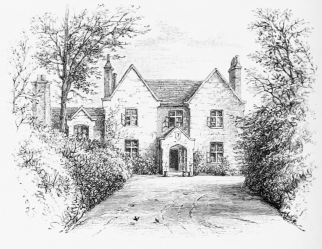
On my way to Oxford, I paid a first visit to Hugh Pearson,[83] afterwards my very dear friend, at Sonning Rectory near Reading, and also visited the old Maria Josepha, Lady Stanley of Alderley,[84] at Holmwood. Old Lady Stanley was then, as always, most formidable; but her daughters Rianette and Louisa were not afraid of her, and in the one afternoon I was there they had a violent dispute and quarrel, with very high words, over which of their dogs barked loudest.
To MY MOTHER.
"University College, Oxford, April 9, 1853.—It is from my own rooms, 'No. 2, Kitchen Staircase,' that I write to my mother—in a room long and narrow, with yellow beams across the ceiling, and a tall window at one end admitting dingy light, with a view of straight gravel-walks, and beds of cabbages and rhubarb in the Master's kitchen-garden. Here, for £32, 16s. 6d. I have been forced to become the owner of the last proprietor's furniture—curtains which drip with dirt, a bed with a ragged counterpane, a bleared mirror in a gilt frame, and some ugly mahogany chairs and tables. 'Your rooms might be worse, but your servant could not,' said Mr. Hedley when he brought me here.... How shy I have just felt in Hall, sitting through a dinner with a whole set of men I did not know and who never spoke to me."
"March 10.—The chapel-clock is in my bedroom, and woke me with its vibration every time it struck the hour. However, I suppose I shall get used to it. But I was up long before the scout came to call me at seven, and was in such fear of being late for chapel, that I was ten minutes too early, and had to walk about in the cold and stare at the extraordinary stained windows—Jonah and the whale swimming about side by side; Abraham dragging Isaac to the sacrifice by his hair; Mary and Martha attending upon Christ, each with a brass ladle in her hand, only that Mary holds hers suspended, and Martha goes on dipping hers in the pot while He is talking. At last the Master entered statelily, and the troop of undergraduates in black gowns and scholars in white ones came clattering in; and Mr. Hedley read the service, and we all responded, and a scholar read the lessons; and then there was a general rush into Quad, and a great shaking of hands, at which I, having no hand to shake, felt very blank, and escaped to my rooms, and afterwards to breakfast with Mr. Jowett.... I am to go to him every night with a hundred lines of Sophocles, some Latin composition, and a piece of Cicero by heart—a great addition to my eighteen lectures a week, but the greatest advantage; and really he could not have done a more true kindness: I do not know how to say enough of it.
"I wish I knew some one in this college. It is most disagreeable being stared at wherever one goes, and having no one to speak to, and though the Hall, with its high roof and pictures, may seem picturesque at first, solitude in society becomes a bore. Expenses appear to be endless. This morning I held a levée. First a sooty man with a black face poked his head in at the door with 'Coalman's fee, if you please, sir,—half-a-crown.' The buttery, represented by a boy in a white apron, came up next, and then the college porter and scouts, though as yet all these officials have done for me—nothing! A man who declared himself sole agent of an important magazine, and also a vendor of flannels and 'dressing-robes,' has also just called—'supposed he had the honour of addressing Mr. Hare, and would I for a moment favour him with my approval,' which I declined to do, when he thanked me for 'my great condescension' and departed."
"March 17.—I have now been a whole week here. It seems a life to look back upon, and I am becoming quite used to it. My first visitor was a man called Troutbeck. This was our conversation:—
"'I suppose you're fond of boating: we must have you down to the river and see what you're made of.'
"'But I don't boat: you would find me utterly inefficient.'
"'Then you ride?'
"'No.'
"'Do you sing, then?'
"'No, not at all.'
"'Do you play rackets?'
"'No, I neither boat, nor ride, nor sing, nor play rackets; so you will never have been to call upon a more hopelessly stupid Freshman.'
"However, I have made plenty of acquaintances already, and I do not see much of either the temptations or difficulties of college life. In some ways a college repeats a public school. For instance, I have made rather friends with a Canadian called Hamilton, who all dinner-time has to answer, and does answer most good-naturedly, such questions as—'Pray, are you going to Canada for the long?—When did you hear last from the Bishop of the Red River?' &c."
"April 23.—Having been induced, or rather compelled, to give a two-guinea subscription to the cricket club, I have just been asked to a great wine given to show that Coleridge the undergraduate is not the same as Coleridge the cricket collector. I have now to prepare Latin prose for the cynical Goldwin Smith, but my principal lectures are with Mr. Shadforth, a man who has the character of being universally beloved and having no authority at all. The undergraduates knock at his door and walk in. He sits at a table in the middle, they on cane-chairs all round the room, and his lecture is a desultory conversation—questions addressed to each individual in turn. But he dawdles and twaddles so much over details, we have generally done very little before the hour ends, when he says, 'I will not detain you any longer.' I doubt if there is much good in any of the lectures one attends, or anything to be learnt from them except what one teaches oneself; still they are part of the college routine, and so have to be pottered through.
"There is a high Romanistic club here, called the Alfred, whose members spend their time in passing ridiculous votes of censure on different individuals. They are much tormented, but have a pleasant imagination of martyrdom, and believe they are suffering for their faith. When they met at Merton, the men of the college put slates on the top of the chimney of the room where they were, and they were almost suffocated with smoke. Here they met to pass a vote of censure on—St. Augustine, and the whole time of their sitting in conclave cayenne-pepper was burnt through the keyhole; and when it was over, every window in the Quad along which they passed was occupied by a man with a jug of water; so you may imagine they were well soused before they got out.
"The Schools are going on now. They seem less alarming since I have heard that the man passed satisfactorily who construed Ιησομς Χριστος—Julius Cæsar, and also the man who, when asked why they broke the legs of the two thieves, said he supposed it was to prevent their running away. It was all put down to nervousness. Christ Church walks are now green with chestnut buds, and a pear-tree is putting out some blossoms in the Master's arid garden under my windows."
"May 1.—I am writing at half-past six A.M., for at four o'clock I got up, roused Milligan[85] (now my chief friend and companion), and we went off to Magdalen. A number of undergraduates were already assembled, and when the door was opened, we were all let through one by one, and up the steep winding staircase to the platform amid the pinnacles on the top of the tower. Here stood the choristers and chaplains in a space railed off, with bare heads, and white surplices waving in the wind. It was a clear morning, and every spire in Oxford stood out against the sky, the bright young green of the trees mingling with them. Below was a vast crowd, but in the high air the silence seemed unbroken, till the clock struck five, and then, as every one took off their caps, the choristers began to sing the Latin hymn, a few voices softly at first, and then a full chorus bursting in. It was really beautiful, raised above the world on that great height, in the clear atmosphere of the sky. As the voices ceased, the bells began, and the tower rocked so that you could see it swaying backwards and forwards. Milligan and I walked round Magdalen walks afterwards, and when my scout found me dressed on coming to call me, he asked if I had been 'out a-Maying.' Yesterday afternoon I rowed with Milligan on the river to Godstowe. It was so shallow, that if we had upset, which was exceedingly probable, we could have walked to shore."
"May 4.—I have now become a regular visitor at the lodging-house of the Mendicity Society, which means taking my turn in going every evening for a week to receive the beggars who come with tickets, and reading prayers to them, besides giving them their supper, and noting any remarkable cases which need help. It is a strange congregation of wild haggard people, chiefly Irish, probably meeting for that one evening only on earth, and one feels anxious to do them some good.
"I went the other day with Troutbeck[86]—a friend of whom I see much—to Bagley Wood, where he sang old ballads under the trees upon a bank of bluebells and primroses. I have many friends now, and I never was happier in my life."
"May 22.—I am in the Schools to-morrow for Little-go, having insisted on going in, in spite of my tutors. I do not feel as if I minded much, but some of my friends are so alarmed about themselves that they can scarcely eat."
"May 23.—This morning the School-yard was full of men in white ties and Masters in hoods, friends catching friends for last words of advice, &c. Then the doors of the four Schools opened, and we poured in. The room where I was was full of little tables, and we each had one to ourselves. Then a Don walked about distributing the long printed papers to be filled up—arithmetic, chiefly decimals. At first I felt as if I understood nothing, and I saw several of my neighbours wringing their hands in the same despair which overwhelmed myself, but gradually ideas dawned upon me, and I wrote as fast as any one, and had only one question unanswered when we went out at twelve. In the afternoon was the Euclid school—very horrid, but I am certainly not plucked by to-day's work."
"May 30.—You will rejoice to hear I am safe. Just as I was preparing to decamp this morning, to be out of the way of the authorities, I was caught by the Dean's messenger, and was obliged to go to him. He began by saying he could not allow me to go into the Schools, both my friends and the college would suffer; but I so entreated, and declared, and exclaimed that I must go in, that I would be careful, &c., that at last, as his breakfast was getting quite cold, he gave in.
"I had translations of Sophocles and Virgil to do on paper, but it was not till the afternoon that 'Mr. Hare' was called for viva voce. I really did pretty well, and as one of the examiners considerately growled whenever I was turning down a wrong path, I was able to catch up my faults. Mr. Jowett was present amongst my friends, and as soon as all was over, carried me off to walk in New College Gardens; and when we came back, it was he who went in to ask my fate. He came back to me radiant with my testamur, and I am very happy in the restful feeling of its being over, and no other examination for so long.
"I have just been electro-biologised in the most marvellous manner by the power of Troutbeck's left eye! by which he is able to mesmerise friends far away in their own rooms, and can make a fellow called Barrow[87] clairvoyant, in which state he travels to Rugby, and other places where he has never been, and accurately describes all that is going on there."
"June 6.—Commemoration has been most amusing—concerts, flower-shows, &c. The procession of boats was really a beautiful sight—all the college boats, with their different flags and uniforms, moving slowly up between the banks crowded with people, and saluting the University barge by raising their oars and holding them straight up in the air as they passed."
All through my first year at Oxford, Mr. Jowett (afterwards Master of Balliol) continued to show me the utmost kindness, giving me extra work, and allowing me to bring the result to him in the evening. I had been so much neglected at Lyncombe, and so ill-grounded altogether in my boyhood, that my passing all my examinations successfully was probably owing to this generous action of his. Honours at Oxford, even in the History School, I never thought of. My mother would only have wondered what on earth I wanted them for, and, had I gained them, would have lamented them as terribly ensnaring. I was profoundly grateful to Mr. Jowett, but being constantly asked to breakfast alone with him was a terrible ordeal. Sometimes he never spoke at all, and would only walk round the room looking at me with unperceiving, absent eyes as I ate my bread and butter, in a way that, for a very nervous boy, was utterly terrific. Walking with this kind and silent friend was even worse: he scarcely ever spoke, and if, in my shyness, I said something at one milestone, he would make no response at all till we reached the next, when he would say abruptly, "Your last observation was singularly commonplace," and relapse into silence again. He was indeed truly "intermittent," as Swinburne has called him. His quaint brevity of speech was never more remarkable than when the Council, met in solemn conclave, summoned "the little heretic," as he used to be called, into its awful presence. Then, being asked, "Now, Mr. Jowett, answer the truth; can you sign the Thirty-nine Articles?" he dumbfoundered them with—"If you've a little ink!" He could be very satirical. I remember, in after years, when Jex Blake, afterwards Dean of Wells, had been talking very prosily, he said, "I have long known that Law comes from Lex, but I never knew till now that Jaw comes from Jex."
On looking back through the mists of years, I am often surprised at the acquaintance whose society I sought during my first terms at Oxford, few of whom, except my dear friends Willie Milligan and George Sheffield,[88] have had any share in my after life. This was partly owing to the fact that the men who were at University in my time for the most part belonged to so entirely different a station in life, that our after paths were not likely to cross; and partly to the fact that those who had any mental gifts—for most of my companions had none—were repulsive or disagreeable in their habits.
Milligan was the first real friend I had ever had; before that, if I had liked any one, they had never liked me, and vice versa. It was always "l'un qui baisse, et l'autre qui tend la joue."
Very odd and far less satisfactory were others of my early Oxford friendships. One was for a man who imposed upon those younger than himself by a sort of apathetic high-handed manner of his own, and whom, when he professed a great preference for me, I used to look up to as a sort of divinity. Many were the almost volumes of sentimental twaddle I wrote both to and about him, and I used to listen for his footstep on my staircase as the great event of the evening. But all this soon wore off, and when my idol was once dethroned from its pedestal, it became a contemptible object.
An odder friendship still, made in my early Oxford life, was that for a good-looking, sentimental, would-be poet. Of him I wrote home with heartfelt enthusiasm, and at length, though I had never before asked anything at home, took courage to persuade my mother to let me go abroad with him to Bohemia for part of the long vacation. Before we set out he came to stay with us at Hurstmonceaux, and greatly astonished my relations must have been to find my charming young man so utterly unlike what I had described him. But we had scarcely set out on our travels before I found it out for myself—the first discovery being made when he pronounced Cologne Cathedral "very pretty" and S. Aposteln "very nice."
To MY MOTHER.
"Andernach am Rhein, June 30, 1853.—I was delighted when we rounded the corner of the river below Rheinach, and the old tower of Andernach came in sight, with the cathedral, and the vineyard-clad hills behind. The whole place is delightful. In the evening we rambled up the rocks over carpets of thyme and stonecrop, and saw the last tinge of yellow pass away from the sky behind the cathedral and the light fade out of the river. All along the road are stone niches with sculptures of the 'Sept Douleurs,' and as we came in through the dark orchards a number of children were chaunting with lighted tapers before a gaudy image of a saint in a solitary place overshadowed by trees."
"July 2.—This morning we went out at five, meeting crowds of peasants coming in to market with their cheerful 'Guten Tag.' I sate to draw at the Convent of St. Thomas in a rose-garden, while A. read Hallam. At twelve, we drove through the volcanic hills, covered with the loveliest flowers—blue larkspur, marigolds, asphodels, campanulas, and great tufts of crimson pinks—to the Laacher See, a deep blue lake, once the crater of a volcano, in a wooded basin of the hills. It still sends forth such noxious vapours that no bird can fly across it and live, and dead bodies of small animals are constantly found along its shores. At one end of the lake, Kloster Laach rises out of the woods, with a little inn nestling in an orchard close under the walls of the church. The exterior of that old Norman church is most beautiful, mellowed with every tint of age, but internally it is disfigured by whitewash; only the canopied tomb of the Phaltzgraf Henry II. is very curious. We were so delighted with the place, that we sent away the carriage and spent the evening by the lake, which was all alive with fireflies, darting in and out with their little burdens of light amongst the trees. In the morning we walked back to Andernach, which was quite possible, as I had no luggage but a comb and a pair of scissors."
"Limbourg on Lahn, July 3.—What a tiresome diligence-drive we have had from Coblentz here through endless forests, but we were well repaid as we descended upon Limbourg. Our apathetic German fellow-travellers were roused to 'wunderschön,' 'wunderliebliche,' and even A. gave one glance and faintly emitted the word 'pretty.' The view from the bridge is glorious. A precipitous rock rises out of the flats, with the Lahn rushing beneath, and all up one side the picturesque old black and white houses of the town, while growing out of the bare rock, its front almost on the precipice, like Durham, towers the magnificent cathedral, one of the oldest in Germany, abounding in all those depths and contrasts of colour which make the old German churches so picturesque—each window having its different moulding of blue, yellow, and red stone: and reflected in the clear water beneath. In the evening we walked to the neighbouring village of Dietz—a long rambling street of old houses, with the castle of Oranienstein overhanging them; and a wonderful ruined bridge, with the river dashing triumphantly through broken arches and over towers which have fallen into the stream."
"Marbourg, July 6.—We came in the diligence from Limbourg with an emigrant family returning home from America, and words cannot describe their ecstasies as we drew near Weilbourg and they recognised every place as a scene of childhood. 'Oh, look! there is the school! there is the hedge under which we used to have our breakfast!' The noble old castle of Weilbourg, on a precipice above the grey bridge over the Lahn, is very striking. The German waiter at the inn asked with great gravity if we admired it more than 'the castled crag of Drachenfels.' The endless forest scenery afterwards was only varied by the huge castle of Braunfels, till a long avenue brought us into the town of Wetzlar, which has a great red sandstone and golden-lichened cathedral, with a grim and grand Norman door called the Heidenthurm. At Giessen we joined the railway for Marbourg, and the clock which is now striking nine A.M. is that of St. Elizabeth![89]
"The Church of St. Elizabeth is almost out of the town; a rambling street of old timber houses reaches down to it, but its golden-grey spires have nothing between them and the dark forest. Inside, the grove of red sandstone pillars is quite unspoilt by images or altars: one beautiful figure of St. Elizabeth stands in a niche against a pillar of the nave, and that is all. In the transept is the 'heilige Mausoleum.' Its red steps are worn away by the pilgrims: the tomb is covered with faded gold and vermilion; on its canopy are remains of fresco-painting, and within is a beautiful sleeping figure of Elizabeth. All around are grey monuments of the Landgraves, her predecessors, standing upright against the walls. The choir opens into the sacristy, where is the golden shrine of the saint. As we reached it, a pilgrim was just emerging, deeply solemnised by a tête-à-tête with her bones. In her daughter's tomb the face is quite worn away by the hands of the pilgrims. The tomb of Conrad, her confessor, is there also. The sacristan unlocked a great chest to show us Bible tapestry worked by the hands of the saint. Some of the old pictures in the church portrayed the flight from the Wartburg, and St. Elizabeth washing the feet of the lepers: all reminded me of the stories you used to read to me as a very little child out of the great book at the Rectory.
"We went from the grave of St. Elizabeth to her palace—the great castle of Marbourg, seen far and wide over the country and overhanging the town, with a vast view over the blue-green billows of Thuringian pine-forest. The castle is divided into two parts, and you may imagine its size on hearing that 276 soldiers are now quartered in one of them. A guide, who knew nothing of either Luther or St. Elizabeth, except that they were both 'ganz heilige,' let us into the chapel where Luther preached, and the Ritter Saale, an old vaulted chamber where he met Zwingli and discussed Transubstantiation."
"Erfurth, July 8.—It is a delightful walk to the Wartburg from Eisenach. A winding path through a fir-wood leads to an opening whence you look across a valley to a hill crowned with a worn gateway, something like one of the gates of Winchelsea. In the intervening hollow some stone steps lead to a dark gap in the wood, where is the fountain of St. Elizabeth under a grey archway with sculptured pillars and overgrown with ferns. The water here is excluded from the public as too holy for common use, but a little is let out for the people into a stone basin below. By the side is a stone seat, where it is said that Elizabeth used to wash herself.
"Again a narrow path edged with blue campanulas, and then the grey arch of the castle-gateway. You look down at the side, and half-way down the gorge you see a little plot of ground called 'Luther's Garden.'
"The Wartburg is much like an English farmhouse. If Priest's Hawse[90] was perched on the top of a mountain, it would resemble it. It has an irregular court, of which rugged rock is the pavement, surrounded with scattered buildings, some black and white, and some castellated. The latter, which have two rows of Norman arches and pillars and a kind of keep-tower at the end, were the palace of the Landgraves and Elizabeth. The whole was full of women and guides, geese, chickens, and dogs. We had some time to wait in a room, where we were refreshed with 'lemonade' made of raspberries, before we were shown over the castle—the most interesting points being the chapel with Luther's pulpit, and the room of his conflict with the devil, full of old pictures and furniture, but with nothing which can be relied upon as contemporary except his table and a stone which he used as a foot-stool. When he threw the inkstand at the devil, the ink made a tremendous splash upon the wall, but there is no trace of it now: the relic collectors have scraped the wall away down to the bare stones.
"At the last moment at Eisenach I could not resist rushing out to sketch 'Conrad Cotta's House,' where you have so often described how Ursula Cotta first found the little Martin Luther singing hymns.
"The heat here at Erfurth is so great that I have been in a state of perpetual dissolution. It is a dull town with a great cathedral, and another church raised high above the market-place and approached by long flights of steps. The Waisenhaus is an orphan institution occupying the Augustinian convent where Luther lived as a monk. All there is the same as in his time—the floors he used to sweep, the doors he had to open, and the courtyard filled with flowers and surrounded by wooden galleries. A passage lined with pictures from the Dance of Death leads to the cells. Luther's cell is a tiny chamber with a window full of octagonal glass, and walls covered with texts: two sides were written by himself. The furniture is the same, and even the inkstand from which I had to write my name, while the woman who showed me the place mentioned that the pens were not the same, for Luther's pens were worn out long ago! There is a portrait by Cranach and writing of the three friends, Luther, Bugenhagen, and Melancthon.
"A. cannot speak a word of German, and never knows what to do on the simplest occasion, loses everything, is always late for the train, cannot pack his things up, will not learn the money, and has left every necessary of life at home and brought the most preposterous things with him."
"Dresden, July 11.—We have seen a number of places on the way here. In the old cathedral of Naumbourg is a fine Cranach picture of St. Elizabeth, with the Wartbourg above her head and the Marbourg church at her feet. In the cathedral of Mersebourg is a most extraordinary picture of the Electoral family of Saxe-Mersebourg receiving the dead Christ and bearing him to the sepulchre. The family became extinct in 1738, and they all lie in the crypt under the church in the order in which they lived, in coffins covered with vermilion and gold, the little children in front and the grown people behind. Above, is the tomb of the Emperor Rudolph of Swabia, and in the sacristy they put into my hand a thing which I thought was a hand carved in oak, but found it was his own real hand, cut off in 1080!
"Dresden announces itself by four black-looking domes and towers above the flat horizon and then by the many arches of the long Elbe bridge. It is very like a little—a very little Paris; the same rows of tall white houses with green shutters: the same orange and lime trees filling the air with their sweetness: only the river is different, so gigantic and so bright. A broad flight of steps took us to the stately Bruhl terrace above the river—golden in the sunset. At the end an odd-looking building with a dome turned out to be a Jewish synagogue, and we went in. One old Jew in his hat dropped in after another, till at last one of them put on a white muslin shawl, and going up to a desk where the altar should be, began bobbing his head up and down and quacking like a duck. Then another in a corner, standing with his face close to the wall, quacked also at intervals, and then all the rest chimed in, till it was exactly like a farmyard. But no words can say how ridiculous it eventually became, when they all burst out into choruses which sounded like 'Cack a lack-lack-lack. Oh Jeremiah! Jeremiah! Oh Noah's ark, Noah's ark! Cack a lack-lack-lack, lack, lack: loo, loo, loo.' All the little black Wellington boots stamping on the floor together, and all the long white beards bobbing up and down, and giving an audible thump on the table at every bob.... And not the least absurd part was that they seemed to think our presence a compliment, at least they all bowed when we went out."
"Schona on Elbe, July 16.—We left Dresden by the steamer—the last view of the town very striking, with the broad flood of the Elbe sweeping through a line of palaces. At Pirna we left the boat, and a long walk through hot fields brought us to the entrance of the Ottowalder Gründ. A flight of steps leads into a chasm, with high rocks towering all round and the most brilliant and varied greens beneath. In one place the narrow path is crossed by a natural arch; then it winds up again through masses of forest and deep rocky glens, till it emerges on the top of the Bastei.
"I was disappointed with the Bastei, which is like a scene on the Wye rather exaggerated. You look over a precipice of seven hundred feet, and see all around rocks equally high shooting straight up skywards in every conceivable and inconceivable form—pillars, pyramids, cones: and up all of them fir-trees cling and scramble, and bright tufts of bilberries hang where no human hand can ever gather their fruit. There are bridges between some of the rocks, and they support fragments of castles of the robbers who used to infest the Elbe, and, beyond the river, all the distant hills rise in columnar masses of equal irregularity. After dining at the little inn, we walked on to Königstein, a fortress which has never been taken, large enough to hold the whole population of Dresden. Here a tremendous thunderstorm rolled with grand effect around the mountain. There is a terrible parapet overhanging the precipice, where a page fell asleep, and was awakened by one of the Electors firing a pistol close to his ear to break him of the habit. A long path through bilberry thickets brought us to the station, and we took the train to Schandau, where we slept—very glad to go to bed at ten, having been on foot since 4 A.M.
"This morning we took a carriage for the first eight miles up the valley of the Raven's Crag, and walked on to the Kuhl-stuhl. In the very top of the hill the rock has made a huge natural arch, which leads to an otherwise inaccessible platform overhanging the valleys. The peasants drove their cattle here for protection in the Thirty Years' War, whence the name of Kuhl-stuhl, and hither the Bohemian Protestants fled for refuge. There is a natural slit in the rock, with a staircase to an upper platform, which was the refuge of the women, but only a thin woman could reach this place of safety.
"Forest again, ever deeper and darker—and no human life but a few women gathering faggots with bare arms and legs, till we reached the Jagd-Haus on the promontory of the Lesser Winterberg, where Schiller's name is cut, with others, in the mossy stone. Forest and bilberries again to the hotel on the Greater Winterberg, where we dined on mountain florellen and strawberries and cranberries. Forest, ever the same, to the Prebischthor, a natural arch projecting over an abyss, splendid in light and shadow, and altogether the finest scene in the Saxon Switzerland ... then a descent to Schona. We found it easy to accomplish in a day and a half that for which Murray allots four days."
"Prague, July 17.—All through the night we travelled in a railway carriage with twenty-two windows and eighty inmates. Dawn broke on a flat country near the Moldau. At last a line of white wall crowned a distant hill. Then, while an Austrian official was collecting passports, railway and river alike made a turn, and a chain of towers, domes, and minarets appeared above the waving cornfields, one larger than the others—the citadel of Prague!
"What a poem the town is!—the old square of the Grosse Ring, where the beautiful delicately-sculptured Rathhaus and church look down upon a red marble fountain, ever surrounded by women with pitchers, in tall white caps: the streets of Bohemian palaces, with gigantic stone figures guarding the doors: the bridge, with statues of saints bending inwards from every pier, and the huge Hradschin palace on the hill beyond, with the cathedral in its midst: the gloomy precipice from which the Amazonian Queen Libessa hurled down her lovers one by one as she got tired of them: the glorious view from the terrace of the Hradschin, recalling pictures of the view from the Pincio at Rome: the wonderful tombs of the Bohemian kings, and the silver chandeliers and red lights before the shrine of St. John Nepomuck in the cathedral."
"July 18.—On Sunday afternoon we were at the Jewish synagogue, the oldest building here—older than Prague itself, and now only used on the Day of Atonement and other great occasions. It is quite in the midst of the Jews' quarter, which is entirely given up to them, and inside it is black with age, its gothic pillars looming out of a coating of soot and smoke, never allowed to be cleared away. The centre was spread with draperies of cloth of gold and silver. On the platform within them was the chief Rabbi, a venerable man with a white beard which swept over his brown robe as far as his waist. 'He is wonderfully learned,' whispered my neighbour to me. 'He understands every language in the whole world, and as for English he speaks it as well as an Englishman.' At last there was a bustle in the crowd, and a young woman made her way through, enveloped in a very curious ancient hood of worked gold, and several very smart ladies crowded up after her: we followed. Then the priest shouted in Hebrew so that the little building rang again, and the Rabbi took a little silver cup of oil and—I think—anointed the lady, and a service followed in which all the people responded electrically as if a bell were struck; but it was not till we came out that I found the lady in the golden hood had been—married.
"We went afterwards to the Jewish burial-ground—a wide rambling expanse in the heart of the town, literally crammed with tombstones, falling one over the other, and, between them, old gnarled elder-trees growing fantastically. The cemetery has been twice emptied!—and filled again. On one of the graves a young Jewess was lying, evidently very ill. 'You see,' said the old woman who let us into the cemetery, 'that the Rabbi who is buried there was so good when he was alive, that when all the other people were rooted up, they left him and his wife alone; and his good works live on so much, that sick persons are often brought here to lie upon his grave, in the hope of their being cured.'
"One of a knot of palaces in the Kleinsite was Wallenstein's. Here, one room is hung with artificial stalactites: in another are portraits of Wallenstein and his second wife, and the charger which was shot under him at Lützen, stuffed—but only the body remains of the original horse, the head and legs have been eaten up by moths and renewed! The garden is charming, with an aviary of peacocks.
"A. has been twice threatened with arrest for persisting in wearing a wide-awake in the streets, for at present it is a revolutionary emblem! At first he insisted on putting it on again, but the second attack has been too much for his fortitude. Just now I was roused by his shrieks, and reached his room just in time to see a large black sheep emerge from under his bed!—it had walked in from the market by the open galleries and had taken refuge there."
"Bamberg, July 23.—We came here by Dresden and Saxe-Altenberg, with its charming old castle. Near Hof the engine burst, doing us no harm, but keeping us for hours sitting on the grassy railway bank till another engine arrived, so that we did not get here till 3 A.M. The cathedral is glorious. Only imagine my having found Baron and Baroness von Usedom in the hotel, and the next morning Lady Malcolm and her two daughters arrived—most kind, most amusing—and Madame von Usedom most extraordinary. She received me with 'You're wonderfully like your sister, and she is very beautiful,' so that's a compliment!"
"July 28.—We have had another vision of loveliness at Nuremberg. One became quite weary of saying, 'Oh! how beautiful! how beautiful!' But no letter can give an idea of what Nuremberg is—'The German Venice' Madame d'Usedom called it. And Albert Dürer is a part of the place: whenever I see his woodcuts again at the Rectory, they will bring back the town to me—where his house is, and his pictures, his statue, and most of all his grave, in a cemetery full of hollyhocks and lilies."
We came home by Augsburg, Ulm, and Heidelberg, and then through France via Chalons and Rheims. In thinking of present expenses (1895), I often marvel at the cheapness of the long tour we had made. We had seen the greater part of Germany and much of France, had travelled for six weeks, and travelled in comfort, and, including journeys to and from the coast of England, we could each have spent only £25, for we had no more to spend. I joined my mother at Ashburton Vicarage, near Dartmoor, whence we saw "Wistman's Wood"—that wonderful stunted grove of immemorial oak-trees in the midst of the moors. On our way home we went to stay with Miss Boyle[91] at Portishead. It was my mother's first sight of her, and she was much struck by that extraordinary person, for whom at that time I had an almost passionate devotion, and who had unfortunately just become notorious through her appearance—being subpœnaed on the wrong side—at the trial of the false Sir Hugh Smith, the claimant of Ashton Court. This trial created a tremendous excitement at the time, and the decision was nearly given in favour of the claimant. His wife, a daughter of De Wint the artist, had already ordered the carriage in which she was to make a triumphal entry, when the cause suddenly collapsed through the evidence of a jeweller who had been employed to forge a brooch upon which much of importance depended.
The Bishop of St. David's, Thirlwall, was staying at the Rectory when I was at home. Excellent as he was, I was horribly afraid of him, for a more repellent, freezing manner than his I never saw. I hated the Rectory now more than ever, but was more than ever devoted to Lime. What a vision I have now of its quietude in those hot summer days, only the wind whispering in the old abele-trees and rippling the waves upon the pool, and of the fresh morning smell of the pinks and roses and syringa, bowed down by the heavy dew. Our intensely quiet life would have suited few young men, but when my dear mother was well, and the Rectory not too aggressive, I was always happy. Each day was a routine. Called by our fat John at seven, when Fausty's black nose was poked in my face, I woke to see the sun shining on the little pictures on the wall and the old-fashioned china ornaments, and to hear Joe Cornford whetting his scythe on the lawn under the windows. I was downstairs before my mother appeared in her lilac dress to breakfast and prayers. Then we walked on the terrace. I read—first aloud to her, then to myself—then went with her round the field and to the girls' school. At one was dinner; at half-past two we drove out—Fausty with us. Then my mother lay on the sofa and I read: then came our tea-supper, and I read aloud again, and mother sang such old songs as "Hohenlinden," "Lord Ullin's Daughter," "Auld Robin Gray," or the Russian "Pojalite." Then, after prayers, I helped her upstairs, and, at her little round table, she would say a little short prayer with or for me out of her own heart, and I came down to write till the melancholy sound of the mice in the wainscot drove me to bed also. On my return to Oxford in October, I published in "The Penny Post" my first story—"The Good Landgravine," about Elizabeth of Thuringia—quite as important to me then as the publication of one of my large books is now—and I obtained ten shillings for it with great pride! I had much pleasure in a visit from Arthur Stanley this term, and Mr. Jowett—"the great Balliol tutor"—continued his kindness and his voluntary lessons to me, though I must often sorely have tried his patience. I was, no doubt, a terrible little prig, and I have just found, amongst old letters, a very kind one from him, written in the vacation, urging me to make an effort to conquer "my conceit, which was not vanity, but a constant restlessness about myself."[92] Jowett was—tiresome perhaps, in some ways, but—one of the most unselfish persons I have ever known. By his own life, as in his sermons, he constantly inculcated disinterestedness, sympathy, and the love of God. The Christian doctrines of the Incarnation, Resurrection, &c., he utterly ignored, out of the pulpit as in it, and I believe Arthur Stanley quite agreed with him in his heart, though he had not quite "the courage of his opinions."