Volume 2 — CONTENTS VOLUME 2 (continued 4)
Reading edition
"A few weeks after this the carter husband was observed to have become unaccountably pale, ill, and anxious, and on being asked what was the matter with him, he complained bitterly, and said that it was because his wife would not let him rest at nights. He did not seem to be frightened, but lamented that his case was a very hard one, for that he had to work all day, and, when he wanted rest, his wife came and sat by his bedside, moaning and lamenting and wringing her hands all the night long, so that he could not sleep.
"Mrs. Gaskell naturally expressed a wish to see the man and to hear the story from his own lips. The Quaker said that nothing could be easier, as he lived in a cottage close by; to which she went, together with five other persons. It was like a Cheshire cottage, with a window on each side of the door, and a little enclosure, half-court, half-garden, in front. It was six o'clock in broad summer daylight when they arrived. The door was locked and the Quaker went round to try the back entrance, leaving Mrs. Gaskell and her friends in the enclosure in front. They all, while there, distinctly saw a woman, of hard features, dressed in a common lilac print gown, come up to the latticed window close by them on the inside and look out. They then saw her pass on and appear again at the window on the other side of the door, after which she went away altogether.
"When the Quaker appeared, unsuccessful in opening the back-door, they said, 'But there is some one who could have let you in, for there is a woman in the house.' They tried unsuccessfully, however, to make her hear. Then they went to the adjoining cottage, where the people assured them that the man was gone out for the day, and that there could not possibly be any one in the house. 'Oh,' said Mrs. Gaskell, 'but we have seen a woman in the house in a lilac print gown.' 'Then,' they answered, 'you have seen the ghost: there is no woman in the house; but that is she.'"
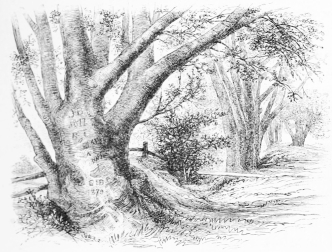
OLD BEECHES, HURSTMONCEAUX PARK.
It was when I was at Beckett, just before Easter 1860, that I was first told that we should have to leave our dear home at Hurstmonceaux. Many years before, there had been an alarm, and my mother would then have bought the Lime property, but that the price asked was so greatly above its value, and no other purchasers came forward. So she was satisfied to go on renting Lime and the surrounding fields for a small sum, especially as she had a promise from those who had charge of the sale that no other offer should be accepted without giving her the preference. In the spring of 1860, however, Mr. Arkcoll, a rich old Hurstmonceaux farmer and churchwarden, died, leaving a large fortune to his nephew and a considerable sum of ready money to buy a house near his property. Lime had long been as Naboth's vineyard in the younger Mr. Arkcoll's eyes, and before we knew that the uncle was dead, we heard that the nephew was the purchaser of Lime, the promise to us having been broken.
My mother immediately offered Mr. Arkcoll a much larger sum than he had paid to save Lime, but not unnaturally he was inexorable.
Thus it was inevitable that at Michaelmas we must leave our dear home, and, though I had suffered much at Hurstmonceaux, and though our position there as a ruined family was often a dismal one, yet we felt that nothing could ever replace what Lime itself was, where every plant was familiar, and every tree had its own little personal reminiscence. And there was also the great difficulty of finding a new home within our small means, and yet large enough to house our many books and pictures.
I met my mother at Bournemouth to talk over plans and possibilities for the future, and we went on to Weymouth, where we remained some weeks. It was bitterly cold weather, but I always liked Weymouth, and the pleasant walks in Sandyfoot Bay, and excursions to Bow and Arrow Castle, Corfe Castle, Abbotsbury, and Lyme Regis. In April I was again at Beckett.
To MY MOTHER.
"Beckett, April 8, 1860.—Yesterday I went with Lady Barrington and Lady Somerton to Ashdowne (Lord Craven's). It is a most awfully desolate place, standing high up on the bare downs. Four avenues approach the house from the four sides. It was built by a Craven who was Lord Mayor of London, and who, flying from the great plague, rode fiercely on and on, till upon this bleak down he saw a desolate farmhouse, where he thought that the plague could not penetrate, and there he rested, and there he eventually built. The four avenues, and the windows on every side, were intended to let the plague out in one direction if it came in at the other. Inside the house are great stag's horns which Elizabeth of Bohemia brought with her from Germany, and portraits of her, Prince Rupert, Prince Maurice, and the four princesses her daughters, painted by one of them. The young Ladies Craven showed us the house amid shouts of laughter at their own ignorance about it, which certainly was most dense.
"We went on by roads, which were never meant for a carriage, to a point whence Lady Barrington and I walked across the down to 'Wayland Smith's Cave,' a very small cromlech, in which Wayland could hardly have stood upright when he used it for a forge."
"Hendred House, April 15.—It is a proof how necessary it is for the writer of a Handbook to see himself all that he writes about, that I found East Hendred, of which I had heard nothing, to be one of the most romantic villages I ever saw—groups of ancient gable-ended houses, black and white or black and red, with turreted chimneys—a ruined moss-grown chapel dedicated to 'Jesus of Bethlehem'—a fine old grey church in a glen—and a beautiful Catholic chapel attached to this quaint old house, which contains a great Holbein of Sir Thomas More and his family, his cup, a portrait of Cardinal Pole, and the staff upon which Bishop Fisher leant upon the scaffold!"
My next visit was to Dr. Hawtrey, the Provost of Eton, to whom I became much attached. Being in the house with him was a constant intellectual feast, he was so accomplished as well as learned. Beautiful and interesting books were produced to illustrate all he said, and it would be hard to say how much Latin or Italian poetry he daily read or repeated to me. It was impossible not to be perfectly at home with him, he was so easy and natural. Of the two old sisters who had resided with him, and who were known by Eton boys as Elephantina and Rhinocerina, only one was still living, in a gentle and touching state of childishness, keeping up all her old-fashioned habits of courtesy and politeness; the mind now and then taking in an idea like a flash of light, and immediately losing it again. The Provost's attention to this old sister was quite beautiful, and her affection for him. When she was going to bed she would "pack up" and carry off all the things upon the table—books, envelope-boxes, &c., which were soon sent downstairs again.
I went with the Provost to dine at New Lodge (Mr. Van de Weyer, the Belgian Minister's), and found there the Dean of St. Paul's and Mrs. Milman, he most bright and animated, she "icily bland and coldly amiable as ever." I was quite delighted with the Van de Weyers, especially the second son Albert (who afterwards died young). M. Sylvain Van de Weyer, through life the trusted friend and representative of Leopold I. of Belgium, had the expensive hobby of books, collecting rare editions and the earliest printed classics, a taste inherited from his father, who kept a circulating library at Louvain. When he showed us two shelves of books in his library he said, "I have read all these whilst waiting for dinner. I am always down punctually, and my guests are always late. From my library I see them arrive, and never join them till a good many are come: thus I have got through all these." Madame Van de Weyer was immensely fat. She had lately been with her husband to a concert at Windsor, and been much jostled, at which she was very indignant. "Why, they take us for pages," she said to her husband. "No, my dear," he replied; "they take me for a page, but they take you for a volume."
On the last occasion on which I saw the Provost Hawtrey before his death, he said to me that he knew I collected curious stories, and that there was one story, intimately connected with his own life, which he wished that I should write down from his lips, and read to him when I had written it, that he might see that it was perfectly correct.
Here is the story as he gave it:—
"In the time of my youth one of the cleverest and most agreeable women in Europe was Madame de Salis—the Countess de Salis—who had been in her youth a Miss Foster, daughter of the Irish Bishop of Kilmore. As a girl she had been most beautiful and the darling of her parents' hearts, but she married against their will with the Count de Salis. He was a Swiss Count, but he took her, not to Switzerland, but to Florence, where he hired a villa at Bellosguardo. There the life of Madame de Salis was a most miserable one: she had many children, but her husband, who cut her off from all communication with her friends, was exceedingly unkind to her. She was married to him for several years, and then she was mercifully released by his death. It was impossible for her to pretend to be sorry, and she did not pretend it: she hailed it as the greatest mercy that could have befallen her.[186]
"Madame de Salis went back to Ireland, where her parents, the old Bishop of Kilmore and Mrs. Foster, were still alive, and welcomed her with rapture. But she had left them a radiant, beautiful, animated girl; she returned to them a haggard, weird, worn woman, with that fixed look of anguish which only the most chronic suffering can leave. And what was worst was that her health had completely given way: she never slept, she never seemed able to rest, she had no repose day or night: she became seriously ill.
"All the best advice that could be procured was hers. There was a great consultation of doctors upon her case, and after it had taken place, the doctors came to the Bishop and said, 'The case of Madame de Salis is an extraordinary one; it is a most peculiar, but still a known form of hypochondria. She cannot rest because she always sees before her—not the horrible phantom which made her married life so miserable, but the room which was the scene of her suffering. And she never will rest; the image is, as it were, branded into her brain, and cannot be eradicated. There is only one remedy, and it is a very desperate one. It will probably kill her, she will probably sink under it, but it may have happy results. However, it is the only chance of saving her. It is that she should see the real room again. She can never get rid of its image: it is engraven upon her brain for life. The only chance is for her to connect it with something else.' When Madame de Salis was told this, she said that her returning to Florence was impossible, absolutely impossible. 'At any rate,' she said, 'I could not go unless my younger sister, Miss Foster, might go with me; then possibly I might think of it.' But to this Dr. and Mrs. Foster would not consent. The happiness of their lives seemed to have been extinguished when their elder daughter married Count de Salis, and if their beautiful younger daughter went abroad, perhaps she also would marry a foreigner, and then what good would their lives do them? However, Madame de Salis grew daily worse; her life was evidently at stake, and at last her parents said, 'Well, if you will make us a solemn promise that you will never, under any circumstances whatever, consent to your sister's marrying a foreigner, she shall go with you;' and she went.
"Madame de Salis and Miss Foster went to Florence. They rented the villa at Bellosguardo which had been the scene of the terrible tragedy of Madame de Salis's married life. As they entered the fatal room, Madame de Salis fell down insensible upon the threshold. When she came to herself, she passed from one terrible convulsion into another: she had a brain fever: she struggled for weeks between life and death. But nature is strong, and when she did rally, the opinion of the Irish doctors was justified. Instead of the terrible companion of her former life and the constant dread in which she lived, she had the companionship of her beautiful, gentle, affectionate sister, who watched over her with unspeakable tenderness, who anticipated her every wish.... The room was associated with something else! Gradually, very gradually, Madame de Salis dawned back into active life. She began to feel her former interest in art; in time she was able to go and paint in the galleries, and in time, when her recovery became known, many of those who had never dared to show their sympathy with her during her earlier sojourn at Florence, but who had pitied her intensely, hastened to visit her; and gradually, as with returning health her brilliant conversational powers came back, and her extraordinary gift of repartee was restored, her salon became the most recherché and the most attractive in Florence.
"Chief of all its attractions was the lovely Miss Foster. When, however, Madame de Salis saw that any one especially was paying her sister attentions, she took an opportunity of alienating them, or, if there seemed to be anything really serious, she expressed to the individual her regret that she was unable to receive him any more. But at last there was an occasion on which Madame de Salis felt that more stringent action was called for. When a young Count Mastai, in the Guardia Nobile, not only felt, but showed the most unbounded devotion to Miss Foster, Madame de Salis did more than express to him her regret that untoward family circumstances prevented her having the pleasure of seeing him again; she let her villa at Bellosguardo, she packed up her things, and she took her sister with her to Rome.
"The reputation of the two sisters had preceded them, and when it became known that the Madame de Salis who had had so romantic a history was come to Rome with her beautiful younger sister, all that was most intellectual and all that was most remarkable in the old Papal capital gathered around them. But now the scene had changed. It was no longer Madame de Salis who was the invalid. Miss Foster grew pale and languid and unable to occupy herself, and gradually she became so pale and so changed, and the cause of it was so evident, that Madame de Salis felt that she must choose between two alternatives: she must either break her word to her parents and save the life of her sister, or she must keep her promise to her parents and see her sister sink into the grave.
"And she decided on the former course. She wrote two letters—one letter to Count Mastai, telling him that he might come back and see her sister again, and the other letter to the Bishop of Kilmore and Mrs. Foster. She said to her parents that she knew they measured a foreign marriage by her own dreadful life with Count de Salis: that in Count Mastai they must imagine the exact opposite of Count de Salis: that he was honourable, noble, chivalrous, generous, disinterested—in fact, that had she to seek through the whole world the person to whom with the greatest confidence she could commit her sister's happiness, she could not do otherwise than choose Count Mastai. This letter she sent too late to have the refusal which she knew it would bring. Count Mastai flew to the feet of the beautiful Miss Foster, and was accepted at once. The wedding-day was fixed, the wedding-dress was made, the wedding-feast was prepared.[187]
"When the day came, all the friends of Madame de Salis collected in the Church of San Luigi dei Francesi, where the marriage was to take place. According to the custom of brides in Rome, Miss Foster, accompanied by Madame de Salis, came first to the altar and waited for the bridegroom. He never came—he never came at all—he never, never, never was heard of again. And that is the end of the first part of the story.
"The second part of the story is quite different. It was the time of the great famine and pestilence in the Basilicata. The misery was most intense, hundreds perished daily everywhere. Every one who could get away did; those who could went to Switzerland, others went to Sicily; bishops abandoned their dioceses, priests abandoned their flocks: there was a general stampede.
"But in that terrible time, as in all seasons of great national suffering, there were instances of extraordinary devotion and heroism. There was one young bishop of a Neapolitan diocese, who was absent in Switzerland at the time, who came back like San Carlo Borromeo over the Alps, who sold his library for the poor, who sold his carriages, who sold at last even his episcopal ring, who walked day and night in the hospitals, and by whose personal devotion many lives were saved, while thousands were cheered and encouraged by his example. The consequence was, that when the famine and the pestilence in the Basilicata passed away, at an early age—at a much earlier age than is usual—that young bishop was made a cardinal.
"The third part of the story is again quite different. It was when Pope Gregory XVI. lay upon his deathbed. There was the greatest possible difficulty about who should be his successor; one member of the Sacred College was too old, another was too young, another was too much bound up with the princely families: there seemed to be no one. The person who was of most influence at that time was Count Rossi, the French Ambassador, and he was very anxious for a liberal Pope, for some one who would carry out his own liberal views. One day as he was walking pensively, filled with anxieties, down the Corso, there passed by in a carriage that young bishop of the Basilicata, once Bishop of Imola, now Archbishop of Spoleto, who had been so distinguished during the famine. And when Count Rossi saw him, he felt that is the man—that is the man who would further my ideas and carry out my views. And by the wonderful influence of Count Rossi on separate individuals, and by his extraordinary powers of combination in bringing the mind of one person to bear upon another, that person was chosen Pope. And on the day on which he mounted the Papal throne as Pius IX., he revealed that he was the person who, as Count Mastai Ferretti in the Guardia Nobile, had been engaged to be married to the beautiful Miss Foster. He had belonged to a Jesuit family: he had been summoned on a Jesuit mission from which no one can shrink: his value to the Church had been estimated: he was sent off to the West Indies: letters were intercepted, and he was induced to believe that Miss Foster had ceased to care about him: he was persuaded to take Orders; he became bishop in the Basilicata, Bishop of Imola, Archbishop of Spoleto, Pope of Rome—and Miss Foster lived to know it.
"'Now,' said Dr. Hawtrey, 'if you ever tell that story, recollect to say that it is no mere story I have heard; it is part of my own life. Madame de Salis and her sister were my relations, and I was most intimate with them. I was there when Madame de Salis made her miserable marriage; I was there when she came back so terribly changed. I shared in the consultations as to whether her sister should go with her: I was with Dr. and Mrs. Foster when they received the letter about Count Mastai: I was there when they heard of the disappearance of the mysterious bridegroom: and I have lived to think of him as Pope.'"
I am surprised to find no letters recording the long and happy visit which I made during the latter part of April 1860 to Chequers, the beautiful old house of Lady Frankland Russell, to whom I had been introduced by Lady Sheffield, who was her cousin. With this most interesting old lady I made great friends and received the greatest kindness from her. Owing to the marriage of Sir John Russell of Chequers with Mrs. Rich, youngest daughter of Cromwell, the house was perfectly full of Cromwell relics, and in its grand old gallery hung portraits of the Protector, his mother, brother, his four daughters, two sons-in-law, secretary, &c. Here, also, enclosed in a cabinet, was a very awful mask taken from Cromwell's face after death, which Lady Frankland used to uncover with great solemnity. In the garden was a wonderful wych elm, said to have been planted by King Stephen, and behind rose the Chiltern Hills, the most beautiful point of which—Velvet Lawn, covered with indigenous box—was in the immediate neighbourhood.
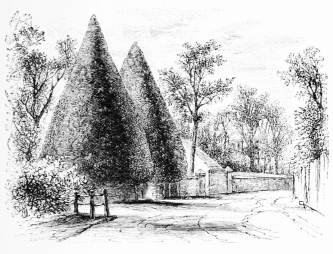
All through the summer of 1860 we were occupied in considering our new home. We sent for all the London agents' lists of places to be let or sold south of the Humber, and many of these, in Kent, Surrey, Berks, Bucks, Oxfordshire, Hampshire, Hertfordshire, I went to see, either with or without my mother. If she were not with me, I wrote to her long accounts, always concluding with saying, "They are not like Holmhurst, not in the least like Holmhurst,"—Holmhurst being the ideal place in the unwritten novels which my mother and I had been accustomed to narrate to each other in our long journeys abroad. My being difficult to satisfy gave the aunts an unusual handle for abuse, and plentifully did they bestow it upon me. "What can it signify whether you have a view or not? No one but you would care to waste your time in always looking out of the window," &c., &c. Especially was indignation roused by my refusing to consider an old house which the Stanleys were determined upon our taking in Oxfordshire,[188] and which was to be had very cheap because no servants could be persuaded to stay there on account of a frightful apparition which was supposed to haunt it. At last we almost despaired of finding any place to suit us, and determined to take the farm of Belhurst at Hurstmonceaux to put our furniture in, and to go abroad till quite a different set of places were to be disposed of. Just then a neighbour sent us a Hastings paper with a very humble advertisement marked, "At Ore, a house, with thirty-six acres of land, to be let or sold." "What a horrible place this must be," I said, "for which they cannot find one word of description;" for the very ugliest places we had seen had often been described in the advertisements as "picturesque manorial residences," "beautiful villas with hanging woods," &c. But my mother rightly thought that the very simple description was perhaps in itself a reason why we should see it, and after breakfast we set off in the little carriage. It was a drive of about fourteen miles. Long before we could arrive at Ore, we passed under a grey wall overhung by trees. "It looks almost as if there might be a Holmhurst inside that wall," I said. Then we reached a gate between two clipped yew-trees, and a board announced, "This house is to be let or sold." We drove in. It was a lovely day. An arched gateway was open towards the garden, showing a terrace, vases of scarlet geraniums, and a background of blue sea. My mother and I clasped each other's hands and simultaneously exclaimed—"This is Holmhurst!"
The house was let then, and we were refused permission to see the inside, but my mother bought the property at once: she was as sure as I was that we should never like any other place as well.
We found that the name of the place was Little Ridge. There were six places called Ridge in the neighbourhood, and it was very desirable to change the name, to prevent confusion at the post-office and elsewhere. Could we call it anything but Holmhurst? Afterwards we discovered that Holmhurst meant an ilex wood, and our great tree is an ilex.
On September 24 my mother left Lime. The day before was Sunday, and very sad—so many tearful farewells, so many poor women crying in the churchyard as we passed through. I stayed at Lime to pack up and arrange everything. On October 6, in the gloaming of the autumn evening, while the sunlight was streaming through the diminishing leaves of the old abele trees, and throwing long shadows upon the green lawn and bright flower-beds, we took a last farewell of our dear Hurstmonceaux home. Lea delivered up the keys, and we walked away (to the Rectory) up the drive, our drive no longer.
To MY MOTHER.
"Holmhurst, Oct. 8, 1860.—This morning we left Hurstmonceaux Rectory directly after breakfast, good old Dr. Wellesley quite affected, and Harriet Duly, and even begging Mrs. Havendon, crying bitterly on taking leave of Lea. We met a smart carriage with two white horses going to fetch the Arkcolls, who made a triumphal entry to Lime just after our departure. Winchester drove us, in order to bring back the horse—John and Romo (the dog) on the box: Lea and I with Julietta (the cat) and her kitten inside, and no end of provisions under the seats. We stopped first at Mrs. Taylor's farm, and she gave Lea a new loaf and some cheese to begin housekeeping with, and me some excellent cakes. Lea thought the drive charming. I walked up all the hills and we arrived about one o'clock. It was impossible to enter the gates on account of the waggons of the outgoing tenants, but Joe and Margaret Cornford from the lodge hailed us with the joyful news that they had themselves departed a few hours before."
"Oct. 9.—We began work at six, a lovely morning, and the view exquisite as I opened my window, the oak-trees with which the meadows are studded casting long shadows on the grass, the little pond glittering in the sun, and the grey castle rising against the softest blue sea beyond. John is awed by the magnitude of the grounds.... Julietta cries to go home, and would certainly set off, if it were not for little black pussy. I think the winding walks and obscure paths are enchanting, and the fir-woods are really large enough for you to 'inhale the turpentine air' as at Bournemouth."
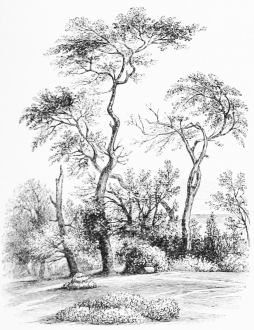
THE ABELES, LIME.
My mother came to Holmhurst in about ten days, but not to stay, as we had arranged to break the transition between our two homes by spending the winter at Mentone. We took the route to the south by Orleans (whence I made a most interesting excursion to Notre Dame de Clery), Bourges, and then lingered at Oranges, Avignon, &c. I have always looked back upon the earlier part of this journey with remorse, as one in which I took my mother a longer way, in cold weather, simply to gratify my own wishes.
The dear mother, however, was very well, and this winter was therefore perhaps the happiest of the many we have spent abroad. Mentone consisted then only of the old town on a promontory above the sea, ending in a little island-tower, and clambering up the sides of the hill to the castle and cemetery. On either side were a very few villas scattered amid the olive and orange groves. In one of these,[189] above the terrace which led from the eastern gate of the town to the little chapel of St. Anne, we rented the first floor. On the ground floor lived our worthy landlord, M. Trenca, and his Swiss wife, with whom we made much acquaintance. In the neighbouring villas also we had many friends, and often gave little parties,—for the tiny society was most simple and easily pleased. We all enjoyed Mentone, where we had no winter, and breakfasted with windows wide open at Christmas. Our old servants, Lea and John, amused themselves by collecting roots of anemones and other plants; I drew, and sought materials for my little book "A Winter at Mentone;" and my mother was always gay and happy, betaking herself every morning with her camp-stool to draw in some sheltered nook, and returning proud of having discovered some new pathlet, or some fresh bank of rare flowers in the olive groves; and in the afternoons often going to sit with and read or sing to some of the invalid visitors.
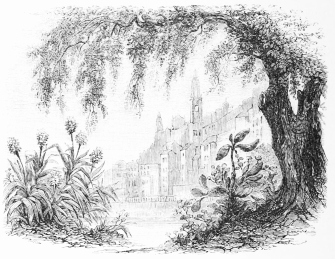
MENTONE.[190]
JOURNAL.
"Dec. 1860.—Our apartment has a bright salon looking towards the garden, with glass doors opening on a balcony. All the rooms except one overlook a vast expanse of blue sea, above groves of magnificent olivetrees, and from the garden a fresh scent of flowers is wafted up, even in December. From this garden the peaks of the Berceau are seen rising above the thickets of oranges and lemons, and beyond is a chain of rosecoloured rocks descending in an abrupt precipice to the blue waters of the bay, while on the farthest promontory Bordighera gleams white in the sunshine. Twice a day a lovely fairy vision salutes us; first, when, in the sunrise, Corsica reveals itself across the sapphire water, appearing so distinctly that you can count every ravine and indentation of its jagged mountains, and feel as if a boat would easily take you to it in an hour; and again in the evening, when, as a white ghost, scarcely distinguishable from the clouds around it, and looking inconceivably distant, it looms forth dimly in the pink haze of sunset.
"We were here a very little while before several donkey-women presented themselves to secure our custom. We engaged ourselves to a wild Meg Merrilies figure in a broad white hat, with a red handkerchief tied underneath, and a bunch of flowers stuck jauntily in the side of her hair, who rejoices in the name of Teresina Ravellina Muratori de Buffa! With her we have made many excursions. It is impossible for anything to be more beautiful than the variety of green in the valleys: the blue-green of the gigantic euphorbias, which fringe the rocks by the wayside, the grey-green of the olives, the dark green of the old gnarled carouba trees, and the yellow-green of the canes and the autumnal vineyards. The walls are beautiful with their fringe of mesembryanthemum—'Miss Emily Anthem' as the servants call it. Most of the paths are a constant 'excelsior,' and beginning with the steep yellow tufa rocks behind the town, gradually enter the pine-woods, and ascend towards the blue peaks of Sant' Agnese, which are always visible through the red stems of the pine-trees, and across the rich foreground of heath and myrtle. The trees are full of linnets, which the natives call 'trenta-cinque' from the sound of their note, and the air resounds with the cries of the donkey-drivers—'Ulla'—go on, and 'Isa'—for shame."
"Jan. 11, 1861.—We have been climbing up to Grimaldi, whose broad sunny terrace is as Italian a scene as any on the Riviera, for it is crossed by a dark archway, and lined on one side with bright houses, upon whose walls yellow gourds hang in the sun, with a little church, painted pink and yellow, while the other side is overshadowed by old olive-trees, beneath which is seen the broad expanse of sea, here deep blue, there gleaming silver white in the hot sunshine. Children in bright handkerchiefs and aprons were playing about, and singing 'Tanta di gioja, tanto di contento,' while we were drawing.
"Beyond Grimaldi the path becomes intensely steep, but we were repaid for going on when we reached to the top of the hills, as the scenery there is almost Alpine in its bold rocky foregrounds, beneath which yawns the deep black chasm of St. Louis, with a huge cliff towering above. On the scorched rock is Ciotti Superiore, a quaint cluster of houses, while the church, quite separated from the village, stands farther off, on the highest ridge of the mountain. Behind the church, the sea view is magnificent, embracing the coast, with its numerous bays, as far as the Estrelles, which turn golden and pink in the sunset; the grand mountain barriers, with all the orange-clad valleys running up into them; and S. Agnese rising out of the blue mist on its perpendicular cliff.... And, even in this high situation, lovely narcissus and pink carnations were blooming in January.
"People here are unconventional. When it began to rain on Tuesday, as we were going to a picnic, the coachman said 'Ah! le bon Dieu a oublié que c'est un jour de fêtes.'"
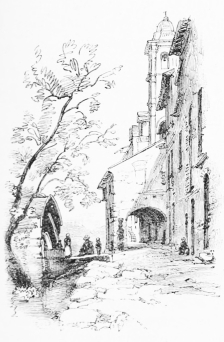
GRIMALDI.[191]
It was a great delight during our winter at Mentone that Lady Mary Wood and her family were spending the winter at Nice with old Lady Grey, so that my friend Charlie and I often met, and became greater friends than ever, entirely sympathising in all we did and saw. I went to Nice to spend some days with the Woods, and they came to Mentone for Easter, when we saw the Mentonais assemble to "grind Judas's bones," and many other of their strange ceremonies.
"Good Friday, 1861.—When Charlie and I went to S. Michele at eight o'clock in the evening, we found the church crowded from end to end with people chanting the Miserere, and radiant with a thousand waxlights. In the choir, under a canopy, upon a raised bier surrounded by a treble row of tall tapers, lay the body of Christ, for which the whole service was a funeral celebration. Soon after we arrived, a sudden hush in the crowd showed that something important was going to happen, and a huge friar's lanthorn carried in by a boy preceded the celebrated 'Pilgrim Preacher of the Riviera,' a Capuchin monk with a long white beard, who exercises his wonderful gift of preaching all along the Riviera during Lent. His sermon was short, but very graphic and striking. He began by describing a dreadful murder which people had committed upon the person of their kindest friend, with the horror it excited; and then, pointing to the white corpse which lay before him amid the blazing candles, he declared that those around him were themselves the perpetrators of the crime, and that the object of it was no other than their Saviour, whose image they saw there pale and bleeding before their eyes. Then, snatching the crucifix from the support by his side, he held it aloft to urge repentance by the sufferings there portrayed. As he concluded, soldiers filed into the church, and, amid rolling of drums and blowing of trumpets which intermingled with the chanting, the body was taken up and carried three times round the church by the Black Penitents, Mentonais nobles supporting a canopy over the bier."
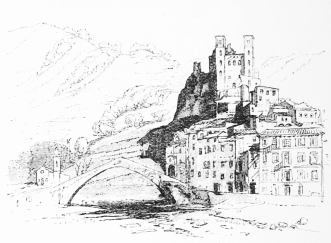
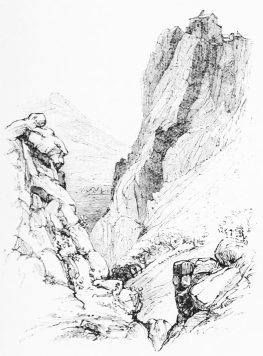
With Charlie Wood, also, I went to Dolceacqua, which will always come back to me as one of the most beautiful places I have ever seen, with its forest-clad mountains, its tall bridge, its blue river Nervia, and the palatial castle of the Dorias on a cliff, with sunlight streaming through its long lines of glassless windows. Almost equally picturesque were Peglia and Peglione, the latter on the top of a conical rock, with tremendous precipices and extraordinary mountain forms all around.
DOLCEACQUA.[192]
In the spring we went for a few days to S. Remo, accompanied by several friends. With them, when my mother returned to Mentone, I travelled farther along the Riviera, an excursion which was most amusing, as we bargained for a little carriage from place to place, giving ridiculously small sums, and living entirely like Italians. We went on to many-towered Albenga, to Savona, and eventually to Genoa, making all the excursions belonging to each place. From Genoa we joined Mr. and Mrs. Strettel in an excursion to Porto Fino. When we returned, it was too late to reach Mentone before Sunday, and my companions refused to travel on that day, so we employed the interval in going to Piacenza, Parma, and Modena! Thence we were obliged to telegraph to Mr. Strettel (then chaplain at Genoa) to send us some money to get home with, which we did in a series of little carriages as we had come, but travelling all day and night, driving in the moonlight along the Riviera roads, or often walking for miles at night upon the sands by the sea.
PEGLIONE.[193]
VENTIMIGLIA.[194]
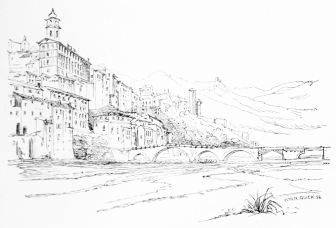
Mr. Petit, the famous ecclesiologist,[195] spent some time at Mentone afterwards, and was very kind in taking me sketching excursions, as a fourth in the carriage with his sister, Miss Emma Petit, and his niece, Miss Salt. Mr. Petit was extraordinarily clever, especially as an artist, but most eccentric. He covered the backs of his pictures with caricatures of goblins, &c., representing the events of each day on which the pictures were done. When they travelled, this extraordinary family used to keep what they called "the Petit count:" if they met a cat, it counted for so much—a black goat for so much more, and so on: but if they met a royal prince, it annihilated the whole of the Petit count, and the party would consequently go a whole day's journey out of their way to evade a royal prince. Mr. Petit was most striking in appearance, with a great deal of colour and snow-white hair and beard. I remember the start which our donkey-boy François gave when he first saw him, and his exclaiming, "Je crois, Monsieur, que c'est le frère du Père Eternel!" One day I had gone with Mr. Petit and Miss Salt to Ventimiglia, and we were returning at a most alarming speed (with their horses, from Toulon, unaccustomed to the road) along the edge of an almost unguarded and perpendicular precipice. Suddenly the horses made a great dash, and I felt, rather than saw, that they were leaving the road. I threw myself out instantly over the side of the carriage. As I picked myself up, I had the horror of seeing the horses over, hanging in the branches of an olive-tree which overhung the sea at a tremendous height, and on the tiny plateau on which it grew. The carriage was swaying to and fro on the wall, which it had broken down, and which was rapidly giving way altogether. "Uncle, shall I get out?" said Miss Salt, as coolly as if nothing was going on. "Yes," he said—and they both got out. A crowd of men came and rescued the horses with ropes from their perilous position, and we walked home.
As usual, in our return to England, we lingered much by the way. The railway then only reached as far as Aix in Provence, and we joined it there after a long vetturino journey; then, after visiting the wonderful deserted town of Les Baux near Arles and Vaucluse near Avignon, we went to S. Laurent du Pont and the Grande Chartreuse, greatly enjoying the beauty of the spring flowers there, as well as the scenery.
X WORK IN NORTHERN COUNTIES
"Al ogni uccello suo nido par bello."
—Italian Proverb.
"O my life! have we not had seasons
That only said, Live and rejoice?
That asked not for causes or reasons,
But made us all feeling and voice."
—Lowell.
ON our arrival in England, we were delighted with our little Holmhurst, which we arranged to be as much like Lime as possible, while many of the plants and shrubs we had brought with us, were, in the garden, a perpetual reminder of our old home. To my mother, however, our return was greatly clouded by the loss of her only brother, my Uncle Penrhyn, who died at Sheen while we were at Mentone, passing away most peacefully, surrounded by his family. This uncle is one of the few figures connected with my childhood with whom I have no associations but those of unvarying kindness, and in later years we had been brought nearer to him in our long winter visits at Sheen, and we missed him greatly.
My Handbook (nominally Murray's) of Oxfordshire, Buckinghamshire, and Berkshire had been published during our winter absence: my little book "A Winter at Mentone" appeared soon after our return. With Murray's Handbook I had taken as much pains as if it were to appear in my own name, and felt as strongly the responsibility of what Miss Edgeworth calls "irremediable words," once past the press. The "Winter at Mentone" fell perfectly flat, but Murray was so pleased with the laudatory notices which followed the appearance of the Handbook, that he asked me to select any other counties I liked. I chose Durham and Northumberland, and after the middle of July went there for three months. In undertaking these counties, I again assented to an arrangement by which I was never repaid for my work; but the work was one which I liked extremely, bringing me in contact with endless interesting persons, enabling me to be much with "Cousin Susan," who gave me a second home at Ridley Hall, and opening a field of historic study of the most interesting kind. On the way north I went to the Vaughans at Doncaster, of which Dr. Vaughan had lately become Vicar.
To MY MOTHER.
"Doncaster, July 24, 1861.—The people here are a perpetual amusement to Kate, they are so quaint and original. She spoke to one old woman the other day about her sinful ways and the necessity for amendment. 'Na, na, Mrs. Vaughan,' she replied, 'I be got too old for Mr. Satan noo; he canna hurt I noo.' Another old woman who was brought into the hospital swore dreadfully all night long, to the great annoyance of her neighbours; but when they complained she said, 'Wal, I niver did it afore I coomed here, but I be gettin' old, and I canna help it—and it's the will o' God, and I canna help it.'
"Kate said to an old man, 'What are you so low about, my man?' 'Why,' he said, 'what wi' faith, and gas, and balloons, and steam-ingines a-booming and a-fizzling through t' warld, and what wi't' arth a going round once in twenty-four hours, I'm fairly muzzled and stagnated.'
"I have been to call on the daughters of 'Presence-of-mind Smith,' who was Dean of Christ Church, and to the close of his life used to tell this story of himself. 'In my life,' he said, 'there has been one most fortunate incident. A friend of mine persuaded me to go out with him in a boat upon a lake. I did not wish to go, but he persuaded me, and I went. By the intervention of Providence, I took my umbrella with me. We had not been long on the lake when the violence of the waves threw my friend out of the boat drowning, and he sank. Soon, as is the case with drowning persons, he came up again, and clutched hold of the side of the boat. Then such, providentially, was my presence of mind, that I seized my umbrella and rapped him violently on the knuckles till he let go. He sank, and I was saved.'"
AT DURHAM.
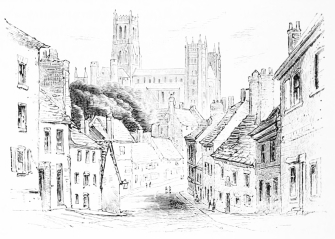
When I arrived at Durham, I presented myself at once to my cousins the George Liddells, who lived at a dingy brick house in the suburb called Old Elvet. They had never seen me before, but welcomed me with the utmost kindness and hospitality, making me quite at home with them. I took a little lodging close by, but they made me dine with them almost every day, and I went constant expeditions with them, staying to dinner at the neighbouring houses, Elemore, Aldin Grange, &c. Durham itself I always found charming. The smoke only gave a picturesqueness of its own, and on Sunday there was a Sabbath of nature, for when the chimneys ceased smoking, the birds began to sing, the flowers to bloom, and the sky to be blue. Sunday, however, was a severe day with the George Liddells, almost entirely spent in going to church, reading prayers, and listening to long sermons at home. Even on ordinary days, after long morning prayers, we were expected to read all the Psalms and Lessons for the day, verse by verse, before we went out. But with all this, George Liddell was the very dearest and kindest of old men, and I was very fond too of his wife—"Cousin Louise"—who was most amusing and original.
Other cousins, who were intensely good to me at this time, were old Henry Liddell, brother of my great-uncle Lord Ravensworth, and his wife, who was daughter of Thomas Lyon of Hetton, my great-grandmother's youngest brother. I had known them first at Bath many years before, where they were kind to me when I had very few friends. With them lived their daughters Charlotte and Amelia, and their youngest son William, a very tall, very excellent, and very shy clergyman, who was his father's curate at Easington. Here I paid my first visit to them. It is an ugly village in the Black Country, but the Liddells' house was most comfortable, having the sea close by, with delightful sands and rocks, and many wooded "denes" running down to it, of which Castle Eden is especially beautiful.
I remember one day, after returning from Easington, dining with Dr. Phillpotts, the celebrated Bishop of Exeter, who had a Canonry at Durham. He was very old, and was obliged to have a glass of wine given to him to obtain strength to go in to dinner, and every one wished him good-night when he left the dinner-table. He was good enough also to send for me alone to wish success to my book, &c. It was my only sight of this kindly old man, though I knew his daughter well, and valued her many good qualities. They both died shortly afterwards. Amongst the company at the Bishop's were Mr. and Mrs. Johnson of Akeley Heads, whom I also visited at their own beautiful place, which is on a high terrace overlooking Durham. It came to them in a curious way. Mr. Johnson was at school at Durham, and went out with his two elder brothers to spend the day with a rich old uncle who lived there. The eldest brother was his uncle's heir. They were sent to play in the garden, and seeing there a beautiful ripe peach upon the wall, they were unable to resist it, and ate it up. Soon the uncle came into the garden to look for that identical peach. "Where is my peach gone?" he said. The three boys were dreadfully frightened, and the two eldest denied knowing anything about it, but the youngest said, "We picked it and ate it up." The old man said nothing, but went home and altered his will that very afternoon, and when he was killed by an accident three weeks afterwards, his youngest nephew was found to be the heir of Akeley Heads.
I was frequently invited by Dean Waddington, who was a man of stately presence, "grand seigneur, fastueux, homme du monde," and had a great reputation for learning and cleverness; but in my acquaintance with him he seemed to care for nothing but his dinner, and his chief topic of conversation was his sherry of 1815, for which he gave £12 a dozen. "What with diner à la Russe, crinoline, and pale sherry," he said one day, "England is fast going to the dogs."
To MY MOTHER.
"Dilston, August 28.—The Greys gave me a warm welcome to Dilston—Mr. Grey being agent for the Greenwich Hospital Estates there, and a great agriculturist. Dilston is lovely. The house stands on a terraced height, covered with hanging woods, beneath which flows the Devil's Water, the most beautiful of Northumbrian rivers, with trout dancing about in its transparent brown currents, and floating away over its crumpled-looking rocks. On the hilltop is the ruined castle of the Earl of Derwentwater, with his nursery, now overgrown by huge elder-trees, and the little chapel beneath which he was buried at night beside his ancestors. Below is the old grey pointed bridge, upon which, as he rode over, he repented of his rebellion and turned back to the castle, when his wife threw her fan at him, and calling him a coward, drove him forth to his destruction."
"Ridley Hall, Sept. 1.—'How happily the days of Thalaba roll by' might be applied to all the dwellers at Ridley Hall; for 'Cousin Susan' is so truly genial to her many guests, that they cannot fail to enjoy being with her."
"Chillingham Castle, Sept. 6.—I went with Cousin Susan to spend two days at Matfen, Sir Edward Blackett's, a large modern Tudor house with a church beside it, looking into a great park, and entered through a stately gothic hall. Sir Edward and Lady Blackett have not been married many years, but four of his daughters by his first wife are now out. Lady Blackett also had another Northumbrian husband, Mr. Orde of Whitfield, and, as daughter of Sir Charles Lorraine, was once thought a great beauty. Sir Edward drove me to see Aydon, a curious old castle which belongs to him.
"Yesterday I came to Chillingham from Belford, a beautiful drive, over hills first, and then descending into moorland, purple with heather, and bounded by the Cheviots, which rose deep blue against the sunset sky. The castle, which is partly as old as King John, is built round a great courtyard, from which flights of stone steps go up to the principal apartments. On the stairs I found Lord Tankerville, a handsome middle-aged man, with grey hair, romping with his children. He is quite charming, so merry and so courteous. He took me at once to my room, which is high up in one of the old towers, and at eight we dined. Lady Tankerville is sister of the Duke of Manchester, very pretty, and looks quite a girl, though her three boys must be eight, nine, and ten years old."
"Chillingham, Sept. 8.—This park is quite as beautiful in its way as any scenery abroad, and much more so, I think, than any in Scotland. It is backed by the Cheviot Hills, and often broken into deep dells, with little streamlets rushing down them, and weird old oaks whose withered branches are never cut off, sheltering herds of deer. Great herds too of wild cattle, which are milk-white, and have lived here undisturbed from time immemorial, come rushing every now and then down the hillsides like an army, to seek better pasture in the valley. Deer of every kind are to be seen upon the hills, and Lady Tankerville hunts them furiously, tiring out twelve horses in succession, placed to await her at different points in the park. Nothing can be more lovely than the evening effects each day I have been here, the setting sun pouring streams of golden light into the great grey mysterious basins of the Cheviots, amid which Marmion died and Paulinus baptized the ancient Northumbrians.
"If the place is charming, the people are even more so. The family is the happiest and most united I have ever seen. Lord Tankerville is the best and kindest of human beings. Lady Tankerville, whose spirits are so exuberant she scarcely knows how to get rid of them, dotes on her 'Hossinun,' plays with her children, gallops on her horses, hunts her deer, and manages her household, with equal vivacity. She is the most amusing person possible, is never ill, laughs fine-ladyism to scorn, and scrambles about the park, regardless of colds and crinolines, in all states of the weather. The three little boys, Charlie, Georgie, and Peddie, are all quite as engaging in their different ways, and the two little girls are lovely little creatures.
"The prettiest story of an acceptance I ever heard of is that of Lord Tankerville. He was playing at billiards with Lady Olivia Montagu when he proposed, but she gave no definite answer. At last she said, 'I think we must go into the drawing-room now; we have been away long enough.'—'But what may I think, what may I say?' he asked in agitation. 'Say that we have played our game, and that you have won,' she answered.
"Yesterday, as soon as luncheon was over, Lady Tankerville and I set off for a regular good sketching, in which she soon outstripped me, for her drawings are first-rate. In some she has been helped by Landseer, who is often here, and who has added beautiful misty backgrounds, and put herds of deer into her fern.
"In the park is a beautiful old Peel tower, the home of the Hepburns."
"Chillingham, Sept. 10.—Lord Tankerville says, 'I do not see why any one should ever go away from a place as long as he can make himself happy there.' On that principle I should certainly never leave Chillingham, which is the pleasantest place I ever was at. I feel as if I had known Lord and Lady Tankerville all my life, his kindness and her fun make one so entirely at home; and as for Charlie, Georgie, and Peddie, there never were such little boys.
"Yesterday I was awakened by the servant saying that an order had just come out to have breakfast ready in twenty minutes, as we were all going to Dunstanborough for the day. So we hurried down, and as soon as we had eaten our breakfast, set off in two little basket-carriages across the park and up the steep hills to the moors. At the top we found a larger carriage, packed with luncheon, and with plenty of wraps, for the day was most unpromising; but Lady Tankerville had quite made up her mind that it should be fine, and that we would enjoy ourselves; and so we most certainly did. The drive across the moorlands was charming, such sweeps of purple heather, with blue mountain distance. Then, after twelve miles, we descended through the cornland to Dunstanborough, and walked through the sandhills covered with rye-grass and bloody cranesbill to the castle, on a reef of basaltic rocks overhanging the sea, which in one place roars up beneath in a strange cavern, known as the Rumbling Churn. Lady Tankerville and I drew Queen Margaret's Tower, where she was concealed after the battle of Hexham, and then we picnicked and rambled about. Coming home we told stories. A tremendous shower came on, and then the sky cleared for a golden sunset over the mountains, and a splendid descent into the old deer-park."
"Bamborough Castle, Sept. 12.—Yesterday, at four, we set off on a gipsy picnic from Chillingham—little 'Co' (Corisande) on a pony, with the tea-things in panniers; Lady Tankerville, a fat Mr. Athelstane from Portugal, Charlie, Georgie, Peddie, and I walking. The pouring morning turned into a beautiful afternoon, and we had a delightful scramble through the ferny glades of the park, and up the steep craggy hills to the moorlands. Here Lady Tankerville went off through the heather to look after her little girl, and I told the three boys the story of Littlecot Hall, till the Shetland pony, 'Piccolomini,' arrived by the longer path. Then we lighted a fire between two rocks, and Lady Tankerville and her children boiled a kettle and cooked omelets over a fire of heather and fern, and beautiful grapes, greengages, jam, and cakes unfitted us for the eight-o'clock dinner. Then we came down like bushrangers, breaking a path through the bracken, a great deal taller than ourselves, and seeing in the distance the herds of wild white bulls. One or two people came to dinner, but it was just the same simple merry meal as usual.
"The Tankervilles sent me here to-day—twelve miles—in their carriage."
"Bamborough Castle, Sept. 13.—It is very pleasant, as you will imagine, to be here again, and I have much enjoyed the delightful sands and the splendid green waves which came rolling in all yesterday afternoon. It was a lovely evening, warm enough to enjoy sitting out on the seat amongst the tall bent-grass, and to watch Holy Island quite distinct in the sunset, with all the little fleet of red-sailed herring-boats coming round from North Sunderland. Old Mrs. Liddell sits as usual in her deep window and looks through the telescope. Amelia wanders about with her black spaniel, and Charlotte rides furiously on the sands when out, and talks incessantly, though pleasantly, when in."
"Bamborough, Sept. 16.—Yesterday I set off at 8 A.M. in a dogcart for Holy Island, one of the castle cart-horses being harnessed for the purpose, and the castle joiner going with me to find old wood for repairs. It was a wild morning, but gleams of light made the country picturesque, and Waren Bay looked very striking, backed by its angular purple hills, and strewn with pieces of wreck, over which sea-birds were swooping. Only one bit of sand was visible when we reached the ford, but the horse plunged gallantly in. Then we had a very rough crossing of a quarter of an hour in a boat through the great green waves to the island, where we landed on the yellow rocks. Close by, on the green hill, stand the ruins, so well described in 'Marmion,' of St. Cuthbert's Abbey, the old cathedral of Lindisfarne—rather small after descriptions, but beautiful in colour, and its massive round pillars, with patterns upon them, almost unique in England. Beyond, was the still blue harbour filled with fishing-boats, and the shore was lined with men and women packing herrings in barrels of salt. At one corner of the bay rises the castle on a conical hill like a miniature Mont St. Michel, and Bamborough and Dunstanborough are blue in the hazy distance."
"Sept. 17.—Stephen Denison is here (my cousin by his marriage with Miss Fellowes[196]), and I have been with him to pay a long visit to Grace Darling's[197] old father, an interesting man, with as much information as it is possible for any one to have who has lived since he was one year old on a desolate island rock tending a lighthouse. He lent us his diary to read, which is very curious, and an awful record of wrecks and misery."
ON ALLEN WATER, RIDLEY HALL.
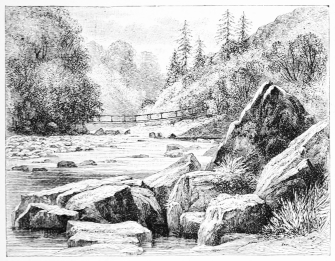
"Ridley Hall, Sept. 19.—Cousin Susan and her old friend Miss Coulson, with 'the boys' (the dogs), were waiting to welcome me in the avenue, when I got out at the private station here. The house is quite full of people, to whom it is amusing to help to do the honours. Great is the autumnal beauty of the place. I have been with Cousin Susan up the Birky Brae, and down by the Craggy Pass and the Hawk's Nest—streams of sunlight falling upon the rocks and river, and lighting up the yellow and red leaves which now mingle with the green. The dogs walked with us to church to-day—Tarlie was allowed to enter with the family, and Bloomer with the maids, but Perette, Bianca, Fritz, and the Chowdy-Tow were sent back from the door!
"We have had a remarkable visit from an old Miss Clayton, an eccentric, strangely-attired, old, very old lady, who had travelled all the way from Chesters, on North Tyne, to see Staward Peel, and then had rambled on foot hither down the rocks by the Allen. Both she and her friend had fallen into the river in crossing the stepping-stones above the wood, and arrived, carrying a large reticule basket, and dripping with wet and mud, about five o'clock; yet, as soon as she had been dried and fed, she insisted on setting off again on foot to visit Haltwhistle and Bellister Castle before going home at night!"
"Streatlam Castle, Sept. 25.—I came with Cousin Susan to this curious place, to which our cousin Mr. Bowes[198] has welcomed us very cordially. The house is in a hollow—an enormous building of the last century, enclosing a mediæval castle. I sleep in the ghost-room, looking most grim and weird from its black oak with red hangings, and containing a tall bed with a red canopy. Here the only existing local Handbook says that 'the unfortunate Mary Queen of Scots expired in captivity.' I am afraid the next Handbook will be obliged to confess that she was beheaded at Fotheringay.
"The long galleries are full of family portraits—Hyltons, Blakistons, and Bowes's—one of whom, Miss Bowes of Streatlam, was Mrs. John Knox! More interesting to me is the great picture of Mary Eleanor, the unhappy Countess of Strathmore,[199] walking in the gardens of Pauls-Walden. This house was the scene of her most terrible sufferings."
"Streatlam Castle, Sept. 27.—This is the oddest house I ever was in! Everything is arranged for you, from the moment you get up till the moment you go to bed, and you are never allowed to deviate from the rules laid down: I even write this in time stolen from the half-hour for dressing. We are called at eight, and at ten march in to breakfast with the same procession as at dinner, only at this meal 'Madame Bowes' does not appear, for she is then reclining in a bath of coal-black acid, which 'refreshes her system,' but leaves her nails black. After breakfast we are all set down to employments appointed for the morning. At twelve Madame appears, having painted the under-lids of her jet-black eyes with belladonna. At two the bell rings for luncheon, and we are fetched if not punctual to an instant. At three we are all sent out driving (the coachman having exact orders where to take us) immense drives (twenty-four miles to-day) in an open barouche and pair. At seven we dine in great splendour, and afterwards we sit in the oak drawing-room and talk about our ancestors!
"The town of Barnard Castle is most picturesque, with a ruined castle of the Baliols. Dickens, in early life, used frequently to come down and stay there with some young artist friends of his. The idea of 'Humphrey's Clock' first sprung from Humphrey, the watchmaker in the town, and the picture in the beginning of the book is of the clock over the door of his shop. While at Barnard Castle, Dickens heard of the school at Bowes which he afterwards worked up as Dotheboys Hall. Many of these schools, at £15 and £20 a year, existed at that time in the neighbourhood, and were principally used for the sons of London tradesmen, who, provided their sons got a moderate education, cared little or nothing what became of them in the meantime. Dickens went over to see the school at Bowes, and was carefully shown over it, for they mistook him for a parent coming to survey it, with a view of sending his son there. Afterwards the school was totally ruined. At one of Mr. Bowes's elections, the Nicholas Nickleby or former usher of the school, who was then in want of a place, wrote to him to say in what poverty he was. He 'had formerly been living with Mr. Shawe at Bowes, and they had been happy and prosperous, when Mr. Dickens's misguided volume, sweeping like a whirlwind over the schools of the North, caused Mr. Shawe to become a victim to paralysis, and brought Mrs. Shawe to an untimely grave.'"
"Morpeth Rectory, Oct. 8.—My present host is Mr. Francis Grey, an old likeness of his nephew, Charlie Wood: his wife, née Lady Elizabeth Howard, is as sweet-looking as she is charming.
"Friday morning was pouring, with a thick sea-fog hiding the country. Nevertheless Mr. Grey did not think it too bad for a long expedition, and drove me in his little pony-carriage a dreary twelve miles to Wallington, where we arrived about half-past twelve. Wallington is a huge house of the elder branch of the Trevelyans, represented in the North by Sir Walter, who is at the head of teetotallers and Low Churchmen, while his wife is a great friend of Ruskin, Rossetti, and all the Pre-Raphaelites. It is like a French château, with tall roofs and chimneys, enclosing a hall, once a court, which Lady Trevelyan and her artists have covered in and painted with beautiful fresco studies of Northumbrian birds, flowers, and insects, while the intervening spaces are filled with a series of large pictures of the chief events in Northumbrian history—very curious indeed.
"Lady Trevelyan[200] is a little, bright, black-eyed woman, who was charmed to see us, and more to see my drawings, which Mr. Grey had brought. Any good opinion of me, however, which they led her to entertain was quelched by my want of admiration for some wretched little scraps by Ruskin—very scratchy sketches, after his manner. After luncheon, which was as peculiar as everything else (Lady Trevelyan and her artists feeding solely on artichokes and cauliflowers), we went to the upper galleries to look at more pictures.
"Yesterday morning we went to the fine old Morpeth Church, which has been 'restored,' one of the stained windows having been put in by a poor old woman in the village. We saw her afterwards in her garden gathering cabbages, and I told her I had seen the window. 'Eh, hinnie,' she said, 'and ain't it bonnie? and I be going to case it i' marble afore I dee, to mak it bonnier.' And then she said, 'And noo come ben, hinnie, my dear, and see me hoose;' and she showed me her cottage.
"The Greys are one of the families who have a sort of language of their own. A bad cold the Greys always call a Shelley, because of a famous cold old Lady Shelley had when she came to stay with them. This was the Lady Shelley who, when her carriage, full of people, upset, and there was a great entanglement of legs, called out to the footman, who came to extricate them, 'John, the black ones are mine—the black ones are mine.'"
"Warkworth, Oct. 6.—It is very pleasant being here with my kind Clutterbuck cousins,[201] and this old-fashioned house, though small, is most refined and comfortable, with its pervading smell of roseleaves and lavender."
"The Rock, Alnwick, Oct. 10.—I am now staying with the father of a college friend, Charles Bosanquet, in a pleasant old-fashioned house, an enlarged 'Peel tower.' The family are very united, genial and kind; are friends of the Arnolds, Gaskells, &c., and related to Mr. Erskine of Linlathen. I like Charlie Bosanquet so much in his own home, that I am quite ashamed of not having tried to cultivate him more when at Oxford. Yesterday he drove me to Craster Tower, the old castellated house of the Crasters, a very ancient Northumbrian family, now well represented by the old Squire and his wife, their three tall daughters, and seven stalwart sons, one of whom was at college with me. After luncheon we went over the tower, its vaulted cellars and thickly walled rooms, and then walked to the wild heights of Dunstanborough, with its ruins overhanging the waves, and large white gulls floating up from the 'caverned shore' of 'Marmion.' Then we went to Embleton to see one of the curious fortified rectories of the North—fortified against the Scots."
"Ford Castle, Oct. 15.—I enjoyed my visit at Rock increasingly, and we made interesting excursions to Falloden and Howick. At the former we dined with Sir George and Lady Grey. On Sunday the beautiful little Norman chapel at Rock was filled from end to end with the whole population of the village, all responding, all singing, and forty-three (in that tiny place) remaining to the Sacrament. Mrs. Bosanquet says they are truly a God-fearing people. They live (as all over Northumbria) bound by the year like serfs, close around the large farms. At Rock the people seem perfectly devoted to the Bosanquets, who are certainly quite devoted to them. 'My Missis herself can't feel it more than I do,' said the gamekeeper when he heard the sailor son was coming home.
"Yesterday morning I set off directly after breakfast with Charles Bosanquet, in the sociable, on a long expedition. It was a really lovely day, and the drive over the wild moorlands, with the pink and blue Cheviot distances, was quite beautiful. At one we reached Hedgeley, where we had been asked to luncheon at the fine old house of the Carrs, looking up a mountain ravine, but a soldier-son first took us up to Crawley Tower, a neighbouring ruined Peel. At three we came on to Roddam, where an uncle and aunt of Charlie Bosanquet's live—a beautiful place, with a terraced garden almost overhanging the moorlands, and a dene stretching up into the Cheviots. I had ordered a gig to meet me and take me to Ford, where I arrived about half-past six, seeming to be driving into a sort of gothic castle of Otranto, as we passed under the portcullis in the bright moonlight. I found Lady Waterford sitting with her charming old mother, Lady Stuart de Rothesay.... Her drawings are indescribably lovely, and her singing most beautiful and pathetic. Several people appeared at dinner, amongst them Lord Waterford (the brother-in-law), who sat at the end of the table, a jovial white-headed young-old man."
"Ford Castle, Oct. 17.—Being here has been most pleasant, there is so much to do and see both indoors and out. Lady Waterford is perfectly charming.... She is now occupied in putting the whole architecture of the castle back two centuries. Painting is her great employment, and all evening she makes studies for larger drawings, which she works upon in the mornings. She is going to make a 'Marmion gallery' in the castle to illustrate the poem.
FORD CASTLE, THE TERRACE.
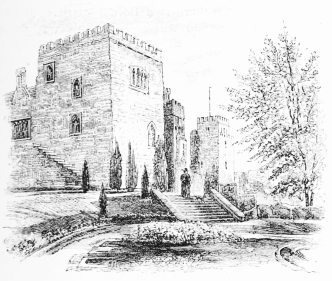
"Yesterday we went to Palinsburn, where Paulinus baptized, and on to Branxton to see Mr. Jones, who is the great authority about the battle of Flodden, which he described to us till all the dull ploughed fields seemed alive with heroes and armies. He is coming to-night to talk about it again, for Flodden seems to be the great topic here, the windows of the castle looking out upon the battle-field. The position of the different armies and the site of Sybil's Well are discussed ten times a day, and Lady Waterford herself is still sufficiently a stranger here to be full of her first interest about it.
"To-day the pony-carriage took me part of the way to the Rowting Lynn, a curious cleft and waterfall in the moorland, with a 'Written Rock,' supposed to have been the work of ancient Britons. Thence I walked by a wild path along the hills to Nesbitt, where I had heard that there was a chapel of St. Cuthbert, of which I found no vestiges, and on to Doddington, where there is a Border castle. If you look on the map, you will see that this was doing a great deal, and I was very glad to get back at five to hot tea and a talk with Lady Stuart."
"Roddam, Oct. 20.—I had not promised to return here, and I was received almost rapturously, so welcome is any stray guest in this desolate place.... Sunday here was a curious contrast to that at Rock, for though there is a population of nine hundred, the Rector waited for us to begin afternoon service, as no one else came!"
"Roddam, Oct. 22.—Yesterday was terribly dark and cold, but we went a long expedition across the moorland to the Raven's Burn, a wild tumbling rivulet in a chaos of grey rocks, and thence by the farm of 'Blaw Weary'—picturesquely perched upon rocks which were covered with white goats, like a bit of Roman Campagna—to the 'Raven's Rock' in a rugged cleft of the moorland. To-day I have been to Linhope Spout, a waterfall at the end of a gorge, and to-morrow we go to the Three Stone Burn, where there are Druidical remains."
"Ripley Castle, Yorkshire, Oct. 25.—Lady Ingilby (who is sister of Mr. Bosanquet of Rock) kindly pressed my coming here on my way south, and here I am. It is a fine old castle added to, about four miles from Harrogate, with beautiful gardens and a lovely neighbourhood. At the head of the stairs is the portrait of a Nun, who is said to descend from her picture at night and tap at the bedroom doors, when, if any one says, 'Come in'—in she comes. Eugene Aram was the gardener here, and the Ingilbys have all his letters. Cromwell insisted on taking the castle, but the then Lady Ingilby, a staunch Royalist known as 'Trooper Jane,' would not let him have either food or rest there, and sat opposite him all the night through with two loaded pistols in her girdle."
"Hickledon Hall, Yorkshire, Oct. 27.—Sir Charles Wood's carriage was waiting at Doncaster for me and a very nice young Seymour.[202] Charlie seems delighted to have me here, and I think Sir Charles quite charming, not a bit as if he had the government of all India upon his shoulders."
Many of the visits which I paid in 1861 laid the foundation of after friendships, but chiefly that to Ford, whither I went again and again afterwards, and where I have passed some of the happiest days of my life. Lord and Lady Tankerville, after a few years, passed out of my horizon—I never have quite known how or why. The Liddells, Mrs. Clutterbuck and her daughters, and the saintly Lady Ingilby, added much to my enjoyment for several years. This was especially happy for me, as I see by my journals of the time how in the following winter I felt more than ever depressed by the constant snubbing I received from different members of my immediate family. Such snubs are trifling in themselves, but, like constant dropping of water in one place, they wear away the spirit at last. All this time my sister was bravely exerting herself in cheering her mother and aunt, as well as in a clever (and eventually successful) scheme for the improvement of their fortunes. Miss Hughan (afterwards Lady John Manners) showed her at this time an unwearied kindness which I can never forget.
To my Sister.
"Holmhurst, Dec. 18, 1861.—I went to-day to see three ladies take the veil in the convent at Hastings. I had to get up in the cold early morning and be in the chapel by half-past eight. At nine the Bishop of Brighton arrived in a gold robe and mitre, and took his place with his back to the altar, leaning against it. Then a side door opened, and a procession came in singing—some nuns, and the three brides of Christ dressed in white watered silk, lace veils, and orange flowers. There were six little bridesmaids also in white veils and wreaths. The brides looked ghastly livid, and one of them would have fallen if a nun had not rushed forward to support her. The Bishop then made them an address, the point of which was that they were not going into a convent for their own benefit or that of the world, but for 'the consolation of Christ'—that was to be their work and duty through life—'the consolation of Christ for the sins of the world.' Then he fixed his eyes upon them like a basilisk and cried, 'Venite.' They tottered, quivered, but scarcely moved; again in a louder voice he called 'Venite;' they trembled and advanced a few steps. Once more 'VENITE,' and they all three fell down prostrate at his feet.
"Then the most solemn music was played, the most agonising wailing dirges were sung, and the nuns coming behind with a great black pall, spread it over the prostrate figures. It was as if they were dead. The bridesmaids strewed flowers, rosemary and laurestinus, as they sang out of their books: the spectators cried and sobbed till they were almost hysterical; but nothing was to be seen but the sunlight streaming in upon a great black pall.
"Then all the saints of the monastic orders were invoked and responded to, and then the nuns closed in, so that no one could see how the three novices were hurried away, only to reappear in their nun's dress. Then they received the Sacrament.
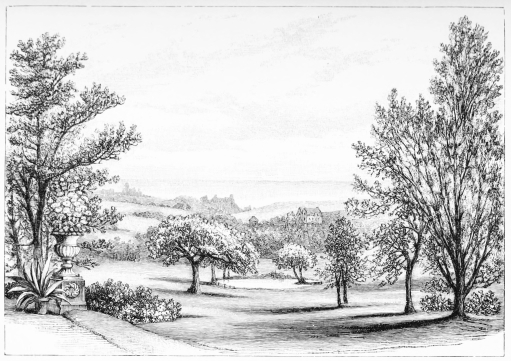
"It is impossible to say how well this little Holmhurst seems suited to the mother. There is still a lingering of autumnal leaves and flowers, and the grey castle rises against a gleaming sea. Thinking of her, and of our home view as it is now, one cannot help recalling Keble's lines:—
'How quiet shows the woodland scene, Each flower and tree, its duty done, Reposing in decay serene, Like weary men when age is won, Such calm old age as conscience pure And self-commanding heart ensure, Waiting their summons to the sky, Content to live, but not afraid to die.'"
VIEW FROM HOLMHURST.
ENTRANCE TO HOLMHURST: "HUZ AND BUZ."
JOURNAL.
"Holmhurst, Dec. 27.—It was on Monday, the 16th, that I was sitting in my study in the twilight, when the mother came in suddenly. She had been down to Hastings with Mrs. Colegrave and Miss Chichester to see Florence Colegrave at the convent, and there first heard the dreadful news of the event of Saturday. Seeing her so much agitated terrified me to the last degree. I thought that it was Arthur who was dead, and when I heard that it was the Prince Consort, the shock was almost as great. It seems impossible to realise that one will not be able to say 'the Queen and Prince Albert' any more: it is a personal affliction to every one, and the feeling of sympathy for the Queen is overpowering. The Prince sank from the time he read the letter about the deaths of the King and Princes of Portugal. Then they tried to persuade him not to see the messengers who returned from taking the letters of condolence: he insisted upon doing so, and never rallied.... From the first the Prince thought that he should not live, and from the Wednesday Sir Henry Holland thought so too, and wrote in the first bulletin, 'Hitherto no unfavourable symptoms,' to prepare the public mind; but the Queen came into the anteroom, saw the bulletin, and scratched out the 'hitherto:' she would entertain no idea of danger till the last[203].... When the Prince was dying, he repeated the hymn 'Rock of Ages.' ... A letter from Windsor Castle to Mr. P. describes the consternation and difficulty as to how the Queen was to be told of the danger: no one would tell her. At last Princess Alice relieved them all by saying, 'I will tell her,' and took her out for a drive. During the drive she told the Queen that the Prince could not recover. When he died, the Queen gave one piercing, heart-rending scream, which echoed all over the castle, and which those who stood by said they could never forget, and threw herself upon the body. Then she rose and collected her children and spoke to them, telling them that they must rally round her, and that, next to God, she should henceforth look to them for support.
"C. W. sends an odd story about the King of Portugal. After his death, Princess Alice made a drawing of him lying dead, and, at the top of the drawing, the gates of heaven, with Queen Stephanie waiting to receive the spirit of her husband. A little while after, M. Lavradio sent the Queen a long account of the King's illness, in which it was said that when the King lay dying he fell into a deep sleep, and woke up after some little time saying that he had dreamt, and wished he could have gone on dreaming, that he lay dead, and that his spirit was going up to heaven, and that at the gates he saw 'Stephanie' waiting to welcome him in. Everything fresh that one hears of Prince Albert makes one realise, 'Le prince était grand, l'homme l'était davantage.'"[204]
In the course of the winter I was at Miss Leycester's house in Wilton Crescent, and saw there Miss Marsh and Sir Culling Eardley, both of whom told me much that was curious. I remember Sir Culling Eardley's saying, "I feel sure that the destruction of the temporal power will be the end of the Papacy, and I am also sure that there is one person who agrees with me, and that is Pio Nono!" He also told me that—
"One morning Mrs. Pitcairn at Torquay told her husband that she had been very much disturbed by a dream. She said she had seen her little boy of four years old carried into the house dreadfully crushed and hurt, and that all the principal doctors in the town—Madden, Mackintosh, &c.—had come in one after the other to see him.
"Her husband laughed at her fears, but said, 'Whatever you do, don't tell this to the boy; it would only frighten him unnecessarily.' However, Mrs. Pitcairn did not promise, and when her husband was gone out, she called her little boy to her, and taking him on her knee, spoke to him very seriously, saying, 'If anything happened to you now, where would you be?' &c.
"That afternoon, the little boy went with his elder brother to see some new houses his father was building. In crossing the highest floor, the ill-fastened boards gave way, and he fell, passing through all the floors, into the cellar. Half-an-hour afterwards his mother saw him carried into the house, and all the doctors come in to see him, one after another, in the exact order of her dream.
"The little boy recovered; but four years after, his elder brother, playing on the shore at Babbicombe, pulled down some rocks upon himself, and was killed upon the spot."
In March 1862 an event occurred which caused a great blank in our circle, and which perhaps made more change in my life than any other death outside my own home could have done—that of my aunt Mrs. Stanley.
JOURNAL.
"Holmhurst, March 23, 1862.—In March last year dear Uncle Penrhyn died. Aunt Kitty was with him, and felt it deeply. Now she also, on the same day of the same week, the first anniversary of his death, has passed away from us—and oh! what a blank she has left! She was long our chief link with all the interest of the outside world, writing almost daily, and for years keeping a little slate always hanging to her davenport, on which, as each visitor went out, she noted down, from their conversation, anything she thought my mother might like to hear.
"Five weeks ago Arthur went to join the Prince of Wales at Alexandria. He was very unwilling to leave his mother, but he took the appointment by her especial request, and she was delighted with it. He took leave of her in the early morning, receiving farewells and blessings as she lay on the same bed, from whence she was unable afterwards to speak one word to her other children. When he went, my mother was very ill with bronchitis. Aunt Kitty also caught it, but wrote frequently, saying that 'her illness did not signify, she was only anxious about my mother.' It did signify, however. She became rapidly weaker. Congestion of the lungs followed, and she gradually sank. The Vaughans were sent for, and Mary was with her. We were ready to have gone at any moment, if she had been the least bit better, but she would not have been able to have spoken to the mother, perhaps not have known her, so that I am thankful for my sweet mother's sake that she should have been here in her quiet peaceful home.
"There were none of the ordinary features of an illness. Aunt Kitty suffered no pain at all: it was a mere passing out of one gentle sleep into another, till the end.
"Kate wrote—'What a solemn hour was that when we were sitting in silence round her bed, watching the gradual cessation of breathing—the gradual but sure approach of the end! Not a sound was heard but the sad wailing of the wind as her soul was passing away. She lay quite still: you would hardly have known who it was, the expression was so changed—Oh no, you would never have known it was the dear, dear face we had loved so fondly. And then, when all ceased, and there was stillness, and we thought it had been the last breath, came a deep sigh, then a pause—then a succession of deep sighs at long intervals, and it was only when no more came that we knew she was gone. Charles then knelt down and prayed for us, "especially for our dear absent brother, that he might be comforted"—and then we rose up and took our last look of that revered countenance.'
"When people are dead, how they are glorified in one's mind! I was almost as much grieved as my mother herself, and I also felt a desolation. Yet, on looking back, how few words of tenderness can I remember receiving from Aunt Kitty—some marigolds picked for me in the palace garden when I was ill at Norwich—a few acknowledgments of my later devotion to my mother in illness—an occasional interest in my drawing: this is almost all. What really makes it a personal sorrow is, that in the recollection of my oppressed and desolate boyhood, the figure of Aunt Kitty always looms forth as that of Justice. She was invariably just. Whatever others might say, she never allowed herself to be biassed against me, or indeed against any one else, contrary to her own convictions.
"I went with Mary and Kate to the funeral in Alderley churchyard. We all assembled there in the inner school-room, close to the Rectory, which had been the home of my aunt's happiest days, in the centre of which lay the coffin covered with a pall, but garlanded with long green wreaths, while bunches of snowdrops and white crocuses fell tenderly over the sides. 'I know that my Redeemer liveth' was sung as we passed out of the church to the churchyard, where it poured with rain. The crowds of poor people present, however, liked this, for 'blessed,' they said, 'is the corpse that the rain falls on.'"
ALDERLEY CHURCH AND RECTORY.
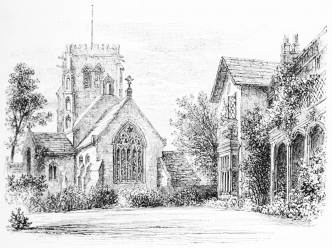
During this sad winter it was a great pleasure to us to have our faithful old friend the Baroness von Bunsen at St. Leonards, with two of her daughters—Frances and Matilda. She had been near my mother at the time of her greatest sorrow at Rome, and her society was very congenial at this time. We were quite hoping that she would have made St. Leonards her permanent winter-home, when she was recalled to live in Germany by the death of the darling daughter of her heart—Theodora von Ungern-Sternberg—soon after giving birth, at Carlsruhe, to her fifth child.
In this winter I went to stay at Hurstmonceaux Rectory with Dr. Wellesley, who was never fitted to be a country clergyman, but who never failed to be the most agreeable of hosts and of men. In person he was very like the Duke of Wellington, with black eyes, shaggy eyebrows, and snow-white hair. His courtesy and kindness were unfailing, especially to women, be their rank what it might. A perfect linguist, he had the most extraordinary power of imitating Italians in their own peculiar dialects. Most diverting was his account of a sermon which he heard preached in the Coliseum. I can only give the words—the tone, the gestures are required to give it life. It was on the day on which the old Duke of Torlonia died. He had been the great enemy of the monks and nuns, and of course they hated him. On that day, being a Friday, the Confraternità della Misericordia met, as usual, at four o'clock, in SS. Cosmo and Damiano in the Forum, and went chanting in procession to the Coliseum. Those who remember those days will recall in imagination the strong nasal twang of "Sant' Bartolome, ora pro nobis; Santa Agata, ora pro nobis; Sant' Silvestro, ora pro nobis," &c. Arrived at the Coliseum, the monk ascended the pulpit, and began in the familiar style of those days, in which sermons were usually opened with "How do you do?" and some remarks about the weather.
"Buon giorno, cari fratelli miei. Buon giorno, care sorelle—come state tutti? State bene? Oh, mi fa piacere, mi fa molto piacere! Fa bell' tempo stasera, non e vero? un tempo piacevole—cielo sereno. Oh ma piacevole di molto!
"Ebbene, cari fratelli miei—Ebbene, care sorelle—sapete cosa c' è di nuovo—sapete che cos' è successo stammattina in città? Non lo sapete—maraviglia! Oh, non vi disturbate—nò—nò—nò—non vi disturbate affatto—ve lo dirò, io ve lo spieghierò tutto.
"Stammattina stessa in città è morto qualcheduno. Fu un uomo—un uomo ben inteso—ma che specie d' uomo? Fu un uomo grande—fu un uomo ricco—fu un uomo potente—fu un uomo grandissimo, ricchissimo, potentissimo, magnificentissimo, ma morì!—morì, cari fratelli miei, quell' uomo così grande, così ricco, così potente—morì!—così passiamo tutti—così finisce il mondo—moriamo.
"E che fu quell' uomo così importante che è morto? Fu un Duca! un Duca, cari fratelli miei! E, quando morì, cosa fece? È montato sopra, montato sopra su alla porta del Paradiso, dove sta San Pietro, colle sue sante chiavi. Picchia il Duca.... 'Chi è là,' disse San Pietro. 'Il Duca di Torlonia!'—'Ah, il Duca di Torlonia,' disse San Pietro, 'quel nome è ben conosciuto, ben conosciuto davvero.' Quindi si voltò San Pietro all' angelo custode che teneva il libro della vita, e disse, 'Angelo mio, cercate un pò se trovate quel nome del Duca di Torlonia.' Dunque l'angelo cercò, cercò con tanta pena, con tanta inquietudine, voltò tante pagine in quel libro così grande della vita, ma disse infine, 'Caro Signor San Pietro mio, mi rincresce tanto, ma quel nome lì non mi riesce di trovarlo.'
"Allora si voltò San Pietro, e disse, 'Caro Signor Duca mio, mi rincresce tanto, ma il suo nome non si trova nel libro della vita.' Rise il Duca, e disse, 'Ma che sciocchezza! cercate poi il titolo minore, cercate pure il titolo maggiore della famiglia, cercate il Principe di Bracciano, e lo troverete sicuramente.' Dunque l'angelo cercò di nuovo, cercò con sollecitudine, voltò tante tante pagine in quel libro così immenso—ma alla fine disse, 'Caro Signor San Pietro mio, mi rincresce tanto—ma quei nomi non si trovan qui, nè l'uno, nè l'altro.' Allora disse San Pietro, 'Mi dispiace tanto, Signor Duca mio—ma bisogna scendere più giù—bisogna scendere più giù.'
"Scese dunque il Duca—poco contento—anzi mortificato di molto—scese giù alla porta del Purgatorio. Picchia il Duca. 'Chi è là,' disse il guardiano. 'Il Duca di Torlonia' (piano). 'Ah, il Duca di Torlonia,' disse il guardiano. 'Anche qui, quel nome è ben conosciuto, molto ben conosciuto—ma bisogna scendere più giù—bisogna scendere più giù.'
"Scese dunque il Duca. Ahimè! quant' era miserabile! come gridava, quanto piangeva, ma—gridando, piangendo—scendeva—scendeva giù—alla porta dell' Inferno, dove sta il Diavolo. Picchia il Duca. 'Chi è là,' disse il Diavolo. 'Il Duca di Torlonia' (pianissimo). 'Ah, il Duca di Torlonia,' disse il Diavolo, 'oh siete il benvenuto, entrate qui, caro amico mio, oh quanto tempo siete aspettato, entrate qui, e restate per sempre.' Ecco cari fratelli miei, ecco care sorelle, quel ch' è successò quest' oggi, stammattina, in città, a quel povero Duca di Torloni-a!" &c.
I narrated this story afterwards to Mrs. F. Dawkins and her daughters, and they told me that some friends of theirs were at Rome on August 10, St. Laurence's Day—which fell on a Friday that year—and St. Laurence, as all know, was roasted on a gridiron. That day, the monk began as usual—
"Buon giorno, cari fratelli miei—buon giorno, care sorelle (sniff, sniff, sniff)—ma sento qualche cosa (sniff, sniff)—che cosa sento io (sniff)—sento un odore. E l'odore de che? (sniff, sniff, sniff)—è l'odore di carne (sniff). Chi specie di carne può essere? E l'odore di carne bollito? (sniff). Nò, nò, nò, non e bollito (sniff, sniff, sniff). Ah, lo vedo, è l'odore di carne arrosto, è l'odore di carne arrostito—è l'odore d'un santo arrostito—è l'odore di San Lorenzo."
Lady Marian Alford used to tell a similar story. Lord Brownlow was at S. Agostino, when a monk, who was walking about, preaching, in the great pulpit there, said, "Che odore sento io? E l'odore di montone?—nò! È l'odore di presciutto?—nò! È l'odore delle anime che friggono nell' inferno."
I cannot remember whether it was in this or the preceding winter that I spent an evening with Dr. Lushington, the famous judge, who, having been born in the beginning of 1782, and preserving evergreen all the recollections of his long life, was one of the most delightful of men. I remember his describing how all the places ending in s in England take their names from people who have lived there. Leeds is so called from an old person called Leed or Lloyd, of whom the great city is now the only memorial. Levens is from Leofwin.
He said that "the Duchesse d'Angoulême never forgave the Court of Rome for not canonising her father." She always regarded Louis XVI. as a saint. Of her mother she spoke with less confidence—"she had faults," she said, "but they were terribly expiated."
Dr. Lushington said that when he was a very little child travelling alone with his father, the carriage stopped near a public-house, and the footman and coachman, with the license of those times, went in to drink. He was himself asleep in the corner of the carriage, when a pistol, directed at his father, came crashing in at the window, with a demand for money. Dr. Lushington distinctly remembered his father drawing out a long green silk purse, in which were one hundred guineas, and deliberately counting out twelve guineas into the man's hand, and saying, "There, take that, that is enough." "Well," said the man, "but I must have your watch."—"No," said his father, "it is an old family watch, and I cannot give it to you." Upon this the man said, "Well, God bless you," and went away. Immediately after the servants came out of the inn, and hearing what had happened, said they were armed, they could pursue the highwayman, and they could easily take him. "No," said Dr. Lushington's father, "let him go. The man God-blessed me, and I'll be damned if I hang him."