Volume 2 — CONTENTS VOLUME 2 (continued 2)
Reading edition
How well I remember the extreme wretchedness of our mid-day halting-places in the after journey to Capua, and wonder how the pampered Italian travellers of the present day would put up with them; but in those days we did not mind, and till it was time to go on again, we drew the line of old crones sitting miserably against the inn-wall, rocking themselves to and fro in their coloured hoods, and cursing us in a chorus of—
"Ah, vi pigli un accidente Voi che non date niente,"
if we did not give them anything.
ROCCA JANULA, ABOVE SAN GERMANO.[128]
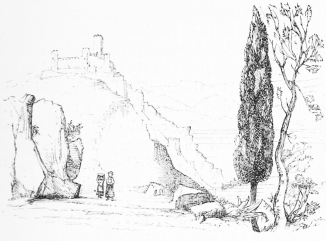
While we were at Naples, every one was full of the terrible earthquake which in December had been devastating the Basilicata. Whole towns were destroyed. It was as after a deep snow in England, which covers fields and hedges alike; you could not tell in the mass of débris whether you were walking over houses or streets. The inhabitants who escaped were utterly paralysed, and sat like Indian Brahmins with their elbows on their knees, staring in vacant despair. Hundreds were buried alive, who might have been extricated if sufficient energy had been left in the survivors. Others, buried to the middle, had the upper part of their bodies burnt off by the fire which spread from the ruined houses, and from which they were unable to escape. Thousands died afterwards from the hunger and exposure.
Whilst we were at Naples my mother lost her gold watch. We believed it to have been stolen as we were entering the Museo Borbonico, and gave notice to the police. They said they could do nothing unless we went to the King of the Thieves, who could easily get it back for us: it would be necessary to make terms with him. So a ragazaccio[129] was sent to guide us through one of the labyrinthian alleys on the hill of St. Elmo to a house where we were presented to the King of Thieves. He mentioned his terms, which we agreed to, and he then said, "If the watch has been stolen anywhere within twelve miles round Naples, you shall have it in twenty-four hours." Meanwhile the watch was found by one of the custodes of the Museo at the bottom of that bronze vase in which you are supposed to hear the roaring of the sea; my mother had been stooping down to listen, and the watch had fallen in. But the story is worth mentioning, as the subserviency of the police to the King of the Thieves was characteristic of public justice under Ferdinand II.
To my Sister.
"Sorrento, March 7, 1858.—Some people say Sorrento is the most beautiful place in the world, and I believe that even my town-loving sister, if she could gaze over the golden woods in the sunset of this evening, and see the crimson smoke float over dark Vesuvius and then drift far over the blue sea, would allow it to be more inspiring than the Piazza S. Claudio! Then to-day the mother and her three companions have been riding on donkeys to the lovely Vigna Sersale through a fringe of coronilla and myrtle, anemones and violets.... It is a comfort here to be free from the begging atmosphere of Naples, for in Sorrento people do not beg; they only propose 'mangiare maccaroni alla sua salute.'"
"April 4.—We have had a charming cruise in the 'Centaur'—the sea like glass, the view clear. Captain Clifford sent his boat to fetch us, and we sat on deck in arm-chairs, as if on land. In tiny fishing-boats, lying flat on our backs, we entered the Grotta Azurra (of Capri), like a magical cavern peopled with phantoms, each face looking livid as the boats floated over the deep blue water. Then we scrambled up to the fortress-palace of Tiberius, our ascent being enlivened by a tremendous battle between the midshipmen and the donkey-women, who finally drew their stilettos!
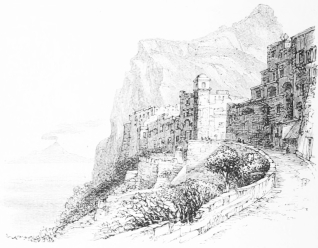
"Amalfi is most romantic and lovely. We were there ten days, and spent the mornings in drawing amongst the purple rocks and sandy bays, and the afternoons in riding up the mountain staircases to the Saracenic rock-built castles and desolate towns.
"The mother thinks I have grown dreadfully worldly under your influence, and that my love for wild-flowers is the only hopeful sign remaining!"
CAPRI.[130]
PÆSTUM.[131]"
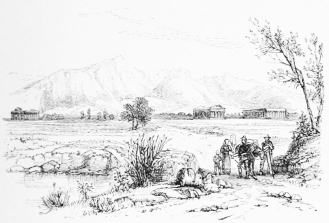
From Salerno we made a glorious expedition to Pæstum, but on our return found our servant, John Gidman, alarmingly ill in consequence of a sunstroke while fallen asleep on the balcony at Amalfi. His sufferings were dreadful, and he remained between life and death for a long time, and I believe was only eventually saved by the violent bleedings (so often inveighed against) of an Italian doctor. This delayed us long at the dull Salerno, and afterwards at La Cava, where I comforted myself by much drawing at Salvator Rosa's grotto in the valley below the old Benedictine convent.
In May our companions returned to England, and having no one but ourselves to consider, we planned to make our own northern vetturino journey as interesting as possible. I think it was a description in "Dennis" which made us take the route by Viterbo and Orvieto, but we went there and saw it with enthusiasm, as afterwards Perugia—to which we zigzagged back across the Apennines, and Cortona, where the hill was redolent with great wild yellow roses, and where I drew the tomb of S. Margherita in the monastery, to the great delight of the monks, who regaled us with snuff and wine.
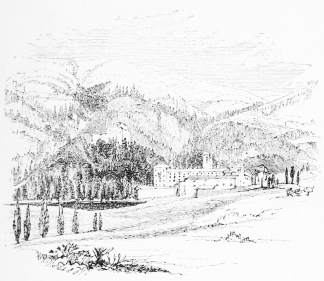
Whilst we were at Florence, living in the Casa Iandelli, I made a delightful excursion to Vallombrosa, driving in a little carriage to Pelago, and thence riding on a cart-horse up the forest-clothed mountain by the rough track which emerges on a bright green lawn, then covered with masses of lilies and columbine, and other spring flowers of every description. All around the dark forests swept down from the mountains towards the convent, where the hospitable monks entertained me with a most excellent dinner, and the abbot showed the manuscripts.
VALLOMBROSA.
On my return, I found my mother so convulsed with laughter that it was long before she was able to explain the cause of it. At last she showed me a letter in her hand, which was a violent declaration of love and proposal of marriage from one Giorgio Rovert—"bello—possidente—avocato"—who was even then waiting at Siena to know if his "fiamme d'amore" was responded to, and if he might hasten to Florence to throw himself at the feet of the object of his adoration. For some time we were utterly bewildered, but at length recollected that at Rome a young man had constantly followed the cousin who was with us, had lifted the heavy curtains for her at the entrance of the churches, found her places in a mass-book, &c., and we concluded that he must have tracked her to the Palazzo Lovati, inquired of the porter who lived there, and hearing it was "Mrs. Hare," had followed us to Florence. Lady Anne S. Giorgio coming in soon after to see us, undertook to answer the letter, and did so most capitally; but Giorgio Rovert did not break his heart, and within three weeks we heard of him as proposing to old Lady Dillon!
The Lady Anne S. Giorgio I have mentioned began at this time to fill a great part in our life. She was a Roman Catholic, and used to say that she had become so (at sixteen) on account of the poor apology which she found made for Protestantism in Robertson's "Charles V.," which she had been reading. After she was a widow, she became a member of a Tertiary Order which binds its votaries to forsake the vanities of the world, to wear a cross, and be dressed in black. She used to be very anxious for my conversion, and have special prayers to that intent on St. Augustine's Day. She read through Madame de Sévigné every year, and her library of books excited the astonishment of her poorer neighbours, who said, "O la Contessa e tanto buona; legge sempre; prega sempre; e tanto buona," for they cannot understand any one reading anything but religious books.
Lady Anne was one of the daughters of that beautiful Lady Oxford whose offspring were named "the Harleian Miscellany." Lady Oxford lived at Genoa with her daughters, leaving Lord Oxford in England, and during her Italian life had many strange adventures, and one of a most terrible kind, the story of which was related to me by Dr. Wellesley, who was present at the time, but I will omit it. Of the weird stories of the other sisters I will say nothing, but Lady Anne in her youth was engaged to a young Italian, who, with the ugly name of Boggi, was yet of a very good family. However, before they could be married, Boggi died, and the Harleys returned to England. While there, Lady Anne wished to marry her music-master, but her family would not hear of it, and by the harshness of their opposition made her life miserable. Having striven vainly for some years to win the consent of her family, Lady Anne wrote to Madame Boggi, the mother of her late betrothed, with whom she had always kept up a communication, to say that she was in wretched health and spirits, that she required change terribly, and that she was very unhappy because her family violently opposed her marriage with a very excellent young Italian—but she did not say who he was. Madame Boggi replied by saying that nothing could give her greater happiness than having her dearest Annie with her, and imploring her to come out to her at once. The Harley family consented, thinking that the change might cure Lady Anne's heartache, and she went out to Madame Boggi, who had always said that she looked upon her as a daughter because she was once engaged to her dead son.
While Lady Anne was with Madame Boggi, she heard that her Italian lover had returned to Italy to join his friends, but that he had been stopped by illness at some place in the north of Italy, and was lying in a very critical condition. I cannot say how Lady Anne persuaded Madame Boggi, but she did persuade her to consent to her going off to nurse her lover, and, unmarried girl as she was, she nursed him through all his illness. He died, but his brother, who came to him when he was dying, was so touched by Lady Anne's devotion, that he afterwards proposed to her, and she married him.
The husband of Lady Anne was only a "cavaliere." They were dreadfully poor, and lived at a little farm somewhere in the hills above Spezia, where two boys and a girl were born. But Lady Anne did not mind poverty; she fattened her chickens and pigs for market, she studied botany and all the ologies by herself, and she taught her children. After she became a widow, she heard one day that her father, Lord Oxford, from whom she had been separated from childhood, was passing through Italy, and she threw herself in his way upon the staircase in the inn at Sarzana. When he found who she was, he was delighted both with her and her children. He said, "I have done nothing for you hitherto, and I can do nothing for you after my death, for my affairs are arranged and they cannot be altered; but whatever you ask me to do now shall be granted." "Then," said Lady Anne, "you have always looked down upon me and despised me, because my husband was a simple 'cavaliere.' You are going to Rome: get me created a Countess in my own right, and then you will despise me no more." And Lord Oxford went to Rome, and, by his personal influence with the Pope, to whom he had great opportunities of being useful, his daughter Anne was created a Countess in her own right, and her sons became titular Counts and her daughter a Countess.
It was in this summer of 1858, while we were at Florence, that Lady Anne came to "Italima" (for she had known my father intimately in her palmy days) and said, "You know how I have lived like a hermit in my 'tenuto,' and meanwhile here is Carolina grown up, and Carolina must marry somebody, and that somebody you must find, for you are almost the only person I know." And, to her surprise, Italima was able to answer, "It is really very odd, but Mrs. de Selby, the cousin of the Princesses Doria and Borghese, was here this morning, and she said, 'Here is Roberto, and I want to find somebody for him to marry. I do not want a fortune, we have plenty of money, but it must be a girl of good family, and if she is partly English so much the better.'"
We went to the betrothal dinner of Robert Selby and Carolina di S. Giorgio, and afterwards we ran about the Torrigiani gardens in the still summer evening, and made round our straw hats wreaths of the fireflies, which, when they are once fixed, seldom fly away. Carolina was afterwards a great friend of ours, and most entertaining and clever. She could imitate an old priest scolding and taking snuff so exactly, that if you shut your eyes you thought one must be in the room; and she used to create for herself little dramas and tragedies, in which she was as pathetic as she was at other times comic. As a mother she was most unfortunate. Several of her children were poisoned by eating "fungi" at a trattoria outside the Porta del Popolo, and she herself nearly died from the same cause. After Robert Selby's death she married again, and went to live at Leghorn.
I was very sorry afterwards that during this visit we never saw Mrs. Browning, who died in 1861, before we were at Florence again. We used to hear much of her—of her peculiar appearance, with her long curls, and (from illness) her head always on one side; of the infinite charm of her conversation; of her interest in spiritualism; how she would endeavour to assert her belief in it in her little feeble voice, upon which Browning would descend in his loud tones; but they were perfectly devoted to each other.
Another person whom we often saw at Florence was the foolish wife of our dear old Landor, who never ceased to describe with fury his passionate altercations with her, chiefly caused apparently by jealousy. Landor was still living at Bath at this time.
In the Cascine at Florence we found the same old flower-woman who had been there when I was a baby in the Prato, where I was taught to walk. She used to drive to the Cascine with her flowers in a smart carriage with a pair of horses, and would smile and kiss her hands to us as we passed. It was contrary to good Florentine manners not to accept the flowers which she offered to every one she saw when she arrived where the carriages were waiting, but they were never paid for at the time; only a present was sent occasionally, or given by foreigners when they left Florence, and she came to the station to see them off and present a farewell bouquet. I merely mention these customs because they are probably dying out, perhaps are already extinct.
My cousin Lady Normanby was at this time resident in her beautiful Florentine villa, with its lovely garden of roses and view over Florence, and she was very kind to us.
We were at Florence this year during the festival of Corpus Domini, and saw that curious procession, chiefly consisting of little boys in white dominos, and brown monks and brothers of the Misericordia; but, following the Archbishop under his canopy, came the Grand Duke on foot, with all the male members of the Corsini and Guicciardini families, and the young Archdukes in white satin trains.
We saw also the Foundling Hospital, where all the children were brought up and nursed by goats, and where, when the children cried, the goats ran and gave them suck.
About the 10th of June we settled at Lucca baths, in the pleasant little Casa Bertini, a primitive house more like a farm-house than a villa, on the steep hillside above the Grand Duke's palace, possessing a charming little garden of oleanders and apple-trees at the back, with views down into the gorge of the river, and up into the hilly cornfields, which were always open to us. Very delightful were the early mornings, when the mother, with book and camp-stool, wandered up the hill-path, fringed with flowers, to the Bagni Caldi. Charming too the evenings, when, after "merenda" at four o'clock in the garden, we used to go forth, with all the little society, in carriages or on horseback, till the heavy dews fell, and drove us in by the light of the fireflies. A most pleasant circle surrounded us. Close by, in a large cool villa with a fountain, was the gentle invalid Mrs. Greville (née Locke), singing and composing music, with her pleasant companion Miss Rowland. Just below, in the hotel of the villa, "Auntie" was living with the George Cavendishes, and in the street by the river the pretty widow, Mrs. Francis Colegrave, with her children, Howard and Florence, and her sister Miss Chichester.
An amusing member of the society at the Bagni, living in a cottage full of curiosities, was Mrs. Stisted, the original of Mrs. Ricketts in "The Daltons." She had set her heart upon converting the Duke of Parma to Protestantism, and he often condescended to controversy with her. One day she thought she had really succeeded, but driving into Lucca town next day, to her horror she met him walking bare-headed in a procession with a lighted candle in his hand. Then and there she stopped her carriage and began to upbraid him. When he returned to the Bagni, he went to see her and to reprove her. "There cannot," he said, "be two sovereigns at Lucca; either I must be Duke or you must be Queen," and ever after she was called the Queen of the Bagni. Colonel Stisted had a number of curious autographs, the most interesting being the MS. of the "Lines to an Indian air"—"I rise from dreams of thee"—found in the pocket of Shelley after he was drowned.
Living beneath us all this summer were the Grand Ducal family, and we saw them constantly. They were greatly beloved, but the Grand Duchess-Dowager, who was a Sardinian princess, was more popular than the reigning Grand Duchess, who was a Neapolitan Bourbon, and ultimately brought about the ruin of the family by her influence. The Grand Duchess-Dowager was the step-mother of the Grand Duke, and also his sister-in-law, having been sister-in-law of his first wife. The Hereditary Grand Duke was married to her niece, a lovely Saxon princess, who died soon afterwards: it was said that he treated her very ill, and that his younger brother protected her. We were at a very pretty ball which was given on the festa of S. Anna, her patroness. The Grand Ducal family generally went out at the same hour as ourselves. In the middle of the day nothing stirred except the scorpions, which were a constant terror. One was found in my bath in the morning, and all that day we were in fearful expectation, as the creatures never go about singly; but in the evening we met the companion coming upstairs. There were also quantities of serpents, which in the evening used frequently to be seen crossing the road in a body going down to the river to drink.
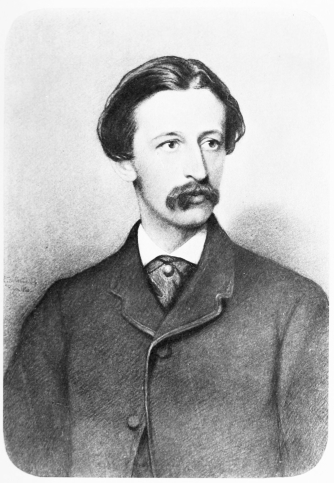
Augustus J. C. Hare. From a portrait by Canevari.
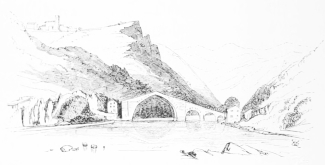
PONTE ALLA MADDALENA, LUCCA.[132]
Every Friday afternoon we had a reception in our hill-set garden, and our maid Quintilia set out tea and fruit, &c., in the summer-house. At the gate a basket was held, into which every one dropped a story as they entered, and they were all read aloud after tea. One day, one of these stories, a squib on Ultra-Protestants written by the younger Miss Cavendish, led to a great fracas with the George Cavendishes, Admiral and Mrs. Cavendish being perfectly furious with my gentle mother, who of all people was the most innocent, as she could not have an idea of what was in the stories till they were read aloud. Well do I remember coming round the corner of the villa, and finding the Admiral storming at her as she sat upon her donkey, with "My daughters shall never enter your house again—they shall never enter it again!" and her sweet smile as she replied, "Then, Admiral Cavendish, I have only to thank you so very much for having so often allowed them to come to me hitherto,"—and the Admiral's subdued look afterwards.
There was a little school established by the Grand Duchess just below us, whither my mother sometimes went in the mornings. The children were taught Scripture dialogues. One little girl would say to another, "Oh, cara mia, cara amica mia, I have such a wonderful thing to tell you," and then would narrate how a babe was born in Bethlehem, &c., upon which the hearer would exclaim, "O Gran Dio" in her amazement, and on one occasion, with a cry of "O cielo!" pretended to faint away with astonishment in the most natural way imaginable.
A long excursion from Lucca was that to Galicano, where a hermit with a reputation of great sanctity was living under an overhanging cliff in the mountains. He hid himself on our approach, but our large party hunted him, and eventually unearthed him—an old dirty man in a brown gown, with a chain of huge beads at his girdle. We wanted to see the miraculous image of which he was guardian, but he would not show it unless we were Catholics, and was much puzzled by my protesting that we were, and my mother that we were not. However, at last he consented to exhibit it, on condition that we all knelt, and that the ladies took off their bonnets. We returned home much later than was expected, and so, as we found afterwards, escaped seven bandits, who had been lying in wait for us, and at last gave us up. The whole of the road from Lucca to Galicano had then black crosses at intervals, commemorating the murders committed there.
This summer at Lucca was altogether the greatest halt in my life I have ever known. We seemed so removed from the world, and I was more free from family snubbings than I had ever been before. But, all through the time we were there, I had been far from well, and the doctor who was consulted declared that I could not survive the severities of an English winter. In spite of this, my mother never flinched in her determination to return, for having once taken the impression (without the remotest reason) that I had a tendency to Roman Catholicism, she had a far greater terror of what she considered as danger to my soul than of any danger to my body.
When we left the Bagni di Lucca on the 2nd of August, I left it in despair. Behind us was a quiet, peaceful, and a far from useless life, encircled by troops of friends, and supplying the literary and artistic occupations in which I began to feel that I might possibly in time be able to distinguish myself. Before me was the weary monotony of Hurstmonceaux, only broken by visits from or to relations, by most of whom I was disliked and slighted, if not positively ill-treated. I also felt sure that all the influence of my aunts would be used with my easily guided mother to force upon me the most uncongenial of employments, which she was only too certain to allow them to advocate as "especially desirable for Augustus, because they were uncongenial!" I was at this time also in more than usual disgrace, because disgust at the sham Christians, sham Evangelicals, sham Protestants, with whom for years I had been thrown, had induced me to avow my horror of Ordination. In every way I felt myself unfitted for it. I wrote at this time—"'Some fell upon stony places, where they had not much earth: and forthwith they sprung up, because they had no depth of earth: and when the sun was up, they were scorched; and, because they had no root, they withered away.' If you want to know about my past religious 'impressions,' that is just my story." Still the declaration of my determination not to take Orders, dreaded and put off for years, cost me acutest suffering from the pain and disappointment which I knew it inflicted upon my mother.
When we left Casa Bertini and descended the steep hill to our carriages, we found that the whole society had been amusing themselves by dressing in mourning, and were waiting to sing "a dirge" of their own composition, as we drove away. But we had one or two more happy days. On the morning after our arrival at Lucca town, we were astonished by sounds of loud singing in the passage, and going out, found all those we had so recently parted from at the Bagni singing in chorus some more verses which they had composed as "a serenade," and bringing for us a picture of the Ponte alla Maddalena, painted on a stone out of the river. We quickly determined to spend the day in going with them to Pisa, and making an excursion to the Gombo, where the Pisan pines end in the sands by the seashore—and we did not return till midnight. It was the custom at Lucca for those who drew to make little sketches in the travellers' book at the hotel, and I had amused myself by doing one the day before, and inscribing it "View from the Walls of Lucca," though it was a wretched performance. When we came back, we found a most lovely drawing opposite, inscribed—"View from the Walls of Lucca as it really is." The Grand Duke's artist had been at the hotel in the interval.
PIETRA SANTA.[133]"
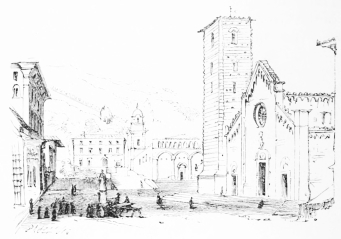
We travelled then with delicious slowness, only rolling onwards through the most glorious scenery in the cool mornings and evenings, and resting in the heat of mid-day, while, as at this time we only took our carriage from place to place, we had no scruple in halting for days at Pietra Santa, with its glorious views over the mountains, and old convents embosomed in olives and cypresses; in making excursions to Serravezza and to dismal Carrara; in lingering at La Spezia, where the avenue of oleanders was in full blaze of bloom, and driving thence to Porto Venere with its marble church and wonderful views along the cliffs—blue, green, yellow, and coral-red, descending abruptly into the sea.
To my Aunt Eleanor Paul.
"Lucca, August 3, 1858.—Once upon a time there was a lady advanced in years, who had an only child. They were sick and sorrowful, and the tempests of the world beat upon them. Driven from home, they wandered hither and thither, seeking rest and finding none, till at length one day they arrived, wearied and wayworn, at the entrance of a mountain valley. 'Alas!' they whispered, 'what place is this?'—'Take courage,' answered the trees and fountains; 'rejoice,' shouted the flowers, 'for this is the Happy Valley, where those who enter rest from all sickness and trouble: this is the place where people may have a halt in life, and where care and anxiety do not exist.' And when they heard these words, the countenances of the weary lady and her son were glad, and the flowers and the trees and the fountains laughed and shouted for joy in the ceaseless golden sunshine. For two months the strangers rested in the Happy Valley, and then once more the tempest howled to receive them, and the voices of the unseen sternly bade them depart; and slowly and sadly they arose, and went out again into the wilderness, where every solitary flower, every mountain and stream, seemed only an echo from a lost and beautiful past.
"Oh, my auntie, do you know who the mother and son were, and what was the Happy Valley to which they looked back with so much loving regret?"
"La Spezia, August 8.—We have been to Carrara. Do you know, my auntie, that once upon a time there lived in the mountains of Carrara a race of funny little people called Fanticelle? They were the hobgoblins of the marble rocks, and were very merry, very useful, and highly respected by every one. Each marble had its own Fante; one was dressed in red, another in yellow, and others in stripes of various colours; but the Fante of the white marble wore only a simple dress as white as snow, and was greatly despised in consequence by her companions, who were so fashionably attired. Daily the poor white Fante was snubbed and insulted, and at last, when the ancient Romans came to make quarries, and cut and hacked her to pieces, and carried her remains away in carts, all the other Fanti smiled in their cold satire and said, 'It only served the vulgar creature right, for she did not even know how to dress herself, and sitting upon the mountain with nothing on but her night-dress was really quite indecorous.'
"But when some years had passed, the great guardian spirit came to the mountains, and, stretching forth his wings, he gathered all the Fanti beneath them, and said, 'Now, my children, you shall go forth to see the world, and, when you return, you shall each say what is most highly esteemed by the lovers of art, and what it is that the children of men consider most beautiful and best.'
"Thus the Fanti of Carrara flew forth to see the world! They alighted first in the square at Genoa. All around were huge and stately palaces, and in the centre the statue of a hero, with the world lying captive at his feet. But what the Fanti remarked most was that in the most magnificent chambers of every palace, and even upon the statue of the great Columbus himself, sat the semblance of their despised sister the white Fante, as if enshrined and honoured. 'Alas!' exclaimed the Fanti, 'what degraded notions have these Genoese; let us examine places better worth our notice.' So they came to Spain, and visited the Alhambra, but in every court, and even on the Fountain of Lions itself, they found the image of the white Fante seated before them. Thence they passed on to London, to Paris, to Berlin, to Vienna, but it was ever the same. In every gallery of statues, over the hearth of every palace, upon the altar of every church, it seemed as if the white Fante was reigning. 'Ah,' they exclaimed, 'can all men be thus degraded? can all good taste be banished from the earth? Let us see one more city nearer home, and from that let us form our judgment, for the inhabitants of these northern cities are not worthy to be ranked with mankind.'
"So the Fanti came to Milan, and beneath the wings of the great guardian spirit, rejoicing in their approaching triumph, they entered its vast square. And behold the spirit drew back his wings, and they beheld a mighty and an awful vision! Before them stood their sister, the Fante of the milk-white rocks, but no longer humble, no longer to be restrained even within the bounds of the greatest palace upon earth. Majestic in beauty, invincible in power, she raised her mighty wings to heaven in the aisles of a vast cathedral, and mounted higher and higher as by an aërial staircase, till, far above all human things, she flung her snow-white tresses into the azure sky!
"Then the Fanti of the coloured robes bowed their heads and trembled, and acknowledged in penitence and humility—'Truly the Fante of the white rocks is the most beautiful thing in the world!'
"Who can go to Carrara, my auntie, and not feel this?"
We were for a few days at Turin. The society there was then, as it is still, the very climax of stagnation. One of its most admired ornaments was a beautiful young Contessa la Marmora. She did nothing all day, absolutely nothing, but sit looking pretty, with her chin leaning on her hand. Her mother-in-law was rather more energetic than herself, and hoping to rouse her, left a new "Journal des Modes" upon her table. Some days after, she asked what she thought of it. "Alas!" said the young Countess, with her beautiful head still leaning upon her hand, "I have been so much occupied, that I never have found time to look into it." In all my acquaintance since with Italian ladies, I have always found the same, that they are all intensely occupied, but that it is in doing—nothing!
Since the dreadful epidemic at court, which swept away at once the Queen, the Queen-Dowager, and the Duke of Genoa, the King had never received, and as his eldest daughter, Madame Clotilde, was not old enough to do so, there were no court parties. At the opera all the young ladies sat facing the stage, and the old ladies away from it; but when the ballet began there was a general change; the old ladies moved to the front, and the young ones went behind.
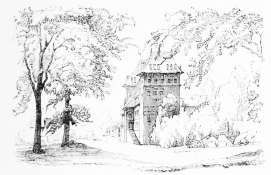
IL VALENTINO, TURIN.[134]"
A great contrast to the Italians at Turin was Mr. Ruskin, whom we saw constantly. He was sitting all day upon a scaffold in the gallery, copying bits of the great picture by Paul Veronese. My mother was very proud of my drawings at this time, and gave them to him to look at. He examined them all very carefully and said nothing for some time. At last he pointed out one of the cathedral at Perugia as "the least bad of a very poor collection." One day in the gallery, I asked him to give me some advice. He said, "Watch me." He then looked at the flounce in the dress of a maid of honour of the Queen of Sheba for five minutes, and then he painted one thread: he looked for another five minutes, and then he painted another thread.[135] At the rate at which he was working he might hope to paint the whole dress in ten years: but it was a lesson as to examining what one drew well before drawing it. I said to him, "Do you admire all Paul Veronese's works as you do this?" He answered, "I merely think that Paul Veronese was ordained by Almighty God to be an archangel, neither more nor less; for it was not only that he knew how to cover yards of canvas with noble figures and exquisite colouring, it was that it was all right. If you look at other pictures in this gallery, or any gallery, you will find mistakes, corrected perhaps, but mistakes of every form and kind; but Paul Veronese had such perfect knowledge, he never made mistakes."
The Charles Bunsens were at Turin, and we dined with them. With Mrs. C. Bunsen was her brother, whom we thought a very dull, heavy young man. Long afterwards he became very well known as the French Ambassador, Waddington.
We saw Mr. Ruskin again several times in the Vaudois, whither we went from Turin, and stayed for several days at La Tour, riding on donkeys to the wild scene of the Waldensian battle in the valley of Angrogna, and jolting in a carriage to the beautiful villages of Villar and Bobbio—"une vraie penitence," as our driver expressed it, though the scenery is lovely. My mother was charmed to find an old woman at La Tour who had known Oberlin very well and had lived in his parish.
VILLAR, IN THE VAUDOIS.[136]"
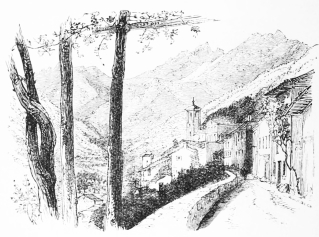
Amongst the endless little out-of-the-way excursions which my mother, Lea, and I have made together in little chars-à-banc, one of those I remember with greatest pleasure is that from Vergogna up the Val Anzasca. The scenery was magnificent: such a deep gorge, with purple rocks breaking through the rich woods, and range upon range of distant mountains, with the snows of Monte Rosa closing them in. We stayed at a charming little mountain inn at Ponte Grande, where everything was extraordinarily cheap, and wandered in the meadows filled with globe-ranunculus and over-shadowed by huge chestnut-trees. In the evening the charcoal-burners came down from the mountains, where we had watched the smoke of the fires all day amongst the woods, and serenaded us under our windows, singing in parts, with magnificent voices, most effective in the still night. We were afterwards at Domo d'Ossola for a Sunday for the extraordinary fête of the imaginary Santa Filomena—kept all day with frantic enthusiasm, cannons firing, bells ringing, and processions of girls in white, chaunting as they walked, pouring in from all the country parishes in the neighbourhood.
To Mrs. Hare (Italima).
"Lausanne, Sept. 3, 1858.—At Martigny we found Galignani, which we had not seen for some days, and you will imagine my distress at the sad news about Mr. Landor with which they were filled.[137] Dear Mr. Landor! I had always hoped and intended to be near him and watch over the last years of this old, old friend. I feel certain that there is much, which the world does not know, to be said on his side. I have known Mrs. Y. for years ... and always prophesied that she would be the ruin of Mr. Landor some day. For the poems, no excuse can be offered except that he was so imbued with the spirit of the classical authors, that when he wished to write against Mrs. Y., he thought, 'How would Horace have written this?' and wrote accordingly, only that Horace would have said things a great deal worse.
'Some thought far worse of him, and judged him wrong; But verse was what he had been wedded to, And his own mind did like a tempest strong Come to him thus, and drove the weary wight along.'[138]
Whatever his faults are, I am sure you will feel that we who have known him well must draw a veil for ourselves over the failings of his old age, and remember only the many kind words of the dear old man, so tender in heart and so fastidious in taste, the many good and generous acts of his long life, and how many they are.
"How much we have been struck with the pale blue of the Swiss lakes compared with the deep blue of those of Italy."
To my Aunt, Eleanor Paul.
"Dijon, Sept. 12, 1858.—We found Fribourg quite up to our expectations, quite worth coming all the way round by Switzerland to visit. And the organ, how magnificent it is! We went in the evening to hear it, when all the beautiful gothic church was wrapped in darkness, except the solitary gleam of light in the organ-loft, and we all sat long in breathless expectation. When the music came, it was like a story. One seemed to be sitting far up the nave of some great cathedral, and to hear from the distant choir the choristers chaunting a litany, answering one another, and then swelling and joining in a universal chorus. Then, while they were singing, it was as if a great storm arose, the hail rattled and the rain splashed against the windows, the thunder crashed overhead, and the wind howled around. And then a mighty earthquake convulsed and shook the church to its very foundations. But always, in the pauses of the storm, the sweet silvery voices of the choristers were heard above the roaring of the elements, and when the storm subsided, they joined in thanksgiving, which died away in the faint echoes of the surrounding hills. And all this was the organ!
"We came by Morat to Neuchâtel. It is a pretty, though not a striking place; but the view of the vast mass of Mont Blanc and of all the Oberland Alps in the rose-coloured glow is magnificent. The mother made inquiries after many old acquaintances,[139] to find most of them dead, and those who were still living old, old ladies of ninety and of one hundred.
"Did you ever hear of Doubs? We came through it yesterday, and it certainly seemed to us the most melancholy, ill-fated village we had ever seen. Some time ago there lived there a boy, whose stepmother was very cruel to him—so cruel that his whole aim and object in life was to obtain money enough to set up for himself and escape from her tyranny. At last he succeeded, and leaving his father's house with his heart full of bitterness, he invested his savings in a partnership with the owner of the village café, where he kept the accounts. One day his partner accused him of not giving him a fair share of the profits. This made him perfectly frantic—so furious that he determined to avenge himself by nothing less than the total destruction of his native place! He began by setting fire to his café, but the alarm was scarcely given when it was discovered that almost every other house was in flames. The inhabitants hurried from their beds, and were barely able to save themselves, their houses, cattle, and goods perishing at one blow. Only a few houses and the church escaped, in which the fugitives took refuge, and were beginning to collect their energies, when, after ten days, the fire broke out again in the night, and the rest of the village was consumed with all it contained, including a child of four years old. Between the two fires cholera had broken out, so that numbers perished from pestilence as well as exposure. The author of all the misery was taken and transported, but the town is only now beginning to rise again from its ruins, and the people to raise their spirits."
On reaching Paris, we found Italima and my sister at the Hôtel d'Oxford et Cambridge. Greatly to my relief, my mother decided that, as she was in perfect health and well supplied with visitors, it was an admirable opportunity for my remaining abroad to learn French: this I was only too thankful for, as it put off the evil day of my return to England, and encountering the family wrath about my refusal to take Orders. With my sister I spent an amusing day at Versailles on a visit to the Marquis and Marquise du Prât, the latter a daughter of the Duc de Grammont, and a very pretty, lively person. They lived in an ideal house of the ancienne régime, where the chairs, picture-frames, carpets, even the antimacassars, were carved or worked with the shields, crests, and mottoes of the family.
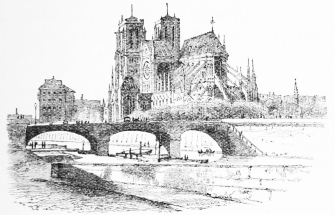
After my sister left, the intrigues of Madame Davidoff, whom, in compliance with my mother's wishes, I had refused to visit, brought about my acquaintance with the Vicomte de Costa le Cerda, a Franco-Spaniard and ardent Catholic, who constituted himself my cicerone, and amongst other places took me to séances of the Académie de France, of which he was a member; and I should have been much interested in seeing all the celebrated philosophers, politicians, physicians, geologists, &c., if I had not been so ignorant of French literature that I had scarcely heard of any one of them before. The Marquis de Gabriac[140] (I forget how his office entitled him to do so) sent me a medal which enabled me to visit all profane, and the Archbishop of Paris a permission to enter all religious, institutions. Using the latter, I went with De Costa to the Benedictines, Ursulines, Carmelites, Petites Sœurs des Pauvres, and the Œuvre de la Compassion for bringing up little homeless boys. On Sundays I heard Père Félix, the philosophic Bourdaloue of the nineteenth century, preach with his musical voice to vast enthralled audiences in Nôtre Dame.[141]
NOTRE DAME, PARIS.[142]"
Capital were the French lessons I received from the excellent M. Nyon, to whom I have always felt indebted. After Italima left Paris, I lodged with a Madame Barraud, who rented a small apartment at the back of a court in the Rue des Saints-Pères. Here my wretched little room looked out upon a blank wall, and was as thoroughly uncomfortable as it was possible to be. The weather soon became bitterly cold, and, to prevent being starved, I had to sit almost all day in the one poor uncarpeted sitting-room with old Madame Barraud herself, who was a most extraordinary character. Without the slightest apparent reason, a sudden suspicion would seize her, and she would rush off to the kitchen. In another minute she would return, wringing her hands, and would fling herself down in a chair with—"Oh, que je suis malheureuse! Oh, que je suis malheureuse! C'est une fille abominable cette Marie—cette tortue! elle ne sait pas le service du tout," and then, before she had time to take breath, she would run off to investigate the causes of a fresh noise in the kitchen. You were never safe from her. Every moment that old woman would dart in like a whirlwind, just to wipe off one speck of dust she had discovered on the mirror, or to smooth some crease she suspected in the tablecloth; and almost before you could look up she was vanishing with her eternal refrain of "que je suis misérable! que je suis malheureuse!"
The one subject of discussion till twelve o'clock was the déjeûner, from twelve to six the dinner, and after that the déjeûner of the next morning. Matters, however, were rather improved when Mademoiselle Barraud was at home—a thoroughly sensible, sterling person, who was generally absent on professional duties, being one of the first music-mistresses of the day. Sometimes Madame and Mademoiselle had friends in the evening, when it was amusing to see specimens of the better sort of third-class Parisians.
I made very few friends at Paris, but the persons I saw oftenest were the Marquise du Pregnier and her old mother, who remembered the Reign of Terror and had lost both her parents by the guillotine. Occasionally I went in the evening to the salon of Madame Mohl, wife of Julius Mohl, the great Orientalist, but herself an Englishwoman, who had in early life been intimate with Chateaubriand and present at his touching last hours, when his friend Madame Recamier, beautiful to the end, sat watching him with her blind eyes. Madame Mohl was a most extraordinary-looking person, like a poodle, with frizzled hair hanging down over her face and very short skirts. Her salon, at 120 Rue de Bac, especially on Friday evenings, was at that time quite one of the social features of Paris. One savant used to drop in after the other and sit round her talking in a circle, and with a finesse d'esprit all her own, she would address each in turn in her quick sharp voice, always saying something pungent or clever. Politics were the chief topic, and though I remember Madame Mohl once saying that "political society was not what could be called a nourishing occupation," there were no refreshments, however late the company stayed, but tea and biscuits. She had always had a sort of salon, even when, as Miss Clarke, she lived with her old mother in a very small apartment in the Abbaye-aux-Bois. Ticknor speaks of her there as keeping a little bureau d'esprit all her own, à la française.
One night when I was shown into her salon, I found, to my horror, that I was not only the first to arrive, but that the old lady was so engrossed in administering a violent scolding to her husband, that she was promenading the drawing-room half undressed, with her strange locks still in curl-papers. It was a most ridiculous scene, and my premature appearance not a little embarrassing to them both. I retreated into the passage till Madame Mohl was "done up," though that operation was not accomplished till many other guests had arrived.
M. Julius Mohl was the greatest contrast to his quicksilver wife. He used to be called "le bourru bienfaisant," from his rough exterior and genuine kindness of heart. He was really ten years younger than his wife, though she considered sixty-eight the right age for a woman to attain to, and never to her last day allowed that she had passed that limit.
Madame Mohl was fond of describing how, when she was at Paris in her childhood, her elder sister, Mrs. Frewen, was taken by their mother and grandmother to the chapel royal at the Tuileries, where Marie Antoinette was then living in a kind of half-captivity. She was a very little girl, and a gendarme thought she would be crushed, and lifted her upon his shoulders, on which she was just opposite the King and Queen. She remembered, as in a picture, how on one side of them were first Madame Royale, then Madame Elizabeth, then the little Dauphin.
The cause which led to Mrs. Frewen seeing Marie Antoinette at that time was in itself very curious. She was returning from the south with her mother (Mrs. Clarke) and her grandmother. They reached Bordeaux, where they were to embark for England in a "smack." Their luggage was already on board; but, on the night before starting, the grandmother had a vivid dream that the smack was lost with all on board. In the morning she declared that nothing on earth should induce her to go in it. The daughter remonstrated vigorously about expense, but the old lady stood firm. They were able to take off their smaller things, but all their larger luggage had to be left. The smack went down on the Goodwin Sands and all was lost; so the family came to Paris.[143]
Of all the evenings I spent at Paris, the most interesting was one with the Archbishop, who kindly invited me to his old country château of Issy, once a palace of the Prince de Condé, and very magnificent. The Archbishop, however, only inhabited the porter's lodge, and all the rest was left deserted. The Archbishop was playing at bagatelle with his chaplains when we entered, upon which he seated himself opposite to us (De Costa went with me) in an arm-chair. He was a fine old man with grey hair, dressed in cardinal's robes and crimson stockings, with the chain of a Grand Almoner of France round his neck. There was only one light in the high dark room, a lamp close to his shoulder, which threw a most picturesque light over him, like a Rembrandt portrait. He inquired about my visits to the different "religious" in Paris, and spoke regretfully of the difficulties encountered by the Petites Sœurs des Pauvres. Then he talked to De Costa about his medical studies and about phrenology. This led him to the great Napoleon, of whose habits he gave a very curious account. He said that he believed his strange phrenological development was caused by his extraordinary way of feeding—that he never was known to take a regular meal, but that he had a spit on which a chicken was always roasting at a slow fire, and that whenever he felt inclined he took a slice. When demolished, the chicken was instantly replaced. It was the same with sleep: he never went to bed at regular hours, only when he felt sleepy. We had been warned that the Archbishop himself went to bed at nine, as he always rose at four; so at nine I got up and kissed his ring, as we always did then to the cardinals at Rome, but the kind old man insisted on coming out after us into the passage, and seeing that we were well wrapped up in our greatcoats.
In October, Aunt Kitty (Mrs. Stanley) came for a few days to Paris, and going about with Arthur Stanley was a great pleasure.
To MY MOTHER.
"Paris, Oct. 19, 1858.—I have been much disturbed by my dearest mother's writing twice to Aunt Kitty to urge upon me the duty of instantly deciding upon some situation. It seems so useless to make oneself miserable in the interval because situations and professions do not drop from the clouds whenever one chooses to call for them. You know how I have dreaded the return to England, simply because I knew how wearing the family onslaught would be directly I arrived, and that all peace would be at an end, and it certainly was not likely to mend matters to write to complain to the Stanleys of how grievously I had disappointed you, and that therefore I must decide instantly! If my mother will consider, she will see that it is no question of exerting oneself. I know exactly what there is to be had and what there is not, and we both know how extremely improbable it is that I could get anything without some knowledge of modern languages, at least of French. This therefore is evidently the first point, and whilst one is employed all day long in struggling and striving to attain it, is it not rather hard to see letters from England about waste of time, want of effort, &c.?
"Were I to take an office in London now, the pay might possibly be as much as £60 a year, without any vacation, or any hope of advance in life, and even in the most miserable lodgings it would be difficult to live in London under £200 a year. However, if my mother hears of anything which she wishes me to take, I will certainly take it.
THE PONT NEUF, PARIS.[144]"
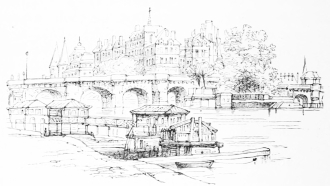
"Aunt Kitty has been very kind, and I have enjoyed going about with Arthur. Yesterday we went to the Conciergerie, where, by help of the Archbishop's letter and an order from the Préfecture of Police, we contrived to gain admittance. It is in the centre of Louis the Ninth's palace, of which it was once the dungeon, and has been very little altered. The room in which Marie Antoinette was confined for two months before her execution has scarcely been changed at all. There are still the heavy barred doors, the brick floor, the cold damp smell, the crucifix which hung before the window and kneeling before which she received the viaticum, the place where the bed stood, upon which the Queen could not lie down without being watched by the guards—who never took their eyes off—from the wicket opposite. Opening out of the Queen's prison is the small narrow chamber in which Robespierre was confined for one day, but where he never slept—brought there at eight, tried at eleven, executed at four. This opens into a large room, now the chapel, once the prison of Madame Elizabeth, and afterwards the place in which the Girondists held their last dreadful banquet before execution, when they sang the Marseillaise around the dead man on the table, and are said to have composed 'Mourir pour la Patrie.'
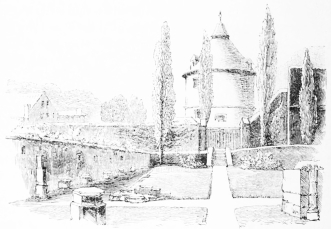
"To-day Arthur and I went by rail to Versailles, and took a little carriage thence to Port Royal. The country was lovely, the forest red and golden with autumnal tints. In a wooded valley, with a green lawn winding through it like a river, watered by a little brooklet, are the remains of Port Royal, the farmhouse where Racine and Pascal lived and wrote, the dovecot and fountain of Mère Angélique, the ruins of the church, the cemetery and cross, and 'the Solitude' where the nuns sat in solemn council around a crucifix in the middle of the woods. In the house is a collection of old pictures of the celebrities connected with the place. Arthur, of course, peopled the whole place in imagination and description with the figures of the past, and insisted on our 'walking in procession' (of two) down the ruined church.
"We went on to Dampierre, a fine old château of the Duc de Luynes, with green drives and avenues; and then to Chevreuse, where we climbed up the hill to the ruined castle with machicolated towers and a wide view over the orange-coloured woods, where the famous Madame de Chevreuse lived."
PORT ROYAL.[145]"
"Nov. 8.—The cold is almost insupportable! Parisians are so accustomed to their horrible climate, that Madame Barraud cannot understand my feeling it, and I have great difficulty in getting even the one little fire we have, and am occupied all day in shutting the doors, which every one else makes a point of leaving open. Madame Barraud describes her own character exactly when she stands in the middle of the room and says with a tragic voice, 'Je suis juste, Monsieur, je suis bonne; mais, Monsieur, je suis sévère!' She is excellent and generous on all great occasions, but I never knew any one who had such a power of making people uncomfortable by petty grievances and incessant fidgetting. Though she will give me fifty times more food than I wish, nothing on earth would induce her to light the fire in my bedroom, even in the most ferocious weather, because it is not 'son habitude'. 'La bonne Providence m'a donné un caractère,' she said the other day, recounting her history. 'Avec ce caractère j'ai fait un mariage de convenance avec M. Barraud: avec ce caractère, étant veuve, j'ai pris ma petite fille de douze ans, et je suis venue à Paris pour faire jouer son talent: avec ce caractère, quand les fils de mon mari m'ont fait des mauvaises tournées, je n'ai rien dit, mais je les ai quittés pour toujours, parceque je n'ai pas voulu voir le nom de mon mari paraître dans des querelles: je suis bonne, Monsieur, je suis juste, c'est ma nature; mais, Monsieur, je suis sévère; et je ne les reverrais jamais.' Just now she is possessed with the idea—solely based upon her having a new pair of shoes—that Marie, the maid, certainly has a lover concealed somewhere, and she constantly goes to look for him under the kitchen-table, in the cupboard, &c. She hangs up the chicken or goose for the next day's dinner in the little passage leading to my room, and in the middle of the night I hear stealthy footsteps, and a murmur of 'Oh, qu'il est gras! Oh, qu'il sera délicieux!' as she pats it and feels it all over."
At the end of November I returned to England. Two years after, when we were in Paris on our way to Italy, I went to the Rue des Saints-Pères. Madame Barraud was dead then, and her daughter, left alone, was lamenting her so bitterly that she was quite unable to attend to her work, and sat all day in tears. She never rallied. When I inquired, as we returned through Paris, Mademoiselle Barraud had followed her mother to the grave; constantly as she had been scolded by her, wearisome as her life seemed to have been made, the grief for her loss had literally broken her heart.
During the winter we were absent at Rome, our house of Lime was lent to Aunt Esther (Mrs. Julius Hare) and Mrs. Alexander. Two cabinets contained all our family MSS., which Aunt Esther knew that I valued beyond everything else. Therefore, she forced both the cabinets open and destroyed the whole—all Lady Jones's journals and letters from India, all Bishop Shipley's letters—every letter, in fact, relating to any member of the Hare family. She replaced the letters to my adopted mother from the members of her own family in the front of the cabinets, and thus the fact they had nothing behind them was never discovered till we left Hurstmonceaux, two years after. When asked about it, Aunt Esther only said, "Yes, I did it: I saw fit to destroy them." It was a strange and lasting legacy of injustice to bequeath, and I think I cannot be harsh in saying that only a very peculiar temperament could construe such an act into "right-doing."
IX WORK IN SOUTHERN COUNTIES
"How can a man learn to know himself? By reflection never, only by action. In the measure in which thou seekest to do thy duty shalt thou know what is in thee. But what is one's duty? The demand of the hour."—GOETHE.
"Il est donné, de nos jours, à un bien petit nombre, même parmi les plus délicats et ceux qui les apprécient le mieux, de recueillir, d'ordonner sa vie selon ses admirations et selon ses goûts, avec suite, avec noblesse."—Sainte-Beuve.
"Every man has a separate calling, an end peculiar to himself."—Frederick Schlegel.
"The old lord-treasurer Burleigh, if any one came to the Lords of the Council for a licence to travel, he would first examine him of England: if he found him ignorant, he would bid him stay at home and know his own country first."—HENRY PEACHAM, 1622, The Compleat Gentleman.
UPON returning to England in the winter of 1858, I felt more bitterly that ever the want of sympathy which had formerly oppressed me. Though I had the most idolatrous love for my dearest mother, and the most over-anxious wish to please her, there was then none of the perfect friendship between us, the easy interchange of every thought, which there was in later years; for she was still so entirely governed by her sisters-in-law as scarcely to have any individuality of her own. Often, often, did she pain me bitterly by suspecting my motives and questioning my actions, even when I was most desirous of doing right; and from the long habit of being told that I was idle and ignorant, that I cared for nothing useful, and that I frittered away my life, she had grown to believe it, and constantly assumed that it was so. Thus all my studies were embittered to me. I was quite sure that nothing I did would be appreciated, so that it never seemed worth while to do anything, and I became utterly deficient in that cheerfulness of disposition which is the most important element in all private success.
As I write this, and remember the number of delightful intimates by whom my after years have been surrounded, I find it difficult to realise that I had at this time no friends who, by mutual confidence, could help or cheer me. The best of them, Milligan, was now settled in London, being in full work in the Ecclesiastical Commission Office, and though always very kind to me, he had now fallen into a new set of acquaintances and surroundings, and had no time to bestow upon me individually. George Sheffield I seldom saw; and I had no other friends worth speaking of.
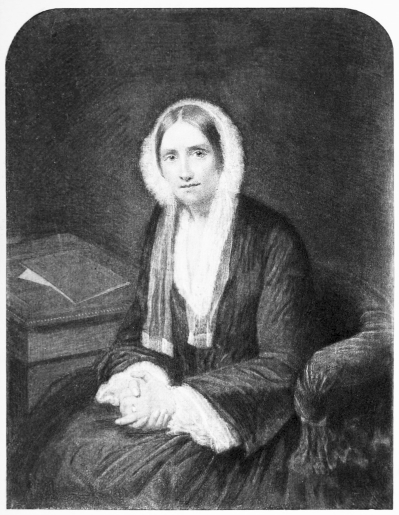
At this time all the intellectual impetus I received, and without which I should have fallen into a state of stagnation, came from the house of my aunt, Mrs. Stanley. Her grace, ease, and tact in society were unrivalled. At her house, and there alone, I met people of original ideas and liberal conversation. In this conversation, however, I was at that time far too shy to join, and I was so dreadfully afraid of my aunt, who, with the kindest intentions, had a very cold unsympathetic manner in private, that—while I always appreciated her—I was unable to reap much benefit from her society. Perhaps my chief friend was my cousin Arthur Stanley, whom I was not the least afraid of, and whom I believe to have been really fond of me at this time; also, though he had a very poor opinion of my present powers and abilities, he did not seem, like other people, utterly to despair of my future.
Catherine Stanley
By my mother's desire, Archdeacon Moore (an old friend of the Hare family) had written to Sir Antonio Panizzi,[146] then the autocratic ruler of the British Museum Library, with a view to my standing for a clerkship there. But this idea was afterwards abandoned, and it was owing to the kindness of my cousin Arthur and that of Albert Way (our connection by his marriage with Emmeline Stanley) that I obtained from John Murray, the publisher, the employment of my next two years—the "Handbook of Berks, Bucks, and Oxfordshire."
The commission to undertake this Handbook was one which I hailed with rapture. The work was in every respect welcome to me. I had an inner consciousness that I could do it well, and that while I was doing it I should be acquiring information and advancing my own neglected education. Besides, the people with whom the work would necessarily bring me in contact were just those who were most congenial. My principal residence would be Oxford, associated with some of my happiest days, and where it was now a real pleasure to be near Arthur Stanley; while, if my mother were ill or needed me in any way, there was nothing in my work which would prevent my returning to her, and continuing it at home. Above all, the fact of my having the work to do would silence the ceaseless insinuations to my mother as to my desire for an idle life of self-indulgence. I knew nothing then of the mercantile value of my labour. I did not know (and I had no one to inform me) that I was giving away the earnest work of two years for a pitiful sum,[147] which was not a tenth of its value, and which was utterly insufficient to meet its expenses.
How well I remember my first sight of John Murray, when he came to dine at the Stanleys' house in Grosvenor Crescent—his hard, dry questions, his sharp, concise note afterwards, in which he announced the terms of our hardly-driven bargain, received by me as if it had been the greatest of favours. Perhaps, however, the very character of the man I had to deal with, and the rules he enjoined as to my work, were a corrective I was much the better for at this time. The style of my writing was to be as hard, dry, and incisive as my taskmaster. It was to be a mere catalogue of facts and dates, mingled with measurements of buildings, and irritating details as to the "E. E.," "Dec.," or "Perp." architecture even of the most insignificant churches, this being the peculiar hobby of the publisher. No sentiment, no expression of opinion were ever to be allowed; all description was to be reduced to its barest bones, dusty, dead, and colourless. In fact, I was to produce a book which I knew to be utterly unreadable, though correct and useful for reference. Many a paper struggle did I have with John Murray the third—for there has been a dynasty of John Murrays in Albemarle Street—as to the retention of paragraphs I had written. I remember how this was especially the case as to my description of Redesdale, which was one of the best things I have ever done. Murray, however, was never averse to a contribution from one whose name was already distinguished either by rank or literature, and when Arthur Stanley contributed passages with his signature to my account of Oxford, they were gladly accepted, though antagonistic to all his rules.
CANON STANLEY'S HOUSE, OXFORD.
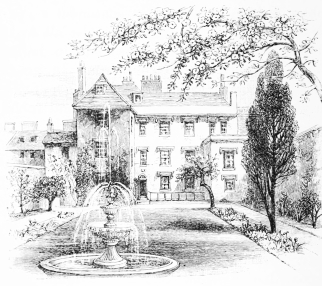
Arthur Stanley had been made Professor of Ecclesiastical History at Oxford before we had gone abroad, and, while we were absent, a Canonry at Christ Church, attached to the professorship, had fallen in to him. The Canon's house was just inside the Peckwater Gate leading into Tom Quad, and had a stiff narrow walled garden behind, planted with apple-trees, in the centre of which Arthur made a fountain. It had been a trouble to the Canon that it was almost impossible in his position to make the acquaintance he wished with the young men around him, and in this I was able to be a help to him, and in some way to return the kindness which often gave me a second home in his house for many months together. His helpless untidiness, and utter inability to look after himself, were also troubles which I could at least ameliorate. I rapidly made acquaintances in Christ Church, several of which developed into friendships, and I was only too glad to accede to Arthur's wish that I should invite them to his house, where they became his acquaintances also. Of Christ Church men at this time I became most familiar with Brownlow,[148] Le Strange,[149] Edward Stanhope,[150] Stopford,[151] Addie Hay,[152] and my second cousin, Victor Williamson.[153] A little later, at the house of Mrs. Cradock, I was introduced to "Charlie Wood."[154] I did not think that I should like him at first; but we became intimate over an excursion to Watlington and Sherborne Castle, and he has ever since been the best and dearest of my friends. Very soon in constant companionship, we drew together in the Bodleian and Christ Church libraries, we read together at home, and many were the delightful excursions we made in home scenes, forerunners of after excursions in more striking scenes abroad. We also often shared in the little feasts in Mrs. Cradock's[155] garden, where we used to amuse ourselves and others by composing and reciting verses.
I frequently left Christ Church for a week or two upon exploring raids into the counties on which I was employed, and used to bring back materials to work up in Oxford, with the help of the Bodleian and other libraries. Very early, in this time of excursions, I received an invitation (often repeated) from Jane, Viscountess Barrington, a first cousin of my real mother, to visit her at Beckett near Shrivenham. I had seen so little then of any members of my real family, that I went to Beckett with more shyness and misgivings than I have ever taken to any other place; but I soon became deeply attached to my dear cousin Lady Barrington, who began from the first to show an interest in me, which was more that of a tenderly affectionate aunt than of any more distant relation. Lord Barrington, the very type of a courteous English nobleman, was also most kind. Of their daughters, two were unmarried—Augusta, who was exceedingly handsome, brimful of very accurate information, and rather alarming on first acquaintance; and Adelaide, who was of a much brighter, gentler nature. I thought at this time, however, that Lina, Lady Somerton, was more engaging than either of her sisters. I often found her at Beckett with her children, of whom the little Nina—afterwards Countess of Clarendon—used to be put into a large china pot upon the staircase when she was naughty. Beckett was a very large luxurious house in the Tudor style, with a great hall, built by Thomas Liddell, Lady Barrington's brother. The park was rather flat, but had a pretty piece of water with swans, and a picturesque summer-house built by Inigo Jones. Much of the family fortune came from Lord Barrington's uncle, Shute Barrington, Bishop of Durham, who used to say he was the only licensed poacher in England—"I Shute, by the grace of God," &c. This old bishop, when his nephew brought his bride to visit him—a wedding visit—at Mongewell, filled all the trees with rare cockatoos and parrots, in the hope that when she heard them scream, she would think they were the native birds of that district. Lord and Lady Barrington took me, amongst other places, to see Mr. Aitkens of Kingston Lyle—"the Squire" in Tom Hughes's "Scouring of the White Horse," and also to see the creature itself, which is far more like a weasel than a horse. The kindness of Lord Barrington also secured my favourable reception at every other house in the county, and many were the visits I paid in Berkshire at places described in my Handbook.
Much kindness was also shown me by old Lady Stanley of Alderley,[156] who was often very violent, indeed quite furious, about her own opinions; but full of the most sincere interest and kindness towards me for my mother's sake. Holmwood, near Henley, whither I went several times to visit her, was an enchanting place, with luxuriant lawn and flowers, fine trees, and beautiful distant views. A succession of grandchildren always filled the house, and found it most enjoyable, the two unmarried aunts—Rianette (Maria Margaret) and Louisa—being, as one of them (Lady Airlie) has often told me, "the good fairies of their childhood." Like most Stanleys, they were peculiarly subject to what that family calls "fits of righteous indignation" with all who differed from them; but nobody minded. Having had the most interesting youth themselves, during which their uncle (afterwards Bishop Stanley) and other relations were always inventing something for their amusement, they had a special gift for interesting others, so that those who went to visit them always felt that though they received many and often unmerited scoldings, their visit could never be dull. How well I remember still Louisa Stanley's graphic imitation of many people of her long-ago—especially of old Mr. Holland, the Knutsford doctor,[157] who would come in saying, "Well, Miss Louisa, and how are we to-day? We must take a little more rubbub and magnesia; and I would eat a leetle plain pudden with a leetle shugger over it!" and then, ringing the bell, "Would you send round my hearse, if you please?"
Lady Stanley herself had been the pupil of Gibbon at Lausanne, and had much to tell of past days; and the pertinacity with which she maintained her own opinions about them and everything else, rendered her recollections very vivid and amusing. All the family, including my mother, were so dreadfully afraid of Lady Stanley, that a visit to her always partook of the nature of an adventure; but it generally turned out to be a very charming adventure, and I always look back to her with affectionate gratitude, and feel that there was a great charm in the singleness, sincerity, and freshness of her character. When I was at Holmwood, I used to engage a little carriage and go out for long excursions of eight or ten hours into the country; and when I returned just before dinner, Lady Stanley was so anxious to hear my adventures, that she would not wait till I came down, but would insist upon the whole history through the bedroom door as I was dressing.
If people were not afraid of her, Lady Stanley liked them the better for it, and she always heartily enjoyed a joke. I remember hearing how one day at Alderley she raged and stormed because the gentlemen sat longer after dinner than she liked. Old Mr. Davenport was the first to come into the drawing-room. "Well now, what have you been doing?" she exclaimed; "what can you have found to talk about to keep you so long?"—"Would you really like to know what we've been talking about, my lady?" said Mr. Davenport. "Yes indeed," she stormed. "Well," said Mr. Davenport very deliberately, "we talked first about the depression in the salt (mines), and that led us on inadvertently to pepper, and that led us to cayenne, and that, my lady, led us ... to yourself,"—and she was vastly amused. One day her maid told her that there was a regular uproar downstairs about precedence, as to which of the maids was to come in first to prayers. "Oh, that is very easily settled," said Lady Stanley; "the ugliest woman in the house must always, of course, have the precedence," and she heard no more about it.
Another house which I was frequently invited to use as a centre for my excursions was that of my father's first cousin, Penelope, Mrs. Warren, who was living in the old home of Lady Jones at Worting, near Basingstoke. It was in a most dreary, cold, wind-stricken district, and was especially selected on that account by Lady Jones, because of its extreme contrast to the India which she abominated. Internally, however, the old red-brick house was very comfortable and charming, and Mrs. Warren herself a very sweet and lovable old lady, tenderly cared for by her sons and daughters, many of whom were always about her, though only one of the latter, Anna, was unmarried. Mrs. Warren had been the eldest of the daughters of Dean Shipley, and the only one who never gave her family any trouble, and who was invariably loved and honoured by its other members. Her character through life had been that of a peacemaker, and in her old age she seemed almost glorified by the effulgence of the love which had emanated from her, no single member of the family having a recollection of her which was not connected with some kindly word or unselfish action.[158] That Lady Jones should bequeath Worting to her was felt by all the other nephews and nieces to have been most natural. "Who should it have been to, if not to Penelope?" She liked to talk of old times, and her reminiscences were most interesting. She was also very proud of her family, especially of the Mordaunts, and of our direct descent, through the Shipleys, from the youngest son of Edward I. It was on one of my early visits at Worting that I first made acquaintance with my cousin Harriet, Mrs. Thornton, niece of Mrs. Warren, and one of the daughters of Bishop Heber.[159] She described the second marriage of her mother to Count Valsamachi in the Greek church at Venice, and the fun she and her sister thought it to walk round the altar with huge wedding favours in their hands. She was full of amusing stories of India, from which she was just returned: would tell how one day she was sitting next a Rajah who was carving a pie, and when he lifted the crust a whole flock of little birds flew out—"Whir-r-r-r!" said the Rajah as they flew all over the room; how, one day, being surprised that an expected ham was not brought in to dinner, she went out and found it lying in the court, with all the native servants round it in a circle spitting at it; and how one day at the Cape she was told that a woman was bitten by a venomous snake, and going out, found her eating a toad as a remedy. One of Mrs. Thornton's stories, which I have often repeated since, is so curious as to deserve insertion here.
"M. de Sartines had been brought up by an old friend of his family who lived in Picardy. The château of his old friend was the home of his youth, and the only place where he felt sure that all his failings would be overlooked and all his fancies and wishes would be considered.
"While he was absent from France on diplomatic service, M. de Sartines heard with great grief that his old friend was dead. In losing him, he lost not only the friend who had been as a second father, but the only home which remained to him in France. He felt his loss very much—so much, indeed, that for many years he did not return to France at all, but spent his time of leave in travelling in Italy and elsewhere.
"Some years after, M. de Sartines, finding himself in Paris, received a letter from the nephew of his old friend, who had succeeded to the Picardy property. It was a very nice letter indeed, saying how much he and his wife wished to keep up old family ties and connections, and that though he was well aware that it would cost M. de Sartines much to revisit the château so tenderly connected with memories of the dead, still, if he could make that effort, no guest would be more affectionately welcomed, and that he and his wife would do their utmost to make him feel that the friendship which had been held had not passed away, but was continued to another generation. It was so nice a letter that M. de Sartines felt that he ought not to reject the hand of friendship stretched out in so considerate and touching a manner, and though it certainly cost him a great effort, he went down to the château in Picardy.
"His old friend's nephew and his wife received him on the doorstep. Everything was prepared to welcome him. They had inquired of former servants which room he had occupied and how he liked it arranged, and all was ready accordingly. They had even inquired about and provided his favourite dishes at dinner. Nothing was wanting which the most disinterested solicitude could effect.
"When M. de Sartines retired to his room for the night, he was filled with conflicting emotions. The blank which he felt in the loss of his old friend was mingled with a grateful sense of the kindness he had received from the nephew. He felt he could not sleep, or would be long in doing so; but having made up a large fire, for it was very cold weather, he went to bed.
"In process of time, as he lay wakefully with his head upon the pillow, he became aware of the figure of a little wizened old man hirpling towards the fire. He thought he must be dreaming, but, as he listened, the old man spoke—'Il y a longtemps que je n'ai vu un feu, il faut que je me chauffe.'
"The blood of M. de Sartines ran cold within him as the figure turned slowly round towards the bed and continued in trembling accents—'Il y a longtemps que je n'ai vu un lit, il faut que je me couche.'
"But every fibre in M. de Sartines' body froze as the old man, on reaching the bed, drew the curtains, and seeing him, exclaimed—'Il y a longtemps que je n'ai vu M. de Sartines, il faut que je l'embrasse.'
"M. de Sartines almost died of fright. But fortunately he did not quite die. He lived to know that it was his old friend himself. The nephew had got tired of waiting for the inheritance; he had imprisoned his uncle in the cellar, and had given out his death, and had a false funeral of a coffin filled with stones. The invitation to his uncle's friend was a coup de théâtre: if any suspicions had existed, they must have been lulled for ever by the presence of such a guest in the château. But on the very day on which M. de Sartines had arrived, the old gentleman had contrived to escape from his cell, and wandering half imbecile about the house, made his way to the room where he remembered having so often been with his friend, and found there his friend himself.
"M. de Sartines saw the rightful owner of the castle reinstated, and the villainy of the wicked nephew exposed; but the old man died soon afterwards."
Here is another story which Mrs. Thornton told, apropos of the benefits of cousinship:—
"Frederick the Great was one day travelling incognito, when he met a student on his way to Berlin, and asked him what he was going to do there. 'Oh,' said the student, 'I am going to Berlin to look for a cousin, for I have heard of so many people who have found cousins in Berlin, and who have risen through their influence to rank and power, that I am going to try if I cannot find one too.' Frederick had much further conversation with him, and on parting said, 'Well, if you trust to me, I believe that I shall be able to find a cousin for you before you arrive at Berlin.' The student thanked his unknown friend, and they parted.
"Soon after he reached Berlin, an officer of the court came to the student, and said that he was his cousin, and that he had already used influence for him with the King, who had desired that he should preach before him on the following Sunday, but that he should use the text which the King himself should send him, and no other.
"The student was anxious to have the text, that he might consider his sermon, but one day after another of the week passed, and at last Sunday came and no text was sent. The time for going to church came, and no text had arrived. The King and the court were seated, and the unhappy student proceeded with the service, but still no text was given. At last, just as he was going up into the pulpit, a sealed paper was given to him. After the prayer he opened it, and it was ... blank! He turned at once to the congregation, and showing them the two sides of the paper, said, 'Here is nothing, and there is nothing, and out of nothing God made the world'—and he preached the most striking sermon the court had ever heard."
Mrs. Thornton described how old Mr. Thornton had been staying in Somersetshire with Sir Thomas Acland, when he heard two countrymen talking together. One of them said to the other, who was trying to persuade him to do something, "Wal, noo, as they say, 'shake an ass and go.'" Mr. Thornton came back and said to Sir Thomas, "What very extraordinary proverbial expressions they have in these parts. Just now I heard a man say 'shake an ass and go'—such a very extraordinary proverbial expression." "Well," said Sir Thomas, "the fact is there are a great many French expressions lingering in this neighbourhood: that meant 'Chacun à son goût!'"
Of the new acquaintances I made in Oxfordshire, those of whose hospitality I oftenest availed myself were the Cottrell Dormers, who lived at the curious old house of Rousham, above the Cherwell, near Heythrop. It is a beautiful place, with long evergreen shrubberies, green lawns with quaint old statues, and a long walk shaded by yews, with a clear stream running down a stone channel in the midst. Within, the house is full of old family portraits, and has a wonderful collection of MSS., and the pedigree of the family from Noah! Mr. and Mrs. Dormer were quaint characters: he always insisting that he was a Roman Catholic in disguise, chiefly to plague his wife, and always reading the whole of Pope's works, in the large quarto edition, through once a year; she full of kind-heartedness, riding by herself about the property to manage the estate and cottagers, always welcoming you with a hearty "Well, to be sure, and how do you do?" She was a maîtresse femme, who ruled the house with a sunshiny success which utterly set at nought the old proverb—
"La maison est misérable et méchante Où la Poule plus haut que le Coq chante."
Mrs. Dormer was somehow descended from one of the daughters of Sir Thomas More, and at Cokethorpe, the place of her brother, Mr. Strickland, was one of the three great pictures by Holbein of the family of Sir Thomas More, which was long in the possession of the Lenthalls.[160] Another place in the neighbourhood of Rousham which I visited was Fritwell Manor, a most picturesque old house, rented by the father of my college friend Forsyth Grant—"Kyrie." Fritwell is a haunted house, and was inhabited by two families. When the Edwardes lived there in the summer, no figure was seen, but stains of fresh blood were constantly found on the staircase. When the Grants lived there, for hunting, in the winter, there was no blood, but the servants who went down first in the morning would meet on the staircase an old man in a grey dressing-gown, bleeding from an open wound in the throat. It is said that Sir Baldwin Wake, a former proprietor, quarrelled with his brother about a lady of whom they were both enamoured, and, giving out that he was insane, imprisoned him till real madness ensued. His prison was at the top of the house, where a sort of large human dog-kennel still exists, to which the unfortunate man is said to have been chained.
I made a delightful excursion with "Kyrie" to Wroxton Abbey and Broughton Castle—Lord Saye and Sele's—where we were invited to luncheon by Mr. Fiennes and Lady Augusta, in the former of whom I most unexpectedly found 'Twisleton'[161]—an old hero boy-friend of my Harrow school-days, whom I regarded then much as David Copperfield did Steerforth. The old castle is very picturesque, and the church full of curious monuments.
To MY MOTHER.
"Christ Church, Oxford, April 25, 1859.—Arthur and I dined last night at Canon Jelf's. He was for thirteen years tutor to the King of Hanover, and while at the court fell in love with Countess Schlippenbach, the Queen's lady-in-waiting, who married him.... Dr. Jelf told a great deal that was interesting about the King: how, as Prince George, he would insist upon playing at being his Eton fag, brush his clothes, make his toast, &c.: that he was with the Prince at the time of the fatal accident which caused his blindness, when, in the garden at Kew, having just given half-a-crown to a beggar, he was whisking his purse round and round, when the ring at the end went into his eye. A fortnight's anxiety followed, and then came the great grief of his dear Prince one day saying to him when out shooting, 'Will you give me your arm, sir? I don't see quite so well as I ought to do. I think we had better go home.' Afterwards, instead of murmuring, the Prince only said, 'Those who will not obey must suffer: you told me not to whisk my things about in that way, and I disobeyed: it is right that I should suffer for it.'
"He gave many beautiful pictures of the King's after life: how the dear blind King, who bears no outward mark of his misfortune, always turns to the sun, as if seeking the light: of his marriage with his cousin of Saxe-Altenbourg, a true love-match: that he, the old tutor, was never forgotten, and that on his last birthday, when he least expected it, a royal telegram announced—'The King, the Queen, and the royal children of Hanover wish Dr. Jelf many happy new years.' The King always writes to Dr. and Mrs. Jelf on their wedding-day, which even their own family do not always remember, and on their silver-wedding he sent them a beautiful portrait of himself.
"Arthur, I imagine, rather likes having me here, though no outsiders would imagine so; but he finds me useful after a fashion, and is much annoyed if I allude to ever going into lodgings. He certainly does exactly what he likes when I am there, and is quite as unreserved in his ways as if nobody whatever was present. I am generally down first. He comes in pre-engrossed, and there is seldom any morning salutation. At breakfast I sit (he wills it so) at the end of the table, pour out his excessively weak tea, and put the heavy buttered buns which he loves within his easy reach. When we are alone, I eat my own bread and butter in silence; but if undergraduates breakfast with us, it is my duty, if I know anything about it, so to turn the conversation that he may learn what their 'lines' are, and converse accordingly. Certainly the merry nonsense and childlike buoyancy which cause his breakfast parties to be so delightful, make the contrast of his silent irresponsiveness rather trying when we are alone—it is such a complete 'you are not worth talking to.' However, I have learnt to enjoy the first, and to take no notice of the other; indeed, if I can do so quite effectually, it generally ends in his becoming pleasanter. In amiable moments he will sometimes glance at my MSS., and give them a sanction like that of Cardinal Richelieu—'Accepi, legi, probavi.' After breakfast, he often has something for me to do for him, great plans, maps, or drawings for his lectures, on huge sheets of paper, which take a good deal of time, but which he never notices except when the moment comes for using them. All morning he stands at his desk by the study window (where I see him sometimes from the garden, which he expects me to look after), and he writes sheet after sheet, which he sometimes tears up and flings to rejoin the letters of the morning, which cover the carpet in all directions.[162] It would never do for him to marry, a wife would be so annoyed at his hopelessly untidy ways; at his tearing every new book to pieces, for instance, because he is too impatient to cut it open (though I now do a good deal in this way). Meantime, as Goethe says, 'it is the errors of men that make them amiable,' and I believe he is all the better loved for his peculiarities. Towards the middle of the day, I sometimes have an indication that he has no one to walk with him, and would wish me to go, and he likes me to be in the way then, in case I am wanted, but I am never to expect to be talked to during the walk. If not required, I amuse myself, or go on with my own work, and indeed I seldom see Arthur till the evening, when, if any one dines for whom he thinks it worth while to come out of himself, he is very pleasant, and sometimes very entertaining."
My mother spent a great part of the spring of 1859 at Clifton, whither I went to visit her, afterwards making a tourette by myself to Salisbury, Southampton, Beaulieu, and Winchester.
"Salisbury, April 12, 1859.—At 8½ I was out on bleak Salisbury Plain, where, as the driver of my gig observed, 'it is a whole coat colder than in the valley.' What an immense desert it is! The day, so intensely grey, with great black clouds sweeping across the sky, was quite in character with the long lines of desolate country. At last we turned off the road over the turf, and in the distance rose the gigantic temple, with the sun shining through the apertures in the stones. It was most majestic and impressive, not a creature in sight, except a quantity of rabbits scampering about, and a distant shepherd."
The latter part of June 1859 I spent most happily in a pony-carriage tour in Buckinghamshire and Berkshire with my friend George Sheffield, who had just passed his examination at the Foreign Office. It was on this occasion that, as we were driving under a park wall in Buckinghamshire, I said to George, "Inside that park is a very fine old house, and inside the house is a very fine old sundial. We will go to see the house, and we will take away the sundial;" and we did, though at that moment I did not even know the name of the people who lived there. The old house was the Vatche, which had belonged to my great-great-grandfather, Bishop Hare, who married its heiress in the reign of George II., and I had heard of the sundial from the churchwarden of Chalfont, with whom I had had some correspondence about my ancestor's tomb. It was made on the marriage of Bishop Hare with Miss Alston and bore his arms. The family of Allen, then living at the Vatche, allowed us to see the house, and my enthusiasm at sight of the sundial, which was lying neglected in a corner, so worked upon the feelings of Mrs. Allen, that she gave it me. It is now in the garden at Holmhurst.