VII. TUNISIA.
Reading edition
Route Page
Geographical and Historical Sketch. Preliminary Notes 319
51. From (Constantine, Bona) Souk-Ahras to Tunis 325
Thuburnica, 325.—Simitthu. From Souk el-Arba, through the Kroumirie, to Tabarca, 326.—From Pont-de-Trajan to Béja. From Béja to Tabarca. Chaouach, 328.
52. Tunis 329
a. The New Town, 333.—b. The Old Town (Djamâa ez-Zitouna, Souks, Dâr el-Bey, Kasba, Mosque of Sidi Mahrez), 334.—c. Environs (Jardin du Belvédère, the Manoubia Hill, the Bardo, etc.), 338.
53. Carthage 343
Jebel Khaoui, 351.
54. From Tunis to Bizerta 351
Ferryville. Barrage des Pêcheries, 352.—From Tunis to Bizerta by road (Utica, Porto-Farina), 353.
55. From Tunis to Dougga (Le Kef) 354
Henchir Maâtria (Numluli), 355.—From Medjez el-Bab to Le Kef, 357.
56. From Tunis to Le Kef and Kalaâ-Djerda 358
From Bir-Kassa to La Laverie, 358.—From Smindja to Zaghouan. From Tunis to Zaghouan by road. Jebel Zaghouan, 359.—Maktar, 360.—Kalaât es-Senam. Haidra. From Kalaâ-Djerda to Kasserine viâ Thala, 362.
57. From Tunis to Susa 363
Jebel Bou-Kornin, 363.—From Fondouk Djedid to Menzel Bou-Zelfa. From Soliman to Korbous. From Bir Bou-Rekba to Nabeul, 364.—Takrouna. Hergla, 365.—From Susa to Mehdia viâ Moknine, 369.—Chebba, 370.
58. From Susa to Kairwan 370
From Aïn-Ghrasesia to Metlaoui (Sbeïtla, Kasserine, Thelepte, Feriana), 370.
59. From Susa to Sfax 378
60. From Sfax to Metlaoui viâ Gafsa 383
From Gafsa to El-Guettar, 385.—Gorges du Seldja, 386.
61. From Metlaoui to the Djerid 386
The Djerid, 386.—Kebilli. El-Hamma, 388.
62. From (Sfax) Graïba to Djerba viâ Gabes and Médenine 388
The Monts des Ksour, 390.—Tatahouine, 391.—The Island of Djerba, 393.
Tunisia, the eastmost part of the Maghreb (p. 93), a territory of about 50,000 sq. M., has a population of ca. 1½–2 millions, the great majority being Mohammedans (Berbers, Arabs, Moors, Kuluglis, and negroes). Of the remainder about 60,000 are Jews 320(Arabic Ihûdi, pl. Ihûd), either natives or settlers (from Spain and the so-called Livornese), 105,680 Italians, 40,850 French, 12,200 Maltese (p. 397), and 4800 other Europeans. The coast, about 620 M. long, extends from Cape Roux (p. 131) to Râs Adjir (p. 406).
The abrupt coast of the Tell Atlas (p. 169), which stretches from the Fedja Grandpré (3783 ft.) on the Algerian frontier to Cape Blanc (p. 129), and comprises the wooded hill-country of the Kroumirie, the Nefza and Mogod Mts., and several ranges of lower heights, is broken by the small coast-plain of Tabarca alone. The dunes to the E. of Bizerta, rising to 1033 ft., the greatest range of sand-hills on the Mediterranean, separate the Lake of Bizerta from the Gulf of Tunis (p. xxx), into which fall the Medjerda and the Oued Miliane, the two chief rivers of the country, forming a number of lagoons and tongues of land at their mouths.
The Algerian Sahara Atlas (p. 170) extends to the N.E. from Jebel Bou Roumane (5250 ft.) and Jebel Zebissa (4167 ft.) near Tebessa (p. 315) to Cape Bon (p. 153), broken by stony plateaux (Hammada, Kalaâ, Dyr), and finally descends abruptly to the sea. Its most important peaks in Tunisia are Jebel Chambi (5217 ft.), Jebel Bireno (4655 ft.), Jebel Rekaba (or Râs Ali Bou-Mouzine, 4987 ft.), Jebel Serd (4511 ft.), and, beyond the deep depression of Jebel Faroua (2362 ft.), Jebel Zaghouan (4249 ft.), which last is the most striking landmark for mariners in all Tunisia. The S. slope of the Sahara Atlas is remarkable for its terraced formation due to the action of water. The whole country consists mainly of great basins with floors of clay or sand of recent origin, separated from each other by elliptically shaped hills of more solid rock, chiefly of chalk formation. The Oued Hathob (pp. 362, 370) flows through no fewer than six basins of the kind.
From the Gulf of Hammamet, on the S. margin of the peninsula of Cape Bon, to the Lesser Syrtis, now the Gulf of Gabes, extends an alluvial plain of marine formation. This steppe-like tract, with its large fresh-water lake (Lac de Kelbia, p. 370) and many salt-marshes (Sebkha, comp. p. 169), is thinly peopled by nomads only, except on the strip of coast, with its lagoons, flanking the Sahel. To the W. of the Gulf of Gabes lies the region, 250 M. long, of the Shotts (Chotts el-Fedjedj, Djerid, and Rharsa), belonging to the great Bassin du Melrir (p. 170); it forms the N. fringe of the desert, lying largely below the sea-level, and contains the finest palm-oases in Barbary. The transition from the shotts to the highlands of Tripoli is formed by Jebel Tebaga (1608 ft.), and by the Monts des Ksour (2460 ft.), famed ever since the time of Herodotus for their troglodytes or cave-dwellers, and bounded on the S.W. by the Erg Oriental (p. 285).
Tunisia, unlike its neighbour Algeria, which is shut in all round by high mountains, covered with snow in winter, opens due E. upon 321the Mediterranean and enjoys a mild winter climate, but in summer and autumn is directly exposed to the sirocco (Arabic samûm), the burning wind from inland Africa, which is hotter and drier here than in Algeria. The mean temperature of January is at Tunis 51° Fahr. (minimum 28½°), at Aïn-Draham 42½° (min. 9½°), at Le Kef 45° (min. 23°), at Kairwan and Tozeur 50° (min. 25°), at Djerba 54½° (min. 35½°). The mean temperature of August at Tunis is 81° (maximum 122°), at Kairwan 85° (max. 120°), at Djerba 81° (max. 115°), and at Tozeur reaches 91° (max. 120°). The greatest rainfall in N. Africa is in the region of the Kroumirie (65 inches per annum at Aïn-Draham); to the S. of the Medjerda it decreases to 20–24 inches (at Le Kef 21½ in.); it is still lower at Tunis (17¾ in.), on the E. coast (Susa 16½, Sfax 9¾ in.), and particularly in the district of the shotts (at Tozeur 5 in.). The rain falls in short, torrential showers; owing to the destruction of the forests and the paucity of reservoirs the water rushes down unhindered to the salt-lakes and the sea, inundating the plains on its way. A few hours after each shower the thirsty soil is as dry as before, but the devastation caused by erosion is aggravated.
The fauna and flora are almost identical with those of Algeria (p. 171). The chief products of Tunisia are the tanner’s bark and cork of the Kroumirie, early vegetables from the environs of Tunis, cereals from the Medjerda valley and from the dales of the Sahara Atlas (here horse and cattle breeding also thrive), alfa or esparto grass (p. 171), olive-oil from the Sahel and from Sfax, and dates from the oases of the Sahara. Fish abound on the coast and the sponge fishery also is productive, while the coral-fishing has sunk into complete insignificance. The principal ores worked here are zinc, lead, iron, and copper. At Kalaât es-Senam, Kalaâ-Djerda, Metlaoui, Redeyef, and Aïn-Moularès there are immense deposits of phosphate, the yield of which has rapidly increased the traffic of Tunis and Sfax, and is expected greatly to augment that of Susa after the completion of its harbour.
Tunisia owes its ancient culture, the earliest in Barbary, to its numerous Phœnician colonies, such as Utica, Kambe, Hadrumetum (Susa), Leptis Minor, and Carthage. The Carthaginians wisely introduced the irrigation system of Mesopotamia into N. Africa and promoted the corn and vine culture, but the agricultural prosperity of the country was confined chiefly to the littoral, inhabited by Libyan-Phœnicians, a mixed Berber and Phœnician race, and to the valley of the Medjerda. The contiguous region of Numidia was first opened up to Punic culture by Masinissa (B.C. 201–149), the most distinguished of the ancient Berber kings.
The Roman republican period was unfavourable for the development of the new province of Africa. The chief events were the war with Jugurtha (111–106), the grandson of Masinissa, and the 322battles between Pompey, whose adherents were aided by Juba I., and Cæsar, which, after the battle of Thapsus (p. 369), led to the annexation of Numidia as the province of Africa Nova. The marvellous progress of the country during the first centuries of the Roman empire is evidenced by the colonization of the central Tunisian and S. Algerian steppe, a triumph of Roman enterprise. A great network of roads was constructed, chiefly from the reign of Hadrian onwards, to connect Carthage, the new capital, and other towns with Tebessa, Hippo Regius (p. 309), Tripolitania, and even the distant Mauretania Tingitana (p. 95), and numerous towns were founded in the interior of Tunisia and Numidia. But soon (about 238) a period of decline set in. Its causes were manifold. The Berbers were constantly rebelling, the Roman soldiers quarrelled, advancing Christianity and expiring paganism were struggling fiercely for the mastery, and the Christians, at length victorious, persecuted with the greatest ferocity. To add to these troubles, the terrible peasant-war of the so-called Circumcelliones broke out in the 4th cent., followed in the 4th and 5th cent. by the religious wars between Catholics and Donatists.
Once more, however, the ancient glory of Tunisia revived, though for but a brief period (439–77), under Genseric, the Arian king of the Vandals. After he had completed his victorious expedition from S. Spain to Carthage (429–39) he proceeded, in alliance with the Donatist Berbers and with the still Punic speaking inhabitants of the coast, to attack the effete western empire. With his newly formed fleet he conquered Sicily (440), Rome (455), Tripolitania, Malta (456), and Sardinia (458), and in 476, after the overthrow of the W. Roman empire, was recognized by Zeno, the E. Roman emperor, as lord of the whole western Mediterranean. But the incompetence and intolerance of his successors soon shattered this new empire, and in 533 king Gelimer was defeated by Justinian’s able general Belisarius. Even in Justinian’s time, however, the new rulers were incessantly attacked by the Berbers of the mountains, while the Byzantine governors (534–698) persecuted Donatists and Arians alike, with the result, according to Procopius’s estimate, that five millions of the inhabitants of N. Africa perished. The fate of the country was thus sealed and its conquest by Islam greatly facilitated.
After eight successive campaigns (647–98) the first Arabian governors (representing the caliphs), Abdallah ibn Saâd, Moauya ibn Hodeij, Sidi Okba ben-Nâfi (founder of Kairwan, p. 372), Zoheir ibn Kaïs, and Hassan ibn en-Nôman (destroyer of Carthage, p. 346), drove the Byzantines out of ‘Ifrikia’ and overcame the desperate resistance of the Berber mountaineers, thus sweeping Christianity from African soil and destroying the last vestiges of Punic and Roman culture. Ere long, however, their ineradicable love of independence led the Berbers, who after the conquest of 323Andalusia (p. 50) had formed the sect of the Kharijites and later that of the Shiites, to unite in opposing the orthodox Arabs and to found (about 740) several small states of their own, such as that of the Ibadites in Tiaret (p. 208) and that of the Sofrites in Sijilmassa (Tafilet, p. 96). In Tunisia the Aglabides (800–909), a Berber dynasty, who were originally governors under Hârûn er-Rashid, declared themselves independent, and in 827 they proceeded to conquer Sicily. Under the Fatimites, who also were Berbers, the seat of government was transferred in 916 from Kairwan to Mehdia (p. 369), and in 973, after the conquest of Egypt, it was removed to Cairo (comp. p. 443). The revolt of the Zirites, a new dynasty of Tunisian governors, named after Bologgîn ez-Ziri, led in 1045 to the fateful irruption of the Beni Hilal (Hilalides) and Beni Soleïm, two marauding tribes of nomadic Arabs. At the instigation of the Fatimites they overran Barbary like a swarm of locusts, defeated the allied Zirites and Hammadites (p. 270), destroyed Kairwan and many other towns, demolished most of the forests and the irrigation-works, and drove the Berbers back to their mountains. After a time the Zirites partly succeeded in subduing these hordes, but in 1148 the whole of the Sahel with its capital Mehdia was wrested from them by the Normans of Sicily (p. 148). In 1160 the Normans were expelled by Abd el-Mûmen (p. 95), and Tunisia was incorporated with the great empire of the Almohades. At length, under the Hafsides (1206–1573), Tunisia regained independence, with Tunis as the capital. Towards the end of this period troubles began anew. After interminable wars with the Merinides (p. 95) Tunis was captured by Kheireddin (p. 221) in 1534, and was attacked, though without permanent success, by the crusading Maltese knights (p. 398), by Emp. Charles V. (in 1535), by Juan de Vega (1551), and by Don John of Austria (1573). From 1574 to 1650 Tunisia was governed by Turkish officials (pashas, deys, beys), after which the dynasty of the Husseinites was founded by Hussein Ali ben-Turki. From 1705 onwards Tunisia, often only a nominal dependency of Turkey, degenerated into a mere pirate-state, which down to 1830 took an active part in the marauding expeditions of its barbaresque Algerian neighbours.
Since 1881 the French protectorate has paved the way for a new period of prosperity and opened up the greatly impoverished and thinly peopled country to European trade and culture. The present bey is Sidi Mohammed en-Nasr (born in 1855). The minister for foreign affairs is the French resident-general, and the minister of war is the commandant of the French garrison. Finance, postal arrangements, public works, and education are all superintended by French officials, with whom are associated a Mohammedan prime minister and a secretary of state. Europeans and their dependents are under the jurisdiction of the French law-courts; 324the natives are dealt with by the courts of the Ouzara and the ‘Shaâra’. The bey is allowed a body-guard of 600 men of the infantry, cavalry, and artillery, uniformed like the Zouaves.
Lovers of art will find Tunisia a most attractive country. As in Algeria and Morocco, so here also the megalithic monuments (dolmens, basinas, etc.), built of huge blocks of stone, are the chief memorials of the Libyan (or ancient Berber) culture. The Punic art of Tunisia, at first under Assyrian, Egyptian, and Greek influence, but exclusively Greek after the first campaigns in Sicily, has become better known of late, especially since the rich yield of the rock-tombs of Carthage. Apart from the tomb at Dougga (p. 355), as little of Punic architecture remains as in Algeria. On the other hand no other country can boast of such a profusion of Roman ruins (called by the Mohammedans Henshir) as Tunisia.
The early Moorish art of Tunisia, as in the whole of the Maghreb, betrays the influence of Andalusian masters, but most of the buildings are no earlier than the Turkish period. Contrary to their Algerian methods the French have preserved the Oriental character of the country, so that the seaports of the E. coast, Kairwan, and the oasis villages still contain fine Moorish buildings.
Travellers may explore any part of the country in safety and without escort, but they should not enter Mohammedan burial-grounds or shrines (comp. p. xxv). The only mosques and zaouïas open to Christians (but not to Jews) are those of Le Kef, Kairwan, Gafsa, and Tozeur.
The means of communication are similar to those in Algeria (comp. p. 173). The network of Railways, mostly belonging to the company of the Chemins de Fer de Bône-Guelma (p. 173), extends to central Tunisia only. Between Susa and Sfax (until the opening of the new railway) and between Sfax or Graïba and Gabes the motor-omnibus or the diligence (p. 173) is at present the only conveyance. The shotts are visited by carriage from Metlaoui, or, if preferred, from Gabes. A visit to S.E. Tunisia (Monts des Ksour, Gightis, Djerba) is usually paid from Gabes, where introductions had better be obtained from the authorities of the Territoire Militaire. Susa, Sfax, Gabes, and Djerba are also steamboat-stations (comp. R. 64). In Tunisia mid-European time (1 hr. ahead of Greenwich time), which is observed also on the Italian steamers, has recently been introduced.
First-class Hotels are to be found in Tunis only. Those in country places are similar to the Algerian (p. 174), but still plainer and less up to date, apart from a few creditable exceptions. In the steppe and on the Sahara one must often have recourse to the fortified caravanserai or to the hospitality of the local authorities.
The Post Office of the regency of Tunis has its own stamps (letter-postage within Tunisia or to France 10, to Italy 20 c. etc.; post-cards 5 c.). A passport visé by the consul must be shown in order to obtain delivery of registered letters.
The Coinage, since the introduction of the gold standard (1891), has been French, with Arabic and French inscriptions. The gold coins are of 10 and 20 francs, the silver of ½, 1, and 2 francs, the copper of 5 and 10 centimes. Italian, Swiss, Belgian, and Greek silver coins (except 5 fr. pieces) and copper coins are rejected. English or American money should be exchanged for banknotes of the Banque de France or the Banque de l’Algérie (p. 174), or for gold of the Latin monetary union.
325Books (comp. also pp. xii, 175). Douglas Sladen, Carthage and Tunis (2 vols., London, 1906; illus.); Frances E. Nesbitt, Algeria and Tunis (London, 1906; illus.); G. Petrie, Tunis, Kairouan, and Carthage (New York, 1909; $4.80); A. M. Broadley’s ‘Tunis, Past and Present’ (London, 1882) gives an interesting account of the French conquest of Tunisia. Of French books may be mentioned La Tunisie (Législation, Gouvernement, Administration) by D. Gaudiani et P. Thiaucourt (Paris, 1910; 12½ fr.); H. Lorin, L’Afrique du Nord (Paris, 1908); J. Toutain, Les Cités Romaines de la Tunisie (Paris, 1896; 12½ fr.); R. Cagnat et H. Saladin, Voyage en Tunisie (Paris, 1887); R. Cagnat, L’Armée Romaine d’Afrique (Paris, 1892; 40 fr.); Charles Diehl, L’Afrique Byzantine (Paris, 1896; 20 fr.); H. Saladin, Tunis et Kairouan (Paris, 1908; 4 fr.). Carthage is the scene of Gust. Flaubert’s historical novel Salammbô.
Maps of the Service Géographique de l’Armée (comp. p. 175): sheets on the scale of 1 : 50,000, each 1½ fr.; on the scale of 1 : 100,000, each 1 fr. 20 c.; and on the scale of 1 : 200,000, each 70 c.—A general survey is afforded by the Carte des Routes et des Chemins de Fer de la Tunisie, 1 : 500,000 (Tunis, 1908). See also Map, p. 319.
51. From (Constantine, Bona) Souk-Ahras to Tunis.
Railway from Souk-Ahras to Tunis, 154 M., direct train with dining-car between Ghardimaou and Tunis (déj. 4, D. 4½ fr.) in 7 hrs. (27 fr. 80, 20 fr. 85, 14 fr. 90 c.; from Constantine to Tunis 14¼ hrs.); also ordinary train in 11¼ hrs. on Mon., Wed., & Frid.—Custom-house examination at Ghardimaou, strict as to tobacco and cigars, which are a government monopoly in Tunisia. All luggage not accompanied by the owner will be detained at the custom-house.
Motorists from Bona (p. 309) to Tunis must go viâ La Calle (p. 131), Tabarca (p. 327), and Béja (p. 328).
From Constantine to (134 M.) Souk-Ahras, see RR. 48, 49.—The line from Souk-Ahras to Tunis, opened in 1879 (before the establishment of the French protectorate), crosses the Tebessa line (R. 50) and then descends to the S. into the Medjerda Valley (pp. 313, 320), called by the Carthaginians Makar, and by the Romans Bagradas, the most fertile and most important in Tunisia.
Beyond (5½ M.) Tarja (1611 ft.) the valley forms a short ravine. 10½ M. Sidi-Bader, in a meadowy dale, the future junction of the line from Bona to the mines on Jebel Ouenza (p. 314).
The train traverses a lonely mountain-region to (20½ M.) Oued-Mougras (1171 ft.), a finely situated village, and then runs through a narrow valley in the frontier-hills, with dense underwood, to (30½ M.) Sidi el-Hemessi (853 ft.), the last Algerian village.
37 M. Ghardimaou (673 ft.; Rail. Restaurant; Hôt. du Commerce; Algerian and Tunisian frontier, see above), a colonists’ village (Tues. market) at the entrance to the Regba, the upper plain of the Medjerda, which is fertile only in rainy seasons.
About 7 M. to the N. of Ghardimaou, beyond the Oued Raraï, lies Henchir Sidi Ali Bel-Kassem, on a hill between the Oued el-Hammam and the Oued Henja. This was the Roman town Thuburnica, among the ruins of which are the cellæ of two temples and a Byzantine fortress.
32645 M. Oued-Meliz (584 ft.; Mon. corn-market), a village a little above the Oued Raraï (p. 325) and the mouth of the Oued Meliz.
Oued-Meliz is the station for the village of Chemtou (590 ft.), 2 M. to the N.E., at the influx of the Oued Melah into the Medjerda, the Simitthu of the Carthaginian and Roman periods. Its once famous quarries of yellowish red ‘Numidian’ marble are now abandoned. Among the ruins are a Roman bridge across the Medjerda, where the old road to Le Kef diverges (p. 360); also remains of the forum (44 by 27 yds.), of thermæ, cisterns, and an aqueduct; an interesting Roman wall on the bank of the Melah; the fairly preserved *Theatre; and, near the ancient Tabarca road, the burial-ground with its numerous tombstones. On the slope of the town-hill (830 ft.), which is crowned with a small Byzantine fortress, lies the so-called Temple des Boucliers, of the Punic and Roman periods.
50 M. Sidi-Meskine, at the mouth of the Regba, between Jebel el-Herrech (2277 ft.) on the left and Jebel Bou-Rebbah (2431 ft.) on the right. The train now enters the Dakla, the central plain of the Medjerda, about 25 M. long, partly swampy in winter and malarious and extremely hot in summer, which from ancient times till now has been the chief granary of Tunisia.
57½ M. Souk el-Arba (470 ft.; Rail. Restaurant; Hôt. du Commerce; Hôt. de France; pop. 1500), a thriving village of immigrant farmers, partly built with materials from Bulla Regia, and named after its Wednesday (‘fourth day’) corn-market, the most important in N. Tunisia next to those of Béja and Mateur. Road to Le Kef (p. 360) viâ the small village of Nebeur, the terminus of the railway from Béja (p. 328), with important iron-ore mines.
From Souk el-Arba a field-road leads to the N., in the direction of the conduit, somewhat apart from the Tabarca road, to (4½ M.) Bulla Regia, the prosperous ancient capital of the Dakla in the Carthaginian period, and in 203 the scene of Scipio’s victory over Hasdrubal and Syphax. The village lies on a terrace on the S. slope of Jebel Rebia (2123 ft.) and owes its modern name Hammam-Darradji to its spring. Among the interesting Roman ruins are the large *Thermae; a *Nymphaeum, or fountain; a Temple of Apollo, an open court with three cellæ in the style of Punic sanctuaries (comp. p. 357); a *Dwelling House, with an almost intact groundfloor, a mosaic pavement, vaults, and stairs to the upper floor. The Cisterns now serve the natives as habitations and the old Byzantine Fortress is now a caravanserai. The ruins of the Amphitheatre are less important. Three well-preserved subterranean Palaces and a Punic Fortress have been recently excavated. The rock-tombs of the Necropolis date partly from the Punic period.
From Souk el-Arba to Tabarca, 42 M., by the highroad. (Diligence to Aïn-Draham, in summer only, at 1 p.m., in 6 hrs.; from Aïn-Draham to Tabarca at 10.45 a.m., in 6 hrs., there and back 6 fr.) This excursion, only suitable for the warmer season, introduces us to the most beautiful parts of the *Kroumirie, which, thanks to its ample rainfall (p. 321), is the most richly wooded region in Barbary. Now and then we meet with an almost virgin forest of cork-trees, evergreen oaks, 327elms, ashes, and other trees, in whose shade grow luxuriant ferns, while babbling brooks refresh the wayfarer. It was owing to violations of the frontier and thefts of cattle committed by the Kroumirs that the French at length occupied Tunisia in 1881, but the natives are now peaceable herdsmen, wood-cutters, and charcoal-burners. The tombs of this Berber tribe still recall the ancient megalithic monuments of their ancestors.
The road ascends to the N.W. from the Dakla, through a depression between Jebel el-Herrech and Jebel Rebia (p. 326), to the saddle on the N.E. slope of Jebel Halloufa (1512 ft.), and then turns to the N. into the valley of the Oued Rzella, a feeder of the Oued Bou Heurtma (see below). It passes (13 M.) Fernana (820 ft.; Restaurants Dauteroche and Richetti) and ascends, soon more rapidly, to the (19½ M.) forester’s house of Camp de la Santé and (20½ M.) Les Chênes (2461 ft.; Hôt. des Chênes), a small summer resort superbly situated amid venerable evergreen oaks. The road descends in windings for a short time and then ascends again between Jebel Bir (see below) on the right and Kef Sidi Abdallah (2861 ft.) on the left, on whose slope is the kubba of Sidi Abdallah Ben-Djemel, the chief saint of the Kroumirs.—25½ M. Aïn-Draham (about 2625 ft.; Hôt. de France, Hôt. Serrières, both quite good; Mon. market), an agricultural village amidst cork-trees and evergreen oaks, lies in the heart of the Kroumirie, at the N. base of *Jebel Bir (3327 ft.), which commands a splendid survey of the Kroumirie and the Nefza Mts. (p. 328), stretching to the N. to the sea, to the N.W. to the lakes near La Calle (p. 131), and to the S. to the Dakla.
The road now descends across the Col des Ruines (2382 ft.) in windings to (30½ M.) Babouch (1637 ft.; frontier custom-house), a village of immigrant farmers, where the road to La Calle diverges to the W. (22½ M. from Aïn-Draham; diligence 5 fr.). Our road, flanked at first by cork-trees and then passing through groves of olive and fig-trees, now descends the picturesque valley of the Oued el-Kébir, the ancient Tusca, the boundary between the Roman province of Africa (p. 321) and Numidia.
42 M. Tabarca (Hôt. Tiret, plain but quite good; Hôt. de France; pop. 1300, of whom 1100 are Europeans; Frid. market), a quiet little seaport in the fertile coast-plain between the Oued el-Kébir and Cape Tabarca, was the Roman Thabraca, the busiest harbour on the coast-road between Utica (p. 353) and Hippo Regius (p. 309), the outlet for the marble of Simitthu (p. 326) and for the timber and the wild beasts of the Kroumirie. Hardly a trace of that period now exists. The loftily situated Turkish Bordj Djedid is now used as barracks. Opposite lies the bare island of Tabarca, rising abruptly on the N. side, with a picturesque old Genoese castle. Of the two, originally Carthaginian, quays connecting the island with the mainland the westmost has lately been restored, but the shallow harbour is scarcely used except by Sicilian fishermen. The steamers of the Comp. Gén. Transatlantique (p. 130) anchor in the open roads.—For the future railway to Mateur, see p. 352.
From Tabarca to Béja, see p. 328.
64 M. Ben-Bachir, not far from the influx of the Oued Mellègue, the ancient Muluth, and of the Oued Tessa (p. 357) into the Medjerda. We cross the Oued Bou Heurtma, the Armascla of the Romans. Fine view of Jebel Gorra (p. 355).
71½ M. Souk el-Khemis (427 ft.; ‘fifth-day market’), a thriving agricultural village, the largest at this end of the Dakla. The valley now contracts. 79½ M. Sidi-Zehili.
87½ M. Pont-de-Trajan (Rail. Restaurant), misnamed after a three-arched *Bridge of the time of Tiberius, 99 yds. long and 8 yds. wide, one of the oldest Roman structures in Barbary.
328From Pont-de-Trajan to Béja, 9 M., branch-line in 24 min. (1 fr. 45, 1 fr. 10 c., 80 c.). The line ascends the bare valley of the Oued Béja, to the N.—9 M. Béja (715–1000 ft.; Hôt. de France, etc.; pop. 12,000, incl. 1600 Europeans), the Vaga of the Roman period, when it had a great market and was one of the most thriving places in the Medjerda valley, owes its present prosperity to the grain-trade and the culture of early vegetables. To the E., bordering the Avenue de la Gare, is the new quarter of the Italian and French farmers, with the Halle aux Grains. To the W., on the slope beyond the Oued Bou Zegdem, rises the picturesque old town. On its N.E. margin the Grande Rue leads to the Marché (cattle-market, Tues.) and to the Souks (p. 335). The Grande Mosquée, built in the form of an Egyptian cross (p. 376), one of the oldest in Tunisia, is famed for its borrowed wealth of ancient Roman capitals. The only Roman ruins are the Bâb el-Aïn (‘fountain-gate’) and relics of Thermae and of a Basin. The Town Walls, with their many towers, were originally Byzantine, but have been repeatedly restored. With the exception of the ‘keep’, the Byzantine fortress on the top of the hill has been superseded by the Kasba, built largely of Roman materials. On the Bou Hamdan (1047 ft.), a hill 1 M. to the N.W. of Béja, lies a large Punic Burial Ground, with rock-tombs.—Railways run from Béja to the N.E. to Mateur (p. 351) and to the S.W. to Nebeur (p. 326).
The picturesque route to Tabarca (45 M.; motor-omnibus or diligence) leads to the N. from Béja, past the zinc-mines of Jebel Charra (1414 ft.), and through the now treeless valleys of the Oued Béja (Oued Djorfane in its upper course) and the Oued Sersar. It next passes the richest calamine or zinc-ore mines in Tunisia (Jebel Damous, Aïn-Roumi, Jebel Sidi Ahmed) and leads through the grand ravine of Khanguet Kef Tout into the valley of the Oued Maden. 25 M. Djebel-Abiod (Hôt. des Nefzas, quite good), a village in the Nefza Mts., famed for their cork-tree woods, their abundant game, and their great deposits of hæmatite. (Railway from Mateur to Djebel-Abiod, see p. 352; thence to Tabarca under construction.) We now drive to the W., between Jebel Kherouf (2035 ft.) on the left and a chain of *Dunes (650 ft.) on the right, to Râs er-Radjel, and cross the Oued el-Kébir to (45 M.) Tabarca (p. 327).
From Pont-de-Trajan to Teboursouk (Dougga), see p. 355.
The Medjerda, in its sinuous course, then forces its way through the bare hill-country below Pont-de-Trajan. For a short distance the train runs to the N.E. into the side-valley of the Oued Zarga, stopping at (100½ M.) Oued-Zarga (322 ft.), and then returns to the E., through hilly country, and below Toukabeur and Chaouach (see below), into the valley of the Medjerda.
113 M. Medjez el-Bab (197 ft.; Hôt. des Colons; omn. to the diligence office 30 c.), a considerable village on the right bank of the Medjerda, 1¼ M. to the S. of the station, was formerly Membressa, a busy place on the Roman road from Carthage to Tebessa (p. 315). The eight-arched Medjerda Bridge was built in the 18th cent. with the materials of the Roman bridge; and the Roman Triumphal Arch, to which the village owes its name (‘ford by the gateway’), has lately been almost entirely demolished for a similar purpose. Important corn-market on Mondays.
On the slope of Jebel Chaouach (1778 ft.), some 5½ M. to the N.W. of Medjez el-Bab, lies Chaouach (1480 ft.), with the ruins of the small Roman town of Sua (triumphal arch, nymphæum, town-wall, etc.). About 1¼ M. to the W. of Chaouach are the ruins of Toukabeur (1221 ft.), the Roman Thuccabor, with its ancient cisterns, gateways, temple, etc.
From Medjez el-Bab to Teboursouk and Dougga (Le Kef), see R. 55.
329The train now proceeds, generally somewhat apart from the tortuous stream, at the foot of bare hills (Jebel Heïdous, Jebel Lansarine, etc.), to (119 M.) El-Heri and (122½ M.) Bordj Toum.
133 M. Tebourba (133 ft.; Hôt. Cafort, R. 2, B. ½, D. 2½, pens. 6 fr.; pop. 2000) is pleasantly situated among olive-groves. On a height (164 ft.) crowned with the kubba of Sidi Ras-Allah, between the village and the Medjerda, are the scanty ruins of the Roman town of Thuburbo Minus. About ½ hr. to the S. of Tebourba lies the dam or *Bridge of El-Bathan, originally Roman, but restored to form a reservoir for watering the olive-trees. Adjacent are a small manufactory of chechias (a kind of fez) and barracks. Near Tebourba are large quarries of gypsum.
139 M. Djedeïda, junction for Bizerta (R. 54), with a barrage and an agricultural school and farm of the Alliance Israélite.
The train crosses the Medjerda and, at the arches of the *Aqueduct of Carthage (p. 348), still 7½ M. long, the watershed between the Medjerda valley and the undulating plain of Tunis.
148 M. La Manouba (p. 342). We then pass Kassar-Saïd (on the left; p. 342) and the (150½ M.) Bardo (p. 339), and for a short time skirt the N. side of the Sebkha es-Sedjoumi (p. 332). Lastly the train rounds the S. edge of the old town (Rebat Bab-Djazira, p. 337) and passes close to the Manoubia Hill (p. 339) and the Zaouïa Sidi Bel-Hassen (p. 339).
154 M. Tunis (Gare du Sud, see below).
52. Tunis.
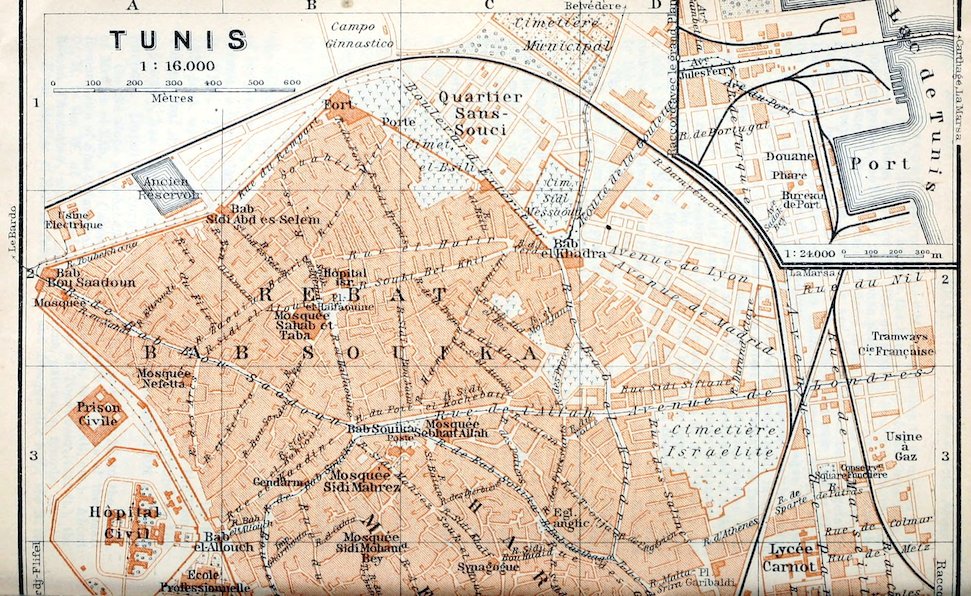
Arrival by Sea. The Quay where almost all the steamers (p. 331) are berthed is 10–15 min. from the hotels. The Douane is close by. It is best to entrust luggage at once to the hotel servants; if a porter (hamal) is required his charge should be asked (usually 10 c. for small packages, and 25 c. for each trunk carried to the cab or omnibus). Cab (into the town 1 fr., each trunk 15 c.) and tramway (No. 1), see p. 330.
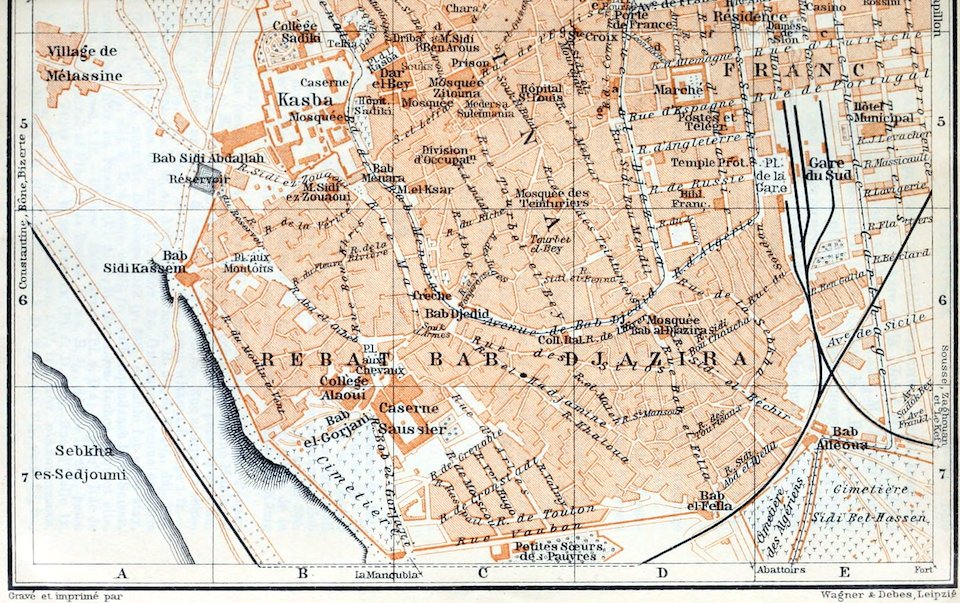
Railway Station. Gare du Sud (Pl. E, 5; Restaurant), Place de la Gare (Rue es-Sadikia).—Railway and sleeping-car office in the town, König & Co. (p. 331).
Hotels (comp. p. 324; often full in Feb.-April). *Tunisia Palace Hotel (Pl. c; E, 4, 5), Avenue de Carthage, behind the Casino Municipal (p. 331), with a small garden, R. 4–10, B. 1½, déj. 5, D. 7, pens. 13–20, omn. 1½–2 fr.; *Hôt. de Paris & Impérial (Pl. a; D, 5), Rue al-Djazira 23bis, R. 3–6, B. 1½, déj. 3½–4, D. 4–5, pens. 9–16, omn. without luggage 1 fr.—*Grand-Hôtel (Pl. b; D, 4), Avenue de France, R. 3½–6, B. 1½, déj. 3½, D. 4½, pens, from 10, omn. 1 fr.; *Hôt. St. Georges, Avenue de Paris (N. of Pl. E, 2), near the Belvedere Park (p. 338), suitable for some stay, R. 3–4, B. 1½, déj. 3, D. 4, pens. 9–12½ fr. (with dépendance Hôt. Suisse, moderate); Hôt. de France (Pl. d; D, 5), Rue Léon-Roches 8, quiet site, pens. 9–11, omn. 1 fr.—Plainer: Hôt. Eymon (Pl. e, D 4; ‘Gigino’), Rue de l’Eglise 1, corner of Place de la Bourse, R. 3–4, B. ¾, déj. or D. 2½, pens. 8 fr., good; Tunis Hotel & de Genève (Pl. f; D, 4, 5), Rue d’Italie 12, R. 2½–6, B. ¾, déj. 2–2½, D. 2½–3, omn. 1–1¼ fr.; Hôt. d’Angleterre, Ave. Jules-Ferry 37, R. 2½–5, B. ¾, déj. 2, D. 2½, pens. 7½, omn. 1¼ fr.; 330Hôt. Maison Dorée, Rue de Hollande 10 (Pl. E, 5), with restaurant, similar charges; Hôt. Moderne (Pl. g; D, 4), Rue de Constantine 12, corner of Rue de Bône, R. from 3½, déj. or D. 3, pens. from 9½ fr.; Hôt. de la Poste, Rue d’Espagne 5 (Pl. D, 5).—Hôtels Garnis. Hôt. Bellevue (Pl. h; D, 4), Rue es-Sadikia 1; Hôt. Régence (dépendance of the Hôt. Eymon), Ave. de France, R. 3–8, B. 1 fr.; Splendid Hotel, Ave. Jules-Ferry 74; Royal Hotel, Rue d’Espagne 19, R. from 3 fr.; Hôt. Central, Ave. de Paris 8; Family Hotel, Rue d’Allemagne 15 (Pl. D, 5), near the marché (p. 333), plain.—Furnished Rooms (20–70 fr. per month) abound.
Cafés. Café du Casino, in the palmarium of the Casino Municipal (p. 331), with a summer terrace in the Ave. Jules-Ferry; Café-Restaurant de Tunis, Ave. de France 2, in the Hôt. Bellevue, much frequented; Café de Paris, same street, No. 16. Arabian cafés (p. 174) in the Halfaouine quarter (Pl. B, 2), at the Bab Djedid (Pl. C, 6), etc.—Confectioners. Engerer, Place de la Bourse 1; Wagner & Co., Rue d’Italie 24, and Ave. de Paris 8; Montelateci, Ave. de France 7.
Restaurants. *Brasserie du Phénix, Ave. Jules-Ferry 74, in the Splendid Hotel (see above); Café-Restaurant de Tunis, see above; Salvarelli, Ave. de France, adjoining the Grand-Hôtel; Maxéville, Ave. Jules-Ferry 63 (déj. or D. 1½ fr.); Maison Dorée, in the hotel (see above); Restaurant du Rosbif, Ave. Jules-Ferry 56; Restaurant de la Poste, Rue d’Angleterre 8.
Carriages. Voiture de Place Voiture de Remise
With one horse With two horses
(2–3 pers.) (4 pers.)
Drive (course) in the town (petite banlieue) 0.80 0.90 1.— 1.60
Outside the town, up to 8 kilomètres (5 M.) 2.50 2.70 3.— 4.50
Hour in the town 1.30 1.50 1.80 2.40
Hour outside the town 1.80 2.— 2.40 3.20
Day (12 hrs.) 12.— 12.— 15.— 20.—
The chief limits of the inner town are the Bardo and the Belvedere Park. From 10 p.m. to 7 a.m. (or in April-Sept. 11–5) a fare and a half is charged. During festivals and races, and also for long drives, bargain advisable. Small packages free; trunk 15 c.—There are also Taximeter Motor Cabs (comp. tariff).
Motor Cars. Auto-Palace, Rue d’Autriche Prolongée 3; Garage Peyrard, Rue de Belgique 10; Tunisienne Automobile, Rue de Grèce.
Tramways (fares by zones, from 5 c. upwards; also transfer-tickets), from 6 a.m. to 9 p.m.: 1. Porte de France (Pl. D, 4), Ave. Jules-Ferry (Pl. E, 4), Ave. du Port, Harbour.—2. Porte de France, Rue al-Djazira (Pl. D, 5, 6), Ave. Bab-Djedid (Pl. D, C, 6), Place de la Kasba (Pl. B, 5).—3. Porte de France, Rue des Maltais (Pl. D, 4), Place Bab-Souika (Pl. B, C, 3), Kasba.—4. Rue al-Djazira (Rue d’Algérie; Pl. D, 6), Rue es-Sadikia (Pl. D, 5; Gare du Sud), Rue de Rome (Pl. D, 4), Ave. de Paris (Pl. E, 4, 3), Place Bab-Souika, Bab Bou-Saâdoun (Pl. A, 2).—5. Place Bab-Souika (Pl. B, C, 3), Bab Bou-Saâdoun, Bardo (p. 339; every ¼ hr., 15 c.), La Manouba (p. 342; every ½ hr., 30 c.).—6. Porte de France, Rue des Maltais (Pl. D, 4), Bab el-Khadra (Pl. C, 2), Cimetière Municipal, Belvedere Park (p. 338; Ave. Carnot, 15 c.).—7. Rue de Rome (Pl. D, 4), Ave. de Paris (Pl. E, 4–2), Belvedere Park (Rond-Point; every 10 or 15 min., 15 c.; on week-days there and back 25 c.), Ariana (p. 338; every ½ hr., 30 c.).—8. Ave. de France (Pl. D, 4), Ave. de Carthage (Pl. E, 5–7), Bab Alleoua (Pl. E, 7), Abattoirs (to the S. of Pl. E, 7).—For the electric tramways to Carthage and La Marsa, see p. 343.
Post & Telegraph Office (Pl. D, 5), Rue d’Italie 30; branches on the quay and in the Place Bab-Souika.
331Steamboat Agents. For the Comp. Gén. Transatlantique (RR. 21, 22), Banque de Tunisie, Rue es-Sadikia 3, and on the Quai Ouest; for the Società Nazionale (RR. 25, 26, 64), Florio, Rue d’Alger 1; for the Comp. de Navigation Mixte (RR. 21, 26, 64), Ave. Jules-Ferry and Quai Ouest; for the Hamburg-American Line, the Hungarian Adria, and the German Levant Line, Siebert & Co., Rue d’Italie 5bis; for the North German Lloyd, Heckmann, see below.
Tourist Offices. Eisen (travel and sport), Rue Léon-Roches 6; König & Co., Rue es-Sadikia; Pernull & Myddleton, Ave. Jules-Ferry 39; R. Heckmann (Universal Tourist Office), Ave. de Carthage, opposite Tunisia Palace Hotel; Lubin, Ave. de France 5.—Comité d’Hivernage, Ave. de Carthage 8.
Consuls. British Consul-General, E. J. L. Berkeley, Place de la Bourse (Pl. D, 4); vice-consuls, Chas. A. Goodwin, R. Schembri.—U. S. Vice-Consul, A. J. Proux, Ave. de France.
Physicians. Dr. Domela, Ave. Jules-Ferry 72; Dr. Valetta, Rue d’Espagne; Dr. Zammit, Rue Amilcar (all three speak English); Dr. Jaeggy, Rue d’Autriche; Mlle. Dr. Gordon, Rue de Rome 18.—Chemist. Heyler, Ave. Jules-Ferry 54 (Théâtre Rossini, Pl. E, 4).
Baths. Dublineau, Rue d’Allemagne 17 (Pl. D, 5; well fitted up; bath 1½, Turkish 3 fr.); Bains Français, Rue de Suisse 8; Bains Maures (comp. p. 175), Ave. Bab-Menara.
Banks (comp. p. 174). Banque de l’Algérie, Rue de Rome 18; Comp. Algérienne, Rue de Rome; Banque de Tunisie, Rue es-Sadikia 3; Comptoir d’Escompte de Paris, Ave. de France; Cooperativa Italiana, Rue es-Sadikia 7; Krieger, Rue al-Djazira 45.
Goods Agents. Meyer, Porte de France 35; Dana, Rue es-Sadikia 9.
Booksellers. Niérat & Fortin, Ave. de France 15, and Saliba, No. 17.—Photographs (and photographic materials). Lehnert & Landrock, Ave. de France 17, and Garrigues, No. 9; Neuer, Rue Léon-Roches 6; Vella, Rue d’Allemagne 4.—Newspapers. Dépêche Tunisienne, Tunisie Française, Unione (Ital. and Fr.).—Shop for European goods, Magasin Général, Ave. de France 22 (fixed prices). Oriental goods at the Musée Ahmed Djamal, Souk el-Attârîn 11 and Rue d’Autriche 108; Pohoomull Frères, Ave. de France 17. The Oriental articles in the Souks (pp. 335–337) and even the fezes (chechia) are mostly of European make and may be bought cheaper at home. Important purchases should not be made without the aid of a friend who knows the country and its ways (bargaining necessary). The services of touts, guides, and hotel servants should be declined, as they tend to raise prices.
Theatres. Théâtre du Casino Municipal, in the Casino Municipal (see below), entrance in the Ave. Jules-Ferry, for operas and operettas, 15th Nov. to 15th April; Théâtre Rossini (Pl. E, 4), Ave. Jules-Ferry 48, for Italian and French dramas.—Casino Municipal (Pl. E, 4), Ave. de Carthage 1, with hall for concerts and varieties (‘Palmarium’), a summer terrace, card-rooms, and American bar. The Pavillon du Belvédère, in the park of the Belvedere (p. 338), is the summer casino of the same company.—Band on Sun. and Thurs. afternoons, Place de la Résidence; on Wed. in front of the Cercle Militaire.
English Church. St. George’s (‘Egl. anglic.’; Pl. C, 3), Rue Bab-Carthagène 39, service at 10.15 a.m.
Sights. Bardo Museum, same as Musée Alaoui, see below.
Bardo Palace (p. 340), week-days, at any hour; tickets at the Musée Alaoui (comp, below).
Bibliothèque Française (p. 333), week-days 9–11 and 2–4 (in summer 8–11 only).
Dâr el-Bey (p. 336), daily, 9–11 and 3–5; fee ½–1 fr.
Jardin d’Essais (p. 338), daily 8–11 and 1–5 (April-Oct. 7–11 and 3–6).
Musée Alaoui (p. 340), daily except Mon. and great Catholic festivals 9.30–11.30 and 1–4 (16th Feb. to 15th Oct. 2–5), 1 fr. (Sun. free); the same ticket admits to the Bardo Palace also, if visited on the same day.
332Two Days. 1st. Forenoon, Ave. Jules-Ferry and Ave. de France (p. 333); walk through the Souks of the Medina (p. 335) and the adjoining Mohammedan Quarters (p. 334); visit to Place el-Halfaouine (p. 337). Afternoon, Bardo Museum (p. 340) or Belvedere Park (p. 338), or, by carriage, both.—2nd. Excursion to Carthage, see R. 53.
Tunis, Ital. Túnisi, capital of the Régence de Tunis, and seat of the French Resident-General (p. 323) and of the Mohammedan university, is the largest city in N. Africa after Cairo and Alexandria, and vies with Sfax as a most important harbour. Population about 200,000, of whom about 115,000 are Mohammedans, 22,500 Jews, 41,000 Italians, 14,000 French, 5400 Maltese, and 250 Greeks.
The town lies in 36°47′ N. lat. and 10°10′ W. long., on the E. margin of the narrow tongue of land (rising to 190 ft.) between the Lac de Tunis (or Lake Bahira, p. 129) and the small salt-lake Sebkha es-Sedjoumi, an old lagoon. The central part of the sea of houses composing the old town is the Medina, the oldest Moorish quarter, built largely out of the ruins of Thunes, Carthage, and Utica, and now the chief focus of trade and industry. Adjacent, to the N. and S., are two poor quarters, also chiefly Mohammedan, the Rebat Bab-Souika and Rebat Bab-Djazira, formerly N. and E. suburbs. The monotonous European new town in the low ground to the E. of the Medina, exposed in summer to the exhalations of Lake Bahira, is gradually extending from the Porte de France (formerly Bab el-Bahar, sea-gate) towards the harbour. On the brow of the hill to the W. of the old town are the old Kasba and most of the public buildings, almost all built under the French protectorate. Some of these lie outside the Turkish town-wall, once 6000 yds. long, erected in the 17th century.
Tunis, the ancient Thunes, a Berber name given to an earlier Phœnician colony, appears in history in 508 B.C. as an ally of Carthage. In 395 it was destroyed by rebellious Berber tribes. It was from Thunes that Agathocles (p. 163) and Regulus (p. 345) advanced against Carthage, and here, after the first Punic war, the discontented mercenaries from Sicca Veneria (p. 360) established themselves. Tunis was probably destroyed by the Romans at the same time as Carthage (146 B.C.) and rebuilt later. After the downfall of Carthage Utica (p. 353) entered into the heritage of her proud neighbour, but for a short time only; for from 29 B.C. onwards Carthage resumed her ancient supremacy and continued to flourish down to her second destruction in 698 A.D. This time Tunis was her natural successor. But the nomadic Arabs, being ignorant of navigation, and the Aglabides (p. 323) preferred Kairwan (p. 372), which had recently been founded in the heart of the Tunisian steppe; and the succeeding Fatimite and Zirite dynasties favoured the Sahel, with Mehdia (p. 369) as their new capital, to the detriment of N. Tunisia. At length, under the Hafsides (1206–1573; p. 323), Tunis became the capital, and rapidly grew to be the greatest and fairest city in the land, as well as a zealous promoter of the glorious Moorish art and science of the 13th and 14th centuries. The most distinguished of the Hafside sovereigns was Abû Abdallah Mohammed el-Mostanser Billah, who in 1270 defended his capital successfully against Louis IX., the Saint (p. 346). After the decline of that dynasty at the close of the 15th cent. and the capture of Tunis by Kheireddin (p. 221) in 1534, the city was attacked by the Spaniards in three different campaigns (p. 323), and was conquered four times by the 333Turks and the Algerians (in 1569, 1573, 1689, and 1757); yet in the 17th and 18th centuries, thanks to its Oriental trade and the booty of its pirates, it again enjoyed great prosperity.
The only mediæval buildings in the old town which have survived all these vicissitudes are three mosques, now much modernized. The distinctive character of the present town is of Mauro-Turkish origin. Those who cross the threshold of the Orient here for the first time will be specially struck with the narrow and crooked lanes of the Mohammedan quarters, only 12–16 ft. wide, with the motley crowd in the Souks (p. 335), and with the picturesque concourse of all the tribes of N. Africa and the Sahara. The poor Jewish quarter (p. 337) is less interesting. The strange costume of the women, with their kufias or sugar-loaf hats, loose jackets, and tight-fitting trousers, is now rarely seen except on members of the older generation, while the pretty, old-fashioned costume of the girls is a thing of the past.
John Howard Payne (b. 1792), author of ‘Home, Sweet Home’, was United States consul at Tunis from 1842 until his death in 1852.
a. The New Town.
From the Harbour (Port; see inset map, Pl. E, 1), which together with the Bahira Canal (p. 129) was constructed in 1888–96, the short Avenue du Port (tramway No. 1, p. 330) leads through the Piccola Sicilia, a group of workmen’s huts, into the town, ending at the bronze statue of Jules Ferry (1832–93), the French statesman who brought about the occupation of Tunisia.
The Avenue Jules-Ferry (Pl. E, 4), or Avenue de la Marine, the finest street in the new town, 66 yds. wide and 710 yds. long, is planted with double avenues of fig-trees. On the left, just beyond the divergence, to the right and left, of the unfinished Avenue de Paris (p. 338) and Avenue de Carthage (Pl. E, 5–7), which together are 2¼ M. long, rises the Casino Municipal (Pl. E, 4; p. 331).
The Ave. Jules-Ferry ends at the Place de la Résidence (Pl. D, 4; band, see p. 331), the centre of the new town. To the left, on the S. side, rises the Palais de la Résidence (Pl. D, E, 4), or Maison de France, built in 1856–60 for the French consulate (see p. 334), and tastefully remodelled in 1890–2 by Dupertuys as a dwelling for the resident-general. The beautiful garden is not accessible. Opposite the Residence is the Cathedral (Pl. D, 4); erected in 1893–7. The Rue es-Sadikia leads to the S. from the W. end of the square to the Gare du Sud (p. 329).
The Ave. Jules-Ferry is continued by the much narrower Avenue de France (Pl. D, 4), intersecting the older European quarter, the favourite promenade of the town. A little to the S. of it, in the Rue d’Italie, which leads to the Post and Telegraph Office (Pl. D, 5), is the Marché (Pl. D, 5; interesting from 7 to 10 a.m.).
In the Rue de Russie, the southmost street in this quarter, is the Bibliothèque Française (Pl. D, 5; adm., see p. 331), which is well supplied with literature relating to N. Africa.
334
b. The Old Town.
At the W. end of the Ave. de France (p. 333), the starting-point of several tramway-lines (see p. 330), is the Porte de France (p. 332), and beyond it lies the Place de la Bourse (Pl. D, 4), which presents a busy scene all day. In and near this square are most of the Consulates (British among others), as during the Turkish period. The old French Consulate (about 1650 to 1860), which served also as a warehouse (fondouk), is at No. 15 Rue de l’Ancienne-Douane.
To the W. from the Place de la Bourse run the two chief thoroughfares of the Medina. To the right is the Rue de la Kasba (Pl. D, C, 4, 5; p. 336), leading past the Jewish quarter (p. 337) and the Souk el-Grana (Pl. C, 4) to the upper boulevards (p. 336), to which it is the chief approach. To the left is the Rue de l’Eglise (Pl. D, C, 4, 5), leading direct to the Souks of the Medina, the main business street of the Christian merchants in the Turkish period.
We follow the Rue de l’Eglise. On the left is the small church of Ste. Croix (Pl. C, D, 4, 5; 1662), to which the street owes its name. Then, on the right, is the Administration des Habous, the headquarters of the Mohammedan pious foundations. Lastly we pass through a vaulted passage under the Direction des Antiquités.
The Rue de l’Eglise ends at the Rue de Djamâa ez-Zitouna, on the E. side of the chief mosque, the Djamâa ez-Zitouna (Pl. C, 5), which is said to trace its origin to the tomb of St. Oliva of Palermo, a Christian saint revered even by many Mohammedans. The mosque was founded in 732 by Obeïd Allah ibn el-Habbab, enlarged by the Aglabide Sijadet Allah I. (p. 374), and repeatedly altered under the Hafsides. When Tunis was plundered by the troops of Emp. Charles V. the mosque was used as a stable. Since then the edifice has been much modernized, and is lavishly adorned with spoils from Carthage. The chief portal, behind the colonnade in the Rue de Djamâa ez-Zitouna, where on Fridays the clergy receive the Sheikh ul-Islam, or supreme pontiff, and the side-portal in the Souk des Etoffes (p. 335) have each an ornamental ancient pillar as a lintel. The many-aisled interior, with its 161 columns and two domes over the nave, is similar in plan to the Sidi Okba Mosque at Kairwan (p. 374). The new minaret, 145 ft. high, erected in the Andalusian style by Si Slîmân Ennigro in 1894, is a free copy of the old tower. The pile of buildings is best surveyed from the roof of the Dâr el-Bey (p. 336).
The mosque serves also as a lecture-room for the Mohammedan University. The instruction is under the direction of the Sheikh ul-Islam; there are about a hundred teachers and 400 students. Admittance to the twenty-two medersas, or colleges, for students 335from other parts of the country, and to the library famed for 7000 Oriental MSS. is granted to none but Mohammedans.
The Zitouna Mosque lies in the region of the *Souks (Pl. C, 5; Arabic sûk, market), the market quarter of the Medina, dating from the Hafside period (13th cent.). As usual in the East the lanes are roofed over. The small narrow shops are shut in by a counter, over which the trader swings himself into his seat with the aid of a rope. Most trades have their own streets. It is interesting to watch the people at work in those souks where the wares are made on the spot. The larger bazaars in some of the streets are designed solely to attract foreigners. The busiest time is the early morning. Friday is the Mohammedan, and Saturday the Jewish day of rest. As to purchases, see p. 331. In and near the Souks are many small Arab coffee-houses and barbers’ shops.
From the Rue de Djamâa ez-Zitouna we turn to the right to visit the Souk el-Attârîn, the spice-market, founded in 1249. Besides the spices and perfumes sold here (such as essence of jasmine and rose-geranium, sometimes palmed off on strangers as attar of roses), we observe amber, dried henna-leaves, henna-powder (p. 108), and the big candles, often branched, which are used at weddings and for the tombs of saints.—The side-street to the right, opposite the N. side of the mosque, is the Souk el-Blagdjia, for leather-wares.
At the W. end of the spice-market, to the left, opposite the Rue Sidi Ben-Arous (see below), is the Souk des Etoffes, on the W. side of the mosque, with its display of silk and woollen stuffs, carpets from Kairwan, and rugs from the Djerid (p. 386) and from Djerba (p. 393).
Adjoining the Souk des Etoffes is the busy Souk des Femmes, the only one frequented by Mohammedan women, where female apparel, trinkets, and slippers of Saffian leather (p. 109) are sold.
Between these two souks the Souk el-Leffa (Pl. C, 5), off which, on the right, is the Souk el-Kebabdjia (lace), leads to the *Souk Sekajine, the saddle-market, where, among gorgeous caparisons embroidered in gold and silver, we are specially struck with the ornaments worn by horses at the fantasias (p. 99).
We return to the Souk el-Leffa. Thence, to the left, we follow the short Souk ed-Dziria, past the Hôpital Sadiki (Pl. B, C, 5), destined for natives, to the—
Rue Sidi Ben-Ziad, on the S. side of the Dâr el-Bey (p. 336). The small Sidi Youssef Mosque (‘Mosquée’; Pl. C, 5), belonging to the Hanefites (p. 445), with the handsome tomb of the founder and an octagonal minaret, dates from 1610–37.—At the lower end of the street, where the Souk el-Bey branches off to the left to the Place de la Kasba, we turn to the right into the—
Souk el-Berka, the slave-market, which was abolished only in 1842. Down to 1816 Christians captured by the pirates were sold here by auction. This is now the seat of the silversmiths, goldsmiths, and dealers in antiquities, mostly Jews. The best of their gold trinkets are from Paris; the fine silver filigree is Genoese or Maltese; the ancient coins are often spurious.
From the Souk el-Berka the Souk el-Trouk, the street of the tailors, almost all Jews, who make the rich costumes of the Moslems, leads back to the Souk el-Attârîn.
From the N.W. angle of the Zitouna Mosque the Rue Sidi Ben-Arous leads into the Rue de la Kasba (p. 334). At the junction of these streets, adjoining the burial-chapel of Mohammed Murad 336Bey (d. 1705), is the Hanefite Mosque of Sidi ben-Arous (Pl. C, 5), of 1654, similar in plan to that of Sidi Youssef (p. 335), with an elegant minaret.
The Rue de la Kasba ends at the Place de la Kasba (Pl. B, C, 5), with its charming grounds.
On the S. side of this square rises the Dâr el-Bey (Pl. B, C, 5), the largest pile of buildings in the Medina, erected in 1810 on the foundations of a Roman theatre(?) by Moroccan architects under Hamuda Bey as his town-palace. It is now the seat of the French secretary-general and other authorities. The Bey usually comes hither on Monday mornings from La Marsa (p. 351) for the transaction of business. Admittance, see p. 331. The entrance is by the portal where a sentry is posted.
The covered quadrangle (patio) on the first floor forms the centre of the palace. The fine timber ceiling in the dining-room is the only object of interest in the state apartments. The council-chamber of the ministers has a dome with remarkably fine stucco-work. Here, as in the Bardo and at Kassar-Saïd, the effect is marred by European gewgaws.
Fine *View from the flat roof over the white houses of the town, the Zitouna and many smaller mosques. Best light at and after noon.
To the W. of the Place de la Kasba, at the junction of the two upper boulevards Bab-Benat (Pl. B, 4; p. 337) and Bab-Menara (Pl. B, C, 5, 6), the old town culminates in the Kasba (Pl. B, 5), an extensive group of barracks on the site of the palace of the Hafsides and the Turkish citadel. The Kasba Mosque, with its fine minaret, well restored in 1904, dates from 1231–5.
Near the old Bab-Menara, where the Souk des Sacs diverges to the reservoir of the waterworks (p. 339), is the small Mosquée el-Ksar (Pl. C, 5), the oldest in Tunis, said to have been founded by Hassan ibn en-Nôman (p. 322). The handsome minaret (1545) is an addition of the Turkish period.
On the N. side of the mosque runs the Rue du Château. No. 3 is the Division d’Occupation (Pl. C, 5), the seat of the French commandant, formerly the *Dâr-Hussein (18th cent.; well restored in 1876), one of the finest Mauro-Turkish palaces in Tunis. (Adm. by special introduction only.)
The Rue des Andalous (Pl. C, 5), which begins here, and its side-street Rue du Riche are the aristocratic streets of the Medina. Many of the houses have elegant marble portals and artistically grated windows. Parallel, on the E., leading to the Avenue de Bab-Djedid, runs the long Rue Tourbet el-Bey, in which at No. 62, at the corner of the Rue Sidi-Zamouhl, rises the Tourbet el-Bey (Pl. C, 6), the domed tomb of the Husseinites (p. 323; ladies sometimes admitted).
The Rue Sidi Kassem, the next side-street on the left, leads to the Djamâa Djedid (‘new mosque’), or Mosquée des Teinturiers (Pl. C, 5, 6), founded by Hussein Ali ben-Turki (p. 323). The modern minaret is by Si Slîmân Ennigro (p. 334).
337The open space near the dilapidated Bab Djedid (Pl. C, 6), dating from 1277, is an afternoon haunt of snake-charmers and story-tellers (5–10 c. to the boy soliciting money).
Between the Bab Djedid and the Place aux Chevaux (Pl. B, 6; p. 339) is the Market Quarter of Rebat Bab-Djazira (p. 332), containing the Souk el-Aâssar, the Souk des Armes, and the Marché-au-Blé.
From the Bab Djedid we return to the Place de la Kasba (p. 336; tramway No. 2, see p. 330).
In the Boulevard Bab-Benat, in an old Moslem cemetery on the right, is the Tekia (Pl. B, 4, 5), a home for the aged (1905). On the left, founded in 1876, is the Collège Sadiki (Pl. B, 4), a high school for Moslems. Farther on rises the handsome Palais de Justice (Pl. B, 4; 1901). These two buildings are in the neo-Moorish style.
We may now proceed direct to the Place Bab-Souika (see below; tramway No. 3, p. 330); but it is better to take the less direct route through the N.W. part of the Medina, by the Rue du Lutteur (diverging to the right from Boul. Bab-Benat, a little before the Palais de Justice), Rue du Pacha (Pl. B, 4), Rue de la Hafsia (Pl. B, C, 4), Rue Achour (Pl. C, B, 4, 3; with the Hanefite Mosque of Sidi Mohammed Bey on the left), Rue el-Monastiri, and Rue Sidi-Mahrez.
On the left, in the last-named street, rises the *Mosque of Sidi Mahrez (Pl. B, 3), with several domes in the Turkish style, built in the latter half of the 17th cent., resembling in the interior the Ahmed Mosque of Constantinople (p. 550). The square minaret was added early in the 19th century.—On the right is the school or Zaouïa Sidi Mahrez.
The picturesque Place Bab-Souika (Pl. B, C, 3) lies between the Medina and the poor Rebat Bab-Souika (p. 332). Executions took place here in the Turkish period. The Rue el-Halfaouine (‘alfa street’), partly vaulted over, and lined with butchers’ shops, leads hence to the lively and industrious—
Place el-Halfaouine (Pl. B, 2), with its numerous Arab cafés, where on Mohammedan festivals, such as Ramadan (p. 447) and Bairam, the evenings and nights are spent in mirth and frolic. On the W. side is the Djamâa Sahab et-Taba (Pl. B, 2), one of the largest mosques in Tunis, founded on blocks of stone from Carthage. The Souk el-Djedid on the N. side is for silk wares.
Time permitting, we may glance at the Rue des Potiers (Pl. C, 3), seat of the once noted pottery of Tunis, or at the Jewish Quarter (Hara; Pl. C, 3, 4), in the N.E. part of the Medina. The chief Synagogues (visitors admitted) are in the Impasse es-Snadli, at the corner of Rue Sidi-Mardoun, in Rue Zarkoun (Pl. C, D, 4), etc.
The interesting Old Jewish Cemetery (Pl. D, E, 3), just outside the old town, is entered from the Rue du Cimetière-Israélite.
338
c. Environs.
1. About 1¼ M. to the N. of Tunis lies the *Jardin du Belvédère, laid out in 1892, the most popular promenade in the environs, well shaded with palm-trees, but still unfinished. The grounds cover 250 acres on the slope of Belvedere Hill (269 ft.), which was fortified in the Turkish period. The chief entrance is at the Rond Point at the end of the Ave. de Paris (p. 333; tramway No. 7, p. 330), and there is a side-entrance (tramway No. 6) in the Ave. Carnot, near the Pépinière Municipale (nursery-ground) and the Cimetière Municipal (opened in 1883).
Halfway up, above the main entrance, rises the Pavillon du Belvédère (café; fine view from the terrace). On the S. slope of the hill, ¼ M. from the Avenue Carnot and concealed amid the thick vegetation, is the Mida, the ruin of a mosque-court brought from the souks of the Medina. Farther up is the *Pavillon de la Manouba, a freely restored Moorish garden-pavilion from the Palais de la Manouba (pp. 342, 343), with fine ornamentation in stucco and a charming view. The top of the hill affords a splendid *Panorama, especially towards evening. To the S. is the old town with the Kasba, the Manoubia Hill, and Fort Sidi Bel-Hassen; more to the right, beyond the Sebkha es-Sedjoumi, rise the distant hills of Zaghouan; to the E. lies Lake Bahira with the island of Chikly, the Ship Canal, and the little towns of Goletta and Rades, backed by the Gulf of Tunis and Cape Bon; then, more to the N.E., rise the hills of Carthage, with the cathedral and Sidi Bou-Saïd; a little to the left, in the plain, lie La Marsa and the Sebkha er-Riana; to the W. are seen the Bardo and the two aqueducts.
Adjoining the Institut Pasteur (1904), on the N. side of the Rond-Point, is the entrance to the Jardin d’Essais (adm., see p. 331), opened in 1892, with many tropical and subtropical plants. Connected with it is the Ecole Coloniale d’Agriculture, founded in 1898.
The tramway (No. 7) runs on through olive-groves to (3 M.) the village of El-Ariana, once famed for its Hafside palace of Abu Fehr, and now noteworthy for its beautiful roses. It is a favourite resort of the Jews of Tunis, especially on Saturday afternoons, when Jewish musicians and dancers perform at the cafés.
2. A less extensive but more picturesque *View than that from the Belvedere is obtained from the hill, to the W. of the old town, on which lie the decayed Turkish forts of Bordj Flifel and Bordj Rabta (193 ft.). The shortest way to the hill is by the Rue Bab el-Allouch (Pl. B, 3; see tramway No. 3, p. 330) and through the gate of that name. We then follow the Bardo road (comp. p. 339), straight on, between the garden of the Hôpital Civil (Pl. A, 3, 4), on the right, and the Ecole Professionnelle Loubet (Pl. A, 4), a technical school, on the left. About 6 min. from the gate we diverge to the right by a field-road, and we reach the top in 6 min. more. Near the forts are numerous dilapidated Silos (rabta), once the bey’s granaries.
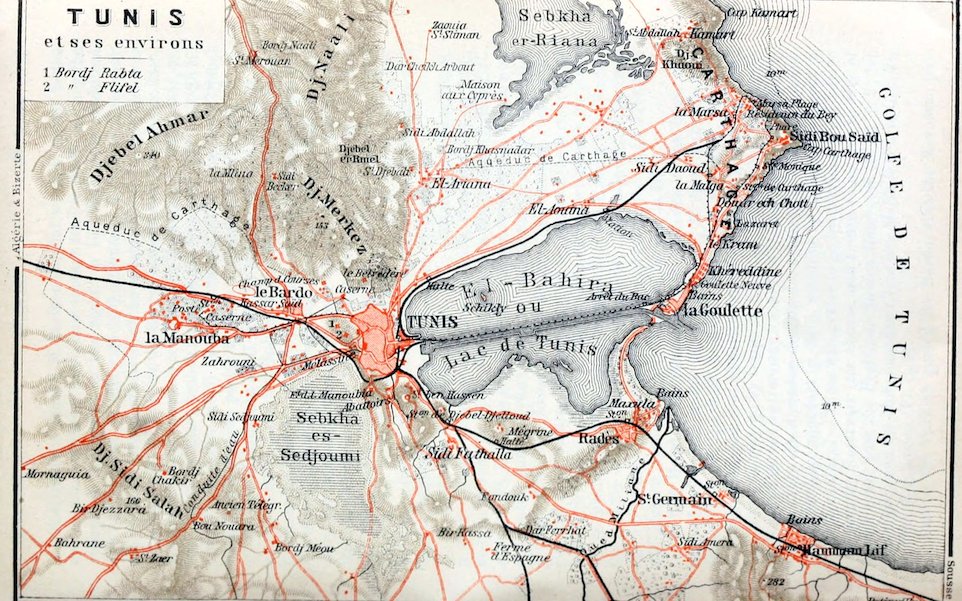
339The Bardo is about 1 M. farther on, but we now return to the crossroads (see above) and follow another road to the S., leaving the village of Mélassine on the right, to the Bab Sidi Abdallah (Pl. A, 5). Close to this gate is the Château d’Eau or Reservoir (Pl. A, B, 5; visitors admitted) of the waterworks of Tunis, which was substituted in 1859–62 for the Roman aqueduct of Carthage (p. 348). It is supplied by the main conduit from Zaghouan (p. 359), 58½ M. long, by an auxiliary branch from the Aïn Djouggar (1276 ft.), 23 M. distant, and (since 1905) by a new branch, 50 M. long, from Djebel Bargou, which flows partly through a tunnel 4 M. in length.
3. The Manoubia Hill (240 ft.) may be reached in ¼ hr. by a road to the S. from the Bab Sidi Kassem (Pl. A, 6), a town-gate 3 min. to the S. of the reservoir. Or we may start from the Place aux Chevaux (Pl. B, 6; p. 337), whence, near the Collège Alaoui (seminary for teachers), we have a good view of the city and of Lake Bahira, and then follow the Rue Bab el-Gorjani (Pl. B, C, 7). The hill offers a fine view, especially in the morning, of the city, Lake Bahira, the hills of Carthage and Cape Bon; at our feet lies the Sebkha es-Sedjoumi; to the S. rise the hills of La Mohamédia and Oudna, backed by the jagged mountains of Zaghouan.
4. From the Bab Alleoua (Pl. E, 7; station of tramway No. 8, p. 330) diverge the roads to Rades (p. 363), Hammam-Lif (p. 363), and the Mornag (p. 358). We ascend across the Cimetière Sidi Bel-Hassen (Pl. E, 7), the largest Mohammedan cemetery of Tunis, now desecrated and therefore open to ‘unbelievers’, to the (12 min.) Zaouïa Sidi Bel-Hassen, where we enjoy a charming view of the city and Lake Bahira. The mosque, where many of the former beys’ wives are buried, stands on the site of a cavern which was for many years inhabited by the Moroccan saint Sidi Bel-Hassen ech-Chadly, the founder of the Chadlya brotherhood. The beautiful view from the top of the hill (240 ft.), a little apart from the small Fort Sidi Bel-Hassen, resembles that from the Manoubia Hill.
5. The Bardo, the former winter-residence of the beys, lies in the fertile plain to the W. of Tunis, 1¼ M. from Bab Bou-Saâdoun (Pl. A, 2), and 2 M. from Bab el-Allouch (Pl. A, B, 3, 4; see p. 338) or from Bab Sidi Abdallah (Pl. A, 5). Starting from the Porte de France, we may go by tramway No. 3 (p. 330; 5 c.) to Place Bab-Souika, and thence by tramway No. 5 (15 c.) to the Bardo. About halfway we cross the Aqueduc du Bardo, originally Roman, a branch of the Carthage aqueduct (p. 348), restored by Andalusian Moors in the 16th century.—Those who prefer to go by carriage should drive out past the Reservoir (see above), and return round the N. side of the old town, past the Feskia or Ancien Réservoir (Pl. A, 1, 2; for rain-water) and the Mohammedan Cimetière el-Bsili (Pl. B, C, 1, 2), to Bab el-Khadra (Pl. C, 2).
During the Turkish period the Bardo, like the Moroccan palaces 340of the present day, formed a little town by itself. It included several palaces of the beys and of the widows of deceased princes, a treasury, dwellings of the court officials, a mosque, baths, barracks, and a prison (zendala), and the whole group was enclosed by a massive rectangular wall. Most of the sadly ruined buildings have been utilized since 1900 as material for the new harbour-works. At the S. end the outer wall has disappeared. From the tramway station we enter the pretty grounds (1903) to the right. Immediately to the left is the way to the remains of the chief palace of the beys, and beyond it, on the left, to the Museum. Straight ahead rises the ruin of a domed building; beyond it are the mosque and the prison (now a reformatory for natives).
The Palace of the Beys, erected after 1782 by Hamuda Bey (p. 336), contains several objects of interest, apart from its tasteless European furniture and poor pictures. Adm., see p. 331.
We enter by a flight of steps, adorned with marble lions of mediocre Italian workmanship, and through a vestibule with delicate decoration in stucco. The anterior colonnaded court is adjoined on the right by the hall of justice, where the beys used to pronounce sentences of death which were immediately carried out close by; opposite to it is the reception-room. A passage to the left brings us to a second colonnaded court. A tasteful marble portal (Italian) leads thence into the Salle des Glaces, which has a fine ceiling and a valuable Kairwan carpet. We then mount the staircase to the First Floor, where the large festal hall is on the right.
The old Palace of the Harem, a creation of the extravagant bey Sidi Mohammed (1855–9), rivalling the Alcázar of Seville (p. 61) in its wealth of decoration, was carefully restored in 1885–1888 and converted into a national museum.
The *Musée du Bardo, or Musée Alaoui, named after Bey Ali Pasha (1882–1902), containing the rich yield of excavations in every part of Tunisia, is now the finest collection in Barbary. The Moorish and Turkish antiquities were arranged in 1900 in a pretty little adjoining palace under the name of Musée Arabe. Adm., see p. 331; catalogue (1897) 10 fr., supplement (1906–10) 27 fr.; director, M. Merlin.
Ground Floor. The Entrance Room contains Roman mosaics from Henchir Sidi Djedidi, etc.; family tombstone of the imperial slave Optatus, from the burial-ground of the Officiales (p. 348). Also, on the right, votive stones from the temples of Saturn at Aïn-Tounga and on Jebel Bou-Kornin (p. 363), Roman milestones from the Tebessa road, etc.; on the left, Roman tomb-cippi and inscriptions. Then two altars bearing regulations in favour of farmers on the imperial estates: D441. from Henchir-Mettich near Testour (time of Trajan), and D 442. from Aïn-Ouassel (time of Septimius Severus); C 1030. Statue of Concordia from Djorf Bou-Grara (p. 392). At the end of the room, a much damaged Roman sarcophagus with the Muses.—On the right is—
Room I (Pre-Roman Room). Along the walls are Punic and neo-Punic votive stones dedicated to Baal, Tanit (p. 356), and other deities; then tomb-stelæ, catapult-balls from an arsenal at Carthage, etc.—At the back-wall of the side-room is a stela from Maktar, nearly 7 ft. high, with a Libyan and neo-Punic inscription.—On the left of the Entrance Room is—
341Room III (Early-Christian Room). In the centre, B 53. Font from El-Kantara (p. 394). Along the walls are mosaics from Tabarca and other places, and sarcophagi. In the show-case, lamps and vessels in clay from Oudna (5–6th cent.).—In the passage to R. IV, terracotta slabs with reliefs, once the mural decoration of churches.
Room IV (Bulla Regia Room), containing finds from Hammam-Darradji (p. 326): Roman sculptures of the time of Antoninus Pius (138–161), incl. C 1017. A Minerva Polias in the style of a Parthenos with the cornucopia of Bonus Eventus and a mural crown; *C 1018. Torso of Athena; C 1014. Æsculapius, after a Greek original of the 4th cent.; C 1013. Colossal statue of Apollo, after the school of Scopas; C 1015. Ceres; Roman inscriptions.—In the adjoining Room V, terracotta figures from the temples of Baal and Tanit at Bir Bou-Rekba.
On the Staircase, C 1033. Head of Hercules, Roman mosaics, etc.; on the upper landing, C 939. Statue of Apollo from the theatre at Carthage.
First Floor. Room VI, the old inner court (patio) of the palace. In the centre are two large Roman mosaics from Oudna (2nd cent. A. D.): A 103. Bacchus presenting the vine to the Attic king Icarius (A 104. Hare and fox hunt, in front); A 105. Representation of a country estate, with hunting scenes. Between the columns of the portico are Roman statues in marble from Carthage (C 944. Ganymede; C 979. Bacchus; C 924. Juno; C 982. Isis; and others). Along the walls are marble busts and heads, most of them from Carthage.—Adjoining this room on the N. is—
Room VII, formerly the banqueting-room, with superb *Dome carved in wood. In the centre, A 1 Mosaic pavement, about 150 sq. yds., from a Roman villa near Susa (‘Cortège de Neptune’). By the end-walls, A 25–27. Three semicircular mosaics from Tabarca (beginning of the 4th cent. A.D.) representing a country seat with park, stable, granary, sheds, and cellar. By the left side-wall are two Roman mosaics (A 7. Fishing; A 12. Head of Oceanus); A 19. Early-Christian relief with circus-scenes; old Christian *Sarcophagus Mosaics from Tabarca, mostly representing the deceased in the attitude of prayer, between two candles. The wall-presses contain Punic, Rhodian, Roman, and early-Christian lamps. By the back-wall are Roman pottery, and implements in bronze, ivory, and bone. Also a fine bust of Athena from Carthage.—Next comes—
Room VIII. In the centre, bronze armour of Campanian origin (end of 3rd cent. B.C.), found in a Punic tomb at Ksour-Essaf (p. 370): *E 3. A silver-gilt patera (sacrificial bowl) from Bizerta, weighing nearly 24 lbs., with reliefs (contest of Apollo and Marsyas, sacrifice to Dionysus, Bacchic scene).—In the side-cases are gold trinkets and cut gems, mostly from Carthage. In the window-cases are Mauretanian, Roman, and Byzantine coins. Along the walls are Roman mosaics from Dougga and from *Chebba (A 292. Neptune and the Four Seasons; A 293. Orpheus among the animals); C 1115. The Graces and the Four Seasons (front of a fine marble sarcophagus).
Room IX. In the centre, A 287. The Procession of Bacchus, a large mosaic from El-Djem. Along the walls are Roman mosaics from El-Djem (A 288. Hare-hunt; A 289. Nine Muses; etc.), from Thina (Thænæ), from Susa (A 6. Boat with quaint representation of the water), and from Djorf Bou-Grara (A 301, A 301 bis. Wrestlers). In the corners, C 1026. Torso of a draped woman, perhaps a Victoria, in black marble; C 72. Head of Augustus; C 1027. Head of Hercules (all from El-Djem). In the press on the left, three leaden urns and six admirably preserved glass cinerary urns from the burial-ground of the Officiales at Carthage (p. 348). In the press on the right, bronze utensils. In the wall-cases, leaden and bronze objects from Carthage and Hammam Darradji; also so-called ‘tabellæ defixionum’, rolls of lead with curses directed against enemies in the circus (found in tombs at Susa). Detached, C 16. Torso of a Bacchante from El-Djem.—We return to R. VI and thence, to the left, enter—
Room XI, formerly the concert-room, containing Roman mosaics. In the centre, A 166. Mosaic pavement from Medeïna, showing the different kinds of Roman trading vessels; also the heads of a river-god and of 342Oceanus. By the entrance-wall, A 171. Temple (containing statues of Apollo and Diana, and hunting scenes) from Carthage. By the wall opposite, A 162. A seriously damaged representation of a banquet (4th cent. A.D.) from Carthage.—The opposite—
Room XII was formerly the dining-room. The presses contain relics from Punic tombs (some of them imported, Egyptian, Greek, and Etruscan). In the two central cases, terracotta-masks (to avert evil spirits), which also were among the objects buried with the dead.—A door on the same (W.) side of R. VI as that to R. XII gives access to three rooms (XIV-XVI) containing objects discovered at the bottom of the sea near Mehdia (see p. 370) in 1907–10.
Room XIV. A bronze *Hermes of Dionysus, in an archaic style, by Boëthus of Chalcedon (according to the inscription; 2nd cent. B.C.). On a shelf are remains of a large bronze capital with two female heads. In the glass-cases are two bronze lamps with the figure of a runner; numerous bronze statuettes, among others an Eros playing a lyre, two female dancers, a buffoon, Satyr, and actors; bronze utensils.
Room XV. In the centre, a bronze *Statue of a winged Eros (4½ ft. high). Along the walls, a leaden anchor; terracotta amphoræ, bars of lead with stamps in Latin, flour-mills; in the glass-case, a terracotta lamp with its wick still preserved.
Room XVI (marble objects). Large mixing bowls (‘crateræ’), adorned with Bacchic subjects; candelabra in the neo-Attic style; capitals; Greek inscriptions; busts and heads, among which should be noted, in the middle, a well-preserved Aphrodite; torsos and statuettes.
We return to R. VI and descend five steps into—
Room XIII, an octagonal *Domed Chamber (formerly the bey’s bedroom), with four side-rooms richly adorned with stucco and tiles (once occupied by his four favourite wives). In the centre, A 10. Roman mosaic from Bir-Chana, with the gods of the seven days of the week and the signs of the zodiac. In the right wing, *A 266. Roman mosaic from Susa, Virgil writing the Æneid. In the wing opposite the entrance, C 4. Torso of a Satyr pouring out wine (after Praxiteles). In the left wing, *C 969. Ceres, from Carthage, with traces of painting; also C 970, C 971. Two draped female statues.—In the corner-room on the right, without number, Large alabaster vase from Carthage with haut-relief (head of Bacchus with vine-wreath).—In the corner-room on the left are terracotta figurines from Susa.
In the Gallery of R. VI (p. 341) are a relief-map of Carthage, models of buildings in Carthage, Dougga, Le Kef, Oudna, Sbeïtla, and Djorf Bou-Grara; also photographs of Tunisian monuments.
From the staircase (p. 341) we enter the Musée Arabe. In Room I, tastefully decorated in stucco, are mural tiles from Tunis, Nabeul (p. 365), and Morocco, and knotted carpets from Kairwan. The side-rooms contain metal-work, enamelled vessels, wood-carving, weapons, etc.
In the Court (patio) are mural tiles; in the small side-rooms on the left, costumed figures, national garbs, and models in stucco.
In Room II, furniture (incl. a sumptuous bed) and embroidery (incl. haïtis, velvet hangings with gold and silver embroidery). In the side-rooms are Tunisian (from Djerba and Moknine) and Algerian trinkets; also beautiful Kairwan carpets.
Behind the Bardo is Kassar-Saïd, a château of the bey (no admittance). Here, in 1881, was concluded the Bardo Treaty, which ended the independence of Tunisia.
The highroad goes on, past the Hippodrome of Kassar-Saïd (races in spring), to (2½ M.) La Manouba (rail. station, see p. 329; tramway No. 5, see p. 330), a group of decayed Moorish country-houses with fine orange-gardens. The Palais de la Manouba (now cavalry-barracks) was once the country-seat of Hamuda Bey (p. 336). The kubba of Lalla Manouba attracts many pilgrims.
343From Tunis to Dougga, see R. 55; to Zaghouan, Le Kef, and Kalaâ-Djerda, see R. 56; to Rades, Hammam Lif, and Susa, see R. 57; to Bizerta, see R. 54; to Malta, see R. 63; to Tripoli (Syracuse), see R. 64.
53. Carthage.
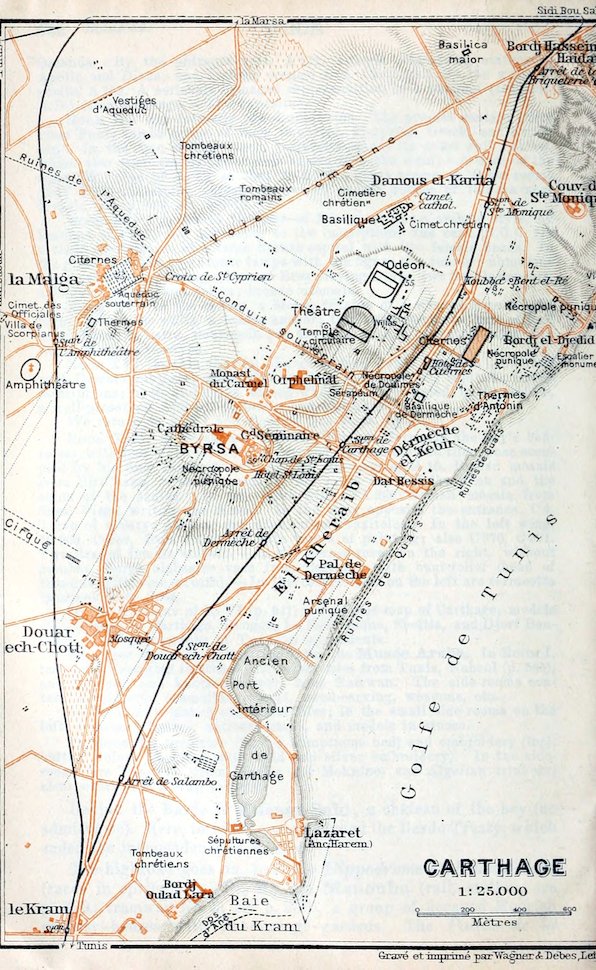
An Electric Tramway starts from Tunis Terminus, Ave. Jules-Ferry (Pl. E, 4), near the Casino, for Carthage and (¾ hr.) Marsa-Plage. The chief stations on this line are La Goulette, for the little town of Goletta; Carthage, for the castle-hill (St. Louis de Carthage), for the plateau of the Odéon, and for the cisterns at the Bordj el-Djedid; Ste. Monique, for Damous el-Karita; and Sidi Bou-Saïd, for the lighthouse. The terminus, Marsa-Plage, close to the shore, is connected by a branch-line (½ M.) with Marsa-Ville, which is the terminus of another electric tramway running from the Ave. de Paris (Pl. E, 3) at Tunis viâ El-Aouina.—Uniform fares from Tunis to Goletta, Carthage, Marsa-Plage, or Marsa-Ville single 1 fr. 20 or 65 c., return 1 fr. 75 c. or 1 fr.
A Drive (carr. 15 fr.) from Tunis to Sidi-Daoud, La Malga (amphitheatre and cisterns), La Marsa, Sidi Bou-Saïd, Carthage (cisterns at Bordj el-Djedid, theatre, and museum), Goletta, Maxula-Rades (p. 363), and back to Tunis is recommended. Luncheon (brought from Tunis) may be taken beside the lighthouse at Sidi Bou-Saïd or at Carthage. Good carriages are to be had also at Goletta and the stations of Carthage and Marsa-Ville (2 fr. per hr.; but the fare should be fixed beforehand).—In cool weather, especially in the forenoon, the Walk from La Marsa viâ Sidi Bou-Saïd to Carthage is very enjoyable.
Hotels at Carthage: Hôt. St. Louis de Carthage, on the castle-hill, tolerable, déj. or D. 3–3½ fr., wine dear; Pavillon Beau-Séjour, R. 3, B. 1¼, déj. 2½, D. 3 fr.; Hôt. des Citernes Romaines, near the cisterns of Bordj el-Djedid (p. 350), plain but good.
For a short visit to the ruins the following description will suffice. For further study the traveller is referred to the Carte archéologique et topographique des Ruines de Carthage (Paris, 1907; three sheets, scale 1 : 5000) and to ‘Carthage autrefois, Carthage aujourd’hui’ (2½ fr.; to be had at the Musée Lavigerie), a full description, but partly out of date. Comp. also the chapters on Carthage in Cagnat’s book mentioned at p. 289.—The guides and beggars are very importunate. Native vendors offer spurious antiquities (cameos, coins, etc.), ‘just dug up’. It should be noted that the ruins abound in awkward cavities and fissures, and that, in summer especially, scorpions lurk under the loose stones.
The Electric Tramway (see above) to Carthage and Marsa-Plage runs to the Harbour (p. 333), crosses its N. entrance by an embankment, and follows the N. bank of the ship-canal across Lake Bahira (comp. p. 129), skirting the passing-place of the steamers. On the left is the islet of Chikly (p. 129).
6¼ M. Arrêt du Bac, station for the Goletta steam-ferry mentioned at p. 363.—7 M. La Goulette, on the W. side of the little town of—
Goletta, or La Goulette (Hôt. de la Gare, unpretending; pop. 5000, chiefly Sicilian and Maltese fisher-folk), the former little harbour of Tunis, deserted since the opening of the ship-canal. 344It was strongly fortified by Kheireddin (p. 221) in 1534 and transformed into a great naval station, but was soon captured by the Spaniards and formed the base whence they kept Tunis in check (1535–74).
On the island between the ship-canal and the two narrow inlets to the harbour are the Dâr el-Bey, an old palace of the beys, and the disused Marine Arsenal founded by Ahmed Bey (1837–55). On the shore, beyond the old harbour-mouth, which is only 6½ ft. deep, rises the Kasba, now barracks.
From Goletta to Maxula-Rades, see p. 363.
Between old Goletta and the ancient harbour of Carthage stretches a tongue of land, the ancient Taenia or Ligula, between Lake Bahira and the open sea, where bathing-places abound: 7¼ M. La Goulette Neuve, with a long row of humble lodging-houses, chiefly patronized by the poorer Jewish families from Tunis; 8 M. Khéreddine, where the old palace of Khéreddine, once the all-powerful minister of Bey Mohammed es-Saddok (1859–82), is now a casino; 9 M. Le Kram, another favourite Jewish resort, on the small Baie du Kram.
The next station is (9¾ M.) Salambo, a new colony of villas named after Flaubert’s novel; near it is the ‘Lazaret‘, an old palace of the beys’ harem, on the shore, between the two ancient harbours of Carthage (p. 345), used as a cholera hospital in 1884 (now barracks). 10 M. Douar ech-Chott, on the E. side of this picturesque native village (comp. p. 345).
10¼ M. Dermèche, station for El-Kheraïb (‘the ruins’), supposed to have been once the market-place of Carthage (p. 345), on the S. side of the Kothon, and also for the Palais de Dermèche, once the palace of the minister Mustapha ben-Ismaïl, and now the property of the bey.
10½ M. Carthage (hotels, see p. 343), station for the road to the castle-hill and abbey-hill of Carthage (pp. 346, 349). 11¼ M. Ste. Monique, between the convent of that name on the right and Damous el-Karita (p. 349) on the left.
Passing Briqueterie, we ascend to (13 M.) Sidi Bou-Saïd (p. 351).
13¾ M. Arrêt de l’Archevêché, for the archiepiscopal palace; Arrêt de la Corniche, the last halt. We then descend to the N.W. to (14½ M.) La Marsa-Plage (p. 351).
Carthage, once the proud queen of the seas, lay 10 M. to the E. of Tunis on a low range of hills culminating in Cape Carthage (p. 351). The cape was originally an island, but was probably united with the mainland by the deposits of the Medjerda before 345the foundation of the city (comp. p. 129). The neck of land between Lake Bahira on the S. and the Sebkha er-Riana on the N., where the army of Regulus was annihilated in 255 and where Scipio encamped in 146, was, according to Polybius, only 3000 paces (ca. 1½ M.) wide, but is now 3 M. at the narrowest part. In the middle ages Douar ech-Chott (p. 344; ‘village on the salt-lake’) lay on Lake Bahira. Carthage possessed two harbours. The outer or commercial harbour lay between the Baie du Kram (p. 344) and Bordj el-Djedid (p. 350), where considerable remains of its quays are preserved for a distance of nearly a mile. The inner or naval harbour (Kothon) was an artificial inland basin, probably on the same site as the two modern lagoons, with a rectangular entrance-basin and a circular main harbour. On an islet in the latter lay the naval arsenal.
Between the two harbours ran the triple town-wall, which on one side extended from the Bordj el-Djedid to the plateau between the Odeon and Damous el-Karita (p. 349), and on the other side enclosed the castle-hill (see below) on the S. and W. sides. The market-place (p. 344), on the N. side of the naval harbour, was connected with the castle-hill by three narrow streets, the chief scene of contest during the storming by Scipio. To the N.W. of the city-wall, as early as the Punic period, lay the villa-suburb of Megara or Magalia (now La Malga).
History. Carthage was founded about 880 B. C. by Phœnicians from Tyre, under the leadership, according to tradition, of Dido, adjacent to Kambe, a colony from Sidon. Under the name of Kart-hadasht (‘new town’) it extended gradually from the dale on the N.E. side of the Bordj el-Djedid up to the castle-hill. Thanks to its most advantageous site near the Sicilian straits and on the sea-route between Egypt and Spain, and to its proximity to the valleys of the Medjerda and the Oued Miliane (p. 363), the richest in the land, it soon surpassed Utica (p. 353) and the smaller Phœnician seaports in wealth and power. From the 6th cent. onwards Carthaginian fleets contended with the Greeks and with the Etruscans, from whom they wrested Corsica and Sardinia, for the mastery of the W. Mediterranean, and in 480 their army of mercenaries, in alliance with Xerxes, even attacked the Greeks of Sicily. After a great struggle of more than two centuries for the possession of Sicily, during which Agathocles (p. 163) carried the war into his enemies’ country (310–307), the intervention of Rome led to the three Punic wars (264–241, 218–201, and 149–146), to the occupation of Spain by the Carthaginians, and to the capture and destruction of Carthage, after a heroic resistance, by Scipio in 146 B. C. On its ruins, in 122, C. Gracchus attempted to found a Roman colony, but it was not till the year 44 that the far-seeing policy of Cæsar led to the firm establishment of the Colonia Julia Carthago. The despatch by Augustus of a colony of veterans and the erection of the city into the capital of the province in place of Utica (29 B. C.) paved the way for the renewed glory of Carthage, which soon became the greatest Mediterranean seaport next to Alexandria and the third-greatest city in the Roman empire. Far and wide its schools of rhetoric and philosophy were famous. Passionate champions of Christianity, like Tertullian (160 to about 245), founder of the sect called after him, and Cyprian (d. 258), who protested against the claim of Rome to precedence in the church, were residents in Carthage, the chief bishopric in N. Africa. 346In numerous councils (from 393 onwards) the dogmas of the Catholic church were here discussed and settled, and at the synod of the Gargilian Thermæ in 411 St. Augustine with fiery eloquence combated the doctrines of the Donatists (p. 322) and the Tertullianists.
Genseric (p. 322) converted the old palace of the proconsuls into his royal residence and made Carthage the capital of the Vandal empire, and a little later the city became the residence of the Byzantine governors. After Hassan ibn en-Nôman (p. 322) had destroyed the city in 698, almost as completely as Scipio had done, and after he had even caused the harbours to be filled up, the ruins were used for centuries as a quarry for the building of Kairwan (p. 372), Tunis, Goletta, and the small towns around, while many of the Roman and Byzantine columns were carried off by the Moors to Cordova and by the Italians to Palermo, Amalfi, Pisa, and Genoa. The attempts of the Hafsides (p. 323) to resuscitate Carthage met with little success. To that dynasty belonged El-Mostanser-Billah, against whom Louis IX., the Saint, directed his last crusade. It was on the castle-hill of Carthage that Louis died of the plague in 1270, and it was from Carthage that Emp. Charles V. led his expedition against Tunis in 1535. Modern builders have again been busy, at the cost of the ancient ruins, since the time of Card. Lavigerie (1825–92), who made the Missions d’Afrique (see below) the centre of the catholic missions in N. Africa and succeeded in 1884 in obtaining the restoration of the old archbishopric.
After all this endless havoc, and owing to constant alterations in the earth’s surface, it is now very difficult to trace the plan either of the Punic or of the Roman Carthage, which seems to have been laid out in chessboard fashion. Yet the beauty of the scenery and the wealth of historical memories amply compensates for the deplorable state of the ruins. The valuable yield of recent excavations is now preserved in the Musée Lavigerie (see below), in the Bardo Museum (p. 340), and in the Louvre.
The Byrsa (194 ft.), the ancient castle-hill of Carthage, 660 yds. from the sea, was the site in the Punic period of a temple of Eshmun, and in the Roman period of a temple of Æsculapius and of the palace of the proconsul. It is now called the Colline de St. Louis de Carthage and is occupied by the chapel of St. Louis, the seminary, and the archiepiscopal cathedral. The terrace on the side next the sea, adjoining the Hôtel St. Louis de Carthage (p. 343), commands a delightful *View of the gulf of Tunis and the site of ancient Carthage.
The Grand Séminaire de Carthage, founded in 1875 by Card. Lavigerie as a mission-house and seminary for the Pères Missionnaires d’Afrique (commonly called Pères Blancs from their white semi-Arab garb), contains the *Musée Lavigerie, dating from 1875, where the yield of the excavations made by Père Delattre, the learned principal of the seminary, is preserved. Adm. on Mon., Thurs., Frid., and Sat., 2 to 5.30; on Sun. and holidays 2–3 and 4 to 5.30; probably also before 11, and on other afternoons, on application (closed in Holy Week after Wed.). Visitors make a donation to the offertory-box. No catalogue.
In the Seminary Garden, below the small Chapelle de St. Louis, built in 1845 to the memory of King Louis the Saint (see above), are preserved eight barrel-vaults, with semicircular niches, relics of some ancient edifice of unknown character. On the terrace in front of the chapel is a large Roman sarcophagus in marble. Around it are placed numerous 347Punic cinerary urns. In the grounds lie fragments of ancient buildings. Along the garden-walls are ranged Roman mosaics, inscriptions, and fragments of sculpture.
The Colonnade of the seminary is adorned with three colossal figures of Victory in high-relief, of the time of the proconsul Q. Aurelius Symmachus (373–5), one of the last champions of expiring paganism.—The Vestibule contains two sadly mutilated early-Christian reliefs, the Annunciation to the Shepherds and the Adoration of the Magi, from Damous el-Karita (p. 349).—To the left, in the Salle de la Croisade, are Punic, Roman, and early-Christian inscriptions.—On the right is the—
Punic Room, containing the most valuable collection, almost exclusively from Punic rock-tombs (8th–2nd cent. B.C.), unrivalled except in the museum of Iviza. In the 1st Case in the middle of the room are Egyptian scarabs and amulets, trinkets (some Egyptian), and weights. 2nd Case: lamps and vases in clay, gold trinkets, beautiful Greek ivory carving (swan bearing a goddess), an Etruscan inscription (the only one yet found in Africa), Egyptian signet-rings, etc. 3rd Case: necklaces composed of amulets, glass amulets with faces of iridescent glass, gold signet-rings with engraved figures, fragments of painted ostrich-eggs, toilet articles in lead, Cupid in terracotta resembling the Tanagra figurines, a Greek work. 4th Case: bronze mirrors and ‘little axes’ or razors, probably amulets.—In the wall-presses, on the left of the entrance, Punic vases and terracotta masks, iron and bronze weapons. By the left side-wall are statuettes in clay in the Egyptian and Cyprian style, Corinthian and Attic vases, an Etruscan vase (toilet scene), two bronze jugs with fine figures as handles. By the back-wall are terracottas.—At the end of the right side-wall, in the window-niche, cinerary urn of the priest Baalchelek, also that of another priest with a beautiful relief of the deceased. By the last window but one, on the right side, are five cinerary urns; in front of them stands a sarcophagus with two skeletons. Then, at the end of the room, are four anthropoid *Sarcophagi in the Greek style (end of 4th cent. B.C.); two bearded priests in the attitude of prayer (one of them a cast); a priestess, with remarkably well-preserved painting, holding a dove and a situla.
Lastly we enter the Roman-Christian Room from the garden. By the end-wall on the left are early-Christian mosaics and lamps. By the back-wall, Roman mosaics (incl. Autumn and Winter); marble sculptures (Ceres, bust of Apollo, etc.). By the right end-wall are Roman terracottas, *Lamps with figure-compositions, and three reliefs in stucco from the tomb of a lady of rank. By the entrance-wall, Roman and Byzantine weights.—The 1st Case in the middle of the room contains early-Christian relics from the abbey-hill (p. 349), mostly of the Vandal period. 2nd Case: a bronze lamp and the clay statuette of an organ-player (upper part broken off). 3rd Case: Roman bronzes and glasses; rolls of lead inscribed with curses, from the burial-ground of the Officiales (p. 348); Byzantine and mediæval coins. 4th Case: coins of the Phœnician down to the Byzantine periods.