V. SEA ROUTES IN THE WESTERN MEDITERRANEAN.
Reading edition
Route Page
15. From Gibraltar to Genoa 111
a. Through the Balearic Sea 111
b. Viâ Algiers 117
16. From Gibraltar to Naples 118
17. From (Lisbon) Tangier, and from Gibraltar, to Marseilles 119
18. From Tangier and Cartagena to Oran 123
19. From Marseilles to Oran 126
20. From Marseilles to Algiers, Bougie, Philippeville, and Bona 126
21. From Marseilles to Tunis 128
22. From Algiers to Tunis by Sea 130
23. From Marseilles to Naples 132
24. From Genoa to Naples 134
25. From Genoa to Tunis viâ Leghorn and Cagliari 142
26. From Naples to Tunis viâ Palermo 146
27. From Naples to Syracuse (Malta, Tunis, Tripoli) viâ Messina and Catania 154
From Messina to Syracuse, 158.
15. From Gibraltar to Genoa.
a. Through the Balearic Sea.
1000 M. Steamboats (see ‘Gibraltar Chronicle’, and comp. pp. 53, 114). White Star Line (from New York or Boston), two or three times monthly; North German Lloyd (from Southampton), monthly; Cunard Line (from New York), occasionally; Lloyd Sabaudo (from S. America), monthly.
On leaving Gibraltar (p. 52) the steamer enters the open Mediterranean and steers to the E.N.E., generally at an accelerated speed, as far as Cape Palos, owing to the strong current flowing in from the Atlantic (p. 5). Looking back, farther on, we enjoy in clear weather a splendid *View of the Straits, and especially of the coast of Morocco from Cape Spartel to the Punta de la Almina (p. 123), from which peep the white houses of Ceuta. The Rîf Mts. (Jebel Beni Hassan, p. 123) also remain visible for a time.
The Spanish coast with the Sierra Bermeja, the Sierra de Mijas, and the Punta de Calaburras (lighthouse) gradually recedes 112Far away to the left is the bay of Málaga. Off Cape Sacratif, with its lighthouse, we obtain a grand *View of the Sierra Nevada (p. 49), in front of which rise the almost entirely barren Sierra de Almijara, Sierra Contraviesa, and Sierra de Gádor. Near the Punta del Sabinal (lighthouse) opens the broad semicircular bay of Almería; in the foreground rise the bare hills of Cabo de Gata (1683 ft.; lighthouse), with the Puerto Genovés beyond.
Steering now to the N.E., we pass the Punta de Loma Pelada, backed by the Frailes (‘monks’), two huge pyramids of rock; then the Mesa de Roldán, the bay of Cartagena (p. 125), the Cabo Tiñoso, Cape Palos, and the island of Hormiga Grande, all with lighthouses. Nearing the Balearic Islands, we may descry to the left, in very clear weather, the coast-plain of Murcia and even the distant hills of Alicante, as far as Cabo de la Nao and Mongó. The vessel now steers round the Balearic Islands (see Baedeker’s Spain and Portugal), on the S.E. side if storms in the Gulf of Lions are expected, but usually through the bay of Valencia and the Balearic Sea. In this case we pass close to the island of Iviza, which is flanked on the S.W. (in front of the Atalayasa; 1559 ft.) by the bold rocky islet of Vedrá, and on the W. by the Bleda Islets and Conejera (with a lighthouse). On the N.E. point of Iviza is the lighthouse of Punta Grosa. In the foreground, farther on, appear the bold limestone slopes of the island of Dragonera, with a lighthouse (1191 ft.) visible for 40 M. round. Beyond it is Mallorca, or Majorca, the largest of the Balearic Islands, whose barren mountains, culminating in the Puig Mayor (4741 ft.) in the centre, are visible to their full extent beyond the little port of Soller.
From Cape Formentor (lighthouse), at the N.E. point of Majorca, the steamer proceeds due N.E. to the Ile du Levant or du Titan (lighthouse, visible for nearly 40 M. round), the eastmost of the Iles d’Hyères (p. 133), which flank the coast of Provence. The island of Porquerolles also, the westmost of the group, is visible. In favourable weather the *Voyage through the Ligurian Sea affords delightful views. The steamers vary their course, but usually steer towards Cape Ferrat near Villefranche, past Cape Camarat (lighthouse), the beautiful double bay of Cannes (with the Iles de Lérins opposite to it), and the Cap d’Antibes. On a clear day Nice is visible in the distance. We then skirt the Riviera di Ponente (p. 118), passing Ventimiglia, Oneglia, and Albenga, backed by the Maritime and the Ligurian Alps, snow-clad in winter and spring. On the picturesque coast between Nice and Bordighera the scenery changes rapidly. After the little bay of Villefranche (Villafranca), with Cape Ferrat (lighthouse), come Beaulieu, the grey rock village of Eze, close under the Grande-Corniche, and La Turbie, overtopped by the forts behind. We next sight the rock of Monaco, with its cathedral and huge marine museum, while among the houses of the little principality may be seen the less conspicuous casino of Monte Carlo. Beyond the olive-clad Cape Martin appears the bay of Mentone, with its superb circus of mountains, then Cape Mórtola, the Italian frontier-town of Ventimiglia, and, beyond the ravine of the Roja, the little town of Bordighera, with its cape and its dense olive and palm groves. Next come Ospedaletti, overlooked by the loftily-situated little town of Coldirodi, and San Remo, on a broad bay bounded by Capo Nero and Capo Verde. The coast is now less attractive till we are off Porto Maurizio, a provincial capital picturesquely situated on a headland, and approach Oneglia.
113Near Cape Berta we gradually leave the coast, pass Cape Mele, with its lighthouse (742 ft.) and Marconi station for wireless telegraphy, and steer across the *Gulf of Genoa. On the left lie Laigueglia, Alassio, and, beyond the fissured island of Gallinaria, the little town of Albenga. Next, on a semicircular coast-plain, lie the villages of Loano and Finale Marina, and a little beyond them rises the Capo di Noli. Beyond Cape Vado we overlook the bay of the industrial seaport of Savona, as far as the headland of Portofino (p. 134). In the background rise the Apennines and the Apuan Alps (p. 134), snow-capped in winter.
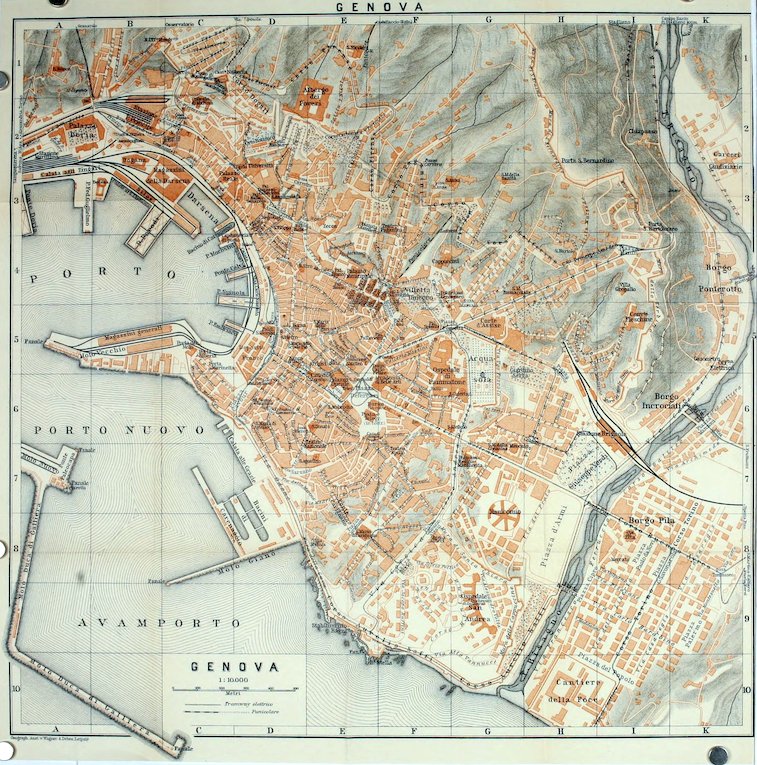
Steering through the Avamporto and the Porto Nuovo, we obtain a superb *View of Genoa, rising in a semicircle on the hill-side.
Genoa.—Arrival by Sea. The passenger-steamers land at the Ponte Federico Guglielmo (Pl. A, B, 3; with custom-house, post, telegraph, and railway offices) in the Porto or inner harbour. Failing room at that pier, they anchor near it (landing by boat, with luggage, 1 fr.; embarkation 30, at night 50 c.), or they are berthed at the Ponte Andrea Doria (Pl. A, 3).—At the custom-house examination the facchino of the dogana expects 20–30 c.
Railway Stations. 1. Stazione Piazza Principe (Pl. B, 2; Rail. Restaur., déj. 2–3, D. 3–4 fr.), in the Piazza Acquaverde, the chief station for all trains, where cabs (p. 114) and omnibuses are in waiting.—2. Stazione di Brignole or Orientale (Pl. H, I, 6), the E. station, Piazza Giuseppe Verdi, a subsidiary station for Pisa, Florence, Rome, etc.—Railway-tickets may be obtained also of the Fratelli Gondrand, Via Venti Settembre 35, and of Thos. Cook & Son (p. 114).
Hotels (mostly in noisy situations and variously judged). *Grand-Hôt. Miramare (Pl. mi; A, 2), Via Pagano Doria, above the principal station, with terrace, R. from 6, D. 6, omn. 2 fr.; Bertolini’s Bristol Hot. (Pl. p; F, 6), Via Venti Settembre 35, R. from 7, D. 7, omn. 1½ fr.; Gr.-Hôt. de Gênes (Pl. f; E, 5), R. from 5, D. 6–7, omn. 1 fr.; Eden Palace (Pl. b; G, 5), Via Serra 6–8, R. from 6, D. 5–7 fr.; Gr.-Hôt. Savoie (Pl. s: C, 2), above Piazza Acquaverde, R. from 4, D. 5–6, omn. ½ fr.; Gr.-Hôt. Isotta (Pl. a; F, 5), Via Roma 5–7, R. from 5, D. 6, omn. 1½ fr.—Hôt. de la Ville (Pl. d; D, 4), Via Carlo Alberto, R. from 4, D. 5, omn. 1 fr.; Britannia (Pl. y; C, 2), R. from 3 fr.; Modern Hot. (Pl. v; F, 6), R. from 4, D. 5, omn. 1 fr.; Continental (Pl. 1; E, 4), R. 4–10, D. 5, omn. 1–1¼ fr.—Less pretending: Hôt. de France (Pl. g; D, 5), R. 3–4, D. 4, omn. 1 fr.; Hot. Smith (Pl. e, D, 5; Engl. landlord), R. from 2½, D. 4, omn. 1 fr., good; Central (Pl. c; F, 5), R. 2–4½ fr.; Royal Aquila (Pl. k; C, 2), near the principal station, R. 3–5, D. 5, omn. ½ fr., 114good for passing tourists; Impérial (Pl. im; F, 6), R. from 3½ fr.; Regina (Pl. q; F, 6).—Hôtels Garnis. Splendide (Pl. x; F, 6), Bavaria (Pl. z; F, 5), Excelsior (Pl. w; E, 5), R. in all these from 3 or 4 fr.
Cafés. Roma, Via Roma 15; Milano, Galleria Mazzini; both are also restaurants.—Restaurants (Italian cookery). Trattoria del Teatro Carlo Felice (Pl. E, F, 5), good; Cairo, Via Venti Settembre 36; Ristorante della Posta, Galleria Mazzini, moderate, often crowded.—Beer. Giardino d’Italia and Peyer, both in Piazza Corvetto (Pl. F, G, 5); Gambrinus, Via San Sebastiano (Pl. F, 5).
Cabs. One-horse, per drive (to the E. as far as the Bisagno, to the W. to the lighthouse) 1, at night 1½ fr.; per hr. 2 or 2½ fr.; each addit. ½ hr. 1 or 1¼ fr.; to Nervi or Pegli 5, there and back, with ½ hr. stay, 7½ fr.—With two horses, ½ fr. extra in each case.—Night is from 9 (in winter from 7) till sunrise.—Small packages inside cab are free; each trunk 20 c.—Motor Cabs (taximeter) per drive of 1200 met. (⅔ M.) 1 fr. 20 c., each addit. 300 met. 20 c.; at night (10 or 8 to dawn) one-fourth extra. Trunk 25 c.
Tramways (6 or 7 a.m. till midnight). The chief lines are: 1. Piazza Principe (Pl. B, 2), Piazza Acquaverde (Pl. B, C, 2), Piazza Zecca (Pl. D, E, 3; funicular to Castellaccio), Piazza Corvetto (Pl. F, G, 5), and Piazza Deferrari (Pl. E, 6; 10 c.).—2. Piazza Principe, Piazza Acquaverde, Via di Circonvallazione a Monte (station for Castellaccio at San Nicolò, Pl. E, 1), Piazza Manin (Pl. I, 4), Piazza Corvetto, and Piazza Deferrari (25 c.).—3. Piazza Caricamento (Pl. D, 5), Piazza Principe, Via Milano (Pl. A, 2), Lighthouse (p. 117), San Pier d’Arena, Sestri Ponente, and Pegli (p. 117; 55 c.).—4. Piazza Raibetta (Pl. D, 5), Via di Circonvallazione a Mare (p. 116), and Stazione Orientale (Pl. H, I, 6; 10 c.).—5. Piazza Deferrari, Piazza Manin, Via Montaldo (Pl. I, 1), and Campo Santo (p. 117; 15 c.).—6. Piazza Deferrari, Via Venti Settembre, Ponte Pila (Pl. H, I, 7), and Nervi (p. 117; every ¼ hr., in 50 min., 45 c.); branch to the Lido d’Albaro (p. 117).
Post Office (Pl. F, 5), Galleria Mazzini (new building in the Piazza Deferrari, Pl. E, 6; see p. 116), open 8 a.m. to 9 p.m.—Telegraph Office (Pl. E, 6), Palazzo Ducale, Piazza Deferrari.
Steamers. Cunard Line (C. Figoli, Piazza San Marcellino 6), from New York, Gibraltar, and Genoa to Trieste; White Star Line (Piazza Annunziata 18), to Naples, Gibraltar, and New York or Boston; Nederland Royal Mail (Agenzia Olandese, Piazza Deferrari), from Southampton to Genoa, Port Said, and Batavia; North German Lloyd (Leupold Bros., Via Garibaldi 5), for Algiers and Gibraltar, for Naples and Port Said, for Marseilles and Barcelona, for Naples, Catania, the Piræus, Smyrna, Constantinople, etc.; Hamburg-American Line (Piazza Annunziata 18), to Naples and New York, also excursion-boats; Società Nazionale (Via Balbi 40), for Naples and New York (comp. R. 24); also circular tours to Cagliari, Tunis, Tripoli, Malta, Syracuse, Messina, Naples, and back to Genoa (RR. 25, 64, 27, 24); also to Palermo, Trapani, and Syracuse; to Palermo, Messina, the Piræus, Constantinople (Odessa and Batum); to Smyrna and Constantinople (RR. 27, 80); to Leghorn, Naples, Messina, and Alexandria (R. 67); to Naples and Port Said (R. 67); La Veloce (Via Garibaldi 2), to Naples and Teneriffe (for Brazil), and viâ Marseilles and Barcelona to Teneriffe (Colón); Italia (Via Venti Settembre 34) to Teneriffe and Buenos Ayres; Lloyd Italiano (Palazzo Doria, Via Andrea Doria), for Naples and New York (R. 24); Lloyd Sabaudo (Piazza San Siro), for Naples, Palermo, and New York (RR. 24, 26), and for Tarragona, Gibraltar, and Buenos Ayres; Compañía Trasatlántica (Giovanelli, Via Balbi, Salita Santa Brigida 2), for Barcelona, Lisbon, and Liverpool, for Port Said and Manila, and for Barcelona, Málaga, Teneriffe, and Buenos Ayres.
Bankers. Kirby & Le Mesurier, Via Carlo Felice 7; Thos. Cook & Son, Piazza della Meridiana, cor. of Via Cairóli (Pl. E, 4); Credito Italiano, Via San Luca 4; Banca Commerciale Italiana, Piazza Banchi 11 (Pl. D, 5).—Money Changers abound near the Borsa.—Bookseller. A. Donath, Via Luccoli 33.
115Consuls. British Consul-General, William Keene, Via Assarotti 11; vice-consul, A. Turton.—U. S. Consul-General, J. A. Smith, Via Venti Settembre 42; vice-consul, J. W. Dye.
Churches. English (Church of the Holy Ghost), Via Goito (Pl. G, 4; services at 8:15 and 11 a.m., occasionally also at 4 p.m.); Presbyterian, Via Peschiera 4 (service at 11 a.m.).
Sights. Museo Chiossone (p. 116), daily except Mon., 10–3, adm. 1 fr.; Palazzo Bianco (p. 116), daily, Oct.-March 11–4, April-Sept. 10–4, Sun. and Thurs. ¼ fr., other days ½ fr., free on last Sun. of each month; Palazzo Durazzo-Pallavicini (see below), daily 11–4, fee ½–1 fr.; Palazzo Rosso (p. 116), free daily, 11–4, except on Tues., Sun., and holidays.
Genoa, Ital. Genŏva, French Gênes, a city of 156,000 inhab., was a republic and a great naval power in the middle ages, rivalling Venice, but declined after the 16th cent.; in 1797 it became the capital of Napoleon’s ‘Ligurian Republic’, and since 1815 has belonged to the kingdom of Sardinia which is now merged in that of Italy. Next to Marseilles it is the greatest of Mediterranean seaports. The exports and imports in 1908 amounted to 6.4 million tons, and the tonnage of shipping to 14.4 millions.
From the pier, either the Ponte Federico Guglielmo or the Ponte Andrea Doria (p. 113), we cross the harbour-rails to the Palazzo Doria (Pl. A, B, 2), once presented by the republic to Andrea Doria (1468–1560), the famous admiral of Charles V., and enter the Piazza del Principe (Pl. B, 2; tramway, see p. 114), with its handsome bronze monument to the Marchese Deferrari, Duke of Galliera (d. 1876), to whose generosity Genoa is partly indebted for its new quays (1877–95).
The Via Andrea Doria leads hence to the E. to the Piazza Acquaverde (Pl. B, C, 2), the square in front of the Railway Station, where, amid palms, rises a monument to Columbus, who was probably born at Genoa in 1451 (d. at Valladolid in 1506).
To the S.E. from this piazza runs a narrow line of streets, the chief artery of traffic, adorned with superb late-Renaissance edifices, built chiefly by Galeazzo Alessi (1512–72), named Via Balbi, Via Cairóli, and Via Garibaldi, and ending at the Piazza Fontane Marose. Several of the palaces are well worth seeing, especially for the sake of their grand staircases.
No. 10, on the right side of the Via Balbi, is the Palazzo Reale (Pl. C, 3), built after 1650 for the Durazzo family, and purchased in 1817 for the royal house of Sardinia. No. 5, on the left, is the Palazzo dell’Università (Pl. D, 2, 3), begun by Bart. Bianco in 1623 as a Jesuit school. The *Court and the staircases are considered the finest in Genoa.
Farther on, to the right, No. 4 is the Palazzo Balbi Senárega; No. 1, on the left, is the Palazzo Durazzo-Pallavicini (Pl. D, 3), both by Bart. Bianco. The picture-gallery in the latter (adm., see above) contains portraits by Rubens and Van Dyck, painted during their visits to Genoa.
116We cross the Piazza dell’Annunziata (Pl. D, 3) with the handsome baroque church of that name on the left, and the small Piazza della Zecca (Pl. D, E, 3; funicular to Castellaccio, p. 117), and then follow the Via Cairóli (Pl. D, E, 4) to the—
*Via Garibaldi (Pl. E, 4), which is flanked with numerous palaces. No. 13, on the left, is the Palazzo Bianco; No. 18, on the right, the Palazzo Rosso; both once belonged to the Brignole-Sale family, but were bequeathed to the city by the Marchesa Brignole-Sale (d. 1889), widow of the Duca di Galliera (p. 115), and converted into the two galleries named Brignole-Sale (adm., see p. 115). Most of the other palaces were designed by Gal. Alessi.
From the Piazza Fontane Marose (Pl. F, 4, 5) the short Via Carlo Felice leads to the S.W. to the Piazza Deferrari (Pl. E, 5, 6), the centre of the city and focus of most of the tramway-lines (p. 114). The Accadémia di Belle Arti (Pl. E, F, 6), on the E. side of the Piazza, contains the valuable Museo Chiossone (adm., see p. 115), a collection of Japanese and Chinese works of art.
The busy Via Roma (Pl. F, 5) leads to the N.E. from the Piazza Deferrari, past (right) the Galleria Mazzini, to the Piazza Corvetto (Pl. F, G, 5), adjoining which, on the left, on an old bastion is the Villetta Dinegro (Pl. F, 4; 242 ft.; fine views), a beautiful public park.
From the S.E. side of the Piazza Deferrari, where the new buildings of the Exchange (Borsa) and the Post Office are in progress (Pl. E, F, 6), runs the broad new Via Venti Settembre (Pl. F-H, 6, 7), the favourite promenade of the citizens, leading to the Bisagno Valley and the Stazione Orientate (p. 113). Immediately before we reach the street-viaduct we may turn to the right, cross the Piazza Ponticello (Pl. F, 6, 7), and ascend the Via Fieschi to *Santa Maria di Carignano (Pl. E, 8; 172 ft.), built by Gal. Alessi. The gallery of the dome (249 steps; sacristan 25 c.) is a splendid point of view. The Via Nino Bixio and Via Corsica (Pl. E, F, 8, 9) lead thence to the—
*Via di Circonvallazione a Mare, skirting the coast on the site of the old town-ramparts, named Via Odone and Corso Aurelio Saffi (Pl. E-H, 9, 10; tramway No. 4, see p. 114).
From the S.W. angle of the Piazza Deferrari the short Via Sellai leads to the Piazza Umberto Primo (Pl. E, 6). On its N. side rises the old Palazzo Ducale, or palace of the doges (telegraph-office), approached by a handsome flight of steps. On the S.E. side is the ornate Jesuit church of Sant’ Ambrogio, containing a Presentation in the Temple and the Miracles of St. Ignatius by Rubens.
From the Piazza Umberto Primo the busy Via San Lorenzo leads to the N.W., past the Cathedral (Pl. E, 5, 6; San Lorenzo), dating from the 12–17th cent. (in the left aisle the fine early-Renaissance chapel of San Giovanni Battista), back to the—
Harbour. Following the tramway to the right to the Piazza Raibetta, we observe on the left, between that piazza and the Piazza Caricamento, the Gothic Palazzo di San Giorgio, once the seat of the great merchants’ bank of that name. Beyond the Piazza Caricamento 117the noisy Via Carlo Alberto (Pl. D, C, 4–2) leads to the N. past the Darsena, once the naval harbour, to the Piazza Principe and to the piers, affording a glimpse at the harbour traffic.
From the Piazza della Zecca (p. 116) a Funicular Tramway (50 c.) ascends every 10 min. to San Nicolò (Pl. E, 1; change cars) and *Castellaccio, loftily situated. At the terminus (about 1025 ft.; Ristorante Beregardo, déj. 2½, D. 4 fr., commended) there is a splendid view of the Bisagno Valley with the Campo Santo (see below). About ½ M. to the N.W. rises the old fort of Castellaccio (1254 ft.), which commands an admirable survey of Genoa and the coast from Savona (p. 113) to the headland of Portofino (p. 134).
On the rocky Capo del Faro, between Genoa and San Pier d’Arena, rises the Lanterna, a great Lighthouse, 230 ft. high, from the foot of which we obtain another extensive *View. Tramway as far as the tunnel (No. 3; p. 114).
From the Piazza Deferrari a tramway (No. 5) leads by the Piazza Manin (Pl. I, 4) to the N.E. to the Campo Santo or Cimitero di Staglieno; which rises above the Val Bisagno on the N. bank.—We may take the tramway or a motor-omnibus also to the Lido d’Albáro, a popular resort and sea-bathing place below the road to Sturla and Nervi.
Favourite excursions from Genoa are (tramways Nos. 6 and 3) to Nervi, 7½ M. to the E., on the Pisa line, and to Pegli, 6¼ M. to the W., on the Ventimiglia line. Nervi has a beautiful marine parade, and at Pegli is the Villa Pallavicini. (The entrance of the villa is immediately to the left of the exit from the rail. station; adm. on week-days except Frid. and festivals, 10–3; on Sun. and holidays 9–2; fee 1 fr.)—A superb view is obtained from the Portofino-Kulm (1477 ft.; Hôt.-Restaur., déj. 5, D. 7 fr.), on the Monte di Portofino (p. 134). Motor-omn. direct from Genoa, Piazza Deferrari; also 4 times daily from Recco station, 13 M. to the E., on the Pisa line.
See also Baedeker’s Northern Italy.
b. Viâ Algiers.
1086 M. North German Lloyd on alternate Saturdays, in 3 days (to Algiers in 25 hrs., fare 66 or 44 marks; thence to Genoa 33 hrs., fare 77 or 55 marks). The Hamburg-American and the Austrian Lloyd steamers sometimes ply between Gibraltar and Algiers. The Navigation Mixte usually sends steamers from Gibraltar to Oran (hence to Algiers by railway). Steamers of the German Levant Line and others also are available as far as Algiers.—Agents at Gibraltar, see p. 53; at Algiers, p. 219; at Genoa, p. 114. See also ‘Gibraltar Chronicle’.
The vessel steers to the E. from Gibraltar, between the Spanish coast, which remains in sight as far as the Cabo de Gata (comp. R. 15 a), and the flat volcanic island of Alborán (48 ft.), the ancient Drinaupa, now belonging to Spain. The distant Sierra Nevada (p. 49) peeps here and there above the horizon.
118Off Cape Ivi (lighthouse), beyond the mouth of the Chélif (p. 208), we sight the Tell Atlas (p. 169) on the Algerian coast. We then pass the very prominent Cape Ténès (p. 209) and, beyond Cherchell (p. 244), the massive Jebel Chenoua (p. 242), near which we survey the beautiful Bay of Castiglione (p. 237), backed by the hills of Sahel and extending to Mont Bouzaréah (p. 235).
By Râs Acrata (p. 237) we near the coast, pass the lighthouse on the low Cape Caxine (p. 237) and the picturesque cliffs of Pointe Pescade (p. 237), then St. Eugène (p. 236) and the church of Notre-Dame d’Afrique (p. 236), and enter the harbour of Algiers (p. 217).
Leaving Algiers for Genoa the vessel steers to the N.N.E., affording a fine parting view of the Bay of Algiers and the coast as far as Cape Bengut (p. 127). Corsica (p. 143) is visible in clear weather only. We near the Riviera di Ponente off Porto Maurizio (p. 113) and soon enter the harbour of Genoa (comp. p. 113).
16. From Gibraltar to Naples.
1118 M. Cunard Line (from New York) and White Star (from New York or Boston), each two or three times a month, in 3 days (fare 5l. 10s.); Orient Royal (from London), fortnightly; North German Lloyd (from New York or Southampton), three or four times a month (120 or 88 marks); Hamburg-American Line (from New York), once or twice a month.
For Gibraltar, and the first part of the voyage, comp. p. 52 and R. 15 a. Astern appears the majestic Sierra Nevada (p. 49).
Steering to the E.N.E., we sometimes see the Algerian coast to the S., from Cape Ténès (p. 209) to the Bay of Algiers (p. 221) and the hills of Great Kabylia (p. 252).
After many hours’ steaming we next sight the uninhabited rocky islet of Il Toro, off the S.W. coast of Sardinia, and the Golfo di Palmas (p. 129), between the island of San Antioco and the bold Cape Teulada, the ancient Chersonesus Promontorium, the southmost point of Sardinia. We pass the Isola Rossa Bay at some distance; then Cape Spartivento (lighthouse), at the S. end of the broad Bay of Cagliari (p. 144), which is only distinguishable in clear weather, and the granitic Isola dei Cavoli (lighthouse), lying off Cape Carbonara (p. 144). The Sardinian coast now rapidly disappears.
The steamer at length nears the Bocca Grande, 15 M. in width, the chief entrance to the *Bay of Naples (p. 135), between the islands of Ischia (left) and Capri (right), with Vesuvius in the distance. The S.W. point of Ischia is the picturesque Punta Imperatore (lighthouse). We steer past the S. side of the island, about 3 M. from the Punta Sant’ Angelo and the Punta San Pancrazio, then past the island of Procida and the hill of Posilipo, into the harbour of Naples (p. 135).
From Naples to Genoa, see R. 24.
119
17. From (Lisbon) Tangier, and from Gibraltar, to Marseilles.
From Lisbon to Tangier and (1150 M.) Marseilles (Naples, and Port Said) there are regular steamboat services (from Tangier or Gibraltar to Marseilles in 3 days) by the German East African Line (E. circular tour), once in three weeks, and the Rotterdam Lloyd, fortnightly.—From Gibraltar to Marseilles there are the Peninsular & Oriental, the Orient Royal, and other lines.—Steamboat-agents at Lisbon, Tangier, Gibraltar, and Marseilles, see pp. 8, 98, 53, 120.
From Lisbon to the Straits of Gibraltar, comp. p. 5; Tangier, p. 98; Gibraltar, p. 52.
The steamer skirts the Spanish coast from Gibraltar to Iviza (p. 112). The direct route to Marseilles is through the Balearic Sea (p. 112) and the Gulf of Lions, where storms often prevail; but when the mistral, or N. wind, blows a more westerly course is chosen, past the volcanic Columbretes islets (lighthouse) and along the coast of Catalonia.
At length, to the S.E. of the Rhone Delta, and flanked with bare limestone hills, we sight the Bay of Marseilles, bounded by the Cap Couronne, on the left, and the Cap Croisette, on the right. We pass the island of Planier (lighthouse) and the islands of Ratonneau, Pomègue, and If, and obtain a fine view of the church of Notre Dame de la Garde (p. 122) overlooking the city. The vessels usually steer through the Avant-Port Nord and the large new Bassin National into the Bassin de la Gare Maritime.
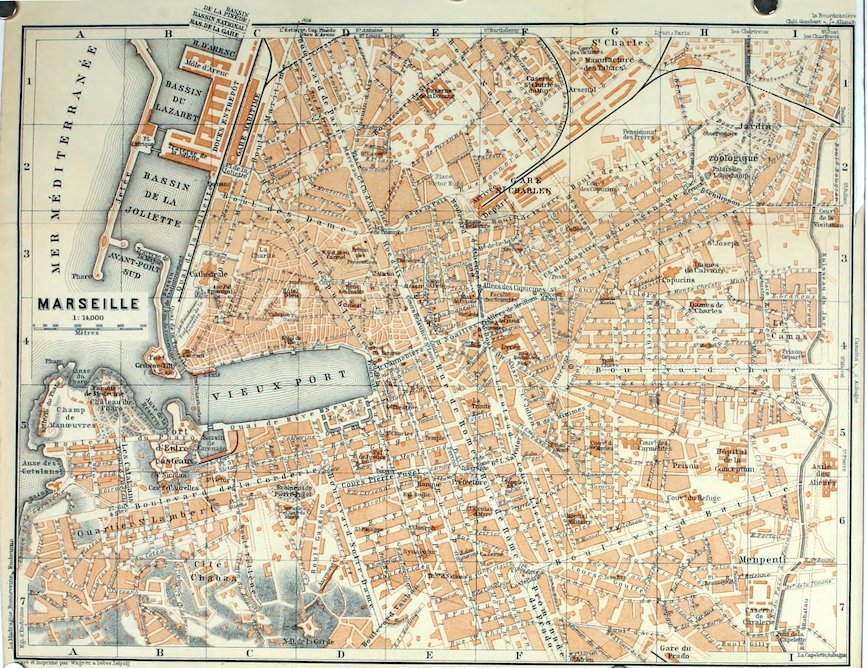
Marseilles.—Arrival by Sea. The North German Lloyd and German East African steamers anchor in the Bassin du Lazaret (Pl. B, 1). Those of the Générale Transatlantique Co. and Messageries Maritimes start from the Bassin de la Joliette (Pl. B, 2, 3). Most of the great British lines (P. & O., Orient Royal, Bibby, British India, etc.) have their own berths, as to which careful inquiry should be made. Note that most of these are a long way from the principal railway-station (1–1½ M.).
Railway Stations. The Gare St. Charles (Pl. F, 2), the main station, is the only one for through-passenger traffic. See the French Indicateur as to trains, several of which run in winter only; others correspond with the P. & O. and other steamers for Egypt, India, Australia, etc.
Hotels (mostly in noisy situations). *Regina (Pl. f; D, 3), Place Sadi-Carnot; *Louvre & de la Paix (Pl. a; E, 4), *Noailles & Métropole (Pl. c; E, 4), and Grand (Pl. b; F, 4), all in the Rue Noailles; Bristol (Pl. w; E, 4), Rue Cannebière, new. These five are of the first class (R. from 4 or 5, B. 1½, déj. 4–4½, D. 5–6 fr.).—Petit-Louvre (Pl. d; E, 4), Rue Cannebière 16; Genève (Pl. m; D, 4), Rue des Templiers 3, R. from 3½, B. 1½, déj. 3, D. 4 fr., well spoken of; Castille & Luxembourg (Pl. e; E, 5), Rue St. Ferréol, R. from 3, B. 1¼, déj. 3, D. 4 fr.; Des Phocéens (Pl. i; E, 4), Rue Thubaneau 4, R. from 3, B. 1, déj. 3, D. 4 fr., good; Continental (Pl. j; D, 4), Rue Beauvau 6, R. from 2½, B. 1, déj. 3, D. 3½ fr.—Near the Railway Station: Terminus Hotel (Pl. g; F, 2), R. 5–10 fr.; *Russie & Angleterre, Boul. d’Athènes 31 (Pl. E, 3), R. from 4, B. 1¼, déj. 3, D. 4 fr.; Bordeaux & Orient (Pl. k; E, 3), same boulevard, No. 11, R. from 3, B. 1½, déj. 3, D. 3½ fr.—Hôtels Garnis (R. 3–4, B. 1½ fr.): Gr. Nouvel Hôtel (Pl. u; F, 4), Boul. du Musée 10, good; Modern Hotel (Pl. s; D, 4), Rue Cannebière 50; Riche et du Vingtième Siècle (Pl. v; E, 4), same street, No. 1.
120Restaurants. *La Réserve, Palace Hotel, Chemin de la Corniche, of the first class.—*Isnard, Hôt. des Phocéens (p. 119); de Provence, Cours Belsunce 12, good.—Cafés, best in Rue Cannebière and Rue Noailles.—Brasserie de l’Univers, at the Hotel Bristol (p. 119); Strasbourg, Place de la Bourse 11.
Cabs (voitures de place, same fares by day or night). In the inner city, to the Traverse de la Joliette (Pl. B, 2) in the N., and to Boul. de la Corderie and Boul. Notre Dame in the S.W.: one-horse carriage (2 seats) per drive, 1½, per hour 2½ fr.; two-horse carr. (4 seats) 2 or 3 fr.; trunk 25 c. per drive, 50 c. per hour.—As overcharges are frequent, the tariff should be asked for.—Motor Cabs (taximeters for 3 pers.), 1 fr. for the first 800 metres (ca. ½ M.), 20 c. each addit. 400 m.; 3 fr. per hour.
Tramways (in the town, 10 c.; no transfer tickets). Among the chief are: from Place de la Joliette (Pl. C, 2) to Boul. Vauban (Pl. D, 7; Notre Dame de la Garde, p. 122); from Quai de la Joliette to the Zoological Garden (Pl. H, 2; Palais de Longchamp, p. 122); from Zoological Garden to Boul. Notre Dame (Pl. D, 6, 7; lift to Notre Dame de la Garde) and Boul. Vauban (Pl. D, 7); from the Cours St. Louis (Pl. E, 4) viâ the Prado (p. 122), the Corniche (p. 122), and Endoume, back to the Cours St. Louis (15 c.).
Transporter Bridge (Pont Transbordeur; Pl. B, 4, 5; p. 121), between Quai de la Tourette and Boul. du Pharo, in 2 min. (5 c.).
Steamboat Lines. Peninsular & Oriental (Estrine & Co., Rue Colbert 18), from London to Gibraltar, Marseilles, and Port Said (RR. 1, 17, 67); Orient Royal (Worms & Co., Rue Grignan 28), from London to Gibraltar, Marseilles, Naples, and Port Said (RR. 1, 17, 23, 67); North German Lloyd (W. Carr, Rue Beauvau 16), to Goletta (Tunis) and Alexandria, to Naples and Alexandria, also to Genoa, Naples, Catania, the Piræus, Constantinople, etc. (RR. 22, 23, 24, 67, 77, 80); German East African (W. Carr), from Southampton to Lisbon, Tangier, Marseilles, Naples, and Port Said (RR. 1, 23, 67); Bibby (Watson & Parker, Rue Beauvau 8), from Liverpool to Marseilles, Port Said, etc. (R. 67); British India (G. Budd, Rue Beauvau 8), from Port Said to Genoa, Marseilles, and London; Rotterdam Lloyd (Ruys & Co., Rue de la République 29), to Port Said (R. 67); Messageries Maritimes (Place Sadi-Carnot 3), to Naples, Piræus, Constantinople, and Beirut (RR. 77, 75), also to Constantinople, Odessa, and Batum (RR. 83, 85), also to Alexandria, Port Said, and Beirut (RR. 67, 72); Générale Transatlantique (Rue Noailles 15), to Oran and Cartagena (RR. 19, 18), also to Algiers, Bougie, Philippeville, and Bona (R. 20), also to Tunis and Malta (R. 21, 63), and to Sfax and Susa (RR. 21, 64); Transports Maritimes (Rue de la République 70), to Gibraltar and Madeira (R. 3), to Oran (R. 19), to Algiers, Philippeville, and Bona (R. 20), and to Tunis (Susa; RR. 22, 64); Navigation Mixte (Touache Co., Rue Cannebière 54), to Oran (R. 19), to Tangier viâ Oran (RR. 19, 18), to Algiers and Philippeville (R. 20), to Tunis, Sfax, and Tripoli (RR. 21, 64), and to Palermo (RR. 21, 26); Chargeurs Réunis (Worms & Co., see above), from Dunkirk to Marseilles, Genoa, and Naples (for E. Indies, S. America, etc.); Fraissinet & Co. (Place de la Bourse 6), to Ajaccio and Bastia (and Leghorn); N. Paquet & Co. (Place Sadi-Carnot 4), to Oran (if required), Tangier, and the Moroccan ocean-coast (R. 14); Compañía Mallorquina, to Palma (Majorca).
Post & Telegraph Office. Hôtel des Postes (Pl. D, 3), Rue Colbert; branches at the railway-station (p. 119), at the Bourse (Pl. D, E, 4), etc.
Tourist Agents. Thos. Cook & Son, Rue Noailles 11 bis; Lubin, Rue des Feuillants 14.—Banks. Banque de France (Pl. E, 6), Place Estrangin-Pastré; Crédit Lyonnais, Rue St. Ferréol 25 (Pl. E, 4, 5).
Consuls. British Consul-General, M. C. Gurney, Rue des Princes 8; vice-consuls, T. Broadwood, F. J. Hamling.—U. S. Consul-General, A. Gaulin, Cours Pierre-Puget 10; vice-consul, P. H. Cram.
English Church, Rue de Bellois 4; services at 10.30 and 3.30.
Marseilles, Fr. Marseille, the second-largest city in France, with 517,500 inhab., the Massalia of the Greeks and Massilia 121of the Romans, was founded by Greeks from Phocæa (p. 530) in Asia Minor about 600 B. C., and soon became one of the greatest seaports on the Mediterranean. During the Roman period it vied with Athens as a seat of Greek culture; in the middle ages it belonged to the kingdom of Arelate, and later to the county of Provence, and in 1481 it was at length annexed to France. Being situated at the mouth of the great and time-honoured route through the Rhone Valley to N.W. Europe, it is the most important of French and of all Mediterranean seaports. The total exports and imports are estimated at 2926 million francs, and nearly 17 million tons of shipping enter and clear annually. The city is now almost entirely modern and destitute of historical memorials.
From the Bassin du Lazaret (Pl. B, 1) and Bassin de la Joliette (Pl. B, 2, 3), the southmost of the docks constructed since 1850 to the N.W. of the old town, we follow the Quai de la Joliette to the—
*Cathedral (Pl. B, C, 3; Ste. Marie Majeure or La Major), situated on a terrace. This is one of the largest and finest churches of the 19th cent.; it was built by Vaudoyer, in a mixed Byzantine and Romanesque style, in 1852–93. Adjacent is the Old Cathedral of St. Lazare, which is shown by the sacristan of the new church.
From the Place de la Major the Esplanade de la Tourette leads to the S. to the *Vieux Port (Pl. C, D, 4, 5), the Lakydon of the Phocæans, a deeply indented creek, where smaller craft only are now berthed. The entrance to it is guarded by the old forts of Grasse-Tilly and Entrecasteaux. Just inside the entrance the harbour is crossed by the Pont Transbordeur or Transporter Bridge (p. 120); for the sake of the view we may ascend either to the trolley-way (buffet-restaurant) or to the top of the N. tower (steps up and down 50 c.; lift up 60, up and down 75 c.).
On the N. side of the Quai du Port (Pl. C, D, 4), the scene of motley popular traffic (pickpockets not uncommon), lies the Old Town, with its narrow and dirty streets, inhabited by the lower classes, including numerous Italians of whom the city contains about 100,000. This quay leads past the Hôtel de Ville (Pl. C, 4), an interesting building of the 17th cent., to the E. end of the Vieux Port, where begins the—
*Rue Cannebière (Pl. D, E, 4), which for ages has been the chief boast of the city. Here, on the left, is the Bourse (Pl. E, 4), erected by Coste in 1852–60.
This street, prolonged by the Rue Noailles, the Allées de Meilhan, etc., intersects the city from S.W. to N.E., and at the Cours St. Louis (Pl. E, 4), the chief centre of traffic, it is crossed by a straight line of streets running from N.W. to S.E., the Cours Belsunce, Rue de Rome, and Promenade du Prado, to the Rond Point (p. 122), being in all nearly 3 M. long.
122The Rue Noailles (Pl. E, 4), from the end of which the Boulevard Dugommier ascends to the railway-station, and the pretty Allées de Meilhan (Pl. F, 4) lead to the modern-Gothic church of St. Vincent de Paul (Pl. F, 3), with its two towers commanding a great part of the city.
A little to the left is the Cours du Chapitre, leading into the Boulevard Longchamp (Pl. G, H, 3, 2), a street ascending steeply to the *Palais de Longchamp (Pl. H, 2). This imposing Renaissance edifice was designed by Espérandieu, the architect (1862–9). The Ionic colonnade, with a lofty triumphal arch in the centre, where a picturesque cascade has been introduced, is flanked with two wings, the right containing the Natural History Museum, and the left the Museum of Fine Art (adm. daily except Mon. and Frid., 8–12 and 2–5 or in winter 9–12 and 2–4; closed 20th–31st Jan. and 20th–31st July).
The groundfloor contains sculptures. In the centre is the principal hall. The room on the left contains works by the Marseillais master Pierre Puget (1622–94); in that on the right is a model of the Monument to the Dead in Père Lachaise at Paris, by Bartholomé. The staircase is adorned with a wall-painting by Puvis de Chavannes (1869).
On the first floor is the picture-gallery. Among the older pictures in the central room are: 361. Nattier, Duchesse de Châteauroux; 788. Pietro Perugino, Holy Family; 914. Rubens, Boar-hunt (about 1615). In the modern department, in the room on the left: 430. J. Fr. Millet, Mother and child (1860).
The main streets of the S. quarter of the town are the Rue de Rome, which begins at the Cours St. Louis (p. 121), and a little to the W. of it the handsome Cours Pierre-Puget (Pl. E, D, 5, 6), ending in the Promenade of that name.
A little to the S., on a bold rock of white limestone, is enthroned the church of *Notre Dame de la Garde (Pl. D, 7; 532 ft.), a great landmark for mariners, where we obtain the finest view of the city and its environs. Lift (Ascenseur; Pl. D, 7) from the Rue Cherchell (up 60, down 30, return 80 c.; on Sun. and before 9 a.m., 40, 20, or 50 c.).
On a fine day the traveller will be repaid by a visit to the *Chemin de la Corniche (comp. Pl. A, 6; tramway, p. 120). From Notre Dame de la Garde it may be reached direct in about 40 min. by the Chemin du Roucas-Blanc. This road, partly hewn in the rock, and shadeless, affords fine views. It ends, near the Château Borély, which stands in a park and now contains the Musée d’Archéologie, at the—
Promenade du Prado, a favourite resort of the Marseillais, planted with plane-trees. A gay throng may be seen here on Sunday afternoons and every fine evening. We may return thence to the town by the Rond Point du Prado.
See also Baedeker’s Southern France.
From Marseilles to Naples, see R. 23.
123
18. From Tangier and Cartagena to Oran.
From Tangier to Oran (301 M.). Mail steamers of the Navigation Mixte, every Wed. afternoon, in 52½ hrs. (fares, without food, 80 and 60 fr.), viâ Melilla and Nemours (returning viâ Beni-Saf, Nemours, Melilla, and Tetuán); also cargo-steamers viâ Málaga, Melilla, and Nemours, in 3–4 days, leaving Tangier every second Tuesday (Málaga Wed.). Also steamers of the Hungarian Adria (fare, without food, 30 fr.). Agents at Tangier, see p. 98; at Málaga, p. 89; at Oran, p. 176.
From Cartagena to Oran (132 M.). Comp. Générale Transatlantique every Tues. in 9 hrs. (fares, without food, 50 and 35 fr.; pier-dues at Cartagena 3 or 2 fr.; agent J. M. Pelegrin, Plaza de la Aduana 1; at Oran, p. 176). This is the shortest sea-route to Algiers and is recommended to those who are bad sailors. Passport necessary.
Steering from Tangier (p. 98) to the E.N.E. through the Straits of Gibraltar, the vessel passes Cape Malabata (p. 57), Cape Alboasa, and the fine shore of the Cala Grande, to which the Rio de las Ostras descends from the Sierra San Simonito, a branch of the Anjera Mts. (p. 103). In the little bay on the E. side of the Punta Alcázar, scarcely visible from the sea, lie the ruins of Ksar es-Serîr, a small seaport founded by Yakûb ibn Yûsuf (p. 61), which prospered in the later middle ages, and belonged to the Portuguese from 1448 to 1540.
Off Cape Ciris (p. 5) the steamer nears the abrupt slopes of the Sierra Bullones (p. 103) and then passes the Isla del Peregil (243 ft.), which is overgrown with underwood and contains a large grotto (Grotta de las Palomas, visited from Ceuta). Beyond Cape Leona and the Bay of Benzus the region of Ceuta (p. 103) is reached. Fine view of the bay of Algeciras (p. 56) and the rock of Gibraltar to the N.
After passing the bay of Ceuta and the N. and E. headlands of the peninsula of Almina (p. 103), the Punta Santa Catalina (p. 5) and the Punta de la Almina (lighthouse), we obtain an admirable view of the Moroccan coast, extending from the Sierra Bullones (p. 103) to the finely shaped Jebel Beni Hassan. In the centre, between Cabo Negro (p. 103) and Cabo Mazari, is the deep depression of the plain of Tetuán (p. 102), where the steamers of the Navigation Mixte call on their voyage to Tangier only.
The vessel now steers to the E.S.E. towards Cape Tres Forcas, quite apart from the Rîf Coast, a hill-region inhabited by the Ruâfa (sing. Rîfi) and still forming part of the Blad es-Siba (p. 96). It lies between the Wâd Waringa, the river bounding the province of Tetuán, and Cape Tres Forcas. In the bay of Alhucemas rise the rocky islets of Peñón de Vélez de la Gomera and Islas de Alhucema, with two Spanish ‘presidios’. The Betoya, the stretch of coast with its numerous creeks between Cape Quilates, on the E. side of the Alhucemas Bay, and Cape Tres Forcas, was for centuries the favourite haunt of the Rîf pirates (p. 96).
124Beyond the wedge-like Cape Tres Forcas, the ancient Sestiaria Promontorium (Arabic Râs Wark), jutting out 12½ M. seaward, we sight the long coast-line of the Bay of Melilla, into which the steamers from Málaga, passing some 20 M. to the W. of the island of Alborán (p. 117), steer direct.
Melilla (Hot. de Asia, Fonda la Africana, both at the harbour and plain), or Melila, a town of 9000 inhab., the only Mediterranean port on the Morocco coast besides Ceuta and Tetuán lies most picturesquely on the spurs of Monte Melila or Caramu (3235 ft.), a little to the N. of the marshy, fever-stricken mouth of the Rio del Oro. Its site is probably that of the ancient Rusaddir (p. 95), where ended the great Roman military road, about 1430 M. long, which connected Carthage with Mauretania. Melilla is the oldest Spanish possession in Morocco, having been captured in 1496. In 1774 it was unsuccessfully besieged by a Moroccan army, and in 1893 it resisted an attack by the Berbers of the Rîf. Being a free port, it carries on a brisk trade with the coast-towns of the Algerian province of Oran, and many Moroccans from the interior embark here on their way to the harvesting in Algeria. The larger steamers anchor in the roads, which are tolerably sheltered from the W. winds only (landing or embarkation 50 c.). New harbour-works, however, are now under construction. The drinking-water of Melilla is not good.
Melilla consists of the small and tidy new town which has been built near the harbour since 1893 and contains a covered market, the shops of the Spanish-Jewish and Moorish tradesmen, and the promenade, and of the remarkably clean old town, enclosed by lofty walls, and occupying the nearly square plateau of a rocky headland. From projecting parts of the town-wall a fine view is obtained of the Fort Rosario, which is separated from the old town by the small Galápago Bay, and of the broad bay extending to the Chafarinas Islands (see below); in the background, beyond the Mar Chica or Lago de Puerto Nuevo (Arabic Sebkha Bu-Erg), a shallow lake 13 M. long, appears the lofty chain of Jebel Kebdana with the Monte de Tessan (3275 ft.).
Continuing our Voyage, we pass the Chafarinas Islands (French Iles Zafarines), occupied by the Spanish since 1848, which lie off the Cabo del Agua and form the only safe harbour on this coast as far as Oran. On the Isla Isabel Segunda, the central island, rises a lighthouse visible at a distance of 20 M.
We pass the mouth of the Mulûya (p. 93), the ancient Malucha (or Muluchath), which separated the provinces of Mauretania Tingitana and Mauretania Cæsariensis (p. 244), and was in the middle ages the boundary between the kingdoms of Fez and Tlemcen (p. 188). Beyond it, rising above the thickly peopled 125coast-plain of Tazagraret, rises the chain of Jebel Beni Snassen (p. 197), which belongs geologically to the Algerian Tell Atlas (p. 169). The political frontier between Morocco and Algeria is formed by the brook Oued Kiss or Adjeroud (comp. p. 169), near which, on the little Baie d’Adjeroud, and not far from Cape Milonia, lies the French seaport of Port-Say or Adjeroud.
In calm weather the steamers call at the bay of Nemours (p. 198), enclosed by the spurs of the Traras Mts. (p. 198; landing or embarkation 1 fr.). They then pass Cape Torsa and Cape Noé, where the plateau of Mont Tadjera (2592 ft.) is sighted, and steer to the N.E. towards Cape Figalo, at some distance from the little port of Honeïn (here the iron-ore of Rhar el-Maden is exported), the lighthouse on the island of Rachgoun (opposite the mouth of the Tafna, p. 185), and the port of Beni-Saf (p. 185). To the N.E., beyond Cape Figalo, appear the Isles Habibas (lighthouse), surrounded by reefs, and then, beyond Cape Lindless, the uninhabited little Ile Plane.
Beyond Cape Falcon (lighthouse; p. 184) we survey the broad Gulf of Oran (p. 126), as far as the Pointe de l’Aiguille. Immediately to the right, in the fertile Plaine des Andalouses, lies the village of Aïn et-Turk (p. 184); then, beyond the spurs of the Jebel Santon, the harbour of Mers el-Kébir (p. 183), with a fort and lighthouse. Entrance to the harbour of Oran, comp. p. 175.
Cartagena (Hot. de Francia y de Paris, Calle de Osuna and Plaza de la Aduana; Hot. Ramos, Plaza de Prefumo 8; Brit, vice-cons. J. C. Gray; U. S. cons. agent, A. J. Marks; pop. 41,300), founded by Hasdrubal in 221 B.C., the best natural harbour on the Spanish Mediterranean coast, is now the chief harbour of the Spanish navy. (It is reached by express from Madrid in 14 hrs.; sleeping-car on Mon., Wed., and Frid., 21 p. 25 c. extra.) The railway-station lies to the N.E. of the town, not far from Muelle de Alfonso Duodecimo, the quay, where the steamers are berthed. A charming view of the town and the bay is obtained from the Castillo de la Concepción (230 ft.), a ruined castle on a hill.
The entrance to the inner harbour, which is closed by the Dique de la Curra (lighthouse), is guarded by two forts situated on bold volcanic rocks, the Castillo de las Galeras (656 ft.) on the W., and the Castillo de San Julián on the E. (919 ft.). The outer bay is protected on the S.E. by the little island of Escombrera, the ancient Scombraria.
The Oran steamboats, soon after leaving Cartagena, steer due S., affording a retrospect of the lighthouses of Cabo Tiñoso to the W. and Cape Palos (p. 112) to the E., and they usually enter the Gulf of Oran (p. 126) before dawn.
126
19. From Marseilles to Oran.
615 M. Steamboat Lines (agents at Marseilles, see p. 120; at Oran, p. 176). Comp. Générale Transatlantique, rapide on Thurs. and Sat. aft. (in reverse direction Tues. and Thurs.), in 41 hrs., fare 81 or 59 fr.; Transports Maritimes, Tues. (returning Sat.), in 38 hrs., 75 or 55 fr.; cargo-boat Frid. (returning Tues.), in 46 hrs., 60 or 40 fr.; Navigation Mixte (Touache Co.), Wed. (returning Sat.), in 54 hrs., 60 or 40 fr.
Travellers in S. France may take a steamer of the Navigation Mixte from Cette (a seaport 90 M. to the W. of Marseilles) to Porte Vendres and Oran (Thurs. night), in 45 hrs., fare 90 or 65 fr.
Marseilles and its harbour, see p. 119.
Steering out into the Gulf of Lions and the Balearic Sea, the steamers at first either follow the same course as those to Gibraltar (R. 17), or a more easterly course, past Majorca and Dragonera (p. 112), towards the rock-bound strait between Iviza (p. 112) and the flat island of Formentera, the southmost of the Balearic group. In passing we obtain a fine view of the town of Iviza, with its old castle and loftily situated cathedral (see Baedeker’s Spain and Portugal).
Nearing the Algerian coast, we first sight the range of hills culminating in Jebel Orouze (p. 199), which separates the bays of Arzew (p. 199) and Oran. Entering the outer *Gulf of Oran, we survey its full extent from the Pointe de l’Aiguille to Cape Carbon (p. 264). On the left, rises the curiously shaped Jebel Kahar or Montagne des Lions (p. 184). In the foreground, in the inner bay bounded by Pointe Canastel and the headland of Mers el-Kébir (p. 183), lies the town of Oran, with the old fort of Santa Cruz rising high above it (p. 175).
20. Prom Marseilles to Algiers, Bougie, Philippeville, and Bona.
Steamers (agents at Marseilles, see p. 120; at Algiers, p. 219; at Bougie, p. 262; at Philippeville, p. 304; at Bona, p. 309). 1. Comp. Générale Transatlantique from Marseilles to Algiers (463 M.), rapide mail-steamers on Sun., Tues., Wed., and Frid. at noon (returning Sun., Tues., Thurs., Frid. at noon), in 26½ hrs.; from Marseilles to Bougie (455 M.), Tues. noon (returning Sat. evening), in 37½ hrs.; from Marseilles to Philippeville (455 M.), Sat. noon (returning Frid. noon), in 30 hrs.; from Marseilles to Bona (462 M.), Tues. aft. (returning Tues. night), in 31 hrs.; fares by the mail-steamers to Algiers 96 or 69 fr.; for the other three routes 81 or 59 fr.—2. Transports Maritimes, from Marseilles to Algiers (and back), Wed. and Sat. aft., in 35 hrs., fare 70 or 45 fr.; to Philippeville (Bougie), Sat. aft. (returning Wed. noon) in 36 hrs., fare 60 or 40 fr.; to Bona, Mon. (returning Thurs.) aft., in 37 hrs., fare 60 or 40 fr.—3. Navigation Mixte (Touache Co.), from Marseilles to Algiers, rapide on Thurs. noon (returning Sat. noon), in 32 hrs., fare 75 or 50 fr.; direct cargo-boat on Mon. aft. (returning Frid. noon), in 36 hrs., fare 60 or 40 fr.; to Philippeville (Bona), mail-steamer on Thurs. noon (returning Mon. noon), in 33 hrs., fare 75 or 50 fr.
127Cheap steamers to Algiers are the cargo-boats of Caillol & Duvillard (50 or 30 fr.) and of Prosper Durand (40 or 25 fr.).
Less frequented routes are those of the Navigation Mixte from Cette (90 M. to the W. of Marseilles) to Port Vendres and Algiers (Sat. night; 42 hrs.; 90 or 65 fr.); the Spanish Compañía Mallorquina (p. 120) from Marseilles and Barcelona to Palma and Algiers (twice monthly; passport necessary); and the Comp. Générale Transatlantique (cargo-boats), between Ajaccio and Bona (Thurs. evening; in 30–38 hrs.; 60 or 50 fr.).
Marseilles, see p. 119.
The Algiers steamer usually passes close to the E. side of the island of Minorca, the eastmost of the Balearic group, where, in daylight, the deeply indented natural harbour of Mahon, the chief town, specially attracts attention. When the sea is rough the course is sometimes more westerly, past Cape Minorca (lighthouse), the W. extremity of the island, while inland on the flat coast lies the town of Ciudadela; the vessel then passes at some distance from the Cabo de Pera (lighthouse), and from the hilly S.E. coast of Majorca, which is famed for its stalactite caverns (see Baedeker’s Spain and Portugal).
At length, in clear weather, we obtain a glorious *View of the Algerian coast, from the hills of Cape Bengut (lighthouse) to the E., and the Jurjura Chain and the Tell Atlas to the S.E., both snow-clad in winter, to the wooded hill-country of Sahel, culminating in Mont Bouzaréah, and Cape Caxine (lighthouse) to the W. We now enter the fine *Bay of Algiers (p. 221), bounded by Cape Matifou (lighthouse) on the N.E. and the cliffs of the Pointe Pescade on the N.W., and survey its whole expanse. To the left, in the Mitidja Plain, between Cape Matifou and the sand-hills at the mouth of the Harrach, lies Fort-de-l’Eau, a sea-bathing place; beyond the Harrach, on the hill, stands the church of Kouba; farther along the coast, among the houses of Hussein-Dey and Belcourt, lies the Jardin d’Essai, backed by the gardens of Mustapha-Supérieur; behind the harbour of Algiers rises the high terrace-wall of the boulevards; then, above the new town, the white houses and lanes of the Kasba on the spurs of the hill crowned with the Fort l’Empereur; lastly, on the slope of the Bouzaréah hill, between the N.W. suburbs Bab el-Oued and St. Eugène, appears Notre-Dame d’Afrique, the mariners’ church.—Arrival in the harbour, see p. 217.
On the voyage from Marseilles to Bougie the course is more easterly, out of sight of the Balearic Islands. The tedium of the voyage is at length compensated for near the Algerian coast by an imposing *View of the mountains of Kabylia, which after a snowfall in winter have quite an Alpine charm. To the W., between Cape Sigli and Cape Carbon (p. 264) lies the abrupt and almost uninhabited coast of Great Kabylia, overtopped by the lofty Jebel Arbalou (p. 262). To the S., behind the fine curved outline 128of the Gulf of Bougie (p. 130), and beyond the plain of the Soumane Valley, rise the heights of Little Kabylia, with the deep depression of the Agrioun Valley, and, to the S.E., the serrated range of Jebel Tababor (6460 ft.). To the E., beyond Cape Cavallo, stretches the hill-region of Djidjelli. In the N.E. angle of the bay, on the S. slope of the Jebel Gouraya, but long concealed by the three spurs of that mountain (Cape Carbon, p. 264, Cape Noir, and Cape Bouak, with its lighthouse), lies most picturesquely the quiet seaport of Bougie, embosomed in luxuriant evergreen vegetation (p. 262).
The crossing to Philippeville is specially recommended to travellers bound for Biskra direct, as they thus avoid the long railway journey from Algiers. The broad Gulf of Stora, with its numerous headlands and creeks and its beautiful wooded hills, presents a charming picture, especially in spring. In the background, in a pleasant creek, lies Philippeville (p. 304). In passing through the outer harbour we obtain a good view of the town.
On the voyage to Bona the first land sighted on the Algerian coast is the lofty Mount Edough (3307 ft.; p. 169), the spurs of which extend to the N.W. to the Cap de Fer (p. 131). The steamers then enter the Gulf of Bona, bounded on the W. by the Cap de Garde (lighthouse), the N.E. spur of Mt. Edough, and on the E. by Cape Rosa (p. 131). On the S. margin of the bay, above the marshy alluvial plain of the Seybouse and the Oued Mafrag, rise the peaks of the Tell Atlas.
On the W. side of the gulf, between the spurs of the Edough, lies Bona (p. 309), one of the most important and most beautiful seaports of Barbary, with rich verdure all around. Before entering the grand harbour, commanded by the hill of the Kasba, we view the Corniche Road (p. 311), while on the low hill of Hippo, to the S. of the town, rises the church of St. Augustine (p. 312).
21. From Marseilles to Tunis.
555 M. Steamboats (agents at Marseilles, see p. 120; at Tunis, p. 331). 1. North German Lloyd from Marseilles to Goletta (Alexandria) every second Wed. foren. (returning Sat. even.), in 30½ hrs. (90–150 or 60 marks).—2. Comp. Générale Transatlantique from Marseilles to Tunis direct (Malta, R. 63), Mon. at noon (returning Frid. aft.), in 31½ hrs. (96 or 69 fr.); viâ Bizerta to Tunis (Sfax and Susa, R. 64), Frid. at noon (returning Wed.), in 41 hrs. (81 or 59 fr.).—3. Navigation Mixte (Touache Co.) from Marseilles to Tunis direct (Sfax and Tripoli, R. 64), rapide mail-steamer Wed. at noon (returning Mon. afternoon), in 39 hrs. (75 or 50 fr.); cargo-boat viâ Bizerta to Tunis (Palermo, R. 26), Sat. evening (returning Thurs. at noon), in 49 hrs. (60 or 40 fr.).
Marseilles, see p. 119.—After remaining for some time in view of the coast of Provence as far as Cape Sicié (comp. p. 132), the vessel steers to the S.E. and loses sight of land.
129Off the Isola di Mal di Ventre we may catch a glimpse of the peninsula of Sinis, which lies on the N. side of the large Gulf of Oristano, on the W. coast of Sardinia, and at whose S. end once lay the Phœnician colony of Tharros. The bare and monotonous hills of the S.W. coast, with the well-known lead and zinc mines of the Iglesiente, the region round Iglesias, are only visible in clear weather. The steamer rounds the islands of San Pietro and San Antioco (p. 118), with its capital of the same name on the E. coast, occupying the site of the Phœnician Sulci. We pass the Golfo di Palmas, with the uninhabited islets of La Vacca, Il Vitello, and Il Toro (p. 118), and then Cape Teulada (p. 118), after which Sardinia is soon lost to view.
To the S.W. appears the distant Ile de la Galite (p. 132); then, on the coast of Tunisia, we descry the low spurs of the Tell Atlas (p. 320), with the headlands of Râs el-Koran, Râs Engelah (lighthouse; the northmost point of the African continent), Cap Blanc (lighthouse; the Promontorium Candidum of antiquity), and Cap de Bizerte or Cap Guardia (853 ft.; lighthouse). To the S.E. another lighthouse marks the rocks of ‘I Cani‘.
Some steamers call at Bizerta (p. 352); the others steer to the left, past the Cani and the island of Pilau (p. 132), towards the little Ile Plane (lighthouse), which lies off Cape Farina (Arabic Râs Tarf; the ancient Promontorium Apollinis), where we come in sight of the broad Gulf of Tunis, with the island of Zembra (p. 153) in the background.
We now cross the Bay of Utica (p. 353) to the S., which since ancient times has been largely filled up with the deposits of the Medjerda (p. 320), pass Cape Kamart (p. 351) and La Marsa (p. 351), and then reach the picturesque Cape Carthage (p. 351), with its lighthouse and the sea-baths and white houses of Sidi Bou-Saïd. We now enter the *Inner Bay of Tunis, commanded on the E. by Jebel Korbous (p. 364) and on the S. by Jebel Bou-Kornin (p. 363), Jebel Ressas (p. 358), and Jebel Zaghouan (p. 359); we pass close to the castle-hill of Carthage (p. 344), crowned with the cathedral, the sea-baths of Le Kram, Khéreddine, and Goulette Neuve (p. 344), and reach Goletta (or La Goulette; p. 343), a small seaport, situated on the tongue of land separating the Lac de Tunis or Lac Bahira (p. 332) from the open sea.
The steamer here enters the canal, 5½ M. long, 110 yds. wide, and about 20 ft. deep, constructed across the lake in 1893, where we have a good view of the white houses of Tunis. On the right lies the island of Chikly, with relics of a castle built by Emp. Charles V. The surface of the lake is sometimes enlivened by flamingoes. The steamer, at half-speed, takes another hour to reach Tunis (p. 329).
130
22. From Algiers to Tunis by Sea.
432 M. Steamers (touching at intermediate ports, 469 M.; agents at Algiers, see p. 219; at Bougie, p. 262; at Philippeville, p. 304; at Tunis, p. 331). 1. Comp. Générale Transatlantique, cargo-boat Wed. evening, viâ Bougie, Djidjelli, Collo, Philippeville, Bona, La Calle, Tabarca, and Bizerta, arrives at Tunis Sun. aft. (returning Sat. noon, arrives at Algiers Wed. morn.); 100 or 80 fr.; pier-dues at Tunis 4 or 3 fr.—2. German Levant Line, twice or thrice a month, generally calling at La Calle.—3. Hungarian Adria Co., cargo-boat twice a month to Tunis direct.
Or the voyage may be pleasantly divided as follows: Marseilles steamer of Comp. Gén. Transatlantique from Algiers to Bougie (Frid. evening; in 10 hrs.; 25 or 18 fr.); Marseilles steamer of Transports Maritimes Co. from Bougie to Philippeville (Tues. afternoon; in 12 hrs.; 18 or 12 fr.); Marseilles steamer of Navigation Mixte from Philippeville to Bona (Sat. forenoon; in 5 hrs.; 10 or 8 fr.); from Bona to Bizerta, by cargo-boat as above, or by railway; from Bizerta to Tunis by Marseilles steamer of the Comp. Gén. Transatlantique (p. 128; Sat. night; in 5 hrs.; 15 or 12 fr.).—The small coasting steamers of Prosper Durand of Marseilles and of the Lignes Cotières Algériennes, which call at most of the ports as far as Bona, can only be recommended for short voyages by daylight.
The coast scenery between Algiers and Tunis is exceedingly picturesque and varied, but the voyage is often very trying for bad sailors. Storms are most frequent between Djidjelli and Collo, and between La Calle and Bizerta, and fogs are not uncommon, even in summer.
Algiers, see p. 217. As the steamer leaves the harbour a beautiful *View is obtained astern of the town and of the coast as far as the Pointe Pescade (comp. p. 127). Beyond Cape Matifou the coast, overlooked by the serrated Jebel Bou-Zegza (p. 249), recedes for a time from view.
Near Jebel Djinet (p. 253), beyond the sand-hills at the mouth of the Isser (p. 253), begins the bold rock-bound coast of Great Kabylia, 87 M. in length, with its headlands and cliffs worn by the surf, its secluded little seaports, and its hill-sides carefully cultivated by the natives.
We pass the mouth of the Sebaou (p. 253), the largest stream in Kabylia, and Cape Bengut (p. 254), which affords scanty protection against the W. winds to the port of Dellys (p. 254); then Tigzirt (p. 255), Cape Tedless, and Port Gueydon or Azeffoun (lighthouse), with its roadstead open towards the W. Next comes the wildest and loneliest part of the coast, between Cape Corbelin and Cape Carbon; we pass Cape Sigli, the Pointe Timri n’Tguerfa, where Jebel Arbalou (p. 262) comes in sight, and Cape Boulima.
Beyond the little Ile Pisan or Djeribia, overlooked by the steep slopes of Jebel Gouraya (p. 265), the steamer rounds Cape Carbon (p. 264), passes Cape Noir and Cape Bouak, and enters the harbour of Bougie (p. 262).
The *Gulf of Bougie, in winter the finest part of this coast, presents many superb scenes (comp. 128), notably as we look back at the town of Bougie climbing the slope of Jebel Gouraya.
Near Cape Cavallo, in the E. part of Little Kabylia, the summits 131of Jebel Hadid (4780 ft.) and Msid Echta (5072 ft.) are specially prominent. We next pass the curiously shaped hill in the Ile du Grand-Cavallo, the Petit-Cavallo, and the headland Râs Afia (lighthouse), and reach the little seaport of—
Djidjelli (p. 267), pleasantly situated at the foot of green hills, where the steamers anchor in the open roads (landing or embarkation ½ fr.). If time permit, the Vigie should be visited.
The vessel now steers to the N.E. at some distance from the coast; we pass the mouths of the Oued Nil and the Oued el-Kébir, the ancient boundary between Mauretania and Numidia, and then the Râs Atia (lighthouse): Fine view of the Bougaroun Mts., commonly called Sahel de Collo, famed for their forest of cork-trees.
Near Cape Bougaroun or Bougaroni (lighthouse), the northmost point of Algeria, opens the broad Gulf of Stora (p. 128), bounded on the E. by the Cap de Fer (see below). On the W. bank of the gulf, in the little Bay of Collo, and between the peninsula of Djerda (lighthouse) and the Râs Frao, lies the small seaport of—
Collo (Grand-Hôtel, poor), important only for the export of cork, the ancient Chullu or Colonia Minervia Chullu, one of the four Coloniæ Cirtenses (p. 298), in a fertile hill-region. From the harbour (landing or embarkation 30 c.) we walk round the *Peninsula, planted with vines and cacti, and overgrown on the N. side with underwood, and affording splendid views of the gulf.
Steering to the E. we now skirt the coast, where the Cape El-Kalaa or Râs Bibi (535 ft.), rising abruptly on both sides, specially strikes the eye, and pass the Pointe Esrah and the bay of that name. By the islet of Sgrigina (lighthouse), which lies in front of the Pointe Akmês or Sgrigina, opens the Inner Bay of Stora, bounded by Jebel Filfila, a mountain rich in marble, while in the background lies the harbour of Philippeville (p. 304).
On the N.E. margin of the gulf, beyond the plain of the Oued el-Kébir, with its border of sand-hills, rise the spurs of Mont Edough (p. 128). The steamer next rounds the almost insular Cap de Fer (1148 ft.; lighthouse), where we again view the whole expanse of the gulf, and passes Cape Toukouch, which shelters the bay of Herbillon (lighthouse) from the W. and N.W. winds. We now steer to the E.S.E., past the bare Jebel Gouari (1880 ft.), Cape Axin, and the dark rock of the Voile Noire (213 ft.), towards the Cap de Garde (p. 128), which projects in front of the gulf of Bona.
Three hours’ steaming from Bona, past the low Cape Rosa, whose light is seen 30 M. away, brings us to the open roads of La Calle (hotel), where landing is impossible in rough weather.
Beyond the rock of Kef Mechtob (591 ft.), and a little short of Cape Roux, which is crowned with a ruined tower, and like Cape 132Rosa was once famed for its coral-reefs, runs the frontier of Tunisia. The wooded hills rising abruptly from the sea belong to the region of the Kroumirie (p. 326), so often mentioned in the recent history of the country.
Tabarca (p. 327), the next port, lies picturesquely in a bay behind the island of Tabarca with its ruined Genoese castle.
Again steering to the N.E. we pass a range of high sand-hills and the mouth of the Oued Zouara, where we have a glimpse of the Nefza Mts. (p. 328).
Off Cape Negro appears in clear weather the coral-girt Ile de la Galite (1290 ft.), the Calatha of antiquity, about 24 M. to the N.W. of Cape Serrat (lighthouse), where the ramifications of the Mogod Mts. approach the coast.
Beyond the cliffs of the two Fratelli and the Râs al-Dukara we round the Bizerta Hills, the northmost part of the African coast, with the four headlands Râs el-Koran, Râs Engelah, Cape Blanc, and Cape de Bizerte (p. 129). As we near the bay of Bizerta (p. 352), fringed with low olive-clad hills, we descry, far to the S.W., the Jebel Ichkeul (p. 352).
Steaming farther to the E., we observe the Cani (p. 129) on the left, and pass Râs Zebib, where the green island of Pilau (377 ft.) becomes visible in the foreground. To the right, on the N. slope of Jebel Nadour (p. 354), covered far up with sea-sand, lies the highly picturesque Arab village of Metlineh.
For the voyage from Cape Farina to Tunis, see p. 129.
23. From Marseilles to Naples.
512 (viâ Genoa 615) M. Steamboat Lines. 1. Orient Royal Mail fortnightly, on the way from London to Port Said.—2. North German Lloyd, for Naples and Alexandria, Wed. afternoon, in 33 hrs. (100 or 70 marks); for Genoa, Naples, Catania, Piræus, Smyrna, Constantinople (Odessa, Batum) every other Frid. afternoon, in 3 days (80 or 56 marks).—3. German East African, to Naples (and Port Said) every third Sat. in 2 days, returning from Naples every third Wed. (80 or 60 marks).—4. Messageries Maritimes, to Naples (Piræus, Smyrna, Constantinople, Beirut, RR. 77, 80, 75) every second Thurs. (100 or 70 fr.).—5. Chargeurs Réunis (Tour du Monde), twice quarterly vîa Genoa to Naples (Colombo, E. Asia, San Francisco, etc.).—6. Hungarian Adria Co., cargo-boats, Sun. forenoon, vîa Genoa to Naples in 4 days (Palermo, Malta); also Wed. afternoon to Nice, Genoa, and Naples in 4½ days (Palermo, Messina); fare, without food, 42 fr.—The steamers of the P. & O. and Rotterdam Lloyd companies go from Marseilles to Port Said direct.
Marseilles, and departure from its harbour, see p. 119.
The steamers run to the E.S.E., between Cap Croisette and the Ile du Planier (p. 119), past the Ile Maire, Ile Jarros, and Ile Rio to the Straits of Bonifacio. Fine view of the richly varied coast of Provence, as far as the peninsula of Cape Sicié, with the bays of Cassis and La Ciotat, the latter of which is overlooked by the 133rock called the Bec de l’Aigle. In the background, beyond the bare limestone rocks on the coast, appears the Chaîne de la Ste. Baume (3786 ft.), famed for its ancient forest, the property of the state. Beyond Cape Sicié and the Bay of Toulon, we pass the steep rocky S. coast of Porquerolles (lighthouse), the largest and westmost of the Iles d’Hyères, the ancient Stoechades Insulae.
After a sail of several hours more Corsica (p. 143), with its high mountains, is sighted towards the E. In the distance lies the Bay of Ajaccio, where at night the lights on the Iles Sanguinaires may be descried. We next pass the Gulf of Valinco, and at Cape Aquila or Senetosa (lighthouse) we approach the S.W. coast of Corsica, fringed with numerous bays and creeks. Off the rocks called Les Moines (Monaci) we sight, to the left, the Montagne de Cagna (4518 ft.), which is usually covered with snow in winter.
The passage of the *Straits of Bonifacio, between Corsica and Sardinia, is very beautiful when the light is favourable. At the narrowest part, between Cape Pertusato and Punta del Falcone, they are 7 M. wide. Between the lighthouses of Capo di Feno and Capo Pertusato, amid fissured limestone rocks honeycombed with caverns, rises a headland crowned with the grey old Genoese citadel and the white houses of Bonifacio. Opposite to it, on the N. coast of Sardinia, is the peninsula of Capo Testa, and near the Punta del Falcone lies the narrow Bay of Longo Sardo, with the little port of Santa Teresa di Gallura. Beyond the town rise the hills of the Gallura in terraces, stretching far away to the Monti di Limbara (4469 ft.). On the S.E. the horizon is bounded by a girdle of granitic islands and rocks, the Insulae Cuniculariae (‘rabbit-islands’) of Pliny, which imperil navigation, especially as they are washed with a strong current from the Tyrrhenian Sea.
The steamers pass through the Bocca Grande, between the lighthouses on the French island of Lavezzi and the Italian Isola dei Razzoli. To the right, beyond the islets of Santa Maria and Isola dei Budelli, appears the island of Maddalena, on which rise a signalling station and the fort of Guardia Vecchia (545 ft.). This island, the largest of the group, is connected with its neighbours Santo Stefano and Caprera (696 ft.; once the residence of Garibaldi; d. 1882) by roads built on embankments, and has been converted into one of the strongest fortresses on the Mediterranean in emulation of Porto Vecchio in Corsica and of Bizerta. Beyond Caprera, and adjoining the deeply indented Bay of Arsachena, appears the reddish Capo di Ferro, the N.W. point of Sardinia.
We now steer across the Tyrrhenian Sea to the E.S.E. towards the Ponza Islands (p. xxxi). We first pass the volcanic N.W. group, Palmarola (the ancient Palmaria), Ponza (929 ft.; Pontiae, once a Roman colony), with the lighthouse of Punta della Guardia, and Zannone (Sinonia). Beyond La Botte, a rock dreaded by sailors, 134begins the S.E. group, first Ventotene, the well-known Pandateria of the Romans, to which Julia, Agrippina, and Octavia were banished, and then the islet of Santo Stefano (lighthouse).
In the distance appear the Monte Epomeo and the lighthouse on the Punta Imperatore in the island of Ischia (p. 118). Approach to the Bay of Naples, see p. 135.
From Naples to Alexandria and Port Said, see R. 67; to Athens (Smyrna, and Constantinople), see R. 77.
24. From Genoa to Naples.
387 M. Steamboat Lines (agents at Genoa, see p. 114; at Naples, p. 137). 1. Cunard (New York and Trieste Line), once monthly to Naples.—2. White Star (for New York or Boston), once monthly to Naples (3l. 5s.).—3. North German Lloyd (for New York), two or three times a month, in 21 hrs.; also (for Port Said) every second Thurs. to Naples, in about 24 hrs.; also Mediterranean-Levant Service (for Catania, Piræus, Smyrna, Constantinople; RR. 23, 27, 77, 80), every second Sat., in about 26 hrs. (70.40 or 48.20 marks).—4. Hamburg-American (for New York), once or twice monthly to Naples (80 fr.).—5. Società Nazionale: Line XX every Wed. night to Naples (and Messina, etc.; circular trip, comp. p. 142) in 33 hrs. (52 or 34 fr.); Lines V, X, & XI every Mon. and Tues. to Leghorn and Naples in 42–48 hrs. (63 or 42 fr.); Line I monthly to Naples (for Port Said and Bombay).—6. La Veloce, to Naples (for Teneriffe and S. America), comp. p. 114.—7. Lloyd Sabaudo, 1–3 times monthly to Naples (Palermo and New York).—8. Italian Lloyd, 1–3 times monthly to Naples and New York.—9. Hungarian Adria Co. (comp. R. 23), Tues. and Sat., to Naples in 36 hrs.; fare, without food, 24 fr.
Genoa, see p. 113. In departing we survey in clear weather the whole of the *Gulf of Genoa. On the left lies the Riviera di Levante, as far as the Monte di Portofino (2000 ft.; p. 117); on the right are the Ligurian Alps, snow-capped in winter, and the Riviera di Ponente as far as Cape Mele (p. 113).
The vessel steers for the island of Gorgona (see below), passing Monte di Portofino at a distance of 6 or 7 M., and then gradually leaves the coast; the last place visible is Chiavari on the beautiful Bay of Rapallo. Beyond the headland of Punta del Mesco, where the slopes of the Cinque Terre, a famous wine-country, descend abruptly to the sea, appear the rocky islet of Tino (302 ft.; lighthouse) and the fortified island of Palmária (614 ft.), at the S. point of the Gulf of Spezia. The distant pinnacles of the Apuan Alps are seen in clear weather. Of Leghorn (p. 143), where some of the Italian steamers call, the lights only are visible at night.
The islands of Gorgona and Capraia (p. 143) lie on the right; behind the latter sometimes peep the mountains of Corsica (p. 143). From the Ligurian we now pass into the Tyrrhenian Sea, either through the Strait of Piombino, between the port of Piombino and the rocky islet of Palmaiola, or through the Palmaiola Strait, between that islet (lighthouse) and Elba (p. 143). By Follónica, near Piombino, some furnaces, where iron from Elba is smelted, gleam through the night. Beyond the Bay of Portoferraio and Capo della Vita, the N.E. point of Elba, are seen near Rio Marina the reddish-black hills where the iron-ore comes to the surface. Farther to the S. is seen the depression of the bay of Porto Longone.
135The Promontory of Castiglione, in the midst of the marshy Maremma Toscana, and the small group of the islands of Formíche di Grosseto remain some way to the left. The steamer then passes through a strait between the steep headland of Monte Argentario (2083 ft.) and the island of Giglio (1634 ft.), each with its lighthouse. On the right lies the islet of Giannutri (305 ft.).
Steering towards the seaport of Civitavecchia and Cape Linaro, we see the distant Maremma di Roma, backed by the volcanic Tolfa Mts. (2011 ft.). Above the Roman Campagna rise the Sabine and Alban Mts., followed by the Volscian Mts. (Monti Lepini) and the Monte Circeo (1775 ft.) in the Pontine Marshes. Farther on, we obtain a glimpse of Terracina, the distant hills on the Gulf of Gaëta, and, to the S.W., the Ponza Islands (p. 133).
In the foreground we next sight Vesuvius and the island of Ischia with Monte Epomeo (2589 ft.), by which Capri is at first concealed. The steamers usually pass between Ischia and Procida, but sometimes through the Strait of Procida, between that island and Cape Miseno. The *Bay of Naples, which we now survey in its full expanse, from the Bay of Pozzuoli and the hill of Posilipo to the Peninsula of Sorrento (p. 154), is strikingly picturesque.
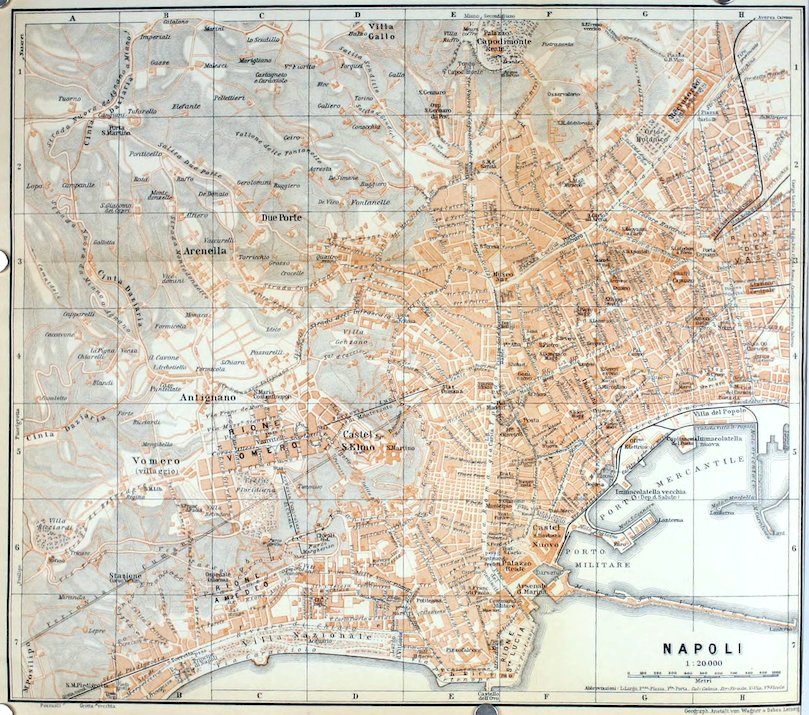
Naples.—Arrival by Sea. The Mediterranean and New York steamers of the North German Lloyd and those of the Società Nazionale are berthed at the Immacolatella Nuova (Pl. G, H, 5). Passengers by other steamers are landed at that quay by boat, those from the Lloyd and Orient Royal Lines free of charge by steam-tender or boat respectively, from others by rowing-boat (1 fr., with luggage, but bargain advisable). Travellers should be on their guard against boatmen wearing the jerseys of well-known steamboat-lines though not employed by these companies. Porter (facchino) for small valise 40, trunk 80 c.
The Railway Station (Stazione Centrale, Pl. H, 3) lies at the E. end of the city, 12 min. from the Immacolatella Nuova (see above), and ½¾ M. from most of the hotels. Here arrive all the express trains from the north, such as those from Verona (18½–20¼ hrs.), from Milan (17 hrs.), from Turin (17½–22½ hrs.), and from Venice (20 hrs.). As the delivery of luggage is a slow process, the traveller who is willing to pay somewhat more may drive straight to his hotel without it, and have it sent later. Porter (facchino) for each small package 15, for each trunk 25 c.
Hotels (often full in spring). Of the very first class: *Bertolini’s Palace Hotel (Pl. p; C, 6), in the Parco Grifeo (with lift from the Corso Vittorio Emanuele; 245 ft.), R. from 6 (Jan.–May 10) fr., B. 2, déj. 5, D. 8 fr.; *Excelsior (Pl. o; F, 7), Via Partenope 24, R. from 6, B. 2, déj. 5, D. 7 fr., new; *Grand-Hôtel (Pl. d; B, 7), Piazza Principe di Napoli, near the sea, at the W. end of the Villa Nazionale (p. 141), R. from 6, B. 1¾, déj. 4½, D. 7 fr.—In the higher quarters, with beautiful views: Corso Vittorio Emanuele 168, *Bristol (Pl. a; D, 6), R. from 4, B. 1½, déj. 4, D. 6 fr.; No. 135, *Parker’s (Pl. b; C, 6), R. 5–10, B. 1½, déj. 3½, D. 5½ fr.; adjacent, No. 133, *Macpherson’s Hôt. Britannique (Pl. q; C, 6), R. 4–6 (Jan.-April, 5–8) fr., B. 1½, déj. 3½, D. 5 fr.; *Grand Eden (Pl. u; C, 6), Parco Margherita 1, R. from 5, B. 1½, déj. 4, D. 5½ fr.; Bellevue (Pl. t; C, 6), Corso Vittorio Emanuele 142, R. 3½–4½, B. 1½, déj. 3, D. 4 fr.
136In the lower quarters.—Via Partenope, facing the sea: No. 23, *Gr.-Hôt. Santa Lucia (Pl. m; F, 7), R. from 5, B. 1½, déj. 4, D. 6 fr.; No. 22, *Gr.-Hôt. du Vésuve (Pl. g; E, 7), R. from 6, B. 1½, déj. 4, D. 6 fr.; *Gr.-Hôt. Victoria (Pl. v; E, 7), R. from 5, B. 1½, déj. 4, D. 6 fr.; No. 14, *Royal des Etrangers (Pl. i; E, 7), R. from 6, B. 1½, déj. 4, D. 6 fr. Piazza del Municipio (convenient for passing travellers): *Gr.-Hôt. de Londres (Pl. l; F, 6), R. from 5, B. 1½, déj. 3½, D. 5 fr. Overlooking the sea, Via Partenope and Strada Chiatamone 55, Hassler (Pl. k; E, 7), R. 5–10, B. 1½, déj. 3½, D. 5 fr., good; Via Caracciolo 15, Savoy (Pl. r; B, 7), R. from 4, B. 1½, déj. 4, D. 5 fr. Riviera di Chiaia (Pl. D, C, B, 7), with view of the Villa Nazionale and the sea: No. 276, *Gr. Bretagne & Angleterre (Pl. e; D, 7), R. from 4, B. 1½, déj. 3½, D. 5 fr.—By the sea, Via Partenope 20, *Continental (Pl. c; E, 7), R. 3½–7, B. 1½, déj. 3, D. 4½ fr. Strada Medina 76 (convenient for passing travellers), Isotta & Genève (Pl. s; F, 5), R. 4½–6, B. 1½, déj. 3, D. 4½ fr. By the sea, entrance Strada Chiatamone 59, Métropole & Ville (Pl. h; E, 7), R. from 4, B. 1¼, déj. 3½, D. 3–4½ fr., good. Riviera di Chiaia 127, with view of the Villa Nazionale and the sea, Riviera (Pl. f; C, 7), R. 3–4, B. 1½, déj. 3½, D. 5 fr., good. Strada Santa Lucia 37, Eldorado Modérn (Pl. x; E, 7), R. from 3, B. 1½, déj. 3, D. 4 fr.
Unpretending: La Patria (Pl. w; F, 5) Via Guglielmo Sanfelice 47, R. 3½–5 fr., good; Hôt. de Naples, Corso Umberto Primo 55, R. 4–5 fr.; Hôt. Milan & Schweizerhof, Piazza del Municipio 84, R. 3–4 fr., Russie (Pl. n; F, 7), Strada Santa Lucia 82, R. 2½–3½ fr., both plain.
Restaurants (Ristoranti, Trattorie; Italian style, à la carte). Giardini Internazionali, Via Roma, entrance Vico Tre Re 60, good cuisine; Giardini di Torino, Via Roma 292; Ristorante Milanese, Galleria Umberto Primo, N. Italian cookery; Scotto Jonno, Galleria Principe di Napoli (Pl. F, 3), déj. 2 fr., Nic. Esposito, Salita del Museo 62 (these two suitable for visitors to the Museum); Renzo e Lucia, Mira Napoli, both at the terminus of tramway-line Nr. 7 (for visitors to San Martino); Ristorante Bella Vista (p. 142), on the hill of Posilipo.—Beer. *Pilsener Urquell, Strada Santa Brigida 36; Bavaria, Galleria Umberto Primo, opposite the Teatro San Carlo, good.
Cafés. Gambrinus, Piazza San Ferdinando, also restaurant, Calzona, Galleria Umberto Primo, at both evening concerts; Nazionale, Villa Nazionale (p. 141), near the Aquarium.—Tea Rooms. Galleria Vittoria (Pl. E, 7). open 3–8 p.m. only, fashionable; Via Domenico Morelli 8 (Pl. E, 7); Strada di Chiaia 143 (Caflish, confectioner).—Bars, numerous in Via Roma.
Taximeter Cabs. All the fares given below are for drives within the city; charges for drives outside the city at any time of day are the same as the night-fares given below.
a. By Day: Open one-horse carriage (for 2 pers., or 3 at most), for the first 1500 metres (ca. 1 M.) or 12 min. waiting 40 c., for each additional 500 m. or 4 min. waiting 10 c. (two-horse carr., for 4–6 pers., 60 and 20 c.). Closed one-horse carriage (‘coupé’), for the first 1200 m. (ca. ¾ M.) or 12 min. waiting 50 c., each addit. 400 m. or 4 min. waiting 10 c. Motor Cab, for the first 1000 m. or 12½ min. waiting 80 c., each addit. 200 m. or 2½ min. waiting 10 c.; each addit. pers. above three 40 c.—b. By Night (midnight to dawn): Open one-horse carriage for the first 1200 m. or 12 min. waiting 40 c., each addit. 400 m. or 4 min. waiting 10 c. (two-horse carr. 60 and 20 c.). Closed one-horse carriage for the first 1000 m. or 12 min. waiting 50 c., each addit. 333⅓ m. (ca. 365 yds.) or 4 min. waiting 10 c. Motor Cab, for the first 1000 m. or 12½ min. waiting 80 c., each addit. 100 m. (ca. 110 yds.) or 2 min. waiting 10 c.; each pers. above three 80 c.
Luggage up to 25 kilos (55 lbs.) 10 c., up to 50 kilos 20 c.; small articles free.—In order to avoid misunderstandings the driver should be asked to repeat the given direction before starting. The numerous tramways and omnibuses will generally enable the traveller to dispense with cabs.
137Tramways (numbered; fare 15–40 c., 5 c. less in 2nd class; cars stop regularly at stations called sezione, and when required at those bearing the name fermata).
Chief lines: 1. Piazza Sette Settembre (in front of Spirito Santo; Pl. E, 4; Via Roma, p. 139) to the Posta (Pl. F, 5), Piazza del Municipio, Piazza San Ferdinando, Largo della Vittoria (Pl. D, 7), Torretta (Pl. B, 7), and Strada Nuova di Posilipo (p. 142).—4. National Museum (Pl. E, F, 3; p. 139) to the Piazza Cavour, Central Station (Pl. H, 3; p. 135), Castel del Carmine (Pl. H, 4), Strada Nuova (Pl. G, H, 5), Strada del Piliero, and Piazza del Municipio; thence as No. 1 to the Torretta.—6. Piazza Dante (Pl. E, F, 4; p. 139) to National Museum, Via Salvator Rosa (Pl. E, 3), Corso Vittorio Emanuele (p. 141), and Torretta (Pl. B, 7).—7. Piazza Dante to National Museum, Via Salvator Rosa, Antignano (Pl. B, C, 4; p. 142), and Castel Sant’ Elmo (Pl. D, 5; by San Martino, p. 141).—11. Piazza San Ferdinando (Pl. E, 6), to Strada del Piliero, Strada Nuova (Pl. F, G, 5, 6; harbour), Via del Duomo (Pl. G, F, 4, 3), and Strada delle Vérgini (Pl. F, 3).
Funiculars (every 10–20 min.; up 20 or 15, down 15 or 10 c.). 1. Funicolare di Chiaia, Parco Margherita (Pl. C, 6), to Corso Vittorio Emanuele and Via Cimarosa (Pl. C, 5).—2. Funicolare di Monte Santo to Strada Monte Santo (Pl. E, 4; 4 min. from Piazza Dante), Corso Vittorio Emanuele, and Castel Sant’Elmo (Pl. D, 5).
Omnibuses (10 c.), among others, from Piazza San Ferdinando (Pl. E, 6) and from Largo della Vittoria (Pl. D, 7) to the National Museum.
Steamboat Agents. Cunard, Nic. Ferolla, Via Guglielmo Sanfelice 59; Union Castle, Anchor Line, Orient, and Hungarian Adria, Holme & Co. (see below); White Star and Hamburg-American, Piazza della Borsa 21; North German Lloyd, Aselmeyer & Co., Corso Umberto Primo 6 (goods-office, Piazza della Borsa 33); German East African, Kellner & Lampe, Piazza della Borsa 8; Austro-Americana, Fornari & Massara, Via Francesco Denza 2; Messageries Maritimes, Fratelli Gondrand, Corso Umberto Primo 128; Società Nazionale, Via Agostino Depretis 18; Peninsular & Oriental, Thomson Line, Ferrovie dello Stato (steamer service), Spanier, Piazza della Borsa 9; Navigazione Generale, Via Agostino Depretis; La Veloce, same street, No. 26.
Post & Telegraph Office (Pl. F, 5), Palazzo Gravina, Strada Monteoliveto.
Consuls. British Consul-General, S. J. A. Churchill, Via dei Mille 40 (Pl. D, 6); vice-consul, A. Napier.—U. S. Consul, A. H. Byington, Piazza del Municipio 4 (Pl. F, 6).
Tourist Agents. Thos. Cook & Son, Galleria Vittoria (Pl. E, 7).—Goods Agents. American Express, Via Vittoria 27; Elefante & Co., Piazza del Municipio 66; Fratelli Gondrand, Corso Umberto Primo 128.—Lloyd’s Agents. Holme & Co., Via Guglielmo Sanfelice 24.
Churches. English (Christ Church; ‘Chiesa Inglese’; Pl. D, 7), Strada San Pasquale; Presbyterian (‘Chiesa Scozzese’), Vico Cappella Vecchia 2; American, Viale Principessa Elena 15.
Sights. (The churches are usually open in the morning and towards evening. The Museums are closed on great festivals.) Museo Nazionale (p. 139), week-days 10–4, May-Oct. 9–3, adm. 1 fr.; Sun. 9–1 free.—San Martino (p. 141), week-days 10–4, 1 fr.; Sun. 9–1, free.—Aquarium (p. 141), daily, 2 fr.; Sun. and holidays 1 fr.
Naples, Ital. Napoli, once the capital of the kingdom of Naples, and now that of a province, is the most important seaport and after Milan the most populous city of Italy (492,000 inhab.). It lies in 40°51′ N. lat. and 14°15′ E. long., on the N. side of the bay named after it, at the foot and on the slopes of several hills. Its site and environs are among the most beautiful in the world. The vicissitudes of its history are as remarkable as those of its volcanic soil. Here in hoar antiquity Greeks from Kyme (Cumæ) 138founded Parthenope, afterwards called Palaeopolis or ‘old town’, and Neapolis, or ‘new town’. Here, too, Ostrogoths, Byzantines, Normans, and Hohenstaufen held sway. Charles of Anjou (1266–85) made Naples his capital, which was much extended by Ferdinand I. of Aragon (1458–94), by the Spanish viceroy Don Pedro de Toledo (1532–53), and by the Bourbon Charles III. (1748–59). At length in 1860 the kingdom and city were united to the kingdom of Italy. In historic and artistic monuments Naples is far poorer than the towns of Northern and Central Italy; but the matchless treasures from Pompeii and Herculaneum preserved in the Museum, which present a new and fascinating picture of ancient life, afford ample compensation.
A line drawn from the Castel Sant’Elmo (Pl. D, 5; p. 141) to the Pizzofalcone (Pl. E, 7), a height which terminates in the narrow rock of the Castello dell’Ovo, divides the city into two parts. To the E. lie the oldest and busiest quarters, of which the long Via Roma (p. 139) is the main street. The smaller part of the town, the strangers’ quarter, extends along the shore to the W. from the Pizzofalcone and up the slopes of Sant’Elmo and Posilipo (p. 142).
The Harbour Quarter, and particularly the lanes between the Strada Nuova (Pl. G, H, 5) and the broad Corso Umberto Primo (Pl. F-H, 5, 4), which leads to the station, still present diverse scenes of popular life. Through this quarter the Strada del Duomo (p. 140) leads to the Strada Foria and the Museum (p. 139).
Passing the Immacolatella Vecchia (Pl. G, 5), we follow the Strada del Piliero (Pl. G, F, 5, 6; tramways Nos. 4 and 11; see p. 137) to the Molo Angioino (Pl. F, G, 6), the old quay which separates the Porto Mercantile from the Porto Militare.
Adjacent, on the W., lies the Piazza del Municipio (Pl. F, 6), with the Municipio or town-hall at its W. end. On the S.E. side of this piazza is the approach to the—
Castel Nuovo (Pl. F, 6), built for Charles I. of Anjou in 1279–83, and afterwards much enlarged. It was the residence successively of the kings of the houses of Anjou and Aragon and the Spanish viceroys, but is now used as barracks. The inner gateway of the castle (adm. free) consists of a *Triumphal Arch, flanked with two towers, in the early Renaissance style, erected in 1451–70 in memory of the entry of Alphonso I. of Aragon (1442).
From the Piazza del Municipio the Strada San Carlo leads to the S.W. to the Galleria Umberto Primo (Pl. E, F, 6), built in 1887–90, and vying with the grand arcade at Milan, and to the—
Piazza San Ferdinando (Pl. E, 6), the business centre of the city. (Tramcars and omnibuses, see p. 137.) On the E. side rises the Teatro San Carlo (Pl. F, 6), dating from 1737, one of the largest in Europe. Adjacent, in the large Piazza del Plebiscito, rises the Palazzo Reale (Pl. F, 6), begun in 1600.
139At the Piazza San Ferdinando begins the Via Roma, the chief artery of traffic, named the Toledo down to 1870, after its founder Don Pedro de Toledo (1540). With its continuation the Salita del Museo Nazionale it ascends for over a mile, between the lanes on the slope of the Sant’Elmo hill, on the left, and the chief business part of the city, on the right, to the National Museum. This long line of streets, poor architecturally, is broken only by the small Largo della Carità (Pl. E, 5) and the Piazza Dante (Pl. E, F, 4). About halfway between these the Via Domenico Capitelli diverges to the right to the church of—
Santa Chiara (Pl. F, 4), the Pantheon of Naples, built in 1310–40, but tastelessly restored in 1742–57. The interior, planned in the French Gothic style, resembles a great public hall. Behind the high-altar is the Gothic *Monument of Robert the Wise (d. 1343), the founder of the church. The transepts contain the monuments of other Angevin kings.
The **Museo Nazionale (Pl. E, F, 3), built in 1586 as cavalry barracks, was the seat of the University from 1616 to 1780, but since 1790 has been occupied by the royal art-collections, which are among the finest in the world. Adm., see p. 137.
On the Ground Floor, in the E. wing on the right of the vestibule, are the *Greek Sculptures in marble. Entering by the first door, we begin our visit with the colonnade of the archaic sculptures (Marmi Arcáici). In the centre: 6009, 6010. Harmodios and Aristogeiton (p. 506).—Turning to the right, we enter the rooms on the S. side of the building, which contain sculptures of the First Golden Age of Greek art (5th cent.). In the central room, 6322. Bust of Athena, probably after Cephisodotus (father of Praxiteles); by the window, two statues of Aphrodite (after Alcamenes?); I. Room on the right, 6005. So-called Hera Farnese; II. Room on the left, *6727. The famous Orpheus relief; *6024. Statue of Athena (after Phidias?). Also, in II. R. on the right, fine Mosaics.
From the colonnade of the archaic sculptures we pass through R. II into the Flora colonnade, the rooms on the right of which contain the sculptures of the Second Golden Age of Greek art (4th cent.) and of the later Greek or Hellenistic period. In the central room, 6306. Bearded Dionysus, after Praxiteles. I. Side-Room on the right, *6035. Torso of Aphrodite; without a number, Torso of a man sitting, a replica of the so-called Ares Ludovisi, after Lysippus. II. Side-Room, Farnese Hercules, after Lysippus, but coarsened. III. Side-Room on the left, Farnese Bull, a colossal group, after Apollonius and Tauriscus of Rhodes.
The third colonnade contains coloured sculptures. In the side-rooms are fragments of sculptures and buildings. Crossing the vestibule to the W. wing, we enter the—
Colonnade of the Greek portrait-statues (Portico Iconográfico). On the right, *6018. Æschines, the Athenian orator; 6023. Homer; 6135. Euripides.—Straight on, we next come to the Portico degli Imperatori, containing Greek and Roman portraits. In the centre, *Hermes of a Greek philosopher. In the side-rooms, Roman sculptures and architectural fragments. The central of these rooms contains the celebrated *Mosaic of the Battle of Alexander.
The remaining rooms contain the *Collection of the larger antique bronzes. The chief rooms (I, II Bronzes from Pompeii, III-V from Herculaneum) are on the S. front of the Museum. Room I. 5003. Young Dionysos (so-called Narcissus). Room II. 5630. Archaic statue of Apollo playing on the lyre; 4997. Victory. Room III. 5625. Hermes reposing, 140School of Lysippus; 5633. Boy’s head (end of 5th cent.); *4885. Bust of the Doryphorus (spear-bearer), after Polycletus; *5618. Head of bearded Dionysus, after a work of the School of Myron (5th cent.). Room V. 5616. Hellenistic poet (the so-called Seneca).
In the Mezzanino (entresol), on the right, is the *Collection of ancient wall-paintings (Affreschi Pompeiani) from Pompeii, Herculaneum, etc.—Room I. 9105. Briseis carried off from the tent of Achilles; 9559. Nuptials of Zeus and Hera. Room II. 8976. Medea about to slay her children; 9286. Dionysus and the sleeping Ariadne. Passage to R. V, 9180. ‘Cupids for sale’. Room V. 8834. Girl gathering flowers; 9295. Bacchantes and Satyrs; 9133. Centaurs; 9118–21. Rope-dancing satyrs.
The First Floor (Primo Piano) contains, in the E. wing, to the left of the staircase, the two Sale dei Commestibili, devoted to provisions, textiles, pigments, etc. from Pompeii; also seven rooms on the N. side of the building, occupied by the *Collection of the smaller bronzes (Piccoli Bronzi), and by interesting domestic furniture from Pompeii, affording an admirable idea of the ancient style of living.