III. ANDALUSIA.[5]
Reading edition
III. ANDALUSIA.[5]
Route Page
Geographical and Historical Sketch. Preliminary Notes 49
5. Gibraltar 52
6. From Gibraltar to Seville 56
a. Viâ Bobadilla and Utrera 56
b. Viâ Tangier and Cadiz 57
7. Seville 59
a. The Plaza del Triunfo with the Alcázar and the Cathedral, 61.—b. The Central and Eastern Quarters (Casa del Ayuntamiento, Casa de Pilatos, University), 65.—c. The Western and South-Western Quarters (Museo Provincial, Hospital de la Caridad, Public Gardens), 66.
8. From Seville to Cordova 68
9. From Cordova viâ Bobadilla to Granada 72
10. Granada 73
a. The Lower Town, 75.—b. Darro Valley and Albaicín, 78.—c. The Alhambra, 79.—d. The Generalife, 87.
11. From Granada viâ Bobadilla to Málaga 88
Andalusia, the southmost region of Spain, is geologically of somewhat recent origin. In the tertiary period the sea still washed the southern shores of the Iberian tableland, until a pressure acting in a direction from S. to N. gradually lifted up a new coast in long parallel folds, while the Mediterranean forced a new passage to the ocean through the Straits of Gibraltar (comp. p. xxix). Latest of all appeared the Guadalquivir Bay, the highest point of whose coast scarcely rises 490 ft. above the sea. The coast-hills, which have their counterpart in the Rîf Mts. on the African side (p. 93), stretch in the main from E. to W., descending abruptly to the sea. Transverse fissures, in which volcanic activity is still indicated by frequent earthquakes, divide the coast into several different chains, which culminate in the Sierra Nevada (11,421 ft.; ‘snow-mountain’), the highest peak in Spain. The W. chain (Serranía de Ronda) trends round to the N. In contrast to the Andalucía Alta, the folded region facing the Mediterranean, the Andalucía Baja, the basin of the Guadalquivir, opens towards the Atlantic. 50The Guadalquivir (Arabic Wâd al-Kebîr, ‘the great river’), the Bætis of antiquity, rises indeed in the Sierra de Cazorla, apart from the coast-mountains, but receives its more copious affluents, particularly the Guadiana Menor, from the Sierra Nevada. After a wild career it enters the plain beyond Montoro, becomes navigable at Cordova, and even carries sea-going vessels at Seville.
The History of the country dates from hoar antiquity. It was the Tarshish of the Bible, being already named in the generations of Noah (Gen. x. 4), and was called by the Greeks Tartessós, the home of precious metals, especially of silver, the source of the wealth of Tyre. Here, too, are the rich copper mines of Rio Tinto and Tharsis, which were already worked in the ancient Iberian age. The Mediterranean peoples contented themselves with visiting the harbours established in the bays of the coast, leaving it to the natives to bring the produce of the interior down to them across the mountains or by the river Bætis. Thus arose, probably even before the foundation of Cadiz, the Phœnician towns of Málaca (Málaga) and Kalpe (Gibraltar), besides other small settlements. About 1100 B.C. Gadîr or Gades, the westmost of these, appears in history, and afterwards became dependent on Carthage. The art of writing, the first and most potent aid to commerce, was propagated from Gades, which thereby laid the foundation of the higher civilization of the peninsula. Summoned to their aid by the Gaditanians, the Carthaginians, who had already gained possession of the Balearic Islands, invaded Iberia. After the Punic Wars (p. 345) came the domination of the Romans, who in 27 A.D. gave the whole of S. Spain the name of Provincia Baetica. On the break-up of the Roman Empire Andalusia was overrun by the Vandals (p. 322), the Suevi, and the Visigoths. At length the Arabs and the Berbers of Morocco obtained a footing here, after they had crossed the Straits of Gibraltar under Târik (p. 54). By them this region, and afterwards the whole peninsula which they conquered, were named El-Andalûs (‘land of the West’). Down to the 13th cent. the Moors occupied Andalusia, and it was not till 1492 that Granada was captured by Ferdinand V., the Catholic.
These vicissitudes in the country’s history are still reflected in its present Inhabitants. Half African, half European, like the Maltese, the Sicilians, and the Sardinians, the Andalusians have inherited something of the character, the customs, and the language of all the nations that once held sway in this region. To this day the Andalusian dialect swarms with Arabic words; almost all the terms used in agriculture and irrigation are Arabic. The popular dances and music are of Oriental origin. To their Oriental ancestry the Andalusian (Andaluz, Andaluza) also owes his exuberant imagination. There can be no greater contrast than that which the calm and proud Old-Castilian presents to the volatile 51and excitable Andalusian, who is apt to substitute fancy for fact, who sees everything as through a magnifying glass, and who is therefore much given to exaggeration (fanfarronadas). On the other hand nothing can be more charming than the bearing of an Andalusian ‘maja’, who is admired rather for her wit, her grace, and her power of repartee than for her beauty. The Sal Andaluza is as proverbial as the Attic ‘salt’ of the ancients.
Andalusia can boast of possessing, not only some of the finest and most interesting Moorish Buildings in Spain, such as the mosque at Cordova, the Giralda and Alhambra at Granada, but also several of the grandest monuments of the ‘reconquista’ period. Among these are the Alcázar of Seville, one of the most brilliant creations of the so-called Mudejar, or Moorish-Christian style, and the grand cathedrals of Seville and Granada in the Gothic and ‘plateresque’, or Spanish early-Renaissance, styles.—Nor is the Scenery of this region less attractive. Andalusia may be said to stand in the same relation to Spain as Sicily to Italy, or as Provence to the rest of France. It combines all that the rest of the peninsula possesses locally or partially. To the E. are vast plateaux and steppes, frozen in winter and parched in summer; to the S. rise snow-clad mountains; on the S.W. are the sand-dunes of the Atlantic coast; olive-groves thrive on the Guadalquivir; and on the shores of the Mediterranean are well-watered vegas where the cotton-plant, the banana, and the sugar-cane flourish.
Mediterranean Travellers will hardly have time for more than a circular tour from Gibraltar to Tangier, Cadiz, Seville, Cordova, Granada, and back to Gibraltar, or, in unfavourable weather, to Algeciras, Bobadilla, and Seville only. The Spanish railways (see the Guía general de Ferrocarriles; 1 p., smaller edition 75 c.) are far inferior to the British or to the French, and their speed is very low. The natives travel mostly in the second or third class, but the carriages cannot be recommended. The first class often has a berlina, or coupé-carriage with four seats, which affords an unimpeded view (higher fare).
In the larger towns one may book luggage (facturar el equipaje) 1–2 hrs. before the departure of the train, at the despacho central, or town-office. Booking it at the station itself is a very slow process. As in France luggage up to 30 kilos (66 lbs.) is free. The ticket for it is called a talón or boletín de equipaje. The porter (mozo), often most importunate, receives 30–50 c. or more.
Andalusia possesses few first-class hotels. The better second-class inns are similar to the French and Italian. Even for a stay of a single day it is usual to pay an inclusive charge for bed and board (pupilaje, from 6 to 20 p.). Déjeuner or lunch (11–1 o’clock) is called almuerzo; dinner, comida (at or after 7); table-wine, vino común or de mesa. No allowance is made for meals omitted. An extra charge is often made for breakfast (coffee, etc.), which Spanish travellers usually take in their own rooms. Notice of departure should be given as early as possible, lest a whole additional day be charged for. The usual fee to the servants (camarero, waiter; muchacha, chamber-maid; mozo, boots), who are apt to be lazy and inattentive, is 1 p. per day, divided among them, or more in proportion for families.
The beer-houses are called cervecerías. The cafés are usually open in the afternoon and evening only. Café con leche is coffee with milk; 52café solo is without milk. Newspapers (periódicos) are not provided by the cafés. Tobacco and cigars are a government monopoly; the shop is called estanco; there are also special shops for the better Havana cigars.
The post-offices (correo), even in the larger towns, are often open for a few hours only. The hours for obtaining poste-restante (cartas en lista) or registered letters (cartas certificadas) are often changed; the addressee must show his visiting-card (tarjeta) at the office. Stamps (sellos de correo; for the town 10, country 15, abroad 25 c.) and post-cards (tarjetas postales, 10 c.) are obtainable at the tobacco-shops only. Telegrams (telegramas) must be prepaid with special stamps (sellos de telégrafos), for the sale of which there are separate offices.
The Spanish peseta (p.), divided into 100 centimos (c.), is scarcely equal to the franc in value. The only valid banknotes are those of the Madrid Banco de España. The 5 p. piece is popularly called a duro; the 10 c. and 5 c. copper coins are often termed perro grande and perro chico (‘big and little dog’) in jocular allusion to the lions in the coat-of-arms. Change should be examined carefully, as base coin is common.—At Gibraltar the currency is English, but Spanish money is received, except at the post and telegraph office.
5. Gibraltar.
Arrival. The ocean-going steamers land and embark their passengers in their own steam-tenders at any time before sunset at the Commercial Pier (fare for each pers. 1s. either way). The tariff for small boats is 1s. 6d. for a row in the harbour, or to or from the steamboats, for 1–2 pers., and 1s. for each addit. person; luggage up to 56 lbs. free; excess, 6d. per 56 lbs.; or a bargain may be made (l–2s. for passenger, incl. luggage). In bad weather the tariff is raised, in accordance with the signals (red, blue, bluish-white), to one-third more, or double, or triple fare. The porters are notorious for their extortionate demands. The charge for conveying luggage to the hotel should be fixed beforehand.—The Custom House Examination at the harbour-gate is confined to tobacco, spirits, and weapons. Foreigners require a permit from the Police Office (Pl. 2) to spend the day on shore, and if they intend to spend the night the permit must be renewed by their landlord. Between 5.30 and 8.15, according to the season, a cannon-shot (gun-fire) announces the closing of the Land Port (p. 55). The other gates remain open till 11.
Hotels (the inclusive charge for the day should be ascertained). Hôt. Bristol (Pl. a), Cathedral Square, quiet and pleasant; Grand Hotel (Pl. b) and Hôt. Cecil (Pl. c), both in Waterport St.; these three have high charges, from 10–12s. a day and upwards; Hôt. Paris (Pl. f), opposite the post-office, new, pens. 8–15 fr.—Plainer: Hôt. Continental (Pl. d), Turnbull’s Lane; Hôt. Victoria, Church St., café-restaur.; Nuevo Hot. Español (Pl. e), Irish Town, pens. 8s., tolerable.—The drinking-water (rain-water from cisterns) is not good.—Cafés. Universal, Church St.; also at the Assembly Rooms (p. 53).
Cabs (stands at Waterport Gate, Commercial Sq., and Cathedral Sq.). Drive for 1–2 pers. in the lower town, between Waterport Gate and Alameda, 6d.; in the upper quarters (Governor’s St.) 9d.; to Catalan Bay 1s. 3d.; to the lighthouse 1s. 4d.; to Governor’s Cottage 1s. 9d.—Per hour, for 1–2 pers., 1s. 6d.; for each addit. ½ hr. 6d.; 3d. extra for each addit. pers., or 5d. extra for the longer drives (lighthouse, Governor’s Cottage, etc.).—Each trunk 2d.—The tariff is in force only from daybreak till midnight. A bargain should be made beforehand.
Post Office (Pl. 1), Waterport St.; week-days 7 a.m.–8 p.m. (on Sun. 8–10 a.m.). The overland English mail closes at 6.45 a.m.—Telegraph Office, same place; 6 a.m. till midnight. Tariff to England 3d. or (viâ Malta) 6d. per word; to the United States 1s. 4d.–1s. 11d. per word.
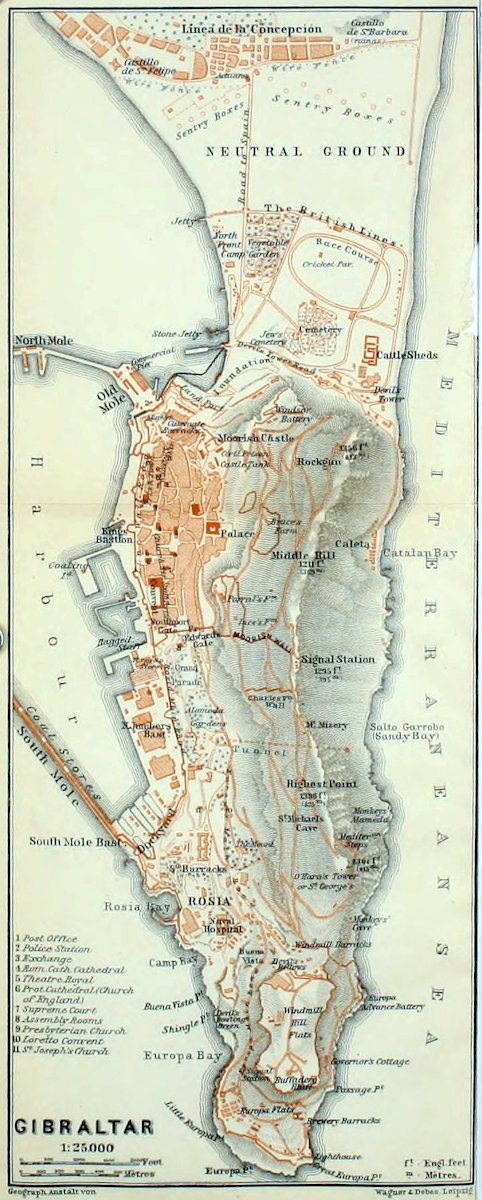
53Banks. Anglo-Egyptian, Market St., opposite Police Station; Larios Hermanos, Irish Town; Thos. Cook & Son (tourist-agents), Waterport St.—Numerous money-changers.
United States Consul, R. L. Sprague; vice-consul, A. D. Hayden.—Lloyd’s Agents, Smith, Imossi, & Co., Irish Town.
Theatre. Assembly Rooms (Pl. 8), in the Alameda, with open-air café.
Steamboat Lines (comp. ‘Gibraltar Chronicle’). Peninsular & Oriental (Smith, Imossi, & Co., Irish Town), weekly between London, Marseilles, and Port Said (for Australia and China; comp. RR. 17, 67); Orient Royal (Smith, Imossi, & Co.), fortnightly between London, Marseilles, and Port Said (for Australia; comp. RR. 17, 67); Cunard (M. H. Bland & Co., Cloister Bdg.), between New York and Trieste (RR. 15a, 16); White Star (Th. Morsley & Co., Irish Town 11), 2 or 3 times monthly to Naples (and Genoa; RR. 16, 15a), or viâ Algiers to Genoa; North German Lloyd (J. Onetti & Sons, Engineer Lane), fortnightly to Algiers, Genoa, Naples, and Port Said (comp. RR. 1, 15b, 24, 67), also fortnightly between New York, Algiers, Naples, and Genoa (comp. RR. 16, 24); the Hamburg-American (J. Carrara & Sons, Waterport St.) has excursion-steamers only; German Levant (J. Rugeroni & Son, Commercial Sq.), occasionally to Algiers; Hall Line (W. J. S. Smith, Bomb House Lane), weekly between London, Lisbon, Cadiz, and Málaga (comp. RR. 1, 6b); Royal Mail Steam Packet (Bland & Co., see above), every other Wed. for Tangier, Mogador, Teneriffe, etc. (RR. 14, 3, 4); Transports Maritimes (Imossi & Son), 21st of each month for Madeira and S. America; Oldenburg-Portuguese (A. Mateos & Sons, Pitman’s Alley) twice monthly to Tangier and Mogador (R. 14); Navigation Mixte (A. Mateos & Sons), every other Wed. night to Tangier, Oran, and Marseilles (RR. 18, 19); Vapores Correos de Africa (J. Onetti & Sons; at Algeciras, A. Gil Pineda), from Algeciras to Tangier and Cadiz (see R. 6b).—Local steamers to Algeciras and Tangier, comp. R. 6.
One Day (or even less when time presses). Walk through the town to the Alameda (p. 55); visit to Europa Point (p. 55) and perhaps Catalan Bay also (p. 56).—Foreigners are not admitted to the fortifications, photographing or sketching which is prohibited.
Gibraltar, a town of 23,450 inhab. (incl. the garrison of 5100 men), the key of the Mediterranean, and one of the most important coast-fortresses in the world, in British possession since 1704, and headquarters of the Atlantic Fleet, lies on the W. slope of a huge rock, which is connected with the Spanish mainland by a sandy isthmus only. The famous rock bounds the Bay of Algeciras or Gibraltar on the E. ‘It is the very image of an enormous lion, crouched between the Atlantic and the Mediterranean, and set there to guard the passage for its British mistress’ (Thackeray).
The rock is composed of Jurassic limestone, overlying Silurian slate, and extending from N. to S.; it is 3 M. long and ¾ M. in breadth, with a saddle separating Mt. Rockgun (1356 ft.), the lower hill on the N., from the Signal Station, the Highest Point (1396 ft.), and the Sugar Loaf Hill (O’ Hara’s Tower, 1361 ft.) on the S. Its grey masses ascend gradually in terraces on the W. and S. sides, and rise almost perpendicularly on the E. and N. sides.
The Town of Gibraltar (‘North Town’) covers a third of the W. slope to the N., while the remaining two-thirds are occupied by the Alameda, numerous pretty villas, the barracks of the South Town, and the Lighthouse on Europa Point. The houses rise in 54terraces to a height of 260 ft.; the streets are narrow and dark, and are relieved by few squares. The natives are chiefly Spaniards and descendants of many different Mediterranean races. The numerous Moroccans, mostly dealers from Tangier, indicate the proximity of the African coast. The cleanness of the town and the absence of beggars produce a pleasant impression. The Coal Stores on the South Mole (along with those of Algiers and Malta) supply the vessels bound for the Suez Canal (about 1200 annually). There is little other trade except the import of cattle and provisions from Galicia and Morocco.
The ancient name of the rock was Kalpe, while the hills on the African side were called Abyla (now Sierra Bullones; p. 103). Together they were known as the ‘Pillars of Hercules’, the entrance to the ocean. Under the protection of the divine Hercules-Melkarth, the Phœnicians ventured through the straits, even as far as Britain, whence they brought the earliest tidings from the North and also cargoes of tin, which they mixed with copper to produce bronze. Kalpe was also the name of the first Phœnician settlement on the bay of Gibraltar, while Carteia, on the inner part of the bay, was probably of ancient Iberian origin. Carteia was still an important harbour under the Carthaginians, and in 171 B. C. it became the first Roman colony in the whole peninsula. Nothing is recorded of the period which succeeded the invasion of the Vandals (p. 322). At length in 711 the bay re-appears in history, when Mûsa, the governor appointed by the Caliph of Damascus, sent the Berber Târik ibn Ziyâd across from Ceuta to the bay of Algeciras on an expedition against Spain, in which he defeated the Visigoths at Veger de la Frontera, near Cape Trafalgar (p. 58). Impressed by the commanding position of the rock of Gibraltar, Târik afterwards erected a fort upon it, which formed the nucleus of the Moorish castle (p. 55). From him is derived the name of Jebel Târik, ‘mountain of Târik’, corrupted into Gibraltar. In 1309 Gibraltar was captured by Al. Pérez de Guzmán (el Bueno) for Ferdinand IV. of Castile; the Moors recaptured it in 1333, but in 1462 lost it again to the Spaniards. In consequence of the plundering of Gibraltar by Algerian pirates under Kheireddin (p. 221), Charles V. ordered the fortifications to be reconstructed and new ramparts to be built from the S. side of the town to the crest of the hill. In 1610 the Spanish Admiral Mendoza caused the last Moriscoes of Andalusia to be sent back to Morocco from this very port, where their ancestors had so long held sway, and whence they had gone forth to conquer the whole peninsula. After having undergone ten sieges at various periods, the fortress was surprised and captured by the British fleet under Adm. George Rooke and Prince George of Hesse-Darmstadt in 1704, during the Spanish War of Succession, and was stoutly and successfully defended by them during a six months’ bombardment by the Spaniards and the French (1704–5). The thirteenth siege (1727) and the ‘great siege’ by the French and the Spaniards (1779–83) were also unsuccessful, the British commander then being Gen. Eliott, afterwards Lord Heathfield. By the Peace of Versailles, in 1783, Great Britain was confirmed in her possession of the historic rock.
The older Fortifications on the coast, from Land Port on the N. to Europa Point on the S., those on the S. slope of the rock above Europa Point, and those on the N. side (the famous underground galleries, p. 55) have in late years been strengthened by the construction of a fort on the summit of the hill, armed with guns of the largest calibre.
From the Old Mole, dating from 1309, and lately prolonged by the North Mole, we pass through the Old Mole Gate (the outer gate of the harbour), and then, beyond the Market, through the 55inner Waterport Gate, which stands on the site of the old Moorish wharf. This brings us to the S. E. to Casemates Square.
Adjacent, on the S., is Waterport Street, with the chief buildings, forming, together with the parallel street to the W. called Irish Town, the chief business quarter.
Waterport Street is prolonged to the S. by Church Street. Beyond Commercial Square and the Exchange (Pl. 3) we come to the Catholic Cathedral (Pl. 4), on the left, originally a mosque, but restored by the ‘Catholic kings’ (p. 75) after 1502; there now remains little worth seeing except the Moorish orange-court.—A little farther on, on the same side is the Supreme Court (Pl. 7), with its pretty garden. To the right, in Cathedral Square, stands the Anglican Cathedral (Pl. 6), built in the Moorish style.
The southmost part of this line of streets is Southport Street, where, on the right, rises the Convent, once a Franciscan establishment, now the Government House (governor, Sir Arch. Hunter), the garden of which contains a venerable dragon-tree (p. 30). At the S. end of this street is Southport Gate, which is always open, dating from the time of Charles V., but restored in 1883. Outside the gate, on the left, is the small Trafalgar Cemetery, where the British who fell at the battle of Trafalgar (p. 58) are buried.
The Alameda, beyond the gate, a fine promenade with rich subtropical vegetation, was laid out by Governor George Don in 1814. A military band plays near the Assembly Rooms (p. 53) on Sun. and Wed. from 3–5, or in summer in the evening. To the W. we overlook the Naval Harbour, with its dockyard, quays, and long South Mole.
A little to the E. of the Southport Gate is Prince Edward’s Gate, a second exit to the S. from the town, whence the *Europa Main Road ascends gently along the W. slope of the rock, above the Alameda Gardens, between gardens and villas. Below it, on the right, farther on, are the Naval Hospital and the Buena Vista Barracks. Lastly, a little way short of a signal-station, we descend between the fissured rocks of the Europa Pass to (1½ M.) Europa Point, with its great Lighthouse, the much-eroded S. extremity of the peninsula. The road then turns to the N., soon affording a view of the Spanish Mediterranean coast, to the Governor’s Cottage and the Monkeys’ Cave hidden among the rocks.
The Moorish Castle, above the artillery barracks, begun by Târik in 713 and completed in 742, is entered through the Civil Prison (verbal permission required by foreigners). Access to the Subterranean Galleries of the fortress, lying below the castle and dating from 1782 (comp. p. 54), is now limited to British subjects.
From the Market (p. 54) we may walk to the N. E. to the Land Port (notice as to closing should be observed; comp. p. 52), and past the Inundation, a space which may be flooded for defensive 56purposes (made in 1705), to the North Front, which forms part of the low neck of land below the N. slopes of the rock. From this point the Devil’s Tower Road leads to the S.E., past the Cemeteries, to the Devil’s Tower (10 min. from the Land Fort), probably an old Genoese watch-tower. The road then turns to the S. to Catalan Bay, below the E. flank of the rock, just allowing room for the little fishing-village of Caleta. The rocks contain several caves.
Beyond the Neutral Ground, 550 yds. in breadth, we come to the Spanish town of Linea de la Concepción (29,600 inhab.), 1¼ M. to the N. of Gibraltar, which owes its origin to the old Spanish lines of defence, long since demolished. The place is uninteresting.
6. From Gibraltar to Seville.
a. Viâ Bobadilla and Utrera.
Steamboat from Gibraltar (Commercial Pier) to Algeciras Puerto in ½ hr. (fare 1½ or 1 p.; passengers with through-tickets have their luggage conveyed gratis).—Railway from Algeciras Puerto to Seville, 214 M., in 10½ hrs. (54 p. 20, 40 p. 20, 24 p. 85 c.); carriages are changed at Bobadilla, La Roda, and Utrera. Rail. Restaurants at Ronda, Bobadilla, and Utrera. There are through-expresses from Granada to Seville (thrice weekly, in 7¾ hrs.), but they do not correspond with the Algeciras trains.
Algeciras (Hot. Reina Cristina, first-class; Hot. Anglo-Hispano; Hot. Marina; Brit, vice-cons., W. J. Smith; pop. 13,300), a small town on the W. margin of the bay of that name, is a winter resort of English and American visitors. The famous Morocco Conference (comp. p. 96) of 1906 was held in the Casa Consistorial or town-hall.—Local steamer to Ceuta, see p. 102.
The train for Bobadilla, soon after starting, crosses the rivers Palmones and Guadarranque. To the right we have a final view of the Bay of Algeciras and the African coast. Beyond (8¾ M.) San Roque we traverse extensive plantations of cork-trees (p. 171). 26 M. Jimena; 36 M. Gaucin, in the Guadiaro Valley, the station for the little town high up on the hills, 5½ M. to the E.—We next pass through the romantic Guadiaro Ravine, and through many tunnels under the slopes of the Sierra de Ronda, and skirt the foot of the barren limestone slopes of the Sierra de Libar.
65½ M. Ronda (2460 ft.; Rail. Restaur.; Hot. Reina Victoria, first-class, pens. from 17½ or 20 p.; Hot. Royal, in the new town, English, pens. from 12½ p., good; pop. 19,000), one of the most interesting towns in Spain, occupying a plateau girdled by grand mountains. From the station we follow the Carrera de Espinel to the W. to the Calle de Castelar, the main street of the new town, and the Plaza de Toros (bull-ring). From the railed-in platforms of the Paseo de la Merced, a park a little to the N.W. of the plaza, we enjoy a fine view, with the foaming Guadalevin, or Guadiaro, some 660 ft, below us. The Puente Nuevo, crossing at the S. end 57of the main street (p. 56) from the new town to the old town, affords a splendid view of the *Ravine of the Guadalevin (El Tajo, ‘the cutting’), about 330 ft. deep and filled with the spray of the river. The bed of the latter is strewn with rocks and the abrupt sides of the gorge are thickly overgrown with cactus.
The train descends between olives and cork-trees into the valley of the Guadalete (p. 59), and then cuts through the last N. spurs of the S. Andalusian Mts.
110 M. Bobadilla (1240 ft.; Rail. Restaur.) is the junction for Cordova (see R. 9), Granada (see R. 9), and Málaga (R. 11).
We follow the Cordova line as far as (124½ M.) La Roda (comp. p. 72; change carr.), and then turn to the W. to (147 M.) Osuna and (166½ M.) Marchena, junction of the Utrera and Cordova line (p. 59). We next cross the Guadaira (p. 59) and pass (184 M.) Empalme de Morón. At (194 M.) Utrera (Rail. Restaur.; change carr.) we join the Cadiz and Seville line (R. 6 b).
The train now runs to the N.W., mostly through fertile land (oranges, pomegranates, olives), and crosses the Guadaira.
214 M. Seville (Estación San Bernardo or de Cádiz), see p. 59.
b. Viâ Tangier and Cadiz.
From (Gibraltar) Algeciras to Cadiz. Steamers of the Vapores Correos de Africa (agents at Gibraltar and Algeciras, see p. 53; at Tangier, p. 98; at Cadiz, p. 58) from Algeciras (steamboats from Gibraltar, see p. 56) every morning except on Mon. & Frid. (from Cadiz daily except on Sun. & Thurs.) to (3 hrs.) Tangier and (9 hrs.) Cadiz (fares 1st cl. 30 p., 2nd cl. 23 p.; to Tangier only 15 or 12 p.). From Gibraltar to Tangier there ply on Tues., Thurs., and Wed. the small cargo-steamers of the Bland Line (about 2¼ hrs.; 10 or 5 p.). Steamers of the Hall Line ply weekly and those of the Royal Mail Steam Packet and the Oldenburg-Portuguese lines mentioned at p. 104, as well as of the Navigation Mixte, ply occasionally to Cadiz. The voyage to Cadiz viâ Tangier is picturesque in itself, and it affords also a most interesting glimpse of Moorish-Mohammedan life at Tangier. On the other hand the steamboat communication is uncertain in stormy weather, and to many travellers the voyage, especially in the smaller vessels, is very trying.
From Cadiz to Seville, 95 M., railway in 3¼–5¼ hrs. (fares 19 p. 80, 14 p. 50, 8 p. 70 c.). Railway Restaurant at Utrera only.
For Algeciras and the voyage through the Straits, see pp. 56, 5. As far as Tarifa the steamers usually skirt the Andalusian coast, and then strike across the straits to the semicircular Bay of Tangier, which is bounded on the E. by Cape Malabata.
Tangier, see p. 98.
After leaving the Bay of Tangier we sight Cape Spartel (p. 102) on the coast of Morocco. In clear weather we command a beautiful retrospect of the mountainous coast, as far as the Sierra Bullones (p. 103). Opposite, on the Spanish coast, where the hills gradually recede, at the N.W. end of the shallow Bay of Barbate, rises Cape 58Trafalgar, the Promontorium Junonis of the Romans and Taraf al-Ghâr (‘cape of caverns’) of the Moors. The tall lighthouse on the cape is visible at night from a distance of 22 M. It was here, on 21st Oct. 1805, that Nelson won the brilliant victory over the combined French and Spanish fleets under Villeneuve and Gravina that cost him his life and made Britain mistress of the seas.
Farther along the sandy coast, are the little town of Conil and the insignificant Cape Roche, beyond which we sight San Fernando (p. 59). At length, rising out of the blue sea, appear the lofty quays and the white houses of Cadiz, overtopped by the cathedral, a beautiful sight in sunny weather. We steer round Fort San Sebastián, skirt the cliffs of Los Cochinos and Las Puercas, and enter the broad Bay of Cadiz.
Cadiz.—Arrival. Passengers of the Vapores Correos de Africa steamers are landed in tenders gratis, but heavy luggage is taken ashore by special boats according to tariff. The mandadero, or porter, usually gets ½–1 p. for taking luggage to the Aduana (custom-house) or to the hotel.—The Railway Station (Estación) lies at the harbour.
Hotels (comp. p. 51). Hôt. de France, Plaza de Loreto, pens. from 12½ p.; Hôt. Continental, Calle del Duque de Tetuán 23; Hôt. de Cadiz, Plaza de la Constitución, pens. from 10 p.
Cafés. Cervecería Inglesa, Plaza de la Constitución, corner of Calle del Duque de Tetuán; Café Imperial, Calle del Duque de Tetuán 6; Cervecería Alemana, Calle Zorrilla 2.
Post Office (Correo), Calle del Sacramento 1.—Telegraph Office, Alameda de Apodaca 20.
Bankers. Ant. Sicre & Co. (Agents of Crédit Lyonnais), Calle Diego de Cádiz 5; Amaro Duarte & Co., Plaza de Mina 18.—Money Changers. Casa de Cambio, Calle de San Francisco 8 and 16.
Consuls. British Vice-Consul, R. A. Calvert, Alameda 20.—U. S. Consular Agent, J. Sanderson, Alameda 12.—Lloyd’s Agent, H. MacPherson, San Ginés 6.
Steamboat Lines. Hall Line, weekly from London to Lisbon, Cadiz, Gibraltar, and Málaga (comp. pp. 1, 89); the Compañía Trasatlántica (office in the Calle Isabel la Católica) has a Philippine Line (monthly from Liverpool to Lisbon, etc.; comp. p. 1), a Canary Line, and several others; Vapores Correos de Africa (agent, Antonio Millán), comp. p. 57; steamers of the Austro-American Line (office, Viuda de R. Alcon) ply between Trieste, Almería, Las Palmas, and Buenos Ayres; Navegación é Industria (Viuda de R. Alcon), for the Canaries.
Cadiz, Span. Cádiz, the Gadîr of the Phœnicians and Gades of the Romans, now a provincial capital of 64,100 inhab., and a fortress, is most picturesquely situated on a low limestone rock, which was once an island, on the W. side of the Bay of Cadiz.
From the harbour or from the railway-station we cross the Plaza Isabel Segunda either to the Calle Alonso el Sábio and the Cathedral (Catedral Nueva), or to the Calle del Sacramento, leading to the Torre del Vigía or de Tavira, 102 ft. high, which is accessible only by special permission of the Capitania del Puerto (Calle de Aduana). The top (151 steps; fee 30–50 c.) commands an excellent survey of the town, surrounded almost entirely by the sea, with its flat-roofed houses and their miradores or belvederes.
59The Calle Sagasta, the second side-street off the Calle del Sacramento, leads to the right into the Calle del Duque de Tetuán, the chief artery of traffic, which ends in the busy Plaza de la Constitución to the N.W. A little to the N.E., in the pretty Plaza de Mina, is the Academia de Bellas Artes, the picture-gallery of which contains several admirable works by Murillo, Zurbarán, and other masters. (Adm. 9–3, in summer 7–4; Sun. and holidays 10–3.)
On the N. outskirts of the town are the beautiful *Gardens of the Alameda de Apodaca and the Parque Genovés, with their fine palms. On the S. side of the town, not far from the W. end of the shadeless Paseo del Sur, rises the former Capuchin convent-church of Santa Catalina (ring on the left in the adjacent court; adm. 20 c.), containing Murillo’s last work, the *Betrothal of St. Catharine.
The Railway to Seville runs along the narrow neck of land which connects Cadiz with the mainland, rounds the Bay of Cadiz, passing between salt-marshes, where salt is obtained by evaporation, and then strikes across the delta of the Guadalete. The chief stations are the naval harbour of San Fernando, the sea-baths of Puerto Real, and the Puerto de Santa María (‘El Puerto’). Turning to the N.E., the train now runs through a hilly country to (30½ M.) Jerez (or Xeres) de la Frontera, the third-richest town in Spain, with 52,500 inhab., far-famed for its ‘sherry’.
Our next run is through moor, alternating with fertile tracts, to (75 M.) Utrera (p. 57), junction for La Roda (and Bobadilla, R. 6 a), and also for the direct line to Cordova. Lastly, we cross the Guadaira to (95 M.) Seville (Estación de Cádiz, see below).
7. Seville.
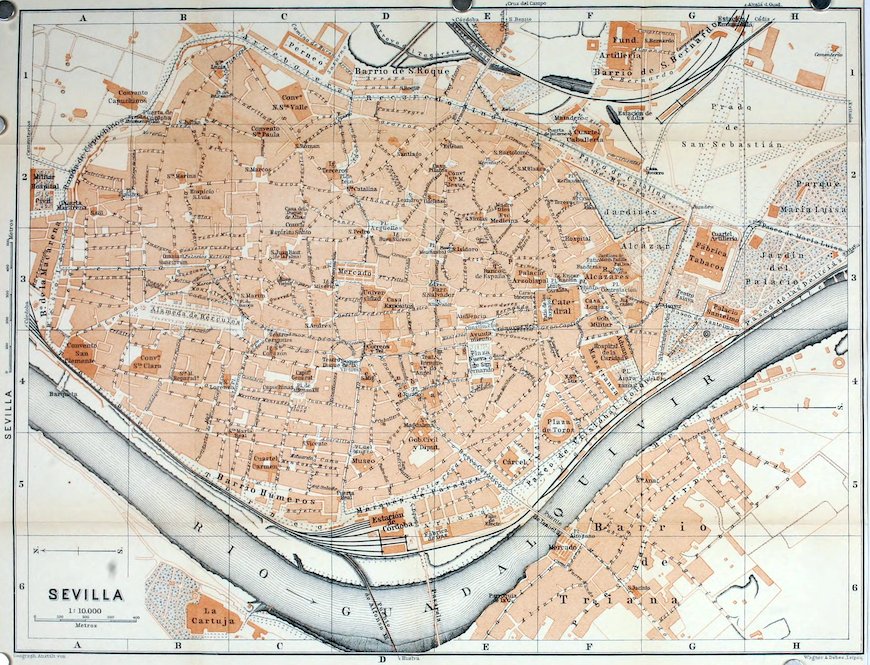
Railway Stations. 1. Estación San Bernardo or de Cádiz (Pl. F, G, 1; Rail. Restaur.), for the line to Utrera (Cadiz, Granada, Málaga).—2. Estación de Córdoba or de Madrid (Pl. D, 5, 6; Restaur.), near the Guadalquivir. Hotel carriages and cabs at both. Tariff, see p. 60.
Hotels (comp. p. 51). *Hot. de Madrid (Pl. a; D, E, 4), Calle de Méndez Núñes 2, with dépendance (Pl. b; D, 4), in the Plaza del Pacífico, pens. from 12½ (in spring 15) p.; *Hot. de Inglaterra (Pl. f; E, 4), Plaza Nueva 13, newly fitted up, pens. from 12½ p.; Hôt. de Paris (Pl. c; D, 4), Plaza del Pacífico, with two dépendances (Pl. d), similar charges; these three claim to be first-class.—Hot. de Roma (Pl. e; D, 4), Plaza del Duque de la Victoria 6, pens. from 9 p.; Hot. de Oriente (Pl. i; E, 4), Plaza Nueva 8, pens. 7–10 p.; Pensión la Peninsular (Pl. g; E, 4), Plaza Nueva 20; Cecil Hotel (Pl. h; E, 4), Calle de Méndez Núñez 18 & 23; Hôt. de la Paix (Pl. k; E, 4), same street, No. 11; Hot. Simón (Pl. n; D, 4), Calle O’Donnell 25, pens. 7 p.; Hôt. Restaur. Alhambra, Calle Santa María de Gracia (Pl. D, 4).—During Holy Week (semana santa) and the Feria (p. 60) charges are doubled almost everywhere, and rooms should be secured long beforehand.
Cafés. Pasaje de Oriente (see below); Cervecería Inglesa (Engl. beer) and Café de Paris, both in the Calle de la Campana; Perla Chica, near the Ayuntamiento (p. 65).—Restaurant. *Pasaje de Oriente, Calle de las Sierpes.
60The Tramways (Tranvías; cars stop where required; passengers ring to alight) all start from the Plaza de la Constitución (Pl. E, 3). For a general view of the city the circular lines ‘Constitución, Roario, Macarena’ (red cross) and ‘Constitución, Puerta Real, Puerta de Jerez’ (green cross) are recommended. The ‘Línea del Parque’ runs to the park on fine afternoons only.
Cabs. 1–2 pers. 3–4 pers.
by day at night by day at night
One-horse, per drive 1 p. 2 p. 1½ p. 2½ p.
„ per hour 2 „ 3 „ 2½ „ 4 „
Two-horse, per drive 2 „ 4 „ 2 „ 4 „
„ per hour 3 „ 5 „ 3 „ 5 „
The night hours are from midnight to sunrise. Small articles 25 c.; trunk under 66 lbs. (30 kilos) 50 c., heavier 1 p.—During the Semana Santa and the Feria fares are about double (but not for baggage), and bargaining is advisable. Driving on Holy Thursday and Good Friday is prohibited.
Post & Telegraph Office (Correos y Telégrafos; Pl. D, 4), Calle de las Sierpes. Poste-restante hours are from 8.15 to 9.45, from 12.15 to 2.15, and 6–7 p.m.
Banks. Crédit Lyonnais, Calle de las Sierpes 87; Banco Hispano-Americano, same street, No. 91; Banco de Cartagena, Calle Rioja 18.
Consuls. British, A. L. Keyser, Chicarreros 10 (to the E. of the Audiencia, Pl. E, 3); vice-consul, A. Henderson.—United States, Ch. S. Vinans, Mercaderes 50 (Pl. E, 3); vice-consul, C. Karminski.—Lloyd’s Agent, José Dunipe, Marqués de Santa Ana 14.
English Church, Plaza del Museo (Pl. D, 5). Services in winter.
Theatres. *Teatro de San Fernando (Pl. D, E, 4), Calle de Tetuán, for operas and ballet; Teatro de Cervantes (Pl. C, 4), Calle Amor de Dios, for short dramas, etc.—Bull Ring (Plaza de Toros; Pl. F, 4, 5). Famous ‘corridas’ on Easter Sunday and during the Feria.
Church Festivals. Most curious among these are the *Processions (pasos) of the brotherhoods during Holy Week, which attract crowds of spectators. They are best witnessed from the stand in front of the town-hall (seat for the 4 days 10 p.).—The *Feria (18–20th April), a picturesque popular festival, founded in 1847, is held in the Prado de San Sebastián (Pl. G, 1, 2), where wealthy families have their own tents.
Sights. Most of the churches are open in the morning only; the Cathedral (p. 63) till 12 and after 3.30. In the Sacristía de los Cálices (p. 64) a ticket (permiso) for this sacristia, for the Sacristía Mayor, the Sala Capitular, and the closed chapels is obtained for 2 p. The Capilla Real is open in the forenoon only (fee ½–1 p.). The services of the importunate guides to the Cathedral and the Giralda may be dispensed with. During Holy Week, when the churches are open all day, the inspection of their art-treasures is scarcely possible. Admission to collections in private houses and charitable institutions is readily granted as a rule, but seldom without difficulty on Sundays and holidays and during Holy Week. The usual days and hours of admission are—
*Alcázar (p. 61), week-days 11–4; tickets (1 p.) are issued at the office at the back of the Patio de las Banderas (door No. 11).
Casa de Pilatos (p. 65), daily (50 c., for the poor).
*Giralda (p. 62), daily (25 c.); no one allowed to ascend alone.
*Hospital de la Caridad (p. 67), daily (fee ½–1 p.); clear weather indispensable; afternoon light best.
*Museo Provincial (p. 66), daily 10–3 (in summer 10–4). On Sun. the Archæological Museum is open till 1 only.
Two Days (when time is limited). 1st. Forenoon, Plaza de la Constitución (p. 65), Cathedral (p. 63), Alcázar (p. 61); afternoon, Calle de las 61Sierpes (p. 65), Casa de Pilatos (p. 65); towards evening, ascent of the Giralda (p. 62).—2nd. Forenoon, Museum (p. 66); afternoon, Caridad (p. 67), Paseo de las Delicias (p. 67), and Parque María Luisa (p. 68).
Seville, Span. Sevilla (33 ft.), a city of 145,300 inhab., the capital of Andalusia and of the province of Sevilla, the seat of an Archbishop and of a University, lies in a broad plain on the left bank of the tawny Guadalquivir, opposite the suburb of Triana. At flood-tide sea-going vessels of 23 ft. draught can ascend the river to the quays of Seville, which, though 54½ M. from the sea, can thus claim to be a seaport. The harbour is annually entered by about 1000 vessels, of 1¼ millions aggregate tonnage. The city combines the features of a seaport with gay scenes of popular life and a wealth of treasures of art. The houses in the narrow winding streets, the heritage of the Moorish period, often contain charming inner courts, called pátios, where the inhabitants spend most of their time in summer. The larger plazas or squares are mostly planted with oranges or palm-trees.
Seville, as its ancient name Hispalis indicates, was originally an Iberian settlement. Ever since the 2nd cent. B. C. its navigable river has made Seville a place of importance. In 411 it became the capital of the Vandals (p. 322), and in 441 the seat of the Visigoth kings, who however migrated in 567 to the more central Toledo. During the Moorish period Seville, alternately with Marakesh, was a favourite residence of the Almoravides and Almohades (p. 95); and particularly under Yûsuf Abû Yakûb (1163–84) and under Yakûb ibn Yûsuf (1184–98), surnamed Al-Mansûr (‘the victorious’), it was embellished with many sumptuous buildings, and for a time it even surpassed Cordova in population. The Christian period begins with Frederick III. (‘the saint’) of Castile, who captured the city in 1248 and made it his residence. Among his descendants was Pedro I. (1350–69), surnamed ‘the Cruel’, of whom many anecdotes are still current. Since the discovery of America Seville has prospered greatly and vies with Cadiz as one of the chief ports of Spain.
At Seville were born Spain’s two greatest painters, Velázquez (1599–1660; court-painter at Madrid from 1623 onwards) and Murillo (1617–82). Here too is laid the scene of several famous operas: Mozart’s Don Juan and Figaro, Rossini’s Barber of Seville, and Bizet’s Carmen.
See ‘Seville’, by W. M. Gallichan, in the ‘Mediæval Towns Series’ (London, 1903); and ‘Seville’, by A. J. Calvert (London, 1907).
a. The Plaza del Triunfo with the Alcázar and the Cathedral.
We begin our walk at the Plaza del Triunfo (Pl. F, 3), which is bounded by three imposing edifices, the Lonja on the W. side, the Alcázar on the S., and the Cathedral on the N.
The Casa Lonja (Pl. F, 3), the Exchange, built in the high-Renaissance style in 1583–98, contains on the upper floor the Archivo General de Indias, with the Spanish charters and deeds relating to the discovery and government of America and the Philippines. Fine view from the roof, especially of the Cathedral.
The *Alcázar (Pl. F, 3; adm., see p. 60), originally a castle of the Almohade Yûsuf Abû Yakûb (1181; see above), dates in its 62present form mainly from the time of kings Pedro I. (p. 61) and Henry II. (1369–79), who caused the castle to be restored by Moorish architects in the Mudejar style (p. 51). Later alterations date from the reigns of Charles V. (1526), Philip II. (1569), and Philip IV. (1624), while modern restorations (1857–89) have materially changed the character of the interior.
The Exterior with its pinnacled corner-towers, still has the character of a mediæval castle. From the entrance in the S.E. angle of the Plaza del Triunfo we first cross the large Patio de las Banderas, in which are the ticket-office and a vaulted gateway (‘apeadero’). Thence we may proceed straight to the garden (see below), or to the right to the Patio de la Montería, the inner court, planted with oranges and palms. Very striking is the splendid *Chief Façade of the inner Alcázar. The beautiful windows and side-entrances are framed with toothed arches; above them runs a rich stalactite frieze crowned with a far-projecting timber roof resting on quaint corbels. Arabic inscriptions in Cufic characters (p. 150) serve for decoration.
The Apartments in the interior are grouped round the Patio de las Doncellas (‘court of the maidens’), erected in 1369–79, but almost entirely rebuilt under Charles V. and Philip II. The lower story is preceded by superb Moorish arcades resting on coupled Renaissance columns. The upper walls in open-work are richly embellished with stucco. The chief rooms on the groundfloor are, on the S.E., the Salón de Carlos Quinto with its fine ‘azulejos’ (or tiles) and timber ceiling; on the S.W., the quadrangular domed *Salón de Embajadores, also richly decorated with azulejos, and the Patio de las Muñecas (dolls’ court), modern in its upper parts, so called from the figures which adorn it.
From the Apeadero (see above) we may lastly visit the Garden of the Alcázar, with its luxuriant vegetation, a pavilion of the time of Charles V., a grotto, and fountains.
Returning to the Plaza del Triunfo, we face the Cathedral, with the Capilla Real (p. 64), projecting on the E., and the clock-tower at the N.E. angle of the church, the famous—
**Giralda (Pl. F, 3), the conspicuous landmark of the city. It was originally the minaret of the principal Moorish mosque, built in brick by the architect Jâbir for Yakûb ibn Yûsuf (p. 61) in 1184–96. The tower tapers slightly towards the top and is remarkable for its harmonious proportions. It is square in form, each side being 45 ft. long, and its walls are 7 ft. thick. The upper wall-surfaces adjoining the windows, at a height of about 80 ft. above the ground, are diapered with a network of Arabesque-like sunken panels, and are further enlivened with niches. Instead of being crowned with a pinnacled platform (see altar-piece, p. 64), the tower now has a belfry (1568), capped by a small dome (305 ft.), on which stands the Girardillo, or vane, a bronze female figure representing Faith.
The *Ascent (p. 60) is most enjoyable towards evening. Entrance by the door in the S.E. angle. An easy inclined plane, in 35 sections, and ending in 16 steps, ascends to the first gallery, where the bells are hung, and where we enjoy a very extensive view.
In the Calle de Alemanes, on the N. side of the Cathedral, is the main entrance to the *Patio de los Naranjos (Pl. F, 3; 63‘orange-court’), once the court of the mosque. The handsome entrance-gateway, called Puerta del Perdón, dates from the Moorish period. The bronze-mounted *Doors and the knockers, in the Mudejar style, and the sculptures (1519) are additions of the Christian period. The old artesonado or coffered ceiling was replaced in 1833 by a tower.
In this picturesque court, where the faithful used to perform their ablutions at a fountain (al-mîdâ) before entering the sacred precincts, we stand opposite the Cathedral; on the right is the Sagrario (p. 65); on the left is the Biblioteca Colombina, or cathedral library, founded in 1539 by Fernando Colón, Columbus’s son, above which towers the Giralda.
From the orange-court the cathedral may be entered by the Puerta de los Naranjos or (on the left) by the Puerta del Lagarto. It is preferable, however, to enter on the W. side, from the Calle del Gran Capitán.
The **Cathedral (Pl. F, 3; adm., see p. 60), one of the grandest and most sumptuous Gothic churches in the whole of Christendom, occupies the site of the principal Moorish mosque, which was erected by Yûsuf Abû Yakûb in 1171. It was begun by unknown architects in 1402, and in its chief parts was completed in 1506. The dome having collapsed in 1511, it was rebuilt from designs by Juan Gil de Ontañón in 1517, and having in 1888 again fallen in it was restored by Casanova.
The W. Façade, which was not completed till 1827, as well as the E. façade, is remarkable for the wealth of sculpture on its portals. On the two lateral gateways in particular, the Puerta del Bautismo (left) and the Puerta del Nacimiento (right), we note the beautiful terracotta figures by Pedro Millán (about 1500), of semi-northern character.
The *Interior has a nave with double aisles, two rows of side-chapels, a transept which does not project beyond the main walls, a choir in the centre, and a Capilla Mayor containing the high-altar. Exclusive of the Capilla Real, the church is 383 ft. long and 249 ft. in width. The nave is 53 ft. wide and 132 ft. high, the aisles are each 36 ft. wide and 85 ft. in height. The marble pavement is of the 18th cent., the fine stained glass of the 16th–19th centuries. The screen (reja) and the Gothic stalls (sillería) of the choir were almost entirely destroyed by the last collapse of the dome. The huge high-altar (retablo) in the Capilla Mayor is a masterpiece of Gothic wood-carving (1482–1564).
The Side Chapels and the Sacristies form a veritable museum of sculpture and painting, but are very badly lighted.
Adjoining the Puerta Mayor, the chief portal of the W. façade, are the Altar del Santo Angel, with a picture by Murillo (the ‘Angel de la Guarda’ or guardian angel), and the small Altar del 64Nacimiento, containing admirable pictures by Luis de Vargas (1502–68; ‘Adoration of the Child’ and the ‘Four Evangelists’).
The fourth chapel in the S. aisle, the Capilla de Hermenegildo, contains the fine Gothic monument of Archbp. Juan de Cervantes (d. 1453), by Lorenzo Mercadante de Bretaña.—In the S. transept rises the very curious sarcophagus of Columbus, placed in the cathedral of Havana in 1892 and brought to Spain in 1899. To the right stands the Altar de la Gamba, with the famous painting by Luis de Vargas, the so-called Generación, or Adoration of the Immaculate Conception by Adam and Eve, generally known as ‘La Gamba’, from the finely drawn and painted leg of Adam.
Through the Capilla de los Dolores we pass into the Sacristía de los Cálices, built in the late-Gothic style by Diego de Riaño (d. 1533) and Martin Gainza (d. 1566), where we obtain tickets of admission to the closed chapels, etc. (see p. 60). In front of us is a famous *Crucifix, by Martínez Montañés (d. 1649), the most typical of Andalusian sculptors; on the left are a SS. Justa and Rufina, by Goya (1817), and St. Dorothea by Murillo. On the window-wall is St. John the Evangelist, by Zurbarán.
Adjacent to the Antesala is the *Sacristía Mayor, a magnificent room in the plateresque style, also built, after 1532, by Riaño and Gainza, containing the rich treasury of the cathedral and three valuable pictures, a Descent from the Cross, by Pedro Campaña (1548), and SS. Leander and Isidore by Murillo.
The Capilla del Mariscal possesses an altar-piece in ten sections, the Presentation in the Temple, by Pedro Campaña.
The elliptical *Sala Capitular, begun by Riaño and Gainza in 1530 but not finished till after 1582, has a Doric entablature resting on Ionic mural columns, while the decoration is plateresque (Span. Renaissance). The eight ovals between the windows and the fine picture of the Immaculate Conception are by Murillo.
On the E. side of the church we pass through a high railing (1773) into the Capilla Real (adm., see p. 60), a Renaissance edifice by Gainza and others (1551–75), on the site of the old royal vaults. By the entrance, right and left, are the tombs of Alfonso the Wise (d. 1284) and his mother Queen Beatrice of Swabia. In the apse is preserved the reliquary of St. Ferdinand (Ferdinand III. of Castile; p. 69), who, as well as Pedro I., is interred in the ‘Panteón’ under the chapel.
In the N. aisle, beyond the Puerta del Lagarto (p. 63) is the Capilla de los Evangelistas, whose altar-piece is by Ferd. Sturm (1559); on the predella, to the left, below, are SS. Justa and Rufina with the Giralda in its original form (p. 62). In the Capilla de Santiago (St. James) is a *Picture of that saint, by Juan de las Roelas (1609). Most famous of all is a **Murillo in the Capilla 65del Bautisterio (forenoon light best), the Infant Christ appearing to St. Antony of Padua (1656).
The Puerta del Sagrario, the last door on the N. side of the cathedral, leads into the Sagrario, built as a parish-church in the baroque style in 1618–62, with a single vault 75 ft. high. The altar-piece on the left is a fine half-figure of the Mater Dolorosa by Montañés.
b. The Central and Eastern Quarters.
The lively Calle Génova or Cánovas del Castillo leads from the Cathedral to the Plaza de la Constitución (Pl. E, 3), the focus of the city traffic. On the right is the Audiencia, containing the law-courts; on the left, between this plaza and the large Plaza Nueva or de San Fernando (Pl. E, 4), rises the—
*Casa del Ayuntamiento (Pl. E, 4), or town-hall, a Renaissance edifice (1526–64) designed by Diego de Riaño (p. 64). The richly decorated S. part is one of the most charming creations of the plateresque style.
At the Audiencia begins the *Calle de las Sierpes (Pl. E, D, 3), or ‘street of serpents’, so named after the sign-board of an old inn. It contains the chief cafés and clubs and the largest shops, and it presents a very lively scene in the evening.
This street forms the best starting-point for a walk through the E. quarters of the town. The first lateral street on the right, the Calle Sagasta, leads to the church of San Salvador (Pl. D, E, 3), which contains a statue of Christ by Montañés (2nd altar on the right). From the S.E. angle of that church the Cuesta del Rosario leads to—
San Isidoro (Pl. E, 3), where at the high-altar a celebrated masterpiece by Roelas, the Death of St. Isidore (El Tránsito), was once closely studied by Murillo.—From San Isidoro the Calle Almirante Hoyos and Calle de Aguilas, which contain several fine patios, lead to the Plaza de Pilatos.
The *Casa de Pilatos (Pl. E, 2; adm., see p. 60), the property of the Duque de Medinaceli, was probably begun early in the 16th cent. by Christian-Moorish architects for the Ribera family. As a member of that family had been to Jerusalem, the building was popularly supposed to be a copy of Pilate’s house. The architecture shows a curious but harmonious blend of Moorish, Gothic, and Renaissance elements.
The beautiful Patio, with its colonnade and fountain, contains several antiques; in the angles are two excellent replicas of a statue of Athena, of the time of Phidias.—Adjoining the court, on the right, is the so-called Prætorium of Pilate, and straight in front are the Vestibule, with its superb azulejos, and the Chapel, with its charming Gothic-Moorish decoration. To the left of the vestibule is a room with azulejos and a rich 66artesonado ceiling.—A magnificent staircase, roofed by a much admired dome, ascends to the upper floor, which is not accessible.
From the Plaza de Pilatos we follow the Calle de Caballerizas and Calle Descalzos to the N.W. to the pretty Plaza de Argüelles (Pl. D, 2, 3). Here rises San Pedro, a Gothic church of the 14th cent., containing a fine timber ceiling and pictures by Pedro Campaña and Roelas (sacristan, Calle Doña María Coronel 1).
Following the Calle de la Imagen, and crossing the Mercado (Pl. D, 3), we reach the Calle Laraña.
The University (Pl. D, 3) now occupies an old Jesuit convent. The University Church (entered from the quadrangle; fee ½–1 p.), built in 1565–79 by Bartolomé Bustamante (?) for the Jesuits, in the Renaissance style, contains fine Renaissance monuments and several sculptures and paintings by Montañés, Alonso Cano, Roelas, and others.
The churches in the N.E. Quarter, such as Omnium Sanctorum (Pl. B, 3), San Marcos (Pl. C, 2), and Santa Marina (Pl. B, 2) still possess towers in the Moorish style, which were once the minarets of mosques.—The so-called Casa del Duque de Alba (Pl. C, 2), Calle de las Dueñas 5, a palace built for the Riberas (p. 65) in the Mudejar style after 1483, contains a court planted with palms and a staircase richly adorned with azulejos, but the house itself is not shown.
In the Calle de Santa Paula, a little to the E. of San Marcos, is the Convento de Santa Paula (Pl. C, 1, 2), a nunnery founded in 1476. The forecourt has a superb Gothic portal, with terracotta ornamentation by Franc. Nicoluso of Pisa and reliefs of saints by Pedro Millán (p. 63). The rich mural azulejos (16th cent.) in the church’ are well worth seeing.
In the Ronda de Capuchinos (Pl. A, 1, 2) there are considerable remains of the ancient City Wall, with its external towers and low parapet (‘barbacana’, after Byzantine models).
c. The Western and South-Western Quarters.
Starting from the small Plaza del Pacífico (Pl. D, 4), planted with orange-trees, we follow the Calle de San Pablo to the S.W. as far as the church of Santa Magdalena (Pl. D, 4) and then turn to the right into the Calle de Bailén. From this in turn we again diverge to the right and follow the Calle de Miguel de Carvajal to the Plaza del Museo (Pl. D, 5; officially, Plaza de la Condesa de Casa Galindo), in which rises a Bronze Statue of Murillo.
The *Museo Provincial (Pl. D, 5; adm., see p. 60), occupying an old monastery of Mercenarii (Convento de la Merced), contains the small Museo Arqueológico and the Museo de Pinturas, a famous picture-gallery. The gallery contains several valuable sculptures, but its chief treasure consists in 23 Murillos, mostly from the old Capuchin monastery (Pl. A, B, 1), depicting the legend of St. Francis of Assisi and the foundation of the Franciscan order.
A small court leads to the N. Cloisters, where the antiques (Roman, Visigothic, Moorish), along with some modern works, are exhibited. From the nearer aisle of the cloisters an azulejos-portal leads straight into the—
67Great Hall of the picture-gallery, once the convent-church. The **Murillos are all hung on the walls of the nave. On the S. wall, by the entrance, note specially the Concepción, the Annunciation, SS. Leander and Bonaventura, and the ‘Virgen de la Servilleta’, said to have been painted on a table-napkin. On the N. wall we note St. Felix of Cantalicio with the Infant Jesus, the *Almsgiving of St. Thomas of Villanueva, the great Conception, the Adoration or the Shepherds, and Christ on the Cross embracing St. Francis.
On the end-wall of the church is the Martyrdom of St. Andrew by Roelas. The transept and choir are hung with numerous pictures by Zurbarán (notably the Triumph of St. Thomas Aquinas, in the choir). Here, too, are several *Sculptures: Pietro Torrigiani, Virgin and Child, with the penitent St. Jerome (in terracotta); Montañés, wooden figures of the Virgin and Child, John the Baptist, and St. Dominicus.
A room on the Upper Floor contains modern pictures.
The Calle de los Reyes Católicos, in line with the Calle de San Pablo (p. 66), ends at the Puente de Isabel Segunda (Pl. F, 6), the chief bridge crossing to the suburb of Triana.
A little short of the bridge we turn to the left and follow the Paseo de Cristóbal Colón (Pl. E, F, 5, 4), skirting the left bank of the Guadalquivir and the quays. On the left lie the Bull Ring (Pl. F, 4, 5); then the pretty Plaza de Atarazanas (Pl. F, 4; Arabic Dâr as-San῾a, ‘arsenal’, ‘place of work’), on the site of the old Moorish wharf, where the great Artillery Arsenal (Maestranza), the Hospital de la Caridad, and the Custom House (Aduana), are now situated.
The Hospital de la Caridad (Pl. F, 4; adm., see p. 60), erected for the ‘brotherhood of charity’ (Hermandad de la Caridad) in 1661–4, possesses, in its baroque church, six far-famed **Murillos (1660–74). Two of these in particular are the delight and admiration of every beholder: Moses striking the Rock (Cuadro de las Aguas, or La Sed, ‘the thirst’) and the Feeding of the Five Thousand (Pan y Peces, ‘bread and fishes’). Besides these pictures there are, on the left, the Infant Christ, the Annunciation, and San Juan de Dios carrying sick persons into the hospital; on the right, the young John the Baptist. By tho high-choir are two singular but repulsive pictures by Juan Valdés Leal (1630–91), the Raising of the Cross and the Triumph of Death.
Near the S. angle of the Plaza, close to the river, rises the Torre del Oro (Pl. G, 4), once a fortified tower of the Moorish Alcázar (p. 61), and ever since called the ‘tower of gold’ on account of its brilliant azulejos. The upper part of the tower dates from the Christian period only; the window openings and the balconies were constructed in 1760.
Near the Torre del Oro begin the *Public Gardens of Seville, which, particularly in spring, when roses, camellias, and orange-blossom are in their glory, afford a delightful promenade. The favourite part is the Paseo de las Delicias (Pl. H, 3), beginning at the Palacio de Santelmo (Pl. G, 3; now a priests’ seminary), 68where the people of fashion drive on fine afternoons. On the way back we may walk through the Parque María Luisa (Pl. H, 2), once part of the Santelmo gardens, and regain the town by the Calle San Fernando, passing the great Tobacco Factory (Pl. G, 3), a huge baroque building of 1757.
8. From Seville to Cordova.
81½ M. Railway (Seville and Madrid Line) in 2¾–4¾ hrs. (fares 16 p. 40, 12 p. 30, 7 p. 40 c.); one train de luxe daily, 1st cl. only, fare 10 per cent higher. Trains start from the Estación de Córdoba.
Seville, see p. 59. We follow the Guadalquivir upstream, at some distance from its lofty reddish banks, which are visible at times. Nearing (13½ M.) Brenes we enjoy a last retrospect of the cathedral of Seville with the Giralda.
22 M. Tocina, the junction for Mérida and Lisbon. Beyond (25½ M.) Guadajoz we cross to the right bank of the Guadalquivir. 46½ M. Peñaflor, adjoining rapids of the river which drive large mills. 49 M. Palma del Río, at the confluence of the Guadalquivir with the Genil (p. 74). 67½ M. Almodóvar, with a loftily situated Moorish castle, now being restored.
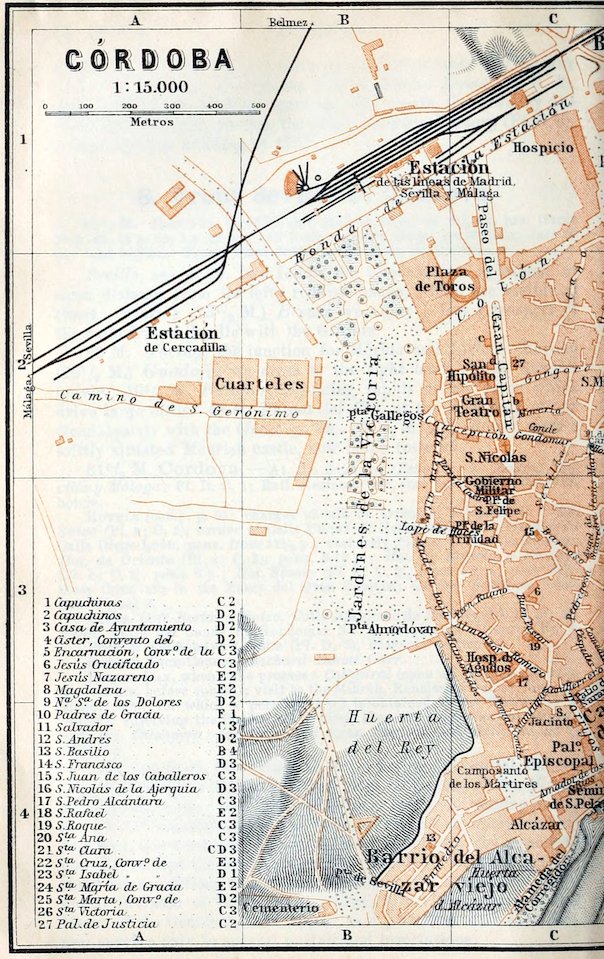
81½ M. Cordova.—At the Station (Estación de Madrid, Sevilla y Málaga; Pl. B, C, 1; Rail. Restaur.) are omnibuses from the chief hotels.
Hotels (comp. p. 51; charges should be arranged beforehand). Hot. Suizo (Pl. a; C, 2), corner of Calle Duque de Hornachuelos and the narrow Calle Diego León, pens, from 12½ p., variously judged.—Less expensive: Hot. de Oriente (Pl. c; C, 2), pens. 8–10 p.; Hot. de España & Francia (Pl. b; C, 2), pens. 8 p.; Hot. Simón (Pl. d; C, 2), pens. 5–6 p., very fair; these three are in the Paseo del Gran Capitán; Cuatro Naciones, Calle San Miguel 4.
Cafés. Café-Restaur. Suizo, Calle Ambrosio de Morales (Pl. D, 3); La Perla, Calle del Conde de Gondomar No. 1, Cervecería Alemana No. 8.
Post & Telegraph Office (Pl. D, 3), Plazuela de Seneca.
British Vice-Consul, Richard Eshott Carr.
Half-a-Day, when time presses: Cathedral (open all day, except 12–2; closes 2 hrs. before sunset); visit to the Mihrâb, Renaissance choir, Mudejar chapel, etc., for which a permiso (2 p.) is obtained at the Oficina de la Obrería, adjoining the Puerta del Perdón; then the Guadalquivir Bridge, with the Calahorra; the Paseo del Gran Capitán and Jardines de la Victoria.
Cordŏva, Span. Córdoba (391 ft.), a provincial capital and the seat of a bishop, with 60,000 inhab., lies at the foot of the Sierra de Córdoba, a spur of the Sierra Morena, in a plain sloping gently down to the Guadalquivir. The town, whose ancient glory has long departed, now contains little or nothing to interest the expectant traveller except the mosque, now the Cathedral, which in spite of many later additions and disfigurements, is still the grandest monument in Spain of the Moorish period. Other memorials of this Mecca of the Occident, once famous as a patroness of science also, now survive only in several portals and inscriptions.
69Corduba, the most important of the ancient Iberian towns on the upper course of the Bætis, became a Roman colony in 152 B.C., and was noted for its commerce and its wealth. The Visigothic king Leovigild wrested it in 571 from the Byzantines and made it an episcopal see. After the decisive battle of 711 (p. 51) Cordova was captured by the Moors, aided by the Jews who were alienated by the arrogance of the Visigoths. With the Moorish sway begins the world-wide fame of the city, especially from the time when the emir Abderrahmân I., of the house of the Omaiyades (p. 485), on his escape from the massacre of his family at Damascus, settled at Cordova in 756 and declared his independence of the Oriental caliphate. As the capital of the Spanish or western caliphate, Cordova soon became the wealthiest city in Spain, and even for a short time the richest in Europe, notably under Abderrahmân II. (822–52) and Abderrahmân III. (912–61), the greatest of the Omaiyades, and also under the governor (hâjib) Al-Mansûr (d. 1002). It even rivalled Bagdad and Fez as a brilliant centre of Mohammedan culture, to which students flocked from every part of the Occident. At length, after the Almoravides and Almohades (p. 95), who had been summoned to aid the citizens against the Christians, had vainly attempted to arrest the decay of the city, Cordova fell, in 1236, into the hands of Ferdinand III. of Castile, who expelled the Moorish inhabitants and in 1248 made Seville his residence. The city afterwards fell into decay and poverty, and the once highly extolled Campiña became a desolate wilderness.
See ‘Cordova’, by A. F. Calvert and W. M. Gallichan (London, 1907).
From the Carrera de la Estación, or ‘station street’, bearing a little to the left, we enter the Paseo del Gran Capitán (Pl. C, 1, 2), the favourite promenade of the townsfolk on summer evenings.
At the S. end of the Paseo, near the church of San Nicolás de la Villa (Pl. C, 2), with its octagonal tower, once a minaret, we take the Calle del Conde de Gondomar to the left, and then, just short of the Hotel Suizo, follow the Calle de Jesús María (Pl. C, 2, 3) to the right. This street, continued by the Calle de Angel de Saavedra, the Calle Pedregosa, and the Calle Céspedes, leads to the S. to the cathedral.
The **Cathedral (Pl. C, 3, 4; adm., see p. 68), once the Mesjid al-Jâmia, or ‘chief mosque’ of the city, one of the greatest in the world, and still called La Mezquita, is the grandest and noblest creation of Moorish architecture in Spain. The mosque was founded by Abderrahmân I. in 785, on the site of a Christian church, and was intended to form a great religious centre for all believers in Spain, and to induce the great stream of western pilgrims to repair to Cordova instead of to Mecca. A model for the edifice was found in the arcaded courts and colonnaded halls of the Egyptian mosques (such as the Amru Mosque, p. 460). The original edifice contained only ten rows of columns, which formed eleven longitudinal and twelve transverse aisles. The central aisle was a little wider than the others and ended in a Mihrâb, or prayer-recess, designed to mark the direction of Mecca (Kibla). As the building soon proved inadequate for the population, which was rapidly increased by accessions from the East, Abderrahmân II., in 833–48, added seven transepts on the S. side and erected a new mihrâb. A further prolongation by fourteen transepts was effected by AlHâkim 70II. (961–76), after which the magnificent third mihrâb (mihrâb nuevo) formed the termination of the building. Though the mosque was now considered the finest in the Occident, rivalling the Kairuin mosque at Fez, it failed to satisfy the ambition of Al-Mansûr (p. 69). As the sloping ground on the S. side precluded extension in that direction, this governor, in 987–90, caused seven new rows of columns to be raised on the E. side, thus increasing the number of aisles to nineteen, but destroying the symmetrical plan of the building, which required the mihrâb, or holy of holies, to be in line with the main axis of the building.
After the conquest of Cordova by the Christians in 1236 (p. 69) the mosque was dedicated to the Virgin (Virgen de la Asunción). The Spaniards at first confined their operations to walling up most of the doors and then fitting up side-chapels along the walls. As the needs of the Christian ritual, however, soon demanded the construction of a choir (primitivo coro), part of the second mihrâb and the adjoining aisles had in 1260 to be demolished. Still greater damage was done by the insertion of the Renaissance choir in the centre of the building, and of the Sala Capitular, or sacristy, in the middle of the S. wall.
The Ground Plan forms an immense rectangle of about 575 by 427 ft., of which fully a third is occupied by the court. Court and church are surrounded by a fortress-like battlemented wall which, on three sides, rests on massive substructions. Nothing indicates the object of the building except the rich portals, flanked with niches and windows, and, on the N. side, adjoining the Calle del Obispo Herrero, the Campanario or bell-tower (305 ft. high), which was substituted for the Moorish minaret in 1593. Ascent of the tower interesting (adm. 25 c.; 255 steps).
The *Puerta del Perdón, the main gateway, restored in 1377 on the model of the gate of that name at Seville (p. 63), adjoins the clock-tower and leads into the—
*Patio de los Naranjos (‘orange-court’), once the court of the mosque, where the faithful performed their ablutions. Light and spacious, yet well-shaded by orange and palm-trees, watered by five fountains, and always enlivened with groups of quiet visitors, it presents a typical scene of Oriental repose. The avenues were originally laid out in line with the colonnades in the interior of the mosque. The old arcades of the court (claustro) are now walled up on the N. side. Of the nineteen gates on the S. side, two only, the Puerta de las Palmas, the chief entrance to the cathedral, and the small doorway of the eastmost colonnade are now open.
The *Interior of the Cathedral, in spite of its moderate height (37 ft.), and in spite of much disfigurement, is singularly impressive. In the subdued light the forest of columns seems endless. They average 13 ft. only in height, and are of the most diverse 71materials, many of them having been brought from late-Roman buildings or from Christian churches. The capitals show a marvellous wealth of design; their bases are buried in the pavement, the level of which has been raised by 11–14 inches in the course of centuries. The vast number of horseshoe arches which connect the columns, in the direction of the length of the church, and the upper semicircular arches resting on projecting pillars impart peculiar life to the building. The painted timber-ceilings of the different roofs have been restored in their original style. The sumptuous mosaic pavement has disappeared, and so too have the countless chandeliers and lamps which burned perpetually during the Moorish period.
The wealth of artistic decoration was lavished chiefly on the mihrâbs, the first of which has been entirely destroyed. The second and third were each provided with a vestibule and two side-rooms, part of which was formerly shut off to form the Caliph’s maksûra (or court-platform). The vestibule of the *Second Mihrâb, with its superb shell-vaulting, still exists.
The **Third Mihrâb is considered a marvel of art. The front is adorned with two rows of columns, one above the other, and with double toothed arches. The vestibule, now Capilla de San Pedro, and the prayer-niche itself, a kind of heptagonal chapel of barely 13 ft. in diameter, exhibit the most elaborate efforts of early-Moorish art, especially in the rich marble plinth and in the coloured glass mosaics executed by Byzantine artists. The toothed arches of the windows and the boldly interlacing arches of the superb dome point to a later high development of Moorish art.
Of the Christian Additions to the church one of the most noteworthy is the sumptuous Capilla Mudéjar de San Fernando, to the left of the second mihrâb, erected over the old royal vault. The *Renaissance Choir (Coro and Capilla Mayor), designed by Hernán Ruiz the Elder in 1523, was completed, with many alterations, in 1627. Though only 256 by 79 ft. in size, it is crowded with no less than 63 columns, and it rises high above the roof of the mosque. It is considered a masterpiece of the plateresque style, but has ruined the original symmetry of the mosque.
The Alcázar (Pl. C, 4; now a prison), erected in 1328, contains but scanty relics of the ancient Moorish castle.
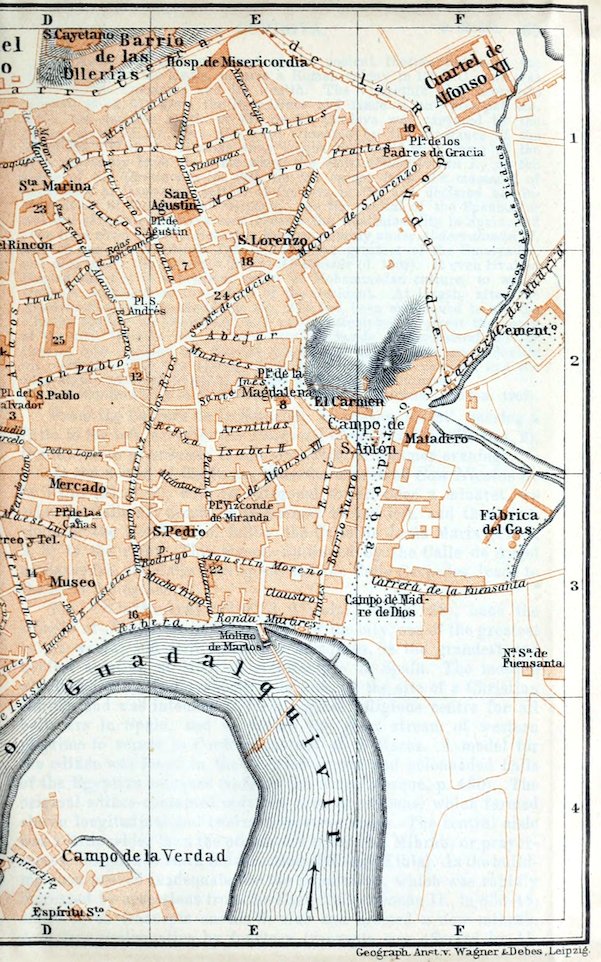
The Calle Torrijos, on the W. side of the cathedral, descends to the Puerta del Puente, a triumphal arch of the time of Philip II., on the site of the Moorish bridge gateway. The Moorish *Bridge (Pl. C, D, 4) of sixteen arches, resting on Roman foundations, here unites Cordova with the S. suburb of Campo de la Verdad. Halfway across we have a fine view of the cathedral, and of a dam, up the river, with Moorish mills. The massive tête-de-pont, Calahorra (Iberian Calagurris), also is of Moorish origin.
72Returning into the town from the bridge, we may next visit the Puerta Almodóvar (Pl. B, 3), a relic of the Moorish city-wall, and then walk through the Jardines de la Victoria to the station.
9. From Cordova viâ Bobadilla to Granada.
153 M. Railway in 6¼–8½ hrs. (fares 36 p. 30, 28 p. 20, 19 p. 30 c.); express on Mon. & Frid. only; change at Bobadilla (Railway Restaurant). Beyond Bobadilla views to the right.
Cordova, see p. 68.—The train crosses the Guadalquivir and runs through a dreary hill-country (Campiña). Looking back, we see Cordova, the Sierra of Cordova, and Almodóvar (p. 68).
We cross the Guadajoz several times. Beyond (21 M.) Fernán Núñez the vine and olive culture begins. 31 M. Montilla (1165 ft.), once famed for its Amontillado, resembling the wine of Xeres (p. 59). Farther on, to the left, we have a view of the distant Sierra Nevada (p. 49).
47 M. Puente Genil (Rail. Restaur.). The town lies 2 M. to the N.W., and is seen to the right as we cross a lofty bridge over the Genil (see below). The train ascends to the plateau of the Sierra de Yeguas, in view, farther on, of abrupt Jurassic mountains.
62 M. La Roda, junction for Utrera. (Lines to Cadiz and Seville, see R. 6.)
Running to the S.W. the train soon reaches the watershed (1477 ft.) between the Guadalquivir and the Guadalhorce. Beyond (69½ M.) Fuente Piedra we observe on the right the Laguna Salada, a salt-lake resembling the shotts of N. Africa (p. 169).
77 M. Bobadilla, see p. 57.
The Granada train diverges to the N.E. from the Málaga line (R. 11), and ascends the broad valley of the Guadalhorce. On the right soon appears the Sierra de Abdalajis.
87 M. Antequera (1346 ft.; Fonda de la Castaña and others), the Roman Anticaria, lies picturesquely at the N. base of the hills, with a ruined Moorish castle. The Cueva de Menga, 10 min. to the E. of the town, is one of the largest dolmens in Spain.
99½ M. Archidona; the town lies on a hill, 3¾ M. to the S.—We next cross the watershed between the Guadalhorce and the Genil and descend through several tunnels. After the third the snow-covered Sierra Nevada suddenly appears towards the E.
121 M. Loga, the Lôsha of the Moors, together with Alhama, a little town on the hill 12½ M. to the S.E., once ‘the keys of Granada’, were captured by the Catholic kings (p. 75) in 1488.
73The country is now hilly and at places sandy; the Genil with its Vega (p. 73) remains on the right. 132 M. Tocón, at the foot of the Sierra de Prugo, On the left rises the bare Sierra de Parapanda, which the natives of Granada regard as a barometer. 144 M. Pinos Puente, at the foot of the barren Sierra de Elvira.
We next enter the fertile Vega, enclosed by olive-clad hills. 148 M. Atarfe, station for Santa Fe, 3 M. to the S.W., on the left bank of the Genil, built in the form of a Roman camp by Isabella the Catholic during the siege of Granada. The capitulation was signed here in 1491 (p. 75), and so too, in 1492, was the contract with Columbus regarding his voyage of discovery (p. 5).
In the foreground appears the lofty Albaicín (p. 74); then, overtopped by the Sierra Nevada, (153 M.) Granada (see below).
10. Granada.
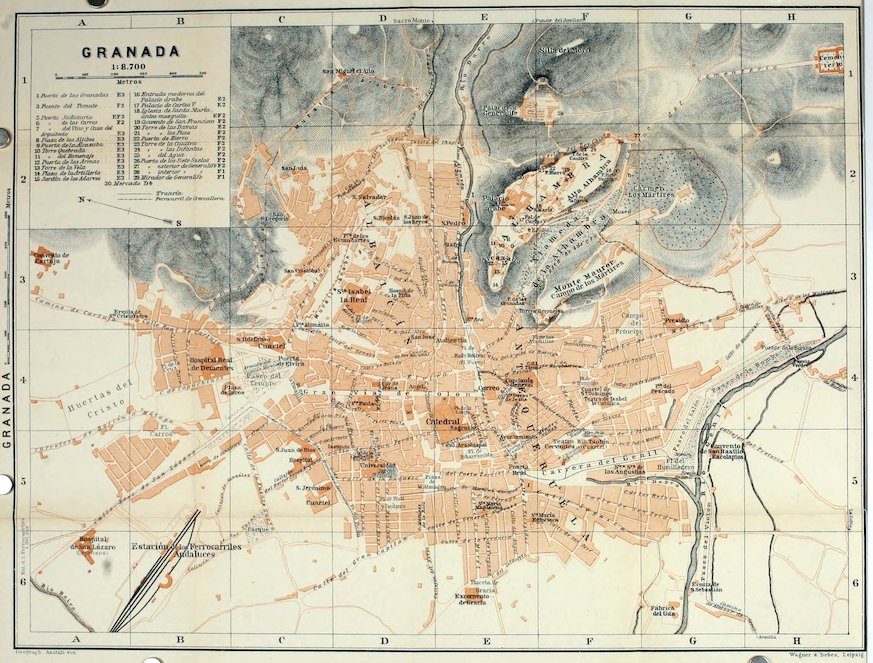
The Station (Estación de los Ferrocarriles Andaluces; Pl. B, 6; no buffet) is 1¾ M. from the hotels in the Puerta Real and nearly 2 M. from those near the Alhambra. Hotel-omnibus to the former 1, to the latter 2 p.; an ‘omnibus general’ (50 c. each pers. or each trunk) plies to the Despacho Central (p. 51), opposite the Hot. Victoria.
Hotels (comp. p. 51). Near the Alhambra, in the Alhambra Park, a beautiful, but in winter a cold situation, ¾ M. above the town (2–3 min. from the hill-tramway station; see below): Hot. Washington Irving (Pl. b; F, 2), with the dépendance Siete Suelos (Pl. c; F, 2), patronized by English and Americans; Alhambra Palace Hotel (Pl. a; F, 3), new, R. 6–12½, pens. 20–35 p.; *Pens. Miss Laird, Carmen de Bella Vista, with garden, 8½–12 p. per day; Hot. del Bosque de la Alhambra, at the N. base of the Alhambra Hill, below the Torre de Comares (Pl. E, 2), pens. 8–15 p., well spoken of.—In the Town (ca. 1¾ M. from the Alhambra): *Hot. Alameda (Pl. d; F, 5), adjoining the shady Carrera del Genil, with view of the Sierra Nevada, pens. 8–20 p.; Hot. de Paris (Pl. e; E, 4), Gran Via de Colón 5, with terrace, restaurant, etc., pens. 9–20 p.; Hot. Victoria, on the W. side of the Puerta Real, with fine view, pens. from 8 p., Spanish, quite good; Hot. Nuevo Oriente (Pl. g; E, 5), Plaza de Cánovas del Castillo 8, pens. 7 p., quite Spanish, very fair; Fonda Navío, Calle Martínez Campos (Pl. E, 5), with a favourite restaurant.—Drinking-water not good.
Cafés. Café Colón, Calle de los Reyes Católicos (Pl. E, 4); Imperial, Carrera del Genil (Pl. F, 5).
Tramways. 1. Plaza Nueva (Pl. E, 4)-Cocheras (red disc): through the Calle de los Reyes Católicos (Pl. E, 4, 5) to the Puerta Real, the University (Pl. D, 5), and the Rail. Station (Pl. B, A, 6).—2. Plaza Nueva-Cervantes (yellow): viâ the Puerta Real and the Carrera del Genil to the Paseo de la Bomba (Pl. G, H, 4).—3. Puerta Real (Pl. E, 5)-Vistillas-Alhambra (green): viâ the Plaza Nueva to the Puerta de los Molinos (Pl. G, 3; change), then by the hill-tramway (rack-and-pinion) to the Alhambra Park (Cuesta de las Cruces; Pl. F, 2, 3), in ¼ hr.; fare 30 c.
Cabs (stationed in the Carrera del Genil). Drive in the town, with one horse 1, with two horses 2½ p.; per hour 2 or 3 p.—To the Alhambra, Albaicín (p. 79), and Sacro Monte (p. 78) 5 p. extra (but bargain advisable). Carr. and pair may be had also from the Despacho Central or the Alhambra hotels (3 p. per hour).
Post & Telegraph Office (Correo; Pl. E, 4), Calle de los Reyes Católicos. Post-office open 10–12 and after 2; poste restante letters delivered 1 hr. after arrival of trains.
British Vice-Consul, Chas. E. S. Davenhill.
74Sights. Alhambra (p. 79), daily, 9–12 and 1–6, adm. 50 c.–1 p., on Sun. free; some rooms specially shown by the custodian.—Generalife (p. 87), best by morning light; tickets (papeletas) at the Casa de los Tiros (p. 77), on week-days, 9–11, free.—The Cathedral (p. 76), daily, closed between 11 and 2.30; the Capilla Real (p. 76), either in the morning before high-mass (in winter at 10, in summer at 9), or 2.30 to 4, in summer 3–5 p.m.—The smaller churches are usually open from an early hour till 8.30 or 9 only, but are shown later by the sacristan (fee).—The usual hours for other sights are 8–12 and 2–6; between 12 and 2 a substantial fee is exacted.
Promenades. In winter, Carrera del Genil (p. 77), 3–5; in summer, Paseo del Salón (p. 77) and Paseo de la Bomba, 5–7. Band on Sun. and Thurs.
Guides at the hotels, needless except when time presses. Those who pester strangers in the streets and at the entrance to the Alhambra, as well as gipsy beggars, should be disregarded.
Chief Attractions (two days). 1st. Forenoon: the Cathedral (p. 76); Placeta de la Lonja (p. 77); Casa de los Tiros (p. 77); Carrera del Genil; *Paseo del Salón; afternoon: Alameda del Darro (p. 78); *View from San Nicolás (p. 79) or from San Miguel el Alto (p. 79).—2nd. *Alhambra (p. 79) and Generalife (p. 87).
Granáda (2195 ft.; pop. 69,000), once the capital of the Moorish kingdom, and now that of the province of Granada, the residence of an archbishop and seat of a university, lies most picturesquely at the foot of two hills (about 490 ft. high), which gradually slope to the E. up to the Cerro del Sol, and descend abruptly to the fertile, well-watered river-plain of the Vega. The Albaicín, the northmost of the two hills, the oldest quarter of Granada, once the residence of the Moorish aristocracy, but now inhabited chiefly by gipsies, forms a town by itself. The deep ravine of the Darro, which is generally dry as its water is much diverted for irrigation purposes, separates the Albaicín from the Monte de la Assabica, or Alhambra Hill to the S. (comp. p. 79). The Darro, descending from the N.E., turns to the S. near the Alhambra Hill and falls into the more important Genil.
The two hills were once occupied by Iberian and then by Roman settlements, the one on the Albaicín having perhaps already borne the name of Garnata. Soon after 711 the Moors built the ‘Old Castle’ (Al-Kasaba al-Kadîma) on the site of Garnata. After the decline of the caliphate of Cordova (p. 69) Zâwi ibn Zîri, the governor of Granada, declared himself independent in 1031, and founded here the dynasty of the Zirites, which, however, was overthrown by the Almoravides (p. 95) in 1090. As the power of the Almohades (p. 95) declined the native governors revolted anew. At length in 1246 Granada became the seat of the Nasride Dynasty founded by Al-Ahmar (‘Mohammed I.‘), which, after the fall of Seville, succeeded, in alliance alternately with the Castilians and the Merinides (p. 95), in retaining possession of Granada, Málaga, and Almería for nearly 250 years. Mohammed I. offered an asylum in Granada to the Moors who were expelled from Cordova, Valencia, and Seville, and began the building of the ‘New 75Castle’ (Al-Kasaba al-Jedîda) on the hill of the Alhambra. His successors afterwards created the Alhambra Palace, the most sumptuous of royal residences. Thanks to their fostering care for agriculture and industry, for science, art and architecture, Granada attained such brilliant prosperity as even to eclipse the fame of the old caliphate of Cordova.
The downfall of the kingdom of Granada was at length brought about by party struggles between the Zegri, the Beni Serrâj (the Abencerrages of legend; comp. p. 84), and other noble families, and by quarrels between king Mulei Abu’l-Hasan (d. 1485) and his son Boabdil; a welcome opportunity was thus afforded to Ferdinand and Isabella, the so-called ‘Catholic Kings’, of intervening and thus gaining their life-long object of destroying the last Moorish kingdom in Spain. After the death of his father Boabdil remained inactive when Ferdinand proceeded to besiege Málaga (p. 90); he made one despairing attempt at resistance when the Spaniards demanded the evacuation of Granada, but in 1491 had to conclude a humiliating peace. He soon afterwards crossed the Sierra Nevada and retired to Tlemcen in N. Africa (p. 187), where he ended his inglorious career. With the Spanish domination began the decay of the city; it was depopulated by the decrees of the Catholic Kings, the Inquisition held fearful sway here, and ere long Granada became a ‘living ruin’. Within the last few years, however, the busy tourist traffic, the establishment of sugar-factories, and the prosperous mining industry of the Sierra Nevada have somewhat repaired the fortunes of the city, and several of the old quarters have been entirely modernized. But its picturesque history, its memorials of the most glorious period of Moorish culture and art, and the striking view of the snow-mountains it affords will ever render it the most fascinating goal of travellers in Andalusia.
See ‘Granada: Memories, Adventures, Studies, and Impressions’, by Leonard Williams (London, 1906); and ‘Granada and the Alhambra’, by A. F. Calvert (London, 1907).
a. The Lower Town.
Leaving the railway-station (Pl. B, 6; tramway No. 1, see p. 73), we follow the Calle Real de San Lázaro to the S.E. to the Paseo del Triunfo (Pl. C, 4), so named from the column in honour of the Virgin (triunfo). Here, by the half-ruined Puerta de Elvira (Pl. C, 4), begin the old Calle de Elvira and the new Gran Via de Colón (Pl. C-E, 4), both leading to the chief artery of traffic, the narrow—
Calle de los Reyes Católicos (Pl. E, 4, 5), which is built above the Darro, and connects the busy Puerta Real (Pl. E, 5), to the S.W., with the Plaza Nueva (Pl. E, 4; officially, Plaza Rodriguez Bolivar), to the N.E., at the foot of the Alhambra Hill (p. 79).
76In the Calle de Lopez Rubio, a side-street, is the so-called Casa del Carbón, once a Moorish granary, with picturesque horseshoe arches and stalactite vaulting. To the S.W. of it is the modern town-hall (Ayuntamiento).
The short streets on the opposite side lead to the Alcaicería, (Pl. E, 4, 5), with its numerous columns, which was burned down in 1843, once a Moorish market-hall (Al-Kaisariya), resembling the Oriental sûks (p. 335), and to the modernized Plaza de Bibarrambla (Pl. E, 5), named after a Moorish city-gate which once stood here. A few paces from these lies the Placeta de las Pasiegas. Here, surrounded by buildings which mar its effect, rises the—
*Cathedral (Pl. D, E, 4, 5), an imposing memorial of the conquest of Spain, and the finest Renaissance church in the kingdom. It was begun in 1523 by Enrique de Egas in the Gothic style, continued in 1525 by Diego de Siloe (d. 1533) in the plateresque style (p. 51), and consecrated, while still unfinished, in 1561. The N. tower only, which is now 187 ft. high, has been erected; the huge façade was begun in 1667 by Alonso Cano, who was also the chief author of the sculpture and painting in the church; the interior was not completed till 1703.
Two of the Side Portals, the Puerta de San Jerónimo, the first entrance to the N. in the Calle de Jiménez de Cisneros, and the Puerta del Colegio, on the E. side of the ambulatory, are adorned with sculptures by Siloe and others. The *Puerta del Perdón, the second portal to the N., also owes the beautiful ornamentation of its lower part to Siloe.
The *Interior (adm., see p. 74) has double aisles with two rows of chapels, a lofty transept which does not project beyond the side-walls, a central choir, and a Capilla Mayor with ambulatory. The vaulting, 100 ft. in height, is borne by massive pillars and half-columns. Total length 380, breadth 220 ft. The decoration in white and gold harmonizes well with the fine marble pavement (1775).
The *Capilla Mayor, 148 ft. long and 154 ft. high, is crowned with a dome resting on Corinthian columns. On the pillars in front of the marble high-altar are kneeling statues of the ‘Catholic Kings’, by Pedro de Mena and Medrano (1677); above them are painted *Busts of Adam and Eve, in oak, by Alonso Cano, who painted also the representation of the Seven Joys of Mary.
Side Chapels. The Capilla de San Miguel, on the right, lavishly decorated in 1807, contains a picture by Al. Cano, the Mater Dolorosa (after Gasp. Becerra).—In the Capilla de la Trinidad, beyond the door of the Sagrario (p. 77), is a painting of the Trinity by Al. Cano.—The Altar de Jesús Nazareno contains *Pictures by Dom. Theotocópuli (St. Francis) and Ribera; the fine Bearing of the Cross is by Al. Cano.—By the same artist are also the fine oaken busts of St. Paul and John the Baptist in the Capilla de Nuestra Señora del Carmen, adjoining the N. aisles.
From the first chapel in the ambulatory, to the right of the Puerta del Colegio, a portal by Siloe leads through an ante-room (antesacristía) into the Sacristy (18th cent.), containing a crucifix by Montañés (p. 61) and an Annunciation and a Conception (a sculpture) by Al. Cano.
A handsome portal leads from the right transept into the late-Gothic *Capilla Real, the burial-chapel of the ‘Catholic Kings’, where Charles V. caused his parents Philip of Austria and Juana the Insane also to be interred. The marble *Monuments are in the Italian early-Renaissance style: on the right those of Ferdinand and Isabella, by the Florentine Domenico 77Fancelli; on the left, Philip and Juana, by Bartolomé Ordóñez. The high-altar, with the kneeling statuettes of the ‘Catholic Kings’, is by Philip Vigarní, a Burgundian; the reliefs in wood, historically interesting, represent (left) the surrender of the Alhambra keys and (right) the compulsory baptism of the Moors. Behind the reliquary altars, which are opened on four festival-days only, are hung Madonnas by Dierick Bouts, altar-wings by Roger van der Weyden, a Madonna and a Descent from the Cross by Memling, and other pictures. Over an altar in the right aisle is a *Winged Picture by D. Bouts.
The third great addition to the cathedral, the Sagrario, erected as a parish church in 1705–59, occupies the site of the ancient mosque, with its eleven aisles, which was used for Christian worship down to 1661.
The picturesque Placeta de la Lonja (Pl. E, 4), on the S. side of the cathedral, affords a good view of the Lonja (Exchange), built in 1518–22, which stands before the Sagrario, of the rich architecture of the Capilla Real, and of the—
Casa del Cabildo Antigua, once the seat of the Moorish university founded here after the downfall of Cordova and Seville, afterwards the residence of the ‘Catholic Kings’, and now a cloth magazine. Its fantastic exterior dates from the 18th cent.; in the interior are two interesting rooms of the Moorish period (fee 50 c.).
From the E. end of the Calle de los Reyes Católicos (p. 75) the Calle Castro y Serrano and Calle Doctor Eximio lead to the right to the Casa de los Tiros (Pl. E, 4), a building in the Moorish castellated style, dating from the 15th cent., and now owned by the Marquesa de Campotéjar. The court contains a venerable tree-like vine. Tickets for the Generalife (comp. p. 74) are issued here.
The Calle de Santa Escolástica leads hence to the Plaza de Santo Domingo (Pl. F, 4) and the old monastery of Santo Domingo (now a military school), with its pleasing church (15–17th cent.).—A little to the S.W. is the—
Cuarto Real de Santa Domingo (Pl. F, 4; admittance seldom granted), the Al-Majarra of the Moors, now named after a tower of the 13th cent., a superb villa with a Moorish portal and a hall whose charming decoration is older than the Alhambra. The beautiful garden is said to have been laid out in Moorish times.
We now cross the Plaza Bailén to the N.W. to the favourite winter promenade (p. 74), the Carrera del Genil (Pl. E-G, 5), shaded with plane-trees, which begins at the Puerta Real (p. 75) and now comprises the former Alameda. Adjoining the Carrera on the left is the—
*Paseo del Salón (Pl. G, 5, 4). planted with elms and adorned with a bronze statue of Isabella the Catholic. Delightful view to the N.E. of Monte Mauror with the Torres Bermejas (p. 80); to the S.E. towers the majestic Sierra Nevada, from whose rocky crest the Picacho de la Veleta (11,148 ft.), the grandest point of view in all Andalusia, alone rises conspicuously.
78
b. Darro Valley and Albaicín.
At the mouth of the Darro Valley lies the Plaza Nueva (Pl. E, 4; p. 75), another focus of traffic (tramways, see p. 73). On the left is the Audiencia, formerly the Chancilleria, built in 1531–87 for the Capitán General or governor. The pretty arcaded court was probably designed by Diego de Siloe (p. 76).
A few paces farther to the E. the Darro is not covered in. Here, on the right, on the site of an old mosque, is the church of Santa Ana (Pl. E, 3), a Renaissance building, perhaps designed by Diego de Siloe in 1541, with a fine plateresque portal and an admirable timber ceiling. The tower, built by Juan Castellar in 1561–3, with its azulejos and jutting roof resting on corbels, resembles a minaret.
Opposite the church, on the right bank of the Darro, begins the Carrera del Darro (Pl. E, 3, 2), one of the oldest parts of Granada, affording picturesque views, notably of the towers and walls of the Alhambra, which had its oldest approach from this quarter. (Part of a horseshoe arch of the bridge is seen on the left bank.) The Bañuelo, at No. 37, now occupied by poor families, is a Moorish bath, dating perhaps from the 11th century.
On the right side of the street we come to the church of San Pedro y San Pablo (Pl. E, 3, 2), with its fine timber ceiling. On the opposite bank of the Darro we observe traces of the landslip under the N.E. corner of the Alcazaba (p. 81), below which are the arches of an aqueduct. To the N. of the church is the Casa de Castril, a curious Renaissance building with an ornate portal by a pupil of Siloe.
We next reach the Alameda del Darro (Pl. E, 2), planted with elms; above us, on the right, is the Generalife (p. 87); on the left, Albaicín (p. 79). Crossing the bridge to the right we enter the steep Cuesta del Rey Chico (Pl. F, 2), which leads through the ravine mentioned at p. 79, and past the Moorish towers of the Alhambra, to the Puerta de Hierro (p. 87), the E. gate of the Alhambra, and to the Generalife.
From the Darro the Cuesta del Chapiz (Pl. E, D, 2) ascends to the N. to the old suburb of Albaida. The street is named after the Casa del Chapiz, erected early in the 16th cent. in the Mudejar style for two Morisco nobles, with two separate patios. The house, now a bakery, is entered from No. 14, at the corner of the Camino del Sacro Monte.
From this point the Camino del Sacro Monte (Pl. D, 2, 1) ascends the cactus-grown slope. The numerous poor Cuevas, or cave-dwellings, are chiefly occupied by gipsies (gitanos). The path ends at the (25 min.) Sacro Monte (to the N.E. of Pl. D, E, 1), a Benedictine monastery of the 17th cent., now a divinity and law school. 79The view of the Alhambra across the Darro valley, of the town and the Vega, is one of the finest near Granada.
Footpaths ascend from the Cuesta del Chapiz in 25 min., and from the Sacro Monte in ¾ hr., partly through deep gorges, to the chapel of San Miguel el Alto (Pl. D, 1), in the midst of aloes and cacti, where we enjoy a grand *View of the Alhambra, the town, the Vega, and the Sierra Nevada.
The side-streets of the Carrera del Darro (p. 78) ascend to the N. to Albaicín, a poor suburb (p. 74). Not far from San Pedro y San Pablo (p. 78) is the small Gothic church of San Juan de los Reyes (Pl. D, 2), an early 16th cent. edifice, whose tower was once a minaret.