SUBDIVISION ANGIOSPERMAE CLASS IV. MONOCOTYLEDONEAE
Reading edition
ORDER PANDANALES
FAMILY 5. TYPHACEAE
Aquatic or marsh herbs with a creeping root-stock and simple stems. Leaves in two ranks, linear. Inflorescences spadix-like, cylindrical, superposed, interrupted by bracts, the lower female, the upper male. Flowers unisexual, without a perianth, but usually surrounded by hairs. Stamens 2-7; connective thickened; anthers opening lengthwise by two slits. Ovary 1-celled. Ovule 1, pendulous, inverted. Style and stigma simple. Fruit tardily dehiscent. Seed with abundant albumen and a long, axile embryo.
Genus 1, species 4. They are used as ornamental plants and in medicine, and yield potash and also materials for plaiting and stuffing and for the manufacture of paper and felt. The root-stock and the pollen are edible. “Reedmace.” Typha Tourn.
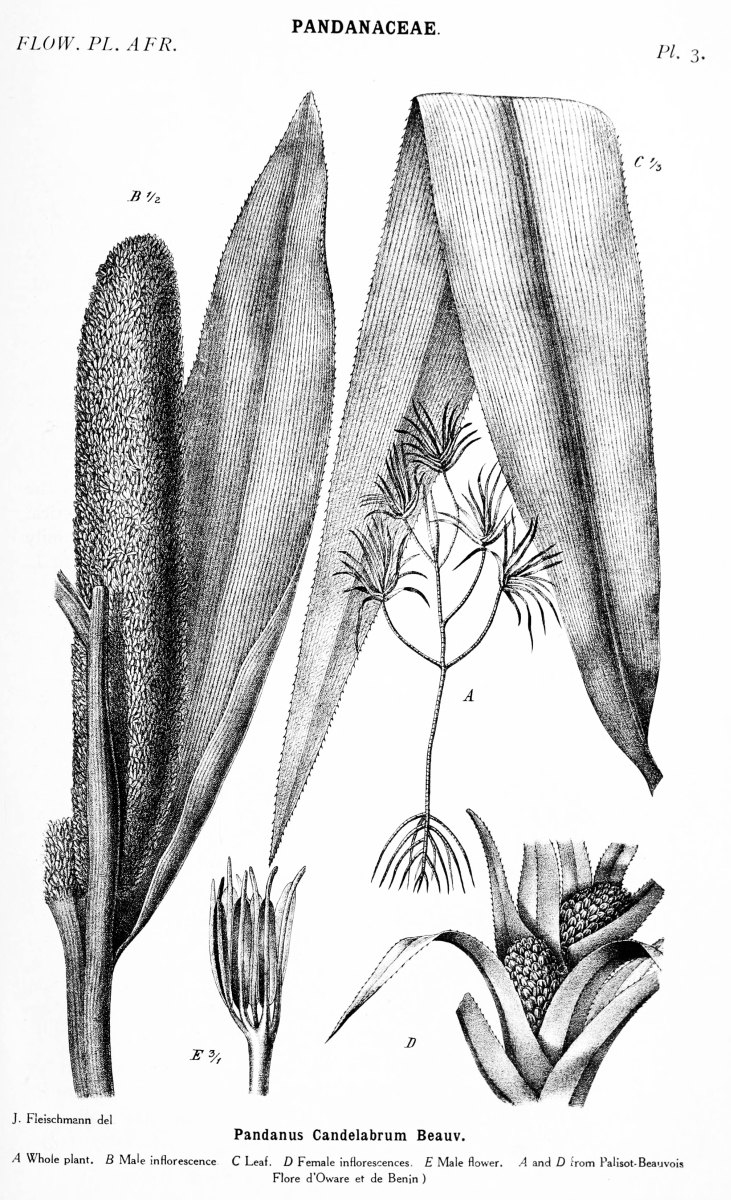
PANDANACEAE.
FLOW. PL. AFR. Pl. 3.
J. Fleischmann del
Pandanus Candelabrum Beauv.
A Whole plant. B Male inflorescence. C Leaf. D Female inflorescences. E Male flower. A and D (from Palisot-Beauvois Flore d’Oware et de Benin.)
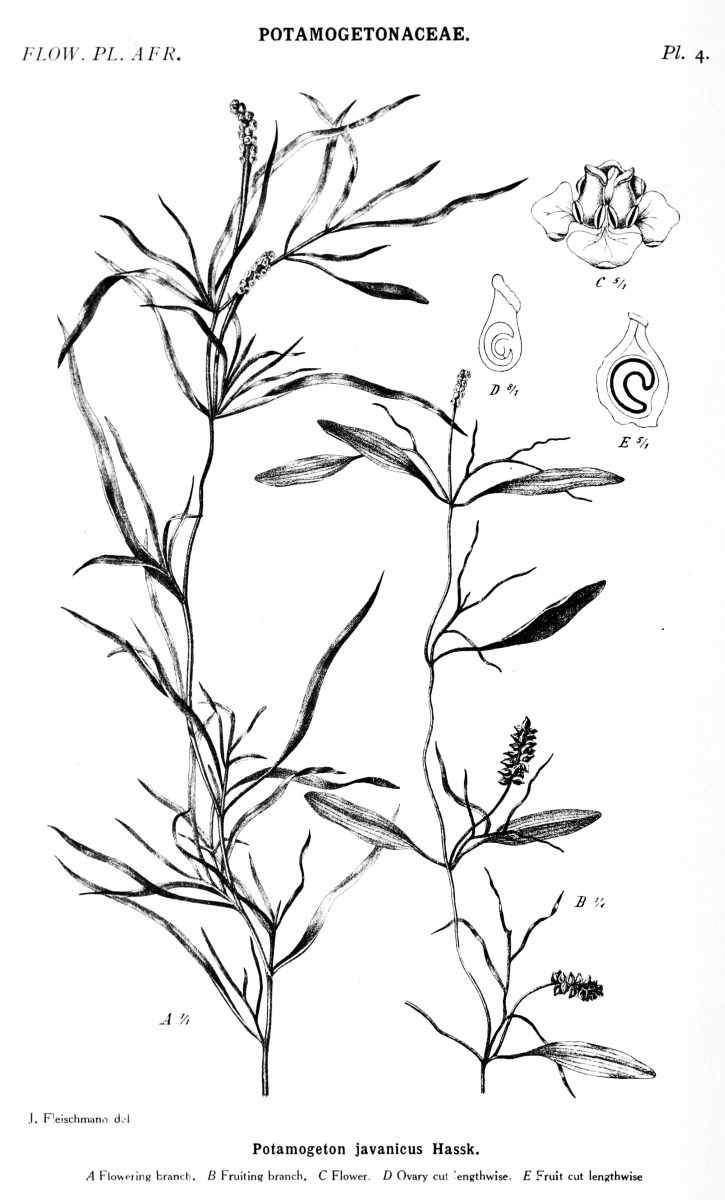
POTAMOGETONACEAE.
FLOW. PL. AFR. Pl. 4.
J. Fleischmann del
Potamogeton javanicus Hassk.
A Flowering branch. B Fruiting branch. C Flower. D Ovary cut lengthwise. E Fruit cut lengthwise.
FAMILY 6. PANDANACEAE
Shrubs or trees, usually with aerial roots. Leaves in three ranks, sword-shaped, usually spiny. Flowers dioecious, without bracts, arranged in solitary or panicled, spike-or head-like spadices, which are inserted in the axil of spathe-like bracts. Perianth none. Ovaries connate, 1-celled. Ovule 1, descending, inverted. Stigma 1, sessile. Fruits drupe-like, congested into a globose or ovoid head. Seed with abundant albumen. (Plate 3.)
Genus 1, species 65. Tropics. They yield timber, fibres, flowers used in perfumery, edible fruits, and medicinal drugs. “Screw-pine.” Pandanus L.
FAMILY 7. SPARGANIACEAE
Aquatic or marsh herbs with a creeping root-stock. Leaves in two ranks, linear. Flowers unisexual, in globular heads, the lower of which are female. Perianth of membranous scales. Stamens 3 or more. Ovary superior, 1-2-celled. Ovule 1 in each cell, pendulous, inverted. Style simple, stigmas 1-2. Fruits drupe-like. Seed with a mealy albumen and a large, axile embryo. (Under TYPHACEAE.)
Genus 1, species 2. North-west Africa. “Bur-reed.” Sparganium L.
ORDER HELOBIAE
SUBORDER POTAMOGETONINEAE
FAMILY 8. POTAMOGETONACEAE
Aquatic herbs. Leaves with axillary scales. Flowers solitary or spicate, regular, with 1-4-merous whorls. Perianth simple and little developed or wanting. Stamens 1-4. Anthers sessile, opening outwards or laterally. Carpel 1, with a 1-celled ovary, or several distinct or almost distinct carpels. Ovules solitary in each carpel, very rarely 2, pendulous or laterally fixed Fruit indehiscent. Seed exalbuminous. Embryo with a strongly developed radicle.—Genera 8, species 35. (Including ZOSTERACEAE, under NAIADACEAE.) (Plate 4.)
1. Flowers in spikes, hermaphrodite or polygamous, without a perianth, but the stamens sometimes provided with a sepal-like connective. 2 Flowers solitary or in cymes, unisexual. 5 2. Spikes with a flat axis, at the time of flowering enclosed in the sheaths of the uppermost leaves. Stamen 1. Pollen-grains filiform. Carpel 1. Stigmas 2, on a short style. Embryo with a very large radicle and a tail-like cotyledon. Submerged marine plants.—Species 2. North and South Africa and Madagascar. Used for stuffing and as packing material. “Grass-wrack.” [Tribe ZOSTEREAE.] Zostera L. Spikes with a cylindrical axis, at the time of flowering not enclosed in the sheaths of the uppermost leaves. Stamens 2-4. Stigma 1, undivided or many-parted. 3 3. Spikes compound, submerged. Spikelets shorter than their bracts. Flowers polygamous. Stamens 3, rarely 4. Pollen-grains filiform. Carpel 1. Stigma divided (or provided with narrow appendages). Embryo with a very large radicle and a straight cotyledon resembling the leaves of the plumule. Marine plants.—Species 1. Mediterranean Sea. The leaves are used for packing and thatching, and also in medicine. [Tribe POSIDONIEAE.] Posidonia Koen. Spikes simple, above the water. Flowers hermaphrodite. Pollen-grains globular or bent. Carpels usually 4. Stigma simple, more or less peltate. Embryo with a curved cotyledon. [Tribe POTAMOGETONEAE.] 4 4. Spikes two-flowered. Stamens 2. Anthers with a very short appendage and kidney-shaped cells opening outwards. Pollen-grains bent. Fruit stalked. Embryo with a very thick radicle. Salt-water plants. Leaves subulate.—Species 1. Ruppia L. Spikes several-flowered. Stamens 4. Anthers with a sepal-like appendage and straight cells opening laterally. Pollen-grains globular. Fruit sessile. Embryo with a slightly thickened radicle.—Species 20. Used for manure; some have edible root-stocks. “Pondweed.” (Plate 4.) Potamogeton Tourn. 5. Perianth none. Stamens 2. Pollen-grains filiform. Carpels 2. Stigmas strap-shaped, longer than the style. Embryo with an accumbent cotyledon. Marine plants. [Tribe CYMODOCEAE.] 6 Perianth present, at least in the female flowers. Stamens 1-2. Pollen-grains globular. Carpels 3-9. Stigma shield- or funnel-shaped, shorter than the style. Embryo with a hooked or rolled cotyledon. Fresh- or brackish-water plants. [Tribe ZANICHELLIEAE.] 7 6. Stigma 1. Anthers inserted at slightly different heights. Ripe carpels scarcely compressed.—Species 2. Indian Ocean, Red Sea, Angola. (Halodule Endl., under Cymodocea Koen.) Diplanthera Thouars Stigmas 2. Anthers inserted at the same height. Ripe carpels compressed and keeled.—Species 5. North Africa, Senegambia, East Africa, Madagascar and neighbouring islands. (Including Phycagrostis Ascherson) Cymodocea Koen. 7. Perianth in the male flowers none, in the female cup-shaped and undivided. Anthers stalked, opening by 2 longitudinal slits. Carpels usually 4, slightly curved, with a peltate stigma.—Species 1. North and South Africa, southern West Africa, Madagascar and neighbouring islands. Zannichellia Mich. Perianth in the male flowers 3-toothed, in the female consisting of 1-3 segments. Anthers sessile, opening with one longitudinal slit. Carpels 3, straight, with a funnel-shaped stigma.—Species 1. North-west Africa (Algeria). Althenia Fr. Petit
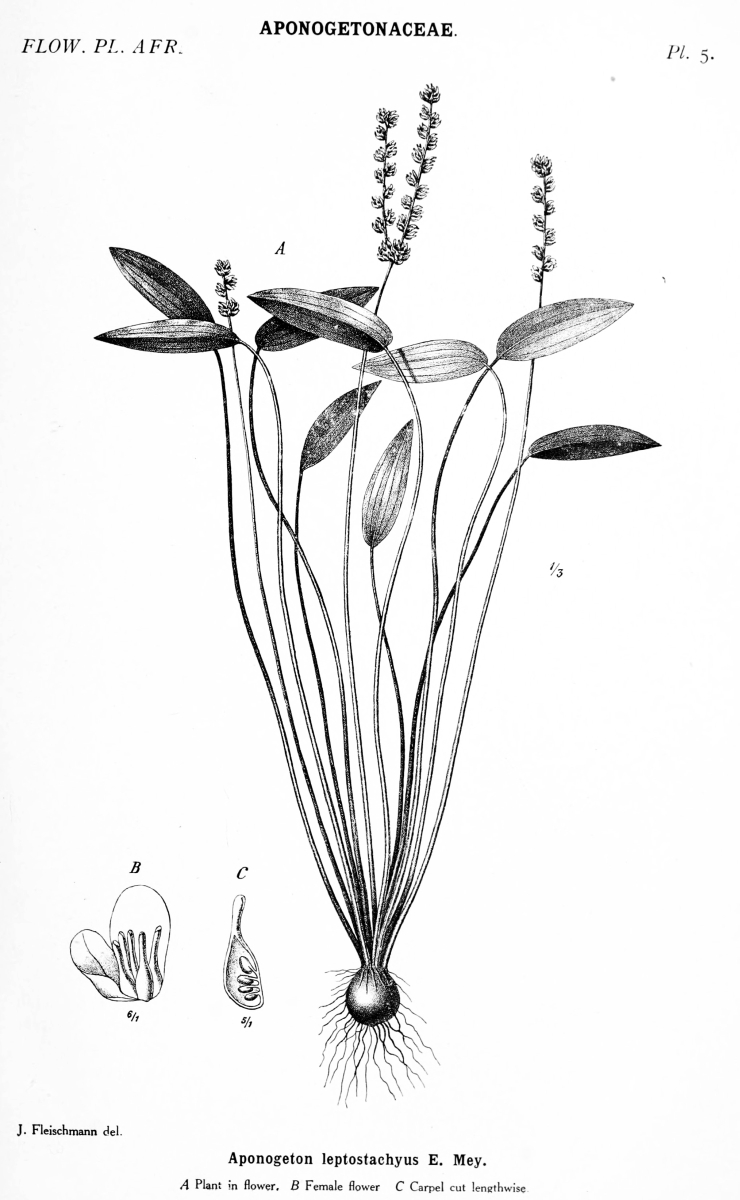
APONOGETONACEAE.
FLOW. PL. AFR. Pl. 5.
J. Fleischmann del.
Aponogeton leptostachyus E. Mey.
A Plant in flower. B Female flower. C Carpel cut lengthwise.
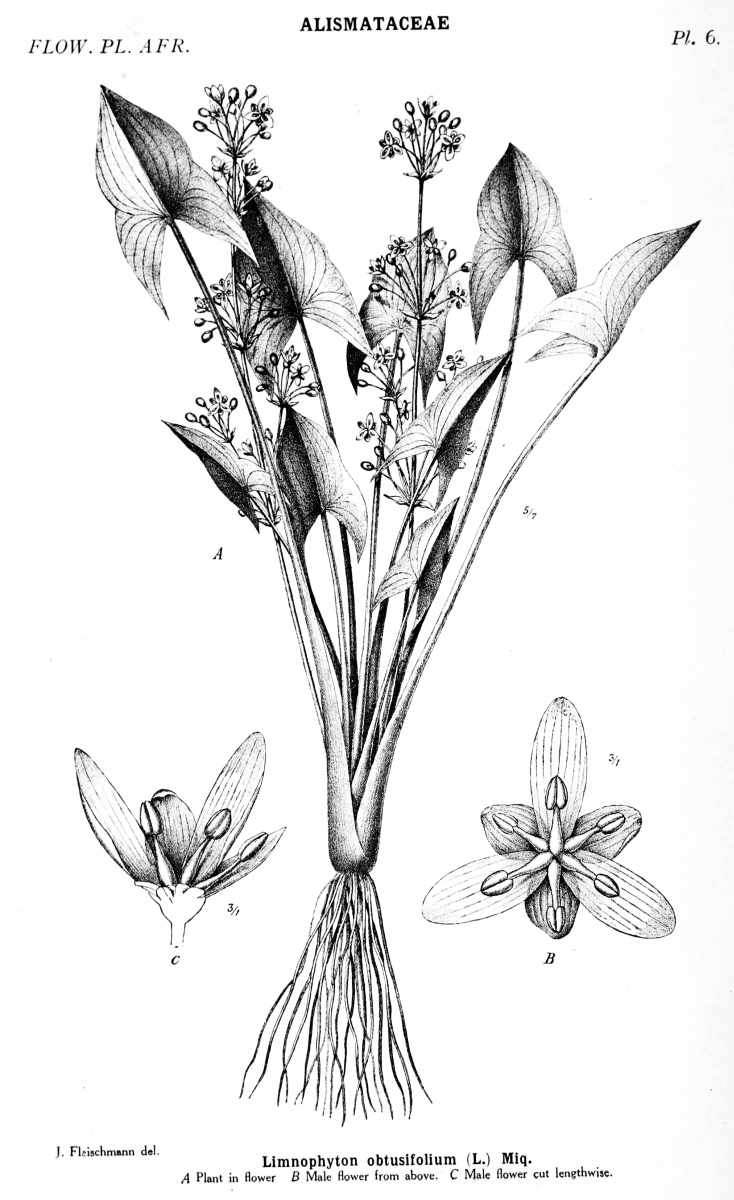
ALISMATACEAE
FLOW. PL. AFR. Pl. 6.
J. Fleischmann del.
Limnophyton obtusifolium (L.) Miq.
A Plant in flower. B Male flower from above. C Male flower cut lengthwise.
FAMILY 9. NAIADACEAE
Herbs growing in fresh or brackish water. Leaves linear, toothed or spiny. Flowers axillary, solitary or in glomerules, unisexual. Perianth little developed, in the male flowers simple or double, sack-like, in the female simple and sack-like or wanting. Stamen 1. Anthers 1-or 4-celled. Pollen-grains globular or ovoid. Ovary 1-celled. Ovule 1, erect, inverted. Style 1; stigmas 2-3. Seed with a hard coat, exalbuminous. Embryo straight, with a large radicle and a well developed plumule.
Genus 1, species 10. (Including Caulinia A. Braun) Naias L.
FAMILY 10. APONOGETONACEAE
Aquatic herbs with a tuberous root-stock. Leaves radical, narrow, with several longitudinal and many transverse nerves. Flowers in 1-4 spikes connected at the base, enclosed when young in a sheath, and rising above the water. Perianth of 1-3 more or less brightly coloured segments. Stamens 6 or more, hypogynous, free. Anthers attached by the base, opening with two longitudinal slits. Carpels 3-8, distinct. Ovules in each carpel 2-8, basal or sutural, ascending, inverted. Fruits membranous, dehiscent. Seeds 2 or more, erect, exalbuminous, with a straight embryo. (Under NAIADACEAE.) (Plate 5.)
Genus 1, species 20. Tropical and South Africa. Some are used as ornamental plants, especially the lattice-leaf (A. fenestralis Hook. fil.) with perforated leaves. The tubers are edible and contain starch. (Including Ouvirandra Thouars). Aponogeton Thunb.
FAMILY 11. SCHEUCHZERIACEAE
Marsh herbs. Leaves linear, with axillary scales. Flowers in terminal racemes or spikes, regular, hermaphrodite. Perianth of 6 segments, usually green. Stamens 3-6. Anthers turned outwards; pollen-grains ovoid. Ovary 3-6-celled. Ovule 1 in each cell, ascending, inverted. Stigmas sessile. Seeds exalbuminous, with a straight embryo. (JUNCAGINEAE, under NAIADACEAE.)
Genus 1, species 4. North, South, and West Africa. The leaves and fruits of some species are edible. (Juncago Tourn.) Triglochin L.
SUBORDER ALISMATINEAE
FAMILY 12. ALISMATACEAE
Aquatic or marsh herbs, with milky juice. Leaves with axillary scales. Flowers regular. Perianth of 3 sepals and 3 petals, rarely in the female flowers of 3 sepals only. Stamens 6 or more, rarely 3. Anthers opening outwards. Pollen-grains globular. Carpels 6 or more, rarely 3, distinct or united at the base. Ovules solitary in each carpel, rarely two or more, inverted. Seeds without albumen; embryo curved.—Genera 9, species 15. Tropical and North Africa. (Plate 6.)
1. Carpels on a large and distinctly convex receptacle. Inner perianth-segments petal-like, larger than, or almost as large as the outer. Stamens 6 or more. [Tribe SAGITTARIEAE.] 2 Carpels on a small and almost flat receptacle. 4 2. Flowers hermaphrodite. Ripe carpels numerous, slightly compressed, with many ribs.—Species 3. Central and North-west Africa. (Under Alisma L.) Echinodorus Engelm. Flowers unisexual or polygamous. Ripe carpels much compressed laterally. 3 3. Flowers monoecious or polygamous. Petals a little longer than the sepals. Carpels many. Ripe carpels with two crest-like ribs.—Species 1. Tropics. (Lophiocarpus Miq., under Sagittaria L.) Lophotocarpus Th. Dur. Flowers dioecious. Petals shorter than the sepals, white. Carpels 7-9. Ripe carpels with 3 ribs.—Species 1. German South-west Africa. Rautanenia Buchenau 4. Petals much smaller than the sepals or wanting. Stamens 3 or 9. [Tribe WIESNEREAE.] 5 Petals larger than the sepals, coloured. Stamens 6, rarely 9. [Tribe ALISMEAE.] 6 5. Flowers dioecious. Petals in the female flowers wanting. Stamens 9. Carpels about 12.—Species 1. East Africa. Burnatia Mich. Flowers monoecious. Petals present, but very small and falling off early. Stamens 3. Carpels 3-6.—Species 2. East Africa and Madagascar. (Wisneria Mich.) Wiesnera Mich. 6. Carpels 6-8, united at the base and spreading horizontally, containing 2 or more ovules each and opening by a lid when ripe.—Species 2. North Africa. The root-stock is edible. Damasonium Tourn. Carpels 6-20, distinct, with a single ovule in each, indehiscent. 7 7. Flowers polygamous-monoecious. Carpels 15-20. Pericarp bony within, hollow on either side. Leaves sagittate.—Species 3. Tropics. (Plate 6.) Limnophyton Miq. Flowers hermaphrodite. Leaves ovate, cordate, or lanceolate. 8 8. Carpels 6-12, irregularly whorled, slightly compressed and 3-5-ribbed when ripe; pericarp woody within.—Species 2. Tropics and Egypt. (Under Alisma L.) Caldesia Parl. Carpels 15-20, distinctly whorled, much compressed and 2-ribbed when ripe; pericarp leathery or parchment-like.—Species 1. North and East Africa. The root-stock contains starch and is used in medicine. “Water-plantain.” Alisma L.
SUBORDER BUTOMINEAE
FAMILY 13. BUTOMACEAE
Aquatic or marsh herbs. Leaves linear or lanceolate. Flowers in umbel-like cymes, regular, hermaphrodite. Perianth of 6 segments, all, or the inner ones only, petal-like. Stamens 9, very rarely fewer. Pollen-grains globular. Carpels 6, very rarely fewer, distinct or united at the base only, opening when ripe along the ventral suture. Ovules on irregularly branched parietal placentas, numerous, inverted. Seeds without albumen.—Genera 2, species 2. North and Central Africa. (Under ALISMACEAE.)
Perianth-segments nearly equal, all petal-like, pink, persistent. Embryo straight. Leaves linear. Juice not milky.—Species 1. North-west Africa (Algeria). Used as a garden plant. The root-stock is edible. “Flowering-rush.” Butomus Tourn. Perianth-segments unequal, outer sepal-like, inner petal-like, white, falling off very early. Embryo horseshoe-shaped. Leaves elliptical. Juice milky.—Species 1. Northern part of Central Africa. (Butomopsis Kunth) Tenagocharis Hochst.
FAMILY 14. HYDROCHARITACEAE
Aquatic herbs. Leaves with axillary scales. Flowers enclosed when young in a one-or several-flowered spathe of one or two bracts, regular, rarely somewhat irregular. Perianth consisting of a calyx and a corolla, rarely simple. Stamens 2-12. Anthers opening outwards or laterally. Ovary inferior, more or less distinctly one-celled, with 2-15 parietal placentas, which sometimes form incomplete dissepiments. Seeds without albumen.—Genera 10, species 40. (Plate 7.)
1. Stigmas 2-5. Placentas as many, slightly raised. 2 Stigmas 6 or more. Placentas as many, much projecting and generally meeting in the centre of the ovary. 6 2. Petals none. Stamens 3. Pollen-grains filiform. Stigmas several times as long as the sepals. Embryo with a strongly developed radicle. Totally submerged marine plants. Leaves more or less distinctly stalked.—Species 2. Indian Ocean. [Subfamily HALOPHILOIDEAE.] Halophila Thouars Petals present, but sometimes very small and falling off very early. Pollen-grains globular. Stigmas at most twice as long as the sepals. Embryo with a not very strongly developed radicle. Freshwater plants; flowers raised above the water. Leaves sessile. [Subfamily VALLISNERIOIDEAE.] 3 3. Leaves whorled. Spathes 1-flowered. Flowers unisexual. Stamens 3.—Species 1. Upper Nile, Madagascar, Mauritius. Used in refining sugar. [Tribe HYDRILLEAE.] Hydrilla L. C. Rich. Leaves spirally arranged. Spathes of the male flowers several-flowered. 4 4. Spathes of the male flowers 2-10-flowered, not breaking away from the stem. Stamens 3-9. Ovules inverted.—Species 3. Madagascar and Angola. [Tribe BLYXEAE.] Blyxa Noronha Spathes of the male flowers many-flowered, breaking away from the stem. Stamens 2-3. Ovules straight. [Tribe VALLISNERIEAE.] 5 5. Male flowers regular, with 3 fertile and 2-4 sterile stamens. Stigmas linear, 2-cleft or 2-parted. Leaves one-nerved. Stem elongated.—Species 10. Tropical and South Africa. Lagarosiphon Harv. Male flowers somewhat irregular, with 2-3 fertile stamens and sometimes a sterile one. Stigmas ovate, notched or two-toothed. Leaves several-nerved.—Species 2. North and Central Africa. Used in refining sugar. Vallisneria Mich. 6. Leaves in two rows. Ovules inverted, inserted in the angles formed by the placentas and the wall of the ovary. Radicle of the embryo strongly developed. Marine plants. [Subfamily THALASSIOIDEAE.] 7 Leaves in rosettes. Ovules inverted, but inserted on the whole surface of the placentas, or straight. Radicle of the embryo not strongly developed. Freshwater plants. [Subfamily STRATIOTOIDEAE.] 8 7. Scape of the male flowers short, of the female long and at length spirally twisted. Male spathes several-flowered; flowers with 3 petals and 3 stamens.—Species 1. Madagascar and Red Sea. Yields fibres and edible seeds. Enalus L. C. Rich. Scapes moderately long, not spirally twisted. Male spathes one-flowered; flowers without petals, with 6 stamens.—Species 1. East Africa. Thalassia Soland. 8. Placentas undivided. Ovules straight. Fertile stamens 9. Stem emitting runners. Leaves floating.—Species 1. Algeria and Madagascar. “Frogbit.” [Tribe HYDROCHARITEAE.] Hydrocharis L. Placentas two-cleft. Ovules inverted. Seeds very numerous. Fertile stamens 6-12. Stem very short, without runners. Leaves at least partially submerged. [Tribe OTTELIEAE.] 9 9. Flowers hermaphrodite. Spathes one-flowered. Stigmas 6.—Species 9. Tropics and Egypt. Some are used as vegetables. (Plate 7.) Ottelia Pers. Flowers dioecious. Spathes of the male flowers several-flowered. Stigmas 9-15.—Species 10. Tropics. Some are used as vegetables. Boottia Wall.
ORDER TRIURIDALES
FAMILY 15. TRIURIDACEAE
Small, pale, yellowish or reddish herbs. Leaves reduced to scales. Flowers in racemes, regular, monoecious. Perianth of 6 petaloid, valvate segments united at the base. Stamens 3; filaments short or wanting; anthers 2-celled, opening transversely. Carpels inserted on a convex or conical receptacle,
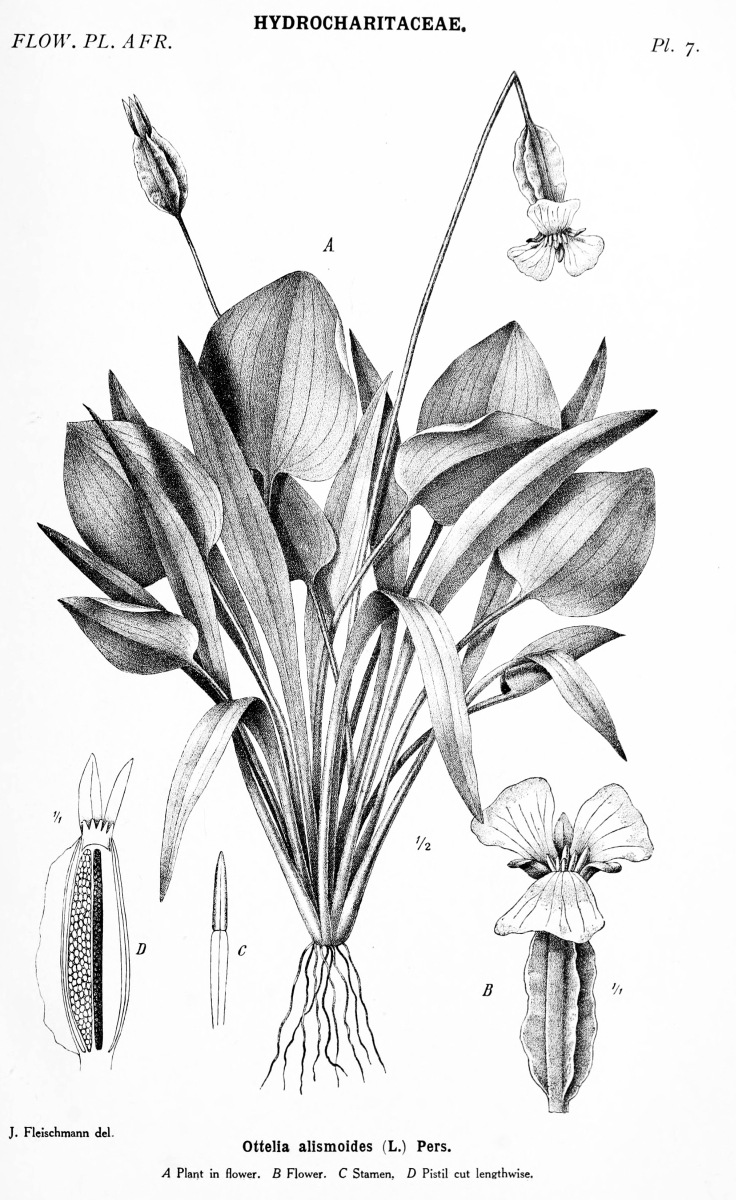
HYDROCHARITACEAE.
FLOW. PL. AFR. Pl. 7.
J. Fleischmann del.
Ottelia alismoides (L.) Pers.
A Plant in flower. B Flower. C Stamen. D Pistil cut lengthwise.
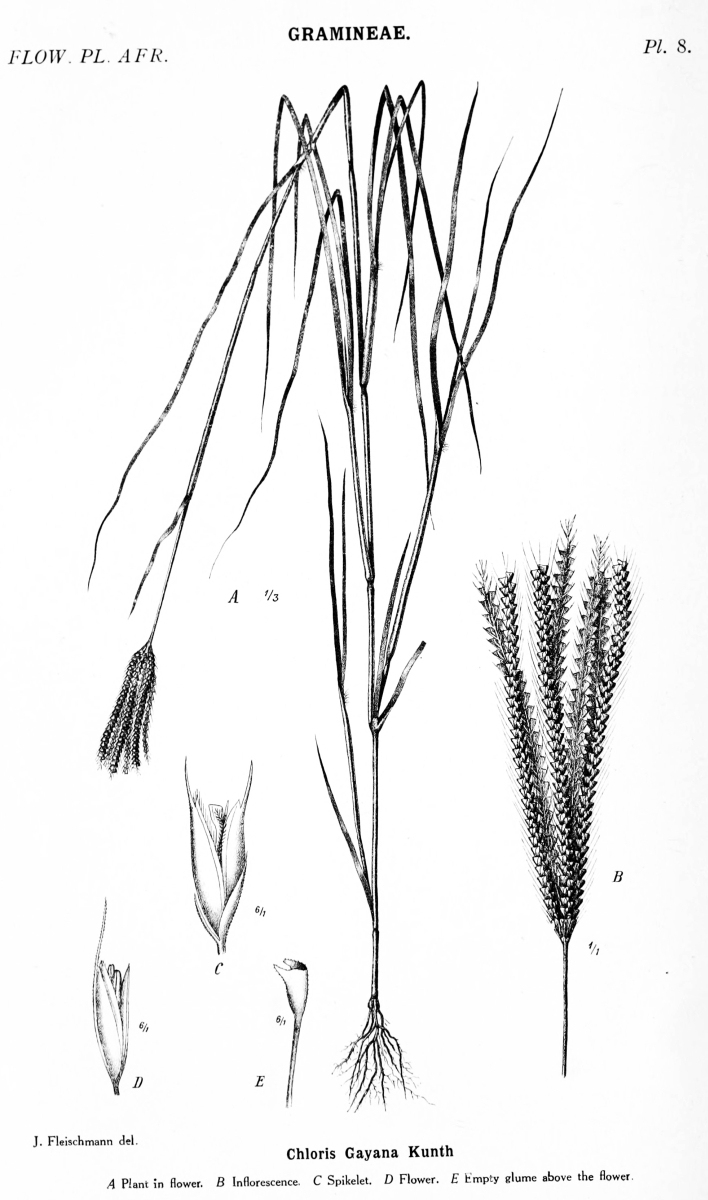
GRAMINEAE.
FLOW. PL. AFR. Pl. 8.
J. Fleischmann del.
Chloris Gayana Kunth
A Plant in flower. B Inflorescence. C Spikelet. D Flower. E Empty glume above the flower.
numerous, distinct; styles lateral; ovules solitary, erect, inverted. Fruits dehiscing by a longitudinal slit.
Genus 1, species 3. West Africa and Seychelles. (Including Seychellaria Hemsl.) Sciaphila Blume
ORDER GLUMIFLORAE
FAMILY 16. GRAMINEAE
Stem usually herbaceous and hollow between the nodes. Leaves alternate, usually linear and furnished at their base with a sheath split open on one side and ending in a ligule. Inflorescence consisting of spikelets, rarely of single flowers, usually enclosed by 2 glumes (outer or empty glumes) and arranged in spikes, racemes, or panicles. Flowers in the axil of the flowering glume (or valve), subtended by the usually 2-keeled palea and sometimes by one or two, rarely more, minute lodicules. Perianth none. Stamens 1-6, usually 3. Anthers opening by 2 slits or pores. Ovary 1-celled. Ovule 1, erect or laterally affixed, slightly curved, with the micropyle turned downwards. Styles 2, rarely 3 or 1. Fruit indehiscent; pericarp usually dry and adnate to the seed. Embryo outside the copious albumen.—Genera 205, species 1600. “Grasses.” (Plate 8.)
1. Spikelets 1-flowered, rarely 2-flowered, the upper flower fertile, the lower male or barren and inserted immediately below the fertile one. Axis of the spikelet not produced beyond the fertile flower, jointed below the outer glumes or not jointed; ripe spikelets falling entire from their stalk or from the rachis of the spike, sometimes together with a part of it. [Subfamily PANICOIDEAE.] 2 Spikelets either 1-flowered with the axis produced beyond the flower or jointed above the outer glumes, which therefore persist when the spikelet falls off, or 2-flowered with both flowers fertile or with a distinct interval between the flowers or with a continuation of the axis beyond the flowers, or 3- to many-flowered. 65 2. Spikelets distinctly compressed from the side. Stamens usually 6. Seed with a linear hilum. [Tribe ORYZEAE.] 3 Spikelets compressed from front to back or not distinctly compressed. Stamens usually 1-3. Seed usually with a punctiform hilum. 7 3. Spikelets in terminal clusters of two or three, connate, at length hardened. Stamens 3. Style undivided, papillose.—Species 1. North Africa. One source of the Esparto-grass, which is used for plaiting and paper-making. Lygeum L. Spikelets in panicles. Stamens nearly always 6. Style 3-cleft or 3-parted, with feathery stigmas. 4 4. Spikelets unisexual; 1-2 sessile female and a stalked male on each branch of the panicle. Flowering glume globose. Stamens 6. Style 1, long, 3-cleft. Leaves broad-lanceolate, stalked.—Species 1. Equatorial West Africa. Leptaspis R. Br. Spikelets bisexual or polygamous. Styles 3, short, free or united at the very base. Leaves linear or narrow lanceolate. 5 5. Outer glumes rudimentary. Flowering glume awnless.—Species 4. (Homalocenchrus Mieg.) Leersia Swartz Outer glumes distinctly developed. Stamens 6. 6 6. Flowering glume and palea slightly compressed, awnless. Leaves linear-lanceolate, more or less distinctly stalked.—Species 4. Madagascar and Natal. (Under Potamophila R. Br.) Maltebrunia Kunth Flowering glume and palea strongly compressed.—Species 3, two wild in Central Africa, the third (O. sativa L., rice) cultivated in various regions. The seeds are used for food and for the preparation of meal, starch, oil, and brandy, the straw for plaiting and for the manufacture of paper and brush-ware. Oryza L. 7. (2.) Flowering glume and palea (if present) stiff or at length hardened, firmer than the outer glumes and awnless, at least in the hermaphrodite flowers. Lowest glume usually smaller than the others. Rachis of the spike or raceme or branches of the panicle rarely jointed. [Tribe PANICEAE.] 8 Flowering glume and palea (if present) membranous, thinner than the outer glumes. 26 8. Flowers unisexual, monoecious. Spikelets in panicles, the male in the lower portion of the panicle or in special panicles. Outer glumes in the male spikelets none, in the female 2. Lodicules 3. Leaves net-veined.—Species 2. Tropical and South-East Africa. Olyra L. Flowers hermaphrodite or polygamous; in the latter case spikelets arranged in spikes. 9 9. Spikelets partly hermaphrodite, partly male or neuter. 10 Spikelets all hermaphrodite. 11 10. Spikelets in short spikes consisting of a lower hermaphrodite and two or three upper neuter spikelets; spikes unilateral on the flattened, leaf-like rachis of a compound spike. Stem erect. Leaves lanceolate, sagittate.—Species 1. Southern West Africa (Angola). Phyllorhachis Trimen. Spikelets in a simple spike consisting of 1-2 lower female and 4-6 upper male spikelets; rachis of the spike enlarged at the base, but not leaf-like. Stem creeping.—Species 1. Madagascar. Thuarea Pers. 11. Spikelets in short spikes sunk in pits on a broad rachis. Stem creeping.—Species 4. Tropical and South Africa. Used for binding the sand on riverbanks or as fodder; also in medicine. Stenotaphrum Trin. Spikelets not sunk in pits on a broad rachis. 12 12. Spikelets surrounded or subtended singly or 2-3 together by an involucre formed of one or several bristles or spines or of 2 toothed glumes inserted below the two empty glumes. 13 Spikelets without an involucre formed of bristles, spines, or toothed glumes. Empty glumes 1-3. Stigmas 2, feathery. 16 13. Involucre formed by two toothed glumes. Stigma 1, papillose. Aquatic herbs.—Species 1. Abyssinia. Odontelytrum Hack. Involucre formed by one or several bristles or spines. Stigmas 2, feathery. 14 14. Axis of the spikelet jointed above the persistent involucre. Bristles of the involucre stiff and rough. Styles free from the base. Spikelets in spike-like panicles.—Species 30. Some of them (especially S. italica Beauv.) are cultivated as cereals. Setaria Beauv. Axis of the spikelet jointed below the involucre or not jointed; involucre falling together with the spikelet; rarely axis jointed above the persistent involucre, but then styles united at the base. 15 15. Bristles of the involucre numerous, stiff, thickened and often united at the base. Spikelets in spikes or racemes.—Species 10. Tropics and Egypt. Some have edible seeds; several are fodder-grasses. Cenchrus L. Bristles of the involucre fine, not thickened at the base.—Species 65. Some (especially the duchn, P. typhoideum Rich.) are cultivated as cereals, as fodder, or as ornamental plants. (Including Gymnothrix Beauv. and Penicillaria Willd.) Pennisetum Pers. 16. Spikelets with 2 outer glumes and 1 flower, or with 1 outer glume and 2 flowers. 17 Spikelets with 3 outer glumes and 1 flower, or with 2 outer glumes and 2 flowers. 21 17. Spikelets containing an hermaphrodite and a male flower, arranged in panicles. Glumes awnless. Styles free.—Species 1. South-west Africa (Nama-land). Anthaenantia Beauv. Spikelets 1-flowered, arranged in one-sided, usually digitate or panicled spikes. 18 18. Rachis of the spike prolonged beyond the spikelets. Style 1, with 2 stigmas.—Species 3. North-west and South Africa. Spartina Schreb. Rachis of the spike not prolonged beyond the spikelets. Styles 2, free or shortly united. 19 19. Styles united at the base. Flowering glume papery. Upper outer glume awned. Spikelets in digitate racemes.—Species 1. East Africa. (Stereochlaena Hack.) Chloridion Stapf. Styles free. Flowering glume cartilaginous. 20 20. Lower outer glume decurrent into a callous swelling. Flowering glume mucronate.—Species 6. Central Africa. Eriochloa Kunth Lower outer glume without a callus at the base.—Species 15. Tropical and South Africa. Used as fodder-, medicinal, or ornamental plants. The seeds of several species (especially those of the fundi P. exile Kippist) are sometime used as food. Paspalum L. 21. Spikelets containing two hermaphrodite flowers. Axis of the spikelet jointed above the persistent outer glumes. Outer glumes awnless. Spikelets arranged in panicles.—Species 6. Tropics. Isachne R. Br. Spikelets containing a single hermaphrodite flower and sometimes also a male flower. Axis of the spikelet jointed below the outer glumes; spikelet falling as a whole. 22 22. First (lowest) outer glume awned, as well as the second. Spikelets one-flowered, directed to one side and disposed in panicles.—Species 4. Tropical and South Africa. Some are used as fodder. Oplismenus Beauv. First outer glume awnless. 23 23. Second outer glume apparently removed from the first by a conical or cylindrical, strongly-haired swelling at the base, usually awned or mucronate. Spikelets in panicles. 25 Second outer glume without a basal swelling. 24 24. First outer glume as large as or larger than the second, papery.—Species 1. South-west Africa to Angola. (Under Panicum L.). Leucophrys Rendle First outer glume much smaller than the second.—Species 20. Some are used as ornamental or fodder-plants. (Including Monachyron Parl. and Rhynchelytrum Nees, under Panicum L.) Tricholaena Schrad. 25. Second outer glume bearing, like the third, a long, twisted awn.—Species 1. German East Africa. Acritochaete Pilger Second outer glume unawned.—Species 220. Some (especially P. miliaceum L., millet, and P. sanguinale L.) are cultivated as cereals, others furnish vegetables, syrup, or fodder, or are used for plaiting-work or as ornamental plants. (Including Axonopus Beauv., Digitaria Pers., Echinolaena Desv., Sacciolepis Nash, and Syntherisma Walt.) Panicum L. 26. (7.) Outer glumes 3, the lowest smaller than the others, the uppermost sometimes including a male flower. Rachis and branches of the inflorescence not jointed. [Tribe TRISTEGINEAE.] 27 Outer glumes 1-3; if 3, then the lowest larger than the uppermost. 30 27. Spikelets arranged in spikes. First and second outer glume minute, the third awned.—Species 3. Abyssinia. Beckera Fresen. Spikelets arranged in panicles. Second outer glume not very small. Flowering glume awnless. 28 28. Lowest outer glume minute, like the second awnless, the third more or less distinctly awned. Spikelets arranged singly along the branches of the panicle.—Species 1. Tropical and South-east Africa. Used as a fodder-grass. Melinis Beauv. Lowest outer glume not very small; the third awnless, rarely both the second and third awned. 29 29. Outer glumes, at least the second, awned. Spikelets arranged singly along the branches of the panicle. (See 24.) Tricholaena Schrad. Outer glumes awnless, the first and second about half the length of the third and the flowering glume. Spikelets in clusters along the branches of the panicle.—Species 2. West Africa and Mascarene Islands. Used as ornamental plants. Thysanolaena Nees 30. (26.) Flowers unisexual. Male and female spikelets in different inflorescences, or male spikelets in the upper, female in the lower portion of the inflorescence. [Tribe MAYDEAE.] 31 Flowers hermaphrodite or polygamous, rarely (Andropogon) unisexual, but then male and female spikelets in the same inflorescence and arranged in pairs, the male spikelets sometimes rudimentary. 33 31. Male spikelets in a terminal spike, the female at its base, enclosed singly or 2-3 together by a hardened globose bract. Style not very long, 2-cleft.—Species 1 (C. Lacryma Jobi L., Job’s tears). North-west Africa, Madagascar and neighbouring islands. Used medicinally and for making ornamental articles and rosaries. Coix L. Male spikelets in spikes arranged in a terminal panicle, female in spikes or spadices with membranous bracts or spathes. Style very long, undivided or shortly 2-cleft. 32 32. Female spikelets in fascicled spikes with a jointed rachis. Style 2-cleft. Fruit enclosed when ripe in a cartilagineous case.—Species 1 (E. mexicana Schrad., Teosinte), cultivated as an ornamental or fodder-plant. Euchlaena Schrad. Female spikelets connate into a spadix with a thick, not jointed rachis. Fruit projecting beyond the membranous glumes, rarely enclosed by leathery glumes.—Species 1 (Z. Mays L., maize or Indian corn). Cultivated for the grain or as a fodder- or ornamental plant. The seeds are also used for the preparation of starch, oil, and spirituous drinks. The leaves and spathes yield fibre. Zea L. 33. Spikelets in heads surrounded by 2 or 3 involucral bracts, containing a single hermaphrodite flower. Outer glumes 2, membranous, awnless, the lower one short. Flowering glume larger than the outer glumes, awnless. Stamens 2.—Species 1. North Africa and Senegambia. Crypsis Ait. Spikelets in spikes, racemes, or panicles. 34 34. Spikelets arranged singly or in clusters of 3-6, very rarely in pairs, along the continuous rachis of a spike or raceme. Outer glumes 2. [Tribe ZOYSIEAE.] 35 Spikelets arranged in pairs, one sessile, the other stalked, more rarely singly or in clusters of 3 or more, along the more or less distinctly jointed rachis of a spike or raceme or along the branches of a sometimes very narrow (spike-like) panicle. Outer glumes usually 3. [Tribe ANDROPOGONEAE.] 42 35. Spikelets in clusters of 3-6, falling as a whole. 36 Spikelets solitary along the rachis, rarely in pairs. 38 36. Clusters of spikelets enclosed by a hard, urn-shaped involucre formed by the lowest outer glumes. Rachis of the spike wavy.—Species 5. Central and South Africa. Anthephora Schreb. Clusters of spikelets without an involucre. 37 37. Clusters containing 2-4 fertile spikelets and a barren one. Outer glumes 1-2, the upper one with hooked spines on the nerves. Rachis of the spike glabrous.—Species 4. (Nazia Adans.) Tragus Hall. Clusters containing 1-2 fertile and 2-3 barren, often awn-like spikelets. Outer glume 1, with rough nerves, awned.—Species 1. Southern West Africa (Hereroland). Monelytrum Hack. 38. Styles united at the base; stigmas short, feathery. Outer glumes 2, glabrous, with a long awn or awnless. Flowering glume smaller. Spikelets diverging from the rachis.—Species 4. Tropical and South Africa. Used as fodder-grasses. Perotis Ait. Styles free or the stigmas elongated and short-haired all round. 39 39. Outer glume 1, compressed, keeled, awnless. Styles free. Spikelets pressed close to the rachis. Leaves stiff.—Species 1. Mascarene Islands. (Osterdomia Neck.) Zoysia Willd. Outer glumes 2. 40 40. Outer glumes subulate, with a long awn, short-haired. Flowering glume somewhat shorter, with a rather long awn. Palea slightly shorter than the flowering glume, acuminate. Styles free. Fruit with a large hilum. Spikelets in pairs.—Species 1. Northern East Africa. Tetrachaete Chiovenda Outer glumes and flowering glume with a short awn or awnless. 41 41. Outer glumes convex, with hooked spines on the back, awnless. Flowering glume much shorter, unarmed or mucronate. Styles free; stigmas feathery. Spikelets with a flattened stalk.—Species 1. Northern part of Central Africa. Latipes Kunth Outer glumes compressed and keeled, not bearing hooked spines. Flowering glume broad, 3-nerved, mucronate or shortly awned. Stigmas long, short-haired all round.—Species 5. North Africa. Used as ornamental or fodder-plants. “Foxtail grass.” (Including Colobachne Beauv.) Alopecurus L. 42. (34.) Joints of the rachis much thickened, forming, together with the appressed or adnate pedicels of the stalked spikelets, hollows in which the sessile spikelets are sunk. Flowering glumes awnless. Lowest outer glume leathery or hardened. Sessile spikelets hermaphrodite, stalked ones male or neuter, rarely (Ophiurus) reduced to the adnate pedicel and therefore apparently absent. [Subtribe ROTTBOELLIINAE.] 43 Joints of the rachis not much thickened, nor forming hollows for the reception of the spikelets, rarely slightly concave, but then flowering glumes of the sessile spikelets awned or (Elionurus) the lowest outer glume membranous or papery and marked with two transparent balsamiferous streaks. 48 43. Lower outer glume awned or tailed, at least in the stalked spikelets. 44 Lower outer glume neither awned nor tailed, rarely tailed in the terminal spikelet only. 46 44. Lower outer glume with a long tail (or soft awn). Racemes digitate. Aquatic herbs.—Species 1. Central Africa. Forming the chief element of the grass-barriers (sudd) of the upper Nile. Vossia Wall. & Griff. Lower outer glume with 1-2 short awns, or in the stalked spikelets with a long awn, in the sessile awnless. Racemes solitary or arranged in racemes. 45 45. Lower outer glume with 1-2 short awns. Joints of the rachis horizontally truncate without an appendage.—Species 7. Central Africa. Used for plaiting-work. (Rhytidachne Hack., including Jardinea Steud.) Rhytachne Desv. Lower outer glume in the sessile spikelets awnless, in the stalked ones with a long awn or tail. Joints of the rachis obliquely truncate with an appendage at the tip.—Species 5. Central and South Africa. Urelytrum Hack. 46. Lower outer glume globular, pitted. Leaves cordate at the base.—Species 1. Tropics. Used in medicine. (Including Hackelochloa O. Ktze.) Manisuris Swartz Lower outer glume more or less ovate, flat or rounded on the back. 47 47. Stalked spikelets reduced to the adnate pedicel and therefore apparently absent.—Species 1. Northern East Africa. (Under Rottboellia L. fil.) Ophiurus Gaertn. Stalked spikelets containing a male flower or reduced to empty glumes.—Species 15. (Including Hemarthria R. Br.) Rottboellia L. fil. 48. (42.) Sessile spikelets 2-flowered, the lower flower male, the upper male or hermaphrodite. Stalked spikelets 1-2-flowered or reduced to empty glumes. 49 Sessile spikelets 1-flowered, rarely all spikelets stalked and 1- or (Imperata) 2-flowered. 52 49. Sessile spikelets containing 2 male flowers, stalked spikelets a male and a female or hermaphrodite flower. Outer glumes of the sessile spikelets awned. Flowering glumes awnless. Spikelets in compound racemes. Leaves lanceolate.—Species 1. Madagascar. Cyphochlaena Hack. Sessile spikelets containing a male and an hermaphrodite flower. Flowering glumes of the sessile spikelets nearly always awned. [Subtribe ISCHAEMINAE.] 50 50. Racemes reduced to the 3 terminal spikelets, surrounded by sheathing bracts, fasciculate; fascicles arranged in panicles. Stamens 2-3.—Species 1. Islands of Réunion and Socotra. Used as an ornamental plant. Apluda L. Racemes consisting of numerous pairs of spikelets, solitary or digitate; one spikelet of each pair sometimes reduced to the pedicel. Stamens 3. 51 51. Stalked spikelets reduced to the pedicel. Lower outer glume tuberculate.—Species 1. Abyssinia. Thelepogon Roth Stalked spikelets 1-2-flowered or reduced to empty glumes.—Species 7. Tropical and South Africa. Some are used as fodder- or garden plants. Ischaemum L. 52. Spikelets all alike, hermaphrodite. [Subtribe SACCHARINAE.] 53 Spikelets of two kinds, the sessile hermaphrodite, rarely female, the stalked ones male or neuter, sometimes reduced to the pedicel. [Subtribe ANDROPOGONINAE.] 60 53. Rachis of the raceme jointed. 54 Rachis of the raceme not jointed. 57 54. Racemes more or less palmately arranged on a short main axis, rarely solitary. 55 Racemes arranged in panicles along a slender main axis, silky. Spikelets in pairs. 56 55. Spikelets solitary on the branches of the inflorescence, all sessile. Flowering glumes awned from the back. Leaves cordate-lanceolate.—Species 5. Tropics. Arthraxon Beauv. Spikelets in pairs on the branches of the inflorescence, one sessile, the other stalked. Flowering glumes awned from the tip, rarely awnless. Leaves linear or lanceolate with a narrow base.—Species 5. South and East Africa, Madagascar and the neighbouring islands. (Including Eulalia Kunth) Pollinia Trin. 56. Flowering glume produced into a bristle or awn.—Species 5. South Africa, southern Central Africa, and Algeria. Some are used as ornamental plants or for plaiting mats. Erianthus Michx. Flowering glume unarmed like the other glumes.—Species 5. One of them (S. officinarum L., sugar-cane) known only in a cultivated state. It is used for the manufacture of sugar, syrup, rum, and wax, also as a vegetable and a fodder-plant. Saccharum L. 57. Spikelets in pairs along the rachis of the raceme, awnless. Outer glumes 3, membranous, silky. Stamens 1-2.—Species 1 (I. cylindrica P. Beauv.) Sometimes a noxious weed in plantations, but also used for paper-making, and as a fodder-, medicinal or ornamental plant. Imperata Cyr. Spikelets scattered along the rachis of the raceme, awned. 58 58. Outer glumes 3, the two lower stiff. Flowering glume very small, ending in a long awn. Panicle spreading, hairy.—Species 2. Central Africa. Cleistachne Benth. Outer glumes 2. Flowering glume rather large, with a usually short awn in a terminal notch or on the back. Panicle spike-like. 59 59. Stigmas projecting at the tip of the spikelet, short-haired all round. Outer glumes awnless, rarely with a short awn. (See 41.) Alopecurus L. Stigmas projecting near the base of the spikelet, feathery. Outer glumes with usually long awns.—Species 6. North Africa, Abyssinia, and South Africa. Some are used as ornamental plants. “Beardgrass.” Polypogon Desf. 60. (52.) Racemes bearing at their base a false whorl of 4 male or neuter spikelets and subtended by a spathe-like bract, more rarely without a bract. 61 Racemes without a whorl of male or neuter spikelets at their base, rarely surrounded by an imperfect whorl of spikelets, but then racemes in pairs subtended by a common spathe. 62 61. Hermaphrodite spikelets produced at the base into an appendage decurrent along the rachis, easily separating from the whorl of spikelets below them.—Species 2. (Anthistiria L. fil.). Themeda Forsk. Hermaphrodite spikelets without a decurrent appendage at the base, falling together with the whorl of spikelets below them.—Species 1. Naturalized in the Island of Mauritius. (Under Anthistiria L. fil.) Iseilema Anders. 62. Spikelets all stalked, in pairs, the longer-stalked hermaphrodite, the shorter-stalked male. Rachis of the raceme indistinctly jointed. Racemes terminal, solitary or 2-3 together.—Species 1. Tropical and South Africa. Trachypogon Nees Spikelets partly sessile, partly stalked. Rachis of the raceme distinctly jointed, fragile at maturity, rarely indistinctly or not jointed, but then spikelets in clusters of three, arranged in panicles. 63 63. Lowest outer glume marked with two transparent balsamiferous streaks, usually 2-toothed. Glumes awnless. Racemes solitary; rachis nearly always silky.—Species 10. Tropical and South Africa. Elionurus Humb. & Bonpl. Lowest outer glume without balsamiferous streaks. Flowering glumes of the sessile spikelets awned, very rarely awnless and then racemes nearly always panicled. 64 64. Flowering glumes awned from the back. Leaves cordate at the base. (See 55.) Arthraxon Beauv. Flowering glumes awned from the tip or awnless. Leaves not cordate.—Species 110. The sorghum or Guinea corn (A. Sorghum Brot.) is cultivated as a cereal and used for manufacturing sugar, spirituous drinks, dyes, and brushware. Other species are used in perfumery (lemon-grass, vetiver-root) and medicine, for plaiting-work, or as fodder- or garden-plants. (Including Anatherum Beauv., Chrysopogon Trin., Cymbopogon Spreng., Euclaste Franch., Heterochloa Desv., Heteropogon Pers., Homopogon Stapf, and Sorghum Pers.) Andropogon L. 65. (1.) Leaf-blade jointed with the sheath and finally separating from it, often contracted at the base into a short stalk, usually transversely veined. Stem generally woody. [Subfamily BAMBUSOIDEAE.] 66 Leaf-blade passing into the sheath without a joint and without a stalk, rarely transversely veined. Stem herbaceous. [Subfamily POOIDEAE.] 79 66. Stamens 3. Styles 2-3, free. Outer glumes 1-2. Pericarp dry and thin. [Tribe ARUNDINARIEAE.] 67 Stamens 6. 68 67. Spikelets 2-flowered. Upper flowering glume keeled. Herbs.—Species 1. Equatorial West Africa. Microcalamus Franch. Spikelets many-flowered. Flowering glumes not keeled. Undershrubs or shrubs.—Species 2. East and South Africa. They yield wood, fibre, vegetables, edible seeds, and medicaments. Arundinaria Michx. 68. Fruit a nut or a berry; pericarp thick, free from the seed. Tall shrubs or trees. 69 Fruit a caryopsis; pericarp thin, adnate to the seed. [Tribe BAMBUSEAE.] 72 69. Palea rounded on the back, similar to the flowering glume. Spikelets 1-flowered. [Tribe MELOCANNEAE.] 70 Palea 2-keeled. Fruit a nut. [Tribe DENDROCALAMEAE.] 71 70. Spikelets in one-sided spikes, the axis not continued beyond the flower. Outer glumes acuminate. Fruit a large apple-like berry. Trees.—Species 1. Naturalized in the Island of Mauritius. The fruits are edible; also the wood and the fibres are used. Melocanna Trin. Spikelets in panicled clusters, the axis continued beyond the flower in the form of a bristle. Outer glumes rolled inwards. Fruit a small wrinkled nut. Shrubs.—Species 1. Madagascar. Used medicinally. Schizostachyum Nees 71. Spikelets 1-flowered, in scattered heads. Lodicules 2-3, large. Fruit oblong.—Species 1. Madagascar. Cephalostachyum Munro Spikelets 2- or more-flowered, in panicled glomerules. Lodicules 1-2, very small, or absent. Fruit subglobular, beaked.—Species 1. Naturalized in the Island of Mauritius. Yields wood, fibre, vegetables, edible seeds, and medicaments, and is also used as an ornamental plant. Dendrocalamus Nees 72. Filaments united into a tube. Palea of the uppermost (hermaphrodite) flower of each spikelet usually 1-keeled. 73 Filaments free. Palea of the uppermost flower 2-keeled, rarely without a keel. 75 73. Spikelets terete. Lodicules none. Tall shrubs.—Species 5. Central Africa. Oxytenanthera Munro Spikelets compressed. Herbs. 74 74. Outer glumes 2. Fruit spindle-shaped, furrowed; style much broadened at the base. Spikelets in racemes.—Species 1. Equatorial West Africa. Atractocarpa Franch. Outer glumes 3-4. Fruit subglobular, not furrowed; style not broadened.—Species 5. Equatorial West Africa. Puelia Franch. 75. Spikelets 1-flowered. Outer glumes 6-10. Ovary glabrous. Style 2-3-cleft or -parted. Tall shrubs.—Species 3. Madagascar and Mascarenes. Nastus Juss. Spikelets 2- or more-flowered. Outer glumes 1-6. 76 76. Lodicules none. Spikelets 2-flowered, in clusters surrounded by two bracts. Ovary glabrous. Style undivided, hairy.—Species 1. German East Africa. Oreobambus K. Schum. Lodicules 2-3. Spikelets without bracts. Ovary hairy. 77 77. Lodicules 2. Outer glume 1. Palea not winged on the keels. Styles 2, free. Spikelets many-flowered. Herbs with 4 large leaves.—Species 1. West Africa (Cameroons). (Under Guaduella Franch.) Microbambus K. Schum. Lodicules 3. Outer glumes usually 2. 78 78. Palea with winged keels. Spikelets strongly flattened. Herbs.—Species 5. Equatorial West Africa. Guaduella Franch. Palea not winged on the keels. Spikelets slightly flattened. Tall shrubs.—Species 2. Cultivated and sometimes naturalized. They yield wood, fibre, vegetables, edible seeds, drinks, and medicaments, and are also used as ornamental plants. “Bamboo.” Bambusa Schreb. 79. (65.) Spikelets sessile in the notches on the rachis of a nearly always equal-sided spike, usually 2-ranked. [Tribe HORDEAE.] 80 Spikelets along a rachis without notches, in usually one-sided spikes or in racemes or panicles. 94 80. Spike one-sided. Spikelets solitary in each notch, 1-flowered. Outer glume 1, minute. Flowering glume awned. Stigma 1. Leaves stiff.—Species 1. Azores. “Matgrass.” [Subtribe NARDEAE.] Nardus L. Spike equal-sided. Stigmas 2. 81 81. Spikelets solitary in each notch of the spike. 82 Spikelets 2-6 in each notch of the spike. [Subtribe ELYMINAE.] 93 82. Spikelets with the back towards the hollows of the rachis. [Subtribe LOLIINAE.] 83 Spikelets with the side towards the hollows of the rachis. 88 83. Spikelets 1-flowered, awnless, the terminal one with 2 outer glumes, the others with one. 84 Spikelets 2- to many-flowered. 86 84. Flowering glumes with a hairy callus at their base. Outer glumes 1-3-nerved. Dwarf herbs.—Species 2. South and East Africa. Oropetium Trin. Flowering glumes with a glabrous, sometimes rudimentary callus. 85 85. Joints of the rachis of the spike produced into wing-like appendages.—Species 1. Island of Socotra. Ischnurus Balf. fil. Joints of the rachis of the spike without wing-like appendages.—Species 3. Madagascar, South and North-west Africa. Monerma Beauv. 86. Spikelets 2-flowered. Styles long. Outer glumes 2. Flowering glumes produced into 3 points.—Species 1. North-west Africa (Algeria). (Including Kralikiella Coss. et Durieu). Kralikia Coss. et Durieu Spikelets many-flowered. Styles very short. 87 87. Outer glumes 2, awnless. Flowering glumes with 2 points and a dorsal awn. Lodicules 2-cleft. Fruit hairy at the top.—Species 2. North Africa. (Including Meringurus Murbeck). Gaudinia Beauv. Outer glumes in the terminal spikelets 2, in the lateral single. Fruit glabrous.—Species 6. North, South, and East Africa. Two species (ray-grass) are cultivated on lawns; one (the darnel, L. temulentum L.) is poisonous. (Including Arthrochortus Lowe). Lolium L. 88. Spikelets 1-, very rarely 2-flowered, in a slender spike; joints of the spike separating at maturity together with the lower spikelet. Outer glumes approximate in front. [Subtribe LEPTURINAE.] 89 Spikelets 2- to many-flowered, in usually stout spikes; joints of the spike separating at maturity together with the upper spikelet or not separating at all. Outer glumes opposite one another. [Subtribe TRITICINAE.] 90 89. Outer glume 1, very small. Flowering glumes awned. Stamen 1. Rachis of the spike with but slightly hollowed joints.—Species 1. North-west Africa (Algeria). Psilurus Trin. Outer glumes 2, large. Flowering glumes awnless.—Species 4. North Africa, Abyssinia, Socotra. Lepturus R. Br. 90. Flowering glumes decurrent into a callus limited by a furrow, falling with the fruit when ripe. Fruit adhering to the palea.—Species 7. North Africa, Abyssinia, South Africa. The quitch grass (A. repens Beauv.) is used for binding the sand, as fodder, for making syrup, and medicinally. (Including Eremopyrum Jaub. et Spach). Agropyrum Gaertn. Flowering glumes without a callus at the base, persisting at maturity. Fruit free. 91 91. Outer glumes ovate, 3- to many-nerved. Fertile spikelets ventricose, 2-5-flowered. Spike usually with a terminal spikelet.—Species 13. Ten species spontaneous in North Africa and Abyssinia, the others (especially the wheat, T. sativum Lam. and polonicum L.) cultivated in various regions. The latter are used as cereals and for plaiting-work, other species as ornamental plants. (Including Aegilops L.) Triticum L. Outer glumes oblong lanceolate or subulate, 1-2-nerved. Spikelets not ventricose, 2-, rarely 3-flowered. Spike without a terminal spikelet. 92 92. Outer glumes truncate, two-keeled, with a long awn. Flowering glumes awned from below the tip. Spike very dense.—Species 2. North-west Africa. Haynaldia Schur Outer glumes acuminate, one-nerved. Flowering glumes awned from the tip. Spike rather loose.—Species 3. North Africa, Abyssinia, and South Africa. One of them (the rye, S. cereale L.) is cultivated as a cereal and also used as fodder, for making brandy and paper, and for plaiting-work. Secale L. 93. Spikelets 1-flowered, sometimes with an empty glume above the flower. Flowering glume awned.—Species 8. North Africa; some species also cultivated or naturalized in Abyssinia, Madagascar, and South Africa. The barley (H. sativum Jessen) is cultivated as a cereal and for making beer; it is also used as fodder and for medicinal purposes. Other species are used as ornamental plants. Hordeum L. Spikelets 2-6-flowered.—Species 2. North Africa. Used as ornamental plants. “Lymegrass.” Elymus L. 94. (79.) Spikelets in two rows approximated to one another, forming one-sided, sometimes panicled spikes (or spike-like racemes). [Tribe CHLORIDEAE.] 95 Spikelets in sometimes spike-like but equal-sided racemes or more frequently in panicles not consisting of one-sided spikes. 123 95. Spikelets containing 1 hermaphrodite flower. 96 Spikelets containing 2 or more hermaphrodite flowers. 108 96. Spikelets bearing no male flowers or empty glumes above the hermaphrodite flower, but sometimes ending in a short bristle. 97 Spikelets bearing above the hermaphrodite flower a male flower or one or several empty, sometimes very small or awn-like glumes. 101 97. Spikelets awned. 98 Spikelets awnless. 99 98. Flowering glume much shorter than the outer glumes, with a very long awn. Spikes 1-4, terminal.—Species 3. Central Africa and Egypt. Schoenefeldia Kunth Flowering glume almost as long as the outer glumes, with a short awn. Spikes numerous, arranged along a common axis.—Species 4. Southern West Africa. Willkommia Hack. 99. Spikes solitary, terminal.—Species 3. Central and South Africa. Used in medicine. Microchloa R. Br. Spikes digitate or in racemes. 100 100. Spikes digitate, 3-5. Flowering glume usually larger than the outer glumes.—Species 5. Some are used as pasture-grasses or in medicine. “Dogstooth.” Cynodon Pers. Spikes arranged along a common axis. Rachis of the spike dilated. Flowering glume much smaller than the outer glumes.—Species 2. East Africa. Craspedorhachis Benth. 101. Outer glumes 4. Second outer glume and flowering glume awned. Spikes solitary, rarely 2-3 together.—Species 5. Tropical and South Africa and Egypt. (Including Campulosus Desv.) Ctenium Panzer Outer glumes 2. 102 102. Spike 1, terminal. 103 Spikes 2 or more, sometimes fascicle-like. 105 103. Flowering glume many-nerved, awned. Styles united at the base, with shortly bearded, at length spirally twisted stigmas.—Species 1. Central Africa. Streptogyne Beauv. Flowering glume 3-nerved. Styles free, with feathery stigmas. 104 104. Spikelets awned, imbricate, in slender spikes.—Species 6. East and South Africa, Madagascar and Seychelles. Enteropogon Nees Spikelets awnless, crowded, in stout spikes.—Species 1. South Africa. Harpechloa Kunth 105. Spikes in false whorls or closely superposed.—Species 25. Some are used as ornamental or fodder-plants. (Plate 8.) Chloris Swartz Spikes all distant or the lowest only approximate. 106 106. Spikes very short and very dense. Outer glumes ciliate, with a straight awn. Flowering glume with 3 awns. Several empty glumes above the flowering glume. Low grasses.—Species 1. Northern East Africa. Melanocenchris Nees Spikes more or less elongated and loose. Flowering glume with 1 awn or awnless. Rather tall grasses. 107 107. Flowering glume awned, 2-toothed. Empty glume above the flowering one awn-like. Spikes very loose, at first erect.—Species 1. Abyssinia. Gymnopogon Beauv. Flowering glume awnless. Spikes rather dense, spreading.—Species 8. Central Africa. Some have edible seeds. (Including Cypholepis Chiov.) Leptochloa Beauv. 108. (95.) Spikes 1-3, terminal. 109 Spikes more than 3. 114 109. Flowering glumes with 3, sometimes very short awns. Spikelets many-flowered. Spikes long, rather loose.—Species 4. Central Africa. Tripogon Roth Flowering glumes with one awn or mucro or unarmed. Spikes dense, usually short. 110 110. Flowering glumes with a rather long awn, long-haired on the back. Spikelets 2-3-flowered.—Species 6. Central and North Africa. (Including Lepidopironia Rich.) Tetrapogon Desf. Flowering glumes unarmed or mucronate. 111 111. Spikes 2-3 together. Spikelets 3-4-flowered. Fruit almost orbicular. Leaves rather broad.—Species 1. Egypt and Nubia. (Under Eragrostis Beauv.) Coelachyrum Nees Spike solitary. Fruit oblong. Leaves narrow. 112 112. Spikelets 2-flowered. Flowering glumes and paleas delicately membranous.—Species 3. South Africa. (Prionanthium Desv.) Prionachne Nees Spikelets 3- to many-flowered. Flowering glumes and paleas firmly membranous, rather stiff. 113 113. Outer glumes subequal.—Species 1. North-west Africa (Algeria). Wangenheimia Moench Outer glumes very unequal or only one present.—Species 50. Some are used for the manufacture of paper or as ornamental or fodder-plants. Fescue.” (Including Ctenopsis De Not., Nardurus Reichb., and Vulpia Gmel.) Festuca L. 114. (108.) Outer glumes 4. Spikelets falling entire. 115 Outer glumes 2, usually persisting on the stalk of the spikelet. 116 115. Outer glumes 1-nerved. Flowering glumes 5-nerved. Styles short.—Species 1. South Africa. Tetrachne Nees Outer glumes 3-8-nerved. Flowering glumes 7-11-nerved. Styles long.—Species 2. South Africa and Angola. (Under Tetrachne Nees). Entoplocamia Stapf 116. Outer glumes shortly awned, much longer than the flowering glumes. Spikes short, distant, at length bent downward.—Species 2. Central Africa and Egypt. Used as ornamental grasses. (Dineba Jacq.) Dinebra Jacq. Outer glumes unarmed or mucronate, shorter than the flowering glumes. 117 117. Spikelets very densely crowded. Spikes digitate, at least the upper. 118 Spikelets not very densely crowded. Spikes distant. 119 118. Spikes ending in a point. Outer glumes mucronate.—Species 6. Used as cereals, fodder-, medicinal, or ornamental plants, and for making beer. (Under Eleusine Gaertn.) Dactyloctenium Willd. Spikes terminated by a spikelet. Outer glumes usually unarmed. Pericarp usually loose.—Species 10. The coracan (E. coracana Gaertn.) is cultivated as a cereal and for the preparation of beer; other species are used as medicinal or ornamental plants. (Including Acrachne Wight Arn.) Eleusine Gaertn. 119. Flowering glumes rounded on the back. Pericarp more or less adhering to the palea. (See 113.) Festuca L. Flowering glumes keeled. Pericarp free. 120 120. Glumes thinly membranous, the outer subequal. 121 Glumes firmly membranous, glabrous, the outer conspicuously unequal. 122 121. Flowering glumes 4-toothed, shortly awned.—Species 3. East and South Africa. (Under Diplachne Beauv.) Leptocarydium Hochst. Flowering glumes entire or obscurely 2-3-toothed. (See 107.) Leptochloa Beauv. 122. Spikelets 2-8-flowered, with a jointed, ciliate axis. Lodicules very small. Fruit linear-oblong, closely enveloped by the glumes.—Species 2. South and East Africa. Used as fodder-grasses. (Under Eragrostis L. or Leptochloa Beauv.) Pogonarthria Stapf Spikelets many-flowered, with a tough axis. Lodicules rather large. Fruit ovate, loosely enveloped by the glumes.—Species 1. East Africa and Egypt. (Stapfiola O. Ktze., under Eragrostis L.) Desmostachya Stapf 123. (94.) Spikelets 1-flowered. 124 Spikelets 2- or more-flowered. 153 124. Outer glumes 4, rarely 3. Palea usually 1-nerved. [Tribe PHALARIDEAE.] 125 Outer glumes 2, rarely 1 or none. Palea usually 2-nerved. [Tribe AGROSTIDEAE.] 129 125. Leaves lanceolate or elliptical, transversely veined. Spikelets in pairs on the branches of a panicle. Outer glumes 3.—Species 2. Madagascar. Poecilostachys Hack. Leaves linear. Flowering glume awnless. 126 126. Upper two outer glumes, or at least the uppermost, larger than the lower. Stamens 6, rarely 3.—Species 25. South and East Africa, Mascarene Islands, St. Helena. Ehrharta Thunb. Upper two outer glumes smaller than the lower, more rarely equalling them. Stamens 2-3. 127 127. Upper two outer glumes awnless, smaller than the lower. Flowering glume and palea hardening. Lodicules present. Stamens 3.—Species 10. North, East, and South Africa. Some species are used as ornamental grasses. The seeds of Ph. canariensis L. (Canary-seeds) are used as food and in medicine. Phalaris L. Upper two outer glumes awned; lower two unequal. Flowering glume and palea membranous. Lodicules none. Stamens 2. 128 128. Upper two outer glumes smaller than the lower.—Species 5. North-west and Central Africa. The vernal grass (A. odoratum L.) imparts a sweet scent to new-made hay. Anthoxanthum L. Upper two outer glumes about as large as the lower.—Species 5. South Africa and Madagascar. “Holygrass.” (Ataxia R. Br., under Anthoxanthum L.). Hierochloë Gmel. 129. (124.) Stigmas shortly branched all round, protruding between the tips of the slightly gaping glumes. [Subtribe PHLEINAE.] 130 Stigmas feathery, protruding above the base of the spikelet or enclosed in it. 133 130. Flowering glume rather stiff, awned or mucronate. Axis of the spikelet produced beyond the flower into a bristle usually bearing an empty glume.—Species 2. South Africa. Fingerhuthia Nees Flowering glume thinly membranous, unarmed. Axis of the spikelet rarely produced beyond the flower into a bristle without empty glumes. 131 131. Spikelets in slender simple spikes. Outer glumes obscurely keeled, unarmed. Flowering glume somewhat shorter than the outer. Leaves awl-shaped.—Species 1. North-west Africa (Algeria). Mibora Adans. Spikelets in spike-like panicles. Outer glumes distinctly keeled. Leaves flat. 132 132. Flowering glume somewhat longer than the outer. Outer glumes unarmed.—Species 4. North Africa to Senegambia, East Africa, Madagascar. Heleochloa Host Flowering glume much shorter than the outer. Outer glumes mucronate or shortly awned.—Species 5. North Africa to Senegambia. Some species have edible seeds or are used as ornamental grasses. Ph. pratense L. is a valuable fodder-grass. “Timothy-grass.” Phleum L. 133. Flowering glume harder than the outer glumes at maturity, tightly enclosing the fruit. Axis of the spikelet not prolonged beyond the flower. [Subtribe STIPINAE.] 134 Flowering glume thinner than the outer at maturity, loosely enclosing or not enclosing the fruit, rarely harder or tightly enclosing the fruit, but then the axis of the spikelet prolonged into a bristle. 137 134. Flowering glume awnless.—Species 1. North-west Africa (Algeria). Yields edible seeds and is used as an ornamental grass. Milium L. Flowering glume awned. 135 135. Flowering glume narrow, with a 3-branched awn, but the lateral branches sometimes very short. Lodicules 2.—Species 80. Some of them have edible seeds or are used as fodder. (Including Arthratherum Beauv.) Aristida L. Flowering glume with a single awn. 136 136. Flowering glume narrow, with a strong, kneed, usually twisted, persistent awn. Palea not distinctly keeled. Lodicules usually 3.—Species 15. North Africa, northern East Africa, Madagascar, and South Africa. The Esparto-grass (St. tenacissima L.) is used for the manufacture of paper, ropes, and in plaiting-work, other species as ornamental grasses (feather-grass); some have edible seeds. (Stupa L., including Macrochloa Kunth) Stipa L. Flowering glume broad, with a fine, short, deciduous awn. Palea 2-keeled. Lodicules usually 2.—Species 3. North Africa, one species also introduced into South Africa. (Piptatherum Beauv.) Oryzopsis Michx. 137. Fruit not enclosed by the glumes; pericarp usually loose and dehiscing. Axis of the spikelet not produced beyond the flower. Glumes unarmed. Flowering glume usually longer than the outer ones.—Species 60. Some of them yield edible seeds or are used as fodder and for plaiting-work. (Including Triachyrium Hochst. and Vilfa Beauv.) Sporobolus R. Br. Fruit enclosed by the flowering glume and the palea; pericarp usually adnate to the seed. 138 138. Spikelets of two kinds, the fertile surrounded by the sterile, which consist of numerous glumes. Flowering glume 1-nerved, with a dorsal awn.—Species 1. North Africa and Abyssinia; also introduced into South Africa. Used as an ornamental grass. (Chrysurus Pers.) Lamarckia Moench Spikelets all alike. 139 139. Outer glumes conspicuously shorter than the flowering glume. Flowering glume firmly herbaceous, 3-5-nerved, with a long, straight, terminal or subterminal awn. Panicle loose.—Species 2. East and South-east Africa (Kilimandjaro and Transvaal). (Under Brachyelytrum Beauv.) Pseudobromus K. Schum. Outer glumes almost equalling the flowering glume or exceeding it. Flowering glume membranous, rarely firmer, but then many-nerved or with a distinctly dorsal awn or awnless. 140 140. Outer glumes feathery, long. Flowering glume with two short terminal awns or with a long dorsal one. Panicles spike- or head-like.—Species 1. North Africa; introduced in South Africa. Used as an ornamental grass. “Harestail-grass.” Lagurus L. Outer glumes not feathery. 141 141. Outer glumes bladdery at the base, much longer than the flowering glume. Panicles spike-like.—Species 2. North Africa and Abyssinia. “Nitgrass.” Gastridium Beauv. Outer glumes not bladdery. 142 142. Flowering glume cleft into 9-23 awn-shaped teeth. Panicles spike-like.—Species 13. Some are used as fodder-grasses. (Including Enneapogon Desv.) Pappophorum Schreb. Flowering glume with 1-3 awns or awnless. 143 143. Flowering glume with a delicate dorsal awn and two long and thin lateral awns.—Species 2. Egypt and Abyssinia. Trisetaria Forsk. Flowering glume awnless or with a single awn and sometimes 2 short bristles. 144 144. Flowering glume with a terminal awn, rounded on the back, sometimes keeled towards the tip. (See 113.) Festuca L. Flowering glume with a dorsal awn or with a short mucro or unarmed. 145 145. Flowering glume decurrent into a callus bearing a tuft of long hairs. 146 Flowering glume with a glabrous or shortly and scantily hairy callus or without a callus. 147 146. Flowering glume papery, unarmed or shortly mucronate. Spikelets large, with a glabrous and bristle-like or a club-shaped prolongation of the axis.—Species 1 (A. arundinacea Host, maram). North Africa. Used for binding sand-dunes and as a fodder-grass; the root-stock is edible. (Psamma Beauv.) Ammophila Host Flowering glume membranous, awned from the back, very rarely awnless. Spikelets rather small, sometimes with a bristle-like and usually hairy prolongation of the axis.—Species 6. Azores, mountains of tropical Africa, South Africa. Some are used as ornamental or medicinal plants. (Including Deyeuxia Beauv.) Calamagrostis Roth 147. Axis of the spikelet not distinctly continued beyond the flower. Flowering glume shorter than the outer glumes. 148 Axis of the spikelet produced beyond the flower into a bristle-like appendage bearing sometimes empty glumes. 149 148. Palea as long as the flowering glume. Panicles few-flowered.—Species 1. South Africa. (Under Agrostis L. or Colpodium Trin.) Poagrostis Stapf Palea shorter than the flowering glume. Panicles many-flowered.—Species 30. North and South Africa and mountains of the tropics. Some are used as fodder- or ornamental grasses. “Bent-grass.” Agrostis L. 149. Flowering glume much shorter than the outer glumes, with 2 bristles at the top and an awn on the back near the base. Continuation of the axis of the spikelet hairy, without glumes. Panicles spike-like.—Species 1. North-west Africa. (Under Gastridium Beauv.) Triplachne Link Flowering glume slightly shorter or longer than the outer glumes. Continuation of the axis of the spikelet glabrous or bearing empty glumes. 150 150. Flowering glume with a very long awn. Outer glumes unequal. Continuation of the axis of the spikelet without glumes. Panicle loose.—Species 2. North-west Africa (Algeria). Used as ornamental grasses. Apera Adans. Flowering glume with a short or moderate awn or awnless. Outer glumes subequal. Continuation of the axis of the spikelet usually with empty glumes. 151 151. Lower outer glume 1-nerved. Flowering glume 3-5-nerved, membranous, about as long as the outer glumes. Continuation of the axis of the spikelet with 1-2 empty glumes or without glumes.—Species 10. North Africa, Abyssinia, South Africa. Some are used as fodder-grasses. Koeleria Pers. Lower outer glume 3-9-nerved. Flowering glume 5- to many-nerved, leathery or longer than the outer glumes. 152 152. Fruit deeply grooved. Flowering glume leathery, rounded on the back, with a kneed dorsal awn. Outer glumes 7-9-nerved.—Species 20. Extra-tropical regions and mountains of the tropics. Some (especially A. sativa L.) are cultivated as cereals (oat) or fodder, and yield also oil and medicaments; others are used as ornamental grasses. (Including Avenastrum Juss.) Avena L. Fruit not deeply grooved. Flowering glume keeled, longer than the outer ones. Outer glumes 3-7-nerved. Empty glumes above the flower 2 or more.—Species 10. Extra-tropical regions. Some are used as ornamental grasses. Melica L. 153. (123.) Flowering glumes, at least one in each spikelet, bearing a twisted or kneed, generally dorsal awn, usually shorter than the outer glumes, rarely awnless, and then spikelets 2-flowered with a very short axis not prolonged beyond the flowers. [Tribe AVENEAE.] 154 Flowering glumes bearing a straight, terminal or subterminal awn, or unawned, usually longer than the outer glumes. Spikelets 2-flowered, the axis prolonged between the flowers or above them, or 3-many-flowered. [Tribe FESTUCEAE.] 177 154. Spikelets 2-flowered without a continuation of the axis beyond the upper flower. Flowering glumes usually unawned. 155 Spikelets 2-flowered with a continuation of the axis beyond the upper flower, or 3-many-flowered. Flowering glumes awned. 161 155. Spikelets solitary, enveloped by a spathe. Flowering glumes connate. Style 1, undivided. Stigma papillose. (See 3.) Lygeum L. Spikelets in panicles, racemes, or spikes. Flowering glumes free. Styles 2, free. Stigmas feathery. 156 156. Outer glumes with a cartilaginous, pectinately-toothed keel. Panicle spike-like. (See 112.) Prionachne Nees Outer glumes membranous. 157 157. Outer glumes hemispherical. Panicle spike-like.—Species 1. North-west Africa (Algeria). Airopsis Desv. Outer glumes not hemispherical. Panicle spreading. 158 158. Outer glumes shorter than the flowering glumes. Flowering glumes truncate or minutely toothed.—Species 1. North-west Africa. (Under Aira L.) Molineria Parl. Outer glumes somewhat longer than the flowering glumes. 159 159. Flowering glumes blunt, unarmed, hardened at maturity. Axis of the spikelet very short. (See 21.) Isachne R. Br. Flowering glumes 3-lobed, 2-toothed, or mucronate, usually provided with a dorsal awn, not hardened at maturity. 160 160. Flowering glumes 3-lobed, unarmed. Axis of the spikelet somewhat elongated between the flowers.—Species 1. North-west Africa (Algeria). Used as an ornamental grass. (Under Aira L.) Antinoria Parl. Flowering glumes 2-toothed or mucronate, nearly always with a dorsal awn. Axis of the spikelet very short.—Species 8. Extra-tropical regions and mountains of the tropics. Some species are used as ornamental grasses. Aira L. 161. (154.) Flowering glumes with a terminal awn inserted between the apical lobes or teeth. 162 Flowering glume with a dorsal awn inserted below the apex. 168 162. Spikelets 2-flowered; the lower flower male, the upper female or hermaphrodite. 163 Spikelets 2- or more flowered; all flowers hermaphrodite or the uppermost male. Flowering glumes 5-11-nerved. 165 163. Spikelets in clusters of 3 at the tips of the branches of a raceme or panicle.—Species 13. Tropical and South Africa. Tristachya Nees Spikelets solitary at the tips of the branches of a panicle. 164 164. Palea auricled. Flowering glume of the upper flower not distinctly toothed. Spikelets small.—Species 4. Tropical and South Africa. Some are used for plaiting-work. Arundinella Raddi Palea not auricled. Flowering glume of the upper flower distinctly toothed. Spikelets large.—Species 25. Tropical and South Africa. Trichopteryx Nees 165. Spikelets with 2 flowers and a minute or bristle-like continuation of the axis. Flowering glumes with 2-4, at least partly bristle-like teeth. 166 Spikelets with 3 or more flowers, the uppermost of which is usually incomplete. Flowering glumes with 2 rarely bristle-like teeth. 167 166. Fruit globular; pericarp crusty, almost free from the seed.—Species 5. South Africa. (Under Danthonia DC.) Pentameris Beauv. Fruit oblong.—Species 40. Southern and tropical Africa. The seeds of some species are eaten or used in medicine. (Under Danthonia DC.) Pentaschistis (Nees) Stapf 167. Spikelets falling entire with a part of their stalk. Lowest flowering glume without, the others with side-bristles.—Species 4. South Africa. (Under Danthonia DC.) Chaetobromus (Nees) Stapf Spikelets not falling entire; axis jointed between and below the flowering glumes.—Species 30. Extra-tropical regions and mountains of the tropics. The seeds of several species are eaten or used in medicine. Danthonia DC. 168. (161.) Spikelets in spikes, many-flowered. (See 87.) Gaudinia Beauv. Spikelets in sometimes spike-like panicles. 169 169. Lower flowers male, upper hermaphrodite. 170 Lower or all flowers hermaphrodite, upper sometimes male or barren. 171 170. Spikelets with 2 flowers and a bristle-like continuation of the axis. Stamens 3. Styles short.—Species 2. North-west Africa. They yield fodder and edible seeds. Arrhenatherum Beauv. Spikelets with 3 flowers, one of which is sometimes reduced to a glume, without a continuation of the axis. Stamens in the male flowers 3, in the hermaphrodite 2. Styles long. (See 128.) Hierochloe Gmel. 171. Axis of the spikelets jointed at the base; spikelets falling entire, 2-flowered, the upper flower usually male, the lower hermaphrodite with the flowering glume unarmed.—Species 6. North-west and South Africa. Some are used as ornamental grasses. Holcus L. Axis of the spikelets jointed above the persistent outer glumes. 172 172. Fruit grooved in front, usually adherent to the glumes. Spikelets large. 173 Fruit not grooved, free. Spikelets usually small. 174 173. Fruit slightly grooved. Styles inserted laterally below the summit of the ovary.—Species 30. Extra-tropical regions and mountains of the tropics. Some species are poisonous, others are used as fodder-, medicinal, or ornamental plants. Bromus L. Fruit deeply grooved. Styles inserted at or near the summit of the ovary. (See 152.) Avena L. 174. Flowering glumes 2-cleft or 2-toothed to 2-awned. 175 Flowering glumes irregularly and minutely toothed or 2-lobed with toothed lobes or entire. 176 175. Flowering glume of the lower flower awnless, entire. Outer glumes 3-5-nerved. Spikelets linear-oblong.—Species 1. North-west Africa (Algeria) Ventenata Koeler Flowering glume of the lower flower awned, 2-toothed. Outer glumes 1-3-nerved. Spikelets lanceolate-elliptical.—Species 20. Extra-tropical regions and mountains of the tropics. Some species are used as fodder- or ornamental grasses. Trisetum Pers. 170. Awns of the flowering glumes jointed, thickened towards the tip.—Species 3. North Africa. (Under Aira L.) Corynephorus Beauv. Awns of the flowering glumes not jointed, slender throughout.—Species 5. Azores, Canaries, high mountains of Central Africa, subantarctic islands. Used as ornamental grasses. (Under Aira L.) Deschampsia Beauv. 177. (153.) Flowering glumes of the fertile flowers cleft in 3-23 awn-like or awn-bearing lobes. [Subtribe PAPPOPHORINAE.] 178 Flowering glumes entire or 2-lobed, rarely (Triodia) 3-lobed, bearing a single awn or unawned. 182 178. Flowering glumes 3-cleft, with 3 awns. Spikelets 5-15-flowered, in panicles.—Species 9. Southern and Central Africa, Sahara, Egypt. Some are used as fodder-grasses. Triraphis R. Br. Flowering glumes 4-many-cleft, with 5 or more awns. Spikelets 2-6-flowered. 179 179. Flowering glumes with 5-9 awns springing from the back of the lobes. Style 1, short and broad, 2-cleft. Spikelets 2-3-flowered, in dense panicles.—Species 1. Egypt. Boissiera Hochst. Flowering glumes with 5-23 awns springing from the tips of the lobes or from the notches between them. Styles 2, free. 180 180. Flowering glumes with 9-23 awn-like lobes. Spikelets 2-3-flowered, in spike-like panicles. (See 142.) Pappophorum Schreb. Flowering glumes with 5-7 awns or awn-like lobes. 181 181. Flowering glumes with 5-7 subequal, awn-like lobes. Spikelets 2-3-flowered, in heads.—Species 1. North-west Africa. Echinaria Desv. Flowering glumes with 9 lobes, 5 of which are awn-like. Spikelets 4-6-flowered, in rather loose panicles.—Species 3. Central and South Africa and Egypt. Used as fodder and in medicine. (Antoschmidtia Steud.) Schmidtia Steud. 182. Axis of the spikelets or flowering glumes covered with long hairs enveloping the glumes. [Subtribe ARUNDINAE.] 183 Axis of the spikelets and flowering glumes glabrous or short-haired. 185 183. Flowering glumes firmly membranous, 5-nerved, hairy like the axis of the spikelets. Ovary hairy at the top. Leaves narrow, more or less rolled up. Low grasses.—Species 1 (A. tenax Link). North Africa. Used for making paper, in plaiting-work, as fodder, and as an ornamental plant. Ampelodesma Beauv. Flowering glumes delicately membranous, 3-nerved; if hairy, then axis of the spikelets glabrous. Ovary glabrous. Leaves flat and rather broad. Tall grasses. 184 184. Flowering glumes glabrous, entire, produced into a fine point. Axis of the spikelets hairy. Lowest flower of each spikelet usually male. Panicles lax.—Species 2. Used in house-building, for plaiting-work and divers utensils, and as ornamental grasses; the root-stock is edible and used in medicine. “Reed.” (Trichoon Roth) Phragmites Trin. Flowering glumes hairy, 2-toothed, with a mucro in the notch. Axis of the spikelets glabrous. Flowers all hermaphrodite or the uppermost flower or all flowers of the lower spikelets male. Panicles dense.—Species 5. North Africa, Madagascar, South Africa. Used in house-building, for plaiting-work, and as medicinal, fodder-, and ornamental plants. Reed.” (Donax Beauv., including Neyraudia Hook. fil.) Arundo L. 185. Stigmas shortly papillose on all sides, projecting between the tips of the flowering glumes; styles long. [Subtribe SESLERINAE.] 186 Stigmas feathery, rather short, projecting near the base of the flowering glumes; styles short or almost wanting. 191 186. Styles united at the base. Stigmas spirally twisted. Spikelets in one-sided spikes or spike-like racemes, 2-flowered, very rarely 3-4-flowered. Glumes many-nerved; the outer ones unarmed, the flowering ones awned. Leaves transversely veined. (See 103.) Streptogyne Beauv. Styles free. Spikelets in sometimes spike-like panicles or in heads. 187 187. Spikelets in spike-like panicles, falling singly and entire, 2-flowered, very rarely 3-4-flowered, the uppermost flower male. Glumes awned or mucronate. (See 130.) Fingerhuthia Nees Spikelets in heads or head-like panicles or in fascicles arranged in spike-like panicles, not falling entire. 188 188. Spikelets in fascicles arranged in slender spike-like panicles, rarely in heads, and then stamen 1. Glumes 1-3-nerved, mucronate or awned. Spikelets 3-7-flowered.—Species 2. Central Africa. Elytrophorus Beauv. Spikelets in head-like panicles. Stamens 3. 189 189. Glumes 4-7-nerved, long-awned. Spikelets 3-7-flowered. Panicles enveloped by the sheath of the uppermost leaf. Leaves awl-shaped.—Species 1. South Africa. Urochlaena Nees Glumes 1-3-nerved, not awned, but sometimes mucronate. Leaves flat. 190 190. Spikelets 2-3-flowered, in spikes arranged in heads enveloped by the sheath of the uppermost leaf.—Species 1. North-west Africa (Morocco). (Under Ammochloa Boiss.) Dictyochloa (Murb.) Camus Spikelets 7-15-flowered. Inflorescence not enveloped by a sheath. Species 2. North Africa. Ammochloa Boiss. 191. (185.) Spikelets 2-flowered, the lower flower hermaphrodite, the upper female. Axis of the spikelet elongated between the flowers, but not continued beyond them. Glumes unarmed, with faint nerves. Spikelets in loose panicles.—Species 1. Madagascar. Coelachne R. Br. Spikelets 2-flowered, both flowers hermaphrodite or the lower flower hermaphrodite, the upper one male or rudimentary, or 3-many -flowered. 192 192. Flowering glumes 1-3-nerved. [Subtribes TRIODIINAE and ERAGROSTINAE.] 193 Flowering glumes 5-many-nerved. 207 193. Flowering glumes 2-4-toothed or -cleft, rounded on the back, at least at the base. 194 Flowering glumes entire or obscurely toothed, rarely (Diplachne) distinctly 2-toothed and sometimes awned from the notch, but then keeled. 196 194. Flowering glumes with 3 rather obtuse lobes.—Species 1. North-west Africa. Triodia R. Br. Flowering glumes with 2 acute lobes and an awn or mucro between them. 195 195. Flowering glumes with a long awn, the upper ones empty. Outer glumes unequal. Spikes approximate, almost digitate.—Species 1. South Africa. Lophacme Stapf Flowering glumes with a short awn or a mucro. Outer glumes subequal.—Species 2. Central and South Africa. (Under Diplachne Beauv.) Crossotropis Stapf 196. Spikelets of two kinds, the fertile 2-3-flowered and surrounded by the sterile consisting of numerous two-ranked glumes, arranged in one-sided spike-like panicles. Flowering glumes awned or mucronate.—Species 8. North and South Africa. Some have edible seeds or are used as fodder or ornamental grasses. “Dogstail.” Cynosurus L. Spikelets all alike. 197 197. Spikelets in spike-like racemes, laterally flattened, falling as a whole, containing 3-4 fertile flowers and two empty glumes above them.—Species 1. Abyssinia. Harpachne Hochst. Spikelets in panicles; empty glume above the fertile flowers 1 or none. 198 198. Main branches of the panicles two-ranked, usually branched at their base. 199 Main branches of the panicles not two-ranked. 203 199. Panicles spreading, with long, thin branches. Spikelets 2-4-flowered, with membranous, unarmed glumes. 200 Panicles contracted (more or less spike-like) or with very short, rather thick, but somewhat spreading branches. 201 200. Outer glumes slightly unequal. Perennial, creeping grasses, with flat leaves.—Species 1. North Africa. Catabrosa Beauv. Outer glumes very unequal the lower very small. Stalk of the spikelet somewhat thickened. Delicate, annual grasses with narrow leaves.—Species 2. North Africa. Sphenopus Trin. 201. Panicles with short, rather thick, more or less spreading branches. Glumes hard. Spikelets 3-13-flowered.—Species 5. North Africa. Cutandia Willk. Panicles strongly contracted, dense, more or less spike-like. Glumes membranous. Spikelets 2-5-flowered. 202 202. Upper outer glume much broader and somewhat longer than the flowering glumes. Lower outer glume very short, almost bristle-like. Flowering glumes awned below the tip.—Species 1. North-west Africa (Algeria). Avellinia Parl. Upper outer glume neither broader nor longer than the flowering glumes. Lower outer glume almost equalling the upper one. (See 151.) Koeleria Pers. 203. Branches of the panicle spike-like. Flowering glumes 1-3-nerved, usually toothed. 204 Branches of the panicle raceme-like. Flowering glumes 3-nerved, not distinctly toothed, unarmed or mucronate. 205 204. Panicles contracted, spike-like. Flowering glumes entire, acuminate. Lodicules membranous. Fruit terete.—Species 3. South Africa and southern East Africa. (Triphlebia Stapf, under Lasiochloa Kunth). Stiburus Stapf Panicles lax. Lodicules fleshy.—Species 9. Tropical and South Africa and Egypt. Some are used as fodder-grasses. Diplachne Beauv. 205. Flowering glumes rounded on the back. Spikelets conical, loosely 2-4-flowered; axis jointed, fragile. Fruit oblong, broadly grooved.—Species 1. North-west Africa (Algeria). Used in plaiting-work and as an ornamental grass. Molinia Schrank Flowering glumes keeled. Spikelets not conical, densely 5-many-flowered. 206 206. Outer glumes unequal, the lower 3-nerved, the upper 5-nerved. Axis of the spikelet fragile. Fruit broadly grooved.—Species 1. Coast of East Africa. Halopyrum Stapf Outer glumes 1-nerved, rarely the upper one 3-nerved. Axis of the spikelet usually tough. Fruit usually ovate and not grooved.—Species 130. Some are used as fodder- or ornamental grasses, others as sand-binders or for plaiting-work. The tef (E. abyssinica Link) is cultivated in Abyssinia as a cereal. Eragrostis Host 207. (192.) Axis of the spikelet bearing above the fertile flowers two or more empty glumes usually forming a club-shaped body. Flowering glumes keeled. Outer glumes 3-5-nerved. (See 152.) [Subtribe MELICINAE.] Melica L. Axis of the spikelet bearing above the fertile flowers a single empty glume or none, rarely several, but then flowering glumes rounded on the back. 208 208. Leaves broadly-lanceolate or ovate, with fine transverse veins between the nerves. [Subtribe CENTOTHECINAE.] 209 Leaves linear or linear-lanceolate, without distinct transverse veins. [Subtribes FESTUCINAE and BRACHYPODINAE.] 210 209. Spikelets 2-flowered, in pairs on the spike-like branches of a panicle. Outer glumes 3, the uppermost sometimes bearing a barren spikelet in its axil. (See 125.) Poecilostachys Hack. Spikelets many-flowered. Outer glumes 2.—Species 4. Tropics. Centotheca Desv. 210. Spikelets in glomerules arranged in panicles. 211 Spikelets not in glomerules. 212 211. Panicles one-sided. Outer glumes unequal, 1-3-nerved. Flowering glumes larger, firmer, 5-nerved, mucronate or awned, ciliate on the keel.—Species 1. North and South Africa. Used as a fodder- and ornamental grass. “Cocksfoot.” Dactylis L. Panicles equal-sided. Outer glumes subequal, 5-7-nerved, usually hispid. Flowering glumes shorter, thinner, 7-9-nerved, unarmed.—Species 3. South Africa. Lasiochloa Kunth 212. Spikelets tightly imbricate in short spikes arranged in racemes or heads. Flowering glumes broad, 7-9-nerved, somewhat shorter than the palea, mucronate.—Species 4. North and East Africa. Aeluropus Trin. Spikelets tightly imbricate in solitary spikes or not imbricate. 213 213. Spikelets very tightly imbricate, arranged in a linear false spike. Flowering glumes sharply keeled from the base, 7-nerved, unarmed.—Species 7. North and South Africa and St. Helena. Used as ornamental plants. (Brizopyrum Link). Desmazeria Dumort. Spikelets not very tightly imbricate; if rather tightly, then flowering glumes not keeled. 214 214. Styles inserted on the front of the ovary, conspicuously below the top. Flowering glumes usually awned. Fruit linear or oblong, adhering to the palea. (See 173.) Bromus L. Styles inserted on the top of the ovary or close to it. 215 215. Flowering glumes much shorter than the outer ones, 2-lobed or 2-cleft. Outer glumes with white, membranous margins.—Species 4. South and North Africa. Schismus Beauv. Flowering glumes slightly shorter or longer than the outer ones. 216 216. Flowering glumes cordate at the base, very concave, scarious, broader than the outer glumes. Fruit strongly compressed.—Species 5. North Africa, Senegambia, and South Africa. Some are used as ornamental plants. “Quaking-grass.” Briza L. Flowering glumes not cordate. 217 217. Flowering glumes distinctly keeled. 218 Flowering glumes rounded on the back, sometimes slightly keeled towards the tip. 220 218. Flowering glumes shortly awned, scarious. Panicles spike-like. (See 151.) Koeleria Pers. Flowering glumes unawned, membranous herbaceous or cartilaginous. Panicles usually spreading. 219 219. Flowering glumes cartilaginous at the base, herbaceous towards the tip. Outer glumes unequal. Axis of the spikelet thickened. Panicles one-sided.—Species 1. North-west Africa (Algeria). Sclerochloa Beauv. Flowering glumes membranous or herbaceous at the base or throughout.—Species 20. Extra-tropical regions and mountains of the tropics. Some are used as ornamental grasses. Poa L. 220. Spikelets 2-flowered with very approximate flowers and a bristle-like continuation of the axis beyond them. Outer glumes rather stiff, 1-3-nerved. Flowering glumes somewhat shorter, blunt, awnless.—Species 10. South and East Africa. Achneria Munro Spikelets 2-flowered, with perceptibly distant flowers and usually membranous outer glumes, or 3-many-flowered. 221 221. Outer glumes 7-11-nerved, membranous. Flowering glumes toothed, usually awnless. Paleas narrow, 2-toothed. Spikelets usually 2-flowered. Fruit deeply furrowed. (See 152.) Avena L. Outer glumes 1-5-nerved, rarely 7-9-nerved, and then flowering glumes awned and paleas broad. Spikelets usually 3-many-flowered. 222 222. Flowering glumes 2-cleft, awned, 7-9-nerved. (See 167.) Danthonia DC. Flowering glumes entire, rarely toothed or 2-cleft, but then unarmed or 5-nerved. Styles very short. 223 223. Side-nerves of the flowering glumes nearly parallel, not joining the middle-nerve, sometimes obscure. Flowering glumes unarmed. Fruit oblong or ovate. 224 Side-nerves of the flowering glumes curved, converging towards the middle-nerve. Fruit oblong or linear. 225 224. Lodicules united. Styles distinctly developed. Fruit free, narrowly or not grooved.—Species 1 (G. fluitans R. Br., manna-grass). North-west Africa. The seeds are used as food. (Under Poa L.) Glyceria R. Br. Lodicules free. Styles wanting. Fruit usually adherent to the palea, broadly or not grooved.—Species 4. North-west and South Africa. (Under Glyceria R. Br.) Atropis Rupr. 225. Paleas with rigidly ciliate keels. Flowering glumes 7-9-nerved. Outer glumes 3-7-nerved, rather stiff. Spikelets in spike-like racemes.—Species 9. Extra-tropical regions and mountains of the tropics. Some species are used as ornamental grasses. Brachypodium Beauv. Paleas with finely ciliate or rough keels. Flowering glumes usually 5-nerved. Outer glumes 1-3-nerved. 226 226. Seed with a linear hilum. (See 113.) Festuca L. Seed with a punctiform hilum. 227 227. Spikelets upon stout stalks in one-sided panicles. Flowering glumes unarmed.—Species 2. North Africa, also introduced into South Africa. (Under Festuca L.) Scleropoa Griseb. Spikelets in spike-like racemes.—Species 3. North-west Africa. (Under Festuca L.) Catapodium Link
FAMILY 17. CYPERACEAE
Grass-like herbs, very rarely (Schoenodendron) low trees. Stems usually triangular, rarely jointed. Leaves with a closed sheath, sometimes without a blade. Flowers in genuine or spurious spikelets arranged in spikes, heads, or panicles. Perianth much reduced or wanting. Stamens 1-6. Anthers opening by 2 longitudinal slits. Ovary superior or naked, 1-celled. Ovule 1, basal, inverted. Style simple or with 2-3 branches. Fruit a nut or a drupe. Seed free. Embryo lateral, enclosed by the albumen.—Genera 40, species 880. “Sedges.” (Plate 9.)
1. Flowers unisexual, but sometimes (Bisboeckelerieae) apparently hermaphrodite, single female flowers being surrounded by several male ones; in this case false spikelets branched at the insertion of one of the lowest bracts. 2 Flowers hermaphrodite or polygamous. Flowers either in centripetal spikelets without a terminal flower or in centrifugal (false) spikelets branched at the insertion of the uppermost bract below the terminal flower. 13 2. Spikelets unisexual, rarely partly unisexual, partly bisexual; the female 1-flowered, the male 2- or more-flowered. Stamens 1-2, rarely 3. [Tribe SCLERIEAE.] 3 Spikelets bisexual, rarely 1-flowered and spicate. 8 3. Perianth consisting of scales or bristles. Partial inflorescences panicled. 4 Perianth none. 6 4. Perianth of numerous bristles. Spikelets in spikes.—Species 6. Central Africa to Transvaal. Eriospora Hochst. Perianth of 2-5 scales. 5 5. Perianth of 2-3 laciniate scales. Spikelets in head-like clusters. Herbs.—Species 1. West Africa. Microdracoides Hua Perianth of 3-5 ciliate scales. Spikelets in spikes. Small trees.—Species 1. West Africa (Cameroons). Schoenodendron Engl. 6. Female flowers in the upper portion of the partial inflorescences. Spikelets in panicles.—Species 1. Madagascar. (Under Eriospora Hochst.) Fintelmannia Kunth Female flowers in the lower portion of the partial inflorescences or in special partial inflorescences. 7 7. Style thickened and jointed at the base, deeply 3-cleft. Fruit without a distinct disc. Spikelets in panicles. Leaves broad.—Species 3. Tropics. (Under Scleria Berg) Acriulus Ridl. Style not thickened at the base. Fruit very hard, surrounded by a disc at the base.—Species 60. Tropical and South Africa. (Including Diplacrum R. Br.) Scleria Berg 8. (2.) Spikelets consisting of a terminal female flower surrounded by 3 or more male ones. Stamen 1. Female flowers not enclosed by an utricle-like bracteole. [Tribe BISBOECKELERIEAE, Subtribe CHRYSITRICHINAE.] 9 Spikelets 1-flowered, spicate, rarely 2-flowered or consisting of a basal female flower and several male ones. Stamens usually 3. Female flowers enclosed by an utricle-like bracteole. [Tribe CARICEAE.] 11 9. Male flowers 3. Style-branches 3. Spikelets numerous, in spikes which are sometimes arranged in panicles or heads.—Species 12. Tropics. (Including Thoracostachyum Kurz) Mapania Aubl. Male flowers 6 or more. Spikelets in spikes arranged in heads. 10 10. Style-branches 2. Fruit not ribbed. Spikes consisting of numerous spikelets. Leaves reduced to the sheath.—Species 1. Madagascar. Used for plaiting-work. Lepironia Rich. Style-branches 3. Fruit many-striate. Spikes consisting of 1-4 spikelets.—Species 3. South Africa. Chrysithrix L. 11. Lateral spikelets consisting of one female flower and 1-6 male inserted above the female flower upon the distinctly developed axis of the spikelet; rarely male flowers reduced to empty glumes or wanting. Utricle usually 2-cleft.—Species 6. South and East Africa. (Including Hemicarex Benth.) Schoenoxiphium Nees Lateral spikelets consisting only of 1 female flower and the usually rudimentary axis. Utricle closed, entire or toothed. 12 12. Axis of the spikelet projecting beyond the utricle and hooked at the tip.—Species 2. Subantarctic islands. Uncinia Pers. Axis of the spikelet enclosed and straight or more frequently rudimentary and usually early disappearing.—Species 80. Extra-tropical regions and mountains of the tropics. Carex L. 13. (1.) Spikelets (false spikelets) centrifugal, with a terminal flower, branched from the uppermost bract, 1-2-, rarely 3-6-flowered. 14 Spikelets centripetal, without a terminal flower, 3-many-, rarely 1-2-flowered; flowers hermaphrodite, a male one sometimes added. 24 14. Spikelets containing 1 terminal male flower and 1-2 lateral hermaphrodite flowers. Style dilated at the base.—Species 30. South Africa. (Elynanthus Nees, including Macrochaetium Steud.) [Tribe GAHNIEAE.] Tetraria Beauv. Spikelets containing only hermaphrodite flowers, a male one being sometimes added. [Tribe RHYNCHOSPOREAE.] 15 15. Glumes 2-ranked. Style-branches 3. 16 Glumes not distinctly 2-ranked. 19 16. Perianth-bristles 6, alternately unequal. Fruit crowned by the base of the style. Spikelets in heads.—Species 9. South Africa, Madagascar and Mascarene Islands. (Under Carpha R. Br.) Asterochaete Nees Perianth-bristles equal or wanting. 17 17. Perianth-bristles stiff, not feathery, or wanting. Fruit not beaked.—Species 6. South Africa, Madagascar and neighbouring islands, Abyssinia, North Africa. (Including Epischoenus C.B. Clarke). Schoenus L. Perianth-bristles feathery. 18 18. Perianth-bristles 3. Glumes 4-5. Style with a thickened, persistent base. Spikelets in spikes or solitary.—Species 3. South Africa. (Ecklonea Steud.) Trianoptiles Fenzl Perianth-bristles 6. Glumes numerous. Style slightly thickened. Spikelets in panicles.—Species 2. Madagascar and neighbouring islands. (Under Schoenus L.) Cyclocampe Steud. 19. Style-branches 1-2. Perianth of 6 or more bristles or wanting.—Species 15. (Rynchospora Vahl). Rhynchospora Vahl Style-branches 3. 20 20. Perianth of 3-6 bristles. 21 Perianth none. 22 21. Perianth of 3 bristles. Upper leaves with red sheaths.—Species 1. South Africa. (Decalepis Boeck., under Tetraria Beauv.) Boeckeleria Dur. Perianth of 5-6 bristles. Lowest flower male.—Species 6. Madagascar and South Africa. Costularia C. B. Clarke 22. Partial inflorescences arranged in a panicle.—Species 5. Cladium R. Br. Partial inflorescences arranged in a head. 23 23. Involucre of the inflorescence short. Stem leafless.—Species 1. Madagascar and neighbouring islands. (Arthrostylis Boeck.) Actinoschoenus Benth. Involucre of the inflorescence long. Stem leafy.—Species 1. West Africa and Madagascar. Used medicinally. Remirea Aubl. 24. (13.) Bracteoles 1-2. [Tribe HYPOLYTREAE.] 25 Bracteoles none. [Tribe SCIRPEAE.] 28 25. Bracteoles 1-2, parallel with the glume (bract), i.e. placed before or behind or before and behind it. Stamens 1-2. [Subtribe LIPOCARPHINAE.] 26 Bracteoles 2, lateral to the glume, sometimes united. Stamens 2-3. [Subtribe HYPOLYTRINAE.] 27 26. Bracteole 1, deciduous. Stamen 1. Spikelets solitary or in clusters of 2-3, subtended by a single involucral bract.—Species 2. Central and South Africa. (Under Scirpus L.) Hemicarpha Nees Bracteoles 2, persistent. Stamens 1-2. Spikelets in heads surrounded by several involucral bracts.—Species 10. Tropical and South Africa. (Hypaelyptum Vahl). Lipocarpha R. Br. 27. Bracteoles united in front, longer than the glume. Spikelets solitary or in heads. Stem leafy at the base only.—Species 9. Tropical and South Africa. Ascolepis Nees Bracteoles free or united behind, as long as or shorter than the glumes. Spikelets in heads or panicles. Stem leafy throughout its length.—Species 10. Tropics. Hypolytrum Rich. 28. (22.) Glumes distinctly 2-ranked. Partial inflorescences usually arranged in heads or umbels. [Subtribe CYPERINAE.] 29 Glumes not distinctly 2-ranked. Partial inflorescences usually arranged in spikes or panicles. [Subtribe SCIRPINAE.] 34 29. Perianth consisting of 6 bristles. Spikelets in panicles.—Species 1. Region of the great lakes. (Under Carpha R. Br.) Oreograstis K. Schum. Perianth none. 30 30. Flowers with a toothed or lobed disc at the base of the ovary. Spikelets solitary or in heads.—Species 3. South Africa. (Under Ficinia Schrad.) Hemichlaena Schrad. Flowers without a disc. 31 31. Style-branches 2. Spikelets containing an hermaphrodite and sometimes also a male flower, arranged in heads.—Species 40. Tropical and South Africa. The root-stock of some species is used in perfumery and medicine; others yield fodder. (Plate 9.) Kyllinga Rottb. Style-branches 3, rarely 1-2, but then spikelets many-flowered. 32 32. Fertile flowers in each spikelet 1-2. Glumes with a winged keel, the lower glume enclosing the upper one. Spikelets in umbellately arranged heads.—Species 2. Tropics to Transvaal. Courtoisia Nees Fertile flowers in each spikelet 3 or more, rarely 1-2, but then glumes not winged or the lower glume not enclosing the upper one. 33 33. Glumes with the margins united into a cylinder at their base, long acuminate at the top. Spikelets terete, 3-4-flowered, in spikes. Stamens 2.—Species 1. South-east Africa. (Under Mariscus Gaertn. or Cyperus L.) Cylindrolepis Boeck. Glumes with free margins.—Species 300. The root-stocks of some (especially C. esculentus L.) are eaten and used for the preparation of oil, perfume, and medicaments; the culms (especially of C. Papyrus L.) are used for making paper and for plaiting-work; some species serve as fodder- or ornamental plants, others are noxious weeds. (Including Galilea Parl., Juncellus Griseb., Mariscus Vahl, Pycreus Beauv., and Torulinium Desv.) Cyperus L. 34. (28.) Style conspicuously thickened at the base. 35 Style not or slightly thickened at the base. 37 35. Perianth none. Style deciduous.—Species 75. Some are used as fodder. (Including Abildgaardia Vahl and Bulbostylis Kunth). Fimbristylis Vahl Perianth consisting of 3-8 bristles. Base of the style usually persistent. 36 36. Spikelets in heads. Glumes in 5 rows.—Species 1. Tropics. (Under Fuirena Rottb.) Pentasticha Turcz. Spikelets solitary.—Species 25. Some are used for plaiting-work or yield starch. (Eleocharis R. Br.) Heleocharis R. Br. 37. Flowers with a toothed or lobed, persistent disc at the base of the ovary. Glumes usually brown or black.—Species 65. South Africa and mountains of East Africa and Madagascar. Ficinia Schrad. Flowers without a disc. 38 38. Perianth-bristles 6 or more, much elongated after flowering. Spikelets solitary or in umbels.—Species 1. South Africa. The cotton-like perianth-bristles are used for stuffing cushions. “Cotton-grass.” Eriophorum L. Perianth-bristles not elongated or wanting. 39 39. Glumes hairy, like the whole plant. Perianth of 3-6 toothed scales or bristles.—Species 20. Fuirena Rottb. Glumes glabrous.—Species 70. Some are used as ornamental plants or for plaiting-work, others have edible root-stocks, also used in medicine. (Including Isolepis R. Br. and Schoenoplectus Reichb.) Scirpus L.
ORDER PRINCIPES
FAMILY 18. PALMAE
Stem woody, usually simple. Leaves pinnately or palmately split, at least 2-cleft, usually collected in a crown at the top of the stem. Flowers in simple or branched spadices enveloped by spathes, usually unisexual and provided with rudimentary stamens or carpels. Perianth-segments 6, similar in texture, but often unequal in size, leathery or parchment-like, green, white or yellow. Stamens 6 or more, rarely 3, united at the base or adnate below to the perianth. Carpels 3, superior, distinct or united and then forming a 1-3-celled ovary; sometimes 2 carpels empty or reduced to the style. Ovules solitary in each cell, filling the cell and sometimes adhering to its wall. Fruits berry-or drupe-like. Seeds with a small embryo and horny albumen.—Genera 36, species 100. (Plates 10 and 11.)
1. Carpels 3, distinct. Fruit consisting of 1-3 smooth berries. Leaf-segments induplicate in bud. [Subfamily CORYPHOIDEAE.] 2 Carpels 3, united and forming a 1-3-celled ovary, or carpel 1. 3 2. Leaves fan-shaped. Spadices with 2 or more incomplete spathes. Flowers polygamous or dioecious. Perianth of the female flowers as in the male. Seed ovate, not deeply grooved; albumen ruminate. Stem short, usually branched.—Species 1 (Ch. humilis L.). North-West Africa. Used as an ornamental plant; the leaf-buds are eaten and the fibres used for making ropes or paper or for stuffing cushions. “Dwarf-palm.” [Tribe SABALEAE.] Chamaerops L. Leaves pinnate. Spadices with one complete spathe. Flowers dioecious. Perianth of the female flowers differing from the male. Seed oblong, with a deep longitudinal groove.—Species 5. Some (especially the date-palm, Ph. dactylifera L.) have edible fruits, also used for making brandy and sugar. They yield also palm-wine, wood, and fibres for plaiting and stuffing, and are used as ornamental plants. [Tribe PHOENICEAE.] Phoenix L. 3. Leaves fan-shaped. Spadices with many incomplete spathes. Fruit a drupe with 1-3 distinct stones; epicarp smooth or minutely dotted. [Subfamily BORASSOIDEAE, tribe BORASSEAE.] 4 Leaves pinnately dissected or 2-cleft. Fruit berry-like or covered with imbricate scales or containing a single stone; if fruit drupe-like and one-seeded, then spadices with 1-4 complete spathes. 8
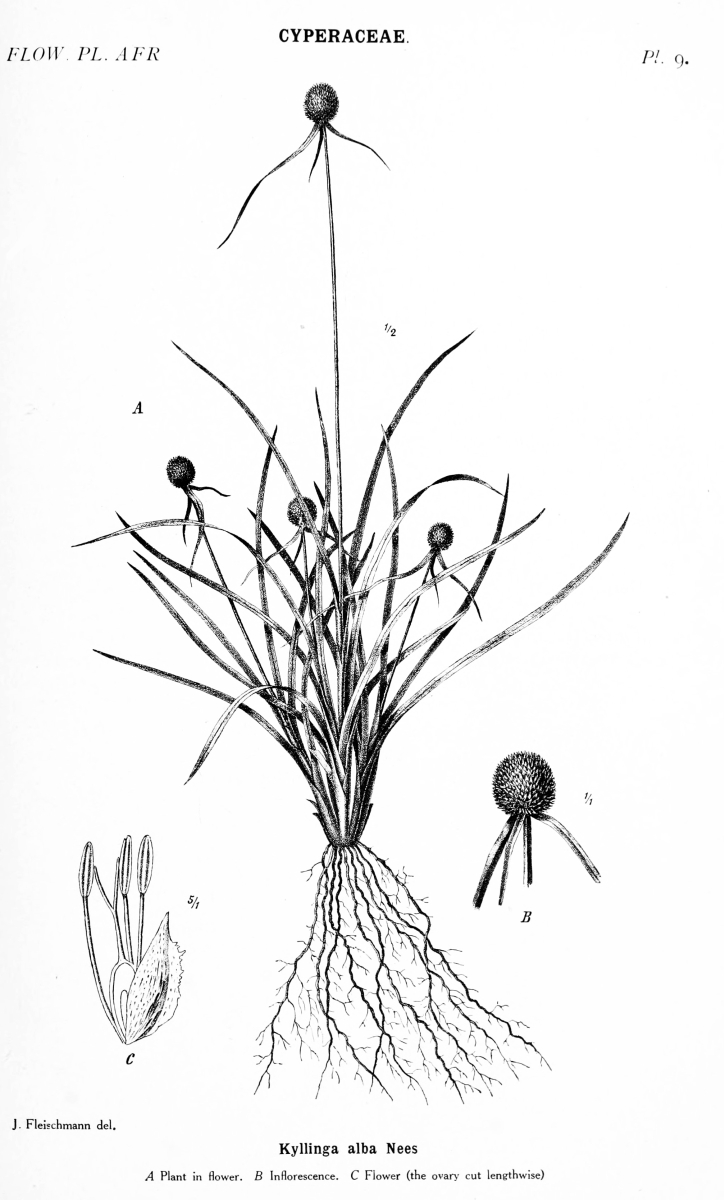
CYPERACEAE.
FLOW. PL. AFR.
Pl. 9.
J. Fleischmann del.
Kyllinga alba Nees
A Plant in flower. B Inflorescence. C Flower (the ovary cut lengthwise).
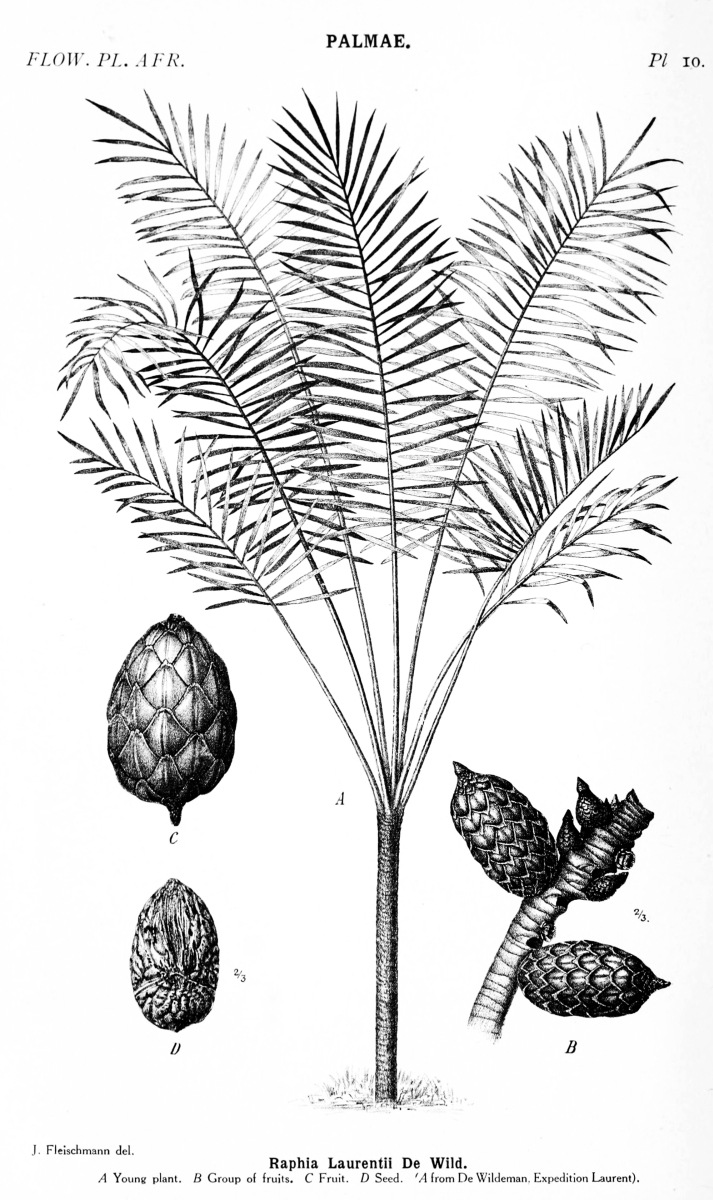
PALMAE.
FLOW. PL. AFR.
Pl. 10.
J. Fleischmann del.
Raphia Laurentii De Wild.
A Young plant. B Group of fruits. C Fruit. D Seed. (A from De Wildeman, Expedition Laurent).
4. Male flowers many in each pit of the spadix. 5 Male flowers solitary in each pit of the spadix. 6 5. Male flowers 20-30 in each pit of the spadix. Stamens about 30. Fruit nearly always with a single stone. Seeds deeply 2-lobed.—Species 1. Seychelles. The fruit (“double cocoa-nut”) is eaten and used in medicine. Lodoicea Labill. Male flowers 10 in each pit of the spadix. Stamens 6. Fruit with 3 stones. Seeds emarginate. Species 1 (B. flabellifer L., Palmyra palm). Tropics. It yields timber, fibre (piassave), starch (sago), gum, vegetables, edible fruits, wine, vinegar, alcohol, sugar, and medicaments. Borassus L. 6. Stamens 15-30. Fruit with 3 stones, very rarely with 1-2. Medium-sized trees.—Species 3. Madagascar and Mascarene Islands. They furnish fibre for plaiting-work and are used as ornamental plants; one species has edible fruits. Latania Comm. Stamens 6. Fruit with a single stone. Tall trees. 7 7. Albumen ruminate. Fruit medium-sized (the size of a walnut). Stem simple.—Species 3. Upper Nile and Madagascar. They yield timber, fibre, edible pith, and alcohol. (Including Bismarckia Hildebr. & Wendl.) Medemia G. de Wuert. & Braun Albumen homogeneous. Fruit large. Stem usually branched.—Species 13. Tropics to Natal and Egypt. They yield wood, fibre, edible fruits, and wine. “Dum palm.” Hyphaene Gaertn. 8. (3.) Ovary and fruit clothed with imbricate scales. Fruit one-seeded. Flowers with bracts and bracteoles. Leaf-segments reduplicate in bud. [Subfamily LEPIDOCARYOIDEAE, tribe METROXYLEAE.] 9 Ovary and fruit without scales. Flowers usually without bracts. [Subfamily CEROXYLOIDEAE.] 15 9. Ovary incompletely 3-celled. [Subtribe CALAMINAE.] 10 Ovary completely 3-celled. [Subtribe RAPHIINAE.] 11 10. Stem erect. Leaves without tendrils. Spadices terminal. Seed depressed-globose.—Species 1 (M. Rumphii Mart.) Cultivated in Madagascar and the Mascarenes. It yields wood, fibre for plaiting and weaving, vegetables, and starch (sago). (Sagus Blume). Metroxylon Rottb. Stem climbing. Leaves with tendrils. Spadices lateral.—Species 6. Tropics. The stems (cane) are used for plaiting-work and for the manufacture of walking-sticks and various utensils. “Rattan-palm.” Calamus L. 11. Stem erect. Flowers monoecious, the male and female on the same branches of the much-branched terminal spadices. Seed oblong or ovate.—Species 10. Tropics. The leaf-stalks (false bamboo) are used for building houses and making furniture, the fibres (piassave) for plaiting, weaving, and brush-making. The stems, leaf-buds, and fruits of some species yield starch, meal, vegetables, wine, and oil. (Plates 10 and 11.) Raphia Beauv. Stem climbing. Leaves with tendrils. 12 12. Flowers monoecious, in cymes on the primary branches of the lateral spadices; cymes consisting of one female and several male flowers.—Species 2. Equatorial West Africa. They furnish cane for plaiting-work and for the manufacture of various utensils. (Under Calamus L.) Oncocalamus Mann & Wendl. Flowers hermaphrodite or polygamous, in pairs on the branches of the spadices. 13 13. Spadices lateral. Spathes none.—Species 5. West Africa to the upper Nile. They furnish cane for plaiting-work and for the manufacture of various utensils. (Under Calamus L.) Eremospatha Mann & Wendl. Spadices terminal. Spathes tubular. 14 14. Seed flattened, with a thick raphe. Leaves with a short stalk and narrow segments.—Species 1. West Africa to the upper Nile. They furnish cane for plaiting-work and for the manufacture of various utensils. (Under Calamus L.) Ancistrophyllum Mann & Wendl. Seed roundish, deeply grooved, kidney-shaped in transverse section. Leaves with a rather long stalk and rather broad segments.—Species 2. West Africa. They furnish cane for plaiting-work and for the manufacture of various utensils. (Under Ancistrophyllum Mann & Wendl. or Calamus L.) Laccosperma Mann & Wendl. 15. (8.) Fruit a drupe; endocarp very hard, with 3 pores. [Tribe COCOEAE.] 16 Fruit a berry; endocarp membranous, rarely woody. [Tribe ARECEAE.] 17 16. Flowers sunk singly in deep pits of the spadix-branches. Spadices unisexual, with 2 deciduous spathes. Stamens united high up. Fruit rather small; pericarp spongy outside; pores towards the top of the stone.—Species 1 (E. guineensis L. oil-palm). Central Africa. The stem and the leaves furnish wood, fibre, vegetables, and wine; the fruits are edible and used for making oil. [Subtribe ELAEIDINAE.] Elaeis Jacq. Flowers inserted singly or in groups of three in shallow pits or notches of the spadix-branches. Spadices bisexual, with a woody, persistent spathe. Stamens free or united at the base. Fruit large; pericarp fibrous; pores towards the base of the stone.—Species 1 (C. nucifera L., coco-nut-palm). Cultivated and sometimes naturalised on the shores of the tropics. The stem and the leaves furnish wood, fibre, tanning materials, vegetables, wine, and medicaments; the fruits are edible and yield oil, fodder, and a drink. [Subtribe ATTALEINAE.] Cocos L. 17. Leaves with long prickles. Spadices branched; spathes 2 or more, complete. Corolla of the female flowers imbricate in bud. Ovary 1-celled, with a laterally affixed ovule. Stigmas 3. 18 Leaves without prickles. 23 18. Leaves with a long sheath. Spadices below the leaves. Seed with homogeneous albumen. 19 Leaves with a rather short sheath. Spadices between the leaves. Seed with ruminate albumen. 20 19. Seed obtusely triquetrous. Stamens 9.—Species 1. Seychelles. Deckenia Wendl. Seed ellipsoid, slightly compressed laterally. Stamens usually 12.—Species 3. Madagascar and Mascarenes. Used in house-building and as ornamental plants. Acanthophoenix Wendl. 20. Leaves 2-cleft, with pinnately toothed margins. 21 Leaves irregularly pinnatisect. 22 21. Stamens 6. Seed and endocarp furrowed. Spadices with 3 spathes. Leaf-stalk prickly.—Species 1. Seychelles. Used as an ornamental plant. Verschaffeltia Wendl. Stamens 15-20. Seed and endocarp not furrowed. Spadices with 2 spathes. Leaf-stalk smooth.—Species 1. Seychelles. Used as an ornamental plant. (Stevensonia Duncan). Phoenicophorium Wendl. 22. Stamens 6. Seed elliptical. Spadices twice branched, with several spathes.—Species 1. Seychelles. Used as an ornamental plant. Roscheria Wendl. Stamens 40-50. Seed kidney-shaped. Spadices once branched, with 2 spathes.—Species 1. Seychelles. Nephrosperma Balf. 23. (17.) Spadices with many tubular incomplete spathes, twice branched. Stamens 6. Ovary 3-celled. Stem tree-like.—Species 4. Madagascar and Mascarenes. Used as ornamental plants. The fruit is said to be poisonous. Hyophorbe Gaertn. Spadices with 1-4 spathes, all or the uppermost complete (i.e. completely enveloping the spadix, when young.) 24 24. Spadices with 4 spathes, simple. Flowers sunk in pits on the spadix. Corolla valvate in bud. Stamens 6. Ovary 3-celled. Stem reed-like.—Species 1. West Africa. The fruit is edible. Podococcus Mann & Wendl. Spadices with 1-3 spathes; if simple, then corolla of the female flowers imbricate in bud or stamens 3 or many. 25 25. Stamens numerous. Stigma 1. Ovary 1-celled. Corolla valvate in bud. Spadices simple. Flowers sunk in pits on the spadix. Stem short.—Species 1. Equatorial West Africa. Sclerosperma Mann & Wendl. Stamens 3-6. Stigmas usually 3. 26 26. Stamens in the male flowers 3, staminodes in the female 6. Ovary with 1 fertile and 2 empty cells. 27 Stamens 6. 28 27. Stamens opposite the petals, united at the base.—Species 3. Madagascar. Trichodypsis Baill. Stamens alternating with the petals, free or almost free.—Species 7. Madagascar. Used as ornamental plants. (Including Adelodypsis Becc.) Dypsis Nor. 28. Ovary 1-celled. 29 Ovary 3-celled, but usually one cell only fertile. 34 29. Spadices simple. Leaves deeply forked. Stem short, erect.—Species 5. Madagascar. Haplophloga Baill. Spadices branched. 30 30. Spadices once branched. Stigma usually 1. Stem tree-like.—Species 5. Madagascar and neighbouring islands. Used as ornamental plants. The fibres of the leaves (piassave) are used in the manufacture of ropes and stuffs. Dictyosperma Wendl. & Drude Spadices 2-3 times branched. Stigmas usually 3. 31 31. Spadices twice branched. Male flowers with valvate or subimbricate sepals. Anthers sagittate, basifixed, opening outwards or laterally. Rudimentary pistil 3-cleft. Female flowers larger than the male. Stigmas 3, subsessile. Tall trees.—Species 1 (A. Catechu L., betel palm). Cultivated in East Africa. It yields wood, bark for tanning, fibre, vegetables, wine, and medicaments; the fruits are chewed. Areca L. Spadices thrice branched. Male flowers with imbricate sepals. Anthers ovoid, opening inwards. Rudimentary pistil entire. 32 32. Styles basal. Stem reed-like.—Species 2. Madagascar. (Chrysalidocarpus Wendl.) Neodypsis Baill. Styles or stigmas terminal. 33 33. Leaves irregularly pinnatisect, with lanceolate segments. Stem low, reed-like.—Species 1. Madagascar. (Under Dypsidium Baill.) Neophloga Baill. Leaves regularly pinnatisect, with linear segments. Stem tall.—Species 2. Madagascar and Comoro Islands. (Including Vonitra Becc.) Phlogella Baill. 34. Spadices simple. Petals lanceolate. Anther-halves linear. Style conical.—Species 3. Madagascar. Haplodypsis Baill. Spadices much branched. Petals ovate or orbicular. Anther-halves oblong or ovate. Style 3-partite. 35 35. Flowers monoecious. Sepals of the male flowers orbicular. Stamens unequal in length. Stigmas awl-shaped. Albumen ruminate.—Species 5. Madagascar. Leaves used for plaiting-work. Phloga Nor. Flowers dioecious. Sepals of the male flowers elliptical. Stamens subequal. Stigmas short and thick. Albumen homogeneous.—Species 2. Madagascar and Comoro Islands. Ravenea Hildebr. & Bouché
ORDER SPATHIFLORAE
FAMILY 19. ARACEAE
Leaves usually net-veined. Flowers in spadices, without bracteoles. Perianth simple or wanting. Fruit indehiscent or bursting irregularly, usually berry-like. Seed-coat fleshy.—Genera 33, species 150. (Plate 12.)
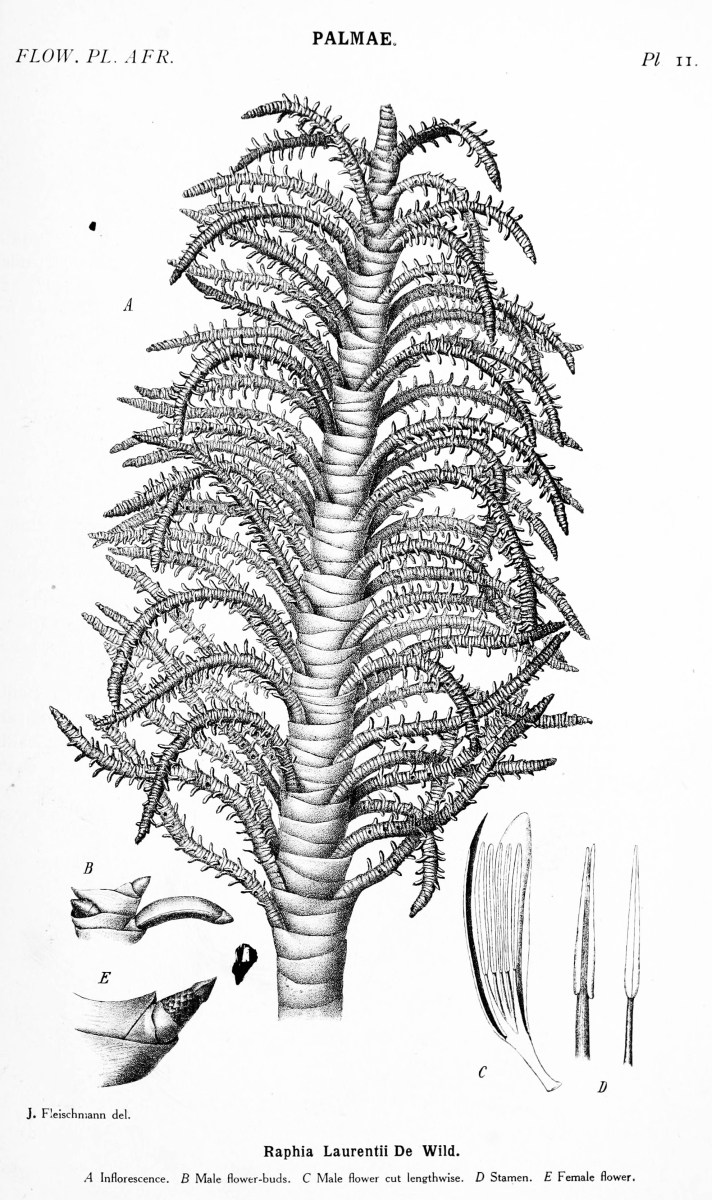
PALMAE.
FLOW. PL. AFR.
Pl. 11.
J. Fleischmann del.
Raphia Laurentii De Wild.
A Inflorescence. B Male flower-buds. C Male flower cut lengthwise. D Stamen. E Female flower.
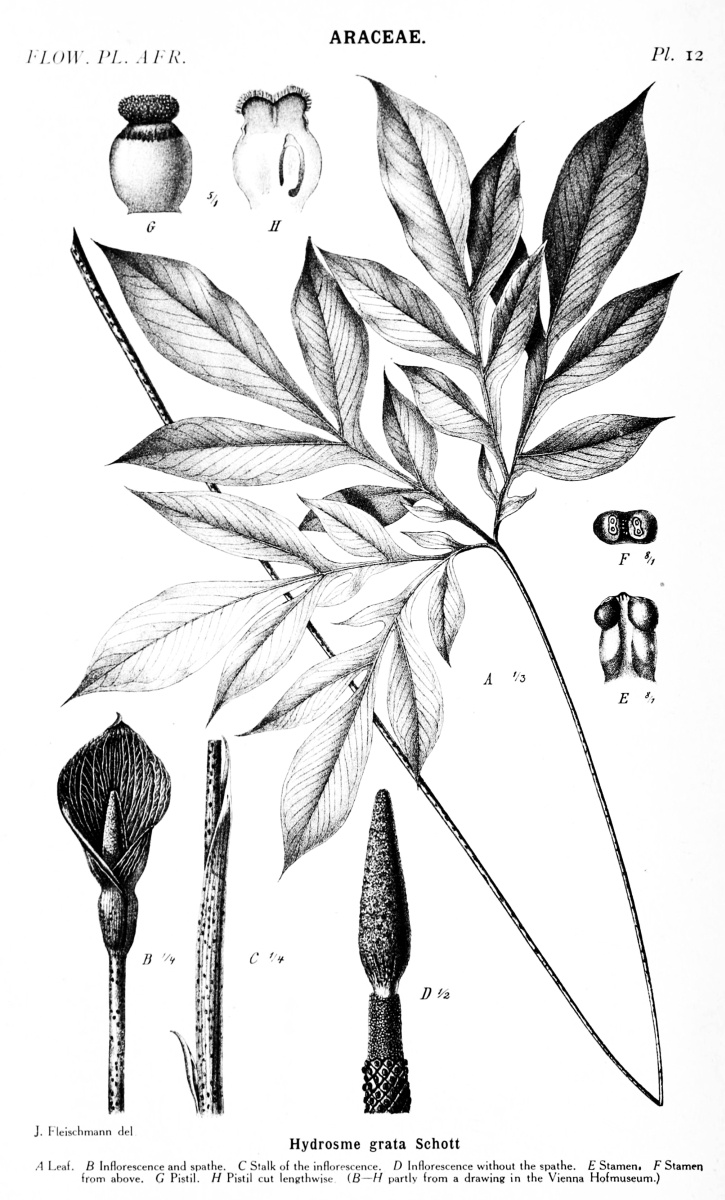
ARACEAE.
FLOW. PL. AFR.
Pl. 12.
J. Fleischmann del.
Hydrosme grata Schott
A Leaf. B Inflorescence and spathe. C Stalk of the inflorescence. D Inflorescence without the spathe. E Stamen. F Stamen from above. G Pistil. H Pistil cut lengthwise. (B-H partly from a drawing in the Vienna Hofmuseum.)
1. Flowers hermaphrodite. 2 Flowers unisexual. 5 2. Perianth none. Ovary incompletely 2-celled with several ascending ovules. Climbing shrubs. Leaves stalked, lanceolate.—Species 2. West Africa. Used as ornamental plants. (Raphidophora Schott). [Tribe MONSTEREAE.] Afroraphidophora Engl. Perianth of 4-6 segments. 3 3. Ovary 1-celled. Ovules 2 or more. Tall herbs. Juice milky. Root-stock tuberous. Leaves sagittate; stalk prickly.—Species 1. West Africa. Used for making salt. [Tribe LASIEAE.] Cyrtosperma Griff. Ovary 2-3-celled. Juice not milky. 4 4. Ovule one in each cell, ascending, inverted. Seeds exalbuminous. Climbing shrubs. Leaves stalked, lanceolate to ovate. Spathe oblong or ovate.—Species 1. Madagascar and Comoro Islands. [Tribe POTHOEAE.] Pothos L. Ovules several in each cell, pendulous, straight. Seeds albuminous. Herbs with a creeping root-stock. Leaves sessile, linear, sword-shaped. Spathe linear, sword-shaped, forming a continuation of the flowering stem.—Species 1 (A. Calamus L., sweet-flag). Introduced in the Mascarene Islands. Yields tanning-materials and is used in the preparation of perfumes, liquors, snuff, and medicaments. [Tribe ACOREAE.] Acorus L. 5. Perianth present. 6 Perianth none. 8 6. Perianth cupular. Ovary 1-4-celled with 2 or more ovules in each cell. Juice milky. Leaves sagittate; stalk not thickened near the middle. Spathe-margins connate below.—Species 20. Central and South-East Africa. [Tribe STYLOCHITONEAE.] Stylochiton Leprieur Perianth of 4 free segments. Ovary 2-celled with 1 ovule in each cell. Juice not milky. Leaves pinnate; stalk with a thickened joint near the middle. Spathe-margins free. [Tribe ZAMIOCULCASEAE.] 7 7. Stamens with free filaments; anthers opening by slits. Leaves several, once pinnate. Spathe upon a short stalk.—Species 1. East Africa and Mascarene Islands. Used as an ornamental plant. Zamioculcas L. Stamens with united filaments; anthers opening by pores. Leaf 1, thrice pinnate in the adult stage. Spathe upon a long stalk.—Species 2. East Africa to the upper Congo. Gonatopus Hook. fil. 8. Stamens united throughout their length or almost so. 9 Stamens free or united in pairs or at the base only. 17 9. Female (inferior) part of the spadix adnate to the spathe, 1-flowered. Stamens 2. Floating water-plants. Juice not milky.—Species 1. Tropical and South Africa and Egypt. Used medicinally. [Tribe PISTIEAE.] Pistia L. Female part of the spadix free from the spathe, several-flowered. Stamens 3-8, very rarely 2. Land- or marsh-plants. Juice milky. 10 10. Stem creeping. Leaves lanceolate, parallel-veined, with numerous primary and secondary lateral veins. Ovary completely or incompletely 2-3-celled with numerous ovules.—Species 12. West Africa. [Tribe ANUBIADEAE.] Anubias Schott Stem erect or tuberous. Leaves ovate, ovate-sagittate or dissected, net-veined, rarely parallel-veined with 5 primary lateral nerves. 11 11. Ovules 1-3. Spadix with barren flowers below and above the male ones. Stem short, ascending. Leaves ovate or sagittate, entire, with about 5 primary lateral nerves and many parallel secondary ones.—Species 2. Madagascar and neighbouring islands and Zanzibar. They yield fibre and edible tubers and seeds and are used in medicine. Typhonodorum Schott Ovules 4 or more. Leaves sagittate- or cordate-ovate and net-veined, or dissected. 12 12. Ovules 4. Female flowers with staminodes. Spadix with a terminal appendage. Stem tuberous. Leaves dissected.—Species 1. Seychelles. [Tribe PROTAREAE.] Protarum Engl. Ovules more than 4. Leaves sagittate- or cordate-ovate. [Tribe COLOCASIEAE.] 13 13. Ovary completely 1-celled. Ovules straight or almost so. 14 Ovules incompletely 2-3-celled. Ovules inverted. Spadix without a terminal appendage. 16 14. Ovules few, basal. Stem erect. Spadix with a terminal appendage.—Species 1. Cultivated and sometimes naturalised in Madagascar and the neighbouring islands. Stem and leaves are edible; also used as an ornamental plant. Alocasia Schott Ovules many, parietal. Stem tuberous. 15 15. Spadix with a terminal appendage. Spathe erect. Stamens 3-6.—Species 1 (C. antiquorum Schott, taro or dinde). Cultivated and sometimes naturalised in Tropical and North Africa. The tubers and leaves are eaten and used in medicine; also an ornamental plant. (Under Caladium Vent.) Colocasia Schott Spadix without an appendage. Spathes recurved at the top. Stamens 2-3.—Species 1. Island of Socotra. Used as an ornamental plant. Remusatia Schott 16. Style disc-like, adnate to the styles of the neighbouring flowers. Ovules with a long funicle. Leaves leathery.—Species 2. Cultivated and sometimes naturalised in West Africa and the Mascarene Islands. Used as ornamental plants or vegetables. Xanthosoma Schott Style none. Ovules with a short funicle. Leaves herbaceous, usually with red spots.—Species 1. Cultivated and sometimes naturalised in West Africa. Used as an ornamental plant. Caladium Vent. 17. (8.) Stem above ground and usually climbing or underground and creeping. Spadix without an appendage. Ovary 1-2-celled with 1 ovule in each cell. 18 Stem underground, short and thick, more or less tuberous. Juice milky. 23 18. Juice milky. Leaves cordate or sagittate. Female inflorescence not adnate to the spathe. Ovary 1-celled. [Tribe NEPHTHYTIDEAE.] 19 Juice not milky. Leaves lanceolate oblong or elliptical, acute or obtuse at the base, rarely cordate and then female inflorescence adnate to the spathe or ovary 2-celled. Seed albuminous. 22 19. Stem underground, creeping.—Species 3. West Africa. Used as ornamental plants. (Including Oligogynium Engl.) Nephthytis Schott Stem above ground, climbing, woody. 20 20. Leaves perforated or dissected. Male inflorescence three times as long as the female and contiguous to it. Ovary with a strongly projecting parietal placenta.—Species 2. West Africa. Rhektophyllum N. E. Brown Leaves entire or lobed, not perforated. Ovary with a slightly projecting parietal or sub-basal placenta. 21 21. Leaves oblong, shortly cordate at the base. Male inflorescence twice as long as the female and contiguous to it. Stamens 2-3.—Species 1. West Africa (Cameroons). (Under Cercestis Schott). Alocasiophyllum Engl. Leaves sagittate or hastate. Stamens usually 4.—Species 7. West Africa. Cercestis Schott 22. Stem creeping. Female inflorescence adnate to the spathe, as long as the male. Ovary conical. Style present.—Species 1. Central Africa. Used as an ornamental plant. [Tribe CALLOPSIDEAE.] Callopsis Engl. Stem climbing or erect. Female inflorescence free from the spathe. Ovary subglobose. Style wanting.—Species 17. Central Africa. Some are used as ornamental plants. [Tribe CULCASIEAE.] Culcasia Beauv. 23. (17.) Spadix covered with fertile flowers to the top. Ovary with 4 or more ovules. Leaves sagittate or hastate. Spathe funnel-shaped.—Species 10. South Africa and southern Central Africa; one species (Z. aethiopica Spreng.) cultivated as an ornamental plant under the name of “Calla” and naturalised in the island of Madeira. (Aroides Heist., Richardia Kunth). [Tribe ZANTEDESCHIEAE.] Zantedeschia Spreng. Spadix ending in an appendage which is glabrous or covered with rudimentary flowers, rarely without an appendage, but then ovary 1-2-ovuled and leaves dissected. 24 24. Ovules inverted. Ovary usually 2-4-celled. Male and female portions of the spadix contiguous, rarely separated by a glabrous interval without barren flowers. Leaf 1, dissected. [Tribe AMORPHOPHALLEAE.] 25 Ovules straight. Ovary 1-celled. Seeds albuminous. Spadix with a terminal appendage. [Tribe AREAE.] 27 25. Spadix ending in a flowerless appendage.—Species 35. Tropics. Some have edible tubers or are used as ornamental plants. (Under Amorphophallus Blume). (Plate 12.) Hydrosme Schott. Spadix covered with flowers to the top; upper flowers sometimes reduced to barren stamens. 26 26. Ovary 1-celled. Male inflorescence as long as the female. Spathe boat-shaped.—Species 7. Central Africa. Some have edible tubers. Anchomanes Schott Ovary 2-celled. Male inflorescence longer than the female.—Species 2. Equatorial West Africa. (Including Zyganthera N.E. Brown). Pseudohydrosme Engl. 27. Spadix unisexual (containing male or female flowers only). Stamens 2-4. Ovules basal. Leaves dissected.—Species 4. East Africa. Some are poisonous. Arisaema Mart. Spadix bisexual (containing both male and female flowers). 28 28. Male inflorescence contiguous to the female. 29 Male inflorescence separated from the female by a distinct interval usually covered with rudimentary flowers. 30 29. Stamen 1. Anther opening by a slit. Ovules basal. Leaves sagittate or hastate.—Species 2. North Africa. Used as ornamental plants. The tubers are poisonous when raw, but edible when cooked, and furnish starch, medicaments, and a substitute for soap. Arisarum Targ. Tozz. Stamens 3-4. Anthers opening by pores. Ovules basal or apical. Leaves several dissected.—Species 2. North-west Africa. Used as ornamental plants. The tubers are poisonous when raw, but edible when cooked, and furnish starch, medicaments, and a substitute for soap. Dracunculus Schott 30. Interval between the male and the female inflorescence without rudimentary flowers. Spathe divided into two chambers, one of which contains a female flower, the other one several male flowers. Stamens 2. Ovules numerous. Leaves ovate.—Species 1. North-west Africa (Algeria). Ambrosinia Bassi Interval between the male and the female inflorescence clothed with rudimentary flowers. Spathe not 2-chambered. Female flowers several. 31 31. Ovules 6 or more, parietal. Stamens 3-4. Leaves sagittate or hastate.—Species 2. North Africa. Poisonous and sometimes used as ornamental plants. The tubers are edible when cooked and yield starch; they are also used in medicine and as a substitute for soap. Arum L. Ovules 1-4, basal. Stamens 1-2. Leaves linear, oblong, ovate, or dissected. 32 32. Ovule 1. Leaves several, entire.—Species 3. North Africa. Used as ornamental plants. The tubers are edible when cooked, and yield starch, medicaments, and a substitute for soap. Biarum Schott Ovules 2-4. Leaf 1, dissected.—Species 2. East Africa and Angola. Used as ornamental plants. The tubers are edible when cooked, and yield starch, medicaments, and a substitute for soap. Sauromatum Schott