ORDER RANALES (continued 2)
Reading edition
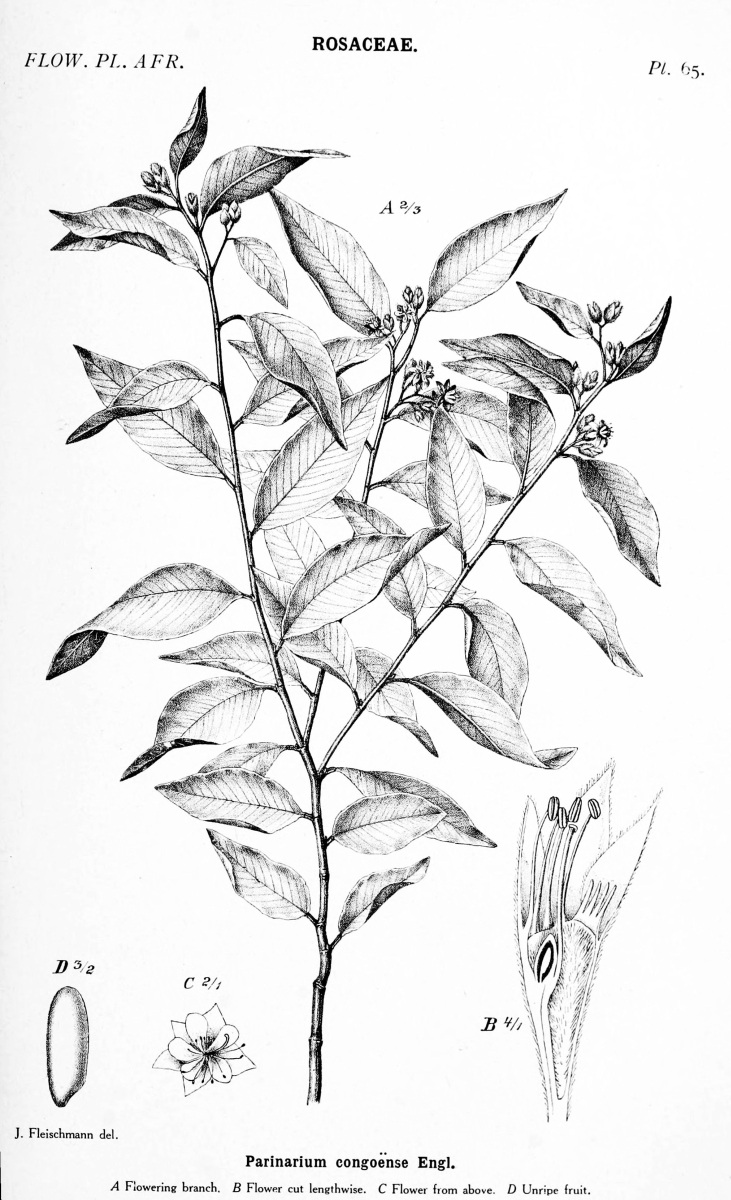
ROSACEAE.
FLOW. PL. AFR.
Pl. 65.
J. Fleischmann del.
Parinarium congoënse Engl.
A Flowering branch. B Flower cut lengthwise. C Flower from above. D Unripe fruit.
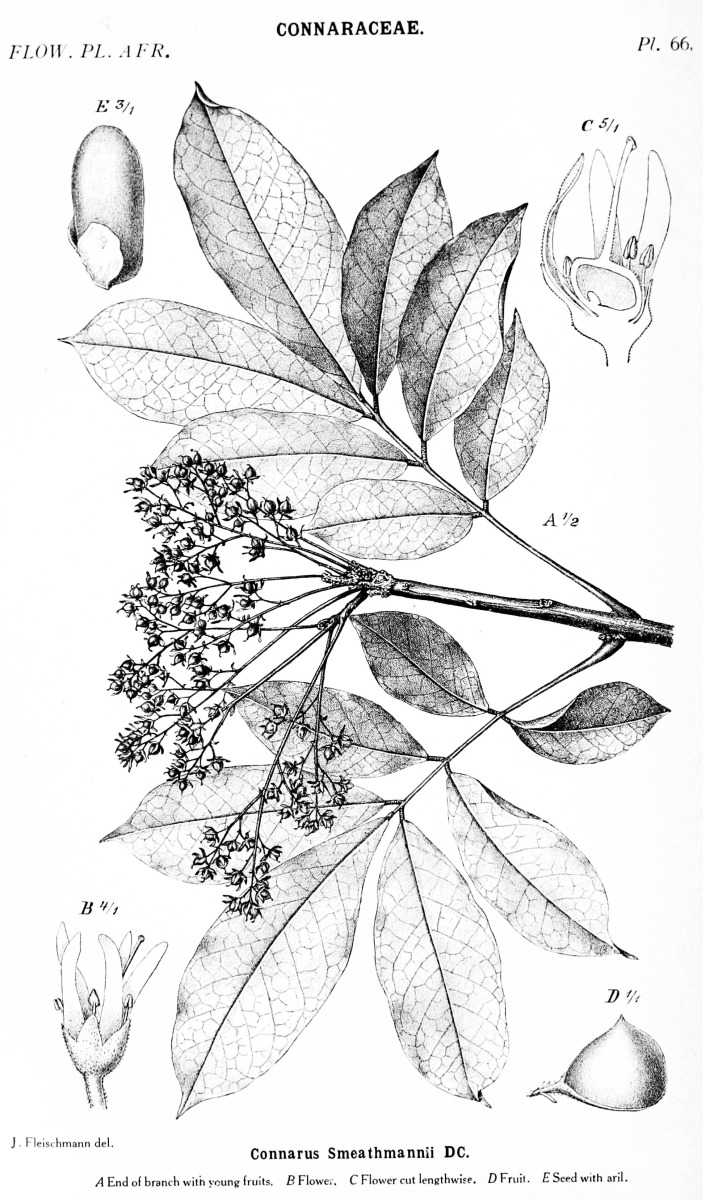
CONNARACEAE.
FLOW. PL. AFR.
Pl. 66.
J. Fleischmann del.
Connarus Smeathmannii DC.
A End of branch with young fruits. B Flower. C Flower cut lengthwise. D Fruit. E Seed with aril.
Receptacle not swelling on one side; carpel central. Stamens numerous. Fruit with an irregularly 5-angled stone. Flowers in panicles.—Species 3. Central Africa. They yield tanning and dyeing materials, oil, medicaments, and edible fruits (cocoa-plums). Chrysobalanus L. 29. Filaments united in a long strap. Anthers 10-20. Ovary completely 1-celled.—Species 17. Central Africa. Some species yield timber (Griffonia Hook. fil.) Acioa Aubl. Filaments free or united at the base only. 30 30. Receptacle prolonged above into a scale-like appendage. Stamens 6-7. Ovary completely 1-celled. Stipules large.—Species 3. West Africa. Magnistipula Engl. Receptacle without a scale-like appendage. Stipules small. 31 31. Ovary completely 1-celled. Fertile stamens 3-10. Fruit 1-seeded.—Species 3. East Africa and Madagascar. Hirtella L. Ovary completely or incompletely 2-celled. Fertile stamens 10-20. Fruit usually 2-seeded.—Species 25. Tropical and South Africa. Some of them yield timber, tanners’ bark, medicaments, and edible fruits, from which also oil, glue, and an inebriating drink are prepared. (Parinari Aubl.) (Plate 65). Parinarium Juss.
FAMILY 104. CONNARACEAE.
Shrubs or trees. Leaves alternate, pinnate, but sometimes with 3 leaflets only, exstipulate. Flowers in fascicles, racemes or panicles, regular, hermaphrodite or polygamous. Calyx 5-cleft or 5-parted. Petals 5, free, rarely slightly united, imbricate in the bud. Stamens 5-10, free or united at the base. Carpels 1-5, free, superior. Ovules 2 to each carpel, erect or ascending, straight. Ripe carpels dry, dehiscing by a longitudinal slit, rarely indehiscent, usually solitary. Seeds with an aril often adnate to the testa.—Genera 12, species 140. Tropical and South Africa. (Plate 66.)
1. Sepals imbricate in the bud. Seeds exalbuminous. [Tribe CONNAREAE.]. 2 Sepals valvate in the bud. Seeds albuminous. Stamens 10. Carpels 5. [Tribe CNESTIDEAE.] 8 2. Ripe carpel indehiscent, nearly always 2-seeded. Seeds with a large, adnate aril. Calyx hardened in fruit. Petals greatly exceeding the sepals. Stamens 10, very unequal, surrounded by a disc. Carpel 1. Flowers in clusters, springing from the old wood.—Species 3. Equatorial West Africa (Gaboon). (Anthagathis Harms). Jollydora Pierre Ripe carpel (or carpels) dehiscing lengthwise, usually 1-seeded. 3 3. Fruit-carpels narrowed at the base into a distinct stalk. Seeds attached to the ventral suture, with a free aril. Calyx not enlarged in fruit.—Species 18. Central Africa. Some are used medicinally. (Plate 66.) Connarus L. Fruit-carpels not stalked. Seeds attached at their base. Carpels (at the time of flowering) 3-5. 4 4. Calyx scarcely or not enlarged in fruit, small, usually flaccid. 5 Calyx conspicuously enlarged and hardened in fruit, leathery to woody. Stamens 10. Carpels 5. 6 5. Leaves trifoliolate.—Species 25. Tropics. Some are used medicinally. Agelaea Sol. Leaves pinnate, with several pairs of leaflets. Stamens 10. Carpels 5. Styles 2-cleft at the apex. Calyx persistent.—Species 7. Tropics. Some are poisonous. (Under Rourea Aubl.) Byrsocarpus Schum. & Thonn. 6. Calyx tightly clasping the fruit, herbaceous at the time of flowering. Styles short; stigmas capitate. Seeds with very convex cotyledons.—Species 40. Tropics. Some are poisonous or used in medicine. Rourea Aubl. Calyx not clasping the fruit. Stamens very unequal. Styles long. 7 7. Stem twining. Inflorescence paniculate. Calyx leathery at the time of flowering. Seeds with flat cotyledons.—Species 2. Equatorial West Africa. Paxia Gilg Stem erect. Inflorescence racemose-fasciculate. Anther-halves distant from one another, the pollen-sacs placed crosswise.—Species 1. Equatorial West Africa. (Jaundea Gilg). Yaundea Gilg 8. (1.) Ripe carpel indehiscent, not stalked, with a crusty pericarp. Seeds enveloped by a thin aril. Carpel 1. Stamens 5-7, alternating with as many glands. Calyx deeply divided, persistent, but not enlarged in fruit. Low trees. Leaves unifoliolate. Flowers in clusters.—Species 2. West Africa. Hemandradenia Stapf Ripe carpel (or carpels) dehiscing lengthwise. 9 9. Receptacle prolonged into a stalk-like androphore. Sepals red, free. Petals yellow, clawed, with 2 glands above the claw. Styles long. Erect shrubs.—Species 1. Northern West Africa (Liberia). Dinklagea Gilg Receptacle not prolonged. Petals without glands. Mostly climbing shrubs. 10 10. Sepals united to the middle, ovate-triangular. Petals linear, four times as long as the calyx, rolled inwards at the tip. Stamens very unequal. Styles long; stigmas lobed.—Species 6. West Africa. Spiropetalum Gilg Sepals free or nearly so. Petals not more than twice as long as the calyx. Styles short; stigmas capitate. 11 11. Fruit-carpels glabrous on the inside, short-haired on the outside, prolonged into a stalk at the base. Seeds without a distinct aril, but with a fleshy testa. Embryo long and narrow. Petals longer than the calyx.—Species 10. West Africa. Manotes Sol. Fruit-carpels covered with long stiff hairs on the inside and usually also on the outside. Seeds with a very small adnate aril at the base. Petals as long as or shorter or somewhat longer than the calyx. Stamens subequal.—Species 30. Tropical and South Africa. Some are used medicinally. Cnestis Juss.
FAMILY 105. LEGUMINOSAE
Leaves usually compound and stipulate. Anthers 2-celled. Ovary superior, 1-celled. Ovules inserted at the ventral suture. Style simple, but sometimes with a tooth near the apex. Stigma entire. Fruit 1-, 2-, or transversely several-celled, opening in two valves or along the ventral suture, or separating transversely in two or more joints, or indehiscent.—Genera 261, species 3300 (FABACEAE, including PAPILIONACEAE, CAESALPINIACEAE and MIMOSACEAE.) (Plate 67.)
1. Petals valvate in bud. Flowers regular. Leaves twice pinnate, rarely (Acacia) reduced to the broadened stalk. [Subfamily MIMOSOIDEAE.] 2 Petals imbricate in bud or wanting. Flowers more or less irregular (sometimes nearly regular.) 28 2. Calyx with imbricate aestivation. Unarmed trees. [Tribe PARKIEAE]. 3 Calyx with valvate aestivation. 4 3. Flowers in long spikes, yellowish. Fertile stamens 5, sterile ones 10-15.—Species 3. West Africa. They yield timber, oil, and edible seeds. (ovala-seeds) Pentaclethra Benth. Flowers in globular or club-shaped heads. Fertile stamens 10.—Species 7. Tropics. They yield timber, tanners’ bark, vegetables, medicaments, edible fruits, from which a drink is prepared, and oily seeds, which are also used as a condiment, a substitute for coffee, a fish-poison, and for improving bad water. Parkia R. Br. 4. Stamens as many or twice as many as the petals. 5 Stamens more than twice as many as the petals. Trees or shrubs. 25 5. Anthers without glands. [Tribe MIMOSEAE.] 6 Anthers crowned, at least in the bud, by a sometimes caducous gland. Stamens 10. 9 6. Fruit dehiscing by two valves which separate from the persistent sutures. Petals united below. 7 Fruit dehiscing by two valves which do not separate from the sutures, or indehiscent. 8 7. Fruit and seeds slightly 4-angled, the former prickly. Petals red. Stamens 8-10. Herbs or undershrubs. Flowers in heads.—Species 1. West Africa. Schranckia Willd. Fruit and seeds flat.—Species 20. Tropics to Egypt, one species naturalized. Some yield timber or medicaments or serve as ornamental plants. Mimosa L. 8. Fruit broadly linear. Seeds placed transversely. Petals free, white. Stamens 10. Ovary stalked. Unarmed shrubs or trees. Flowers in heads.—Species 1 (L. glauca Benth.). Naturalized in the Tropics. It yields timber, fodder, edible fruits, ornamental seeds, and medicaments. Leucaena Benth. Fruit narrowly linear. Seeds placed obliquely or longitudinally.—Species 7. One of them naturalized in the Tropics, the others natives of Madagascar. Seeds used as ornament. (Acuan Medik.) Desmanthus Willd. 9. Seeds albuminous. [Tribe ADENANTHEREAE.] 10 Seeds exalbuminous. [Tribe PIPTADENIEAE.] 19 10. Flowers in heads. 11 Flowers in spikes or racemes. 12 11. Flowers partly (the upper) hermaphrodite, partly (the lower) male or neuter. Ovary stalked. Ovules numerous. Fruit obliquely-oblong, opening by two valves. Herbs or undershrubs. Stipules membranous, cordate.—Species 1. Tropics. Used as a vegetable. Neptunia Lour. Flowers all hermaphrodite. Ovary sessile. Ovules 1-2. Fruit sickle-shaped, indehiscent. Shrubs. Stipules spinous, recurved.—Species 1. South Africa. Xerocladia Harv. 12. Flowers partly (the upper) hermaphrodite and yellow, partly (the lower) neuter and white or red. Fruit not winged. Shrubs or trees.—Species 12. Tropical and South Africa. Some species yield ebony-like wood and medicaments. (Cailliea Guill. & Perr.) Dichrostachys DC. Flowers partly hermaphrodite, partly male or female, or all hermaphrodite; no neuter flowers. Trees. 13 13. Fruit winged or distinctly 4-angled, transversely septate, indehiscent. 14 Fruit neither winged nor distinctly 4-angled. 16 14. Fruit 2-winged. Ovary stalked. Flowers sessile.—Species 1. Madagascar and Mauritius. Gagnebina DC. Fruit 4-winged or 4-angled. Ovary sessile or nearly so. Flowers stalked. 15 15. Fruit 4-winged.—Species 3. Central Africa. They yield timber, a substitute for soap, poison, and medicaments. Tetrapleura Benth. Fruit 4-angled. Leaves with 4-5 pairs of pinnae.—Species 1. Central Africa. Amblygonocarpus Harms 16. Fruit distinctly dehiscing in two valves. 17 Fruit indehiscent. 18 17. Seeds few, very flat, winged, with a long funicle.—Species 3. Equatorial West Africa. Newtonia Baill. Seeds numerous, thick, red. Leaflets numerous.—Species 1 (A. pavonina L.). Naturalized in the tropics. It yields timber, gum, dyes, medicaments, and edible oily seeds, which are also used as ornaments. Adenanthera L. 18. Calyx large, tube- or urn-shaped, with ovate, acute teeth. Stamens inserted at the base of the petals. Leaves with one pair of pinnae and several pairs of very large oblong leaflets. Spikes arranged in panicles.—Species 1. Equatorial West Africa (Cameroons). Yields timber and medicaments. Calpocalyx Harms Calyx small, bell-shaped, with short segments. Stamens free. Leaves with 2-5 pairs of pinnae and small or rather small leaflets.—Species 3. North and Central Africa. They yield timber and edible fruits. (Including Anonychium Benth.) Prosopis L. 19. (9.) Flowers in heads. Ovary sessile, with many ovules. Fruit transversely septate. Trees.—Species 5. Tropics. They yield timber and a substitute for soap. (Under Parkia R.Br.) Xylia Benth. Flowers in spikes or racemes. Shrubs or trees. 20 20. Flowers sessile. 21 Flowers short-stalked. 23 21. Calyx saucer-shaped, cleft to the middle. Petals free. Disc cupular, thick. Fruit large, elliptical, 1-celled. Seeds winged, with a long funicle. Trees. Leaves with 1-2 pairs of pinnae. Spikes panicled.—Species 1. Equatorial West Africa. Yields timber. Fillaeopsis Harms Calyx bell-shaped, shortly toothed. Disc inconspicuous or wanting. 22 22. Petals obviously united below. Fruit 1-celled, opening in two valves.—Species 13. Tropics to Delagoa Bay. Some species yield ebony-like wood. Piptadenia Benth. Petals free or nearly so. Fruit with thick, persistent sutures, the valves splitting transversely into one-seeded joints. Endocarp separating from the exocarp and persisting round the seeds. Shrubs.—Species 10. Tropical and South Africa. Some species (especially E. scandens L. with fruits attaining a yard in length) yield soap-bark, fibre, vegetables, fish-poison, and edible oily seeds which are also used in medicine and as ornaments. (Gigalobium P.Br., Pusaetha L.) Entada Adans. 23. Disc cupular, thin. Ovary stalked. Seeds winged. Trees. Leaves with one pair of pinnae. Flowers with a very short stalk.—Species 1. Equatorial West Africa. Yields timber. (Including Cyrtoxiphus Harms) Cylicodiscus Harms Disc inconspicuous or wanting. Ovary sessile or nearly so. Shrubs. Leaves with 3-12 pairs of pinnae. 24 24. Calyx-teeth more or less unequal. Buds oblique. Fruit woody, transversely septate, opening in two valves. Leaves with 3-6 pairs of pinnae.—Species 1. German East Africa. Pseudoprosopis Harms Calyx-teeth equal. Fruit leathery, with persistent sutures, the endocarp separating from the exocarp. Leaves with 6-12 pairs of pinnae.—Species 5. South Africa and southern Central Africa. They yield fish-poison and are used in medicine. Elephantorrhiza Benth. 25. (4.) Filaments free or the inner united into a ring. Petals white or yellow.—Species 80. They yield timber, fibre, soap-bark, gum (especially from A. Senegal Willd., Verek), tanning and dyeing materials, perfumes, oil, and medicaments; some are used as ornamental plants. (Including Vachellia Arn.) [Tribe ACACIEAE.] Acacia Willd. Filaments united into a tube, at least at the base. Petals white or red. Flowers in heads. Unarmed plants. [Tribe INGEAE.] 26 26. Fruit strongly curved or coiled, thick, leathery, separating into one-seeded joints or indehiscent. Petals united beyond the middle. Trees.—Species 3. Tropics; one species naturalized. They yield timber, gum, tanning and dyeing materials, edible fruits, and medicaments. Pithecolobium Mart. Fruit straight or nearly so. 27 27. Fruit dehiscing elastically. Petals united to the middle. Shrubs.—Species 5. Tropics. They yield timber, gum, and medicaments, and are used also as ornamental plants. Calliandra Benth. Fruit dehiscing in two straight and thin, not elastic valves, or indehiscent. Petals united to the middle or beyond.—Species 45. Tropical and South-east Africa; several species also cultivated in Egypt. Some species (especially A. Lebbek Benth.) yield timber, tanners’ bark, gum, condiments, and medicaments, or serve as ornamental plants. (Including Zygia Benth.) Albizzia Durazz. 28. (1.) Petals 1-6, the posterior one (the one next the placenta) inside of all in the bud, not forming a papilionaceous corolla, or wanting altogether. Embryo usually with a straight radicle. [Subfamily CAESALPINIOIDEAE.] 29 Petals 5, the posterior outside in bud, usually constituting a papilionaceous corolla. Sepals united below. Stamens 10, more rarely 5-9. Embryo usually with an inflexed radicle. Leaves simple, unifoliolate, digitate, or once pinnate. [Subfamily PAPILIONATAE.] 104 29. Calyx undivided or shortly lobed in the bud, usually more deeply divided at the time of flowering. 30 Calyx, already in the bud, divided down to the receptacle or nearly so. 39 30. Stamens 1-10. Corolla of 5 petals, nearly regular. Trees or shrubs. 31 Stamens 16 or more. Corolla of 6 petals, or of a single petal, or wanting. Calyx undivided in bud. Leaves imparipinnate or unifoliolate. Trees. [Tribe SWARTZIEAE.] 37 31. Leaves undivided, 2-lobed, 2-parted, or of 2 leaflets. [Tribe BAUHINIEAE.] 32 Leaves pinnate, with many leaflets. Stamens 10. 34 32. Ovary and fruit with a very long stalk, the fruit turgid. Ovules few. Style short. Stamens 10. Petals red. Calyx 5-lobed, imbricate in bud. Climbing shrubs. Leaves undivided, penninerved or faintly trinerved.—Species 3. West Africa. (Bandeiraea Welw.) Griffonia Baill. Ovary and fruit with a short or rather short stalk, the fruit not turgid. 33 33. Receptacle (calyx-tube) very long. Petals yellowish. Stamens 10, partly sterile. Leaves undivided, ovate or elliptical. Racemes many-flowered.—Species 1. Madagascar. (Under Bauhinia L.) Gigasiphon Drake Receptacle (calyx-tube) not very long.—Species 40. Tropical and South Africa, and Egypt. Some species yield timber, fibre, tanning and dyeing materials, edible roots, oily seeds, and medicaments, or serve as ornamental plants. (Plate 67.) Bauhinia L. 34. Leaves once pinnate, with a terminal leaflet. Calyx campanulate, subequally 5-lobed. Petals subequal, white or red. Ovules numerous. Fruit opening by two valves. Shrubs. Flowers solitary or in racemes.—Species 8. Madagascar and East Africa. Cadia Forsk. Leaves twice pinnate. [Tribe DIMORPHANDREAE.] 35 35. Ovary sessile or nearly so. Ovules 2. Style very short. Fruit with a thin, leathery rind, indehiscent. Seeds suborbicular. Flowers in spikes.—Species 2. Central Africa to Transvaal. They yield gum. Burkea Hook. Ovary stalked. Ovules more than 2. Fruit with a thick, leathery rind. Flowers in racemes. Trees. 36 36. Calyx-lobes unequal. Petals with a long claw. Stamens with a glandular connective. Style long. Fruit long, wavy, indehiscent. Leaflets small.—Species 1. Madagascar and Seychelles. Brandzeia Baill. Calyx-lobes subequal. Stamens with a glandless connective. Style short. Fruit oblong, dehiscing by two valves. Seeds oblong. Leaflets large.—Species 5. Tropics. They yield timber, tanning and dyeing materials, medicaments, and poisons especially used in ordeals. “Sassy tree.” (Fillaea Guill. & Perr.). Erythrophloeum Afz. 37. (30.) Corolla of 6 petals, almost regular. Stamens 16-18. Ovary sessile. Ovules 2. Leaves unifoliolate.—Species 2. West Africa to the Great Lakes. They yield timber. Baphiopsis Benth. Corolla reduced to a single petal or wanting. Ovary stalked. Ovules more than 2. Leaves pinnate. 38 38. Receptacle (calyx-tube) very short, almost wanting. Petal 1. Fruit linear.—Species 2. Tropics. Yielding timber. (Tounatea Aubl.). Swartzia Schreb. Receptacle bell-shaped. Petals none. Fruit ovate.—Species 1 (C. africana Lour.). Central Africa. Yields timber, gum, edible fruits, and medicaments. Cordyla Lour. 39. (29.) Leaves, at least some of them, twice pinnate. [Tribe CAESALPINIEAE.] 40 Leaves all once pinnate, rarely simple. 52 40. Common petiole very short, ending in a spine; rachis of the pinnae very long, flattened, leaf-like; leaflets very small. Stipules spinous. Trees or shrubs. Calyx imbricate in bud. Petals 5, subequal, yellow. Stamens 10. Ovules numerous. Fruit linear, tardily dehiscing or indehiscent. Seeds oblong, placed lengthwise, albuminous.—Species 2, one of them a native of South Africa, the other naturalized in the tropics. They yield timber, bast for paper-making, a substitute for coffee, and medicaments, and serve also as garden- or hedge-plants. Parkinsonia L. Common petiole distinctly developed; rachis of the pinnae not leaf-like. 41 41. Stem herbaceous or woody at the base only. Petals 5, subequal, yellow. Stamens 10. Ovules numerous. Fruit dehiscing by two valves, membranous or thin-leathery. Seeds transverse, ovoid, exalbuminous.—Species 3. South Africa and southern Central Africa. (Melanosticta DC.) Hoffmannseggia Cav. Stem woody throughout, shrub- or tree-like. 42 42. Flowers sessile, in elongate panicled spikes. Calyx 5-cleft, with semiorbicular lobes. Petals 5, equal, oblong, much exceeding the calyx. Stamens 10, unequal. Anthers basifixed. Ovules 2-3. Trees.—Species 1. West Africa (Cameroons). Stachyothyrsus Harms Flowers more or less stalked, in racemes or panicles. 43 43. Flowers polygamous. Calyx slightly imbricate in bud. Petals 3-5, subequal, white or greenish. Stamens 6-10. Seeds transverse, albuminous. Trees. Leaves without stipules.—Species 2, one a native of Central Africa, the other naturalized in North Africa. Used as hedge-plants and yielding timber. Gleditschia L. Flowers hermaphrodite. Stamens 10. 44 44. Petal 1, greenish-yellow. Calyx valvate in bud. Ovules very numerous. Styles long. Trees.—Species 1. Madagascar. Aprevalia Baill. Petals 5. 45 45. Sepals united high up, excepting one, valvate in bud. Petals unequal, red. Ovules numerous. Fruit straight, turgid, dehiscing by two valves. Seeds transverse. Trees. Bracts coloured.—Species 1. Madagascar. Used as an ornamental plant. Colvillea Boj. Sepals free above the receptacle. 46 46. Sepals valvate in bud. Petals yellow or red. Ovules numerous. Style thread-shaped. Fruit dehiscing by two valves. Seeds transverse, oblong, albuminous. Trees. Stipules indistinct. Flowers large.—Species 3. Tropics; also cultivated in various regions. Ornamental plants. “Flame-tree.” Poinciana L. Sepals imbricate in bud. Seeds exalbuminous. 47 47. Ovule 1, very rarely ovules 2. Seed 1, placed lengthwise. Fruit winged at the top, indehiscent. Petals subequal, white or yellow. Spinous climbing shrubs. Flowers small.—Species 1. Abyssinia. (Cantuffa Gmel.). Pterolobium R.Br. Ovules 2 or more. Seeds placed transversely. 48 48. Fruit woody, not winged, 2-seeded, opening by two valves. Ovary short-stalked, 2-ovuled. Stigma peltate. Stamens hairy at the base. Petals unequal. Receptacle oblique.—Species 2. German East Africa. (Under Peltophorum Vog.). Bussea Harms Fruit membranous or leathery. 49 49. Fruit winged at both sutures, indehiscent. Stigma broad-peltate. Filaments hairy at the base. Petals subequal, yellow. Trees—Species 1. Central Africa and northern South Africa. Peltophorum Vog. Fruit winged at one suture only or not winged. Stigma small, sometimes concave. 50 50. Fruit winged, indehiscent. Receptacle (calyx-tube) very oblique. Petals subequal, yellow. Stamens bent downwards.—Species 5. West Africa and Madagascar. Mezoneurum Desf. Fruit not winged. Receptacle not very oblique. 51 51. Fruit membranous, lanceolate, dehiscing in the middle of the valves. Seeds oblong. Sepals subequal. Petals oblong, subequal, yellow. Stamens erect, hairy at the base. Ovary short-stalked. Ovules 2-3. Trees.—Species 1 (H. campecheanum L.). Cultivated in the tropics. Yields timber (log-wood), dyes, gum, and medicaments, and serves also as a garden- and hedge-plant. Haematoxylon L. Fruit leathery, dehiscing at the sutures or indehiscent. Seeds ovoid or globose. Petals yellow or red. Stamens bent downwards. Ovules few.—Species 10, of which 7 are natives of tropical and South Africa, 3 naturalized there as well as in Egypt and Madeira. They yield timber, tanning and dyeing materials, oily seeds, and medicaments, and are also used as garden- and hedge-plants. (Including Guilandina L.). Caesalpinia L. 52. (39.) Anthers attached by the base or nearly so, rarely by the back, and then opening by apical pores. Seeds usually albuminous. [Tribe CASSIEAE.] 53 Anthers distinctly attached by the back, opening by longitudinal slits. Seeds usually exalbuminous. Trees or shrubs. 58 53. Petals 1-2 or 0. Ovules 2-3. Fruit indehiscent, 1-2-seeded. Trees. Leaves unequally pinnate. 54 Petals 3-5. 55 54. Stamens 2-3.—Species 10. Tropics. They yield timber and edible fruits from which an intoxicating drink is prepared. Dialium L. Stamens 8-10. Petals none.—Species 1. East Africa. Yields timber. Andradia Sim 55. Petals 3, narrow, yellow. Fertile stamens 2; anthers opening by a terminal pore. Staminodes 3, petaloid. Ovules 4-5. Trees. Leaves unequally pinnate.—Species 1. Equatorial West Africa. Yields timber. Distemonanthus Benth. Petals 5. Stamens 4-10. 56 56. Sepals 4. Petals unequal, red. Stamens 4-5, some of them with cohering anthers. Ovules 2. Fruit 4-winged. Leaves unequally pinnate.—Species 1. Equatorial West Africa. (Oligostemon Benth.) Duparquetia Baill. Sepals 5. Leaves equally pinnate or simple. 57 57. Leaves simple, undivided. Stamens 10. Filaments thickened above. Anthers opening below the top. Ovules few. Fruit fleshy, with transverse partitions. Trees.—Species 2. Madagascar. Baudouinia Baill. Leaves pinnate.—Species 40. They yield timber, gum, tanning and dyeing materials, fish-poison, medicaments (especially senna-leaves),
fodder, vegetables, edible fruits, and a substitute for coffee; several species are used as ornamental plants. Cassia L.
58. (52.) Ovules 2, rarely 3 or 1, occasionally in some flowers 4. Ovary or its stalk usually free at the base of the receptacle, more rarely adnate to it. [Tribe CYNOMETREAE.]. 59
Ovules 4 or more, occasionally in some flowers only 3. Ovary or its stalk usually adnate to the receptacle by the back. Leaves pinnate. [Tribe AMHERSTIEAE.] 80
59. Petals none. 60
Petals 1-5. 64
60. Sepals 6, very small and unequal. Stamens 6. Ovary sessile. Shrubs. Leaves pinnate. Bracteoles large.—Species 1. Southern West Africa (Congo). Dewindtia De Wild.
Sepals 4-5. Stamens 8-10 or 4. Trees. Leaves abruptly pinnate. Bracteoles small or wanting. 61
61. Sepals 5, distinctly imbricate in bud. Stamens 10. Ovary sessile. Stigma acute. Bracteoles present.—Species 2. West Africa (Cameroons). They yield timber. (Under Copaiba Mill. or Hardwickia Roxb.) Oxystigma Harms
Sepals 4. 62
62. Stamens 4, inserted on the outside of a spathe-like disc cleft on one side. Sepals imbricate in bud. Ovary nearly sessile. Bracteoles present.—Species 1. West Africa (Cameroons). Stemonocoleus Harms
Stamens 8-10. 63
63. Ovary sessile. Fruit sessile, drupe-like, indehiscent. Bracteoles present.—Species 3. Central Africa. They yield timber, fragrant resin, arrow-poison, and medicaments. The fruits of one species are edible, of another poisonous. “Dattock.” Detarium Juss.
Ovary stalked. Fruit stalked, oblique, with a leathery rind, dehiscing by two valves. Bracteoles none.—Species 9. Central Africa. They yield timber, a resin (copal) used for making ornaments, lacs and varnishes, dye stuffs, medicaments, and edible seeds. (Copaiba Mill.) Copaifera L.
64. Petals 1-2. Bracteoles large. Trees. Leaves pinnate. 65
Petals 5. 67
65. Stamens 3. Sepals 4, small, scale-like. Petals 1, orbicular.—Species 10. Central Africa. Cryptosepalum Benth.
Stamens 10. 66
66. Sepals reduced to minute teeth or wanting. Leaves with a single pair of leaflets.—Species 1. Equatorial West Africa. Aphanocalyx Oliv.
Sepals 5, three of them very small, the other two larger and connate. Petal 1, spatulate. Filaments united at the base, excepting one. Leaves with many pairs of leaflets.—Species 2. West Africa. Monopetalanthus Harms
67. Fertile stamens 3. Ovules 3. Bracteoles large. Tree—Species 20. Central Africa. Some species yield timber. (Vouapa Aubl.) Macrolobium Schreb. Fertile stamens 10, rarely (Cynometra) more. 68 68. Petals very unequal. Leaves pinnate. 69 Petals equal or nearly equal. 71 69. Corolla of 1 large and 4 very small petals. Receptacle shortly cup-shaped. Bracteoles minute. Leaves with 1-2 pairs of leaflets.—Species 1. Equatorial West Africa. Eurypetalum Harms Corolla of 3 large and 2 small petals. 70 70. Bracteoles petal-like. Receptacle cup- or top-shaped.—Species 4. West Africa. (Under Cynometra L.) Hymenostegia Harms Bracteoles sepal-like, hairy outside, equalling the bracts. Receptacle funnel-shaped. Sepals 4. Shrubs. Leaves with 3-4 pairs of leaflets.—Species 1. West Africa. Loesenera Harms 71. Sepals 5, very unequal, the lowest very large. Receptacle very short. Trees. Leaves pinnate.—Species 1. Madagascar. Cymbosepalum Bak. Sepals 4-5, equal or nearly equal. 72 72. Receptacle (calyx-tube) long and narrow. Sepals 4. Stalk of the ovary obliquely adnate to the receptacle. 73 Receptacle short and usually broad. 75 73. Bracteoles large, petaloid, enclosing the bud. Receptacle with a thick disc on one side. Shrubs. Leaves pinnate, with 2-4 leaflets.—Species 1. West Africa (Cameroons.) Plagiosiphon Harms Bracteoles small, not enclosing the bud, or wanting. Leaves simple or pinnate with many leaflets. 74 74. Leaves simple. Shrubs.—Species 2. West Africa (Cameroons). Zenkerella Taub. Leaves abruptly pinnate. Trees.—Species 1. West Africa (Cameroons). The bark is used as a condiment. Scorodophloeus Harms 75. Ovule 1. Stalk of the ovary obliquely adnate to the receptacle. Sepals 4. Trees. Leaves simple.—Species 1. East Africa. Podogynium Taub. Ovules 2, rarely 3. Leaves abruptly pinnate. 76 76. Filaments united into a ring at the base, unequal, hairy. Sepals 5. Ovary glandular. Trees. Leaves with 3-6 pairs of leaflets. Flowers in terminal, many-flowered racemes.—Species 1. East Africa. Stuhlmannia Taub. Filaments free. Bracteoles none. 77 77. Flowers in panicles. Sepals short. Petals white. Filaments hairy at the base. Fruit flat, lanceolate, opening by two valves. Trees.—Species 1. South Africa (Cape Colony). Yields timber. Umtiza Sim Flowers in racemes or corymbs. Sepals usually long. 78 78. Flowers in terminal, few-flowered corymbs. Filaments hairy at the base. Fruit flat, ovate, beaked, opening by two valves. Low, glandular shrubs.—Species 1. East Africa (Somaliland). The seeds are edible. Cordeauxia Hemsl. Flowers in racemes springing from the axils of the leaves or from the old wood. 79 79. Fruit lanceolate, flat, bursting in the middle of the valves, but remaining closed at the sutures. Sepals 5. Corolla yellow. Filaments erect, hairy at the base. Stalk of the ovary free. Trees. (See 51.) Haematoxylon L. Fruit more or less ovate and turgid, opening in two valves. Filaments usually glabrous.—Species 20. West Africa and Madagascar. Some species yield timber and resin (copal). Cynometra L. 80. (58.) Petals reduced to minute scales or wanting. Trees. 81 Petals well developed. 87 81. Bracteoles large, enclosing the bud, persisting during the time of flowering. Calyx consisting of 1-5 scale-like sepals, or replaced by a 10-lobed disc, or wanting altogether. 82 Bracteoles small, not enclosing the bud, falling off early. Calyx of 4-5 well-developed sepals. 83 82. Disc fleshy. Petals 5, awl-shaped. Stamens 5-6. Stipules small, connate.—Species 4. West Africa. Didelotia Baill. Disc none. Stamens 10-20, more or less united at the base. Ovules few. Fruit oblong or linear, opening in two valves. Seeds exalbuminous.—Species 20. Central Africa. The seeds of some species are eaten and the bark is used as a substitute for cloth. (Under Didelotia Baill.) Brachystegia Benth. 83. Sepals 5. Petals 0. Stamens 5. Disc expanded. Ovary in its centre, subsessile. Ovules numerous. Style very short; stigma peltate. Fruit linear, indehiscent. Seeds albuminous. Leaves equally pinnate. Flowers polygamous-dioecious. Bracteoles very small, deciduous.—Species 1 (C. Siliqua L., carob-tree). North Africa. The fruits are edible, and used as fodder and for preparing brandy and medicaments; the seeds serve as a substitute for coffee. Ceratonia L. Sepals 4. Stamens 8-10. Disc not expanded. 84 84. Petals 5, scale-like. Stamens 10. Leaves equally pinnate. Flowers in panicles.—Species 12. Central and South Africa. They yield timber, gum, and edible seeds from which meal is prepared. (Theodora Medik.) Schotia Jaqu. Petals none. 85 85. Stamens 8, alternatingly unequal. Ovary sessile. Ovules numerous. Leaves unequally pinnate. Flowers in compound racemes. Bracteoles linear.—Species 1. Equatorial West Africa (Gaboon). Hylodendron Taub. Stamens 10, rarely 8, but then equal in length. Ovary short-stalked. Ovules few. 86 86. Stamens unequal, 10. Fruit oblong, winged, indehiscent. Seeds pendulous. Leaves equally pinnate. Flowers in simple racemes.—Species 1. Madagascar. Apaloxylon Drake Stamens equal in length. Fruit broad-oblong to orbicular, dehiscing in two valves. Leaves unequally pinnate.—Species 5. Central Africa to Delagoa Bay. (Apalatoa Aubl.) Crudia Schreb. 87. (80.) Well developed petal 1; sometimes 2-4 rudimentary petals in addition. Trees. 88 Well developed petals 3-6. Leaves abruptly pinnate. 93 88. Petal sessile. Sepals 4. Leaves abruptly pinnate. 89 Petal with a long claw. 90 89. Receptacle minute. Sepals scale-like. Petal orbicular. Stamens 3, short. Ovary with a short stalk. Ovules 4. Stigma truncate. Bracteoles large, enclosing the bud, persistent at flowering. (See 65.) Cryptosepalum Benth. Receptacle rather large, narrowly top-shaped. Sepals large, coloured. Petal oblong. Stamens 10, long. Ovary with a long stalk. Ovules numerous. Stigma capitate. Bracteoles falling off early.—Species 3. West Africa. They yield timber and an aromatic resin. Daniella Benn. 90. Fertile stamens 3. 91 Fertile stamens 5-10. 92 91. Bracteoles enclosing the bud, persisting at flowering. Petal folded together in the bud. Flowers small or middle-sized. (See 67.) Macrolobium Schreb. Bracteoles shorter than the bud, falling off during the time of flowering. Receptacle elongated. Sepals 4. Fruit oblong. Flowers rather large.—Species 1. Madagascar and neighbouring islands. It yields timber, edible seeds, and medicaments. (Under Afzelia Smith). Intsia Thouars 92. Fertile stamens 6-8. Sepals 4. Bracteoles shorter than the bud. Seed with an aril.—Species 4. Central Africa to Delagoa Bay. They yield timber; the aril is edible, the seeds are poisonous and used medicinally. (Under Intsia Thouars) Afzelia Smith Fertile stamens 5 or 10. Sepals usually 5. Petal folded in bud, whitish. Bracteoles enclosing the bud.—Species 15. Central Africa. The wood and the bark are used, the latter for making cloth. Berlinia Soland. 93. (87.) Sepals 6-7. Petals 6, subequal. Fertile stamens 6-8, barren ones 4-7. Trees.—Species 1. East Africa. Englerodendron Harms Sepals 4-5. 94 94. Sepals 5. Trees. 95 Sepals 4. 96 95. Petals more or less unequal, white or yellowish. Stamens 5 or 10. Fruit dehiscent. Bracteoles enclosing the bud. (See 92.) Berlinia Soland. Petals subequal, red. Stamens 10. Fruit winged, indehiscent. Seeds pendulous.—Species 1. Madagascar. Bathiaea Drake 96. Fertile stamens 3. Petals unequal, 3 of them larger than the other two. Trees. 97 Fertile stamens 10 or more. 98 97. Filaments united nearly half their length. Petals yellowish or red-striped. Fruit indehiscent. Leaves with many pairs of leaflets. Bracteoles narrow, falling off early.—Species 3. Tropics. They yield timber, tanning and dyeing materials, edible fruits from which drinks and medicaments are prepared, and oily seeds. Tamarindus L. Filaments free. Fruit dehiscent. Bracteoles large, enclosing the bud. (See 67.) Macrolobium Schreb. 98. Stamens numerous, united at the base. Anthers linear. Petals subequal. Bracteoles enclosing the bud. Trees.—Species 1. West Africa. Polystemonanthus Harms Stamens 10. 99 99. Bracteoles large, enclosing the bud. 100 Bracteoles small, not enclosing the bud, falling off early. 101 100. Petals very unequal, 3 large, 2 very small. Filaments united at the base. Ovules numerous. Leaves with several pairs of leaflets. Flowers in panicles.—Species 3. West Africa. They yield timber and resin. (Under Daniella Benn.) Cyanothyrsus Harms Petals subequal. Ovules few. Shrubs. Leaves with 1-2 pairs of leaflets. Flowers in racemes. Bracteoles petaloid. (See 73.) Plagiosiphon Harms 101. Filaments, excepting one, united high up. Petals pink, narrow; blade passing gradually into the claw. Sepals unequal, subvalvate in bud. Receptacle very short. Flowers in racemes or panicles. Leaflets 7-9, alternate.—Species 1. Equatorial West Africa. Tessmannia Harms Filaments free or united at the base. 102 102. Petals sessile or nearly so, subequal, red. Leaves with 2-16 pairs of leaflets. Flower in panicles. (See 84.) Schotia Jacq. Petals with a long or rather long claw. Trees. 103 103. Sepals slightly imbricate. Petals subequal. Filaments, excepting one, united at the base. Leaves with 1-4 pairs of leaflets. Flowers large, in racemes.—Species 7. West Africa to the Great Lakes. Baikiaea Benth. Sepals much imbricate. Petals white. Filaments free. Ovules few. Leaves with one pair of leaflets. Flowers in panicles.—Species 2. Tropics. They yield timber and resin (copal) which is used for turnery and carving and for making lacs and varnishes. (Under Hymenaea L.) Trachylobium Hayne 104. (28.) Filaments free or nearly so. Shrubs or trees. 105 Filaments, all or all excepting one, united into a tube or sheath. 126 105. Stamens 4-5. Filaments very short. Anthers attached by the base, opening at the top; 2-3 of them united. Ovary 4-winged. Ovules 2. Stigma terminal. Calyx-lobes 4, unequal. Petals 5, shorter than the calyx, unequal, red. Leaves pinnate. (See 56.) Duparquetia Baill. Stamens 8-10. [Tribes SOPHOREAE and PODALYRIEAE.] 106 106. Leaves simple and undivided or unifoliolate. Corolla papilionaceous. 107 Leaves pinnate or palmately trifoliolate. 112 107. Calyx shortly toothed, not slit. Corolla whitish; petals of the keel slightly cohering. Ovules few. Shrubs with arched or climbing branches. Stipules ovate or lanceolate. Flowers in racemes or panicles. Bracteoles large, enclosing the flower, persistent.—Species 1. West Africa. Dalhousiea Grah. Calyx shortly toothed but slitting as the flower expands, on one or both sides, or deeply cleft. Bracteoles not enclosing the flower, rather large but deciduous, or small. 108 108. Calyx shortly toothed, but deeply slit in one or two places. Corolla white or yellow; petals of the keel free or nearly so. Ovules few. 109 Calyx subequally 4-5-cleft. Stipules awl-shaped or wanting. 110 109. Anthers longer than the filaments. Ovary long-stalked. Calyx slit on one side. Corolla white; petals of the keel free. Fruit long-stalked, falcate-ovate, turgid. Seeds oblong, with a thick aril. Flowers in panicles. Bracteoles small.—Species 1. West Africa. Leucomphalus Benth. Anthers shorter than the filaments. Ovary nearly sessile. Fruit compressed. Seeds ovate or orbicular.—Species 50. Tropical and South-east Africa. Some of them yield timber (camwood), dye-stuffs, or edible fruits. (Including Bracteolaria Hochst.) Baphia Afz. 110. Petals of the keel free. Flowers in 5-10-flowered racemes.—Species 1. West Africa. Ormosia Jacks. Petals of the keel united. Flowers solitary or in 2-4-flowered fascicles. 111 111. Corolla yellow; keel shortly beaked. Fruit compressed. Leaves sessile, without stipules. Flowers solitary.—Species 10. South Africa. The leaves are used as a substitute for tea or as a medicament. Cyclopia Vent. Corolla red or reddish-white; keel blunt. Ovary sessile. Fruit turgid. Leaves short-stalked, with deciduous stipules. Hairy plants.—Species 20. South Africa. Podalyria Lam. 112. (106.) Leaves palmately trifoliolate. Corolla papilionaceous. 113 Leaves pinnate. 115 113. Petals subequal, yellow, those of the keel united. Ovary sessile or nearly so. Fruit oblong, not septate. Erect shrubs. Leaves sessile, leathery, exstipulate. Flowers solitary, axillary, with bracteoles. (See 111.) Cyclopia Vent. Petals of the keel free. Ovary stalked. Fruit linear. Leaves stalked, stipulate. Flowers in racemes. 114 114. Standard shorter than the wings. Petals yellow. Fruit septate between the seeds. Erect shrubs. Leaves herbaceous; stipules connate. Flowers without bracteoles.—Species 2. North Africa. Poisonous and medicinal. Anagyris L. Standard as long as or longer than the wings. Petals clawed, yellowish-white. Climbing shrubs. Leaves leathery. Flowers with small, deciduous bracteoles.—Species 3. West Africa. (Giganthemum Welw.) Camoënsia Welw. 115. Corolla nearly regular; petals subequal. 116 Corolla papilionaceous; petals conspicuously unequal, at least one of them (the standard) very different from the others. 118 116. Petals entire. Anthers linear, Ovules more than 2. (See 34.) Cadia Forsk. Petals 2-lobed or 2-cleft. Anthers ovate. Ovules 1-2. 117 117. Petals shortly lobed. Ovary short-stalked. Leaflets 9-11. Flowers in racemes.—Species 1. Northern East Africa (Somaliland). Dicraeopetalum Harms Petals deeply left. Ovary long-stalked. Leaflets 13-19. Flowers in panicles.—Species 2. Equatorial West Africa (Gaboon). Amphimas Pierre 118. Petals of the keel united. 119 Petals of the keel free. 121 119. Petals long-clawed, red. Ovary sessile. Ovules few. Fruit compressed, not winged, leathery, dehiscing in two valves. Trees. Flowers in racemes. Bracteoles none.—Species 1. South Africa and St. Helena. Yields timber and is used as an ornamental plant. Virgilia Lam. Petals short- or not clawed, white, yellow or violet. Ovary more or less distinctly stalked. Fruit tardily or not dehiscing. 120 120. Fruit compressed, winged at the upper suture, membranous. Calyx-lobes unequal. Petals yellow; those of the keel curved. Flowers in racemes. Bracteoles none.—Species 9. South and Central Africa. Calpurnia E. Mey. Fruit terete or nearly so, constricted between the seeds, 4-winged or wingless, leathery, woody or fleshy.—Species 6. Tropical and South-east Africa. They yield timber, dye-stuffs, and medicaments, and are also used as ornamental plants. Sophora L. 121. Standard broad-oblong or narrow-ovate, clawed and auricled. Calyx very shortly toothed. Filaments slightly united at the base, excepting one. Ovary long-stalked, hairy. Style very short, almost straight. Ovules numerous. Trees. Flowers in panicles.—Species 1. Madagascar. (Under Cadia Forsk.) Pseudocadia Harms Standard broad-ovate or orbicular. Ovary short-stalked or almost sessile. 122 122. Calyx shortly toothed or entire. Stigma terminal. Fruit almost terete, constricted between the seeds. 123 Calyx deeply cleft. Fruit flat. 124 123. Stalk of the ovary obliquely adnate to the curved receptacle (calyx-tube). Standard suborbicular, slightly exceeding the other petals. Filaments free. Flowers in racemes arising from the old wood.—Species 5. Central Africa. Angylocalyx Taub. Stalk of the ovary not adnate to the receptacle. Style curved at the apex. Flowers in terminal racemes or panicles. (See 120.) Sophora L. 124. Ovule 1. Stigma terminal. Flowers in racemes. Leaflets 5-7.—Species 1. East Africa. Platycelephium Harms Ovules 2 or more. Leaflets 7-13. 125 125. Stigma terminal. Corolla blue. Flowers in racemes. Leaflets curved and pointed.—Species 1. South Africa. Bolusanthus Harms Stigma lateral. Corolla red or green. Flowers in panicles.—Species 2. West Africa. They yield timber. Afrormosia Harms 126. (104.) Filaments all, or the alternate ones, broadened at the apex. [Especially tribe LOTEAE.] 127 Filaments not broadened at the apex. 147 127. Filaments monadelphous, i.e., all united into a tube or sheath, at least when young. 128 Filaments diadelphous, i.e., united into a sheath, excepting one, which is free from the others, at least at the base, but sometimes connate with them in the middle or slightly cohering with them at the very base. 131 128. Leaves equally pinnate or reduced to the broadened stalk, usually ending in a tendril or bristle. Stipules large, leaf-like. Flowers solitary or in racemes, without bracteoles. Petals short-clawed. Anthers all alike. Ovary more or less distinctly stalked. Style-apex bearded on the inner face. Fruit opening by two valves. Herbs.—Species 35. North Africa and the mountains of the tropics. Several species yield edible tubers or seeds, vegetables, fodder, medicaments, or perfumes; some are poisonous or used as ornamental plants. (Including Orobus L.) Lathyrus L. Leaves unequally pinnate, digitate, or unifoliolate. Style glabrous. 129 129. Leaflets minutely toothed, 1 or 3, very rarely more. Stipules adnate to the leaf-stalk. Flowers solitary or in racemes. Calyx-lobes long, subequal. Petals short-clawed. Anthers usually of two kinds. Ovary more or less distinctly stalked. Fruit dehiscing by two valves.—Species 60. North Africa and Abyssinia. Some are used as vegetables or in medicine. Ononis L. Leaflets entire. Stipules small or wanting. Flowers in heads or umbels, sometimes almost solitary. Petals long-clawed. Anthers all alike. Fruit not or tardily dehiscing. 130 130. Ovary sessile. Ovules 2. Fruit protruding beyond the calyx, linear, shortly or not beaked, slightly 4-angled, spirally coiled. Silky herbs. Flowers in umbels, very small, reddish-yellow, without bracteoles.—Species 1. Abyssinia. Helminthocarpum A. Rich. Ovary more or less distinctly stalked. Fruit enclosed by the calyx or slightly protruding; in the latter case beaked. Flowers in heads or nearly solitary.—Species 12. North Africa and Abyssinia. Some species (especially A. Vulneraria L.) are used as fodder-, dyeing-, medicinal-, or ornamental plants. (Including Cornicina Boiss., Dorycnopsis Boiss., and Physanthyllis Boiss.) Anthyllis L. 131. (127.) Keel beaked. 132 Keel blunt or somewhat pointed. 138 132. Ovary short-stalked. Ovules 2. Calyx deeply and equally divided. Corolla yellow. Fruit spirally coiled, flat, margined, indehiscent. Herbs. Lowermost leaves simple, with adnate stipules, upper pinnate, without stipules. Flowers in few-flowered heads.—Species 1. North Africa. (Circinus Medik.) Hymenocarpos Savi Ovary sessile. Ovules more than two. Calyx more or less unequally divided. Flowers solitary or in umbels. 133 133. Leaves simple, undivided. Stipules adnate to the leafstalk. Upper calyx-teeth united high up. Petals long-clawed, yellow. Fruit spirally coiled, almost terete, ribbed. Herbs.—Species 5. North Africa and Abyssinia. Scorpiurus L. Leaves pinnate, sometimes apparently digitate. 134 134. Fruit jointed. 135 Fruit not jointed. Herbs or undershrubs. 136 135. Joints of the fruit and seeds curved. Fruit more or less flattened, with the upper edge notched at each seed. Corolla yellow. Leaves with 5 or more leaflets.—Species 9. North Africa. Hippocrepis L. Joints of the fruit and seeds straight, oblong. Fruit not or slightly flattened. Leaves with 3 or more leaflets, stipulate.—Species 12. North Africa. Some species are poisonous or used as ornamental or medicinal plants. Coronilla L. 136. Leaves with many leaflets. Stipules small, membranous. Corolla yellow. Fruit flat, slightly curved. Seeds quadrate. Glabrous herbs.—Species 1. North Africa. (Bonaveria Scop., Securidaca Gaertn.). Securigera DC. Leaves with 4-5 leaflets, of which the 1-2 lowest have usually the appearance of stipules. Stipules very small or wanting. Keel gibbous on each side. Seeds globular or lenticular. 137 137. Fruit longitudinally 4-winged or 4-angled.—Species 5. North Africa. Used as fodder or as vegetables. (Under Lotus L.) Tetragonolobus Scop. Fruit neither 4-winged nor 4-angled.—Species 50. Some of them are used as vegetables, fodder, or ornamental plants. (Including Heinekenia Webb, Lotea Medik., and Pedrosia Lowe). Lotus L. 138. (131.) Petals, at least the lower, adnate below to the staminal tube. Standard oblong or ovate. Erect or prostrate herbs. Leaves pinnate or palmate; leaflets 3-5, usually toothed. Stipules adnate to the leafstalk. Flowers solitary or in umbels, heads, or spikes.—Species 70. North and South Africa and mountains of Central Africa. Many of them are used as fodder or in medicine. “Clover.” Trifolium L. Petals free from the staminal tube. Leaflets entire, rarely toothed, but then more than 5. Stipules usually free or wanting. 139 139. Leaves unifoliolate, stipellate; stalk winged. Flowers in spikes. Calyx-lobes unequal. Uppermost stamen free at the base, but united with the others in the middle. Ovary sessile. Ovules 3-4.—Species 4. Central Africa. (Under Desmodium Desv.) Droogmansia De Wild. Leaves pinnate, digitate, or reduced to the usually broadened stalk. 140 140. Leaves equally pinnate or reduced to the stalk. Leaflets entire. Stipules leaf-like. Flowers solitary or in racemes. Ovary more or less distinctly stalked. Style-apex broadened and bearded. Fruit 2-valved. Seeds with an outgrowth near the hilum. Herbs or undershrubs. 141 Leaves unequally pinnate or digitate. Ovary sessile or nearly so. 142 141. Style-apex laterally compressed with reflexed edges, hence grooved above. Corolla white or red; wings adhering to the keel. Herbs with tendrils. Leaflets 2-6.—Species 3. North Africa, also cultivated in the tropics. They yield fodder and edible seeds (peas), from which also starch is prepared. Pisum L. Style-apex compressed dorsally, with the edges bent downwards or straight. (See 128.). Lathyrus L. 142. Stem woody throughout. Leaves unequally pinnate. Flowers in racemes or fascicles. Upper calyx-teeth united for the greatest part. Corolla red or violet; wings slightly adhering to the keel; standard with a callus at the base. Fruit linear, flat.—Species 15. Tropical and South-east Africa. The seeds of some species are used as a fish-poison. Mundulea DC. Stem herbaceous or woody at the base only. 143 143. Flowers in racemes. Calyx-teeth unequal. Corolla blue; standard suborbicular, with a callus and two auricles; keel somewhat longer than the wings and the standard. Uppermost stamen cohering with the others at the base. Style-apex bearded. Ovules 2. Twining undershrubs.—Species 1. Equatorial East Africa (Kilimandjaro). Spathionema Taub. Flowers solitary or in umbels or heads. 144 144. Leaflets toothed. Stipules leaf-like. Flowers solitary. Corolla white or blue. Fruit ovate to oblong, turgid, 2-valved.—Species 2. North Africa and Abyssinia; one species also cultivated in Angola. They yield edible seeds (chick-peas) and are used medicinally. Cicer L. Leaflets entire. Flowers in umbels or heads, rarely solitary, but then corolla yellow. 145 145. Leaflets numerous. Leaf-stalk long. Flowers very small, in heads or umbels. Keel nearly straight. Fruit jointed.—Species 6. North Africa and high mountains of Central Africa. Some are used as fodder. “Birds-foot.” (Including Arthrolobium Desv.) Ornithopus L. Leaflets 3-5, the lower usually stipule-like. Leaf-stalk short or wanting. 146 146. Corolla yellow; standard suborbicular, with a long claw. Fruit jointed. Undershrubs with long silky hairs. Stipules small. Flowers solitary or 2-3 together in the axils of the leaves.—Species 1. North-west Africa (Algeria). (Ludovicia Coss.) Hammatolobium Fenzl Corolla white or red; standard oblong or ovate, short-clawed; wings coherent towards the apex, longitudinally folded or transversely gibbous; keel gibbous on each side. Fruit continuous, terete, 2-valved. Stipules very small or wanting.—Species 6. North Africa. (Including Bonjeania Reichb.) Dorycnium Vill. 147. (126.) Anthers of two kinds, five shorter and attached by the back, the others longer and attached by the base, or the alternate ones rudimentary. 148 Anthers all alike. 205 148. Leaves digitate, unifoliolate, simple, or wanting. [Tribe GENISTEAE.] 149 Leaves pinnate, but sometimes with three leaflets. 195 149. Uppermost stamen free or nearly so. 150 Uppermost stamen united with the others into a tube or sheath. 158 150. Stem herbaceous or woody at the base only. Leaves stipulate. 151 Stem woody throughout. Leaves usually exstipulate. 154 151. Keel with a straight beak. Anthers bearded. Stigma lateral. Fruit linear. Leaves simple, sessile. Flowers in axillary racemes.—Species 2. Southern West Africa. (Under Indigofera L.) Rhynchotropis Harms Keel with a spirally twisted beak or without a beak. Anthers not bearded. Stigma terminal. Leaves unifoliolate or digitate. 152 152. Keel spirally beaked. Fruit oblong. Flowers opposite the leaves, solitary or 2-3 together. Bracteoles 2.—Species 2. South Africa to Amboland. Bolusia Benth. Keel curved inwards, not beaked. Flowers in axillary or terminal inflorescences. Bracteoles none. 153 153. Keel somewhat pointed. Ovules several. Fruit linear. Leaves digitate. Corolla reddish.—Species 1. East Africa. Parochetus Hamilt. Keel blunt. Ovule 1. Fruit ovate. Gland-dotted plants.—Species 60. Some are used as ornamental or medicinal plants. Psoralea L. 154. Keel with a lateral gibbosity or spur. Anthers distinctly unequal. Leaves simple. 155 Keel without a lateral appendage. Anthers nearly equal. 156 155. Keel beaked. Corolla yellowish-green, shorter than the calyx. Ovule 1. Flowers in small terminal heads.—Species 1. South Africa (Cape Colony). Lathriogyne Eckl. & Zeyh. Keel blunt. Corolla red or white, longer than the calyx.—Species 10. South Africa. Amphithalea Eckl. & Zeyh. 156. Corolla blue, red, or white. Ovule 1. Leaves unifoliolate or digitate, stipulate. (See 153.) Psoralea L. Corolla yellow. Ovules 2 or more. Leaves simple, exstipulate. 157 157. Calyx-lobes very unequal, the lowest very large and petaloid. Standard ovate or oblong; wings oblong. Inflorescence surrounded by large bracts.—Species 4. South Africa. Liparia L. Calyx-lobes about equal. Standard suborbicular; wings obovate. Bracts not very large.—Species 15. South Africa. Priestleya DC. 158. (149.) Filaments united into a sheath which is slit above. 159 Filaments united into a tube which is closed all round. 180 159. Style bearded or ciliate on the inside towards the apex. 160 Style glabrous inside. 161 160. Fruit flat, oblong or ovate, stalked, downy, 2-seeded. Shrubs. Leaves trifoliolate.—Species 1. Island of Socotra. Priotropis Wight & Arn. Fruit turgid.—Species 220. Tropical and South Africa and Egypt. Some yield fibres, dyes, vegetables, and medicaments, or serve as ornamental plants. Crotalaria L. 161. Ovule 1. 162 Ovules 2 or more. 163 162. Leaves stipulate. Flowers ebracteolate, blue, pink or white. Keel incurved. Fruit indehiscent. Seeds without an outgrowth at the hilum, adhering to the pericarp. Gland-dotted plants. (See 153.) Psoralea L. Leaves exstipulate. Flowers bracteolate, red, yellow or white. Keel almost straight, gibbous at each side. Fruit dehiscing by two valves. Seeds with an outgrowth at the hilum. Silky-hairy shrubs. Leaves simple, sessile. Flowers usually in pairs in the axils of the leaves.—Species 8. South Africa. Coelidium Vog. 163. Leaves simple and undivided or unifoliolate, usually exstipulate. 164 Leaves digitate, with 3, rarely 5-7 leaflets, usually stipulate. 171 164. Calyx-lobes distinctly unequal, the 1-3 lowest usually narrower than the rest. 165 Calyx-lobes about equal. 169 165. Petals adnate at the base to the staminal tube, yellow; wings auricled at the base; keel with a blunt spur at each side. Ovules 2. Shrubs clothed with long hairs. Leaves stalked, linear. Flowers axillary. Bracteoles leaf-like.—Species 1. South Africa (Cape Colony). Walpersia Harv. Petals free from the staminal tube. 166 166. Petals red, long-clawed, glabrous. Fruit ovate, turgid. Prostrate undershrubs clothed with long reddish-brown hairs. Leaves imbricate sessile, lanceolate. Flowers in short racemes.—Species 1. South Africa (Cape Colony). Euchlora Eckl. & Zeyh. Petals yellow, rarely white or red, but then short-clawed and leaves fascicled. 167 167. Leaves in tufts of 3 or more, usually thread-shaped.—Species 150. South Africa. Aspalathus L. Leaves scattered, flat. Petals yellow. Fruit linear or lanceolate, more or less flattened. 168 168. Plant hairy. Leaves stalked.—Species 90. Lotononis DC. Plant glabrous.—Species 30. South Africa. Some are used medicinally. Rafnia Thunb. 169. Leaves more or less distinctly stalked, narrow, usually thread-shaped. Flowers in racemes, yellow. Fruit linear. Funicle very short.—Species 25. South Africa. Lebeckia Thunb. Leaves sessile. 170 170. Leaves many-nerved, flat, stiff. Calyx 5-cleft, with pungent segments. Corolla yellow; standard villous. Fruit linear or lanceolate, slightly flattened.—Species 15. South Africa. Borbonia L. Leaves one- or few-nerved, usually thread-shaped and in tufts. Fruit obliquely-ovate or -lanceolate. Funicle filiform. (See 167.) Aspalathus L. 171. (163.) Calyx 2-lipped, the upper lip 2-toothed or 2-parted, the lower 3-toothed or 3-parted. Corolla yellow. Fruit linear. 172 Calyx not 2-lipped, all segments subequal or the 4 upper ones united in pairs. 174 172. Keel longer than the standard and the wings. Calyx deeply two-lipped. Fruit flat, somewhat constricted and with thin partitions between the seeds, not glandular. Undershrubs. Leaves exstipulate. Flowers solitary. Bracteoles small.—Species 4. South Africa. Dichilus DC. Keel shorter than the standard. Leaves stipulate. 173 173. Fruit glandular-hairy or viscid, flat, usually constricted between the seeds. Calyx tubular, usually shortly two-lipped. Shrubs or undershrubs. Flowers in spikes or racemes. Bracteoles mostly leaf-like.—Species 12. South Africa. Melolobium Eckl. & Zeyh. Fruit hairy, but not glandular. Calyx deeply two-lipped. Standard suborbicular. Bracteoles usually small.—Species 60. (Tephrothamnus Sweet, including Macrolotus Harms) Argyrolobium Eckl. & Zeyh. 174. Calyx-lobes distinctly unequal, the upper 4 united in pairs, the lowest separate and narrow. 175 Calyx-lobes about equal. 177 175. Keel and style straight. Standard spatulate. Bracteoles bristle-like.—Species 3. South Africa. (Pleiospora Harv.) Phaenohoffmannia O. Ktze. Keel and style curved inwards. Bracteoles none. 176 176. Fruit flattened, repeatedly folded and twisted from side to side. Corolla yellow; keel exceeding the standard. Stigma oblique. Herbs. Flowers in racemes.—Species 1. South Africa (Cape Colony). Listia E. Mey. Fruit slightly flattened or turgid, straight or curved. (See 168.) Lotononis L. 177. Fruit winged, flat, ovate or oblong, stalked, indehiscent. Petals long-clawed, yellow; keel exceeding the standard. Ovary stalked. Ovules few. Shrubs. Flowers in racemes.—Species 7. South Africa. (Viborgia Thunb.) Wiborgia Thunb. Fruit not winged. Ovules usually numerous. 178 178. Fruit ovate, 1-3-seeded. Corolla white, yellowish, or red; standard with a long claw, clothed with long hairs. Shrubs. Flowers in spikes or heads, without bracteoles.—Species 10. South Africa. Buchenroedera Eckl. & Zeyh. Fruit linear, lanceolate, or oblong. 179 179. Seeds with a very short funicle. Fruit linear. Corolla yellow. Shrubs or undershrubs. Leaves exstipulate. Flowers in terminal racemes. (See 169.) Lebeckia Thunb. Seeds with a long funicle. Fruit flattened or slightly inflated. Leaves usually stipulate. (See 168.) Lotononis L. 180. (158.) Ovule 1. Fruit ovate, indehiscent; pericarp adhering to the seed. Gland-dotted plants. Stipules stem-clasping. Corolla blue, rose, or white. Bracteoles none. (See 153.) Psoralea L. Ovules 2 or more. 181 181. Calyx 2-lipped. 182 Calyx subequally 5-toothed or 5-cleft. Leaves 1- or 3-foliolate. 191 182. Calyx deeply 2-lipped. 183 Calyx slightly 2-lipped. Leaves 1-3-foliolate or wanting. 188 183. Leaves reduced to scales or spines. Spinous shrubs. Calyx and corolla yellow. Fruit oblong or ovate, 1-4-seeded.—Species 6. North Africa; one species (U. europaeus L.) also naturalized in South Africa, the Mascarenes, and St. Helena. This species is used as a garden- or hedge-plant and furnishes a dye-stuff, fodder, and a substitute for tea. “Furze.” Ulex L. Leaves digitate, with 2-9 leaflets. 184 184. Leaflets 5-9. Stipules adnate to the leafstalk. Keel beaked; wings cohering at the apex.—Species 10. North and Central Africa. They yield manure, fodder, vegetables, medicaments, and edible seeds which serve also as a substitute for coffee; several species are used as ornamental plants. Lupinus L. Leaflets 2-4. Stipules usually free. Wings free. 185 185. Leaflets 2 or 4, very rarely 3. Lateral calyx-lobes much shorter than the others. Fruit jointed, bristly or spiny, indehiscent. Herbs or undershrubs.—Species 3. Tropical and South Africa. Used as fodder. Zornia Gmel. Leaflets 3. Fruit not jointed, dehiscing by two valves. 186 186. Fruit covered with glandular tubercles or hairs. Seeds without an outgrowth at the hilum. Corolla yellow; keel curved inwards. Shrubs.—Species 7. North and Central Africa. Adenocarpus DC. Fruit not glandular, but usually hairy. 187 187. Seeds with an outgrowth at the hilum. Shrubs.—Species 15. North Africa. Some are poisonous or are used as ornamental or medicinal plants. (Including Sarothamnus Wimm., Spartocytisus Webb, and Teline Medik.) Cytisus L. Seeds without an outgrowth at the hilum. Herbs or undershrubs, rarely shrubs. Corolla yellow. (See 173.) Argyrolobium Eckl. & Zeyh. 188. (182.) Calyx sheath-like, split on one side after flowering. Corolla yellow; keel and wings adnate below to the staminal tube; keel acuminate, curved inwards; wings obovate. Stigma oblique. Fruit linear. Seeds without an outgrowth at the hilum. Shrubs or trees. Leaves unifoliolate, without stipules.—Species 1 (S. junceum L., Spanish broom). North Africa. Yields fibres and medicaments and is used as an ornamental plant. Spartium L. Calyx not sheath-like. Keel obtuse or free from the staminal tube. 189 189. Seeds with an outgrowth at the hilum. Fruit linear or oblong, flat. Petals free from the staminal tube. Shrubs. (See 187.) Cytisus L. Seeds without an outgrowth at the hilum. 190 190. Keel distinctly curved inwards; wings and keel free from the staminal tube; standard suborbicular. Fruit linear or oblong, flat, covered with glandular tubercles or hairs. Shrubs. Leaves trifoliolate, with small stipules. Flowers in racemes, yellow. (See 186.) Adenocarpus DC. Keel straight or nearly so, blunt, gibbous at each side; wings and keel usually adnate to the staminal tube; the former oblong; standard ovate. Fruit usually inflated. Shrubs or undershrubs.—Species 40. North Africa. Some species yield fibres, dyes, and medicaments, or serve as ornamental plants. (Including Retama Boiss.) Genista L. 191. (181.) Calyx deeply divided. Ovary more or less distinctly stalked. Leaflets minutely toothed. Stipules adnate to the leaf-stalk. (See 129.) Ononis L. Calyx shortly toothed. Filaments not broadened above. Ovary sessile or nearly so. Leaflets entire. 192 192. Calyx obscurely toothed, coloured. Corolla yellow, free from the staminal tube. Fruit thickened or winged at the upper suture. Seeds without an outgrowth at the hilum. Spinous shrubs. Leaves digitate, without stipules. Flowers solitary or in fascicles.—Species 3. North Africa. Used medicinally. Calycotome Link Calyx distinctly toothed. Corolla red, blue, or white. 193 193. Petals with a long claw, blue or violet; wings and keel adnate at the base to the staminal tube. Fruit oblong, glandular-hairy. Seeds without an outgrowth at the hilum. Spinous shrubs. Leaves trifoliolate on the young branches, unifoliolate on the older. Flowers solitary or in fascicles. Bracteoles small, leaf-like.—Species 1. North Africa (Algeria). Used medicinally. Erinacea Boiss. Petals with a short claw or sessile, free from the staminal tube. Seeds with an outgrowth at the hilum. Unarmed plants. Leaves trifoliolate. Flowers in racemes or panicles. 194 194. Keel shorter than the standard. Corolla red or violet. Fruit linear, many-seeded. Shrubs. Bracteoles bristle-like.—Species 1. South Africa (Cape Colony). Hypocalyptus Thunb. Keel longer than the standard. Corolla red or white. Fruit ovate-lanceolate, few-seeded. Undershrubs.—Species 1. South Africa (Cape Colony). Loddigesia Sims 195. (148.) Leaves equally pinnate. 196 Leaves unequally pinnate. 197 196. Leaflets 4. Flowers solitary or in spikes. Calyx with a long, narrow tube and unequal lobes. Corolla yellow or whitish; keel beaked. Filaments all united. Ovules 2-3. Fruit oblong, inflated, continuous within, indehiscent, ripening beneath the soil. Stem herbaceous.—Species 1 (A. hypogaea L., ground-nut). Cultivated. The seeds are edible and yield oil; the leaves are used as a vegetable or as fodder. Arachis L. Leaflets numerous. Flowers in racemes. Calyx with a wide tube, truncate or with subequal lobes. Keel blunt or somewhat pointed. Filaments united, excepting one. Ovules numerous. Fruit linear, with transverse partitions.—Species 15. Tropics to Natal and Egypt. Some species yield timber, fibre, fodder, or medicaments, or serve as garden- or hedge-plants. Sesbania Pers. 197. Leaflets 3. 198 Leaflets numerous. 203 198. Leaflets with stipels. 199 Leaflets without stipels. 201 199. Filaments all united. Corolla red; standard unappendaged; keel almost straight, blunt, shorter than the wings. Style short and thick. Flowers very small. Twining herbs.—Species 3. Tropical and South-east Africa. Used medicinally. Teramnus Swartz Filaments united, excepting the uppermost, which is free at least at the base. Standard auricled at the base; keel curved. Flowers large or rather large. 200 200. Uppermost stamens free at the base, but united with the others at the middle. Corolla red; keel somewhat shorter than the wings. Twining shrubs.—Species 1. Tropics. Dioclea H. B. & K. Uppermost stamens free throughout. Corolla red or yellowish-green; keel as long as or longer than the wings.—Species 20. Tropics. Some of them yield poisons, medicaments, vegetables, fodder, and dyes, or serve as ornamental plants. (Stizolobium P. Br.). Mucuna Adans. 201. Stipules free, stem-clasping. Corolla red, blue, or white; keel blunt. Ovule 1. Fruit ovate, indehiscent. Gland-dotted plants. (See 153.) Psoralea L. Stipules adnate to the leaf-stalk. Corolla red or yellow; keel usually beaked. Ovules 2 or more. 202 202. Leaflets toothed. Calyx with a short tube and subequal segments. Fruit dehiscing by two valves, usually terete. (See 129.) Ononis L. Leaflets entire. Calyx with a thread-shaped tube and unequal segments, four of which are connate. Corolla yellow. Ovules 2-3. Base of the style persistent. Fruit flat, separating in two joints or indehiscent. Herbs. Flowers usually intermixed with feathery bristles.—Species 5. Tropical and South Africa. Stylosanthes Swartz 203. (197.) Stem woody. Corolla white or red; wings free. Stamens diadelphous at the base, at first monadelphous at the middle. Ovary stalked. Style hairy at the apex. Fruit flat.—Species 1 (R. Pseudacacia L.). Naturalized in North Africa. Yields timber and medicaments and is used as an ornamental plant. The bark and the leaves are poisonous. Robinia L. Stem herbaceous. Corolla blue, yellow, or whitish. Ovary sessile. 204 204. Filaments united, excepting one, or all united into a sheath split above. Wings free. Fruit oblong or ovate, flat or constricted between the seeds.—Species 2. North Africa. They yield medicaments (liquorice), dyes, and material for papermaking. Glycyrrhiza L. Filaments all united into a closed tube. Wings slightly adhering to the keel. Style glabrous. Fruit linear, subterete.—Species 1. North Africa (Algeria). Used as an ornamental, medicinal, or fodder-plant. “Goats rue.” Galega L. 205. (147.) Leaves abruptly pinnate. [Especially tribe VICIEAE.] 206 Leaves imparipinnate, digitate, unifoliolate, simple, or wanting. 220 206. Calyx distinctly two-lipped, the upper lip entire or shortly 2-toothed, the lower one entire, 3-toothed, or 3-parted. Corolla yellow; standard suborbicular. Fruit jointed. Flowers in racemes. 207 Calyx equally or subequally toothed or divided, or entire. 210 207. Bracts very large, imbricate, hiding the flowers and fruits. Bracteoles none. Flowers very small. Filaments all united. Ovules 2. Herbs. Stipules produced at the base into a spur-like appendage.—Species 9. Central Africa. Geissaspis Wight & Arn. Bracts not hiding the flowers, usually small and deciduous. Bracteoles present. 208 208. Fruit enclosed by the enlarged calyx. Filaments all united. Ovules more than two.—Species 30. Tropical and South-east Africa. (Damapana Adans., including Kotschya Endl.) Smithia Ait. Fruit much exceeding the calyx. 209 209. Ovary sessile. Uppermost stamen free. Keel obtuse. Fruit ring-shaped or spirally twisted, flat, glabrous except at the shortly spinous sutures, 2-valved. Herbs. Leaves with 2-4 pairs of leaflets. Stipules spurred at the base. Bracts not spurred.—Species 1. West Africa. Cyclocarpa Afz. Ovary stalked. Fruit straight, curved, or spirally twisted; in the latter case covered with glandular hairs.—Species 60. Tropical and South Africa. Some species (especially the ambatch, A. Elaphroxylon Taub.) yield cork-wood, fibre, and medicaments. (Including Herminiera Guill. & Perr.) Aeschynomene L. 210. Style hairy, usually bearded lengthwise. Fruit more or less flattened, 1-celled, 2-valved. Seeds with an outgrowth near the hilum. Herbs. Bracteoles rudimentary or wanting. 211 Style glabrous. 214 211. Staminal tube obliquely truncate at its mouth. 212 Staminal tube evenly truncate. 213 212. Style bearded on the inner face. Flowers small. Corolla bluish-white; keel somewhat pointed. Uppermost stamen free. Ovary almost sessile. Ovules 2. Seeds flat.—Species 3. North Africa; also cultivated in northern Central Africa. The seeds of L. esculenta Moench (lentils) are used as food, for the preparation of starch, and in medicine. (Under Ervum L.) Lens Gren. & Godr. Style hairy all round or on the back only; in the latter case flowers large or middle-sized. Seeds globose or slightly flattened.—Species 40. North and East Africa; some species also naturalized in South Africa and the Mascarene Islands. They yield fodder, edible fruits and seeds (especially beans from V. Faba L.), and medicaments; some are used as ornamental plants. “Vetch.” (Including Ervum L. and Faba Tourn.) Vicia L. 213. Style-apex compressed laterally, with the margins bent upwards, hence grooved above. Ovary subsessile. Ovules more than 2. Corolla white or red; keel blunt. Uppermost stamens free at the base. Leaves with 1-3 pairs of leaflets. (See 141.) Pisum L. Style-apex compressed dorsally, with the margins straight or bent downwards. (See 128.) Lathyrus L. 214. Stamens 9. Calyx-teeth very short. Corolla white or pink; standard adhering to the staminal tube at its base; wings oblong, shorter than the keel. Shrubs or undershrubs. Leaves ending in a bristle. Bracteoles present.—Species 6. Tropical and South Africa. Several species (especially A. praecatorius L.) yield fibres, poisonous ornamental seeds (crab-eyes), and medicaments. Abrus L. Stamens 10. 215 215. Connective of the stamens ending in a small point, a gland, or a tuft of hairs. Keel gibbous or spurred on each side. Fruit transversely chambered, opening by two valves. Herbs undershrubs or shrubs, clothed with appressed hairs fixed at the middle. Bracteoles none.—Species 320. Tropical, South, and North-east Africa. Several species yield a dye (indigo), or are used in medicine or as ornamental plants. Indigofera L. Connective without an appendage. 216 216. Fruit indehiscent, not jointed. Calyx-teeth obscure or wanting. Standard auricled at the base; petals of the keel free. Alternate filaments with a scale at the base. Trees. Leaflets alternate.—Species 1. Madagascar. Xanthocercis Baill. Fruit dehiscent or jointed. Herbs, undershrubs, or shrubs. 217 217. Fruit jointed, dehiscing on one side or indehiscent. Corolla yellow; standard orbicular. Stamens usually all united. (See 209.) Aeschynomene L. Fruit not jointed, dehiscing by two valves. 218 218. Fruit transversely septate. Bracteoles bristle-like, deciduous. Uppermost stamen free. (See 196.). Sesbania Pers. Fruit longitudinally septate or 1-celled. Wings adhering to the keel. 219 219. Fruit 1-celled, compressed. Petals with a short claw. Herbs. Leaves ending in a bristle or a tendril. Bracteoles none. (See 212.). Vicia L. Fruit 2-celled, rarely 1-celled but then turgid.—Species 70. North and East Africa to Transvaal and the Cape Verde Islands. Several species yield fodder, tragacanth-gum, manna-like exudations, or edible seeds which are also used as a substitute for coffee. (Including Acanthyllis Pomel, Erophaca Boiss., and Phaca L.) Astragalus L. 220. (205.) Leaves unifoliolate, simple, or wanting. 221 Leaves digitate or pinnate, with 3 or more leaflets 251 221. Leaves exstipulate or wanting 222 Leaves stipulate. 224 222. Branches leaf-like. Leaves usually wanting. Trees. Corolla red. Fruit turgid, indehiscent.—Species 5. Madagascar. They yield timber. (Including Neobaronia Bak.) Phylloxylon Baill. Branches not leaf-like. Leaves present. Shrubs. Corolla yellow. Fruit flat, dehiscing by two valves. Seeds with an outgrowth near the hilum. 223 223. Flowers in heads surrounded by large imbricate bracts. Lowest calyx-lobe very large, petaloid. Standard ovate or oblong; wings oblong. (See 157.) Liparia L. Flowers solitary or in racemes, umbels, or heads with small or medium-sized bracts. Lowest calyx-lobe equalling or slightly exceeding the others. Standard suborbicular; wings obovate. Bracteoles bristle-like. (See 157.) Priestleya DC. 224. Stem herbaceous or woody at the base only. 225 Stem woody throughout. 241 225. Uppermost stamen united with the others at least in its lower half. 226 Uppermost stamen free from the others throughout or at the base. 229 226. Ovule 1. Ovary sessile. Style slender. Calyx-teeth long and pointed. Petals shortly clawed. Fruit enclosed by the calyx, ovate, indehiscent. Flowers 1-3 in the axils of the leaves.—Species 6. South Africa (Cape Colony). Hallia Thunb. Ovules 2 or more. Fruit dehiscing by two valves. 227 227. Style bearded. Ovary more or less distinctly stalked. Seeds with an aril. Leaves reduced to the broadened or tendril-bearing petiole. (See 128.) Lathyrus L. Style glabrous. Leaves unifoliolate. 228 228. Style short and broad. Ovary sessile. Petals red, long-clawed. Fruit compressed. Leaflets entire. Stipules awl-shaped. Flowers very small, in axillary racemes.—Species 5. Central Africa to Transvaal. Microcharis Benth. Style awl-shaped. Ovary more or less distinctly stalked. Calyx deeply divided. Petals short-clawed. Leaflets toothed. Stipules adnate to the leaf-stalk. Flowers 1-3 in the axils of the leaves. (See 129.) Ononis L. 229. Uppermost stamen united with the others in the middle, at least when young, free at the base, later sometimes free throughout. 230 Uppermost stamen free from the base or nearly from the base. 234 230. Fruit jointed. 231 Fruit not jointed. 232 231. Upper calyx-lobes separate. Wings small; standard subsessile. Ovary stalked. Ovules 1-3. Leaflets without stipels. Flowers in axillary, few-flowered racemes, with small bracteoles.—Species 5. Nileland and Island of Socotra. Taverniera DC. Upper calyx-lobes more or less united. Wings oblong, adhering to the keel. Ovules 2 or more. Leaflets usually with stipels.—Species 40. Tropical and South Africa. Some are used as ornamental, medicinal, or textile plants. (Meibomia Moehr.) Desmodium Desv. 232. Flowers very small, in pairs in the axils of the leaves, with minute bracteoles. Fruit oblong, with a membranous pericarp, indehiscent. Leaflets without stipels.—Species 2. South Africa to Angola. Sylitra E. Mey. Flowers not very small, in usually terminal or leaf-opposed racemes. Fruit with a more or less herbaceous pericarp, dehiscing by two valves. 233 233. Flowers with rather large bracteoles, violet. Ovary shortly stalked. Stigma penicillate. Fruit 4-winged, septate. Stem twining. Leaflets with stipels. Stipules spurred.—Species 4. Tropics. The roots and the fruits are used as vegetables. (Botor Adans.) Psophocarpus Neck. Flowers without bracteoles. Ovary sessile. Fruit flat. Leaflets without stipels, usually with numerous parallel side-nerves.—Species 130. Some of them yield dyes, poisons, and medicaments. (Cracca L., including Pogonostigma Boiss. and Requienia DC.) Tephrosia Pers. 234. Connective of the stamens ending in a small point, a gland, or a tuft of hairs. Keel straight or slightly curved. Fruit with transverse partitions. Plants clothed with appressed hairs fixed by the middle. 235 Connective without an appendage. Hairs rarely affixed by the middle. 236 235. Keel beaked. Anthers bearded at base and apex. Style boat-shaped below. Ovules 4-6. Fruit short-stalked, turgid. (See 151.) Rhynchotropis Harms Keel blunt or somewhat pointed, gibbous or spurred on each side. Style thread-shaped. Fruit sessile or nearly so. (See 215.) Indigofera L. 236. Ovule 1. 237 Ovules 2 or more. 238 237. Leaflets with stipels. Flowers in racemes, with broad bracteoles. Calyx-lobes narrow, subequal. Fruit dehiscing by two valves.—Species 2. Madagascar. Leptodesmia Benth. Leaflets without stipels. Leaves gland-dotted. Fruit indehiscent; pericarp adnate to the seed. (See 153.) Psoralea L. 238. Ovules 2. Corolla usually yellow. 239 Ovules 3 or more. Corolla usually red. 240 239. Seeds oblong, without an outgrowth at the hilum; hilum linear, the funicle affixed at its apex. Upper calyx-lobes separate or shortly united. Standard oblong or obovate. Erect or decumbent, rarely twining plants.—Species 55. Tropical and South Africa. The roots of one species are used in making beer. Eriosema DC. Seeds orbicular or reniform, with a more or less distinct outgrowth at the hilum; hilum orbicular or oblong, the funicle affixed at or nearly in the middle. Upper calyx-lobes more or less united. Standard orbicular or obovate. Twining or decumbent, more rarely erect plants.—Species 100. Tropical and South Africa and Egypt. (Dolicholus Medik.) Rhynchosia Lour. 240. Calyx-lobes long, stiff, very unequal, the two upper ones united high up. Style thread-shaped, glabrous. Fruit jointed, indehiscent. Leaves unifoliolate, usually stipellate. Stipules membranous. Flowers small, in racemes, with bracteoles.—Species 9. Tropical and South Africa. (Fabricia Scop.). Alysicarpus Neck. Calyx-lobes subequal. Style flattened, bearded towards the apex. Fruit not jointed, dehiscing by two valves. Seeds with a small aril. Leaves reduced to the broadened or tendril-bearing petiole. Stipules leaf-like. Flowers without bracteoles. (See 128.) Lathyrus L. 241. (224.) Filaments all united into a tube split on one or on both sides. Bracteoles present. 242 Filaments united into a tube, excepting one which is free, at least at the base. 240 242. Ovary sessile. Ovules numerous. Standard suborbicular. Fruit jointed. Seeds oblong. Shrubs, usually erect. Flowers in few-flowered racemes.—Species 10. Tropics. (Diphaca Lour., including Arthrocarpum Balf. f.) Ormocarpum Beauv. Ovary stalked. Ovules 2-3. Anthers basifixed. Fruit not jointed, indehiscent. Seeds reniform. Trees or climbing shrubs. Flowers in cymes arranged in many-flowered raceme- or panicle-like inflorescences.—Species 65. Tropical and South-east Africa. Some species yield timber (Senegal-ebony) and gum-resin. (Amerimnon P.Br., including Ecastaphyllum Rich.) Dalbergia L. f. 243. Uppermost stamen united with the others in the middle, at least when young. 244 Uppermost stamen free throughout. 245 244. Fruit jointed, indented at one or at both sutures. Leaflets usually with stipels. (See 231.). Desmodium Desv. Fruit not jointed, very thinly or not septate, opening by two valves. Standard clawed, suborbicular. Ovary sessile. Stigma usually hairy. Leaflets usually with numerous parallel side-nerves and without stipels. Bracteoles none. (See 233.) Tephrosia Pers. 245. Connective of the stamens ending in a gland, a point, or a tuft of hairs. Keel straight or slightly curved. Fruit transversely septate. Shrubs with appressed hairs fixed by the middle. Bracteoles none. 246 Connective without an appendage. Hairs rarely fixed by the middle. 247 246. Fruit separating into joints. Petals red, clawed. Ovules numerous. Leafstalk not jointed at the apex.—Species 1. Mascarene Islands. Bremontiera DC. Fruit not jointed, dehiscing by two valves. Standard sessile or short-clawed; keel gibbous or spurred on each side. (See 215.) Indigofera L. 247. Bracteoles present. Trees. Petals yellow, more rarely white marked with violet; those of the keel free or slightly cohering. Ovules 2-4. Fruit compressed, more or less winged, indehiscent.—Species 15. Tropical and South Africa. Several species yield timber (rose-wood) and a resin (kino) used for tanning and dyeing and for medicinal purposes, also edible fruits and seeds. Pterocarpus L. Bracteoles wanting. Shrubs. 248 248. Ovule 1. Petals blue, red, or white; standard short-clawed; keel curved. Fruit ovate, indehiscent; pericarp adhering to the seed. Gland-dotted plants. Stipules stem-clasping. (See 153.) Psoralea L. Ovules 2 or more. 249 249. Ovules 3 or more. Petals red. Fruit subterete, constricted between the seeds, indehiscent. Spinous shrubs. Racemes with the rachis ending in a spine.—Species 1. Egypt and Nubia. The resinous exudations (Persian manna) are used for food and in medicine. Alhagi Desv. Ovules 2. Petals red or yellow; standard auricled at base. Fruit dehiscing by two valves. 250 250. Fruit compressed. Seeds with a linear hilum. (See 239.) Eriosema DC. Fruit turgid. Seeds with a short hilum.—Species 5. Tropical and South-east Africa. Used for dyeing and in medicine. (Moghania St. Hil.) Flemingia Roxb. 251. (220.) Leaflets 3. 252 Leaflets 4 or more. 330 252. Leaves digitate. 253 Leaves pinnate. 264 253. Uppermost stamen united with the others into a tube or sheath. Ovules numerous. Bracteoles bristle-like. 254 Uppermost stamen free from the others, at least at the base. 257 254. Filaments united into a closed tube. Seeds with an outgrowth at the hilum. Herbs or hairy shrubs. 255 Filaments united into a sheath split above. Seeds without an outgrowth at the hilum. Glabrous undershrubs, shrubs, or trees. 256 255. Calyx-lobes unequal, the upper approaching in pairs. Standard spatulate; wings obliquely ovate. Anthers slightly unequal. Fruit ovate-lanceolate, dehiscing by two valves. Tall shrubs with brownish hairs. Flowers in head-like spikes. (See 175.) Phaenohoffmannia O. Ktze. Calyx-lobes subequal. Standard ovate or oblong; wings narrow; petals of the keel scarcely cohering. Fruit linear or lanceolate, dehiscing at the upper suture. Decumbent herbs. Flowers very small, solitary or in short racemes.—Species 1. Central Africa. Rothia Pers. 256. Keel longer than the standard. Fruit ovate-lanceolate, few-seeded. Undershrubs. (See 194.) Loddigesia Sims Keel shorter than the standard. Fruit linear, many-seeded. Shrubs or trees. (See 194.) Hypocalyptus Thunb. 257. Uppermost stamen united with the others in the middle, at least when young. 258 Uppermost stamen free. Bracteoles absent. 260 258. Petals, at least the four lower ones, adnate below to the staminal tube. Fruit not jointed, scarcely dehiscent. Herbs. Leaflets usually toothed. Stipules adnate to the leafstalk. Flowers solitary or in spikes, heads, or umbels. Bracteoles absent. (See 138.) Trifolium L. Petals free from the staminal tube. Ovary sessile. Fruit flat. Leaflets entire. 259 259. Flowers very small, solitary or in pairs in the axils of the leaves, with small bracteoles. Petals yellowish. Fruit oblong; pericarp membranous. Undershrubs. (See 232.) Sylitra E. Mey. Flowers not very small, in racemes, without bracteoles. Petals usually red. Fruit dehiscing by two valves; pericarp more or less herbaceous. (See 233.) Tephrosia Pers. 260. Connective of the stamens ending in a gland, a tuft of hairs, or a small point. Keel gibbous or spurred on each side. Fruit transversely septate, dehiscing by two valves. Plants with appressed hairs fixed by the middle. (See 215.) Indigofera L. Connective without an appendage. 261 261. Ovule 1. Keel curved. Fruit ovate, indehiscent; pericarp adhering to the seed. Gland-dotted plants. (See 153.) Psoralea L. Ovules 2 or more. 262 262. Ovules 2. Petals free from the staminal tube; standard auricled at base. Fruit turgid, 1-celled, 2-valved. Shrubs. (See 250.) Flemingia Roxb. Ovules 3 or more, rarely 2, but then lower petals adnate to the staminal tube. Wings exceeding the keel. Herbs. Stipules adnate to the leafstalk. 263 263. Petals, at least the four lower ones, adnate to the staminal tube. Keel blunt. Ovules 2-8. Fruit scarcely dehiscent. (See 138.) Trifolium L. Petals free from the staminal tube, red. Keel somewhat pointed, curved. Ovary sessile. Ovules numerous. Fruit dehiscing by two valves. Flowers solitary. (See 153.) Parochetus Hamilt. 264. (252.) Leaflets with stipels. [Especially tribe PHASEOLEAE.] 265 Leaflets without stipels. 310 265. Stem herbaceous or woody at the base only. 266 Stem woody throughout. 303 266. Uppermost stamen united with the others from the base. Flowers small, red, in racemes, with the rachis not thickened.—Species 20. Tropical and South-east Africa; one species (G. hispida Maxim., soy-bean) only cultivated. The latter yields edible oily seeds. Glycine L. Uppermost stamen free or almost so, or united with the others in the middle only. 267 267. Uppermost stamen, at least when young, free at the base, but united with the others in the middle. 268 Uppermost stamen free from the base or nearly so. 272 268. Flowers in racemes, the rachis of which is thickened at the insertion of the pedicels. Bracteoles present. Wings usually free from the keel. Fruit not jointed, opening in two valves. 269 Flowers in racemes with the rachis not thickened, or in fascicles, or solitary. Wings adhering to the keel. Fruit compressed. 271 269. Fruit 4-angled or 4-winged. Seeds oblong. Stigma villous. Corolla violet. Bracteoles rather large, falling off tardily. Stipules spurred. (See 233.) Psophocarpus Neck. Fruit 2-3-angled or 2-winged. Stigma small. Bracteoles small, falling off early. Stipules small. 270 270. Calyx-lobes very unequal, the upper much larger than the lower. Seeds ovate or orbicular.—Species 5. Tropical and South Africa. The seeds of several species are eaten and used for dyeing and in medicine. Canavalia Adans. Calyx-lobes not very unequal, the upper united higher up, but not considerably larger than the lower. Seeds oblong.—Species 1. East Africa. Pueraria DC. 271. Fruit more or less distinctly jointed. Bracteoles usually present. (See 231.) Desmodium Desv. Fruit not jointed, opening by two valves. Stigma usually penicillate. Flowers in terminal or leaf-opposed racemes. Bracteoles wanting. (See 233.) Tephrosia Pers. 272. Style hairy above. 273 Style glabrous or hairy at the base only, sometimes with a hairy stigma. 287 273. Flowers solitary or in fascicles or racemes with the rachis not thickened at the insertion of the pedicels. Keel curved. Ovules numerous. Fruit linear. 274 Flowers in racemes, the rachis of which is thickened at the insertion of the pedicels. 277 274. Calyx tubular; upper lobes united high up. Corolla white, blue, or violet; wings oblong, adhering to the much shorter and pointed keel. Ovary stalked. Style broadened above, bearded lengthwise.—Species 5. Tropics. Used as medicinal, dyeing, and ornamental plants. Clitoria L. Calyx campanulate. Wings obovate. Ovary almost sessile. 275 275. Upper calyx-teeth united to the middle. Corolla red or violet; standard equalling the wings, spurred or gibbous on the back; keel not beaked. Style-apex broadened, hairy round the stigma. Fruit flat. Seeds without an outgrowth at the hilum. Climbing herbs.—Species 1. Naturalized in West Africa. Used as a medicinal and ornamental plant. (Bradburya Rafin., under Clitoria L.) Centrosema DC. Upper calyx-teeth united wholly or for the greatest part. Standard not spurred at the back, but auricled at the base. Style-apex slightly or not thickened. Fruit more or less inflated. Seeds with an outgrowth near the hilum. 276 276. Style with a crown of hairs beneath the large ovoid stigma. Wings longer than the keel, but shorter than the standard. Stipules long-spurred.—Species 1. Southern West Africa (Congo). Vignopsis De Wild. Style bearded on the inner face towards the top, or penicillate round the small terminal stigma. Wings adhering to the keel.—Species 60. Tropical and South Africa. Some species yield fodder and edible fruits or seeds, or serve as ornamental plants. Dolichos L. 277. Keel spirally twisted. Ovary surrounded by a cupular disc. Stigma lateral or oblique. 278 Keel more or less curved inwards, but not spiral. 279 278. Keel with a long spur; wings free. Ovary stalked. Ovules 2-3. Style with a pointed dorsal appendage at the apex. Flowers violet or whitish, without bracteoles.—Species 3. Central Africa. One species (Ph. venenosum Balf., Calabar bean) has poisonous seeds used in ordeals and medicinally. Physostigma Balf. Keel without a spur, but sometimes with two gibbosities; wings adhering to the keel. Ovary almost sessile. Ovules numerous. Style without a dorsal appendage at the apex.—Species 20. Tropical and South-east Africa; one species (Ph. vulgaris L.) cultivated also in extra-tropical regions. The fruits and seeds of some species (beans) are eaten and used for preparing starch and medicaments, those of others are poisonous. Several species are used as ornamental or fodder-plants. Phaseolus L. 279. Stigma lateral, situated beneath the apex of the style. 280 Stigma terminal, but sometimes oblique. 283 280. Style-apex bent down towards the stigma. Stigma globose, blunt or notched. Wings oblong, equalling the blunt keel. Fruit flat. Leaflets usually toothed.—Species 2. Cultivated in the tropics. They yield fibre used for rope-making, and edible roots and seeds, from which also starch and medicaments are prepared. (Cacara Thouars). Pachyrrhizus Rich. Style-apex bent back. Fruit turgid. 281 281. Fruit subglobular, 1-2-seeded, ripening under ground. Ovules 2-3. Stigma 2-lobed. Corolla yellow; keel blunt. Creeping herbs. Racemes 1-3-flowered.—Species 1 (V. subterranea Thouars). Cultivated in Tropical and South Africa. Yields edible fruits and oily seeds. Voandzeia Thouars Fruit linear, several- or many-seeded, ripening above ground. Ovules several or many. 282 282. Calyx deeply 4-cleft, with acuminate segments. Keel pointed; wings auricled. Undershrubs with erect or ascending branches.—Species 1. South Africa. (Under Vigna Savi). Otoptera DC. Calyx 4-5-toothed or 5-cleft. Keel blunt or beaked.—Species 65. Tropical and South Africa and Egypt. Some species yield fibre used for rope-making, and edible fruits or seeds. (Including Liebrechtsia De Wild.) Vigna Savi 283. Stigma very oblique. Style-apex wedge-shaped, hairy. Calyx-teeth very short and broad. Keel blunt. Fruit linear.—Species 5. Central and South-east Africa. (Under Vigna Savi). Sphenostylis E. Mey. Stigma slightly oblique or straight. 284 284. Upper lip of the calyx entire. Style bearded lengthwise. Fruit oblong, 2-4-seeded. 285 Upper lip of the calyx notched. 286 285. Keel almost straight, blunt. Standard oblong, straight, folded over the other petals. Corolla yellow-green. Style flat at base, hairy above.—Species 1. South Africa. (Under Dolichos L.) Chloryllis E. Mey. Keel sharply bent upwards, pointed. Standard orbicular, bent back, expanded. Corolla white or red. Style flat and bearded above.—Species 1 (L. vulgaris Savi). Tropical and South-east Africa; also cultivated in Egypt. It yields edible fruits and seeds, fodder, and medicaments, and serves also as an ornamental plant. (Under Dolichos L.) Lablab Savi 286. Ovules 2. Style flattened and hairy above. Keel pointed. Upper calyx-teeth united to about the middle. Glandular plants.—Species 10. Central Africa. (Under Dolichos L.) Adenodolichos Harms Ovules 3 or more. Style thread-shaped. Keel shortly beaked. Glandless plants. (See 276.) Dolichos L. 287. (272.) Ovules 1-2. 288 Ovules 3 or more. 295 288. Connective of the stamens produced into a gland, a tuft of hairs, or a short point. Calyx-teeth subequal. Corolla usually red; keel gibbous or spurred on each side. Fruit more or less turgid, with transverse partitions. Plants clothed with appressed hairs fixed by the middle. Bracteoles none. (See 215.) Indigofera L. Connective without an appendage. Fruit more or less compressed. 289 289. Ovule 1. Calyx-teeth about equal, bristle-like. Keel obtuse. Fruit enclosed by the calyx. Bracts broad. (See 237.) Leptodesmia Benth. Ovules 2, rarely ovule 1, but then calyx-teeth unequal (the upper ones more or less united). 290 290. Bracteoles present. 291 Bracteoles absent. Corolla usually yellow; standard auricled at the base. 293 291. Style hairy at the base, bent almost at a right angle above the middle. Ovary surrounded at the base by a cupular disc. Calyx-teeth and bracteoles ending in a club-shaped gland. Corolla spotted with violet. Fruit 1-celled. Leaflets toothed.—Species 5. Central Africa. (Under Rhynchosia Lour.) Eminia Taub. Style glabrous, slightly curved. Fruit transversely chambered. 292 292. Corolla yellowish; keel as long as the wings; standard not auricled. Flowers two or several together in the axils of the leaves, subsessile. Fruit ripening under ground.—Species 1. West Africa. Cultivated for its edible seeds. Kerstingiella Harms Corolla red; keel shorter than the wings; standard slightly auricled. Flowers in axillary racemes or false-racemes. Fruit ripening above ground. (See 266.) Glycine L. 293. Calyx-lobes very unequal. Standard oblong or ovate; wings shorter than the keel, auricled at the base. Style downy below.—Species 4. Tropics. Cylista Ait. Calyx-lobes about equal, but the two upper ones sometimes more or less united. 294 294. Seeds oblong, without an outgrowth at the hilum; hilum linear, the funicle affixed at its apex. Upper calyx-teeth free or shortly united. Standard oblong or obovate. Erect or decumbent, rarely twining plants. (See 239.) Eriosema DC. Seeds orbicular or reniform, with a more or less distinct outgrowth at the hilum; hilum orbicular or oblong, the funicle affixed in the middle. Upper calyx-teeth more or less united. Standard orbicular or obovate. Twining or decumbent, more rarely erect plants. (See 239.) Rhynchosia Lour. 295. (287.) Calyx entire or obscurely toothed, gibbous at the base. Corolla yellow or red. Ovary surrounded at the base by a tubular disc. Style broadened in the middle. Fruit flattened, 2-valved. Twining herbs. Bracteoles present.—Species 1. South and East Africa and Madagascar. Dumasia DC. Calyx distinctly toothed. 296 296. Upper sepals wholly united; hence calyx 4-toothed or 4-cleft. Twining herbs. 297 Upper sepals more or less separate; calyx 5-toothed or 5-cleft. 298 297. Calyx-lobes short. Corolla red; keel shorter than the wings. Rachis of the inflorescence not thickened at the insertion of the pedicels. Bracts striate.—Species 1. Mountains of Central Africa. Shuteria Wight & Arn. Calyx-lobes long. Corolla yellow; keel as long as or longer than the wings. Rachis of the inflorescence thickened at the insertion of the pedicels. Bracts bristle-like.—Species 2. East Africa to Natal and Mascarene Islands. Galactia P. Browne 298. Wings free from the keel. Flowers small, red. Leaflets large. 299 Wings adhering to the keel. 300 299. Fruit septate between the seeds, oblong. Seeds globose. Ovules 3-5. Style thickened below. Standard auricled at the base.—Species 1. German South-west Africa. Neorautanenia Schinz Fruit not septate between the seeds, flat, with transversely veined valves. Seeds reniform. Style awl-shaped. Upper calyx-lobes united high up. Hairy plants.—Species 5. Central and South-east Africa (Anarthrosyne E. Mey.) Pseudarthria Wight & Arn. 300. Bracteoles wanting. Keel gibbous or spurred on each side. Connective ending in a gland, a point, or a tuft of hairs. Plants with appressed hairs fixed by the middle. (See 215.) Indigofera L. Bracteoles present. 301 301. Standard spurred or gibbous at the apex of the claw. Style broadened above. Fruit flat. Seeds oblong. Stem twining. Flowers large. Bracteoles larger than the bracts. (See 275.) Centrosema DC. Standard neither spurred nor gibbous. Flowers small or medium-sized. 302 302. Fruit jointed, flat, usually indehiscent. (See 231.) Desmodium Desv. Fruit not jointed, but septate between the seeds, dehiscing by two valves. Corolla red; standard auricled at the base; wings exceeding the keel. Bracts bristle-like. (See 266.) Glycine L. 303. (265.) Uppermost stamen united with the others in the middle. Calyx-lobes blunt and very short. Fruit not jointed, indehiscent.—Species 30. Tropics. Some species yield timber, dyes, fish-poison, and medicaments. Lonchocarpus H. B. & K. Uppermost stamen free from the base or nearly so, rarely (Desmodium) united with the others in the middle, but then calyx-lobes pointed. Fruit jointed or dehiscent. 304 304. Connective of the stamens produced in a gland, a point, or a tuft of hairs. Calyx-teeth subequal. Keel gibbous or spurred on each side. Ovary sessile or nearly so. Fruit transversely septate. Shrubs with appressed hairs fixed by the middle. Bracteoles none. (See 215.) Indigofera L. Connective without an appendage. 305 305. Standard with two auricles at the base. 306 Standard without an appendage at the base. 308 306. Calyx-teeth blunt, nearly equal. Corolla usually red; keel beaked. Bracteoles deciduous.—Species 6. Madagascar and Mascarenes. Strongylodon Vog. Calyx-teeth pointed, unequal, the upper united high up. Corolla yellow; keel blunt. Bracteoles none. 307 307. Standard oblong or ovate; keel longer than the wings. Ovary and base of the style hairy. Style thread-shaped. Ovules 2.—Species 1. Madagascar. Baukea Vatke Standard orbicular; keel somewhat shorter than the wings. Ovary and base of style glabrous or downy. Style thickened in the middle and at the apex. Ovules numerous.—Species 1 (C. indicus Spreng., pigeon-pea). Tropics, also cultivated. Yields edible, pea-like fruits and seeds, medicaments, fodder, food for silkworms, and manure. Cajanus DC. 308. Style bearded above. Upper calyx-teeth almost entirely united. Wings adhering to the shorter and pointed keel. Fruit not jointed. Bracteoles persistent. (See 274.) Clitoria L. Style glabrous. 309 309. Fruit separating into joints, when ripe. Flowers usually small. Wings adhering to the keel. (See 231.) Desmodium Desv. Fruit not jointed. Flowers large. Wings much shorter than the standard, sometimes wanting. Ovary stalked.—Species 20. Tropical and South Africa. Several species yield wood, vegetables, and medicaments, or serve as ornamental plants. Erythrina L. 310. (264.) Uppermost stamen united with the others from the base. 311 Uppermost stamen free from the others, at least at the base. 314 311. Ovule 1. Fruit ovate, not jointed, indehiscent. Gland-dotted plants. Bracteoles absent. (See 153.) Psoralea L. Ovules 2 or more. Fruit linear or oblong, dehiscent or separating into joints. 312 312. Staminal tube split. Ovary sessile. Fruit breaking up into several joints. Shrubs. Bracteoles persistent. (See 242.) Ormocarpum Beauv. Staminal tube closed. Fruit not jointed, opening by two valves. Herbs or undershrubs. Bracteoles absent. 313 313. Connective of the stamens ending in a small point. Ovary sessile. Corolla red; keel blunt. Fruit slightly 4-angled, transversely septate. Stipules bristle-like. Flowers small, in racemes, without bracteoles.—Species 2. Central Africa. Cyamopsis DC. Connective without an appendage. Ovary stalked. Calyx deeply divided. Standard suborbicular. Leaflets minutely toothed. Stipules adnate to the leaf-stalk. (See 129.) Ononis L. 314. Bracteoles present. Calyx-teeth subequal. Wings short. Ovary stalked. Ovules few. 315 Bracteoles absent. 316 315. Keel beaked. Standard clawed, auricled. Uppermost stamen free. Fruit opening by two valves. Seeds subglobular. Twining shrubs. Rachis of the raceme thickened at the insertion of the pedicels. (See 306.) Strongylodon Vog. Keel not beaked. Standard scarcely clawed. Uppermost stamen at first united with the others in the middle. Fruit breaking up into several joints. Seeds reniform. Erect undershrubs. (See 231.) Taverniera DC. 316. Petals, at least the lower ones, adnate to the staminal tube. Herbs. Leaflets usually toothed. Flowers solitary or in spikes, heads, or umbels. (See 138.) Trifolium L. Petals free from the staminal tube. 317 317. Connective of the stamens produced into a gland, a point, or a tuft of hairs. Keel straight or slightly curved inwards, gibbous or spurred on each side. Fruit transversely septate. Plants with appressed hairs fixed by the middle. (See 215.) Indigofera L. Connective without an appendage. 318 318. Ovule 1. Corolla red, blue, or white; standard clawed. Fruit ovate, indehiscent; pericarp adhering to the seed. Gland-dotted plants. Stipules stem-clasping, not adnate. Bracts membranous. (See 153.) Psoralea L. Ovules 2 or more, rarely ovule 1, but then fruit more or less curved or coiled, corolla usually yellow, standard almost sessile, and stipules adnate to the leafstalk. 319 319. Uppermost stamen, at least when young, united with the others in the middle. Corolla red or white; standard suborbicular, clawed; wings adhering to the keel. Stigma usually hairy. Fruit dehiscing by two valves. Leaflets entire, usually with numerous parallel side-nerves. Flowers in terminal or leaf-opposed racemes, more rarely in axillary racemes or clusters. Bracts distinctly developed. (See 233.) Tephrosia Pers. Uppermost stamen free from the base, rarely united with the others in the middle, but then standard oblong or ovate, sessile or nearly so, corolla usually yellow, fruit not or tardily dehiscent, leaflets usually toothed, stipules adnate to the leafstalk, inflorescence axillary, and bracts minute or wanting. 320 320. Ovules 1-2. 321 Ovules more than 2. 325 321. Calyx-lobes very unequal, the upper two almost wholly united, the side ones small, the lowest the longest, enlarged after flowering, scarious. Corolla reddish-yellow; standard auricled at base. Fruit falcate-ovate, enclosed by the calyx, 1-seeded, 2-valved. Twining undershrubs. (See 293.) Cylista Ait. Calyx-lobes about equal, but the upper ones sometimes more or less united, not or scarcely enlarged after flowering. 322 322. Fruit dehiscing by two valves, more or less flattened, straight or nearly so. Upper calyx-teeth usually more or less united. Standard auricled at base. Leaflets usually entire. 323 Fruit not or very tardily dehiscing, turgid or curved to spiral, exceeding the calyx. Upper calyx-teeth scarcely or not united. Leaflets usually toothed. Stipules adnate to the leafstalk. 324 323. Seeds orbicular or reniform, with a more or less distinct outgrowth at the hilum; hilum orbicular or oblong, the funicle attached in the middle or nearly so. Standard orbicular or obovate. Twining or decumbent, rarely erect plants. (See 239.) Rhynchosia Lour. Seeds oblong, without an outgrowth at the hilum; hilum linear, the funicle attached at its apex. Upper calyx-teeth not or shortly united. Standard oblong or obovate. Erect or decumbent, rarely twining plants. (See 239.) Eriosema DC. 324. Fruit straight, globular or ovoid, thick, wrinkled. Flowers in slender, more or less spike-like racemes, yellow, rarely white. Herbs.—Species 10. North Africa and Abyssinia; several species also naturalized in South Africa. Used as fodder or in medicine. Melilotus Juss. Fruit more or less curved (sickle- or kidney-shaped) or spirally coiled, usually flattened. Flowers in short racemes or in heads.—Species 35. North Africa to Abyssinia and South Africa; several species also naturalized in the Mascarene Islands. Some of them (especially M. sativa L., lucern) are used as fodder, or medicinal plants, and for making paper and brush-wares, others are noxious as burs. Medicago L. 325. Upper calyx-lobes more or less, sometimes entirely united. Corolla yellow. Standard suborbicular, auricled at base. Fruit linear or oblong, constricted between the seeds, dehiscing by two valves. Leaflets entire, gland-dotted. 326 Upper calyx-lobes not or scarcely united. Standard oblong or obovate. Fruit dehiscing at the upper suture or indehiscent, rarely tardily dehiscing by two valves. Leaflets usually toothed. Stipules adnate to the leafstalk. 328 326. Upper calyx-lobes shortly united. Keel exceeding the wings. Fruit oblong, curved, turgid, 1-celled. Seeds with an outgrowth at the hilum. Viscid, twining herbs or undershrubs.—Species 1. South Africa and Madagascar. Fagelia Neck. Upper calyx-lobes united for the greater part or entirely. Fruit compressed and transversely septate. 327 327. Fruit oblong, blunt or shortly pointed. Seeds with an outgrowth at the hilum. Herbs or undershrubs. Stipules persistent. Flowers in fascicles or short racemes.—Species 2. Madagascar and Mascarenes. (Under Atylosia Wight & Arn.) Cantharospermum Wight & Arn. Fruit linear, ending in a long point. Seeds without an outgrowth at the hilum. Style broadened in the middle and towards the apex. Erect shrubs or undershrubs. Stipules deciduous, awl-shaped. Flowers in racemes. (See 307.) Cajanus DC. 328. Flowers in long, more or less spike-like racemes. Ovules few. Fruit oblong to globose, thick, straight, indehiscent, 1-3-seeded. Herbs. (See 324.) Melilotus Juss. Flowers solitary or in short racemes, heads, or umbels. 329 329. Fruit linear or oblong, straight or slightly curved. Herbs.—Species 25. North Africa, Nile-land, and South Africa. T. foenumgraecum L. is cultivated for its seeds, which are used as food, fodder, vermin-poison, in medicine, and in the manufacture of cloth; it is also used as a vegetable. Trigonella L. Fruit spirally twisted, more rarely sickle- or kidney-shaped. (See 324.) Medicago L. 330. (251.) Stem herbaceous or woody at the base only. 331 Stem woody throughout. 347 331. Uppermost stamen united with the others from the base, at least when young. 332 Uppermost stamen free from the others, at least at the base. 336 332. Filaments united into a closed tube, at least when young. Corolla red, blue, or white. Fruit dehiscing by two valves. 333 Filaments united into a sheath split on one or both sides. Corolla yellow, sometimes veined with red. Fruit breaking up into joints, more rarely indehiscent. 335 333. Stem twining. Leaflets 5-7, stipellate. Bracteoles present. Uppermost stamen finally separating from the others. (See 266.) Glycine L. Stem erect or decumbent. Leaflets not stipellate. Bracteoles absent. Uppermost stamen remaining united with the others. 334 334. Leaflets 5-7. Stipules bristle-like. Corolla red; standard sessile; wings free. Connective ending in a short point. Fruit septate. (See 313.) Cyamopsis DC. Leaflets numerous. Stipules semi-sagittate. Corolla blue or white; standard short-clawed; wings adhering to the keel. Connective without an appendage. Fruit 1-celled. (See 204.) Galega L. 335. Fruit enclosed by the enlarged calyx, folded, with 2 or more flat joints. Calyx 2-lipped. (See 208.) Smithia Ait. Fruit much exceeding the calyx. Ovary stalked. (See 209.) Aeschynomene L. 336. Uppermost stamen united with the others in the middle, at least when young. 337 Uppermost stamen free throughout. 339 337. Standard clawed. Wings adhering to the keel. Ovules several or many, very rarely only 2. Stigma usually penicillate. Fruit linear, rarely oblong or ovate, dehiscing by two valves. Leaflets usually with many parallel side-nerves. Flowers white or red, in terminal or leaf-opposed racemes, rarely in axillary fascicles or racemes; in this case ovules numerous. Bracteoles absent. (See 233.) Tephrosia Pers. Standard nearly sessile. Wings short. Ovules 1-3. Fruit oblong to orbicular, indehiscent, very rarely dehiscing by two valves. Flowers in axillary spikes or racemes. 338 338. Calyx-lobes much longer than the tube, feathery. Corolla red; keel adhering to the staminal tube. Fruit enclosed by the calyx, oblong or ovate. Unarmed, hairy plants. Stipules connate.—Species 2. North Africa. Ebenus L. Calyx-lobes as long as or shorter than the tube. Fruit projecting beyond the calyx, hemispherical or spirally twisted.—Species 10. North Africa and Abyssinia. Sainfoin (O. sativa Lam.) is cultivated in various regions for fodder, sometimes also as a medicinal or ornamental plant. Onobrychis Gaertn. 339. Style bearded lengthwise towards the top. Fruit 2-valved. 340 Style glabrous above or penicillate round the stigma. 343 340. Style thread-shaped, bearded on the outside or all round. Calyx-teeth subequal. Petals red or white, clawed; standard exceeding the wings and the keel. Seeds kidney-shaped, with a filiform funicle. Flowers in racemes.—Species 40. South Africa to Angola. Some are used medicinally. (Coluteastrum Heist.) Lessertia DC. Style flattened, bearded on the inner side. 341 341. Calyx-teeth unequal, the two upper ones united high up. Corolla blue or white. Seeds without an outgrowth at the hilum. Leaflets usually stipellate. Bracteoles persistent. (See 274.) Clitoria L. Calyx-teeth about equal. Seeds with a small aril covering the hilum. Leaflets not stipellate. Bracteoles rudimentary or wanting. 342 342. Staminal tube obliquely truncate. Keel somewhat pointed. Ovary almost sessile. Ovules 2. Aril ovate or oblong. Flowers small, bluish-white. (See 212.) Lens Gren. & Godr. Staminal tube evenly truncate. Keel shorter than the wings, usually blunt. Ovules 3 or more. Aril usually linear. (See 128.) Lathyrus L. 343. Connective of the stamens bearing a gland, a point, or a tuft of hairs. Fruit transversely septate, 2-valved. Plants with appressed hairs fixed by the middle. (See 215.) Indigofera L. Connective without an appendage. Hairs rarely fixed by the middle. 344 344. Leaflets stipellate, 5-7. Flowers in terminal racemes, without bracteoles. Fruit jointed, enclosed by the calyx; joints ovate, slightly flattened.—Species 1. Central Africa. Used as an ornamental and medicinal plant. Uraria Desv. Leaflets not stipellate. Fruit jointed, with orbicular or quadrate flattened joints, or not jointed. 345 345. Fruit breaking up into joints, flat. Wings clawed, auricled, shorter than the scarcely clawed standard. Flowers in axillary racemes, with bristle-like bracteoles.—Species 12. North Africa. Some are used as fodder- or ornamental plants. Hedysarum L. Fruit not jointed, usually septate lengthwise. 316 346. Fruit sessile, linear, flat, longitudinally 2-celled, indehiscent, the valves boat-shaped with a wavy and toothed keel. Hairy herbs. Leaflets emarginate. Stipules adnate to the leafstalk. Flowers in axillary spikes or fascicles, bluish or whitish.—Species 1. North Africa and Abyssinia. Biserrula L. Fruit not flat and with wavy and toothed valves, tardily dehiscent. (See 219.) Astragalus L. 347. (330.) Uppermost stamen united with the others from the base into a tube usually split in one or two places, rarely (Dalbergia) wanting. 348 Uppermost stamen free from the others, at least at the base. 354 348. Fruit breaking up into two or more joints, very rarely reduced to a single ovate, not winged joint. Calyx usually two-lipped. Corolla yellow or white, sometimes with red stripes or veins. Standard suborbicular. Erect shrubs. 349 Fruit not jointed, indehiscent, more or less distinctly winged, rarely not winged but curved. Ovules few. Trees or climbing, very rarely erect shrubs. 351 349. Fruit enclosed by the enlarged calyx, folded, jointed. Seeds 2 or more, reniform or orbicular, flat. Calyx two-lipped. Racemes short. Bracteoles persistent. (See 208.) Smithia Ait. Fruit much exceeding the calyx. 350 350. Joints of the fruit 2 or more, oblong, usually striate. Ovary sessile, with several or many ovules. Racemes few-flowered. Bracteoles persistent. (See 242.) Ormocarpum Beauv. Joints of the fruit quadrate to semiorbicular, not striate. Ovary usually stalked. (See 209.) Aeschynomene L. 351. Staminal tube closed all round. Calyx subtruncate, very shortly or obscurely toothed. Wings adhering to the keel. Leaflets opposite—Species 15. Tropics. Some are poisonous. (Deguelia Aubl., including Leptoderris Dunn) Derris Lour. Staminal tube split in one or two places. Leaflets usually alternate. 352 352. Anthers attached by the base, with erect cells opening by a short apical slit, or with divergent cells opening lengthwise. Calyx-lobes unequal. Ovary stalked. Seeds kidney-shaped. Flowers in copious panicles composed of cymes. (See 242.) Dalbergia L. f. Anthers attached by the back, opening by parallel longitudinal slits. Fruit more or less oblique or curved. 353 353. Bracteoles persistent. Calyx bell-shaped, obtuse at base. Corolla violet; standard silky outside. Ovary stalked. Ovules 1-2. Fruit thick-leathery, crescent-shaped, not winged. Seed 1, kidney-shaped. Small spiny trees.—Species 1. West Africa. Drepanocarpus G. F. Mey. Bracteoles deciduous. Calyx more or less top-shaped at the base. Corolla yellow, more rarely white marked with violet; standard glabrous. Ovules 2-6. Fruit membranous or leathery, hardened in the middle, more or less distinctly winged. (See 247.) Pterocarpus L. 354. (347.) Uppermost stamen united with the others in the middle, at least when young. 355 Uppermost stamen free throughout. 361 355. Wings free from the keel. Ovules more than two. Fruit 2-valved. Leaflets usually with stipels. 356 Wings adhering to the keel. Leaflets usually without stipels. 357 356. Flowers in axillary racemes, without bracteoles. Corolla white. Ovary stalked, not surrounded by a disc. Style hairy at the apex. Stipules spine-like. (See 203.) Robinia L. Flowers in terminal racemes or panicles, with bracteoles. Corolla red, bluish, or white. Ovary usually surrounded at the base by a disc. Style glabrous.—Species 60. Tropical and South-east Africa. Some species yield timber, dyes, and poison. Millettia Wight & Arn. 357. Calyx-teeth distinctly developed. Fruit dehiscing by two valves. Shrubs. Bracteoles absent. 358 Calyx-teeth very short or wanting. Fruit indehiscent. Trees or climbing shrubs. Bracteoles present. 359 358. Petals acuminate, red; standard lanceolate; keel beaked. Style glabrous.—Species 10. Madagascar. Chadsia Boj. Petals obtuse or subacute, white or red; standard suborbicular; keel not beaked. (See 233.) Tephrosia Pers. 359. Fruit winged. Seeds flat. Ovary sessile or short-stalked. (See 351.) Derris Lour. Fruit not winged. 360 360. Fruit with a thick-leathery, almost woody pericarp, oblique-oblong, not thickened at the sutures. Seed 1, kidney-shaped, rather thick. Ovary subsessile, with 2 ovules. Climbing shrubs. Flowers in racemes, reddish.—Species 1. Seychelles. The wood and the oily seeds are used. (Galedupa Lam.) Pongamia Vent. Fruit with a membranous or leathery pericarp. Seeds flat. (See 303.) Lonchocarpus H. B. & K. 361. (354.) Stem shrubby, erect or climbing. 362 Stem tree-like. 371 362. Style bearded lengthwise towards the apex. Ovules numerous. Fruit indehiscent or dehiscing at the top only. Flowers in axillary racemes. 363 Style glabrous, or hairy at the base only, or bearing a penicillate stigma. 365 363. Style bearded on the back or all round. Stigma terminal. Corolla red or white; keel blunt, shorter than the standard. Fruit finally dehiscing at the top. (See 340.) Lessertia DC. Style bearded on the inner side only. Ovary stalked. Fruit inflated, indehiscent. 364 364. Stigma terminal. Corolla red; keel pointed, exceeding the standard. Bracteoles present.—Species 1. South Africa. Used as an ornamental plant. Sutherlandia R. Br. Stigma placed beneath the hooked apex of the style. Corolla yellow; keel blunt; standard with two callosities on the inner side.—Species 2. North Africa and Abyssinia. They (especially C. arborescens L. bladder senna) are used as ornamental plants and yield a dye and medicaments. Colutea L. 365. Connective of the stamens bearing a gland, a short point, or a tuft of hairs. Wings adhering to the keel. Fruit 2-valved. Hairs fixed by the middle. Bracteoles absent. (See 215.) Indigofera L. Connective without an appendage. Bracteoles usually present. 366 366. Ovule 1. Fruit ovate, indehiscent; pericarp adhering to the seed. Gland-dotted plants. (See 153.) Psoralea L. Ovules 2 or more. 367 367. Calyx 2-lipped, the upper lip hooded, notched, equalling the standard, the lower lip divided into 3 narrow teeth. Corolla yellowish. Ovary sessile. Ovules 5-7. Flowers in panicles, with large persistent bracteoles.—Species 8. West Africa. Platysepalum Welw. Calyx obscurely 2-lipped, with a not very large upper lip, or equally 4-5-toothed, or almost entire. 368 368. Wings adhering to the keel. 369 Wings free from the keel. 370 369. Calyx-teeth very short or wanting. Fruit flat, narrowly winged, transversely chambered or 1-celled, indehiscent. Usually climbing plants. (See 351.) Derris Lour. Calyx-teeth distinctly developed. Fruit longitudinally 2-celled, more rarely 1-celled, but turgid, finally dehiscing by two valves. (See 219.) Astragalus L. 370. Inflorescence axillary. Corolla yellowish. Ovary sessile. Ovules free. Fruit leathery, suborbicular, not winged, indehiscent. Seed 1, oblong or ovate. Climbing plants. Leaflets without stipels.—Species 3. West Africa. Ostryocarpus Hook. fil. Inflorescence terminal. Ovary usually surrounded by a disc. Fruit linear or oblong, tardily dehiscing by two valves. Seeds orbicular or reniform. (See 356.) Millettia Wight & Arn. 371. (361.) Calyx 2-lipped, with large entire lips. Corolla yellow; wings free; petals of the keel free. Ovary subsessile, surrounded by a lobed disc. Ovules 3-4. Bracteoles small, deciduous.—Species 1. West Africa (Congo). Dewevrea Mich. Calyx 2-lipped with divided lips, or more or less equally 4-5-toothed. 372 372. Calyx 2-lipped, the upper lip hooded, notched, equalling the standard, the lower lip divided into 3 narrow teeth. Corolla yellow. Ovary sessile. Ovules 5-7. Flowers in panicles. Bracteoles large, persistent. (See 367.) Platysepalum Welw. Calyx obscurely 2-lipped, with a not very large upper lip, or equally 4-5-toothed, or almost entire. 373 373. Fruit dehiscing by two valves. 374 Fruit indehiscent. Ovules 2-6. 375 374. Leaflets alternate, gland-dotted on the lower face. Petals gland-dotted. Ovary long-stalked. Ovules 3-4. Fruit woody, turgid.—Species 2. Central Africa. Schefflerodendron Harms