ORDER RANALES (continued 7)
Reading edition
ORDER TUBIFLORAE
SUBORDER CONVOLVULINEAE
FAMILY 202. CONVOLVULACEAE
Leaves alternate, simple, sometimes dissected or reduced to scales, exstipulate, rarely (Ipomoea) stipulate. Flowers regular, rarely slightly irregular, usually hermaphrodite. Sepals 5, rarely 4, persistent. Petals united into a 5-angled, 5-lobed, or 5-cleft, rarely a 4-lobed corolla, usually with plicate-valvate aestivation. Stamens as many as and alternating with the corolla-lobes, inserted on the corolla. Anthers 2-celled, opening inwards or laterally by longitudinal slits. Disc within the stamens, sometimes indistinct. Ovary superior, 1-4-celled, sometimes deeply divided. Ovules 1-4 in each cell, rarely (Humbertia) more, erect, inverted. Styles 1-2, sometimes 2-cleft. Seeds albuminous; embryo with folded cotyledons.—Genera 34, species 450. (Plate 131.)
1. Plants without green colour, parasitic. Stem herbaceous, twining. Leaves reduced to scales or wanting. Flowers small, in fascicles. Corolla imbricate in bud, usually with scales at the throat. Ovary completely or incompletely 2-celled with 4 ovules. Embryo twisted, without cotyledons.—Species 25. Some of them are noxious weeds, several are used medicinally. “Dodder.” [Tribe CUSCUTEAE.] Cuscuta L. Plants of green colour. Corolla plicate or valvate in bud, rarely (Cressa) imbricate, but then stem shrubby. Embryo straight or slightly curved, with 2 cotyledons. 2 2. Calyx minute. Ovary 1-celled with 2 ovules. Styles 2. Fruit 1-seeded, ripening underground. Creeping herbs. Leaves kidney-shaped. Flowers solitary.—Species 1. Abyssinia. (Nephrophyllum A. Rich.) Hygrocharis Hochst. Calyx distinctly developed. 3 3. Ovary lobed or divided. Ovules 4. Styles 2, inserted between the lobes of the ovary. Sepals more or less united below. Flowers solitary. Creeping or prostrate herbs. [Tribe DICHONDREAE.] 4 Ovary entire. Sepals free, rarely (Rapona) united below, but then ovules 2, style 2-cleft, flowers in panicles, and stem twining. 5 4. Ovary and fruit 2-lobed. Corolla deeply cleft, yellow. Sepals nearly free. Leaves kidney-shaped.—Species 1. Tropical and South Africa, also naturalized in the Island of Madeira. Dichondra Forst. Ovary and fruit 4-parted. Corolla slightly lobed. Sepals evidently united below.—Species 4. South Africa and Abyssinia. Falkia L. f. 5. Styles 2, free or united below. 6 Style 1, undivided; stigmas 2, continuous at the base, or a single stigma. 16 6. Flowers in axillary or terminal and axillary racemes or panicles. Twining shrubs. [Tribe PORANEAE.] 7 Flowers solitary, in axillary cymes, or in terminal spikes or heads. Ovules 4. [Tribe DICRANOSTYLEAE.] 10 7. Sepals united below, not enlarged in the fruit. Corolla entire, with plicate aestivation. Filaments broadened and hairy at the base. Disc large, cup-shaped. Ovary incompletely 2-celled, with 1 ovule in each cell. Style 2-cleft at the top, with capitate stigmas.—Species 1. Madagascar. Rapona Baill. Sepals free. Corolla more or less lobed. Disc small. Ovary 1-2-celled, with 2 ovules in each cell. Style deeply 2-cleft or divided to the base. 8 8. Sepals unequal, the two outer ones much enlarged in the fruit. Corolla deeply lobed. Disc cup-shaped. Ovary 1-celled. Ovules 2. Style 2-cleft; stigmas linear or oblong.—Species 1. Equatorial West Africa (Cameroons). Dipteropeltis Hallier Sepals about equal. Disc ring-shaped or indistinct. Ovary completely or incompletely 2-celled. Ovules 4. Style divided to the base; stigmas capitate or peltate. 9 9. Inflorescence composed of racemes. Bracts surrounding the fruit much enlarged. Corolla deeply lobed, induplicate-valvate in bud. Ovary incompletely septate. Stigmas peltate.—Species 2. West Africa. Neuropeltis Wall. Inflorescence composed of fascicles. Bracts not much enlarged in the fruit. Stigmas capitate.—Species 2. East Africa. Porana Burm. 10. Flowers dioecious. Sepals enlarged in the fruit. Corolla deeply cleft. Stigmas horse-shoe-shaped. Shrubs with small leaves. 11 Flowers hermaphrodite. 12 11. Sepals of the female flowers distinctly unequal, the outer much larger than the inner. Flowers usually 4-merous.—Species 4. Northern East Africa. Hildebrandtia Vatke Sepals nearly equal. Flowers 5-merous. Styles united at the base. Seeds 2. Branches stiff.—Species 2. Northern East Africa. Cladostigma Radlk. 12. Stigmas filiform, 2-parted. Erect herbs or undershrubs. Leaves small.—Species 4. Tropical and South Africa. Evolvulus L. Stigmas globose or peltate, usually entire. Shrubs. 13 13. Anthers and stigmas projecting beyond the corolla-tube. Sepals subequal. Corolla small, cleft to the middle, imbricate in bud. Fruit 1-seeded. Prostrate or ascending small shrubs. Leaves small. Flowers in terminal spikes.—Species 1. Tropical and North Africa. Used medicinally. Cressa L. Anthers and stigmas concealed within the corolla-tube. Corolla folded in bud. 14 14. Corolla small, funnel-shaped. Sepals subequal. Filaments glabrous, broadened at the base and usually toothed on each side. Stigmas more or less peltate. Fruit 4-seeded. Erect or procumbent, small shrubs. Leaves small.—Species 20. Tropical and South Africa. (Under Breweria R. Br.) Seddera Hochst. Corolla large or medium-sized. Filaments not toothed, but usually hairy at the base. Stigmas more or less globose. Twining shrubs. Leaves large or of moderate size. Flowers solitary or in axillary cymes or terminal panicles. 15 15. Sepals herbaceous or leathery, subequal, or the inner somewhat smaller, not enlarged after flowering. Corolla funnel-shaped. Fruit 4-seeded.—Species 10. Tropics. (Under Breweria R. Br.) Bonamia Thouars Sepals membranous or scarious, the inner much smaller than the outer, enlarged after flowering. Corolla bell- or pitcher-shaped. Fruit 1-seeded.—Species 12. Tropics. (Under Breweria R. Br.) Prevostea Choisy 16. (5.) Flowers in axillary racemes. Outer sepals much larger than the inner, together with the 3 bracteoles much enlarged in the fruit. Corolla small, deeply lobed. Anthers exserted. Disc cushion-shaped. Ovary 1-celled. Ovules 2. Stigma 1. Twining herbs. Leaves cordate.—Species 2. Madagascar. Cardiochlamys Oliv. Flowers solitary or in axillary, sometimes raceme-like cymes, rarely in terminal spikes or panicles. Ovules 4 or more. 17 17. Ovules numerous. Stigmas 2. Filaments curved; anthers much exserted. Corolla entire. Flowers solitary. Trees.—Species 1. Madagascar. Yields timber. Humbertia Lam. Ovules 4-6. Herbs, undershrubs, or shrubs. 18 18. Pollen-grains smooth. Corolla usually gradually widened from below upwards and without well defined midpetaline areas. Anthers included. Ovules 4. [Tribe CONVOLVULEAE.] 19 Pollen-grains spinous. Corolla irregularly widened, with 5 longitudinal midpetaline areas limited by prominent nerves. 26 19. Ovary 1-celled, sometimes with an incomplete partition. 20 Ovary 2-celled, rarely (Merremia) 4-celled. 22 20. Stigmas globose. Sepals lanceolate, unequal, not enlarged after flowering. Corolla bell-shaped, shortly lobed. Stamens unequal. Fruit one-seeded, indehiscent. Prostrate herbs. Leaves lobed.—Species 1. East Africa (Somaliland). Hyalocystis Hallier Stigmas ovate or oblong, flattened. Fruit 4-seeded, 4-valved. 21 21. Sepals unequal. Corolla bell-shaped, entire. Twining herbs. Leaves ovate-cordate. Bracts small.—Species 1. Tropical and South-east Africa. (Shutereia Choisy). Hewittia Wight & Arn. Sepals about equal. Corolla slightly lobed. Twining or prostrate herbs. Leaves sagittate or hastate. Bracts large, leaf-like.—Species 5. North, South, and East Africa. Some of them have edible root-stocks or serve as ornamental or medicinal plants. (Under Convolvulus L.) Calystegia R. Br. 22. Stigmas filiform. Disc present. Corolla funnel-shaped without well-defined midpetaline areas.—Species 70. Some of them yield an essential oil used in perfumery or serve as ornamental or medicinal plants. “Bind-weed.” (Including Rhodorrhiza Webb et Berth.) Convolvulus L. Stigmas elliptic, disciform, or globose. 23 23. Stigmas elliptic or disciform. Disc indistinct or wanting. Corolla with well-defined midpetaline areas, blue, more rarely white or reddish. Sepals not decurrent on the pedicel, usually subequal. Herbs or under-shrubs.—Species 5. Tropical and South Africa. Some are used as vegetables. (Plate 131.) Jacquemontia Choisy Stigmas more or less globose. Corolla white or yellow. 24 24. Sepals very unequal, the outer much larger than the inner and decurrent on the pedicel, herbaceous. Corolla tubular-funnel-shaped, entire, hairy outside, with well-defined midpetaline areas. Disc obscure. Twining herbs. Leaves oblong.—Species 1. Tropical and South-east Africa. (Under Ipomoea L.) Aniseia Choisy Sepals nearly equal, usually leathery or parchment-like. 25 25. Fruit opening by a lid. Flowers large. Sepals much enlarged in the fruit. Corolla without sharply limited midpetaline areas and without dark lines. Twining herbs. Stem usually winged. Leaves broad.—Species 6. Tropics. Some are used medicinally. (Under Merremia Dennst. or Ipomoea L.) Operculina Manso Fruit opening by 4 valves. Corolla bell-shaped; midpetaline areas usually marked with 5 dark-violet lines. Stem rarely winged.—Species 25. Tropical and South Africa. Some species yield fodder and a substitute for coffee. (Under Convolvulus L. or Ipomoea L.) Merremia Dennst. 26. (18.) Fruit fleshy, mealy, or dry, and then with a woody or crusty rind, indehiscent. Ovary 2-4-celled. Stigmas globose or elliptical. Disc cupular. Shrubs. [Tribe ARGYREIEAE.] 27 Fruit dry, with a membranous leathery or parchment-like rind, dehiscing by 4-6 valves, rarely (Ipomoea) indehiscent. [Tribe IPOMOEEAE.] 29 27. Fruit fleshy or mealy. Corolla more or less bell-shaped. Stigmas 1-2, globose. Stem twining. Leaves cordate.—Species 2. Naturalized in the Mascarene Islands. Ornamental plants. Argyreia Lour. Fruit dry. Corolla funnel- or salver-shaped. Stigmas 2, globose or elliptical. 28 28. Fruit with a woody rind, 1-celled, usually 1-seeded. Seeds glabrous.—Species 10. Central and South Africa and Canary Islands. (Including Legendrea Webb, under Ipomoea L.) Rivea Choisy Fruit with a crustaceous rind, 4-celled, 4-seeded, enveloped by the adnate sepals. Seeds large, brown-velvety. Ovary 4-celled. Corolla funnel-shaped. Stem twining. Leaves cordate.—Species 4. Tropics. (Under Argyreia Lour., Rivea Choisy, or Ipomoea L.) Stictocardia Hallier 29. Filaments with a large scale at the base within. Corolla shortly lobed. Disc cupular. Ovary 2-celled. Ovules 4. Stigma capitate, 2-lobed. Twining herbs. Leaves usually lobed. Flowers in axillary cymes. 30 Filaments without a scale at the base. 31 30. Sepals distinctly unequal. Corolla bell-shaped. Fruit 2-valved. Seed-coat granular. Flowers medium-sized.—Species 1. East Africa. Lepistemonopsis Dammer Sepals nearly equal. Corolla pitcher-shaped. Fruit 4-valved. Seed-coat smooth. Flowers small.—Species 2. Central Africa. Noxious to cattle. Lepistemon Blume 31. Stigmas 2, oblong or linear. Corolla funnel-shaped, white red or violet. Seeds hairy. Plants with star-shaped hairs.—Species 20. Central and South-east Africa. Astrochlaena Hallier Stigmas 1-3, more or less capitate. Plants without star-shaped hairs. 32 32. Pedicels club-shaped, becoming large and fleshy in the fruit. Sepals cartilaginous, pointed or awned. Corolla very large, regular, salver-shaped, white or violet. Ovary 2-celled. Stigma biglobose. Seeds glabrous. Twining herbs. Leaves cordate or lobed.—Species 2. Naturalized in the tropics. Ornamental and medicinal plants; the young seeds are edible. (Under Ipomoea L.) Calonyction Choisy Pedicels not much thickened in the fruit. 33 33. Anthers and stigmas projecting beyond the corolla-tube. Ovary 4-celled. Corolla scarlet, medium-sized, salver-shaped, usually somewhat irregular. Sepals herbaceous, ending in a short point. Seeds glabrous or downy. Twining herbs. Leaves cordate, lobed, or pinnately dissected. Flowers in cymes.—Species 2. Naturalized in the tropics and in South Africa. Ornamental plants. (Under Ipomoea L.) Quamoclit Tourn. Anthers and stigmas usually concealed within the corolla-tube. Ovary 1-3-celled, rarely 4-celled, but then corolla not scarlet and salver-shaped. Corolla regular.—Species 220. Some of them (especially the sweet potato, I. Batatas Lam.) yield edible tubers from which also starch and brandy are prepared, besides vegetables, fodder, and medicaments, others are used in preparing rubber, for fixing sand-dunes, or as ornamental plants. (Including Batatas Choisy and Pharbitis Choisy). Ipomoea L.
SUBORDER BORRAGININEAE
FAMILY 203. HYDROPHYLLACEAE
Erect herbs or undershrubs. Juice not milky. Leaves alternate, herbaceous, undivided, without stipules. Flowers solitary or in cymes or panicles, regular, hermaphrodite. Sepals united at the base, narrow, imbricate in bud. Corolla more or less bell-shaped, 5-12-cleft, imbricate in bud. Stamens as many as and alternating with the corolla-lobes, inserted on the lower part of the corolla-tube, equal or subequal in length. Anthers attached at the back, opening inwards by two longitudinal slits. Disc none. Ovary superior, completely or almost completely 2-celled, with numerous descending, inverted ovules in each cell. Styles 2, free or partly united. Fruit a capsule opening by 2-4 valves or irregularly. Seeds with a small, straight embryo and copious albumen.—Genera 2, species 8. Tropical and South Africa.
Flowers 5-merous. Corolla blue. Styles free. Placentas free from the pericarp. Seed-coat wrinkled. Glandular-hairy or glabrous plants.—Species 6. Tropics. [Tribe HYDROLEEAE.] Hydrolea L. Flowers 8-12-merous. Corolla white or yellow. Styles united below. Placentas attached to the valves of the fruit. Seed-coat bladdery. Spinous plants.—Species 2. South Africa to Damaraland. [Tribe PHACELIEAE.] Codon L.
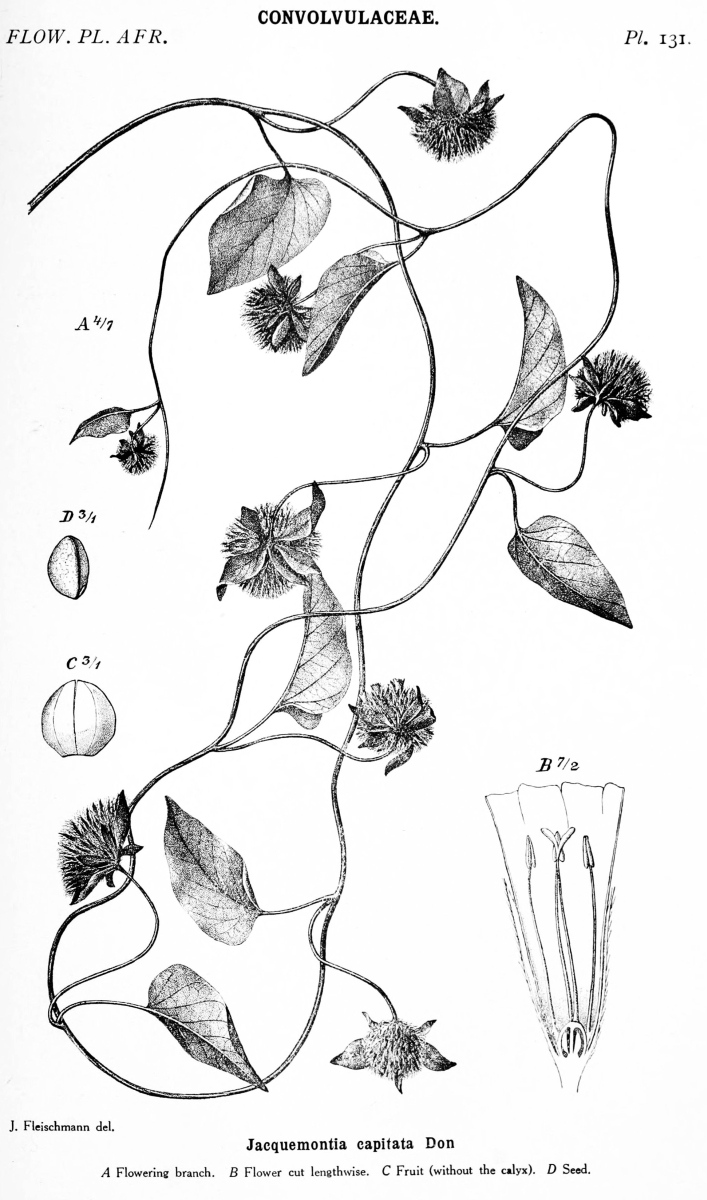
CONVOLVULACEAE.
FLOW. PL. AFR.
Pl. 131.
J. Fleischmann del.
Jacquemontia capitata Don
A Flowering branch. B Flower cut lengthwise. C Fruit (without the calyx). D Seed.
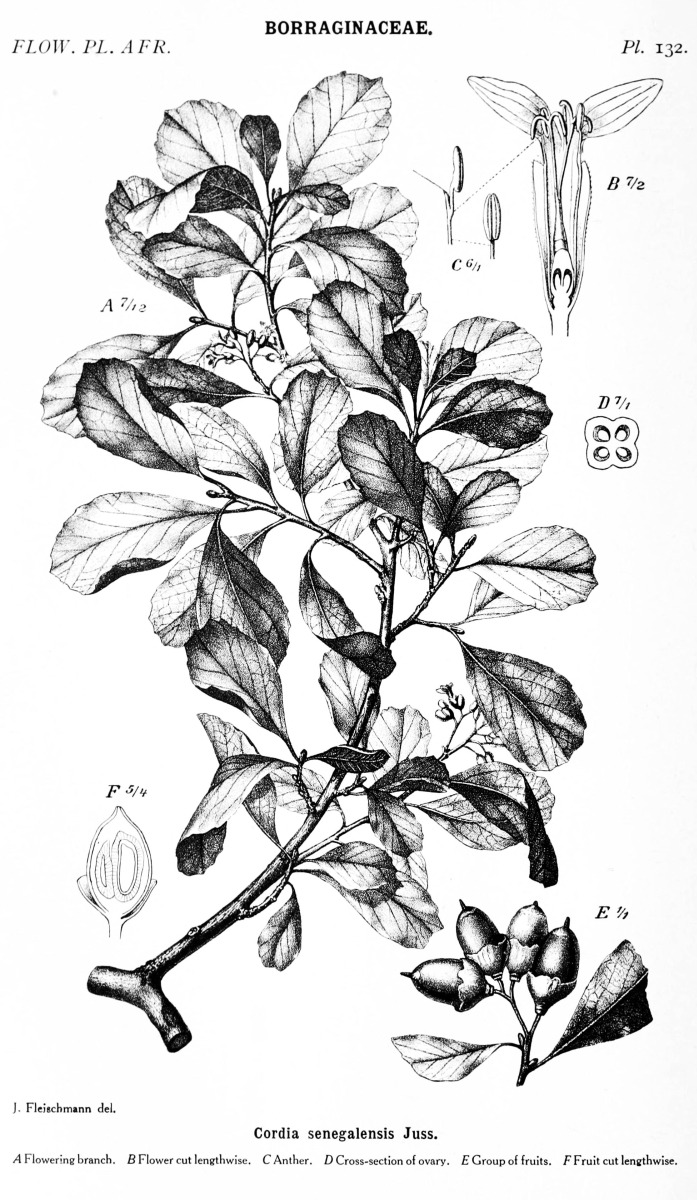
BORRAGINACEAE.
FLOW. PL. AFR.
Pl. 132.
J. Fleischmann del.
Cordia senegalensis Juss.
A Flowering branch. B Flower cut lengthwise. C Anther. D Cross-section of ovary. E Group of fruits. F Fruit cut lengthwise.
FAMILY 204. BORRAGINACEAE
Leaves, at least the upper ones, alternate, undivided, without stipules, usually hairy. Inflorescences usually raceme-or spike-like, cymose, one-sided, and rolled back when young. Flowers 4-7-merous, mostly 5-merous, hermaphrodite. Petals united below, with imbricate or contorted aestivation. Stamens as many as and alternating with the corolla-lobes, inserted on the tube or the throat of the corolla. Anthers opening inwards by longitudinal slits. Disc more or less distinctly developed. Ovary superior, sessile, usually lobed, 4-celled, rarely 2-celled. Ovule 1 in each cell; micropyle superior. Style 1, undivided or 2-4-cleft, rarely (Coldenia) 2 free styles. Fruit a drupe or a schizocarp formed of 2-4 dry and indehiscent nutlets, rarely (Wellstedia) a capsule. Seeds erect or horizontal; testa membranous; albumen scanty or wanting.—Genera 37, species 370. (ASPERIFOLIACEAE.) (Plate 132.)
1. Style inserted at the apex of the ovary. Fruit usually succulent drupe-like and entire. 2 Style inserted between the lobes of the deeply 2-4-lobed or 2-4-parted ovary. Fruit dry, of 2-4 nutlets. Flowers 5-merous. Herbs or undershrubs, rarely shrubs. [Subfamily BORRAGINOIDEAE.] 9 2. Style twice 2-cleft; stigmas 4. Ovary entire. Fruit a drupe with a 1-4-celled stone. Trees or shrubs.—Species 40. Tropical and South Africa and Egypt. They yield timber, fibre, edible fruits, and medicaments. (Plate 132.) [Subfamily CORDIOIDEAE.] Cordia L. Style undivided or 2-cleft, rarely 2 free styles; stigmas 1-2. Fruit a drupe with 2-4 stones or a schizocarp separating into several nutlets, rarely a capsule. 3 3. Style with a stigmatose ring below the entire or 2-cleft apex. [Subfamily HELIOTROPIOIDEAE.] 4 Style without a stigmatose ring below the apex. Ovary entire. 5 4. Fruit more or less fleshy, drupe-like, with 2-4 stones. Seeds with a more or less copious albumen. Shrubs or trees.—Species 7. Tropical and South Africa. Used medicinally. Tournefortia L. Fruit dry, of 2-4 nutlets. Seeds with a scanty albumen. Herbs or undershrubs, rarely shrubs.—Species 60. Some of them are used as vegetables or as ornamental or medicinal plants. (Including Messerschmiedia DC.) Heliotropium L. 5. Ovary 2-celled. Style 2-cleft. Fruit a capsule. Flowers 4-merous. Shrubs.—Species 1. Island of Socotra. Wellstedia Balf. fil. Ovary completely or incompletely 4-celled. Fruit a drupe. [Subfamily EHRETIOIDEAE.] 6 6. Style simple with an entire or lobed stigma. Shrubs. 7 Style 2-cleft or 2 free or almost free styles. 8 7. Anthers globose. Leaves orbicular. Inflorescence dense, spike like.—Species 1. East Africa (Somaliland). Poskea Vatke Anthers oblong. Leaves oblong. Inflorescence loose, corymb-like.—Species 1. West Africa. Rhabdia Mart. 8. Style 1, two-cleft. Shrubs or trees.—Species 30. Tropical and South Africa. Some species yield timber, edible fruits, or medicaments. Ehretia L. Styles 2, free or nearly so. Anthers included. Prostrate herbs. Flowers solitary, axillary.—Species 1. Central Africa. Used medicinally. Coldenia L. 9. (1.) Ovary 2-celled, 2-ovuled. Nutlets 2, adnate to the columnar receptacle by the ventral face.—Species 1. North-west Africa. [Tribe HARPAGONELLEAE.] Rochelia Reichb. Ovary 4-celled, 4-ovuled. 10 10. Flowers more or less irregular. Corolla funnel-shaped, with an oblique limb and more or less unequal lobes. Stamens usually unequal in length. [Tribe ECHIEAE.] 11 Flowers regular. 14 11. Calyx-segments 5, distinctly unequal, or 4. Stamens concealed in the tube of the corolla. Low shrubs or undershrubs. 12 Calyx-segments 5, equal or subequal. Stamens protruding beyond the corolla. Nutlets seated upon a flat receptacle. 13 12. Calyx-segments 5, one of which is very small, or 4. Corolla 2-lipped. Nutlets laterally attached to the conical receptacle. Stems and leaves clothed with white bristles.—Species 1. North Africa to Nubia. Echiochilon Desf. Calyx-segments 5, one or two of them smaller than the others. Corolla almost regular. Nutlets seated upon the flat receptacle.—Species 3. Central Africa. (Under Lobostemon Lehm.) Leurocline S. Moore 13. Style entire with an entire or shortly lobed stigma. Filaments usually with a hairy scale at the base. Corolla almost regular.—Species 50. South Africa. Lobostemon Lehm. Style 2-cleft at the apex. Filaments without a scale at the base.—Species 45. North Africa and northern Central Africa, one species also naturalized in South Africa. Some of them are used as ornamental, medicinal, or dye-plants. “Bugloss.” Echium L. 14. (10.) Nutlets inserted on a flat or very slightly convex receptacle (gynobase). 15 Nutlets inserted on an elevated, more or less conical or columnar receptacle (gynobase). 26 15. Surface of attachment of the nutlets flat or slightly convex, rarely somewhat concave and then small. [Tribe LITHOSPERMEAE.] 16 Surface of attachment of the nutlets concave and large, usually with a prominent ring-like margin. [Tribe ANCHUSEAE.] 22 16. Ovary 2-lobed. Nutlets 2, two-celled. Glabrous or papillose plants. Corolla yellow. Anthers acuminate.—Species 3. North-west Africa. Used as ornamental or medicinal plants. Cerinthe L. Ovary 4-lobed. Nutlets 1-4, one-celled. 17 17. Corolla with contorted aestivation, blue red or white. Inflorescence with bracts at the base or without bracts.—Species 15. North and South Africa and mountains of Central Africa. Used as ornamental or medicinal plants. “Forget-me-not.” Myosotis L. Corolla with quincuncially imbricate aestivation. 18 18. Anthers ending in a long point. Stigma entire. 19 Anthers blunt or shortly pointed. 20 19. Anthers oblong, with a very long point. Filaments with a pouch-shaped appendage at the back. Corolla-lobes long.—Species 1. Island of Socotra. Cystistemon Balf. fil. Anthers linear-sagittate. Filaments without an appendage at the back. Corolla-lobes very short. Corolla yellow, white, or red.—Species 4. North Africa. Used as ornamental, medicinal, and dye-plants. (Including Podonosma Guerke) Onosma L. 20. Corolla-tube with a glandular ring at the base. Corolla yellow or violet. Style 2-4-cleft.—Species 5. North Africa and northern Central Africa. Some species are used as ornamental or dye-plants. Arnebia Forsk. Corolla-tube without a glandular ring. 21 21. Corolla with long and dense hairs, but without scales at the throat. Filaments as long as the anthers. Stigma 1, almost entire. Low shrubs or undershrubs.—Species 2. East Africa (Somaliland). Sericostoma Stocks Corolla with hollow scales, folds, or thin hairs at the throat. Stigmas 2, more or less distinct.—Species 15. South, North, and East Africa. Used for dyeing and in medicine. “Gromwell.” Lithospermum L. 22. (15.) Calyx shortly lobed or cleft half-way down, enlarged in the fruit. Corolla-tube cylindrical, with scales on the inside. Style simple with a 2-parted stigma, or 2-cleft.—Species 5. North Africa. Nonnea Medik. Calyx deeply divided. Stigma usually entire. 23 23. Corolla rotate; tube short, bearing hollow scales on the inner face. Filaments appendaged on the back.—Species 2. North Africa. They are used as pot-herbs or as ornamental or medicinal plants. “Borage.” Borrago L. Corolla more or less tubular. Filaments unappendaged on the back. 24 24. Corolla without hollow scales at the throat, but sometimes with small scales in the lower part of the tube.—Species 2. North Africa. They yield a dye and medicaments. Alkanna Tausch. Corolla with hollow scales at the throat. 25 25. Corolla with long narrow scales at the throat; lobes very short.—Species 2. Naturalized in North Africa. They serve as vegetables or as medicinal or dye-plants. “Comfrey.” Symphytum L. Corolla with short scales at the throat.—Species 15. North Africa to Abyssinia and South Africa. Some species serve as vegetables or as ornamental or medicinal plants. “Alkanet.” (Including Stomotechium Lehm.) Anchusa L. 26. (14.) Tips of the nutlets considerably projecting above their surface of attachment. [Tribe ERITRICHIEAE.] 27 Tips of the nutlets scarcely or not projecting above their surface of attachment. [Tribe CYNOGLOSSEAE.] 31 27. Surface of attachment of the nutlets at least half as large as their ventral surface. 28 Surface of attachment of the nutlets occupying less than half their ventral surface. Prostrate herbs. 29 28. Nutlets beset with hooked bristles, usually margined.—Species 7. North and South Africa. Some are used medicinally. (Echinospermum Swartz) Lappula Moench Nutlets without hooked bristles, not margined.—Species 1. North-west Africa. (Megastoma Coss. et Durieu) Eritrichium Schrad. 29. Surface of attachment of the nutlets not margined; nutlets keeled on the back. Calyx much enlarged in fruit.—Species 1. North-west Africa. Used for dyeing and in medicine. Asperugo L. Surface of attachment of the nutlets surrounded by a prominent margin. Calyx slightly enlarged in fruit. 30 30. Surface of attachment of the nutlets shallow-concave, with a slightly projecting margin.—Species 1. Naturalized in the Mascarene Islands. Bothriospermum Bunge Surface of attachment of the nutlets deep-concave, with a toothed margin.—Species 1. Egypt. Gastrocotyle Bunge 31. (26.) Nutlets attached to the receptacle towards their apex, saccate at the base. Calyx slightly enlarged in the fruit. 32 Nutlets attached to the receptacle by almost their whole inner surface. 34 32. Corolla-segments erect, blue or red. Anthers projecting beyond the corolla-tube. Stigma capitate. Inflorescence compact.—Species 2. North Africa. Solenanthus Ledeb. Corolla-segments spreading; tube short. Anthers concealed within the corolla-tube. 33 33. Nutlets distinctly concave on the back, with an inflexed margin. Corolla white or blue, with a very short tube.—Species 1. Naturalized in North Africa. An ornamental plant, also used in medicine. Omphalodes Moench Nutlets nearly flat on the back. Stigma broadened.—Species 20. Some of them are poisonous or used medicinally. “Houndstongue.” Cynoglossum L. 34. Calyx much enlarged after flowering, enclosing the fruit. Corolla without distinct scales within. Anthers prolonged at the apex into a long, usually twisted appendage. Inflorescence bracteate. Lower leaves opposite.—Species 20. Tropical and South Africa, Sahara, and Egypt. Some are used medicinally. (Borraginoides Boerh., Pollichia Medik.) Trichodesma R. Br. Calyx not or slightly enlarged after flowering. Corolla with scales inside. Anthers unappendaged. Leaves alternate. 35 35. Corolla wheel-shaped, with 10 scales or swellings at the base of the tube, white or yellowish. Anthers short, blunt, projecting beyond the corolla-tube. Nutlets 1-3.—Species 1. South Africa. Tysonia Bolus Corolla funnel-shaped, without scales or swellings at the base of the tube. 36 36. Anthers projecting beyond the corolla-tube, oblong or linear. Style long. Corolla yellowish-red. Nutlets smooth, with an entire margin.—Species 1. North-west Africa. (Mattia Schult.). Rindera Pall. Anthers concealed within the corolla-tube. Style short. Corolla blue or violet.—Species 3. Egypt. Paracaryum Boiss.
SUBORDER VERBENINEAE
FAMILY 205. VERBENACEAE
Leaves opposite or whorled, very rarely alternate, simple or compound with 1-7 leaflets, without stipules. Flowers nearly always more or less irregular, hermaphrodite or polygamous. Sepals more or less united below. Petals 4-8, usually 5, united below, imbricate in bud, the foremost inside. Stamens 4, usually in two pairs of unequal length, alternating with the corolla-lobes, rarely 2 or (Tectona) 5-6. Filaments free. Anthers opening inwards by two longitudinal slits. Disc more or less distinctly developed. Ovary superior, sessile, entire or slightly lobed, completely or incompletely 2-or 4-celled, rarely (Duranta) 8-celled, sometimes only 1 cell fertile. Ovules solitary in each complete or incomplete cell; micropyle turned downwards. Style terminal or nearly so, simple or 2-4-cleft. Seeds with straight embryo.—Genera 27, species 340. (Plate 133.)
1. Flowers in racemose (centripetal) spikes racemes or heads. Ovules basal, inverted. 2 Flowers in cymose inflorescences or solitary. Ovules attached laterally or at the apex, straight or half-inverted. 15 2. Seeds albuminous. Fruit dry. Ovary 2-celled; one cell sometimes rudimentary. Stamens 4. Leaves whorled, densely crowded, linear. Low shrubs. [Subfamily STILBOIDEAE.]. 3 Seeds exalbuminous. Leaves usually opposite. [Subfamily VERBENOIDEAE.] 7 3. Corolla two-lipped, 5-lobed. 4 Corolla regular or nearly so. 5 4. Calyx slightly two-lipped. Upper lip of the corolla flat. Anther-halves parallel, free. Leaves in whorls of three.—Species 1. South Africa. Xeroplana Briq. Calyx regular. Upper lip of the corolla slightly convex. Anther-halves divergent below, confluent at the apex. Leaves in whorls of four.—Species 1. South Africa (Cape Colony). Eurylobium Hochst. 5. Calyx two-lipped. Anther-halves divergent below, confluent at the apex. Stigma entire. Corolla 5-lobed.—Species 1. South Africa (Cape Colony). Euthystachys A. DC. Calyx regular or nearly so. Anther-halves parallel. 6 6. Corolla 4-lobed, with a wide tube. Calyx 5-parted. Stigma 2-lobed. Fruit dehiscing by 4 valves.—Species 1. South Africa. Campylostachys Kunth Corolla 5-lobed, with a narrow tube. Fruit indehiscent.—Species 5. South Africa. Stilbe Berg 7. Flowers in racemes. Corolla unequally 5-lobed. Stamens 4. Fruit fleshy. Shrubs. [Tribe CITHAREXYLEAE.] 8 Flowers in spikes or heads. Stamens 4 with more or less parallel anther-halves, or 2. Ovary 2- or 4-celled. 9 8. Racemes few-flowered. Anther-halves divergent. Ovary 4-celled. Style-apex 2-cleft. Fruit with 2 stones.—Species 2. Islands of Madagascar and Socotra. Coelocarpus Balf. fil. Racemes many-flowered. Anther-halves parallel. Ovary 8-celled. Style-apex 4-cleft. Fruit with 4 stones.—Species 1. Naturalized in various regions. An ornamental and hedge-plant with edible fruits. Duranta L. 9. Ovary 2-celled. Ovules 2. Fruit two-celled or separating into 2 one-celled mericarps. Seeds 2, very rarely 1. [Tribe LANTANEAE.] 10 Ovary 4-celled. Ovules 4. Fruit separating into 2 usually two-celled, or into 4 one-celled mericarps. Seeds 4, very rarely 2. Calyx 5-toothed. Corolla unequally 5-lobed. Stamens 4. Herbs or undershrubs. 14 10. Perfect stamens 2. Anther-halves spreading horizontally. Calyx 5-ribbed and 5-toothed. 11 Perfect stamens 4. Anther-halves parallel. 12 11. Ovary and fruit with an anticous and a posticous cell or stone. Corolla 2-lipped. Shrubs.—Species 1. Cape Verde Islands. Ubochea Baill. Ovary and fruit with two lateral cells or stones.—Species 6, one of them only naturalized. Tropics. Used as ornamental or medicinal plants. (Valerianodes Medik.) Stachytarpheta Vahl 12. Calyx long, tubular, 5-ribbed, 5-toothed. Corolla 5-lobed. Fruit dry. Herbs or undershrubs.—Species 20. South and Central Africa. Bouchea Cham. Calyx short, 2-4-ribbed or without ribs. Corolla unequally 4-5-lobed. 13 13. Calyx 2-4-lobed, two-ribbed. Corolla 4-lobed. Fruit dry.—Species 17. Some are used as ornamental or medicinal plants; one of them (L. citriodora Kunth) yields also an aromatic oil and serves as a substitute for tea. (Including Zapania Scop.) Lippia L. Calyx entire or toothed. Fruit fleshy.—Species 10, 7 natives of Central and South Africa, 3 naturalized there and on the Canary Islands. Some of them are used as ornamental or medicinal plants. Lantana L. 14. Fruit separating into 2 usually two-celled mericarps, enveloped by the enlarged and more or less inflated calyx.—Species 1. East and South Africa. [Tribe PRIVEAE.] Priva Adans. Fruit separating into 4 one-celled mericarps, surrounded by the not or scarcely enlarged calyx.—Species 4, two of them natives of North and East Africa and naturalized in other regions, the others naturalized in various countries. They are used as ornamental and medicinal plants and for preparing an aromatic oil. “Vervain.” [Tribe EUVERBENEAE.] Verbena L. 5. (1.) Ovules pendulous from the top of a free, central, 4-winged placenta, straight. Calyx 5-parted. Corolla white or yellow, nearly equally 4-cleft. Stamens 4. Anthers exserted. Fruit dehiscing by 2 valves, one-seeded. Shrubs or trees.—Species 2. Shores of tropical and South-east Africa and Egypt. They yield timber, tanning material, and medicaments. [Subfamily AVICENNIOIDEAE.] Avicennia L. Ovules parietal or axile, laterally attached, half-inverted. Fruit dehiscing by 4 valves or indehiscent, usually separating into mericarps. 16 16. Fruit a 4-valved capsule. Ovary incompletely 4-celled. Style divided into 2 awl-shaped branches. Stamens 4. Anther-halves spreading horizontally. Shrubs or trees. Leaves with 7 leaflets.—Species 1. Madagascar. [Subfamily CARYOPTERIDOIDEAE.] Varangevillea Baill. Fruit a drupe, a nut, or a schizocarp, indehiscent or separating into mericarps. 17 17. Ovary completely or incompletely 2-celled. Ovules 2. Stamens 4. Anther-halves parallel, with an appendage at the base. Calyx 10-ribbed, 5-toothed. Fruit 1-2-celled, indehiscent, 1-2-seeded. Seeds albuminous. Herbs. Flowers solitary or in false spikes. [Subfamily CHLOANTHOIDEAE, tribe ACHARITEAE.] 18 Ovary completely or incompletely 4-celled. Ovules 4. Fruit 2-4-celled or separating into 2-4 mericarps. Seeds exalbuminous. Shrubs or trees. [Subfamily VITICOIDEAE.] 19 18. Calyx distinctly enlarged in the fruit. Corolla 4-lobed; tube included. Anthers included. Stigma entire. Fruit with a thin rind, 1-celled or unequally 2-celled. Flowers in false spikes, 1-3 in each bract.—Species 2. Madagascar. Acharitea Benth. Calyx scarcely or not enlarged in the fruit. Corolla 5-lobed; tube exserted. Anthers slightly exserted. Fruit with a somewhat fleshy rind, incompletely 2-celled. Flowers solitary or in clusters of 2-5 in the axils of the leaves.—Species 1. Island of Rodrigues. Nesogenes A. DC. 19. Flowers regular. Stamens 4-6, equal. Fruit a drupe. Leaves undivided. 20 Flowers more or less irregular. Stamens 4, in two pairs of unequal length. 21 20. Flowers 4-merous. Calyx shortly toothed, unchanged in fruit. Stamens inserted on the upper part of the corolla-tube. Fruit with 3-4 stones. Shrubs. Leaves toothed. Cymes axillary.—Species 1. Island of Réunion. [Tribe CALLICARPEAE.] Callicarpa L. Flowers 5-6-merous. Calyx cleft halfway down, inflated in fruit. Stamens inserted on the lower part of the corolla-tube. Fruit with a 4-celled stone. Tall trees. Leaves entire. Cymes arranged in a terminal panicle.—Species 1 (T. grandis L., teak). Cultivated in the tropics. Yields valuable timber, tanning bark, oil, and medicaments. [Tribe TECTONEAE.] Tectona L.f. 21. Flowers solitary, axillary. Leaves undivided. 22 Flowers in cymes or inflorescences composed of cymes. Style-apex or stigma 2-cleft. 23 22. Calyx 2-parted. Anthers included. Stigma entire.—Species 2. East Africa. (Under Holmskioldia Retz) Cyclocheilon Oliv. Calyx 5-cleft. Anthers exserted. Stigma 2-parted. Pedicels partly transformed into spines.—Species 1. Central and South Africa. (Under Clerodendron L.) Kalaharia Baill. 23. Fruit with 2 two-celled or 4 one-celled stones. Anthers exserted. Corolla 5-lobed. Leaves undivided or lobed. [Tribe CLERODENDREAE.] 24 Fruit with a single, 2-4-celled stone. [Tribe VITICEAE.] 25 24. Calyx rotate; tube very short, enclosing the fruit; limb spreading, entire or obscurely lobed, coloured, much enlarged in fruit. Corolla with a curved tube and an oblique limb.—Species 4. East Africa and Madagascar. Used as ornamental plants. (Under Clerodendron L. or Cyclonema Hochst.) Holmskioldia Retz Calyx campanulate or tubular, not much enlarged in fruit.—Species 130. Tropical and South Africa and Egypt. Some species are used as ornamental or medicinal plants. (Including Cyclonema Hochst. and Siphonantha L.) (Plate 133.) Clerodendron L. 25. Corolla 4-lobed, small, white blue or greenish. Leaves undivided.—Species 20. Tropics. Some of them yield timber, condiments, or medicaments. Premna L. Corolla 5-lobed. Calyx 5-toothed or 5-cleft. 26 26. Seeds with a membranous border. Fruit incompletely septate. Leaves undivided.—Species 1. Madagascar. Adelosa Baill. Seeds without a membranous border. Fruit completely septate. Leaves usually compound with 3-7 leaflets.—Species 100. Some of them yield timber, vegetables, edible fruits, or medicaments. Vitex L.
FAMILY 206. LABIATAE
Stem usually 4-angled. Branches and leaves opposite or whorled, very rarely alternate. Leaves simple, without stipules. Flowers in cymose false-whorls, usually more or less irregular. Calyx with open aestivation. Corolla more or less distinctly two-lipped and 2-6-lobed, more rarely regularly 4-cleft, imbricate in bud, the foremost lobe inside. Stamens 4, usually in two pairs of unequal length, or 2, inserted on the corolla. Filaments usually free. Anthers opening inwards by slits. Disc present. Ovary superior, 4-lobed or 4-parted, 4-celled. Ovules solitary in each cell, basal, inverted, rarely lateral and half-inverted
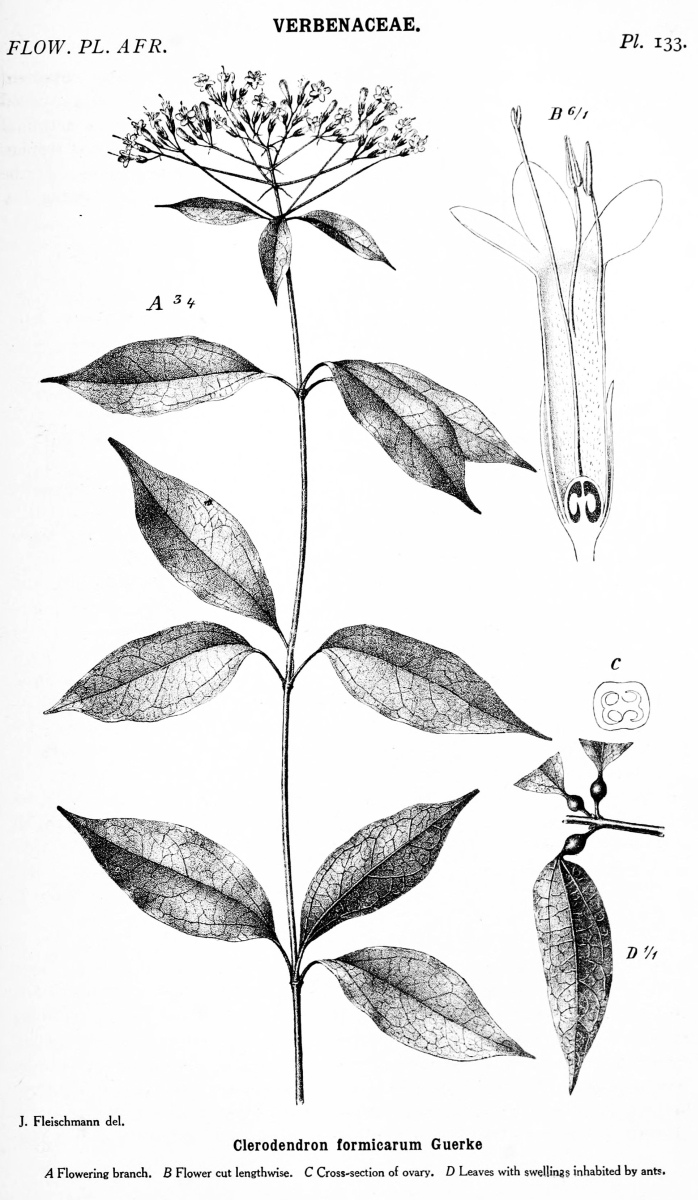
VERBENACEAE.
FLOW. PL. AFR.
Pl. 133.
J. Fleischmann del.
Clerodendron formicarum Guerke
A Flowering branch. B Flower cut lengthwise. C Cross-section of ovary. D Leaves with swellings inhabited by ants.
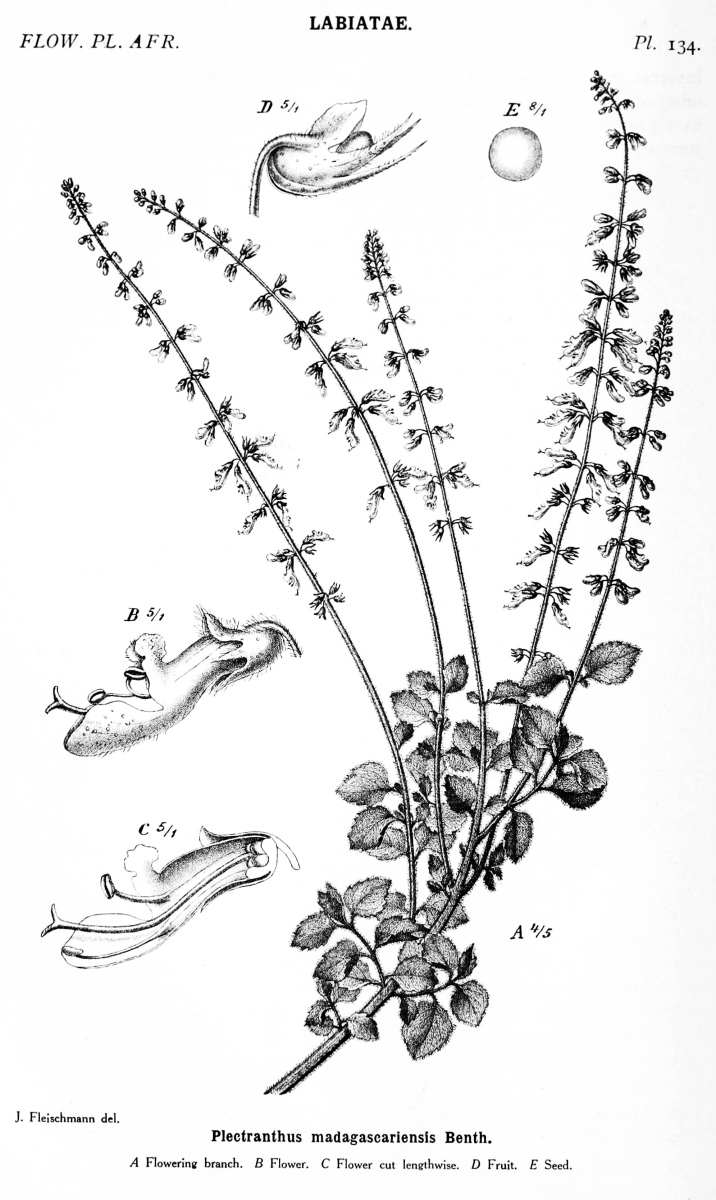
LABIATAE.
FLOW. PL. AFR.
Pl. 134.
J. Fleischmann del.
Plectranthus madagascariensis Benth.
A Flowering branch. B Flower. C Flower cut lengthwise. D Fruit. E Seed.
or curved; micropyle turned downwards. Style inserted between the lobes of the ovary, simple or 2-cleft, rarely (Cleonia) 4-cleft. Fruit separating into 4 nutlets, rarely (Prasium) drupe-like. Seeds without albumen or with a very scanty albumen.—Genera 70, species 1200. (Plate 134.)
1. Nutlets with a large, lateral surface of attachment. Ovary slightly lobed, rarely to the middle; style more or less terminal. Stamens ascending. Corolla 2-lipped, with a 3-lobed lower lip, or 1-lipped. [Subfamily AJUGOIDEAE.] 2 Nutlets with a small, basal or subbasal surface of attachment. Ovary deeply lobed or divided; style springing from between the lobes. 5 2. Nutlets smooth. Ovary deeply lobed; style springing from between the lobes. Disc equal-sided. Stamens 2. Anthers 1-celled. Calyx 2-lipped, 11-nerved. Corolla blue or white, 2-lipped; tube glabrous within; lower lip with a strongly concave middle lobe. Shrubs. Leaves linear.—Species 1. North Africa and Cape Verde Islands. Yields an aromatic oil which is also used medicinally, and serves as an ornamental plant. “Rosemary.” [Tribe ROSMARINEAE.] Rosmarinus L. Nutlets wrinkled. Ovary slightly lobed; style terminal. Stamens 4. Anthers 2-celled; cells divergent or divaricate, sometimes confluent at the top. [Tribe AJUGEAE.] 3 3. Calyx 2-lipped, with entire lips, inflated in fruit. Corolla red or violet, 2-lipped, with a short erect upper lip. Nutlets oblong, furnished with a large shield-shaped wing on the back. Leaves entire.—Species 20. Central Africa to Transvaal. Some are used medicinally. Tinnea Peyr. & Kotschy Calyx equally or somewhat unequally 5-toothed. Nutlets rounded on the back, wingless. 4 4. Corolla 1-lipped, all its lobes being placed below the stamens.—Species 35. North, East, and South Africa. Some species are used as ornamental or medicinal plants. “Germander.” Teucrium L. Corolla 2-lipped, with a short upper lip.—Species 9. North Africa, northern Central Africa, Madagascar, and South Africa. Some species are used as ornamental or medicinal plants. “Bugle.” Ajuga L. 5. Nutlets drupe-like, with a fleshy mesocarp and a crustaceous endocarp. Calyx subequally 5-cleft. Corolla white or pink, 2-lipped; upper lip entire, lower 3-cleft; tube included, hairy within. Stamens 4, ascending. Style-branches subequal. Shrubs. False whorls two-flowered.—Species 1. North Africa. [Subfamily PRASIOIDEAE.] Prasium L. Nutlets dry, but the fruiting calyx sometimes succulent, berry-like. 6 6. Seeds more or less horizontal; radicle curved. Nutlets more or less depressed-globose. Calyx 2-lipped; lips entire, one of them bearing on its back a scale-like appendage and falling after flowering. Corolla 2-lipped; lower lip usually entire; tube exserted. Stamens 4, usually ascending, the anticous with 1-celled, the posticous with 2-celled anthers. Disc prolonged into a stalk-like gynobase. Style-branches unequal.—Species 10. Tropical and North Africa. Some are used as ornamental or medicinal plants. “Skull-cap.” [Subfamily SCUTELLARIOIDEAE.] Scutellaria L. Seeds erect; radicle straight. Calyx persistent in the fruit. Disc not prolonged into a stalk. 7 7. Disc divided into lobes placed opposite to the ovary-lobes. Calyx 13-15-nerved. Corolla blue or violet; upper lip 2-cleft, lower 3-parted. Stamens 4, included, more or less bent downwards. Anther-halves confluent at the apex. Stigmas flattened. Nutlets with a dorsal-subbasal point of attachment.—Species 15. North Africa and northern Central Africa. Some of them yield an essential oil used in the preparation of perfumes, varnishes, and medicaments, or serve as ornamental or medicinal plants, or for keeping off insects. “Lavender.” [Subfamily LAVANDULOIDEAE.] Lavandula L. Disc entire or divided into lobes alternating with the ovary-lobes. Nutlets with a basal or a ventral-subbasal point of attachment. 8 8. Stamens descending upon the lower lip or the lower part of the corolla, or lying upon it. Anther-halves spreading, confluent at the apex. Corolla distinctly, rarely obscurely 2-lipped; lower lip nearly always entire. [Subfamily OCIMOIDEAE, tribe OCIMEAE.] 9 Stamens ascending or projecting straight forwards. Corolla 2-lipped with a 3-lobed lower lip, or subequally 4-cleft. [Subfamily STACHYOIDEAE] 34 9. Lower lip of the corolla entire, flat or slightly concave, somewhat exceeding the upper one; upper lip 3-4-lobed or -cleft. Stamens 4. [Subtribe MOSCHOSMINAE.] 10 Lower lip of the corolla or its middle lobe strongly concave: saucer-, pouch-, or boat-shaped. 20 10. Corolla included in the calyx, globose, with short, connivent lobes. Anthers sessile. Style included, entire. Calyx 2-lipped, the upper lip with decurrent margins, much enlarged in the fruit. Shrubs. False whorls 6-flowered, spicately arranged.—Species 2. East Africa (Somaliland). Hyperaspis Briq. Corolla not included and globose. Anthers on distinctly developed filaments. 11 11. Corolla obscurely two-lipped, 4-lobed, very small. Anthers concealed within the corolla-tube.—Species 1. Central and South-east Africa. (Under Ocimum L.) Endostemon N. E. Brown Corolla distinctly two-lipped, rarely obscurely two-lipped but 5-lobed. Anthers projecting beyond the corolla-tube. 12 12. Calyx two-lipped; margins of the upper lip decurrent along the tube. Inflorescence spike- or raceme-like. 13 Calyx two-lipped, but the margins of the upper lip not decurrent, or subequally 5-toothed. 16 13. Style-apex entire or obscurely notched. Filaments free, unappendaged. Corolla-tube projecting beyond the calyx. 14 Style-apex two-cleft or distinctly notched. 15 14. Upper lip of the calyx much enlarged and wrapped round the other teeth in the fruit. Corolla-tube slightly projecting. Disc almost equal-sided. Shrubs.—Species 3. East Africa. Erythrochlamys Guerke Upper lip of the calyx not more enlarged in the fruit than the rest. Disc one-sided.—Species 75. Tropical and South Africa. Some are used as ornamental plants. Orthosiphon Benth. 15. Filaments of the lower pair of stamens united halfway up, all unappendaged.—Species 9. Central and South Africa. (Under Ocimum L. or Orthosiphon Benth.) Hemizygia Briq. Filaments free or the lower ones shortly united at the base; the upper ones usually kneed, toothed, or crested near the base.—Species 75. Tropical and South Africa. Several species (especially O. Basilicum L., sweet basil) are used as pot-herbs, as medicinal or ornamental plants, as a substitute for tea, and for preparing an essential oil. (Including Becium Lindl.) Ocimum L. 16. Style-apex entire or nearly so. Filaments of the lower pair of stamens united nearly to the top. Corolla-tube exserted. Fruiting calyx subequally 5-toothed. Shrubs. False whorls 2-6-flowered, spicately arranged. Flowers medium-sized.—Species 7. South Africa. Syncolostemon E. Mey. Style-apex two-cleft. Filaments free. Herbs or undershrubs. False whorls 6-many-flowered and spicately arranged, or collected in heads. Flowers small. 17 17. False whorls arranged in dense heads. Calyx ovate-campanulate at the time of flowering; fruiting calyx tubular, two-lipped, without transverse ribs at the base.—Species 50. Tropical and South-east Africa. Acrocephalus Benth. False whorls arranged in spikes. Fruiting calyx ovate-campanulate, more rarely tubular, but then with transverse ribs at the base. 18 18. Fruiting calyx ovate-campanulate with a shortly 3-toothed upper lip and an entire lower lip. False whorls 6-10-flowered.—Species 2. Central Africa. Platostoma Beauv. Fruiting calyx with a 2-4-toothed lower lip or subequally 5-toothed. 19 19. Fruiting calyx tubular, usually transversely ribbed at the base. False whorls many-flowered.—Species 15. Tropical and South-east Africa. Geniosporum Wall. Fruiting calyx ovate-campanulate.—Species 12. Tropical and South-east Africa. (Basilicum Moench, including Iboza N. E. Brown). Moschosma Reichb. 20. (9.) Lower lip of the corolla abruptly bent downwards, short, saccate, narrowed at the base. Stamens 4. Herbs.—Species 6, two of them only naturalized. Tropical and South-east Africa. Used medicinally; the seeds of one species yield oil. (Maesosphaerum P. Br.) [Subtribe HYPTIDINAE.] Hyptis Jacq. Lower lip of the corolla not abruptly bent downwards, entire, exceeding the upper lip. Upper lip 3-4-lobed or entire. [Subtribe PLECTRANTHINAE.] 21 21. Fertile stamens 2. Corolla whitish or violet. Fruiting calyx berry-like. Shrubs. False whorls 2-4-flowered.—Species 1. Tropical and South-east Africa. The fruits are edible. Hoslundia Vahl Fertile stamens 4. Fruiting calyx dry. 22 22. Filaments free. 23 Filaments united at the base into a closed tube or a sheath split behind. 27 23. Fruiting calyx bursting by a circular slit near the base.—Species 50. Central and South Africa. Some species are used as ornamental plants. (Including Icomum Hua). Aeolanthus Mart. Fruiting calyx not bursting by a circular slit near the base. 24 24. Fruiting calyx tubular-elongate and curved or coiled, expanded at the base, constricted at the middle, subequally 5-toothed. Disc one-sided. Herbs or undershrubs.—Species 3. Madagascar and South Africa. (Under Plectranthus L’Hér.) Burnatastrum Briq. Fruiting calyx not tubular-elongate and curved. 25 25. Fruiting calyx bladdery-inflated, membranous, net-veined. Corolla pink; upper lip almost entire. Disc equal-sided. False whorls many-flowered, arranged in racemes. Shrubs.—Species 1. Central Africa. Alvesia Welw. Fruiting calyx not inflated. 26 26. Fruiting calyx with 5 subequal, subulate, rigid, almost spinous teeth. Disc almost equal-sided. Corolla blue or violet. False whorls arranged in spikes. Herbs.—Species 40. Tropical and South-east Africa. Pycnostachys Hook. Fruiting calyx with subequal but not rigid-subulate teeth, or two-lipped. Disc one-sided.—Species 160. Tropical and South Africa. Some species have edible tubers or serve as ornamental or medicinal plants or for keeping off insects. (Including Germanea Lam. and Symphostemon Welw.) (Plate 134.) Plectranthus L’Hér. 27. Staminal tube slit open behind. Herbs or undershrubs. 28 Staminal tube closed. 31 28. Calyx-lobes orbicular, much enlarged in the fruit, membranous, net-veined. Corolla-tube abruptly bent downwards; upper lip entire. Disc almost equal-sided. Style-apex 2-cleft. Stem ascending. Leaves fleshy. False whorls 6-flowered, aggregated in panicled racemes.—Species 1. East Africa. Capitanya Schweinf. Calyx-lobes ovate or oblong, slightly enlarged in the fruit. Upper lip of the corolla 4-toothed or 4-lobed. Stem erect. False whorls in lax racemes. 29 29. Calyx distinctly 2-lipped. Corolla-tube abruptly bent downwards. Disc one-sided. Style-apex 2-cleft. False whorls of 6 or more flowers.—Species 5. Central Africa. (Under Plectranthus L’Hér.) Solenostemon Schum. & Thonn. Calyx subequally 5-toothed. Corolla-tube straight or slightly curved. 30 30. Corolla-tube curved, gibbous at the base. Disc nearly equal-sided. Style-apex notched. Leaves alternate, sometimes almost opposite or whorled. False whorls in terminal racemes. (See 26.) Plectranthus L’Hér. Corolla-tube straight, not gibbous at the base. Disc one-sided. Style-apex two-cleft. Leaves opposite. False whorls 1-2-flowered, in axillary racemes.—Species 2. Central Africa. Englerastrum Briq. 31. Calyx with an ovate, not much prolonged upper lip and narrower, acuminate lower teeth, little changed in fruit.—Species 110. Tropical and South Africa. Some have edible tubers or serve as ornamental or medicinal plants. Coleus Lour. Calyx with a much prolonged upper lip. Herbs or undershrubs. 32 32. Filaments shortly united at the base. Fruiting calyx not bursting; lower teeth suborbicular. Leaves oblong-lanceolate. Inflorescence dense, paniculate.—Species 1. West Africa. Anisochilus Wall. Filaments united halfway up. Lower calyx-teeth acute. Leaves cordate at the base. 33 33. Inflorescence lax, panicle- or corymb-like. Leaves ovate. Fruiting calyx much enlarged, ventricose, bursting at the base.—Species 3. West Africa. Neomuellera Briq. Inflorescence dense, raceme-like. Leaves oblong-lyrate. Calyx-teeth narrow.—Species 1. West Africa. Leocus A. Chev. 34. (8.) Anther-halves linear, usually separated by an enlarged connective. Stamens usually 2. 35 Anther-halves oblong, ovate, or globose. Stamens usually 4. 37 35. Fertile stamens 4, the lower pair longer. Anthers with a very small connective and separate halves divergent below. Corolla obscurely 2-lipped; tube slightly exserted, hairy at the base within. Calyx 13-15-nerved, with 5 subequal acuminate teeth. Shrubs. False whorls few-flowered.—Species 1. Naturalized in the Island of Réunion. (Mahya Cordem.) [Tribe HORMINEAE.] Sphacele Benth. Fertile stamens 2, with a lengthened connective. Calyx 2-lipped. 36 36. Anthers with both halves fertile, parallel, and attached to a short connective. Disc equal-sided. Corolla almost regular, 4-lobed. Shrubs. False whorls many-flowered.—Species 1. Abyssinia. Yields condiments and medicaments. [Tribe MERIANDREAE.] Meriandra Benth. Anthers with one half only fertile and attached to one branch of the long connective, the other half abortive or wanting. Disc more or less one-sided. Corolla 2-lipped.—Species 80. Some of them yield condiments, medicaments, and a substitute for tea, or serve as ornamental plants. “Sage.” [Tribe SALVIEAE.] Salvia L. 37. Anther-halves globose or ovate, spreading horizontally and usually confluent at the apex, flat after opening. Stamens 4. Calyx subequally 5-toothed. [Tribe POGOSTEMONEAE.] 38 Anther-halves oblong or ovate, not flat after opening. 40 38. Filaments unequal, the lower pair longer, glabrous. Anther-halves tardily confluent. Disc one-sided. Corolla slightly 2-lipped, the upper lip somewhat concave and notched, the lower 3-lobed. Herbs or undershrubs. False whorls many-flowered.—Species 3. East Africa. Elsholtzia Willd. Filaments equal. Anther-halves confluent at an early stage. Disc almost equal-sided. Corolla subequally 4-5-lobed. 39 39. Filaments bearded. Disc columnar, truncate. Calyx-teeth equal. Corolla-lobes 4. Herbs.—Species 1. Southern East Africa. Pogostemon Desf. Filaments glabrous. Disc with 4 glands. Calyx-teeth unequal. Corolla-lobes 5. Shrubs or trees. False whorls 6-10-flowered, in paniculately arranged spikes.—Species 3. Madagascar. Tetradenia Benth. 40. Stamens 4, the upper (posticous) pair longer than the lower, all parallel and ascending under the upper lip of the corolla. Calyx 13-15~nerved, subequally 5-toothed. Herbs. [Tribe NEPETEAE.] 41 Stamens 4, the lower longer than the upper, or all equal, or only 2 present. 42 41. Anther-halves parallel or nearly so. Disc almost equal-sided. Corolla white, with a much projecting tube. Leaves 3-partite.—Species 1. Madeira and Canary Islands; naturalized in South Africa. Used as an ornamental plant. Cedronella Moench Anther-halves spreading.—Species 15. North and Central Africa. Some are used as ornamental or medicinal plants. Nepeta L. 42. Stamens and styles enclosed in the corolla-tube. Stamens 4, in two unequal pairs, the lower sometimes with rudimentary anthers. Anther-halves spreading. Style-apex entire or shortly and obtusely lobed. Calyx 5-10-nerved, subequally 5-10-toothed. Corolla 2-lipped; tube not or slightly projecting beyond the calyx. [Tribe MARRUBIEAE.] 43 Stamens and styles of the hermaphrodite flowers projecting beyond the corolla-tube, very rarely enclosed in it, but then anther-halves more or less parallel or calyx distinctly two-lipped. Corolla-tube usually projecting beyond the calyx. 45 43. Nutlets truncate at the apex. Calyx 10-11-nerved. Upper lip of the corolla slightly convex. Anthers all fertile, those of the lower stamens larger; halves confluent. Disc equal-sided. Herbs or undershrubs.—Species 6. South Africa and southern Central Africa. Acrotome Benth. Nutlets rounded at the apex. 44 44. Anthers all fertile, the halves early confluent at the apex. False whorls of flowers axillary. Herbs.—Species 9. North Africa and Cape Verde Islands. Some are used medicinally. “Hore-hound.” Marrubium L. Anthers of the upper stamens 2-celled, those of the lower nearly always abortive or rudimentary. Disc equal-sided. Calyx 5-toothed. Upper lip of the corolla nearly flat. Leaves undivided.—Species 20. North Africa. Some are used medicinally. (Including Leucophae Webb et Berth.) Sideritis L. 45. Corolla distinctly two-lipped with a convex, more or less helmet-shaped upper lip. Stamens 4, in two pairs of unequal length, ascending under the upper lip of the corolla. [Tribe STACHYEAE.] 46 Corolla two-lipped with a rather flat upper lip, or more or less regular. Leaves undivided. [Tribe SATUREIEAE.] 59 46. Calyx compressed from front to back, 10-nerved, distinctly 2-lipped; upper lip 3-toothed, lower 2-cleft, bent towards the upper and closing the mouth of the calyx after flowering. Corolla blue, violet, red, or white; tube exserted, widened above; upper lip entire, lower 3-lobed. Filaments with an appendage at the apex. Anther-halves separate, divergent. Herbs. False whorls 6-flowered, in dense racemes, with imbricate bracts. [Subtribe BRUNELLINAE.] 47 Calyx more or less equally 5-10-toothed, rarely two-lipped, but the lower lip not closing the mouth of the calyx. [Subtribe LAMIINAE.] 48 47. Corolla-tube narrow below, widened at the throat, glabrous within; limb blue or violet; midlobe of the lower lip two-cleft. Disc one-sided. Style-apex 4-cleft. Nutlets very slimy when wet. Bracts narrow, awned.—Species 1. North-west Africa. Cleonia L. Corolla-tube wide, narrow at the throat, with a ring of hairs or scales within; midlobe of the lower lip concave, toothed. Disc equal-sided. Style-apex 2-cleft. Nutlets not or slightly slimy when wet. Bracts broad.—Species 2. North Africa and Cape Verde Islands; one species also naturalized in the Mascarene Islands. Used medicinally. (Prunella L.) Brunella L. 48. Style-branches very unequal, the posterior much shorter than the anterior. Anther-halves spreading, finally confluent at the apex. Corolla white, yellow, or red; upper lip very hairy. Herbs or undershrubs. 49 Style-branches equal or nearly equal, rarely distinctly unequal, but then the upper lip of the corolla almost glabrous. 51 49. Upper lip of the corolla much longer than the lower one. Calyx with 8-10 unequal, usually stiff teeth. Disc equal-sided. Leaves toothed.—Species 30. Tropical and South Africa. Some are used as ornamental or medicinal plants. Leonotis Pers. Upper lip of the corolla as long as or shorter than the lower one. 50 50. Upper lip of the corolla laterally compressed; tube with a ring of hairs inside. Corolla red or yellow. Calyx 5-toothed. Disc equal-sided. False whorls 6- or more-flowered, axillary.—Species 4. North Africa. Used as ornamental or medicinal plants. Phlomis L. Upper lip of the corolla not laterally compressed; tube included. Corolla white or red.—Species 90. Tropical and South Africa and Egypt. Several species are used medicinally; others are noxious weeds. (Including Lasiocorys Benth.) Leucas R. Br. 51. Nutlets 3-angled, with a truncate apex. Leaves toothed or divided. 52 Nutlets more or less egg-shaped, with a rounded apex. 55 52. Style-branches very unequal. Calyx two-lipped with entire lips. Corolla red, with a much exserted tube. Small shrubs.—Species 1. East Africa (Somaliland). (Under Tinnaea Peyr. et Kotschy). Renschia Vatke Style-branches almost equal. Calyx 2-lipped with spiny-toothed lips, or subequally 5-toothed. Upper lip of the corolla hairy. Herbs. 53 53. Calyx-limb broadened, two-lipped, with 5-10 spiny teeth. Corolla white; tube included, furnished with a ring of hairs inside, slightly widened above. Anther-halves spreading. Disc equal-sided.—Species 1. North Africa (Tunisia). Moluccella L. Calyx-limb not broadened, subequally 5-toothed. Corolla white or red. 54 54. Calyx-teeth spinous. Corolla-tube slightly widened above. Disc equal-sided.—Species 2. One a native of North Africa, the other naturalized in the Mascarene Islands. Used medicinally. Leonurus L. Calyx-teeth unarmed. Corolla-tube ventricose above. Anther-halves finally spreading.—Species 8. North Africa and Abyssinia. Some species are used medicinally. “Deadnettle.” Lamium L. 55. Nutlets densely clothed with scales at the apex. Corolla-tube glabrous within; upper lip short, slightly concave, notched or two-lobed, glabrous or downy. Anther-halves usually confluent at an early stage. Disc equal-sided. Herbs. Leaves toothed.—Species 15. Tropics. Achyrospermum Wall. Nutlets not scaly. Anther-halves not or tardily confluent. 56 56. Anthers of the posterior stamens with one half, of the anterior with both halves developed; halves placed transversely. Disc equal-sided. Corolla-tube with a ring of hairs inside; upper lip short, slightly concave, entire, glabrous or very scantily hairy. Calyx equally 5-toothed. Herbs.—Species 2. Mascarene Islands. Used medicinally. Anisomeles R. Br. Anthers all with both halves developed. Upper lip of the corolla more or less hairy. 57 57. Calyx funnel-shaped, 10-nerved, 2-lipped; upper lip entire or 3-toothed, lower much larger, entire or 4-toothed. Corolla-tube with a ring of hairs inside; upper entire, densely hairy. Anther-halves finally spreading. Disc equal-sided. False whorls many-flowered. Shrubs or undershrubs.—Species 8. Central Africa and Egypt. Otostegia Benth. Calyx equally or subequally toothed, very rarely two-lipped with a 3-toothed upper and a 2-cleft lower lip. 58 58. Calyx funnel-shaped, 10-nerved, subequally toothed. Corolla white or red; tube with a ring of hairs inside; upper lip notched, densely hairy. Anther-halves finally spreading. Leaves toothed.—Species 7. North, East, and South Africa. Some species are used medicinally. Ballota L. Calyx tube- or bell-shaped, 5-10-nerved.—Species 80. Some of them are used as ornamental or medicinal plants, others are poisonous for cattle. (Including Betonica L.) Stachys L. 59. (45.) Stamens ascending under the upper lip of the corolla, more or less arched. Corolla two-lipped. Herbs or undershrubs. [Subtribe MELISSINAE.] 60 Stamens projecting straight forwards, divergent. 63 60. Stamens 2. Anthers with 2 confluent halves, or with a fertile and a rudimentary half, or one half only developed. Style-apex unequally two-cleft. Calyx 13-nerved, two-lipped. Corolla-tube shortly exserted, glabrous within. False whorls few-flowered.—Species 3. North Africa. Ziziphora L. Stamens 4. 61 61. Corolla-tube ascending-reflexed at the middle, glabrous within. Corolla white or yellowish. Calyx 13-nerved, two-lipped. Style-apex cleft into two subequal, awl-shaped branches. Leaves toothed. False whorls few-flowered.—Species 1. North Africa. Used as an ornamental and medicinal plant. “Balm.” Melissa L. Corolla-tube straight or slightly curved. 62 62. Calyx inflated in the fruit, 15-20-nerved, subequally 5-toothed. Corolla red; tube included, glabrous within. Style-apex cleft into two equal, awl-shaped branches. Undershrubs. Leaves entire. False whorls 4-6-flowered.—Species 1. North-west Africa (Algeria). (Under Satureia L.) Saccocalyx Coss. Calyx not inflated, 10-15-nerved. Corolla-tube exserted.—Species 45. Some of them are used as pot-herbs (savory), as a substitute for tea, or as medicinal or ornamental plants. (Including Calamintha Moench, Clinopodium L., and Micromeria Benth.) Satureia L. 63. Calyx 15-nerved, equally 5-toothed. Corolla blue, rarely reddish or white, 2-lipped, with an included tube. Stamens 4, in two pairs of unequal length, ascending at the base, divergent and projecting straight forwards towards the apex. Shrubs. Leaves entire, narrow. False whorls 6- or more-flowered.—Species 1. North-west Africa (Morocco). Used as an ornamental plant and for preparing perfumes and medicaments. [Subtribe HYSSOPINAE.] Hyssopus L. Calyx 10-13-nerved. Stamens divergent and projecting straight forwards from the base. 64 64. Corolla two-lipped; upper lip notched or 2-cleft, lower 3-cleft. Stamens 4, in two pairs of more or less unequal length. [Subtribe THYMINAE.] 65 Corolla equally or subequally 4-cleft; tube included. Stamens 4, about equal in length, with parallel halves, rarely only 2. Herbs. [Subtribe MENTHINAE.] 69 65. Calyx more or less distinctly 2-lipped. Leaves entire. 66 Calyx equally 5-toothed. 68 66. Upper lip of the calyx entire or obscurely 3-toothed; lower lip slightly 2-toothed, almost entire, or rudimentary. Anther-halves spreading. Herbs. Bracts suborbicular.—Species 1 (M. hortensis Moench). Cultivated and sometimes naturalized in North Africa. Used as a pot-herb, for the preparation of an essential oil and a kind of snuff, and in medicine. “Marjoram.” (Under Origanum L.) Majorana Moench Upper lip of the calyx 3-toothed, lower 2-cleft. 67 67. Calyx-tube much compressed from above, 13-nerved. Corolla pink; tube exserted; upper lip 2-cleft. Anthers with a small connective and spreading halves. Style-apex unequally 2-cleft. Shrubs. False whorls 6-flowered, in heads.—Species 1. North Africa. (Under Thymus L.) Coridothymus Reichb. fil. Calyx-tube more or less cylindric, not or slightly compressed. Anthers with a thick connective. Style-apex equally or subequally 2-cleft.—Species 20. North Africa and Abyssinia. Some species yield condiments, medicaments, and an essential oil, or serve as ornamental plants. “Thyme.” Thymus L. 68. Corolla-tube more or less projecting beyond the calyx. Anthers exserted, with spreading halves. Style-apex unequally 2-cleft. Herbs.—Species 5. North Africa. They yield condiments, medicaments, and an essential oil. Origanum L. Corolla-tube not projecting beyond the calyx. Anthers with parallel halves. Shrubs.—Species 9. Madeira and Canary Islands. Bystropogon L’Hér. 69. Stamens 2. Anther-halves finally spreading. Calyx equally 5-toothed, glabrous within. Nutlets truncate at the apex. Leaves toothed. False whorls many-flowered, axillary. Bracteoles small.—Species 1. North Africa. Used medicinally. Lycopus L. Stamens 4. Nutlets round at the apex. 70 70. Calyx equally 4-toothed, hairy within; teeth with an awn-like process on the back. Stem decumbent. Leaves linear. False whorls axillary, many-flowered. Bracteoles large, as long as the flowers.—Species 1. North-West Africa. Used medicinally. Preslia Opiz Calyx equally or subequally 5-toothed; teeth without an awn-like process on the back. Bracteoles small.—Species 9. North Africa, northern Central Africa, and South Africa, also naturalized in Madagascar, its neighbouring islands, and St. Helena. Some species (especially M. piperita L., peppermint) yield condiments, medicaments, insectifuges, and an essential oil used as an aromatic or for medicinal purposes; several serve as ornamental plants. “Mint.” Mentha L.
SUBORDER SOLANINEAE
FAMILY 207. SOLANACEAE
Leaves alternate, sometimes in pairs, simple, but sometimes (Solanum) dissected. Flowers solitary or in cymose inflorescences, 5-merous, very rarely 4-or pleio-merous. Corolla of united petals, usually regular or nearly so, mostly folded lengthwise in the bud. Stamens as many as the divisions of the corolla and alternating with them, rarely some of them rudimentary. Anthers turned inwards. Disc usually distinct. Ovary superior, 2-4-, rarely 5-or more-celled, usually 2-celled with the partition oblique to the median plane of the flower, rarely (Capsicum) incompletely septate. Ovules axile, usually numerous, inverted. Style simple; stigma usually 2-lobed. Fruit a berry or a capsule. Seeds albuminous.—Genera 16, species 220. (Including ATROPACEAE.) (Plate 135.)
1. Fertile stamens fewer than the corolla-lobes, 2, rarely 4. Corolla violet or yellow, tube- or funnel-shaped; lobes 5, club-shaped, alternating with entire or 2-lobed appendages. Ovary 2-celled. Fruit a capsule. Seeds with straight embryo. Herbs. Leaves undivided. Flowers panicled.—Species 2. Central Africa. They yield fish-poison. [Tribe SALPIGLOSSIDEAE.] Schwenkia L. Fertile stamens as many as the corolla-lobes, 5, rarely 4. 2 2. Ovary 3-5-celled. Embryo much curved. Leaves entire, toothed, or lobed. Flowers solitary, large. 3 Ovary 2-celled, rarely incompletely 2-celled or many-celled by cultivation. 4 3. Ovary-cells and placentas unequal. Calyx 5-partite with obcordate segments, enlarged after flowering and enveloping the fruit. Corolla blue, regular, bell-shaped. Fruit a berry. Herbs.—Species 1. Naturalized in various regions. An ornamental and medicinal plant. (Pentagonia Heist.) [Tribe NICANDREAE.] Nicandra Adams Ovary-cells and placentas equal, 4. Calyx tubular, 5-lobed, deciduous excepting the base. Corolla funnel-shaped, with a long tube.—Species 5, one of them only naturalized. They yield poisons, dyes, intoxicants, and medicaments, and serve as ornamental plants. “Thorn-apple.” (Including Brugmansia Pers.) [Tribe DATUREAE.] Datura L. 4. Seeds with a straight or slightly curved embryo, usually thick. Corolla with a long tube and a comparatively narrow limb. Flowers in cymes or cymose panicles. Leaves undivided. [Tribe CESTREAE.] 5 Seeds with a strongly curved embryo, flat. [Tribe SOLANEAE.] 6 5. Fruit a berry with one or few large seeds. Ovules few in each ovary-cell. Stamens inserted at or below the middle of the corolla-tube. Flowers in cymes. Trees or shrubs.—Species 2. Naturalized in several islands. Ornamental and medicinal plants. [Subtribe CESTRINAE.] Cestrum L. Fruit a capsule with many small seeds. Ovules many in each ovary-cell. Stamens inserted in the lower part of the corolla-tube. Flowers in cymose, raceme- or panicle-like inflorescences. Herbs or undershrubs.—Species 5. Cultivated and sometimes naturalized in various regions. They yield tobacco (especially from N. tabacum L. and rustica L.), lamp-oil, vermin-poison, and medicaments, and serve as ornamental plants. [Subtribe NICOTIANINAE.] Nicotiana L. 6. Fruit a capsule opening by a lid. Calyx enlarged in the fruit. Corolla widely funnel-shaped, 5-lobed, imbricate in bud, white or yellow with red or violet veins. Herbs. Leaves alternate, undivided or lobed. Flowers solitary, axillary.—Species 8. North and Central Africa. They are poisonous and yield oil and medicaments. “Henbane.” [Subtribe HYOSCYAMINAE.] Hyoscyamus L. Fruit a berry, indehiscent or at length bursting irregularly. Corolla tubular, campanulate, or rotate. 7 7. Anthers attached at the middle of the back. Corolla campanulate, 5-cleft. Root thick. Stem very short. Leaves radical, undivided. Flowers solitary, axillary.—Species 2. North Africa. Poisonous and used in medicine and magic. “Mandrake.” [Subtribe MANDRAGORINAE.] Mandragora Juss. Anthers attached at the base or the lower part of the back. Stem well developed. Leaves alternate. 8 8. Corolla tubular or campanulate; limb narrow in proportion to the tube. Calyx not or slightly enlarged in the fruit. Flowers solitary or in clusters. Leaves undivided. [Subtribe LYCIINAE.] 9 Corolla rotate or campanulate; limb broad. [Subtribe SOLANINAE.] 12 9. Corolla irregular, with an oblique limb, violet, folded in the bud. Stamens inserted at the base of the corolla-tube; filaments short, as long as or shorter than the anthers. Fruit almost dry. Herbs. Leaves lobed. Flowers in pairs in the leaf-axils.—Species 1. North-west Africa (Algeria). Used medicinally. Triguera Cav. Corolla regular. Fruit succulent. 10 10. Corolla-tube narrow; lobes imbricate in bud. Stamens inserted at or below the middle of the corolla-tube. Shrubs or trees.—Species 25. Some of them are poisonous; several species are used as hedge-plants or in medicine. Lycium L. Corolla-tube wide. Fruit globose. 11 11. Calyx 5-lobed. Corolla brownish-green, urceolate, valvate in bud. Stamens inserted above the middle of the corolla-tube. Shrubs. Flowers in clusters.—Species 1. Mountains of Central Africa. (Plate 135.) Discopodium Hochst. Calyx 5-cleft. Corolla brownish-violet or dull-red, campanulate, imbricate in bud. Stamens inserted at the base of the corolla-tube; filaments long. Herbs. Flowers solitary.—Species 1 (A. Belladonna L., dwale). North-west Africa (Algeria). Poisonous and yielding oil and medicaments. Atropa L.
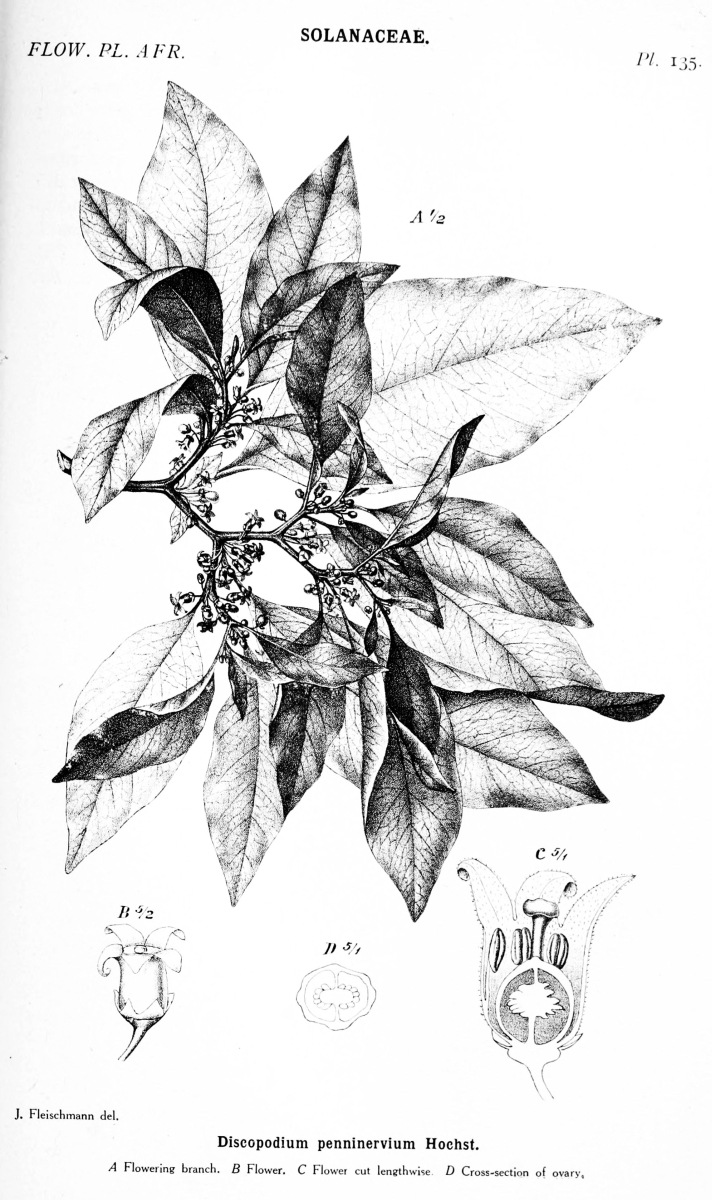
SOLANACEAE.
FLOW. PL. AFR.
Pl. 135.
J. Fleischmann del.
Discopodium penninervium Hochst.
A Flowering branch. B Flower. C Flower cut lengthwise. D Cross-section of ovary.
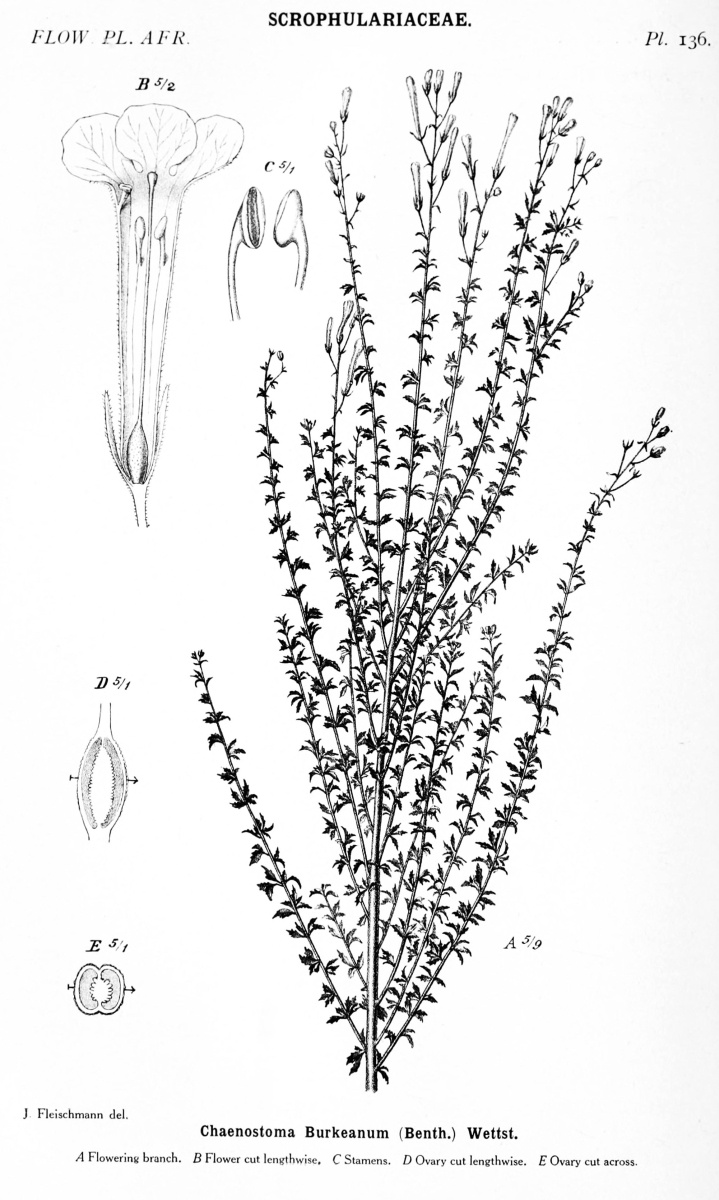
SCROPHULARIACEAE.
FLOW. PL. AFR.
Pl. 136.
J. Fleischmann del.
Chaenostoma Burkeanum (Benth.) Wettst.
A Flowering branch. B Flower cut lengthwise. C Stamens. D Ovary cut lengthwise. E Ovary cut across.
12. Anthers cohering or opening by apical pores. Corolla rotate or widely campanulate. Calyx not or slightly enlarged in the fruit. Flowers usually in cymose, umbel-, raceme-, or panicle-like inflorescences.—Species 150; three of them (S. tuberosum L., potato, S. Melongena L., egg-plant, and S. Lycopericum L., tomato) only cultivated. Several species yield edible fruits or tubers, from which starch, sugar and alcohol are prepared, also tanning and dyeing materials, a substitute for soap, a means to coagulate milk, and various medicaments; others serve as vegetables or as ornamental or hedge-plants; some are poisonous. (Including Lycopersicum Mill. and Normania Lowe). Solanum L. Anthers free, opening by longitudinal slits. Leaves entire, toothed, or lobed. 13 13. Corolla narrowly campanulate, white. Calyx much enlarged and inflated in the fruit. Flowers in clusters. Leaves undivided. Shrubs.—Species 6. Poisonous and used medicinally; the sap coagulates milk. (Physaloides Moench). Withania Pauq. Corolla rotate or very widely campanulate. Flowers solitary. 14 14. Calyx entire or with 5 small teeth, usually but slightly enlarged in the fruit. Corolla white. Filaments longer than the anthers. Fruit slightly fleshy. Herbs or undershrubs.—Species 6. Cultivated and sometimes naturalized in various regions. The fruits (chillies) serve as condiments or medicaments. “Cayenne pepper.” Capsicum L. Calyx 5-lobed, much enlarged in the fruit. 15 15. Calyx spreading under the fruit. Corolla white. Shrubs. Leaves undivided, covered with dense hairs.—Species 1. Island of St. Helena. Melissea Hook. Calyx inflated and enclosing the fruit. Corolla white, yellow, or violet. Herbs.—Species 6; three of them natives of Central and South Africa, the others cultivated and sometimes naturalized in various regions. They yield edible fruits and medicaments. “Winter-cherry.” Physalis L.
FAMILY 208. SCROPHULARIACEAE
Leaves without stipules. Flowers hermaphrodite, usually irregular. Petals 4-5, united below, imbricate, not folded in the bud. Stamens 2-5, usually 4. Disc present. Ovary superior, 2-celled, the partition placed transversely to the median plane of the flower, rarely 1-celled or (Bowkeria) 3-celled. Ovules inverted or half-inverted. Style simple or 2-cleft. Seeds albuminous with a straight or slightly curved embryo, rarely (Dintera) exalbuminous.—Genera 107, species 1150. (Including SELAGINEAE.) (Plate 136.)
1. Posterior lobes or upper lip of the corolla overlapped in the bud by one or both of the lateral lobes. [Subfamily RHINANTHOIDEAE.] 2 Posterior lobes or upper lip of the corolla overlapping the lateral lobes in the bud. 45 2. Corolla 2-lipped with a helmet-shaped upper lip and a 3-lobed lower lip. Stamens 4. Anther-halves separate. Fruit capsular, loculicidal. Herbs. Leaves well developed. Flowers in leafy spikes or racemes. [Tribe RHINANTHEAE.] 3 Corolla 2-lipped with a flat upper lip, or 1-lipped with only 3 distinct lobes, or subequally 4-5-lobed. 8 3. Upper lip of the corolla with reflexed margins. Calyx 4-lobed. Seeds numerous, ribbed. Leaves undivided.—Species 1. Azores. “Eyebright.” Euphrasia L. Upper lip of the corolla with straight margins. 4 4. Calyx 5-lobed, slit in front. Corolla yellow. Capsule oblique, narrow. Leaves pinnately divided.—Species 1. North-west Africa (Algeria). “Lousewort.” Pedicularis L. Calyx 4-lobed. Capsule straight. Leaves entire, toothed, or lobed. 5 5. Ovules few, pendulous. Corolla yellow or red. Capsule broad. Seeds ribbed.—Species 10. North Africa. Some are used medicinally. (Under Bartsia L.) Odontites Pers. Ovules many, horizontal. 6 6. Placentas thin. Seeds few, large, with wing-like ribs. Capsule broad. Corolla blue or red.—Species 8. Central and North-west Africa. (Bartsia L.) Bartschia L. Placentas thick. Seeds numerous, small. Corolla yellow or red. 7 7. Seeds ribbed. Capsule broad.—Species 2. North and South Africa, Abyssinia, and Island of Réunion. (Trixago Stev., under Bartsia L.) Bellardia All. Seeds smooth. Capsule narrow.—Species 3. North Africa. (Eufragia Griseb., under Bartsia L.) Parentucellia Viv. 8. (2.) Anther-halves separate, sometimes one of them rudimentary or one only developed. Stamens 4, more or less unequal, rarely (Strigina) 2 only fertile. Corolla with a distinct, usually long tube. Calyx-teeth about as long as or shorter than the tube. [Tribe GERARDIEAE.] 9 Anther-halves confluent at the apex, more rarely separate, but then corolla-tube very short and stamens nearly equal or reduced to two, or calyx-teeth much longer than the tube. [Tribe DIGITALEAE.] 36 9. Anthers 1-celled (with one half only developed) in all stamens. 10 Anthers 2-celled (with both halves developed), at least in two of the stamens, but one cell (or half) sometimes smaller than the other and barren. 17 10. Corolla almost 1-lipped, with only 3 distinct lobes; tube curved; limb narrow, convex. Calyx 5-cleft. Red-coloured, fleshy, parasitic herbs. Leaves reduced to scales. Flowers in terminal spikes.—Species 5. South Africa. Hyobanche Thunb. Corolla regular or 2-lipped, distinctly 4-5-lobed. Green herbs with well-developed leaves. 11 11. Corolla subequally 5-lobed, blue, red or white; tube straight or slightly curved. Calyx tubular, 4-5-toothed. Capsule straight, oblong or ovate. Leaves undivided. 12 Corolla more or less distinctly 2-lipped; lobes unequal. 14 12. Calyx 2-lipped, 4-lobed, 5-nerved. Stamens inserted in the lower part of the corolla-tube. Lower leaves opposite, upper alternate.—Species 1. Southern East Africa. Eylesia S. Moore Calyx subequally 4-5-toothed, 7-10-nerved. 13 13. Calyx 7-9-nerved, 4-toothed. Stamens inserted in the upper part of the corolla-tube. Leaves all opposite.—Species 3. West Africa. (Under Buchnera L.) Stellularia Benth. Calyx 10-nerved, usually 5-toothed.—Species 60. Tropical and South Africa. (Buchnera L.) Buechnera L. 14. Corolla-tube abruptly curved at or above the middle. Calyx tubular. Capsule straight, oblong or ovate. Leaves undivided. 15 Corolla-tube straight or gradually curved. 16 15. Placentas thin. Ovules few, large. Stem prostrate.—Species 3. East Africa. Cycniopsis Engl. Placentas thick. Ovules numerous, small. Stem erect.—Species 30. Tropical and South Africa and Egypt. Some are noxious weeds. Striga Lour. 16. Calyx tubular, 5-toothed. Capsule ellipsoid, straight, not beaked.—Species 12. Central and South Africa. Cycnium E. Mey. Calyx campanulate, 5-cleft. Capsule usually oblique and beaked, rarely globose and not beaked.—Species 25. Tropical and South Africa. Rhamphicarpa Benth. 17. (9.) Anther-halves (anther-cells) very unequal, one of them fertile, the other barren (without pollen) or almost so. 18 Anther-halves equal or subequal, both of them fertile. 27 18. Leaves scale-like, yellow or reddish. 19 Leaves well developed, green. 20 19. Corolla with a narrow limb, red. Barren anther-cell very small.—Species 1. Madagascar. Tetraspidium Bak. Corolla with a broad limb. Barren anther-cell usually long.—Species 30. Southern and tropical Africa. (Aulaya Harv.) Harveya Hook. 20. Fertile stamens 2, inserted at the throat of the corolla; barren ones filiform. Corolla with a long curved tube and a 2-lipped limb. Leaves undivided.—Species 1. East Africa. Strigina Engl. Fertile stamens 4. 21 21. Anthers partly with, partly (two of them) without a barren cell. Corolla-tube long, inflated. Stem erect. Leaves undivided. 22 Anthers all with a barren cell, which in two is sometimes very small; in this case stem climbing. Herbs or undershrubs. 23 22. Anthers of the lower (anterior) stamens 1-celled, those of the upper stamens with a fertile cell opening by a longitudinal slit and a spur-like sterile cell. Corolla nearly regular. Mostly shrubs.—Species 1. East Africa (Somaliland). Ghikaea Schweinf. & Volk. Anthers of the lower stamens with a cleft connective bearing at one end a fertile cell, which opens by an apical pore, and at the other a disc-like appendage; those of the upper stamens 1-celled. Corolla 2-lipped. Herbs or undershrubs.—Species 7. East Africa. Pseudosopubia Engl. 23. Anthers with a minute, nearly imperceptible barren cell. Corolla violet; tube slightly exceeding the calyx. Calyx enlarged in the fruit. Stem erect, with spreading branches. Leaves undivided.—Species 1. Southern West Africa. Hiernia S. Moore Anthers, at least those of the shorter stamens, with a distinctly developed barren cell. 24 24. Barren anther-cells of the longer stamens minute, nearly imperceptible, of the shorter awn- or worm-shaped. Corolla pink or violet; tube exceeding the calyx. Calyx enlarged and inflated in the fruit. Climbing undershrubs.—Species 2. Central and South-east Africa. Buttonia Mac Ken Barren anther-cells distinctly developed in all stamens, but sometimes unequal in length. Calyx scarcely changed in fruit. Herbs. 25 25. Anthers cohering all together or in pairs. Corolla funnel-shaped, with a broad limb. Stem erect.—Species 25. Tropical and South Africa. Sopubia Hamilt. Anthers free. Corolla more or less bell-shaped, with a rather narrow limb. 26 26. Corolla-tube exceeding the calyx. Stem climbing. Leaves undivided, broad, coarsely toothed.—Species 1. West Africa. Thunbergianthus Engl. Corolla-tube equalling the calyx. Stem erect. Leaves pinnately divided.—Species 1. Southern West Africa (Angola). Baumia Engl. & Gilg 27. (17.) Corolla-tube short, about equalling the calyx. 28 Corolla-tube long, distinctly exceeding the calyx. 30 28. Calyx becoming woody in the fruit. Anthers exserted, with unequal halves. Undershrubs.—Species 1. Island of Socotra. Xylocalyx Balf. Calyx not woody in the fruit. Herbs. 29 29. Calyx scarcely changed in the fruit. Capsule 4-valved. Non-parasitic plants. Stem thin. Leaves linear. Inflorescence lax.—Species 3. Tropics. (Including Gerardianella Klotzsch). Micrargeria Benth. Calyx more or less enlarged and inflated in the fruit; if but slightly changed, then parasitic plants with thick stems and usually broad or scale-like leaves.—Species 30. Tropical and South Africa. (Including Alectra Thunb. and Velvitsia Hiern). Melasma Berg 30. Anther-halves unequal, one of them somewhat shorter or narrower. 31 Anther-halves equal. 33 31. Anther-halves nearly equal, one of them somewhat shorter than the other. Filaments very unequal. Ovules numerous. Stem herbaceous. Flowers without bracteoles.—Species 1. Southern Central Africa and Transvaal. Gerardiina Engl. Anther-halves distinctly unequal, one of them narrower. Stem woody, at least at the base. 32 32. Corolla with a very long tube and a very narrow limb, white. Ovules 2-4 in a cell. Shrubs.—Species 1. Madagascar. Leucosalpa Scott Elliot Corolla with a rather broad limb. Ovules numerous.—Species 3. South Africa and island of Socotra. (Bopusia Presl). Graderia Benth. 33. Stamens nearly equal in length. Corolla-tube rather short. Stem herbaceous. 34 Stamens distinctly unequal. Stem woody. 35 34. Flowers solitary or in clusters, axillary. Calyx 5-cleft. Corolla blue. Capsule 4-valved.—Species 1. South Africa. Charadrophila Marloth Flowers in spikes or racemes. Corolla yellow. Capsule 2-valved.—Species 1. Madagascar. Seymeria Pursh 35. Calyx-teeth very short. Corolla bell-shaped. Glabrous shrubs.—Species 1. Madagascar. (Raphispermum Benth.) Rhaphispermum Benth. Calyx-teeth distinctly developed, pointed. Corolla funnel-shaped. Hairy shrubs.—Species 2. Madagascar and neighbouring islands. Radamaea Benth. 36. (8.) Stamens 2. 37 Stamens 4-8. 38 37. Corolla-tube long, thin, curved. Corolla white. Stamens included; anther-halves confluent. Capsule loculicidal and septicidal, many-seeded. Shrubs. Leaves alternate, linear.—Species 3. Canary and Cape Verde Islands and Socotra. Campylanthus Roth Corolla-tube short or rather short. Stamens long.—Species 30. Some of them yield salad, a substitute for tea, and medicaments, or serve as ornamental plants. “Speedwell.” Veronica L. 38. Corolla-tube very short. Stamens 4-8, nearly equal in length. 39 Corolla-tube long. Stamens 4, unequal. 41 39. Anther-halves confluent at the apex. Stamens 4-5. Corolla 5-parted, white. Calyx 5-parted. Capsule loculicidal, many-seeded. Erect undershrubs. Leaves alternate, narrow.—Species 1. Naturalized in West Africa and in the Seychelles. Used medicinally and as a substitute for tea. Capraria L. Anther-halves separate. 40 40. Calyx 4-parted. Corolla white, with 4 segments. Stamens 4. Capsule septicidal; seeds numerous. Erect undershrubs. Leaves opposite or whorled, subsessile, narrow.—Species 1. Naturalized in the tropics. Used medicinally. Scoparia L. Calyx 4-8-cleft. Corolla yellow or red, with 4-8, usually 5, segments. Capsule loculicidal; seeds not numerous. Creeping herbs. Leaves alternate, stalked, broad.—Species 3. Azores and Canary Islands, Mauritius, and high mountains of Central Africa. Used as ornamental plants. Sibthorpia L. 41. Anther-halves separate. Corolla with a long cylindrical tube and a two-lipped limb. Leaves opposite. Flowers in spikes or racemes.—Species 1. Sahara. Lafuentea Lag. Anther-halves confluent at the apex. Leaves alternate. 42 42. Corolla with a cylindrical tube and a broad, slightly 2-lipped limb, blue or violet. Capsule 4-valved. Low herbs. Flowers in terminal racemes.—Species 1. Algeria. Used as an ornamental plant. Erinus L. Corolla with a funnel- or bell-shaped tube more or less widened above. Tall herbs, undershrubs, or shrubs. 43 43. Stigma 2-lobed. Corolla yellow or red, 2-lipped. Flowers in terminal racemes.—Species 6. North Africa; one of them also naturalized in the island of Réunion. Poisonous plants used medicinally and as ornamental plants. “Foxglove.” (Including Callianassa Webb et Berth.) Digitalis L. Stigma entire. Flowers in terminal heads or in axillary fascicles. Leaves broad. Undershrubs. 44 44. Anthers protruding beyond the corolla-tube. Corolla 2-lipped. Calyx-segments glume-like, fringed or ciliate. Flowers in terminal heads.—Species 1. South Africa. Glumicalyx Hiern Anthers concealed within the corolla-tube. Flowers in axillary fascicles.—Species 1. Island of Socotra. Camptoloma Benth. 45. (1.) Leaves all alternate. Corolla almost regular. Anther-halves confluent at the apex. Ovules many in each cell of the ovary. Fruit a septicidal, many-seeded capsule. [Subfamily PSEUDOSOLANEAE.] 46 Leaves, at least the lower, opposite or whorled; more rarely all radical or alternate; in the latter case corolla distinctly irregular or ovules and seeds solitary in each cell. [Subfamily ANTIRRHINOIDEAE.] 50 46. Corolla with a long tube, funnel-shaped, blue or red. Stamens 2 or 4. Flowers solitary, axillary, sometimes forming leafy racemes. Leaves undivided. [Tribe APTOSIMEAE.] 47 Corolla with a short or very short tube, bell- or wheel-shaped. Stamens 4 or 5. Flowers in spikes, racemes, or panicles. [Tribe VERBASCEAE.] 49 47. Stamens 2. Fruit pointed. Low herbs with glandular hairs.—Species 10. Central and South Africa, Sahara, and Egypt. Some are used medicinally. (Including Doratanthera Benth. and Gerardiopsis Engl.) Anticharis Endl. Stamens 4, but two of them sometimes sterile. 48 48. Fruit pointed. Stamens all fertile. Herbs or undershrubs.—Species 5. South and Central Africa. Peliostomum E. Mey. Fruit blunt. Shrubs.—Species 25. Central and South Africa. Aptosimum Burch. 49. Stamens 4.—Species 18. Central and North Africa. Some are used as ornamental or medicinal plants. Celsia L. Stamens 5.—Species 17. North Africa and northern East Africa; two of the species also naturalized in South Africa and in the Mascarene Islands. They yield fish-poison and medicaments, and serve as ornamental plants. “Mullein.” Verbascum L. 50. (45.) Ovules and seeds solitary in each cell of the ovary and fruit. Fruit indehiscent. Stamens 2 or 4. Anther-halves confluent. Flowers in spikes, more rarely in heads or panicles or solitary. Leaves entire, toothed, or lobed. [Tribe SELAGINEAE.] 51 Ovules and seeds two or more in each cell, usually numerous. 56 51. Corolla 4-lobed, deeply slit in front. Calyx entire or 2-parted. Stamens 4. Flowers in spikes. 52 Corolla 5-lobed, not slit at one side. Calyx with 3 or 5, rarely with 2 segments. 53 52. Calyx slit open in front, entire or notched behind.—Species 30. South and Central Africa. Hebenstreitia L. Calyx divided into two narrow entire segments.—Species 10. South Africa. Dischisma Choisy 53. Fertile stamens 2. Corolla-lobes subequal. Calyx 5-lobed. Fruit 1-seeded. Shrubs. Flowers in spikes. 54 Fertile stamens 4. Corolla-lobes more or less unequal. 55 54. Sterile stamens present.—Species 1. South Africa. Gosela Choisy Sterile stamens absent.—Species 3. South Africa. Agathelpis Choisy 55. Calyx subequally 5-toothed, adnate at the base to the bract. Fruit 1-seeded.—Species 5. South Africa. Microdon Choisy Calyx with 5 segments, free from the bract, or with 2-3 segments. Fruit 2-seeded.—Species 160. Southern and tropical Africa. Some are used as ornamental plants. (Including Walafrida E. Mey.) Selago L. 56. (50.) Corolla two-lipped with concave, bladdery-inflated lips and a very short tube. Stamens 2.—Species 1. Naturalized in the Canary Islands. An ornamental plant. [Tribe CALCEOLARIEAE.] Calceolaria L. Corolla two-lipped with flat or convex lips, or nearly regular. 57 57. Corolla spurred or saccate, two-lipped. Calyx 5-parted. Fruit a capsule. 58 Corolla neither spurred nor saccate, rarely slightly gibbous, but then calyx 5-lobed or 3-parted. 71 58. Corolla without a distinct tube. Capsule opening by 2 or 4 valves. Herbs. [Tribe HEMIMERIDEAE.] 59 Corolla with a distinctly developed tube. Stamens 4. [Tribe ANTIRRHINEAE.] 62 59. Corolla yellow, 4-cleft, usually with two pouches and two teeth at the base of the lower lip. Stamens 2. Flowers solitary, axillary.—Species 4. South Africa. Hemimeris Thunb. Corolla red or blue, 5-lobed. Stamens 4, but two of them sometimes sterile. 60 60. Flowers turned upside down by the twisting of the pedicel. Corolla scarlet, with two shallow pits at the base. Stamens subequal, all fertile, glabrous. Anther-halves confluent at the apex. Flowers solitary, axillary.—Species 1. South Africa. Used as an ornamental plant. Alonsoa Ruiz & Pav. Flowers very rarely turned upside down; if so, then anthers hairy. Corolla with 1-2 pits, pouches, or spurs at the base. Stamens unequal. 61 61. Lower lip of the corolla ventricose and gibbous at the base. Stamens all fertile. Anther-halves separate, spreading.—Species 2. Naturalized in Madagascar. Angelonia Humb. & Bonpl. Lower lip of the corolla with 2 pits, pouches, or spurs, very rarely with one only. Anther-halves confluent at the apex.—Species 45. South Africa. Diascia Link & Otto. 62. Throat of the corolla closed by a projecting palate. Herbs or undershrubs. 63 Throat of the corolla open. 67 63. Corolla spurred at the base. Anther-halves separate. 64 Corolla ventricose, but not spurred at the base. 66 64. Corolla with a long spur. Cells of the capsule opening by 2-5 teeth or valves. Leaves pinnately nerved. Flowers in terminal spikes or racemes.—Species 40. North Africa; one of the species also naturalized in South Africa. Some yield vermin-poison or medicaments, or serve as ornamental plants. “Toadflax.” Linaria Juss. Corolla with a short spur. Flowers solitary, axillary. 65 65. Corolla violet. Cells of the capsule opening by 3 teeth or valves. Seeds oblong. Creeping herbs. Leaves palmately nerved.—Species 1. North Africa. Used as an ornamental and medicinal plant. (Under Linaria Juss.) Cymbalaria Baumg. Corolla white, yellow, or two-coloured. Cells of the capsule opening by lids. Seeds ovoid. Leaves pinnately nerved.—Species 17. North Africa and northern Central Africa; one of the species also naturalized in South Africa. (Under Linaria L.) Elatinoides Wettst. 66. Anther-halves separate. Capsule opening by 2 or 3 toothed pores.—Species 6. North Africa and northern Central Africa; one of the species also naturalized in South Africa and Mauritius. Some are used as ornamental or medicinal plants. “Snap-dragon.” Antirrhinum L. Anther-halves confluent at the apex. A fifth, sterile stamen present. Capsule with unequal cells, opening irregularly. Seeds ribbed. Flowers small, axillary.—Species 3. Northern East Africa and Comoro Islands. Schweinfurthia A. Braun 67. Corolla-tube with 2 pits or pouches at the base; lobes subequal. Anther-halves confluent. Capsule 4-valved. Shrubs. Leaves alternate, broad. Flowers solitary, axillary, yellow.—Species 1. South Africa. Colpias E. Mey. Corolla-tube with 1 pit, pouch, or spur. Herbs or undershrubs. Leaves opposite. 68 68. Anther-halves separate. Corolla-tube long. Capsule with unequal cells. Flowers solitary, axillary.—Species 4. North Africa. (Under Linaria Juss.) Chaenorrhinum (DC.) Lange Anther-halves confluent at the apex. 69 69. Corolla-tube long. Capsule opening by two apical pores. Flowers in racemes. Radical leaves rosulate.—Species 5. North Africa and Abyssinia. (Simbuleta Forsk.) Anarrhinum Desf. Corolla-tube short. Capsule opening by 2 or 4 longitudinal valves. 70 70. Corolla with a 2-lobed upper and a 3-lobed lower lip. Capsule globose, 4-valved. Seeds with a tight testa.—Species 7. Tropical and South Africa. Diclis Benth. Corolla with a 4-lobed upper and an entire lower lip. Capsule compressed, 2-valved. Seeds with a loose testa, girt with a membranous wing.—Species 50. South Africa and southern Central Africa. Some are used as ornamental plants. Nemesia Vent. 71. (57.) Flowers in cymes or in cymose panicles or fascicles; occasionally solitary with two bracteoles on the pedicel; in this case shrubs or trees. Anther-halves usually confluent. Fruit a septicidal capsule or a berry. [Tribe CHELONEAE.] 72 Flowers solitary or in heads, spikes, racemes, or racemose panicles. Stamens 2 or 4. Fruit a capsule. Herbs or undershrubs. 81 72. Stem herbaceous or woody at the base only. Corolla with a ventricose tube and a narrow limb. Fertile stamens 4; a fifth, sterile stamen distinctly developed, usually scale-like. Anther-halves confluent. Fruit a capsule.—Species 20. North Africa and northern Central Africa. Some are used medicinally. Scrophularia L. Stem woody throughout. The fifth stamen minute or wanting, rarely fertile. 73 73. Corolla-tube short and wide. Stamens 2 or 4. Anther-halves confluent at the apex. Fruit a capsule. 74 Corolla-tube long and narrow. Stamens 4 or 5. 76 74. Calyx 3-parted, the posterior segment 3-toothed. Corolla yellow or white. Fertile stamens 2. Anther-halves divergent. Capsule 4-valved, many-seeded. Leaves whorled. Flowers solitary or 2-3 together in the leaf-axils.—Species 1. South Africa. Ixianthes Benth. Calyx 5-lobed or 5-parted, with nearly equal segments. Fertile stamens 4. 75 75. Calyx 5-lobed, valvate in bud. Corolla yellow, with a 2-parted upper lip. Capsule 4-valved, few-seeded. Leaves opposite, tomentose beneath. Flowers in axillary and terminal, many-flowered cymes.—Species 1. South Africa. Yields timber. Anastrabe E. Mey. Calyx 5-parted, imbricate in bud. Corolla with a 2-toothed upper lip. Anther-halves nearly parallel. Capsule 2-3-valved, many-seeded. Leaves nearly always whorled.—Species 6. South Africa. Bowkeria Harv. 76. Fertile stamens 5. Corolla-lobes equal. Fruit a berry. Epiphytic shrubs. Flowers in axillary clusters.—Species 1. South-east Africa. Dermatobotrys Bolus Fertile stamens 4. 77 77. Anther-halves divergent. Corolla red. Leaves glabrous. 78 Anther-halves parallel or nearly so, separate. 79 78. Leaves scale-like. Fruit a capsule.—Species 1. Naturalized in the Seychelles. Ornamental plant. Russelia Jacq. Leaves well developed. Fruit a berry.—Species 5. Tropical and South Africa. The fruits are edible. Halleria L. 79. Anthers protruding beyond the corolla-tube. Corolla red. Fruit a two-valved capsule.—Species 2. South Africa. Used as ornamental plants. Phygelius E. Mey. Anthers concealed within the corolla-tube. Fruit a 4-valved capsule or a berry. 80 80. Corolla red, slightly exceeding the calyx. Fruit a berry.—Species 2. South Africa. Teedia Rudolphi Corolla yellow or violet. Fruit a capsule.—Species 2. South Africa. Freylinia Pangelli 81. (71.) Anther-halves completely confluent; hence anthers apparently 1-celled. Calyx 5-parted or 2-lipped. [Tribe MANULEAE.] 82 Anther-halves separate or confluent at the apex only, rarely completely confluent, but then calyx subequally 5-lobed. [Tribe GRATIOLEAE.] 91 82. Calyx 2-lipped or 2-parted. 83 Calyx subequally 5-parted. Stamens 4. 84 83. Anthers 4, unequal, or 2.—Species 30. South Africa. Zaluzianskia Schmidt Anthers 4, equal.—Species 20. South Africa to Damaraland. Polycarena Benth. 84. Corolla-tube very short. 85 Corolla-tube distinctly developed, usually long. 86 85. Corolla 2-lipped. Capsule 2-cleft. Flowers solitary. Leaves all radical. (See 61.) Diascia Link & Otto Corolla nearly regular. Capsule 4-cleft. Flowers in racemes. Leaves opposite.—Species 2. South Africa. (Under Sutera Roth) Sphenandra Benth. 86. Corolla more or less distinctly 2-lipped. Capsule opening by pores or transverse slits. 87 Corolla nearly regular or slightly 2-lipped. Capsule opening lengthwise, septicidal. 88 87. Flowers solitary. Stem climbing.—Species 1. Naturalized in the island of St. Helena. An ornamental plant. (Lophospermum Don) Maurandia Ort. Flowers in racemes. Stem erect. (See 69.) Anarrhinum Desf. 88. Stigma 2-lobed. Corolla-tube curved. Leaves cleft or dissected.—Species 1. Egypt and Nubia. (Jamesbrittenia O. Ktze.) Sutera Roth. Stigma entire. Leaves entire or toothed. 89 89. Bracts adnate to the pedicels.—Species 20. South Africa. Phyllopodium Benth. Bracts free from the pedicels. 90 90. Calyx open or nearly open in the bud, surrounded by narrow bracts or without bracts. Corolla-tube nearly always straight. Flowers in compound, rarely in simple racemes.—Species 35. South Africa to Angola. (Nemia Berg). Manulea L. Calyx imbricate in the bud or surrounded by broad bracts. Flowers solitary or in usually simple spikes, racemes, or heads.—Species 120. South and Central Africa and Canary Islands. Some are used as ornamental, medicinal, or dye-plants. (Including Lyperia Benth., under Sutera Roth). (Plate 136.) Chaenostoma Benth. 91. (81.) Fertile stamens 2. 92 Fertile stamens 4, rarely 3. 97 92. Staminodes none. Flowers minute, solitary. 93 Staminodes 2. Ovary 2-celled. Corolla 2-lipped, 5-lobed. 95 93. Ovary 1-celled. Style very short. Stamens inserted in the upper part of the corolla-tube. Corolla 2-lipped, 5-lobed. Calyx 5-parted. Leaves ovate. Aquatic herbs.—Species 1. Southern West Africa (Damaraland) Dintera Stapf Ovary 2-celled. Style distinctly developed, curved. Corolla 4-lobed or sub-equally 5-lobed. 94 94. Calyx 5-parted. Corolla 4-lobed. Stamens inserted in the lower part of the corolla-tube. Leaves linear or oblong.—Species 1. Mascarene Islands. Bryodes Benth. Calyx 5-toothed. Corolla 5-lobed. Leaves ovate.—Species 1. Egypt. Peplidium Del. 95. Staminodes inserted at the throat of the corolla. Anther-halves spreading.—Species 20. Tropical and South Africa. (Including Bonnaya Link et Otto) Ilysanthes Rafin. Staminodes inserted in the tube of the corolla. Anther-halves parallel or nearly so. 96 96. Leaves lobed or dissected. Flowers in racemes. Lower lip of the corolla with a 2-cleft middle-lobe. Aquatic herbs.—Species 1. Madagascar. Hydrotriche Zucc. Leaves entire.—Species 10. Central Africa. Dopatrium Hamilt. 97. (91.) Stamens inserted at the throat of the corolla. Anther-halves parallel. Corolla white, unequally 3-5-lobed. Creeping herbs. Leaves broad, palmately nerved, gland-dotted. Flowers solitary.—Species 1. West Africa. Hydranthelium H. B. & Kunth Stamens, all or two of them, inserted in the tube of the corolla. 98 98. Stamens inserted in the tube and at the throat of the corolla. 99 Stamens inserted in the tube of the corolla. 102 99. Sepals free, broad. Corolla slightly irregular, white. The fifth, sterile stamen filiform. Prostrate herbs. Leaves very small. Flowers solitary.—Species 1. Island of Réunion. Allocalyx Cordem. Sepals united below. Corolla 2-lipped. Lower stamens with a tooth- or bristle-like appendage at the base. 100 100. Calyx without wings or prominent angles, but sometimes striped; segments subequal.—Species 17. Tropics. Some are used medicinally. (Vandellia L.) Lindernia All. Calyx winged or with very prominent angles. 101 101. Calyx subequally toothed. Anterior stamens sharply bent at the base. Stem usually leafless.—Species 15. Central and South Africa. Craterostigma Hochst. Calyx 2-lipped. Anterior stamens not sharply bent at the base. Stem leafy.—Species 8. Tropical and South Africa. Some are used as ornamental or medicinal plants. Torenia L. 102. Anther-halves separate, not contiguous. Corolla 2-lipped. 103 Anther-halves contiguous or confluent. 105 103. Sepals united high up. Fruit 2-valved. Stem procumbent or ascending.—Species 8. Northern East Africa and Egypt. Lindenbergia Lehm. Sepals united at the base only. Fruit 4-valved. 104 104. Placentas winged and connate in the fruit. Glabrous water- or marsh-plants.—Species 6. Central Africa. Some are used medicinally. (Ambulia Lam., Stemodiacra P. Browne) Limnophila R. Br. Placentas not winged, usually separate. Corolla blue. Glandular-pubescent land-plants.—Species 1. Central Africa. Stemodia L. 105. Sepals united high up. 106 Sepals united at the base only. 107 106. Corolla 2-lipped. Anther-halves separate or confluent at the top. Ovary completely septate. Leaves opposite.—Species 3. Two of them indigenous in tropical and South Africa, the third naturalized in the Azores. Used as ornamental plants. Mimulus L. Corolla nearly regular. Anther-halves completely confluent. Ovary septate at the base only. Leaves all radical. Flowers axillary.—Species 5. Southern and tropical Africa and Egypt. Limosella L. 107. Sepals very unequal. Anther-halves separate.—Species 10. Tropics, South Africa, and Egypt. Some are used as ornamental or medicinal plants. (Moniera P. Browne, including Herpestis Gaertn. and Bramia Lam.) Bacopa Aubl. Sepals nearly equal. Anther-halves confluent at the top. Corolla 2-lipped. 108 108. Sepals broad. Corolla red or violet. Stamens, at least the anterior exserted; filaments with an appendage at the base. Flowers in racemes, rather large.—Species 1. Central Africa. Artanema Don Sepals narrow. Stamens included; filaments without an appendage. Flowers solitary, very small.—Species 4. East Africa. Stemodiopsis Engl.
FAMILY 209. BIGNONIACEAE
Shrubs or trees. Leaves usually opposite and compound, without stipules. Flowers usually large and panicled, more or less irregular, hermaphrodite. Sepals united below. Petals united below, imbricate in bud. Stamens inserted on the lower part of the corolla, 4, in two pairs of unequal length, the fifth sterile, rarely all 5 fertile. Anthers opening by two longitudinal slits, rarely (Colea) by one. Disc present. Ovary superior, 1-2-celled. Ovules numerous, in two or more rows, inverted. Style simple; stigmas 2. Fruit a capsule with the valves usually separating from the partition, or a nut or berry. Seeds usually placed transversely and margined or winged, exalbuminous.—Genera 21, species 90. Tropical and South Africa. (Plate 137.)
1. Fruit a capsule. Seeds winged. Ovary completely 2-celled. [Tribe TECOMEAE.] 2 Fruit a berry or nut. Seeds not winged, but often margined. Ovary cylindric, 1-celled or incompletely, rarely (Colea) completely 2-celled. Fertile stamens 4. Stem erect. [Tribe CRESCENTIEAE.] 14 2. Fertile stamens 5. Anthers exserted, with parallel halves. Calyx 5-toothed. Ovules few, in two rows. Erect, spiny shrubs. Leaves fascicled. Flowers solitary or in clusters. 3 Fertile stamens 4. Leaves pinnate, very rarely (Stenolobium) unifoliolate. 4 3. Calyx tubular, slit on one side, with linear teeth. Corolla white, with a long tube. Capsule slightly compressed, with prickly warts. Leaves undivided.—Species 1. South Africa and southern Central Africa. Catophraetes G. Don Calyx bell-shaped. Capsule much compressed, smooth.—Species 9. Tropical and South Africa. Rhigozum Burch. 4. Stamens projecting beyond the corolla-tube. Anther-halves divergent or divaricate. Flowers in racemes or panicles. 5 Stamens concealed within the corolla-tube. 6 5. Calyx spathe-like, slit on one side. Seeds with a broad wing. Trees. Leaflets entire.—Species 3. Central Africa. They yield timber, edible seeds, and medicaments, and serve as ornamental plants. “African tulip-tree.” Spathodea Beauv. Calyx bell-shaped, equally 5-toothed. Seeds with a narrow wing. Twining shrubs. Leaflets serrate.—Species 3. Central and South Africa. Used as ornamental plants. (Under Tecoma Juss.) Tecomaria Fenzl 6. Anther-halves parallel. Calyx spathe-like, split down one side. Trees. Flowers panicled. 7 Anther-halves divergent or divaricate. 8 7. Basal (cylindric) part of the corolla-tube short. Ovules of each cell in 2 rows. Fruit 2-celled; valves boat-shaped.—Species 1. West Africa. Yields timber and medicaments. Newbouldia Seem. Basal part of the corolla-tube long. Ovules of each cell in more than two rows. Fruit 4-celled; valves flat. Leaflets entire.—Species 1. Madagascar. Dolichandrone Fenzl 8. Inflorescences lateral, usually springing from the old wood. Anther-halves usually divergent. 9 Inflorescences terminal. Anther-halves usually divaricate. 11 9. Flowers solitary or in cymes. Calyx tubular, 5-toothed. Corolla distinctly 2-lipped; tube curved. Disc conical. Ovules of each cell in two rows. Climbing shrubs.—Species 1. Madagascar. Perichlaena Baill. Flowers in panicles. Calyx bell-shaped, unequally 3-5-cleft. Corolla not distinctly 2-lipped. Ovules of each cell in several rows. Trees. 10 10. Calyx-tube narrow, leathery. Corolla campanulate-funnel-shaped. Disc saucer-shaped. Fruit with leathery, keeled valves. Leaves glabrous, crowded at the end of the branches.—Species 2. Madagascar. Kigelianthe Baill. Calyx-tube wide. Corolla ventricose-campanulate, curved. Disc cushion-shaped. Fruit cylindric, twisted. Leaves tomentose beneath.—Species 2. Central Africa. (Ferdinandia Seem., under Heterophragma DC.) Fernandia Baill. 11. Flowers in racemes or umbels. Calyx narrowly bell-shaped, 5-toothed. Connective of the stamens broadened, leaf-like. Ovules of each cell in two rows. Erect shrubs. Leaflets serrate.—Species 1. Naturalized in Central Africa. An ornamental plant. (Under Tecoma Juss.) Stenolobium D. Don Flowers in panicles. Connective not leaf-like. 12 12. Ovules arranged in 2 rows in each cell. Calyx bell-shaped or tubular, truncate or unequally 2-5-lobed. Fruit with a spongy partition. Trees.—Species 6. Tropics. They yield timber, gum, and medicaments. Stereospermum Cham. Ovules arranged in 4-8 rows in each cell. 13 13. Ovules in 4 rows in each cell. Calyx spathe-like, split down one side. Fruit with a winged partition. Trees.—Species 10. Central Africa. Some species yield timber. (Under Dolichandrone Fenzl) Markhamia Seem. Ovules in 8 rows in each cell. Calyx bell-shaped, inflated, equally 5-toothed. Climbing shrubs.—Species 2. Central and South-east Africa (Under Pandorea Endl. or Tecoma Juss.) Podranea Sprague
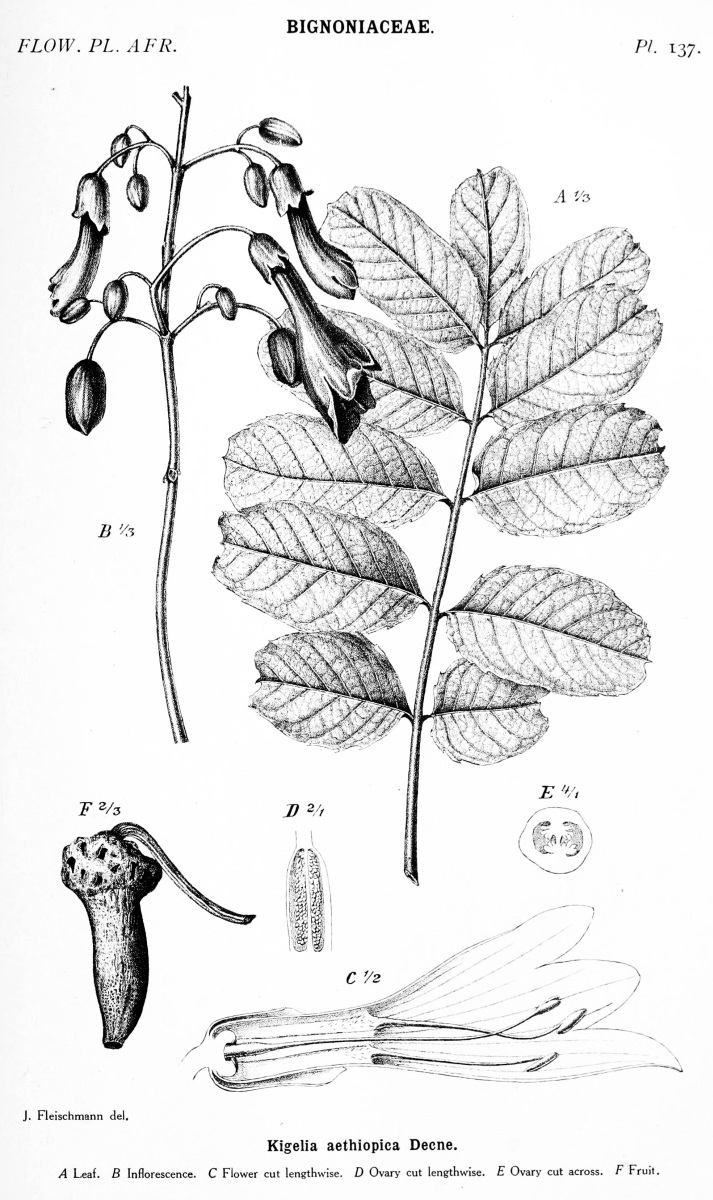
BIGNONIACEAE.
FLOW. PL. AFR.
Pl. 137.
J. Fleischmann del.
Kigelia aethiopica Decne.
A Leaf. B Inflorescence. C Flower cut lengthwise. D Ovary cut lengthwise. E Ovary cut across. F Fruit.
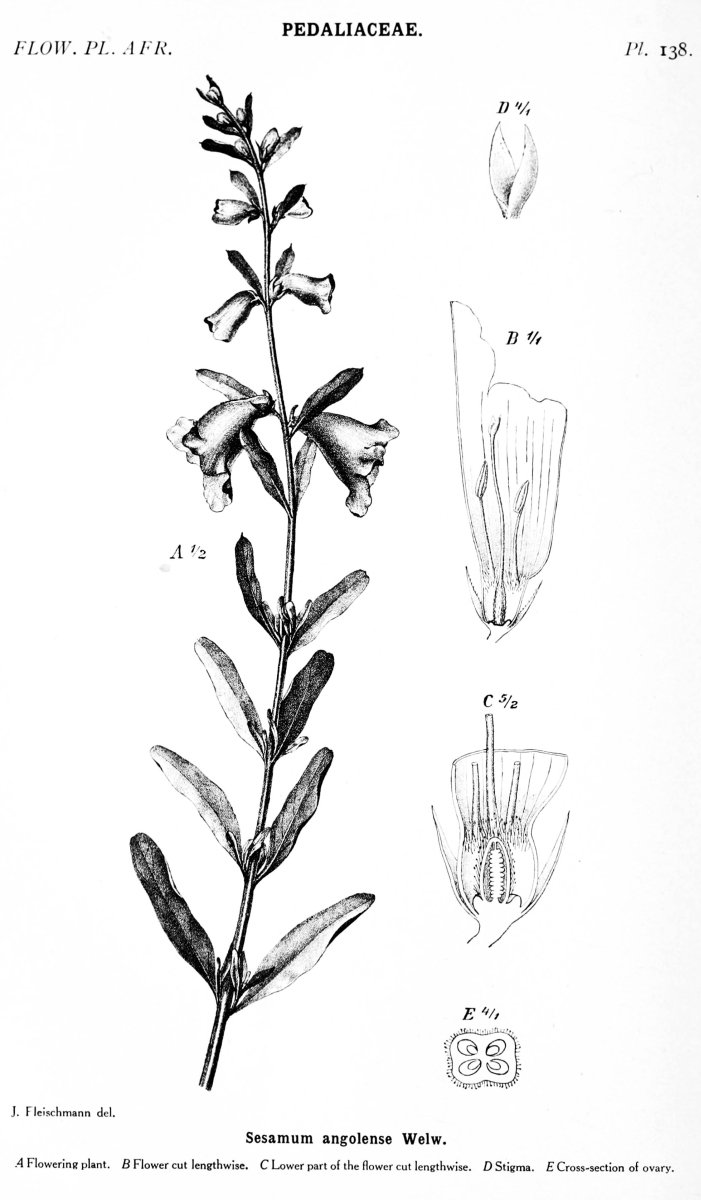
PEDALIACEAE.
FLOW. PL. AFR.
Pl. 138.
J. Fleischmann del.
Sesamum angolense Welw.
A Flowering plant. B Flower cut lengthwise. C Lower part of the flower cut lengthwise. D Stigma. E Cross-section of ovary.
14. (1.) Ovary completely 1-celled. Calyx bell-shaped, bursting irregularly. Corolla red or orange, ventricose-campanulate, irregular. Anther-halves parallel or divergent. Fruit with a thick rind. Trees. Leaves pinnate.—Species 12. Tropical and South Africa. Some species yield timber or medicaments. (Kigelkeia Rafin.) (Plate 137.) Kigelia DC. Ovary completely or incompletely 2-celled. 15 15. Leaves simple, undivided. Ovary 2-celled nearly to the apex. 16 Leaves pinnately compound or reduced to the winged leaf-stalk. Flowers panicled. 18 16. Leaves with a pair of spines at their base. Flowers solitary or in clusters, axillary or springing from the old wood. Calyx pouch-shaped, unequally 2-5-lobed. Corolla regular, long funnel-shaped. Anther-halves divaricate.—Species 2. Madagascar. Paracolea Baill. Leaves without spines at the base, but the leaf-stalk sometimes becoming spine-like. Flowers in terminal racemes or panicles. Calyx bell-shaped, 5-toothed. Corolla more or less irregular, bell- or bell-funnel-shaped. 17 17. Leaves herbaceous; leaf-stalk hardening into a spine. Flowers in panicles. Corolla irregular. Anther-halves divaricate.—Species 1. Madagascar. Phylloctenium Baill. Leaves leathery, resinous; leaf-stalk not hardening into a spine. Flowers in racemes. Corolla almost regular. Anther-halves divergent, pendulous.—Species 1. Madagascar. (Under Tabebuia Gomez). Zaa Baill. 18. Leaves reduced to the jointed and winged leaf-stalk bearing sometimes 1-3 terminal leaflets. Calyx 5-toothed. Corolla slightly irregular. Anther-halves divaricate. Disc saucer-shaped. Ovary septate at the base. Fruit succulent.—Species 7. Madagascar and neighbouring islands. Some species yield timber and edible fruits or serve as ornamental plants. (Arthrophyllum Boj.) Phyllarthron DC. Leaves pinnate, opposite or whorled. 19 19. Calyx long tubular, 5-toothed. Corolla funnel-shaped, nearly regular. Anther-halves divergent. Disc ring-shaped. Ovary 2-celled nearly to the apex. Inflorescences terminal.—Species 3. Madagascar. Siphocolea Baill. Calyx bell-shaped. 20 20. Calyx subequally 5-cleft. Corolla regular, almost barrel-shaped, red. Anther-halves divaricate. Disc saucer-shaped, crenate. Trees. Inflorescences terminal.—Species 1. Madagascar. Rhodocolea Baill. Calyx 5-toothed or unequally cleft. Corolla more or less irregular, bell-funnel-shaped. Fruit dry.—Species 25. Madagascar and neighbouring islands. Some species have edible fruits. Colea Boj.
FAMILY 210. PEDALIACEAE
Plants with glandular hairs. Leaves opposite, at least the lower ones, simple. Flowers irregular, hermaphrodite. Calyx 5-partite. Petals 5, united below, imbricate in bud. Stamens inserted on the lower part of the corolla-tube, the 4 fertile in pairs of unequal length, the fifth sterile, small, awl-shaped. Ovary superior, 2-8-celled with 2 or more axile ovules in each cell, rarely (Linariopsis) 1-celled with 2 basal ovules. Style 1, long, with 2 stigmas or stigmatic lobes. Fruit a capsule or a nut. Seeds with a straight embryo and thin albumen.—Genera 14, species 65. (Plate 138.)
1. Flowers in terminal, raceme- or umbel-like cymes. Shrubs or small trees. Ovary 2-4-celled with numerous ovules in each cell. Fruit a capsule. 2 Flowers solitary or in fascicles in the axils of the leaves, with glands at the base of the pedicels. Herbs, rarely (Pretreothamnus) shrubs, but then ovules 3 in each ovary-cell. 4 2. Inflorescences umbel- or fascicle-like. Glands at the base of the pedicels none. Corolla-tube moderately long, funnel-shaped, neither spurred nor curved. Anthers included; halves divergent, pendulous. Disc slightly one-sided. Ovary-cells not or very incompletely chambered. Fruit beset with hooked bristles. Seeds narrowly winged. Leaves large, broad, long-stalked, lobed. Spines none.—Species 6. Madagascar. (Under Harpagophytum DC.) Uncarina (Baill.) Stapf Inflorescences raceme-like. Glands at the base of the pedicels presente. Corolla-tube very long, cylindrical, spurred or curved. Ovary-cell, nearly completely chambered. Leaves small, partly replaced by spines. 3 3. Corolla spurred. Anthers scarcely exserted, with parallel halves. Disc one-sided. Stem much thickened at the base.—Species 6. Central Africa. Sesamothamnus Welw. Corolla not spurred, with an S-shaped tube, yellow. Anthers exserted, with divergent halves. Disc equal-sided. Stem not much thickened. Species 1. Southern West Africa (Damaraland). Sigmatosiphon Engl. 4. Ovary and fruit 1-celled. Ovules 2, erect. Seed 1. Calyx-lobes very unequal. Corolla violet; tube widened from the base, almost straight. Anther-halves parallel. Disc equal-sided. Stem prostrate, hairy. Leaves undivided. Flowers solitary.—Species 1. Southern West Africa (Angola). Used medicinally. Linariopsis Welw. Ovary and fruit 2-4-celled. Ovules 2 or more in each cell. 5 5. Ovary and fruit 2-celled, with undivided cells. Ovules descending or horizontal. Leaves toothed, lobed, or divided. Flowers solitary. 6 Ovary and fruit 2-4-celled, each cell completely or incompletely divided into two chambers. 10 6. Ovules 2 in each cell of the ovary. 7 Ovules 8 or more in each cell of the ovary. Anthers opening by long slits. Disc one-sided. Succulent, prostrate herbs. 9 7. Fruit 4-winged, without spines. Anther-halves divergent, opening by short slits. Disc one-sided. Corolla yellow or red. Stem tuberous at the base.—Species 15. Central and South Africa. Pterodiscus Hook. Fruit wingless, bearing spines or tubercles. Corolla yellow. Succulent herbs. 8 8. Fruit with a large spine at the base of each angle.—Species 1. East Africa and Madagascar. Yields vegetables and is used in medicine. Pedalium Royen Fruit without large spines at the base, but with small spines or tubercles on the flanks. Seeds winged.—Species 1. East Africa. (Under Pedalium Royen). Pedaliophytum Engl. 9. Ovules 8 in each cell of the ovary. Corolla yellow; tube deeply saccate at the base.—Species 1. South-east Africa. Holubia Oliv. Ovules numerous in each cell of the ovary. Corolla red; tube not or slightly saccate at the base. Fruit with several rows of recurved spines.—Species 3. South and Central Africa. Noxious weeds. “Grapple plant.” (Uncaria Burch.) Harpagophytum DC. 10. Ovules 2-3 in each chamber of the ovary, ascending, or one ascending, the other descending. Fruit a nut. 11 Ovules numerous in each chamber, at least in the larger ones, descending or horizontal. Fruit a capsule. 12 11. Ovules 2 in each of the 4 chambers of the ovary. Fruit with 2 spines in the middle. Corolla red. Trailing herbs. Leaves lobed.—Species 1. Tropical and South Africa. Pretrea J. Gay Ovules 3 in each chamber. Shrubs.—Species 1. Northern East Africa (Somaliland). Pretreothamnus Engl. 12. Cells of the ovary and fruit unequal in size and containing an unequal number of ovules or seeds. Corolla violet or white. Fruit with 2-8 spines or tubercles at the base; only the larger cell dehiscent. Erect herbs. Leaves toothed or lobed. Flowers usually in cymes.—Species 3. Central Africa to Namaland. Rogeria J. Gay Cells of the ovary and fruit equal. Flowers solitary. 13 13. Fruit with two horns or spines at the apex. Corolla red, violet, or yellow.—Species 5. Central and South Africa. Some are used as ornamental or medicinal plants. Ceratotheca Endl. Fruit without horns nor spines. Corolla red or white.—Species 20. Central and South Africa; one species (S. indicum L.) also cultivated in Egypt and Madagascar. The seeds of this and a second species are used as food or as a condiment and for preparing meal and oil; some species yield dyes or medicaments or serve as ornamental plants. (Plate 138.) Sesamum L.
FAMILY 211. MARTYNIACEAE
Erect, hairy herbs. Leaves broad, undivided. Flowers in racemes, with large bracteoles, irregular, hermaphrodite. Calyx unequally 5-lobed, slit in front. Corolla obliquely campanulate, two-lipped, 5-lobed, red. Fertile stamens 2, inserted on the lower part of the corolla-tube, included; staminodes 3. Disc regular. Ovary superior, 1-celled, with 2 two-cleft parietal placentas. Ovules 4-16, descending, inverted. Style 1, long, with 2 stigmas or stigma-lobes. Fruit ending in two horns, 8-ribbed, 4-chambered and 4-seeded, opening loculicidally at the apex; exocarp leathery, endocarp hard. Seeds with a straight embryo and thin albumen. (Under PEDALINEAE.)