ORDER RANALES
Reading edition
SUBORDER NYMPHAEINEAE
FAMILY 76. NYMPHAEACEAE
Aquatic herbs. Leaves floating, undivided, usually peltate. Flowers solitary. Sepals 3 or more. Petals 3 or more. Stamens numerous. Anthers opening inwards by longitudinal slits. Carpels 6 or more, distinct or united below into a many-celled ovary. Stigmas free or partly united. Fruit indehiscent or bursting irregularly. Seeds albuminous.—Genera 3, species 20.
1. Carpels separate, few-ovuled. Sepals 3. Petals 3. Flowers red, axillary. Leaves ovate, without stipules.—Species 1. Southern West Africa (Angola). Used medicinally. (Hydropeltis Michx.) [Subfamily CABOMBOIDEAE.] Brasenia Schreb. Carpels united, at least on the outside, many-ovuled. Sepals 4-5. Petals numerous. [Subfamily NYMPHAEOIDEAE.] 2 2. Sepals 4. Ovary more or less free from the calyx, but adnate to the corolla and the stamens. Seeds with an aril. Leaves with a stipule. Leaf- and flower-stalks with 4-7 large air-canals.—Species 20. Used as ornamental and fodder-plants; the root-stock and the seeds are edible and yield a drink, medicaments, and a dye. “Water-lily.” (Castalia Salisb.) [Tribe TETRASEPALEAE.] Nymphaea Smith Sepals 5. Petals smaller. Flowers yellow. Ovary free. Seeds without an aril. Leaves without stipules. Leaf- and flower-stalks with many small air-canals.—Species 1. North-west Africa (Algeria). Used as ornamental plants, as fodder, and for the preparation of a drink. (Nymphaea Salisb.) [Tribe NUPHAREAE.] Nuphar Smith
FAMILY 77. CERATOPHYLLACEAE
Branched submerged aquatic herbs. Leaves whorled, deeply divided into forked, linear segments. Flowers solitary or in pairs in the axils of the leaves, without bracteoles, unisexual. Perianth simple; segments 9-12, subequal, united at the base, greenish or whitish. Stamens 12-16, inserted upon a convex receptacle; anthers opening outwards. Ovary superior, 1-celled. Ovule 1, pendulous, straight. Style simple; stigma entire, grooved. Fruit a nut. Seed with a thin albumen; embryo with a large, many-leaved plumule.
Genus 1, species 3. Ceratophyllum L.
SUBORDER RANUNCULINEAE
FAMILY 78. RANUNCULACEAE
Herbs, undershrubs, or shrubs. Leaves usually divided. Perianth simple or consisting of a calyx and a corolla of free petals, hypogynous or nearly so. Stamens usually numerous. Anthers opening by longitudinal slits. Carpels superior, solitary or separate, rarely (Nigella) united. Ovules inverted. Seeds with a straight embryo and copious albumen.—Genera 11, species 140. (Plate 46.)
1. Carpels containing each a single perfect ovule and sometimes some rudimentary ones, separate, indehiscent. [Tribe ANEMONEAE.] 2 Carpels containing several perfect ovules each, dehiscing at the suture. 7 2. Petals with a pit or scale at the base or the middle. 3 Petals without a pit or scale, or wanting. Ovule pendulous. 4 3. Ovule pendulous. Carpels arranged in a spike. Sepals with a short spur, yellowish. Petals narrow. Stamens few. Pericarp without a hardened layer. Small herbs. Leaves radical, undivided, linear.—Species 2. North-west Africa. Poisonous plants. “Mousetail.” Myosurus L. Ovule ascending. Pericarp with a hardened layer.—Species 50. Many of them are poisonous, some are used as ornamental or medicinal plants. (Including Ceratocephalus Pers. and Ficaria Dill.) Ranunculus L. 4. Ovary and fruit with 1-3 longitudinal veins or without veins. Ovule with a single coat. 5 Ovary and fruit with 4 or more longitudinal or transverse veins. Ovule with 2 coats. Leaves alternate or all radical. 6 5. Leaves opposite. Herbs or more frequently climbing shrubs. Perianth-segments 4-8, petal-like, usually valvate in the bud.—Species 40. Many of them are poisonous; some are used as ornamental or medicinal plants. Clematis L. Leaves radical and alternate, or the uppermost whorled. Herbs, rarely low shrubs. Perianth-segments 4-20, imbricate in the bud.—Species 15. North, South, and East Africa. Several are poisonous; some are used as ornamental or medicinal plants. (Including Knowltonia Salisb.) (Plate 46.) Anemone L. 6. Perianth simple, of 3-5 segments. Carpels inserted upon a flat receptacle, marked with longitudinal veins. Flowers in racemes or cymes.—Species 4. Poisonous plants, used for dyeing and in medicine. Thalictrum L. Perianth of 5 sepals and 5-16 petals. Carpels inserted upon a cylindrical receptacle, marked with transverse veins. Flowers solitary, terminal.—Species 4. North Africa. Poisonous, also used in medicine and as ornamental plants. Adonis L. 7. (1.) Perianth consisting of 5 or more sepals and 5-8 red, not glandular petals. Stamens united at the base, slightly perigynous. Carpels several, separate, fleshy. Outer coat of the ovules longer than the inner.—Species 1. North-west Africa. Poisonous and used as an ornamental and medicinal plant. [Tribe PAEONIEAE.] Paeonia L. Perianth consisting of 5 petal-like, usually blue sepals and 1-8 glandular petals (nectaries). Stamens free, hypogynous. Carpels not fleshy. Outer coat of the ovules as long as or shorter than the inner. [Tribe HELLEBOREAE.] 8 8. Perianth regular. Petals 5-8. 9 Perianth irregular. Petals 1-4, usually 2. 10 9. Petals 5, large, with a long spur. Carpels separate. Leaves ternately dissected; segments broad. Tall, perennial herbs.—Species 1. North-west Africa. Used as an ornamental plant and in medicine. “Columbine.” Aquilegia L. Petals 8, small, not distinctly spurred. Carpels more or less united. Leaves pinnately dissected; segments narrow. Low annual herbs.—Species 6. North Africa. Some (especially N. sativa L.) yield condiments and medicaments, others serve as ornamental plants. Nigella L. 10. Petals with a long claw, enclosed by the sepals. Upper sepal erect, helmet-shaped. Flowers yellow.—Species 1. North-west Africa (Morocco). Poisonous and used in medicine. Aconitum L. Petals sessile, projecting beyond the sepals. Upper sepal spreading, spur-shaped.—Species 18. North and East Africa. Some are poisonous or used in medicine or as ornamental plants. “Larkspur.” Delphinium L.
FAMILY 79. BERBERIDACEAE
Leaves alternate or all radical. Flowers in racemes, hermaphrodite. Sepals 4-9, more or less petal-like and yellow, at least the inner ones. Petals (nectaries) 4-8. Stamens 4-6, free. Anthers turned inwards, opening by valves. Ovary superior, 1-celled. Ovules 2 or more, basal or inserted along the ventral suture. Stigma 1. Fruit a capsule or a berry. Seeds with a straight embryo and copious albumen.—Genera 3, species 6. North and East Africa.
1. Stem woody, shrubby. Leaves undivided. Inflorescence terminal. Flowers 6-merous. Fruit a berry.—Species 4. North and East Africa. They yield timber, tanning and dyeing materials, fish-poison, medicaments, and edible fruits which are also used for the preparation of drinks and confectionery. “Barberry.” [Tribe BERBERIDEAE.] Berberis L. Stem herbaceous, low. Leaves dissected. Inflorescence lateral. Fruit a capsule. [Tribe EPIMEDIEAE.] 2 2. Flowers 4-merous. Ovules many, inserted along the ventral suture. Fruit opening by two valves. Seeds with an aril.—Species 1. North-west Africa. Epimedium L. Flowers 6-merous. Ovules few, basal. Fruit bursting irregularly. Seeds without an aril.—Species 1. North-west Africa. The tubers are used in medicine and as a substitute for soap. Leontice L.
FAMILY 80. MENISPERMACEAE
Stem usually woody and twining. Leaves alternate, undivided, palmately lobed or digitate, nearly always exstipulate. Flowers small, unisexual, nearly always dioecious, mostly in racemes or panicles. Sepals usually 6. Petals usually 6, smaller than the sepals, sometimes absent. Stamens generally as many as and opposite the petals. Anthers opening by slits. Carpels 3-30, separate, more rarely solitary. Ovule 1, pendulous or laterally affixed, half-inverted with superior micropyle, sometimes accompanied at first by a second which is soon suppressed. Fruits drupaceous.—Genera 27, species 100. (Plate 47.)
1. Sepals 4 in the male flowers, 1-2 in the female. Petals of the male flowers 2-4, united below, of the female 1-3. Stamens united. Carpels solitary. 2 Sepals 6-24, rarely (Stephania) in the female flowers only 3-4. Petals free or wanting. Carpels 3-30, free, rarely (Stephania) solitary. 3 2. Female flowers with 1 sepal and 1 petal, rarely with 2-3 petals, in cymes. Leaves broad. Usually high-climbing plants.—Species 12. Tropical and South Africa. Some are used medicinally. Cissampelos L. Female flowers with 2 sepals and 2 petals, solitary or in pairs. Leaves usually narrow. Low-growing plants.—Species 4. South Africa. (Under Cissampelos L.) Antizoma Miers 3. Sepals 6-8, usually 6, rarely in the female flowers 3-4. 4 Sepals 9-24. 22 4. Sepals 6-8 in the male flowers, 3-4 in the female, usually equal in length. Petals 2-4. Carpels solitary.—Species 5. Central and South Africa. (Including Homocnemia Miers and Perichasma Miers). Stephania Lour. Sepals 6-8 in both sexes. Petals usually 6. Carpels 3-6. 5 5. Sepals nearly equal in length. 6 Sepals very unequal in length, the outer usually much shorter than the inner. 7 6. Petals none. Filaments entirely united. Anthers opening lengthwise. Stigmas thick, entire.—Species 5. Central Africa. (Including Ropalandria Stapf). Dioscoreophyllum Engl. Petals 6. Anthers opening transversely. Stigmas lobed. Leaves lobed.—Species 2. Tropical and South-east Africa. Used medicinally. “Calumba-root.” Iatrorrhiza Miers 7. Petals 3. Stamens 3. Filaments united beyond the middle. Anthers opening by a transverse slit. Flowers in spreading panicles. Leaves sinuated or dissected.—Species 3. Equatorial West Africa. Syntriandrium Engl. Petals 5-8, usually 6, rarely (Tiliacora) 3, but then stamens 6-9 and leaves undivided, very rarely (Penianthus) petals wanting. 8 8. Stamens 15-30. Filaments united. Anthers opening outwards by a transverse slit. Carpels 4-6. Inner sepals united nearly to the top. Male flowers fascicled, female solitary.—Species 2. Central Africa to Delagoa Bay. Epinetrum Hiern Stamens 3-9, usually 6. 9 9. Filaments free or united at the base only. 10 Filaments, at least the inner ones, united to the middle or beyond. 17 10. Anthers opening by 1-2 transverse slits. 11 Anthers opening by 2 longitudinal slits. 13 11. Anthers opening by two slits. Staminodes in the female flowers 6 or 0. Stigmas entire. Fruits ovoid, reniform, or globular; scar of the style nearly basal. Endocarp ribbed. Seeds with a scanty uniform albumen and thick-fleshy cotyledons. Flowers in fascicles sometimes arranged in racemes.—Species 5. Tropics to Delagoa Bay, Sahara and Egypt. They yield dyes, drinks, and medicaments. (Cebatha Forsk.) (Plate 47.) Cocculus L. Anthers opening by one slit. Fruits oblong or elliptical; scar of the style nearly terminal. 12 12. Anthers opening by a slit across the apex. Staminodes in the female flowers 6 or 0. Stigmas entire. Endocarp smooth. Seeds exalbuminous, with fleshy cotyledons. Stem erect. Leaves lanceolate to ovate, penninerved. Flowers in glomerules or false umbels.—Species 2. West Africa. (Including Heptacyclum Engl.) Penianthus Miers Anthers opening by a semicircular slit on the inside. Staminodes 3. Stigmas 3-cleft. Endocarp spiny. Seeds with a ruminate albumen and thin leaf-like cotyledons. Stem climbing. Leaves cordate-ovate, 5-nerved. Male flowers in spreading panicles, female in racemes.—Species 4. West Africa. Kolobopetalum Engl. 13. Anthers opening laterally, almost outwards. Carpels 3. Leaves cordate-ovate, palmately 5-7-nerved. 14 Anthers opening inwards. Leaves palmately 3-nerved, peltate, or penninerved. 15 14. Leaves deeply cordate at the base. Styles short. Staminodes in the female flowers 6.—Species 1. Northern Central Africa. Tinospora Miers Leaves slightly cordate. Styles none. Filaments united at the base.—Species 7. Tropical and South-east Africa. Desmonema Miers 15. Leaves palmately 3-nerved, oblong. Carpels 3. Seeds straight.—Species 1. Madagascar. (Under Cocculus DC.) Orthogynium Baill. Leaves peltate or penninerved. Seeds curved. 16 16. Leaves peltate. Flowers in racemes. Filaments free, flattened. Endocarp tubercled, hairy. Cotyledons thin, leaf-like.—Species 1. West Africa (Cameroons). (Under Tinospora Miers). Platytinospora Diels Leaves lanceolate to ovate, not peltate. Carpels 6 or more. Staminodes in the female flowers none. Fruits with a basal style-scar; endocarp smooth or wrinkled. Cotyledons thick, fleshy.—Species 12, Central Africa. (Including Glossopholis Pierre, under Limacia Lour.) Tiliacora Colebr. 17. (9.) Outer stamens free, inner united to the middle. Carpels 9; scar of the style basal. Seeds spirally twisted, without albumen. Leaves oblong or lanceolate. Flowers in panicles.—Species 1. Madagascar. Spirospermum Thouars Outer and inner stamens more or less united. 18 18. Outer stamens united at the base, inner up to the anthers. Anthers opening lengthwise, the inner laterally, the outer inwards. Carpels 3; endocarp spiny. Leaves cordate-ovate. Flowers fascicled in racemes.—Species 1. West Africa. (Miersiophyton Engl., under Chasmanthera Miers). Rhigiocarya Miers Outer and inner stamens united to the middle or beyond. 19 19. Anthers opening by a semicircular slit. Carpels 3; stigmas 3-cleft. Endocarp spiny. Flowers in panicles. (See 12.) Kolobopetalum Engl. Anthers opening by two longitudinal slits. Endocarp smooth, wrinkled, or tubercled. 20 20. Carpels 6-30. Scar of the style basal. Cotyledons fleshy. Anthers opening inwards. (See 16.) Tiliacora Colebr. Carpels 3. Scar of the style terminal. Flowers fascicled in racemes. 21 21. Petals unequal. Style none. Leaves undivided. (See 14.) Desmonema Miers Petals subequal. Stamens 6. Styles short. Stigmas cleft. Leaves broadly cordate.—Species 2. Central Africa. One species has edible tubers. Chasmanthera Hochst. 22. (3.) Inner sepals united nearly to the tip. 23 Inner sepals free or nearly so. 24 23. Stamens 6-9. Filaments united at the base. Anthers opening lengthwise. Flowers solitary or in pairs.—Species 1. West Africa. Synclisia Benth. Stamens 15-30. Filaments united throughout their whole length. Anthers opening transversely. Male flowers fascicled, female solitary. (See 8.) Epinetrum Hiern 24. Petals none. 25 Petals 3-9, usually 6. 27 25. Stamens 3. Filaments united. Anthers opening by two transverse slits. Carpels 3-4. Scar of the style near the base of the fruit. Leaves broad-cordate. Flowers in fascicled glomerules.—Species 2. West Africa. Syrrheonema Miers Stamens 3, with free filaments, or 5-6. Anthers opening by sometimes confluent longitudinal slits. Scar of the style terminal or lateral. 26 26. Carpels 3. Styles absent. Stigmas peltate. Anthers opening by confluent slits. Stem erect. Flowers in glomerules. (See 12.) Penianthus Miers Carpels 6 or more. Styles present. Stem climbing. Flowers in lax cymes or in panicles.—Species 12. Tropics. (Including Pycnostylis Pierre, Rameya Baill., and Welwitschiina Engl.) Triclisia Benth. 27. Petals 9. Stamens 21. Carpels 12.—Species 1. West Africa. Sphenocentrum Pierre Petals 3-6. 28 28. Stamens 3. 29 Stamens 6-18. 31
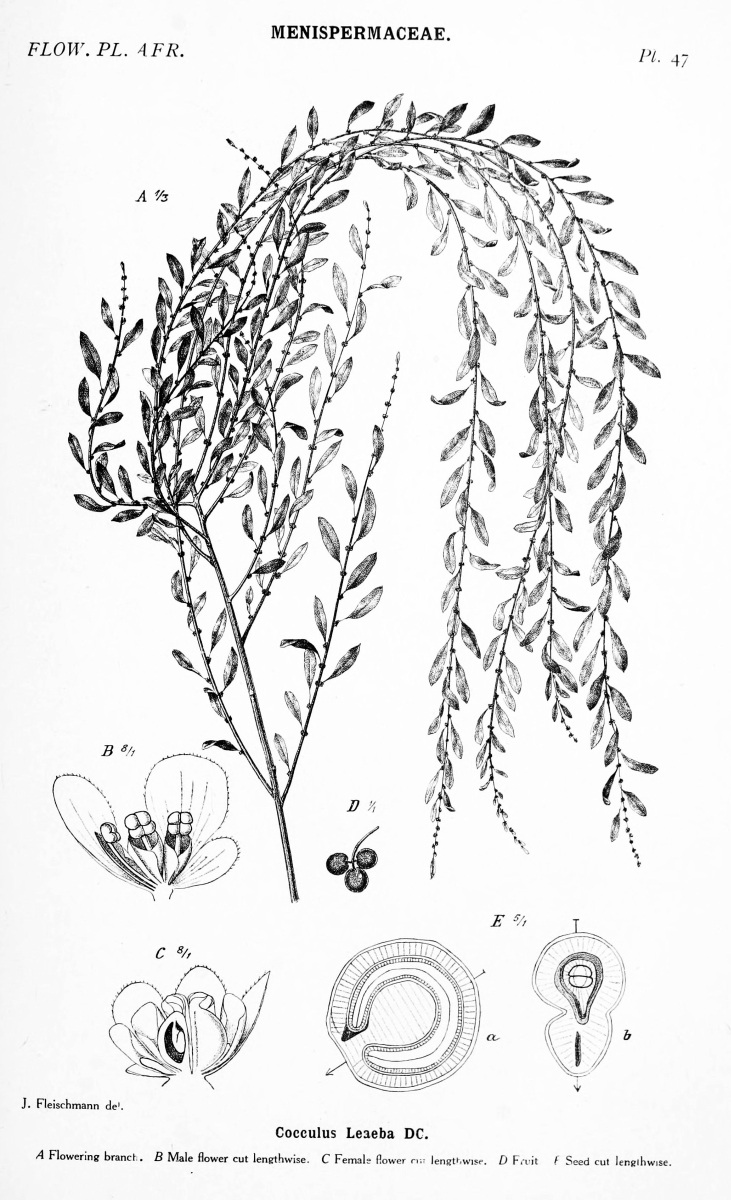
MENISPERMACEAE.
FLOW. PL. AFR.
Pl. 47.
J. Fleischmann del.
Cocculus Leaeba DC.
A Flowering branch. B Male flower cut lengthwise. C Female flower cut lengthwise. D Fruit. E Seed cut lengthwise.
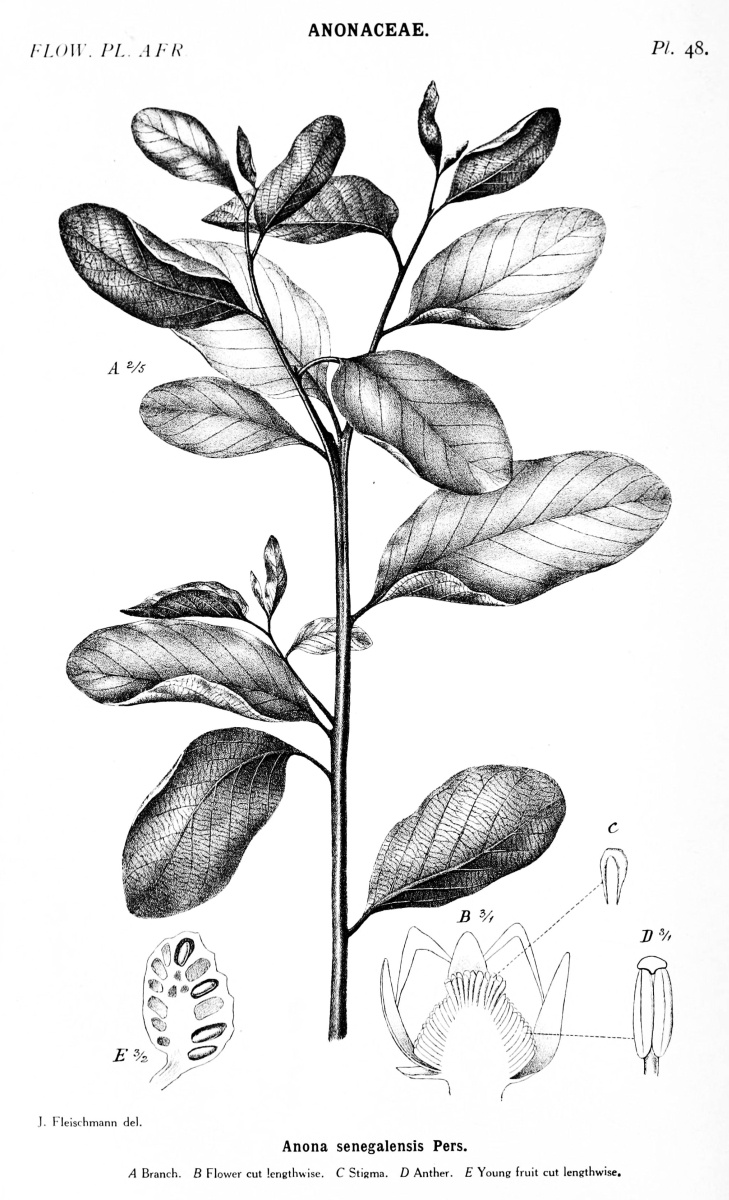
ANONACEAE.
FLOW. PL. AFR.
Pl. 48.
J. Fleischmann del.
Anona senegalensis Pers.
A Branch. B Flower cut lengthwise. C Stigma. D Anther. E Young fruit cut lengthwise.
29. Filaments free. Sepals hairy. Stem climbing. (See 26.) Triclisia Benth. Filaments united high up. 30 30. Sepals glabrous. Leaves distinctly 3-nerved. Stem climbing.—Species 1. Madagascar. Strychnopsis Baill. Sepals hairy. Leaves not distinctly 3-nerved. Stem erect.—Species 5. Madagascar. (Including Gamopoda Bak. and Tripodandra Baill.) Rhaptonema Miers 31. Stamens 9-18. Filaments united throughout their whole length. Anthers opening transversely. Male flowers with 6 petals, female with 3 petals and 3 staminodes. Carpels 6. Flowers in false racemes or corymbs. Leaves undivided.—Species 7. Tropics to Delagoa Bay. Anisocycla Baill. Stamens 9 with the filaments free or united at the base, or 6. Anthers opening lengthwise, but sometimes obliquely. 32 32. Carpels 3-4. Flowers in racemes. 33 Carpels 6-30. Flowers in cymes or panicles, or the female in racemes. Leaves undivided. 34 33. Petals ovate. Fruits ovoid; embryo nearly straight. Stem erect. Leaves compound, with 3 leaflets.—Species 4. Madagascar. Burasaia Thouars Petals oblong, lobed. Fruits reniform; embryo much curved. Stem climbing. Leaves simple, undivided.—Species 1. West Africa (Congo). Limaciopsis Engl. 34. Sepals densely hairy. Petals minute. Staminodes in the female flowers present. Carpels hairy. (See 26.) Triclisia Benth. Sepals glabrous or scantily hairy. Staminodes in the female flowers absent. (See 16.) Tiliacora Colebr.
SUBORDER MAGNOLIINEAE.
FAMILY 81. ANONACEAE.
Shrubs or trees. Leaves undivided, without stipules. Flowers usually hermaphrodite. Sepals 3, rarely 2, usually valvate in the bud. Petals 3-6, free or united at the base. Stamens hypogynous, 6 or more, usually numerous, rarely (Bocagea) 3. Anthers nearly always turned outwards. Carpels 3 or more, separate, more rarely united and forming a one-or many-celled ovary. Ovules inverted. Fruit usually a berry. Seeds with a copious, ruminate albumen and a small embryo.—Genera 27, species 240. (Plate 48.)
1. Carpels whorled and united, forming a 1-celled ovary with parietal placentas. [Tribe MONODOREAE.] 2 Carpels spirally arranged, free, more rarely united, and then forming a many-celled ovary. 3 2. Petals unequal, free or the outer united below, frequently with a wavy margin.—Species 15. Tropics to Delagoa Bay. The seeds of some species are used as condiments and in medicine. Monodora Dun. Petals equal, more or less united below, not wavy at the margin.—Species 15. Tropics. (Under Monodora Dun.) Isolona (Pierre) Engl. 3. Petals 6, the inner greatly exceeding the outer. Carpels 4-6, with united stigmas; ovules 6-10 to each. Trees with long-haired branches. Flowers in panicles.—Species 5. West Africa (Cameroons). [Tribe MILIUSEAE.] Piptostigma Oliv. Petals 6, about equal in length, or the inner shorter, or petals 3-4. 4 4. Petals thick, more or less distinctly jointed into an inferior hollow portion and a superior flat or thickened one, erect or connivent, rarely spreading, valvate in the bud, very rarely (Anona) the inner imbricate at the apex. [Tribe XYLOPIEAE.] 5 Petals thin or rather thin, rarely thick, not jointed and usually spreading, but sometimes hollow or with a short claw appressed to the stamens. 10 5. Carpels united in fruit. Ovule 1. Styles oblong. Petals 3, alternate with the sepals, or 6.—Species 10, six of them spontaneous in tropical and South-east Africa, 4 cultivated in various regions. They yield cork-wood, fibre, gum-lac, tans and dyes, poisons, medicaments, a substitute for tea, and edible fruits (custard-apple, sour-sop, and others) from which also drinks are prepared. (Plate 48.) [Subtribe ANONINAE.] Anona L. Carpels free till maturity. [Subtribe XYLOPIINAE.] 6 6. Ovules solitary. 7 Ovules 2 or more to each carpel. Petals 6. 8 7. Petals 3, opposite the sepals. Stigmas sessile. Trees with a yellow bark and yellow hairs.—Species 3. Central Africa. They yield timber, dyes, and medicaments. (Under Xylopia L.) Enantia Oliv. Petals 6, the outer greatly exceeding the inner. Stigmas borne upon linear styles.—Species 6. Equatorial West Africa. (Under Oxymitra Blume) Stenanthera (Oliv.) Engl. & Diels 8. Carpels containing numerous ovules or seeds, coiled spirally when ripe and contracted between the seeds. Trees.—Species 1. German East Africa. Polyceratocarpus Engl. & Diels Carpels containing 2-8 ovules or 1-8 seeds, straight or slightly curved when ripe. 9 9. Petals spreading, subequal. Ovules 2. Stalks of the inflorescence and the flowers usually thickened and hooked. Mostly climbing or scrambling shrubs.—Species 18. Tropics to Delagoa Bay. Some have edible fruits or are used in medicine. Artabotrys R. Br. Petals suberect or connivent, the inner shorter and triangular above. Sepals more or less united. Receptacle usually concave. Ovules 2-8, inserted along the ventral suture. Styles long.—Species 30. Tropics. Some yield timber, spices (guinea-pepper), and medicaments. (Xylopicrum P. Br.) Xylopia L. 10. (4.) Petals transversely folded, at least in the bud, united at the base, subequal. Carpels 3-12, hairy; ovules numerous; styles 2-cleft.—Species 6. Tropics. [Tribe HEXALOBEAE.] Hexalobus A. DC. Petals not folded, usually free. [Tribe UVARIEAE.] 11 11. Petals valvate in the bud. Carpels free. [Subtribe UNONINAE.] 12 Petals, at least the inner ones, imbricate in the bud. [Subtribe UVARIINAE.] 23 12. Petals 3-4. Sepals or calyx-lobes 2. Connective of the stamens not or scarcely prolonged. Carpels and ovules numerous. Flowers unisexual. 13 Petals 6. Sepals 3. Connective usually prolonged beyond the anther-cells. 15 13. Petals 3, thick. Flowers in clusters springing from the old wood, the female somewhat larger than the male. Trees.—Species 1. Equatorial West Africa (Congo). Thonnera De Wild. Petals 4. 14 14. Petals free. Flowers in clusters springing from the old wood, the female much larger than the male. Trees.—Species 2. Equatorial West Africa. Tetrastemma Diels Petals united below. Flowers solitary, axillary, the female about as large as the male. Shrubs.—Species 1. Equatorial West Africa (Cameroons). Uvariopsis Engl. 15. Petals in 1 row, rather thick. Stamens 12, six of them sometimes sterile. Anther-cells ovate. Carpels numerous, 1-seeded.—Species 2. West Africa (Congo). Monanthotaxis Baill. Petals in 2 rows. 16 16. Outer petals spreading, inner smaller and converging.—Species 30. Tropical and South-east Africa. (Including Clathrospermum Planch.) Popowia Endl. Outer and inner petals spreading or erect. 17 17. Stamens 3-6; connective ovate, prolonged above, but not dilated. Carpels 3, one-seeded.—Species 1. Madagascar. Bocagea St. Hil. Stamens numerous. 18 18. Stamens with an acuminate connective. Ovules several. Style short. Fruit slightly constricted between the seeds. Trees. Flowers in axillary clusters.—Species 1 (C. odorata Hook. f. & Thoms., Ylang-Ylang). Cultivated in the tropics for its fragrant flowers, which yield a perfume. Cananga Rumph. Stamens with a truncate or rounded connective. 19 19. Style long. Ovules 2. Peduncles thick and hooked. Climbing shrubs. (See 9.) Artabotrys R. Br. Style short or wanting. 20 20. Ovules 1-2 to each carpel, rarely 3-8, and then fruits constricted between the seeds, and young branches, leaves and flowers glabrous or clothed with simple hairs. Carpels usually numerous. 21 Ovules 10-30 to each carpel, rarely 8, but then fruits not constricted between the seeds, and young branches, leaves and flowers clothed with stellate hairs. Carpels usually few. 22 21. Fruit-carpels with a single seed appressed to the pericarp, or with 2-8 seeds, and then constricted between them. Style present. Flowers hermaphrodite.—Species 9. Tropics. Unona L. f. Fruit-carpels with a single seed not appressed to the pericarp, or with 2 seeds without a distinct constriction between them. Ovules 1-2.—Species 8. Tropics. Several species yield timber. Polyalthia Blume 22. Sepals small. Plants covered with stellate hairs.—Species 2. Central Africa. (Under Unona L. f.) Meiocarpidium Engl. & Diels Sepals large. Plants covered with simple hairs or glabrous.—Species 3. Central Africa. Uvariastrum Engl. 23. (11.) Ovules 1-2 in each carpel. 24 Ovules numerous in each carpel. 26 24. Carpels united as to the ovary and sunk in the receptacle, numerous, one-seeded. Flowers unisexual, with two large bracteoles enclosing the bud. Sepals 3, small.—Species 2. Equatorial West Africa. (Under Anona L.) Anonidium Engl. & Diels Carpels free. Flowers hermaphrodite. 25 25. Sepals large, leathery, cohering in the bud. Outer petals ovate, scarcely larger than the inner. Receptacle rather flat. Carpels 6-9, one-ovuled; styles linear. Shrubs.—Species 1. Southern East Africa. (Under Unona L. f.) Cleistochlamys Oliv. Sepals small, membranous. Outer petals oblong, larger than the inner. Receptacle convex. Carpels usually 2-ovuled; stigmas usually sessile.—Species 9. West Africa. (Under Oxymitra Benth.) Cleistopholis Pierre 26. Carpels united, at least in fruit, numerous. Petals much overlapping in the bud. Flowers on dwarf shoots, with a thick stalk and two large bracteoles enclosing the bud. Plants covered with stellate hairs.—Species 2. Equatorial West Africa. Pachypodanthium Engl. & Diels Carpels free. 27 27. Stigmas lanceolate; margin not rolled inwards, or at the base only. Carpels about 10. Sepals triangular. Petals lanceolate, united at the base, greatly exceeding the calyx.—Species 1. East Africa. (Asteranthopsis O. Ktze., under Uvaria L.) Asteranthe Engl. & Diels Stigmas truncate; margin rolled inwards all round. Petals usually free.—Species 55. Tropical and South-east Africa. Some species yield edible fruits, dyes, or medicaments. Uvaria L.
FAMILY 82. MYRISTICACEAE.
Trees or shrubs. Leaves entire, penninerved, without stipules. Flowers dioecious. Perianth simple, 2-5-, usually 3-lobed. Stamens 2-40; filaments more or less, usually wholly, united; anthers 2-celled, turned outwards. Ovary superior, 1-celled; ovule 1, ascending, inverted; stigma 1. Fruit fleshy, usually dehiscent. Seed with an aril; albumen copious; embryo small.—Genera 9, species 25. Tropics. (Plate 49.)
1. Stamens 30-40; filaments united at the base. Style distinctly developed. Aril very small. Inflorescence head-like.—Species 1. Madagascar. Mauloutchia Warb. Stamens 2-24; filaments wholly united. Style very short or absent. Aril distinctly developed. 2 2. Flowers with a bracteole at the base of the perianth, rather large, in racemes or panicles, or the female solitary. Anthers 8-24. Fruit ovoid, dehiscent. Aril slit. Albumen ruminate. Embryo with spreading cotyledons.—Species 2. Cultivated in several tropical islands. The seeds (nutmeg) and the arils (mace) are used as spices and medicaments and for the preparation of perfumes; the pericarp is edible. Myristica L. Flowers, at least the male, without bracteoles. Anthers 2-10. 3 3. Flowers rather large, stalked, in cymosely arranged fascicles. Perianth funnel-shaped. Anthers 4-10, somewhat shorter than the united filaments. Fruit very large, subglobose, indehiscent. Aril entire. Albumen ruminate. Embryo with spreading cotyledons. Lateral nerves of the leaves not forked, joined by distinct arches close to the margin; transverse veins faint.—Species 3. West Africa. They yield timber and oil. (Including Ochocoa Pierre). Scyphocephalium Warb. Flowers very small, in fascicles or heads, which are sometimes arranged in racemes or panicles. Fruit ovoid or elliptical, dehiscent. Embryo with suberect cotyledons. 4 4. Flowers in simple, fascicle- or head-like inflorescences, subsessile. Anthers 3-4. Aril almost entire. Albumen not ruminate. Leaves with forked lateral nerves and distinct transverse veins.—Species 4. West Africa. They yield timber. Staudtia Warb. Flowers in heads or fascicles, which are arranged in racemes or panicles. Aril slit. 5 5. Flowers stalked, in fascicles. Anthers 2-7. Albumen ruminate. Lateral nerves of the leaves not distinctly confluent at the margin. 6 Flowers sessile, in heads. 7 6. Partial inflorescences supported by an involucral disc. Perianth cup-shaped. Anthers 3-5. Albumen with a cavity in the centre.—Species 4. West Africa. They yield timber and oil. Coelocaryon Warb. Partial inflorescences without an involucral disc. Perianth funnel- or pitcher-shaped. Albumen solid in the centre.—Species 1. Cultivated in the tropics. The seeds yield a fat. Virola Aubl. 7. Heads distinctly stalked. Perianth obovoid or club-shaped. Anthers 2-4, shorter than the filaments. Albumen ruminate. Lateral nerves of the leaves joined by arches near the margin.—Species 5. West Africa and Upper Nile. They yield timber and oil. (Under Myristica L.) (Plate 49.) Pycnanthus Warb. Heads sessile or nearly so. Perianth cupular. Anthers 3-10. Albumen uniform. 8 8. Heads large, distant on the branches of a panicle. Anthers 3-4, as long as or somewhat shorter than the filaments. Leaves whitish below; lateral nerves joined by arches distant from the margin; transverse veins faint.—Species 1. German East Africa. (Under Brochoneura Warb.) Cephalosphaera Warb. Heads arranged in dense racemes or panicles. Anthers 4-10, usually longer than the filaments. Leaves with forked lateral nerves and nearly as strong transverse veins.—Species 4. Madagascar. The seeds are used as a condiment and yield a fat. (Under Myristica L.) Brochoneura Warb.
FAMILY 83. MONIMIACEAE
Trees or shrubs. Leaves undivided, without stipules. Flowers unisexual. Perianth simple, 3-6-lobed. Stamens 10 or more. Carpels solitary or several and then separate at the time of flowering, often sunk in the receptacle. Ovule 1. Seeds with a small embryo and fleshy albumen.—Genera 6, species 30. (Plate 50.)
1. Anthers opening by valves. Stamens numerous. Carpels 4 or more, sunk in the receptacle. Ovules erect. Perianth irregular, strap-shaped. Leaves alternate. Flowers solitary or in clusters.—Species 3. West Africa. (Plate 50.) [Subfamily ATHEROSPERMOIDEAE, tribe SIPARUNEAE.] Glossocalyx Benth. Anthers opening by longitudinal slits. Ovule pendulous. Perianth regular or nearly so. [Subfamily MONIMIOIDEAE.] 2 2. Receptacle (floral axis) small. Perianth-segments of the female flowers falling off singly. Stamens numerous. Carpel 1. [Tribe TRIMENIEAE.] 3 Receptacle large, cup- or urn-shaped, at length bursting. Perianth falling off entire and lid-like, or little developed and persistent. Carpels several or many. 4 3. Perianth of the male flowers protruding beyond the stamens. Flowers on long stalks, in lax racemes. Leaves alternate.—Species 2. Equatorial West Africa (Cameroons). Chloropatane Engl. Perianth of the male flowers concealed by the stamens. Flowers on short stalks, in dense racemes. Leaves opposite.—Species 3. Tropical and South Africa. They yield timber. (Including Paxiodendron Engl.) Xymalos Baill. 4. Receptacle cup-shaped, subsequently spreading, not enclosing the carpels. Perianth falling off as a whole, lid-like. Stamens 10-12. Anther-halves confluent above. Leaves opposite. Flowers solitary or in
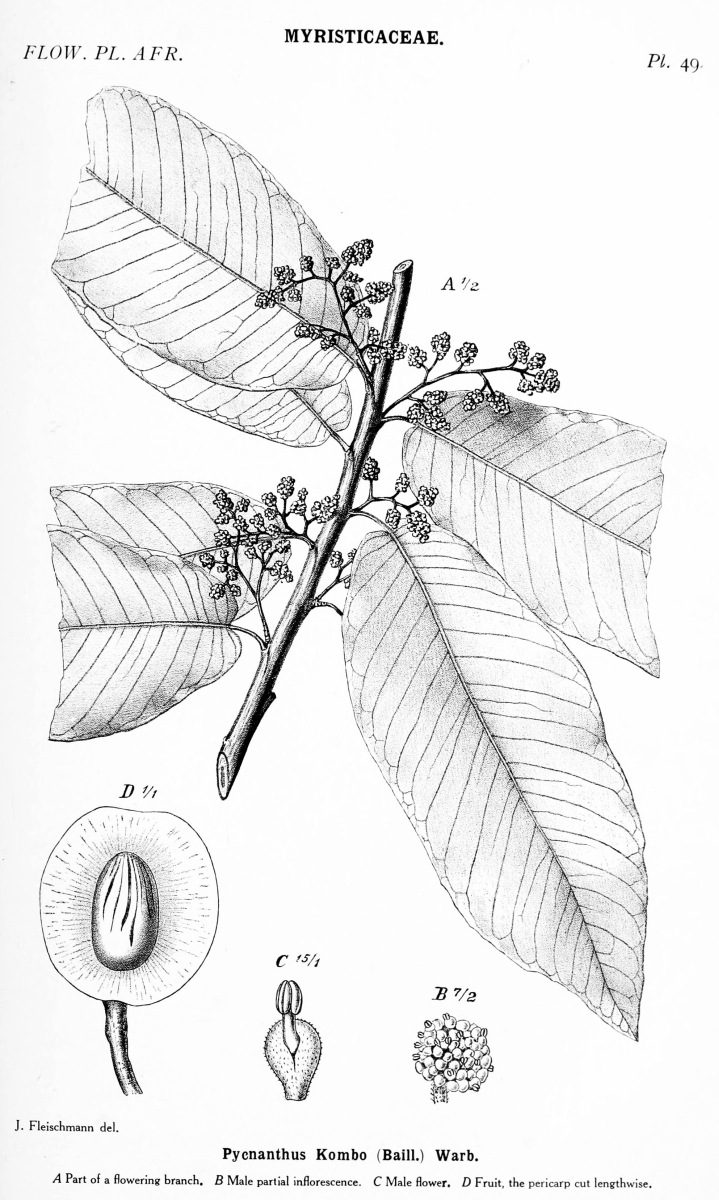
MYRISTICACEAE.
FLOW. PL. AFR.
Pl. 49.
J. Fleischmann del.
Pycnanthus Kombo (Baill.) Warb.
A Part of a flowering branch. B Male partial inflorescence. C Male flower. D Fruit, the pericarp cut lengthwise.
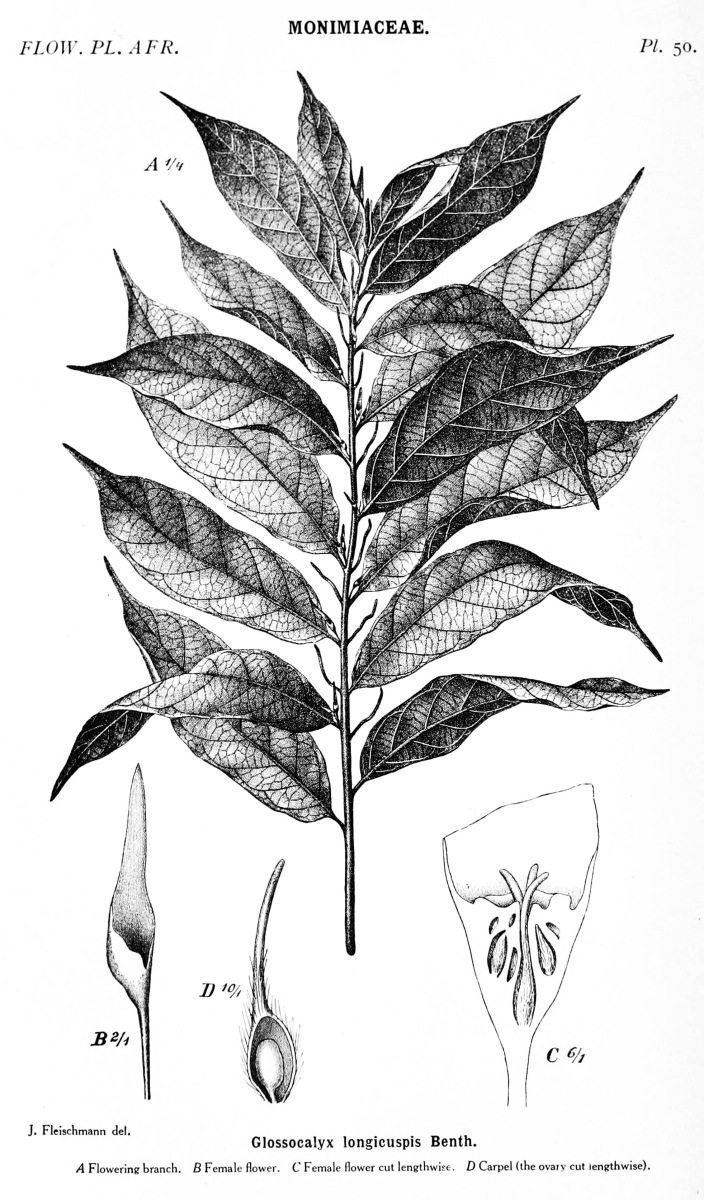
MONIMIACEAE.
FLOW. PL. AFR.
Pl. 50.
J. Fleischmann del.
Glossocalyx longicuspis Benth.
A Flowering branch. B Female flower. C Female flower cut lengthwise. D Carpel (the ovary cut lengthwise).
clusters, monoecious.—Species 1. Madagascar. (Under Mollinedia Ruiz & Pav.) [Tribe MOLLINEDIEAE.] Ephippiandra Decne. Receptacle narrowly pitcher-shaped, subsequently increasing in size and enclosing the carpels. Perianth little developed. Stamens numerous. Anther-halves separate. [Tribe MONIMIEAE.] 5 5. Stamens with a gland on each side. Carpels few, not sunk in the receptacle. Shrubs. Leaves opposite. Flowers in cymes, dioecious.—Species 4. Madagascar and the neighbouring islands. They yield timber and medicaments. Monimia Thouars Stamens without glands. Carpels numerous, sunk in the receptacle.—Species 20. Madagascar and the neighbouring islands. Some species yield timber, dyes, or medicaments. (Ambora Juss.) Tambourissa Sonn.
FAMILY 84. LAURACEAE
Trees or shrubs. Leaves undivided, without stipules, sometimes scale-like. Flowers regular. Perianth of 4 or 6 segments. Fertile stamens 4-14, perigynous. Anthers opening by 2-4 valves. Ovary superior, very rarely (Hypodaphnis) inferior, 1-celled. Ovule 1, pendulous, inverted. Style simple. Seed exalbuminous; embryo straight.—Genera 15, species 75. (Plate 51.)
1. Anthers 2-celled. [Subfamily LAUROIDEAE.] 2 Anthers 4-celled. [Subfamily PERSEOIDEAE.] 11 2. Anthers all turned inwards, 8-14, usually 12. Perianth 4-cleft. Flowers in umbels, dioecious or polygamous. Leafy shrubs or trees.—Species 2. North Africa. They yield timber, oil, perfumes, spices, and medicaments, and are also used as ornamental plants. “Laurel.” [Tribe LAUREAE.] Laurus L. Anthers partly (the outer) turned inwards, partly outwards, 4-12, usually 9. Flowers hermaphrodite or polygamous, usually panicled. 3 3. Stem thread-shaped, twining, parasitic. Leaves reduced to minute scales. Perianth 6-cleft, the outer segments much smaller than the inner. Fertile stamens 9.—Species 4. Southern and tropical Africa. Some are used medicinally. [Tribe CASSYTHEAE.] Cassytha L. Stem shrub- or tree-like. Leaves perfectly developed. Perianth with 6, rarely 4, subequal segments. 4 4. Receptacle accrescent, cupuliform, enclosing the fruit. Perianth-segments 6. Fertile stamens 9, rarely 12. [Tribe CRYPTOCARYEAE.] 5 Receptacle scarcely or not accrescent, not enclosing the fruit. [Tribe APOLLONIADEAE.] 6 5. Fruit incompletely 6-celled. Pericarp adnate to the receptacle, but free from the seed. Cotyledons 6-lobed. Leaves penninerved.—Species 8. Madagascar. They yield timber, oil, condiments, and medicaments. (Agathophyllum Juss.) Ravensara Sonn. Fruit completely 1-celled. Pericarp easily separable from the receptacle, but adnate to the seed.—Species 10. Madagascar, South and East Africa. Cryptocarya R. Br. 6. Perianth 4-parted. Fertile stamens 4. Shrubs. Leaves linear-lanceolate.—Species 2. Madagascar. Potameia Thouars Perianth 6-parted or 6-cleft. Fertile stamens 6-9. 7 7. Fertile stamens 6, each with 2 glands. Flowers in racemes.—Species 1. Madagascar. Berniera Baill. Fertile stamens 9, rarely 6, all or the outer ones without glands. Flowers in panicles. 8 8. Staminodes within the fertile stamens none. Filaments oblong or obovate, the inner ones each with 2 oblong, wholly adnate glands.—Species 3. Equatorial West Africa (Cameroons). They yield timber. Tylostemon Engl. Staminodes within the fertile stamens present. Inner fertile stamens with 2 roundish glands at their base. 9 9. Perianth persistent. Leaves herbaceous.—Species 1. Canary Islands and Madeira. Yields timber. Apollonias Nees Perianth deciduous. Leaves leathery.—Species 20. Tropics. Some species yield timber or edible seeds. (Afrodaphne Stapf, Hufelandia Nees, Nesodaphne Hook., under Tylostemon Engl.) Beilschmiedia Nees 10. (1.) Anthers 9-14 (usually 12), all turned inwards. Flowers dioecious, in umbels.—Species 2. Naturalized in the Mascarenes and Seychelles. They yield timber, a fat, and medicaments. (Tetranthera Jaqu.) [Tribe LITSEEAE.] Litsea Lam. Anthers 9, the outer turned inwards, the inner outwards. Flowers hermaphrodite or polygamous, usually in panicles. [Tribe CINNAMOMEAE.] 11 11. Staminodes very small and awl-shaped or wanting. Receptacle accrescent. Flowers usually polygamous. 12 Staminodes well developed, thickened at the apex. Receptacle scarcely or not accrescent. Flowers usually hermaphrodite. 13 12. Anther-valves side by side. Ovary inferior.—Species 1. West Africa (Cameroons). (Under Ocotea Aubl.) Hypodaphnis Stapf Anther-valves in superposed pairs. Ovary superior.—Species 15. Tropical and South Africa, Canary Islands, Azores. They yield timber, fat, condiments, and medicaments. (Including Mespilodaphne and Oreodaphne Nees). (Plate 51.) Ocotea Aubl. 13. Leaves trinerved. Perianth-segments falling singly after the time of flowering.—Species 2 (C. zeylanicum Breyn, cinnamon, and C. camphora Nees & Eberm., camphor). Cultivated in the tropics. They yield timber, spices, and drugs for industrial and medicinal uses. Cinnamomum Blume Leaves penninerved. Perianth persisting or falling off as a whole. 14
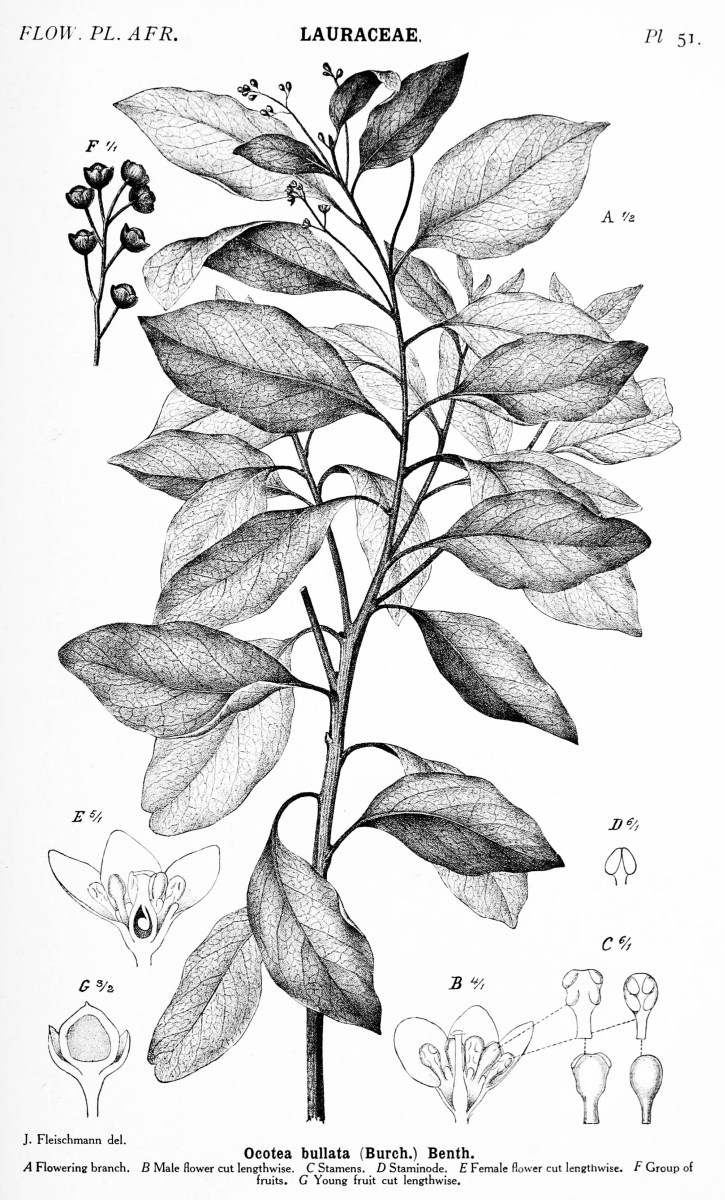
LAURACEAE.
FLOW. PL. AFR.
Pl. 51.
J. Fleischmann del.
Ocotea bullata (Burch.) Benth.
A Flowering branch. B Male flower cut lengthwise. C Stamens. D Staminode. E Female flower cut lengthwise. F Group of fruits. G Young fruit cut lengthwise.
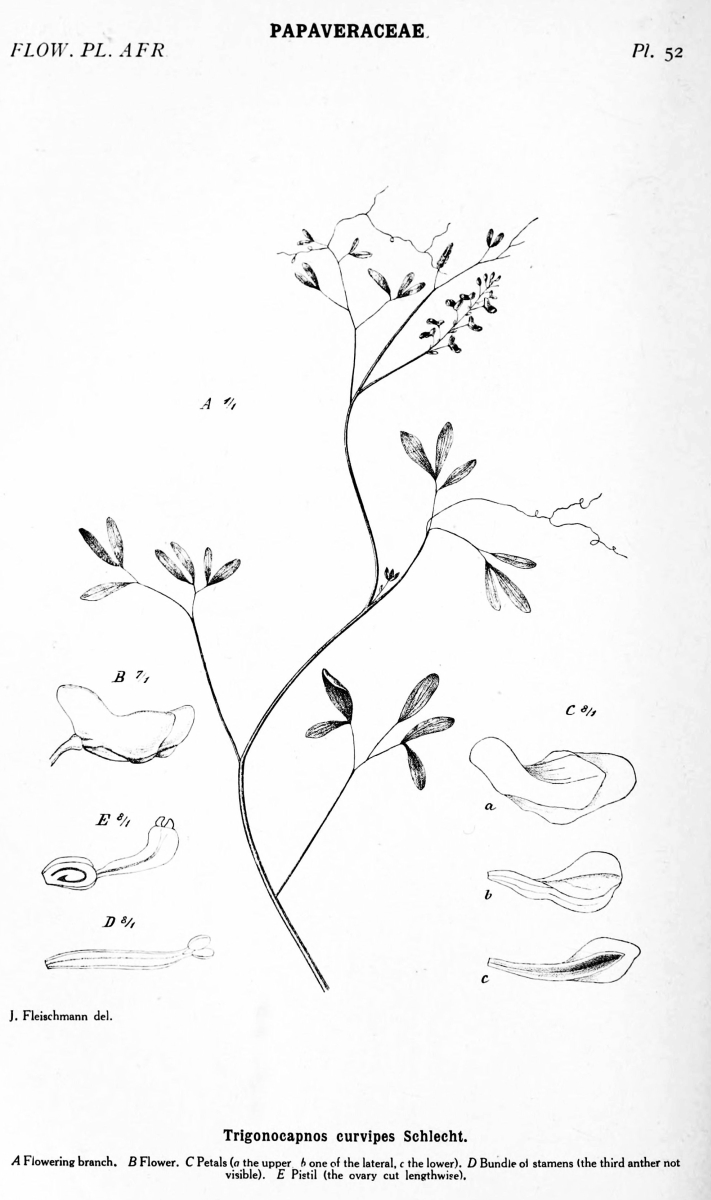
PAPAVERACEAE.
FLOW. PL. AFR.
Pl. 52.
J. Fleischmann del.
Trigonocapnos curvipes Schlecht.
A Flowering branch. B Flower. C Petals (a the upper, b one of the lateral, c the lower). D Bundle of stamens (the third anther not visible). E Pistil (the ovary cut lengthwise).
14. Perianth yellow, with oblong segments, deciduous. Fruit large, greenish.—Species 1 (P. gratissima Gaertn., avocado-pear). Cultivated in the tropics. It yields edible fruit, from which also a fat and a dye are prepared, and is used in medicine. Persea Gaertn. Perianth white, with ovate segments, persistent. Fruit small, blackish.—Species 1. Canary Islands and Azores. Yields timber. (Under Persea Gaertn.) Phoebe Nees
FAMILY 85. HERNANDIACEAE
Trees or shrubs. Leaves alternate, palminerved, without stipules. Flowers in panicles, regular, hermaphrodite polygamous or monoecious. Perianth 4-10-parted. Fertile stamens 3-5, alternating with the inner perianth-segments. Anthers 2-celled, turned inwards, opening by valves. Ovary inferior, 1-celled. Ovule 1, pendulous, inverted. Style and stigma simple. Seed exalbuminous. Embryo with folded or coiled cotyledons.—Genera 3, species 7. Tropics. (Under LAURACEAE or COMBRETACEAE.)
1. Flowers without bracteoles, polygamous. Perianth very small. Stigma capitate. Fruit with 2 terminal wings. Cotyledons spirally twisted. Trees. Leaves undivided or lobed.—Species 1. East Africa, Angola, Madagascar. Yields timber. [Subfamily GYROCARPOIDEAE.] Gyrocarpus Jaqu. Flowers with bracteoles, which sometimes form an involucre, hermaphrodite or monoecious. Perianth rather small. Stigma discoid and more or less lobed. Cotyledons more or less folded or crumpled. [Subfamily HERNANDIOIDEAE.] 2 2. Flowers hermaphrodite. Perianth 10-parted. Fertile stamens 5, with 2 scales at the base. Fruit with 2-4 lateral wings. Climbing shrubs. Leaves digitate.—Species 1. Southern West Africa (Angola). Illigera Blume Flowers monoecious, the female surrounded by a cupular, truncate or lobed, ultimately inflated involucel. Perianth of the male flowers 6-8-parted, of the female 8-10-parted. Fertile stamens 3-4. Trees. Leaves undivided. Partial inflorescences surrounded by an involucre of several bracts, and consisting of a female flower and two or more male.—Species 5. Tropics. They yield timber and are used in medicine. Hernandia L.
ORDER RHOEADALES
SUBORDER RHOEADINEAE
FAMILY 86. PAPAVERACEAE
Herbs. Leaves more or less lobed or divided. Flowers hermaphrodite. Sepals 2, very rarely 3. Petals 4, very rarely 6, free, hypogynous. Anthers opening by slits. Ovary superior, 1-celled or incompletely 2-or more-celled. Ovules parietal, curved or inverted. Fruit a capsule or a nut. Seeds with a small embryo and a copious, oily albumen.—Genera 11, species 50. (Including FUMARIACEAE.) (Plate 52.)
1. Petals, at least one of them, prolonged into a spur. Stamens 2, tripartite (or 6 in two bundles); the middle segment of each stamen bearing a two-celled anther, the lateral ones a one-celled. Juice not milky. [Subfamily FUMARIOIDEAE.] 2 Petals not spurred. Stamens 4 or many, all with 2-celled anthers. 5 2. Ovary with 3 or more ovules. Fruits, at least some of them, dehiscent, 3- or more-seeded.—Species 9. South and North Africa and high mountains of Central Africa. Some are used as ornamental plants. (Including Cysticapnos Adans.) Corydalis DC. Ovary with 1-2 ovules. Fruit indehiscent, 1-2-seeded. Seeds not appendaged. 3 3. Ovary with 2 ovules. Fruit 2-seeded, compressed, with 3 nerves on each side. Leaves fleshy.—Species 1. North-west Africa (Algeria). Sarcocapnos DC. Ovary with 1 ovule. Fruit 1-seeded, compressed but 1-nerved on each side, or triquetrous, or globular. 4 4. Fruit triquetrous, pendulous. Superior petal helmet-shaped, inferior spoon-shaped, lateral ones clawed. Stem climbing.—Species 1. South Africa (Cape Colony). (Plate 52.) Trigonocapnos Schlecht. Fruit globular or compressed, erect.—Species 15. North, South, and East Africa; also naturalized in West Africa and the Mascarene Islands. “Fumitory.” (Including Discocapnos Cham. & Schlechtend. and Platycapnos Bernh.) Fumaria L. 5. Stamens 4. Petals 3-cleft. Placentas and styles 2. Juice not milky.—Species 7. North Africa. Some are used as ornamental plants. [Subfamily HYPECOIDEAE.] Hypecoum L. Stamens numerous. [Subfamily PAPAVEROIDEAE.] 6 6. Juice not milky. Flowers solitary. Petals yellow. Placentas 2. Stigma subsessile, with 4 spreading lobes. Fruit linear, 10-ribbed, 1-celled, 2-valved to the base. Seeds unappendaged.—Species 1. Naturalized in the Canary Islands. Fodder-plant. [Tribe ESCHSCHOLTZIEAE.] Hunnemannia Sweet Juice milky. Placentas 4 or more, more rarely 2, but then stigmas or stigma-lobes only 2, or at least partly erect. 7 7. Stigmas (or style-branches) 2, alternating with the 2 placentas and borne upon a short, but distinct style. Ovary and fruit linear. Seeds appendaged. Flowers in umbels, yellow. Juice reddish-yellow.—Species 1. North-west Africa. Poisonous and used medicinally. “Celandine.” [Tribe CHELIDONIEAE.] Chelidonium L. Stigmas (or style-branches) 3 or more, rarely 2, as many as and opposite to the placentas or more numerous, sessile or nearly so. [Tribe PAPAVEREAE.] 8 8. Fruit linear, dehiscing to the base. Placentas, stigmas, and fruit-valves 2-4. Juice yellow. 9 Fruit oblong, ovoid, or globular, dehiscing near the top only or indehiscent. Placentas, stigmas, and fruit-valves 4-16. 10 9. Petals yellow or reddish-yellow, twisted in the bud. Style ending in 2 erect and 2 spreading lobes. Fruit with a false partition.—Species 2. North Africa and Cape Verde Islands. Used as ornamental or medicinal plants; the seeds yield oil. Glaucium Juss. Petals violet or red, crumpled in the bud. Style ending in 2-4 connivent lobes. Fruit 1-celled.—Species 4. North Africa. Used as ornamental plants. Roemeria Medik. 10. Stigmas in the sinuses between the connivent style-lobes. Petals yellow or whitish. Fruit oblong, usually bristly. Juice yellow.—Species 1. Naturalized in Tropical and South Africa. Used as an ornamental and medicinal plant; the seeds yield oil. Argemone L. Stigmas radiating upon a disc-like expansion of the style-apex. Ovary incompletely septate. Juice white. Buds nodding.—Species 12. North and South Africa, Abyssinia, and Cape Verde Islands; also cultivated in various regions. Some species are poisonous or are used as ornamental, medicinal, or dye-plants. P. somniferum L. yields opium, oil, and edible seeds. “Poppy.” Papaver L.
SUBORDER CAPPARIDINEAE.
FAMILY 87. CAPPARIDACEAE
Leaves alternate, simple or digitate. Flowers solitary or in racemes or umbels, usually irregular. Petals wanting or free, usually 4, rarely (Cercopetalum) united at the base. Disc ring-or scale-like, rarely tubular. Ovary superior, usually stalked. Ovules 4 or more, rarely (Dipterygium) 1-2, curved, usually parietal. Seeds reniform, exalbuminous. Embryo curved, with folded or coiled cotyledons.—Genera 20, species 260. (Plate 53.)
1. Fruit succulent, baccate, indehiscent, rarely at length dehiscing in two valves to which the placentas remain attached. Embryo coiled. Shrubs or trees. [Subfamily CAPPARIDOIDEAE.] 2 Fruit dry, capsular and usually siliquiform, rarely nut-like. Embryo curved. Herbs or undershrubs, rarely shrubs or trees. 14 2. Calyx-tube distinctly developed. Stamens very numerous. Ovary with a long stalk. [Tribe MAERUEAE.] 3 Calyx-tube indistinct or wanting, rarely distinctly developed, but then stamens 10 and ovary with a very short stalk. [Tribe CAPPARIDEAE.] 4 3. Calyx bursting transversely. Petals none. Stamens inserted upon a convex receptacle. Placentas 6-10.—Species 10. East Africa, Madagascar and Mauritius. Thylachium Lour. Calyx bursting lengthwise. Stamens usually inserted upon an elongated, stalk-like receptacle. Placentas 2-4.—Species 50. Some of them yield timber, vegetables, or medicaments. (Including Niebuhria DC. and Streblocarpus Arn.) Maerua Forsk. 4. Calyx-tube distinctly developed. Petals none. Stamens about 10. Disc and androphore wanting. Ovary with a very short stalk. Placentas 2. Leaves digitate.—Species 2. South Africa. Bachmannia Pax Calyx-tube indistinct or wanting. Petals present, more rarely wanting, but then leaves undivided. 5 5. Receptacle produced behind into a tube- or strap-shaped appendage. Stamens 4-8, inserted upon a stalk-like androphore. Leaves undivided.—Species 20. Tropical and South Africa. Some are used in medicine. (Including Schepperia Neck.) Cadaba Forsk. Receptacle produced into scale-like appendages or unappendaged. Stamens rarely upon a distinct stalk-like androphore, and then fertile and sterile stamens together 10 or more. 6 6. Petals none. Stamens without a distinct androphore. Leaves undivided. 7 Petals 4 or more. Ovules numerous. 9 7. Ovary 2-, rarely 3-celled, with 2 ovules in each cell, supported upon a long stalk. Stamens numerous. Disc cup-shaped, crenate. Sepals 3, rarely 2 or 4, united at the base.—Species 6. Central Africa. Courbonia Brongn. Ovary 1-celled, sometimes incompletely 2-celled. Ovules 6 or more. Sepals 4, rarely 5. 8 8. Disc cup-shaped, crenate, accrescent. Stamens numerous. Ovules numerous. Stigma 4-lobed.—Species 3. West Africa. Buchholzia Engl. Disc ring-shaped. Stamens 6-20. Ovules 6-12. Stigma entire.—Species 30. Central Africa, northern South Africa, and Sahara. The fruits and roots of some are eaten or used medicinally. Boscia Lam. 9. Flowers dioecious. Sepals 5. Petals 5, united at the base. Stamens 10-13, borne upon a short androphore. Ovary 5-celled, with axile ovules. Leaves undivided.—Species 1. West Africa. Cercopetalum Gilg Flowers hermaphrodite or polygamous, very rarely dioecious, but then stamens numerous. Flowers nearly always 4-merous. 10 10. Stamens inserted on an elongated stalk-like androphore, united in two bundles, one of which contains 5-9 fertile, the other as many sterile stamens. Petals 4. Placentas 2. Leaves ternately compound.—Species 3. East Africa. Cladostemon A. Br. & Vatke Stamens inserted on a very short androphore or without an androphore. 11 11. Petals very unequal, two much larger than the others, wing-like. Stamens 5-7. Placentas 2. Leaves ternately compound.—Species 1. West Africa. Used as an ornamental plant. (Pteropetalum Pax). Euadenia Oliv. Petals not very unequal. Stamens 8 or more. 12 12. Petals open in aestivation, with a long claw; sepals imbricate or open. Stamens upon a short androphore bearing scales within. Ovary upon a
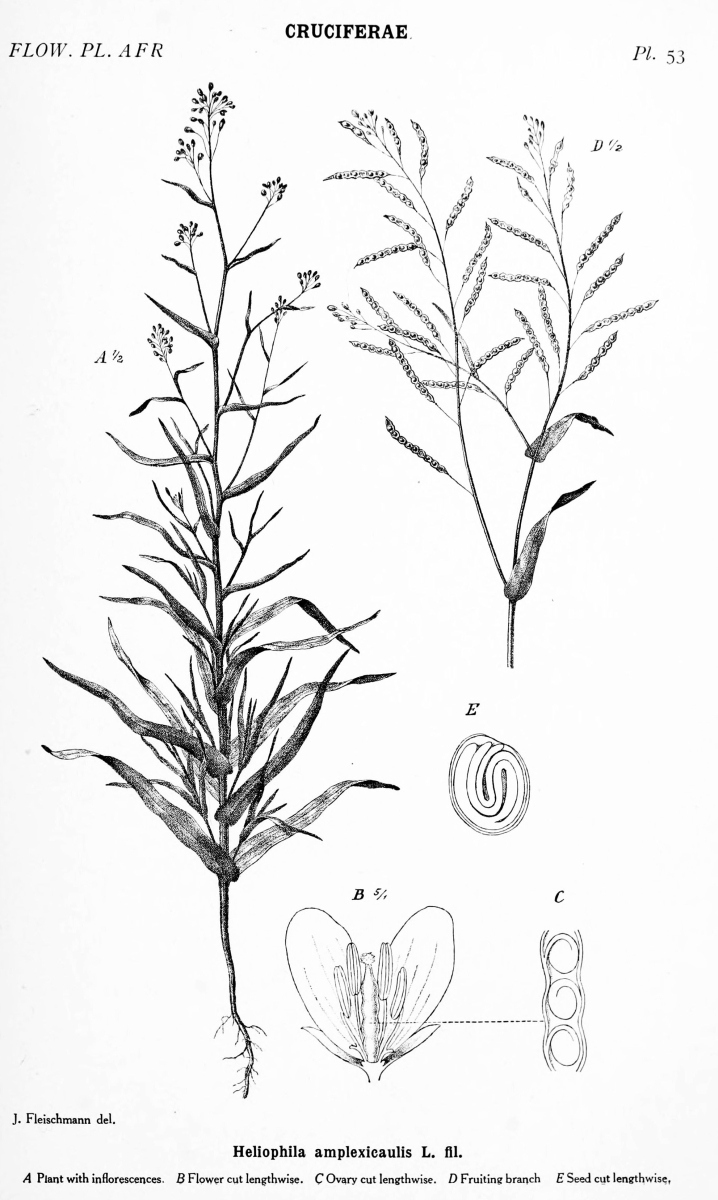
CRUCIFERAE.
FLOW. PL. AFR.
Pl. 53.
J. Fleischmann del.
Heliophila amplexicaulis L. fil.
A Plant with inflorescences. B Flower cut lengthwise. C Ovary cut lengthwise. D Fruiting branch. E Seed cut lengthwise.
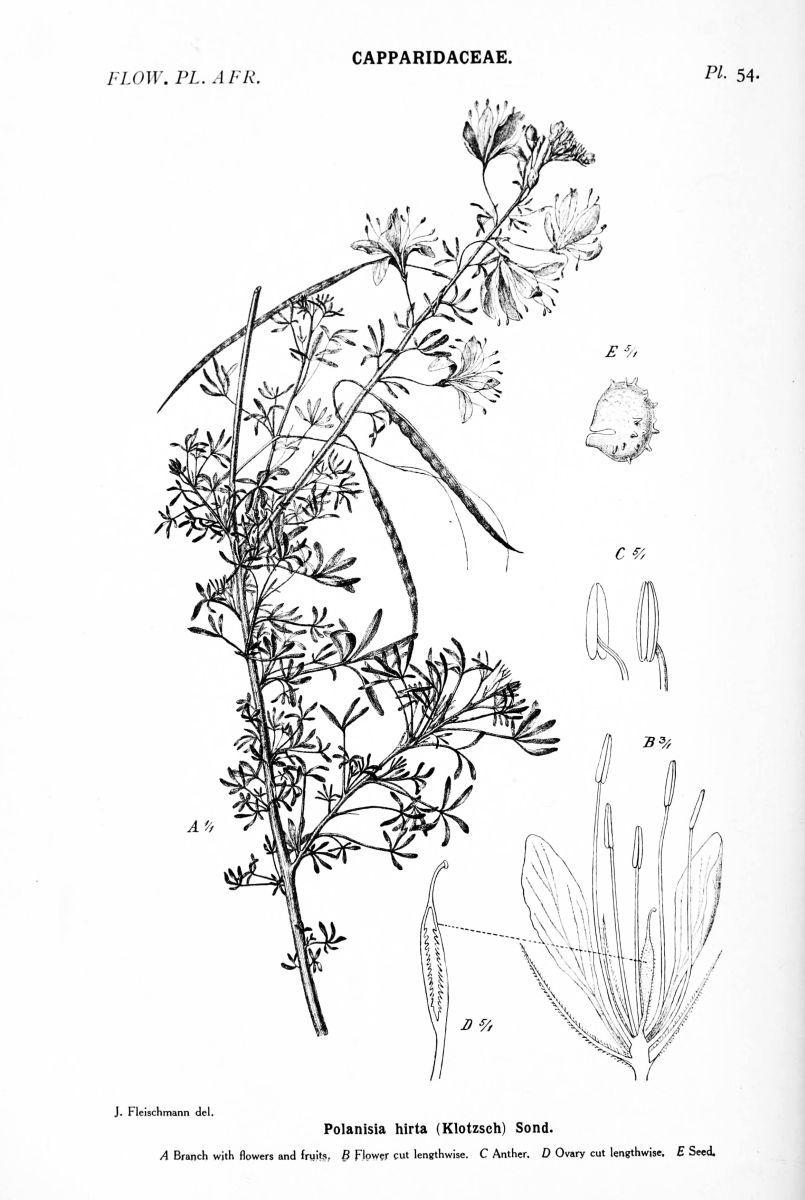
CAPPARIDACEAE.
FLOW. PL. AFR.
Pl. 54.
J. Fleischmann del.
Polanisia hirta (Klotzsch) Sond.
A Branch with flowers and fruits. B Flower cut lengthwise. C Anther. D Ovary cut lengthwise. E Seed.
long gynophore, 1- or incompletely 2-celled, with 2 placentas. Leaves ternately compound.—Species 6. Tropics. Some species yield timber, edible fruit, or medicaments. Crataeva L. Petals imbricate in aestivation; sepals usually valvate. Disc and androphore little developed or wanting. 13 13. Leaves ternately compound, rarely simple and undivided, and then petals numerous. Petals clawed. Ovary with a long stalk, 1-celled.—Species 25. Central Africa. Ritchiea R. Br. Leaves simple, undivided. Petals 4, very rarely 5.—Species 50. Some of them yield timber, salad, condiments (capers from C. spinosa L.), edible fruits, and medicaments; some are poisonous. Capparis L. 14. (1.) Fruit indehiscent, winged, 1-seeded. Petals 4. Stamens 6. Ovary with a very short stalk, 1-celled. Ovules 1-2. Style short. Undershrubs. Leaves undivided.—Species 1. Egypt and Nubia. [Subfamily DIPTERYGIOIDEAE.] Dipterygium Decne. Fruit dehiscing by 2 or more valves. Ovules 4 or more. 15 15. Fruit 1-seeded, dehiscing by many valves. Sepals 2. Petals 5. Stamens 40-60. Ovary sessile, 1-celled. Ovules 4-6. Style long. Shrubs. Flowers fascicled.—Species 2. East Africa. [Subfamily CALYPTROTHECOIDEAE.] Calyptrotheca Gilg Fruit several- or many-seeded, dehiscing by 2 valves which separate from the persistent placentas. Sepals 4. Petals 4. Ovules numerous. [Subfamily CLEOMOIDEAE.] 16 16. Calyx-tube distinctly developed. Petals violet. Stamens 10-12, borne upon a short androphore. Ovary with a long stalk. Herbs. Leaves ternately compound.—Species 2. East Africa. (Under Cleome L.) Chilocalyx Klotzsch Calyx-tube none. 17 17. Stamens inserted upon a stalk-like androphore, 6, all fertile. Ovary stalked. Herbs. Leaves digitate.—Species 1. Tropical and South Africa and Egypt. Yields vegetables, condiments, and medicaments, and is also used as an ornamental plant. (Pedicellaria Schrank). Gynandropsis DC. Stamens inserted upon the receptacle, which is not prolonged into a distinct androphore. 18 18. Stamens numerous or intermixed with staminodes. Herbs. Leaves digitate.—Species 20. Some of them are used as vegetables. (Including Dianthera Klotzsch and Tetratelia Sond., under Cleome L.) (Plate 53.) Polanisia Raf. Stamens 4-6, all fertile. 19 19. Disc reduced to 4 small glands. Ovary sessile. Style long. Trees. Leaves undivided.—Species 1. Northern East Africa (Somaliland). Cleomodendron Pax Disc ring- or saucer-shaped, sometimes produced into scales. Herbs or undershrubs.—Species 30. Some of them are used as ornamental or medicinal plants. Cleome L.
FAMILY 88. CRUCIFERAE
Herbs or undershrubs, rarely shrubs. Leaves alternate, rarely the lower opposite, simple, but often divided, without stipules, but frequently with auricles at the base. Flowers without bracteoles, usually in racemes, regular or nearly so, hermaphrodite. Sepals 4. Petals 4, rarely 0. Stamens 6, of which 4 are longer, rarely 2-4, hypogynous, rarely subperigynous. Glands at the base of the stamens more or less developed. Ovary superior, 1-2-celled or transversely septate, very rarely 3-celled. Ovules parietal, curved. Style simple, with 1-2 stigmas. Fruit dry, usually 2-valved. Albumen scanty or wanting. Embryo curved.—Genera 88, species 420. (Plate 54.)
1. Hairs, all or some of them, branched, at least at the base. Stigma more developed above the placentas than between them. [Tribe HESPERIDEAE.] 2 Hairs simple or wanting. 37 2. Fruit at least 4 times as long as broad. 3 Fruit less than 4 times as long as broad, or broader than long. 19 3. Fruit-valves with a horn-like appendage. Radicle of the embryo accumbent. 4 Fruit-valves without an appendage, but the style sometimes appendaged. 7 4. Fruit-valves with a basal appendage. Seeds margined. Style appendaged at the base. Petals violet. Lateral sepals gibbous at the base. Herbs covered with glandular tubercles.—Species 1. North Africa. Lonchophora Dur. Fruit-valves with an apical appendage. Seeds not margined. Petals white, yellow, or red. Plants without glandular tubercles. 5 5. Fruit-valves with a forked appendage. Petals pink. Leaves linear, entire. Undershrubs.—Species 1. Canary Islands. Parolinia Webb Fruit-valves with an entire appendage. 6 6. Fruit-valves with a blunt appendage below the apex. Petals red. Leaves oblong or ovate, sinuate or toothed. Undershrubs with star-shaped hairs.—Species 5. East Africa. Diceratella Boiss. Fruit-valves with a pointed appendage at the apex. Petals white or yellow. Leaves linear. Herbs with 2-cleft hairs.—Species 1. North Africa. Notoceras R. Br. 7. Lateral glands alone present, one on each side of the lateral stamens. Stigmatic lobes usually long and erect, but sometimes united. 8 Lateral and median (anterior and posterior) glands present, sometimes blended into a ring. Stigmatic lobes usually short and spreading or indistinctly developed. 14 8. Plants covered with glandular tubercles. Style with a dorsal gibbosity; stigma not sharply limited. Seeds flat; radicle accumbent.—Species 15. North, East, and South Africa. Some are used as ornamental plants or in medicine. “Stock.” Matthiola R. Br. Plants without glandular tubercles. Stigma more or less sharply limited at the base. 9. Longer filaments united to the top. Sepals connivent. Petals linear, white or pink. Seeds minute, in two rows. Bracts leaf-like. Leaves divided into narrow segments.—Species 1. North-east Africa (Egypt). Leptaleum DC. Longer filaments free or slightly cohering. 10 10. Seeds thick; radicle incumbent. Fruit-valves more or less convex. Petals white or pink.—Species 10. North Africa. Some are used as ornamental plants. (Including Maresia Pomel). Malcolmia R. Br. Seeds flat; radicle accumbent. 11 11. Fruit-valves convex, with a faint middle-nerve, constricted between the seeds. Sepals saccate at the base. Petals pink. Hairs stellate.—Species 3. North Africa. (Under Farsetia Desv. or Malcolmia R. Br.). Eremobium Boiss. Fruit-valves flat, sometimes keeled. 12 12. Fruit-valves projecting inwards between the seeds, thick, obtusely angled. Stigma acutely 2-lobed. Sepals erect. Petals pink.—Species 3. North and East Africa. Morettia DC. Fruit-valves not projecting between the seeds. 13 13. Petals purple, narrow. Sepals erect, not saccate. Stigma acutely 2-lobed. Seeds winged. Leaves narrow. Hairs 2-cleft.—Species 13. East and North Africa. Some are used medicinally. Farsetia Desv. Petals white, rarely yellowish, reddish, or bluish. Fruit-valves with a faint middle-nerve. Seeds in one row.—Species 15. North, East, and South Africa. Some are used as ornamental plants. “Rock-cress.” Arabis L. 14. (7.) Median glands 4. Style 2-lobed; stigma dilated, not sharply limited. Fruit-valves convex or keeled. 15 Median glands 2, usually confluent with the lateral ones into a ring. Style short, truncate or somewhat depressed at the apex; stigma usually sharply limited. 16 15. Seeds flat; radicle accumbent.—Species 4. North Africa. Used as ornamental plants or in medicine. “Wallflower.” (Including Dichroanthus Webb). Cheiranthus L. Seeds thick; radicle incumbent.—Species 5. North Africa to Abyssinia. Some are used as ornamental plants or in medicine. Erysimum L. 16. Partition of the fruit with two bundles of fibres; valves with a strong midrib. Radicle incumbent. Petals yellow. Leaves pinnatipartite.—Species 4. North Africa to Abyssinia. (Under Sisymbrium L.). Descurainia Webb & Berth. Partition of the fruit without bundles of fibres. Petals white, rarely yellowish, reddish, or bluish. 17 17. Fruit-valves flat, with a faint middle-nerve. Seeds in one row; radicle accumbent. (See 13.). Arabis L. Fruit-valves more or less convex, with a strong middle-nerve. 18 18. Seeds with an accumbent radicle, in 2 rows.—Species 1. South Africa. (Under Arabis L.). Turritis L. Seeds with an incumbent radicle, usually in 1 row.—Species 2. East, South, and North Africa, and Cape Verde Islands. (Under Arabis L. or Sisymbrium L.). Stenophragma Celak. 19. (2.) Fruit 1-seeded. 20 Fruit 2- or more-seeded. 22 20. Sepals petal-like. Petals reddish. Glands none. Ovary 3-celled. Style very short. Fruit elliptical, much compressed. Shrubs.—Species 1. South Africa (Cape Colony). Schlechteria Bolus Sepals not petal-like. Petals yellow or whitish. Glands present. Ovary 2-celled. Fruit orbicular. Herbs. 21 21. Filaments with a tooth-like appendage. Style none. Fruit flat, without a partition. Radicle accumbent. Fruit-stalk bent back. Leaves linear. Hairs star-shaped.—Species 2. North Africa. Clypeola L. Filaments not appendaged. Style thread-shaped. Fruit thick, with a rudimentary partition. Radicle incumbent. Fruit-stalk erect or spreading. Cauline leaves sagittate. Hairs 2-3-cleft.—Species 1. North Africa. Used medicinally. (Vogelia Medik.) Neslia Desv. 22. Fruit 2-4-seeded. 23 Fruit many-seeded. 30 23. Petals yellow. 24 Petals white or reddish. 26 24. Sepals, at least the lateral, saccate at the base. Filaments without an appendage. Stigma 2-lobed. Fruit with laterally compressed, boat-shaped valves and a linear partition. Seeds 2-3; radicle incumbent. Shrubs. Leaves entire. Flowers solitary, axillary.—Species 1. Island of Socotra. Lachnocapsa Balf. Sepals not saccate. Herbs or undershrubs. Flowers in spikes or racemes. 25 25. Median and lateral glands present. Filaments without an appendage. Stigma 2-lobed. Fruit winged, 4-celled, indehiscent. Seeds 4; funicle very short. Embryo spirally twisted; radicle incumbent. Plants covered with glandular tubercles. Leaves toothed.—Species 1. North Africa. Used medicinally. Bunias L. Median glands absent. Filaments usually appendaged. Stigma obscurely lobed. Fruit dehiscing in two valves. Embryo not spiral; radicle accumbent. Plants without glandular tubercles.—Species 13. North and South Africa. Some are used in medicine or as ornamental plants. (Including Meniocus Desv.) Alyssum L. 26. Fruit-valves with a large, wing-like appendage near the top, projecting inwards between the seeds. Style long. Seeds 4. Leaves toothed.—Species 1. North Africa. “Rose of Jericho.” Anastatica L. Fruit-valves without an appendage. 27 27. Fruit-valves boat-shaped, laterally compressed; partition narrow. Stigma sessile. Seeds 4.—Species 2. North Africa. (Including Hinterhubera Reichb. and Hornungia Reichb.) Hutchinsia R. Br. Fruit-valves flat or convex, dorsally or not compressed; partition broad. 28 28. Fruit-valves strongly convex; partition thick, woody. Fruit elliptical, tapering into the style. Seeds 2. Median glands wanting. Flowers short-stalked.—Species 1. North-west Africa (Algeria). Euclidium R. Br. Fruit-valves flat or slightly convex; partition thin, membranous. 29 29. Median glands wanting. Partition of the fruit without fibres. Fruit orbicular. Spinous undershrubs.—Species 1. North-west Africa. (Under Alyssum L.). Ptilotrichum C. A. Mey. Median and lateral glands present. Partition of the fruit with scattered fibres.—Species 6. North and South Africa, Cape Verde Islands, and St. Helena. Some are used as ornamental or medicinal plants. (Koniga Adans., under Alyssum L.) Lobularia Desv. 30. Petals yellow. 31 Petals white or red. 34 31. Sepals, at least the lateral, saccate at the base. Shorter filaments with a tooth-like appendage. Fruit elliptical, flat. Seeds numerous, winged.—Species 1. North-east Africa (Egypt). (Under Farsetia Desv.) Fibigia Medik. Sepals not saccate. 32 32. Filaments, at least some of them, with an appendage, more rarely without, but then, as usually, seeds 2-8. Fruit-valves marked with a mid-rib at the base. (See 25.) Alyssum L. Filaments without an appendage. Seeds 10 or more. Fruit-valves with the mid-rib extending to the top. 33 33. Fruit ovate or elliptical, with rather flat valves and a faint middle-nerve. Radicle accumbent.—Species 5. North-west Africa. Some are used as ornamental or medicinal plants. (Including Erophila DC.) Draba L. Fruit obovate or pear-shaped, with very convex valves and a strong middle-nerve. Radicle incumbent. Leaves sagittate.—Species 3. North Africa. They yield oil and medicaments. Camelina Crantz 34. Petals red. Stigma 2-cleft. Seeds winged. Hairs 2-cleft. (See 13.). Farsetia Turr. Petals white. Stigma entire or notched. Seeds not winged. 35 35. Valves of the fruit flat or slightly convex, with a faint middle-nerve; partition broad. Radicle accumbent. Leaves undivided. (See 33.) Draba L. Valves of the fruit boat-shaped; partition narrow. Radicle incumbent. 36 36. Fruit broadened or notched at the apex.—Species 1. North Africa and northern East Africa, also naturalized in South Africa and the islands of St. Helena and St. Thomas. Used medicinally. “Shepherds purse.” Capsella DC. Fruit rounded or pointed at the apex. (See 27.). Hutchinsia R. Br. 37. (1.) Stigma equally developed all round. Style-apex entire, rarely notched at right angles to the placentas. Cotyledons usually folded or twisted. [Tribe THELYPODIEAE.] 38 Stigma more developed above the placentas than between them. Style-apex entire or 2-lobed. [Tribe SINAPEAE.]. 45 38. Fruit at least 4 times as long as broad. 39 Fruit less than 4 times as long as broad. Cotyledons transversely folded or spirally twisted. 42 39. Fruit without a partition, oblong, with convex, angled valves. Seed-coat spongy. Cotyledons neither folded nor twisted; radicle accumbent. Leaves roundish.—Species 1. Island of Kerguelen. Used as a vegetable and in medicine. Pringlea Hook. fil. Fruit with a partition. Cotyledons folded or twisted; radicle incumbent. 40 40. Sepals connivent, the lateral saccate at the base. Petals white. Fruit oblong. Seeds flat. Cotyledons twice inflected lengthwise. Leaves reniform-cordate.—Species 1. South Africa (Cape Colony). Chamira Thunb. Sepals erect, not saccate. Cotyledons rolled inwards or folded transversely. 41 41. Seeds turgid, separated by transverse partitions. Fruit linear. Petals blue or red. Leaves linear.—Species 1. South Africa (Cape Colony). Carponema Sond. Seeds flat, not separated by transverse partitions, but the fruit often constricted between the seeds.—Species 60. South Africa. Some are used as ornamental plants. (Plate 54.) Heliophila L. 42. Fruit 1-seeded. Seed winged. Leaves thread-shaped.—Species 1. South Africa (Cape Colony). Palmstruckia Sond. Fruit 2- or more-seeded. 43 43. Fruit dehiscent, rather flat, with usually more than 2 seeds. (See 41.) Heliophila L. Fruit indehiscent, 2-seeded. Leaves linear or lanceolate. 44 44. Fruit compressed dorsally; valves with elevated ridges radiating from the centre. Style long. Seeds flat; cotyledons folded. Petals red.—Species 2. South Africa (Cape Colony). Cycloptychis E. Mey. Fruit compressed laterally; valves ventricose; dissepiment very narrow. Style short. Seeds subglobose; cotyledons involute. Petals yellow or red.—Species 2. South Africa (Cape Colony). Brachycarpaea DC. 45. (37.) Fruit at least 4 times as long as broad. 46 Fruit less than 4 times as long as broad, or broader than long. 77 46. Fruit transversely divided into two or more fertile cells. Cotyledons folded; radicle incumbent. [Subtribe BRASSICINAE.] 47 Fruit not transversely septate, but sometimes produced into a seedless beak. 59 47. Fruit with 2 transverse cells (joints). 48 Fruit with 3 or more transverse cells. 56 48. Upper joint of the fruit 3-4-seeded, flat. Seeds oblong. Petals yellow. Undershrubs.—Species 1. North-west Africa (Morocco). Hemicrambe Webb Upper joint of the fruit 1-seeded. 49 49. Fruit-valves flat, usually 1-nerved. 50 Fruit-valves convex. 51 50. Sepals connivent, the lateral saccate. Petals violet. Stigmatic lobes long, erect, connate.—Species 7. North Africa. Moricandia DC. Sepals spreading, not saccate. Stigmatic lobes short. Leaves pinnatipartite.—Species 10. North Africa, northern Central Africa, and Island of St. Thomas; one species also naturalized in South Africa. The seeds of some species are used as a condiment. Diplotaxis DC. 51. Beak of the fruit flat, sharp-edged. Valves usually 3-nerved. 52 Beak of the fruit cylindrical or conical, terete or but slightly flattened. 53 52. Petals red. Lateral sepals saccate. Seeds ovoid. Fruits erect. Leaves dissected.—Species 2. North Africa. (Under Erucaria Gaertn.) Reboudia Coss. & Durieu Petals yellow or whitish with violet veins. Seeds globose. Leaves lyrate.—Species 5. North Africa, one species also cultivated in the Mascarene Islands. The white mustard (S. alba L.) yields salad, oil, condiments, and medicaments. (Under Brassica L.) Sinapis L. 53. Lower joint of the fruit indehiscent, narrower than the upper one, 3-4-seeded. Petals yellow. Lateral sepals saccate.—Species 1. North-west Africa. (Under Rapistrum Desv.) Cordylocarpus Desf. Lower joint of the fruit dehiscing in two valves, as broad as the upper one, rarely narrower, but then petals violet. 54 54. Seeds globular, sometimes slightly flattened. Cotyledons 2-lobed. Petals yellow or white, sometimes with violet veins.—Species 25, five of them only cultivated or naturalized. Some species yield vegetables, salad, oil, condiments, or medicaments, especially B. oleracea L., cabbage, B. campestris L., rapeseed, B. Napus L., turnip, and B. nigra Koch, black mustard. (Including Melanosinapis Schimp. & Spenn.) Brassica L. Seeds ovoid or oblong. Leaves pinnatipartite. 55 55. Fruit-valves net-veined with a strong midrib. Cotyledons truncate. Sepals spreading. Petals white or yellow.—Species 6. North and East Africa. (Including Hirschfeldia Moench, under Brassica L.) Erucastrum Presl Fruit-valves with several longitudinal nerves. Sepals connivent. Petals violet.—Species 4. North Africa. (Including Hussonia Coss.) Erucaria Gaertn. 56. Seeds pendulous. 57 Seeds partly (the upper ones) erect. 58 57. Fruit flat or 4-angled. Stem very short. Leaves radical. Flowers solitary, axillary.—Species 3. North-west Africa. (Raffenaldia Godr.) Cossonia Durieu Fruit turgid. Stem branched. Leaves radical and cauline. Flowers racemose.—Species 2, one spontaneous in North Africa and naturalized in South Africa, the second (R. sativus L.) cultivated and naturalized in various regions. The latter yields salad, oil, and medicaments. “Radish.” (Raphanus L.) Rhaphanus L. 58. Lower joint of the fruit 1-celled, indehiscent, 1-4-seeded. Hispid herbs. Leaves lyrate, the upper toothed. Flowers, at least the lower, subtended by bracts.—Species 4. North Africa to Nubia. Enarthrocarpus Labill. Lower joint of the fruit 2-celled lengthwise, usually dehiscing in two valves, 4-12-seeded. Almost glabrous herbs. Leaves dissected. Flowers without bracts. (See 55). Erucaria Gaertn. 59. (46.) Fruit 1-seeded, flat, winged, 6-nerved, indehiscent. Stigma sessile. Radicle incumbent. Petals yellow. Leaves undivided.—Species 5. North Africa. Woad (I. tinctoria L.) yields a dye, other species are used medicinally. Isatis L. Fruit 2- or more-seeded. 60 60. Fruit-valves flat, but sometimes with a prominent midrib. 61 Fruit-valves convex or keeled. 67 61. Stigmatic lobes long, erect, sometimes connate. Median glands none. Radicle incumbent; cotyledons folded. Lateral sepals saccate. Petals violet or purple. Glabrous plants. 62 Stigmatic lobes short or not developed. Median, sometimes confluent, glands besides the lateral ones present, rarely only the latter, but then radicle accumbent. Radicle accumbent or incumbent; in the latter case cotyledons flat, rarely folded, but then sepals not saccate. 63 62. Seeds broadly winged, in a single row. Fruit broadly linear. Petals with a broad claw. Shrubs. Leaves linear-oblong, sessile, entire.—Species 1. North-west Africa (Algeria). (Including Oudneya R. Br.) Henophyton Coss. & Durieu Seeds narrowly or not winged. Fruit narrowly linear. Herbs or undershrubs. Leaves undivided, the upper stem-clasping, or pinnately divided. (See 50.). Moricandia DC. 63. Radicle of the embryo incumbent. Seeds usually in 2 rows. Leaves, at least the lower, pinnately divided. 64 Radicle of the embryo accumbent. Seeds usually in a single row. 65 64. Seeds oblong. Cotyledons not folded. Sepals converging or erect, the lateral saccate at the base. Petals purple or violet.—Species 2. North Africa. Ammosperma Hook. fil. Seeds ovoid or globose. Cotyledons folded. Fruit-valves 1-nerved. Sepals erect or spreading, not saccate. (See 50.). Diplotaxis DC. 65. Fruit-valves without distinct veins, opening elastically. Fruit linear or linear-lanceolate. Seeds in a single row, oblong or elliptical, not winged. Sepals not saccate. Leaves usually pinnately divided.—Species 8. Some of them are used as salad or in medicine. “Bittercress.” Cardamine L. Fruit-valves with distinct veins, not elastic. Fruit linear. Leaves usually undivided. 66 66. Fruit-valves with a faint midnerve. Seeds in a single row. (See 13.) Arabis L. Fruit-valves with a prominent midnerve. Seeds in two rows, ovoid. Sepals spreading. Petals white. Leaves undivided. (See 18.) Turritis L. 67. (60.) Median glands absent. Fruit-valves with a prominent midnerve. Cotyledons convex or folded; radicle incumbent. Sepals erect or converging. Petals yellow or violet. Glabrous plants. 68 Median and lateral glands present, sometimes blended into a ring, rarely (Nasturtium) median glands absent, but then fruit-valves with a faint or scarcely visible midnerve. Sepals erect or spreading. Petals white or yellow, sometimes with red or violet veins. 69 68. Petals violet. Stigmatic lobes long, erect, sometimes cohering. Cotyledons folded. (See 50.) Moricandia DC. Petals yellowish. Stigmatic lobes short or imperceptible. Seeds in a single row, oblong. Cotyledons convex. Leaves undivided.—Species 1. North Africa to Nubia. Used as a vegetable. Conringia Heist. 69. Radicle of the embryo accumbent. Sepals not saccate. 70 Radicle of the embryo incumbent; cotyledons usually folded. 71 70. Fruit-valves with a strong midnerve. Seeds in a single row. Petals yellow.—Species 3. North, East, and South Africa, also naturalized in the Mascarene Islands. Used as vegetables, salad, or fodder. “Wintercress.” Barbarea R. Br. Fruit-valves with a faint midnerve not reaching to the top. Seeds usually in two rows.—Species 15. Some of them (especially N. officinale R. Br., watercress) yield salad, condiments, and medicaments. (Including Roripa Scop.) Nasturtium R. Br. 71. Cotyledons not folded. Fruit not beaked; valves with 1-3 strong ribs. Glands confluent into a ring. 72 Cotyledons folded. Fruit usually beaked. 73 72. Style-apex truncate beneath the stigma. Seeds striate. Petals white. Leaves broad-cordate, toothed.—Species 1. North-west Africa. Used medicinally. (Under Sisymbrium L.) Alliaria Adans. Style-apex notched beneath the stigma. Petals usually yellow.—Species 25. Some are used as vegetables or in medicine. (Including Kibera DC. and Nasturtiopsis Boiss.) Sisymbrium L. 73. Fruit with a flat, sharp-edged beak, dehiscing in two valves. Seeds globular. Herbs with lyrate leaves. 74 Fruit with a cylindrical or conical, terete or slightly flattened beak, or without a beak. 75 74. Fruit-valves with a single strong longitudinal nerve. Seeds in 2 rows. Sepals converging. Fruits erect, pressed against the stem.—Species 4. North Africa and northern East Africa. The seeds are used as a condiment or in medicine. (Including Rytidocarpus Coss.) Eruca Lam. Fruit valves with 3 longitudinal nerves. Seeds in 1 row. Sepals spreading. (See 52.). Sinapis L. 75. Seeds oblong. Fruit-valves with a strong midrib. Lateral sepals saccate. Petals yellow. Undershrubs. Leaves undivided.—Species 6. Madeira and Cape Verde Islands. (Under Brassica L.) Sinapidendron Lowe Seeds globular, sometimes slightly flattened. Herbs. 76 76. Fruit indehiscent, spongy. Leaves lyrate. (See 57.) Rhaphanus L. Fruit dehiscing in two valves. (See 54.) Brassica L. 77. (45.) Fruit indehiscent, transversely divided into 2-7 cells (joints), the lowest cell sometimes seedless. 78 Fruit not transversely septate, but sometimes prolonged into a seedless beak. 82 78. Fruit 3-7-jointed, oblong, flat. Style rather long. Seeds solitary in each cell, pendulous. Sepals erect or connivent, the lateral saccate. Stem very short. Leaves radical, lyrate. Flowers solitary, axillary. (See 57.) Cossonia Durieu Fruit 2-jointed. Flowers racemose. 79 79. Fruit compressed, the lower joint with a pendulous, the upper with an erect seed. Stigma sessile. Radicle accumbent. Lateral sepals saccate. Petals pale-violet or rose-coloured.—Species 1. North Africa. Used medicinally. Cakile Gaertn. Fruit not essentially compressed. Radicle incumbent. Cotyledons folded. Petals white or yellow. 80 80. Upper joint of the fruit with a partition and an erect seed; lower joint 1-2-seeded or seedless. Sepals spreading. Leaves pinnatipartite.—Species 7. North Africa; one species also naturalized in South Africa. (Including Ceratocnemon Coss. et Balansa, Didesmus Desv., Otocarpus Durieu, and Rapistrella Pomel). Rapistrum Desv. Upper joint of the fruit without a partition, one-seeded; lower joint seedless. Sepals not saccate. Petals white. 81 81. Upper joint of the fruit tubercled, beaked. Seed erect or pendulous from the top of the cell. Cotyledons not lobed. Sepals suberect. Filaments not toothed. Leaves lobed.—Species 2. North-west Africa. (Including Kremeria Coss.). Muricaria Desv. Upper joint of the fruit ribbed or smooth, not beaked. Seed pendulous from the long, ascending funicle. Cotyledons 2-lobed. Sepals spreading.—Species 7. North and East Africa. Some are used as vegetables (sea-kale). Crambe L. 82. (77.) Fruit prolonged into a broad beak. Radicle incumbent. Petals yellow, often marked with violet veins. 83 Fruit not distinctly beaked. 87 83. Fruit indehiscent, 1- or 3-celled, with a single perfect seed and usually a rudimentary one below it. Seed oblong. Herbs. Leaves toothed, lobed, or cleft. 84 Fruit dehiscing in 2 valves, completely or incompletely 2-celled, with 2 or more seeds, but the seed of one cell sometimes rudimentary (in this case shrubs). Seeds globose or nearly so. Cotyledons folded. 85 84. Fruit 1-celled, with an oblique, sword-shaped beak.—Species 1. North-east Africa (Egypt). Schimpera Hochst. & Steud. Fruit 3-celled, with a broad, hollow, chambered beak.—Species 1. North-west Africa (Algeria). Myagrum L. 85. Fruit with 2 seeds. Longer filaments united in pairs. Small shrubs. Leaves entire.—Species 1. North-west Africa. Vella L. Fruit with 6 or more seeds. Filaments free. Herbs. Leaves divided, at least some of them. 86 86. Fruit with 6-8 seeds and a leaf-like beak. Leaves twice pinnately dissected.—Species 1. North Africa. Carrichtera Adans. Fruit with many seeds and a sword-shaped beak. Leaves lyrate or undivided. (See 74.) Eruca Lam. 87. (82.) Fruit 1-seeded. 88 Fruit 2- or more-seeded. 91 88. Fruit slightly or not compressed, ovoid, with a crusty rind. Seed globular. Cotyledons folded; radicle incumbent. Petals white. Filaments without an appendage. Glands confluent. Radical leaves pinnately divided. Fruit-stalks spreading-erect.—Species 1. North-west Africa (Algeria). Calepina Adans. Fruit much compressed. Leaves undivided. 89 89. Sepals petal-like. Petals rose-coloured. Filaments without an appendage. Glands wanting. Ovary 3-celled. Fruit elliptical. Radicle accumbent. Shrubs. Leaves entire. (See 20.) Schlechteria Bolus Sepals not petal-like. Glands present. Ovary 2-celled. Herbs or undershrubs. 90 90. Petals rose-coloured. Longer filaments with a tooth-like appendage. Median glands wanting. Apex of the style truncate beneath the stigma. Fruit discoid, winged.—Species 2. North-west Africa (Algeria). Used as ornamental plants. Aethionema R. Br. Petals yellow. Filaments without an appendage. Median and lateral glands confluent into a ring. Apex of the style more or less 2-lobed beneath the stigma. Fruit with 6 longitudinal nerves. Fruit-stalks bent downwards. (See 59.) Isatis L. 91. (87.) Fruit 2-seeded. 92 Fruit 4- or more-seeded. 99 92. Fruit much compressed from the back, oblong, with a soon vanishing partition and flat, net-veined valves. Seeds horizontal, winged; radicle accumbent. Lateral sepals saccate. Petals pale-violet. Leaves pinnatisect.—Species 1. North-east Africa (Egypt). Ricotia L. Fruit compressed from the side, and then with a narrow partition, or not compressed; partition well developed. 93 93. Fruit distinctly compressed laterally. 94 Fruit not distinctly compressed. 97 94. Fruit moderately compressed, with a lanceolate or elliptical partition, opening by 2 valves. Seeds pendulous; radicle incumbent, rarely obliquely accumbent; cotyledons inserted behind the bend of the embryo. Petals white, more rarely yellowish or wanting.—Species 20. Some of them (especially L. sativum L., garden-cress) yield salad, oil, and medicaments. Lepidium L. Fruit strongly compressed, with a linear partition. 95 95. Seeds horizontal, inserted in the middle of the cell. Radicle short, accumbent; cotyledons inserted behind the bend of the embryo. Petals yellow. Median and lateral glands present.—Species 6. North Africa. Some are used medicinally. Biscutella L. Seeds pendulous from the top of the cell. Petals, when present, white, red or violet. 96 96. Radicle incumbent; cotyledons inserted behind the bend of the embryo. Style very short. Fruit reniform, wrinkled, indehiscent.—Species 7. Some of them are used medicinally. (Senebiera Poir.) Coronopus Gaertn. Radicle accumbent; cotyledons inserted at the bend of the embryo. Style distinctly developed. Fruit ovate. Outer petals larger than the inner. Median glands wanting.—Species 4. North-west Africa. Some are used as ornamental plants or in medicine. “Candytuft.” Iberis L. 97. Fruit dehiscing by two valves, globular, prickly, with a pierced partition. Style subulate, with short, blunt lobes. Seeds globose, with a thread-shaped funicle. Radicle incumbent; cotyledons folded, inserted at the bend of the embryo. Sepals erect. Petals yellow. Herbs. Leaves pinnatisect.—Species 1. North-west Africa. Succowia Medik. Fruit indehiscent, with a thick partition. Style conical. Seeds with a very short funicle. 98 98. Fruit angular-subglobose, tubercled. Style very short, with short lobes. Seeds oblong. Radicle obliquely accumbent; cotyledons inserted behind the bend of the embryo. Sepals spreading. Petals yellow. Herbs. Leaves pinnately divided.—Species 1. North-east Africa (Egypt). Ochthodium DC. Fruit ovoid. Style rather long, with long lobes. Radicle incumbent; cotyledons folded, inserted at the bend of the embryo. Sepals erect. Petals rose-coloured. Spinous shrubs. Leaves undivided.—Species 2. North Africa to Nubia. Zilla Forsk. 99. (91.) Fruit compressed from the back or not compressed; hence partition as broad as the fruit. 100 Fruit laterally compressed; partition narrower than the fruit. 104 100. Seeds 4, in a single row, flat, with a long free funicle; radicle accumbent. Fruit with a soon vanishing partition; valves flat, without a distinct median nerve; style very short. Lateral sepals saccate. Petals violet. Only two lateral glands present. Leaves pinnately dissected. Fruit-stalks bent downwards. (See 92.). Ricotia L. Seeds more than 4, nearly always in two rows. Fruit with a persistent partition. Sepals not saccate. 101 101. Seeds flat, winged. Funicle adnate to the partition at the base. Radicle incumbent; cotyledons folded. Fruit with a stalk-like appendage at the base; valves slightly convex. Petals rose or violet. Leaves undivided or lobed.—Species 2. North Africa. Used medicinally. Savignya DC. Seeds turgid or flat but not winged. Funicle free. Radicle accumbent. Petals white or yellow. 102 102. Fruit-valves with a very faint median nerve not reaching the top, or without a distinct median nerve, convex. Seeds turgid. Style-apex lobed. Median and lateral glands developed. (See 70.) Nasturtium R. Br. Fruit-valves with a distinct median nerve reaching the top. Median glands wanting. 103 103. Fruit-valves distinctly convex. Seeds turgid. Style-apex truncate beneath the stigma. Petals white. Filaments curved.—Species 1. Naturalized in the Island of St. Helena. (Under Cochlearia L.) Kernera Medik. Fruit-valves rather flat. Style-apex lobed or depressed beneath the stigma. Glands 4. Leaves undivided. (See 33.) Draba L. 104. (99.) Median and lateral glands present. Sepals erect. Fruit winged. Style long. Seeds numerous. Radicle incumbent; cotyledons folded. Leaves undivided. 105 Median glands absent. Style short, rarely long, but then radicle accumbent. Cotyledons not folded. 106 105. Petals white, with dark veins. Fruit obcordate. Style-apex shortly and obtusely lobed. Hispid herbs.—Species 1. North-west Africa. Psychine Desf. Petals violet or red. Fruit ovoid. Style-apex distinctly and acutely lobed. Glabrous herbs.—Species 1. North Africa and Abyssinia. Schouwia DC. 106. Stamens more or less perigynous. Petals white. Seeds 4-6. Cotyledons inserted behind the bend of the embryo. 107 Stamens hypogynous. Cotyledons inserted at the bend of the embryo. 108 107. Filaments with an appendage at their base. Fruit winged above. Style short. Seeds 4. Radicle accumbent. Leaves lanceolate, ovate, or pinnatipartite.—Species 2. North-west Africa. Used as vegetables. Teesdalia R. Br. Filaments without an appendage. Fruit not winged. Style absent. Seeds 6. Radicle incumbent. Leaves linear.—Species 1. High mountains of East Africa. Subularia L. 108. Filaments, at least the longer ones, with a tooth-like appendage. Lateral sepals saccate at the base. Petals rose-coloured. Style short. Radicle incumbent. Flowers in racemes. (See 90.). Aethionema R. Br. Filaments without an appendage. Sepals not saccate. 109 109. Flowers solitary in the axils of the radical, undivided leaves. Petals rose-coloured. Fruit-valves wingless, separating from the laterally dilated placentas. Seeds 6. Radicle incumbent.—Species 2. North-west Africa. Used as ornamental plants. Ionopsidium Reichb. Flowers in racemes. Fruit-valves separating from the narrow or thickened but not dilated placentas, or fruit indehiscent. 110 110. Fruit-valves not winged. Fruit oblong or ovate. Petals white. Leaves pinnately divided. (See 27.) Hutchinsia R. Br. Fruit-valves winged. 111 111. Radicle accumbent. Petals white or rose. Leaves undivided.—Species 6. North Africa and Abyssinia. Used medicinally. “Penny-cress.” Thlaspi L. Radicle incumbent. 112 112. Fruit oblong or elliptical. Stigma sessile. Petals white or yellow. Leaves undivided.—Species 2. North-west Africa (Algeria). (Including Pastorea Tod.) Bivonaea DC. Fruit obcordate. Stigma borne upon a short style. Funicle free. Petals white. (See 36.). Capsella DC.
SUBORDER RESEDINEAE
FAMILY 89. RESEDACEAE
Leaves alternate, stipulate. Flowers in terminal spikes or racemes, irregular. Sepals 4-8. Petals 2-8, free, rarely 0. Disc hypogynous, one-sided, rarely wanting. Stamens 3-40, free or united at the base. Carpels 2-6, superior and usually stalked, open at the top, distinct or united and then forming a 1-celled ovary. Ovules inverted. Stigmas sessile. Seeds reniform, exalbuminous, with a curved embryo.—Genera 6, species 45. (Plate 55.)
1. Carpels 5-6, distinct or cohering at the base only. Petals 5. Leaves lanceolate, entire. 2
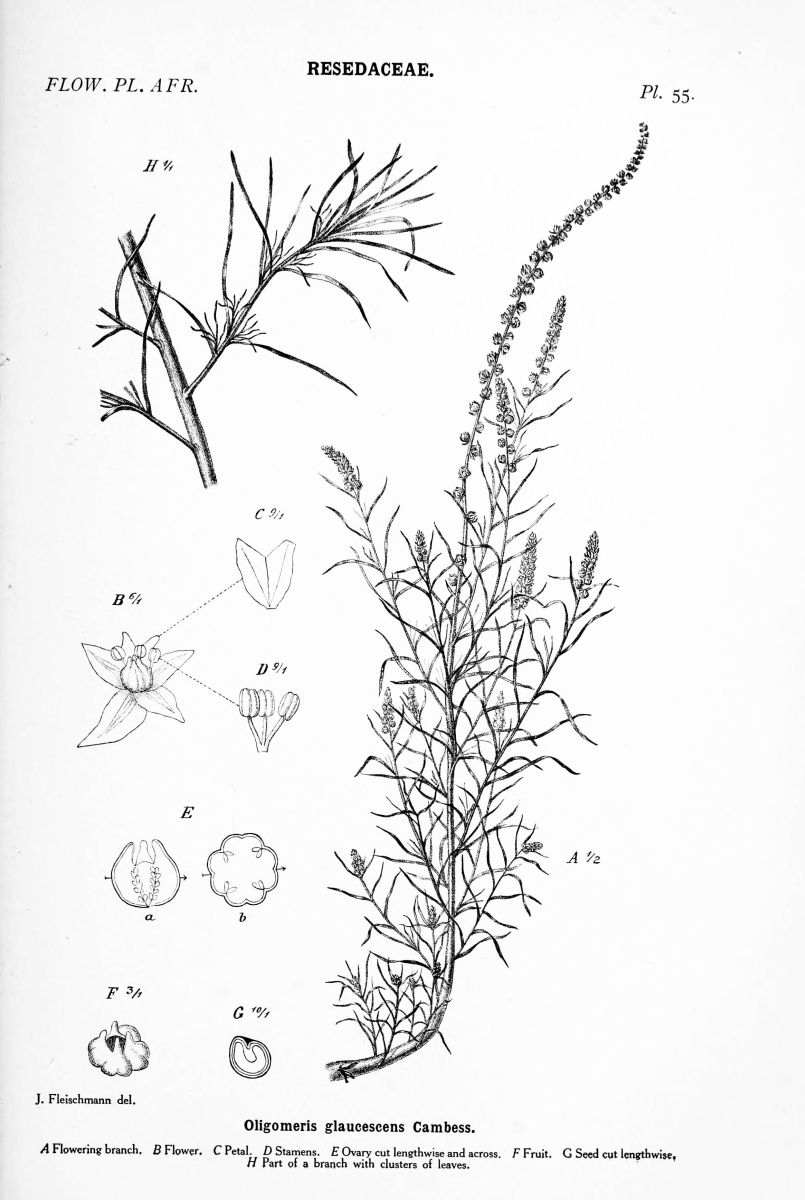
RESEDACEAE.
FLOW. PL. APR.
Pl. 55.
J. Fleischmann del.
Oligomeris glaucescens Cambess.
A Flowering branch. B Flower. C Petal. D Stamens. E Ovary cut lengthwise and across. F Fruit. G Seed cut lengthwise. H Part of a branch with clusters of leaves.
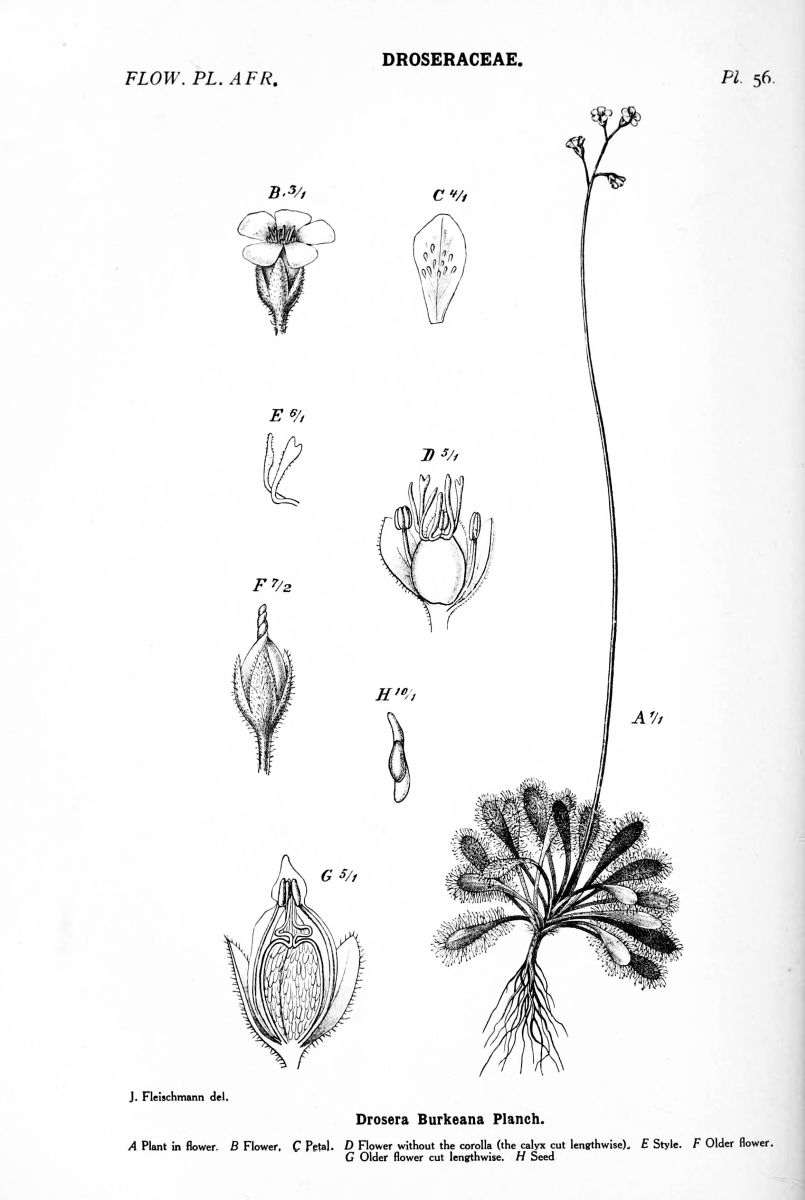
DROSERACEAE.
FLOW. PL. AFR.
Pl. 56.
J. Fleischmann del.
Drosera Burkeana Planch.
A Plant in flower. B Flower. C Petal. D Flower without the corolla (the calyx cut lengthwise). E Style. F Older flower. G Older flower cut lengthwise. H Seed.
Carpels 2-4, united at least to the middle, forming a 1-celled ovary open at the top with parietal placentation; if carpels united to the middle only, then petals 4. 3 2. Carpels with a single descending ovule attached in the middle of the cell, stellately spreading when ripe. Shrubs.—Species 1. North-west Africa (Algeria). Astrocarpus Neck. Carpels with 2-3 basal ovules. Herbs.—Species 3. North and Central Africa. Caylusea St. Hil. 3. Petals none. Sepals 6. Stamens 10-30, hypogynous. Stigmas 3. Fruit berry-like, closed at the top. Shrubs. Leaves linear.—Species 5. North Africa and northern East Africa. Ochradenus Del. Petals 2-8. Fruit capsular, open at the top. 4 4. Petals 2. Disc wanting. Stamens 3-10, hypogynous. Ovary sessile. Stigmas 4. Herbs or undershrubs.—Species 6. South Africa and North Africa to Nubia. (Plate 55.) Oligomeris Cambess. Petals 4-8. Disc present. 5 5. Petals perigynous, 6-8. Stamens perigynous, numerous. Disc double. Stigmas 2-3. Shrubs.—Species 2. North Africa and northern East Africa. Randonia Coss. Petals hypogynous, 4-7. Stamens hypogynous. Ovary stalked. Herbs or undershrubs.—Species 30. North Africa and northern East Africa; one species also introduced in South Africa. Some species (especially R. luteola L.) yield a dye, oil, and medicaments, others (especially R. odorata L.) are used as ornamental plants and in perfumery. “Mignonette.” (Including Luteola Tourn.). Reseda L.
SUBORDER MORINGINEAE
FAMILY 90. MORINGACEAE
Trees. Leaves alternate, pinnate. Stipules gland-like or wanting. Flowers in panicles, irregular, hermaphrodite. Petals 5, perigynous, imbricate in bud. Fertile stamens 5, perigynous, alternating with 5 staminodes. Anthers 1-celled, turned inwards. Ovary short-stalked, 1-celled, with 3 parietal placentas. Ovules numerous, pendulous, inverted. Style simple. Fruit capsular. Seeds exalbuminous; embryo straight. (Under CAPPARIDACEAE.)
Genus 1, species 6. Five species spontaneous in northern East Africa, Madagascar, and Egypt; the sixth (M. oleifera Lam., horse-radish-tree) cultivated and sometimes naturalized on the coasts of the tropics. This species yields gum, fibre, tanners’ bark, fodder, vegetables, oil, condiments, and medicaments. Moringa Juss.
ORDER SARRACENIALES
FAMILY 91. NEPENTHACEAE
Shrubs or undershrubs. Leaves alternate, undivided, terminating in a pitcher. Flowers regular, dioecious. Perianth-segments 4. Stamens 4 or more, with united filaments; anthers 2-celled, opening outwards. Ovary superior, 4-celled. Ovules numerous, axile, inverted. Stigmas 4, sessile, 2-lobed. Fruit a loculicidal capsule. Seeds with a straight, axile embryo and fleshy albumen.
Genus 1, species 2. Madagascar and Seychelles. Used as ornamental plants. “Pitcher plant.” Nepenthes L.
FAMILY 92. DROSERACEAE
Herbs or undershrubs. Leaves usually covered with glandular hairs and rolled up in the bud. Flowers regular, hermaphrodite. Calyx 4-8-lobed or parted, imbricate in bud. Petals 4-8, usually 5, free, clawed, imbricate or contorted in aestivation. Stamens 4-20, as many as or more than the petals, hypogynous or nearly so, free. Anthers usually turned outwards, opening by longitudinal slits. Ovary superior, 1-celled. Ovules numerous (10 or more), inverted. Styles or style-branches 2-5. Fruit a loculicidal capsule. Seeds albuminous, with a small embryo.—Genera 3, species 15. (Plate 56.)
1. Stamens 10-20. Styles 5, free, with capitate stigmas. Ovules basal or nearly so. Undershrubs. Leaves linear, glandular-hairy, rolled up in the bud. Flowers in corymbs.—Species 1. North-west Africa (Morocco). Drosophyllum Link Stamens 4-8. Styles or style-branches 2-5, with not much thickened stigmas. Ovules parietal. Herbs. 2 2. Blade of the leaves jointed to the stalk, folded lengthwise, surrounded by bristles, without glands at the edges. Leaves whorled. Flowers solitary, axillary. Stamens 5. Styles 5, free, with branched stigmas. Ovules few, affixed at the middle of the placentas. Floating water-plants.—Species 1. Upper Nile. Aldrovanda L. Blade of the leaves not jointed, flat, rolled up in the bud, bearing long-stalked glands at the edges. Ovules numerous.—Species 13. Southern and tropical Africa. Some species are used in the preparation of liquors and in medicine. “Sundew.” (Plate 56.) Drosera L.
ORDER ROSALES
SUBORDER PODOSTEMONINEAE
FAMILY 93. PODOSTEMONACEAE
Aquatic herbs resembling mosses or algae. Flowers solitary or in cymes, usually enclosed when young in a spathe, hermaphrodite. Perianth of 2-3 minute scales, rarely larger and 3-parted. Stamens 1-4, hypogynous. Anthers opening by longitudinal slits. Ovary superior, 1-3-celled, with a central placenta. Ovules numerous, sub-sessile, inverted. Fruit capsular. Seeds exalbuminous.—Genera 9, species 25. Tropical and South Africa. (Plate 57.)
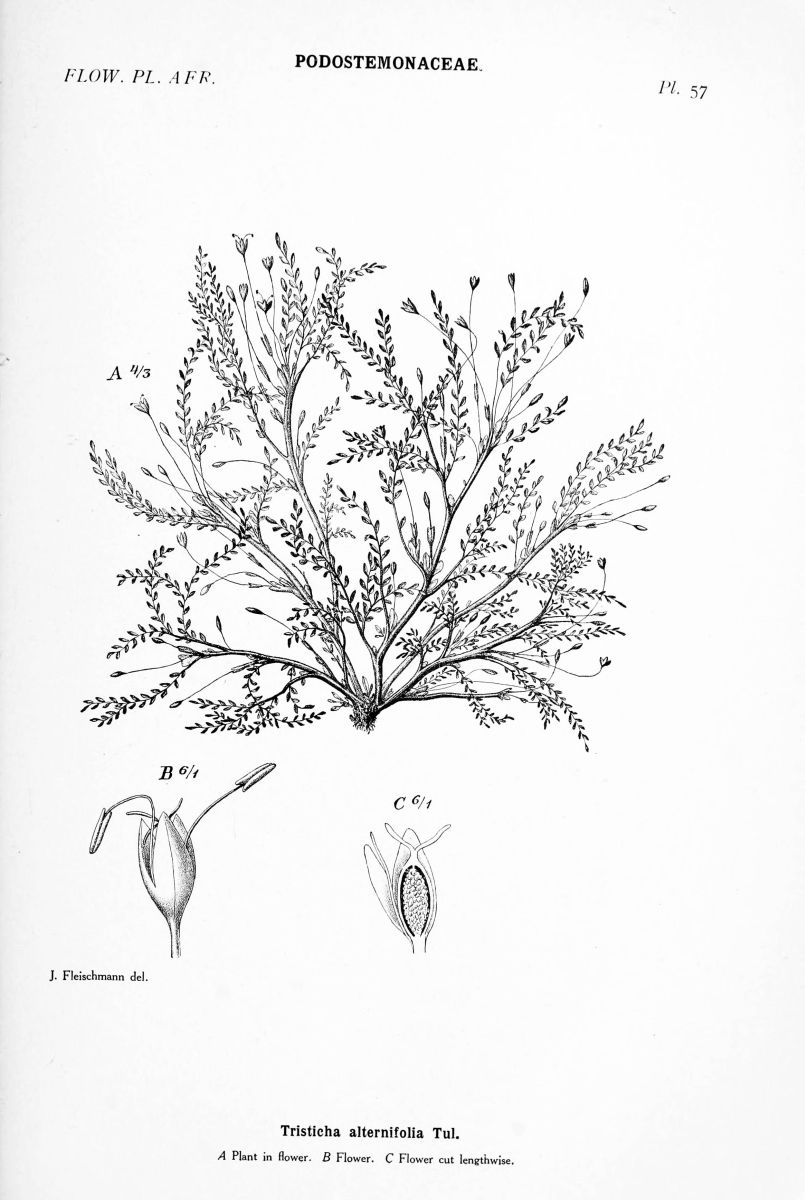
PODOSTEMONACEAE.
FLOW. PL. AFR.
Pl. 57.
J. Fleischmann del.
Tristicha alternifolia Tul.
A Plant in flower. B Flower. C Flower cut lengthwise.
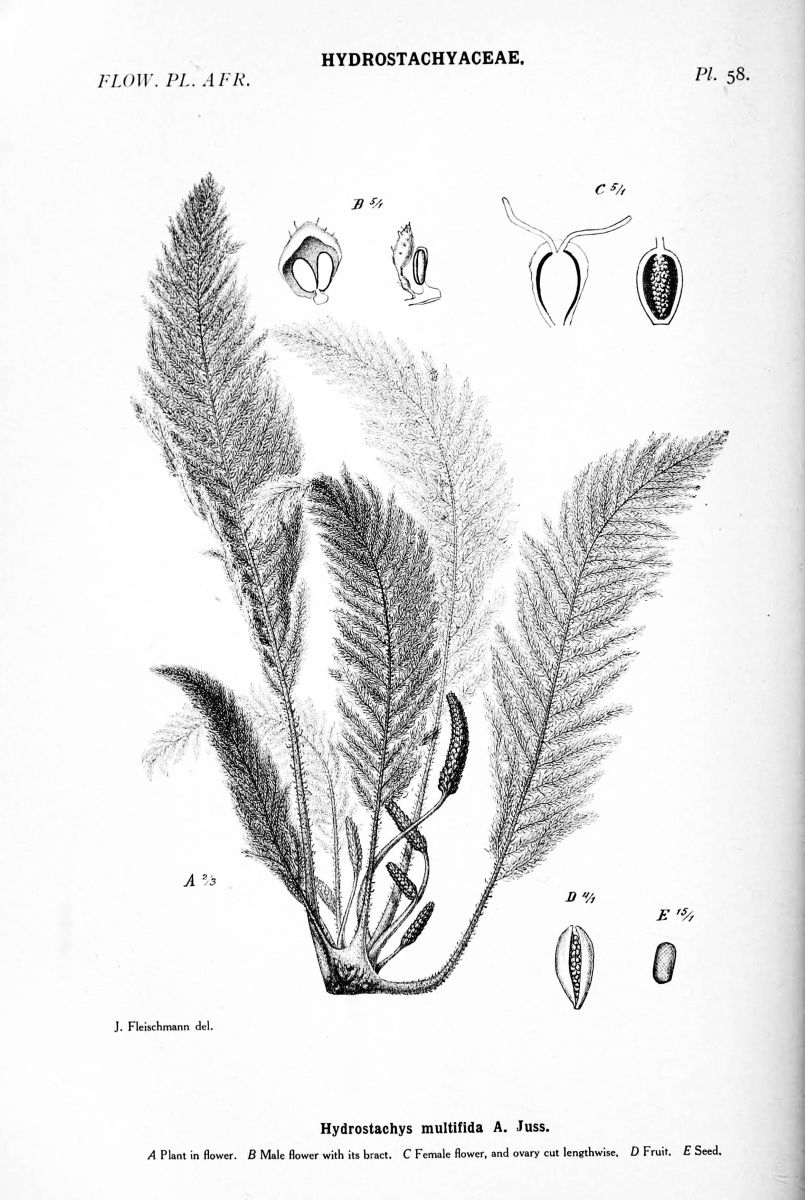
HYDROSTACHYACEAE.
FLOW. PL. AFR.
Pl. 58.
J. Fleischmann del.
Hydrostachys multifida A. Juss.
A Plant in flower. B Male flower with its bract. C Female flower, and ovary cut lengthwise. D Fruit. E Seed.
1. Flowers without a spathe, regular. Perianth 3-parted. Stamen 1. Ovary 3-celled. Styles 3. Leaves undivided.—Species 5. Tropical and South Africa. (Plate 57.) [Tribe TRISTICHEAE.] Tristicha Thouars Flowers at first enclosed in a spathe, irregular. Perianth of 2, rarely of 3 small scales. Stamens 2-4. Ovary 1-2-celled. Styles 1-2. Leaves usually dissected. 2 2. Style 1, very short; stigma entire. Ovary 1-celled. Stamens 3-4; filaments free or nearly so. Stem elongate. Spathe close to the flower.—Species 1. Southern West Africa (Angola). [Tribe MARATHREAE.] Angolaea Wedd. Styles 2, free or united at the base. Stamens 2, rarely (Winklerella) 3, but then filaments united about halfway up. [Tribe PODOSTEMONEAE.] 3 3. Filaments free or nearly so. Ovary stalked. 4 Filaments obviously united. 5 4. Fruit with unequal valves, the persistent valve 5-nerved, the deciduous one 3-nerved. Stem little branched. Leaves linear or the lower with two teeth at the base.—Species 1. West Africa (Cameroons). Ledermanniella Engl. Fruit with two equal, persistent, linear, 5-nerved valves. Stem much branched. Leaves divided in 2-5 narrow segments.—Species 2. West Africa. Used as salad. Dicraeanthus Engl. 5. Ovary and fruit 1-celled, the latter with somewhat unequal valves. Flowers drooping.—Species 4. Central and South Africa. Used as salad. (Including Isothylax Baill.) Sphaerothylax Bisch. Ovary and fruit 2-celled. 6 6. Fruit with unequal valves, one of which falls off, and with prominent ribs. Pollen-grains united in pairs.—Species 1. Madagascar. Podostemon Mich. Fruit with equal valves. 7 7. Fruit smooth, without distinct ribs. Pollen-grains separate. Flowers drooping.—Species 3. Southern Central Africa. (Leiocarpodicraea Engl., under Dicraea Thouars). Leiothylax Warm. Fruit with prominent ribs. 8 8. Fruit 2-toothed at the top, with boat-shaped valves, one of them or both falling off. Pollen-grains separate.—Species 1. West Africa (Cameroons). Winklerella Engl. Fruit with persistent valves. Pollen-grains united in pairs.—Species 9. Tropics. (Under Podostemon Mich.) Dicraea Thouars
FAMILY 94. HYDROSTACHYACEAE
Aquatic herbs. Stem tuberous. Leaves with a sheath and a ligule. Flowers in spikes, bracteate, without a perianth, dioecious. Stamen 1, with separated anther-halves (or 2 with united filaments), hypogynous. Anthers turned outwards. Pollen-grains united in groups of 4. Ovary 1-celled, with 2 parietal placentas. Ovules numerous, inverted. Styles 2. Fruit capsular. Seeds exalbuminous. (Under PODOSTEMONACEAE.) (Plate 58.)
Genus 1, species 15. Tropical and South-east Africa. Hydrostachys Thouars
SUBORDER SAXIFRAGINEAE
FAMILY 95. CRASSULACEAE
Herbs or undershrubs, rarely shrubs. Stem and leaves usually succulent. Leaves without stipules. Flowers regular, hermaphrodite. Petals 3-20, free or united below, hypogynous or nearly so. Stamens as many or twice as many as the petals. Filaments free. Anthers turned inwards. Carpels as many as the petals, free or united at the base, usually with a scale-like appendage. Ovules numerous, rarely (Crassula) 1-2 in each carpel. Fruit-carpels follicular. Seeds with a very scanty albumen or without albumen.—Genera 10, species 400. (Plate 59.)
1. Petals free or nearly so. 2 Petals united below into a distinct, usually long tube. 5 2. Stamens as many as the sepals or petals, 3-9, usually 5. Sepals free or nearly so. Petals white or reddish. Leaves opposite.—Species 180. Some of them are used as ornamental or medicinal plants. (Including Bulliarda DC., Dinacria Harv., Helophytum Eckl. & Zeyh., and Tillaea L.) Crassula L. Stamens twice as many as the sepals, rarely (Sedum) equalling the sepals in number, but then leaves alternate. 3 3. Flowers 4-5-merous, very rarely 6-7-merous. Sepals free or nearly so. Leaves usually scattered.—Species 25. North Africa and high mountains of East Africa. Some species are used as vegetables or as medicinal or ornamental plants. Sedum L. Flowers 6-20-merous, very rarely 5-merous. Sepals more or less united. Leaves usually rosulate. 4 4. Scale-like appendages of the carpels broad, petaloid. Petals linear-lanceolate, inconspicuous, reddish or yellowish.—Species 10. North-west Africa. (Petrophyes Webb). Monanthes Haw. Scale-like appendages of the carpels small or wanting. Petals lanceolate, brightly coloured.—Species 70. North Africa and northern Central Africa. Some are used as ornamental or medicinal plants. “House-leek.” (Including Aeonium Webb, Aichryson Webb, and Greenovia Webb & Berth.) Sempervivum L. 5. Flowers 4-merous. Leaves opposite. 6 Flowers 5-6-merous. 8
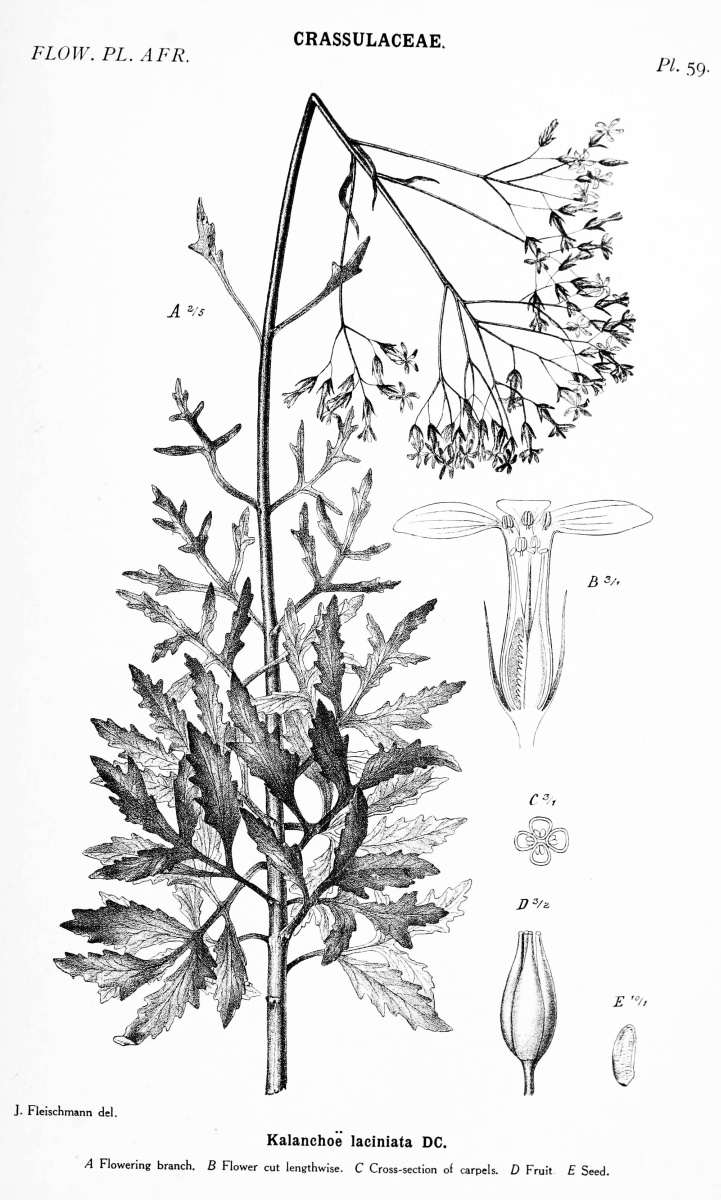
CRASSULACEAE.
FLOW. PL. AFR.
Pl. 59.
J. Fleischmann del.
Kalanchoë laciniata DC.
A Flowering branch. B Flower cut lengthwise. C Cross-section of carpels. D Fruit. E Seed.
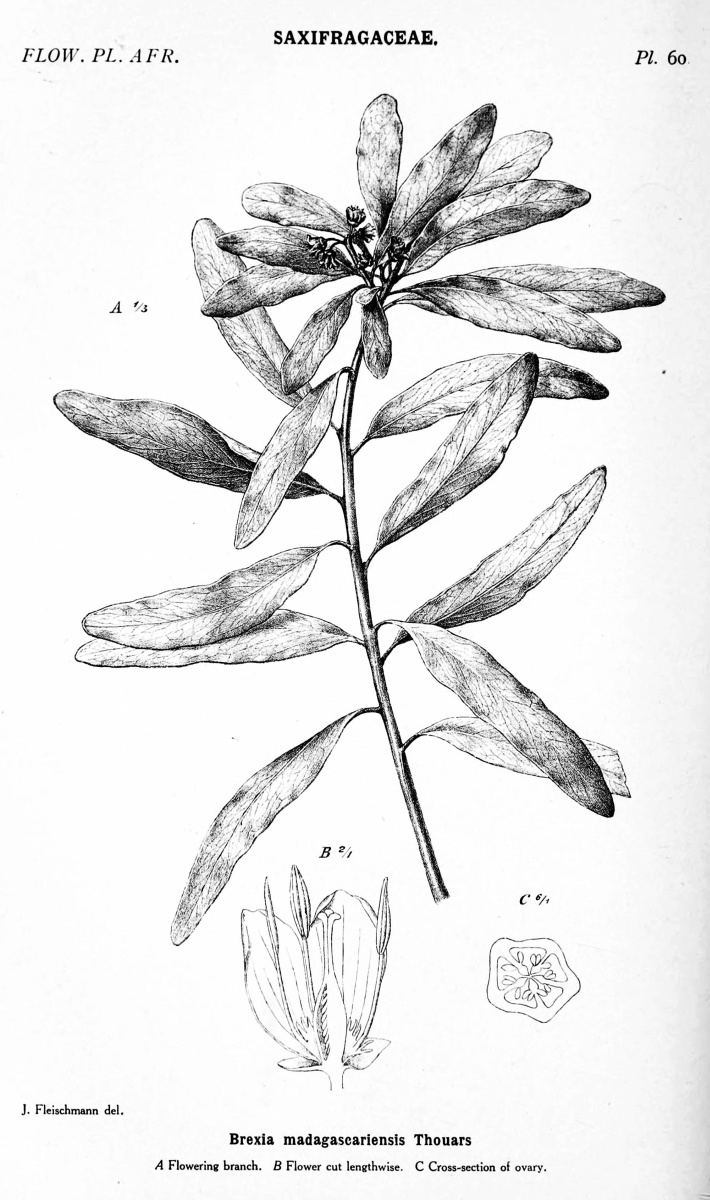
SAXIFRAGACEAE.
FLOW. PL. AFR.
Pl. 60.
J. Fleischmann del.
Brexia madagascariensis Thouars
A Flowering branch. B Flower cut lengthwise. C Cross-section of ovary.
6. Calyx cleft nearly to the middle, large, inflated. Corolla urn- or almost bell-shaped. Stamens 8. Carpels not diverging. Stigmas capitate. Undershrubs.—Species 5. Tropical and South Africa. Some are used as ornamental or medicinal plants. (Crassuvia Comm.) Bryophyllum Salisb. Calyx divided to the middle or beyond, usually small. 7 7. Calyx divided to the middle, small, bell-shaped. Corolla tube- or bell-shaped; segments short and broad, triangular to orbicular. Stamens 8. Carpels diverging. Stigmas capitate.—Species 15. Madagascar. (Under Kalanchoe Adans.) Kitchingia Bak. Calyx divided nearly to the base, rarely only to the middle, but then corolla with oblong, elliptical, or ovate segments. Corolla usually salver-shaped, with spreading segments. Stigmas obliquely truncate.—Species 45. Tropical and South Africa. Some yield an aromatic resin or are used in medicine. (Plate 59.) Kalanchoë Adans. 8. Stamens twice as many as the sepals or petals, 10, rarely 12.—Species 40. Some of them are used as ornamental or medicinal plants. (Including Echeveria DC., Mucizonia DC., Pistorinia DC., and Umbilicus DC.) Cotyledon L. Stamens as many as the sepals or petals, 5, rarely 6. Leaves opposite. 9 9. Calyx as long as the corolla-tube, bell-shaped, divided to about the middle. Corolla bell-shaped, yellow. Small, stiff, glaucous herbs.—Species 1. South Africa. Grammanthes DC. Calyx shorter than the corolla-tube, divided nearly or quite to the base. Corolla funnel-shaped. Thick, succulent herbs or undershrubs.—Species 4. South Africa. Used as ornamental plants. Rochea DC.
FAMILY 96. SAXIFRAGACEAE
Petals 4-5, free or united below. Stamens as many or twice as many as the petals, perigynous or epigynous. Anthers opening by two longitudinal slits. Ovary 1-7-celled. Ovules numerous, inverted. Seeds with copious albumen, rarely (Montinia) without albumen. Genera 11, species 25. (Including GROSSULARIACEAE.) (Plate 60.)
1. Stem herbaceous. Styles 2-5, free. [Subfamily SAXIFRAGOIDEAE.] 2 Stem woody, rarely (Berenice) herbaceous above, but then style simple. Leaves without stipules. Placentas parietal or septal. 3 2. Calyx with valvate aestivation. Stamens 5. Ovary inferior, 1-celled, with 2-3 placentas suspended from the apex of the cell. Leaves opposite, entire.—Species 4. Tropical and South Africa and Egypt. Vahlia Thunb. Calyx with imbricate aestivation. Stamens 8-10. Ovary 2-5-celled, with the placentas attached to the dissepiments.—Species 9. North Africa and Abyssinia. Some species are used as ornamental or medicinal plants. Saxifraga L. 3. Stamens 8-10. Ovary inferior or half-inferior, completely or incompletely 2-5-celled. Styles 2-5, free or united at the base. Corolla with valvate aestivation. Outer flowers of the inflorescence often barren with enlarged sepals. Leaves opposite.—Species 1 (H. Hortensia DC.) Naturalized in several islands (Madeira, St. Helena, Réunion). An ornamental plant. [Subfamily HYDRANGEOIDEAE.] Hydrangea L. Stamens 4-5. Styles 1-2. 4 4. Ovary 1-celled, inferior. Style simple with 2 stigmas, or styles 2. Fruit a berry. Leaves alternate. Flowers hermaphrodite.—Species 2. North-west Africa (Algeria). One of them (R. Grossularia L., gooseberry) yields edible fruit, from which also a drink is prepared. (Including Grossularia A. Rich.) [Subfamily RIBESOIDEAE.] Ribes L. Ovary 2-7-celled, rarely 1-celled, but then leaves opposite and flowers unisexual. [Subfamily ESCALLONIOIDEAE.] 5 5. Ovary 1-celled, inferior. Ovules 8-10. Style simple; stigma 2-lobed. Flowers unisexual. Leaves opposite.—Species 1. Madagascar. Grevea Baill. Ovary 2-7-celled. Style simple with an entire or 5-7-lobed stigma, or 2-parted. 6 6. Ovary superior, 5-7-celled. Style simple with a 5-7-lobed stigma. Fruit a berry or drupe. 7 Ovary inferior or half-inferior, 2-4-celled. Style simple with an entire stigma or 2-parted. Fruit a capsule. Leaves alternate. 8 7. Sepals persistent. Petals united at the base, campanulately connivent, rolled back at the tip. Stamens inserted between the lobes of the disc. Anthers opening outwards. Ovary pyramidal. Fruit a berry. Embryo shorter than the seed. Climbing shrubs. Leaves opposite. Flowers solitary or in few-flowered clusters.—Species 1. Mascarene Islands. Roussea Smith Sepals deciduous. Petals free, blunt. Stamens inserted on the margin of the disc. Anthers opening inwards or laterally. Ovary ovoid. Fruit a drupe with a woody, 1-celled stone. Embryo as long as the seed. Low trees. Leaves alternate. Flowers in umbel-shaped cymes.—Species 2. East Africa, Madagascar and Seychelles. The fruits are edible. (Venana Lam.) (Plate 60.) Brexia Thouars 8. Ovary 3-4-celled. Style 1, simple. Petals 5, united at the base. Seeds linear-oblong. Undershrubs. Leaves serrate. Flowers in panicles.—Species 1. Island of Réunion. Berenice Tul. Ovary 2-celled. Styles 2, free or united at the base (sometimes also at the top, when young). Shrubs or trees. 9 9. Ovary inferior. Flowers 4-merous, unisexual. Petals imbricate in bud. Seeds winged, exalbuminous. Leaves entire. Male flowers panicled, female solitary.—Species 1. South Africa. Montinia L.f.
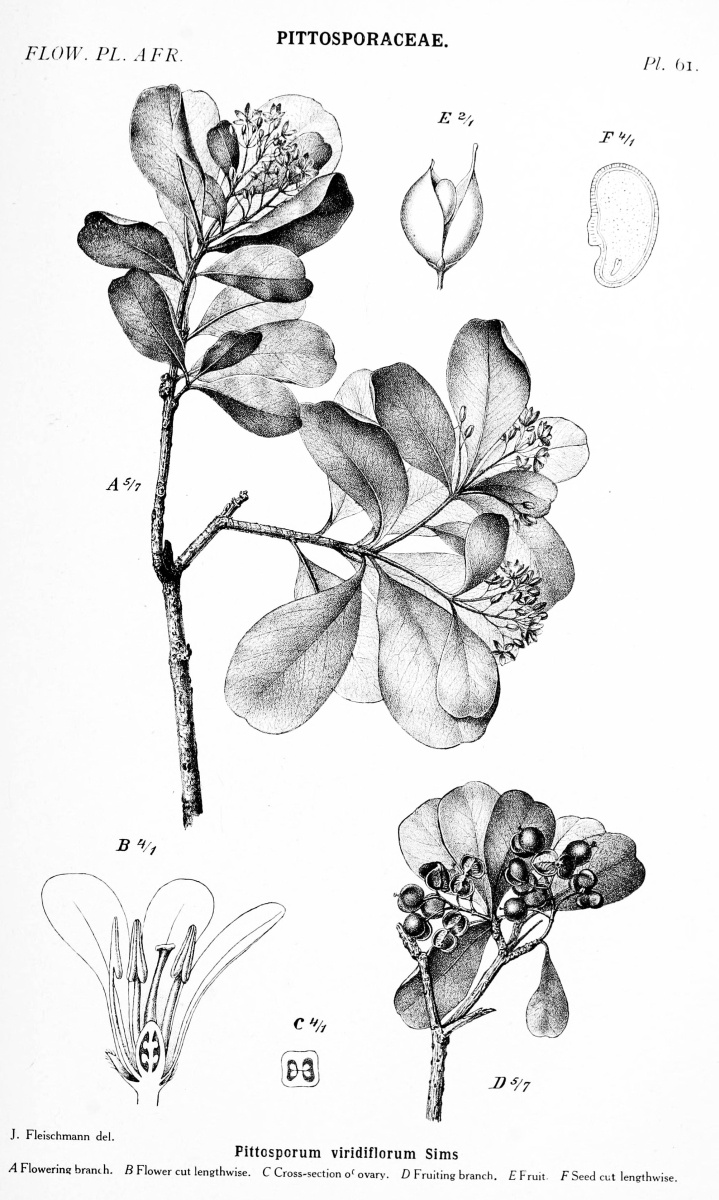
PITTOSPORACEAE.
FLOW. PL. AFR.
Pl. 61.
J. Fleischmann del.
Pittosporum viridiflorum Sims
A Flowering branch. B Flower cut lengthwise. C Cross-section of ovary. D Fruiting branch. E Fruit. F Seed cut lengthwise.
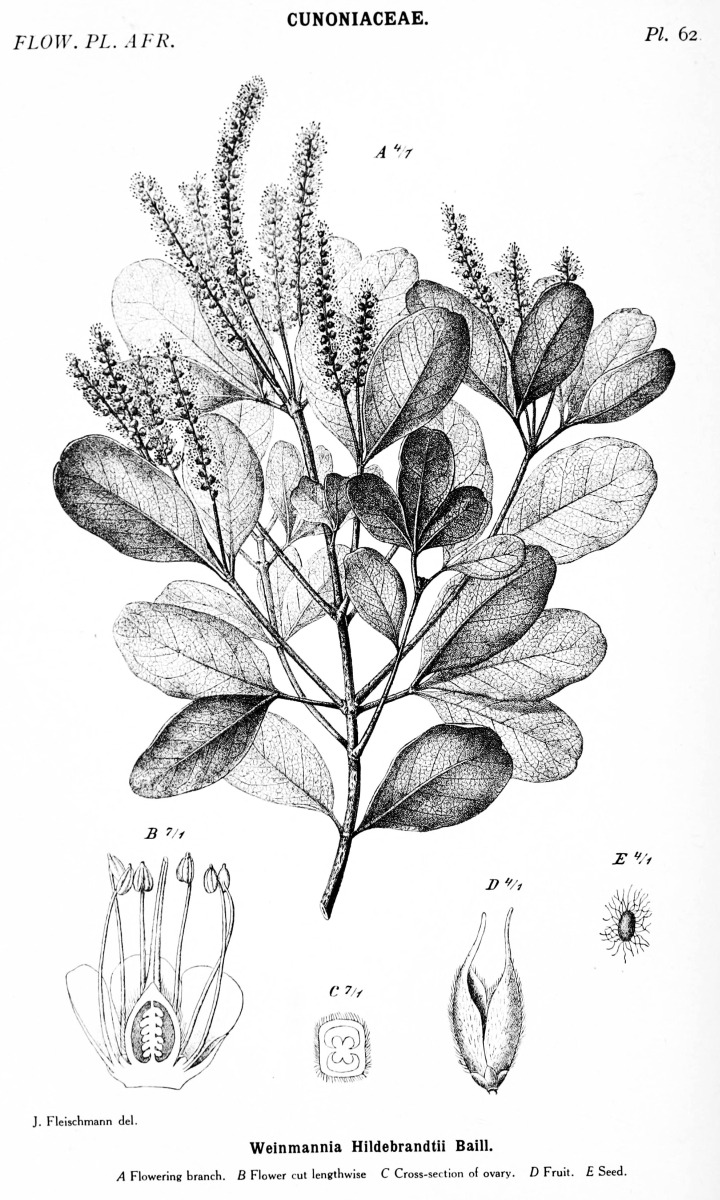
CUNONIACEAE.
FLOW. PL. AFR.
Pl. 62.
J. Fleischmann del.
Weinmannia Hildebrandtii Baill.
A Flowering branch. B Flower cut lengthwise. C Cross-section of ovary. D Fruit. E Seed.
Ovary half-inferior. Flowers 5-merous. Petals valvate in bud. Seeds albuminous. Leaves glandular-serrate. Flowers in panicles or in umbel-shaped cymes. 10 10. Sepals subulate. Petals ovate. Filaments thin. Seeds oblong. Shrubs with thin branches. Flowers small, polygamous.—Species 2. South Africa and southern East Africa. Choristylis Harv. Sepals lanceolate to ovate. Petals linear or oblong. Filaments thick. Trees with thick branches. Flowers rather large.—Species 1. Island of Réunion. Forgesia Comm.
FAMILY 97. PITTOSPORACEAE
Shrubs or trees. Leaves alternate, undivided, exstipulate. Flowers regular, hermaphrodite. Sepals 5, free or nearly so. Petals 5, free or united below. Stamens 5, hypogynous. Disc none. Ovary superior, sessile or short-stalked, 1-celled or incompletely 2-5-celled. Style simple; stigma entire or lobed. Ovules numerous, ascending or horizontal, inverted, with a single coat. Fruit a loculicidal capsule. Seeds with a hard albumen and a small embryo situated near the hilum. (Under SAXIFRAGACEAE.) (Plate 61.)
Genus 1, species 35. Tropical and South Africa and Canary Islands. Some are used as ornamental plants. Pittosporum Banks
FAMILY 98. CUNONIACEAE
Shrubs or trees. Leaves opposite or whorled, stipulate. Flowers in spike-, raceme-, or panicle-like inflorescences, hermaphrodite. Sepals 4-5, free or united at the base. Petals 4-5. Stamens 8-10, inserted beneath the disc. Ovary superior, 2-3-celled; ovules 2 or more to each cell. Styles 2-3, free. Fruit capsular. Seeds albuminous.—Genera 3, species 17. South Africa, Madagascar and neighbouring islands. (Under SAXIFRAGACEAE.) (Plate 62.)
1. Calyx valvate in bud. Petals 3-cleft or 3-toothed, shorter than the calyx. Disc perigynous, deeply 4-5-lobed. Connective acuminate. Ovary 2-celled, with 2 pendulous ovules in each cell. Trees. Leaves of 3 leaflets. Stipules free. Flowers in panicles.—Species 1. South Africa (Cape Colony). Platylophus Don Calyx imbricate in bud. Disc 8-10-lobed. Stipules united in pairs. Flowers in clusters arranged in spikes or racemes. 2 2. Disc perigynous, adnate to the base of the ovary. Stamens 10. Ovary 2-celled, with numerous ovules. Seeds compressed, with a narrow wing. Leaves compound, with 3 or more leaflets.—Species 1. South Africa. Yields timber. Cunonia L. Disc hypogynous, free from the ovary. Seeds hairy.—Species 15. Madagascar and the neighbouring islands. Some species yield timber, tans, dyes, and medicaments. (Plate 62.) Weinmannia L.
FAMILY 99. MYROTHAMNACEAE
Balsamiferous shrubs. Leaves opposite, folded fan-like, undivided, stipulate. Flowers in spikes, dioecious, without a perianth. Stamens 3-8; connective produced into a point; anthers attached at the base, opening by lateral slits; pollen-grains cohering in groups of four. Ovary lobed, 3-4-celled. Ovules numerous, inverted. Styles 3-4, free, short and thick, with broadened stigmas. Fruit capsular or separating into 2-4 nutlets. Seeds with copious albumen. (Under HAMAMELIDEAE or SAXIFRAGACEAE.)
Genus 1, species 2. Tropical and South Africa. The resin is used as a fumigant and in medicine. (Including Myosurandra Baill.) Myrothamnus Welw.
FAMILY 100. BRUNIACEAE
Undershrubs or shrubs. Leaves alternate, small, undivided, without stipules, rarely (Staavia) with gland-like stipules. Flowers in heads, more rarely in spikes or racemes or solitary, hermaphrodite, 5-merous, very rarely 4-merous. Calyx with imbricate or open aestivation. Petals free or united below, imbricate in bud. Stamens as many as and alternate with the petals. Anthers opening inwards by longitudinal slits. Ovary inferior or half-inferior, rarely (Lonchostoma) almost superior, 1-3-celled. Ovules 1-4 in each cell, pendulous, inverted. Style 1-3. Fruit a capsule or nut. Seeds with a copious albumen and a minute embryo next the hilum.—Genera 12, species 55. South Africa. (Plate 63.)
1. Anthers linear or oblong, with parallel, wholly adnate cells. Petals clawed, the claw without distinct glands. Ovary and receptacle (calyx-tube) glabrous. Style 1, with 2-3 punctiform stigmas. [Tribe AUDOUINIEAE.] 2 Anthers sagittate or cordate, with partly free and divergent cells. [Tribe BRUNIEAE.] 4 2. Ovary 3-celled. Ovules 6. Stigmas 3. Connective prolonged beyond the anther-cells, strap-shaped. Receptacle obconical. Petals red. Flowers in head-like spikes. Bracteoles 7-10.—Species 1. Cape Colony. Audouinia Brongn. Ovary 2-celled or later on 1-celled. Ovules 4 or 8. Stigmas 2. Connective not prolonged. Fruit a 1-seeded nut. Flowers solitary or in racemes. 3 3. Ovary inferior. Receptacle obconical or cupular. Sepals hairy, deciduous. Petals lanceolate. Flowers solitary.—Species 5. South Africa. Thamnea Soland. Ovary half-inferior. Ovules 4. Receptacle globular-urceolate. Sepals glabrous, persisting in fruit. Petals obovate, white. Flowers in racemes. Bracteoles 6.—Species 1. Cape Colony. Tittmannia Brongn.
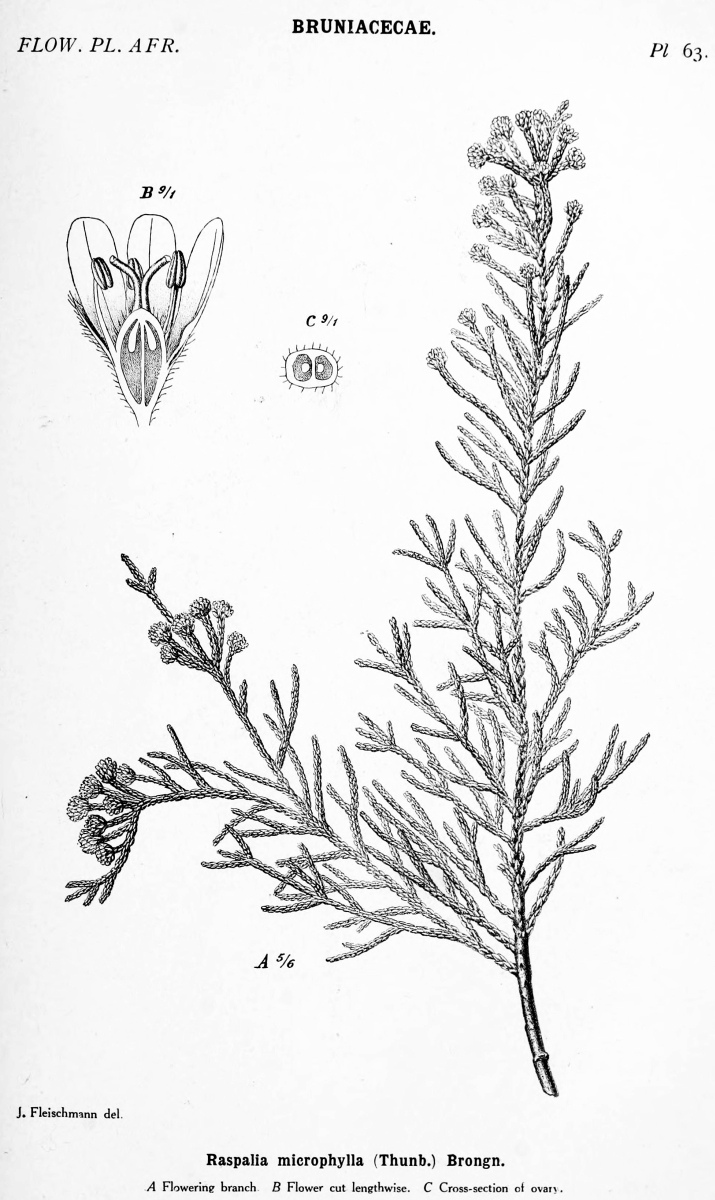
BRUNIACECAE.
FLOW. PL. AFR.
Pl. 63.
J. Fleischmann del.
Raspalia microphylla (Thunb.) Brongn.
A Flowering branch. B Flower cut lengthwise. C Cross-section of ovary.
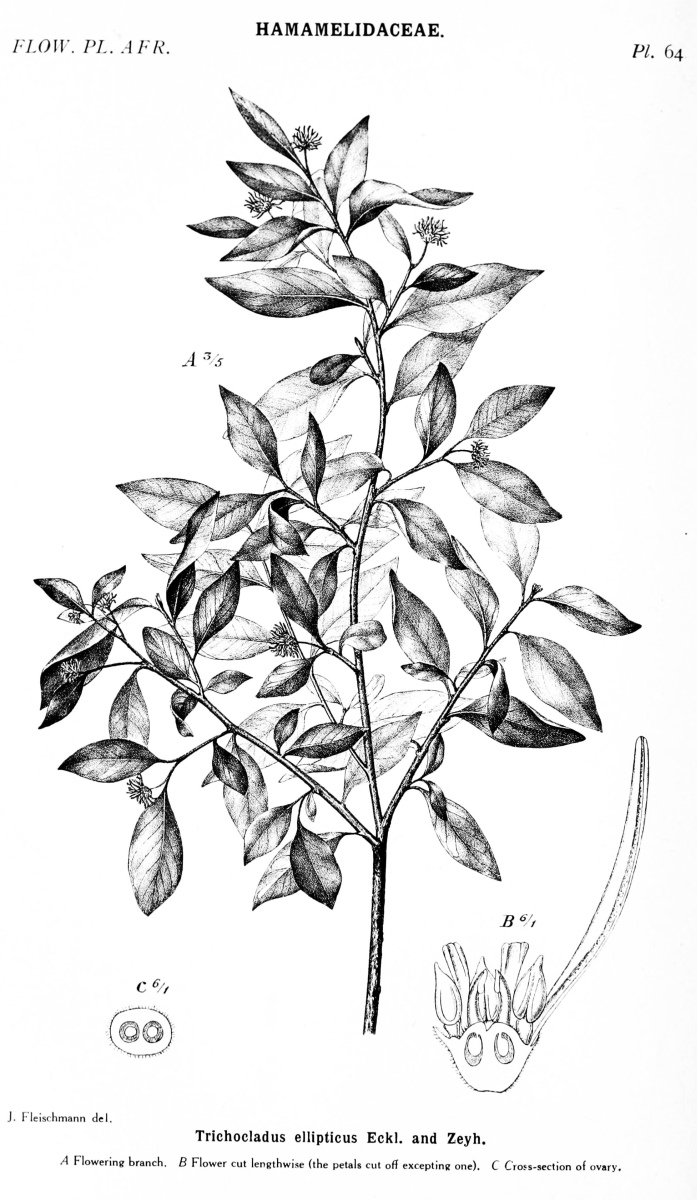
HAMAMELIDACEAE.
FLOW. PL. AFR.
Pl. 64.
J. Fleischmann del.
Trichocladus ellipticus Eckl. and Zeyh.
A Flowering branch. B Flower cut lengthwise (the petals cut off excepting one). C Cross-section of ovary.
4. Anthers sagittate. Petals sessile or with a glandless claw. Ovary 2-celled with 2 ovules in each cell. Fruit consisting of 2 dehiscing parts. Flowers in spikes. 5 Anthers cordate. Petals clawed, the claw with 2 glands. 6 5. Petals with the claws united into a tube. Sepals, anthers, and ovary hairy. Ovary almost superior. Bracteoles 2.—Species 3. Cape Colony. Lonchostoma Wickstr. Petals sessile, free. Flowers glabrous. Sepals very short. Ovary almost inferior. Styles free. Bracteoles 4-8.—Species 3. Cape Colony. Linconia L. 6. Ovary 1-celled. Ovule 1. Style and stigma simple. Glands at the base of the petals crest-like. Flowers hairy. Fruit indehiscent. 7 Ovary 2-celled. Styles 2, or a single style with 2 stigmas. Glands at the base of the petals tubercle- or pouch-like. 8 7. Sepals short and broad, triangular. Stamens curved inwards, shorter than the petals; anthers shortly cleft. Flowers solitary, axillary, spicately arranged. Bracteoles thread-shaped.—Species 1. Cape Colony. (Under Berzelia Brongn.) Mniothamnea Oliv. Sepals awl-shaped. Stamens curved outwards, longer than the petals; anthers deeply cleft. Flowers in heads. Bracteoles club- or spoon-shaped.—Species 9. South Africa. Berzelia Brongn. 8. Fruit one-seeded, usually indehiscent. 9 Fruit consisting of two dehiscent, usually one-seeded parts. Flowers in heads. 10 9. Receptacle obconical. Sepals united beyond the ovary. Petals short, with a very short, 2-tubercled claw. Stamens shorter than the petals, equal. Anthers adnate, shortly cleft. Style short and thick, kneed.—Species 8. South Africa. (Under Brunia L.) Pseudobaeckea Nied. Receptacle cylindrical. Sepals free above the ovary. Petals long, with a long claw bearing a 2-lobed pouch. Stamens longer than the petals, unequal, the anterior longer. Anthers versatile, deeply cleft. Style long or rather long, almost straight. Ovules 2 in each cell. Flowers in heads.—Species 4. South Africa. Brunia L. 10. Style 1, short and thick; stigmas 2, obliquely terminal, slightly thickened. Anthers pointed at the apex. Receptacle rather long. Sepals united beyond the ovary. Petals oblong, shortly clawed, 2-tubercled at the base. Bracteoles thread-shaped.—Species 9. South Africa. Staavia Thunb. Styles 2, free or more or less cohering, but then long and thread-shaped; stigmas simple, terminal. Anthers rounded at the apex. 11 11. Sepals united beyond the ovary, triangular. Petals oblong, with a short claw bearing two tubercles at the base. Styles free, kneed above. Bracts broad, shorter than the flowers. Bracteoles linear.—Species 8. South Africa. (Under Berardia Sond.) (Plate 63.) Raspalia Brongn. Sepals free above the ovary, linear. Petals strap-shaped, with a long claw bearing two tubercles in the upper part. Styles more or less cohering, long, almost straight. Bracts narrow, longer than the flowers. Bracteoles spatulate or sickle-shaped.—Species 5. South Africa. (Berardia Brongn.) Diberara Baill.
FAMILY 101. HAMAMELIDACEAE
Trees or shrubs. Leaves undivided, stipulate. Flowers in heads or head-like spikes, 4-5-merous. Petals narrow, sometimes wanting in the female flowers. Fertile stamens as many as and alternating with the petals, sometimes accompanied by staminodes. Filaments free. Anthers opening by lateral slits or by valves. Ovary 2-celled. Ovules 1 in each cell, pendulous, inverted. Styles 2, free. Fruit capsular. Seeds with a straight embryo and thin albumen.—Genera 3, species 20. Tropical and South Africa. (Plate 64.)
1. Flowers unisexual, rarely polygamous, 5-merous. Staminodes none. Anthers ovoid., opening by valves. Shrubs. Stipules short and narrow. Flowers in many-flowered heads.—Species 3. South and East Africa. (Plate 64.) Trichocladus Pers. Flowers hermaphrodite, usually 4-merous. Sepals short. Ovary inferior or almost so. 2 2. Staminodes none. Anthers opening by longitudinal slits. Trees. Flowers in many-flowered heads, 4-merous.—Species 1. Madagascar. Franchetia Baill. Staminodes as many as and alternate with the stamens. Anthers oblong. Shrubs. Stipules long and broad. Flowers in 3-8-flowered head-like spikes.—Species 15. Madagascar and Comoro Islands. Some species yield timber and medicaments. Dicoryphe Thouars
SUBORDER ROSINEAE
FAMILY 102. PLATANACEAE
Trees. Leaves alternate, palmately lobed; stipules connate. Flowers on a thickened receptacle in spicately arranged globose heads, monoecious. Sepals 3-8, free, hairy. Petals the same number, nearly hypogynous. Stamens as many as and alternating with the petals; connective peltate; anthers opening inwards or laterally by longitudinal slits. Carpels the same number, free. Ovules solitary, pendulous, straight. Fruit consisting of achenes densely crowded in a head. Seed with scanty albumen; cotyledons linear.
Genus 1, species 2. Cultivated in North Africa as avenue-trees. They also yield timber. “Plane.” Platanus L.
FAMILY 103. ROSACEAE
Leaves alternate, stipulate. Receptacle (floral axis) more or less concave, saucer-, cup-, urn-, or tube-shaped, in the male flowers sometimes very small. Stamens curved inwards in the bud, usually numerous. Anthers opening inwards by longitudinal slits. Carpels superior, solitary or free, or inferior and then more or less united. Ovules inverted.—Genera 32, species 230. (Including AMYGDALACEAE and POMACEAE.) (Plate 65.)
1. Ovaries 1-10, inferior (adnate to the concave receptacle) and usually connate. Petals 5. Flowers hermaphrodite or polygamous. 2 Ovaries (or ovary) superior, free from the receptacle, but sometimes tightly enclosed by it. 10 2. Stem herbaceous. Leaves lobed or dissected. Petals yellow. Stamens 10. Carpels 1-10, one-ovuled. Fruiting receptacle dry. [Subfamily NEURADOIDEAE.] 3 Stem woody. Petals white or red. Carpels 1-5. Fruiting receptacle succulent. [Subfamily POMOIDEAE.] 4 3. Flowers small, with a persisting epicalyx. Carpels 10. Leaves lobed.—Species 2. North Africa to Nubia, German South West Africa. Neurada L. Flowers large. Epicalyx none.—Species 6. South Africa. Grielum L. 4. Carpels 2-5, distinct from each other on their inside, 2-ovuled. Fruit small. Endocarp bony. Leaves undivided.—Species 3. North-west Africa (Algeria). Used medicinally. Cotoneaster Medik. Carpels 2-5, united as to the ovaries, or carpel 1. 5 5. Carpels 3-5, incompletely divided in two cells each; hence cells twice as many as the style-branches and containing a single ovule each. Fruit small. Endocarp membranous. Petals narrow. Leaves undivided. Flowers in racemes.—Species 1. North-west Africa (Algeria). Used as an ornamental plant. Amelanchier Medik. Carpels not divided, containing 2 or more ovules each. 6 6. Ovules and seeds more than 2 to each carpel (or ovary-cell). Carpels 5. Fruit large. Endocarp cartilagineous. Seed-coat mucilagineous. Leaves undivided.—Species 1 (C. vulgaris Pers., quince). Cultivated in North and South Africa and in some tropical islands. The fruit is edible and used for the preparation of confectionery and in medicine. (Under Pyrus L.) Cydonia Tourn. Ovules and seeds 1-2 to each carpel (or ovary-cell). 7 7. Fruit with a bony endocarp and a mealy mesocarp. Ovules 2, one of them sterile and covering the fertile one. 8 Fruit with a membranous, parchment-like, or cartilagineous endocarp. Carpels 2-5. 9 8. Style furrowed. Carpel 1. Embryo with coiled cotyledons. Stamens 10-15. Flowers in racemes. Leaves undivided, persistent.—Species 1. Madeira. Chamaemeles Lindl. Style not furrowed. Embryo with flat cotyledons. Leaves usually lobed or divided and deciduous.—Species 5. North-west Africa. They yield timber, tanners’ bark, edible fruits (medlars) and medicaments and are also used as ornamental plants (hawthorn). (Including Crataegus L.) Mespilus L. 9. Carpels projecting above the receptacle; hence cells of the fruit reaching to the cavity at its top. Styles 5, free. Fruit with a membranous endocarp. Seeds very large, with thick cotyledons. Leaves undivided, persistent.—Species 1 (E. japonica Lindl., loquat). Cultivated in North Africa and some tropical islands for its edible fruits. (Under Photinia Lindl.) Eriobotrya Lindl. Carpels completely enclosed in the receptacle; hence cells of the fruit not reaching to its top. Leaves usually deciduous.—Species 8, of which 6 are growing wild in North Africa, the other two (P. communis L., pear, and P. Malus L., apple) cultivated in North and South Africa and Madagascar. They yield timber, tanners’ bark, and edible fruits, from which also drinks and medicaments are prepared. Several species are used as ornamental plants. (Pyrus L., including Malus Tourn. and Sorbus L.). Pirus Tourn. 10. (1.) Carpels 2 or more, with 1-2 ovules each, rarely carpel 1, with a single ovule. Flowers regular. [Subfamily ROSOIDEAE.] 11 Carpel 1, with 2 ovules, sometimes more or less completely 2-celled or one ovule abortive; in this cases flowers distinctly irregular. Fruit a drupe. Shrubs or trees. Leaves undivided. 25 11. Receptacle of the female flowers deeply concave, tube- or urn-shaped, tightly enclosing the carpels, especially in fruit. 12 Receptacle flat, convex, or moderately concave (cup- or saucer-shaped), not tightly enclosing the carpels. Carpels 5 or more. Stamens numerous. 21 12. Carpels numerous. Ovules pendulous. Stamens numerous. Petals 4-6, large, red, white or yellow, imbricate in bud. Sepals imbricate. Flowers hermaphrodite. Receptacle becoming succulent in fruit. Shrubs. Leaves pinnate.—Species 10. North Africa and Abyssinia; also naturalized in several tropical islands. Used as ornamental plants, and in the preparation of perfumes and medicaments; some have edible fruits. [Tribe ROSEAE.] Rosa Tourn. Carpels 1-4. Petals small, yellow or white, or wanting. [Tribe SANGUISORBEAE.] 13 13. Perianth consisting of an epicalyx, a calyx, and a corolla. Carpels 2-4. 14 Perianth consisting of calyx and corolla, or of epicalyx and calyx, or of the calyx only. 15 14. Flowers hermaphrodite. Epicalyx of 5-6 small segments. Petals broad. Stamens 10-12. Shrubs. Leaves pinnatipartite. Flowers in racemes.—Species 1. South Africa. Leucosidea Eckl. & Zeyh. Flowers polygamous-dioecious. Epicalyx of 4-5 large segments. Petals narrow. Stamens 20. Trees. Leaves pinnate. Flowers in panicles.—Species 1. East Africa. Used medicinally. (Brayera Kunth) Hagenia Gmel. 15. Perianth consisting of a corolla and a calyx surrounded by several rows of hooked bristles. Stamens 10 or more. Styles 2, subterminal. Herbs. Leaves pinnate. Flowers in spikes.—Species 1. North and South Africa. Yields tanning and dyeing materials, and is also used in medicine. Agrimonia L. Perianth consisting of a calyx with an epicalyx, or only of a calyx. 16 16. Epicalyx of 4-5 segments alternating with the sepals. Stamens 1-5. Ovules ascending. Styles basal. Stigmas capitate. Leaves lobed or digitate.—Species 25. Some of them yield tanning and dyeing materials and medicaments. “Lady’s mantle.” (Including Aphanes L.) Alchimilla L. Epicalyx none. Stigmas more or less penicillate. 17 17. Flowers hermaphrodite or monoecious; in the latter case receptacle of the male flowers resembling that of the female. Leaves pinnate. Flowers in spikes or heads. 18 Flower dioecious. Stamens numerous. Receptacle of the male flowers very small. Shrubs or trees. 20 18. Receptacle armed with hooked bristles, at least in fruit. Flowers hermaphrodite. Stamens 2-5. Herbs or undershrubs.—Species 3. South Africa. Used medicinally. Acaena Vahl Receptacle without bristles. 19 19. Flowers hermaphrodite or polygamous. Fruiting receptacle dry, not coloured, wrinkled and pitted or winged. Herbs.—Species 10. North Africa, one species also introduced in South Africa. Some species yield tans, dyes, and medicaments, or are used as potherbs. (Under Poterium L.) Sanguisorba L. Flowers monoecious. Fruiting receptacle somewhat fleshy, coloured, smooth. Stamens numerous. Spinous shrubs.—Species 1. North Africa. Used medicinally. (Sarcopoterium Spach). Poterium L. 20. Leaves pinnate, with several pairs of leaflets. Flowers in spikes. Fruiting receptacle somewhat fleshy.—Species 2. Canary Islands and Madeira. Bencomia Webb Leaves 1-3-foliolate. Flowers solitary, axillary. Fruiting receptacle cartilaginous, rarely somewhat fleshy.—Species 40. South Africa and southern Central Africa. Cliffortia L. 21 (11.) Filaments narrowed towards the base. Petals 5, white. Ovules 2. Styles terminal. Ripe carpels dry and indehiscent. Herbs. Leaves pinnatisect. Flowers in panicles.—Species 1. North-west Africa (Algeria). Used as an ornamental plant. (Ulmaria Tourn., under Spiraea L.) [Tribe FILIPENDULEAE]. Filipendula L. Filaments broadened at the base. Sepals valvate in bud. Carpels usually inserted on an elevated receptacle. [Tribe POTENTILLEAE]. 22 22. Carpels with 2 ovules each, drupe-like when ripe. Style subterminal. Epicalyx none.—Species 30. Many of them yield edible fruits, from which also drinks are prepared; some are used as ornamental plants, for tanning, and in medicine. “Bramble.” [Subtribe RUBINAE.] Rubus L. Carpels with 1 ovule each, nut-like when ripe. Epicalyx nearly always present. 23 23. Ovule ascending. Style persistent, terminal. Herbs. Radical leaves pinnatisect.—Species 4. North and South Africa; one species also naturalized in St. Helena. They yield tanning and dyeing materials and medicaments. “Avens.” [Subtribe DRYADINAE.] Geum L. Ovule pendulous. Style deciduous. [Subtribe POTENTILLINAE.] 24 24. Ripe carpels on a greatly enlarged, coloured, and succulent receptacle. Petals white. Herbs. Leaves usually trifoliolate.—Species 5. Cultivated in various regions; one species also growing wild in the Azores, Madeira, and the Canary Islands. They yield edible fruits (strawberries), dyeing and tanning materials, and medicaments. Fragaria L. Ripe carpels on a slightly or not enlarged, not coloured, dry (sometimes spongy, but not succulent) receptacle. Flowers hermaphrodite.—Species 10. Some of them yield tanning and dyeing materials, or serve for the preparation of ink and medicaments, or as ornamental plants. Potentilla L. 25. (10.) Style terminal or nearly so. Ovules pendulous. Flowers regular. [Subfamily PRUNOIDEAE.] 26 Style basal. Ovules erect. [Subfamily CHRYSOBALANOIDEAE.] 27 26. Petals sepaloid. Flowers in racemes.—Species 1. Central and South-east Africa. Pygeum Gaertn. Petals petaloid.—Species 9; six of them spontaneous in North Africa, the others, as well as the former, cultivated in various regions. They yield timber, tanners’ bark, gum, oil, medicaments, and edible fruits (plums, cherries, apricots, peaches, almonds), from which also drinks and confectionery are prepared. Several species are used as ornamental plants. (Including Amygdalus L., Armeniaca Juss., Cerasus Juss., and Persica Tourn.) Prunus L. 27. Flowers almost regular. Stamens 10 or more. Carpel inserted at or near the base of the bell- or funnel-shaped receptacle. [Subtribe CHRYSOBALANINAE.] 28 Flowers distinctly irregular. Fertile stamens 3-20, all on one side of the flower. Carpel inserted at or near the upper margin of the more or less tubular receptacle. [Subtribe HIRTELLINAE.] 29 28. Receptacle swelling on one side; carpel slightly excentrical. Stamens 10-15. Fruit with a 3-angled stone. Flowers in racemes.—Species 2. Madagascar and Mascarenes. Used medicinally. Grangeria Comm.