ORDER RANALES (continued 6)
Reading edition
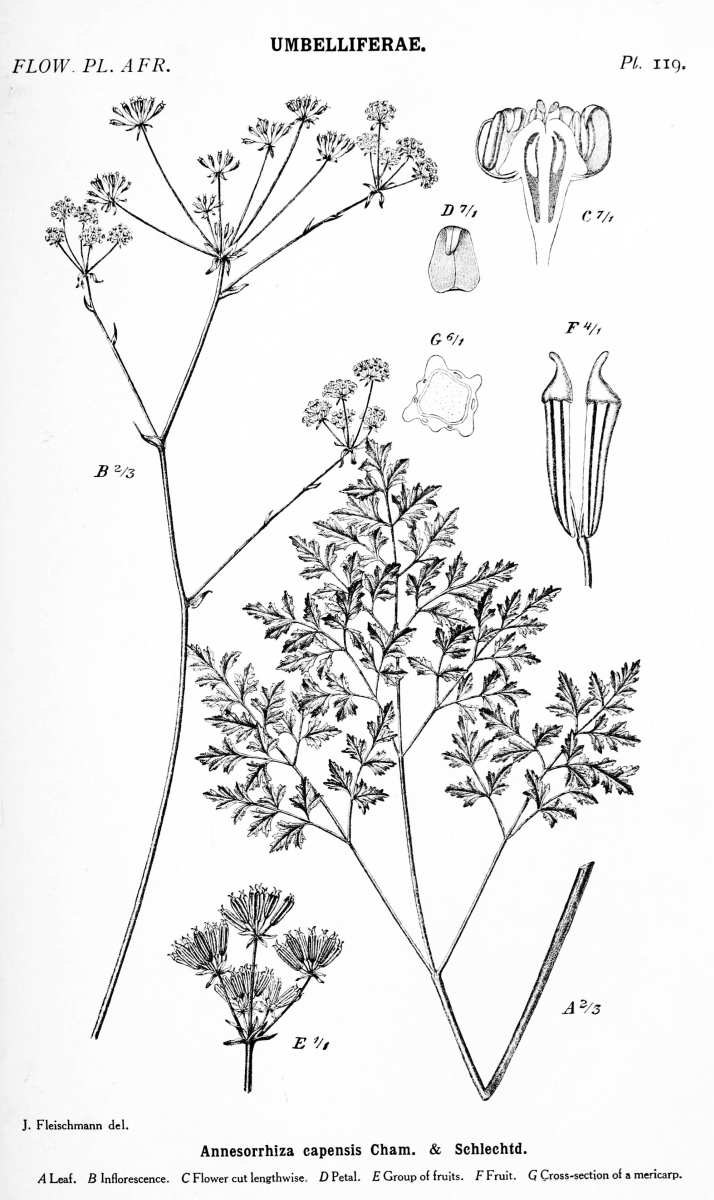
UMBELLIFERAE.
FLOW. PL. AFR.
Pl. 119.
J. Fleischmann del.
Annesorrhiza capensis Cham. & Schlechtd.
A Leaf. B Inflorescence. C Flower cut lengthwise. D Petal. E Group of fruits. F Fruit. G Cross-section of a mericarp.
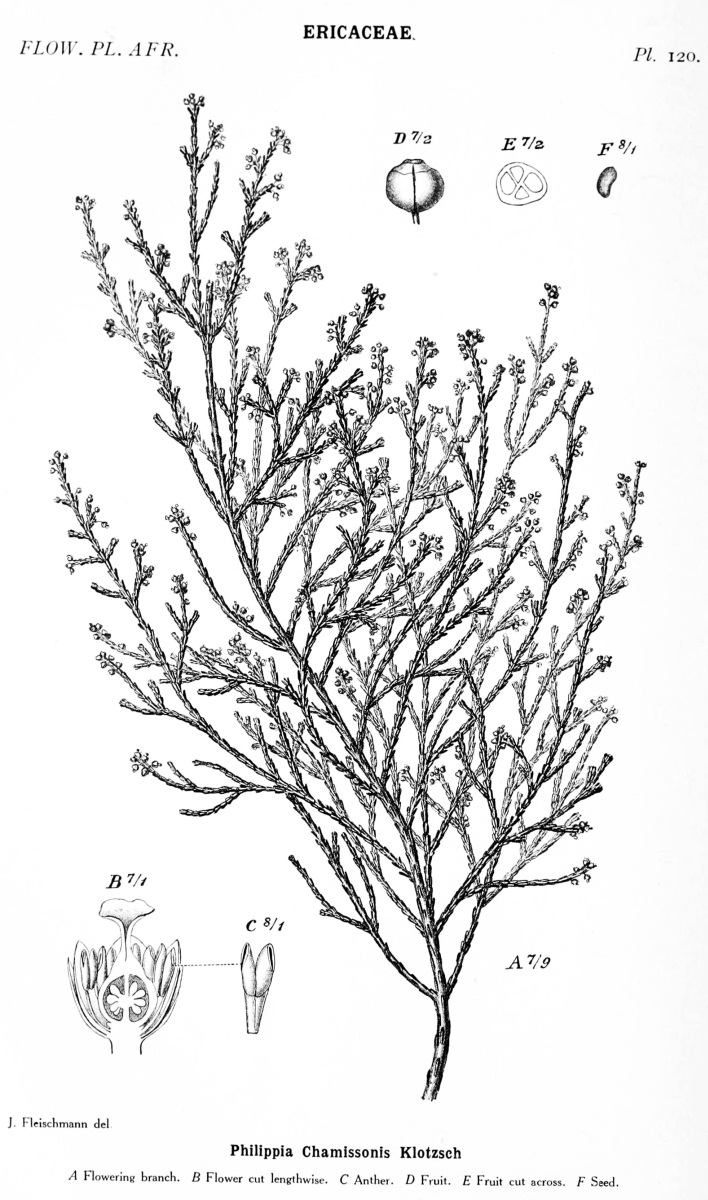
ERICACEAE.
FLOW. PL. AFR.
Pl. 120.
J. Fleischmann del.
Philippia Chamissonis Klotzsch
A Flowering branch. B Flower cut lengthwise. C Anther. D Fruit. E Fruit cut across. F Seed.
two short slits at the top; pollen-grains separate. Disc none. Ovary superior, 3-celled. Ovules numerous, axile, inverted. Style 3-cleft at the top. Fruit a loculicidal capsule. Seeds with a lax testa, a fleshy albumen, and a short embryo. (Under ERICACEAE.)
Genus 1, species 1. Island of Madeira. Yields wood especially used for making walking-sticks, and serves as an ornamental plant. Clethra L.
FAMILY 189. ERICACEAE
Undershrubs, shrubs, or trees. Leaves undivided, usually narrow. Flowers solitary or in umbels, racemes or panicles, regular or nearly so, hermaphrodite. Calyx 4-5-cleft or-parted, persistent. Petals united below, with imbricate or contorted aestivation. Stamens 3-15, usually twice as many as the petals, free from the corolla or almost so, rarely (Ficalhoa) distinctly inserted on the corolla-tube. Anthers turned inwards, usually opening towards the top; pollen-grains united in groups of four. Disc more or less distinctly developed. Ovary usually superior, 1-5-celled. Ovules axile or solitary, inverted or almost so. Style simple. Seeds with copious albumen.—Genera 17, species 720. (Including VACCINIACEAE.) (Plate 120.)
1. Ovary inferior, adnate to the calyx-tube. Corolla deciduous. Stamens 8-10. Fruit a many-seeded berry.—Species 8. Azores, Madeira, East Africa to Transvaal, and Madagascar. Some have edible fruits. [Subfamily VACCINIOIDEAE, tribe VACCINIEAE.] Vaccinium L. Ovary superior, free from the calyx, but sometimes (Salaxis) adnate to the corolla-tube at the base. 2 2. Flowers 5-merous, rarely 6-merous. Corolla deciduous. Stamens 10-15 inserted at the base of the corolla. Ovules numerous in each ovary-cell. Fruit a capsule without a persistent central column, or a berry. Trees or tall shrubs. Leaves alternate or subopposite, oblong or lanceolate. Flowers in racemes or panicles. [Subfamily ARBUTOIDEAE.] 3 Flowers 4-merous, rarely 2-3-merous, very rarely (Erica) 5-merous, but then low shrubs with fascicled flowers. Corolla usually persistent. Stamens 3-8, rarely 10-12. Fruit a capsule, usually with a persistent central column, or an achene. Undershrubs or mostly low shrubs, very rarely trees. 5 3. Anthers attached below the apex, provided with two spur-like appendages. Filaments broadened at the base. Disc distinctly developed. Ovules axile. Fruit a mealy berry with a warty skin.—Species 2. North Africa. They yield tanning materials, medicaments, and edible fruits, and serve as ornamental plants. “Strawberry-tree.” [Tribe ARBUTEAE.] Arbutus L. Anthers attached above the base, without appendages. Disc indistinct. Ovules subbasal. Fruit a loculicidal capsule. [Tribe ANDROMEDEAE.] 4 4. Corolla shortly urn-shaped, deeply 5-lobed. Stamens 15, in groups of three, inserted in the corolla-tube. Filaments glabrous. Stigma finally 5-parted. Seeds ovoid. Trees. Leaves serrate.—Species 1. Southern West Africa (Angola). Ficalhoa Hiern Corolla tubular or funnel-shaped, 5-6-toothed. Stamens 10-12, inserted singly at the base of the corolla-tube. Filaments hairy. Stigma entire. Seeds oblong. Leaves entire.—Species 7. Tropics. Some of them are poisonous or yield wood and medicaments. Agauria DC. 5. Fruit dehiscing septicidally, many-seeded. Corolla shortly toothed, deciduous. Stamens 8. Anthers longer than the filaments, without appendages, opening by terminal pores. Ovary-cells many-ovuled. Small shrubs. Leaves alternate, elliptical. Flowers in terminal racemes.—Species 1. Azores. Used as an ornamental plant. [Subfamily RHODODENDROIDEAE, tribe PHYLLODOCEAE.] Daboecia Don Fruit dehiscing loculicidally or indehiscent, rarely septicidal, but then few-seeded and enveloped by the persistent corolla. Corolla usually persistent after the time of flowering. Leaves usually whorled and linear. [Subfamily ERICOIDEAE.] 6 6. Ovary with a single ovule in each cell, rarely with several ovules, but then 1-2-celled. [Tribe SALAXIDEAE.] 7 Ovary with 2 or more ovules in each of its 3-8 cells. [Tribe ERICEAE.] 12 7. Stigma large, cupular or discoid. Bracteoles rudimentary or wanting. Corolla-lobes 4. 8 Stigma small, capitate or truncate. Bracts and bracteoles usually 3. 10 8. Style short, included in the corolla-tube. Stamens 6-8. Calyx unequally 4-cleft or 4-parted.—Species 15. South Africa. (Including Coccosperma Klotzsch, Lagenocarpus Klotzsch, and Lepterica N. E. Brown). Salaxis Salisb. Style long, exserted. Stamens 3-5. Calyx 3-4-toothed or -cleft. 9 9. Anthers much exserted. Calyx 4-toothed. Bract 1.—Species 1. South Africa. (Under Syndesmanthus Klotzsch). Codonostigma Klotzsch Anthers included or slightly exserted. Bracts none.—Species 20. South Africa. (Including Coilostigma Klotzsch). Scyphogyne Brongn. 10. Corolla 2-lobed. Calyx 2-lobed or 4-toothed. Stamens 4.—Species 9. South Africa. (Including Aniserica N. E. Brown) Sympieza Lichtenst. Corolla 4-lobed. Calyx 4-toothed to 4-parted. 11 11. Calyx shortly toothed, usually thickened. Stamens 3-4. Ovary 1-2-celled.—Species 50. South Africa. (Including Anomalanthus Klotzsch and Syndesmanthus Klotzsch). Simochilus Hook. & Benth. Calyx divided to the middle or beyond. Stamens 4-8.—Species 40. South Africa. (Including Acrostemon Klotzsch, Eremiopsis N. E. Brown, Grisebachia Klotzsch, Hexastemon Klotzsch, Platycalyx N. E. Brown, Thamnus Klotzsch, and Thoracosperma Klotzsch). Eremia Don 12. (6.) Stamens 4. Fruit few-seeded, loculicidal. 13 Stamens 8, very rarely 6, 7, 10, or 12. 14 13. Calyx-lobes unequal, one of them somewhat larger than the others. Disc distinctly developed. Bracts and bracteoles none.—Species 6. Tropical and South Africa. Ericinella Klotzsch Calyx-lobes equal. Disc rudimentary. Bracts and bracteoles 3.—Species 30. Tropical and South Africa. Blaeria L. 14. Flowers with 4 bracts and bracteoles. Calyx corolla-like, 4-parted nearly to the base, slightly exceeding the deeply 4-cleft corolla. Anthers spurred, opening by longitudinal slits. Fruit dehiscing septicidally, few-seeded.—Species 1 (C. vulgaris Salisb., ling). North-west Africa (Morocco and Azores). Yields tanning and dyeing materials, medicaments, and food for bees. Calluna Salisb. Flowers with 1-3 bracts and bracteoles or without any. Fruit dehiscing loculicidally, usually many-seeded. 15 15. Calyx-lobes unequal, the lowest larger than the others. Bracts and bracteoles none. Disc rudimentary. Stigma broad. Flowers terminal.—Species 45. Tropical and South Africa. Some are used medicinally. (Plate 120.) Philippia Klotzsch Calyx-lobes equal. Bracts and bracteoles nearly always present. Disc usually distinctly developed. 16 16. Calyx much longer than the corolla, two of the segments including the other two. Anthers opening by loculicidal slits.—Species 1. South Africa (Cape Colony). (Under Erica L.) Macnabia Benth. Calyx not much longer, usually shorter than the corolla.—Species 480. South Africa, East Africa to Comoro Islands, and North Africa. Many species are used as ornamental plants, some yield wood or dyes. (Including Pentapera Klotzsch). “Heath.” Erica L.
ORDER PRIMULALES
FAMILY 190. MYRSINACEAE
Trees or shrubs, rarely (Afrardisia) herbs. Leaves alternate, undivided, gland-dotted, without stipules. Flowers in racemes, panicles, umbels or heads, regular, 4-5-, very rarely 6-7-merous. Petals white or red, rarely yellow or green, usually united below. Stamens as many as the petals, opposite to them, inserted on the corolla. Anthers opening inwards, more rarely near the apex. Ovary superior, rarely (Maesa) half-inferior, 1-celled, with a free central, usually globular placenta. Ovules several or many, inverted or half-inverted. Style simple or wanting; stigma entire or lobed. Fruit a berry, a drupe, or a nut. Seeds with copious albumen. Embryo with a long radicle and small cotyledons.—Genera 10, species 130. (Plate 121.)
1. Ovary inferior or half-inferior. Ovules seated upon the surface of the placenta. Fruit several-seeded. Petals united below, white. Stigma broadened. Shrubs. Flowers in racemes or panicles.—Species 10. Tropical and South Africa. Some are used medicinally. (Plate 121.) [Subfamily MAESOIDEAE.] Maesa Forsk. Ovary superior. Ovules sunk into the placenta. Fruit one-seeded. [Subfamily MYRSINOIDEAE.] 2 2. Ovules in several rows. Petals free, pink. Flowers hermaphrodite, 5-merous, in short racemes. Stigma punctiform. Filaments long.—Species 1. Madeira and Canary Islands. (Under Ardisia Swartz or Myrsine L.) [Tribe ARDISIEAE.] Heberdenia Banks Ovules in a single row. Petals united below, more rarely free, but then flowers dioecious and stigma peltate. [Tribe MYRSINEAE.] 3 3. Ovules numerous, about ten. Anthers opening by a single pore at the apex. Sepals unequal-sided. Petals united below. Filaments short. Stigma punctiform. Trees. Flowers in panicles, dioecious, 5-merous.—Species 6. Madagascar. (Under Ardisia Swartz). Monoporus A. DC. Ovules few. Anthers opening by two slits or pores. 4. 4. Stigma punctiform. Style thin. Flowers hermaphrodite, 5-7-merous. Petals united below. Filaments short, free or nearly so. 5 Stigma more or less dilated. Style thick. 6 5. Sepals and petals with imbricate, not contorted aestivation; petals white, equal-sided. Trees or tall shrubs. Leaves entire. Flowers sessile or nearly so, in heads or umbels arising from lateral dwarf-shoots.—Species 1. Madeira and Canary Islands. (Under Myrsine L.) Pleiomeris A. DC. Sepals and petals with contorted aestivation; petals red, unequal-sided. Herbs, undershrubs, or shrubs. Flowers in axillary umbels or racemes, 5-merous.—Species 10. West Africa. (Under Ardisia Swartz). Afrardisia Mez 6. Petals free or nearly so. Filaments usually free. Flowers unisexual.—Species 25. Tropical and South-east Africa. Some are used medicinally. (Samara L., Pattara Adans.) Embelia Burm. Petals obviously united below. 7 7. Filaments wanting. 8 Filaments distinctly developed, more or less united. Style present. 9 8. Style wanting. Flowers in umbels upon sometimes imperceptible dwarf-shoots.—Species 10. Tropical and South Africa. (Under Myrsine L.) Rapanea Aubl. Style present. Flowers in axillary racemes or panicles.—Species 10. Mascarene Islands and Madagascar. (Under Ardisia Swartz or Icacorea Aubl.) Badula Juss. 9. Flowers dioecious, in umbels arising from dwarf-shoots. Petals imbricate in bud. Anthers free.—Species 2. Tropical and South Africa and Azores. They yield timber and are used as ornamental, medicinal, or fodder plants. Myrsine L. Flowers hermaphrodite, in axillary umbels, racemes or panicles.—Species 55. Madagascar and neighbouring islands. Oncostemon A. Juss.
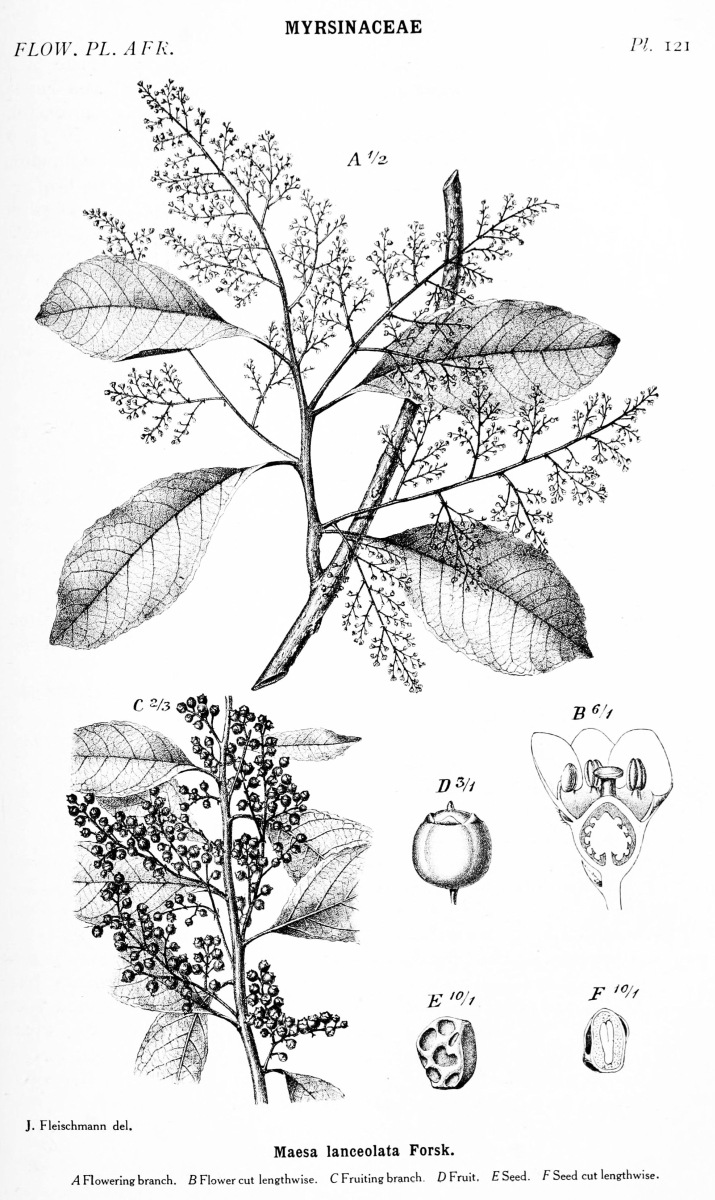
MYRSINACEAE.
FLOW. PL. AFR.
Pl. 121.
J. Fleischmann del.
Maesa lanceolata Forsk.
A Flowering branch. B Flower cut lengthwise. C Fruiting branch. D Fruit. E Seed. F Seed cut lengthwise.
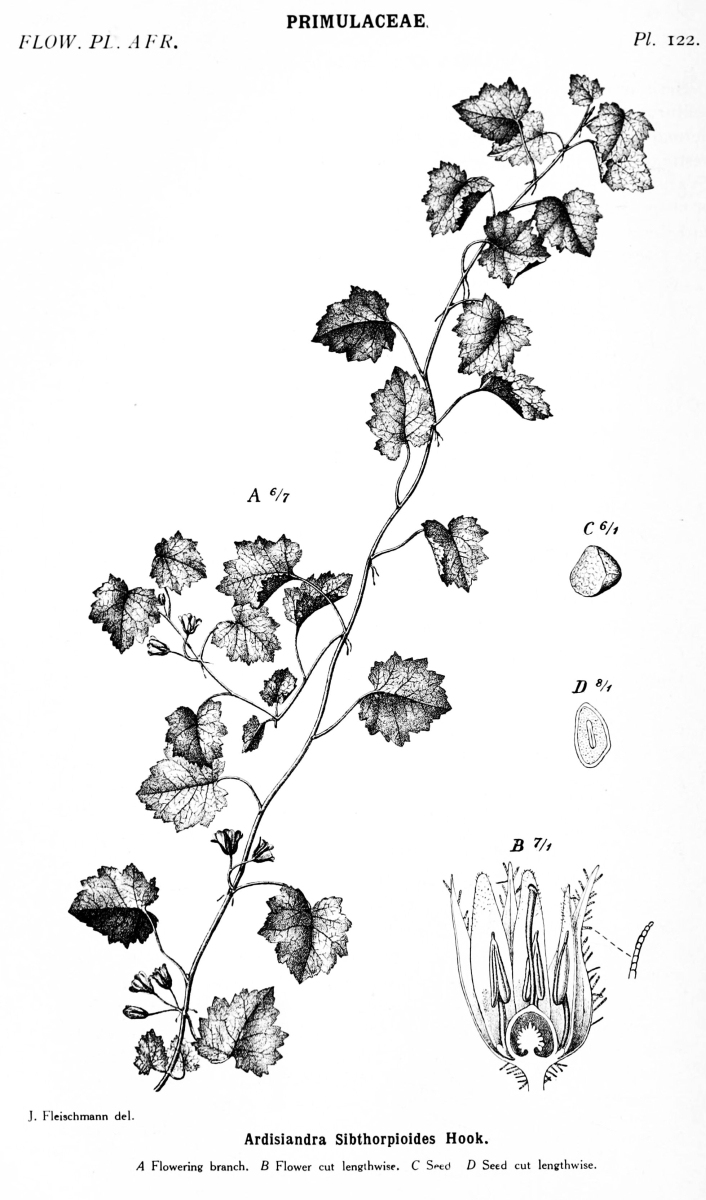
PRIMULACEAE.
FLOW. PL. AFR.
Pl. 122.
J. Fleischmann del.
Ardisiandra Sibthorpioides Hook.
A Flowering branch. B Flower cut lengthwise. C Seed. D Seed cut lengthwise.
FAMILY 191. PRIMULACEAE
Herbs or undershrubs. Leaves undivided or lobed, without stipules. Flowers solitary or in umbels racemes or panicles, without bracteoles, 3-7-merous, hermaphrodite. Petals usually united below, with imbricate or contorted aestivation. Fertile stamens as many as the petals and opposite to them. Ovary usually superior, 1-celled, with a free central placenta. Ovules several or many, half-inverted. Style simple; stigma entire. Fruit a capsule. Seeds with ventral hilum; albumen fleshy; embryo small, axile.—Genera 11, species 45. (Plate 122.)
1. Ovary inferior or half-inferior. Corolla white, 5-cleft, regular, imbricate in bud, with 5 scales at the throat. Ovules numerous. Flowers in terminal racemes or panicles. Leaves alternate.—Species 2. Used as vegetables. [Tribe SAMOLEAE.] Samolus L. Ovary superior. 2 2. Corolla irregular, red. Calyx prickly. Ovules 5. Flowers in terminal racemes. Leaves alternate, linear, prickly toothed.—Species 1. North Africa. Used medicinally. [Tribe CORIDEAE.] Coris L. Corolla regular. Calyx not prickly. 3 3. Corolla-lobes bent back, with contorted aestivation, red or white. Ovules numerous. Stem tuberous. Leaves radical, stalked, broad. Flowers solitary, radical.—Species 4. North Africa. Used as ornamental or medicinal plants; the tubers are poisonous. [Tribe CYCLAMINEAE.] Cyclamen L. Corolla-lobes erect or spreading. Stem not tuberous. 4 4. Corolla with contorted aestivation. [Tribe LYSIMACHIEAE.] 5 Corolla with imbricate, not contorted aestivation. [Tribe ANDROSACEAE.] 9 5. Corolla smaller than the calyx. Flowers solitary in the axils of the leaves. 6 Corolla larger than the calyx; petals united below. 8 6. Petals 3, free. Fruit 2-seeded, opening in 3 valves. Leaves opposite.—Species 1. Naturalized in the Canary Islands. (Under Asterolinum Link & Hoffmsg.) Pelletiera St. Hil. Petals 4-5, united below. Fruit many-seeded. 7 7. Corolla-tube short. Fruit opening by a lid. Leaves alternate, at least the upper ones.—Species 1. North and East Africa. Centuneulus L. Corolla-tube long. Fruit opening by 4-5 valves. Leaves opposite.—Species 2. North and East Africa. Asterolinum Link & Hoffmsg. 8. Fruit opening by a lid. Corolla red or blue. Flowers solitary, axillary.—Species 20. Some of them yield a fish-poison or medicaments, or serve as ornamental plants. “Pimpernel.” Anagallis L. Fruit opening by valves. Corolla usually yellow or white.—Species 12. North, South, and East Africa and Madagascar. Some are used as ornamental or medicinal plants. (Including Lubinia Vent.) Lysimachia L. 9. Stamens with an acuminate connective, inserted at the base of the corolla. Corolla white, about as long as the calyx, bell-shaped, deeply cleft, ciliate. Flowers solitary or 2-3 together in the axils of the leaves. Leaves alternate, stalked, cordate, lobed. Stem creeping.—Species 1. Mountains of Central Africa. (Plate 122.) Ardisiandra Hook. Stamens with an obtuse connective, inserted in the tube of the corolla. Flowers terminal, solitary or in umbels or whorls. Leaves radical. Stem erect, sometimes very short. 10 10. Corolla smaller than the calyx, bell-shaped, with a short tube, whitish or reddish. Flowers in umbels. Leaves elliptical, subsessile.—Species 1. North Africa. Used medicinally. Androsace L. Corolla larger than the calyx, salver-shaped, with a long tube. Leaves spatulate.—Species 2. North Africa and Abyssinia. Used as ornamental or medicinal plants. “Primrose.” Primula L.
FAMILY 192. PLUMBAGINACEAE
Herbs, undershrubs, or shrubs. Leaves undivided. Flowers in spike-head or panicle-like inflorescences, regular or nearly so, 5-merous, hermaphrodite, bracteolate. Calyx with valvate or open aestivation, usually folded. Petals more or less clearly united, with contorted aestivation. Stamens as many as the petals and opposite to them. Anthers turned inwards. Ovary superior, 1-celled. Ovule 1, suspended from the basal funicle, inverted, with superior micropyle. Style or style-branches 5. Seeds with a straight embryo and mealy albumen.—Genera 7, species 90. (Plate 123.)
1. Styles united high up. Stamens generally free from the corolla. Inflorescence usually simple; each flower with 2 bracteoles, which usually bear no flowers in their axils. [Tribe PLUMBAGINEAE.] 2 Styles free or united at the base only. Stamens attached to the corolla. Inflorescence composed of cymes; each flower with 1-2 bracteoles, one of which bears a flower in its axil. [Tribe STATICEAE.] 4 2. Sepals glandular, evidently united below. Corolla salver-shaped. Stamens free from the corolla. Undershrubs.—Species 9. Some of them yield arrow-poison, tanning materials, or medicaments, or serve as ornamental plants. Plumbago L. Sepals without glands, free or nearly so. Shrubs. 3 3. Stamens inserted in the middle of the corolla-tube. Corolla salver-shaped, pink or violet. Inflorescence capitate.—Species 2. Abyssinia. Ceratostigma Bunge Stamens free from the corolla. Corolla funnel-shaped. Inflorescence spicate-paniculate.—Species 3. Central and South Africa. (Vogelia Lam.) (Plate 123.) Dyerophyton O. Ktze. 4. Stamens inserted in the middle of the corolla-tube. Styles united nearly halfway up. Corolla blue, with a long tube. Undershrubs.—Species 3. North Africa. (Bubania Gir.) Limoniastrum Moench Stamens inserted at the base of the corolla. 5
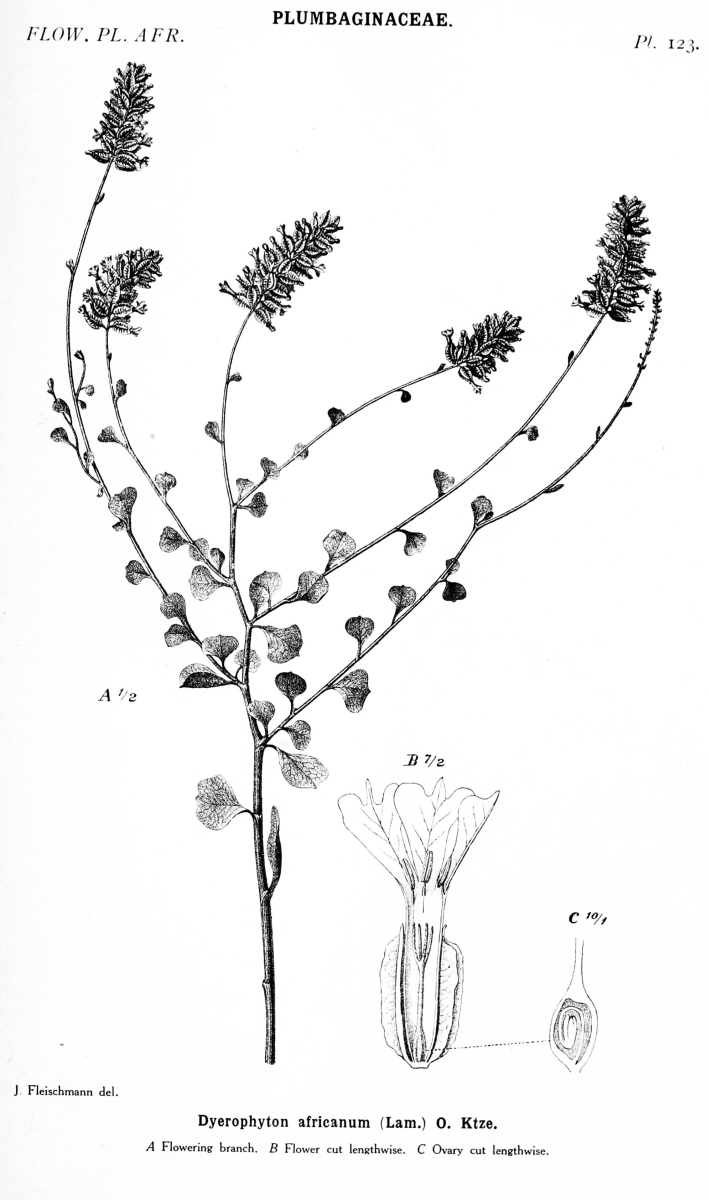
PLUMBAGINACEAE.
FLOW. PL. AFR.
Pl. 123.
J. Fleischmann del.
Dyerophyton africanum (Lam.) O. Ktze.
A Flowering branch. B Flower cut lengthwise. C Ovary cut lengthwise.
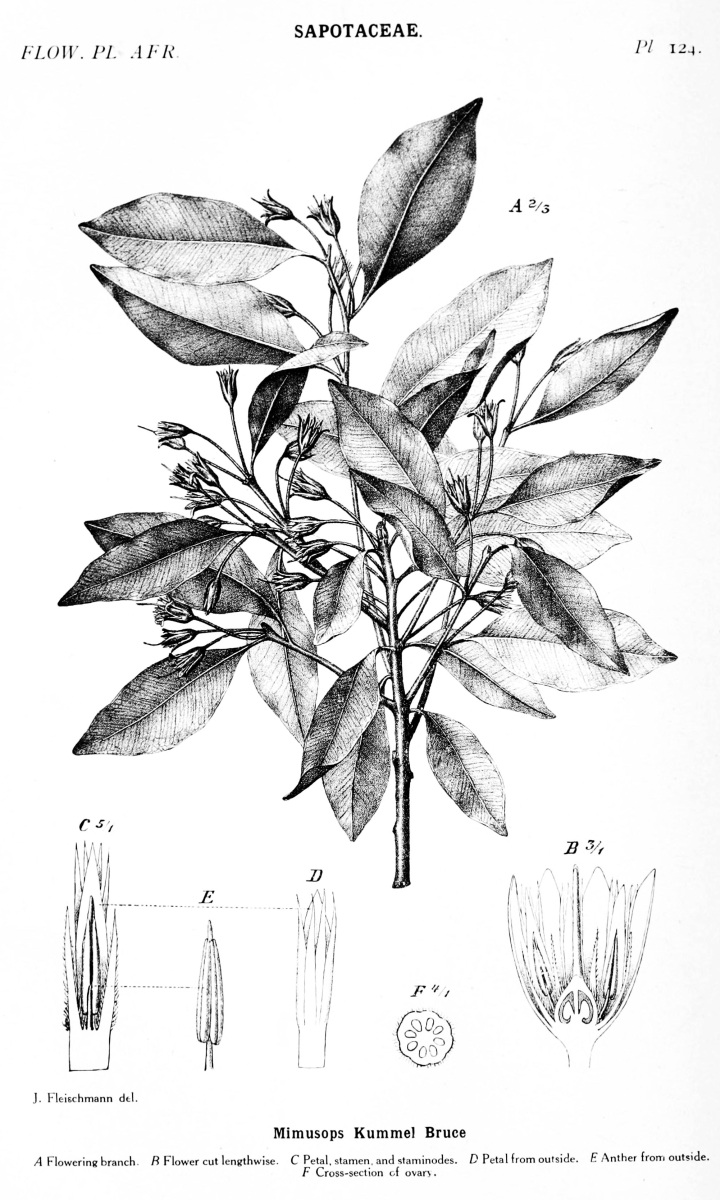
SAPOTACEAE.
FLOW. Pl. AFR
Pl. 124.
J. Fleischmann del.
Mimusops Kummel Bruce
A Flowering branch. B Flower cut lengthwise. C Petal, stamen, and staminodes. D Petal from outside. E Anther from outside. F Cross-section of ovary.
5. Stigmas capitate. Styles tubercled. Fruit opening by a lid. Inflorescence paniculate. Herbs.—Species 1. North Africa. Yields tanning and dyeing materials and medicaments, and serves as an ornamental plant. Goniolimon Boiss. Stigmas cylindrical or filiform. 6 6. Styles hairy. Petals almost free. Fruit bursting all round at the base. Inflorescence capitate. Leaves usually linear.—Species 10. North Africa. Some are used as ornamental or medicinal plants. “Thrift.” Armeria Willd. Styles glabrous. Fruit opening with a lid, or bursting irregularly, or remaining closed. Inflorescence paniculate.—Species 60. North Africa, northern Central Africa, and South Africa. Some species are used for tanning or as ornamental or medicinal plants. (Limonium Boiss.) Statice L.
ORDER EBENALES
SUBORDER SAPOTINEAE
FAMILY 193. SAPOTACEAE
Trees, rarely shrubs. Leaves entire. Flowers solitary or in clusters in the leaf-axils or on the trunk. Calyx imbricate in bud. Petals united below, imbricate in bud. Stamens as many as the petals and opposite to them, or more. Anthers opening lengthwise. Ovary superior, completely or almost completely 2-or more-celled. Ovules solitary in each cell, more or less curved, the micropyle turned downwards. Style simple. Fruit a berry.—Genera 19, species 150. (Plate 124.)
1. Petals with two sometimes laciniate or minute dorsal appendages, rarely with one only. [Tribe MIMUSOPEAE.] 2 Petals without dorsal appendages. [Tribe PALAQUIEAE.] 4 2. Fertile stamens as many as the petals, 6; staminodes none. Appendages of the petals small, toothed. Flowers hermaphrodite. Seeds exalbuminous, affixed by a broad, lateral hilum.—Species 1. Seychelles. Northea Hook. fil. Fertile stamens as many as the petals, 6-8, but alternating with as many staminodes, or more. 3 3. Fertile stamens more than twice as many as the petals. Fruit 1-seeded.—Species 3. Madagascar and Mascarenes. Yielding timber. Labourdonnesia Boj. Fertile stamens as many, rarely twice as many as the petals.—Species 60. Tropical and South Africa. Some species yield timber, tanning-bark, a resin (balata) similar to guttapercha, edible fruits, fat-containing seeds, fish-poison, and medicaments. (Including Baillonella Pierre, Dumoria A. Chev., Imbricaria Commers., Labramia A. DC., and Tieghemella Pierre). (Plate 124.) Mimusops L. 4. Fertile stamens as many as petals. [Subtribe SIDEROXYLINAE.] 5 Fertile stamens more than petals. 17 5. Staminodes none, rarely 1-4, small. 6 Staminodes 5 or more. 11 6. Filaments with a leaf-like appendage. Leaves crowded at the top of the branches; stipules linear. Flowers in clusters springing from older branches.—Species 1. Madagascar. Cryptogyne Hook. fil. Filaments without a leaf-like appendage. 7 7. Anthers converging around the style, oblong. Filaments adnate to the long corolla-tube at their base. Sepals free. Endocarp separating and enveloping the 5 seeds. Seeds exalbuminous. Shrubs with long, reddish brown, undivided hairs. Leaves lanceolate, with 2 pouch-shaped auricles at the base of the blade; side-nerves numerous, somewhat distant, connected by numerous transverse veins.—Species 1. Equatorial West Africa (Gaboon). Delpydora Pierre Anthers not converging. Leaves not auricled. Hairs usually 2-parted. 8 8. Seeds albuminous. Primary side-nerves of the leaves usually approximate.—Species 20. Central and South Africa. Some species yield timber or edible fruits. Chrysophyllum L. Seeds exalbuminous, solitary. Stigma 5-lobed. Primary side-nerves of the leaves somewhat distant. Trees. 9 9. Sepals free or nearly so. Tube of the corolla longer than the segments. Anthers opening inwards or laterally. Leaves oblong or ovate; primary side-nerves straight and connected by numerous transverse veins.—Species 6. Central Africa. They yield timber. Malacantha Pierre Sepals obviously united at the base. Tube of the corolla as long as or shorter than the segments. Anthers opening outwards. Leaves lanceolate or elliptical; primary side-nerves arched, connected by a network of veins. 10 10. Corolla-tube as long as the segments. Ovules attached below the middle.—Species 6. Central Africa. Some have edible fruits. (Under Sideroxylon L.) Sersalisia R. Br. Corolla-tube shorter than the segments. Ovules attached by the middle or above it. Leaves lanceolate; stipules linear.—Species 4. Central Africa. They yield timber, edible fruits, and oily seeds. Pachystela Pierre 11. (5.) Ovary 2-6-celled. 12 Ovary 8-12-celled. 16 12. Filaments much longer than the anthers. Staminodes linear. Style long. Ovules attached above the middle. Corolla with a short tube and narrow segments. Seed 1, with a very scanty albumen. Trees. Leaves lanceolate, stipulate.—Species 4. West Africa. (Under Sideroxylon L.) Bakerisideroxylon Engl. Filaments about as long as or slightly longer than the anthers. Ovules attached by the middle or below it. 13 13. Sepals united to above the middle. Anthers opening inwards. Staminodes lanceolate or ovate. Styles very long, with a very small stigma. Seeds exalbuminous. Trees. Leaves lanceolate.—Species 3. Central Africa. (Including Stironcurum Radlk.) Synsepalum A. DC. Sepals free or united at the base. Anthers opening outwards. 14 14. Staminodes awl-shaped. Ovary 2-4-celled. Seeds 2-4, connate, albuminous. Spiny trees. Leaves lanceolate. Species 1. Morocco. Yields timber (iron-wood) and oil. Argania Roem. & Schult. Staminodes more or less petal-like, or short and broad. Ovary usually 5-celled. Seeds separate or solitary. 15 15. Staminodes more or less petal-like. Seeds albuminous, with leaf-like cotyledons.—Species 20. Tropical and South Africa, Canary Islands, and Madeira. Some species yield timber, edible fruits, or medicaments. (Including Calvaria Commers. and Sapota A. DC.) Sideroxylon L. Staminodes small, broad. Seeds exalbuminous, with thick cotyledons. (See 10.) Sersalisia R. Br. 16. Calyx 5-6-parted. Corolla 5-6-lobed. Ovary 10-12-celled. Ovules attached by the base. Fruit 4-12-seeded. Seeds ovoid, compressed, with a narrow hilum, albuminous. Flowers solitary.—Species 1 (A. Sapota L., sapodilla-plum). Cultivated in the tropics. Yields a guttapercha-like resin, edible fruits, and medicaments. (Under Sapota Plum.) Achras L. Calyx 8-10-parted. Corolla 8-10-cleft or -parted. Ovary 8-10-celled. Ovules attached by the middle. Fruit 1-4-seeded. Seeds globular, with a broad hilum, exalbuminous. Flowers in clusters, clothed with rusty-brown hairs.—Species 1 (B. Parkii Kotschy). Central Africa. Yields timber, a guttapercha-like resin, edible fruits, and a fat (shea-butter) from the seeds. (Bassia L.) Butyrospermum Kotschy 17. (4.) Sepals 5, unequal, spirally arranged. Fertile stamens 15, 20, or more; Staminodes 5 or more. Ovary 9-30-celled. Style cone- or club-shaped. [Subtribe OMPHALOCARPINAE.] 18 Sepals 4 or 6, nearly equal, whorled. Stamens 12 or 16, all fertile. Anthers opening outwards. Style awl-shaped. [Subtribe ILLIPINAE.] 19 18. Stamens 15, united in 5 bundles. Anthers opening outwards. Ovary 10-celled. Style club-shaped. Petals 5, white. Sepals red. Flowers solitary or few together in the axils of the lower, sometimes fallen leaves.—Species 1. Equatorial West Africa (Cameroons). Tridesmostemon Engl. Stamens 20 or more, free. Anthers opening inwards. Style cone-shaped, Flowers springing from the old wood.—Species 13. West Africa. They yield timber and a sort of guttapercha. Omphalocarpum Beauv. 19. Sepals 4. Petals 8. Stamens 16. Ovary 10-12-celled. Seeds albuminous.—Species 1. Cultivated in the tropics. Yields guttapercha. Payena A. DC. Sepals 6. Petals 6. Stamens 12. Ovary 6-celled. Seeds exalbuminous.—Species 2. Cultivated in the tropics. Yielding guttapercha. Palaquium Blanco
SUBORDER DIOSPYRINEAE
FAMILY 194. HOPLESTIGMATACEAE
Trees. Leaves alternate, undivided, without stipules. Flowers in terminal panicles. Calyx closed in the bud, subsequently cleft into 2-4 lobes. Corolla with a short tube and 11-14 imbricate segments. Stamens 23-34, inserted in the tube of the corolla. Anthers opening lengthwise. Ovary 1-celled with 2 much projecting placentas. Ovules 4, pendulous inverted. Styles 2, united at the base, with roundish stigmas. Fruit a drupe with 2 empty cavities. Seeds with a large embryo and scanty albumen. (Under FLACOURTIACEAE.)
Genus 1, species 2. Equatorial West Africa. Hoplestigma Pierre
FAMILY 195. EBENACEAE
Trees or shrubs. Leaves entire, without stipules. Flowers solitary or in cymes in the leaf-axils, regular. Petals united below, with contorted, rarely valvate aestivation. Stamens as many as the petals and opposite to them, or more numerous, inserted at the base of the corolla-tube. Filaments free or united in bundles. Anthers basifixed, 2-celled. Ovary superior, sessile, 2-16-celled. Ovules 1-2 in each cell, pendulous, inverted. Styles 2-8, free or united at the base. Seeds with a copious, cartilaginous albumen and an axile embryo.—Genera 6, species 150. Tropical and South Africa. (Plate 125.)
1. Corolla with valvate aestivation. Stamens about 30. Flowers 4-merous, dioecious, the male in cymes, the female solitary.—Species 1. Madagascar. Tetraclis Hiern Corolla with contorted aestivation. 2 2. Stamens 2-3, with hairy filaments and linear anthers. Corolla 3-4-lobed. Flowers dioecious. Fruit oblong or ovoid. Leaves oblique at the base.—Species 1. West Africa. Rhaphidanthe Hiern Stamens 4 or more, very rarely 3, but then filaments glabrous and anthers oblong or lanceolate. 3 3. Stamens in a single row, 4-14, usually 10. Flowers usually hermaphrodite, 5-, rarely 4-, 6-, or 7-merous. Ovary 4-10-celled with 1 ovule in each cell. Pericarp leathery.—Species 20. South and Central Africa. Some species yield timber. Royena L. Stamens in 2 or more rows, very rarely in a single row, but then only 3. Flowers unisexual, rarely polygamous. Pericarp usually fleshy. 4 4. Ovary 3-celled with 2 ovules, or 6-celled with 1 ovule in each cell; in the latter case female flowers with staminodes. Flowers 3-merous, more rarely 4-6-merous. Stamens usually 9, glabrous. Leaves alternate.—Species 20. Tropical and South-east Africa. Some species yield timber, edible fruits, and medicaments. (Plate 125.) Maba Forst. Ovary 4- or 8-16-celled, rarely 2- or 6-celled; in the latter case female flowers without staminodes. Flowers 4-7-, very rarely 3-merous. Stamens usually 12-20. 5
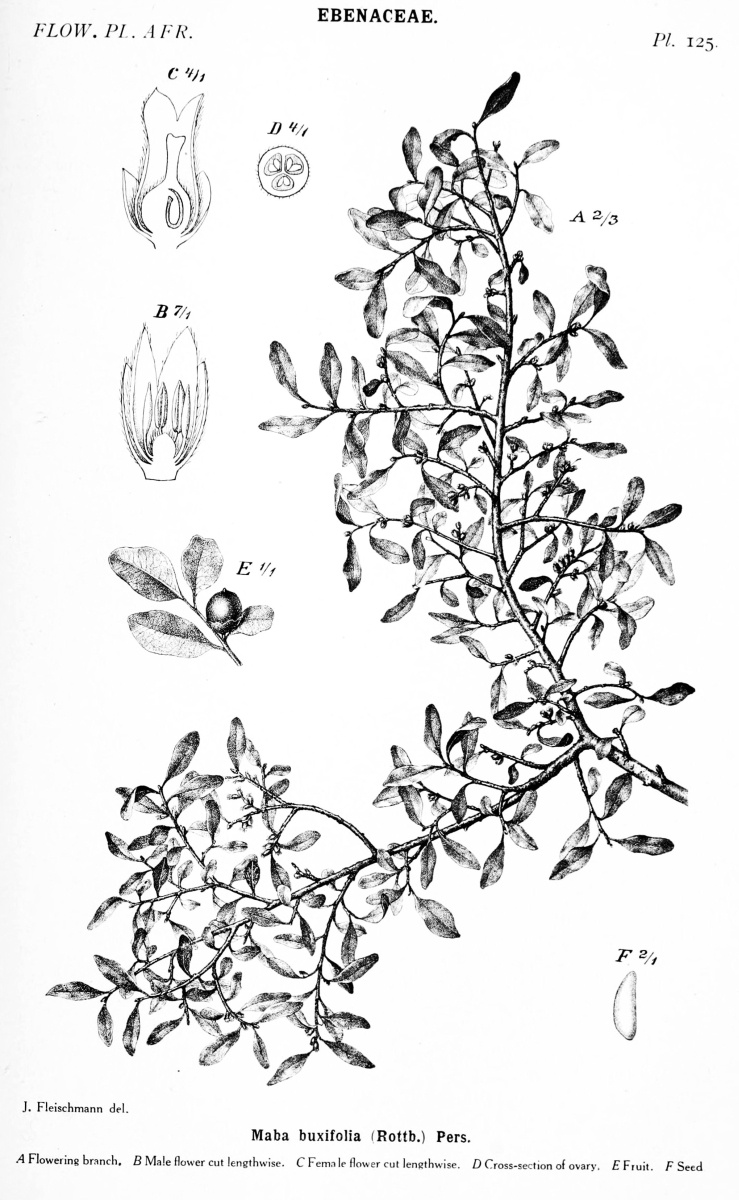
EBENACEAE.
FLOW. PL. AFR.
Pl. 125.
J. Fleischmann del.
Maba buxifolia (Rottb.) Pers.
A Flowering branch. B Male flower cut lengthwise. C Female flower cut lengthwise. D Cross-section of ovary. E Fruit. F Seed.
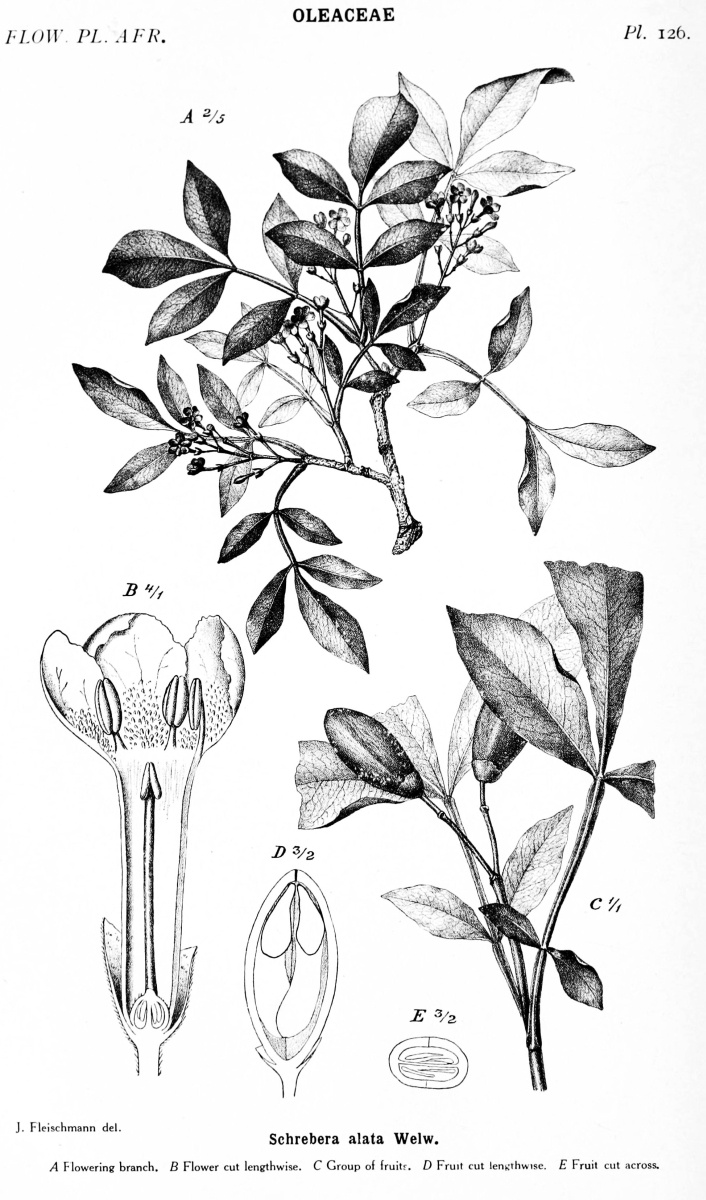
OLEACEAE
FLOW. PL. AFR.
Pl. 126.
J. Fleischmann del.
Schrebera alata Welw.
A Flowering branch. B Flower cut lengthwise. C Group of fruits. D Fruit cut lengthwise. E Fruit cut across.
5. Staminodes usually absent in the female flowers. Ovary 2-celled with 2 ovules, or 4-6-celled with one ovule in each cell. Calyx not enlarged after flowering. Fruit fleshy. Stamens 10-30.—Species 35. Central and South Africa. Some species yield timber or edible fruits. Euclea L. Staminodes usually present in the female flowers. Ovary 4-16-, usually 8-celled, with 1 ovule in each cell. Calyx most frequently enlarged after flowering. Stamens usually 16.—Species 75. Tropical and South-east Africa. They yield timber (ebony), tanning and dyeing materials, mucilage, edible fruits (date-plums), fish-poison, and medicaments. (Including Thespesocarpus Pierre). Diospyros Dalech.
FAMILY 196. STYRACACEAE
Trees. Leaves alternate, undivided, without stipules. Flowers solitary or in pairs in the leaf-axils, clothed with stellate hairs, hermaphrodite. Calyx closed in the bud, splitting subsequently into 2 or 3 segments. Petals 5, free, fleshy, whitish-yellow. Stamens 10, free. Anthers basifixed, pointed, opening by 2 longitudinal slits. Ovary superior, 1-celled. Ovules 6, basal, inverted. Style simple. Fruit dry, indehiscent. Seed 1, with a crusty-woody testa and a copious, horny albumen. Embryo axile, large, straight, with a short radicle and thin cotyledons.
Genus 1, species 1. Equatorial West Africa (Cameroons). Afrostyrax Perkins & Gilg
ORDER CONTORTAE
SUBORDER OLEINEAE
FAMILY 197. OLEACEAE
Shrubs or trees, rarely undershrubs. Leaves exstipulate, usually opposite. Flowers regular. Stamens 2, alternating with the carpels, rarely 3-4, inserted on the corolla, if the latter is present. Disc none. Ovary superior, rarely (Fraxinus) naked, 2-celled, rarely 3-4-celled. Ovules 1-4, usually 2, in each cell, inverted. Style simple; stigmas 1-2. Seeds with a straight embryo.—Genera 11, species 120. (Including JASMINEAE.) (Plate 126.)
1. Seeds erect or ascending, the radicle turned downwards. Fruit 2-parted, but sometimes one half only developed. Corolla conspicuous, white or yellow, with 5-6, more rarely 7-12 or 4 imbricate segments; in the latter case anthers opening inside. Shrubs or undershrubs. [Subfamily JASMINOIDEAE, tribe JASMINEAE.] 2 Seeds pendulous or descending, the radicle turned upwards. Fruit not 2-parted. Petals 4 or 0, rarely 5-8; in this case petals valvate in bud or stem tree-like. Anthers opening laterally, very rarely inside, but then petals valvate in bud. [Subfamily OLEOIDEAE.] 3 2. Fruit a capsule. Sepals linear. Corolla bell- or wheel-shaped, with a short tube and 5-6 segments. Anthers opening laterally. Ovules 2-4 in each ovary-cell. Undershrubs. Leaves simple, undivided or pinnatifid.—Species 3. South Africa. Menodora Humb. & Bonpl. Fruit a berry. Corolla salver-shaped. Anthers opening inside. Shrubs. Leaves compound, with 1-7 leaflets.—Species 60. Some of them are used in perfumery and medicine or as ornamental plants (jessamine). Jasminum L. 3. Fruit a linear or lanceolate winged nut. Seeds with fleshy albumen. Ovules 2 in each ovary-cell. Corolla absent. Flowers unisexual or polygamous. Leaves pinnate. Trees.—Species 4. North-west Africa. They yield timber, tanning and dyeing materials, and medicaments. “Ash.” [Tribe FRAXINEAE.] Fraxinus L. Fruit a capsule, a berry, or a drupe. Corolla present. 4 4. Fruit a capsule. Albumen very scanty or absent. Ovules 4 in each ovary-cell. Corolla with a long tube and 4-8 imbricate lobes. Flowers in panicles. Trees.—Species 15. Central and South Africa. (Nathusia Hochst.) (Plate 126.) [Tribe SYRINGEAE.] Schrebera Roxb. Fruit a berry or a drupe. Ovules 2 in each ovary-cell. Corolla with a short tube or without a tube, and with valvate, rarely imbricate segments; in the latter case shrubs with spicate or racemose flowers. Leaves undivided. [Tribe OLEINEAE.] 5 5. Petals free or united in pairs, with valvate aestivation. 6 Petals all united at the base. 7 6. Flowers in axillary and terminal simple racemes. Embryo with a long radicle.—Species 1. Canary Islands and Madeira. Yields timber. (Picconia DC.) Notelaea Vent. Flowers in axillary or terminal compound racemes. Embryo with a short radicle.—Species 10. Tropical and South-east Africa. Some species yield timber. (Mayepea Aubl.) Linociera Swartz 7. Corolla with imbricate aestivation. Flowers in axillary simple spikes or racemes. Shrubs.—Species 4. North Africa. They yield timber and medicaments, and serve also as ornamental plants. Phillyrea L. Corolla with induplicate-valvate aestivation. 8 8. Corolla globular. Seeds exalbuminous, with thick cotyledons. Flowers in axillary and terminal simple racemes, more rarely solitary or in clusters. Trees. Species 6. Madagascar and Mascarenes. Some have edible fruits. Noronhia Stadtmann Corolla not globular. Seeds with a fleshy albumen and flat cotyledons. Flowers in compound racemes or in clusters. 9 9. Corolla-tube very short; segments narrow, bent inwards at the margins. Sepals free or nearly so. Anthers opening outwards. Flowers in clusters. Low trees.—Species 1. Southern Central Africa. Dekindtia Gilg Corolla-tube not very short. Sepals united high up. Anthers opening inwards or laterally. Flowers in compound racemes. 10 10. Fruit a berry with a membranous or crustaceous endocarp, 2 cells, and 2-4 seeds. Inflorescences terminal. Shrubs. Species 1. Naturalized in North Africa. Serves as an ornamental or hedge plant; also the wood is used; the berries are poisonous. “Privet.” Ligustrum L. Fruit a drupe with a bony, woody, or crustaceous endocarp and 1, rarely 2 seeds. Inflorescences usually axillary.—Species 15. Some of them, especially the olive (O. europaea L.), yield timber, edible fruits, oil, and medicaments, or serve as ornamental plants. Olea L.
SUBORDER GENTIANINEAE
FAMILY 198. LOGANIACEAE
Shrubs or trees. Juice not milky. Leaves opposite or whorled, entire, rarely toothed or lobed; stipules well developed or reduced to a transverse ridge or line connecting the leaf-stalks. Calyx-lobes 4-5. Petals 4-16, united below. Stamens as many as or fewer than the petals, inserted on the corolla. Ovary superior, completely or incompletely 2-, rarely 4-celled, with 2 or more inverted ovules in each cell. Style simple or 4-cleft. Seeds albuminous.—Genera 14, species 240. Tropical and South Africa. (Plate 127.)
1. Glandular hairs present. Corolla-lobes 4, imbricate in bud. Stamens 4. Style simple. [Subfamily BUDDLEIOIDEAE.] 2 Glandular hairs absent. [Subfamily LOGANIOIDEAE.] 8 2. Anther-halves cohering above, divergent below. Anthers projecting beyond the corolla-tube. Filaments inserted at the throat of the corolla. Style long; stigma small. Ovary incompletely 2-celled. Fruit a capsule. Flowers in terminal panicles. Stipules reduced to a transverse line. Capitate tips of the glandular hairs consisting of several cells.—Species 30. Tropical and South Africa. Some species yield timber. (Plate 127.) Nuxia Lam. Anther-halves separate. Style short with a thick stigma, rarely rather long, but then flowers in racemes. Capitate tips of the glandular hairs consisting of 2 cells. 3 3. Anthers distinctly projecting beyond the corolla-tube. Filaments inserted at the base of the corolla-tube. Ovary 2-celled. Fruit a capsule. Flowers in many-flowered, terminal panicles. Stipules reduced to a transverse line. Trees.—Species 4. South Africa and Madagascar. Chilianthus Burch. Anthers concealed within the corolla-tube or scarcely projecting. 4 4. Style long. Ovary 2-celled. Fruit a capsule. Flowers in terminal simple racemes. Stipules reduced to a transverse line. Shrubs.—Species 2. South Africa and southern Central Africa. Gomphostigma Turcz. Style short. Flowers in capitate, racemose, or panicled inflorescences composed of cymes. 5 5. Ovary completely or incompletely 4-celled. Corolla salver-shaped. Fruit a globular drupe. Flowers in terminal panicles. Stipules reduced to a transverse line.—Species 2. Madagascar. (Under Buddleia L.) Adenoplea Radlk. Ovary completely or incompletely 2-celled. 6 6. Fruit a globular drupe. Seeds with a small embryo. Ovary completely 2-celled. Corolla salver-shaped. Inflorescences lateral, racemiform. Leaves toothed, with foliaceous stipules.—Species 2. Madagascar. Adenoplusia Radlk. Fruit an oblong berry or an oblong or ovate capsule. 7 7. Fruit a berry. Seeds with a comparatively large embryo. Ovary incompletely 2-celled. Corolla salver-shaped. Inflorescences capitate. Shrubs.—Species 7. Madagascar and the neighbouring islands. Nicodemia Ten. Fruit a capsule. Seeds with a small embryo.—Species 18. Tropical and South Africa. Some species yield timber, dye-stuffs, a substitute for soap, and medicaments, or serve as ornamental plants. Buddleia L. 8. (1.) Style 4-cleft. Ovary 2-celled with 2 ovules in each cell. Corolla funnel-shaped, 4-5-lobed, imbricate in bud. Stamens 4-5. Fruit a capsule. Leaves entire. Stipules triangular or united into a sheath. [Tribe GELSEMIEAE.] 9 Style simple. Ovules with several or many ovules in each cell, rarely with 2, but then corolla valvate in bud. 10 9. Flowers in few-flowered cymes enclosed by two large involucral bracts united at the base. Stamens unequal in length.—Species 6. Central Africa. (Under Mostuea Didr.) Coinochlamys Anders. Flowers without an involucre.—Species 25. Tropics. Mostuea Didr. 10. Corolla with imbricate or contorted aestivation; segments 5-16. Stamens the same in number. 11 Corolla with valvate aestivation; segments 4-5. Stamens the same in number or fewer. Stipules reduced to a transverse line. Inflorescences terminal and lateral. 12 11. Calyx with 4, corolla with 10-16 segments. Anthers long and narrow. Disc present. Ovary 4-celled below, 2-celled above. Fruit a berry. Inflorescences terminal.—Species 20. Tropical and South Africa. Some species have edible fruits or are used in medicine. [Tribe FRAGRAEEAE.]. Anthocleista Afz. Calyx and corolla with 5 segments each. Anthers short. Ovary 2-celled. Fruit a capsule. Inflorescences lateral.—Species 10 Madagascar and Mascarenes. Some species yield timber. [Tribe LOGANIEAE.] Geniostoma Forst. 12. Calyx-segments very unequal, one of them much larger than the others and petal-like. Corolla salver-shaped, 4-lobed. Stamen 1. Ovary 2-celled with numerous ovules. Fruit a capsule. Seeds winged. Climbing shrubs.—Species 1. West Africa. [Tribe ANTONIEAE.] Usteria Willd. Calyx-segments nearly equal. Stamens 4-5. 13 13. Corolla tubular, red. Ovules 2-3 in each ovary-cell. Fruit a capsule. Leaves whorled, linear. Flowers few, terminal or arising in the upper leaf-axils. Shrubs. Species 1. South Africa. Retzia Thunb.
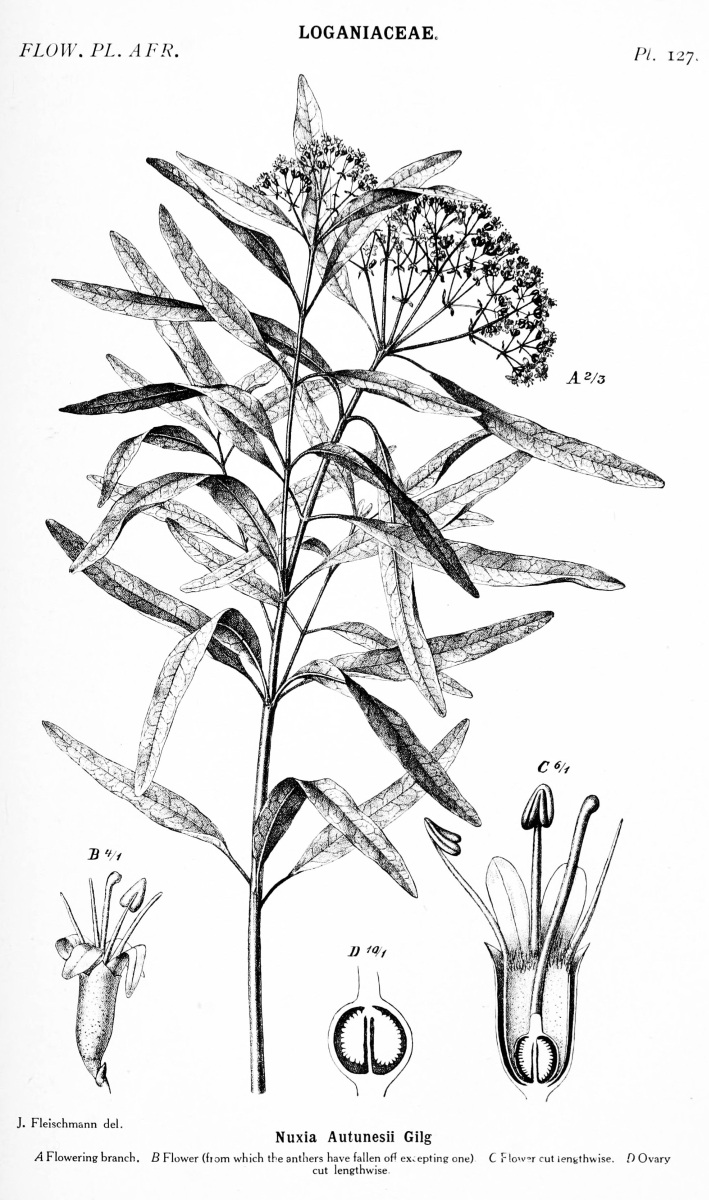
LOGANIACEAE.
FLOW. PL. AFR.
Pl. 127.
J. Fleischmann del.
Nuxia Autunesii Gilg
A Flowering branch. B Flower (from which the anthers have fallen off excepting one). C Flower cut lengthwise. D Ovary cut lengthwise.
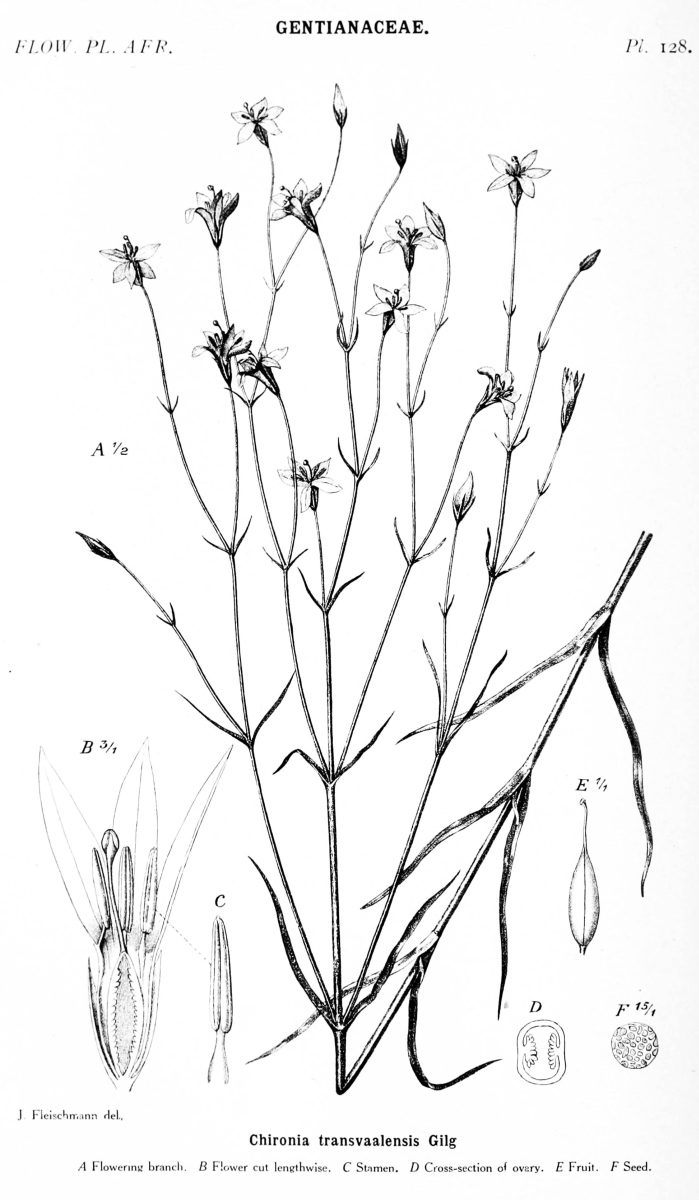
GENTIANACEAE.
FLOW PL. AFR.
Pl. 128.
J. Fleischmann. del.
Chironia transvaalensis Gilg
A Flowering branch. B Flower cut lengthwise. C Stamen. D Cross-section of ovary. E Fruit. F Seed.
Corolla salver-, bell-, or wheel-shaped, usually white. Ovules several or many in each ovary-cell. Fruit a berry. Leaves opposite, 3-5-nerved—Species 110. Tropical and South Africa. Some species yield timber, poisons, and medicaments; some have poisonous, others edible fruits and seeds, which are also used for preparing alcohol. (Including Brehmia Harv. and Ignatia L. f.) [Tribe STRYCHNEAE.] Strychnos L.
FAMILY 199. GENTIANACEAE
Herbs or undershrubs, rarely shrubs. Leaves undivided, sometimes reduced to scales; stipules absent or replaced by a transverse ridge or line connecting the leaf-stalks. Flowers regular, rarely (Canscora) somewhat irregular. Petals united below. Stamens as many as the petals, and alternating with them, 3-8, sometimes one only fertile. Ovary superior, 1-celled with 2 or 4 parietal placentas, or 2-celled with axile placentas. Ovules numerous. Style simple with 1-2 stigmas rarely (Erythraea) 2-cleft. Fruit a capsule, rarely a nut or (Chironia) a berry. Seeds minute, albuminous.—Genera 23, species 250. (Plate 128.)
1. Corolla with induplicate-valvate aestivation, 5-partite, white or yellow. Pollen-grains compressed from one side. Ovary 1-celled, with little intruding placentas. Stigma 2-partite. Leaves alternate or all radical, broad-cordate. [Subfamily MENYANTHOIDEAE.] 2 Corolla with contorted or imbricate aestivation. Pollen-grains not compressed from one side. Leaves opposite or whorled or nearly so. [Subfamily GENTIANOIDEAE.] 3 2. Stem erect. Leaves slightly cordate at the base, ovate, radical. Flowers panicled. Fruit opening by 4 valves at the top.—Species 1. South Africa (Cape Colony). Used medicinally. Villarsia Vent. Stem floating or creeping. Leaves deeply cordate at the base. Flowers fascicled. Fruit bursting irregularly or remaining closed.—Species 9. Tropical and South Africa. Some have edible roots or serve as ornamental or medicinal plants. Limnanthemum Gmel. 3. Stem and leaves reddish. Leaves reduced to scales. Flowers solitary, terminal. Corolla salver-shaped, 5-lobed, yellow or blue. Anthers included. Pollen-grains with a single pore. Ovary 1-celled. Stigma entire. Ovules straight. Seeds with a very scanty albumen.—Species 2. West Africa. (Under Voyria Aubl.) [Tribe LEIPHAIMEAE.] Leiphaimos Cham. & Schlechtd. Stem and leaves green. Leaves well developed, rarely very small, but then flowers in cymes. Pollen-grains with 3 pores. Ovules inverted. Seeds with copious albumen. 4 4. Pollen-grains connected in groups of four, tubercled on the surface. Calyx 4-toothed, with a winged tube. Corolla funnel-shaped, 4-lobed. Filaments inserted on the upper part of the corolla-tube, winged at the base. Ovary 1-celled. Stigma 2-partite.—Species 1. West Africa. Used medicinally. [Tribe HELIEAE.] Schultesia Mart. Pollen-grains separate. [Tribe GENTIANEAE.] 5 5. Ovary completely 2-celled. Pollen-grains very small. 6 Ovary 1-celled, sometimes incompletely 2-celled. Pollen-grains rather large. 9 6. Anthers opening by terminal pores which are sometimes produced into slits, without glands, exserted. Filaments inserted at the throat of the corolla or somewhat lower. Corolla violet, pink, or white, with a short and wide tube. Calyx winged.—Species 12. Tropics. Used as ornamental plants. Exacum L. Anthers opening by longitudinal slits, nearly always with 1-4 small glands at the base or the apex. Corolla yellow, with a more or less elongated tube. 7 7. Anthers projecting beyond the corolla-tube. Filaments inserted in the sinuses between the corolla-lobes.—Species 80. South Africa and tropics. Some are used medicinally. Sebaea R. Br. Anthers concealed within the corolla-tube. Filaments inserted in the corolla-tube. Flowers 5-merous. 8 8. Filaments inserted in the lower part of the corolla-tube. Calyx not winged. Small plants with small flowers.—Species 1. South Africa (Cape Colony). (Under Sebaea R. Br.) Lagenias E. Mey. Filaments inserted in the middle or the upper part of the corolla-tube, Calyx winged. Flowers rather large. Species 30. Tropical and South Africa. (Parasia Rafin., including Exochaenium Griseb., under Sebaea R. Br.) Belmontia E. Mey. 9. Ovary divided into incomplete cells by the intrusion of the placentas. Stigma more or less distinctly 2-lobed. Stamens 5. 10 Ovary completely one-celled with little intruding placentas. 12 10. Anthers more or less twisted after flowering. Pollen-grains smooth.—Species 6. North Africa and northern Central Africa. Used as medicinal or ornamental plants. Erythraea L. C. Rich. Anthers erect or bent back after flowering. Pollen-grains tubercled or netted. Calyx with small scales on the inside. 11 11. Corolla yellow; tube short, glabrous within. Anthers exserted. Pollen-grains tubercled. Leaves stem-clasping. Flowers in many-flowered panicles with large bracts.—Species 1. Canary Islands. Ixanthus Griseb. Corolla white or red; tube long, with 5 small scales on the inside. Anthers included. Pollen-grains netted. Flowers solitary or in few-flowered cymes.—Species 9. Madagascar. Some are poisonous or are used in medicine. Tachiadenus Griseb. 12 Corolla with 1-2 glandular nectaries at the base of each segment; tube very short. Stamens 4-5. Pollen-grains tubercled.—Species 35. Tropical and South Africa. Some are used medicinally. Sweertia L. Corolla without nectaries, but sometimes with scales at the insertion of the stamens. Pollen-grains smooth or dotted. 13 13. Corolla with distinctly unequal segments and imbricate, more rarely contorted aestivation, white or red. Stamens 4, inserted at different heights on the corolla-tube, usually one only perfect. Pollen-grains smooth. Stigma 2-lobed.—Species 3. Tropics. Used medicinally. Canscora Lam. Corolla with equal or subequal segments and contorted aestivation. 14 14. Fertile stamen 1, staminodes 3; all inserted in the sinuses between the corolla-lobes. Pollen-grains smooth. Corolla yellow, with a short tube. Stigma 2-lobed. Stem 4-angled or winged. Leaves very small, decurrent along the stem. Flowers in dense cymes.—Species 1. Southern West Africa (Angola). (Under Canscora Lam.) Schinziella Gilg Fertile stamens 3-8, rarely more. 15 15. Flowers 6-8-merous, rarely polymerous. Corolla yellow, with a short tube. Pollen-grains smooth. Stigma 2-parted with deeply notched branches. Flowers in lax cymes.—Species 2. North-west Africa. Used as ornamental or medicinal plants. Chlora L. Flowers 3-5-merous. Stigma entire or 2-parted with entire branches. 16 16. Flowers 3-merous. Sepals very unequal. Corolla with a long tube, usually blue. Stamens inserted at the throat; filaments with a swelling at the base. Stigma 2-parted. Flowers crowded in heads.—Species 3. Southern Central Africa. Pycnosphaera Gilg Flowers 4-5-merous. Sepals not very unequal. 17 17. Flowers 4-merous. Anthers ovate, rarely oblong. Pollen-grains smooth. Herbs. 18 Flowers 5-merous. Anthers oblong or linear. 21 18. Stamens inserted below the middle of the corolla-tube. Calyx 8-12-ribbed. Corolla with a narrow tube. Stigma 2-lobed. Dwarf herbs. Flowers solitary or paired in the leaf-axils, sometimes forming racemes or corymbs.—Species 8. Central Africa. Neurotheca Salisb. Stamens inserted at the throat of the corolla. Anthers ovate. Flowers small. 19 19. Flowers in dense fascicles. Calyx divided to the middle or below the middle. Corolla with 4 scales at the throat.—Species 10. Central and South Africa. Some are used medicinally. Faroa Welw. Flowers in lax cymes. Corolla without scales at the throat. Dwarf herbs. 20 20. Stem much branched. Calyx deeply divided. Corolla with a long tube and broad lobes. Stigma 2-parted.—Species 1. North-west Africa (Algeria). Cicendia Adans. Stem not or scantily branched. Calyx shortly toothed. Corolla with a rather long tube and narrow segments. Stigma entire or notched.—Species 1. North-west Africa. Microcala Link & Hoffmsg. 21. Filaments with a double scale at the base, inserted at the middle of the corolla-tube. Anthers included, not twisted. Pollen-grains smooth. Corolla-tube long. Stigma entire. Flowers small, in axillary fascicles. Herbs.—Species 3. Tropical and South-east Africa. Used medicinally. (Hippion Spreng.) Enicostemma Blume Filaments without a scale at the base. Anthers usually exserted and twisted after flowering. Flowers in usually lax cymes or solitary. 22 22. Stigma 2-lobed or 2-parted. Pollen-grains medium-sized, smooth. Herbs. (See 10.) Erythraea L. C. Rich. Stigma entire. Pollen-grains very large, dotted. Corolla-tube rather short. 23 23. Calyx with blunt, not keeled segments. Glands between calyx and corolla present. Corolla red. Stamens inserted at the throat of the corolla. Hairy shrubs. Flowers large, in terminal cymes.—Species 1. South Africa (Cape Colony). Used as an ornamental plant. Orphium E. Mey. Calyx with pointed, usually keeled segments. Glands between calyx and corolla absent.—Species 40. South Africa, southern Central Africa, and Malagasy Islands. Some species serve as ornamental plants. (Including Plocandra E. Mey.) (Plate 128.) Chironia L.
FAMILY 200. APOCYNACEAE
Usually woody plants. Juice milky. Leaves entire, usually penninerved with closely arranged, parallel primary side-nerves, generally opposite. Flowers with bracteoles, usually panicled, regular or nearly so, 5-, very rarely 4-merous, hermaphrodite. Calyx imbricate in bud, usually deeply divided. Petals united below, with contorted aestivation. Stamens as many as the petals, inserted in the tube or at the throat of the corolla. Filaments free, short. Anthers opening inwards by two longitudinal slits, sometimes adhering to the stigma. Pollen granular. Ovary superior, more rarely half-inferior, 1-2-celled, or 2, rarely (Pleiocarpa) 3-5 separate ovaries. Ovules 2 or more in each cell, rarely solitary, pendulous, inverted. Style simple or divided at the base, thickened at the apex, bearing the stigmas on the under-surface of the thickened part (stigmatic or stylar head), and sometimes two-lobed above it. Seeds usually albuminous and provided with a wing or a tuft of hairs.—Genera 61, species 450. (Plate 129.)
1. Stamens closely connected with the stigmatic head. Anthers prolonged at the base into empty tails. Corolla-lobes usually overlapping to the right. Fruit dry, dehiscent. Seeds usually with a tuft of hairs. [Subfamily ECHITIDOIDEAE.] 2 Stamens free or loosely cohering with the stigmatic head. Anthers without tails, full of pollen to the base, more rarely prolonged into tails, but then fruit fleshy and most frequently indehiscent. Corolla-lobes usually overlapping to the left. Seeds usually without a tuft of hairs. [Subfamily PLUMIEROIDEAE.] 22 2. Anthers projecting beyond the mouth of the corolla-tube. [Tribe PARSONSIEAE.] 3 Anthers, entirely or for the greatest part, concealed within the corolla-tube. [Tribe ECHITIDEAE.] 7 3. Calyx without glands; segments blunt. Corolla with a very short tube without scales; segments overlapping to the right. Filaments twisted around the style. Disc cupular, irregularly crenate. Twining shrubs.—Species 1. West Africa (Congo). Dewevrella De Wild. Calyx with glands on the inside. Disc 5-lobed or wanting. 4 4. Disc 5-lobed. Calyx with 5-10 glands. Corolla white, with 5-10 confluent scales at the throat; segments overlapping to the right. Seeds glabrous. Trees or erect shrubs, glabrous.—Species 1. Northern West Africa. Malouetia A. DC. Disc absent. Seeds hairy. 5 5. Calyx with pointed segments and 10—20 glands. Corolla glabrous at the throat; segments unequal-sided, overlapping to the right. Seeds with a terminal and a smaller basal tuft of hairs. Twining shrubs.—Species 3. West Africa. Isonema R. Br. Calyx with blunt segments and 5-10 glands. Corolla nearly always with scales at the throat; segments overlapping to the left. Erect shrubs or trees. 6 6. Flowers small. Seeds covered all over with long hairs densest at the base.—Species 5. West Africa. (Under Wrightia R. Br.) Pleioceras Baill. Flowers rather large. Seeds provided at the base with a deciduous tuft of hairs.—Species 3. South-east Africa and Madagascar. Wrightia R. Br. 7. Leaves alternate. Stem succulent. Flowers subsessile. Calyx without glands, with subulate or lanceolate segments. Corolla usually funnel-shaped; segments overlapping to the right. Ovary superior. 8 Leaves opposite or whorled. Stem woody. 9 8. Leaves with 2 or more spines at their base or in their axils. Disc 5-lobed or replaced by 2-5 glands. Seeds with a tuft of hairs at the apex.—Species 15. Madagascar, South Africa, and Angola. Pachypodium Lindl. Leaves and stem without spines. Corolla red. Disc none. Seeds with a tuft of hairs at either end. Flowers large, in few-flowered cymes.—Species 13. Central and South Africa. Some species yield an arrow-poison. (Idaneum O. Ktze.) Adenium Roem. & Schult. 9. Corolla with separate or confluent scales at the throat. 10 Corolla naked at the throat, but sometimes with scales or swellings lower down in the tube. 13 10. Scales at the throat of the corolla united into a tubular, 15-crenate corona. Corolla salver-shaped, the segments overlapping to the left. Calyx without glands. Ovary superior. Seeds with a basal tuft of hairs. Erect shrubs. Flowers small.—Species 1. East Africa. Stephanostema K. Schum. Scales at the throat of the corolla free or slightly united at the base. Corolla-segments nearly always overlapping to the right. Ovary almost superior or half-inferior. 11 11. Corolla salver-shaped with 5 entire scales at the throat. Calyx without glands, rarely with 5 small glands within. Filaments inserted on the lower part of the corolla-tube. Disc cup-shaped, 5-lobed or 5-parted. Twining shrubs. Leaves opposite, without axillary glands. Flowers small.—Species 12. Tropical and South-east Africa. Oncinotis Benth. Corolla funnel-shaped, with 5 divided scales at the throat. Calyx with usually numerous glands within. Disc none. 12 12. Corolla with laciniate scales at the throat, and with broad, not tailed segments, white or red. Anthers with a tailed connective. Mericarps at first cohering, subsequently divergent. Seeds with an apical tuft of hairs. Erect shrubs or low trees. Leaves whorled, narrow, densely veined. Flowers large.—Species 1 (N. Oleander L.). North Africa. A poisonous plant yielding wood and medicaments and used as an ornamental plant. Nerium L. Corolla with bipartite scales at the throat, and with usually tailed segments. Mericarps divaricate, ultimately spreading horizontally. Seeds with a basal tuft of hairs and a long apical awn. Leaves usually opposite, with axillary glands.—Species 35. Tropical and South Africa. Some species yield vegetable silk, poisons, and medicaments, or serve as ornamental plants. (Including Roupellia Baill. and Zygonerion Baill.) Strophanthus P. DC. 13. Corolla bell-, pitcher-, or funnel-shaped, usually small and with scales in the tube. Calyx-segments with 3-5 glands or without glands at the base. Twining shrubs. 14 Corolla salver-shaped and more or less constricted at the mouth, usually large and without scales in the tube. 18 14. Calyx and corolla very large; corolla white, with a glabrous tube, the segments short and overlapping to the right. Filaments thickened above. Anthers acuminate. Disc cupular, lobed. Stigmatic head conical. Leaves with distant nerves and axillary glands. Flowers in terminal cymes.—Species 1. Naturalized in Madagascar. Beaumontia Wall. Calyx and corolla small or medium-sized; in the latter case corolla-segments long. Leaves with distant nerves but without glands, or with closely set nerves and with axillary glands. 15 15. Corolla-segments overlapping to the left; tube very short, with 10 longitudinal ridges. Anthers very shortly tailed. Disc none. Ovules 4 in each carpel. Leaves closely nerved, with small, axillary glands.—Species 2. Equatorial West Africa. Pycnobotrya Benth. Corolla-segments overlapping to the right. Disc cupular. Ovules numerous in each carpel. Leaves remotely nerved, without axillary glands. 16 16. Anthers with blunt, reflexed tails at the base and a small, feathery mucro at the apex. Corolla white or yellow; tube with 5 longitudinal ridges inside, without scales or swellings. Stigmatic head spindle-shaped, with 2 narrow lobes. Seeds with an apical tuft of hairs.—Species 5. West Africa and equatorial Lake-region. One species yields rubber. Motandra A. DC. Anthers with pointed, almost straight tails at the base and without an apical mucro. Corolla-tube usually with scales or swellings above the insertion of the stamens. 17 17. Flowers in dense axillary cymes, inconspicuous. Corolla-lobes as long as or shorter than the tube, broad. Stigmatic head conical, crowned by a 2-cleft point.—Species 5. Central Africa. Zygodia Benth. Flowers in terminal and axillary panicles or corymbs, more rarely in few-flowered cymes. Corolla-lobes as long as or longer than the tube, usually narrow. Stigmatic head campanulate. Seeds with an apical tuft of hairs.—Species 20. West Africa and Madagascar. One species yields rubber. (Including Codonura K. Schum., Guerkea K. Schum., and Perinerion Baill.) Baissea A. DC. 18. Calyx with 5 glands inside the base. Disc none. Twining shrubs. Stipules usually present. 19 Calyx with numerous glands inside the base. Erect shrubs or trees. Stipules absent. 20 19. Ovary 1, entire, more or less completely 2-celled—Species 1. West Africa. (Under Alafia Thouars). Holalafia Stapf Ovaries 2, free.—Species 15. Tropics. (Including Ectinocladus Benth.) Alafia Thouars 20. Corolla-lobes overlapping to the left. Calyx with unequal segments. Disc absent. Ovary 1, two-celled.—Species 1. Madagascar. Ochronerium Baill. Corolla-lobes overlapping to the right. Disc present. Ovaries 2, free. 21 21. Flowers in many-flowered, axillary cymes. Corolla fleshy, white or yellowish; segments not folded in the bud. Stigmatic head ovoid. Mericarps oblong or spindle-shaped. Seeds with a feathery, basal awn.—Species 3. Central Africa. One of them (F. elastica Stapf, Ireh-tree) yields rubber (Lagos-rubber). (Under Kickxia Blume) Funtumia Stapf Flowers solitary or in few-flowered fascicles. Corolla not fleshy, usually red; segments folded lengthwise in the bud. Stigmatic head oblong. Mericarps linear. Seeds with an apical tuft of hairs.—Species 30. Madagascar and East Africa. Some of the species yield timber and rubber. Mascarenhasia A. DC. 22. (1.) Carpels united throughout their whole length. [Tribe ARDUINEAE.] 23 Carpels only partly united; ovaries wholly free or in their upper part only, styles usually free at the base. [Tribe PLUMIEREAE.] 33 23. Ovary 1-celled, sometimes incompletely 2-celled. [Subtribe LANDOLPHIINAE.] 24 Ovary completely 2-celled. [Subtribe MELODININAE.] 29 24. Corolla funnel-shaped, large, yellow; tube cylindric below, much widened above. Disc ring-shaped. Calyx without glands. Stamens inserted somewhat below the mouth of the corolla-tube. Fruit a woody, spinous, 2-valved capsule. Seeds winged, with fleshy albumen. Erect shrubs.—Species 1. Naturalized in the tropics. An ornamental and medicinal plant. Allamanda L. Corolla salver-shaped; tube more or less cylindric. Disc none. Fruit a berry. 25 25. Anthers tailed at the base. Stamens inserted in the middle of the corolla-tube. Calyx small, with 5 small glands within. Ovary incompletely 2-celled. Style short. Seeds with fleshy, ruminate albumen. Erect shrubs or trees.—Species 5. West Africa. Used medicinally. (Iboga Schum.) Tabernanthe Baill. Anthers not tailed. Calyx small and without glands inside, or large and with numerous glands within. Seeds with horny albumen. Twining shrubs, more rarely erect shrubs or undershrubs. 26 26. Stamens inserted near the mouth of the corolla-tube. Style long, usually hairy. Calyx without glands.—Species 35. Central Africa. Some species yield rubber and edible fruits. (Including Sclerodictyon Pierre) Carpodinus R. Br. Stamens inserted near the base or the middle of the corolla-tube. Style short or rather short, usually glabrous. 27 27. Calyx large, with numerous filiform glands within, spreading or bent back in the fruit. Corolla fleshy. Placentas much projecting. Pericarp woody. Flowers in terminal panicles.—Species 1. West Africa (Congo). (Under Landolphia Beauv.) Vahadenia Stapf Calyx small, without glands on the inside. 28 28. Flowers in axillary, or axillary and terminal cymes. Ovules 12-16; placentas much projecting. Glabrous plants.—Species 25. Central Africa. Several species yield rubber. (Including Aphanostylis Pierre and Cylindropsis Pierre). (Plate 129.) Clitandra Benth. Flowers in terminal panicles or corymbs sometimes overtopped by barren shoots and then apparently lateral.—Species 45. Tropical and South Africa. Several species yield rubber, dyes, and edible fruits, from which drinks are prepared. (Pacourea Aubl., including Ancylobothrys Pierre and Vahea Lam.) Landolphia Beauv. 29. (23.) Carpels cohering along the ventral suture only. Ovules numerous, in several rows. Stigmatic head glabrous. Stamens inserted in the upper half of the corolla-tube. Fruit usually of 2 spreading berries. Trees. Leaves opposite, with numerous axillary glands. Flowers in terminal false umbels.—Species 1. West Africa. (Under Tabernaemontana L.) Picralima Pierre Carpels wholly connate. Fruit entire. 30 30. Ovules numerous in each cell, in several rows. Disc none. Stamens inserted in the lower half of the corolla-tube. Calyx without glands. Fruit a capsule. Seeds ciliate. Erect shrubs. Leaves whorled.—Species 1. Madagascar. Craspidosperma Boj. Ovules 1-10 in each cell, in one or two rows. 31 31. Stamens inserted in the lower half of the corolla-tube. Anthers linear. Calyx-tube with many glands inside. Disc ring-shaped. Stigmatic head cylindrical. Unarmed, climbing shrubs.—Species 1. West Africa (Congo). Cyclocotyla Stapf Stamens inserted in the upper half of the corolla-tube. Stigmatic head crowned by a hairy point. Fruit a berry. Leaves opposite, with a few axillary glands or without glands. 32 32. Stem unarmed, erect, woody. Bark bitter, poisonous. Inflorescences axillary. Ovules 1-2 in each ovary-cell.—Species 4. Tropical and South Africa. They yield arrow-poison and are used as ornamental plants. (Toxicophloea Harv.) Acocanthera Don Stem spinous. Bark not bitter nor poisonous. Inflorescences terminal or pseudo-axillary.—Species 12. Tropical and South Africa. Some species yield timber, edible fruits, and medicaments, or serve as hedge plants. (Arduina Mill., Carandas Adans.) Carissa L. 33. (22.) Ovules 2-6 in each carpel. 34 Ovules 8 or more in each carpel. 42 34. Placentas much projecting. Fruit drupaceous. Trees or shrubs. [Subtribe CERBERINAE.] 35 Placentas little projecting. Corolla-lobes overlapping to the left. Leaves opposite or whorled. [Subtribe RAUWOLFIINAE.] 38 35. Corolla without scales at the throat; segments overlapping to the right. Calyx-segments blunt, imbricate in bud. Anthers pointed. Leaves opposite or whorled.—Species 1. Madagascar and neighbouring islands. Yields timber, dyes, and medicaments. Ochrosia Juss. Corolla with scales at the throat; segments overlapping to the left. Calyx-segments pointed. Leaves alternate. 36 36. Calyx with many glands. Corolla yellow. Disc present. Ovules 2 in a carpel.—Species 1 (Th. neriifolia Juss.). Cultivated in the tropics. The seeds yield oil. Thevetia L. Calyx without glands. Corolla white or reddish. Disc absent. Ovules 4 in a carpel. 37 37. Calyx-segments broadened at the base, imbricate in bud, persistent. Corolla-tube slightly widened at the throat. Anthers blunt. Pericarp not fibrous.—Species 1. Madagascar. Yields timber and poison. Tanghinia Thouars Calyx-segments narrowed at the base, open in bud, deciduous. Corolla-tube constricted at the throat. Anthers pointed. Pericarp fibrous.—Species 1. Madagascar and neighbouring islands. Yields oil, poison, and medicaments. Cerbera L. 38. Ovules 4-6 in a carpel, in two rows. Disc and glands of the calyx obscure or wanting. Seeds with ruminate albumen. Leaves remotely-nerved, usually whorled.—Species 4. Madagascar. (Gynopogon Forst.) Alyxia R. Br. Ovules 2-4 in a carpel, in one row. Seeds with uniform albumen or without albumen. Leaves usually closely-nerved. 39 39. Disc distinctly developed, cup-shaped. Calyx without glands at the base. Stigmatic head short-cylindrical with a membranous margin at the base. Fruit drupaceous. Seeds with a fleshy albumen. Leaves with numerous axillary glands, usually whorled.—Species 25. Tropical and South Africa. Some species yield timber and medicaments. Rauwolfia L. Disc obscure or wanting. Anthers pointed. Leaves with hardly perceptible axillary glands or without glands. 40 40. Calyx with glands at the base. Stigmatic head elliptical, ending in a 2-cleft point. Fruit berry- or nut-like. Seeds with a cartilaginous albumen. Trees. Leaves opposite. Flowers in terminal panicles.—Species 2. Central Africa. Hunteria Roxb. Calyx without basal glands. 41 41. Stigmatic head depressed-capitate, ending in a 2-cleft point. Carpels 2. Mericarps leathery or woody, dehiscent. Seeds winged, exalbuminous; embryo with kidney-shaped cotyledons and a short radicle. Leaves opposite. Flowers in terminal panicles.—Species 5. Central Africa. One species yields a kind of rubber or resin used as a varnish. Diplorrhynchus Welw. Stigmatic head oblong-ellipsoid, without a distinct point. Carpels 2-5. Mericarps berry-like. Seeds not winged, with cartilaginous albumen; embryo with oblong cotyledons and a long radicle. Flowers in axillary, rarely pseudo-terminal fascicles or panicles.—Species 13. Central Africa. One species yields a kind of rubber, another a poison. Pleiocarpa Benth. 42. (33.) Calyx with glands at the base. Fruit succulent, usually indehiscent. [Subtribe TABERNAEMONTANINAE.] 43 Calyx without basal glands, rarely (Holarrhena) the inner sepals with glands, the outer without. Fruit dry, usually dehiscent. [Subtribe ALSTONIINAE.] 52 43. Stigmatic head with a usually ring-shaped appendage at the base. Anthers more or less sagittate. 44 Stigmatic head without a basal appendage. Anthers shortly 2-lobed at the base. Sepals free or nearly so. Corolla-lobes overlapping to the left. 48 44. Sepals united high up, obtuse, usually deciduous. Stamens inserted above the middle of the corolla-tube. Anthers deeply sagittate. Disc usually distinctly developed. Inflorescences terminal.—Species 15. Tropical and South-east Africa. (Orchipeda Blume, Piptolaena Harv., under Tabernaemontana L.) Voacanga Thouars Sepals free or nearly so. 45 45. Corolla-lobes overlapping to the right. Stamens inserted in the middle of the corolla-tube. Anther-halves pointed at the base. Disc adnate to the ovary for the greatest part. Ovules about 9 in a cell, in two rows. Mericarps striped, dehiscent. Shrubs. Leaves exstipulate. Flowers small.—Species 1. East Africa. Used medicinally. Schizozygia Baill. Corolla-lobes overlapping to the left. Disc free or wanting. Leaves stipulate. 46 46. Corolla-tube slightly widened above the insertion of the stamens. Anthers obtusely 2-lobed at the base. Disc ring-shaped. Shrubs. Flowers large, white.—Species 6. West Africa. (Under Tabernaemontana L.) Callichilia Stapf Corolla-tube gradually narrowed above the insertion of the stamens. Anthers distinctly sagittate. Disc wanting. 47 47. Corolla-tube slender or widened at the base; stamens inserted near its base. Climbing shrubs. Leaves without axillary glands.—Species 8. West Africa to the Great Lakes. (Under Tabernaemontana L.) Gabunia K. Schum. Corolla-tube widened and bearing the stamens at the middle. Trees or erect shrubs. Leaves usually with numerous axillary glands.—Species 35. Tropical and South Africa. Some species yield timber, fibres, rubber, edible fruits, or medicaments, or serve as ornamental plants; some are poisonous. (Under Tabernaemontana L.) Conopharyngia Don 48. Corolla bell- or funnel-shaped; tips of the lobes not bent inwards in the bud. Disc ring-shaped, adnate to the ovary. 49 Corolla salver-shaped; tips of the lobes bent inwards in the bud. Disc none. 50 49. Narrow part of the corolla-tube short. Bracts small, not forming an involucre. Undershrubs with a creeping root-stock.—Species 1. Equatorial West Africa (Cameroons). Calocrater K. Schum. Narrow part of the corolla-tube long. Bracts large, forming an involucre. Erect or twining shrubs.—Species 2. Equatorial West Africa (Gaboon). Crioceras Pierre 50. Stigmatic head globose, entire, without an apical point. Mericarps 3-winged, not or tardily dehiscent. Erect shrubs. Axillary glands and stipules present. Flowers small, in terminal few-flowered cymes.—Species 1. Equatorial West Africa. (Under Tabernaemontana L.) Pterotaberna Stapf Stigmatic head oblong, crowned by a 2-cleft point. 51 51. Anthers linear, on short but distinct filaments. Axillary glands and stipules present.—Species 2, one a native of Madagascar, the other naturalized in the tropics. Ornamental plants. (Under Tabernaemontana L.) Ervatamia Stapf Anthers oblong or ovate, sessile. Axillary glands and stipules absent.—Species 2. West Africa. (Under Carpodinus R. Br. or Picralima Pierre) Polyadoa Stapf 52. (42.) Disc reduced to two glands alternating with the carpels. Ovules in two rows. Herbs or undershrubs. Flowers solitary, axillary. 53 Disc ring-shaped or wanting. Shrubs or trees. 54 53. Stamens inserted at the middle of the corolla-tube; filament inflexed; connective broadened, hairy. Stigmatic head with 5 tufts of hairs. Corolla blue.—Species 2, one a native of North-west Africa, the other naturalized there and in the Islands of St. Helena and Ascension. Used as ornamental and medicinal plants. “Periwinkle.” Vinca L. Stamens inserted in the upper part of the corolla-tube; filament very short, oblong; connective glabrous, not broadened. Stigmatic head glabrous. Corolla white or pink.—Species 3; two natives of Madagascar, the other one naturalized in Tropical and South Africa. They are used as ornamental and medicinal plants. (Under Vinca L.) Lochnera Reichb. 54. Disc distinct, wavy, adnate to the ovary. Corolla funnel-shaped. Stamens inserted below the middle of the corolla-tube. Anthers with long, curved tails. Erect shrubs. Leaves opposite.—Species 2. East Africa. Carvalhoa K. Schum. Disc obscure or absent. Corolla salver-shaped. Anthers with short tails or without tails. 55 55. Ovary half-inferior. Style very short. Calyx-lobes broad. Stamens inserted in the lower part of the corolla-tube. Seeds winged. Leaves alternate, exstipulate, without axillary glands. Erect shrubs or trees.—Species 3. Cultivated and sometimes naturalized in the tropics. They yield timber, perfumes, medicaments, and edible fruits, and serve also as ornamental plants. (Plumeria Willd.) Plumeria L. Ovary superior. Leaves opposite or whorled. 56 56. Corolla with a short ventricose tube and with 5 scales at the throat. Ovules in two rows. Mericarps keeled or winged, long cohering. Twining shrubs. Leaves opposite.—Species 5. Madagascar. Some are poisonous or yield rubber and medicaments. Plectaneia Thouars Corolla with a long, cylindric tube slightly widened at the insertion of the stamens, without scales, but sometimes with hairs or with a continuous ring at the throat. Ovules usually in three or more rows. 57 57. Corolla with a tubercled ring at the throat. Stamens inserted in the upper part of the corolla-tube. Stigmatic head conical, with a membranous
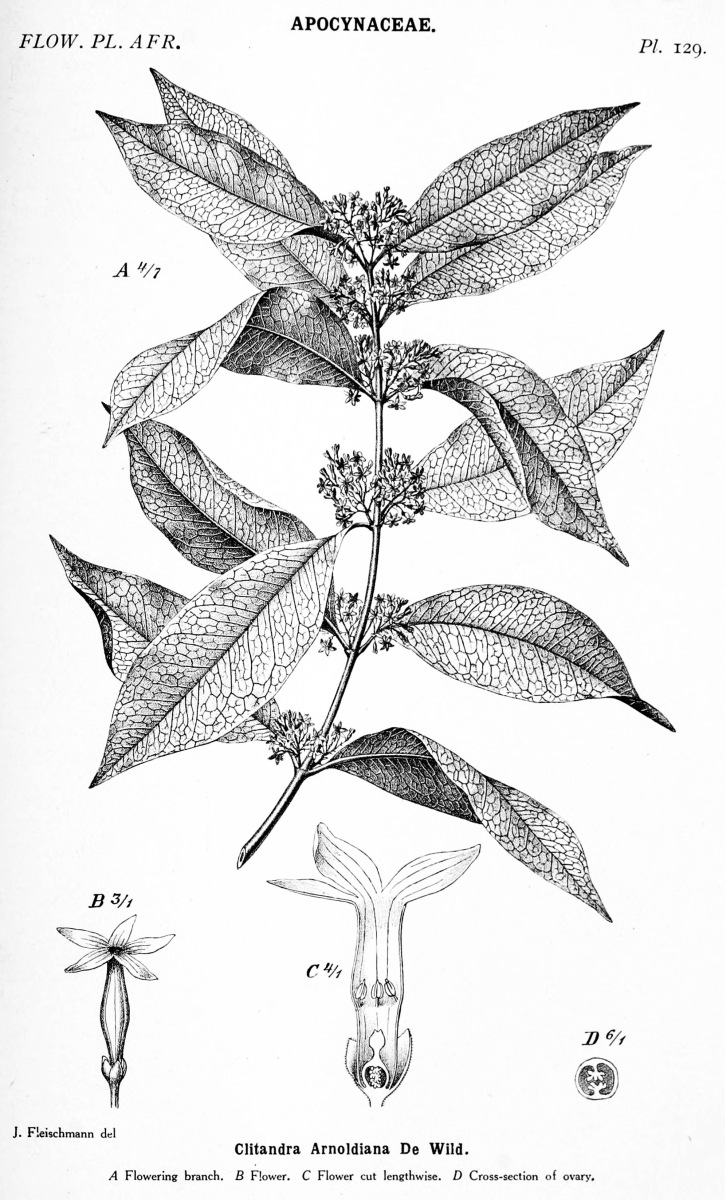
APOCYNACEAE.
FLOW. PL. AFR.
Pl. 129.
J. Fleischmann del.
Clitandra Arnoldiana De Wild.
A Flowering branch. B Flower. C Flower cut lengthwise. D Cross-section of ovary.
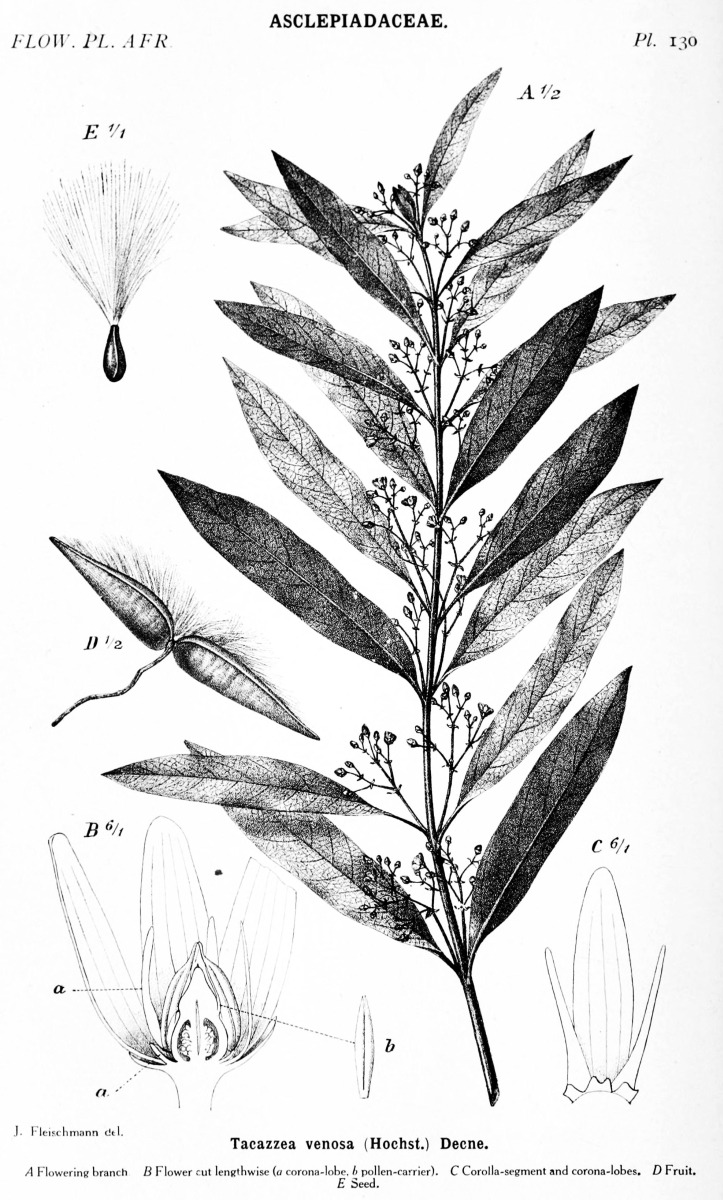
ASCLEPIADACEAE.
FLOW. PL. AFR.
Pl. 130.
J. Fleischmann del.
Tacazzea venosa (Hochst.) Decne.
A Flowering branch. B Flower cut lengthwise (a corona-lobe, b pollen-carrier). C Corolla-segment and corona-lobes. D Fruit. E Seed.
margin at the base. Small trees. Leaves opposite. Flowers in terminal, many-flowered panicles.—Species 1. Madagascar. Stephanostegia Baill. Corolla without a ring, but sometimes with a crown of hairs at the throat. 58 58. Corolla-lobes overlapping to the right. Calyx-segments narrow. Stamens inserted in the lower part of the corolla-tube. Seeds with an apical tuft of hairs. Trees or erect shrubs. Leaves opposite, herbaceous, exstipulate.—Species 6. Tropics. Some of them yield timber or medicaments. Holarrhena R.Br. Corolla-lobes overlapping to the left. 59 59. Stamens inserted at the base of the corolla-tube. Anthers with short, pointed tails at the base. Twining shrubs. Leaves opposite, stipulate, without axillary glands. (See 46.) Gabunia K. Schum,. Stamens inserted at the middle or in the upper part of the corolla-tube. Anthers not tailed. 60 60. Stamens inserted about the middle of the corolla-tube. Anthers acuminate. Stigmatic head elliptical. Seeds winged. Twining shrubs. Leaves opposite. Flowers in lateral, few-flowered cymes.—Species 2. Madagascar and Comoro Islands. Ellertonia Wight Stamens inserted in the upper part of the corolla-tube. Erect shrubs. Leaves whorled. Flowers in terminal cymes or panicles. 61 61. Ovules in two rows. Corolla yellow, glabrous at the throat; lobes auricled at the base. Seeds winged. Leaves with few or obscure side-nerves. Flowers in few-flowered cymes.—Species 1. South Africa. Yields timber and an aromatic oil. Gonioma E. Mey. Ovules in 3 or more rows. Seeds hairy. Leaves with numerous side-nerves. Flowers in many-flowered, whorled panicles.—Species 1. Central Africa. Poisonous and yielding cork-wood, a guttapercha-like resin, and medicaments. Alstonia R. Br.
FAMILY 201. ASCLEPIADACEAE
Stem usually twining and woody at the base. Juice mostly milky. Leaves simple, without stipules, usually opposite, sometimes reduced to scales. Flowers with bracts and bracteoles, regular, hermaphrodite, 5-merous. Sepals free or nearly so, imbricate in bud. Petals united below, with contorted or valvate aestivation. Stamens 5, usually adnate to the style. Filaments short or wanting. Pollen-grains united in waxy masses or in granules of 3-5 grains. Corona formed of appendages of the petals or stamens, rarely wanting. Disc none. Ovaries 2, free, superior, rarely half-inferior, with many pendulous inverted ovules on a ventral placenta, very rarely (Emicocarpus) with 1-2 ovules. Styles 2, united above into a thickened, sometimes 2-parted head bearing on its under surface 5 stigmatic dots and on its flanks between the anthers 5 small, usually horny bodies (“pollen-carriers”) to which the pollen is attached. Fruit of one or two follicles. Seeds usually with a tuft of hairs and scanty albumen. Embryo with flat cotyledons and a short radicle.—Genera 118, species 1100. (Including PERIPLOCACEAE). (Plate 130.)
1. Pollen in loosely cohering granules formed of 3-5 grains each. Pollen-carriers spoon- or trumpet-shaped, consisting of the concave blade holding the pollen, the stalk, and the adhesive gland at its base. Filaments usually free. [Subfamily PERIPLOCOIDEAE, tribe PERIPLOCEAE.] 2 Pollen of each anther-half closely united into 1-2 waxy masses. Pollen-carriers not spoon- or trumpet-shaped, consisting of a central body and two lateral, rarely obsolete arms (“caudicles”) to which the pollen-masses are attached. Filaments nearly always united or wanting. [Subfamily CYNANCHOIDEAE.] 29 2. Corona inserted on the stamens or at their base. 3 Corona inserted on the corolla remote from the stamens, but sometimes decurrent nearly to the insertion of the stamens. 16 3. Corona consisting of free scales or threads. 4 Corona consisting of scales or threads united at their base. 9 4. Corona indistinct, consisting of minute scales. 5 Corona distinctly developed. 6 5. Corona adnate to the filaments. Corolla-lobes oval. Anthers ovate-oblong. Leaves lanceolate. Flowers in dense, long-stalked cymes or panicles.—Species 2. East Africa. (Including Macropelma Schum. and Sacleuxia Baill.) Gymnolaema Benth. Corona free from the filaments. Corolla-lobes linear-oblong. Anthers linear-oblong. Leaves orbicular. Flowers in lax cymes.—Species 1. Equatorial East Africa. Baseonema Schlecht. & Rendle 6. Corolla with valvate or almost valvate aestivation, divided nearly to the base. Calyx without glands. Corona-lobes broad, contiguous, usually with a linear, 2-cleft dorsal appendage. Stem twining. Leaves cordate, connected by a toothed stipular sheath. Inflorescences axillary.—Species 2. Central and South-east Africa. Used medicinally. Chlorocodon Hook. fil. Corolla with distinctly contorted aestivation. Sepals alternating with glands, very rarely without, but then stem erect. 7 7. Anthers hairy. Corona-lobes thread-like, sometimes broadened at the base or cleft at the top.—Species 5. Some of them yield fibre, rubber, poison, or medicaments. (Including Parquetina Baill. and Socotora Balf. fil.) Periploca L. Anthers glabrous. 8 8. Stem woody, twining. Leaves linear. Inflorescences axillary or on axillary dwarf-shoots. Corolla white, rotate, divided nearly to the base. Corona-lobes thread-like, 3-cleft.—Species 1. Equatorial East Africa. (Pleurostelma Schlecht., under Tacazzea Decne.) Schlechterella K. Schum. Stem herbaceous or woody at the base only, usually erect; underground part tuberous. Corolla with a distinct tube, rarely divided nearly to the base, but then inflorescences terminal.—Species 30. Central and South Africa. Several species yield rubber. (Raphionacme Harv., including Gonocrypta Baill., Kompitsia Cost. et Gall., and Mafekingia Baill.) Raphiacme Harv. 9. (3.) Corona indistinct, consisting of minute scales. Corolla dark purple. Seeds hairy all round. Leaves oblong-cordate, connected by a large toothed stipular sheath. Flowers in axillary panicles.—Species 1. Equatorial West Africa. (Including Perithrix Pierre). Batesanthus N. E. Brown Corona distinctly developed. 10 10. Corolla with valvate or almost valvate aestivation. 11 Corolla with distinctly contorted aestivation. 13 11. Corona-lobes united high up, usually 10. Anthers with a leaf-like appendage at the top. Pollen-carriers at first hooded, subsequently spreading reniform. Flowers in axillary cymes.—Species 7. Madagascar and Mascarenes. Used medicinally. (Including Baroniella Cost. et Gall.) Camptocarpus Decne. Corona-lobes united at the base only, lanceolate, 5. Anthers with a small appendage or without any. Pollen-carriers spatulate or spoon-shaped. Leaves lanceolate. 12 12. Corona-lobes rather blunt. Anthers ending in a membranous, trigonous appendage. Stigmatic head 5-angled. Flowers in few-flowered axillary cymes.—Species 1. Island of Rodrigues. Tanulepis Balf. fil. Corona-lobes tailed. Anthers without an appendage. Stigmatic head conical. Flowers solitary or 2-3 together.—Species 1. Madagascar. Symphytonema Schlecht. 13. Anthers hairy. (See 7.) Periploca L. Anthers glabrous. Corona-lobes 5, filiform or linear. 14 14. Stigmatic head flat, 5-lobed. Corona-lobes shortly and unequally two-cleft at the top. Corolla yellow. Flowers small, in axillary panicles. Leaves lanceolate.—Species 1. Madagascar. Harpanema Decne. Stigmatic head short-conical. Corona-lobes entire or divided into 2-3 filiform branches. 15 15. Corona-lobes provided with 2 lateral teeth at the base; no lobules within them. Pollen-carriers with an oval, entire blade. Corolla greenish. Flowers large, in terminal cymes. Leaves oblong-obovate.—Species 1. South-east Africa. (Under Raphionacme Harv,.) Chlorocyathus Oliv. Corona-lobes without basal teeth; 5 small lobules within them. Pollen-carriers with a notched blade. Flowers small, in axillary cymes or panicles.—Species 15. Central and South-east Africa. Some species are used medicinally, one of them produces a kind of rubber. (Including Leptopaetia Harv.) (Plate 130.) Tacazzea Decne. 16. (2.) Corolla-tube as long as or longer than the segments. Corona-lobes awl-shaped. 17 Corolla-tube shorter than the segments. 18 17. Sepals linear, without basal glands. Corolla salver-shaped, with scales at the throat. Anthers hairy, with a tailed connective. Ovary superior. Mericarps cylindrical, smooth. Leaves linear or lanceolate.—Species 2. South Africa. Ectadium E. Mey. Sepals oval, with numerous basal glands. Corolla funnel-shaped, red or violet, with scales in the tube. Anthers with an acute appendage. Ovary half-inferior. Mericarps ribbed lengthwise or winged. Leaves oblong to ovate.—Species 2. Madagascar and Mascarenes; also cultivated in Central Africa. They yield rubber, poison, and medicaments, and serve as ornamental plants. Cryptostegia R. Br. 18. Corona double, the outer of 5 triangular, the inner of 5 obcordate scales. Filaments rather long. Anthers with a bristle-like point.—Species 1. Central Africa. Omphalogonus Baill. Corona simple. 19 19. Corona-lobes 2-cleft, short and thick. Corolla bell-shaped. Sepals acuminate, with toothed glands at the base. Anthers ending in a long, awl-shaped appendage. Leaves broad-ovate. Flowers in many-flowered panicles.—Species 1. Island of Socotra. (Socotranthus O. Ktze.) Cochlanthus Balf. fil. Corona-lobes entire or 3-cleft. 20 20. Corona-lobes three-cleft or broadened at the base. 21 Corona-lobes entire, not broadened at the base. 23 21. Filaments united below. Stigmatic head flat. Corona-lobes thread-shaped. Erect shrubs or undershrubs. Leaves whorled or alternate, linear. Flowers in axillary cymes.—Species 1. Southern West Africa (Angola). (Under Tacazzea Decne.) Aechmolepis Decne. Filaments free. Stigmatic head short-conical. 22 22. Sepals blunt, with basal glands. Corolla bell-shaped, with narrow segments. Corona-lobes thread- or spindle-shaped. Erect shrubs. Leaves in clusters, linear. Flowers solitary.—Species 1. Island of Socotra. Mitolepis Balf. fil. Sepals pointed. Corona-lobes usually 3-cleft. Herbs or undershrubs; underground part of the stem tuberous. Flowers in cymes. (See 8.) Raphiacme Harv. 23. Corona-lobes short and broad, arising from the very short corolla-tube opposite the segments. Stem twining.—Species 1. Madagascar. (Under Pentopetia Decne.) Pentopetiopsis Cost. & Gall. Corona-lobes long and narrow. 24 24. Corona-lobes thread-shaped. Sepals pointed. Flowers in cymes. 25 Corona-lobes club-shaped. Corolla bell- or wheel-shaped. 26 25. Corolla wheel-shaped. Anthers with a short mucro. Erect tuberous shrubs. Leaves whorled.—Species 1. Madagascar. Ischnolepis Jum. & Perr. Corolla funnel-shaped. Anthers with a long ciliate process. Twining shrubs.—Species 10. Madagascar. Used medicinally; one species yields rubber. (Under Tacazzea Decne.) Pentopetia Decne. 26. Corona-lobes arising from the sinuses between the corolla-segments. Corolla bell-shaped, with oblong segments. Leaves opposite. Flowers in terminal and axillary cymes.—Species 1. South-east Africa to Lake Ngami. (Under Cryptolepis R. Br.) Stomatostemma N. E. Brown Corona-lobes arising from the corolla-tube below the sinuses. 27 27. Sepals pointed, lanceolate. Corolla bell-shaped with long and narrow segments. Filaments united at the base. Pollen-carriers with an orbicular blade. Erect shrubs. Leaves in clusters. Flowers solitary or in pairs.—Species 1. South-west Africa to Angola. (Under Cryptolepis R. Br.) Curroria Planch. Sepals blunt. Corolla wheel-shaped. Pollen-carriers with a linear or oblong blade. Leaves scattered. Flowers in sometimes few-flowered cymes or panicles. 28 28. Corolla with long and narrow segments, beaked in bud. Filaments united at the base. Anthers almost erect. Pollen-carriers linear. Stem twining. Inflorescences lax.—Species 15. Tropical and South Africa. One species yields a dye. (Including Acustelma Baill.). Cryptolepis R. Br. Corolla with oblong, rather short segments, hence not beaked in bud. Filaments free. Anthers inflexed. Pollen-carriers with an oblong blade. Stem usually erect. Inflorescences dense.—Species 10. Central and South Africa. (Under Cryptolepis R. Br.) Ectadiopsis Benth. 29. (1.) Pollen-masses contained in the lower part of the anthers, pendulous from the arms of the pollen-carriers. [Tribe ASCLEPIADEAE.] 30 Pollen-masses contained in the upper part of the anthers and attached to the pollen-carriers in an erect, ascending, or horizontal, rarely (Tylophora) an almost pendulous position. 75 30. Corona obscure or wanting. [Subtribe ASTEPHANINAE.] 31 Corona distinctly developed. 34 31. Corolla shortly lobed, urceolate, hairy within. Calyx without glands. Corona arising from the corolla-tube or wanting. Filaments short. Stigmatic head conical, notched. Mericarps thin or rather thin. Twining shrubs. Leaves narrow. Flowers of medium size, in usually many-flowered cymes or umbels.—Species 10. South Africa. Microloma R. Br. Corolla deeply divided. Corona arising from the staminal tube or wanting; in the latter case filaments none and flowers small. 32 32. Anthers sessile or nearly so. Corona-lobes alternating with the anthers or wanting. Corolla campanulate or urceolate, glabrous or tubercled within. Stigmatic head more or less conical. Mericarps thick or rather thick. Shrubs or undershrubs. Flowers small, in usually few-flowered cymes.—Species 10. Southern and tropical Africa. (Including Haemax E. Mey. and Microstephanus N. E. Brown). Astephanus R. Br. Anthers stalked. Corona-lobes opposite to the anthers. Leaves oval. 33 33. Stigmatic head beaked. Calyx glandular. Corolla campanulate. Small shrubs. Flowers in few-flowered, sessile cymes or fascicles.—Species 1. Northern East Africa. Podostelma K. Schum. Stigmatic head truncate or slightly convex. Corolla campanulate or rotate. Twining herbs or undershrubs. Flowers in racemosely arranged, umbel-like cymes.—Species 1. East Africa. (Under Tylophora R. Br.) Tylophoropsis N. E. Brown 34. (30.) Corona inserted on the corolla, free from the staminal tube, but sometimes approximate to it. [Subtribe GLOSSONEMATINAE.] 35 Corona, at least the inner, inserted on the staminal tube. 43 35. Corona double, the outer ring-shaped, the inner of 5 lanceolate scales. Anthers sessile. Calyx glandular within. Corolla rotate or widely campanulate, glabrous within, with valvate aestivation. Twining herbs or undershrubs. Flowers conspicuous, in umbels or racemes.—Species 2. Central Africa and Egypt. Used as vegetables, as ornamental plants, and in medicine. Oxystelma R. Br. Corona simple. Corolla with contorted aestivation. 36 36. Corona-lobes united about to the middle. 37 Corona-lobes free or united at the base only. Staminal tube short or wanting. 38 37. Sepals blunt. Corolla rotate, yellowish; segments velvety within, with distinctly contorted aestivation. Corona of 10 lobes, the alternating 2-cleft. Anthers without an apical appendage. Stigmatic head with 5 small points at the angles. Twining shrubs. Leaves wanting. Flowers small, in few-flowered umbels.—Species 2. Madagascar. Vohemaria Buchen. Sepals pointed, with numerous glands within. Corolla almost campanulate; segments glabrous within, with subvalvate aestivation. Corona of 5 lobes. Staminal column long. Stigmatic head flat or slightly concave, 5-lobed. Mericarps short and thick. Erect shrubs. Leaves lanceolate. Flowers in many-flowered cymes.—Species 1. Nile-lands and Sahara. Used medicinally,. (Under Cynanchum L.) Solenostemma Hayne 38. Corona inserted at the base of the corolla. Flowers in few-flowered cymes. 39 Corona inserted below the sinuses of the corolla. Calyx with 5 glands at the base. Flowers in umbel-like inflorescences. Erect herbs. 41 39. Corolla-tube longer than the segments. Calyx without glands inside. Corona-lobes strap-shaped, gibbous outside. Twining shrubs.—Species 1. Naturalized in the island of Madeira. Araujia Brot. Corolla-tube shorter than the segments. Herbs or undershrubs. 40 40. Calyx without glands inside. Corona-lobes petal-like. Twining undershrubs.—Species 2. West Africa. Prosopostelma Baill. Calyx with 5 glands inside. Corona-lobes not petal-like. Mericarps thick, prickly. Erect or procumbent, downy or cottony plants.—Species 7. Central Africa, Sahara, and Egypt. Glossonema Decne. 41. Corona-lobes bristle-like, curved. Corolla with linear divisions. Stigmatic head elongate-conical. Leaves linear. Flowers solitary.—Species 1. Northern East Africa. (Under Glossonema Decne.) Conomitra Fenzl Corona-lobes broad. Corolla with lanceolate or ovate divisions. Leaves lanceolate or oblong. 42 42. Stigmatic head elongate-conical, 2-cleft, projecting beyond the anther-appendages.—Species 1. South Africa. (Under Parapodium E. Mey.) Rhombonema Schlecht. Stigmatic head obtuse-subconical, not projecting beyond the anther-appendages.—Species 2. South Africa. Parapodium E. Mey. 43. (34.) Corona-lobes united more or less, usually high up. Corolla with contorted, rarely with valvate aestivation. [Subtribe CYNANCHINAE.] 44 Corona-lobes free or nearly so. Corolla with valvate or almost valvate aestivation. Erect or procumbent herbs or undershrubs, rarely twining or shrubby. [Subtribe ASCLEPIADINAE]. 60 44. Corona double. 45 Corona simple, but sometimes with small accessory teeth between or within the lobes. 51 45. Leaves reduced to scales or absent. Flowers in umbels or fascicles. Twining or procumbent shrubs. 46 Leaves well developed. 49 46. Corolla shortly lobed or cleft to the middle, with valvate aestivation. Outer corona cupular, entire or lobed. 47 Corolla divided beyond the middle, with contorted aestivation, small, white or yellow. 48 47. Corolla shortly lobed, large, red. Outer corona entire or obscurely lobed. Stigmatic head 2-lobed.—Species 1. Madagascar. Platykeleba N. E. Brown Corolla cleft to the middle. Outer corona distinctly lobed. Stigmatic head entire.—Species 1. Madagascar. Decanemopsis Cost. & Gall. 48. Outer corona of 5 long lobes united below, awl-shaped above. Corolla yellow. Mericarps very long.—Species 2. Madagascar and Mauritius. Used medicinally. Decanema Decne. Outer corona short, ring- or cup-shaped, entire or shortly lobed.—Species 8. Tropical and South Africa. The stem and the milky juice of some species are edible or used medicinally; they also yield resin. (Including Sarcocyphula Harv.) Sarcostemma R. Br. 49. Outer corona lobed; lobes of the inner spurred. Sepals lanceolate, with glands at the base. Corolla white or greenish, woolly. Twining shrubs. Leaves broad-cordate. Flowers in many-flowered panicles.—Species 5. Used as medicinal and fibre-plants. (Pergularia L.) Daemia R. Br. Outer corona nearly entire. Leaves linear, oblong, or ovate. Flowers in few-flowered umbels or fascicles. 50 50. Sepals lanceolate, without glands. Stigmatic head with a boss at the top and surrounded by a short 5-lobed cup. Erect shrubs. Leaves linear.—Species 1. East Africa. Diplostigma K. Schum. Sepals elliptical, with minute glands at the base. Stigmatic head without a distinct boss. Twining herbs or undershrubs.—Species 4. Tropics. Used medicinally. Pentatropis Wight & Arn. 51. (44.) Corona much lower than the stamens. 52 Corona equalling or exceeding the stamens. 54 52. Corona fleshy, crenate. Stigmatic head capitate, papillose. Mericarps linear. Erect herbs with a tuberous root-stock. Flowers in terminal panicles.—Species 1. West Africa (Congo). Nanostelma Baill. Corona membranous, lobed. Stigmatic head with a boss or beak. Twining or procumbent undershrubs or shrubs. 53 53. Corolla campanulate. Corona-lobes alternating with the anthers. Stigmatic head with a long, 2-lobed beak. Twining undershrubs. Leaves small. Flowers axillary, solitary or in few-flowered cymes.—Species 1. Madagascar. Pleurostelma Baill. Corolla rotate. Stigmatic head with a boss or a short beak. Twining or procumbent shrubs. Leaves none. Flowers in umbels. (See 48.) Sarcostemma R. Br. 54. Corona very large, campanulate, corolla-like. Stigmatic head conical. Corolla campanulate; lobes rolled back at the edge. Twining shrubs. Flowers in axillary umbels.—Species 3. Central Africa. (Under Cynanchum L.) Perianthostelma Baill. Corona not corolla-like. 55 55. Corona with concave or laterally compressed lobes. Herbs or undershrubs. 56 Corona with flat, but sometimes appendaged lobes, or entire. 58 56. Corona-lobes obviously united below, concave, 10. Stigmatic head pyramidal. Sepals blunt, without glands. Flowers solitary or in pairs. Leaves linear.—Species 1. South Africa. (Under Cynanchum L.) Flanagania Schlecht. Corona-lobes nearly free. Stigmatic head rounded or produced into a boss at the top. Sepals pointed, with small glands at the base. Flowers in umbels or racemes. Stem twining. 57 57. Corolla with broad divisions. Corona-lobes with an inflexed apical appendage. Leaves broad. Flowers in racemes or panicles.—Species 5. South and Central Africa. Some have edible fruits. Pentarrhinum E. Mey. Corolla with narrow divisions. Corona-lobes laterally compressed. Flowers in few-flowered umbels. (See 50.) Pentatropis Wight & Arn. 58. Staminal column long. Corona-lobes 10-15. Sepals lanceolate-oblong, with basal glands. Corolla rotate. Erect shrubs. Leaves cordate-ovate. Flowers in racemes.—Species 2. East Africa. (Under Cynanchum L. or Vincetoxicum Moench). Schizostephanus Hochst. Staminal column short or wanting. 59 59. Sepals subulate, with solitary glands at the base. Corolla campanulate or urceolate; lobes pointed, fleshy at the sinuses. Corona entire or 5-lobed. Stigmatic head lengthened, mushroom-shaped. Erect herbs. Leaves linear. Flowers small, in umbel-like inflorescences.—Species 2. Madagascar. Pycnoneurum Decne. Sepals lanceolate or ovate. Flowers in umbel- or raceme-like inflorescences.—Species 40. Some of them yield fibre, poison, or medicaments. (Including Cynoctonum E. Mey., Endotropis Endl., and Vincetoxicum Moench) Cynanchum L. 60. (43.) Corona-lobes distinctly concave, more or less hood-shaped. Erect plants. 61 Corona-lobes flat or rather flat, sometimes keeled. 66 61. Pollen-carriers with very large, broad and concave arms. Stigmatic head more or less ruminate. Sepals pointed, with numerous basal glands. Corolla rotate. Corona-lobes not spurred. Herbs. Leaves narrow. Inflorescences umbel-like.—Species 10. Central and South Africa. (Under Asclepias L.) Stathmostelma K. Schum. Pollen-carriers with narrow and flat arms. Stigmatic head not ruminate. 62 62. Corona-lobes with a recurved spur at the base and two teeth at the apex. Anthers stalked. Stigmatic head depressed. Sepals pointed, with many glands at the base. Corolla green outside, red within. Mericarps inflated. Leaves broad. Flowers large, in panicles.—Species 2. Central and North Africa. They yield a kind of rubber, bast-fibre, vegetable silk, poison, and medicaments, and serve as ornamental plants. Calotropis R. Br. Corona-lobes not spurred. 63 63. Corona lobes with a more or less horn-like appendage arising from the cavity. Sepals pointed, with solitary or paired glands at the base. Corolla rotate. Mericarps thick. Herbs or undershrubs. Inflorescences umbel-like.—Species 40. Central and South Africa; besides one species naturalized in the tropics. Some species yield rubber, fibre from the bark, vegetable silk from the hairy seeds, or medicaments; several serve as ornamental plants. Asclepias L. Corona-lobes without an appendage in the cavity, but sometimes with scale- or tooth-like appendages at the base. 64 64. Corona-lobes without appendages or alternating with small teeth. Sepals pointed, with basal glands. Stigmatic head usually flat.—Species 110. Some of them yield vegetable silk or medicaments, or serve as ornamental plants. (Including Krebsia Harv. and Pachycarpus E. Mey., under Asclepias L.) Gomphocarpus L. Corona-lobes with rather large scale-like appendages at the base. Sepals without basal glands. Herbs. Flowers small, in umbel-like inflorescences. 65 65. Corona-lobes curved inwards, attached to the stamens only by their basal appendages. Stigmatic head with a boss at the top. Leaves ovate.—Species 3. South and Central Africa. Woodia Schlecht. Corona-lobes erect-connivent, inserted on the stamens. Stigmatic head elevate-conical, 2-lobed. Sepals blunt. Corolla campanulate; segments with recurved tips. Leaves linear.—Species 1. South Africa. (Under Schizoglossum E. Mey.) Stenostelma Schlecht. 66. (60.) Corona of 3 rows of 5 lobes each; those of the middle row 3-lobed or 3-parted. Corolla rotate; segments narrowly overlapping in the bud. Sepals with basal glands. Flowers in few-flowered umbels or corymbs. Erect or more frequently procumbent herbs or undershrubs. 67 Corona simple. 68 67. Ovules 1-2 in each carpel. Mericarps triangular, ending in three spines. Seeds glabrous. Branches long. Leaves palmately 5-7-lobed.—Species 1. South-east Africa (Delagoa Bay). (Lobostephanus N. E. Brown). Emicocarpus K. Schum. & Schlecht. Ovules 3 or more in each carpel. Branches short. Leaves linear-filiform or linear-hastate.—Species 5. South Africa. Eustegia R. Br. 68. Corona-lobes petal-like, coloured, larger than the corolla-lobes, spatulate. Divisions of the corolla usually rolled back. Sepals with many glands at the base. Stigmatic head flat or short-conical. Erect herbs with a tuberous root-stock. Leaves narrow. Flowers in umbels.—Species 6. Central Africa. Margaretta Oliv. Corona-lobes not petal-like. 69 69. Corona-lobes very thick and fleshy, more rarely moderately fleshy, and then without an appendage and without a keel or with a single keel on the inner face, but sometimes alternating with small teeth. Stigmatic head low. Erect plants. 70 Corona-lobes thin, rarely somewhat fleshy, but then with 2 keels or 1-2 appendages on the inner face. Herbs or undershrubs. 71 70. Stem woody. Leaves narrow, with minute bristles in their axils. Flowers in sometimes very short racemes. Sepals with basal glands. Corolla campanulate, cleft to the middle or beyond; segments woolly within.—Species 1. Central Africa. Used medicinally. Kanahia R. Br. Stem herbaceous or woody at the base, tuberous under ground. Flowers in umbels. Corolla divided nearly to the base.—Species 45. Central and South Africa. Some species have edible tubers or are used in medicine. (Including Glossostelma Schlecht.) Xysmalobium R. Br. 71. Corolla shortly lobed or cleft half-way down. Sepals with glands at the base. Corona-lobes gibbous within. Stigmatic head truncate or umbonate. Stem twining. Flowers large, in axillary umbels or racemes. (See 34.) Oxystelma R. Br. Corolla deeply divided. 72 72. Stigmatic head produced much beyond the anthers into a long beak 2-lobed at the apex. Corona-lobes linear. Corolla-segments narrow. Sepals awl-shaped, without glands. Flowers in lateral cymes or racemes. Leaves linear. Twining herbs or undershrubs.—Species 1. South Africa. (Oncinema Arn.) Glossostephanus E. Mey. Stigmatic head not or slightly projecting beyond the anthers. Sepals with glands at the base. Flowers in umbels. Stem erect, rarely procumbent. 73 73. Stigmatic head club-shaped. Corona-lobes somewhat fleshy, with a transverse ridge or a short scale on the inner face. Sepals lanceolate, with solitary glands. Inflorescences many-flowered. Leaves linear.—Species 5. South Africa and Southern East Africa. (Including Periglossum Decne.) Cordylogyne E. Mey. Stigmatic head truncate or depressed and usually umbonate. 74 74. Inflorescences terminal. Sepals with many glands at the base. Corolla white, with long hairs on the edges of the segments. Connective fringed. Corona-lobes purple, with two linear appendages at the base, but without keels. Leaves narrow.—Species 1. South Africa. Used as an ornamental plant. Fanninia Harv. Inflorescences lateral or terminal and lateral. Corona-lobes usually with 2 keels on the inner face.—Species 120. South and Central Africa (Including Aspidoglossum E. Mey., Lagarinthus E. Mey., and Mackenia Harv.) Schizoglossum E. Mey. 75. (29.) Pollen-masses 2 in each anther-half (4 on each pollen-carrier), very small. Pollen-carriers very small, broad, pale, rather soft. Anthers with a more or less fringed appendage at the top. Corona, at least the inner, arising from the stamens. Flowers small, in axillary cymes or terminal panicles. [Tribe SECAMONEAE.] 76 Pollen-masses solitary in each anther-half (2 on each pollen-carrier). Pollen-carriers hard, horny, usually of a dark colour. [Tribe TYLOPHOREAE.] 78 76. Pollen-carriers with well developed, narrow arms. Corolla yellow, urceolate, with short triangular lobes. Sepals oval.—Species 1. Madagascar. Yields rubber. Secamonopsis Jum. Pollen-carriers with short and broad or indistinct arms. Corolla rotate. 77 77. Stem erect, shrubby. Flowers in few-flowered cymes. Corolla adnate to the ovary at the base; segments very long, spatulate. Corona-lobes 5, filiform. Pollen-carriers without distinct arms.—Species 1. Madagascar. Poisonous. Menabea Baill. Stem twining or procumbent, shrubby or half-shrubby.—Species 45. Tropical and South Africa. Some are used medicinally. (Including Toxocarpus Wight et Arn.) Secamone R. Br. 78. Anthers with a distinct, membranous, flat or inflated appendage at the apex. Corolla usually with contorted aestivation. [Subtribe MARSDENIINAE.] 79 Anthers with a very short appendage or a small point, or without any appendage at the apex. Corolla nearly always with valvate aestivation. [Subtribe CEROPEGIINAE.] 93 79. Corona absent. Sepals blunt, with solitary glands. Shrubs. 80 Corona present. 81 80. Inflorescence 1-3-flowered. Corolla campanulate, woolly within; segments overlapping to the right. Stigmatic head obtuse-conical. Mericarps short, thick, covered with longitudinal ridges. Branches erect or procumbent, downy. Leaves fleshy, linear.—Species 1. South Africa (Cape Colony.) Rhyssolobium E. Mey. Inflorescence many-flowered. Sepals unequal. Corolla-segments overlapping to the left. Apical appendages of the anthers ciliate-laciniate. Stigmatic head hemispheric or conical. Mericarps long, smooth. Branches twining, glabrous.—Species 1. Madagascar and Mascarenes. Trichosandra Decne. 81. Corona arising from the corolla below its sinuses and consisting of 5 scales. Sepals blunt. Corolla campanulate. Twining, hairy shrubs. Leaves ovate. Flowers small, in umbels.—Species 1. Tropical and South Africa. Yields fibre. Gymnema R. Br. Corona, at least the inner, arising from the stamens. 82 82. Corona double. Twining shrubs. Leaves herbaceous. 83 Corona simple; lobes in one row, but sometimes furnished with appendages on the inner face. 85 83. Outer and inner corona arising from the staminal column and consisting of 5 scales each. Sepals linear-lanceolate. Flowers in few-flowered umbel-like cymes.—Species 1. Southern East Africa. Swynnertonia S. Moore Outer corona arising from the corolla, the inner from the stamens. 84 84. Sepals lanceolate. Corolla with contorted aestivation. Inner corona ring-shaped, slightly lobed. Pollen-masses horizontal. Flowers in panicles.—Species 1. Equatorial West Africa. Oncostemma K. Schum. Sepals ovate or subulate. Corolla with valvate or almost valvate aestivation. Inner corona of oblong lobes. Pollen-masses erect. Flowers in globose, axillary, partly stalked, partly sessile umbels.—Species 2. West Africa. Anisopus N. E. Brown 85. Corona-lobes united high up, usually numerous. Anthers with a large inflated appendage. Pollen-masses flat and thin. Pollen-carriers very small, without distinct arms. Sepals lanceolate, with small solitary glands. Corolla rotate. Herbs with a tuberous root-stock. Leaves narrow. Flowers solitary or in fascicle- or corymb-like cymes.—Species 10. Southern and Central Africa. Some have edible tubers. Fockea Endl. Corona-lobes free or united at the base, 5, but sometimes appendaged. 86 86. Corona-lobes with a narrow appendage on the inner face. Sepals lanceolate, with solitary glands. Corolla salver-shaped. Mericarps thick. Twining shrubs. Flowers in dense umbels or racemes.—Species 3. Tropical and South Africa. (Prageluria N. E. Brown, under Pergularia L.) Telosma Coville Corona-lobes without an appendage on the inner face, but sometimes with a small, usually tubercle-like appendage at the base of the back. 87 87. Corona-lobes united at the base, linear, erect. Sepals lanceolate, without glands. Corolla with linear segments recurved from the base. Stigmatic head truncate. Mericarps slender. Erect herbs with a tuberous rootstock. Leaves linear. Flowers in fascicles.—Species 1. Southeast Africa to Rhodesia. The tubers are edible. Macropetalum Burch. Corona-lobes free or nearly so. Twining plants, rarely erect shrubs or herbs without a tuberous rootstock. 88 88. Corona-lobes spreading, linear. Sepals lanceolate, without glands. Corolla rotate. Stigmatic head flat or umbonate. Mericarps thick, villous. Twining, tomentose shrubs. Leaves elliptical. Flowers in cymes.—Species 1. Madagascar. Pervillaea Decne. Corona-lobes spreading and tubercle-shaped, or erect, or converging. 89 89. Pollen-masses very small, disc-shaped. Corona-lobes short, usually tubercle-like. Sepals pointed, with solitary glands. Corolla rotate. Stigmatic head more or less flattened and usually provided with a central boss at the top. Mericarps slender.—Species 25. Tropical and South Africa. Some are used medicinally. Tylophora R. Br. Pollen-masses large or rather large, usually pear-shaped. Mericarps usually thick. 90 90. Filaments united at the base, free above. Stigmatic head produced into a long beak. Ovary glabrous. Sepals oblong or ovate, with solitary glands. Corolla campanulate. Twining shrubs or undershrubs. Leaves leathery. Flowers in racemes or panicles.—Species 3. West Africa. (Under Secamone R. Br. or Toxocarpus Wight et Arn.) Rhynchostigma Benth. Filaments united up to the anthers. 91 91. Anther-appendages cohering into a long tube. Stigmatic head beaked. Ovary hairy. Sepals elliptical, with solitary glands. Corolla campanulate, with linear segments. Twining shrubs. Leaves elliptical, herbaceous. Flowers in panicles.—Species 1. East Africa. (Under Marsdenia R. Br.) Traunia K. Schum. Anther-appendages not cohering into a tube. 92 92. Sepals large, without glands. Corolla funnel- or salver-shaped; tube widened below. Stigmatic head conical. Twining shrubs. Leaves leathery. Flowers large, in umbels.—Species 5. Madagascar. They are used as ornamental plants, and the hairs of the seeds as vegetable silk. Stephanotis Thouars Sepals small, usually with glands. Leaves herbaceous. Flowers small or of moderate size.—Species 17. Tropical and South Africa. Some species yield rubber or serve as vegetables. (Including Dregea E. Mey. and Pterygocarpus Hochst.) Marsdenia R. Br. 93. (78.) Stem cactus-like, thick and fleshy, with 4 or more angles or rows of tubercles, usually low. Leaves more or less rudimentary or wanting. Flowers solitary or in fascicles, fleshy. Sepals pointed, with solitary glands. Corolla-segments very rarely coherent at the tip. Stigmatic head flat or ending in a small boss. 94 Stem herbaceous or woody, rarely (Ceropegia) fleshy, but then leafy or obscurely 3-angled and corolla-segments cohering at the tip, at least when young. 106 94. Branches divided by longitudinal and transverse furrows into several-ranked areas, not spiny nor bristly. Corolla rotate or campanulate, cleft to the middle. Corona-lobes 5 or 10, united at the base.—Species 7. East Africa. Echidnopsis Hook. fil. Branches angled or tubercled, but not divided into areas, usually spiny or bristly. 95 95. Branches with more than 6 angles or rows of tubercles, rarely with 6; in this case with 3-parted spines. 96 Branches with 4, more rarely with 5 or 6 angles or rows of tubercles. Spines or other appendages of the tubercles simple. 98 96. Spines 3-parted. Flowers solitary or in pairs, large. Corolla tube- or funnel-shaped, shortly lobed. Corona double, the outer divided into 10 filiform segments terminating in knobs.—Species 2. South Africa and southern West Africa. (Tavaresia Welw.) Decabelone Decne. Spines simple or absent. Corolla saucer- or cup-shaped. Outer corona of 5 two-lobed or two-parted pointed lobes or indistinct. 97 97. Tubercles of the stem united into continuous angles, spiny. Flowers large. Corolla slightly lobed.—Species 10. South and Central Africa. Hoodia Sweet Tubercles of the stem not confluent. Flowers rather small. Corolla lobed to about halfway.—Species 12. South Africa and southern Central Africa. Trichocaulon N. E. Brown 98. Corolla-segments cohering at the tip. Corona double.—Species 5. South Africa. Used as vegetables. Pectinaria Haw. Corolla-segments free at the tip. 99 99. Corona simple, of 5 lobes. 100 Corona double or triple. 101 100. Sepals large. Corolla campanulate, divided half-way down, hairy, inside red mottled with yellow. Corona-lobes thick, without a dorsal crest:—Species 1. South Africa to Damaraland. (Huerniopsis N. E. Brown). Huerniopsis N. E. Brown Sepals small. Corolla rotate or campanulate, divided to beyond the middle. Corona-lobes with a dorsal transverse crest at the base.—Species 10. South Africa. Piaranthus R. Br. 101. Third (outermost) corona corolla-like, arising from the base of the corolla-tube. Corolla campanulate, hairy.—Species 1. South Africa (Cape Colony). Diplocyathus N. E. Brown Third (outermost) corona not corolla-like, arising from the throat of the corolla, or wanting. 102 102. Second (intermediate) corona disc-shaped, entire; third (outermost) ring-shaped. Corolla rotate.—Species 20. South Africa to Lake Ngami. Some are used as ornamental plants. Duvalia Haw. Second (intermediate or outer) corona ring- or cup-shaped and more or less deeply divided. 103 103. Corolla with accessory teeth between the lobes, campanulate, more or less distinctly lobed or cleft.—Species 30. South and Central Africa. Some are used as ornamental plants. (Huernia R. Br.) Huernia R. Br. Corolla without accessory teeth between the lobes. 104 104. Corolla campanulate with broad lobes or rotate; in the latter case (as usually) outer corona divided to the base. Stem with soft spines or teeth, or without any. Flowers usually large, solitary or in pairs, more rarely in clusters.—Species 100. South and Central Africa. Some are used as ornamental or medicinal plants. (Including Podanthes Decne.) Stapelia L. Corolla campanulate with narrow lobes or rotate; in the latter case outer corona nearly entire or more or less deeply divided, but not to the base. 105 105. Inner corona-lobes bent inwards and broadened at the tip, beset with short spines on the back; outer short, united at the base. Corolla purple-brown, rotate, cleft half-way down, bearing club-shaped hairs. Flowers very large, solitary or in pairs. Stem with hard, usually brown spines.—Species 2. Northern East Africa. Edithcolea N. E. Brown Inner corona-lobes not broadened at the tip. Flowers of moderate size. Stem with soft, green spines or teeth.—Species 30. Some of them are used as ornamental plants, or as vegetables, others are poisonous. (Including Apteranthes Mik. and Boucerosia Wight et Arn.) Caralluma R. Br. 106. (93.) Corolla tubular, rarely funnel- or salver-shaped; tube long and narrow, usually widened at the base; lobes usually cohering at the tip, at least when young. Flowers large or of moderate size, very rarely small. Herbs or undershrubs. 107 Corolla rotate or campanulate; tube short or rather long but wide; lobes rarely cohering at the tip. 109 107. Calyx without glands at the base. Corona of 5 lobes. Anthers with a small appendage at the apex. Flowers in few-flowered umbel-like cymes. Species 3. South Africa and southern Central Africa. (Barrowia Decne.) Orthanthera Wight Calyx with glands at the base. Corolla more or less tubular; lobes cohering at the tip, at least in bud. Corona double, rarely simple, but then anthers without an apical appendage. 108 108. Corona double, the inner with short lobes. Anthers with a small appendage at the apex. Mericarps constricted between the seeds. Twining plants with a tuberous rootstock. Leaves heart-shaped. Flowers long-stalked, in fascicles arranged in racemes or panicles.—Species 8. South and East Africa. Riocreuxia Decne. Corona double, the inner with long lobes, or simple. Anthers without an apical appendage. Mericarps not constricted. Flowers solitary or in fascicles, umbels, or racemes; if in fascicles arranged in racemes or panicles, then short-stalked.—Species 90. Tropical and South Africa and Canary Islands. Some species have edible tubers or stems, or serve as ornamental plants. Ceropegia L. 109. Corona of 5 lobes inserted on the corolla beneath the sinuses, sometimes with an inconspicuous fleshy ring at the base of the staminal column. Anthers sometimes with a short apical appendage. Corolla hairy. Sepals ovate, without glands. Shrubs, sometimes leafless. Flowers small.—Species 6. Tropics, Sahara, and Egypt. Some species yield fibre. Leptadenia R. Br. Corona inserted on the stamens. 110 110. Corona simple. 111 Corona double or triple. 114 111. Corona of 10 lobes united below. Sepals with glands at the base. Corolla almost rotate, deeply divided. Stigmatic head depressed. Erect herbs. Leaves broad. Flowers very small.—Species 1. South-east Africa (Natal). (Under Brachystelma R. Br.) Aulostephanus Schlecht. Corona of 5 free lobes. 112 112. Corolla rotate. Sepals with glands at the base. Pollen-masses minute, orbicular. Stigmatic head with a boss at the top. Twining plants. (See 89.) Tylophora R. Br. Corolla campanulate or almost urceolate. Erect herbs or undershrubs. 113 113. Sepals lanceolate, with glands at the base. Corolla with contorted aestivation. Stigmatic head flat. Leaves oblong or elliptic.—Species 4. Central and South Africa. Sphaerocodon Benth. Sepals without glands. Corolla with valvate aestivation. Leaves linear.—Species 10. South Africa. Sisyranthus E. Mey. 114. Corona 3-ranked, the outermost lobes reflexed, the others erect, the innermost the largest. Corolla campanulate, deeply divided. Twining plants. Flowers in racemes, on long pedicels.—Species 1. Equatorial West Africa (Cameroons). Neoschumannia Schlecht. Corona 2-ranked. Erect or procumbent herbs or undershrubs, rarely twining, but then flowers in fascicles. 115 115. Inner corona-lobes broad, shorter than the outer. 116 Inner corona-lobes narrow, longer than the outer. 118 116. Outer corona cupular, entire; inner of 5 small lobes. Corolla campanulate, blackish-red, hairy within, with valvate aestivation. Flowers solitary, small. Leaves linear.—Species 1. Southern West Africa (Amboland). Craterostemma K. Schum. Outer corona divided into 10 lobes. Flowers usually fascicled. 117 117. Corolla rotate, with valvate aestivation. Stem branched. Flowers small.—Species 2. South Africa. (Under Anisotome Fenzl or Brachystelma R. Br.) Decaceras Harv. Corolla rotate-campanulate, with contorted aestivation. Stem simple.—Species 5. South and East Africa. (Under Brachystelma R. Br. or Tenaris E. Mey.) Lasiostelma Benth. 118. Outer corona-lobes 5, entire or 2-cleft. 119 Outer corona-lobes 10, free from each other or nearly so. Pollen-masses disciform. Flowers solitary, fascicled, or umbellate. 123 119. Corolla campanulate. Roots spindle-shaped. Stem erect. Flowers solitary or fascicled.—Species 6. South Africa. (Under Brachystelma R. Br., Dichaelia Harv., or Lasiostelma Benth.) Brachystelmaria Schlecht. Corolla rotate. Roots fibrous, somewhat fleshy. 120 120. Stem erect, arising from a tuber. Leaves linear. Flowers usually in racemes or panicles, rather large. Corolla-segments linear. Anthers usually with a short appendage at the apex.—Species 5. Central and South Africa. Tenaris E. Mey. Stem prostrate or twining. Leaves oblong or ovate. Flowers solitary or in fascicles or pseudo-umbels. Anthers without an appendage. 121 121. Leaves ovate. Flowers solitary or in pairs, small. Corolla yellow, with ovate segments. Stem prostrate, springing from a tuber.—Species 1. South Africa. (Under Brachystelma R. Br.) Tapeinostelma Schlecht. Leaves cordate. Flowers in fascicles or pseudo-umbels. 122 122. Stem prostrate. Flowers small. Corolla-segments oblong-linear. Inner corona-lobes subulate.—Species 2. South Africa. (Lophostephus Harv.) Anisotome Fenzl Stem twining. Inner corona-lobes oblong or linear-oblong.—Species 2. South Africa. Emplectanthus N. E. Brown 123. Outer corona-lobes erect. Corolla-segments cohering at the tip.—Species 15. South Africa. (Under Brachystelma R. Br.) Dichaelia Harv. Outer corona-lobes spreading. Corolla-segments free at the tip.—Species 35. South and Central Africa. Some have edible tubers. (Including Micraster Harv.) Brachystelma R. Br.