ORDER RANALES (continued 9)
Reading edition
Shrubs or trees. Juice not milky. Leaves alternate, undivided, without stipules. Flowers in axillary cymes, irregular, hermaphrodite. Calyx truncate or 5-toothed. Corolla 5-lobed, slit open behind, with folded aestivation. Stamens 5, alternating with the corolla-lobes, free from the corolla. Anthers free, turned inwards. Ovary inferior, 2-celled. Ovules solitary in each cell, erect. Style simple. Stigma capitate, surrounded by a fringed cup. Fruit a drupe. Seeds with fleshy albumen; embryo straight.
Genus 1, species 2. Tropical and South Africa. They yield wood for carpenters’ work, pith used in the manufacture of paper, vegetables, and medicaments. Scaevola L.
FAMILY 226. COMPOSITAE
Leaves simple and exstipulate, but sometimes dissected or provided with stipule-like auricles. Flowers seated upon a dilated or elevated receptacle and arranged in sometimes spike-like or one-flowered heads which are surrounded by an involucre. Heads either containing only hermaphrodite flowers, several of which are sometimes sterile (male), or consisting of hermaphrodite or male central (disc-) flowers and female or neuter marginal (ray-) flowers, more rarely heads unisexual or reduced to a single flower. Calyx-limb (pappus) formed of sometimes connate scales or hairs, fully developed only in fruit, or wanting. Corolla of united petals, in the hermaphrodite and male flowers 3-5-lobed with valvate aestivation, regular (tube-, funnel-, or bell-shaped) or 2-lipped or 1-lipped (strap-shaped), in the female flowers sometimes wanting. Stamens as many as the corolla-lobes and alternate with them, inserted in the corolla-tube. Anthers connate, rarely free, opening inwards by
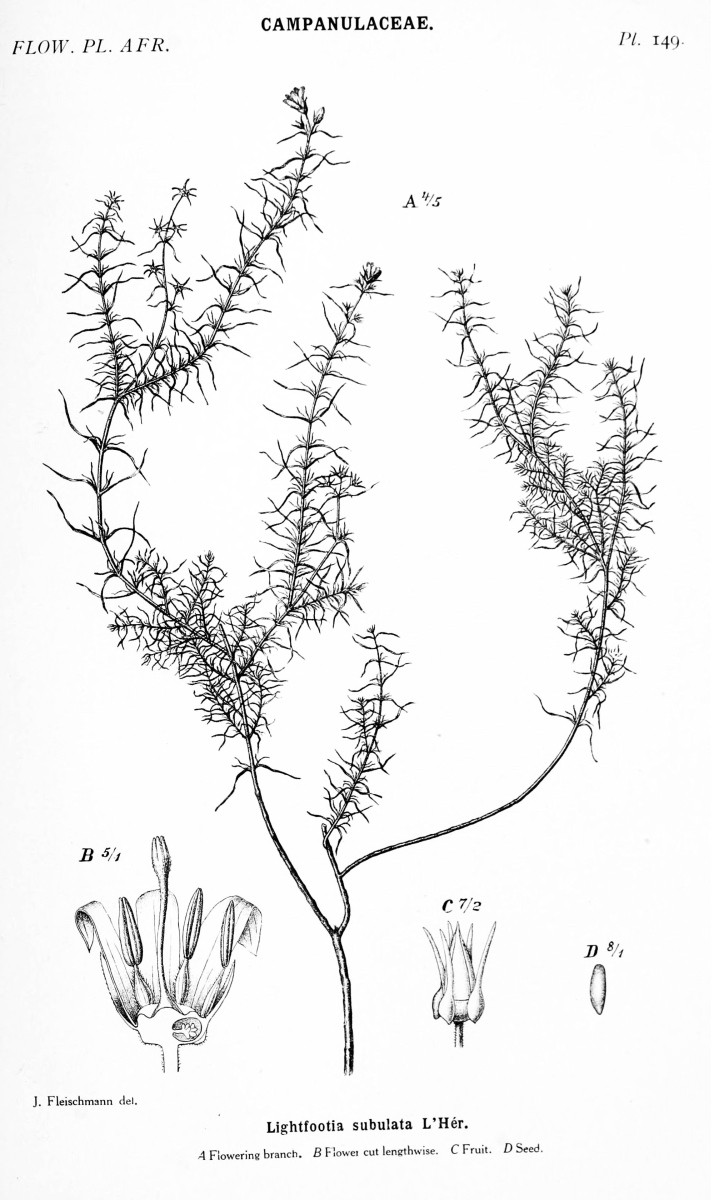
CAMPANULACEAE.
FLOW. PL. AFR.
Pl. 149.
J. Fleischmann del.
Lightfootia subulata L’Hér.
A Flowering branch. B Flower cut lengthwise. C Fruit. D Seed.
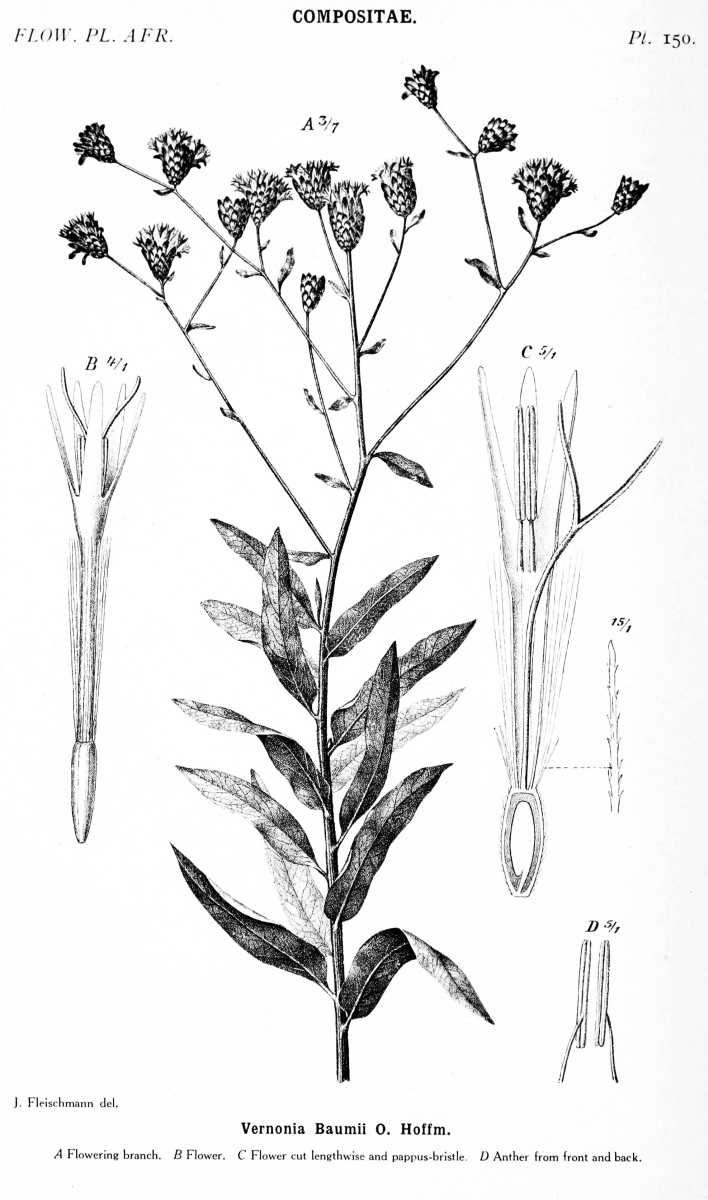
COMPOSITAE.
FLOW. PL. AFR.
Pl. 150.
J. Fleischmann del.
Vernonia Baumii O. Hoffm.
A Flowering branch. B Flower. C Flower cut lengthwise and pappus-bristle. D Anther from front and back.
two longitudinal slits. Ovary inferior, 1-celled. Ovule 1, erect, inverted. Style of the fertile hermaphrodite flowers cleft into two branches, which bear stigmatic papillae on the inner face or the margins, and hairs on the outer face, on both sides, or at the top; style of the sterile flowers usually entire. Fruit indehiscent, mostly dry. Seed solitary, with a thin coat usually adnate to the pericarp, exalbuminous. Embryo straight; radicle short, inferior.—Genera 327, species 4200. (Including AMBROSIACEAE.) (Plate 150.)
1. Corolla of all flowers strap-shaped (ligulate). Juice milky. [Tribe CICHORIEAE.] 2 Corolla of the hermaphrodite and male flowers not strap-shaped. Juice not milky. 31 2. Scales on the receptacle enclosing the fruits. Thistle-like herbs.—Species 3. North Africa and northern East Africa. Used as vegetables and in medicine. [Subtribe SCOLYMINAE.] Scolymus L. Scales on the receptacle not enclosing the fruits or wanting. Not thistle-like plants. 3 3. Pappus of all or of the inner fruits consisting of feathery bristles which are sometimes broadened at the base or surrounded by simple bristles or by a small crown. [Subtribe LEONTODONTINAE.] 4 Pappus consisting of simple, smooth or rough, in some cases shortly ciliate bristles, or of such bristles and scales, or only of scales sometimes ending in a not feathery, in some cases shortly ciliate awn, or of scales united into a small crown, or wanting altogether. 10 4. Pappus-bristles, at least on the inner fruits, with interwoven pinnae. Receptacle without scales. 5 Pappus-bristles with not interwoven pinnae, in 1 or 2 rows. Flowers yellow. 7 5. Pappus-bristles and involucral bracts in one row. Flower-heads terminal, solitary, large or rather large. Leaves linear.—Species 3. North Africa; one of the species also naturalized in St. Helena. Used as vegetables or in medicine. “Salsify.” (Including Geropogon L.) Tragopogon L. Pappus-bristles and involucral bracts in several rows. 6 6. Fruits obliquely truncate at the top; hence pappus lateral. Flower-heads terminal, solitary; flowers yellow. Leaves radical.—Species 1. North-west Africa (Algeria) Tourneuxia Coss. Fruits straight at the top.—Species 7. North and Central Africa; one species only cultivated. They yield edible roots, food for silkworms, and medicaments. (Including Podospermum DC.) Scorzonera L. 7. Receptacle with scales between the flowers. Involucral bracts in several rows.—Species 6. North Africa; two of the species also naturalized in South Africa, St. Helena, and the Mascarenes. Used in medicine. (Including Seriola L.) Hypochoeris L. Receptacle without scales. 8 8. Involucral bracts in one row. Fruits with a hollow beak. Pappus-bristles in two rows. Flower-heads solitary.—Species 2. North Africa and Cape Verde Islands; naturalized in South Africa. Urospermum Scop. Involucral bracts in several rows. 9 9. Leaves all radical. Stem simple or scantily branched. Pappus persistent.—Species 20. North Africa. (Including Asterothrix Coss., Fidelia Schultz, Kalbfussia Schultz, Microderis DC., Millina Cass., and Thrincia Roth). Leontodon L. Leaves cauline or cauline and radical. Stem branched, hairy.—Species 20. North and Central Africa. Several species are used as vegetables. (Including Deckera Schultz, Helminthia Juss., Spitzelia Schultz, Viraea Vahl, and Vigineixia Pomel). Picris L. 10. (3.) Pappus, at least on the inner fruits, consisting of bristles. [Subtribe CREPIDINAE.] 11 Pappus consisting of scales and bristles, or of scales sometimes prolonged into an awn or united in a small crown, or wanting. [Subtribe CICHORINAE.] 24 11. Receptacle beset with bristles. Fruits not beaked. 12 Receptacle glabrous or shortly ciliate. 13 12. Receptacle bristly throughout. Fruits linear.—Species 1. North-east Africa (Egypt). (Lagoseris M. Bieb.) Pterotheca Cass. Receptacle pitted; only the edges of the pits beset with bristles. Fruits oblong.—Species 10. North Africa. Andryala L. 13. Fruits ending in a beak. 14 Fruits without a beak, but sometimes narrowed at the apex. 18 14. Fruits tubercled at the base of the beak. 15 Fruits not tubercled at the base of the beak. 17 15. Outer fruits not beaked, with a rudimentary pappus or without a pappus. Flower-heads subequal, in corymbs.—Species 1. North-east Africa (Egypt). Heteroderis Boiss. Outer fruits similar to the inner. 16 16. Heads rather small, 7-15-flowered. Leaves radical and cauline.—Species 1. North Africa. Used as a salad and in medicine. Chondrilla L. Heads rather large, many-flowered. Leaves all radical.—Species 8. Some of them are used as salad or in medicine. “Dandelion.” Taraxacum Hall. 17. Fruits compressed.—Species 40, one of them (L. sativa L.) only cultivated. They are used as salad and fodder and in medicine; some are poisonous. “Lettuce.” (Including Cicerbita Wallr.) Lactuca L. Fruits, at least the inner, terete or angular, many-ribbed.—Species 35. (Including Anisorhamphus DC. and Barkhousia Moench). Crepis L. 18. Fruits much narrowed at the top. 19 Fruits, at least the inner, not or slightly narrowed and truncate at the top. 20 19. Stem reduced to a rootstock sometimes prolonged into a short scape. Flowers yellow.—Species 2. East Africa. Dianthoseris Schultz Stem well developed, not scape-like. (See 17.) Crepis L. 20. Fruits of two kinds, the inner differing from the outer. Involucral bracts in many rows, with scarious margins. 21 Fruits all alike. 22 21. Outer fruits transversely wrinkled or hairy, inner smooth and glabrous.—Species 20. Some of them are used medicinally. (Including Heterachaena Fres., Microrhynchus Less., Rhabdotheca Cass., and Zollikoferia DC.) Launaea Cass. Outer and inner fruits 3-5-furrowed, with crenate ribs, the inner less deeply furrowed. Pappus-bristles falling away together.—Species 5. North and East Africa. Some are used as vegetables. (Picridium Desf.) Reichardia Roth 22. Fruits obscurely ribbed, not or slightly compressed, angular. Flowers red, violet, or white. Heads in racemes or panicles.—Species 2. Canary Islands and Socotra. Prenanthes L. Fruits distinctly ribbed. Flowers usually yellow. 23 23. Fruits compressed.—Species 40. Some of them are used as vegetables or in medicine. “Sowthistle.” Sonchus L. Fruits terete or angular.—Species 7. North and South Africa and Madagascar. Some are used in medicine. “Hawkweed.” Hieracium L. 24. (10.) Pappus present. 25 Pappus absent. Receptacle glabrous or shortly ciliate. Flowers yellow. 29 25. Receptacle entirely beset with long bristles. Pappus consisting of toothed or awned scales. Involucral bracts with a scarious appendage.—Species 5. North Africa. Some are used as ornamental plants. Catananche L. Receptacle glabrous or shortly ciliate, sometimes with some long bristles in the centre. 26 26. Involucral bracts hardened at the time of maturity. Flower-heads terminal, solitary; flowers yellow. 27 Involucral bracts not hardened at maturity. 28 27. Fruits compressed, some of them winged.—Species 3. North Africa. Hyoseris L. Fruits terete, not winged.—Species 2. North Africa. (Under Leontodon L.) Hedypnois Schreb. 28. Flowers yellow. Involucral bracts subequal in length. Fruits 6-8-ribbed. Pappus of the inner fruits consisting of scales and bristles.—Species 12. North and Central Africa. Some are used as ornamental plants. Tolpis Bivona Flowers blue, red, or white. Involucral bracts unequal in length. Fruits 5-angled. Pappus consisting of short scales.—Species 6. North and Central Africa; one of the species also naturalized elsewhere, two of them only cultivated. The latter yield vegetables, salad, fodder for cattle, medicaments, and a substitute for coffee. “Chicory.” Cichorium L. 29. Involucral bracts hardened later on and enclosing the outer fruits. Fruits linear, the outer spreading.—Species 2. North Africa. Used as salad. Rhagadiolus Juss. Involucral bracts neither hardened nor enclosing the fruits. 30 30. Fruits linear, incurved at the top, spreading, the ribs beset with short prickles.—Species 1. North-west Africa (Algeria). Koelpinia Pall. Fruits oblong-ovate, rounded at the top, compressed, many-streaked, glabrous.—Species 1. North Africa, also naturalized in the Mascarene Islands. Yields salad and is used in medicine. (Lampsana Juss.) Lapsana L. 31. (1.) Styles of the hermaphrodite flowers, at or somewhat below the point of division, thickened or provided with a ring of rather long hairs. Involucral bracts in several rows. [Tribes CYNAREAE and ARCTOTIDEAE.] 32 Styles of the hermaphrodite flowers neither thickened nor provided with a ring of long hairs at or below the point of division. 67 32. Outer (ray-) flowers strap-shaped. Anthers not tailed. 33 Outer flowers not strap-shaped. Anthers usually more or less distinctly tailed. 41 33. Involucral bracts free, the inner scarious at the apex. Flower-heads solitary. 34 Involucral bracts united below. [Subtribe GORTERINAE.] 35 34. Pappus formed of feathery bristles. Outer involucral bracts leaf-like and usually prickly. Leaves prickly.—Species 12. North Africa. One of the species yields gum and is used in medicine. Atractylis L. Pappus formed of scales sometimes united into a small crown, or wanting.—Species 85. South and Central Africa. Some are used as ornamental plants. (Including Arctotheca Wendl., Cryptostemma R. Br., Damatris Cass., Haplocarpha Less., Landtia Less., Microstephium Less., and Venidium Less.) Arctotis L. 35. Involucral bracts united at the base only. Receptacle with deep pits enclosing the fruits. 36 Involucral bracts united to the middle or beyond. Receptacle with more or less shallow pits not enclosing the fruits. 38 36. Involucral bracts in two rows, the outer leaf-like and longer than the inner. Pappus of feathery-fringed scales. Flower-heads solitary. Leaves entire or prickly-toothed, often ciliate.—Species 5. South Africa. Didelta L’Hér. Involucral bracts in 3 or more rows, prickly. Leaves prickly. 37 37. Pappus formed of scales.—Species 80. South and Central Africa. Some are used medicinally, others are noxious weeds. (Crocodiloides Adans., including Stephanocoma Less. and Stobaea Thunb.) Berkheya Ehrh. Pappus wanting. Flower-heads solitary. Leaves undivided.—Species 15. South Africa. Cullumia R. Br. 38. Involucral bracts united at the base or up to halfway. Fruits clothed with long hairs. 39 Involucral bracts united high up. Receptacle with shallow pits. Herbs. 40 39. Receptacle with deep pits. Pappus of two unequally long rows of scales. Herbs.—Species 7. South and Central Africa. Berkheyopsis O. Hoffm. Receptacle with shallow pits. Pappus a small crown of bristles or wanting. Shrubs.—Species 3. South Africa. Hirpicium Cass. 40. Involucral bracts hardened and prickly at the time of maturity. Pappus formed of one-ranked scales or wanting. Fruits nearly glabrous.—Species 4. South Africa. Gorteria L. Involucral bracts unchanged at maturity. Pappus formed of usually two-ranked scales. Fruits clothed with long hairs.—Species 35. South Africa and southern Central Africa. Some are used as ornamental plants. (Meridiana Hill). Gazania Gaertn. 41. (32.) Receptacle with scales between the flowers. Flower-heads collected in clusters. Flowers red or violet. Corolla-tube short. Leaves pinnately divided. [Subtribe GUNDELINAE.] 42 Receptacle rarely with scales between the flowers, and then flower-heads not in clusters. 43 42. Involucral bracts united below. Pappus crown-shaped. Leaves cauline, prickly.—Species 1. North Africa. Gundelia L. Involucral bracts free. Pappus of unequal scales. Leaves radical.—Species 3. South and Central Africa. Platycarpha Less. 43. Heads 1-flowered, collected in globose secondary heads. Partial involucres of many bracts and bristles. Flowers blue or white. Anthers tailed. Pappus present. Leaves toothed or divided.—Species 20. Central and North Africa. Some are used as ornamental plants. “Globe-thistle.” (Sphaerocephalus L.) Echinops L. Heads several-flowered, rarely 1-flowered but not arranged in heads. 44 44. Fruits with a lateral or at least distinctly oblique point of attachment. [Subtribe CENTAUREINAE.] 45 Fruits with a basal, straight or nearly straight point of attachment. 51 45. Heads surrounded outside the calyx-like involucre by an involucre of leaves. Leaves prickly. 46 Heads without an outer involucre of leaves, rarely (Centaurea) surrounded by some unarmed leaves. 48 46. Pappus double, of two unequally long rows of bristles. Fruits ribbed. Heads containing hermaphrodite and male flowers. Flowers yellow.—Species 1. North Africa, also naturalized in South Africa. Used medicinally. (Carbenia Adans.) Cnicus Gaertn. Pappus simple or wanting. 47 47. Pappus of feathery bristles. Flowers blue, all hermaphrodite.—Species 13. North Africa and northern East Africa. Carduncellus Juss. Pappus of not feathery bristles or scales, or wanting.—Species 15. North Africa and northern East Africa; two of the species also naturalized in South Africa. Some species (chiefly the safflower, C. tinctorius L.) yield dyes, oil, and medicaments. (Including Kentrophyllum Neck.) Carthamus L. 48. Fruits with a threefold border towards the top. Pappus of scales and bristles. Heads containing hermaphrodite and neuter flowers. Flowers white or yellow. Involucral bracts appendaged. Leaves undivided.—Species 1. North-east Africa (Egypt). Zoegea L. Fruits with a simple border at the top. 49 49. Fruits with a crenate ring within the pappus, hairy; pappus of scales and bristles. Heads containing hermaphrodite and neuter flowers. Flowers red. Involucral bracts unappendaged. Leaves pinnately divided into narrow segments.—Species 1. North Africa. Crupina Cass. Fruits without a crenate ring within the pappus, or without any pappus. 50 50. Involucral bracts with a scarious or prickly appendage, rarely without an appendage, and then pappus consisting of unequally long scales or double.—Species 90. North and Central Africa; two of the species naturalized in South Africa. Several species yield edible roots or medicaments or serve as ornamental plants. (Including Aegialophila Boiss. & Heldr., Amberboa DC., Leuzea DC., Melanoloma Cass., Microlonchus Cass., Phaeopappus Boiss., Rhaponticum Lam., and Volutarella Cass.) Centaurea L. Involucral bracts without a scarious or prickly appendage, but sometimes with a small point. Pappus of unequally long bristles.—Species 4. North Africa. They yield dyes and medicaments. “Sawwort.” Serratula L. 51. (44.) Fruits, at least the central ones, clothed with silky hairs, not margined at the apex. [Subtribe CARLININAE.] 52 Fruits glabrous, usually margined at the apex. [Subtribe CARDUINAE.] 56 52. Pappus formed of feathery scales or bristles. Outer bracts of the involucre leaf-like, usually prickly, inner scarious at the apex. Leaves prickly. 53 Pappus formed of not feathery scales. 54 53. Inner involucral bracts spreading horizontally, petal-like. Flower-heads large.—Species 7. North Africa. Some are used medicinally. Carlina L. Inner involucral bracts not spreading horizontally. Herbs. (See 34.) Atractylis L. 54. Heads solitary, containing fertile hermaphrodite disc-flowers with a regular corolla and sterile female ray-flowers with a two-lipped corolla. Inner involucral bracts long, usually petal-like. Leaves entire, not prickly.—Species 2. North Africa. Used as ornamental plants. Xeranthemum L. Heads containing only fertile hermaphrodite flowers. Involucral bracts prickly. Leaves toothed or divided, prickly. 55 55. Receptacle deeply pitted. Anthers not tailed. (See 37.) Berkheya Ehrh. Receptacle not pitted. Anthers tailed. Heads arranged in cymes.—Species 1. North Africa. Used medicinally. (Broteroa Willd.) Cardopatium Juss. 56. (51.) Filaments united. Flowers red. Leaves white-stained, prickly. 57 Filaments free. 58 57. Heads panicled; the central flowers hermaphrodite, the outer neuter. Pappus-bristles feathery.—Species 3. North Africa. (Lupsia Neck.) Galactites Neck. Heads solitary; all flowers hermaphrodite. Pappus-bristles not feathery.—Species 2. North Africa; one of the species also naturalized in South Africa. Used as vegetables and in medicine. Silybum Gaertn. 58. Filaments warty or hairy. Leaves usually prickly. 59 Filaments glabrous. 62 59. Receptacle deeply pitted, without bristles.—Species 9. North Africa. Onopordon L. Receptacle slightly or not pitted, bristly. 60 60. Receptacle fleshy. Flower-heads large, solitary. Leaves divided.—Species 6. North Africa; one species (C. Scolymus L., artichoke) only cultivated. They are used as vegetables and in medicine. (Including Cynaropsis O. Ktze.) Cynara L. Receptacle not fleshy. 61 61. Pappus-bristles feathery.—Species 17. North and Central Africa. Some are used as vegetables and in medicine. (Cnicus L., including Chamaepeuce DC., Notobasis Cass., and Picnomon DC.) Cirsium Scop. Pappus-bristles not feathery.—Species 20. North and East Africa. Carduus L. 62. Receptacle deeply pitted, ciliate only at the edges of the pits. Pappus of scales. Involucral bracts united at the base. Flowers yellow. Anthers not tailed. 63 Receptacle not or slightly pitted, bristly. Pappus of bristles. 64 63. Involucral bracts in two rows, the outer the longer. (See 36.) Didelta L’Hér. Involucral bracts in 3 or more rows, prickly. Leaves prickly. (See 37.) Berkheya Ehrh. 64. Involucral bracts ending in hooked awns. Heads in racemes. Leaves undivided, unarmed. Herbs.—Species 1. North Africa. Yields oil and medicaments. “Burdock.” (Lappa Juss.) Arctium L. Involucral bracts without hooked awns. 65 65. Pappus-bristles in one row, not feathery, united below. Flowers red. Heads narrow, in corymbs. Leaves undivided, unarmed. Undershrubs.—Species 1. North-west Africa. Used medicinally. Staehelina L. Pappus-bristles in several rows, rough or feathery. 66 66. Pappus-bristles rough. Leaves unarmed. Flowers red.—Species 1. North Africa. Jurinea Cass. Pappus-bristles feathery. Leaves prickly. (See 61.) Cirsium Scop. 67. (31.) Anthers tailed, i.e., produced at the base into two acuminate, awned, or ciliate appendages. 68 Anthers not tailed: entire, auricled, or sagittate, rarely shortly mucronate at the base. 200 68. Corolla of the hermaphrodite flowers irregular, more or less 2-lipped. 69 Corolla of the hermaphrodite flowers, at least of the inner ones, regular. 71 69. Style-branches hairy at the top only. Pappus of scales and bristles. Heads containing only hermaphrodite flowers. Herbs.—Species 3. Central and South Africa. Pegolettia Cass. Style-branches hairy far down or throughout their whole length. Pappus of bristles. Flower-heads solitary. [Tribe MUTISIEAE, subtribe MUTISINAE.] 70 70. Heads with all the flowers hermaphrodite. Trees.—Species 1. Madagascar. Cloiselia S. Moore Heads with the inner flowers hermaphrodite and the outer female. Herbs.—Species 30. Southern and tropical Africa. Some are used as ornamental plants. (Including Perdicium L.) Gerbera Gronov. 71. Corolla-limb of the hermaphrodite flowers deeply divided. [Tribe MUTISIEAE, subtribe GOCHNATINAE.] 72 Corolla-limb of the hermaphrodite flowers toothed or cleft, more rarely flowers unisexual. [Tribes INULEAE and CALENDULEAE.] 78 72. Style hairy in the upper part, unappendaged. Fruits clothed with long silky hairs. Pappus of several rows of bristles. Heads solitary, large; all flowers hermaphrodite. Shrubs. Leaves pinnately cleft.—Species 1. North Africa. Warionia Benth. & Coss. Style appendaged above the hairy part or without hairs. 73 73. Pappus none. Fruits with 5 ribs thickened above, hairy. Receptacle with scales between the flowers. Heads with hermaphrodite and male flowers. Anthers with an appendage at the apex. Herbs.—Species 2. East Africa. Achyrothalamus O. Hoffm. Pappus consisting of bristles or scales. 74 74. Receptacle with scales between the flowers. Flowers all hermaphrodite, but the corollas sometimes of two kinds. Fruits glabrous. Pappus of 4-5 deciduous scales. Herbs. Flower-heads solitary.—Species 10. Central Africa. Erythrocephalum Benth. Receptacle without scales. 75 75. Receptacle pitted, with toothed edges to the pits. Corolla of the marginal flowers strap-shaped. Fruits hairy. Pappus of several rows of scales. Herbs. Flower-heads solitary.—Species 2. Central Africa. (Phyllactinia Benth.) Pasaccardoa O. Ktze. Receptacle without pits toothed at the edges. 76 76. Involucral bracts blunt. Flowers all hermaphrodite. Pappus of several rows of bristles.—Species 13. Central Africa. Pleiotaxis Steetz Involucral bracts pointed. 77 77. Heads with all the flowers hermaphrodite, but the marginal flowers with a 2-lipped corolla. Fruits hairy. Pappus of feathery bristles. Shrubs with thick branches. Leaves leathery. Heads very large, red-flowered.—Species 3. South Africa. Oldenburgia Less. Heads either with all the flowers hermaphrodite and equal-shaped, or with neuter marginal flowers. Leaves herbaceous.—Species 35. Tropical and South Africa. Some species are used medicinally. (Including Brachyachaenium Bak. and Hochstetteria DC.) Dicoma Cass. 78. (71.) Receptacle bearing chaffy scales between the flowers, at least towards the margin. 79 Receptacle without scales between the flowers, glabrous or hairy. 114 79. Heads with all the flowers hermaphrodite. 80 Heads with the central flowers hermaphrodite or male, the marginal female or neuter. 85 80. Pappus of 3-4 minute teeth or ring-shaped or wanting. 81 Pappus of bristles or lacerated scales. 82 81. Fruits slightly flattened. Involucral bracts scarious. Flower-heads collected in compound heads.—Species 3. East Africa. Polycline Oliv. Fruits 4-angled. Involucral bracts united below, hardening after the time of flowering. Flower-heads solitary, terminal.—Species 3. North Africa. Anvillea DC. 82. Pappus of 5 lacerated scales. Heads in corymbs. Leaves mostly 3-lobed.—Species 1. Southern West Africa (Damaraland). Eenia Hiern & Moore Pappus of bristles. 83 83. Pappus-bristles in two rows, not feathery. Fruits hairy. Involucral bracts pungent. Heath-like shrubs.—Species 1. South Africa. Lachnospermum Willd. Pappus-bristles in one row. Involucral bracts scarious. Not heath-like plants. 84 84. Pappus-bristles feathery from the base.—Species 15. South Africa. Some are used as ornamental plants. Helipterum DC. Pappus-bristles feathery only at the tip or not feathery.—Species 300. Some of them are used as medicinal or ornamental plants (“everlastings”). (Elichrysum Gaertn., including Aphelexis Don). Helichrysum Gaertn. 85. (79.) Corolla of the marginal flowers strap-shaped. 86 Corolla of the marginal flowers thread-shaped. 102 86. Style-branches of the hermaphrodite flowers blunt or rounded, with the marginal rows of stigmatic papillae confluent at the tip. Disc-flowers hermaphrodite, fertile, yellow; ray-flowers yellow or white. [Tribe INULEAE, subtribe BUPHTHALMINAE.] 87 Style-branches of the hermaphrodite flowers usually truncate; marginal rows of stigmatic papillae not confluent at the tip. 97 87. Pappus absent. 88 Pappus present, at least upon the inner fruits. 89 88. Involucral bracts united at the base. Scales on the receptacle broad. (See 81.) Anvillea DC. Involucral bracts free. Scales of the receptacle very narrow.—Species 2. Central Africa. Astephania Oliv. 89. Pappus cup-shaped, minutely toothed.—Species 12. Sphacophyllum Boj. Pappus of scales or bristles. 90 90. Inner fruits with a pappus of feathery bristles, outer without a pappus. Receptacle bearing scales at the margin only.—Species 3. North Africa. Rhanterium Desf. Inner and outer fruits with a pappus of scales or of scales and bristles. 91 91. Pappus of the central fruits consisting of outer scales and inner bristles. Receptacle bearing scales at the margin only. Fruits 10-ribbed. Shrubs.—Species 1. South-west Africa (Kalahari). Philyrophyllum O. Hoffm. Pappus of all fruits consisting of scales, rarely (Anisopappus) of scales intermingled with some bristles. 92 92. Involucral bracts with a large scarious appendage. Heads solitary.—Species 1. German South-west Africa. Ondetia Benth. Involucral bracts without a scarious appendage. 93 93. Involucral bracts leathery. Corolla of the hermaphrodite flowers deeply 5-cleft. Heads in cymes.—Species 20. South and Central Africa. Geigeria Griesselich Involucral bracts herbaceous or membranous. Corolla of the hermaphrodite flowers 5-toothed. 94 94. Corolla-tube of the hermaphrodite flowers thickened, broader than the limb, corky. Marginal fruits winged. Flower-heads solitary, with an outer involucre of mucronate leaves.—Species 1. North Africa. Pallenis Cass. Corolla-tube of the hermaphrodite flowers not thickened, narrower than the limb. 95 95. Outer and inner fruits alike, many-ribbed. Pappus-scales unequal. Heads in leafy corymbs. Herbs.—Species 6. Central Africa. Anisopappus Hook. & Arn. Outer and inner fruits dissimilar. Heads solitary, terminal. 96 96. Inner fruits conspicuously compressed. Pappus of a few very unequal scales. Herbs.—Species 5. South Africa. Callilepis DC. Inner fruits scarcely compressed. Pappus of many subequal scales.—Species 13. North and Central Africa. O. pygmaeum O. Hoffm. is one of the hygroscopic plants called “rose of Jericho.” (Asteriscus Moench) Odontospermum Neck. 97. (86.) Pappus wanting. Shrubs. 98 Pappus present. 99 98. Scales between the flowers bristle-like. Leaves small, pungent, nearly glabrous.—Species 1. South Africa. Arrowsmithia DC. Scales between the flowers not bristle-like. Leaves glandular-hairy.—Species 2. South Africa. Used medicinally. Osmitopsis Cass. 99. Pappus of the inner fruits formed of scales sometimes united into a small crown. 100 Pappus of the inner fruits formed of bristles or of scales and bristles. 101 100. Involucral bracts in few rows. Style-branches truncate. Undershrubs.—Species 8. South Africa. Some are used medicinally. Osmites L. Involucral bracts in many rows.—Species 20. South Africa. Relhania L’Hér. 101. Pappus of the inner fruits consisting of many scales and two awns. Shrubs.—Species 2. South Africa. Rosenia Thunb. Pappus of the inner fruits consisting of feathery bristles sometimes intermingled with scales. Herbs or undershrubs.—Species 7. South, North, and East Africa. Some are used medicinally. Leyssera L. 102. (85.) Heads collected in glomerules, heads, or spikes. Female marginal flowers usually numerous. [Tribe INULEAE, subtribe FILAGININAE.] 103 Heads solitary or in cymes, corymbs, or panicles. Female marginal flowers few. Involucral bracts scarious or ending in a coloured appendage. Pappus of the central fruits formed of bristles. 110 103. Marginal or all fruits without a pappus. Herbs. 104 Marginal fruits, at least the inner ones, or all fruits provided with a pappus. 106 104. Scales on the receptacle tightly enclosing the marginal fruits. Corolla of the female flowers inserted laterally upon the ovary. Herbs.—Species 2. North Africa. Micropus L. Scales on the receptacle not enclosing the fruits. 105 105. Central fruits without a pappus. Heads in compound heads. Herbs.—Species 7. North Africa. (Including Evacidium Pomel) Evax Gaertn. Central fruits with a pappus of feathery bristles. Heads in glomerules or in spikes. Leaves linear.—Species 10. South and North Africa. (Including Trichogyne Less.) Ifloga Cass. 106. Pappus of the central fruits consisting of scales, that of the marginal ones of scales and bristles. Heads in glomerules. Glabrous herbs.—Species 1. North Africa. Gymnarrhena Desf. Pappus of all fruits consisting of bristles. 107 107. Stem herbaceous, woolly or cottony. 108 Stem woody, at least at the base. 109 108. Stem winged. Pappus of all fruits formed of one or two rows of bristles.—Species 1. Madagascar and Mauritius. (Monenteles Labill.) Pterocaulon Ell. Stem not winged.—Species 13. North Africa, Abyssinia, and Cape Verde Islands. (Including Logfia Boiss. and Xerotium Bluff & Fing.) Filago L. 109. Leaves hairy. Heads in glomerules. Female flowers in several rows. Shrubs.—Species 1. Island of Mauritius. Cylindrocline Cass. Leaves glabrous. Heads in compound heads or in spikes. Female flowers few.—Species 7. Central Africa. Blepharispermum Wight 110. (102.) Heads containing 3-6 female and 1-2 fertile hermaphrodite flowers and collected in dense cymes arranged in panicles. Undershrubs.—Species 9. Tropical and South-east Africa. Achyrocline Less. Heads containing fewer female than hermaphrodite flowers. 111 111. Hermaphrodite flowers sterile, the inner not subtended by scales. Shrubs. 112 Hermaphrodite flowers fertile. 113 112. Female flowers in the axils of the outer involucral bracts and separated from the hermaphrodite flowers by two rows of inner involucral bracts.—Species 1. South Africa. Petalactella N. E. Brown Female flowers in the axils of the inner involucral bracts. Pappus-bristles thickened or penicillate at the apex.—Species 1. South Africa. Petalacte Don 113. Scales between the flowers long, deciduous. Shrubs.—Species 3. Tropical and South-east Africa. (Including Rhynea DC.) Cassinia R. Br. Scales between the flowers short, persistent. (See 84.) Helichrysum Gaertn. 114. (78.) Flowers dioecious. Trees or shrubs. [Tribe INULEAE, subtribe TARCHONANTHINAE.] 115 Flowers hermaphrodite, polygamous, or monoecious, rarely (Anaphalis) subdioecious, but then herbs. 117 115. Involucral bracts of the male heads in one row, united below, of the female in two rows. Pappus none.—Species 3. South and Central Africa. They yield timber and medicaments. Tarchonanthus L. Involucral bracts in several rows. Pappus of bristles. 116 116. Pappus-bristles in one row. Heads in fascicles.—Species 3. Madagascar. Synchodendron Boj. Pappus-bristles in two rows. Heads in racemes or panicles.—Species 10. Southern and Tropical Africa. Some species yield timber. Brachylaena R. Br. 117. Inner flowers hermaphrodite but sterile (male). 118 Inner flowers hermaphrodite and fertile. 134 118. Corolla of the outer flowers strap-shaped. 119 Corolla of the outer flowers thread-shaped. 125 119. Pappus consisting of bristles. Shrubs.—Species 3. South Africa. Macowania Oliv. Pappus wanting. 120 120. Receptacle beset with many long bristles. Outer fruits compressed. Shrubs. Leaves pungent. (See 98.) Arrowsmithia DC. Receptacle glabrous, rarely bearing some bristles; in this case fruits turgid. [Tribe CALENDULEAE.] 121 121. Marginal fruits of several kinds. Heads solitary, yellow-flowered. Herbs or undershrubs. 122 Marginal fruits all alike. 123 122. Fruits curved. Heads medium-sized.—Species 15. North and South Africa and Cape Verde Islands, some also naturalized in St. Helena, and one species naturalized in the extratropical regions. Some are used as ornamental plants (marigold) or yield medicaments and a substitute for saffron. Calendula L. Fruits straight. Heads small.—Species 3. South Africa. (Including Xenisma DC.) Oligocarpus Less. 123. Fruits with 3 wings and a cupular apical appendage. Involucral bracts in one row.—Species 35. South and Central Africa. Tripteris Less. Fruits without distinct wings or other appendages. 124 124. Involucral bracts in one row or nearly so. Fruits 3-angled, usually tubercled. Heads solitary. Herbs or undershrubs.—Species 20. South Africa to Angola. Some are used as ornamental plants. Dimorphotheca Moench Involucral bracts in 2 or more rows. Marginal flowers yellow. Fruits thick and hard, smooth or indistinctly ribbed.—Species 60. South and Central Africa. (Including Gibbaria Cass.) Osteospermum L. 125. (118.) Heads of two kinds; one kind with nearly all the flowers male, the other with nearly all female. Pappus of free bristles. Woolly or cottony herbs. Heads in corymbs.—Species 1. Madagascar. Anaphalis DC. Heads all alike. 126 126. Female flowers in one row. Involucral bracts scarious, all or the inner petal-like. Pappus of bristles. Cottony shrubs or undershrubs. 127 Female flowers in several rows. 128 127. Heads large, solitary.—Species 1. South Africa. Used as an ornamental plant. Phaenocoma Don Heads small, in dense cymes.—Species 7. South Africa. Anaxeton Cass. 128. Pappus consisting of bristles. 129 Pappus wanting, at least in the marginal fruits. 131 129. Heads in glomerules arranged in corymbs. Shrubs.—Species 3. Madagascar and Mascarenes. Monarrhenus Cass. Heads solitary or in panicles or corymbs. 130 130. Involucral bracts narrow. Herbs. Species 15. Tropical and South Africa. Some species yield camphor and medicaments. (Placus Lour.) Blumea DC. Involucral bracts broad. Shrubs or undershrubs, rarely herbs.—Species 15. Tropics. Some are used medicinally. (Including Tecmarsis DC.) Pluchea Cass. 131. Inner fruits with a pappus of feathery bristles, outer without a pappus. 132 Inner and outer fruits without a pappus. 133 132. Heads in glomerules. Involucral bracts scarious. Corolla-limb of the female flowers shortly toothed. Pappus-bristles 2-6.—Species 6. Tropical and South Africa. (Including Demidium DC.) Amphidoxa DC. Heads in corymbs. Involucral bracts scarious only at the edges, subequal. Corolla-limb of the female flowers two-cleft. Pappus-bristles 1-2.—Species 2. South and Central Africa. Denekia Thunb. 133. Heads arranged in cymes.—Species 3. Central and South Africa. (Including Litogyne Harv.) Epaltes Cass. Heads collected in compound heads.—Species 25. Tropical and South Africa and Egypt. Some species are used medicinally. Sphaeranthus L. 134. (117.) Style-branches of the hermaphrodite flowers stigmatose within, hairy outside from the tips downwards to below the point of division. 135 Style-branches of the hermaphrodite flowers stigmatose at the edges, hairy only in their upper part. 149 135. Heads with all the flowers hermaphrodite. 136 Heads with the inner flowers hermaphrodite or male, the outer female. 138 136. Pappus wanting; fruits with an indistinctly cupular margin at the apex. Heads small, 1-4-flowered, arranged in corymbs. Shrubs.—Species 2. Madagascar. Apodocephala Bak. Pappus present. Heads medium-sized. 137 137. Fruits hairy. Pappus of scales. Receptacle bristly. Heads sessile. Undershrubs.—Species 1. Southern West Africa (Angola). (Under Geigeria Griesselich). Thysanurus O. Hoffm. Fruits glabrous. Pappus of bristles. Receptacle glabrous. Heads stalked. Shrubs.—Species 5. Madagascar. Centauropsis Boj. 138. Corolla of the female (marginal) flowers strap-shaped. Receptacle pitted. Outer involucral bracts mucronate. Fruits hairy. Pappus of several rows of bristles. Shrubs. Heads solitary, yellow-flowered.—Species 1. South-west Africa (Namaland). Eremothamnus O. Hoffm. Corolla of the female (marginal) flowers thread-shaped. [Tribe INULEAE, subtribe PLUCHEINAE.] 139 139. Pappus wanting. 140 Pappus present, at least in the hermaphrodite (central) flowers. 141 140. Heads arranged in cymes. (See 133.) Epaltes Cass. Heads collected in compound heads. (See 133.) Sphaeranthus L. 141. Inner fruits with a pappus of 1-5 bristles, outer without a pappus. 142 Inner and outer fruits provided with a pappus. 143 142. Pappus of 1-2 bristles feathery at the tip. Corolla-limb of the female flowers 2-cleft. Heads in corymbs. (See 132.) Denekia Thunb. Pappus of 3-5 simple bristles. Corolla-limb of the female flowers 4-5-cleft. Heads solitary.—Species 1. East Africa. Delamerea S. Moore 143. Pappus of scales united into a small crown. Heads in compound heads collected in heads of the third order.—Species 1. East Africa. Triplocephalum O. Hoffm. Pappus of bristles or of scales and bristles. 144 144. Pappus of scales and bristles. Fruits hairy. Heads in leafy panicles, red-flowered.—Species 2. Central Africa. Porphyrostemma Grant Pappus of bristles. 145 145. Female flowers in one row. Inner involucral bracts membranous. Heads in leafy panicles. Undershrubs.—Species 1. Southern West Africa (Damaraland). (Under Pluchea Cass.) Pechuel-Loeschea O. Hoffm. Female flowers in several rows. 146 146. Fruits compressed. Pappus of 3 bristles. Heads solitary or few together. Undershrubs.—Species 4. Central Africa. Nicolasia S. Moore Fruits terete or angular. 147 147. Heads in glomerules arranged in corymbs. Shrubs. (See 129.) Monarrhenus Cass. Heads solitary or in panicles or corymbs. 148 148. Involucral bracts narrow. Herbs. (See 130.) Blumea DC. Involucral bracts broad. Shrubs or undershrubs, rarely herbs. (See 130.) Pluchea Cass. 149. (134.) Style-branches of the hermaphrodite flowers blunt, or rounded; marginal rows of stigmatic papillae confluent at the apex. Female (marginal) flowers with a strap-shaped corolla, rarely with a tubular one or wanting. [Tribe INULEAE, subtribe INULINAE.] 150 Style-branches of the hermaphrodite flowers usually truncate; marginal rows of stigmatic papillae not confluent at the apex. 166 150. Pappus ring-shaped. Heads solitary. Herbs.—Species 3. West Africa. Mollera O. Hoffm. Pappus of scales or bristles or of both. 151 151. Pappus of scales. 152 Pappus of bristles or of scales and bristles. 153 152. Pappus-scales 3-5. Heads with all the flowers hermaphrodite, arranged in panicles. Climbing shrubs.—Species 1. South Africa. Anisochaeta DC. Pappus-scales 10. Heads in leafy panicles. Herbs.—Species 4. Central and South-west Africa. Calostephane Benth. 153. Pappus of sometimes feathery bristles. 154 Pappus of scales and bristles. 161 154. Ray-flowers white, blue, or red. Pappus-bristles in several rows. Shrubs.—Species 7. South Africa. Some are used medicinally. Printzia Cass. Ray-flowers yellow or wanting. 155 155. Ray-flowers sterile. Receptacle pitted. Pappus-bristles in several rows. Undershrubs.—Species 1. South Africa. Cypselodontia DC. Ray-flowers fertile. 156 156. Pappus of two or more rows of bristles, the outer of which are shorter. 157 Pappus of subequal bristles sometimes intermingled with a few shorter ones. 159 157. Pappus-bristles in 3 or more rows. Heads without ray-flowers.—Species 10. Tropical and South Africa and Egypt. Iphiona Cass. Pappus-bristles in 2 rows. 158 158. Pappus of 5 inner and 10 outer bristles. Heads without ray-flowers. Shrubs.—Species 1. South Africa. Anisothrix O. Hoffm. Pappus of 10 inner and 10 outer bristles. Heads with ray-flowers. Undershrubs.—Species 1. South Africa. Minurothamnus DC. 159. Heads few-flowered, without ray-flowers, arranged in panicles or corymbs. Involucre of few bracts.—Species 2. Egypt. (Under Iphiona Cass.) Varthemia DC. Heads many-flowered. Involucre of many bracts. 160 160. Involucral bracts leathery, the outer sticky at the tip. Heads with ray-flowers, solitary. Pappus-bristles in one row. Glandular-hairy shrubs.—Species 1. South Africa. Homochaete Benth. Involucral bracts herbaceous or the inner scarious.—Species 30. Some of them yield vermin-poison or are used in medicine. (Including Bojeria DC., Pentatrichia Klatt, Schizogyne Cass., and Vicoa Cass.) Inula L. 161. Pappus-scales united below. 162 Pappus-scales free. 163 162. Pappus-bristles about 5. Female marginal flowers wanting. Heads in corymbs. Shrubs.—Species 2. Canary Islands. Allagopappus Cass. Pappus-bristles 7 or more. Female marginal flowers present. Heads solitary at the ends of the branches. Herbs.—Species 30. Some of them yield vermin-poison or are used in medicine. (Including Francoeuria Cass.) Pulicaria Gaertn. 163. Pappus-scales rather broad, fringed. Fruits 10-ribbed. Heads without ray-flowers. Herbs. (See 69.) Pegolettia Cass. Pappus-scales very narrow. 164 164. Fruits constricted into a short neck, 10-ribbed. Heads without ray-flowers. Shrubs. Leaves pinnately divided.—Species 3. North Africa. (Under Grantia Boiss.) Perralderia Coss. Fruits not constricted above. Heads with ray-flowers. 165 165. Fruits 4-5-ribbed. Pappus-bristles 5-10. Shrubs.—Species 1. Canary Islands. Viraea Webb Fruits many-ribbed. Pappus-bristles numerous. Undershrubs.—Species 1. North-west Africa. Jasonia Cass. 166. (149.) Female or neuter marginal flowers with a strap-shaped corolla. 167 Female or neuter marginal flowers with a thread-shaped corolla or wanting. [Tribe INULEAE, subtribes GNAPHALINAE and RELHANINAE.] 176 167. Leaves grooved or rolled inwards on the upper side, small. Heath-like plants. [Tribe INULEAE, subtribe RELHANINAE.] 168 Leaves flat or rolled back from the margins. Not heath-like plants. 172 168. Heads one-flowered, some hermaphrodite, the others female, or 2-flowered with a hermaphrodite and a female or neuter flower. Pappus of feathery bristles united at the base. Shrubs.—Species 8. South Africa. Disparago Gaertn. Heads many-flowered. 169 169. Pappus wanting. Shrubs.—Species 2. South Africa. Anaglypha DC. Pappus present. 170 170. Pappus of numerous scales sometimes united below.—Species 13. South Africa. Nestlera Spreng. Pappus of bristles. 171 171. Pappus-bristles feathery. Shrubs.—Species 5. South Africa. Amphiglossa DC. Pappus-bristles simple. Herbs. Flowers red.—Species 1. South Africa. Bryomorphe Harv. 172. Pappus wanting. Inner fruits compressed. Heads solitary. Herbs or undershrubs. (See 124.) Dimorphotheca Moench Pappus present. [Tribe INULEAE, subtribe ATHRIXINAE.] 173 173. Pappus of the outer fruits consisting of scales, of the inner of bristles or of scales and bristles. Fruits glabrous. Herbs or undershrubs. (See 101.) Leyssera L. Pappus consisting of bristles. 174 174. Involucral bracts narrow, acuminate. Herbs or undershrubs.—Species 15. Southern and tropical Africa. Athrixia Ker Involucral bracts blunt, scarious at the apex. Pappus-bristles in two rows. Shrubs. 175 175. Fruits hairy. Pappus-bristles thick and stiff. Involucre hemispherical.—Species 3. South Africa. Heterolepis Cass. Fruits glabrous, but with a hairy swelling at the base. Pappus-bristles thin. Involucre narrow-campanulate.—Species 3. Central and South Africa. Antithrixia DC. 176. (166.) Hermaphrodite flowers fewer than the female. 177 Hermaphrodite flowers as many as or more than the female, or all flowers hermaphrodite. 184 177. Fruits without a pappus. Heads small, in dense cymes. Tall herbs.—Species 1. East Africa. Chiliocephalum Benth. Fruits, at least the inner, crowned by a pappus. 178 178. Inner fruits with a pappus of feathery bristles, outer without a pappus. Heads small, in glomerules. Low herbs. (See 132.) Amphidoxa DC. Inner and outer fruits crowned by a pappus. 179 179. Pappus of the inner fruits of bristles and united scales, that of the outer only of scales united below. Heads solitary. Herbs.—Species 1. East Africa. Artemisiopsis S. Moore Pappus of all fruits formed of bristles. 180 180. Pappus-bristles feathery. Heads in glomerules. Herbs.—Species 2. South and North Africa. Lasiopogon Cass. Pappus-bristles not feathery. 181 181. Fruits with a long beak. Herbs. Leaves radical or opposite. Heads solitary.—Species 1. Island of Tristan da Cunha. Chevreulia Cass. Fruits without a beak. 182 182. Heads 4-8-flowered, cylindrical, in dense cymes arranged in panicles. Undershrubs. (See 110.) Achyrocline Less. Heads many-flowered, hemispherical ovoid or campanulate. 183 183. Anthers very shortly tailed. Shrubs or undershrubs. Heads solitary or in long-stalked glomerules.—Species 15. North and Central Africa. Phagnalon Cass. Anthers distinctly tailed. Herbs.—Species 50. “Cudweed.” Gnaphalium L. 184. (176.) Heads 1-flowered. 185 Heads 2- or more-flowered. 188 185. Flowers partly hermaphrodite, partly female. Pappus of feathery bristles. Heads in glomerules. Shrubs. (See 168.) Disparago Gaertn. Flowers all hermaphrodite. 186 186. Pappus wanting. Heads in glomerules. Shrubs.—Species 2. South Africa. Perotriche Cass. Pappus formed of bristles. 187 187. Pappus-bristles feathery. Inner involucral bracts scarious. Heath-like shrubs.—Species 35. Southern and tropical Africa. Stoebe L. Pappus-bristles feathery only at the apex or not feathery. Involucral bracts scarious, coloured. Heads in panicled cymes. Herbs.—Species 12. Madagascar, Mauritius, and South Africa to Damaraland. Some are used medicinally. Stenocline DC. 188. Pappus wanting. Heads 2-3-flowered, in leafy corymbs. 189 Pappus formed of bristles. 190 189. Leaves small. Undershrubs.—Species 1. Madagascar. Syncephalum DC. Leaves rather large. Shrubs. Involucre woolly at the base.—Species 1. Madagascar. Astephanocarpa Bak. 190. Pappus-bristles feathery from the base. 191 Pappus-bristles feathery at the tip only or not feathery. 192 191. Heads 2-10-flowered. Heath-like shrubs.—Species 3. South Africa. Pterothrix DC. Heads many-flowered. Involucral bracts scarious, coloured. Not heath-like plants. (See 84.) Helipterum DC. 192. Pappus-bristles in 1 row. 193 Pappus-bristles in 2 or more rows. 197 193. Pappus-bristles with bladdery inflated cells at the tip. Heads small, in glomerules. Prostrate herbs.—Species 1. South Africa. Eriosphaera Less. Pappus-bristles without bladdery inflated cells. 194 194. Habit heath-like. Shrubs. Leaves small, grooved or rolled inwards on the upper face. Flowers all hermaphrodite. 195 Habit not heath-like. 196 195. Pappus-bristles feathery at the tip, united at the base and surrounded by a ring- or cup-shaped rim. Heads few-flowered.—Species 7. South Africa. Some are used medicinally. Elytropappus Cass. Pappus-bristles simple or thickened at the tip. Inner involucral bracts coloured above.—Species 25. South Africa. Metalasia R. Br. 196. Fruits large, with 8-10 prominent ribs, glabrous or short-haired. Heads 2-6-flowered, in panicled cymes. Herbs. (See 187.) Stenocline DC. Fruits small, not prominently 8-10-ribbed. (See 84.) Helichrysum Gaertn. 197. Pappus-bristles in 2 rows. Heath-like shrubs. 198 Pappus-bristles in 3 or more rows. Not heath-like herbs or undershrubs. 199 198. Heads few-flowered. Involucre oblong, of oblong bracts. Receptacle glabrous. Fruits ribbed. Leaves oblong.—Species 1. Madagascar. Cullumiopsis Drake Heads many-flowered. Involucre top-shaped, of linear bracts. Receptacle bristly at the margin. Fruits angular, hairy. Leaves linear. (See 83.) Lachnospermum Willd. 199. Fruits beaked, hairy. Heads few-flowered. Inner involucral bracts yellow.—Species 1. South Africa. Pachyrhynchus DC. Fruits not beaked, glabrous. Heads in cymes.—Species 8. South Africa. Leontonyx Cass. 200. (67.) Hermaphrodite disc-flowers sterile, their style without a stigma and usually entire or shortly toothed. 201 Hermaphrodite flowers, at least some of them, fertile. 238 201. Anthers arrow-shaped, with acuminate halves. Corolla of the marginal flowers strap-shaped. Fruits glabrous, usually large. Pappus wanting, rarely cup-shaped. Receptacle glabrous, rarely bristly. [Tribe CALENDULEAE.] 202 Anthers entire or shortly auricled at the base, rarely (Adelostigma) distinctly arrow-shaped, but then corolla of the marginal flowers thread-shaped, fruits hairy, and pappus bristly. 207 202. Outer fruits of several kinds. Heads solitary, yellow-flowered. Herbs or undershrubs. 203 Outer fruits all alike. 204 203. Fruits curved. Heads middle-sized. (See 122.) Calendula L. Fruits straight. Heads small. (See 122.) Oligocarpus Less. 204. Fruits with 3 wings and a cup-shaped apical appendage. Involucral bracts in one row. (See 123.) Tripteris Less. Fruits without distinct wings or other appendages. 205 205. Fruits very hard, smooth or indistinctly ribbed. Involucral bracts in two or more rows. Ray-flowers yellow. (See 124.) Osteospermum L. Fruits not very hard, 3-angled, usually tubercled. Herbs or undershrubs. Heads solitary. 206 206. Involucral bracts in one row or in two indistinct rows. (See 124.) Dimorphotheca Moench Involucral bracts in several rows. Ray-flowers blue or white. Leaves pinnately divided.—Species 6. South Africa. Some are used medicinally. Garuleum Cass. 207. (201.) Receptacle covered with chaffy scales. 208 Receptacle glabrous or hairy, without scales between the flowers. 213 208. Heads with the inner flowers male (apparently hermaphrodite), the outer female and provided with a more or less strap-shaped, rarely a thread-shaped corolla. 209 Heads unisexual, some with all the flowers male (apparently hermaphrodite), the others with all the flowers female and provided with a tubular corolla or without a corolla. 211 209. Involucral bracts in one row, united below when young. Outer fruits hairy, without a pappus, the inner with a pappus of numerous one-ranked bearded bristles. Heads solitary. Shrubs.—Species 1. South Africa. (Under Eriocephalus L.) Lasiocoma Bolus Involucral bracts in two or more rows. Pappus of 2-3 bristles or wanting. 210 210. Involucral bracts all alike. Corolla of the female flowers 2-toothed. Pappus of the outer fruits of 2-3 bristles. Heads in panicles.—Species 1. Naturalized in tropical and South Africa. Used medicinally. Parthenium L. Involucral bracts of two kinds, the inner united below. Corolla of the female flowers entire or 3-toothed. Pappus none. Heads in racemes or umbels, or solitary.—Species 20. South Africa to Damaraland. Some are used medicinally. Eriocephalus L. 211. Heads dioecious, many-flowered. Involucral bracts in 3 rows. Corolla 4-toothed, yellow. Anthers cohering, auricled at the base. Style cleft. Fruits hairy. Pappus of 2-3 bristles. Trees. Leaves opposite. Heads in leafy panicles.—Species 2. Island of St. Helena. Petrobium R. Br. Heads monoecious, the male many-flowered with a 5-toothed corolla, the female 1-2-flowered with an involucre of partly united bracts, and without a corolla. Anthers free or slightly cohering, entire at the base. Style of the male flowers undivided. Pappus none. Herbs or undershrubs. [Tribe HELIANTHEAE, subtribe AMBROSINAE.] 212 212. Involucral bracts of the male heads free. Filaments united. Female heads 2-flowered. Heads solitary or in glomerules in the axils of the leaves.—Species 4. North and Central Africa and Mascarene Islands; naturalized in South Africa. They yield dyes and medicaments and are noxious to pasturing cattle. Xanthium L. Involucral bracts of the male heads united below. Filaments free or nearly so. Female heads 1-flowered. Male heads in spikes or racemes.—Species 2. Northern and tropical Africa; naturalized in South Africa. Used medicinally. Ambrosia L. 213. (207.) Pappus of the outer fruits ring-, crown-, or ear-shaped, sometimes produced into two small points, or wanting. 214 Pappus of the outer fruits consisting of bristles. 223 214. Pappus of the inner fruits of bristles, of the outer of 1-2 small points or wanting. Involucral bracts in few rows. Receptacle pitted. Corolla of the female flowers strap-shaped. Style cleft, with lanceolate appendages. Fruits flattened. Shrubs or undershrubs. Leaves entire.—Species 8. South Africa. (Heteractis DC.) Gymnostephium Less. Pappus of all fruits alike or wanting. 215 215. Outer flowers with a strap-shaped corolla. 216 Outer flowers with a tubular corolla or without a corolla. 220 216. Corolla of the outer flowers very shortly strap-shaped, of the inner 4-toothed, yellow in all flowers. Involucral bracts in two rows.—Species 40. Some of them are used as ornamental or medicinal plants. (Including Brocchia Vis. and Cenia Juss.) Cotula L. Corolla of the outer flowers distinctly strap-shaped. Involucral bracts rarely in two rows, and then corolla of the inner flowers 5-toothed. 217 217. Involucral bracts in one row and united at the base. Corolla-limb of the hermaphrodite (male) central flowers bell-shaped, 5-cleft. Style-branches of the same ending in a blunt appendage. Fruits flattened, without ribs. Branching herbs. Leaves pinnately divided. Heads solitary.—Species 4. South Africa. Steirodiscus Less. Involucral bracts in two or more rows. 218 218. Involucral bracts in two rows. Corolla of the marginal flowers red, of the central yellow, the latter 5-toothed. Style-branches of the hermaphrodite (male) flowers pointed. Fruits beaked, without ribs. Herbs. Leaves undivided, radical. Heads solitary.—Species 1. Island of Tristan da Cunha. Lagenophora Cass. Involucral bracts in 3 or more rows. Corolla of the marginal flowers white, yellow, or blue, more rarely red, but then style-branches of the hermaphrodite (male) flowers truncate and fruits ribbed. 219 219. Style of the hermaphrodite (male) flowers with pointed branches or undivided. Corolla of the marginal flowers blue, rarely white. Fruits wrinkled or smooth. Branching herbs or undershrubs. Leaves pinnately divided. (See 206.) Garuleum Cass. Style of the hermaphrodite (male) flowers with truncate branches. Corolla of the marginal flowers white, yellow, or red. Fruits 5-10-ribbed.—Species 50. North Africa, Abyssinia, Madagascar, and South Africa. Some species yield condiments, medicaments, or insect-poison, or serve as ornamental plants. (Including Argyranthemum Webb, Ismelia Cass., Leucanthemum DC., Monoptera Schultz, Myconia Neck., Pinardia Cass., Plagius L’Hér., Preauxia Schultz, Prolongoa Boiss., Pyrethrum Gaertn., and Tanacetum L.) Chrysanthemum L. 220. Corolla of the hermaphrodite (male) flowers 2-4-toothed, of the female 2-3-toothed, entire, or wanting. Involucral bracts in two rows. Herbs. Flowers yellow. 221 Corolla of the hermaphrodite (male) flowers 5-toothed, of the female 2-4-toothed. 222 221. Heads sessile between the leaves. Female flowers in several rows, without a corolla. Outer fruits winged, with a persistent style. Leaves divided.—Species 1. Naturalized in the Island of Madeira. Soliva Ruiz & Pav. Heads stalked, at the ends of the branches. (See 216.) Cotula L. 222. Heads in corymbs. Involucral bracts in two rows. Fruits with marginal ribs or wings. Herbs or undershrubs.—Species 4. South Africa. Used medicinally. Hippia L. Heads not in corymbs. Involucral bracts in several rows. Fruits without strong ribs.—Species 20. Some of them (especially A. Absinthium L., wormwood) are used as ornamental or medicinal plants, as pot-herbs, or for preparing liquors and vinegar. Artemisia L. 223. (213.) Pappus of 1 or 2 rows of bristles. 224 Pappus, at least that of the outer fruits, of 3 or more rows of bristles. 233 224. Pappus-bristles feathery. 225 Pappus-bristles not feathery. 226 225. Corolla of all flowers yellow. Small shrubs.—Species 1. South Africa. Homochroma DC. Corolla of the marginal flowers white or red, of the central ones yellow. Herbs or undershrubs.—Species 13. South Africa. Used as ornamental plants. Mairia Nees 226. Involucral bracts in one row, sometimes surrounded by some much shorter ones. Herbs or undershrubs. Heads in corymbs or panicles. 227 Involucral bracts in two rows and all nearly of the same size, or in 3 or more rows. 228 227. Involucral bracts united at the base. Style of the hermaphrodite (male) flowers undivided. Inner fruits without a pappus.—Species 3. South Africa. Gymnodiscus Less. Involucral bracts free. Style cleft.—Species 45. Southern and tropical Africa. Cineraria L. 228. Corolla of the female marginal flowers thread-shaped. Herbs. Heads solitary on the ends of the branches. Style of the central flowers entire or shortly toothed. 229 Corolla of the female marginal flowers, at least of the outer ones, strap-shaped, rarely (Psiadia) thread-shaped, but then shrubs, heads in corymbs, and style of the central flowers 2-cleft. 230 229. Involucral bracts in two rows. Corolla of the hermaphrodite (male) flowers 4-toothed. Anthers entire at the base. Fruits compressed, glabrous. (See 216.) Cotula L. Involucral bracts in 3 or more rows. Corolla of the hermaphrodite (male) flowers 5-toothed. Anthers arrow-shaped. Fruits nearly terete, hairy.—Species 2. Central Africa. Adelostigma Steetz 230. Corolla of the female marginal flowers yellow, thread- or shortly strap-shaped. Fruits scarcely compressed, 3-6-ribbed. Shrubs. Heads in corymbs.—Species 40. Tropics. Some are used as pot-herbs. Psiadia Jacq. Corolla of the female marginal flowers white, red or blue, strap-shaped. Fruits compressed. 231 231. Stem woody, at least at the base. Marginal flowers in 1-2 rows. Pappus-bristles usually in one row.—Species 65. South and Central Africa. Some are used as ornamental plants. (Including Asterosperma Less., Detris Adans., and Diplopappus DC., under Aster L.) Felicia Cass. Stem herbaceous. 232 232. Involucral bracts in 2 rows, membranous. Marginal flowers usually in several rows, with a linear corolla. Style-branches with a mostly short triangular appendage. Pappus-bristles usually in one row.—Species 13, one of them only naturalized. Several species are used medicinally. Erigeron L. Involucral bracts in 3 or more rows. Marginal flowers in 1-2 rows, with a usually oblong corolla. Style-branches with a lanceolate appendage. Pappus-bristles in two rows.—Species 10. South and North Africa. Some are used as ornamental or medicinal plants. (Including Linosyris Cass.) Aster L. 233. (223.) Involucral bracts in several rows. (See 232.) Aster L. Involucral bracts in one row, but sometimes surrounded by some much smaller ones. 234 234. Heads of two kinds, some with most of the flowers hermaphrodite (male), the others with most of them female. Corolla red or white; limb shortly strap-shaped in the female flowers. Herbs. Leaves radical, broad. Heads in racemes or corymbs.—Species 1. North Africa. Used as an ornamental plant. Petasites Gaertn. Heads all alike. 235 235. Female marginal flowers in several rows. Corolla yellow; limb long strap-shaped in the female flowers. Herbs. Leaves radical, broad. Heads solitary.—Species 1. North Africa. Used medicinally. “Coltsfoot.” Tussilago L. Female marginal flowers in one row. 236 236. Inner fruits without a pappus, outer with a pappus of interwoven hairs. Style 2-cleft. Herbs. Leaves pinnately divided. Heads solitary.—Species 3. South Africa. Ruckeria DC. Inner and outer fruits with a pappus of bristles. 237 237. Style of the central flowers 2-cleft. Involucral bracts finally free. Undershrubs.—Species 7. South and North Africa. Some are used as ornamental plants. (Othonnopsis Jaub. et Spach) Hertia Less. Style of the central flowers undivided. Involucral bracts more or less united.—Species 110. South Africa and southern Central Africa. Some are used as ornamental plants. (Including Doria Less.) Othonna L. 238. (200.) Style-branches of the hermaphrodite flowers rather long, semi-cylindrical, covered with stigmatic papillae on the inner surface, with hairs on the outer; hairs also clothing the upper part of the style below the point of division. Anthers more or less arrow-shaped. 239 Style-branches of the hermaphrodite flowers with marginal rows of stigmatic papillae, hairy only in their upper part, more rarely down to the point of division; no hairs on the upper part of the style below that point. 262 239. Heads with inner hermaphrodite and outer female flowers. 240 Heads with all the flowers hermaphrodite, rarely (Vernonia) subdioecious by incomplete development of one sex. 242 240. Female marginal flowers with a thread-shaped corolla. Style-branches blunt. Pappus of bristles. Herbs.—Species 17. Tropical and South Africa and Egypt. Laggera Schultz. Female marginal flowers with a strap-shaped corolla. Flowers yellow. Receptacle pitted. 241 241. Pappus of scales. Involucral bracts united at the base. Leaves prickly. (See 37.) Berkheya Ehrh. Pappus of bristles. Involucral bracts free. Shrubs. Heads solitary. (See 138.). Eremothamnus O. Hoffm. 242. Flowers yellow. 243 Flowers white, red, or blue. 244 243. Pappus of scales. Involucral bracts united at the base. Leaves prickly. (See 37.) Berkheya Ehrh. Pappus of bristles. Involucral bracts free.—Species 7. Central Africa. (Including Autunesia O. Hoffm. and Newtonia O. Hoffm., under Vernonia Schreb.) Gongrothamnus Steetz 244. Receptacle with scales between the flowers. Leaves linear or lanceolate. 245 Receptacle glabrous, rarely ciliate, bristly, or with toothed borders to the pits, without scales between the flowers. Style-branches rather long and pointed. [Tribe VERNONIEAE.] 247 245. Heads solitary. Scales between the flowers membranous. Style-branches rather long and pointed. Pappus of unequally broad scales.—Species 1. West Africa (Congo). Dewildemania O. Hoffm. Heads in corymbs. Scales between the flowers with a coloured appendage. Style-branches short, blunt or somewhat pointed. Pappus of scales united into a toothed cup. 246 246. Outer involucral bracts longer than the inner. Corolla slightly irregular. Leaves linear, sessile, glabrous.—Species 1. Southern West Africa (Angola). Omphalopappus O. Hoffm. Outer involucral bracts shorter than the inner. Corolla regular. Leaves lanceolate, short-stalked, short-haired.—Species 1. Southern West Africa (Angola). Gossweilera S. Moore 247. Heads in dense glomerules or heads, few-flowered. Involucral bracts in several rows of two bracts each. Corolla 5-cleft. Fruits 10-ribbed. Pappus of 1-2 rows of bristles or narrow scales. Herbs.—Species 5. Tropics. Used medicinally. Elephantopus L. Heads not in dense glomerules or heads. [Subtribe VERNONINAE.] 248 248. Pappus wanting. 249 Pappus present. 251 249. Heads 1-4-flowered, in corymbs. Involucre oblong. Fruits with an indistinctly cup-shaped border at the top. Shrubs. (See 136.) Apodocephala Bak. Heads many-flowered. Involucre campanulate or hemispherical. Herbs. 250 250. Fruits truncate at the top, 4-5-ribbed.—Species 5. Tropical and South Africa and Egypt. Ethulia L. Fruits rounded at the top.—Species 10. Central Africa. Gutenbergia Schultz 251. Pappus ear- or cup-shaped, entire or nearly so. Herbs. 252 Pappus formed of scales or bristles. 253 252. Pappus auricle-like. Heads in cymes. Leaves linear.—Species 1. East Africa. Hoehnelia Schweinf. Pappus cup-shaped. Heads solitary or in fascicles.—Species 1. Tropics. Sparganophorus Vaill. 253. Pappus of one row of scales and sometimes some bristles within them. 254 Pappus only of bristles or of several rows of bristles with some small scales outside them. 257 254. Pappus-scales 5, long and narrow. Fruits 5-ribbed. Corolla white. Involucral bracts in two rows. Heads in panicles. Shrubs.—Species 1. West Africa (Congo). Msuata O. Hoffm. Pappus-scales short. Herbs. 255 255. Pappus-scales 5. Fruits 4-ribbed, glabrous. Corolla violet. Receptacle pitted; pits with toothed borders. Heads many-flowered, in glomerules.—Species 3. Central Africa. Ageratina O. Hoffm. Pappus-scales more than 5. Receptacle not pitted. 256 256. Heads one-flowered, in corymbs. Involucral bracts in two rows. Fruits cylindrical, hairy. Pappus-scales united below. Leaves linear, with parallel veins.—Species 10. South Africa. Corymbium L. Heads several-flowered. Involucral bracts in several rows. Fruits 3-5-angled, glandular. Pappus-scales free or nearly so.—Species 4. Central Africa. Herderia Cass. 257. Pappus of caducous, usually one-ranked bristles. 258 Pappus of persistent, several-ranked bristles or of bristles and scales. 260 258. Pappus surrounded by a wavy ring. Fruits 5-ribbed. Heads 4-5-flowered, in corymbs. Shrubs.—Species 1. East Africa. Volkensia O. Hoffm. Pappus not surrounded by a wavy ring. Herbs or undershrubs. 259 259. Outer involucral bracts leaf-like, much larger than the inner. Fruits blunt, 8-10-ribbed.—Species 1. West Africa (Congo). Centratherum Cass. Outer involucral bracts, like the inner, scale-like. Fruits 4-5-angled.—Species 30. Central and South Africa. (Including Bothriocline Oliv. and Stephanolepis S. Moore) Erlangea Schultz 260. Leaves unarmed.—Species 330. Tropical and South Africa. Some of the species yield wood or medicaments. (Including Bechium DC., Cyanopis Blume, and Decaneurum DC.) (Plate 150.) Vernonia Schreb. Leaves prickly. 261 261. Heads axillary. Stem branched, woody at the base. Fruits hairy.—Species 2. South Africa. Hoplophyllum DC. Heads terminal. Stem not branched, herbaceous throughout. Fruits many-ribbed.—Species 2. West Africa. Aedesia O. Hoffm. 262. (238.) Style-branches of the hermaphrodite flowers rather long, semi-cylindrical, usually blunt; the lower part bearing scarcely projecting and not recurved marginal rows of stigmatic papillae, the upper part subequally clothed with hairs on both sides. Flowers all hermaphrodite, red, blue or whitish. [Tribe EUPATORIEAE.] 263 Style-branches of the hermaphrodite flowers rather flat, bearing conspicuous marginal rows of stigmatic papillae sometimes confluent in the middle, and above them either a crown of rather long hairs, with or without shorter ones, or an appendage clothed with dense hairs on the outer face, scantily haired or not hairy on the inner; more rarely style-branches almost uniformly clothed with hairs, but then rows of stigmatic papillae curved outwards or confluent in the middle, or flowers yellow or partly female. 266 263. Anthers without an apical appendage. Fruits angular, glandular, without prominent ribs. Pappus of 3-5 bristles. Herbs. Leaves opposite. Heads in panicles.—Species 2. Tropical and South Africa. Used medicinally. Adenostemma Forst. Anthers with an apical appendage. Pappus of numerous bristles or of scales. [Subtribe AGERATINAE.] 264 264. Pappus of 5-10 scales. Herbs. Leaves opposite. Heads in panicles.—Species 1. Used as an ornamental or medicinal plant. Ageratum L. Pappus of numerous bristles. 265 265. Involucral bracts 4-5. Heads few-flowered, in panicles. Leaves opposite.—Species 10. Tropical and South Africa. Some are used medicinally. (Willugbaeya Neck.) Mikania Willd. Involucral bracts 6 or more.—Species 6. Four species indigenous to North and Central Africa, the other two naturalized in Madagascar and the Mascarenes. Some are used as ornamental or medicinal plants. Eupatorium L. 266. (262.) Style-branches of the hermaphrodite flowers bearing in the lower part marginal, finally reflexed rows of stigmatic papillae, in the upper part on the outer, more rarely also the inner surface, short subequal hairs. [Tribe ASTEREAE.] 267 Style-branches of the hermaphrodite flowers stigmatose at the margins or on the inner surface, bearing in the upper part or at the top only a crown of rather long hairs sometimes joined above or below or in both directions by shorter ones. 301 267. Female or neuter marginal flowers with a bell-, tube-, thread-, or very shortly strap-shaped corolla not overtopping the involucre. 268 Female or neuter marginal flowers with a distinctly strap-shaped corolla overtopping the involucre, or wanting. 276 268. Pappus of scales or few short bristles, or wanting. Corolla of the marginal flowers bell-, tube-, or thread-shaped. Herbs. [Subtribe GRANGEINAE.] 269 Pappus of long bristles. Corolla of the marginal flowers thread- or strap-shaped. [Subtribe CONYZINAE.] 272 269. Pappus wanting, rarely some minute bristles on the central fruits. Fruits compressed.—Species 6. Tropical and South Africa. Some species yield condiments and medicaments. Dichrocephala DC. Pappus present. 270 270. Pappus formed of bristles. Fruits subterete.—Species 1. Central Africa. Microtrichia DC. Pappus cup-shaped or consisting of scales. 271 271. Receptacle with scales between the flowers.—Species 1. Central Africa and Egypt. Ceruana Forsk. Receptacle without scales between the flowers.—Species 3. Tropics to Egypt. Used medicinally. Grangea Adans. 272. Fruits turgid. Involucral bracts in many rows, membranous. Heads in panicles. Shrubs.—Species 13. Tropical and South Africa. Some species are used as vegetables or salad. Microglossa DC. Fruits compressed. 273 273. Female flowers in one row. Pappus-bristles deciduous. Shrubs or undershrubs. Leaves linear. Heads solitary at the ends of the branches.—Species 6. South and North Africa. (Leptothamnus DC.) Nolletia Cass. Female flowers in two or more rows. 274 274. Corolla of the marginal flowers strap-shaped, but shorter than the style, or thread-shaped, yellowish or whitish.—Species 80. Some of them yield condiments, medicaments, or insect-poison. (Marsea Adans., including Webbia Schultz). Conyza Less. Corolla of the marginal flowers strap-shaped, longer than the style. Involucral bracts in two rows. Herbs or undershrubs. 275 275. Ray-flowers yellow. Heads in corymbs.—Species 35. Southern and tropical Africa. Nidorella Cass. Ray-flowers red or white. (See 232.) Erigeron L. 276. (267.) Ray-flowers yellow, sometimes reddish when old, or wanting. Pappus of bristles. [Subtribe SOLIDAGININAE.] 277 Ray-flowers white, blue, or red. 289 277. Heads with all the flowers hermaphrodite; the inner flowers sometimes sterile. 278 Heads with the inner flowers hermaphrodite and surrounded by one row of female or neuter marginal flowers. 286 278. Involucral bracts in one row or in two very unequal rows (the outer of much smaller bracts). Fruits 5-10-ribbed. Herbs. 279 Involucral bracts in two subequal rows or in 3 or more rows. 280 279. Hairy appendages of the style-branches short. Pappus of bristles. Leaves radical.—Species 1. West Africa. Psednotrichia Hiern Hairy appendages of the style-branches long. Pappus of hairs. Leaves alternate.—Species 20. Tropical and South-west Africa. (Including Crassocephalum Moench, under Senecio L.) Gynura Cass. 280. Pappus-bristles in 1 row. Shrubs. Leaves linear. Heads in leafy corymbs. 281 Pappus-bristles in 2 or more rows. 282 281. Fruits turgid, 5-ribbed.—Species 1. South Africa (Orange River Colony). Pentheriella O. Hoffm. & Muschler Fruits compressed.—Species 15. South Africa. Some are used as ornamental plants. Chrysocoma L. 282. Pappus-bristles in 2 very unequal rows, the outer of very short, sometimes scale-like bristles. Fruits compressed. 283 Pappus-bristles in 2 subequal rows or in 3 or more rows. 284 283. Outer pappus-bristles scale-like. Hairy appendages of the style-branches linear, obtuse. Herbs. Leaves opposite.—Species 2. Southern West Africa. (Adenogonum Welw.) Engleria O. Hoffm. Outer pappus-bristles hair-like. Hairy appendages of the style-branches lanceolate. Shrubs.—Species 5. South Africa. Fresenia DC. 284. Stem woody, shrubby.—Species 55. South Africa to Damaraland. Pteronia L. Stem herbaceous. Fruits compressed. Pappus-bristles in 2 or 3 rows. 285 285. Leaves decurrent. Flowers yellow. Heads in corymbs. Species 2. South Africa. (Under Chrysocoma L.) Heteromma Benth. Leaves not decurrent. (See 232.) Aster L. 286. (277.) Marginal rows of stigmatic papillae confluent at the rounded apex of the style-branches. Flower-heads large. Involucre broad, of many rows of bracts. Pappus-bristles in 2-3 rows. Herbs.—Species 2. South Africa. Alciope DC. Marginal rows of stigmatic papillae not confluent at the apex of the style-branches. Heads small or middle-sized. Involucre oblong or campanulate. 287 287. Involucral bracts subequal, in 2 rows. Pappus-bristles numerous, unequal. Heads in panicles. Shrubs. Leaves marked with pellucid dots.—Species 1. Madagascar. Glycideras Cass. Involucral bracts unequal, in 3 or more rows. 288 288. Involucre broad-campanulate. Fruits 4-5-ribbed. Pappus-bristles in one row, intermixed with some shorter ones. Shrubs.—Species 3. Madagascar. Rochonia DC. Involucre narrow-campanulate or oblong. Fruits 8-12-ribbed. Herbs. Species 2. North Africa. Used as ornamental or medicinal plants. “Goldenrod.” Solidago L. 289. (276.) Pappus indistinct or wanting. Herbs. 290 Pappus of the central fruits formed of bristles or of scales and bristles. [Subtribe ASTERINAE.] 292 290. Receptacle with scales between the flowers. Appendages of the style-branches linear, hairy all round. Involucral bracts membranous. Leaves dissected.—Species 1. Tropics. Chrysanthellum Rich. Receptacle glabrous. Appendages of the style-branches triangular or lanceolate, hairy on the outer face only. [Subtribe BELLIDINAE.] 291 291. Involucral bracts scarious at the margin.—Species 2. Central Africa. Brachycome Cass. Involucral bracts herbaceous throughout. Leaves undivided.—Species 5. North Africa. Some are used as ornamental or medicinal plants. “Daisy.” Bellis L. 292. Inner fruits with a pappus of one-ranked feathery bristles, outer without a pappus. Ray-flowers blue. Herbs.—Species 1. South Africa. Used as an ornamental plant. Charieis Cass. Inner and outer fruits provided with a pappus. 293 293. Pappus of the inner fruits consisting of scales and bristles, that of the outer of scales only. Receptacle usually scaly. Heads solitary, terminating the branches. Herbs.—Species 12. South Africa. Amellus L. Pappus of all fruits consisting of bristles or of scales and bristles. 294 294. Pappus of 3-5 bristles intermixed with as many minute scales. Ray-flowers white. Heads solitary on leafless scapes. Herbs.—Species 1. North Africa. Bellium L. Pappus of many bristles sometimes surrounded by some minute scales. 295 295. Pappus-bristles feathery. Herbs or undershrubs. (See 225.) Mairia Nees Pappus-bristles not feathery. 296 296. Fruits compressed. 297 Fruits not compressed. Heads in corymbs. 300 297. Fruits with 3-4 nerves on each side. Gummiferous shrubs or trees.—Species 4. Island of St. Helena. Commidendron DC. Fruits with 1-2 nerves on each side or without nerves. Herbs, undershrubs, or non-gummiferous shrubs. 298 298. Stem woody, at least at the base, rarely herbaceous throughout and then much branched at the base. Involucral bracts scarious at the edge, usually in several rows. Marginal flowers in 1-2 rows, with a strap-shaped corolla. Hairy appendages of the style-branches lanceolate. Pappus-bristles in one row, rarely surrounded by a second of much shorter bristles. (See 231.) Felicia Cass. Stem herbaceous, not much branched at the base. 299 299. Involucral bracts membranous, in 2 rows. Marginal flowers usually in several rows, the outer with a narrow-linear corolla, the inner sometimes with a tubular one. Hairy appendages of the style-branches usually short, triangular. Pappus-bristles in 1 row, rarely in 2 rows. (See 232.) Erigeron L. Involucral bracts herbaceous or scarious at the edges, in 3 or more rows. Marginal flowers in 1-2 rows, with a more or less strap-shaped, usually oblong corolla. Hairy appendages of the style-branches lanceolate. Pappus-bristles in 2 or 3 rows. (See 232.) Aster L. 300. Involucral bracts in 2 rows. Receptacle convex. Marginal flowers in 1 row, with a white, 3-toothed corolla. Fruits hairy. Pappus-bristles in one row. Downy undershrubs.—Species 1. Madagascar. Henricia Cass. Involucral bracts in 3 or more rows. Receptacle flat. Marginal flowers in 2 rows, with an entire corolla. Fruits glabrous. Pappus-bristles in 2 rows. Trees with blackish hairs.—Species 1. Island of St. Helena. Melanodendron DC. 301. (266.) Pappus consisting of thin, hair-like, simple or toothed, but not feathery bristles, rarely outer fruits without a pappus. Receptacle without scales between the flowers. [Tribe SENECIONEAE.] 302 Pappus consisting of strong, awn-like or feathery bristles, or of scales sometimes united into a crown, or wanting. 316 302. Involucral bracts united below, one-ranked. [Subtribe OTHONNINAE.] 303 Involucral bracts free, at least at and after the time of flowering. [Subtribe SENECIONINAE.] 306 303. Involucral bracts slightly united at the base. Inner disc-flowers sterile. Marginal flowers with a strap-shaped corolla. Fruits hairy. Inner disc-fruits without a pappus, the other fruits with a pappus of numerous interwoven hairs. Perennial, nearly stem-less herbs. Leaves pinnately dissected. Heads solitary on a long scape. (See 236.) Ruckeria DC. Involucral bracts obviously united below. Disc-flowers all fertile. Pappus on all fruits. Heads on a short scape or a branched stem. 304 304. Stem woody, at least at the base. Heads stalked. Marginal flowers with a strap-shaped corolla. Fruits 10-ribbed. Pappus of several rows of caducous bristles.—Species 40. South and Central Africa. Some species yield a resin. Euryops Cass. Stem herbaceous throughout. 305 305. Stem annual, branched. Heads small. Corolla-lobes with a strong midnerve. Fruit 5-ribbed. Pappus of few caducous bristles.—Species 3. Central and South Africa. Oligothrix DC. Stem perennial, short and scape-like or branched; in the latter case pappus-bristles persistent. Heads medium-sized, solitary. Corolla-lobes without a strong midnerve.—Species 2. East Africa. Werneria H. B. & Kunth 306. Female marginal flowers with a tubular or filiform corolla. 307 Female marginal flowers with a strap-shaped corolla or wanting. 311 307. Involucral bracts in 3 or more rows, imbricate, with scarious borders. Female marginal flowers in several rows. Fruits without ribs. Heads solitary or in glomerules, yellow-flowered. (See 183.) Phagnalon Cass. Involucral bracts in 1-2 rows. 308 308. Female marginal flowers in 2 or more rows. Fruits 5-angled or 10-ribbed. Herbs. Leaves scattered. Heads in corymbs, narrow.—Species 1. Naturalized in the Mascarene Islands. Erechthites Raf. Female marginal flowers in 1 row. 309 309. Stem herbaceous. Leaves nearly all radical, orbicular-cordate. Outer fruits without a pappus.—Species 1. South Africa. Stilpnogyne DC. Stem woody, shrubby. Leaves mostly cauline. 310 310. Leaves densely crowded, small. Heads solitary, terminating the branches. Involucral bracts leaf-like.—Species 1. Island of Réunion. Eriothrix Cass. Leaves scattered. Heads in corymbs.—Species 4. Madagascar and Mascarenes. Faujasia Cass. 311. Receptacle hemispherical. Involucral bracts in 2-3 rows, subequal. Ray-flowers yellow. Fruits 10-ribbed. Herbs. Heads solitary or several together, on long stalks.—Species 7. North Africa. Doronicum L. Receptacle flat or slightly convex. 312 312. Involucral bracts with a leaf-like appendage along the median nerve, 1-nerved. Receptacle pitted. Ray-flowers none. Style-branches with a crown of longer hairs in the middle of the hairy part. Fruits many-nerved. Shrubs or undershrubs. Leaves entire.—Species 8. South Africa. Lopholaena DC. Involucral bracts without an appendage. 313 313. Involucral bracts in 3 or more rows. Ray-flowers present. Style-branches rounded, almost uniformly clothed with hairs. Herbs. (See 286.) Alciope DC. Involucral bracts in 1-2 rows, rarely (Senecio) indistinctly arranged in 3 or more rows, but then style-branches with a crown of longer hairs. 314 314. Style-branches with an awl-shaped hairy appendage, without a distinct crown of longer hairs. Ray-flowers wanting. Herbs. (See 279.) Gynura Cass. Style-branches truncate with a terminal tuft of hairs or with a hairy appendage overtopping a crown of longer hairs. 315 315. Fruits, at least the outer, distinctly compressed. Style-branches truncate, ending in a tuft of hairs. Herbs or undershrubs. Heads in corymbs. (See 227.) Cineraria L. Fruits not distinctly compressed, 5-10-ribbed.—Species 500. Some of them are used as vegetables, as food for birds, or as ornamental or medicinal plants. (Including Brachyrhynchos Less., Cacalia L. partly, Emilia Cass., Kleinia DC., Lachanodes DC., Mesogramma DC., Notonia DC., and Pladaroxylon Hook. fil.) Senecio L. 316. (301.) Involucral bracts, at least the inner, scarious at the tip and the edges. Pappus of minute scales, crown- or ear-shaped or wanting. Style-branches of the hermaphrodite flowers truncate, with a terminal crown of hairs. 317 Involucral bracts rarely scarious at the edges, and then pappus of rather large scales or bristles, or style-branches of the hermaphrodite flowers ending in a hairy appendage. 356 317. Anthers arrow-shaped; halves pointed at the base. Involucral bracts in 1-2 rows. Receptacle glabrous. Female marginal flowers in one row, with a strap-shaped corolla. Inner fruits flattened, outer 3-edged. Pappus none. Herbs or undershrubs. Heads long-stalked. (See 124.) Dimorphotheca Moench Anthers not arrow-shaped; halves blunt or rounded at the base. [Tribe ANTHEMIDEAE.] 318 318. Receptacle with scales between the flowers. [Subtribe ANTHEMIDINAE.] 319 Receptacle glabrous or hairy, without scales between the flowers. [Subtribe CHRYSANTHEMINAE.] 331 319. Receptacle-scales hairy in the middle, glabrous at the base and apex. Ray-flowers yellow. Fruits cylindrical, without a pappus. Herbs. Leaves pinnately divided. Heads seated between 2-6 (usually 5) branches of the much-branched cyme.—Species 1. North-west Africa. Used as an ornamental plant. Cladanthus Cass. Receptacle-scales hairy throughout their whole length or at the top only, or glabrous. Heads solitary or in glomerules, corymbs, or panicles. 320 320. Corolla-tube with a basal appendage adnate to the ovary. Corolla persistent. Ray-flowers none. Pappus wanting. Herbs. Leaves entire. Heads in corymbs.—Species 1. North Africa. Used medicinally. Diotis Desf. Corolla-tube with appendages which are free from the ovary, or without any appendages. 321 321. Fruits clothed with long wool, 8-10-ribbed. Ray-flowers white or violet. Herbs. Leaves pinnately divided. Heads solitary, terminating the branches.—Species 3. South Africa. Lasiospermum Lag. Fruits not woolly. 322 322. Fruits much compressed. Herbs or undershrubs. 323 Fruits not or scarcely compressed. 325 323. Fruits, at least the outer, broadly winged. Leaves alternate, pinnately divided.—Species 10. North Africa. Some are used medicinally. Anacyclus L. Fruits not or indistinctly winged, without a pappus. 324 324. Leaves alternate, toothed or pinnately divided.—Species 7. North Africa; one species also naturalized in South Africa. Some are used as ornamental or medicinal plants. Achillea L. Leaves opposite, at least the lower, entire. Ray-flowers neuter, white.—Species 2. North-west Africa. (Fradinia Pomel, under Cladanthus Cass.) Mecomischus Benth. & Hook. 325. Leaves opposite or whorled, entire. Shrubs. Ray-flowers present. 326 Leaves alternate. 327 326. Heads collected in compound heads. Pappus of the inner fruits consisting of scales sometimes united into a small crown.—Species 4. South Africa. Oedera L. Heads solitary at the ends of the branches. Pappus wanting.—Species 4. South Africa. Eumorphia DC. 327. Stem herbaceous. Leaves toothed or pinnately divided. 328 Stem woody, at least at the base. 329 328. Heads without ray-flowers. Corolla-tube regular. Pappus crown-shaped. Leaves toothed. Heads in dense corymbs.—Species 1. North Africa. Lonas Adans. Heads with ray-flowers, more rarely without, but then pappus auricle-shaped or wanting. Corolla-tube compressed, often with appendages. Heads stalked, terminating the branches.—Species 30. North and Central Africa; one species naturalized in South Africa. Some are used as medicinal plants (camomile). (Including Chamaemelum Cass., Ormenis Cass., Perideraea Webb, and Rhetinolepis Cass.) Anthemis L. 329. Ribs of the fruits produced into unequal scales or strong awns. Shrubs. Leaves pinnatifid. Heads in corymbs.—Species 4. Canary Islands. (Including Hymenolepis Schultz and Lugoa DC.) Gonospermum Less. Ribs of the fruits not produced into scales or awns. Heads without ray-flowers. 330 330. Corolla-tube with a more or less distinct appendage at the base, usually compressed. Pappus wanting. Heads long-stalked. Under-shrubs. Leaves pinnatipartite.—Species 6. Central and North-west Africa. Some of the species are used as ornamental or medicinal plants. Santolina L. Corolla-tube without an appendage, not compressed. Fruits 5-angled. Heads in usually dense corymbs.—Species 55. Southern and tropical Africa. (Including Bembycodium Kunze and Oligodora DC.) Athanasia L. 331. (318.) Heads with all the flowers hermaphrodite. 332 Heads with the inner flowers hermaphrodite, the outer female or neuter. 343 332. Flowers 4-merous. 333 Flowers 5-merous. 336 333. Involucral bracts in several rows, the outer shorter. Fruits 4-angled, glabrous. Herbs or undershrubs. Leaves dissected. Heads rather small.—Species 6. South and East Africa. (Under Tanacetum L.) Schistostephium Less. Involucral bracts in 1-3 rows, nearly equal. 334 334. Pappus ring- or crown-shaped. Herbs. Leaves pinnately divided.—Species 20. Some of them are used as ornamental or medicinal plants (camomile). (Including Chamaemelum Vis., Chlamydophora Ehrenb., Courrantia Schultz, and Otospermum Willk.) Matricaria L. Pappus wanting. 335 335. Stem herbaceous. Heads solitary at the ends of the branches. (See 216.) Cotula L. Stem woody, shrubby. Leaves entire. Heads in corymbs. Fruits compressed, glabrous.—Species 1. South Africa. Peyrousea DC. 336. Heads in leafy racemes or spikes sometimes arranged in elongated (not corymb-like) panicles. Pappus wanting. (See 222.) Artemisia L. Heads solitary or in corymbs. 337 337. Involucral bracts in 1-3 rows, nearly equal. Herbs. Leaves pinnately divided. (See 334.) Matricaria L. Involucral bracts in several rows, the outer ones shorter. 338 338. Stem herbaceous. Leaves alternate. (See 219.) Chrysanthemum L. Stem woody, shrubby. 339 339. Leaves opposite. Pappus wanting. 340 Leaves alternate. 341 340. Heads in corymbs. Involucral bracts in few rows. Fruits with 12-15 ribs. Leaves usually forked.—Species 2. South Africa. Gymnopentzia Benth. Heads solitary, seated between lateral tufts of leaves. Involucral bracts in many rows. Fruits 3-4-ribbed. Leaves entire, connate in pairs at the base.—Species 1. South Africa. Asaemia Harv. 341. Leaves toothed, lobed, or divided. Fruits 5-ribbed.—Species 20. South Africa and southern Central Africa. Some are used medicinally. Pentzia Thunb. Leaves entire. 342 342. Heads in corymbs. Central flowers sterile. Pappus none.—Species 3. South Africa. Stilpnophytum Less. Heads few together at the ends of the branches. Flowers all fertile.—Species 3. South Africa. (Including Adenosolen DC. and Brachymeris DC.) Marasmodes DC. 343. (331.) Female or neutral marginal flowers with a thread-shaped corolla or without a corolla. 344 Female or neuter marginal flowers with a strap-shaped corolla. 350 344. Hermaphrodite flowers 4-merous. Herbs or undershrubs. 345 Hermaphrodite flowers 5-merous. Marginal flowers with a corolla. 349 345. Involucral bracts of two kinds, the outer four broad and membranous, the inner numerous, longer and narrower, scarious. Marginal flowers in one row, without a corolla. Corolla of the central flowers with a large appendage enclosing the fruit. Pappus none. Leaves opposite. Heads stalked, solitary, terminating the branches.—Species 2. South Africa. Otochlamys DC. Involucral bracts equal or nearly so. 346 346. Involucral bracts in 3-4 rows, the outer shorter. Marginal flowers with a corolla. Outer fruits compressed and hairy, the inner 4-angled, glabrous. Leaves fan-shaped or pinnately divided. (See 333.) Schistostephium Less. Involucral bracts in 1-2 rows, about equal. 347 347. Heads stalked, solitary, terminating the branches. (See 216.) Cotula L. Heads sessile or arranged in racemes or corymbs. Marginal flowers with a corolla. Leaves undivided. 348 348. Female flowers in one row.—Species 1. Island of Rodrigues. Abrotanella Cass. Female flowers in several rows. Pappus wanting.—Species 1. Tropics. (Myriogyne Less.) Centipeda Lour. 349. Heads in racemes or spikes sometimes arranged in elongated (not corymb-like) panicles. Involucral bracts in few rows. Marginal flowers in one row. Fruits without ribs and without a pappus. (See 222.) Artemisia L. Heads solitary or in corymbs. (See 219.) Chrysanthemum L. 350. (343.) Involucral bracts in many rows, imbricate, the outer much shorter. 351 Involucral bracts in few rows, about equal in length. 352 351. Leaves decurrent, undivided. Herbs. Heads in corymbs. Hermaphrodite flowers 5-merous. Fruits glandular-hairy. Pappus of scales.—Species 1. South Africa. Lepidostephium Oliv. Leaves not decurrent. (See 219.) Chrysanthemum L. 352. Involucral bracts broad. Herbs. Leaves dissected. 353 Involucral bracts narrow. Shrubs or undershrubs. Leaves entire, toothed, lobed, or cleft. Corolla-limb of the ray-flowers elongate, entire. 354 353. Corolla of the ray-flowers yellow, very shortly strap-shaped. Fruits compressed, 1-2-ribbed, without a pappus. Heads solitary on long stalks thickened above. (See 216.). Cotula L. Corolla of the ray-flowers white, usually long strap-shaped. Fruits usually several-ribbed and provided with a pappus. (See 334.) Matricaria L. 354. Ray-flowers fertile. Disc-flowers 5-merous. Fruits 8-10-ribbed, glandular-warted. Leaves linear or divided into 3 linear segments.—Species 7. South Africa. (Including Adenachaena DC. and Iocaste E. Mey.) Phymaspermum Less. Ray-flowers sterile. Disc-flowers 4-merous. 355 355. Corolla-lobes of the disc-flowers acuminate. Involucre campanulate. Heads short-stalked. Leaves linear, entire. Shrubs.—Species 2. South Africa. Thaminophyllum Harv. Corolla-lobes of the disc-flowers not acuminate. Involucre hemispherical. Heads long-stalked. Leaves lobed or cleft. Undershrubs.—Species 3. South Africa. Lidbeckia Berg 356. (316.) Receptacle with scales between the flowers. 357 Receptacle glabrous, rarely hairy, without scales between the flowers. 383 357. Pappus of 5-6 large scales sometimes intermixed with bristles. Fruits 10-ribbed, not compressed. Involucral bracts in several rows, scarious at the edges. Ray-flowers in one row, neuter, with a yellow, strap-shaped corolla. Style-branches truncate, with a terminal crown of hairs. Herbs or undershrubs. Leaves alternate, usually toothed or pinnately divided. Heads solitary or in lax panicles.—Species 65. South Africa and Abyssinia. (Including Sphenogyne R. Br.) Ursinia Gaertn. Pappus wanting or crown-shaped or consisting of bristles or minute scales, rarely of 1-2 or 8-16 larger scales. Involucral bracts rarely scarious at the edges. Leaves usually opposite. [Tribe HELIANTHEAE.] 358 358. Pappus of feathery bristles. Fruits hairy, angular. Involucral bracts subequal, in 2-3 rows. Ray-flowers yellow, with a strap-shaped corolla. Prostrate herbs. Leaves opposite, broad, toothed. Heads on long stalks.—Species 1. Naturalized in South Africa, Madagascar, and the neighbouring islands. Tridax L. Pappus of simple (not feathery) bristles or of scales sometimes united into a crown, or wanting. 359 359. Pappus, at least on the inner fruits, formed of 8-16 rather large, fringed scales. Fruits angular. Receptacle conical. Marginal flowers in one row, white, fertile, rarely wanting. Involucral bracts in 1-2 rows, embracing the outer fruits. Heads small, hemispherical.—Species 1. Naturalized in East Africa. Galinsoga Ruiz & Pav. Pappus formed of minute scales or of 1-2 larger scales or of bristles, or crown-shaped, or wanting. 360 360. Female or neuter marginal flowers persisting in the fruit, with a strap-shaped corolla. Receptacle conical. Herbs. Leaves opposite. Heads on long stalks.—Species 1. Naturalized in various regions. Ornamental plants. Zinnia L. Female or neuter marginal flowers falling off before maturity or wanting. 361 361. Inner fruits compressed from front to back. Scales on the receptacle between the flowers flat or convex, not keeled. Female or neuter marginal flowers with a strap-shaped corolla or wanting. [Subtribe COREOPSIDINAE.] 362 Inner fruits not or laterally compressed. [Subtribe VERBESININAE.] 368 362. Pappus formed of 2-6 barbed bristles (which are armed with minute reflexed prickles). Herbs. Leaves opposite, toothed or divided. 363 Pappus formed of bristles which are not barbed, at least on the inner fruits, or ring-shaped, or wanting. 364 363. Fruits beaked. Ray-flowers red.—Species 1. Naturalized in Madagascar and the Mascarene Islands. Cosmos Cav. Fruits not beaked. Ray-flowers, if present, yellow or white.—Species 20. Some of them are used medicinally, others are noxious weeds. (Including Kerneria Moench) Bidens L. 364. Involucral bracts 3-6. Marginal flowers female. Corolla glabrous at the base. Pappus of the inner fruits of 2-3 awns. Herbs. Leaves opposite. 365 Involucral bracts numerous, in two rows. 366 365. Involucral bracts partly herbaceous, partly membranous. Outer fruits winged. Heads several together in the leaf-axils.—Species 1. Naturalized in Central Africa. Synedrella Gaertn. Involucral bracts herbaceous. Fruits all similar, not winged. Heads solitary.—Species 1. West Africa (Congo). Calyptrocarpus Less. 366. Involucral bracts free, the outer herbaceous, the inner membranous. Ray-flowers female. Corolla hairy at the base. Pappus none. Herbs. Leaves, at least the lower, opposite. Heads solitary or in cymes, stalked.—Species 8. Central Africa. One of the species yields oil from the seeds (ramtil-oil). Guizotia Cass. Involucral bracts more or less united. Corolla glabrous at the base. 367 367. Ray-flowers female. Fruits oblong, many-ribbed, hairy. Pappus a minutely toothed crown. Herbs. Leaves opposite, divided. Heads in panicles.—Species 1. Abyssinia. Microlecane Schultz Ray-flowers neuter or wanting. Pappus of two teeth or awns, or ring-shaped, or wanting.—Species 50. Central Africa. Some are used as ornamental plants. Coreopsis L. 368. (361.) Inner fruits much compressed laterally. Pappus of two awns or wanting. Receptacle convex, conical, or cylindrical. Herbs. 369 Inner fruits slightly or not compressed. 370 369. Fruits winged. Receptacle convex. Involucre as long as the disc. Heads in lax corymbs. Leaves alternate, at least the upper ones.—Species 1. Naturalized in the tropics and in Egypt. Used medicinally. (Ximenesia Cass.) Verbesina L. Fruits not winged. Receptacle elongated. Involucre much shorter than the disc. Heads solitary. Leaves opposite.—Species 1. Tropical and South-east Africa. Yields condiments and medicaments. Spilanthes L. 370. Inner involucral bracts embracing the outer fruits. Pappus wanting. Herbs. Leaves opposite. 371 Inner involucral bracts not embracing the outer fruits. 372 371. Female marginal flowers in one row. Heads in panicles.—Species 5. Tropical and South Africa and Canary Islands. Some are used medicinally. Siegesbeckia L. Female marginal flowers in several rows, with a strap-shaped corolla. Heads solitary, sessile. Marsh plants.—Species 1. Central Africa. Enydra Lour. 372. Receptacle-scales wholly enclosing the fruits. Pappus ring-shaped or wanting. Flowers all hermaphrodite with a tubular corolla or the marginal neuter with a strap-shaped corolla. Receptacle convex or conical. Herbs.—Species 2. Central Africa. Sclerocarpus Jacq. Receptacle-scales partly or not enclosing the fruits. 373 373. Receptacle-scales very narrow, nearly bristle-like. Pappus wanting. Marginal flowers in two rows, with a strap-shaped corolla. Herbs. Leaves opposite. Heads solitary or in pairs.—Species 2. They yield dye-stuffs, salad, and medicaments. Eclipta L. Receptacle-scales broad or rather broad, convex or keeled. 374 374. Pappus wanting. Heads containing hermaphrodite and female flowers. Herbs. Leaves opposite. 375 Pappus present. 376 375. Inner flowers 4-merous, outer with a very shortly strap-shaped corolla-limb. Fruits 4-angled. Leaves oblong. Heads in groups of three.—Species 1. Madagascar. Micractis DC. Inner flowers 5-merous, outer with a rather long strap-shaped corolla-limb. Fruits 2-3-angled. Leaves ovate.—Species 15. Tropical and South Africa. Wedelia Jacq. 376. Pappus ring-shaped. Fruits 4-angled. Receptacle flat. Receptacle-scales slit. Heads in corymbs; all flowers hermaphrodite. Shrubs. Leaves alternate.—Species 1. Madagascar. Temnolepis Bak. Pappus cup-shaped or formed of scales and bristles. Herbs or undershrubs 377 377. Pappus of free, caducous bristles or scales. 378 Pappus of bristles united at the base, or cup-shaped with or without free bristles. 379 378. Pappus-bristles 1-4, more or less broadened below. Heads large. Ray-flowers neuter.—Species 3. Cultivated and sometimes naturalized. Used as ornamental plants (sunflower) and yielding edible tubers, dye-stuffs, and oily seeds from which bread may be prepared. Helianthus L. Pappus-bristles thin, usually numerous. Heads middle-sized. Receptacle convex. Receptacle-scales acuminate. Leaves opposite.—Species 17. Tropical and South-east Africa. (Including Lipotriche R. Br.) Melanthera Rohr 379. Heads with all the flowers hermaphrodite, arranged in corymbs. Receptacle convex. Receptacle-scales with a coloured appendage. Anthers arrow-shaped. Fruits 5-ribbed. Pappus a toothed cup. Leaves alternate, linear. (See 246.) Omphalopappus O. Hoffm. Heads with the inner flowers hermaphrodite, the outer female or neuter. 380 380. Marginal flowers neuter, with a strap-shaped corolla. Leaves opposite.—Species 40. Tropics. Some are used medicinally. Aspilia Thouars Marginal flowers female. 381 381. Marginal flowers with a tubular or shortly strap-shaped corolla. Pappus of 2-5 unequal bristles united at the base. Leaves, at least the lower, opposite.—Species 4. Central Africa. Blainvillea Cass. Marginal flowers with a distinctly strap-shaped corolla. Pappus cup-shaped, with or without awns. Heads stalked. 382 382. Leaves alternate. Fruits 4-5-angled, many-ribbed.—Species 6. Madagascar. Epallage DC. Leaves opposite. Fruits 2-3-angled, with indistinct angles. (See 375.) Wedelia Jacq. 383. (356.) Female marginal flowers in several rows, with a yellow, thread-shaped, 2-3-toothed corolla. Involucral bracts in several rows, imbricate, with scarious edges. Fruits without ribs. Pappus of one row of bristles. Leaves alternate, undivided. Heads solitary or in glomerules. (See 183.) Phagnalon Cass. Female or neuter marginal flowers in one row, with a strap-shaped, rarely a tubular but 4-toothed corolla, or wanting. [Tribe HELENIEAE.] 384 384. Female marginal flowers with a tubular, 4-toothed corolla. Involucral bracts in 4-5 rows. Receptacle pitted. Pappus of scales. Herbs. Leaves alternate. Heads in panicles.—Species 1. Southern West Africa (Angola). Welwitschiella O. Hoffm. Female or neuter marginal flowers with a strap-shaped corolla or wanting. Heads solitary or in glomerules. 385 385. Receptacle bristly. Involucral bracts in 3-4 rows. Anthers arrow-shaped, the halves pointed at the base. Pappus of scales. Herbs. Leaves alternate or radical. Heads solitary.—Species 1. Naturalized in Central Africa. An ornamental plant. Gaillardia Foug. Receptacle glabrous, rarely (Tagetes) ciliate at the edges of the pits. 386 386. Involucral bracts in 3-4 rows. Herbs or undershrubs. Leaves opposite, entire. Heads solitary.—Species 9. Central Africa. (Including Hypericophyllum Steetz). Jaumea Pers. Involucral bracts in 1-2 rows. 387 387. Involucral bracts free. 388 Involucral bracts united below. Heads solitary. Anthers entire at the base or with blunt halves. 390 388. Involucral bracts numerous. Heads many-flowered. Female marginal flowers numerous. Anthers arrow-shaped, the halves pointed at the base. Pappus none. Herbs or undershrubs. Leaves alternate or all radical. Heads solitary. (See 124.) Dimorphotheca Moench Involucral bracts 2-6. Heads few-flowered. Female marginal flowers solitary or wanting. Anthers entire at the base or with blunt halves. Heads in glomerules. 389 389. Pappus wanting. Herbs. Leaves opposite.—Species 2. Naturalized in Egypt and Eritrea. They yield dyes and medicaments. Flaveria Juss. Pappus of slit scales. Small shrubs. Leaves alternate.—Species 1. South Africa. Phaeocephalus S. Moore 390. Pappus wanting. Fruits 5-10-ribbed. Leaves alternate.—Species 15. South Africa. Some are used as ornamental plants. Gamolepis Less. Pappus of scales or bristles. Herbs. 391 391. Pappus of 3-6 scales. Fruits scarcely ribbed. Leaves opposite, pinnately divided.—Species 3. Naturalized. Ornamental plants, also yielding dyes and medicaments. Tagetes L. Pappus of numerous bristles or slit scales. Fruit 10-12-ribbed. Leaves alternate, undivided.—Species 1. South Africa. Cadiseus E. Mey.