ORDER RANALES (continued 3)
Reading edition
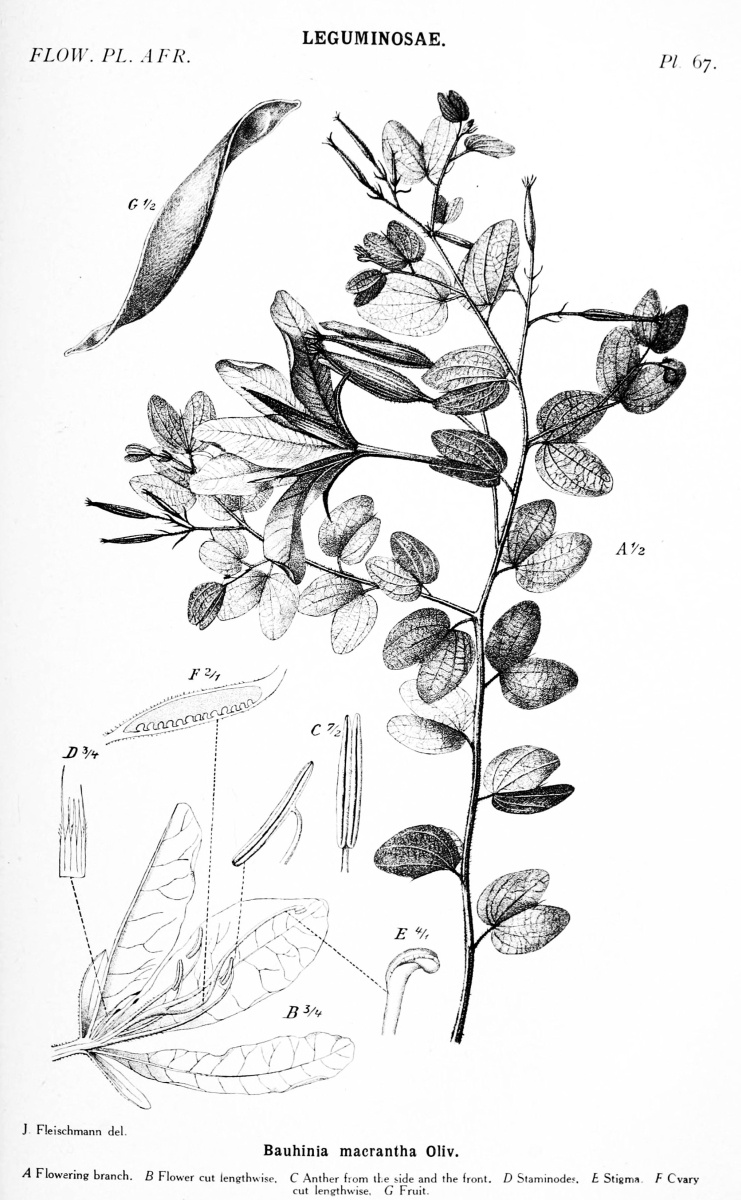
LEGUMINOSAE.
FLOW. PL. AFR.
Pl. 67.
J. Fleischmann del.
Bauhinia macrantha Oliv.
A Flowering branch. B Flower cut lengthwise. C Anther from the side and the front. D Staminodes. E Stigma. F Ovary. cut lengthwise. G Fruit.
GERANIACEAE.
FLOW. PL. AFR.
Pl. 68.
J. Fleischmann del.
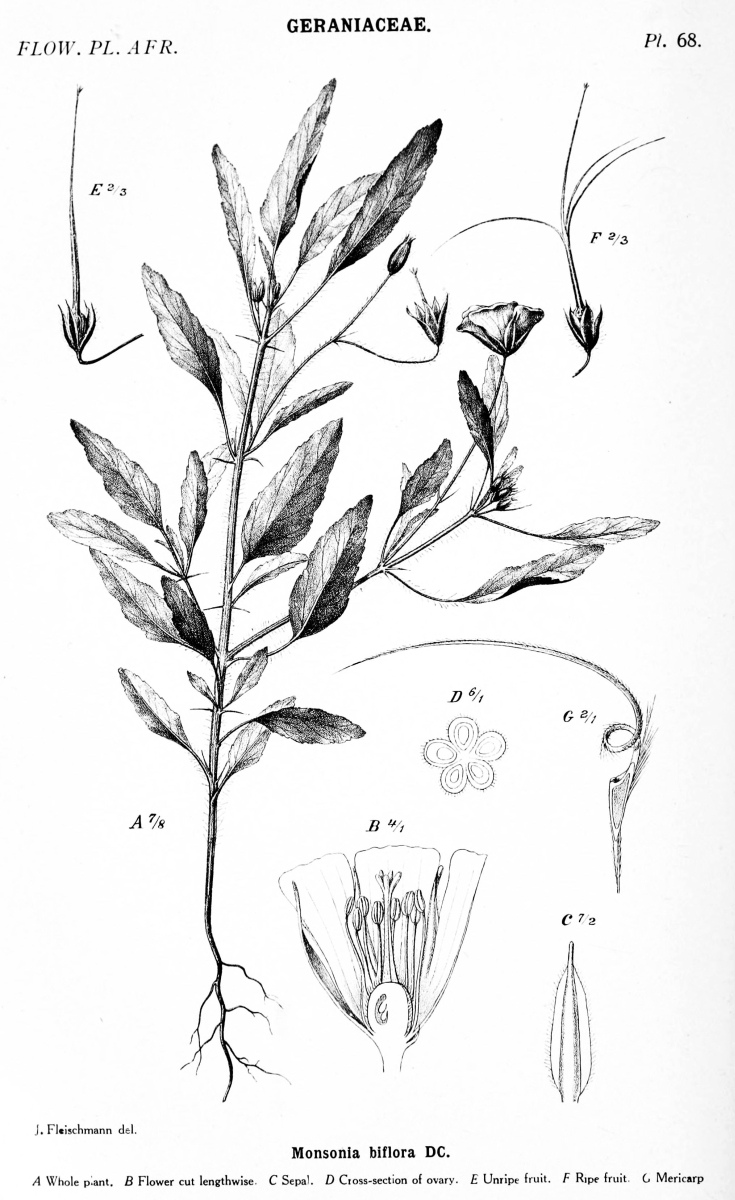
Monsonia biflora DC.
A Whole plant. B Flower cut lengthwise. C Sepal. D Cross-section of ovary. E Unripe fruit. F Ripe fruit. G Mericarp.
Leaflets opposite. Petals not gland-dotted. Fruit more or less leathery and flattened. Inflorescence terminal. (See 356.) Millettia Wight & Arn. 375. Calyx-teeth very short or wanting. Corolla red or white; standard distinctly clawed; petals of the keel free. Ovary stalked. Fruit drupe-like with a woody endocarp and a more or less fleshy exocarp. Seed 1. Inflorescence terminal.—Species 2. West Africa. They yield timber and are used in medicine. (Vouacapoua Aubl.) Andira Lam. Calyx-teeth distinctly developed. Corolla yellow or white, sometimes marked with red or violet. Fruit more or less distinctly winged, with a membranous or leathery pericarp. Leaflets alternate or subopposite. (See 247.) Pterocarpus L.
ORDER PANDALES
FAMILY 106. PANDACEAE
Trees. Leaves alternate. Flowers in fascicled racemes, or in false racemes formed of fascicles, or in panicles, unisexual. Calyx small, slightly toothed. Petals 5, large, oblong, red. Stamens 10. Ovary superior, slightly lobed, 3-4-celled. Ovule 1 in each cell, pendulous, straight. Stigmas 3-4, sessile or nearly so, oblong. Fruit a drupe; stone with many pits and cavities, 3-4-seeded. Seeds with a large axile embryo and an oily albumen.
Genus 1, species 1. Equatorial West Africa. The seeds yield oil. (Porphyranthus Engl.) Panda Pierre
ORDER GERANIALES
SUBORDER GERANIINEAE
FAMILY 107. GERANIACEAE
Herbs, undershrubs, or shrubs. Leaves stipulate. Flowers hermaphrodite. Sepals 5, imbricate, rarely 4, valvate in bud. Petals 2-8, more or less distinctly perigynous, imbricate in bud. Stamens twice or thrice as many as the petals, some frequently sterile, the outer opposite the petals. Anthers opening inwards. Ovary lobed, 5-celled, with 2 ovules in each cell, rarely 8-celled with 1-ovuled cells. Fruit beaked, the carpels separating at maturity. Seeds albuminous.—Genera 6, species 350. (Plate 68.)
1. Sepals 4, valvate in bud. Petals 8, white. Stamens 8, opposite the petals, free. Ovary 8-celled, with 1 ascending ovule in each cell. Tails (awns) of the carpels not recurved at maturity. Shrubs. Flowers solitary, with 4 bracteoles.—Species 1. Island of Socotra. [Tribe DIRACHMEAE.] Dirachma Schweinf. Sepals 5, imbricate in bud. Petals 2-5. Stamens 10 or 15, some frequently sterile. Ovary 5-celled, with 2 ovules in each cell. Tails (awns) of the carpels curved or twisted backwards at maturity. [Tribe GERANIEAE.] 2 2. Flowers irregular, with a spur-like appendage along the pedicel and without glands at the base of the stamens. Fertile stamens 5-7, rarely 2-4.—Species 250. Southern and tropical Africa; two species also naturalized in North Africa. Many of them are used as ornamental plants, some have edible roots or yield perfumes or medicaments. Pelargonium L’Hér. Flowers regular or almost so, without a spur-like appendage, with glands at the base of the stamens. Fertile stamens 5, 10, or 15. 3 3. Stamens 10, all or 5 of them fertile. 4 Stamens 15, all fertile. 5 4. Tails of the carpels spirally twisted, hairy. Fertile stamens 5. Petals entire. Flowers usually in umbels.—Species 40. North Africa to Abyssinia and South Africa. Some are used medicinally; hygrometres are made from the carpel-tails. “Storks-bill.” Erodium L’Hér. Tails of the carpels arched, generally glabrous. Fertile stamens usually 10. Petals mostly notched. Flowers usually solitary or in pairs.—Species 30. North and South Africa and mountains of the tropics. Some species are used as ornamental plants or yield tanning and dyeing materials or medicaments. “Cranes-bill.” Geranium L. 5. Filaments united in 5 bundles. Stem herbaceous.—Species 25. Some are used medicinally. (Plate 68.) Monsonia L. Filaments free almost to the base. Stem fleshy, armed with spines formed from the persistent leafstalks.—Species 7. South Africa, southern Central Africa, and Madagascar. Some species yield an aromatic resin. (Under Monsonia L.) Sarcocaulon DC.
FAMILY 108. OXALIDACEAE
Leaves alternate. Flowers regular, hermaphrodite. Sepals 5. Petals 5, free or united at the base, with contorted aestivation. Stamens 10, rarely 5 of them sterile. Filaments united at the base. Anthers opening inwards. Glands at the base of the stamens present. Ovary superior, 5-celled. Ovules axile. Styles 5, free. Fruit a capsule or a berry. Seeds with a fleshy albumen and a straight embryo.—Genera 3, species 160. (Under GERANIACEAE.) (Plate 69.)
1. Fruit a berry. Trees. Leaves unequally pinnate, sensitive. Flowers in cymes.—Species 2. Cultivated in the Mascarene Islands. They yield timber, medicaments, and edible fruits, which are also used for preparing a scouring water. Averrhoa L. Fruit a capsule. All stamens fertile. Herbs or undershrubs, rarely shrubs. 2
OXALIDACEAE.
FLOW. PL. AFR.
Pl. 69.
J. Fleischmann del.
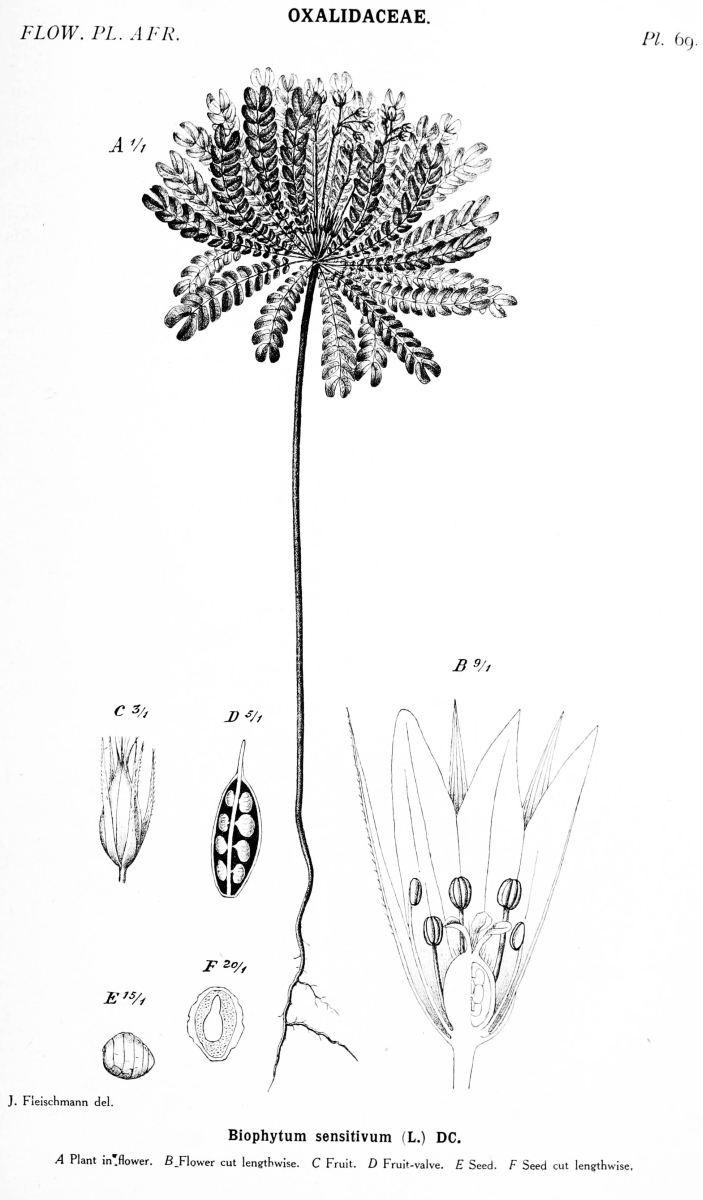
Biophytum sensitivum (L.) DC.
A Plant in flower. B Flower cut lengthwise. C Fruit. D Fruit-valve. E Seed. F Seed cut lengthwise.
LINACEAE.
FLOW. PL. AFR.
Pl. 70.
J. Fleischmann del.
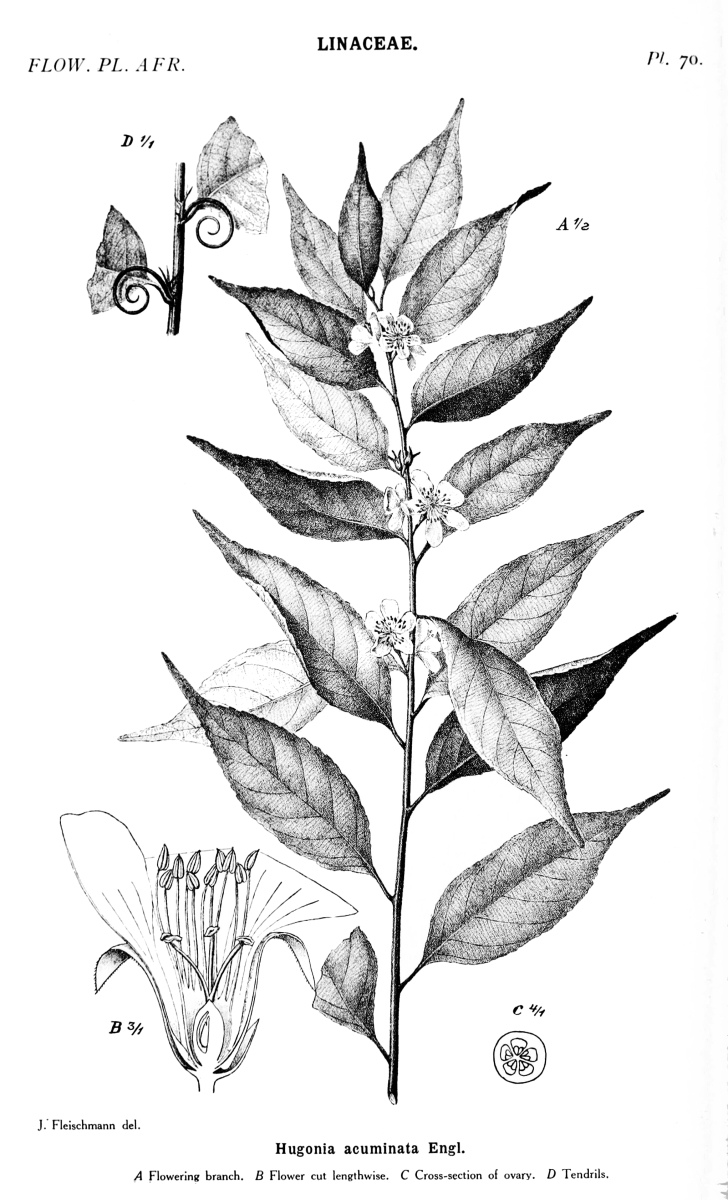
Hugonia acuminata Engl.
A Flowering branch. B Flower cut lengthwise. C Cross-section of ovary. D Tendrils.
2. Valves of the fruit finally spreading. Leaves pinnate, sensitive.—Species 15. Tropics. Some are used medicinally. (Under Oxalis L.) (Plate 69.) Biophytum DC. Valves of the fruit persisting around the central column. Leaves usually digitate.—Species 140. Some are used as salad or fodder or for preparing chemical drugs and medicaments. (Including Bolboxalis Small). Oxalis L.
FAMILY 109. TROPAEOLACEAE
Twining, succulent herbs. Leaves alternate, undivided, peltate. Flowers solitary, axillary, irregular, hermaphrodite. Sepals 5, the hindmost spurred. Petals 5, yellow or red, imbricate in bud. Stamens 8, free; anthers opening inwards or laterally. Ovary superior, 3-celled. Ovule 1 in each cell, pendulous, inverted. Style 1, with 3 stigmas. Fruit separating in 2-3 nutlets. Seeds without albumen. (Under GERANIACEAE.)
Genus 1, species 1 (T. majus L., Indian cress). Naturalized in the Island of St. Helena. Ornamental plant, also yielding salad, condiments, and medicaments. Tropaeolum L.
FAMILY 110. LINACEAE
Leaves undivided. Flowers regular, hermaphrodite. Calyx imbricate in bud. Petals free, with imbricate or contorted aestivation. Stamens as many or twice as many as the petals. Filaments united at the base. Ovary 2-10-celled. Ovules 1-2 in the inner angle of each cell, pendulous, inverted. Fruit a capsule or a drupe. Seeds with fleshy albumen.—Genera 7, species 60. (Plate 70.)
1. Fertile stamens as many as the petals, 4-5, furnished with glands at their base. Styles or style-branches 2-5. Petals deciduous. Fruit capsular. Herbs or undershrubs, very rarely shrubs. [Tribe LINEAE.] 2 Fertile stamens twice as many as the petals, 10, rarely the same number, 5, but then without glands at their base and style simple. Shrubs or trees. [Tribe HUGONIEAE.] 4 2. Sepals 3-toothed at the tip. Petals very small, white. Flowers 4-merous. Stem repeatedly forked. Leaves opposite.—Species 1. North Africa and high mountains of Central Africa. “Alseed.” Radiola Gmel. Sepals entire. Flowers nearly always 5-merous. 3 3. Stipules bristle-like. Corolla yellow. Stamens partly (2-4 of them) with, partly without glands. Styles 3. Stigmas kidney-shaped. Shrubs or undershrubs.—Species 1. Naturalized in the Mascarene Islands. Ornamental plant. (Under Linum L.) Reinwardtia Dumort. Stipules gland-like or wanting. Stamens all furnished with glands.—Species 25. North, East, and South Africa and Madagascar. L. usitatissimum L. is cultivated for fibre and oil and yields also fodder and medicaments; other species are used as ornamental plants. “Flax.” Linum L. 4. Styles 5, free or united at the base. Stamens 10. Petals deciduous. Fruit a drupe.—Species 25. Tropics. Some are used medicinally. (Plate 70.) Hugonia L. Style 1, undivided or 2-3-cleft at the top. 5 5. Style shortly 2-cleft. Ovary 2-celled, with 1 ovule in each cell. Stamens 10. Anthers linear or oblong. Petals elongated, with a glandular pit at the claw.—Species 2. East Africa. Nectaropetalum Engl. Style 3-cleft or undivided. Ovary 3-5-celled. 6 6. Style shortly 3-cleft. Ovary 3-celled with 2 ovules in each cell. Stamens 10. Anthers ovoid or globose. Petals short. Inflorescence racemose, cone-shaped when young, with roundish vaulted bracts.—Species 1. West Africa (Cameroons). Lepidobotrys Engl. Style undivided. Stamens usually 5. Corolla persistent. Fruit capsular. Inflorescence racemose with small bracts, or paniculate.—Species 5. Central Africa. (Under Ochthocosmus Benth.) Phyllocosmus Klotzsch
FAMILY 111. HUMIRIACEAE
Trees. Leaves alternate, undivided. Flowers in cymes or panicles, regular, hermaphrodite. Sepals 5, imbricate in bud. Petals 5, yellow or greenish, imbricate in bud, deciduous. Stamens 10, at first united below, with a prolonged connective and 1-celled anther-halves. Ovary surrounded by a cupular disc, superior, 5-celled. Ovules solitary in each cell, pendulous, inverted. Style simple. Fruit a nut or drupe. Seeds with fleshy albumen.
Genus 1, species 1. West Africa. Yields timber and edible fruits from which a spirituous drink is prepared. (Aubrya Baill., under Humiria Aubl.) Saccoglottis Mart.
FAMILY 112. ERYTHROXYLACEAE
Shrubs or trees, rarely undershrubs. Leaves entire, stipulate. Flowers solitary or in clusters, regular, hermaphrodite, rarely polygamous. Sepals 5, imbricate in bud. Petals 5, free, with a callosity or an appendage on the inner face, imbricate or contorted in aestivation. Stamens 10. Filaments united at the base. Anthers opening by two longitudinal slits. Ovary 3-, rarely 4-celled, usually a single cell fertile. Ovules 1-2, pendulous, inverted. Styles or style-branches 3, rarely 4. Fruit a drupe. Seeds with fleshy albumen, rarely without albumen; embryo straight.—Genera 2, species 40. Tropical and South Africa. (Under LINACEAE.) (Plate 71.)
Petals scarcely clawed, provided with a longitudinal callosity. Filaments united into a ring. Ovary with 3-4 two-ovuled cells. Fruit 3-4-celled. Leaves opposite. Stipules 2.—Species 1. Equatorial West Africa. Aneulophus Benth. Petals distinctly clawed, with a usually 2-cleft scale. Filaments united into a cup. Ovary with 1 fertile one-ovuled cell and 2 empty ones.
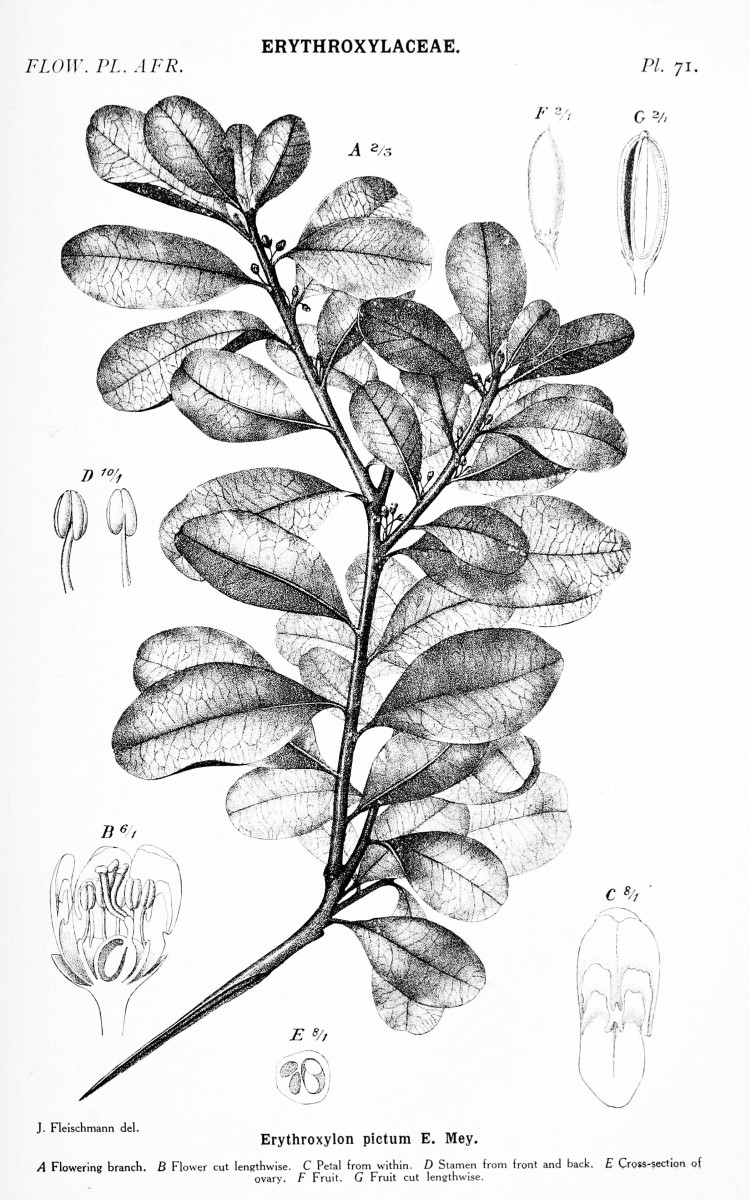
ERYTHROXYLACEAE.
FLOW. PL. AFR.
Pl. 71.
J. Fleischmann del.
Erythroxylon pictum E. Mey.
A Flowering branch. B Flower cut lengthwise. C Petal from within. D Stamen from front and back. E Cross-section of ovary. F Fruit. G Fruit cut lengthwise.
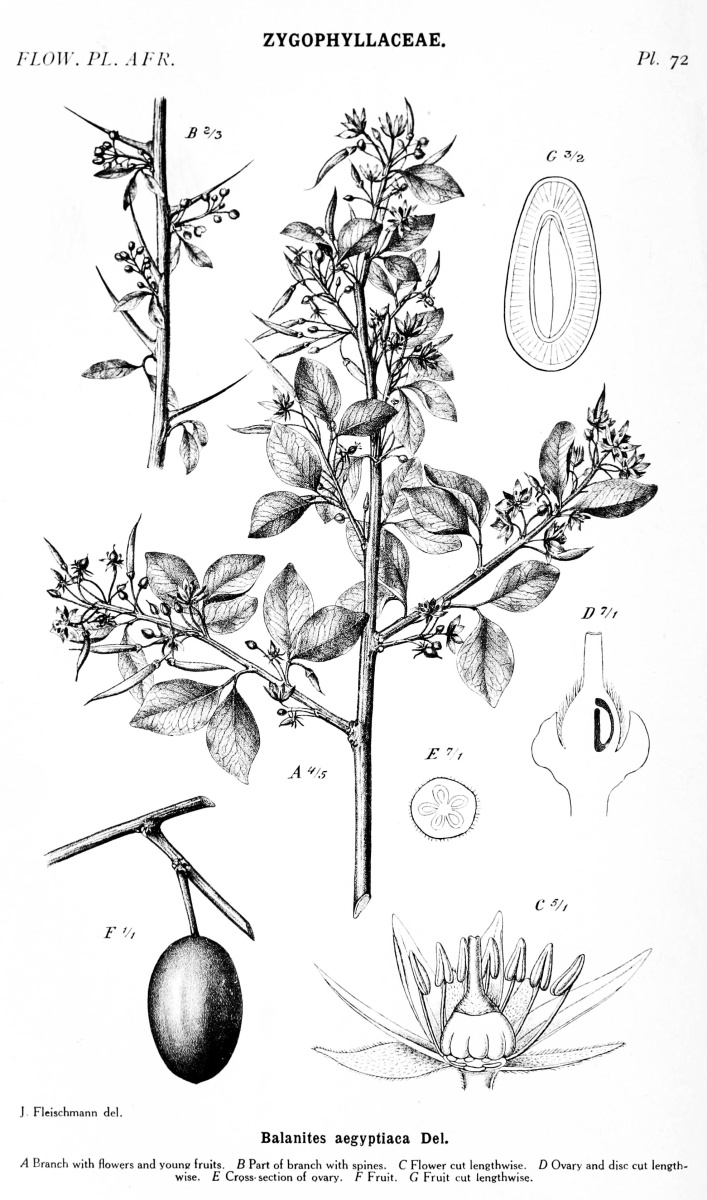
ZYGOPHYLLACEAE.
FLOW. PL. AFR.
Pl. 72.
J. Fleischmann del.
Balanites aegyptiaca Del.
A Branch with flowers and young fruits. B Part of branch with spines. C Flower cut lengthwise. D Ovary and disc cut lengthwise. E Cross-section of ovary. F Fruit. G Fruit cut lengthwise.
Fruit 1-celled. Leaves alternate. Stipule 1.—Species 40. Tropical and South Africa. Some species yield timber or medicaments. (Plate 71.) Erythroxylon P. Browne
FAMILY 113. ZYGOPHYLLACEAE
Leaves stipulate. Flowers regular, hermaphrodite, rarely (Neoluederitzia) dioecious. Petals 4-5, free, rarely wanting. Stamens 1-3 times as many as the petals. Filaments usually with an appendage at the base. Anthers attached by the back. Ovary superior, 3-10-celled, lobed, angled or winged. Style simple, rarely (Seetzenia) styles 5.—Genera 12, species 90. (Plate 72.)
1. Fruit drupaceous, one-seeded. Seeds without albumen. Ovary 3-5-celled with 1 pendulous ovule in each cell. Filaments without an appendage. Corolla yellowish-green. Leaves alternate, simple and undivided or of 2 leaflets. Shrubs or trees. [Subfamilies BALANITOIDEAE and NITRARIOIDEAE.] 2 Fruit capsular or separating into several nutlets, several- or many-seeded. Leaves opposite, at least the lower ones, more rarely all alternate, but then dissected or pinnate with many leaflets. 3 2. Fruit with a very thick endocarp. Ovary 5-celled, surrounded by a cupular disc; ovules attached at the top of the cells. Style rather long; stigma 1. Stamens 10. Petals oblong. Sepals hairy. Leaves with two leaflets. Spiny plants.—Species 3. Central Africa, Sahara, Egypt. They yield timber, fish-poison, vegetables, medicaments, oily seeds, and edible fruits which are also used as a substitute for soap and for preparing a spirituous drink. “Zachun-oil-tree.” (Agialid Adans.) (Plate 72.) Balanites Del. Fruit with a thin endocarp, opening finally by 6 teeth at the top. Ovary 3-celled; ovules attached near the middle of the cells. Style very short; stigmas 3, converging. Stamens usually 15. Petals concave, induplicate-valvate in bud. Sepals fleshy, imbricate in bud. Leaves simple, undivided, fleshy.—Species 2. North Africa and northern Central Africa. They yield soda and edible fruits which are said to be inebriating. “Nitre bush.” Nitraria L. 3. Leaves pinnately dissected or irregularly many-cleft, alternate. Filaments without an appendage. Ovary 3-4-celled with several or many ovules in each cell. Seeds albuminous. Herbs. [Subfamilies TETRADICLIDOIDEAE and PEGANOIDEAE.] 4 Leaves undivided, unifoliolate, digitate, or pinnate, usually opposite. Ovary 4-10-, usually 5-celled. [Subfamily ZYGOPHYLLOIDEAE.] 5 4. Leaves pinnately dissected. Flowers small. Calyx 3-4-toothed. Petals 3-4, obovate. Stamens 3-4. Ovary deeply lobed, the lobes incompletely 3-celled, 6-ovuled.—Species 1. North-east Africa. Tetradiclis Stev. Leaves irregularly many-cleft. Flowers rather large. Sepals 4-5, linear. Petals 4-5, oblong. Stamens 8-15. Ovary slightly lobed, with undivided, many-ovuled cells.—Species 1. North Africa. The seeds are used medicinally, as a condiment, and for dyeing. Peganum L. 5. Leaves unequally pinnate or digitate, rarely unifoliolate; in the latter case disc indistinct and ovules ascending. Filaments without an appendage. Ovary 5-celled with 1-2 ovules in each cell. 6 Leaves equally pinnate or undivided, rarely reduced to the stalk. Disc distinctly developed. Ovules pendulous. 8 6. Leaves alternate, with 4-6 pairs of leaflets. Flowers dioecious. Ovary surrounded by strap-shaped scales. Spiny shrubs.—Species 1. South-west Africa (Namaland). Neoluederitzia Schinz Leaves opposite, with 1 or 3 leaflets. Flowers hermaphrodite. Herbs or undershrubs. 7 7. Calyx valvate in bud. Petals none. Disc 5-lobed. Stamens 5. Ovule 1 in each ovary-cell, pendulous. Styles 5, with capitate stigmas. Prostrate undershrubs. Leaflets 3.—Species 2. South and North-east Africa. Seetzenia R. Br. Calyx imbricate in bud. Petals 5, rose, violet or yellowish. Disc obscure. Stamens 10. Ovules 2 in each ovary-cell, suspended from ascending funicles. Style 1; stigma simple.—Species 15. North Africa, northern Central Africa, and South-west Africa. Some are used medicinally. Fagonia Tourn. 8. Leaves alternate, abruptly pinnate, with 6-8 pairs of leaflets. Flowers large. Sepals saccate at base. Corolla yellow. Disc lobed, with 5 glands projecting into the sacks of the sepals. Stamens 10, unappendaged. Ovary 5-lobed, with 2 ovules in each cell. Shrubs.—Species 1. East Africa (Somaliland). Kelleronia Schinz Leaves opposite, at least the lower ones. 9 9. Ovary 10-celled, with 2 ovules in each cell. Calyx valvate in bud. Petals narrow, 3-cleft. Disc cupular, 10-toothed. Stamens 10, with awl-shaped appendages at the base. Fruit winged. Seeds exalbuminous. Erect, succulent herbs. Leaves undivided, club-shaped.—Species 1. South Africa. Augea Thunb. Ovary 4-5-celled. Calyx imbricate in bud. 10 10. Ovary-cells with one ovule in each. Style long; stigma club-shaped. Disc 5-lobed, with five 3-cleft scales opposite the sepals. Stamens 10, appendaged. Fruit capsular. Seeds exalbuminous. Shrubs.—Species 1. South Africa. Sisyndite E. Mey. Ovary-cells with 2 or more ovules in each. 11 11. Ovary-cells later on transversely chambered, 3-5-ovuled. Style very short, with a large stigma. Disc thin, lobed. Fruit separating into nutlets, bristly or warty, usually with outgrowths. Seeds exalbuminous. Herbs. Flowers cymose, 5-merous.—Species 12. Some of them have edible seeds or serve as ornamental or medicinal plants. Tribulus Tourn. Ovary-cells undivided. Style awl-shaped, with a small stigma. Disc fleshy. Filaments usually appendaged. Fruit capsular. Seeds albuminous. Flowers solitary or in pairs, whitish or yellowish.—Species 55. Some of them yield soda, edible seeds, medicaments, or poison. Zygophyllum L.
FAMILY 114. CNEORACEAE
Shrubs. Leaves alternate, simple, entire, gland-dotted, without stipules. Flowers in cymes, 3-4-merous, hermaphrodite, with an elongated receptacle. Petals free, imbricate in bud. Stamens 3-4, alternating with the petals; filaments without an appendage. Ovary 3-4-lobed, 3-4-celled. Ovules 2 in each cell, one above the other, pendulous, curved. Style simple; stigmas 3. Fruit separating in two 2-celled drupes. Seeds with a curved embryo and fleshy albumen. (Under SIMARUBACEAE.)
Genus 1, species 1. Canary Islands. Used medicinally. (Under Cneorum L.) Chamaelea Tourn.
FAMILY 115. RUTACEAE
Leaves gland-dotted, at least at the margin, rarely (Empleuridium) without dots. Petals free, rarely (Empleurum) wanting. Disc usually present. Anthers versatile, opening inwards or laterally by longitudinal slits. Embryo rather large, the radicle turned upwards.—Genera 33, species 320. (Including AURANTIACEAE and XANTHOXYLEAE.) (Plate 73.)
1. Fruit dehiscent and more or less dry. Carpels, at least when ripe, more or less separate, rarely only one present. [Subfamily RUTOIDEAE.] 2 Fruit indehiscent and more or less fleshy. Carpels usually united, even when ripe, rarely only one present. Shrubs or trees. Leaves compound, but sometimes with a single leaflet. 19 2. Stem herbaceous or woody at the base only. Flowers hermaphrodite. Corolla yellow. Stamens 8-10. Ovules 2, or more frequently more than 2 in each carpel. Seeds albuminous; embryo curved. [Tribe RUTEAE.] 3 Stem woody. Corolla green, white, red, or violet, rarely (Empleurum) wanting. Fertile stamens 3-5, rarely (Pelea) 8-10. Ovules 2 in each carpel. 4 3. Carpels 2, with 5-6 ovules in each. Flowers 4-merous. Petals entire. Seeds spiny. Undershrubs. Leaves undivided or 3-parted.—Species 2. German South-west Africa (Hereroland) and Island of Socotra. Thamnosma Torr. Carpels 4-5. Seeds tubercled.—Species 8. North Africa and northern Central Africa. Some species yield condiments and medicaments. “Rue.” (Including Desmophyllum Webb and Haplophyllum Juss.) Ruta L. 4. Seeds albuminous. Corolla greenish or whitish. Leaves usually compound. [Tribe XANTHOXYLEAE.] 5 Seeds exalbuminous. Corolla white, red, violet, or wanting. Leaves simple, undivided. [Tribe DIOSMEAE.] 7 5. Stamens 8-10. Carpels 4-5. Trees. Leaves alternate, undivided. Flowers polygamous.—Species 1. Madagascar. (Under Melicope Forst.) Pelea A. Gray Stamens 3-5. 6 6. Leaves opposite. Flowers unisexual. Carpels 4-5. Styles united. Seeds oblong. Unarmed plants.—Species 15. Madagascar and neighbouring islands. Some are used medicinally. Evodia Forst. Leaves alternate. Carpels 1-5. Styles free or united above.—Species 30. Tropical and South Africa. Some species yield timber, vegetables, condiments, and medicaments. (Including Pterota P. Br., under Zanthoxylum L.) Fagara L. 7. Carpels 1-2. Fertile stamens 4. Flowers unisexual or polygamous. Shrubs. [Subtribe EMPLEURINAE.] 8 Carpels 4-5. Fertile stamens 5. Flowers hermaphrodite or polygamous. 9 8. Flowers dioecious. Sepals united at the base. Petals 4. Disc 4-lobed. Anthers roundish, without terminal glands. Leaves needle-like, three-edged, without glandular dots.—Species 1. South Africa (Cape Colony). Empleuridium Sond. Flowers polygamous-monoecious. Sepals united beyond the middle. Petals wanting. Disc none. Anthers oblong, with a gland at the top. Ovary beaked. Stigma entire. Leaves linear-lanceolate, flat, glandular-serrate.—Species 1. South Africa (Cape Colony). Used medicinally. Empleurum Soland. 9. Endocarp cartilaginous, adnate at the back and separating from the tubercled exocarp at the margins only. Seeds with thick cotyledons. Ovules one above the other. Ovary with a long and thin stalk. Staminodes linear, glandulose. Trees.—Species 2. East and South Africa. [Subtribe CALODENDRINAE.] Calodendron Thunb. Endocarp separating from the exocarp. Seeds with flat cotyledons. Ovules usually side by side. Shrubs. [Subtribe DIOSMINAE.] 10 10. Staminodes 5. 11 Staminodes none. 15 11. Style long. Stigma small. 12 Style short or rather short. Stigma capitate or discoid. Inflorescences terminal. 13 12. Petals clawed. Stamens with glabrous filaments and gland-tipped anthers. Staminodes petaloid, with hairy claws. Disc crenate or lobed. Carpels 2-4. Flowers in terminal umbels or heads, rarely solitary and axillary.—Species 100. South Africa (Cape Colony). Some are used as ornamental or medicinal plants. (Plate 73.) Agathosma Willd. Petals subsessile, glabrous. Carpels 5. Flowers solitary or in cymes in the axils of the leaves.—Species 20. South Africa (Cape Colony). Some are used medicinally. Barosma Willd. 13. Petals with a very short, glabrous claw. Anthers ending in a stalked gland. Staminodes exceeding the fertile stamens. Disc lobed. Ovary covered with stalked glands. Flowers rather large.—Species 25. South Africa (Cape Colony). Several species are used as ornamental or medicinal plants, or as a substitute for tea. Adenandra Willd. Petals with a long or rather long, usually channelled or bearded claw. Anthers with a sessile gland or without a gland. 14 14. Petals channelled inside, glabrous. Anthers bearing a sessile gland. Staminodes adnate below to the petals or enclosed by their channelled claw. Ovary glabrous. Leaves alternate.—Species 6. South Africa (Cape Colony). Some are used as ornamental or medicinal plants. Coleonema Bartl. & Wendl. Petals not channelled, usually with a hairy claw. Stamens short. Staminodes very small.—Species 15. South Africa (Cape Colony). Acmadenia Bartl. & Wendl. 15. Style long. Stigma small. Petals with a hairy claw. 16 Style short or rather short. Stigma capitate. Filaments glabrous. 17 16. Disc 5-parted. Filaments and style hairy. Carpels 5. Flowers solitary or in clusters, white.—Species 1. South Africa (Cape Colony). Phyllosma Bolus Disc entire, urn-shaped. Filaments glabrous. Carpels 3-5.—Species 10. South Africa (Cape Colony). Macrostylis Bartl. & Wendl. 17. Petals sessile, obovate, glabrous.—Species 15. South Africa (Cape Colony). Some are used medicinally. Diosma L. Petals clawed, hairy within. 18 18. Petals oblong or lanceolate, slightly exceeding the calyx. Anthers with a terminal gland. Flowers very small.—Species 6. South Africa (Cape Colony). Euchaetis Bartl. & Wendl. Petals obovate. (See 14.) Acmadenia Bartl. & Wendl. 19. (1.) Fruit a drupe. Flowers usually unisexual. Stigma sessile or nearly so. [Subfamily TODDALIOIDEAE, tribe TODDALIEAE.] 20 Fruit a berry. Flowers usually hermaphrodite. [Subfamily AURANTIOIDEAE, tribe AURANTIEAE.] 27 20. Fruit 1-celled. Seed 1, exalbuminous. Ovary 1-celled. Petals imbricate in bud. Leaflets 1-3. [Subtribe AMYRIDINAE.] 21 Fruit 2-7-celled or consisting of 2-4 carpels cohering at the base only, 1-3 of them sometimes abortive. Ovary 2-7-celled. 22 21. Flowers hermaphrodite. Fertile stamens 10. Disc cup-shaped. Style long, with a minute stigma. Ovule 1.—Species 1. Equatorial West Africa (Cameroons). Eriander H. Winkl. Flowers dioecious. Fertile stamens 4-5. Disc ring-shaped. Style short, with a broad stigma. Ovules 2.—Species 18. Tropical and South Africa. (Under Toddalia Juss.) Teclea Del. 22. Carpels almost free when ripe, some of them rudimentary. Seeds exalbuminous. Ovary distinctly 2-4-lobed. Stamens 4. Petals valvate in bud. Leaves digitate. [Subtribe ORICIINAE.] 23 Carpels united up to maturity, forming a 2-7-celled fruit. Ovary not or obscurely lobed. Petals imbricate in bud. [Subtribe TODDALIINAE.] 24 23. Carpels 2, one of them rudimentary at maturity. Seeds with equal cotyledons. Ovary almost glabrous. Petals oblong. Flowers in racemes.—Species 1. Equatorial West Africa (Gaboon). Diphasia Pierre Carpels 4, of which 1-3 are rudimentary at maturity. Seeds with unequal cotyledons. Ovary very hairy. Petals oval. Flowers in panicles, unisexual.—Species 4. West Africa. Oricia Pierre 24. Fruit with 2-seeded cells. Seeds albuminous. Flowers 4-merous. Trees. Leaves digitate, with 5 leaflets.—Species 1. Equatorial West Africa (Gaboon). Araliopsis Engl. Fruit with 1-seeded cells. Flowers unisexual. Leaves digitate with 3 leaflets, rarely pinnate with 7-9 leaflets. 25 25. Fertile stamens as many as the petals. Flowers 5-merous. Seeds albuminous; embryo curved. Climbing shrubs. Leaves digitate.—Species 1. Tropics. Yields condiments and is used in medicine. (Cranzia Schreb.) Toddalia Juss. Fertile stamens twice as many as the petals. Flowers 2-4-merous. Embryo straight or almost so. 26 26. Filaments awl-shaped. Flowers 4-merous. Seeds exalbuminous. Shrubs. Leaves digitate.—Species 1. East Africa. Toddaliopsis Engl. Filaments flattened. Seeds albuminous.—Species 30. Tropical and South Africa. Some species yield timber and medicaments. (Under Toddalia Juss.) Vepris Comm. 27. (19.) Ovary 2-5-celled, with 1-2 ovules in each cell. Stamens twice as many as the petals. [Subtribe LIMONIINAE.] 28 Ovary 5- or more-celled, with 4 or more ovules in each cell. Leaves with 1-3 leaflets. [Subtribe CITRINAE.] 32 28. Ovules solitary in each ovary-cell. 29 Ovules two or more in each ovary-cell. Unarmed plants. 30 29. Flowers solitary or in groups of three in the axils of the leaves, 3-, rarely 4-merous. Calyx toothed. Seeds usually with unequal and lobed cotyledons. Spiny shrubs. Leaflets 3, unequal.—Species 1. Cultivated in the tropics. Yields timber, fragrant flowers, and edible fruits. Triphasia Lour. Flowers in racemes or panicles, 4-5-merous. Calyx lobed or more deeply divided. Leafstalk winged.—Species 10. Tropics. They yield timber, edible fruits, oily seeds, and medicaments. Limonia L. 30. Style very short, not jointed with the ovary. Leaves unifoliolate.—Species 1. West Africa. Glycosmis Correa Style long or rather short, jointed with the ovary. Leaves unequally pinnate. 31
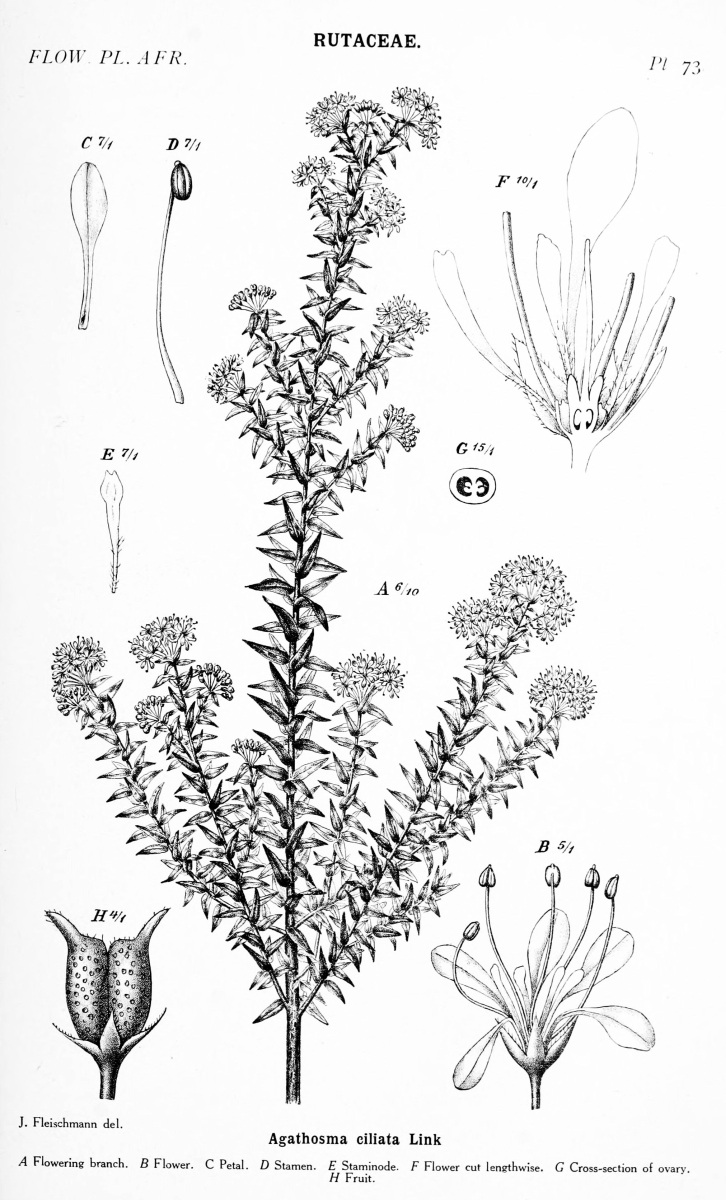
RUTACEAE.
FLOW. PL. AFR.
Pl. 73.
J. Fleischmann del.
Agathosma ciliata Link
A Flowering branch. B Flower. C Petal. D Stamen. E Staminode. F Flower cut lengthwise. G Cross-section of ovary. H Fruit.
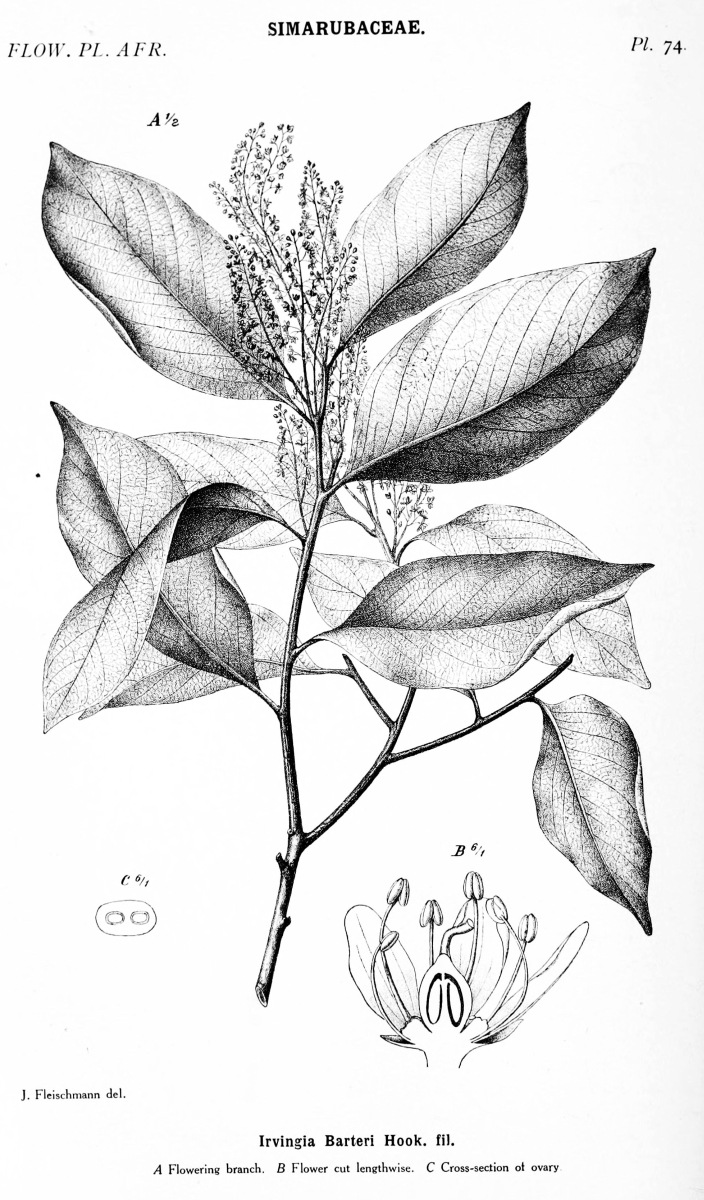
SIMARUBACEAE.
FLOW. PL. AFR.
Pl. 74.
J. Fleischmann del.
Irvingia Barteri Hook. fil.
A Flowering branch. B Flower cut lengthwise. C Cross-section of ovary.
31. Filaments awl-shaped. Petals 5, linear lanceolate or oblong. Flowers rather large.—Species 1. Cultivated and naturalized in the tropics. Yields timber, fragrant flowers, and medicaments. Murraya L. Filaments broadened below. Petals 4-5, elliptical or roundish. Flowers rather small.—Species 6. Central and South Africa. Some are used medicinally. (Including Myaris Presl). Clausena Burm. 32. Ovary with 4-8 ovules in each cell. Anthers oblong. Pericarp leathery. Seed-coat white, leathery. Leaves leathery.—Species 4. Cultivated; also naturalized in the tropics. They serve as ornamental plants and afford wood, fragrant flowers, and edible fruits (especially oranges and citrons) from which drinks, medicaments, and perfumes are prepared. Citrus L. Ovary with numerous ovules in each cell. Anthers linear. Pericarp hard. Leaves with 3 leaflets. 33 33. Stamens 10. Seed-coat smooth. Leaves leathery.—Species 1. Region of the great lakes. Balsamocitrus Stapf Stamens numerous. Seed-coat woolly and sticky. Leaves herbaceous.—Species 1. West Africa. Yields timber and is used in medicine. Aegle Correa
FAMILY 116. SIMARUBACEAE
Shrubs or trees. Leaves simple or pinnate, not gland-dotted. Flowers in spikes racemes or panicles, regular. Sepals 2-5. Petals 3-9, free. Disc usually present. Anthers versatile, opening inwards by longitudinal slits. Carpels free or united and then forming a several-celled ovary. Ovules 1-2, pendulous or laterally attached. Seeds with a very thin albumen or without albumen.—Genera 16, species 40. Tropical and South Africa. (Under RUTACEAE.) (Plate 74.)
1. Carpels 5, free, 2-ovuled. Disc indistinct. Stamens 5-10, without an appendage. Corolla yellow. Fruit drupe-like. Embryo curved, with a large radicle. Shrubs. Leaves undivided.—Species 1. Tropics. [Subfamily SURIANOIDEAE.] Suriana L. Carpels united at least by the base or the apex of the style, 1-ovuled. Disc distinctly developed. Embryo with a very short radicle. [Subfamily SIMARUBOIDEAE.] 2 2. Filaments with a scale-like appendage at the base. [Tribe SIMARUBEAE.] 3 Filaments without a scale at the base. 9 3. Stamens 6-14, twice as many as the petals. Anthers oblong or oval. 4 Stamens 15-18, thrice as many as the petals or more. Anthers linear. Ovaries 5. Style 1. Corolla red. Trees. Leaves pinnate. [Subtribe MANNIINAE.] 8 4. Ovaries and style-tips united. Fruit a drupe with 4-5 stones. Embryo curved. Shrubs. Leaves compound.—Species 2. Central Africa. [Subtribe HARRISONIINAE.] Harrisonia (R.Br.) Juss. Ovaries free. Styles united. Fruit consisting of 1-5 nuts or drupes. [Subtribe SIMARUBINAE.] 5 5. Leaves undivided. Flowers in umbels. Calyx 3-5-lobed, imbricate in bud. Petals with contorted aestivation. Filaments with a minute scale at the base. Style long; stigma small, entire. Fruits woody. Trees.—Species 2. Madagascar. Used medicinally. Samadera Gaertn. Leaves pinnate. Flowers in racemes or panicles. 6 6. Calyx 5-parted, imbricate in bud. Petals 5, with contorted aestivation. Filaments with a short scale. Style long; stigma slightly 5-lobed. Leaflets lanceolate, acuminate.—Species 1. West Africa. Yields arrow-poison and is used in medicine. Quassia L. Calyx 2-4-lobed or -cleft. Petals with imbricate aestivation. Filaments with a long scale. Style short. Flowers in panicles. 7 7. Calyx 4-, rarely 5-lobed. Petals 4, rarely 5. Fruits woody. Leaflets oblong or obovate.—Species 3. Equatorial regions. The seeds yield a fat. (Under Quassia L.) Odyendea (Pierre) Engl. Calyx at first closed, later on unequally 2-4-cleft. Petals 5, rarely 6-9. Stigma 5-parted. Fruits drupe-like.—Species 4. Central Africa. They yield timber, oily seeds, and medicaments. Hannoa Planch. 8. Calyx shortly lobed. Anthers shorter than the filaments. Ovaries united below. Leaflets with a spoon-shaped appendage at the tip.—Species 1. West Africa (Cameroons). Pierreodendron Engl. Calyx deeply divided. Anthers longer than the filaments. Ovaries free. Leaflets with an awl-shaped appendage at the tip.—Species 1. West Africa. Mannia Hook. fil. 9. (2.) Stamens 4-6. Carpels free, either as to the ovaries or as to the styles. Flowers usually polygamous. 10 Stamens 8-10. Fruit drupe-like. Trees. 12 10. Sepals 3. Petals 3. Stamens 6. Carpels 2, united at the base. Stigma subsessile, discoid. Fruit 2-celled, winged. Leaves undivided.—Species 1. Seychelles. [Tribe SOULAMEEAE.] Soulamea Lam. Sepals, petals, stamens, and carpels 4. Stigma small. Leaves pinnate. 11 11. Ovaries and styles free or united at the base only. Petals short. Fruit consisting of 4 drupes. Rusty-hairy plants.—Species 5. Central Africa. Used medicinally. [Tribe PICRASMEAE.] Brucea J. S. Muell. Ovaries united; styles free. Petals long. Fruit separating into 4 leathery mericarps suspended from a central column.—Species 5. Central Africa. [Tribe KIRKIEAE.] Kirkia Oliv. 12. Carpels free for the greater part. Leaves pinnate.—Species 1. Madagascar. Poisonous. Perriera Courchet Carpels wholly united. Leaves undivided. Flowers hermaphrodite. 13 13. Stigma 2-parted. Ovary 2-celled. Disc ring-shaped, lobed. Anthers oblong. Flowers solitary or in clusters in the axils of the leaves.—Species 1. South Africa. (Under Nectaropetalum Engl.) Peglera Bolus Stigma entire. Disc cushion-shaped. Anthers ovate. Flowers in panicles. [Tribe IRVINGIEAE.] 14 14. Ovary 4-5-celled. Fruit broader than long, angled, 4-5-celled, with a thin fleshy layer.—Species 3. Equatorial West Africa. Klainedoxa Pierre Ovary 2-celled. Fruit oblong, 1-2-celled. 15 15. Fruit much compressed, broadly winged all round, 2-celled, 2-seeded, with a thin fleshy layer.—Species 2. Equatorial West Africa. (Under Irvingia Hook. fil.) Desbordesia Pierre Fruit slightly compressed, not winged, 1-celled, 1-seeded, with a thick fleshy layer.—Species 5. Central Africa. They yield timber, edible fruits, and oily seeds (dika). (Including Irvingella van Tiegh.) (Plate 74.) Irvingia Hook. fil.
FAMILY 117. BURSERACEAE
Trees, rarely shrubs. Bark resinous. Leaves usually pinnate. Flowers panicled, regular, mostly polygamous. Perianth consisting of a calyx and a corolla of 3-5 free petals. Stamens twice as many as the petals, inserted on the margin or the outside of the disc, rarely within. Anthers versatile, opening inwards by longitudinal slits. Ovary 2-5-celled. Ovules 2 in each cell, pendulous or attached laterally. Style simple or wanting; stigma lobed. Fruit drupe-like, but sometimes dehiscent. Seeds exalbuminous. Embryo with a superior radicle and usually folded or twisted cotyledons.—Genera 7, species 160. Tropical and South Africa. (Under TEREBINTHACEAE). (Plate 75.)
1. Receptacle concave; tube-, cup-, or urn-shaped; sepals, petals, and stamens inserted at its upper rim. Sepals 4 and petals 4, valvate in bud. Ovary 2-3-celled. Fruit drupaceous, but dehiscent, with a 2-3-celled stone; one cell only fertile.—Species 110. Tropical and South Africa. Several species yield timber and odorous resins (especially myrrh) which are used for preparing varnish, incense, and medicines. Some are also used as hedge plants. (Balsamea Gled., Balsamodendron Kunth. including Hemprichia Ehrenb. and Hitzeria Klotzsch). Commiphora Jacq. Receptacle flat or convex, usually bearing a free disc, outside of which the sepals and petals are inserted. Leaves pinnate. Trees. 2 2. Flowers 3-merous. Petals valvate in bud. Fruit with a 2-3-celled stone, indehiscent, sometimes only one cell fertile. 3 Flowers 4-5-merous. Fruit with 2-5 stones. 5 3. Fruit depressed, obliquely hemispherical, broader than long, with a lateral style and 1-2 fertile cells; endocarp thin, mesocarp rather thick. Embryo with a short radicle and thick, pinnately divided cotyledons. Stamens inserted outside the thick disc. Ovary 3-celled; one cell sterile.—Species 6. Equatorial West Africa. They yield timber, edible fruits, and medicaments. (Under Pachylobus Don or Santiria Blume) Santiriopsis Engl. Fruit oblong, ovate, or subglobose. 4 4. Fruit with 2 cells, one of which is sterile, and with a terminal style or style-scar; endocarp thin crusty, mesocarp thick fleshy. Embryo with a long radicle and thick, much divided cotyledons. Ovary 2-celled. Sepals united at the base.—Species 13. West Africa. They yield timber, resin, and edible oily fruits (safu). (Under Canarium L.) (Plate 75.) Pachylobus Don Fruit with 3 cells, two of them sometimes sterile; endocarp usually thick, woody or bony; mesocarp usually thin. Embryo with a short radicle and slightly divided cotyledons. Ovary 3-celled. Sepals united high up.—Species 13. Tropics. Some species yield timber, resin (elemi) used in medicine and manufacture, and edible oily fruits and seeds. Canarium L. 5. Disc situated outside the stamens. Petals 5, imbricate in bud. Ovary 5-celled. Fruit top-shaped, with 5 stones, dehiscent.—Species 1. Equatorial West Africa. Yields timber and an aromatic resin. Aucoumea Pierre Disc situated inside the stamens. 6 6. Petals 4-5, valvate in bud. Ovary 4-5-celled. Fruit globular or ovoid. Species 4. Madagascar and Mascarenes. They yield timber and resin. (Marignia Comm.) Protium Burm. Petals 5, imbricate in bud. Ovary 2-3-celled. Fruit with 2-3 stones, dehiscent. Flowers hermaphrodite.—Species 15. Central Africa. The resin of several species (frankincense) is used as an incense and in medicine. Boswellia Roxb.
FAMILY 118. MELIACEAE
Trees or shrubs. Leaves without stipules, usually pinnate. Flowers regular, mostly panicled. Petals 3-6, usually free. Stamens as many or more frequently twice as many as the petals. Filaments usually united. Anthers 2-celled, opening inwards or laterally by longitudinal slits. Ovary superior, usually 2-or more-celled. Ovules inverted. Style simple or wanting; stigma entire or lobed.—Genera 23, species 150. (Including AITONIEAE, CEDRELEAE, and PTAEROXYLEAE.) (Plate 76.)
1. Filaments free. Ovule 1 in each ovary-cell. Seeds winged. Leaves pinnate. [Subfamily CEDRELOIDEAE] 2 Filaments more or less united into a tube. 3 2. Ovary and fruit 2-celled. Petals 4. Stamens 4.—Species 2. South and East Africa. They yield timber (sneezewood). Ptaeroxylon Eckl. & Zeyh. Ovary and fruit 5-celled.—Species 1. Madagascar. Cedrelopsis Baill.
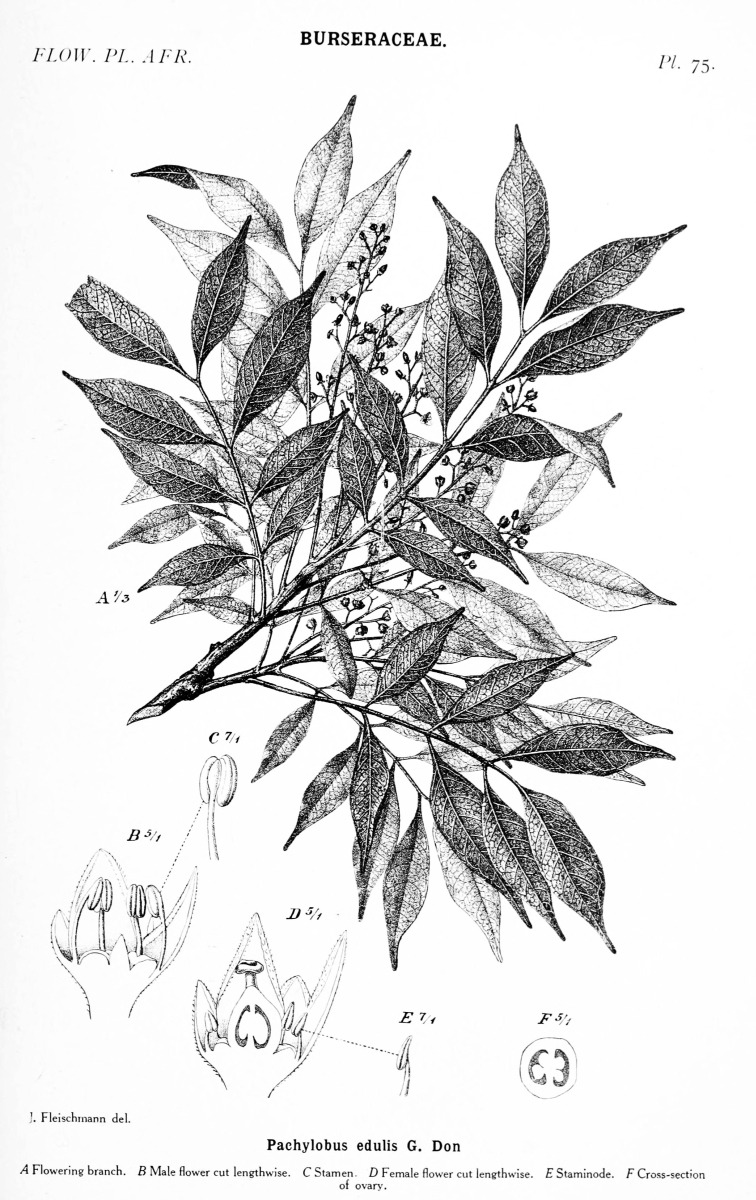
BURSERACEAE.
FLOW. PL. AFR.
Pl. 75.
J. Fleischmann del.
Pachylobus edulis G. Don
A Flowering branch. B Male flower cut lengthwise. C Stamen. D Female flower cut lengthwise. E Staminode. F Cross-section of ovary.
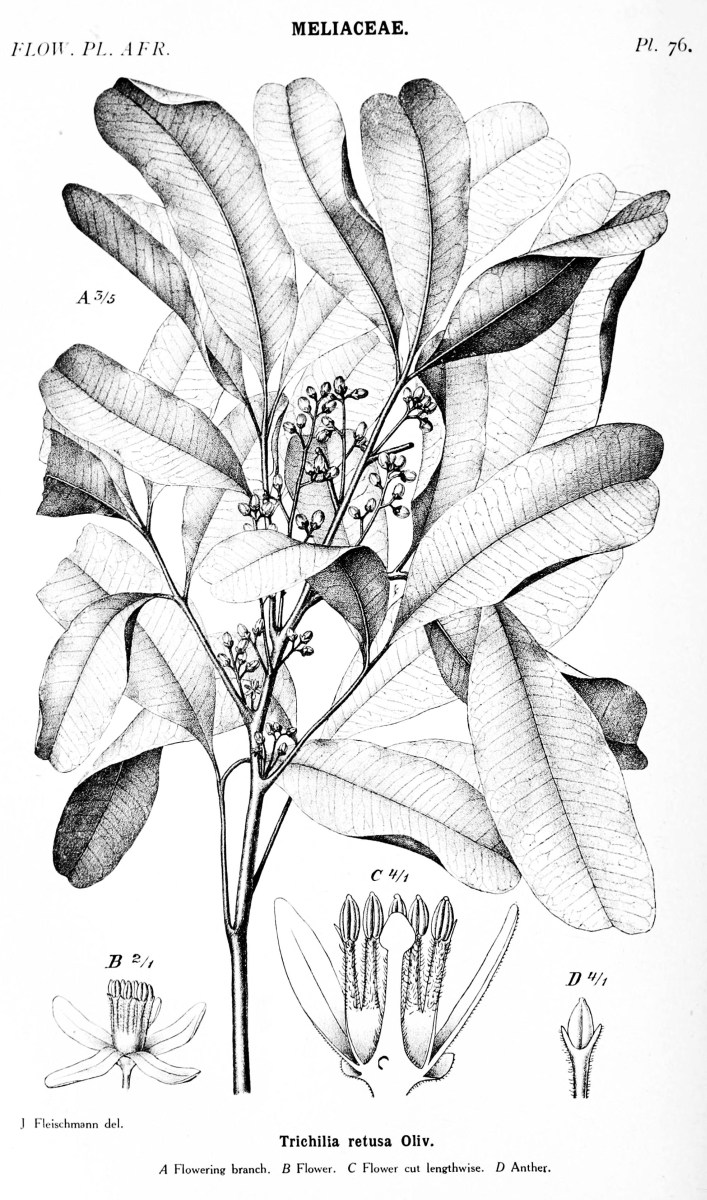
MELIACEAE.
FLOW. PL. AFR.
Pl. 76.
J. Fleischmann del.
Trichilia retusa Oliv.
A Flowering branch. B Flower. C Flower cut lengthwise. D Anther.
3. Seeds winged. Ovules 4 or more, rarely 2 in each ovary-cell. Stamens 8-10. [Subfamily SWIETENIOIDEAE.] 4 Seeds not winged. Ovules 1-2, rarely 3-8 in each ovary-cell or on each placenta. [Subfamily MELIOIDEAE.] 9 4. Ovules 2 in each ovary-cell. Ovary 5-celled. Stigma small. Disc wanting. Anthers 10, seated between the teeth of the staminal tube. Leaves whorled, undivided. Flowers in panicles.—Species 2. West Africa. Pynaertia De Wild. Ovules 4 or more in each ovary-cell. Leaves pinnate. 5 5. Ovules 4 in each ovary-cell. Disc shortly stalk-shaped. Staminal tube campanulate, the mouth crenate and with short teeth bearing the anthers. Petals imbricate in bud.—Species 7. Central Africa. Lovoa Harms Ovules 6 or more in each ovary-cell. 6 6. Ovules 6 in each ovary-cell. Ovary sessile. Disc none. Staminal tube entire at the mouth, or with short teeth bearing the anthers. Petals with imbricate aestivation. Flowers 5-merous.—Species 2. Southern West Africa. Wulfhorstia C. DC. Ovules 12 or more in each ovary-cell. Petals with contorted aestivation. 7 7. Disc shortly stalk-shaped, connected with the staminal tube by longitudinal ridges. Seeds winged below. Leaflets entire.—Species 15. Central Africa. They yield timber, gum, and a dye-stuff. (Including Leioptyx Pierre, under Swietenia L.) Entandophragma C. DC. Disc cup- or cushion-shaped, not connected with the staminal tube by longitudinal ridges. 8 8. Disc cup-shaped. Fruit oblong. Seeds about 5 in each cell of the fruit, winged below.—Species 1. Central Africa. Yields timber and gum. (Under Cedrela L.) Pseudocedrela Harms Disc cushion-shaped. Flowers 4-merous. Fruit globose. Seeds numerous in each cell, winged all round.—Species 7. Tropics. They yield timber (African mahogany), tanning bark, gum, and medicaments. Khaya Juss. 9. (3.) Ovules more than 2 in each ovary-cell. Ovary 4-5-celled. Anthers 8-10, inserted between the lobes of the staminal tube. Seeds large, pyramidal; seed-coat woody or corky. 10 Ovules 1-2 in each ovary-cell or on each placenta. Seeds small or medium-sized; testa crustaceous, leathery, parchment-like, or membranous. 11 10. Flowers 4-merous. Staminal tube with 2-toothed lobes. Seed-coat corky or spongy. Radicle of the embryo lateral. Leaves pinnate, with 1-3 pairs of leaflets, or simple. Panicles rather small, lax, few-flowered.—Species 3. Tropics. They yield timber, tanning bark, and oily seeds. (Under Carapa Aubl.) Xylocarpus Koen. Flowers 5-merous. Staminal tube with entire lobes. Ovules 6-8 to each ovary-cell. Seed-coat woody. Radicle superior. Leaves pinnate, with many pairs of leaflets. Panicles very large, many-flowered.—Species 4. Tropics. They yield timber, oily seeds, and medicaments. Carapa Aubl. 11. Ovary 2-3-celled, rarely 1-celled with 2-3 placentas. Stamens 6-12. 12 Ovary 4-20-celled, rarely later on 1-celled with 4-5 placentas. 19 12. Anthers inserted below the mouth of the staminal tube, entirely or almost included. Disc stalk-like or wanting. Seeds exalbuminous. Leaflets 6-25. 13 Anthers inserted at the upper edge of the staminal tube, or at the top of its lobes, or in the notches between them. 14 13. Leaflets serrate. Flowers 5-merous. Anthers inserted at the base of the lobes of the staminal tube. Disc none. Ovary septate. Stigma 2-3-parted. Fruit a 1-seeded drupe. Radicle of the embryo exserted.—Species 1. East Africa. Yields timber, oily seeds, and medicaments. (Under Melia L.) Azadirachta Juss. Leaflets entire. Stigma discoid. Fruit a 2- or more-seeded capsule or berry. Radicle included.—Species 7. West Africa. Yield timber. (Including Bingeria A. Chev. and Heckeldora Pierre). Guarea L. 14. Filaments united at the base only, 2-toothed at the top; anthers inserted between the teeth. Petals 5, valvate in bud. Fruit a berry or drupe. Seeds albuminous. Leaves 3-foliolate.—Species 2. Madagascar and Comoro Islands. Cipadessa Blume Filaments united high up, rarely (Trichilia) at the base only, but then fruit a capsule and seeds exalbuminous. 15 15. Ovary 1-celled, adnate to the staminal tube. Stigma sessile. Anthers inserted at the rim of the almost entire staminal tube. Disc stalk-like. Flowers 4-merous. Leaflets usually 5.—Species 1. Madagascar. Symphytosiphon Harms Ovary 2-3-celled. 16 16. Flowers solitary, axillary, rarely in spikes. Anthers 10, inserted at the tips of the teeth of the staminal tube. Disc ring-shaped. Style long. Fruit capsular, subglobose. Seeds with 3 narrow wings and with fleshy albumen. Small shrubs. Leaves with a narrowly winged stalk and 3 woolly leaflets.—Species 1. Southern West Africa (Angola). Used medicinally. (Nelanaregam Adans.) Naregamia Wight & Arn. Flowers in panicles, rarely in racemes. Leaves with 5 or more leaflets, rarely with 3, but then seeds exalbuminous. 17 17. Leaflets 5-7, toothed, clothed with stellate hairs; leafstalk winged. Anthers 10, inserted between the lobes of the staminal tube, which are divided in filiform segments. Disc ring-shaped. Style short.—Species 1. West Africa (Cameroons). The bark is eaten and used medicinally. Pterorhachis Harms Leaflets entire, very rarely toothed, but then anthers 8, inserted at the entire mouth of the staminal tube. Seeds exalbuminous. 18 18. Fruit a berry or a drupe. Seed-coat crustaceous. Staminal tube entire or shortly toothed.—Species 15. Tropical and South Africa. Some of them yield timber, tanners’ bark, and medicaments. (Including Charia C. DC.) Ekebergia Sparm. Fruit a capsule with a leathery rind. Seed-coat thin-leathery. Staminal tube usually more or less deeply divided.—Species 35. Tropical and South Africa. Some of them yield timber, dyes, oily seeds, and medicaments. (Plate 76.) Trichilia L. 19. (11.) Leaves simple, undivided. Flowers solitary or in cymes or racemes. Fruit capsular. Seeds albuminous. 20 Leaves pinnate. Flowers in panicles, racemes, or cymes. Stamens united high up. 21 20. Stamens united at the base only, 8. Disc cup-shaped. Stigma small. Flowers solitary.—Species 1. South Africa. (Aitonia Thunb., Carruthia O. Ktze.) Nymania Lindb. Stamens united high up, 8-10. Disc ring-shaped or absent. Stigma usually thick.—Species 50. Tropical and South Africa. Some are used medicinally. (Including Calodryum Desv., Grevellina Baill., and Quivisia Comm.) Tourraea L. 21. Leaves twice pinnate, with usually serrate leaflets. Anthers 10-12, inserted between the teeth of the staminal tube. Fruit a drupe. Seeds with scanty albumen.—Species 4, two natives of Central Africa, the others (especially M. Azederach L., beadtree or Persian lilac) cultivated as ornamental plants and sometimes naturalized. They yield timber, gum, oil, and medicaments, and are also used for the preparation of liquors. The fruits are poisonous. Melia L. Leaves once pinnate, with entire leaflets. Seeds exalbuminous. 22 22. Leaves equally pinnate. Anthers 5 or 8. 23 Leaves unequally pinnate. Anthers 8 or 10. 24 23. Leaflets 2-6. Flowers 4-merous. Petals with contorted aestivation. Anthers 8, inserted below the notches between the lobes of the staminal tube. (See 10.) Xylocarpus Koen. Leaflets 10-16. Flowers 5-merous. Petals with valvate aestivation. Anthers 5, inserted at the rim of the nearly entire staminal tube.—Species 1. Madagascar. Quivisianthe Baill. 24. Anthers inserted at the upper margin of the staminal tube or at the top of its teeth. Disc ring- or cup-shaped. Style short, with a lobed stigma. Leaflets opposite. (See 18.) Ekebergia Sparm. Anthers inserted below the mouth of the staminal tube, included. Leaflets usually alternate. 25 25. Petals united high up and adnate to the staminal tube, valvate in bud. Ovary at first 4-5-celled, with 2 ovules in each cell, later 1-celled.—Species 4. West Africa. Turraeanthus Baill. Petals free, or united at the base only. 2 26. Ovary 4-celled, with 1 ovule in each cell. (See 13.) Guarea L. Ovary 4-5-celled, with 2 ovules in each cell. (See 10.) Carapa Aubl.
SUBORDER MALPIGHIINEAE
FAMILY 119. MALPIGHIACEAE
Shrubs or undershrubs, with branched hairs, usually climbing. Leaves undivided, usually stipulate. Flowers in racemose inflorescences, bracteolate. Sepals 3-5, free or united at the base, mostly furnished with glands on the outside. Petals 5, free, imbricate in bud, usually clawed and toothed. Stamens usually 10, hypogynous. Filaments free or united at the base. Anthers opening inwards by two longitudinal slits. Ovary 2-3-celled, with 1 pendulous and inverted ovule in each cell. Styles 1-3. Fruit usually separating into 3 mericarps. Seeds exalbuminous.—Genera 16, species 80. Tropical and South Africa. (Plate 77.)
1. Fruiting receptacle flat. Mericarps not winged. Calyx without glands. Petals clawed, almost entire. Stamens 10. Leaves stipulate. Flowers in terminal racemes. 2 Fruiting receptacle pyramidal. Mericarps winged. 3 2. Fruit covered with short hairs, dehiscent. Petals equal. Anthers glabrous. Ovary covered with short hairs. Styles free, long and thin, with small stigmas. Leaves opposite.—Species 1. Madagascar. [Tribe GALPHIMIEAE.] Galphimia Cav. Fruit covered with long, soft, hairy, spine-shaped processes. Petals unequal. Anthers hairy. Ovary clothed with long hairs. Styles converging, rather short and thick, with oval reflexed stigmas. Leaves alternate or subopposite.—Species 1. Madagascar. [Tribe TRICOMARIEAE.] Echinopteris Juss. 3. Mericarps with a large dorsal wing, without a lateral wing. Petals more or less distinctly clawed. [Tribe BANISTERIEAE.] 4 Mericarps with a large, sometimes divided, lateral wing and a small dorsal wing, or without a dorsal wing. Stamens 10. [Tribe HIRAEEAE.] 10 4. Style 1. Ovary 3-celled, 3-lobed. Stamens 5, two only fertile. Sepals with two large glands each. Flowers solitary, terminal. Leaves mucronate.—Species 1. Madagascar. Cottsia Dubard & Dop Styles 2-3. Stamens 10-15. 5 5. Styles 2, long. Ovary with 2 perfect and 1 rudimentary cell. Stamens 10. Petals with a long claw. Leaves usually alternate. 6 Styles 3. Ovary with 3 perfect cells. Corolla regular. Leaves usually opposite. 7 6. Corolla distinctly irregular. Mericarps with an almost semi-circular, cockscomb-shaped, palmately nerved dorsal wing. Bracteoles awl-shaped.—Species 1. West Africa. Rhinopteryx Nied.
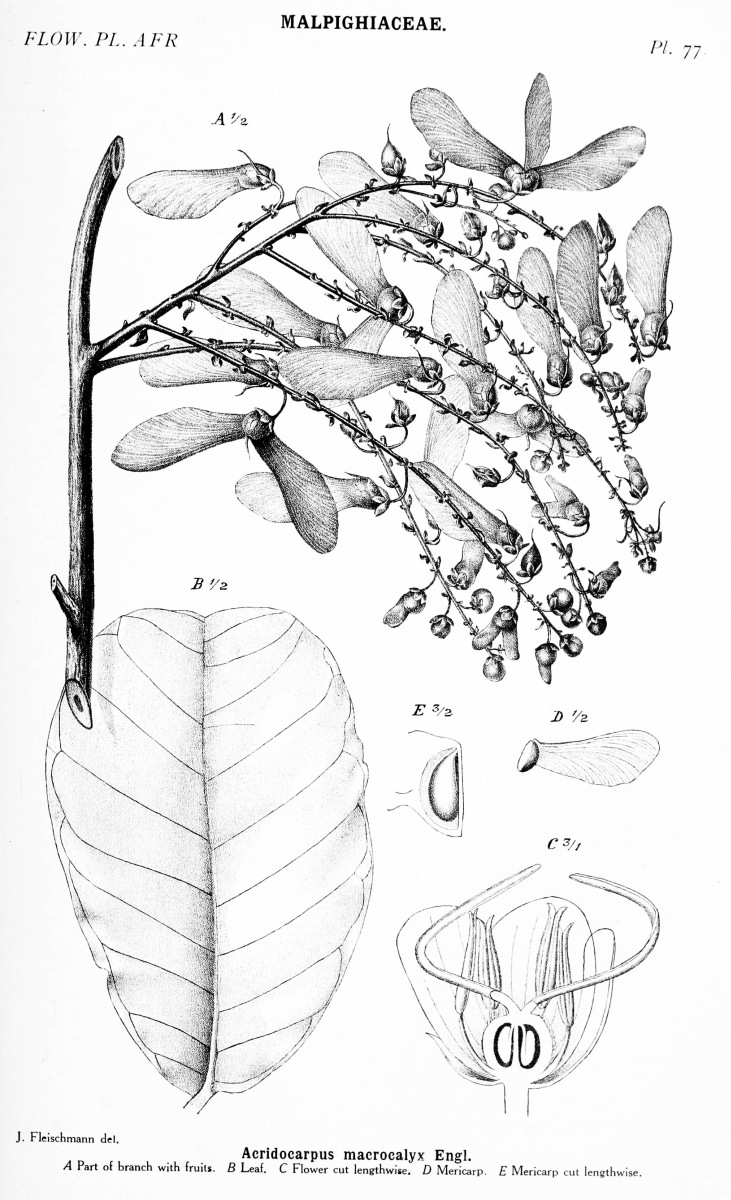
MALPIGHIACEAE.
FLOW PL. AFR.
Pl. 77.
J. Fleischmann del.
Acridocarpus macrocalyx Engl.
A Part of branch with fruits. B Leaf. C Flower cut lengthwise. D Mericarp. E Mericarp cut lengthwise.
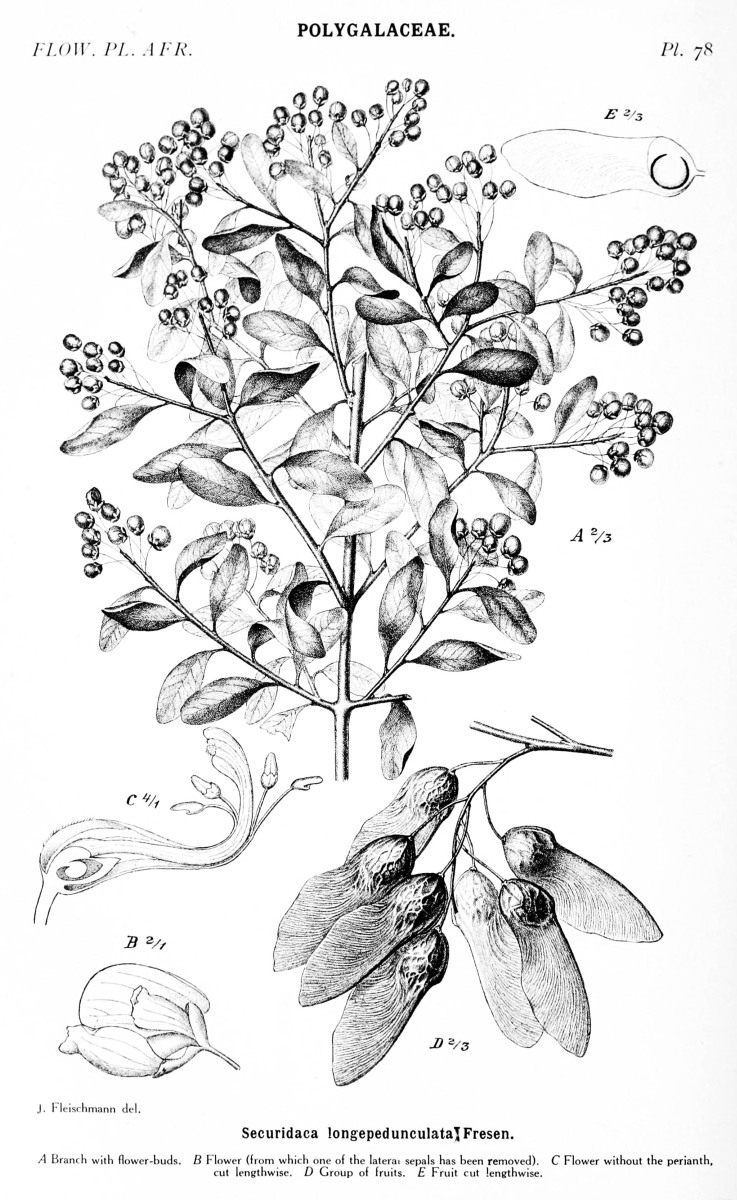
POLYGALACEAE.
FLOW. PL. AFR.
Pl. 78.
J. Fleischmann del.
Securidaca longepedunculata Fresen.
A Branch with flower-buds. B Flower (from which one of the lateral sepals has been removed). C Flower without the perianth, cut lengthwise. D Group of fruits. E Fruit cut lengthwise.
Corolla regular. Mericarps with a more or less parallel-nerved dorsal wing.—Species 20. Tropical and South-east Africa. Some species are used as ornamental plants or in medicine. (Plate 77.) Acridocarpus Guill. & Perr. 7. Styles very long, divaricate; stigmas small, capitate. Stamens 10. Petals with a very short claw. Sepals with very scantily developed glands.—Species 4. Central and South-east Africa. Sphedamnocarpus Planch. Styles short or rather short, erect or slightly divergent; stigmas obliquely truncate, hooked, or broadened. 8 8. Stigmas broadened, semi-orbicular. Ovary with 3 tufts of hairs. Stamens 11-15. Petals with a very short claw. Sepals without glands.—Species 1. Madagascar. Tricomariopsis Dubard & Dop Stigmas not broadened. Stamens 10. 9 9. Styles hooked at the apex, bearing the stigma at the bent. Petals with a distinct claw. Sepals with glands.—Species 1. West Africa. Heteropteris Juss. Styles not hooked above, bearing the stigma at the obliquely truncate tip. Petals with a very short claw. Sepals without glands.—Species 1. Madagascar. (Under Sphedamnocarpus Planch.) Banisterioides Dubard & Dop 10. (3.) Styles shorter than the ovary. Stigma terminal. Petals with a short claw. Calyx without glands. Mericarps with an undivided side-wing. 11 Styles longer than the ovary. 12 11. Ovary 2-celled. Petals slightly toothed. Leaves alternate.—Species 1. East Africa. Diaspis Nied. Ovary 3-celled. Mericarps with an air-cavity extending all round. Leaves usually opposite and crowded upon dwarf-shoots.—Species 4. East Africa. Caucanthus Forsk. 12. Petals sessile, entire. Calyx without glands. Styles 3, very long, with the stigma on the inside of the thickened apex. Mericarps with an undivided side-wing.—Species 1. West Africa to the upper Nile. Flabellaria Cav. Petals clawed. 13 13. Petals with a very short claw, entire. Calyx without glands. Styles 3, rather short, with a 2-lobed stigma. Flowers polygamous-dioecious, in umbels. Mericarps with a 3-parted side-wing.—Species 5. Madagascar. Microsteira Bak. Petals with a long or rather long claw. Style long. Flowers usually hermaphrodite. 14 14. Stigma at the inside of the thickened style-apex. Styles 3, all perfectly developed. Calyx without glands. Petals more or less toothed or fringed. Mericarps with a shield-shaped, usually notched side-wing.—Species 25. Tropical and South Africa. Triaspis Burch. Stigma small, at the slightly or not thickened style-apex. Usually a single style perfectly developed. 15 15. Flowers distinctly irregular. Calyx with a large gland. Petals fringed. Mericarps with a 3-parted side-wing.—Species 2, one a native of West Africa, the other one naturalized in the Mascarene Islands. Ornamental plants. (Gaertnera Roxb.) Hiptage Gaertn. Flowers more or less regular. Calyx with several small glands or without glands. Petals entire. Mericarp with a stellate, many-parted side-wing.—Species 17. Madagascar, East and South-east Africa. Tristellateia Thouars
SUBORDER POLYGALINEAE
FAMILY 120. POLYGALACEAE
Leaves simple, entire. Inflorescence racemose, bracteolate. Flowers irregular. Sepals 5, the two inner usually petal-like. Petals 3-5, more or less adnate to the staminal tube, the lowest more or less concave and boat-shaped. Stamens 5-8. Filaments more or less united. Anthers attached by the base, at length one-celled, opening towards the apex. Ovary superior, 1-3-celled. Ovule 1 in each cell, pendulous, inverted. Style simple or 2-cleft, usually curved and flattened.—Genera 6, species 240. (Plate 78.)
1. Petals 5, all well-developed, unappendaged. Stamens 5. Ovary 2-3-celled. 2 Petals 3, 4, or 5, two of which are rudimentary. Stamens 6-8. Ovary 1-2-celled. 3 2. Petals unequal, clawed, the lowest boat-shaped. Stigma capitate. Fruit a drupe. Seeds ellipsoid.—Species 3. West Africa. They yield timber, edible fruits, and medicaments. Carpolobia Don Petals subequal, sessile, the lowest not boat-shaped. Stigma punctiform. Fruit a nut. Seeds globose.—Species 4. West Africa. (Under Carpolobia Don) Atroxima Stapf 3. Ovary 1-celled; a second rudimentary cell sometimes present. Stigma entire or lobed. Sepals unequal. Concave petal with an appendage. Stamens 8. Fruit a winged nut. Seeds without an aril, exalbuminous. Shrubs or trees.—Species 3. Central and South Africa. They yield bast-fibres, soap-bark, oily seeds, and medicinal drugs; the roots are said to be poisonous. (Lophostylis Hochst.) (Plate 78.) Securidaca L. Ovary 2-celled. Fruit a capsule or a drupe. 4 4. Sepals subequal. Concave petal with an appendage. Stamens 7, rarely 8. Style almost straight. Fruit a capsule. Seeds with an aril, albuminous.—Species 60. South Africa to Nyasaland. Muraltia Neck. Sepals unequal, the two inner usually wing-like. 5 5. Fruit a drupe. Seeds albuminous. Style almost straight. Stamens 7, rarely 8. Filaments united quite or nearly to the top. Concave
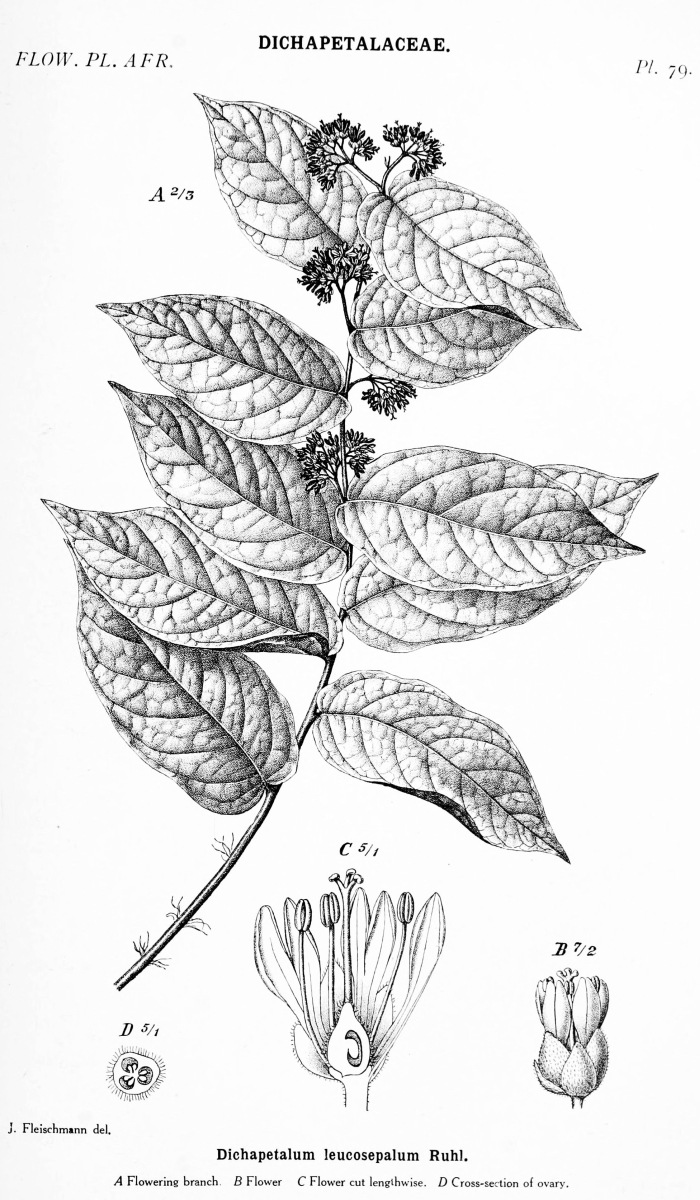
DICHAPETALACEAE.
FLOW. PL. AFR.
Pl. 79.
J. Fleischmann del.
Dichapetalum leucosepalum Ruhl.
A Flowering branch. B Flower. C Flower cut lengthwise. D Cross-section of ovary.
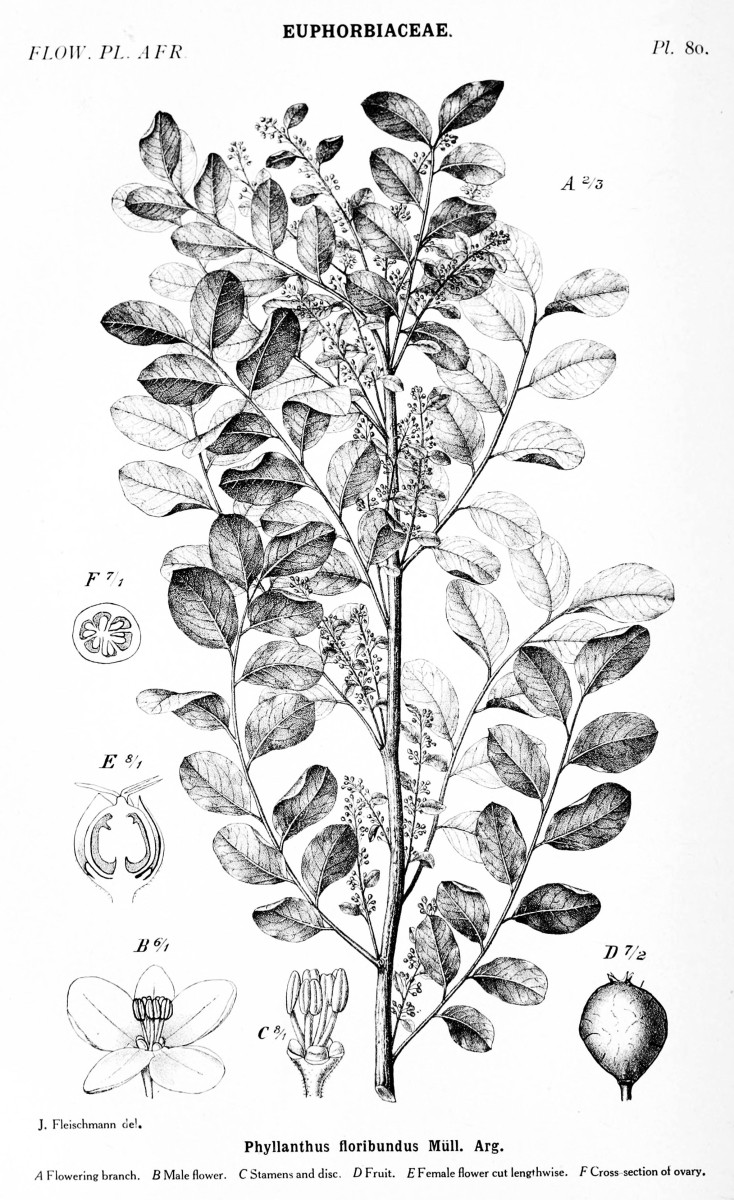
EUPHORBIACEAE.
FLOW. PL. AFR.
Pl. 80.
J. Fleischmann del.
Phyllanthus floribundus Müll. Arg.
A Flowering branch. B Male flower. C Stamens and disc. D Fruit. E Female flower cut lengthwise. F Cross section of ovary.
petal with an appendage. Shrubs.—Species 1. South Africa (Cape Colony). The fruits are edible. (Mundtia Kunth). Mundia Kunth Fruit a capsule. Stamens 8, rarely 6 or 7.—Species 170. Some of them yield fibres or fat from the seeds, others serve as ornamental or medicinal plants. “Milkwort.” Polygala L.
SUBORDER DICHAPETALINEAE
FAMILY 121. DICHAPETALACEAE
Shrubs or trees. Leaves alternate, undivided, stipulate. Inflorescence cymose. Sepals 4-5, imbricate in bud. Petals 4-5, usually 2-cleft. Disc present, but sometimes reduced to separate glands. Stamens 5, sometimes only 2-3 fertile. Anthers opening inwards. Ovary 2-3-celled, usually superior. Ovules 2 in each cell, pendulous, inverted; raphe ventral. Style 2-3-cleft or undivided with 2-3 stigmas. Fruit a nut or drupe. Seeds 1-2, exalbuminous.—Genera 2, species 75. Tropical and South Africa. (CHAILLETIACEAE.) (Plate 79.)
Petals unequal, united below into a long tube, 2-cleft, imbricate in bud. Sepals united below, unequal. Fertile stamens 2-3. Disc semi-annular.—Species 2. Central Africa. Tapura Aubl. Petals equal, free or united at the base, rarely higher. Fertile stamens 5.—Species 75. Tropical and South Africa. Some are poisonous. (Chailletia DC.) (Plate 79.). Dichapetalum Thouars
SUBORDER TRICOCCAE
FAMILY 122. EUPHORBIACEAE
Flowers unisexual. Stamens hypogynous, rarely (Bridelia) perigynous. Anthers 2-celled. Ovary superior or naked, usually 3-celled. Ovules solitary in each cell, or 2 side by side, pendulous, inverted; raphe ventral; micropyle usually covered by an outgrowth of the placenta. Fruit generally separating into 3 dehiscing mericarps. Seeds usually albuminous; embryo axile, radicle superior.—Genera 122, species 1200. (Including DAPHNIPHYLLACEAE.) (Plate 80.)
1. Ovule 1 in each ovary-cell. [Subfamily CROTONOIDEAE.]. 2 Ovules 2 in each ovary-cell. Juice not milky. [Subfamily PHYLLANTHOIDEAE.]. 76 2. Inflorescence consisting of partial inflorescences having the appearance of a single flower and containing one female flower and several or many male ones surrounded by a lobed involucre with glandular appendages. Petals none. Stamen 1. Ovary 3-4-celled. Juice milky. [Tribe EUPHORBIEAE.]. 3 Inflorescence not consisting of partial inflorescences looking like a single flower. 11 3. Male flowers with a cupular, entire or 3-6-lobed perianth. Female flowers with a 3-4-toothed or -cleft perianth. Trees or shrubs. 4 Male flowers without a perianth. 5 4. Involucre of the partial inflorescences split at one side and consisting of 4 or more bracts. Ovary 3-celled. Style 3- or 6-cleft. Trees.—Species 3. Tropics. Poisonous and used medicinally. Anthostema Juss. Involucre closed all round and consisting of 4 bracts. Ovary 4-celled. Style 4-parted.—Species 3. Equatorial West Africa. Dichostemma Pierre 5. Involucre of the partial inflorescences with unequal lobes and with an appendage, in the axil of which the glands are inserted. Shrubs.—Species 2. Madagascar. Pedilanthus Neck. Involucre with equal lobes, but sometimes surrounded by a one-sided gland. 6 6. Involucre irregular, with a single gland sometimes embracing the partial inflorescence and split at one side only. 7 Involucre regular, with several glands sometimes united into a ring or cup. 9 7. Involucre with a narrow gland not enveloping the partial inflorescence. Female flowers with a perianth. Bracts subtending the involucres united high up. Spiny shrubs.—Species 1. East Africa. Stenadenium Pax Involucre with a broad gland enveloping the partial inflorescence. Herbs. 8 8. Female flowers with a perianth. Bracts subtending the involucres united at the base.—Species 2. East Africa. (Under Monadenium Pax). Lortia Rendle Female flowers without a perianth. Bracts subtending the involucres united high up.—Species 10. Central Africa. Monadenium Pax 9. Glands of the involucre united into a ring or cup.—Species 10. Tropical and South-east Africa. Some are poisonous. Synadenium Boiss. Glands of the involucre separate. 10 10. Fruit a drupe.—Species 1. West Africa. (Under Euphorbia L.) Elaeophorbia Stapf Fruit a capsule.—Species 320. Many of them are poisonous, some yield timber, gum, rubber, oil, and medicaments, or serve as garden- or hedge-plants. “Spurge.” Euphorbia L. 11. (2.) Filaments bent inwards in the bud. Calyx 4-6-partite, imbricate or subvalvate in bud. Corolla present, at least in the male flowers. Inflorescence spike- or raceme-like. Leaves and young shoots clothed with scales or stellate hairs.—Species 100. Tropical and South Africa. Several species are poisonous, some yield gum-lac, incense-wood, oil, and medicaments, or serve as ornamental plants. [Tribe CROTONEAE.] Croton L. Filaments straight in the bud. 12 12. Calyx of the male flowers with valvate or closed aestivation. [Especially tribe ACALYPHEAE.] 13 Calyx of the male flowers with imbricate or open aestivation. 59 13. Corolla present in the male flowers. 14 Corolla absent in the male flowers. 24 14. Petals of the male flowers more or less united. Rudimentary pistil cup-shaped or wanting. Style-branches 2. Flowers dioecious. Hairy undershrubs, shrubs, or trees. 15 Petals of the male flowers free from each other, but sometimes (Caperonia) adnate to the staminal tube; in this case rudimentary pistil club-shaped and style with many branches. 17 15. Petals united high up. Calyx bursting irregularly. Disc of 5 glands alternating with the petals. Stamens 12-20. Rudimentary pistil absent. Climbing shrubs with reddish-brown hairs. Leaves 3-7-nerved. Flowers in panicles.—Species 5. West Africa. Fibre-yielding plants. Manniophyton Muell. Arg. Petals united at the base only. Calyx 4-5-parted. Stamens 4-5. Undershrubs or trees. 16 16. Flowers 4-merous. Anthers turned inwards. Disc within the stamens. Trees. Leaves 3-nerved. Young shoots with rusty-brown hairs. Flowers in panicles.—Species 1. West Africa (Cameroons). Schubea Pax Flowers 5-merous. Anthers turned outwards. Glands alternating with the stamens; a cupular disc also present within them. Undershrubs. Young shoots with white hairs. Flowers in axillary clusters.—Species 1. East Africa (Somaliland). Gilgia Pax 17. Style many-cleft. Rudimentary pistil of the male flowers club-shaped. Stamens 5-10, united below. Petals adnate to the staminal tube. Disc indistinct. Flowers in racemes. Herbs or undershrubs, usually hispid.—Species 9. Tropics. Several species yield fibre. Caperonia St. Hil. Style 2-4-cleft. Rudimentary pistil of the male flowers 2-3-cleft or wanting. 18 18. Stem herbaceous or woody at the base only, hairy or cottony. Flowers in racemes, monoecious. Male flowers without a disc.—Species 7. Northern and tropical Africa. Some are poisonous or yield dyes and medicaments. “Turnsole.” (Tournesolia Scop.) Chrozophora Neck. Stem woody. Male flowers usually with a disc reduced to separate glands. 19 19. Young branches and leaves clothed with scales. Inflorescence spicate or racemose. Flowers dioecious. Stamens 15-20.—Species 12. West Africa. Crotonogyne Muell. Arg. Young branches and leaves glabrous, downy, or clothed with star-like hairs. Inflorescence spicate, racemose, or paniculate; in the two former cases stamens 6-14. 20 20. Young branches and leaves clothed with 2-cleft or star-like hairs. Trees. Leaves palmately nerved. Flowers in panicles, monoecious. Stamens 8-20. Fruit a drupe.—Species 2. Cultivated and naturalized in the tropics. They yield timber, gum-lac, tanning bark, dye-stuffs, and edible oily seeds (“candle-nuts”). Aleurites Forst. Young branches and leaves clothed with simple hairs, or glabrous. Shrubs. Inflorescence spicate or racemose, more rarely paniculate, but then leaves pinnately nerved. Fruit a capsule. 21 21. Flowers in panicles, dioecious. Calyx 2-3-partite in the male flowers, 4-partite in the female. Corolla in the female flowers falling off very early, or wanting. Stamens numerous, free. Male flowers without a rudimentary pistil. Branches downy, at least when young.—Species 2. West Africa (Cameroons). Grossera Pax Flowers in spicate or racemose inflorescences. Stamens 6-13. 22 22. Flowers monoecious. Calyx 5-partite. Stamens 10, united at the base. Anthers attached by the back. Male flowers without a rudimentary pistil. Branches glabrous.—Species 1. Madagascar and Comoro Islands. Tannodia Baill. Flowers dioecious. 23 23. Branches glabrous. Anther-halves suspended from the connective.—Species 2. West Africa and Comoro Islands. Agrostistachys Dalz. Branches hairy. Styles 2-cleft. Leaves stalked.—Species 2. East Africa. Holstia Pax 24. (13.) Styles united to about the middle or beyond. 25 Styles free or united at the base only. 32 25. Styles united nearly to the top into a usually hollow column. 26 Styles united about to the middle, undivided. Ovary 3-celled. 31 26. Calyx of the female flowers entire or shortly toothed. Anthers 3-4-celled. Ovary 1-2-, rarely 3-celled. Trees or shrubs.—Species 50. Tropical and South Africa. (Including Mappa Juss.) Macaranga Thouars Calyx of the female flowers 4-12-partite. Anthers 2-celled. Ovary 3-4-, rarely 5-celled. 27 27. Flowers dioecious. Calyx of the female flowers 4-partite. Ovary 4-celled, winged. Style rather long, columnar, with a 4-lobed stigma. Seeds with an outgrowth at the hilum. Trees.—Species 1. West Africa (Cameroons). Tetracarpidium Pax Flowers monoecious. Calyx of the female flowers 5-12-, rarely 4-partite. Seeds usually without an outgrowth. 28 28. Calyx of the male flowers 3-partite, of the female 5-6-partite. Stamens 3, with united filaments. Ovary 3-celled. Style united into a globose body. Climbing shrubs. Flowers in spikes.—Species 1. Madagascar. Sphaerostylis Baill. Calyx of the male flowers 4-6-partite. Stamens 4-30. 29 29. Stamens 4-6. Rudimentary pistil of the male flowers columnar. Ovary 3-celled. Trees or shrubs, with stellate hairs. Leaves undivided, palmately nerved. Flowers in spikes.—Species 1. Madagascar and Comoro Islands. (Including Niedenzua Pax). Adenochlaena Baill. Stamens 8-30, inserted upon an elevated receptacle. Rudimentary pistil none. Shrubs or undershrubs, usually climbing. 30 30. Flowers in cymes surrounded by two large, brightly coloured bracts. Anther-halves parallel. Style columnar.—Species 15. Tropical and South Africa. Some are used for dyeing, in medicine, or as ornamental plants. Dalechampia L. Flowers in racemes, without conspicuous bracts. Anther-halves spreading. Climbing plants. Leaves undivided.—Species 5. Central and South Africa. Plukenetia L. 31. Stem herbaceous or woody at the base only, usually climbing, often with stinging hairs. Stamens 3, rarely more.—Species 45. Tropical and South Africa. Some are used medicinally. (Including Ctenomeria Harv.) Tragia L. Stem woody throughout. Stamens numerous, free.—Species 20. Tropics. The fruits of some species are used for tanning. Pycnocoma Benth. 32. (24.) Filaments repeatedly branched. Anther-halves numerous, separate, globose. Tall herbs or shrubs. Leaves palmately lobed. Flowers monoecious.—Species 1 (R. communis L., castor-oil-plant). Spontaneous in the tropics, naturalized in other parts of Africa. An ornamental plant yielding fibre, fodder, and poisonous oily seeds used in medicine. Ricinus L. Filaments not branched. 33 33. Anther-halves plainly separate, oblong or linear, often twisted. Filaments 6-20, free. Styles free, usually divided. Trees or shrubs. 34 Anther-halves contiguous or nearly so, oblong to globular. 35 34. Bracts of the female flowers leaf-like. Sepals of the female flowers 3-5, small. Stamens usually 8. Disc none. Male flowers spicate, female spicate, paniculate, or solitary.—Species 80. Tropical and South Africa. Some are used as ornamental or medicinal plants. Acalypha L. Bracts of the female flowers small. Sepals of the female flowers 4-6, broad. Disc absent in the male flowers, flat and lobed in the female. Flowers spicate.—Species 4. West Africa. Mareya Baill. 35. Anthers 2-celled, at least after opening. 36 Anthers 3-4-celled, even after opening. Trees or shrubs. 57 36. Anther-halves oblong, attached lengthwise or above the middle. 37 Anther-halves ovoid or globose, attached by the base or the tip, rarely in the middle. 50 37. Stamens 3-10. Trees or shrubs. 38 Stamens numerous. 43 38. Calyx valvate in bud. Stamens 5-10; filaments united throughout. Rudimentary pistil exceeding the staminal tube. Styles very short, 2-lobed. Trees. Leaves 3-foliolate. Flowers in panicles, monoecious.—Species 2. Cultivated in the tropics. They yield rubber (para-rubber): (Siphonia Schreb.) Hevea Aubl. Calyx closed in bud. Stamens 3-10; filaments free or united at the base only. Styles distinctly developed. Leaves simple, undivided. 39 39. Male flowers with a rudimentary pistil. Stamens 6-10. Filaments free, bent twice. Styles divided into many branches. Flowers monoecious. Shrubs with stellate hairs. 40 Male flowers without a rudimentary pistil. Filaments united at the base. Styles undivided or with 2 branches. Flowers usually dioecious. 41 40. Sepals of the female flowers 6, entire, united halfway up. Styles free.—Species 1. Island of Socotra. (Under Cephalocroton Hochst.) Cephalocrotonopsis Pax Sepals of the female flowers pinnately dissected. Styles united at the base.—Species 8. East Africa to Transvaal, Madagascar, and German South-west Africa. Cephalocroton Hochst. 41. Styles at first united, finally free. Seeds with an outgrowth at the hilum. Glabrous shrubs. Leaves 3-5-nerved at the base. Male inflorescences catkin-like, springing from the old wood.—Species 5. Tropics. Some yield dye-stuffs. Lepidoturus Baill. Styles free or nearly so. Seeds without an outgrowth. Male inflorescences spike- or panicle-like, axillary. 42 42. Styles united at the base, two-cleft. Trees. Leaves penninerved.—Species 2. Madagascar. (Including Orfilea Baill., under Alchornea Swartz) Lautembergia Baill. Styles free, undivided.—Species 10. Tropics to Delagoa Bay. Some of them yield dye-stuffs. Alchornea Swartz 43. (37.) Styles laciniate. Ovary nearly glabrous. Disc in the male flowers consisting of glands situated outside the stamens, in the female indistinct. Sepals 5. Trees. Leaves penninerved, without stipules. Flowers dioecious, the male in clusters arising from the old wood, the female in axillary racemes.—Species 1. East Africa. Crotonogynopsis Pax Styles two-cleft or undivided, but usually ciliate within. Ovary usually hairy. Disc indistinct in the male flowers. Sepals 2-4, very rarely 5. Flowers in spikes or panicles. 44 44. Styles two-cleft. 45 Styles undivided. 47 45. Flowers dioecious, in panicles. Calyx of the male flowers 2-partite. Disc indistinct. Plants clothed with stellate hairs. Leaves palminerved.—Species 5. Central Africa. Neoboutonia Muell. Arg. Flowers monoecious, all or the female in spikes. Calyx of the male flowers 4-5-partite. Disc distinctly developed in the female flowers. Trees. Leaves penninerved. 46 46. Disc of the female flowers expanded. Styles thick. Leafstalk rather short. Stipules lanceolate, persistent.—Species 1. West Africa. Necepsia Prain Disc of the female flowers cupular. Styles awl-shaped. Leafstalk very short. Stipules awl-shaped, deciduous. Spikes unisexual.—Species 1. Madagascar. (Under Alchornea Swartz) Palissya Baill. 47. Calyx of the male flowers 2-partite. Stamens numerous. Styles thickish, united at the base. Shrubs. Leaves narrow, penninerved. Flowers in axillary spikes, monoecious.—Species 1. Equatorial West Africa. Neopycnocoma Pax Calyx of the male flowers 3-5-partite. 48 48. Flowers in leaf-opposed spikes, monoecious. Calyx 4-partite. Styles 4. Stem herbaceous. Leaves broad.—Species 2. Southern West Africa (Amboland). Pseudotragia Pax Flowers in axillary or terminal spikes or panicles. Stem woody. 49 49. Leaves narrow, penninerved. Flowers monoecious, in spikes. Calyx of the male flowers 3-partite. Styles thin.—Species 1. Central Africa. Argomuellera Pax Leaves broad, palminerved. Flowers usually dioecious.—Species 10. Tropical and South Africa. (Including Echinus Lour.) Mallotus Lour. 50. (36.) Anther-halves attached at the middle. Stamens 6-12. Calyx 5-partite. Ovary 3-celled. Styles 3, united at the base, 2-cleft. Herbs. Flowers in cymes.—Species 8. South Africa. (Including Paradenocline Muell. Arg.) Adenocline Turcz. Anther-halves attached at the base or the top. Styles undivided or many-cleft. 51 51. Anther-halves attached at the top, pendulous, spreading downwards. Styles 2, rarely 3, undivided. Herbs or undershrubs. 52 Anther-halves attached at the base, erect, spreading upwards. 54 52. Stamens 8-20. Disc of the female flowers reduced to two scales. Calyx 3-partite. Leaves opposite.—Species 3. North Africa; also introduced in South Africa. Used as dye-plants, pot-herbs, and in medicine. “Mercury.” Mercurialis L. Stamens 2-7. Disc none. Flowers monoecious. Leaves alternate. 53 53. Calyx of the female flowers 3-partite. Stamens 2-3. Leaves narrow, entire. Flowers in clusters.—Species 1. South Africa. Seidelia Baill. Calyx of the female flowers reduced to a single scale or absent. Stamens 4-7. Leaves broad, more or less toothed. Flowers in racemes.—Species 2. South Africa. Leidesia Muell. Arg. 54. Stem herbaceous. Flowers monoecious. Calyx of the female flowers imbricate in bud. Stamens 3-10. Disc of the female flowers reduced to 3-4 linear scales. Ovary 3-4-celled. Styles undivided.—Species 1. Central Africa. Micrococca Benth. Stem woody. Flowers dioecious, rarely monoecious, but then calyx of the female flowers valvate in bud. Ovary 2-3-celled. 55 55. Styles undivided. Disc of the female flowers entire or lobed. Stamens 5 or more, usually numerous.—Species 25. Tropical and South Africa. Several species yield timber or are used in medicine. Claoxylon Juss. Styles many-cleft. Stamens 3-12. Flowers dioecious. Shrubs. Stipules spiny. 56 56. Disc of the female flowers consisting of numerous, more or less ciliate scales; also 3 staminodes present. Sepals of the female flowers broad. Ovary 3-celled. Fruit a 3-celled capsule. Female flowers in pendulous spikes.—Species 1. Southern West Africa. Poggeophyton Pax Disc of the female flowers consisting of 2 narrow scales; no staminodes. Fruit a drupe. Female flowers in clusters.—Species 8. Central Africa. Erythrococca Benth. 57. (35.) Disc of the female flowers formed of 3 petal-like scales. Styles recurved, appressed to the ovary, united at the base, 2-cleft. Ovary 3-celled. Stamens 3. Anthers 4-celled. Flowers dioecious, the male ones in spikes, the female solitary or 2-3 together. Leaves pinnately nerved.—Species 3. West Africa. Yielding timber. Hasskarlia Baill. Disc absent. Styles erect or spreading. Flowers in spikes, racemes, or panicles. 58 58. Calyx of the female flowers 3-5-partite. Stamens numerous. Anthers 4-celled. Ovary 2-3-celled. Styles long and thin, 2-parted. Seed-coat leathery. Trees or shrubs. Inflorescence spicate or racemose.—Species 3. Central Africa. Cleidion Blume Calyx of the female flowers entire or shortly toothed. Connective not prolonged. Ovary 1-2-, rarely 3-celled. Styles undivided, usually short and thick. Seed-coat crustaceous. Leaves usually palmately nerved. (See 26.). Macaranga Thouars 59. (12.) Corolla present in the male flowers. 60 Corolla absent in the male flowers. 66 60. Flowers in corymb- or panicle-like inflorescences composed of cymes, nearly always monoecious. Stamens 5 or more, all or the outer opposite the petals, all or the inner united below. [Tribe JATROPHEAE.] 61 Flowers solitary or in clusters or panicles, dioecious. Stamens free, but often inserted on a stalk-like process of the receptacle. Shrubs or trees. [Tribe CLUYTIEAE.] 62 61. Flowers dioecious. Petals free. Stamens 16-17, the five outer nearly free, the inner irregularly united. Seeds without an outgrowth. Leaves undivided.—Species 2. East Africa. Neojatropha Pax Flowers monoecious. Stamens in 2-6 whorls, usually 8-10. Seeds with an outgrowth at the hilum.—Species 50. Central and South Africa; two species cultivated and naturalized in the tropics. Several species yield gum, oil, and medicaments; some are poisonous or used as garden- or hedge-plants. Jatropha L. 62. Stamens 5. Male flowers with a rudimentary pistil. Petals free. Flowers solitary or in clusters in the axils of the leaves. Leaves undivided. 63 Stamens 12 or more. Male flowers without a rudimentary pistil. Flowers in panicles. 64 63. Stamens opposite the sepals, inserted upon a flat receptacle, free. Fruit a drupe.—Species 1. West Africa. Microdesmis Planch. Stamens opposite the petals, inserted upon a stalk-like receptacle. Fruit a capsule.—Species 40. South and Central Africa. Some are used as ornamental plants. Cluytia L. 64. Petals free. Stamens free. Fruit a capsule. Leaves undivided, pinnately nerved. Shrubs.—Species 1. Equatorial West Africa (Congo). Mildbraedia Pax Petals united below. Fruit a drupe. Leaves lobed or dissected, palmately nerved at the base. Trees. 65 65. Leaves lobed.—Species 1. Madagascar. Givotia Griff. Leaves dissected.—Species 3. West Africa. Yield timber and fat from the seeds. Ricinodendron Muell. Arg. 66. (59.) Stamens 1-4, rarely more, and then ovary many-celled. Disc little developed or wanting. Male flowers without a rudimentary pistil. Style-branches undivided. [Tribe HIPPOMANEAE.] 67 Stamens 5 or more. Ovary 2-4-celled. Style-branches two-cleft or lobed. Sepals 4-8. Shrubs or trees. 74 67. Stamens 8 or more. Calyx cup-shaped, almost entire. Ovary many-celled. Style columnar, many-branched at the top. Fruit a capsule. Trees. Inflorescence spicate; bracts adnate to the rachis throughout their whole length, at first enclosing the flower-buds. Flowers monoecious.—Species 1 (H. crepitans L., sandbox-tree). Naturalized in the tropics. Ornamental tree, yielding oil and medicaments; the fruits are used as sand-boxes; the juice is poisonous. Hura L. Stamens 1-4. Ovary 2-4-celled. Bracts adnate to the rachis of the inflorescence by their base only. 68 68. Stamens 1-3, the filaments entirely or almost entirely united. Shrubs or trees. Flowers monoecious. 69 Stamens 2-4, the filaments free or united at the base only. Styles free or united at the base. Ovary 2-3-celled. 71 69. Calyx 3-lobed. Stamens 1-3; filaments free at the top, connective not broadened. Ovary 3-4-celled. Styles united high up. Fruit a capsule. Seeds with a large outgrowth at the hilum. Flowers in panicles.—Species 3. Central Africa. Maprounea Aubl. Calyx 4-5-parted. Stamens 2-3; filaments united into a short column. Anthers turned outwards. Ovary 2-3-celled. Fruit a capsule or a drupe. Seeds without an outgrowth. 70 70. Calyx-segments broad. Connective broadened, peltate. Styles united high up. Flowers in panicles.—Species 2. Tropics. Omphalea L. Calyx-segments narrow. Connective not broadened. Styles free or united at the base. Flowers in spikes.—Species 2. Central Africa. Excoecariopsis Pax 71. Calyx of the male flowers 2-3-toothed or -lobed. Inflorescence terminal. Bracts with two glands. Flowers monoecious. 72 Calyx of the male flowers 2-5-parted. Fruit a capsule with a persistent central column. 73 72. Ripe carpels separating from a 3-parted central column. Seeds without an outgrowth.—Species 10. Tropical and South Africa. They yield timber; one species (S. sebiferum Roxb.) is cultivated for its oily seeds. (Including Conosapium Muell. Arg.). Sapium P. Browne Ripe carpels separating from the base of the pericarp, leaving no central column. Seeds with an outgrowth at the hilum.—Species 5. Tropical and South Africa. Some are poisonous. Stillingia L. 73. Seeds with an outgrowth at the hilum. Flowers monoecious. Inflorescences terminal or terminal and lateral. Leaves alternate.—Species 3. Central Africa. (Cnemidostachys Mart.) Sebastiania Spreng. Seeds without an outgrowth at the hilum. Flowers usually dioecious. Inflorescences usually lateral.—Species 20. Tropical and South Africa. Some are poisonous or are used as ornamental plants. (Including Taenosapium Muell. Arg.) Excoecaria L. 74. (66.) Flowers in racemes, monoecious, with a disc. Sepals of the male flowers evidently united below. Stamens 10, free. Leaves palmately divided, sometimes alternating with undivided ones.—Species 3. Cultivated in the tropics. M. Glaziovii Muell. Arg. yields rubber, M. utilissima Pohl and M. dulcis Pax (cassava or mandioc-plants) furnish vegetables, medicaments, and edible roots, from which meal, starch (tapioca), and a spirituous drink are prepared. Manihot Adans. Flowers in glomerules, dioecious, rarely monoecious, but then without a disc. Sepals of the male flowers free or nearly so. Leaves undivided. [Tribe GELONIEAE.] 75 75. Sepals 5. Filaments free. Male flowers without a disc and without a rudimentary pistil.—Species 6. Tropical and South Africa. (Ceratophorus Sond., including Suregada Roxb.) Gelonium Roxb. Sepals of the female flowers 7-8, the inner petaloid. Filaments united.—Species 1. West Africa. Chaetocarpus Thwait. 76. (1.) Calyx of the male flowers with valvate aestivation. Stamens 5-7. Male flowers with a rudimentary pistil. Shrubs or trees. 77 Calyx of the male flowers with imbricate or open aestivation. 81 77. Petals absent. Disc none. Styles 2, undivided. Ovary-cells 2, each with an incomplete partition.—Species 1. West Africa. Martretia Beille Petals small. Disc outside the stamens. Styles 2-parted. Ovary-cells undivided. [Tribe BRIDELIEAE.] 78 78. Ovary 2-celled. Styles 2. Stamens borne upon a short androphore. Leaf-veins of the third order almost parallel. 79 Ovary 3-celled. Styles 3. Disc of the female flowers cup-shaped. Fruit a capsule. Leaf-veins of the third order netted. 80 79. Disc of the female flowers bottle-shaped, enclosing the ovary to the top. Inflorescence paniculate.—Species 1. East Africa. (Under Bridelia Willd.) Neogoetzea Pax Disc of the female flowers double, the outer cup-shaped, adhering to the calyx, the inner consisting of 5 scales. Fruit usually a drupe.—Species 25. Tropical and South-east Africa. Some species yield dye-stuffs. (Including Gentilia Beille) Bridelia Willd. 80. Receptacle of the male flowers elevated, forming a short androphore.—Species 10. Tropics. Cleistanthus Hook. Receptacle not prolonged into an androphore. Flowers clustered, dioecious.—Species 1. Madagascar and Comoro Islands. Stenonia Baill. 81. (76.) Anthers 4-celled, even after opening, numerous. Filaments united. Male flowers with 5 sepals and 3 valvate petals. Ovary 3-4-celled. Styles 3, undivided. Carpels enlarging and separating after the time of flowering. Downy shrubs. Leaves without stipules. Flowers in axillary glomerules.—Species 1. South-east Africa. [Tribe JUNODIEAE.] Junodia Pax Anthers 2-celled, at least after opening. 82 82. Seeds with a very small embryo. Fruit an oblong drupe. Ovary 2-celled. Styles 2, undivided. Male flowers with 9-18 free, central stamens, without a disc and without a rudimentary pistil. Corolla none. Flowers dioecious, in racemes. Trees.—Species 1. West Africa. [Tribe DAPHNIPHYLLEAE] Daphniphyllum Blume Seeds with a large embryo. Ovary-cells and styles usually 3; if 2, then stamens 2-6 or surrounding a central disc. [Tribe PHYLLANTHEAE.] 83 83. Corolla present, at least in the flowers of one sex. 84 Corolla absent. 95 84. Stamens 8-10. Anthers opening outwards. Sepals, petals, and carpels 4-5. Flowers dioecious, in glomerules. Trees.—Species 1. South Africa. Yields timber. Heywoodia Sim Stamens 4-5. [Subtribe ANDRACHNINAE.] 85 85. Flowers 3-merous, dioecious. Petals exceeding the sepals in the male flowers, absent in the female. Male flowers without a rudimentary pistil. Stamens 6, each surrounded at the base by a gland; anthers opening transversely. Ovary 4-5-celled. Shrubs. Flowers in glomerules.—Species 1. East Africa (Somaliland). Bricchettia Pax Flowers 4-6-merous. Male flowers with a rudimentary pistil. 86 86. Ovary 5-celled. Styles 5, two-cleft. Disc cup-shaped, lobed in the male flowers, entire in the female. Stamens inserted upon a short androphore. Petals exceeding the sepals. Flowers fascicled, monoecious. Shrubs.—Species 1. Seychelles. (Under Savia Willd.) Wielandia Baill. Ovary 3-celled. Styles or sessile stigmas 3. 87 87. Styles very short, undivided. 88 Styles well developed, two-cleft. 90 88. Flowers monoecious, in spikes or fascicles. Petals short. Rudimentary pistil 3-lobed. Stigmas thick. Seeds solitary in each cell, exalbuminous, with thick-fleshy cotyledons. Trees or shrubs.—Species 6. Tropics. Amanoa Aubl. Flowers dioecious, in panicles. Fruit a loculicidal capsule. Trees. 89 89. Panicles terminal. Petals small. Disc of the male flowers of separate glands. Rudimentary pistil obconical, flattened at the top. Seeds with a spongy coat, scanty albumen, and flat cotyledons.—Species 2. Equatorial regions. Megabaria Pierre Panicles axillary. Petals large. Disc of the male flowers cupular. Rudimentary pistil narrowed above. Seeds with copious albumen.—Species 1. Equatorial West Africa. Centroplacus Pierre 90. Stamens inserted upon a prolonged, stalk-like receptacle. Petals shorter than the sepals. Disc and ovary densely woolly. Seeds with scanty albumen and folded cotyledons. Shrubs. Flowers dioecious, the male ones fascicled, the female solitary.—Species 1. South Africa. Lachnostylis Turcz. Stamens inserted upon a receptacle which is not stalk-like. 91 91. Stamens inserted upon the disc. Seeds exalbuminous, with folded cotyledons. Trees or shrubs. Flowers in fascicles.—Species 1. Equatorial West Africa. (Pentabrachium Muell. Arg.) Actephila Blume Stamens inserted inside the disc round the rudimentary pistil. Seeds with copious albumen. 92 92. Male flowers without a corolla, with 4 sepals and 6 stamens. Female flowers with 2 sepals and 5 petals. Flowers dioecious, the male in glomerules, the female solitary. Shrubs or trees.—Species 1. West Africa (Congo). Neochevaliera Beille Male flowers with a corolla, rarely without, but then with 5 sepals and 5 stamens. Flowers dioecious, the male in spikes, racemes, or panicles, or monoecious. 93 93. Lobes of the disc alternating with the petals. Flowers monoecious, in glomerules or the female solitary. Shrubs.—Species 8. Madagascar and neighbouring islands. (Under Savia Willd.) Petalodiscus Baill. Lobes of the disc opposite the petals. Male flowers in spikes, racemes, or fascicles. 94 94. Flowers monoecious. Anther-halves adnate lengthwise. Rudimentary pistil of the male flowers columnar or 3-partite. Styles short. Herbs, undershrubs, or shrubs.—Species 6. Andrachne L. Flowers dioecious. Anther-halves at first suspended from the thick connective. Rudimentary pistil thick, usually obovate. Styles long. Shrubs or trees.—Species 9. West Africa and Madagascar. Thecacoris Juss. 95. (83.) Leaves digitate. Male flowers in glomerules, with a 5-8-partite calyx. Trees. [Subtribe BISCHOFIINAE.] 96 Leaves simple, undivided. 98 96. Leaflets 1-3. Flowers monoecious. Stamens 14-15.—Species 1. Southern West Africa (Angola). Aristogeitonia Prain Leaflets 5-7. Flowers dioecious. Stamens 4-10. 97 97. Leaves opposite. Leaflets stalked. Fruit a capsule.—Species 1. West Africa. Yields timber (African teak). Oldfieldia Hook. Leaves alternate. Leaflets sessile. Male flowers with a 6-8-cleft calyx and 6-8 stamens. Female flowers solitary, with 3 bracteoles, a disc consisting of 6-7 scales, a 2-celled ovary, and 2 short, thick, undivided styles. Fruit a drupe.—Species 1. Southern West Africa (Angola). Paivaeusa Welw. 98. Leaves opposite or whorled. Flowers dioecious, the male in fascicles or panicles, the female solitary. Stamens numerous. Disc none. Fruit a capsule. Trees. [Subtribe TOXICODENDRINAE.] 99 Leaves alternate. 100 99. Sepals 2-5. Stamens inserted upon a stalk-like receptacle. Styles united high up.—Species 1. Southern East Africa (Mosambic). Yields timber. Androstachys Prain Sepals 5-12. Stamens inserted upon a flat receptacle. Styles united at the base only.—Species 1. South Africa (Cape Colony). Fruit poisonous. (Hyaenanche Lamb.) Toxicodendron Thunb. 100. Male flowers in catkins, spikes, racemes, or panicles, more rarely in heads or umbels with a calyx-like involucre. Flowers dioecious. [Subtribe ANTIDESMINAE.] 101 Male flowers in axillary glomerules, fascicles, or short cymes, rarely in umbels without an involucre. 112 101. Male flowers in umbels or heads with a calyx-like involucre, female solitary. Male flowers without a disc, but with a rudimentary pistil. Stamens 4-5. Ovary 2-4 celled. Styles branched. Fruit fleshy, indehiscent. Trees.—Species 30. Tropics. Some yield timber or edible fruits. Uapaca Baill. Male flowers in spikes, racemes, or panicles without an involucre. 102 102. Ovary 1-celled. Fruit a drupe. Trees or shrubs. 103 Ovary 2-5-celled. 105 103. Styles 3, 2-lobed. Male flowers with a disc. Stamens 2-5.—Species 25. Tropical and South-east Africa. Some yield timber and dye-stuffs. Antidesma L. Style 1, undivided. Male flowers without a disc. 104 104. Sepals in the male flowers 3-5. Stamens 3-5. Disc of the female flowers ring-shaped.—Species 2. Madagascar. Cometia Thouars Sepals in the male flowers 6-8. Stamens numerous. Disc none.—Species 1. Equatorial West Africa. The seeds yield oil. Plagiostyles Pierre 105. Ovary 2-celled. Male flowers with a rudimentary pistil. Trees or shrubs. 106 Ovary 3-, rarely 4-5-celled. 108 106. Ovary and fruit winged. Styles long, undivided. Disc none. Stamens 4-6.—Species 12. Central and South Africa. Hymenocardia Wall. Ovary and fruit not winged. Styles short. 107 107. Disc in the male flowers consisting of 5 scales, in the female cup-shaped, entire. Stamens 5. Fruit one-seeded.—Species 4. West Africa and Upper Nile. Maesobotrya Benth. Disc, especially in the female flowers, little developed or absent. Styles shortly lobed. Fruit several-seeded.—Species 10. West Africa. Baccaurea Lour. 108. Disc indistinct or wanting. Styles short, very shortly lobed. (See 107.) Baccaurea Lour. Disc distinctly developed. Stamens 4-5. 109 109. Disc entire or nearly so. Styles undivided, united high up. Rudimentary pistil salver-shaped. Shrubs.—Species 1. Equatorial regions. Baccaureopsis Pax Disc lobed or divided. Styles more or less deeply two-cleft. 110 110. Stem herbaceous or woody at the base only. Stipules hair-like. Flowers very small. Rudimentary pistil salver-shaped. Styles free, thick, 2-cleft.—Species 5. Central Africa. Cyathogyne Muell. Arg. Stem woody. Rudimentary pistil not salver-shaped. 111 111. Stipules large, kidney-shaped. Inflorescence springing from the old wood. Seeds with an aril.—Species 5. West Africa. (Under Maesobotrya Benth.) Staphysora Pierre Stipules not kidney-shaped. Flowers 5-merous. Anther-halves at first suspended from the thickened connective. Styles long. (See 94.) Thecacoris Juss. 112. (100.) Styles or sessile stigmas much broadened, sometimes wholly united. Flowers dioecious. Disc present. Fruit indehiscent. Trees or shrubs. [Subtribe DRYPETINAE.] 113 Styles or style-branches rather thin or broadened at the apex only. [Subtribe PHYLLANTHINAE.] 115 113. Stamens 3. Ovary 1-celled. Stigmas peltate, nearly sessile. Disc cup-shaped in the male flowers, ring-shaped in the female. Sepals unequal.—Species 1. West Africa. Sibangea Oliv. Stamens 4 or more. 114 114. Fruit 1-seeded. Ovary 1-2-celled. Stamens usually 4.—Species 4. Central Africa. Drypetes Vahl Fruit 2-4-seeded. Ovary 2-4-celled. Stamens usually numerous.—Species 20. Tropical and South Africa. Cyclostemon Blume 115. Male flowers with a rudimentary pistil and a disc usually divided into glands. 116 Male flowers without a rudimentary pistil. 120 116. Receptacle of the male flowers prolonged into an androphore. Stamens 5-6. Shrubs, undershrubs, or herbs. 117 Receptacle not prolonged into an androphore. Disc of the male flowers divided into glands alternating with the sepals, rarely entire. Seeds without an outgrowth at the hilum. Shrubs and trees. 118 117. Disc of the male flowers nearly entire, of the female divided into 5 glands alternating with the sepals. Fruit a drupe. Seeds with an outgrowth at the hilum. Shrubs. Male inflorescence many-flowered.—Species 3. Central Africa. Pseudolachnostylis Pax Disc of the male flowers 5-lobed or divided into 5 glands opposite the sepals. Fruit a capsule. Seeds without an outgrowth at the hilum. Flowers monoecious, fascicled.—Species 4. Central Africa. Cluytiandra Muell. Arg. 118. Disc of the male flowers slightly lobed. Styles undivided. Flowers monoecious, large. Stipules large.—Species 1. German East Africa. Zimmermannia Pax Disc of the male flowers deeply lobed or divided. Styles two-cleft. Flowers usually dioecious. 119 119. Anthers opening outwards. Disc of the female flowers lobed. Seeds grooved on the ventral face; testa thick; embryo curved.—Species 8. Tropical and South Africa. Some yield timber. (Under Securinega Juss.) Flueggea Willd. Anthers opening inwards or laterally. Disc of the female flowers undivided. Seeds not grooved; testa thin; embryo straight.—Species 6. Some of them yield timber. Securinega Juss. 120. Disc present. 121 Disc absent. Shrubs or trees. 124 121. Disc of the male flowers consisting of 5-6 scales adnate below to the sepals which consequently appear much thickened. Stamens 3. Filaments very short, united. Anthers opening outwards. Style-branches 2-cleft. Flowers monoecious. Herbs or undershrubs.—Species 1. Madagascar and neighbouring islands. Agyneia Vent. Disc of the male flowers not adnate to the sepals; hence sepals not much thickened. 122 122. Stamens 2-10. Styles usually two-cleft.—Species 80. Tropical and South Africa; one species naturalized in Egypt. Some of them serve as garden- or hedge-plants or yield timber, tanning and dyeing materials, edible fruits, and medicaments. (Including Cicca L. and Pleiostemon Sond.) (Plate 80.) Phyllanthus L. Stamens 12-18. Disc many-lobed or many-parted. Styles 3. Shrubs or trees. 123 123. Flowers monoecious. Sepals 5. Disc lobed. Styles entire or notched, flattened.—Species 1. Madagascar and Comoro Islands. Humblotia Baill. Flowers monoecious with 6 sepals, or dioecious with 5. Disc deeply divided. Styles two-cleft. Stipules gland-like.—Species 2. Equatorial West Africa. Lingelsheimia Pax 124. Flowers monoecious. Calyx 6-lobed. Stamens 3; filaments united; anthers opening outwards. Male flowers in glomerules.—Species 1. Naturalized in the Mascarene Islands. (Melanthesopsis Muell. Arg.) Breynia Forst. Flowers dioecious. Calyx 5-parted. Stamens 5; filaments free; anthers opening inwards. Male flowers in umbels.—Species 1. Madagascar. Leptonemea Juss.
FAMILY 123. CALLITRICHACEAE
Herbs. Leaves opposite, simple, entire. Flowers solitary or in clusters in the leaf-axils, minute, without a perianth, but sometimes with two bracteoles, monoecious. Stamens 1. Anther 2-celled. Ovary 4-celled. Ovules solitary in each cell, pendulous, inverted, with a single coat and a ventral raphe. Styles 2, free, awl-shaped. Fruit separating into 4 drupe-like mericarps. Seeds albuminous; embryo axile. (Under HALORRHAGIDACEAE.)
Genus 1, species 6. North and South Africa and high mountains of Central Africa; one species also naturalized in Madagascar and the Mascarene Islands. Callitriche L.
ORDER SAPINDALES
SUBORDER BUXINEAE
FAMILY 124. BUXACEAE
Shrubs or trees. Juice not milky. Leaves opposite, simple, entire. Flowers in lateral fascicles, heads or spikes, regular, monoecious. Perianth simple, of 4 segments in the male flowers, of 4-6 in the female. Disc absent. Stamens 4, opposite the sepals, or 6. Filaments free. Anthers 2-celled. Ovary superior, 3-celled. Ovules 2 in each cell, pendulous or nearly so, inverted, with dorsal raphe. Styles 3, free, short and thick, undivided, persisting in fruit. Fruit a loculicidal capsule. Seeds albuminous; embryo axile, straight.—Genera 3; species 8. (Under EUPHORBIACEAE.)
1. Stamens 4; filaments long. Male flowers with a rudimentary pistil. Perianth of the female flowers of 4-6 segments.—Species 6. The box (B. sempervirens L.) is used as a garden-plant and yields wood and medicaments; another species affords arrow-poison. [Tribe BUXEAE.] Buxus L. Stamens 6; filaments very short or absent. Male flowers without a rudimentary pistil. Perianth of the female flowers of 4 segments. [Tribe STYLOCEREAE.] 2 2. Flowers in fascicles, the male on long pedicels, very small. Leaves narrowed into a long point.—Species 1. Central Africa. Macropodandra Gilg Flowers in groups of 3, nearly sessile, not very small. Leaves blunt or slightly pointed.—Species 1. South-east Africa. Notobuxus Oliv.
SUBORD ER EMPETRINEAE
FAMILY 125. EMPETRACEAE
Low shrubs. Leaves alternate, sometimes almost whorled, undivided, grooved on the under surface, without stipules. Flowers solitary or in heads, bracteolate, unisexual or polygamous. Sepals 3. Petals 3 or none. Stamens 3, hypogynous, opposite to the sepals, free. Disc absent. Ovary superior, 2-9-celled. Ovules solitary in each cell, erect, inverted, with ventral raphe. Style branched. Fruit a drupe. Seeds without an outgrowth at the hilum, albuminous. Embryo axile; radicle turned downwards.—Genera 2, species 2. North and South Africa.
Flowers, at least the male, crowded in terminal heads. Ovary cells, style-branches, and fruit-stones 2-5. Style with linear branches.—Species 1. Canary Islands and Azores. The fruits are used as a condiment and in medicine. Corema Don Flowers solitary, on lateral dwarf-shoots. Ovary-cells, style-branches, and fruit-stones 6-9. Style with broadened branches.—Species 1. Island of Tristan da Cunha. The fruits (crawberries) are eaten and used for preparing drinks and medicaments. Empetrum L.
SUBORDER CORIARIINEAE
FAMILY 126. CORIARIACEAE
Shrubs. Leaves opposite, simple, entire, 3-nerved, without stipules. Flowers in racemes, hermaphrodite or polygamous. Sepals 5, imbricate in bud. Petals shorter, fleshy, enlarged after flowering. Stamens 10. Anthers opening inwards. Carpels 5, distinct. Ovule 1 in each carpel, pendulous, inverted, with dorsal raphe. Fruit with a crustaceous rind, indehiscent. Seeds with scanty albumen.
Genus 1, species 1. North-west Africa. Poisonous and used for tanning and dyeing. Coriaria L.
SUBORDER ANACARDIINEAE
FAMILY 127. ANACARDIACEAE
Trees or shrubs. Juice resinous. Leaves usually alternate, without stipules. Flowers in panicles, usually polygamous. Corolla present, rarely (Pistacia) absent. Ovary superior, 1-5-celled. Ovules solitary in each cell, inverted, with dorsal raphe. Fruit usually a drupe. Albumen of the seeds scanty or wanting.—Genera 29, species 250. (TEREBINTHACEAE.) (Plate 81.)
1. Carpel 1. Style simple, lateral; stigma entire. Funicle basal. Fertile stamen 1, rarely 5. Leaves simple, entire. Trees. [Tribe MANGIFEREAE.] 2 Carpels 2-5, sometimes 1-4 of them rudimentary. Style simple with a lobed stigma, or more or less deeply divided, or several free styles. Fertile stamens 3 or more. Leaves usually compound. 5 2. Stamen 1. Filament broad. Calyx 4-lobed. Petals 4. Disc one-sided. Leaves lanceolate.—Species 2. West Africa. The fruits are edible. (Under Mangifera L.) Fegimanra Pierre Stamens 5-10, but usually 1 only fertile. Petals 5. 3 3. Fertile stamens 5. Calyx bursting irregularly.—Species 1. Madagascar. The juice is used for preparing varnishes and medicaments. Gluta L. Fertile stamen 1, usually accompanied by 4 or 9 sterile ones, which bear small anthers. Calyx 5-partite. 4 4. Stamens and staminodes together 5. Disc cushion-shaped. Fruit egg-shaped, with a fleshy pericarp and a slightly thickened stalk. Leaves lanceolate.—Species 1 (M. indica L., mango-tree). Cultivated in the tropics. Yields timber, gum, tanning and dyeing materials, edible fruits from which a spirituous drink is prepared, starch from the seeds, and medicaments. Mangifera Burm. Stamens and staminodes together 10. Disc indistinct. Fruit kidney-shaped, with a resinous pericarp and a much thickened, fleshy stalk. Leaves obovate.—Species 1 (A. occidentale L., cashew-tree). Cultivated in the tropics. Yields timber, gum, tanning and dyeing materials, oil, vermin-poison, edible seeds and fruit-stalks from which vinegar and brandy are prepared, and medicaments. Anacardium L. 5. (1.) Ovary with 1 fertile cell and sometimes 1-2 empty and usually rudimentary ones, rarely (Protorhus) with 3 fertile cells; in this case stamens 5 and leaves simple. [Tribe RHOIDEAE.] 6 Ovary with 3-5 fertile cells. Stamens 6-15 and leaves compound, rarely stamens 5 and leaves simple, but then ovary-cells and styles 5. [Tribe SPONDIEAE.] 20 6. Perianth simple, consisting of 1-2 segments in the male, of 2-5 in the female flowers. Stamens 3-5. Style 3-cleft. Leaves compound.—Species 5, one of them only cultivated. North Africa and northern East Africa. They yield timber, tanning and dyeing materials, resins (mastic and turpentine) which are used industrially, in medicine, as fumigatories, masticatories, or condiments, and for preparing spirituous drinks, also edible oily fruits and seeds (pistachio-nuts) and various medicaments. Pistacia L. Perianth consisting of a calyx and a corolla. 7 7. Style 1, undivided, rarely (Micronychia) shortly cleft at the top, or a slightly lobed sessile stigma. 8 Styles 3, free or united at the base, sometimes recurved and adnate to the ovary, or 3 free sessile stigmas. 13 8. Leaves simple, undivided. 9 Leaves compound, pinnate. 11 9. Stamens 6-10, twice as many as the petals. Ovary with 1 fertile and 1 sterile cell. Style absent. Trees with small flowers.—Species 2. Madagascar and Seychelles. Campnosperma Thwait. Stamens 4-5, as many as the petals. Ovary 1-celled. Style present. 10 10. Corolla of the male flowers equalling the calyx. Disc broad, fleshy. Filaments thread-shaped. Ovary and fruit much compressed. Style short, undivided, with a 3-lobed stigma. Shrubs. Leaves serrate. Flowers small. Female inflorescence finally with broadened branches and hardened bracts.—Species 1. South Africa (Cape Colony). (Botryceras Willd.) Laurophyllus Thunb. Corolla much exceeding the calyx. Disc cup-shaped. Filaments broad. Ovary and fruit slightly compressed. Style long, shortly 3-cleft at the top. Trees. Leaves entire. Flowers rather large.—Species 1. Madagascar. Micronychia Oliv. 11. Receptacle deeply cupular; hence petals and stamens distinctly perigynous. Calyx valvate, corolla imbricate in the bud. Stamens 5-10. Ovary sessile. Style thin. Fruit dry, indehiscent.—Species 1. West Africa. Thyrsodium Benth. Receptacle flattish or convex; hence petals and stamens hypogynous or nearly so. Style thick or wanting. 12 12. Petals imbricate in the bud; sepals imbricate. Stamens 4-5, as many as the petals. Ovary and fruit with a compressed stalk. Stigma sessile. Fruit sickle-shaped, dry, indehiscent.—Species 1. Madagascar. Faguetia March. Petals valvate in the bud. Stamens 5-20, usually more than petals. Ovary and fruit sessile, the latter drupaceous.—Species 20. Tropics. Some species yield timber, gum, and edible fruits. Sorindeia Thouars 13. (7.) Ovule basal or suspended from a basal funicle. 14 Ovule suspended from the top or the flank of the cavity. 16 14. Ovule subbasal, ascending. Styles lateral, thread-shaped. Ovary compressed. Stamens 5, alternating with 2-cleft scales. Petals of the male flowers longer, of the female shorter than the sepals. Sepals lanceolate, enlarged in the fruit. Flowers dioecious. Leaves pinnate; stalk winged.—Species 1. South Africa. Loxostylis Spreng. fil. Ovule suspended from the basal funicle. Styles terminal. Flowers polygamous. 15 15. Endocarp crusty or bony, finally separating from the mesocarp. Seedcoat thin. Leaves alternate, usually compound.—Species 100. Some of them yield timber, tanning and dyeing materials (sumac), condiments, medicaments, and edible fruits; others are used as ornamental plants. Rhus L. Endocarp leathery, not separating from the mesocarp. Seed-coat thick. Leaves undivided, narrow, with numerous parallel side-nerves.—Species 18. Tropical and South Africa. Some yield timber. (Anaphrenium E. Mey.) Heeria Meissn. 16. Leaves simple, undivided. Stamens 5. 17 Leaves compound, trifoliolate or pinnate. 18 17. Filaments broadened. Ovary 1-celled. Ovule attached laterally. Styles sickle-shaped, united at the base, with capitate stigmas. Fruit transversely oblong; endocarp very thin. Embryo with thick cotyledons.—Species 1. Madagascar. Used medicinally. Baronia Bak. Filaments awl-shaped. Ovary usually 3-celled. Ovule attached at the top of the cell. Stigmas sessile. Fruit oblong; endocarp woody. Leaves opposite or nearly so, with numerous parallel side-nerves.—Species 10. Madagascar and South-east Africa. Some species are poisonous or used medicinally. Protorhus Engl. 18. Leaflets 3, toothed. Stamens 5. Ovary compressed. Styles lateral, thread shaped. Fruit winged; endocarp very thin, mesocarp resinous. Shrubs.—Species 1. South Africa. Smodingium E. Mey. Leaflets 5 or more. Styles more or less terminal. 19 19. Stamens 4-5. Fruit with a crusty endocarp, a fibrous mesocarp, and a fleshy exocarp. Embryo with a short radicle.—Species 30. Central Africa. Some have edible fruits. (Emiliomarcelia Hel. et Th. Dur.) Trichoscypha Hook. fil. Stamens 10. Fruit with a hard endocarp, an oily mesocarp, and a parchment-like exocarp. Embryo with a long radicle. Shrubs.—Species 2. Cultivated in North Africa, the Cape Verde Islands, and the Mascarenes. They yield timber, resin used industrially and medicinally, tanning and dyeing materials, vinegar, syrup, and medicaments. Schinus L. 20. (5.) Stamens 5, as many as the petals. Disc consisting of 5 scales. Styles 5. Leaves simple, undivided.—Species 2. West Africa. Spondianthus Engl. Stamens 6-15, twice as many as the petals or more. Leaves compound. 21 21. Petals valvate in bud. 22 Petals imbricate in bud. 23 22. Flowers dioecious, 4-merous. Petals lanceolate, with inflexed tips. Male flowers with a sterile ovary and a simple style. Leaflets 3, serrate.—Species 1. Equatorial East Africa. Spondiopsis Engl. Flowers polygamous, usually 5-merous. Petals oblong ovate or elliptical, finally recurved. Styles in the female and hermaphrodite flowers 4-5, free. Leaflets 5 or more, usually with a marginal nerve.—Species 4, two of them growing wild in equatorial West Africa, the others cultivated in the tropics. They yield timber, gum, tanning material, medicaments, and edible fruits from which a spirituous drink is prepared. (Including Antrocaryon Pierre). Spondias L. 23. Sepals free. Stone of the fruit with 3-4 lids at the top. 24 Sepals more or less united. 25 24. Flowers dioecious, 3-4-merous. Anthers subglobose, versatile. Seeds oblong, terete.—Species 2. Central Africa. The fruits are edible. (Under Spondias L.). Pseudospondias Engl. Flowers polygamous, 4-5-merous. Anthers oblong, continuous with the filament. Ovary-cells and styles usually 3. Seeds club-shaped, somewhat
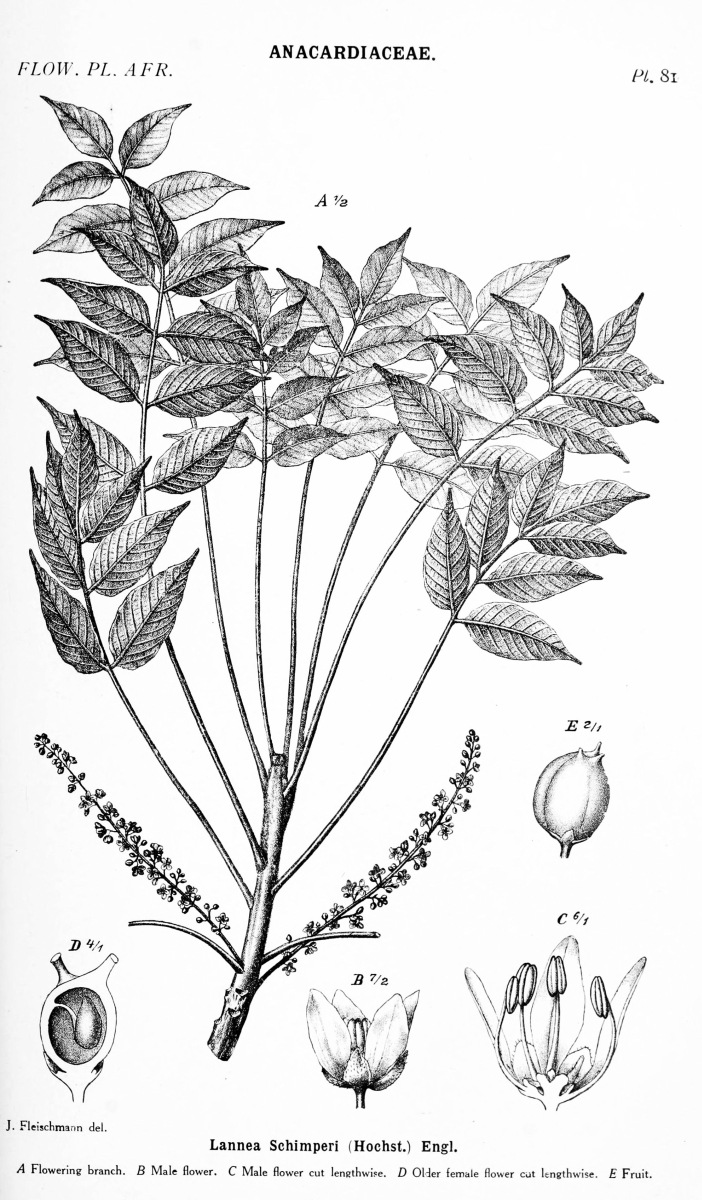
ANACARDIACEAE.
FLOW. PL. AFR.
Pl. 81.
J. Fleischmann del.
Lannea Schimperi (Hochst.) Engl.
A Flowering branch. B Male flower. C Male flower cut lengthwise. D Older female flower cut lengthwise. E Fruit.
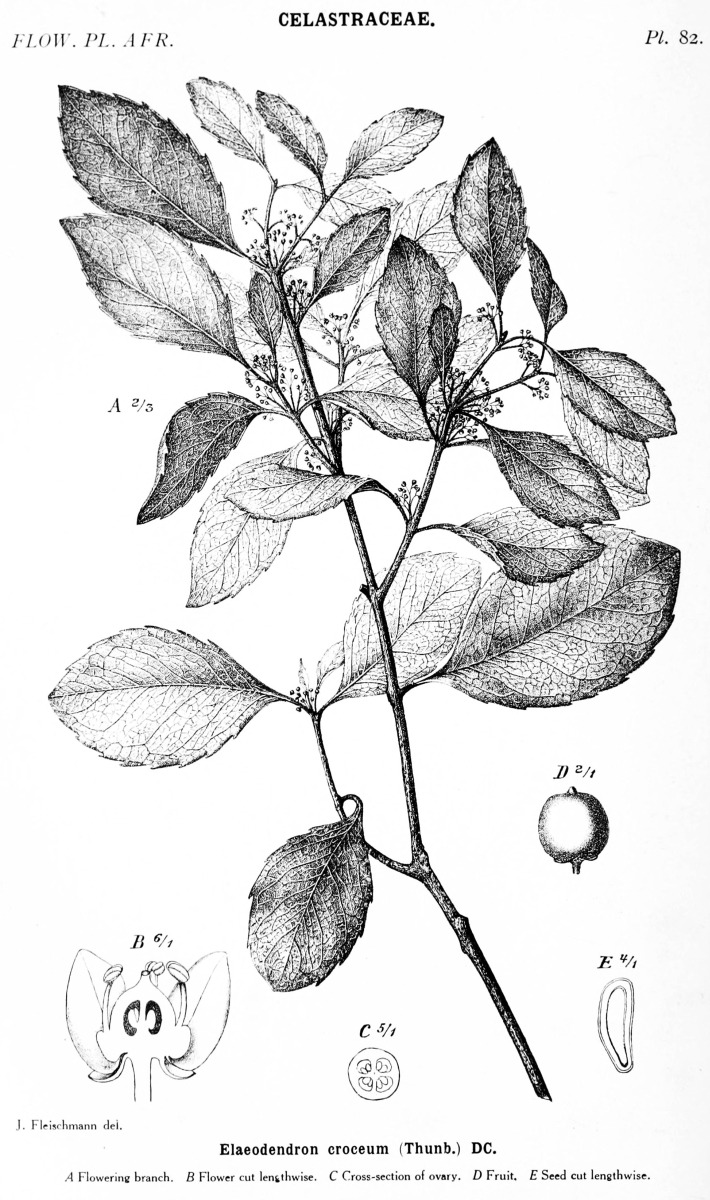
CELASTRACEAE.
FLOW. PL. AFR.
Pl. 82.
J. Fleischmann del.
Elaeodendron croceum (Thunb.) DC.
A Flowering branch. B Flower cut lengthwise. C Cross-section of ovary. D Fruit. E Seed cut lengthwise.
compressed.—Species 5. Tropical and South Africa. They yield timber, gum, dyes, oil, medicaments, and edible fruits and seeds from which a spirituous drink is prepared. Sclerocarya Hochst. 25. Flowers 3-merous, dioecious. Fruit 1-2-seeded. Leaflets numerous.—Species 2. West Africa. They yield timber and edible fruits (blood-plums). Haematostaphis Hook. fil. Flowers 4-5-merous. 26 26. Flowers 4-merous. Fruit usually 1-seeded. 27 Flowers 5-merous. Fruit 2-5-seeded. Leaflets 5 or more. Sepals united at the base only. 28 27. Sepals united high up. Petals oblong. Disc 4-partite. Style simple, club-shaped. Flowers in panicled fascicles. Leaflets numerous, alternate.—Species 1. West Africa (Cameroons). Nothospondias Engl. Sepals united at the base only. Petals obovate. Disc 8-crenate. Styles 3-4. Stone of the fruit with 1-2 fertile cells bearing a lid at the top and with 2-3 sterile cells. Seeds 1 or 2; in the latter case leaflets 3.—Species 30. Tropical and South Africa. Several species yield timber, bark used for making cloth, gum, edible fruits, and medicaments. (Calesiam Adans., Odina Roxb., including Lanneoma Del.) (Plate 81.) Lannea Rich. 28. Male flowers with a narrow disc and 3 styles. Stone of the fruit with 2 fertile and 2 sterile cells.—Species 1. South Africa. Harpephyllum Bernh. Male flowers with a broad disc and 5 styles. Ovary 5-celled. Stone of the fruit with 3-5 fertile cells. Panicles spike-like.—Species 5. Madagascar and Mascarenes. They yield timber, resin, and edible fruits. (Under Spondias L.) Poupartia Comm.
SUBORDER CELASTRINEAE
FAMILY 128. AQUIFOLIACEAE
Shrubs or trees. Leaves alternate, entire toothed or lobed. Flowers regular, dioecious. Calyx 4-7-cleft. Petals 4-7, united at the base, imbricate in bud. Stamens as many as the petals, hypogynous. Anthers 2-celled, opening inwards by longitudinal slits. Disc none. Ovary superior, 4-8-celled. Style short or absent; stigma lobed. Ovules solitary in each cell or two side by side, pendulous, inverted, covered by a cupular expansion of the funicle. Fruit a drupe with 4-8 one-seeded stones. Embryo minute, at the apex of the albumen (ILICINEAE.)
Genus 1, species 5. They yield timber, bird-lime, tea, and medicaments. The holly (I. Aquifolium L.), with poisonous fruits, is also planted as a garden- or hedge-plant. Ilex L.
FAMILY 129. CELASTRACEAE
Shrubs or trees. Leaves simple, stipulate. Flowers regular. Sepals 4-5, imbricate or open in bud. Petals 4-5, free, imbricate in bud. Disc present. Stamens as many as and alternating with the petals. Filaments free. Anthers opening by two longitudinal slits sometimes confluent at the top. Ovary superior, but sometimes sunk in the disc and adnate to it, 2-5-celled, rarely (Pleurostylia) 1-celled. Ovules 1-8 in each cell, inverted. Style 1 or 0. Seeds usually albuminous. Embryo axile, with leaf-like cotyledons.—Genera 15, species 160. (Plate 82.)
1. Fruit a loculicidal capsule. Seeds with an aril. [Subfamily CELASTROIDEAE.] 2 Fruit a drupe or a nut. Seeds without an aril. 7 2. Leaves opposite, at least those of the flowering and fruiting branches. Unarmed shrubs. Ovules 2 in each ovary-cell. 3 Leaves alternate. 4 3. Petals spreading. Disc thick. Anthers opening by 1 slit. Ovary-cells and stigmas 4-5. Seeds enveloped by a red aril. Leaves elliptical.—Species 1. North-west Africa (Algeria). Yields timber and medicaments and serves as an ornamental plant; the fruits are poisonous. “Spindle-tree.” Evonymus L. Petals erect. Disc thin. Anthers opening by 2 slits. Ovary-cells and stigmas 3. Seeds with a white, wing-like aril. Leaves lanceolate.—Species 1 (C. edulis Forsk.). Central and South Africa. The wood and the leaves are used, the latter for chewing and for preparing a tea and medicaments. (Methyscophyllum Eckl. & Zeyh.) Catha Forsk. 4. Flowers in axillary racemes or umbels, or more frequently solitary or in clusters and inserted upon the leaves, 5-merous. Ovary-cells and stigmas 5, very rarely 3-4. Seeds with a laciniate aril. Unarmed shrubs or trees.—Species 7. Madagascar. (Under Celastrus L.). Polycardia Juss. Flowers in axillary fascicles or cymes. Ovary 2-3-celled, very rarely 4-5-celled. 5 5. Ovules 3-6 in each cell of the ovary. Disc thick, almost hemispherical, ribbed, red. Seeds enveloped by the aril. Spiny shrubs.—Species 2. South Africa. (Under Celastrus L.) Putterlickia Endl. Ovules 2 in each cell of the ovary. Ovary 2-3-celled. Disc not hemispherical. 6 6. Fruit with usually wing-like appendages. Seeds with a gaping aril. Ovary usually ribbed. Stigmas 2-3. Disc 5-lobed or 5-parted. Flowers 5-merous. Unarmed shrubs or trees. Leaves entire.—Species 9. South Africa. Pterocelastrus Meissn. Fruit without appendages. Ovary not ribbed. Disc faintly lobed, not ribbed.—Species 80. Some of them yield timber, rubber, or medicaments. (Including Scytophyllum Eckl. & Zeyh., under Celastrus L.) Gymnosporia Wight & Arn. 7. (1.) Fruit broadly winged, with a leathery rind. Flowers 4-merous. Stamens inserted within the disc. Anthers opening outwards. Ovary 2-celled, with 1 erect ovule in each cell. Stigma 1, small. Shrubs. Leaves opposite, entire. Inflorescences terminal and axillary.—Species 1. Madagascar. [Subfamily TRIPTERYGIOIDEAE.] Ptelidium Thouars Fruit not winged. Stamens inserted on the edge or outer face of the disc. Anthers usually opening inwards. [Subfamily CASSINIOIDEAE.] 8 8. Ovary 1-celled. Ovules 2-8, erect. Style lateral. Stigma peltate. Flowers 5-merous. Fruit with a thin endocarp and a thin-fleshy mesocarp. Seeds with copious albumen. Leaves opposite.—Species 5. East and South Africa and Malagasy Islands. (Including Cathastrum Turcz.) Pleurostylia Wight & Arn. Ovary 2-4-celled, with 1-2 ovules in each cell. Style terminal, rarely lateral in the fruit. 9 9. Ovules pendulous. Flowers 5-merous. Fruit a drupe. Glabrous shrubs. Upper leaves opposite, broad.—Species 1. South Africa (Cape Colony). Yields timber. (Under Cassine L.) Maurocenia L. Ovules erect. 10 10. Stigma entire. Anthers turned inwards. Petal-like staminodes usually present. Flowers hermaphrodite. Leaves opposite, unequal, the lower lanceolate, the upper oval. Trees.—Species 1. Isle of Réunion. Herya Cordem. Stigma 2-4-lobed, very rarely entire, but then anthers turned outwards. Petal-like staminodes none. 11 11. Flowers in short racemes, unisexual, 4-merous. Stamens inserted at the margin of the thin disc; filaments strap-shaped. Fruit almost dry. Glabrous shrubs. Leaves opposite.—Species 1. South Africa (Cape Colony). (Under Elaeodendron Jacq.) Lauridia Eckl. & Zeyh. Flowers solitary or in fascicles or cymes; usually hermaphrodite. 12 12. Leaves alternate. Flowers 5-merous. Fruit almost dry.—Species 20. Tropical and South Africa. (Under Cassine L. or Elaeodendron Jacq.) Mystroxylon Eckl. & Zeyh. Leaves opposite or the upper alternate. 13 13. Pericarp neither fleshy nor hardened. Seeds exalbuminous. Anthers opening outwards. Glabrous shrubs. Leaves more or less distinctly toothed.—Species 3. South Africa and Madagascar. (Under Schrebera Thunb.) Hartogia Thunb. Pericarp more or less fleshy or hardened. Seeds albuminous. Anthers usually opening inwards. 14 14. Pericarp fleshy. Leaves opposite.—Species 10. South Africa. Cassine L. Pericarp dry.—Species 17. Tropical and South Africa. Some species yield timber, dyes, edible fruits, and medicaments. (Under Cassine L.) (Plate 82.) Elaeodendron Jacq.