ORDER RANALES (continued 5)
Reading edition
Leaves alternate, simple. Flowers regular, hermaphrodite. Sepals 5, furnished with a gland or a callosity, imbricate in bud, deciduous. Petals 5, with contorted aestivation. Stamens 5, alternating with the petals. Filaments free. Anthers versatile, opening by longitudinal slits. Ovary superior, 1-celled with 3 parietal placentas. Ovules inverted. Styles 3, often divided. Fruit a loculicidal capsule. Seeds arillate, pitted, with a large embryo and copious albumen.—Genera 7, species 20. Tropical and South Africa. (Plate 105.)
1. Sepals free or nearly so. 2 Sepals united below into a distinct tube. 3 2. Stigmas nearly entire. Sepals with ovate glands. Petals white. Fruit dehiscing throughout its whole length. Aril formed of long hairs. Trees with simple hairs. Leaves stipulate, with two glands on the stalk. Flowers pendulous, solitary or in clusters of 3, bracteolate.—Species 1. Mascarene Islands. Mathurina Balf. fil. Stigmas many-cleft. Fruit dehiscing from the top to the middle. Aril one-sided, crenate. Leaves without glands at the base, but sometimes with small glands at the margin. Flowers erect, solitary or in cymes. Species 3. Madagascar and South Africa. (Including Erblichia Seem., under Turnera L.) Piriqueta Aubl. 3. Calyx-tube with very numerous and very thin nerves. Stamens inserted at the base of the tube. Stigmas entire or obscurely notched. Areas of the seed-coat without holes. Glandular shrubs. Stipules minute. Flowers solitary, erect, bracteolate.—Species 2. East Africa. Loewia Urban Calyx-tube with 10-15 nerves. Herbs or undershrubs, rarely shrubs or trees, but then stigmas divided. 4 4. Calyx-tube 10-nerved, with hemispherical callosities or without any appendage on the inside. Areas of the seed-coat with one hole in each or without a hole. Flowers solitary or in fascicles or heads. 5 Calyx-tube 15-nerved, furnished with linear ledges within. Areas of the seed-coat with two holes in each. Flowers in one-sided racemes. Hairy herbs. Leaves without stipules. 6 5. Sepals thin-membranous, colourless. Petals inserted at the base of the calyx-tube. Stigmas many-cleft. Ovules 9. Fruit pendulous. Aril entire. Herbs. Leaves without glands. Flowers solitary.—Species 2. Madagascar. (Under Turnera L.) Hyalocalyx Rolfe Sepals herbaceous, green. Petals inserted at the mouth of the calyx-tube. Fruit erect. Aril crenate or lobed.—Species 2, one a native of Madagascar, the other naturalized in the Mascarene Islands. Turnera L. 6. Petals inserted below the mouth of the calyx-tube, provided with a scale at their base. Stamens arising from the base of the tube. Fruit linear. Seeds in one row.—Species 8. Tropical and South-east Africa. (Plate 105.) Wormskioldia Schum. & Thonn. Petals inserted at the mouth of the calyx-tube, unappendaged. Stamens adnate to the tube at their base. Fruit oblong or oval. Seeds in several rows.—Species 3. East Africa. (Under Wormskioldia Schum. & Thonn.) Streptopetalum Hochst.
FAMILY 161. PASSIFLORACEAE
Usually tendril-bearing plants. Leaves alternate. Flowers regular. Sepals 4-6, imbricate in bud. Petals as many, free, imbricate in bud, more rarely wanting. Receptacle produced into a corona which is sometimes divided into separate scales, rarely without any appendage. Stamens 4-10, as many as and alternate with the petals or twice as many. Anthers opening by two longitudinal slits. Ovary superior, 1-celled, with 3, rarely 4-5 parietal placentas and numerous inverted ovules. Seeds arillate, with a pitted or furrowed testa and a fleshy albumen.—Genera 8, species 75. (Plate 106.)
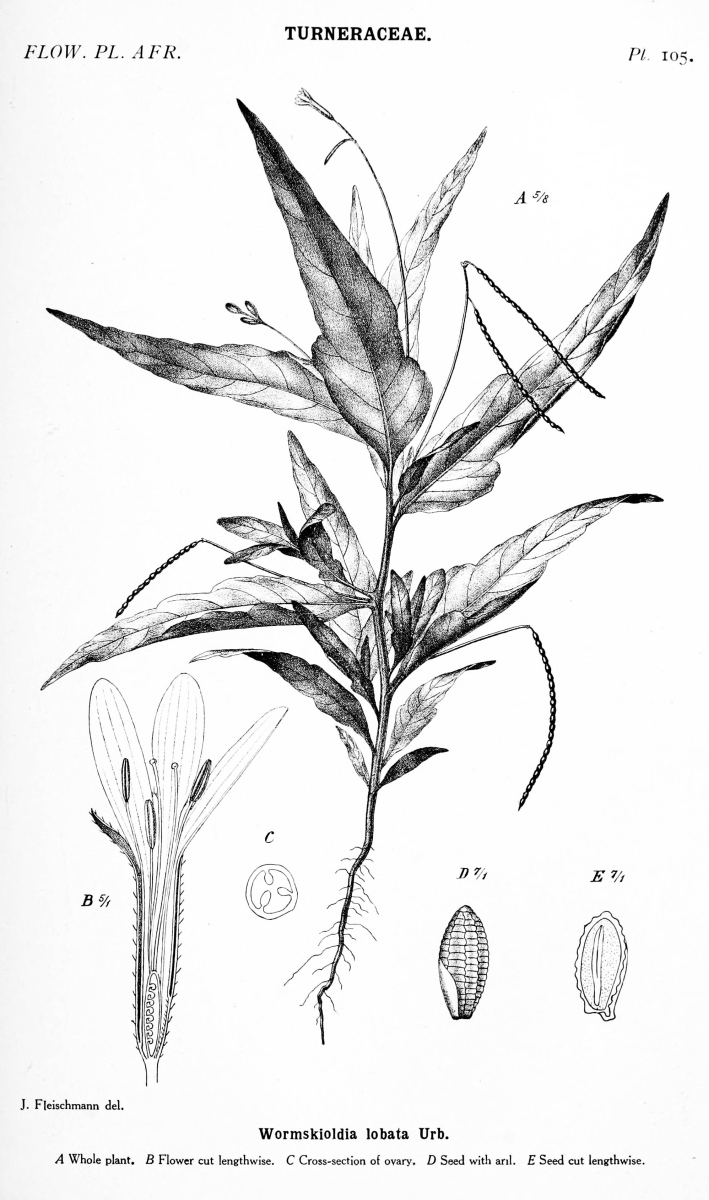
TURNERACEAE.
FLOW. PL. AFR.
Pl. 105.
J. Fleischmann del.
Wormskioldia lobata Urb.
A Whole plant. B Flower cut lengthwise. C Cross-section of ovary. D Seed with aril. E Seed cut lengthwise.
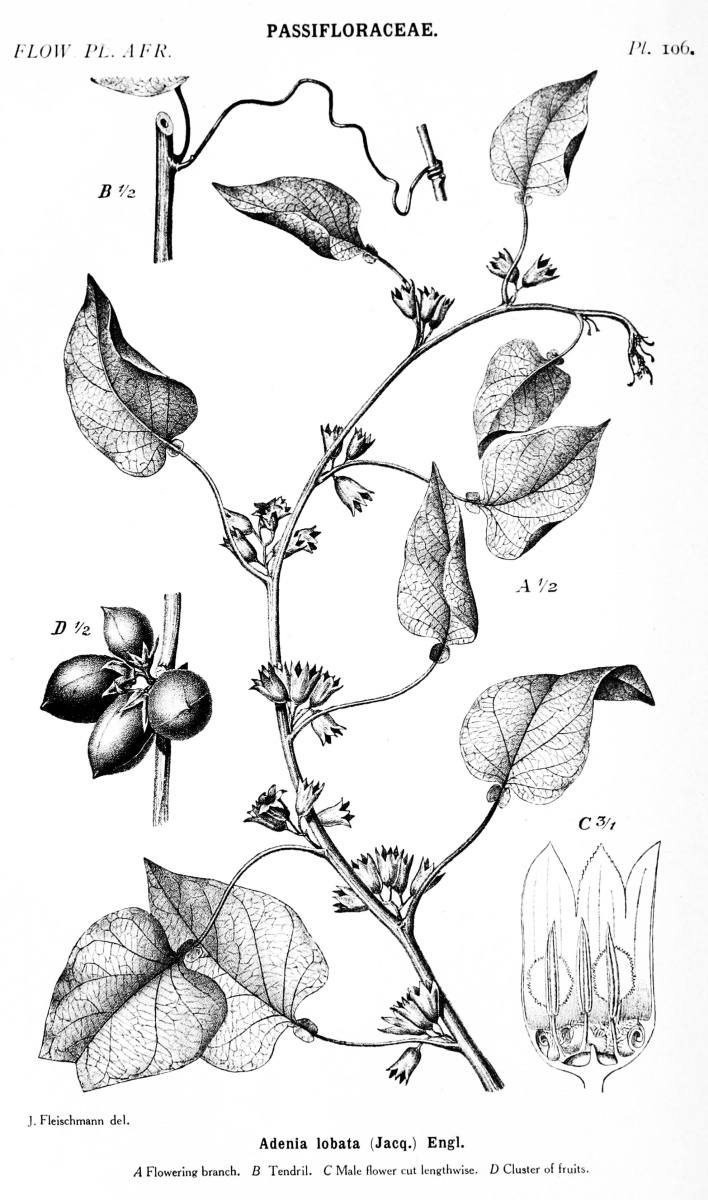
PASSIFLORACEAE.
FLOW. PL. AFR.
Pl. 106.
J. Fleischmann del.
Adenia lobata (Jacq.) Engl.
A Flowering branch. B Tendril. C Male flower cut lengthwise. D Cluster of fruits.
1. Leaves compound: 2-3-foliolate or pinnate. Shrubs. Flowers hermaphrodite. Stamens 5-10, free from the short gynophore. Anthers attached by the back. 2 Leaves simple: entire, toothed, lobed, or cleft. 3 2. Corona formed of numerous threads springing from the base of the calyx. Petals 4-5, resembling the sepals. Stamens united at base. Style 3-5-cleft. Ovules numerous. Fruit a capsule. Stem climbing. Leaflets in 1-2 pairs. Flowers in cymes.—Species 6. West Africa and Madagascar. Deidamia Thouars Corona none, but a disc within the stamens present. Petals 5, much exceeding the sepals. Fertile stamens 5, free, alternating with 5 staminodes. Style simple. Ovules 10-12. Leaflets in 4-5 pairs. Flowers in panicles.—Species 1. East Africa. Donaldsonia Bak. 3. Fertile stamens twice as many as the sepals or petals, 6-8. Corona formed of one row of threads. Ovary almost sessile, with 4 placentas and 4 subsessile stigmas. Shrubs.—Species 1. South-east Africa. Schlechterina Harms Fertile stamens as many as the sepals or petals. 4 4. Fertile stamens alternating with as many staminodes. Flowers hermaphrodite. Petals 5. Style simple. 5 Fertile stamens not alternating with staminodes. 6 5. Calyx-tube saucer-shaped. Sepals ovate. Petals ovate, larger than the sepals. Corona formed of one row of threads. Staminodes tooth-shaped. Ovary seated in the centre of the disc. Stigma entire. Climbing, tendril-bearing shrubs. Leaves oblong.—Species 1. Northern West Africa. Crossostemma Planch. Calyx-tube bell- or funnel-shaped. Sepals oblong. Petals linear-oblong, much smaller than the sepals. Corona none. Staminodes awl-shaped. Anthers affixed by the back, near the base, and surmounted by a prolonged, awl-shaped connective. Stamens free from the short gynophore. Stigma 3-lobed. Fruit a berry. Erect herbs without tendrils. Leaves linear-lanceolate.—Species 1. Southern West Africa. Machadoa Welw. 6. Stamens adnate to the gynophore. Anthers affixed by the back, at first turned inwards, later on outwards. Styles 3 or style single and 3-cleft. Corona present. Flowers hermaphrodite. Fruit a berry.—Species 8. One of them a native of Madagascar, the others cultivated and sometimes naturalized in the tropics and the Canary Islands. They yield edible fruits, drinks, and medicaments, and serve as ornamental plants. “Passion-flower.” Passiflora L. Stamens free from the gynophore, or no gynophore present. Anthers affixed by the base or between its lobes, opening inwards or laterally. Fruit a capsule, rarely a berry. 7 7. Flowers hermaphrodite. Calyx-tube saucer-shaped. Corona triple. Style 3-cleft. Herbs or undershrubs. Flowers in 2-3-flowered cymes.—Species 15. Central and South Africa. (Including Basananthe Peyr.) Tryphostemma Harv. Flowers unisexual, rarely hermaphrodite or polygamous, but then without a corona. Petals 4-6. Corona simple, double, or wanting. Leaves with 1-3 glands at the base.—Species 40. Tropical and South Africa. Some are poisonous, others have edible fruits or are used in medicine. (Modecca Lam., including Echinothamnus Engl., Jaeggia Schinz, Keramanthus Hook. fil., Ophiocaulon Hook. fil., and Paschanthus Burch.) (Plate 106.) Adenia Forsk.
FAMILY 162. ACHARIACEAE
Herbs or undershrubs. Leaves alternate, undivided or lobed, without stipules. Flowers regular, 3-5-merous, monoecious, solitary or fascicled, axillary, the male sometimes in racemes. Sepals free, at least in the female flowers, imbricate or open in bud. Petals united below, imbricate in bud. Stamens as many as and alternating with the corolla-lobes, affixed to the corolla. Anthers adnate, opening inwards. Receptacle produced into a corona formed of 3-5 scales which are inserted at the base of the corolla and alternate with the stamens. Ovary superior, sessile or short-stalked, 1-celled, with 3-5 parietal placentas bearing 2 or more inverted ovules each. Style 3-10-cleft. Fruit a capsule. Seeds with a sometimes adnate aril, a pitted or wrinkled testa, a copious albumen, and a straight embryo.—Genera 3, species 3. South Africa. (Under PASSIFLORACEAE.)
1. Stem twining. Leaves 5-7-lobed. Flowers 4-5-merous, the male in racemes, the female solitary. Sepals of the male flowers linear. Stamens inserted at the base of the corolla. Anthers cohering. Corona formed of linear or oblong scales. Ovary short-stalked, oblong. Style-branches twice as many as placentas. Fruit linear. Aril adnate to the wrinkled testa.—Species 1. South Africa. Ceratiosicyos Nees Stem erect or underground. Leaves 3-lobed or undivided. Flowers solitary or fascicled. Stamens inserted in the tube or at the throat of the corolla. Aril free from the pitted testa. 2 2. Aboveground stem erect or ascending, woody at the base. Leaves 3-lobed. Flowers 3-4-merous. Sepals oblong or ovate, free. Anthers with a broad connective. Ovary sessile, subglobose. Ovules few, usually 6-8. Style-branches twice as many as placentas.—Species 1. Cape Colony. Acharia Thunb. Aboveground stem wanting. Leaves undivided. Flowers solitary, 5-merous. Sepals linear, adnate to the corolla. Stamens inserted at the throat of the corolla. Anthers with a narrow connective. Ovary short-stalked, oblong. Ovules numerous. Style-branches as many as placentas. Fruit elliptical.—Species 1. Cape Colony. Guthriea Bolus
SUBORDER PAPAYINEAE
FAMILY 163. CARICACEAE
Trees with a milky juice. Leaves alternate, usually crowded at the top of the stem, palmately lobed or divided, without stipules. Flowers, at least the male ones, panicled, 5-merous, unisexual or polygamous. Petals united below, with contorted aestivation. Stamens 10, inserted in the tube of the corolla. Anthers turned inwards, with a prolonged connective. Ovary superior, 1-or 5-celled. Ovules numerous, parietal, inverted. Style simple with 5 stigmas, or 5-to many-cleft. Fruit a berry. Seeds albuminous, with a double coat, succulent outside, woody within.—Genera 2, species 3. Tropics. (PAPAYACEAE, under PASSIFLORACEAE.)
Filaments free. Ovary 1-celled. Stigmas branched. Stem unarmed, simple or scantily branched.—Species 1 (C. Papaya L., papaw-tree). Cultivated and sometimes naturalized in the tropics. It yields edible fruits, medicaments, and substitutes for soap and tobacco. The juice of the stem is poisonous, that of the leaves is used for rendering meat tender. (Papaya Tourn.) Carica L. Filaments united below. Ovary 5-celled. Stigmas undivided. Stem branched, prickly. Species 2. Central Africa. (Under Jacaratia Marcgr.) Cylicomorpha Urban
SUBORDER LOASINEAE
FAMILY 164. LOASACEAE
Shrubs. Leaves alternate, toothed or lobed, without stipules. Flowers in cymes, regular, 5-merous, hermaphrodite. Sepals open in bud, becoming wing-like after flowering. Petals shorter, free, concave, with imbricate or contorted aestivation. Stamens numerous, collected in 5 bundles opposite to the petals, alternating with glandular scales bearing each two staminodes on their inner surface. Ovary inferior, unequally 2-celled, the larger cell with two ovules, the smaller with one. Ovules descending, inverted. Style simple or 3-cleft. Fruit dry, indehiscent. Seeds exalbuminous; embryo straight.
Genus 1, species 1. South Africa. Kissenia R. Br.
SUBORDER BEGONIINEAE
FAMILY 165. BEGONIACEAE
Leaves alternate, simple or palmately compound, usually oblique, stipulate. Flowers in cymes, monoecious. Perianth simple, of 2-5, very rarely 6-9 free segments. Stamens numerous. Anthers basifixed. Ovary inferior, completely or almost completely 2-6-celled, usually winged. Placentas attached to the inner angle of the cells or to the partitions. Ovules numerous, inverted. Styles 2-6, free or united at the base, usually cleft. Fruit a capsule, rarely a berry. Seeds very numerous, minute, with a striate or netted testa, exalbuminous. (Plate 107.)
Genus 1, species 110. Tropical and South Africa. Some species are used as ornamental or medicinal plants or as vegetables. (Including Mezierea Gaud.) Begonia L.
SUBORDER ANCISTROCLADINEAE
FAMILY 166. ANCISTROCLADACEAE
Climbing, tendril-bearing shrubs. Leaves alternate, undivided, with small, deciduous stipules. Flowers in racemes or panicles, regular, hermaphrodite. Sepals unequal, imbricate in bud. Petals 5, united at the base, with contorted aestivation. Stamens 10, rarely 9. Filaments united at the base, short. Anthers basifixed, opening inwards by longitudinal slits. Ovary inferior, 1-celled. Ovule 1, basal, half-inverted. Style simple with 3 stigmas or 3-cleft. Fruit a nut surmounted by the enlarged, wing-like sepals. Seeds with a thin testa, a repeatedly folded albumen, and a straight embryo. (Under DIPTEROCARPACEAE.)
Genus 1, species 2. West Africa. Ancistrocladus Wall.
ORDER OPUNTIALES
FAMILY 167. CACTACEAE
Succulent plants with a thickened, usually jointed and spiny stem. Leaves mostly scale-like, often deciduous. Flowers solitary or in clusters, hermaphrodite. Perianth of 8 or more segments not distinctly differentiated into sepals and petals. Stamens numerous. Anthers opening inwards or laterally. Ovary inferior, 1-celled, with several parietal placentas. Ovules inverted. Style simple, with several stigmas. Fruit a berry. Seeds albuminous; embryo curved.—Genera 5, species 13.
1. Leaves well-developed. Stem not jointed. Spines not barbed. Perianth wheel-shaped. Ovules few, not enveloped by the short funicle. Cotyledons intertwisted.—Species 1. Naturalized in the Mascarene Islands. A decorative and medicinal plant. [Subfamily PEIRESKIOIDEAE, tribe PEIRESKIEAE.] Peireskia Plum. Leaves scale-like or absent. Stem more or less copiously jointed. Cotyledons not intertwisted. 2 2. Plants destitute of barbed spines. Joints of the stem elongated. Ovules not enveloped by the funicle. [Subfamily CEREOIDEAE.] 3 Plants bearing barbed spines, at least upon the fruit. Joints of the stem short, more or less ovoid. Perianth regular, more or less wheel-shaped. Ovules enveloped by the funicle. [Subfamily OPUNTIOIDEAE, tribe OPUNTIEAE.] 4 3. Perianth funnel- or salver-shaped, with obviously united segments. Ovules numerous, on long funicles. Terrestrial plants.—Species 1. Cultivated and sometimes naturalized in various regions. A decorative plant with edible fruits. [Tribe ECHINOCACTEAE.] Cereus Haw.
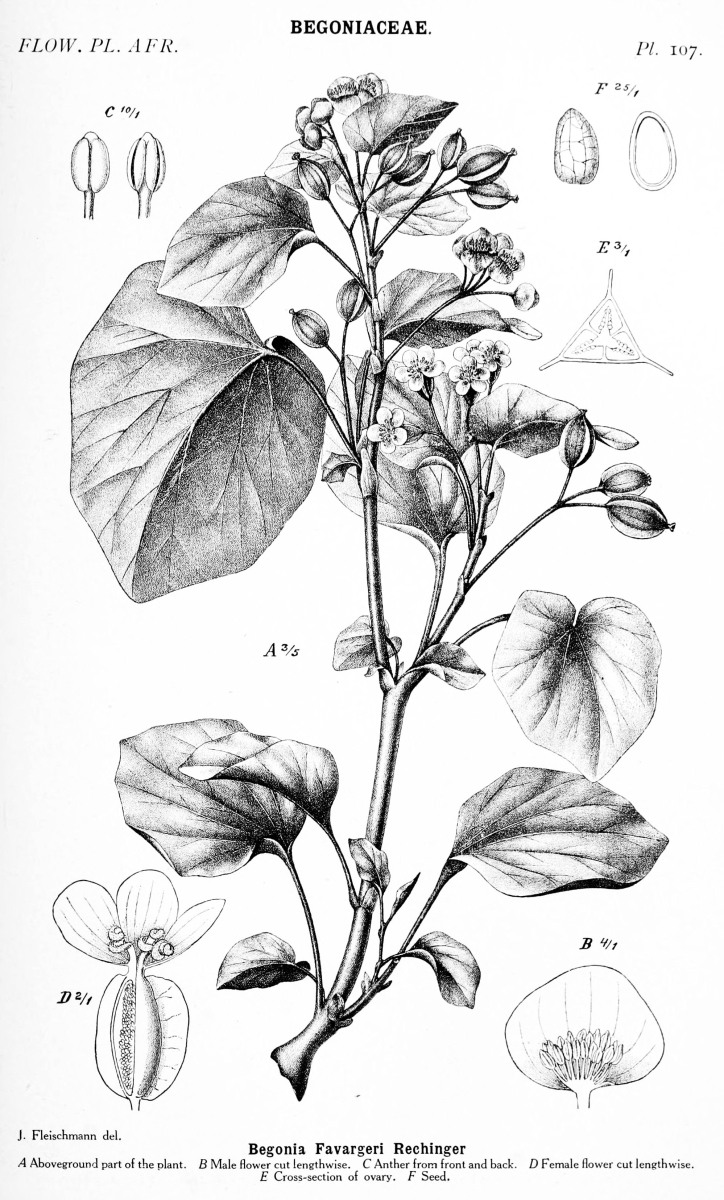
BEGONIACEAE.
FLOW. PL. AFR.
Pl. 107.
J. Fleischmann del.
Begonia Favargeri Rechinger
A Aboveground part of the plant. B Male flower cut lengthwise. C Anther from front and back. D Female flower cut lengthwise. E Cross-section of ovary. F Seed.
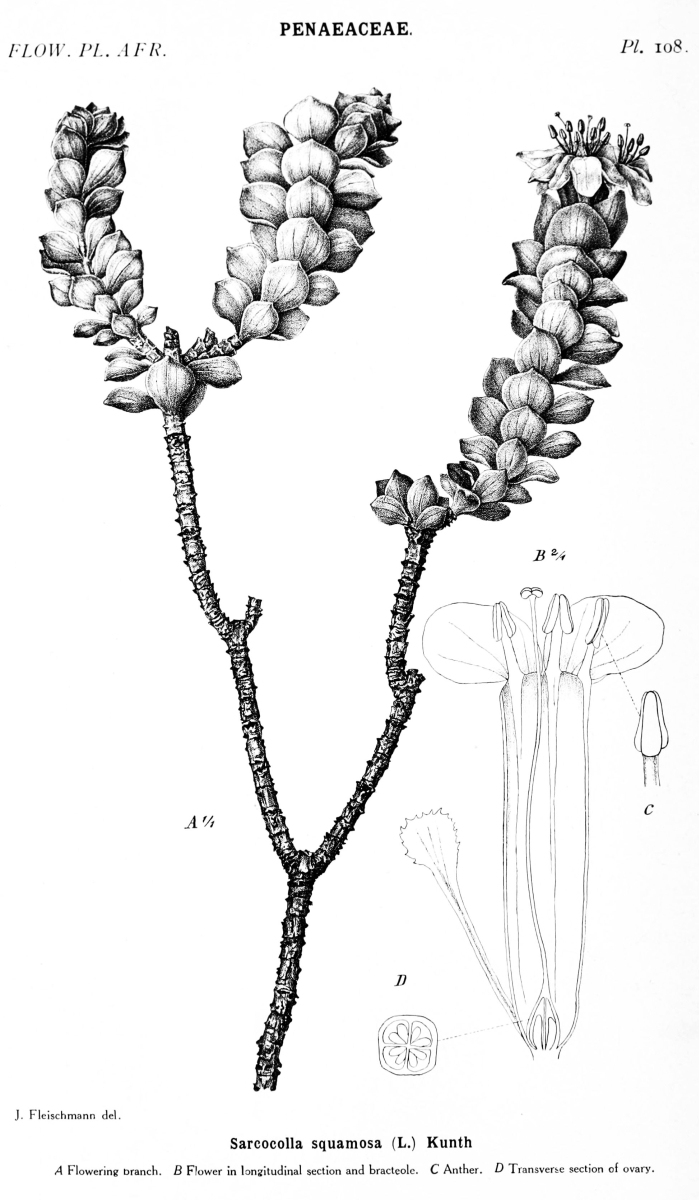
PENAEACEAE.
FLOW. PL. AFR.
Pl. 108.
J. Fleischmann del.
Sarcocolla squamosa (L.) Kunth
A Flowering branch. B Flower in longitudinal section and bracteole. C Anther. D Transverse section of ovary.
Perianth wheel-shaped, of free or nearly free segments. Ovules few, on short funicles. Epiphytes.—Species 7. Tropical and South Africa. (Under Hariota Adans.) [Tribe RHIPSALIDEAE.] Rhipsalis Gaertn. 4. Stamens much exceeding the perianth. Seed-coat leathery. Stem without spines. Flowers red.—Species 1 (N. coccinellifera S. Dyck). Cultivated and sometimes naturalized, especially in the Canary Islands. It is used for rearing the cochineal insect and as a vegetable. (Under Opuntia Haw.) Nopalea S. Dyck Stamens shorter than the perianth. Seed-coat hard.—Species 3. Cultivated, especially in North Africa. They yield edible fruits (prickly pear) from which also dyes, drinks, medicaments, and sugar are prepared; one species is used for rearing the cochineal insect. Opuntia Haw.
ORDER MYRTIFLORAE
SUBORDER THYMELAEINEAE
FAMILY 168. GEISSOLOMATACEAE
Shrubs of heath-like appearance. Leaves opposite, undivided, stipulate. Flowers solitary, axillary, regular, 4-merous, hermaphrodite, surrounded by 6-8 unequal bracteoles. Calyx-tube short. Sepals petal-like, imbricate in bud. Petals none. Stamens 8, perigynous, unequal. Anthers versatile, short, with a narrow connective, opening inwards by two longitudinal slits. Ovary superior, 4-celled. Ovules 2 in each cell, pendulous, inverted, the raphe turned outwards. Style 1. Stigmas 4. Fruit a loculicidal capsule. Seeds with a small outgrowth at the hilum, a smooth testa, a fleshy albumen, and a large straight embryo. (Under PENAEACEAE.)
Genus 1, species 2. South Africa. Geissoloma Lindl. & Kunth
FAMILY 169. PENAEACEAE
Shrubs or undershrubs of heath-like appearance. Leaves opposite, entire, with sometimes gland-like stipules. Flowers solitary or in pairs in the axils of the leaves or in terminal spikes or heads, with 2 or 4 bracteoles, regular, 4-merous, hermaphrodite. Calyx-tube long. Sepals petal-like, red or yellow, valvate in bud. Petals none. Stamens 4, perigynous, alternating with the sepals. Anthers adnate, with a thickened connective, opening inwards by two longitudinal slits. Ovary superior, sessile, 4-celled. Ovules 2 or 4 in each cell, all or the lower ones ascending, inverted, the raphe turned outwards. Style simple with a 4-lobed or 4-parted stigma, or 4-cleft. Fruit a loculicidal capsule. Seeds exalbuminous. Embryo with very small cotyledons.—Genera 5, species 35. South Africa. (Plate 108.)
1. Ovules 4 in each ovary-cell, two of them ascending, two descending. Ovary and style cylindrical. Style simple. [Tribe ENDONEMEAE.] 2 Ovules 2, very rarely 4 in each ovary-cell, all ascending. Flowers in the axils of crowded leaves or bracts. Bracteoles 2. [Tribe PENAEEAE.] 3 2. Flowers in the axils of coloured bracts, crowded in terminal spikes or heads. Bracteoles 2. Filaments much shorter than the anthers. Anthers turned inwards in the bud; cells equalling the connective.—Species 1. Cape Colony. (Under Endonema Juss.) Glischrocolla A. DC. Flowers in the axils of foliage-leaves, not crowded. Bracteoles 4. Filaments nearly as long as or longer than the anthers. Anthers turned outwards in the bud; cells much shorter than the connective. Seeds with an outgrowth at the top.—Species 2. Cape Colony. Endonema A. Juss. 3. Ovary and style 4-angled or 4-winged. Ovules 2 in each cell. Stamens very short.—Species 20. Cape Colony. (Including Stylapterus Juss.) Penaea L. Ovary and style cylindrical. Style simple. 4 4. Calyx-tube short, oblong-oval, somewhat longer than the sepals. Stamens slightly exceeding the calyx-tube; filaments short. Ovules 2 in each cell.—Species 6. Cape Colony. (Under Sarcocolla Kunth). Brachysiphon A. Juss. Calyx-tube long, cylindrical, much longer than the sepals. Stamens much exceeding the calyx-tube; filaments long. Anthers-cells almost equalling the connective.—Species 5. Cape Colony. Used as ornamental plants. (Plate 108.) Sarcocolla Kunth
FAMILY 170. OLINIACEAE
Shrubs or trees. Leaves opposite, entire, without stipules. Flowers in terminal cymose inflorescences, regular, 4-5-merous. Calyx petaloid, white or red. Petals much smaller than the sepals, white, valvate in bud. Fertile stamens 4-5, opposite to the petals, usually alternating with scale-like staminodes. Anthers nearly sessile, with a large connective. Ovary inferior, 3-5-celled. Ovules 2-3 in the inner angle of each ovary-cell, inverted, the raphe turned outwards. Style simple; stigma entire. Fruit a drupe. Seeds exalbuminous; embryo with folded cotyledons. (Under LYTRHACEAE, MELASTOMATACEAE, or RHAMNACEAE.)
Genus 1, species 7. South and Central Africa. Some species yield timber. Olinia Thunb.
FAMILY 171. THYMELAEACEAE
Leaves entire, without stipules. Flowers 4-5-merous. Sepals petaloid. Petals usually present. Stamens as many as and opposite to the petals, 4, or twice as many, 8 or 10. Anthers opening by longitudinal slits. Ovary superior, 1-5-celled. Ovule 1 in each cell, pendulous, inverted, with a ventral raphe. Style simple; stigma entire. Fruit a drupe or a nut. Embryo large, straight.—Genera 17, species 250. (Plate 109.)
1. Receptacle flat. Sepals free. Petals none, but 4-10 scales placed singly or in pairs opposite to the sepals. Stamens 8-10, hypogynous. Ovary 4-5-celled. Low trees. Leaves alternate, dotted beneath. Flowers solitary or fascicled, axillary, white.—Species 7. West Africa. (Including Makokoa Baill.) [Subfamily OCTOLEPIDIOIDEAE, tribe OCTOLEPIDEAE.] Octolepis Oliv. Receptacle concave. Sepals united. Stamens perigynous. Ovary 1-2-celled. 2 2. Ovary 2-celled, surrounded by a disc. Petals none. Stamens 8-10. Fruit a drupe. Shrubs. Leaves alternate. Flowers in umbels, yellowish-green.—Species 10. Tropical and South Africa. [Subfamily PHALERIOIDEAE, tribe PEDDIEAE.] Peddiea Harv. Ovary 1-celled. [Subfamily THYMELAEOIDEAE.] 3 3. Petals present, usually smaller than the sepals and 2-parted, sometimes united into a ring. 4 Petals none, but sometimes 8 or more scales present, inserted below the stamens, and usually alternating with them. Stamens 8-10. 9 4. Calyx-tube constricted and jointed above the ovary, the upper part falling off after flowering. Fruit with a membranous exocarp. [Tribe GNIDIEAE.] 5 Calyx-tube not jointed, persisting in fruit or falling off as a whole. Fruit with a hard or fleshy exocarp. Stamens 8-10. [Tribe DICRANOLEPIDEAE.] 6 5. Stamens 4, inserted in the upper part of the calyx-tube, nearly sessile, with a broadened connective. Petals thick-fleshy, surrounded by hairs. Shrubs or undershrubs. Leaves small, leathery. Flowers solitary or in pairs in the axils of the leaves.—Species 25. South and Central Africa. Struthiola L. Stamens 8 or 10, in two whorls very distant from each other and inserted in the upper part of the calyx-tube and at the throat. Trees, shrubs, or undershrubs. Flowers in heads, more rarely arranged spike-like in the axils of the upper leaves.—Species 125. Southern and tropical Africa. Some species are used as ornamental, medicinal, or textile plants. (Including Arthrosolen Mey. and Lasiosiphon Frees) Gnidia L. 6. Petals united into a ring. Stamens 10. Shrubs. 7 Petals free, 2-partite. Leaves herbaceous. 8 7. Petals united into a nearly entire ring. Ovary short-stalked, surrounded at the base by a cup-shaped or slashed disc. Flowers in few-flowered axillary clusters or in short terminal racemes.—Species 6. Central Africa to Delagoa Bay. Synaptolepis Oliv. Petals united into a slashed ring. Ovary sessile. Disc none. Flowers in long-stalked spikes or heads.—Species 2. Madagascar and Comoro Islands. Stephanodaphne Baill. 8. Flowers 4-merous. Petals thickish, almost erect. Staminal whorls remote from each other. Anthers nearly sessile, slightly exserted. Disc none. Ovary sessile, hairy. Style included. Shrubs. Leaves opposite. Flowers in terminal umbels.—Species 1. East and South-east Africa. Englerodaphne Gilg Flowers 5-merous. Petals thin, spreading. Staminal whorls approximate. Anthers more or less exserted. Disc cup-shaped. Ovary short-stalked. Style long. Shrubs or trees. Leaves alternate. Flowers solitary or in pairs, axillary.—Species 25. Central Africa. Dicranolepis Planch. 9. (3.) Stamens 10, inserted at or below the middle of the long, narrowly funnel-shaped, not jointed calyx-tube at the same level. Filaments short, unequal in length. Anthers included. Corona none. Disc ring- or saucer-shaped. Ovary sessile. Style short. Twining shrubs. Leaves opposite or nearly so, leathery. Flowers in axillary clusters, greenish-yellow.—Species 2. West Africa. [Tribe CRATEROSIPHONEAE.] Craterosiphon Engl. & Gilg Stamens inserted at the throat or the upper part of the calyx-tube; in the latter case calyx-tube wide or jointed. [Tribe DAPHNEAE.] 10 10. Calyx-tube bearing in its upper part a corona of 8 or more scales, jointed above the ovary, the lower part persistent in fruit. Flowers 4-merous. Filaments thread-like. Anthers exserted. Ovary sessile. Fruit dry. Shrubs. Leaves small, leathery, sometimes needle-shaped. 11 Calyx-tube without a corona, but sometimes the ovary surrounded at the base by a disc or by several glands. 12 11. Flowers solitary, white or reddish. Sepals equal in length. Corona inserted in the middle of the calyx-tube.—Species 5. South Africa. Some are used as ornamental plants. Cryptadenia Meissn. Flowers in fascicles or heads. Corona inserted next to the throat of the calyx, and formed of 8 scales which alternate with the stamens.—Species 20. South Africa. Some are used as ornamental plants. (Plate 109.) Lachnaea L. 12. Calyx-tube constricted and jointed above the ovary, the upper part, rarely the whole calyx, falling off after flowering. 13 Calyx-tube not jointed, persistent in fruit or falling off as a whole, the segments sometimes falling off singly. Filaments and style short. Flowers 4-merous. 16 13. Filaments very short. Staminal whorls widely separated. Disc minute or wanting. (See 5.) Gnidia L. Filaments long. Staminal whorls approximate, rarely somewhat distant, but then disc distinctly developed. Shrubs. 14 14. Flowers 5-merous. Segments of the calyx much shorter than the tube. Disc saucer-shaped, lobed. Ovary hairy. Fruit dry. Seeds without albumen. Flowers in terminal heads.—Species 6. South Africa and Madagascar. Some are used as ornamental plants. Dais L. Flowers 4-merous. Segments of the calyx nearly as long as the tube. Disc none. Ovary glabrous. Seeds with a copious albumen. Leaves opposite. Flowers solitary and axillary, or in terminal spikes. 15 15. Fruit fleshy. Calyx-tube short, urn-shaped.—Species 1. South Africa. Chymococca Meissn.
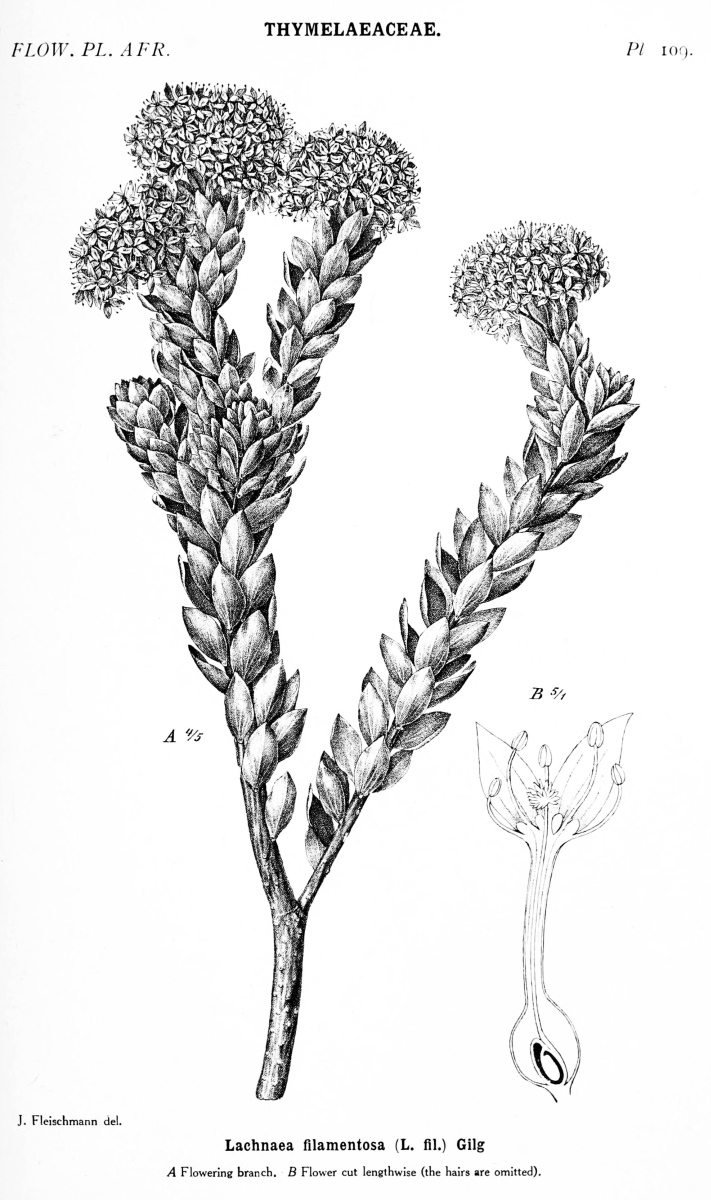
THYMELAEACEAE.
FLOW. PL. AFR.
Pl. 109.
J. Fleischmann del.
Lachnaea filamentosa (L. fil.) Gilg
A Flowering branch. B Flower cut lengthwise (the hairs are omitted).
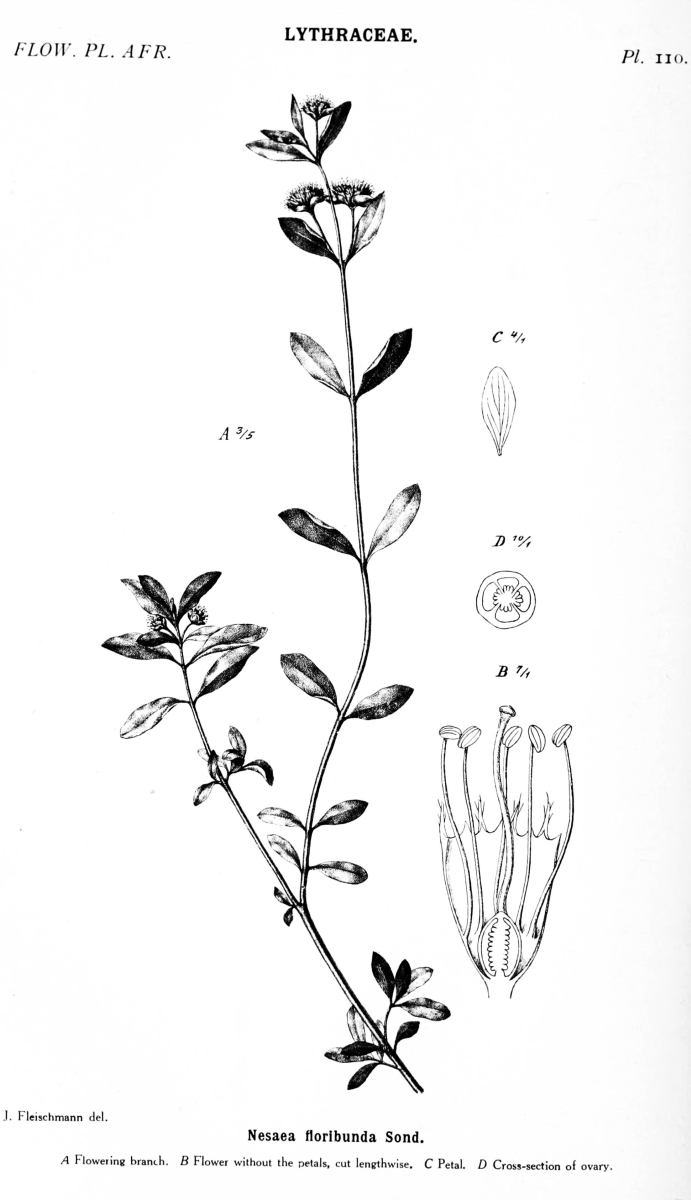
LYTHRACEAE.
FLOW. PL. AFR.
Pl. 110.
J. Fleischmann del.
Nesaea floribunda Sond.
A Flowering branch. B Flower without the petals, cut lengthwise. C Petal. D Cross-section of ovary.
Fruit dry.—Species 7. South Africa. Some species yield dyes or serve as ornamental plants. Passerina L. 16. Disc hypogynous, consisting of 1-4, usually 4, free or partly united, narrow, almost thread-shaped scales. Calyx-tube long; segments deciduous. Ovary hairy. Shrubs or trees. Flowers in terminal racemes or spikes, hermaphrodite.—Species 1. Naturalized in the Mascarene Islands. Ornamental plant. Wikstroemia Endl. Disc minute and ring-shaped, or wanting. 17 17. Fruit a drupe. Flowers hermaphrodite. Calyx-tube long. Stigma large. Shrubs or trees. Flowers in heads, racemes, or panicles.—Species 4. North Africa. Poisonous plants yielding bast-fibres, tanning and dyeing materials, and medicaments; they also serve as ornamental plants. Daphne L. Fruit a nut. Disc none. Ovary short-stalked. Herbs, undershrubs, or shrubs. Leaves alternate. Flowers solitary or fascicled, axillary.—Species 10. North Africa. Some species are used as medicinal or fibre-plants. Thymelaea Endl.
FAMILY 172. ELAEAGNACEAE
Shrubs or trees, covered with scaly hairs. Leaves alternate, entire, without stipules. Flowers in axillary fascicles or racemes, 4-merous, very rarely 5-8-merous, hermaphrodite or polygamous. Calyx white or yellow within, valvate in bud. Petals none. Stamens perigynous, as many as and alternate with the sepals. Filaments very short. Anthers attached at the back, opening by longitudinal slits. Ovary superior, but tightly enclosed by the concave receptacle, 1-celled, with a single erect and inverted ovule. Style simple, long; stigma entire, capitate. Fruit a nut enclosed by the succulent calyx-tube. Seed with a hard coat and scanty albumen or without albumen; embryo straight, with a minute radicle and thick, fleshy cotyledons.
Genus 1, species 2. Naturalized in North Africa and the Island of Mauritius. Ornamental plants yielding timber and medicaments. “Oleaster.” Elaeagnus L.
SUBORDER MYRTINEAE
FAMILY 173. LYTHRACEAE
Leaves entire, usually stipulate. Flowers 3-8-merous, hermaphrodite. Sepals valvate in the bud. Petals inserted at the throat of the calyx, usually crumpled in the bud, sometimes absent. Stamens nearly always inserted below the petals. Anthers fixed by the back. Ovary superior, completely or incompletely 2-6-celled. Ovules numerous in each cell, attached at the inner angle, ascending, inverted, with ventral raphe. Style simple or wanting; stigma entire or 2-lobed. Fruit dry. Seeds exalbuminous; embryo straight.—Genera 12, species 90. (Plate 110.)
1. Partitions of the ovary incomplete above; placentas not continuing into the style. [Tribe LYTHREAE.] 2 Partitions of the ovary complete; placentas continuing into the style. Flowers regular. [Tribe NESAEEAE.] 9 2. Flowers distinctly irregular. Sepals 6. Petals 6-7, unequal. Stamens 10-14, usually 11. Disc present. Placenta finally protruding from the bursting ovary and calyx-tube. Leaves opposite or whorled.—Species 1. Naturalized in the Mascarene Islands. Ornamental plant. Cuphea P. Browne Flowers regular or almost so. 3 3. Stem herbaceous or woody at the base only. Leaves not dotted. Seeds not winged. 4 Stem woody. Leaves opposite, marked with black dots, rarely without dots, but then seeds with a thick wing. Style long. 7 4. Fruit indehiscent, membranous, not striate. Seeds very numerous. Flowers 6-merous. Calyx-tube hemispherical or broad-campanulate, with appendages at the apex. Sepals herbaceous. Stamens as many as the sepals. Ovary 2-celled. Style very short. Flowers solitary, axillary, with whitish bracteoles.—Species 1. North Africa. Used as a vegetable. Peplis L. Fruit dehiscing by 2-4 valves or bursting transversely or irregularly; in the latter cases flowers 4-merous and cymose. 5 5. Fruit bursting transversely or irregularly, membranous, not striate. Seeds very numerous. Flowers 4-merous. Sepals herbaceous. Stamens as many or twice as many as the sepals. Flowers in axillary cymes, with whitish bracteoles.—Species 15. Tropical and South Africa and Egypt. Some are used medicinally. Ammania L. Fruit dehiscing longitudinally in 2-4 valves. 6 6. Fruit marked with dense, sometimes very faint, transverse veins. Sepals usually membranous. Stamens as many as the sepals or fewer. Glabrous plants. Flowers solitary or umbellate and axillary, or in terminal spikes or racemes, bracteolate.—Species 20. Tropical and South Africa. (Including Quartinia Endl., Rhyacophila Hochst., and Suffrenia Bellardi). Rotala L. Fruit without transverse veins. Calyx-tube tubular, rarely campanulate, with appendages at the top. Flowers solitary or paired in the leaf-axils, rarely in spikes or racemes of cymes (false whorls).—Species 8. North, East, and South Africa. Some are used as ornamental or medicinal plants. Lythrum L. 7. Stamens 6. Calyx-tube top-shaped. Sepals membranous. Ovary nearly completely 2-celled. Flowers in panicles.—Species 1. South-east Africa. Galpinia N. E. Brown Stamens 12-18. Flowers solitary or in racemes. 8 8. Calyx-tube tubular. Petals small. Stamens 12. Ovary nearly completely 2-celled. Fruit bursting irregularly or remaining closed. Seeds not winged. Flowers in racemes.—Species 2. East Africa and Madagascar. They yield tanning and dyeing material and serve as ornamental plants. Woodfordia Salisb. Calyx-tube campanulate or cupular. Ovary very incompletely 3-4-celled. Fruit opening transversely. Seeds with a thick wing. Flowers solitary or in pairs in the leaf-axils.—Species 2. Madagascar and East Africa. They serve as vegetables. Pemphis Forst. 9. (1.) Stamens 5-6, opposite to the petals and adnate to their base. Calyx-tube expanded. Sepals lanceolate. Ovary 2-celled. Ovules in a single row. Low trees. Flowers in panicles.—Species 1. South-east Africa (Natal). Rhynchocalyx Oliv. Stamens 4-23, inserted below the petals, or petals wanting. Ovules in two or more rows. Herbs, undershrubs, or shrubs. 10 10. Calyx-tube top- or saucer-shaped, without appendages. Sepals 4. Stamens inserted near the petals, singly or in clusters of 2-3 opposite the sepals. Fruit bursting irregularly or remaining closed. Seed-coat with a spongy thickening at the top. Shrubs. Leaves opposite. Flowers in panicles.—Species 1 (L. inermis L.). Tropical and North Africa. Yields a dye (henna) and is used in perfumery and medicine. (Including Rotantha Bak.) Lawsonia L. Calyx-tube bell-, urn-, or cup-shaped. Sepals 4-8. Stamens remote from the petals, or petals wanting. Fruit opening by 4 valves or by a lid. Seed-coat not specially thickened. Flowers in cymes or umbels. 11 11. Calyx-tube winged. Sepals 4. Petals none. Stamens 4, alternating with the sepals. Anthers finally kidney-shaped. Fruit opening by 4 valves. Style persisting upon the placentas. Shrubs. Leaves opposite. Flowers in axillary, 2-4-flowered umbels.—Species 1. Island of Mauritius. Tetrataxis Hook. fil. Calyx-tube not winged. Fruit at first opening by a small lid, later on splitting towards the base. Style persisting upon a valve or falling off. Herbs, undershrubs, or low shrubs. Flowers in sometimes head-like cymes.—Species 40. Tropical and South Africa. (Plate 110.) Nesaea Comm.
FAMILY 174. SONNERATIACEAE
Trees or shrubs. Leaves opposite, entire, not dotted, without stipules. Flowers solitary, without bracteoles, regular. Sepals 6-7, fleshy, valvate in bud. Petals 6-7, linear, occasionally wanting. Stamens numerous, perigynous. Filaments bent inwards in the bud. Anthers fixed by the back, kidney-shaped, opening inwards by longitudinal slits. Ovary almost superior, with 10-20 somewhat incomplete cells not reaching the top. Ovules very numerous, attached to the partitions, inverted. Style simple; stigma entire. Fruit succulent, indehiscent or bursting irregularly. Seeds curved, exalbuminous, with a hard coat and a straight embryo. (BLATTIACEAE, under LYTHRACEAE.)
Genus 1, species 1. East Africa, Madagascar and neighbouring islands. Yields edible fruits, condiments, and medicaments. (Blatti Adans.) Sonneratia L. f.
FAMILY 175. PUNICACEAE
Trees or shrubs. Leaves undivided, without stipules. Flowers solitary or in clusters of 2-5 at the ends of the branches, regular, hermaphrodite. Sepals 5-8, red, fleshy, valvate in bud. Petals as many, red or yellow, imbricate and crumpled in the bud. Stamens numerous, curved inwards in the bud. Anthers fixed by the back, opening inwards by longitudinal slits. Ovary inferior or half-inferior, with several cells, which are usually arranged in 2-3 whorls placed one above the other. Ovules numerous, at first basal, afterwards parietal, inverted. Style simple; stigma 1. Fruit a berry. Seeds exalbuminous, with an outer fleshy and an inner horny coat; embryo straight, with twisted cotyledons. (GRANATEAE, under LYTHRACEAE.)
Genus 1, species 2. One of them growing wild in the Island of Socotra, the other one (P. Granatum L., pomegranate) cultivated and naturalized in northern and tropical Africa. The latter serves as an ornamental plant and yields wood, tanning and dyeing materials, medicaments, and edible fruits, from which also a drink is prepared. Punica L.
FAMILY 176. LECYTHIDACEAE
Trees or shrubs. Leaves alternate, undivided, without stipules. Flowers solitary or racemose, hermaphrodite. Sepals 2-5. Petals 4-6, adnate to the staminal tube, imbricate in bud, or wanting. Stamens numerous, united at the base, curved in the bud. Anthers versatile, usually basifixed, opening by longitudinal slits. Disc within the stamens, ring-shaped. Ovary inferior, 2-20-celled, with 2 or more inverted ovules in each cell. Style simple. Fruit indehiscent. Seeds exalbuminous.—Genera 4, species 15. Tropical and South-east Africa. (Under MYRTACEAE.) (Plate 111.)
1. Petals and staminodes absent. Sepals 3-5, usually 4. Stamens almost free. Disc obscure. Ovules numerous in each cell, inserted in a vertical ring round a shield-shaped placenta, horizontal, the micropyle turned outwards. Stigmas 4. Fruit a drupe. Leaves clustered. Flowers solitary, axillary.—Species 4. Madagascar and Mascarenes. Yielding timber. [Subfamily FOETIDIOIDEAE.] Foetidia Comm. Petals or staminodes present. Stamens obviously united at the base. Disc distinct. Ovules inserted in rows on slightly thickened placentas, horizontal with the micropyle turned inwards, or ascending, or pendulous. Flowers racemose, rarely solitary, but then leaves scattered. 2 2. Sepals 5. Petals 0. Stamens and staminodes united to different heights, in 4 concentric rows, the inner row partly fertile, the rest barren. Anthers 1-celled. Disc thick. Ovary 5-20-celled. Style short; stigmas 5. Seeds 5 or more. Flowers solitary or 2-3 together, axillary. Leaves scattered.—Species 5. Central Africa. They yield timber and edible fruits. [Subfamily NAPOLEONOIDEAE.] Napoleona Beauv. Sepals 2-4. Petals 4-6. Stamens all fertile or the innermost barren, all united to the same height. Anthers 2-celled. Disc ring-shaped.
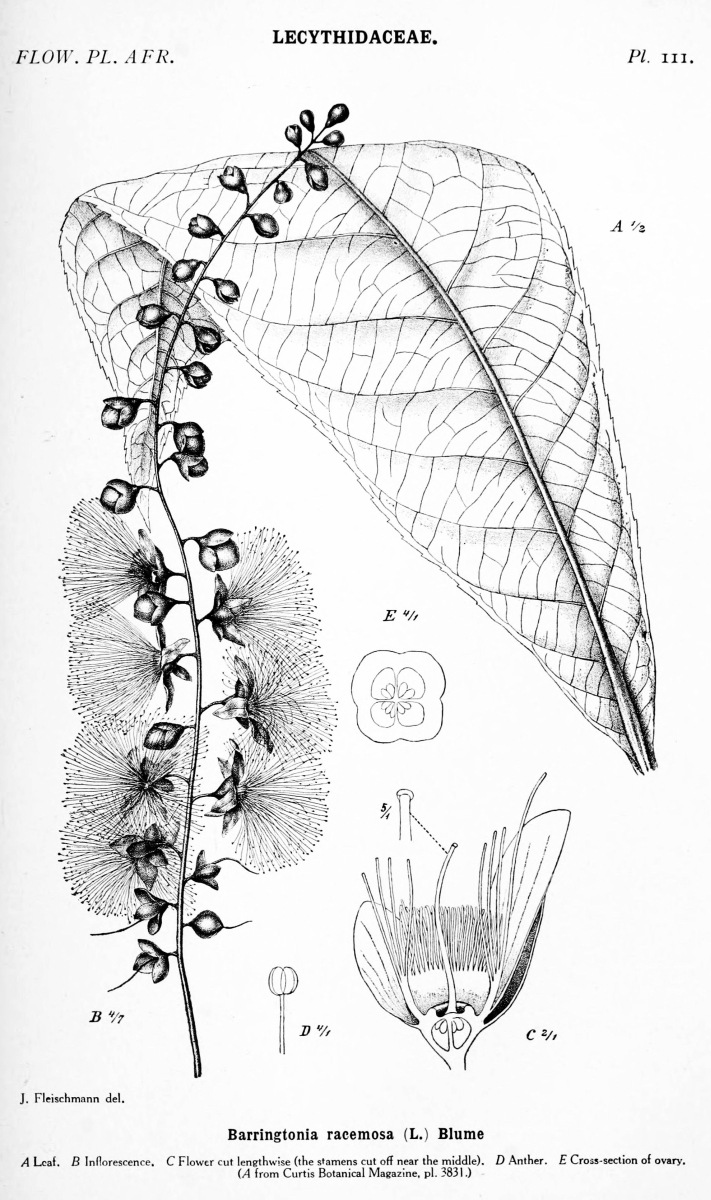
LECYTHIDACEAE.
FLOW. PL. AFR.
Pl. 111.
J. Fleischmann del.
Barringtonia racemosa (L.) Blume
A Leaf. B Inflorescence. C Flower cut lengthwise (the stamens cut off near the middle). D Anther. E Cross-section of ovary. (A from Curtis Botanical Magazine, pl. 3831.)
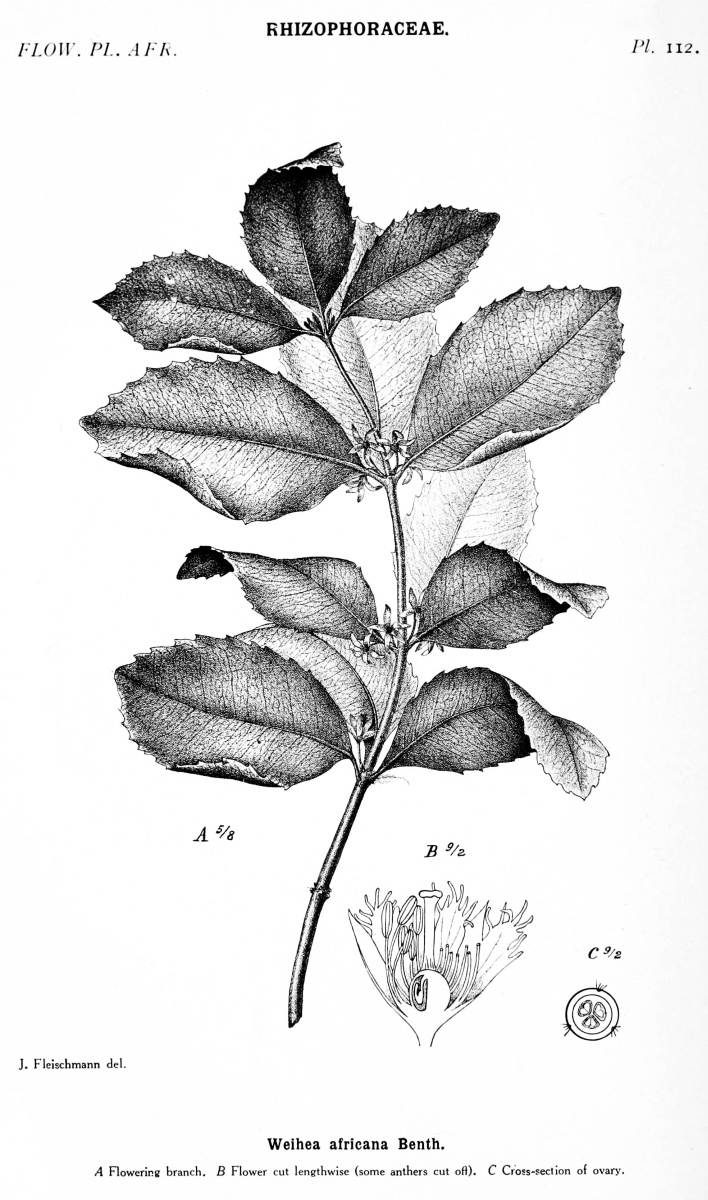
RHIZOPHORACEAE.
FLOW. PL. AFR.
Pl. 112.
J. Fleischmann del.
Weihea africana Benth.
A Flowering branch. B Flower cut lengthwise (some anthers cut off). C Cross-section of ovary.
Ovary 2-4-celled. Style long; stigma 1, entire or 2-4-lobed. Seeds 1-4. Flowers in racemes. Leaves clustered. [Subfamily PLANCHONIOIDEAE.] 3 3. Ovary long, winged. Ovules inserted along the inner angle of the cells or in the middle of the partitions. Fruit a nut. Embryo with distinct cotyledons. Bracteoles in the middle of the long pedicels.—Species 2. West Africa. Petersia Welw. Ovary short, ovate. Ovules suspended from the apex of the inner angle of the cells. Fruit a one-seeded drupe. Embryo undivided. Bracteoles at the base of the pedicels.—Species 5. Madagascar and neighbouring islands. East and South-east Africa. They yield timber, tanning bark, vegetables, oil, fish-poison, and medicaments, and serve also as ornamental plants. (Plate 111.) Barringtonia Forst.
FAMILY 177. RHIZOPHORACEAE
Trees or shrubs. Leaves undivided. Flowers regular, hermaphrodite or polygamous. Sepals valvate in bud. Petals free, induplicate-valvate in bud, usually lobed or fringed. Stamens perigynous or epigynous, twice as many as the petals or more, rarely (Anisophyllea) some of them barren. Anthers opening inwards by longitudinal slits. Ovary completely or incompletely 2-6-celled. Ovules 1-2 in the inner angle of each cell, pendulous, inverted. Seeds usually germinating in the still attached fruit.—Genera 10, species 45. Tropical and South Africa. (Plate 112.)
1. Styles 3-4. Ovary inferior, with 1 ovule in each cell. Stamens 6-8, several of them sometimes barren. Flowers 3-4-merous, polygamous. Fruit a drupe. Seeds exalbuminous. Leaves alternate, exstipulate. [Subfamily ANISOPHYLLOIDEAE.] 2 Style 1. Ovary with 2 ovules in each cell. Fruit a berry or a capsule. Seeds albuminous. Leaves opposite or whorled, stipulate. [Subfamily RHIZOPHOROIDEAE.] 3 2. Flowers in few-flowered spikes or racemes. Fruit 1-seeded.—Species 7. Tropics. They yield timber and edible fruits. Anisophyllea R. Br. Flowers in spikes arranged in racemes. Style ovate. Fruit 2-4-seeded.—Species 1. Equatorial West Africa (Gaboon). Yields edible, oily seeds. Poga Pierre 3. Ovary inferior or half-inferior. Placentas usually passing into the style. Ovules without appendages. Petals yellow, brown, red, or greenish. Stamens twice as many as the petals. [Tribe GYNOTROCHEAE.] 4 Ovary superior or nearly so. Placentas not reaching to the base of the style. Ovules with appendages. Petals 4-6, toothed or split, usually white. [Tribe MACARISIEAE.] 7 4. Ovary inferior. Receptacle (flower-tube) deeply concave, bell- or funnel-shaped, distinctly prolonged above the ovary. Petals 5-14. Calyx crowning the fruit. 5 Ovary half-inferior. Receptacle slightly concave, saucer-shaped, scarcely prolonged above the ovary. Petals 4-6. Calyx at the base of the fruit. Seeds germinating in the still attached fruit. Plants with aerial roots. Flowers with an involucre of two bracteoles, arranged in cymes. 6 5. Receptacle funnel-shaped, prolonged above the ovary into a long tube. Flowers 8-14-merous. Petals red or brown, 2-lobed, with thread-like appendages. Antesepalous stamens curved sideways at the base, becoming opposite to the antepetalous. Disc obscurely lobed. Ovary 2-4-celled. Seeds germinating in the still attached fruit. Flowers solitary.—Species 1. Tropical and South-east Africa. Yields timber and bark used for tanning and dyeing. Bruguiera Lam. Receptacle bell-shaped, prolonged above the ovary into a short tube. Flowers 5-8-merous. Petals yellowish, irregularly lobed. Antesepalous stamens not opposite to the antepetalous. Disc usually double. Fruit 1- or 3-6-celled. Seeds germinating after the fruit has fallen. Flowers with an involucre of two bracteoles, arranged in cymes.—Species 2. Madagascar. Carallia Roxb. 6. Flowers 4-merous. Petals entire, yellowish or green. Anthers with numerous cells (pollen-sacks). Disc obscurely lobed. Ovary 2-celled. Stigma 2-lobed.—Species 2. Tropical and South-east Africa. They yield timber, tanning and dyeing materials, and medicaments. “Mangrove.” Rhizophora L. Flowers 5-6-merous. Petals 2-lobed, brownish. Anthers with 4 cells. Disc deeply lobed. Ovary 3-celled above, 1-celled below. Stigma entire.—Species 1. Tropics. Yields timber and tanning bark. Ceriops Arn. 7. Ovary 2-4-celled, adnate to the receptacle by the broad base. Leaves opposite. 8 Ovary 5-celled, sessile or short-stalked. Stamens 10. Flowers 5-merous, in few-flowered inflorescences. Seeds winged. 9 8. Disc distinctly 8-15-lobed. Stamens 10-15. Stigma entire. Placentas reaching the middle of the ovary only. Flowers in many-flowered inflorescences, frequently in glomerules.—Species 10. Tropical and South-east Africa. (Under Cassipourea Aubl.) Dactylopetalum Benth. Disc not distinctly lobed. Stamens 10-30. Stigma 2-4-lobed. Placentas reaching the base of the style. Fruit fleshy. Seeds with an aril. Flowers with an involucre of two bracteoles, solitary or in few-flowered inflorescences.—Species 18. Tropical and South-east Africa. (Plate 112.) Weihea Spreng. 9. Ovary sessile. Tall trees. Leaves whorled.—Species 2. West Africa. Anopyxis Pierre Ovary short-stalked. Low trees. Leaves opposite.—Species 3. Madagascar. Macarisia Thouars
FAMILY 178. ALANGIACEAE
Trees or shrubs. Leaves alternate, undivided, without stipules. Flowers in axillary cymes, regular, hermaphrodite. Calyx 6-10-toothed. Petals 6-10, free or slightly cohering at the base, narrow, valvate in bud. Stamens as many as the petals and alternate with them, or more. Filaments short, free or nearly so, hairy. Anthers long, adnate, opening inwards or laterally by two longitudinal slits. Disc cushion-shaped. Ovary inferior, 1-celled, rarely 2-celled. Ovule 1 in each cell, pendulous, inverted, with a ventral raphe. Style simple; stigma lobed. Fruit a drupe. Seed with a large central embryo and fleshy albumen. (Under CORNACEAE.)
Genus 1, species 2. Tropics. Used medicinally. (Including Marlea Roxb. and Stylidium Lour.) Alangium Lam.
FAMILY 179. COMBRETACEAE
Trees or shrubs, rarely undershrubs. Leaves entire, without stipules. Flowers in spikes heads or panicles, regular or nearly so, 4-6-merous. Petals free or wanting. Stamens usually twice as many as the sepals. Anthers versatile. Ovary inferior, rarely half-inferior, 1-celled. Ovules 2-3, rarely 4-6, pendulous from the apex of the cavity, inverted. Style simple. Fruit a one-seeded drupe or nut, rarely incompletely dehiscent, usually angled or winged. Seeds exalbuminous.—Genera 12, species 330. Tropical and South Africa. (Plate 113.)
1. Ovary half-inferior. Petals 5. Stamens 10. Ovules 2, with a short funicle. Fruit dorsally compressed, dry, indehiscent. Embryo with very thick, almost hemispherical cotyledons.—Species 2. West Africa. [Subfamily STREPHONEMATOIDEAE.] Strephonema Hook. fil. Ovary inferior. Ovules usually with a long funicle. Fruit winged, angled, laterally compressed, or terete. Embryo with flat, folded, or twisted cotyledons. [Subfamily COMBRETOIDEAE.] 2 2. Flowers with bracteoles adnate to the ovary, arranged in spikes or racemes. Sepals persistent. Petals 5. Cotyledons twisted. [Tribe LAGUNCULARIEAE.] 3 Flowers without bracteoles. Sepals deciduous, rarely persistent, but then flowers in heads. 4 3. Leaves opposite. Flowers sessile. Stamens 10. Ovules 2; funicle short.—Species 1. Coasts of West Africa. Yields timber, tanning and dyeing materials, and medicaments. Laguncularia Gaertn. Leaves alternate. Flowers stalked. Ovules 4-6; funicle long.—Species 1. Coast of East Africa and Madagascar. Lumnitzera Willd. 4. Petals 4-5, rarely none; in this case, as usually, leaves opposite. Flowers mostly hermaphrodite. Funicle usually tubercled. Cotyledons flat or folded, more rarely twisted. [Tribe COMBRETEAE.] 5 Petals none. Leaves alternate, rarely almost opposite. Flowers mostly polygamous. Sepals deciduous. Funicle usually smooth. Cotyledons twisted. Trees or erect shrubs. [Tribe TERMINALIEAE.] 10 5. Petals absent. Sepals 5. 6 Petals present, sometimes minute, rarely absent, but then sepals 4. 7 6. Calyx campanulate, divided down to the ovary, wing-like in fruit. Cotyledons twisted. Climbing shrubs. Flowers in panicled spikes.—Species 1. Madagascar. Calycopteris Lam. Calyx tubular-campanulate, lobed or cleft, net-veined, corolla-like, deciduous. Fruit woody. Cotyledons flat. Flowers in heads or short spikes.—Species 9. Madagascar. (Under Combretum L.) Calopyxis Tul. 7. Flowers ebracteate, arranged in heads which are subtended by 4 involucral bracts. Sepals persistent. Petals 5, strap-shaped. Stamens 10. Ovules 4-6. Fruit elongate, spindle-shaped, obscurely 5-angled, clothed with long hairs. Erect shrubs or trees. Leaves opposite, dotted.—Species 1. Central Africa. Used medicinally. Guiera Adans. Flowers bracteate, arranged in spikes or racemes. Sepals deciduous. Fruit winged or angled. 8 8. Flowers polygamous (hermaphrodite and male). Fruit 2-, rarely 3-4-winged, indehiscent. Trees or erect shrubs.—Species 5. Central Africa to Delagoa Bay. (Under Combretum L.) Pteleopsis Engl. Flowers hermaphrodite. Fruit 4-5-winged or 4-5-angled. 9 9. Calyx-tube above the ovary very long and thin, filiform; style adnate to it. Ovules 3-4. Flowers 5-merous. Fruit dehiscing at the top along the 5 angles. Climbing shrubs. Lower leaves alternate, upper opposite.—Species 3. Tropical and South-east Africa. Used as ornamental or medicinal plants. Quisqualis L. Calyx-tube not elongate-filiform. Ovules 2-3; funicles equal in length. Fruit indehiscent. Leaves opposite or whorled, sometimes intermixed with alternate ones.—Species 230. Tropical and South Africa. Some species yield timber, gum, tanning and dyeing materials, arrow-poison, medicaments, and fatty seeds; several serve as ornamental plants. (Including Cacoucia Aubl., Campylochiton Welw., Campylogyne Welw., and Poivrea Comm.) (Plate 113.) Combretum L. 10. (4.) Flowers and fruits in globose heads. Receptacle (calyx-tube) prolonged above the ovary into a stalk. Calyx-lobes 5, reflexed. Ovules 2. Fruits erect or spreading, flat, 2-winged, produced into a long beak; pericarp corky. Shrubs.—Species 1. Central Africa. Yields timber, dyes, a substitute for soap, and medicaments. Anogeissus Wall. Flowers and fruits in sometimes ovate, usually panicled spikes. Receptacle not much prolonged. Fruit not long-beaked but sometimes acuminate; pericarp leathery or drupaceous. 11 11. Fruits crowded in a cone, bent downwards, flat, 2-winged, acuminate; pericarp leathery. Flowers in short panicled spikes, 5-merous. Calyx-lobes erect. Ovules 2.—Species 2. Central Africa. They yield timber, tanning materials, and medicaments. Conocarpus Gaertn.
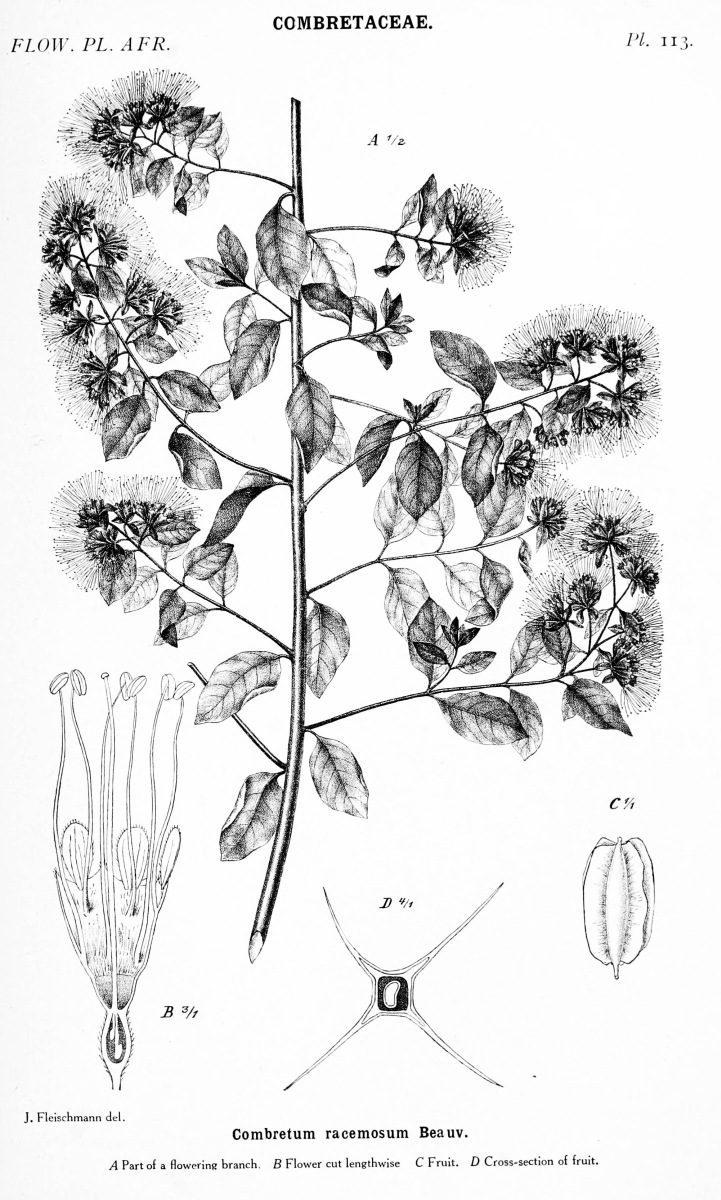
COMBRETACEAE.
FLOW. PL. AFR.
Pl. 113.
J. Fleischmann del.
Combretum racemosum Beauv.
A Part of a flowering branch. B Flower cut lengthwise. C Fruit. D Cross-section of fruit.
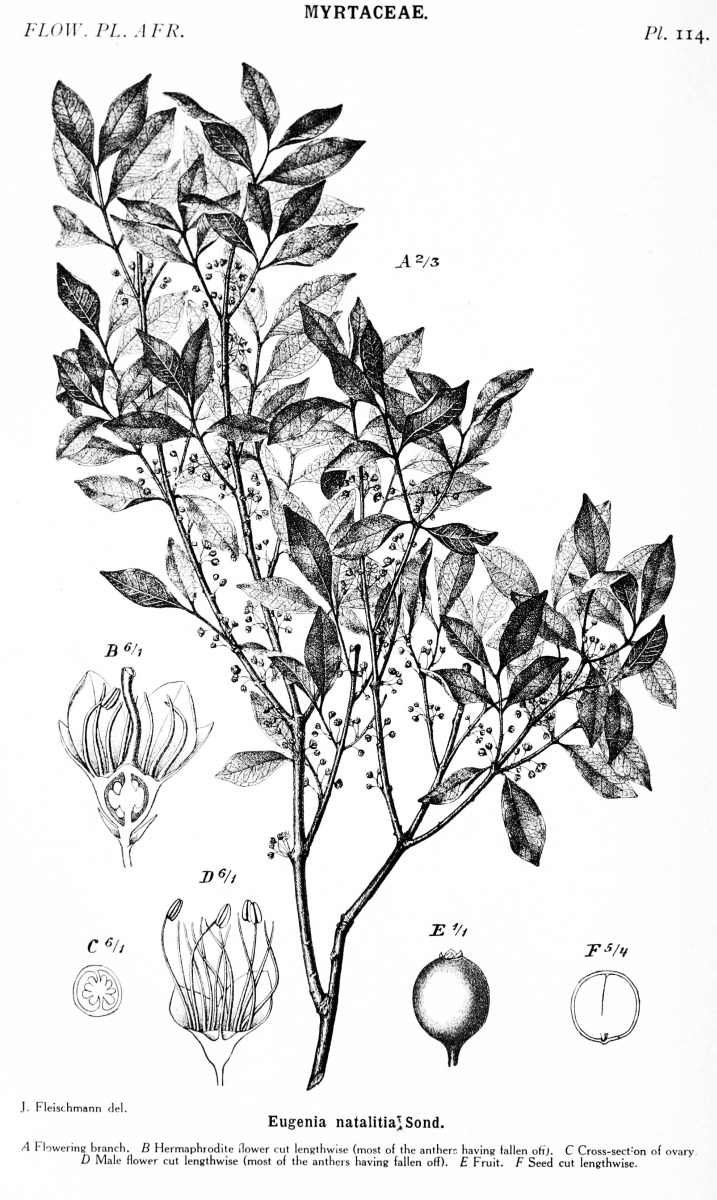
MYRTACEAE.
FLOW. PL. AFR.
Pl. 114.
J. Fleischmann del.
Eugenia natalitia Sond.
A Flowering branch. B Hermaphrodite flower cut lengthwise (most of the anthers having fallen off). C Cross-section of ovary. D Male flower cut lengthwise (most of the anthers having fallen off). E Fruit. F Seed cut lengthwise.
Fruits not crowded in a cone; pericarp fleshy or leathery outside, bony within. Flowers in usually long, often panicled spikes. Funicle smooth. Leaves usually crowded at the ends of the branches.—Species 80. Tropical and South Africa. Some species yield timber, resin used for fumigating, tanning and dyeing materials, food for silk-worms, edible oily seeds, and medicaments; others are used as ornamental plants. Terminalia L.
FAMILY 180. MYRTACEAE
Trees or shrubs. Leaves undivided, gland-dotted, without stipules. Flowers regular, 4-5-merous. Calyx with imbricate, open, or closed aestivation. Petals free and imbricate in bud, or united into a hood. Stamens usually numerous. Anthers opening by longitudinal slits. Ovary usually inferior or half-inferior, 2-5-celled, the cells sometimes incomplete at the top. Ovules inverted. Style simple; stigma entire, rarely (Psiloxylon) 3-4-parted. Seeds exalbuminous.—Genera 10, species 85. (Plate 114.)
1. Fruit a capsule or a nut. Embryo straight, with large cotyledons. Trees. [Subfamily LEPTOSPERMOIDEAE, tribe LEPTOSPERMEAE.] 2 Fruit a berry. Ovary inferior or half-inferior. Stamens numerous. Leaves opposite. [Subfamily MYRTOIDEAE, tribe MYRTEAE.] 5 2. Calyx entire or nearly so. Petals united into a hood falling off as a whole. Stamens numerous. Ovary inferior. Leaves of older trees mostly alternate.—Species 3. Cultivated and naturalized in various regions. They yield timber, bark for tanning, an astringent resin (kino), and an ethereal oil used in perfumery and medicine. [Subtribe EEUCALYPTINAE.] Eucalyptus L’Hér. Calyx with 5 lobes. Petals 5, free. 3 3. Stamens numerous. Ovary inferior or half-inferior. Leaves opposite.—Species 1. South Africa. [Tribe METROSIDERINAE.] Metrosideros Banks Stamens 5-10. Ovary superior. Leaves alternate. 4 4. Stamens 5-8. Stigma 1, entire. Flowers in terminal panicles.—Species 2. South Africa. Heteropyxis Harv. Stamens 10. Stigmas 3-4. Flowers in axillary clusters.—Species 1. Mascarene Islands. Yields timber. (Fropiera Hook. fil.) Psiloxylon Thouars 5. Embryo with a short radicle and large, fleshy cotyledons. Flowers usually 4-merous. Sepals separate or indistinct. Ovary 2-, rarely 3-celled. [Subtribe EUGENIINAE.] 6 Embryo with a long, curved radicle and shorter or somewhat longer cotyledons. Flowers usually 5-merous. Petals free. [Subtribe MYRTINAE.] 8 6. Ovary in the centre of the receptacle. Calyx-tube contrasting distinctly with the pedicel, not or slightly prolonged above the ovary. Petals free.—Species 40. Tropical and South Africa. Some species yield timber, bark used for tanning, edible fruits, and medicaments. (Including Chloromyrtus Pierre). (Plate 114.) Eugenia L. Ovary in the upper part of the receptacle. Calyx-tube gradually narrowed into the pedicel, usually much prolonged above the ovary. 7 7. Petals free, falling singly. Stamens inserted upon a distinct disc. Sepals comparatively large.—Species 8, of which 6 are growing wild in Madagascar and the Mascarenes, the other two cultivated and sometimes naturalized in the tropics. They yield timber, bark used for tanning, spices (cloves from J. caryophyllus Nied.), medicaments, and edible fruits; some are used as ornamental plants. (Including Caryophyllus L., under Eugenia L.) Jambosa DC. Petals more or less cohering, usually falling off together. Staminiferous disc none. Sepals usually small.—Species 25. Tropical and South Africa. They yield timber, tanning and dyeing materials, spices, medicaments, and edible fruits. (Including Acmena DC., under Eugenia L.) Syzygium Gaertn. 8. Placentas in the upper part of the ovary-cells, bearing 1-6 ovules each. Ovary 2-celled. Calyx divided already in the bud. Seeds 1-2, with a membranous coat; embryo spirally twisted, with minute cotyledons.—Species 2. Cultivated and naturalized in the Mascarene Islands. They yield timber, an aromatic oil, spices (allspice), and medicaments, and serve also as ornamental plants. Pimenta Lindl. Placentas in the middle of the ovary-cells, bearing numerous ovules each. Ovary completely or incompletely 3-5-, rarely 2-celled. Seeds numerous, with a horny coat; embryo curved, not spiral. 9 9. Calyx already divided into segments in the bud. Ovary and fruit completely or incompletely 2-3-celled. Embryo with rather large cotyledons.—Species 1 (M. communis L., myrtle). North Africa and Abyssinia, also naturalized in St. Helena. It is used as an ornamental plant and yields tanning bark and an oil employed in perfumery and medicine. Myrtus L. Calyx closed in the bud, bursting subsequently. Ovary and fruit usually 4-5-celled. Embryo with minute cotyledons.—Species 2. Cultivated in the tropics. They yield timber, bast used for paper-making, tanning and dyeing materials, vegetables, edible fruits (guavas), and medicaments. Psidium L.
FAMILY 181. MELASTOMATACEAE
Leaves opposite or whorled, undivided, usually with 3-11 longitudinal nerves, not dotted, without stipules. Flowers regular or nearly so. Petals perigynous or epigynous, free, usually with contorted aestivation. Stamens perigynous or epigynous, twice as many, rarely as many as the petals. Filaments inflexed in the bud. Anthers 2-celled, turned inwards, usually with an enlarged connective and opening at the top by 1-2 pores or short slits. Ovary generally inferior or half-inferior. Ovules numerous. Style simple; stigma entire. Seeds exalbuminous.—Genera 33, species 280. Tropical and South Africa. (Plate 115.)
1. Ovary 1-celled, inferior. Ovules 6-20, inserted upon a free central placenta. Fruit a berry. Seed 1, large. Calyx entire or 4-lobed. Petals white or blue. Stamens twice as many as the petals. Anthers short, with a posterior appendage, opening in front by two longitudinal slits. Shrubs or trees. Leaves penninerved or obscurely trinerved. [Subfamily MEMECYLOIDEAE, tribe MEMECYLEAE.] 2 Ovary completely 2- or more-celled. Ovules numerous, inserted upon axile placentas. Seeds numerous, small. [Subfamily MELASTOMATOIDEAE.] 3 2. Connective of the stamens lengthened at the base. Petals reddish. Flowers in terminal fascicles. Stem and inflorescence bristly.—Species 1. East Africa. Warneckea Gilg Connective of the stamens not lengthened at the base, but spurred at the back. Petals white or blue. Flowers in axillary inflorescences, more rarely in terminal, many-flowered cymes. Stem and inflorescence glabrous.—Species 60. Tropical and South-east Africa. Some species yield timber, dyes, medicaments, and edible fruits. Memecylon L. 3. Seeds strongly curved or spirally coiled. Fruit usually a membranous, 4-5-valved capsule with a convex, usually bristly summit. Connective of the stamens unappendaged behind, but furnished with two spurs or gibbosities in front, rarely quite unappendaged. Calyx-lobes usually large and alternating with bristles or small teeth. [Tribe OSBECKIEAE.] 4 Seeds straight or slightly curved, rarely strongly curved, but then fruit bursting irregularly or indehiscent and connective gibbous before and behind. Connective usually appendaged behind, or before and behind. 17 4. Stamens of two kinds, the larger with the connective distinctly lengthened at the base and furnished with two spurs or bosses, the smaller ones with a not or slightly lengthened connective. Shrubs or trees. 5 Stamens equal in shape, but sometimes unequal in length. 8 5. Connective of the smaller stamens unappendaged, of the larger with two bosses. Calyx-tube glabrous; teeth very short. Fruit with a membranous skin, bursting irregularly. Low shrubs. Flowers in terminal panicles.—Species 2. West Africa. Dinophora Benth. Connective of all stamens provided with 2 spurs or bosses. Calyx-tube usually hairy. Fruit with a membranous skin, but dehiscing in 4-5 valves, or with a leathery or fleshy skin. 6 6. Calyx without accessory teeth. Connective of all stamens lengthened at the base and provided with 2 awns. Fruit 4-5-valved. Rough-hairy shrubs or trees. Flowers in terminal panicles.—Species 20. Madagascar. Dichaetanthera Endl. Calyx with accessory teeth outside the sepals. Connective of the smaller stamens not or scarcely lengthened. 7 7. Fruit bursting irregularly or remaining closed; skin leathery or fleshy. Flowers 5-7-merous. Shrubs with rough branches and bristly leaves.—Species 1. Seychelles. Melastoma Burm. Fruit opening by 4-5 valves; skin membranous or leathery. Ovary adnate to the calyx-tube by 4-5 longitudinal partitions. Flowers 4-5-merous. Hairy, usually bristly herbs, undershrubs or shrubs.—Species 50. Central and South Africa; one species also naturalized in the Mascarene Islands. An intoxicating drink is prepared from the roots of some species. (Including Argyrella Naud.) (Plate 115.) Dissotis Benth. 8. Connective with two spur-like appendages. Ovary half-inferior. Flowers in terminal cymes or panicles. 9 Connective with two bosses or without any appendage. 12 9. Stamens unequal in length. Connective much lengthened at the base. Flowers 4-merous. Calyx-lobes broadly rounded. Ovary with 4 bristles at the top. Shrubs.—-Species 1. Equatorial West Africa. Barbeyastrum Cogn. Stamens equal in length. Connective not or slightly lengthened at the base. 10 10. Connective lengthened at the base. Flowers 4-merous. Calyx-tube pitcher-shaped, glabrous. Calyx-lobes 4, very short. Petals yellow. Shrubs.—Species 1. Madagascar. Amphorocalyx Bak. Connective not or scarcely lengthened at the base. Calyx-tube bell-shaped. Calyx-lobes rather large. Shrubs with pink petals, or herbs. 11 11. Flowers 4-merous. Calyx without accessory teeth. Shrubs. Leaves 5-11-nerved.—Species 2. Madagascar. Dionychia Naud. Flowers 5-merous. Calyx with 5 bristle-like accessory teeth alternating with the sepals. Herbs. Leaves 3-nerved.—Species 4. Madagascar. Rhodosepala Bak. 12. Calyx with accessory teeth or bristles alternating with the sepals. Stamens equal in length. Ovary with bristles at the top. 13 Calyx without accessory teeth or bristles. Petals red or white. Ovary more or less adnate to the calyx-tube. 15 13. Ovary free. Flowers 4-merous. Calyx-tube glabrous or scantily hairy. Petals yellow. Connective not lengthened at the base, obscurely tubercled. Erect herbs. Flowers terminal, solitary or ternate.—Species 1. West Africa. Nerophila Naud. Ovary more or less adnate to the calyx-tube. Calyx-tube usually hairy. Petals usually red. 14 14. Anthers smooth, oval-oblong. Connective more or less lengthened and provided with two bosses at the base. Herbs. Flowers in cymes.—Species 2. Tropics. (Under Osbeckia L.) Antherotoma Hook. fil. Anthers with a wavy surface, linear, rarely broader, but then connective not distinctly lengthened at the base.—Species 20. Tropical and South-east Africa. Some species are used as ornamental or medicinal plants. Osbeckia L. 15. Anthers linear. Connective not or scarcely lengthened at the base, provided with two bosses in front. Stamens usually unequal in length. Calyx-tube bristly. Shrubs.—Species 15. Tropics. Some species yield edible fruits and medicaments. Tristemma Juss. Anthers ovoid. Connective lengthened at the base, unappendaged. Stamens equal in length. Ovary glabrous at the top. Herbs. Flowers solitary. 16 16. Flowers 4-merous. Calyx-tube hairy. Ovary inferior. Flowers terminal.—Species 1. West Africa. (Under Guyonia Naud.) Afzeliella Gilg Flowers 5-merous. Calyx-tube glabrous. Ovary half-inferior.—Species 2. West Africa. Guyonia Naud. 17. (3.) Fruit bursting irregularly or remaining closed; skin fleshy or leathery, rarely membranous. Connective furnished with appendages in front and behind, rarely only in front. [Tribe DISSOCHAETEAE.] 18 Fruit opening by 3-6 valves; skin membranous, rarely leathery. Connective usually furnished with appendages only behind. 25 18. Connective with two spurs in front, unappendaged behind. Stamens equal or nearly so. 19 Connective with two spurs or bosses in front and 1-2 behind. Calyx-lobes tooth-shaped, bristle-shaped, or wanting. Flowers in cymes, umbels, or panicles. 20 19. Calyx distinctly 5-lobed. Connective very shortly prolonged at the base. Fruit a berry. Herbs. Flowers solitary.—Species 1. West Africa (Cameroons). Tetraphyllaster Gilg Calyx obscurely lobed. Connective much prolonged at the base. Fruit a capsule with a membranous skin. Shrubs or trees. Flowers in panicles.—Species 5. West Africa. Sakersia Hook. fil. 20. Stamens distinctly unequal, the connective of the longer ones lengthened at the base and furnished with 1 spur behind and 2 in front, that of the shorter ones also with one spur behind but none in front. Flowers 5-merous. Calyx-tube top- or urn-shaped; lobes short, alternating with accessory teeth. Petals red. Ovary adnate up to the middle. Shrubs. Flowers in terminal, few-flowered cymes.—Species 3. West Africa. Dicellandra Hook. fil. Stamens equal or nearly so, rarely very unequal, but then the connective of all with 2 appendages in front and usually not lengthened at the base. 21 21. Stamens distinctly unequal. Flowers 4-merous. Calyx-tube constricted above the ovary, saucer-shaped at the top, entire or nearly so. Climbing shrubs. Lower leaves alternate, upper whorled. Flowers at the base of the stem in many-flowered globose inflorescences, composed of cymes.—Species 1. Equatorial West Africa (Gaboon). Myrianthemum Gilg Stamens equal or subequal, rarely (Medinilla) distinctly unequal, but then calyx-tube not much constricted and inflorescence not many-flowered and springing from the base of the stem. 22 22. Connective of the stamens lengthened at the base and furnished with a spur in front and a boss behind. Flowers 5-merous. Ovary wholly adnate. Shrubs. Flowers in terminal, few-flowered cymes.—Species 1. Equatorial West Africa (Cameroons). Preussiella Gilg Connective with 2 spurs or bosses in front and 1-2 behind. 23 23. Stem woody, shrubby. Flowers in cymes or panicles. Ovary adhering to the calyx-tube entirely or by several dissepiments.—Species 25. Tropics. Some are used as ornamental or medicinal plants. Medinilla Gaud. Stem herbaceous or woody at the base only. Leaves opposite; side-nerves nearly perpendicular to the main nerves. Flowers 5-merous, in terminal umbels or panicles. Connective with 2 bosses in front and one behind. 24 24. Flowers in panicles. Petals subacute. Ovary in its lower half adhering to the calyx-tube by dissepiments. Style without scales at the base. Fruit bursting irregularly. Seeds curved.—Species 1. Central Africa. Phaeoneuron Gilg Flowers in umbels. Petals acuminate. Ovary adhering to the calyx-tube to above the middle. Style surrounded at the base by 5 scales.—Species 1. East Africa. Orthogoneuron Gilg 25. (17.) Fruit and ovary cylindrical or angled, convex at the top. Stamens equal; connective appendaged behind only, more rarely without any appendage. [Tribe OXYSPOREAE.] 26 Fruit and usually also the ovary angled or winged, broad and flat or concave at the top, rarely (Calvoa) slightly convex, but then the connective appendaged in front or in front and behind. [Tribe SONERILEAE.] 29 26. Stem herbaceous or half-shrubby, erect. Leaves large. Flowers in umbels, large, red, 5-merous. Calyx-tube angled; lobes long. Petals produced into a thread-like point. Connective with a thick spur and two glands. Ovary crowned by 5 scales.—Species 1. East Africa. Petalonema Gilg Stem shrubby, more rarely half-shrubby, but then decumbent and bearing small leaves. Flowers in cymes or panicles. 27 27. Stem half-shrubby, decumbent. Connective shortly prolonged at the base, tubercled or obscurely spurred behind.—Species 1. Madagascar. Phornothamnus Bak. Stem shrubby. Connective not prolonged. 28 28. Calyx-limb divided into 4 large lobes without accessory teeth. Connective unappendaged. Ovary adhering below to the calyx-tube by several
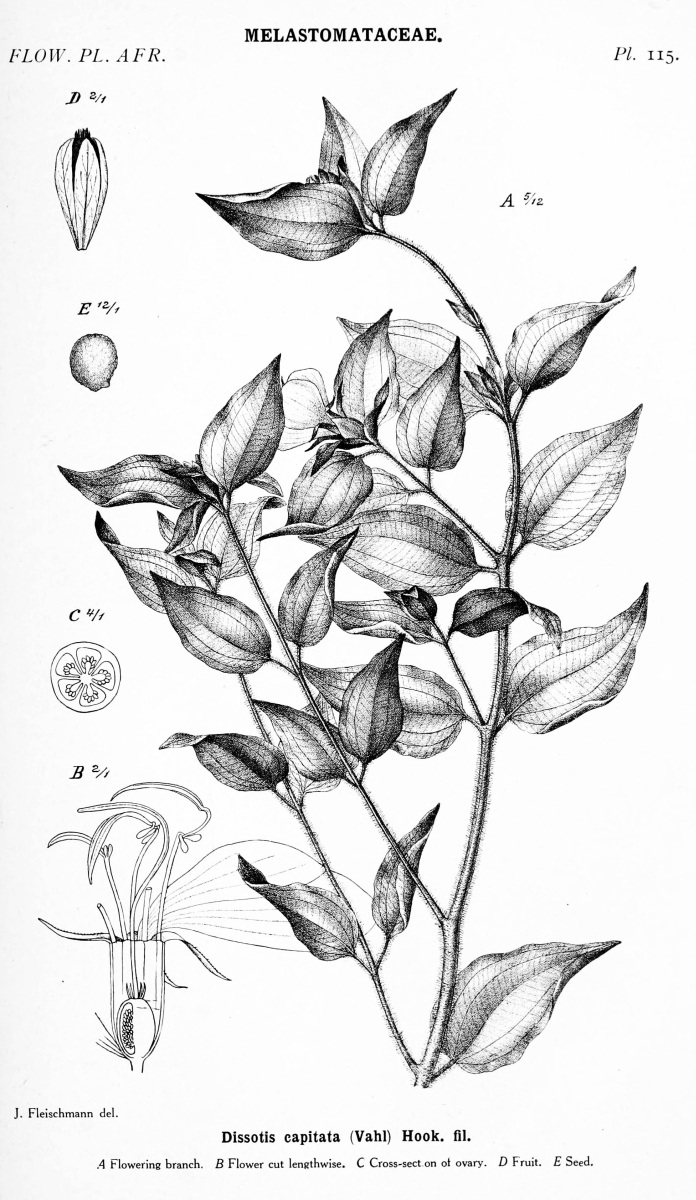
MELASTOMATACEAE.
FLOW. PL. AFR.
Pl. 115.
J. Fleischmann del.
Dissotis capitata (Vahl) Hook. fil.
A Flowering branch. B Flower cut lengthwise. C Cross-section of ovary. D Fruit. E Seed.
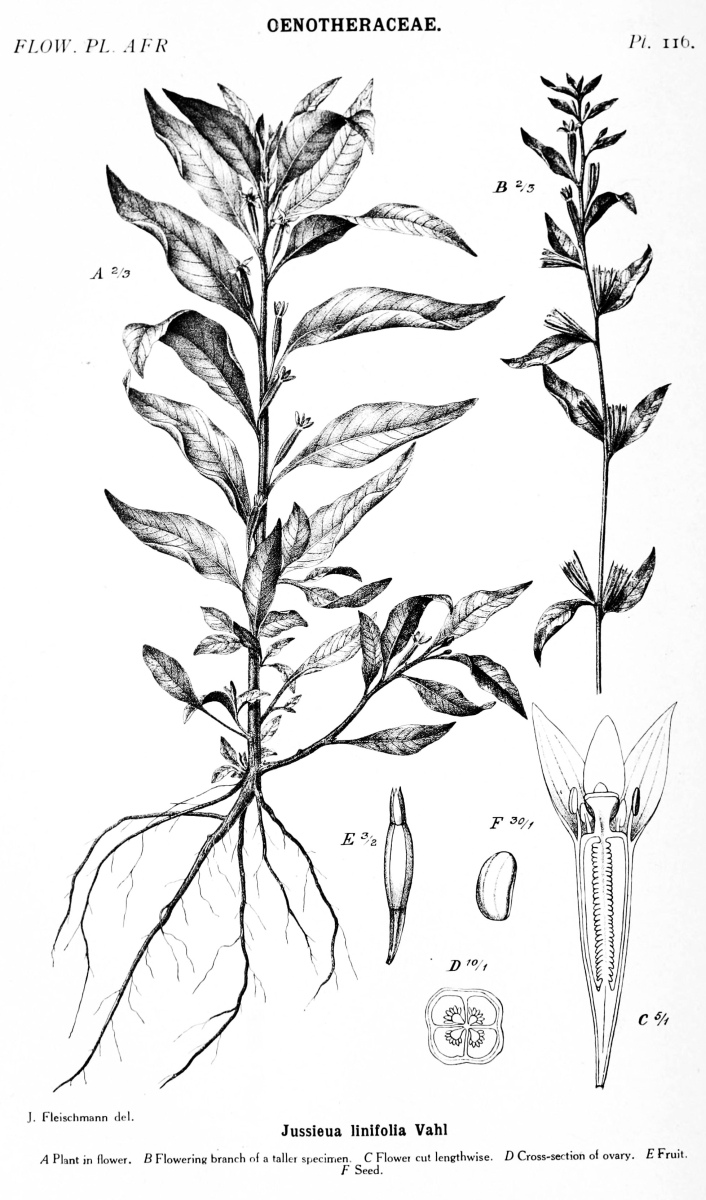
OENOTHERACEAE.
FLOW. PL. AFR.
Pl. 116.
J. Fleischmann del.
Jussieua linifolia Vahl
A Plant in flower. B Flowering branch of a taller specimen. C Flower cut lengthwise. D Cross-section of ovary. E Fruit. F Seed.
dissepiments and crowned by 4 bristle-like scales.—Species 1. Madagascar. Rousseauxia DC. Calyx-limb entire or sinuate, provided with 5 accessory teeth. Ovary adhering to the calyx-tube all round.—Species 20. Madagascar. Veprecella Naud. 29. Connective of the stamens appendaged behind only, not or shortly prolonged at the base. 30 Connective of the stamens appendaged in front or also behind, or unappendaged. Flowers 5-merous. 32 30. Stamens unequal in length. Herbs with a thickened root-stock. Leaves cordate, 9-nerved.—Species 2. Central Africa. Cincinnobotrys Gilg Stamens equal in length. Flowers 5-merous. 31 31. Calyx almost entire. Ovary crowned by 5 scales. Erect herbs with glandular hairs. Leaves lanceolate. Flowers in umbels.—Species 1. East Africa. Urotheca Gilg Calyx 5-toothed. Herbs with a very short stem and cymose flowers, or climbing shrubs.—Species 15. Madagascar. Some are used as ornamental plants. Gravesia Naud. 32. Stamens distinctly unequal; connective of the longer ones lengthened at the base, furnished with 1-2 bosses or spurs in front, spurred or unappendaged behind.—Species 8. West Africa. Some are used as ornamental plants. Amphiblemma Naud. Stamens equal or nearly so; connective not or shortly lengthened at the base, usually provided with a scale in front, rarely also with a boss behind.—Species 9. Central Africa. Calvoa Hook. fil.
FAMILY 182. OENOTHERACEAE
Leaves undivided or pinnately cleft. Flowers solitary or in spikes, heads, racemes, or panicles, 2-6-, rarely 4-merous. Sepals valvate in bud. Petals free, rarely (Ludwigia) absent. Stamens as many or twice as many as the sepals. Anthers opening inwards by longitudinal slits. Ovary inferior or half-inferior, completely or almost completely 2-6-celled. Ovules inverted. Style simple. Seeds exalbuminous.—Genera 10, species 40. (ONAGRACEAE, including HYDROCARYACEAE.) (Plate 116.)
1. Ovary half-inferior, 2-celled, with one pendulous ovule in each cell. Flowers 4-merous. Fruit top-shaped, woody, indehiscent. Floating herbs, with filiform branched side-roots and broad radical leaves.—Species 2. The seeds are edible and are used for preparing meal and medicaments. “Water Chestnut.” [Tribe TRAPEAE.] Trapa L. Ovary inferior, 2-celled with one ascending ovule in each cell, or more frequently 3-6-celled with numerous ovules. 2 2. Flowers 2-merous. Receptacle prolonged above the ovary in the shape of a stalk. Petals white or reddish. Stamens 2. Ovules and seeds 2. Fruit an ovoid nut with a leathery rind, covered with hooked bristles. Herbs. Leaves opposite. Flowers in racemes.—Species 1. North Africa. [Tribe CIRCAEEAE.] Circaea L. Flowers 3-6-merous. Stamens 3-12. Ovules and seeds numerous. Fruit a capsule or a berry. 3 3. Flowers with bracteoles, regular. Receptacle (calyx-tube) not prolonged beyond the ovary. Calyx persistent. Petals yellow or white, rarely absent. Fruit loculicidal and septicidal. Herbs or undershrubs. Stipules present, but usually minute and caducous. [Tribe JUSSIEUEAE.] 4 Flowers without bracteoles, 4-merous. Receptacle more or less prolonged above the ovary; if obscurely prolonged, then flowers somewhat irregular with red petals. Calyx deciduous. Stamens 8. Fruit loculicidal or indehiscent. 5 4. Stamens 3-6.—Species 5. (Including Isnardia L.) Ludwigia L. Stamens 8-12. Petals 4-6. Epigynous disc pyramidal or cushion-shaped.—Species 10. Some of them are used medicinally and for dyeing. (Plate 116.) Jussieua L. 5. Stem woody. Leaves stipulate. Flowers regular. Calyx coloured, with a long tube. Petals red or violet. Stamens unequal. Fruit a berry.—Species 1. Naturalized in some tropical countries. An ornamental plant. [Tribe FUCHSIEAE.] Fuchsia L. Stem herbaceous or woody at the base only. Leaves exstipulate. Fruit a capsule. 6 6. Calyx-tube short, bell-shaped. Petals usually red. Stamens unequal in length. Fruit linear with a membranous rind. Seeds with a tuft of hairs. [Tribe EPILOBIEAE.] 7 Calyx-tube long, funnel-shaped or cylindrical. Calyx-lobes reflexed. Flowers regular. Petals usually yellow. Stamens subequal. Stigma 4-partite. Seeds without a tuft of hairs. [Tribe OENOTHEREAE.] 8 7. Flowers somewhat irregular, large. Calyx-tube scarcely prolonged beyond the ovary. Petals red, spreading. Stamens in one row, bent down, broadened at the base. Style bent down, hairy at the base. Stigma 4-partite.—Species 1. Canary Islands. Yields tea and medicaments, and serves as a vegetable and as an ornamental plant. (Under Epilobium L.) Chamaenerium Spach Flowers regular, usually small. Calyx-tube shortly bell-shaped above the ovary. Stamens in two rows, erect. Style erect, glabrous.—Species 15. Some of them are used as ornamental or medicinal plants. “Willow-herb.” Epilobium L. 8. Calyx-tube funnel-shaped, rather short (as long as or shorter than the lobes). Petals red or white. Fruit club-shaped, stalked, keeled at the angles, with a more or less woody rind. Seeds with an elongated funicle. Leaves pinnatifid.—Species 2. Naturalized in North and South Africa. Ornamental plants. (Under Oenothera L.) Xylopleurum Spach Calyx-tube cylindrical, long. Petals yellow. Fruit obscurely angled, with a more or less membranous or leathery rind. 9 9. Seeds horizontal, sharply angled, with a thick coat. Leaves dentate.—Species 2. Naturalized in North and South Africa. Ornamental plants; one species (O. biennis Scop.) has edible roots. (Under Oenothera L.) Onagra Tourn. Seeds ascending, rounded, egg-shaped, with an appendage at the top. Leaves sinuate-dentate or pinnatifid.—Species 2. Naturalized in North and South Africa and some tropical islands. Ornamental plants. “Evening primrose.” Oenothera Spach
SUBORDER HALORRHAGINEAE
FAMILY 183. HALORRHAGACEAE
Herbs or undershrubs. Leaves undivided, lobed, or pinnately divided, without stipules. Flowers solitary or in fascicles spikes or panicles, small, regular, 2-4-merous. Petals free or in the female flowers wanting. Stamens 1-8. Anthers attached by the base, opening laterally by two longitudinal slits. Ovary inferior, 1-celled with a single ovule or with 4 ovules, or 4-celled with one-ovuled cells. Ovules pendulous, inverted. Styles or sessile stigmas 2 or 4. Fruit a nut, drupe, or schizocarp. Seeds albuminous; embryo straight.—Genera 3, species 15. (Plate 117.)
1. Ovary 1-celled with a single ovule. Styles or sessile stigmas 2. Sepals 2. Petals 1-2, or more frequently wanting. Stamens 1-2. Fruit a drupe. Seed with a very short embryo. Terrestrial plants. Leaves radical, kidney-shaped, crenate. Flowers in spikes or panicles.—Species 1. East and South Africa and Madagascar. Used medicinally. [Subfamily GUNNEROIDEAE.] Gunnera L. Ovary 1-celled with 4 ovules, or 4-celled. Styles or sessile stigmas 4. Sepals 4, sometimes scarcely perceptible in the female flowers. Petals 4 or in the female flowers absent. Stamens 2-8. Seeds with a long embryo. [Subfamily HALORRHAGOIDEAE.] 2 2. Ovary 1-celled, sometimes incompletely 4-celled. Stamens 4. Fruit one-seeded, dry and indehiscent. Terrestrial plants. Leaves undivided. Flowers in axillary clusters.—Species 9. (Serpicula L.) (Plate 117.) [Tribe HALORRHAGEAE.] Laurembergia Berg Ovary 4-celled. Fruit 2-4-seeded, usually separating into mericarps. Aquatic plants. Leaves usually pinnately divided. Flowers solitary and axillary or in terminal spikes.—Species 5. North, South, and East Africa and Madagascar. [Tribe MYRIOPHYLLEAE.] Myriophyllum L.
SUBORDER CYNOMORIINEAE
FAMILY 184. CYNOMORIACEAE
Reddish-brown, fleshy herbs, parasitic upon roots. Leaves scale-like. Flowers in terminal spadices, polygamous. Perianth of 1-5 narrow segments. Stamen 1. Anther versatile, turned inwards, 2-celled. Ovary inferior, 1-celled. Ovule 1, pendulous, almost straight. Style simple; stigma entire. Fruit a nut. Seed albuminous; embryo small, without cotyledons.
Genus 1, species 1. North Africa. Used medicinally. Cynomorium Mich.
ORDER UMBELLIFLORAE
FAMILY 185. ARALIACEAE
Shrubs or trees. Leaves usually stipulate. Inflorescence composed of umbels, racemes, heads, or spikes. Flowers 4-16-merous. Calyx entire or shortly toothed, imbricate or open in bud. Petals free, valvate in bud, or united into a cap. Stamens as many as petals or more. Anthers versatile, opening by two longitudinal slits. Ovary inferior or half-inferior, crowned by a disc (stylopod), 2-or more-celled, rarely (Polyscias) 1-celled. Ovules solitary in each cell, pendulous, inverted, with ventral raphe. Fruit indehiscent. Seeds albuminous.—Genera 8, species 75. (Plate 118.)
1. Stem climbing by means of small aerial roots. Leaves entire or lobed, without stipules. Flowers in umbels, 5-merous; pedicels not jointed. Stamens 5. Ovary 5-celled; style simple. Fruit a berry; endocarp membranous. Seeds with ruminate albumen.—Species 1 (H. Helix L., ivy). North Africa. Used as ornamental and medicinal plants; the fruits are poisonous. Hedera L. Stem without adhesive roots. Leaves pinnate or digitate, rarely undivided or lobed, but then ovary 2-4-celled and style 2-4-parted. Fruit a drupe or a nut; endocarp leathery, crustaceous, cartilaginous, or bony. 2 2. Leaves undivided, lobed, or digitate. Stipules usually distinctly developed. Pedicels not jointed. 3 Leaves pinnate. Stipules indistinctly developed or wanting. Seeds with uniform albumen. 5 3. Ovary 2-, rarely 3-4-celled. Styles short, free or united below. Stylopod convex or conical. Petals 5, free. Stamens 5. Endocarp crustaceous. Albumen usually ruminate. Flowers in spikes or racemes, rarely in umbels.—Species 25. Tropical and South Africa. (Including Seemannaralia Viguier). (Plate 118.) Cussonia Thunb. Ovary 5-15-celled. Petals 5-15, usually united in the shape of a cap. Albumen uniform. Flowers in umbels or heads, rarely in racemes. Leaves digitate. 4 4. Stamens as many as the petals.—Species 13. Tropics. (Including Astropanax Seem., Heptapleurum Gaertn., and Sciadophyllum P. Browne) Schefflera Forst.
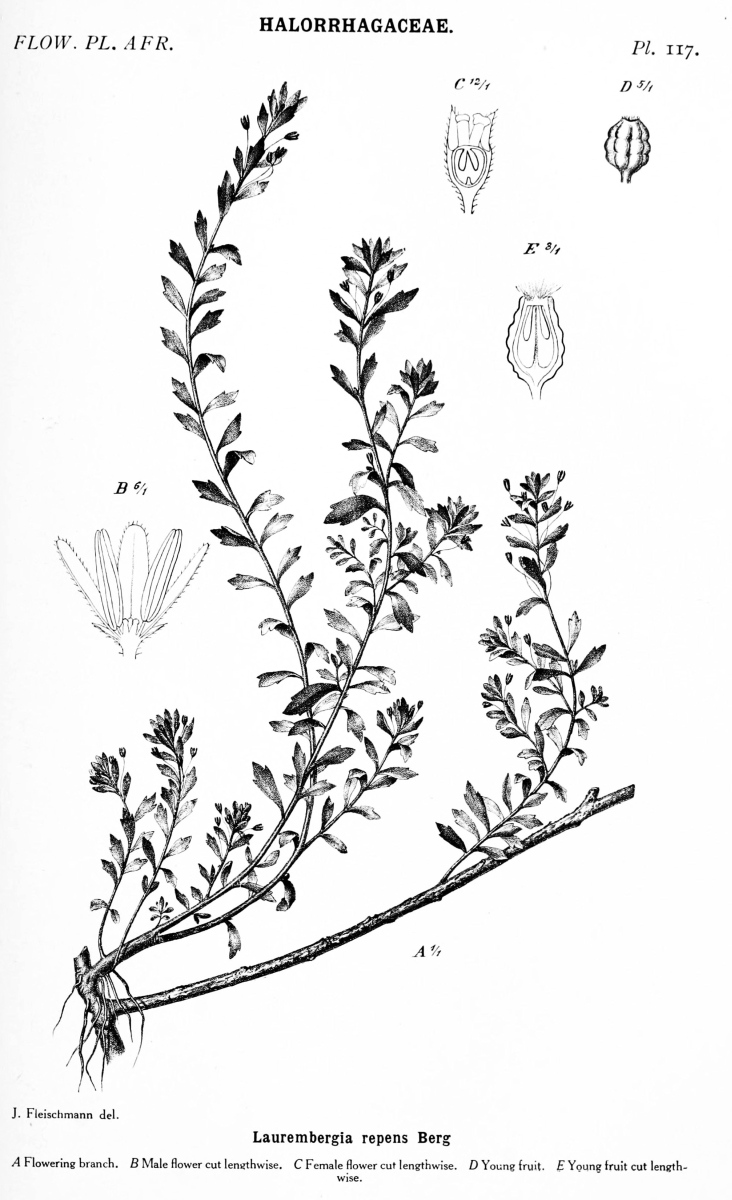
HALORRHAGACEAE.
FLOW. PL. AFR.
Pl. 117.
J. Fleischmann del.
Laurembergia repens Berg
A Flowering branch. B Male flower cut lengthwise. C Female flower cut lengthwise. D Young fruit. E Young fruit cut lengthwise.
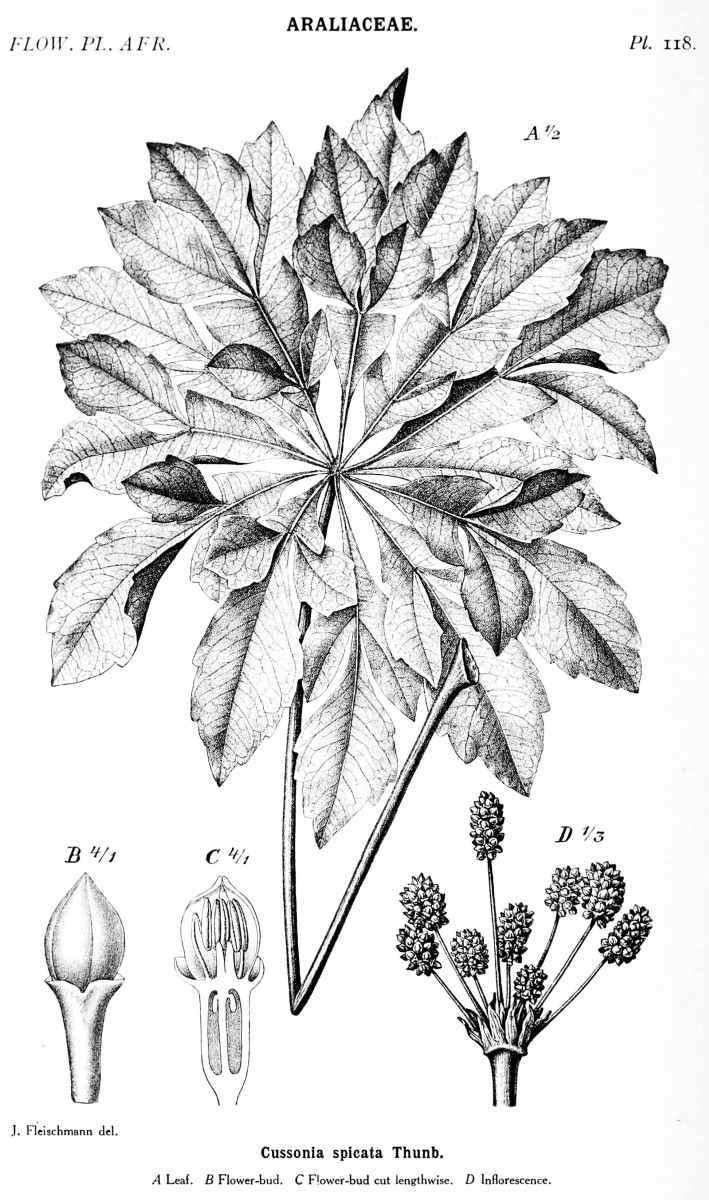
ARALIACEAE.
FLOW. PL. AFR.
Pl. 118.
J. Fleischmann del.
Cussonia spicata Thunb.
A Leaf. B Flower-bud. C Flower-bud cut lengthwise. D Inflorescence.
Stamens twice as many as the petals. Petals 5, cohering in the shape of a cap. Ovary 8-10-celled. Flowers in spicately arranged heads.—Species 1. Seychelles. Geopanax Hemsl. 5. Flowers in umbels or racemes with jointed pedicels, very rarely in spikes or heads. Ovary-cells and styles or style-branches 1-10. Stamens as many as the petals. 6 Flowers in umbels; pedicels not jointed. Ovary-cells and styles or style-branches 10-15. Leaves unequally pinnate with entire leaflets. 7 6. Styles present, usually free and filiform. Seeds smooth or folded on the surface.—Species 30. Tropics. (Including Cuphocarpus Decne. et Planch. and Tieghemopanax Viguier, under Panax L.) Polyscias Forst. Styles absent; stigmas 2, seated upon the conical stylopod. Ovary 2-celled. Pericarp with 8 oil-channels. Seeds 4-lobed. Trees. Leaves unequally pinnate with entire leaflets. Flowers in panicled umbels.—Species 1. Madagascar. (Under Panax L.) Sciadopanax Seem. 7. Petals free or cohering at the tip. Stamens as many as the petals, 10-15; filaments flattened. Styles awl-shaped. Trees.—Species 4. Madagascar and the neighbouring islands. Gastonia Comm. Petals united throughout their whole length. Stamens numerous; filaments awl-shaped. Style none; stigma 2-cleft. Shrubs.—Species 1. Seychelles. Indokingia Hemsl.
FAMILY 186. UMBELLIFERAE
Mostly herbs with a jointed stem. Leaves alternate, rarely (Drusa) opposite, usually dissected and with a sheathing stalk. Flowers in umbels or heads, rarely in spikes or in racemed false-whorls, regular or the outermost flowers, of the inflorescence somewhat irregular, usually hermaphrodite. Calyx-limb usually faintly developed or wanting. Petals 5, free, usually bent inwards at the tip and therefore apparently notched or 2-lobed, valvate or slightly imbricate in bud. Stamens 5, alternating with the petals. Ovary inferior, 2-celled, rarely one cell only fertile, very rarely ovary 3-celled. Ovules solitary in each cell, pendulous, inverted, with ventral raphe. Styles 2, free, arising from a more or less distinctly 2-lobed disc (stylopod), rarely (Lagoecia) style simple. Fruit dry, usually separating into 2 mericarps attached to the 2-parted, more rarely 2-cleft, simple, or obsolete carpophore. Pericarp ribbed and usually traversed by oil-channels commonly situated in the furrows between the primary ribs which as a rule enclose vascular bundles. Seeds with an adnate testa, a horny albumen, and a small embryo with flat cotyledons.—Genera 92, species 410. (APIACEAE.) (Plate 119.)
1. Fruit with a woody rind, without a free carpophore. Oil-channels wanting, more rarely small and situated beneath the primary ribs. Seeds rather flat on the inner face. Petals straight, rarely bent inwards at the point and thread-shaped. Flowers in solitary or fascicled simple umbels or in racemed false-whorls, rarely (Hermas) in compound umbels. Leaves undivided, lobed, or 3-parted. [Subfamily HYDROCOTYLOIDEAE.] 2 Fruit with a membranous or leathery rind, rarely (tribe Coriandreae) with a woody one, but then oil-channels situated on the inner surface of the mericarps and seeds deeply grooved on this side. Flowers usually in compound umbels. 6 2. Fruit much compressed laterally, with a very narrow commissure and a much projecting dorsal angle. Oil-channels very narrow or wanting. Calyx-limb indistinct or shortly toothed. Petals with a straight point. [Tribe HYDROCOTYLEAE.] 3 Fruit compressed from front to back, with a broad commissure. [Tribe MULINEAE.] 4 3. Mericarps with 5 ribs, the marginal ones contiguous. Flowers hermaphrodite. Petals valvate in bud. Leaves roundish, stipulate.—Species 15. Some are used medicinally. Hydrocotyle L. Mericarps with 7-9 ribs connected by a network of veins, the marginal ribs divergent. Flowers polygamous. Petals imbricate in bud. Leaves exstipulate.—Species 20. Southern and tropical Africa. Some are used medicinally. (Under Hydrocotyle L.) Centella L. 4. Fruit slightly compressed, not winged, with faint ribs. Oil-channels more or less obvious. Calyx-teeth narrow. Petals elliptical or lanceolate, with a straight point. Herbs forming cushion-shaped tufts. Leaves 3-cleft or 3-parted, alternate. Flowers in terminal simple umbels.—Species 1. Island of Kerguelen. Azorella Lam. Fruit much compressed, winged. Oil-channels obscure or absent. Calyx-teeth large or wanting. Leaves undivided or lobed. 5 5. Wings of the fruit arising from the marginal ribs and covered with barbed prickles. Seeds not furrowed. Flowers hermaphrodite. Calyx-lobes wanting. Petals elliptical, with a straight point. Flowers in simple umbels arising at the forks of the stem. Leaves usually opposite, clothed with barbed bristles.—Species 1. Canary Islands. (Under Bowlesia Ruiz et Pav.) Drusa DC. Wings of the fruit arising from the intermedial ribs. Fruit netted or wrinkled on the back. Seeds angular-furrowed. Flowers polygamous. Calyx-lobes broad-lanceolate, petal-like in the male flowers. Petals awl-shaped, with the point bent inwards. Flowers in compound umbels. Leaves alternate, tomentose beneath.—Species 5. South Africa (Cape Colony). Hermas L. 6. (1.) Styles 2, surrounded by a ring-shaped disc, filiform and rather long, rarely a single style. Fruit covered with scales, prickles, or tubercles. Carpophore adnate or wanting. Oil-channels under the primary ribs, scattered, or wanting (none in the furrows). Calyx-lobes large. Petals with the point bent inwards. Flowers in umbels heads or spikes, which are simple or arranged in heads or cymes. [Subfamily SANICULOIDEAE.] 7 Styles 2, arising from the top of a more or less elevated disc (stylopod). Carpophore usually free. Oil-channels in general only in the furrows of the fruit. Flowers nearly always in compound umbels. [Subfamily APIOIDEAE.] 11 7. Ovary with 1 perfect and 1 imperfect cell, the latter empty or containing a rudimentary ovule; in the latter case flowers dioecious and fruit with faint secondary ribs and without oil-channels. Oil-channels indistinct or wanting; in the former case style single. [Tribe LAGOECIEAE.] 8 Ovary with 2 perfect cells and ovules. Styles 2. Flowers hermaphrodite or monoecious-polygamous. [Tribe SANICULEAE.] 9 8. Style 1. Oil-channels present. Flowers hermaphrodite, in simple umbels with pinnately divided involucral bracts. Leaves pinnatipartite.—Species 1. North-east Africa (Cyrenaica). Lagoecia L. Styles 2. Oil-channels absent. Flowers dioecious, in compound umbels or in umbels arranged in heads, with undivided involucral bracts. Leaves lobed.—Species 3. South Africa (Cape Colony). Used medicinally. Arctopus L. 9. Flowers polygamous, in umbels arranged in cymes. Ovary and fruit clothed with hooked prickles. Fruit more or less globose, without distinct ribs, but with many large and small oil-channels.—Species 2. North and South Africa and mountains of the tropics. Used medicinally. Sanicula L. Flowers hermaphrodite, in heads or spikes. Ovary and fruit clothed with scales or tubercles. Fruit ovoid, with several large and many small oil-channels or without distinct oil-channels. 10 10. Flowers in few-flowered heads with a 2-ranked involucre of usually 10 bracts, without bracteoles beneath the single flowers. Calyx-limb membranous. Fruit with thick and warty primary ribs. Oil-channels indistinct. Leaves undivided.—Species 8. South and Central Africa. Alepidea Laroch. Flowers in many-flowered heads or spikes with an involucre of several or many, usually prickly bracts, and with a bracteole under each flower. Calyx-teeth stiff. Fruit without distinct ribs, scaly.—Species 15. North and Central Africa. Some are used as vegetables or in medicine. Eryngium L. 11. (6.) Secondary ribs between the primary ribs of the fruit distinctly developed, similar to, or larger than the primary ribs, more or less distinctly winged or beset with rows of prickles. 12 Secondary ribs slightly prominent or wanting. 23 12. Secondary ribs, at least some of them, winged and unarmed. [Tribe LASERPITIEAE.] 13 Secondary ribs not distinctly winged, but beset with prickles, more rarely with bristles or tubercles. 17 13. Fruit much compressed from front to back. Seeds flat or nearly so on the inner face. [Subtribe THAPSIINAE.] 14 Fruit scarcely or not at all compressed, broadly winged, glabrous. Oil-channels also under the primary ribs. Seeds deeply grooved on the inner face. [Subtribe ELAEOSELINAE.] 16 14. Secondary ribs with a narrow or indistinct wing. Oil-channels only under the secondary ribs, narrow. Petals white, slightly notched.—Species 3. Cape Verde Islands. Used medicinally. Tornabenea Parl. Secondary ribs with a broad wing. Petals entire. 15 15. Primary ribs very prominent. Oil-channels also under the primary ribs. Petals white or reddish.—Species 2. Island of Madeira. The roots are edible. (Including Monizia Lowe, under Thapsia L.) Melanoselinum Hoffm. Primary ribs slightly prominent. Oil-channels only under the secondary ribs. Petals yellow.—Species 3. North Africa. Used medicinally. Thapsia L. 16. Fruit with 4 wings, contracted at the commissure. Oil-channels distant. Petals narrow, yellow.—Species 5. North Africa. Used medicinally. Elaeoselinum Koch Fruit with 8 wings and a broad commissure. Oil-channels nearly contiguous. Petals broad, white,.—Species 1. North-west Africa (Algeria). (Under Elaeoselinum Koch) Margotia Boiss. 17. (12.) Albumen deeply grooved on the inner face of the seeds. [Tribe SCANDICINEAE, subtribe CAUCALINAE.] 18 Albumen slightly grooved or flat on the inner face of the seeds. 21 18. Albumen rolled in at the edge. Commissure narrowed. Primary ribs prickly. Secondary ribs with 1-3 rows of prickles. Oil-channels obvious. Umbels of 2-6 rays.—Species 5. North Africa and mountains of the tropics. Used medicinally. (Including Turgenia Hoffm.) Caucalis L. Albumen flat at the edge. 19 19. Fruit with a broad commissure (plane of junction of the mericarps). Primary ribs covered with short bristles. Secondary ribs with 2-3 rows of prickles. Oil-channels large. Umbels of 5-8 rays.—Species 1. North Africa. (Under Daucus L.) Orlaya Hoffm. Fruit with a narrow commissure. 20 20. Secondary ribs prominent, rounded, warty. Oil-channels obscure. Umbels of many rays.—Species 2. North-west Africa. Ammiopsis Boiss. Secondary ribs scarcely prominent, prickly. Primary ribs ciliate. Oil-channels large. Umbels of 6-12 rays.—Species 9. North and South Africa and mountains of Central Africa. (Under Caucalis L.) Torilis Adans. 21. Fruit somewhat flattened laterally and narrowed at the commissure. Secondary ribs clothed with bristles. Seeds slightly grooved on the inner face. Calyx-teeth long, awl-shaped, unequal. Petals oblong, white or pink. Umbels of 3-5 rays.—Species 1 (C. Cyminum L.). North Africa, also cultivated in East Africa. The fruits serve as a condiment and a medicament. Cuminum L. Fruit flattened from front to back. Calyx-teeth short. [Tribe DAUCEAE.] 22 22. Secondary ribs clothed with white bristles. Primary ribs nearly glabrous. Petals white. Umbels opposite to the leaves, with 2-4 rays.—Species 1. North Africa. The fruits serve as a condiment. (Under Daucus L.) Ammodaucus Coss. & Dur. Secondary ribs beset with one row of long prickles. Primary ribs clothed with short bristles.—Species 20. North Africa to Abyssinia; one species naturalized in Tropical and South Africa. Some species (especially D. Carota L., carrot) yield vegetables, gum-resin, and medicaments. Daucus L. 23. (11.) Seeds very concave or marked with a deep furrow on the inner face. 24 Seeds flat, slightly concave, or somewhat convex on the inner face. 44 24. Flowers polygamous, the sessile hermaphrodite ones surrounded each by several stalked males. Petals white. Style long. Fruit nearly always one-seeded. Ribs indistinct. Albumen rolled in at the edge. [Tribe ECHINOPHOREAE.] 25 Flowers of the primary umbels polygamous, but irregularly arranged, or hermaphrodite. Fruit nearly always 2-seeded. 26 25. Ovary of the hermaphrodite flower adnate to the pedicels of the male, which subsequently form a woody cup around the fruit. Oil-channels solitary in each furrow.—Species 1. North Africa. The root is edible. Echinophora L. Ovary of the hermaphrodite flower not adnate to the pedicels of the male; no cup around the fruit. Oil-channels 2-3 in each furrow.—Species 1. Abyssinia. Pycnocycla Lindl. 26. Leaves undivided, entire. Calyx not toothed. Petals yellow or yellowish-green. Fruit laterally compressed.—Species 25. North and South Africa. Some are used medicinally. Bupleurum Tourn. Leaves, at least the lower ones, dissected. 27 27. Fruit linear or oblong. [Tribe SCANDICINEAE, subtribe SCANDICINAE.] 28 Fruit ovoid, globose, or biglobose. 35 28. Fruit beaked. Oil-channels very narrow, situated in the furrows and under the primary ribs. 29 Fruit not beaked. Oil-channels usually broad. Petals bent inwards and notched at the tip. 31 29. Fruit with a long beak. Ribs obtuse. Calyx not toothed. Petals entire and not or shortly bent inwards at the tip. Umbels of few rays.—Species 3. North Africa. Used medicinally. Scandix L. Fruit with a short beak. 30 30. Fruit cylindrical, broadened at the base, without ribs in the lower part. Calyx not toothed. Petals narrow, entire and not or shortly bent inwards at the tip.—Species 3. North and East Africa. One of them, the chervil (A. Cerefolium Hoffm.) is grown as a pot-herb and also used medicinally. Anthriscus Hoffm. Fruit oblong, hispid, with broad and obtuse ribs. Calyx toothed. Petals broad, bent inwards and notched at the tip. Involucral bracts numerous.—Species 2. North-west Africa. (Under Athamantha L.) Tinguarra Parl. 31. Fruit without distinct ribs, oblong, somewhat flattened from front to back, clothed with long hairs. Oil-channels solitary in the furrows, narrow; besides two larger ones at the commissure. Calyx-teeth awl-shaped. Petals minute, white.—Species 1. North-west Africa. (Under Caucalis L.) Chaetosciadium Boiss. Fruit with distinct ribs. Calyx-teeth wanting. 32 32. Fruit with thread- or keel-shaped ribs. Oil-channels thin or rather thin. Root tuberous. 33 Fruit with broad and rounded, roll-shaped ribs. Oil-channels large, solitary in the furrows. Root not tuberous. 34 33. Leaf-segments linear. Umbels of 10-20 rays. Involucre reduced to a single bract or wanting. Involucels of many bractlets. Oil-channels numerous.—Species 1. North-west Africa. (Geocaryum Coss. et Dur., under Chaerophyllum L.) Conopodium Koch Leaf-segments lanceolate or ovate. Umbels of 5-10 rays. Involucre and involucels of 1-4 bracts.—Species 1. North-west Africa. (Including Balansaea Boiss. et Reut., under Chaerophyllum L. or Bunium Koch). Biasolettia Koch 34. Fruit conical, clothed with bristles or short prickles. Umbels few-flowered.—Species 1. North-west Africa. (Under Chaerophyllum L.) Physocaulis Tausch. Fruit cylindrical, glabrous.—Species 3. North Africa. One species is poisonous. Chaerophyllum L. 35. (27.) Pericarp woody. Ribs slightly prominent or obscure. Oil-channels only at the commissure. [Tribe CORIANDREAE.] 36 Pericarp not woody. Oil-channels also on the back of the fruit, or all indistinct. [Tribe SMYRNIEAE.] 37 36. Fruit biglobose, much broader than long, wrinkled, without distinct ribs. Commissure small, perforated. Mericarps separating when ripe. Calyx not toothed.—Species 2. North Africa. The fruits serve as a condiment. Bifora Hoffm. Fruit ovoid or globose, not broader than long, with wavy ribs. Commissure large, not perforated. Mericarps not separating. Calyx toothed.—Species 1 (C. sativum L.). North Africa, also cultivated and naturalized in Central Africa. The fruits are used as a condiment and for preparing an aromatic oil. Coriandrum L. 37. Pericarp much thickened; corky, spongy, or blistery. Ribs broad, more or less roll-shaped, sometimes confluent. 38 Pericarp not much thickened. Ribs narrow, thread-shaped, sometimes obscure. Fruit laterally compressed, with a narrow commissure, more or less biglobose. 41 38. Ribs of the fruit confluent; furrows hardly perceptible. Fruit ovoid, glabrous or hairy. Oil-channels numerous. Albumen rolled inwards. Calyx not toothed. Petals yellow. Leaf-segments linear.—Species 3. North-west Africa. Cachrys L. Ribs of the fruit separated; furrows distinctly visible. Calyx toothed. 39 39. Ribs of the fruit broad and rounded, roll-shaped; furrows very narrow, each with several oil-channels. Fruit slightly or not compressed, hairy. Albumen curved. Petals white. Leaf-segments broad.—Species 2. North-west Africa. Magydaris Koch Ribs of the fruit slender, more or less thread-shaped; furrows not very narrow. Albumen rolled inwards. Leaf-segments narrow. 40 40. Fruit covered with blisters, broad-cordate, laterally much compressed. Oil-channels 1-3 to each furrow. Seeds loosely enclosed by the pericarp. Petals white. Leaf-segments oblong.—Species 1. East Africa. Trachydium Link Fruit smooth or covered with tubercles or hairs. Oil-channels numerous. Petals yellow. Leaf-segments linear.—Species 3. North-west Africa. Used medicinally. Hippomarathrum Lindl. 41. Oil-channels replaced by a continuous oil-layer. Fruit ovoid. Pericarp thick. Ribs thick, wavy or crenate. Albumen curved. Calyx not toothed. Petals white, shortly inflexed.—Species 2. North Africa, Abyssinia, and South Africa. Poisonous and used medicinally. “Hemlock.” Conium L. Oil-channels separated. Fruit cordate. Pericarp thin. Ribs thin. Petals long inflexed. 42 42. Oil-channels solitary in the furrows. Albumen curved. Calyx toothed. Petals white.—Species 1. North Africa. Physospermum Cuss. Oil-channels 2 or more in each furrow. Root tuberous. 43 43. Oil-channels 2-3 in each furrow. Albumen curved. Calyx not toothed. Petals white. Involucre wanting.—Species 1. North-east Africa (Cyrenaica). (Under Conopodium Koch). Scaligeria DC. Oil-channels numerous. Albumen rolled inwards. Petals yellow.—Species 2. North Africa. They yield vegetables and medicaments. Smyrnium L. 44. (23.) Marginal ribs of the mericarps much more prominent than the dorsal and more or less distinctly winged. Mericarps and seeds much compressed from front to back. [Tribe PEUCEDANEAE.] 45 Marginal ribs of the mericarps similar to the dorsal. Mericarps and seeds slightly or not compressed. [Tribe AMMINEAE.] 57 45. Nerves (vascular bundles) of the marginal ribs next to the edge of the mericarps, distant from the seed. 46 Nerves of the marginal ribs situated at their base near the seed. 52 46. Marginal wings of the mericarps much thickened at the edge. 47 Marginal wings of the mericarps slightly or not thickened at the edge or not distinctly developed. 50 47. Mericarps without dorsal ribs. Oil-channels only in the marginal ribs. Petals white.—Species 1. South Africa. (Pappea Sond. & Harv.) Choritaenia Benth. & Hook. Mericarps with filiform dorsal ribs. Oil-channels also on the back of the mericarps. 48 48. Thickened margin of the mericarps gibbous. Oil-channels very thin. Calyx toothed. Petals white, 2-cleft.—Species 2. North Africa. They yield vegetables and medicaments. Tordylium L. Thickened margin of the mericarps slightly uneven. Oil-channels distinctly developed. 49 49. Marginal wings of the mericarps traversed lengthwise by a broad oil-channel. Petals yellow, turned or rolled inwards at the top.—Species 7. East and North Africa. Malabaila Hoffm. Marginal wings of the mericarps not traversed by an oil-channel. Petals white, hairy.—Species 1. North-east Africa (Egypt). (Under Heracleum L.) Zozimia Hoffm. 50. Oil-channels not extending to the base of the mericarps, usually ending at the middle in a club-shaped swelling, solitary in the furrows. Dorsal ribs slightly prominent. Marginal wings membranous. Calyx toothed. Petals deeply emarginate, usually white. Involucels of many bractlets.—Species 2. North Africa and Abyssinia. They yield edible roots, fodder, and medicaments. Heracleum L. Oil-channels, at least some of them, extending to the base of the fruit. Calyx rarely toothed. Petals slightly or not emarginate, yellow greenish or reddish. 51 51. Leaves once pinnatisect. Flowers mostly hermaphrodite, only those of the uppermost lateral umbels male. Petals broad, much rolled in. Marginal wings of the mericarps membranous. Oil-channels solitary in the furrows, rarely in pairs.—Species 2. One growing wild in South Africa, the other cultivated in North Africa. Root edible. “Parsnip.” (Under Peucedanum L.) Pastinaca L. Leaves repeatedly pinnatisect. Flowers polygamous, those of the lateral umbels male. Petals narrow, shortly bent inwards. Disc broad. Marginal wings of the mericarps thickish or indistinct.—Species 10. North and East Africa. Several species yield a gum-resin (African ammoniacum) used industrially and medicinally, others serve as vegetables or as ornamental plants. Ferula L. 52. (45.) Dorsal ribs of the mericarps very prominent. Marginal ribs more or less thickened. Oil-channels solitary in each rib and solitary or wanting in the furrows. Umbels opposite to the leaves, of few rays. Petals white.—Species 4. North and South Africa. Some have edible roots. (Krubera Hoffm., including Sclerosciadium Koch). Capnophyllum Gaertn. Dorsal ribs of the mericarps slightly prominent, more or less filiform. 53 53. Marginal ribs of the mericarps thickened, corky. Oil-channels solitary in the furrows. Calyx toothed. 54 Marginal ribs of the mericarps not thickened, closely contiguous. 55 54. Petals yellow. Leaf-segments broad.—Species 1. Canary Islands. Astydamia DC. Petals white. Leaf-segments narrow.—Species 1. Egypt. Ducrosia Boiss. 55. Oil-channels numerous. Marginal wings thick. Disc broad. Petals yellow, not or shortly bent inwards. Flowers polygamous, in the lateral umbels male.—Species 1. North Africa. (Under Ferula L.) Ferulago Koch Oil-channels 1-3 in each furrow. Petals much bent or rolled inwards. Flowers mostly hermaphrodite, only those of the uppermost lateral umbels sometimes male. 56 56. Fruit moderately compressed, with a narrow marginal wing. Oil-channels solitary in the furrows. Calyx not toothed. Petals broad and rolled inwards at the tip, yellow. Umbels without an involucre.—Species 1. (A. graveolens L., dill). North Africa, also cultivated and naturalized in Central and South Africa. Used as a pot-herb. (Under Peucedanum L.) Anethum Tourn. Fruit much compressed, with a membranous, usually broad marginal wing. Petals narrowed and much bent inwards at the tip.—Species 50. Some of them have edible roots or are used in medicine. (Including Bubon L., Imperatoria Tourn., and Lefeburia A. Rich.) Peucedanum L. 57. (44.) Fruit compressed from front to back or not compressed; commissure (plane of junction of the mericarps) broad. Ribs usually prominent: wing-like, keeled, or broad, more rarely filiform. [Subtribe SESELINAE.] 58 Fruit compressed laterally; commissure more or less narrowed. Ribs usually slender, filiform, rarely keel- or wing-like. [Subtribe CARINAE.] 73 58. Ribs of the fruit very prominent, keel- or wing-like. 59 Ribs of the fruit slightly prominent, filiform or broad. 69 59. Ribs wing-like. 60 Ribs keel- or ridge-like. 62 60. Oil-channels numerous. Leaves 2-5 times pinnately dissected.—Species 1. North Africa. “Lovage.” (Under Meum Jacq.) Ligusticum L. Oil-channels solitary in the furrows. 61 61. Marginal wings of the fruit thin. Dorsal wings either corky or partly wing-like, partly filiform. Mericarps usually unequal. Calyx toothed.—Species 10. South Africa. Some of them have edible roots. (Including Stenosemis E. Mey.) (Plate 119.) Annesorrhiza Cham. & Schlechtd. Marginal wings of the fruit thick. All wings equal, membranous or spongy. Mericarps equal. Leaves 2-3 times pinnately dissected.—Species 2. South Africa. (Under Selinum L.) Cnidium Cuss. 62. Oil-channels numerous, crowded around the seed. Pericarp thickened, spongy. Fruit egg-shaped. Calyx toothed. Petals narrowed and rolled in at the tip, white. Undershrubs. Leaves fleshy, with narrow segments. Involucre and involucels of many bracts.—Species 1. North Africa. Used as a pot-herb. “Samphire.” Crithmum Tourn. Oil-channels solitary in the furrows, rarely (Seseli) accompanied by a second channel in each furrow or one under each rib. 63 63. Calyx toothed. Petals white or reddish. Involucel present. 64 Calyx not toothed. 67 64. Stem woody, shrubby. Petals elliptical, entire, with an inflexed point. Fruit oblong, not compressed, glabrous. Disc depressed. Leaves once or twice dissected.—Species 2. South Africa. Polemannia Eckl. & Zeyh. Stem herbaceous. 65 65. Petals lanceolate or elliptical. Disc biglobose. Fruit narrowly bottle-shaped, compressed from front to back, hairy. Involucre present. Leaves thrice dissected.—Species 2. Canary Islands. Todaroa Parl. Petals broad-cordate. Disc conical or flattened. Fruit oblong or oval. 66 66. Seeds concave on the inner face. Fruit cylindrical, with warty or bristly ribs. Oil-channels solitary in the furrows. Disc conical. Styles long, with broad stigmas. Flowers hispid. Involucre present. Leaves twice pinnatisect, with broad leathery segments.—Species 3. Central Africa. Physotrichia Hiern Seeds flat on the inner face. Leaves, as a rule, repeatedly pinnatisect and with narrow segments.—Species 7. North and South Africa. Some are used in medicine. (Including Libanotis Crantz). Seseli L. 67. Involucels and involucre wanting. Petals yellow. Disc conical. Pericarp not essentially thickened. Leaves with linear segments.—Species 2. North Africa and Abyssinia, one species also naturalized in other regions. They yield vegetables, condiments, perfumes, and medicaments, and serve also as ornamental plants. “Fennel”. Foeniculum L. Involucels of a few bracts. Petals white or greenish-white. Pericarp thickened. Leaves with oblong, lanceolate, or elliptical segments. 68 68. Involucre of a few bracts. Petals oblong, greenish-white. Disc conical. Fruit oblong; furrows narrow.—Species 1. Madagascar. Used medicinally. Phellolophium Bak. Involucre absent. Petals obovate, white. Disc flattened. Fruit ovoid; furrows broad.—Species 1. North-west Africa. Poisonous and used medicinally. “Fools parsley.” Aethusa L. 69. (58.) Ribs of the fruit broad and rounded. Carpophore none. Oil-channels solitary in the furrows. Calyx-teeth large. Petals obovate, white. Involucels of many bracts.—Species 10. North and South Africa. Some are poisonous or used in medicine. Oenanthe L. Ribs of the fruit slender, filiform. Carpophore present. 70 70. Oil-channels numerous, scattered. Fruit linear-oblong. Pericarp not considerably thickened. Seeds somewhat grooved on the inner face. Calyx-teeth short. Petals yellow. Involucre and involucels of many bracts. Leaves with broad segments.—Species 1. North Africa. (Brignolia Bertol.) Kundmannia Scop. Oil-channels solitary in the furrows, more rarely accompanied by a second in each furrow or one under each rib. Petals white or reddish. 71 71. Seeds flat on the inner face. Calyx toothed. Petals broad-cordate. Disc depressed. (See 66.) Seseli L. Seeds grooved on the inner face. Fruit oblong, hairy. Disc conical. Involucre present. Leaves thrice dissected. 72 72. Oil-channels in the furrows and under the ribs of the fruit. Seeds with a keel in the middle of the groove on the inner face. Calyx toothed.—Species 4. North Africa. Used medicinally. Athamanta L. Oil-channels only in the furrows. Calyx not toothed. Rays of the umbels thickened.—Species 2. East Africa. Diplolophium Turcz. 73. (57.) Leaves undivided, entire, rarely (Heteromorpha) toothed to dissected, and then some ribs of the fruit wing-like. 74 Leaves, at least some of them, toothed to dissected. Ribs of the fruit filiform, rarely keeled but not wing-like. 77 74. Flowers in heads. Calyx toothed. Petals greenish-white. Carpophore none; mericarps closely cohering. Ribs thickened, corky. Oil-channels solitary in each furrow, faint or obscure.—Species 2. North-west Africa. Hohenackeria Fisch. & Mey. Flowers in compound umbels. Petals yellow or yellowish-green. Carpophore free. 75 75. Calyx toothed. Mericarps unequal, one 2-winged, the other 3-winged. Oil-channels solitary in the furrows. Shrubs or trees.—Species 3. Central and South Africa. (Franchetella O. Ktze.). Heteromorpha Cham. et Schlechtd. Calyx not toothed. Mericarps and ribs equal. 76 76. Petals much inflexed and 2-lobed at the tip. Disc conical, crenate. Fruit oblong, with thick and very prominent ribs. Oil-channels solitary in each furrow. Undershrubs. Leaves stalked, cordate-orbicular, leathery. Umbels of few rays, involucrate.—Species 1. Island of Socotra. Nirarathamnus Balf. Petals rolled in and entire or slightly notched at the tip. Disc flat, entire. Leaves usually sessile. (See 26.) Bupleurum Tourn. 77. Oil-channels solitary under each rib, none in the furrows. Calyx toothed. Petals white, with a long inflexed point. Involucre and involucels of many bracts.—Species 7. South Africa. Lichtensteinia Cham. & Schlechtd. Oil-channels in the furrows, sometimes also under the ribs. 78 78. Fruit linear or oblong, at least twice as long as broad. Ribs slender. Petals white or reddish. 79 Fruit ovoid, globose, or biglobose. 83 79. Fruit linear or linear-oblong. Oil-channels solitary in the furrows. Disc broadened at the base, with a wavy margin. Calyx-teeth distinctly developed. Petals white, 3-5-nerved, notched. Involucre and involucels present.—Species 1. North Africa. Used medicinally. Falcaria Host. Fruit oblong. Calyx-teeth minute or wanting. 80 80. Mericarps with 5 ribs at the back and near the margin and 2 smaller ones on the inner face. Oil-channels solitary in the furrows and under the ribs, very narrow. Disc reduced to a swelling of the base of the styles. Umbels panicled. Involucre wanting. Involucels of few bracts.—Species 1. West Africa (Cameroons). (Lereschia Boiss., under Anthriscus L.) Cryptotaenia DC. Mericarps with 5 ribs only. Oil-channels only in the furrows. Disc broadened at the base, with a wavy margin. Umbels terminal and lateral. 81 81. Involucre of many large dissected bracts. Petals unequally 2-lobed. Oil-channels solitary in the furrows.—Species 5. North and Central Africa. Used medicinally; one species has edible roots. Ammi L. Involucre of usually few entire bracts or wanting. Petals equally notched. 82 82. Root-stock tuberous. Oil-channels 1-3 in each furrow. Embryo with a single cotyledon.—Species 6. North Africa. The tubers are edible. (Including Diaphycarpus Calestani, partly under Carum L.) Bunium L. Root-stock not tuberous. Oil-channels solitary in each furrow. Embryo with 2 cotyledons.—Species 7. North Africa, Abyssinia, Madagascar, and South Africa; one species (C. Carvi L., caraway) also cultivated elsewhere. The fruits of this species are used as a condiment and for preparing an aromatic oil; eaten in large quantities they are poisonous. Other species yield edible roots or medicaments. (Including Selinopsis Coss. et Dur., partly under Bunium L.) Carum L. 83. Oil-channels numerous, narrow. Ribs filiform. Herbs or undershrubs. Leaves dissected or the lower lobed. 84 Oil-channels solitary in each furrow, rarely (Rhyticarpus) 3, large, but then shrubs and upper leaves undivided. 85 84. Calyx toothed. Petals white. Involucre and involucels large, persistent.—Species 7. Central and South Africa and Egypt. Some are used as vegetables. (Including Berula Koch) Sium L. Calyx not toothed. Involucre and involucels usually wanting.—Species 25. The fruits of P. anisum L., anise, serve as a condiment; other species are used in medicine. (Including Reutera Boiss.) Pimpinella L. 85. Pericarp densely bristly or warty. Ribs filiform. 86 Pericarp smooth or wrinkled, not hairy. 87 86. Calyx toothed. Petals deeply notched, white. Fruit tubercled upon the ribs, not hairy. Herbs. Leaves twice or thrice pinnately dissected with very narrow segments.—Species 7. South and North Africa and Island of Socotra; one species also naturalized in the Mascarene Islands. Some species yield condiments. (Tragiopsis Pomel, under Carum L. or Ptychotis L.) Trachypermum Link Calyx entire. Petals not notched, white or greenish. Undershrubs. Radical leaves once or twice pinnately dissected, cauline reduced to the sheath. Umbels of few rays.—Species 10. North and South Africa. (Deverra DC.) Pituranthos Viv. 87. Carpophore entire or shortly cleft at the top. Ribs very prominent. Oil-channels large. Calyx not or obscurely toothed. Petals greenish-white, straight or shortly inflexed at the tip. Involucre of 1-3 bracts or wanting.—Species 7. One of them (A. graveolens L., celery) is used as a pot-herb, as a salad, or in medicine. (Including Helosciadium Koch). Apium L. Carpophore split down to the middle or beyond. 88 88. Oil-channels extending down to the middle of the fruit and ending there in a club-shaped swelling. Calyx entire. Petals white, broadly inflexed and deeply notched at the tip. Leaves with broad segments.—Species 1. North Africa. Used medicinally. Sison L. Oil-channels extending down to the base of the fruit. Calyx toothed, more rarely entire, but then petals yellow and not notched. 89 89. Calyx not or obscurely toothed. Petals yellow, yellowish-green, or somewhat reddish, much inflexed at the tip. 90 Calyx distinctly toothed. 91 90. Ribs of the fruit prominent, filiform. Oil-channels broad. Leaves 2-3 times pinnately dissected.—Species 2. North Africa; also naturalized in tropical and South Africa. One species (P. sativum Hoffm., parsley) is used as a pot-herb. (Under Apium L. or Carum L.). Petroselinum Hoffm. Ribs of the fruit scarcely prominent or indistinct. Oil-channels narrow. Leaves 4-times pinnately dissected.—Species 1. North Africa and Abyssinia. (Under Carum L.) Ridolfia Moris. 91. Ribs of the fruit very prominent. Oil-channels narrow. Petals shortly inflexed at the tip, white or greenish. Umbels involucrate.—Species 3. South Africa, St. Helena, and Canary Islands. One species is used for preparing an intoxicating drink. (Glia Sond., under Lichtensteinia Cham. & Schlechtd.) Ruthea Bolle Ribs of the fruit slightly prominent. Petals much inflexed at the tip, rarely shortly inflexed, but then red. 92 92. Mericarp with 9 faint ribs. Petals dark-red, oblong, shortly inflexed at the tip.—Species 1. Madagascar. Anisopoda Bak. Mericarps with 5 filiform ribs. Petals white or yellow, much inflexed at the tip. 93 93. Petals white, notched, the terminal point proceeding from a transverse fold beneath the notch. Herbs. Umbels without an involucre.—Species 4. North and South Africa. (Under Carum L., Petroselinum Hoffm., or Seseli L.) Ptychotis Koch Petals yellow, entire. Undershrubs or shrubs.—Species 3. South Africa (Cape Colony). Rhyticarpus Sond.
FAMILY 187. CORNACEAE
Shrubs or trees. Leaves undivided, without stipules. Flowers regular. Calyx entire or toothed. Petals 4-5, free or cohering at the base. Stamens as many as the petals. Ovary inferior, 2-4-celled, with 1 pendulous ovule in each cell. Fruit a drupe. Seeds albuminous; embryo long.—Genera 4, species 6. Tropical and South Africa.
1. Ovary 4-celled. Micropyle turned outwards. Style simple; stigma 4-parted. Anthers oval. Petals broad. Flowers 4-merous, hermaphrodite, in cymose panicles. Leaves opposite, toothed.—Species 1. South Africa. Yields timber. [Subfamily CURTISIOIDEAE.] Curtisia Ait. Ovary 2-3-celled. Micropyle turned inwards. Style and stigma simple, or styles 2-3. Flowers 4-merous, but unisexual, or 5-merous. [Subfamily CORNOIDEAE.] 2 2. Petals imbricate in bud. Filaments short, thread-shaped. Flowers hermaphrodite, 5-merous, in racemes sometimes arranged in panicles.—Species 3. Madagascar. [Tribe GRISELINIEAE.] Melanophylla Bak. Petals valvate in bud. Flowers unisexual, 4-merous. [Tribe CORNEAE.] 3 3. Style simple. Filaments thread-shaped. Anthers ovate. Petals ovate. Fruit with a 2-celled stone. Flowers in umbel-like cymes. Leaves opposite.—Species 1. Equatorial East Africa (Kilimandjaro). Cornus L. Styles or sessile stigmas 2. Filaments very short, rather thick. Anthers oblong. Petals oblong. Fruit with two 1-celled stones. Flowers in panicles. Leaves alternate.—Species 1. Madagascar. Kaliphora Hook. fil.
SUBCLASS METACHLAMYDEAE
(SYMPETALAE)
ORDER ERICALES
FAMILY 188. CLETHRACEAE
Low trees. Leaves alternate, undivided. Flowers in terminal racemes or panicles, without bracteoles, regular, hermaphrodite. Calyx 5-parted, imbricate in bud, persistent. Petals 5, free, hypogynous, deciduous. Stamens 10, hypogynous. Anthers turned inwards, shortly beaked at the base, opening by