ORDER RANALES (continued 4)
Reading edition
FAMILY 130. HIPPOCRATEACEAE
Shrubs or trees. Leaves simple. Flowers regular. Calyx 5-partite, imbricate in bud. Petals 5, free, inserted below the disc. Stamens 3-5, inserted upon or within the disc. Filaments free, strap-shaped. Ovary 3-celled, with 2-10 inverted ovules in each cell. Style 1 or 0. Fruit drupaceous or capsular or separating into several mericarps. Seeds exalbuminous.—Genera 3, species 110. Tropical and South Africa. (Under CELASTRINEAE.) (Plate 83.)
1. Stamens 5. Anthers opening inwards by a transverse slit. Disc indistinct. Ovules 6-8 to each ovary-cell. Leaves opposite, serrate.—Species 4. West Africa. Campylostemon Welw. Stamens 3. Anthers opening outwards. Disc distinct. 2 2. Fruit drupaceous. Petals imbricate in bud. Flowers usually in fascicles or in fascicled cymes.—Species 60. Tropical and South Africa. Several species yield rubber or edible fruits. (Plate 83.) Salacia L. Fruit capsular or separating into several mericarps. Anthers roundish. Leaves opposite. Flowers usually in simple cymes.—Species 50. Tropics to Delagoa Bay. Some are used medicinally. (Including Helictonema Pierre). Hippocratea L.
FAMILY 131. SALVADORACEAE.
Shrubs or trees. Leaves opposite, simple, entire, with minute stipules. Flowers solitary or in spikes, racemes or panicles, regular. Calyx 2-4-cleft. Petals 4, very rarely 5, free or united at the base, with imbricate or contorted aestivation. Stamens as many as and alternate with the petals; sometimes 4-5 staminodes also present. Ovary superior, 1-2-celled. Ovules 1-2 in each cell, erect, inverted. Style simple, short. Fruit a berry or a drupe. Seeds exalbuminous; embryo with the radicle turned downwards.—Genera 3, species 6.
1. Flowers dioecious. Petals 4, free, narrow. Filaments free from one another and from the corolla. Glands between the stamens absent. Ovary 2-celled. Shrubs with 2-6 spines in the axils of the leaves.—Species 2. Tropical and South Africa. Used medicinally. (Monetia L’Hér.) Azima Lam. Flowers hermaphrodite or polygamous. Filaments united together or to the corolla. Glands between the stamens nearly always present. Ovary 1-celled. Unarmed shrubs or trees. 2 2. Petals free, narrow. Filaments united at the base. Anthers oblong.—Species 3. East Africa. Yielding timber. (Including Platymitium Warb.) Dobera Juss. Petals united at the base, broad, 4. Filaments free. Anthers ovoid or globose.—Species 1 (S. persica Garcin). North-east and Central Africa to Delagoa Bay. Yields edible fruits and medicaments; the twigs are used as tooth-brushes. Salvadora Garcin
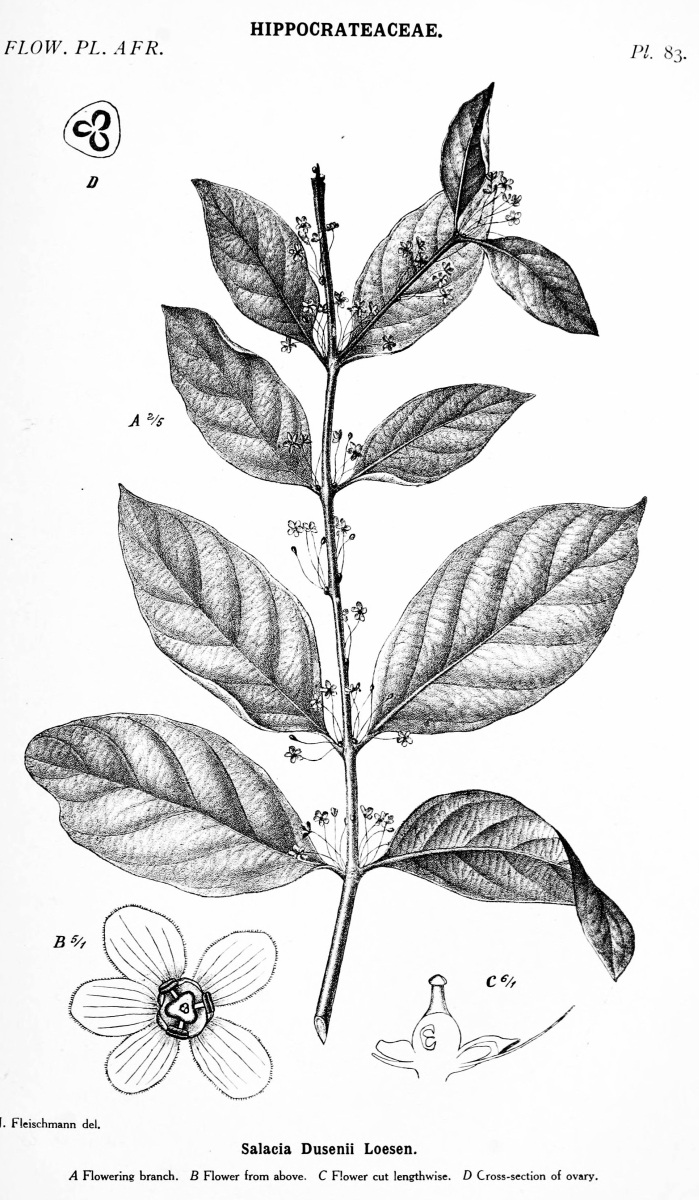
HIPPOCRATEACEAE.
FLOW. PL. AFR.
Pl. 83.
J. Fleischmann del.
Salacia Dusenii Loesen.
A Flowering branch. B Flower from above. C Flower cut lengthwise. D Cross-section of ovary.
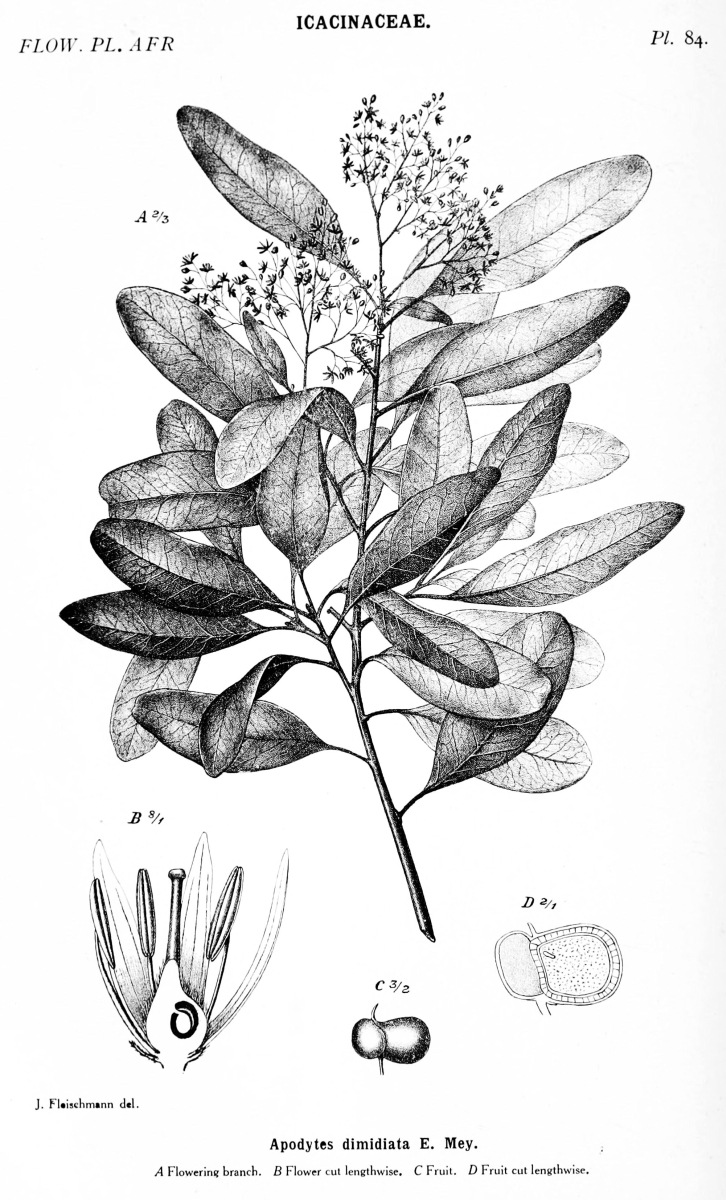
ICACINACEAE.
FLOW. PL. AFR.
Pl. 84.
J. Fleischmann del.
Apodytes dimidiata E. Mey.
A Flowering branch. B Flower cut lengthwise. C Fruit. D Fruit cut lengthwise.
SUBORDER ICACININEAE
FAMILY 132. ICACINACEAE
Trees or shrubs. Leaves entire toothed or lobed, without stipules. Flowers regular, 4-5-merous. Stamens as many as the petals or perianth-segments and alternate with them. Anthers opening by 2 longitudinal slits. Ovary superior, 1-celled. Ovules 2, pendulous, inverted, with dorsal raphe. Style 1 or 0. Fruit a drupe. Seed 1, with a thin testa, without an aril.—Genera 19, species 90. Tropical and South Africa. (Under OLACINEAE.) (Plate 84.)
1. Pericarp warty or spiny on the inner face. Embryo equalling the albumen. Climbing or twining shrubs. Leafstalk terete. [Tribe PHYTOCRENEAE.] 2 Pericarp smooth or wrinkled on the inside. Leaves entire. 7 2. Perianth simple, 3-5-parted. Stigma sessile. Leaves palminerved. 3 Perianth, at least in the female flowers, consisting of a sometimes very small calyx and a corolla of united petals. Leaves penninerved. 5 3. Flowers solitary or in pairs in the axils of the leaves, hermaphrodite. Stem tuberous, with slightly twining branches. Leaves undivided, wavy at the margin.—Species 1. East Africa (Somaliland). Trematosperma Urban Flowers in heads or spikes, dioecious. 4 4. Flowers in heads arranged in spikes or panicles. Perianth of the male flowers 3-lobed.—Species 3. West Africa. Polycephalium Engl. Flowers in spikes. Perianth usually 4-parted.—Species 15. Tropical and South Africa. Pyrenacantha Hook. 5. Calyx minute. Corolla not enlarged in the fruit. Flowers in spikes arising from the lower part of the stem. Leaves oval.—Species 1. Madagascar. Endacanthus Baill. Calyx distinctly developed, at least in the female flowers. Corolla enlarged in the fruit. 6 6. Calyx of the male flowers 5-toothed. Petals 5. Filaments rather long. Anthers linear. Flowers in spikes at the nodes of the older branches. Leaves lanceolate.—Species 1. West Africa (Cameroons). Stachyanthus Engl. Calyx of the male flowers indistinct or wanting. Petals 4. Filaments short. Anthers ovate. Flowers in spikes or heads. Species 7. West Africa. Chlamydocarya Baill. 7. (1.) Flowers dioecious, with a corolla of united petals, with or without a calyx. Stamens with flat filaments; anthers opening inwards. Embryo nearly equalling the albumen. Climbing shrubs, usually with tendrils. Leaves opposite. Flowers in panicles.—Species 6. Tropics. [Tribe IODEAE.] Iodes Blume Flowers hermaphrodite or polygamous, rarely unisexual, but then with a calyx and a corolla of free petals, or without a corolla, and the anthers opening outwards. Embryo usually much shorter than the albumen. Trees or erect, rarely climbing shrubs; in the latter case leaves alternate or flowers in spikes. [Tribe ICACINEAE.] 8 8. Flowers unisexual, dioecious. Calyx 5-partite. Petals minute and free, or wanting. Anthers turned outwards. Ovary with a ring-shaped appendage at the top. Trees. Leaves alternate. Flowers in panicles.—Species 2. Madagascar and neighbouring islands. Grisollea Baill. Flowers hermaphrodite or polygamous. Perianth consisting of a calyx and a corolla. 9 9. Petals free. Sepals usually united high up. 10 Petals more or less united. Sepals usually united at the base only. 14 10. Embryo nearly as long as the albumen. 11 Embryo much shorter than the albumen. 12 11. Petals bearded within. Disc present. Style long; stigma small or shield-shaped. Fruit with a crusty endocarp. Embryo with flat cotyledons. Shrubs with ascending or somewhat twining branches.—Species 7. Tropics. Some have edible fruits or seeds. Icacina Juss. Petals not bearded within. Disc absent. Fruit with a woody endocarp and a fleshy mesocarp. Embryo with folded cotyledons. Climbing shrubs.—Species 2. Equatorial West Africa. The fruits and seeds are eaten and used medicinally. Lavigeria Pierre 12. Stem climbing. Flowers in spikes. Petals hairy outside. Disc present. Ovary without swellings. Style terminal; stigma slightly lobed.—Species 6. Tropics. Desmostachys Planch. & Miers Stem erect, tree-like. Flowers in fascicles or panicles. Ovary with 2 swellings. Style lateral. 13 13. Flowers in axillary fascicles. Filaments broadened below. Ovary usually with two narrow swellings at the top.—Species 12. Central Africa. (Under Apodytes Mey.) Rhaphiostyles Planch. Flowers in terminal panicles. Filaments awl-shaped. Ovary with two broad swellings on the ventral face.—Species 10. Tropical and South Africa. Several species yield timber or edible fruits. (Plate 84.) Apodytes E. Mey. 14. Petals united at the base or nearly to the middle. 15 Petals united beyond the middle. 16 15. Petals imbricate in the bud. Style short. Leaves opposite. Flowers in repeatedly forked cymes.—Species 4. South Africa and Madagascar. Cassinopsis Sond. Petals valvate in the bud. Style long. Leaves alternate. Flowers in few-flowered fascicles or panicles.—Species 9. Central Africa. (Including Alsodeiidium Engl.) Alsodeiopsis Oliv. 16. Petals imbricate in the bud. Sepals and stamens unequal. Disc indistinct. Stigma sessile. Leaves opposite, elliptical. Flowers in panicles.—Species 1. Madagascar. Tridianisia Baill. Petals valvate in the bud. 17 17. Petals bent backwards at the tip. Disc thick. Style short. Leaves opposite, lanceolate. Flowers in few-flowered axillary cymes.—Species 1. West Africa (Congo). Acrocoelium Baill. Petals bent inwards at the tip. Disc absent. Leaves alternate. 18 18. Sepals united at the base only. Filaments adnate to the corolla-tube throughout their whole length, without appendages. Style long, filiform. Ovary and fruit without a swelling.—Species 5. Tropics. Leptaulus Benth. Sepals united high up. Filaments free from the corolla, with two tufts of hairs at the apex. Style short, conical. Ovary and fruit with a lateral swelling. Flowers in head-like cymes.—Species 1. West Africa. Lasianthera Beauv.
SUBORDER SAPINDINEAE
FAMILY 133. ACERACEAE
Trees or shrubs. Leaves opposite, palmately lobed, without stipules. Flowers in terminal corymbs, regular, polygamous. Sepals 5, free. Petals 5, free. Stamens 8, very rarely 4 or 12, perigynous, inserted on the inner edge of the thick disc. Filaments free. Ovary superior, 2-lobed and 2-celled, with 2 ovules in each cell. Styles 2 or a single style with 2 branches or stigmas. Fruit winged, splitting into 2 mericarps. Seeds exalbuminous. (Under SAPINDACEAE.)
Genus 1, species 4. North-west Africa. They yield timber, tanning bark, and sugar, and serve as ornamental plants. “Maple.” Acer L.
FAMILY 134. SAPINDACEAE
Trees or shrubs, rarely (Cardiospermum) herbs or undershrubs. Leaves alternate, usually compound. Flowers in racemes or panicles, rarely solitary or in clusters, polygamous, rarely unisexual. Petals 4-5, mostly with a scale on the inner face, or absent. Stamens 4-24, usually 8, inserted within the disc, rarely upon it; sometimes disc indistinct. Anthers opening inwards by 2 longitudinal slits. Ovary superior, 2-8-, usually 3-celled, sometimes not quite completely septate or with a single fertile cell, frequently lobed. Ovules 1-2, rarely (Cossignia) 3 in each ovary-cell, curved. Style 1, undivided, rarely cleft. Seeds exalbuminous; embryo usually curved.—Genera 51, species 200. (Including DIDIEREACEAE.) (Plate 85.)
1. Ovary with 1 fertile cell and sometimes 2 sterile ones. Ovule 1. Style 3-4-cleft. Stamens 8-10, inserted on the edge of the ring-shaped disc. Petals 4. Sepals 2. Flowers dioecious. Leaves undivided, deciduous. Spiny trees.—Species 6. Madagascar. Some species yield timber. (Including Alluaudia Drake). [Tribe DIDIEREAE.] Didierea Baill. Ovary with 2-8 fertile cells. Stamens inserted within the disc, rarely upon it (Pistaciopsis) or no distinct disc present (Dodonaea); in both these cases petals wanting. 2 2. Ovule 1 in each cell of the ovary. 3 Ovules 2, very rarely 3, in each cell of the ovary. 45 3. Ovule pendulous. Ovary 2-celled. Style undivided, with 2 decurrent stigmatic lines at the apex. Stamens 5. Disc regular. Petals 5, small. Sepals 5, slightly imbricate in bud. Fruit succulent, indehiscent. Seeds without an aril. Embryo with pinnately cut cotyledons. Branches and leaves with a resinous coating. Leaves equally pinnate, with a winged rachis.—Species 2. Equatorial East Africa and Madagascar. Filicium Thwait. Ovule erect or ascending. Stamens usually 8. 4 4. Flowers irregular, with a one-sided disc. Petals 4. 5 Flowers regular or nearly so, with a complete disc. Petals 5 or 0. Leaves exstipulate, equally pinnate, rarely unequally pinnate (Pistaciopsis) or simple (Pappea). 14 5. Leaves stipulate, unequally pinnate with 5 leaflets or twice ternate. Herbs or undershrubs or climbing tendril-bearing shrubs. Petals with a crested, and hooded scale. Stamens 8. Ovary 3-celled. 6 Leaves exstipulate, simple trifoliolate or equally pinnate. Trees or shrubs without tendrils. Seeds without an aril. 8 6. Stem herbaceous or woody at the base only. Fruit capsular, inflated, with a membranous rind. Seeds without an aril.—Species 5. Tropical and South Africa, one species (C. Helicacabum L.) also naturalized in North Africa. They yield fodder, vegetables, oil, and medicaments, and serve also as decorative plants. “Heartseed.” Cardiospermum L. Stem woody, climbing, bearing tendrils. Fruit capsular, not inflated, with a leathery or woody rind, or separating into mericarps. Seeds with a more or less distinct aril. 7 7. Leaves twice ternate. Fruit 3-winged below, separating into 3 nutlets.—Species 1. Madagascar. Serjania Schum. Leaves pinnate. Fruit wingless, capsular.—Species 1. Tropics. Poisonous and yielding fibres and medicaments. Paullinia L. 8. Leaves simple or trifoliolate. Sepals 4, broadly imbricate in bud. Petals with a crestless, notched or 2-parted scale. Stamens 8. Ovary deeply lobed. Fruit of 1-3 drupes.—Species 50. Tropical and South Africa. Some species yield timber, edible fruits, and medicaments. (Under Schmidelia L.) Allophyllus L. Leaves abruptly pinnate. Sepals 5. 9 9. Sepals free, broadly imbricate in bud. Petals with a notched scale. Stamens 8. Fruit separating into 3 mericarps. Seed-coat hard.—Species 3. Naturalized in the Mascarenes and Seychelles. The wood and the fruits (soap-berries) are used; the latter afford a substitute for soap, mucilage, oil, poison, and medicaments; the seeds serve as ornaments and for making buttons and rosaries. (Including Dittelasma Hook.) Sapindus L. Sepals more or less united, narrowly imbricate or valvate in bud. Fruit furrowed or lobed, indehiscent. 10 10. Calyx shortly bell- or top-shaped; sepals united at the base only. Petals with a 2-crested scale. Stamens 6-8. Pericarp crustaceous or leathery. 11 Calyx deeply urn-shaped or almost globular; sepals united high up. Pericarp more or less fleshy. 12 11. Disc obliquely cupular. Ovary 2-celled. Sepals imbricate in bud. Petals with a very broad scale. Shrubs. Leaflets 10.—Species 1. Madagascar. Plagioscyphus Radlk. Disc not cupular. Ovary 3-celled. Leaflets 4-8.—Species 7. West Africa. (Under Erioglossum Blume) Pancovia Willd. 12. Stamens 12-15. Petals sessile; scale adnate below by the margin, bearing a short crest. Ovary 6-8-celled. Trees. Leaflets 10-12.—Species 1. West Africa (Cameroons). Glossolepis Gilg Stamens 6-8. Petals clawed. 13 13. Scales of the petals adnate below by the margins, bearing an incurved crest; claws elongate. Calyx subglobose, shortly toothed. Ovary 7-celled. Trees. Leaflets numerous.—Species 1. West Africa (Cameroons). Radlkofera Gilg Scales of the petals adnate by a ridge, more rarely free. Ovary 3-4-celled, rarely 7-8-celled, but then petals with a free and crestless scale. Species 10. West Africa. Some have edible fruits. Chytranthus Hook. fil. 14. (4.) Petals absent. 15 Petals present. 23 15. Sepals 4-6, united at the base only, valvate or almost valvate in bud. 16 Sepals 5, united high up. 19 16. Stamens 4. Ovary 2-celled. Sepals 4. Leaves with 4-6 leaflets.—Species 1. Madagascar. Crossonephelis Baill. Stamens 5-8. Ovary 3-celled. 17 17. Flowers in racemes or panicles. Sepals 4-5, hairy outside. Stamens 7-8. Seeds without an aril. Leaves with 4-6 leaflets.—Species 2. Central Africa. Melanodiscus Radlk. Flowers in clusters. Stamens 5, rarely 6-7, but then seeds with an aril. 18 18. Stamens inserted inside the disc; filaments short, not exceeding the calyx; anthers linear. Sepals 5-6, hairy above. Seed 1, with an aril. Leaves abruptly pinnate, with 4-10 leaflets.—Species 2. East Africa. Haplocoelum Radlk. Stamens inserted at the edge of the disc, 5; filaments long, much exceeding the calyx; anthers oblong or oval. Sepals 5. Leaves with a narrowly winged rachis.—Species 4. Central Africa. Pistaciopsis Engl. 19. Sepals imbricate in bud, finally slashed. Stamens 8-10, bent twice in the bud. Ovary 3-celled. Seeds with an aril; embryo almost straight. Trees. Flowers in axillary racemes or panicles.—Species 2. Central Africa. Flowers fragrant, used for preparing an aromatic water. Lecaniodiscus Planch. Sepals valvate in bud. Stamens 8. 20 20. Ovary 2-celled. Fruit indehiscent. Seeds with an aril. 21 Ovary 3-celled. 22 21. Fruit covered with wart-like protuberances. Aril free from the seedcoat.—Species 1 (L. chinensis Sonn.) Cultivated in the tropics and naturalized in the Mascarene Islands. It yields timber, edible fruits, and medicaments. (Under Nephelium L. or Euphoria Commers.) Litchi Sonn. Fruit covered with soft spine-like processes or glabrous. Aril adnate to the seed-coat.—Species 1 (N. lappaceum L., Rambutan). Cultivated in the tropics. It yields edible fruits and fat-containing seeds. (Under Euphoria Comm.) Nephelium L. 22. Fruit dehiscent. Seeds with an aril. Calyx cup-shaped. Flowers in axillary panicles.—Species 1. Mascarene Islands. Yields timber (iron-wood), edible fruits, and oily seeds. (Under Nephelium L.) Stadmannia Lam. Fruit indehiscent. Seeds without an aril. Calyx top-shaped. Flowers in racemes or panicles springing from the older parts of the stem.—Species 3. Central Africa. Placodiscus Radlk. 23. (14.) Calyx 5-lobed; lobes open or slightly imbricate in bud. Stamens 6-10. 24 Calyx 5-parted. 27 24. Calyx urn-shaped. Petals with a scale adnate by a ridge. Fruit indehiscent, 3-lobed, with a leathery pericarp. Seeds without an aril. Inflorescences arising from the older branches. Leaves pinnate. (See 13.) Chytranthus Hook. fil. Calyx cup- or saucer-shaped, small. Petals with a scale adnate by the margins, or with a free scale, or without a scale. Fruit dehiscent. Seeds with an aril. 25 25. Petals hairy, without a scale or with the inflexed margins prolonged into small scales. Ovary lobed. Pericarp leathery. Leaves simple, undivided, oblong.—Species 4. East and South Africa. They yield timber, edible fruits, and oily seeds. (Under Sapindus L.) Pappea Eckl. & Zeyh. Petals with a free scale or with a scale adnate by the margins. Leaves pinnate. 26 26. Petals with a scale adnate by the margins, hence funnel-shaped. Disc clothing the base of the calyx. Filaments hairy. Fruit 3-angled, almost glabrous. Inflorescences axillary.—Species 5. Central Africa. Some yield timber. (Under Blighia Koen.) Phialodiscus Radlk. Petals with an almost free, notched scale. Disc free. Filaments glabrous. Fruit almost globose; pericarp crustaceous or woody, hispid on the outside, woolly within.—Species 3. West Africa. Yielding timber. Eriocoelum Hook. fil. 27. (23.) Sepals narrowly imbricate in bud. 28 Sepals broadly imbricate in bud. 33 28. Stamens 5. Petals hooded, without scales. Disc 5-lobed. Ovary 2-celled. Fruit indehiscent, with a crustaceous pericarp. Seeds with an aril. Leaves with numerous leaflets. Inflorescences arising from the older parts of the stem.—Species 1. Madagascar. Pseudopteris Baill. Stamens 6-10. 29 29. Stamens 6-7. Petals hairy, with 1-2 scales adnate by their edges. Ovary 2-celled. Fruit compressed, dehiscent, with a cartilagineous endocarp. Seeds with an adnate aril. Leaves with 4-11 pairs of leaflets. Flowers in terminal panicles.—Species 3. Central Africa. Aporrhiza Radlk. Stamens 8-10. 30 30. Ovary 2-celled. Fruit indehiscent. Stamens 8. 31 Ovary 3-celled. Fruit tardily dehiscent. Stamens 8-10. Petals furnished at the base with a scale adnate at each side. 32 31. Leaflets in 3-4 pairs, toothed, pellucidly dotted, beset with scaly glands when young. Fruit 2-lobed, with a fleshy pericarp. Seeds without an aril.—Species 1. South Africa (Cape Colony). (Under Sapindus L.) Smelophyllum Radlk. Leaflets in 5 pairs, entire, beset with stellate hairs. Fruit with a crustaceous pericarp. Seeds with a free aril.—Species 1 (E. Longana Lam.). Cultivated in the tropics and in Egypt and naturalized in the Mascarene Islands. Yields timber and edible fruits. (Under Nephelium L.) Euphoria Commers. 32. Petals saccate at the base. Stamens 8, rarely 10. Fruit large, bluntly 3-angled. Seeds enveloped at the base by an adnate aril.—Species 3. West Africa. The aril is poisonous when unripe or over-ripe, but edible when ripe, and used for preparing oil and medicaments; from the fragrant flowers an aromatic liquid is prepared. “Akee-tree.” (Under Cupania L.) Blighia Koen. Petals funnel-shaped. Stamens 10. Seeds enclosed in the fleshy testa. Leaflets in 4-6 pairs, toothed.—Species 3. West Africa. Lychnodiseus Radlk. 33. (27.) Stamens 5. Ovary 2-celled. Fruit compressed, dehiscent, with a spongey pericarp. Seeds with a free aril.—Species 1. Madagascar. Tinopsis Radlk. Stamens 8-24. 34 34. Stamens 8. 35 Stamens 10-24. Seeds without an aril. 42 35. Leaves twice pinnate. Petals small. Fruit 1-celled, indehiscent, with a crustaceous pericarp. Seeds with a membranous aril and a crustaceous testa.—Species 10. Madagascar and East Africa. Macphersonia Blume Leaves once pinnate. 36 36. Petals with 1 scale. Seeds without an aril; testa membranous, leathery, or crustaceous. 37 Petals with 2 scales, usually formed by the inflexion of their edges, rarely (Molinaea) without scales. Seeds with an aril, rarely (Sapindus) without, but then with a bony testa. 38 37. Leaflets prickly toothed, in several pairs. Stem shrubby. Inflorescences springing from the older parts of the stem. Petals with a hooded scale. Disc cup-shaped, crenate.—Species 1. Madagascar. Cotylodiscus Radlk. Leaflets entire. Stem tree-like. Fruit lobed. 38 38. Leaflets in 2 pairs. Fruit drupaceous, not separating into mericarps. Seeds with a thin testa; embryo nearly straight.—Species 1 (A. senegalensis Radlk.). Central Africa. It yields timber and edible fruits which are also used as a substitute for soap; the seeds are poisonous. (Under Sapindus L.) Aphania Blume Leaflets in 3 or more pairs. Fruit separating into 2-3 berry-like mericarps. Seeds with a leathery testa.—Species 20. Tropical and South Africa. Some have edible fruits. (Plate 85.) Deinbollia Schum. & Thonn. 39. Petals with large scales. Ovary 2-celled. Fruit capsular.—Species 10. Madagascar. (Under Cupania L., Jagera Blume, or Ratonia DC.). Tina Roem. & Schult. Petals with small scales or without scales. Ovary 3-celled. 40 40. Petals very small, with 2 linear scales at the base. Filaments bent twice in the bud. Shrubs. Leaflets in 6-10 pairs.—Species 1. Madagascar. Eriandrostachys Baill. Petals small or rather large, with the margins bent inwards at the base or without any appendage. Usually trees. 41 41. Seeds with an aril and a crustaceous testa. Fruit winged, capsular.—Species 8. Madagascar and Mascarenes. Some species yield timber and medicaments. (Under Cupania L.). Molinaea Comm. Seeds without an aril; testa bony. Fruit not winged, drupaceous or separating into mericarps. (See 9.) Sapindus L. 42. (34.) Petals without a scale. Stamens 10. Ovary 3-celled. Fruit capsular, bristly. Climbing shrubs clothed with rust-coloured hairs. Leaflets in 3-4 pairs, toothed.—Species 1. West Africa. (Under Cupania L.) Laccodiscus Radlk. Petals with a scale. Trees or erect shrubs. 43 43. Ovary entire. Stamens 10-12. Leaves without glands.—Species 1. East Africa. (Under Deinbollia Schum. & Thonn.) Camptolepis Radlk.
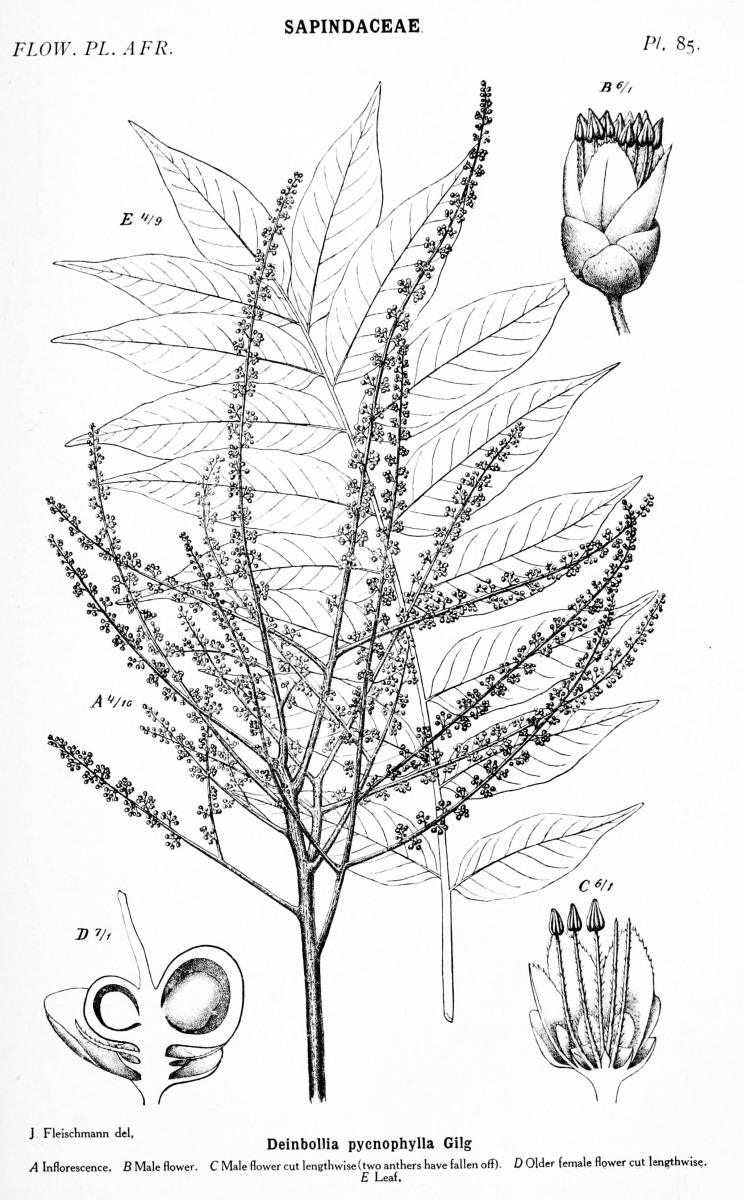
SAPINDACEAE
FLOW. PL. AFR.
Pl. 85.
J. Fleischmann del.
Deinbollia pycnophylla Gilg
A Inflorescence. B Male flower. C Male flower cut lengthwise (two anthers have fallen off). D Older female flower cut lengthwise. E Leaf.
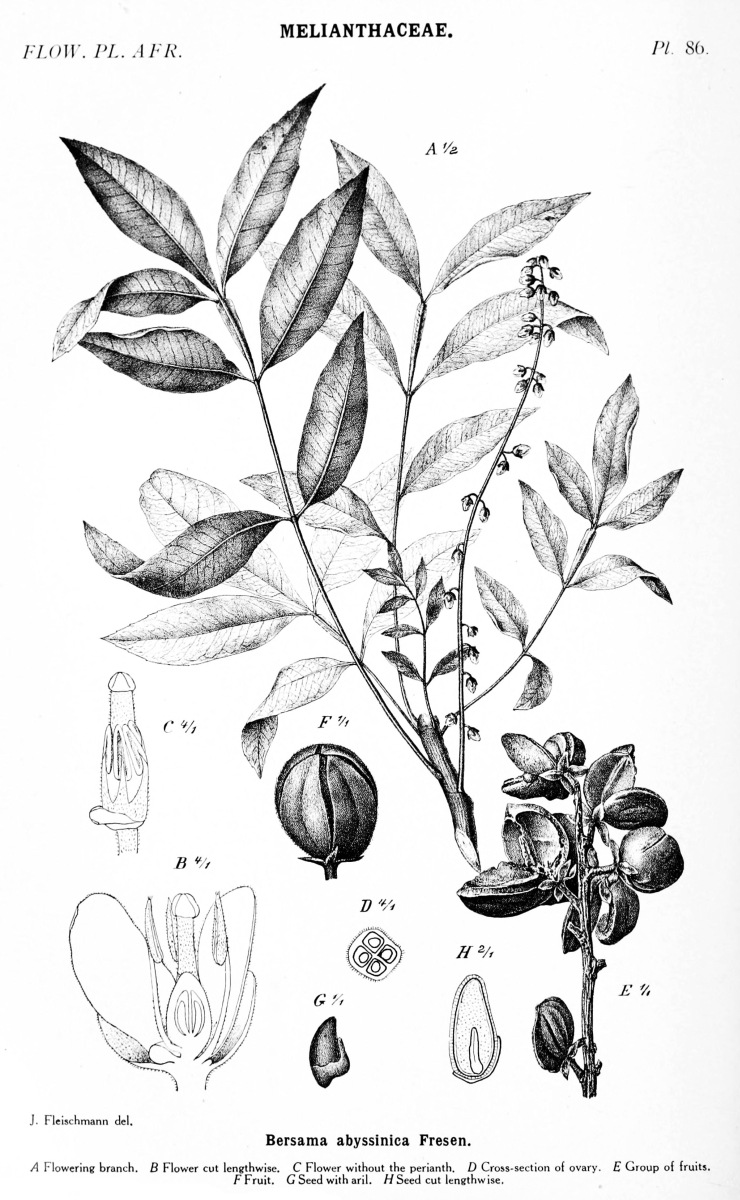
MELIANTHACEAE.
FLOW. PL. AFR.
Pl. 86.
J. Fleischmann del.
Bersama abyssinica Fresen.
A Flowering branch. B Flower cut lengthwise. C Flower without the perianth. D Cross-section of ovary. E Group of fruits. F Fruit. G Seed with aril. H Seed cut lengthwise.
Ovary lobed or divided. Stamens 12-24. Leaves with sunken glands. Fruit separating into mericarps. 44 44. Fruit winged; pericarp leathery. Ovary 2-celled. Stamens 20-24. Sepals densely clothed with silky hairs. Leaflets 4, with conspicuous veins.—Species 1. Island of Mauritius. The seeds contain oil. Hornea Bak. Fruit not winged; pericarp fleshy. (See 38.) Deinbollia Schum. & Thonn. 45. (2.) Flowers irregular. Petals 4. Disc one-sided. Ovary 3-celled. Fruit capsular. 46 Flowers regular or nearly so. Petals 5 or 0. Disc complete or indistinct. 48 46. Petals with a long claw and a crisped scale, red. Disc cup-shaped. Stamens 8. Ovary stalked. Fruit inflated, bursting irregularly. Seeds with a red, bony testa and a spiral embryo. Shrubs. Leaves unequally pinnate with a winged rachis and 11-13 leaflets.—Species 2. South Africa and Madagascar. Erythrophysa E. Mey. Petals with a short claw and without a scale. Disc flat. Ovary sessile. Fruit opening regularly. Seeds with a leathery or crusty testa. Leaves with 3-10 leaflets clothed with stellate hairs. 47 47. Stamens 5-6. Fruit with septifragal dehiscence. Embryo spirally twisted. Leaves unequally pinnate, with 3-7 leaflets.—Species 2. Madagascar and Mascarenes. Yielding timber. Cossignia Comm. Stamens 8. Fruit with loculicidal dehiscence. Embryo curved. Leaves equally pinnate, with 6-10 leaflets.—Species 3. Tropics. (Majidea Kirk) Harpullia Roxb. 48. Petals present. Stamens 8. Ovary 3-celled. Leaves equally pinnate. 49 Petals absent. 51 49. Disc somewhat one-sided. Petals green or yellowish. Fruit capsular. Leaves with 8-10 leaflets. (See 47.) Harpullia Roxb. Disc equal-sided. Petals red or reddish. 50 50. Leaves with 4-6 leaflets. Petals with the margins bent back at the base. Fruit capsular, 3-celled.—Species 1. Madagascar. Conchopetalum Radlk. Leaves with 8-14 usually serrate leaflets along a winged rachis. Petals minutely toothed. Fruit indehiscent, leathery, usually 1-celled.—Species 1. South Africa. Hippobromus Eckl. & Zeyh. 51. Disc indistinct. Stamens 5-15, usually 8. Ovary 2-6-, usually 3-celled. Stigma lobed. Fruit capsular, 2-6-celled. Embryo spirally twisted. Leaves usually simple.—Species 4. Tropical and South Africa. They yield timber, medicaments, and edible fruits; the beaten branches are used as torches. Dodonaea L. Disc distinctly developed. Stamens 4-5. Ovary 2-celled. Fruit indehiscent, usually drupaceous and 1-celled. Embryo not spiral. Leaves pinnate. 52 52. Flowers 4-merous. Leaves unequally pinnate. Tall trees.—Species 1. Southern West Africa (Angola). Zanha Hiern Flowers 5-merous. Leaves equally pinnate. 53 53. Calyx slightly lobed. Seeds with a thin testa and short radicle. Leaflets elliptical, entire. Flowers in panicles.—Species 1. West Africa. Talisiopsis Radlk. Calyx deeply divided. 54 54. Stamens alternating with the sepals. Stigma 2-lobed. Seeds with a thin testa and short radicle. Leaflets oval, crenate. Flowers in few-flowered cymes.—Species 1. East Africa. The seeds are edible. Dialiopsis Radlk. Stamens opposite to the sepals. Stigma entire. Seeds with a leathery testa and long radicle. Leaflets lanceolate oblong or elliptical, entire. Flowers in panicles.—Species 1. Mascarene Islands. It yields timber, edible fruits, and medicaments. (Under Hippobromus Eckl. & Zeyh. or Melicocca L.) Doratoxylon Thouars
SUBORDER MELIANTHINEAE
FAMILY 135. MELIANTHACEAE
Trees or shrubs. Leaves alternate, unequally pinnate or simple and undivided. Flowers in racemes, more or less irregular, hermaphrodite. Sepals 4-5, free or united at the base, imbricate in bud. Petals 4-5, imbricate in bud, sometimes cohering in the middle. Stamens 4-10, inserted within the disc. Anthers opening lengthwise by lateral slits. Ovary superior, 4-5-celled. Style simple; stigma entire or lobed. Fruit a capsule. Seeds with a straight embryo and copious albumen.—Genera 3, species 30. (Under SAPINDACEAE) (Plate 86.).
1. Leaves simple, undivided, exstipulate. Flowers almost regular. Disc equal-sided, with 10 processes. Petals sessile. Stamens 10. Ovary 5-celled, with numerous ovules in each cell. Capsule septicidal.—Species 3. South Africa. [Tribe GREYIEAE.] Greyia Hook. & Harv. Leaves pinnate, stipulate. Flowers more or less irregular. Disc one-sided. Petals clawed. Stamens 4-5. Ovary usually 4-celled. Ovules 1-12 in each cell. Capsule loculicidal. [Tribe MELIANTHEAE.] 2 2. Sepals very unequal. Petals 4, rarely 5, cohering in the middle, shorter than the sepals. Disc pouch-shaped. Stamens 4. Ovules 4-12 in each ovary-cell. Seeds without an aril.—Species 5. South Africa; one species also naturalized in the Canary Islands. The latter serves as an ornamental plant and is said to render honey poisonous. Melianthus L. Sepals nearly equal. Petals 5, free, longer than the sepals. Disc semi-orbicular. Ovules solitary in each ovary-cell. Seeds with an aril.—Species 20. Central and South-east Africa. (Including Natalia Hochst.) (Plate 86.) Bersama Fres.
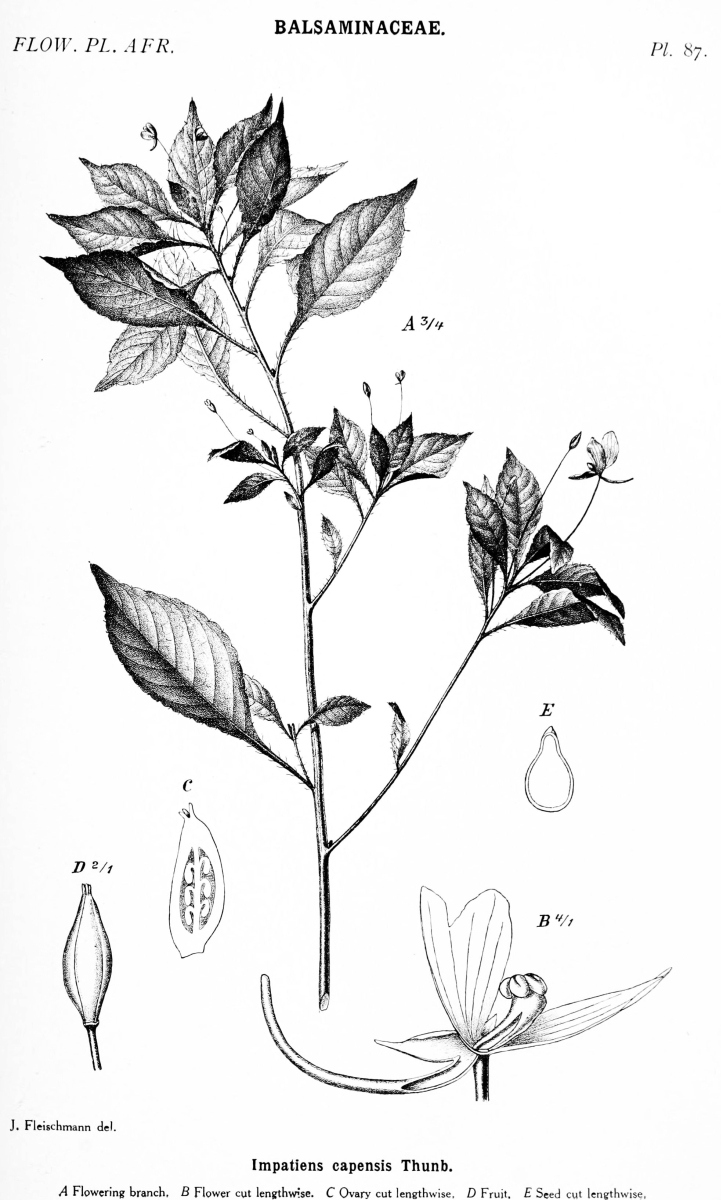
BALSAMINACEAE.
FLOW. PL. AFR.
Pl. 87.
J. Fleischmann del.
Impatiens capensis Thunb.
A Flowering branch. B Flower cut lengthwise. C Ovary cut lengthwise. D Fruit. E Seed cut lengthwise.
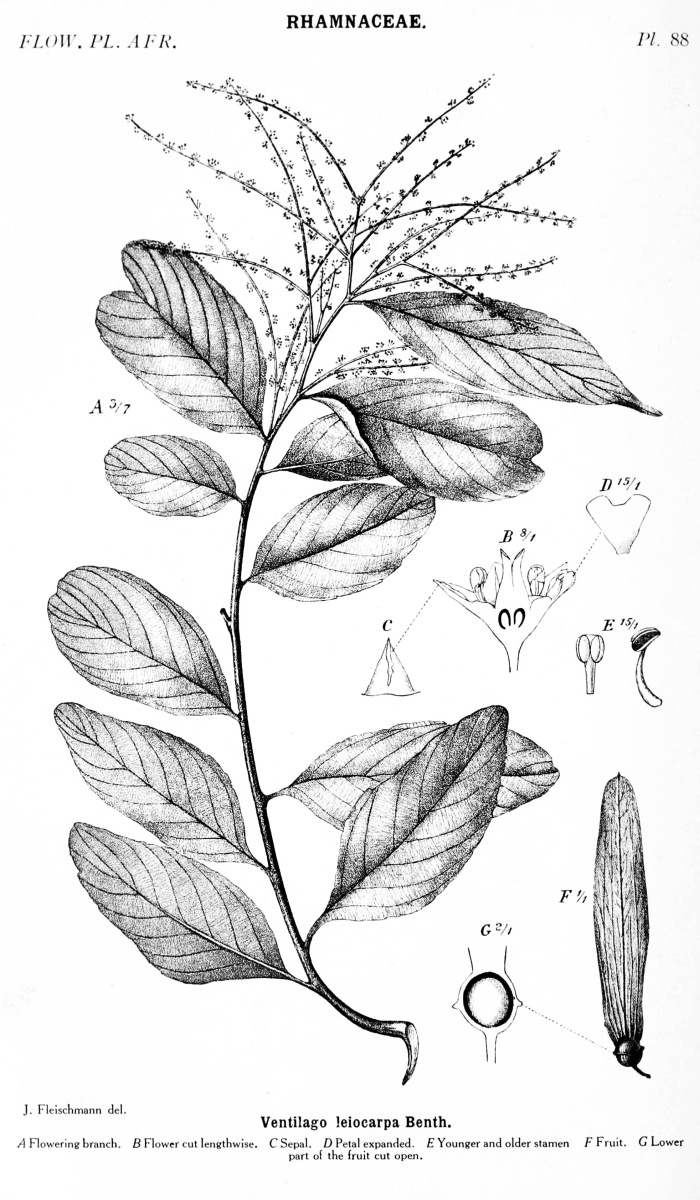
RHAMNACEAE.
FLOW. PL. AFR.
Pl. 88.
J. Fleischmann del.
Ventilago leiocarpa Benth.
A Flowering branch. B Flower cut lengthwise. C Sepal. D Petal expanded. E Younger and older stamen. F Fruit. G Lower part of the fruit cut open.
SUBORDER BALSAMININEAE
FAMILY 136. BALSAMINACEAE
Succulent herbs. Leaves herbaceous, undivided, penninerved, without stipules. Flowers solitary or in clusters or racemes, without bracteoles, irregular, hermaphrodite. Sepals 3, rarely 5, imbricate in bud, the hindmost more or less distinctly spurred. Petals 3 or 5. Stamens 5; filaments short and broad; anthers united, turned inwards, opening towards the apex. Disc none. Ovary superior, 5-celled. Ovules 3 or more, in the inner angle of each cell, pendulous, inverted, with dorsal raphe. Style 1; stigmas 1 or 5. Fruit succulent, dehiscing elastically. Seeds exalbuminous. (Under GERANIACEAE.) (Plate 87.)
Genus 1, species 100. Tropical and South Africa. Some are used as ornamental plants (balsams), others yield dyes, medicaments, or edible oily seeds. (Including Trimorphopetalum Bak.) Impatiens L.
ORDER RHAMNALES
FAMILY 137. RHAMNACEAE
Shrubs or trees, rarely (Helinus) undershrubs. Leaves undivided, stipulate, more rarely (Phylica) exstipulate. Flowers regular, hermaphrodite or polygamous. Receptacle more or less cup-shaped. Sepals 4-5, valvate in bud. Petals 4-5 or 0. Stamens as many as and alternate with the sepals. Anthers opening by 1-2 slits. Disc within the stamens, sometimes indistinct. Ovary 2-4-celled, sometimes not quite completely septate, rarely (Maesopsis) 1-celled. Ovules solitary in each cell, basal, inverted. Style undivided or cleft. Seeds with a large, straight embryo.—Genera 18, species 140. (Plate 88.)
1. Ovary superior or almost so. 2 Ovary inferior or half-inferior. 9 2. Ovary 1-celled. Stigma 5-lobed. Fruit one-seeded, indehiscent. Leaves opposite or nearly so, penninerved.—Species 2. Equatorial regions. The fruits are edible. (Including Karlea Pierre) Maesopsis Engl. Ovary completely or almost completely 2-4-celled. Stigma 2-4-lobed, or 2-4 stigmas. 3 3. Anthers opening outwards. Sepals with a far projecting ledge on the inside. Disc ring-shaped. Style undivided, with a 2-lobed stigma. Leaves opposite or nearly so, crenate, with 2-4 lateral nerves on each side. Flowers in axillary spikes or in terminal panicles.—Species 1. Abyssinia. Lamellisepalum Engl. Anthers dehiscing inwards or laterally. Flowers solitary or in cymes, rarely in racemes or panicles, but then style 2-4-cleft or with 3 stigmas. 4 4. Leaves 3-, more rarely 5-nerved from the base. Style 2-4-cleft. Fruit wingless, fleshy, indehiscent, with a 1-4-celled stone.—Species 10. Some of them yield timber, tanning and dyeing materials, gum-lac, food for silk-worms, medicaments, and edible fruits (jujubes) from which a sort of bread and a beverage are prepared; others have poisonous fruits; some are used as hedge plants. Zizyphus Juss. Leaves penninerved. 5 5. Flowers in terminal panicles, 5-merous. Stigmas 3. Fruit with 3 stones. Shrubs with spiny branches. Leaves opposite.—Species 1. Northern East Africa. The fruits are edible. Sageretia Brongn. Flowers in axillary inflorescences. 6 6. Receptacle united with the fruit for the greatest part. Fruit with 2-4 indehiscent stones. Seeds not grooved. Disc thick. Spines in the axils of the leaves.—Species 3. Tropical and South Africa. (Adolia Lam.) Scutia Brongn. Receptacle free from the fruit for the greatest part. Disc thin, rarely thick, but then spines, as usually, wanting. 7 7 Fruit with 1 two-celled stone. Disc thick. Style 2-cleft. Flowers 5-merous. Leaves alternate.—Species 1. East Africa. The fruits are edible. Berchemia Neck. Fruit with 2-4 stones. Disc thin. 8 8. Fruit with a red skin and a woody stone separating into 3 elastically dehiscing portions. Seed-coat crustaceous, shining. Flowers 5-merous. Leaves alternate.—Species 1. Madagascar. Macrorhamnus Baill. Fruit with 2-4 leathery or thin-woody, scarcely or not dehiscing stones. Seed-coat thin.—Species 17. North, East, and South Africa. They yield timber, dyes, a substitute for hop, fish-poison, and medicaments. “Buckthorn.” Rhamnus L. 9. (1.) Ovary half-inferior. 10 Ovary inferior. 15 10. Style simple; stigma 3-lobed. Leaves penninerved, serrate or crenate. 11 Style 2-4-cleft. 12 11. Ovary incompletely 2-3-celled, 1-2-ovuled. Fruit drupaceous, 1-celled, 1-2-seeded. Trees. Leaves opposite or nearly so. Flowers in axillary, raceme-like cymes. (See 2.) Maesopsis Engl. Ovary completely 3-celled, 3-ovuled. Fruit separating into 3 dehiscing mericarps, 3-seeded. Shrubs. Leaves alternate. Flowers in axillary and terminal cymes or panicles.—Species 1. South Africa and St. Helena. Noltia Reichb. 12. Leaves 3-5-nerved from the base, alternate. Fruit a drupe. Stem erect or decumbent. 13 Leaves penninerved. Fruit a nut, a schizocarp, or a capsule. 14 13. Fruit with a horizontal wing; epicarp leathery, endocarp woody. Leaves 3-nerved, serrate; stipules transformed into spines. Flowers in axillary and terminal, raceme-like cymes.—Species 1. Cultivated and naturalized in Algeria. Used medicinally and as a hedge-plant. Paliurus Juss. Fruit not winged; epicarp fleshy, endocarp horny, woody or leathery. (See 4.) Zizyphus Juss. 14. Ovary 2-celled. Style 2-cleft. Fruit with a long wing-like appendage, dry, 1-seeded, indehiscent. Climbing shrubs. Leaves alternate.—Species 3. Madagascar and neighbouring islands, West Africa. They yield fibres, tanning and dyeing materials, and medicaments. (Plate 88.) Ventilago Gaertn. Ovary 3-celled. Style 3-cleft or 3-parted. Fruit not winged, 3-seeded. Erect or almost erect, hairy shrubs or trees. Leaves opposite. Flowers in lateral inflorescences.—Species 6. Tropics. Lasiodiscus Hook. fil. 15. (9.) Style simple, sometimes very short, with 1-3 stigmas. Fruit separating into 3 dehiscing mericarps. Seed-coat hard. Hairy plants. Leaves alternate, entire, nearly always exstipulate. Flowers solitary or in spikes, racemes, or heads.—Species 80. South Africa, southern Central Africa, Madagascar and the neighbouring islands. Some are used as ornamental plants. Phylica L. Style 2-4-cleft. Leaves stipulate. Flowers in cymes sometimes arranged in false spikes or racemes, very rarely flowers solitary. 16 16. Receptacle top-shaped, not prolonged beyond the ovary. Fruit separating into 3 elastically dehiscent mericarps. Erect shrubs or low trees. Leaves alternate, 3-nerved at the base, serrate. Flowers in axillary cymes.—Species 1. East and South-east Africa, including the islands. Colubrina Brongn. Receptacle prolonged beyond the ovary. 17 17. Stem tree-like. Leaves opposite, entire, penninerved, hairy beneath. Flowers in axillary cymes. Anthers dehiscing by longitudinal slits which are confluent at the apex. Fruit separating into dehiscent mericarps; epicarp somewhat fleshy.—Species 1. Island of St. Helena. Nesiota Hook. fil. Stem shrubby, half-shrubby, or climbing. Leaves alternate. Flowers in axillary and terminal inflorescences. 18 18. Stem not climbing, without tendrils. Leaves few, lanceolate, entire. Flowers solitary or in few-flowered cymes.—Species 1. South Africa (Betchuanaland). Marlothia Engl. Stem climbing, bearing tendrils. Leaves oval. Flowers in usually many-flowered cymes, false spikes, or panicles. Mericarps 3, separating from a central column. 19 19. Flowers in cymes. Disc entire. Fruit wingless; mericarps dehiscing elastically. Leaves entire, penninerved.—Species 3. Tropical and South Africa. Helinus E. Mey. Flowers in false spikes or racemes. Disc usually lobed. Fruit 3-winged; mericarps dehiscing by a narrow slit or indehiscent—Species 12. Tropics. Some are used medicinally. Gouania L.
FAMILY 138. VITACEAE.
Shrubs or trees, usually climbing, rarely (Cissus) herbs or undershrubs. Leaves alternate, stipulate. Flowers regular, in cymose inflorescences. Calyx small, entire or lobed. Petals 3-7, sometimes cohering at the base or at the apex, valvate in bud. Stamens as many as and opposite to the petals, inserted outside the hypogynous, sometimes indistinct disc. Anthers opening inwards by two longitudinal slits. Ovary 2-8-celled, seated upon the disc or more or less sunk in it. Ovules solitary in each cell or two side by side, ascending, inverted, with ventral raphe. Style simple, sometimes indistinct. Stigma entire or 2-4-lobed. Fruit a berry, usually septate. Seeds with a bony or crustaceous testa and a fleshy or cartilaginous, more or less ruminate albumen enclosing a small straight embryo.—Genera 5, species 200. (AMPELIDEAE.) (Plate 89.)
1. Filaments united with one another and with the petals. Ovary 3-8-celled, with 1 ovule in each cell. Erect shrubs or trees, without tendrils. Leaves 1-3 times pinnate.—Species 3. Tropics. They yield vegetables, edible fruits, dyes, and medicaments, and serve as ornamental plants. [Subfamily LEEOIDEAE.] Leea L. Filaments free from each other and from the petals. Ovary 2-celled, with 2 ovules in each cell. [Subfamily VITOIDEAE.] 2 2. Flowers polygamous-dioecious. Petals 5, cohering at the top and falling off together. Disc 5-lobed. Style very short, conical. Seeds pear-shaped, with two pits on the ventral face. Climbing shrubs. Leaves more or less distinctly 3-5-lobed. Inflorescences paniculate, often with tendrils.—Species 1 (V. vinifera L., grape-vine). North Africa, also cultivated in other regions. It yields edible fruits, also used for preparing wine vinegar and brandy, oily seeds, and medicaments. Vitis Tourn. Flowers hermaphrodite or polygamous-monoecious. Petals usually spreading at the time of flowering, very rarely cohering at the top, but then only 4. Seeds more or less egg-shaped. 3 3. Style short-conical or wanting. Petals usually 5. Disc ring-shaped. Seeds egg- or boat-shaped. Climbing shrubs. Inflorescences with tendrils.—Species 30. Tropics. Some have edible fruits. (Under Cissus L. or Vitis Tourn.) Ampelocissus Planch. Style filiform or columnar, usually rather long. Inflorescences mostly without tendrils. 4 4. Petals 5 or 6, very rarely 4 or 7, thickened, fleshy, persistent. Disc adnate to the ovary. Style usually short. Climbing shrubs. Inflorescences compact.—Species 15. Central and South Africa. (Under Cissus L. or Vitis Tourn.) Rhoicissus Planch. 5. Petals 4, not thickened. Disc usually saucer-shaped, 4-lobed and adnate to the ovary at the base only. Style usually long.—Species 150. Tropical and South Africa and Egypt. Some of them yield edible fruits or tubers, mucilage, or medicaments. (Under Vitis Tourn.) (Plate 89.) Cissus L.
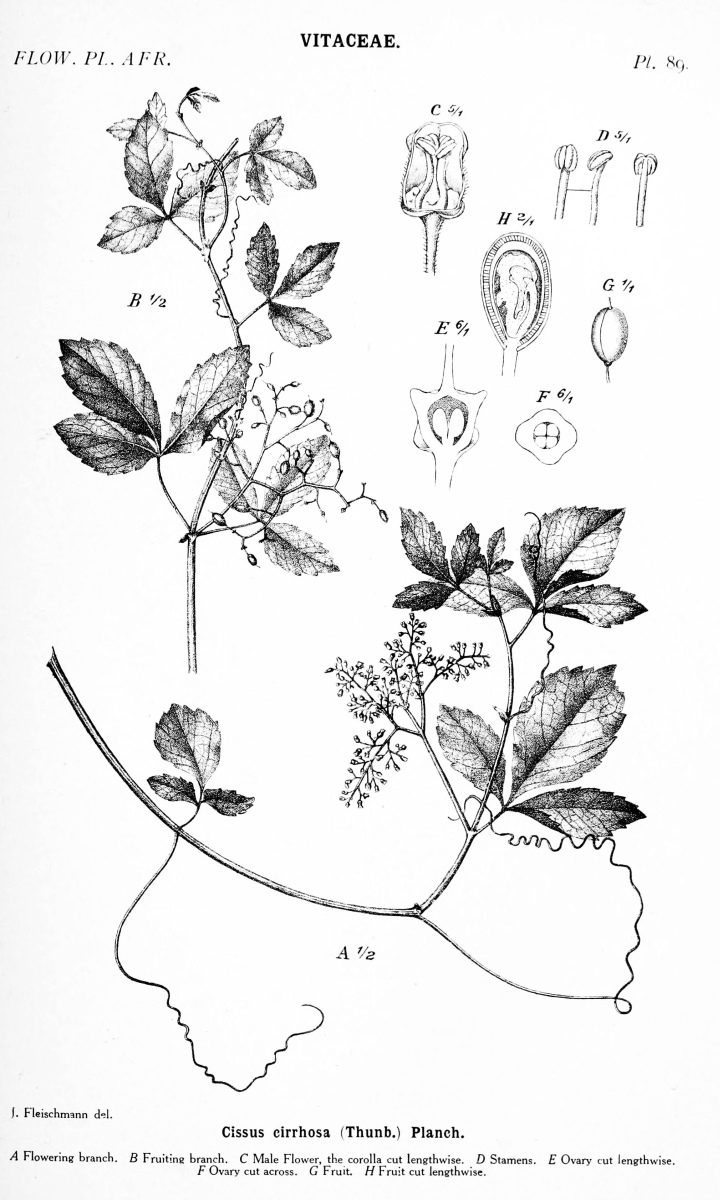
VITACEAE.
FLOW. PL. AFR.
Pl. 89.
J. Fleischmann del.
Cissus cirrhosa (Thunb.) Planch.
A Flowering branch. B Fruiting branch. C Male Flower, the corolla cut lengthwise. D Stamens. E Ovary cut lengthwise. F Ovary cut across. G Fruit. H Fruit cut lengthwise.
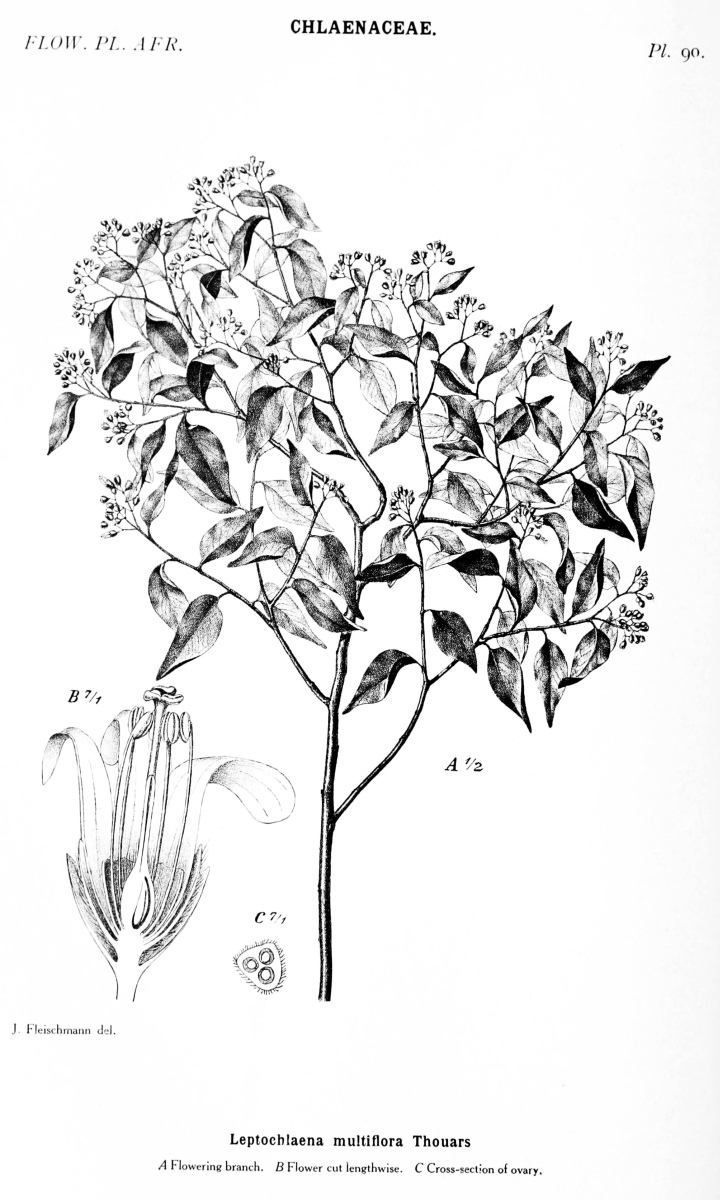
CHLAENACEAE.
FLOW. PL. AFR.
Pl. 90.
J. Fleischmann del.
Leptochlaena multiflora Thouars
A Flowering branch. B Flower cut lengthwise. C Cross-section of ovary.
ORDER MALVALES
SUBORDER ELAEOCARPINEAE
FAMILY 139. ELAEOCARPACEAE
Trees. Leaves undivided, stipulate. Flowers in axillary racemes, regular, hermaphrodite or polygamous. Sepals 4-6, valvate in bud. Petals 4-6, hypogynous, free, flat at the base, toothed or fringed at the apex, valvate in bud. Stamens numerous, inserted upon a cushion-shaped receptacle. Filaments free. Anthers linear, 2-celled, opening by a terminal pore. Ovary superior, 2-5-celled. Ovules 2 or more in the inner angle of each cell, inverted, pendulous, with ventral raphe, or one of them ascending. Style simple. Fruit a drupe with a septate stone. Seeds albuminous; embryo straight. (Under TILIACEAE.)
Genus 1, species 15. Madagascar, Mauritius, and Socotra. Elaeocarpus L.
SUBORDER CHLAENINEAE
FAMILY 140. CHLAENACEAE
Trees or shrubs, rarely climbing. Leaves alternate, simple, entire, stipulate. Flowers solitary or in panicles, regular, hermaphrodite, each flower or pair of flowers usually surrounded by an involucre. Sepals 3-5, imbricate in bud. Petals 5-6, free, hypogynous, with contorted aestivation. Disc ring-or cup-shaped, rarely 5-parted or indistinct. Stamens 10 or more, inserted within the disc or at its edge. Filaments free or united below with the disc, very rarely in 5 bundles. Anthers roundish, opening by 2 sometimes confluent longitudinal slits. Ovary superior, 3-celled, with 2 or more ovules in each cell. Style simple; stigmas 1 or 3. Fruit a capsule or a nut. Seeds with a leathery testa and copious albumen.—Genera 7, species 25. Madagascar. (Under TERNSTROEMIACEAE.) (Plate 90.)
1. Involucre large, calyx-like, 3-10-lobed or many-parted. Sepals 3. Disc cupular. Ovules 2-4 in each ovary-cell, pendulous. 2 Involucre not calyx-like, either 2-parted or shortly cup-shaped or indistinct or wanting; in the two former cases ovules numerous in each ovary-cell. Stamens 12 or more. 4 2. Involucre consisting of numerous densely crowded bracts, fleshy. Stamens numerous. Ovules 2 in each ovary-cell. Fruit a capsule.—Species 5. Madagascar. Used medicinally. (Sarcolaena Thouars). Sarcochlaena Thouars Involucre cup-shaped, lobed, dry. 3 3. Stamens 10. Ovules 2 in each ovary-cell. Involucre 6-toothed. Fruit a one-seeded nut.—Species 7. Madagascar. (Leptolaena Thouars). (Plate 90.) Leptochlaena Thouars Stamens numerous. Fruit a capsule.—Species 4. Madagascar. Xerochlamys Bak. 4. Involucre cup-shaped, enlarged in fruit. Sepals 5, the two outer somewhat smaller than the others. Disc consisting of 5 scales. Filaments united in 5 bundles. Ovules many in each ovary-cell, descending. Fruit a nut.—Species 1. Madagascar. (Sclerolaena Bak., Xylolaena Baill.) Xylochlaena Baill. Involucre of two bracts or rudimentary or wanting. Sepals 5, the two outer much smaller than the others, or 3. Disc ring- or cup-shaped. Filaments not united in bundles. 5 5. Ovules many in each ovary-cell, descending. Involucre enclosing two flowers, usually consisting of two laciniate bracts enlarged in fruit. Sepals 3. Disc cup-shaped. Fruit a capsule splitting to the base.—Species 5. Madagascar. (Schizolaena Thouars). Schizochlaena Thouars Ovules few in each ovary-cell. Involucre rudimentary or wanting. 6 6. Ovules axile, descending. Outer stamens inserted on the inside of the disc. Fruit a capsule dehiscing at the top only.—Species 4. Madagascar. (Rhodolaena Thouars). Rhodochlaena Thouars Ovules basal, ascending. Sepals 5. Outer stamens inserted at the edge of the ring-shaped disc. Stigma 3-lobed.—Species 1. Madagascar. (Eremolaena Baill.) Eremochlaena Baill.
SUBORDER MALVINEAE
FAMILY 141. TILIACEAE
Leaves toothed or lobed, more rarely entire or deeply divided. Stipules present. Flowers regular. Calyx valvate in bud. Petals entire or notched at the apex, rarely (Grewia) wanting. Stamens hypogynous, 10 or more, rarely 5-9, free or united in 4-10 bundles. Anthers 2-celled, the cells sometimes confluent at the top. Ovary superior, completely or almost completely 2-or more-celled, rarely (Christiania) deeply divided.—Genera 18, species 260. (Plate 91.)
1. Sepals combined into an entire, crenate, or 2-6-lobed calyx. Petals with contorted aestivation. Stamens numerous. Anthers roundish, opening by usually confluent, longitudinal slits. Style 4-5-parted or wanting. Ovules 1-2 in each ovary-cell. Trees or shrubs. Leaves cordate. Flowers panicled. [Tribe BROWNLOWIEAE.] 2 Sepals free or nearly so. Anthers opening by separate slits or by pores. Style simple. 4 2. Ovary 2-celled, with 1 ovule in each cell. Stigma sessile, petal-like, lobed. Calyx 2-3-lobed. Flowers dioecious. Fruit 4-winged.—Species 2. East Africa and Madagascar. Carpodiptera Gris. Ovary 4-6-celled. Styles 4-6, free or united at the base. 3 3. Flowers dioecious or polygamous. Calyx 3-4-lobed. Filaments united at the base. Ovary 5-6-parted. Stigmas horizontal, laciniate. Fruit with one-seeded cells.—Species 2. Tropics. Christiania DC. Flowers hermaphrodite. Calyx 5-6-cleft. Ovules 2 in each ovary-cell. Stigmas twisted, almost entire.—Species 1. Madagascar. Speirostyla Bak. 4. Petals with a gland at the base, rarely (Grewia) petals wanting. Receptacle nearly always prolonged into a more or less stalk-like androphore. Anthers roundish. [Tribe GREWIEAE.] 5 Petals without a gland at the base. Receptacle not stalk-like, rarely (Corchorus) somewhat prolonged. Anthers linear or oblong, rarely (Sparmannia) oval. 11 5. Flowers dioecious or polygamous. Stamens 10. Ovary 3-5-celled, with numerous ovules in each cell. Leaves elliptical. Inflorescence raceme-like.—Species 1. West Africa (Congo). Pentadiplandra Baill. Flowers hermaphrodite. Stamens numerous, rarely (Triumfetta) 5-10, but then ovary-cells with 2 ovules in each. 6 6. Fruit a spiny nut or schizocarp. Herbs or undershrubs, rarely shrubs. Flowers in cymes, yellow. Stigma lobed. Ovules 2 in each ovary-cell.—Species 50. Tropical and South Africa. Some species yield fibres, vegetables, or medicaments. Triumfetta L. Fruit an unarmed nut or drupe. Shrubs or trees. 7 7. Fruit few-seeded, usually fleshy. Ovary 2-5-celled, with usually 2 ovules in each cell. Filaments free.—Species 140. Tropical and South Africa and the Sahara. They yield timber, fibre, edible fruits from which drinks are prepared, and medicaments. (Plate 91.) Grewia L. Fruit many-seeded, fibrous. Ovary 4-10-celled, with numerous ovules in each cell. Petals 4-5, small. Trees. 8 8. Flowers 2-3 together surrounded by an involucre of 3-4 bracts. Filaments free. Ovary 6-8-celled. 9 Flowers without a distinct involucre. Filaments united at the base. Stipules cleft. 10 9. Involucral bracts 3, enclosing 3 flowers. Ovary 8-celled. Fruit with 8 furrows. Stipules awl-shaped.—Species 1. West Africa. The seeds are used as a substitute for coffee. Duboscia Bocq. Involucral bracts 4, enclosing 2 flowers. Petals 4. Ovary 6-7-celled. Fruit with 6-7 ribs. Stipules large, oblique.—Species 1. West Africa (Cameroons). Diplanthemum K. Schum. 10. Ovary and fruit 4-5-celled. Fruit oblong. Seeds winged.—Species 1. West Africa. Desplatzia Bocq. Ovary and fruit 8-10-celled. Fruit ovoid or globose.—Species 3. Equatorial West Africa. Used medicinally. (Grewiopsis De Wild. & Dur.) Grewiella O. Ktze. 11. (4.) Anthers linear, surmounted by a two-tipped or scale-like appendage. Stamens numerous. Ovary 6-10-celled, with 3 or more ovules in each cell. Shrubs or trees. [Tribe APEIBEAE.] 12 Anthers without an appendage at the top, rarely surmounted by a short point. Ovary 2-5-celled, rarely 6-celled. [Tribe TILIEAE.] 13 12. Petals 4, white, shorter than the calyx. Filaments united in 4 bundles. Anthers with a two-tipped appendage. Ovary 6-celled. Fruit globular, spiny.—Species 2. West Africa. (Including Acrosepalum Pierre). Ancistrocarpus Oliv. Petals 4-5, yellow, equalling the calyx. Filaments almost free. Anthers with a scale-like appendage. Ovary 8-10-celled. Fruit spindle-shaped, many-celled.—Species 5. Tropics. Some are used for dyeing and in medicine. Glyphaea Hook. fil. 13. Staminodes 5 or more. Shrubs or trees. 14 Staminodes none. 17 14. Staminodes 5, within the stamens. Anthers ending in a short point. Petals 5, white. Ovary 5-celled with 2 ovules in each cell. Stigma 5-parted. Leaves undivided, oblong or oval.—Species 3. Central Africa. Cistanthera K. Schum. Staminodes numerous, outside the stamens. Ovary 4-6-celled, with 3 or more ovules in each cell. 15 15. Fertile stamens 7-10. Anthers linear. Petals 4-5, violet. Fruit oblong, prickly, not winged.—Species 3. West Africa to the Great Lakes. They yield fibre. Honckenya Willd. Fertile stamens numerous. Petals 4, white or yellow. 16 16. Petals white. Ovary 4-celled. Fruit globose, prickly.—Species 6. South and East Africa and Madagascar. S. africana L. is used as an ornamental, medicinal, and textile plant. Sparmannia L. f. Petals yellow. Ovary 5-6-celled. Fruit oblong, with bristly ciliate wings.—Species 1. Equatorial West Africa. Yields fibre. Cephalonema K. Schum. 17. Stem woody, shrubby. Leaves 6-7-parted. Sepals united at the base, bearing a small horn at the top. Petals 5, notched at the top or minutely toothed, shorter than the sepals. Stamens very numerous. Ovary 5-6-celled with 2 ovules in each cell.—Species 1. East Africa. Ceratosepalum Oliv. Stem herbaceous or woody at the base only. Leaves undivided. Sepals free. Petals yellow. Ovary 2-5-celled, with more than 2 ovules in each cell. Fruit more or less elongate, not prickly.—Species 30. Tropical and South Africa and Egypt; one species also cultivated in other parts of North Africa. Some of them yield fibre (jute), vegetables, and medicaments. Corchorus L.
FAMILY 142. MALVACEAE
Leaves simple, stipulate. Calyx valvate in bud. Petals 5, adhering to the staminal tube, with contorted aestivation. Stamens numerous; filaments united into a tube; anthers 1-celled; pollen-grains large, prickly. Ovary superior, sessile, 3-or more-celled, or many distinct ovaries. Ovules inverted. Seeds albuminous; embryo curved.—Genera 21, species 300. (Plate 92.)
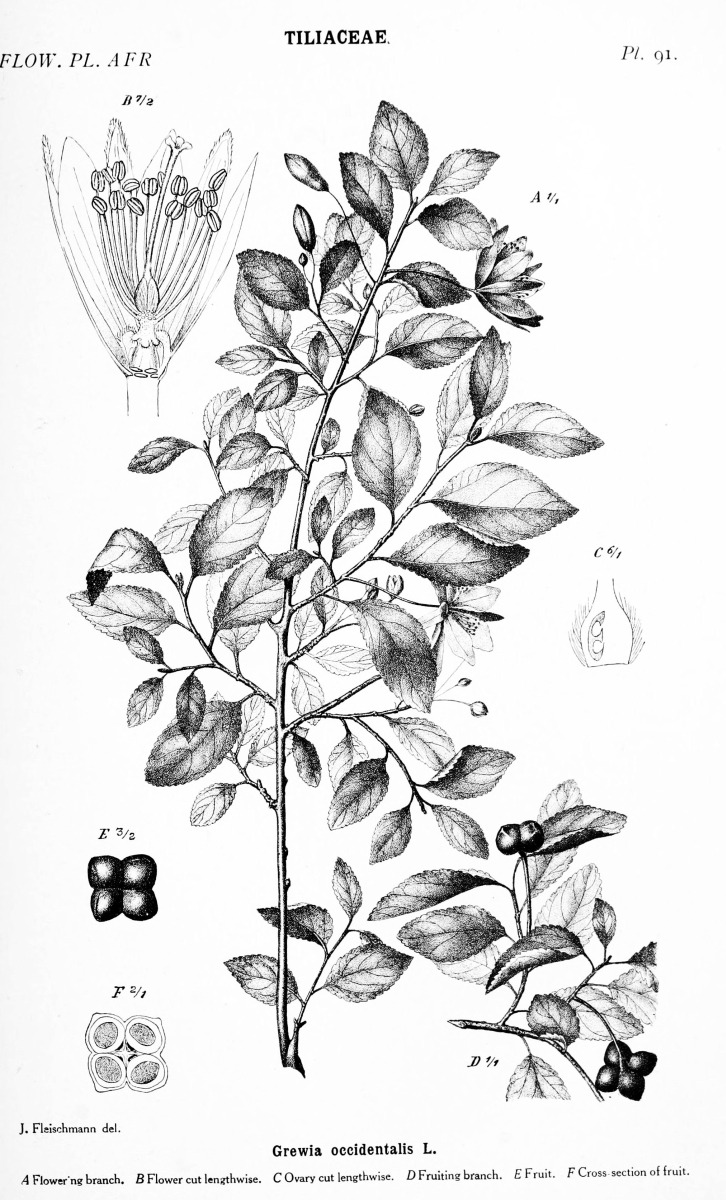
TILIACEAE
FLOW. PL. AFR.
Pl. 91.
J. Fleischmann del.
Grewia occidentalis L.
A Flowering branch. B Flower cut lengthwise. C Ovary cut lengthwise. D Fruiting branch. E Fruit. F Cross section of fruit.
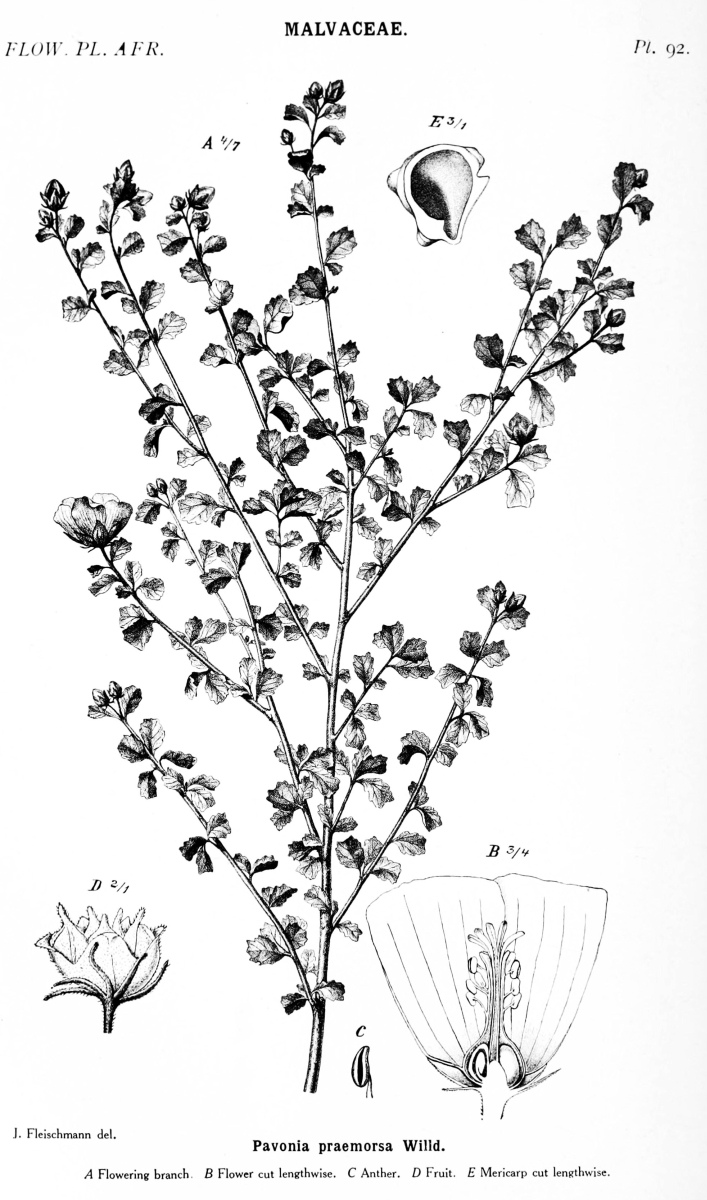
MALVACEAE.
FLOW. PL. AFR.
Pl. 92.
J. Fleischmann del.
Pavonia praemorsa Willd.
A Flowering branch. B Flower cut lengthwise. C Anther. D Fruit. E Mericarp cut lengthwise.
1. Carpels in several rows placed one above the other, one-seeded, indehiscent, falling singly. Staminal tube beset with anthers to the top. Flowers with an epicalyx of 3 bracteoles. Herbs.—Species 3. North Africa. Used as ornamental and medicinal plants. [Tribe MALOPEAE.] Malope L. Carpels placed side by side in one plane. 2 2. Style-branches 10, twice as many as the ovary-cells. Ovules solitary in each cell. Staminal tube truncate or minutely toothed at the top. Fruit splitting into mericarps. [Tribe URENEAE.] 3 Style-branches as many as the ovary-cells, or a simple style. 5 3. Flowers without an epicalyx, but inflorescence with an involucre. Carpels opposite to the petals. Hispid herbs.—Species 2. Tropics. Yielding fibre. Malachra L. Flowers with an epicalyx of 5 or more bracteoles. 4 4. Mericarps covered with hooked bristles, indehiscent. Carpels alternating with the petals. Epicalyx of 5 bracteoles. Leaves glandular beneath.—Species 2. Tropical and South Africa; one species only cultivated. Used as medicinal and textile plants. Urena L. Mericarps winged, tubercled, or with 1-3 awns, rarely smooth. Leaves without glands on the under surface.—Species 25. Tropical and South Africa. Some of them are used as ornamental, medicinal, or textile plants. (Malache Vogel). (Plate 92.) Pavonia L. 5. Fruit splitting into mericarps. Carpels 5 or more. Style cleft. Staminal tube loaded with anthers to the top. [Tribe MALVEAE.] 6 Fruit capsular, loculicidal. Staminal tube beset with anthers on the outer face, truncate or minutely toothed at the top. [Tribe HIBISCEAE.] 14 6. Carpels with 1 ovule. 7 Carpels with 2 or more ovules, sometimes transversely septate. [Subtribe ABUTILINAE.] 11 7. Ovule pendulous. Stigmas terminal. Epicalyx absent.—Species 20. Some of them yield fibre, fodder, tea, and medicaments. [Subtribe SIDINAE.] Sida L. Ovule ascending. Epicalyx usually present. [Subtribe MALVINAE.] 8 8. Style-branches bearing the stigma at the thickened, capitate apex. Shrubs or undershrubs.—Species 20. Tropical and South Africa. Some of them are used as ornamental or medicinal plants. Malvastrum A. Gray Style-branches pointed, bearing the stigma on the inner face. 9 9. Epicalyx consisting of 3 free bracteoles or wanting. Central column of the fruit overtopping the mericarps.—Species 15. Some of them are used as ornamental or medicinal plants. “Mallow.” Malva L. Epicalyx consisting of 3-9 bracteoles united below. 10 10. Central column of the fruit overtopping the mericarps. Epicalyx 3-6-cleft.—Species 12. North Africa; one species also introduced into South Africa. Some are used as ornamental or medicinal plants. (Including Navaea Webb & Berth. and Saviniona Webb & Berth.) Lavatera L. Central column of the fruit not overtopping the mericarps. Epicalyx 6-9-cleft. Herbs.—Species 7. North and South Africa, Mascarene Islands, and St. Helena. Several species yield fibres, dyes, mucilage, and medicaments, or serve as ornamental plants. (Including Alcea L.) Althaea L. 11. Carpels completely or nearly completely divided into two compartments by a transverse partition. Style-branches capitate at the top. Ovules 2-3 in each carpel. 12 Carpels without a partition. Style-branches filiform throughout or club-shaped. 13 12. Flowers with an epicalyx of 3 bracteoles. Petals red. Carpels numerous. Mericarps with 2 prickles at the back. Prostrate herbs. Leaves lobed.—Species 1. South Africa; naturalized in the Island of Madeira. Modiola Moench Flowers without an epicalyx. Petals yellow. Carpels 5. Mericarps beaked. Shrubs or undershrubs. Leaves undivided.—Species 3. Tropics. They yield fibres. Wissadula Med. 13. Flowers with an epicalyx of 3 bracteoles. Carpels numerous; ovules 2-3 in each.—Species 5. South Africa. Used as ornamental plants. (Including Sphaeroma Harv.) Sphaeralcea St. Hil. Flowers without an epicalyx. Ovules 3-9 in each carpel.—Species 30. Some of them yield fibres, medicaments, and a substitute for coffee, or serve as ornamental plants. Abutilon Gaertn. 14. (5.) Style split into long or rather long branches. Ovary 5-celled. Seeds kidney-shaped. 15 Style split into very short, erect branches, or simple. 17 15. Ovules solitary in each carpel. Stigma capitate. Epicalyx of 7-10 bracteoles.—Species 9. Tropical and South Africa. Kosteletzkya Presl Ovules 2 or more in each carpel. 16 16. Ovules 2 in each carpel. Epicalyx consisting of 3 large, cordate bracteoles. Shrubs.—Species 1. East Africa. Senra Cav. Ovules 3 or more in each carpel. Epicalyx consisting of 3 or more narrower bracteoles or wanting.—Species 130. Some of them yield timber, fibres, dyes, perfumes, oil, vegetables, condiments, and medicaments, or serve as ornamental plants. (Including Abelmoschus Medik., Lagunaea Cav., and Paritium St. Hil.) Hibiscus L. 17. Epicalyx of partly united bracteoles. Calyx deeply divided. Ovary 5-celled. Leaves small, undivided. 18 Epicalyx of free bracteoles. Calyx not deeply divided. 19 18. Epicalyx 5-parted, large. Calyx 5-parted. Trees. Leaves ovate.—Species 1. Madagascar. Macrocalyx Cost. & Poisson Epicalyx 11-toothed. Calyx 2-parted. Corolla yellow. Shrubs. Leaves reniform or orbicular.—Species 1. East Africa. Symphyochlamys Guerke 19. Epicalyx of 3 large, cordate bracteoles. Ovary 5-celled. Seeds woolly. Species 5, three of them growing wild in Central and South Africa, the others (cotton-plants) cultivated in various regions. They yield cotton, oil, dyes, vegetables, and medicaments. Gossypium L. Epicalyx of small or narrow bracteoles. 20 20. Calyx sprinkled with black dots. Ovary 3-4-celled. Fruit readily dehiscing. Cotyledons not dotted. Shrubs or undershrubs.—Species 7. Central and South Africa. (Fugosia Juss.) Cienfuegosia Cav. Calyx not dotted. Ovary 5-celled. Fruit not or hardly dehiscing. Seeds woolly. Cotyledons usually marked with black dots. Trees or shrubs. Leaves undivided.—Species 5. Tropics to Delagoa Bay. They yield timber, fibres, dyes, and medicaments. Thespesia Corr.
FAMILY 143. BOMBACACEAE
Trees. Leaves digitate, stipulate. Flowers solitary or fascicled, hermaphrodite, without an epicalyx. Calyx with valvate, closed, or open aestivation. Petals 5, adhering at the base to the staminal tube, with contorted aestivation. Stamens 5 or more, united below. Anthers 1-celled. Pollen-grains smooth or almost so. Ovary superior or nearly so, 5-10-celled, the cells opposite to the petals. Ovules numerous in each cell, ascending or horizontal, inverted. Style simple. Fruit a capsule or a nut. Seeds with a scanty albumen and a curved embryo with folded or coiled cotyledons.—Genera 3, species 13. Tropics. (Under MALVACEAE or STERCULIACEAE.) (Plate 93.)
1. Stamens 5. Anthers twisted. Calyx lobed. Stigma capitate. Fruit leathery, woolly within, dehiscent.—Species 1 (C. pentandra Gaertn., silk-cotton-tree). Central Africa; naturalized in Madagascar and the Mascarenes. Yields timber, bast, tanning materials, wool for stuffing, oil, condiments, vegetables, and medicaments. (Eriodendron DC.) Ceiba Gaertn. Stamens numerous. 2 2. Calyx truncate or irregularly 3-5-cleft, with open or closed aestivation. Stigma 5-partite or capitate. Fruit hairy within, dehiscent.—Species 6. Central Africa. They yield timber, wool for stuffing, and medicaments (Including Pachira Aubl.) (Plate 93.) Bombax L. Calyx 5-cleft, with valvate aestivation. Stigma 5-10-partite. Fruit woody, filled with pulp, indehiscent. Flowers solitary, pendulous.—Species 6. Tropics. They yield wood, fibres, tanning materials, vegetables, oil, condiments, and medicaments. The pulp of the fruits and the seeds are edible; from the former a drink is prepared. “Baobab.” Adansonia L.
FAMILY 144. STERCULIACEAE
Leaves alternate, stipulate, rarely (Hua) exstipulate. Sepals more or less united, valvate in bud, rarely (Cotylonychia) at first imbricate. Petals 5, with contorted, rarely (Hua) valvate aestivation, sometimes adnate to the staminal tube, or rudimentary, or wanting. Stamens as many as the sepals or more. Filaments usually more or less united. Anthers 2-celled, rarely (Triplochiton) 1-celled. Ovary superior, 3-or more-celled, or several free ovaries, rarely ovary 1-2-celled. Ovules inverted, usually 2 or more to each carpel.—Genera 28, species 470. (Including BUETTNERIACEAE and TRIPLOCHITONACEAE.) (Plate 94.)
1. Flowers unisexual or polygamous, without a corolla. Filaments united. Male flowers without staminodes. Styles free at the base or throughout. Trees. [Tribe STERCULIEAE.] 2 Flowers hermaphrodite, rarely polygamous, but then, as nearly always, provided with a corolla. 7 2. Carpels numerous, in several rows. Calyx-lobes 6-8, yellow or brown. Anthers numerous, arranged in a ring.—Species 2. West Africa. Octolobus Welw. Carpels 3-12, in a single row. Calyx-lobes 4-5. 3 3. Anthers arranged irregularly, crowded in a head, numerous. Seeds albuminous. 4 Anthers arranged in a ring. 5 4. Calyx tubular, red. Ovules 2 in each carpel. Fruit with a membranous rind, one-seeded, dehiscing before the time of maturity. Leaves undivided.—Species 1. West Africa. Yields fibre. (Under Sterculia L.) Firmiana Marsigli Calyx campanulate. Ovules more than 2 in each carpel. Fruit with a woody or leathery rind, dehiscing at maturity.—Species 25. Tropical and South Africa. Some species yield timber, fibre, gum (African tragacanth), vegetables, edible fruits, oily seeds, and medicaments. (Including Eribroma Pierre). Sterculia L. 5. Anthers 4-5, inserted below the apex of the staminal column. Ovules 2 in each carpel. Calyx shortly lobed. Ripe carpels woody, winged, indehiscent. Seeds exalbuminous.—Species 3. Tropics. They yield timber, bark for tanning, and medicaments. Heritiera Ait. Anthers 8 or more, rarely 5, but then inserted at the apex of the staminal column. Ovules 3 or more in each carpel. Ripe carpels dehiscent. 6 6. Seeds winged, albuminous. Leaves undivided.—Species 4. Central Africa. (Under Sterculia L.) Pterygota Endl. Seeds wingless, exalbuminous.—Species 45. Central and South-east Africa. Some species yield timber, vegetables, and edible seeds (cola-nuts) which are also used medicinally. (Edwardia Rafin.) Cola Schott
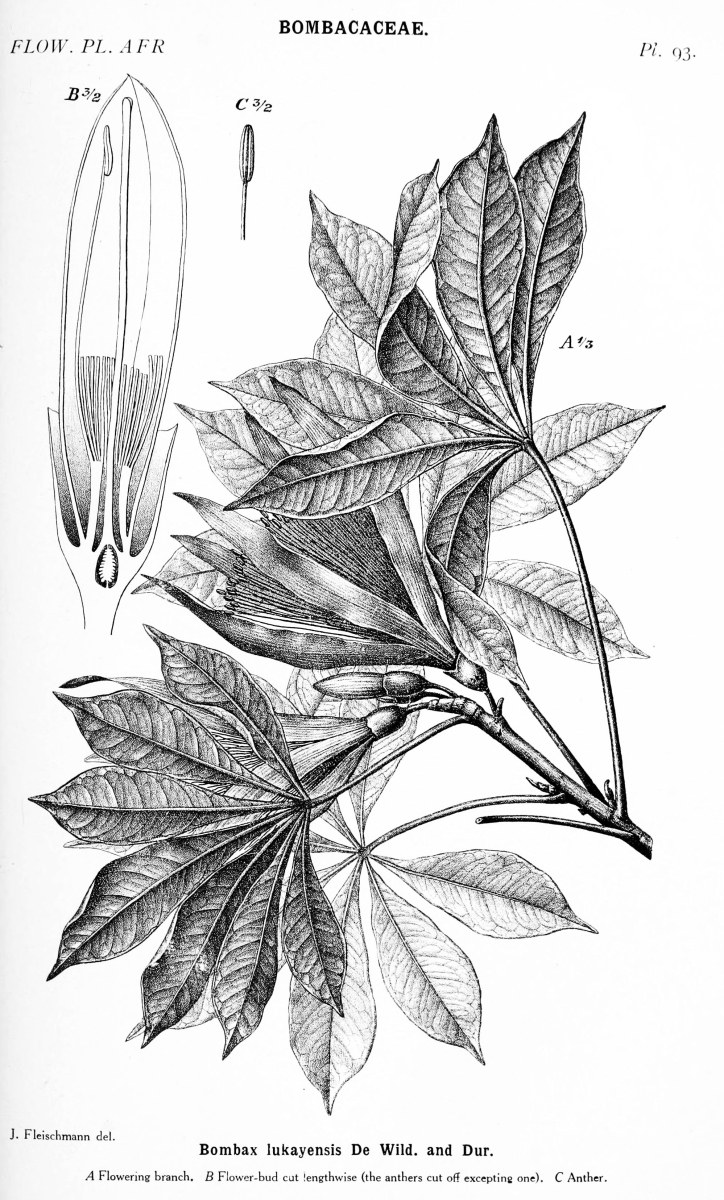
BOMBACACEAE.
FLOW. PL. AFR.
Pl. 93.
J. Fleischmann del.
Bombax lukayensis De Wild. and Dur.
A Flowering branch. B Flower-bud cut lengthwise (the anthers cut off excepting one). C Anther.
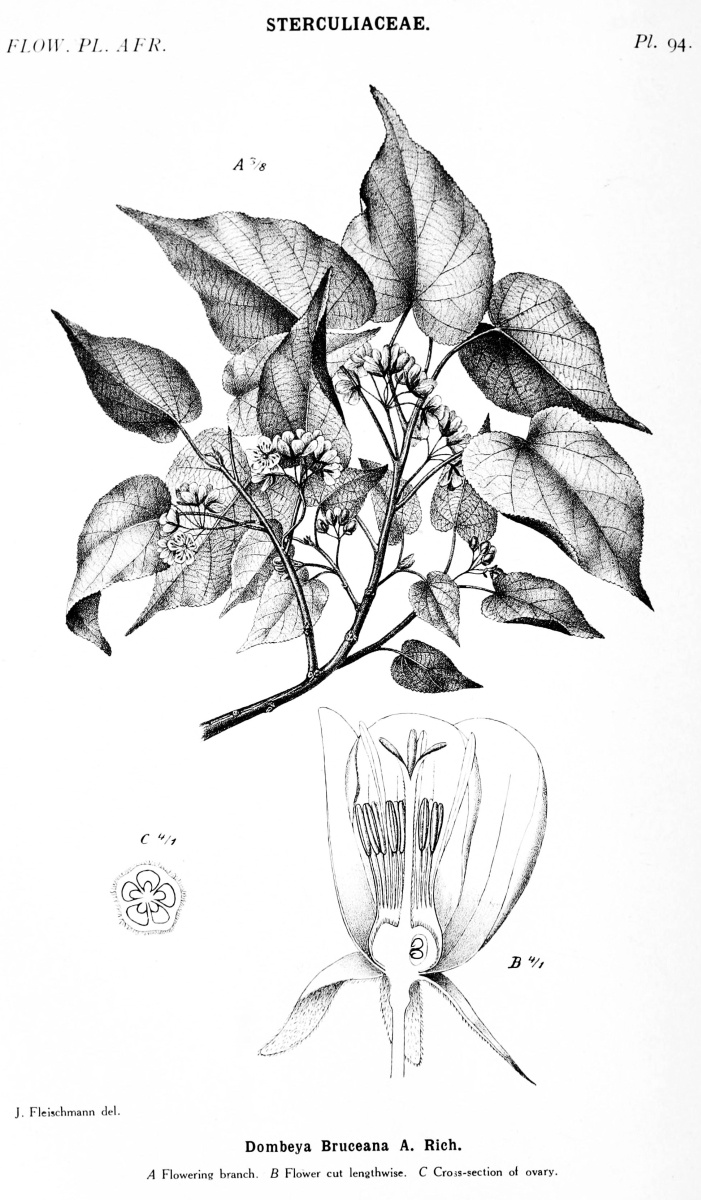
STERCULIACEAE.
FLOW. PL. AFR.
Pl. 94.
J. Fleischmann del.
Dombeya Bruceana A. Rich.
A Flowering branch. B Flower cut lengthwise. C Cross-section of ovary.
7. (1.) Petals minute or wanting. Stamens 5, free or almost free. Ovary 3-5-celled, with 3 or more ovules in each cell. Shrubs.—Species 1. Madagascar. [Tribe LASIOPETALEAE.] Keraudrenia Gay Petals distinctly developed. 8 8. Carpels distinct, surrounded by 5-10 petal-like staminodes twisted in the bud. Stamens 10-30, inserted upon a raised receptacle, free. Fruit winged. Trees. Flowers panicled. [Tribe MANSONIEAE.] 9 Carpels not surrounded by petal-like staminodes. Anthers 2-celled. 10 9. Calyx spathe-like. Petals oblong, with a gland at the base. Stamens 10, inserted upon a long androphore. Staminodes 10, oblong-linear, glabrous. Leaves toothed. Panicles terminal, many-flowered.—Species 1. West Africa. Yields timber. Achantia A. Chev. Calyx 5-parted. Petals obovate, without glands. Stamens 30, upon a short androphore. Staminodes 5, ovate, downy. Leaves lobed. Panicles lateral, few-flowered.—Species 1. West Africa. Yields timber. Triplochiton K. Schum. 10. Petals or their lower part hooded. 11 Petals or their lower part flat or slightly boat-shaped, sometimes one of them hooded, the others flat. 18 11. Ovary 1-celled, with a single ovule. Stamens united in pairs. Staminodes none. Petals clawed, with a spur-like appendage. Trees.—Species 1. Equatorial West Africa. The bark and the seeds are used as condiments. Hua Pierre Ovary 2- or more-celled, with two or more ovules in each cell. [Tribe BUETTNERIEAE.] 12 12. Staminodes absent. Fertile stamens 10, united at the base. Sepals at first imbricate. Petals with a saucer-shaped claw and a lanceolate blade. Ovary 5-celled, with numerous ovules. Shrubs. Leaves undivided. Flowers in racemes.—Species 1. West Africa (Congo). Cotylonychia Stapf Staminodes present. 13 13. Stamens united in pairs or bundles. Shrubs or trees. [Subtribe THEOBROMINAE.] 14 Stamens united below in a ring or tube; anthers solitary between the barren lobes. Petals with a blade. Ovules 2-3 in each ovary-cell. [Subtribe BUETTNERINAE.] 17 14. Petals with a blade above the hood. Ovules numerous in each ovary-cell. 15 Petals without a blade. 16 15. Petals with a 2-parted blade. Staminodes short. Fruit with a woody, prickly rind, dehiscent. Cotyledons coiled. Trees. Leaves serrate. Flowers in panicles.—Species 1. Cultivated in the tropics, naturalized in the Mascarene Islands. Yields timber, fibre, a mucilage used for clarifying sugar, fodder, edible fruits, and medicaments. Guazuma Plum. Petals with an entire blade. Staminodes long. Fruit with a leathery rind, indehiscent. Cotyledons wrinkled. Leaves entire or sinuate. Flowers in cymes.—Species 3 (chiefly Th. Cacao L.). Cultivated in the tropics. The seeds are used for the preparation of cocoa, chocolate, and cocoa-butter, the pericarp for making a beverage. They yield also fibres and are used in medicine. Theobroma L. 16. Staminal tube bell-shaped. Anthers in short-stalked clusters of 3. Staminodes solitary, leaf-like, bent outwards. Shrubs.—Species 10. West Africa. Scaphopetalum Mast. Staminal tube ring-shaped. Anthers singly upon long filaments. Staminodes in bundles, thread-like.—Species 10. Central Africa. Leptonychia Turcz. 17. Petals clawed, adhering to the cupular staminal tube. Anthers sessile or nearly so. Seeds exalbuminous.—Species 13. Tropics. Buettnera L. Petals sessile, free from the annular staminal tube. Anthers stalked. Seeds albuminous.—Species 2. Madagascar. Ruelingia R. Br. 18. (10.) Stamens and carpels inserted on a long gynophore. Petals unequal, one of them hooded, red, deciduous. Stamens in bundles of 3 alternating with staminodes. Ovary 5-celled with 3-5 ovules in each cell. Trees.—Species 1. Comoro Island. Yields timber. [Tribe HELICTEREAE.] Kleinhofia L. Stamens and carpels inserted on a very short gynophore or without a gynophore. Petals equal or subequal, flat or slightly convex, not hooded. 19 19. Fertile stamens 5; staminodes minute or wanting. Petals deciduous, usually slightly oblique. [Tribe HERMANNIEAE.] 20 Fertile stamens 10 or more, rarely (Melhania) 5, but then alternating with long staminodes. Filaments united at the base. Petals usually very oblique and persistent. [Tribe DOMBEYEAE.] 22 20. Filaments free, broadened at the base or above the middle. Ovary 5-celled, the cells alternating with the petals. Ovules 3 or more in each cell. Seeds reniform; embryo curved. Herbs, undershrubs, or small shrubs.—Species 190. South and Central Africa. Some are used as ornamental plants. (Including Mahernia L.) [Subtribe HERMANNINAE.] Hermannia L. Filaments united below, not broadened above. Ovary 5-celled, the cells opposite to the petals, or 1-celled. Ovules 2 in each cell. Seeds elliptical; embryo straight. [Subtribe MELOCHINAE.] 21 21. Ovary 1-celled. Style 1, simple; stigma penicillate.—Species 2. Tropical and South Africa and Canary Islands. Used medicinally. Waltheria L. Ovary 5-celled. Styles or style-branches 5.—Species 5. Tropics; one species only naturalized. They yield fibres, vegetables, and medicaments. (Including Altheria Thouars) Melochia L. 22. Staminodes wanting. Ovules 2 in each ovary-cell. Shrubs or trees. 23 Staminodes 2-8, usually 5. 24 23. Ovary-cells and styles 5. Anthers 20. Fruit with loculicidal dehiscence.—Species 1. Island of Mauritius. Astiria Lindl. Ovary-cells and styles 10. Anthers 20-30, associated in 5 bundles. Fruit with loculicidal and septicidal dehiscence.—Species 1. Island of Réunion. Ruizia Cav. 24. Fertile stamens 5. Ovary 5-celled. Bracteoles 3, persistent. Herbs, undershrubs, or low shrubs.—Species 30. Tropical and South Africa. Melhania Forsk. Fertile stamens 10 or more. Bracteoles deciduous or wanting. 25 25. Ovary almost completely 2-celled with 1 ovule in each cell. Petals slightly oblique, deciduous. Bracteoles remote from the flower. Undershrubs.—Species 3. East Africa. Harmsia K. Schum. Ovary 3-10-, usually 5-celled, with 2 or more ovules in each cell. Trees or shrubs. 26 26. Ovules 2 in each ovary-cell.—Species 120. Tropical and South Africa. Some species yield timber, fibres, and medicaments, or serve as ornamental plants. (Including Assonia Cav. and Xeropetalum Del.) (Plate 94.) Dombeya Cav. Ovules 3 or more in each ovary-cell. Style simple. 27 27. Bracteoles palmately cut. Petals falling off together with the staminal tube. Leaves linear.—Species 1. Madagascar and Mascarenes. Cheirolaena Benth. Bracteoles entire or wanting. Petals persistent.—Species 8. Madagascar and Mascarenes. Trochetia DC.
SUBORDER SCYTOPETALINEAE
FAMILY 145. SCYTOPETALACEAE
Trees or shrubs. Leaves alternate, undivided. Flowers in fascicles, racemes, or panicles. Calyx entire or lobed. Petals 3-16, free or almost free, valvate in bud, more rarely wholly united. Stamens numerous, slightly perigynous. Anthers attached by the base. Ovary superior, rarely half-inferior, completely or almost completely 3-8-celled. Ovules 2 or more in each cell, pendulous, inverted, with dorsal raphe. Style simple. Seeds albuminous.—Genera 5, species 40. West Africa. (RHAPTOPETALACEAE, under OLACINEAE.) (Plate 95.)
1. Ovules 2 in each ovary-cell. Anthers usually opening by longitudinal slits. Corolla furrowed in the bud, subsequently separating into 5 or more petals. Fruit one-seeded. Seeds usually without a crown of hairs. Flowers in axillary or terminal racemes or panicles. [Tribe OUBANGUIEAE.] 2 Ovules 6 or more in each ovary-cell. Anthers usually opening by apical pores. Corolla not furrowed in the bud, sometimes subsequently separating into 2-5 petals. Seeds usually with a crown of hairs. Flowers in fascicles or cymes, usually on the old wood. [Tribe RHAPTOPETALEAE.] 3 2. Flowers in racemes. Stigma usually lobed. Fruit a drupe. Albumen ruminate.—Species 9. West Africa. Scytopetalum Pierre Flowers in panicles. Stigma entire. Fruit a capsule. Albumen uniform.—Species 10. West Africa. (Including Egassea Pierre) Oubanguia Baill. 3. Ovary almost superior to half-superior. Fruit a one-seeded drupe. Albumen ruminate.—Species 5. West Africa. (Plate 95.) Rhaptopetalum Oliv. Ovary superior. Fruit a several-seeded capsule. Albumen uniform. 4 4. Fruit long, with 2 fertile and 2 sterile cells.—Species 2. Equatorial West Africa (Cameroons). Pierrina Engl. Fruit short, with 4-6 fertile cells.—Species 15. West Africa. (Including Erythropyxis Pierre) Brazzeia Baill.
ORDER PARIETALES
SUBORDER THEINEAE
FAMILY 146. DILLENIACEAE
Shrubs or trees. Leaves undivided. Sepals imbricate in bud, persistent in fruit. Petals imbricate in bud. Stamens numerous, hypogynous. Anthers adnate. Carpels 2 or more, free or united at the base of the ovarial portion. Ovules erect, ascending or horizontal, inverted, with a ventral raphe. Fruit dry. Seeds with an aril; albumen abundant; embryo minute, straight.—Genera 3, species 25. Tropics. (Plate 96.)
1. Filaments much broadened at the top. Anther-halves short, diverging below, opening lengthwise. Aril laciniate. Leaves hispid, penninerved with parallel side-nerves, exstipulate. Flowers in panicles.—Species 20. Tropics. The stem of several species (especially T. alnifolia L., water-tree) secretes much watery juice when cut across. (Plate 96.) [Tribe TETRACERAE.] Tetracera L. Filaments not conspicuously broadened. Anther-halves long, parallel. 2 2. Stamens crowded at one side of the flower. Anthers opening by longitudinal slits. Carpels 2, free. Ovules 1-3. Leaves opposite, oblong, one-nerved or faintly net-veined. Flowers in racemes.—Species 2. Madagascar. Hibbertia Andrz. Stamens equally distributed all round. Anthers opening by apical pores sometimes prolonged downwards into slits. Carpels 5 or more, united at the base. Ovules numerous. Leaves penninerved, with parallel side-nerves, usually stipulate.—Species 3. Madagascar and neighbouring islands. They yield timber. (Wormia Blume) Dillenia L.
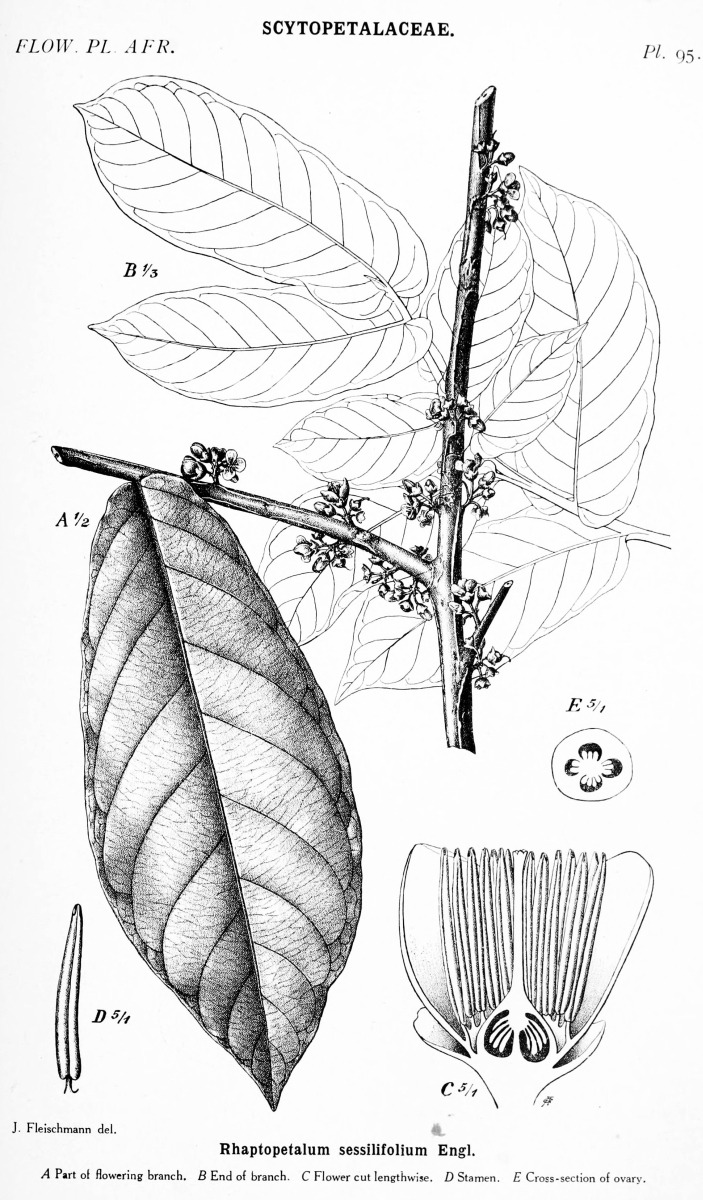
SCYTOPETALACEAE.
FLOW. PL. AFR.
Pl. 95.
J. Fleischmann del.
Rhaptopetalum sessilifolium Engl.
A Part of flowering branch. B End of branch. C Flower cut lengthwise. D Stamen. E Cross-section of ovary.
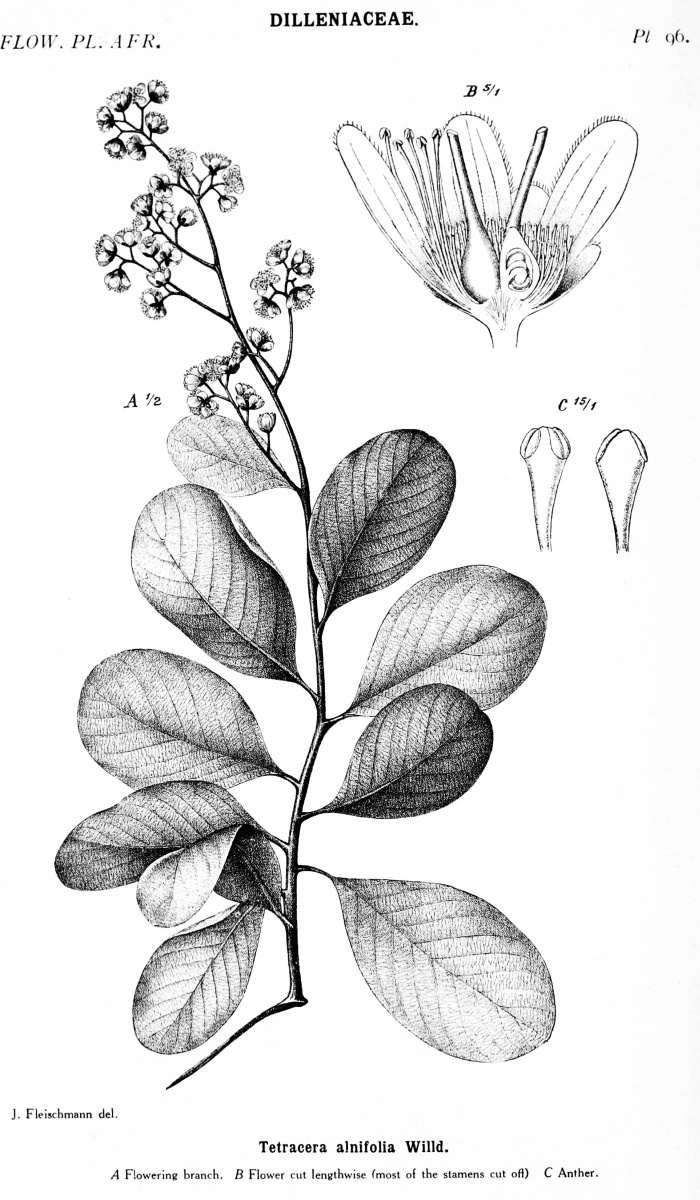
DILLENIACEAE.
FLOW. PL. AFR.
Pl. 96.
J. Fleischmann del.
Tetracera alnifolia Willd.
A Flowering branch. B Flower cut lengthwise (most of the stamens cut off). C Anther.
FAMILY 147. OCHNACEAE
Leaves alternate, undivided, usually stipulate. Flowers in racemes or panicles, rarely solitary, hermaphrodite. Sepals free or nearly so, imbricate in bud. Petals free, with imbricate or contorted aestivation. Stamens hypogynous or nearly so. Anthers adnate, 2-celled, usually opening by apical pores. Receptacle usually prolonged into a gynophore. Carpels almost free, but with a common style, or united. Style undivided or cleft. Ovules with a ventral raphe. Embryo of the seeds rather large.—Genera 7, species 150. Tropical and South Africa. (Plate 97.)
1. Fertile stamens 5. Petals usually white or red. Seeds albuminous. Herbs or undershrubs. 2 Fertile stamens 10 or more; no staminodes. Petals usually yellow. Seeds exalbuminous. Shrubs or trees. 4 2. Anthers opening by apical pores. Staminodes absent. Ovary 3-celled with 1 pendulous ovule in each cell. Leaves glandular. Flowers in racemes.—Species 2. South Africa (Cape Colony). Roridula L. Anthers opening by longitudinal slits. Staminodes present. Ovary 1-celled or 3-celled at the base, with numerous parietal ovules. [Tribe LUXEMBOURGIEAE.] 3 3. Staminodes in one row, 5, petal-like, adnate below to the fertile stamens. Flowers in cymes.—Species 2. West Africa. Vausagesia Baill. Staminodes in two rows, the 5 inner petal-like, free, but twisted into a tube, the outer numerous, thread-shaped. Flowers usually solitary.—Species 2. Tropical and South Africa. Used medicinally. Sauvagesia L. 4. Ovary 1, one-celled or two-celled at the base, with numerous basal ovules. Style 2-cleft. Stamens numerous, in 3-5 indistinct rows. Sepals enlarged and wing-like in fruit. Fruit a woody capsule.—Species 1 (L. alata Banks). Central Africa. Yields timber, oily seeds, and medicaments. (Tribe LOPHIREAE.) Lophira Banks Ovaries 3-15, free, with one ovule in each and with a common style. Stamens in 2-3 rows. Sepals not wing-like. Fruit a drupe or consisting of several drupes. [Tribe OURATEEAE.] 5 5. Stamens numerous, in 3 rows. Filaments as long as or longer than the anthers.—Species 80. Tropical and South Africa. Some species yield timber or dye-stuffs. (Plate 97.) Ochna L. Stamens 10, in 2 rows. Filaments shorter than the anthers or wanting. 6 6. Anthers borne upon distinct filaments, oblong, smooth, opening by longitudinal slits or by apical pores which later on are prolonged into slits. Ovules, seeds, and embryo curved. Flowers in few-flowered clusters.—Species 3. East Africa. Brackenridgea A. Gray Anthers subsessile, linear, wrinkled or warty, opening by apical pores. Flowers in many-flowered panicles or racemes.—Species 60. Tropics. (Gomphia Schreb.) Ouratea Aubl.
FAMILY 148. THEACEAE
Shrubs or trees. Leaves alternate, undivided, without stipules. Sepals 5, free or united at the base, imbricate in bud. Petals 5, free or united below, with imbricate or contorted aestivation. Stamens 10 or more, rarely (Thomassetia) 5. Ovary superior or almost so, 2-5-celled, with 2 or more ovules in each cell. Fruit a capsule or a nut. Albumen scanty or wanting.—Genera 6, species 12. Tropics and Canary Islands. (TERNSTROEMIACEAE.) (Plate 98.)
1. Flowers in cymes or panicles. Fruit a capsule. [Tribe ASTEROPEIEAE.] 2 Flowers solitary or in pairs in the axils of the leaves. 4 2. Fertile stamens 5, alternating with staminodes which are united in 5 bundles. Ovary 5-celled. Flowers in long-stalked, axillary clusters.—Species 1. Seychelles. Thomassetia L. Fertile stamens 10 or more. Flowers in panicles. 3 3. Stamens 10-15, united at the base. Anthers versatile, turned inwards. Ovary 3-celled. Sepals enlarged and wing-like in fruit. Low trees or climbing shrubs.—Species 6. Madagascar. (Including Rhodoclada Bak.) Asteropeia Thouars Stamens numerous. Ovary 5-celled. Fruit with 5 wing-like ribs. Tall trees. Inflorescence terminal, scantily branched.—Species 1. Madagascar. Yields timber. Nesogordonia Baill. 4. Anthers versatile, turned outwards. Stamens numerous, the outer ones united at the base. Ovules 4-6 in each ovary-cell. Fruit a capsule. Seeds wingless, exalbuminous; embryo straight.—Species 2. Cultivated and occasionally naturalized in the tropics. One of them (Th. sinensis L.) is the tea-plant, the other (Th. japonica L., camellia) is an ornamental plant and yields wood and oily seeds. (Including Camellia L.) [Tribe THEEAE.] Thea L. Anthers adnate. Fruit a nut. Seeds albuminous; embryo curved. [Tribe TERNSTROEMIEAE.] 5 5. Ovules 2-3 in each cell, axile, descending. Styles 3. Fruit, half-inferior.—Species 1. Canary Islands. It has edible fruits and is used in medicine and as an ornamental plant. (Plate 98.) Visnea L. f. Ovules many in each cell, attached to a pendulous placenta. Style 1, simple.—Species 1. West Africa. Adinandra Jacks.
FAMILY 149. GUTTIFERAE
Leaves opposite, rarely whorled, undivided. Flowers regular. Petals with imbricate or contorted aestivation. Stamens numerous, hypogynous. Ovary superior. Seeds exalbuminous.—Genera 16, species 180. (Including CLUSIACEAE and HYPERICINEAE.) (Plate 99.)
1. Ovary-cells and styles numerous (17-24). Ovules 2 in each cell, one ascending, the other pendulous. Filaments free. Shrubs.—Species 1. Seychelles. Medusagyne Bak. Ovary-cells 1-12. Styles 1-5. 2
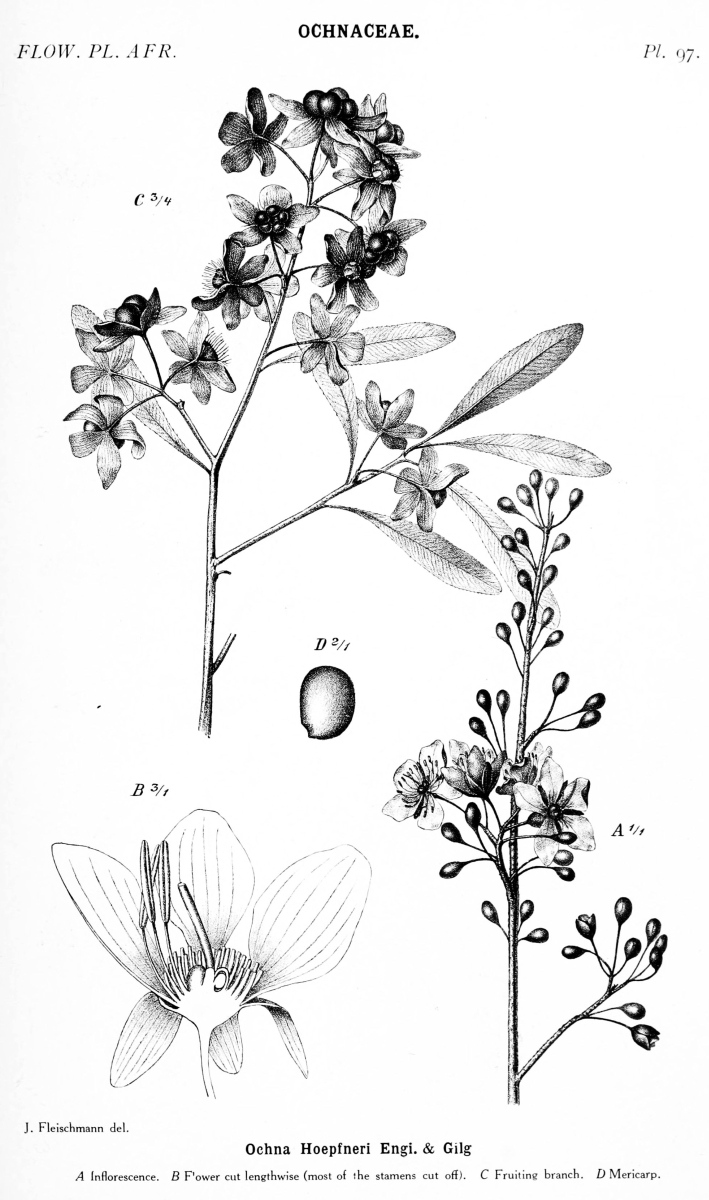
OCHNACEAE.
FLOW. PL. AFR.
Pl. 97.
J. Fleischmann del.
Ochna Hoepfneri Engl. & Gilg
A Inflorescence. B Flower cut lengthwise (most of the stamens cut off). C Fruiting branch. D Mericarp.
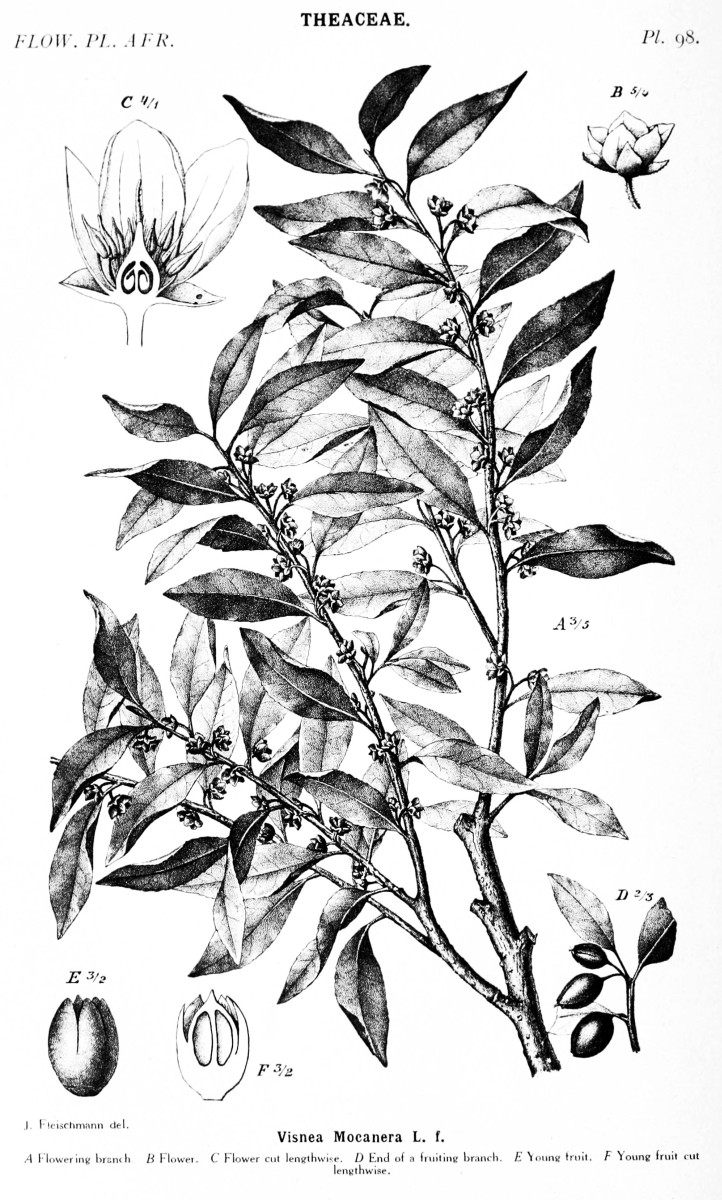
THEACEAE.
FLOW. PL. AFR.
Pl. 98.
J. Fleischmann del.
Visnea Mocanera L. f.
A Flowering branch. B Flower. C Flower cut lengthwise. D End of a fruiting branch. E Young fruit. F Young fruit cut lengthwise.
2. Styles 3-5, free or united below. Sepals 5. Embryo with distinct, not very thick cotyledons. [Subfamily HYPERICOIDEAE.] 3 Style 1, undivided or cleft at the top, or 1 sessile stigma. Shrubs or trees. 7 3. Fruit a berry or a drupe. Carpels 5. Seeds not winged; cotyledons longer than the radicle. Petals usually woolly within. Stamens in 5 bundles. Shrubs or trees. [Tribe VISMIEAE.] 4 Fruit a capsule, rarely a berry, but then carpels 3. Petals glabrous within. 6 4. Fruit a drupe. Ovules 2-3 in each ovary-cell. Stamens in bundles of 3-5.—Species 1 (H. paniculata Lodd.). Tropics. Yields timber, dyes, edible fruit from which a drink is prepared, and medicaments. (Harungana Lam.) Haronga Thouars Fruit a berry. Stamens in bundles of 4-20. 5 5. Ovules 1-2 in each ovary-cell. Embryo with usually twisted cotyledons. Flowers in terminal, umbel-like cymes.—Species 35. Tropics. Some are used medicinally. Psorospermum Spach Ovules 3 or more in each ovary-cell. Embryo with semiterete cotyledons. Flowers in panicles.—Species 6. Central Africa. (Caopia Adans.) Vismia Vell. 6. Fruit dehiscing septicidally and loculicidally. Seeds with a long wing. Embryo with a very short radicle and longer cotyledons. Ovary 3-celled, with 2 ovules in each cell. Stamens in 3 bundles. Petals with a basal appendage. Shrubs.—Species 2. Madagascar. [Tribe CRATOXYLEAE.] Eliaea Camb. Fruit dehiscing septicidally, rarely indehiscent. Seeds without a distinct wing, but sometimes keeled. Embryo with the cotyledons usually shorter than the radicle.—Species 35. Some of them yield wood and medicaments, or serve as ornamental plants. (Including Androsaemum All. and Triadenia Spach). [Tribe HYPERICEAE.] Hypericum L. 7. (2.) Style very short or wanting. Fruit a berry. Seeds usually with an aril. Embryo undivided. [Subfamily CLUSIOIDEAE, tribe GARCINIEAE.] 8 Style distinctly developed. Seeds usually without an aril. 11 8. Ovary incompletely 5-celled with numerous parietal ovules in each cell. Flowers unisexual. Sepals 5. Petals 5. Stamens in 5 bundles. Anthers opening by longitudinal slits. Seeds with an aril.—Species 4. Central Africa. The seeds yield a fat. (Including Stearodendron Engl.) (Plate 99.) Allanblackia Oliv. Ovary completely 2-12-celled with 1-2 axile ovules in each cell. Flowers hermaphrodite or polygamous. 9 9. Ovary with 2-3 two-ovuled cells, sometimes each cell subsequently divided into two incomplete, one-ovuled compartments. Sepals 2. Petals 4. Filaments united at the base. Seeds without an aril. Flowers in clusters, rarely solitary.—Species 12. Madagascar and West Africa. They yield timber, dyes, and edible fruits. (Calysaccion Wight) Ochrocarpus Thouars Ovary with one-ovuled cells. Seeds with an aril. 10 10. Sepals 2. Petals 4-7. Filaments free.—Species 4. Madagascar. (Including Tsimatimia Jum. et Perrier) Rheedia L. Sepals 4-5, rarely 2, but then filaments united in several bundles. Petals 4-5.—Species 60. Tropical and South Africa. Some species yield timber, gum-resin (gambodge), dyes, edible fruits, fat-containing seeds, and various medicaments, among which are the false cola-nuts. (Including Xanthochymus Roxb.) Garcinia L. 11. Ovary 5-celled, with several or many ovules in each cell. Style 5-cleft. Sepals 5. Petals 5. Stamens united in 5 bundles or in a tube. Fruit a berry. Embryo undivided. [Subfamily MORONOBOIDEAE.] 12 Ovary 1-4-celled with 1-2 ovules in each cell, surmounted by a simple style with an entire or 2-4-parted stigma, rarely (Hypericum) ovary 5-celled and style or stigma 5-cleft, but then fruit a capsule and embryo with distinct cotyledons. 13 12. Stamens in 5 bundles consisting of numerous stamens each. Sepals nearly equalling the petals.—Species 3. West Africa. The fruits of the tallow-tree (P. butyracea Sabine) yield a fat. Pentadesma Sabine Stamens united in a tube, the lobes of which bear 3-4 anthers each. Sepals much smaller than the petals. Disc cupular.—Species 15. Madagascar and West Africa. S. globulifera L. f. yields timber and a resin used industrially and medicinally; other species afford edible fruits, oily seeds, food for silkworms, and medicaments. (Including Chrysopia Thouars) Symphonia L. f. 13. Sepals 2-4. Stamens free or shortly united at the base. Ovary 1-4-celled with 1-2 ovules in each cell. Fruit a drupe. Embryo with a very short radicle and thick-fleshy cotyledons. [Subfamily CALOPHYLLOIDEAE.] 14 Sepals 5. 15 14. Ovary 1-celled, with a single erect ovule. Fleshy mesocarp thin. Flowers in racemes or panicles.—Species 6. Madagascar and East Africa. They yield timber, resin, oil, fish-poison, and medicaments. Calophyllum L. Ovary 2-4-celled, with altogether 4 ovules. Flowers solitary or in clusters.—Species 2, one growing wild in West Africa, the other (M. americana L.) cultivated in the tropics and naturalized on the Cape Verde Islands. The latter species yields timber, resin, medicaments, and edible fruits (mammee-apples), which are also used for preparing drinks. Mammea L. 15. Ovary 1-celled, with a single pendulous ovule. Filaments united at the base in 5 bundles, further upwards in a tube. Fruit a drupe. Embryo with a very short radicle and thick cotyledons.—Species 1. West Africa. [Subfamily ENDODESMIOIDEAE.] Endodesmia Benth. Ovary 2-5-celled. 16
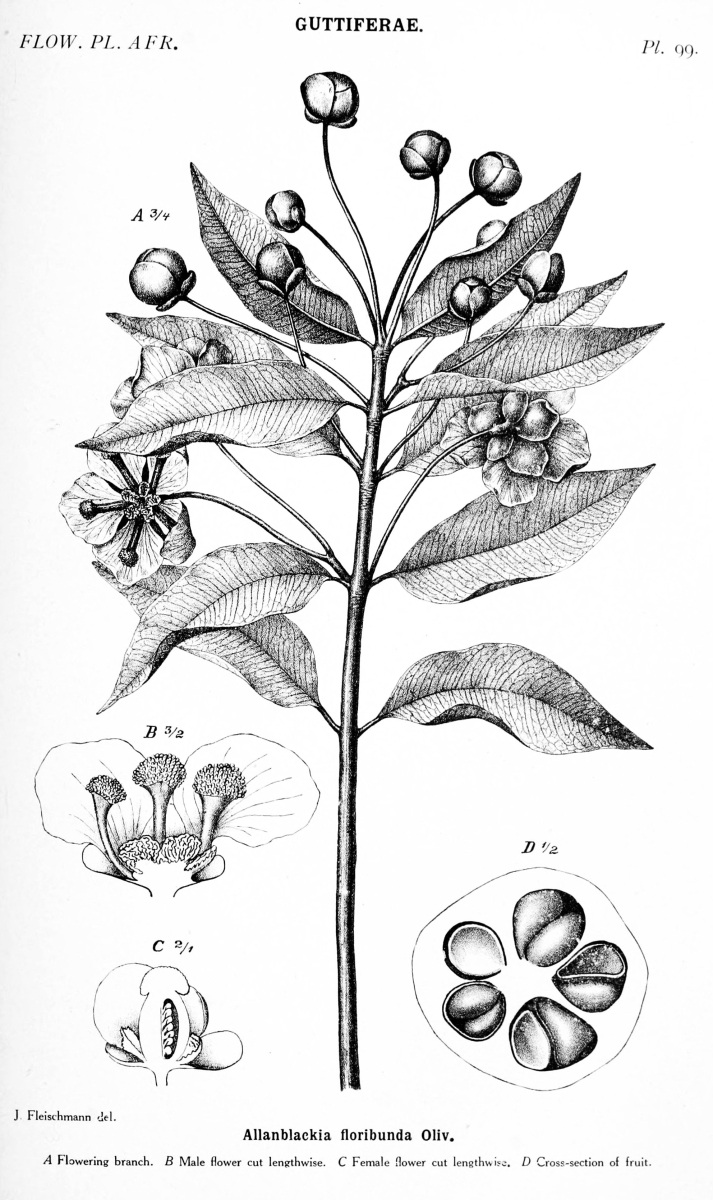
GUTTIFERAE.
FLOW. PL. AFR.
Pl. 99.
J. Fleischmann del.
Allanblackia floribunda Oliv.
A Flowering branch. B Male flower cut lengthwise. C Female flower cut lengthwise. D Cross-section of fruit.
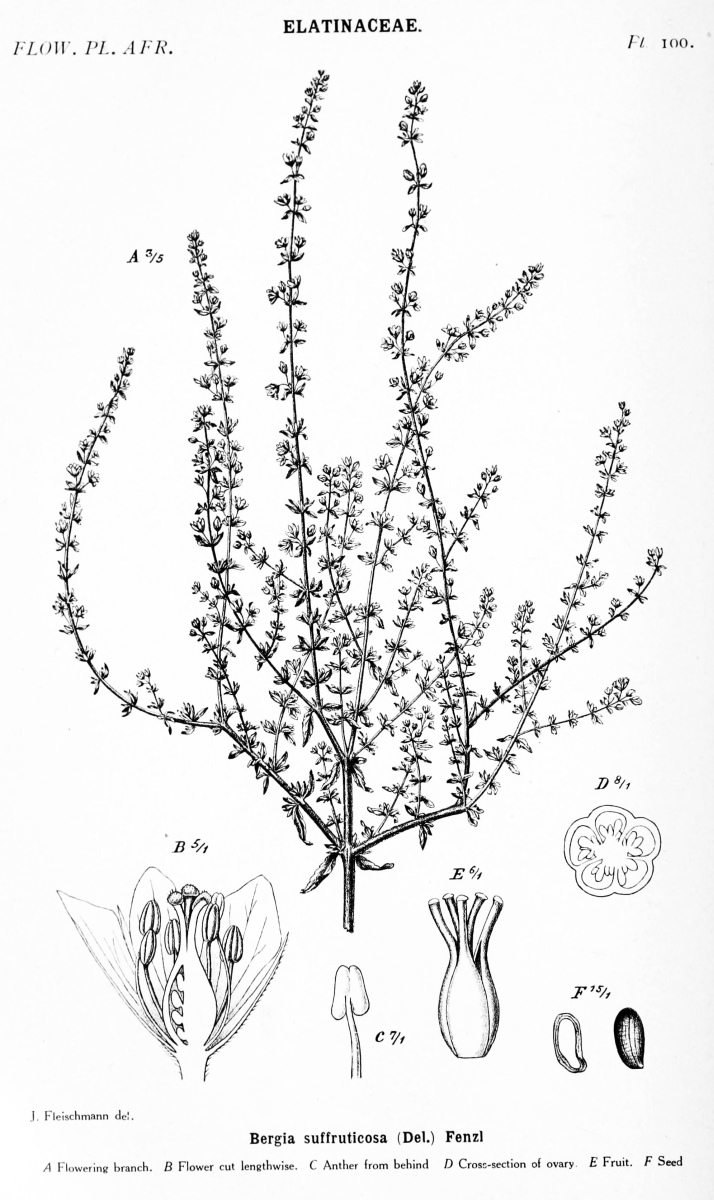
ELATINACEAE.
FLOW. PL. AFR.
Pl. 100.
J. Fleischmann del.
Bergia suffruticosa (Del.) Fenzl
A Flowering branch. B Flower cut lengthwise. C Anther from behind. D Cross-section of ovary. E Fruit. F Seed.
16. Flowers unisexual. Ovary 2-celled with 2 ovules in each cell. Fruit a berry.—Species 1. Madagascar. Leioclusia Baill. Flowers hermaphrodite. Ovary 3-5-celled. Fruit a capsule. (See 6.) Hypericum L.
FAMILY 150. DIPTEROCARPACEAE
Trees or shrubs. Leaves alternate, simple, entire, stipulate. Flowers in cymes or panicles, regular, hermaphrodite. Sepals 5, imbricate in bud, enlarged in fruit. Petals 5, with contorted aestivation. Stamens numerous, hypogynous or nearly so, with a prolonged connective. Ovary superior, 3-celled. Ovules 2 in each cell, descending, inverted. Style simple. Fruit a one-seeded nut. Seeds without albumen or with a very thin albumen.—Genera 2, species 15. Tropics.
Receptacle flat. Filaments short. Anthers linear, adnate. Ovary glabrous. Embryo with thick, fleshy cotyledons. Tall trees.—Species 1. Seychelles. Yields timber, resin, and fatty seeds. [Subfamily DIPTEROCARPOIDEAE.] Vateria L. Receptacle raised. Filaments long. Anthers oval, versatile. Embryo with thin, leaf-like, twisted cotyledons.—Species 15. Central Africa. (Under Vatica L.) [Subfamily MONOTOIDEAE.]. Monotes A. DC.
SUBORDER TAMARICINEAE
FAMILY 151. ELATINACEAE
Herbs or undershrubs. Leaves opposite or whorled, undivided, stipulate. Flowers solitary or in cymes, regular, hermaphrodite. Sepals 3-5, free or united at the base, imbricate in bud. Petals 3-5, free, hypogynous, imbricate in bud, persistent in fruit. Stamens hypogynous, as many or twice as many as the petals. Anthers attached by the back, opening inwards by longitudinal slits. Ovary 3-5-celled. Ovules numerous, axile, inverted, with a short funicle. Styles 3-5, free. Fruit a septicidal capsule. Seeds exalbuminous.—Genera 2, species 15. (Plate 100.)
Flowers 3-4-merous. Sepals united below, with a faint midrib and without membranous margins. Ovary depressed at the top. Flowers solitary.—Species 3. North Africa. Elatine L. Flowers 5-merous. Sepals free or almost free, with a very projecting midrib and with membranous margins. Ovary narrowed at the top. Leaves serrate.—Species 12. Central and South Africa and Egypt. (Plate 100.) Bergia L.
FAMILY 152. FRANKENIACEAE
Herbs or undershrubs, rarely low shrubs. Stem jointed. Leaves opposite, undivided, stipulate. Flowers in cymes, bracteolate, regular, hermaphrodite. Calyx 4-5-lobed or-cleft, valvate in bud. Petals 4-5, hypogynous, free or united in the middle, clawed, usually with a scale-like appendage, persistent. Stamens 4-6, hypogynous. Filaments united at the base, broadened in the middle. Anthers versatile, opening outwards by longitudinal slits. Ovary 1-celled, with 2-3 parietal placentas bearing the ovules at their base. Style simple with 2-3 stigmas, or 2-3-cleft at the top. Ovules with a long ascending funicle, inverted. Fruit a loculicidal capsule. Seeds with a copious, mealy albumen and a straight, axile embryo.—Genera 2, species 10.
Stamens 5, equal. Carpels 2. Petals without a ligule. Small shrubs.—Species 1. Island of St. Helena. Used as a substitute for tea. (Under Frankenia L.) Beatsonia Roxb. Stamens 4 or 6, the outer ones shorter. Carpels usually 3. Petals usually with a ligule.—Species 10. North Africa, northern Central Africa, and South Africa. Frankenia L.
FAMILY 153. TAMARICACEAE
Shrubs, undershrubs, or trees. Leaves alternate, undivided, exstipulate. Flowers terminal, solitary or in racemes, regular, 4-5-, rarely 6-7-merous. Petals hypogynous, free. Disc present. Anthers versatile, opening by longitudinal slits. Ovary superior, 1-celled, with basal or parietal placentas. Ovules numerous, ascending, inverted, with a very short funicle. Styles or sessile stigmas several, free or united at the base. Fruit a capsule. Seeds hairy; embryo straight.—Genera 3, species 25. (Plate 101.)
1. Flowers solitary. Petals 5, with an appendage on the inner face. Stamens numerous. Styles distinctly separated from the ovary, thread-shaped; stigmas small, simple. Placentas extending throughout the ovary, but bearing ovules at the base only, later on separating from the wall of the ovary. Seeds with a boss at the top, hairy all round, albuminous.—Species 3. North Africa. Used for making salt. [Tribe REAUMURIEAE.]. Reaumuria L. Flowers in racemes. Petals unappendaged. Stamens as many or twice as many as the petals. Ovary beaked. Styles short and thick or wanting; stigmas broadened. Placentas basal-subparietal, cushion-shaped. Seeds without a boss, but with a tuft of hairs at the top, exalbuminous. [Tribe TAMARICEAE.] 2 2. Anthers turned inwards. Stigmas sessile, cushion-shaped. Seeds with a stalked tuft of hairs.—Species 1. North West Africa (Algeria). Myricaria Desv. Anthers turned outwards. Filaments free or almost free. Stigmas borne upon a short style, more or less spatulate. Seeds with a sessile tuft of hairs.—Species 20. Some of them yield timber, tanning and dyeing materials, and medicaments, or serve as ornamental plants. (Plate 101.) “Tamarisk.” Tamarix L.
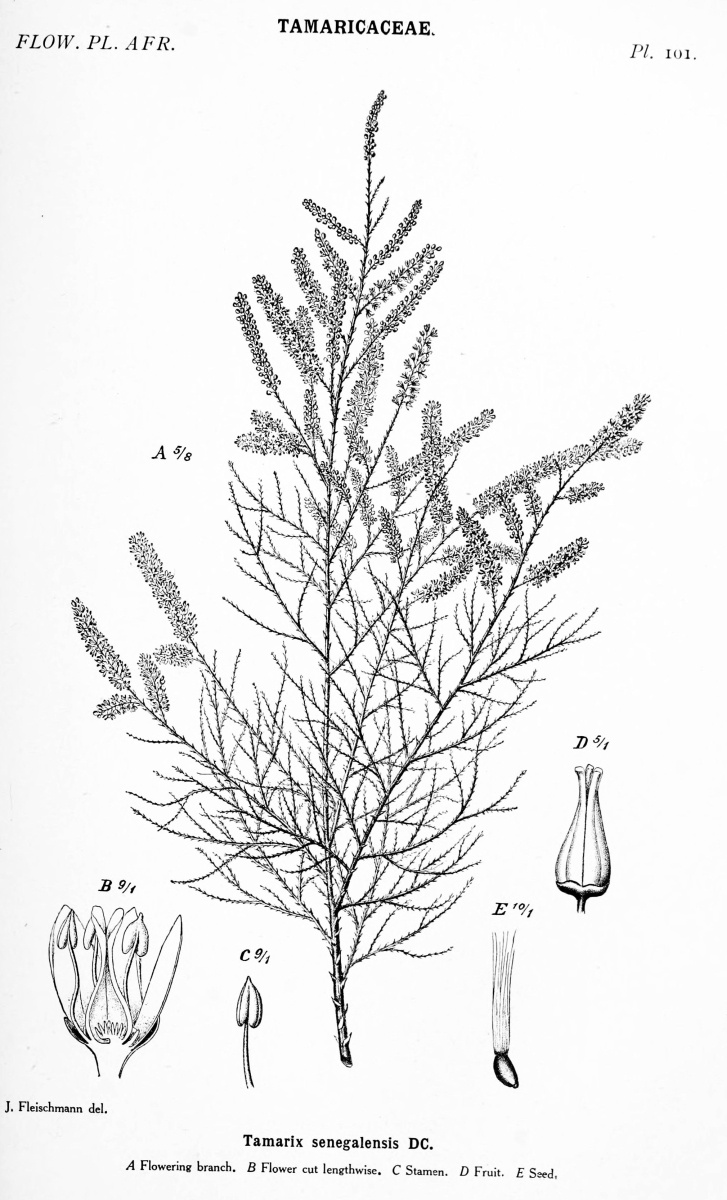
TAMARICACEAE.
FLOW. PL. AFR.
Pl. 101.
J. Fleischmann del.
Tamarix senegalensis DC.
A Flowering branch. B Flower cut lengthwise. C Stamen. D Fruit. E Seed.
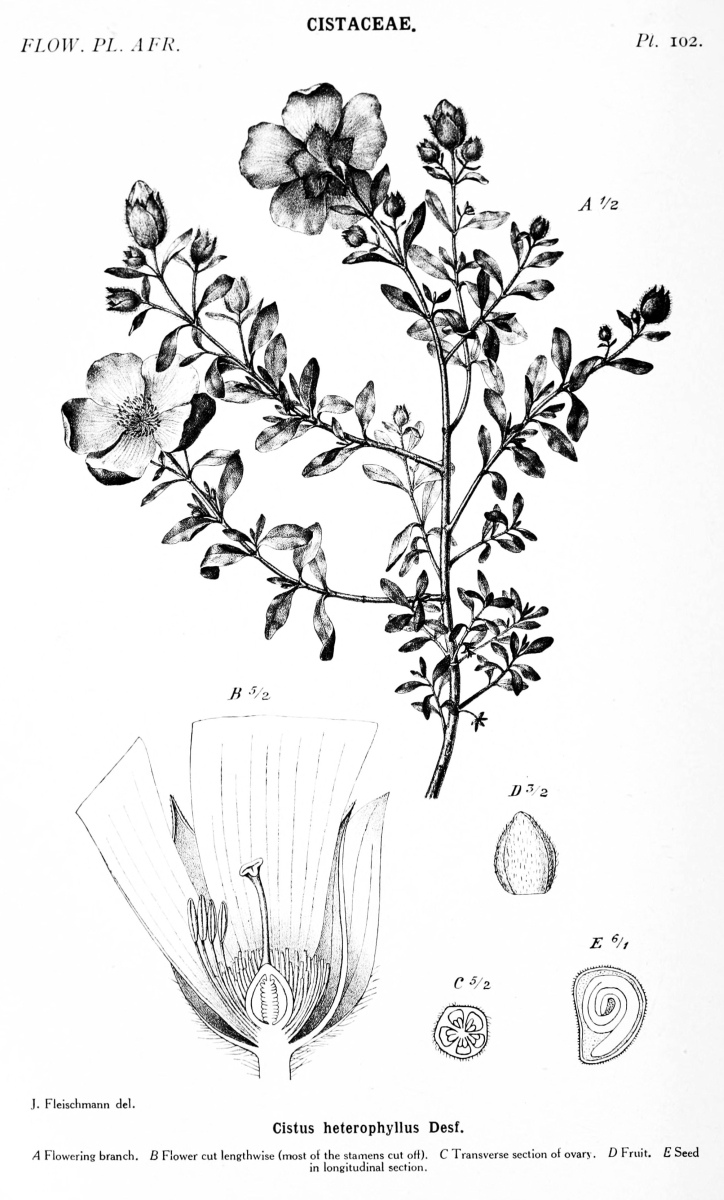
CISTACEAE.
FLOW. PL. AFR.
Pl. 102.
J. Fleischmann del.
Cistus heterophyllus Desf.
A Flowering branch. B Flower cut lengthwise (most of the stamens cut off). C Transverse section of ovary. D Fruit. E Seed in longitudinal section.
SUBORDER CISTINEAE
FAMILY 154. CISTACEAE
Leaves simple, entire. Flowers regular, hermaphrodite. Sepals 3 or 5, with contorted aestivation. Petals 5, with contorted aestivation, deciduous. Stamens hypogynous, 7 or more, usually numerous, unequal. Anthers opening inwards or laterally. Ovary 1-celled with 3-10 parietal placentas, or more or less completely 3-10-celled. Style simple or wanting, stigma large. Ovules numerous, usually straight. Fruit a loculicidal capsule. Seeds albuminous; embryo curved.—Genera 5, species 75. North Africa and Cape Verde Islands. (Plate 102.)
1. Stamens partly (the outer ones) sterile. Carpels 3. Ovules 6-12, inverted. Style long. Undershrubs.—Species 5. North Africa. (Under Helianthemum L.) Fumana Spach Stamens all fertile. Ovules straight. 2 2. Carpels 5 or 10. Funicle thread-shaped. Petals white or red. Shrubs or undershrubs. Leaves opposite, without stipules.—Species 15. North Africa. Some are used as ornamental plants; the resin of others (ladanum) is employed in medicine and perfumery and as a fumigant. (Plate 102.) Cistus L. Carpels 3. 3 3 3. Style long, usually kneed or sigmoid at the base. Funicle obconical. Embryo folded. Herbs or undershrubs.—Species 40. North Africa and Cape Verde Islands. Some are used as ornamental plants. “Rock-rose.” Helianthemum Adans. Style short and straight or wanting. Funicle thread-shaped or thickened in the middle. Embryo coiled or hooked. 4 4. Funicle thread-shaped. Embryo coiled. Leaves, at least the upper ones, alternate, without stipules.—Species 3. North Africa. (Under Helianthemum Tourn.) Halimium Willk. Funicle thickened in the middle. Embryo hooked. Herbs.—Species 10. North Africa. (Under Helianthemum Tourn.) Tuberaria Spach
FAMILY 155. BIXACEAE
Shrubs. Leaves alternate, entire or lobed, palminerved, stipulate. Flowers in terminal racemes, clothed with scales, regular, hermaphrodite. Sepals 5, free, glandular at the base, imbricate in bud. Petals 5, free, rose-coloured, with imbricate or contorted aestivation. Stamens numerous, hypogynous, free or slightly united at the base. Anthers curved, opening at the top by two short, transverse slits. Ovary superior, 1-celled, with 2 parietal placetas. Ovules numerous, inverted. Style simple; stigma small, 2-lobed. Fruit 2-valved, usually prickly. Seed-coat red and fleshy outside, hard within. Albumen copious.
Genus 1, species 1 (B. orellana L.). Cultivated and naturalized in the tropics. Yields fibres, dyes (arnatto), and medicaments. Bixa L.
SUBORDER COCHLOSPERMINEAE
FAMILY 156. COCHLOSPERMACEAE
Trees, shrubs, or undershrubs. Leaves undivided or palmately lobed or divided, stipulate. Flowers in racemes or panicles, glabrous or clothed with simple hairs, regular, hermaphrodite. Sepals 4-5, free, imbricate in bud. Petals 4-5, free, with imbricate or contorted aestivation. Stamens numerous, hypogynous, free or united at the base. Anthers straight, opening by two sometimes confluent slits or pores. Ovary superior, 1-celled with 3-5 more or less projecting parietal placentas, or 2-3-celled. Ovules several or many, inverted. Style simple. Fruit a capsule. Seeds with a curved embryo and copious albumen.—Genera 2, species 7. Tropics. (Under BIXINEAE.)
Petals large, yellow. Anthers long, attached by the base, opening at the top. Ovary 1-celled, sometimes incompletely 3-5-celled. Ovules numerous, parietal. Seeds covered with long hairs. Leaves palmately lobed or divided. Flowers in few-flowered racemes or panicles.—Species 5. Central Africa. They yield fibre, gum, dyes, and medicaments. (Maximilianea Mart. & Schrank.) Cochlospermum Kunth Petals small. Anthers short, attached by the back, opening lengthwise. Ovary 2-3-celled. Ovules few, subbasal. Leaves undivided, penninerved. Flowers in compound cymes.—Species 2. Madagascar. Sphaerosepalum Bak.
SUBORDER FLACOURTIINEAE
FAMILY 157. WINTERANACEAE
Trees. Leaves alternate, simple, entire, penninerved, gland-dotted, without stipules. Flowers solitary or in cymes, axillary, hermaphrodite. Sepals 3, imbricate in bud. Petals 4-10, free or united below, imbricate in bud. Stamens 7-18, hypogynous. Filaments wholly united. Anthers opening outwards by longitudinal slits. Ovary superior, 1-celled, with 3-5 parietal placentas. Ovules inverted. Style simple, short. Fruit a berry. Seeds with a minute embryo and copious albumen.—Genera 2, species 4. Tropics. (CANELLACEAE.)
Petals 4-6, united beyond the middle. Anthers 7-9, two-celled, or 14-18, 1-celled. Placentas 3-4. Stigma 1. Flowers solitary.—Species 2. Madagascar. Used medicinally. [Tribe CINNAMOSMEAE.] Cinnamosma Baill. Petals 10, free. Anthers 10. Placentas 5. Stigmas 5. Flowers cymose.—Species 2. East Africa. Yielding an aromatic oil. [Tribe CINNAMODENDREAE.] Warburgia Engl.
FAMILY 158. VIOLACEAE
Leaves simple. Flowers bracteolate, more or less irregular. Sepals 5, free or united at the base, with open or imbricate aestivation. Petals 5, free, hypogynous or nearly so, imbricate in bud. Stamens 5, alternating with
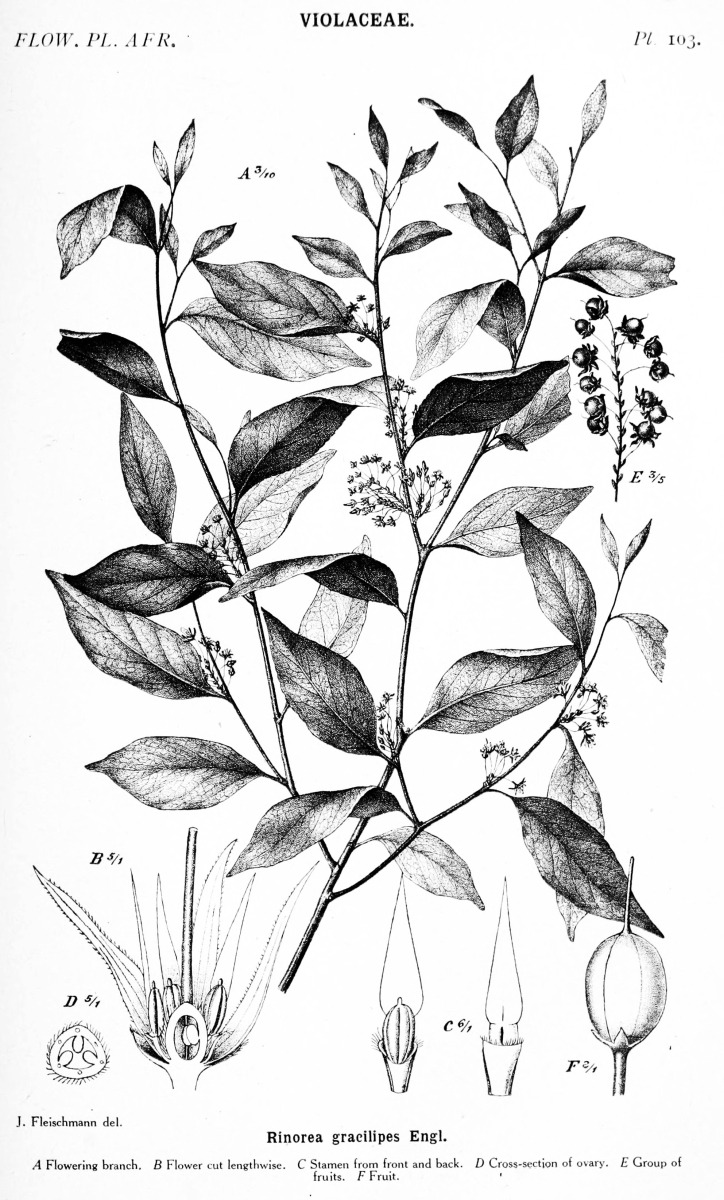
VIOLACEAE.
FLOW. PL. AFR.
Pl. 103.
J. Fleischmann del.
Rinorea gracilipes Engl.
A Flowering branch. B Flower cut lengthwise. C Stamen from front and back. D Cross-section of ovary. E Group of fruits. F Fruit.
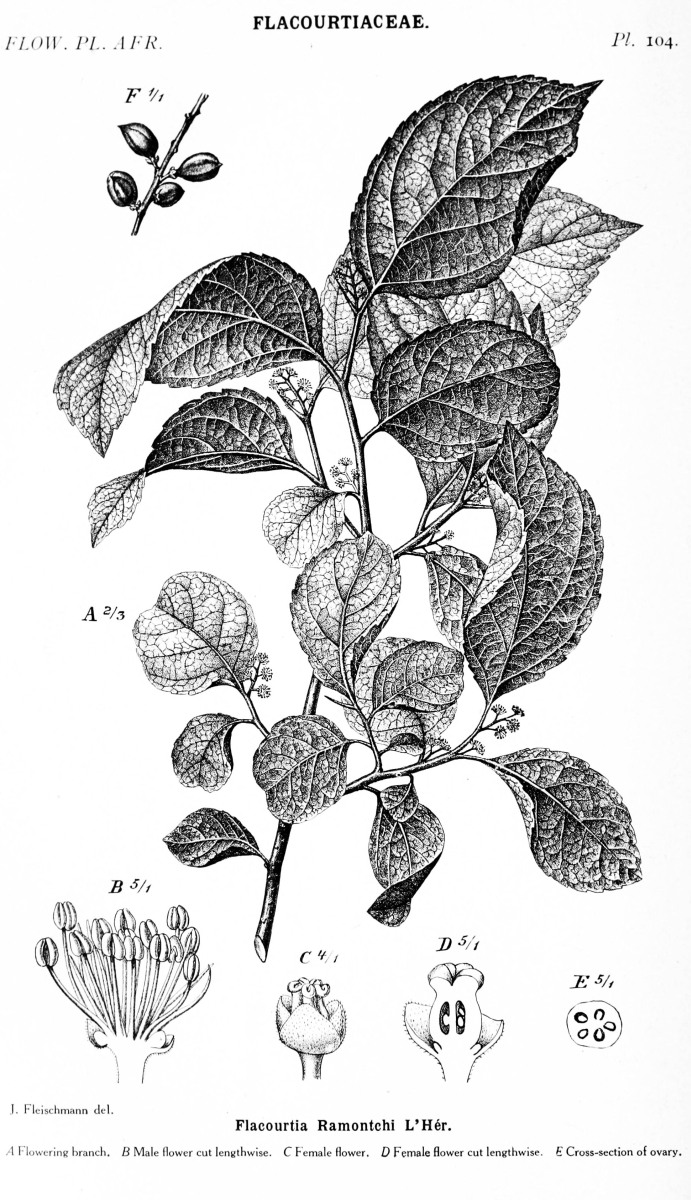
FLACOURTIACEAE.
FLOW. PL. AFR.
Pl. 104.
J. Fleischmann del.
Flacourtia Ramontchi L’Hér.
A Flowering branch. B Male flower cut lengthwise. C Female flower. D Female flower cut lengthwise. E Cross-section of ovary.
the petals, hypogynous or nearly so. Filaments short. Anthers turned inwards; connective usually prolonged. Ovary superior, sessile, 1-celled, with 3 parietal placentas. Ovules inverted. Style simple. Fruit a loculicidal capsule with an elastically seceding exocarp. Seeds albuminous.—Genera 4, species 100. (Plate 103.)
1. Flowers distinctly irregular. Lowest petal larger than the rest and furnished with a spur or boss at the base. Anterior filaments bearing a spur, a boss, or a gland. Style thickened and usually curved above. Ovules numerous. Herbs or undershrubs, rarely shrubs. [Tribe VIOLEAE.] 2 Flowers nearly regular. Petals subequal, without spur or boss. Style straight, with a terminal stigma. Shrubs or trees. [Tribe RINOREEAE.] 3 2. Sepals produced at the base into two auricles. Filaments very short. Herbs or undershrubs. Leaves alternate. Flowers solitary or in pairs.—Species 20. Some of them yield perfumes and medicaments and serve as ornamental plants (violets and pansies). Viola L. Sepals not auricled. Lowest petal saccate or gibbous.—Species 10. Tropical and South Africa. Some are used medicinally. (Calceolaria Loefl., Ionidium Vent.) Hybanthus Jacq. 3. Flowers in clusters springing from the old wood. Petals connivent. Ovules 3. Seeds with an aril and with scanty albumen.—Species 1. West Africa (Cameroons). Allexis Pierre Flowers solitary or in terminal or axillary racemes or panicles. Seeds without an aril, with copious albumen.—Species 70. Tropical and South-east Africa. Some yield timber. (Alsodeia Thouars). (Plate 103.) Rinorea Aubl.
FAMILY 159. FLACOURTIACEAE
Shrubs or trees. Leaves undivided, usually stipulate. Flowers regular. Petals free, with imbricate or valvate, rarely (Dioncophyllum) with contorted aestivation, or wanting. Stamens as many as the sepals or more. Anthers 2-celled, very rarely 4-celled, opening by longitudinal slits, rarely (Kiggelaria) by apical pores. Ovary superior and sessile or nearly so, or half-inferior, rarely (Bembicia) inferior, one-celled or incompletely, rarely completely 2-or more-celled, with 2-8 parietal, rarely axile placentas bearing the ovules sometimes at the top only, rarely with a single placenta. Ovules 3 or more, rarely 2, inverted. Seeds nearly always albuminous and with a straight embryo.—Genera 46, species 250. Tropical and South Africa. (Including SAMYDACEAE, under BIXINEAE.) (Plate 104.)
1. Perianth-leaves spirally arranged; sepals gradually passing into the petals. Ovary superior, 1-celled. Flowers in spikes or racemes. [Tribe ERYTHROSPERMEAE.] 2 Perianth-leaves whorled; sepals separated from the petals, or petals absent. 7 2. Inner perianth-leaves with small, scale-like appendages at the base. 3 Inner perianth-leaves without appendages. 5 3. Outer perianth-leaves much smaller than the inner, free, leathery. Style very short.—Species 4. East and South-east Africa. Rawsonia Harv. & Send. Outer perianth-leaves about as large as the inner. 4 4. Stamens 5.—Species 5. West Africa. (Under Dasylepis Oliv.) Scottelia Oliv. Stamens numerous.—Species 3. Central Africa. Dasylepis Oliv. 5. Stamens 5-15, hypogynous. Anthers broad-sagittate. Style simple, with a 2-4-lobed stigma. Leaves exstipulate. Flowers in racemes, hermaphrodite.—Species 15. Madagascar and neighbouring islands and East Africa. Erythrospermum Lam. Stamens 20 or more, perigynous. Anthers oblong or linear. Style 3-4-cleft or -parted. 6 6. Flowers hermaphrodite. Style 3, free. Fruit a few-seeded, loculicidal capsule. Low trees. Leaves stipulate. Flowers in spikes.—Species 1. Equatorial West Africa. Pyramidocarpus Oliv. Flowers unisexual or polygamous. Style 1, with 4 branches. Fruit a many-seeded, septicidal capsule. Tall trees. Flowers in racemes.—Species 2. Equatorial West Africa. (Cerolepis Pierre). Camptostylus Gilg 7. (1.) Petals present. Ovary 1-celled. 8 Petals absent. Sepals 3-6, very rarely 7-8. 35 8. Petals more than sepals, unappendaged. Stamens numerous. Ovary superior. 9 Petals as many as sepals. 17 9. Stamens collected in bundles opposite to the petals and alternating with 8 glands inserted at the margin of the receptacle. Calyx 4-partite. Petals 8. Ovules few, suspended from the upper part of the placentas. Styles 3-4. Flowers in axillary spikes.—Species 1. West Africa. Dissomeria Benth. Stamens not in bundles. Receptacle without glands. Ovules numerous, parietal. Style 1, simple cleft or 2-parted. [Tribe ONCOBEAE.] 10 10. Sepals wholly or partly united, when young, with valvate aestivation. Style simple. 11 Sepals free or nearly so, with imbricate aestivation. 12 11. Flowers hermaphrodite or polygamous, in few-flowered racemes. Calyx hood-shaped. Petals 5. Filaments free, thread-shaped. Placentas 2-3. Fruit a capsule.—Species 1. Madagascar. Prockiopsis Baill. Flowers dioecious, in fascicles or abbreviated spikes or racemes. Calyx of 3 sepals. Petals 6-7. Stamens in 2 rows, the outer longer and with broadened, incompletely united filaments. Placentas 3-5.—Species 5. Central Africa. Buchnerodendron Guerke 12. Flowers hermaphrodite. Sepals 3. Petals 9-12. Anthers attached by the back. Ovary and fruit winged. Style long, 2-cleft at the top, with small stigmas. Shrubs. Leaves serrate, stipulate. Flowers in the axils of undeveloped leaves, towards the ends of the branches.—Species 3. West Africa. Poggea Guerke Flowers polygamous or unisexual. Petals 4-12. 13 13. Style very short, with 2-4 recurved stigmas. Anthers attached by the back near the base. Sepals 3. Petals 5-7. Fruit winged. Shrubs. Leaves entire, stipulate. Flowers in spikes.—Species 1. East Africa. Grandidiera Jaub. Style thread-shaped, simple or 3-7-cleft. Anthers attached by the base. Fruit not winged. Flowers solitary or in fascicles or racemes. 14 14. Flowers rather small, in racemes. Stigma inconspicuous or slightly branched. Placentas 3. Seeds few. Leafstalk jointed. Branches without spines.—Species 6. Central Africa. (Under Oncoba Forsk.) Lindackeria Presl Flowers large. Placentas 4 or more. 15 15. Stigma (or style-apex) not thickened, slightly notched or divided into several branches. Fruit dehiscing incompletely; seeds numerous, minute. Leafstalk jointed. Branches without spines.—Species 15. Central Africa. Some have edible fruits or serve as ornamental or medicinal plants. (Under Oncoba Forsk.) Caloncoba Gilg Stigma thickened or divided into many branches. Leafstalk not jointed. Flowers solitary or 2-3 together. 16 16. Branches without spines. Fruit ovoid, beaked, dehiscing by 4-6 valves; seeds few, large.—Species 10. Tropical and South-east Africa. Some species have edible fruits or serve as ornamental or medicinal plants. (Under Oncoba Forsk.) Xylotheca Hochst. Branches spinous. Fruit globose, indehiscent, with many placentas and numerous seeds.—Species 2. Central Africa. Used medicinally; the fruits are edible and used for making ornaments. Oncoba Forsk. 17. (8.) Petals 5, each with a scale-like appendage at the base. Sepals valvate in bud. Stamens 10-12. Anthers opening at the top. Ovary superior. Styles 2-5. Flowers dioecious, in axillary cymes. Shrubs.—Species 6. South and East Africa. [Tribe PANGIEAE.] Kiggelaria L. Petals without scales at the base. Anthers opening lengthwise. 18 18. Receptacle (flower-tube) bearing a cupular or filamentous corona at its margin. Petals 5. Ovary superior. Seeds with an aril. [Tribe PAROPSIEAE.] 19 Receptacle without a corona, but sometimes with glands. 25 19. Anthers peltate, 4-celled. Stamens numerous, perigynous. Corona short-tubular, entire. Ovules 6, apical. Styles 3, long. Stigmas not thickened. Low trees. Leaves entire, stipulate. Flowers in elongated axillary spikes or racemes.—Species 3. West Africa. Soyauxia Oliv. Anthers cordate, 2-celled. Ovules parietal. Stigmas thickened. Flowers solitary or in fascicles or terminal panicles. 20 20. Ovules 2 on each placenta. Styles 3. Stamens 5. Filaments broadened and united below. Corona many-parted. Flowers in terminal panicles. Bracts with two large glands at the base.—Species 1. West Africa (Liberia). (Under Paropsia Nor.) Androsiphonia Stapf Ovules 3 or more on each placenta. 21 21. Style 1, simple. Stamens numerous. Corona double. Flowers sessile, in the axils of the leaves or by the side of them, enveloped by imbricate bracts. Fruit indehiscent. Branches with swellings inhabited by ants. Leaves stipulate.—Species 4. West Africa and region of the Great Lakes. Barteria Hook. Styles 3-5, free or united at the base. Flowers stalked. 22 22. Corona double, the outer slit into narrow segments, the inner ring-shaped. Stamens 8-10. Leaves toothed. Flowers solitary, axillary.—Species 6. Equatorial West Africa. Paropsiopsis Engl. Corona simple. Stamens 5 or many. 23 23. Flowers in panicles. Corona divided into thread-like segments. Stamens 5. Filaments flat. Styles 5.—Species 1. Madagascar. Hounea Baill. Flowers solitary or few together in the axils of the leaves. Filaments thin, thread-like. Fruit dehiscent. Leaves toothed. 24 24. Stamens 5. Flowers rather small. Leaves with glandular patches at the base of the blade.—Species 10. Tropics. Some have edible fruits. Paropsia Nor. Stamens numerous. Flowers large. Leaves with glands at the base of the stalk.—Species 4. West Africa. (Under Paropsia Nor.) Smeathmannia Soland. 25. (18.) Inflorescences springing from the midrib of the leaves, cymose. Ovary superior, many-ovuled. [Tribe PHYLLOBOTRYEAE.] 26 Inflorescences axillary or terminal. 28 26. Stamens 5. Anthers linear. Petals 5. Leaves toothed.—Species 1. Equatorial West Africa. Moquerysia Hua Stamens numerous. Anthers oval or triangular. Petals 3-5. 27 27. Style 1, shortly 2-cleft. Anthers oval or elliptical. Flowers solitary or in pairs. Leaves large, serrate.—Species 1. Equatorial West Africa. Phylloclinium Baill. Styles 3, free or united below. Petals 3-4. Flowers in glomerules. Leaves very large.—Species 2. Equatorial West Africa. Phyllobotryum Muell. Arg. 28. Stamens singly or in bundles opposite to the petals. Ovary half-inferior, more rarely superior. Fruit a capsule. [Tribe HOMALIEAE.] 29 Stamens numerous, not collected in bundles. Ovary superior. Fruit a berry. [Tribe SCOLOPIEAE.] 33 29. Flowers dioecious. Stamens 9-15. Ovary superior. Placentas 3, with 1-2 ovules each. Styles 3. Leaves palminerved. Flowers in spikes or spike-like panicles.—Species 4. East and South Africa. Trimeria Harv. Flowers hermaphrodite. 30 30. Style 1, simple, with a capitate stigma. Ovules 4. Stamens 5. Flowers in axillary cymes.—Species 1. South-east Africa. Gerrardina Oliv. Styles 2-6, or style single and 2-6-cleft. 31 31. Ovary superior. Ovules numerous. Styles 3-6, free. Stamens 5-8, nearly hypogynous. Seeds woolly. Leaves stipulate. Flowers in panicles.—Species 5. Madagascar and East Africa. (Including Bivinia Tul.) Calantica Tul. Ovary half-inferior. Seeds not woolly. 32 32. Style 1, thick, 4-6-cleft at the apex. Ovules numerous. Stamens 12-18. Petals scarcely larger than the sepals. Flowers in spike-like panicles. Leaves exstipulate.—Species 2. West Africa. Byrsanthus Guill. Styles 2-6, thread-shaped, free or united at the base, rarely beyond; in the latter case stamens 4-8 or petals considerably larger than the sepals. Petals persistent.—Species 50. Tropical and South Africa. Some species yield timber. (Including Blackwellia Comm.) Homalium Jacq. 33. Sepals united below. Petals with contorted aestivation. Anthers attached by the base. Placentas 5-7. Ovules numerous. Styles 5-7, united at the base. Leaves ending in two tendrils. Flowers in cymose panicles.—Species 1. West Africa (Congo). Dioncophyllum Baill. Sepals free. Anthers attached by the back. Placentas 2-4. Style 1, simple. Leaves stipulate, without tendrils. 34 34. Ovary stalked, incompletely 3-celled at the base, 6-ovuled. Connective not prolonged. Sepals 5, imbricate in bud. Petals larger than the sepals. Flowers in compound racemes or panicles. Leaves penninerved.—Species 1. Southern West Africa (Angola). Marquesia Gilg Ovary sessile or nearly so, completely 1-celled. Connective usually prolonged. Sepals valvate or slightly imbricate in bud. Petals similar to the sepals. Flowers solitary or in racemes, rarely in panicles. Leaves 3-5-nerved at the base.—Species 12. Tropical and South Africa. Some species yield timber or serve as ornamental plants. (Phoberos Lour.) Scolopia Schreb. 35. (7.) Ovary inferior, 1-celled, with 2-3 parietal placentas. Styles 2-3. Stamens numerous. Sepals 7-8, petaloid. Inflorescences head-like.—Species 1. Madagascar. [Tribe BEMBICIEAE.] Bembicia Oliv. Ovary superior. 36 36. Receptacle with thread- or strap-shaped, sometimes partly united appendages. Stamens 5 or more. Ovary 1-celled, with 2-4 parietal placentas. 37 Receptacle with separate glands or with a ring-shaped disc, but without thread- or strap-shaped appendages, or without any appendages. 39 37. Stamens 15-20. Styles 4. Sepals 4, unequal. Flowers unisexual, solitary, axillary.—Species 1. Equatorial West Africa (Cameroons). Trichostephanus Gilg Stamens 5-12. Style 1, simple or cleft at the top. Fruit a capsule. Seeds hairy or arillate. Leaves stipulate, usually gland-dotted. [Tribe CASEARIEAE.] 38 38. Flowers in terminal panicles, polygamous. Stamens 5-6. Seeds with a minute aril.—Species 1. Equatorial West Africa (Cameroons). Ophiobotrys Gilg Flowers solitary and axillary or in axillary fascicles or heads, hermaphrodite. Stamens 6-12.—Species 20. Tropics to Delagoa Bay. Some species yield timber or are used in medicine. (Guidonia Plum.) Casearia Jacq. 39. Stamens collected in 5-8 bundles alternating with the sepals. Sepals glandular, valvate in bud. Placentas 3-6, parietal, with numerous ovules. Styles 3-6. Fruit a capsule. Seeds woolly. Leaves entire or crenate, stipulate. Flowers in racemes, hermaphrodite. (See 31.) Calantica Tul. Stamens not in bundles. 40 40. Anthers 10-15, linear, large, subsessile. Calyx very small, imbricate in bud. Placentas 2, parietal, bearing 2 ovules each. Styles 2. Fruit a nut. Seeds very large, arillate, exalbuminous. Embryo with a minute radicle and very unequal cotyledons. Shrubs. Leaves without stipules. Flowers in racemes or panicles, dioecious.—Species 2. Madagascar and neighbouring islands. Used medicinally. Physena Thouars Anthers short and broad, more or less oval. Seeds albuminous. 41 41. Ovary 2- or more-celled, with 2-4 subbasal ovules in each cell. Style 1, simple. Stamens numerous, surrounding a thick disc. Fruit a prickly nut. Seeds ruminate within. Stipules connate. Flowers in cymes, hermaphrodite.—Species 5. Madagascar. (Ropalocarpus Boj.) Rhopalocarpus Boj. Ovary 1-celled, sometimes incompletely, very rarely completely 2- or more-celled, with parietal or axile ovules; if ovary 2- or more-celled, then styles 2-8, free or united at the base, and fruit a berry or a drupe. Seeds not ruminate. [Tribe FLACOURTIEAE.] 42 42. Ovary incompletely, very rarely completely 2- or more-celled. Styles 2-8, free or united at the base. Receptacle bearing a disc or free glands. 43 Ovary completely 1-celled. Style usually 1. Stamens numerous. 44 43. Flowers dioecious. Stamens 10-25, alternating with glands. Placentas with 1-6 ovules each. Fruit a berry. Stipules minute, deciduous.—Species 17. Tropical and South Africa. Some have edible fruits. (Dovyalis Arn. & Mey., including Aberia Hochst.) Doryalis Arn. & Mey. Flowers hermaphrodite or polygamous. Stamens numerous, surrounded by a ring-shaped disc. Placentas with several or many ovules each. Fruit a drupe with several stones. Stipules wanting.—Species 7. Tropics to Delagoa Bay. They yield timber, edible fruits (Indian plums), and medicaments, and serve also as hedge-plants. (Plate 104.) Flacourtia Juss. 44. Flowers dioecious or polygamous, in cymes. Receptacle expanded into a disc. Stamens with short filaments and introrse anthers. Style very short, simple or 2-6-cleft. Ovary with a single placenta and 2 ovules. Fruit a drupe. Stipules minute.—Species 1. Island of Réunion. Yields timber and condiments. Guya Frapp. Flowers hermaphrodite. Receptacle unappendaged, rarely with a disc but then style distinctly developed. 45 45. Receptacle expanded into a glandular-toothed disc. Sepals 5-6, oblong, imbricate in bud. Placentas 2-4. Style filiform, 2-4-cleft at the apex. Stipules none.—Species 2. East Africa (Sansibar), Madagascar and neighbouring islands. They yield timber and are used in medicine. Ludia Lam. Receptacle without a disc and without glands. Sepals 4-5, roundish, or 3. Styles 3 or 0. 46 46. Sepals 3, valvate in bud. Anthers attached by the base. Placentas 3. Styles 3, free, filiform; stigmas not thickened. Stipules linear. Flowers in racemose inflorescences.—Species 6. Madagascar. Tisonia Baill. Sepals 4-5, imbricate in bud. Anthers attached by the back near the base. Placenta 1. Style none; stigma peltate. Fruit a berry. Flowers solitary or in clusters.—Species 5. Madagascar and neighbouring islands, East and South-east Africa. Some species yield edible fruits, a substitute for tea, and medicaments. (Aphloia Benn.) Neumannia Rich.
FAMILY 160. TURNERACEAE