SUBDIVISION ANGIOSPERMAE CLASS IV. MONOCOTYLEDONEAE (continued 2)
Reading edition
FAMILY 20. LEMNACEAE
Floating herbs without distinct stems or leaves, consisting of leaf-or grain-like fronds. Inflorescence seated in a cavity of the frond and consisting of 1-2 male flowers and a female. Flowers monoecious, without a perianth. Stamen 1. Ovary 1-celled, with 1-6 basal ovules and a funnel-shaped stigma. Seed-coat fleshy.—Genera 3, species 12.
1. Fronds rootless. Inflorescence on the back of the frond, without a spathe and consisting of 1 male and 1 female flower.—Species 6. (Including Wolffiella Hegelm., under Lemna L.) [Subfamily WOLFFIOIDEAE.] Wolffia Horkel Fronds with roots. Inflorescence at the margin of the frond, consisting of 2 male and a female flower enclosed by a spathe. [Subfamily LEMNOIDEAE.] 2 2. Fronds with one root each, 3-5-nerved.—Species 5. Some are used in medicine. “Duckweed.” Lemna L. Fronds with several roots each, many-nerved.—Species 1. (Under Lemna L.) Spirodela Schleid.
ORDER FARINOSAE
SUBORDER FLAGELLARIINEAE
FAMILY 21. FLAGELLARIACEAE
Climbing herbs. Leaves lanceolate, ending in a tendril. Flowers in panicles, regular, hermaphrodite. Perianth-segments 6, free, subpetaloid, yellowish or whitish, the outer somewhat shorter than the inner. Stamens 6. Anthers turned inwards. Ovary superior, 3-celled, with a solitary, inverted ovule in the inner angle of each cell. Style with 3 linear, recurved stigmas. Fruit a 1-2-seeded berry. Seeds with a mealy albumen and a small marginal embryo.
Genus 1. Species 1. Tropical and South-east Africa. Used in medicine and for plaiting-work. Flagellaria L.
SUBORDER ENANTIOBLASTAE
FAMILY 22. RESTIONACEAE
Grass-like herbs. Leaves linear or reduced to the sheath. Flowers in spikelets usually arranged in spikes or panicles, regular, unisexual. Perianth of 3-6 membranous or scarious segments, imbricate in bud, rarely absent in the female flowers. Stamens 2-3. Anthers 1-celled. Ovary superior, 1-3-celled, with 1-3 pendulous, straight ovules. Fruit dry. Seeds with a mealy albumen and a marginal embryo.—Genera 12. Species 230. South Africa to Nyasaland. (Plate 13.)
1. Ovary 1-celled, sometimes 2-3-celled when young. Fruit 1-celled, indehiscent. 2 Ovary 2-3-celled. Fruit 1-3-celled, dehiscent. Flowers dioecious. 10 2. Spikelets, all or most of them, bisexual, containing a male and a female flower, arranged in spikes. Styles 2.—Species 1. South Africa. Phyllocomos Mast. Spikelets unisexual. 3 3. Female spikelets 1-flowered. Styles or stigmas 2. 4 Female spikelets 2-many-flowered, very rarely 1-flowered, but then stigmas 3. 6 4. Glumes distant. Male spikelets in panicles, female in spikes.—Species 10. South Africa (Cape Colony). (Including Ceratocaryum Nees). Willdenowia Thunb. Glumes closely imbricate. 5 5. Female flowers on a thick stalk. Style 1, with 2 stigmas. Fruits more or less distinctly stalked.—Species 15. South Africa (Cape Colony). Hypodiscus Nees Female flowers on a thin stalk or sessile. Styles 2. Fruits sessile.—Species 20. South Africa to Nyasaland. Hypolaena R. Br. 6. Outer perianth-segments of the female flowers winged on the keel. 7 Outer perianth-segments not winged. Styles 2-3. 8 7. Style 1. Female spikelets in spikes.—Species 15. South Africa (Cape Colony). Thamnochortus Berg Styles 2-3. Female spikelets solitary or in fascicles.—Species 5. South Africa (Cape Colony). (Under Thamnochortus Berg). Staberoha Kunth 8. Female spikelets solitary or in clusters of 2-3 on the top of the stem, 2-5-flowered. Outer perianth-segments larger than the inner. Styles 2.—Species 8. South Africa (Cape Colony). Cannomois Beauv. Female spikelets in spikes or panicles. Outer perianth-segments as large as or smaller than the inner, more rarely larger, but then styles 3. 9 9. Leaf-sheaths persistent. Styles 3.—Species 15. South Africa. Leptocarpus R. Br. Leaf-sheaths deciduous, more rarely persistent, but then styles 2.—Species 30. South Africa. (Including Lamprocaulos Mast.) Elegia L. 10. (1.) Leaf-sheaths persistent.—Species 100. South Africa. (Plate 13.) Restio L. Leaf-sheaths, at least the upper ones, deciduous. Spikelets few-flowered. 11 11. Ovary and fruit 2-celled. Female spikelets in short spikes.—Species 1. South Africa (Cape Colony). Askidiosperma Steud. Ovary and fruit 3-celled.—Species 15. South Africa. Dovea Kunth
FAMILY 23. MAYACACEAE
Herbs. Leaves alternate, linear, 2-toothed at the apex. Flowers in axillary, 2-3-flowered umbels, regular, hermaphrodite. Perianth consisting of 3 imbricate sepals and 3 imbricate petals. Stamens 3. Anthers opening by a terminal pore. Ovary superior, 1-celled, with 3 parietal placentas. Ovules numerous, straight. Style and stigma simple. Fruit capsular. Embryo at the apex of the mealy albumen.
Genus 1, species 1. Southern West Africa (Angola). Mayaca Aubl.
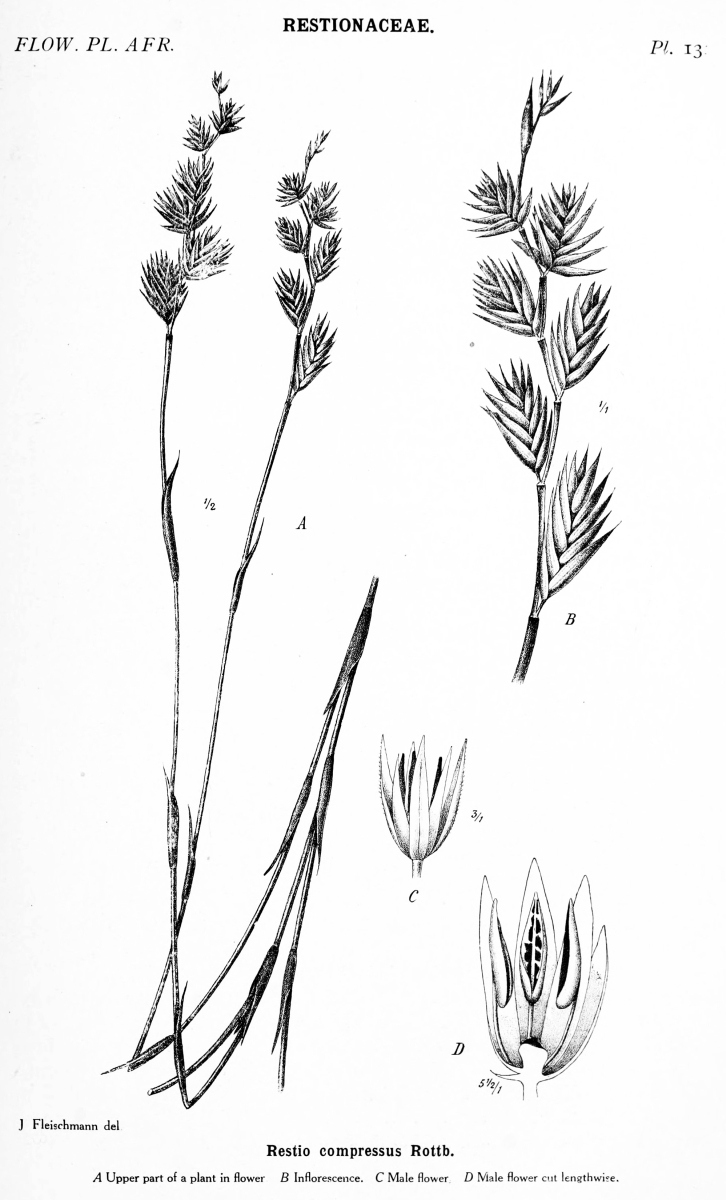
RESTIONACEAE.
FLOW. PL. AFR.
Pl. 13.
J. Fleischmann del.
Restio compressus Rottb.
A Upper part of a plant in flower. B Inflorescence. C Male flower. D Male flower cut lengthwise.
XYRIDACEAE.
FLOW. PL. AFR.
Pl. 14.
J. Fleischmann del.
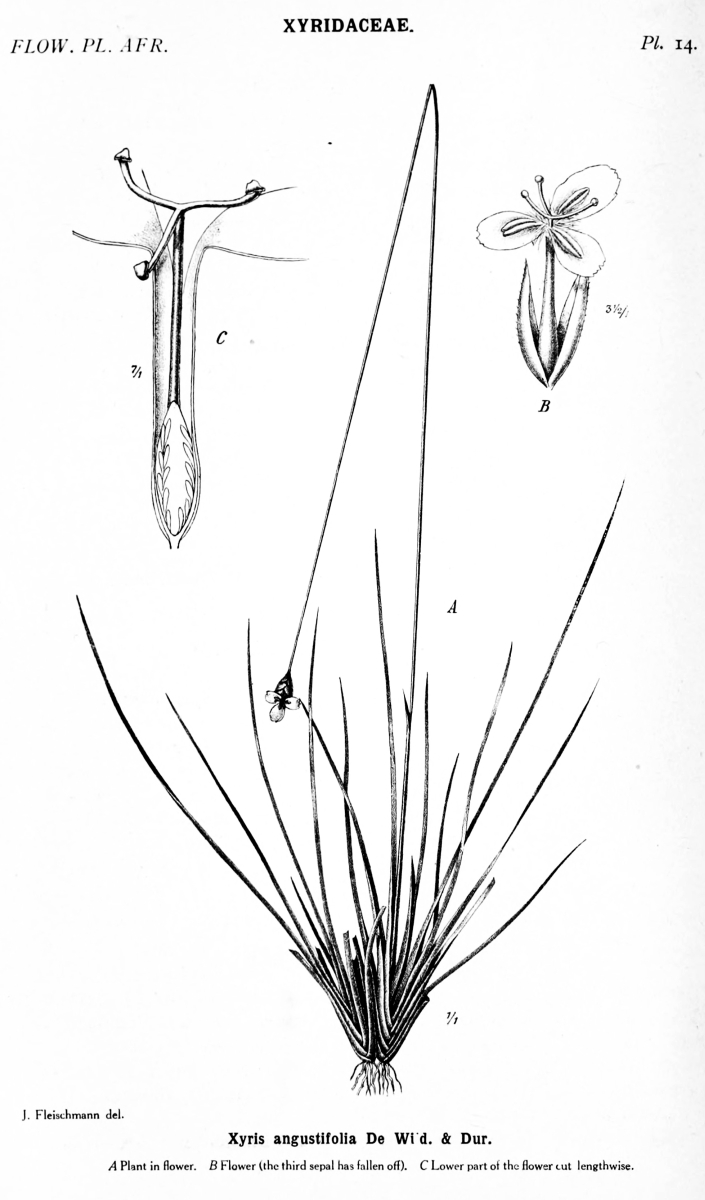
Xyris angustifolia De Wild. & Dur.
A Plant in flower. B Flower (the third sepal has fallen off). C Lower part of the flower cut lengthwise.
FAMILY 24. XYRIDACEAE
Herbs. Leaves radical, linear. Flowers in spikes or heads with an involucre of imbricate bracts, hermaphrodite. Sepals 3, one much larger than the others and deciduous. Petals 3, united below into a tube. Fertile stamens 3, adnate to the petals; staminodes 3. Anthers opening by longitudinal slits. Ovary superior, 1-celled or incompletely 3-celled. Ovules numerous, straight. Style 3-cleft. Fruit capsular. Embryo at the apex of the mealy albumen. (Plate 14.)
Genus 1, species 40. Tropical and South Africa. Some are used in medicine. Xyris L.
FAMILY 25. ERIOCAULACEAE
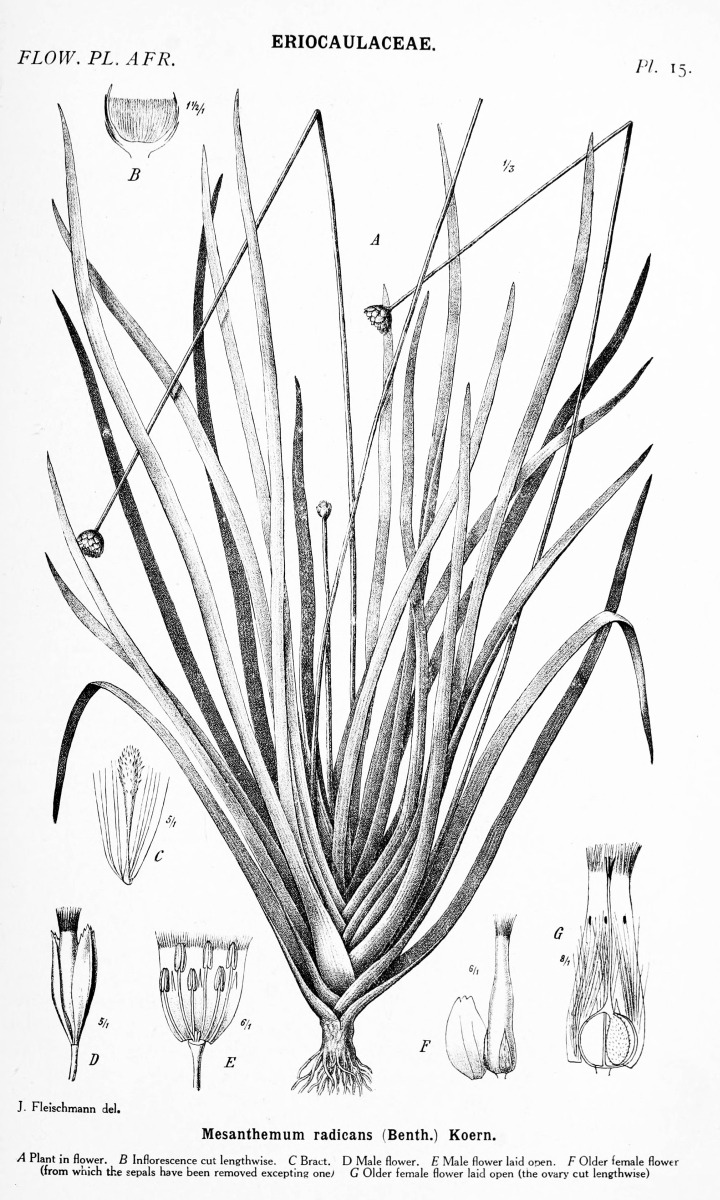
Herbs. Leaves radical, linear. Flowers in heads surrounded by an involucre, very small, monoecious. Perianth membranous, simple or double, rarely in the female flowers none. Stamens 2-6. Anthers 2-celled. Ovary superior, 2-3-celled, with one pendulous ovule in each cell. Styles or style-branches 2-3. Fruit capsular. Embryo small, at the apex of the albumen.—Genera 4, species 80. Tropical and South Africa. (Plate 15.)
1. Stamens 2-3, opposite the petals. Petals of the male flowers united below, without a gland on the inside. Style-branches 6, three of which bear a stigma, rarely 3. [Subfamily PAEPALANTHOIDEAE.] 2 Stamens 4-6, very rarely fewer, but then petals free. Petals usually with a gland on the inside near the apex. Style-branches 2-3, without alternating appendages. [Subfamily ERIOCAULOIDEAE.] 3 2. Petals of the female flowers united at their middle part.—Species 6. Central and South Africa. (Under Paepalanthus Mart.) Syngonanthus Ruhl. Petals of the female flowers free.—Species 3. West Africa and Mascarene Islands. Paepalanthus Mart. 3. Petals united into a tube, but free at the base in the female flowers. Inner involucral bracts more or less spreading. Stamens 6.—Species 8. Tropics. Some are used in medicine. (Plate 15.) Mesanthemum Koern. Petals free or absent. Inner involucral bracts rarely spreading.—Species 60. Tropical and South Africa. Eriocaulon L.
SUBORDER BROMELIINEAE
FAMILY 26. RAPATEACEAE
Herbs. Leaves radical, lanceolate. Flowers in heads with 2 large involucral bracts, regular, hermaphrodite. Perianth corolla-like, yellow or whitish, 6-lobed. Stamens 6, inserted in the tube of the perianth. Anthers linear, opening by two terminal pores. Ovary superior, 3-celled, with 1 ascending, inverted ovule in each cell. Style simple. Fruit capsular. Embryo near the apex of the mealy albumen.
Genus 1, species 1. West Africa (Liberia). Maschalocephalus Gilg & Schum.
FAMILY 27. BROMELIACEAE
Herbs. Leaves for the most part radical, linear, toothed. Inflorescence terminal, cone-shaped. Flowers regular, hermaphrodite. Perianth consisting of a calyx and a corolla. Petals slightly cohering and bearing two scales at the base. Stamens 6, slightly adhering to the petals. Anthers linear, turned inwards. Ovary inferior or half-inferior, 3-celled, with many axile, inverted ovules. Style 1; stigmas 3. Fruits berry-like, united into a cone-shaped head. Embryo near the base of the mealy albumen.
Genus 1, species 1 (A. sativus Schult., pine-apple). Cultivated and often naturalised in the tropics. The edible fruit and the fibres of the leaves are used. (Ananassa Lindl.) Ananas Adans.
SUBORDER COMMELININEAE
FAMILY 28. COMMELINACEAE
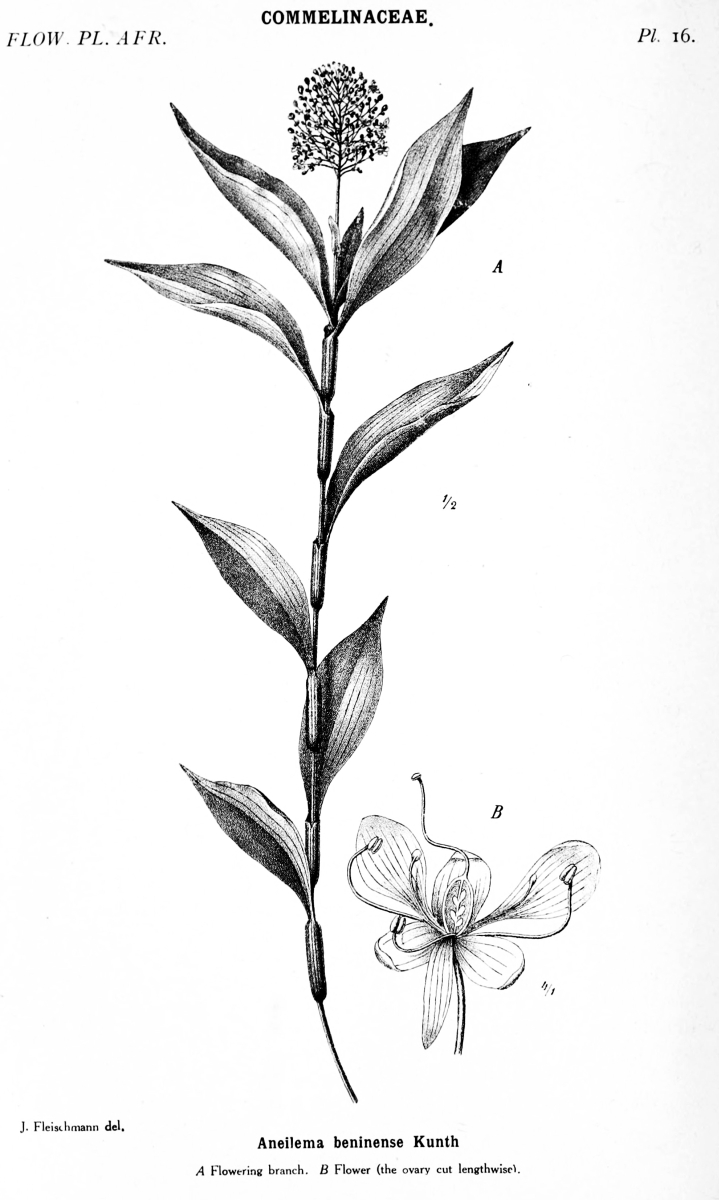
Herbs. Leaves alternate. Inflorescence cymose. Flowers hermaphrodite. Perianth-segments 6, more or less distinctly separated into sepals and petals. Fertile stamens 2-6. Ovary superior, 2-3-celled. Ovules straight. Style terminal. Embryo near the apex of the more or less mealy albumen.—Genera 12, species 160. (Plate 16.)
1. Fruit indehiscent, ovate or globular. Ovary 3-celled. Petals free, white, more rarely pale pink or blueish. Inflorescence a panicle without spathe-like bracts. [Tribe POLLIEAE.] 2 Fruit dehiscing loculicidally. 3 2. Pericarp succulent. Margin of the leaves silky. Perfect stamens 3.—Species 10. West Africa and Upper Nile. Some are used as ornamental plants. Palisota Reichb. Pericarp crusty. Margin of the leaves nearly glabrous. Perfect stamens 3 or 6.—Species 5. Tropics. Pollia Thunb. 3. Fertile stamens 2-3, sterile ones 0-4, often bearing empty anthers. [Tribe COMMELINEAE.] 4 Fertile stamens 5-6. [Tribe TRADESCANTIEAE.] 7 4. Inflorescence in the axil of spathe-like bracts. 5 Inflorescence without spathe-like bracts. 6 5. Sterile stamens with linear anther-halves cohering at the base. Ovary 2-celled with 1 ovule in each cell. Petals white. Spathes on the elongate branches of a panicle.—Species 1. West Africa. Polyspatha Benth. Sterile stamens with cross-shaped anthers. Ovary usually 3-celled. Petals usually blue.—Species 80. Some have an edible root-stock or yield vegetables, medicaments, or dyeing-materials; others are used as ornamental plants. Commelina L. 6. Sepals large, equal, lanceolate, acute. Petals equal. Fruit with 3 equal-sized, many-seeded cells.—Species 1. East Africa. Anthericopsis Engl.
ERIOCAULACEAE.
FLOW. PL. AFR.
Pl. 15.
J. Fleischmann del.
Mesanthemum radicans (Benth.) Koern.
A Plant in flower. B Inflorescence cut lengthwise. C Bract. D Male flower. E Male flower laid open. F Older female flower (from which the sepals have been removed excepting one). G Older female flower laid open (the ovary cut lengthwise).
COMMELINACEAE.
FLOW. PL. AFR.
Pl. 16.
J. Fleischmann del.
Aneilema beninense Kunth
A Flowering branch. B Flower (the ovary cut lengthwise).
Sepals small, unequal, ovate or oblong-ovate, obtuse. Petals unequal. Fruit with 2 cells, more rarely with 3, one of which is smaller and 1-2-seeded.—Species 30. Tropical and South Africa. Some are used as ornamental plants. (Plate 16.) Aneilema R. Br. 7. Petals united below into a tube, but sometimes free at the base, blueish or reddish. Ovary 3-celled with 1-2 ovules in each cell. 8 Petals free or nearly so. 9 8. Stamens inserted towards the top of the corolla-tube. Petals united from the base.—Species 5. Tropical and South Africa. Coleotrype C. B. Clarke Stamens inserted at the base of the corolla. Petals free at the base.—Species 15. Tropical and South Africa. Some are used as ornamental plants. Cyanotis Don 9. Ovary 2-celled with 1 ovule in each cell. Fruit ovate. Filaments glabrous. Petals red or yellow. Inflorescence a panicle.—Species 9. Tropical and South-east Africa. Some are used as ornamental plants. Floscopa Lour. Ovary 3-celled. 10 10. Ovules 4-10 in each cell. Fruit oblong. Filaments glabrous. Petals whitish. Inflorescence a panicle.—Species 2. Central Africa. Buforrestia C. B. Clarke Ovules 1-2 in each cell. Fruit ovoid or globular. Stamens hairy. Inflorescence spike-, head-, or umbel-like. 11 11. Ovules 2 in each cell; in the dorsal cell sometimes solitary. Fruit subglobular. Stamens with a narrow connective. Sepals herbaceous, green. Inflorescence spike- or head-like. Stem long.—Species 3. Equatorial West Africa. Forrestia A. Rich. Ovule 1 in each cell. Fruit ovoid. Stamens with a broad connective. Sepals subpetaloid. Inflorescence umbel-like and surrounded by an involucre of two bracts. Stem short.—Species 1. West Africa (Congo). Rhoeo Hance
SUBORDER PONTEDERIINEAE
FAMILY 29. PONTEDERIACEAE
Aquatic herbs. Flowers in spikes, racemes or panicles, without bracts, hermaphrodite. Perianth-segments 6, petaloid, white, yellow or blue, united below into a tube, rarely nearly free. Stamens 3 or 6, affixed to the perianth. Anthers oblong. Ovary superior, 1-or 3-celled, with numerous inverted ovules. Style simple. Fruit a loculicidal, many-seeded capsule. Seeds with a ribbed testa, a copious mealy albumen, and a long cylindrical embryo.—Genera 3, species 5. Tropics.
1. Stamens 3. Ovary 1-celled or incompletely 3-celled. Perianth funnel-shaped, with a distinct tube.—Species 3. Central Africa. Heteranthera Ruiz & Pav. Stamens 6. Ovary 3-celled. Perianth blue or violet. 2 2. Perianth funnel-shaped, with a distinct tube; Filaments thread-like. Anthers attached by the back. Stigma entire or shortly lobed.—Species 1. Tropics. Used as an ornamental plant. Eichhornia Kunth Perianth bell-shaped, with nearly free segments. Filament of the largest stamen toothed at the base. Anthers attached by the base. Stigma deeply cleft.—Species 1. Central Africa (Upper Nile and Kasai). Used as an ornamental plant, and in medicine. Monochoria Presl
FAMILY 30. CYANASTRACEAE
Herbs. Root-stock tuberous. Leaves elliptical or cordate, with curved main-nerves. Flowers in terminal racemes or panicles, provided with bracts. Perianth-segments 6, petaloid, shortly united at the base. Stamens 6, inserted at the base of the perianth, more or less united below. Anthers linear, longer than the filaments, opening by short slits at the apex. Ovary slightly sunk in the receptacle, deeply lobed, 3-celled. Ovules 2 in each cell, ascending, inverted. Style simple, with a 3-lobed stigma. Fruit a 1-seeded nut. Seed with a thin testa, a copious albumen, and a transversely-ovate marginal embryo. (Under PONTEDERIACEAE or HAEMODORACEAE.)
Genus 1, species 5. Central Africa. Some have edible tubers. (Schoenlandia Cornu). Cyanastrum Oliv.
ORDER LILIIFLORAE
SUBORDER JUNCINEAE
FAMILY 31. JUNCACEAE
Leaves linear or reduced to the sheath. Flowers regular, hermaphrodite. Perianth-segments 6, free, stiff, usually green. Stamens 3 or 6. Ovary superior, 1-or 3-celled. Ovules 3 or more, inverted. Style 1; stigmas 3, elongated. Fruit capsular. Seeds with a straight axile embryo and abundant albumen.—Genera 3, species 55. (Plate 17.)
1. Stem woody. Leaves at its top, stiff, serrate. Ovary 3-celled, with 2 or few ovules in each cell. Style very short. Seeds with a large embryo and appressed testa.—Species 1. South Africa. It yields fibres and vegetables and is used for plaiting-work. “Palmiet.” (Plate 17.) Prionium E. Mey. Stem herbaceous. Style thread-like. Seeds with a small embryo. 2 2. Ovary 1-celled, with 3 basal ovules. Leaves with a closed sheath and ciliate margins.—Species 10. North and South Africa and high mountains of Central Africa. “Wood-rush.” Luzula DC. Ovary 1-3-celled, with numerous parietal or axile ovules.—Species 45. Some are used in medicine or for plaiting-work. “Rush.” Juncus L.
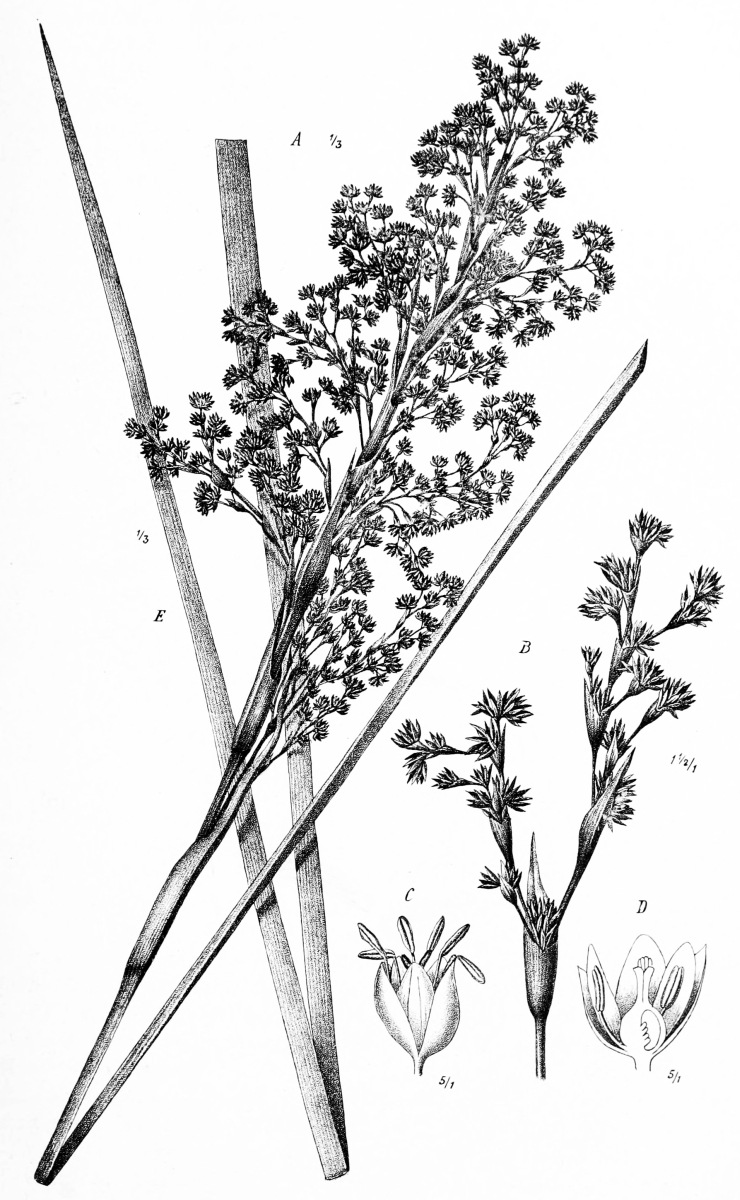
JUNCACEAE.
FLOW. PL. AFR.
Pl. 17.
J. Fleischmann del.
Prionium serratum Drege
A Inflorescence. B Branch of the inflorescence. C Older flower. D Younger flower cut lengthwise. E Leaf.
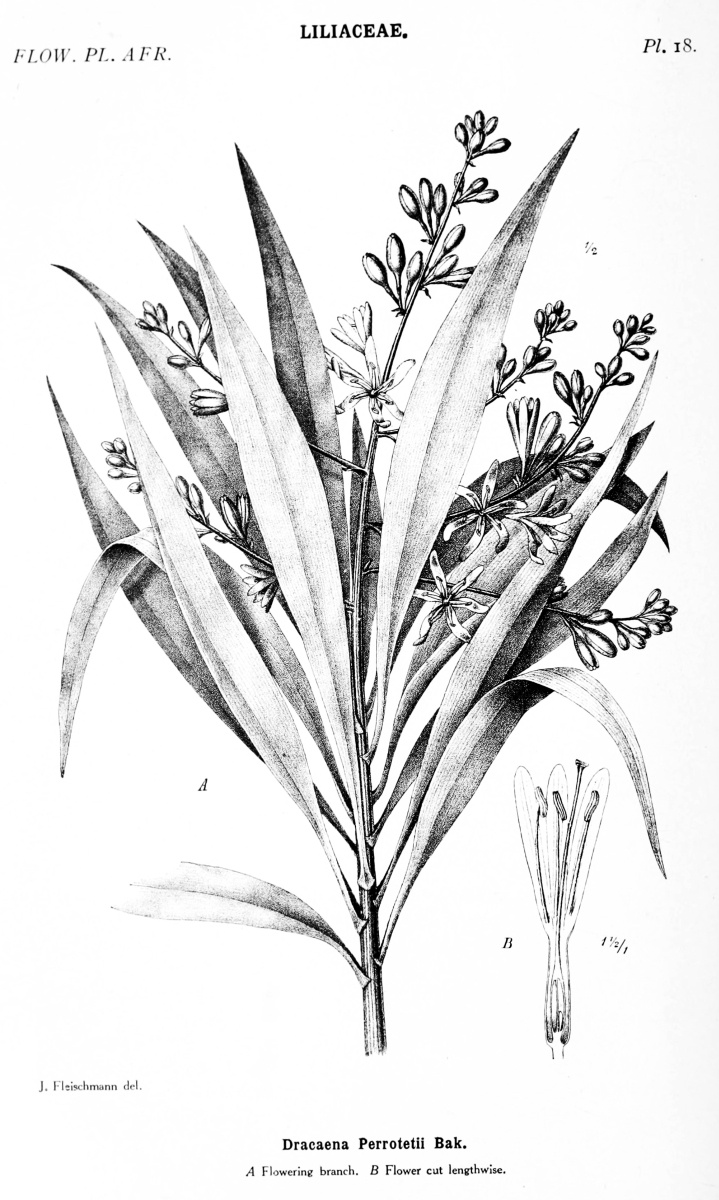
LILIACEAE.
FLOW. PL. AFR.
Pl. 18.
J. Fleischmann del.
Dracaena Perrotetii Bak.
A Flowering branch. B Flower cut lengthwise.
SUBORDER LILIINEAE
FAMILY 32. LILIACEAE
Perianth more or less corolla-like. Stamens 6, rarely fewer. Ovary superior, usually 2-5-celled, rarely 1-celled with parietal placentas. Seeds with a small embryo and abundant, fleshy or horny albumen.—Genera 79, species 1450. (Including COLCHICACEAE and SMILACEAE.) (Plate 18.)
1. Underground part of the stem a bulb or a corm. 2 Underground part of the stem a rootstock or not distinctly developed. 41 2. Leaves all radical, rarely also some much smaller cauline leaves present. 3 Leaves distributed along the stem or crowded at its top. 31 3. Stem arising out of a corm, very short, underground during the time of flowering, bearing 1-3 flowers at the top. Perianth with a very long, sometimes split tube. Capsule opening septicidally. [Tribe COLCHICEAE.] 4 Stem arising out of a bulb. Flowers in racemes or umbels, very rarely solitary. Perianth with a not very long tube or without a tube. Capsule opening loculicidally. 5 4. Perianth-segments free.—Species 2. Algeria and Abyssinia. Used as ornamental plants. Merendera Ram. Perianth-segments united below.—Species 5. North Africa. Poisonous and used as medicinal and ornamental plants. Colchicum L. 5. Flowers in cymose umbels or heads surrounded by 2-3 bracts. Scape distinctly developed. Leaves usually linear. Perianth-segments free or united at the base only. [Tribe ALLIEAE.] 6 Flowers in racemes, corymbs, or spikes, very rarely solitary, rarely in umbels or heads surrounded by 3 or more bracts, but then scape almost wanting, leaves oblong to ovate, spreading, and perianth-segments united to the middle or higher up. 8 6. Inflorescence surrounded by narrow bracts. Radical leaves 1-3. Perianth usually yellow.—Species 10. North Africa. Gagea Salisb. Inflorescence surrounded by broad membranous bracts usually united at the base. 7 7. Perianth-segments united into a short tube at the base. Filaments dilated. Ovules in each ovary-cell 6-12. Smell not alliaceous.—Species 2. Cultivated and sometimes naturalised in North Africa, the Mascarene Islands, and St. Helena. Ornamental plants. (Milla Cav.) Nothoscordum Kunth Perianth-segments free or nearly free. Ovules in each ovary-cell 2, rarely 3-6. Smell alliaceous.—Species 30. North Africa, Abyssinia, southern West Africa, and South Africa. Some of them (onion, leek, garlic) are cultivated as vegetables or pot-herbs, and yield also condiments, medicaments, and glue; others are used as ornamental plants. Allium L. 8. Anthers attached by the base. Stem or inflorescence branched or twining. Leaves vanishing before the time of flowering. [Tribe ASPHODELEAE, Subtribe ERIOSPERMINAE.] 9 Anthers attached by the back. Stem simple. [Tribe SCILLEAE.] 10 9. Inflorescence twining, bearing flowers on its upper branches only. Seeds oblong, with a small embryo.—Species 1. South Africa. Used as an ornamental plant. Bowiea Harv. Inflorescence bearing flowers on all its branches or not branched. Seeds ovoid or globose, with a large embryo.—Species 7. South Africa to Angola. Schizobasis Bak. 10. Flowers in nearly sessile heads or umbels surrounded by an involucre. Perianth-segments united into a tube below. Leaves 2, oblong or ovate. 11 Flowers in racemes or spikes, rarely solitary. 12 11. Perianth-segments very unequal. Filaments free.—Species 3. South Africa. Used as ornamental plants. Daubenya Lindl. Perianth-segments subequal. Filaments united at the base.—Species 30. South Africa. Some are used as ornamental plants. Massonia Thunb. 12. Perianth-segments free or nearly free. 13 Perianth-segments united into a tube below. 18 13. Seeds flattened or sharply angled, more or less distinctly winged. Perianth white, yellow, or green. 14 Seeds globose or obovoid. 15 14. Perianth persistent; inner segments somewhat shorter than the outer, connivent at the top, hood-shaped or crested.—Species 70. South and Central Africa. Some are used as ornamental plants. Albuca L. Perianth deciduous; segments subequal, spreading or connivent and bell-shaped.—Species 55. Some of them are poisonous or used in medicine or as ornamental plants. Urginea Steinh. 15. Inflorescence racemose, crowned by a tuft of leafy bracts. Perianth greenish.—Species 10. South Africa to Nyasaland. Some are used as ornamental plants. Eucomis L’Hér. Inflorescence without a terminal tuft of bracts. 16 16. Perianth-segments convex, connivent at the top, whitish. Flowers in spikes or spike-like racemes, sessile or short-stalked, the uppermost abortive. Filaments broadened almost to the top.—Species 17. Central and South Africa. Some are used as ornamental plants. Drimiopsis Lindl. Perianth-segments spreading or campanulately-connivent at the base. Flowers in racemes, long- or short-stalked, in the latter case filaments thread-shaped or broadened at the base only. 17 17. Perianth-segments 1-nerved, blue or red, rarely whitish or greenish. Stamens affixed to the perianth; filaments thread-shaped or broadened at the base only.—Species 100. Some have edible bulbs or are used in medicine or as ornamental plants. “Squill.” (Including Endymion Dumort.) Scilla L. Perianth-segments obscurely many-nerved, white or yellow and usually striped, rarely brownish or greenish. Stamens usually free from the perianth and with flattened filaments.—Species 90. Some have edible bulbs. Ornithogalum L. 18. Perianth-tube cylindrical, linear or oblong in section. 19 Perianth-tube bell-, urn-, funnel-, or saucer-shaped. 23 19. Perianth-segments very short and broad, more or less ovate. 20 Perianth-segments narrow and more or less elongated. 21 20. Perianth falling off after flowering. Stamens inserted below the throat; filaments very short. Ovules numerous. Seeds flattened. Leaves awl-shaped. Flowers solitary or in pairs.—Species 1. South Africa. Litanthus Harv. Perianth withering. Stamens inserted in the middle of the tube; filaments thread-shaped. Ovules 2 in each cell. Seeds thick. Leaves strap-shaped. Flowers in dense racemes.—Species 3. South Africa. Used as ornamental plants. Veltheimia Gled. 21. Seeds flattened. Anthers linear. Perianth-segments unequal, the outer spreading, the inner erect, as long as or shorter than the outer. Leaves linear, usually more than 2.—Species 60. Dipcadi Medik. Seeds thick. Anthers oblong. Perianth-segments equal or, if unequal, the inner usually longer than the outer. Leaves oblong or lanceolate, more rarely linear, usually 2. 22 22. Perianth-segments equal, lanceolate, shorter than the tube. Stamens inserted at the throat of the perianth. Leaves 2, oblong.—Species 10. South Africa. Polyxena Kunth Perianth-segments more or less unequal in length, oblong or spatulate. Stamens inserted in the tube of the perianth.—Species 40. South Africa. Some are used as ornamental plants. Lachenalia Jacq. 23. Perianth-segments very short, usually blue. 24 Perianth-segments half as long as the tube or longer. 25 24. Perianth urn-shaped. Ovules 2 in each cell.—Species 7. North Africa. Several species serve as ornamental plants; the bulbs are used in medicine and as a substitute for soap. Muscari Mill. Perianth bell-shaped. Ovules 5-6 in each cell.—Species 1. Madagascar. Rhodocodon Bak. 25. Perianth-segments unequal, the inner longer. Leaves 2, rarely 3-5. (See 22.) Lachenalia Jacq. Perianth-segments nearly equal. 26 26. Perianth with a very short tube and spreading segments. Filaments united at the base. Leaves 2, broad. Flowers in spikes.—Species 1. South Africa (Cape Colony). Whiteheadia Harv. Perianth with a more or less elongated tube, very rarely with a short tube, but with erect segments. Leaves 2, narrow, or more. 27 27. Seeds globular or obovoid, turgid. Ovules 2-6 in each cell.—Species 12. North and South Africa, southern East Africa, and Madagascar. Some species are used in medicine, perfumery, or gardening. (Including Bellevalia Lapeyr.). Hyacinthus L. Seeds flattened or angular. Ovules 6 or more in each cell. Flowers whitish. 28 28. Perianth-segments erect or converging. 29 Perianth-segments spreading or bent back. 30 29. Perianth funnel-shaped; segments half as long as the curved tube. Stamens inserted at the throat. Ovary oblong. Style subulate. Leaves large, lanceolate. Raceme dense, about 100-flowered.—Species 2. German South-west Africa. Pseudogaltonia Kuntze Perianth bell-shaped; segments as long as the tube or longer. Stamens inserted below the throat. Ovary ovate. Style short, columnar. Leaves short, linear. Raceme lax, 6-20-flowered.—Species 2. South Africa (Cape Colony). Rhadamantus Salisb. 30. Perianth withering; segments as long as the tube, the outer oblong, the inner obovate. Stamens inserted below the throat. Seeds angular.—Species 3. South Africa. Used as ornamental plants. Galtonia Decne. Perianth falling off after flowering; segments somewhat longer than the tube, linear or oblong. Stamens inserted at the throat. Seeds discoid.—Species 30. Southern and tropical Africa. Some are used as ornamental or medicinal plants. Drimia Jacq. 31. (2.) Anthers turned outwards, opening outwards or laterally. Styles 3. [Tribe ANGUILLARIEAE.] 32 Anthers turned inwards, opening inwards or laterally. Style 1, sometimes very short, with 1-3 stigmas. Flowers solitary or in lax, few-flowered racemes or umbels. 37 32. Capsule opening loculicidally. Flowers long-stalked, solitary or in racemes, rarely short-stalked and then solitary and axillary. Perianth dark brown. 33 Capsule opening septicidally. Flowers sessile or short-stalked, in spikes, spike-like racemes, or heads, rarely solitary and terminal. 34 33. Perianth deciduous; segments without a gland at the base. Stamens with thickened filaments. Flowers solitary, axillary.—Species 10. Tropics and northern South Africa. Iphigenia Kunth Perianth persistent; segments with a gland at the base. Stamens with thread-shaped filaments. Flowers in racemes.—Species 3. South Africa, southern Central Africa, and Madagascar. Used as ornamental plants. Ornithoglossum Salisb. 34. Perianth-segments united below, persistent. Stigmas capitate. Flowers in spikes, without bracts.—Species 4. South Africa and mountains of Central Africa. Used as ornamental plants. Wurmbea Thunb. Perianth-segments free, clawed. Flowers in heads or racemes, rarely solitary or in spikes; in the latter case perianth deciduous and stigmas on the inside of the styles. 35 35. Flowers in spikes, without bracts. Perianth deciduous, whitish. Ovary 3-lobed, obovate.—Species 3. South Africa (Cape Colony). (Including Neodregea Wright). Dipidax Salisb. Flowers in heads or racemes, rarely solitary, provided with bracts. Perianth persistent. 36 36. Flowers in racemes or solitary. Stigmas lateral. Ovary triangular-cylindrical. Perianth yellow or red. Stem distinctly developed.—Species 1. South Africa (Cape Colony). Baeometra Salisb. Flowers in heads. Stigmas minute. Ovary usually ovoid.—Species 20. South, East, and North Africa. (Erythrostictus Schlecht.) Androcymbium Willd. 37. Flowers large, usually solitary. Perianth deciduous, bell- or funnel-shaped, usually white or reddish. Anthers linear or oblong. Stigma usually 3-lobed. [Tribe TULIPEAE.] 38 Flowers rather small, usually umbellate. Perianth persistent, finally more or less wheel-shaped with spreading segments, usually yellow. Anthers ovate or oblong. Stigma usually simple. 40 38. Perianth funnel-shaped, white; segments recurved at the apex. Anthers attached by the back. Flowers in racemes.—Species 1. North Africa. Used as an ornamental plant. “Lily.” Lilium L. Perianth bell-shaped, usually reddish; segments more or less erect, not recurved. Anthers attached by the base. Flowers usually solitary. 39 39. Flowers drooping. Perianth-segments with a nectar-bearing pit or spot at the base. Style long.—Species 2. North-west Africa (Algeria). Used as ornamental plants. Fritillaria L. Flowers erect, sometimes slightly drooping before flowering. Perianth-segments without a pit, but often with a nectar-bearing spot at the base. Style very short.—Species 2. North-west Africa (Algeria). Used as ornamental plants. “Tulip.” Tulipa L. 40. Perianth funnel-shaped, whitish, with oblong-ovate segments. Style short; stigma 3-lobed.—Species 1. North Africa (Cyrenaica). Lloydia Salisb. Perianth wheel-shaped, usually yellow and with lanceolate segments. (See 6.) Gagea Salisb. 41. (1.) Branches leaf-like, but often awl-shaped. Leaves scale-like. Flowers axillary, solitary or in pairs, more rarely in fascicles, umbels, or racemes. Fruit a berry. [Tribe ASPARAGEAE.] 42 Branches not leaf-like; stem usually simple. Leaves well developed. 44 42. Flowers inserted at the base of the usually linear leaf-like branches. Perianth-segments free or slightly united at the base. Stamens 6, with free filaments.—Species 80. Some of them are used as vegetables, medicinal-, ornamental-, or hedge-plants. (Including Myrsiphyllum Willd.) Asparagus L. Flowers inserted on the surface or margin of the lanceolate or broader leaf-like branches. Stamens with united filaments. 43 43. Flowers hermaphrodite. Perianth-segments united high up. Anthers 6. Ovary 3-celled. Style distinctly developed; stigmas 3.—Species 1. Canary Islands, Madeira, and Azores. Semele Kunth Flowers dioecious. Perianth-segments free. Anthers 3. Ovary 1-celled. Style very short; stigma lobed.—Species 2. North Africa. Used as ornamental and medicinal plants. Ruscus L. 44. Flowers solitary, axillary. Anthers turned outwards. Fruit capsular. [Tribe UVULARIEAE.] 45 Flowers solitary but terminal or collected into various inflorescences. Anthers turned inwards. 47 45. Perianth-segments free, spreading or reflexed. Style bent downwards at the base.—Species 5. Tropical and South Africa. Poisonous and used as medicinal and ornamental plants; some of them yield starch. Gloriosa L. Perianth-segments united below or connivent. Style not bent downwards. 46 46. Perianth-segments free or almost so, with a nectar-bearing cavity at their base.—Species 6. Tropical and South Africa. Some are used as ornamental plants. Littonia Hook. fil. Perianth-segments united almost to the top into a pitcher-shaped tube, with a short spur at the base.—Species 1. South-East Africa. Used as an ornamental plant. Sandersonia Hook. fil. 47. Flowers solitary, in 2-3-flowered heads, in axillary cymes, or in umbels, the latter sometimes arranged in racemes. 48 Flowers in spikes, racemes, or panicles, which are sometimes contracted into many-flowered heads or consist of fascicles or cymes. 52 48. Stem herbaceous. Leaves radical, linear, parallel-veined. Inflorescence terminal. Fruit a capsule. 49 Stem woody at least at the base, usually climbing. Leaves cauline, oblong or broader, net-veined. Inflorescence axillary. Fruit a berry. 51 49. Flowers solitary or in groups of 2-3, surrounded by an involucre of 5-7 bracts, sessile. Perianth-segments free. Ovary-cells with a single ovule.—Species 1. North Africa. [Tribe APHYLLANTHEAE.] Aphyllanthes L. Flowers in umbels enclosed by 2 bracts. Perianth-segments united below. Ovary-cells with many ovules. [Tribe AGAPANTHEAE.] 50 50. Perianth with a long tube and a corona at the throat. Style short, columnar.—Species 20. South Africa and southern Central Africa. Some are used as ornamental plants. Tulbaghia L. Perianth with a short tube, without a corona. Style filiform. Seeds winged.—Species 3. South Africa. Used as ornamental plants. Agapanthus L’ Hér. 51. Flowers in cymes, hermaphrodite. Perianth-segments united below into a long tube.—Species 1. South Africa. [Tribe LUZURIAGEAE.] Behnia Didrichs. Flowers in umbels, dioecious. Perianth-segments free.—Species 9. Some of them are used medicinally. [Tribe SMILACEAE.] Smilax Tourn. 52. Perianth-segments free or almost so, more or less spreading. Stem herbaceous. Ovary 3-celled. [Tribe ASPHODELEAE.] 53 Perianth-segments evidently united at their base or connivent into a long tube, rarely almost free and not connivent into a tube, but then stem woody, very seldom herbaceous plants growing upon trees and having a 1-celled ovary. 66 53. Anthers attached by the base or between the lobes of the base. 54 Anthers attached by the back. 62 54. Anthers opening by terminal pores, sometimes prolonged into slits. Filaments thickened. Perianth blue, rarely white. Fruit a berry. Leaves 2-ranked, linear. Flowers in lax panicles.—Species 2, one native in Madagascar and the neighbouring islands, the other one naturalized in the Island of St. Helena. They are used as ornamental and medicinal plants; the berries are poisonous. [Subtribe DIANELLINAE.] Dianella Lam. Anthers opening by longitudinal slits. Fruit a capsule. Leaves in several ranks or 1-2 only present. Flowers usually in racemes. 55 55. Anthers without a pit at the base. Perianth more or less campanulate. Seeds woolly. Root-stock tuberous. Leaves 1-3, usually a single leaf.—Species 50. South and Central Africa. Some are used as ornamental or medicinal plants. [Subtribe ERIOSPERMINAE.] Eriospermum Jacq. Anthers attached to the filament in a small pit at the base. Perianth more or less rotate. [Subtribes ANTHERICINAE and ASPHODELINAE.] 56 56. Perianth spirally twisted after flowering, blue violet or red. Ovules 2 in each ovary-cell. 57 Perianth not twisted, usually white. Ovules 4 or more in each ovary-cell. 58 57. Stamens free or the inner attached to the perianth; filaments flattened. Perianth blue. Stem very short, 2-3-flowered.—Species 1. South Africa (Cape Colony). Nanolirion Benth. Stamens attached to the perianth; filaments thread-shaped. Stem long, many-flowered.—Species 4. South Africa and Madagascar. Caesia R. Br. 58. Ovules many in each cell. Filaments short and broad. Perianth funnel-shaped, with erect segments.—Species 3. West Africa. (Debesia Kuntze). Acrospira Welw. Ovules 4-8 in each cell. Filaments thread-shaped or slightly broadened in the middle. 59 59. Stamens as long as or longer than the perianth. Flowers almost sessile. 60 Stamens shorter than the perianth. Flowers distinctly stalked. 61 60. Perianth-segments erect. Leaves broadly elliptical.—Species 1. Southern West Africa. Verdickia De Wild. Perianth-segments spreading. Leaves linear or lanceolate.—Species 15. Central Africa. (Under Chlorophytum Ker). Dasystachys Bak. 61. Fruit deeply 3-lobed or acutely angled. Seeds discoid.—Species 80. Tropical and South Africa. Some are used as ornamental plants. Chlorophytum Ker Fruit not distinctly lobed, obtusely angled. Filaments thread-shaped.—Species 120. Some are used as ornamental or medicinal plants. (Phalangium Juss.) Anthericum L. 62. (53.) Anthers attached to the filament in a small dorsal pit. 63 Anthers without a dorsal pit. 65 63. Perianth wheel-shaped, with spreading 5-nerved segments, white on the inner face, violet or red on the outer. Filaments woolly. Seeds globular or ovoid.—Species 1. North-West Africa. Used in medicine. Simethis Kunth Perianth bell- or funnel-shaped, with more or less connivent, 1-nerved segments. Seeds triquetrous. 64 64. Perianth yellow. Filaments distinctly unequal, bent downwards. Stem bearing leaves to the middle or higher up.—Species 2. North Africa. Used as ornamental or medicinal plants. Asphodeline Reichb. Perianth white or reddish. Filaments subequal. Stem bearing leaves at the base only.—Species 10. North Africa, northern East Africa, and Mascarene Islands. Some are used as ornamental or medicinal plants or for preparing glue. Asphodelus L. 65. Filaments glabrous. Ovules 2 in each ovary-cell. Perianth white or yellow.—Species 9. South Africa. Bulbinella Kunth Filaments bearded. Ovules 3 or more in each ovary-cell. Perianth yellow, rarely whitish.—Species 30. South and Central Africa. Some are poisonous to cattle. Bulbine L. 66. (52.) Stamens free from the perianth, rarely (Lomatophyllum) slightly attached to it at the base. Anthers attached to the tip of the filament in a small pit. Perianth-segments evidently united or connivent into a narrow tube at the base. Fruit a capsule which is rarely fleshy. Leaves leathery and all radical, or more or less fleshy. [Tribe ALOINEAE.] 67 Stamens attached to the perianth, rarely almost free, but then anthers without a pit, perianth-segments almost free, spreading or globosely-connivent, fruit a berry, and leaves not fleshy. 75 67. Leaves leathery, minutely toothed or entire, radical or nearly so. Inflorescence terminal, simple, densely racemose, upon an almost naked stalk. Perianth usually yellow or red; limb regular or nearly so, not 2-lipped. [Subtribe KNIPHOFIINAE.] 68 Leaves fleshy and usually prickly, generally inserted on a woody stem, rarely leathery, but then inflorescence subcapitate or loosely racemose or perianth with a 2-lipped limb. Inflorescence axillary, but often apparently terminal. [Subtribe ALOINAE.] 69 68. Perianth campanulate, with a short and wide tube. Flowers spreading, rarely erect.—Species 5. South Africa to Angola. Notosceptrum Benth. Perianth cylindrical, with a long and narrow tube. Flowers more or less drooping, rarely erect.—Species 65. South and East Africa to Katanga and Madagascar. Some are used as ornamental plants. Kniphofia Moench 69. Perianth-segments erect or converging. Flowers usually large and red or yellow. 70 Perianth-segments spreading or bent back. Flowers usually small and whitish. 72 70. Perianth-tube long, curved, swollen below, cylindrical above. Perianth usually red. Stamens shorter than the perianth. Stem short. Leaves not toothed. Racemes lax, one-sided.—Species 40. South Africa. Most of them are used as ornamental plants. Gasteria Duval Perianth-tube straight or almost so, cylindrical or campanulate. Perianth usually reddish-yellow. Stamens as long as the perianth or somewhat longer. 71 71. Flowers small, erect, whitish, with minute bracts. Perianth-segments free. Stamens exserted. Filaments thread-shaped. Leaves not awned.—Species 1. South Africa (Cape Colony). (Under Aloë L.) Chamaealoë Berg. Flowers large, spreading or drooping, yellow or red, rarely small erect and whitish, but then bracts large, filaments flattened, and leaves long-awned.—Species 160. They yield fibre, vegetables, dye-stuffs, vermin-poison, and medicaments, and are often used as ornamental plants. Aloë L. 72. Perianth with a 2-lipped limb. Stamens shorter than the perianth. Fruit dry. 73 Perianth with a regular, stellate limb. Stem woody. 74 73. Ovary and fruit conical, acuminate. Leaves leathery, jointed, dilated at the base and forming a bulb.—Species 4. South Africa to Angola. (Under Haworthia Duval) Chortolirion Berg. Ovary and fruit rounded at the top. Leaves fleshy, not jointed and not forming a bulb.—Species 60. South Africa to Angola. Some are used as ornamental plants. Haworthia Duval 74. Perianth with short segments, whitish. Stamens equalling the perianth-tube. Fruit dry.—Species 9. South Africa. Some are used as ornamental plants. Apicra Willd. Perianth with long segments, red or green. Fruit fleshy.—Species 3. Mascarene Islands. Used as ornamental plants. Lomatophyllum Willd. 75. (66.) Anthers attached to the tip of the filament in a pit at their back. Ovary 3-celled with many ovules in each cell. Fruit a leathery capsule. Flowers yellowish-red, large, panicled. Leaves all radical. [Tribe HEMEROCALLEAE.] 76 Anthers without a pit. Ovary 3-celled with 1-8 ovules in each cell, or incompletely 6-celled, or 1-celled. Fruit a berry, rarely a fleshy capsule or a nut. Flowers usually whitish. 77 76. Leaves herbaceous. Inflorescence few-flowered. Seeds ovate, angled.—Species 1. Naturalised in the Mascarene Islands. A garden-plant. “Day-lily.” Hemerocallis L. Leaves leathery. Inflorescence many-flowered. Seeds oblong, winged.—Species 1 (Ph. tenax Forst., New-Zealand-flax). Cultivated in South Africa and the Mascarene Islands. Yields fibre and is used as an ornamental and medicinal plant. Phormium Forst. 77. Perianth-segments globosely-campanulately converging, slightly cohering at the base. Stamens with the filaments thickened at the apex and with sagittate basifixed anthers. Ovary 3-celled, each cell with an incomplete partition and numerous ovules. Leaves serrate, crowded at the top of the woody stem.—Species 2. Cultivated and naturalised in the Mascarene Islands and the island of Zanzibar. They yield fibre and starch and are used as ornamental plants. [Tribe YUCCEAE.] Yucca L. Perianth-segments spreading towards the tip. Stamens with thread-like filaments or with dorsifixed anthers. Ovary 3-celled with 1-8 ovules in each cell, or 1-celled. [Tribe DRACAENEAE.] 78 78. Ovary 1-celled with numerous ovules. Style short or wanting. Anthers attached at or near the base, opening laterally. Flowers polygamous, in panicles formed of spikes. Leaves all radical.—Species 1. Mascarene Islands. It yields fibre and is used as an ornamental plant. Astelia Banks & Soland. Ovary 3-celled with 1-8 ovules in each cell. Anthers attached by the back. 79 79. Ovules 4-8 in each ovary-cell. Style short and thick. Perianth-segments almost free. Flowers in repeatedly branched panicles. Stem woody.—Species 2. Mascarene Islands. Used as ornamental plants. (Under Cordyline Commers.) Cohnia Kunth Ovules solitary in each ovary-cell. Style long and slender. Perianth-segments evidently united. 80 80. Leaves all radical, springing from a short root-stock, cartilaginous. Flowers in racemes composed of fascicles. Ovary sessile with a large base. Fruit an achene with a membranous pericarp. Seed-coat fleshy.—Species 25. Tropical and South Africa. Many of them yield fibre and are used as ornamental plants. “Bowstring-hemp.” (Sanseverinia Petagna). Sansevieria Thunb. Leaves springing from a sometimes very short woody stem, herbaceous or leathery. Fruit a berry.—Species 65. Tropical and South Africa and Canary Islands. Several species yield a resin (dragon’s blood) employed medicinally and industrially; some are used for plaiting-work or as ornamental plants. Dracaena Vand.
FAMILY 33. HAEMODORACEAE
Herbs. Leaves narrow, 2-ranked. Flowers in racemes or panicles, rarely solitary, hermaphrodite. Perianth yellow; segments 6, petal-like, free or shortly united at the base. Stamens 3, opposite the inner perianth-segments and attached at their base. Anthers turned inwards. Ovary 3-celled; two cells sometimes sterile. Style simple, with a simple stigma, rarely 3-parted. Fruit a loculicidal capsule. Seeds flat. Embryo small, enclosed by the base of the albumen.—Genera 4, species 6. South Africa.
1. Ovary superior, 1-3-celled, with 1 ovule in each cell. 2 Ovary inferior, 3-celled. Flowers regular. 3 2. Ovary with 1 fertile cell. Flowers regular, glabrous, in racemes.—Species 1. Natal and Kaffraria. Barberetta Harv. Ovary with 3 fertile cells. Flowers irregular, hairy, in panicles.—Species 2. Cape Colony. Used as ornamental plants. The roots contain a red dye-stuff. Wachendorfia L. 3. Ovary with 1 ovule in each cell. Flowers hairy, in panicles.—Species 2. Cape Colony. Dilatris Berg Ovary with numerous ovules in each cell. Flowers glabrous, solitary.—Species 1. Cape Colony. Pauridia Harv.
FAMILY 34. AMARYLLIDACEAE
Flowers hermaphrodite. Perianth corolla-like. Stamens 6, rarely (Gethyllis) more. Anthers introrse. Ovary inferior, rarely half-inferior or (Walleria) almost superior, 3-celled, with slightly projecting axillary placentas. Ovules inverted. Embryo small, straight, lateral, enclosed by the fleshy albumen.—Genera 33, species 310. (Including HYPOXIDACEAE.) (Plate 19.)
1. Underground part of the stem a bulb or a corm, rarely a short root-stock. Leaves all radical. Flowers solitary or in umbels; inflorescence surrounded by a spathe. [Subfamily AMARYLLIDOIDEAE.] 2 Underground part of the stem a root-stock. Flowers in spikes, racemes or panicles, rarely solitary or in umbels, but without a spathe. 27 2. Perianth furnished with a corona, which sometimes is reduced to a narrow ring or a crown of hairs. [Tribe NARCISSEAE.] 3 Perianth without a corona. [Tribe AMARYLLIDEAE.] 8 3. Stamens inserted within the corona. Corona cup- or ring-shaped or consisting of 12 scales. [Subtribe NARCISSINAE.] 4 Stamens inserted on the edge of the cup- or funnel-shaped corona; corona rarely reduced to a crown of hairs. 6 4. Corona of 12 free scales. Perianth tubular, red. Fruit a berry.—Species 2. Central Africa (British East Africa and Angola). Cryptostephanus Welw. Corona cup- or ring-shaped, undivided or lobed. Perianth bell-, funnel-, or salver-shaped, usually white or yellow. Fruit a capsule. 5 5. Perianth funnel-shaped, with a very short tube, yellow. Corona little developed, 6- or 12-lobed.—Species 1. North-West Africa. (Carregnoa Boiss.) Tapeinanthus Herb. Perianth salver- or bell-shaped, with a more or less elongated tube.—Species 10. North Africa. Used as ornamental plants, in the preparation of perfumes, and in medicine; some species are poisonous. (Including Aurelia Gay and Corbularia Haw.) Narcissus L. 6. Perianth salver-shaped, with a cylindrical tube and linear segments, white. Corona funnel-shaped. Ovary with 2 ovules in each cell.—Species 1. West Africa. Used as an ornamental plant. [Subtribe EUCHARIDINAE.] Hymenocallis Salisb. Perianth funnel-shaped. Ovary with many ovules in each cell. [Subtribe PANCRATIINAE.] 7 7. Flowers white, regular. Corona large, cup-shaped. Stigma 1.—Species 8. Northern and tropical Africa. Some are used as ornamental plants, for the preparation of starch, and in medicine. Pancratium L. Flowers red, slightly irregular. Corona reduced to a crown of hairs. Stigmas 3.—Species 2. Naturalised in the West African islands St. Thomas and Princes Island. Ornamental plants. Hippeastrum Herb. 8. (2.) Ovules 1-6 in each cell of the ovary. Perianth-segments free or united below into a short tube. [Subtribe HAEMANTHINAE.] 9 Ovules many in each cell of the ovary. 14 9. Perianth divided nearly or quite to the ovary. Spathe consisting of two narrow bracts. 10 Perianth with a distinct tube. Spathe of two broad bracts or of more than two bracts. Anthers oblong, attached by the back. 11 10. Anthers globose, attached by the base. Ovules 1-4 in each ovary-cell. Perianth red.—Species 10. South Africa. Some are used as ornamental plants. (Including Carpolyza Salisb.) Hessea Herb. Anthers oblong, attached by the back. Ovules 5-6 in each ovary-cell.—Species 5. South Africa. Strumaria Jacq. 11. Ovules 5-6 in each ovary-cell. Perianth reddish-yellow, funnel-shaped. Spathe of more than 2 bracts. Leaves linear.—Species 3. South Africa. Used as ornamental plants. Clivia Lindl. Ovules 1-4 in each ovary-cell. 12 12. Spathe consisting of 2 bracts. Pedicels long. Perianth red, salver-shaped. Fruit a capsule. Leaves linear.—Species 4. South Africa and southern Central Africa. Used for the preparation of arrow-poison, in medicine, and as ornamental plants. Buphane Herb. Spathe consisting of more than 2 bracts. Pedicels short or rather short. Fruit a berry. 13 13. Filaments shorter than the anthers. Perianth-tube very short. Umbels rather few-flowered. Leaves very long and narrow, strap-shaped.—Species 1. West Africa (Congo). Demeusea De Wild. & Th. Dur. Filaments as long as or longer than the anthers. Perianth-tube long. Umbels many-flowered. Leaves rather short.—Species 45. South and Central Africa. Some are poisonous or are used as ornamental or medicinal plants. (Including Choananthus Rendle) Haemanthus L. 14. Perianth divided nearly or quite to the ovary. 15 Perianth with a distinct tube. 19 15. Perianth divided to the ovary, white, rarely reddish. Flowers regular, middle-sized, solitary or in few-flowered umbels. [Subtribe GALANTHINAE.] 16 Perianth with a short tube, usually red. Flowers more or less irregular, in umbels. [Subtribe AMARYLLIDINAE.] 17 16. Perianth-segments spreading, whitish. Anthers deeply sagittate at the base. Flowers erect, in umbels.—Species 1. North-west Africa. Lapiedra Lag. Perianth-segments converging. Anthers slightly sagittate at the base. Flowers drooping.—Species 3. North-west Africa. Used as ornamental plants and in medicine; the bulb is edible. Leucoium L. 17. Filaments thickened at the base. Stigma 3-lobed. Fruit obtusely angled, 3-valved.—Species 17. South Africa to Damaraland. Some are used as ornamental plants. (Imhofia Heist.) Nerine Herb. Filaments thread-shaped, free. Stigma entire. 18 18. Ovules sunk in the placentas. Ovary oblong. Fruit obtusely angled, bursting irregularly. Perianth-segments oblong. Flowers drooping.—Species 1. South Africa (Cape Colony); also naturalised in the Canary Islands, Madeira, and the Azores. Used as an ornamental plant; the bulb is poisonous. Amaryllis L. Ovules not sunk in the placentas. Ovary top-shaped. Fruit acutely angled, 3-valved.—Species 10. South Africa and southern Central Africa. Some are used as ornamental plants. Brunsvigia Heist. 19. Flowers solitary. [Subtribe ZEPHYRANTHINAE.] 20 Flowers in umbels occasionally reduced to a single flower. [Subtribe CRININAE.] 22 20. Perianth with a short tube, funnel-shaped, yellow. Filaments long. Anthers oblong, attached at the back near the base. Scape above-ground.—Species 1. North-west Africa (Algeria). Used as an ornamental plant. Sternbergia Waldst. & Kit. Perianth with a long tube. Filaments very short. Anthers linear, attached at the base. Scape underground. 21 21. Perianth salver-shaped, yellow or whitish. Stamens in a single row.—Species 9. South Africa (Cape Colony). The fruit of some is eaten or used in medicine. Gethyllis L. Perianth funnel-shaped, white or reddish. Stamens in 2 rows.—Species 5. South Africa. Apodolirion Bak. 22. Perianth-tube perceptibly shorter than the limb. 23 Perianth about as long as or longer than the limb. 26 23. Flowers rather small, yellow or yellowish-white, almost regular. Perianth-segments lanceolate, slightly longer than or twice as long as the tube. Stigmas 3.—Species 2. South and East Africa. Anoiganthus Bak. Flowers large, red, reddish-yellow, or reddish-white. Stigma 1, simple or 3-lobed. 24 24. Flowers almost regular. Perianth-segments elliptical, about twice as long as the tube. Umbels 6-9-flowered. Fruit oblong.—Species 1. South Africa (Cape Colony). Used as an ornamental plant. Vallota Herb. Flowers distinctly irregular. Perianth-segments 3-4 times as long as the tube. 25 25. Umbels 2-4-flowered. Scape hollow. Perianth hairy within. Fruit globose. (See 7.) Hippeastrum Herb. Umbels many-flowered; spathe of 2 bracts. Scape solid.—Species 2. South Africa to Damaraland. Ammocharis Herb. 26. Ovules sunk in the placentas, usually few in each ovary-cell. Stigma very small, capitate. Anthers linear. Scape solid.—Species 60. Tropical and South Africa. Some are used as ornamental or medicinal plants. (Including Stenolirion Bak.) (Plate 19.) Crinum L. Ovules not sunk in the placentas, many in each ovary-cell. Stigma more or less distinctly 3-lobed or 3-parted. Anthers oblong. Scape hollow.—Species 25. South and East Africa and Angola. Some are used as ornamental plants. Cyrtanthus Ait. 27. (1.) Leaves fleshy, very long (1-2 m.), in a rosette at the base or the top of the stem. Very tall plants. [Subfamily AGAVOIDEAE.] 28 Leaves not fleshy and not very long. Smaller plants. [Subfamily HYPOXIDOIDEAE.] 30 28. Filaments longer than the perianth. Flowers in spikes or panicles, usually greenish or yellow. Leaves at the top of a very short stem.—Species 2. Cultivated and sometimes naturalised in North and South Africa and some tropical islands. They yield fibre, fodder, drinks, medicaments, and a substitute for soap, and are also used as hedge- or garden-plants. Agave L. Filaments shorter than the perianth. 29 29. Filaments strongly thickened at the base. Flowers in panicles, white. Fruit ovoid. Leaves at the top of a short stem.—Species 1. Cultivated and sometimes naturalised in North and South Africa and some tropical islands. It yields fibre, and is used as a hedge- or garden-plant, also in medicine. (Furcraea Vent.) Fourcroya Schult. Filaments slightly thickened at the base. Flowers in capitate spikes, red. Fruit oblong or club-shaped. Leaves at the base of a long stem.—Species 1. Naturalised in the island of St. Helena. An ornamental plant. Doryanthes Correa 30. Ovary inferior with many ovules in each cell. Perianth yellow, rarely white or red. Leaves all radical, usually hairy like the peduncle. [Tribe HYPOXIDEAE.] 31 Ovary inferior with 2 ovules in each cell or half-inferior or almost superior. Perianth blue, red, or whitish. Leaves usually radical and cauline. 32
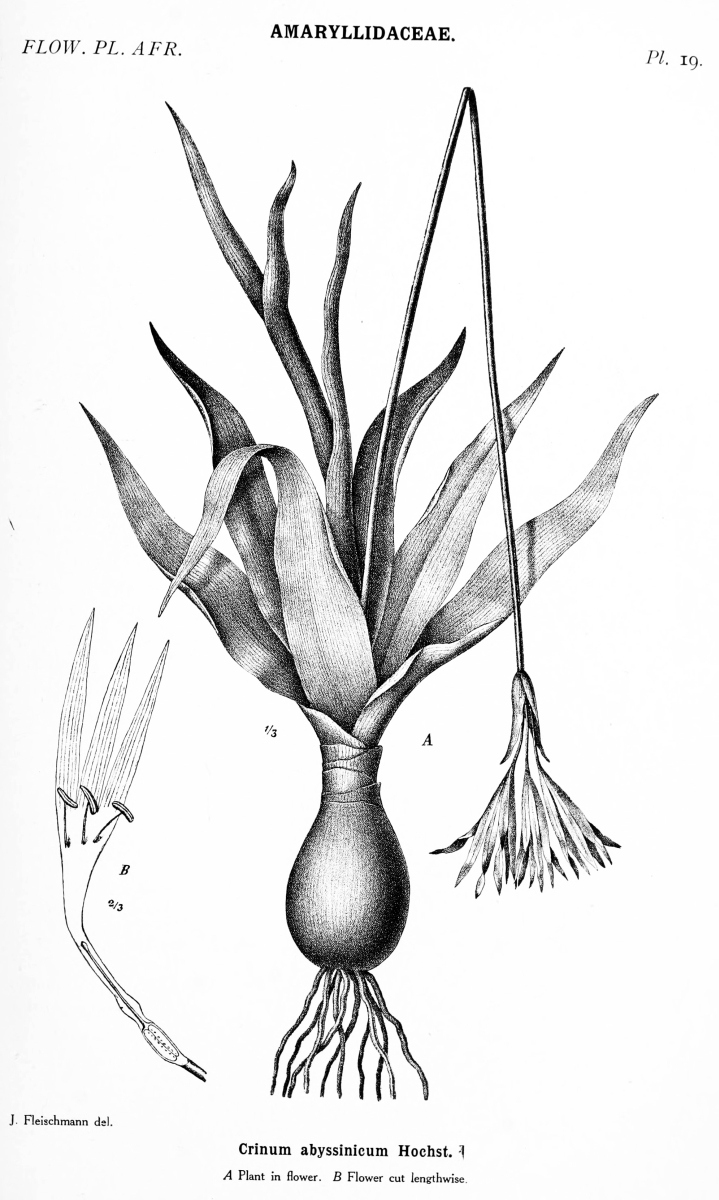
AMARYLLIDACEAE.
FLOW. PL. AFR.
Pl. 19.
J. Fleischmann del.
Crinum abyssinicum Hochst.
A Plant in flower. B Flower cut lengthwise.
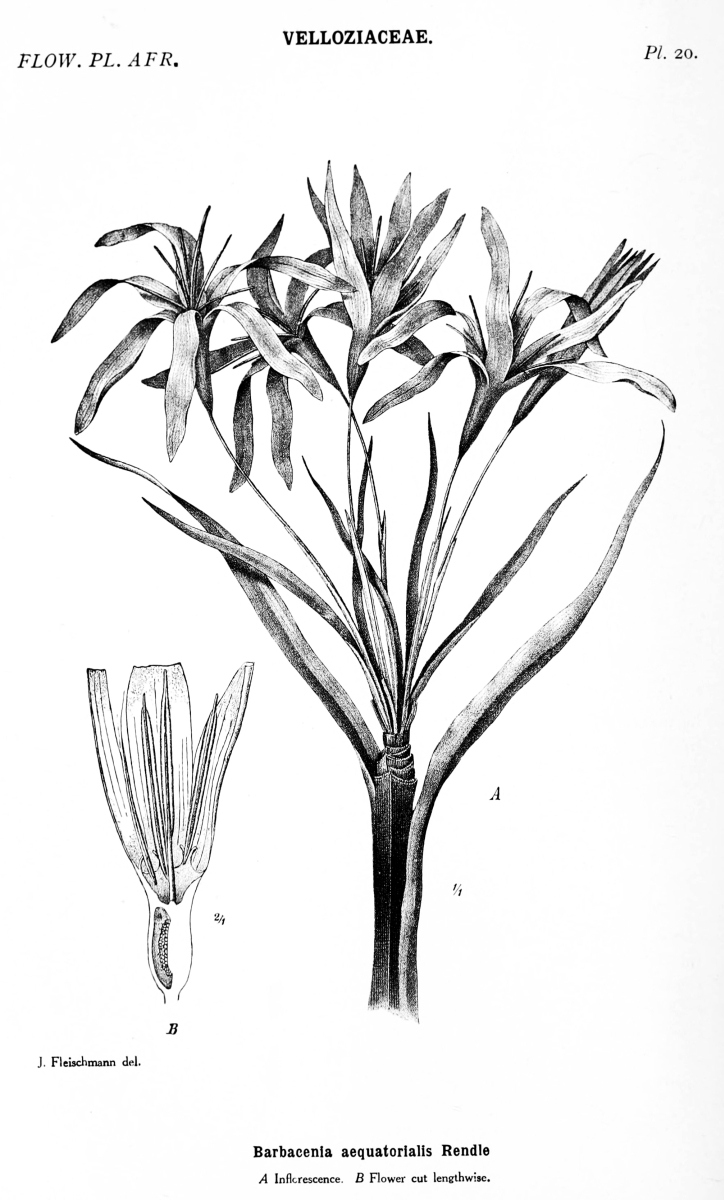
VELLOZIACEAE.
FLOW. PL. AFR.
Pl. 20.
J. Fleischmann del.
Barbacenia aequatorialis Rendle
A Inflorescence. B Flower cut lengthwise.
31. Ovary beaked. Fruit a berry. Flowers solitary or in dense spikes or heads.—Species 6. Tropical and South Africa. They yield fibre and are used medicinally and as ornamental plants; some have an edible root-stock. Curculigo Gaertn. Ovary not beaked. Fruit a capsule. Flowers solitary or in lax racemes or umbels.—Species 60. Southern and tropical Africa. Some are used as ornamental plants. (Including Ianthe Salisb.) Hypoxis L. 32. Ovary almost inferior with 2 ovules in each cell. Anthers attached by the back, bursting lengthwise. Perianth with a distinct tube. Fruit 1-seeded. Flowers in panicles. Stem, leaves, and inflorescence woolly.—Species 1. South Africa (Cape Colony). [Tribe CONOSTYLIDEAE.] Lanaria Ait. Ovary half-inferior or almost superior, with several or many ovules in each cell. Anthers attached at the base or near it, bursting at or towards the apex. Perianth divided nearly or quite to the ovary. Stem, leaves, and inflorescence glabrous. [Tribe CONANTHEREAE.] 33 33. Ovary half-inferior. Stamens more or less unequal. Flowers usually without bracteoles, solitary and terminal or arranged in racemes or panicles. Leaves, all or most of them, crowded at the base of the stem.—Species 7. South Africa to Damaraland. Some have edible root-stocks or are used as ornamental plants. Cyanella L. Ovary almost superior. Stamens equal. Flowers blue, with bracteoles, solitary or in pairs and axillary, or arranged in panicles. Leaves scattered along the stem.—Species 5. Southern tropical Africa. Some have edible root-stocks. Walleria Kirk
FAMILY 35. VELLOZIACEAE
Leaves linear. Flowers solitary, terminal, without bracteoles, regular, hermaphrodite. Perianth-segments free or nearly so, petaloid, usually white. Stamens 6. Anthers attached by the base. Ovary inferior, 3-celled. Placentas projecting and peltately dilated. Ovules numerous. Style simple; stigma 3-lobed. Fruit a capsule. Seeds black, compressed. Embryo very small, enclosed by the albumen. (Under AMARYLLIDEAE.) (Plate 20.)
Genus 1. Species 25. Tropical and South Africa. (Xerophyta Juss., under Vellozia Vand.) Barbacenia Vand.
FAMILY 36. TACCACEAE
Herbs with a tuberous root-stock. Leaves all radical, large, stalked, twice pinnately divided. Flowers in an umbel-like inflorescence on a leafless scape, regular, hermaphrodite. Perianth greenish-brown, bell-or urn-shaped, with a short tube. Stamens 6. Filaments hooded. Anthers turned inwards. Ovary inferior, 1-celled, with parietal placentas. Ovules numerous, inverted. Style short, umbrella-shaped, 6-lobed. Fruit a berry. Seeds compressed. Embryo small, enclosed by the albumen.
Genus 1, species 2. Tropics. Used as ornamental plants and for plaiting-work; the tubers yield starch (arrowroot) and are edible when cooked. Tacca Forst.
FAMILY 37. DIOSCOREACEAE
Root-stock tuberous. Stem twining. Leaves alternate, net-veined, usually cordate. Flowers in racemes, inconspicuous, regular, unisexual. Stamens 6. Ovary inferior, 3-celled. Ovules 2 in each cell, superposed, inverted. Styles or style-branches 3. Embryo enclosed in a horny or cartilaginous albumen.—Genera 2, species 45. (Plate 21.)
Fruit a berry. Seeds not winged.—Species 3. North Africa. The tubers are eaten and used in medicine; the berries are poisonous. (Tamnus Juss.) Tamus L. Fruit a capsule. Seeds winged.—Species 40. Tropical and South Africa. Some are cultivated for their edible tubers (yams) or used in medicine; others are poisonous. (Including Testudinaria Salisb.) (Plate 21.) Dioscorea L.
SUBORDER IRIDINEAE
FAMILY 38. IRIDACEAE
Herbs or undershrubs. Inflorescence terminal. Flowers hermaphrodite. Perianth with 6 petaloid segments. Stamens 3, inserted opposite the outer perianth-segments. Anthers turned outwards. Ovary inferior, 3-celled, rarely (Hermodactylus) 1-celled. Style-branches usually divided or dilated. Ovules numerous, inverted. Fruit a loculicidal capsule. Embryo enclosed by the horny albumen.—Genera 39, species 600. (Plate 22.)
1. Flowers solitary, terminal, sometimes surrounded by several axillary flowers, each flower with a spathe. Perianth regular; inner and outer segments nearly equal. Leaves not exactly 2-ranked. Stem short or almost wanting. [Subfamily CROCOIDEAE.] 2 Flowers in various inflorescences, rarely spathes solitary, but 2- or more-flowered or (if 1-flowered) the outer perianth-segments very different from the inner ones. Leaves 2-ranked, folded one above the other, rarely (Geosiris) reduced to scales. Stem distinctly developed. 5 2. Stem underground, very short. Perianth-tube very long. 3 Stem partly above ground. Perianth-tube short or moderately long. 4 3. Style-branches undivided, stigmatose inside. Perianth red or violet, rarely white with red streaks.—Species 6. South Africa (Cape Colony). Syringodea Hook. fil. Style-branches many-lobed or many-parted, stigmatose at the top.—Species 3; one of them only cultivated. North-West Africa. Used as ornamental plants; the tubers are edible. The cultivated species (C. sativus L.) yields the saffron, which is used as a condiment and for dyeing. Crocus L. 4. Leaves crowded at the top of the very short stem. Perianth with a rather long tube, yellow or violet. Filaments united into a tube. Style-branches dilated above, petal-like.—Species 3. South Africa (Cape Colony). Used as ornamental plants. Galaxia Thunb.
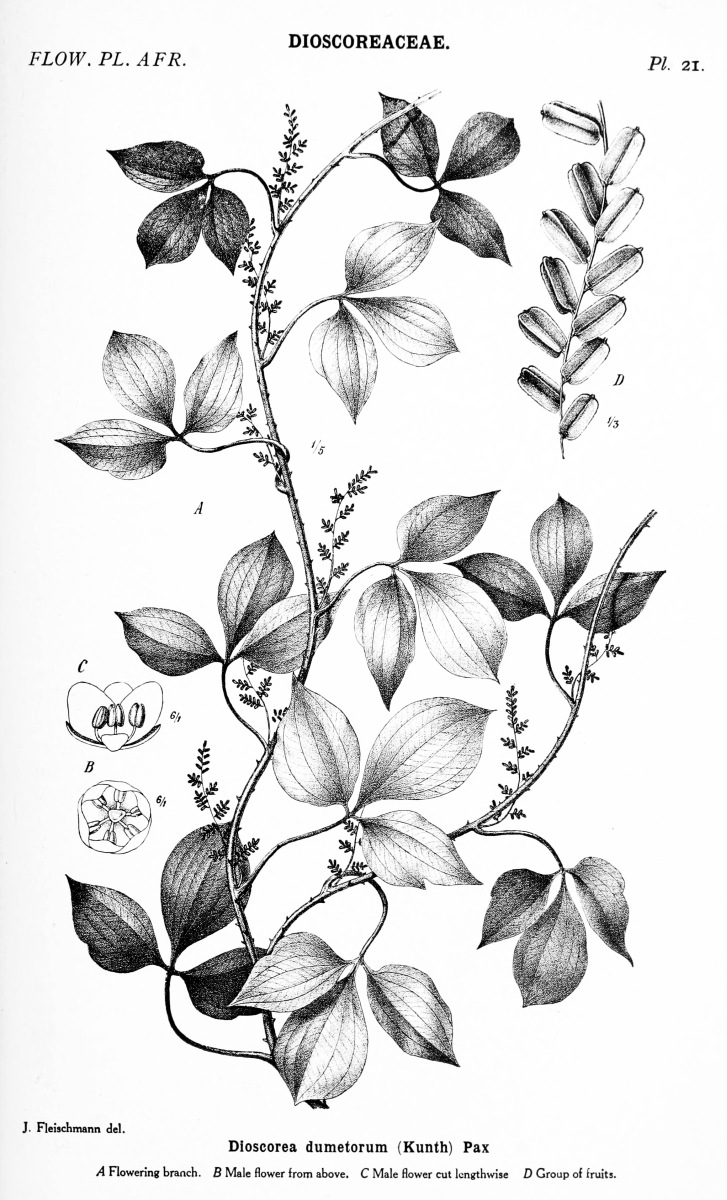
DIOSCOREACEAE.
FLOW. PL. AFR.
Pl. 21.
J. Fleischmann del.
Dioscorea dumetorum (Kunth) Pax
A Flowering branch. B Male flower from above. C Male flower cut lengthwise. D Group of fruits.
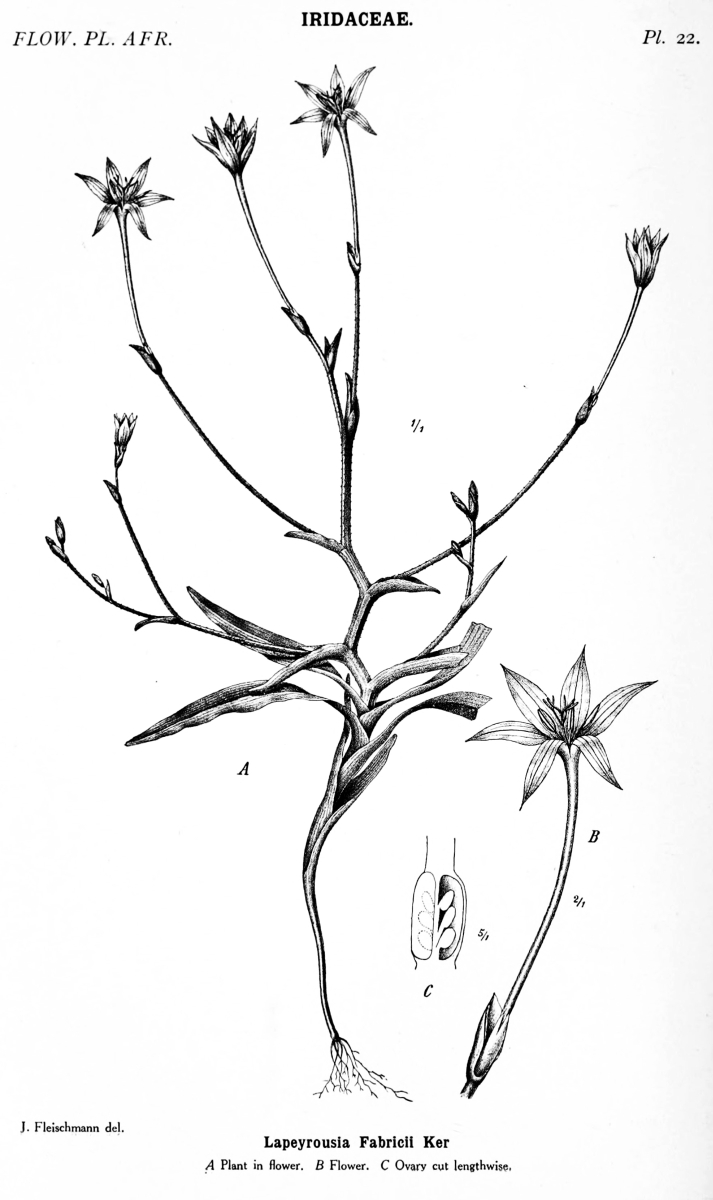
IRIDACEAE.
FLOW. PL. AFR.
Pl. 22.
J. Fleischmann del.
Lapeyrousia Fabricii Ker
A Plant in flower. B Flower. C Ovary cut lengthwise.
Leaves scattered along the stem or crowded at its base. Filaments free, rarely united, but then perianth with a very short tube. Style-branches not petal-like.—Species 50. South and North Africa and mountains of Central Africa. Some are used as ornamental plants. (Trichonema Ker). Romulea Maratti 5. (1.) Spathes 1-flowered, in spikes. Style-branches well developed, generally alternate with the anthers, thread-shaped or thickened at the top, more rarely dilated and almost petal-like, but undivided. Flower usually more or less irregular. Stem leafy. [Subfamily IXIOIDEAE.] 6 Spathes 2- or more-flowered, rarely 1-flowered, but then style-branches either reduced to short teeth, or opposite the anthers, petal-like, and 2-lobed. Flowers regular, but the inner perianth-segments often very different from the outer ones. [Subfamily IRIDOIDEAE.] 23 6. Style-branches 2-parted. [Tribe WATSONIEAE.] 7 Style-branches undivided. 10 7. Flowers small. Perianth with a short tube, red or blue. Ovules 2 in each ovary-cell.—Species 2. South Africa (Cape Colony). Micranthus Pers. Flowers large or rather large. Perianth with a long or rather long tube. Ovules many in each ovary-cell. 8 8. Perianth-tube straight or nearly so. Filaments short, inserted at the throat of the perianth.—Species 40. South and Central Africa. Some have edible tubers or serve as ornamental plants. (Plate 22.) Lapeyrousia Pourr. Perianth-tube curved. Filaments long, inserted below the throat of the perianth. 9 9. Spathes short, scarious. Perianth yellowish, with unequal segments.—Species 2. South Africa. Used as ornamental plants. Freesia Klatt Spathes rather long, rigid. Perianth red or white, with almost equal segments.—Species 15. South Africa, Madagascar, and Mascarenes. Some are used as ornamental plants. Watsonia Mill. 10. (6.) Flowers distinctly irregular. [Tribe GLADIOLEAE.] 11 Flowers regular or almost so. Filaments and style straight. [Tribe IXIEAE.] 18 11. Perianth curved. 12 Perianth straight. 13 12. Perianth-tube longer than the limb, filiform below, cylindrical above. Stamens inserted in the basal part of the tube. Spathes small.—Species 20. South and Central Africa. Some are used as ornamental plants. (Including Anisanthus Sweet). Antholyza L. Perianth-tube as long as or shorter than the limb, funnel-shaped.—Species 120. Some of them have edible bulbs, others are used in medicine or as ornamental plants. Gladiolus L. 13. Leaves folded, usually hairy. Perianth with a long tube.—Species 30. South Africa and Island of Socotra. Several species have edible bulbs or are used as ornamental plants. Babiana Ker Leaves flat, glabrous. 14 14. Perianth-segments almost free, thinly acuminate, yellowish-green. Ovules 2-3 in each ovary-cell. Inflorescence paniculate.—Species 1. South Africa (Cape Colony). Melasphaerula Ker Perianth-segments evidently united below, obtuse or shortly mucronate. Ovules usually numerous. 15 15. Perianth-tube funnel-shaped (distinctly widened above). Style-branches filiform. Spathe-bracts lacerated. 16 Perianth-tube more or less cylindrical (slightly or not widened above). Style-branches usually dilated. Spathe-bracts entire or toothed. 17 16. Perianth 2-lipped, with a long or rather long tube, yellow or violet. Style-branches short.—Species 3. South Africa (Cape Colony). Used as ornamental plants. Synnotia Sweet Perianth regular, with a short or rather short tube, yellow, red or variegated. Style-branches long.—Species 3. South Africa (Cape Colony). Used as ornamental plants. The bulbs are edible. Sparaxis Ker 17. Spathe-bracts long, green, entire. Inflorescence spicate. Perianth nearly always with a long tube.—Species 20. South and Central Africa. Used as ornamental plants. Acidanthera Hochst. Spathe-bracts short, brown, toothed at the top. Inflorescence spicate or paniculate. Perianth with a short or rather short tube.—Species 35. South and Central Africa. Many of them are used as ornamental plants; some yield edible bulbs or a substitute for saffron. (Including Crocosmia Planch., Montbretia DC., and Tritonixia Klatt). Tritonia Ker 18. (10.) Style-branches club-shaped. 19 Style-branches linear or subulate. 20 19. Stigmas notched. Flowers white or yellow. Spathe-bracts lacerated. Leaves short.—Species 2. South Africa (Cape Colony). Streptanthera Sweet Stigmas entire. Flowers white or red. Spathe-bracts entire. Leaves long.—Species 2. South and East Africa. Used as ornamental plants. Dierama C. Koch 20. Style-branches linear, slightly dilated, short. Outer spathe-bract brown.—Species 20. South Africa. Some are used as ornamental plants. (Including Morphixia Ker). Ixia L. Style-branches subulate. Spathe-bracts green or brown at the tip. 21 21. Style long, with short branches.—Species 35. South Africa, southern Central Africa, and Madagascar. Some are used as ornamental or medicinal plants. Geissorrhiza Ker Style short, with long branches. 22 22. Underground part of the stem a root-stock. Perianth red. Filaments as long as or longer than the anthers.—Species 2. South Africa. Used as ornamental plants. Schizostylis Backh. & Harv. Underground part of the stem a corm. Filaments short.—Species 35. South Africa and mountains of Central Africa. Some are used as ornamental plants. Hesperantha Ker 23. (5.) Style-branches undivided, very short or thread-shaped or somewhat broadened at the top, but not petal-like, nearly always alternate with the stamens. 24 Style-branches more or less divided or petal-like, opposite the stamens. Perianth with a short tube or without a tube. Fruit not enclosed by the spathe. 32 24. Perianth with a distinct tube. Filaments free. Style-branches very short. Fruit, wholly or for the greater part, enclosed by the spathe. [Tribe ARISTEAE, Subtribe ARISTINAE.] 25 Perianth divided nearly or quite to the ovary. Style-branches usually long. Fruit not enclosed by the spathe. [Tribe SISYRINCHIEAE.] 30 25. Perianth-segments very unequal, the inner much larger than the outer, blueish, the outer black; tube short. Spathes 2-3-flowered, solitary or in corymbs.—Species 1. South Africa (Cape Colony). Cleanthe Salisb. Perianth-segments almost equal. 26 26. Stem and leaves without green colour. Leaves short, scale-like. Flowers in umbel-like cymes. Perianth white, with a short tube.—Species 1. Madagascar. Geosiris Baill. Stem and leaves green. Leaves long, linear or sword-shaped. Perianth blue, rarely yellowish or whitish. 27 27. Spathes 3- or more-flowered, solitary or in spikes, racemes or corymbs. Herbs. Perianth with a short tube.—Species 30. Southern and tropical Africa. Some are used as ornamental or medicinal plants. Aristea Ait. Spathes 1-2-flowered. Undershrubs. 28 28. Perianth with a short tube and clawed segments, blue. Filaments long. Spathes in heads.—Species 1. South Africa (Cape Colony). Klattia Bak. Perianth with a long tube. Filaments short. 29 29. Perianth blue, glabrous, with a cylindrical tube. Filaments awl-shaped. Anthers small. Spathes solitary or in corymbs.—Species 2. South Africa (Cape Colony). Used as ornamental plants. (Under Aristea Ait.) Nivenia Vent. Perianth greenish-yellow, hairy outside, with a funnel-shaped tube. Filaments flat. Anthers large. Spathes surrounded by empty bracts and arranged in heads.—Species 1. South Africa (Cape Colony). Used as an ornamental plant; the stem contains sugar. Witsenia Thunb. 30. Filaments united into a tube. Perianth blue.—Species 1. Naturalised in the Mascarene Islands. An ornamental plant. [Subtribe SISYRICHINAE.] Sisyrinchium L. Filaments free or nearly so. Perianth yellow or red. [Subtribe LIBERTINAE]. 31 31. Stem leafy. Spathes in lax corymbs. Perianth orange-coloured. Style filiform, with club-shaped, erect or spreading stigmas.—Species 1. Naturalised in the Mascarene Islands. An ornamental and medicinal plant. Belamcanda Adans. Stem leafless. Spathes solitary or in heads. Perianth pale yellow. Style very short, with thread-shaped, recurved stigmas.—Species 6. South Africa. Bobartia Ker 32. (23.) Stigmas at the tip of the style-branches. Inner and outer perianth-segments almost equal. Filaments united. Underground part of the stem a bulb. [Tribe TIGRIDIEAE, subtribe CIPURINAE.] 33 Stigmas on the underside of the dilated style-branches. Inner and outer perianth-segments unequal. [Tribe MORAEEAE.] 36 33. Style-branches simple or one of them forked. 34 Style-branches divided. Perianth-segments usually crisped. 35 34. Perianth white, divided to the ovary.—Species 1. South-east Africa (Natal). Keitia Regel Perianth yellow or brownish-red, with a short tube.—Species 12. South Africa; one species also naturalised in St. Helena. Used as ornamental plants. Homeria Vent. 35. Perianth yellow, divided to the ovary, twisting up in fading. Style-branches cylindrical, glabrous.—Species 2. South Africa (Cape Colony). Hexaglottis Vent. Perianth greenish brownish or red, with a short tube. Style-branches dilated, fringed on the margin.—Species 8. South Africa and southern West Africa. Some are used as ornamental plants. Ferraria L. 36. Style-branches broadened, but not petal-like. Perianth blue; segments free, the inner with the edges rolled inwards and the tip recurved. Filaments free. Scape flattened.—Species 1. Angola and islands of equatorial West Africa. Used as an ornamental plant. [Subtribe MARICINAE.] Marica Ker Style-branches winged, petal-like. [Subtribe IRIDINAE.] 37 37. Perianth-segments free, not bearded. Filaments usually united.—Species 60. Southern and tropical Africa. Several species have edible root-stocks, others are poisonous, many are used as ornamental plants. (Including Dietes Salisb. and Vieusseuxia Delaroche). Moraea L. Perianth-segments united at the base. Filaments free. 38 38. Ovary 1-celled with parietal placentas. Inner perianth-segments linear, acuminate.—Species 1. North-west Africa (Algeria). Hermodactylus Adans. Ovary 3-celled, with axile placentas.—Species 15. North Africa. Many of them are used as ornamental plants, some are poisonous; the root-stock of several species (orris-root) is edible and yields tanning materials, perfumes, and medicaments. Iris L.
ORDER SCITAMINEAE
FAMILY 39. MUSACEAE
Tall herbaceous plants. Leaves with a large, oblong or ovate, penni-nerved blade. Flowers subtended by large bracts and arranged in usually spicate rows or cymes, irregular. Perianth corolla-like. Fertile stamens 5, rarely 6. Filaments free. Anthers 2-celled. Ovary inferior, 3-celled. Style free from the stamens, 3-6-lobed. Seeds with a straight embryo and mealy albumen.—Genera 4, species 25. (Under SCITAMINEAE.) (Plate 23.)
1. Leaves spirally arranged. Partial inflorescences consisting of 1-2 rows of flowers. Flowers monoecious or polygamous. Sepals and two of the petals united below. Fruit berry-like. Seeds without an aril.—Species 15, growing wild in the tropics, besides 4 (especially M. paradisiaca L.) which are cultivated in various regions. They yield fibre (Manila hemp), tanning and dyeing materials, vegetables, and edible fruits (bananas and plantains), from which also starch, sugar, vinegar, and alcoholic liquor are made. Some species are used as ornamental plants. [Subfamily MUSOIDEAE.] Musa L. Leaves 2-ranked. Partial inflorescences cymose. Flowers hermaphrodite. Sepals free or the lateral ones united with the petals. Fruit capsular. [Subfamily STRELITZIOIDEAE.] 2 2. Odd sepal posterior. Petals united at the base. Ovules solitary in each ovary-cell. Fruit opening septicidally. Seeds without an aril.—Species 1. Naturalised on the Canary Islands. An ornamental plant; the root-stock is edible. [Tribe HELICONIEAE.] Heliconia L. Odd sepal anterior. Petals free, at least one of them. Ovules many in each ovary-cell. Fruit opening loculicidally. Seeds with an aril. [Tribe STRELITZIEAE.] 3 3. Petals very unequal, the two lateral ones elongated, connate on one side, provided with a wing-like appendage on the other, the third petal very short. Stamens 5. Aril yellow. Inflorescence few-flowered. Stem moderately tall.—Species 4. South Africa. Some are used as ornamental plants. (Plate 23.) Strelitzia L. Petals subequal, free, without an appendage. Stamens 6. Aril blue. Inflorescence many-flowered. Stem very tall. Species 1 (R. madagascariensis Sonn., traveller’s tree). Madagascar and Mascarene Islands. The leaves are used in house-building; their sheaths retain much water; the sap also furnishes a drink. The seeds are edible and yield a fat. Ravenala Adans.
FAMILY 40. ZINGIBERACEAE
Herbs. Stem simple, springing from a root-stock. Leaves stalked or provided with a sheath, oblong or lanceolate. Flowers in spikes racemes heads or panicles, more or less irregular, hermaphrodite, very rarely dioecious. Perianth consisting of a calyx and a corolla. Sepals united below. Petals subequal, united below. Fertile stamen 1. Anther 2-celled, opening by longitudinal slits. Staminodes 1-3, petal-like, at least one of them (the lip). Ovary inferior, more or less completely 3-celled. Ovules numerous. Style enclosed in a groove of the filament. Stigma funnel-shaped. Fruit a capsule or a berry. Seed with a straight embryo and mealy albumen.—Genera 11, species 120. Tropical and South-east Africa. (Under SCITAMINEAE.) (Plate 24.)
1. Leaves spirally arranged; sheath at first closed, articulated with the petiole. Filaments petal-like. Lateral staminodes wanting. Epigynous glands none. Stem and leaves not aromatic.—Species 35. Central Africa. Some of them are used as ornamental or medicinal plants and in the preparation of rubber. (Including Cadalvena Fenzl). [Subfamily COSTOIDEAE.] Costus L. Leaves two-ranked; sheath split open, not articulated with the petiole. Epigynous glands present, often style-like. Stem and leaves aromatic. [Subfamily ZINGIBEROIDEAE.] 2 2. Lateral staminodes petal-like, but sometimes adnate to the lip, which then appears 3-lobed. [Tribe HEDYCHIEAE.] 3 Lateral staminodes linear, tooth-like, or wanting; in the latter case lip not distinctly 3-lobed. [Tribe ZINGIBEREAE.] 5 3. Connective spurred. Lateral staminodes adnate below to the filament of the fertile stamen.—Species 1 (C. longa L.). Cultivated and sometimes naturalised in the tropics. The root-stock yields starch, condiments, medicaments, perfumes, and dyeing-materials (turmeric); the leaves are used for plaiting-work. Curcuma L. Connective not spurred. Lateral staminodes free from the filament of the fertile stamen. 4 4. Connective with a crest-like appendage. Filament short. Lateral staminodes broad.—Species 15. Central and South-east Africa. Some are used as ornamental plants. Kaempfera L. Connective without an appendage. Filament long. Lateral staminodes narrow. Inflorescence terminating the leafy stem.—Species 3, two of them natives of Madagascar, the third naturalised in the tropics. Ornamental plants; the tubers yield condiments, perfumes, and medicaments. Hedychium Koen. 5. Connective with a distinct appendage. Flowering stem separated from the leafy stem. 6 Connective without a distinct appendage. 8
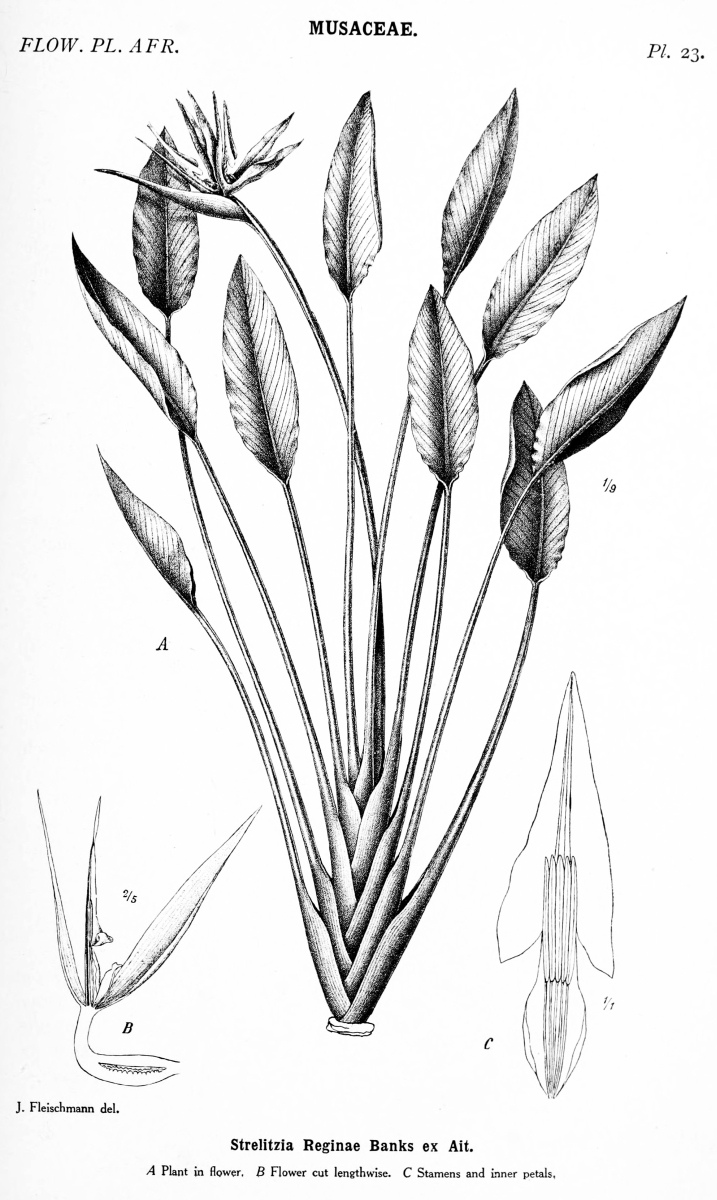
MUSACEAE.
FLOW. PL. AFR.
Pl. 23.
J. Fleischmann del.
Strelitzia Reginae Banks ex Ait.
A Plant in flower. B Flower cut lengthwise. C Stamens and inner petals.
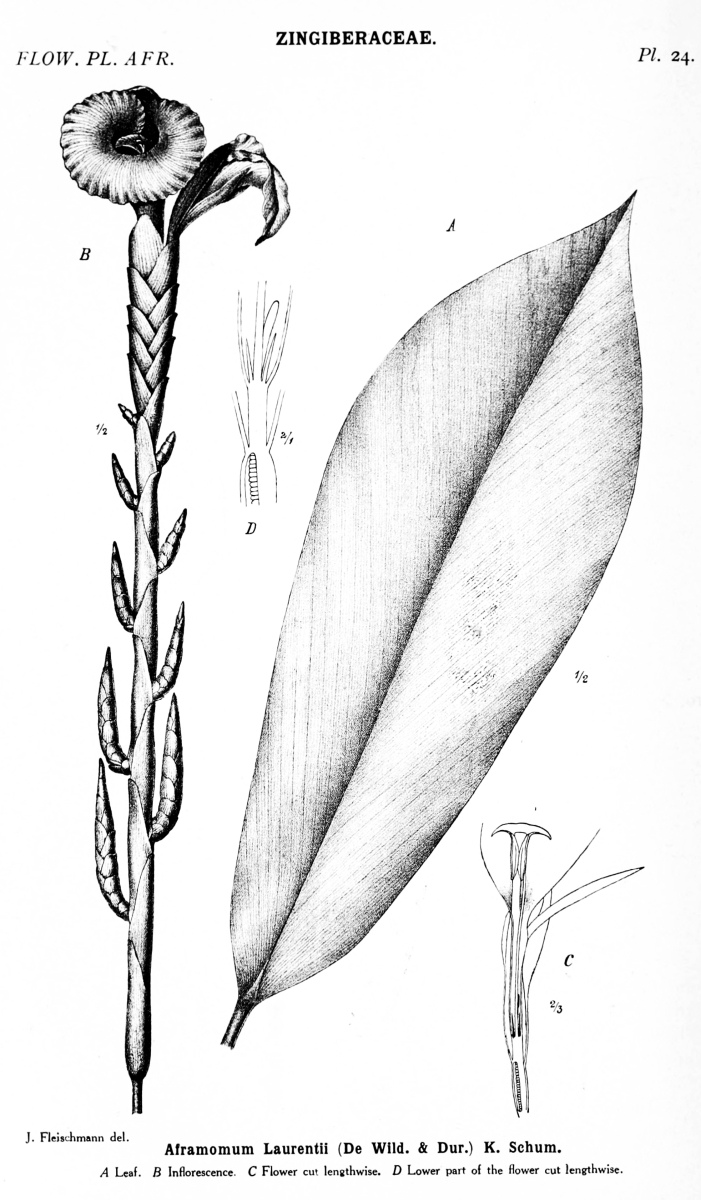
ZINGIBERACEAE.
FLOW. PL. AFR.
Pl. 24.
J. Fleischmann del.
Aframomum Laurentii (De Wild. & Dur.) K. Schum.
A Leaf. B Inflorescence. C Flower cut lengthwise. D Lower part of the flower cut lengthwise.
6. Connective with a grooved beak. Lip 3-lobed.—Species 2. Cultivated and sometimes naturalised in the tropics. The root-stock is used as a condiment, especially for the preparation of liquors, and in medicine. “Ginger.” Zingiber L. Connective with an oblong or 3-lobed, not grooved appendage. Lip not distinctly 3-lobed. 7 7. Connective with an entire, oblong appendage. Filament adnate to the base of the lip. Inflorescence lax.—Species 2. West Africa (Cameroons) and Madagascar. Aulotandra Gagnepain Connective with a 3-lobed appendage. Filament free from the lip. Inflorescence dense.—Species 50. Tropics. The fruits (grains of paradise) of several species (especially A. melegueta Roscoe) are used as a condiment and for the preparation of perfumes and medicaments; others serve as ornamental plants. (Under Amomum L.) (Plate 24.) Aframomum K. Schum. 8. Filament long. Lip not distinctly clawed. Inflorescence terminating the leafy stem.—Species 3. Naturalised in the tropical regions. Ornamental plants. Alpinia L. Filament short. Lip clawed. 9 9. Lip entire, rhomboidical, adnate to the filament at the base. Epigynous glands lobed. Flowering stem separated from the leafy stem. Inflorescence very dense, almost head-like, surrounded by a coloured involucre.—Species 1. Madagascar and neighbouring islands. Used as an ornamental plant, the fruit as a condiment. (Nicolaia Horan., under Amomum L.) Phaeomeria Lindl. Lip more or less distinctly 3-lobed, free from the filament. 10 10. Fruit indehiscent. Seeds without an aril. Corolla-tube slightly exceeding the calyx. Stigma small. Inflorescence springing from the base of the leafy stem, lax, paniculate.—Species 1 (E. Cardamomum White et Maton). Cultivated in the tropics and naturalised in the Mascarene Islands. The fruits (cardamoms) are used as a condiment and for the preparation of perfumes and medicaments. Elettaria Maton Fruit dehiscent. Seeds with an aril. Calyx closed in bud. Inflorescence usually terminal.—Species 15. Central Africa. (Ethanium Salisb.) Renealmia L. f.
FAMILY 41. CANNACEAE
Herbs. Leaves large, penninerved. Inflorescence spicate or formed of cymes. Flowers irregular and asymmetrical, hermaphrodite. Sepals free. Petals united below. Fertile stamen single, 1-celled, the barren half leaf-like. Staminodes leaf-like. Ovary inferior, 3-celled, with numerous inverted ovules. Style and stigma simple. Fruit capsular. Seeds albuminous; embryo straight. (Under SCITAMINEAE.)
Genus 1, species 5. Cultivated and sometimes naturalised in various regions. They yield starch, vegetables, medicaments, and dyeing materials, and are also used as ornamental plants. “Indian shot.” Canna L.
FAMILY 42. MARANTACEAE
Herbs or undershrubs. Leaves stalked, with a swelling in the upper part of the stalk, penninerved. Inflorescence spicate, capitate, or paniculate. Flowers irregular and asymmetrical, hermaphrodite. Sepals free. Petals united below. Fertile stamen single, 1-celled. Staminodes 2-4, petal-like. Ovary inferior, 1-or 3-celled. Ovules solitary in each cell, inverted. Style simple; stigma entire or lobed. Seeds with a mealy albumen and a curved embryo.—Genera 12, species 60. Tropics. (Under SCITAMINEAE.) (Plate 25.)
1. Ovary 1-celled. [Tribe MARANTEAE.] 2 Ovary 3-celled, but the ovules of 2 cells sometimes abortive. [Tribe PHRYNIEAE.] 3 2. Corolla-tube very short. Staminodes 3, one of them with two filiform appendages. Fruit indehiscent. Bracts enclosing one pair of flowers each.—Species 7. Central Africa. Used as ornamental plants. Thalia L. Corolla-tube long. Staminodes 4. Fruit dehiscent. Bracts enclosing 3 pairs of flowers each.—Species 1 (M. arundinacea L.) Cultivated and sometimes naturalised in the tropics. The root-stock contains starch (arrow-root). Maranta L. 3. Staminodes 2. Fruit winged. Inflorescence spike-like, springing from the root-stock. Bracts enclosing one pair of flowers each.—Species 1. West Africa. The fruits are edible and contain sugar. Thaumatococcus Benth. Staminodes 4, rarely 3. 4 4. Bracts approximated in one row, enclosing two pairs of flowers each. Ovary with 1 fertile and 2 sterile cells.—Species 1. Madagascar. (Under Myrosma Benth. or Phrynium Willd.) Ctenophrynium K. Schum. Bracts in two opposite rows. 5 5. Flower-pairs with small, thickened, almost gland-like scales inserted above the bracts and the 2-keeled bracteoles which usually accompany the bracts. 6 Flower-pairs without gland-like scales above the bracts and bracteoles. 8 6. Ovary and fruit smooth, the latter fleshy. Leaves having the larger half all on the same side. Herbs with a simple stem. Inflorescence panicle-, very rarely spike-like.—Species 13. West Africa. Some have edible fruits. (Under Phrynium Willd. or Phyllodes Lour.) Sarcophrynium K. Schum. Ovary and fruit covered with pointed protuberances, the latter dry. Leaves having the larger half some on the right, some on the left side. Undershrubs or climbing herbs with a branched stem. Inflorescence spike-like. 7 7. Fruit dehiscent, covered with small protuberances. Seeds with an aril. Flower-pairs without a bracteole.—Species 1. West Africa. (Under Trachyphrynium Benth.) Hybophrynium K. Schum.
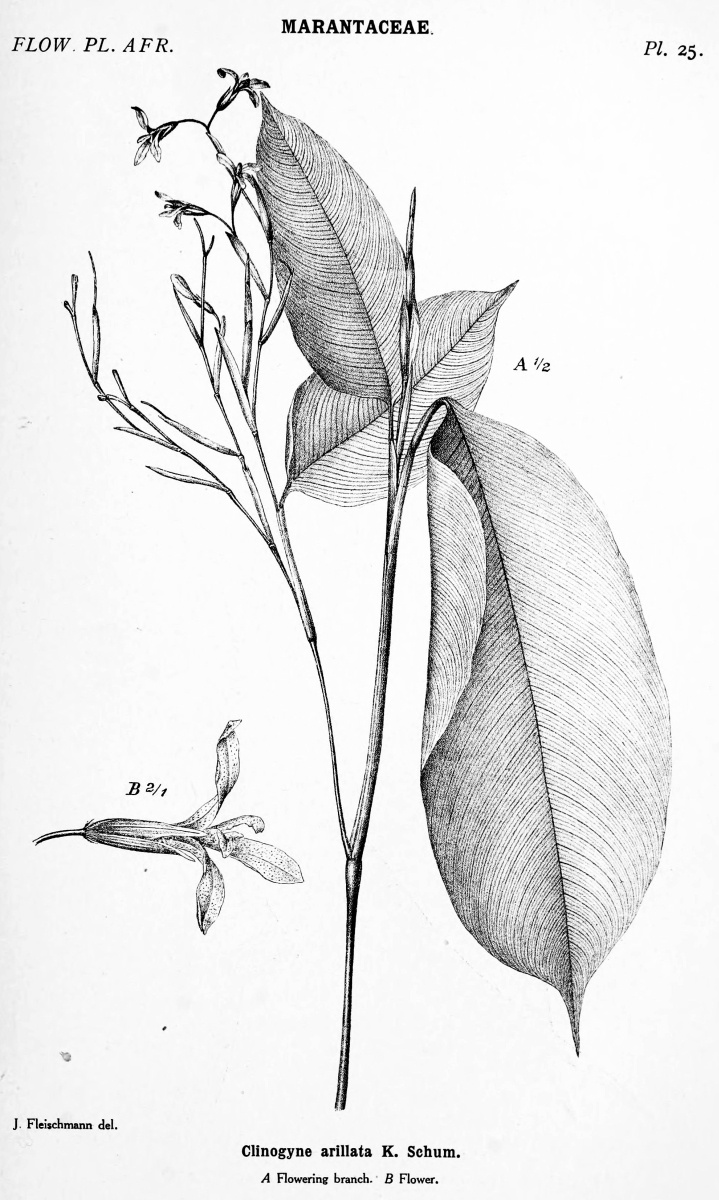
MARANTACEAE.
FLOW. PL. AFR.
Pl. 25.
J. Fleischmann del.
Clinogyne arillata K. Schum.
A Flowering branch. B Flower.
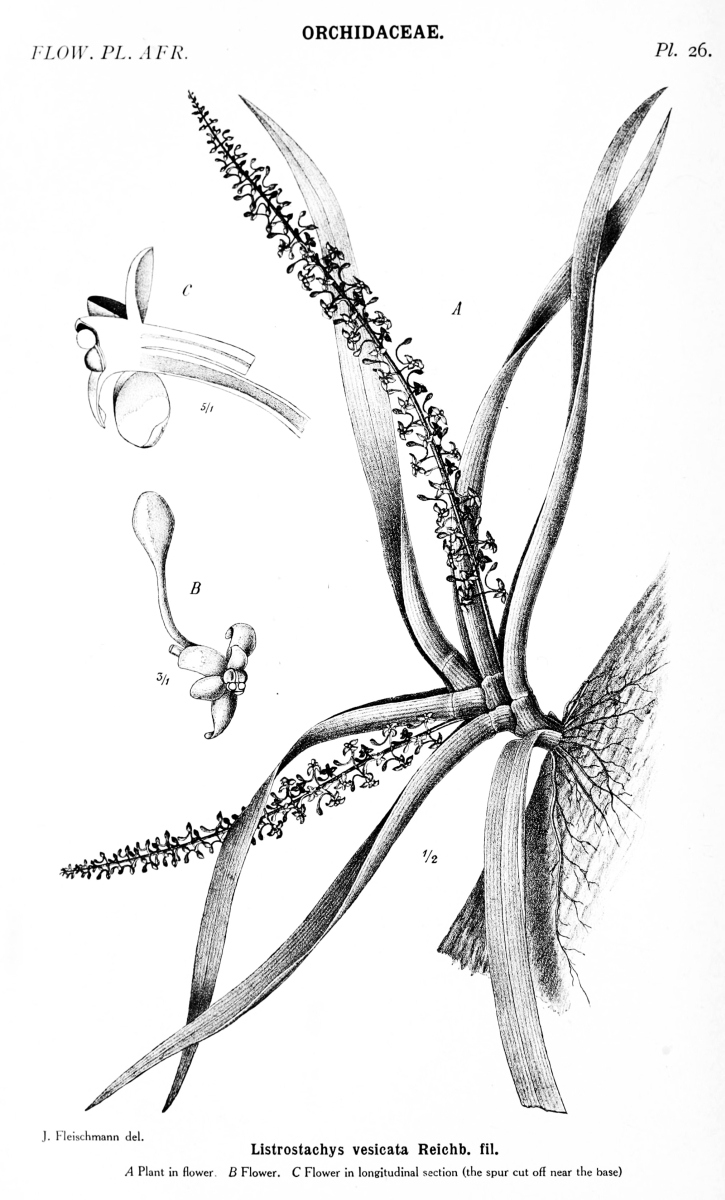
ORCHIDACEAE.
FLOW. PL. AFR.
Pl. 26.
J. Fleischmann del.
Listrostachys vesicata Reichb. fil.
A Plant in flower. B Flower. C Flower in longitudinal section (the spur cut off near the base).
Fruit indehiscent, covered with large protuberances. Seeds without an aril. Flower-pairs with a bracteole.—Species 6. West Africa. Trachyphrynium Benth. 8. Inflorescence springing from the root-stock and separated from the 1-leafed stem, spike-like. Inner staminodes, at least one of them, equalling the outer.—Species 1. Equatorial West Africa. (Under Calathea Mey.) Afrocalathea K. Schum. Inflorescence terminating the leafy, sometimes very short stem or its branches. 9 9. Inner staminodes larger than the outer, the hooded one without a strap-shaped appendage. Bracts enclosing 2-4 sessile pairs of flowers each. Inflorescence head-like. Stem branched.—Species 1. Equatorial West Africa (Gaboon). Ataenidia Gagnepain Inner staminodes smaller than the outer. 10 10. Sepals very unequal. Fruit dry, indehiscent, with adnate seeds. Inflorescence consisting of 2-3 spikes. Bracts enclosing one pair of flowers each, persistent.—Species 1. Equatorial Africa. Used in the preparation of salt. (Under Clinogyne Benth. or Donax Lour.) Halopegia K. Schum. Sepals subequal. Bracts usually enclosing 2-4 pairs of flowers each. 11 11. Inflorescence head-like. Bracts persistent.—Species 2. West Africa. (Under Calathea Mey.) Phrynium Willd. Inflorescence raceme- or panicle-like. Bracts deciduous.—Species 25. West Africa, Upper Nile, and Island of Réunion. Some species yield starch or fibre. (Donax Lour., including Marantochloa Griseb.) (Plate 25.) Clinogyne Salisb.
ORDER MICROSPERMAE
SUBORDER BURMANNIINEAE
FAMILY 43. BURMANNIACEAE
Herbs. Leaves narrow or scale-like. Flowers solitary or in cymose, usually spike-like inflorescences, regular or nearly so, hermaphrodite or polygamous. Perianth-segments 3 or 6, petaloid, united below. Stamens 3, opposite the inner perianth-segments, or 6. Ovary inferior, 1-or 3-celled. Ovules numerous, inverted. Style 3-or 6-cleft. Fruit dry, dehiscing by slits or irregularly. Seeds albuminous; testa loose.—Genera 4, species 15. Tropical and South Africa.
1. Anthers erect, opening transversely, 3. Style long, with 3 stigmas. [Tribe BURMANNIEAE.] 2 Anthers recurved, opening lengthwise. Style short. [Tribe THISMIEAE.] 3 2. Ovary 1-celled.—Species 3. Central Africa. Gymnosiphon Blume Ovary 3-celled.—Species 10. Tropical and South Africa. Burmannia L. 3. Corolla regular. Stamens 3; connective without an appendage. Stigma 3-parted.—Species 1. West Africa (Cameroons). Oxygyne Schlecht. Corolla irregular. Stamens 6; connective with an appendage. Stigma 6-toothed.—Species 2. West Africa (Cameroons). (Under Thismia Griff.) Afrothismia (Engl.) Schlecht.
SUBORDER GYNANDRAE
FAMILY 44. ORCHIDACEAE
Leaves with longitudinal nerves. Inflorescence of the racemose type. Flowers irregular. Perianth more or less corolla-like or distinguished into calyx and corolla, one of the petals or segments (the lip) distinctly differing from the others. Receptacle usually continued beyond the ovary and forming the column upon which the stigma and the anther are inserted. Fertile stamen 1, belonging to the outer whorl. Staminodes sometimes present. Ovary inferior, 1-celled, with numerous parietal ovules. Stigmas or stigma-lobes 3, one of them rudimentary or transformed into the rostellum, to which the pollen-masses adhere. Seeds very small, exalbuminous; embryo imperfectly developed.—Genera 96, species 1600. (Plate 26.)
1. Pollen-masses with basal, stalk-like appendages, which adhere to the sticky, gland-like appendages of the rostellum. Root thickened into tubers. [Tribe OPHRYDEAE.] 2 Pollen-masses with apical appendages or without appendages. 37 2. Anther reflected, forming an angle with the column. Lip with 2 spurs or without a spur, but sometimes saccate or bearing appendages on the back. 3 Anther erect, having the same direction as the column, rarely slightly reflected, but then lip with one spur. 14 3. Lip partly adnate to the column, usually bearing on its upper face a large appendage. Petals broad, converging and usually cohering with the middle sepal into a hood. [Subtribe CORYCIINAE.] 4 Lip free from the column, inserted at its base, rarely shortly adnate to it, but then petals not distinctly converging into a hood. [Subtribe SATYRIINAE.] 7 4. Lateral sepals united nearly to the apex.—Species 10. South Africa. Corycium Swartz Lateral sepals free. 5 5. Lateral sepals spurred or saccate.—Species 30. Southern and tropical Africa. Disperis Swartz Lateral sepals flat. 6 6. Column short. Lip broad at the base. Connective dilated.—Species 15. South Africa. (Including Ommatodium Lindl.) Pterygodium Swartz Column long. Lip clawed. Connective not dilated.—Species 8. South Africa (Cape Colony). Ceratandra Eckl. 7. Lip posticous (uppermost), produced behind into a pair of descending spurs or sacs.—Species 90. Tropical and South Africa. Some are used in medicine. (Including Aviceps Lindl. and Satyridium Lindl.) Satyrium Swartz Lip usually anticous, not spurred, but sometimes with a sac-like cavity. 8 8. Odd sepal spurred or gibbous. 9 Odd sepal neither spurred nor gibbous. 13 9. Lip more or less saccate at the base. 10 Lip flat. 11 10. Lip very small, adnate to the column. Stem rather rigid. Leaves in the middle of the stem.—Species 9. South Africa and mountains of the tropics. Brownleea Harv. Lip rather large, free from the column. Stem very flexible. Leaves at the base of the stem.—Species 6. South Africa (Cape Colony). (Under Disa Berg). Schizodium Lindl. 11. Rostellum with 2 distinct glands, to which the pollen-masses are attached; side-lobes exceeding the middle-lobe.—Species 110. Southern and tropical Africa. Some are used as ornamental plants. (Including Penthea Lindl.) Disa Berg Rostellum with one gland; sides-lobes, if present, not exceeding the middle-lobe. 12 12. Stigma 2-parted. Rostellum with 3 narrow, subequal lobes.—Species 10. South Africa to Nyasaland. (Under Disa Berg). Herschelia Lindl. Stigma entire. Rostellum more or less hood-shaped, large.—Species 15. South Africa. (Under Disa Berg). Monadenia Lindl. 13. Petals much narrower than the odd sepal, kneed. Lip kidney-shaped. Stigma not extended in two branches.—Species 1. South Africa (Cape Colony). (Under Disa Berg). Forficaria Lindl. Petals and sepals subequal. Stigma with 2 erect, linear branches.—Species 2. South Africa (Cape Colony). Pachites Lindl. 14. (2.) Stigma extended into two, usually elongated processes. [Subtribe HABENARIINAE.] 15 Stigma not extended into processes, rather flat. Column very short. 21 15. Stigmatic processes short, adnate to the lip. Rostellum small, not prolonged into anther-channels. Column very short.—Species 10. Tropics. (Under Habenaria L. or Platanthera Rich.) Peristylus Blume Stigmatic processes free 16 16. Column long, curved. Rostellum not prolonged into anther-channels. Perianth subglobose.— Species 1. Mascarene Islands. Acrostylia Frapp. Column short 17 17. Rostellum or stigmatic processes 2-cleft. Base of the anther not enclosed by a channel, but prolonged into solid processes.—Species 7. Central Africa. (Under Habenaria Willd.) Roeperocharis Reichb. Rostellum and stigmatic processes entire, the former prolonged at the base into two lateral anther-channels. 18 18. Anther reflected. Stigma broad. 19 Anther erect. Stigma more or less slender. 20 19. Middle-lobe of the rostellum exceeding the side-lobes. Lip linear, entire, with a long spur. Petals broad.—Species 1. Southern West Africa. (Under Habenaria Willd.) Barlaea Reichb. fil. Middle-lobe of the rostellum equalling the side-lobes. Lip oblong or broader, usually lobed.—Species 40. Tropical and South-east Africa. (Cynosorchis Thouars, including Amphorchis Thouars, Hemiperis Frapp., and Camilleugenia Frapp.) Cynorchis Thouars 20. Stigmatic processes diverging at a right angle. Spur short.—Species 1. North-west Africa. (Tinea Biv.) Neotinea Reichb. fil. Stigmatic processes nearly parallel.—Species 210. (Including Bonatea Willd., Platycoryne Reichb., and Podandria Rolfe). Habenaria Willd. 21. (14.) Glands of the rostellum enclosed in 1-2 pouches proceeding from the rostellum and persisting when the glands are removed. [Subtribe SERAPIADINAE.] 22 Glands of the rostellum enclosed by the processes of the anther or naked, rarely covered by a thin pellicle proceeding from the rostellum and carried away with the glands upon removal. [Subtribe GYMNADENIINAE.] 27 22. Glands enclosed in 2 separate pouches. Lip not spurred, usually convex, gibbous and hairy.—Species 10. North Africa. The tubers yield medicaments (salep) and mucilage. Ophrys L. Glands enclosed in a common pouch. 23 23. Glands 2, free. Lip spurred.—Species 20. North Africa. The tubers yield medicaments (salep) and mucilage. Orchis L. Glands united into one. 24 24. Connective distinctly elongated. Rostellum laterally compressed. Lip not spurred; middle-lobe entire.—Species 4. North-west Africa. They yield medicaments and mucilage. Serapias L. Connective not or scarcely elongated. Rostellum conical at the apex. Lip spurred, rarely without a spur, but then with a 2-cleft middle-lobe. 25 25. Lip with a long spur and two protuberances at the base, equally 3-lobed, flat in the bud.—Species 1. North-west Africa (Algeria). It yields medicaments and mucilage. (Under Orchis L.) Anacamptis Rich. Lip with a short spur or without a spur, with unequal lobes, bent inwards or rolled up in the bud. 26 26. Middle-lobe of the lip very long, strap-shaped, spirally coiled in the bud.—Species 1. North-west Africa (Algeria). (Under Aceras R. Br. or Orchis L.) Himantoglossum Spreng. Middle-lobe of the lip moderately long, 2-cleft, bent over the anther in the bud.—Species 2. North Africa. (Including Barlia Parl.) Aceras R. Br. 27. (21.) Glands of the rostellum transversely connate. Rostellum narrow. Stigmatic surface small. Basal appendages of the pollen-masses short. Column short. Lip with a short spur.—Species 40. Tropical and South Africa. (Including Bucculina Lindl., Deroemeria Reichb. fil., Monotris Lindl., Saccidium Lindl., Scopularia Lindl., and Tryphia Lindl.) Holothrix L. C. Rich. Glands of the rostellum free. 28 28. Glands large, surrounded by a thin membrane, which proceeds from the rostellum and is removed together with the glands. Lip with a very short spur. Flowers very small.—Species 1. Island of Réunion. Herminium L. Glands naked, rarely enclosed by processes of the anther, but then small. 29 29. Petals clawed; blade deeply concave, fringed. Lip fringed, not spurred.—Species 4. South Africa. (Including Hallackia Harv.) Huttonaea Harv. Petals not clawed, flat or slightly concave. 30 30. Rostellum forming a narrow fold between the anther-cells. 31 Rostellum broad, triangular, placed below the anther-cells. 33 31. Column short. Stigmatic surfaces convex. Lip shortly or not spurred. Flowers yellow or white.—Species 5. South Africa and southern East Africa. (Schizochilus Sond.) Gymnadenia R. Br. Column long. Stigmatic surfaces concave. 32 32. Petals partly adnate to the column. Lip not spurred. Sepals and petals subequal.—Species 1. South Africa. (Under Brachycorythis Lindl.) Neobolusia Schlecht. Petals inserted below the column.—Species 25. Tropical and South Africa. (Including Schwartzkopffia Kraenzl., under Platanthera Rich.) Brachycorythis Lindl. 33. Lip with a spur. 34 Lip without a spur. 36 34. Lip 3-lobed, the side-lobes inflexed, covering the mouth of the spur.—Species 3. Madagascar. Bicornella Lindl. Lip 3-lobed, with erect or spreading side-lobes, or undivided. 35 35. Lip fringed. Anther-cells approximate and parallel.—Species 2. South Africa. Bartholina R. Br. Lip entire or crenate. Anther-cells divergent.—Species 20. The tubers yield medicaments (salep) and mucilage. (Including Gennaria Parl., under Habenaria Willd.) Platanthera L. C. Rich. 36. Lip 3-lobed. Column with 2 basal staminodes. Basal appendages of the pollen-masses very short.—Species 3. South Africa and southern East Africa. Stenoglottis Lindl. Lip undivided. Column without distinct staminodes.—Species 2. Madagascar and Mascarenes. Arnottia A. Rich. 37. (1.) Pollen-masses soft, granular. Anthers usually persistent and withering. Inflorescence terminal. Leaves rolled up in the bud, with overlapping edges. Usually terrestrial herbs. [Tribe NEOTTIEAE.] 38 Pollen-masses firm, waxy. Anthers usually deciduous. Inflorescence lateral, more rarely terminal, but then leaves folded lengthwise in the bud. 55 38. Anther erect and greatly exceeding the rostellum, or inclined and incumbent upon the rostellum. Pollen-masses granular or powdery. Rostellum not distinctly notched after the removal of the pollen-masses, or not distinctly cohering with them. 39 Anther about equalling the rostellum, erect, rarely incumbent, but then pollen-masses divided into a number of large angular sections. Rostellum usually distinctly notched after the removal of the pollen-masses. 47 39. Lip distinctly articulated into 2-3 portions placed one behind the other. Anther erect. [Subtribe CEPHALANTHERINAE.] 40 Lip not distinctly articulated, embracing the column. Anther more or less incumbent. 42 40. Lip produced into a spur. Leaves replaced by scales. Plants of a violet colour.—Species 2. North-west Africa (Algeria). Limodorum L. C. Rich. Lip not distinctly spurred. Leaves perfectly developed. 41 41. Lip saccate at the base; the terminal portion oblong and enclosed by the connivent sepals.—Species 1. North-west Africa (Algeria). Cephalanthera L. C. Rich. Lip concave, but not saccate at the base; the terminal portion broad and projecting between the spreading sepals.—Species 4. North-west Africa and northern East Africa. (Helleborine Hill). Epipactis L. C. Rich. 42. Sepals and petals united below. Leafless herbs. [Subtribe GASTRODIINAE.] 43 Sepals and petals free. 44 43. Sepals and petals united high up, very unequal. Lip ovate, with 2 gibbosities at the base. Column short. Anther incumbent. Root-stock branched. Flowers large, in few-flowered spikes.—Species 1. West Africa (Cameroons). Gastrodia R. Br. Sepals and petals united at the base only, subequal. Lip spatulate, not gibbous. Column long. Anther suberect. Rootstock tuberous, spindle-shaped. Flowers very small, in many-flowered racemes.—Species 1. West Africa (Cameroons). Auxopus Schlecht. 44. Stem climbing. Seed-coat crusty or winged. [Subtribe VANILLINAE.] 45 Stem erect. Seed-coat membranous, not winged. [Subtribe POGONIINAE.] 46 45. Lip adnate to the column. Fruit fleshy. Seeds not winged. Usually leafy plants.—Species 15. Tropics. Two of the species (especially V. planifolia Andr.) are cultivated for their fruits, which are used as condiments and for the preparation of perfumes. Some species are used as ornamental plants. Vanilla Swartz Lip not adnate to the column. Fruit dry. Seeds winged. Leafless plants.—Species 1. Comoro Islands. Galeola Lour. 46. Lip spurred or saccate. Column short. Leaves wanting.—Species 1. West Africa (Cameroons). (Under Epipogon Gmel.) Galera Blume Lip neither spurred nor saccate. Column long. Leaves stalked, usually separated from the flowering stem.—Species 10. Tropics to Transvaal. (Including Apostellis Thouars, under Pogonia Juss.) Nervilia Gaud. 47. (38.) Pollen-masses divided into a moderate number of rather large, angular segments. Leaves not folded lengthwise. [Subtribe PHYSURINAE.] 48 Pollen-masses not divided into several large segments. 53 48. Pollen-masses connected with the glands of the rostellum by a strap-shaped stalk detached from the tissue of the rostellum. 49 Pollen-masses or their appendages adhering directly to the glands of the rostellum. 50 49. Column with 2 narrow, erect arms. Sepals usually united to the middle. Lip with two protuberances at the base and with a two-lobed blade.—Species 4. West Africa, Madagascar, Comoro Islands. Cheirostylis Blume Column without erect arms, but sometimes auricled. Sepals free.—Species 9. Tropical and South-east Africa. (Including Monochilus Blume). Zeuxine Lindl. 50. Lip similar to the other petals, oblong, slightly concave. Stigmas free, erect, one on each side of the rather long rostellum.—Species 2. Madagascar and Mascarene Islands. Gymnochilus Blume Lip distinctly differing from the other petals. 51 51. Column long. Sepals connivent into a tube at the base. Lip with an oblong blade.—Species 6. Comoro Islands, Seychelles, Natal, West Africa. Platylepis A. Rich. Column short. 52 52. Stigma with a papillose protuberance on each side. Lip tubercled at the base, with a distinctly limited broad blade.—Species 3. Mascarenes, Seychelles, Comoro Islands, and Cameroons. Hetaeria Blume Stigma simple. Lip not tubercled, but sometimes hairy at the base; blade not distinctly separated, undivided, bent back at the tip.—Species 3. Mascarene Islands and Madeira. Used as ornamental plants. Goodyera R. Br. 53. (47.) Leaves firm, folded lengthwise. Flowers in panicles. Lip narrow below, broadened above. Pollen-masses affixed to a slender stalk arising from the rostellum; gland peltate.—Species 2. Tropics. (Corymbis Lindl.) [Subtribe TROPIDIINAE.] Corymborchis Thouars Leaves soft, not folded, sometimes scale-like. Flowers in spikes. 54 54. Sepals and petals united into a long tube. Lip uppermost, with 2 lateral appendages. Column elongated, two-winged.—Species 1. West Africa. [Subtribe CRANICHIDINAE.] Manniella Reichb. fil. Sepals and petals free or almost so, suberect. Lip below. Inflorescence one-sided.—Species 2. North-west Africa (Algeria). [Subtribe SPIRANTHINAE.] Spiranthes L. C. Rich. 55. (37.) Inflorescence terminal. Leaves folded lengthwise before expansion. 56 Inflorescence lateral. 65 56. Pollen-masses 8, without an appendage. Lip saccate at the base. Leaves jointed at the upper end of the sheath. Inflorescence head-like.—Species 1. Madagascar and Seychelles. [Tribe GLOMEREAE.] Agrostophyllum Blume Pollen-masses 2-4. 57 57. Column extended below into a foot forming with the base of the perianth a chin or spur. Pollen-masses attached to a short, sometimes scarcely perceptible stalk arising from the rostellum. Mostly epiphytic plants. [Tribe POLYSTACHYEAE.] 58 Column not extended into a foot. Pollen-masses without appendages. Sepals and petals usually bent backwards. [Tribe LIPARIDEAE.] 61 58. Lip spurred, 3-lobed. Pollen-masses 2, grooved. Leaves not jointed, linear. Joints of the stem swollen.—Species 6. South Africa. (Under Eulophia R. Br.) Acrolophia Pfitz. Lip not spurred. Leaves usually jointed. 59 59. Lip undivided. Chin weakly developed. Column short and thick. Stem slender.—Species 1. German East Africa. Neobenthamia Rolfe Lip 3-lobed. 60 60. Lateral sepals forming with the column a weakly developed chin. Side-lobes of the lip embracing the column. Column slender. Stem slightly thickened.—Species 6. Tropical and South-east Africa. Some are used as ornamental plants. Ansellia Lindl. Lateral sepals forming with the column a strongly developed chin. Side-lobes of the lip small. Column short and broad. Stem usually thickened into pseudo bulbs.—Species 120. Tropical and South Africa. Some are used as ornamental plants. (Including Epiphora Lindl.) Polystachya Lindl. 61. Anther erect. Leaves not jointed. 62 Anther inclined to horizontal. 63 62. Anther adnate to the rostellum; cells widely diverging, opening laterally. Column long.—Species 1. West Africa. Orestia Ridl. Anther deciduous, opening inwards. Column short. Lip uppermost.—Species 4. West Africa and Comoro Islands. Microstylis Nutt. 63. Leaves not jointed. Lip more or less distinctly clawed. Column slender.—Species 30. Tropical and South Africa. Liparis L. C. Rich. Leaves jointed between sheath and blade. Lip not distinctly clawed. 64 64. Stem with pseudobulbs. Leaf-blade horizontally flattened.—Species 1. Mascarene Islands. (Cestichis Thouars, under Liparis Rich.) Stichorchis Thouars Stem without pseudobulbs. Leaf-blade placed vertically, fleshy. Lip uppermost, concave at the base.—Species 1. Tropics. Oberonia Lindl. 65. (55.) Leaves with convolute praefoliation (i.e. rolled lengthwise in the bud, one edge overlapping the other). Stem not swollen, or several joints of the stem equally thickened. Mostly terrestrial herbs. 66 Leaves with conduplicate praefoliation (i.e. folded together along the midrib in the bud, their edges being applied to each other without overlapping). Mostly epiphytic herbs. 73 66. Pollen-masses 2-4, without appendages, attached to the glands of the rostellum by a stalk produced from the latter. Leaves usually jointed. [Tribe CYRTOPODIEAE.] 67 Pollen-masses 8, appendaged, without a stalk produced from the rostellum. Leaves usually continuous. [Tribe PHAIEAE.] 71 67. Lip produced into a spur or pouch at the base. 68 Lip without a spur or pouch. 69 68. Sepals narrower and less coloured than the petals, usually reflected. Petals erect or spreading.—Species 90. Tropical and South Africa. Some are used as ornamental plants. Lissochilus R. Br. Sepals and petals equal or nearly so, spreading.—Species 130. Tropical and South Africa. Some species yield medicaments (salep) and mucilage or serve as ornamental plants. (Including Cyrtopera Lindl. and Orthochilus Hochst.) Eulophia R. Br. 69. Column with 2 basal lobes projecting upon the base of the lip.—Species 4. East Africa. Pteroglossaspis Reichb. fil. Column without appendages. 70 70. Lip and lateral sepals inserted on the foot of the column, the former with a narrow, the latter with a broad base.—Species 1. Madagascar. Eulophiella Rolfe Lip inserted on the foot of the column, the lateral sepals on the margin of the ovary, both with a narrow base.—Species 1. Madagascar and Mascarene Islands. The pseudobulbs yield mucilage. Cyrtopodium R. Br. 71. Leaves jointed at the upper end of the sheath. Inflorescence 2-3-flowered. Lip slightly saccate. Column rather long, with short, roundish wings. Pollen-masses affixed to a single appendage.—Species 2. West Africa. Used as ornamental plants. (Under Pachystoma Reichb. fil.) Ancistrochilus Rolfe Leaves not jointed. Inflorescence usually many-flowered. Lip clasping the column or adnate to it, usually spurred. 72 72. Lip adnate to the column; blade spreading, 3-4-lobed. Column short.—Species 9. Tropical and South Africa. Some are used as ornamental plants. Calanthe R. Br. Lip free, clasping the column or broadly concave at the base. Column slender.—Species 7. Madagascar and neighbouring islands, West Africa. Some are used as ornamental plants or yield dye-stuffs. Phaius Lour. 73. (65.) Leafy stems with indeterminate apical growth; side-shoots weakly developed or wanting. Inflorescences or solitary flowers axillary. Epiphytes without pseudobulbs. Lip continuous with the base of the column. [Tribe SARCANTHEAE, subtribe AERIDINAE.] 74 Leafy stems with determinate apical growth; annual shoots arising laterally at their base and forming a sympodium. Mostly epiphytes with pseudobulbs. Lip more or less distinctly articulated with the foot of the column. 86 74. Lip not spurred. Sepals and petals long and narrow, spreading. Pollen-masses without an appendage. Leaves broad.—Species 2. Island of Réunion. Bonniera Cord. Lip spurred. 75 75. Lateral sepals inserted on the foot of the column, forming a chin. Lip entire, smooth, shortly spurred.—Species 10. Madagascar and neighbouring islands, Cameroons. Some are used as ornamental plants. Aeranthus Lindl. Lateral sepals inserted on the apex of the ovary. Column not prolonged into a foot. 76 76. Pollen-masses upon a single, sometimes 2-cleft or almost imperceptible stalk. 77 Pollen-masses with 2 stalks, which are entirely distinct or united by the gland only. 81 77. Stalk of the pollen-masses 2-cleft.—Species 10. Madagascar and the neighbouring islands, West Africa. (Including Ancistrorhynchus Finet, Dicranotaenia Finet, and Monixus Finet, under Angrecum Thouars). Aerangis Reichb. fil. Stalk of the pollen-masses simple. 78 78. Stalk of the pollen-masses broadened above or throughout, sometimes almost imperceptible. Lip with a long and thin spur.—Species 120. Tropical and South Africa. Some are used as ornamental or medicinal plants. (Including Lepervenchea Cord., Radinocion Ridl., and Rhaphidorhynchus Finet). Angrecum Thouars Stalk of the pollen-masses thread-like. 79 79. Lip hood-shaped, entire, covering the column. Sepals and petals connivent.—Species 1. West Africa (Cameroons). (Under Angrecum Thou. or Saccolabium Blume). Calyptrochilus Kraenzl. Lip not covering the column. 80 80. Lip directed upwards. Flowers fleshy, rather small.—Species 4. Madagascar and neighbouring islands, Equatorial East Africa. Used as ornamental plants. (Under Saccolabium Blume). Acampe Lindl. Lip directed downwards.—Species 3. Madagascar and neighbouring islands, West Africa. Used as ornamental plants. Saccolabium Blume 81. Pollen-masses affixed to the surface of two oblong scales. Lip entire, with a long spur.—Species 20. Madagascar and neighbouring islands, West Africa. Some are used as ornamental plants. (Under Angrecum Thou.) Macroplectrum Pfitz. Pollen-masses affixed to thin, not scale-like, but sometimes very short stalks. 82 82. Gland of the rostellum covered by scales. Petals 2-4-lobed. Lip with a long spur, a clawed 3-5-lobed middle-lobe, and incurved sickle-shaped side-lobes.—Species 1. Madagascar and Mascarenes. Cryptopus Lindl. Gland of the rostellum without scales. 83 83. Lip with a short, conical spur; side-lobes embracing the column.—Species 9. Madagascar and neighbouring islands. (Aeonia Lindl.) Oeonia Lindl. Lip with a long, thread- or club-shaped spur. 84 84. Sepals unequal, the lateral much longer than the middle one, united with the petals above. Lip deeply 3-cleft. Stem climbing.—Species 1. German East Africa. Angrecopsis Kraenzl. Sepals and petals subequal, free. 85 85. Sepals and petals erect. Lip entire. Pollen-masses with very short stalks.—Species 1. Island of Réunion. (Pectinaria Cord., under Angrecum Thou., Macroplectrum Pfitz. or Mystacidium Lindl.) Ctenorchis K. Schum. Sepals and petals spreading. 86 86. Column bent backwards. Stalks of the pollen-masses attached to a common gland.—Species 70. Tropical and South Africa. Some are used as ornamental plants. (Plate 26.) Listrostachys Reichb. fil. Column straight. Stalks of the pollen-masses usually attached to two separate glands.—Species 40. Tropical and South Africa. Some are used as ornamental plants. (Including Gussonia A. Rich.) Mystacidium Lindl. 87. (73.) Pollen-masses 2, grooved, with a large transverse appendage at the base, attached to the gland of the rostellum by a broad stalk. Lip usually large. Pseudobulbs formed by several internodes, rarely by a single one or wanting. [Tribe CYMBIDIEAE.] 88 Pollen-masses 4, rarely 2, without an appendage and usually without a stalk. Lip usually small. Pseudobulbs formed by a single internode, bearing one or two leaves. 92 88. Lip distinctly spurred. 89 Lip not distinctly spurred. 90 89. Pollen-masses grooved. Stem with a pseudobulb.—Species 5. Madagascar and Mascarenes. (Under Eulophia R. Br.) Eulophiopsis Pfitz. Pollen-masses not grooved. Stem without pseudobulbs.—Species 1. Madagascar. Lemurorchis Kraenzl. 90. Pollen-masses attached to two processes of the stalk. Stem slender, without pseudobulbs, many-leaved.—Species 1. Madagascar. Used as an ornamental plant. Grammatophyllum Blume Pollen-masses attached to a common stalk without processes. Stem with more or less distinct pseudobulbs. 91 91. Pseudobulbs enveloped by the sheaths of the leaves inserted below and upon them.—Species 4. Madagascar. Used as ornamental plants. Cymbidium Swartz Pseudobulbs bearing leaves at the top only, hence not enveloped by sheaths. Lateral sepals forming with the foot of the column a distinct chin.—Species 2. Madagascar. Used as ornamental plants. Grammangis Reichb. fil. 92. Pollen-masses attached to a scale-like stalk. Lip spurred, 3-lobed.—Species 2. West Africa. Used as ornamental plants. (Under Eulophia R. Br.) [Tribe MAXILLARIEAE.] Eulophidium Pfitz. Pollen-masses without a stalk, rarely with a linear stalk. Lip small, not distinctly spurred, usually entire. [Tribe BOLBOPHYLLEAE.] 93 93. Pollen-masses with a stalk. Lateral sepals somewhat longer than the dorsal one. Flowers in racemes. Stem creeping.—Species 3. West Africa. (Under Bolbophyllum Thou. or Polystachya Lindl.) Genyorchis Schlecht. Pollen-masses without a stalk. 94 94. Lateral sepals much longer than the dorsal one, free at the base, united towards the tip. Inflorescence almost umbel-like.—Species 1. Madagascar, Mascarenes, East Africa. Used as an ornamental plant. (Under Bolbophyllum Thou.) Cirrhopetalum Lindl. Lateral sepals shorter or somewhat longer than the dorsal one or equalling it, free or almost so. Flowers in spikes or racemes, rarely solitary. 95 95. Lateral sepals much shorter than the dorsal one. Inflorescence with a dilated, almost leaf-like rachis.—Species 40. Tropical and South-East Africa. Some species are used as ornamental plants. Megaclinium Lindl. Lateral sepals about as long as or longer than the dorsal one. Inflorescence with a cylindrical rachis.—Species 90. Tropical and South-East Africa. Some are used as ornamental plants. (Bulbophyllum Thou.) Bolbophyllum Thouars
CLASS V. DICOTYLEDONEAE
SUBCLASS ARCHICHLAMYDEAE
(APETALAE AND CHORIPETALAE)
ORDER VERTICILLATAE
FAMILY 45. CASUARINACEAE
Trees or shrubs. Leaves scale-like, whorled, united into a sheath. Flowers unisexual, the male in spikes, the female in heads. Perianth of the male flowers consisting of two scales, in the female absent. Stamen 1. Anther opening by two longitudinal slits. Ovary 1-celled. Ovules 2, ascending, straight. Style very short, with 2 thread-shaped stigmas. Fruit dry, indehiscent, enclosed by woody bracteoles. Seed 1, without albumen. Embryo straight; radicle superior.
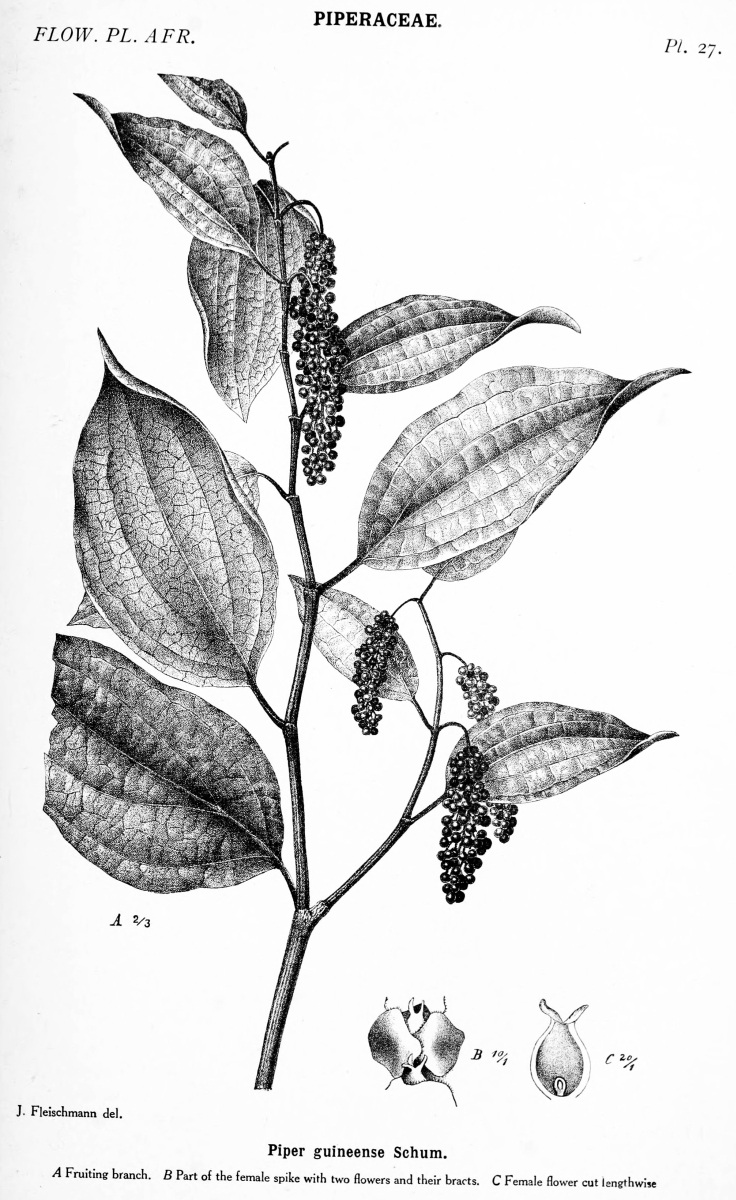
PIPERACEAE.
FLOW. PL. AFR.
Pl. 27.
J. Fleischmann del.
Piper guineense Schum.
A Fruiting branch. B Part of the female spike with two flowers and their bracts. C Female flower cut lengthwise.
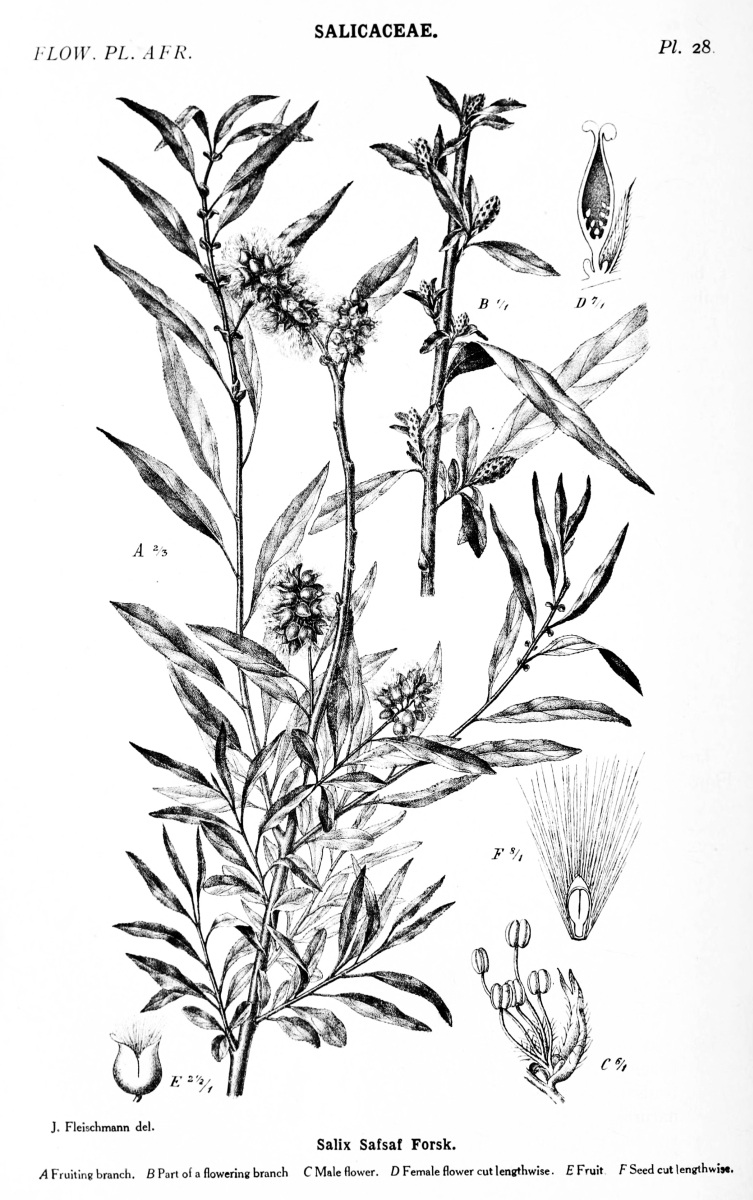
SALICACEAE.
FLOW. PL. AFR.
Pl. 28.
J. Fleischmann del.
Salix Safsaf Forsk.
A Fruiting branch. B Part of a flowering branch. C Male flower. D Female flower cut lengthwise. E Fruit. F Seed cut lengthwise.
Genus 1, species 2. Spontaneous in Madagascar and the neighbouring islands, cultivated in other tropical countries. The wood (beaf-wood) and the bark are used, the latter for tanning and dyeing and in medicine. Casuarina Rumph.
ORDER PIPERALES
FAMILY 46. PIPERACEAE
Flowers in spikes. Perianth none. Stamens 2-6. Ovary 1-celled. Ovule 1, basal, straight. Fruit a berry. Seed with a copious albumen and a small embryo.—Genera 3, species 80. Tropical and South Africa. (Plate 27.)
1. Stigma 1, sometimes penicillate. Flowers hermaphrodite. Leaves exstipulate. Herbs.—Species 65. Tropical and South Africa. Some yield vegetables or condiments or are used in medicine. Peperomia Ruiz & Pav. Stigmas 2-5. Leaves stipulate or sheathing at the base. Usually shrubs. 2 2. Flowers hermaphrodite. Spikes axillary, arranged in an umbel. Stipules united into a sheath. Shrubs.—Species 1. Tropics. Yields edible fruits containing an aromatic oil and is also used in medicine. (Under Piper L.) Heckeria Kunth Flowers unisexual or polygamous. Spikes leaf-opposed.—Species 17, two of them only in cultivation. Tropical and South Africa. Some species yield spices (pepper) or are used in medicine. (Including Coccobryon Klotzsch and Cubeba Miq.) (Plate 27.) Piper L.
ORDER SALICALES
FAMILY 47. SALICACEAE
Trees or shrubs. Leaves alternate, entire toothed or lobed, stipulate. Flowers in spikes or catkins, dioecious, without a perianth. Disc cup-shaped or reduced to scales. Stamens 2 or more. Anthers opening by two longitudinal slits. Ovary 1-celled, with two or more parietal placentas. Ovules inverted. Stigmas 2-4, sessile or nearly so. Fruit capsular. Seeds with a basal tuft of hairs, without albumen; embryo straight.—Genera 2, species 20. (Plate 28.)